Author: Sword of Damocles

Table of Contents:
Information:
- Released: 2025
- Country of Origin: China
- Price: 409 €
- Type: open, over-ear
- 80 x 50 mm planar drivers (diaphragm thickness 60% compared to Edition XS model, Stealth magnets)
- Impedance: 12 Ohm
- Sensitivity: 92 dB/mW
- Weight: 452 g
- Connection type: 2x 3,5 mm
- Cable: Length 1.5 m / connector 3.5 mm
- Accessories: ”Headphone stand” and 3.5–6.35 mm adapter
Review sample: Self-purchased product
Hifiman likes to update its headphone selection regularly, so the flood of new model versions no longer surprises at this point, nor has the manufacturer's basic concept ultimately changed much over the years. Each new model is always slightly better than its predecessor or at least different in its treble frequencies. Based on the recently launched Unveiled products, there is currently a shift from emphasized brightness towards a more balanced headphone reproduction. Structurally, however, the manufacturer's headphones are still criticized, as the impression of quality and user comfort could reach a better level. Now, with the three (four, including Audivina LE) latest headphone releases, the situation may finally be changing in this regard as well.
Hifiman recently added headphone models named Ananda Unveiled (589 €), HE600 (829 €), and Edition XV (409 €) to its selection, whose headband structure has been updated to a new type. Of the released headphones, the new Ananda expands the Unveiled theme to the sub-1000 euro price range, while the HE600 aims to be the successor to the legendary HE-6: which I also have on my shelf. I recently acquired the most affordable of the trio, the Edition XV, for testing (manufacturer's product page).
The headphone model is intended as a kind of successor to the popular Edition XS: even though its sound is said to resemble the original Edition X from 2015 more. Even if Hifiman doesn't mention it, this could be a 10th-anniversary release. In any case, the manufacturer is no longer known for warm-sounding and treble-calm planar headphones, so the Edition XV could offer something genuinely new – or rather, old – after a long time. Let's find out.
Packaging and accessories
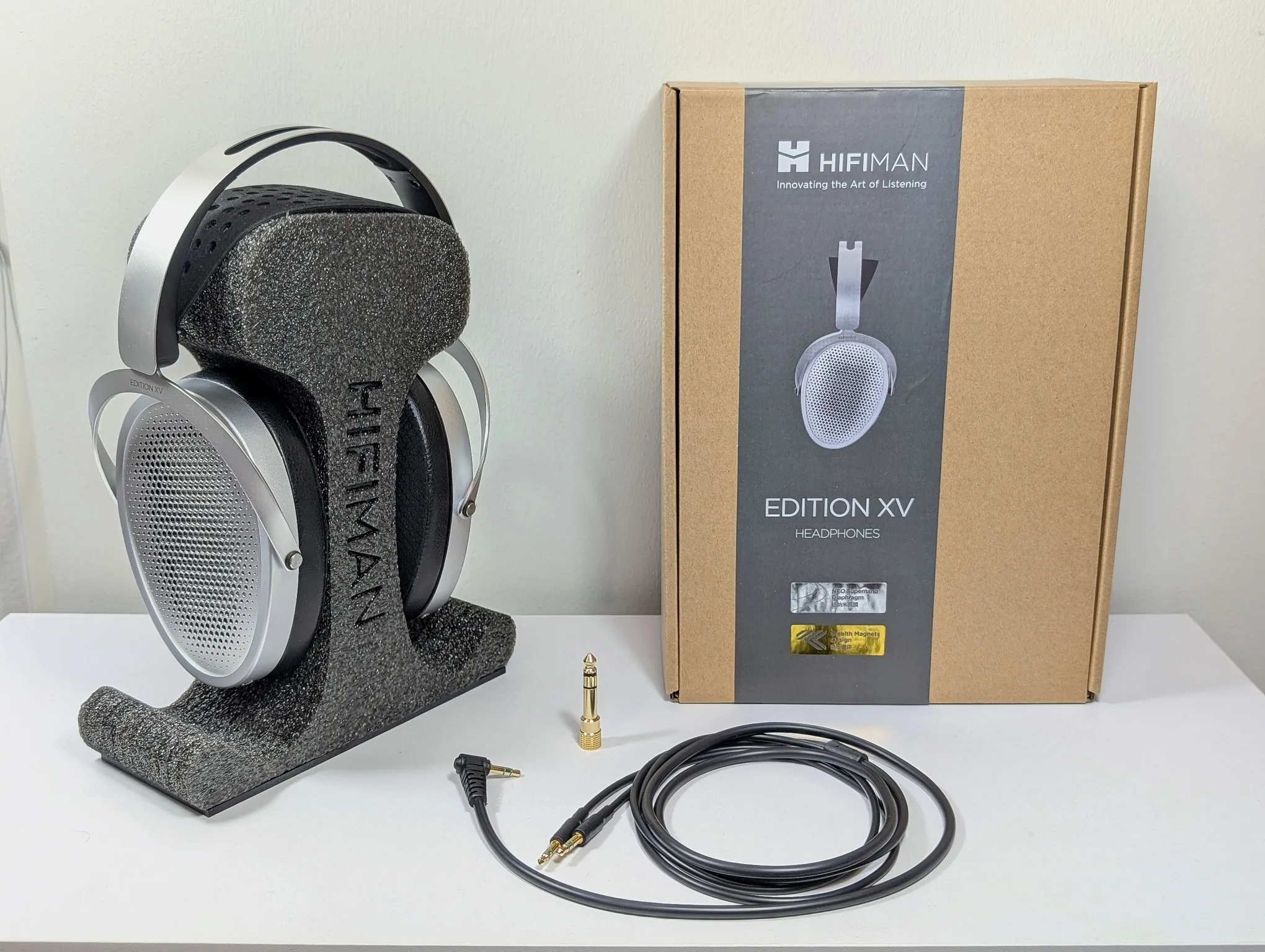
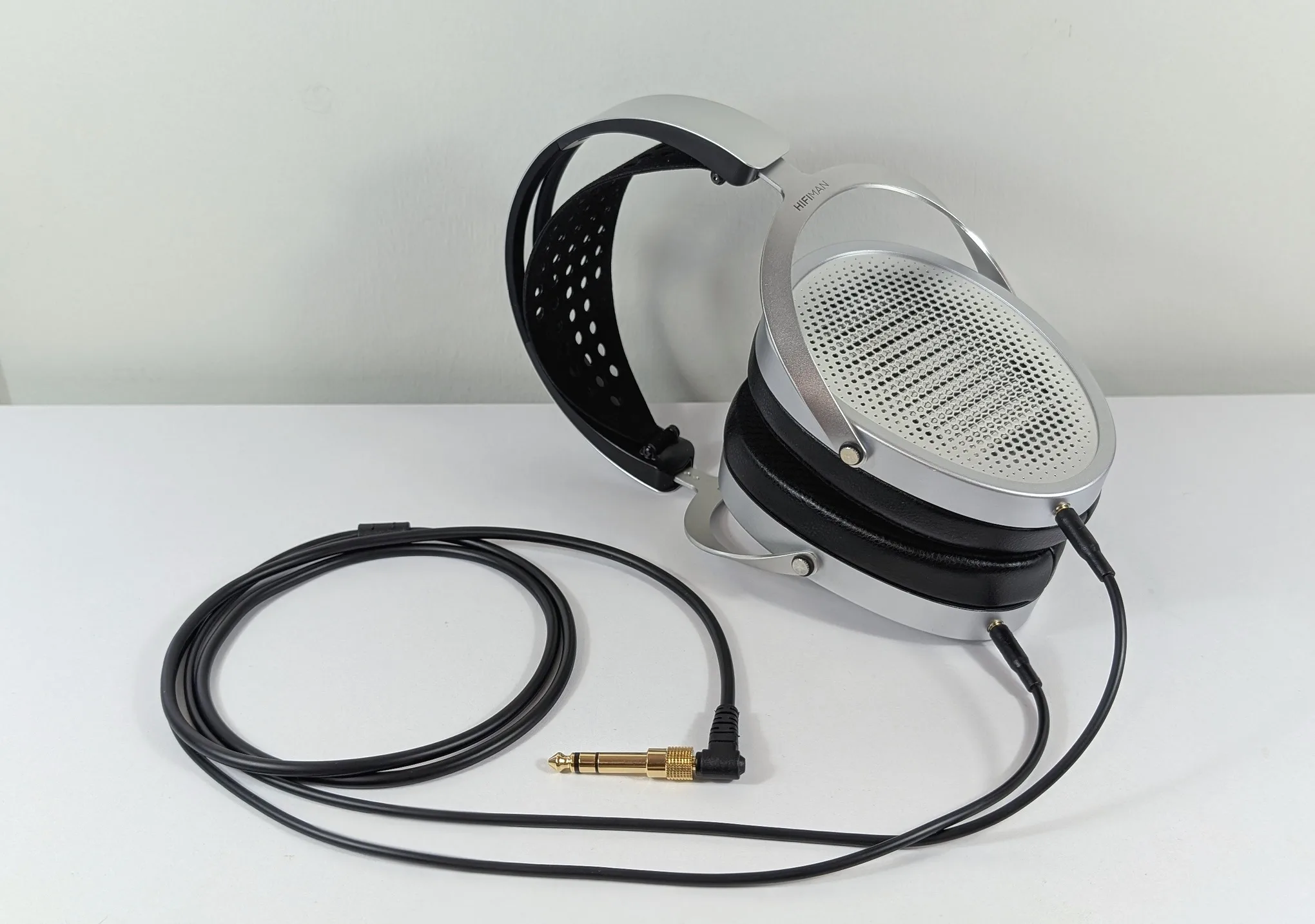
Hifiman has sparsely equipped its Edition XV model, but nothing essential is missing from the package. The headphones arrive in a brown cardboard box, the inside of which can be utilized as a rudimentary headphone stand. The 1.5-meter rubber cable, in my opinion, is the best in terms of usability among Hifiman's various options and easily beats, for example, Focal's standard cables.
Curiously, the 3.5-millimeter connector that attaches to the amplifier is set at a 90-degree angle, as if the open-back Edition XV should be considered some kind of mobile headphone. In this regard, Hifiman's logic is difficult to understand. However, with the included adapter, the headphones can also be listened to from a 6.35-millimeter connection, so most people will do well with the manufacturer's standard cable, unless a longer or balanced option is needed later.
Build and comfort
Although the sound quality of Hifiman headphones has usually been good, structurally they have lagged somewhat behind their competitors. Arya-, HE1000and Susvara-series' structure is still quite decent despite its ridiculously tall design, whereas Sundaraand Ananda-models' cups have always lacked horizontal swivel movement. Edition XS:s and HE6se V2:s familiar headband solution, on the other hand, has felt cheap and and, in many people's opinion, uncomfortably hard against the top of the head.
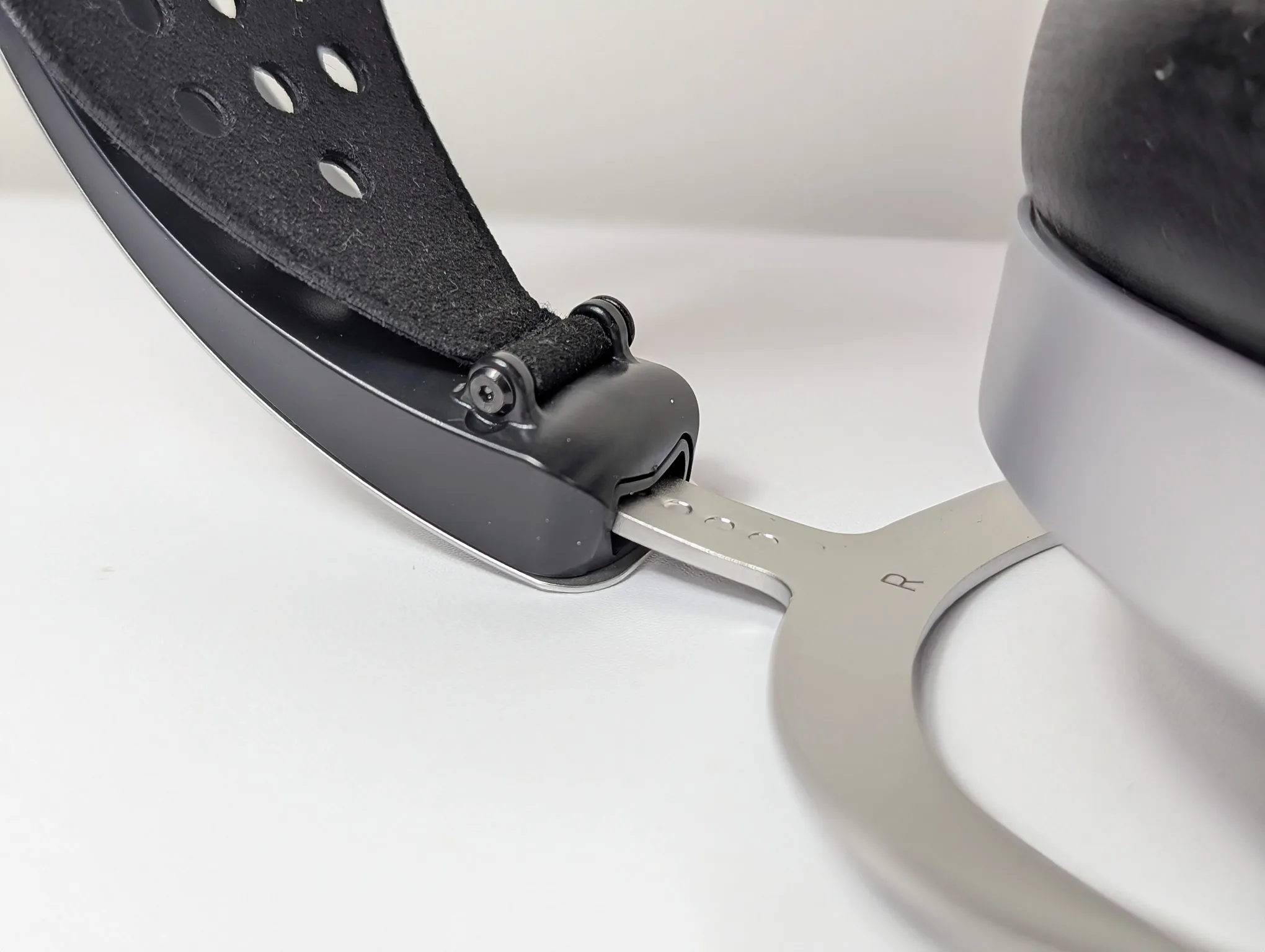
Fortunately, Hifiman has returned to the drawing board with its new models and created a new type of headband there, called the ”composite headband”. Now, similar to the Sundara/Ananda models, a separate padded strip is combined with the metal arch part, which would be delightfully easier to replace than before. The cups also swivel slightly horizontally, like the Edition XS, to improve fit, although the swivel movement is still very limited to 10–15 degrees and feels somewhat unrefined. Nevertheless, I consider the renewed structure a clear improvement over the manufacturer's previous arrangements. Both user comfort and perceived quality have improved to a good level.
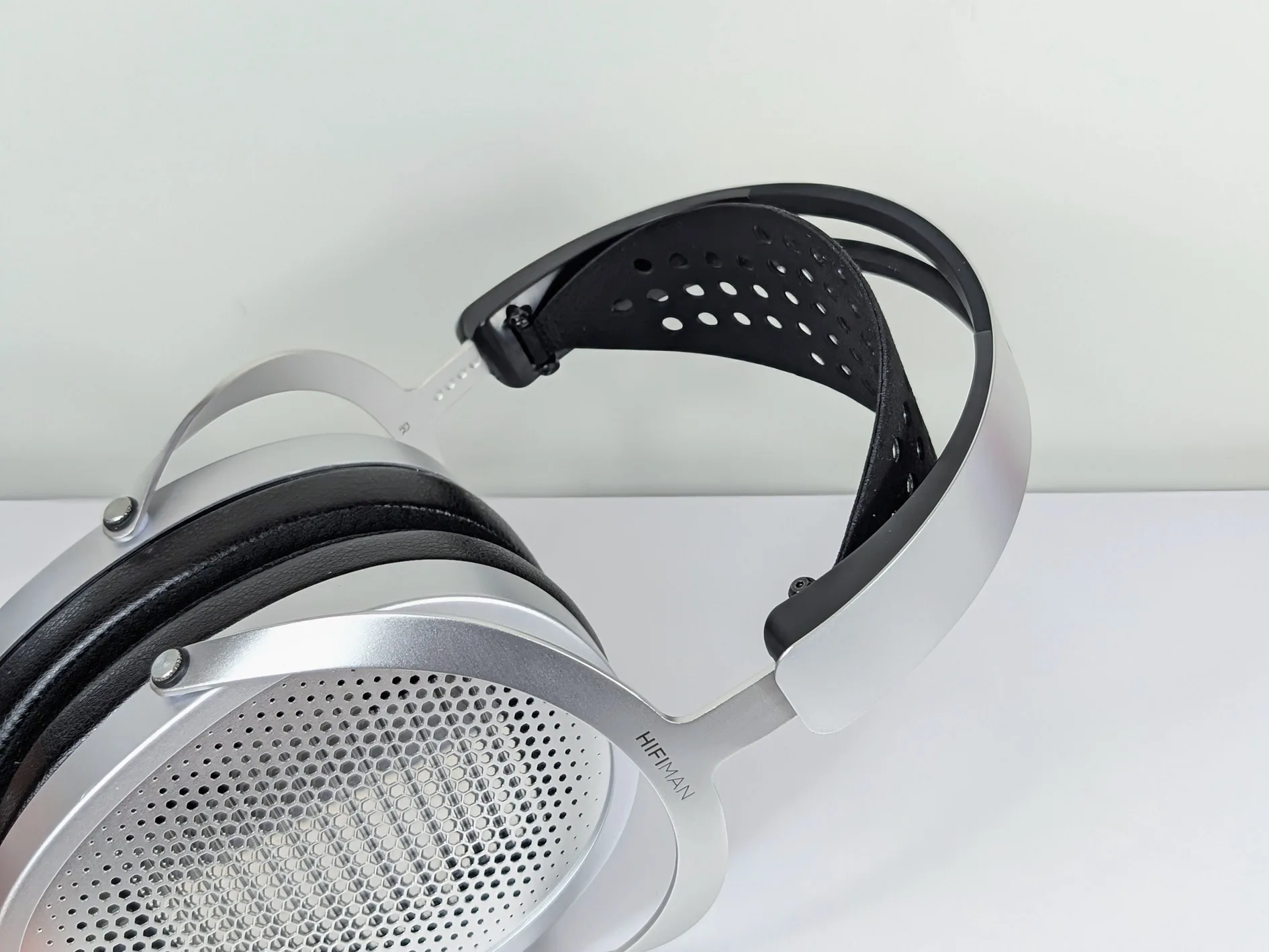
The Edition XV feels clearly sturdier in hand than the Edition XS. Furthermore, Hifiman's traditional protective grille on the side of the cups was already becoming a bit outdated, so I like the new hexagon-patterned grilles. Their silver coloring also matches the headphone frame, so the theme looks more cohesive than, for example, in Sundara Silver. The Edition XV is, in my opinion, a stylish headphone, and best of all, despite its 450-gram weight, it is also very comfortable for me to use.
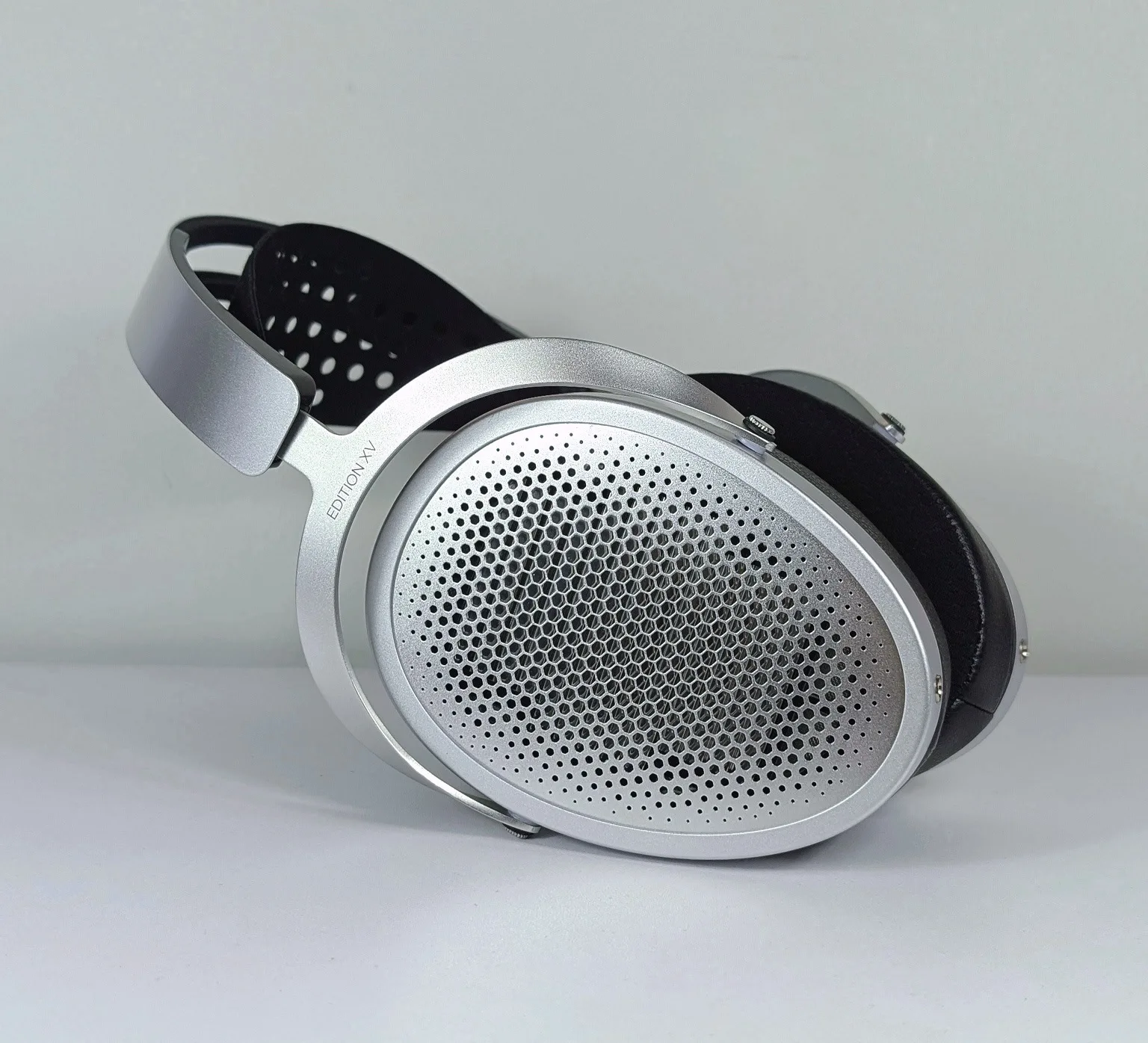
The most peculiar feature of the headphones is actually the short length of the headband's padded strip, which limits the maximum width of the structure. Since it's not possible to stretch the cups very far apart, I have to, as it were, thread my head between them. In doing so, my ears hit the edges of the pads, which makes for a strange experience. Once on my head, however, the headphones clamp quite moderately, so user comfort is good with the large and angled ear pads. Because the headband also rests widely on the top of my head, I have found the Edition XV to be quite unnoticeable, for example, during several-hour gaming sessions.
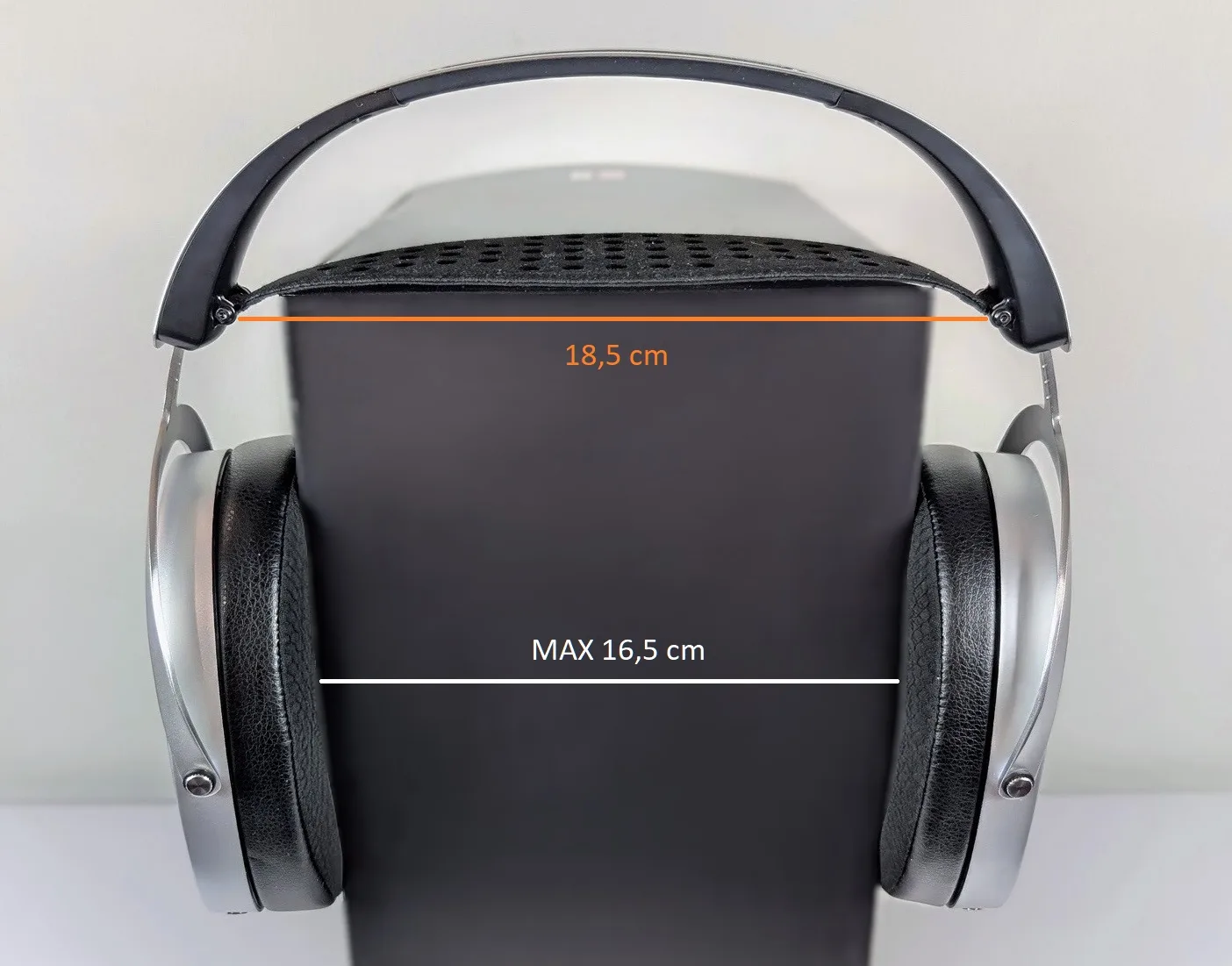
For comparison, with the new HE600 model, some have reported problematic fit because, when combined with round headphone cups, the new structure works worse in terms of proportions. Based on the Hifimessut (Hifi Fair), I myself have to adjust the HE600 almost to its maximum height to fit my head. With the Edition XV, however, half of the adjustment range still remains.
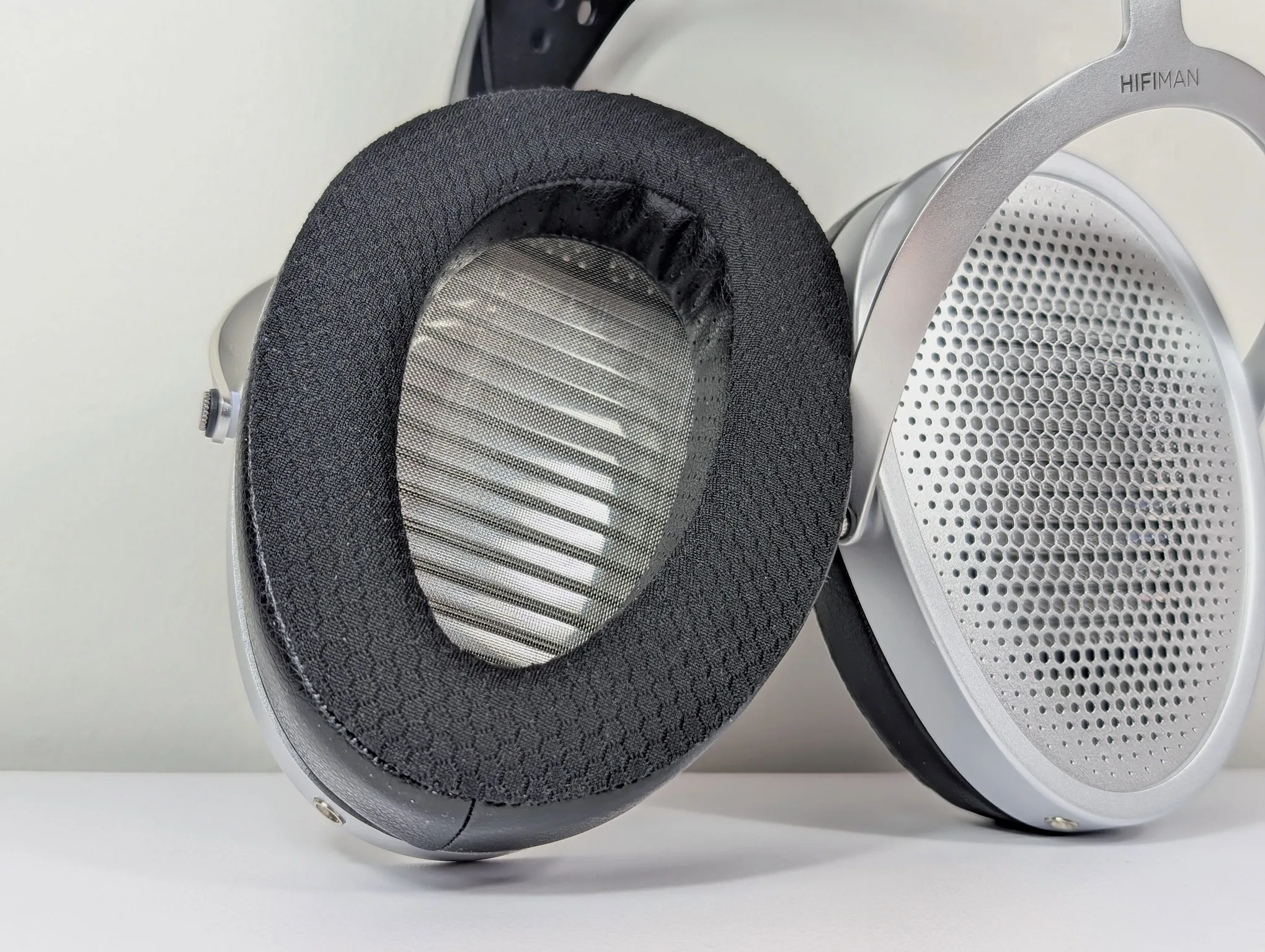
The large ear pads look the same from the outside as before, but their attachment method has been updated regarding the plastic clips. Thus, replacement pads are not yet sold for these headphones, and for example, pads designed for the Edition XS do not fit them, to my knowledge. The change is regrettable from the perspective of spare parts availability, but the clips seem more durable than before. The pads also stay attached so tightly that I haven't been able to remove them without fearing breaking something. Therefore, it's probably best to leave removal for when the pads are meant to be replaced with new ones at the same time.
Sound quality
Small updates to elements
Hifiman mentions that the planar diaphragms of the Edition XV are 60 percent of the thickness of the Edition XS diaphragms, or in other words, the diaphragms have been thinned by 40 percent. However, the manufacturer does not state the exact diaphragm thickness, but the term NEO Supernano would suggest that it is measured in nanometers instead of microns. In any case, we are talking about an extremely thin diaphragm.
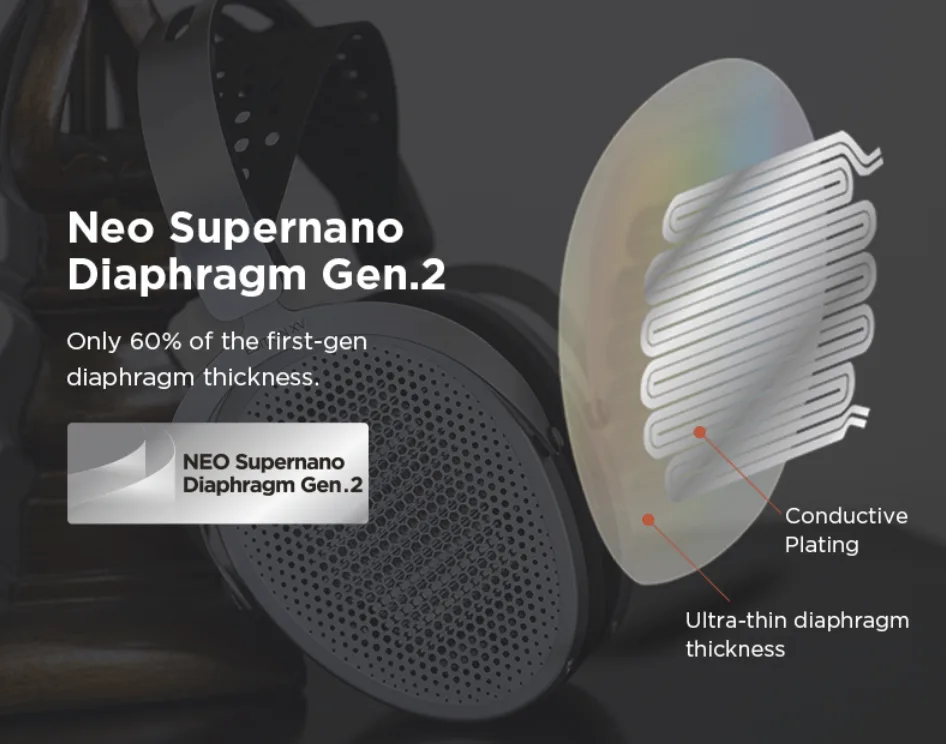
One change is that the headphones use rare-earth-free permanent magnets (marketing term ”enhanced magnets”), which should nevertheless be as effective as the magnets previously used by the manufacturer. The idea is to save rarer natural resources in a product that is not used in extreme conditions or that does not require the world's best magnets to function correctly. As usual, the edges of the magnets have been rounded (Stealth magnets) so that sound waves pass through the magnet array as freely and effortlessly as possible. Most other planar headphones also now include such magnets or some kind of additional ”air guides” similar to Audeze's Fazor technology.

The base of the Edition XV's ear pads no longer has a thin fabric layer; instead, a fairly dense metal mesh has been installed to protect the drivers. I don't believe this significantly affects sound quality, but at least in theory, it could act as some kind of high-frequency attenuator. More concretely, the metal meshes announce their presence by crackling when moving the headphones on the head. Perhaps the edges could have been stretched a bit tighter.
Impedance measurements and amping requirements
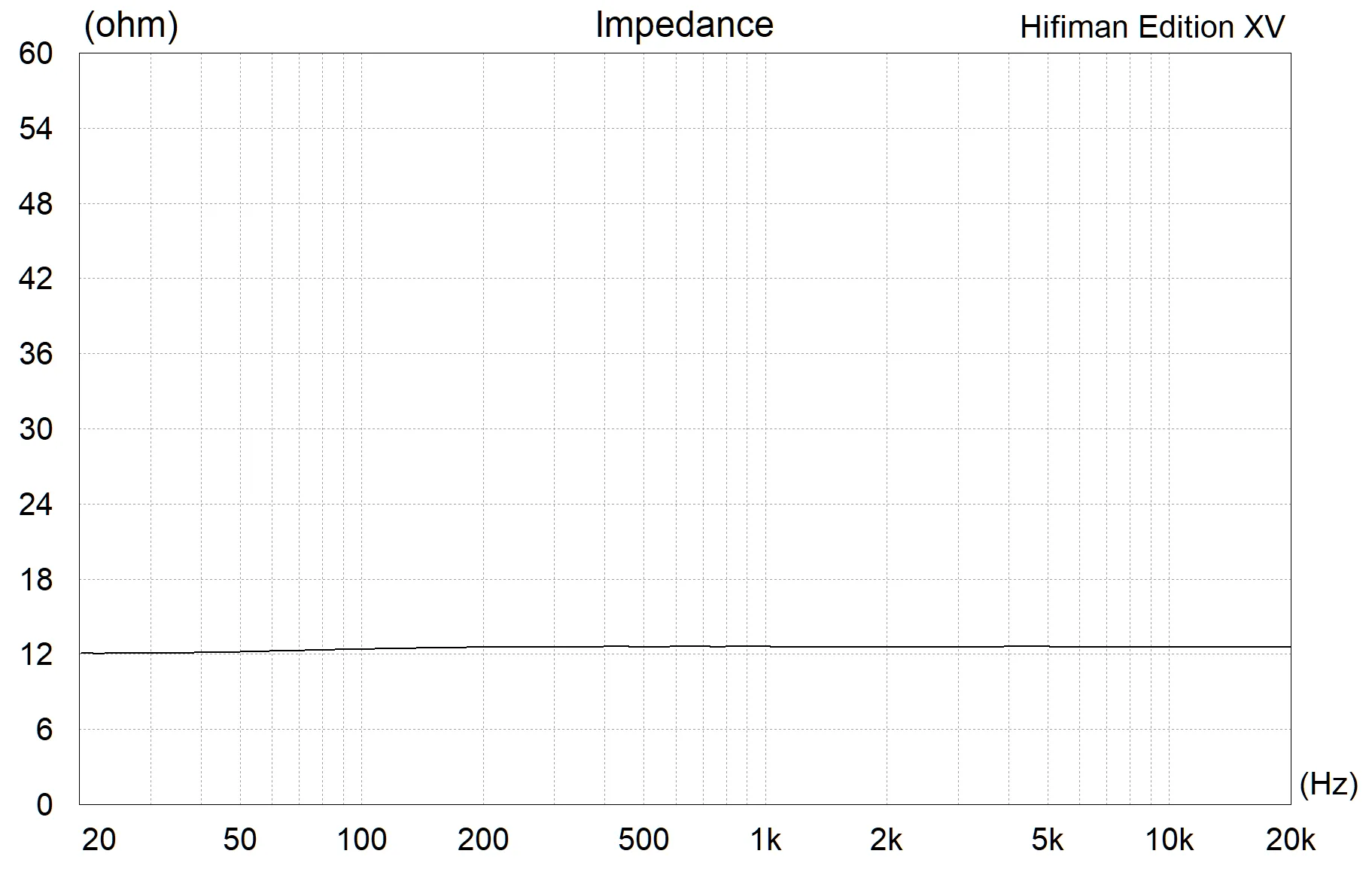
The Edition XV is not the easiest headphone to drive, as its sensitivity is relatively low (92 dB/mW), and its 12-ohm impedance can also pose challenges for the current delivery capability of some devices. Realistically, however, most transistor amplifiers released in recent years are easily sufficient, provided their specifications promise a few hundred milliwatts of output power for a 16-ohm load.
My impedance measurements confirm the headphones' impedance curve to be flat, which is expected in planar headphones unless their frequency response has been adjusted with resistors. Hifiman's stated 12 ohms also holds true. Thanks to the flat impedance, the headphones' frequency response remains unchanged, even if the output impedance of the headphone amplifier used for listening is somewhat high.
Headphone Measurements
Our frequency response measurements have been made with a clone IEC-60318-4 coupler and KB501X pinnae. The Harman target curve from 2018 is used as a reference point and generalization of the headphone response that would sound good to most people. For more information on the measurements and their accuracy, see Headphone Measurements-page. The Edition XV's frequency response is also comparable with other measured headphones Squiglink .
Frequency response:
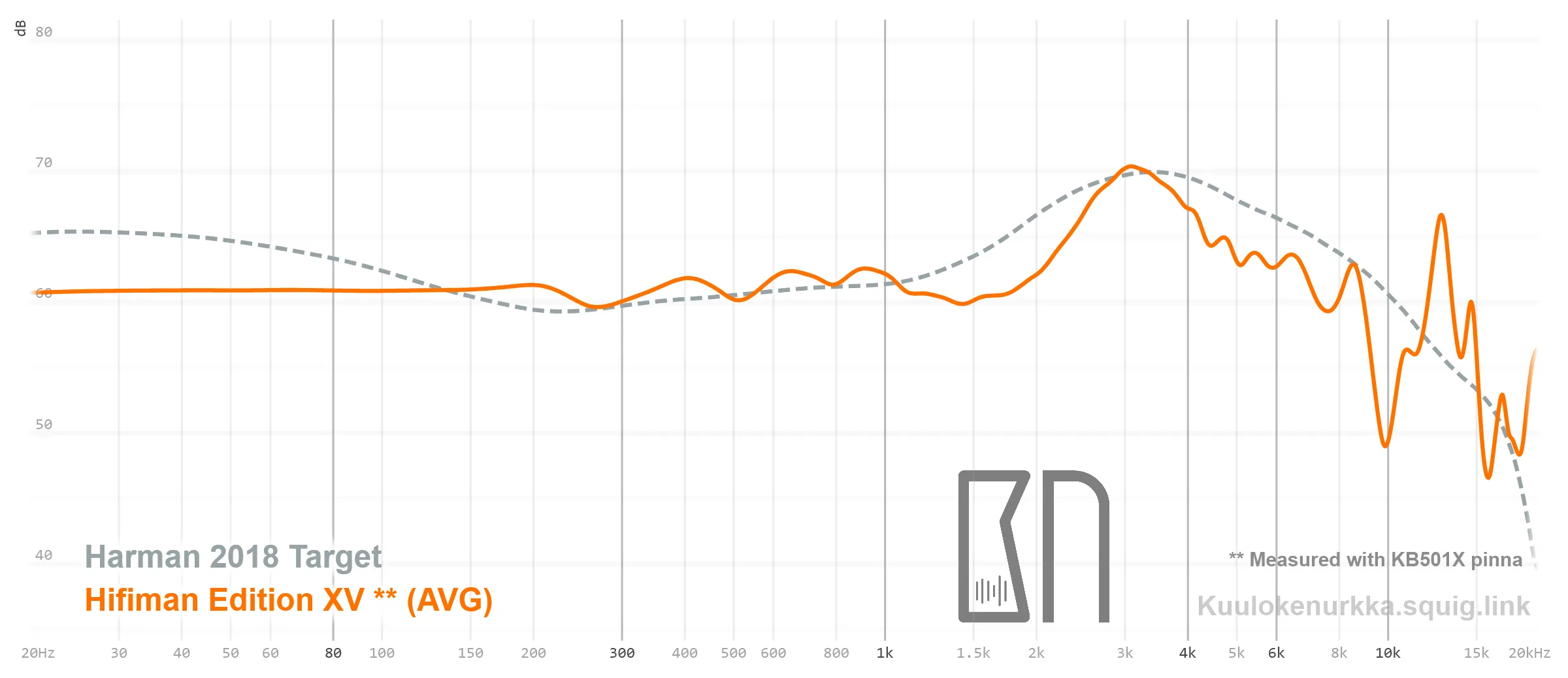
The Edition XV's frequency response still looks familiar for Hifiman with its linear low frequencies and calmly reproduced 1.5–2 kilohertz region, but between 4–8 kilohertz, it clearly deviates from the manufacturer's other current headphones. The alternating peaks and dips are gone, so the response is astonishingly flat. On the other hand, this frequency range is a few decibels below Harman's target curve in terms of energy level. Due to this characteristic and slightly elevated lower midrange frequencies, the Edition XV might be difficult to recognize as a Hifiman headphone model, as the full, relaxed, and slightly dark sound is something we are not accustomed to in the manufacturer's products. So, variation that people might be craving is now available.
Planar driver modal phases:
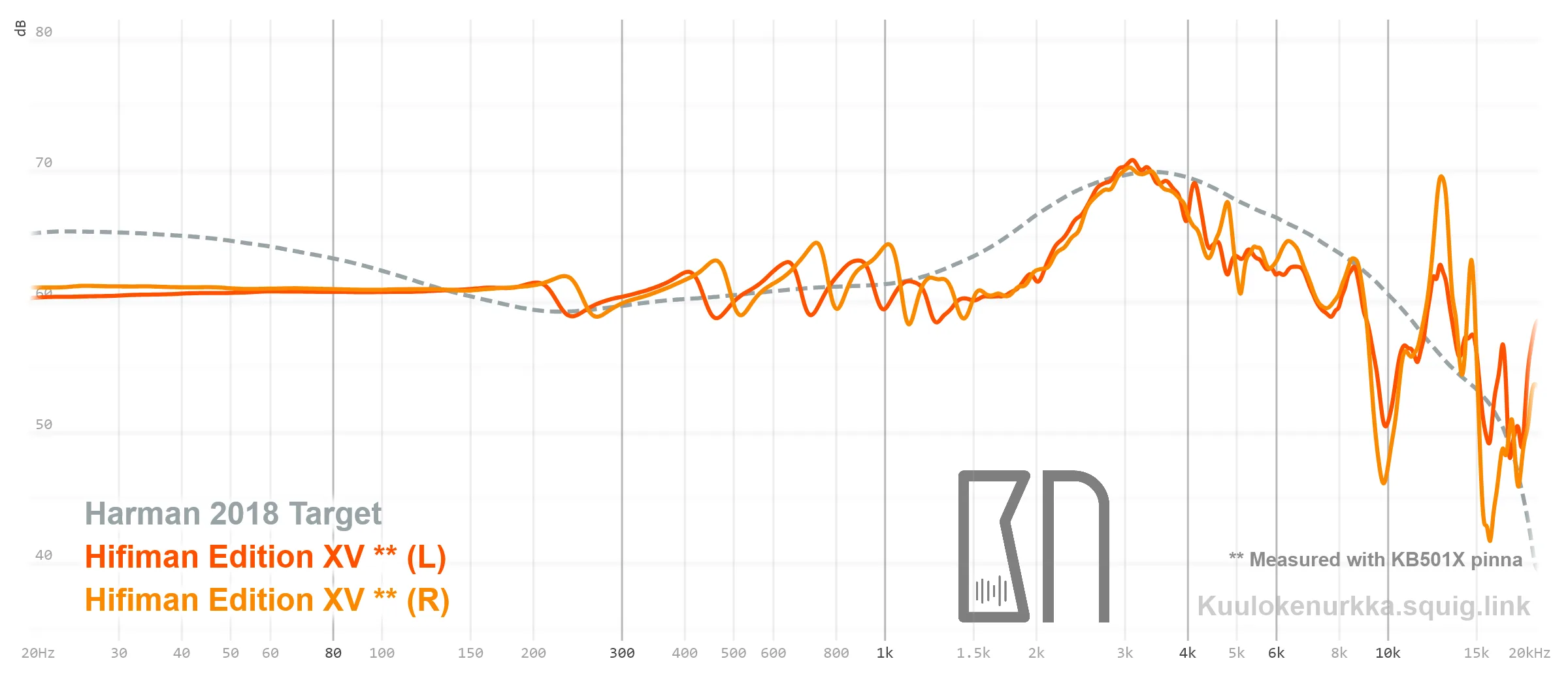
The frequency response of planar drivers often looks quite rough when unsmoothed due to local irregularities, as is the case with the Edition XV. The sawtooth-like vibration visible in the midrange and partly between 2–6 kilohertz is due to the modal phases of the drivers and can vary under different test conditions. The phenomenon is fundamentally about a large flat diaphragm starting to "live its own life," so to speak, due to structural resonances, causing it to vibrate inconsistently at different frequencies. Different parts of the diaphragm can even move in different phases relative to each other.
Headphone manufacturers can mitigate this by, for example, damping the drivers from the front and back (various foam and felt materials), which reduces the resonances affecting the diaphragm's operation. Other acoustic design solutions also influence the steepness and extent of such vibration patterns. Hifiman, however, is among those manufacturers whose drivers are often almost bare on both sides, making vibration due to modal phases evident in measurement results. On the other hand, the undamped nature of the drivers can simultaneously offer sound quality benefits.
Fortunately, the human ear can equalize and round off the sound it hears, so such frequency response unevenness largely goes unnoticed when listening to headphones. I wouldn't see this as particularly worrying in the Edition XV, even though, for example, vibration caused by modal phases is heavily frowned upon on the Audio Science Review forum.
Sound observations
The Edition XV is therefore a headphone that doesn't sound entirely like a traditional Hifiman, but rather somewhat fuller and more relaxed. Released in 2021, Edition XSthe same characteristics are noticeable in the low frequencies, but its sharper treble and the airiness of the soundstage draw more attention. The Edition XV, on the other hand, presents music more calmly and smoothly, or in a way, more safely. Thus, those who prefer the most detailed sound and an airy soundstage might find the presentation a bit subdued and therefore prefer, for example, the Edition XS. Different styles always have their own strengths and compromises. The Edition XV may not excite with its energy or clarity, but its listening experience is intentionally very effortless and pleasant without the tuning deviating too much from the so-called neutral sound.
Those who have previously found Hifiman headphones to have a light sound would surely appreciate the firmer and warmer grip in the low frequencies of the XV model. The bass kicks more robustly than, for example, in the Sundara and Ananda models of past years, but it doesn't sound overly bloated like, for example, Meze Audio Empyrean/Elite. On the contrary, the robustness stays perfectly in its own territory, so I don't perceive any muddiness. Good examples would therefore be Audeze's traditional LCD series and the Ukrainian SASH Tres. The sub-bass in the Edition XV is reproduced typically for open-back planar headphones, completely linearly, so those who prefer Harman-style physicality would have to turn their attention to an equalizer or some kind of bass control. However, this is not a criticism of Hifiman, but rather commonplace for many open-back headphones.

The Edition XV adds power to instruments and vocal performances because the so-called fundamental frequency is slightly boosted, while harmonics are softened. Thus, when listening, the main attention is drawn to the basic body and initial part of the instruments, while smaller nuances remain somewhat hidden or at least do not stand out as sharply and distinctly as with brighter-sounding headphones. This generally makes the presentation relaxed, though at the same time, in a negative sense, slightly rounded. Usually, smaller details would not be mixed quite as far into the background, so the Edition XV often, as it were, tames the music. On the other hand, I think this slightly more robust and calmer presentation works well as it is, as long as one doesn't expect Harman curve-like energy from the headphones.
For comparison, the similarly warm Sennheiser HD650 reproduces the 1.5–2.5 kilohertz range more present, so in comparison, the Edition XV can sometimes sound even a bit distant. Also, the airiest part of the human voice is slightly lacking, meaning, for example, female vocalists don't sound the brightest. Conversely, the voices of many low-pitched singers become even thicker. However, these are minor nuances, as often vocal performances still give me goosebumps due to the power and warmth imbued in the sound. Everyone should really get to evaluate this kind of tuning and presentation with their own ears.
I personally find the soundstage of the Edition XV somewhat peculiar, as the airiness of many other Hifiman models is partly missing, yet the headphones still sound large and tall, as if the sound originates from the walls next to me. At its best, the presentation feels wonderfully powerful. The sound also has a nice depth, because the ”calming” of the upper mid-frequencies pushes the vocalist, in particular, a bit further back in the overall sound. This, however, required some getting used to for me, because for some reason, vocal performances occasionally feel intimately distant and close at the same time in an odd way. However, it may be that many others would not perceive it the same way. Although I don't find the Edition XV's soundstage particularly wide in the lateral direction, the height of the reproduction adds interest to the listening experience. Despite their relaxed sound, the headphones keep me well engaged.
The smoothness of the high frequencies is a clear advantage over many competitors. I haven't noticed anything irritating popping out of the treble, even if I use slightly brighter-sounding ancillary equipment or listen to rougher quality music. The situation is therefore very safe, for example, regarding sibilance. Likewise, for those who equalize their headphones, the Edition XV would be an easy case, as with three or even two filters with a wide Q-value, a more neutral result could be achieved if necessary. I myself might add energy especially around 2 kilohertz, because its lack hurts the Edition XV more than many other Hifiman models, which compensate for softness with their brighter treble.
All in all, I think the Edition XV is a very welcome variation to the manufacturer's headphone lineup, as most other models have followed the same basic idea with minor nuanced differences. Thus, a certain novelty appeal has already faded in recent years, for which such a larger departure serves as a good remedy. If Hifiman headphones have sounded too bright to someone, or if a large amount of treble is not generally to their liking, the Edition XV would be a headphone worth considering. On the other hand, if someone only wanted a small fine-tuning compared to, for example, the Edition XS or the two previous Ananda models, the new XV model might be too big a stylistic change. It should be perceived primarily as a different headphone, as superiority is still largely a matter of taste.
Peripheral device notes
With its smooth and relatively calm treble, the Edition XV is almost better suited for a bright-sounding listening chain than as a companion to devices that further soften the sound. On the other hand, all kinds of neutral pairings also feel appropriate, so the headphones are not particularly picky about equipment choices. Transistor amplifiers are rarely so warm in their presentation that I would foresee problems with them and the Edition XV.
I listened to the Edition XV, among other things, Luxsin X9 with a combination device, whose slightly bright sound signature via balanced connections compensated well for the headphones' relaxedness – if, that is, the goal was to make the presentation more neutral and lively than the starting point. For balanced listening, I unfortunately needed a separate cable, as Hifiman does not supply one with their headphones. In any case, I found myself getting even slightly more excited about the Edition XV with the Luxman X9 than with my current primary setup, which includes a Topping Centaurus DAC and Gold Note HP-10 -amplifier.
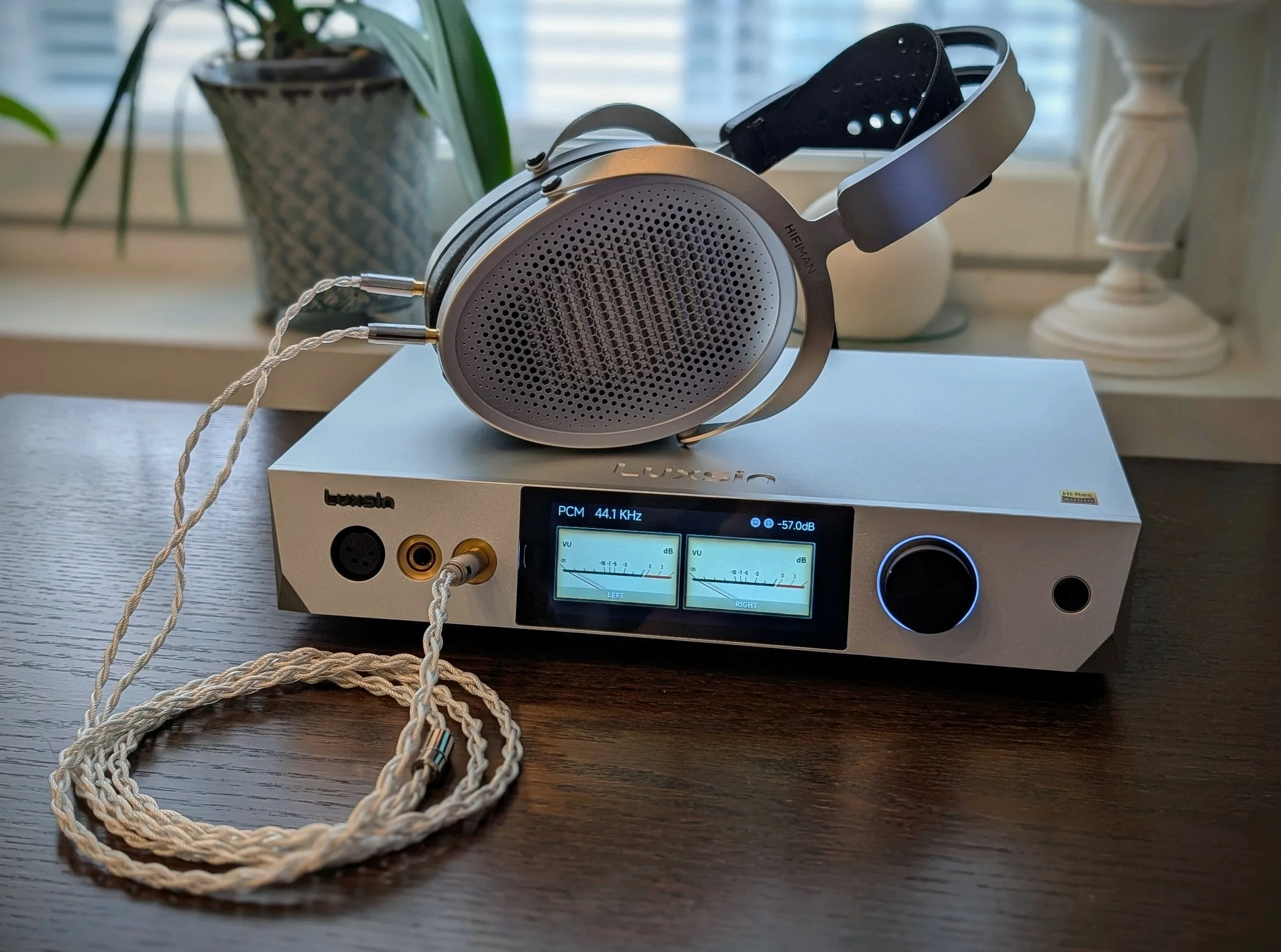
My more expensive equipment makes the headphones sound very refined, but perhaps even too much so. I suspect that also Aune Audio S17 Pro and Ferrum Audio OOR might make me tell the same story. Luxman's X9, on the other hand, added energy to the high frequencies and thus made the soundstage feel a bit more open. With the Centaurus DAC, Cayin iHA-6-amplifier also produced a sharper result than the Gold Note HP-10, but the difference ultimately remained very small. With these headphones, I didn't find it particularly easy to notice differences between devices in general, although small tonal differences were achievable. With sound adjustments like those on the Luxman X9 or Gold Note HP-10, even greater changes could certainly be made.
However, a buyer of the approximately 400-euro Edition XV will likely own/acquire some kind of more affordable amplifier, so I also tried the headphones with SMSL DL200, Topping DX1:, Qudelix 5K: and directly from the Macbook Air's (M1) headphone jack. With none of these did the bass become muddy or the treble irritating, but the soundstage became slightly different. Frankly, I didn't particularly like the DX1, because despite a balanced sound, the soundstage was almost completely absent. The sound thus played as if from a single point inside my head. The DL200, on the other hand, expanded the sense of space and thus automatically added separation and liveliness to the reproduction. Compared to the DX1, the treble also sounded suitably sharper, so I considered the result to be very good.
The battery-powered Qudelix 5K sounded slightly lighter and softer through its 3.5mm headphone jack, but when balanced, it performed very comparably to the DL200. If needed, a Macbook would also clearly suffice as an amplifier, as the Edition XV played loudly through its headphone jack and sounded very good. The sound did not lack power, nor did the treble distort or show signs of running out of output power. Generally speaking, mobile devices should not have major challenges with 20-ohm headphones, as long as they are not tried to be played at volumes over 100 decibels.
Comparison: Hifiman Edition XV vs. Fiio FT7
Prices: 410 € vs. 750 €
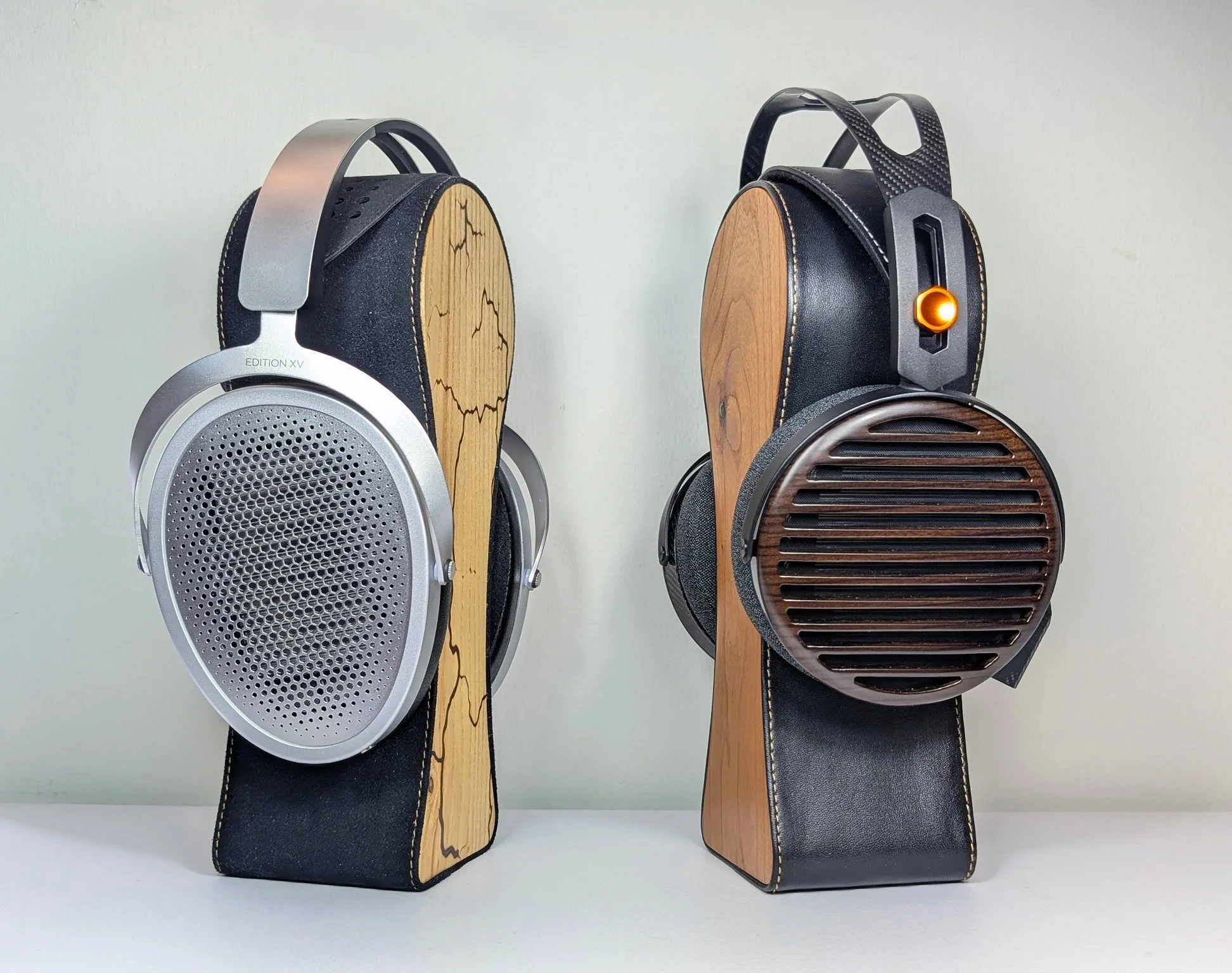
Let's start the pair comparisons with the recently featured in Kuulokenurkka Fiio FT7: which costs 340 euros more than the Edition XV. The price difference is likely explained at least in part by the FT7's more exotic materials, such as carbon fiber and wood. Its planar drivers also have a slightly more complex design with conductor material combining gold and silver. In practice, however, the FT7 feels looser in structure and more wobbly on the head, and despite its flimsier materials, it weighs only a modest 25 grams less. At this point, the simplicity of the Edition XV is an advantage. It sits more securely on my head and retains my chosen height setting, unlike the first batch of the FT7, where the padding slides upwards.
In terms of amplification needs, both headphones seem quite identical, although depending on the amplifier, the FT7 may play slightly louder at the same volume setting due to its higher sensitivity. In terms of accessories (case, extra ear pads, expensive cable, multiple adapters), Fiio's headphones are also significantly ahead of Hifiman, although I find the Edition XV's shorter and lighter cable clearly more practical.
Frequency responses:
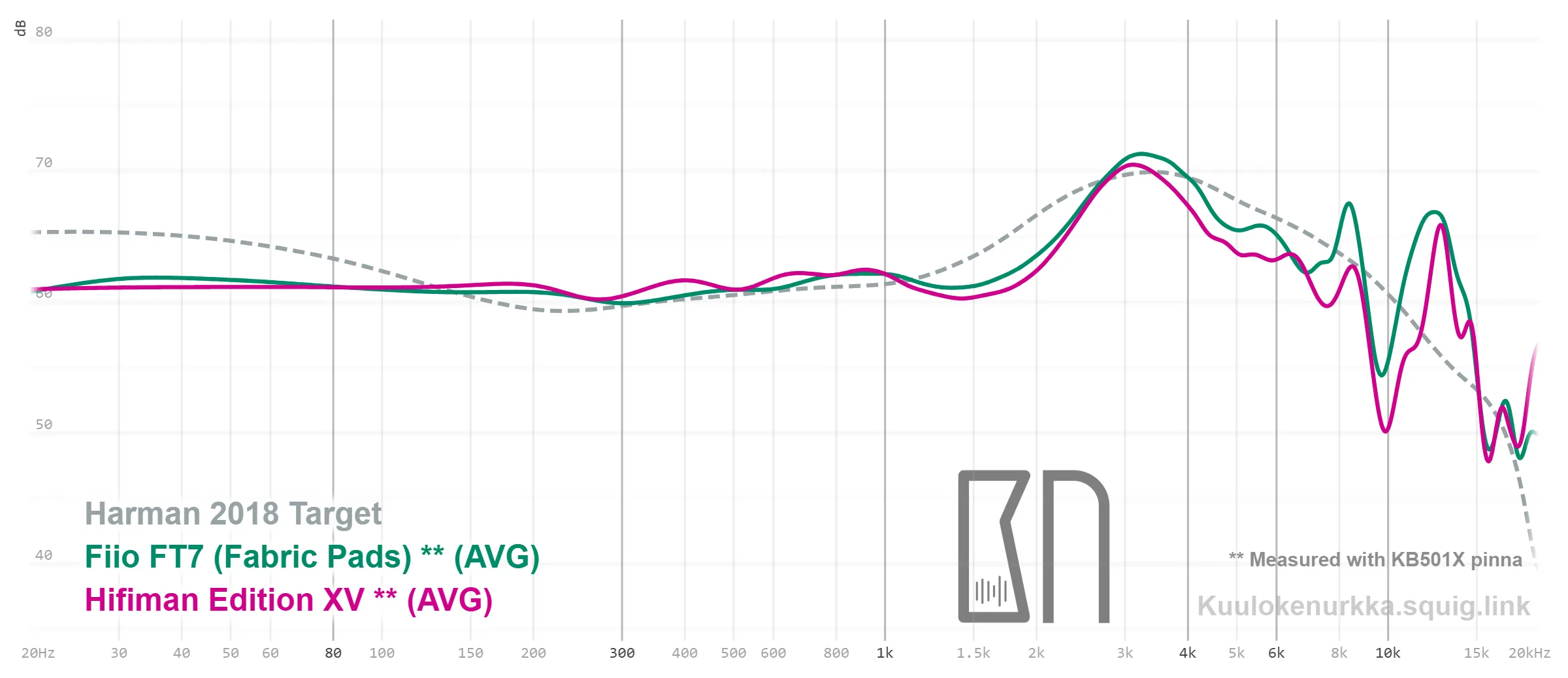
Fiio's headphones reproduce sound more energetically and brightly, because the familiar characteristics of the Edition XV are realized more moderately: the lower mid-frequencies are not as robust in the FT7, nor are the high frequencies as calm, and the 1.5–2.5 kilohertz ”dip” does not become as deep. Thus, the sound is more neutral and resembles Hifiman's older headphone models, such as the Edition XS and Ananda. At the same time, the FT7 also suffers from similar treble peaks, which have been completely eliminated in the Edition XV.
The clearest advantages of the FT7 are a soundstage that feels transparent and airy, and the precision of reproduction. The separation of sounds is clearly sharper, and the details contained in the music are presented more strikingly. On the other hand, a more airy and fresh presentation does not, however, make the FT7's soundstage significantly larger, which is ultimately somewhat disappointing. Although the Edition XV's reproduction is quite soft and dark in a comparative situation, it feels larger and more powerful. Music flows forward more smoothly and less mechanically, while the FT7 sounds a touch dry and, at times, less pleasant due to its splashy treble. However, I personally do not find Fiio's headphones irritatingly bright when listened to with suitable equipment; rather, I find them more relaxed than, for example, the Edition XS.
When listening to high-quality music, the FT7, with its meticulousness, makes a greater impression on me by bringing out small production nuances and the vocalist's articulation more precisely. This creates a stronger memory imprint compared to the more rounded-sounding Edition XV. If, on the other hand, I listen to, for example, more robust modern rock, the Hifiman model creates more sound pressure in the reproduction and excites me more. Although the Edition XV is not as detailed as the FT7, its ability to smooth out the sharpness of music makes it an excellent choice for more relaxed listening. The Fiio model inevitably sounds more analytical, which it is probably intended to be. The two presentation styles ultimately differ quite a lot from each other, even if the difference based on frequency responses is not huge.
In summary, both headphones are good in their own way. Transparent and separated hi-fi reproduction is better realized with the FT7, while a more relaxed and in a certain way more analog presentation style is found with the Edition XV. The Hifiman model quickly charms with its warm appeal and also adds more power to the sound, while Fiio's headphones handle sudden changes in direction more agilely. The FT7 actually offers precisely the advantages that Hifiman's brighter headphone models would also offer compared to the Edition XV. Since this has been heard before, the Edition XV, in my opinion, has more novelty value.
Comparison: Hifiman Edition XV vs. Hifiman Sundara Silver
Prices: 410 € vs. 259 € (current established market price)
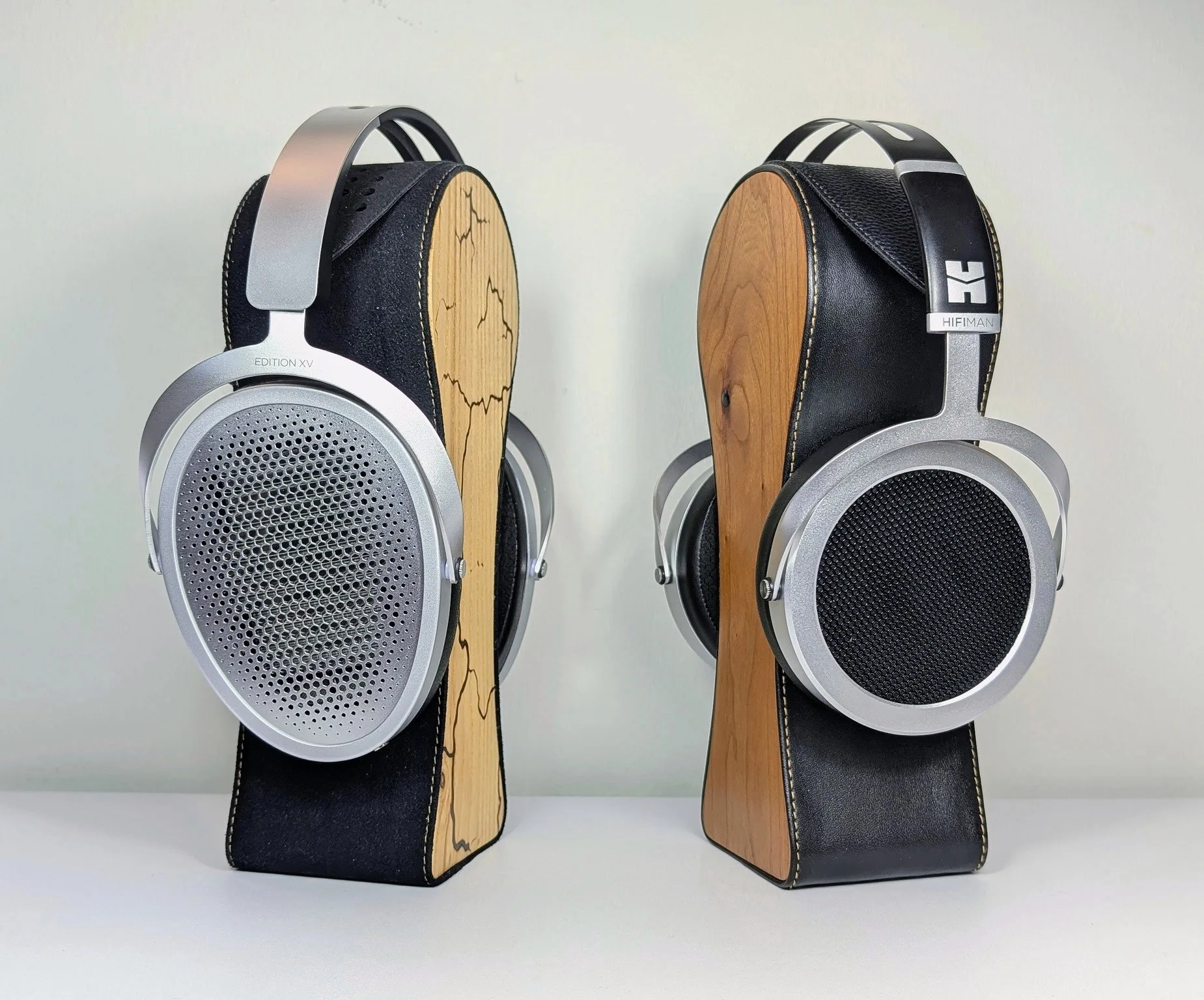
As a second comparison, I chose Hifiman's own Sundara Silver, whose market price has dropped from over 400 euros to about 260 euros. Thus, by purchasing it, one would get slightly slimmer planar headphones for 150 euros less. In terms of materials, the Sundara is even slightly higher quality, as its cups are aluminum. On the other hand, the headband lacks horizontal swivel movement, so the Edition XV might sit on the head a touch more evenly in addition to lighter clamping force. Ultimately, however, comfort is pretty much even, as the Sundara Silver weighs 100 grams less.
Despite its smaller planar drivers, the Sundara model requires more amplifier power to achieve the same volume as the Edition XV, assuming the amplifier is more powerful with a 12-ohm load than a 32-ohm load. The sensitivity for both headphones is stated as the same 92 dB/mW. Interestingly, the Sundara comes with a carrying case and a longer cable, so the Edition XV's accessories feel sparse in this context as well.
Frequency responses:
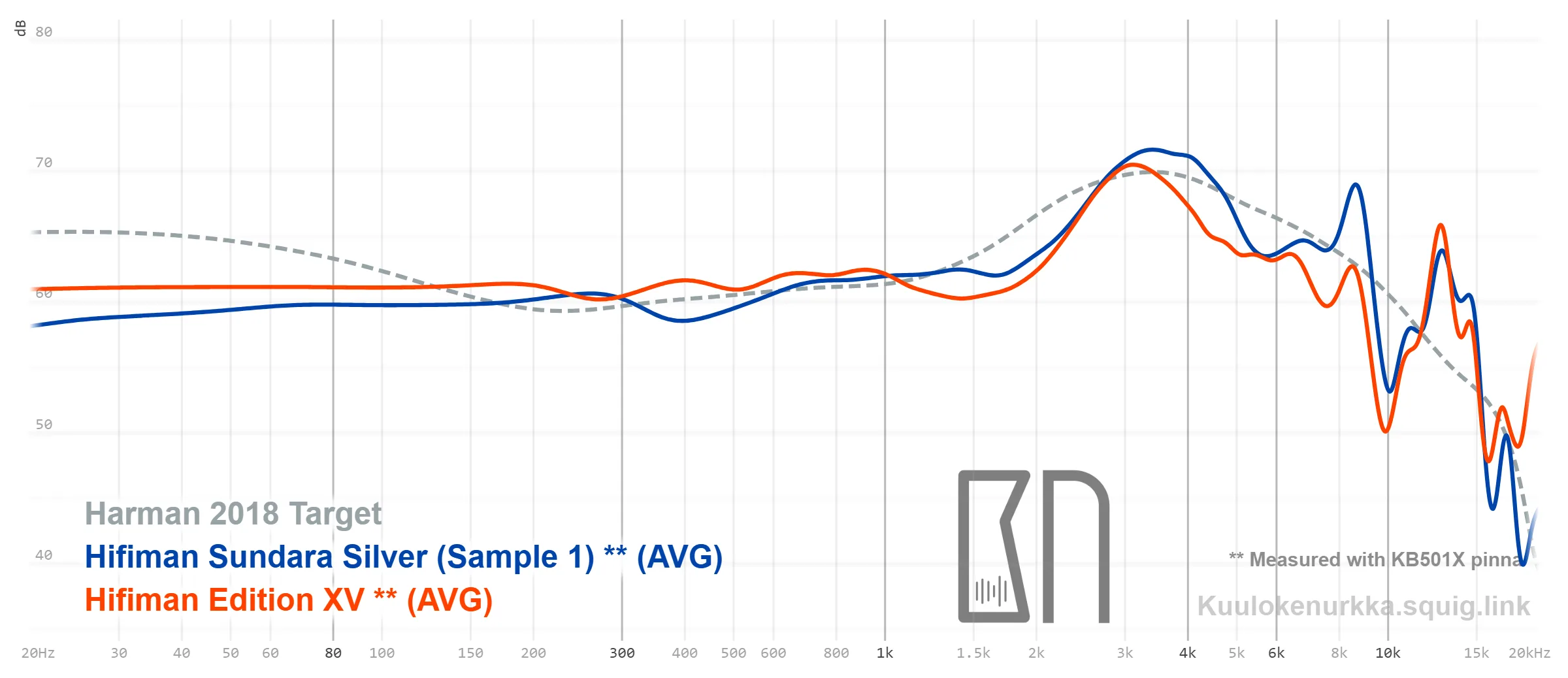
Hifiman Sundara Silver and Edition XV represent very different approaches to sound reproduction, even though both headphones are manufactured by Hifiman. The Sundara Silver offers a livelier and more analytical sound profile, while the Edition XV focuses on a fuller and more relaxed listening experience. The former thus emphasizes high frequencies, and the latter low frequencies.
The Sundara Silver sounds energetic and fresh, presenting music clearly and with a kind of brisk dynamism. Instruments have more bite, and for example, drum skin impact sounds are reproduced more powerfully. Vocal performances also sound more present and thus, in my opinion, slightly more realistic. On the other hand, the overall presentation is thinner and lighter than the Edition XV, and the treble can even be a bit splashy in places. The sound signature, in my opinion, remains a touch cold and overtly hi-fi-oriented when compared to headphones like the Edition XV.
The Edition XV's more robust and calmer reproduction makes it easier to listen to. On the other hand, it doesn't sound boring next to the Sundara Silver either, because I enjoy its kind of sense of grandeur. The sound has a completely different kind of power emanating from the low frequencies, and the soundstage feels distinctly taller. The Edition XV thus feels like a large muscle car, while the small Sundara Silver has to rev at high RPMs. I don't know if the comparison makes any sense, but at least it's fun to think about it this way.
Although the Edition XV doesn't sound as detailed or energetic, I believe it succeeds in creating a more pleasant and relatable atmosphere with its warm sound and larger-feeling soundstage. I already reiterated Sundara's advantages in the same sentence: it is a more traditional Hifiman.
Comparison: Hifiman Edition XV vs. Fiio FT1 Pro
Prices: 410 € vs. 250 € (Ordering from China under 200 €)
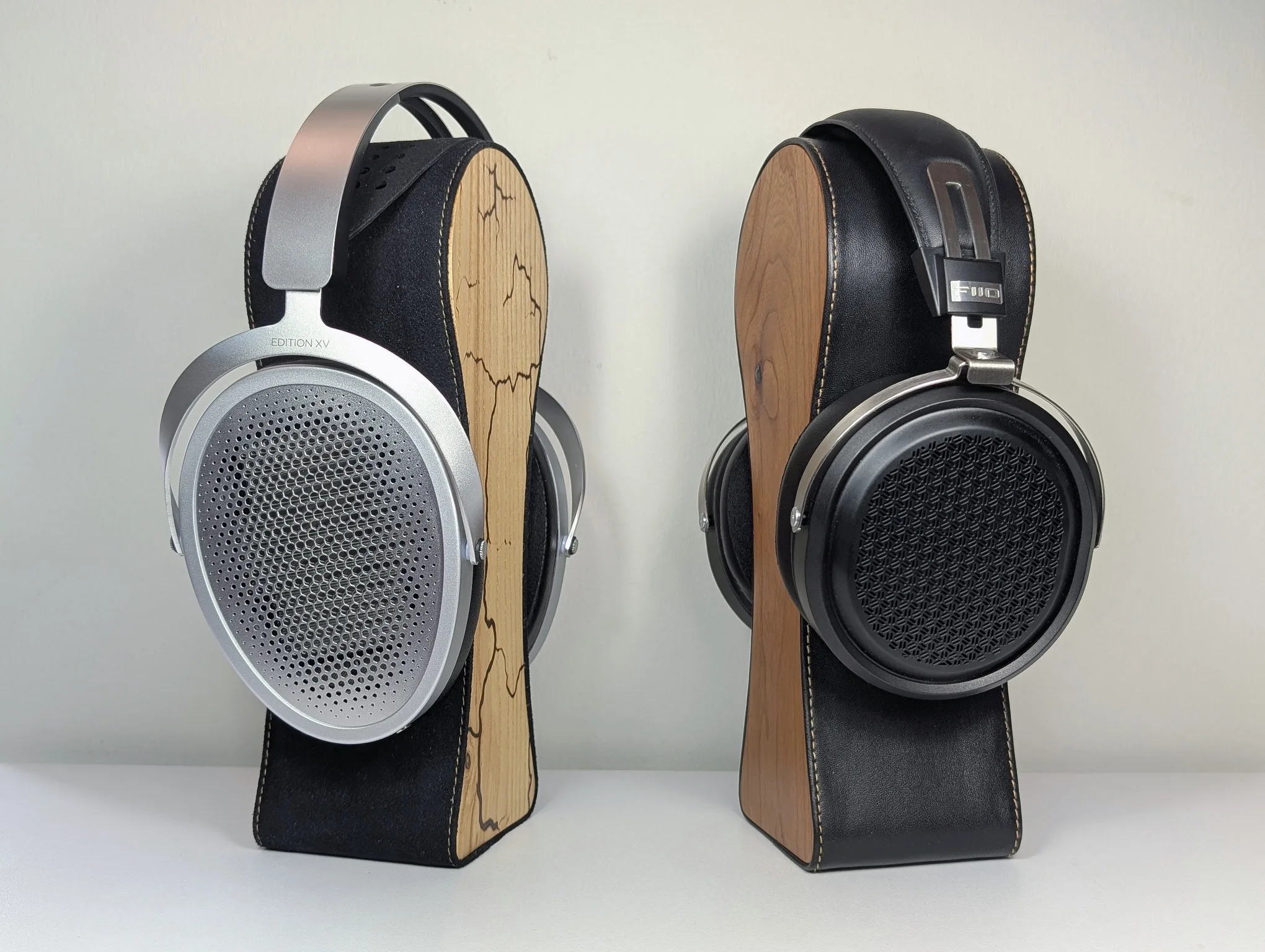
The Chinese Fiio's product range also includes a more affordable FT1 Pro -planar headphone, which can be bought for as little as under 200 euros or from Finland for 250 euros. Fiio's quality control failed at the time of the FT1 Pro's release, but nowadays, to my knowledge, the worst problems have already been fixed. Although my own pair of headphones does not reproduce sub-bass completely cleanly and it may break in the future at the joint of the headband and forks, the comparison is still possible.
The FT1 Pro weighs about 75 grams less than the Edition XV and also sits quite gently on my head. However, the poorly padded headband becomes the biggest weakness from the perspective of comfort, so in the long run, the Hifiman model is more comfortable for me despite its higher weight. In terms of build quality and sturdiness, the Edition XV also feels quite clearly a higher quality product, whereas the FT1 Pro corresponds to its own lower price range. On the other hand, as a nice bonus, Fiio offers a clearly more comprehensive set of accessories for its headphones, which includes a sturdy case and two cables. One of these is even balanced.
From an amplification perspective, the FT1 Pro is a slightly easier headphone because its sensitivity is higher (95 vs. 92 dB/mW) and its impedance is a gentler 20 ohms for most devices. However, there is no significant difference in volume between the two.
Frequency responses:
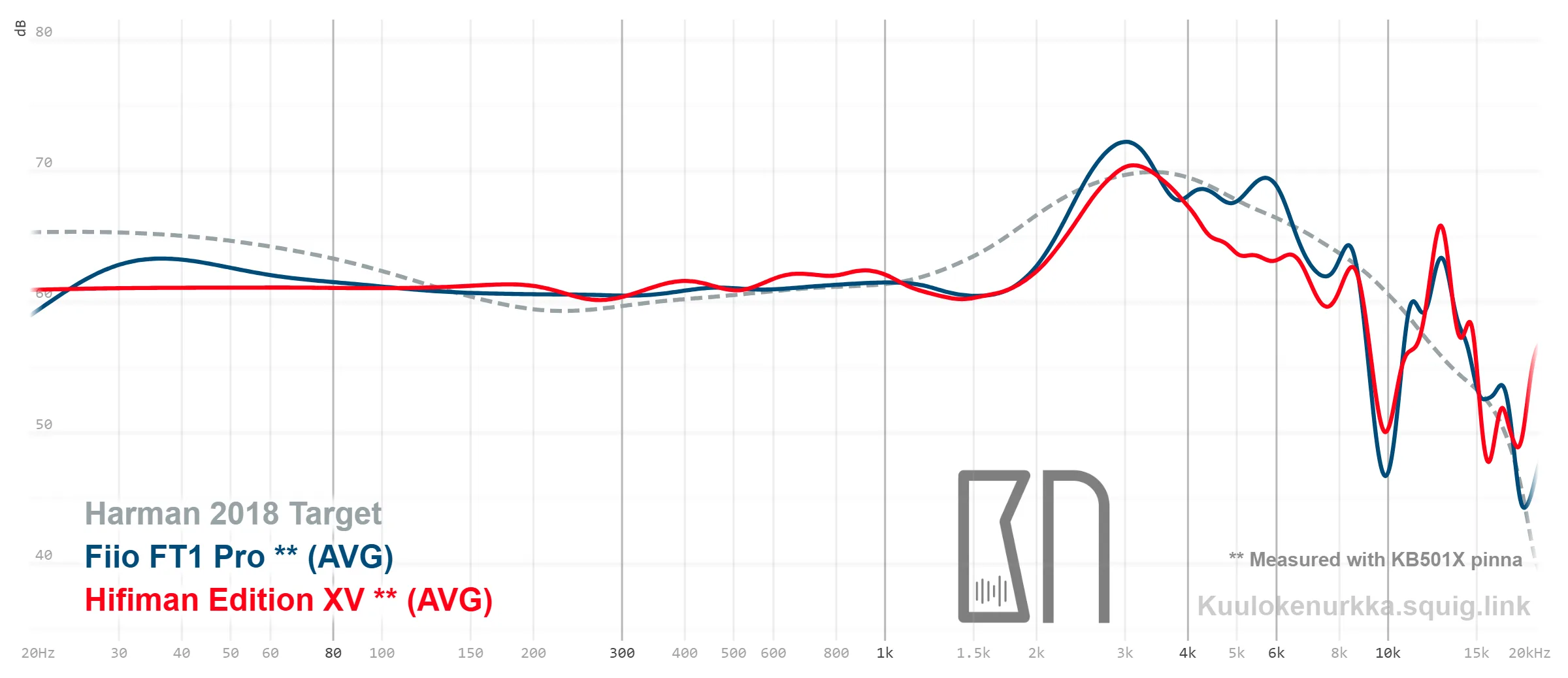
The FT1 Pro positions itself, as it were, between the Sundara Silver and the Edition XV. Compared to the Sundara, the headphones' sound is somewhat sturdier and darker, but still more energetic and neutral than the Edition XV, especially in the lower treble. If someone couldn't choose their favorite between the two Hifiman models, Fiio's headphones would be a good compromise of both. For comparison, the FT7 has a more airy soundstage and more separated reproduction than these three more affordable planar headphones.
The FT1 Pro reproduces the high frequencies more present than the Edition XV, albeit somewhat roughly in places, which is evident from a couple of bumps in the frequency response. Smoothness and fluidity are therefore Hifiman's strengths, even if the reproduction ultimately remains more relaxed, for better or worse. Both headphones resemble each other in the robustness of their low frequencies. While the FT1 Pro's sub-bass kicks a bit more physically and loosely, the Edition XV sounds even a bit fuller with its calmer high frequencies. The Fiio model's added sharpness helps with clarity of reproduction, but at the same time, when listening to it, I perceive the 1.5–2 kilohertz region as more veiled than in the Edition XV. This is probably because the bottom of the dip is deeper relative to the 3 kilohertz energy level, meaning something is more clearly missing from the music. The Edition XV is similarly softish, but does not indicate its deficiencies as obviously.
Although the FT1 Pro successfully combines energy and relaxation, it is ultimately not as interesting for me to listen to as the Edition XV. Partially, this is due to the Hifiman model's larger and deeper soundstage, but it generally has its own clear appeal compared to many other open-back planar headphones. The FT1 Pro does not sound as clear or detailed as brighter headphones, whereas the Edition XV, in my opinion, appeals more to those who prefer a robust sound. A middle ground like the FT1 Pro doesn't quite ignite my interest; it would have been nice to hear, for example, slightly more energetic mid-frequencies in Fiio's headphones. On the other hand, the FT1 Pro costs significantly less than the Edition XV, so in a way, I'm criticizing it unnecessarily. For 200–250 euros, it offers the same advantages as the Edition XV for those who find many other planar headphones too bright and light in sound.
Comparison: Hifiman Edition XV vs. Aune AR5000
Prices: 410 € vs. 330 €
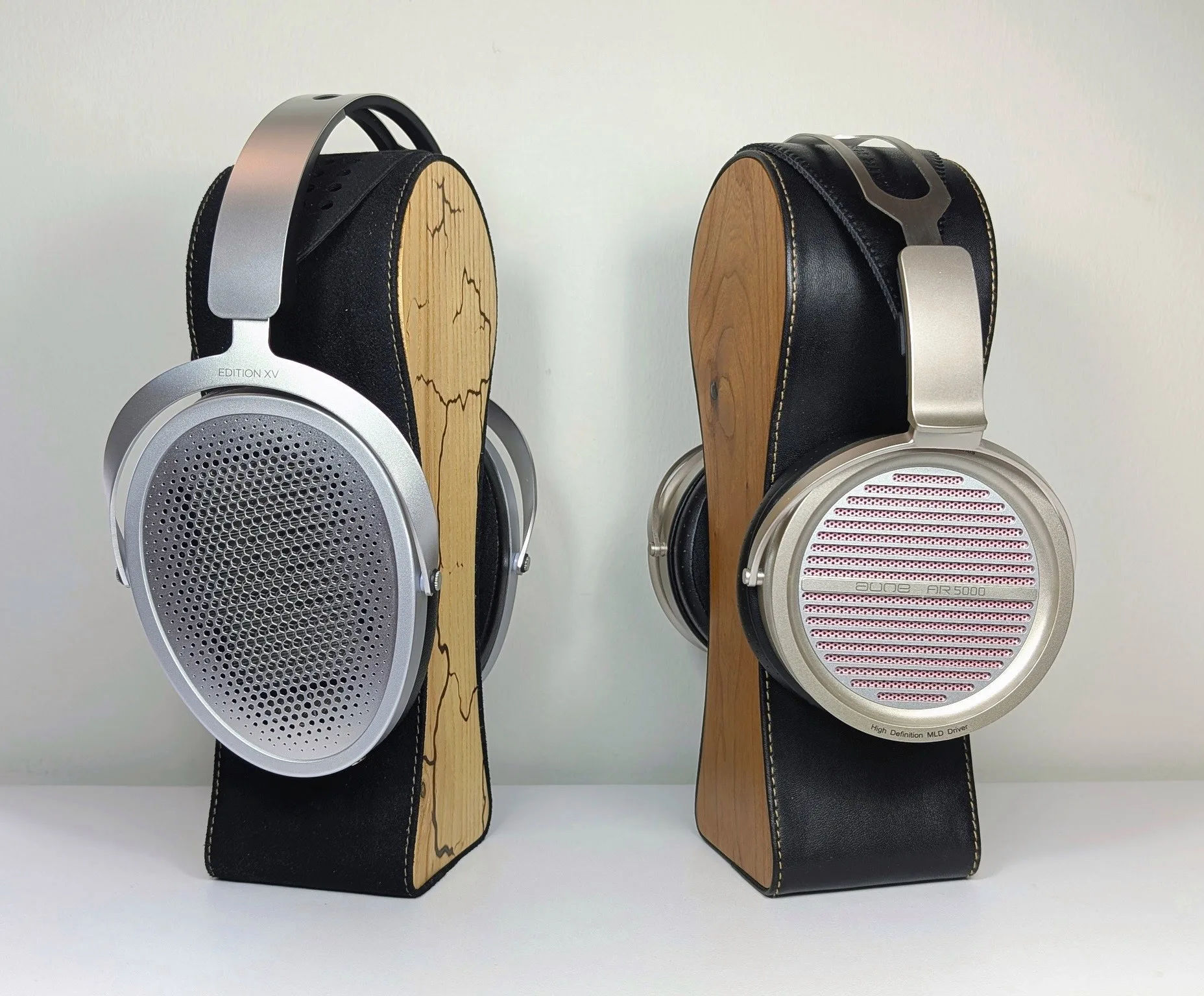
In addition to planar headphones, I also wanted to compare the Edition XV to dynamic headphone models, of which the first model I chose from my shelf was the 330-euro priced Aune Audio AR5000. It also happens to come from China, so the country is widely represented in this article.
The AR5000's construction contains more plastic, so it doesn't feel as premium as Hifiman's creation. However, this is not of great importance to me, because with a 100-gram lighter weight and a gentler fit, I slightly prefer the AR5000 of the two. The Edition XV turns out to be surprisingly heavy in many comparison situations, as its large drivers require a bulky frame and many magnets on both sides of the diaphragm.
If the headphones are intended for listening with mobile devices, the sensitive AR5000 would be an excellent choice. It plays really loud with almost any device. On the other hand, for example, I cannot use the headphones with my Gold Note HP-10 amplifier due to a rather strong background hiss. For this reason, headphones like the Edition XV, which are slightly less sensitive, are often more practical. Aune Audio delivers its headphones in finer packaging, but the accessories do not differ much from Hifiman.
Frequency responses:
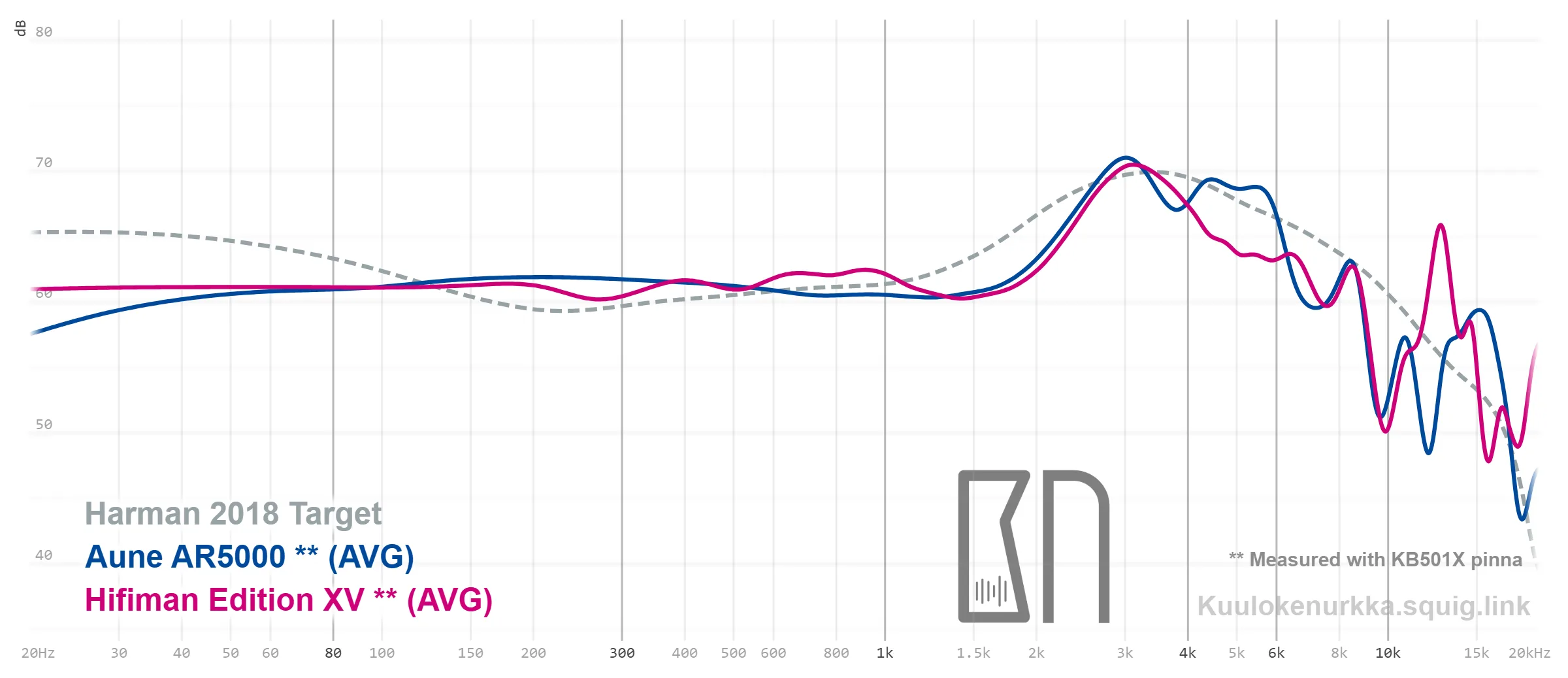
Similar characteristics can be observed in the AR5000 and Edition XV, but they differ most in the presence region (4–6 kHz), which usually determines how present the sound feels. While the AR5000 is more present and neutral in energy level, the Edition XV offers a more physical and less fatiguing reproduction. Although the AR5000 is similarly slightly warm, it feels surprisingly light and treble-focused next to the Hifiman model. Advantages, like with previous comparisons, are the clarity of the sound and, for example, the naturalness of female vocalists, while the Edition XV often manages to sound more pleasant due to its full-bodied sound.
The AR5000 reproduces the treble more vividly, thus bringing out details and effects more strongly, which might remain slightly in the background with the Edition XV. On the other hand, I feel that accuracy diminishes as the music becomes faster-paced, so in some situations, the Edition XV manages to sound more detailed despite its more relaxed sound.
The soundstage in the AR5000 is quite unique due to the angled drivers, as I perceive the sound appearing in front of me while hardly hearing it from the rear-diagonal. The Edition XV, in turn, manages to sound distinctly larger and slightly wider. It also generates more sound pressure in the lower frequencies, whereas the AR5000 feels a tad lacking in power in this context. Its bass starts to fade towards the lowest frequencies, so the focus remains around 200 hertz. The Edition XV, on the other hand, reproduces the lower frequencies slightly elevated throughout, so there's plenty of robustness.
Since the AR5000 ultimately resembles the Fiio FT1 Pro quite a lot, the same concluding observations regarding the Edition XV apply, with the difference that the sound is lighter this time and thus less dynamic. The Edition XV offers me a more memorable listening experience, while the AR5000 feels ”just” like a good and versatile headphone. When favoring a neutral sound, it gets closer to the goal, while the robustness and warmth of the Edition XV ultimately appeal to me more.
Comparison: Hifiman Edition XV vs. Focal Hadenys
Prices: 410 € vs. 700 €
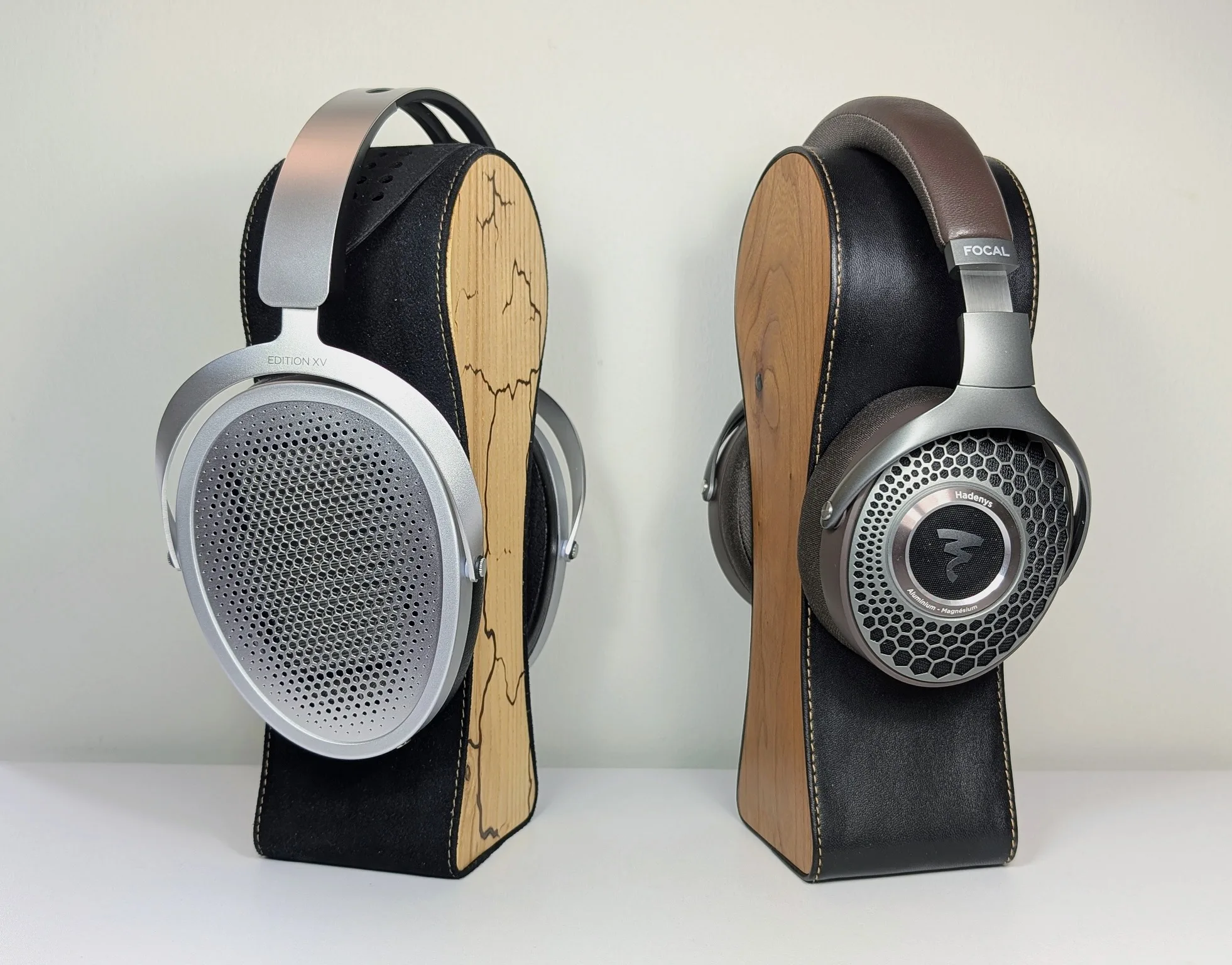
An European comparison model must also be included, but in truth, the 700-euro priced one Focal Hadenys was chosen rather because of its different sound. Other comparison models have been more or less similar in style.
Weighing under 300 grams, the Hadenys is a full 160 grams lighter than the Edition XV, which is immediately noticeable in a positive sense during use. The Focal model's earpads also feel pleasantly soft, and the headphones are otherwise quite small and unobtrusive on the head. Since the headband is also made of magnesium, structurally, I believe the Hadenys is worth its approximately 300 euro additional price. It also comes with a high-quality carrying case. On the other hand, Hifiman has the upper hand regarding the cable, as Focal still offers some of the worst cables on the market in terms of usability. Even with Hifiman itself, the cables stiffen as the price level of the headphones rises.
Like the Aune Audio AR5000, the Hadenys belongs to headphones that are a bit too easy to amplify, so I understand why Focal has not enabled balanced listening for it. Powerful amplifiers tend to produce background noise even now, unless their gain level can be sufficiently lowered. With the Edition XV, there's no need to worry about such things. Since both play easily with mobile devices, the benefits of the Hadenys remain partial.
Frequency responses:
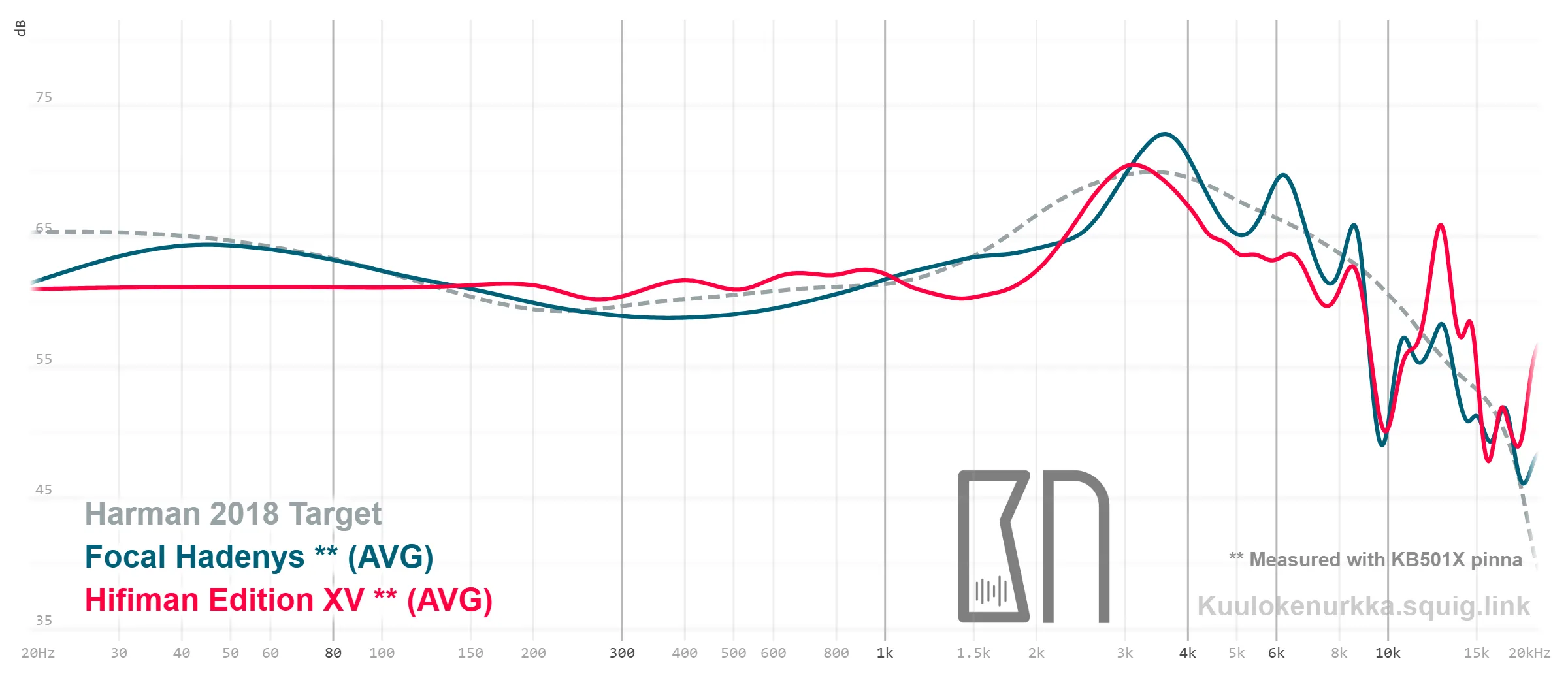
The Focal Hadenys is often an interesting comparison, as its sound differs quite a lot from its competitors without the reproduction being particularly colored in any direction. Compared to the Edition XV, the Hadenys sounds distinctly more energetic and lively, as it reproduces the sub-bass more robustly and the treble more punchily in precisely those frequency areas that remain calm in the Hifiman model. On the other hand, the mid-frequencies of the Edition XV are significantly fuller and more robust between 300–1000 hertz, so the reproduction has a heavier body. For the same reason, male vocalists also sound slightly better with Hifiman headphones.
The biggest difference is that listening to the Edition XV is more relaxed and less exciting, but its warmth continues to charm. The Hadenys, in turn, offers a more dynamic reproduction with its punchier bass and added energy. Instruments exhibit a realistic amount of energy between 1–2 kilohertz, and the vocalist is also placed slightly more authentically in the soundstage. In my opinion, the Hadenys is an excellent all-rounder headphone, a role that the Edition XV might not perform quite as well, unless a flat treble is the be-all and end-all. The Hadenys is slightly darker in its uppermost treble, while the lower treble is reproduced a tad unevenly. The Edition XV also sounds larger in this context, as the soundstage of Focal headphones is often focused on a very small area, as is the case with the Hadenys.
In summary, the Focal Hadenys is excellent for listeners who enjoy the dynamism of music and punchy bass. In contrast, the Hifiman Edition XV is a better choice for those who appreciate a fuller and calmer soundstage, as well as a greater sense of space. When switching between the two, it's hard not to like both.
Summary
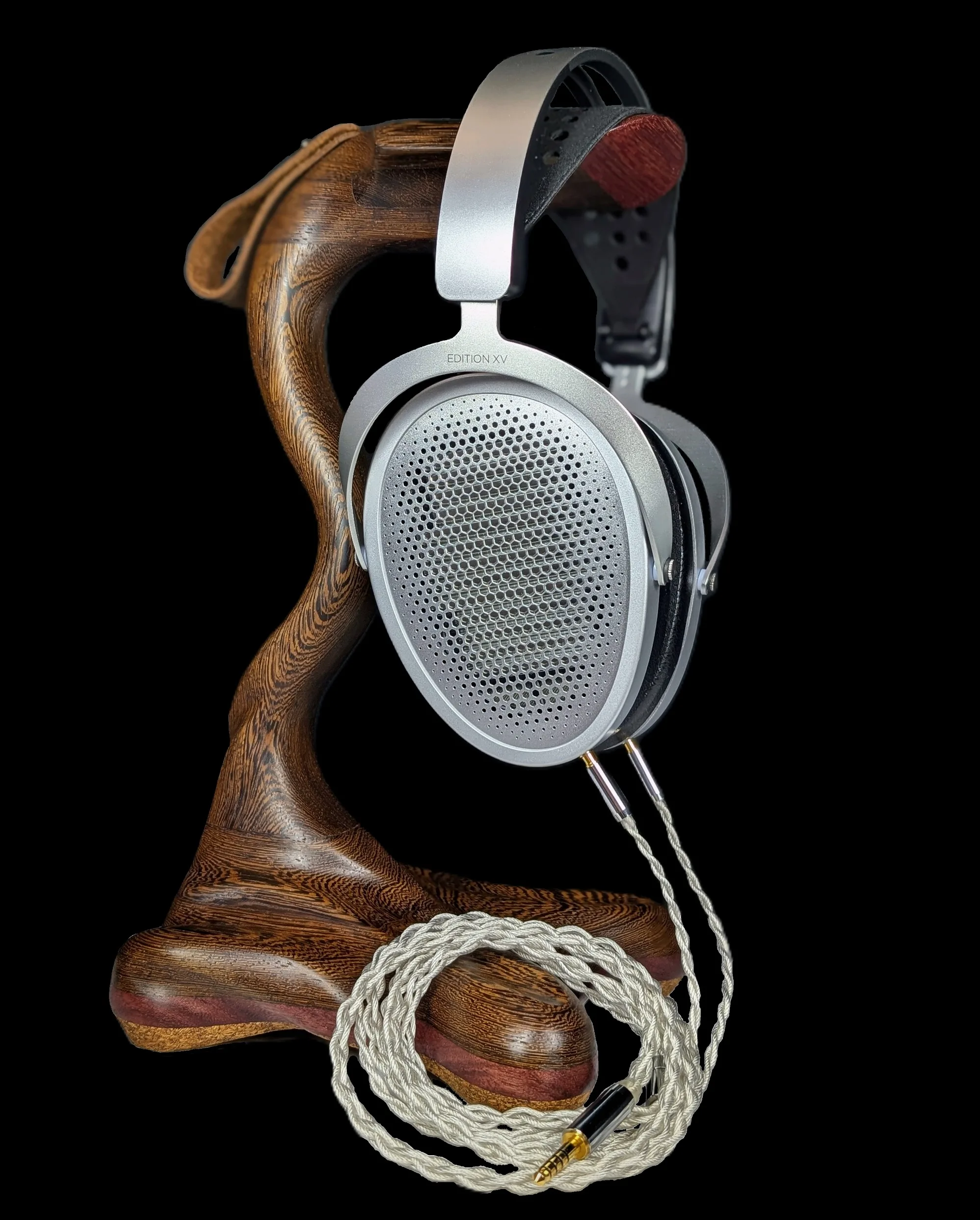
With its robust and calm sound, the Edition XV expands Hifiman's headphone selection in a new direction, although this can also be seen as a partial return to the era of the original Edition X. I therefore perceive these headphones primarily as a different alternative to brighter-sounding planar headphones. The detail of the reproduction and the airiness of the soundstage understandably take a slight backseat, but with the Edition XV, the harshness and unevenness of the high frequencies, from which many other Hifimans suffer somewhat, are completely avoided. This new style direction, in my opinion, is excellent for those desiring a more relaxed listening experience. When a warm and expansive sound works, it REALLY works.
Furthermore, the headphones' updated headband structure is successful in terms of both comfort and perceived quality, and the silver coloring is stylishly uniform. In light of this, the product's 400-euro price can even be considered a small surprise, as the Edition XS cost 150 euros more at its release, and its build quality was not as good. With the Edition XV, Hifiman immediately enters the market competitively, without the older model automatically feeling like a better purchase due to sales. I genuinely consider the Edition XV an attractive package now that the sound quality stands out from the crowd, and the build no longer feels cheap. It remains to be seen whether other manufacturers will start developing such headphones or if they will continue to pursue the most accurate and detailed sound possible.
I am still waiting to test the Ananda Unveiled model, which costs almost 200 euros more, but if the Edition XV holds its own against it, it will most likely ascend to Kuulokenurkka's wall of fame. In the same price range, other options should still be considered, but headphones like the Edition XV are few and far between, or at least not as successfully implemented in my opinion.
Pros and cons:
+ Robust and relaxed sound brings variety to Hifiman's headphone selection
+ Smooth and non-fatiguing treble
+ Expansive soundstage
+ Improved comfort
+ Improved perceived quality
+ Cohesive appearance
+ Does not require a powerful amplifier
+ Moderate price
– Does not sound as detailed or airy as brighter planar headphones
– The limited width of the structure makes it difficult to place the headphones on the head
– Not everyone may want such large or heavy headphones
– Sparse accessories
 EN
EN  FI
FI
Mainitsit rapsahtelun verkoissa niin oliko tai onko metalliverkot XV:ssäsi yhtä löysällä kuin tässä https://www.reddit.com/r/headphones/s/iEAtxTx8Kl
Kyllä niistä tosiaan suurin piirtein tuollaista ääntä kuuluu painellessa, kun verkon ja magneettirakenteen väliin jää tyhjää tilaa. Tällä hetkellä testaamassani HE600-mallissa vastaava suojaverkko on pinta-alaltaan pienempi, joten se on saatu kiristettyä tiukemmalle.