Author: Sword of Damocles
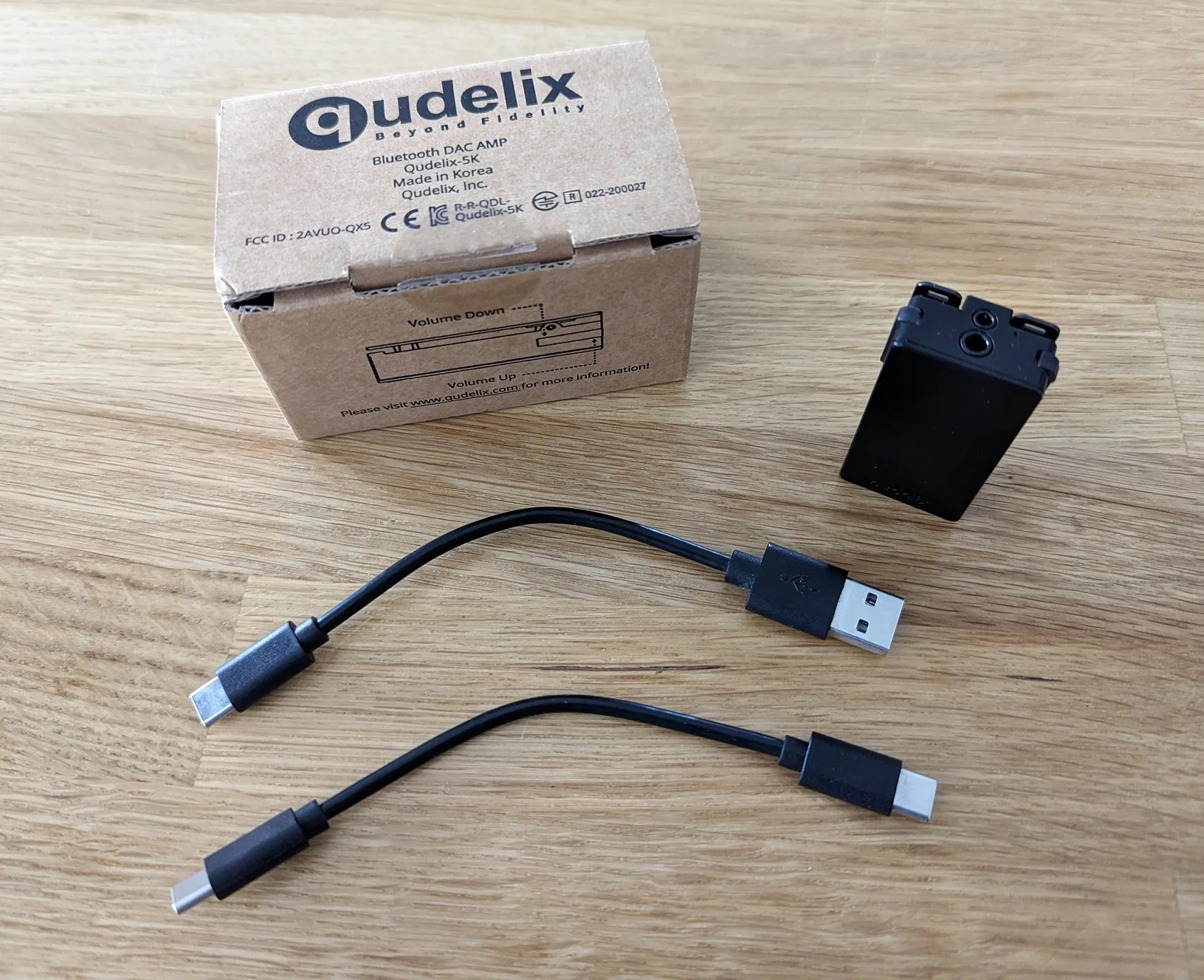
Table of Contents:
Information:
- Release Year: 2020
- Country of Manufacture: South Korea
- Price: 109 USD / 129 EUR
- Type: Mobile DAC & Headphone Amplifier
- DAC Chip: 2 x ESS Sabre ES9219C (ES9218P in older devices)
- Bluetooth Chip: Qualcomm QCC5124 (Kalimba DSP)
- Input Connections: USB-C and Bluetooth
- Output Connections/Headphone Jacks: 3.5 mm and 2.5 mm (balanced)
- Supported Bluetooth Codecs: LDAC, APTX Adaptive, APTX HD, APTX, AAC and SBC
- Sampling Rate (USB) PCM: 44.1–96 kHz (16–24 bit)
- Output Voltage: 1.0/2.0 V (3.5 mm) and 2.0/4.0 V (2.5 mm)
- Output Impedance: < 1 ohm
- Charging port: USB-C
- Battery Size: 500 mA
- Battery Life: 6–20 hours (varies by usage)
- Headphone Amplifier Maximum Output Power: 80 mW (3.5 mm) and 240 mW (2.5 mm)
- Includes a comprehensive app, which features, among other things, a 20-channel parametric equalizer and crossfeed
- External dimensions: 5.2 x 2.6 x 1.5 cm
- Weight: 25 g
- Included: USB-C cable (12 cm) and USB-C -> USB-A cable (12 cm)
Review sample: Self-purchased product
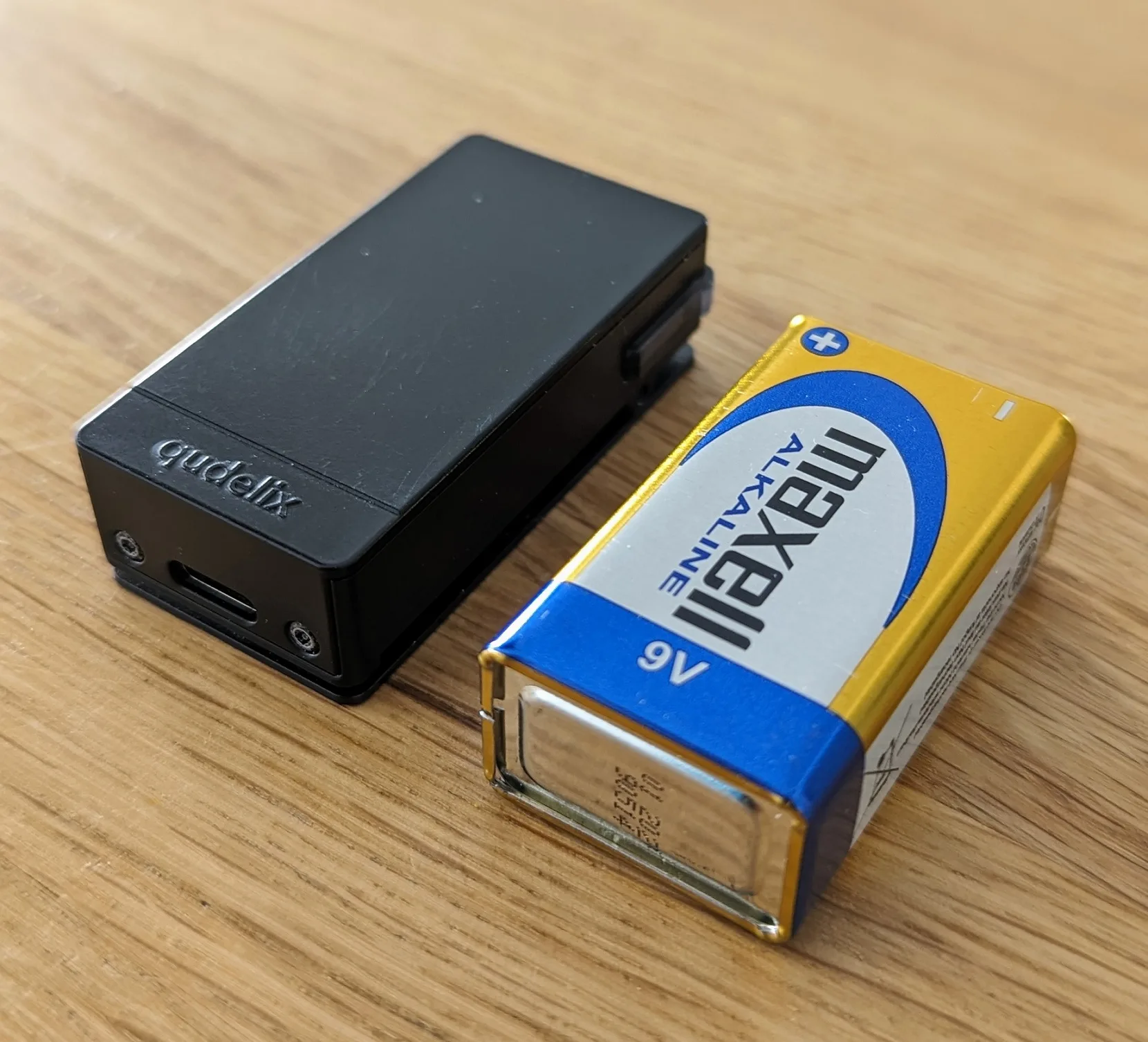
The Qudelix 5K, released three years ago (link to the manufacturer's product page) is a small battery-powered D/A converter and headphone amplifier that supports Bluetooth connectivity. The device costs 129 euros, so it competes in its price range with, for example, Fiio BTR5, EarStudio ES100, and Shanling UP4. The biggest advantage of the Qudelix 5K compared to all of these is its incredibly versatile software, whose feature list and adjustment possibilities are unparalleled in any price range. Many might be surprised by everything that a device the size of a 9-volt battery hides inside.
Structure, technology and functionalities
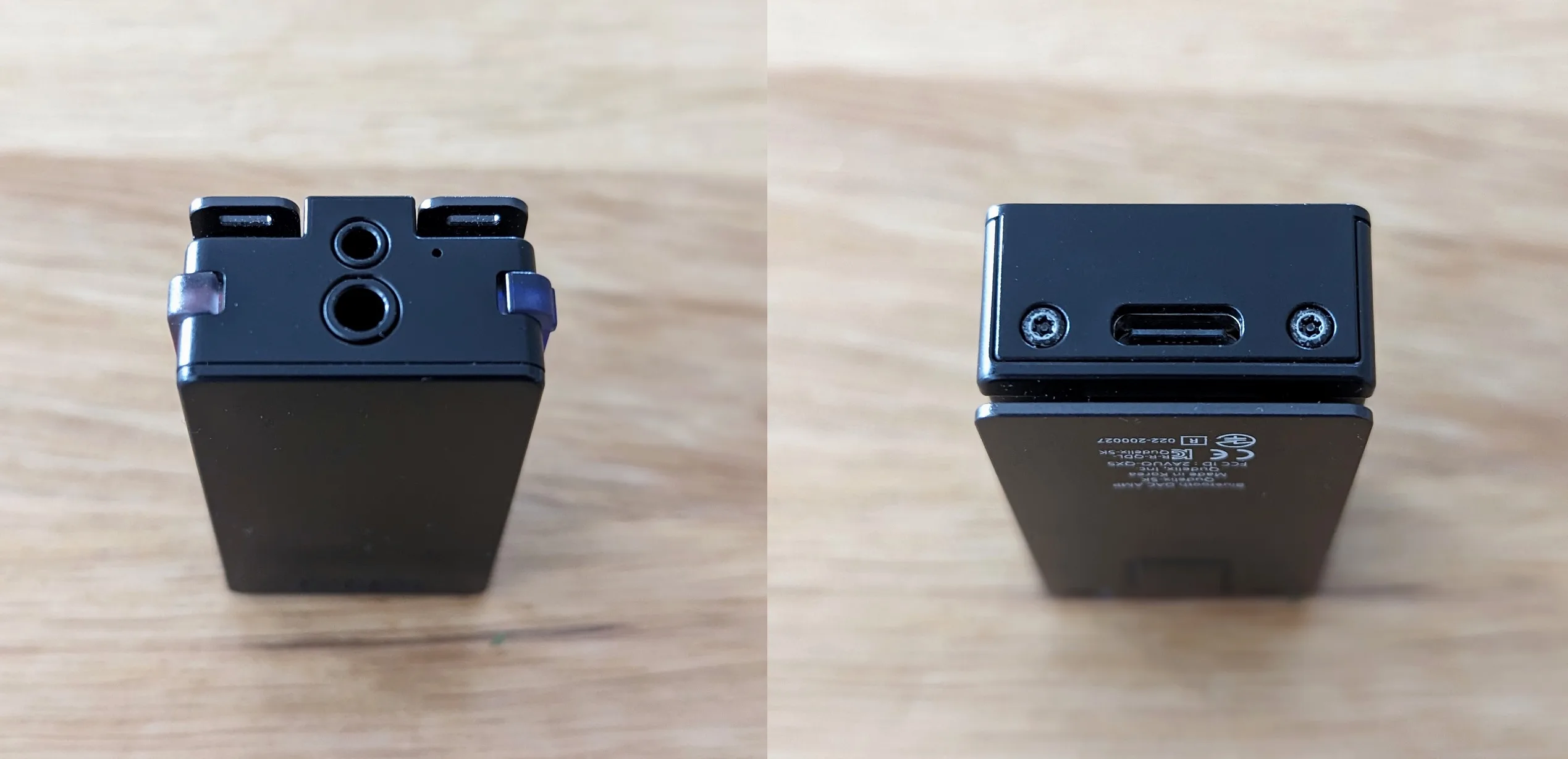
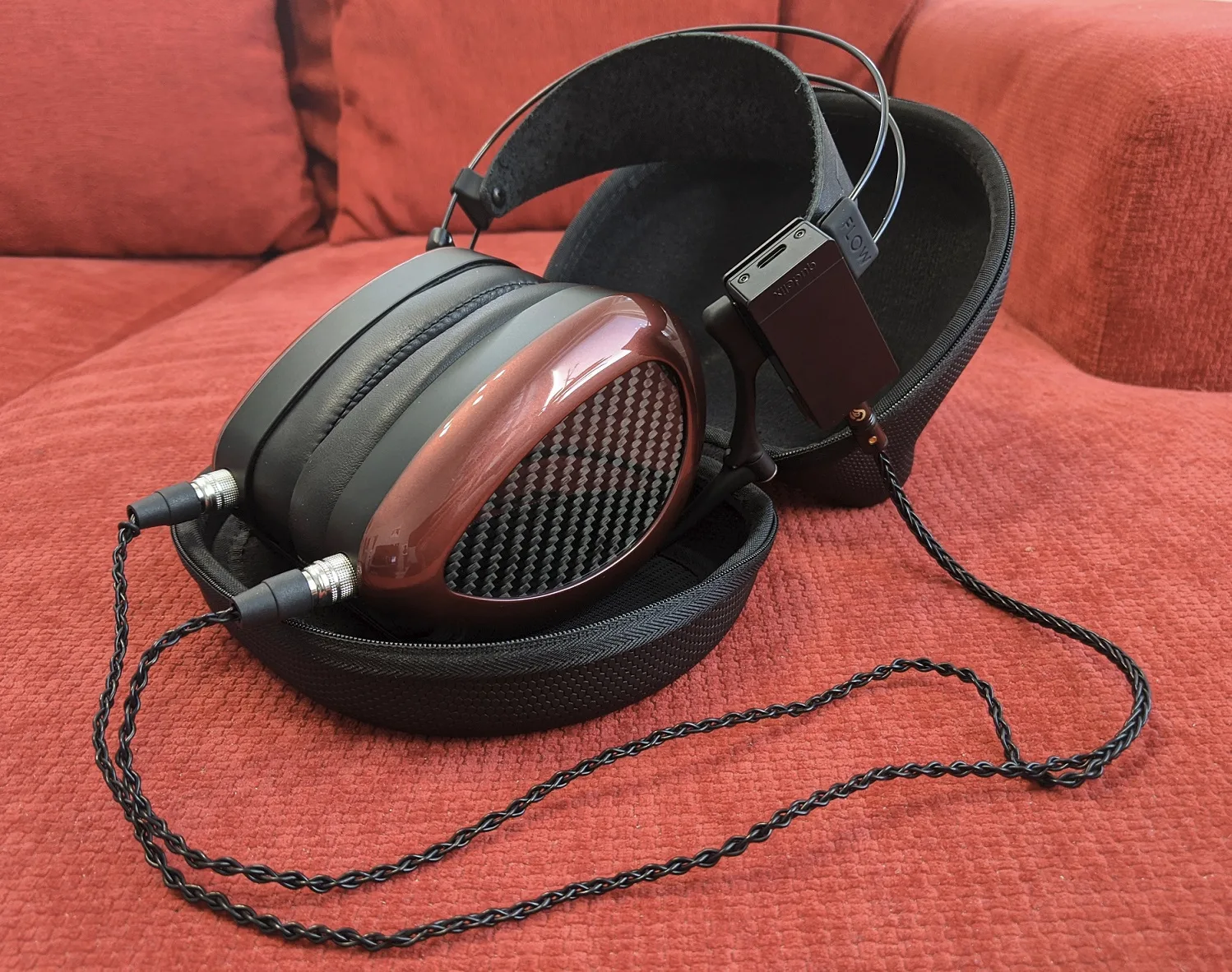
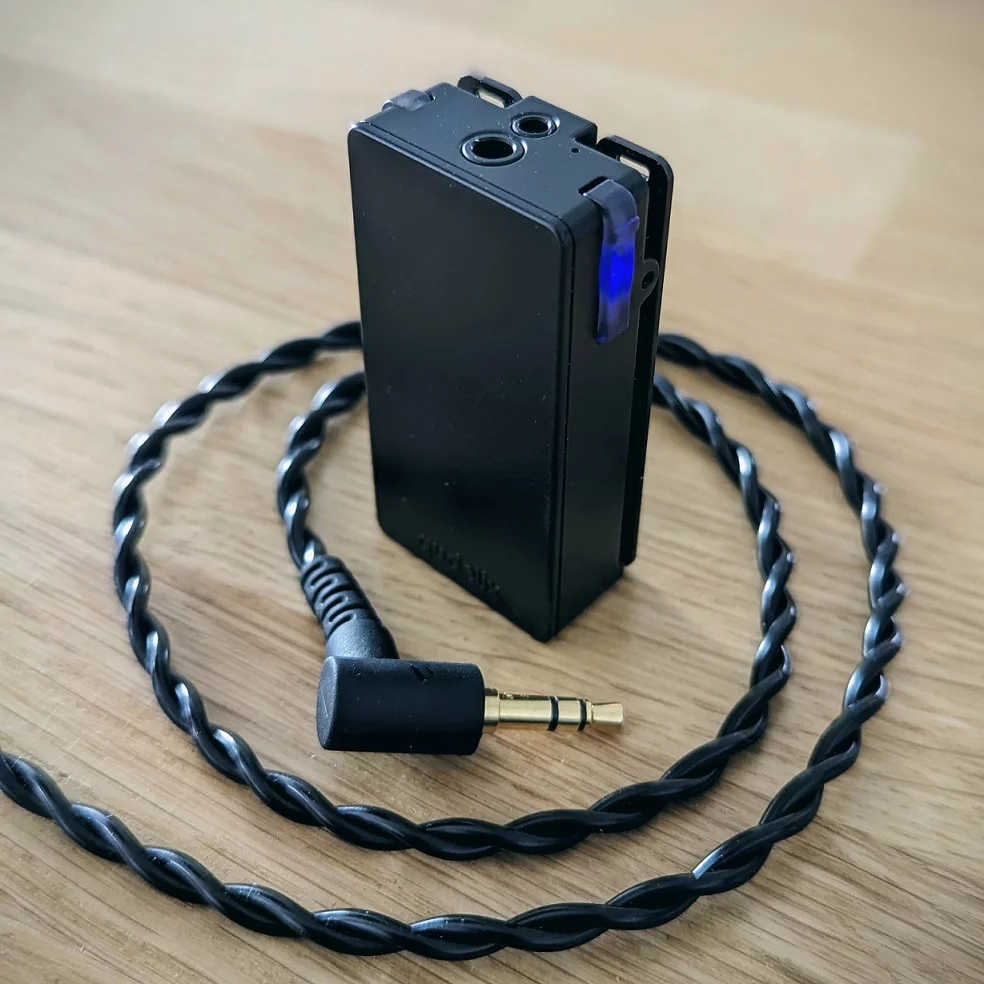
The all-black Qudelix 5K looks rather dull, so it won't win any style points. However, despite its plastic casing, the device is sturdy, so the minimalist appearance does not negatively affect its use. The bottom features a USB-C connector, and one end has both a balanced (2.5 mm) and an unbalanced (3.5 mm) headphone jack. The device is controlled by physical buttons located on the sides, and it can be attached with a large metal clip, for example, to a shirt collar or the edge of a pocket. Some have attached the device to the headphone headband with a short cable, making the headphones virtually wireless when used with a Bluetooth connection. The device also has a built-in microphone, which could convert regular headphones into suitable ones for conference calls.
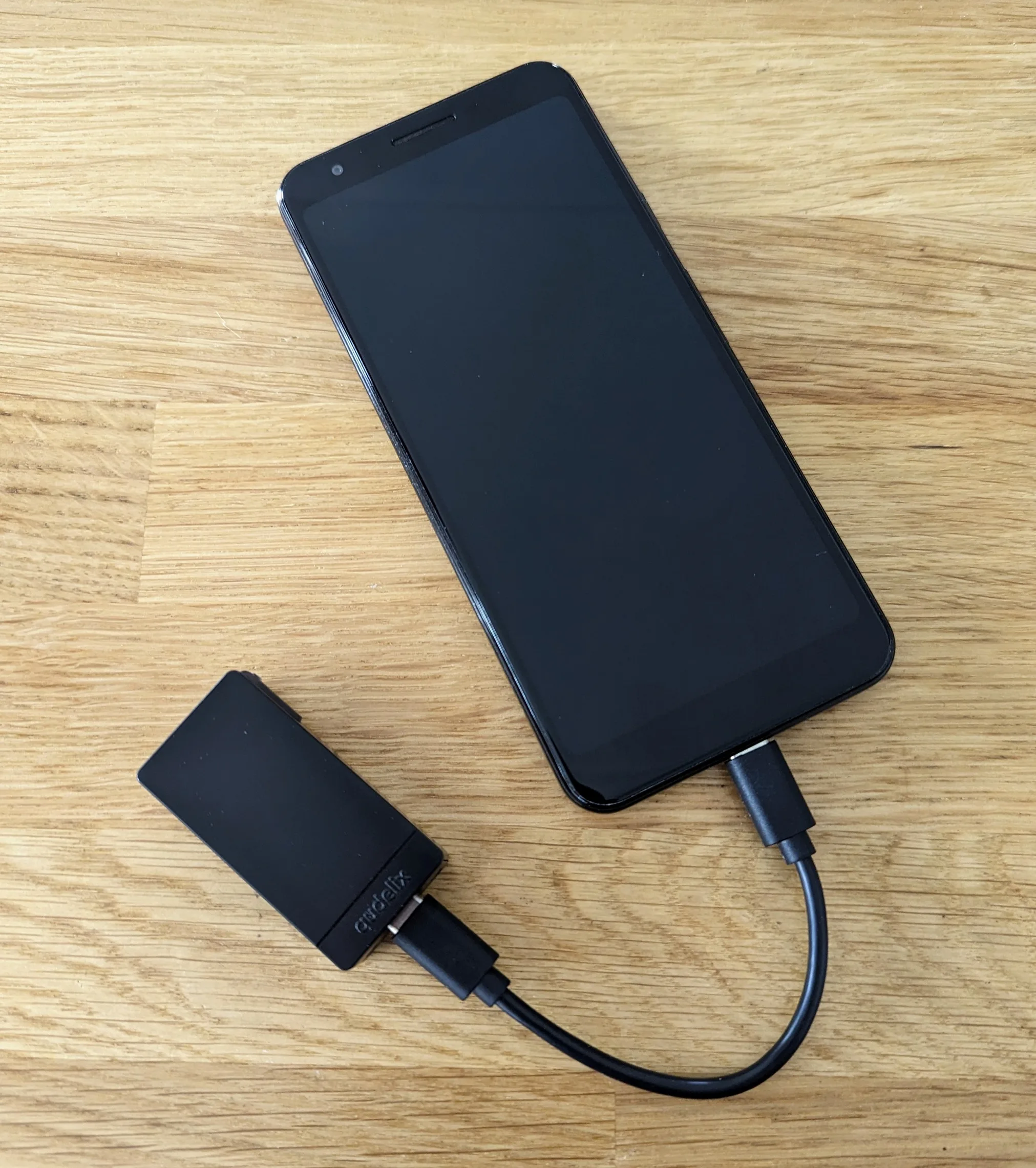
The Qudelix 5K includes a battery, so it is primarily intended for use with a Bluetooth connection. Alternatively, it can also be used as a USB-DAC (power is drawn via the USB cable, so the battery is not consumed) either directly to headphones or to another amplifier, utilizing the 3.5-millimeter headphone jack as the output connector. Thanks to its digital volume control, the 5K would also be suitable as a small preamplifier for active speakers.
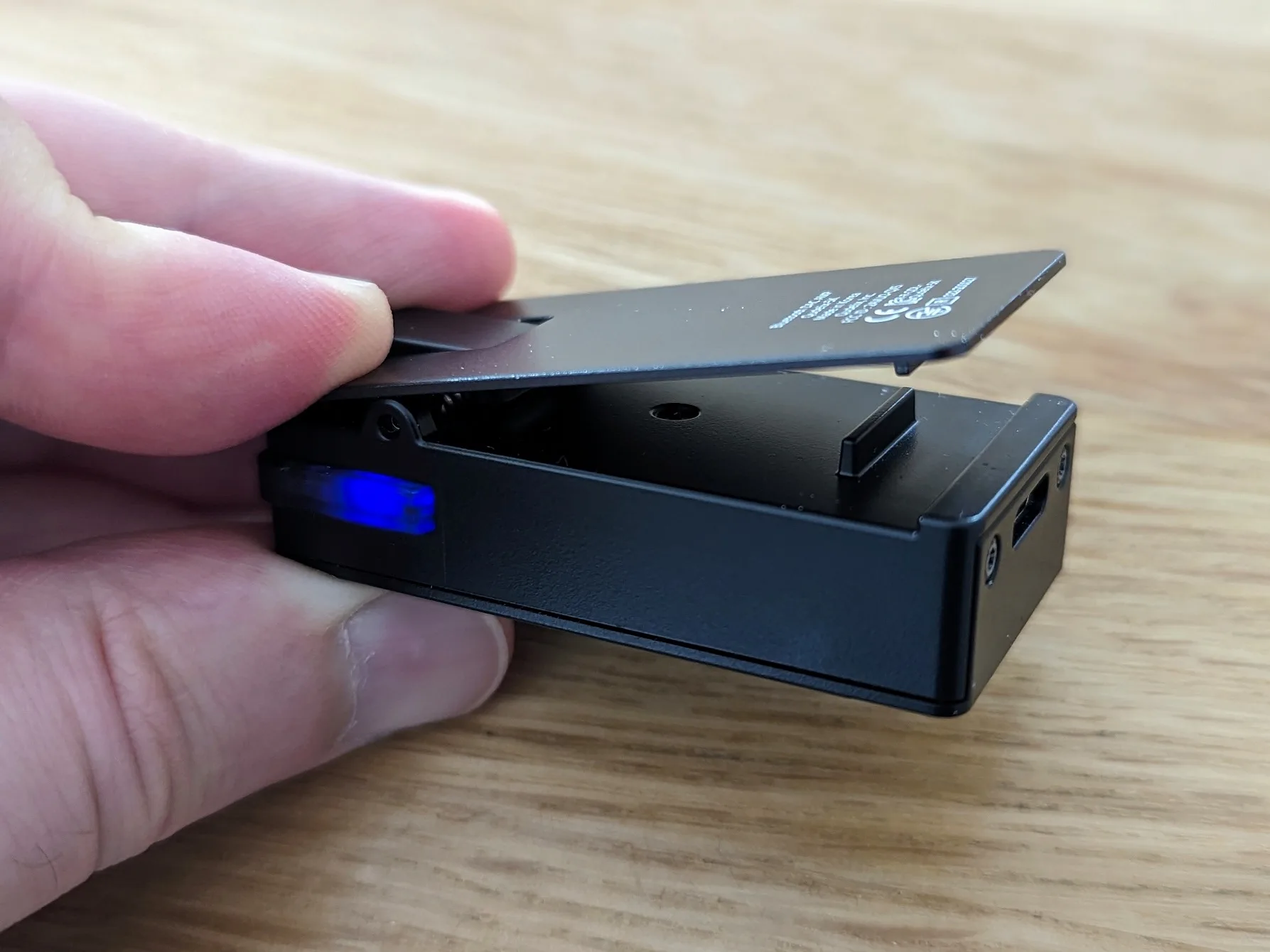
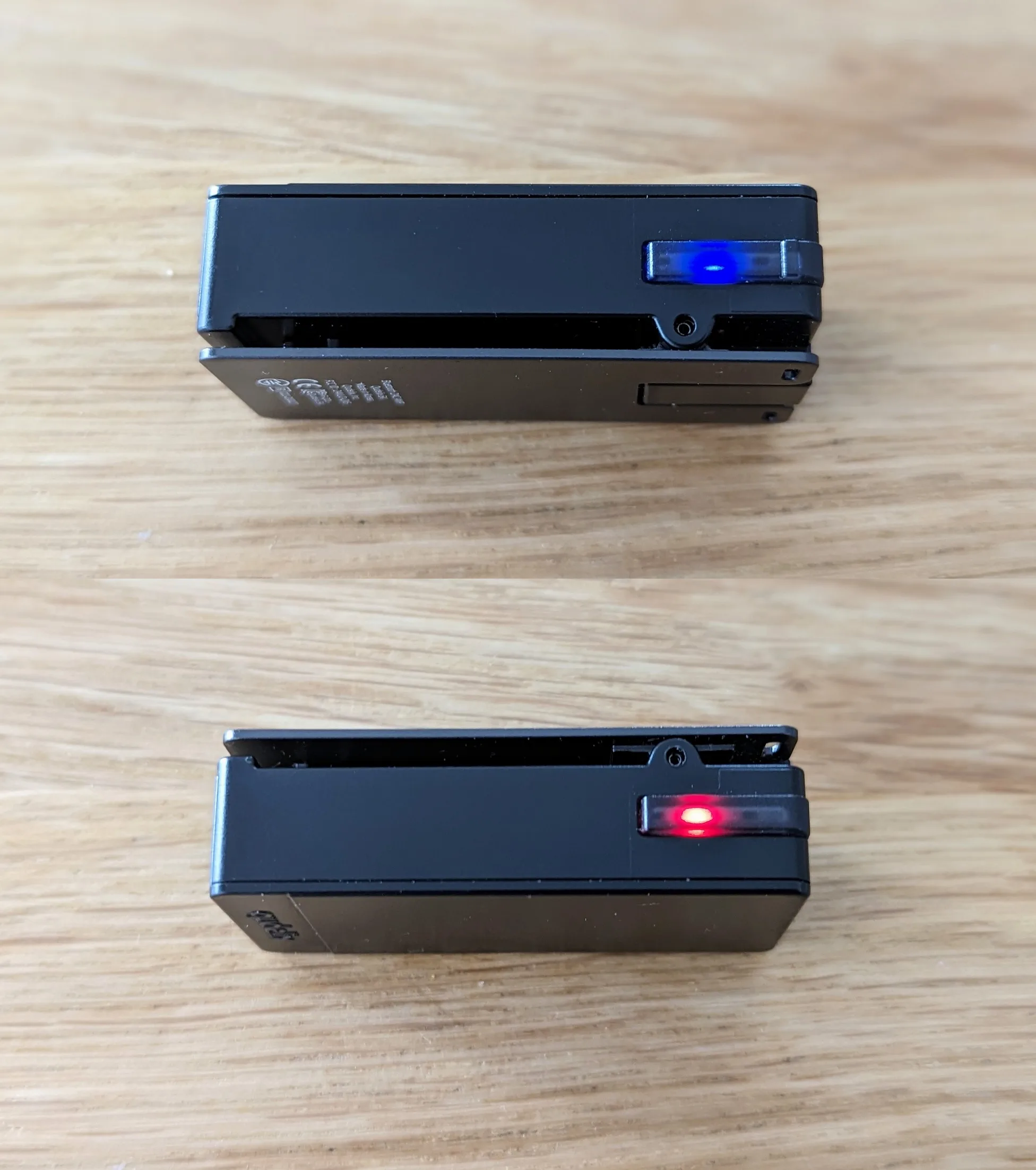
The device is controlled by two elongated buttons, which have different functions depending on which edge they are pressed from and how many times they are pressed. The buttons require a surprising amount of learning, and they also feel quite cheap and flimsy. The power button & play/pause/skip button & Bluetooth pairing button can be identified by a small bump and a blue backlight. The button that adjusts the volume in 0.5-decibel increments, on the other hand, is flat and has a red backlight. In reality, however, distinguishing the buttons from each other is difficult when the device is, for example, in a pocket. If the manufacturer ever releases an updated version of the device, its buttons should, in my opinion, be easier to use.
The 500 mAh battery housed inside lasts for 6–20 hours of use. Headphones that are more difficult to drive, higher-quality Bluetooth codecs, and listening via the balanced connector consume more battery. In my own use, the typical battery life has been about 10 hours, which I consider a commendable figure for a small device. Charging is easy thanks to the USB-C connector, and it is also possible to use the device while charging.
D/A converter and headphone amplifier:
The Qudelix 5K's D/A converter is implemented with two ESS Sabre ES9219C chips (in my device, the equivalent ES9218P), of which the unbalanced 3.5-millimeter connector utilizes only one. The maximum sampling rate in USB mode remains somewhat modest by current standards (96 kHz / 24 bit), but is still perfectly adequate for most users. The Qudelix is not for those who require DSD support or 32-bit audio.
Qualcomm's QCC5124 has been chosen as the device's Bluetooth chip, which comprehensively supports all possible codecs, including LDAC and various aptX versions. The LDAC connection is quite stable even at 660 kb/s, whereas 990 kb/s causes occasional stuttering depending on the mobile phone in use. However, one of the device's strengths is its excellent Bluetooth range, which allows for free movement, for example, at home. The Bluetooth implementation also includes a powerful DSP chip, which allows access to a whopping 20-channel parametric equalizer with all the bells and whistles via the software.
The DAC chip(s)” built-in headphone amplifier does not hiss with sensitive in-ear headphones, and its power is sufficient for most over-ear models, especially when listening via the balanced connector. The unbalanced 3.5 millimeter connector is promised to offer a maximum of 80 mW / 2.0 V of power, while the balanced 2.5 millimeter connector delivers a maximum of 240 mW / 4.0 V. To extend battery life, the gain can also be set to a 1-volt (3.5 mm) or 2-volt (2.5 mm) ”eco-mode", which is effortlessly sufficient especially for in-ear headphones.
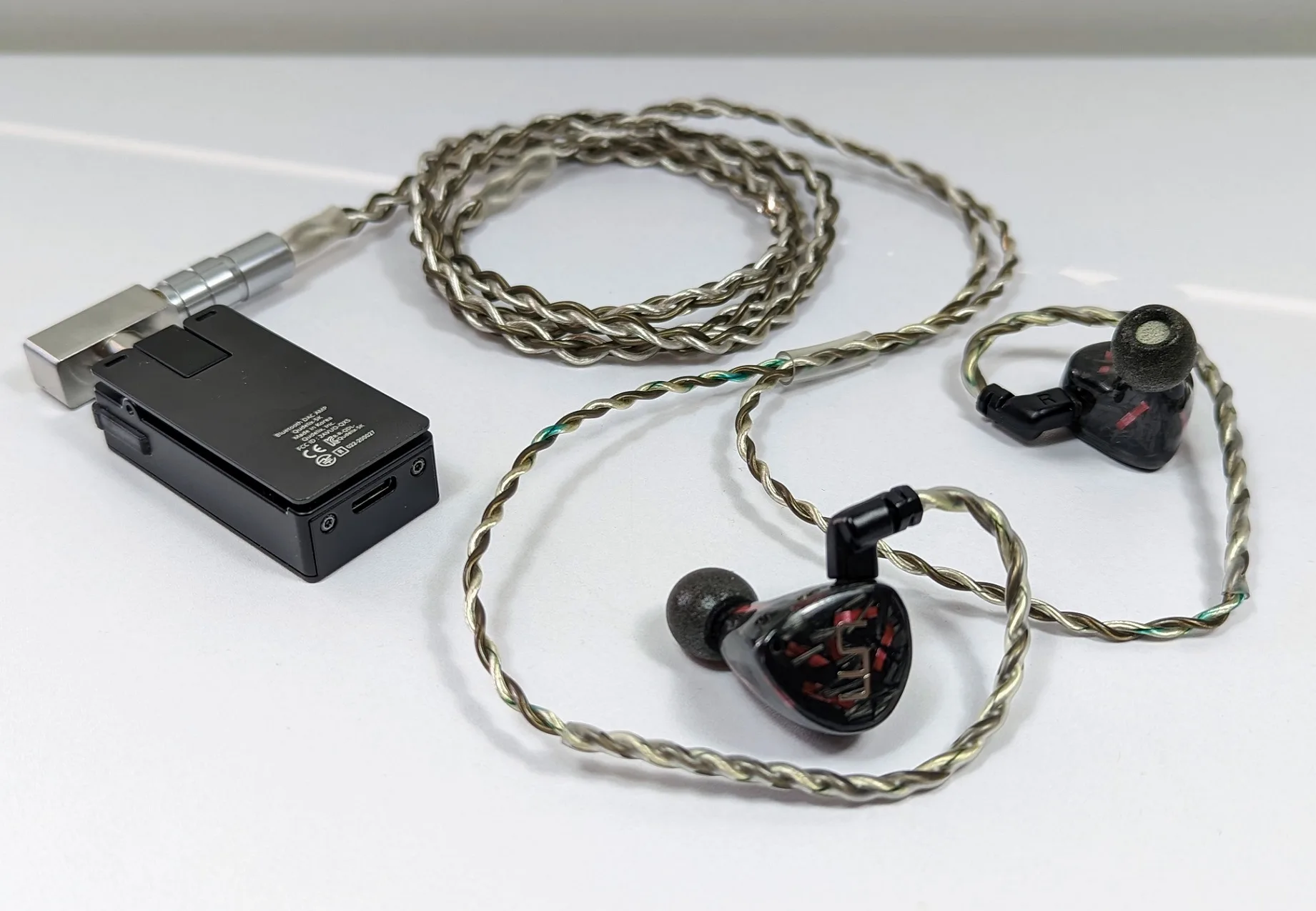
I have found the Qudelix 5K to perform well with all common headphones regardless of impedance, leaving ample headroom for volume adjustment upwards even when using the equalizer. The device plays even the notoriously difficult Hifiman HE6 at a decent volume, but in its case, there would be little headroom left for equalization. Additionally, with more difficult-to-drive headphones, the sound may ”clip” and distortion values begin to rise, which can result in a somewhat harsh and grainy outcome. However, the 5K is not designed for more demanding headphones; for those, one could purchase, for example, the more powerful Topping G5 or the one previously reviewed in Kuulokenurkka iFi xDSD Gryphon.
The application's comprehensive adjustment possibilities
A phone application has been developed for the Qudelix 5K for Android and iOS operating systems, in addition to which an application implemented as a Google Chrome web browser extension is now also available for computer use on Windows, Linux, and Mac operating systems. The functionalities are identical in both application versions. On mobile devices, the application connects via Bluetooth, while the computer version only works via a USB connection. The application contains truly incredible adjustment possibilities, thanks to which the Qudelix 5K, despite its affordable price, is the most versatile representative of its product category.
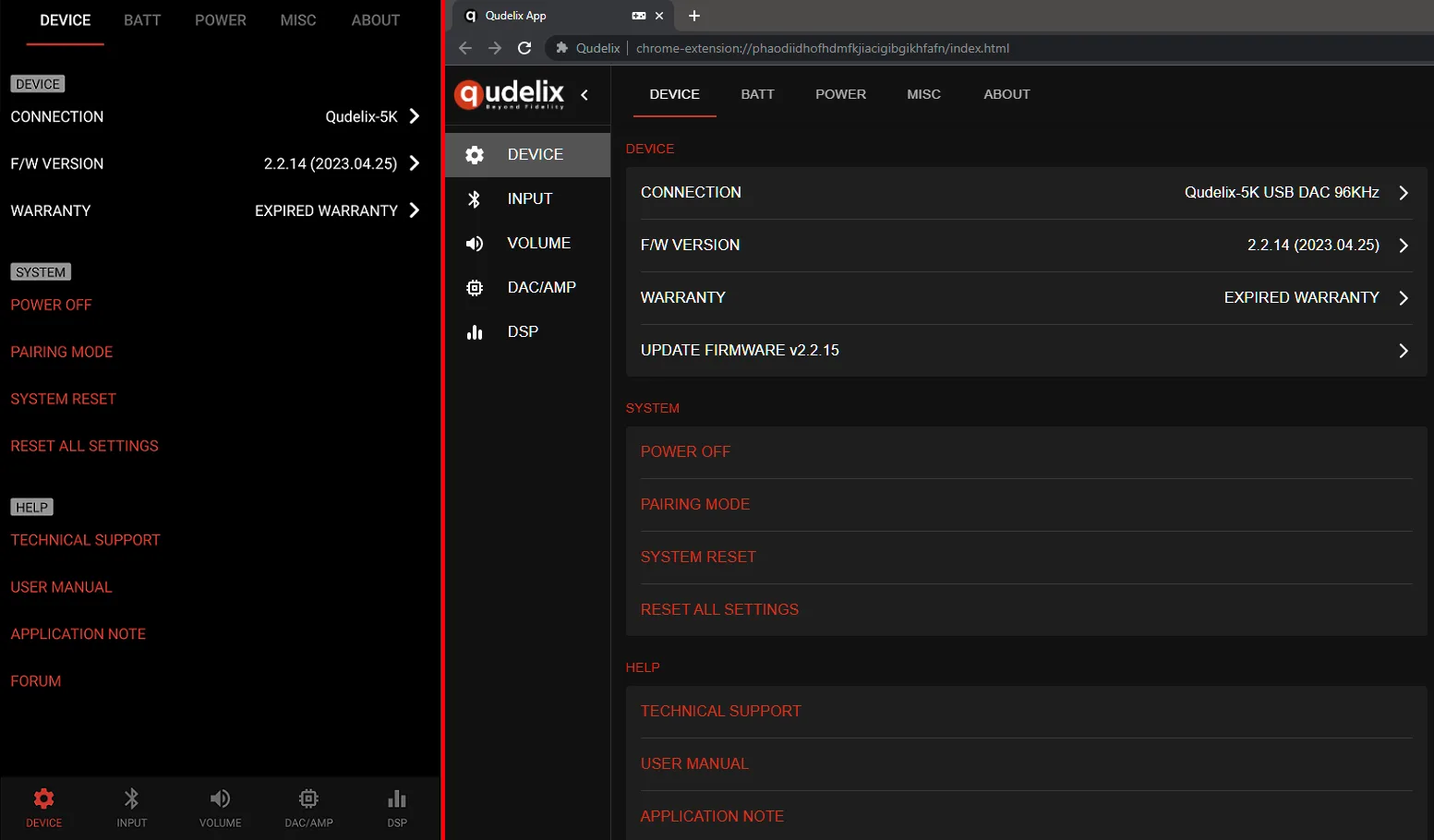
Qudelix has also diligently developed the 5K over the past three years, as the application constantly receives software updates. The device itself has received over 40 firmware updates, which may well be close to some kind of world record. Many settings and functions were not available at the time of the device's release but have been added afterwards – the manufacturer's commitment to its product is exemplary.
Due to the vast number of different settings, the application is not the clearest in terms of user interface or usability, but each tab has useful and precise instructions at the bottom. At the software level, the Qudelix 5K is a kind of sandbox where almost all conceivable adjustments have been possible to implement. To my understanding, behind the 5K are the same individuals who were also involved in designing the equally versatile EarStudio ES100 device.
All screenshots from now on are from the phone application and can be opened larger by clicking the image.
Battery usage monitoring, charging, and button commands:
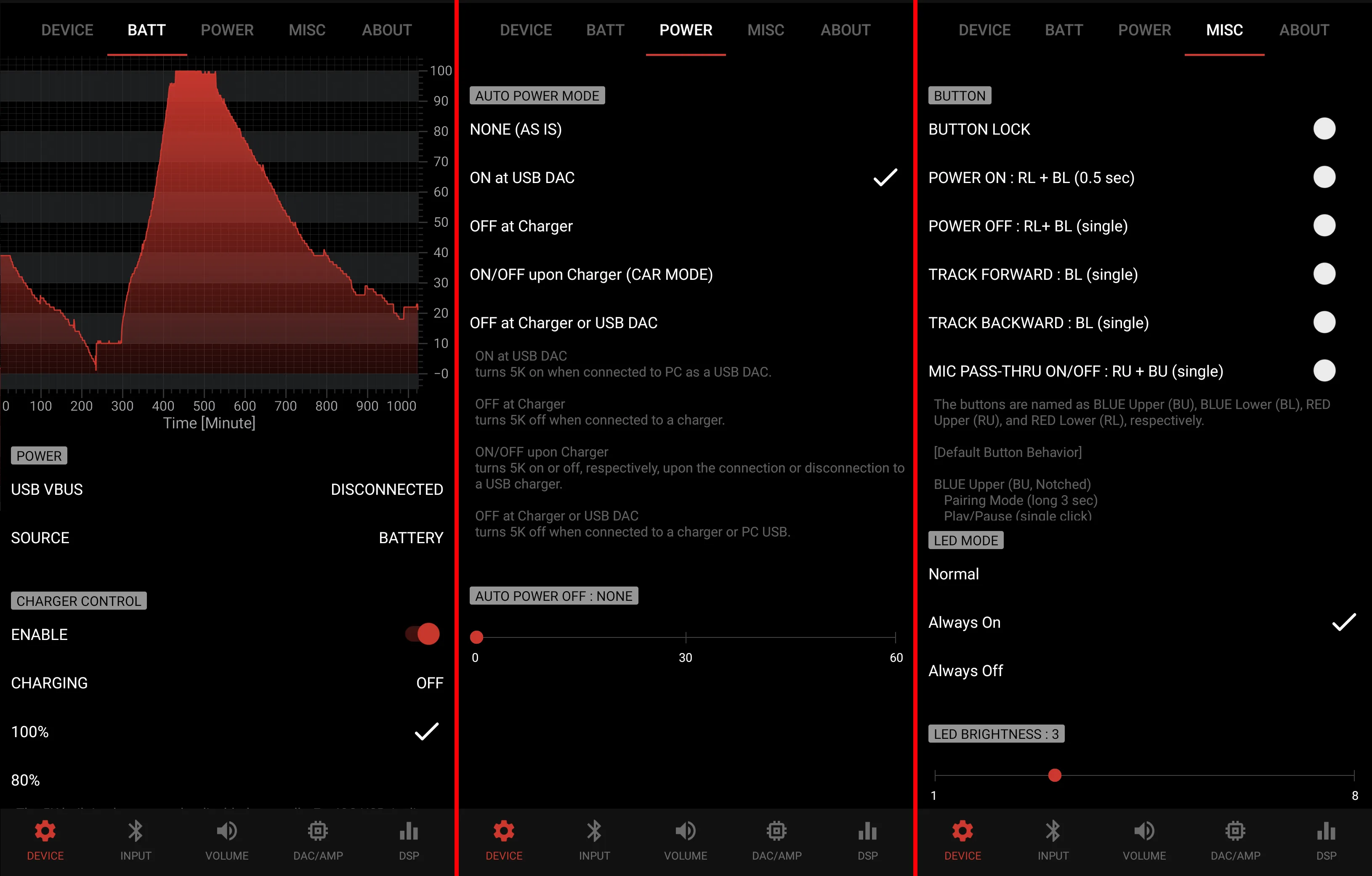
The device's battery usage can be precisely monitored and thus optimized. The maximum battery charge level can also be limited to 80 percent, which reduces wear during charging. A separate tab offers options for the device's startup and shutdown, so the 5K can be optimized for a specific use case, such as functioning as a USB DAC or for use in a car. Button commands can also be adjusted, for example, if someone wishes the device to start up in half a second by pressing two buttons instead of having to hold a single button down for 3 seconds. Adjusting the brightness of the button LEDs is also possible.
Audio signal and microphone settings:
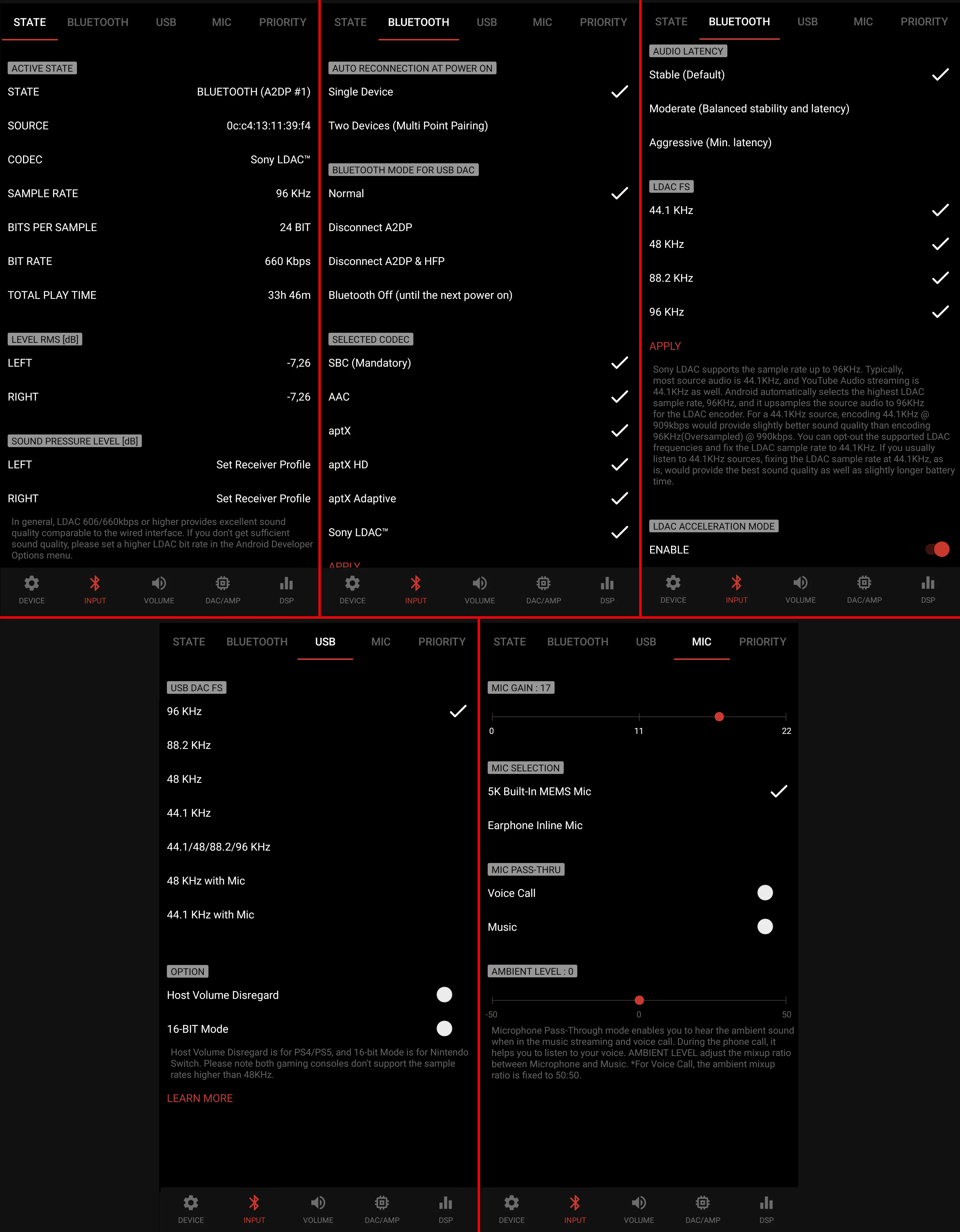
The Qudelix 5K can indicate very precisely at what sampling rate audio is being played or with which Bluetooth codec playback is occurring. Since the device can be connected to two different devices simultaneously (for example, a computer via USB cable and a phone via Bluetooth), the user experience can be made as smooth as possible by adjusting connections. If necessary, certain Bluetooth codecs or sampling rates can be completely deselected to ensure the device functions as desired. The Bluetooth connection's latency can also be optimized so that audio plays without interruption on different listening devices. There are separate fine-tuning options for game consoles.
I personally find the device's built-in microphone quite unnecessary, but it also offers a few adjustments, such as changing the gain level. The microphone can also be set to play ambient sounds into the headphones, which resembles the transparency mode familiar from noise-cancelling headphones. If the microphone is not needed, it can be bypassed so that using the device does not interfere with, for example, answering a call in the traditional way.
Volume control:

The 5K's volume can be adjusted with both physical buttons and a separate tab in the software. The manufacturer recommends maximizing the volume of the listening device to maintain the best possible audio signal quality. In addition to the headphone jack in use, the application displays the amplification voltage and real-time output power. As useful additional features, it is possible to set a maximum limit for the volume. The volume of the left and right channels can also be adjusted separately if there is a clear channel imbalance in the headphones or a difference in hearing between the listener's ears.
DAC filters and headphone amplifier operating mode:
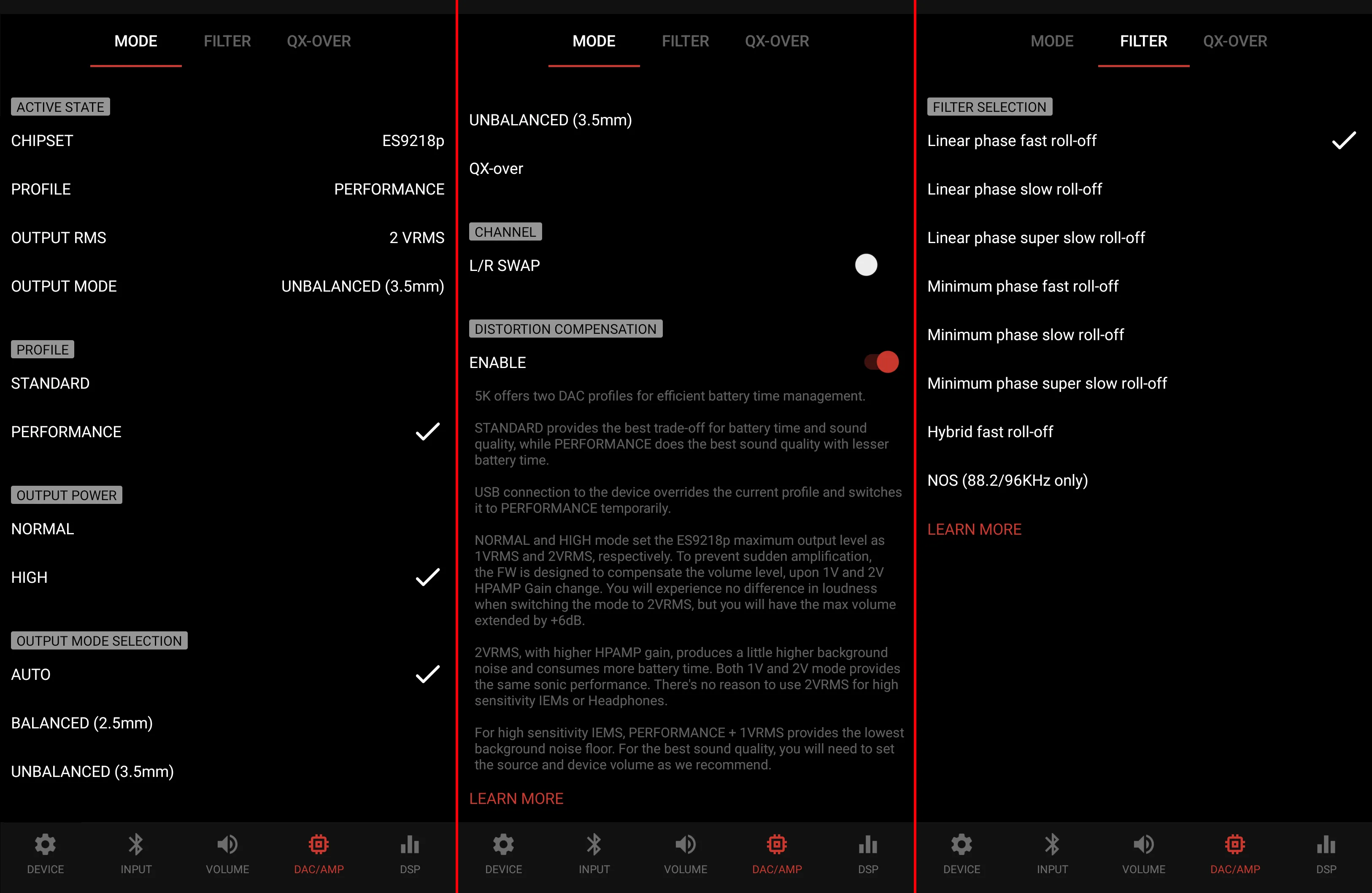
The DAC/AMP section first offers the option to change the audio filters provided by the ESS Sabre DAC chip manufacturer. More useful settings, however, are the different operating modes of the headphone amplifier, which can optimize the device's battery life. By default, the device operates in a 2-volt amplification mode when using an unbalanced headphone jack and in a 4-volt mode when balanced. However, if some easier-to-drive headphones do not require all the amplification power, the unbalanced connector can be dropped to a 1-volt mode and the balanced connector to a 2-volt mode. At the same time, the intensity of any background noise should decrease, although it is not noticeable even at full power.
According to the manufacturer, there is no difference in sound quality between the modes, but battery life is better at lower voltages. On the positive side, selecting a higher amplification power during listening does not suddenly change the volume, so no one needs to fear hearing damage. The increased amplification power manifests concretely only as a 6-decibel increase in the volume adjustment range.
For the headphone amplifier, either Standard mode (standard operating clock and output bias current) or Performance mode (the highest operating clock and output current bias) can also be selected. The former saves battery at the expense of sound quality, and the latter prioritizes sound quality while reducing battery life. With a USB connection, the device always operates in Performance mode because power is supplied via the USB cable without consuming battery. I have not noticed a clear difference in sound quality between the modes, so for Bluetooth use, I have preferred slightly longer battery life by choosing the Standard option.
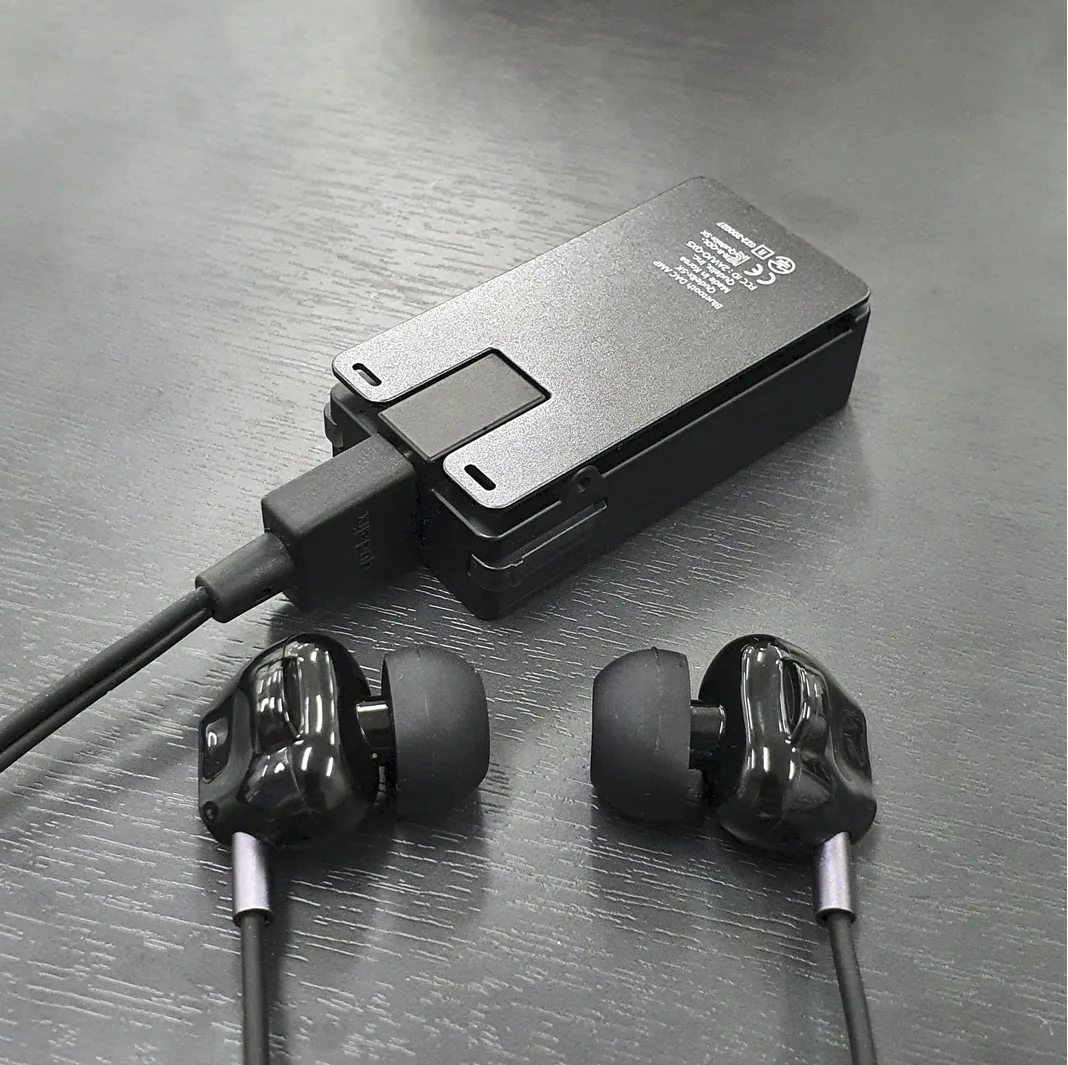
More unusual settings include distortion compensation, which is on by default, and the option to swap the right and left stereo channels – perhaps this is intended to help those who install the headphone cable incorrectly or wear headphones the wrong way around. Qudelix's product range includes in-ear headphones called QX-over (price 29 USD) designed for the 5K device, which could be adjusted from their own tab. To my understanding, the headphones are not particularly great due to their overemphasized bass reproduction, but what makes them interesting is an active (digital) crossover designed for two drivers, which offers sound quality advantages over passive crossovers.
DSP settings: equalizer, auto-EQ profiles and crossfeed:
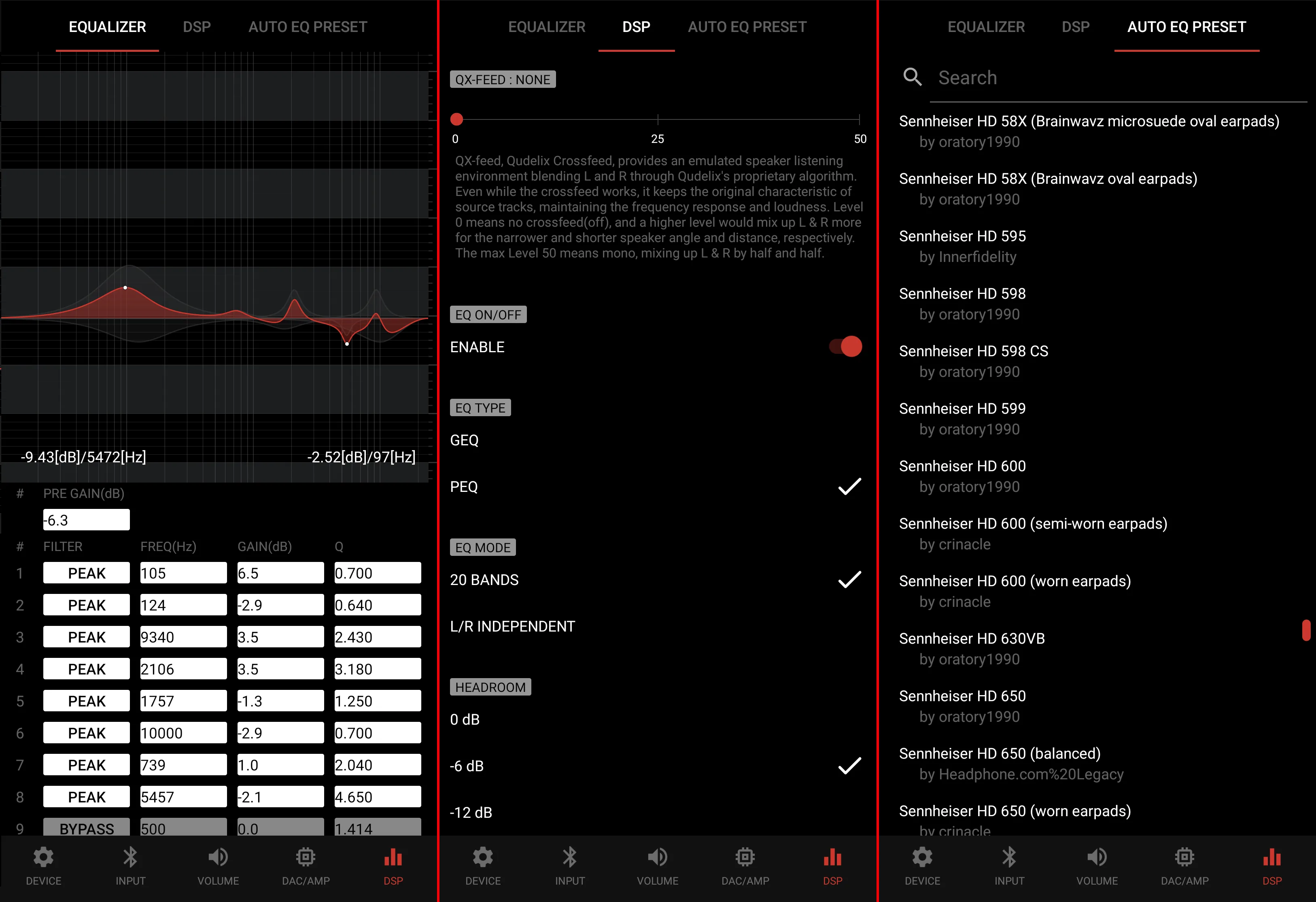
The last tab of the application is the main reason why the Qudelix 5K is worth buying. The device has a complete 20-band equalizer that works with Bluetooth, including the LDAC codec. The user can freely adjust the headphones in terms of filters, frequency, gain level, and Q-value. Additionally, it would be possible to equalize the left and right channels separately. Up to 20 custom profiles can be saved from the changes made, and the manufacturer's own sound profiles are also available.
A surprising Finnish connection ensures that the device's refinements don't end here. A separate tab contains all of Jaakko Pasanen's Auto EQ-tool's equalizer profiles, based on frequency response measurements made by Crinacle and Oratory1990, among others. The almost endless list, comprising hundreds and hundreds of profiles, covers all even slightly more well-known headphone models. Selecting a profile loads the equalization directly into the Qudelix 5K's own equalizer, where it can be further fine-tuned to better suit one's preferences if necessary.
Some of the profiles have not been very functional as such, as they were based on inaccurate frequency response measurements. Sometimes, however, the settings are almost perfect, in which case the feature shows its true power. I can't think of any other device that would allow something similar as comprehensively and easily. The Qudelix 5K is therefore an almost perfect device for those interested in headphone equalization, as settings optimized for a specific headphone model are always carried in your pocket.
The DSP section also includes, as the icing on the cake, a crossfeed function called QX-feed, which mixes the sound of the right and left channels with a selected ratio. This narrows the soundstage, but makes it more speaker-like in terms of depth. The crossfeed algorithm developed by Qudelix is not the best I've heard, but it has succeeded in making the soundstage of, for example, the Sennheiser HD600 more pleasant and proportionate. The feature also seems to be most useful with headphones whose soundstage is naturally somewhat small.
Sound quality
The Qudelix 5K is an interesting device in that its own sound quality is not of huge importance. If the sound coming out of the headphones is not pleasing, almost any kind of sound can be conjured up with the help of the equalizer or ready-made EQ profiles. Still, many may still be interested in how the device sounds as is.
I would characterize the 5K's sound as clean, balanced, and suitably non-fatiguing. When I have connected headphones with bright treble to the device, they have generally become slightly calmer and more pleasant-sounding. For example, a headphone as expensive as the Focal Stellia sounds really good because the 5K relaxes its mid-frequency aggressiveness and reduces the overall metallic nuance of the sound.
As a rule, through the balanced connector, the high frequencies better retain their freshness and detail, while the unbalanced connector offers a slightly softer reproduction. The sound is also subtly softer via Bluetooth connection than with a USB cable, but the difference is practically unnoticeable during normal listening. I have therefore happily used the device almost exclusively with a Bluetooth connection with the LDAC codec activated.
Compared to more powerful amplifiers, the Qudelix 5K's bass reproduction is not as strong, nor is the soundstage as spacious and layered. The presentation could be described as less attention-grabbing, which is not directly a negative thing. A slightly more moderate and controlled bass reproduction can even be beneficial, for example, for dynamic headphone models with a bloated-sounding mid-bass. For instance, the bass-heavy ZMF Verite Closed has a less weighty presentation with the Qudelix 5K, which makes it sound more neutral. On the other hand, the result is more fun with more robust (not related to the physical size of the device) amplifiers.
With more affordable headphones, the Qudelix 5K does not significantly differ from desktop devices of its own price or even somewhat more expensive ones, except for the breadth of the soundstage. I have often had to conclude that the 5K, when used with a Bluetooth connection, sounds even better than my listening chains that are tens of times more expensive, because I can move more freely at home while listening to music. For example, for in-ear headphones, I cannot imagine a better device, especially since the 5K's non-fatiguing presentation style suits modern headphone models well, whose treble is often adjusted to be slightly too bright and forward. On the other hand, with a comprehensive equalizer, the sound can be further adjusted if necessary.
In my opinion, the sound produced by the Qudelix 5K is overall natural and, in a good way, quite ordinary. If someone has previously feared that devices implemented with ESS Sabre DAC chips would have harsh treble, there is no need to worry about that with the Qudelix. It is excellently suited for enjoying music listening without drawing much attention in either direction.
Summary
The compact Qudelix 5K is an excellent demonstration of modern audio technology's capability and offers a great deal of value for its 130 euro price. In practice, equally comprehensive features could be included in any other device, but for some reason, similar products are rarely found on the market. If the 5K's amplification power is sufficient for one's needs and there is use for an excellent equalizer, the device is, in principle, better than most products costing thousands of euros due to its versatility.
In my opinion, the Qudelix 5K is, firstly, the most sensible purchase in its price range among devices designed for mobile use, and it does not significantly lose out in amplification power to the 200-euro Fiio BTR7 or iFi Go Blue either. Secondly, all dongle-type mini-amplifiers become quite redundant compared to the 5K's versatility, unless someone is specifically looking for the most affordable and simple solution, for example, for in-ear headphones costing less than 50 euros. The Qudelix 5K has been quite unbeatable in terms of price-performance ratio in the mobile world for the past three years.
Many more expensive and more powerful devices may still sound better, but there is nothing fundamentally wrong with the Qudelix in terms of sound quality, especially since the sound can be modified almost infinitely. The device would also be suitable for permanent desktop use, as power is supplied via a USB cable without consuming the battery. Ultimately, even the somewhat poor buttons and limited support for sampling rates do not prevent me from giving the Qudelix 5K a very strong recommendation.
Pros and cons:
+ Balanced and high-quality sound with both USB connection and Bluetooth listening
+ Sufficient power for most headphones
+ Good battery life for its size, which can be optimized
+ Wide support for Bluetooth codecs
+ Good Bluetooth signal strength and range
+ Comprehensive software with adjustment options for both mobile devices and computers
+ Full equalizer and ready-made Auto-EQ profiles
+ Small size and weight
+ Manufacturer's diligent development work over the last three years
+ Affordable price
– Somewhat dull appearance
– Buttons with poor usability
– Learning and understanding all adjustment options can take time
– Does not support particularly high sampling rates via USB connection
 EN
EN  FI
FI
Excellent review. By luck, I stumbled upon it while browsing other articles.
I'd like to add that I also strongly acquired this back then because these have external microphone support, seemingly as the only ones among BT mobile amplifiers on the market. This is a strong selling point feature, and thus, for example, my daily driver Moondrop Katos with their own MKI cable are now walking around in my ear as hands-free headphones.
I have no experience with the microphone integrated into the device, and it's not great according to what I understand. However, it exists as a backup.
The only annoyance, of course, is that microphone support is only wireless and not available via the USB connection. A chipset limitation, apparently.