Author: Roderick
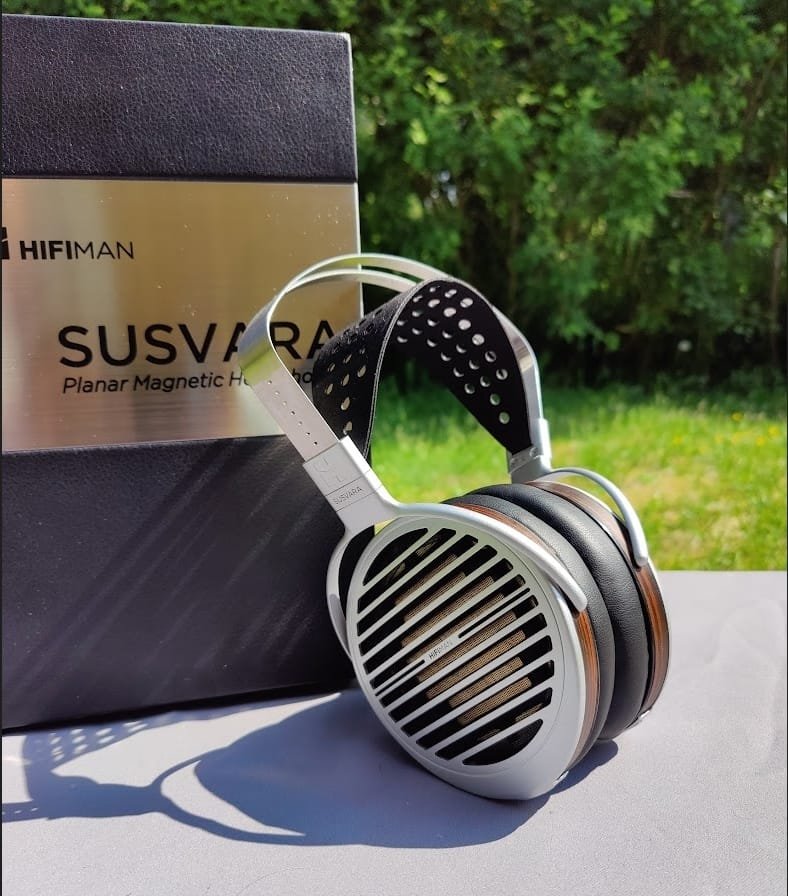
Table of Contents:
Information:
- Release year: 2017
- Country of Origin: China
- Price: 7000 €
- Type: open, over-ear
- Driver type: Planar
- Impedance: 60 ohm
- Sensitivity: 83 dB/mW
- Weight: 450 g without cable
- Connector type: 2 x 3.5 mm
- Cable: 3-meter long cable with a 4-pin XLR connector and another similar one with a 6.35 mm connector
- Accessories: Pouch, hardcover manual, and storage box
Review sample: Self-purchased product
Chinese Hifiman tends to bring new headphones to the market at a rapid pace. Older models also receive updates almost annually, as, for example, four different versions of the HE1000 and Arya models have already been released. Introduced in 2017, the Susvara is a peculiar exception in Hifiman's lineup due to its longevity. The headphones have also maintained their position as the manufacturer's flagship planar model. Technologies developed for Susvara, such as Stealth magnets and Window Shade grilles, have later been adopted in several more affordable headphone models.
Although the Susvara now costs a whopping 7000 euros after a price increase, it is not even the manufacturer's most expensive headphone model. The true flagship can be considered the Shangri La SR electrostatic headphone, priced at 18,000 euros. However, few have had the chance to hear the Shangri La, while almost everything possible has been written about the Susvara. The headphones have been both a critical and commercial success, and over the years, they have established their position as a high-end reference. Even though new expensive headphones are released annually, it is still not possible to discuss the world's best headphones without mentioning the Susvara.
For me, however, it is quite a new acquaintance, as I got to listen to the headphones for the first time about half a year ago after buying an older model used. Later, I upgraded it to the newer Susvara featured in this review. Some of my photos are from the old pair of headphones, which is best evidenced by the frayed headband padding.
Productpackaging and accessories
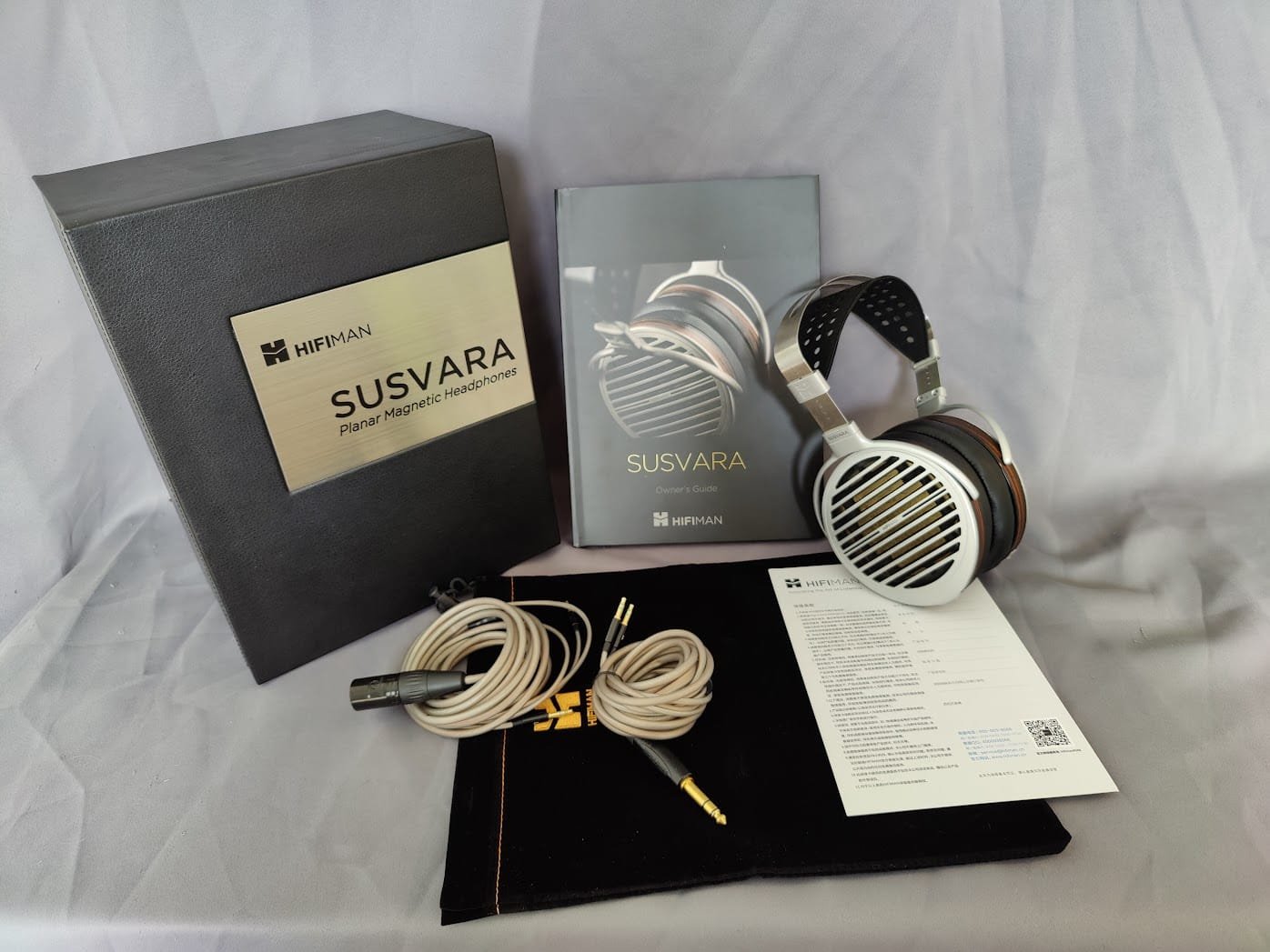
The headphones are delivered in a fine faux leather-covered box with the model name embossed on a metal plate. In addition to the headphones, the package includes two cables, a pouch, and a hardcover opus serving as a manual. The book is admittedly quite nice, but I would have appreciated, for example, replacement ear pads or a headphone stand more. The lack of additional accessories in a 7000 euro product is indeed a disappointment.

Quality of construction and comfort of use
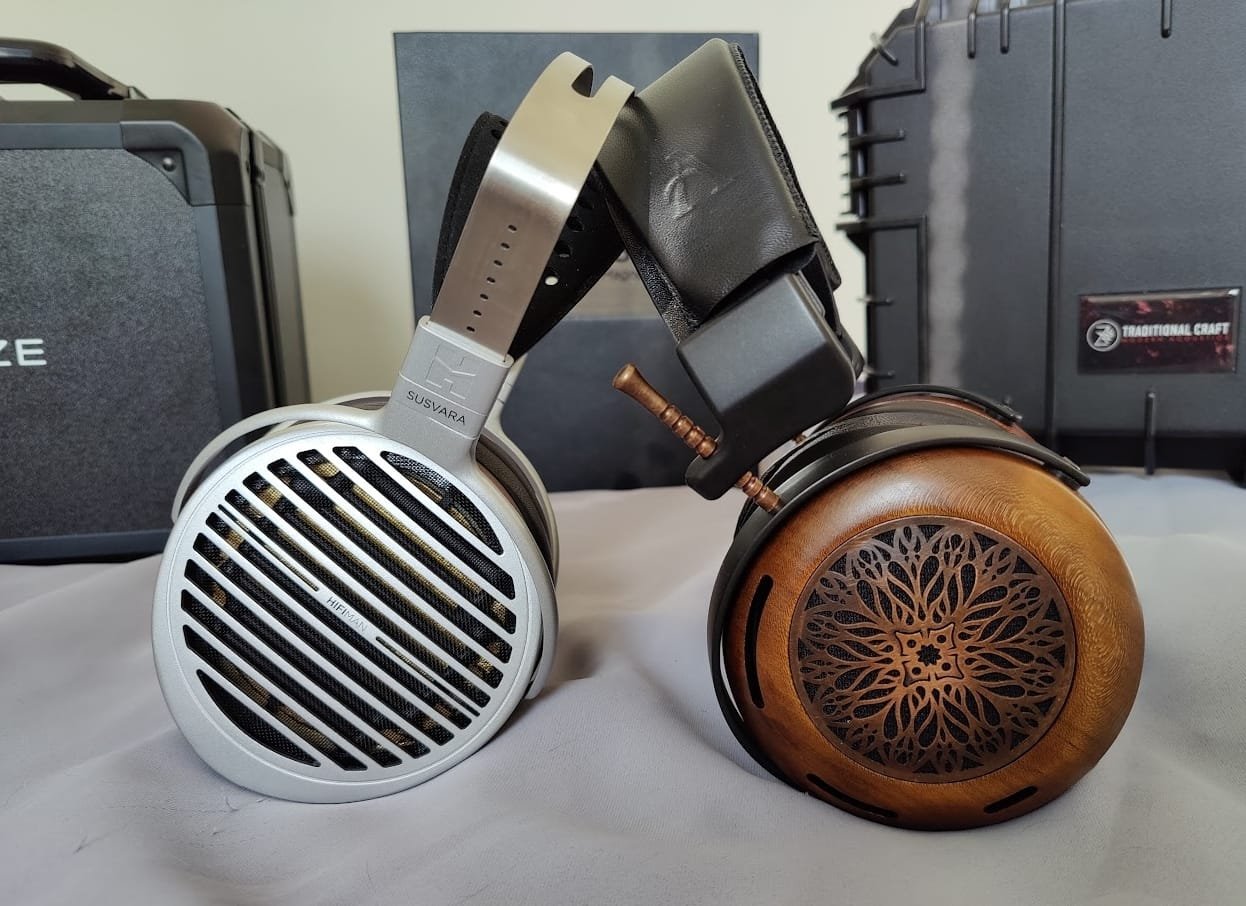
In appearance, the Susvara is easily recognizable as Hifiman headphones. In size and shape, it is a kind of intermediate form between models with round cups and larger models with egg-shaped cups. Deva and HE5XX are shaped somewhat similarly. In other aspects of its appearance, the Susvara is closest to the HE1000 series headphones. The Susvara fits my rather small head more comfortably than the manufacturer's larger models, as, for example, the lower edge of the HE1000 and Arya earpads sits a bit too low on my face.
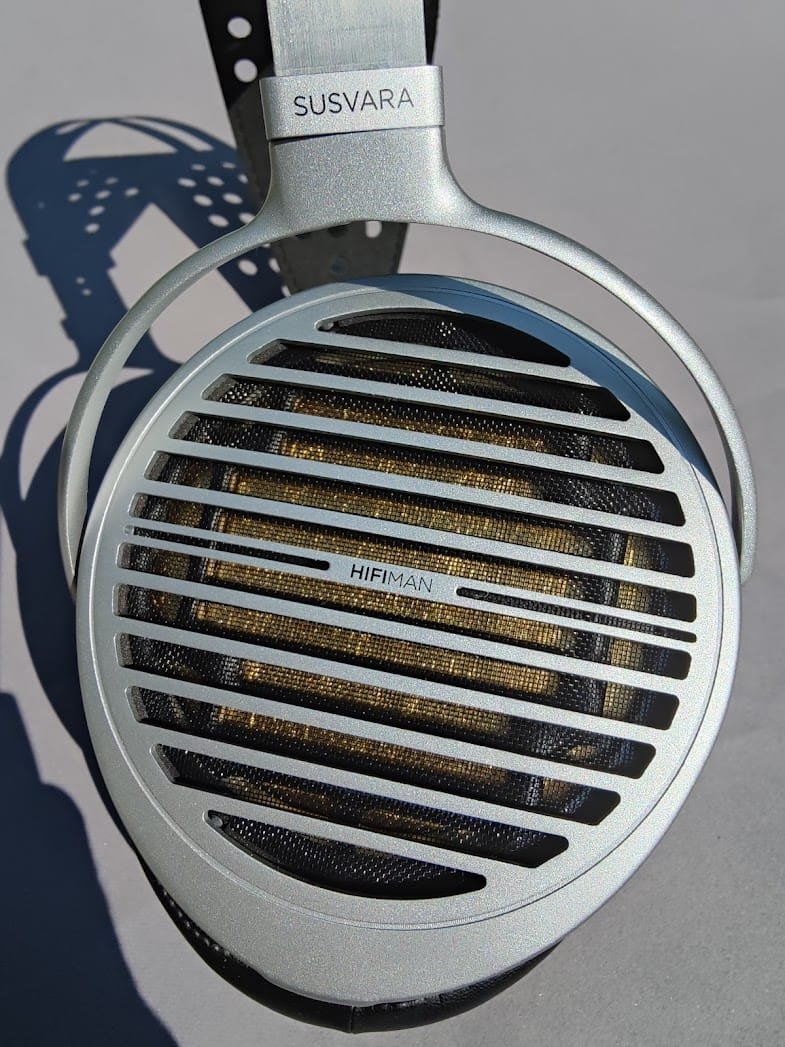
Part of the large price difference between the Susvara and HE1000 series headphones is explained by a different manufacturing process. The Susvara's cups are made of aluminum by CNC machining and are finished by hand sanding. The HE1000 series is manufactured by casting aluminum into a mold, which, according to the manufacturer, is six times cheaper than CNC machining. However, the more complex manufacturing process is hardly visible in the Susvara's appearance. I am not an expert in metalworking, but due to the slightly rough edges, the parts look more cast than high-quality milled or laser-cut.
Despite its minor flaws, the Susvara still looks quite good, although I would expect better in this price range. I admit I am superficial, but in my opinion, 7000 euro headphones should look good and expensive, and the materials should be the best possible. The cheap-looking and poorly finished wood veneer, familiar from more affordable Hifiman models, hardly improves the impression of quality.

The Susvara's headband structure is similar to that of the HE1000 and Arya. There is plenty of adjustment range for the height of the band, so the headphones can be positioned on any head. The clamping force on the ears is moderate but sufficiently firm. The structure is, all in all, functional. The cardboard-like and poorly made leather headband, however, is miserable. Since my headphones are new, the band still feels quite sturdy. In my older pair of headphones, the band flopped loosely from side to side. This is a typical defect of the manufacturer's headphones, as reviewed in Kuulokenurkka's HE1000 V2also had the same problem.
A bad headband would be a minor issue on 50 euro headphones, whereas on a 7000 euro product, it is utterly ridiculous. Fortunately, it does not affect comfort, as long as the potentially floppy headband is manually adjusted to a suitable position on the top of the head.

Earpads:
Hifiman calls the headphone pads "Harmony-pads". The part that touches the skin is fabric, the inner edges are perforated leather, and the outer edge is solid leather – I couldn't find confirmation, but I assume the leather is artificial. Almost all Hifiman headphone pads are made from these same materials. The Susvara pads offer quite good space for the ears, but I wouldn't mind if there was a bit more depth.
On the underside of the pads, there is a fixed plastic ring that attaches to the headphones with clips. Other manufacturers' pads can also be used with the Susvara, provided suitable mounting rings are acquired for this purpose, for example, from Ebay. Many indeed use ZMF pads with the Susvara, which, of course, also change the sound.
Trying different pads could be interesting, but so far, I haven't dared to remove the Susvara's own pads. Even if it were easy, the plastic rings could bend during removal or attachment, leaving an air gap between the pads and the headphones that would alter the sound.
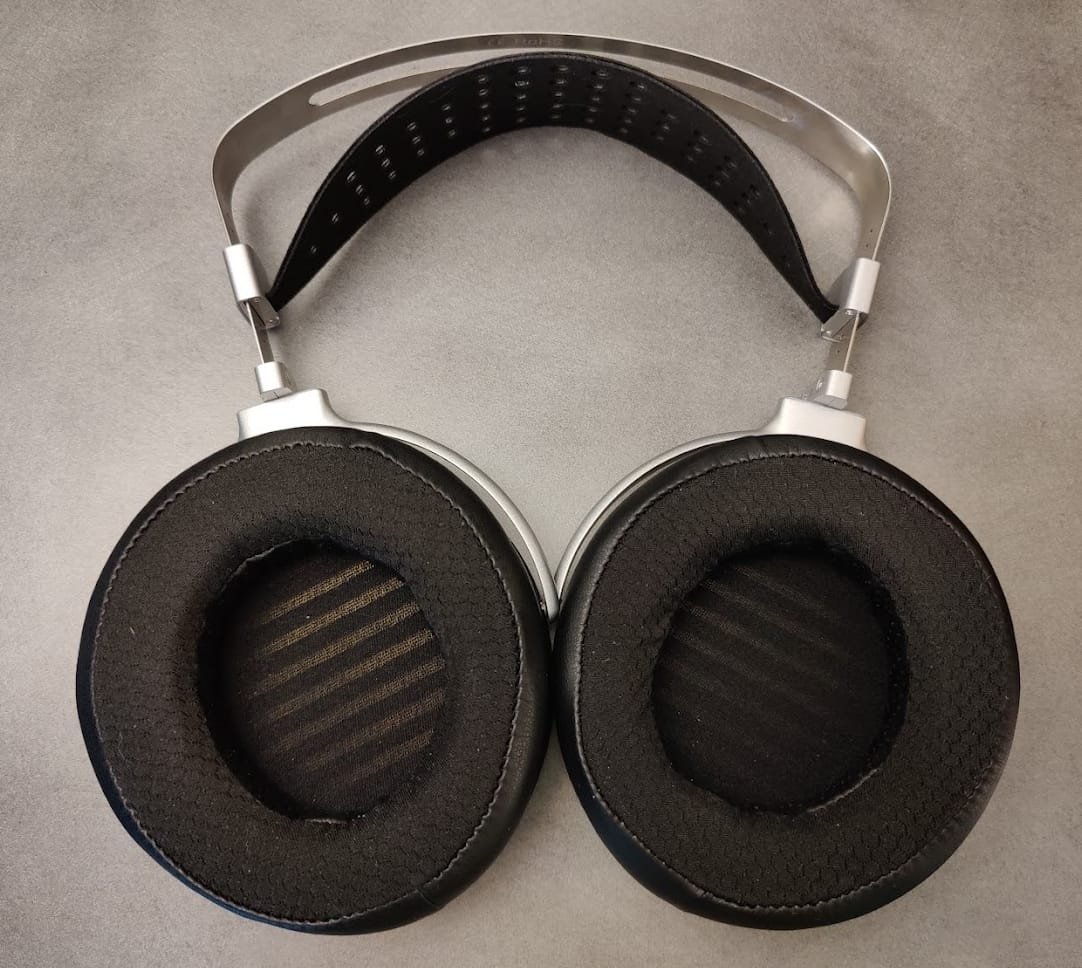
In older Susvara headphones, the earpads were even thinner than in the current version, which caused a peculiar problem. When the ears touched the magnets of the drivers, their black paint started to peel off and stick to the surface of the planar diaphragm. Paint crumbs on a diaphragm thinner than a hair can certainly affect sound quality. When buying older used headphones, it is advisable to ask the seller for a photograph of the drivers. A diaphragm full of paint may not be apparent by listening, so a visual inspection is necessary. In models currently in production, the problem should have been fixed.
In old headphones, the adhesive for the earpads was also of poor quality, like in other Hifiman models, which could cause the earpads to tear at their seams. Fortunately, this problem has also been fixed in all headphone models currently manufactured.

Cables:
In addition to many other minor quality issues, Hifiman is known for its dismal cables resembling surgical tubing. Two of these are supplied with the Susvara (connectors 4-pin-XLR and 6.35 mm). The cables easily develop kinks, which makes intermittent contact quite likely over time. It is also almost impossible to straighten the cables, as they tend to retain the shape they were packed in at the factory. Furthermore, the unpleasant rustling caused by moving the cables is clearly transmitted to the headphones. It is incomprehensible that Hifiman has still not deemed it necessary to replace the included cable type with a better one. It is no wonder that almost all Susvara owners use cables made by another manufacturer.
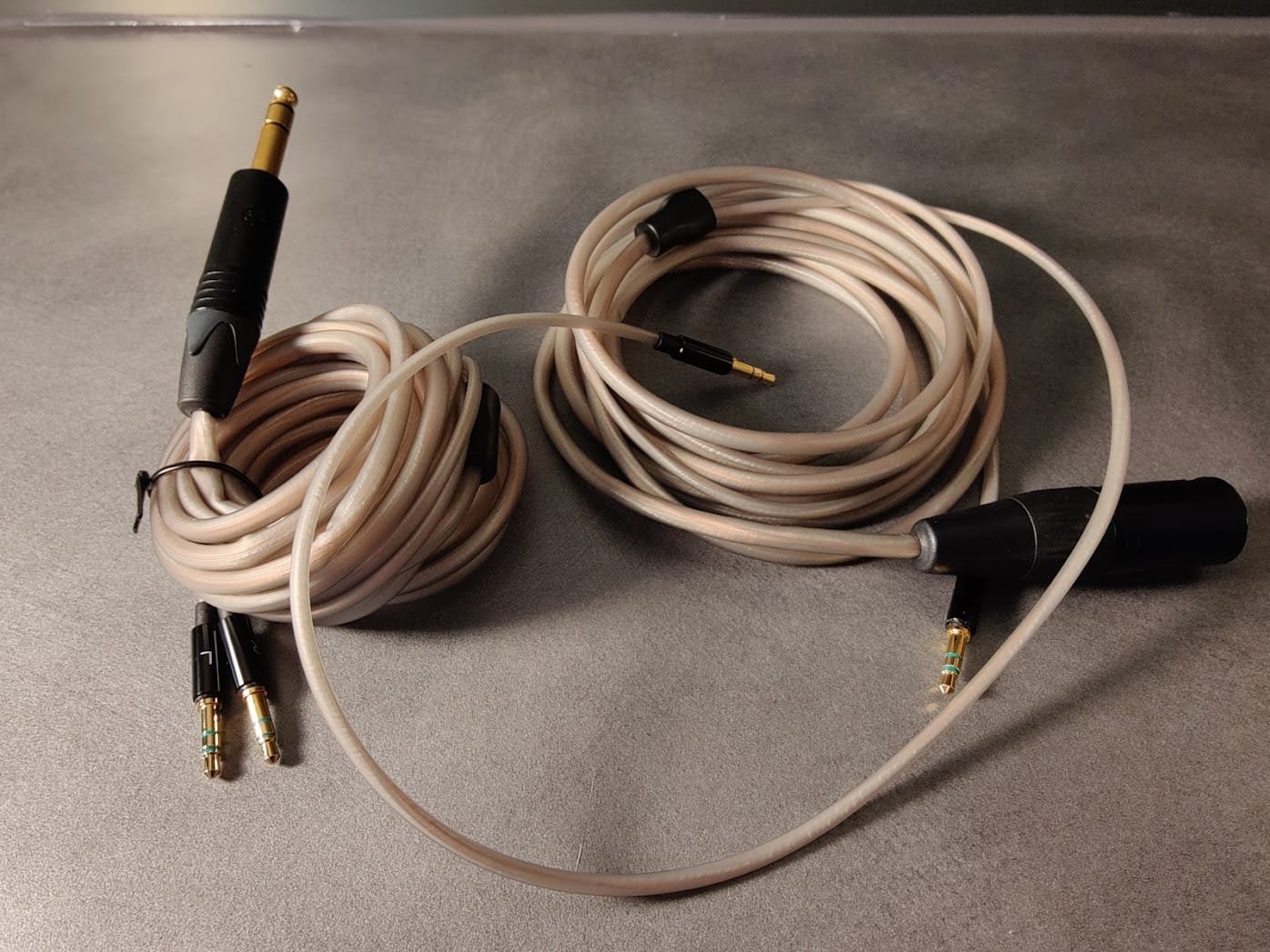
Weighing about 450 grams, the Susvara offers quite good wearing comfort. However, the dismal cables, limited accessories, and a rather modest build for the price do not impress. It's good that the manufacturer has fixed the quality issues of older models, but the Susvara is still impossible to call worth 7000 euros in terms of overall quality impression.
Knowing Hifiman, this is not surprising, as its headphones are bought solely for sound quality (and with reservations, also for comfort). Sound quality is also the most important criterion for me, but the appearance of the headphones also has great significance. I have less time to listen to music than I would like. Setting up the equipment and preparing for a listening evening is an event in itself, so it also matters what kind of headphones I pick up. For example, the Abyss AB1266 Phi TC and ZMF headphones already put me in a positively tuned state.
Sound quality
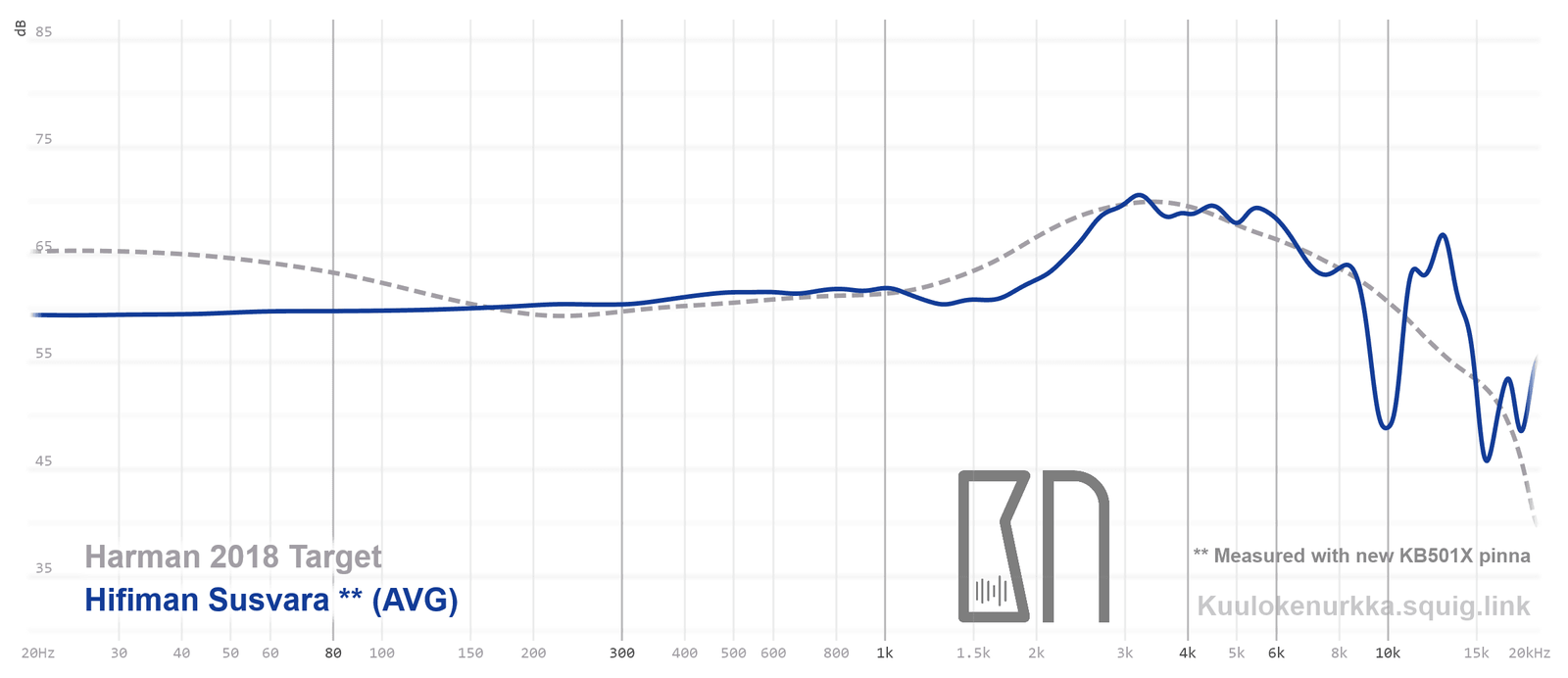
The headphone frequency response measurements were made using IEC711 standard equipment and new, more accurate silicone ears (KB501X). The graphs use the scientifically based Harman target curve (2018 version) as a reference, which is a generalisation of the frequency response that most people think would sound good. For more information on the measurements and their accuracy, see Headphone Measurements-page. The Susvara's frequency response can also be compared with other measured headphones comparison tool .
Headphone frequency response:
Bass:
The Susvara has a very balanced bass reproduction, which those who appreciate neutral or slightly lean bass are likely to be satisfied with. In Hifiman's own lineup, at least the HE1000 V2 and Edition XS offer slightly more bass. My own taste has increasingly aligned with Harman's target response, so I would like a bit more power in the lowest frequencies for the Susvara. Pop music, EDM, and rap relying on powerful bass reproduction sound regrettably dull.
Susvara, like other Hifiman models, emphasizes accuracy over power in bass reproduction. Notes are excellently separated, but impacts remain too light. The headphones also don't properly ”shake” the listener with longer-lasting low-frequency rumbles. The grip is quite delicate – the bass is audible, but hardly feels like anything. For example, many Audeze headphones don't have quantitatively more bass than Susvara, but they feel significantly more physical.
Central votes:
In terms of mid-range, Susvara is simply the best headphone I have ever heard. Its reproduction is clear, but the presentation remains quite relaxed due to the slightly smoothed-out sounding presence region. Although Susvara's frequency response and frequency balance largely correspond to other Hifiman open planar headphones, each model sounds slightly different. Susvara sounds electrostatically ethereal, and its sound is framed by warmth and softness. The presentation is seductively appealing.
Piano and string instruments sound incredibly good. However, the headphones are at their best when reproducing vocals. Susvara's way of emphasizing the singer's interpretation and emotional state is unparalleled. I use the word ”emphasize” because the result is not entirely natural either. The headphones are not necessarily a bullseye for those seeking the most authentic timbre in the mid-range, but for listening pleasure, the result is almost perfect for my taste. Hifiman HE1000 V2 is very similar in its mid-range, but Susvara takes the same presentation style to a new level.
If there's anything I'd like to improve, the reproduction could be a touch more robust, making heavier music sound more powerful. However, it's likely that with a slightly more robust sound, Susvara would no longer reproduce vocal performances in such a magical way.
Treble:
Many might find Susvara slightly bright in its upper frequencies. For my taste, however, the treble balance is perfect. When interpreting the frequency response measured with IEC711-standard equipment, it's worth noting that the dip at 10 kHz is a known characteristic of the equipment, and the sound does not actually sound attenuated to the human ear.
Susvara is actually very close to balanced in its upper frequencies Sundara-model. HE1000 V2, Arya V2, Ananda and Edition XS are slightly brighter. I cannot say a bad word about the quality of the treble, as Susvara is among the best headphones in the world in terms of resolution. Cymbal harmonics are reproduced clearly and very naturally. Sounds located at the extreme limits of my hearing threshold are also reproduced with a clarity that most headphones can only dream of. Susvara's treble does not hiss unpleasantly, rustle unnaturally, or cause sibilance in the mid-frequencies.

Soundstage:
The soundstage of the headphones is larger than average, but not exceptionally impressive. HE1000 V2 and perhaps even Arya V2 sound more spacious. According to my recollections, also Meze Empyrean spreads the sound over a wider area from the speaker-like sounding Abyss AB-1266 Phi and not to mention Phi TC headphones. It may be that even the old classic Sennheiser HD800 has a larger soundstage than Susvara.
Susvara, however, places sounds very precisely. There seem to be no limitations on the layering of the soundstage or the possible locations of sounds. However, I must admit that Susvara's smaller-than-expected soundstage is still a disappointment. I assumed that the headphones would at least outperform the manufacturer's own more affordable models. On the other hand, when listening to Susvara, I don't even miss a larger soundstage. The sound has enough sense of spaciousness, and the overall presentation is truly coherent. In terms of soundstage proportionality, Susvara is ultimately the best Hifiman headphone I have heard.
Resolution and tonal transparency:
Susvara's sound is very precise and resolving. Small changes in sound pressure and echoes are reproduced clearly. Sometimes I notice, for example, a different number of backing vocalists in a song than I had previously discerned with other headphones. Other new sounds may be revealed in the music that I might usually have missed because they were drowned out by, for example, a synthesizer's whine. All of this is the least one should expect from 7000 euro headphones.
Critically evaluating, Susvara's sound is, however, slightly veiled, which is at least partly explained by the subtly playing 1–2.5 kHz region. From memory, Susvara is not significantly more resolving or less veiled than the clearly cheaper HE1000 V2. Those seeking detailed and resolving reproduction will certainly not be disappointed with Susvara, but in my opinion, it doesn't offer full value for money. With these priorities, anyone looking for headphones should also consider top models from other manufacturers.
Dynamics:
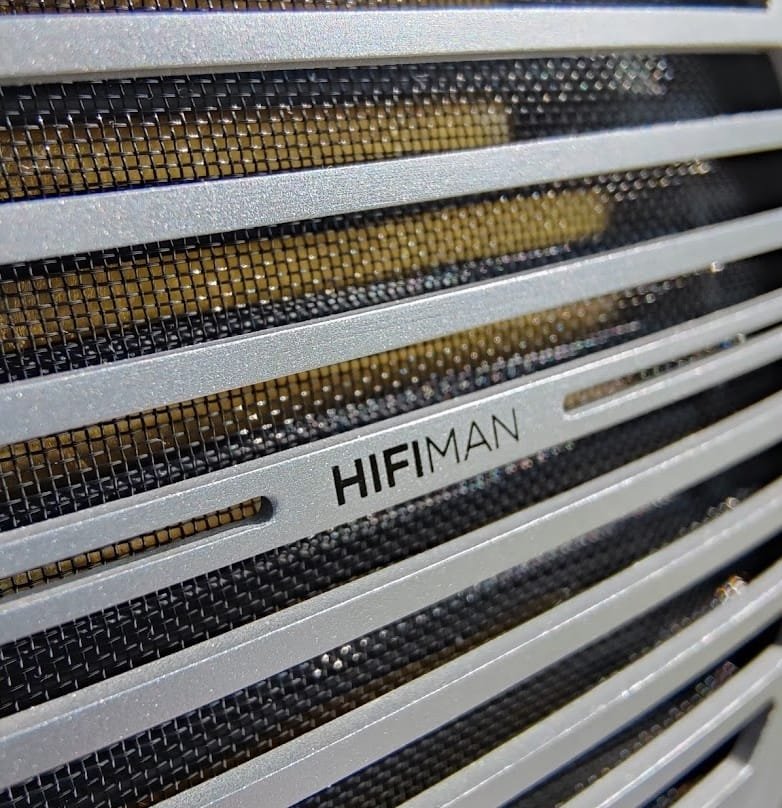
In my opinion, the Achilles' heel of many Hifiman headphones is their bland dynamics. The HE-6, which has achieved classic status in the manufacturer's lineup (and the slightly weaker reissue of the headphones HE6se) is the only headphone that stands out with exceptionally explosive macrodynamics. In the Hifiman lineage, Susvara is the successor to the HE-6 and HE1000 V1. The kinship to the HE-6 model is indicated not only by the golden drivers but also by the fact that Susvara was originally supposed to be named Edition 6. Unfortunately, however, Susvara is more akin to the HE1000 in terms of its restrained dynamics.
In Hifiman's headphone lineup, I would place Susvara roughly in the same category as Arya and HE1000. Susvara's sound might be slightly more impactful compared to the aforementioned, but the improvement remains small. Susvara is indeed very fast in its transients, but the reproduction is a bit too light and ethereal-feeling. Susvara surprisingly resembles electrostatic headphones, for better or worse. Not everyone, on the other hand, desires a very punchy sound from headphones.
For me, powerful dynamics are one of the most important criteria for headphones. Everything else is pointless if the headphones don't make your feet tap or draw attention to themselves during music's peak moments. Listening to Susvara requires concentration because its dynamics don't captivate, and thoughts tend to wander to other things. The sound does roll rhythmically even with energetic music, but the end result is too light for my taste. However, slower-building musical climaxes are reproduced quite well by Susvara. So, the macrodynamics are by no means inadequate, and the headphones' soft and polished presentation does not prevent me from enjoying music. Still, I couldn't consider Susvara as the only headphone model I own.
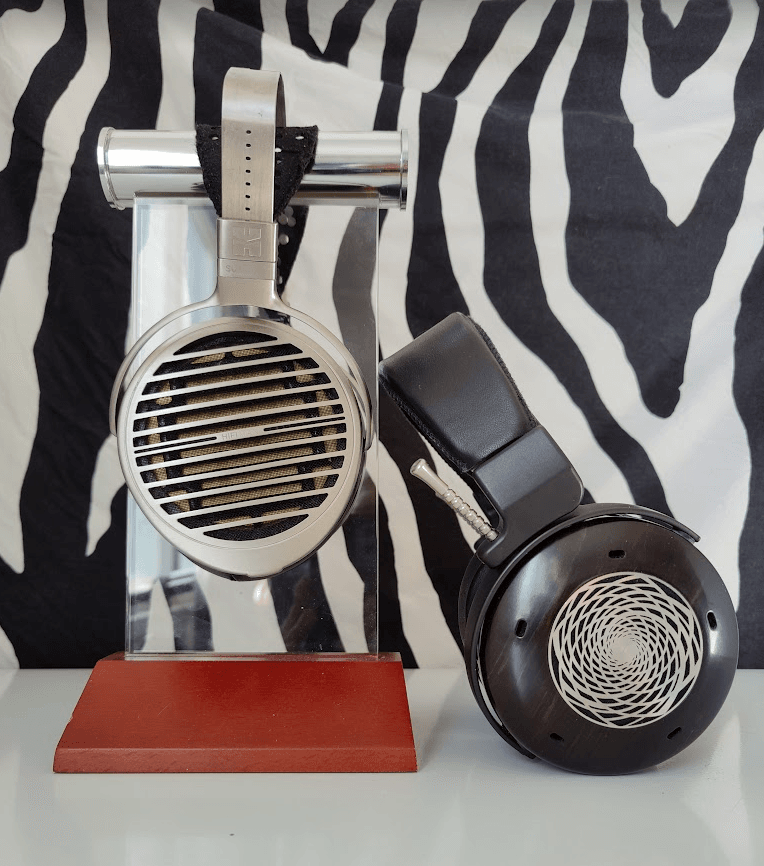
Confirmation
Hifiman Susvara and HE-6 are probably the most difficult headphones in the world to amplify. Other models considered challenging, such as Abyss AB-1266 Phi and HEDDphone, are nowhere near as demanding. I personally find the HE-6 slightly more difficult than Susvara because its timbre changes more with the wrong amplifier.
Susvara, in any case, requires an exceptionally generous amount of power from an amplifier. Many users connect the headphones to an amplifier intended for speakers. According to these people, it's not just about volume, but about Susvara's dynamics and bass reproduction not coming alive with ordinary headphone amplifiers. I am somewhat skeptical about this myself, but the view is quite common among Susvara owners.
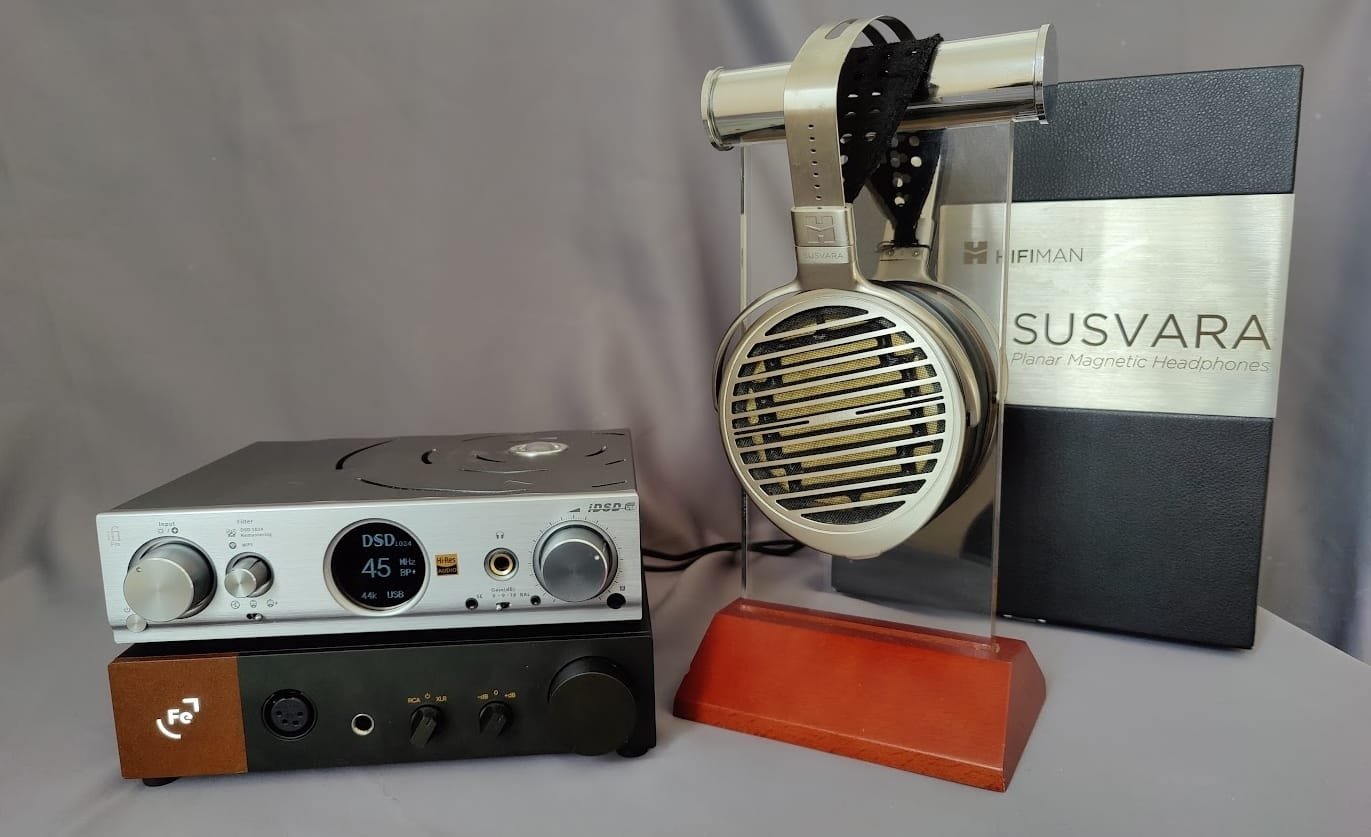
I have mostly used the Ferrum OOR (1995 €) headphone amplifier with Susvara. I find the pairing excellent, which is not a real surprise, as the device is one of the most popular headphone amplifiers among Susvara owners. Usually, OOR owners also acquire a Hypsos power supply, which increases the price of the setup by a thousand euros. Many believe that a better result than the OOR+Hypsos combination can only be achieved with significantly more expensive amplifiers, such as the Enleum AMP-23R (7500 €) and Zähl HM1 (8000 €).
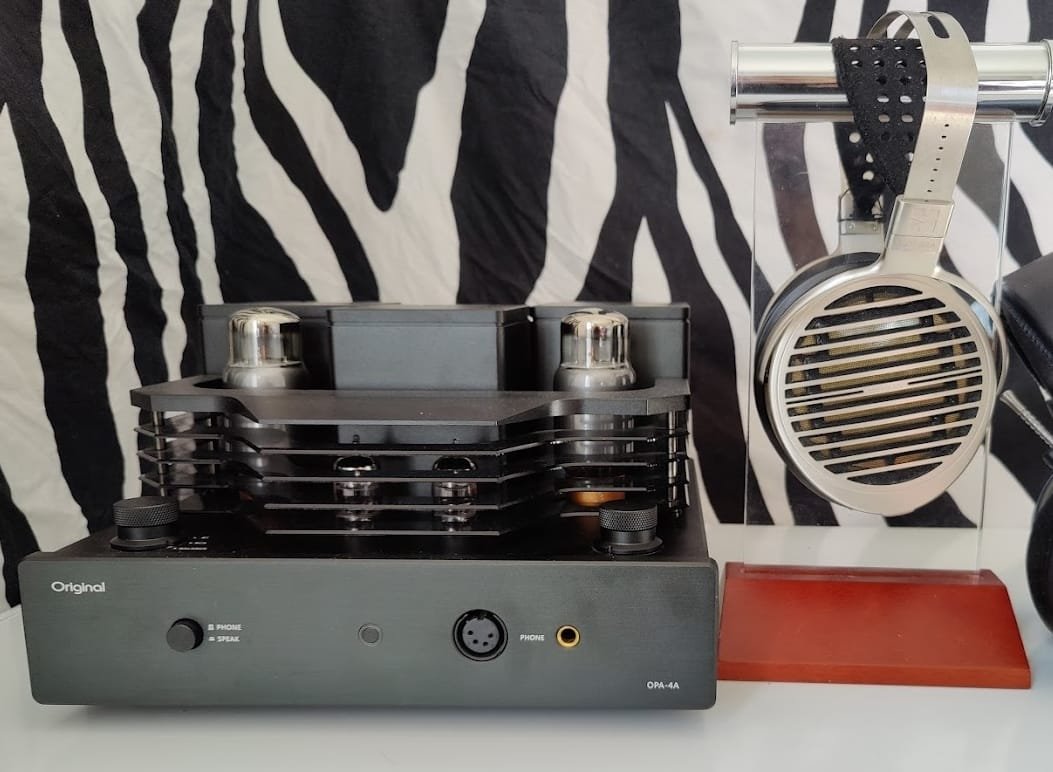
In addition to the Ferrum OOR, I listened to Susvara with the Original OPA 4A (850 €) tube amplifier. Its stated output power is as much as 4 watts into a 32-ohm load, so the tube amplifier is not entirely typical for its price range. The OPA 4A generally sounds excellent with Susvara, but at higher volumes, it ”freezes up” and the headphones' bass reproduction distorts. I also tested the Hifiman EF6 amplifier, which did not quite reach the sound quality level of the OOR, even though it handled the task excellently in terms of its output power.

Amplifying the Susvara is a scene of its own. Owners of the world's best (or at least most expensive) headphone amplifiers usually use the Susvara. It would be great to someday hear what the headphones would sound like with, for example, the Woo Audio WA234 (€18,000), Trafomatic Primavera (€12,000), or Viva Egoista 845 (€16,000). Hifiman itself also has a high-end amplifier designed for the Susvara, the EF1000, which costs around €15,000. Among those with a more normal budget, popular amplifiers include the Topping A90 (€500), Schiit Audio Jotunheim 2 (€550), and Cayin iHA-6 (€700).
Comparison to other headphones
I will return to the Susvara in future reviews. Therefore, this time I will only compare it quite briefly to the Focal Utopia and Abyss AB-1266 Phi. Since more detailed reviews of the comparison headphones have already been published separately in Kuulokenurkka, I will not discuss structural features or comfort in this context.
Previous reviews:
Hifiman Susvara vs. Focal Utopia 2017
Prices: €7000 vs. €4000 (production discontinued and replacement model costs €5000)

The former flagship model of French Focal and one of my favorite headphones, the Utopia, was released in 2017, as was the Hifiman Susvara. Many believe that Hifiman and Focal are the main culprits behind the runaway pricing of headphones. Focal introduced a new version of the Utopia to the market in 2022, which costs €5000. Hifiman, on the other hand, has not released a successor to the Susvara, but in Europe, the price of the headphones was raised by €1000 to the current €7000.
Frequency responses:
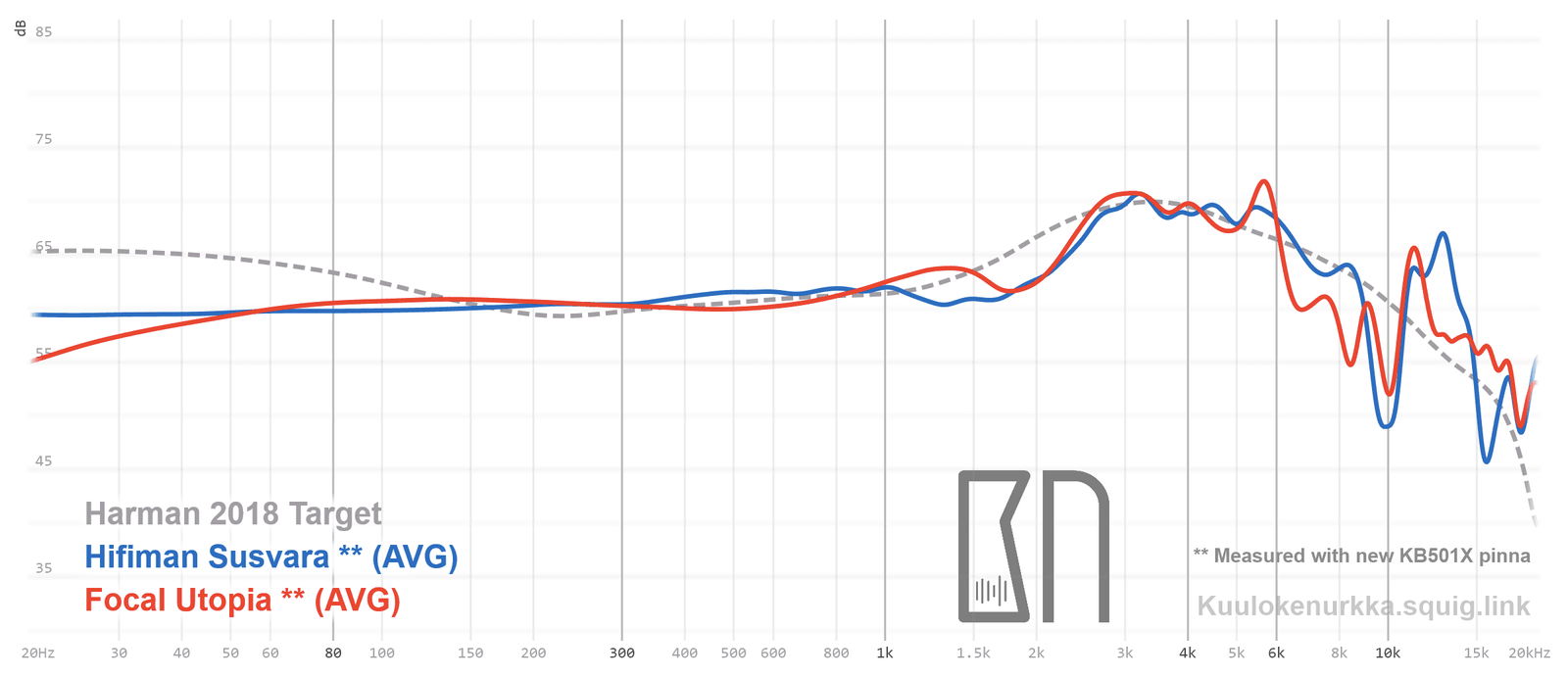
Compared to the Utopia, the Susvara's sound has a warmth that makes the mid-range almost honey-like. Despite its excellence, the Utopia, unlike the Susvara, does not make music sound more beautiful than it actually is. Conversely, this means that the Utopia sounds less colored. The Susvara's subdued frequency range between 1–2.5 kHz makes it sound slightly veiled. The effect is mild, but it is emphasized when compared to the Utopia, which is more present in the same frequency range. To my ears, the difference is greater than what could be inferred from the frequency responses. The Utopia's mid-frequencies are indeed slightly clearer and more transparent.
Usually, I prefer the most unveiled reproduction possible, but in this case, the Susvara sounds more interesting and pleasant than the Utopia. My apologies to all haters of vague terms, but in my opinion, the Susvara is more musical than the Utopia. It reproduces the mid-range with more nuance and is quite clearly ahead of the Utopia, especially when listening to complex music.
The Susvara is better in its sub-bass, while the mid-bass hits significantly harder with the Utopia. Differences in dynamics are not limited only to bass impact sounds; the Utopia is more impactful, straightforward, and explosive across the entire frequency range. The Susvara, on the other hand, is more rhythmic, calmer, and meandering – it almost sounds like a wine tasting.
At first glance, the Utopia might sound more resolving than the softer-sounding Susvara. However, with longer listening, it becomes clear that the Susvara brings out small details in the background that are more easily missed with the Utopia. The Susvara's soundstage is also clearly more impressive – not necessarily more precise, but more spacious.
I really like the Utopia for its appearance, build, and above all, its engaging reproduction and incredible dynamics. Overall, however, the Susvara is a more convincing headphone. Its incredible mid-range combined with better resolution than the Utopia is a combination that is hard to beat. Still, I cannot ultimately say that the €3000 price difference between the two is entirely justified. The Susvara is not *that* much better. The headphones also have very different presentation styles. I would gladly own both, as they complement each other excellently. Although I prefer the Susvara more, I might choose the Utopia if I didn't listen to classical, acoustic, or vocal-centric music at all.
Hifiman Susvara vs. Abyss AB-1266 Phi
Prices: €7000 vs. €6000–€8000 depending on equipment level (production discontinued / prices for the replacement AB1266 Phi TC start from €6800)
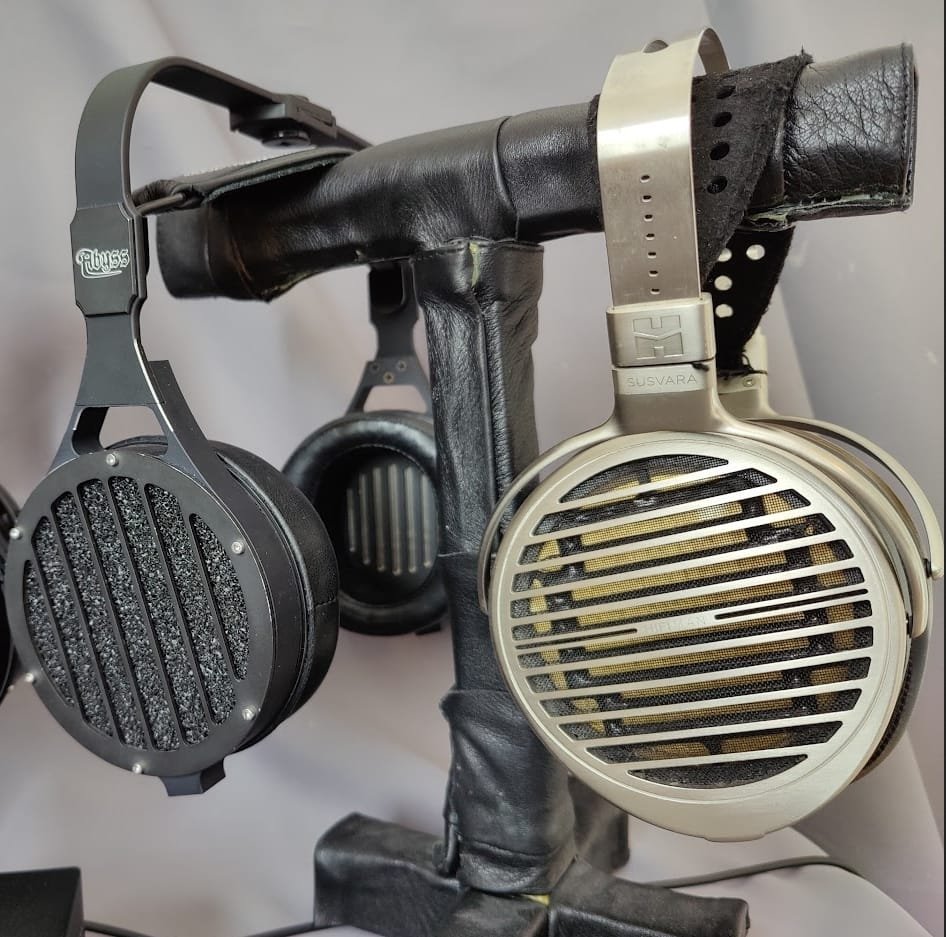
Like Susvara and Utopia, the Abyss AB-1266 Phi was also released in 2017. I owned the headphones for over a year, so their sound became quite familiar. I never warmed up to the slightly artificial timbre, but the amazing resolution and excellent bass reproduction always impressed me. The production of the AB-1266 Phi has already been discontinued, but many headphone enthusiasts make their choice between the newer Phi TC model and Susvara. The AB1266 Phi TC and Susvara are likely the world's most popular headphones costing over 6000 euros. Since I now own both, I will compare the duo later when writing a review of the Abyss model.
Frequency responses:
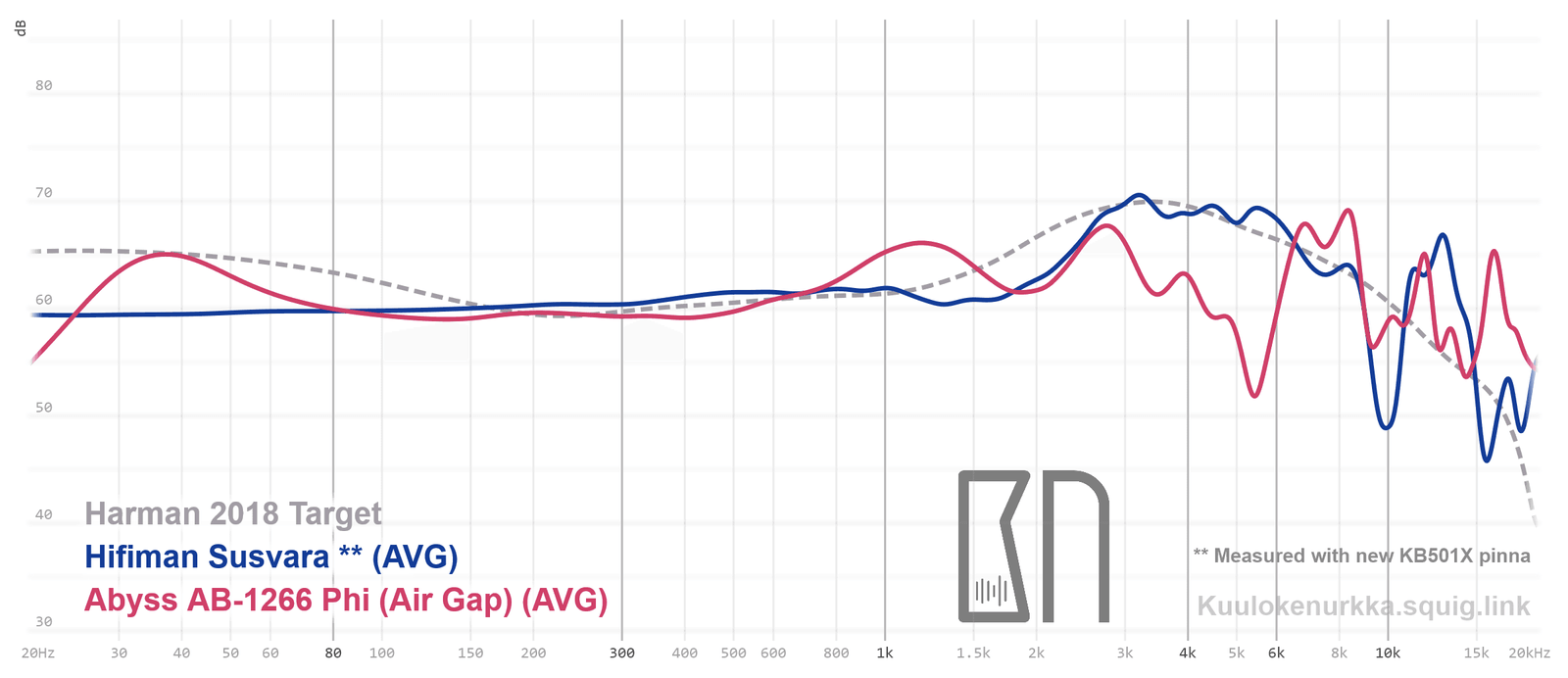
Note. The frequency responses were measured with different silicone ears, so the results are not fully comparable from 3 kHz onwards. The amount of sub-bass in AB-1266 models depends entirely on how large an air gap is left between the head and the ear pads. The frequency response shown above illustrates the situation with a moderate air gap, which the manufacturer itself recommends.
When I switch from Susvara to AB1266 Phi, my attention is first drawn to the Abyss model's truly peculiar mid-range tuning. One gets somewhat accustomed to the unusual sound over time, but when quickly compared, the difference to Susvara is significant. The AB-1266 Phi's sound is stark, thin, aggressive, and unnatural. Susvara, on the other hand, is absolutely wonderful, offering the best mid-range I have heard.
Once the initial shock caused by the strange mid-frequencies subsides, the Abyss model also begins to show its strengths. Its bass reproduction is clearly superior to Susvara in that aspect. Although Susvara's bass reproduction is of high quality, it is not as impactful and precise as in the AB-1266 Phi. With Susvara, the low frequencies remain in a supporting role, whereas the AB-1266 Phi draws attention to them with its exceptionally high-quality presentation. The headphones also have slightly more bass than Susvara, but the difference lies in the very lowest frequencies, not in the mid-bass that adds to the sense of impact. The differences I experienced in the dynamics of the low frequencies are not explained solely by the frequency response.
Now that dynamics have been mentioned, let it be said that Abyss outperforms Hifiman significantly in that regard. The AB-1266 Phi reproduces both fast and large tempo changes and even the smallest nuances more excitingly. Its overall sound is also more precise, painting a sharper picture of the music. Susvara, although undoubtedly a reference-level top-tier headphone, sounds almost hazy in direct comparison. The Abyss model also boasts a larger soundstage than Susvara.
Susvara and AB-1266 Phi are therefore quite different headphones. The superiority between them is once again determined by the type of music intended to be listened to with the headphones. Pop, rock, and EDM sound excellent with Abyss headphones. Susvara, on the other hand, shines with all kinds of music where vocal performances are central. As an all-rounder, Susvara is better in my opinion, because even at its weakest, it is quite impressive. The AB-1266 Phi, however, is more of a love-it-or-hate-it type of headphone, which would be important to audition before making a purchase decision.

Summary
Hifiman Susvara is not without reason considered one of the best headphones in the world. There is nothing negative to say about its frequency response, as long as the balanced, but slightly bright, reproduction typical of Hifiman headphones is pleasing. For those accustomed to a more colored presentation, Susvara might instead sound dull and overly detailed. For me, the headphones are a great combination of musicality and resolution, at their best bordering on perfection. The mid-range, in particular, is impressive. Some headphones tend to shape the listener's musical taste because they make unfamiliar music sound exceptionally wonderful. Susvara made me enthusiastic about a cappella, even though I hadn't cared for that music genre before.

Of course, even a headphone like Susvara doesn't deserve only praise from me. In my opinion, the perceived quality of the headphones does not match their high selling price. Although they are quite handsome, I would wish for them to stand out more clearly from the more affordable HE1000 series. Susvara has also had a lot of different quality issues over the years, which cast an unpleasant shadow over the product, even though the faults should now be fixed during the production phase. However, the poor cables and flimsy headband are still present. The headphones' exceptional insensitivity, i.e., the need for a powerful amplifier, can also be considered a kind of flaw by current standards.
However, no actual sound quality problems are found in Susvara. The only weaknesses are somewhat subdued macro dynamics and slightly delicate bass reproduction. Sometimes the presentation is too restrained for my taste, making it difficult to get excited about, especially with bass-heavy music. For more aggressive thumping, it's worth considering some other headphones.
For many, Susvara represents an almost perfect headphone in terms of resolution and tonal transparency. However, it didn't quite meet my own excessively high expectations. For 7000 euros, one should be able to achieve even more precise, transparent, and faster reproduction. Therefore, it is difficult to justify why Susvara should cost three times more than the manufacturer's more affordable models or thousands of euros more than, for example, Focal Utopia. Few, of course, pay the full price for Susvara, as the manufacturer sells customer returns quite ”cheaply,” and it is known that many retailers may also offer a rather significant discount if asked. Susvara would ultimately be much easier to recommend for, say, 5000 euros.
Pros and cons:
+ Balanced frequency response
+ Mid-range reproduction is the best I've heard
+ Sound clarity and detail resolution
+ Accurate and well-structured soundstage
+ Comfort of use and lightness compared to other large planar headphones
+/- The reproduction has a pleasant relaxation, but at its expense, some sound transparency is lost
+/- The appearance is handsome and the materials used are quite good, but the headphones do not feel like a premium product for their price
– Somewhat subdued macrodynamics
– Bass reproduction should be fuller
– Requires a powerful and high-quality amplifier to sound good
– Terrible cables
– Limited accessories
– Very high retail price
 EN
EN  FI
FI
Headphone listening does not differ from speaker listening in any way regarding the quality of amplifiers and the source.
It's worth paying if one wants to get as much as possible out of the reproduction.