Author: Sword of Damocles
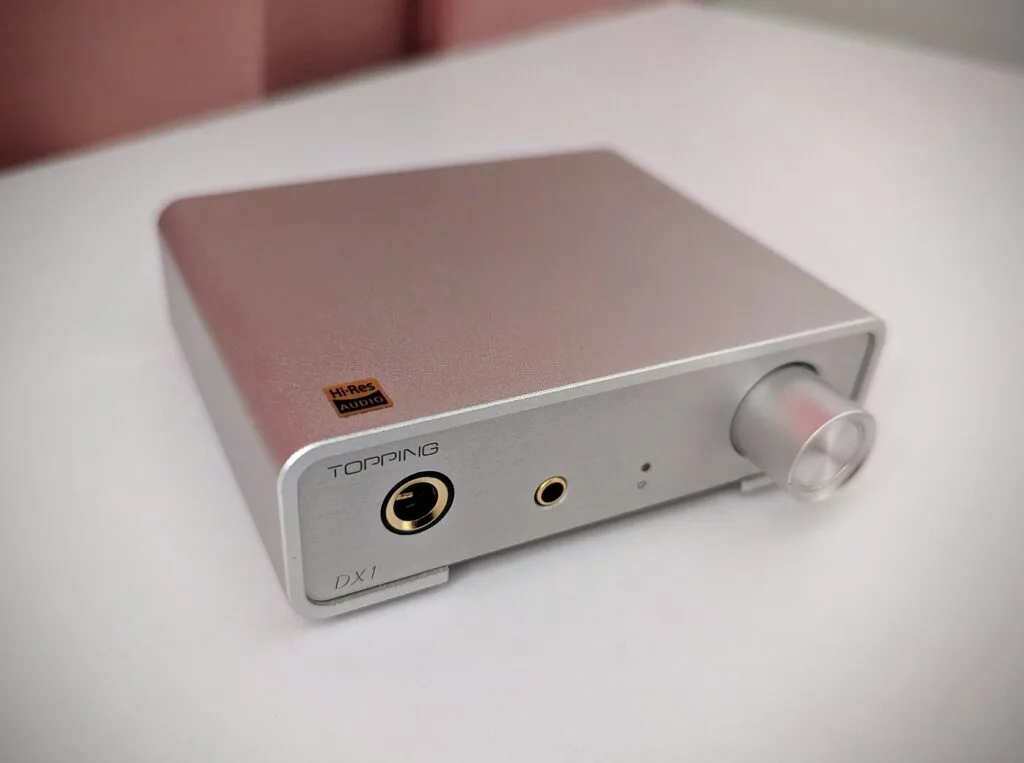
Table of Contents:
Information:
- Release year: 2022
- Country of Origin: China
- Price: 99 €
- Type: DAC & headphone amplifier
- Color options: Black or silver
- DAC chip: AKM AK4493S
- Input connections: USB-B
- Output connections: RCA
- Headphone jacks: 3.5 mm and 6.35 mm
- Sampling rate (USB) PCM: 44.1–384 kHz (16–32 bit)
- Sampling rate (USB) DSD: DSD64–DSD256 (native)
- Output voltage (RCA): 2.0 V
- Headphone amplifier output impedance: < 0.7 ohm
- Two gain levels: -2.0 dB (low) and +12 dB (High)
- Headphone amplifier stated output power: 280 mW @ 32 ohm / 190 mW @ 64 ohm / 51 mW @ 300 ohm
- External dimensions: 10 x 9.8 x 3.2 cm
- Weight: 255 g
- Included: USB cable
Review sample: Self-purchased product
Chinese device manufacturers release D/A converters and headphone amplifiers priced close to each other at such a pace that it's not easy to keep track of the differences between the products. On the positive side, however, the consumer cannot really choose wrong between the devices, as their differences are largely limited to connections and appearance. There are only minor differences between different DAC chips, and even modern headphone amplifiers don't easily run out of power, even in lower price ranges. A larger wad of cash gets bigger numbers in product specifications, but for most, a good basic device would probably suffice, such as the Topping DX1, which costs 99 euros and I'm reviewing this time (link to the manufacturer's product page). It contains both a D/A converter and a decent headphone amplifier in a small enclosure.
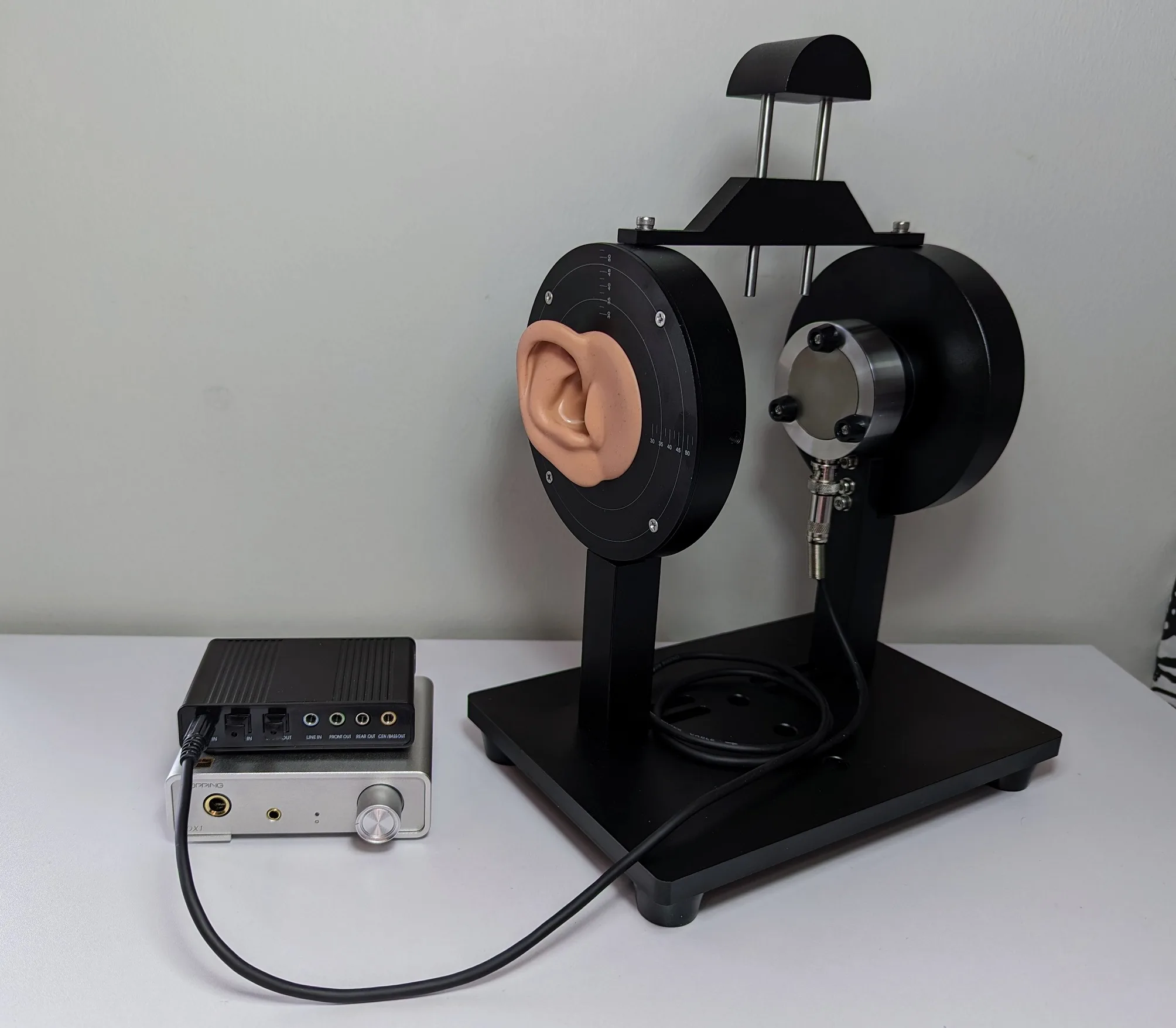
I originally acquired the DX1 for headphone frequency response measurements, as the device does not require mains power and is easy to carry around. The DX1's headphone amplifier is also powerful enough for measurement situations and does not distort the headphones' frequency response. In addition, the standard 6.35 mm headphone jack reduces the need for adapters. Since I have used the DX1 less for listening to headphones, I thought writing a review would be a good time to get to know it better in that regard as well.
Product packaging
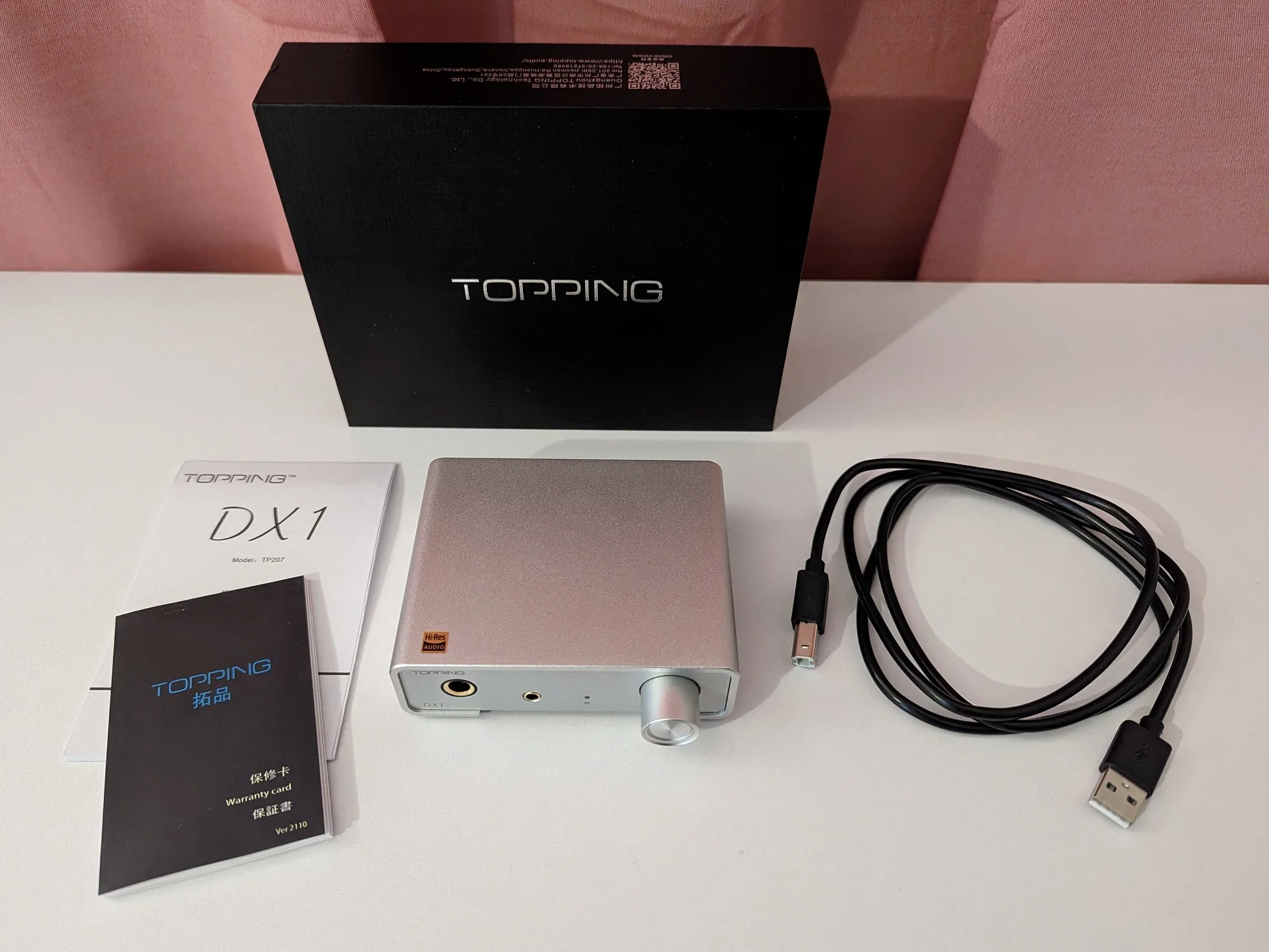
The DX1 is delivered in a dark cardboard package with a USB cable and instruction sheets. Nothing else is needed for use, as, for example, a 6.35 mm adapter would be redundant thanks to the two different headphone jacks.
Structure and connections
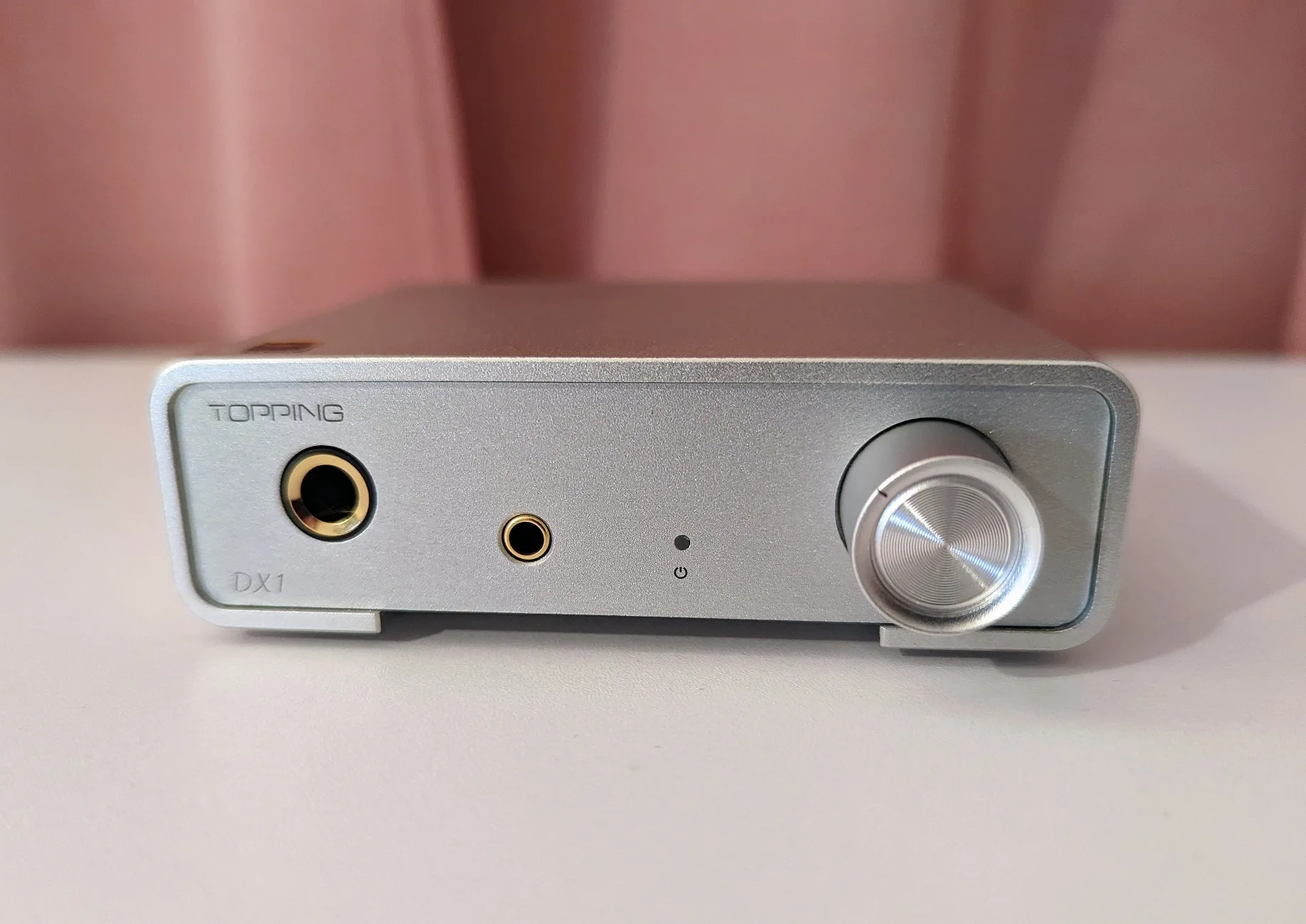
The device is slender in size and, thanks to its aluminum casing, also very sturdy. The silver-colored DX1 I bought does not show visible fingerprints, but those who wish can also buy it in black. The front edge features two headphone jacks (3.5 mm and 6.35 mm), a white power LED, and a volume control. The indicator for the control's position is just a gray line, so it's difficult to see the selected volume from half a meter away. The control itself is high-quality, as it rotates smoothly and has appropriate resistance in its rotational movement. For comparison, the control on my previously owned L30 amplifier was significantly looser. The DX1's control has channel imbalance at the beginning of its range of motion (7–8 o'clock), but fortunately, this does not cause problems during use, even with sensitive in-ear headphones.
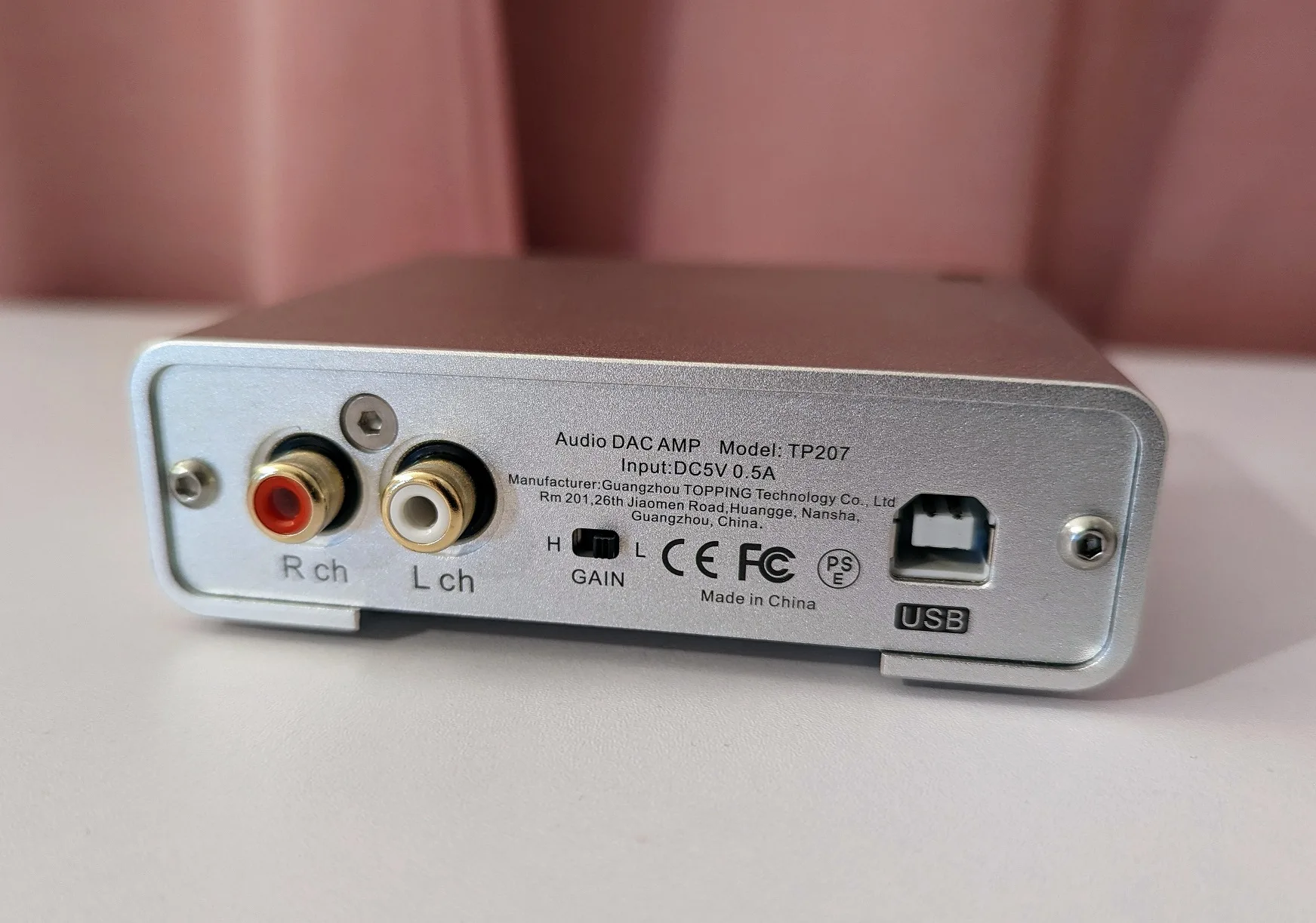
On the back of the device, in addition to the connections, there is a small gain selector with two different levels: low (-2 dB) and high (+12 dB). The DX1 receives both its audio signal and power via a single USB connector, similar to iFi's Zen DAC-series devices. Such devices are easy to use, for example, with a laptop. In addition to the USB-B connector, the DX1 has no other input connectors, so those who need them should acquire another device. The headphone amplifier also cannot be used other than through the built-in D/A converter, which is common in affordable combination devices. However, the Topping device does have RCA output connectors with a fixed 2-volt output voltage, so it can function as a D/A converter for another amplifier. Unfortunately, the DX1 is not suitable as a preamplifier for active speakers, as the volume is not adjustable for the output connectors.
Features and usage considerations
The device's D/A converter is based on the relatively new AKM AK4493S chip, which supports high sampling rates, such as DSD. Unlike more expensive devices, the DAC chip's filter is not interchangeable, which is not a major loss, however. Otherwise, the DX1 largely resembles Topping's other affordable devices, as it performs excellently in device measurements and is not intended to significantly color the sound in any direction.
The manufacturer markets the DX1's USB implementation as particularly quiet, which is entirely true. No noise or extraneous sound is transmitted through the computer to even the most sensitive headphones, even though power also travels along the same USB cable. The device itself is also completely silent, and for example, attaching and detaching headphones or turning the potentiometer does not produce any crackling or popping sounds. Thanks to all this, using the device is truly pleasant, and its implementation feels almost perfect. I consider the only drawback to be that setting the volume to zero does not completely mute the device; the sound still plays faintly – however, this does not cause any major practical inconvenience.
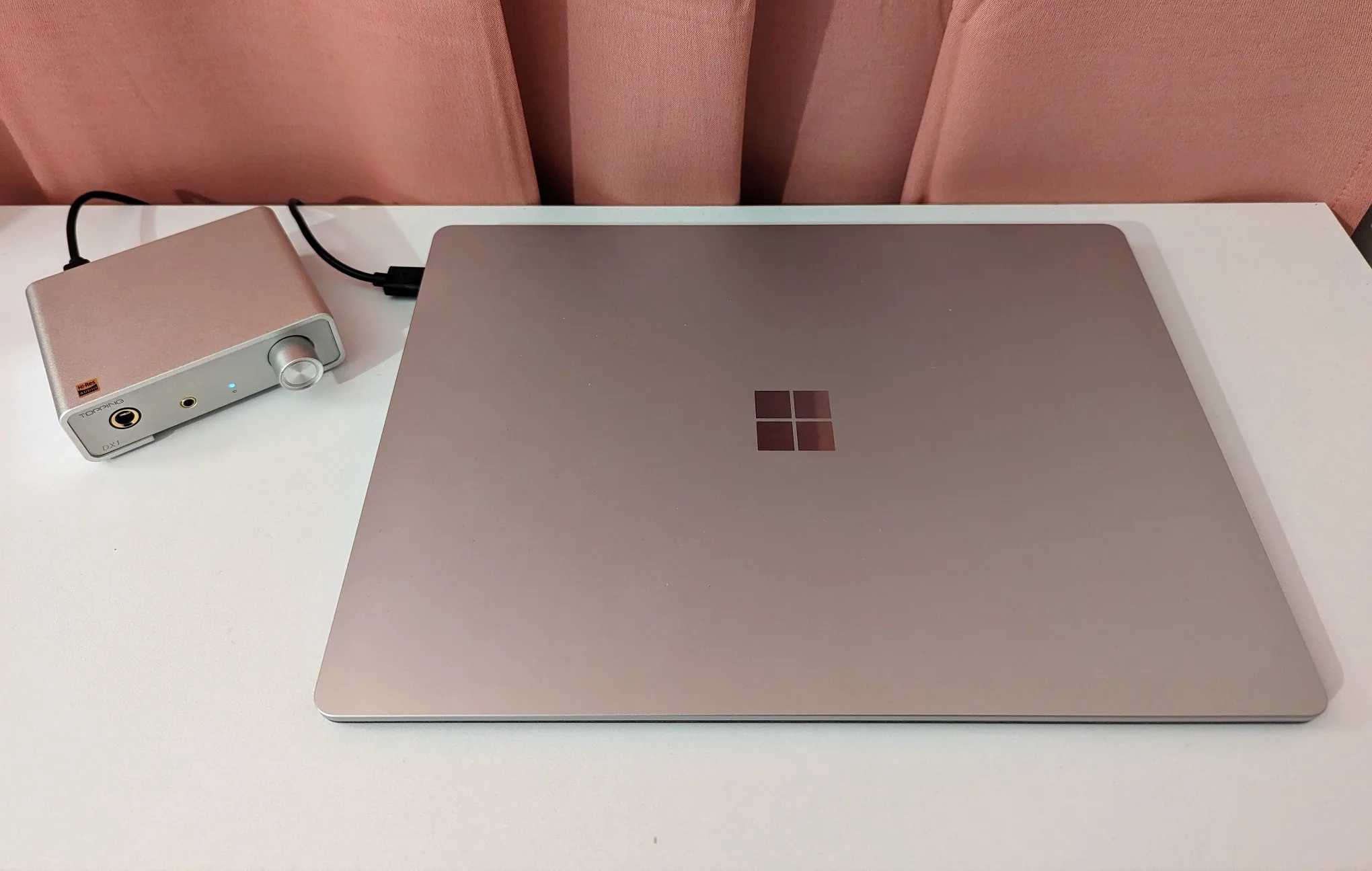
The DX1's headphone amplifier has a moderate output power due to the limitations of USB power delivery combined with the data cable. With a separate power supply, the power figures would certainly be higher, but the DX1 is currently powerful enough for most headphones. For example, 280 milliwatts into a 32-ohm load corresponds to battery-powered amplifiers that are more powerful than average, compared to which the DX1 is more affordable in terms of selling price. Generally, in devices designed for mobile use, higher power figures are additionally only achieved through a balanced headphone jack, whereas with the DX1, there is no need to acquire a balanced cable for headphones.
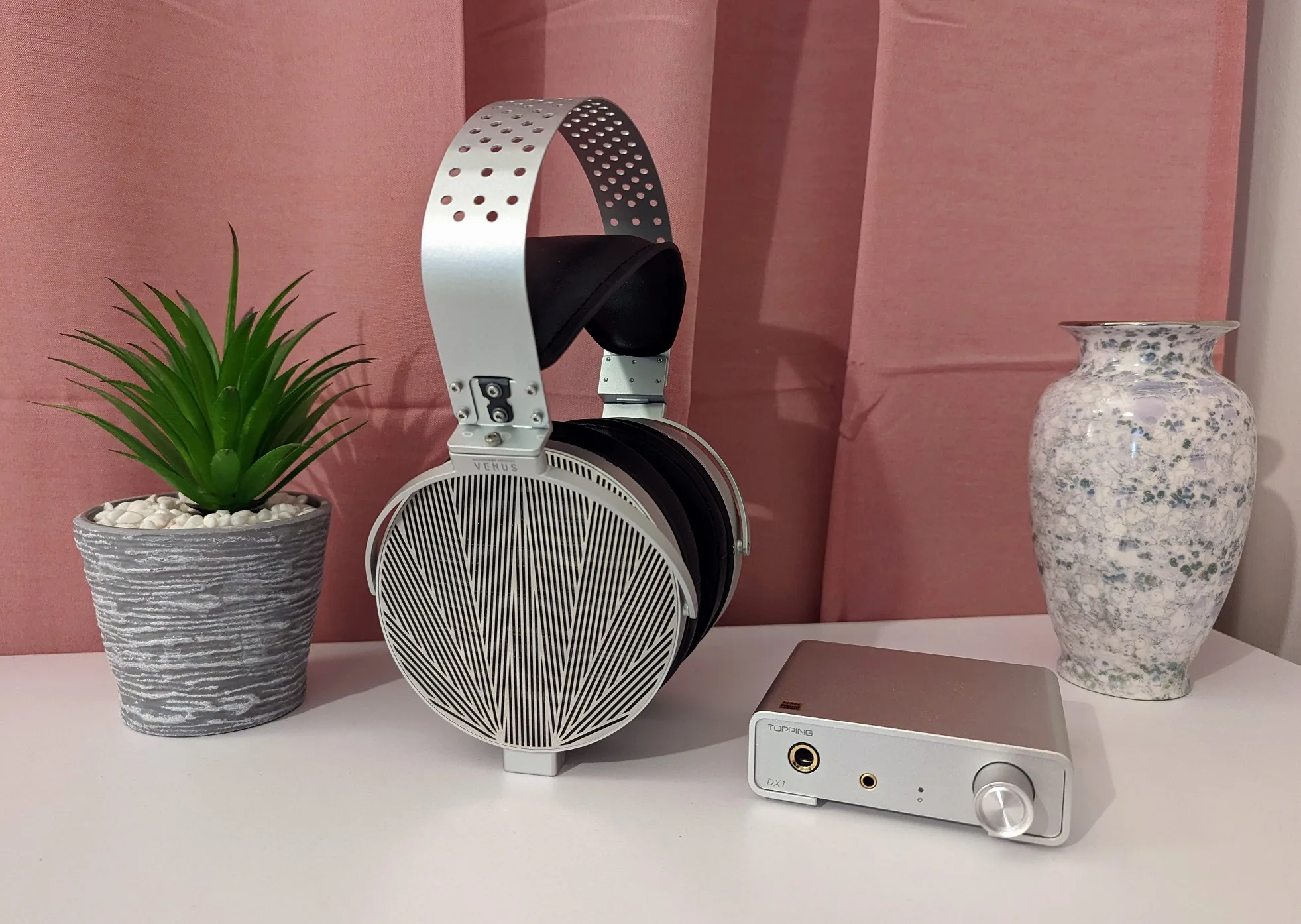
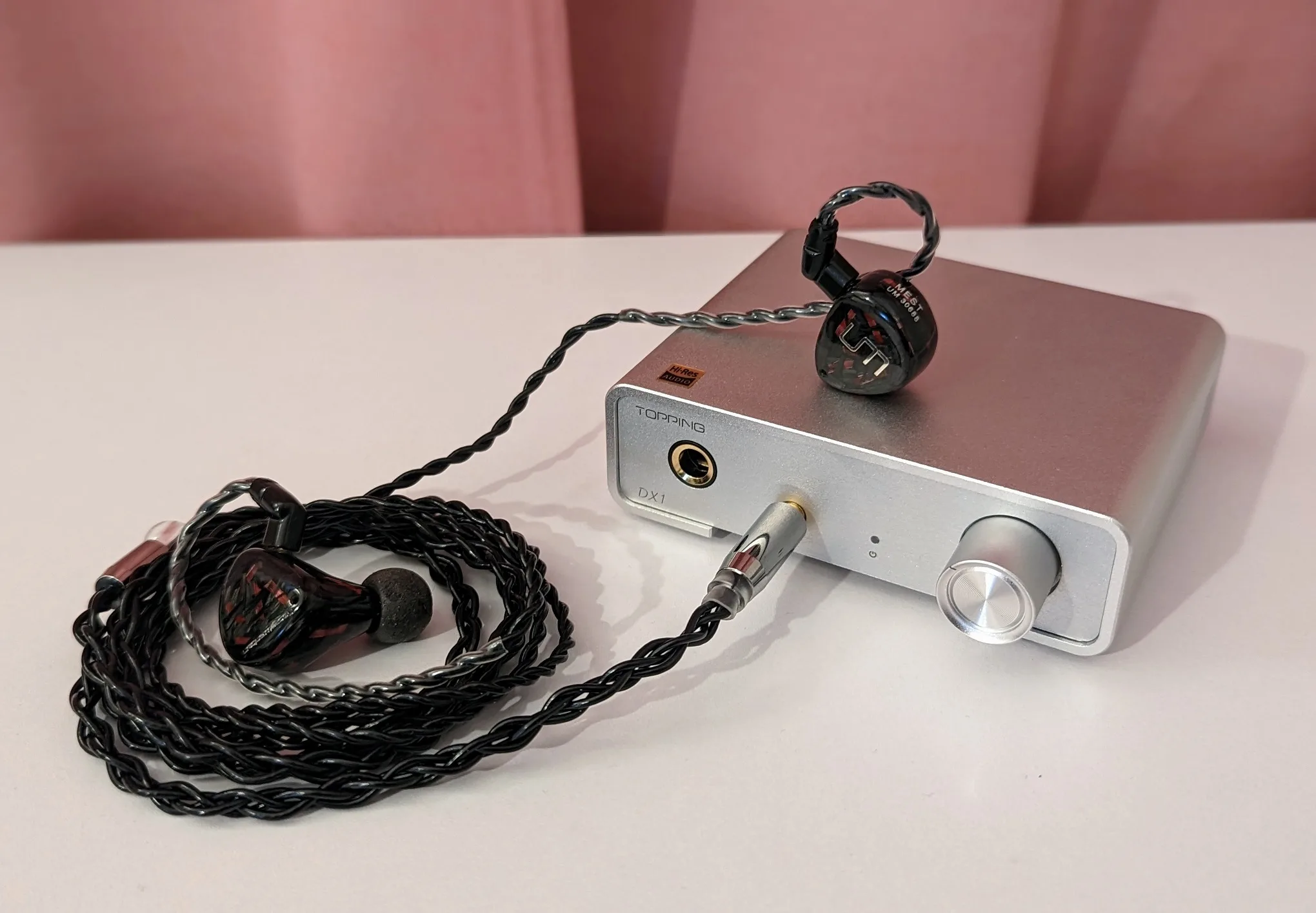
At a higher gain level, all headphones I tested, except for Hifiman HE6 and Susvara, played really loud. Correspondingly, a lower gain level provides sufficient volume adjustment range for sensitive in-ear headphones, for which the DX1 is otherwise excellently suited when looking for a desktop-type device. The headphone amplifier's output impedance is less than 1 ohm, so the headphones' frequency response remains unchanged regardless of the headphone model.
Sound quality as a headphone amplifier
The DX1 delivers clean sound through its own headphone amplifier with a pleasantly dark playback background. Dynamism and clarity are the first things that come to mind regarding its presentation. The sound has good power even with more difficult-to-drive headphones, and the edges of the sounds are reproduced sharply in a good way – it's hard not to like the device. However, when comparing the DX1 to other devices, the soundstage it creates turns out to be quite narrow and static. The device loads the music's energy into the foreground of the overall sound without any particular sense of space or layering of sounds. On the positive side, the playback is lively and easy to follow without noticeable colorations, but with better headphones or music with more spatial separation, the DX1 feels like a limiting factor in the listening chain – everything always sounds annoyingly close, albeit clearly placed within the soundstage.
However, in the right mood and during more relaxed listening, this doesn't bother much; rather, I prefer the concise, punchy presentation more than, for example, the more clinical reproduction of an older Objective 2 amplifier or the uniformly thick dynamics of THX devices like the SMSL SP200. The DX1 sounds quite natural, apart from its narrow soundstage, because it doesn't clearly emphasize any particular frequency range. Many more expensive devices are still more impressive in sound, while the DX1 offers as much as possible for its 100-euro price. I would say that the end result would be to most people's liking, as the device is anything but lifeless and boring. With reasonably priced headphone pairings, the DX1's soundstage limitations also do not become particularly apparent.
Sound quality as a D/A converter
The DX1 can also be harnessed as a pure D/A converter, so I was able to compare it to a device I previously reviewed Topping E30 -DAC (the first version of that device), which offers a more versatile set of features for 150 euros without a headphone amplifier. In this context, I will focus only on sound quality comparison, using as a third, minor reference Schiit Audio Bifrost 2:ta.
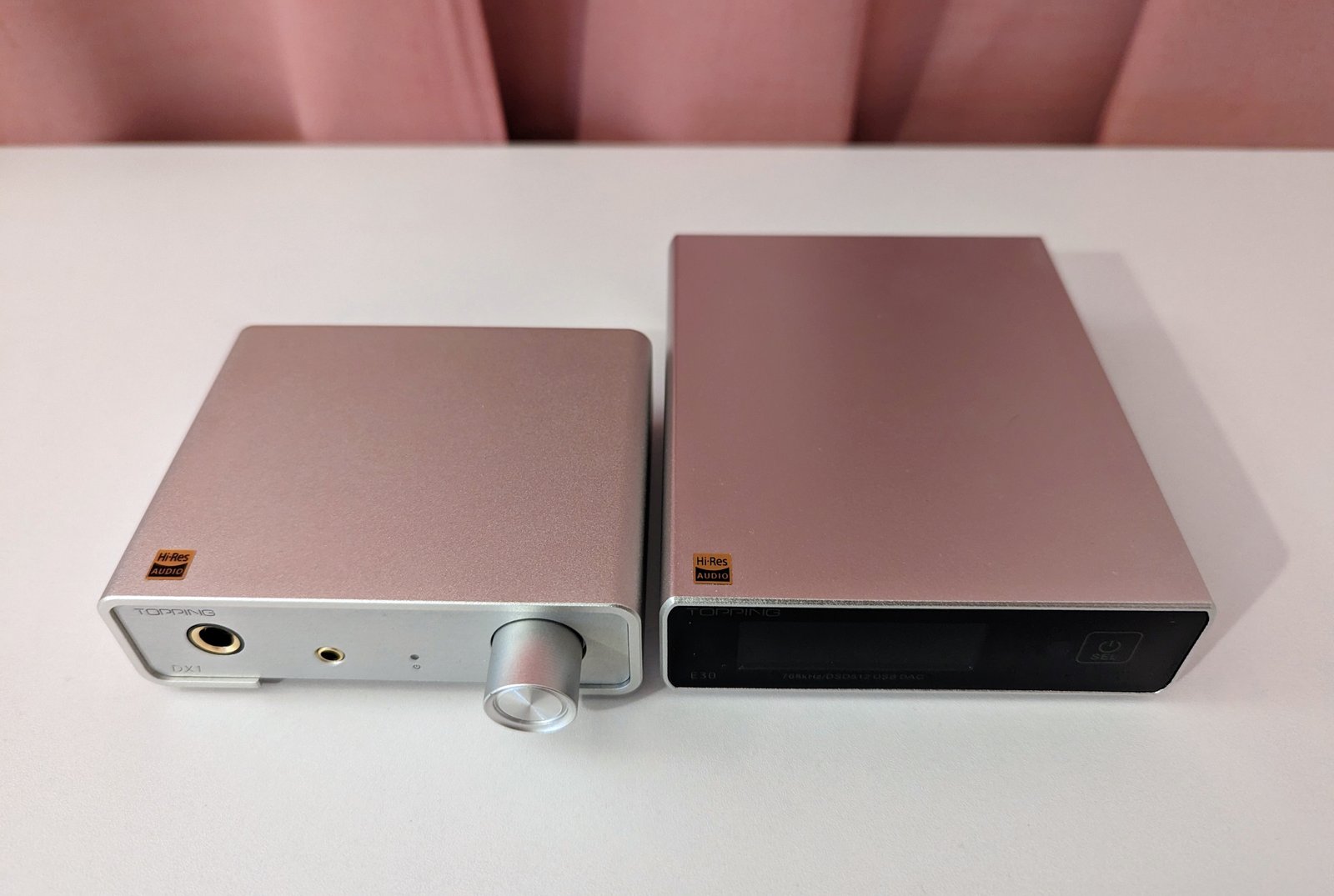
I adjusted the volume of each device to be identical by measuring the decibel reading through the headphones. All three DACs were connected simultaneously to my computer's USB ports during the comparison, and the Windows sound settings were identical for each. I connected the devices with similar RCA cables to an RCA selector, by flipping its lever I could ”jump” between the trio while listening to the same song. My goal was not to get stuck on small, difficult-to-interpret differences, but to find possible larger stylistic differences. For the comparison, I used the Cayin IHA-6 as an amplifier and several different headphones.
Since both Topping devices are implemented with an AKM DAC chip, it was not a big surprise to me that they sound quite similar. The soundstage of both feels restricted, as if there were walls in the width direction that the sound hits. The Bifrost 2 sounds more open and layered, and thus more realistic. Otherwise, the stylistic differences remain quite unnoticeable, even though the Bifrost 2 is slightly warmer in overall tone (bass is slightly more emphasized and treble draws less attention to itself).
Of the Topping devices, the more affordable DX1 is slightly more energetic and clearer in sound than the E30. The DX1 reproduces the edges of sounds more sharply, whereas with the blurrier and softer E30, I find it harder to discern faintly reproduced sounds. The E30, on the other hand, has a slightly more relaxed sound, which is not necessarily a bad thing at all. The DX1, in turn, is more exciting to listen to and also reproduces bass impacts more tightly. Unfortunately, I have not heard the newer E30 II, which may well be closer in style to the DX1. Compared to the original E30 model, however, I believe the DX1 as a D/A converter is closer in sound to more expensive devices, while the E30 offers more comprehensive connections and features. Neither reaches the level of the Bifrost 2 in terms of spatial impression or naturalness of timbre, but I didn't expect that either.
Topping DX1 vs. iFi Zen Air DAC
Prices: 100 € vs. 100 €
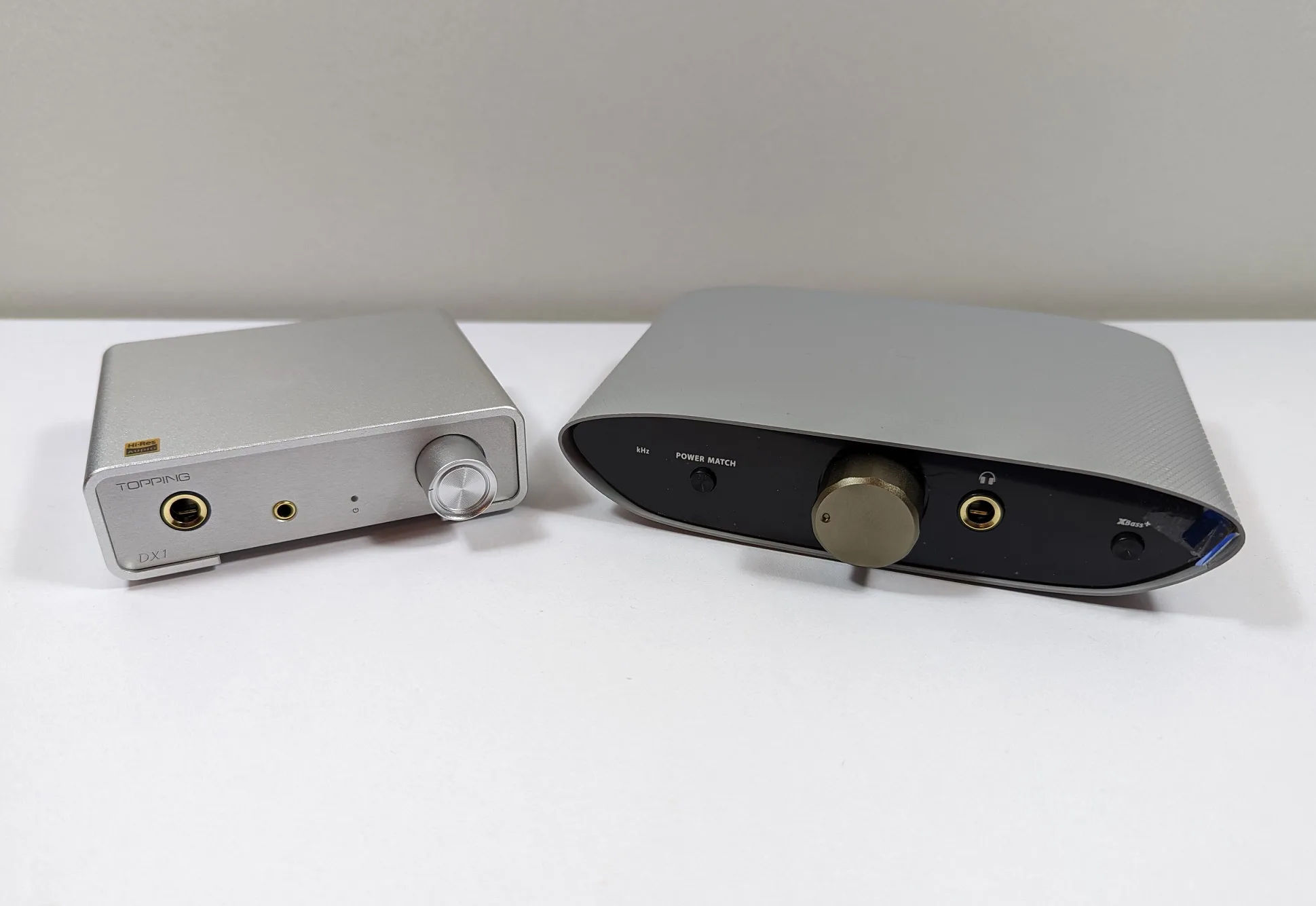
The Topping DX1 is by no means the only recently released USB-powered affordable combo device, as iFi Audio also launched the Zen Air DAC, priced at 100 euros, in 2022. The device is a stripped-down version of the more expensive ZEN DAC (price 200 €), so it lacks, among other things, balanced connections. In addition, the sturdy metal casing of the more expensive model has been replaced with plastic shells, which immediately make the Air version feel cheaper.
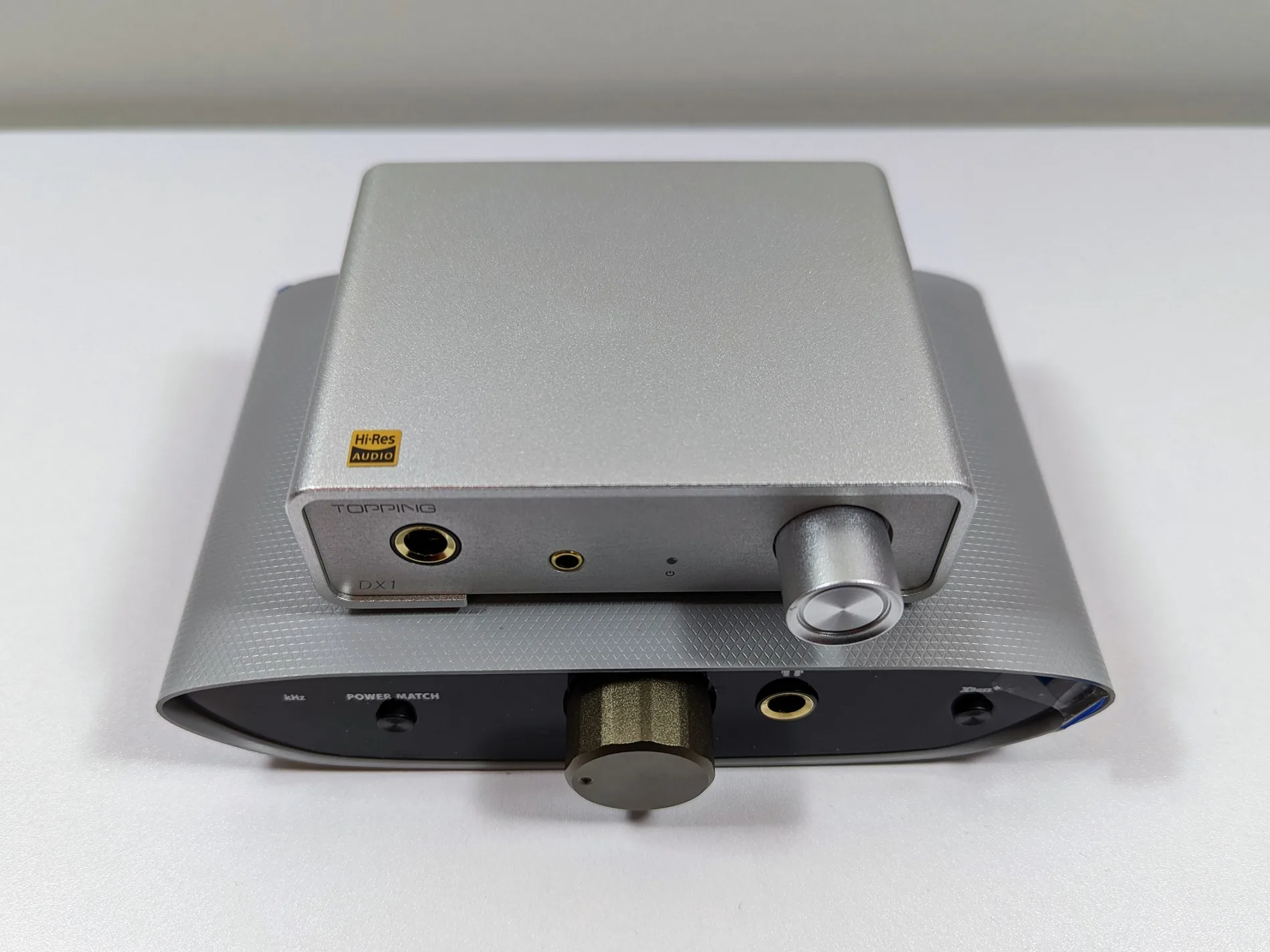
The Topping DX1, with its sturdier metal casing, wins in terms of external quality impression. It is also significantly smaller in size than the Zen Air DAC, which is beneficial when carrying the device around. The DX1 also comes with a usable length USB cable, whereas iFi supplies an incredibly short cable with its device.
Features:
In terms of features, both devices are easy to grasp. They include two gain settings, a volume control, and RCA output connectors for the D/A converter. The Zen Air DAC's advantage is volume control for the output connectors, allowing it to be used as a preamplifier for active speakers. The DX1 has a monochrome power LED, while the LED indicator on the left side of the Zen Air DAC shows the currently active sampling rate.
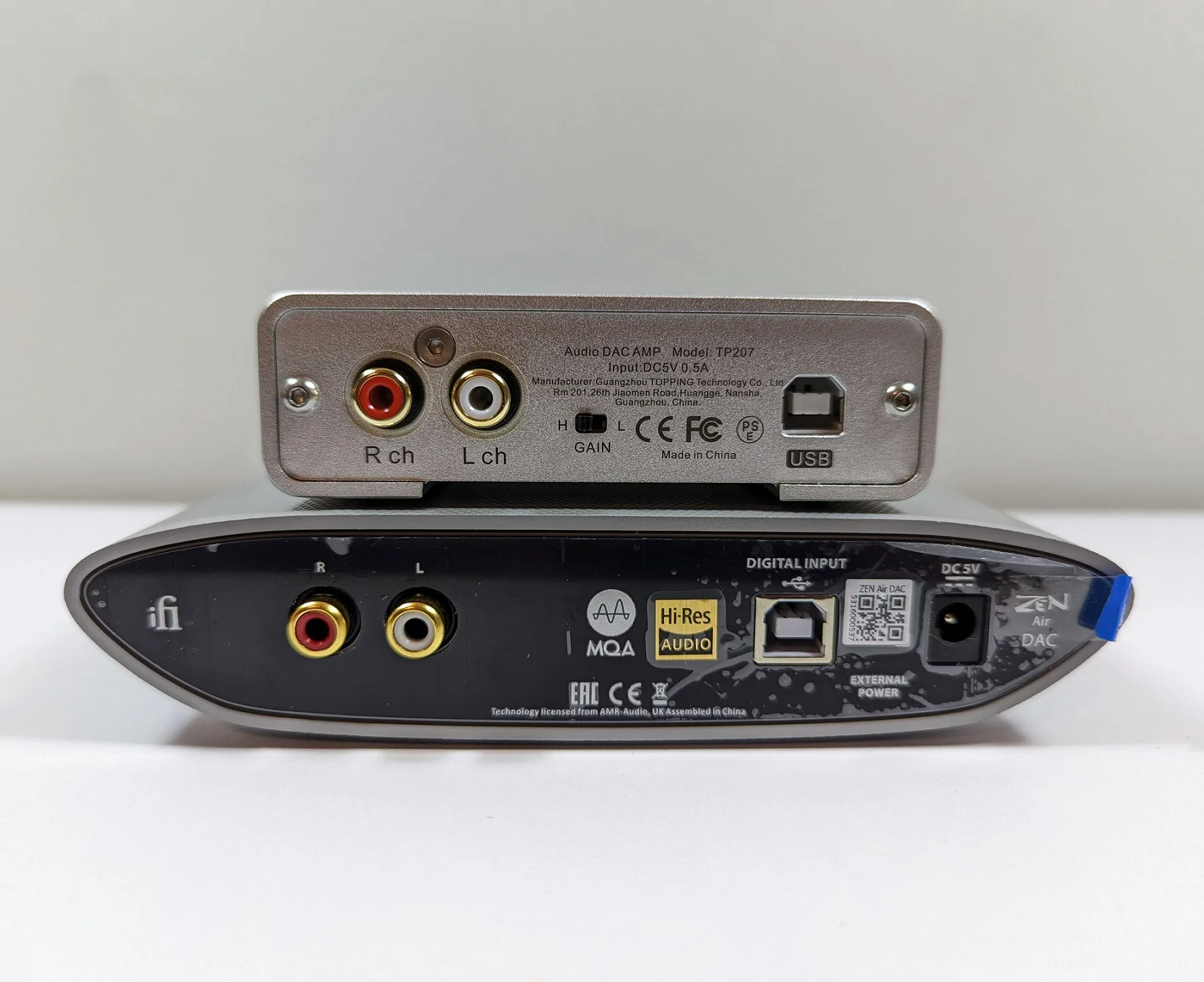
iFi's device has two other advantages compared to Topping: 1) MQA support for Tidal service users and 2) a button-activated XBASS+ setting, which provides a significant boost to bass frequencies. XBASS+ works well with headphones whose bass is by default subdued or at most linear, such as many open-back planar headphones. With headphones that already have strong bass, the bass boost is, however, excessive, as the sound becomes badly muddled. However, using the setting is not mandatory.
From the perspective of amplification power, both devices are equally powerful with a 32-ohm load (280 mW), while the DX1 is slightly more powerful with a 300-ohm load (51 mW vs. 36 mW). Topping's device is slightly more versatile thanks to its two headphone jacks, but headphones with a 3.5 mm cable can still be used with the Zen Air DAC's 6.35 mm jack via an adapter. In both devices, the headphone amplifier's output impedance is low, so they do not color the sound for any headphone model in that regard.
Before comparing the sound quality of the devices, I want to mention that the Zen Air DAC's software seemed to have some kind of bug at the time of testing, as the device cut off sub-bass by 10 decibels between 20–30 Hz. This occurred both through the device's own amplifier and when using it as a D/A converter for another amplifier. After trying several different firmware versions, I found that the problem was only fixed with version 7.40C, which also uses the manufacturer's questionable GTO filter. For this reason, I ultimately used the device with version 7.40B, which has MQA support disabled, and which I would not have used in a comparison situation anyway.
Sound quality differences as a headphone amplifier:
Both devices, in my opinion, sound good for their price, but also different. The DX1 has a sharper and more dynamic sound, while the Zen Air DAC is calmer and softer. With the DX1, for example, guitar string plucks are reproduced more sharply, and the snare drum snaps more tightly. The background of the reproduction is also darker than in the Zen Air DAC, making it easier to hear fading sounds all the way through with the DX1. Because the Zen Air DAC has the bass bug I mentioned, the DX1 is, as expected, more powerful in bass reproduction. However, few songs have a huge amount of bass between 20–30 Hz, so the difference remains quite minimal in practice.
I would call the DX1's sound more neutral, while the Zen Air DAC adds its own little pleasant spice to the reproduction, for which iFi devices are known. The Zen Air DAC, in my opinion, sounds more natural in its spatial presentation, so I find myself immersing myself in listening better. The DX1, on the other hand, keeps the sounds contained in the center of the soundstage, which leads to a narrower-feeling result. Listening to energetic music with the DX1 is fun, but the soundstage falls behind the Zen Air DAC, which sounds more open in every direction and separates sounds further from each other. Thanks to this, iFi's device may be more pleasant for many to listen to, even if smaller details are reproduced more softly and less perceptibly than with the DX1.
Concluding remarks:
In my opinion, the DX1 ultimately sounds slightly better, apart from its narrow soundstage, because it is more dynamic and clearer in reproducing musical details. However, the Zen Air DAC's softer and more open presentation has its own merits, so preferring one device over the other is largely a matter of taste. Both devices demonstrate that it is possible to get perfectly decent sound for 100 euros. If the headphones in use are, for example, in the sub-300 euro price range, both of these affordable devices are excellent for them in terms of both power and sound quality. For better headphones, however, I still think it's worth buying a better amplifier, in which case the DX1 or Zen Air DAC can still be utilized as a D/A converter.
Summary
The Topping DX1 sounds good for an affordable device and is effortless to use. Although more expensive devices have more comprehensive connectors and features, as well as a more powerful headphone amplifier, not everyone needs one. If the DX1 suffices for one's own needs, it is extremely easy to recommend alongside the similarly priced iFi Zen Air DAC. For a tighter budget, for example, iFi's Uno (price 80 €) or a DAC dongle could be alternatives, while increasing the budget, Topping itself offers in its selection for 200 euros DX3 Pro+, and from iFi Zen DAC V2. Of course, a few other manufacturers also sell similar devices, if ordering from outside Finland is possible.
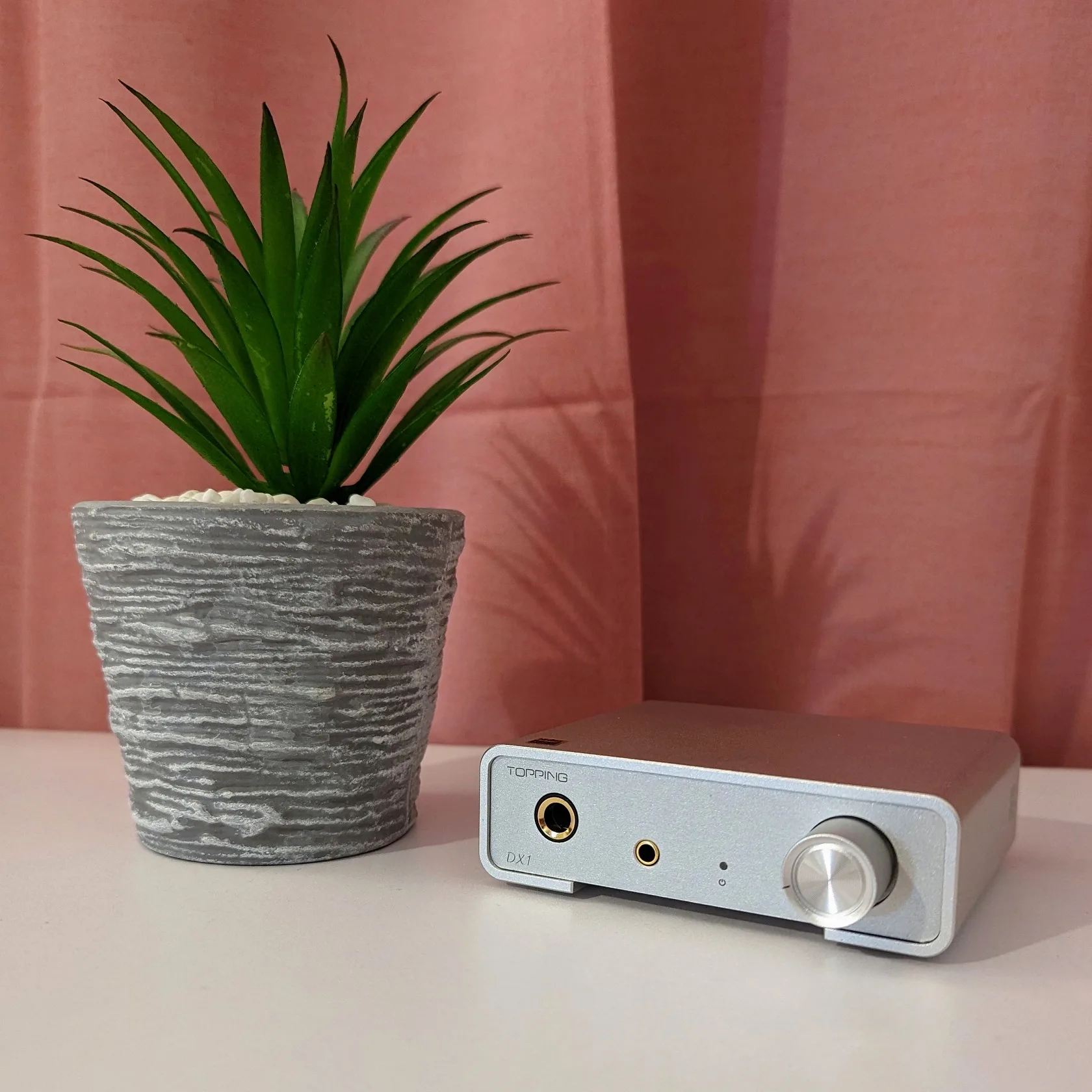
The DX1's biggest advantage over competitors is its quietness when using sensitive headphones. The implementation also seems excellent in every respect for the price, whereas in the same price range, for example, iFi devices are more prone to small background noises. The DX1 would therefore be an excellent purchase especially for in-ear headphones. The output power of the amplifier section is also sufficient for all over-ear models that are generally viable options for listening with a device priced like the DX1 – for example Sennheiser HD600 and Hifiman Sundara work well.
Affordable products always involve compromises, but in the case of the DX1, I don't think money has been spent in the wrong places. It offers excellent value for money both when listening to headphones and when measuring their frequency response.
Pros and cons:
+ Clean, clear and powerful sound both as a headphone amplifier and a D/A converter
+ Extremely dark playback background without any noise or background sounds
+ Small size and high-quality construction
+ No need for mains power
+ Headphone amplifier powerful enough for most common use cases
+ Two headphone jacks
+ Usable length USB cable
+ Affordable price
– The soundstage is narrow and the sense of space feels a bit lacking
– Cannot be used as a preamplifier
– Adjusting the volume to zero does not completely mute playback
 EN
EN  FI
FI
Hi. You mentioned in the Topping DX1 review that the Zen Air DAC has a bug in firmware 7.4a and b in sub-bass playback. Could it be possible that the Zen DAC v2 also has the same bug as it also has 7.4 firmware. I am using 7.3b firmware in the Zen DAC v2 just in case.
Hi. The affordable Zen Air DAC indeed had such a bug, which, however, might go unnoticed by many when limited to the 20-30 Hz range. I don't have a Zen DAC V2 at hand to test the matter, but at least in the Zen DAC V1, the bug does not appear to be present with those firmware versions. Just in case, you can certainly use an older firmware version, but I wouldn't be particularly concerned about it with other devices in the Zen series. 🙂