Author: Sword of Damocles
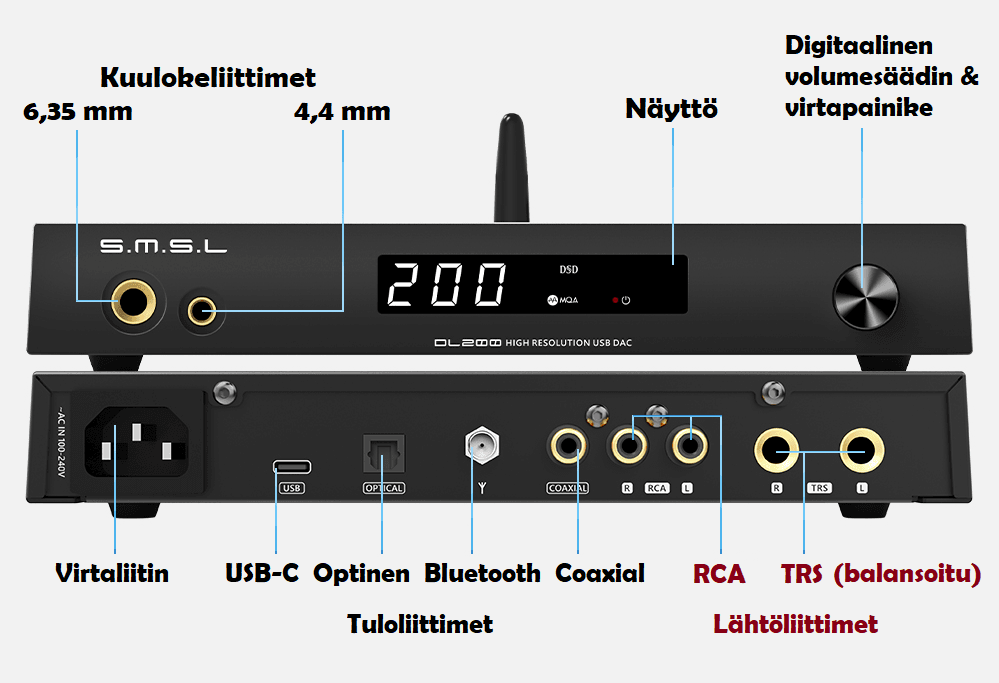
Table of Contents:
Information:
- Release year: 2023
- Country of Origin: China
- Price: 190 USD (When ordered to Finland, depending on the place of purchase and discounts, 165–210 €)
- Type: DAC & headphone amplifier & preamplifier
- DAC chip: ES9039Q2M (a relatively new chip from 2023)
- Amplifier section: 4x OPA1632
- USB: XMOS XU316
- Input connections: USB-C, Optical Toslink, Coaxial SPDIF and Bluetooth 5.1
- Output connections: RCA and TRS (balanced)
- Headphone jacks: 6.35 mm and 4.4 mm
- Supported Bluetooth codecs: LDAC, APTX Adaptive, APTX HD, AAC and SBC
- Maximum supported sampling rate (PCM): 768 kHz (32 bit)
- Maximum supported sampling rate (DSD): DSD512 (native)
- MQA support (a deprecated format, not currently used anywhere)
- Output voltage: 2.5 V (RCA) and 5.0 V (TRS)
- Headphone amplifier output impedance: < 1 ohm
- Headphone amplifier gain level: 0 dB (low) and 11 dB (high)
- Headphone amplifier stated output power: 3 W @ 16 ohm | 1.5 W @ 32 ohm | 200 mW @ 300 ohm
- Features: Driver-free USB 1.1 mode for game consoles, televisions and mobile devices
- Power consumption: < 0.5 W in standby mode and < 30 W during use
- External dimensions: 22.19 x 20.67 x 3.1 cm
- Weight: 1.39 kg (1.275 kg measured with own scale)
- Accessories: USB-C –> USB-A cable (length ), power cable, remote control and user manual
Review sample: Self-purchased product
Chinese SMSL (Foshan ShuangMuSanLin Technology/Electronics) DL200 is an affordable combination device (DAC & headphone amplifier) that competes in the sub-200 euro price range with, for example, Topping DX3 Pro+'s, ifi Zen DACand Creative Sound Blaster X4. Devices in this price range usually involve some compromises in terms of connections, features, or output power, but the DL200 is astonishingly strong by all measures. Many might never even need a better device, so I'm going to find out if the affordable price comes with any hidden pitfalls.
Product packaging
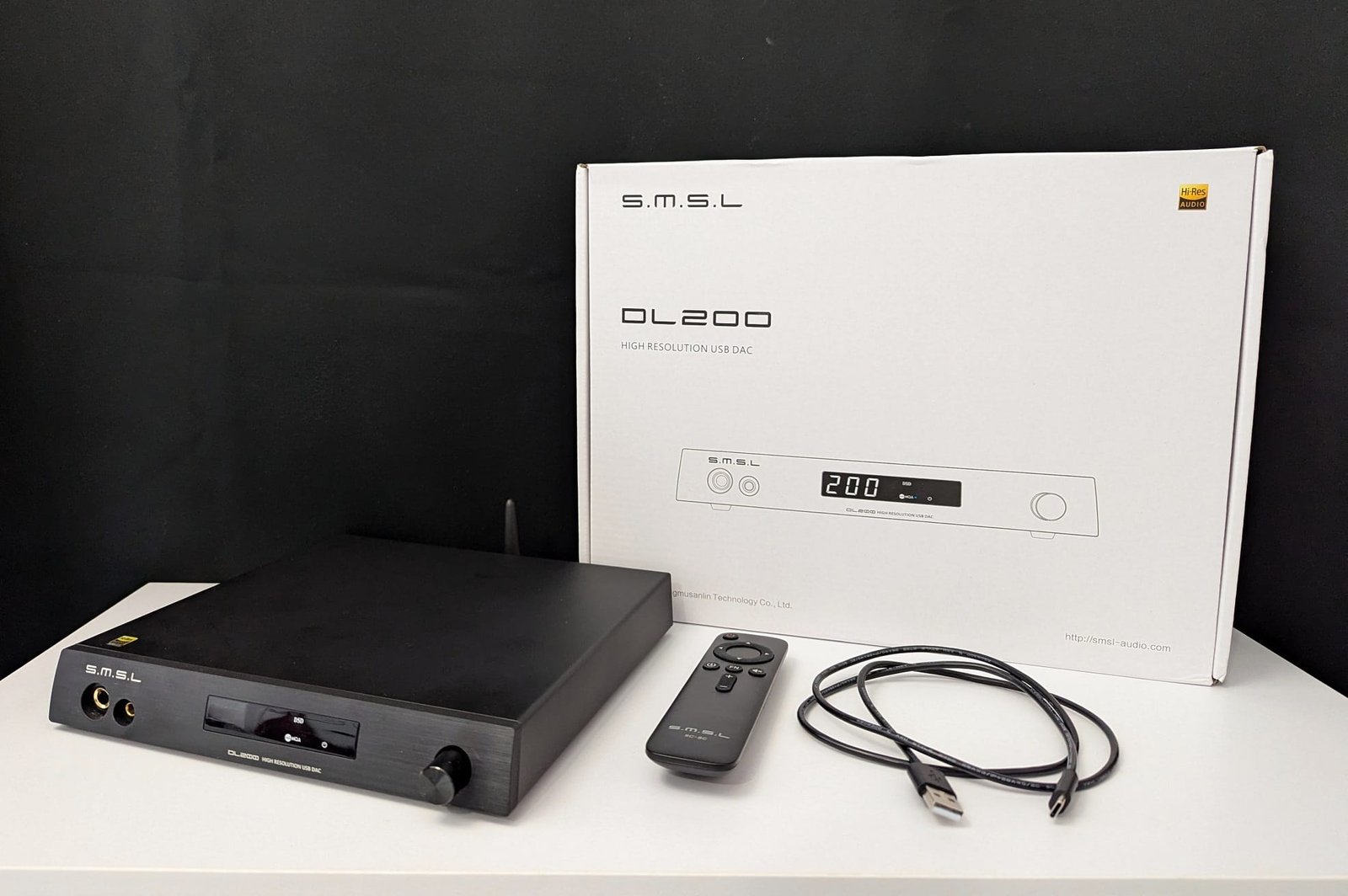
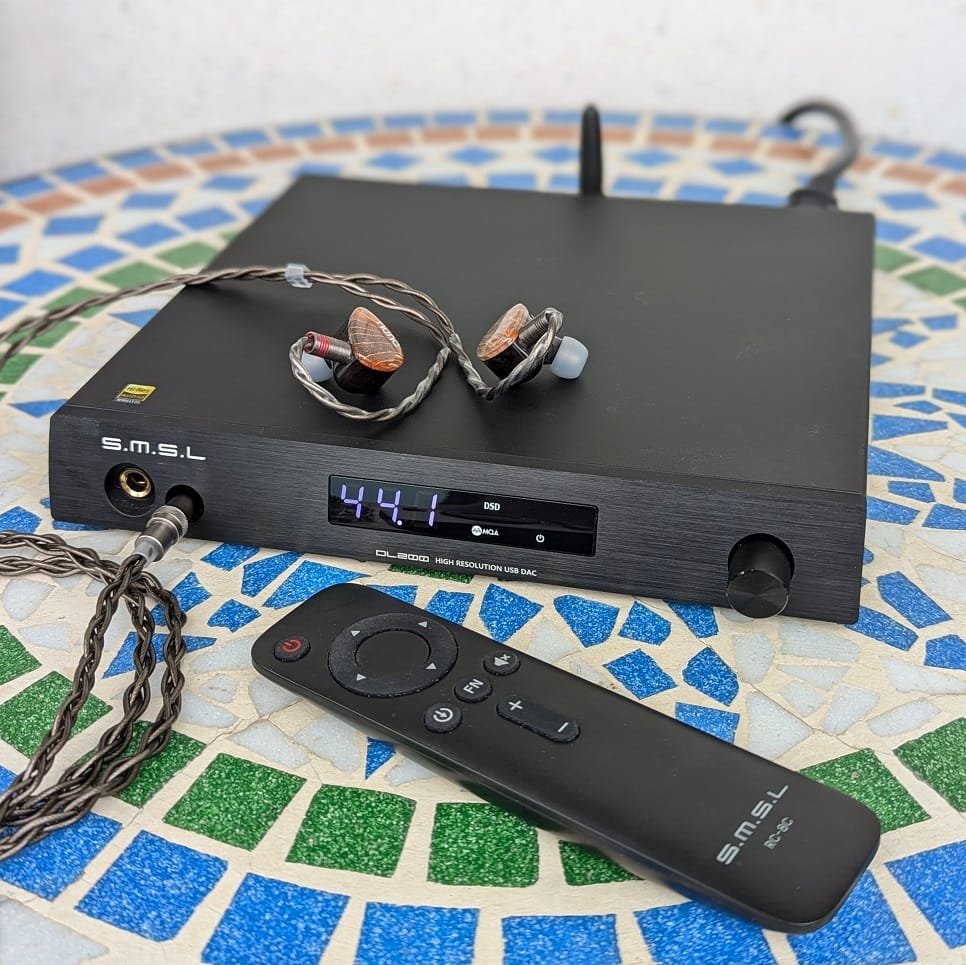
In addition to the device and power cable, the DL200's white product packaging includes a plastic infrared remote control, a USB cable, and a user manual. The remote control, in particular, is a nice addition in the sub-200 euro price range, which Western manufacturers usually cannot include in a similar price category. The Topping DX3 Pro+ also comes with one, but its infrared beam is slightly narrower, making it more difficult to use.
Structure and connections
With the DL200, the first thing that catches the eye is its large size, or rather its surface area, as affordable devices are usually significantly smaller and even up to a kilogram lighter. Weighing about 1.3 kilograms, the DL200 stays in place on the table better than usual, and other devices can be easily placed on top of it. There is also enough space for connectors and buttons, so everything hasn't had to be crammed into one pile. On the other hand, the device alone takes up quite a lot of space, and for cost reasons, its metal frame has had to be left thin, so it rattles cheaply when tapped. This is certainly also influenced by the fact that there is plenty of empty space inside the device. However, there is no need to tap the DL200 during use. The painted surface of the top cover, on the other hand, should be handled with care, as it seems to scratch easily.
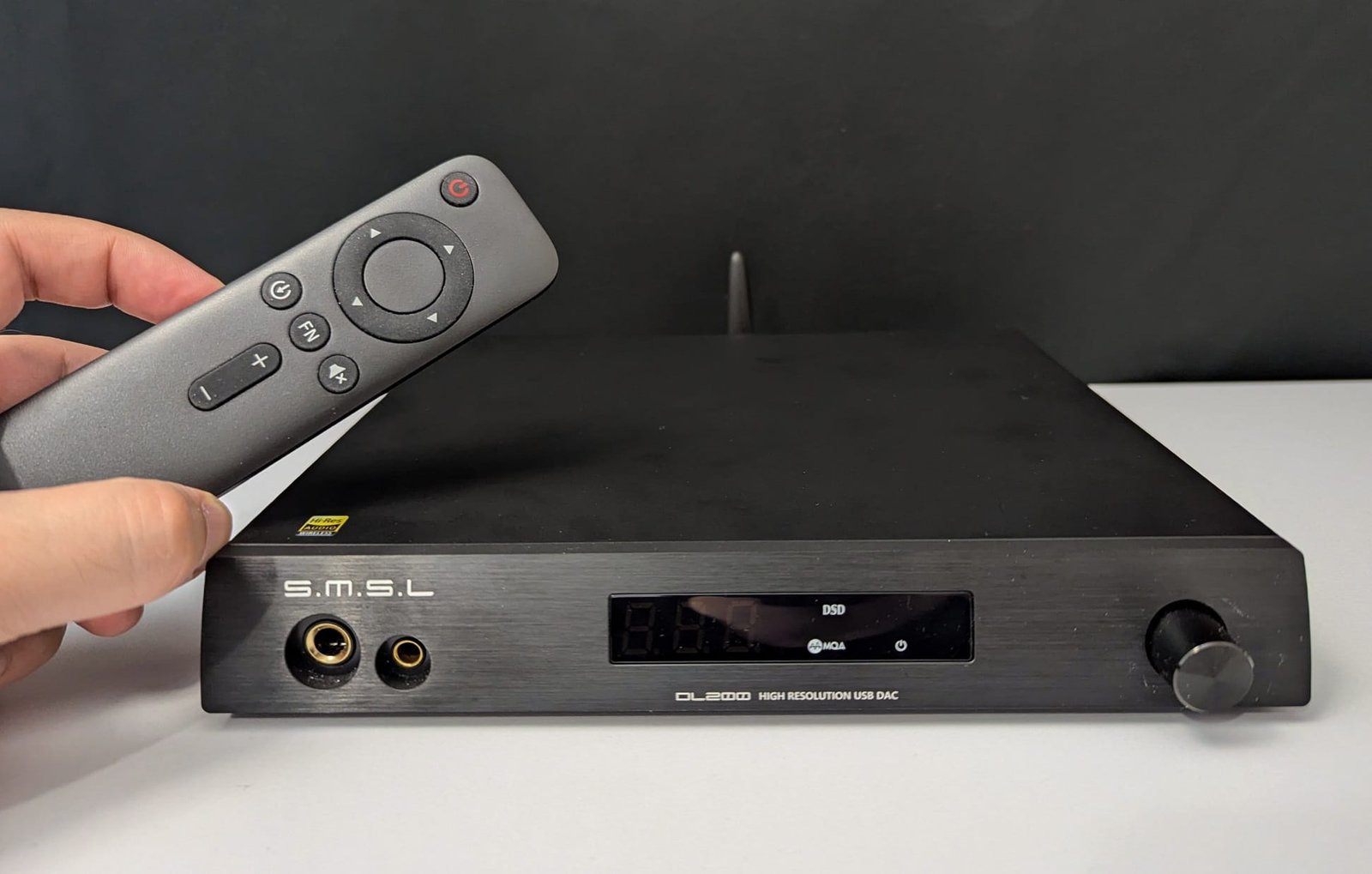
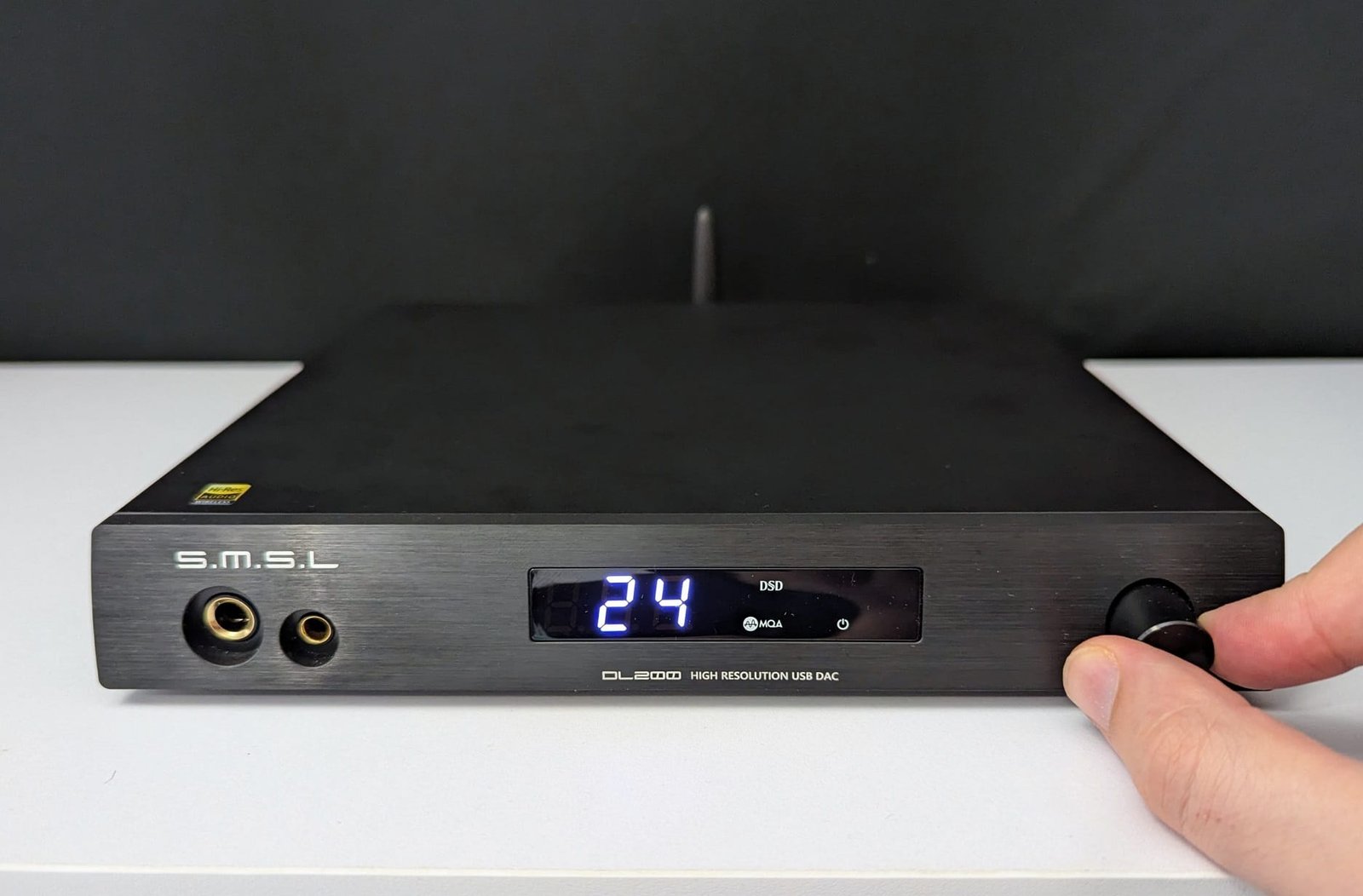
Headphone jacks and volume control are traditionally mounted on the front edge of the device, which is made from an upward-tapering piece of aluminum. I find the digital volume control to have a good feel, as the adjustment steps have just the right amount of resistance, and the knob doesn't spin loosely in a circle, for example Soncoz SGD1like. The control includes a pushable button for changing settings (also functions as a power button), so the device can be used completely without a remote control if necessary.
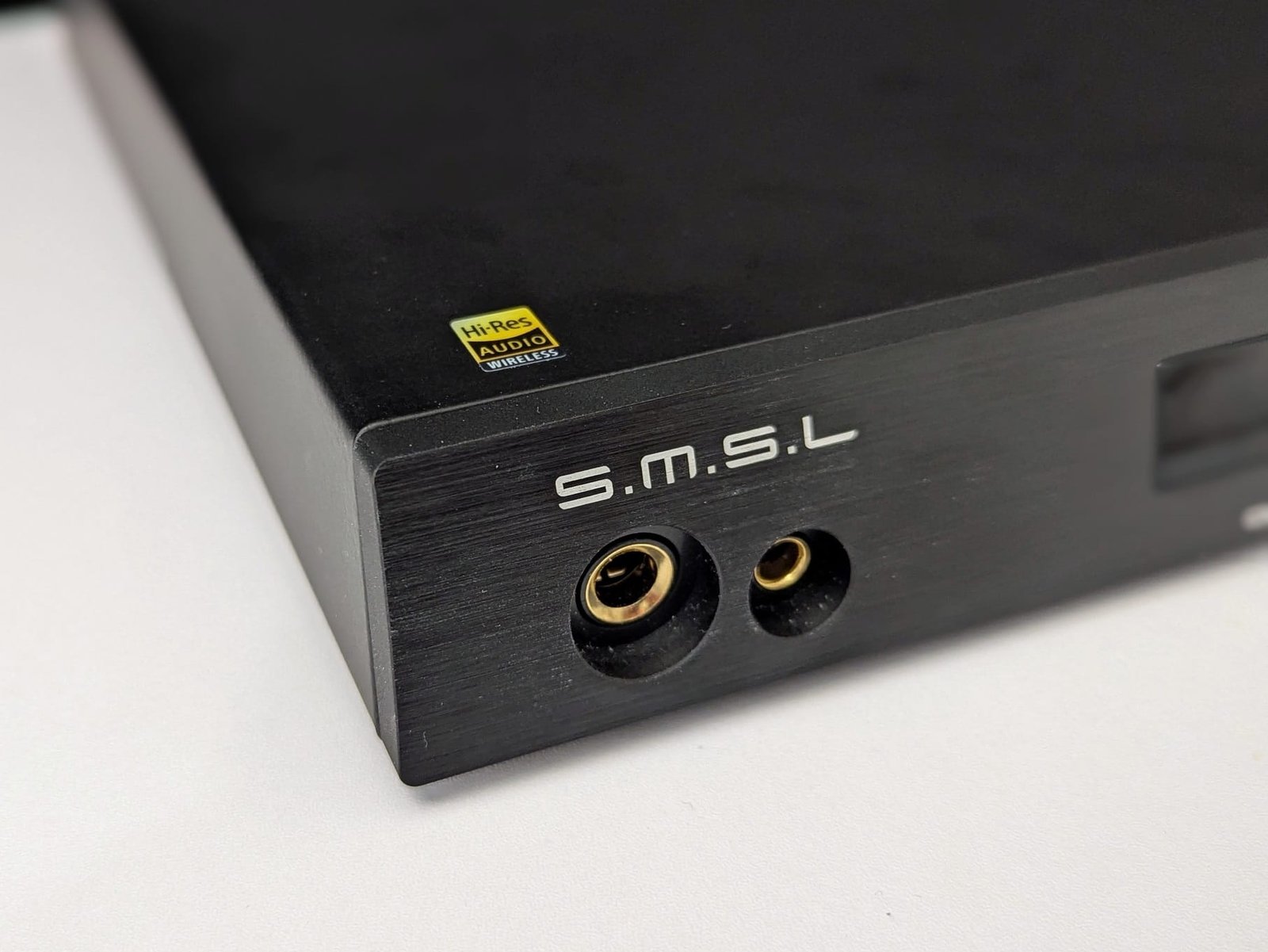
The width of the DL200's chassis has allowed for the placement of two headphone jacks (6.35 mm and 4.4 mm) far from the control on the left edge of the device, so there is plenty of space for fingers during adjustment, unlike smaller devices (e.g. Topping L30 II and Chord Anni) without the headphone cable getting in the way. I consider the headphone jack options sufficient, as they cover the most common needs. However, it's worth noting that the balanced 4.4-millimeter connector is not actually balanced in its implementation, so it does not offer more output power or any other additional benefits compared to the 6.35-millimeter connector. This is, however, a normal thing in affordable devices, where different connectors are primarily intended to bring flexibility to use.
The DL200 also features a simple LCD screen that displays all information, such as sampling rate and selected volume, in white. The screen brightness can be adjusted between no less than 8 different settings, so it can be made dim or blindingly bright if needed. By pressing and holding the FN button on the remote control, the screen can also be completely turned off during use, which could be useful, for example, in a dark room.
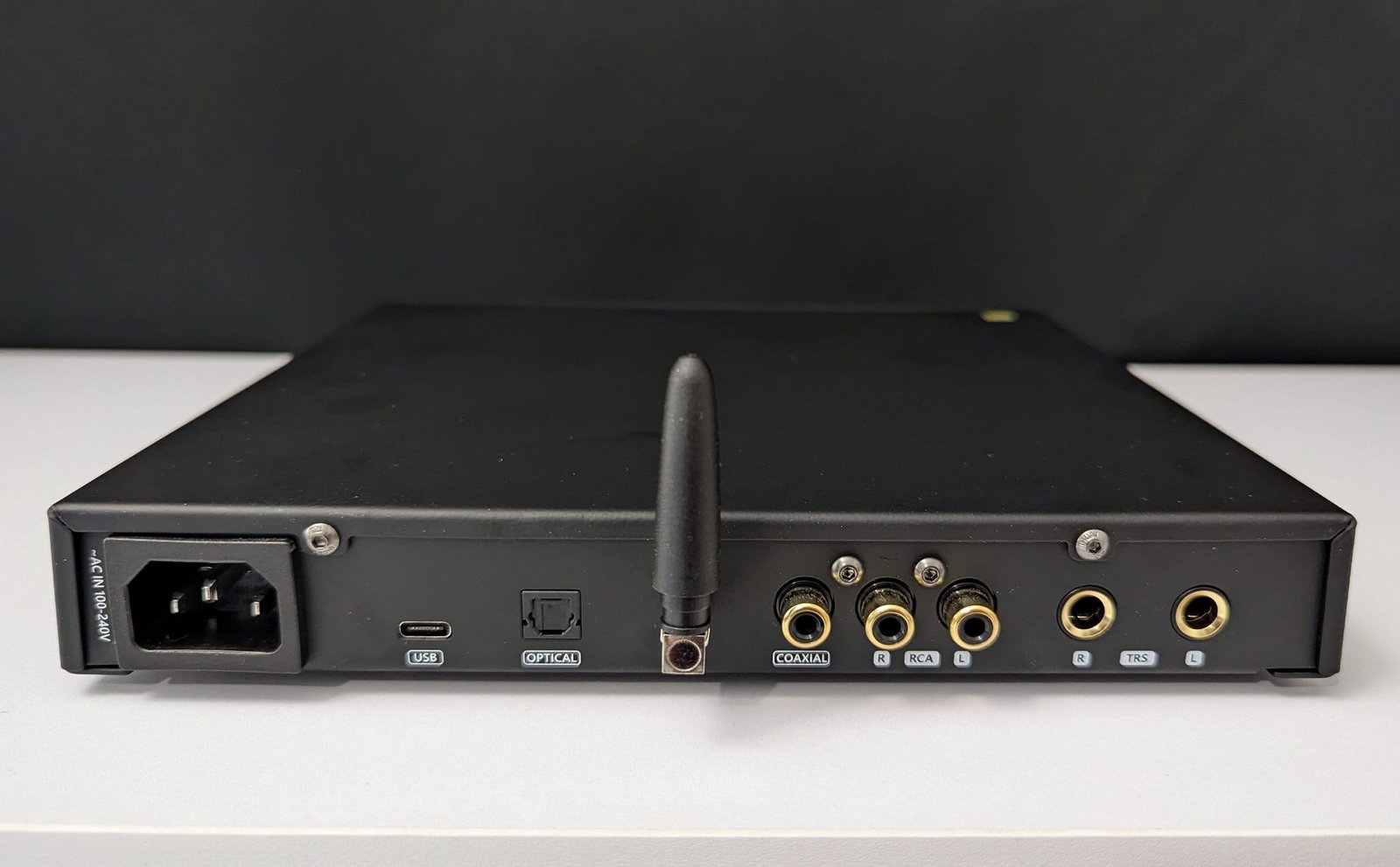
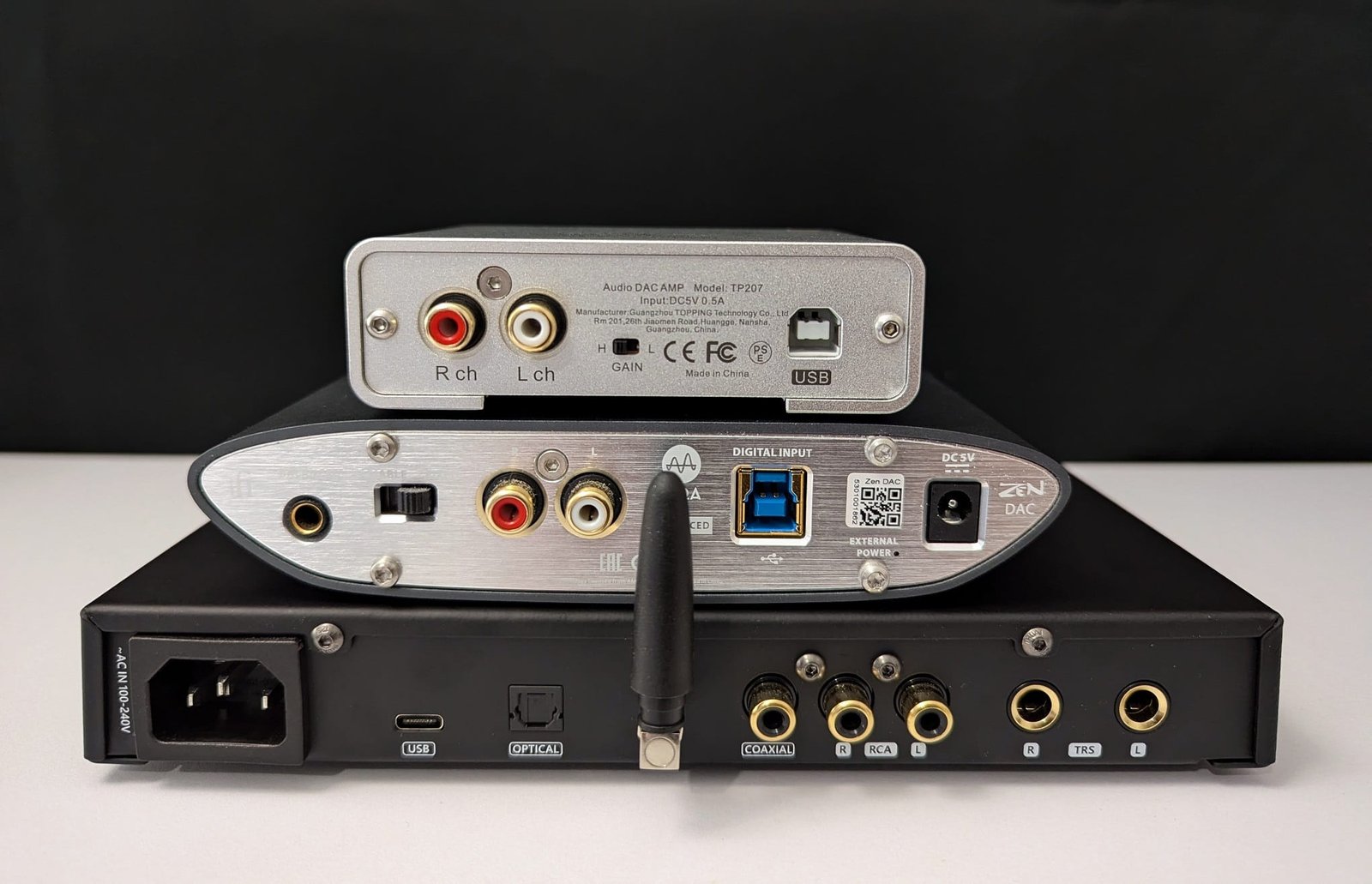
Thanks to the internal power supply, there is no need for an external transformer with the DL200, unlike, for example, in Topping devices. This may seem like a small thing, but it improves overall usability surprisingly much. On the back of the device, you'll find USB-C, Optical Toslink, and Coaxial SPDIF as digital input connections, so nothing surprising there. However, support for Bluetooth connectivity is a nice addition. Analog inputs are not available, so the DL200 cannot be used as a standalone headphone amplifier; the signal must always pass through its D/A converter.
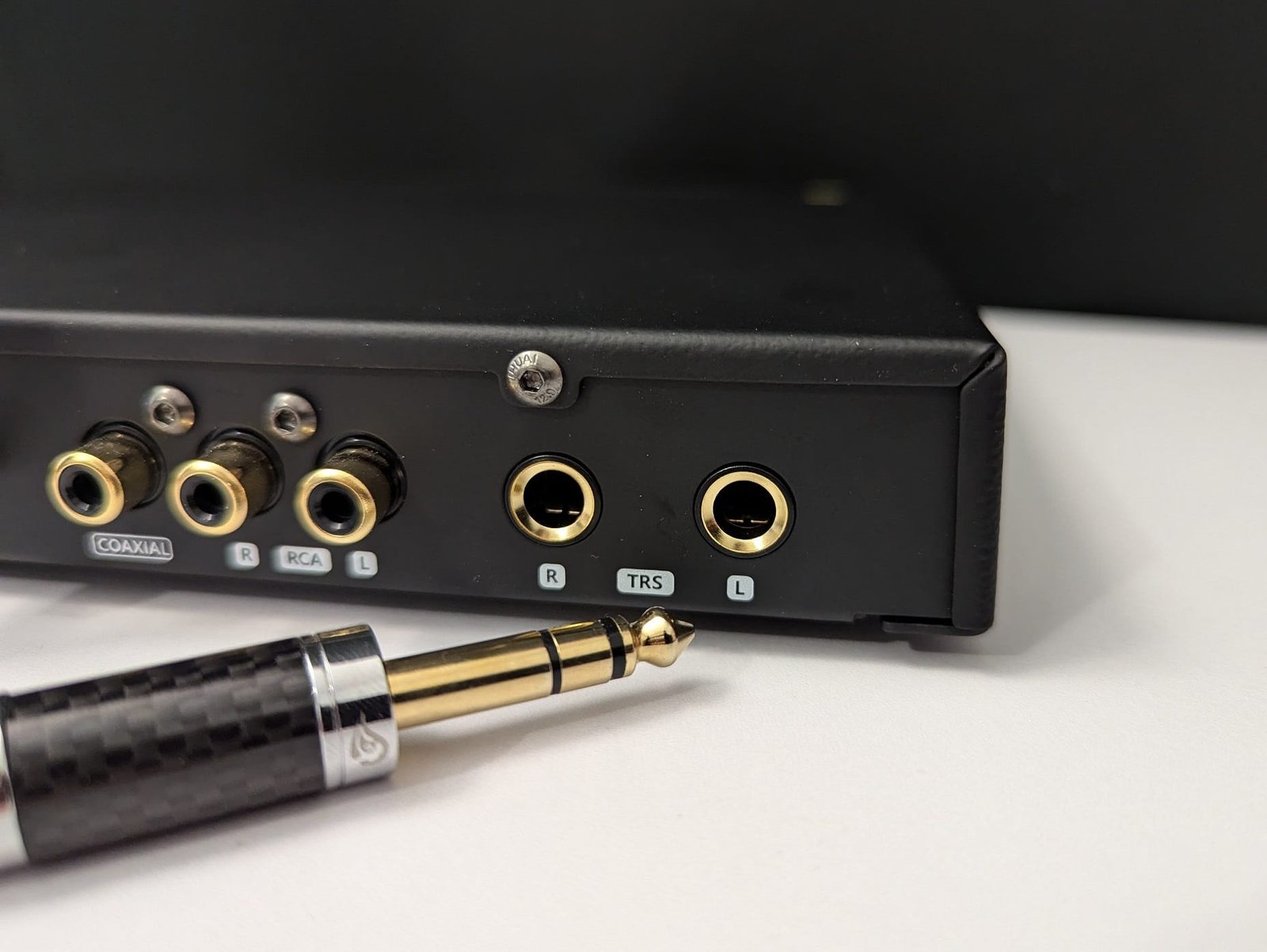
However, the DL200 can be used as a standalone DAC or preamplifier, as the analog output connectors include traditional RCA connectors and, as a balanced option, very unusual 6.35-millimeter TRS connectors, for which acquiring a suitable special cable is not entirely straightforward. For example, a 4.4-millimeter connection like iFi's would have been a more sensible solution in my opinion, and adding XLR connections would certainly not have required major physical changes to the circuit board or casing height. The TRS connectors indeed seem a bit like SMSL didn't want to make the DL200 too attractive compared to its more expensive devices. For those primarily utilizing balanced output connectors, it might be wise to forgo the DL200 and look towards a device with XLR connectors.
Internal implementation and functions
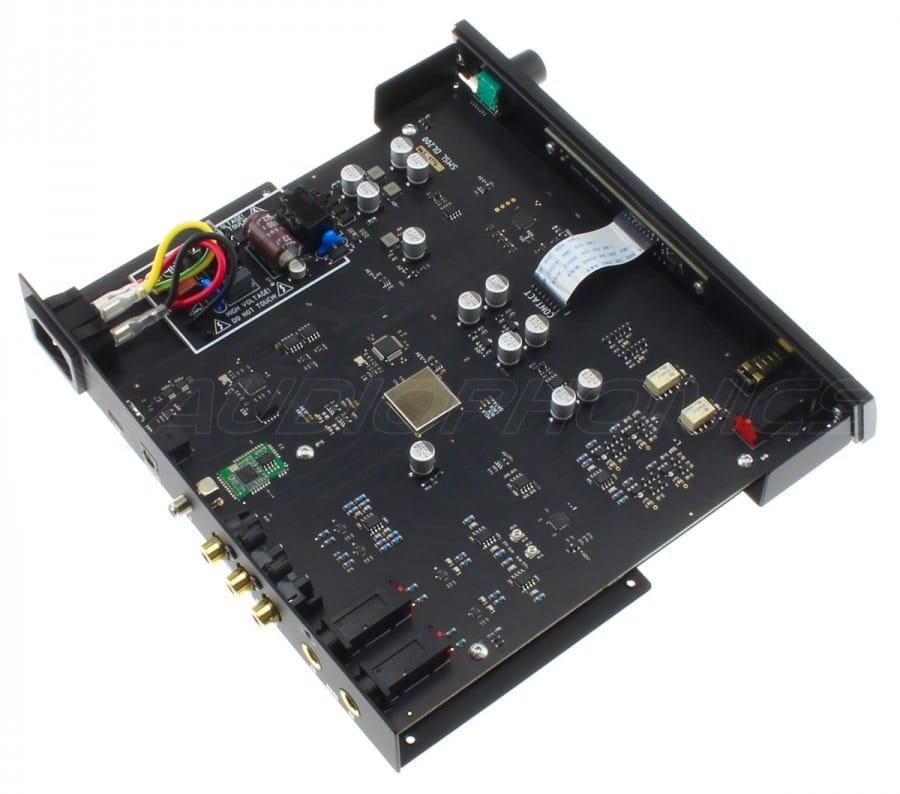
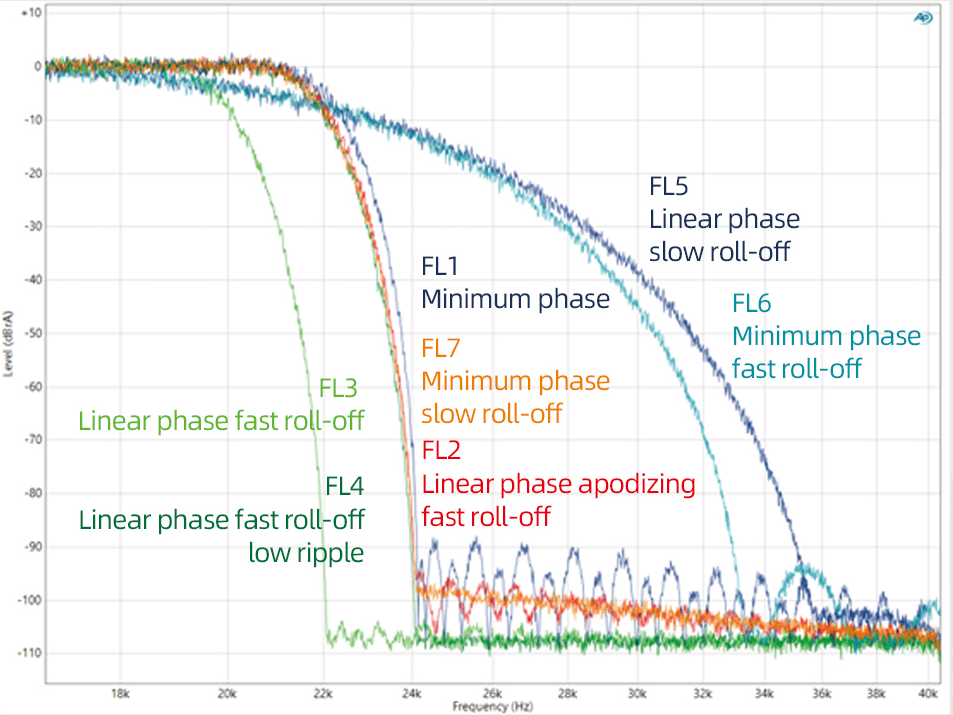
Inside the DL200 beats the ES9039Q2M DAC chip (manufactured by ESS), released in 2023, which has not yet been widely used. The new chip, aiming for low power consumption, doesn't actually offer anything unprecedented, but it comprehensively supports all PCM and DSD sampling rates, and it delivers top-notch performance according to electrical measurements. As usual, the user can also choose from various audio filters (7 different options), although the differences between them are almost impossible to hear. As an even more superfluous feature, the chip supports the MQA audio format, which, to my knowledge, is no longer used anywhere since the Tidal streaming service replaced all its MQA content with the FLAC format. For Bluetooth connectivity, the DL200 can utilize the highest quality LDAC and AptX codecs. I can't really think of a feature that would be missing from the DL200's DAC implementation.
The headphone amplifier section in the device is implemented with four OPA1632 operational amplifiers. The promised output power for a 32-ohm load is 1.5 watts (both headphone jacks are identical in power). When the headphone impedance is 16 ohms, the output power increases to 3 watts, while at 300 ohms, it drops to 200 milliwatts, or 0.2 watts. Even that is more than enough if 100 milliwatts for a 300-ohm load is considered the benchmark for a good amplifier. In my opinion, the DL200 is a perfectly sufficient amplifier for the majority of headphones sold today, so there's no need to worry about its functionality or adequacy.
For comparison, in the same price range, the Topping DX3 Pro+ has a fairly similar power output (1.8 W @ 32 ohm), while iFi's Zen DAC offers only a fraction (330 mW @ 32 ohm) of the power, even balanced, compared to its two Chinese competitors. Other alternatives include FX Audio's relatively new DR07 (price €160), which is promised to offer 1.1 watts for a 32-ohm load, and FiiO K11 (price around €140), which delivers 1.4 watts balanced in the same use case. Creative's €150 Sound Blaster X4, on the other hand, is more versatile in features than all of these, but its headphone amplifier would run out of power fastest with demanding headphones or when aiming for high volume.
According to the manufacturer, the output impedance of the DL200's amplifier section is close to zero, so it does not affect the frequency response of headphones with an uneven impedance curve. For comparison, the 10 ohms of the Sound Blaster X4 is already problematic, especially for in-ear headphones containing balanced armature drivers. With sensitive headphones, the DL200's lower gain setting (0 dB) can be used, while more demanding headphones may benefit from a higher gain level (+11 dB). When using either setting, I do not detect background noise, which is not a big surprise given the excellent measurement results. The DL200 has been well suited for both in-ear headphones and full-size planar headphones.
Among other useful additional features, the DL200 has a separately selectable USB1.1 mode, which allows the device to be connected via a USB cable to, for example, game consoles or televisions that do not have the drivers required for a USB2.0 connection. Perhaps the most special function is that the DAC's internal clock circuit's jitter/bandwidth/etc. (find out about these without an engineering degree) is adjustable in 9 steps. The highest values resolve audio stuttering when using, for example, a television or other lower-quality audio source, while with a high-quality audio source, according to the manufacturer, the best result is achieved with the lowest settings.
Notes on usage
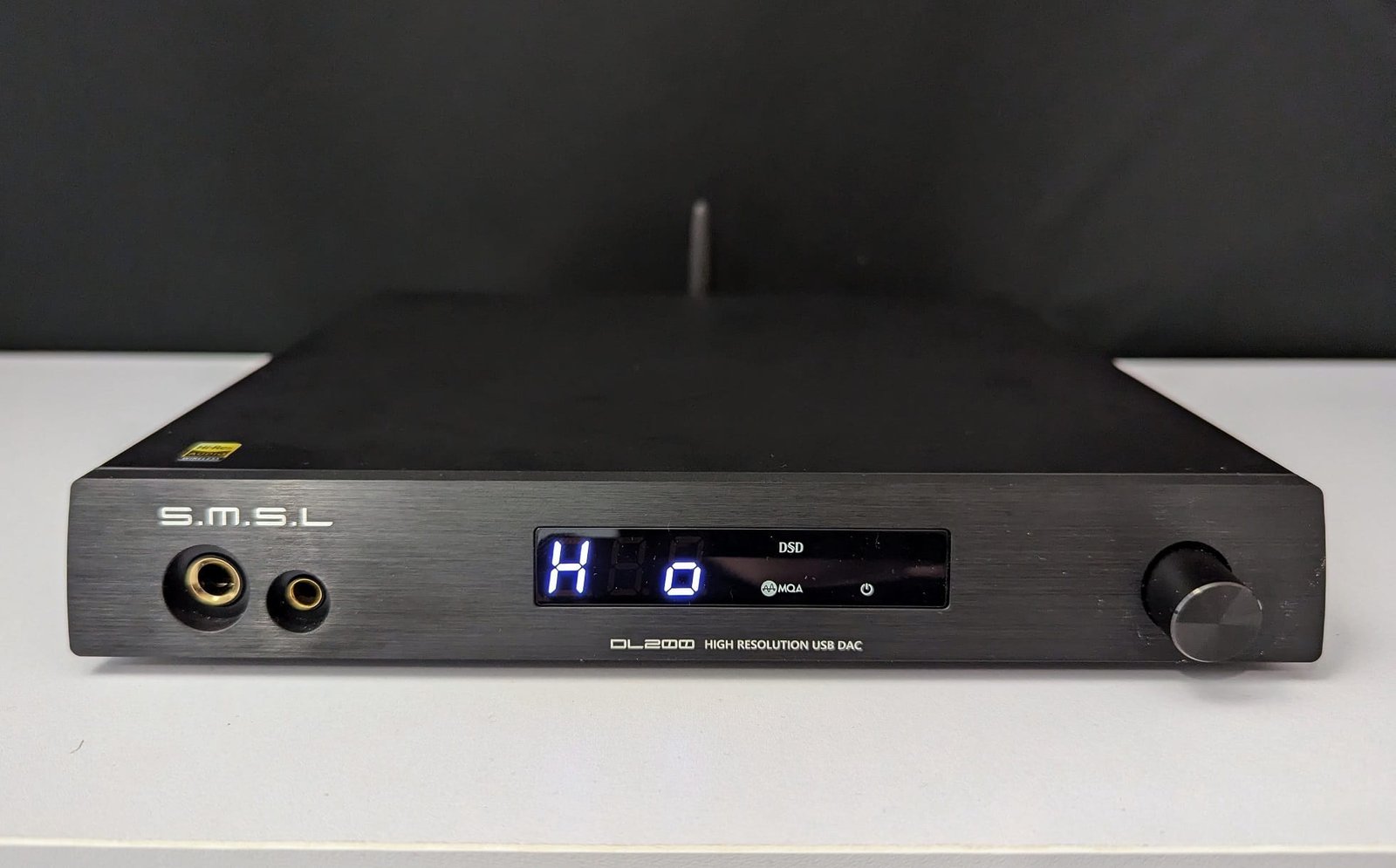
The device's user interface is typically somewhat confusing for Chinese manufacturers, as different functions are expressed on the screen with abbreviations. Fortunately, the manual is only regularly needed to interpret the audio filters contained in the DAC chip (expressed on the screen as FL1–FL7), as ”H o” for headphone jacks and ”L o” for rear output jacks are ultimately quite logical, even though I initially confused them with the gain settings ”G H” and ”G L”. All settings can be changed both with the device's own button and with the included remote control. It would have been nice to see a dedicated button for the gain setting on the remote, but hidden in the menu, the level won't be accidentally changed when fiddling with the remote. Since the DL200's headphone amplifier is quite powerful, this is probably a safe solution.
Speaking of safety, the DL200 conveniently saves the volume separately for headphone jacks and other output jacks, so the device can be used carefree without the risk of the volume suddenly jumping to a hearing-damaging level when switching to another use case. When using the DL200 as a DAC for another amplifier, its volume may be turned up to full, while for headphones, a setting of, for example, 20/100 through the device's own amplifier is sufficient. In an amplifier as expensive as Yamaha HA-L7A there is only one and the same volume for all connections, so in the DL200, the basics are excellently in order despite the affordable price.
Other functionality is also exemplary. For example, utilizing the Bluetooth connection is seamless, as the device quickly connects to my phone as long as I have switched the input to Bluetooth. The phone can also be easily attached to the DL200's USB-C connector, although, to my understanding, this does not necessarily allow for the highest sampling rates to be utilized via the Android operating system without special software.
However, the DL200 is not entirely perfect, as its DAC implementation suffers from a slight clicking issue, which is sometimes encountered with affordable devices. When the sampling rate changes, for example, between two albums or when jumping from a streaming service to YouTube, a couple of faint clicks are heard through the headphones/speakers when playback begins. The same also happens if playback is paused for a few seconds and then restarted. The side noise is by no means irritating in volume, but playback somewhat stutters during the first second. This is unfortunate, but according to SMSL, it is normal because the DL200 is designed so that its mute circuit is momentarily activated when the sampling rate changes.
During continuous listening, however, no clicking or stuttering occurs, so for example, when listening to an album with the same sampling rate, watching longer videos, or playing games, everything works normally. In my opinion, this peculiar characteristic can become a bigger problem mainly when the device user constantly consumes a mix of different audio content. The DL200 is also not necessarily recommended for music production or any kind of professional use. I personally can forgive this in the sub-200 euro price range, but as a single issue, it must be considered the DL200's biggest weakness.
Sound quality
Notes on testing
I have owned the DL200 for some time now, so it has become familiar alongside many other devices and with several different headphones. I could even say that the DL200 is a kind of affordable reference device for me when writing headphone reviews, as I have referred to it many times already. Since the initial novelty has already worn off, my observations primarily describe long-term use. Especially with D/A converters, it should be noted that the sonic differences between them are relatively small in the overall scheme of things, and even small headphone amplifiers implemented with operational amplifiers do not fundamentally differ greatly from each other, especially when they are in the same price range. Thus, the differences I describe inevitably seem larger than they actually are.
When finalizing the review, I used as primary test headphones Dan Clark Audio E3:a, which closely follows Harman's target curve in its frequency response and also offers some resistance to amplifiers. It should be mentioned right away that the E3 sounds really good with the DL200, so the device naturally performs well with more affordable headphones too.
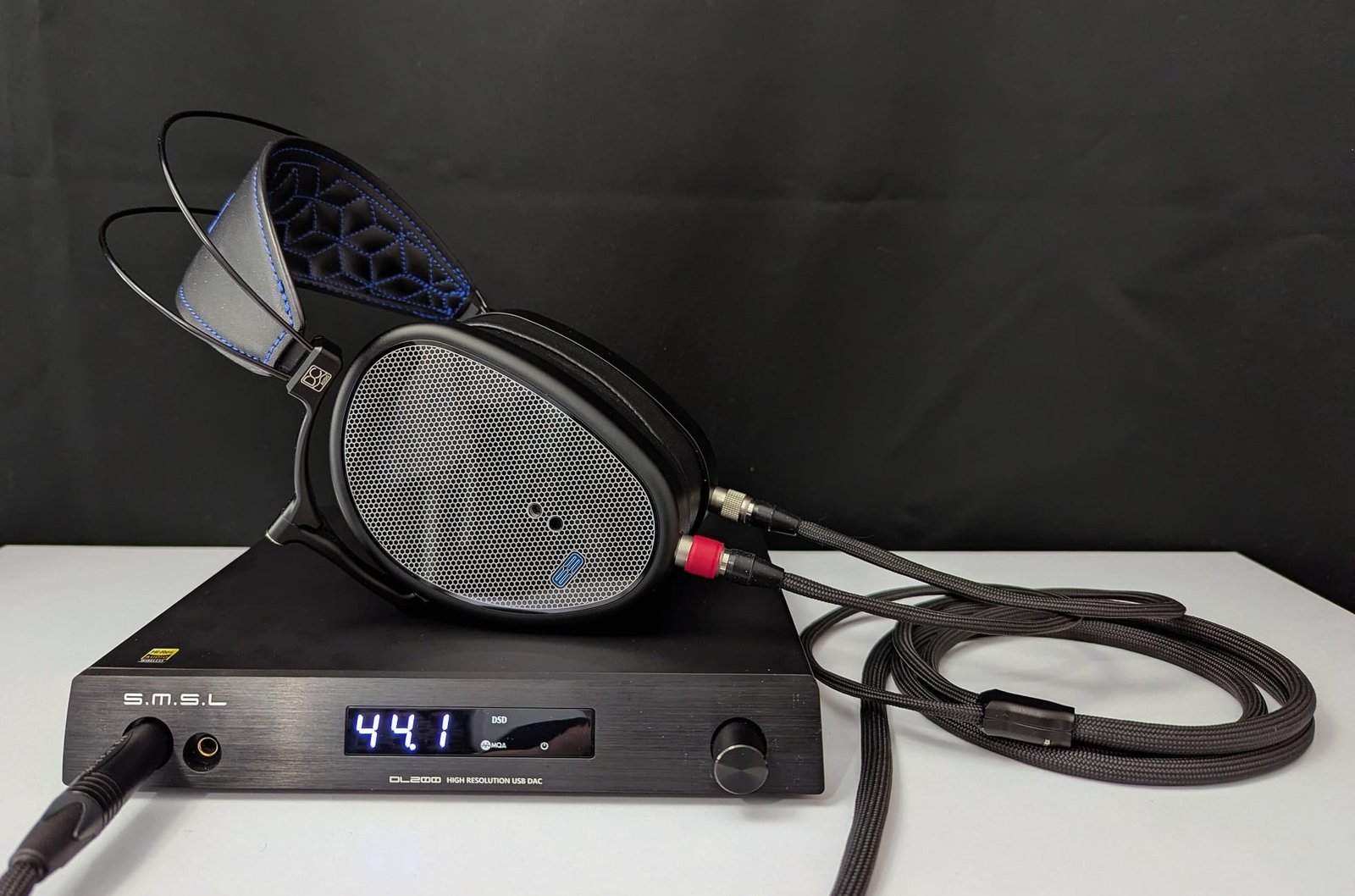
What kind of sound does the DL200 produce as a combination device?
As a combined device, the DL200 is overall quite uncolored and unobtrusive in its sound, but actually in a good way, as I do not detect typical annoyances of affordable devices, such as harsh treble (a characteristic typical of ESS DAC chips) or a narrow soundstage (a characteristic of many Topping devices). Compared to more expensive devices I have tried, such as Cayin iHA-6:to, Aune Audio S17 Pro:to, Chord Mojo 2:to and Topping LA90, the high frequencies are still reproduced slightly more sparklingly and sharply with the DL200, especially with dynamic headphone models. However, planar headphones that ”consume” more power sound rather more relaxed than usual with the DL200, so I wouldn't want to state any truths one way or another.
The DL200, in any case, affects the sound of headphones so moderately that I haven't experienced any headphone model sounding bad or distorted. What else would one need to expect in terms of sound quality for under 200 euros? Nothing irritates, but it doesn't ultimately make a huge impression either, as, for example, sound separation doesn't quite reach the level of more expensive devices. However, considering the affordable price, sufficient output power and features are more important to me, and these are well realized with the DL200.
I compared the device at an identical volume with the Topping DX1 and iFi Zen DAC (V1, which should not differ in sound from V2). First, I found the DL200 to be the most neutral of the trio due to its slightly brighter sound. The Topping DX1 is more relaxed and softer in its presentation, so perhaps even more pleasant for some when listening to aggressive music. However, with this device, the soundstage feels quite narrow, which is why I perceive the more spacious-sounding DL200 as a sound quality improvement, especially since it also separates instruments more precisely from each other.
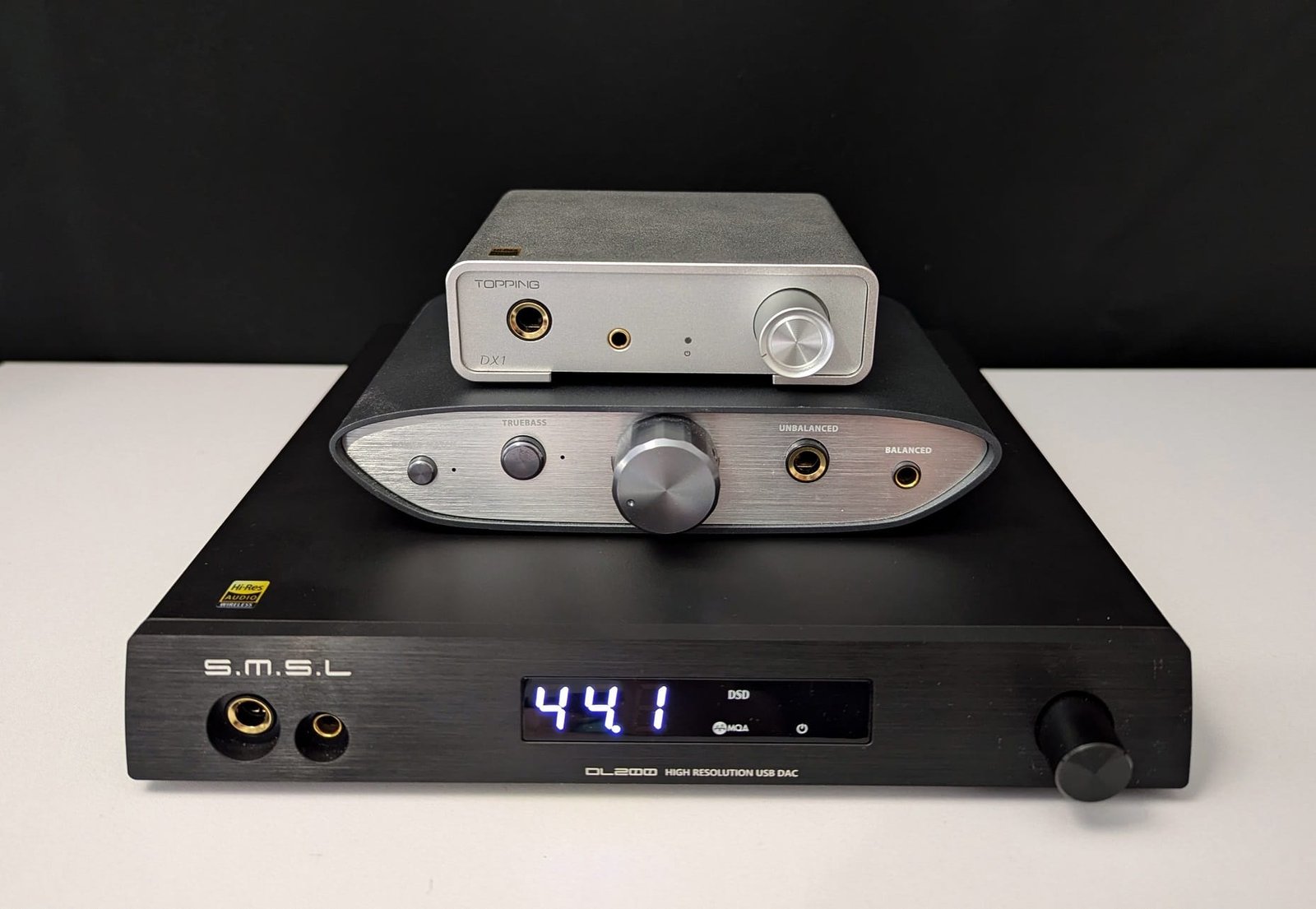
The Zen DAC has the clearest characteristic sound of the trio, as I detect a certain roundness and richness in it that makes listening pleasant. Compared side-by-side, the DL200 sounds slightly drier and sharper at the edges of sounds, essentially like a more typical transistor amplifier. The Zen DAC adds emotion to the reproduction at the cost of sound separation not being quite as precise as with the DL200. However, both sound clear and spacious, so the listening experience is very similar in the long run. Perhaps the biggest difference that comes to mind are the Zen DAC's fuller and warmer low frequencies, which make, for example, the bass guitar and drums sound more robust. The DL200 keeps the reproduction slightly tighter, albeit thinner. When increasing the volume more, the Zen DAC starts to run out of steam with E3 headphones, as the sound distorts and becomes muddy even through the balanced connection. The same does not happen with the DL200, so there is no need to worry about running out of output power with it.
Comparison of DAC sections
I also briefly tested the DL200 as a standalone DAC alongside the same comparison units, using the Cayin iHA-6 as an amplifier. My observations were largely similar to when using the trio as combined devices, but the differences were, as expected, smaller and less significant, so they would be forgotten quite quickly during longer listening sessions.
As a DAC, the DX1 still sounded slightly softer and narrower, pushing the vocalist more to the foreground overall. With the DL200, there was more empty space around the sounds, which brought depth and layering to the presentation. Consequently, I would not feel that the device, as a DAC, significantly degrades the sound of more capable amplifiers and headphones, whereas with the DX1, some potential would remain unutilized. Therefore, I would consider the price difference between the two quite justified, even if they were used purely as DACs, disregarding other features.
The iFi Zen DAC differs less from the DL200 as a DAC than as a combined device, because although there is still a touch more warmth and roundness in the sound, it is already becoming difficult to detect. I would describe the reproduction through the DL200 as slightly airier and more separated, but the Zen DAC also sounds precise and structured, forming the soundstage correctly. In longer listening sessions, the differences largely become insignificant, but those who prefer a more musical reproduction would likely favor the Zen DAC, while the DL200 offers the purest and most uncolored sound possible. Depending on the rest of the listening chain, both characteristics may have their advantages, or alternatively, the differences might not even be noticed.
Summary
The SMSL DL200 is a versatile, modern, sufficiently powerful, and good-sounding device that lacks nothing essential compared to competitors' products in the sub-200 euro price range. Only a small audio dropout related to sample rate changes and difficult-to-utilize balanced connections leave room for improvement. If these bother you, there are many other viable alternatives within 50 euros on the market, such as Topping DX3 Pro+, iFi Zen DAC, Creative Sound Blaster X4, FX Audio DR07, and FiiO K11. Although each of these has its own strengths, I don't believe they can currently offer as comprehensive a package as the DL200, which sets a certain benchmark for others. This can be considered an excellent achievement in a highly competitive price range and product category. On the other hand, the market situation is constantly evolving, and with sales, any of the devices I mentioned may become more attractive than others.
Finally, I want to remind you that for most headphones, a device designed for mobile use would also suffice, Qudelix 5K, whose versatile feature list includes an excellent parametric equalizer. I am still waiting for a desktop-sized device similar to Qudelix in the sub-200 euro price range before I can truly get excited about anything significant. The Sound Blaster X4 is at least a step in the right direction, so I hope to see some kind of combination of it and the DL200 in the future.
Pros and cons:
+ Uncolored and balanced sound without clinicality
+ Versatile features, such as an LCD display, Bluetooth connectivity, USB1.1 mode, and a remote control
+ Comprehensive digital and analog connections
+ Metal casing
+ Ample output power
+ Volume adjustable separately for headphone jacks and other output jacks
+ Affordable price
+/- Larger than usual physical size has both its advantages and disadvantages
– Changing the sampling rate and pausing playback for a longer period causes a slight clicking/stuttering
– To use the balanced output connectors, rare TRS cables must be acquired
– The user interface is a bit difficult to understand despite the display
– Thin paint finish scratches easily
– Completely unnecessary MQA support
 EN
EN  FI
FI
I have had this same dac/amp in use since autumn 2023, both as a headphone amplifier, preamplifier, and just a DA converter, and I do subscribe to the observations presented in your review: neutral sound, sufficient power, neat appearance, smooth to use. I have not noticed any clicking. Headphones used are Hifiman He400se and Beyerdynamics DT700 pro X.
All in all, a really good all-rounder from HLS.