Author: Roderick
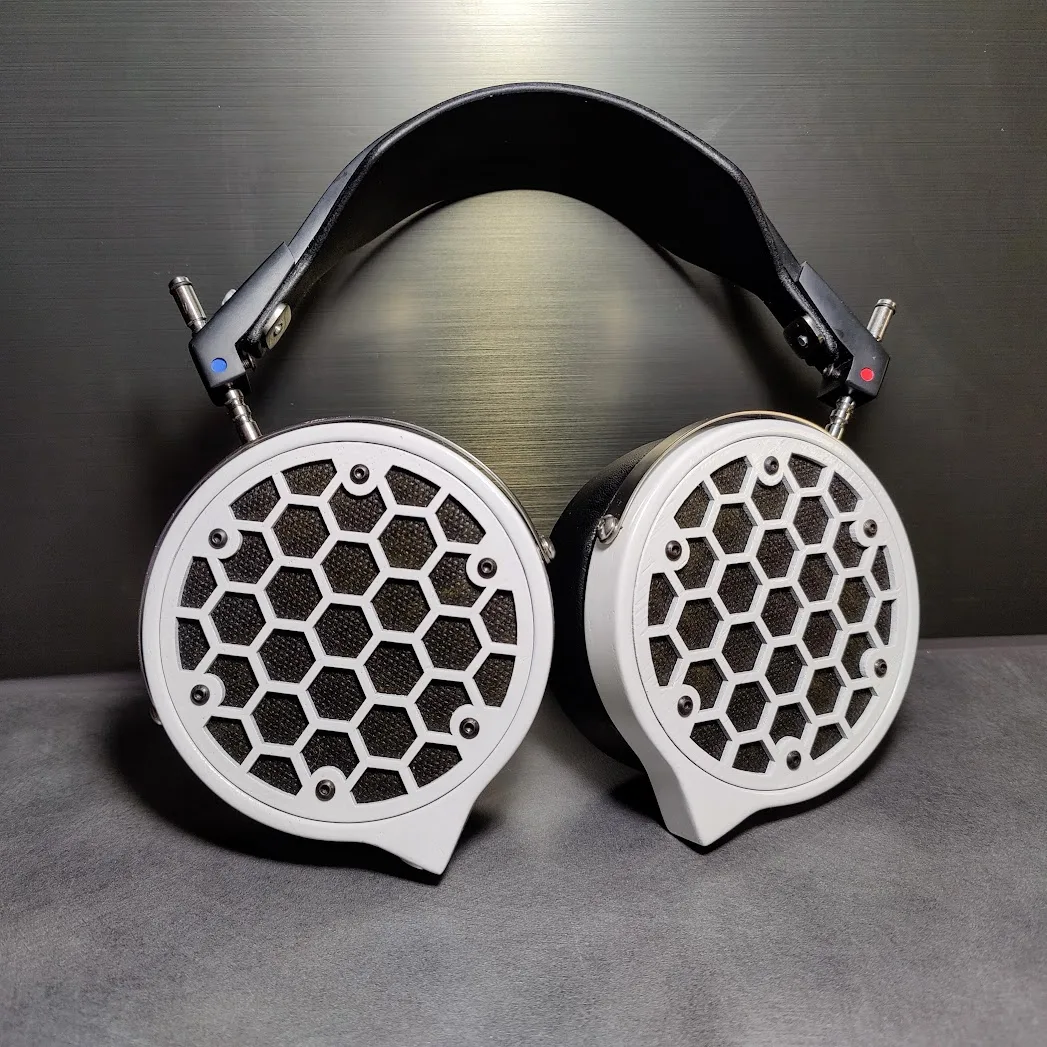
Table of Contents:
Information:
- Release year: 2023
- Country of manufacture: Ukraine
- Price: 420 € (Delivered to Finland with taxes approximately 570 €)
- Type: open, over-ear
- Planar driver: 100 mm, N52 magnets
- Impedance: 25 ohm
- Sensitivity: 98 dB/mW
- Weight: 574 g without cable
- Connector type: 2 x 4-pin-mini-XLR
- Cable: Length and connector type freely selectable
- Included: Only a cable in the basic model, but closed cups, semi-open cups, a wooden box, and various earpads are available for separate purchase
- Warranty: 1 year (can be transferred to a new owner)
Review sample: Self-purchased product
About a year ago I wrote review about SASH Tres (45 ohm) headphones. It's worth checking out the article, especially if the manufacturer is not already familiar. Briefly, let's reiterate that SASH (Studio Audio Sound Handmade) is a Ukrainian headphone manufacturer specializing in planar headphones, and Tres (45 ohm) has been my favorite headphones in the approximately 500 euro price range for some time now.
Currently, the manufacturer's selection includes three headphone models: the Tres with 16 ohm impedance priced at 330 euros, the Tres with 45 ohm impedance costing 360 euros, and the newest, released in 2023, Tres SE (Second Edition), which is priced at 420 euros. Shipping costs and VAT must be added to these prices, making the final price of the Tres SE model I am reviewing this time approximately 570 euros. The price has risen slightly compared to previous models, but it can still be considered in the same price range.
The headphones are ordered from the manufacturer's website (www.sash-audio.com), but at least at the time of writing this review, paying for the order is not possible without agreeing on the payment method separately. So far, payment methods like Paypal have not been available, so I have had to use the Wise service. It is reportedly a reliable payment transfer service, but registration may not be possible without a passport or ID card. Additionally, ordering from war-torn Ukraine naturally involves unforeseen risks. Even if no problems arise, the completion of the headphones must in any case be awaited for a few months. On the other hand, the long waiting time ensures that there is always demand for used SASH headphones, should someone not happen to like their purchase.
Equipment
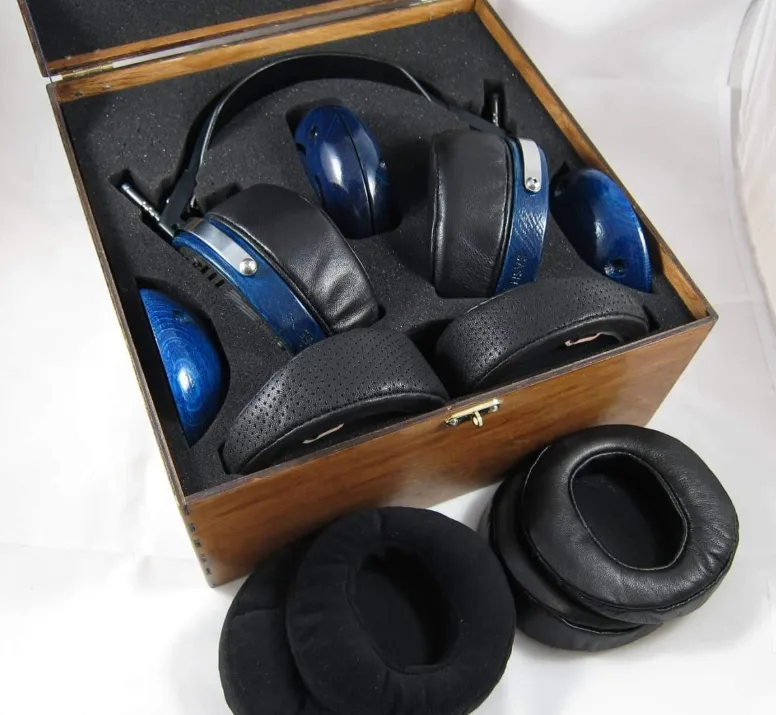
I ordered my headphones without the wooden storage box sold separately by the manufacturer, so they were delivered in a cardboard box wrapped in bubble wrap. I couldn't find out the price of the box, but I assume it costs about 40 euros, because the box for the 45 ohm Tres cost that much. A high-quality box is easy to recommend, especially for those who also order closed or semi-open wooden cups for their headphones. This time I did not order alternative cups, as I thought the Tres (45 ohm) sounded best fully open, so I assumed the situation remained the same for the Tres SE as well.
Build and comfort
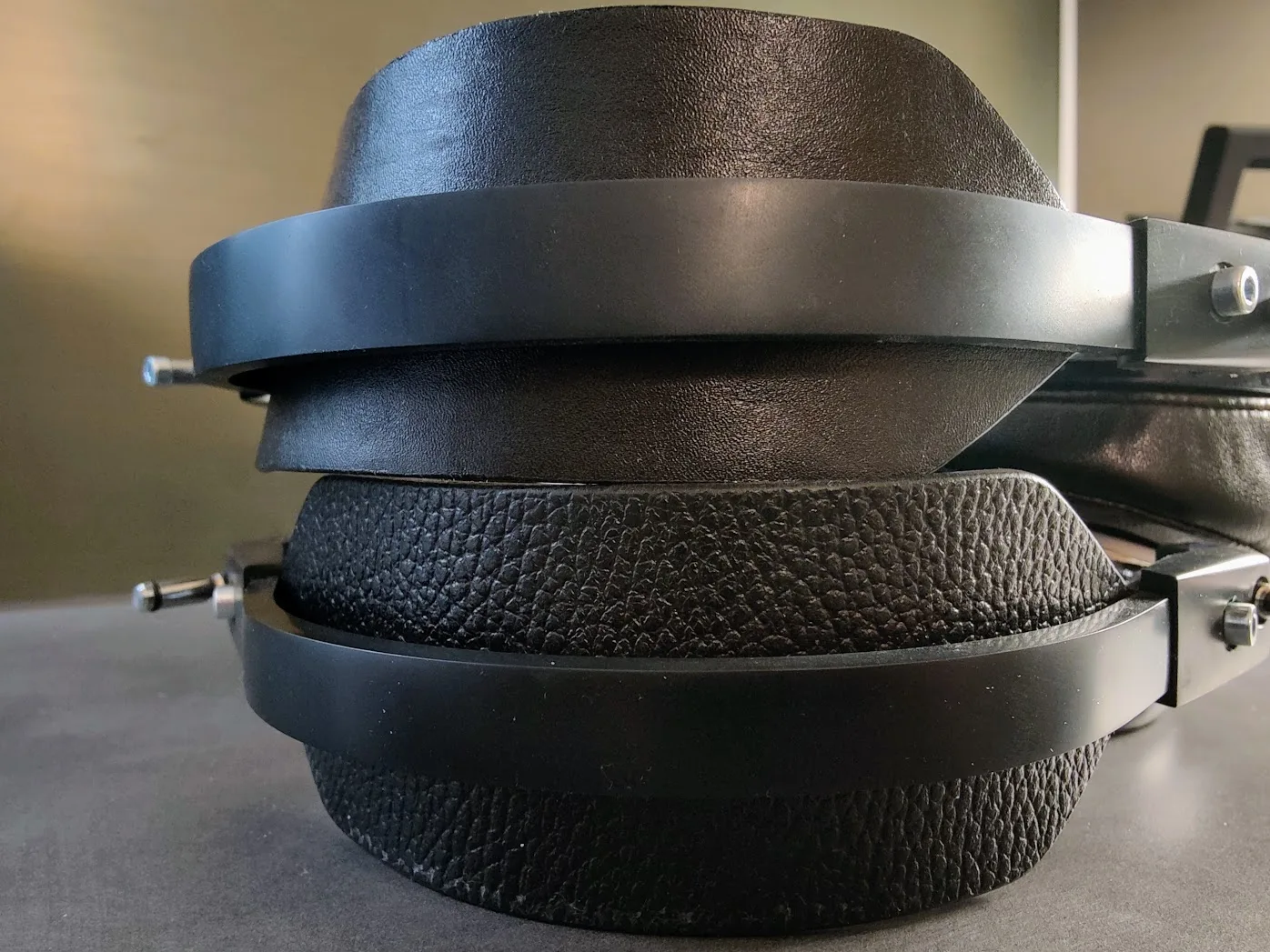
The structure of the Tres SE is largely similar to the manufacturer's previous headphones. SASH's products have always been robust in structure, so I'm not greatly surprised that the SE model strongly resembles its predecessors. Of course, there are a few differences, although some of them may well be general improvements that have also been added to more affordable models in the meantime. Here, in any case, are the differences I noticed between the SE and the 45-ohm model I previously purchased, briefly with pictures.
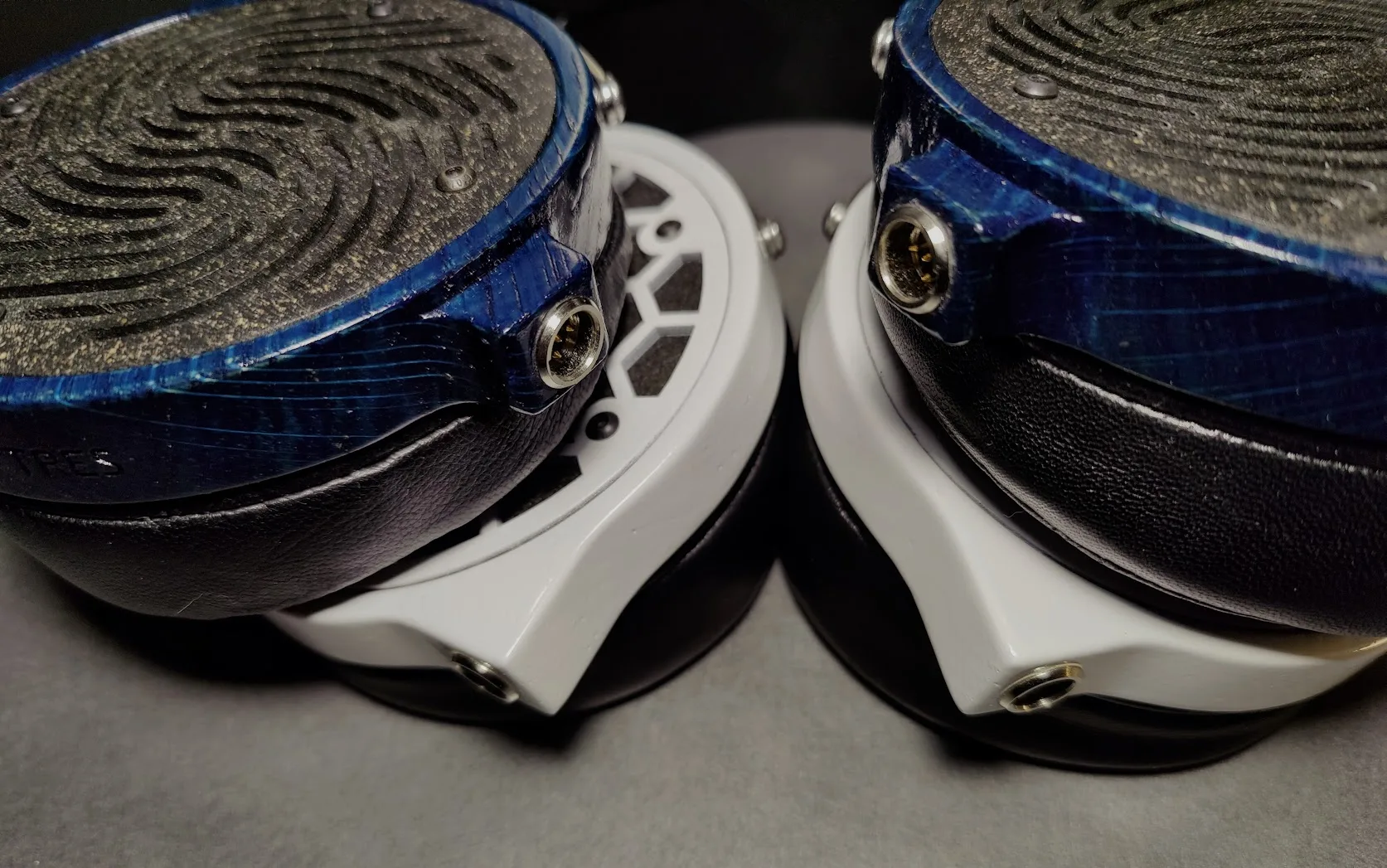
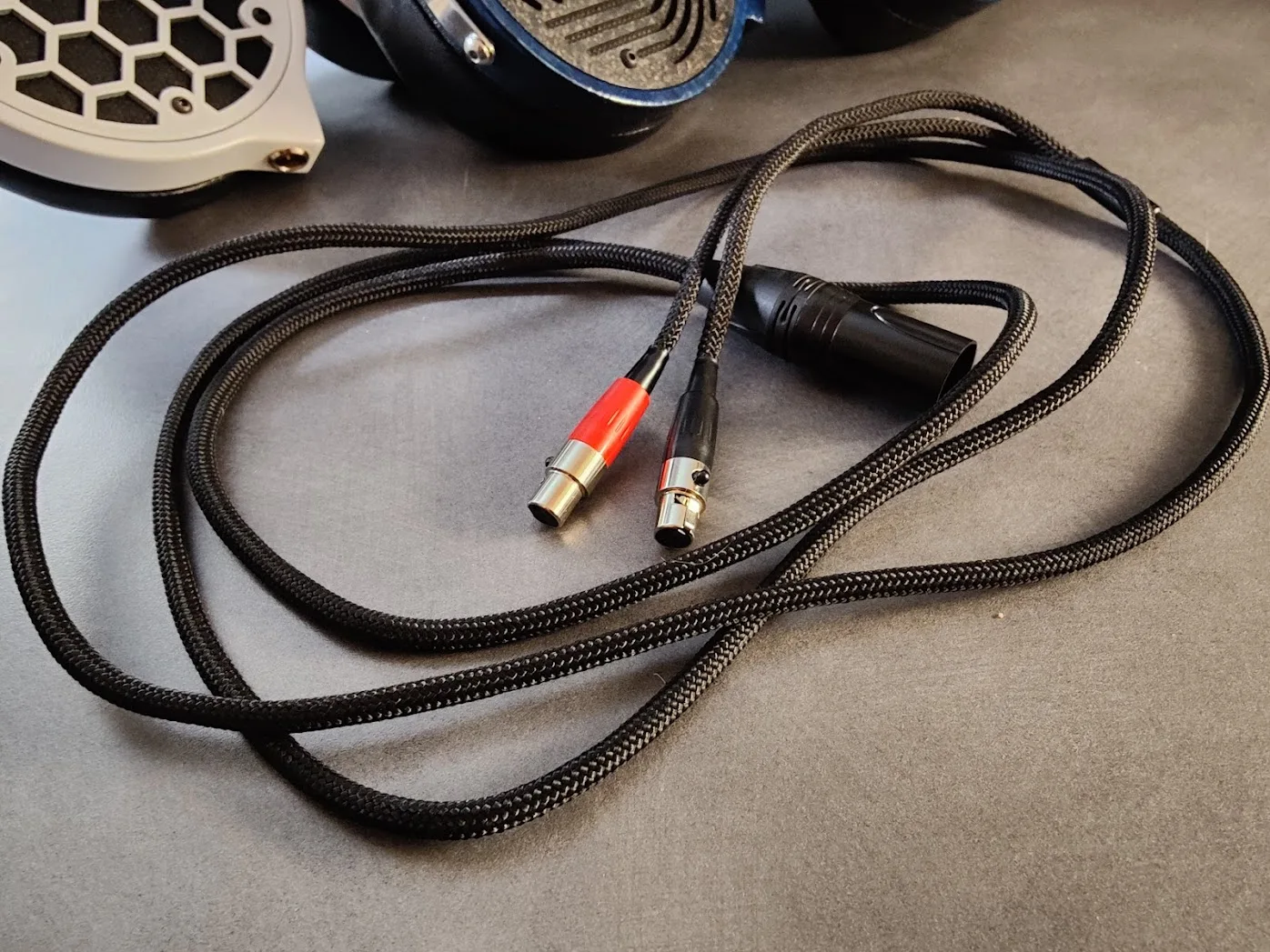
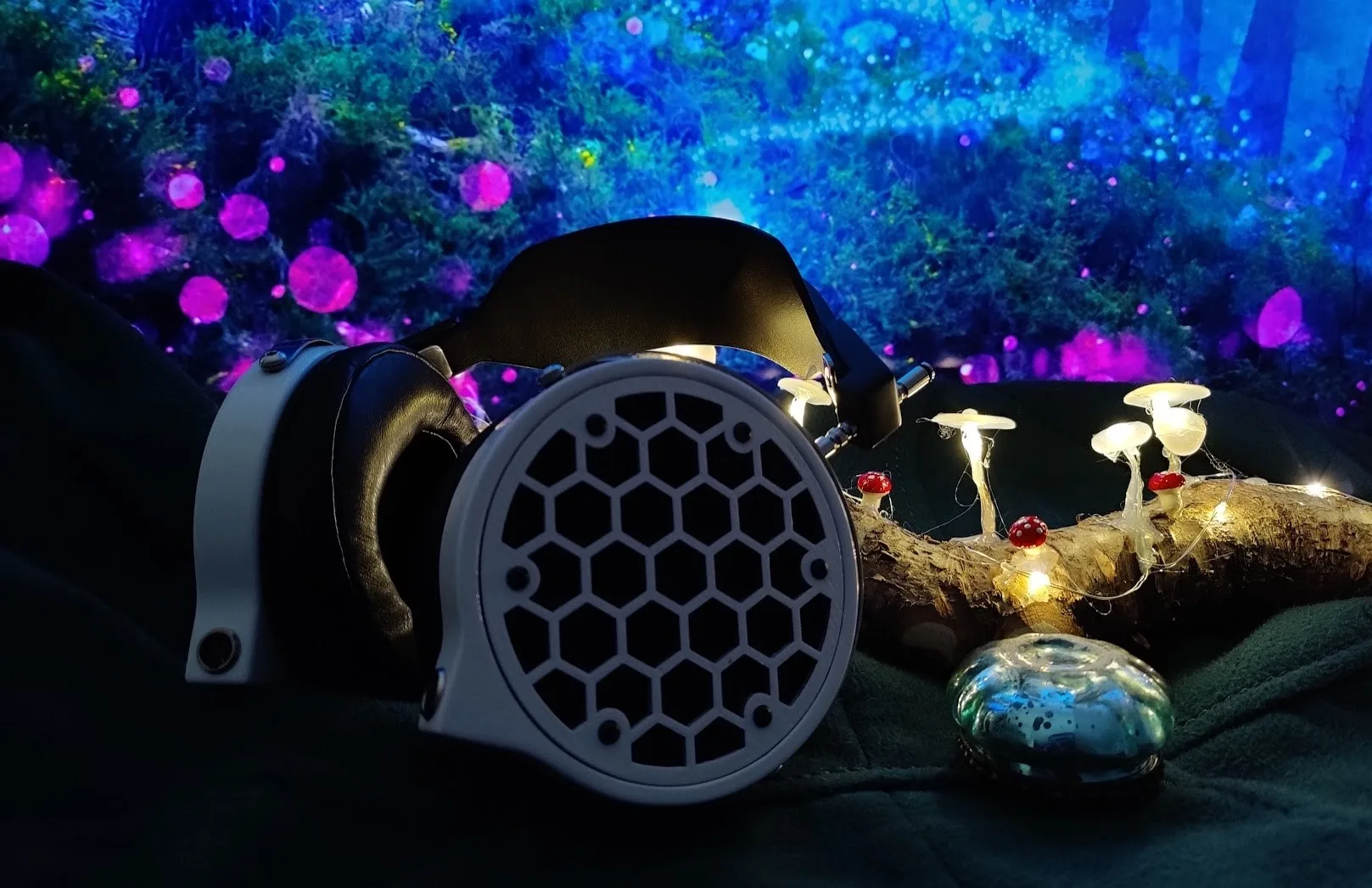
The Tres SE can be ordered with a customizable color scheme, as usual. I chose a glossy lacquered white myself, as I don't recall seeing one like it before. As a small extra, I ordered two sets of grilles for the headphones: one with a honeycomb structure and another with an S-shaped cutout, which the manufacturer has used in its previous Tres models. Previously, the grilles were plastic, but nowadays they are also made of wood, like the cups.
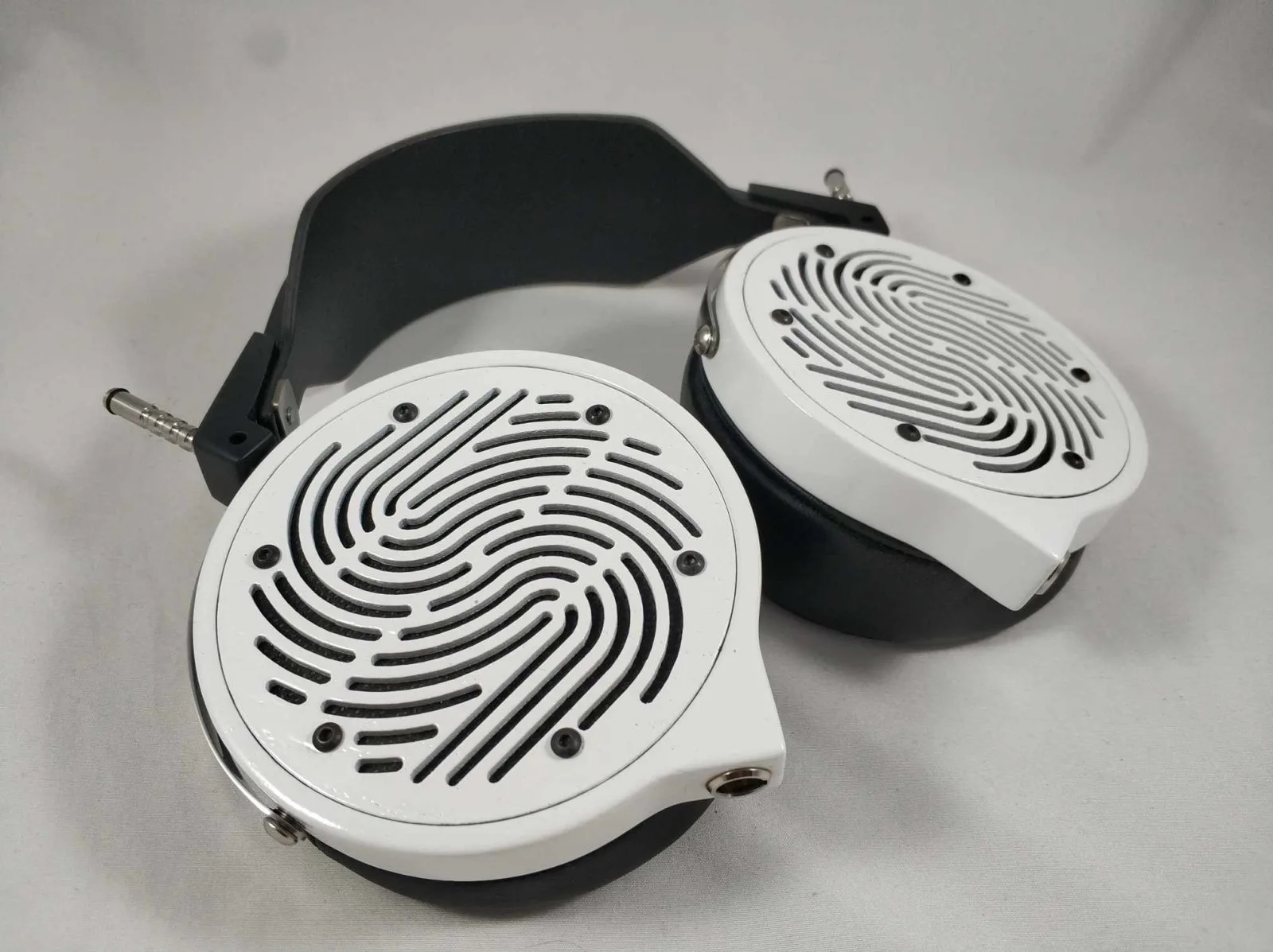
Regarding comfort, there are no surprises for those who have previously used the manufacturer's headphones. Height adjustment is done in the usual way with stepped pins, and the cups' range of motion conforms well to the shape of the head. All parts can still be fully tightened with adjustment screws after finding the optimal wearing position. The Tres SE clamps the head quite firmly, but the comfortable earpads alleviate the sensation. The clamping force can be reduced by loosening the screws on top of the headband and stretching the thick plastic headband. The most regrettable aspect of the new model is its increased weight, as 574-gram headphones are not easy to recommend for those with weak necks. The wide headband does distribute the weight evenly, but many would certainly have appreciated it if some kind of padding had been added to it.
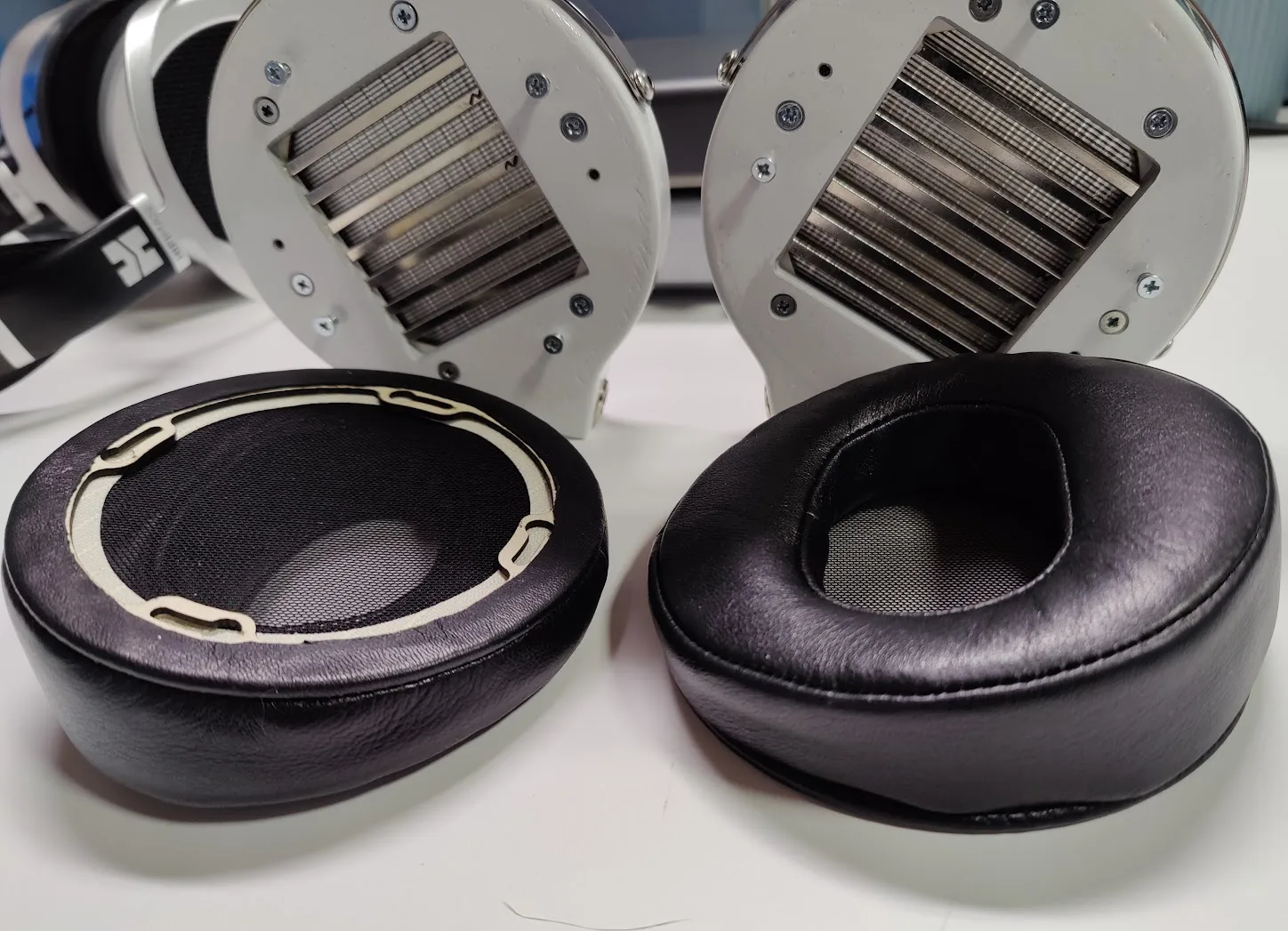
Externally, the headphones have thus remained almost unchanged. Comfort is quite good, but the high weight and strong clamping force can become an issue for some. What best distinguishes the Tres SE from its similarly priced competitors is its high-quality craftsmanship and structural durability. I also don't know of any other equally affordable headphones whose appearance and features customers can influence as extensively.
ÄSound quality
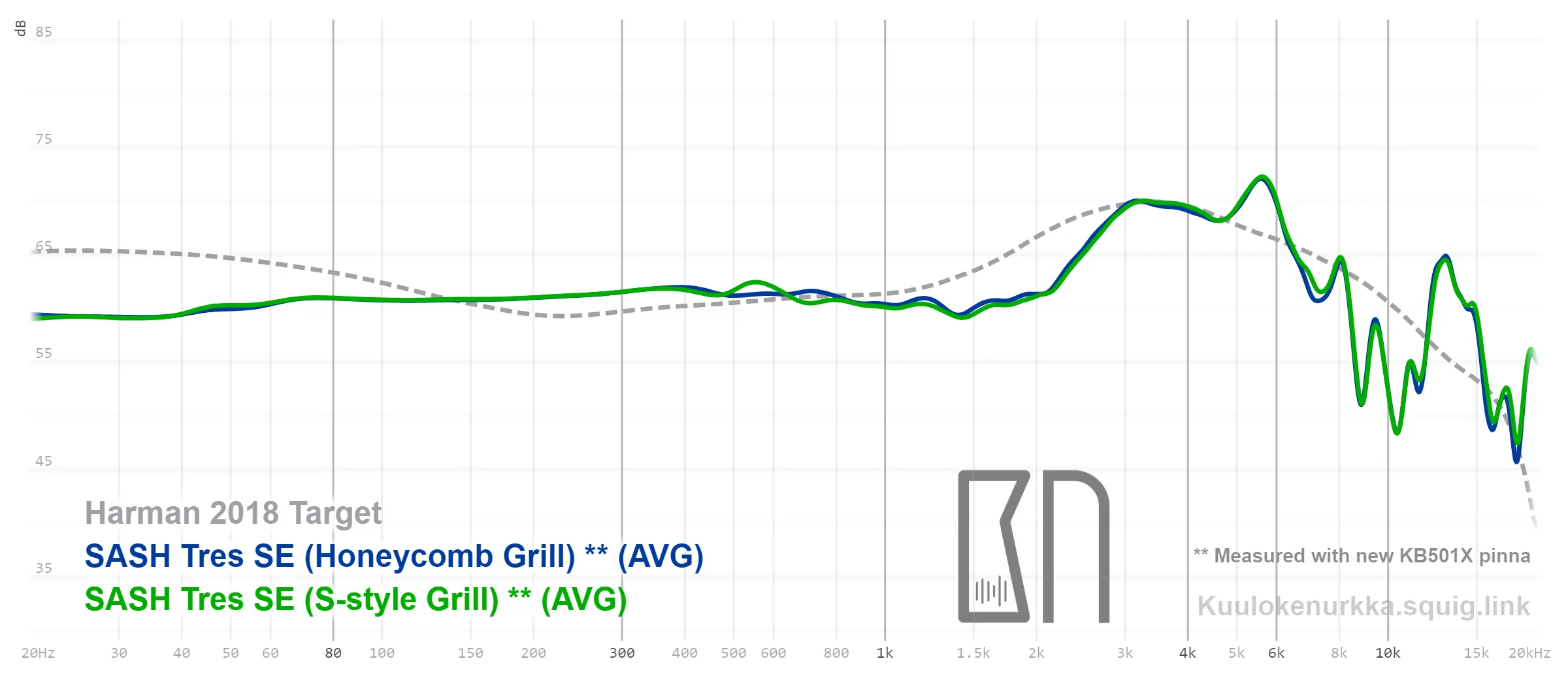
Headphone frequency response measurements have been performed with equipment compliant with the IEC711 standard and KB501X-style silicone ears. The graphs use the Harman target curve (2018 version), based on scientific research, as a reference. This curve is a generalization of what kind of frequency response would sound good to most people and correspond to listening to balanced-sounding speakers in a well-acoustically treated room. More information about the measurements and their accuracy can be found Headphone Measurementson the page. The Tres SE's frequency response can also be compared with other measured headphones Squiglink-comparison tool.
Frequency response:
Bass:
I would describe the bass reproduction of the Tres SE as high-quality and balanced. The bass extends effortlessly to the very lowest frequencies, and there are no emphases in any area – quite typical planar sound, then. The bass is technically excellent, but for some tastes, perhaps a bit too scarce in quantity. I wouldn't mind if there was a little more bass myself. The headphones' low frequencies support the mid-frequencies well, but with bass-driven music, I would crave a more robust approach. However, the reproduction is very precise and sufficiently impactful, so I can't really fault it for anything in the end.
Mid-frequencies:
For those familiar with headphone frequency responses, the Tres SE's ”curve” may look very familiar, as the small dip between 1.5–2 kHz is similar to most Hifiman open-back planar headphones. This kind of mid-frequency tuning brings a bit of relaxation to the reproduction, and when implemented correctly, it is also seen to widen the headphones' soundstage. An overly recessed upper midrange, on the other hand, would make the headphones sound nasal and veiled.
Like Hifiman, SASH also hits the bullseye with its upper midrange tuning. The sound is natural and has a touch of pleasant softness. A more prominent presence region, in turn, brings bite to the sound, making listening exciting. The 5–6 kHz emphasis visible in the frequency response measurements is likely real, even though I initially doubted its accuracy because I did not find the headphones' lower treble disturbing. Probably at least some of the headphones' energetic and perhaps slightly aggressive sound is, however, a consequence of the emphasis in that frequency range.
The Tres SE's mid-range is thus an interesting combination of softness and aggressiveness. The overall presentation is balanced, but for example, drum snaps might be too much for those accustomed to a smoother presentation. In any case, the best aspects of the headphones' mid-range are the layering, separation, and effortlessness of the reproduction. I will delve into this a bit more precisely soon.
Treble:
I find the headphones' high frequencies to be excellently balanced. On the other hand, those accustomed to darker-sounding headphones might not appreciate the presentation, as the prominent lower treble slightly veils the highest frequencies. However, for older listeners, this is probably not very obvious due to natural hearing loss. The Tres SE is not as airy as the best planars and electrostatic headphones, but for its price range, the performance is quite decent.
Audio description:
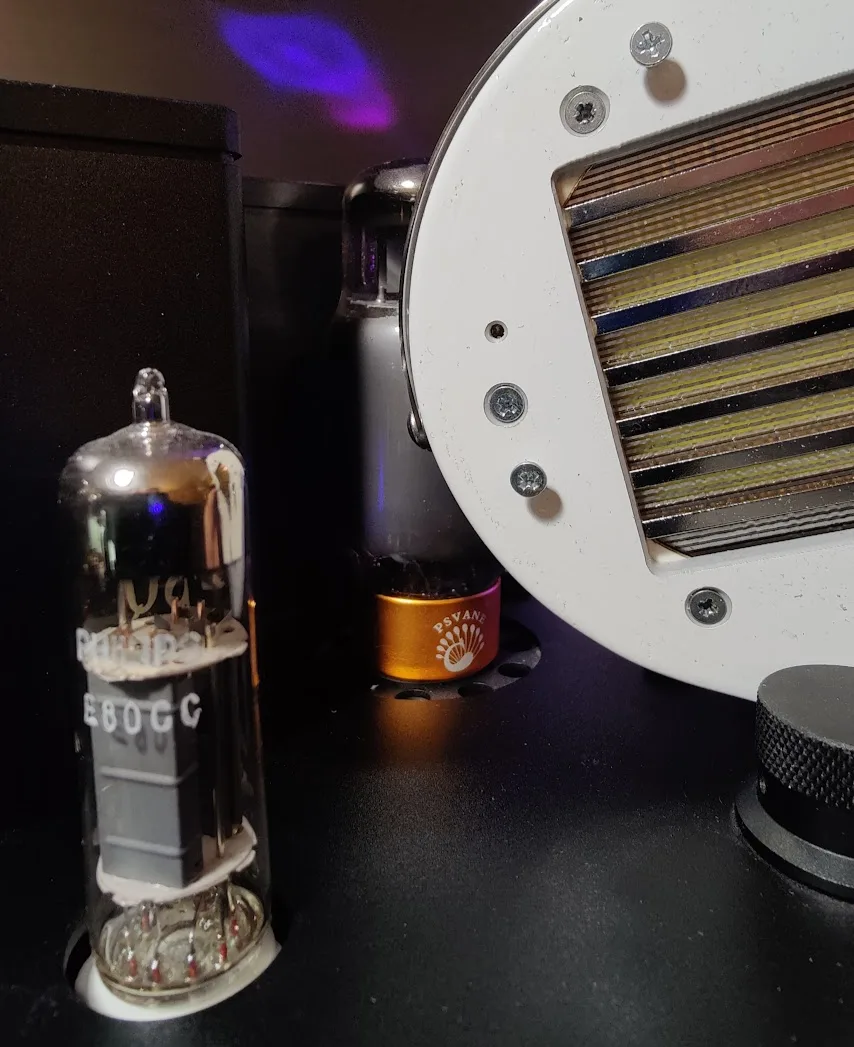
The soundstage in the Tres SE is wonderfully layered and realistic. In that regard, I believe one would have to look for comparisons among significantly more expensive headphones. There is no hollowness whatsoever in the soundstage; instead, SASH's headphones are able to utilize the space to its fullest. Music feels like it's in constant motion, with sound sources localizing to changing positions. Its liveliness reminds me of Hifiman HE6se V2, to which the older Tres model (45 ohm) still fell short in soundstage authenticity. Now this aspect has also been corrected, and in addition, the sound has gained the massive quality characteristic of more expensive planar headphones.
Resolution and sound transparency:
The Tres SE is so resolving and transparent in sound that no other headphones I've heard in the same price range can compete with it. An astonishing amount of information emerges from the music, and especially the headphones” ability to interpret small tempo changes is remarkable. As a good point, the resolution also feels purposeful, as the headphones do not try to ”show off" or draw attention to insignificant crackles in recordings, which at worst would interfere with enjoying the music. The Tres SE's resolution supports the musical whole and makes the listener appreciate the artist and audio professionals even more. Fun-sounding headphones are not always the most resolving, but the Tres SE is an exception in that regard, being simultaneously a genuinely detailed top-tier headphone and enjoyable to listen to.
Dynamics and PRaT:
The Tres SE is among the best in its price range for a planar headphone also in terms of dynamics, but with all its other positive qualities, the more dynamic-than-average reproduction might not even be noticed. The ability to reproduce rapid changes in volume is much better compared to, for example, a similarly priced Hifiman Edition XS:. However, more impressive than good macrodynamics is the Tres SE's ability to reproduce small changes within the music with incredible precision. This could be linked to good microdynamics, which, however, correlates so closely with the detail of the reproduction that it doesn't fully explain everything I've heard.
PRaT (Pace, Rhythm, and Timing) on the other hand, is a divisive concept. I don't really use it, and I'm not even sure how it should be translated into Finnish. Tempo-Rhythm-Timing, however, could be quite close to the correct description. I don't understand much music theory, but I think PRaT makes sense if it's used to describe, for example, how well a band plays together. When evaluating hi-fi equipment through this concept, the situation is different. Tempo-Rhythm and timing are already present in recorded music, so shouldn't every headphone or speaker be able to reproduce it? Sometimes, however, it feels like certain headphones sound more rhythmic than others. Why do some headphones make the listener dance or play air guitar? Let a headphone with good PRaT serve as an example: Grado Hemp.
I decided to talk about PRaT in the context of this review because the Tres SE has a special ability to rhythmically organize music in such a way that the timing and tempo of individual sounds and note progressions are emphasized more than usual. With these headphones, music sounds like a controlled rush, where things happen a little faster than accustomed, and the journey includes more stops and accelerations than usual. Sometimes during the same song, the rhythm might primarily be driven by, for example, a guitarist, but at times the rhythm is led by a rhythm guitar, bass, keyboard, or drums. With many headphones, music is reproduced uniformly, so that the ”dialogue” between instruments does not clearly emerge. The Tres SE, on the other hand, seems to emphasize this ”dialogue.” It is precisely at these moments that PRaT is highlighted.
However, since I don't believe headphones or speakers possess any magical PRaT characteristic, I want to speculate a bit about what might be causing my experience. In the case of the Grado Hemp, an explanation can be sought at least from the headphones” exceptional frequency response. The overemphasized 2.5 kHz region makes the sound energetic, and the rich mid-bass nicely thumps rhythm into the music. The performance of the Hemp's drivers cannot be underestimated either. According to measurements, the headphones” transient response is excellent, so they are demonstrably "fast" sounding. Partially, the experience of PRaT may also be influenced by the fact that Grado's ear pads are very thin foam discs, due to which vibrations caused by the drivers are transmitted more than usual to be felt on the skin.
Grado-like characteristics are also identifiable in the Tres SE. Its midrange is subdued compared to Grado headphones, but the emphasis on the presence region brings energy to the sound. Although I cannot verify this with measurements, subjectively, the Tres SE's transient speed is excellent. Additionally, the headphones' stronger-than-normal clamping force may also enable the "hearing on the skin" I mentioned, as with headphones that close tightly against the head, more energy is inevitably transmitted through the pads to the listener's body. Whatever the reason, the Tres SE is unequivocally incredibly fun to listen to, and unlike the aforementioned Grado Hemp, its resolution is also at an excellent level.
Strongstus
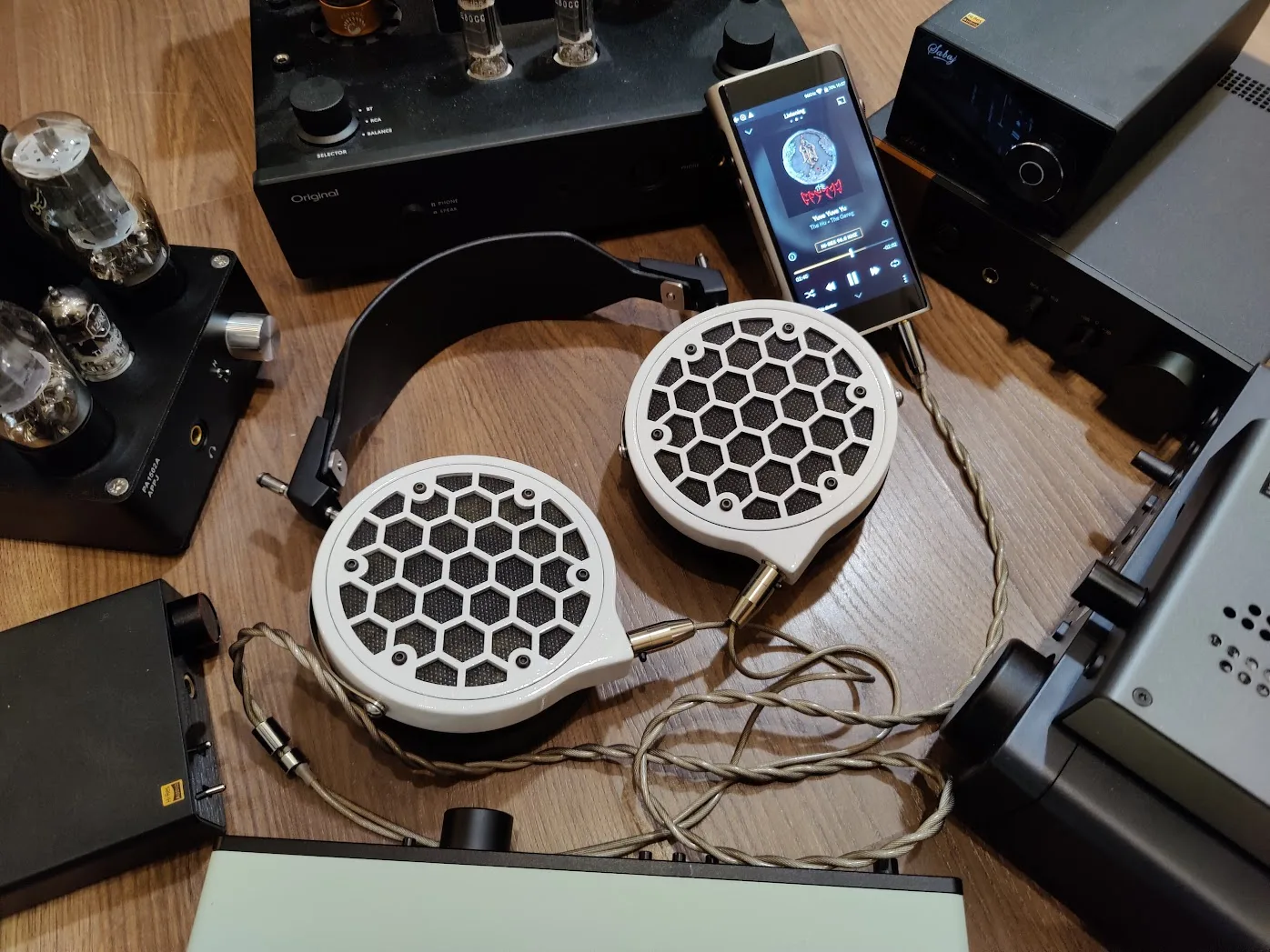
Thanks to its higher sensitivity, the Tres SE is clearly an easier load for an amplifier than the manufacturer's previous headphone models. I have listened to the headphones most with the Shanling M6 Pro mobile player, which can reproduce them effortlessly. The 45-ohm version of the Tres sounded best to me with powerful tube amplifiers, such as the APPJ PA1501 and Original OPA-4A. These amplifiers are also perfectly suited for the Tres SE, but this time it's more about the fact that I generally happen to prefer tube amplifiers over solid-state amplifiers. The Tres SE sounds astonishingly similar to me whether I listen to it with the aforementioned tube amplifiers, the Ferrum OOR, or Creative Sound Blaster X5it. It may well be that none of the devices were a particularly magical match for the headphones, but I would rather guess that they just sound good connected to almost anything.
Comparison to other headphones
SASH Tres SE vs. SASH Tres (45 ohm)
Prices: 420 € vs. 360 € (excluding shipping costs and taxes)
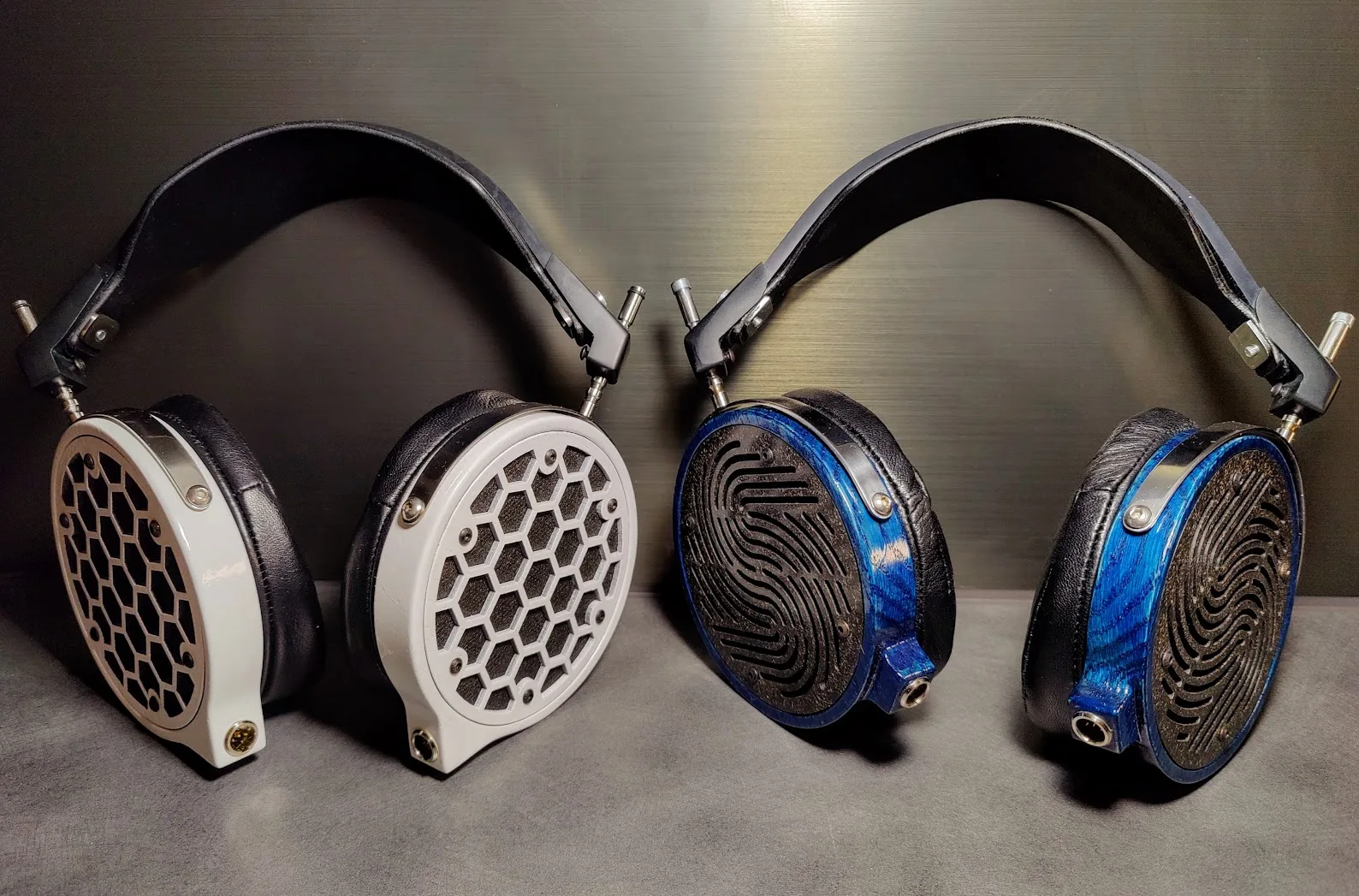
First, I will compare the sound quality of two different Tres models to find out what changes the manufacturer has made to the slightly more expensive SE model.
Frequency responses:
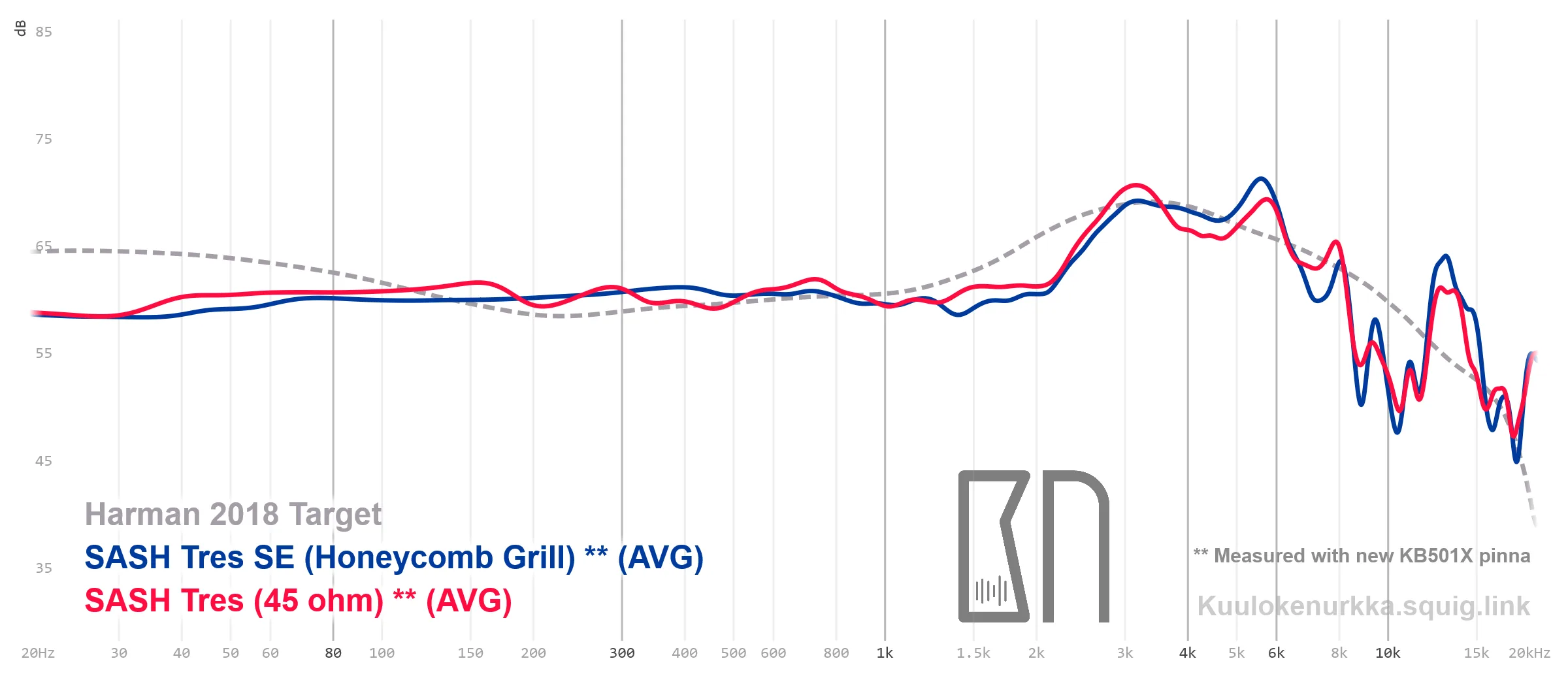
Comparing the frequency responses of the headphones reveals three small differences:
- The Tres SE has slightly less bass, but in practice, the difference is quite difficult to notice.
- The new model has a slightly more emphasized presence region. The sound of the headphones is thus a touch sharper.
- The frequency response of Tres SE is more stable. This may indicate that the manufacturing process of the drivers has evolved. This is also suggested by a better channel balance, which can be examined in Kuulokenurkka's measurement database.
The changes in frequency response are ultimately quite small. The more abundant bass of the older Tres model is difficult to detect when listening, but combined with a more subdued presence region, it changes the sound of the headphones. Tres (45 ohm) sounds fuller and calmer than Tres SE. The difference is not great, but in my opinion sufficient to justify owning both headphones. Due to a slightly different frequency response, Tres SE sounds energetic and fun, while Tres (45 ohm) works better with more subdued music and at times when the connection between the listener and the singer is most important. To put it bluntly, I would choose the 45 ohm headphones for listening to vocal performances and the SE model for everything else.
From this, we can move on to my other subjective observations. Tres SE is, in my opinion, better than its predecessor in almost everything. However, improvements in basic aspects, such as bass quality and dynamics, are not great and diminish further when listening with better equipment, as the SE model does not scale upwards as well as Tres (45 ohm). Tres SE's flagship status is best demonstrated by its improved soundstage and resolution. Tres (45 ohm) has a perfectly adequate soundstage, but it is no match for, for example, Hifiman Edition XS or HE6se V2. Tres SE, however, is a different beast. Its soundstage is wonderfully spacious and lively, leaving behind even the original Hifiman HE-6:s, whose soundstage is slightly deeper, but overall even a touch less precise compared to Tres SE.
The resolution of the SE model is also clearly more precise than the previous model. This is quite an impressive feat, as only about a year ago I wrote about the 45 ohm model as follows: ”Tres is by far the best headphone I have heard for detail resolution costing up to 500 euros, and it offers a really tough challenge even to the best 1000 euro headphones.” Tres SE no longer falls into the sub-500 euro price range after taxes and shipping, but considering the sound quality improvement, its price has increased surprisingly little.
However, I want to comfort owners of Tres (45 ohm) by stating that it is not a worse headphone today compared to a year ago. It can still be considered among the best in its price range, even though the almost similarly priced Tres SE offers many improvements. Some will certainly also find the more romantic presentation of the 45 ohm model more pleasing than the new model.
SASH Tres SE vs. Hifiman Sundara Silver
Prices: 570 € (incl. shipping and taxes) vs. 415 € (cheapest market price)
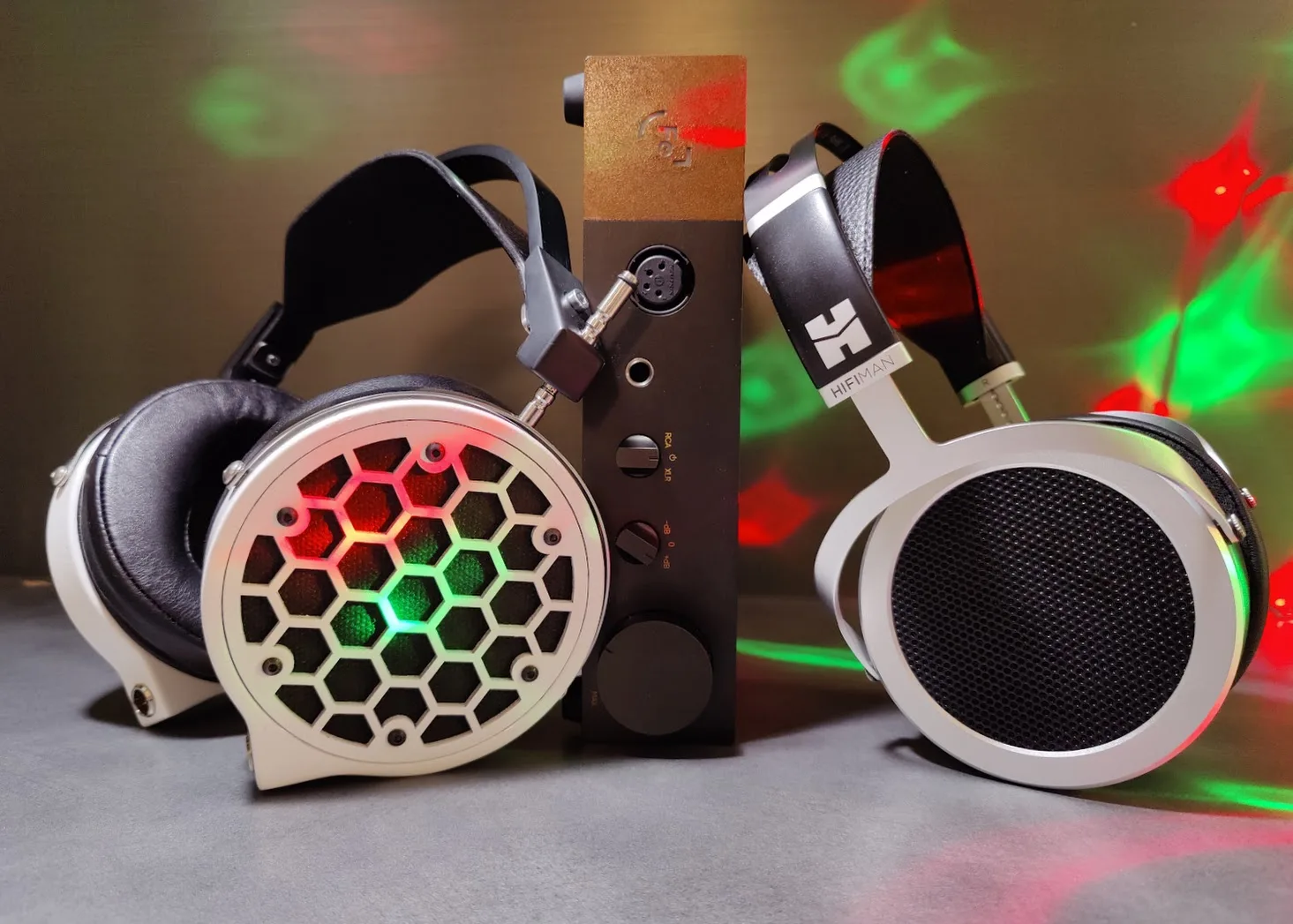
Most headphone enthusiasts are familiar with the popular Hifiman Sundara, because it has been a sensible purchase in the 350–500 euro price range. The still less known Sundara Silver, on the other hand, is a special model released for the European market, about which you can read more in our review. The new Silver model is in many ways better than the black Sundara, which has been on sale longer, but are these improvements enough against Tres SE?
Frequency responses:
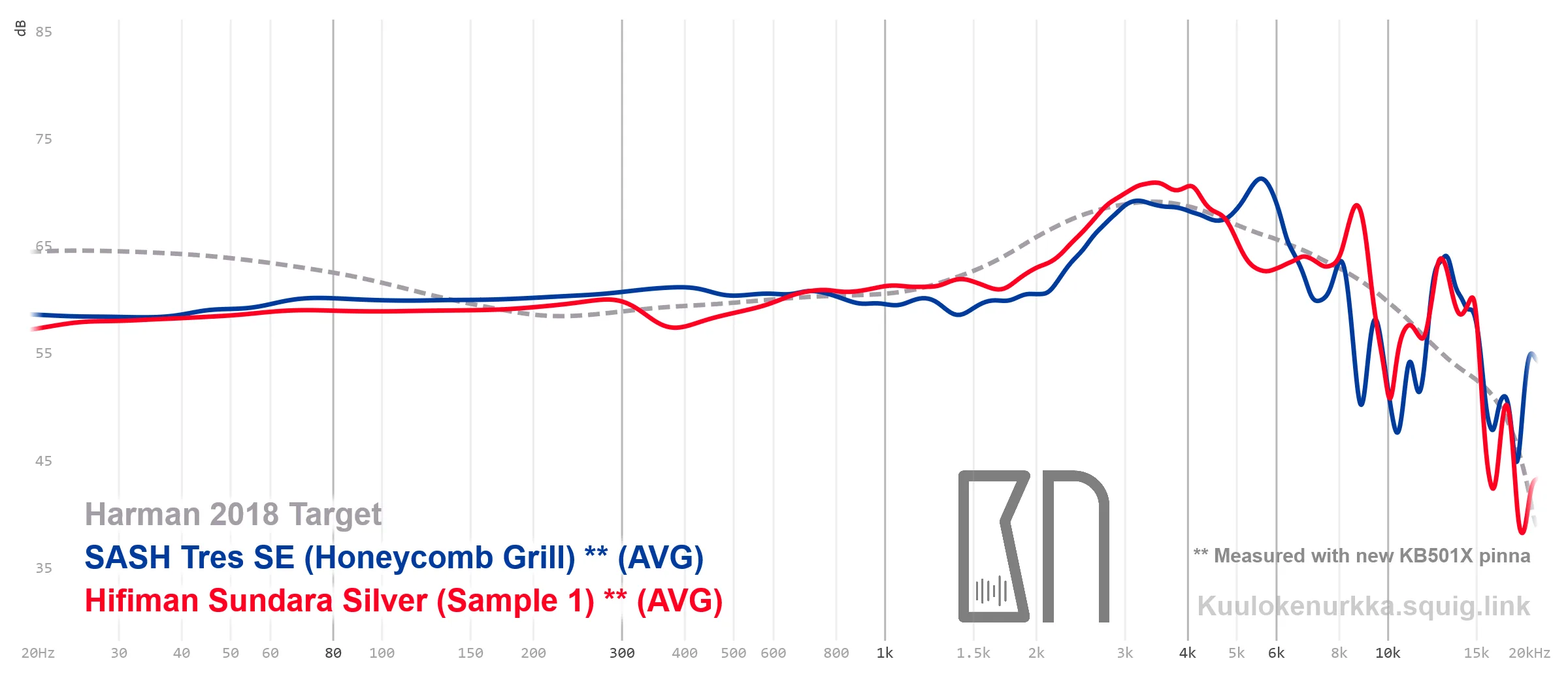
When comparing the headphones to each other, my attention was drawn even more to the fact that the Tres SE does not sound quite as bright in its highest frequencies as I would hope. I cannot say that the reproduction is actually muffled, but Sundara's high frequencies are distinctly fresh and airy in direct comparison. Sundara Silver also pulls slightly ahead in the realism of vocal performance reproduction, as the Tres SE's upper-mid frequencies are more recessed. However, it is a matter of taste which presentation style is more pleasing. Sundara Silver may also sound too thin to some ears. The difference is further emphasized by the Tres SE's more physical-feeling bass reproduction, even if the difference is not large according to frequency response measurements.
However, besides the airy treble and more cleanly reproduced vocal performances, I cannot think of other reasons to favor Sundara. The Tres SE is the more dynamic of the two, with a larger soundstage and more precise resolution. SASH's headphones compare in soundstage and sound quality rather Hifiman Arya than to Hifiman's more affordable headphone models. Making the comparison was even difficult, because whenever I listened to the Sundara Silver, I just wanted to continue listening to the Tres SE. On the other hand, although the Tres is clearly my favorite of the two, the Sundara Silver is also an excellent headphone in terms of sound quality, which is easy to recommend to almost anyone looking for balanced sound quality on a budget under 500 euros. Especially for those who appreciate bright treble and transparent realism in vocal performances, the Sundara Silver may even be the best currently available at a similar price.
Sometimes other factors are more important than sound quality
When choosing headphones, it is good to consider other factors in addition to sound quality, such as price, comfort, and warranty. The Sundara Silver is currently sold for as little as 415 euros, while the Tres SE costs about 570 euros with all expenses. A statutory two-year warranty protects those who bought Sundara from the EU area, while SASH's headphones only have a one-year warranty. In addition, any shipping costs to Ukraine are to be paid by the headphone owner.
In addition to the price difference and warranty issues, it is also good to mention a few words about the structural differences of the headphones. The wooden construction and customizability of the Tres SE are likely considered value-adding features by most. Unfortunately, the finest headphones are not usually the most comfortable or at least the lightest in weight. The Tres SE weighs 574 grams, so it differs significantly from the 342-gram Hifiman. Despite everything, the Tres SE fits my head even more comfortably, but for many others, the Sundara Silver is certainly a better choice from a comfort perspective.
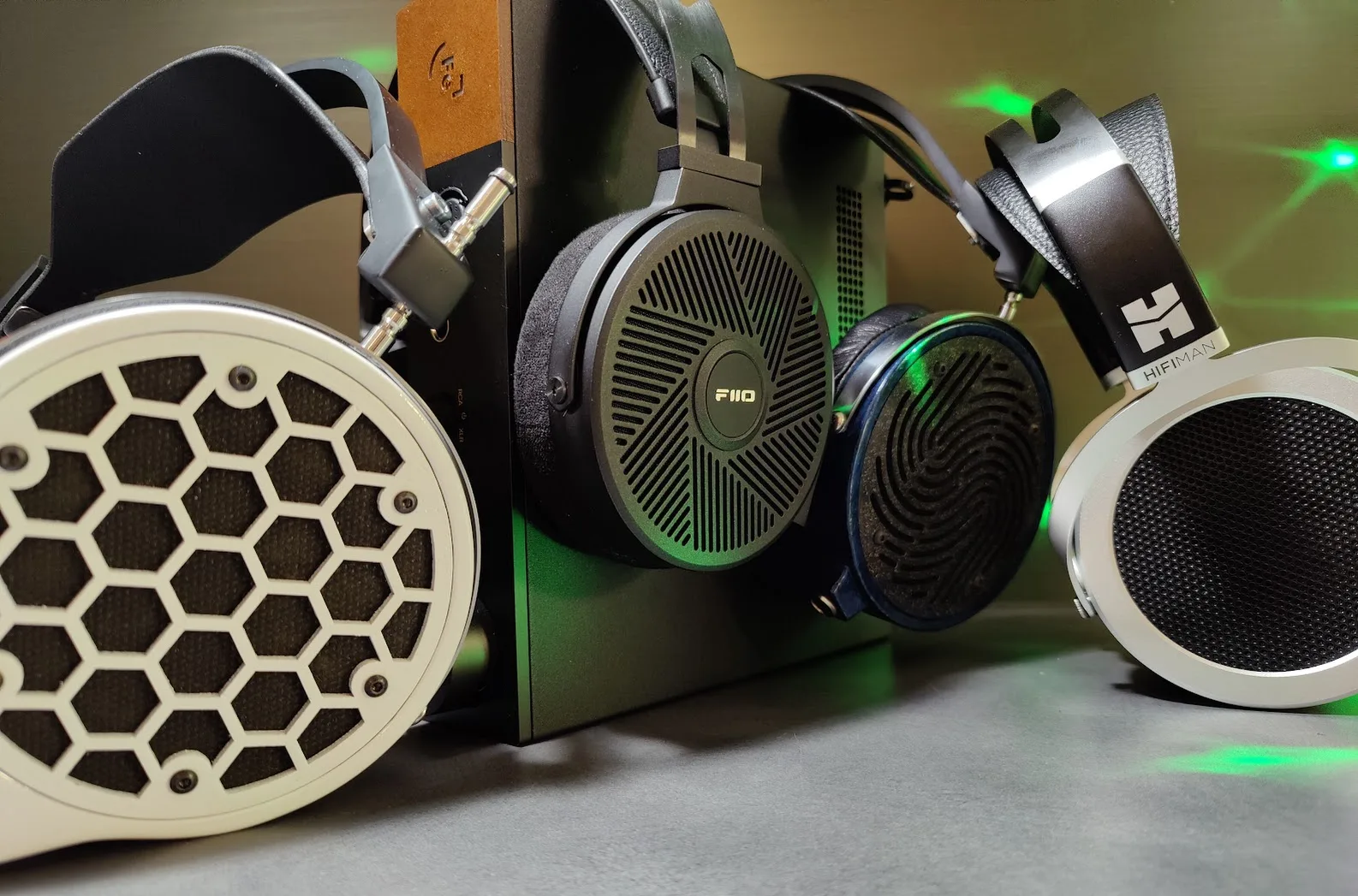
SASH Tres SE vs. FiiO FT5
Prices: 570 € (incl. taxes and shipping) vs. 500 €
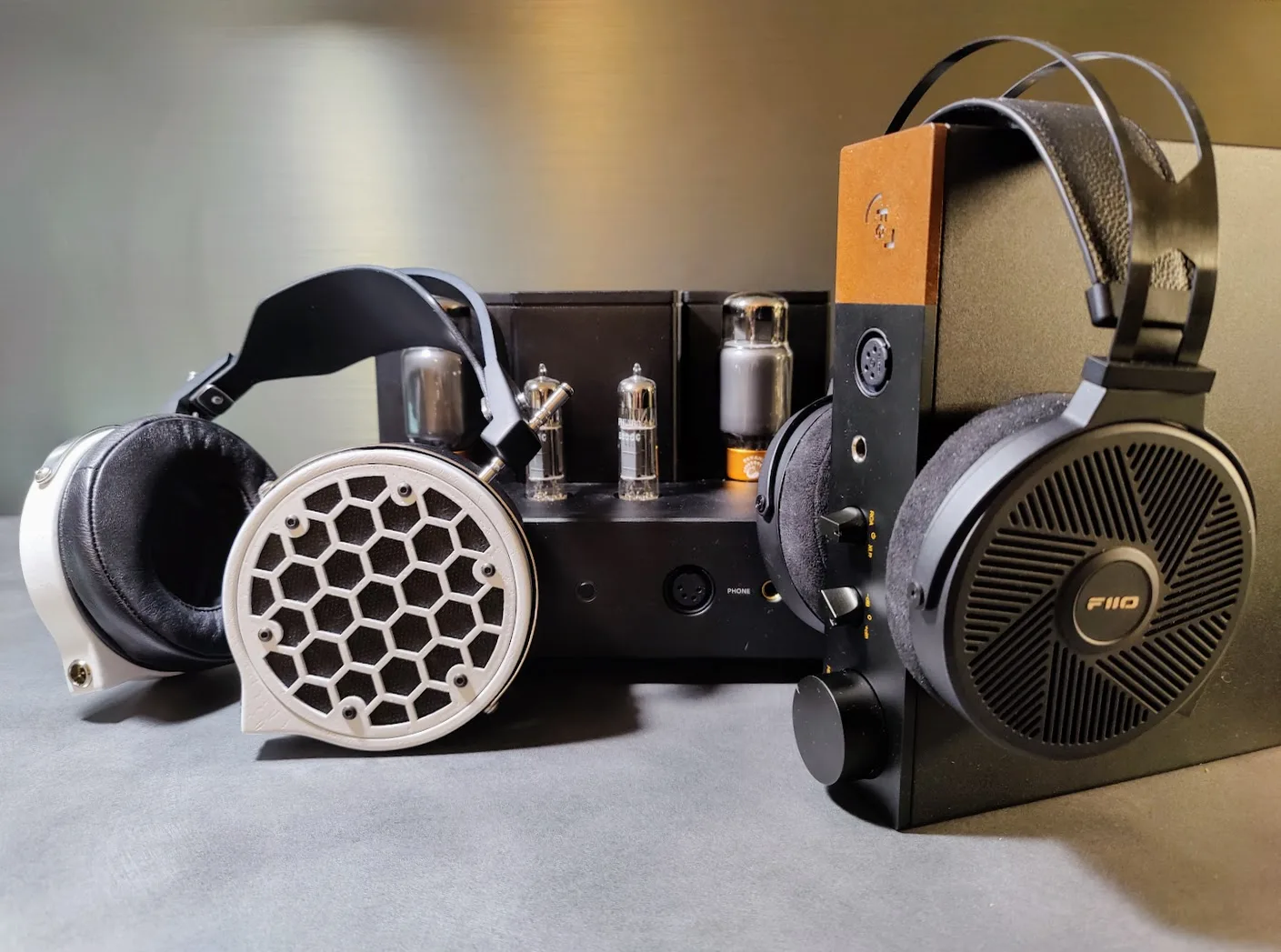
Recently reviewed by me FiiO FT5 is an interesting new product from a Chinese manufacturer, which is probably still more familiar to many for its acclaimed portable players and amplifiers. The manufacturer's more affordable FT3 headphone model was already a balanced package, but the FT5, which produces a distinctive sound, instantly became one of my favorite headphones. So let's find out how it compares to the slightly more expensive Tres SE.
Frequency responses:
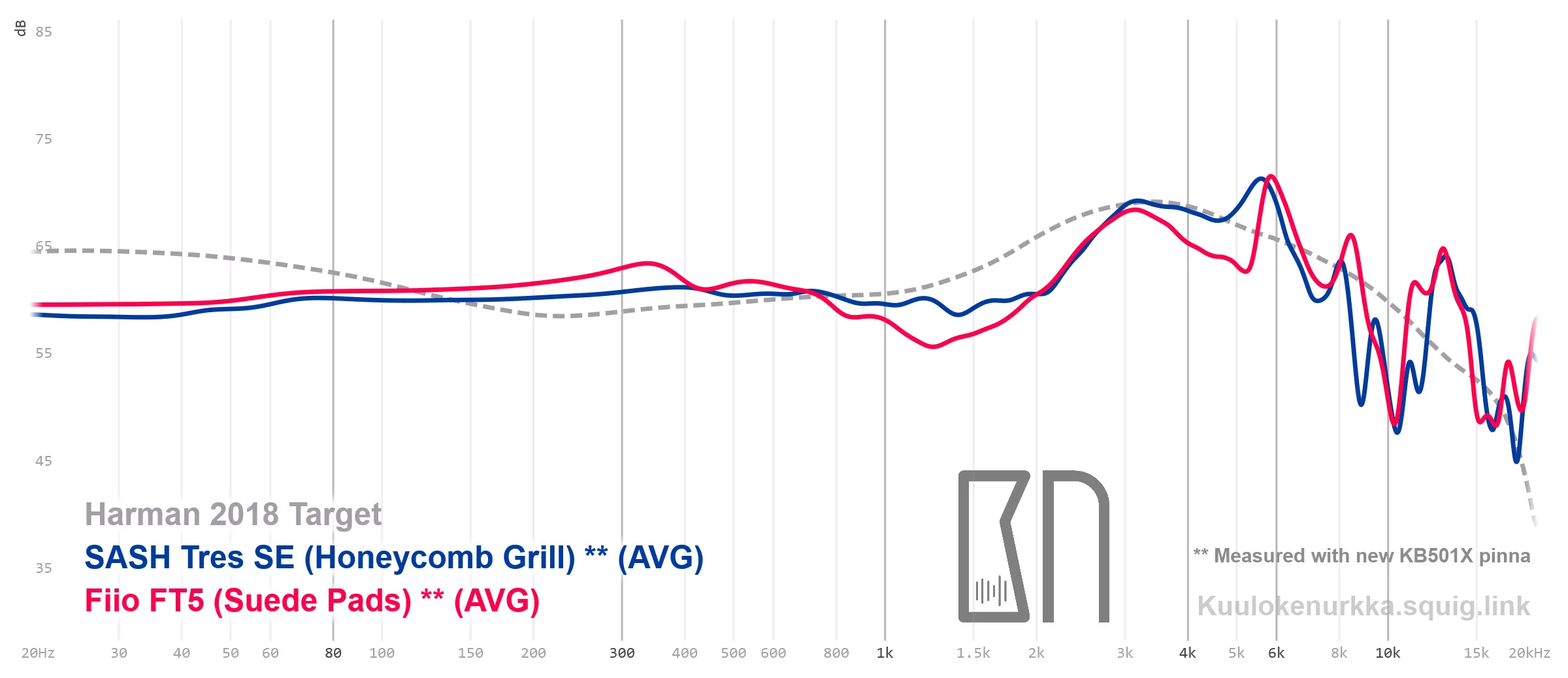
At a quick glance, FiiO's and SASH's headphones have a lot in common based on their frequency responses. Both have a calm upper-midrange and a boost around 6 kHz in the presence region. However, in the case of the FT5, the deviations from the target response are clearly larger, so the headphones sound distinctly colored.
The recessions in the FT5's upper-midrange and lower treble are already approaching the limit after which the headphones would sound blurry and nasal. The sound is really robust because, at the other end of the frequency response, the lower-mid frequencies stand out more than usual in the overall presentation. The result is peculiar but successful in its own genre. Although the Tres SE's reproduction also has its own colorations, it clearly sounds more normal than the FT5. The two differ so significantly in their tuning that to like both, one must appreciate different presentation styles.
In my headphone collection, the FT5 and Tres SE complement each other well. I use FiiO's headphones when I feel like listening to bass-heavy music or when my ears are tired and I crave a slightly more relaxed listening experience. The FT5 also works better as a general-purpose headphone for YouTube and movies, as it is more comfortable and its sound is truly non-fatiguing for all-day use. If, on the other hand, I listen to well-recorded music and want to get, so to speak, everything out of the recordings, my choice is most often the Tres SE.
The FT5's greatest strengths are its wide soundstage and a dynamic, rolling sound that is a truly entertaining experience, especially at louder volumes. Similarly, the Tres SE is also entertaining to listen to, but its fun is based more on rhythm and excellent resolution rather than a robust sound. The FT5's resolution, on the other hand, is not quite what I would generally expect from 500-euro headphones.
The great planar sound and good dynamics are enough to elevate the FT5, despite its weaknesses, to the best in its price range, but it is not a complete challenger to the Tres SE. Although the FT5 is technologically more advanced than, for example, the Grado Hemp I mentioned earlier, it also sounds primarily entertaining compared to SASH's headphones, and not so much like a top-tier headphone satisfying an audiophile. For some, the rocking sound of the Grado model or the FT5's ability to reproduce bass drums incisively might weigh more than the strengths of the Tres SE, which I personally value. In any case, good headphones are available today for every different taste in several different price ranges.
Summary
Since I have really liked SASH's 45-ohm Tres model, my expectations for the Tres SE were high. Even so, the new model managed to exceed my expectations, especially due to its larger and more precise soundstage. Another surprise was that despite its improved resolution, the Tres SE does not sound more analytical, but is even more entertaining to listen to than its predecessor. The headphones now compete in sound quality against headphone models three times more expensive. I haven't heard for a while, for example, Focal Clear MG: or HEDDphone:a, but I believe that the Tres SE would hold its own alongside them. If the treble were a bit airier, I couldn't fault the headphones' sound for anything, considering their price.
The weaknesses of the Tres SE are not related to sound quality in any way. The biggest minus must be given to the high weight of the headphones, due to which the wearing comfort is not top-notch. External customizability and personalized customer service make the ordering process pleasant, but payment may not be entirely straightforward. Ordering from a country at war naturally also carries its own risks. In addition, the warranty terms for the headphones are weaker than when buying from the EU area. However, as encouragement, I can tell you that these are my fourth SASH headphones, and everything has always gone smoothly without problems. Even internal Ukrainian postal service works faster than in Finland, despite the circumstances!
When heavy headphones are not a problem and waiting a couple of months for the order doesn't bother you, the SASH Tres SE is worth every euro. If Kuulokenurkka used an ”Editor´s Choice” style badge, there would be a use for one now.
Pros and cons:
+ Matches the sound quality of significantly more expensive headphones
+ Balanced frequency response
+ Strikingly rhythmic and lively presentation
+ Best resolution in its price range
+ Large and precise soundstage
+ Good dynamics
+ Timbre exceptionally authentic for planar headphones
+ Customizable appearance
+ High-quality craftsmanship and build quality
+ The headphones do not need a powerful amplifier
+ Excellent price-quality ratio
+/- Handcrafted headphones might require a couple of months of waiting, but status updates and photos of the manufacturing process make waiting more pleasant
+/- The basic version's equipment is sparse, but the manufacturer's accessories are reasonably priced
– Treble could be airier
– The headphones are heavy and might clamp strongly
– The purchasing process is more difficult than usual, and the availability of the headphones is currently hard to predict due to the war in Ukraine
– Only a one-year warranty
 EN
EN  FI
FI
Dear Roderick, first of all thank you for this website with its well made reviews and eq measurements!
I understood that you were saying that the SE does not seem to scale that much with tube amps.
So now I am wondering how the SE compares with the 45 when the 45 is driven by a good DAC (Soekris 1541) and a powerful tube amp (Trafomatic Head 2 with some of the best NOS tubes). Would the 45 become more interesting and closer to the technicalities of the SE in this case?
My reasoning is that the 45 with its slightly smoother presenation might be less tiring for longer listening sessions. I do however like a good holographic presention (whereby I find depth and layering more important than width). For this the SE seems to be better according to your review.
I am the happy owner of a ZMF Auteur Blackwood, so all is well… but I would love to add a planar headphone and I favor smaller companies like SASH.
Thanks! Your reasoning makes sense. I think that better gear will close some of the technical gap between 45ohm and SE. However if you’re not against eq I would propably go with SE and trim the 5-6khz region 2-3db if you find the sound tiring. If eq is not an option then 45ohm Tres could be a better fit for long listening sessions but I don’t think even Trafomatic Head 2 can make 45ohm ”technically” as good as SE but without direct comparison it’s difficult to tell how close call it would be. Looking at our measurements it seems SE and Auteur are not that different in 5-6khz region so maybe SE would be fine for you if you don’t have any problems with Auteur. On the other hand slightly more relaxed 45ohm might be a nice complimentary headphone for Auteur if you want something little more different.
Great amp you have btw! Well, actually I’ve never heard Head 2 but I loved Head 1. So much infact that I’ve decided Head 2 will be my next amplifier when I have a change to upgrade my tube gear.
Thank you Roderick for the detailed feedback and your assessment!
Good review once again, but perhaps, despite the price range, it could have been compared more directly to higher-end headphones, when it was brought up that it can compete with significantly more expensive headphones.
Thanks for the feedback! That did cross my mind. Unfortunately, I didn't have a suitable comparison readily available on the shelf. I don't want to write very precise comparisons purely from memory. Of the headphones I own, the HE6 is the only one that falls into the 1000-1500€ price range, but it's more of a collector's rarity than a viable option for most enthusiasts. In the future, some thousand-euro headphones will surely come for testing, and in that context, I might then revisit the sash tres.
That test could probably then be linked here so it saves wading through all the tests?
By the way, these are good and really informative pages, I've now stumbled here for the second time with my headphone-buying pants on, completely by accident and I wasn't disappointed again!
I thank you for the feedback on behalf of both writers! 🙂 Many headphones have been utilized not only for their reviews but also in various comparison situations, so someday the aim is to create a system by which the reader of Kuulokenurkka (Headphone Corner) can easily find all articles where a specific headphone model has been discussed over the years.