Author: Sword of Damocles
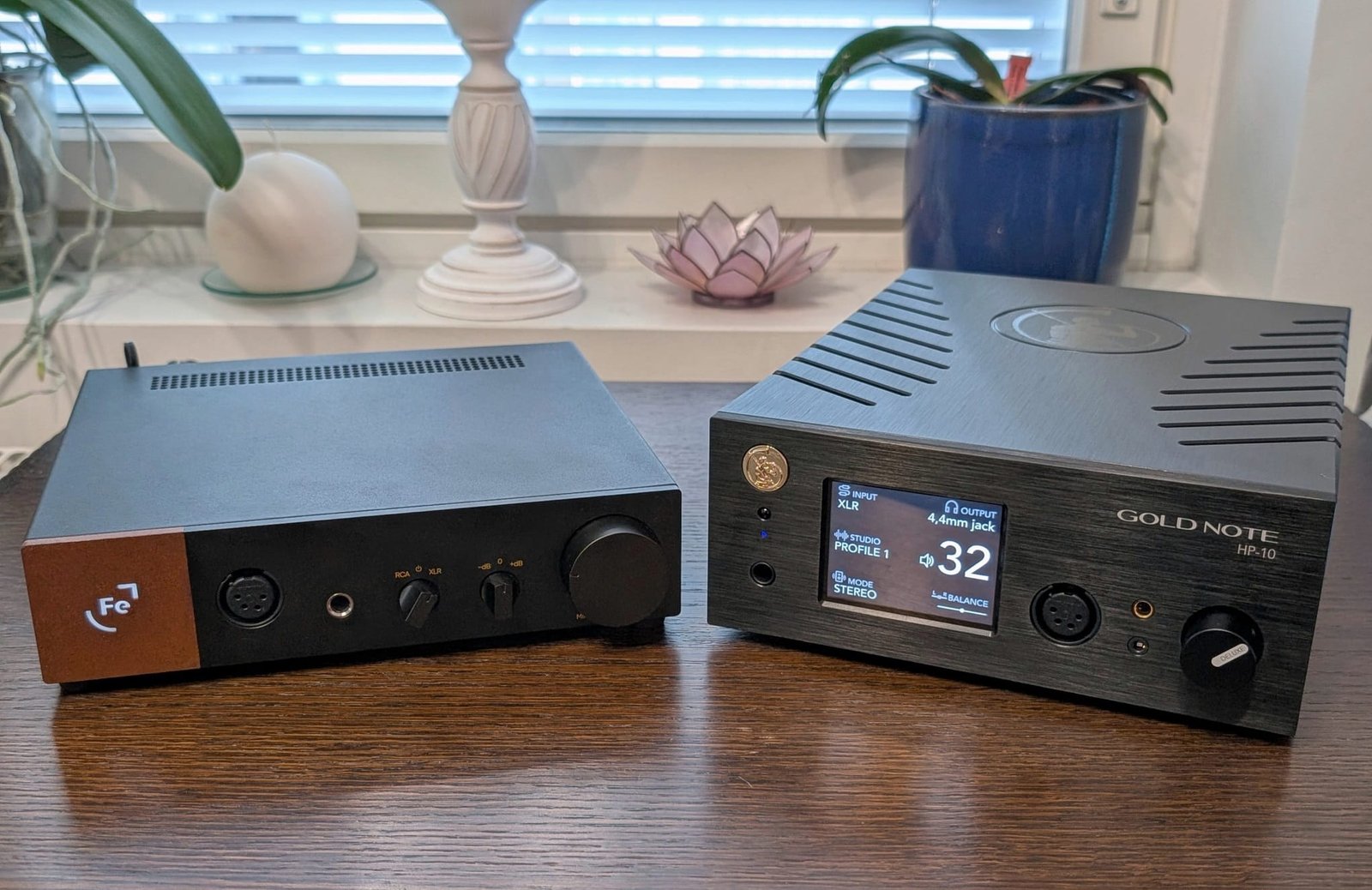
Table of Contents:
High-quality amplification for headphones
This time we will find out about two high-end headphone amplifiers costing around 2000 euros, which are delightfully manufactured in Europe. The Polish Ferrum Audio OOR-amplifier is on my own desk, while the Italian Gold Note HP-10 Deluxe was provided on loan by the importer of the manufacturer's products, IDEAALI Tec – thanks to them. Of the two I compared, the Gold Note device is clearly a more recent case from December 2024, while the Ferrum Audio OOR has been sold since 2021. Both are intended to offer such high-quality headphone amplification that there might never be a need for anything better, unless the appetite grows with eating.
The OOR, costing approximately 2000 euros, is a headphone and preamplifier, while the Deluxe version of the HP-10 includes a DAC for 2400 euros. Alternatively, the basic version of the HP-10 (headphone and preamplifier) would cost 1900 euros, slightly less than the OOR, while the 2000 euro HP-10 BT would offer Bluetooth listening as an additional feature. Ferrum Audio and Gold Note also sell higher-quality power supplies separately for their devices, in which case the total price of both would rise to over 3000 euros.
In my article, I primarily focus on comparing headphone amplifiers, but I will also comment separately on the HP-10 Deluxe's D/A converter. I have not had the opportunity to try either manufacturer's separate power supply, so it is possible that they might slightly change the situation in favor of one device or the other. On the other hand, for 2000 euros, one should already get such a good headphone amplifier that acquiring a separate power supply is not mandatory, but rather a nice addition sometime later, once a longer-term commitment to the device has been made. Let's therefore delve into the initial situation before any additional financial investments.
Ferrum Audio OOR

Information:
- Publication year: 2021
- Country of manufacture: Poland (manufacturer HEM)
- Price: 1995 €
- Type: Headphone amplifier (unique intermediate form of Class A and AB) & preamplifier
- Input connections: XLR and RCA, and a 4-pin power connector for HYPSOS power supply
- Output connections: XLR and RCA
- Headphone connectors: 4-pin-XLR and 6.35 mm
- Gain levels (balanced): -4 dB / +6 dB / +16 dB
- Gain levels (single ended): -10 dB / 0 dB / +10 dB
- Headphone amplifier output impedance: < 0.3 ohm
- THD (balanced output): 0.00011% @ 1 mW / 50 ohm | 0.00028% @ 100 mW / 50 ohm
- Dynamic range: 130 dB
- Stated output power (single ended): 2 W @ 60 ohm / 0.4 W @ 300 ohm
- Stated output power (balanced): 8 W @ 60 ohm / 1.6 W @ 300 ohm
- Measured output power balanced (Golden Sound): 9.5 W @ 32 ohm / 8.3 W @ 50 ohm / 2 W @ 300 ohm
- Features: Bypass mode (functions as a power amplifier) and the possibility to dim the logo's backlight
- Idle power consumption: < 15 W
- Dimensions (W x D x H): 21.7 x 20.6 x 5 cm
- Weight: 1.8 kg
Review sample: Self-purchased product
Behind the Ferrum Audio brand, created in 2020, operates the Polish company HEM, which has over 20 years of experience in manufacturing high-quality audio equipment. For example, it has made DACs for the American Mytek Audio and carried out several projects for the Polish government. Ferrum Audio's product range currently includes, in addition to the OOR headphone amplifier, the previously featured in Kuulokenurkka ERCO combination device, WANDLA-DAC and the versatile HYPSOS power supply, which can also be used with devices from other manufacturers.
OOR is primarily designed for Hifiman Susvara and other power-hungry headphones, so the amplifier attracts the most attention precisely with its high output power. The device is also implemented with discrete components and operates quite uniquely in the intermediate zone between Class A and A/B, which I, as a layman, would not be able to explain in more detail. The design has generally been kept as minimalist as possible, so all kinds of fancier additional features are conspicuously absent. However, simple can be beautiful. The manufacturer surely hopes for such a reaction from consumers regarding the device's appearance as well.
Construction and limited features
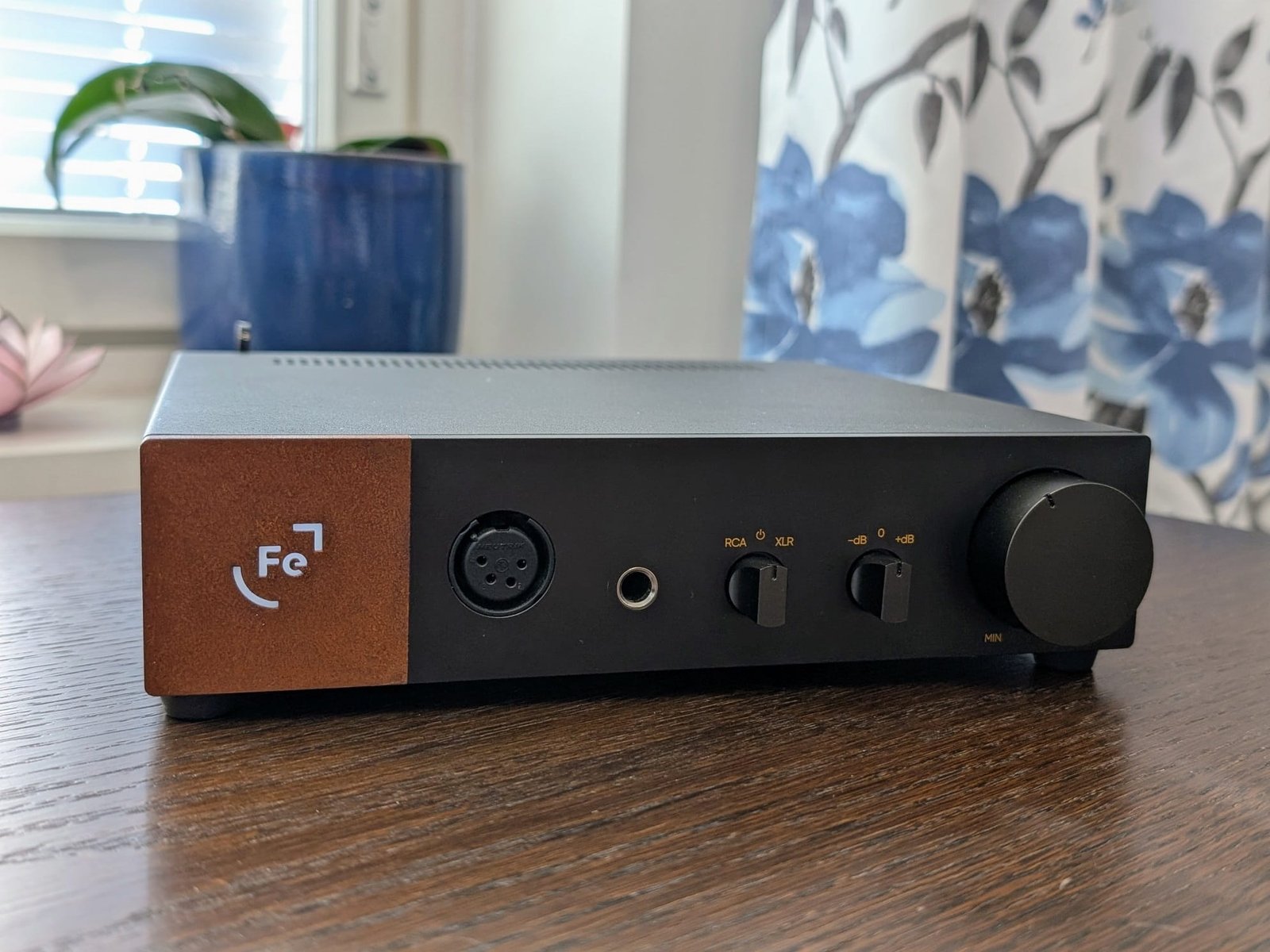
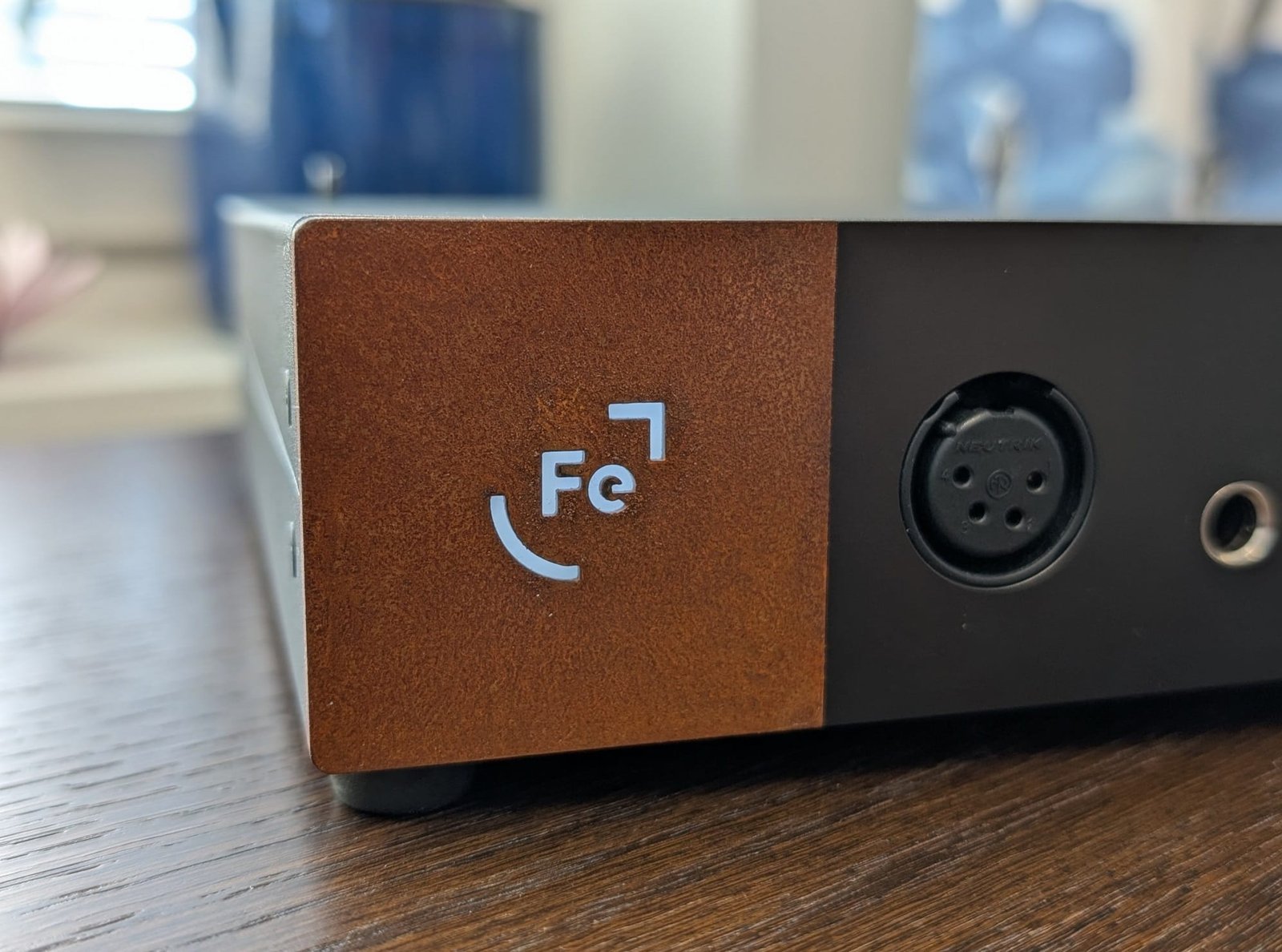
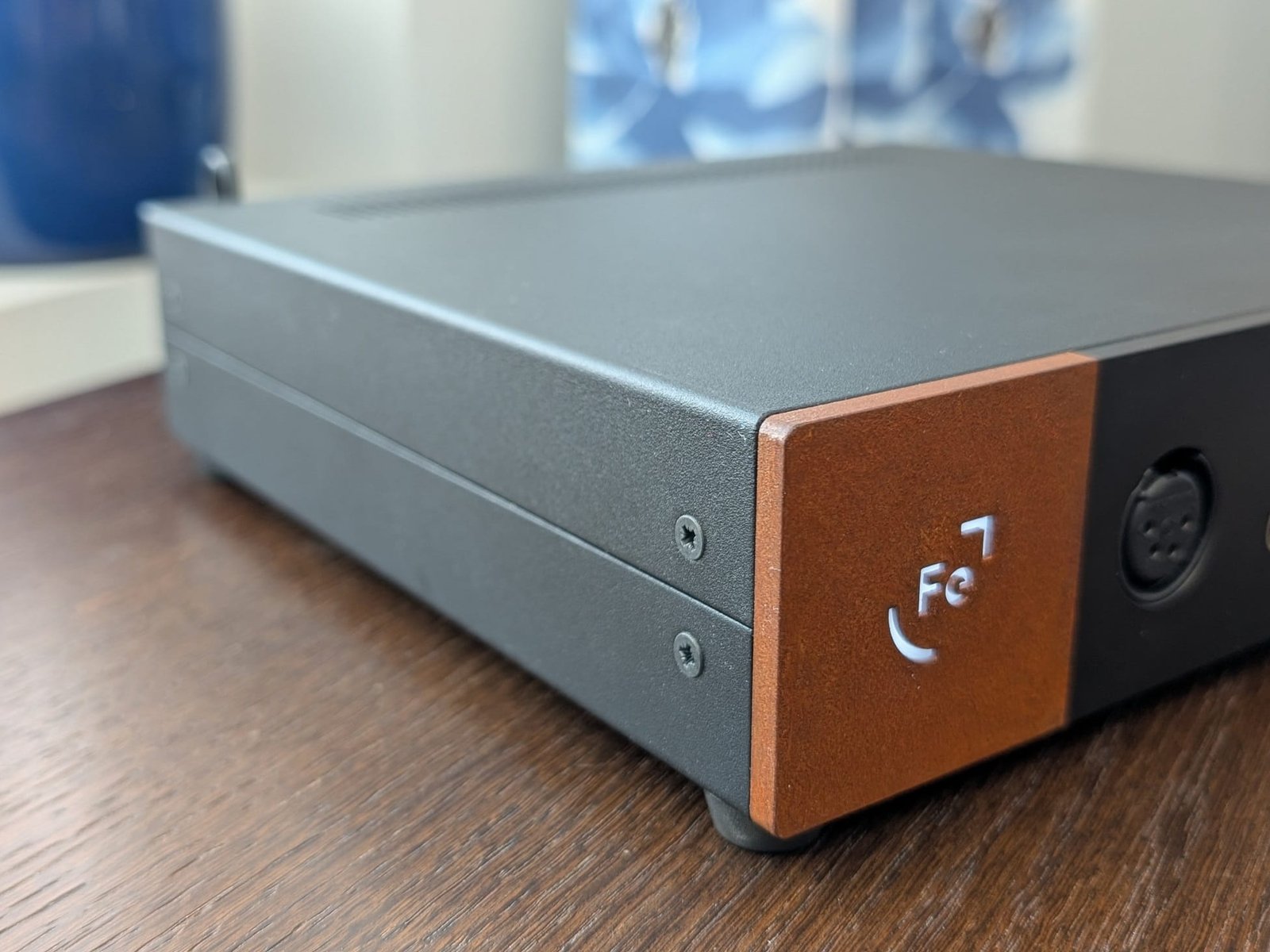
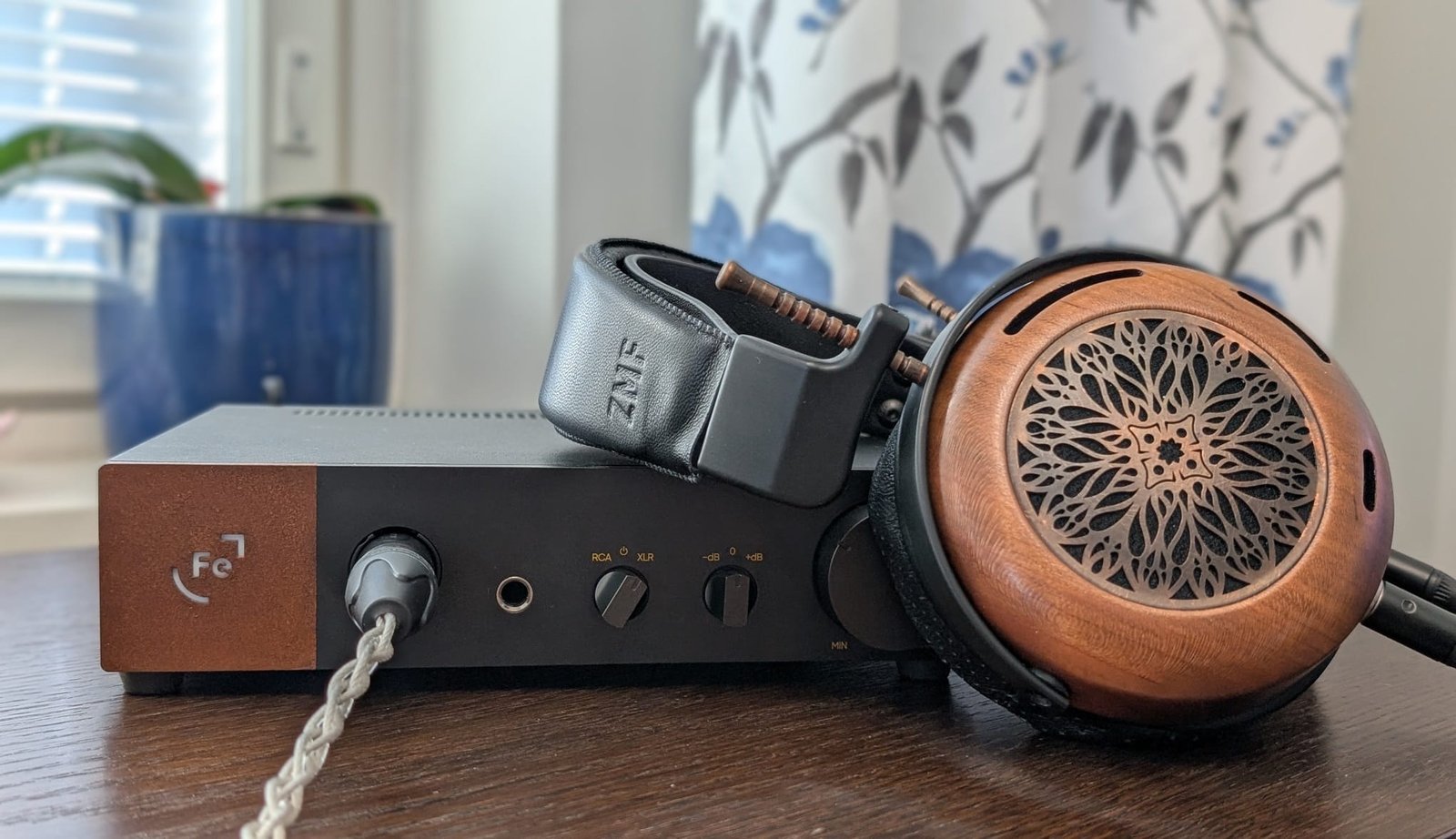
The OOR looks like a fairly traditional black box, but attention is drawn to the rust-colored area on the left front edge and the white glowing Fe logo in its center. The square-shaped part is made of corten steel, on the surface of which a strong oxide layer naturally forms due to the effect of oxygen and humidity, so much so that the material is also called weather-resistant steel – a very interesting detail in a headphone amplifier. Otherwise, the OOR feels even surprisingly cheap, because its bent sheet metal chassis does not really create the impression of a 2000 euro amplifier, but rather resembles Chinese devices costing less than 200 euros. However, without tapping or feeling the chassis, the matter does not ultimately bother me much.
The brightness of the logo's backlight can be adjusted with a dial located on the rear edge of the device, and the light can even be turned off completely. For some strange reason, however, the light always stays on regardless of whether the amplifier is on or not. Since the OOR also lacks a power LED, its on-state is only indicated by the position of the small power switch and the warm top cover. I have often left the device on unnecessarily consuming electricity. The manufacturer has unfortunately also forgotten other basic usability aspects, such as painting an indicator on the volume control. The small black groove is practically invisible, which feels like even a slight safety risk in a powerful amplifier.
On the more positive side, the power switch is located on the front edge of the device, which is not yet entirely self-evident today. The OOR is also quite compact in size, so it doesn't take up much desk space for a powerful amplifier. The front edge looks neat in my opinion, the connectors are high quality, and the switches are pleasantly sturdy and precise. The potentiometer, combined with the large knob, also moves smoothly, and there is no looseness whatsoever. So, the design budget has not been spared in important areas.

For connecting headphones, the OOR offers a balanced XLR connector and a 6.35 millimeter connector, which are perfectly adequate, although nowadays I would expect to see a 4.4 millimeter connector alongside them. On the front edge, next to the power/input switch, there is a three-level gain selector, whose values differ depending on the headphone connector chosen for use. Low-gain is negative in any case, so it is suitable for sensitive in-ear monitors, for example. High-gain, on the other hand, is mainly needed with a few difficult-to-drive planar headphones.
Two pairs of XLR and RCA connectors are located on the rear edge of the device, as the OOR can also be used as a preamplifier for active speakers, for example, thanks to its output connectors. Unfortunately, there is no selector for this function, so headphones would always have to be disconnected from the device before listening to speakers. The volume cannot be adjusted from a distance either, as the amplifier lacks a remote control. Therefore, in my opinion, the OOR is a poor preamplifier in terms of usability.
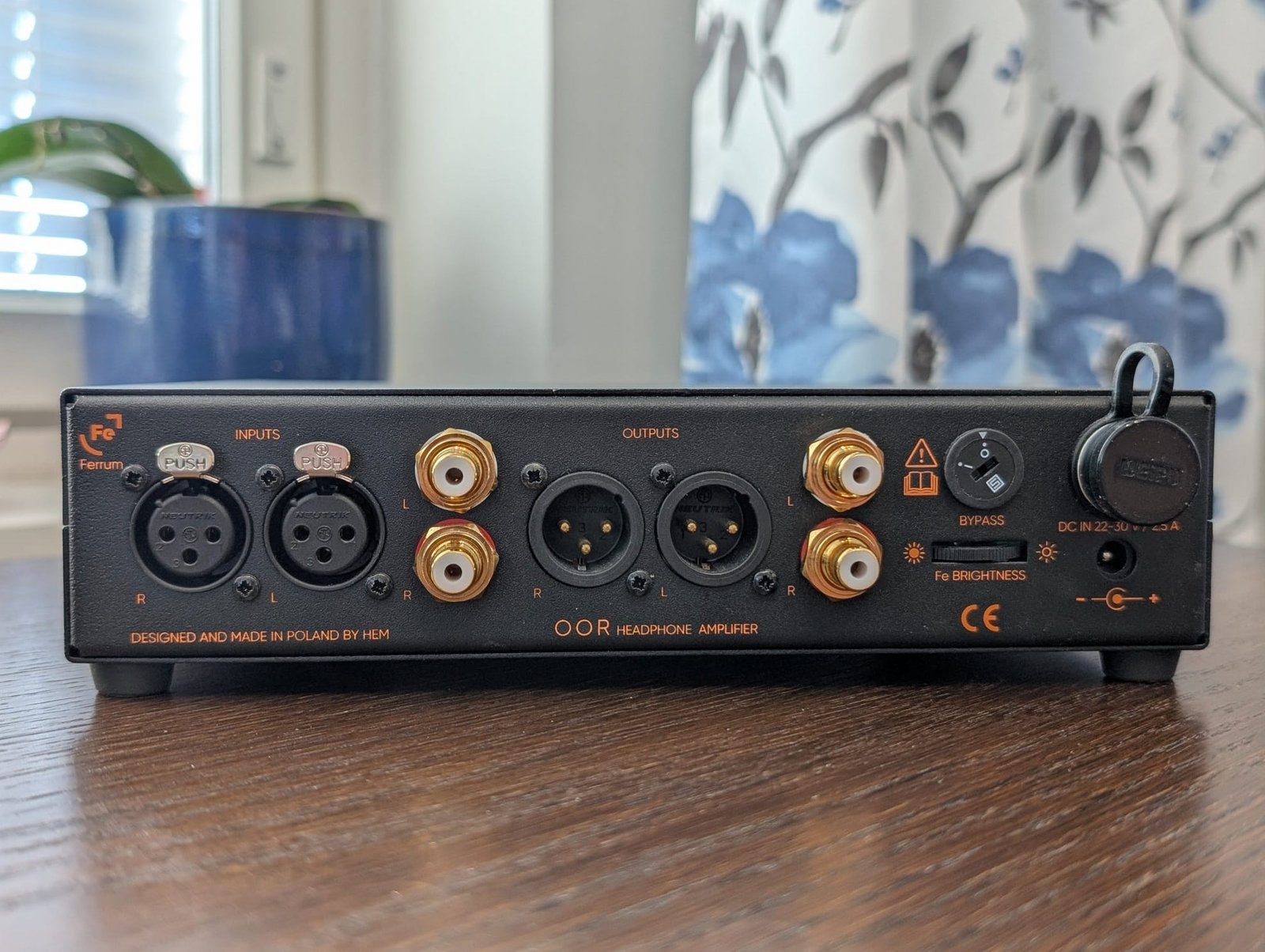
If a preamplifier with volume control is used with the OOR, Bypass mode allows it to be converted into a power amplifier. However, when bypassing the amplifier's own volume control, I recommend great caution. For example, I would not trust software-level adjustments in the Windows operating system, but would recommend an intermediate device that reliably maintains the selected volume.
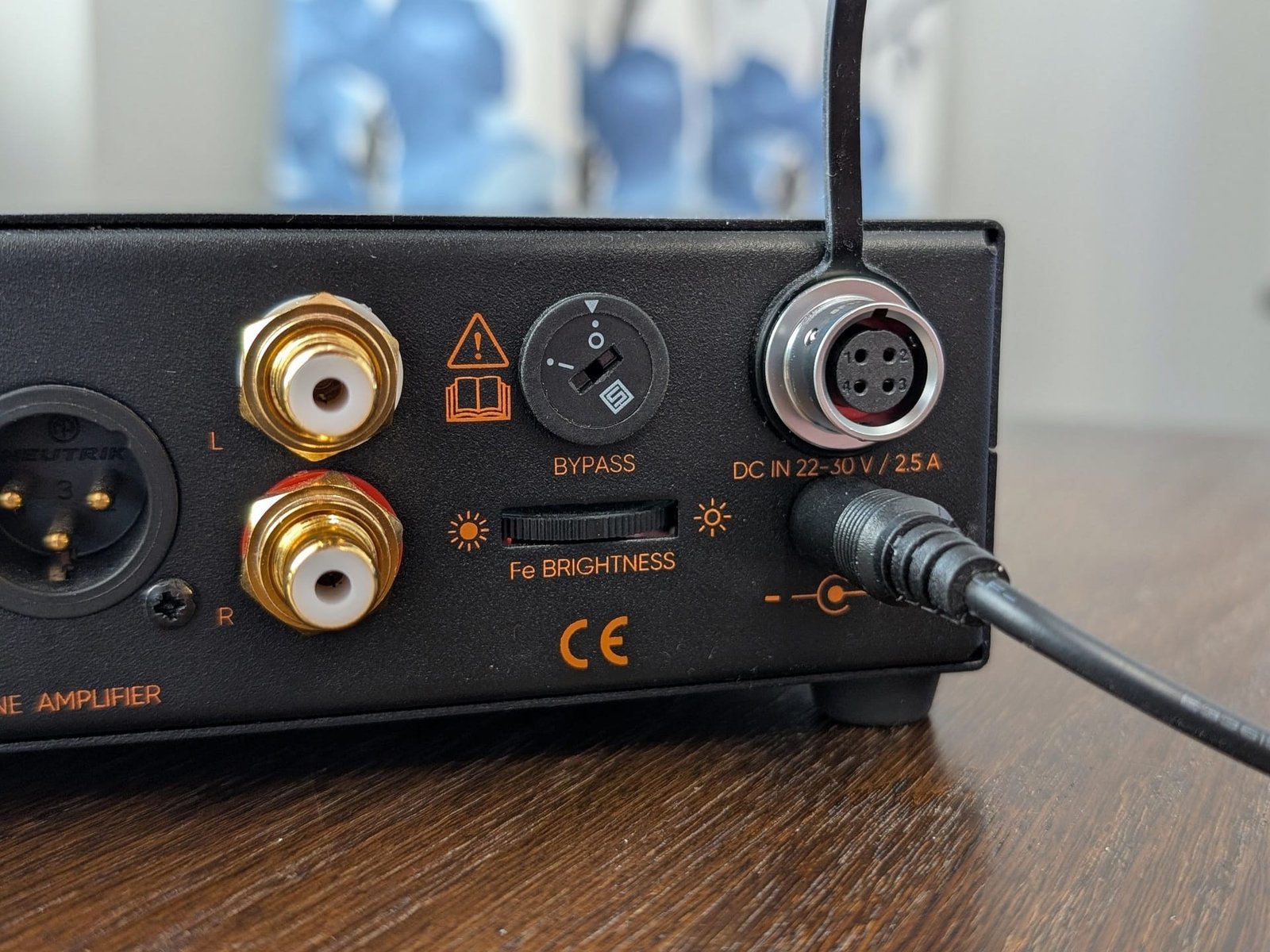
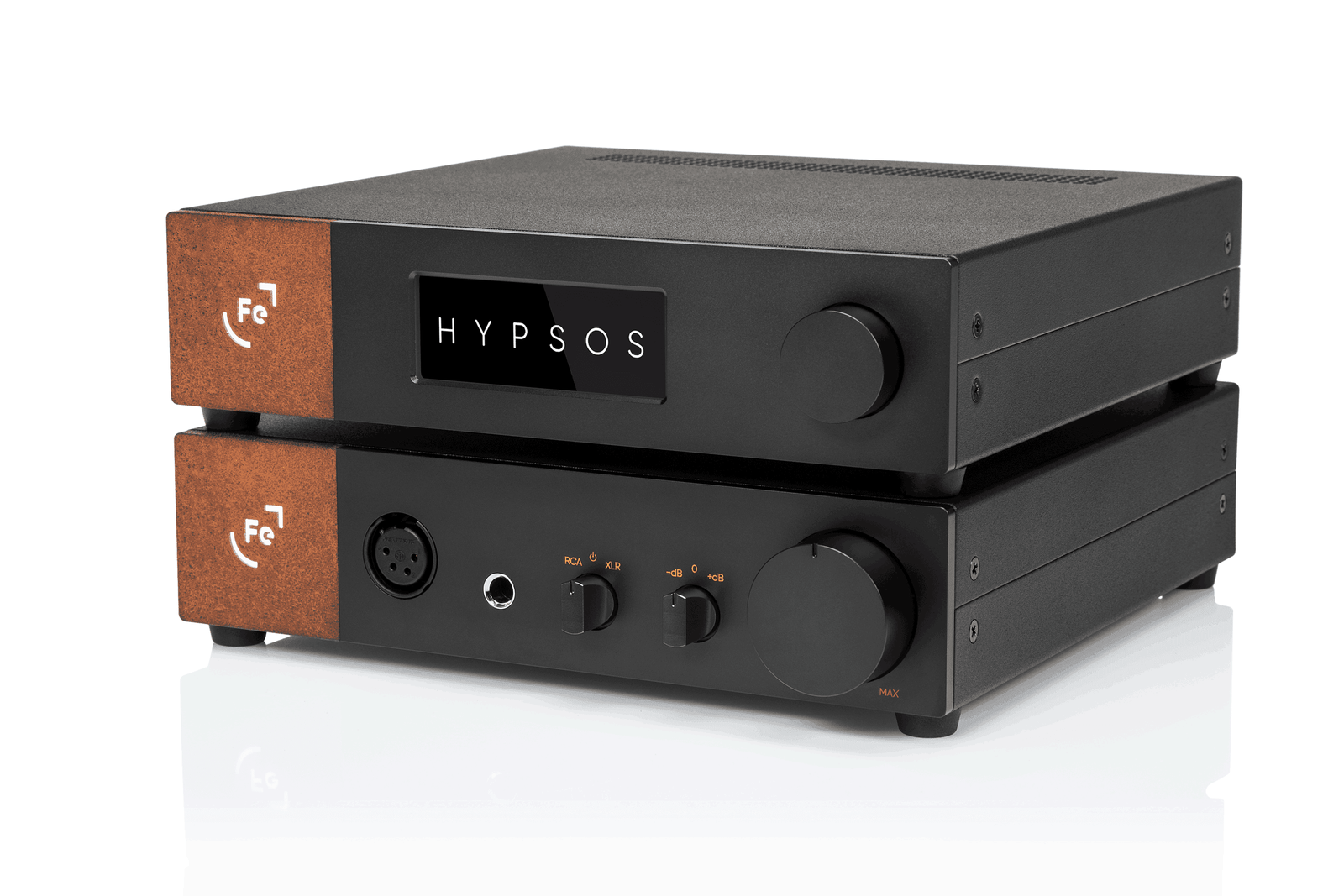
Under a rubber cap, the OOR hides a separate 4-pin power connector, which would be used to connect the manufacturer's HYPSOS power supply. By default, the amplifier comes with a fairly standard Meanwell switching power supply, so Ferrum Audio is likely intentionally trying to steer consumers towards purchasing the HYPSOS.
Abundant amplification power
The Ferrum Audio OOR particularly shines in the amount of output power, as Golden Sound has measured the device to provide almost 10 watts for a balanced 32-ohm load, over 8 watts for a 50-ohm load, and still 2 watts for a 300-ohm load. These figures match the manufacturer's own product specifications, which, however, emphasize a 60-ohm load, which happens to correspond to the Hifiman Susvara. The OOR has indeed been the choice for many for difficult-to-drive headphones. I myself have found the amplifier to be an excellent pair for both Hifiman HE-6:to as For Mod House Audio Tungsten. In addition, Kuulokenurkka's other writer, Roderick, used OOR with Hifiman Susvara headphones when reviewing.
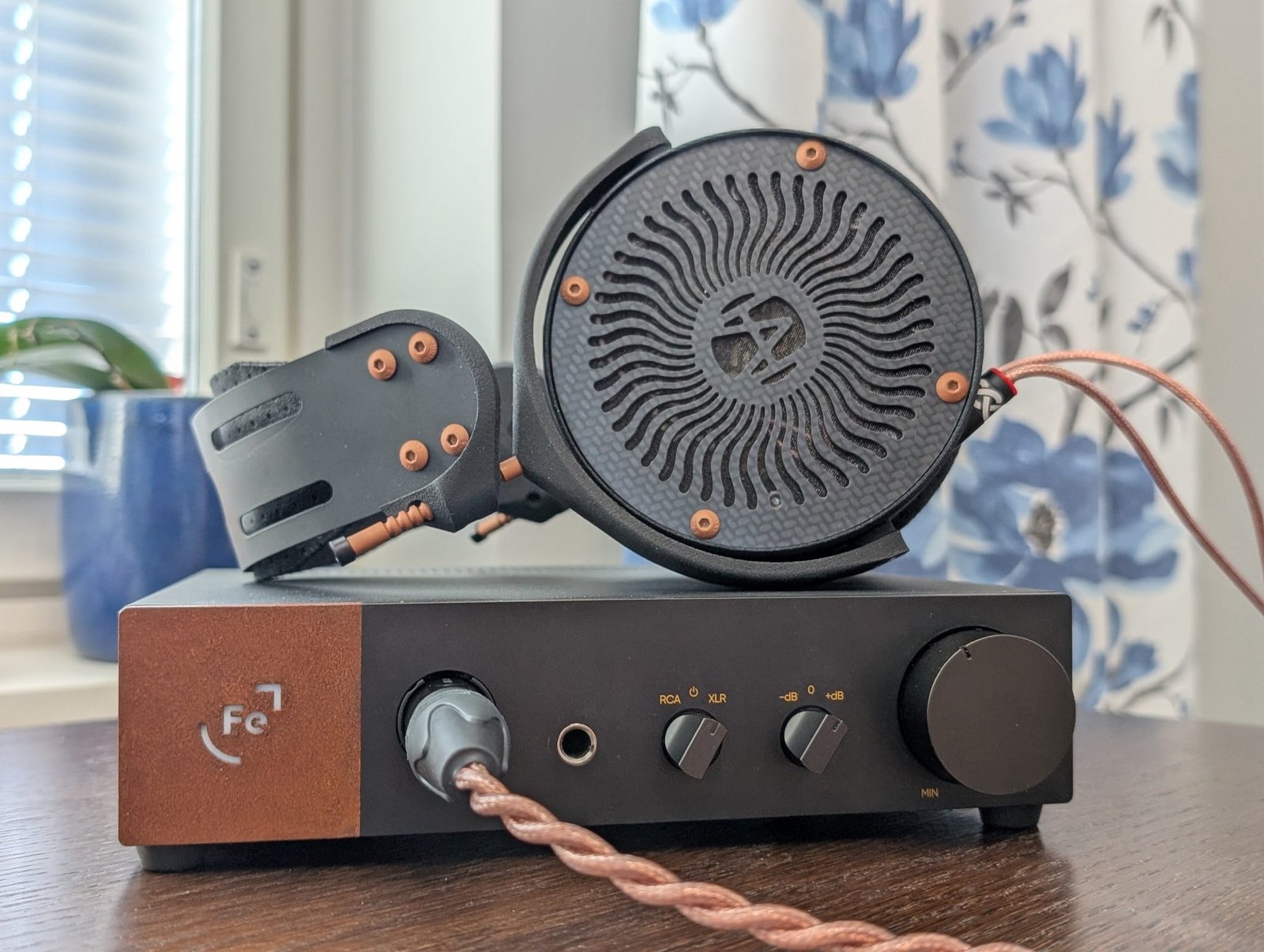
Through the unbalanced headphone connection, OOR's power ratings remain more moderate (2 W @ 60 ohm / 0.4 W @ 300 ohm), which I would see as beneficial with more sensitive headphones. Considering the versatile gain levels, OOR has suited all my headphones without over-amplifying them. There has always been enough headroom for volume adjustment, and no background noise is audible even with the most sensitive in-ear headphones at the lowest gain level. The output impedance of the headphone connections is also smartly set close to zero, so all output power is utilized, and no changes occur in the frequency response of headphone models with an uneven impedance curve. The amplifier is thus well-designed, although it gets quite hot during prolonged use, especially if another device is placed on top of it.
Gold Note HP-10 Deluxe

Information:
- Release year: 2024
- Country of manufacture: Italy
- Price: 2390 € (basic version 1890 € and BT version 1990 €)
- Colour options: black, gold, silver
- Type: Headphone amplifier (Class A dual-mono) & DAC & preamplifier
- DAC chip: AKM AK4493 (ESS ES9023 in BT version)
- Digital input connections: USB-C (max PCM 768 kHz / DSD512) and Bluetooth 5.1 (AptX HD, AAC, SBC)
- Analog input connections: XLR and RCA, and power connector for PSU-10 EVO power supply
- Analog output connections: XLR and RCA
- Headphone connectors: 4-pin-XLR, 4.4 mm, 6.35 mm and 3.5 mm
- Gain level: Not specified
- Headphone amplifier output impedance: Not specified
- THD: 0.015%
- Dynamic range: 110 dB
- Headphone amplifier output power: max 10 W
- Features: Touchscreen, remote control, 4-step Crossfeed function, analog EQ (Harman Curve/Superflat), adjustable damping factor (Low/High), phase inversion (0/180), mono listening capability and channel balance adjustment
- Power consumption: max 25 W
- Dimensions (W x D x H): 20 x 26 x 8 cm
- Weight: 3 kg
Review unit acquisition method: Received on loan from importer/reseller
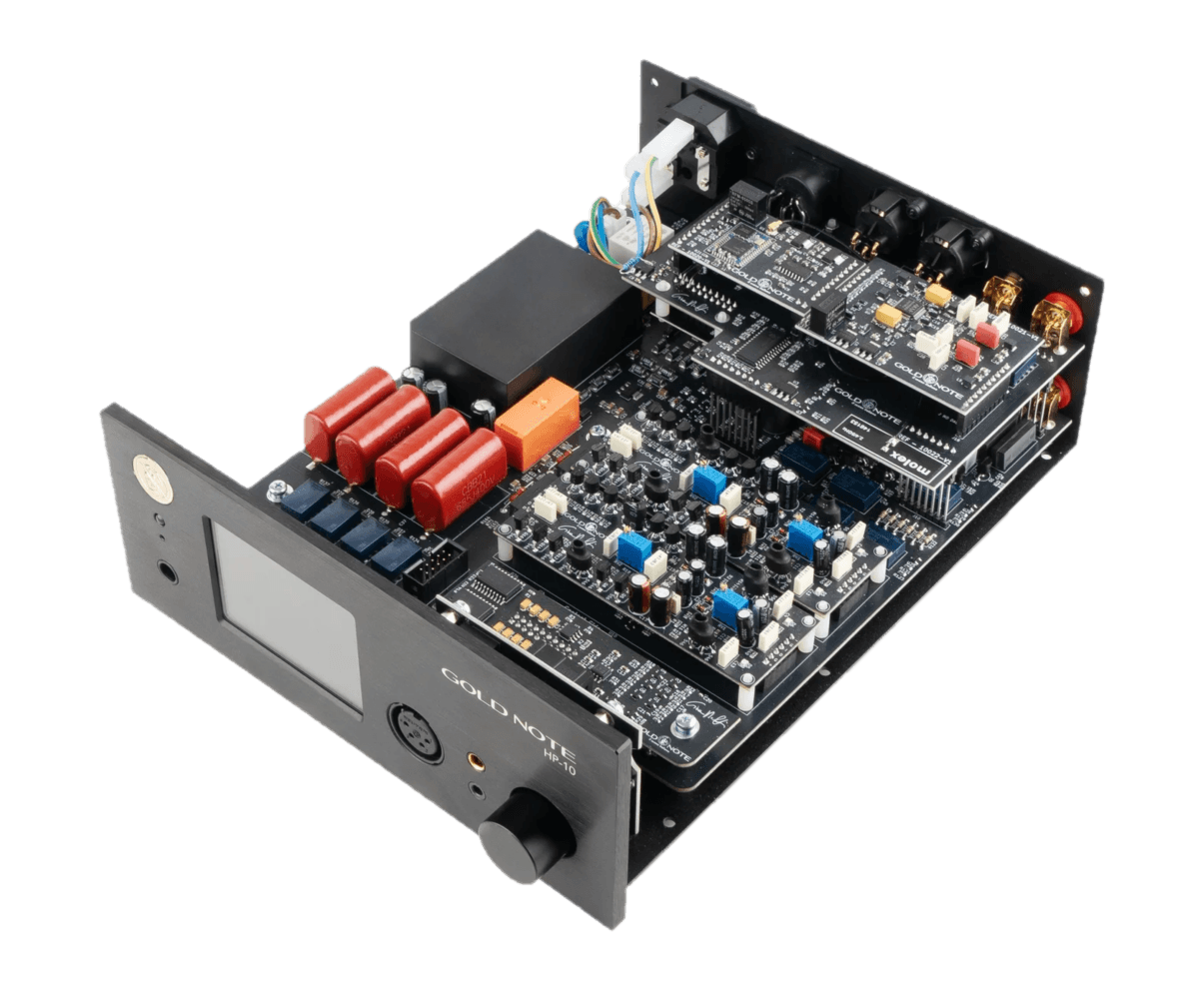
The background of the Italian Gold Note somewhat resembles Ferrum Audio, as it also has a longer history than its founding year marked as 2012 would suggest. Before Gold Note, the company's main figure, Maurizio Aterini, worked as an OEM manufacturer for several top brands, kept secret until now, starting from the 1990s. The founding of Gold Note, in turn, was a kind of consequence of the early 2000s economic crisis and the decrease in the number of ordering customers.
The company manufactures its products by hand in the idyllic hills of Florence and classifies its creations as Italian audio, which is likely centrally associated with a high impression of quality. Until now, Gold Note has focused mainly on speaker listening and turntables, but with the release of the HP-10, it now has a purebred headphone amplifier in its selection, in addition to the DS-10 all-in-one device.
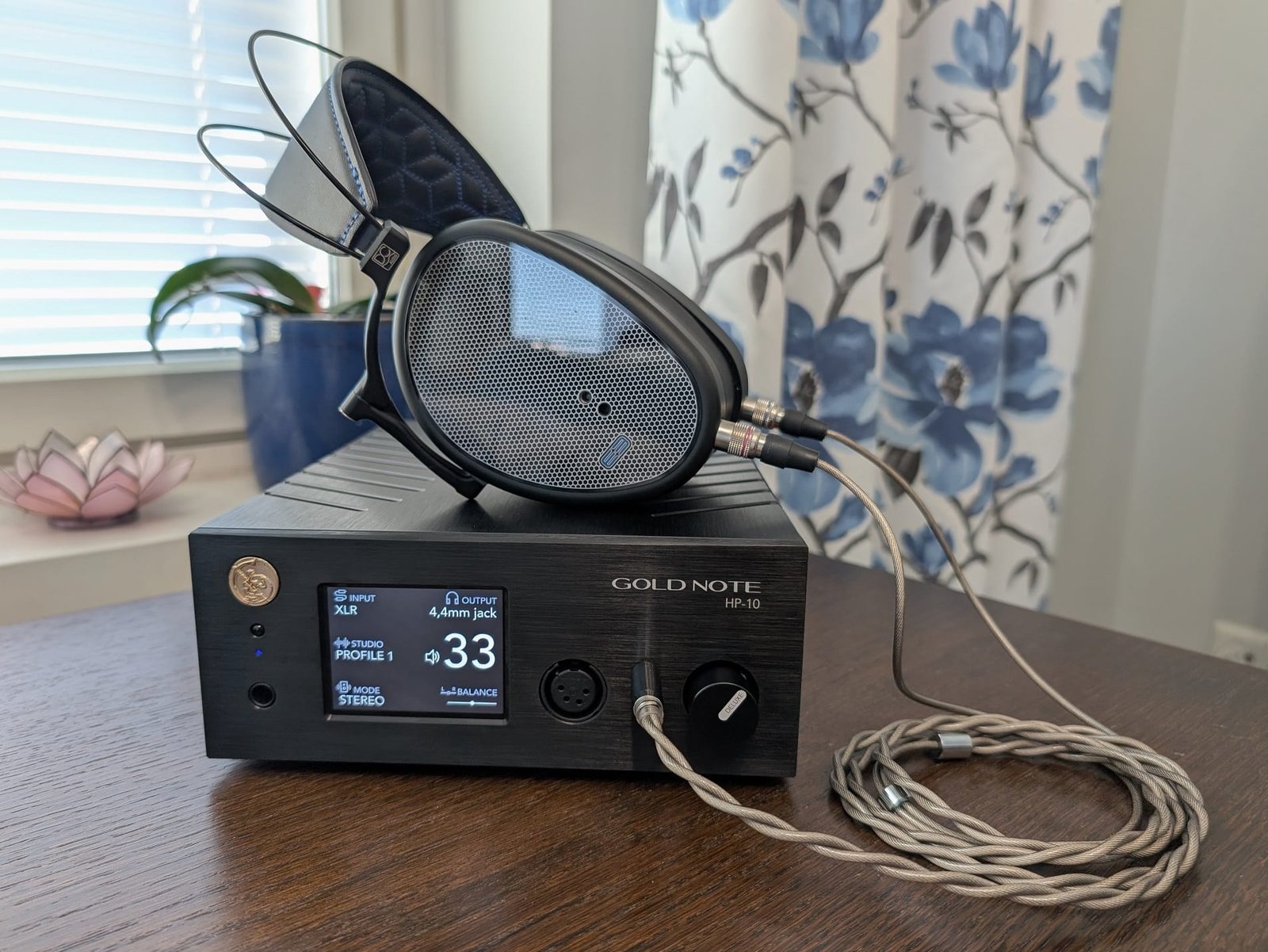
The HP-10 is a robust Class A dual-mono amplifier that offers many exceptional additional features and adjustment possibilities – these are even implemented entirely analogically. Furthermore, with the HP-10 BT and HP-10 Deluxe, digital playback can be accessed either via Bluetooth or USB connection. The Deluxe version I tested is, above all, a versatile device that handles everything except playing passive speakers and streaming music from the network.
Structure and connections

I'll start by reminding you that the basic version of the HP-10 costs 100 euros less than the Ferrum Audio OOR. Despite this, Gold Note has managed to include a thick aluminum casing in the price of its device. The HP-10 weighs over a kilogram more than the OOR (3 kg vs. 1.8 kg) and also feels significantly more premium and refined. The OOR seems like an everyday and reliable tool, whereas operating the HP-10 feels so luxurious that owning it would evoke greater pride in me. This is exactly the kind of feeling, in my opinion, one should get when a 2000 euro device lands on the table. Gold Note thus succeeds excellently in creating an impression of quality and structurally outperforms Ferrum Audio's devices.
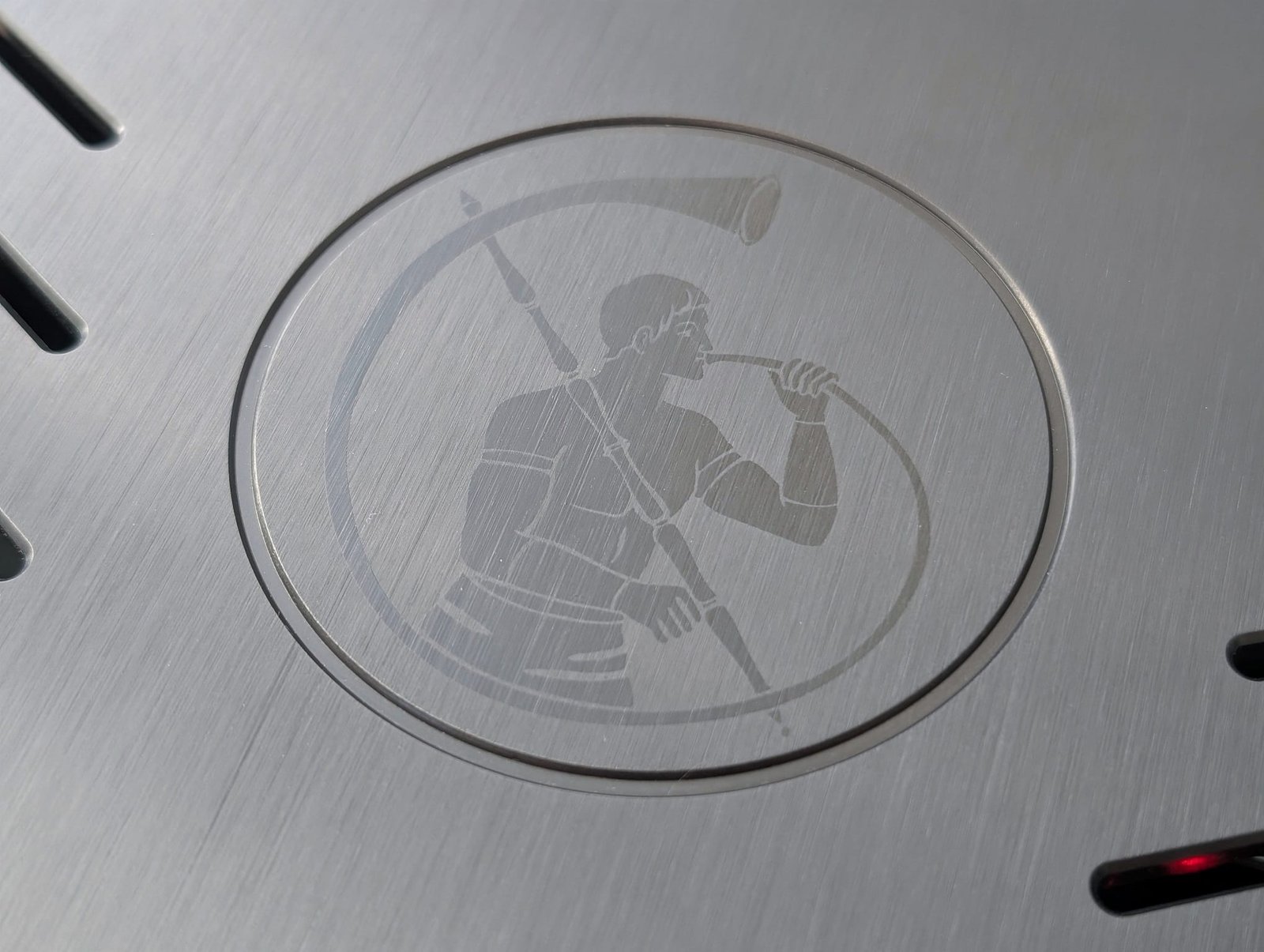
Although the HP-10 is slightly taller and deeper than the OOR, there is ultimately no significant difference in the desk space occupied by the devices. The HP-10 Deluxe I received for loan is black, but the device is also sold in silver and, referring to the manufacturer's name, in gold. The large ventilation openings made in the chassis work well, as I do not observe any heating of the top cover even during prolonged use. The manufacturer's logo added to the center of the cover is subtly visible, slightly shinier than the anodized aluminum, while the golden ”coin logo” in the front upper corner already serves as a clear focal point in the black device version.
Otherwise, the front is dominated by a pleasantly easy-to-read IPS touchscreen, which remains clear even when viewed directly from the side. The amplifier can be controlled either by pressing the screen or by using the included infrared remote control. Thanks to this, the HP-10 is better suited as a preamplifier than the OOR, especially since the output connector selection option prevents headphones from playing simultaneously with speakers. If the screen is distracting, for example in a dimly lit room, it can be set to turn off outside of active functions, such as changing the volume. The power LED embedded in the chassis, on the other hand, remains discreet by default.
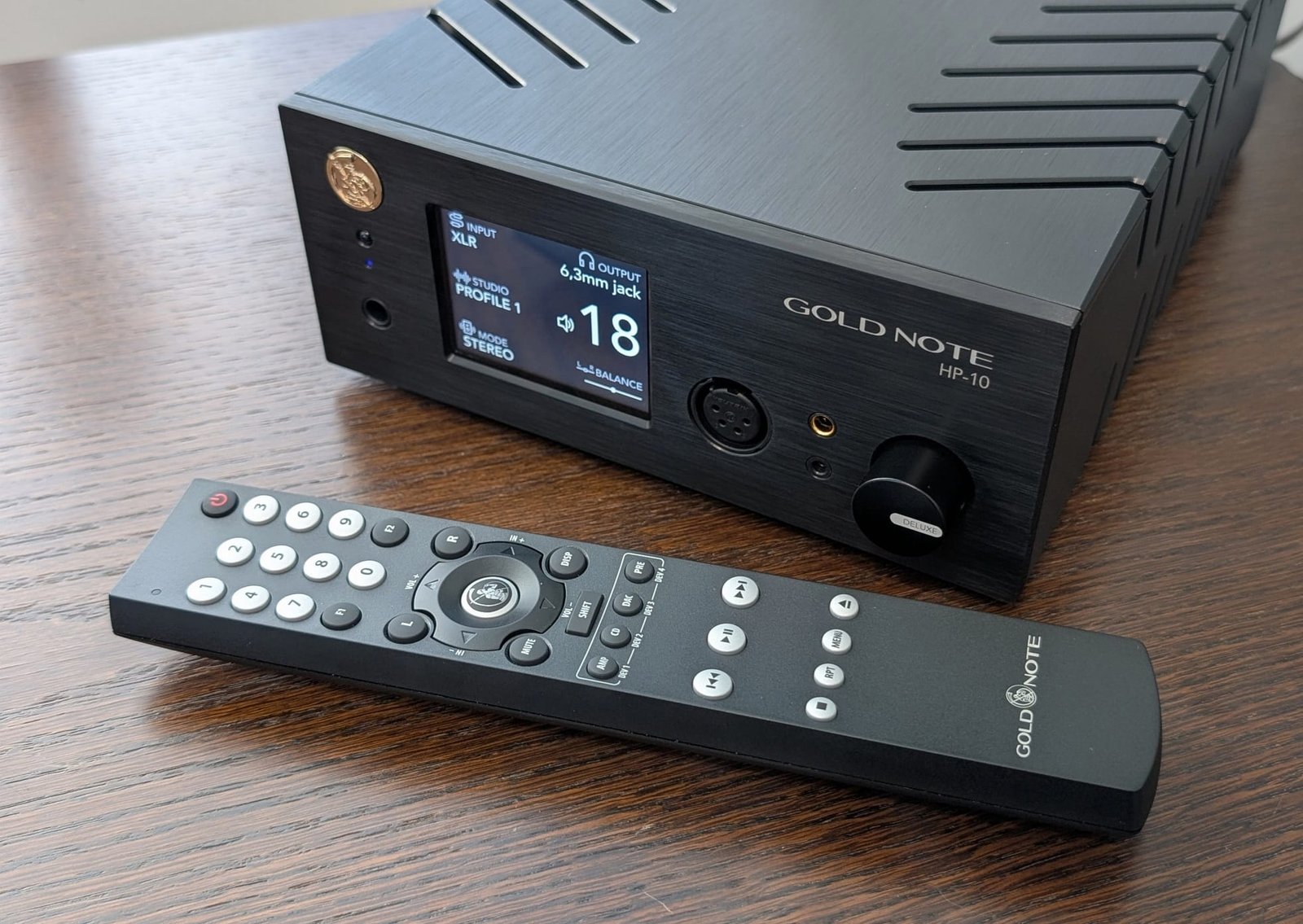
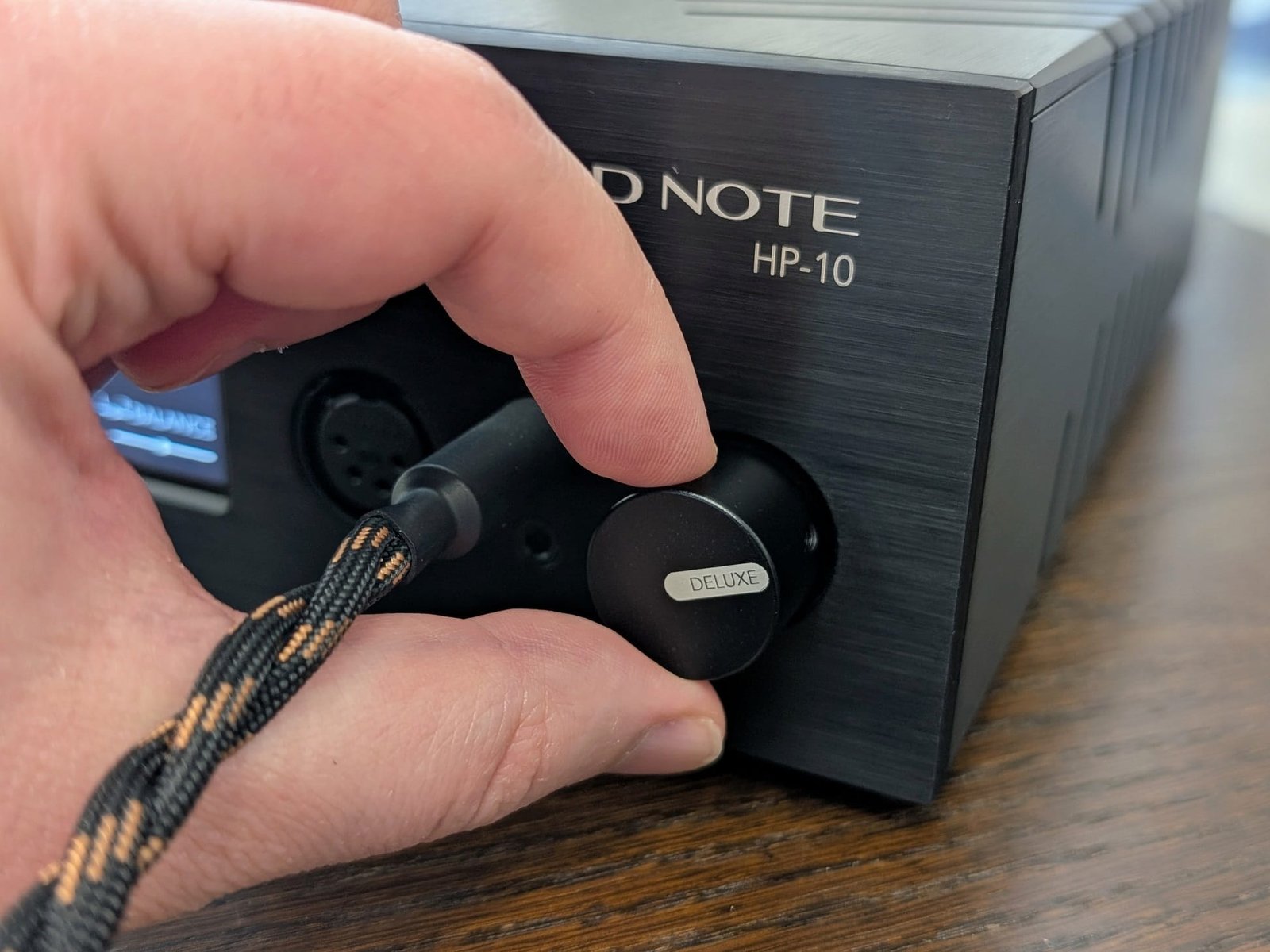
The HP-10 offers a more comprehensive selection of headphone connectors than the Ferrum Audio OOR, with two balanced (XLR and 4.4 mm) and two unbalanced (6.35 mm and 3.5 mm) options available. Regarding the volume control, I prefer the OOR slightly more, because the HP-10's stepped control, despite its firm feel and perfect accuracy, is quite small. Since turning it may require a bit of force and some headphone connectors are positioned close to the control, there might not be much room for fingers, requiring them to be placed in a somewhat unnatural position. The included remote control, of course, solves the problem, but when sitting by the amplifier, I would wish for the operation to be a bit smoother. The potentiometer's indicator is irrelevant in this case, as the selected volume is displayed as a number (0–99) on the screen. The HP-10's power can be conveniently turned on/off in three different ways: 1) with the remote control's power button, 2) by pressing the potentiometer, or 3) by pressing the touchscreen for a moment.

On the back of the device, like the OOR, both input and output connectors (XLR & RCA) are found. In addition to these, the HP-10 Deluxe includes a USB-C connector with its DAC. The Bluetooth connection, somewhat unusually, does not require an external antenna; instead, the signal is picked up internally. Since the Deluxe version costs an extra 500 euros for the DAC compared to the basic version, or an extra 400 euros over the HP-10 BT version, I would honestly expect to get slightly more versatile digital connections instead of a single USB connector. I wouldn't be surprised if this leads some people towards acquiring a separate DAC.
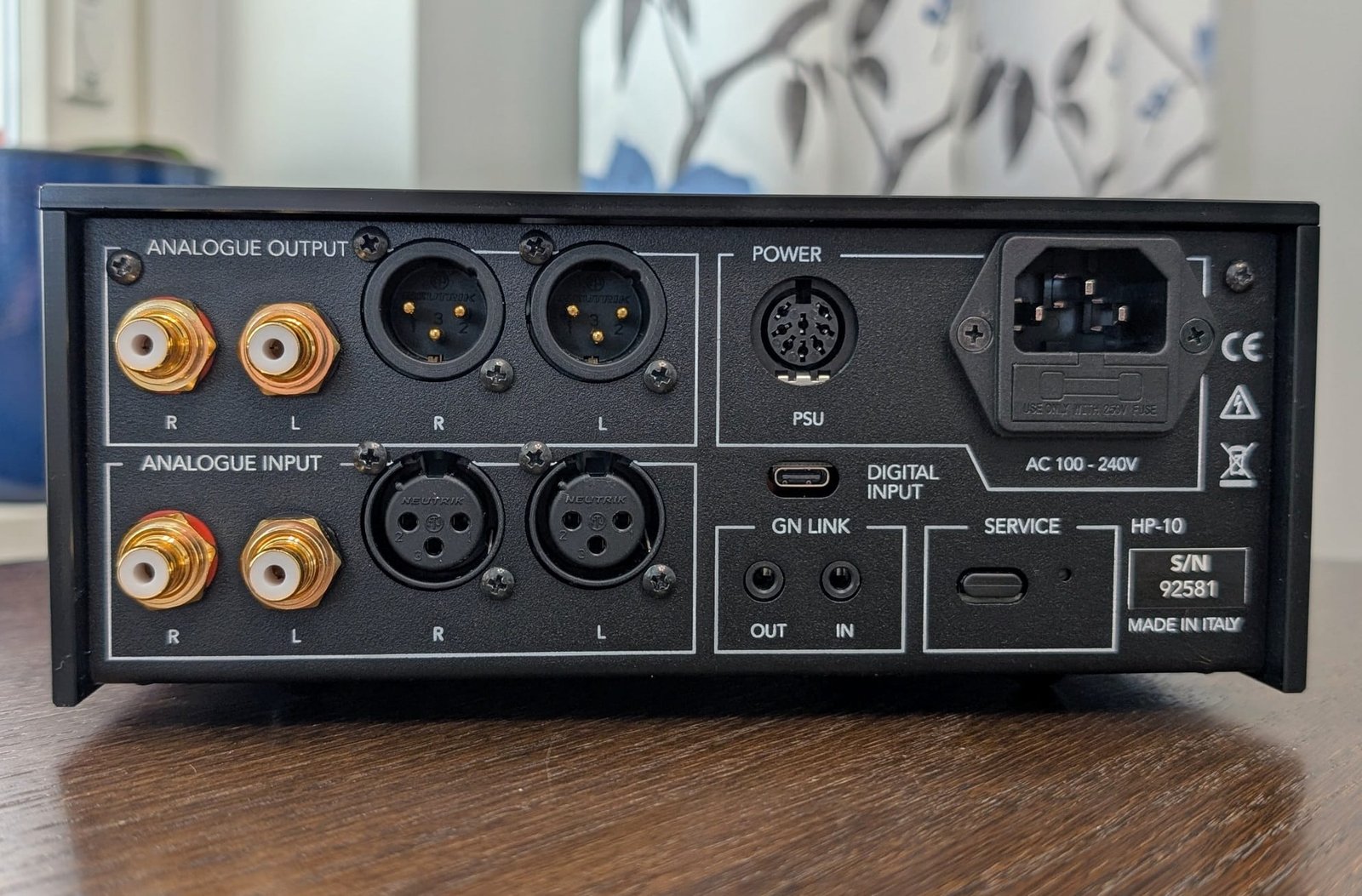
In the Gold Note amplifier, unlike the OOR, the power supply transformer is located inside the chassis, but a separate power connector for the more robust PSU-10 EVO external power supply is still found on the rear edge. The headphone amplifier can be integrated into the rest of the Gold Note product family with 3.5-millimeter trigger connectors, eliminating the need to turn all devices on and off separately.
Versatile additional features
Everything I've mentioned so far would already make the HP-10 a versatile device, but we're only now getting to the real core. Gold Note has indeed baked amazing features into its amplifier, most of which are genuinely useful – at least in certain use cases and with certain headphones. All features also work in preamplifier mode, although they are not specifically designed for speaker listening.
Settings can be accessed either via the touchscreen or the remote control. Of these, using the screen has been smoother and more straightforward for me, at least initially, because the remote control requires more learning. The screen generally responds well to touches, with the exception of selecting the input and output channels, which happens somewhat sluggishly by swiping sideways. I would appreciate it if the connector options opened on the screen as their own buttons from which I could make a selection. However, after a little getting used to it, the current solution also feels perfectly functional.
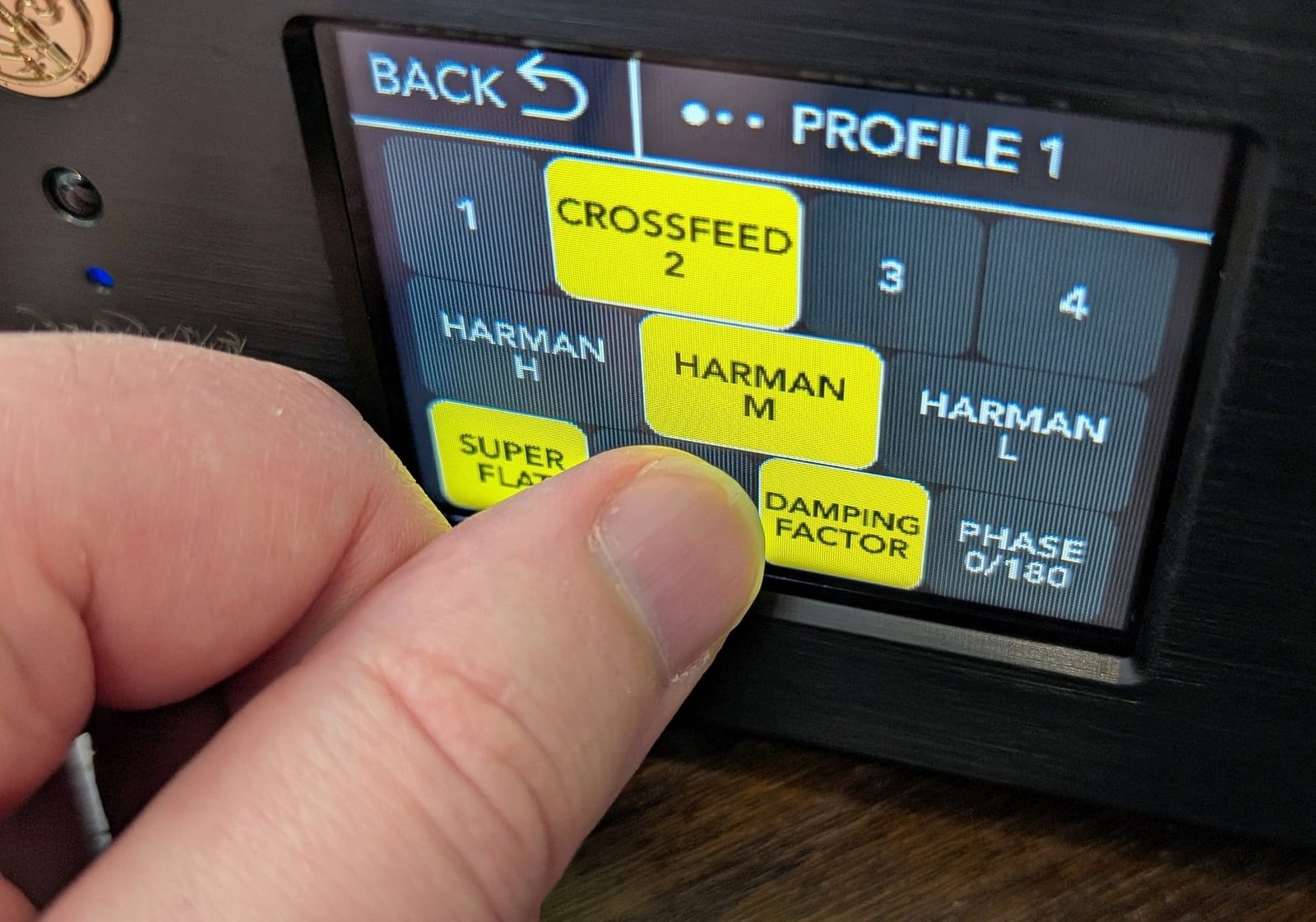
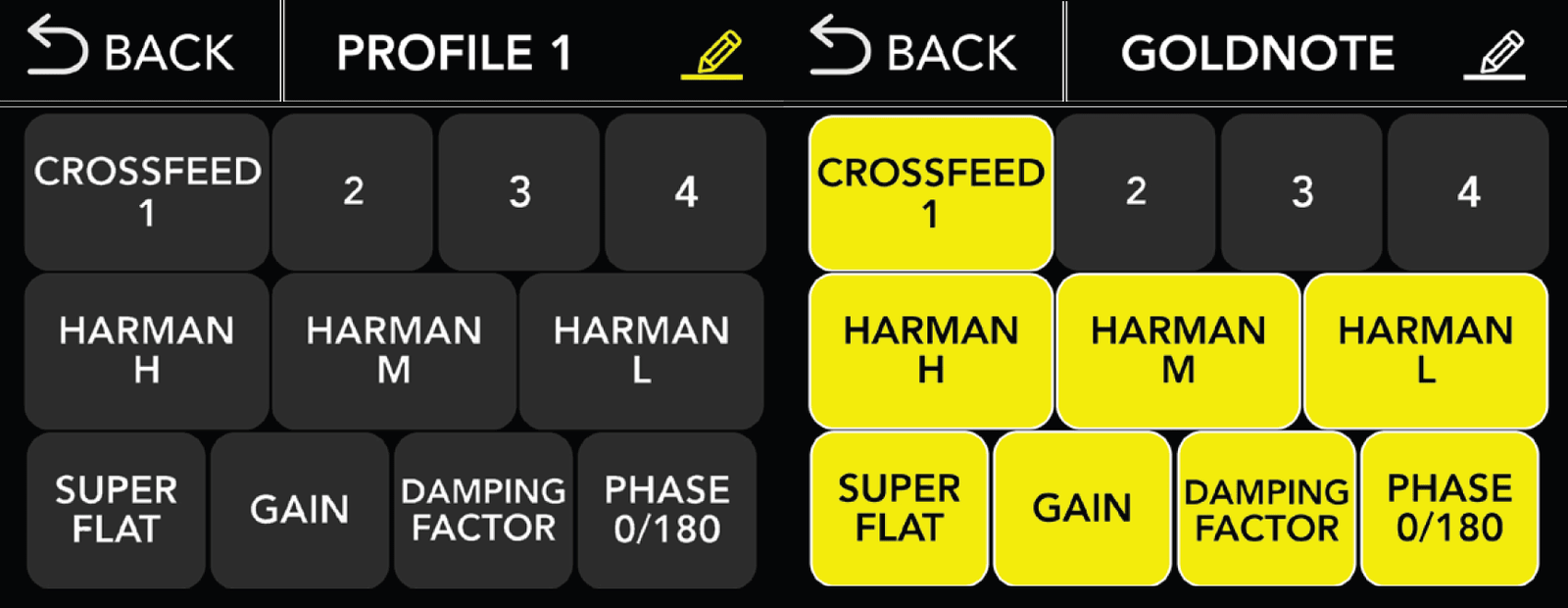
Most of the most interesting additional features are found behind the Studio menu, where they can be toggled on as needed. The amplifier also pleasingly allows saving three profiles from the settings, to which different settings can be assigned, for example, for three different headphone models. Reportedly, the latest firmware version even allows renaming these profiles.
Crossfeed:
Like many other manufacturers, Gold Note has developed its own crossfeed function, which mixes the right and left channels together, meaning that part of the sound reproduced on the right side is also heard on the left side with an appropriate delay, and vice versa. This is intended to make the soundstage more speaker-like by moving the sound to the front of the head and headphones. The HP-10 includes four different crossfeed settings, which differ in their channel mixing ratio, delay parameters, and frequency response changes. Since the crossfeed effect usually colors the sound slightly, Gold Note has decided to compensate for the changes by boosting bass frequencies.
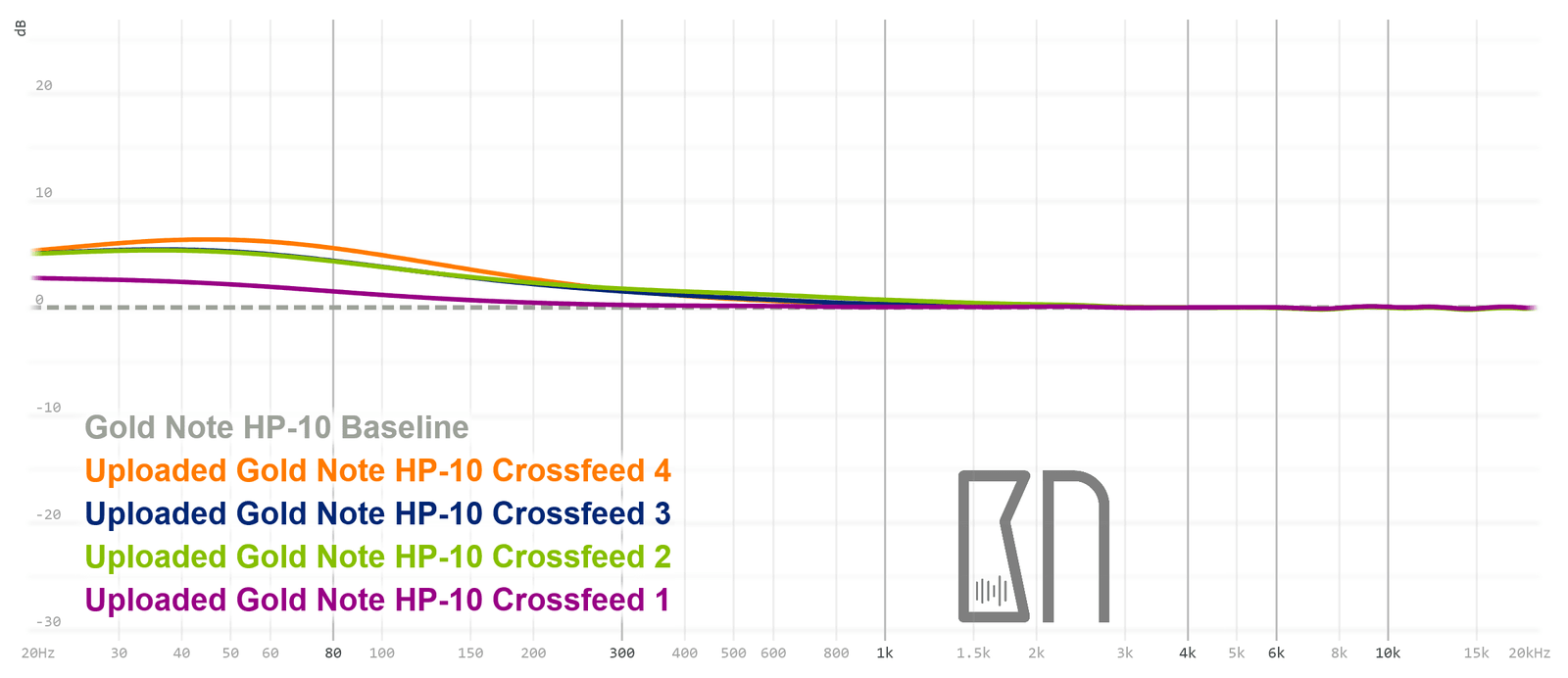
Crossfeed setting 1 is the safest of the options, because it mixes channels by a moderate 20 percent and boosts the sub-bass by only a couple of decibels. Settings 2–4, on the other hand, already increase bass by about 5 decibels, but at the same time further enhance the depth perception of the soundstage. For example, with open-back planar headphones that reproduce bass linearly, a double benefit is gained, so to speak, with a more natural soundstage and firmer sub-bass. I myself, however, have stuck with crossfeed 1, as it sounds excellently natural and moves, for example, the vocalist just right in front of me. This function quickly becomes something you wouldn't want to turn off anymore.
Harman correction curves:
The amplifier interestingly also offers a kind of Harman EQ, which boosts the headphones” so-called ear-gain region, i.e., that part of the frequency response that should rise upwards in ”raw measurements" instead of a horizontal line. This is based on the fact that the anatomy of the human ear naturally amplifies upper midrange frequencies and lower treble, so our brains expect to hear these frequencies through headphones in that way. In some headphone models, however, the frequency response remains too flat between ~1–6 kilohertz, as a result of which most of us perceive the sound as distant and unclear. Such a situation can be corrected with the Harman curves offered by Gold Note.
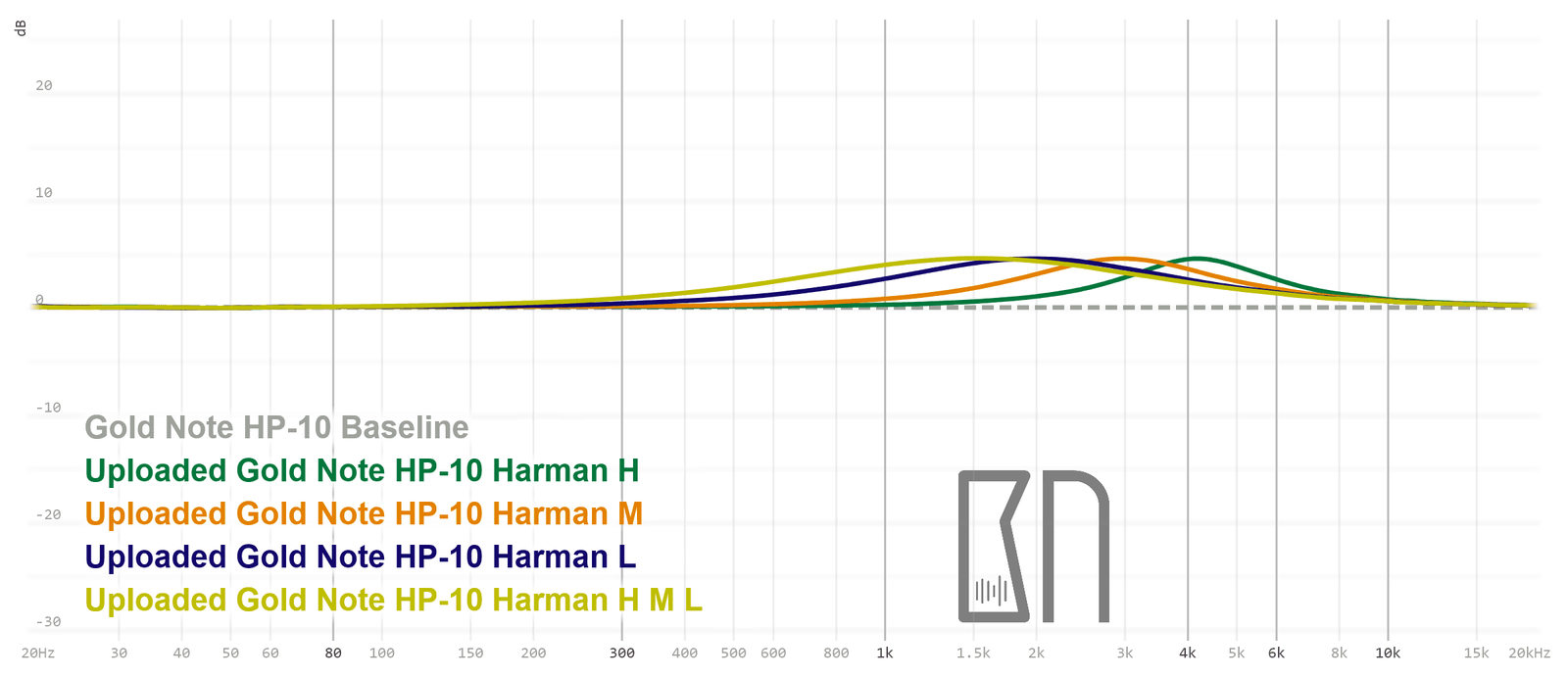
The letters L, M and H after the settings indicate which frequency range the effect is emphasized on. For example, the L-setting boosts the initial part of the ear-gain region the most, while the H-setting focuses on the 3.5–5.5 kilohertz range and M is in between these two. The three different settings can also be activated in pairs or even all at once, which provides more different variations of the changes. It is noteworthy, however, that all options boost the ear-gain region, and it cannot be adjusted downwards.
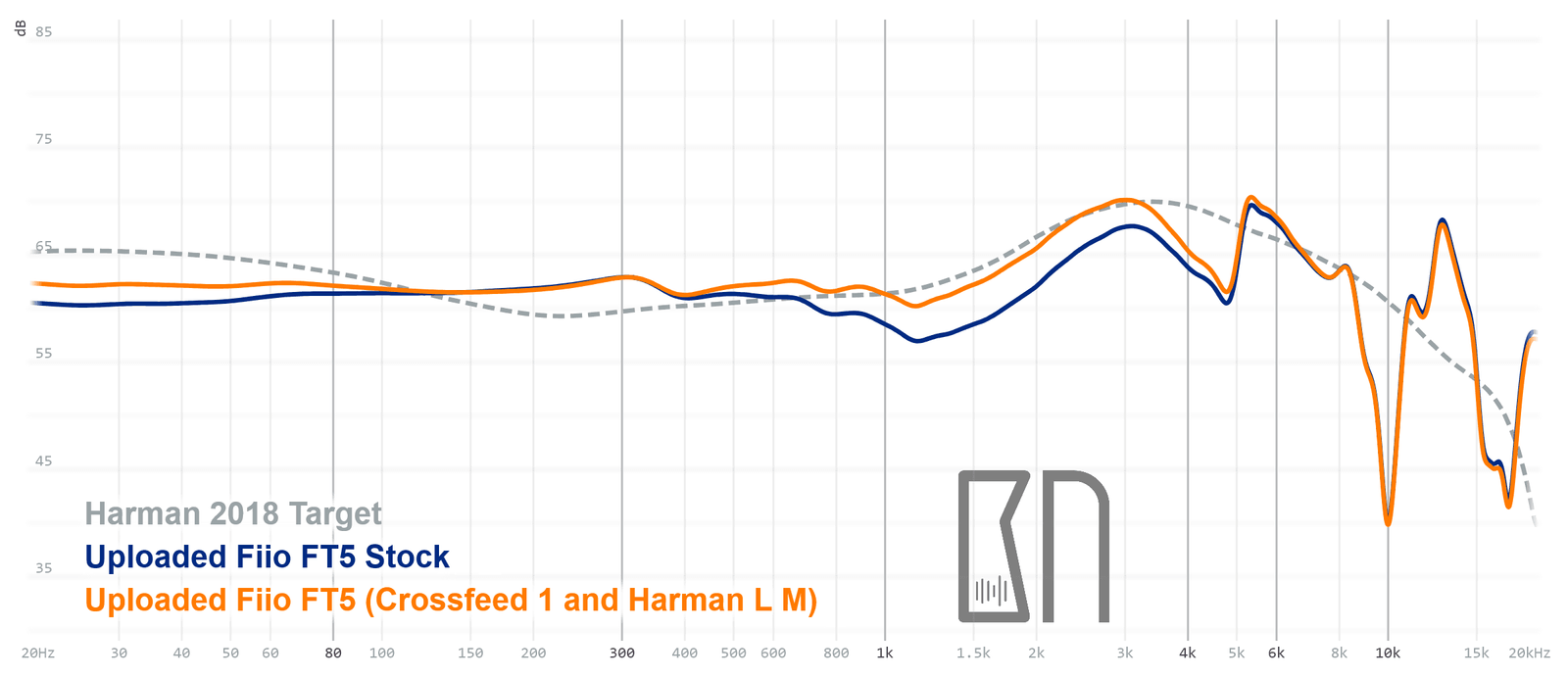
The function is primarily intended for headphones whose ear-gain region reproduces too faintly compared to Harman's target curve. For example, Fiio FT5, Meze Audio Empyrean Elite, and T+A's Solitaire P-series would benefit from the offered settings if a more neutral sound is desired from them. If, on the other hand, the headphones are already neutral in style, there is hardly any need for the function, but it mainly makes the sound unnaturally energetic. I'm not sure how many headphone models will need these adjustments nowadays, but Gold Note has in any case added a feature to its amplifier which, to my knowledge, no one else offers in a similar form in any price range.
Super Flat:
Gold Note mentions that the Super Flat setting bypasses some part of the circuit, making the amplification as neutral, linear, and uncolored as possible. As an obvious change, however, the setting boosts the treble from 4 kilohertz upwards, so the sound actually becomes colored, though not dramatically. With Super Flat activated, the upper frequencies, especially after 8 kilohertz, become slightly fresher and airier.
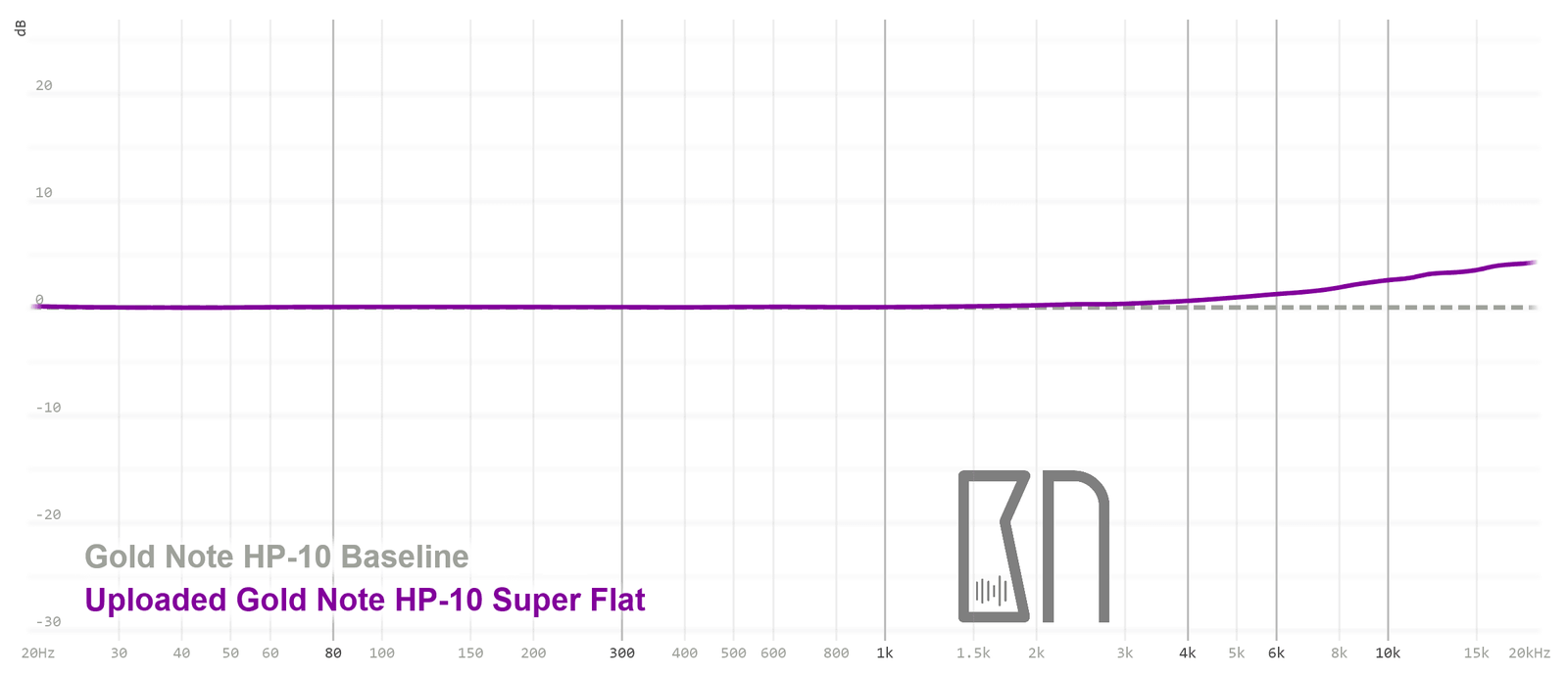
Thanks to the moderate change, for example, headphones with dark treble can be made more neutral. The setting is also suitable for use with Crossfeed modes, as it compensates for the bass boost. As a third option, Super Flat could be combined with Harman correction curves if some headphones need a touch of extra energy for the highest treble frequencies in addition to the upper midrange and lower treble.
Gain, Damping Factor and Phase:
A kind of high-gain mode for the HP-10 can be found in the Studio menu, from where it won't be accidentally activated. On the other hand, the gain factor and volume only increase slightly anyway, so no headphones will start playing deadly loud when pressing the gain button.
The Damping Factor setting, on the other hand, is more interesting, as it allows increasing the damping factor applied by the amplifier to the headphones. By default, it operates in low mode, while activating the function is considered high mode, which simultaneously increases the volume by about 5 decibels. A direct A-B comparison of the two modes is not possible; instead, the volume must first be either raised or lowered to the initial level. Gold Note itself has compared the feature to car suspension: a higher damping factor is like the stiffer suspension of a sports car, while in low mode, the suspension is softer, making the ride smoother and more comfortable. I find the description very apt.
With a higher damping factor, the HP-10 controls the headphone drivers a bit more tightly, making the reproduction more precise and sharper in its transients. The beginning and end of individual sounds become clearer, making it even easier to observe the details of the music. On the other hand, for some headphones, a lower setting is still better, with which the reproduction is slightly more relaxed and the treble less attention-grabbing. In my opinion, both options should be tried with all headphones.
The HP-10 also allows phase inversion (180°), which I find somewhat questionable tinkering. However, the setting is not harmful, for example, if the music being listened to was produced with inverted phase, in which case it might not sound completely natural without the ”correction” offered by the HP-10.
Mono mode and channel balance adjustment:
Headphones can also be listened to with the HP-10 in mono mode (right and left channels combined or separately), and the left and right channels can even be reversed in stereo listening. I can't think of an immediate use for these options, but it's great anyway that Gold Note's amplifier offers various settings in a completely different way than most competitors' devices. Many will also surely appreciate the possibility of adjusting the channel balance if an imbalance is found in their own ears or in the headphones being used. Previously, this setting was standard in amplifiers, but nowadays it is becoming rarer.
Some specs kept secret, but power is available
Gold Note does not specify the output power of its headphone amplifier particularly precisely, nor does it mention a word about the output impedance. However, up to 10 watts of power should be available, which can be assumed to be achieved with a fairly low impedance load. Thus, it might not be far from the Ferrum Audio OOR, which will hopefully be confirmed by device measurements someday. A German reviewer mentions the headphone amplifier's output impedance as approximately 0.3 ohms, which is likely correct, as the HP-10 does not alter the frequency response of headphones, even if their impedance response is uneven.
Regarding output power, I can declare the amplifier powerful, as it easily reproduces both Hifiman HE-6 and Mod House Audio Tungsten, sounding good as well. Not much more can really be demanded, as there are no more difficult headphones on the market, at least for now. In my opinion, Gold Note could still improve a bit in announcing the specs, as they are clearly in order, so there's no need to hide them. However, the manufacturer does not yet have extensive experience with headphone amplifiers, so I will give it time to realize what kind of information headphone enthusiasts are accustomed to examining when making device choices.
Interestingly, the HP-10 outputs the same volume through all headphone connectors, so the amplification power is likely identical between the connectors. As a layman, I cannot say what kind of design achieved this, but in my opinion, it should not matter which connector the headphones are attached to on this device. The OOR, on the other hand, is a highly powerful amplifier mainly through its balanced XLR connector.
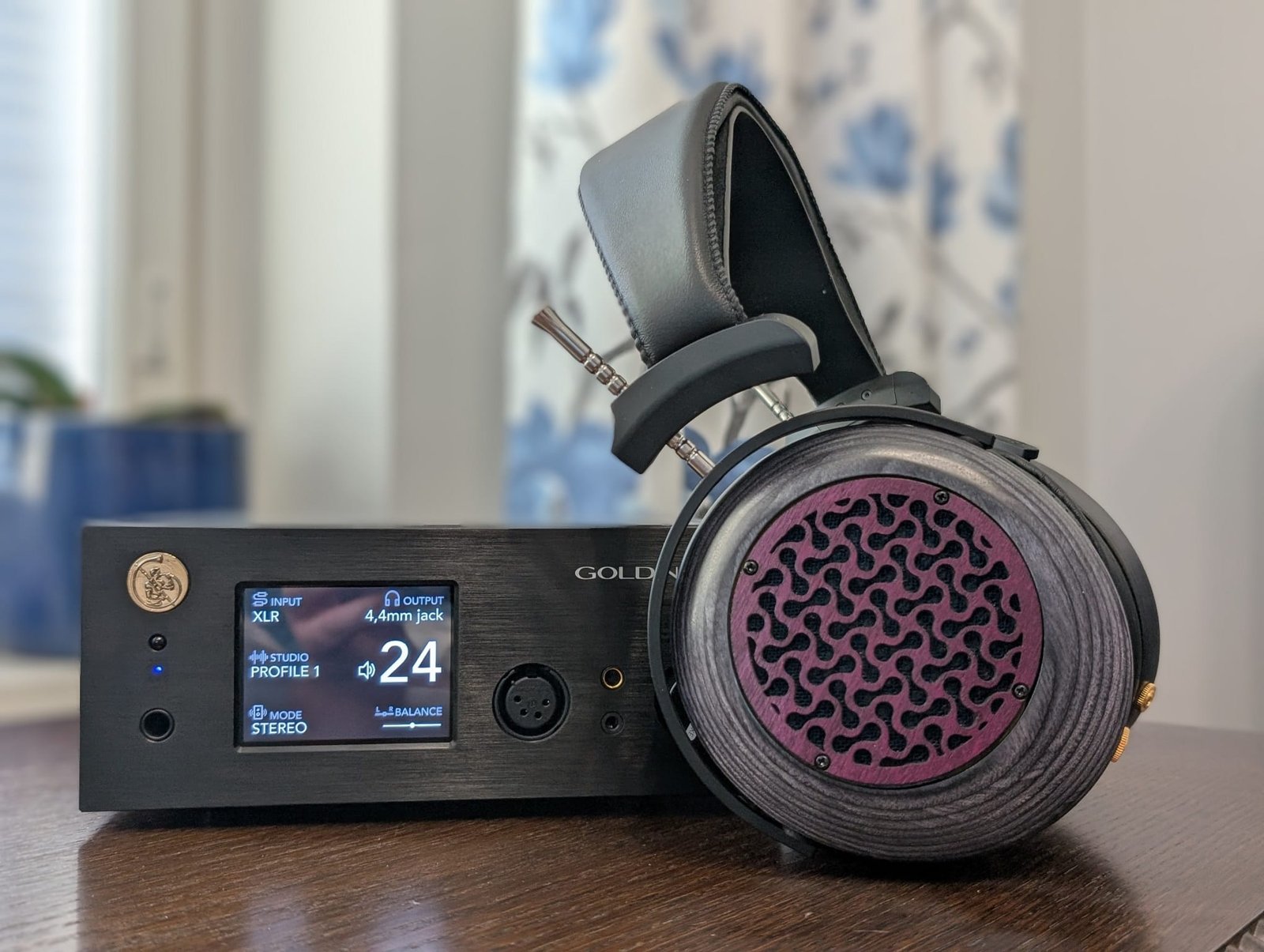
The gain level of Gold Note's amplifier cannot be lowered like with the OOR, so sensitive in-ear headphones hiss strongly with it, even though from the perspective of volume control range, they could very well be listened to. I actually detect faint hiss also with some over-ear models, such as Focal Hadenysand Aune Audio AR5000:s. Interestingly, raising the Damping Factor setting does improve the situation slightly. In any case, I would not fundamentally recommend headphones for the HP-10 whose sensitivity exceeds 100 dB/mW, especially if the impedance is simultaneously below 30 ohms. Ferrum Audio has succeeded better in amplifier design in this regard.
The DAC section in the HP-10 Deluxe is implemented with a fairly common AKM AK4493 delta-sigma chip, which, as expected, supports high sampling rates (max PCM 768 kHz / DSD512). However, the user interface does not offer any fine-tuning options for the AKM chip, such as the possibility to change the DAC filter; instead, the implementation is simpler than the manufacturer's DS-10 combination device. On the other hand, this makes operation very straightforward → plug in the USB cable, select the correct input channel, and start listening. To be precise, separate Windows drivers can also be downloaded from the manufacturer.
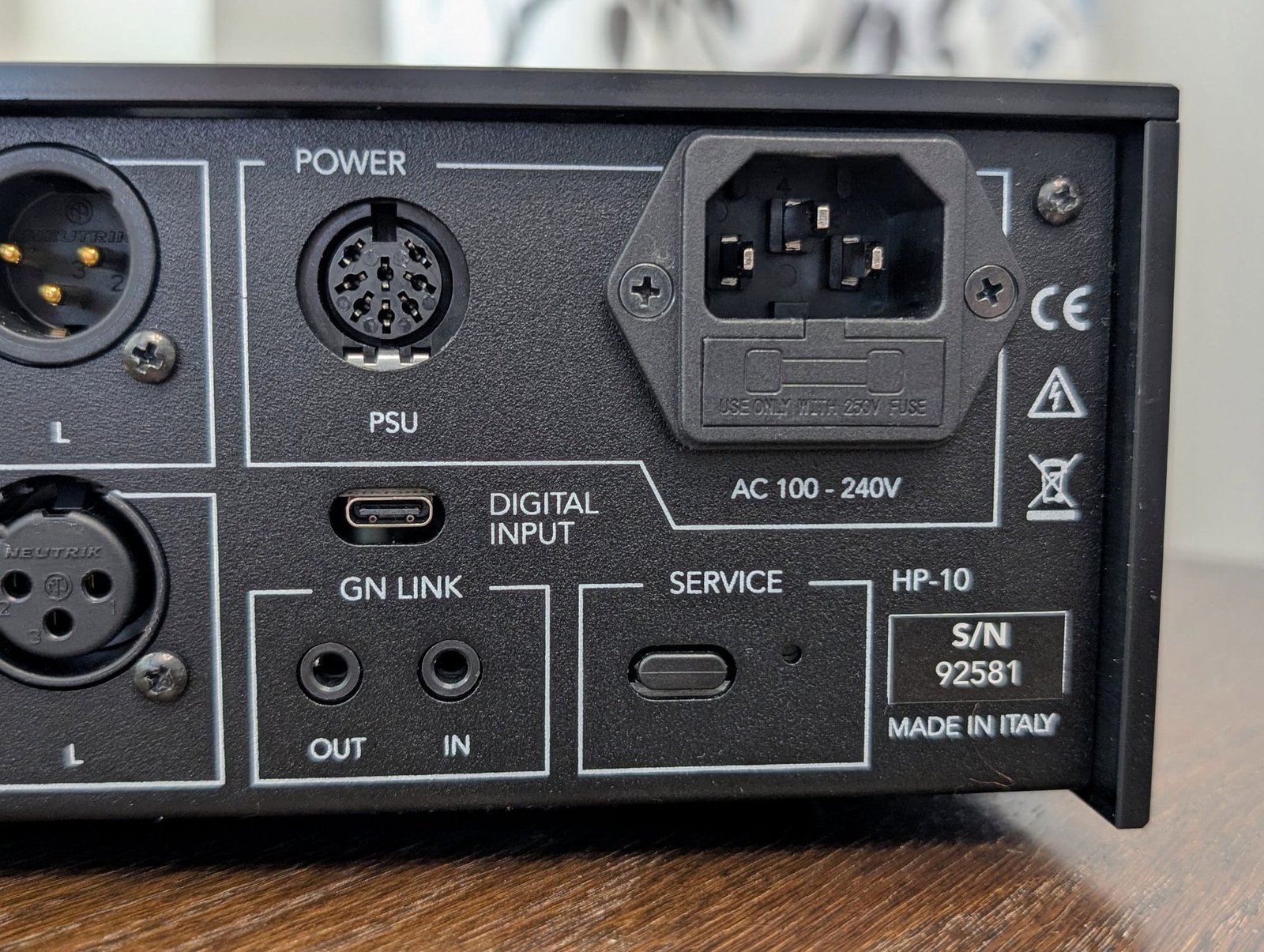
For Bluetooth connectivity (version 5.1), AptX HD, AAC, and SBC codecs are supported, which have wide support on other devices as well. Wireless listening went smoothly for me, although I would wish the device also supported the higher-quality LDAC codec. Critically evaluated, the HP-10 Deluxe's USB-DAC and Bluetooth implementation are not quite end-game level, but should primarily be seen as diversifying usage. However, I will mention the DAC's sound quality a bit later, so let's wait until then before the final verdict.
Observations on amplifier sound quality
I have tested both amplifiers side-by-side with several different headphones, such as Dan Clark Audio E3(primary reference), Mod House Audio Tungsten, a couple of Hifiman models, several ZMF models, Focal Hadenysand Sennheiser HD 600. The DAC used was Topping Centaurus (XLR connection), which is based on the renowned Holo Audio's R2R technology. During the comparison, all HP-10's additional settings were off, as crossfeed, in particular, would clearly alter my experience of the soundstage. Initially, I also always measured the volume of both amplifiers to be roughly identical, but after a while, I started to approach the matter a bit more relaxed, because the stylistic differences between the devices were clear with more or less all the headphones I tried. Both amplifiers, therefore, have a certain characteristic sound in my opinion, which in the case of OOR, I believe deviates a bit more from what many would consider a completely neutral reproduction.
If neutral is defined as a clear, controlled, and unfatiguing sound across all frequency ranges, the HP-10 is, in my opinion, an almost perfect example of this. The amplifier's strengths include an excellently tightly controlled bass, a spacious soundstage, and fantastically precise and transparent-feeling separation of sounds. At the same time, the sound also sounds completely natural, and there is no extra sharpness or harshness in the treble either. I have actually never heard a sound that is simultaneously so detailed and easy on the ears. The HP-10 has literally made many of my headphones slightly better, even though they still sound entirely like themselves in terms of frequency balance. Bravo Gold Note!
Despite everything, I also like the Ferrum Audio OOR, which appeals to fans of a more relaxed reproduction. The amplifier rounds off the sharpest edges of music within good taste, making the treble slightly softer and smoother compared to many other devices, such as the HP-10. Differences are also found in the lower frequencies. While Gold Note's device clarifies the sound of, for example, bass-heavy ZMF headphones by tightly controlling the bass, the OOR allows the lower frequencies to reproduce a bit more robustly and swollen. The general sound signature of the Ferrum Audio amplifier is thus warmer, which certainly has its target audience.
With its smooth treble and richness, OOR is, in my opinion, suitable for headphones that are naturally inclined towards bright and light reproduction. Perhaps for this very reason, the amplifier is considered a good choice for open-back planar headphones, which tend to be like this. The same actually applies to brightly produced music if one wants it to be a bit more relaxed to listen to. However, I would not necessarily recommend a warm-sounding DAC, such as the original Schiit Audio Bifrost 2, as a companion for OOR, because the presentation would become too relaxed. The HP-10, on the other hand, largely maintains the energy level of the uppermost treble unchanged, but if someone perceives a neutral sound as cool in tone, Gold Note's amplifier could also be classified as slightly warm in my opinion, because it does not exhibit any clinicality.
The two amplifiers also differ surprisingly much in their soundstage. I perceive the HP-10's sound as more spacious and transparent, while the OOR offers a more intimate experience. Gold Note's amplifier succeeds in delineating small details more precisely from each other, and the movements of sounds are easier to follow because, in a way, more empty space forms between them. The OOR certainly reproduces the same details effortlessly, but they don't pop out as automatically, instead blending together a bit – this, in turn, makes listening more relaxed.
The HP-10”s more open-feeling soundstage reinforces my previously formed impression: the OOR is not a particularly spacious-sounding amplifier. Fortunately, its created sense of depth is excellent, and vocal performances have a certain presence that I don't pay as much attention to with the HP-10, which disperses and separates sound more. I haven't actually found the OOR's presentation to feel too cramped, but overall, the HP-10 makes a greater impression on me in terms of spatial separation and detail in reproduction. Its sound could also gain more OOR-like depth and ”vocalist focus" by activating crossfeed.
In summary, it should be mentioned that the HP-10, in my opinion, sounds more neutral of the two and surpasses the OOR in soundstage transparency and separation accuracy. Ferrum Audio's amplifier, on the other hand, sounds a bit more pleasant and relaxed, especially with brighter headphones. Overall, Ferrum Audio's amplifier leans towards a smooth and slightly warm listening experience without making too significant sacrifices in any area compared to more neutral devices. This is an achievement in itself, as I have not yet found a more affordable amplifier that would implement a similar presentation as successfully and refinedly as the OOR.
I noted that the differences I mentioned were largely present with all the headphones I tried, but it's worth remembering at this point that my observations are entirely subjective, and amplifiers always differ from each other less than two different headphone models. On the other hand, I believe that those looking at the 2000 euro price range are aiming for that final touch in their listening chain, in which case all kinds of subtle differences can be significant.
How does the HP-10 Deluxe's DAC sound?
Naturally, I also wanted to find out about the sound quality of the DAC included in the HP-10 Deluxe, as the device would be very handy if it could manage entirely on its own ”without needing” a better converter. The Topping Centaurus, which costs 1000 euros, served as a comparison, with its volume matched. Thus, the HP-10 Deluxe's own DAC, priced at 500 euros, wouldn't even need to be as good to justify its existence.
From the perspective of a longer listening experience, it quickly became clear that Gold Note's DAC doesn't significantly change the situation compared to Topping's more expensive R2R implementation. For example, I equally enjoyed the balanced-tuned Dan Clark Audio E3 headphones regardless of which DAC was in use. With a little tweaking, however, I was able to A-B test the devices to the extent that I found the Centaurus added a touch of emotion and warmth to the mid-frequencies, while the soundstage became somewhat more layered and realistic.
I feel that the Centaurus better supports the HP-10's strengths as an amplifier, but I don't detect any disturbing characteristics in the device's own DAC; it also produces an excellent natural result without muddiness in the low frequencies or excessive brightness in the treble. The reproduction is also still separated and detailed. From a sound quality perspective, I have no reason not to recommend the Deluxe version of the device, unless someone already owns a good DAC or needs more digital connections. I can't really say more about the HP-10 Deluxe's DAC because it doesn't really have sound-coloring characteristics, but rather disappears into the background, precisely in the role often expected of a D/A converter. Gold Note has, in my opinion, aimed for a neutral and accurate sound and succeeded.
Summary
Although a powerful, sufficiently featured, and clean-sounding headphone amplifier can now be bought for less than 200 euros at its cheapest, high-end devices bring a touch of luxury to the user experience. Achieving one's dream setup always feels good, especially if savings have been accumulated for it over a longer period. Generally, more expensive devices are also externally finer and more exotic in their circuit implementation, as if reflecting their engineers. In my opinion, everyone can have not only a favorite artist but also favorite headphones and a favorite amplifier, even if one could manage with significantly cheaper and less, especially at the beginning of the hobby. I am quite far along in my headphone hobby, so amplifier matters have already been in order with the Ferrum Audio OOR. Nevertheless, during this test period, the Gold Note HP-10 subtly became my new favorite amplifier.
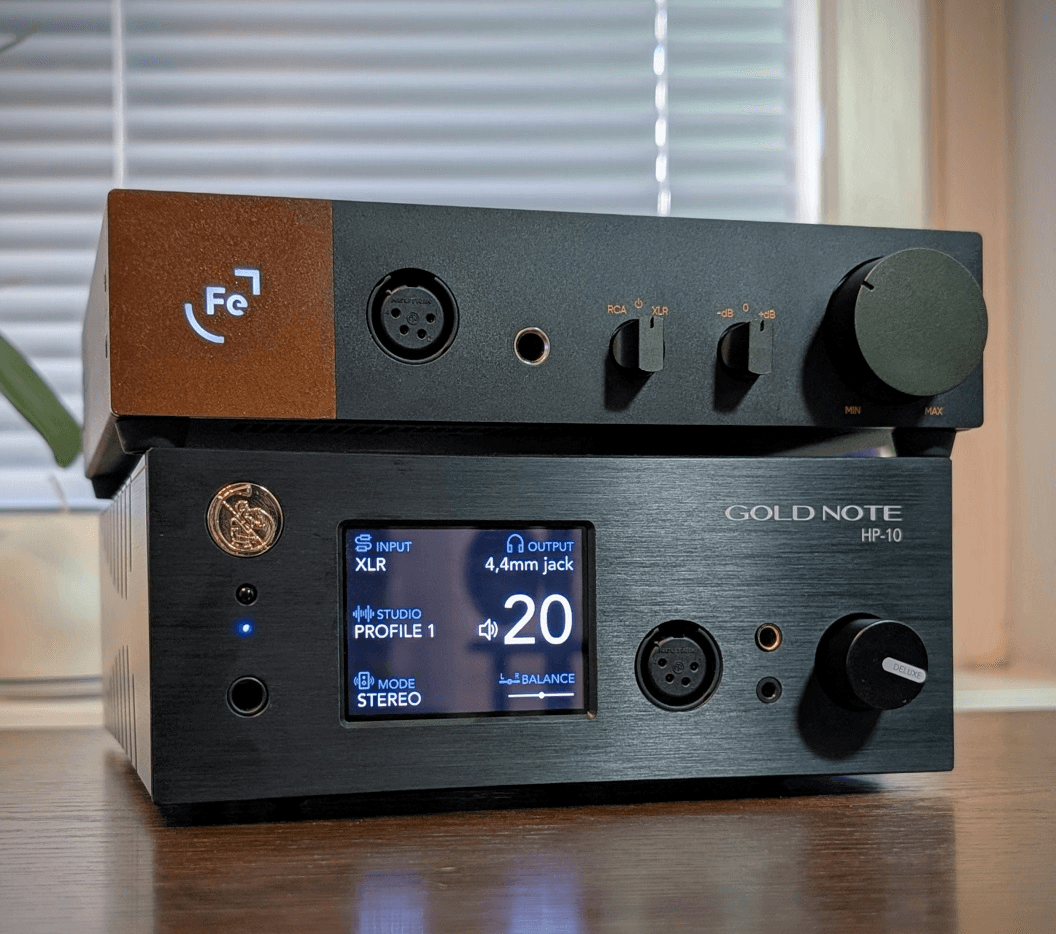
Both devices reach such a high level that they could very well be the last amplifier purchase for many. There is plenty of power, and the sound quality is superb regardless of which device I connect my headphones to. In a way, I even get excited about both amplifiers alternately again, so it's difficult to put them in an absolute order of superiority. However, Gold Note's new product ultimately makes a greater impression on me with its more transparent and separated sound. The HP-10 also has a higher quality build, more comprehensive connections, and clearly additional features, which make me feel I'm getting more value for money compared to Ferrum Audio's simpler approach. The Deluxe version I received on loan also includes a very good D/A converter as the icing on the cake for those who need one. A more direct competitor for it in Ferrum Audio's range would be the ERCO Gen 2.
I consider the background noise present with sensitive headphones to be the HP-10's biggest weakness, which means headphone purchases must be considered a bit more carefully than with the noise-free OOR. Ferrum Audio's longer-term experience in headphone amplifier design, which is behind it, stands out precisely in this area. Unfortunately, in my comparison, I didn't get to examine either manufacturer's separate power supply, so their potential benefits remain a mystery. For now, however, the tests have been completed, and Kuulokenurkka (Headphone Corner) falls silent for a moment. Finally, I'll still give my recommendation to both amplifiers.
Pros and cons:
Ferrum Audio OOR
+ Smooth and slightly warm sound without major compromises
+ Tremendous amplification power for the most demanding headphones on the market
+ Versatile gain levels, so also suitable for sensitive in-ear monitors
+ Compact size
+ High-quality connectors and switches
+ Made in Europe
+/- The appearance is ordinary, except for the corten steel on the front corner
-/+ The intimate soundstage will likely evoke feelings for and against it
– The device is easily forgotten on because it lacks a power light
– Not the most practical preamplifier without a remote control and output selector
– Unclear potentiometer indicator
– Cheap-feeling sheet metal casing
Gold Note HP-10 Deluxe
+ Neutral, spacious, and detailed sound
+ Controlled bass
+ Ample amplification power
+ Good DAC in the same housing
+ High-quality and elegant construction
+ Comprehensive headphone connections
+ Exceptionally versatile additional features and sound adjustments
+ Remote control and touchscreen facilitate use
+ Made in Europe
– Background noise with sensitive headphones
– Small-sized volume control and headphone jacks located close to it
– Limited digital connections (HP-10 Deluxe)
– Slightly modest Bluetooth implementation (HP-10 BT and HP-10 Deluxe)
 EN
EN  FI
FI