Author: Sword of Damocles
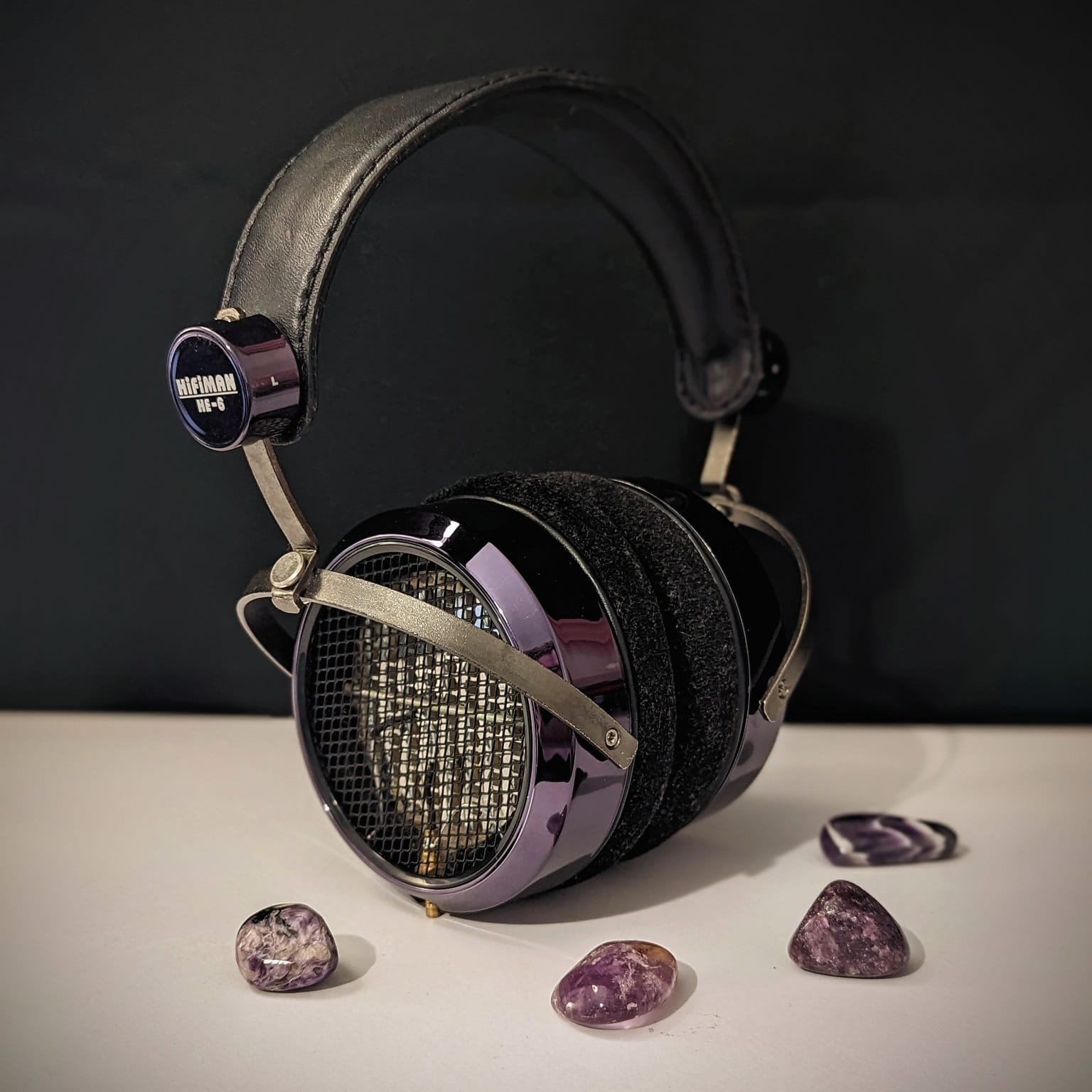
Table of Contents:
Information:
- Publication year: 2010
- Country of Origin: China
- Price: 1200 USD (used 1000–2000 euros)
- Type: open, over-ear
- Planar driver: 60 mm (gold-plated conductors)
- Impedance: 50 ohm
- Sensitivity: 83.5 dB/mW (very low)
- Weight: approx. 500 g
- Connector type: 2 x SMC
- Cable: Headphones bought used may come with anything
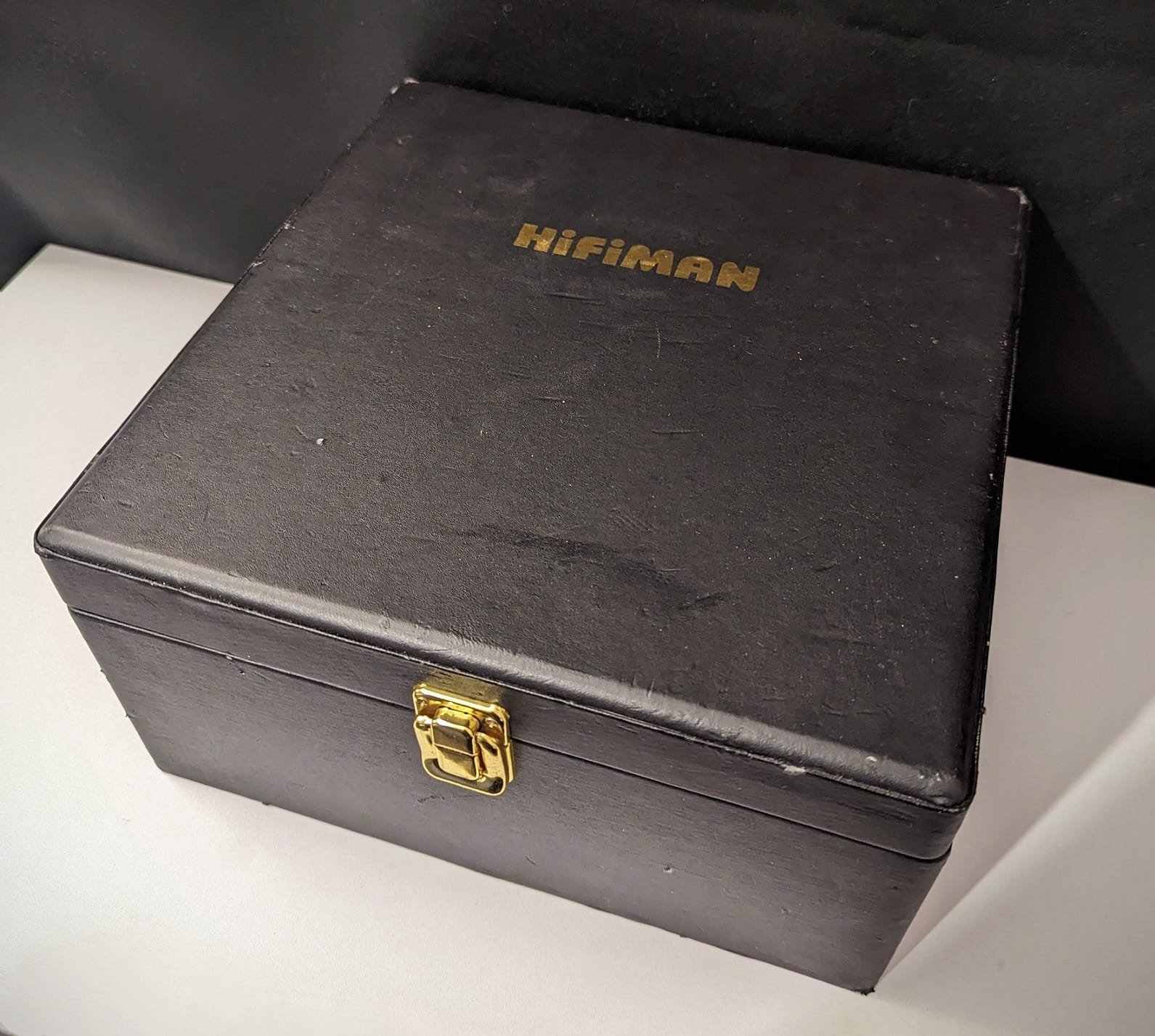
- Accessories: Storage box
Hifiman is currently pushing new planar headphone models onto the market at a steady pace, which are generally slightly better than their predecessors, but all very similar in overall sound. When the manufacturer was less known just over 10 years ago, its headphones were, however, quite different in style. The most legendary of these is the HE-6, released in 2010, which HE-500 its sister model and Audeze's LCD-2:s, launched a new era of planar headphones, after which they have become increasingly popular. The HE-6 and Sennheiser HD 800 in turn, have strongly influenced the fact that headphones costing over 1000 euros became part of everyday life.
However, the HE-6 is ultimately best known for its dynamic sound and how powerful an amplifier it requires to operate optimally. Hifiman has either not wanted or not been able to bring anything similar to the market since it ceased production of the HE-6 in 2015. A reminder of times past is still the model, which has been deemed excellent even in Kuulokenurkka, HE6se-model, which, despite its name, does not fully correspond to the original model. Hifiman allegedly managed to destroy the production machinery of the original model, so the drivers in the re-release are different, although unique compared to the manufacturer's other headphone models.
Even the original HE-6 has several different versions, which can be identified by the number of screws used to attach the driver. The first model had four screws, so it is referred to as the HE-6 4-screw. I own the six-screw 6-screw version of the headphones, whose drivers should apparently be more durable. In hobbyist circles, the four-screw version is revered as better, so one has to pay more for it used. The HE-6 is generally a rare headphone in the sense that it is often sold used for more than it cost new at the time. This, if anything, indicates that the headphones are still special by today's standards.
Since I have owned a slightly modified HE-6 for some time now, I want to remind headphone enthusiasts of the context from which Hifiman has evolved to the present day, and why the HE-6 is still considered one of the best headphones ever made.
Weak build and comfort
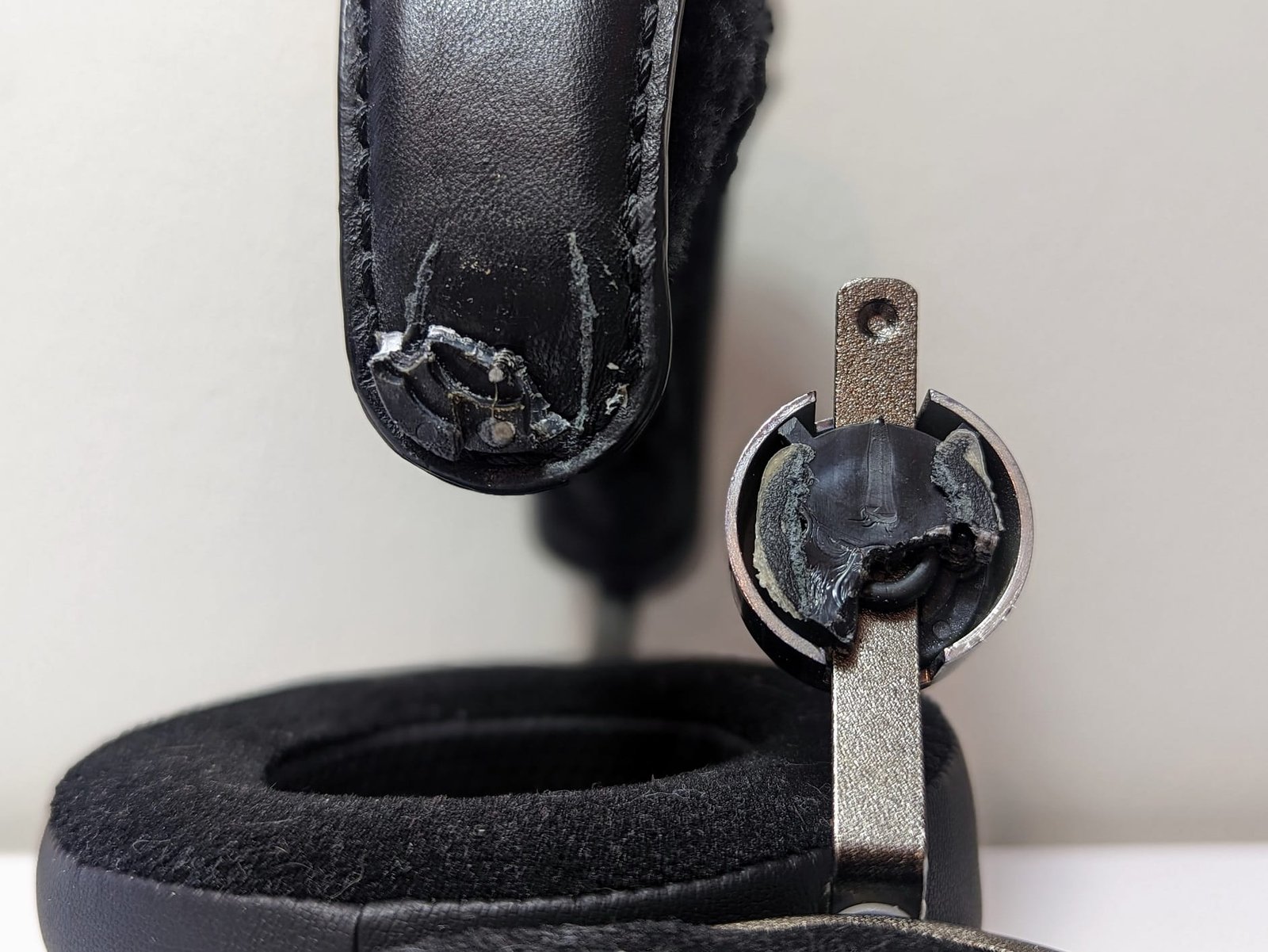
Current Hifiman headphones are often criticized for being of poor quality, but they are actually quite a leap ahead of the HE-6, which literally feels like it could fall apart in your hands at any moment. The old metal headband looks unfinished, and its height-adjusting part passes through two plastic pieces pressed together with screws and glue. When the headband is stretched, for example, when putting the headphones on, most of the stress is directed to these low-quality plastic parts, causing them to break. Unfortunately, this has happened to many, and one pair of headphones has even broken in a similar way in my own hands.
For this reason, the HE-6 is often seen for sale with different headband structures that owners have had to replace. The headphones' original headband can be removed from the cups with screws (if they don't happen to spin freely), but attaching a different headband usually requires replacing the corresponding parts inside the cups. This, in turn, requires removing the drivers, which is always a nerve-wracking procedure. Repairing broken headphones is not an easy task.
Apart from the low-quality headband, the HE-6's construction resembles Hifiman's current round-cup headphone models, such as HE400se. The ear pads are also attached in a similar way with plastic clips, so for example, Sundarapads designed for the model can be used in the HE-6. A peculiar feature, however, is that at the time of the HE-6, no specific slots were made for the four clips of the pads, so the pads can rotate freely 360 degrees on their mounting plate. This is not an issue with the round and rock-hard velour pads I use, but for example, thicker angled pads would always need to be set to their correct position before use.
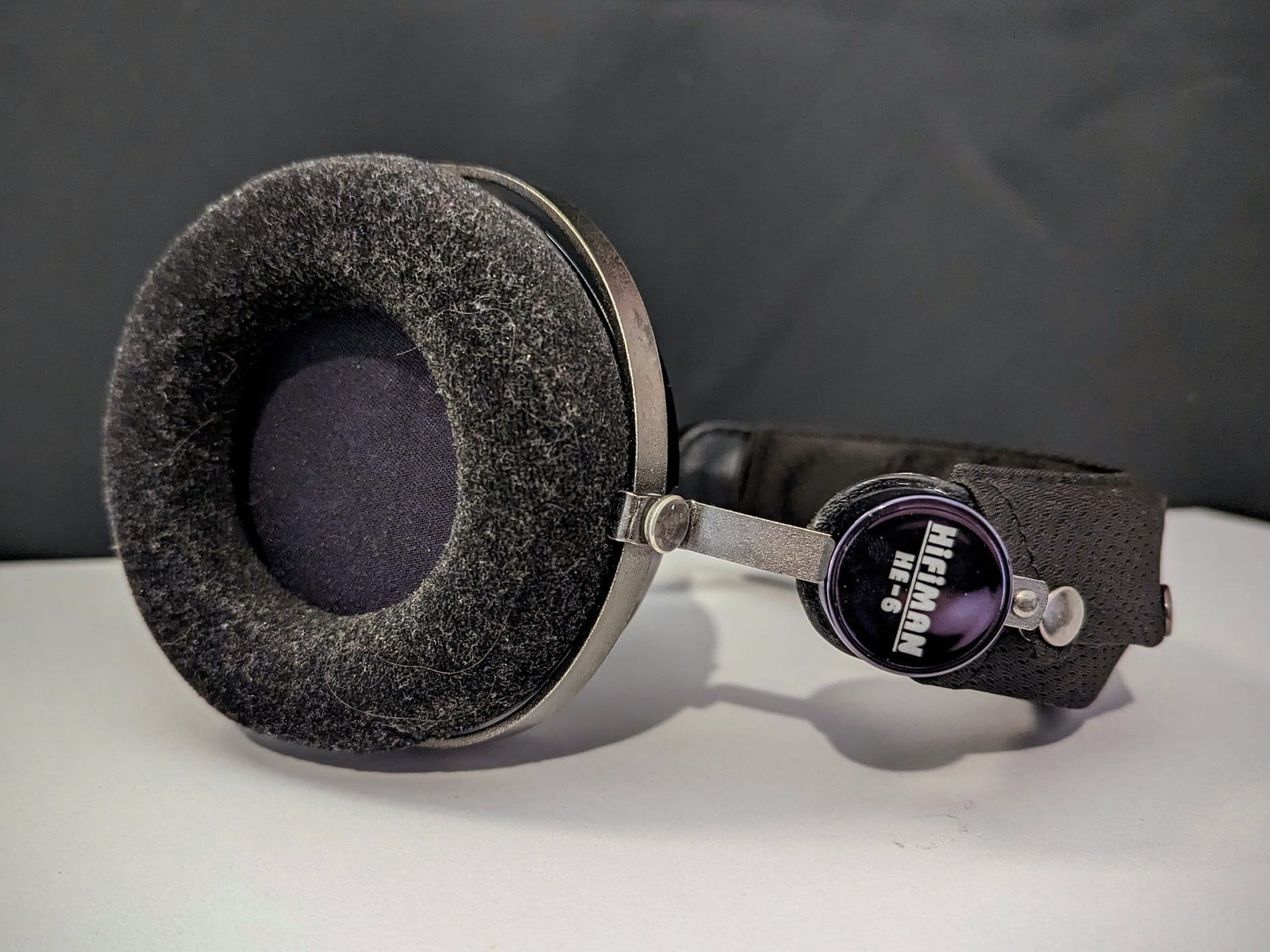
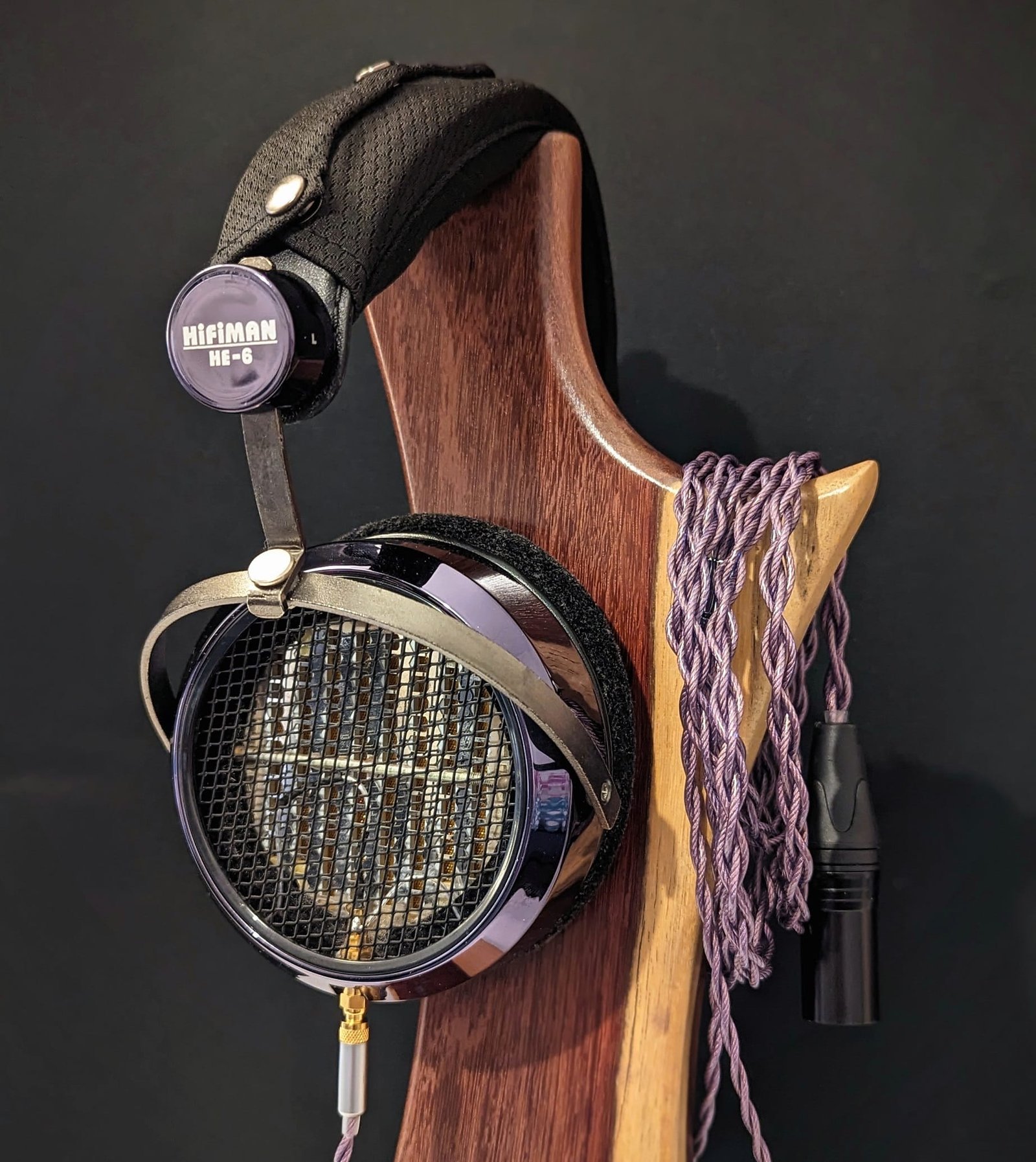
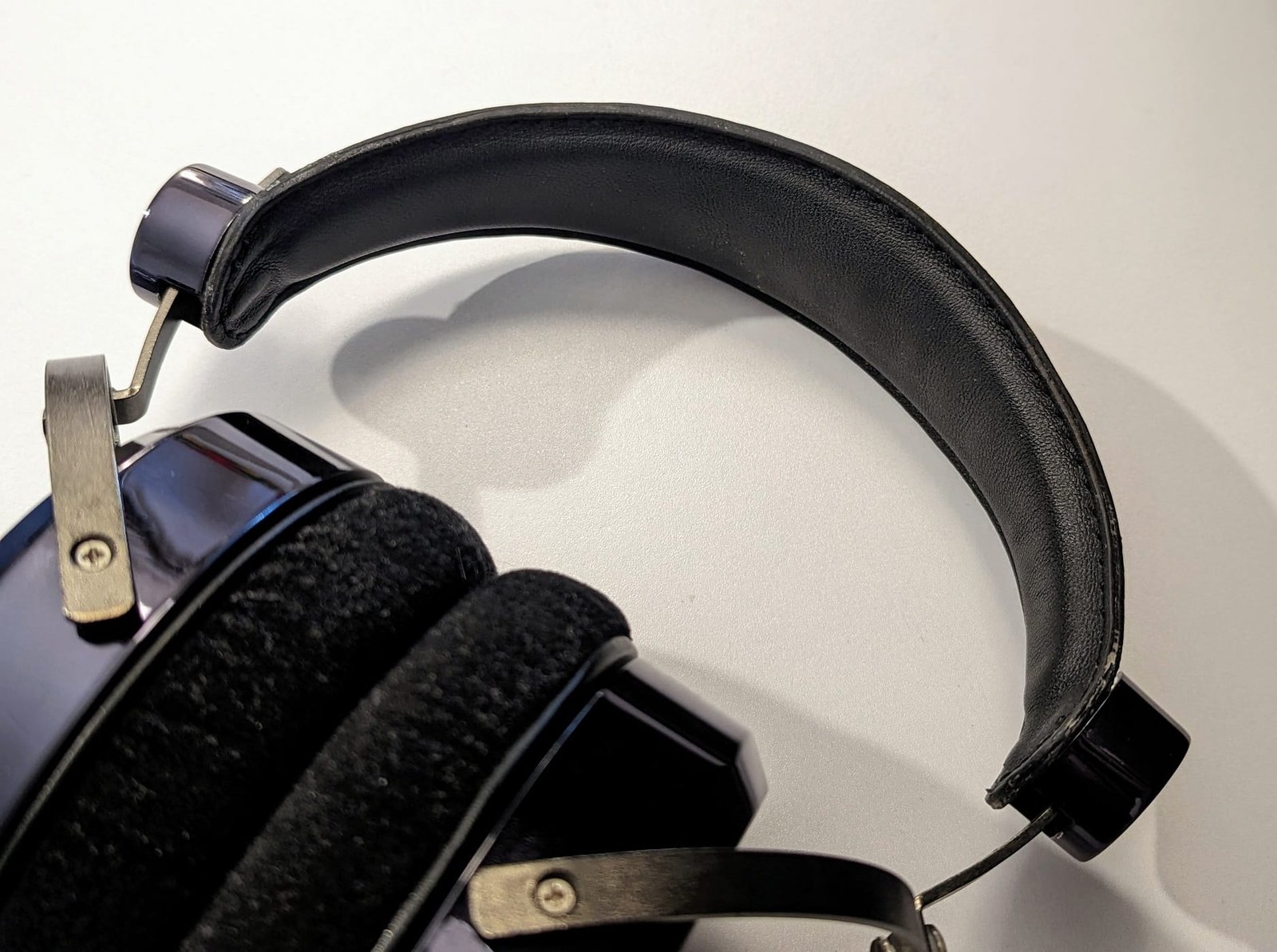
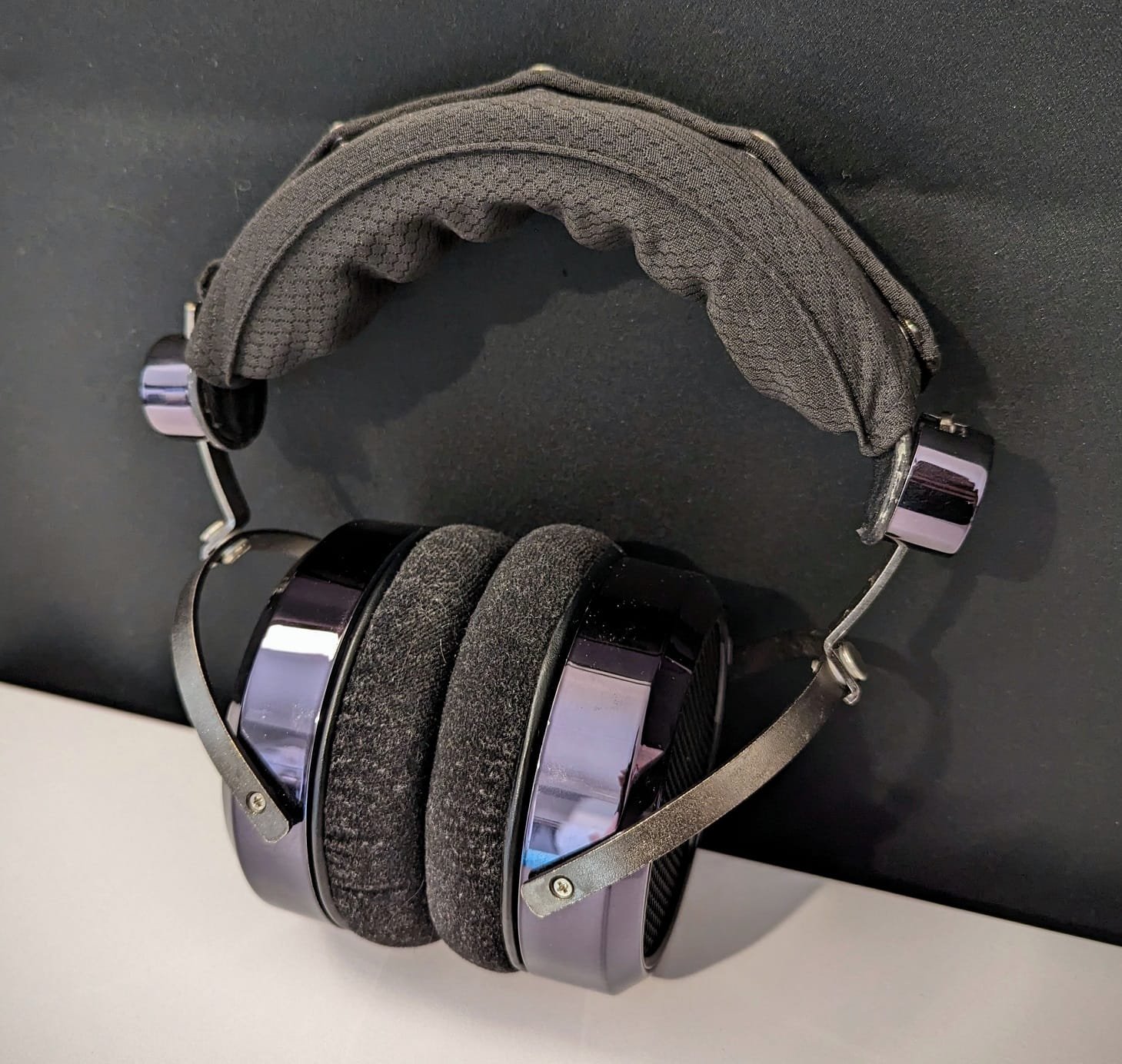
The HE-6's headband is covered with leather, but it is not particularly padded. Due to their 500-gram weight, the headphones feel quite uncomfortable on the top of the head. I have personally improved comfort by acquiring ZMF's Crescent snap -named additional padding, which attaches around the headband with snaps. With the extra padding, the only challenge is that the headphones barely fit my head when the height adjustment is at its maximum position. However, this makes using the HE-6 possible for longer periods at a time.
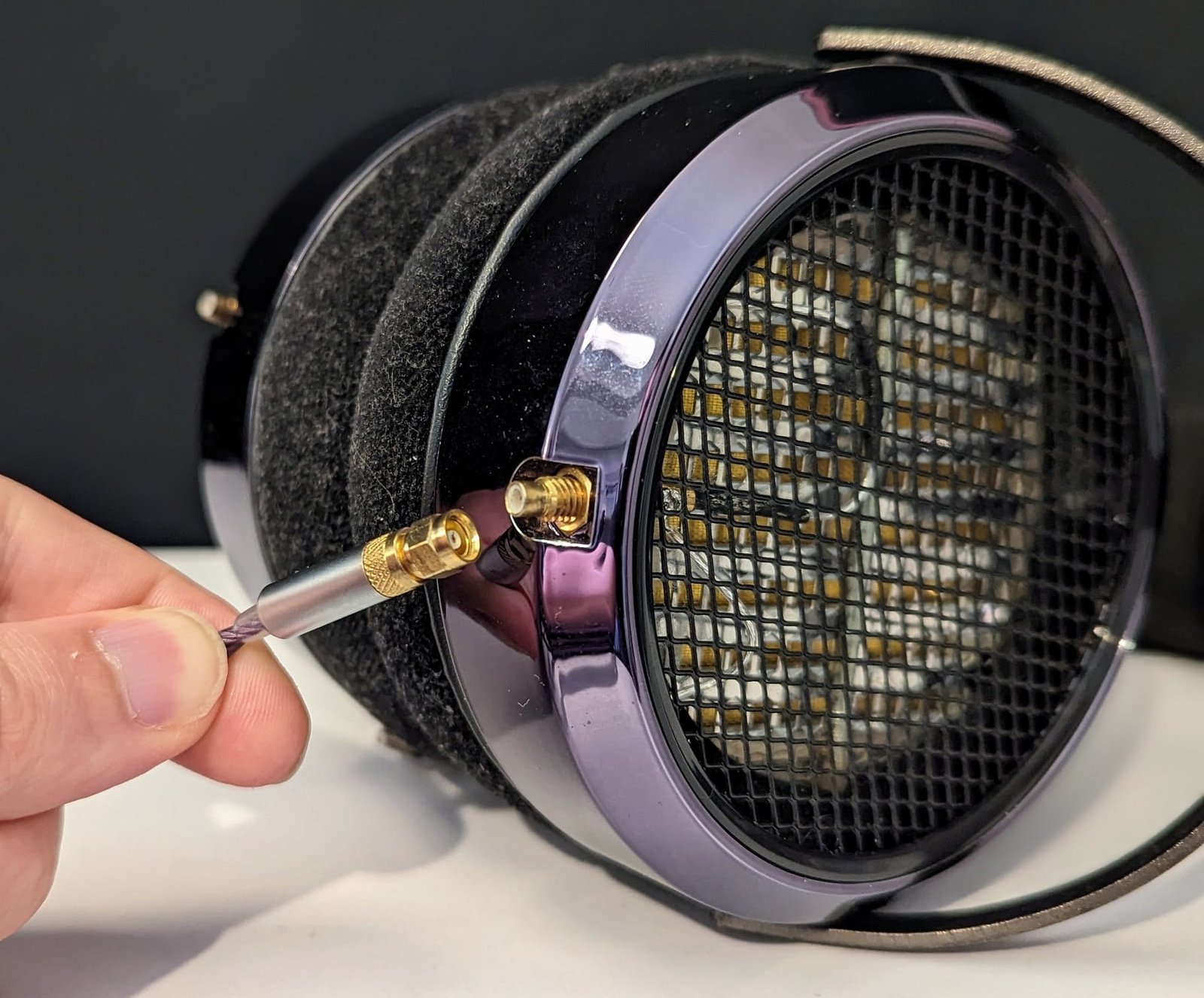
The HE-6 is from a time when Hifiman used screw-on SMC connectors in its headphones. These connectors resemble, for example, the attachment of Wi-Fi antennas on a computer motherboard or Bluetooth antennas in some DACs. I think the connector is completely stupid in headphones, but probably for that reason, the manufacturer eventually abandoned its use, moving to more traditional 2.5 mm and 3.5 mm connectors. Cables equipped with SMC connectors are still available for purchase, although to my knowledge, they are not used in other manufacturers' headphones, with the exception of some Chinese Music Masters.
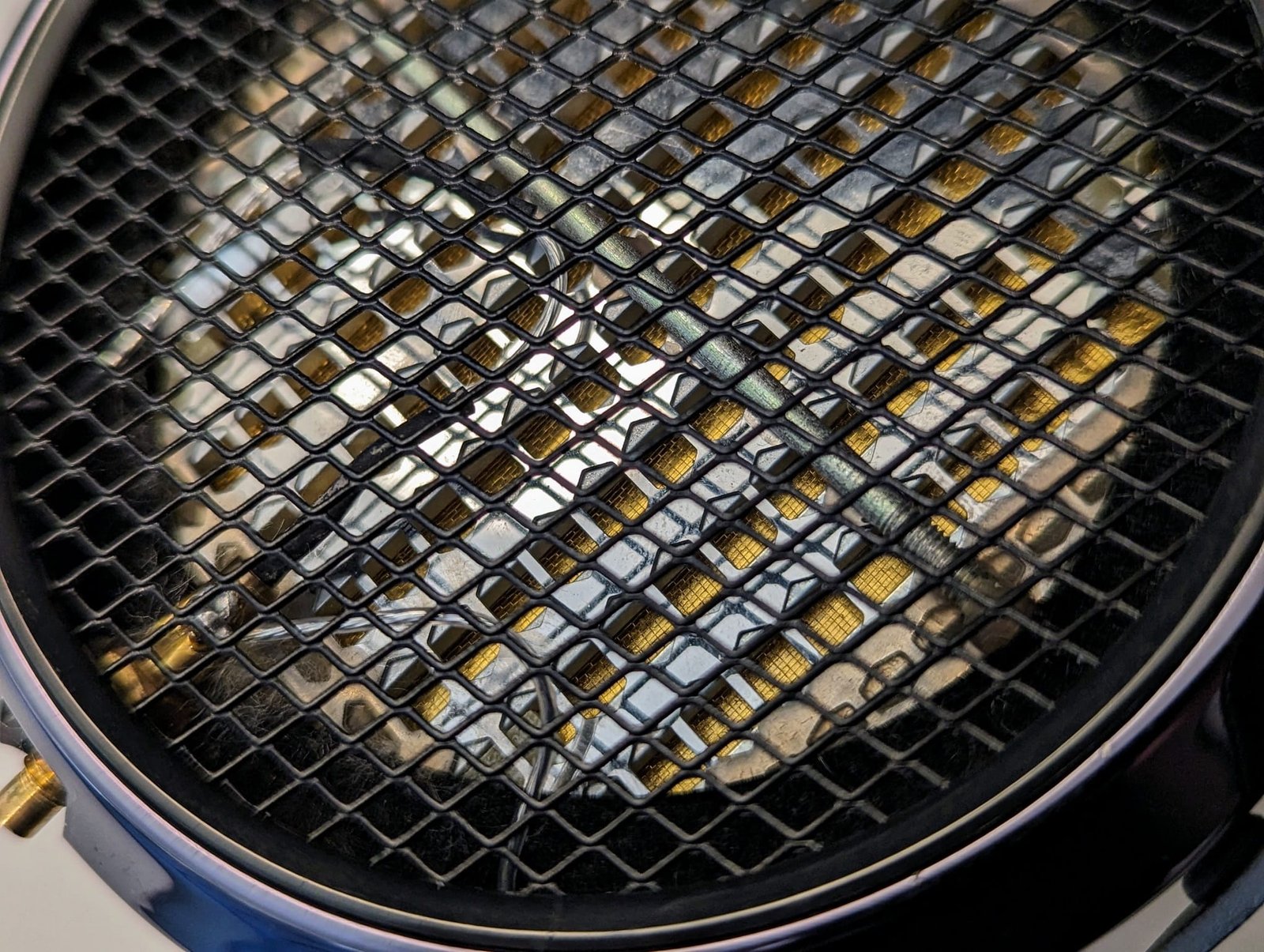
Under the headphone cup grilles, i.e., on the back side of the planar driver, the HE-6 model usually has a protective fabric and a layer of cotton, but removing them has been a recommended procedure from the perspective of sound quality. This has also been done in my own headphones, in addition to which more open metal grilles have been installed. This way, the unique gold-plated conductors of the driver are beautifully visible between the magnets. An original metal support bar has also been attached to the back of the driver.
Otherwise, the HE-6 doesn't win style points, especially due to its glossy cups that collect fingerprints, but the headphones have nevertheless remained in working order for about 10 years. At this point, I'm not particularly afraid of driver failure, but due to the poor quality headband and mediocre comfort, I use the headphones quite sparingly myself. Due to its poor quality, buying a used HE-6 is also a huge risk that I cannot recommend to anyone. However, it offers a listening experience that I believe every headphone enthusiast should get to experience.
Not just any amplifier will suffice, but there's no need to exaggerate anymore either.
Before discussing sound quality for the HE-6 series, we must talk about headphone amplifiers. The HE-6 is known, alongside the Susvara model, as the market's least sensitive and most difficult-to-drive headphone, with its stated impedance being 50 ohms and its sensitivity very low at 83.5 dB/mW, if not even significantly lower according to some tests. In enthusiast circles, there has been rare unanimity that the HE-6 should be listened to with an amplifier designed for speakers. The manufacturer itself even sells an adapter box for this purpose, costing about 100 euros.
Nowadays, however, headphone amplifiers are significantly more powerful than they were 10 years ago, so I consider the need for a stereo amplifier for Hifiman somewhat exaggerated. The headphones do require several watts of power for their impedance rating to sound good and lively, but tens of watts feel like unnecessary snobbery. For example, the one I use Cayin iHA-6 makes the headphones sound dynamic and controlled. With the HE6se V2 (a similarly difficult-to-drive headphone) that I previously tested, I also found Burson Audio Soloist 3X Performance to be suitable for such use.
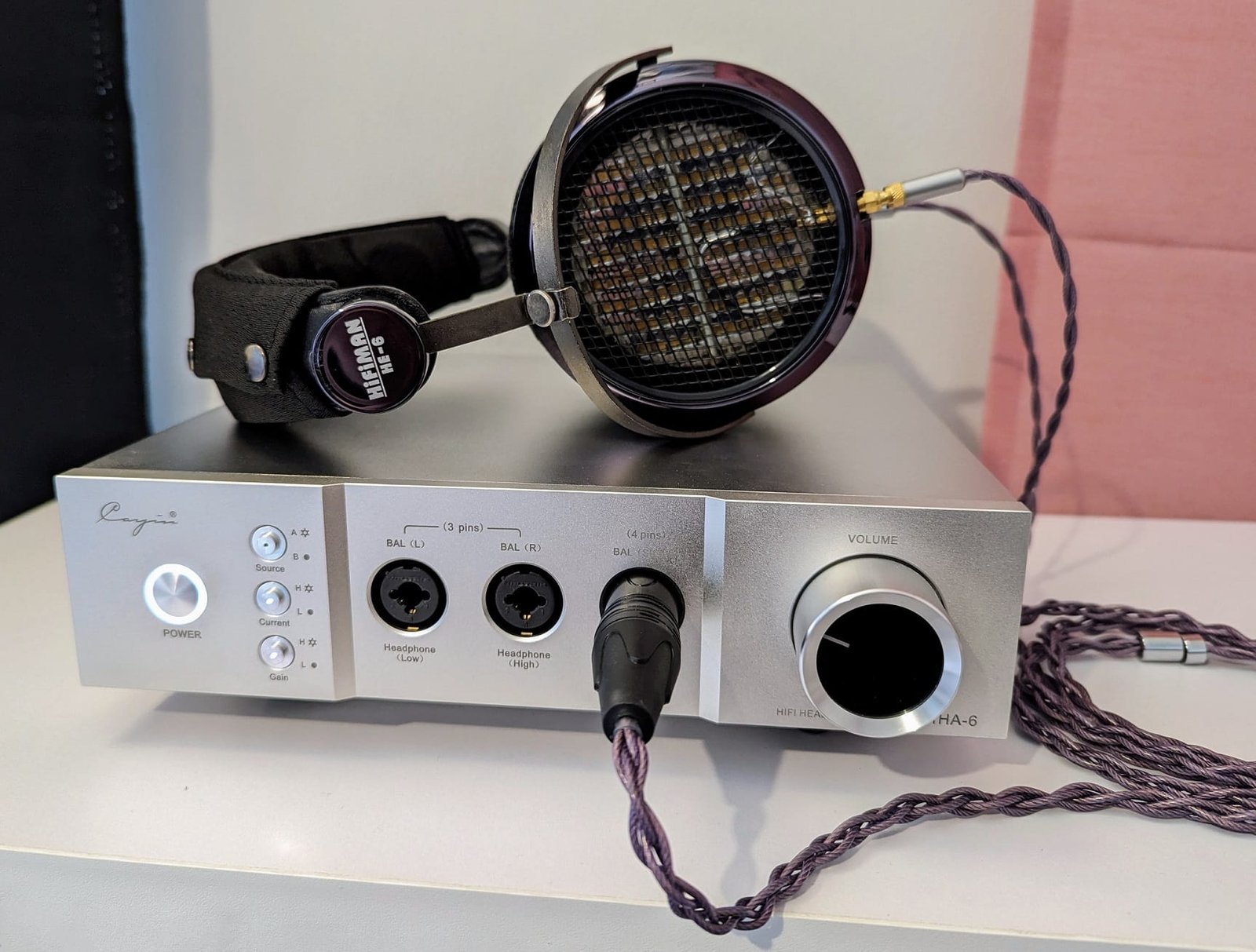
An amplifier that is too underpowered is most easily noticed by the sound remaining very soft and starting to distort even at low volumes. When listening quietly, softness can even be a pleasant thing, but the HE-6 is not supposed to sound like that. The description of sound quality I will give next will not be realized with small mobile amplifiers, and especially not with the headphone jacks of sound sources like mobile phones or laptops, from which the HE-6 can barely produce any sound.
Sound quality
The headphone frequency response measurements were made using IEC711 standard equipment and new, more accurate silicone ears (KB501X). The graphs use the scientifically based Harman target curve (2018 version) as a reference, which is a generalisation of the frequency response that most people think would sound good. For more information on the measurements and their accuracy, see Headphone Measurements-page. The frequency response of the HE-6 is also comparable with other measured headphones comparison tool .
My sound quality assessment is based on Hifiman's own 10-euro velour earpads, which happen to sound good, even though they cannot be called comfortable due to the rock-hard foam material. For example, Andrew Park (username Resolve) from the Headphone Show channel recommends Sundara earpads for the headphones, which would likely sound at least as good and be significantly more comfortable. In addition to the earpads, when reading my review, it's worth noting the grille mod made to my headphones, which changes the frequency response and sound more generally to some extent. I believe my own pair of headphones sounds slightly better than what the HE-6 would be by default.
I have been using the Cayin iHA-6, which I recently reviewed, as a balanced amplifier, while the DAC has been for most of the time Schiit Audio Bifrost 2. If anyone is interested in the manufacturer of the purple headphone cable flashing in the pictures, it is Chinese lunashops.com (also found on AliExpress).
Frequency response with velour pads and grille mod:
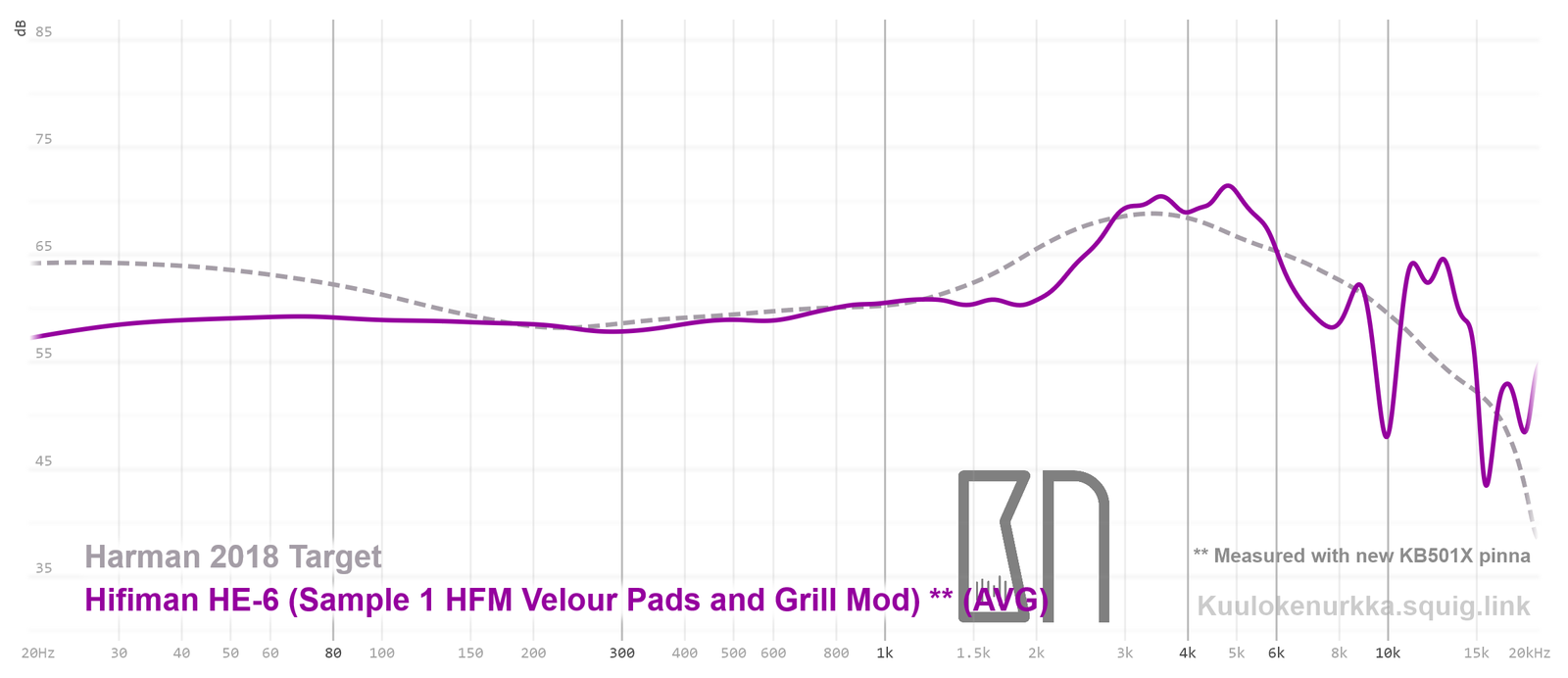
The HE-6 could be classified as neutral in its frequency response, like many other Hifiman headphones. The low frequencies are reproduced completely linearly, after which there is a small dip around 2 kHz, typical for the manufacturer's headphones, which in turn slightly widens the soundstage and the presentation of the mid-frequencies. The presence region, i.e., the 4–6 kHz range, is reproduced energetically in the HE-6, so the sound is present, if not quite intense. However, this is not actually a bad thing, but for me, part of the headphones' charm. Apart from a small unevenness, the treble is not too much for my taste, but despite everything, the HE-6 is a somewhat bright headphone, with which some recordings can sound heavier and more fatiguing than usual. This can be compensated to some extent by amplifier choice, as with more powerful amplifiers, the result is generally less fatiguing. The grille mod made to my own headphones also likely smooths out the high frequencies somewhat.
Although the HE-6 closely resembles Hifiman's newer headphone models in its frequency response, it sounds truly different. The HE-6 is incredibly dynamic for a planar headphone and in a certain way wildly primal. The sound has raw power across all frequency ranges, constantly making my hair stand on end and my hands grip the armrests of the chair. The presentation is so realistic in its vividness that many studio recordings genuinely sound like live music, and the emotional charge easily brings tears to my eyes.
The same impression is not created for me, for example, by the equally dynamic-sounding Abyss AB-1266, because its frequency response is nowhere near as natural. Hifiman's newer HE6se, on the other hand, gives a good taste of everything, but the original HE-6 does things even better. The only downside to the headphones, in my opinion, is that their intense and listener-activating sound can cause listening fatigue quite quickly, especially when the wearing comfort is poor at the same time. As long as I'm not too tired before listening, I still wouldn't trade an hour or two of listening for anything; the time spent with these headphones feels exciting from start to finish, time after time.
The HE-6's only secrets are not its wonderfully explosive and impactful dynamics and present tuning, but its sound also possesses a certain softness and organic quality. The headphones' credible timbre is, of course, still strongly influenced by a neutral frequency response without unnatural colorations. In addition, despite its rather conventional size, the soundstage is truly transparent and captivating. Many have described the spatial impression created by the headphones as concert-like, with which I agree. The presentation style is even somewhat speaker-like. Furthermore, the positions of sounds are reproduced very credibly, even if not the most precisely defined by current standards.
Overall, the HE-6 offers a truly impressive listening experience for which I have not yet found a perfect match in any price range. For example, Hifiman's 7000 euro costing Susvara is a quite different headphone, which I cannot unequivocally call better. The HE-6 is, in a way, a flagship headphone from a time when such headphones did not yet cost several thousands of euros. It is somewhat peculiar that no other headphone manufacturer has managed to make such a dynamic planar headphone for under 2000 euros.
Bass:
Based on the measured frequency response, the headphones don't have much bass, but this poorly describes the actual listening experience. The HE-6's bass hits exceptionally physically, as if the drivers were blowing air directly into my ears. For example, the growl of a bass guitar and the kick drum feel amusingly in the body. When listening to bass music, the sound pressure already increases at louder volumes to such an extent that it affects the regularity of breathing.
With a higher amount of bass, a fuller and more robust result can certainly still be achieved, as for example ZMF Caldera's sound feels pleasantly a bit heavier. However, I don't know another headphone that would be as explosive and powerfully impactful with linear reproduction as the HE-6. The bass of most other headphones feels really loose and downright lifeless compared to it. Generally speaking, headphones clearly wouldn't even need the amount of bass corresponding to Harman's target curve if their dynamics were at the level of the HE-6.
Midrange and Treble:
The mid-frequencies in the HE-6 are typical for Hifiman, as they lack a bit of energy around 2 kHz, while frequencies above that are reproduced more prominently. The presentation is clear and energetic – for example, female vocalists are reproduced sounding truly pure and effortless. However, in my opinion, the HE-6 differs somewhat from many other Hifiman headphones, as I wouldn't describe its sound as equally thin; instead, its mid-frequencies even have a touch of warmth. Nevertheless, the main attention when listening is focused on the intensely lively presence region.
With the HE-6, singers' voices irresistibly penetrate directly into my soul, and percussion instruments have a primal fury. The smaller details of other instruments, and the sheer power of the playing in general, constantly cause chills. In addition, the timbre is, in my opinion, natural and credible, with a relatively normal frequency balance. All of this makes the HE-6 sound truly powerful and lively. As a kind of downside, it also demands a lot from its listener and is not a particularly good choice for casual listening.
Treble:
There's no getting around the fact that the HE-6 is a bright-leaning headphone. It inevitably makes some recordings heavy to listen to compared to more relaxed headphones. Sometimes I also notice slightly emphasized sibilance, for example, when listening to pop music produced with energetic vocal performances. Despite everything, the HE-6 is still not, in my opinion, a particularly harsh or fatiguing headphone, because its upper frequencies successfully integrate with other frequency ranges. For example, in Sundara and Edition XS, the treble remains somewhat detached from the whole. In the HE-6, the heavily reproduced low frequencies also balance the upper frequencies excellently. The sound is indeed intense, but I never have to wince or turn down the volume when listening to the HE-6. Listening fatigue develops gradually rather than when listening to any specific type of music.
Partially, the tolerability of the HE-6's brightness is certainly also influenced by the fact that its treble is somewhat soft in style compared to more modern planar headphones. I personally don't consider this a huge negative, but critically evaluated, the quality, clarity, or separation of the upper frequencies doesn't quite reach the level of newer headphones. In this regard, Hifiman has also succeeded in developing its products to be better, although many of the HE-6's strengths have unfortunately been lost at the same time.

Dynamics:
Dynamics are definitely one of the HE-6's best aspects and still a truly rare strength in planar headphones. The headphones bring out the tempo of the music and the variation in playing intensity almost perfectly, regardless of the instrument. Music truly comes alive because the scale between quiet and loud sounds is realistic, not compressed-sounding, as in Hifiman's newer planar headphones, for example – though the Arya Organic and Sundara Silver I heard at Hifimessut seemed quite promising in terms of dynamics, so the situation might be changing.
With the HE-6, for example, percussion instruments are reproduced credibly because their attack sounds genuinely pop out in the overall presentation. In all instruments and the vocalist's voice, there is generally power when the situation demands it, as if there were no limits to their drive. As a rarer feature for headphones, even the quietest parts of the music feel powerful in their own way and easily give you goosebumps. Thanks to this, I feel I get more small nuances from recordings compared to most other headphones. The majority of headphones, after listening to the HE-6, feel quite lifeless and even emasculated.
On the other hand, this leads to the fact that with the HE-6, the quality of audio tracks matters more than usual. For example, MP3 files and material uploaded to YouTube easily sound flat and soft, so a large part of the headphones' potential remains untapped. When listening to high-quality material, the HE-6, however, truly comes into its own, sounding very dynamic and impressive.
Soundstage and Separation:
The HE-6 is also a special headphone in terms of its spatial presentation. Its soundstage is not significantly larger than average for headphones or extending far outside the head; instead, the reproduction stays relatively close. The presentation has an intimacy typical of headphones, essentially the best aspects of the Sennheiser HD 650. However, the HE-6's sound has more depth, so for example, a vocalist is not reproduced inside the head, but present as if in front of the eyes. Other sounds are placed evenly in the sound field, almost speaker-like in their openness and credibility. The captivating nature of the presentation is further enhanced by the fact that the sound feels in its intensity as if it were produced by a large wall on both sides of the head. The HE-6 sounds particularly fun at loud volumes, as the result resembles a live concert more than any other headphone I've tried. However, this can be dangerous for hearing in the long run, so I sometimes have to remind myself not to get too carried away with the volume.
The headphones somewhat resemble Abyss AB-1266, as I would guess I perceive some sound outside the headphones when listening to both. The drivers of both move air vigorously and leak upper frequencies outwards immensely. However, because the HE-6, unlike the AB-1266, sits tightly on the ears, no phase errors or other latency issues arise from some of the upper frequencies returning inside the headphones between the ear pads and the head. This, in my opinion, is a clear weakness of an implementation like the AB-1266, even though weakening the seal of the pads can enhance bass reproduction.
By current standards, the HE-6 is not the most precise in separating and positioning sounds, but individual sounds have a pleasant amount of empty space around them. This makes the headphones' sound clear and transparent, especially when supported by a successful frequency balance. It's effortless to follow the vocalist and each different instrument among others, and even more restless music doesn't confuse the headphones. With the HE-6, heavy rock, EDM, and classical music all sound impressive. The clarity and detail of the reproduction match significantly more expensive headphones, so I cannot say that paying more would yield a sound much more capable than the HE-6. For example, a calmer and more refined tuning could still resolve the situation in favor of many other headphone models. However, I would place the HE-6 in the same discussion as, for example, the Hifiman Susvara, Focal Utopian, ZMF Caldera, and Audeze LCD-R – that's how excellent it is.
Finally, I want to mention that the HE-6 also has an interesting way of reproducing the beginnings of sounds and transients with an almost emphasized sharpness, which in turn adds to the intensity of the sound. The reproduction is razor-sharp, so I can almost anticipate the music as I listen to it. At the same time, however, the latter part of the sound doesn't fade away too quickly, but its decay somewhat resembles dynamic headphone models. The result is quite exceptional. Hifiman's newer headphones lack a similar rawness and a certain old-fashioned quality, as they sound more refined and restrained. Both styles certainly have their fans depending on the situation, but the HE-6 makes a significantly greater impression on me.
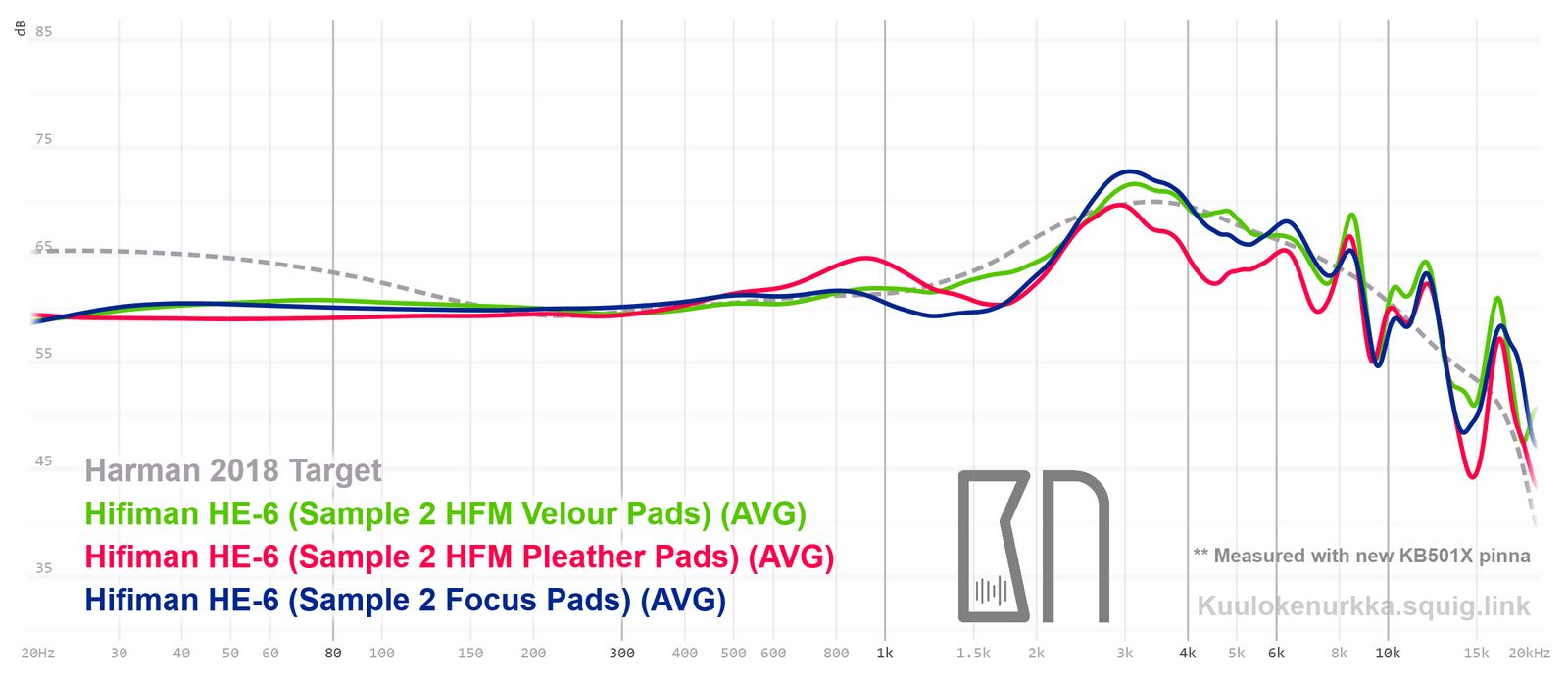
Frequency response with different earpads (measured with old silicone ears):
Comparisons to other headphone models
Although the HE-6 is already a slightly older product and is no longer sold new, I will quickly compare it to a couple of other headphone models I use. For the first comparison product, I chose ZMF's Auteur Classic headphones, because they fall into a similar price range of around 1500 euros. In principle, a more suitable comparison could, however, be an Audeze planar headphone, such as the LCD-X or MM-500. However, I do not have these, so I will use the LCD-R model, which has a fairly similar frequency response, as a second comparison. If and when I get to review Hifiman's Arya Organic model at some point, I will then also revisit the HE-6.
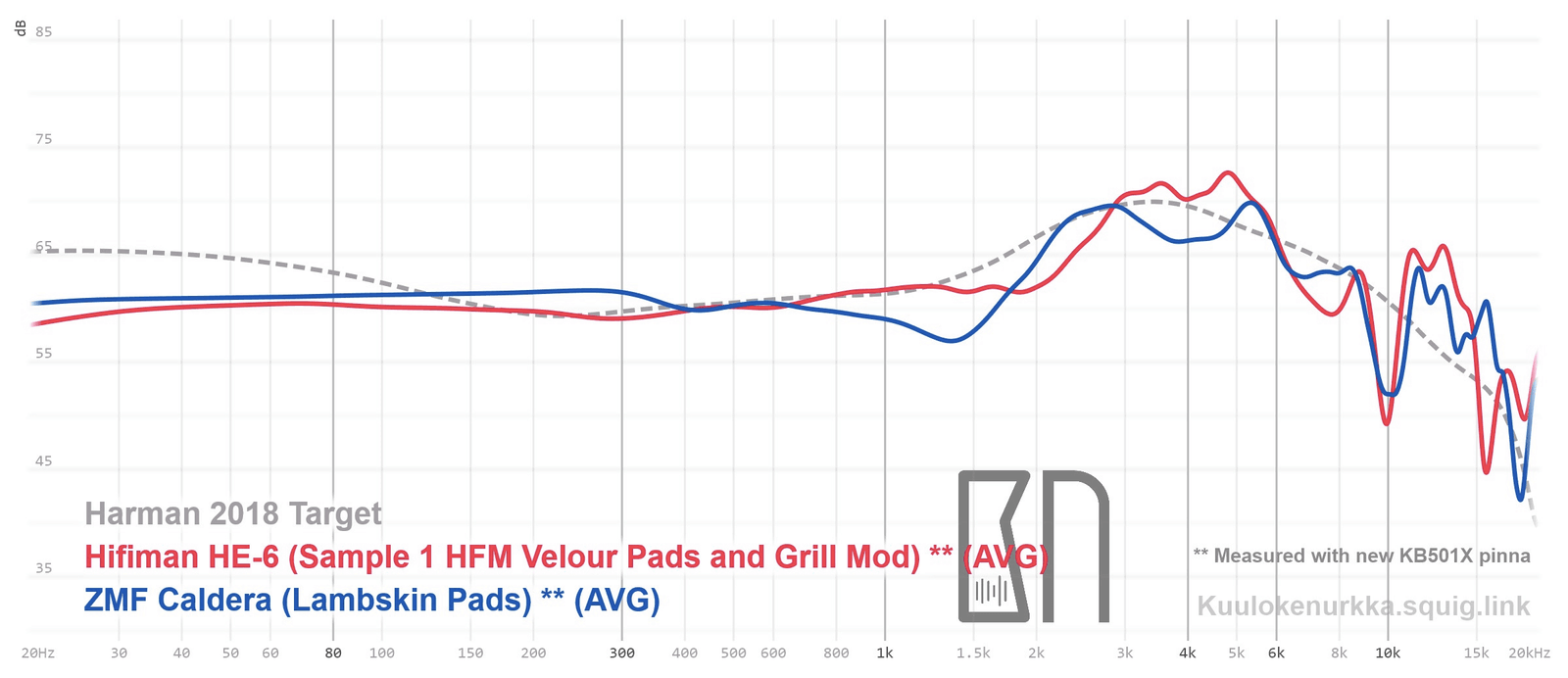
I had hoped to compare the headphones also to the ZMF Caldera I ordered in the summer, but unfortunately, it did not arrive before writing this article – sometimes schedules don't align perfectly. In any case, the HE-6 and Caldera have something distantly similar, as both sound dynamic for planar headphones, in my opinion. The HE-6 has more raw energy, while the Caldera is fuller in sound and in a certain way more mature.
Hifiman HE-6 vs. ZMF Auteur Classic
Prices: used 1000–2000 € vs. 1880 €
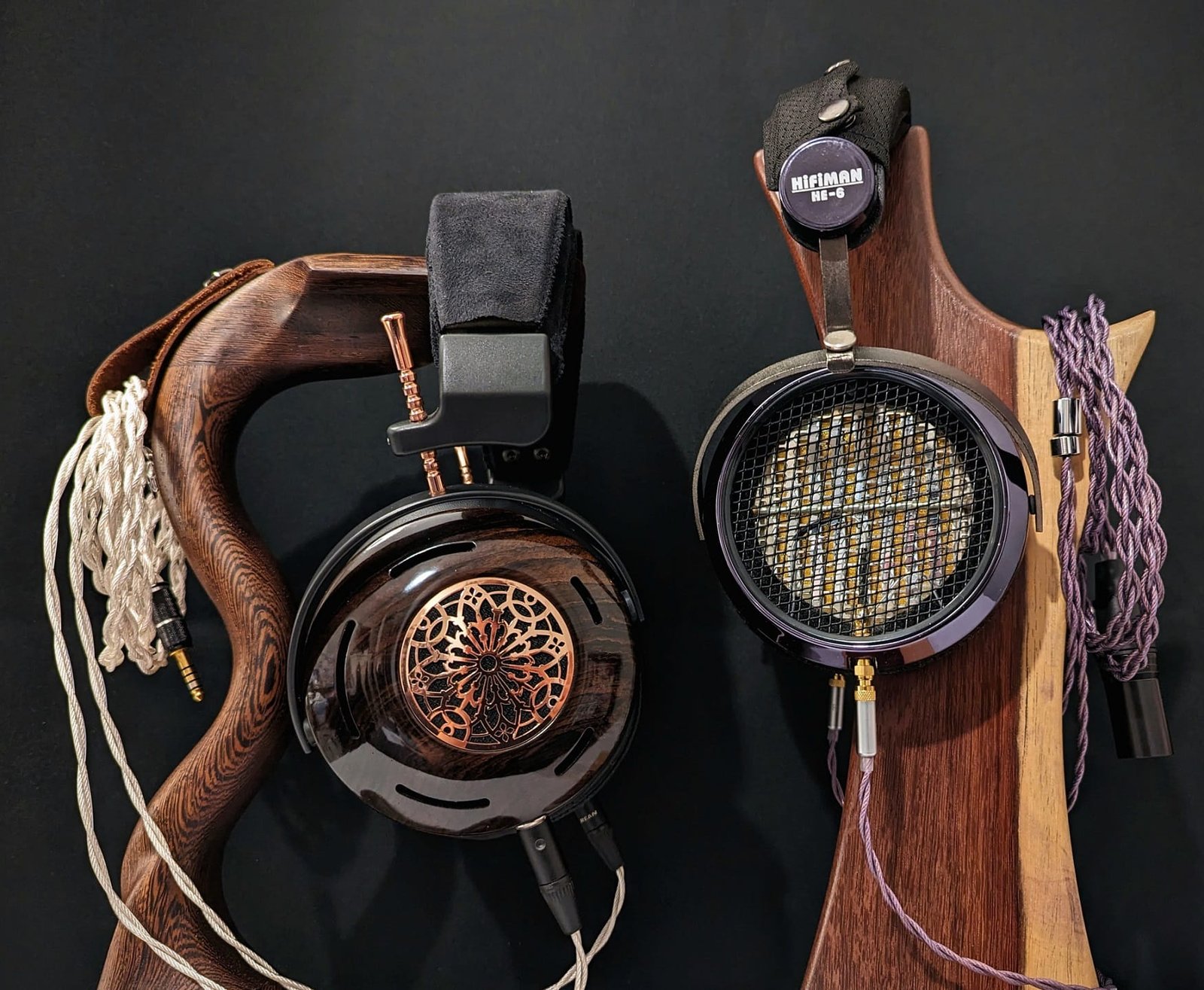
When handling Hifiman and ZMF headphones, it's clear which one pays for sound quality in addition to quality construction. The Auteur Classic has been made by a craftsman comparable to an artist, while the HE-6's exotic planar driver with gold-plated conductors is packed into shells that look like they were hastily made in a garage. My own Auteur headphones weigh 150 grams more, but using them is still clearly more comfortable. From this, it's worth moving on to discussing sound quality, as Hifiman's planar technology should have clear advantages over ZMF's dynamic biocellulose driver in that regard.
Headphone frequency responses:
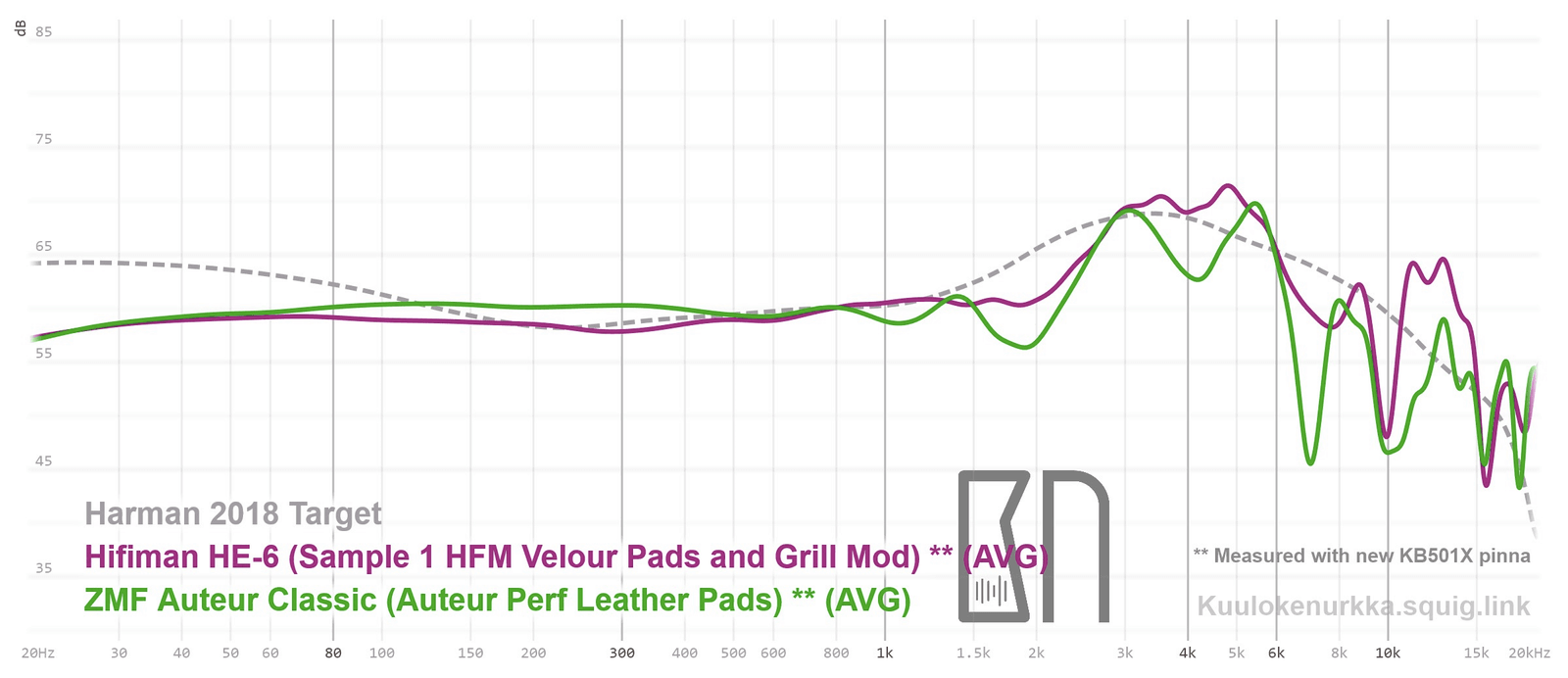
Both headphones are balanced and quite neutral in their own way. The Auteur Classic is clearly the calmer-sounding of the two (milder around 2 and 4 kHz) and fuller (stronger lower mid-frequencies), and its sound does not evoke as strong emotions or chills as the HE-6. Hifiman's reproduction is more present, especially in the presence region. It is also generally clearer in sound and more detailed thanks to its better separation and brighter treble. The soundstage of the headphones is also more interesting and transparent compared to the Auteur. However, the Auteur Classic reproduces the vocalist further away, so its soundstage feels slightly more spacious and less in-your-face. The sound also has more warmth than the HE-6, and it is more relaxing to listen to for longer periods.
Both headphone models clearly have their own style and represent their respective driver types well. When purely evaluating the impact of the reproduction, the HE-6 easily comes out on top by almost all metrics, whereas for more relaxed general-purpose headphones, the Auteur Classic would be better. For example, when tired, I wouldn't tolerate the intensity of the HE-6, but normally I would choose the Hifiman headphones about 75 percent of the time from the two, unless I feared them breaking in my hands.
Hifiman HE-6 vs. Audeze LCD-R
Prices: used 1000–2000 € vs. used 2000–2500 € (production of both discontinued)
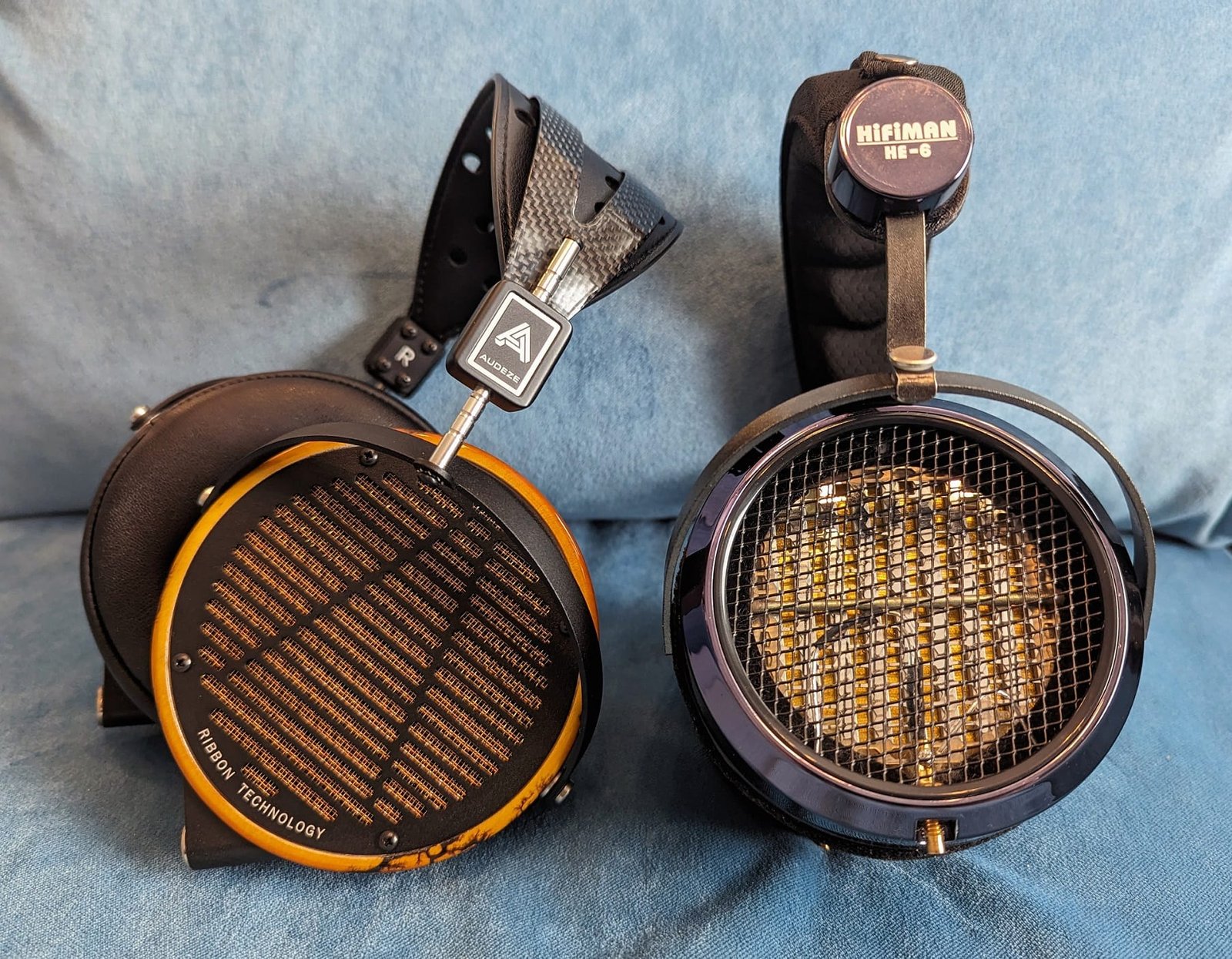
I have written a few times about the Audeze LCD-R model, of which only 70 units were produced. For this reason, it is not a particularly universal comparison in any situation, but the headphones do have a fairly similar frequency response to other products in Audeze's LCD series, with the exception of the latest LCD-5. The LCD-R has, among other things, been said to resemble the LCD-X model somewhat, but its exceptional planar technology ultimately makes it a unique product, especially concerning the upper frequencies.
Due to its 2-ohm impedance, the LCD-R requires a specially made amplifier, so using the headphones presents challenges similar to the HE-6. In terms of comfort, Audeze headphones weigh more, but they sit more comfortably on my head, and there's no need to fear them breaking. However, I must give a small minus for the fazor waveguides that touch my earlobes, which makes me not want to use the LCD-R for very many hours at a time.
Headphone frequency responses:
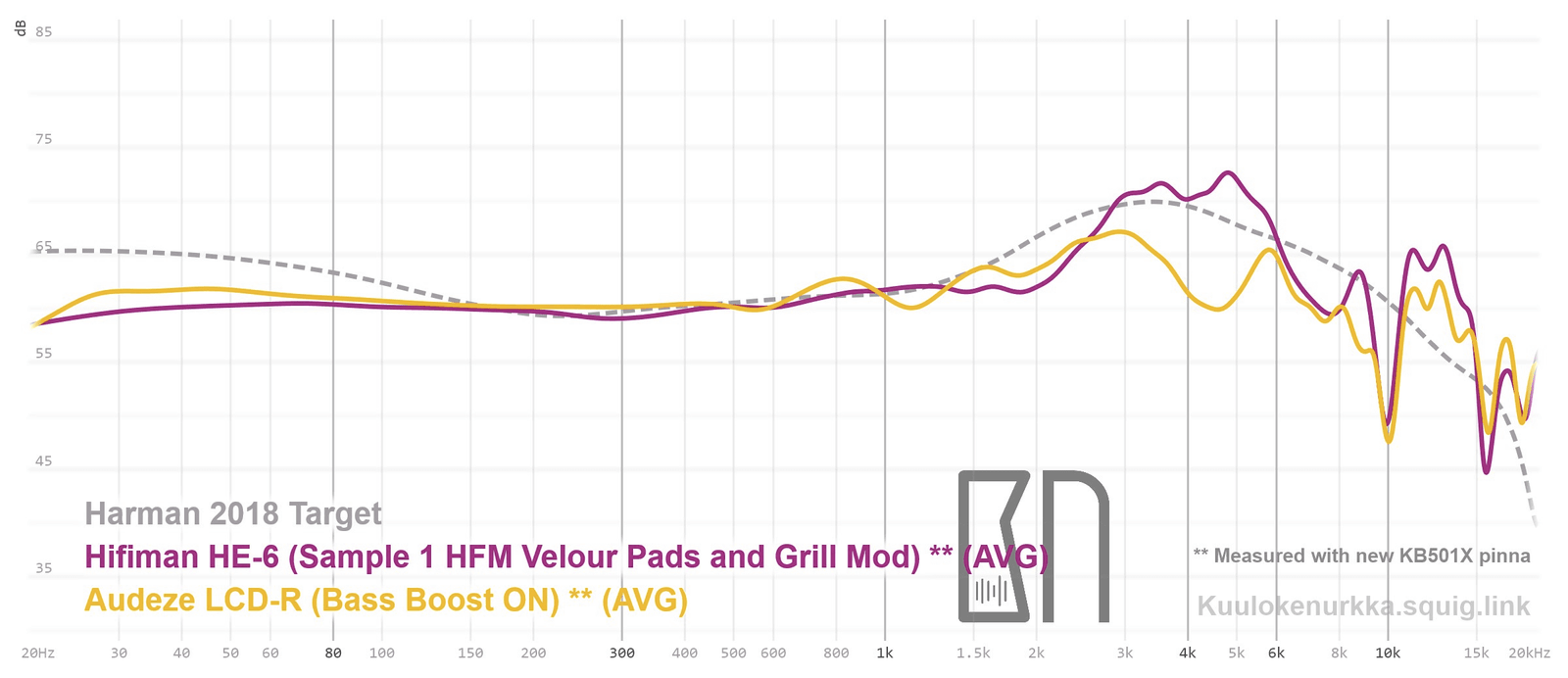
Interestingly, when measured with my own equipment, the HE-6 and LCD-R have surprisingly similar frequency responses from 3–except for a massive difference located between 6 kHz. Without the bass boost I activated for the Audeze headphones from the Schiit Audio amplifier, the low frequencies would be quite identical in quantity in both headphones. However, the HE-6 sounds both more impactful and more resolving in terms of bass.
Audeze headphones are clearly more relaxed in their upper frequencies, and I could even call them silky smooth. On the other hand, they bring out certain areas of the mid-frequencies more than the HE-6, so the lack of presence area does not prevent the headphones from being truly transparent and resolving in sound. I cannot name another headphone that brings out musical details as clearly with such a relaxed presence area tuning. The more other headphones I have heard, the more unique I have also come to consider the LCD-R's treble. The forward-pushing brightness manages to be perfectly smooth and even warmly effortless without being truly soft like the HE-6. No other headphone's treble has sounded similar, so it may be a result of unusual planar technology. The airy effortlessness and smoothness of the high frequencies are even unparalleled, as they do not fully resemble electrostatic headphones either. In other respects, I consider the HE-6 to sound more natural in its timbre.
The HE-6's presentation relies on sharper transient reproduction and a more present tuning. Nevertheless, I would count a certain edginess and precision as a virtue of both headphones. The HE-6 is the more dynamic and punchy of the two, while the LCD-R, due to its tuning, sounds amusingly fuller, drawing more attention to the low frequencies, at least with bass boost activated. The HE-6's soundstage is more spacious and speaker-like, as the spatial impression created by the LCD-R resembles a small bubble around the head, similar to other Audeze headphones. However, pinpoint accuracy might even be better than the HE-6, as the Hifiman model is not the most precise in sound placement by current standards.
Both headphones are unique in my opinion, but perhaps most importantly, I cannot say that the more expensive LCD-R is worse than the HE-6. The Audeze model might be slightly more detailed and more relaxed to listen to, while dynamics and soundstage are at a better level in the Hifiman headphones. Ultimately, the HE-6's more natural and lively tuning, as well as the more credible timbre of the mid-frequencies, make me more enthusiastic about it. On the other hand, the LCD-R serves as an excellent alternative, as I can listen to it more relaxed, and the reproduction does not become less detailed, but rather even slightly more precise. With this duo, I have been fortunate to own both. However, I recently sold the LCD-R to the next enthusiast. I probably wouldn't dare to sell the HE-6 to anyone, as I couldn't guarantee its long-term durability. Audeze headphones, on the other hand, always feel really high-quality and durable.
Summary
Hifiman's HE-6 is one of the most interesting and impressive planar headphones I have heard. It is also clearly the best headphone I have tested in its approximately 1500 euro price range – this is exactly how expensive headphones should still sound today! It is a shame that Hifiman itself or anyone else has not been able to make similar headphones since the production of the HE-6 was discontinued in 2015. In its time, it was certainly one of the most expensive headphones on the market, but by current standards, a price under 1500 euros has offered genuinely excellent value for money. Because the HE-6 is truly unique, a similar headphone with a proper build would probably easily cost over 3000 euros today.
Despite their excellence, the headphones are, however, a kind of ticking time bomb, because their construction is prone to breaking, and the durability of the drivers has not been the best either. The headphones are seen for sale used less and less often, and they are always a direct risky purchase that I could not recommend. On the other hand, I believe that every headphone enthusiast should get to hear the HE-6 purely for the reason that it would bring a new perspective to the hobby and the current headphone market. If someone still has a functional HE-6 and its intense sound is pleasing, they should hold onto it tightly. More modern headphones in its price range are not any better, but certainly different. The HE-6's intense presentation easily takes its toll, but listening is without exception a shaking and emotion-provoking experience that is missing from most other headphones.

Pros and cons:
+ Incredibly dynamic, punchy, and lively sound
+ Neutral frequency response
+ Physical bass reproduction
+ Engaging and credible soundstage
+ Resolution and clarity of reproduction match modern high-end headphones
+ Value for money has been excellent for its time
– Intensity of sound causes listening fatigue
– The treble is reproduced somewhat softly by modern standards, and it might be too much for some tastes
– Poor design in terms of usability and durability
– Requires a powerful amplifier
– Unusual SMC connectors complicate cable acquisition
 EN
EN  FI
FI