Author: Roderick

Table of Contents:
Information:
- Publication year: 2021
- Country of Origin: China
- Price: ~550 € (499 USD)
- Structure: open, over-ear
- Driver type: planar
- Impedance: 18 ohm
- Sensitivity: 92 dB/mW
- Weight: 405 g without cable
- Connector type: 2 x 3.5 mm
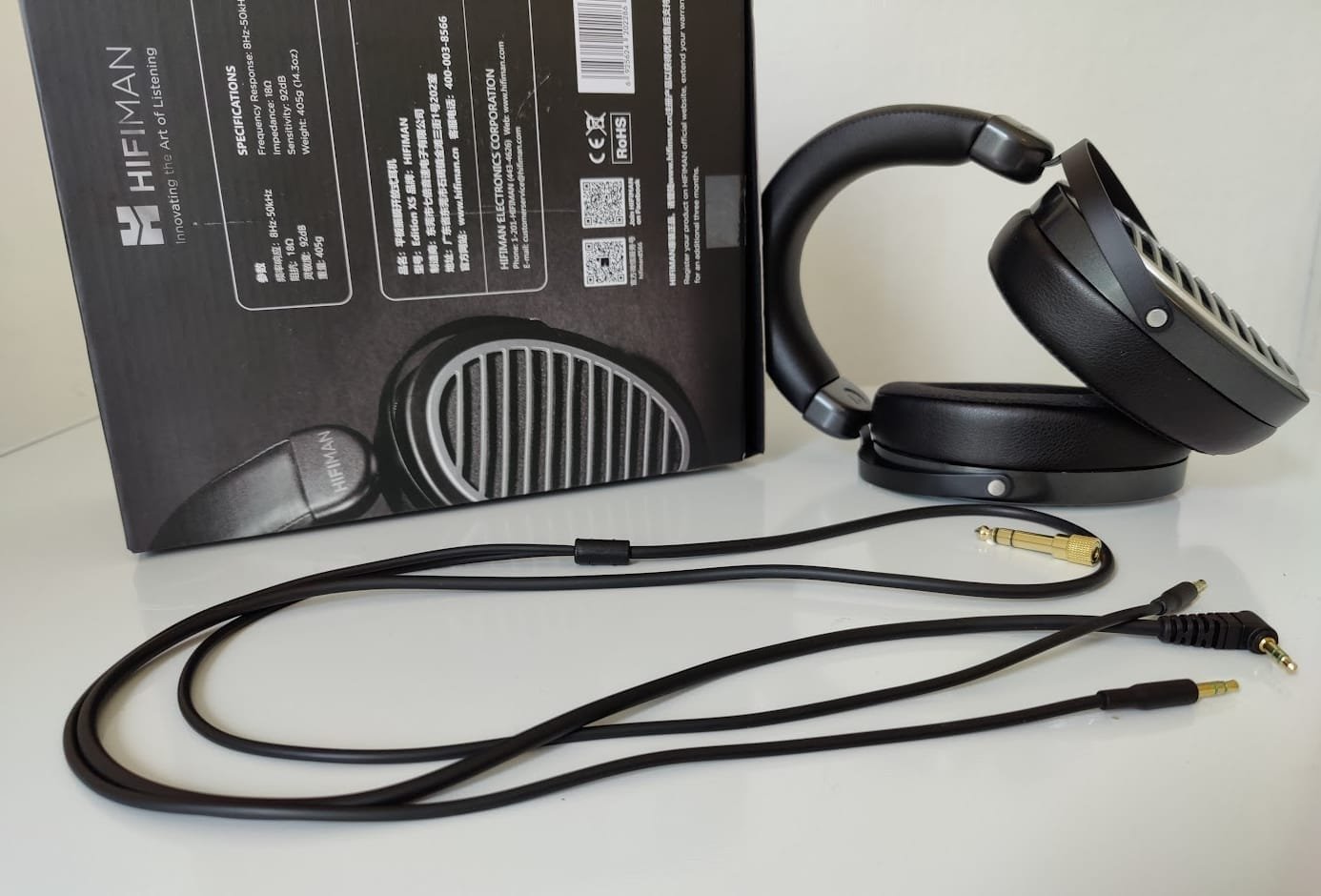
- Cable: 1.5-meter cable with 3.5 mm connector and 6.35 mm adapter
- Accessories: no accessories
Review unit acquisition method: Borrowed from a hobbyist
Edition XS (link to product page) is currently Hifiman's most affordable headphone model with an egg-shaped cup structure, as the structurally similar Ananda model now costs around 800 euros. Ananda (link to review) did not impress me much, as I found its sound too loose and soft. However, the headphones still have many good qualities, such as a wide soundstage and excellent resolution. I hoped that the Edition XS would bring these features to the sub-500 euro price range.
The Edition XS was initially released in October 2021 only for the Chinese market. At that time, the headphones cost 430 dollars. However, much has changed since then, as the price of the headphones rose to 500 dollars after the international release, or 550–600 euros with European pricing. By hunting for offers, however, the headphones can be found a little cheaper.
Structure and comfort
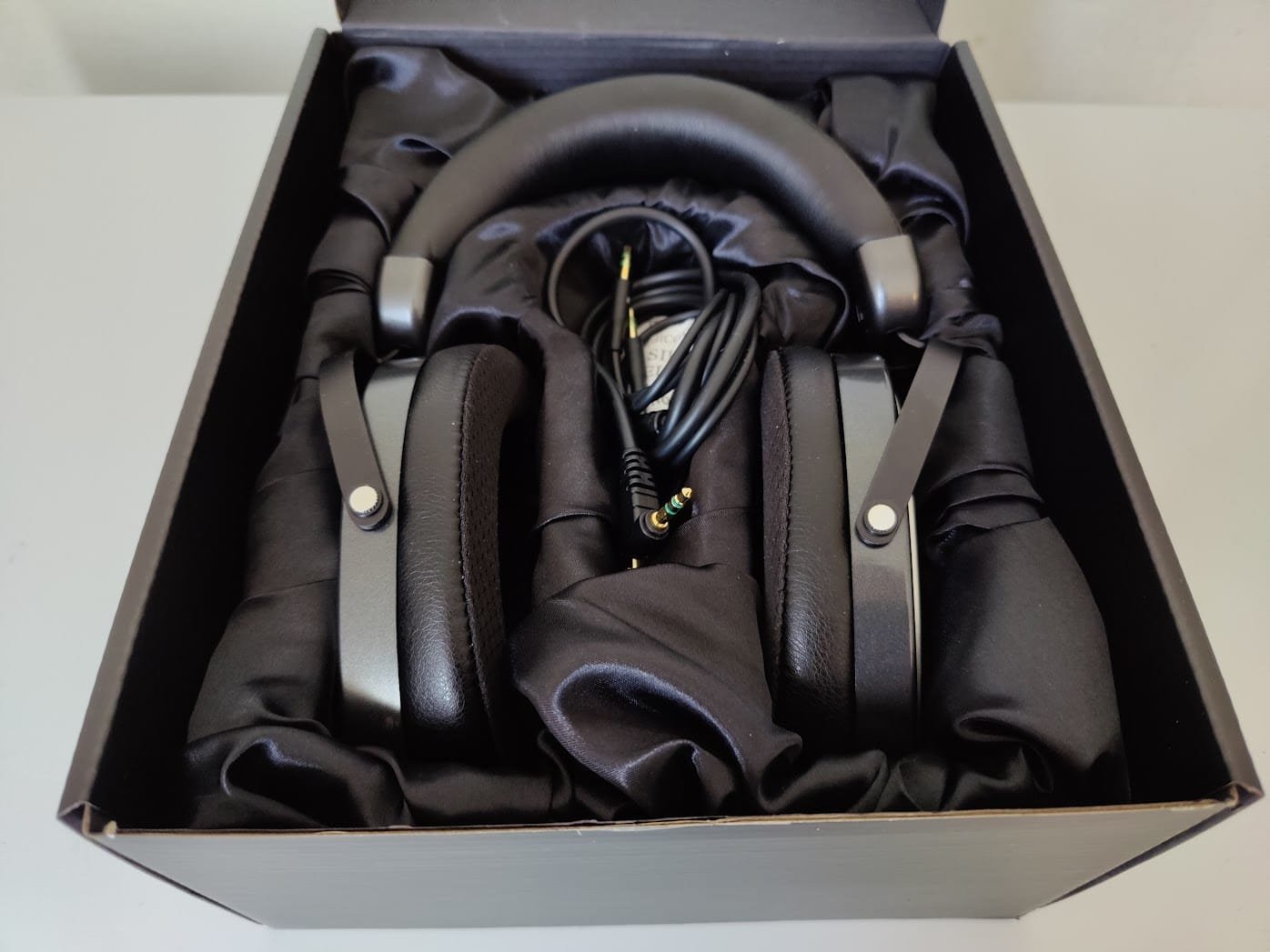
There is not much to mention about the headphones' packaging or the unboxing experience. The cardboard box is similar to other Hifiman headphones costing under 2000 euros. As usual, the manufacturer does not include any accessories with the headphones.
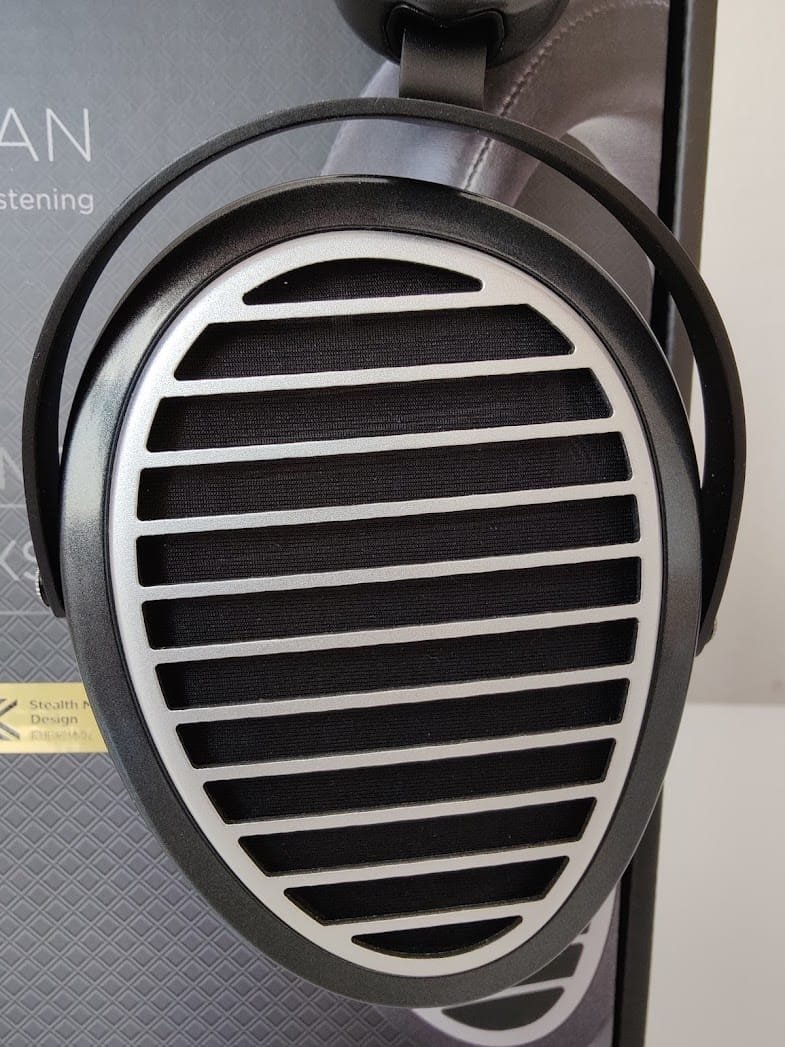
The lack of surprises continues when examining the headphones' structure, as the headband design is familiar from many other Hifimans. However, the structure is functional in terms of adjustments, so the headphones adapt well to the user's head shape. For comparison, the Sundara and Ananda headbands problematically lack any horizontal movement for the cups.
The Edition XS's headband padding is a bit hard, but it does not cause problems due to the headphones' relatively light weight (405 g). About 100 grams heavier HE6se V2 feels significantly more uncomfortable with a similar headband.
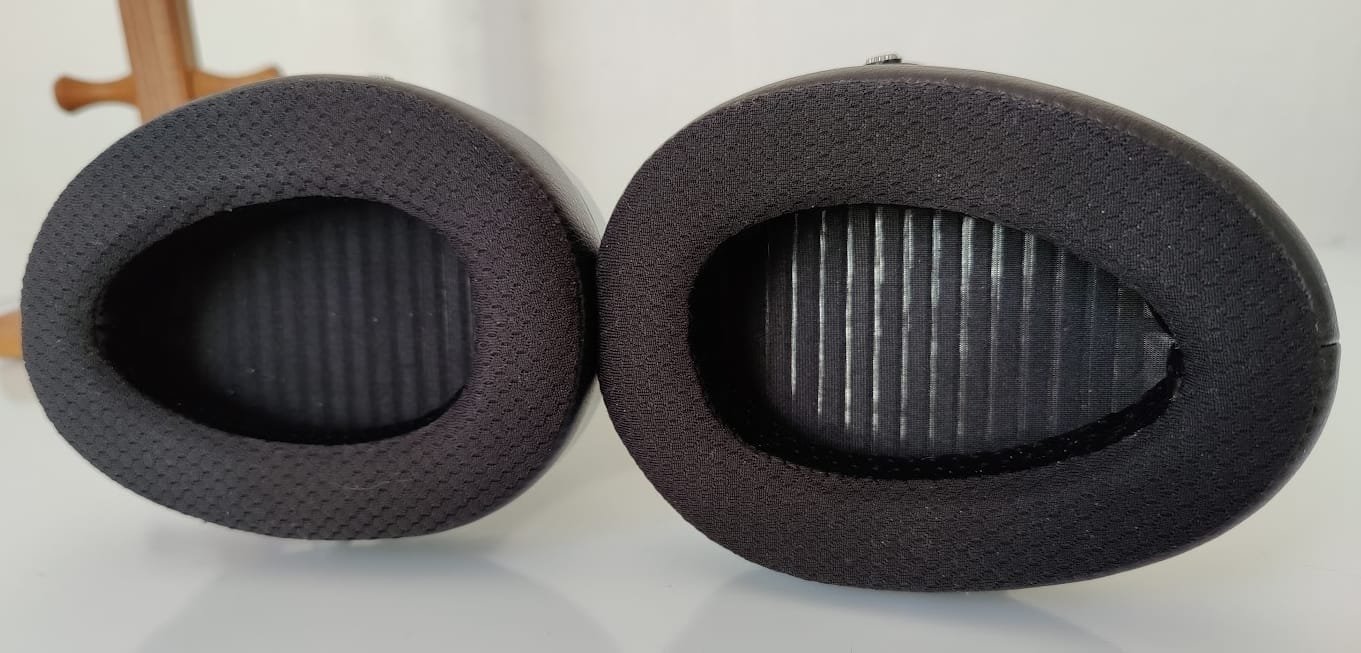
Because the headphone cups are huge, the ear pads are also large – there is ample room for the ears. The smooth fabric coating of the pads feels pleasant against the skin. The material is the same as in most other Hifiman headphones.
Despite the headphones' light weight and comfortable pads, the wearing comfort is still not perfect for me. The headphones feel even too large on my rather small head. Therefore, I cannot recommend the Edition XS or other egg-shaped Hifiman headphones for those with small heads, but for those with larger heads, they are likely one of the most comfortable options on the headphone market.
In summary, the Edition XS largely meets my expectations in terms of construction and wearing comfort: functional and comfortable, but in a manner typical of the manufacturer, boring and feeling cheap for its price.
Soundquality
Headphone frequency response:

Bass:
The headphones meet my expectations with their bass quantity, as there is almost always enough bass, but never too much for my taste. Especially the very lowest frequencies reproduce convincingly. With energetic music, the Edition XS keeps up reasonably well, but despite the apparent ”speed,” the bass reproduction sounds a bit monotonous. The bass does not hit with immediate force but reproduces in a rounded manner, leaving the initial impact of the note lacking. Somewhat contradictorily, the bass thus sounds fast, but also sluggish and even dragging, because the reproduction lacks punch and power. This is, in fact, to varying degrees typical for all Hifiman headphones implemented with a similar driver and cup structure.
Central votes:
In its mid-range, the Edition XS is familiar Hifiman, as the frequency response is very similar to most other headphones from the manufacturer. The sound is clear and framed by a softness achieved with a slightly smoothed and attenuated 1–2.5 kHz tuning. The presentation is functional, but not particularly interesting to listen to. The hairs on the back of your neck don't stand up, your eyes don't water, and the air guitar stays in the closet. However, the positive aspect is that no frequency range is overbearing or feels severely lacking. The headphones sound colorless, for better or worse.
Treble:
To my ears, the headphones' high frequencies are almost perfectly balanced. If I had to find something to complain about, the highest frequencies could have a touch more airiness. However, the overall presentation works excellently because there are no major emphases or dips noticeable in the treble. The sibilance of more affordable Hifiman models and the occasional harshness of some pricier models have been successfully avoided. The reproduction of high frequencies is not particularly resolving, but considering the headphones' price range, there's nothing to complain about.
Soundstage:
The Edition XS is a slight disappointment for me regarding soundstage size. Based purely on memory, I would argue that the HE5XX and Ananda have larger soundstages. The reproduction is also not speaker-like, as with the old HE500 model. However, I can by no means describe the soundstage as small, because the Edition XS feels larger than the manufacturer's own Sundara model, Sennheiser HD650, or Audeze LCD-2 Classic.
Furthermore, the placement of sounds is quite precise. The headphones cannot achieve the pinpoint imaging of more expensive Hifiman models or, for example, the Focal Clear, but in the approximately 500 euro price range, the performance is excellent. The depth-wise placement, in particular, impresses me. The vocalist separates from the background better than with any other headphone I've heard in a similar price range.
Resolution and tonal transparency:
The Edition XS is not a detail-emphasizing headphone, although the experience of headphone detail is generally a completely subjective matter – there is no standard for detail whatsoever. In my opinion, resolving headphones are those with which it is easy to analyze individual sounds and especially their structure. With good headphones, one hears how a sound is formed, how it is produced, and how naturally the sound appears and disappears. At this point, the Edition XS stumbling a bit. When listening, individual sounds never draw attention to themselves, nor do individual instruments ever impress by sounding exceptionally excellent.
Because the headphones are quite calm in their dynamics, the need for excellent resolution is emphasized. In my opinion, listening can be interesting either due to the small nuances and details of the reproduction or due to effective rhythm and dynamics. Since the Edition XS does not fully succeed in either, listening to the headphones is not a particularly thrilling experience.
Although I may seem very critical, I still want to emphasize that the Edition XS is not bad for its price in terms of resolution either. Progress has been made from the more affordable Hifiman models. The sound background is quite dark, and no significant veiling is audible. I can't readily think of headphones in a similar price range that would be better than the Edition XS in terms of resolution. This is partly due to the fact that the headphones don't have actual competitors, as the offering in the 500–600 euro price range is quite non-existent.
Dynamics:
I already mentioned that the Edition XS is quite calm in terms of dynamics. The macro-dynamics are so subdued that it bothers me a little, but not so much that I would condemn the headphones as bad because of it. Weak dynamics are clearly audible across all frequency ranges – it is most evident in bass reproduction, which lacks punch. In addition, the midrange does not react precisely to changes in a vocalist's intensity, and at higher frequencies, for example, drum cymbals sound overly restrained, even though the frequency response of the upper frequencies is pleasant. Small changes in tempo and volume tend to get lost under more prominent sounds.
Confirmation
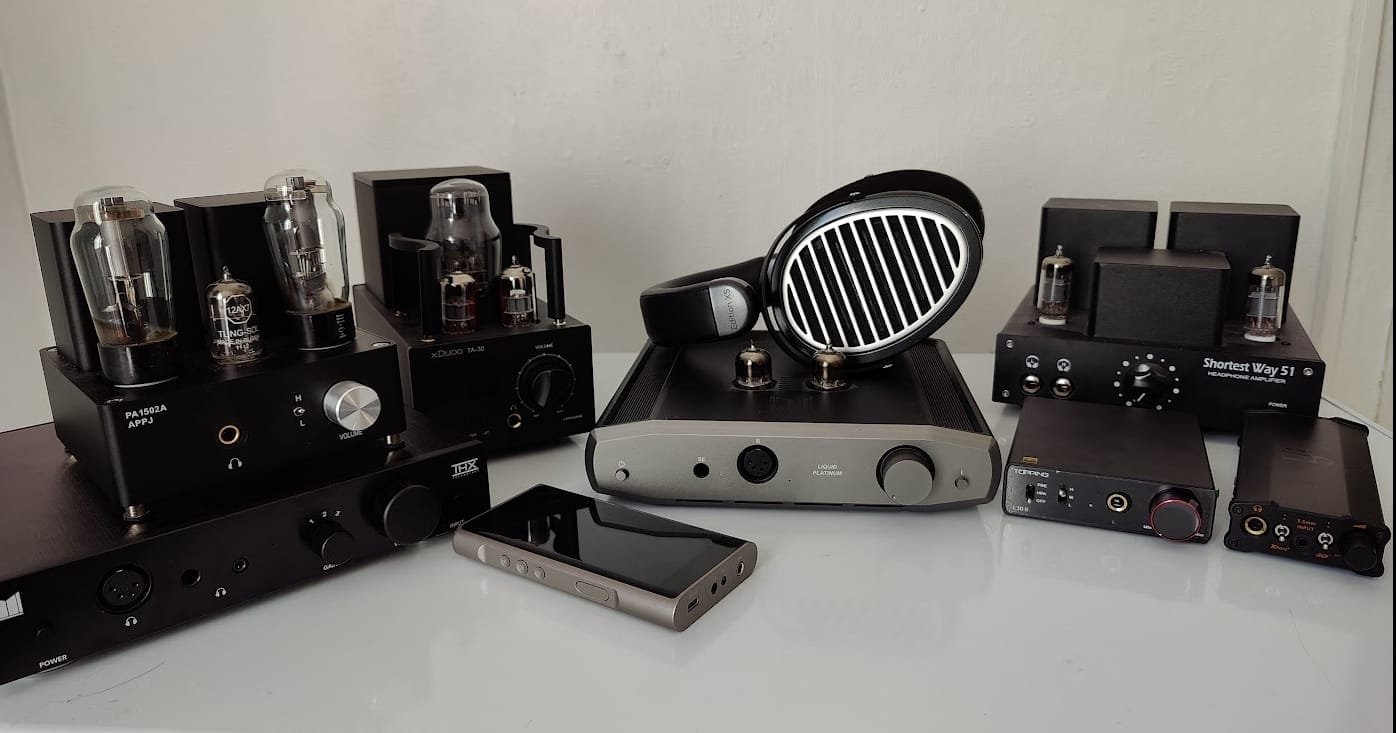
Despite its low impedance (18 ohm) and relatively low sensitivity (92 dB/mW), the Edition XS is not very picky about the amplifier. The headphones play loudly from almost any audio source, even though I assumed they would require more power. I was not able to test the headphones with a phone, low-power dongle-type devices, or an OTL tube amplifier. However, I assume that the result would not be optimal with them, especially for listening at high volumes.
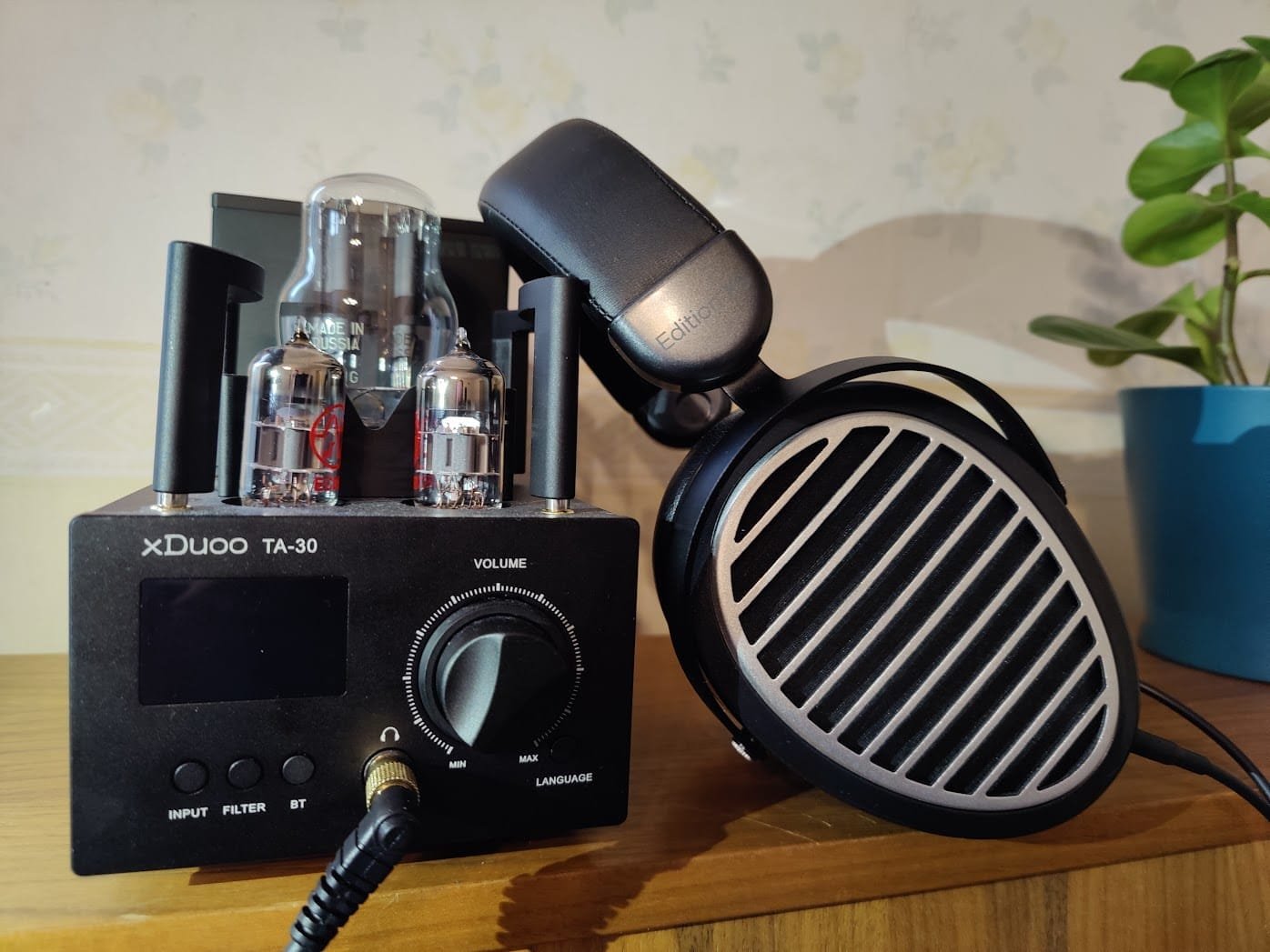
My favorite amplifier for these headphones is the xDuoo TA-30, a powerful tube hybrid that boasts an exceptionally wide soundstage. I haven't considered the amplifier particularly good in terms of macro-dynamics, but it still manages to bring a lot more punch to the Edition XS's reproduction. Another tube hybrid I own, the Monoprice Monolith Liquid Platinum, also works quite well. It is more precise in sound than the TA-30, but the headphones are not at a level where the amplifier's resolution would become a bottleneck. The more colored TA-30 pleased me more this time, even though I usually prefer the Liquid Platinum.
In light of the measurement results, the excellent Monoprice THX AAA 887 and Topping L30 II sounded reasonably good, but to my taste, they didn't do anything that would have at least improved the headphones' sound. It was also peculiar that the Monoprice and Topping amplifiers sounded identical with the Edition XS. With a few other headphones, there were quite clearly noticeable differences in the sound quality of the devices, favoring Topping.
Somewhat surprisingly, the Shortest Way SW51 SET tube amplifier also suited the headphones quite well, even though the result was a tad soft and undynamic. There wasn't much power reserve left either. The APPJ PA1502A tube amplifier I recently acquired has proven to be a good match for Audeze planar headphones, but the Hifiman sounded a bit bodyless with it – the mid-range was harsh, and the dynamics were not on the same level as when listening with the xDuoo. Despite its shortcomings, the APPJ, alongside the Liquid Platinum, is the amplifier I would most likely choose for my use if the TA-30 were not available.
The IFI Micro iDSD USB/battery-powered amplifier performed admirably with the headphones, but didn't offer any major thrills. I can say the same about the Shanling M6 Pro mobile player, whose power from the balanced output was quite sufficient.
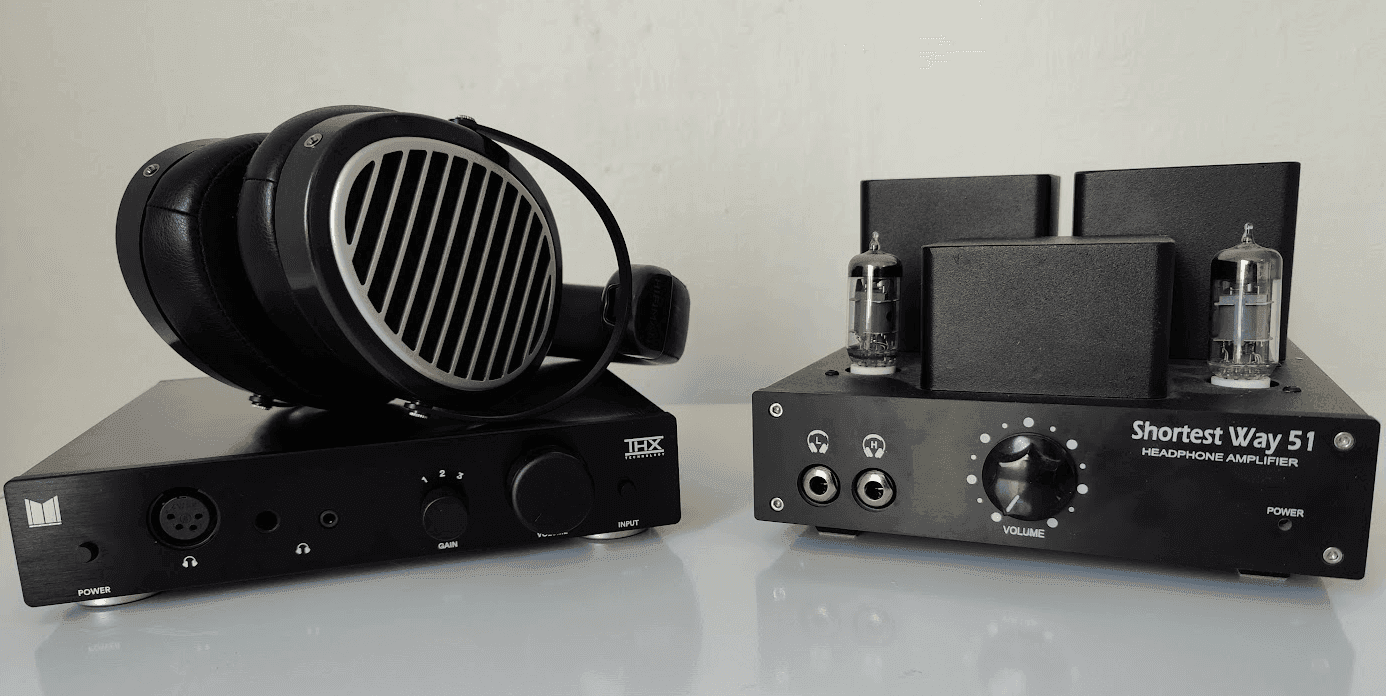
The Edition XS is therefore easy to pair with almost any amplifier, so those acquiring their first hi-fi headphones don't need to stress about getting a suitable amplifier. I couldn't make the headphones sound very bad with any device, and only the xDuoo TA-30 stood out from the other devices with its clearly more pleasing sound.
Comparison to other headphones
Hifiman Edition XS vs. Hifiman Sundara
Prices: 550 € vs. 350 €

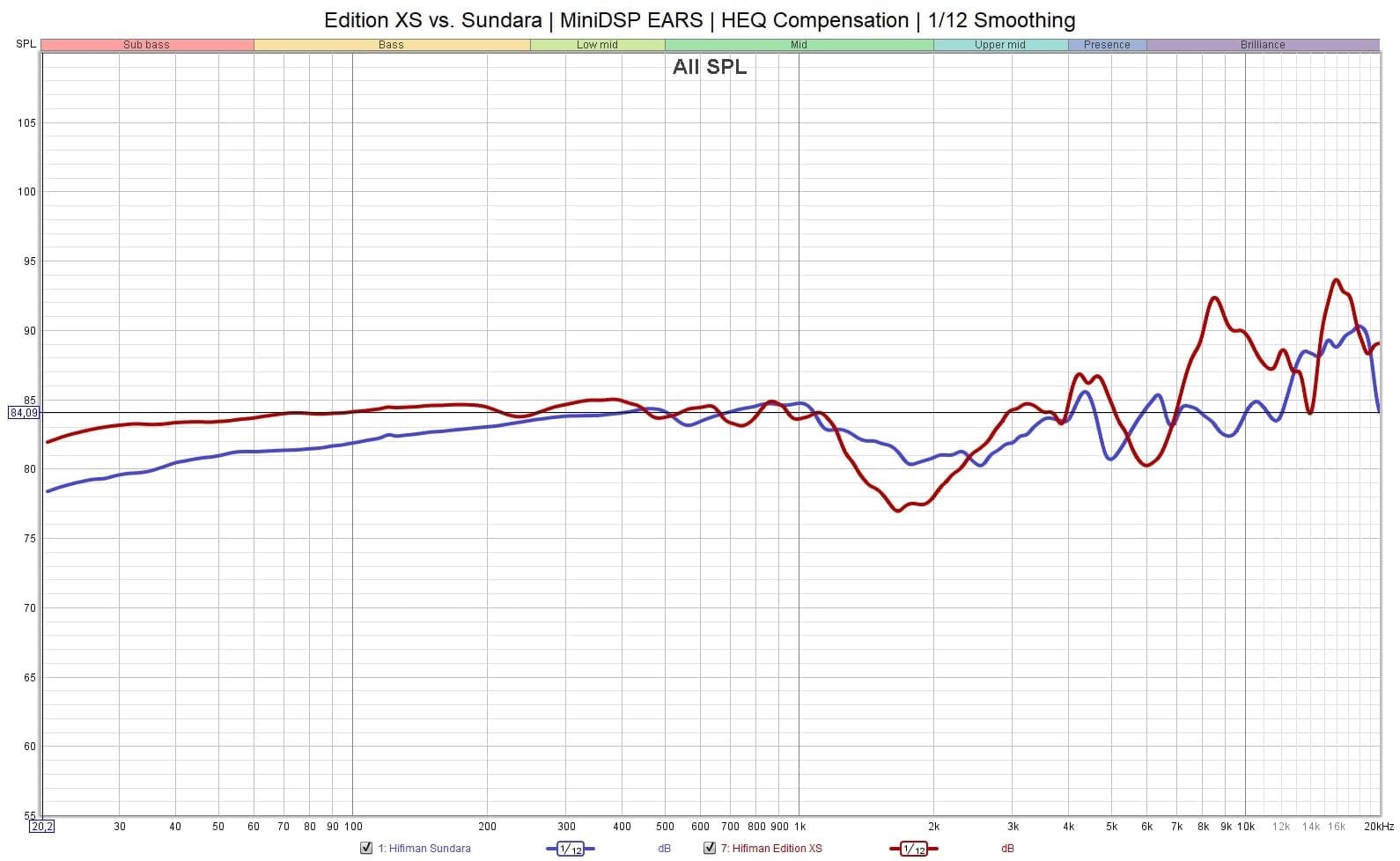
Frequency Responses: Edition XS (red) and Sundara (blue)
Differences in practical listening:
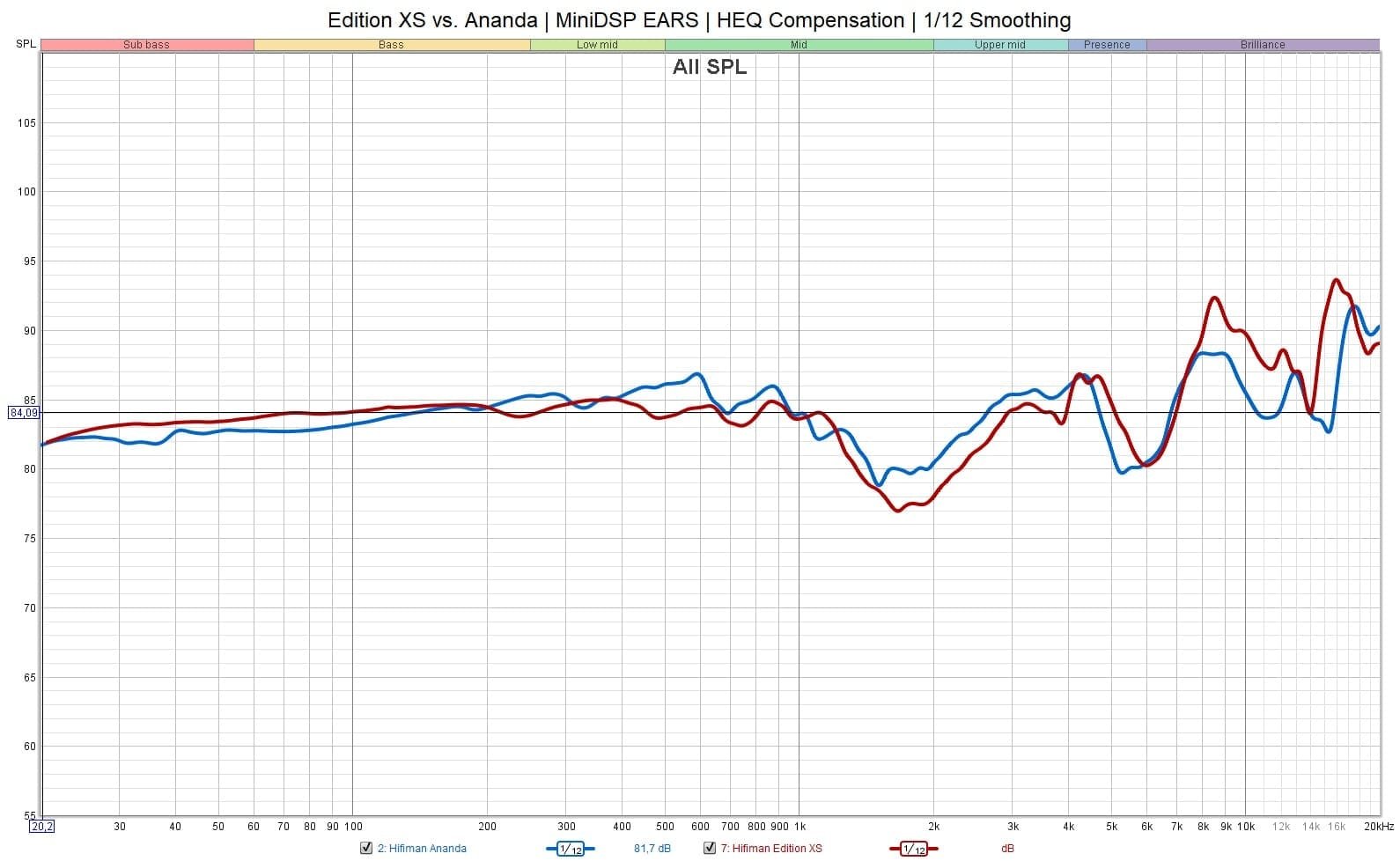
When comparing the frequency responses of the headphones, attention is drawn to two differences: the Edition XS has a more abundant bass reproduction, and the Sundara is less recessed between 1–2.5 kHz. Large differences in the treble are hardware-related measurement errors.
The Edition XS offers more satisfying bass rumble when such is available in the music being listened to. At the very lowest frequencies, there is often no audible content in music, but for example, when watching movies or playing games, the importance of well-reproduced sub-bass is emphasized. The same applies to electronic music and movie soundtracks. When listening to acoustic instruments, reproduction capability in the 20–30 Hz range is essential mainly when someone's favorite instrument happens to be a pipe organ.
In terms of bass quantity, the Edition XS is therefore an improvement compared to the Sundara. However, when examining the quality of the bass, the situation reverses, as the Sundara's bass is tighter, punchier, and more controlled.
What about the difference in the upper mid-range? Sundara is an exceptional Hifiman model in the sense that it almost completely lacks a dip between 1–2.5 kHz. In Sundara's presentation, the vocalist sounds more present and the sound less veiled than it would be if the frequency response were similar to the Edition XS. The difference is clearest on recordings where the vocalist is already slightly in the background.
However, since the Edition XS is technically a better headphone than the Sundara, Sundara's ”better” frequency response is not enough to turn the situation in its favor. Sundara's mid-range sounds forced and tight compared to the Edition XS. This is most evident when listening to calm female vocals.
The Edition XS plays cleaner in the upper frequencies. Although the headphones' treble reproduction is not outstanding in terms of resolution, it is clearly better than the Sundara. The sound is less grainy, and it is possible to extract more information from the sounds.
In terms of soundstage, the Edition XS takes a small but significant step forward compared to the Sundara. The Sundara has a rather compact soundstage, so the Edition XS, equipped with large drivers, offers a ”bigger” sound, as expected. The soundstage is not only more spacious but also more precise and better structured. The reproduction is more open and speaker-like compared to the Sundara.
Concluding remarks:
At first, it wasn't entirely clear to me how much better the Edition XS is compared to the Sundara. However, the longer I listened to the XS, the harder it felt to return to the Sundara. Nevertheless, the Sundara is no pushover, as it is more convincing in its construction and feels more comfortable and less wobbly on a small head.
More precise bass reproduction, a better mid-range frequency response to my taste, and more impactful dynamics should also be counted as Sundara's strengths in this comparison. In other respects, the Edition XS is a clear upgrade for it.
In my opinion, the Sundara still holds its place as the best headphone under 500 euros, but those considering headphones should seriously think about whether it would be possible to stretch the budget by another 200 euros to the Edition XS.
Hifiman Edition XS vs. Hifiman Ananda
Prices: 550 € vs. ~850 €
Frequency responses: Edition XS (red) and Ananda (blue)
Comparison from memory:
When writing this review, I did not have the slightly more expensive Ananda model available for listening, so I have to rely on my previous experiences. Usually, I don't compare headphones that I don't have the opportunity to listen to side-by-side, but I decided to make an exception this time because I know many are interested in the differences between the two. However, I cannot make an exact comparison from memory, so I will briefly mention only the biggest differences.
- Bass: Although I have criticized the Edition XS's loose bass reproduction, I think it is an improvement compared to the Ananda.
- Macrodynamics: I cannot listen to the Ananda for more than five minutes before the headphones' phlegmatic presentation starts to annoy me. The Edition XS also has room for improvement in the same area, but to my ears, the reproduction is not so loose that it would ruin my listening experience.
- Soundstage and resolution: The Ananda made an immediate impression on me with its large soundstage and detailed reproduction. I expected the same from the Edition XS, but I was somewhat disappointed.
When I try to put my own preferences aside for a moment, it must be stated that Ananda is overall a better headphone than the Edition XS. According to my recollections, the difference in soundstage and resolution is so clear that for most listeners, Ananda is certainly the more pleasing option of the two.
Hifiman seemed to know clearly what kind of headphones it was making when designing the Edition XS. The headphones are a noticeable improvement compared to the Sundara, but still just suitably weaker than the more expensive Ananda. A new Stealth-magnet version of the Ananda has actually been released recently, so it might appeal to my preferences more than the original model.
Summary
The Hifiman Edition XS is an impressive headphone. Its tonal balance is excellent, and the resolution and soundstage-related characteristics are at a level appropriate for its price range. However, due to its somewhat bland dynamics, the headphones are not particularly interesting to listen to for my taste. Compared to the more affordable Sundara model, the Edition XS is still a clear improvement overall, so I would say the headphones are worth their price. In addition, it's not really possible to buy anything better new for 500–600 euros. Focal Elex, Cleer Next and Audeze LCD-2 Classic compete more with the Hifiman Ananda than the Edition XS in terms of price and sound quality.
In the headphones' price range, the most noteworthy competitor is likely Hifiman's own HE6se V2, which sells for as little as 600–700 euros. The HE6se V2 is technically at least as good, but it also sounds considerably more entertaining thanks to its better dynamics. However, the Edition XS and HE6se V2 are not entirely comparable, because the latter absolutely needs a powerful amplifier. Topping A90, Schiit Audio Jotunheim 2, and Singxer SA-1, priced around 500 euros, are likely the most affordable amplifiers worth even considering for the HE6se V2. With the Edition XS, on the other hand, it's possible to get by with even more affordable equipment, making it easier to recommend.
Pros and cons:
+ Balanced frequency response
+ Refined overall package: the headphones' greatest strength is the scarcity of flaws
+ Good comfort
+ A reasonably powerful amplifier is sufficient for the headphones, and they are not picky about equipment synergy
+ Good price-quality ratio
+/- Soundstage, resolution, and other technical capabilities match the headphones' price, but performance is not exceptionally good in any single area
– Unremarkable dynamics
– Cheap-feeling build
 EN
EN  FI
FI
Thanks for a good and comprehensive review once again. I read this out of interest now, as this headphone was included in a comparison in the recent Hifimaailma issue (04/23). Hifimaailma's measured frequency response looked quite different in the 1-2.5 kHz range, and the attenuation mentioned here does not seem to be present at all in the aforementioned frequency range. Have the headphones been updated, or are the measuring devices really that different?
Hi! Without seeing Hifimaailma's measurements, it's difficult to say what might cause the difference. There are certainly differences in measuring devices, but in the 1-2.5 kHz range, the devices should function more or less similarly. I also don't believe there's a very large difference between the headphones, so I would guess that the differences are due to a different target response. A flat curve using MiniDSP with HEQ compensation corresponds quite closely to a result mimicking the Harman 2018 target response.
I looked at Hifimaailma's measurements of Susvara and Dan Clark Stealth. In those measurements, Susvara measures almost perfectly in the 1-2.5kHz range compared to the reference curve. However, in almost all other measurements, that area is a bit recessed. Edition XS measures quite similarly to Susvara in that area. Dan Clark Stealth is known for measuring almost perfectly in relation to the Harman target response. According to Hifimaailma's measurements, however, the Stealth is overemphasized in that 1-2.5kHz range. The commonly used reference curve is Harman 2018, but at least in the measurements I mentioned, Hifimaailma has for some reason used the Harman AE/OE 2017 reference curve. It would seem that the 2017 reference curve differs quite radically from the more commonly used 2018 version.