Author: Sword of Damocles
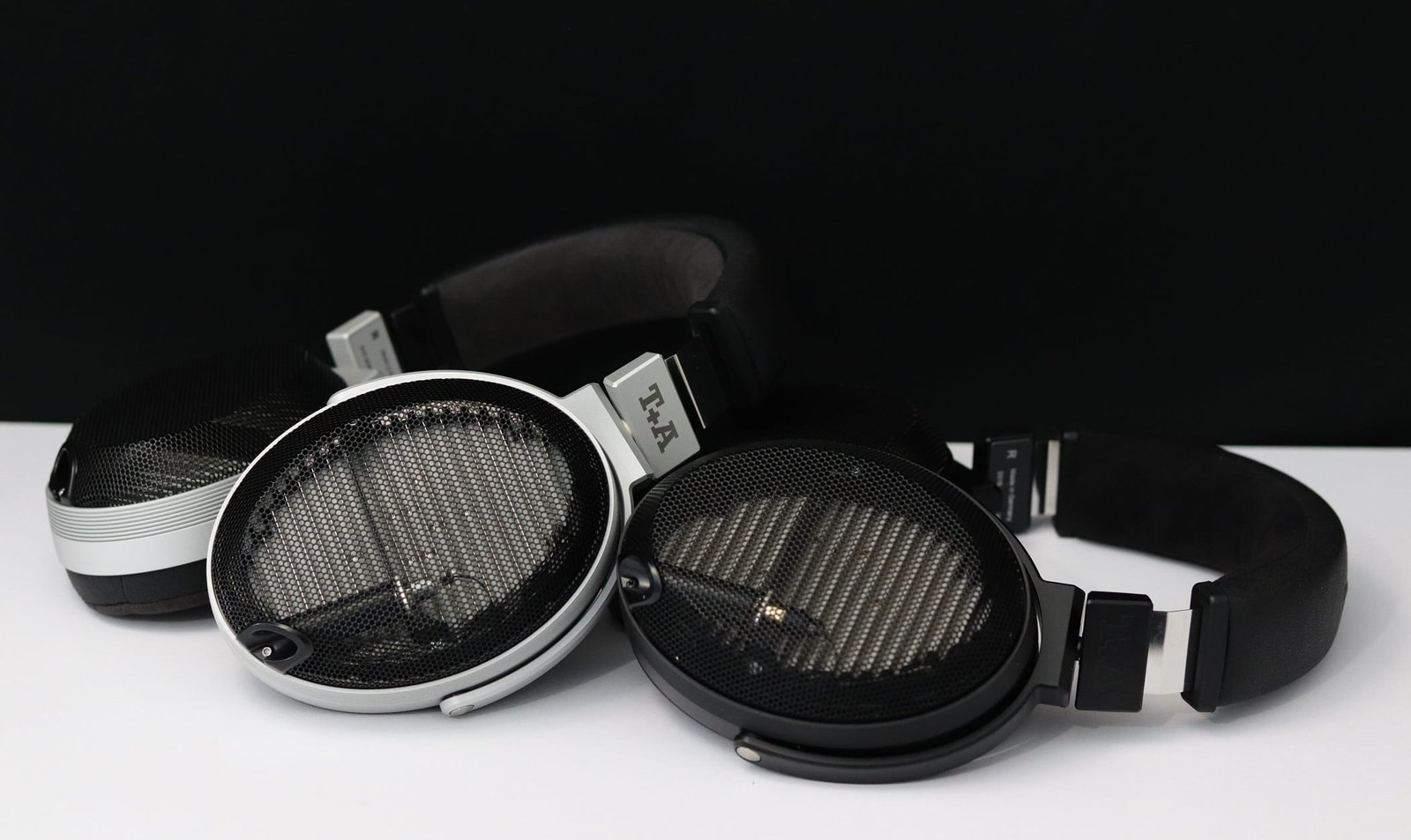
Table of Contents:
Information:
Solitaire P
- Release Year: 2020
- Country of manufacture: Germany
- Price: 5200 €
- Type: open, over-ear
- Planar element: TPM3100 (magnets on both sides of the diaphragm)
- Impedance: 80 Ohm
- Sensitivity: 101 dB/mW
- Weight: 530 g
- Connector type: 2 x ODU 2-pin
- 2 cables: length 3 m and connectors 4-pin-XLR and 6.35 mm
- Accessories: No
- Warranty: 3 years
Solitaire P-SE
- Publication year: 2021
- Country of manufacture: Germany
- Price: 3100 €
- Type: open, over-ear
- Planar element: TPM2500 (magnets only on one side of the diaphragm)
- Impedance: 45 Ohm
- Sensitivity: 101 dB/mW
- Weight: 440 g
- Connector type: 2 x 3.5 mm
- 2 cables: length 3 m and connectors 4.4 mm and 6.35 mm
- Accessories: No
- Warranty: 3 years
Review units acquisition method: Loaned from a reseller/importer
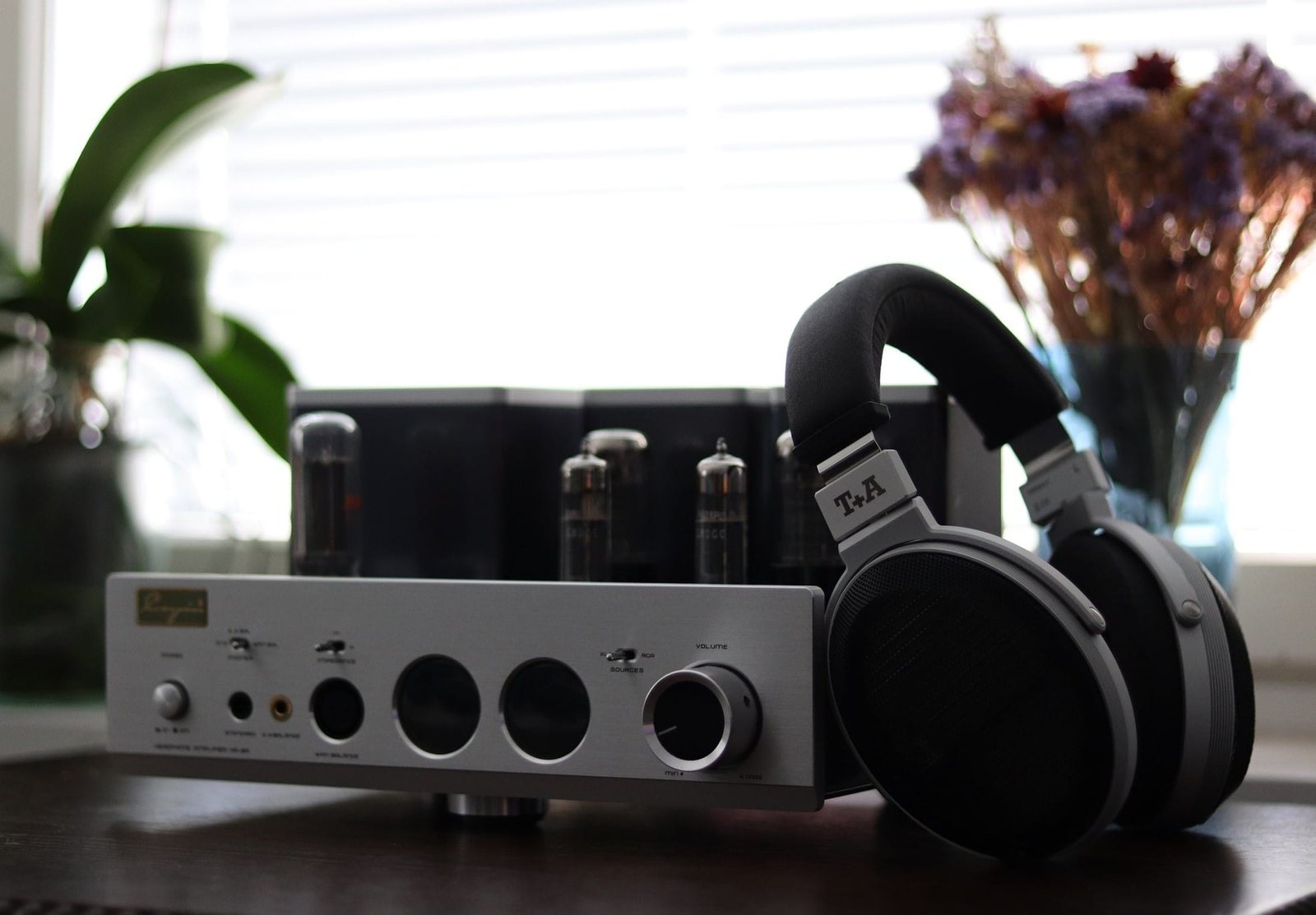
German, founded in 1978 T+A (Theory and Application in Audio Technology) is best known for its expensive loudspeakers and hi-fi equipment, but based on recent years, headphones will also be a more integral part of the manufacturer's product range in the future. So far, T+A has introduced two open-back planar headphones, Solitaire P (5200 €) and Solitaire P-SE (3100 €), as well as noise-cancelling headphones called Solitaire T, which, at their price of 1400 euros, are modestly the most expensive on the market. One would therefore expect the products to have a high interest value, especially among hi-fi enthusiasts. The headphone models I mentioned recently arrived in Finland as well Mareksound acting as their official reseller.
Despite all this, T+A can still be considered a relatively unknown headphone manufacturer among the general public, as it only became more familiar to me at the 2023 Hi-Fi Fair (my experiences with headphone offerings). For this reason, a closer look at the manufacturer's products is probably in order. First, let's find out about the Solitaire planar duo, which we arranged to borrow for Kuulokenurkka with Mareksound. On another occasion, I will, if possible, also get acquainted with the Solitaire T noise-cancelling headphones.
General information about tested headphones
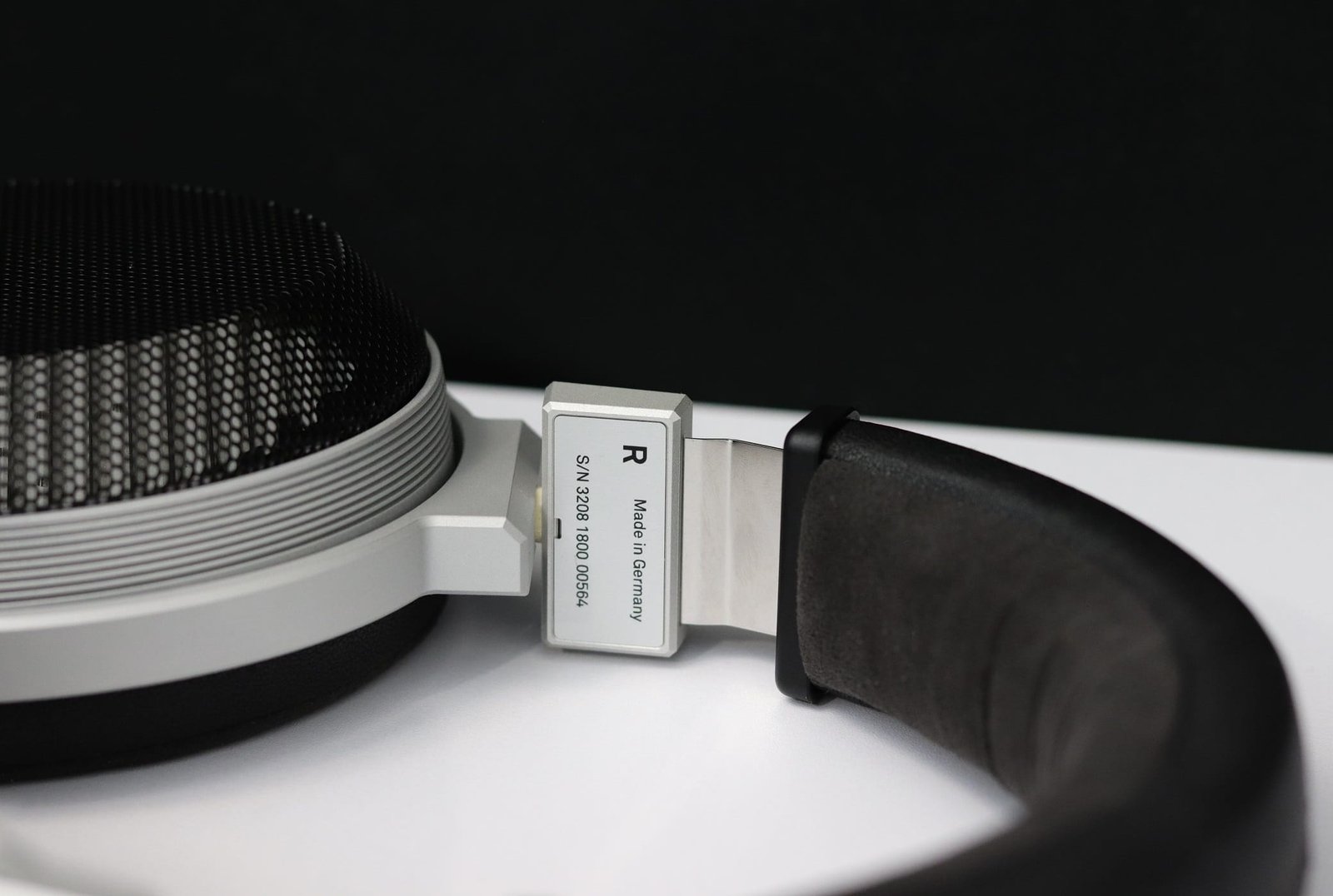
Released in 2020, the Solitaire P is T+A's flagship headphone and, after a small price increase, costs a hefty 5200 euros. The structure of this model is made entirely of aluminum and uses the manufacturer's most advanced TPM3100 planar drivers (double-sided magnetic structure) adjusted for an 80-ohm impedance. T+A has developed its drivers itself, utilizing its 35 years of experience with magnetostatic loudspeakers. For headphone connectors, the Solitaire P uses the familiar 2-pin ODU connectors from the Sennheiser HD 800 series.
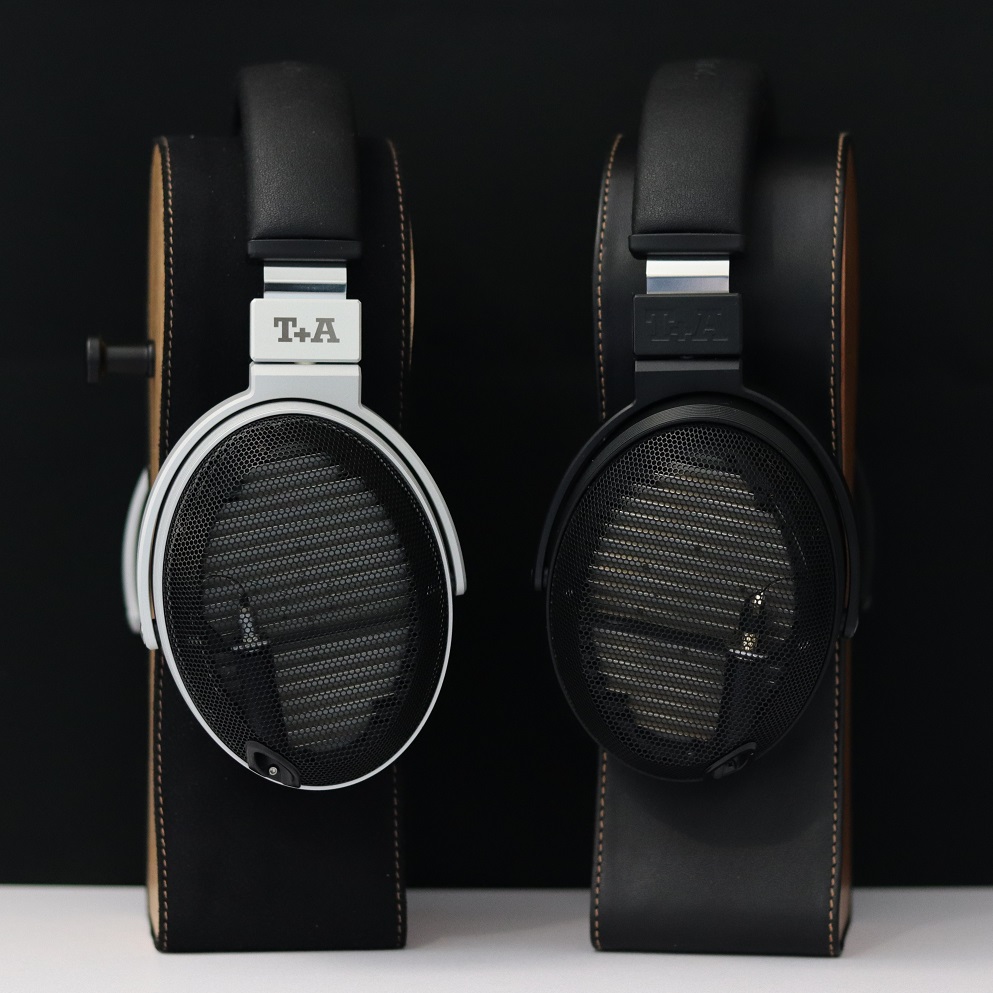
The Solitaire P-SE, which saw the light of day the very next year, primarily aims to be a slightly more reasonably priced option in the same model series, as its price has been squeezed down to 3100 euros with a few changes. The external appearance of the headphones has remained the same, but aluminum has been replaced with plastic, and the planar drivers have changed to TPM2500 models. The most significant differences of these compared to the TPM3100 drivers are a single-sided magnetic structure and a smaller 45-ohm impedance. However, the sensitivity in both drivers is the same at 101 dB/mW. The headphone connectors, on the other hand, are 3.5 mm in the Solitaire P-SE. As a positive change, the more affordable Solitaire model also weighs significantly less (440 g vs. 530 g). Despite the changes, according to the manufacturer, the Solitaire P-SE should still offer a very similar listening experience to the more expensive Solitaire P. I will now investigate this myself, without forgetting other aspects.
Product packaging and accessories
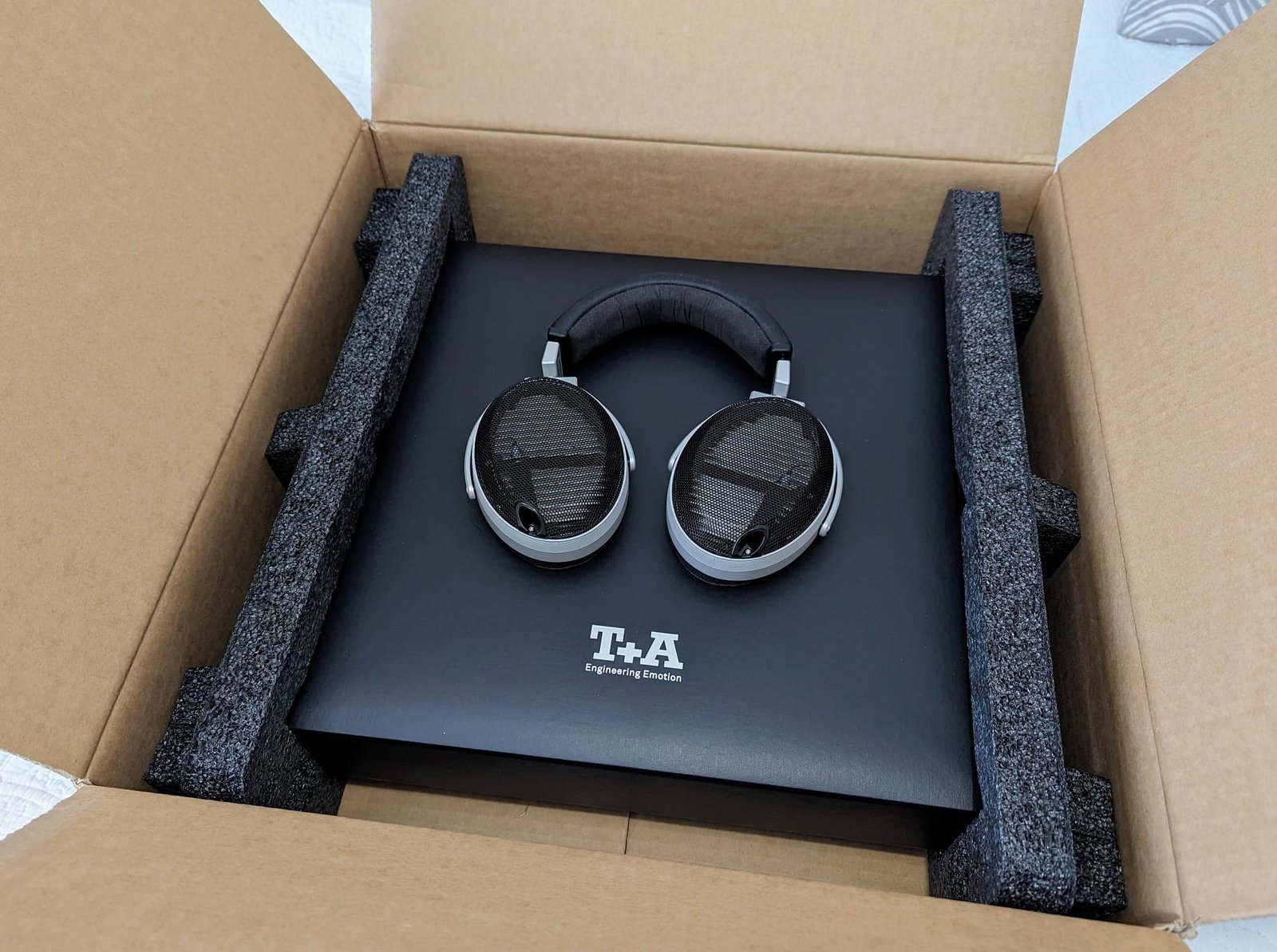
When I received a postal package containing two pairs of T+A headphones, I was immediately surprised by its large size and weight – perhaps Mareksound had packed the headphones with extreme care? In reality, the two enormous boxes turned out to be T+A's own. I wouldn't be surprised if they were originally designed for the manufacturer's amplifiers or other larger electronics. The headphone packages found inside were not small either; each could easily fit two pairs of headphones. Such large packages are sure to impress most people and create an image of a valuable product. As a small visual difference, the Solitaire P's box is black, and the more affordable P-SE's is gray.
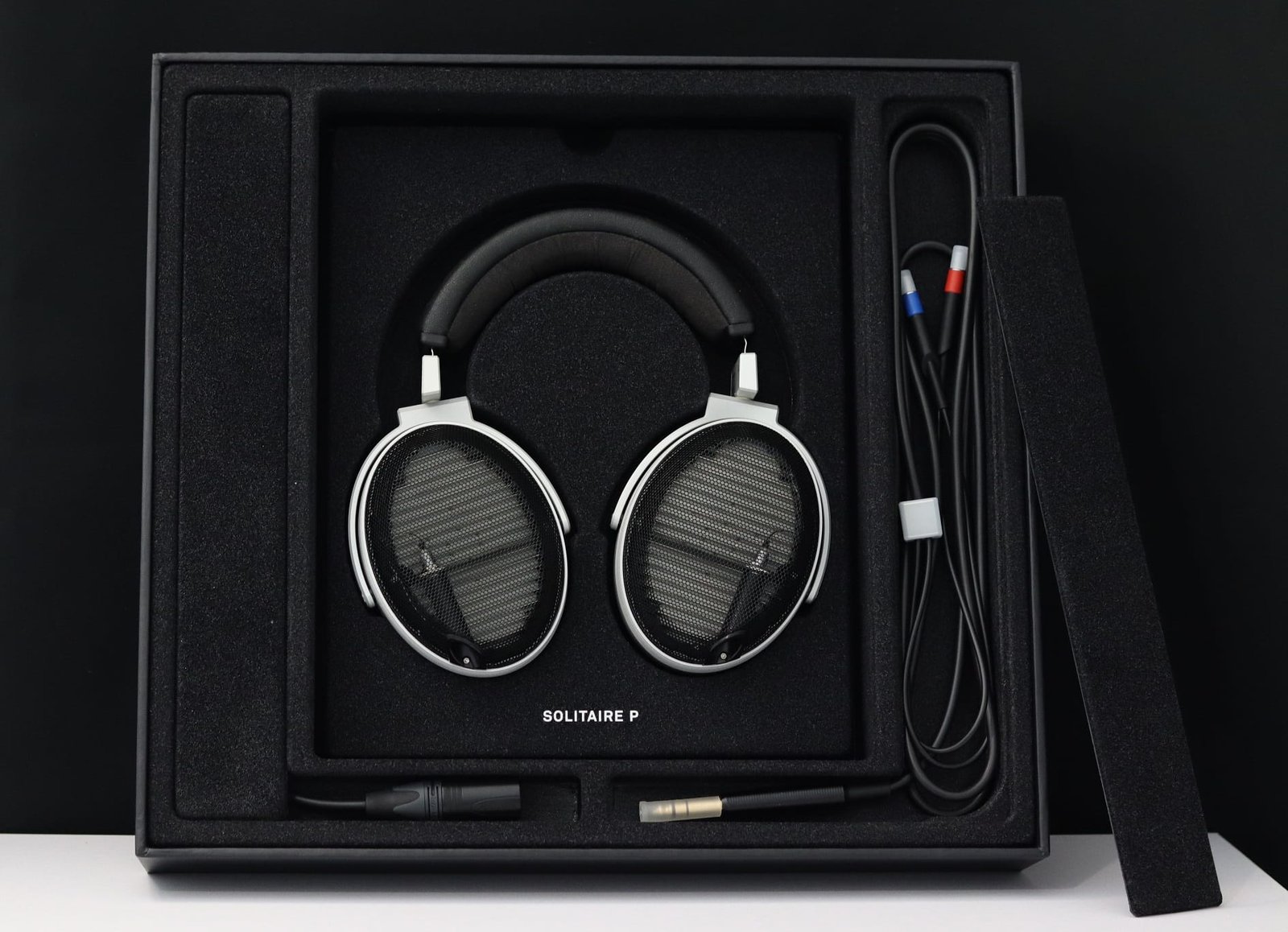
Both headphones come with the necessary instruction leaflets and two long cables, but no other accessories. One of the cables is equipped with a 6.35-millimeter connector, while the other end has a balanced connector. In the P model, this is an XLR type, and in the P-SE model, a more modern 4.4 mm. In terms of conductor material, external feel, and 3-meter length, the cables are identical, but it is not possible to use them interchangeably due to the different types of female connectors on the headphones.
With headphones costing several thousand euros, it would always be nice to receive some kind of accessories, such as spare earpads or, alternatively, earpads with different sound characteristics, similar to the Meze Audio Empyrean series. T+A has actually made different earpads for at least the Solitaire P, but they would have to be purchased separately. The earpads for both headphone models are priced at a hefty 240 euros, while the unit price of the included cables would be 300 euros for the Solitaire P and 120–150 euros for the P-SE. Different connectors would thus seem to double the price, so buyers of expensive headphones, as is traditional, should also prepare for costly accessories.
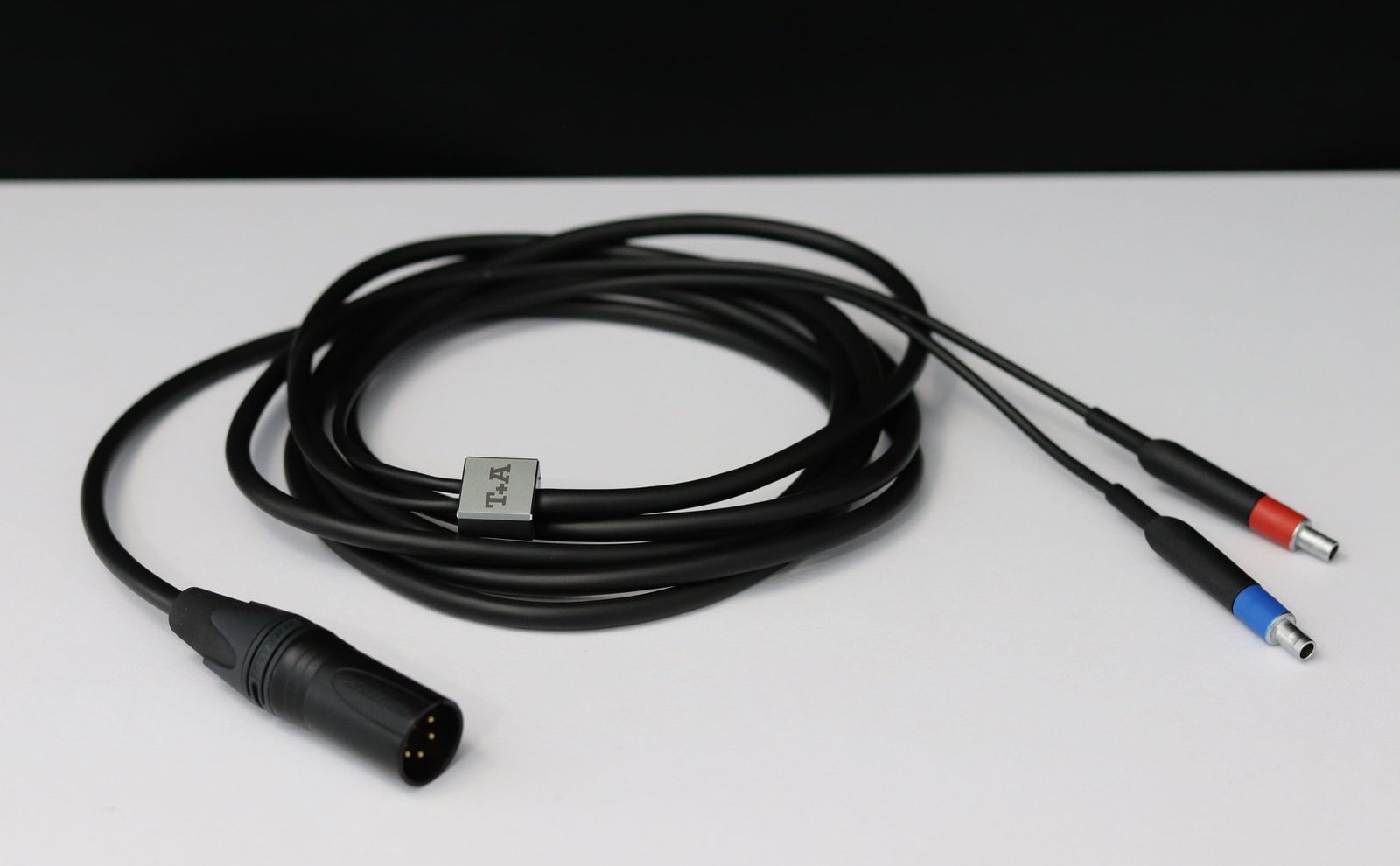
T+A's cables, with their thickness and rubber coating, resemble microphone cables. Durability is certainly good even in tougher use, but usability leaves something to be desired, especially if the amplifier is located close to the listener. In this case, the 3-meter length is a disadvantage, and one has to literally fight against cables that constantly try to coil back, as they do not want to stay in place. Normally, a headphone owner could buy a pleasing replacement cable separately, but for the Solitaire models, the options are unfortunately limited due to the completely unique connector structure. Let's examine this matter more closely in connection with the rest of the headphones' structure.
Rakenteelliset ratkaisut
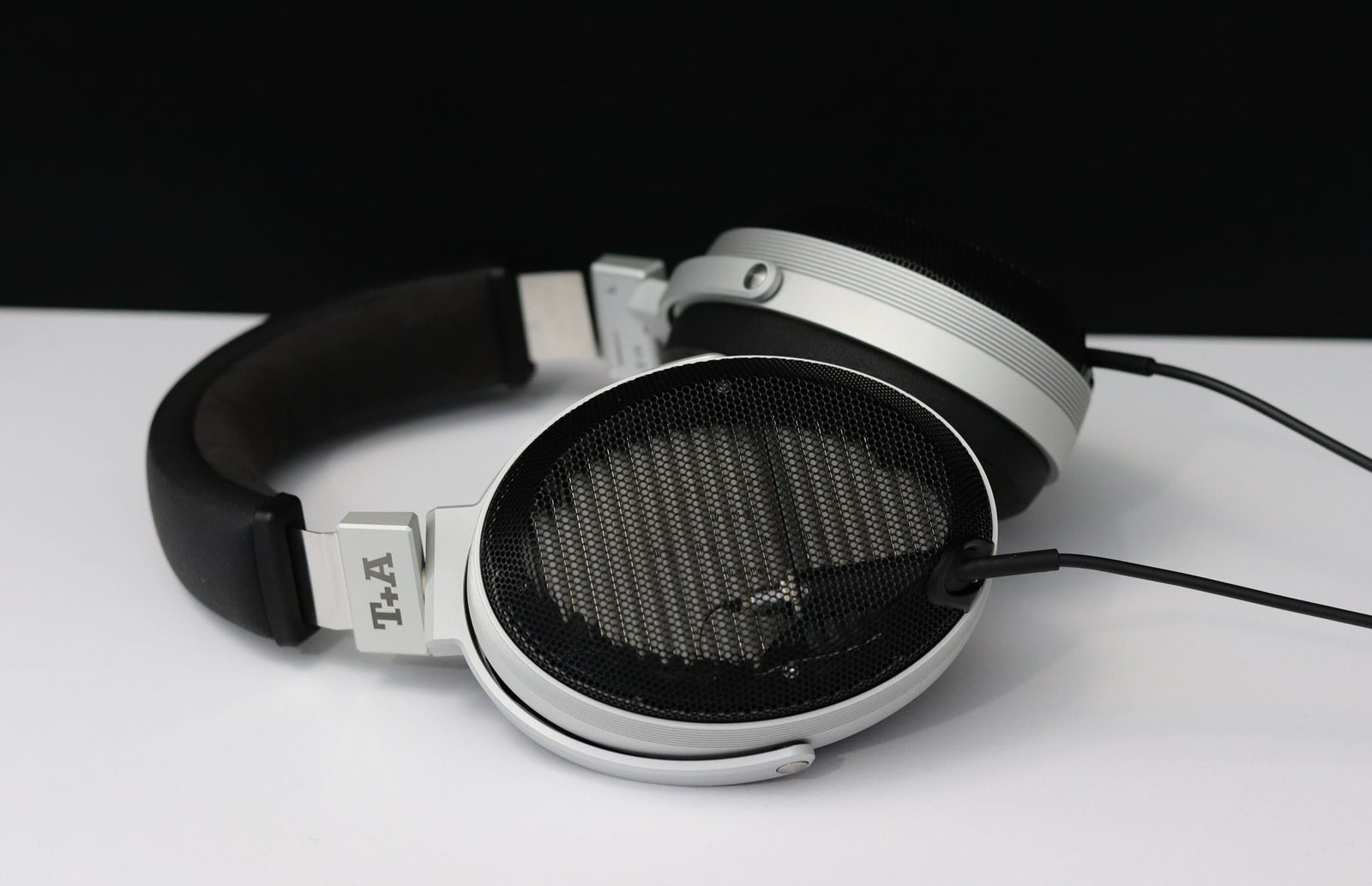
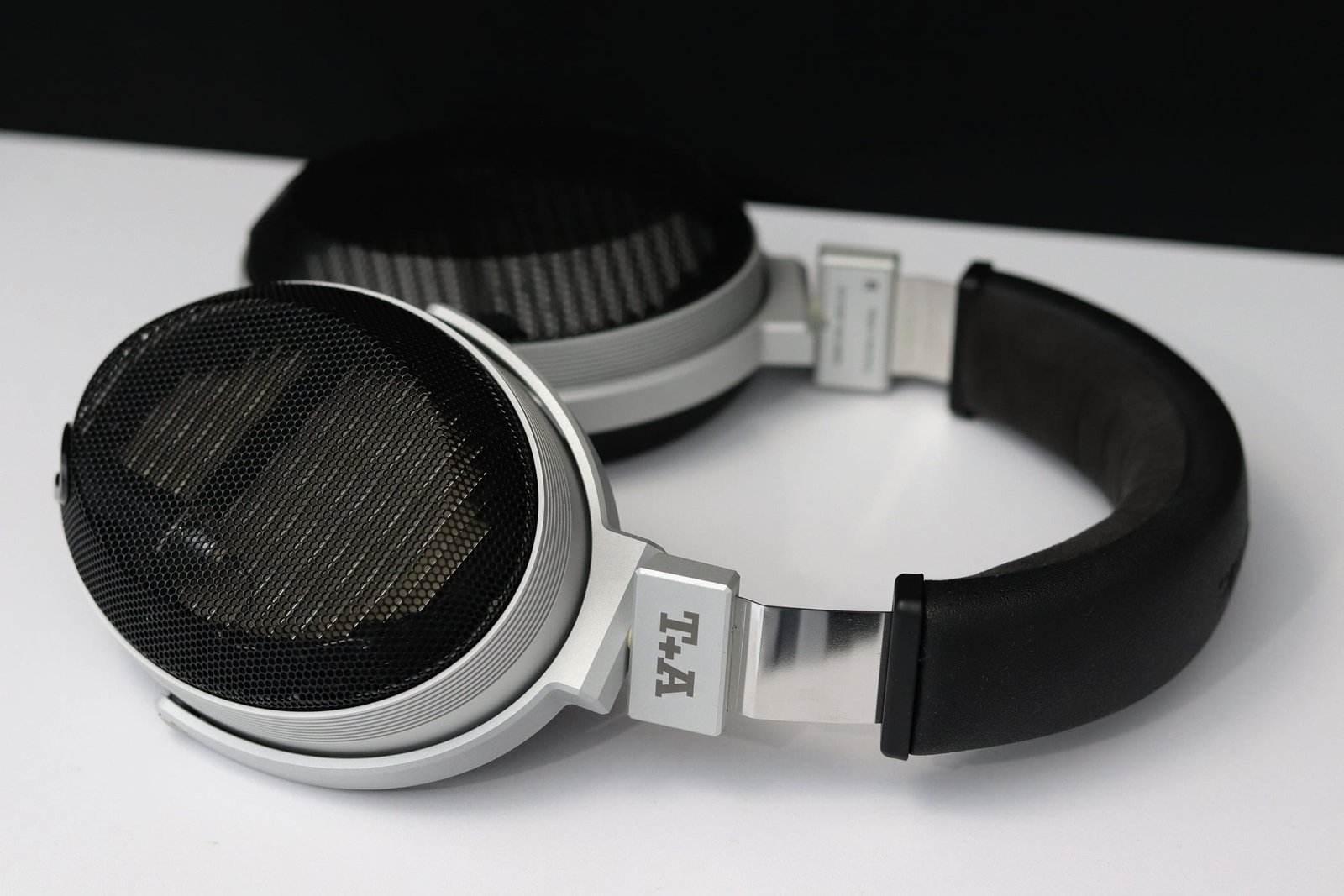
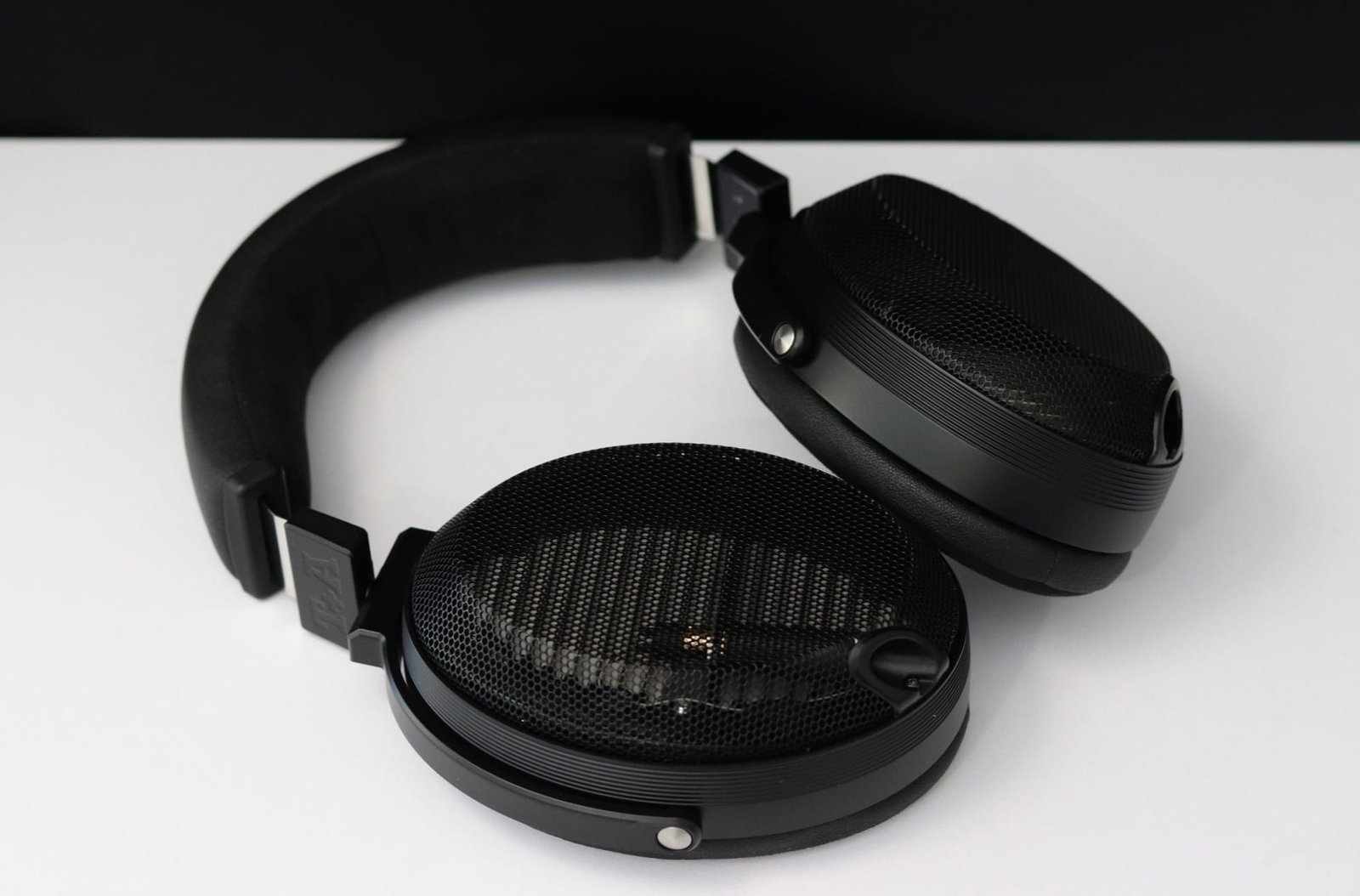
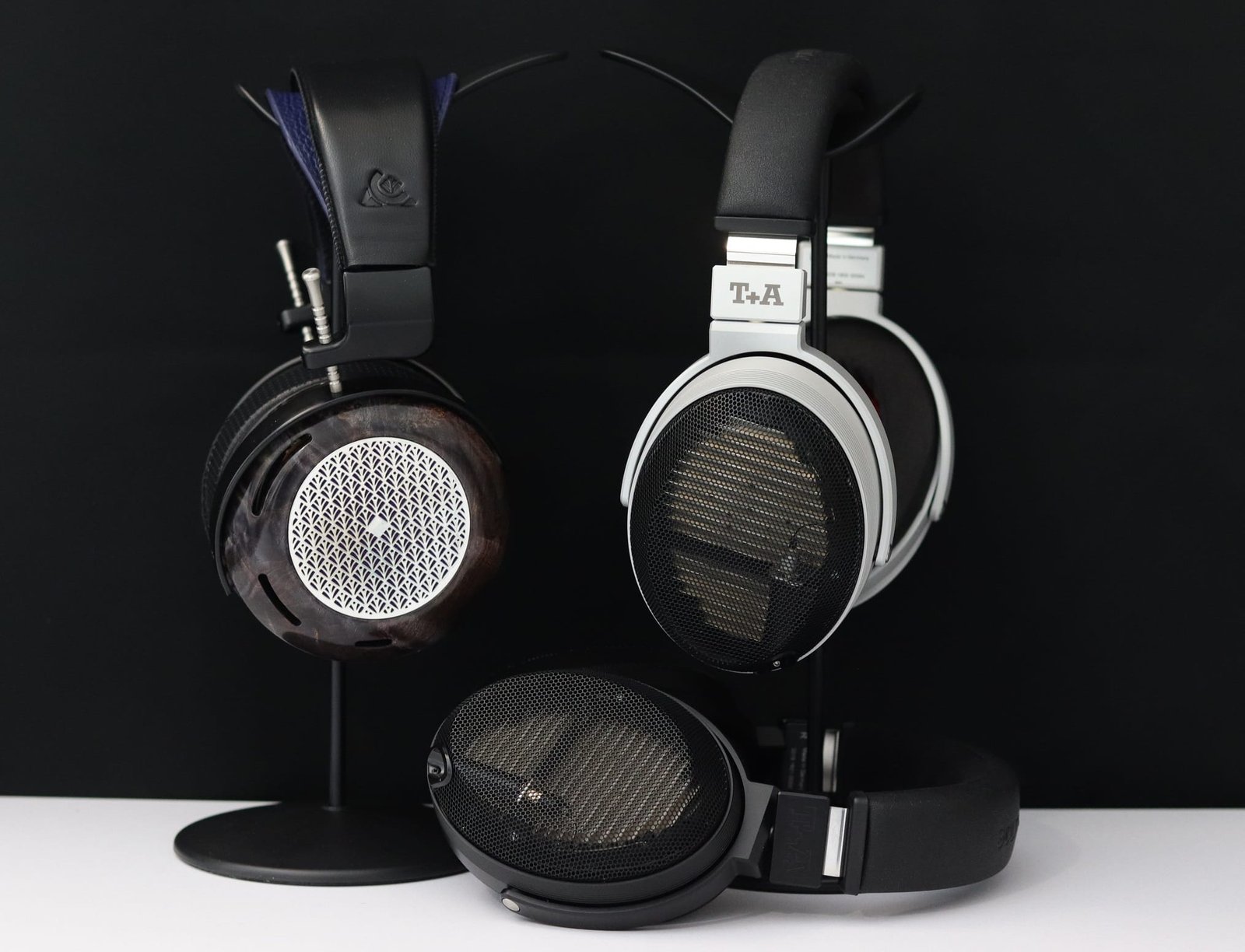
Both headphone models are identical in their basic structure, but there are clear differences in the impression of quality, partly due to material choices. As already mentioned, the more expensive Solitaire P's silver frame is made of thick aluminum. The headphones feel really sturdy in hand, which is further supported by the fact that the hinges allowing the cups to turn horizontally have good resistance – when the cups are turned to a certain position, they stay there. Vertically, too, the cups always remain, so to speak, in check, as springs similar to those in Focal headphones return them to their default position. This was likely intended to ensure sufficient sealing of the earpads below the ears. The outer edge of the cups is shaped from metal mesh, so the back of the large planar drivers and the deeply recessed connectors are visible through it. In my opinion, the design is great in all its simplicity and engineering-like quality!
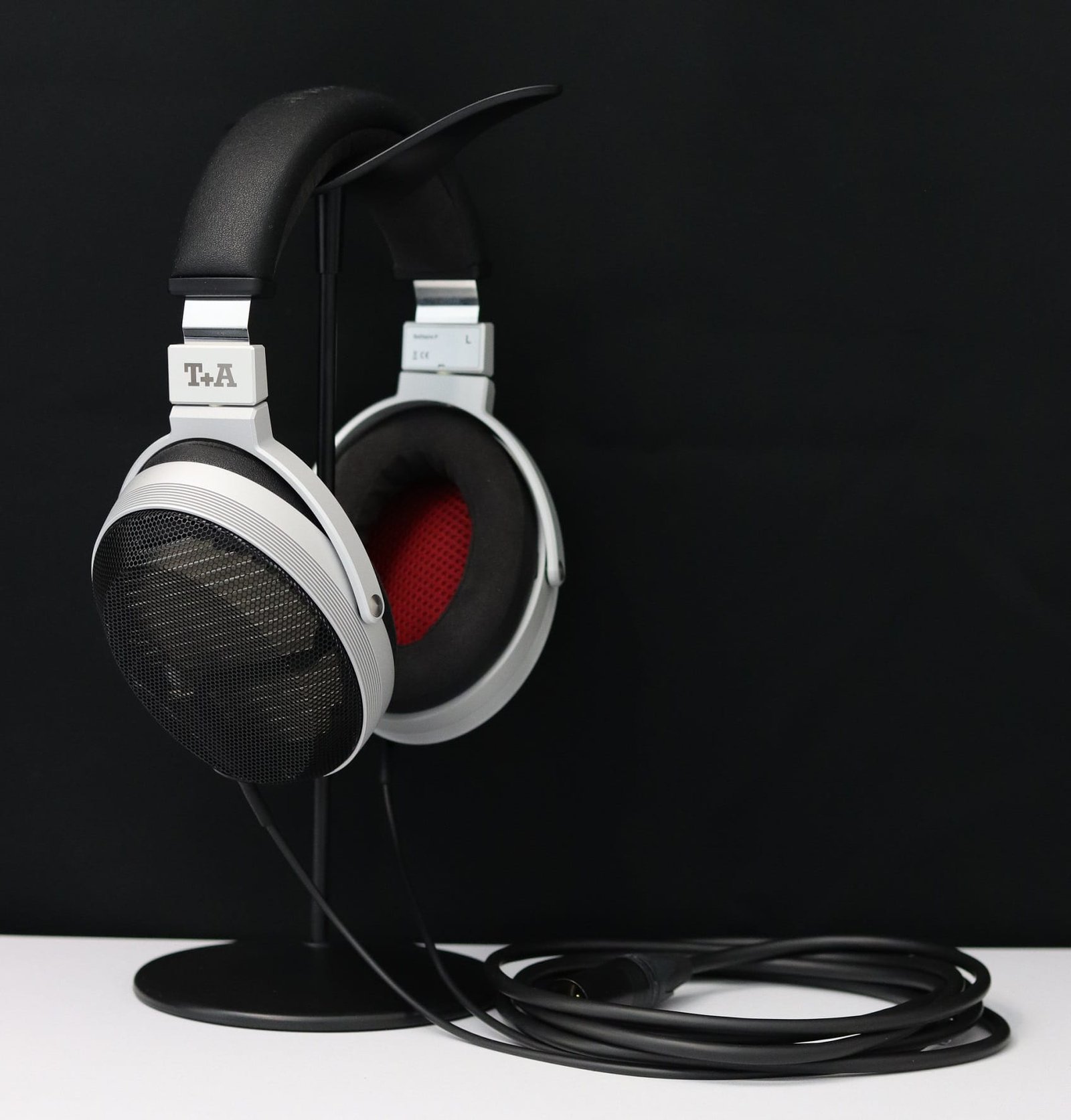
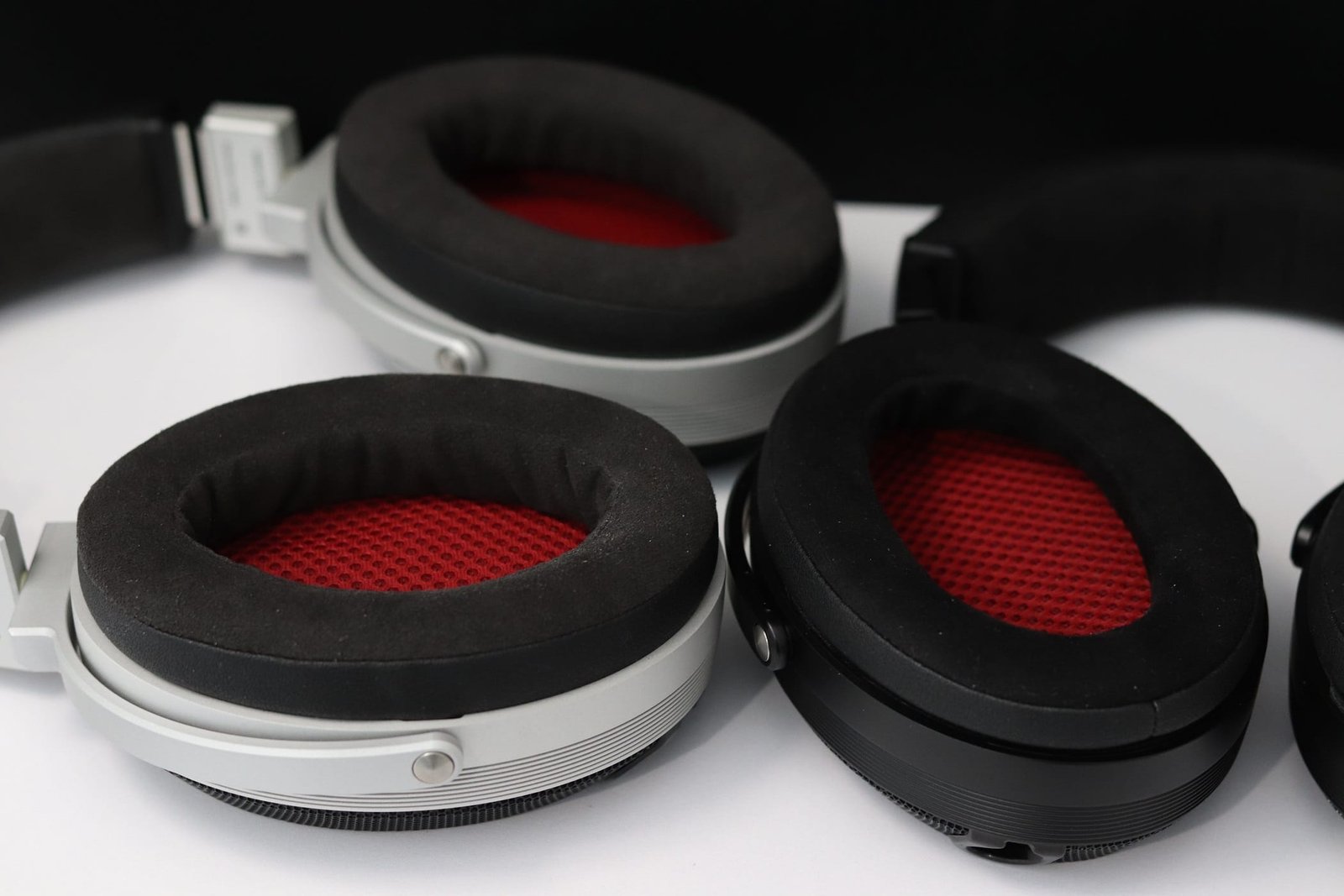
The cheapest-feeling part of the Solitaire P's structure are the height adjustment extension pieces made of thin steel plate, and actually the height adjustment more generally. Due to the high weight of the cups, the adjustment notches cannot really be called locking, as they barely manage to hold their position. When shaking the headphones in hand, the cups immediately slide downwards, but fortunately, this does not happen during use. The headband otherwise feels sturdy, and there would be plenty of height adjustment range. When the finish of the structure is also precise and the earpads are pleasant Alcantara, the overall impression of quality, despite its minor weaknesses, in my opinion surpasses, for example, Hifiman Susvara and Focal Utopian, although not quite the Meze Audio Empyrean models.
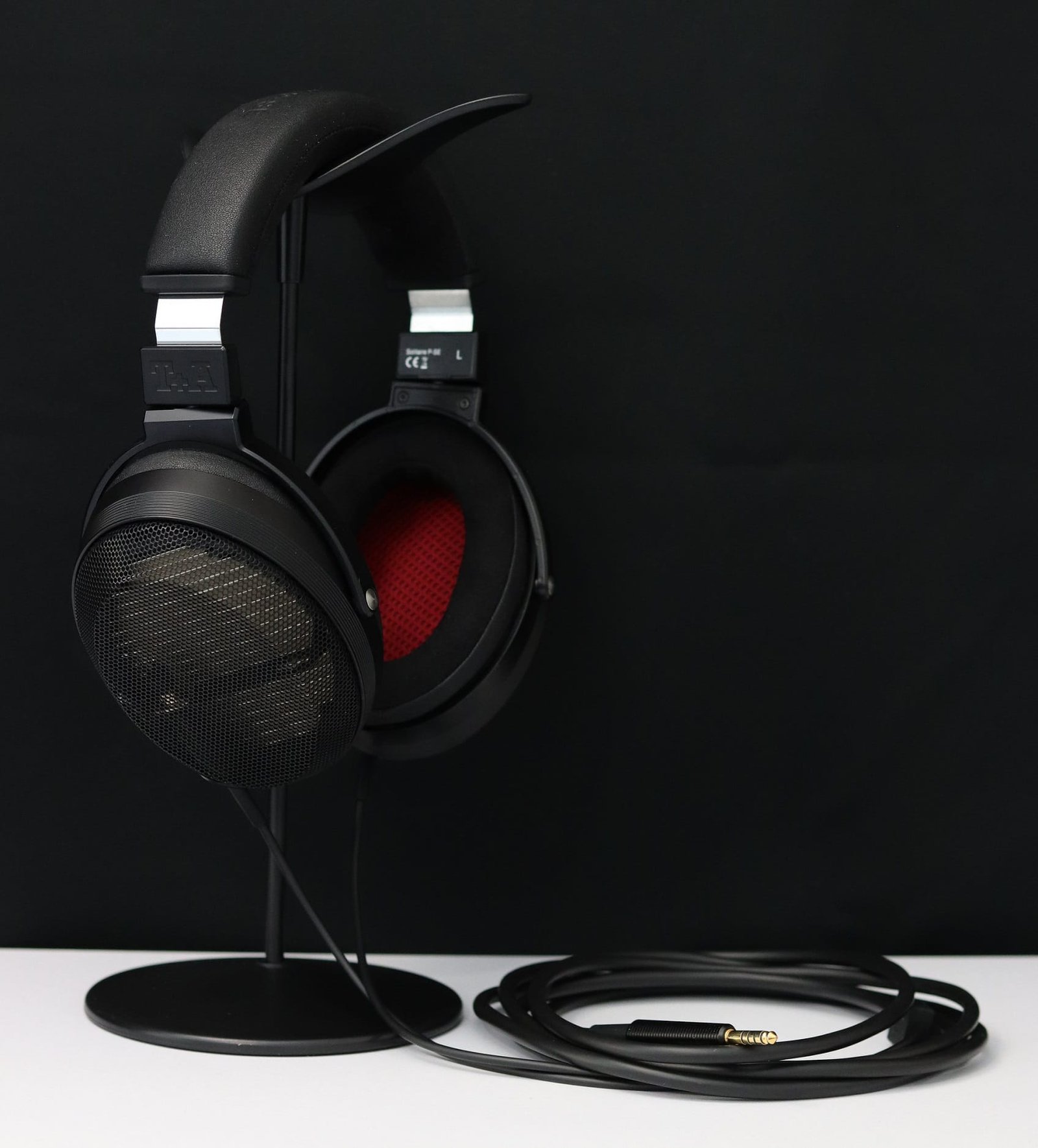
Approximately 2000 euros cheaper, the Solitaire P-SE looks very similar to its sibling model, apart from its black coloring, but its frame is made entirely of plastic. In addition to affordability, a lighter weight can be counted as an advantage of this solution (part of this is also due to the single-sided magnetic structure), and the plastic itself does not look worse from a distance or likely significantly reduce durability due to its thickness. However, the quality difference between the two is obvious as soon as the Solitaire P-SE is picked up: the horizontal swivel movement completely lacks resistance, so the cups can rotate loosely from side to side. The hinge points are also looser, so the headband structure feels clearly flimsier compared to the Solitaire P. On the other hand, the height adjustment holds its position better in the P-SE, and the cups' spring mechanism is still present.
In any case, the Solitaire P's German tank-like essence is gone, which is certainly a compromise by which the manufacturer feels it can offer consumers a certain sound quality for 3000 euros instead of, for example, 4000 euros. For a similarly priced Meze Audio Empyrean 2: the Solitaire P-SE unfortunately offers no resistance in terms of material choices, even though both weigh approximately the same, about 450 grams. Based on this, most might still choose the P-SE model from T+A's headphones, as the Solitaire P, at 530 grams, starts to be too heavy even for me, even though I am used to robust ZMF and Audeze headphones. However, this is more due to the problematic fit of the headphones rather than the weight, which I will return to shortly.
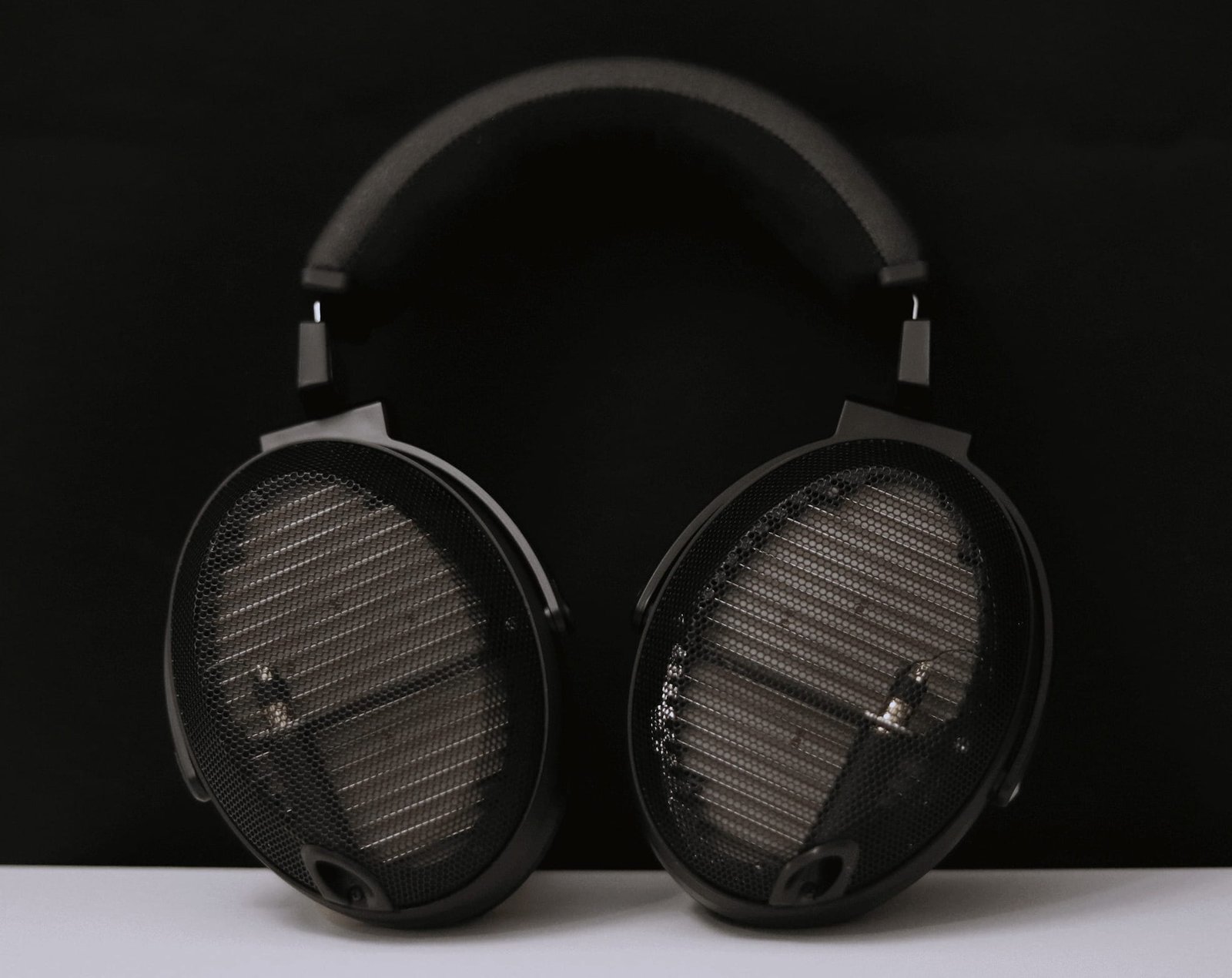
The drivers of both Solitaire models are tilted towards the ear, which is not at all common in planar headphones; it is usually handled with angled ear pads. Thanks to the structural tilt, the Solitaire models' pads could be made of uniform thickness and quite flat, as the most protruding part of the user's ear fits inside the cup structure. The Solitaire P-SE's pads are slightly thinner and attach to the cup with smaller hooks. I would guess the manufacturer wanted to make it easier to remove the pads, as they are very tightly attached in the Solitaire P.
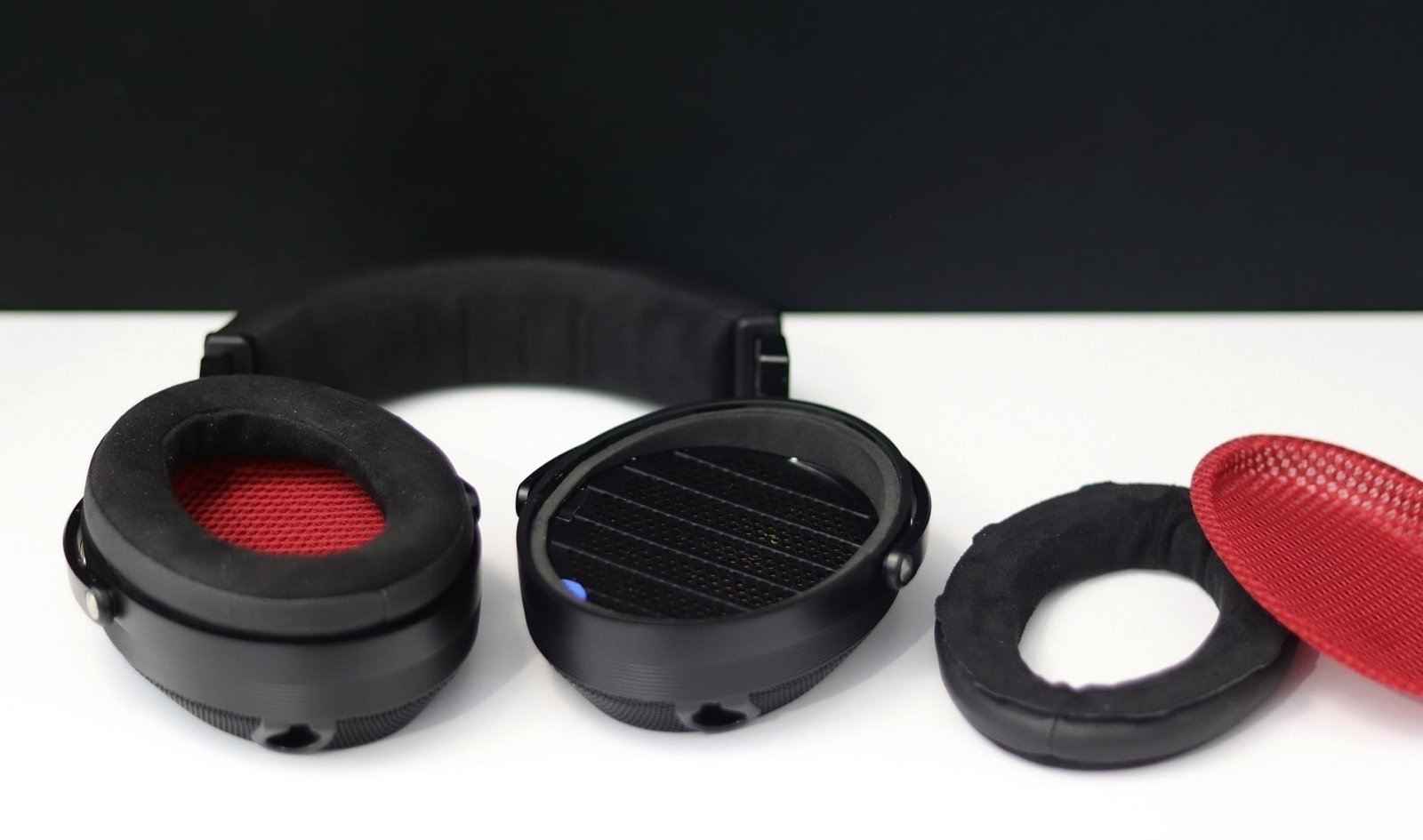
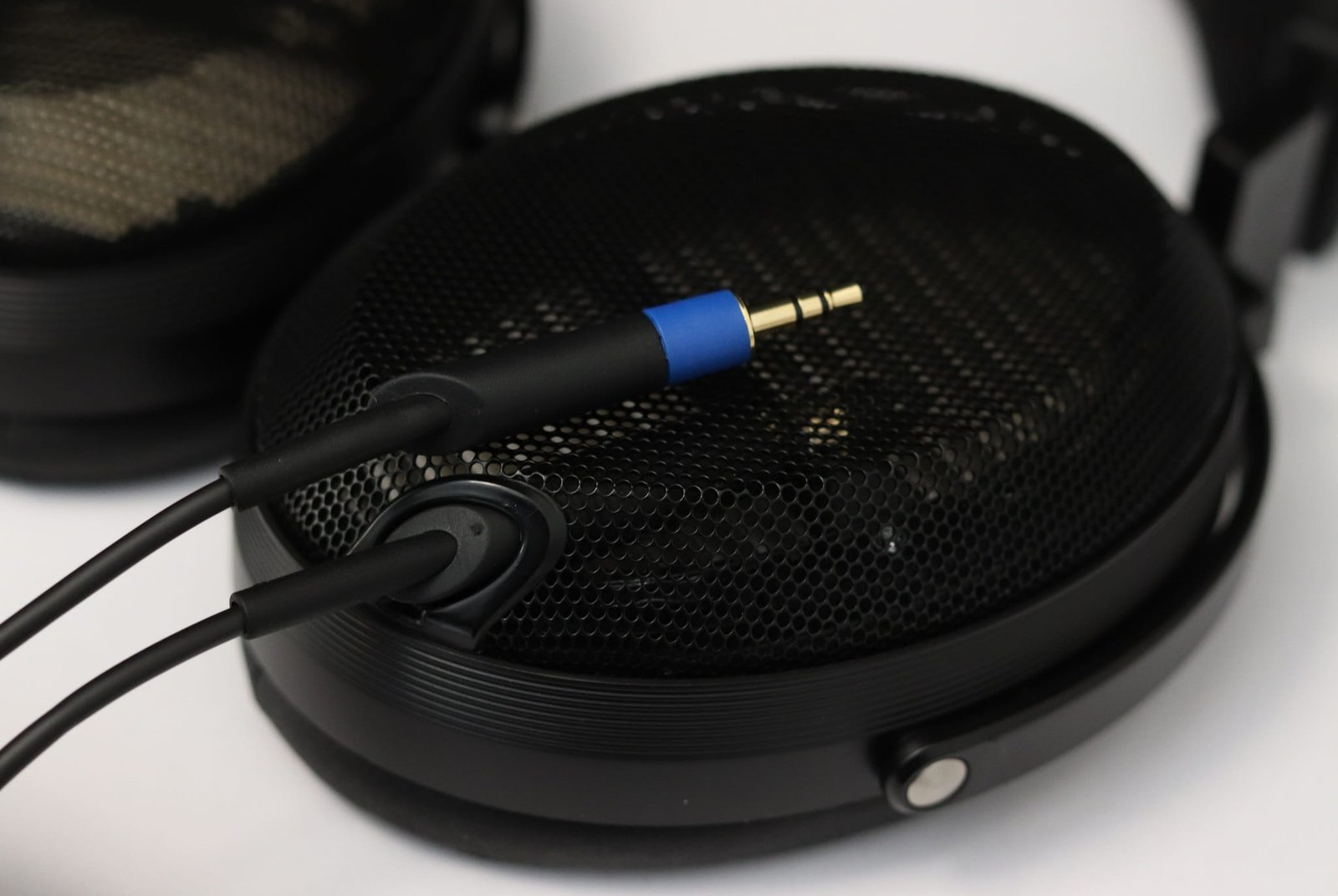
However, the cheaper model has not brought any relief to attaching and detaching cables; instead, the connectors in both T+A headphones are located at the bottom of a deep and narrow groove, or rather at the top when viewed from below. This design certainly protects the headphones' own connectors from bending, but the manufacturer has had to design long special connectors for its cables so that they can even be pressed into place. Detaching the cable, in turn, is done by pulling on their thin strain relief, because when connected, the connectors slide completely into their grooves, and it is no longer possible to get a grip on them. In my opinion, the Solitaire P's ODU connectors work smoothly, whereas pressing the 3.5-millimeter connectors of the Solitaire P-SE to the bottom is a bit difficult. The most regrettable thing, however, is how difficult it would be to find a replacement cable from another manufacturer for these headphones, even though such options are reportedly available nowadays. Sometimes headphone manufacturers get excited about developing unnecessarily original solutions, but at least they bring variety to the headphone enthusiast's daily life.
Usability
Unfortunately, I have to give T+A quite negative feedback regarding the fit and comfort of the headphones. In both models, the steep curve of the headband is either designed for the smallest-headed segment of the population or the manufacturer has made some kind of error in its calculations. For me, the headband sits as shown in the following picture, meaning only the edges of the padding touch my head.
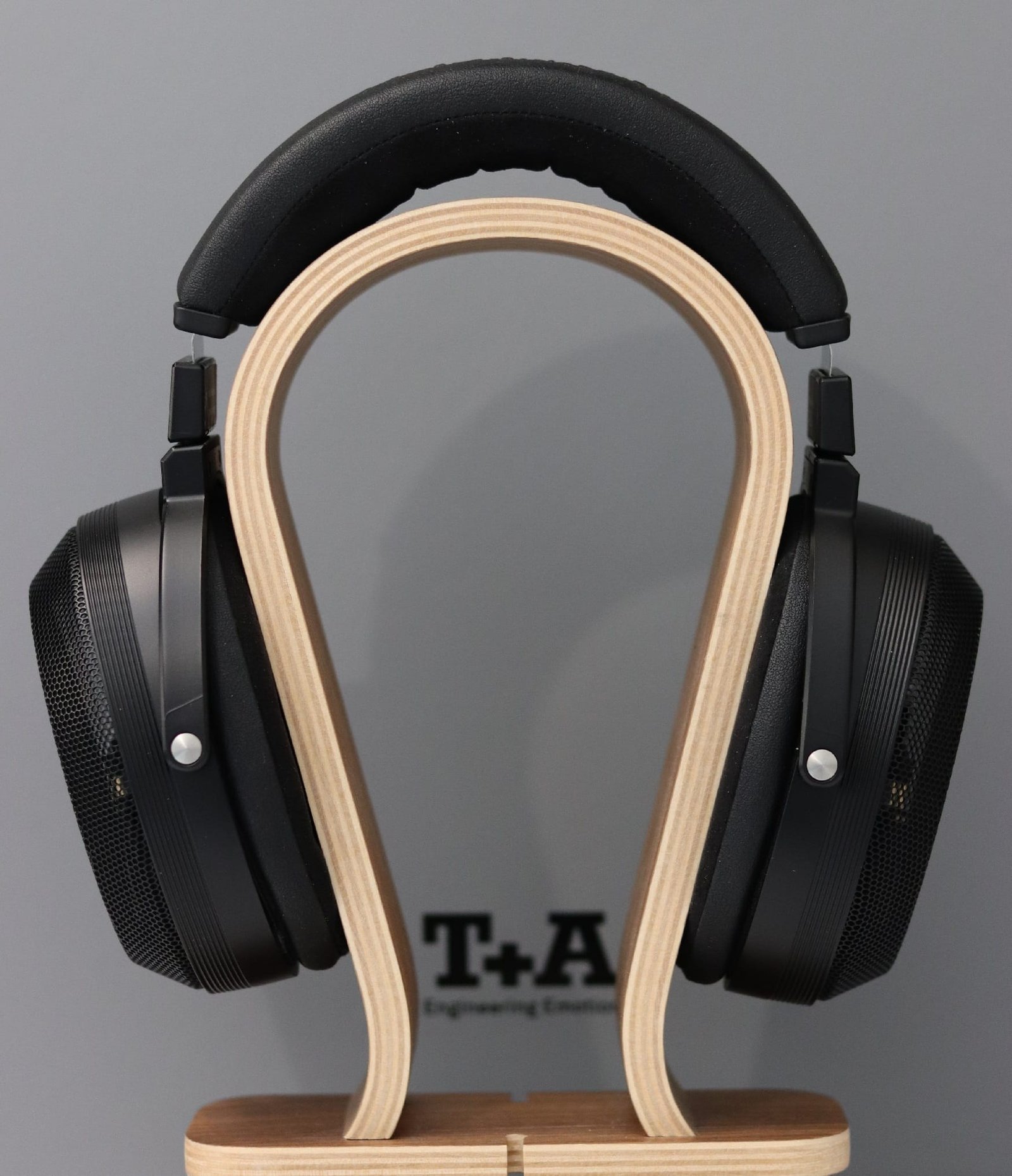
A too-steep arch probably wouldn't bother as much with lightweight headphones, but especially the Solitaire P is so heavy that an irritating ache and pressure quickly form on the sides of my head – often my head sides were sore for several hours after listening. The thick and otherwise comfortable-feeling Alcantara padding also fails to prevent discomfort in the lighter P-SE. In both headphones, the unpadded inner edge of the headband also hits the sides of my head, further worsening the poor comfort. For the Solitaire P and its thicker ear pads, I also have to give a minus for the fact that there is too much clamping pressure on my jawline due to the cups' spring mechanism. Above my ears, the pads only lightly brush.
Both Solitaire models are thus exceptionally uncomfortable for me, which shows that designing a structure to suit everyone can sometimes be difficult. T+A does not yet have vast experience in manufacturing headphones, so the error can be attributed in part to the learning process. I hope the manufacturer makes their next headphone models wider in structure, so I could use them for longer periods. On the other hand, not everyone has criticized the comfort of even the current Solitaire models, so it's not advisable to dismiss the headphones based on my own experiences yet, but rather to try them on your own head.
Sound quality
Our frequency response measurements have been made with a clone IEC-60318-4 coupler and KB501X pinnae. The Harman target curve from 2018 is used as a reference point and generalization of the headphone response that would sound good to most people. For more information on the measurements and their accuracy, see Headphone Measurements-page. The frequency responses of the Solitaire models are also comparable with other measured headphones Squiglink .
Due to a rather intensive test period, I focused on listening to the headphones mainly with the following devices:
- D/A converters: Schiit Audio Bifrost 2 and Matrix Audio X-Sabre 3
- Headphone amplifiers: Cayin iHA-6 and Aune Audio S17 Pro
Solitaire P
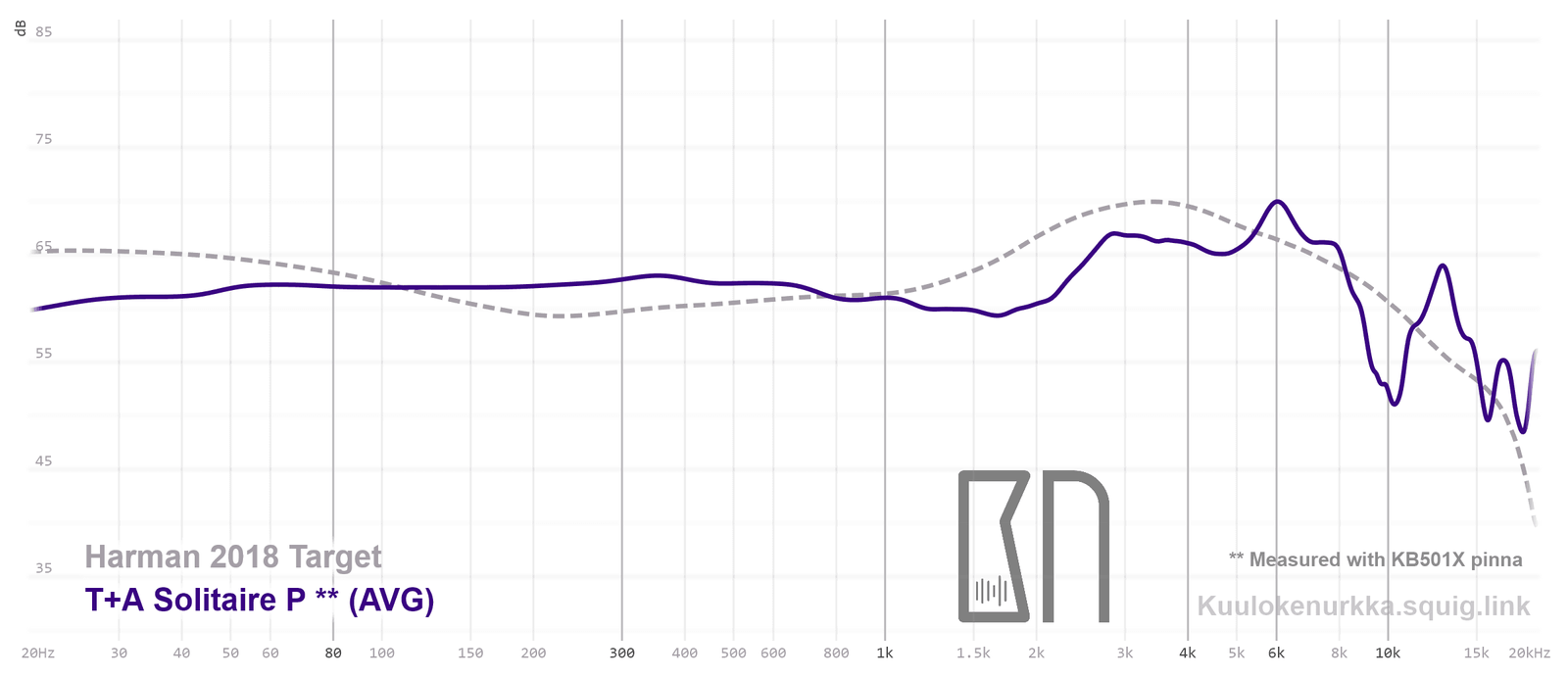
Let's start the sound quality review with the more expensive Solitaire P, which also suits my taste better from the duo. If someone asked me for a concise description of the headphones, I would say they are less bright and more robust in their low frequencies Sennheiser HD 800. Although the kinship ultimately remains somewhat distant, apart from the large soundstage, this is a good starting point.
Frequency response:
Similarity with Sennheiser HD 800:
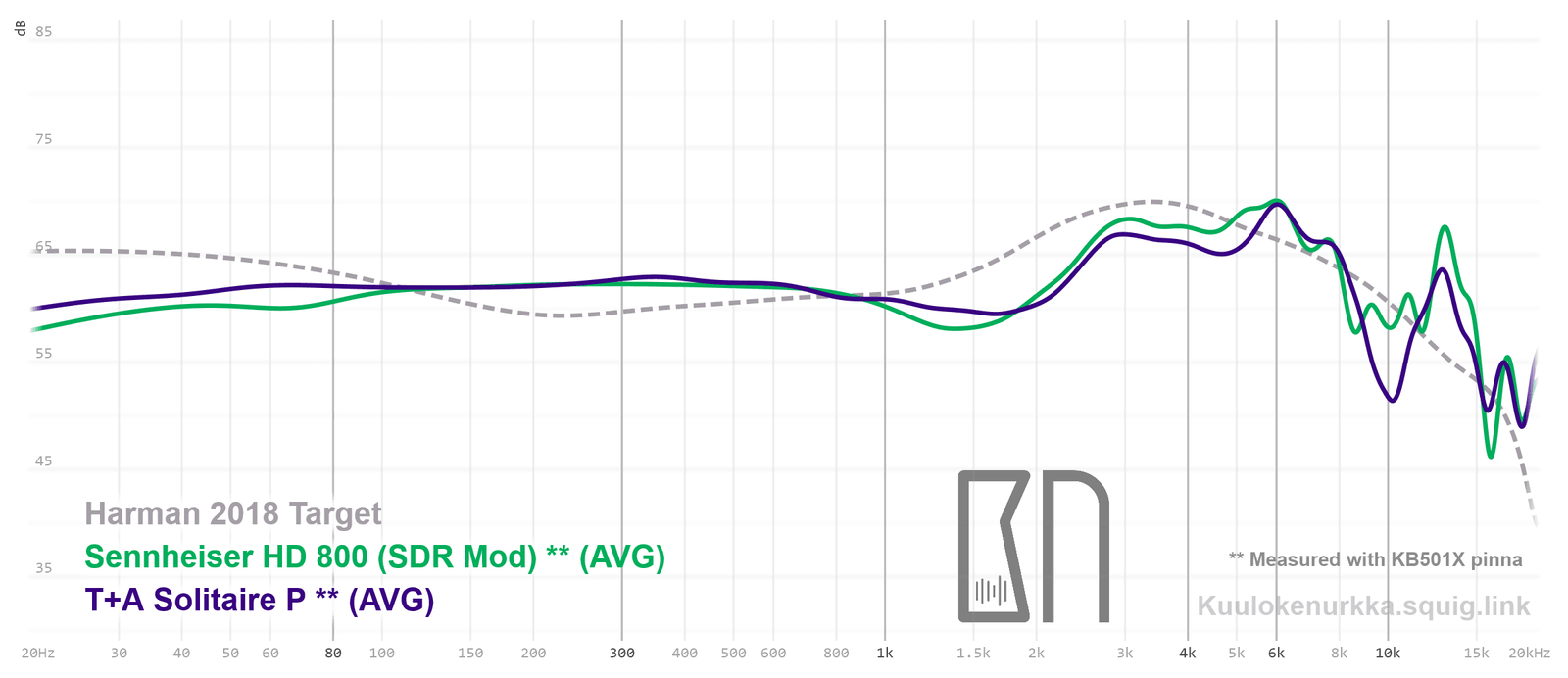
With the Solitaire P, there is no completely neutral reproduction or Harman-style, as clear and present as possible, mid-frequencies; instead, the headphones have their own thing. Firstly, in the low frequencies, they sacrifice some of the clarity of reproduction by adding pleasant warmth and robustness to the sound. This reminds me of ZMF headphones, Audeze's original LCD series, and Meze Audio Empyrean. Solitaire P's upper mid-frequencies, in turn, are reproduced in a softer and more spacious style than usual, creating a sense of volume similar to the Sennheiser HD 800 series. I would describe the treble as unfatiguing, but it still has its own brightness that keeps the sound sufficiently engaging. The frequency response is peculiar on paper, but I have found the spacious and calm presentation surprisingly balanced and easy to adopt.
The end result resembles the Sennheiser HD 800 series in the sense that the somewhat distant presentation does not actually sound veiled or too subdued, but rather the different sounds are reproduced, in my opinion, with an appropriate energy level given how far I perceive them to be located in the large soundstage. With such tuning, one could easily go astray, so it's nice to see T+A succeed. I also find it a welcome change that the Solitaire P does not push information reproduced in the high frequencies into the listener's consciousness as strongly as the HD 800(S) or many Hifimans. The treble may not be the airiest and most impressive, but it is easy to listen to even when a bit tired. I believe many would appreciate this.
On the other hand, the headphones' large planar drivers separate and define musical content so wonderfully precisely and effortlessly that there is no real need for a brighter sound. Especially the precision of sound movements and the seamless transition between the left and right channels impress me. In addition to its width and depth, the Solitaire P's soundstage is exceptionally high, so I perceive sound above me as well – this makes the listening experience immersive. There is a slight step back from the openness and speaker-like dispersion of the Sennheiser HD 800 series, but a heavier and slightly more present sound are, in my opinion, welcome changes. This is precisely the direction I would change the HD 800 myself, even though it was hardly T+A's primary goal.
I have greatly enjoyed the Solitaire P, regardless of the music I listen to with it. It may not be as impressive as the Hifiman Susvara, but it is still a suitably different alternative to other expensive high-end headphones. Since headphone enthusiasts are a diverse group, it is more sensible for manufacturers to stand out from the crowd than to compete with completely identical products. Friends of Harman's target curve would certainly immediately find weaknesses in the Solitaire P, but I personally appreciate T+A's product as it is, because the result is functional. I do not perceive anything in the headphones that would prevent them from being competitive in sound quality within their price range. It should be noted, of course, that at 5000 euros, the price-quality ratio is very difficult to assess for any headphone model.
Bass:
The Solitaire P could be seen as falling between Hifiman headphones and the Meze Audio Empyrean series in its low frequencies. The bass is reproduced more robustly and less distinctly than, for example, in HE1000 models, but still more controlled and less bloated than in the Empyrean. A slight mid-bass emphasis and robust lower mid-frequencies add captivating warmth and weight to the sound, at the expense of the bass frequencies' detail not quite reaching the level of more linear Hifimans. For example, HE1000 V2 reproduces the bass guitar more distinctly and with more realistic texture. Nevertheless, the Solitaire P's more robust sound would often be more enjoyable to listen to, especially with bass music. I personally like instruments that reproduce with a solid body, so the Solitaire P's full-bodied approach greatly pleases me.
Mid-frequencies:
The headphones' mid-frequencies are warm, relaxed, and spacious in style, without forgetting clarity. The Solitaire P does not bring out, like the Hifiman Susvara or ZMF Caldera's for example, the smallest nuances from a vocalist's voice or evoke emotions with its presence or intimacy, but it could be easier listening for those who don't like the sound to be "on the skin" in headphones and strongly activate the senses. I find such a slightly calmer presentation beneficial for the ease of following what is happening in the soundstage. To some tastes, the Solitaire P's upper mid-frequencies between 1–4 kHz would certainly be too soft, but I personally do not find the headphones veiled or unnatural. The size of the soundstage and the energy level of the reproduction are, in my opinion, well balanced, so that a small loss of detail matches the placement of sounds. The presentation is not strictly faithful to the recordings, but it acts as a kind of additional effect that does not descend into unreality. Many have similarly appreciated the spacious sound of the Sennheiser HD 800 over the past decade.
Treble:
The Solitaire P and HD 800(S) differ, however, in the amount of treble. Based on the shape of the frequency response, the treble in both attracts a lot of attention compared to the upper midrange frequencies, but the Sennheiser headphones are clearly brighter and airier. This could, in a way, also benefit the Solitaire P, but it is instead bright without being truly bright. By this, I mean that details emerge effortlessly from the music, but at the same time, the headphones are effortless to listen to even at higher volumes. There is no emphasized sibilance in vocals or any extra sharpness in the sound otherwise. Someone might even consider the Solitaire P to sound a bit dark if compared to a Hifiman model or perhaps Meze Audio's Empyrean 2. To my taste, T+A has succeeded in finding an excellent balance between brightness and relaxation. With the Solitaire P, it is possible to listen to even poorly recorded music relatively relaxed, although it does quickly reveal any potential issues in the recordings.
Other observations:
The Solitaire P shines in songs where interesting things happen in the soundstage, and various sounds appear and move around. It is precisely the accuracy of sound placement and overall resolution that ultimately make these headphones a top product, which is likely the basis for their high selling price. Listening, in my opinion, is truly enjoyable with the relaxed tuning, as the detail feels effortless, but at the same time, it would also be possible to not pay attention to it and enjoy the music as a whole. The Solitaire P is not, so to speak, too "hifi-like" to prevent heavy and gritty rock from sounding engaging and fun on it.
The presentation also captivates in terms of spatial impression, as the soundstage spreads around me impressively large and well-proportioned, without any dead spots in the reproduction. I feel like I am in my own immersive bubble with the music. The reproduction is also pleasantly dynamic, so there is nothing to complain about in that area either. I would say that the Solitaire P's unique tuning ultimately determines whether someone likes it or not. For me, the headphones have been a positive surprise and definitely a successful product. On the other hand, I am left a bit thoughtful about how much more the Solitaire P costs compared to, for example, the Sennheiser HD 800S or Hifiman's HE1000. Their combined price is well below T+A's headphones.
Solitaire P-SE
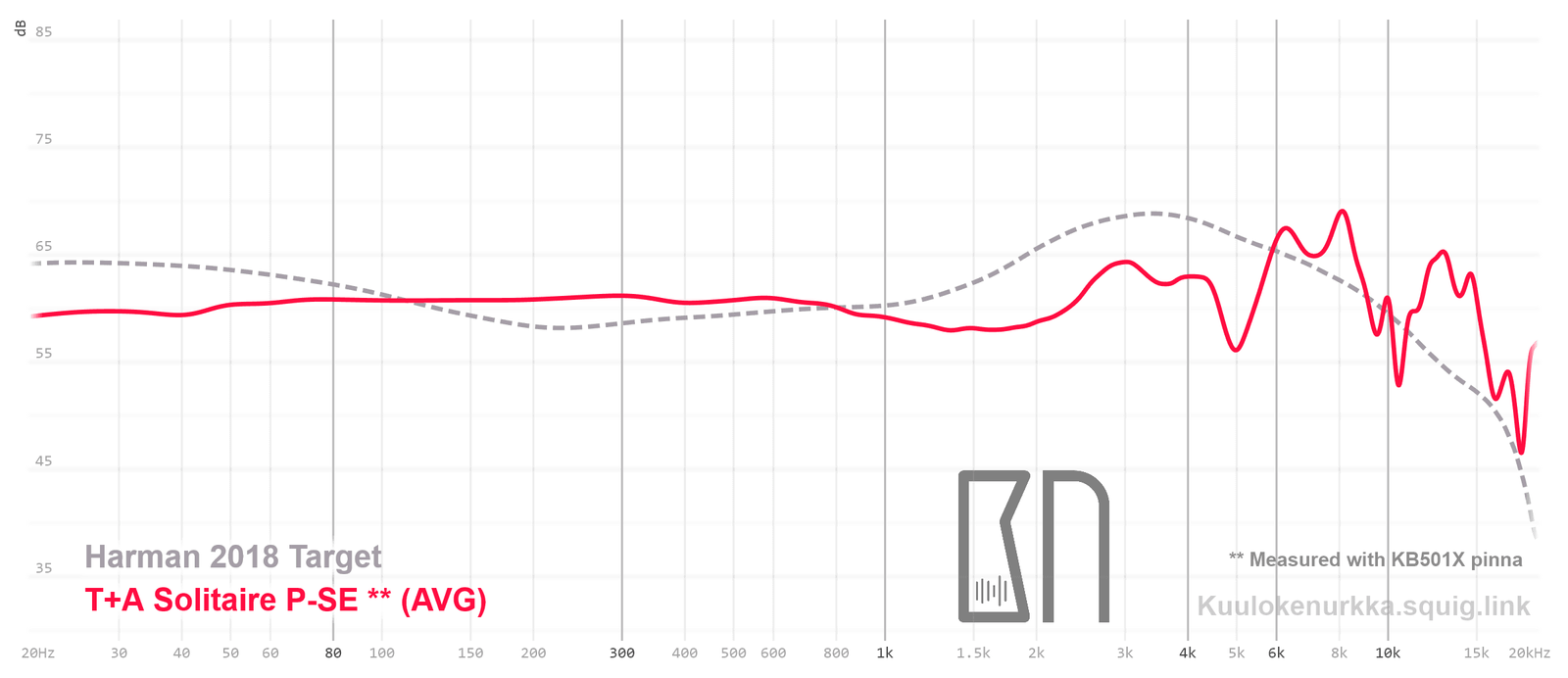
From this, it is good to move on to the more affordable Solitaire P-SE model, which is priced closer to the products of many other manufacturers. Unfortunately, the tuning of these headphones is already so unique that it does not match my preferences. I already sensed at the Hifi Fair that the headphones sounded somewhat bright, but amidst the background noise, I had not yet realized how treble-heavy the sound ultimately is.
Frequency response:
Differences between the two Solitaire models:
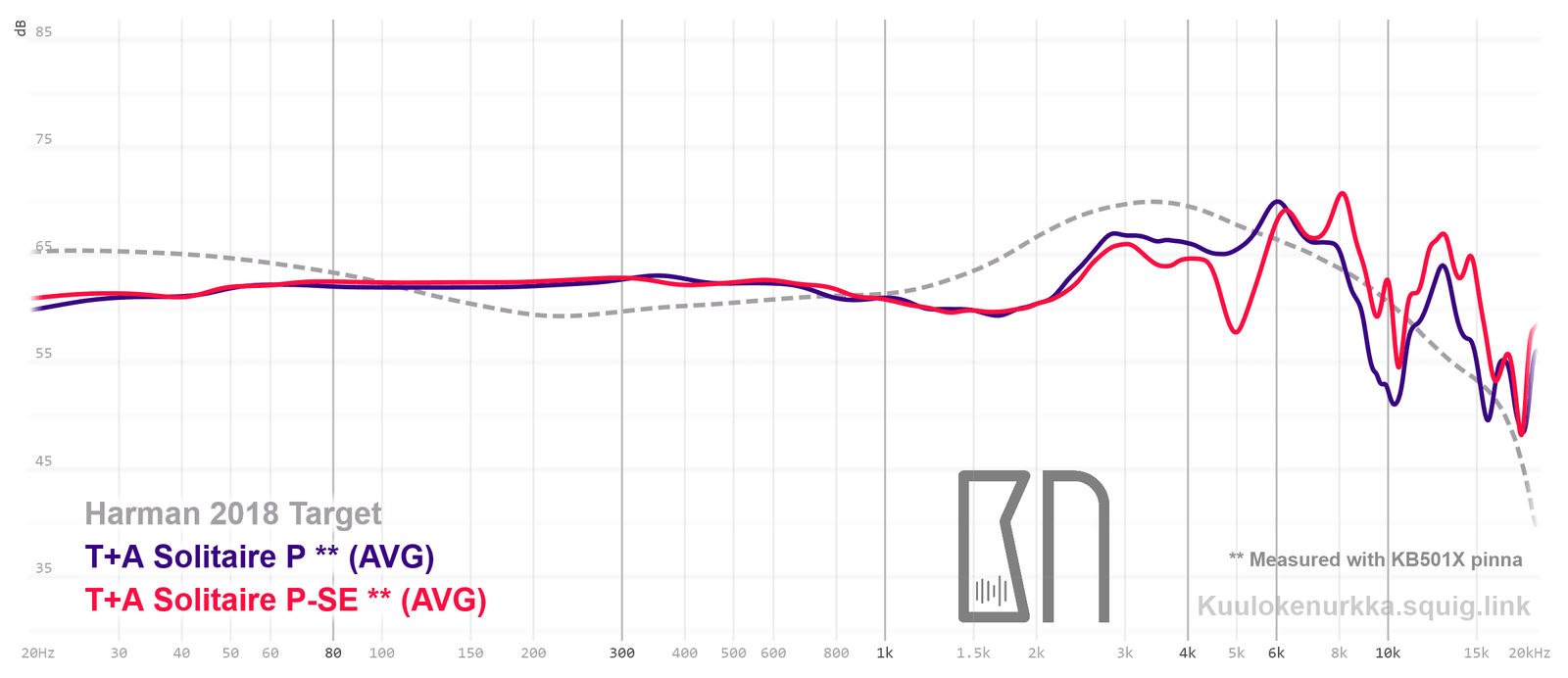
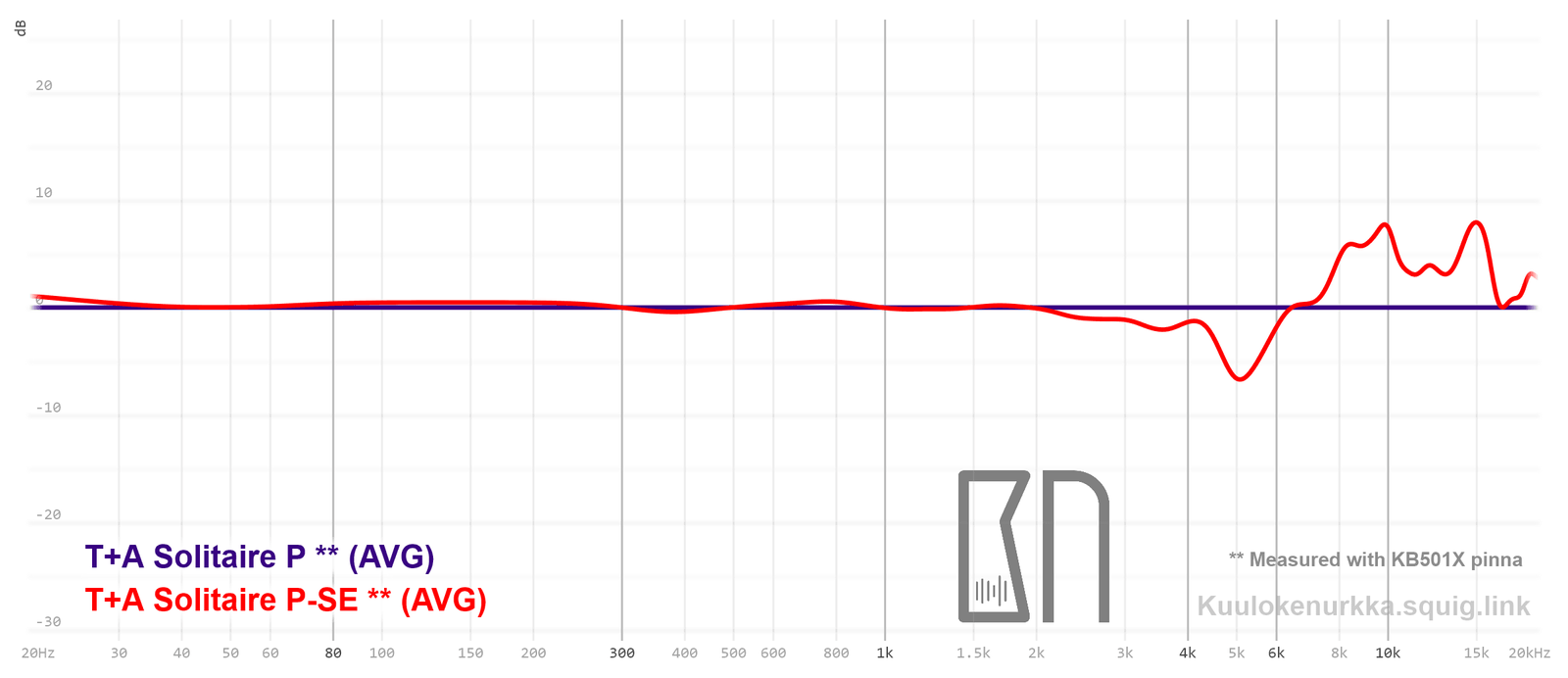
The Solitaire P-SE is identifiable as a member of the same product family as the Solitaire P due to its robust bass frequencies and calmly spacious midrange reproduction. Both headphones also share the same strengths, for example, in terms of resolution. The most significant difference, however, is that the upper frequencies in the P-SE model are clearly brighter and more uneven – to such an extent that I don't feel like listening to the headphones, especially when I've had the much more balanced sister model available at the same time.
The P-SE's treble is very forward in the overall presentation and has a piercing, hissing style. For example, drum cymbals sound quite unnatural, and almost every singer's voice has very emphasized sibilance. Someone else might be immune to the emphasized brightness or even enjoy it, but I myself already suspected the headphones I was testing were faulty, as they cost over 3000 euros. However, based on my measurements, there appears to be no distortion or other exceptional issues in the Solitaire P-SE's drivers; rather, there is simply too much treble between 8–11 kHz. It also has individual strong peaks, which I clearly detect by listening to a frequency sweep. I cannot be entirely sure if all Solitaire P-SEs sound the same, but based on the unit I tested, T+A's more affordable headphone model is aimed at lovers of bright and sharp sound or those who, due to their age, benefit from the added energy in the upper frequencies compared to the P model.
Bass:
The bass reproduction of the Solitaire P-SE is largely similar to the more expensive P model, so my previous observations apply to it. As a small difference, I feel that the P-SE's mid-bass attracts a bit more attention because the headphones' upper midrange frequencies and the presence region between 4–6 kHz are reproduced more subdued than on the Solitaire P. For the same reason, the P-SE generally sounds more V-shaped, focusing most attention on the bass and treble.
Mid-frequencies:
While the Solitaire P's upper midrange frequencies manage to sound sufficiently energetic and present for me, the Solitaire P-SE's sound remains rather rounded and veiled. The explanation for this can be found by glancing at the frequency response, as the area around 5 kHz, in particular, is reproduced more subdued than in the P model. Because of this, the sound remains more distant and subdued. One would constantly want to listen to the headphones at a louder volume due to their lack of clarity, but then the treble becomes even more emphasized. In my opinion, the Solitaire P-SE would require equalization to sound more balanced. Although the presentation is, by default, in a way more open than in the Solitaire P, the subdued 3–6 kHz frequency range prevents sounds from properly positioning around me. The more expensive Solitaire P sounds more accurate and natural of the two, and it also has a deeper soundstage.
Treble:
However, if someone finds the Solitaire P's treble too restrained and prefers noticeably sharpened upper frequencies, the Solitaire P-SE would offer a more energetic and airy listening experience. With its brighter sound, it might also feel more detailed of the two, as many smaller sounds pop out more vividly in the overall presentation. This would certainly suit some types of music, but for example, classical music or any instrumental production would also benefit from clearer midrange frequencies than currently. The timbre of instruments is also not natural, as the treble is reproduced in places almost 15 decibels louder compared to the midrange frequencies. This is likely the main reason why the treble's hiss manages to come so forward in the overall sound.
Many singers sound almost like snakes on the Solitaire P-SE because the 's' sounds hiss badly. No one would actually record vocals of such poor quality. The exceptionally strong and irritating sibilance goes beyond my tolerance. The moments that grate on the ear are often even slightly more emphasized on the left, because the driver on that side reproduces the worst treble peaks 2–6 decibels stronger than the right-side driver. However, this falls under individual variation, so another pair of headphones would likely be different. In any case, the situation is truly regrettable for a product priced at 3000 euros. The treble is also otherwise rough and raw in style. For example, drum cymbals sometimes "break" in a way, because different sounds form a unified hissing mass.
The problems related to the treble are quite directly visible in my measured frequency response, as a strong emphasis is found especially around 8 kHz. To my hearing, this emphasis is located at approximately 8.5 kHz (confirmed by listening to a frequency sweep). There are also exceptional things happening between 10–11 kHz, even if it is not necessarily particularly obvious based on the frequency response. My measurement device, according to the standard it follows, measures a dip at 10 kHz, similar to the Solitaire P, when that particular frequency range is reproduced "normally" without excessive emphasis in the headphones.
However, there is no such dip in the Solitaire P-SE, from which it can be interpreted that 10 kHz is reproduced at least 5 decibels louder than desired to the human ear. Since this frequency has been found to be particularly irritating to hear when emphasized, the problems associated with the Solitaire P-SE do not ultimately surprise me. With a frequency sweep, I also found the 10–11 kHz range to be significantly emphasized to my hearing. If the headphones I tested are not an isolated case, this must be considered a clear design flaw by T+A. For some people's hearing, this might not be as bad a problem, in which case the Solitaire P-SE might sound better and more balanced than it does to me.
Quick notes on the need for confirmation
T+A:n molemmat kuulokemallit ovat varsin herkkiä (101 dB/mW) ja sikäli helppoja vahvistaa. Matalamman 45 ohmin impedanssin ansiosta Solitaire P-SE sopii paremmin mobiililaitteille, joista ei suurella todennäköisyydellä irtoa yhtä paljoa tehoa ja jännitettä Solitaire P:n 80 ohmin impedanssille. Tavanomaisilla transistorivahvistimillakin P-SE soi samalla äänenvoimakkuusasetuksella hieman lujempaa, koska vahvistimien teholukemat ovat yleensä suuremmat 45 ohmin kuin 80 ohmin kuormalle. Toisaalta Solitaire P sopii kaksikosta paremmin putkivahvistimella kuunneltavaksi. Merkittävää eroa kaksikon välillä ei kuitenkaan pitäisi vahvistustarpeen osalta olla, vaikken kovinkaan monella erilaisella laitteella ehtinyt niitä testata.
Totesin lähinnä Solitaire P:n kuulostavan hyvältä kaikilla vahvistimillani, kun taas P-SE-mallin sibilanssia en saanut kuriin millään laiteyhdistelmällä. Edes 100 milliampeerin tilassaan lämpöinen Aune S17 Pro ei tilannetta juurikaan helpottanut, eikä myöskään Cayin HA-3A-putkivahvistimen sulava ääni ratkaissut ongelmaa. Solitaire P sen sijaan kuulosti todella hyvältä myös putkilla pikaisen kokeiluni perusteella. Etenkin keskitaajuuksiin tuli lisää tunnetta hieman samaan tapaan kuin kuunnellessa Sennheiser HD 800:aa putkivahvistimella.
Solitaire models vs. other expensive planar headphones
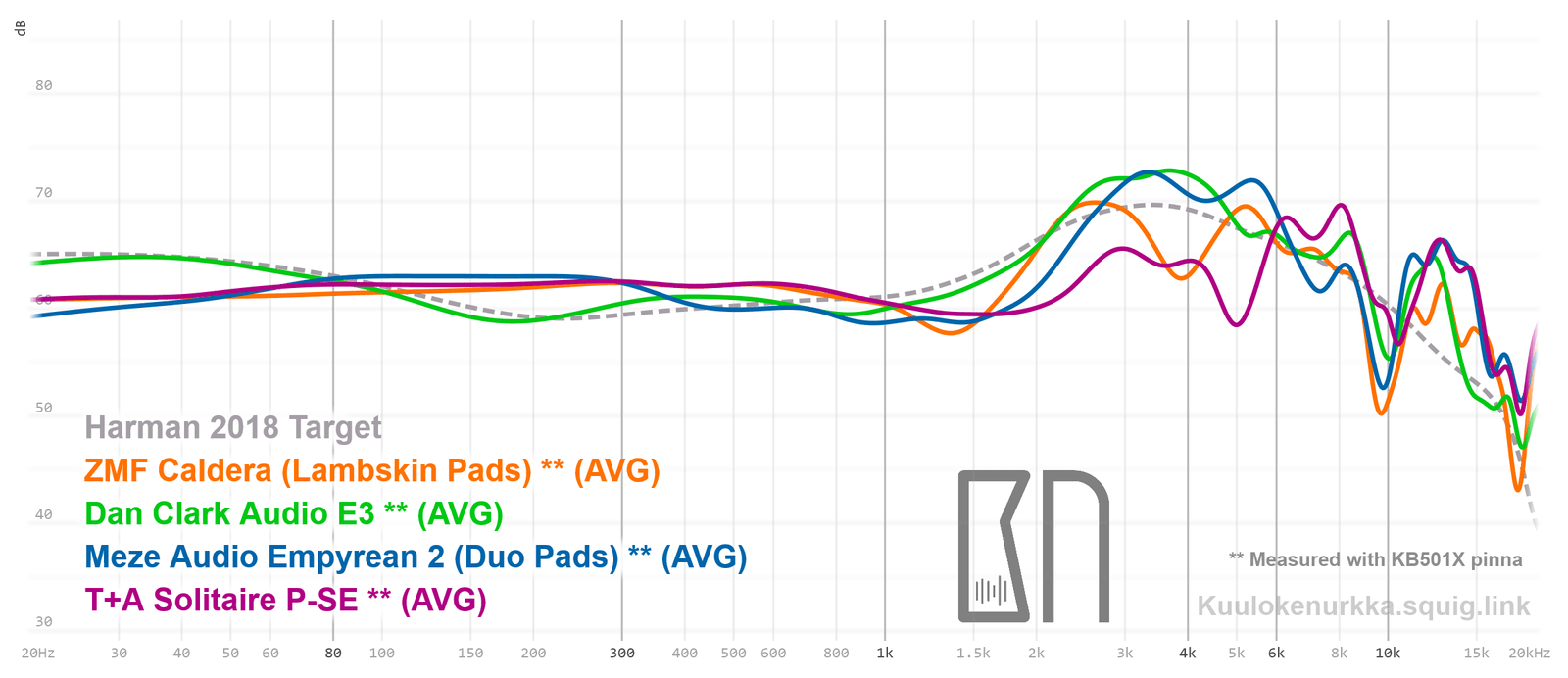
Mainitsen vielä yleisesti, millaisia eroja kuuntelukokemuksessa olisi odotettavissa erityisesti Solitaire P:n ja muutamien muiden planaarikuulokkeiden välillä. Valtaosa verrokeista on aiemmin testaamiani, mutta ZMF Calderan ja Dan Clark Audio E3:n omistan tällä hetkellä.
Solitaire P-SE:tä en valitettavasti koe omassa hintaluokassaan erityisen kilpailukykyiseksi, elleivät sen terävä diskantti ja vaimeat yläkeskitaajuudet satu osumaan täydellisesti jonkun mieltymyksiin – tämäkin on täysin mahdollista, koska monet ovat kuulokkeista pitäneet. Itse valitsisin sen sijaan 2000–3000 euron hintaluokasta esimerkiksi helpommin omaksuttavan ja selkeä-äänisemmän Meze Audio Empyrean 2:n. Myös Dan Clark Audion E3-kuulokkeet olisivat mielestäni suljetusta rakenteestaan huolimatta hyvä vaihtoehto, koska ne mukailevat Harmanin tavoitekäyrää ja kuulostavat siten huomattavasti neutraalimmalta ja luonnollisemmalta kuin Solitaire P-SE. Samasta hintaluokasta löytyy myös dynaamisten kuulokkeiden osalta muun muassa miellyttävän täyteläinen ZMF Atrium.
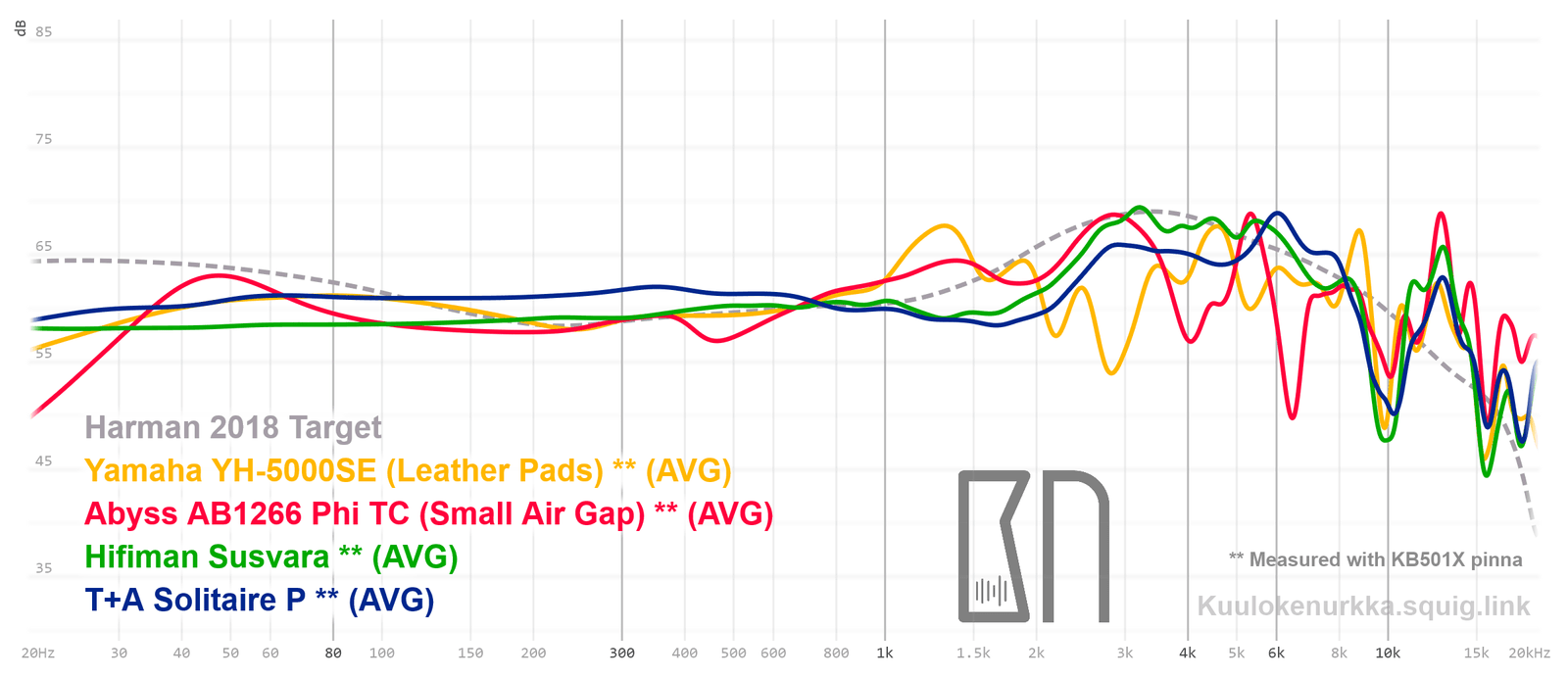
Hintavampi Solitaire P sen sijaan tarjoaa mielestäni toimivalla tavalla erilaisen kokemuksen muiden valmistajien huippukuulokkeisiin nähden. T+A:n kuulokkeissa on edelleen tyyliltään rauhallisemmat keskitaajuudet moniin muihin malleihin verrattuna, mutta toisto on samalla myös avarampaa ja rasittamattomampaa pidemmässä kuuntelussa. Nähdäkseni esimerkiksi alkuperäisestä Meze Empyreanista tai 4000 euron hintaisesta Elite-versiosta pitävät samastuisivat todennäköisesti ennemmin Solitaire P:n kuin valmistajan uuden ja erilaisen Empyrean 2:n esitystapaan. Lisäksi jos Hifimanin kuulokkeet, kuten Susvara, tuntuvat ääneltään turhan kirkkaalta ja ohuelta, Solitaire P toistaisi musiikkia täyteläisemmin ja rotevammin. Sen diskantti olisi myös rennompaa kuunneltavaa.
Hintavat planaarikuulokkeet ovat toistoltaan niin tarkkoja ja erottelevia, ettei niillä mitään jää kuulematta, kunhan taajuusvaste on jotakuinkin normaali – Yamahan YH-5000SE toimii epätasaisen vasteensa myötä päinvastaisena esimerkkinä. Kuuntelukokemukseen vaikuttaakin eniten se, millaista toistoa kukin valmistaja on lähtenyt kuulokkeillaan tavoittelemaan. Monesti tuotteet eroavat niin paljon toisistaan, että voittajien julistaminen on vaikeaa.
Tarkemmin itselläni oli mahdollista vertailla Solitaire P:tä ZMF Calderaan, joka asettuu noin 4000 euron hinnallaan kahden Solitaire-mallin väliin. Caldera on keskitaajuuksiltaan hyvin erilainen kuuloke, sillä se tuo äänen intiimisti ja elävästi melko lähelle. Erityisesti yläkeskitaajuudet toistuvat energisemmin kuin Solitaire P:ssä, joten sekä laulusuorituksissa että soittimissa on enemmän särmikkyyttä ja tarttumapintaa. Solitaire P:n pehmeys alkaa hieman häiritä, sillä Calderan toisto tuntuu tiukemmalta ja hieman dynaamisemmalta. Alataajuudet molemmissa kuulokemalleissa ovat samaan tapaan painavat ja täyteläiset sillä erotuksella, että Caldera pysyy paremmin kontrollissa. ZMF-mallin diskantti sen sijaan on itselleni pidemmän päälle tyyliltään hieman uuvuttavampaa, kun käytän kuulokkeiden vakiopehmusteita. Osa uuvuttavuudesta voi tosin johtua aavistuksen hyökkäävästi toistuvasta 2–3 kHz:n taajuusalueesta, joka tekee välillä kappaleesta riippuen kuuntelusta lievästi epämukavaa.
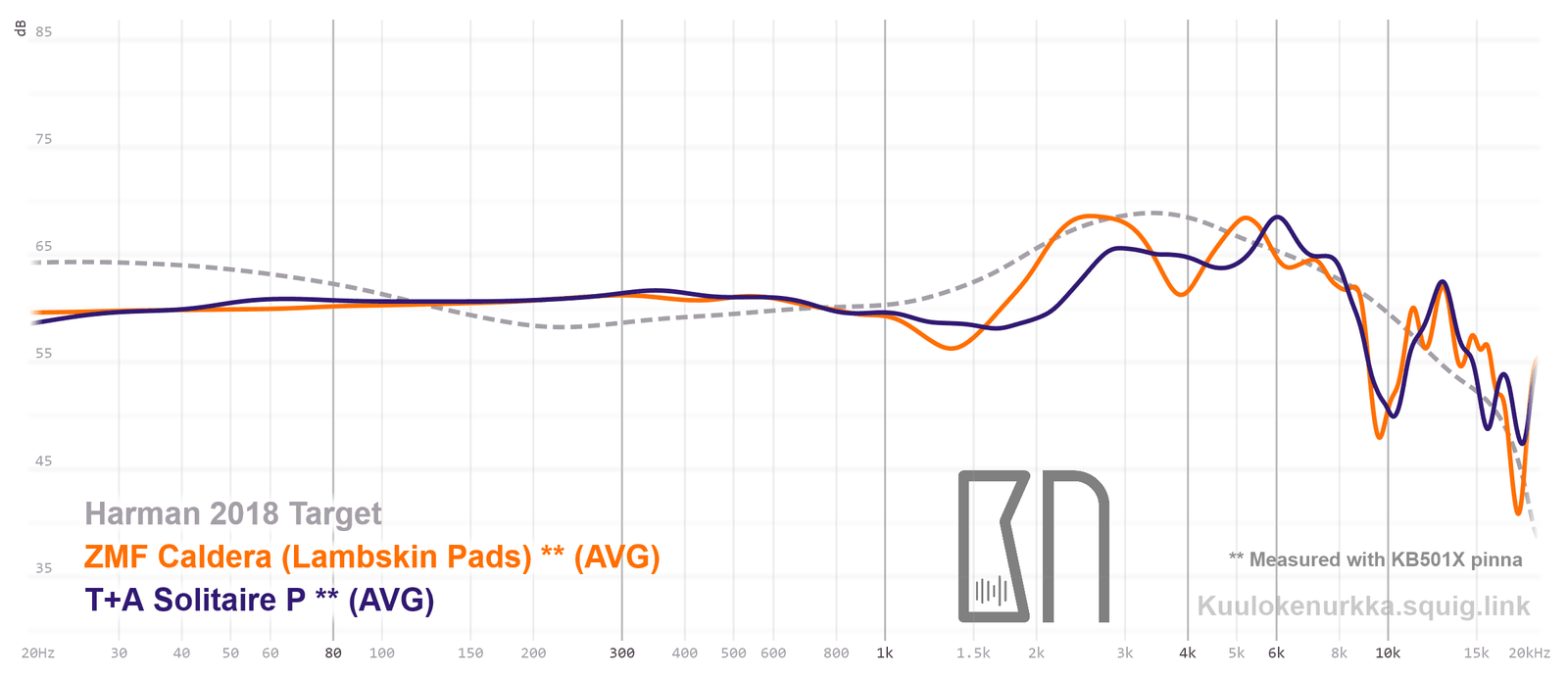
Calderan elävämpi ja läsnäolevampi esitystapa tempaa itseni lopulta paremmin mukaansa, mutta arvostan toisaalta Solitaire P:n rentoutta ja laajempaa äänikuvaa. Calderan äänikuva on upean tilava, mutta se ei kuulosta samaan tapaan korkealta tai siltä kuin molemmilla puolillani soisi suuri ääntä tuottava seinä. Kumpikaan kuulokkeista ei mielestäni tavoittele toiston absoluuttista yksityiskohtaisuutta, mutta ne erottelevat ja rajaavat ääniä todella tarkasti – erinomaisia tuotteita molemmat, joskin kalliita sellaisia. Onkin harmi, ettei reilu 3000 euroa maksava Solitaire P-SE ole diskantiltaan hieman tasapainoisempi, jolloin se voisi haastaa tosissaan hintavampia kilpailijoitaan.
Summary
T+A:n kuulokkeet jättävät minut lopulta yllättyneeksi monellakin eri tavalla. On ensinnäkin mukavaa nähdä lisää Euroopassa suunniteltuja ja valmistettuja huippukuulokkeita monien amerikkalaisten ja kiinalaisten mallien seassa. Vaikken asiaa vielä tähän mennessä maininnutkaan, T+A osaa selvästi laadukkaiden elementtien valmistamisen, sillä Solitaire-mallien säröarvot ovat käytännössä katsoen nollassa kaikilla taajuusalueilla. Esimerkiksi Hifimanin ja Abyss:in planaarielementit säröilevät melko sotkuisesti, Yamahan YH-5000SE:stä puhumattakaan. Vaikkei tämä välttämättä olekaan erityisen helposti kuultavissa, moni saattaisi antaa lisäarvoa sille, että T+A on tehnyt työnsä hyvin.
Toisaalta valmistaja on vielä selvästi aloittelija kuulokkeiden saralla, sillä molempien Solitaire-mallien pääpanta on mielestäni suunniteltu väärän muotoiseksi. Kuulokkeiden käyttömukavuus voikin vaihdella tavallista enemmän ihmisten välillä. Itse en valitettavasti pystyisi omistamaan kumpaakaan kuuloketta, koska niiden käyttäminen on epämukavaa. Sitä ei käy kuitenkaan kiistäminen, etteikö kaksikosta hintavampi Solitaire P olisi muutoin rakenteensa laadun ja tukevuuden osalta huippuluokkaa. Solitaire P-SE:n kohdalla kustannuksia on sen sijaan karsittu rankalla kädellä, joten sen kohdalla laatuvaikutelma jää hieman harmittamaan 3000 euron hinta huomioiden. Muovi ei sinällään ole materiaalina huono ratkaisu, mutta rakenteen löysyys ei herättäisi juurikaan omistamisen ylpeyttä moniin muihin saman hintaluokan tuotteisiin verrattuna.
Äänen osalta pidän selvästi enemmän kalliimmasta Solitaire P:stä, joka kilpailee mielestäni tasaväkisesti muita huippumalleja vastaan ollen tuunaukseltaan yksi harvoista Sennheiserin HD 800-sarjaa muistuttavista kuulokkeista. Ehkäpä juuri siksi omaperäinen lopputulos toimiikin niin hyvin, vaikka alataajuuksien rotevuuden ja rauhallisemman diskantin myötä puhutaankin loppujen lopuksi melko erilaisista kuulokkeista. Jos arvostelussani kuvailemani ääni sattuu houkuttelemaan ja Solitaire P istuu päähän riittävän mukavasti, se on mielestäni vallan erinomainen ja onnistunut kuuloke.
Solitaire P-SE sen sijaan jättää itseni melko pettyneeksi verhoutuneiden keskitaajuuksiensa sekä terävän ja liikaa korostuvan diskanttinsa vuoksi. Vaikka tämä saattaakin sopia tietynlaiselle musiikille, voimakkaaseen sibilanssiin kannattaa varautua, elleivät testaamani kuulokkeet ole olleet jollakin tapaa poikkeukselliset. Epäilen asiaa lähinnä siksi, etten ymmärrä, miten tämän luokan sibilanssiongelma olisi voinut jäädä huomaamatta kuulokkeiden suunnitteluvaiheessa. Oli miten oli, Solitaire P-SE:tä kannattaa toki mahdollisuuden tullen kokeilla, sillä voihan olla, että jollekulle toiselle se kuulostaa täysin normaalilta. Koska molemmat testaamani T+A:n kuulokemallit jäävät korkean hintansa vuoksi usempien ulottumattomiin, toivon valmistajan julkaisevan tulevaisuudessa myös hieman edullisempia planaarikuulokkeita, mieluusti enemmän Solitaire P:stä mallia ottaen.
Pros and cons:
Solitaire P
+ Miellyttävän roteva, avara ja rasittamaton ääni
+ Tukevat alataajuudet
+ Erottelukyky ja liikkuvien äänten sijaintitarkkuus
+ Korkea ja upean suurelta tuntuva äänikuva
+ Rakenteen tukevuus ja laadukkaat materiaalit
+ Does not require a powerful amplifier
+ Two cables included
+ Matalat säröarvot
– Syvälle upotetut liittimet hankaloittavat kaapelihankintoja
– Mukana tulevat kaapelit ovat epäkäytännöllisen järeitä
– Heikko käyttömukavuus liian jyrkän pääpannan kaaren ja korkean painon vuoksi
– Korkeussäätö ei säilytä painavien kuppien vuoksi kunnolla asentoaan
– Expensive accessories
– Erittäin korkea hinta
Solitaire P-SE
+ Avara ja korkea äänikuva
+ Miellyttävän tukevat alataajuudet
+ Erottelukyky
+ Does not require a powerful amplifier
+ Lähes 100 grammaa kevyempi paino hintavampaan P-malliin verrattuna
+ Two cables included
+ Matalat säröarvot
+ Kohtuullisempi hinnoittelu
– Voimakas sibilanssi ja diskantin terävyys
– Yläkeskitaajuudet kuulostavat vaimeilta ja verhoutuneilta
– Syvälle upotetut liittimet hankaloittavat kaapelihankintoja
– Mukana tulevat kaapelit ovat epäkäytännöllisen järeitä
– Heikko käyttömukavuus liian jyrkän pääpannan kaaren vuoksi
– Rakenne on selvästi löysempi P-malliin verrattuna
– Expensive accessories
– Edelleen kallis epätasaiseen ääneensä nähden
 EN
EN  FI
FI