Author: Sword of Damocles
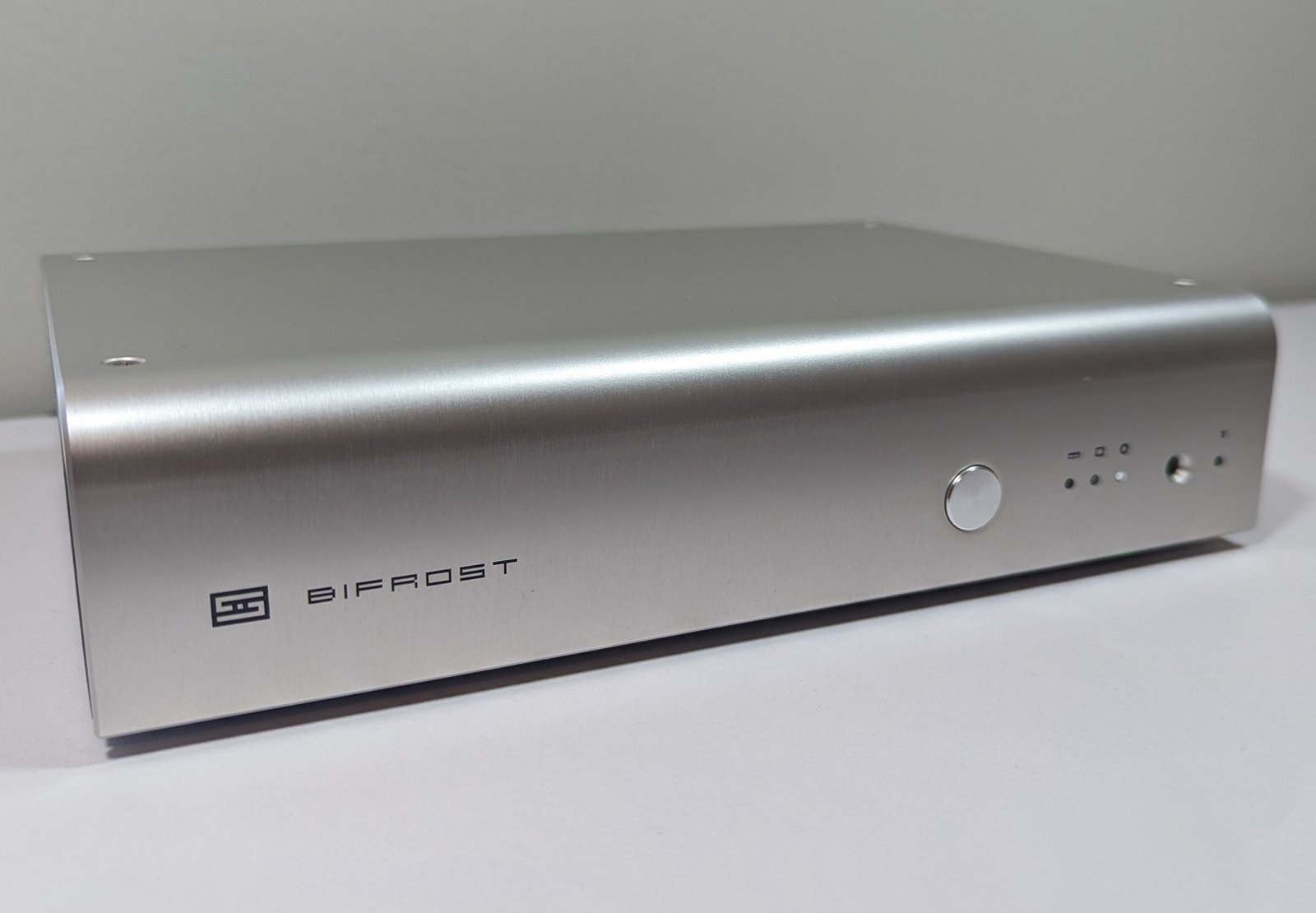
Table of Contents:
Information:
- Year of publication: 2019
- Price: 699 USD / 800 €
- Type: Schiit True Multibit
- DAC chip: Analog Devices AD5781ARUZ x 2
- Digital filter: 8x oversampling
- USB implementation: Schiit Unison USB (requires W10 in the Windows world, as I understand it)
- Memory card slot: for firmware updates
- Digital input connections: USB-B, Optical, Coaxial
- Analog output connections: XLR, RCA
- Sampling rate (all input connections) PCM: 44.1–192 kHz (16–24 bit)
- Output voltage: RCA 2 Vrms / XLR 4 Vrms
- THD + N: < 0.003%
- IMD: < 0.004%
- SNR: 114 dB
- External dimensions (L x W x H): 17 x 23 x 5 cm
- Weight: 2.25 kg
- Power consumption: 15 W
- Included: USB-B cable, power cable and metal remote control
- Warranty: 5 years
Review sample: Self-purchased product
Bifrost 2 (link to product page) is a modular D/A converter from Schiit Audio, located in California, based on the company's self-developed multibit technology. The device can be considered a kind of intermediate form between delta-sigma and R2R DACs, as the conversion is done in an R2R-like manner, but with a single chip. This chip was originally developed for medical use, so converting it into a DAC is a rather original choice. Bifrost 2 has largely been developed from subjective starting points.
The device lacks DSD support, and the maximum PCM sampling rate does not reach high figures by current standards. Neither the 800 euro price nor the mediocre measurement results are in Bifrost 2's favor when compared to many traditional delta-sigma DACs. Nevertheless, I hope to be able to justify in this review why the device is worth its price in terms of sound quality.
Introduction to the device
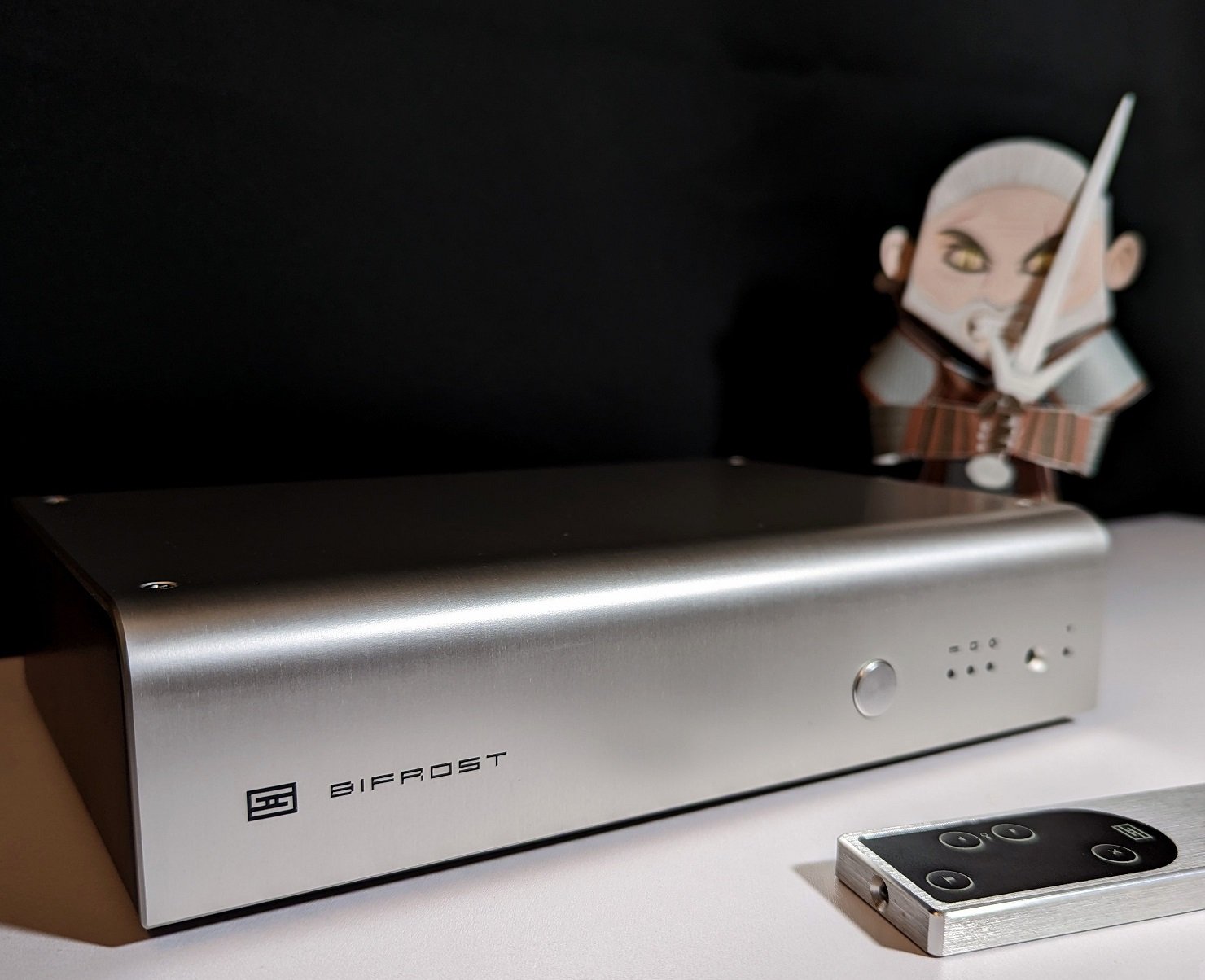
Bifrost 2 is externally a minimalist-looking aluminum block with not much to look at. However, the construction is really sturdy. My own device is silver-colored, but it would also be possible to buy it in black. All Schiit Audio products look largely the same externally, but they come in different sizes. The base area of Bifrost 2 corresponds to the manufacturer's Asgard, Jotunheim, Lyr, Valhalla, and Magnius amplifiers, so they could be neatly stacked on a table.
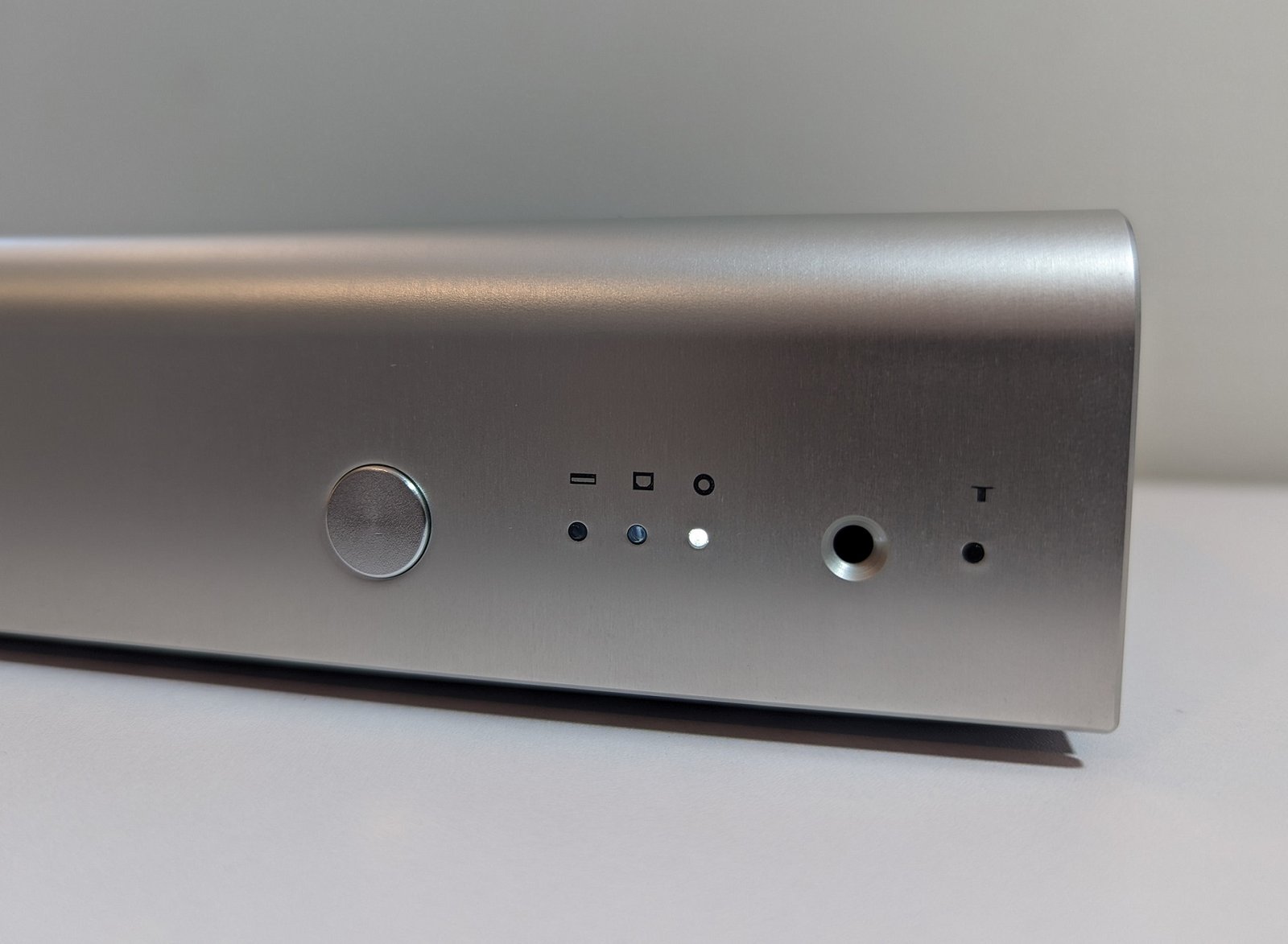
On the front edge of the device, there is a large button that can be used to change the audio input channel – the selection is indicated by three white LEDs. A larger black hole on the front edge of the device is the receiver for the included remote control, which can interestingly be used to change the phase of the audio signal in situations where the phase of the listened music would be inverted. Activating the setting is indicated by a white LED below the T-symbol located on the right edge.
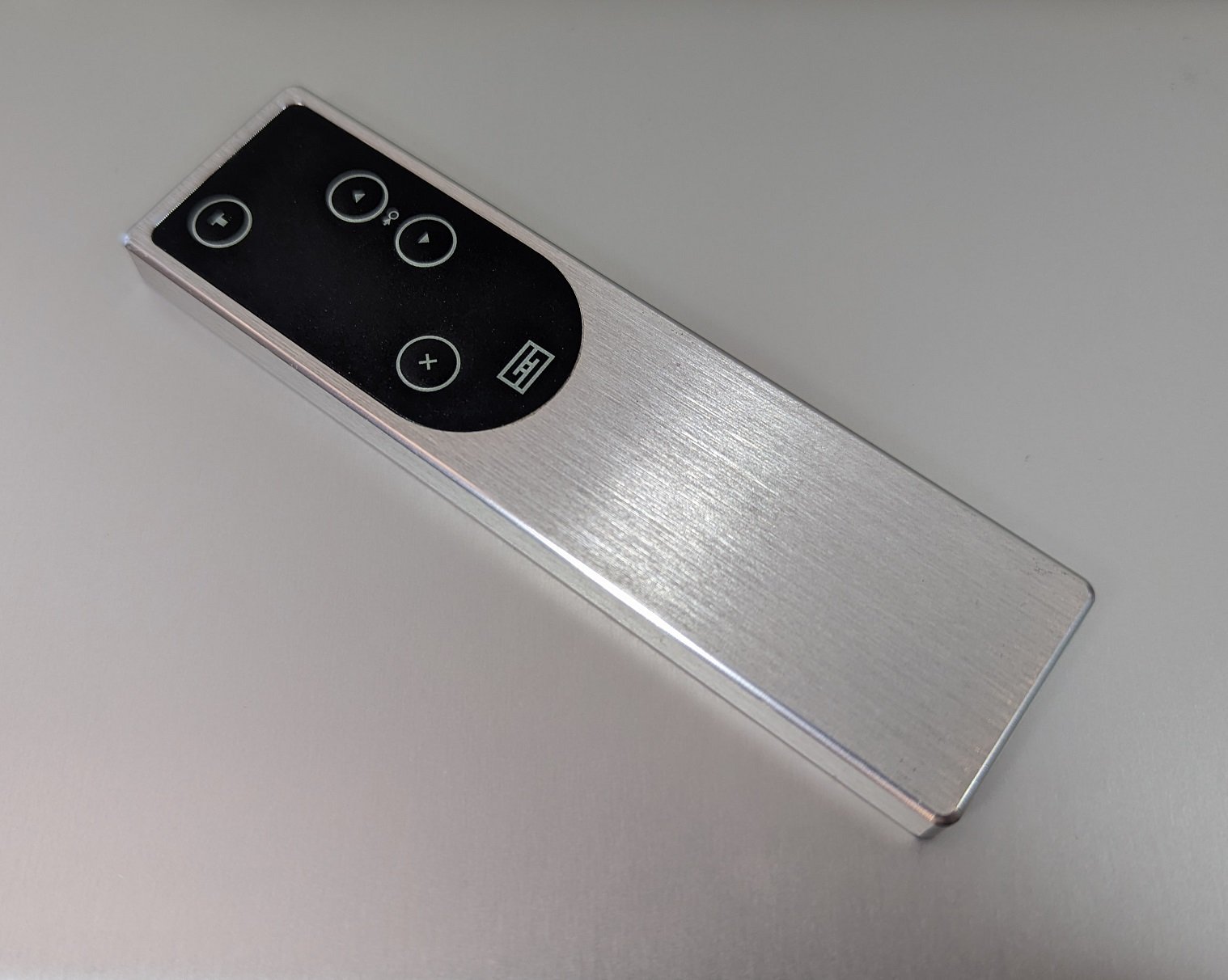
The remote control is exceptionally high-quality and heavy, as it is made from a single piece of metal. It is also magnetic, so it adheres firmly, for example, to the side of a computer case or a refrigerator door. Unfortunately, the remote control is of little use, as Bifrost 2 does not support volume control. I have never needed to change the phase of the audio signal, but the mute function and the ability to change the audio input channel found on the remote control could probably be useful functions in some situations, especially in living room use.
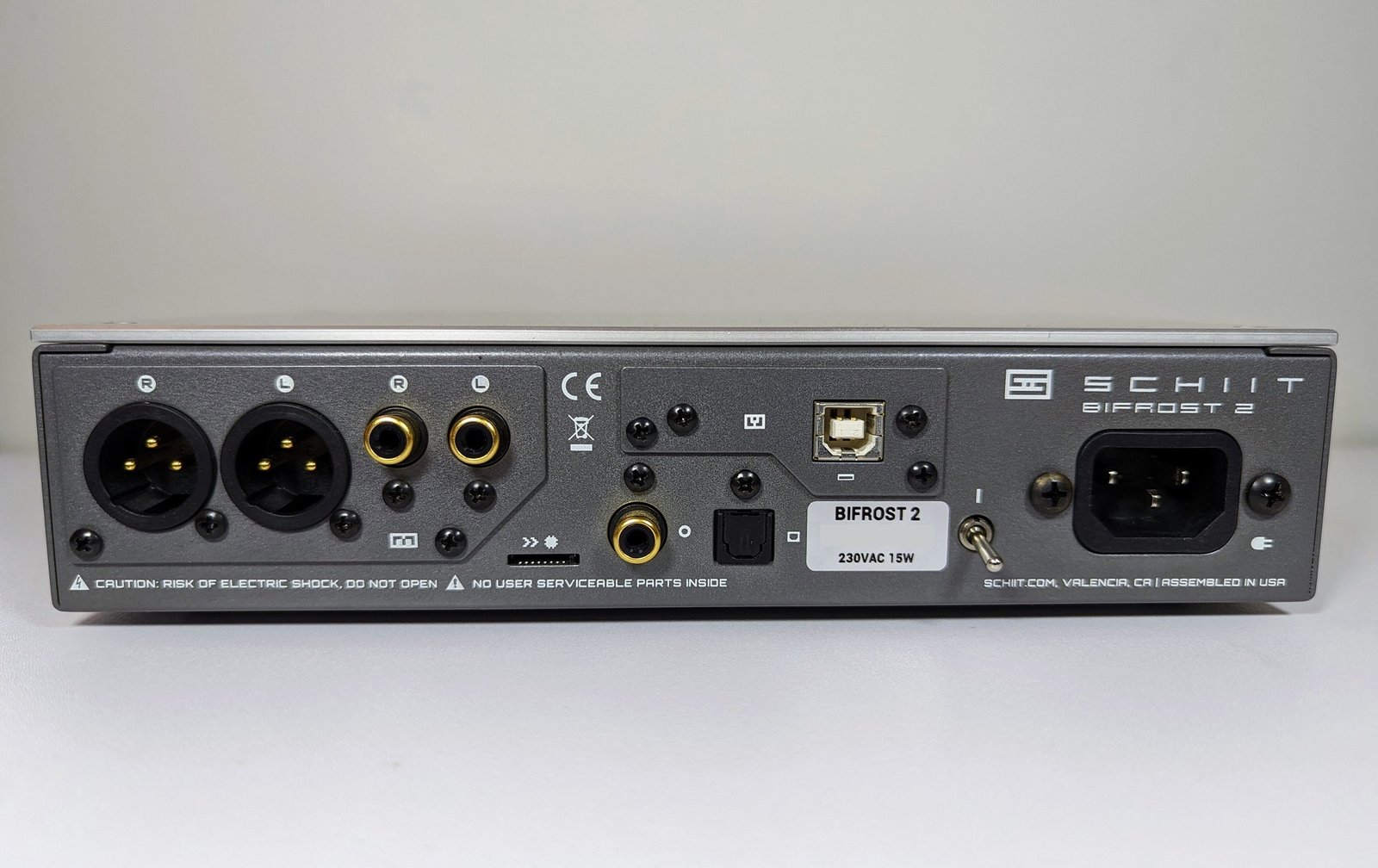
The power switch of Bifrost 2 is typically located on the back of the device, so one has to reach for it if the DAC is placed in a harder-to-reach spot. On the back of the device, there are both balanced (XLR) and unbalanced (RCA) output connectors. The digital signal input connectors are USB-B, coaxial SPDIF, and optical SPDIF, meaning there is nothing particularly special in the connector selection. The only more interesting additional feature is a MicroSD memory card slot, which is intended for updating the device's firmware.
Modular design:
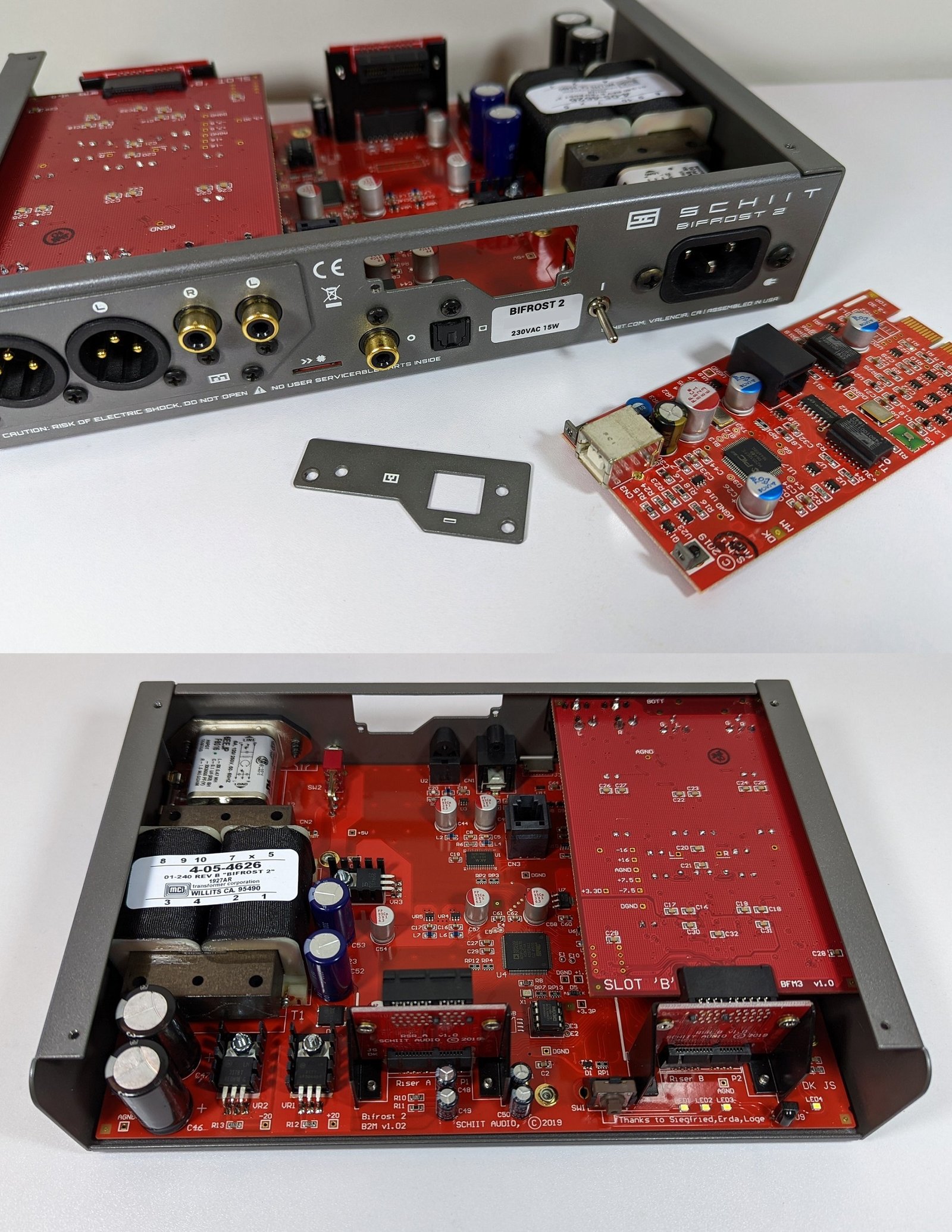
The structure of Bifrost 2 is modular, as inside the device there are removable circuit boards for the USB implementation and analog outputs. The structure allows for updating components if the manufacturer releases revised versions of them in the future. I think the idea is really good, but at least for 2.5 years, no updates have been seen yet. However, the manufacturer has released similar updates for its more expensive DAC models, so I wouldn't be surprised if something eventually becomes available for Bifrost 2 as well.
Unison USB:
Schiit Audio's DACs feature an implementation named Unison USB by the manufacturer, which aims to improve the transfer of the audio signal from a computer to the DAC via the USB connection. Many other factors also affect the final sound quality in D/A converters, so the benefits of a smaller amount of interference or a more stable USB connection are quite difficult to verify. However, the clearest advantage of Unison USB is that the USB connection remains active when connected to the computer, even if another input is selected on the DAC. Almost all devices from other manufacturers completely disconnect the USB connection in such a situation.
This might sound like a non-existent problem or a small matter, but maintaining the USB connection is a useful feature for those who listen to music on a computer with a player that has exclusive mode enabled. During listening, situations may arise where one might want to quickly watch, for example, a YouTube video. However, this is not possible for audio without first turning off the music player (or disabling exclusive mode), as an active exclusive mode mutes all other audio sources except the player. In the worst case, the web browser might even need to be restarted in between to get the video audio to play.
In Bifrost 2, such annoying fiddling can be bypassed by connecting the DAC to the computer not only via USB but also via SPDIF. After this, when watching a Youtube video, SPDIF can be used as the input channel in the DAC at the same time as the USB connection and its exclusive mode remain active in the music player in the background. This makes the use of exclusive mode more flexible than with many other DACs. For me, the feature is not of much use, but I am sure that some others will find a use for it.
Bifrost 2's Unison USB is an improvement compared to the manufacturer's more affordable devices in that its circuit board also includes a galvanic isolator for interference noises transmitted via the USB bus. I mainly listen to music on my rather noisy gaming computer, but I hadn't realized before how clearly the machine's interference noises transfer to the headphones. Bifrost 2 filters out these interferences, so there is less background noise compared to devices without a galvanic isolator.
Notes on device usage
The use of Bifrost 2 has been problem-free after updating to the latest firmware version, so I definitely recommend performing the update, especially for a device bought used. Before the update, my device would enter some kind of intermediate state within 15 minutes of playing games, where it would start clicking the USB connection on and off every second. The DAC only recovered from the problem after restarting the computer. Fortunately, the firmware update seems to have completely resolved the issue.
The device heats up considerably during prolonged use, but according to the manufacturer, this is not a problem even when placing another device, such as an amplifier, on top of the DAC. I personally don't want to unnecessarily stress the Bifrost 2, so I have avoided placing other devices under or on top of it.
Many claim that Schiit Audio's multibit DACs sound better when they are always kept powered on. However, I cannot confirm this, nor do I believe that anything significant changes after, for example, half an hour of use.
Some R2R DACs, such as the popular Denafrips Ares II, have a rather significant delay, which can cause problems when watching video content or playing video games. However, Bifrost 2 does not have such a delay problem, so it is versatile for other uses besides listening to music.
Sound quality
Equipment used for sound quality evaluation
I have owned the Bifrost 2 for long enough that it has become familiar to me from my previous device comparisons. For this reason, I have not compared the device again to other DACs I own this time, but rather I will describe my impression of the sound quality formed over a longer period. Generally speaking, however, the sound quality characteristics of the Bifrost 2 have become most apparent after using it for several months paired with the neutral-sounding Burson Audio Soloist 3X Performance amplifier.
I have mainly used the balanced XLR connectors of the Bifrost 2 and, for digital connections, solely the USB connection, on which the manufacturer has focused most. I will not comment on whether there is an audible difference between digital connections, but many have reported USB sounding significantly better than SPDIF connections, whatever that means. I will focus on what the Bifrost 2 sounds like at its best.
If you wish, you can read more about my test methods related to device comparisons in my previous device reviews. I previously compared the Bifrost 2 to the 500-euro Soncoz SGD1 (link to review), so from this point on, my observations are partly a repetition of that review.
Bifrost 2 makes listening more pleasant and easier
All delta-sigma devices I have heard costing less than 500 euros sound fundamentally very similar, so differences between them must be sought by careful listening – the significance of these differences remains quite small during prolonged listening. However, the Bifrost 2, implemented differently, is clearly distinct, as it changes a broader overall picture rather than individual aspects of playback. This can be both a good and a bad thing, depending on the role one assigns to the DAC in the listening chain.
I already wrote in the SGD1 review about how the Bifrost 2 makes me more convinced that I am listening to real sound, not a digital recording. The change in the naturalness of the timbre and the realism of the playback is, in a way, small, but at the same time truly significant for the overall experience. After hearing the Bifrost 2, it is very difficult to go back to what was before, because with this device, singers and different instruments sound more like they do in real life.
The device aims more for listening enjoyment than analytical playback. Listening to music with the Bifrost 2 is pleasant and easy because the reproduction is just suitably rounded without being too soft or lacking in detail. In a way, the device is a very successful compromise between ease of listening and detail in playback. The result, for example, compared to the neutral Topping E30 and the slightly bright Soncoz SGD1, is warmer and fuller. In other words, the device colors the sound, so it is not for everyone.
Fun and punchy bass reproduction
In my opinion, Bifrost 2's best, and also most memorable feature is its heavy and impactful bass reproduction. The bass is not emphasized in the overall frequency response (no measurable change in headphone frequency response), but the same amount of bass somehow produces more punch and sound pressure than in other DACs I've heard. The bass is always present and sounds truly lively and authentic. I literally feel that Bifrost 2 brings the bass on the recording to life.
The device is most enjoyable when listening to heavier music, where furiously reproducing kick drum and bass guitar inevitably bring a smile to your face. The bass is reproduced thicker and denser than with my reference SGD1, whose bass remains significantly lighter. On the other hand, technically more complex bass patterns are reproduced slightly more controlled with the SGD1, and its less dominant bass reproduction can also be a good thing in some situations. However, I would not trade away Bifrost 2's robust bass reproduction, so when planning a possible device upgrade in the future, the new DAC's bass reproduction should be at least close to it.
Forgiving treble
Bifrost 2 maintains its listening pleasure-focused reproduction style also in the treble, which is reproduced quite forgivingly and calmly. The treble is, in my opinion, natural in style and easy to listen to, but a brighter and sharper-sounding device, such as the SGD1, manages to bring out high-frequency details more clearly. The SGD1 also sounds airier in its upper treble compared to Bifrost 2's darker and calmer background reproduction. Both devices have their own good points, but I am fond of the fact that Bifrost 2 produces significantly less listening fatigue.
Sufficient detail
As can be inferred from the treble reproduction, Bifrost 2 is not the best DAC choice for those who prefer a more analytical reproduction style. On the other hand, the device does not hide details either; rather, it merely removes the sharpest edge from them, making it easier to focus on the overall picture instead of listening to individual sounds. In my opinion, the device is quite clearly aimed at the music listener, not the music analyzer. However, spatial details originating from the recording environment are reproduced more clearly than usual, so Bifrost 2 elevates the listening experience to a new level in that regard.
Credible soundstage
Bifrost 2 does not have as airy and depth-wise forward-projecting soundstage as the SGD1, but the soundstage is pleasantly wide nonetheless. For example, switching from an affordable Topping E30 (link to previous review) directly to Bifrost 2, the soundstage opens up significantly wider and better structured. Each element has a precise and credible location in the sound field. The result sounds like it could exist – this reinforces the feeling that the music being listened to is authentic.
However, the size of the soundstage is something where many other devices can probably offer an improvement compared to Bifrost 2. In a way, I would wish for the depth and airiness of the SGD1 in the sound, but on the other hand, I wouldn't want to trade away the achieved naturalness and realism. Among somewhat similar-sounding R2R DACs, for example, the popular Denafrips Ares II is, according to many, larger in soundstage than Bifrost 2, so it might be a better choice for those who appreciate the widest and largest possible sound.
Device pairing
Bifrost 2 adds body, warmth, and a certain smoothness to the reproduction, so it should, by default, be best suited to balance brighter-sounding amplifiers or headphones. On the other hand, the device does not bring airiness and freshness to the reproduction, so it is not the best choice for those who prefer a cooler and brighter sound. This should be taken into account when pairing devices.
In my own use, however, thanks to its natural presentation, the device has immediately made even my darkest-sounding amplifiers and headphones sound better. I would see that Bifrost 2 is not too warm or robust except, at most, in truly stuffy-sounding listening chains. For example, a very dark-sounding tube amplifier could be a poor choice unless the darkness of the reproduction is desired to be emphasized even further. I have confirmed this myself with my Tor Audio Roger tube amplifier, which becomes overly robust with Bifrost 2 and its standard tubes. The situation can be remedied with brighter and airier-sounding tubes.
I have mostly used my Burson Soloist 3XP amplifier as a pair for Bifrost 2, which, in my opinion, is an excellent pairing due to its neutral and quite energetic treble sound. The Soloist 3XP's upper treble is at times a bit too bright for my taste, but Bifrost 2 removes the irritating characteristics, leaving only music that one wants to listen to. The result is almost perfect for my taste in the sense that I can completely forget the existence of the devices when listening to music, regardless of what headphones I am using with them. Based on my experience, Bifrost 2 appears to be a transparent enough and detail-preserving DAC even for more expensive amplifiers.
Summary
In my opinion, Bifrost 2 is an almost perfect DAC for listening to rock music, thanks to its powerful bass reproduction and forgiving treble. Therefore, the device suits my preferences excellently. However, for someone else listening to less mainstream music and valuing detail in reproduction the most, there would be better alternatives. While coloring the sound to be more enjoyable, Bifrost 2 is still detailed and versatile enough, but it somewhat softens the sharpness of details. The sound is also thicker than usual in style, so it lacks a bit of airiness and freshness.
In the end, however, the device changes the overall sound only slightly compared to headphones and amplifiers. The biggest and clearest change, in my opinion, is that with Bifrost 2, music always sounds more authentic and natural when subjectively evaluated, because artificiality and irritating, listening-fatigue-inducing sharpness are removed. This, in my opinion, is a significant leap forward from more affordable DACs. After hearing Bifrost 2, it would be very difficult for me to go back to basic 200–300 euro devices, knowing what I would be missing.
Not everyone experiences a DAC affecting the final sound at all (as long as the device functions correctly), which is also a perfectly valid view. In my opinion, the most important thing is to be satisfied with what you listen to and how your own equipment sounds. This goal can be achieved in many different ways, and it does not need to include acquiring an expensive DAC. Bifrost 2, like no other device, is not a single miracle that automatically makes the music listened to or headphones better.
For this reason, it might seem like a crazy idea to pay 800 euros for a device like a DAC, as there are also good affordable devices available today. I definitely do not recommend the Bifrost 2 for the more casual music listener. However, I strongly encourage those who invest more in the hobby to test a better DAC, even if they don't end up buying one for themselves. Bifrost 2 opened up a new dimension for me in the headphone hobby by demonstrating what can be achieved in the listening chain with a better DAC.
Pros and cons:
+ Naturalness of timbre and, more broadly, realism of reproduction
+ Fun and powerful bass reproduction
+ Structured soundstage
+ Treble is forgiving and does not cause listening fatigue
+ Detail of reproduction is sufficient in relation to ease of listening
+ Smart modular design, which offers the possibility to upgrade components in the future
+ Unison USB
+ Firmware update capability
+ Includes a high-quality remote control for those who find use for its features
+ 5-year warranty
+/- A significant leap in sound quality from affordable DACs, but the 800 euro price may feel too high for many
– Colors the sound warmer and slightly thicker, which doesn't suit everyone
– Powerful bass reproduction is not always technically the best, and it can also dominate the reproduction too much at times
– Soundstage is not as deep and airy as, for example, in the more affordable Soncoz SGD1
– No volume control capability
– Limited sampling frequencies, and no support for DSD (not a problem for me)
– Does not offer as comprehensive connections for its high price as many cheaper devices
– The power switch is located at the back of the device
– Black rubber feet leave stains on the table surface
 EN
EN  FI
FI