Author: Sword of Damocles
Note !!
The manufacturer has fine-tuned the sound quality of the headphones during 2024, so the Kaiku Tone sold from August onwards sounds better than before. You can learn more about the new headphone version and Kuulokenurkka's role in its development by reading our published news (28.8.2024).
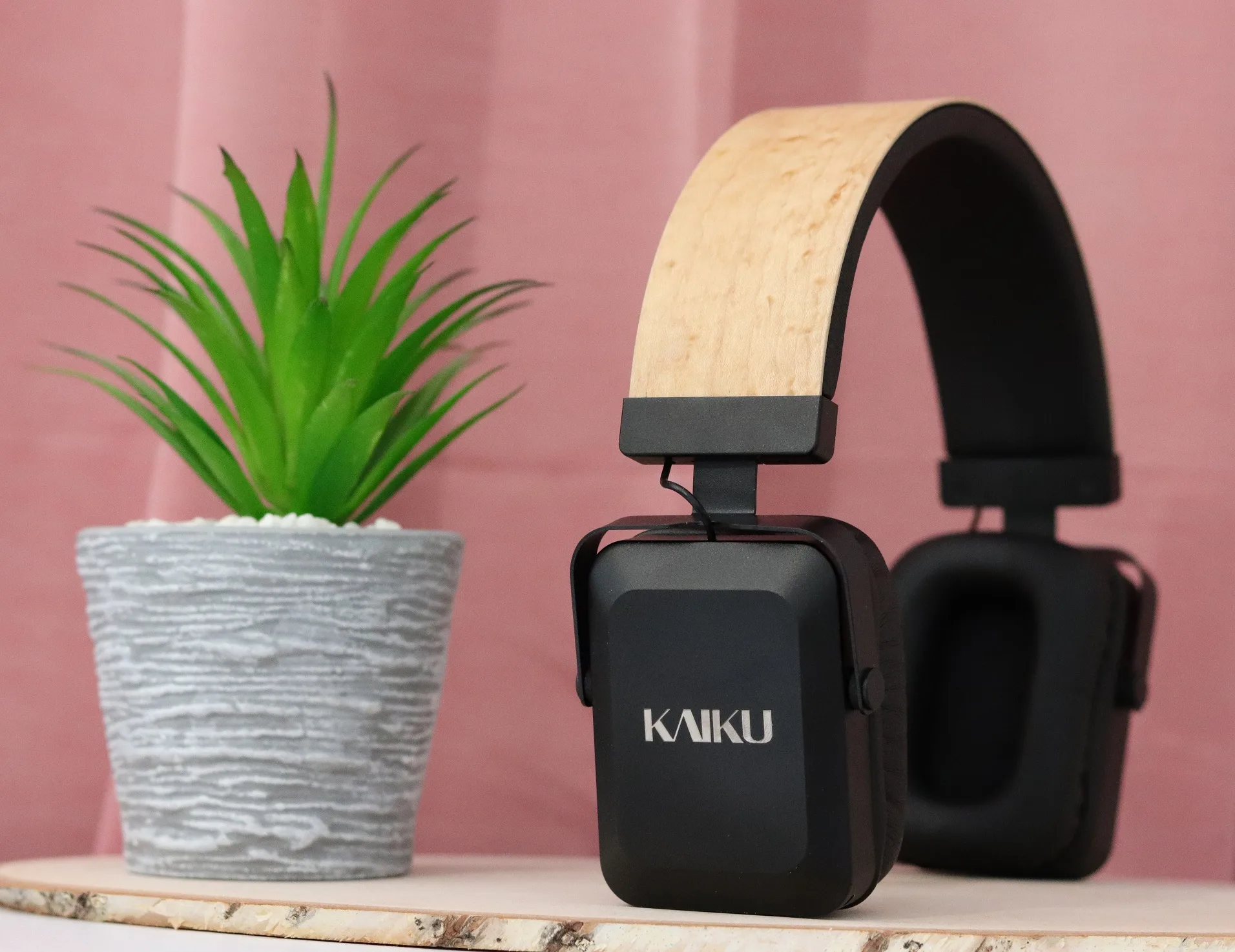
Table of Contents:
Information:
- Release year: 2024
- Country of manufacture: Finland
- Wood options: Birch, Oak, Walnut
- Price: 499 €
- Design: Closed, on-ear (may be over-ear for some)
- Dynamic 40 mm drivers
- Audio connections: Bluetooth 5.0 and 3.5 mm
- Bluetooth codecs: Not specified
- Impedance: 32 ohm
- Sensitivity: 118 dB/mW
- Battery size: 600 mAh
- Battery life: approx. 30 h
- Charging port: USB-C
- Charging time: 2–3 h
- Features: 5 different EQ profiles
- Weight: 280 g
- Accessories: USB charging cable and 3.5 mm headphone cable
Review sample: Provided by the manufacturer
In early January 2024, the Kaiku Tone Bluetooth headphones, handcrafted in Kuopio and priced at a respectable 500 euros, quietly saw the light of day. Many have surely not heard of the headphones or Kaiku Acoustics behind them before this article, as the manufacturer has not yet made itself known. Its websites visiting, however, reveals that the headphones are indeed available for order and even in several different versions – wood can also be found in them. Where did such a new Finnish headphone manufacturer appear from, and what exactly is this all about?
Kaiku Acoustics is largely a one-man company. The Kaiku Tone headphones, in turn, are essentially a hobby project refined into a commercial product. Inspired by his other day jobs, the manufacturer has had the desire to utilize wood as a material for headphones. Initially, the idea was to make headphones for himself, but gradually the plan evolved into a marketable product. According to the manufacturer, the development work lasted several years. There has certainly been plenty of new things to learn and numerous prototypes, as there is no actual expertise in the audio or headphone industry behind it. For this reason, one must indeed tip their hat to the courage to start as a headphone manufacturer – those people from Kuopio are wild.
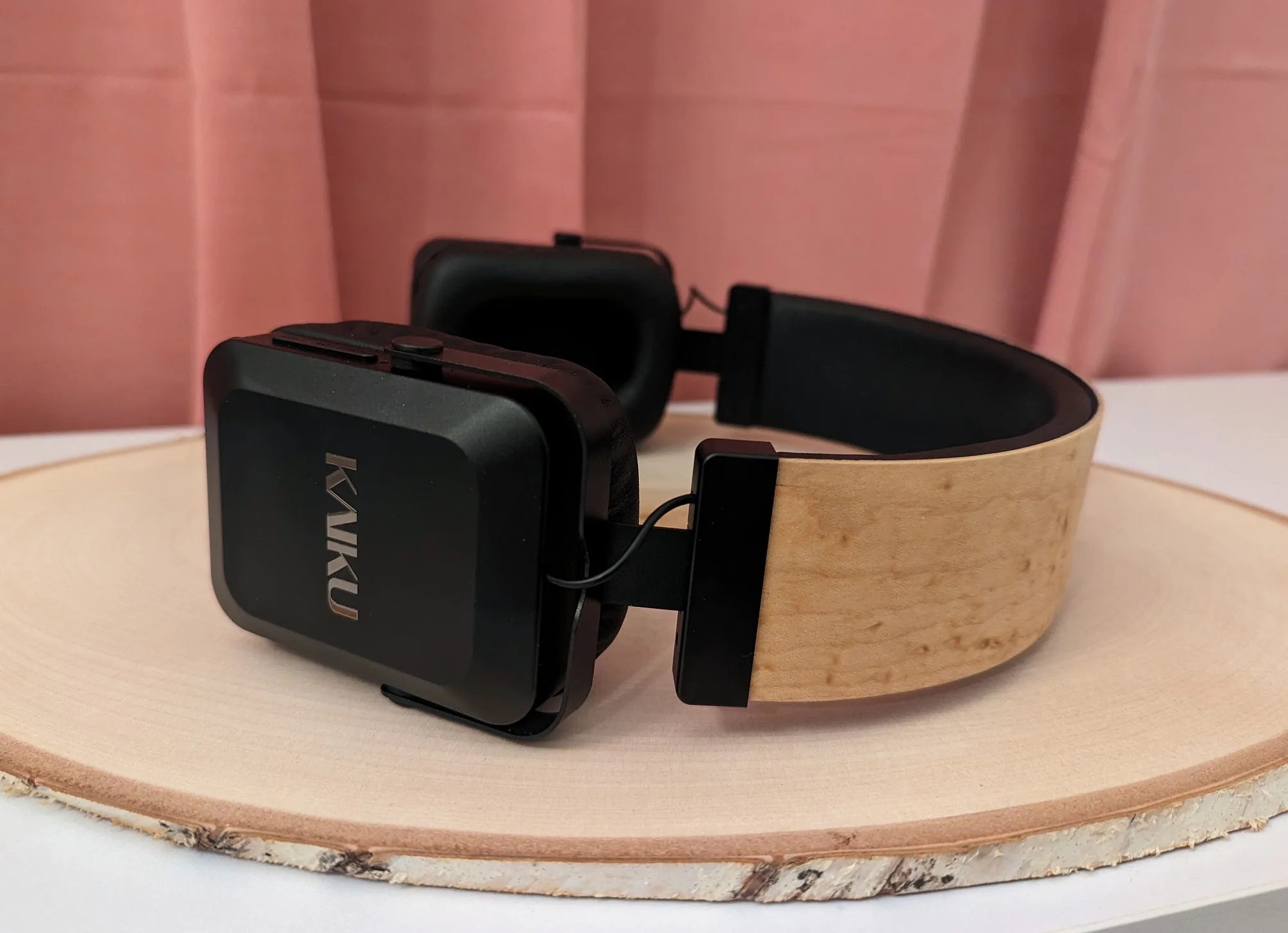
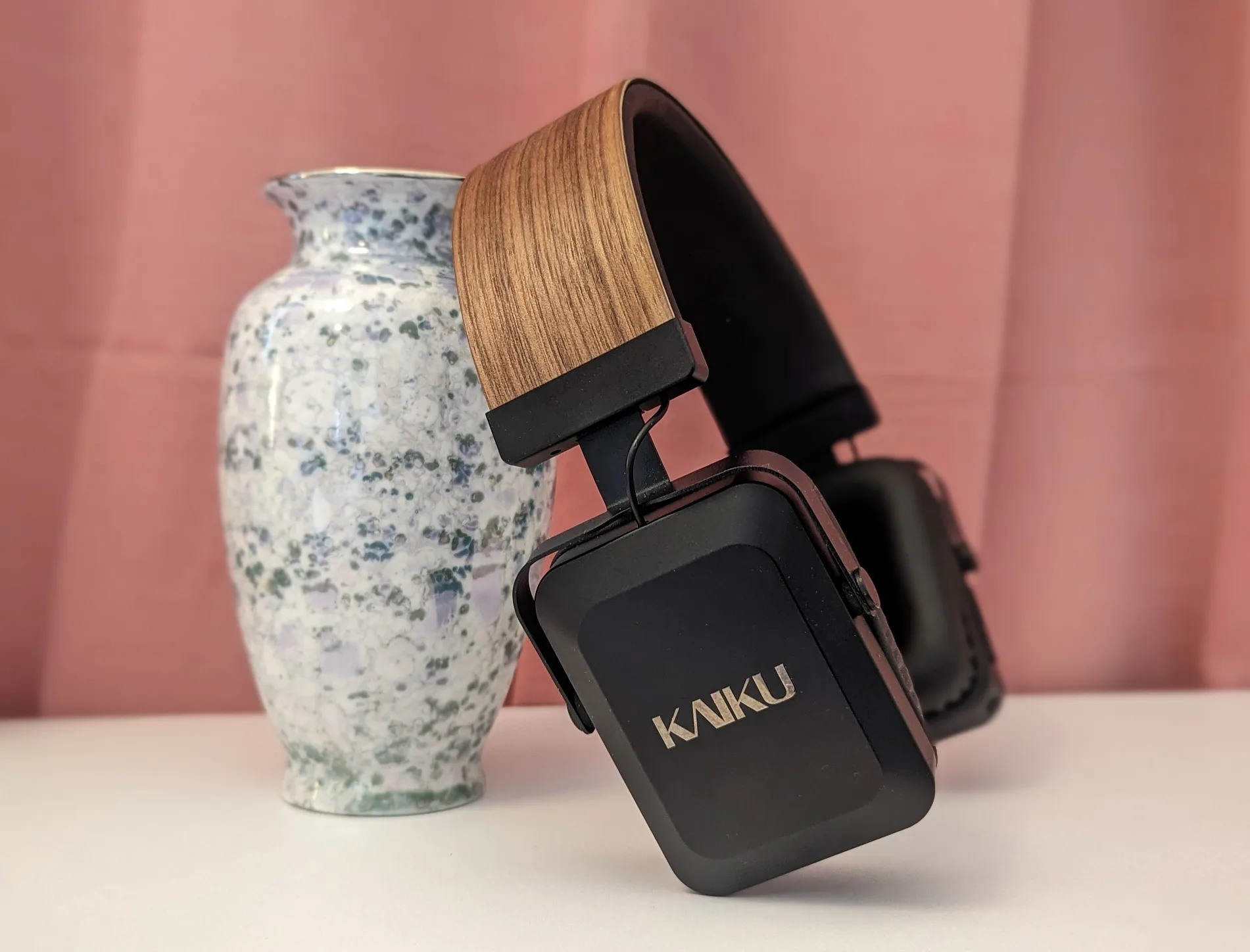
Kaiku Tone's clearly most unique design solution is its wooden headband arch. The buyer can choose the appearance from birch, oak, and walnut. My own test headphones have flame birch, so such a version might also come to market at some point. Since these are Bluetooth headphones, the electronics are, as expected, sourced from China. However, the soldering of circuit boards and the assembly of the headphones are done by hand in Kuopio. The high selling price of 500 euros may raise questions, but the long development time, the manufacturing of wooden parts, and the craftsmanship inevitably increase the price compared to headphones backed by a so-called larger industrial machinery. In my opinion, Kaiku Acoustics correctly strives to stand out from the crowd precisely with its craftsmanship and domestic origin. The website, however, would still need a lot of work, as at the time of writing this sentence, it lacks, among other things, delivery and warranty terms – the texts also contain spelling and factual errors.
Assuming that Finns will soon adopt the headphones, there is one significant shortcoming considering today's needs: there is no active noise cancellation function available. This would presumably limit the buyer base somewhat, but that remains to be seen. When I spoke with the manufacturer, he mentioned having tried noise cancellation in the headphones but found that it did not work satisfactorily without longer development work. I wouldn't really want a poorly functioning or hissing noise cancellation function in my headphones just for the sake of having it on the feature list. Due to its shortcomings, Kaiku Tone nevertheless belongs to the rare product category of ordinary Bluetooth headphones. On the other hand, it is tuned completely mechanically with its default settings, so it can also be used as a closed wired headphone with the frequency response remaining unchanged. When utilizing the Bluetooth connection, various predefined EQ profiles are also available.
Before moving on, I want to mention that the manufacturer has provided their headphones to Kuulokenurkka for testing. By now, we have already been in contact for a longer time regarding feedback and development ideas, but now I am evaluating Kaiku Tone, just like any other product. The headphones I tested are also the second pair, as earlier in the year I had a pair from an earlier production batch for testing. In some respects, there has already been pleasing progress, albeit partly at the expense of sound quality. However, let's find out everything, as is customary at Kuulokenurkka.
Product packaging
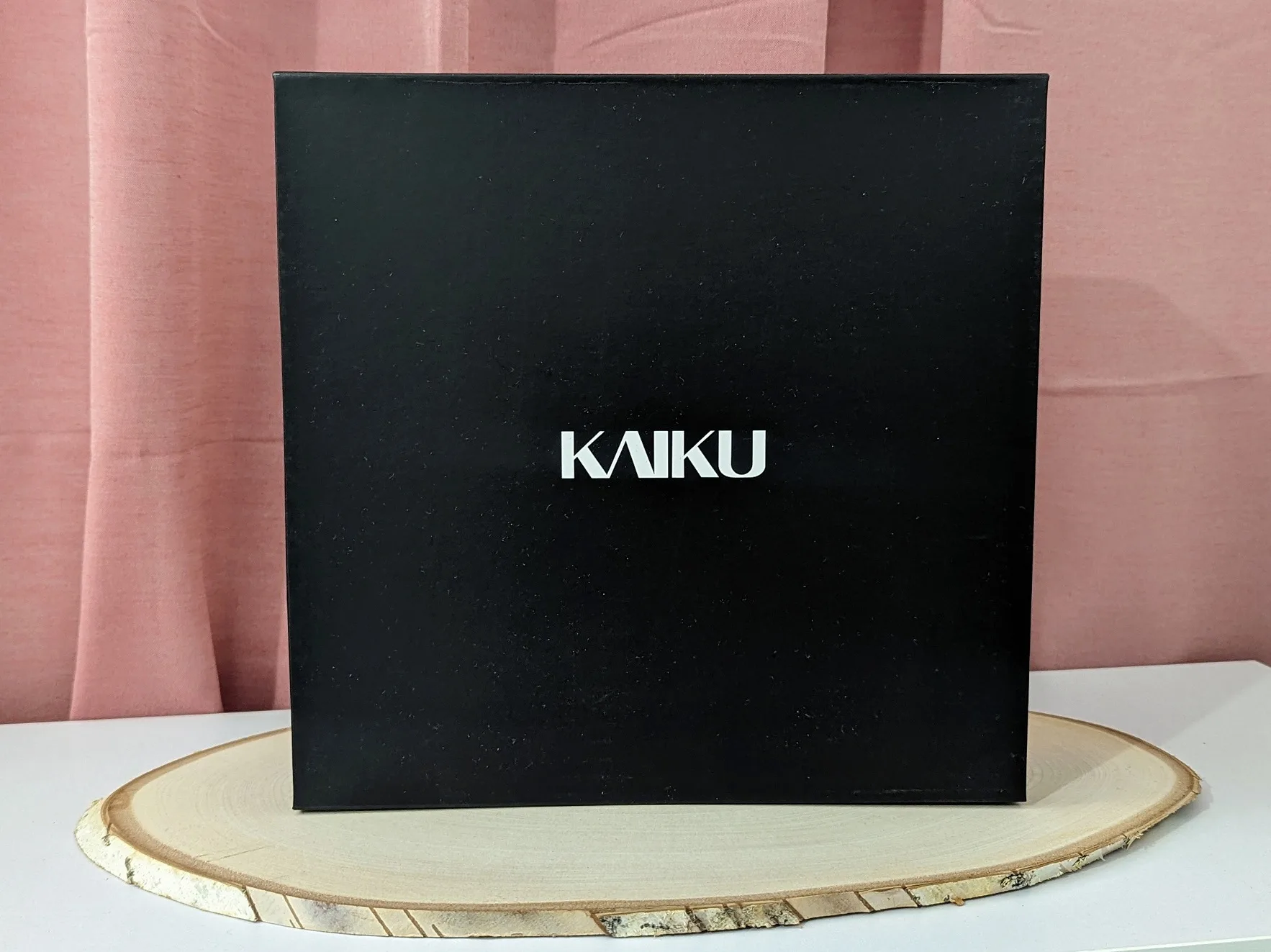
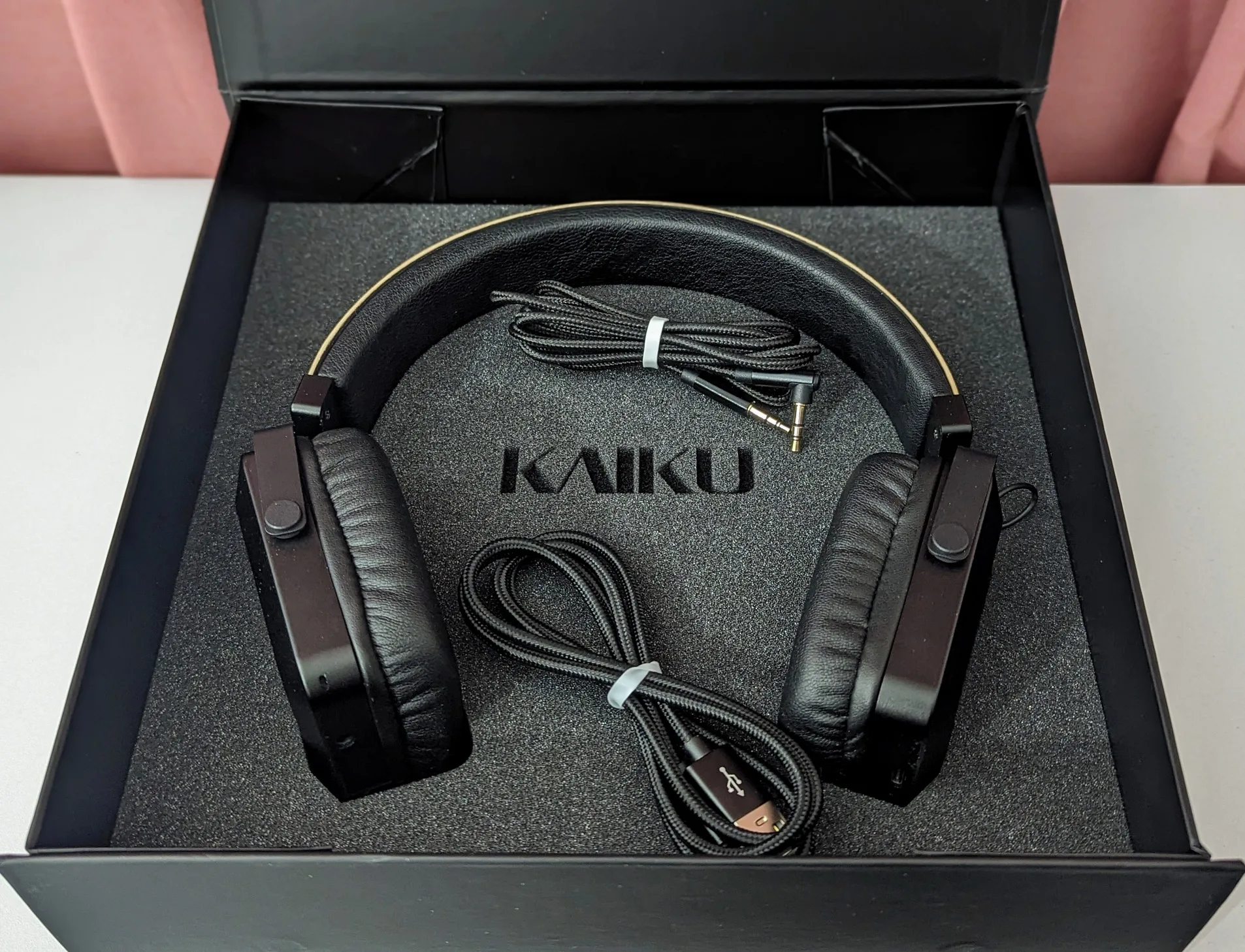
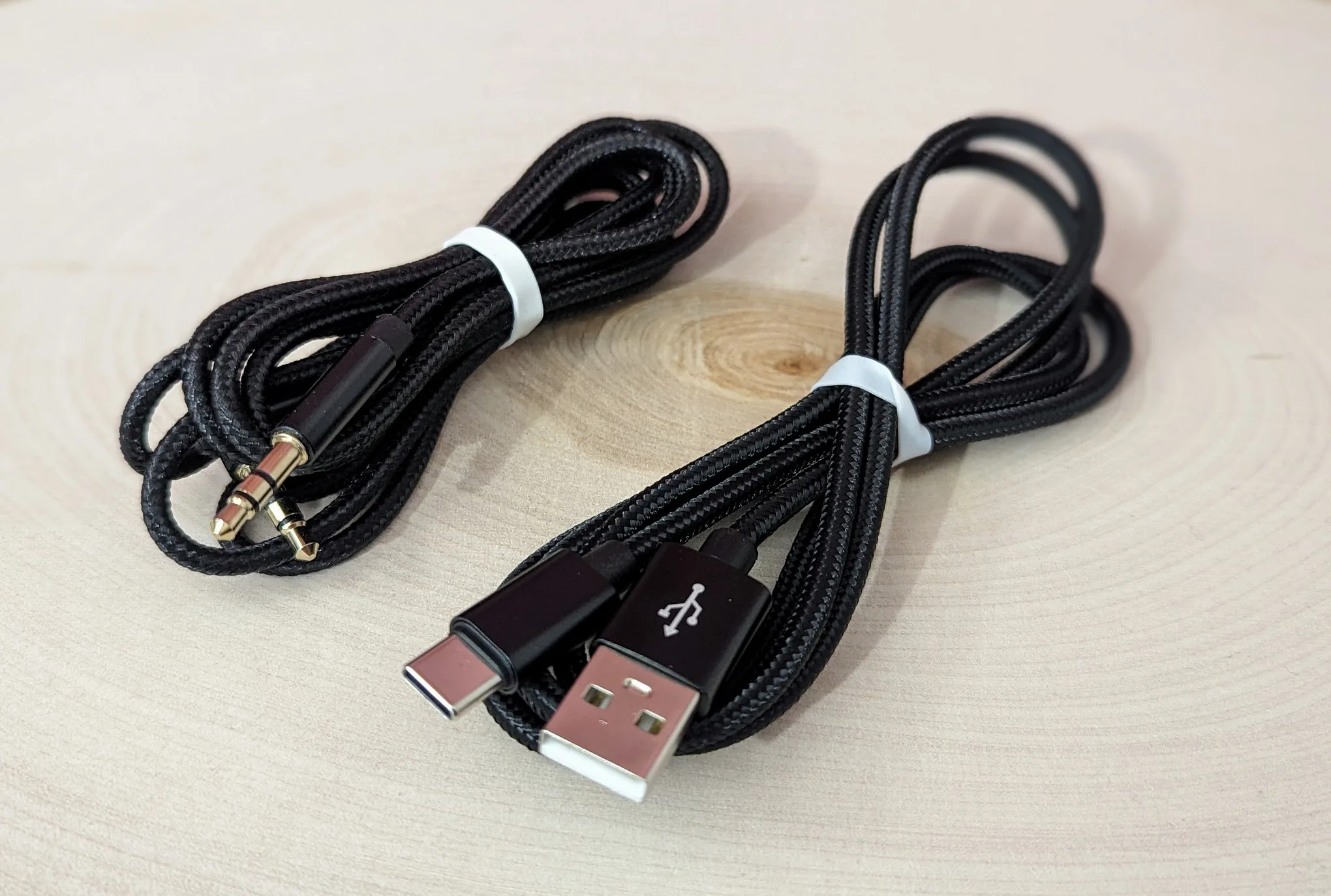
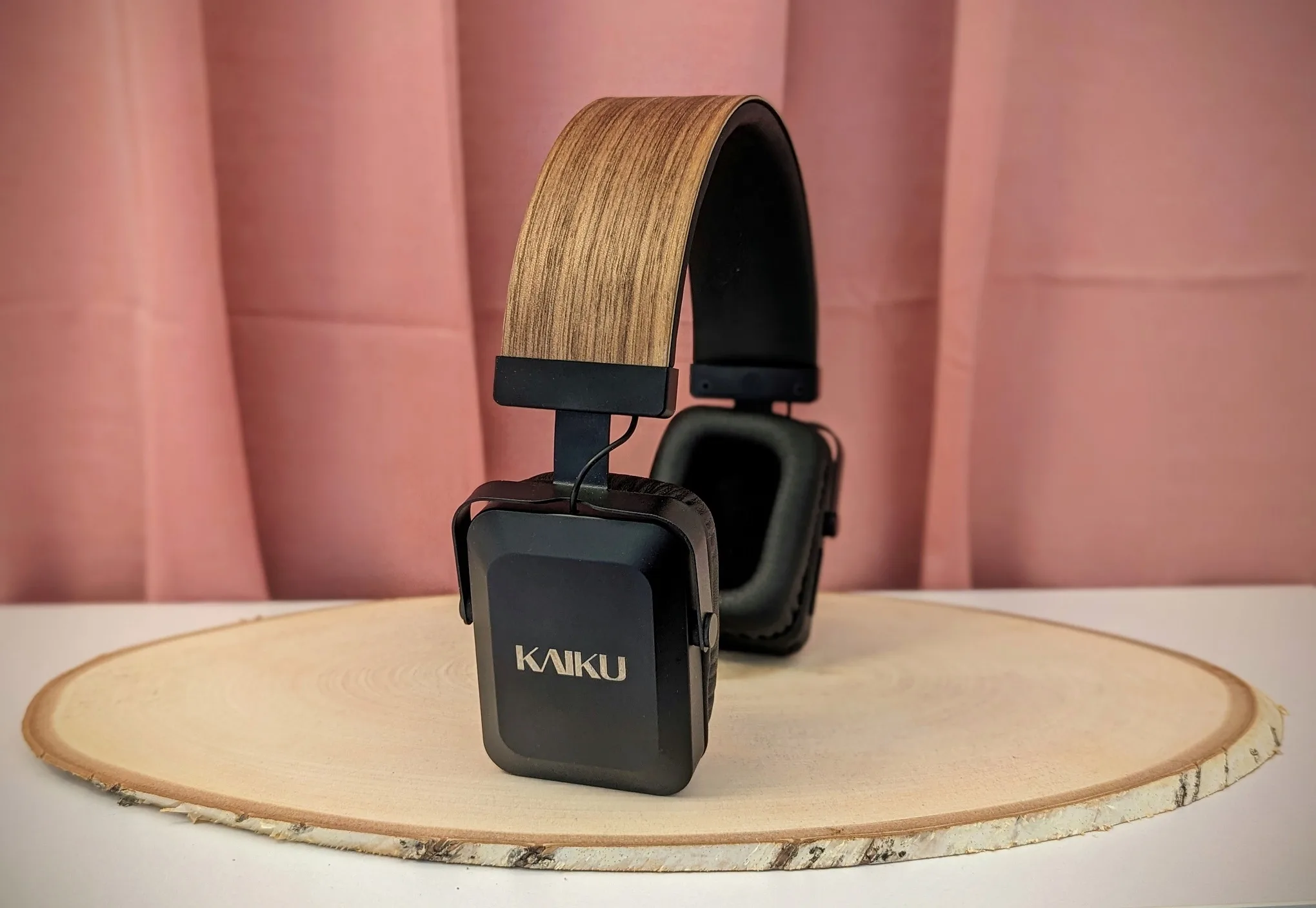
Kaiku Tone is packaged in a black cardboard box that closes with a magnet, so the presentation is better than usual. In addition to the headphones, a USB charging cable and a headphone cable are found loose in the box, for which dedicated slots could certainly have been made in the foam padding. However, both cables are, in my opinion, of a slightly better quality due to their soft fabric covering. Otherwise, the equipment does not differ from most other Bluetooth headphones. Some kind of storage case or at least a storage pouch would have been a nice addition, as being compact, the headphones would likely be carried around, making one want to protect their wooden headband from scratches.
Build and comfort
Kaiku Tone looks truly distinctive with its wooden headband arch, angular aluminum cups, and large mirrored initials. For some reason, the cups remind me of professional environments, such as studios or TV broadcasts from past decades. Some resemblance to other headphones can be found, for example, in the Avantone Planar and Marshal Major ”fashion headphones.” However, I have never before seen a headband arch bent from wood veneer in headphones. It is generally quite unusual, but surprisingly functional on this scale. The structure is not purely wood, however, as there is some kind of plastic part running underneath it, which probably helps maintain the desired clamping force of the band. When stretched, a creaking sound comes from the structure and the padding part attached to it, which feels like a camping mat, but the overall tactile feel of the headphones is quite sturdy.
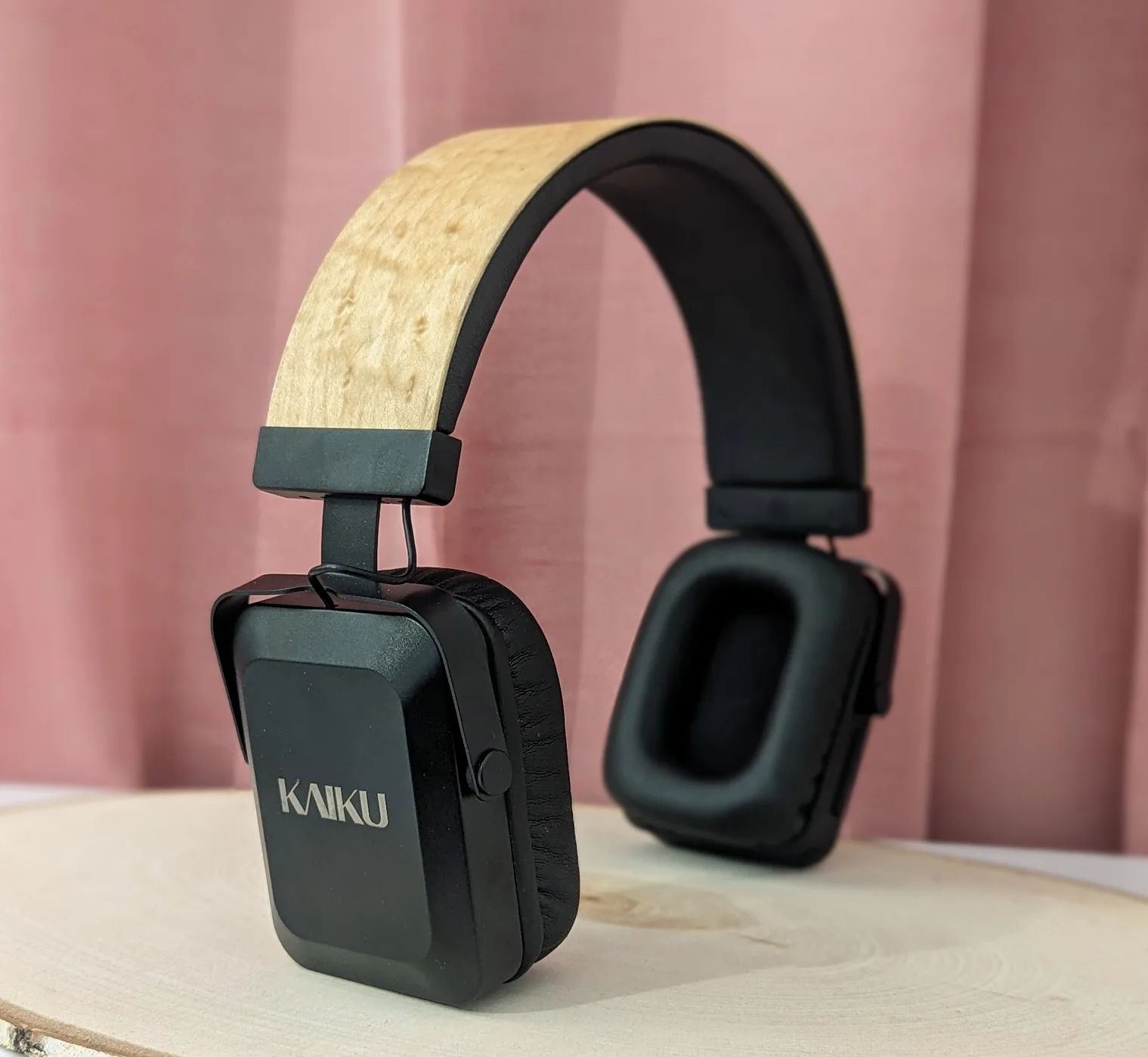
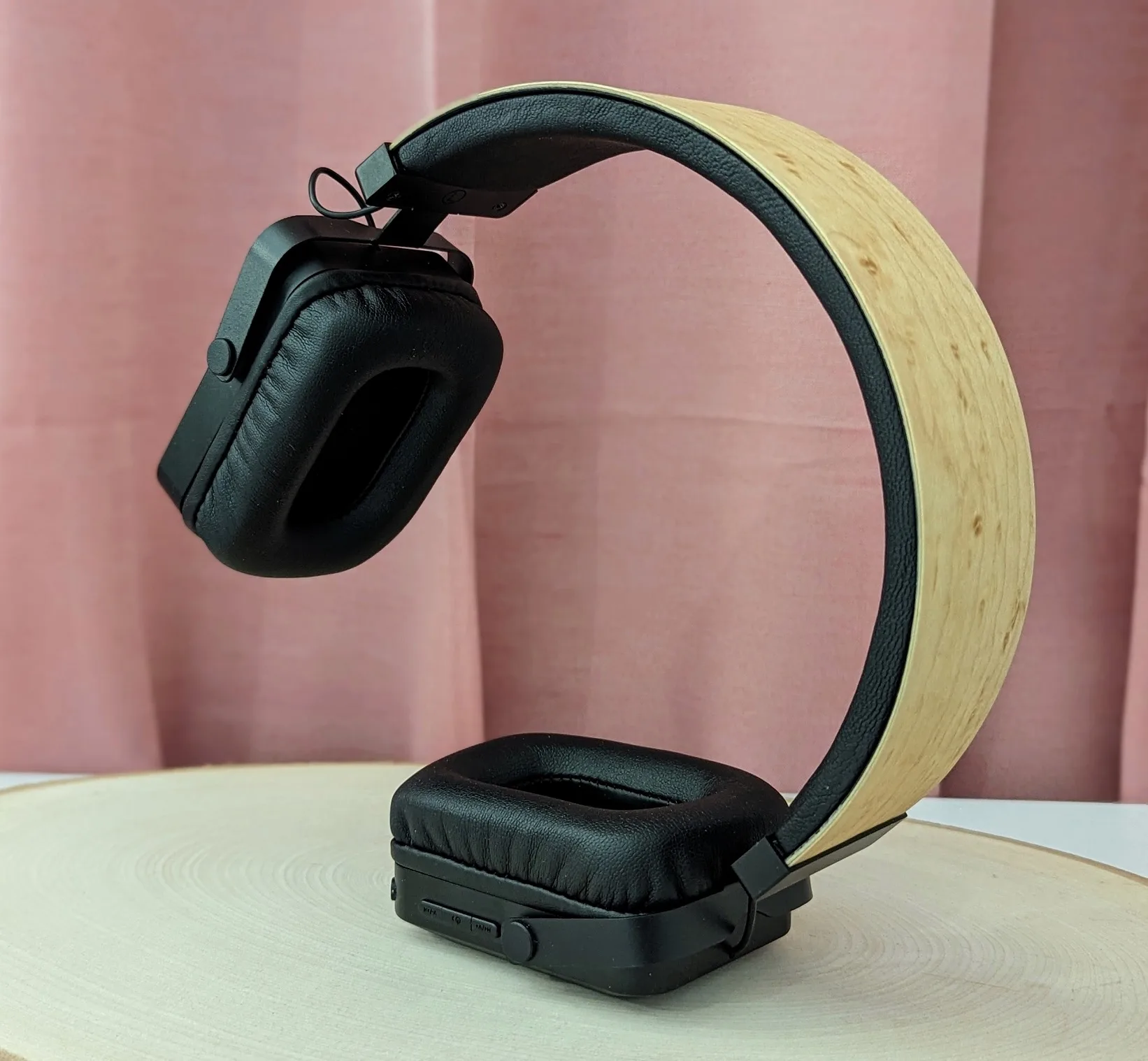
Despite its small size, the Kaiku Tone weighs 280 grams, most of which is due to the metal earcups. The shape of the headband fits my head well, which is important because, due to its stiffness, the headband is not meant to bend much in either direction, unlike, for example, Focal headphones. The clamping force was significantly stronger in the headphones I tested earlier this year, so it has either been loosened or it varies between individual headphone units. The newer headphones sit quite loosely on my head, but at least they don't clamp too tightly. Because the Kaiku Tone, due to its small ear cushions, is an on-ear model for me, it previously pressed quite hard on my ears. In the newer headphones, however, the ear cushions are slightly larger and softer, so the wearing comfort has improved, and I no longer have any real complaints about it. The height adjustment range is limited, however, so the headphones may not be suitable for those with the largest heads.
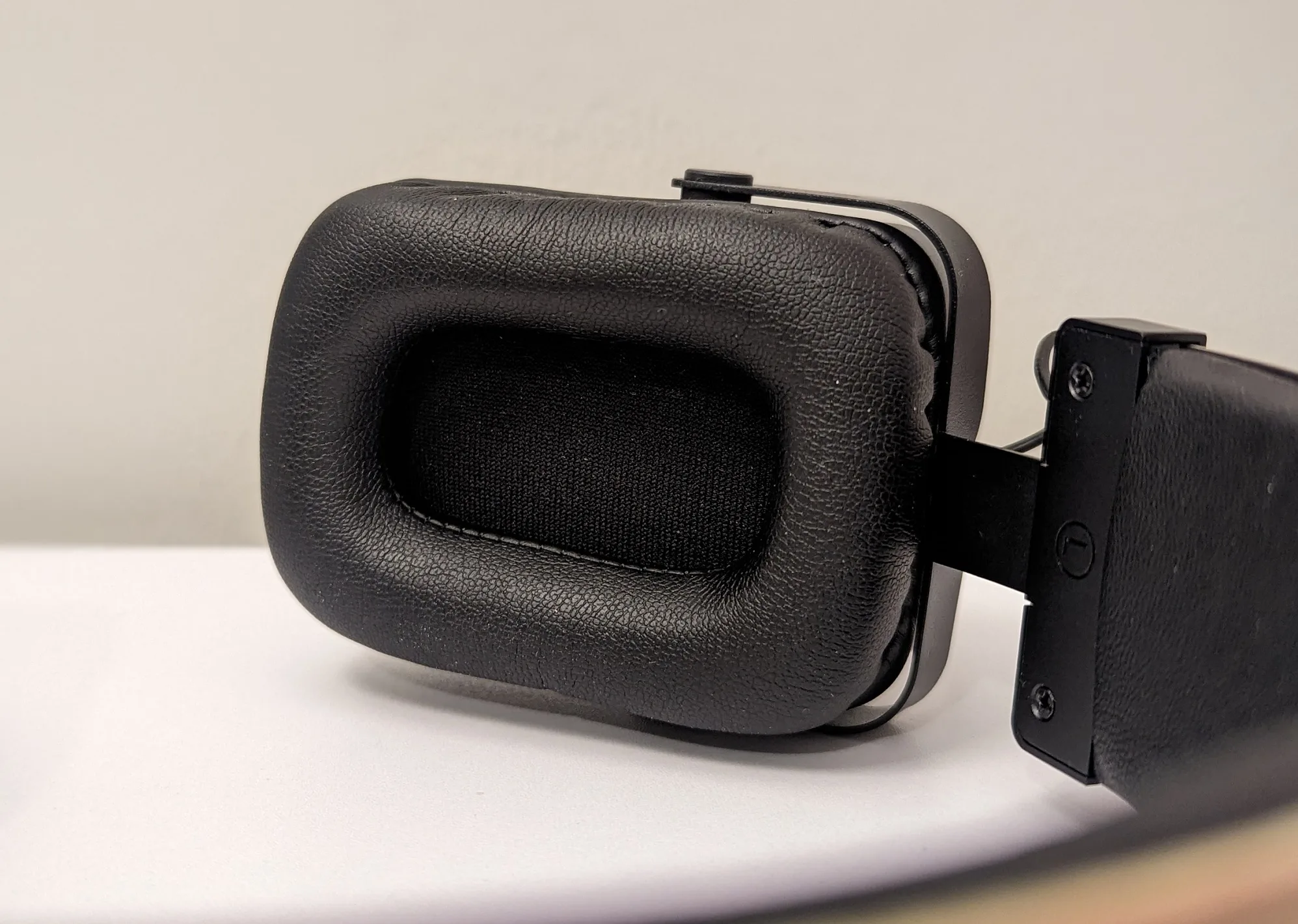
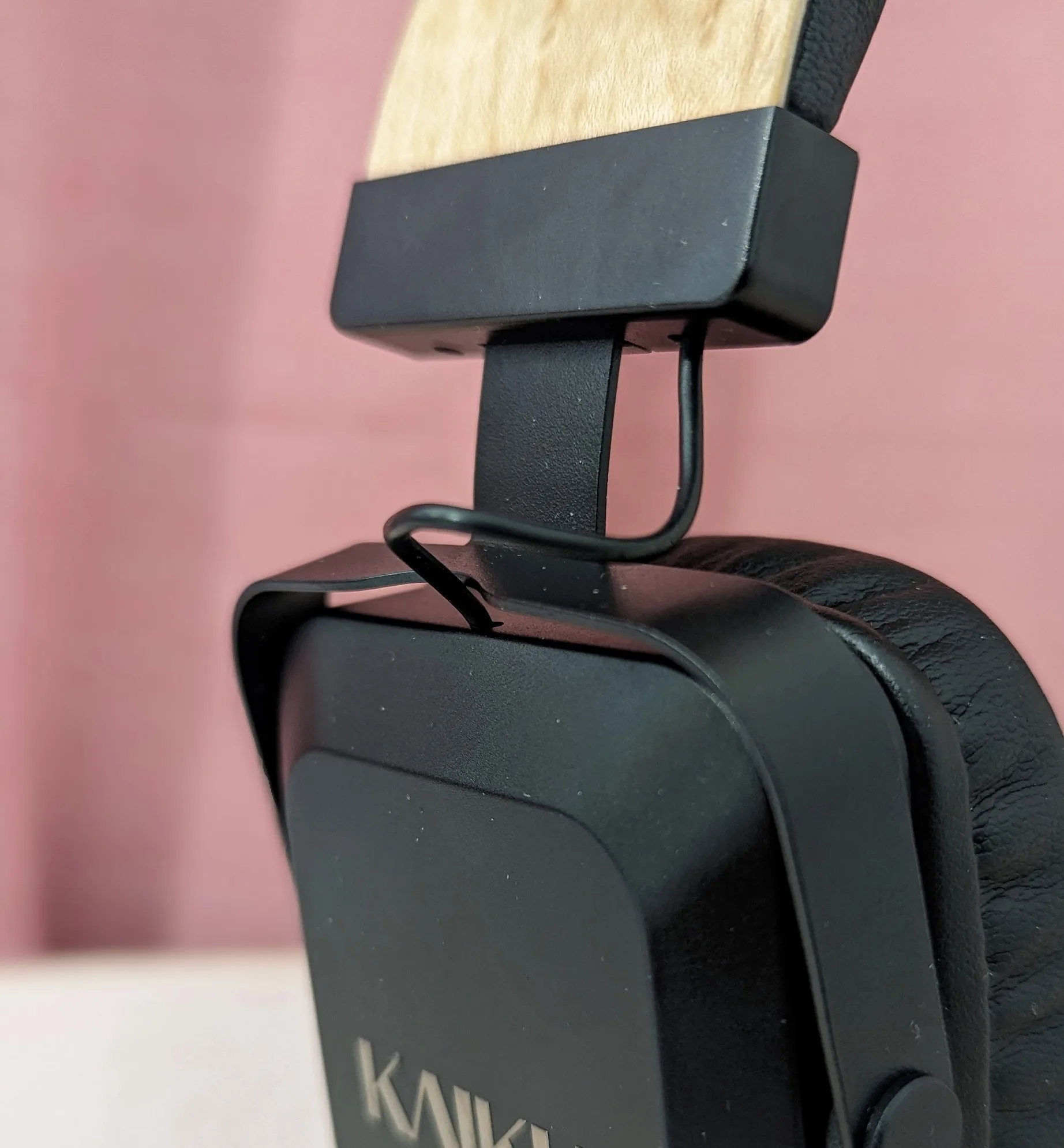
Although the importance of sound quality is emphasized in headphones, the structure and fit are actually more challenging areas for the manufacturer to get right. Especially the shape of the headband and the durability of the yoke structure have caused headaches for many even larger manufacturers, because headphone users differ from each other in head shape, habits, and behavior. Headphones that are comfortable for one person may not be for another, and some treat their headphones quite roughly as if they were utility items. In the case of Kaiku Tone, I believe the structure has been refined to be functional and sturdy despite its simplicity. The durability of the wooden headband's arch is difficult to predict, but without excessive force, I would expect it to be long-lasting. The connecting cable running between the cups, on the other hand, is quite thin, so care should be taken with it, especially when the yoke structure easily presses against it when turning the upper edge of the cups inwards.
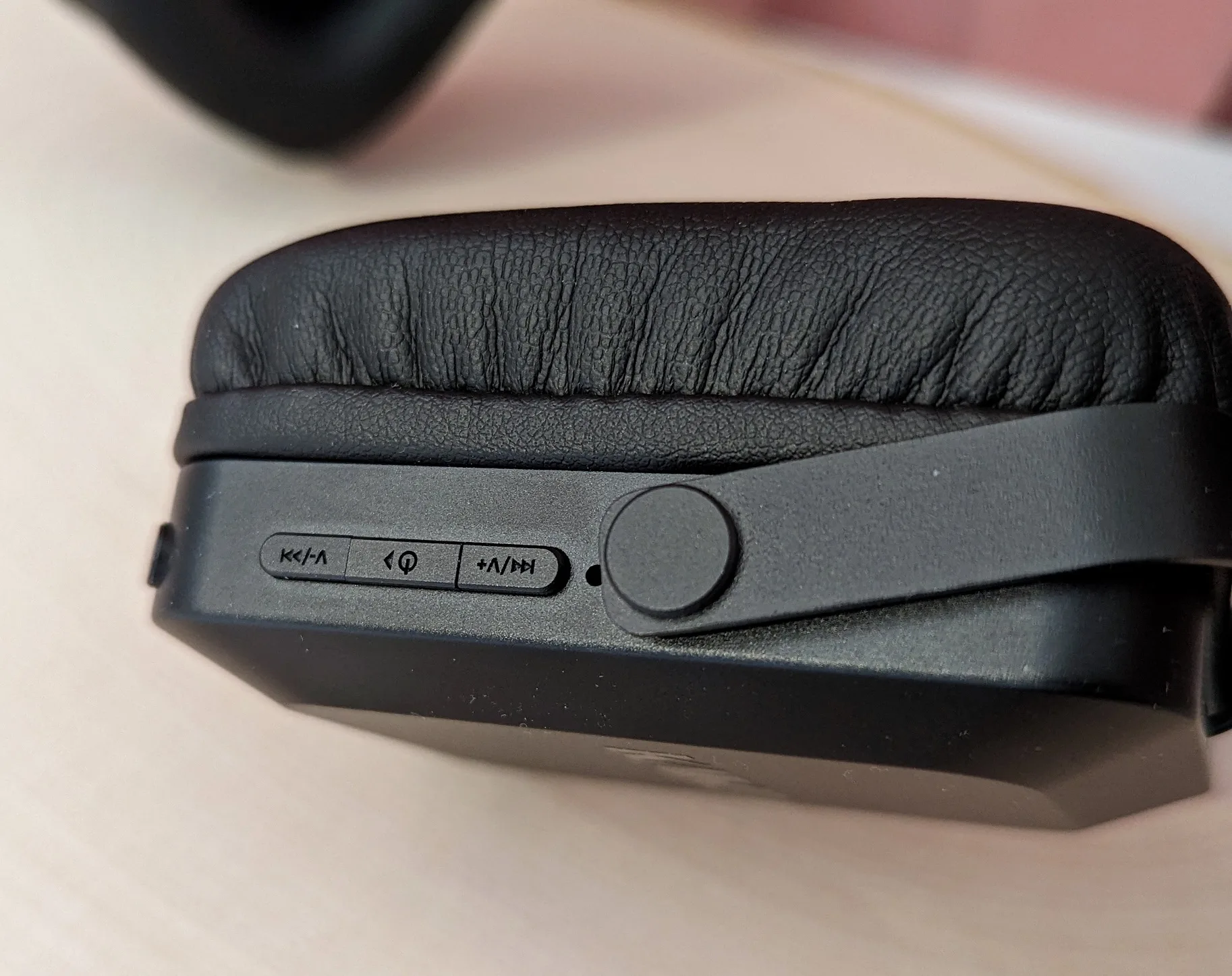
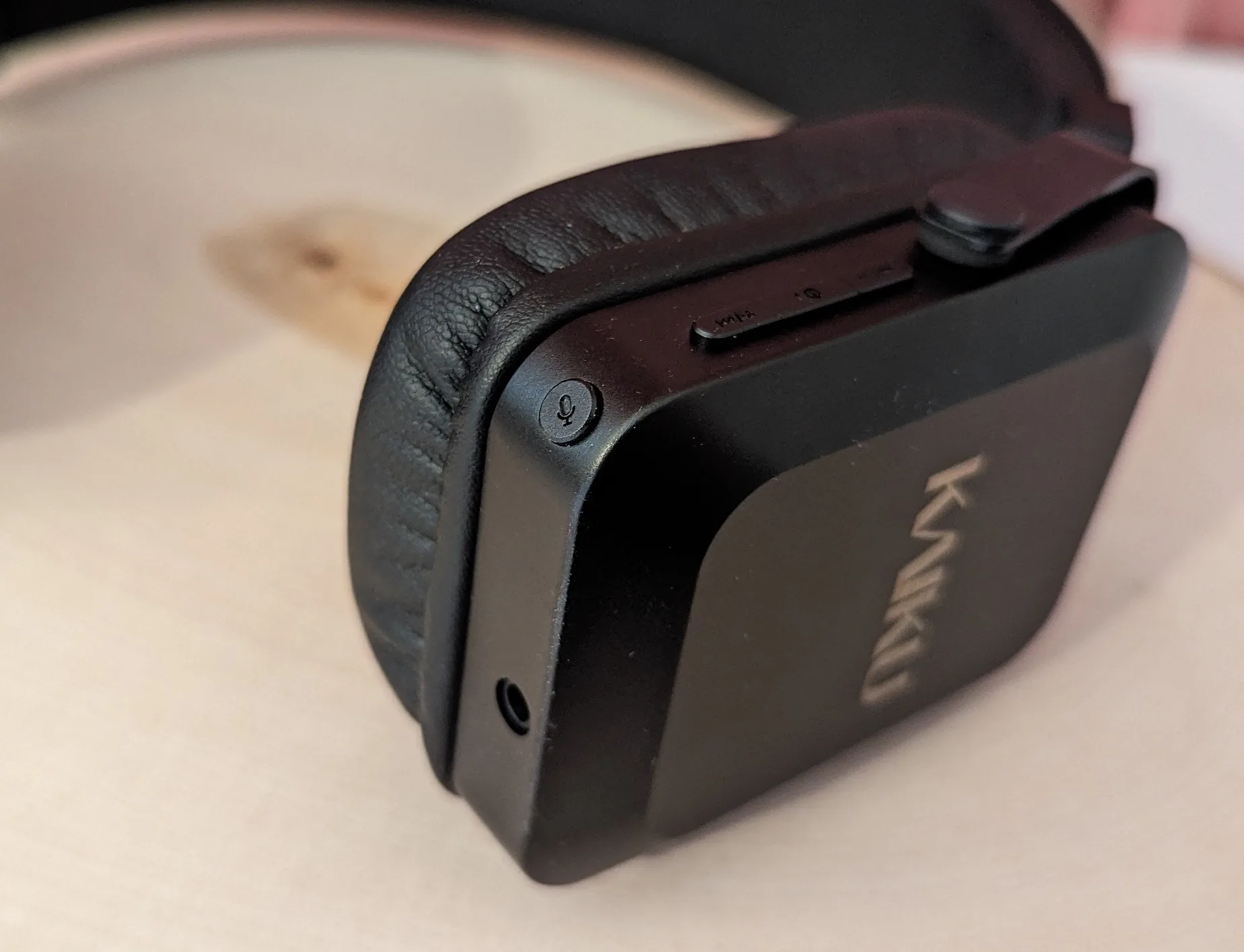
The headphone connectors and metal buttons are located on the right earcup. When using a Bluetooth connection, the volume can be adjusted and the music player controlled in the traditional way. The play/pause button also functions as a power button. Thanks to the microphone, the headphones also allow for making calls and using a voice assistant. By pressing the separately located microphone button twice, the headphone's EQ profile can be switched between five different options – in this case, the headphones announce the selection with a voice message ”two band EQ” and so on. Kaiku Tone does not include a mobile application or other additional features.
Observations related to use
Using the headphones has been straightforward overall, and the battery also lasts well. No memorable disturbances have occurred during Bluetooth pairing or connection, with the exception of a single bug appearing on my Google Pixel 6 phone. If, for example, a song is listened to with the headphones where the sound is mixed to come from only one driver (rarer in modern music), the driver on the opposite side simultaneously starts producing a strong hissing interference sound. However, this does not happen if there is even a little sound coming from the other side at the same time, or if I use the headphones connected to a computer. The same phenomenon occurred in both my current test headphones and the version I tested previously. Hopefully, the bug is not very common, but is somehow related to compatibility with my phone. Fortunately, there is almost no background noise in the Kaiku Tone.
Regarding usability, I would still hope for fine-tuning of the buttons and volume control. The three flat buttons located on the rear edge are quite poorly distinguishable from each other when felt with a finger, as there is no clear gap between them. Pressing the middle button, in particular, is difficult. Secondly, the outermost buttons are configured to change tracks with a single press, and in my opinion, illogically so, that pressing down changes to the next track and pressing up returns to the previous one. However, this is not a major concern, but largely a matter of preference.
The volume, on the other hand, is adjusted by pressing either button down for a slightly longer time. After this, however, the volume quickly moves up or down, so changing by one step requires perfect timing. Otherwise, there could even be a risk of hearing damage, as raising it by a few steps makes the headphones play astonishingly loud. On my Android phone, a suitable listening volume when using the Tidal streaming service is 5/25. From this point onwards, the headphones play far too loudly, so the volume should be sufficient even for those who like to blast their Bluetooth headphones at full volume. However, due to the coarseness of the adjustment, finding a suitable volume is difficult, so I hope the manufacturer can fine-tune this in the future with their chip supplier. When using the headphones with my phone, I have lowered the gain level from the Wavelet app, after which volume adjustment is smoother.
I also tested the microphone installed in the headphones and found its quality to be quite mediocre. When making calls, according to the other party, there is background noise and my voice sounds dark and muffled. Expectations should therefore be kept moderate, but speaking is still possible, at least in a quiet environment.
Sound quality
Our frequency response measurements have been made with a clone IEC-60318-4 coupler and KB501X pinnae. The Harman target curve from 2018 is used as a reference point and generalization of the headphone response that would sound good to most people. For more information on the measurements and their accuracy, see Headphone Measurements-page. The frequency response of Kaiku Tone is also comparable with other measured headphones Squiglink .
Kaiku Tone has mechanical tuning, so its frequency response is by default the same with both Bluetooth connection and headphone cable, even though the default sound profile is named ”pop”. In Bluetooth listening, the sound can be adjusted using four different EQ profiles to be more bass-heavy (Bass Boost), more treble-focused (Treble Boost), or simultaneously in both directions, i.e., more V-shaped (Rock). The fourth, or depending on the counting method, the fifth profile is called Jazz, which seems to emphasize the mid-frequencies slightly more. The desired profile must always be re-selected after each startup.
The headphones have largely been designed by ear to suit the manufacturer's own taste, and the dynamic drivers have also been selected based on subjective comparison from a large number of different options. One can truly speak of a hobby project, rather than the manufacturer having aimed for a specific commercial outcome in advance or measured the frequency response at different stages of development. This also means that the EQ profiles have not been specifically tuned for the Kaiku Tone, but rather affect the sound on a more general level.
Frequency response measured with default settings via Bluetooth connection:
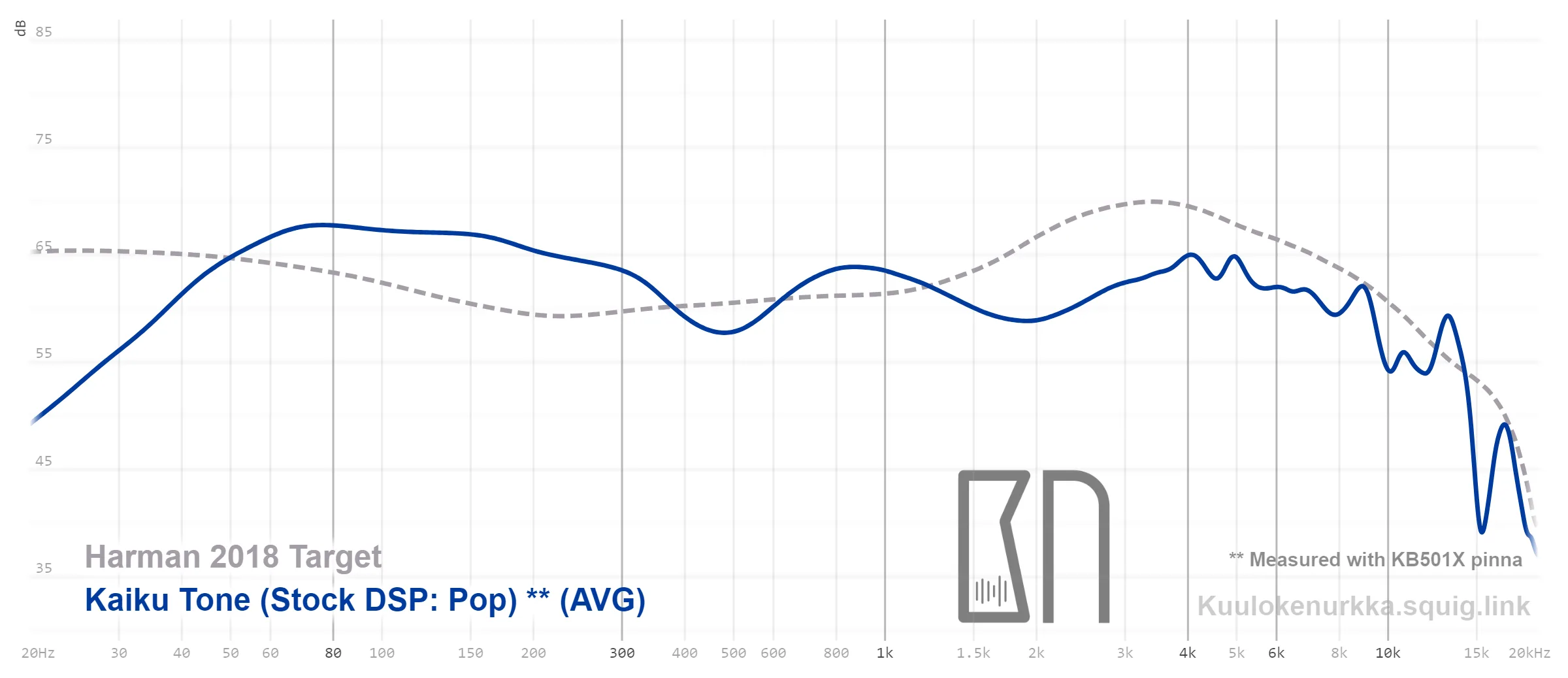
I wouldn't want to be cruel, but I must be honest in my role as a reviewer. In my opinion, Kaiku Tone's competitive advantages, considering its price range, lie elsewhere than in sound quality, at least if other frequencies besides bass are also desirable to be clearly audible. With their default settings, the headphones emphasize the 50–400 hertz frequency range very strongly, which makes the sound thick and loosely resonant. However, the bass is not particularly punchy, because the lowest bass frequencies are attenuated (or rather, leak out) due to the headphones' small ear pads and on-ear style fit. Some people certainly enjoy this bass-heavy presentation, but for 500 euros, I think one would be justified in expecting a slightly more balanced outcome. This puts the headphones in a difficult position, as it's hard to see them as a particularly competitive option in their price range with their default settings.
The bloatedness of the low frequencies is further exacerbated by the almost complete lack of the energy expected by the human auditory sense in the so-called ear gain region (1.5–4 kHz), which inevitably makes the reproduction sound veiled and dull. Musical details are reproduced regrettably unclearly, and vocal performances sound stuffy and nasal. The treble also reproduces too faintly for my taste compared to the hefty bass emphasis. On the more positive side, however, the high frequencies are even, so equalizing the headphones is relatively easy without leaving narrow boosts or dips in the sound.
A hefty bass in headphones with a closed-back design is not ultimately a big surprise, as it is in a way an expected starting point from which the frequency balance would be fine-tuned by modifying, among other things, the driver's airflow, cup structure, and ear pads. With the DSP chip found in Kaiku Tone, suitable adjustments could also be made digitally. Let's next explore what the available EQ profiles do to the sound and frequency response.
EQ profiles
Bass Boost and Treble Boost:
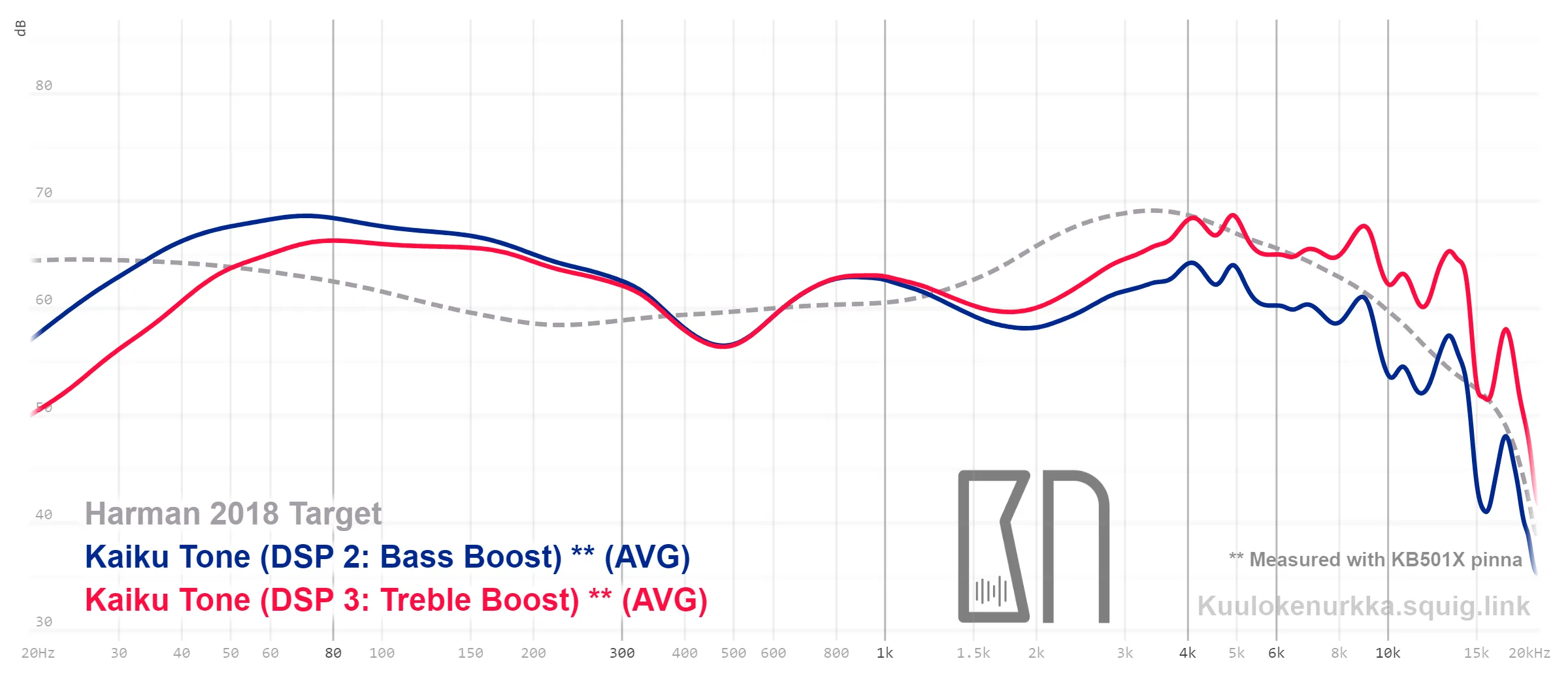
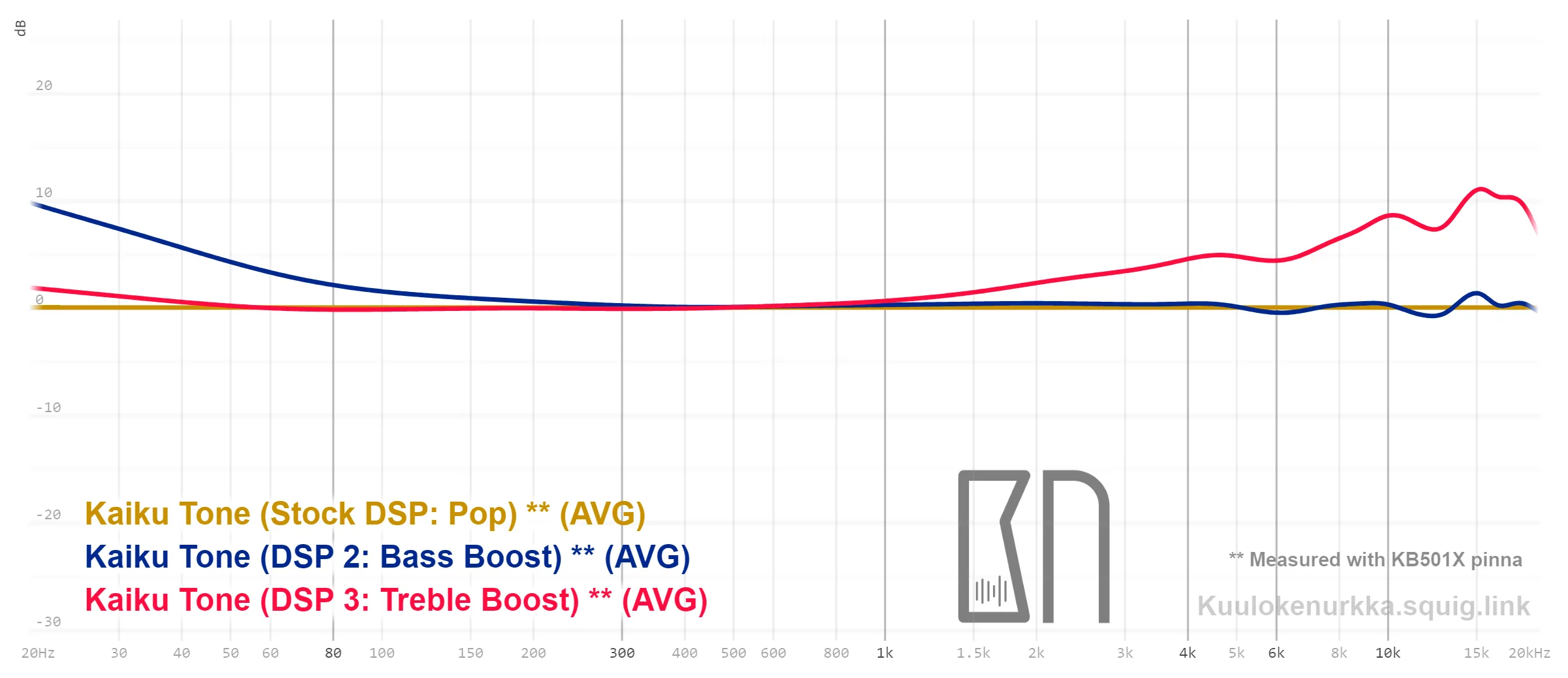
First, the headphones have separate profiles for boosting bass and treble. The first one is hardly needed in any situation, as it only makes the sound even more bass-heavy and unclear. The treble setting, on the other hand, significantly brightens the reproduction, but unfortunately, when using it, the 8–15 kHz range is reproduced too harshly, even though the hefty bass does its best to balance the situation. However, such a V-shaped sound might be fun in some situations, and I would even prefer listening to it compared to the dark and stuffy default state. Still, a balanced outcome is not yet achieved this way either.
Rock and Jazz:
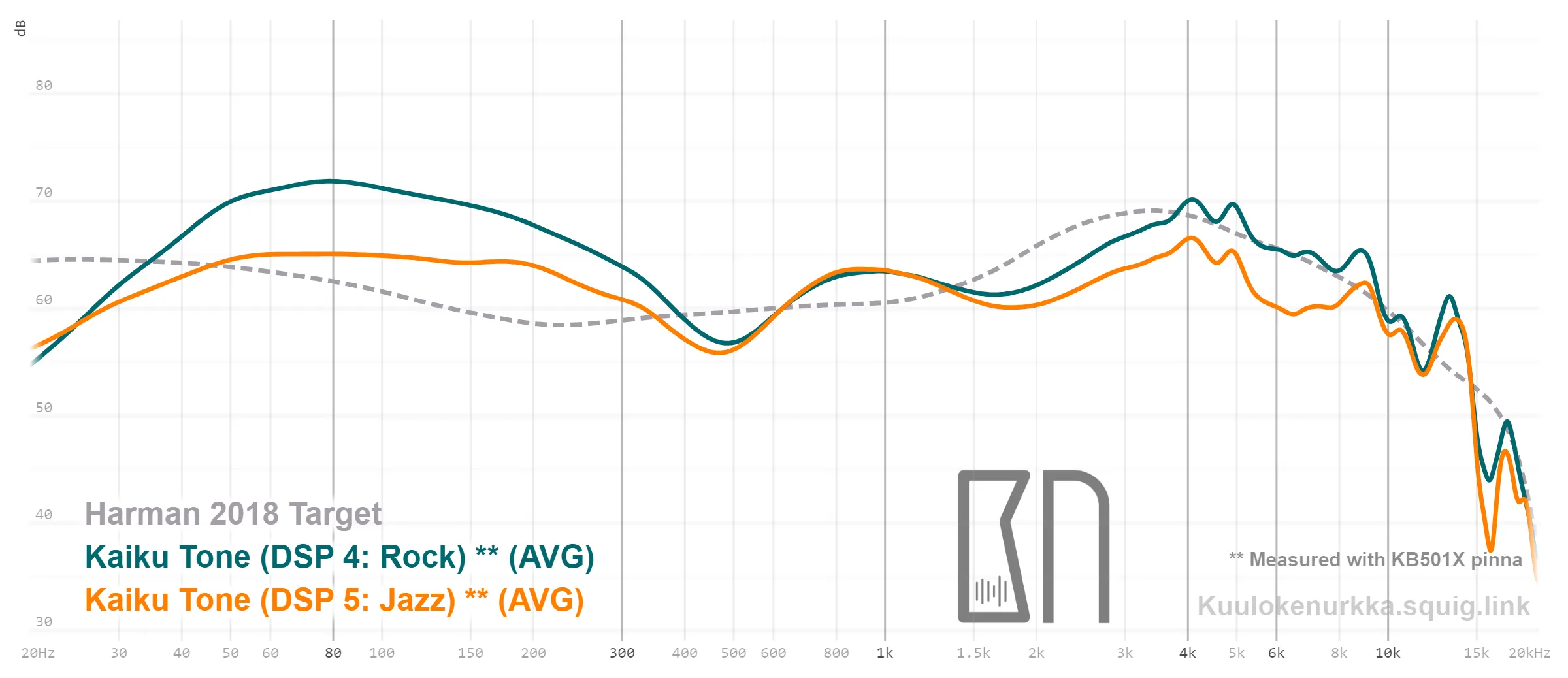
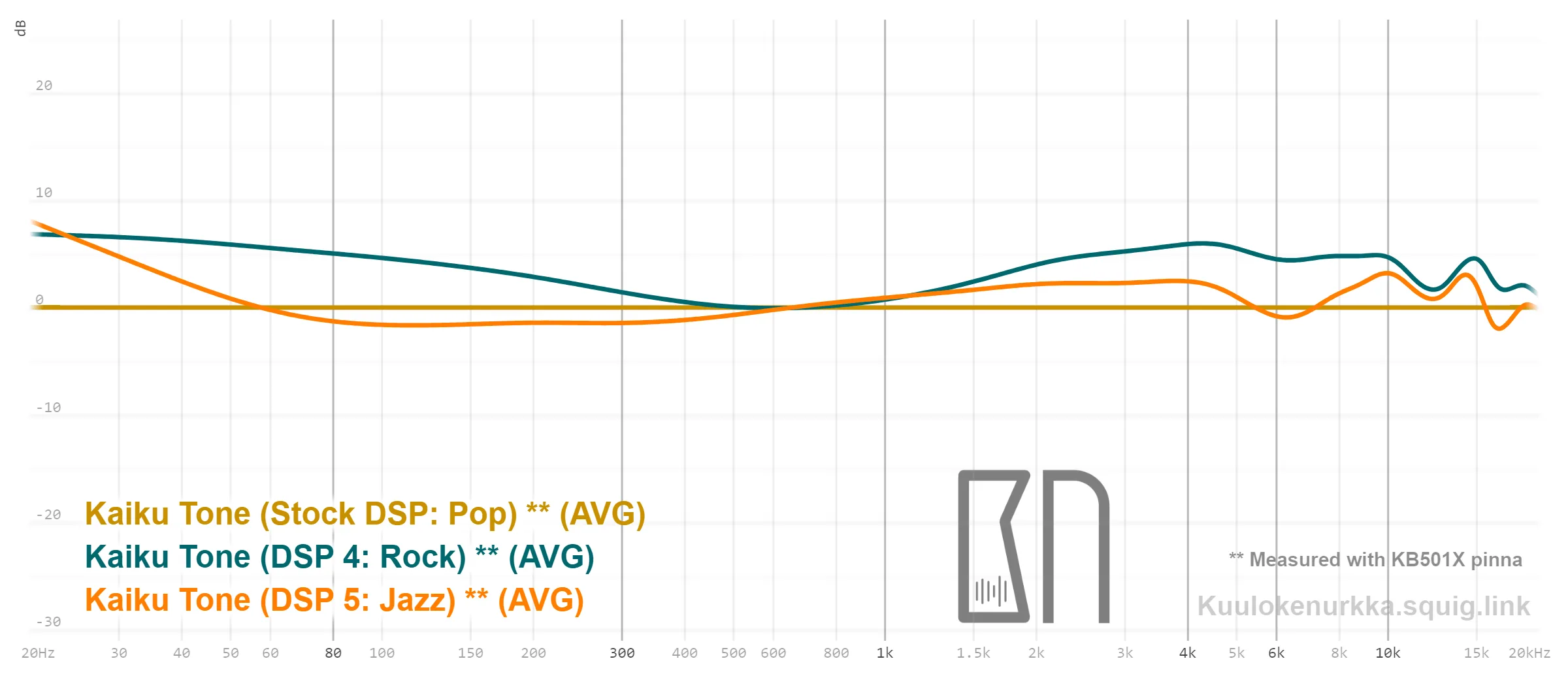
The latter two EQ profiles are named Rock and Jazz, meaning they could imply almost anything in terms of changes. In the case of Kaiku Tone, the Rock setting boosts both low and high frequencies, ultimately being useful when equalizing the headphones. In Rock mode, the headphones' frequency response from 1.5 kHz upwards is surprisingly accurate, so when listening to light music, the sound is already relatively normal in places. If, however, the listened song contains bass, it is reproduced so excessively with the Rock setting that the presentation resembles sound coming from underwater. The bass should be almost 10 decibels lower to speak of an unmuddy and clear reproduction.
Jazz mode, on the other hand, is somewhat of an oddity, as it seems to change a bit of everything. However, since I don't perceive the low frequencies changing significantly, the setting's primary area of effect is likely between 1–4 kHz, i.e., in the upper mid-frequencies. Sometimes this setting manages to sound better than the default state, but most often the area around 1 kHz is reproduced too prominently, and the sound is in a certain way bland and blaring compared to the mid and high frequencies of the Rock setting. Thus, no EQ profile directly makes the headphones balanced; instead, they seem quite random. It's a shame that the DSP chip hasn't been utilized more for fine-tuning the headphones' problem areas. In the future, I believe this should be done, as I think Kaiku Tone could be modified into a significantly better product.
I would suggest, for example, replacing the Bass Boost setting with a new setting where the level of low frequencies would be lowered by approximately 4 decibels from 300 hertz downwards (sub-bass could, of course, be boosted at the same time), and high frequencies would be boosted, for instance, directly according to the Rock setting. In this case, we could already speak of sufficiently balanced headphones that could be used in any situation. Any possible more precise fine-tuning would then be a bonus. If Kaiku Acoustics succeeds in this, the sound profile should be set to activate by default, so that the headphones would sound optimal right out of the box.
Equalization
Wavelet app free version and Rock-EQ profile:
Due to the excessively emphasized bass, I have mainly listened to Kaiku Tone via Bluetooth with equalization. I have adjusted the sound using the free version of the Wavelet Android app, taking the headphones' Rock-EQ profile as a base, where the high frequencies are already quite accurate. Wavelet allows for the removal of excessive bass, making the headphones' sound clear and balanced. This way, I no longer find much to complain about regarding sound quality; instead, the headphones are suitable for versatile use. In truth, however, self-adjustment would be very difficult unless I happened to own precise measuring equipment. I feel I am doing a service to the manufacturer and potential headphone owners by providing such a wealth of information for product improvement.
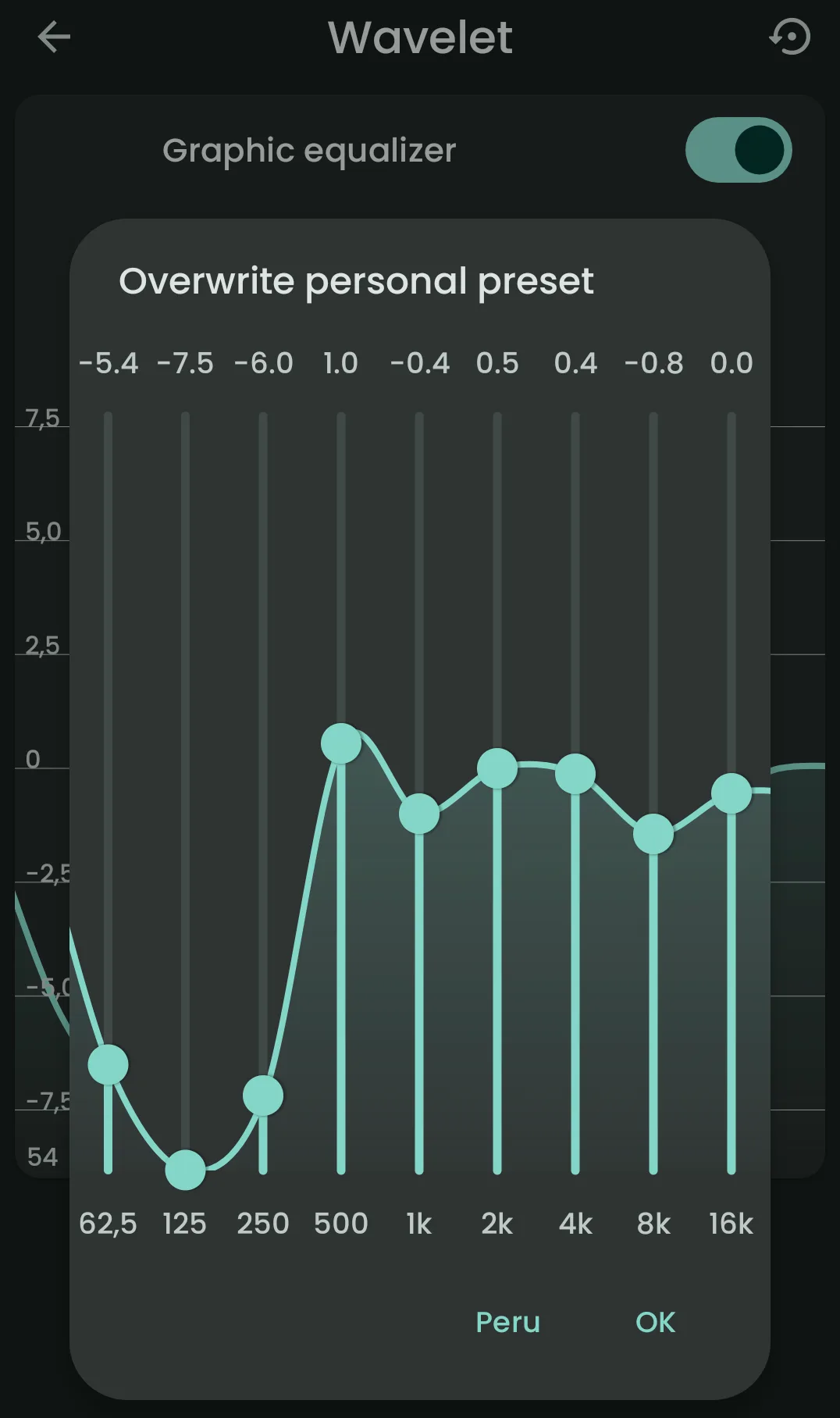
Squiglink website's EQ tool and Qudelix 5K:
Since the free version of the Wavelet app is somewhat limited in the precision of its adjustments, I have also listened to the headphones Qudelix 5Kwith a mobile amplifier using a cable. When I utilize the device's LDAC Bluetooth connection, the Kaiku Tone is still semi-wireless, as it doesn't need to be directly attached to a mobile phone.
With the Qudelix 5K, I have been able to use Squiglink's automatic equalization tool (reminiscent of Jaakko Pasanen's AutoEQ tool), which allows the Kaiku Tone's frequency response to be modified to match, for example, Harman's target curve. The settings can be entered as such into the Qudelix's parametric equalizer. Of course, the device would also have ready-made equalization profiles from the AutoEQ tool listed directly, but at least for now, the newer Kaiku Tone that I measured is not yet found there. The adjustments shown in the image below could also be implemented on a computer, for example, with the Equalizer APO software. So, there is flexibility and choice for equalization.
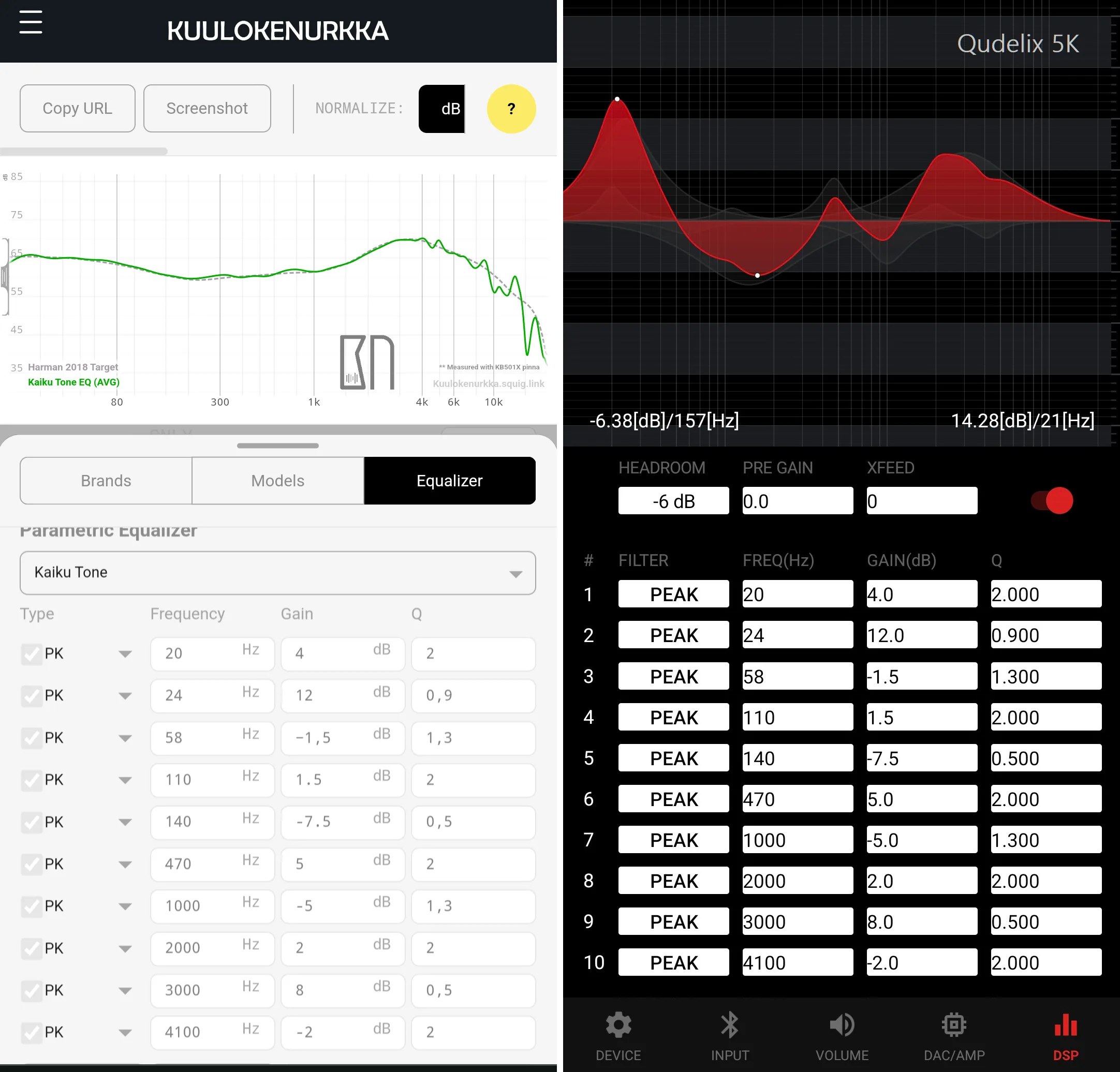
Based on my own measurements, the Kaiku Tone corrected to mimic Harman's target curve sounds excellent – even better than with my Wavelet settings. This also tells me that my measurements are reasonably accurate. Most of the necessary changes are directed at the lower frequencies, while the upper frequencies can be brought into line with a few filters. The treble smoothness I mentioned earlier demonstrates its strength in this context.
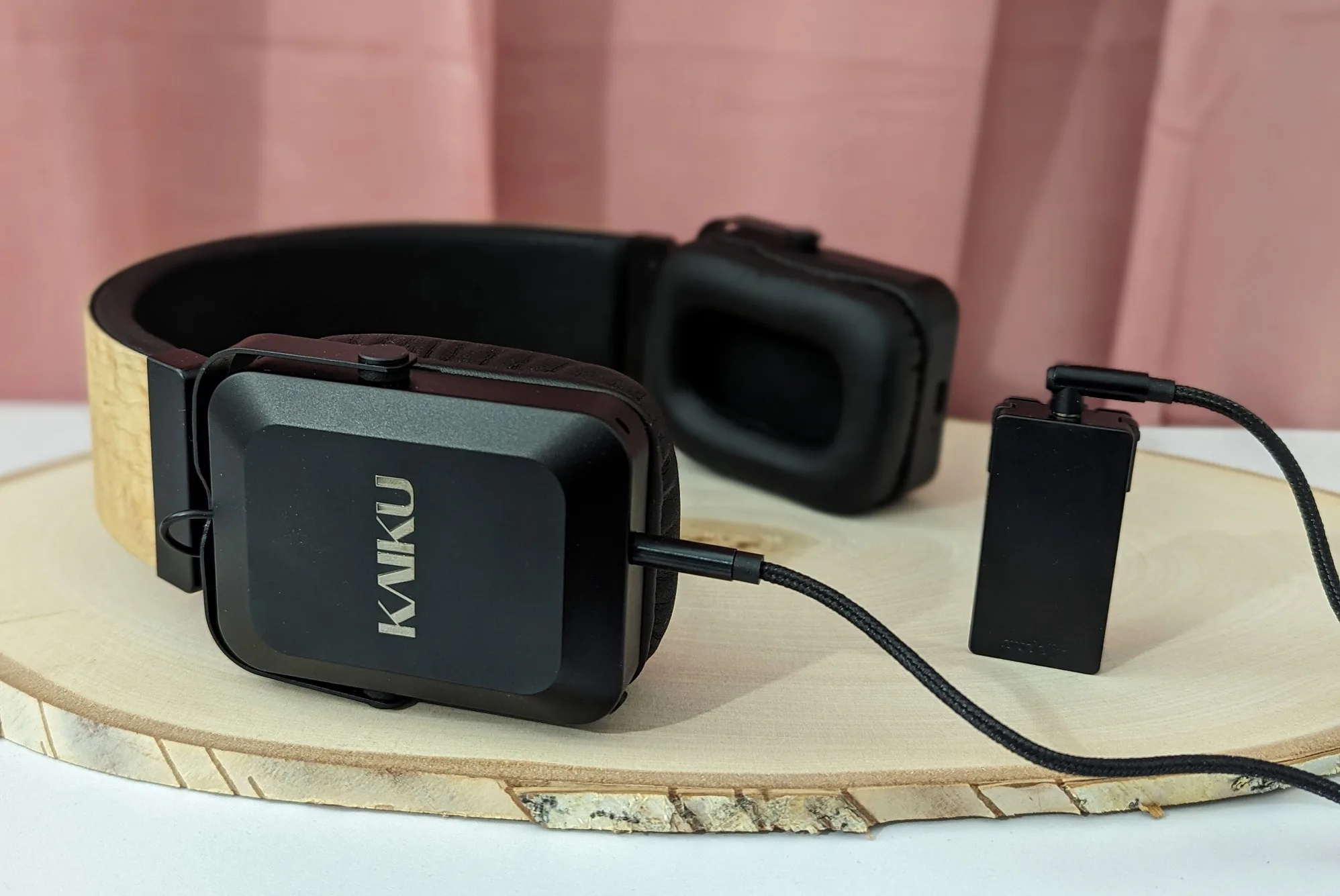
After equalization, the Kaiku Tone sounds clear and clean for a closed-back headphone, so the drivers seem to respond well to the changes. The channel balance is also good in my test headphones, and I don't hear strange echoes (heheh) or anything else unusual from the closed cups. Distortion values also appear normal. The manufacturer actually mentioned that the drivers chosen for the headphones were ultimately the most expensive among several options. This can be considered a good starting point, even if the tuning hasn't hit the mark perfectly by default.
Potential of the first production batch
To make the situation even more interesting, the Kaiku Tone I tested in January-February was clearly more balanced and clearer in sound. I was somewhat surprised to receive newer headphones whose frequency response had changed significantly. The change was ultimately due to the fact that the first headphones I tested were literally from the first production batch, which used a kind of prototype ear pads. The newer pads are more comfortable, but unfortunately, they degrade the frequency balance.
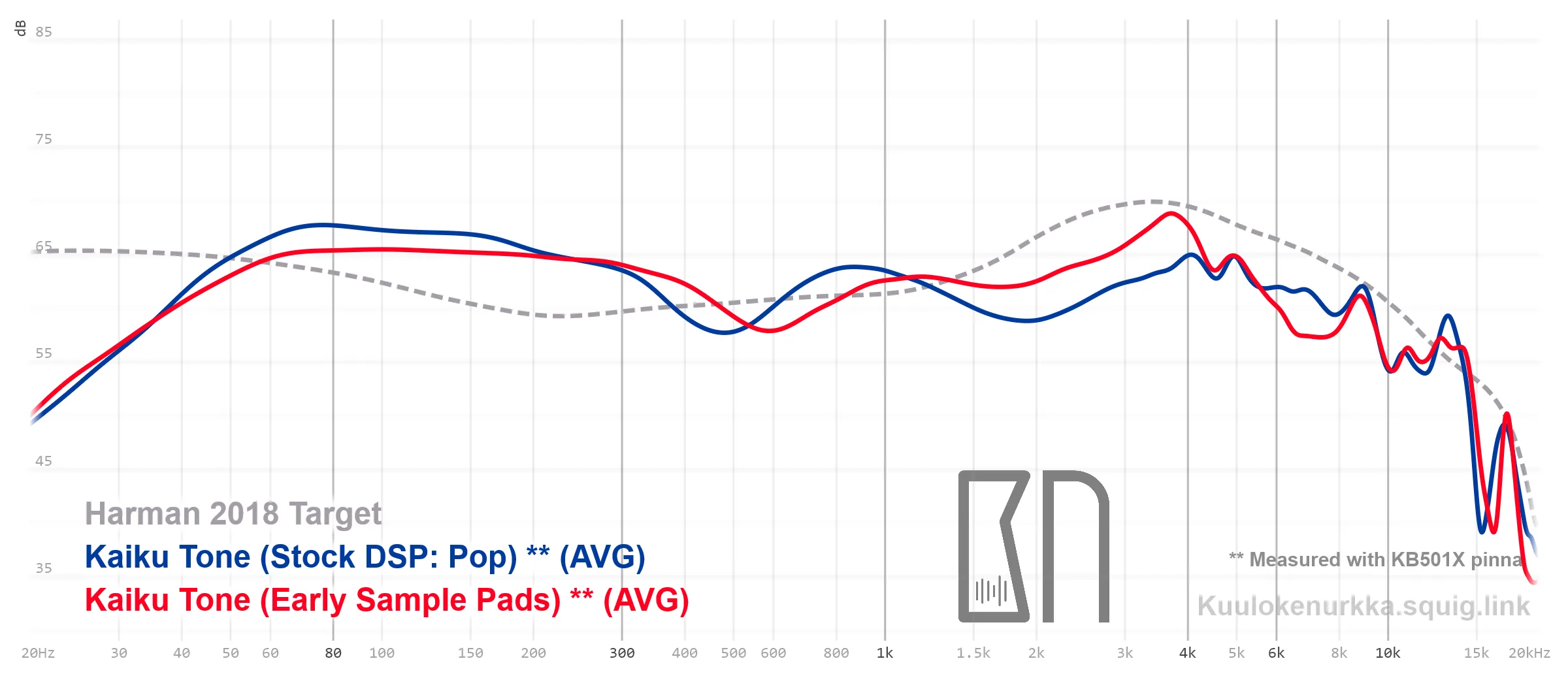
The first headphones I tested would have received a significantly more positive review from me, as their mid-frequencies were sufficiently clear relative to the ample bass quantity. In that case, a moderate reduction in bass quantity and a slight boost to the treble would have been sufficient as equalization. On the other hand, I also liked the headphones as they were, as their sound resembled Modhouse Argon mk3: being even slightly more balanced. The powerful bass combined with a spacious soundstage was a fun combination, making it easier to get excited about the headphones. A small number of people actually own such a Kaiku Tone, as some units were sold with those specific ear pads.
If Kaiku Acoustics can find suitable pads for its headphones in the future, its product would have the potential to be better even when tuned purely mechanically. Since implementing DSP adjustments with the chip supplier might not be the easiest path, adjusting the sound using ear pads could even be more straightforward. Pads that potentially offer a more balanced result could also be sold separately to previous owners of the headphones. Of course, I'm not saying what the manufacturer should do, but I would very much like to see all the pieces fall into place.
Summary
Kaiku Tone is an excellent demonstration of how challenging it ultimately is to develop good headphones, and how many aspects need to be considered. The manufacturer must be given credit for their courage, considering that the journey started from a hobbyist background. This is, of course, how many now-respected headphone manufacturers, such as ZMF and Dan Clark Audio, have emerged across the pond. Considering that both of these initially modified Fostex T50rp planar headphones, Kaiku Acoustics has already gone to greater lengths by developing the structure of their headphones themselves and even making them Bluetooth-enabled. Taking this into account, I don't think it's worth being too harsh on the manufacturer at this stage, as first products are rarely perfect.
If the entrepreneur teams up with a few other skilled individuals, it may have the potential to eventually develop into a respectable headphone manufacturer. The future will show what will be achieved based on the feedback received and in which direction Kaiku Acoustics wants to take its operations. Will it focus on selling its current product, or does it aim to become a larger headphone manufacturer?
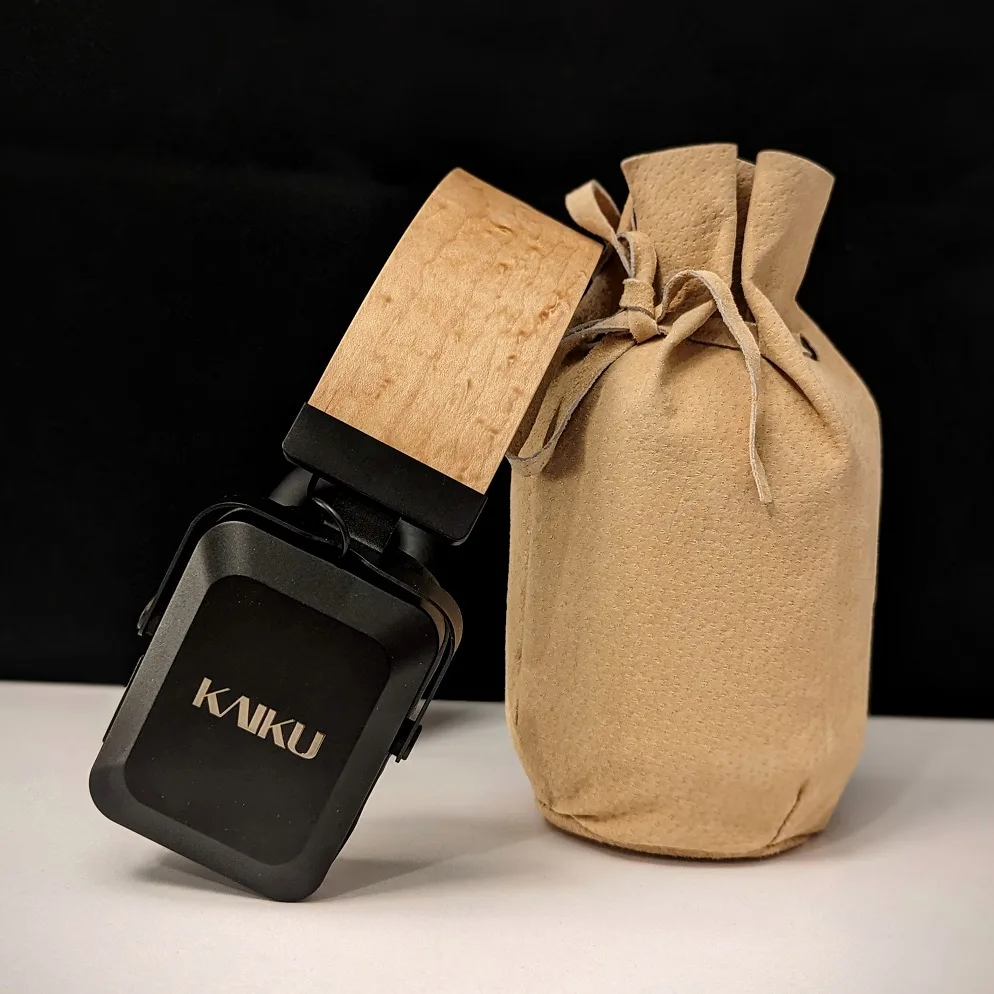
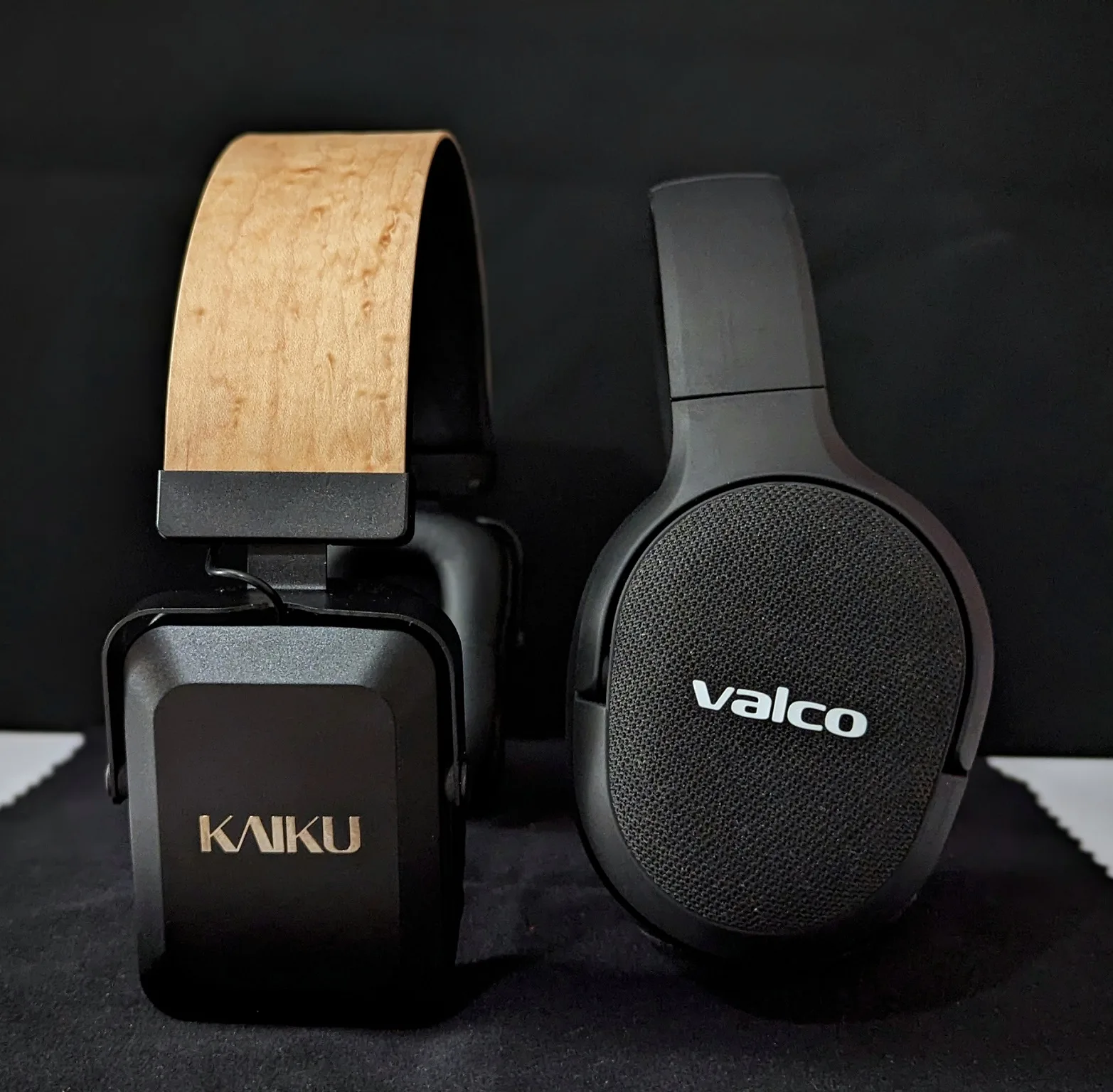
For now, the competitive landscape for Kaiku Tone is tough, as its price could buy both good noise-cancelling headphones and more traditional high-quality hi-fi headphones. Many are certainly still willing to support a domestic company and may even have been waiting for headphones made in Finland. I hope that Kaiku Tone sells well enough so that the manufacturer can, if desired, develop a next version and perhaps acquire some kind of measurement equipment to support sound tuning and quality control. The DSP chip installed in the headphones should also be utilized more effectively for fine-tuning the frequency response alongside EQ profiles, and I wouldn't mind if the current headphone version sounded the same in terms of its ear pads as the first production batch.
So, there's still work to be done, but since the structure and basic package are already functional, this is a good starting point. To begin with, it's probably most important that the entrepreneur himself is satisfied with the completion of his headphones and the opportunity to sell them. I would also be very excited in the same situation. For Kaiku Tone buyers, I recommend equalization, as this will get the sound quality just right. Of course, you can also like the sound as it is, as people often differ significantly in their preferences.
Pros and cons:
+ Can be equalized to sound good
+ Even treble is beneficial when equalizing
+ The sound of the first headphone version was clearly more balanced, so the headphones have the potential to be good with suitable ear pads
+ The structure is functional and comfort is good
+ Various EQ profiles available
+ The headband arch is innovatively made from wood veneer
+ Appearance selectable from several different wood options
+ No background noise
+ Included cables are of higher quality than usual
+ Handcrafted in Finland
+/- Unique appearance
– The sound is by default too mid-bass heavy and bloated
– Muted mid and high frequencies
– Weak sub-bass
– None of the EQ profiles make the sound particularly balanced
– Volume is difficult to adjust with the headphone buttons
– There is only a small adjustment range in volume before the headphones play too loudly
– Mediocre quality microphone
– Bluetooth connection audio bug when playing sound from one driver at a time
– High price compared to competitors' products
 EN
EN  FI
FI