Author: Sword of Damocles
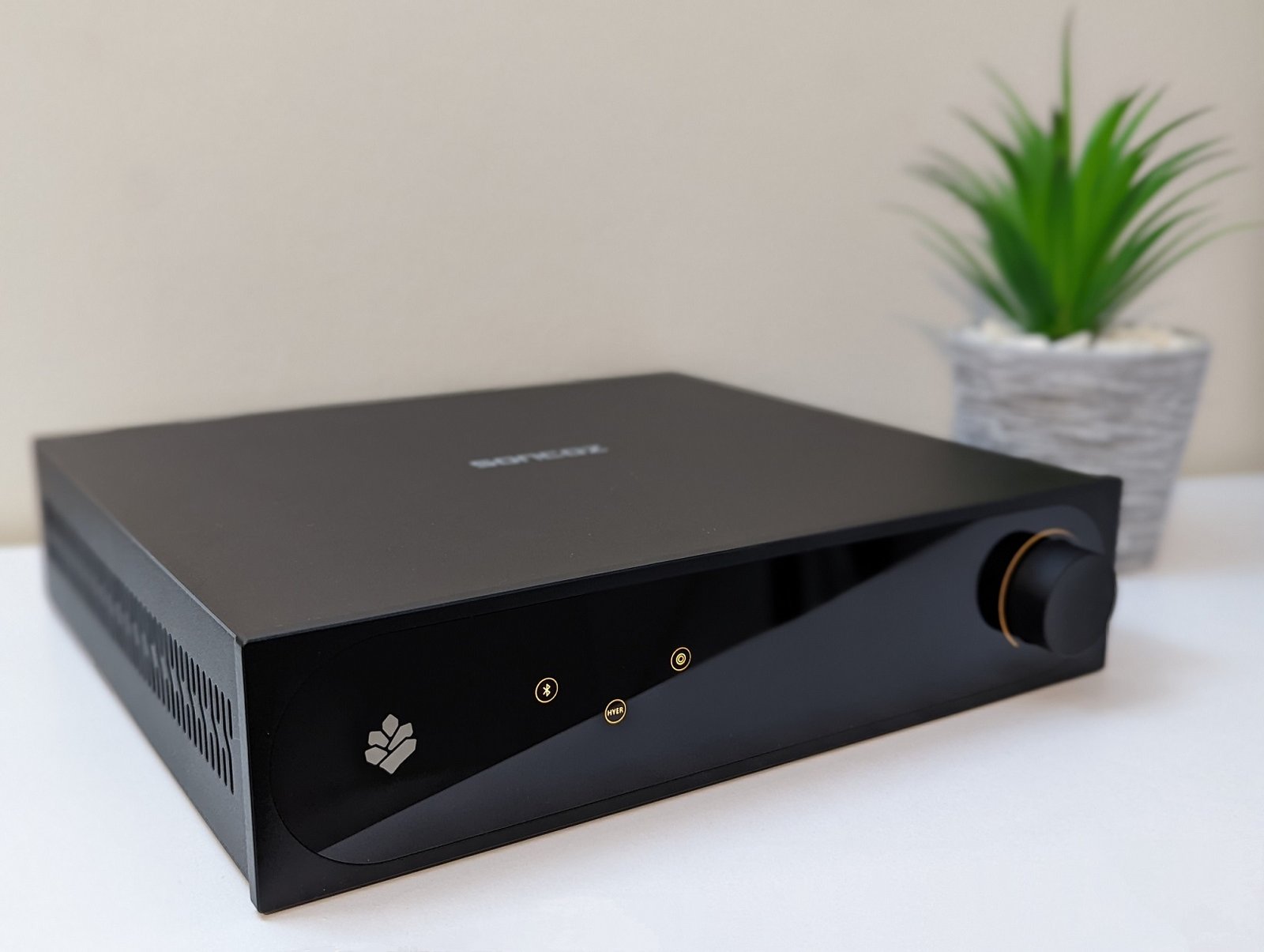
Table of Contents:
Information:
- Release year: 2019 (more widely available 2020)
- Price: 499 €
- Type: Delta-sigma
- DAC chip: 2 x ESS9038Q2M
- USB implementation: XMOS XU208
- SPDIF implementation: AKM 4481A
- Bluetooth: 5.0 (supported codecs APTX, APTX LL, SBC and AAC)
- WIFI: for firmware updates
- Input connections: USB-B, USB-C, Optical, Coaxial, AES
- Output connections (digital): Coaxial
- Output connections (analog): XLR, RCA
- Sampling rate (USB) PCM: 44.1–768 kHz (16–32 bit)
- Sampling rate (USB) DSD: DSD64–512 (native)
- Sampling rate (AES, Optical and COAX) PCM: 44.1–192 kHz (16–24 bit)
- Output voltage: RCA 2 Vrms / XLR 4 Vrms
- Noise: 1.3 uVrms
- THD + N: < 0.0001 %
- SNR: 126 dB
- Dynamic Range: 126 dB
- External dimensions (L x W x H): 22.5 x 25 x 5.5 cm
- Weight: 2 kg
- Power consumption: 9 W
- Included: USB-B cable, power cable and remote control
- Warranty: 1 year + lifetime free maintenance service (spare parts and shipping costs still payable)
Review sample: Self-purchased product
Soncoz is a Chinese company founded in 2019 that manufactures D/A converters and headphone amplifiers. The company's founder, Ben Du, also designed the popular Khadas Tone Board DAC. Soncoz's own devices are based at least partially on the same circuit design, but the devices have been made significantly more versatile. It should also be mentioned about Ben Du that he solved the problem known as the ”IMD-hump” that plagued ESS's newer DAC chips, i.e., the bump visible in IMD distortion measurements. Ben openly published his fix for other manufacturers to utilize as well.
Despite its affordable 100 euro price, the Khadas Tone Board measured excellently, so it's no big surprise that Soncoz's devices are also designed with measurement results in mind. The manufacturer's most expensive DAC to date, SGD1, costs about 500 euros new and is built around two ESS Sabre ESS9038Q2M DAC chips. The implementation of the device is very robust for a chip designed for mobile use, so it has probably been pushed to its limits.
I bought the SGD1 about 8 months ago after finding one at a reasonable price used. The device then replaced the one I previously reviewed Topping E30, because I wanted to find out what a 500 euro DAC sounds like compared to a 150 euro DAC. In my review, I will discuss the sonic differences between the two, and I will also compare the SGD1 to Schiit Audio's Bifrost 2.
Physical overview of the device
The SGD1 is a rather large and stylish device, weighing 2 kilograms. My device is black, but two different metallic shades are also available as color options. The outer casing of the device is metal, and its bottom and sides have perforated areas for cooling.
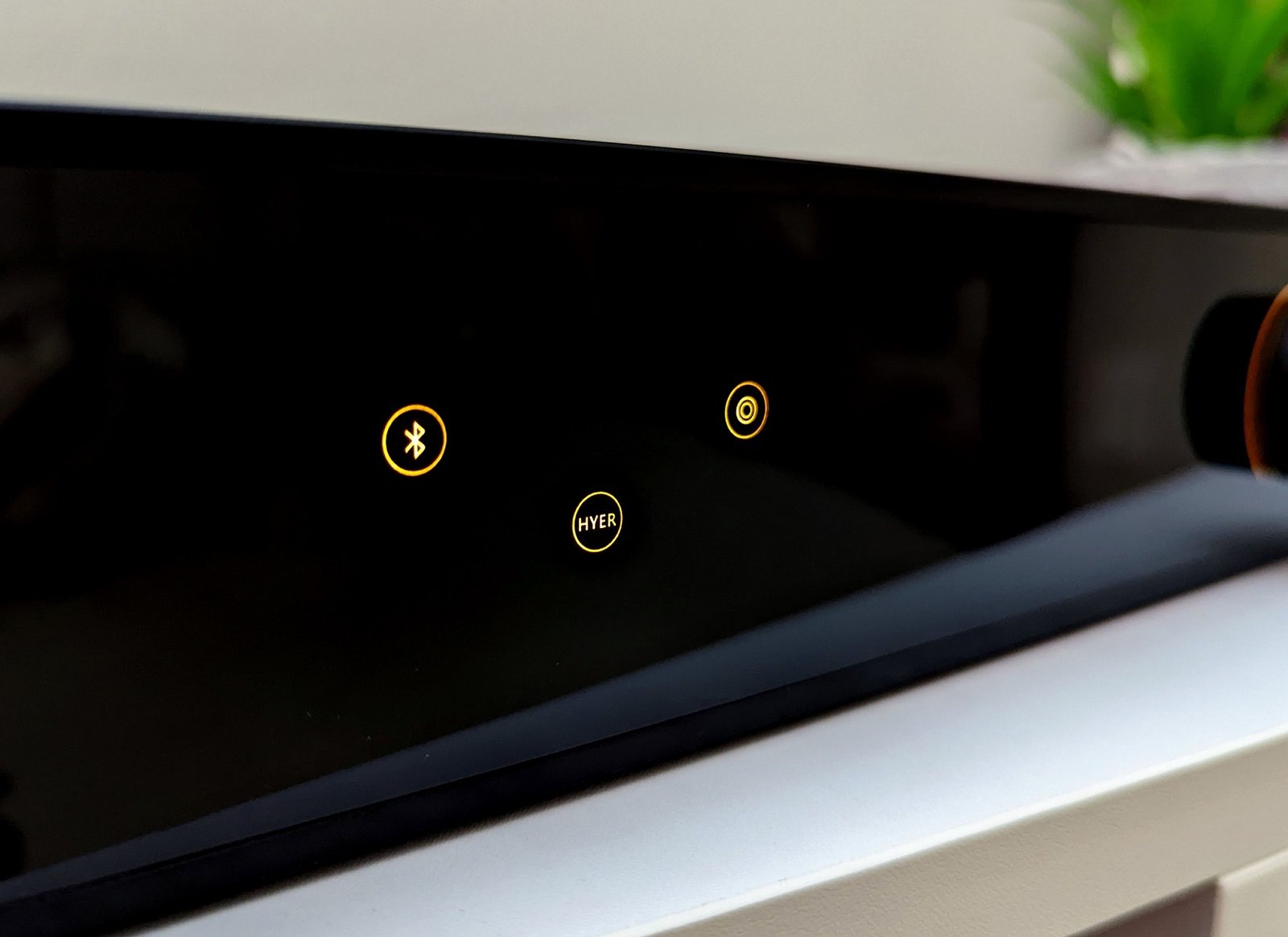
The front panel has a unique look, as it features a rounded black glass plate embedded in it, behind which is a display showing orange symbols. The upper row of the display shows the selected audio input and output connector. The lower row, in turn, shows the active audio filter – I don't know of another DAC where an entire display row would be dedicated solely to indicating the selected filter.
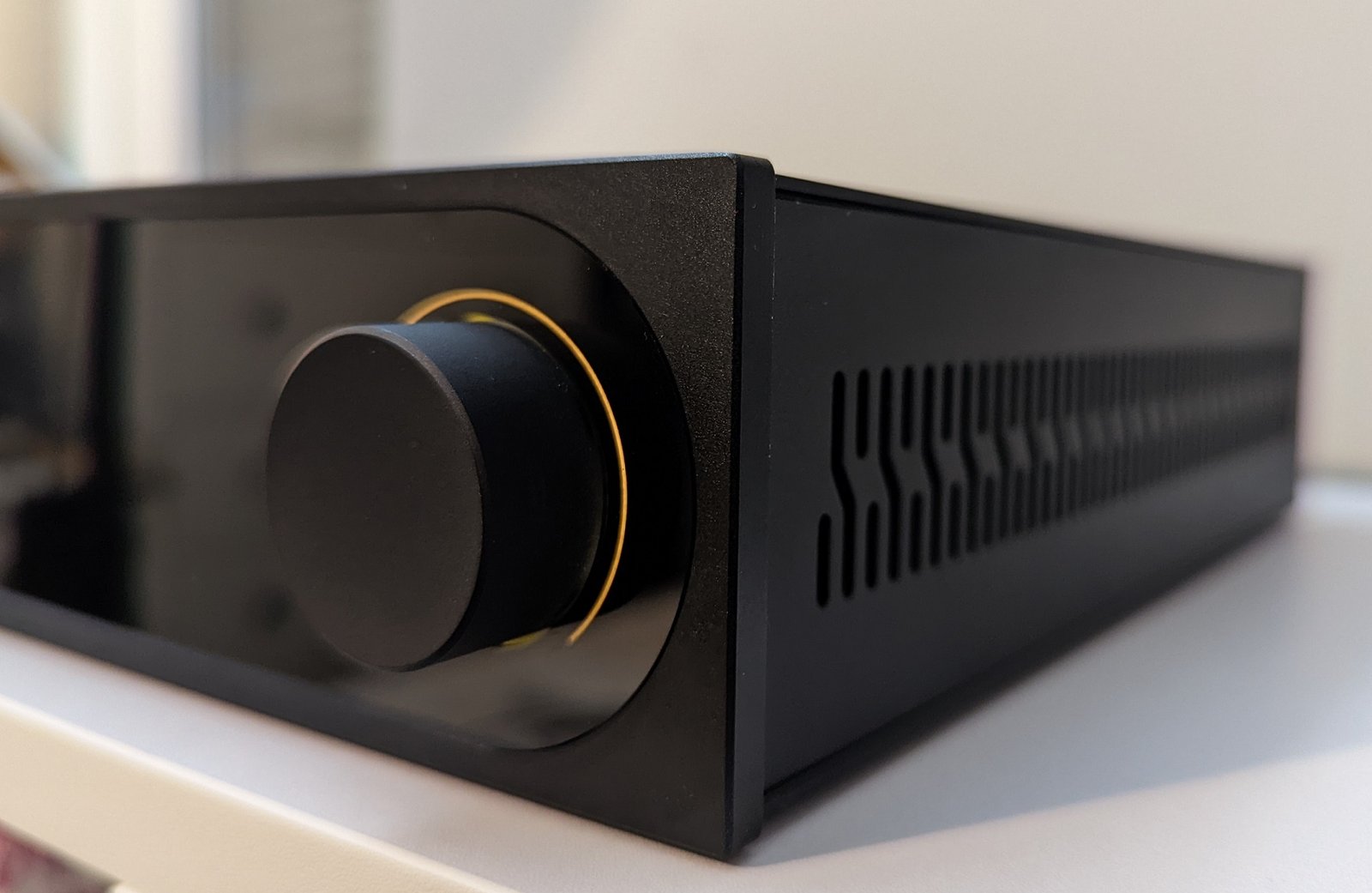
On the right front edge, there is also a round plastic volume knob, which also functions as a mute button and a selector for the input connector and audio filter. The volume setting is elegantly indicated by an orange light ring surrounding the knob, which expands and contracts as the knob is rotated. However, it is very difficult to discern differences of a few decibels from the indicator, so a decibel value on the display would have been a better solution for the device's usability, in my opinion. I also have to complain a bit about the knob itself, as it feels loose and wobbly in different directions when grasped. The feel is largely similar to a traditional rubber dome keyboard.
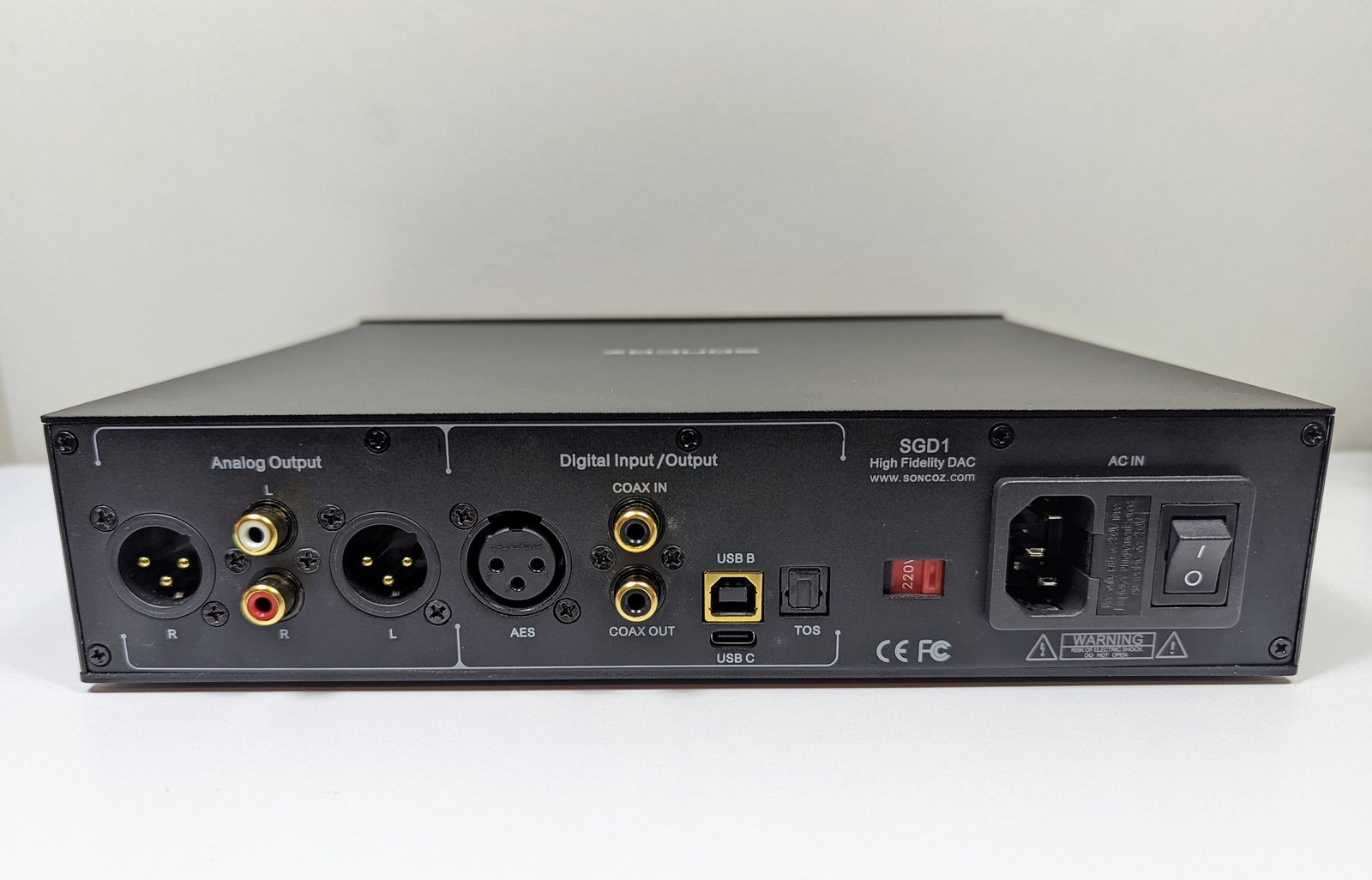
Behind the SGD1, there are very comprehensive connections and a power switch. I like that the device has two USB input connectors (USB-B and USB-C), which can be used independently of each other. The device also receives digital signals via optical and coaxial SPDIF connections, as well as a professional-grade AES connection. The SGD1 is capable of sending digital signals forward to another DAC via a coaxial SPDIF connection. The DAC's structure is balanced, so in addition to RCA output connectors, it also features XLR connectors.
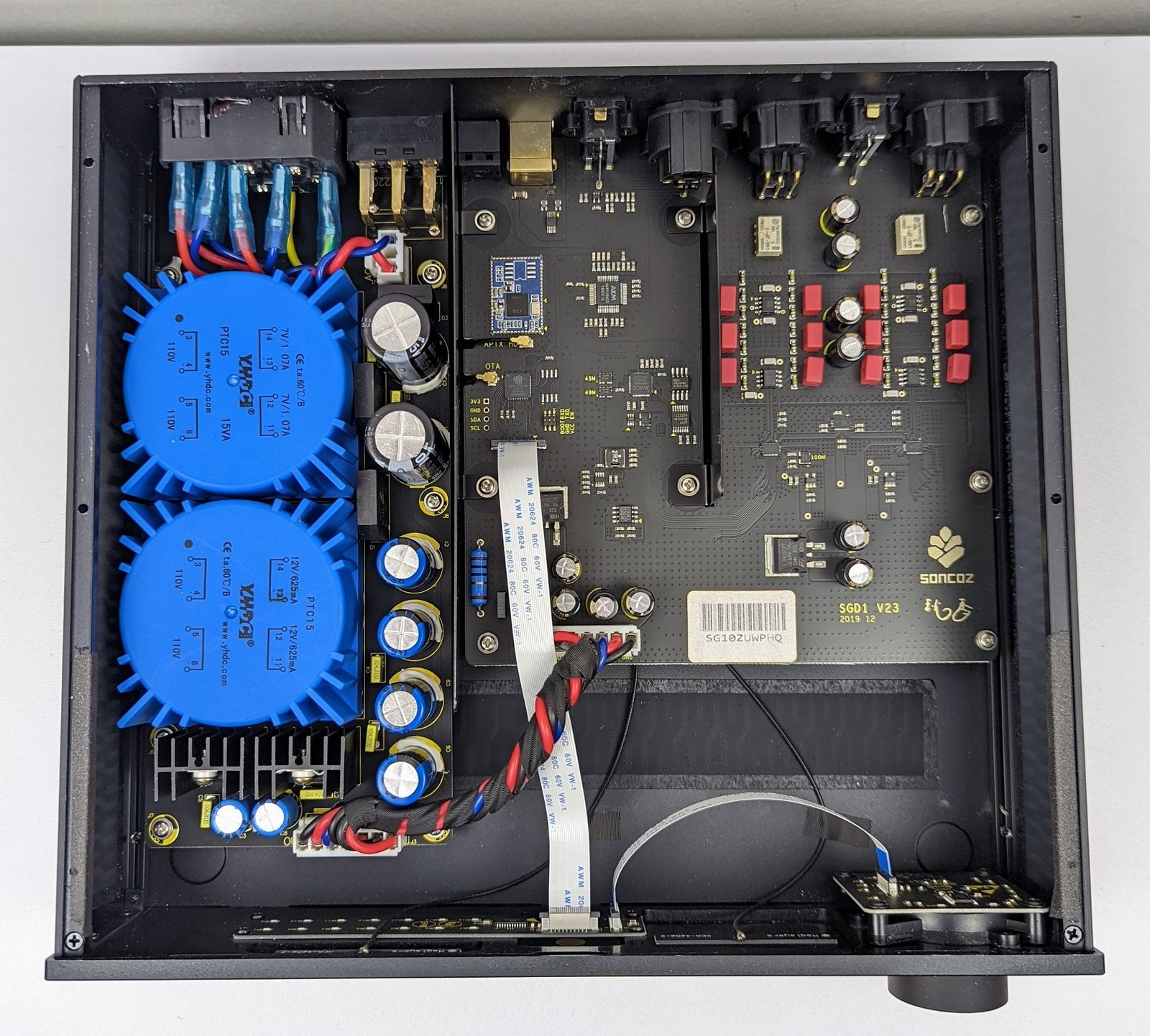
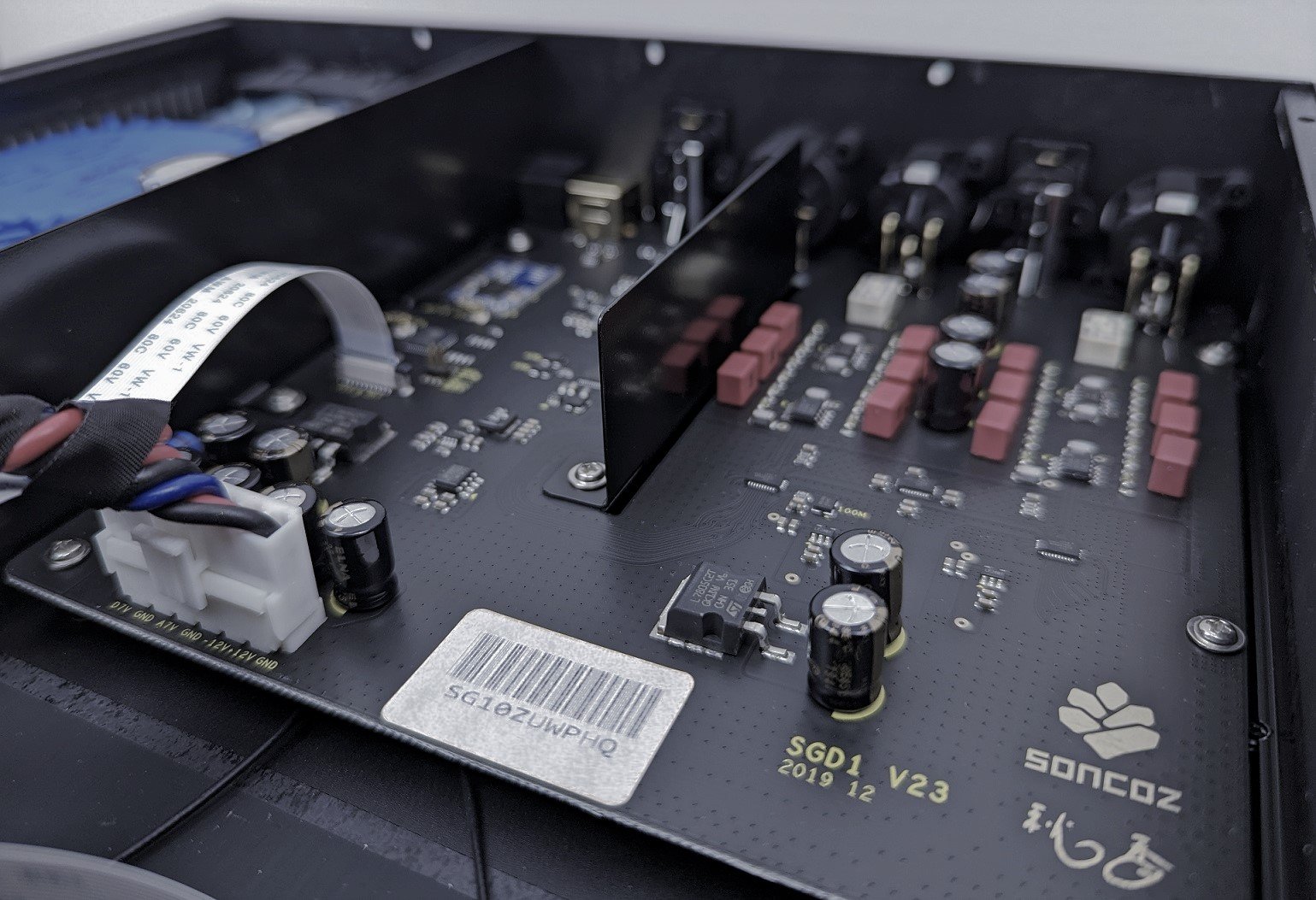
I don't have a deep electrical engineering understanding of device components, but to my eyes, the SGD1 looks like a very carefully considered and impressive package internally. Inside the device, there are, among other things, two linear power supplies, which is quite unheard of for a 500-euro DAC. Different sections of the circuit board are also isolated from each other. Since the SGD1 does not include an external antenna, one might not necessarily guess that it also includes Bluetooth connectivity and Wi-Fi, though the latter is only used for firmware updates.
Features and device use
In terms of features, the SGD1 largely has everything I look for in a DAC. In addition to comprehensive physical connections, the device also has Bluetooth connectivity. The SGD1 automatically appears as a connectable Bluetooth device when Bluetooth is selected as the audio input channel. Supported codecs include APTX, APTX LL, APTX HD, SBC, and AAC. According to some sources, LDAC support might also be available after a firmware update, but at least my Google Pixel 6 phone does not allow its use.
Through its physical connections, the device widely supports PCM and DSD sampling rates, so listening should not be limited by that. Strictly speaking, there is no support for the DSD1024 option, but those who desire it are likely aiming higher than the SGD1 in their device purchases.
The device features 7 ESS Sabre-defined audio filters, which are very similar to those in the Topping E30 I previously reviewed. I cannot hear (or don't know how to hear) a practical difference in AKM's filters, so, less surprisingly, I also don't detect a difference in ESS Sabre's filters. This feature is not very interesting in my opinion, so I probably won't delve into filters in more detail in the future unless they offer a clear change to the sound.
The SGD1 allows for digital volume adjustment in 0.5-decibel increments. The device saves and remembers the set volume and audio filter separately for each input connector, even after power-off. This is a very useful feature both when using multiple devices and, for example, with active speakers, when the volume is desired to be consistent with the previous listening session for the next one as well. In many other devices with digital volume control, the volume might revert to a certain factory setting after a restart, requiring it to be readjusted.
The volume knob on the front edge of the device is not the best possible, as it needs to be turned quite vigorously. One turn of the dial changes the volume only slightly, making larger adjustments feel slow and laborious. For this reason, I recommend using the remote control if the DAC is used as a volume controller for other devices.
The SGD1's user interface (if a few settings can be called a user interface) can be controlled by pressing the volume knob. Pressing the button once puts the device into mute mode, and then turning the knob allows changing the audio input connector. Pressing the button longer makes the device flash the lower row of the display, indicating that turning the knob will change the audio filter. Selections are always confirmed by pressing the button again. The user interface is simple and functional, and unlike the Topping E30, it allows all settings to be changed directly from the device without the included remote control.
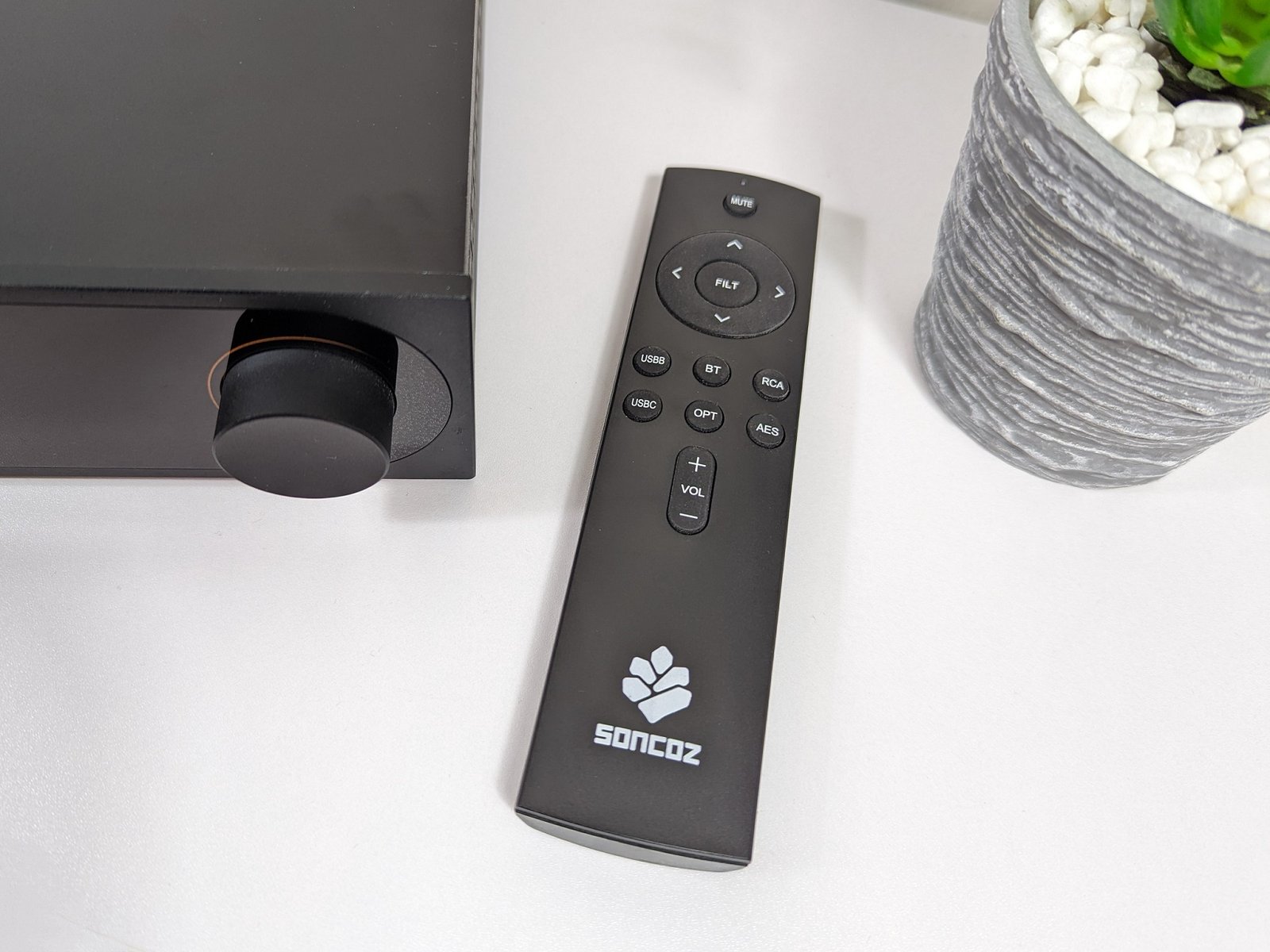
The SGD1's mute feature is interesting because, without a received audio signal, when muted, the device enters a kind of power-saving mode after a moment, turning off its display and digital section. However, this power-saving mode only reduces the device's power consumption by about 2 watts, as the remaining analog section still consumes 7 watts, even though one might imagine the device to be completely off. The actual shutdown must be done using the power switch on the back of the device. Such a power-saving mode does not comply with any EU regulations, nor does it offer much benefit, so its existence is a minor mystery to me.
Sound quality
Equipment used for sound quality evaluation:
I evaluated the Soncoz SGD1 primarily by listening to it with my well-known ZMF Verite Closed headphones, which react strongly to equipment changes, and my best amplifier, the Burson Audio Soloist 3X Performance. Since the SGD1 costs 500 euros new, I don't think it's worth acquiring for an amplifier costing less than 200 euros – for this reason, I did not use cheaper amplifiers in my listening tests. Regarding headphones, the amplifier confirmed the validity of my observations also with Sennheiser HD800, ZMF Auteur, and Modhouse Argon mk3 headphones.
I listened to the SGD1 for about a week alongside the Schiit Audio Bifrost 2, and for a few days also with the Topping E30. All DACs were connected simultaneously to my computer's USB ports, and the Windows audio settings were identical for each. When comparing the SGD1 to the Bifrost 2, both DACs were connected to the Burson Audio Soloist 3XP with balanced XLR connectors. When comparing to the Topping E30, I also used RCA connectors for the SGD1. I had both XLR and RCA selectors/splitters available, which allowed switching the audio input device on the fly by flipping a lever.
I listened to music from the Tidal streaming service because it allowed me to quickly switch the DAC to which I wanted the software to feed audio. When I wanted to switch from one DAC to another while listening, I just had to click on the other DAC in Tidal and simultaneously flip the lever on the XLR/RCA selector.
I equalized the volume of all DACs to be the same in the comparison situation using my MiniDSP EARS device. Through XLR connectors, music plays exactly 1 decibel louder on the SGD1 by default than on the Bifrost 2, so it was easy to equalize the volume by lowering the SGD1's volume. Similarly, through RCA connectors, the SGD1 played 0.5 decibels louder compared to the Topping E30, so it was easy to equalize the volumes in this situation as well.
Soncoz SGD1 sounds excellent
The SGD1 sounds very much like what I would hope and expect a good DAC to sound like. Music is reproduced effortlessly, articulately, and distinctly, so that nothing feels forced or too sharp. The SGD1 is still a slightly bright-sounding DAC because its treble draws extra attention to itself. However, a slight sparkle and sharpness primarily occur in the upper treble region and do not spread to the mid-frequencies. Thanks to this, the SGD1 does not sound clinical or aggressive. At the same time, the Khadas Tone Board, implemented with the same ESS DAC chip, sounds significantly more aggressive in the mid-frequencies, in my opinion.
Apart from the slightly emphasized treble, the SGD1 sounds, when evaluating frequency ranges, so to speak, normal – I would again use the word neutral, even though it means different things to different people. By this, I mean that the SGD1 does not directly affect the balance of different frequency ranges. This is likely the desired outcome for most when acquiring a DAC, so the SGD1 succeeds excellently in that.
In my opinion, the strengths of the SGD1 are the airiness and layering of the reproduction, as well as the articulation of the soundstage. The soundstage is not unusually large, but it is memorable due to its excellent depth. Different sounds play on several different layers and at different distances. The SGD1 draws the vocalist exceptionally clearly before my eyes and other instruments precisely delineated around them. Admirably, air remains between different sounds, and the soundstage is overall very credible in style because the listened song can not only be heard but also seen. This, in my opinion, most clearly distinguishes the device from more affordable DACs, whose soundstage remains flatter in depth, being more inside the listener's head.
The sound of the SGD1 as a whole is fast and distinct – individual sounds have clear outlines. I also consider the device's tightness and briskness in percussive sounds a positive aspect. For example, drumstick hits and the snare drum have a pleasant energy. In these sounds, the sharpness of the device's treble is beneficial.
In my opinion, the device's only major weakness is the general lightness of the reproduction, especially in music with more low frequencies. With the SGD1, the bass sounds fast and technical, but its physical impact remains regrettably light – the bass plays as if further away, so you listen to it, but you don't really feel it. This may not be noticeable in calmer music with electronically produced bass. However, when listening to rock music, I would crave more kick in the bass drum and bass guitar – the SGD1's reproduction style is too refined and restrained for such music for my taste.
The bass reproduction, in a way, lacks texture and flesh around the bones, which unfortunately is also audible in the mid-frequencies. Although the SGD1 reproduces both low and mid-frequencies in detail and naturally, the lightness of the reproduction does not fully convince me that I am listening to real instruments and a real singer. This, in my opinion, is very regrettable, especially when the music is simultaneously reproduced credibly in terms of the soundstage.
Perhaps it's not meant to get everything for 500 euros anyway. The strengths of the SGD1 clearly keep the overall package on the plus side, and despite its slightly digital presentation style and lightness of reproduction, the device sounds excellent. I want to remind once again that this is ”just” a DAC, so the final reproduction is significantly more affected by the chosen headphones and to some extent also the headphone amplifier.
Comparisons
Soncoz SGD1 vs. Topping E30
Prices: 500 € vs. 150 €
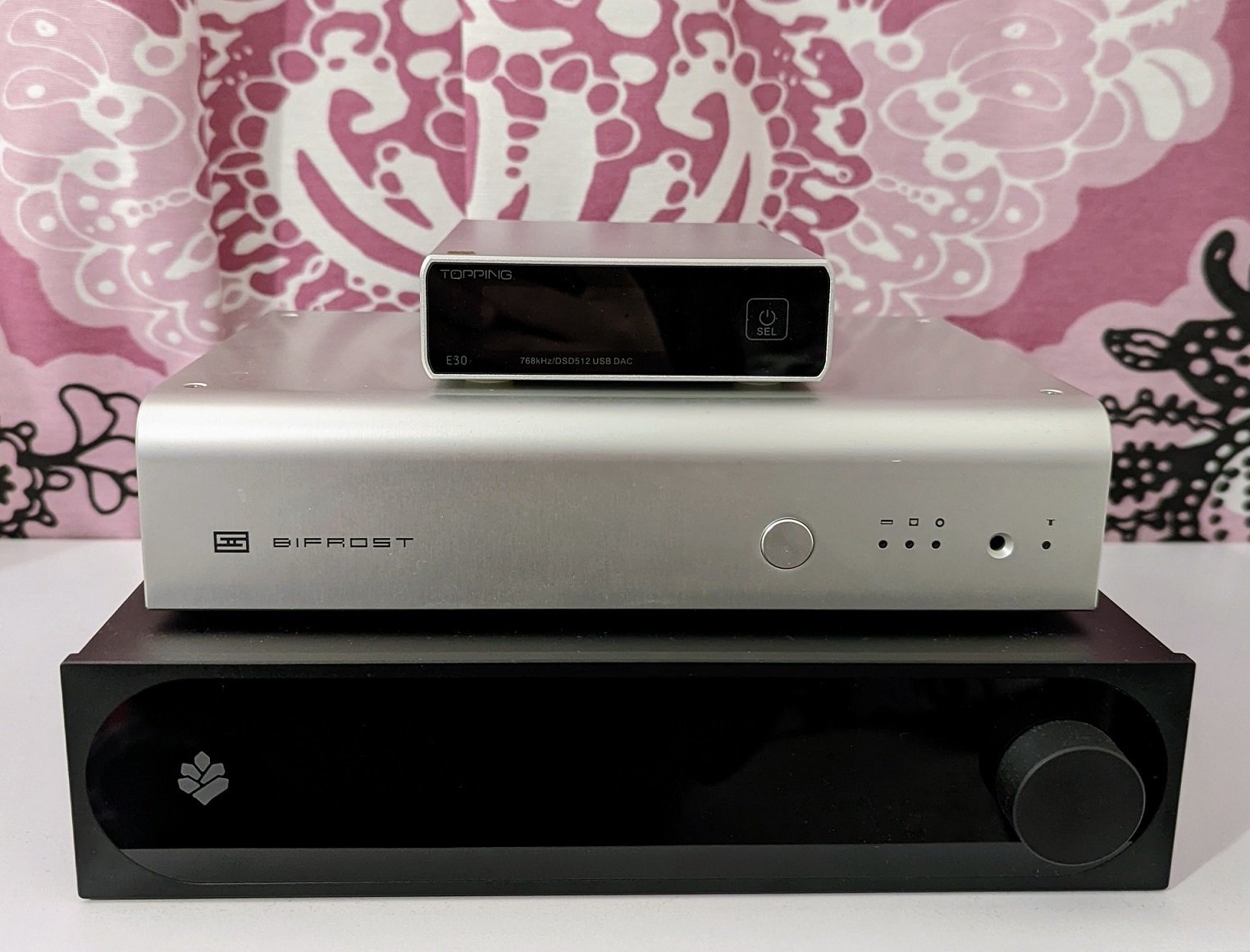
I embarked on this comparison interested in what kind of improvement the SGD1 offers with its additional 350 euro price compared to the popular Topping E30, which I previously reviewed. Part of the price difference between the devices is explained by the SGD1's significantly more versatile connections and additional features. The delta-sigma DAC chips used in the devices do not actually differ in price at all; they can be bought for a few euros. The greater impact on sound quality comes from the devices' other construction and the components used. If you are interested in more details about the Topping E30, you should read more about it from its own review. In this comparison, I will focus only on examining the sound quality differences.
Comparing a large and ”expensive” device to a small and ”affordable” one is always challenging because one expects the former to be better. However, since the impact of a DAC on sound quality is relatively small, practical differences may often remain reasonably minor, unless there is a significant stylistic difference between the devices, for example, one being very bright-sounding and the other dark. I strive to be as moderate as possible with my preconceptions, but this should be taken into account when reading my thoughts. It would be great if an affordable DAC sounded as good as or better than a more expensive device. For this reason, I try to be critical when evaluating the magnitude of improvements brought by the more expensive device.
Most significant differences in sound
Both SGD1 and E30 could be described as neutral in sound, with SGD1 being a slightly bright take on neutral and E30 leaning slightly towards warmth. E30 has a calmer sound, especially due to its more subdued treble reproduction. SGD1 is an improvement in treble airiness compared to it. For example, the last shimmers of drum cymbals are heard more distinctly and powerfully with SGD1.
There is no striking quantitative difference in the bass reproduction of the devices, but SGD1 sounds faster and separates low-frequency details better. With E30, the bass sounds even a bit muddy and muddled in faster tracks, whereas SGD1 controls bass reproduction better. The technical improvement compared to E30 is quite pleasant.
Mid-frequencies are reproduced in a very similar stylistic manner by both devices, but SGD1 does everything better. The biggest difference, in my opinion, is the vocalist's position in the soundstage: with E30, the vocalist is a vaguely defined figure lower inside the listener's head, whereas SGD1 defines and elevates them in front of the listener's eyes. This change alone makes SGD1's mid-frequencies significantly more credible and realistic.
A clearly audible difference also forms between the devices in terms of soundstage depth and the layering of sounds. E30 always sounds a bit congested and as if the sounds are fighting for space. The soundstage is flat and 2D-like compared to SGD1, but still not bad for a 150-euro device. However, SGD1's more layered presentation makes the overall experience sound both livelier and clearer – every sound has its own place. The device also reproduces the edges of details more clearly across all frequency ranges compared to E30's softer style.
Final remarks
Topping E30 and many other more affordable DACs always sound to me as if I'm not getting the full potential out of the music I'm listening to or the headphones. For this reason, the Soncoz SGD1 is a fairly significant improvement over the E30 for me, especially in terms of soundstage. However, when buying the devices new, this improvement costs 350 euros, so it may not be recommended for everyone, especially if a DAC like the Topping E30 already sounds good and its features are sufficient for one's own use.
E30 doesn't really do anything wrong for its price, but unfortunately, it cannot compete in sound quality with DACs implemented with a larger budget, like the SGD1. In my opinion, it doesn't need to, even though some swear that a well-measuring affordable DAC is the death knell for all other devices. E30 is still an excellent demonstration of how good affordable devices are nowadays, and how close they get to better devices.
The sound quality improvement brought by SGD1 for 350 euros depends on how seriously each person takes their listening hobby. For me, the improvement is worth the money, but for another, less focused on listening to soundstage-related information or details, a DAC upgrade might feel like nothing significant changes. Since DACs affect the final sound relatively little, one must be able to appreciate SGD1's superiority to even call the device better than the more affordable Topping E30. Of course, SGD1's advantages also include its balanced design, more comprehensive connections, and Bluetooth.
Soncoz SGD1 vs. Schiit Audio Bifrost 2
Prices: 500 € vs. 800 €
Bifrost 2 is, in principle, a kind of intermediate form between delta-sigma and R2R DACs, which the American company Schiit Audio calls Multibit. A separate review of the device will be published later in Kuulokenurkka, so in this context, I will only discuss its sound quality compared to SGD1. Bifrost 2 costs about 300 euros more than SGD1 when bought new and delivered to Finland, but the devices fall largely into the same price category. In my opinion, in the 500–1000 euro price range, one can no longer speak of better and worse devices, but rather of different devices. The starting point is that SGD1 has more comprehensive features and connections, so Bifrost 2 must perform well in sound quality to be worth its price.
Most significant differences in sound
SGD1 and Bifrost 2 are stylistically different devices to such an extent that the choice between them significantly affects how the music ultimately sounds. While SGD1 has a slightly bright and light overall sound, Bifrost 2 has a warm and thick sound. Bifrost 2's strengths are essentially precisely those areas of reproduction that I see as SGD1's weaknesses. On the other hand, it simultaneously colors the reproduction to such an extent that SGD1 is still better in a few aspects.
Bifrost 2 is in a way a big leap forward from traditional delta-sigma DACs, because with it, I immediately get the impression that I am listening to real sound and real music, instead of the source being a digital recording. Although SGD1 does not sound unnatural in any way, it does not make me immerse myself in listening in the same way. This is one of the biggest and most decisive differences between these two devices. Bifrost 2's timbre is thoroughly natural and, for me, easily worth the additional 300 euro price.
Another clear difference is found in bass reproduction, especially when listening to rock music: with Bifrost 2, the bass is more present and has a very satisfying amount of mass and punch. When Bifrost 2 is combined with headphones that reproduce mid-bass well, such as the ZMF Verite C, the kick drum and bass guitar feel truly impactful in the chest due to their fullness. With SGD1, the reproduction remains considerably lighter, but on the other hand, it is never too thick either – technically more complex bass patterns are also reproduced a bit more controlled with it.
Bifrost 2's bass reproduction is outrageously fun, but the bass sometimes becomes an overly dominant aspect of the overall sound. However, this rarely causes significant harm, because the bass doesn't actually increase quantitatively, but rather it is denser and its sound pressure is, in a way, greater. I believe this is at least partly due to the fact that Bifrost 2, or other Schiit Audio DACs, do not measure very well, but instead produce some distortion that people generally find pleasant.
The warmth and naturalness produced by Bifrost 2 are audible across all frequency ranges. Its treble also sounds natural and quite forgiving. Listening with the device does not cause any listening fatigue. However, this also opens up an opportunity for SGD1 to shine, as its treble sounds airier and more detailed compared to Bifrost 2. SGD1 is also slightly more resolving of the two and has sharper edges for individual sounds. The difference is not huge, but when listening with Bifrost 2, one focuses more on the body of the sounds and their natural texture, whereas with SGD1, the sounds stand out more clearly from each other, and the listener has more time to observe what the music contains.
Both devices have a fairly similar soundstage in terms of width, but SGD1's soundstage has more depth. When SGD1 paints the music in front of my eyes, switching to Bifrost 2 on the fly moves the sound backward, closer to me. I would place SGD1 ahead of Bifrost 2 in terms of soundstage precisely for its better depth and airiness, but on the other hand, with Bifrost 2, the background of the reproduction sounds darker and more authentic. For example, when listening with Sennheiser HD800 headphones, SGD1 further emphasizes the headphones' large and magnificent soundstage and airy treble. Bifrost 2, on the other hand, calms the treble while bringing much-needed warmth and naturalness to the bass reproduction and mid-frequencies of the headphones.
Final remarks
Both devices have their own advantages, but they suit slightly different situations. The Bifrost 2 is an absolute choice for people listening to rock and heavy music, much like myself, as the sound is energetic and fun. The same applies to pop music and all bass-heavy music where a powerful bass is desired. The SGD1, on the other hand, excels in the airiness of its reproduction and the spaciousness of its soundstage with music that benefits from it. I would see the SGD1 as a better fit of the two for, for example, classical music listeners, or generally for listening to more high-quality produced music. Both devices are still very versatile and excellent, and no music sounds bad on them.
Considering the price level of the devices, I believe both are competitively priced relative to their strengths. Since the SGD1 costs 300 euros less, it's easy to recommend if the budget is up to 500 euros. The device's measurement results are also excellent, and it doesn't color the reproduction, unlike the Bifrost 2, whose preference is purely a subjective liking without anything wrong with it. Currently, I wouldn't want to give up the Bifrost 2's rich bass reproduction or natural presentation, but I would wish for a deeper and more spacious soundstage like the SGD1's. I will likely, at some point, look for a DAC that combines the best aspects of both devices.
Device pairing with SGD1
The SGD1 is not problematically bright from a device pairing perspective, but it still might not be advisable to combine it with a bright-sounding amplifier or headphones. A neutrally balanced or slightly warm listening chain suits the SGD1 better. However, I personally don't find the device to sound irritating even with the very bright Sennheiser HD800 when played through a Burson Audio Soloist 3XP amplifier. In such a situation, the amplifier indeed has a quite significant effect between the DAC and the headphones.
I have the SGD1 paired in my living room with a Tor Audio Roger tube amplifier, because it brings much-needed airiness and sharpness to the otherwise soft sound of the tube amplifier – the SGD1 also further enhances the interesting effect of the tubes on the soundstage.
I have also used the SGD1 with a Cambridge Audio CXA81 amplifier and Wharfedale EVO 4.2 speakers, observing largely the same characteristics in the DAC as with headphones. The SGD1 slightly brightens the dark treble of the Wharfedale speakers, and additionally, the soundstage becomes pleasantly spacious and airy. The bass is controlled in style, but it lacks some of the punch I mentioned earlier. The end result is, in my opinion, significantly better than, for example, with the amplifier's own ESS-based DAC or a Topping E30, with which the soundstage remains much narrower between the speakers.
Summary
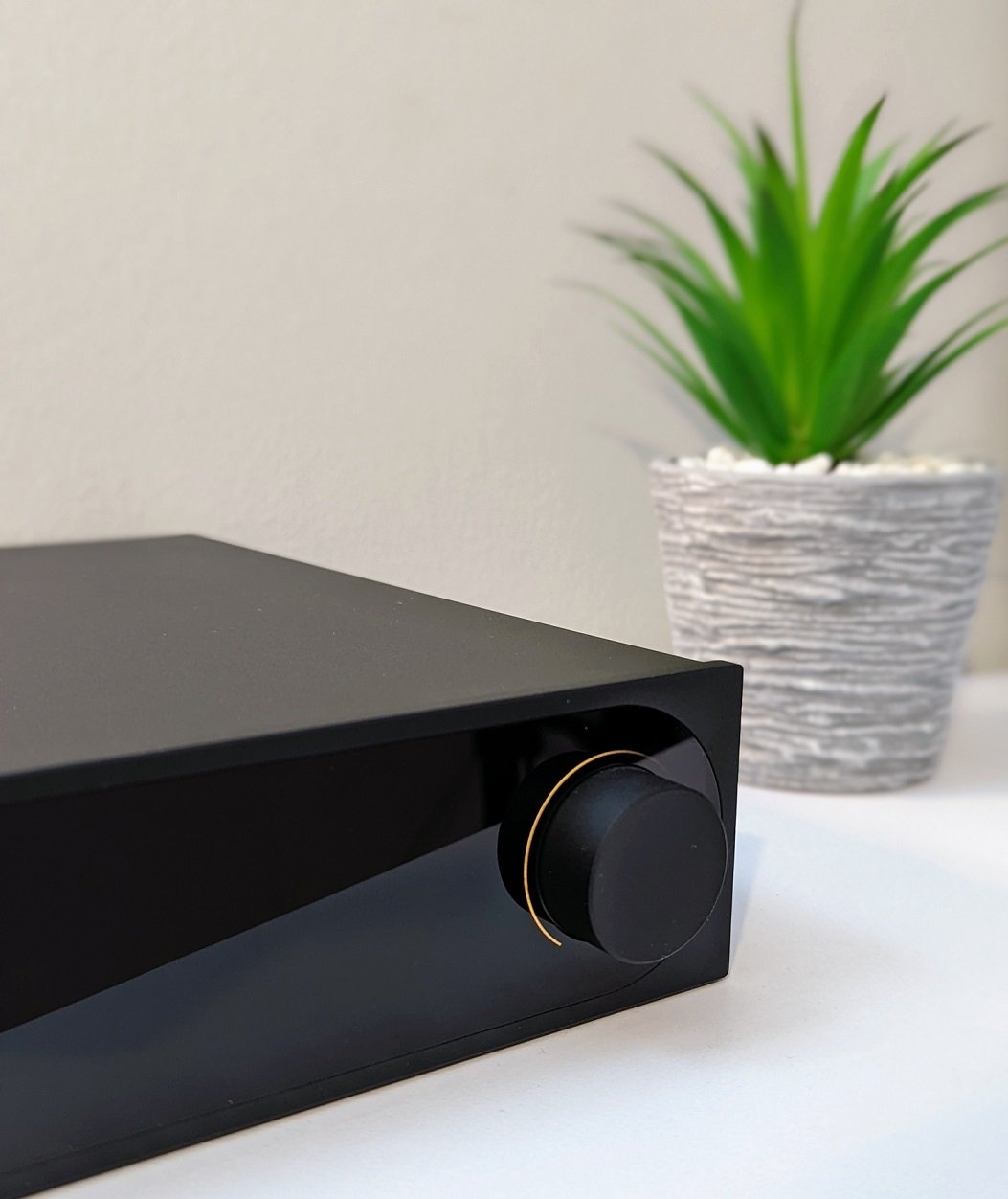
In my opinion, the Soncoz SGD1 is an excellent 500-euro D/A converter. The device has comprehensive connections and all the necessary features even for a more demanding user. Regarding sound quality, I particularly like the SGD1's spacious and well-structured soundstage, and the device's ability to layer sounds airily. Music sounds detailed and clear on the device. The treble is always slightly emphasized in the overall presentation, but fortunately, this emphasis does not make the reproduction clinical or irritating in any way.
When looking for weaknesses, the SGD1 unfortunately doesn't sound the most natural, and its bass reproduction is a bit too light for my taste. However, these are characteristics for which one has to pay more by acquiring, for example, the Bifrost 2, which on the other hand takes a step back from the SGD1's excellent soundstage.
I haven't heard very many different DACs yet, so a sound similar to the SGD1 or Bifrost 2 might also be available in more affordable devices. In the case of the SGD1, competitors costing 300–500 euros implemented with the same DAC chip might come quite close sonically – however, I cannot confirm this at this stage.
Since we are still talking about ”just” DACs, there wasn't a night and day difference between my comparisons. A DAC that better suits the rest of the equipment or one's own preferences provides the final touch to the sound, but it doesn't change the headphones into something else entirely. In my opinion, it is challenging to justify why a device many times more expensive would be an unequivocally better purchase. However, the same principle applies to headphones and devices: cheaper ones are perfectly fine until one has had the chance to hear better ones – after that, it's harder to go back to the previous.
For the last few percentages of performance, one usually has to pay a high price for other products as well. The SGD1 is, in my opinion, a clear step forward from more affordable devices like the Topping E30, but not a necessary purchase until one is ready to invest a bit more into the listening hobby. Not everyone, in general, perceives DACs as changing the sound, and there's nothing wrong with that either. Money saved from a DAC purchase can be used, for example, for better headphones, which is often a significantly greater change in sound quality.
One strength of the SGD1, in my opinion, is that it is still reasonably and sensibly priced given what it offers compared to many more affordable devices. The device's quality doesn't need to be justified solely by sound quality improvements; it's worth its price in other ways too.
Pros and cons:
+ Superb soundstage that forms before your eyes
+ Layered reproduction and airiness
+ Sharp detail resolution
+ Comprehensive connectivity (e.g., 2 USB connectors and Bluetooth) and features
+ Stylish and unique appearance
+ Very high-quality and robust power supply
+ Volume control capability and remote control
+ Good measurement results
+/- Reasonable price, which however depends on how much each person values the DAC's sound quality and features
+/- Slight treble emphasis sounds good to me, but it can be problematic from the perspective of some device pairings and more sensitive-eared listeners
– Bass reproduction and overall reproduction remain a bit too light in style for my taste
– Although the soundstage is credible, the rest of the reproduction is not particularly natural in style, but rather quite digital
– The volume adjusts far too slowly with the device's own control, which also feels quite flimsy
– Strange power-saving mode that hardly reduces power consumption
– The power switch is located at the back of the device
 EN
EN  FI
FI