Author: Sword of Damocles

Table of Contents:
As its name suggests, Austrian Audio, based in Austria, was founded in 2017 by former AKG employees after the company's nearly 70-year-old headquarters in Vienna were closed. This was preceded by a corporate acquisition in which Harman International, which owned AKG, was sold to Samsung, which decided to reorganize operations. There is hardly anything left of the original AKG, as the headphones sold under its name (except apparently old models) are now manufactured in China and the headquarters are also located in the States. Austrian Audio, on the other hand, took on the task of putting Austrian headphones back on the world map.
So far, several of the manufacturer's mid-priced studio headphone models have not gained much reputation; in fact, the Hi-X55, with its even catastrophic frequency response, became somewhat of a joke among enthusiasts. However, the newer Hi-X65, for example, has already been more well-received, so lessons have clearly been learned from mistakes. Perhaps that's why Austrian Audio dared to release its first higher-priced headphone model with an open-back design in late 2023.
Quite memorably named The Composer (product page) taxes the wallet of someone looking for premium-level reference headphones by 2500 euros, or the simultaneously released Full Score one -transistor amplifier (product page) by buying an additional 1500 euros. Both are manufactured in Austria as expected. The manufacturer states that the target audience for its products is connoisseurs of high-quality audio reproduction and professionals, but on the other hand, nothing prevents enthusiasts building a more expensive headphone setup from acquiring this 4000-euro combination, or alternatively just the headphones or the amplifier. I myself am somewhat of a headphone expert, but as a tester, I represent an enthusiast without a professional background.
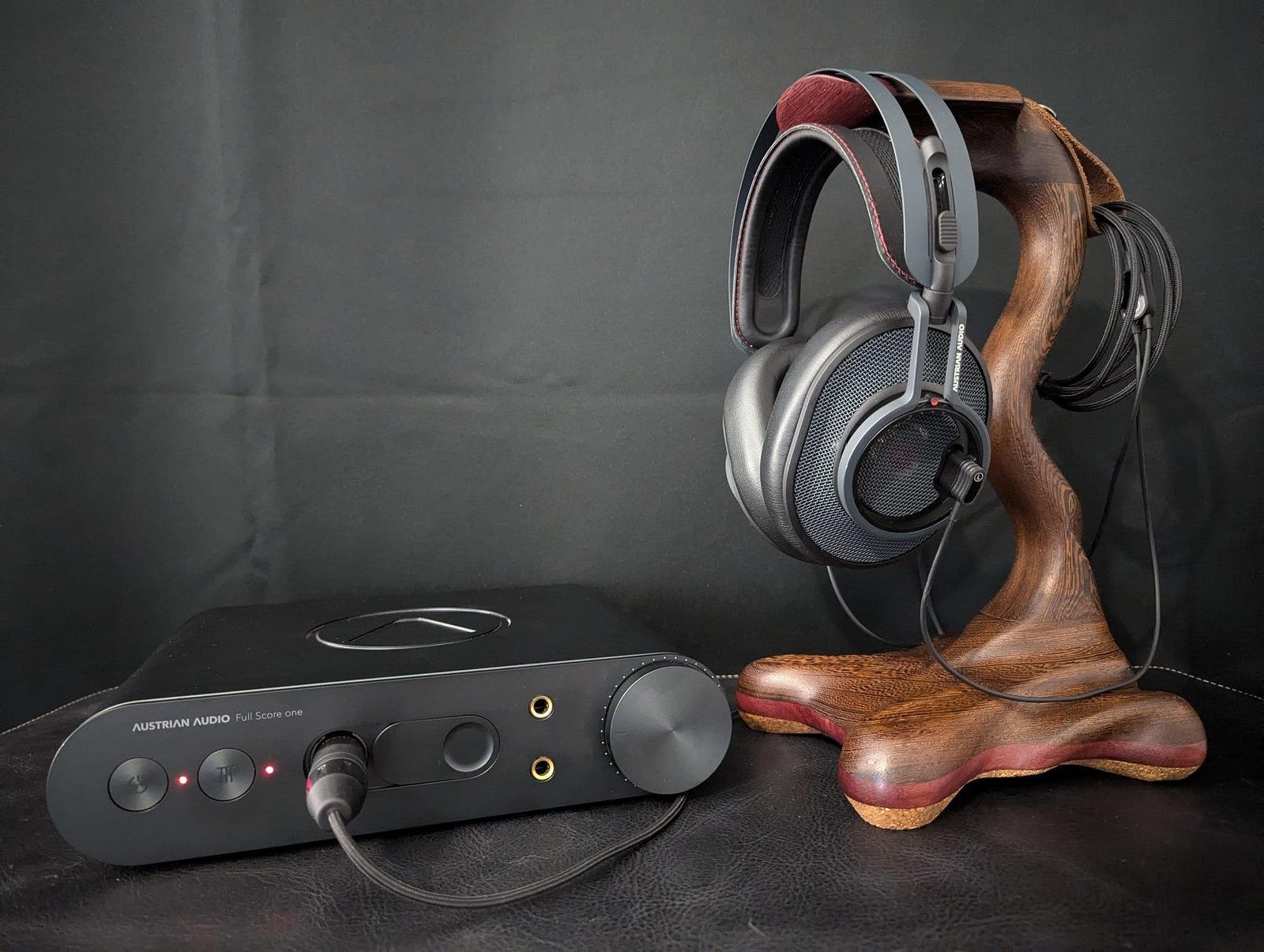
I haven't familiarized myself with Austrian Audio headphones before, but the manufacturer has been on my list of story ideas for a while. I decided to start right at the top, as Audiokauppa's owned AK-Hifisystems was delightfully able to lend me The Composer (from now on, just Composer) and Full Score one for review. Thanks for the cooperation and welcome to learn more about the products! Let's start in the order of the listening chain, i.e., with the amplifier.
Full Score one
Information:
- Release year: 2023
- Country of manufacture: Austria
- Price: 1499 EUR
- Type: Headphone amplifier
- Connections: XLR and RCA inputs
- Headphone connectors: 4-pin-XLR and 2x 6.35 mm
- Gain level: +4 dB
- THD+N: 0.0005 % (1 kHz)
- SINAD (1 kHz): 86 dB @ 50 mVrms / 107 dB @ 3 Vrms
- Maximum output power (source Headphoneshow/Goldensound): 1.2 W @ 32 ohm (4V input) / 3 W @ 32 ohm (6V input) | 0.13 W @ 300 ohm (4V input) / 0.5 W @ 300 ohm (6V input)
- Features: Button-activated TTT mode (True Transient Technology)
- Dimensions (W x D x H): 265 x 220 x 65 mm
- Weight: approx. 2.8 kg
Structure and connections
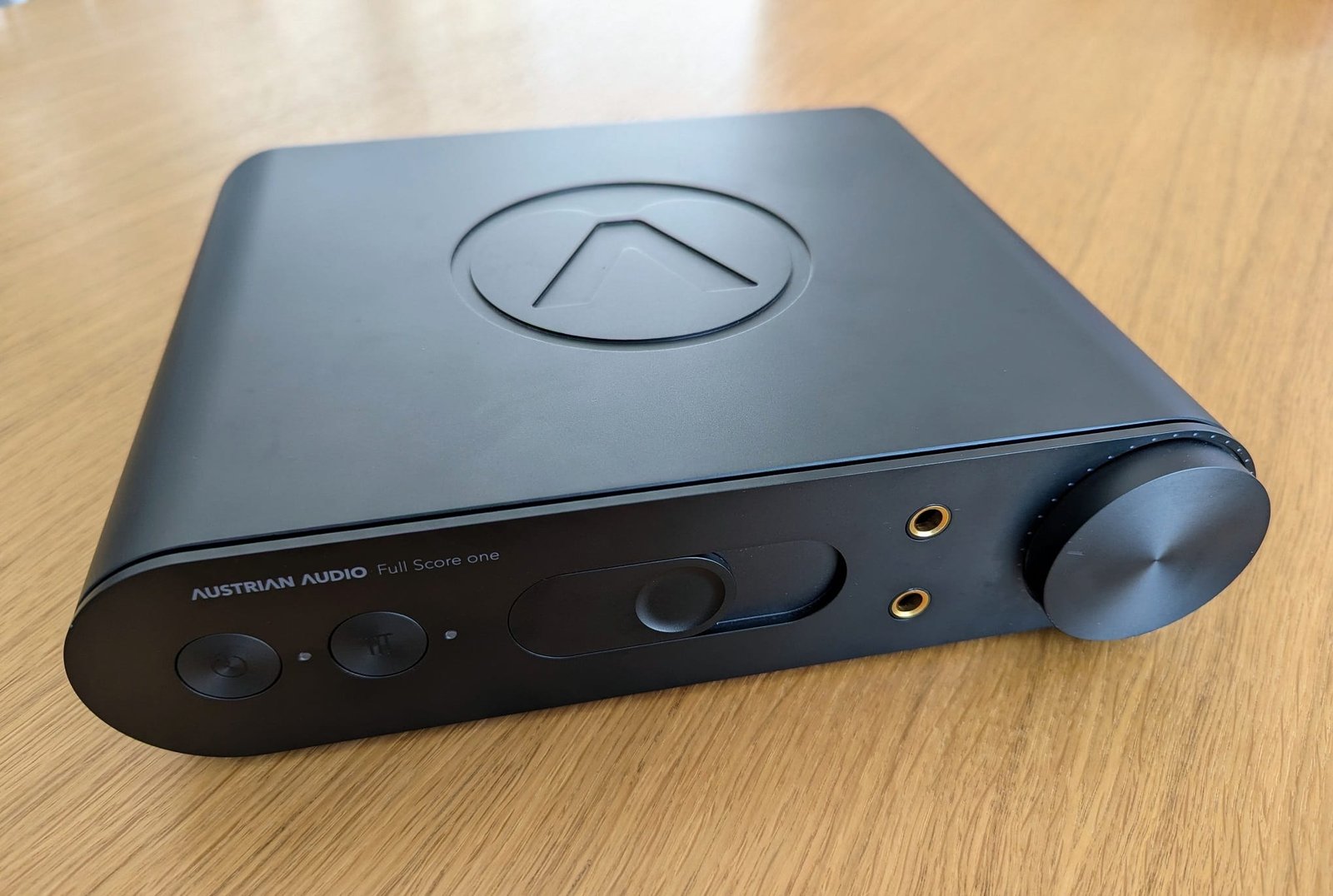
Made entirely of metal, the Full Score one is quite large for a headphone amplifier, but it is probably meant to be noticed and stay firmly on the table. I find the night-blue coloring stylish and, overall, a nice change from many black and silver devices. The amplifier also feels extremely well-made down to every detail, so I believe the 1500 euro price offers good value in that regard. The design, and especially the rounded edges, interestingly resemble devices from Topping's DX series, such as the DX5 and DX7, which is not a bad thing at all. A large Austrian Audio logo is engraved on the top cover.
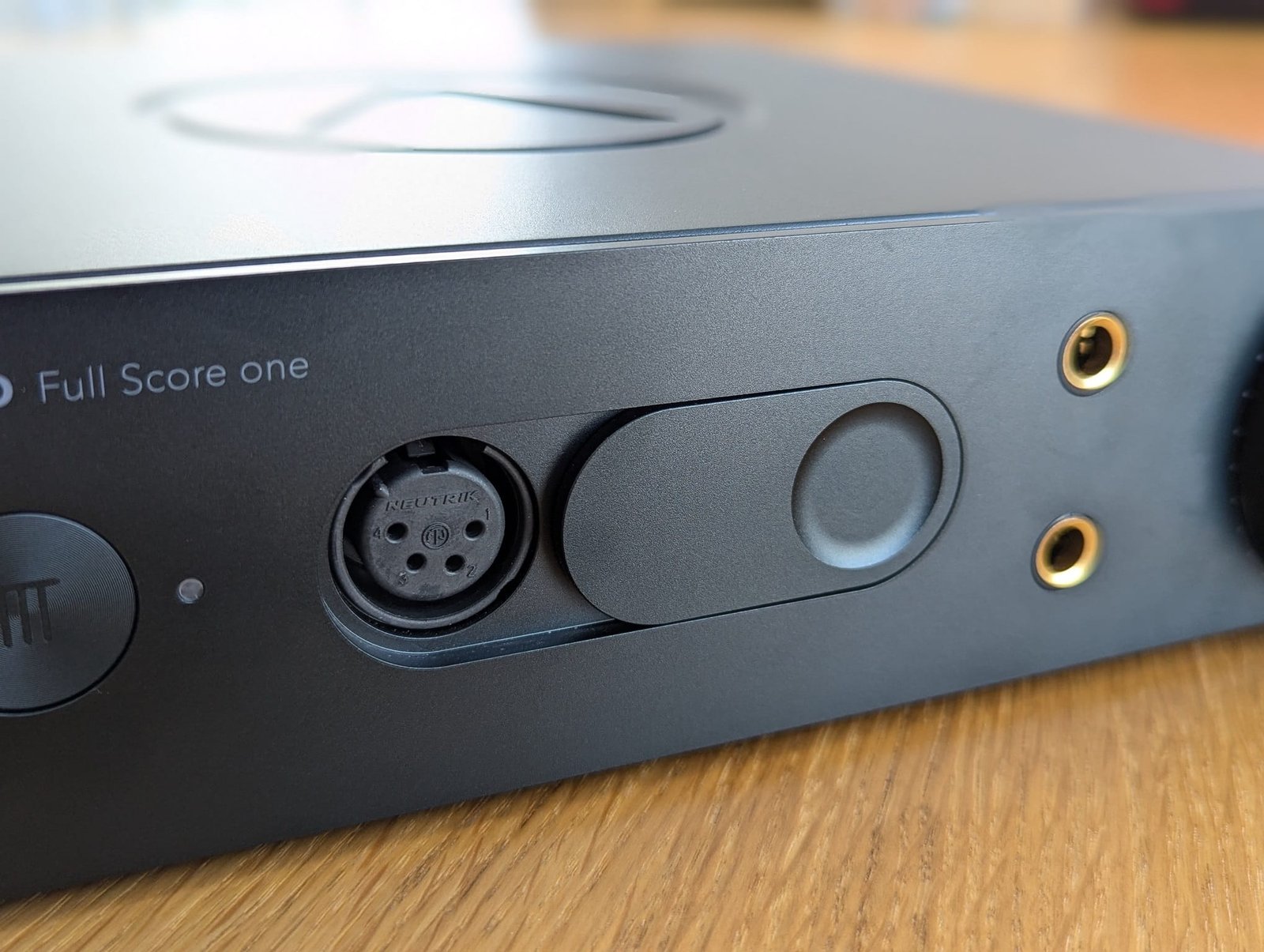
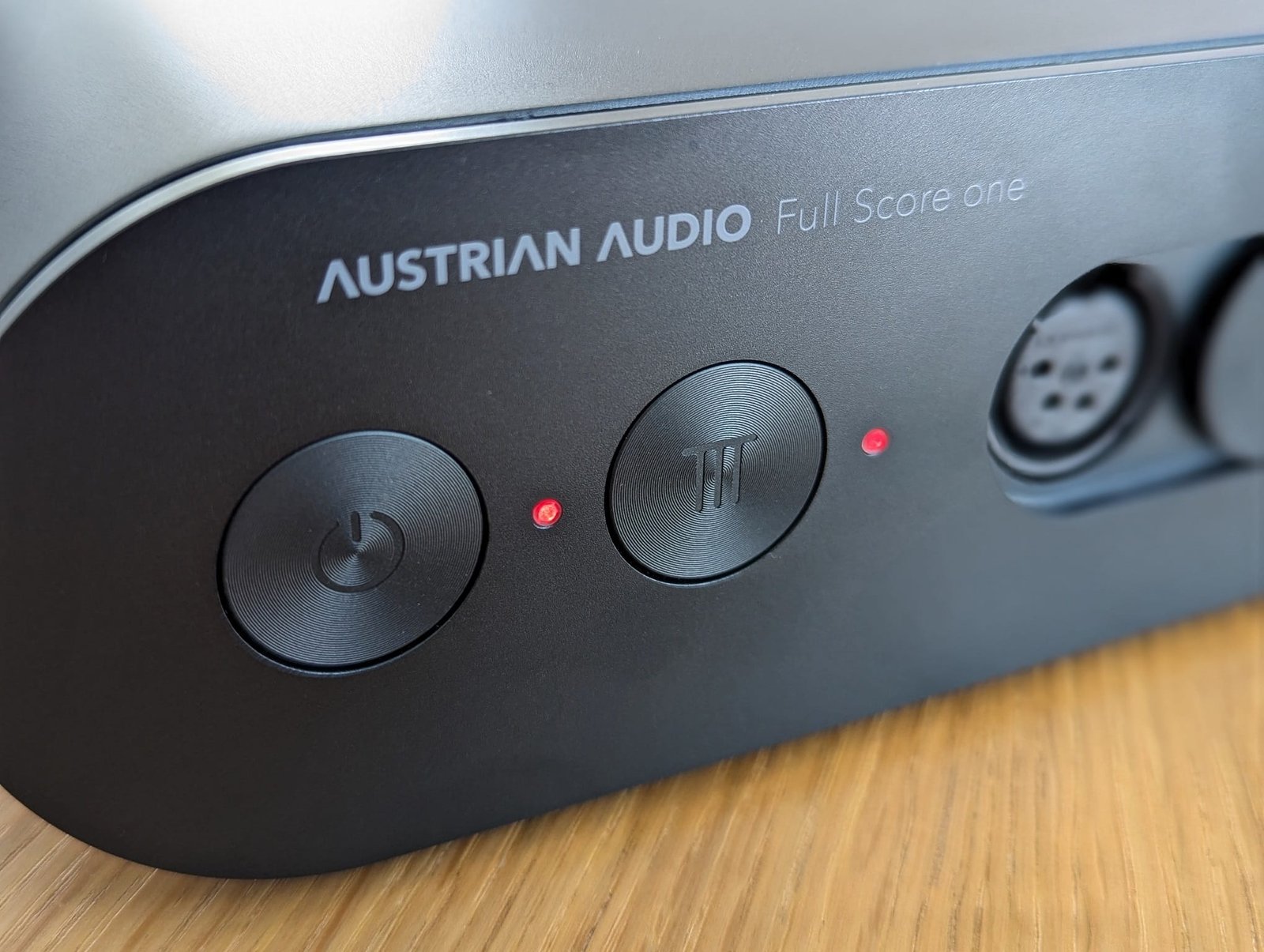
The front edge includes a power button and a TTT button (more on this soon), as well as an XLR headphone connector hidden behind a flap, and two 6.35 millimeter connectors. If there is no need for the XLR connection, the device's appearance can be kept tidier by closing the flap. The large volume control located on the right edge is flat, but easy to grip. It also rotates smoothly, so usability is good in that respect. However, I would have still wished that the indicator on the knob was marked more visibly, as I practically cannot see it at all, even if I place the amplifier half a meter in front of me. For some reason, the same issue affects most modern devices, as if the position of the knob needed to be hidden.
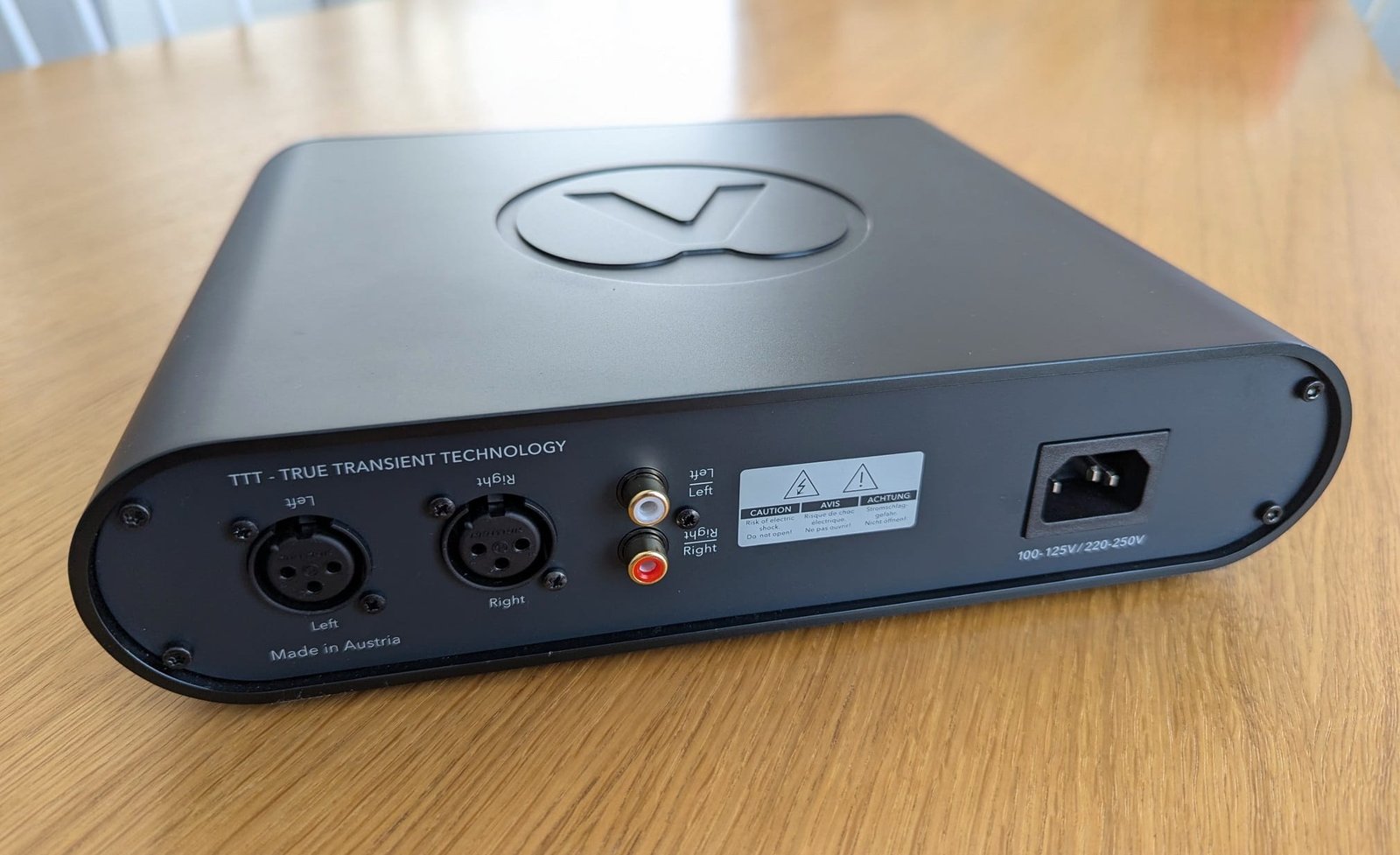
The rear of the Full Score one is very simple, as it only houses XLR and RCA input connectors, as well as the power connector. This also reveals that the device cannot be used as a preamplifier, but is a pure headphone amplifier.
Internal implementation and functions
The Full Score one is completely analog in its operating principle (with Class B emphasis) and, according to the manufacturer, uses only high-quality discrete components. Using the device could not really be more straightforward, as there are no other adjustments available apart from the TTT setting, which is activated by a separate button. There's no need to worry about the gain level either, as the potentiometer is set to be non-linear, so that the volume increases more slowly at the beginning of its travel. As a result, the amplifier is well-suited for both sensitive in-ear headphones and slightly more demanding planar headphones.
Due to the relatively low gain level (reportedly +4 dB), the maximum output power, on the other hand, remains quite low, especially if a conventional DAC supplying a 4-volt output voltage is connected to the amplifier. In this case, according to Cameron Oatley (Goldensound), who performs device measurements for Headphoneshow, the Full Score one delivers 1.2 watts into a 32-ohm load and 0.13 watts into a 300-ohm load – sufficient for most situations, but modest figures for the price. However, if the DAC's output voltage is 6 volts, the output power triples to approximately 3 watts into a 32-ohm load. The output power also remains the same when using unbalanced headphone connections, as the amplifier is only partially balanced in its design. The manufacturer does not state the output impedance, but it is presumably low, as the uneven impedance curve of Composer headphones requires it.
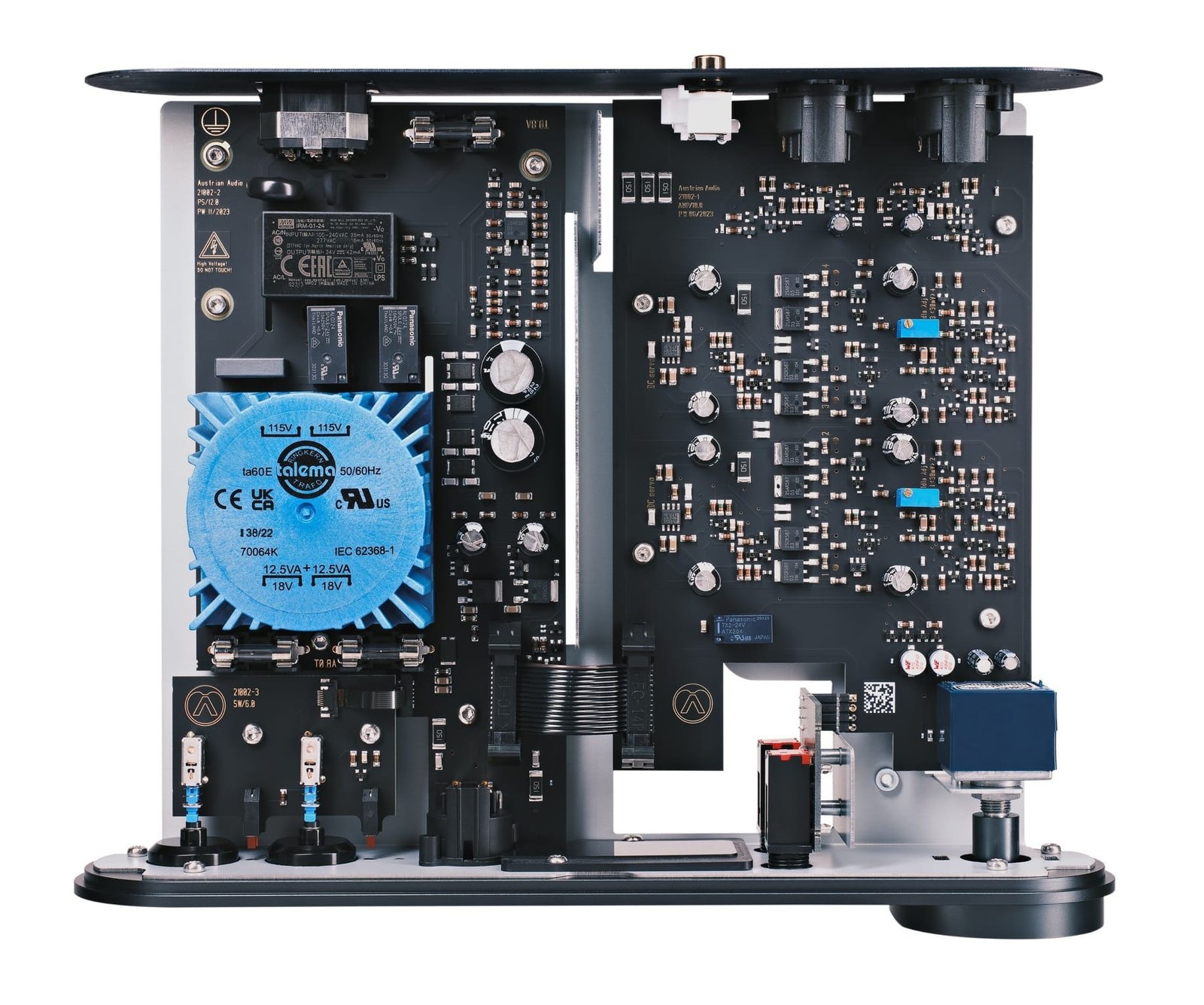
The Full Score one's overwhelmingly most important single feature is Austrian Audio's developed TTT technology (True Transient Technology), which is intended to ”improve” transient response and clarify details within the music. The manufacturer hints that the amplifier's responsiveness and reproduction are then, as it were, faster. At the same time, compatibility with older music, mixed for ”slower” equipment, can apparently become a problem, so the TTT feature can also be switched off if necessary.
Cameron Oatley (Goldensound) observed that TTT significantly reduces distortion between transients, so the feature essentially does exactly what it promises. With it, the Full Score one also performs competitively compared to most other modern amplifiers, whereas without it, the device's design could be called slightly flawed by current standards. TTT also seems partly like a marketing gimmick, as the Full Score one could have been designed directly to have as low distortion as possible without advertising it as a special feature. On the other hand, I still find it useful that the feature can be turned off if someone finds the sound more pleasing that way. It may well be that Austrian Audio's engineers and marketing have simply seen the matter slightly differently. In any case, the amplifier is of high-quality design, as no discernible background noise or other interference sounds are heard from it with any load I tested (including sensitive in-ear headphones). The channel balance of the potentiometer is also very good at the beginning of its travel.
The Composer
Information:
- Release year: 2023
- Country of manufacture: Austria
- Price: 2499 €
- Type: open, over-ear
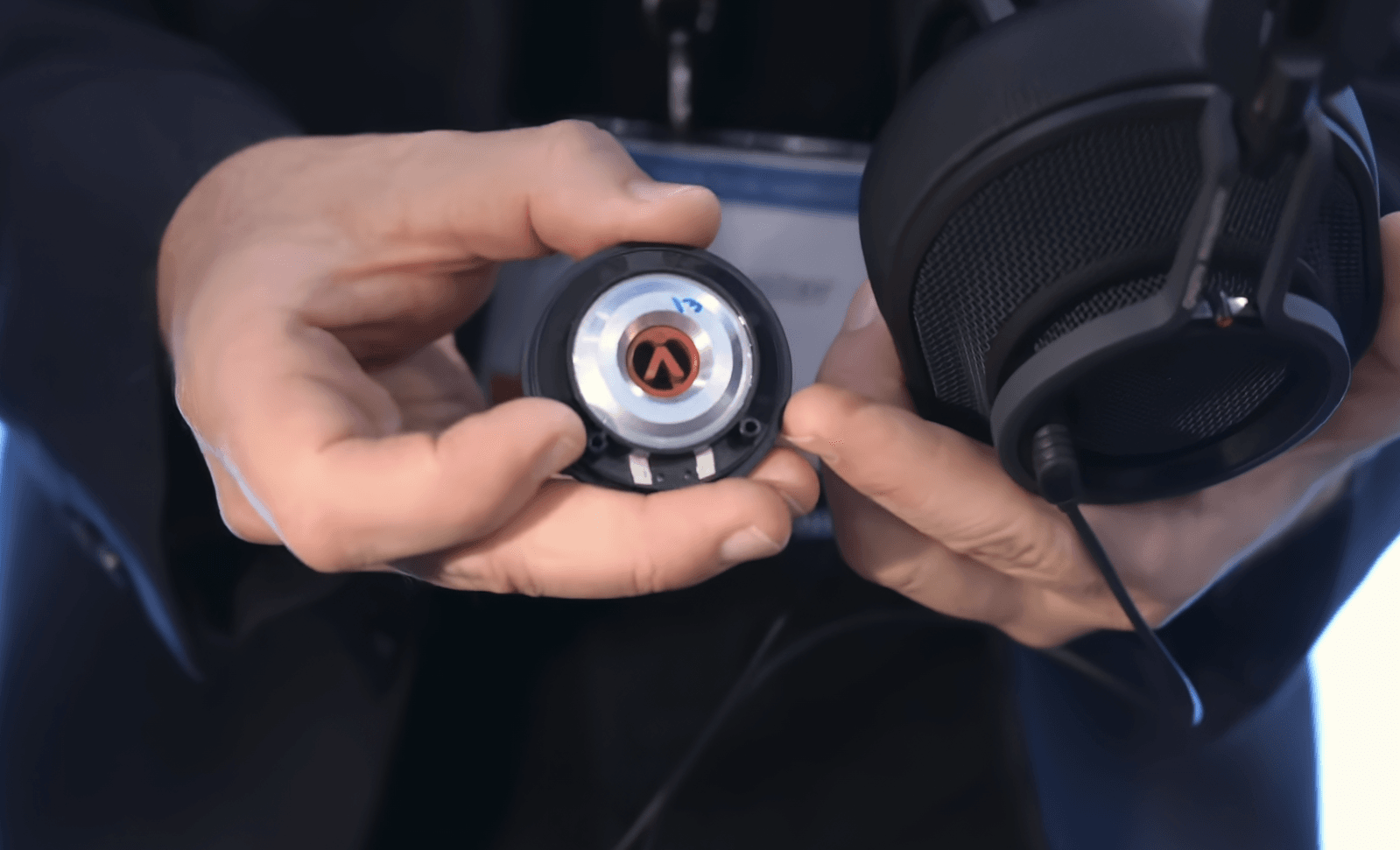
- 49 mm dynamic drivers with DLC (diamond-like carbon) diaphragm and ring magnets
- Impedance: 22 Ohm
- Sensitivity: 112 dB/V | 95.5 dB/mW
- Weight: 385 g (without cable)
- Connector type: 2x 2-pin banana plug
- 3 cables: 3-meter cables with XLR and 3.5 mm connectors, and a 1.4-meter cable with a 4.4 mm connector
- Accessories: Wooden storage box and 6.35 mm adapter
- Warranty: 5 years (requires registration)
Product package contents and accessories
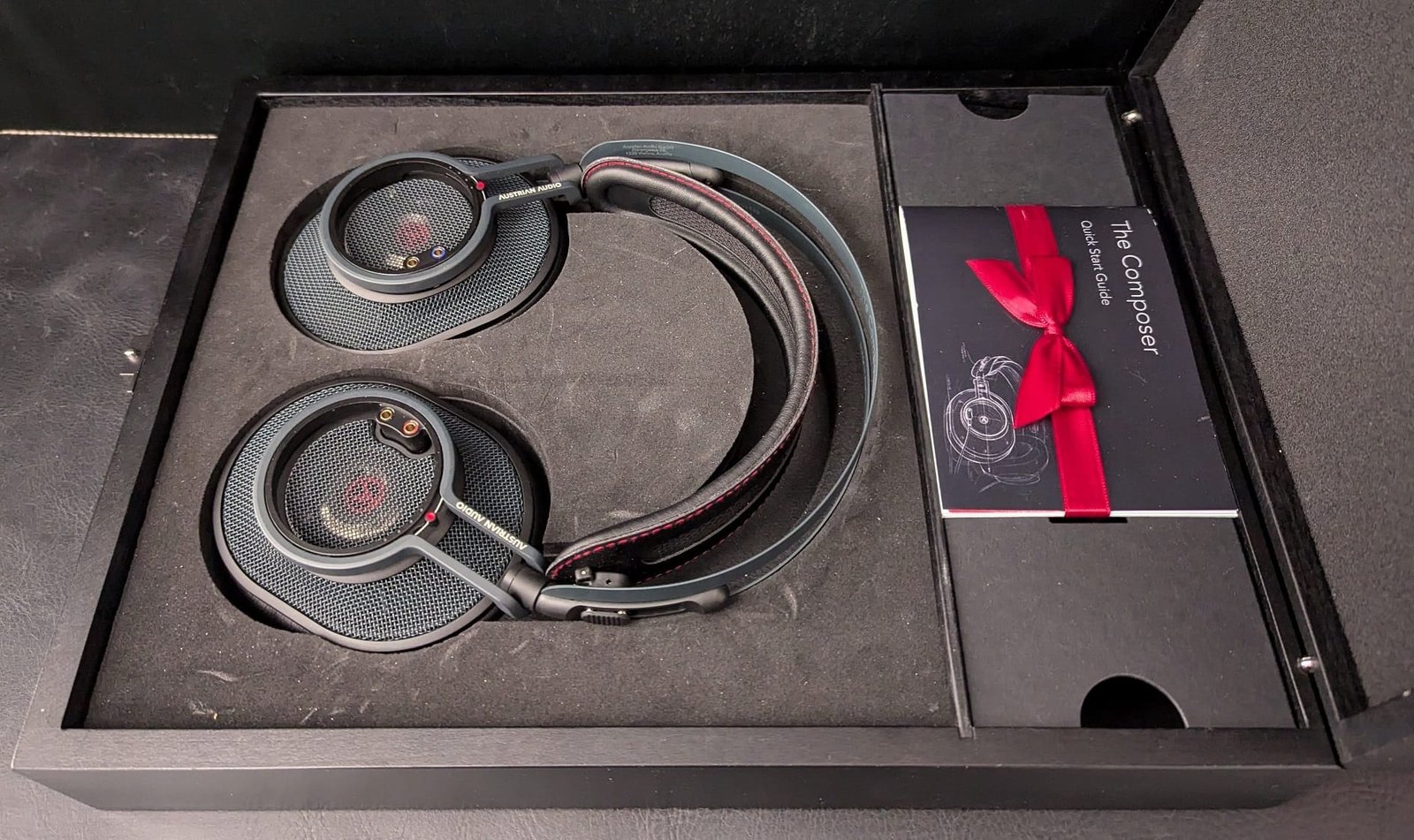
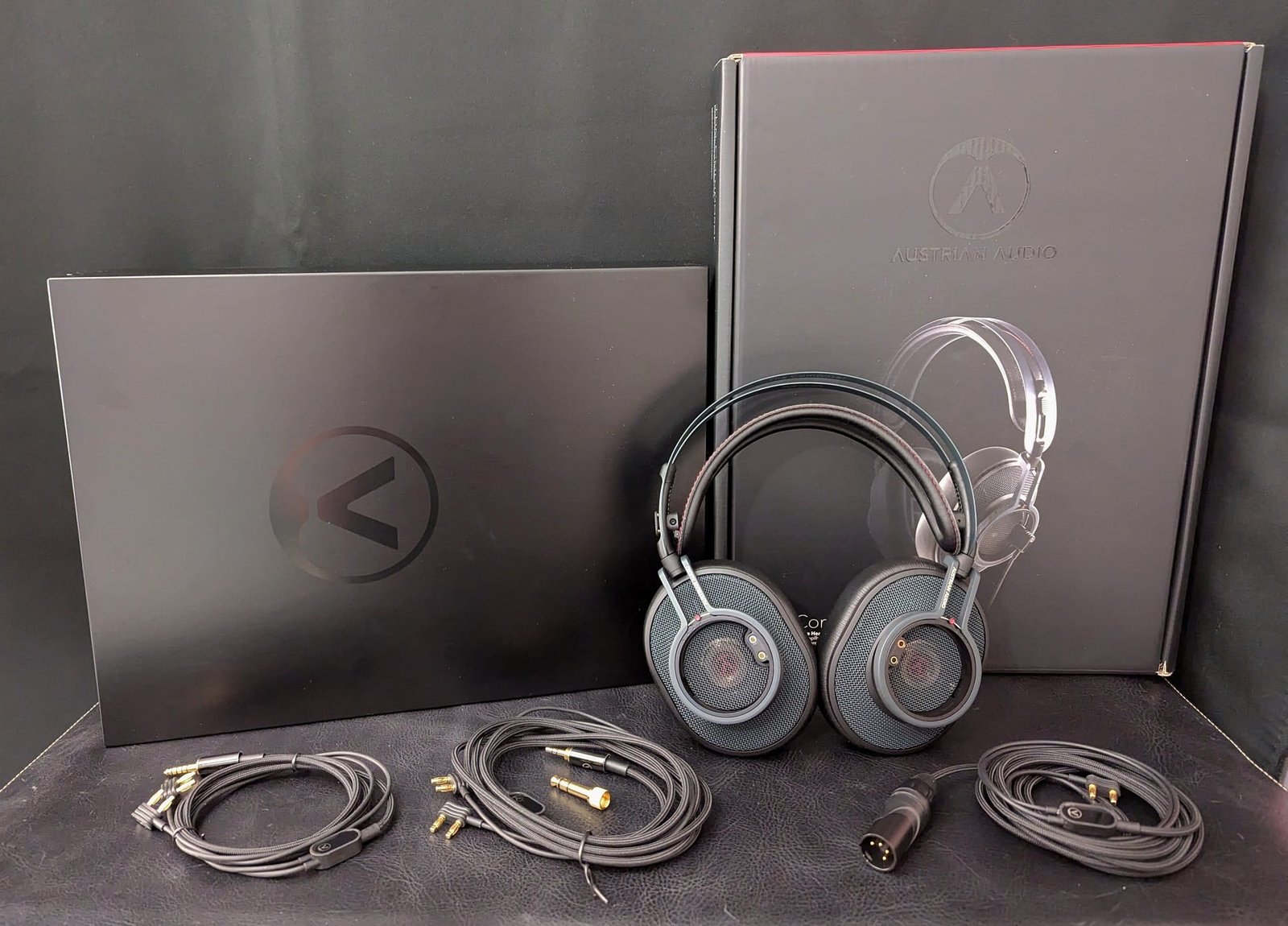
The Composer is delivered in a black wooden box, which is rarely seen nowadays as most manufacturers have switched to the most ecological cardboard packaging. The headphones immediately feel more special than usual. The product package also includes as many as three different cables (connectors XLR, 4.4 mm, and 3.5 mm), which is a good thing because they attach to the headphones with completely exceptional banana plugs, for which suitable replacement cables are not yet widely available on the market. Normally, I would see this as an annoying issue for use, but with Austrian Audio supplying all the necessary cables, I can focus on the system's cleverness. The Composer's earcups are so flat in design that a conventional headphone connector would not have fit, so the issue had to be resolved with side-mounted connectors. I wouldn't have come up with a cleaner solution than banana plugs myself, so this can be called a kind of innovation.
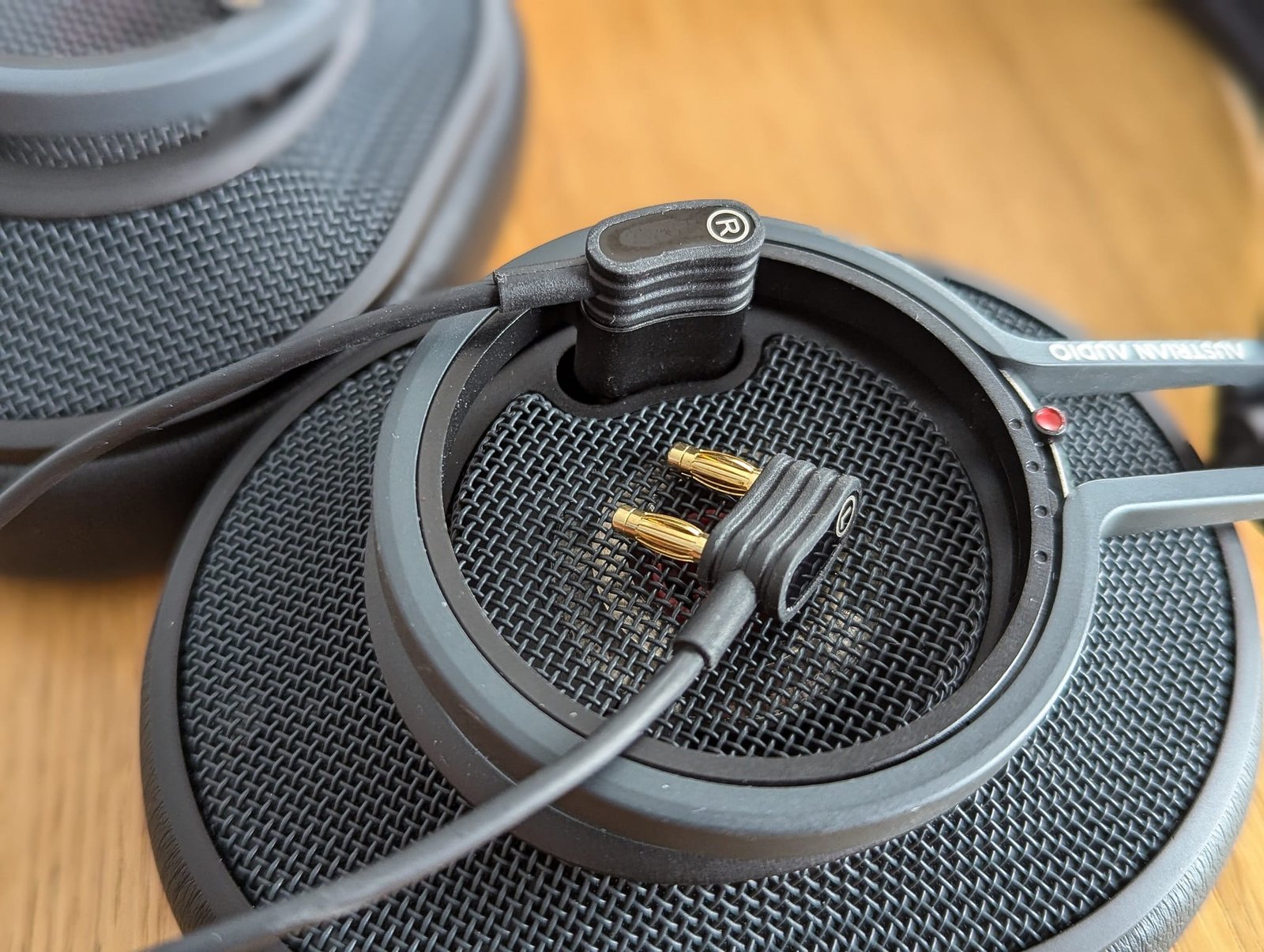
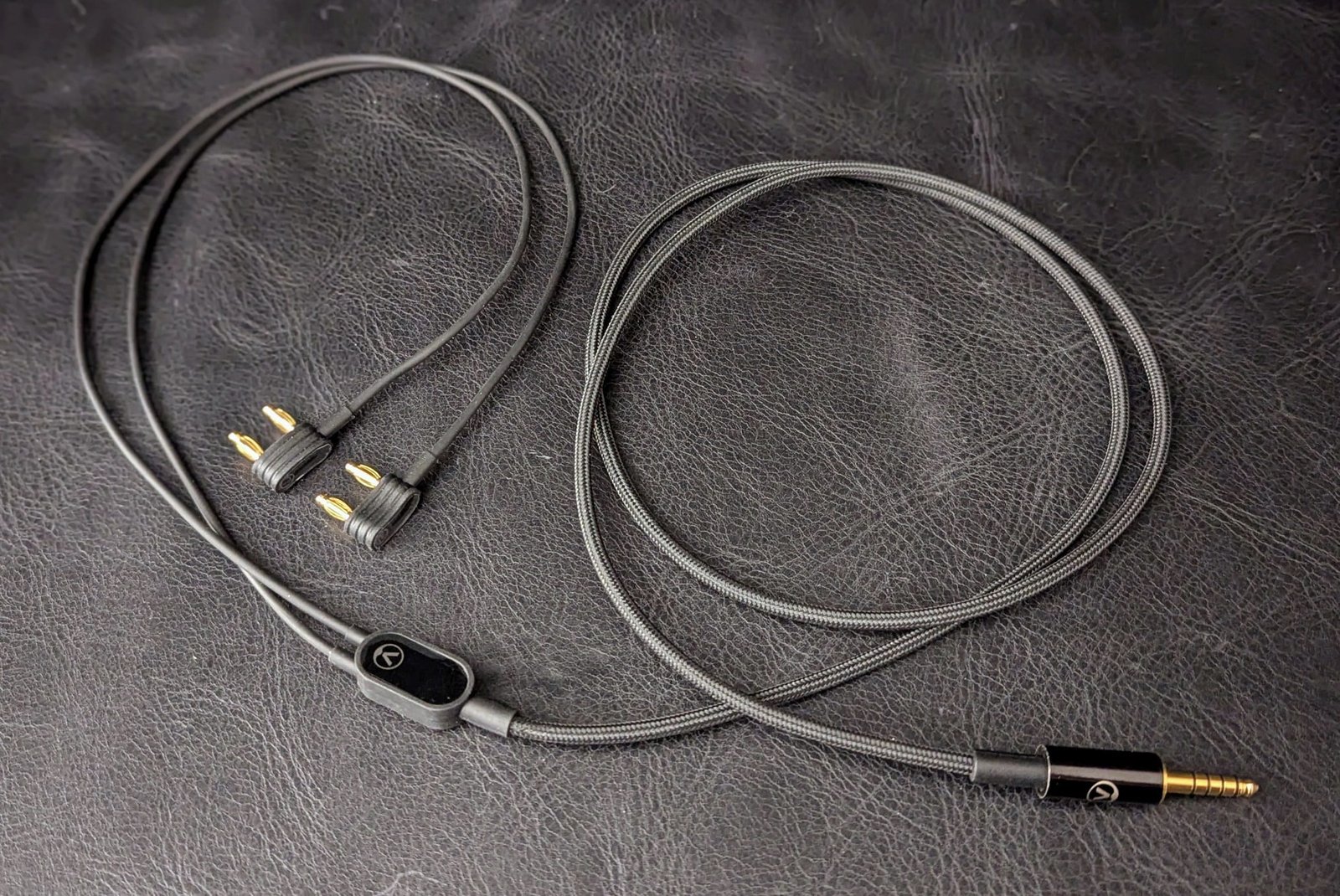
The included cables are quite thin and light, meaning they are sufficiently unobtrusive despite their slight tendency to tangle during use. Fortunately, the fabric sleeving is not particularly microphonic, as the part branching to the cups is rubber. I wouldn't see a huge need to acquire better cables (if they even existed) other than possibly for aesthetic reasons. However, if the Composer is assumed to be primarily aimed at professional use, the appearance of the cables is of little importance. The banana plugs are easy to detach and attach, and their design seamlessly matches the headphones.
Build and comfort
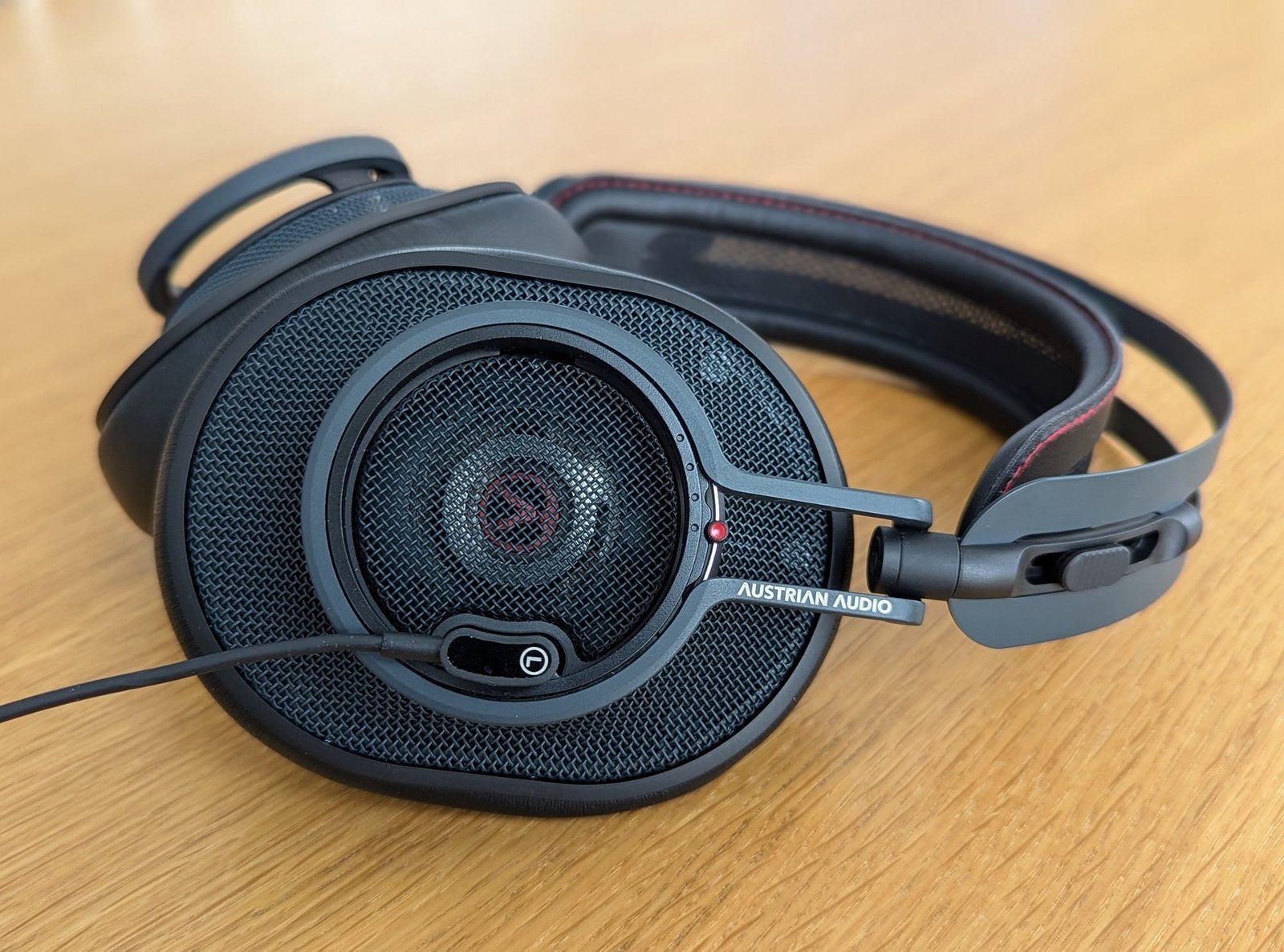
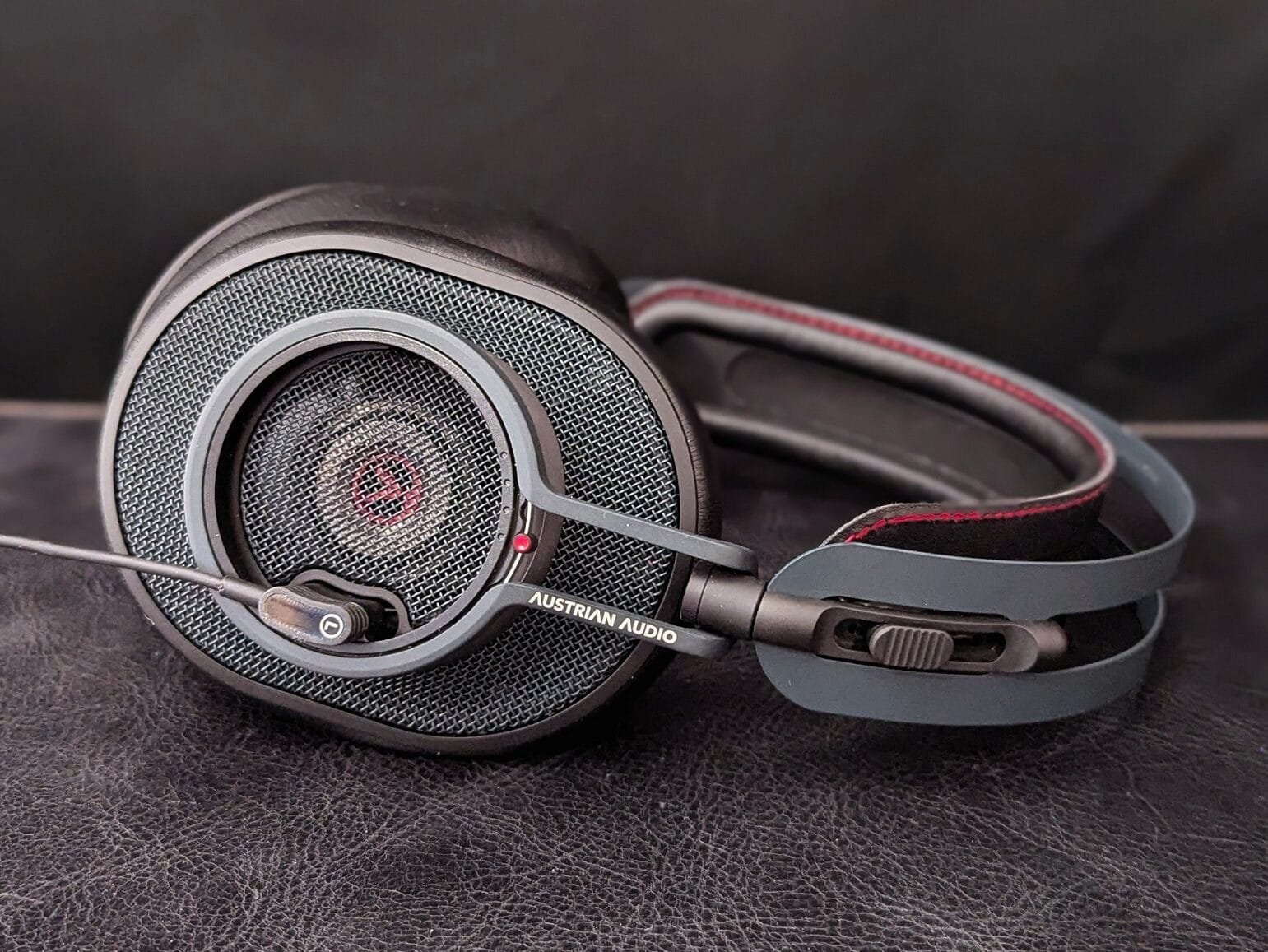
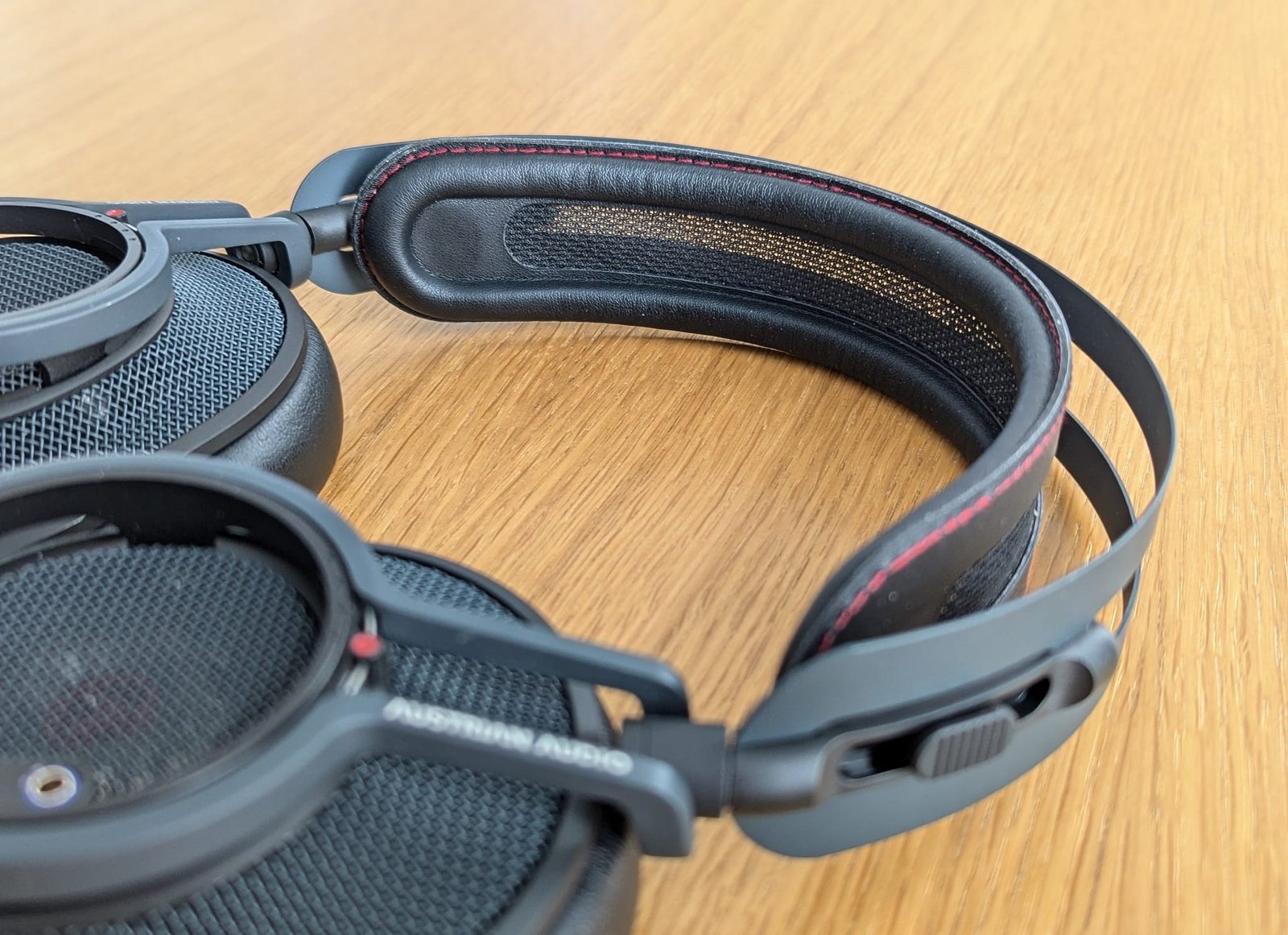
The Composer, weighing 385 grams, is slightly heavier than Sennheiser HD 800 (S) (330 g), but on the other hand, lighter than, for example, Hifiman HE1000 V2 (420 g), Meze Audio Empyrean 2 (455 g) and T+A Solitaire P-SE (440 g). The Audeze MM-500 and ZMF Atrium in turn, already weigh over 100 grams more, so Austrian Audio has succeeded in keeping the structure lighter than most of its competitors. This can be attributed to the slender headband structure, minimal earcups, and dynamic drivers, which weigh less than planar magnetic drivers with their heavy magnets. In my opinion, the Composer also has a very successful shape, as its oval earcups are pleasant to grip. The earcups can be rotated horizontally in both directions, which makes it easier to place the headphones on a table.

The design of the Composer has also not forgotten the quality required by its 2500 euro price tag, as the headphones are made almost exclusively of metal. It is even tinted blue to match the appearance of the Full Score one amplifier. Other interesting details include the unique placement of the headphone connectors and a few red accents, such as the stitching on the headband and the Austrian Audio logo in the center of the driver's ring-shaped magnet. In my opinion, the overall look doesn't draw too much attention but still appears stylish and interesting. The earcup structure is almost completely open, as the back of the driver's frame is largely constructed from metal mesh.
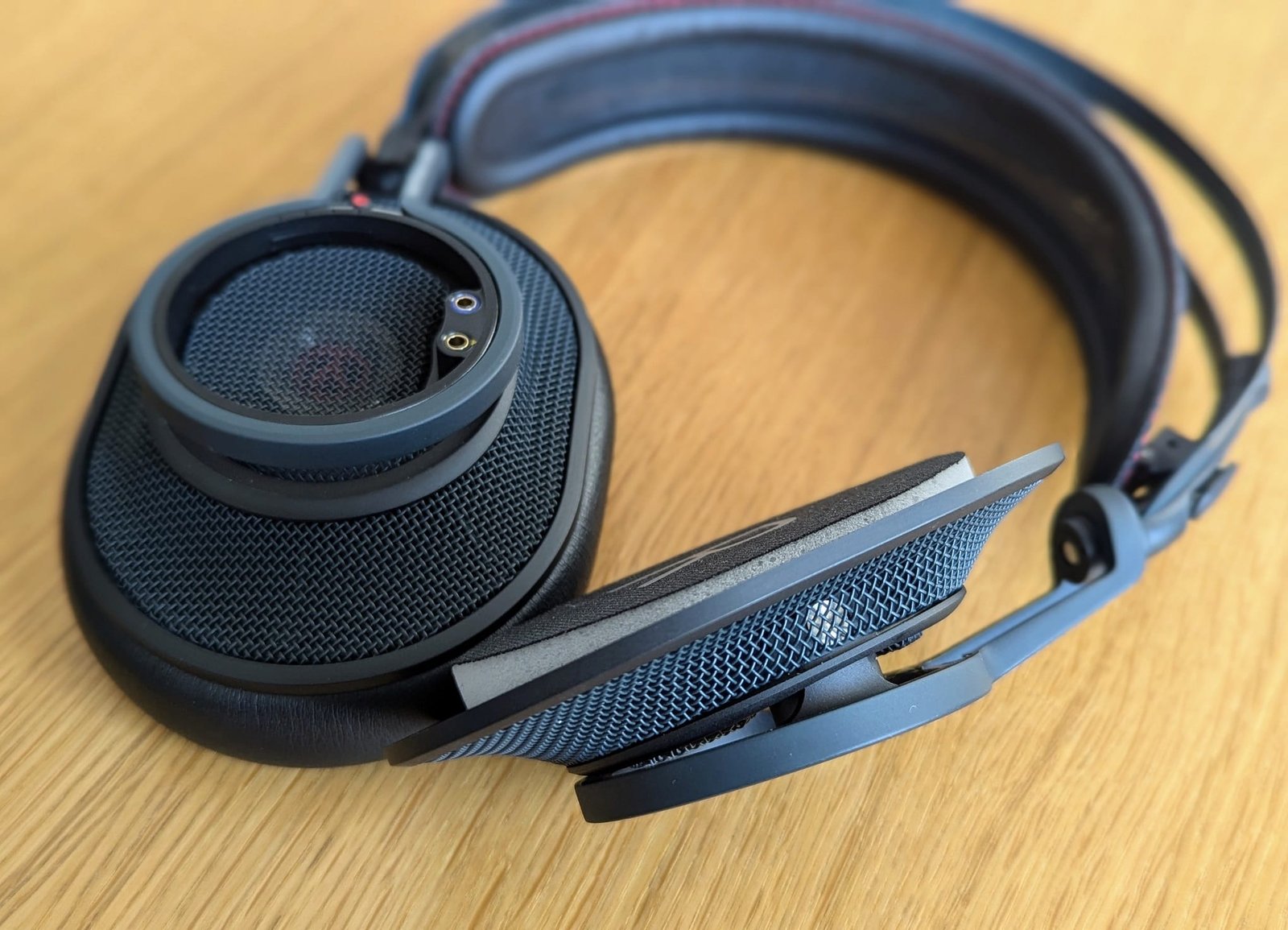
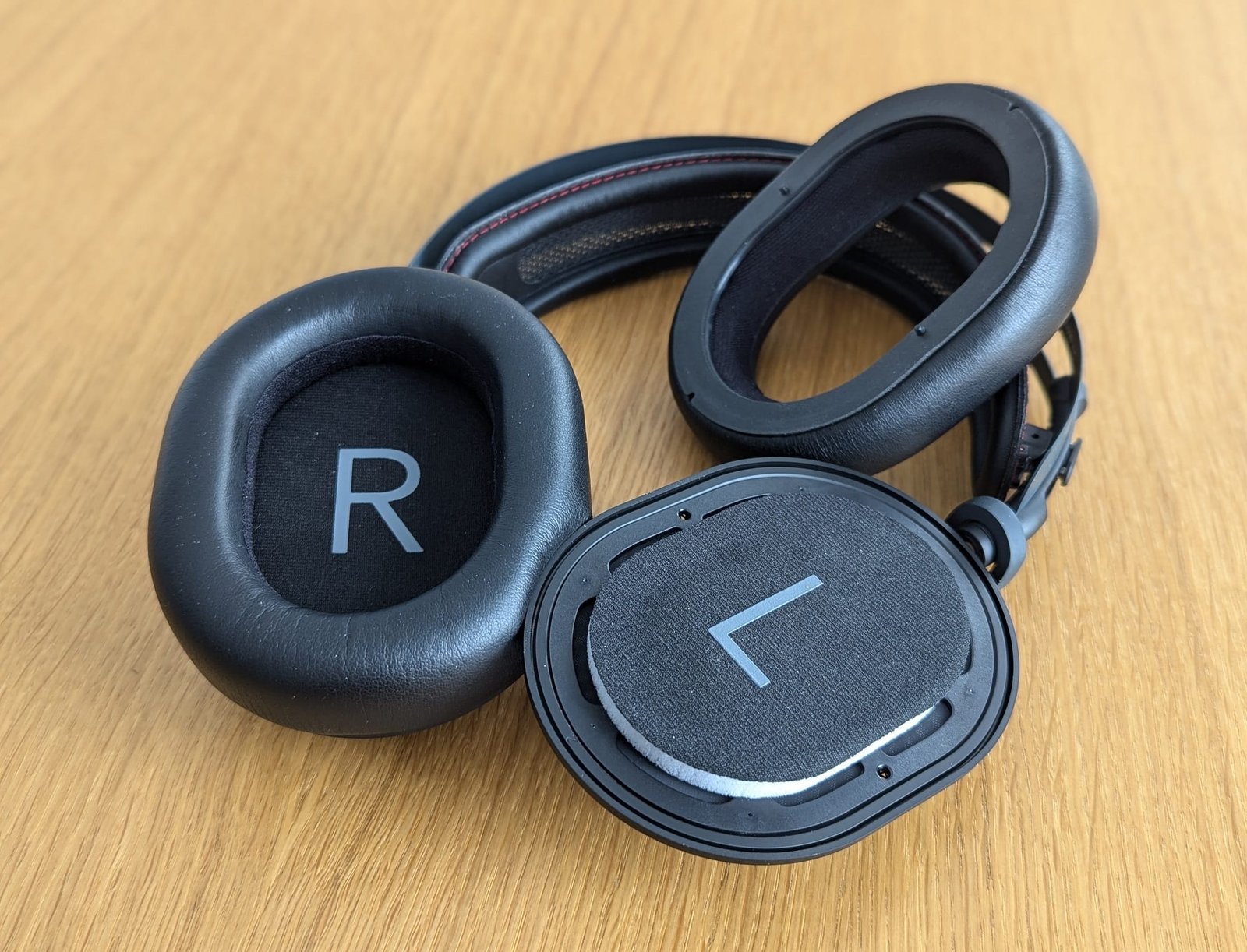
The earpads attach to the headphones with magnets, similar to the Meze Audio Empyrean, meaning they are very easy to remove and attach. The included pads are covered with somewhat sweat-inducing synthetic leather, but according to what I've read, Austrian Audio will also be bringing different pads and risers to be placed under them to market by the end of 2024. A few millimeters of elevation would indeed be beneficial for me, as my earlobes constantly lightly touch the foam layer glued on top of the driver. However, it is soft, so fortunately, my ears are not greatly bothered by it.
Otherwise, my ears fit easily inside the pads because the ear opening is huge. A good point is that the ear's position does not significantly affect the frequency response, so when positioning the headphones on the head, comfort can be emphasized without worry, which is already at an excellent level thanks to the lightweight structure and gentle fit. The Composer is clearly designed to be used, for example, all day long.
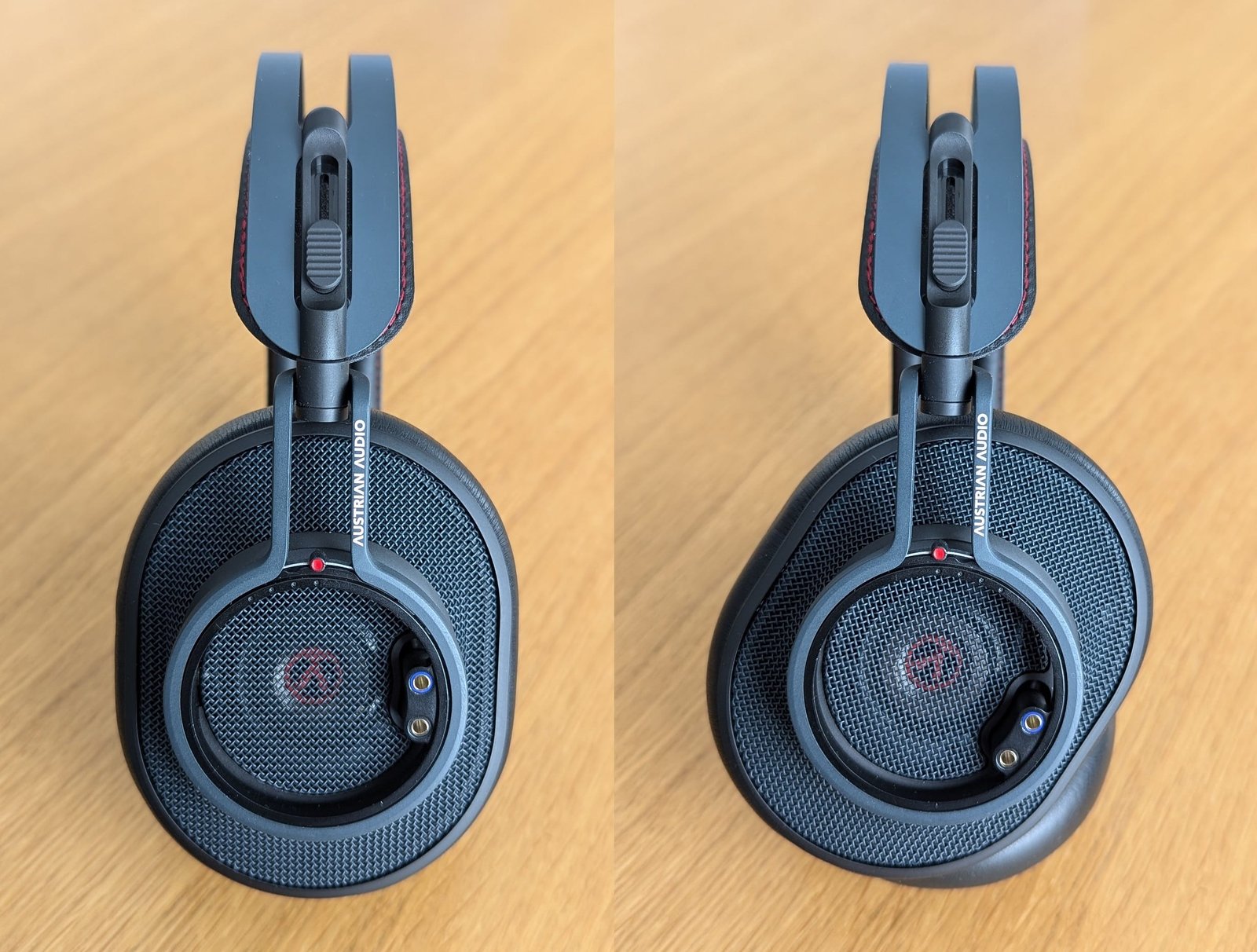
Finding a suitable wearing position can be facilitated by an interesting additional adjustment that allows the angle of the earcups to be rotated relative to the headband. This allows the headband to rest towards the forehead or, alternatively, the earcups to sit slightly obliquely on the ears. Thus, everyone can surely find a comfortable wearing position and place the pads so that they seal tightly around the ears. I hadn't even known to wish for such an adjustment possibility, but it is very handy.
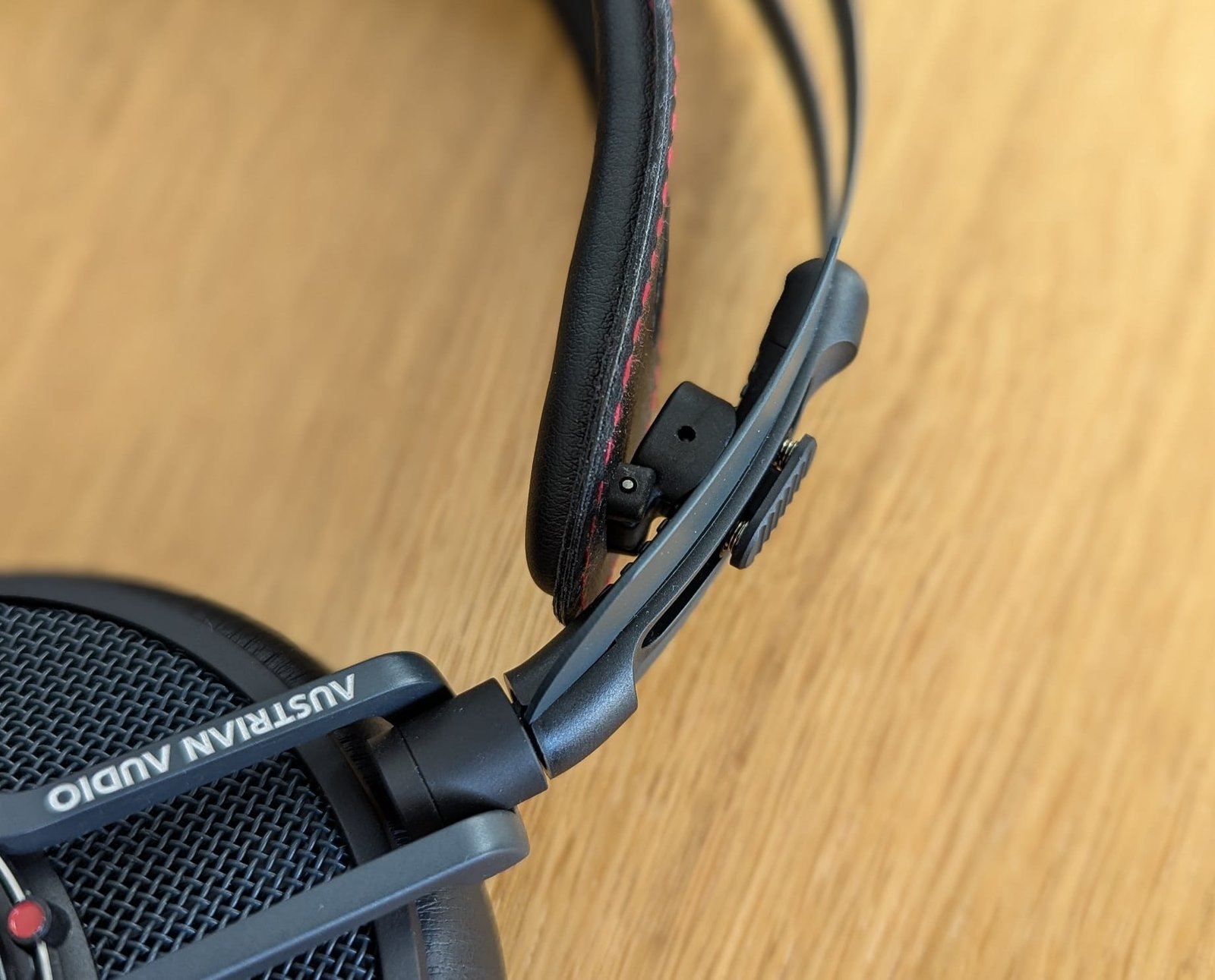
My biggest concern with the Composer, in turn, relates to the height of its headband, as the headphones might be somewhat large for people with small heads. I have come to this conclusion because I don't need to adjust the height upwards at all, even though it is usually necessary with many other headphones. However, if I were to adjust the Composer's height, it would be done by incrementally raising the head cushion. The plastic adjustment mechanism seems a bit flimsy due to its small size, so it remains to be seen how it will hold up in longer use. However, the manufacturer's offered 5-year warranty instills confidence that at least spare parts will be available. More attention than usual has been paid to the headphones' head cushion, as it has two narrow foam ridges along its edges, while the center is made of mesh fabric, which prevents head sweating. The cushion part is also very flexible, so it adapts excellently to the shape of the head.
Sound quality
Our frequency response measurements have been made with a clone IEC-60318-4 coupler and KB501X pinnae. The Harman target curve from 2018 is used as a reference point and generalization of the headphone response that would sound good to most people. For more information on the measurements and their accuracy, see Headphone Measurements-page. The Composer's frequency response is also comparable with other measured headphones Squiglink .
During the test period, I mainly listened to the Composer with the Full Score one amplifier, using as DAC both Schiit Audio Bifrost 2and the SMSL VMV D1SE. My music was played from the Tidal streaming service at the highest possible quality, as well as FLAC files from my computer.
Frequency response:
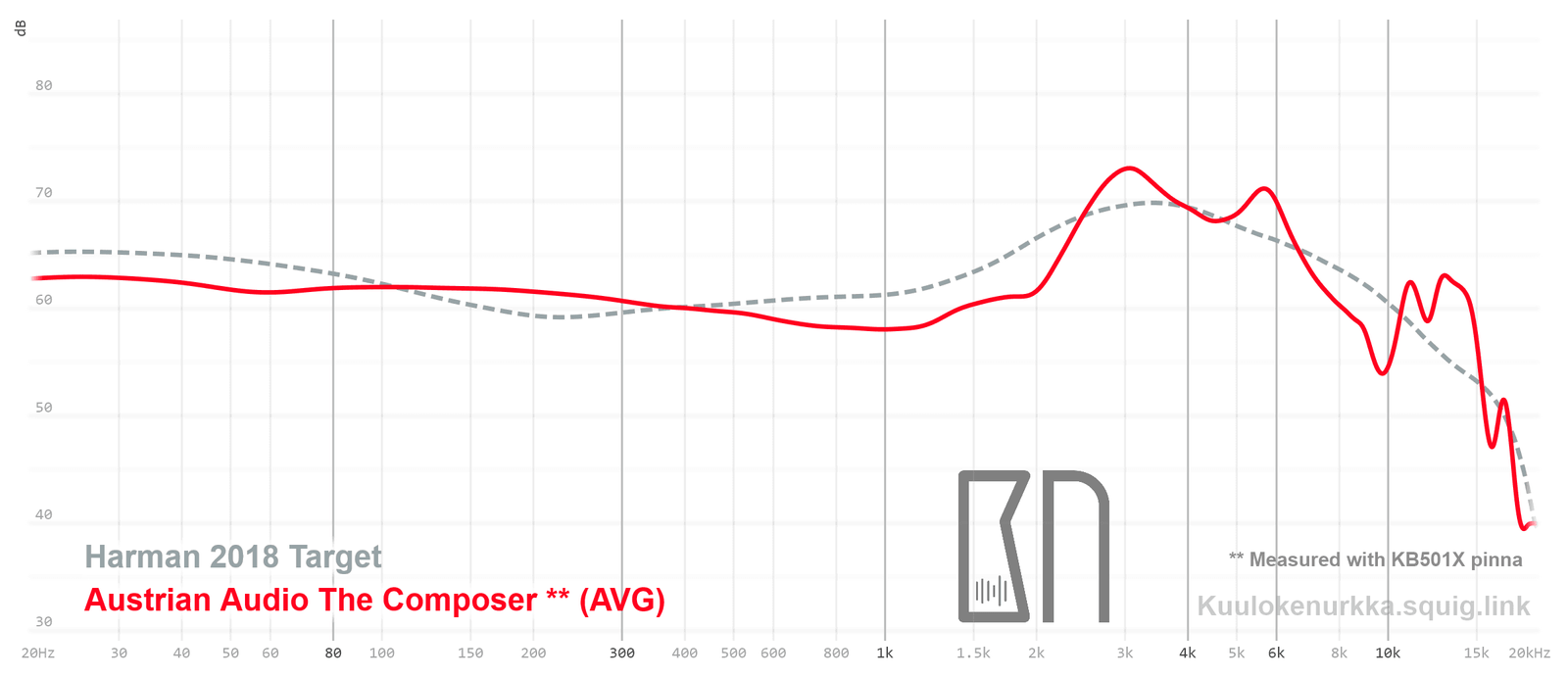
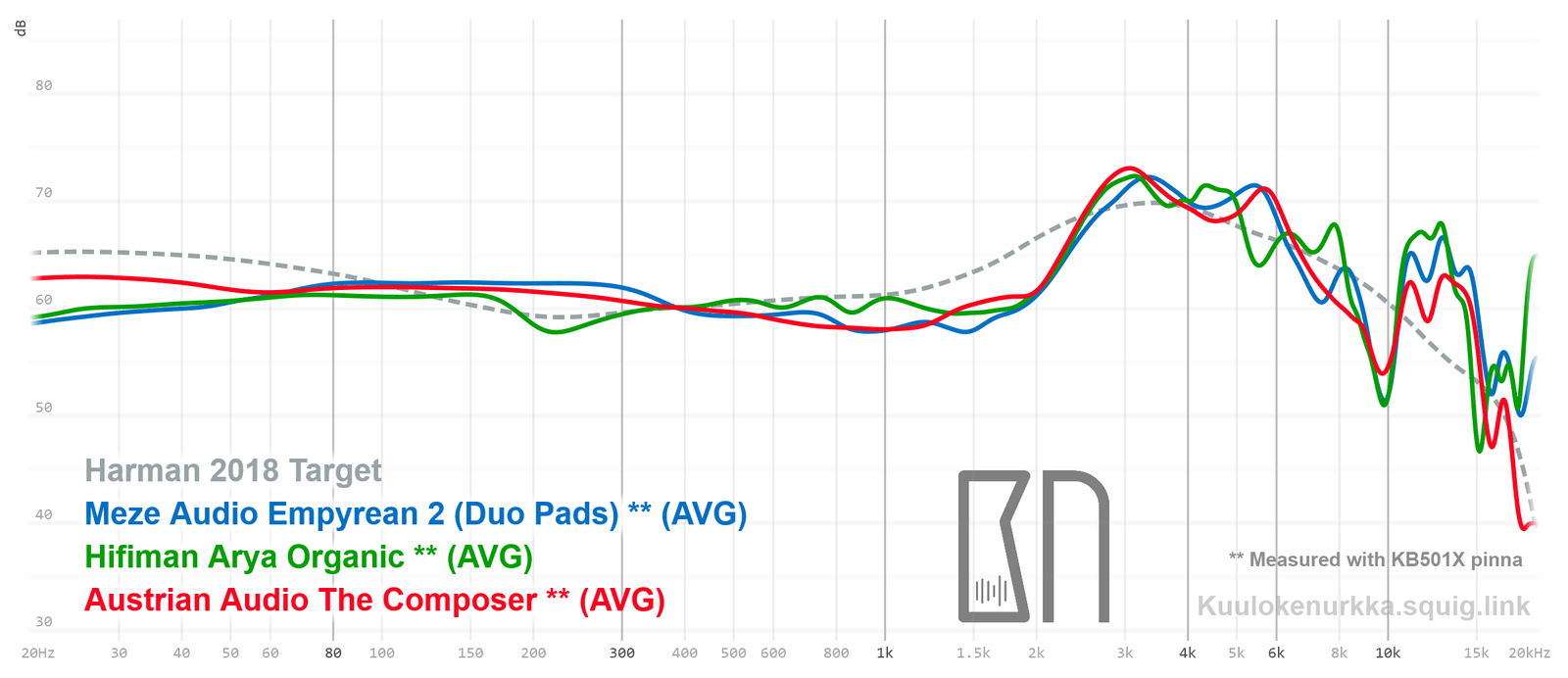
In my opinion, the Composer is a successful take on reference-style headphones, as its tuning, as expected, emphasizes clarity and separation of reproduction, without forgetting to sound largely natural. Especially the emphasis at 3 kHz and 6 kHz makes the presentation microscopically precise for details reproduced at these frequencies. At the same time, however, the 800–2000 Hz range is reproduced more calmly than usual, softening the edginess of some instruments, such as electric guitars, and the energy of vocalists.
A similar tuning style is also familiar from many Hifiman models (e.g., various HE1000 and Arya versions), the Sennheiser HD 800 series, and most recently the Meze Audio Empyrean 2. For this reason, it is not a big surprise that the Composer sounds spacious like them and spreads the different elements of music out for easy observation. I automatically pay attention to things happening in the soundstage, because the vocalist is positioned slightly further away than usual in the overall presentation, and the energy of the instruments doesn't push particularly strongly towards the listener. On the other hand, the smallest nuances and hair-raising presence are missing from the vocals, so it's good to be aware of the compromises that come with aiming for a spacious soundstage.
Since I have heard very similar headphones before, the Composer didn't feel particularly special at first. However, I soon learned to appreciate its small improvements over its predecessors. Firstly, the headphones' treble is less bright compared to Hifiman and the HD 800 series, so apart from occasional sharpness at 6 kHz, there is no emphasized hiss or sparkle in the sound, nor any significant sibilance. The airiness of brighter headphones suits some situations, but I find the Composer sounds more natural and is more relaxing to listen to. This is a great advantage, for example, when listening to music that is produced a bit more roughly.
Secondly, the Composer reproduces bass excellently, resembling planar headphones more in its linearity than traditional dynamic headphone models. The sub-bass does not drop off at all, but even rises slightly between 20–50 Hz. Thanks to this, the reproduction has a nice punch and depth, and overall a dynamic grip. The sound of the headphones is clearly sturdier compared to the HD 800 series and, according to my memory, also more fun compared to the HE1000 V2. The mid-bass also does not emphasize in the same way as in the Empyrean 2, so the lower frequencies remain clearer.
In my opinion, a calmer treble and sturdier bass reproduction are sufficient improvements over the Composer's older competitors, but the pricing and market situation of the headphones raise some questions. The Composer costs a few hundred euros more than, for example, factory-serviced Hifiman HE1000 V2 and Sennheiser HD 800 S combined. Even new, both can be obtained for about 1000 euros less than the Composer, which is a significant saving for fundamentally quite comparable headphones. On the other hand, the Meze Audio Empyrean 2 must also be included in this group, which in turn costs 500 euros more than the Composer. It seems to be in line with current trends that new headphones cost more than before. Despite everything, Austrian Audio has succeeded in making excellent headphones, which I consider the most balanced in their style.
Bass:
The bass is reproduced clearly by the Composer and in most situations robustly enough to also sound fun. The sound has a nice depth and instruments have a solid foundation. Especially when listening to electronic music, I could imagine it being a planar headphone, as open dynamic models rarely produce similar sound pressure. Correspondingly, I find the mid-bass kicks a bit more pleasantly than in many open planar headphones. On the other hand, no bass emphasis can occur, because the rising upper frequencies take their share of attention. For this reason, there are still many more fun headphones for listening to bass music. Those who like a harder-hitting mid-bass might, for example, like ZMF headphones or Meze Audio's Empyrean models. Closed-back headphone models that reproduce bass more powerfully are then a different story altogether.
Mid-frequencies:
The Composer's mid-frequencies are characterized by a clear and spacious approach. Both the vocalist and instruments emerge precisely in the overall sound, but do not actively draw attention to themselves. This is due to the slightly more subdued reproduction of the 800–2000 Hz frequency range, which softens the sound's energy and, in a way, slightly distances details that would normally be at the center of the reproduction. I would characterize the Composer's mid-frequencies as slightly distant, similar to the Empyrean 2, but I have become accustomed to it quite quickly, especially since the timbre remains quite natural.
The advantage of the sense of spaciousness is the ability to more easily examine the sound around the vocalist and instruments mixed into the foreground. Small emphases at 3 kHz and 6 kHz effortlessly bring certain things to the fore. This also creates a slightly bright nuance in the sound, even though the very top treble is not actually emphasized in the headphones, nor do I detect amplified sibilance. I, on the other hand, am not particularly sensitive to emphases in the presence region, whereas for others, the 6 kHz area might sound somewhat irritating and harsh, similar to the Sennheiser HD 800 series. For this reason, it would be advisable to audition the Composer before purchasing it.
As a downside to the ”dip” remaining in the mid-frequencies, some of the vocalist's intimacy and presence are lost, so the Composer might not appeal to those who like the reproduction style of the Sennheiser HD 600 series or the Harman target curve as such. Also, the smallest nuances of some instruments, such as the electric guitar, are reproduced slightly softened. I would see this as sometimes beneficial, for example, when listening to aggressively produced rock music, unless someone specifically likes raw punchiness. For instance, Hifiman HE1000 and Arya reproduce such music more sharply, so they can sound more easily over-energetic. The Composer has its own spacious style, which slightly mitigates the edginess of the reproduction but increases spatial separation. In my opinion, this is a valid way to implement reference-style headphones, as the definition is broad in general.
Itse pidän Composerin keskitaajuuksia hieman tasapainoisempina melko vastaavan tyyliseen Empyrean 2:een verrattuna, koska Meze Audion kuulokkeissa välimatka eri taajuusalueiden välillä on suurempi ja osa äänestä sen myötä etäisemmän tuntuista. Composer loistaa muutoin samoissa asioissa eli sen toisto on selkeää ja yksityiskohtaista olematta liian analyyttista tai raskasta kuunnella. Erinomainen bassontoisto auttaa omalta osaltaan tasapainottamaan lievää kirkkautta, koska ilman sitä ääni olisi tyyliltään ohuempaa. Nyt yksityiskohtaisuus tulee selkeästi esiin tukevalla pohjalla säestettynä, ja avaraa ääntä on miellyttävää kuunnella pitkiäkin aikoja.
Treble:
Composer sekä on että ei ole kirkas kuuloke. Tämä johtuu ensinnäkin 6 kHz:n korostumasta, joka terävöittää väkisin tiettyjä ääniä ja saattaa saada jotkin kappaleet kuulostamaan aavistuksen rosoisilta. Toiston selkeyttä on tavallaan hieman voimistettu. Toisaalta esimerkiksi Sennheiser HD 800-sarjaan ja Hifimaneihin verrattuna toistossa ei ole yhtä korostunutta sihinää tai räiskyvyyttä, joka saisi esimerkiksi rumpujen lautaset kuulostamaan epäluonnollisilta tai voimistaisi merkittävissä määrin sibilanssia. Composerin ylimmät diskanttitaajuudet onkin saatu pidettyä hyvin kurissa, joten lautaset kuulostavat omaan makuuni juuri sopivilta. Ymmärrän kuitenkin esiin nousseet näkemykset siitä, että äänessä voisi olla ilmavuutta hieman enemmänkin. Composeria kirkkaammat kuulokkeet, kuten vaikkapa juuri HD 800 (S), tekevät klassisesta musiikista hieman vaikuttavamman kuuloista. Composer on kuitenkin nähdäkseni suunniteltu tasapainoisemmaksi kuulokkeeksi, joka ei pyrikään olemaan yhden genren ihme.
Itselleni kuulokkeet jäivät testijakson aikana 95 prosenttia ajasta kirkkaudeltaan sen rajan alle, jota alkaisin pitää ärsyttävänä. Nautin toiston tarkkuudesta ja erottelusta, koska sitä ei ole saavutettu ylintä diskanttia epäluonnollisesti korostamalla. Tältä osin Composer eroaa Hifimanin kuulokkeista. Jos joku toivoo vieläkin voimakkaammin yksityiskohtia esiin tuovaa esitystapaa, esimerkiksi Hifiman Arya tai HE1000 sopivat siihen tarkoitukseen. Muutoin Composer on mielestäni miellyttävämpää kuunneltavaa myös hieman rennommalla otteella ja laadultaan keskinkertaisempaa musiikkia kuunnellessa.
Other observations:
Minulla on oikeastaan tällä kertaa testaamistani kuulokkeista hyvin vähän muuta kommentoitavaa. Composer kuulostaa avaralta ja erottelukykyiseltä ja dynamiikkakin on hyvällä tasolla. Lopputulos tuntuisi mukailevan melko suoraan taajuusvastetta, koska avoin kuppirakenne tai särö eivät vaikuta kuultavasti ääneen, eikä Austrian Audio ole myöskään tavoitellut valitsemallaan dynaamisella elementillä mitään poikkeuksellista, vaan ennen kaikkea selkeää toistoa. Tältä osin Composer antaa kuitenkin mielestäni jonkin verran tasoitusta planaarielementit sisältäville kilpailijoilleen, sillä en koe sen olevan aivan yhtä erottelukykyinen tai ”läpinäkyvä”. Lisäenergia keskitaajuuksiin ja diskanttiin kompensoisi kuitenkin varmasti tilannetta, joten lievä pehmeys voi myös olla seurausta tuunauksesta. Tämä voitaisiin nähdä vaihtoehtoisesti yhtenä Composerin vahvuuksista, koska se ei painota yksityiskohtaisuutta liikaakaan, vaan antaa tietyllä tapaa kuuntelijan valita itseään kiinnostavat osa-alueet.
Observations on confirmation
Tästä päästäänkin kuulokkeiden vahvistamiseen ja sitä myötä myös havaintoihini Full Score one:sta. Heti alkuun todettakoon, että Austrian Audion kuulokkeet ja vahvistin sopivat mielestäni erinomaisesti toisilleen, koska ne ovat ääneltään hyvin saman tyyliset. Composer toimisi loistavasti myös edullisilla mobiililaitteilla ja dongle-ratkaisuilla, koska sen impedanssi on matala ja herkkyyskin kohtuullisen suuri 95,5 dB/mW. Yleisesti ottaen kuulokkeita voisi olla järkevintä kuunnella vahvistimella, jonka lähtöimpedanssi on matala.
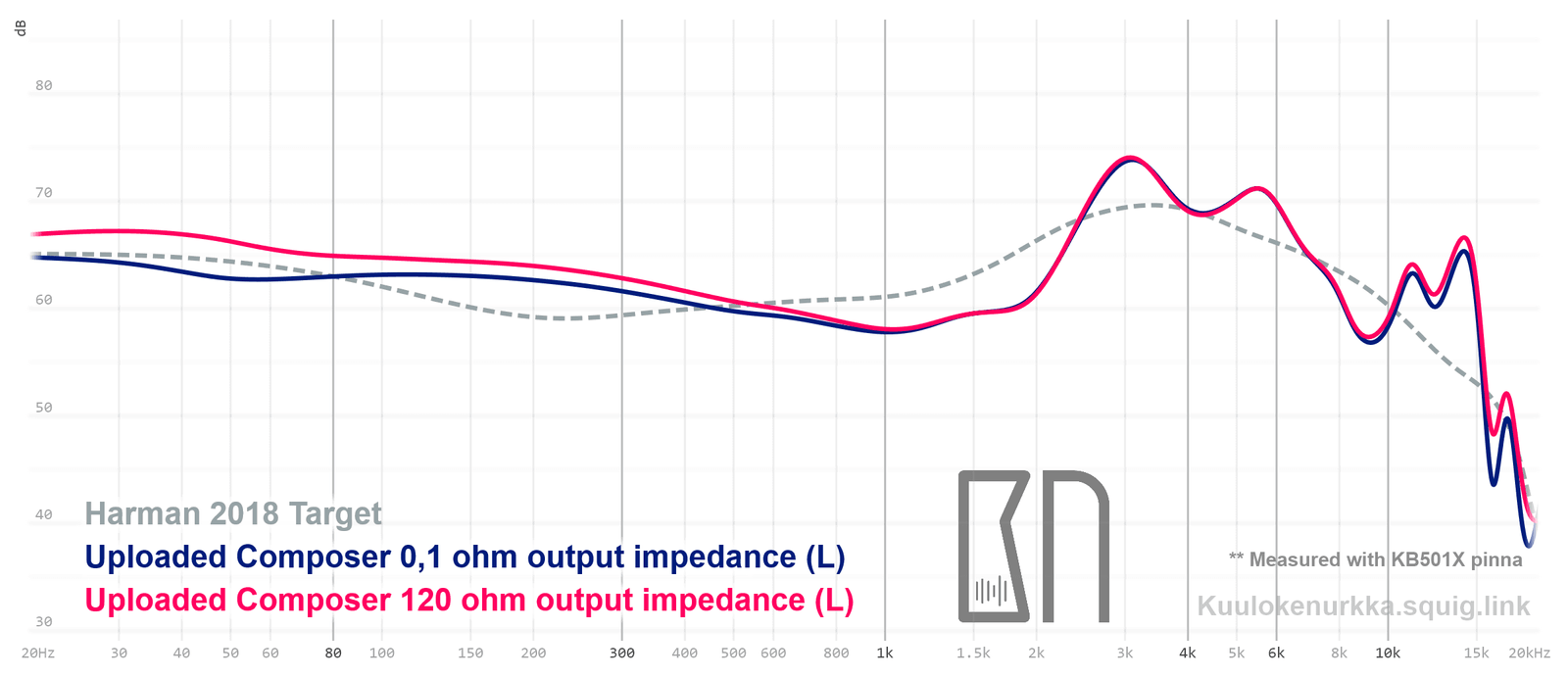
Composerin oma impedanssikäyrä on epätasainen, sillä impedanssi nousee valmistajan ilmoittamasta 22 ohmista 42 ohmiin saakka 30 hertsin kohdalla ja 32 ohmiin saakka 15 kilohertsin kohdalla. Vaikka impedanssi jääkin kokonaisuutena matalaksi, pienestä epätasaisuudesta johtuen kuulokkeet reagoivat herkästi vahvistimen lähtöimpedanssiin. Jo 10 ohmin lähtöimpedanssi alkaa voimistaa bassotaajuuksia samaan tapaan kuin useimmissa Focalin kuulokemalleissa. Samalla myös ylin diskantti voimistuu hieman. Mittasin Composerin taajuusvasteen korkealla 120 ohmin lähtöimpedanssilla osoituksena siitä, millaisia muutoksia esimerkiksi tietynlaisista putkivahvistimista aiheutuisi. Voimistuva murina bassotaajuuksilla voi olla joillekin positiivinen asia, mutta ääni ei enää vastaa täysin sitä, mitä Austrian Audio on kuulokkeillaan tavoitellut. Jos tältä halutaan välttyä, kannattaa valita vahvistin mahdollisimman lähellä nollaa olevalla lähtöimpedanssilla. Myös Full Score one vaikuttaisi olevan tällainen.
Kuuntelin testijakson aikana Full Score one:lla monia erilaisia kuulokkeita vertaillen laitteen ääniprofiilia ylistystä saaneeseen Ferrum Audio OOR -vahvistimeen, joka maksaa 500 euroa enemmän. Palaan OOR:iin tarkemmin sen arvostellessani, mutta tässä yhteydessä on huomionarvoista, että Composer kuulostaa mielestäni hieman paremmalta ja tarkoituksenmukaisemmalta Full Score one:lla. Tämä johtuu nähdäkseni siitä, että OOR pehmentää jonkin verran kuulokkeiden ylintä diskanttia ja tekee myös keskitaajuuksista aavistuksen lämpimämmät. Tyyli ei täysin tue Composerin vahvuuksia tai referenssihenkisyyttä, vaan saa sen kuulostamaan jopa hieman tylsältä ja tukkoiselta. Full Score one puolestaan säilyttää toiston avarampana ja sopivasti terävämpänä eli kuulokkeet eivät varsinaisesti muutu siitä, mitä ne jo valmiiksi ovat. Toisaalta Full Score one ei myöskään kuulosta millään tapaa liian kirkkaalta tai analyyttiselta, vaan hyvällä tavalla täsmälliseltä ja neutraalilta. Erityisesti diskantti toistuu ihailtavan vaivattomasti ilman pistävyyttä. OOR ei ole yhtä ilmava, mutta lisää puolestaan bassoon potkua.

Havaitsin kahden vahvistimen välillä vastaavia eroja myös muilla kuulokkeilla, mutta tilanteeseen vaikutti yllättävän paljon käytössä ollut DAC. Schiit Audio Bifrost 2 saa nimittäin OOR:in kuulostamaan entistä rauhallisemmalta, kun taas neutraalimmalla SMSL VMV D1SE:llä vahvistin herää paremmin eloon ja osoittaa omat vahvuutensa Full Score one:een verrattuna erityisesti äänikuvan syvyydessä ja kerrostuneisuudessa. Full Score one muuttuu DAC:ia vaihtamalla vähemmän, mutta hyötyy mielestäni Bifrost 2:n tietynlaisesta ”orgaanisuudesta”.
Tiivistettynä enemmän tehoa vaativat planaarikuulokkeet, kuten Dan Clark Audio E3 and Hifiman HE-6, kuulostavat vaikuttavammalta OOR:illa, kun taas useimpia dynaamisia kuulokemalleja kuuntelin hieman mieluummin Full Score one:lla etenkin, jos valitsin DAC:iksi Bifrost 2:n. Myös vahvistustarpeeltaan helpommat planaarit, kuten ZMF Caldera, kuulostivat oikein hyvältä Bifrost 2 & Full Score one -yhdistelmällä. Tykästyinkin Austrian Audion vahvistimeen enemmän kuin ennakkoon odotin. OOR on mielestäni edelleen sopivan DAC:in ja haastavampien kuulokkeiden kanssa parempi vahvistin, mutta juuri Composerille Full Score one sopii erinomaisesti. Tämä oli erityisen ilahduttavaa huomata sen jälkeen, miten huonosti totesin Yamahan HA-L7A-vahvistimen sopivan sen pariksi suunnitelluille YH-5000SE-kuulokkeille.
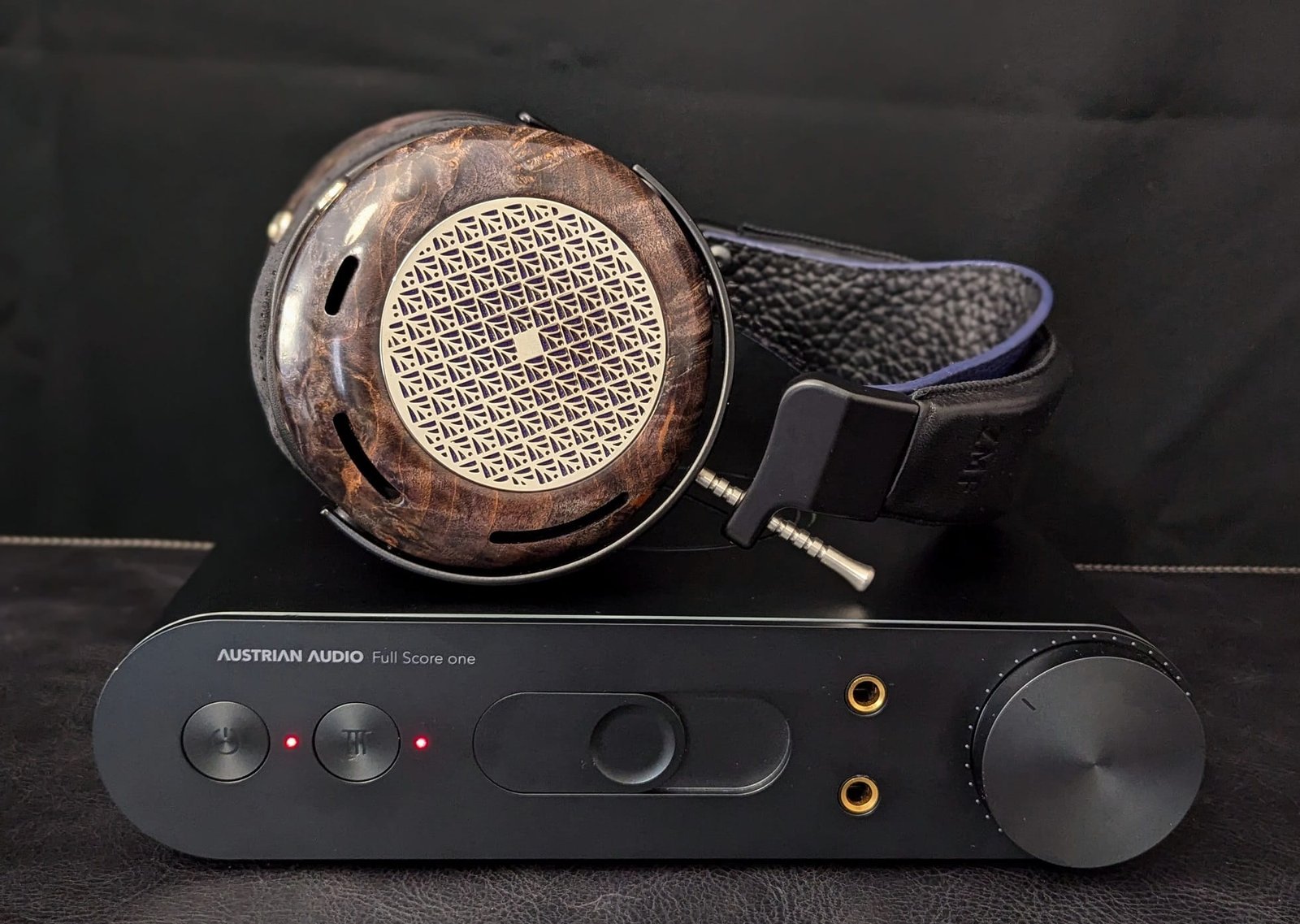
Vielä lopuksi haluan mainita vahvistimen TTT-ominaisuudesta, jonka pidin testijakson aikana käytännössä koko ajan aktivoituna. Alussa TTT:n vaikutus jäi tosin itselläni lähes huomaamatta, kun en tiennyt, millaisia eroja etsiä. Yksinkertaisemman ja esimerkiksi vain vähän ylätaajuuksia sisältävän musiikin kanssa äänenlaadullinen parannus onkin totuuden nimissä pienehkö. Useimmissa tilanteissa Full Score one muuttuu kuitenkin TTT aktivoituna hieman selkeämmän kuuloiseksi, koska äänten erottelu terävöityy ja yksityiskohdista on tavallaan helpompaa napata kiinni. TTT pois päältä ottaessa ääni on puolestaan jonkin verran pehmeämpää ja yhteensulautuneempaa, ellei jopa pahimmillaan hieman tukkoistakin. En lopulta havainnut TTT:n päällä pitämisestä mitään haittaakaan, vaan siten Full Score one kuulostaa enemmän siltä kuin hintavalta vahvistimelta odotan. Ominaisuus on siis mielestäni oleellinen osa vahvistimen hyvyyttä riippumatta siitä, mitä sen toteutuksesta muutoin ajattelen.
Comparison to other headphones
The Composer vs. ZMF Atrium
Hinnat: 2500 € vs. 2800–3500 € (depends on the chosen wood type and appearance)
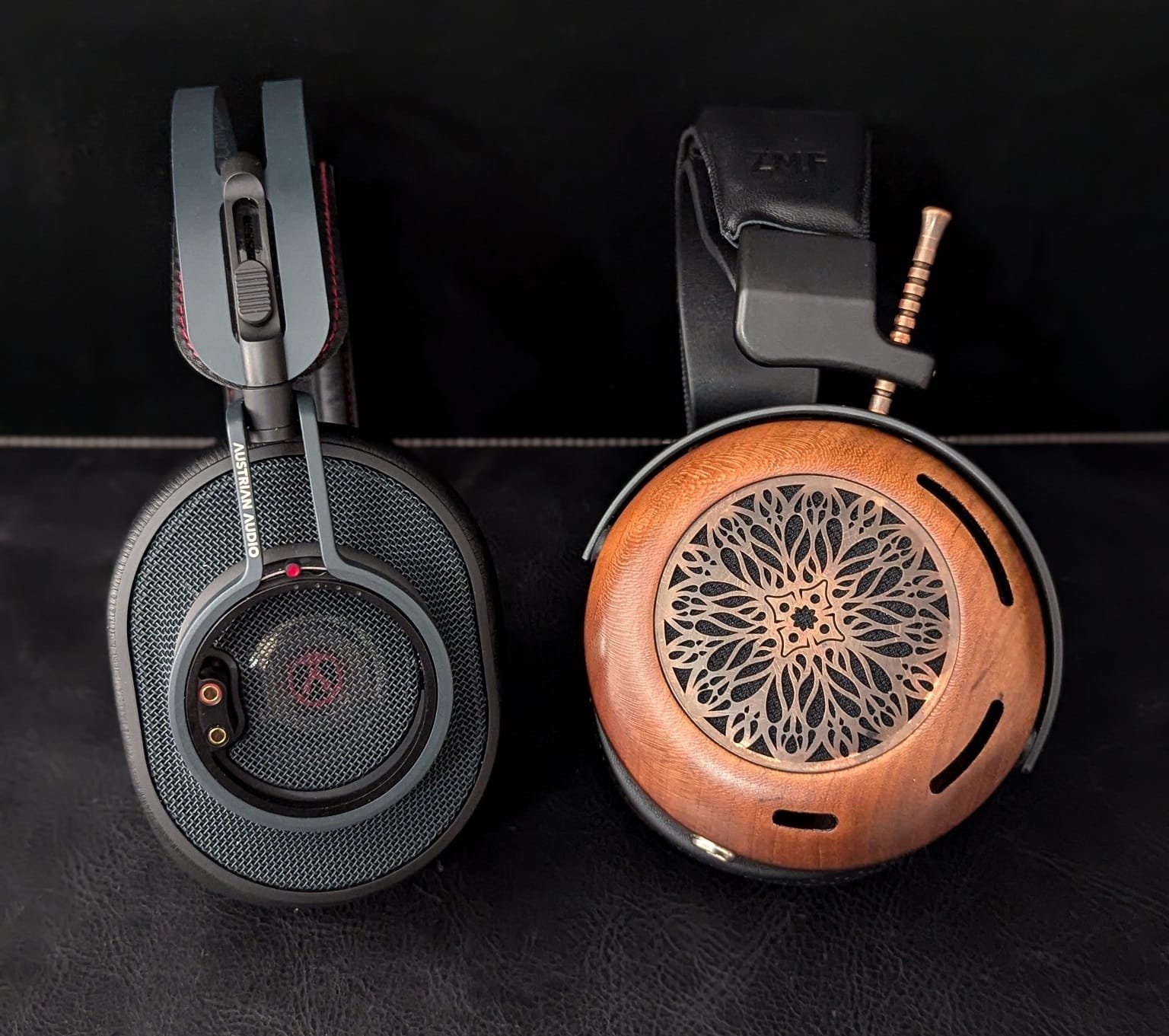
Composer ja ZMF Atrium kuuluvat melko harvaan dynaamisten kuulokemallien joukkoon yli 2000 euron hintaluokassa, sillä useimmissa hintavissa kuulokkeissa käytetään nykyään eksoottisempia planaarielementtejä tai elektrostaattisia elementtejä. Löytyypä markkinoilta myös AMT- ja nauhaelementeillä totetettuja kuulokkeita. Perinteisten dynaamisten elementtien vähäisyys tuskin riippuu varsinaisesti niiden äänenlaadullisesta potentiaalista, vaan pikemminkin siitä, että niiden kiinnostavuusarvon ajatellaan olevan ylemmissä hintaluokissa muita elementtityyppejä matalampi. Toki totuuden nimissä säröarvot ovat yleensä korkeammat, eikä alabassoa ole yhtä helppoa tuunata lineaariseksi planaareihin verrattuna. Silti Composerin ja Atriumin perusteella myös dynaamisille malleille on mielestäni markkinoilla paikkansa. Kaksikko on suunnattu mielenkiintoisesti niin rakenteeltaan kuin ääneltäänkin varsin erilaiseen makuun.
Rakenteellisia ja teknisiä eroja:
- Atrium on kooltaan selvästi suurempi ja painaa 100–200 grammaa enemmän, joten se ei ole hyvästä istuvuudestaan huolimatta yhtä mukava kuin Composer
- Atriumia myydään monilla eri ulkonäkövaihtoehdoilla
- Kuulokkeille sopivat hieman erilaiset vahvistimet, koska Composerin impedanssi on matala 22 ohmia ja Atriumin korkea 300 ohmia
- Composerin 49 millimetrin elementeissä on DLC-kalvo ja Atriumin 50 millimetrin elementeissä bioselluloosasta valmistettu kalvo
- Composerissa on uniikit banaaniliittimet, kun taas Atriumissa yleisemmät mini-XLR-liittimet
- Atriumin ääntä voidaan säätää erilaisilla korvapehmusteilla, mutta saman pitäisi onnistua pian myös Composerin kanssa
- Composerin ostaja saa kolme kaapelia, kun taas Atriumin ostaja kaksi kaapelia ja kahdet korvapehmusteet
- Composerin takuu on 5 vuotta, kun taas ZMF myöntää Atriumille elinikäisen elementtitakuun sekä 2 vuotta ulkoisille osille
Sound quality differences:
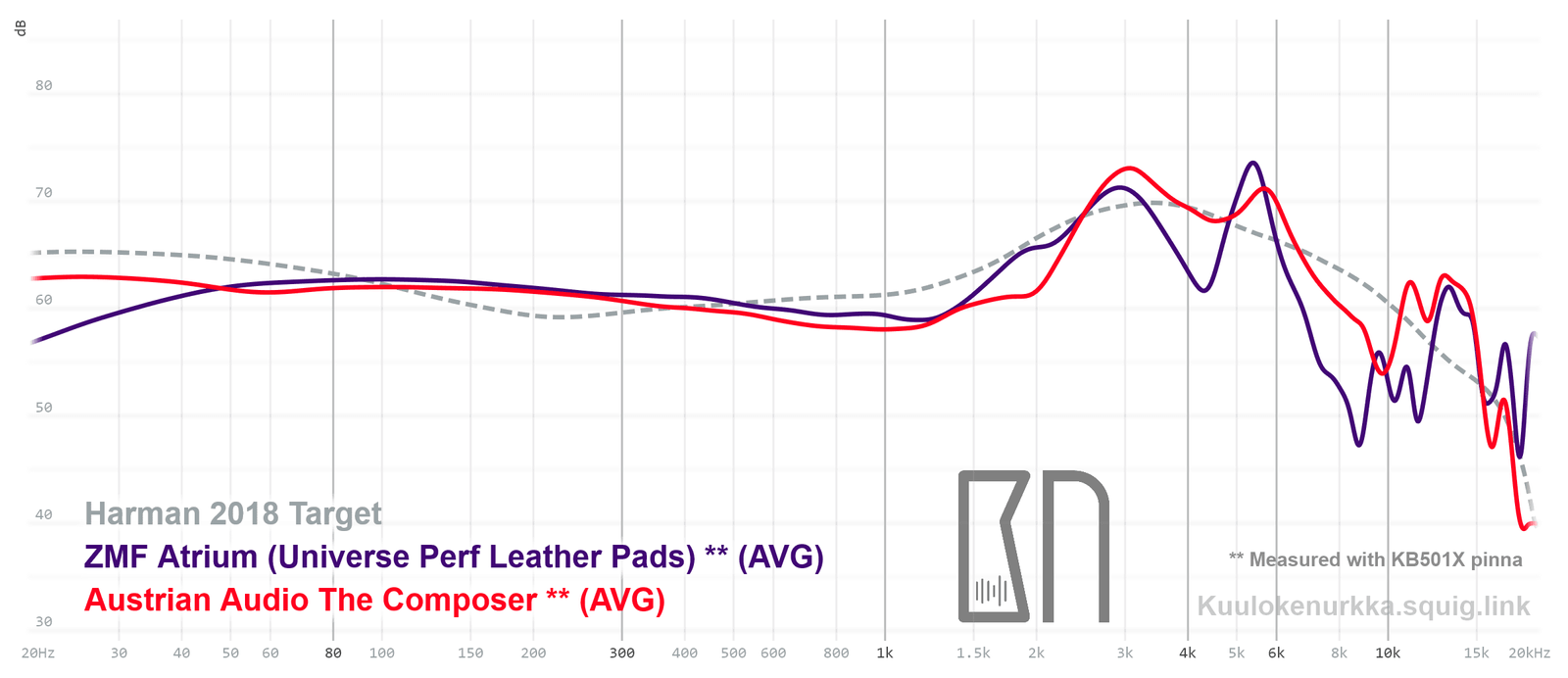
Jos Composer on yleisääneltään hieman kirkas ja keskitaajuuksiltaan aavistuksen pehmeä ja etäinen, Atrium puolestaan kuulostaa vakiokorvapehmusteillaan täyteläisen läsnäolevalta ja ylätaajuuksiltaan melko rauhalliselta. Diskantin osalta kannattaa tosin huomioida, että käyttämäni laitestandardi ei kykene mittaamaan Atriumista 5–8 kHz:n väliä kovinkaan totuudenmukaisesti, sillä ylätaajuudet eivät ole todellisuudessa yhtä vaimeat kuin taajuusvaste antaisi ymmärtää. Diskantti kuuluu kuitenkin joka tapauksessa hieman taka-alalla keskitaajuuksiin nähden.
The Composer is airier of the two and brings out musical details more energetically and distinctly. It also sounds more spacious due to its mid-frequency tuning, allowing for sound monitoring from a slightly greater distance. The Atrium, on the other hand, reproduces both the vocalist and instruments more present, but at the same time also slightly calmer due to its ”dip” around 4 kHz. In my opinion, it is the more authentic of the two, because its more intimate and warmer presentation than the Composer evokes stronger emotions in me, especially with skilled singers. The Atrium's soundstage is not bad either; sounds playing near and far are clearly distinguishable from each other, and the sense of depth is excellent. Despite this, the Composer's soundstage feels more open and spacious.
The duo also differs somewhat in bass reproduction, as the Atrium's mid-bass rumbles and kicks more robustly, while the Composer's sub-bass is firmer and generates more sound pressure. In most music genres, the Atrium's bass sounds heavier, but electronic music is more satisfying with the Composer, whose bass also remains clearer and tighter. With its calm treble, I would even call the Atrium slightly bass-heavy, whereas the Composer is more neutral in its bass. However, it should be noted that amplifier and earpad choices significantly affect the Atrium's low frequencies.
The Composer and Atrium ultimately offer in a certain way what the other slightly lacks. For this reason, it is easy to find strengths in both headphones without either feeling unequivocally better. Personal preferences, in my opinion, ultimately determine which of the headphones is better suited for whom. The Composer offers reference-style detail implemented spaciously, while the Atrium draws you in with its rich and present sound.
The Composer vs. Modhouse Audio Tungsten (Single sided)
Prices: 2500 € vs. 1800–2100 € (depends on aesthetic customizations)
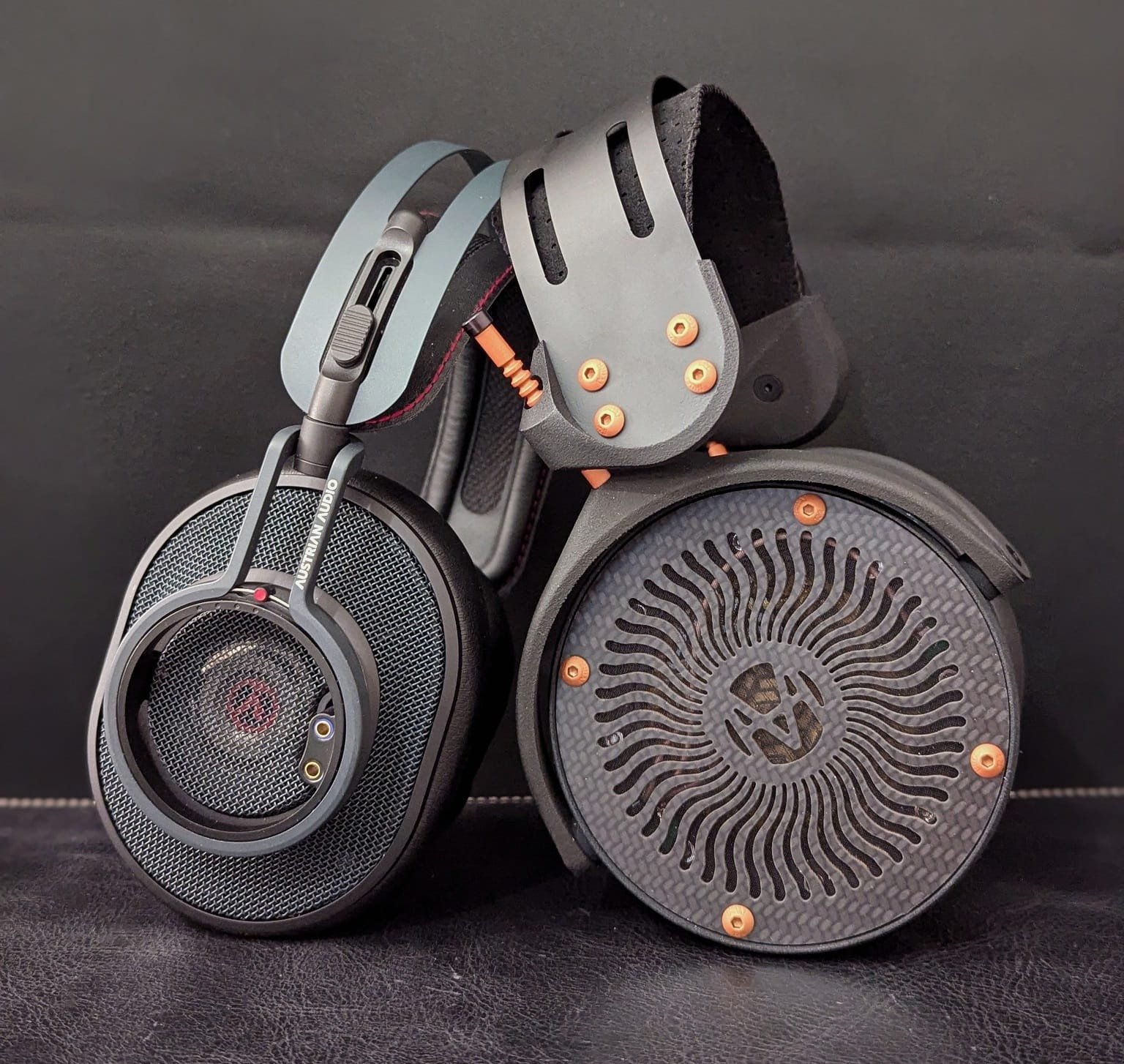
At the same time as the Composer, I also got to know Modhouse Audio's first self-developed planar headphone model, the Tungsten, which is sold with two different magnet structures. I have the $500 cheaper version of the headphones with single-sided magnets, so it can be referred to as ”Single sided” or its SS abbreviation.
The Tungsten is unique, firstly, due to the brutally low sensitivity of its drivers and its higher-than-usual impedance, as listening to the headphones at louder volumes requires an amplifier that is powerful with a 130-150 ohm load. Such amplifiers are somewhat rarer nowadays, as the majority of devices are optimized for 16-32 ohm impedance. For example, Austrian Audio's Full Score one is not properly suited for driving the Tungsten. Ferrum Audio OOR, on the other hand, drives the Tungsten well at its highest gain level.
If the amplification requirement causes its own headache when acquiring the Tungsten, so does its availability, as only one person is responsible for manufacturing the headphones. The Tungsten can practically only be ordered one day per month, and its estimated completion time currently varies between 6-8 months due to high demand. The order must also be paid in advance, so the process is at least frustrating, especially since the manufacturer does not provide any interim information about its operations. Austrian Audio headphones, on the other hand, can be found easily and can be driven by almost any amplifier. Many might wonder why on earth anyone would want to order the Tungsten? The answer relates to sound quality, as the headphones come closest to the legendary Hifiman HE-6. Thus, the Composer is a very different option in this comparison situation as well, which is fundamentally a good thing.
Rakenteellisia ja teknisiä eroja:
- The Tungsten is clearly larger in size and weighs 130 grams more, so despite its good fit, it is not as comfortable as the Composer.
- The Tungsten is sold with two different magnet structures, and its appearance is customizable.
- The Composer works with almost any amplifier, whereas the Tungsten SS is currently the most difficult headphone in the world to drive due to its 135 ohm impedance and extremely low sensitivity (76 dB/mW).
- The Composer has dynamic drivers with a DLC diaphragm, and the Tungsten has planar drivers with gold traces.
- The Composer has unique banana connectors, while the Tungsten has traditional 3.5 mm connectors.
- The Tungsten's sound can be adjusted with different earpads, but the same should soon be possible with the Composer.
- The Composer buyer receives three cables, while the Tungsten buyer receives one Viking Weave premium cable.
- Composerin takuu on 5 vuotta ja Tungstenin vain 1 vuosi. Modhouse Audio huoltaa kuitenkin kuulokkeita maksua vastaan
Sound quality differences:
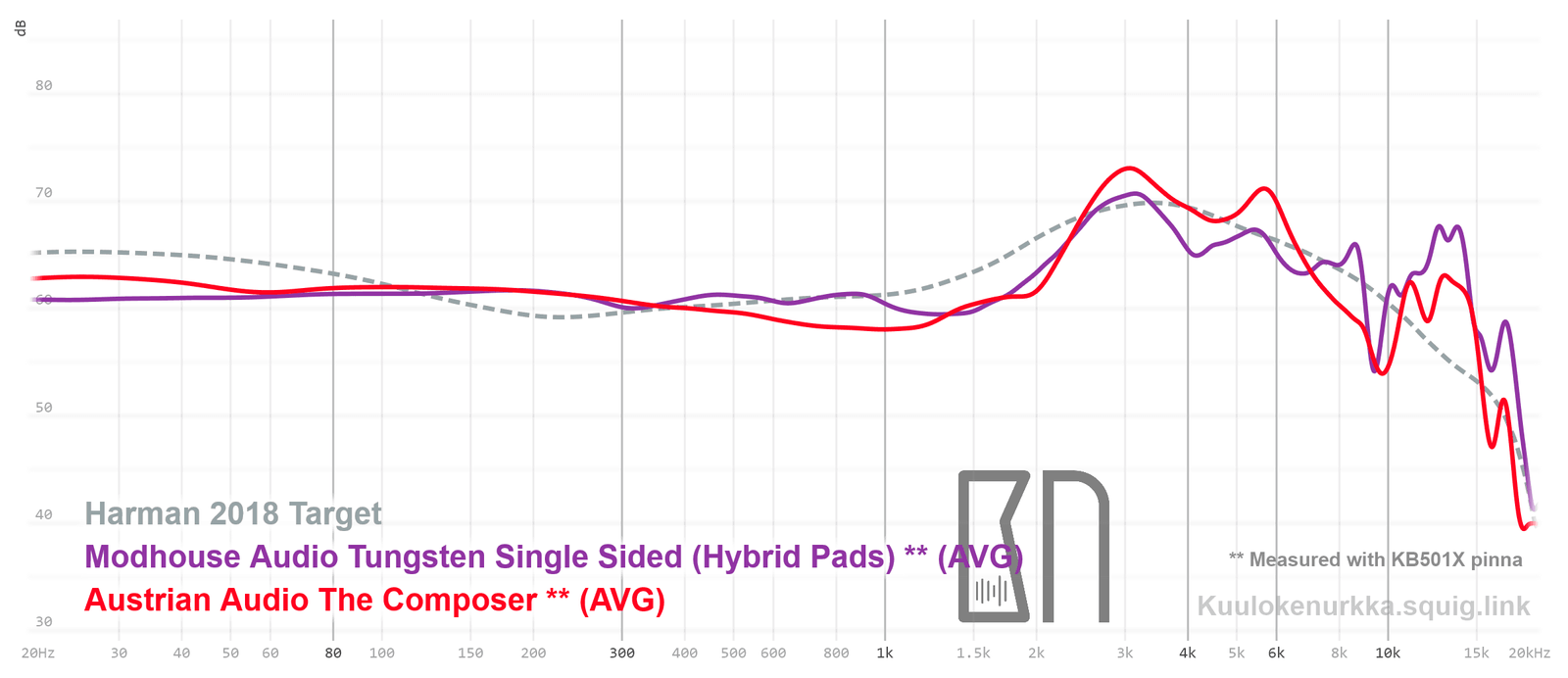
Tungsten on keskitaajuuksiltaan läsnäolevampi erityisesti 500–1000 hertsin välillä, minkä myötä sekä vokalisti että useimmat soittimet toistuvat Composeria särmikkäämmin. Samalla yläkeskitaajuuksien ja preesensalueen väli (3–6 kHz) toistuu Composeria rauhallisemmin, joten Tungsten painottaa vähemmän toiston yleistä selkeyttä, eikä kuulosta yhtä avoimelta. Sen salaisuus on kuitenkin alkuperäisen Hifiman HE-6:n tapainen dynaaminen räjähtävyys. Äänessä on hauskaa menevyyttä ja positiivista aggressiivisuutta, kun taas Composer kuulostaa pehmeämmältä, vaikkei senkään dynamiikassa ole varsinaista moitittavaa.
Tungsten saa reivaamaan intensiivisyydellään, kun taas Composer esittää musiikin eri osa-alueet avarammin ja laajemmalle levitettynä. Äänikuvan tilavuus on yleisemminkin Composerin vahvuus Tungsteniin verrattuna, vaikka planaarielementit pystyvätkin loihtimaan äänestä tietyllä tapaa läpinäkyvämpää. Molemmat painottavat hieman eri yksityiskohtia, joten tarkkuuden osalta on vaikeaa julistaa selkeää voittajaa. Bassontoisto Composerissa tuntuu hieman muhkeammalta, mutta Tungsten iskee lujempaa. Diskantista löytyy puolestaan suurempi tyylillinen ero.
Molempien kuulokkeiden ylätaajuuksissa on omanlaistaan kirkkautta, mutta Tungsten on kaksikosta lopulta aggressiivisempi, koska ääni on säihkyvämpää ja räiskyvämpää. Aion vielä tutkailla asiaa paremmalla ajalla tarkemmin, mutta kuulokkeiden kaksipuoleisilla magneeteilla toteutettu versio tasapainottaa tiettävästi juuri diskantin yksittäisiä korostumia. Single sided -versiolla rumpujen lautaset toistuvat ajoittain melkoisen räiskyvästi ja sibilanssikin voi olla korostunutta. Composerissa on 6 kHz:n tuntumassa pientä karkeutta, mutta sen diskantti on kaiken kaikkiaan selvästi lempeämpää. Toisaalta pienen totuttelun jälkeen Tungsten ei enää kuulosta ärsyttävän kirkkaalta, koska sen ääni muutoin ei ole hyökkäävää. Pieni säikähdys iskeekin lähinnä alussa muista kuulokkeista Tungsteniin vaihtaessa.
Vaikka Composerilla onkin omat etunsa Tungsteniin verrattuna, jälkimmäinen tarjoaa mielestäni vaikuttavamman ja innostavamman kuuntelukokemuksen. Tungstenin poikkeuksellisen dynaamisia planaarielementtejä onkin melko vaikeaa päihittää juuri näillä mittareilla. Kuulokkeet on myös tuunattu pientä diskantin räikeyttä lukuun ottamatta hyvin, joten ne tarjoavat kovan vastuksen Composerin lisäksi muillekin hintavammille kuulokemalleille. Composer on kuitenkin esitystavaltaan ja suunnitellulta käyttötarkoitukseltaan niin erilainen, etten voi lopulta kutsua sitä suoraan Tungstenia huonommaksi vaihtoehdoksi etenkään, kun Modhouse Audio ei tällä hetkellä pysty valmistamaan kuulokkeitaan järkevässä ajassa. Omat kuulokkeeni löysin sattumalta käytettyjen markkinoilta, mutta valmistajalta en luultavasti lähtisi niitä tilaamaan, koska samaan hintaan saa ostettua ilman puolen vuoden odottelua monia muitakin hyviä kuulokkeita, jollaiseksi myös Austrian Audion Composerin lasken.
Summary
Kriittisesti ajateltuna Austrian Audion Composer ei tarjoa valtavasti uutta, koska sitä muistuttavista kuulokkeista Hifiman HE1000-sarja tekee saman jonkin verran kirkkaammin ja erotellummin, Sennheiser HD 800 S kuulostaa avoimemmalta ja ilmavammalta, ja Meze Audio Empyrean 2 on V-tyylisyytensä myötä hieman hauskempaa kuunneltavaa. Composer on kuitenkin niin ikään mainio kuuloke, jossa yhdistyy sopivalla tavalla yksityiskohtaisuus, avara tilavaikutelma ja helppo kuunneltavuus. Näkisin sen jopa oman tyylilajinsa edustajista tasapainoisimpana, mikä on oikein hyvä saavutus. Samalla kuulokkeet maksavat harmillisesti useimpia kilpailijoitaan enemmän siitäkin huolimatta, että ääni tuotetaan varsin perinteisellä dynaamisella elementillä monimutkaisempien ja hintavampien ratkaisujen sijaan.
Tämän myötä Composerista on toisaalta voitu tehdä monia muita kuulokkeita sirompi ja kevyempi, mikä varmistaa sen, että sitä on mukavaa käyttää tunnista toiseen. Rakenne muutoinkin on erinomaisen laadukas ja tyylikäs, ja lisäarvoa syntyy myös 5 vuoden takuusta sekä kolmesta mukana tulevasta kaapelista. On niin ikään mukavaa, että kuulokkeet valmistetaan Euroopassa. Tällä kaikella on hintansa, mutta voin suositella Composeria referenssimäistä ja avaran erottelevaa toistoa etsiville, joita korkea hintalappu ei häiritse. Koska olen nostanut samasta hintaluokasta Meze Audio Empyrean 2:n hiljaittain julkaisemalleni kuulokkeiden kunniaseinälle, sinne pääsee myös objektiivisesti arvioituna neutraalimpi Composer.
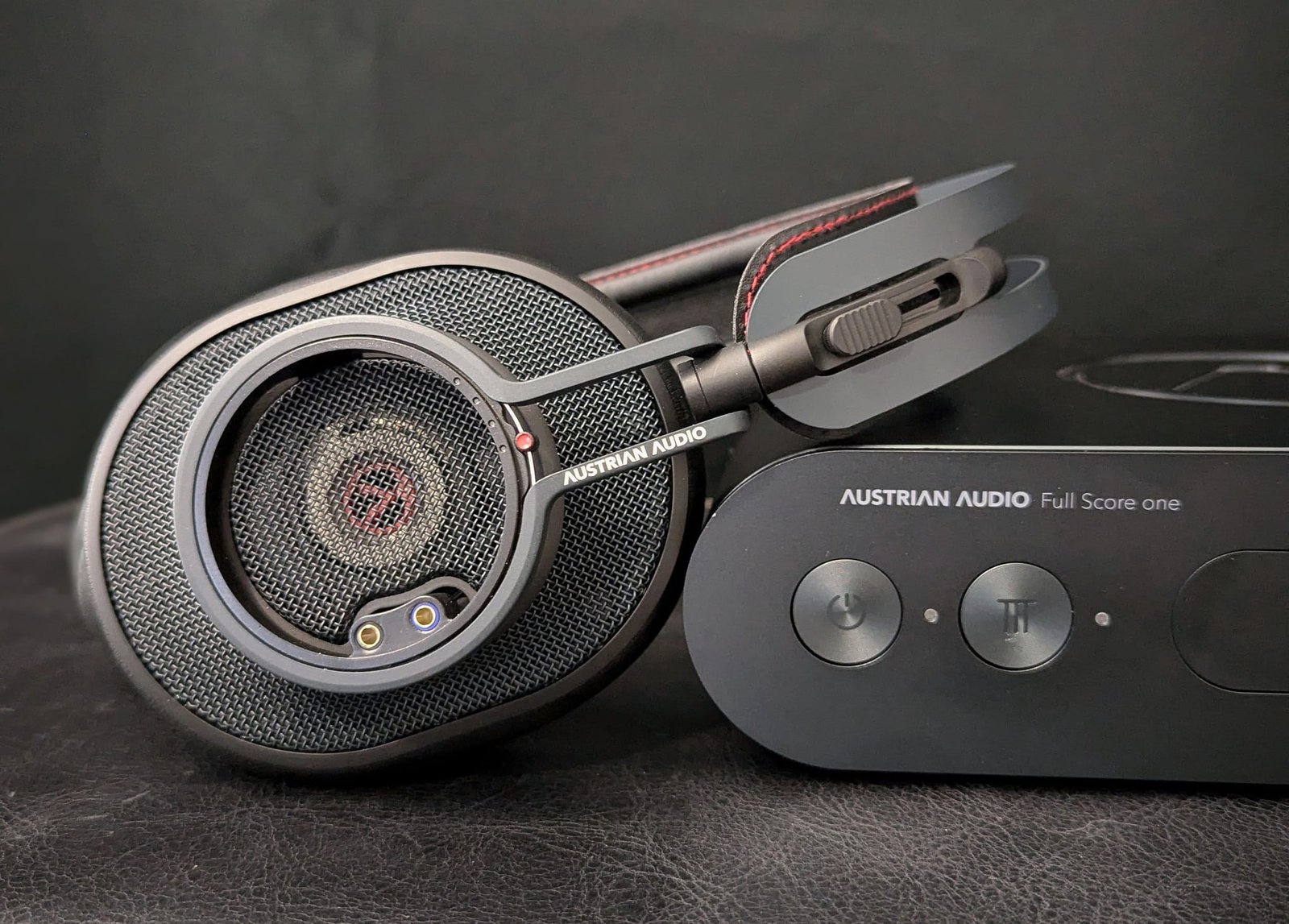
Nautin testijakson aikana suuresti myös Full Score one -vahvistimen tarkasta ja tilavan tuntuisesta äänestä. Laite sopii erinomaisen hyvin yhteen etenkin Composerin, mutta myös monien muiden kuulokkeiden kanssa. Vaikeimmin toistettaville planaarimalleille kannattaa tosin valita hieman tehokkaampi vahvistin.
Full Score one ei tarjoa juurikaan lisäominaisuuksia, mutta korkean laatuvaikutelman ja hyvän äänenlaadun osalta minun tekisi mieli kutsua sitä hyväksi hankinnaksi. Se ei edes pyri kilpailemaan hinta-laatusuhteeltaan lyömättömien edullisten vahvistimien kanssa, vaan on nähdäkseni suunnattu pääasiassa Composerin ”viralliseksi” kaveriksi referenssikäyttöön tai vaihtoehtoisesti niille, jotka haluavat panostaa harrastukseensa hieman enemmän. Jälkimmäiselle tielle lähtiessä 1500 euroa ei lopulta ole valtava summa useita tuhansia euroja maksavien kuulokevahvistimien maailmassa, mutta Full Score one kohtaa joka tapauksessa äärimmäisen kovaa kilpailua.
Pros and cons:
The Composer
+ Referenssimäinen tarkka ääni
+ Avaran tuntuinen äänikuva
+ Järkevällä tasolla pysyttelevä diskantti
+ Mainio bassontoisto dynaamiseksi kuulokemalliksi
+ High-quality and stylish construction
+ Good comfort
+ Helposti irrotettavat korvapehmusteet
+ Tuotepakkaukseen sisältyy 3 kaapelia
+ Does not require a powerful amplifier
+ 5-year warranty
– Keskitaajuudet voivat jäädä joidenkin makuun turhan pehmeiksi ja etäisiksi
– 6 kHz:n ympäristö kuulostaa toisinaan hieman aggressiiviselta
– Pääpannan minimikorkeus voi olla joillekin liian suuri
– Keinonahkapehmusteet hiostavat kesähelteillä
– Vaihtokaapeleita on vaikeaa löytää poikkeuksellisten liittimien vuoksi
– Korkeahko hinta
Full Score one
+ Sopii erinomaisesti juuri Composerille
+ Tarkka ja avara ääni rasittamattomalla diskantintoistolla
+ Laadukas rakenne ja hieno ulkonäkö
+ Äänenvoimakkuudensäätö on optimoitu erilaisille kuulokkeille
+ Ei taustakohinaa edes herkkien in-ear-kuulokkeiden kanssa
+ TTT-ominaisuus selkeyttää toistoa ja äänten erottelua
– Ei sovi matalahkon antotehonsa vuoksi erityisen hyvin vaativille planaarikuulokkeille
– Kilpailijoiden laitteet tarjoavat enemmän ominaisuuksia ja toimintoja
– Äänenvoimakkuuden osoitinta on lähes mahdotonta nähdä
– Useimpien näkökulmasta melko korkea hinta, koska hyviä ja tehokkaita vahvistimia saa nykyään edullisesti
 EN
EN  FI
FI