Author: Roderick
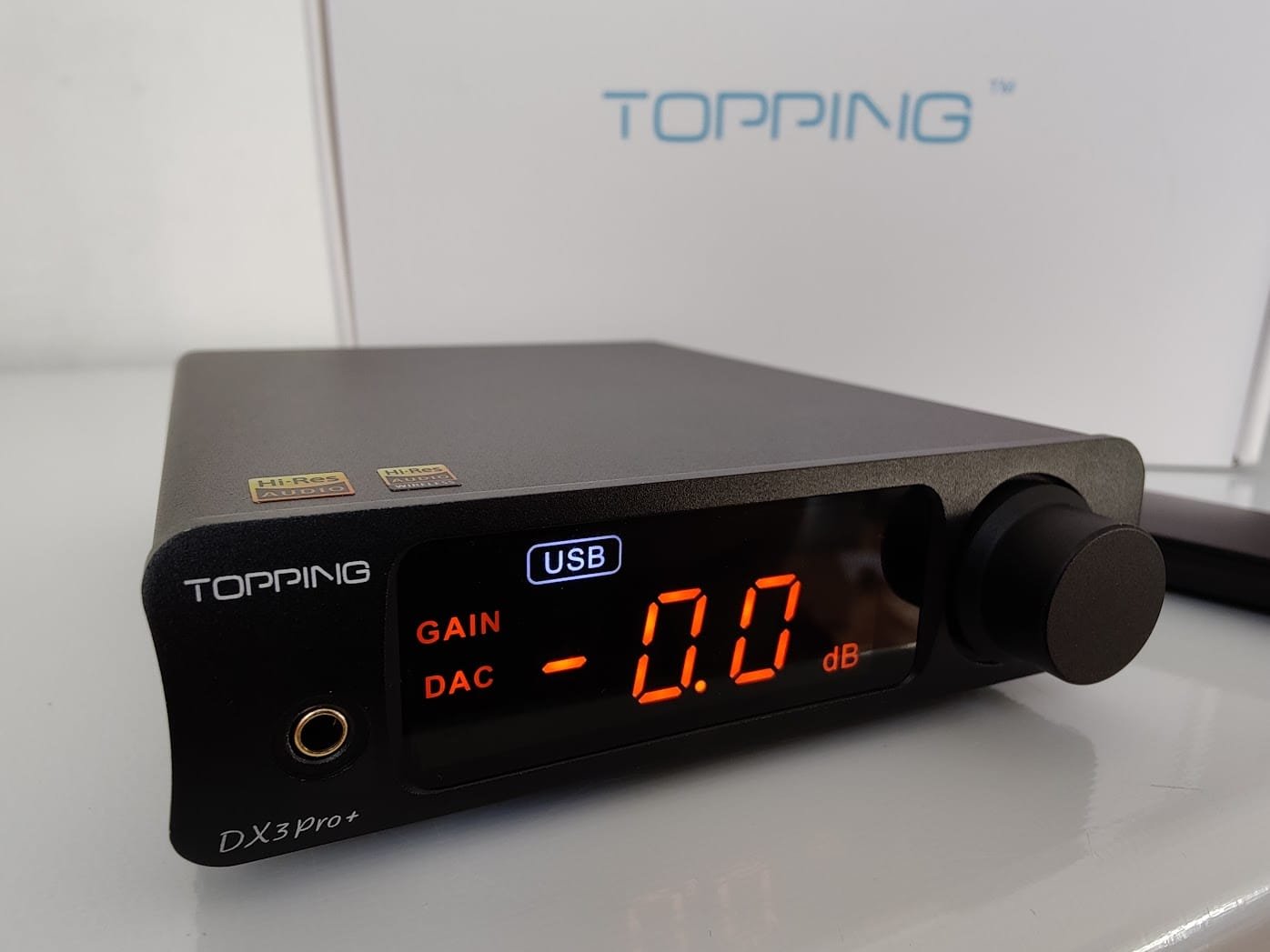
Table of Contents:
Information:
- Publication year: 2021
- Price: 199 €
- Country of Origin: China
- Type: DAC & headphone amplifier and preamplifier
- DAC chip: ES9038Q2M
- Input connections: USB-B, 2x Coaxial, Optical and Bluetooth 5.0
- Output connections: RCA
- Headphone connectors: 3.5 mm
- Supported Bluetooth codecs: LDAC, APTX, APTX LL, APTX HD, AAC and SBC
- Sampling rate (USB) PCM: 44.1–768 kHz (16–32 bit)
- Sampling rate (USB) DSD: DSD64–DSD512 (native)
- Sampling rate (Coaxial) PCM: 44.1–192 kHz (16–24 bit)
- Sampling rate (Optical) PCM: 44.1–192 kHz (16–24 bit)
- Sampling rate (Bluetooth) PCM: up to 96 kHz
- Output voltage (RCA): 2.1 V
- Headphone amplifier output impedance: < 0.1 ohm
- Two gain levels: low +6 dB and high +19 dB
- Headphone amplifier stated output power: 1800 mW @ 32 ohm / 250 mW @ 300 ohm
- External dimensions: 120 x 165 x 40 mm
- Weight: 400 g
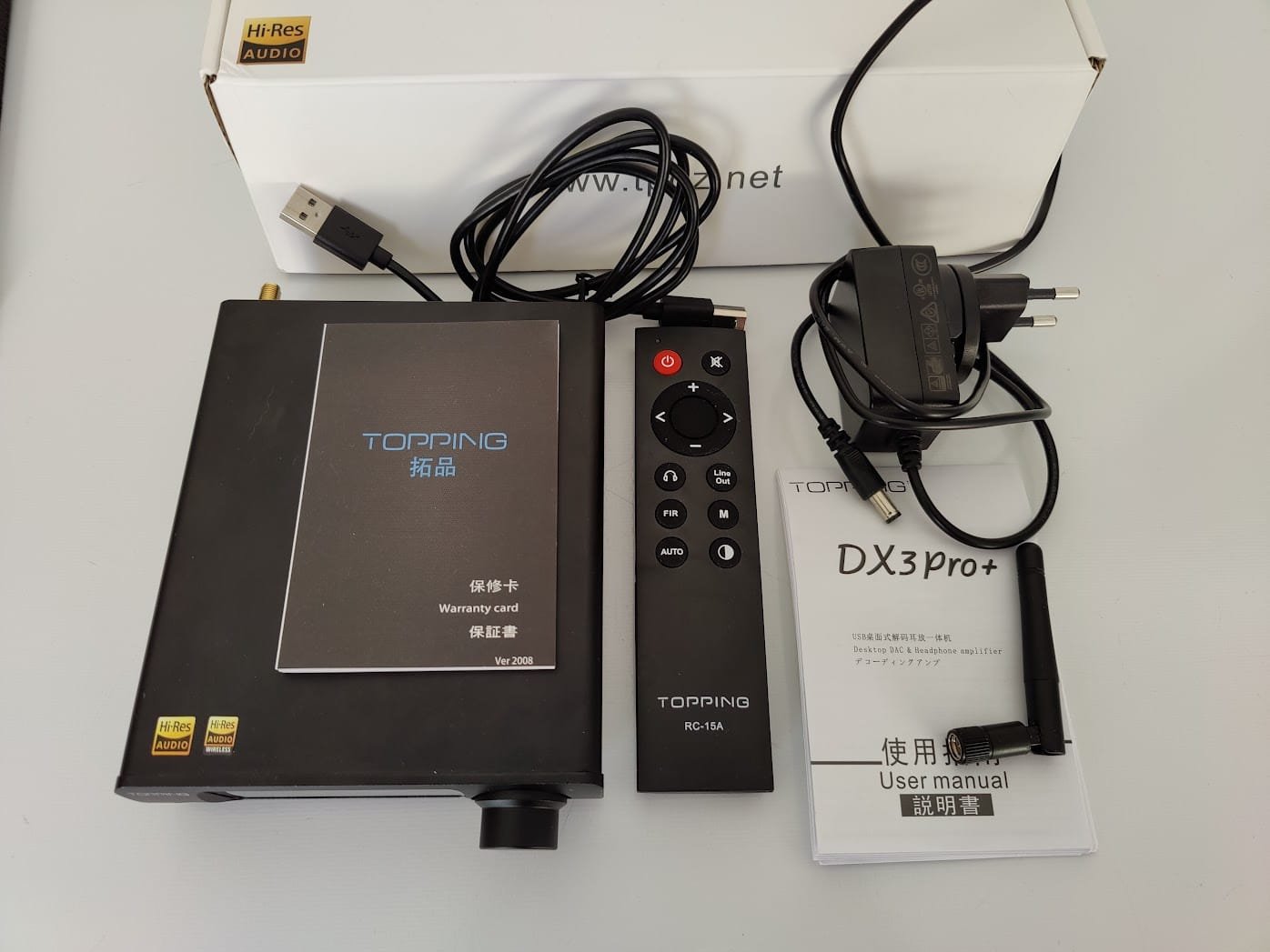
- Included: Remote control, USB cable and Bluetooth antenna
Review unit acquisition method: Loaned from a reseller/importer
The DX3 Pro+, which functions as a D/A converter, headphone amplifier, and preamplifier (link to the manufacturer's product page) is one of Chinese Topping's most popular products. This is no surprise, as despite its affordable 200 euro price, the device has been fitted with a wealth of features and functions.
The manufacturer has made many improvements compared to the older DX3 Pro model. Firstly, the CSR8675 Bluetooth chip has been updated to the QCC5125 chip, the headphone amplifier's output power has more than doubled, and the output impedance has also been dropped from a somewhat problematic 10 ohms to near zero. In addition, the DAC's THD+N values are 60 percent lower, and for the headphone amplifier, the improvement on the same metric is as much as 85 percent.
Of course, these percentage improvements have no practical significance, as no one can hear whether the THD+N is 0.0004% or 0.00015%. One could even say that with ever-better measurable devices, we have comically entered an era where marketing a product with objective performance values might be selling snake oil, just like selling devices with invented subjective platitudes. Platitudes (and also a few ”curses”) can also be found in this review.
We received the DX3 Pro+ for testing on loan from Hifitalo, for which we extend our great thanks.
Features and device use
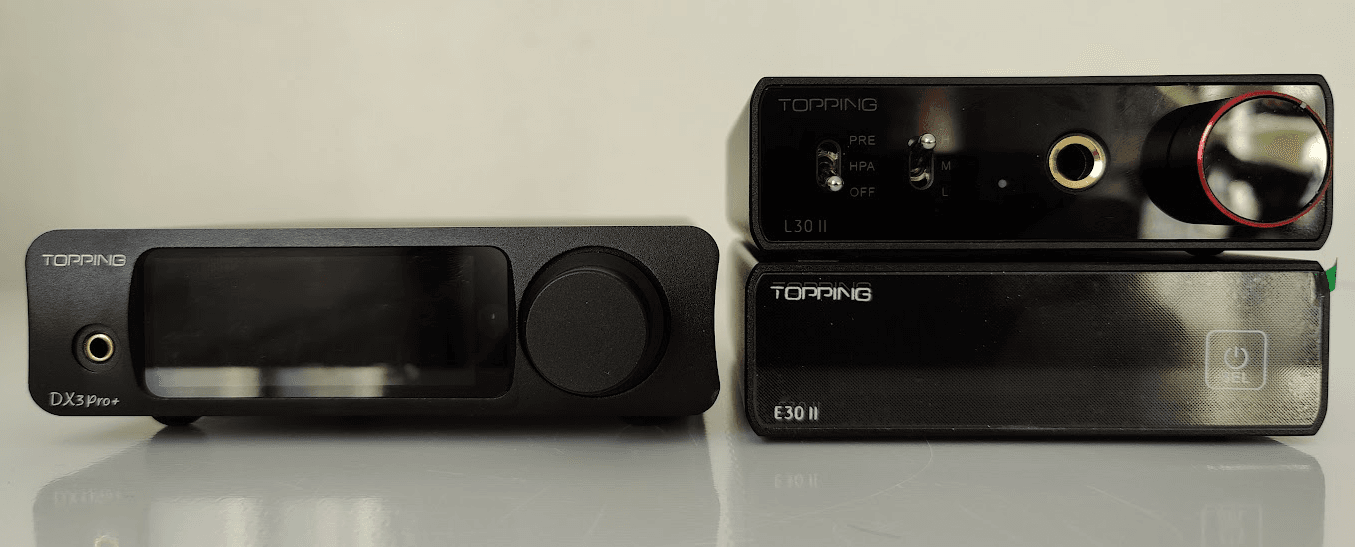
In my opinion, the DX3 Pro+ is a successful device in terms of appearance. The outer casing is made entirely of metal, and the inwardly curved side panels are pleasing to the eye. For comparison, the Topping E30 II & L30 II device combination looks considerably duller on the table.
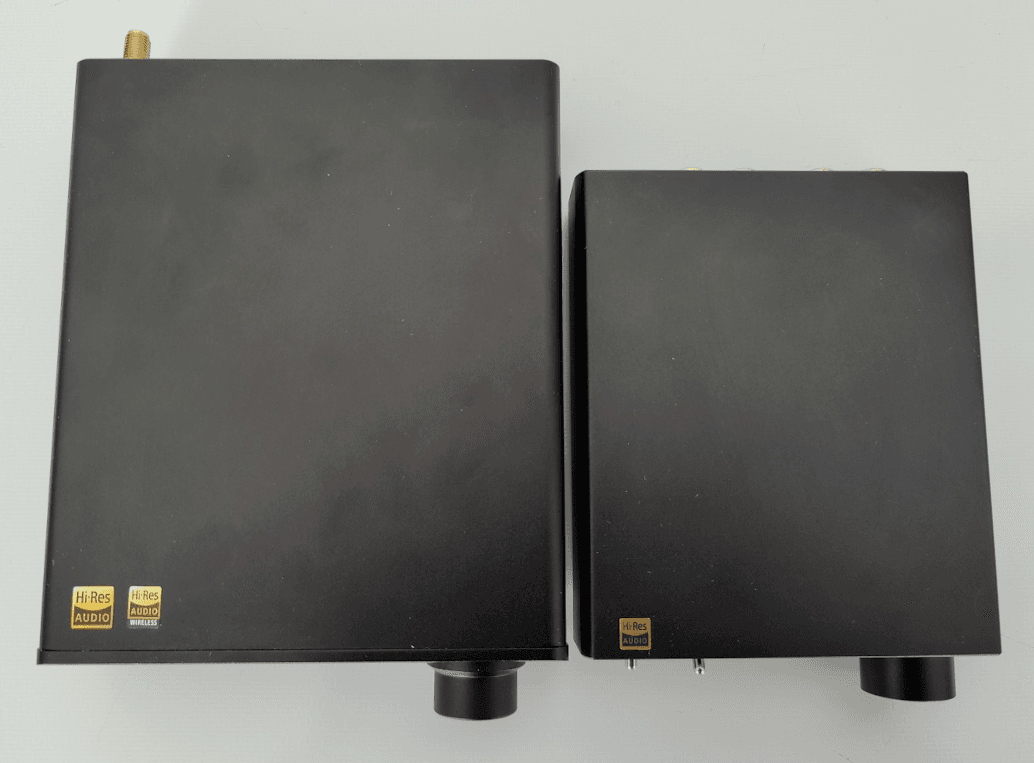
To the L30 II headphone amplifier (link to previous review) compared, the DX3 Pro+'s power supply is clearly smaller in size, and its cable is about 20 centimeters longer. The L30 II's heavy power supply and short cable make it difficult to use, so the DX3 Pro+ is better in that regard. The DX3 model also earns a few extra points for the USB cable, similar to the E30 II DAC, which says Topping. A branded USB cable is a small detail for the overall package, but I like that the manufacturer's cables can be connected to the device itself. Since I test many different devices, selling them on is also more pleasant when it's easy to find the cable that originally came with the product in the package.
The DX3 Pro+ gets a minus from me for poor quality control, as all connectors wobble slightly. The defect appears in both the front headphone jack and the rear connections, so it would seem that the circuit board is not properly attached to the casing. Secondly, I don't like that the device only has a 3.5 mm connection for headphones. Most headphones are suitable for listening with it, but the more common 6.35 mm connector in headphone cables always requires the use of a separate adapter (6.35 mm -> 3.5 mm). Such adapters are somewhat rarer and, due to their large size, they also put quite a lot of strain on the device's female connector. Torque applied to the connector easily leads to contact problems, which may render the amplifier unusable prematurely. If there is a more permanent need for an adapter with the DX3 Pro+, I think it would be advisable to acquire an adapter cable that puts less strain on the headphone jack.
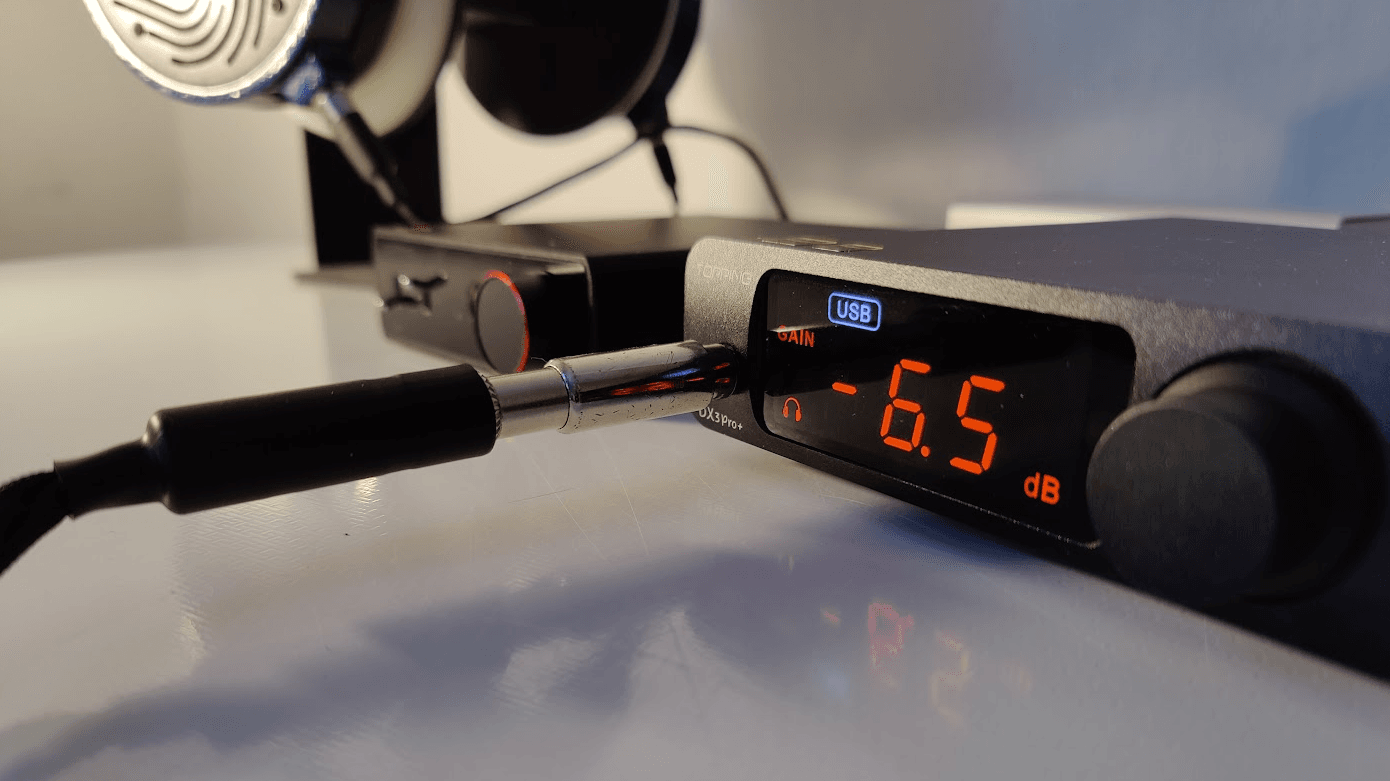
The device's display is very similar to the manufacturer's E30 II DAC. The orange text stands out clearly even from a distance, which is important if the device is used as a preamplifier controlled by a remote. I actually like using the remote control, even if I'm sitting near the device. If all features are to be utilized, using the remote control cannot even be avoided. The volume knob on the front of the device acts as a selector/multifunction button when pressed, but changing settings with it is difficult due to the complex menu.
The volume control is quite peculiar in other ways too. The stepped adjustment clicks strongly with each movement. I found it quite strange at first, but after using the device for a longer time, I started to like this characteristic. Mechanical levers generally appeal to me more than, for example, touchscreens. The DX3 Pro+ excellently combines the perfect channel balance of digital volume control with the tactile feel of analog adjustment.
Various settings and headaches
The basic functions of the device are logical and easy to use. However, when delving deeper into the settings, the situation becomes more confusing because using the menu is infuriating. All settings are cryptic, so they must be interpreted with the help of the user manual.
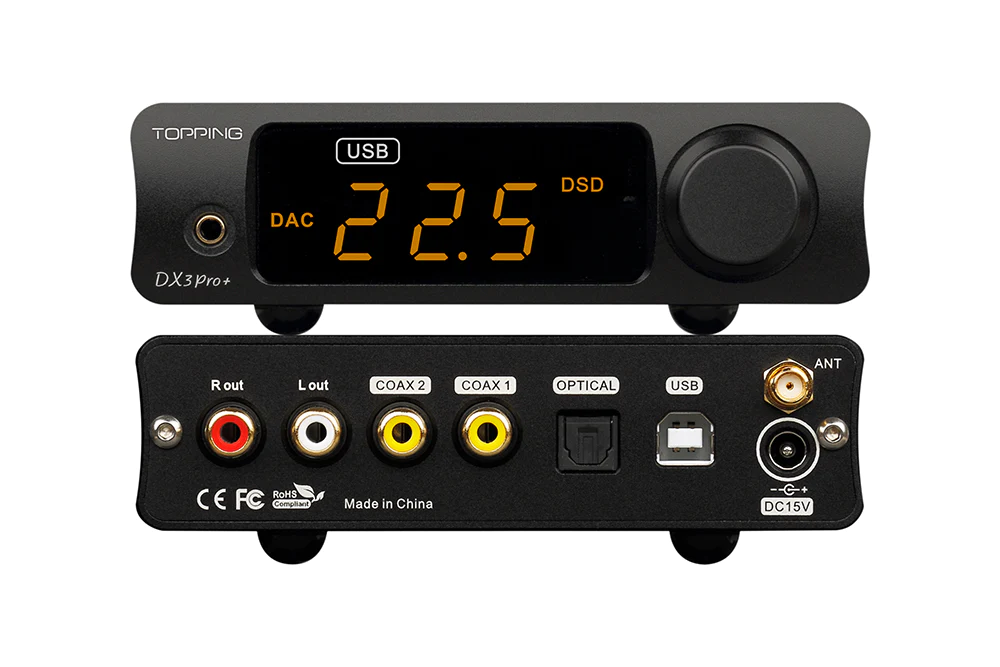
The DAC chip features 7 audio filters, whose names are displayed on the device's screen as F-1, F-2, F-3, and so on. The correct names are only revealed in the user manual, which also includes graphs illustrating the filters' effect on sound. I didn't compare the different filters in any more detail, but with a quick listen, I didn't notice any difference between them this time either.
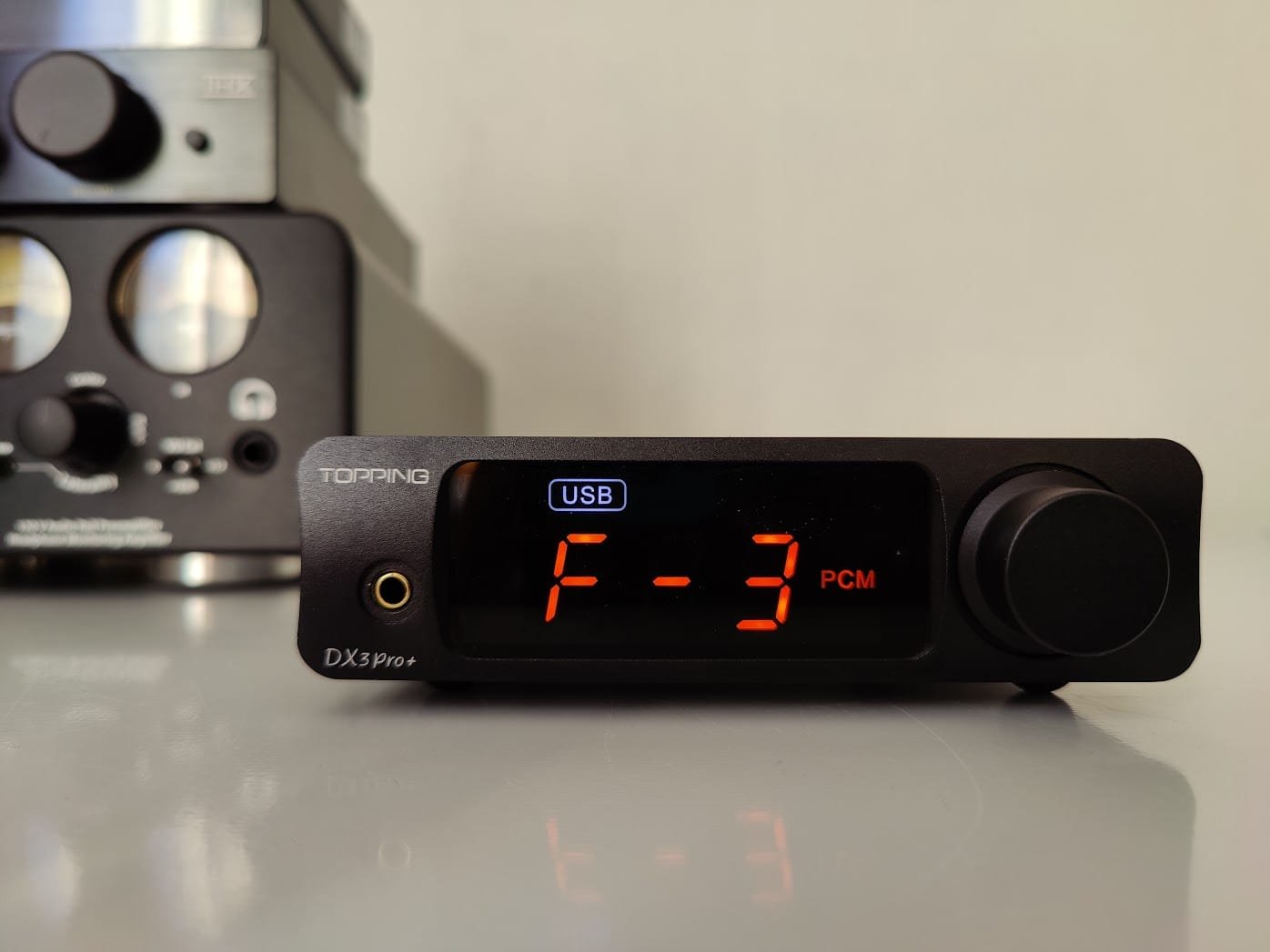
The device's standby setting is adjusted with the remote control's Auto button. With the A-0 selection, the device goes into standby if it does not receive an audio signal for one minute. In the A-C position, the feature is off. Why couldn't the settings have been named more logically, for example, ON and OFF? Only the gain setting is clear without having to interpret it with the user manual: when high-gain is selected, the display shows ”Gain”, whereas in low-gain mode, the text disappears. However, setting the gain level has been implemented somewhat problematically, because pressing the M button immediately adjusts the gain up or down depending on which state it happened to be in previously. The button's name does not refer to volume adjustment in any way, so allowing for a sudden and significant (possibly accidental) increase in volume is, in my opinion, irresponsible behavior from Topping.
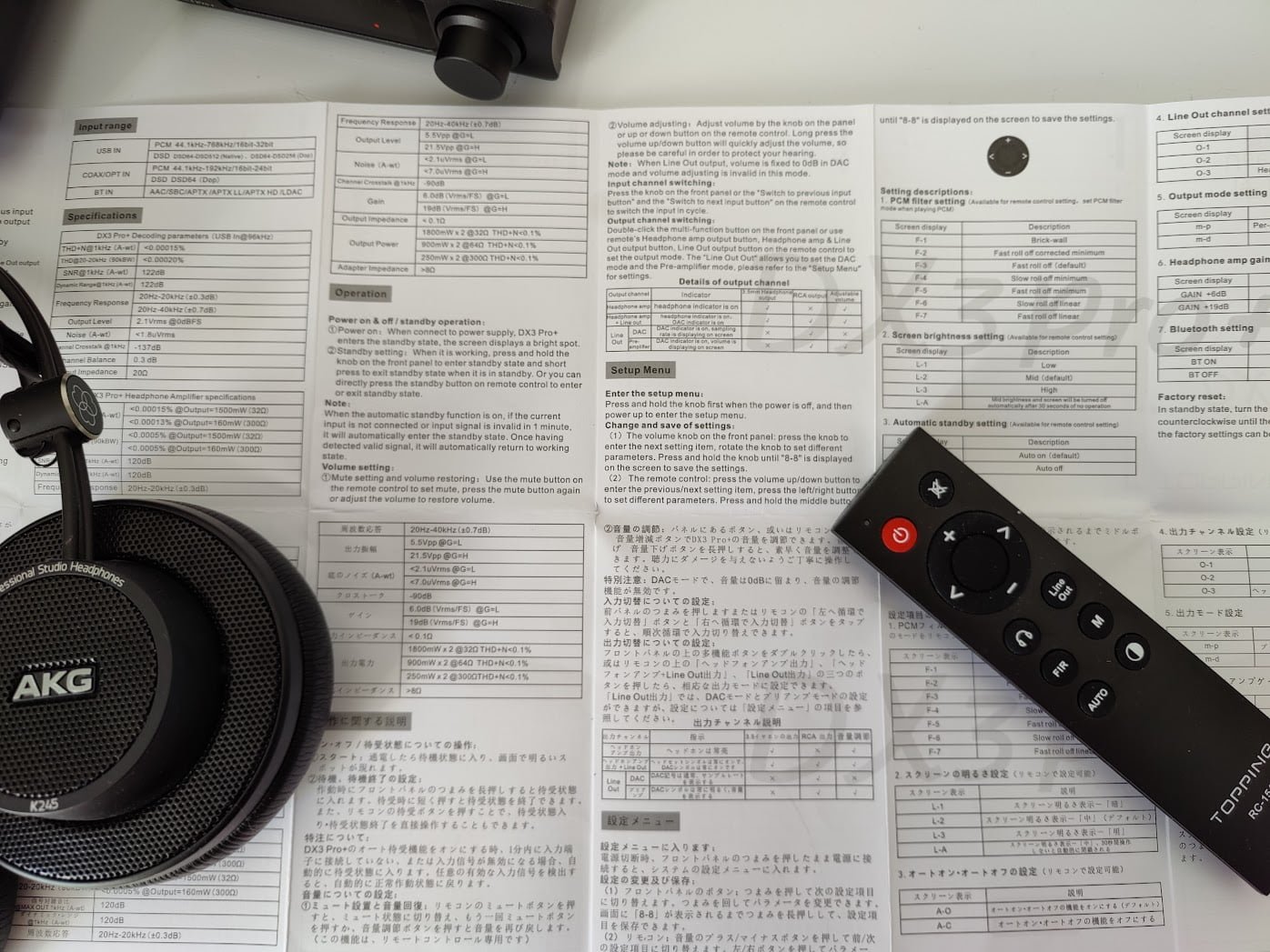
When learning the DX3 Pro+”s user interface, the most difficulty for me was setting the device to function as a pure DAC without volume control. Pressing the remote control's ”line out”-button flashes the text 0-1 on the screen, which, according to the manual, should mean that I have achieved my goal. However, since volume control was still available after this, I was not yet in DAC mode.
Digging out the manual again revealed that I actually needed to get to the ”m-d” mode, which is found via the ”setup menu”. I incorrectly interpreted that ”Press and hold the knob first when the power is off, and then power up to enter setup menu” means that I can access the aforementioned ”setup menu” by pressing and holding the front multifunction button while powering on the device with the remote control. After a new attempt, the text ”dFU”, which presumably meant ”Device Firmware Upgrade”. According to the manual, I should be able to access different menus by pressing the multi-function button, but nothing happened. The device was clearly stuck dFUin a mode from which I could only exit by unplugging the power cord from the wall. Fortunately, apart from the Tidal streaming service crashing, nothing more serious seemed to have happened.
The M-d mode was not found until I found a tip on the Internet that the ”setup menu” can be accessed by pressing and holding the multi-function button while the DX3 Pro+ is plugged into an outlet. The ”Power up” section of the instructions meant turning on the power, which does not happen when the plug is in the wall, because the device is then in standby mode, and not completely powered off. In my case, accessing the ”setup menu” was still impossible because I couldn't simultaneously reach the power outlet located behind the table at floor level and the device on the table. However, I still moved to another power outlet to adjust the device settings.
Now I got a mysterious F-4 code on the display. As a result of further button pressing, L-3 (display brightness adjustment), A-0 (automatic standby setting) and 0-1 (Line out output) flashed on the screen, until finally ”m-p” was found, which could be changed to ”m-d”. Settings are saved by rotating the pressed multi-function button until the display reads 8-8. However, the device does not guide you to save the settings in any way, so this information also had to be found in the user manual. In a normally designed device, pressing the ”line out” button would have cycled me through the selectable modes, or a volume-locked DAC mode would have been selectable with a separate switch on the back of the device, such as in the iFi Zen DAC V2. The ”operating system” of the DX3 Pro+, like other Topping devices, would have a lot of room for improvement.

Sound quality as a combination device
The DX3 Pro+ plays almost effortlessly. The device does not draw attention with, for example, a large soundstage or explosive dynamics. On the other hand, it's difficult to find glaring weaknesses in the sound either. I tested the device with several different headphones, such as Focal Clear, Hifiman Edition XS, Hifiman Sundara, Modhouse Argon mk3, Sennheiser HD6XX, Audio-Technica R70X, SASH Tres (two different models) and ZMF Verite Open. The DX3 Pro+ amplifies all headphones effortlessly. No headphone pairing stood out as particularly good, but only the Sennheiser HD6XX, Audio-Technica R70X, and ZMF Verite Open sounded worse than average. I encountered the same when testing Topping's L30 II amplifier, so I'm coming to the conclusion that there's something in the manufacturer's NFCA-technology-based amplifiers that makes high-impedance headphones sound mediocre to my taste.
A positive surprise, however, was the amplifier's good performance with 16-ohm SASH Tres and Hifiman planar headphones. Low-impedance headphones, such as the Hifiman Sundara with 37 ohms impedance and 94 decibels sensitivity, have been claimed to easily trigger the DX3 Pro+'s overload protection, but in my stress tests, the amplifier remained stable and didn't even get very warm. The sound also remained clean with all headphones even when listening loudly, even though Audio Science Review's (ASR) test states that the DX3 Pro+ should have problems with low-impedance headphones. I apparently don't listen to headphones loudly enough for the problems measured by ASR to become apparent.
As a combo device, the DX3 Pro+ is therefore quite good, even if it doesn't cause outright shouts of joy. Next, let's examine the device's performance by comparing it to another good combo device.
DX3 Pro+ vs. iFi Zen DAC V2
Prices: 200 € vs. 200 €
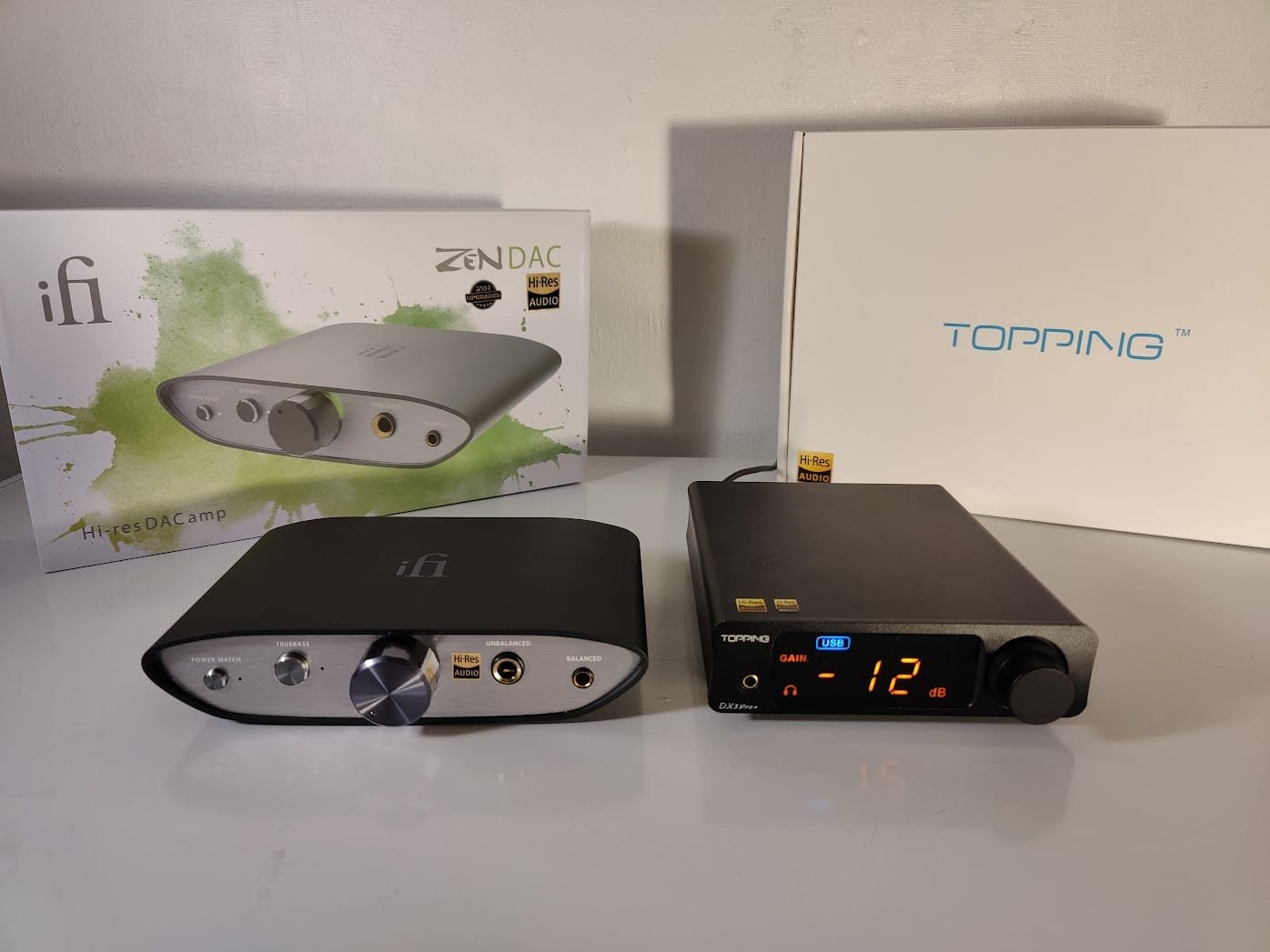
Key differences in device features:
- The Topping DX3 Pro+ comes with a remote control
- The Topping model has a display and supports Bluetooth connectivity
- The iFi Zen DAC V2 has both 6.35 mm and 4.4 mm headphone jacks, while the DX3 Pro+ only has a 3.5 mm jack
- Topping's headphone amplifier is more powerful
- The DX3 Pro+ has an ESS DAC chip and the Zen DAC V2 has a Burr Brown chip
- Topping has various audio filters offered by the ESS chip manufacturer as an additional feature, and iFi has the TrueBass feature. The differences between the filters are almost non-existent, whereas TrueBass is a genuinely fun addition
- In addition to a USB input, the DX3 Pro+ has an optical connection and two coaxial connections, but no balanced output, unlike the Zen DAC V2
- The Zen DAC V2 can draw power directly from a computer's USB port. However, a power supply must be purchased separately for connection to mains power
- The iFi model comes with RCA cables
- The Zen DAC V2 has MQA support (though the lack of support does not prevent the use of the Tidal streaming service with the DX3 Pro+)
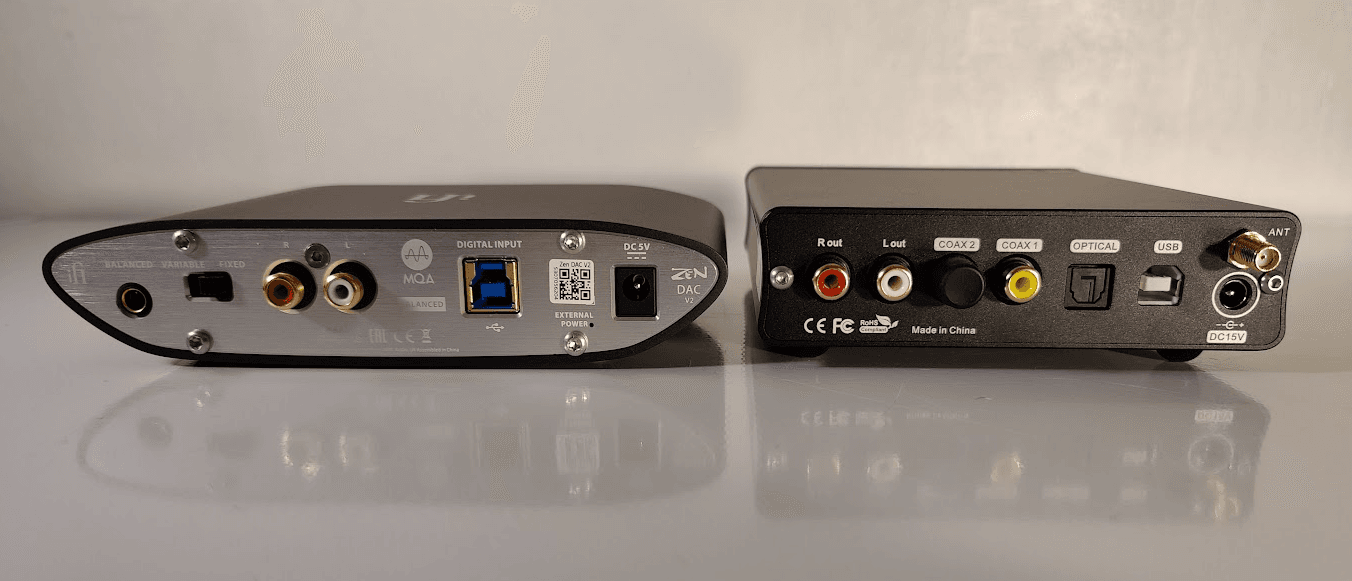
Differences in sound quality:
Firstly, when listening, the treble of the DX3 Pro+ draws more attention to itself. However, this is neither a good nor a bad thing. With the Topping device, it is easier to discern the structure of sounds, and the sound is also slightly more detailed. The Zen DAC V2 (link to previous review) in turn sounds fuller and more dynamic, and the soundstage is larger. With the iFi device, the sound fills the space better, while Topping draws a smaller, but slightly more precise soundscape.
The biggest difference between the devices, in my opinion, is that music plays more effortlessly with the Zen DAC. Although the DX3 Pro+ is the more powerful amplifier of the two, it sounds a little tight. The iFi device pleases me more because when using it, I find it easier to immerse myself in listening to the music itself. With the DX3 Pro+, I am more easily sidetracked into analyzing the sound. On the other hand, when I specifically want to listen to music with an analytical approach, the Topping model's presentation style suits that better than the iFi.
I compared the devices with several headphones. The Zen DAC V2 was clearly better with the Sennheiser HD6XX, in my opinion. With the Focal Clear, the difference between the devices was quite negligible, but I slightly preferred the Zen DAC. The Hifiman Edition XS and SASH Tres, on the other hand, benefited from the DX3 Pro+'s more powerful headphone amplifier. Without a separate power supply and a balanced cable, I cannot recommend the Zen DAC for planar headphones with higher amplification needs.
If it's not possible to test both devices before making a purchase decision, the choice should be made based on features. For planar headphone owners, I would recommend the Topping model from the duo. Zen DAC V2, on the other hand, works better with high-impedance headphones in my opinion. If the headphones are not demanding in terms of amplification, the differences between the devices will be smaller. Both sound almost flawless for their price.
Use as a D/A converter: DX3 Pro+ vs. E30 II
Prices: 200 € vs. 150 €

Testing method:
I connected both DACs to a Schiit SYS device, which transferred the audio signal to the Topping L30 II headphone amplifier. SYS is a passive preamplifier, which allowed me to quickly switch the audio source (DAC) by pressing a button. With the help of Voicemeeter Banana software, I was able to play audio from the computer simultaneously to both DACs. Thus, I did not have to touch the Windows operating system's sound settings when changing the audio source.
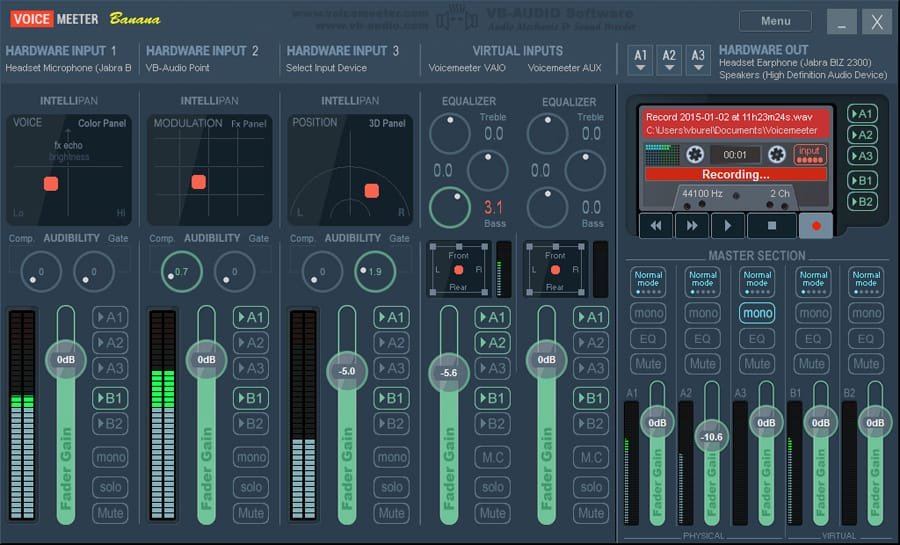
I used the MiniDSP EARS device to equalize the volume of both DACs to be identical for the SASH Tres headphones I used. The volume of the DX3 Pro+ had to be reduced by one step, i.e., 0.5 decibels. After the adjustment, the volumes of the devices settled within 0.1-0.3 decibels of each other, depending on the frequency. I myself cannot hear such a small difference, so with an assistant, it would be possible to conduct a fairly good blind test with such a setup.
While preparing the comparison situation for quite a long time, I accidentally forgot which way I had connected the DACs to the SYS preamplifier. So, during the comparison, I didn't know whether the L30 II amplifier was receiving the audio signal from the DX3 Pro+ or the E30 II at any given moment. If I had had a subconscious need to favor one of the devices, I got rid of it by chance.
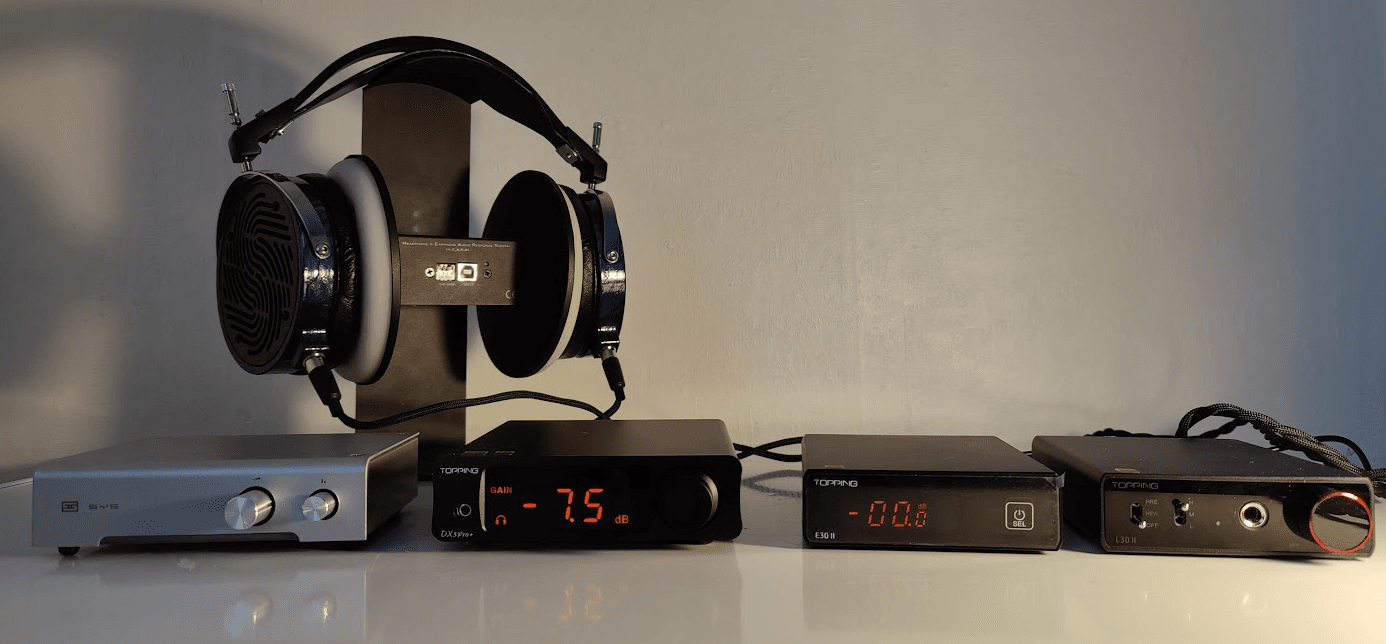
Differences in sound quality:
As many might have guessed, the manufacturer's two DACs sounded almost identical. In my opinion, however, one of them sounded slightly clearer and more defined in its outlines, and also had a slightly larger soundstage. Despite everything, the differences were insignificantly small. After a while, I even forgot which DAC I was listening to.
It is entirely possible that I didn't even truly perceive small differences, but rather imagined them because I knew when the device switched to another. However, listening to the devices for a longer time, I noticed that every time I perceived the soundstage as better, it was the same DAC. Conversely, when I sensed the sound as slightly duller, I had been listening to the other device of the duo. Based on this, small differences probably exist. The more spacious-sounding DAC eventually turned out to be the DX3 Pro+. However, I cannot truly claim it to be better, because the E30 II sounded so similar most of the time that I couldn't distinguish between the two.
I will continue to do more DAC comparisons like this in the future. Although setting up the test situation and measuring the devices is a bit laborious, it is also worth the effort. When it's possible to switch from one device to another without delay, it's harder to imagine differences between them. Even a couple of seconds of delay is enough for the previous sound to partially ”fade away,” which can make the sound of the next device feel more different than it actually is.
In DAC-only use, the DX3 Pro+ performs well, at least when compared to the manufacturer's own device, which is roughly the same price. Since many might be choosing between the DX3 Pro+ and the E30 II & L30 II combination, which costs about 100 euros more, I will finally compare the performance of the DX3 Pro+'s headphone amplifier to the L30 II.
Use as a headphone amplifier: DX3 Pro+ vs. L30 II
Prices: 200 € vs. 150 €
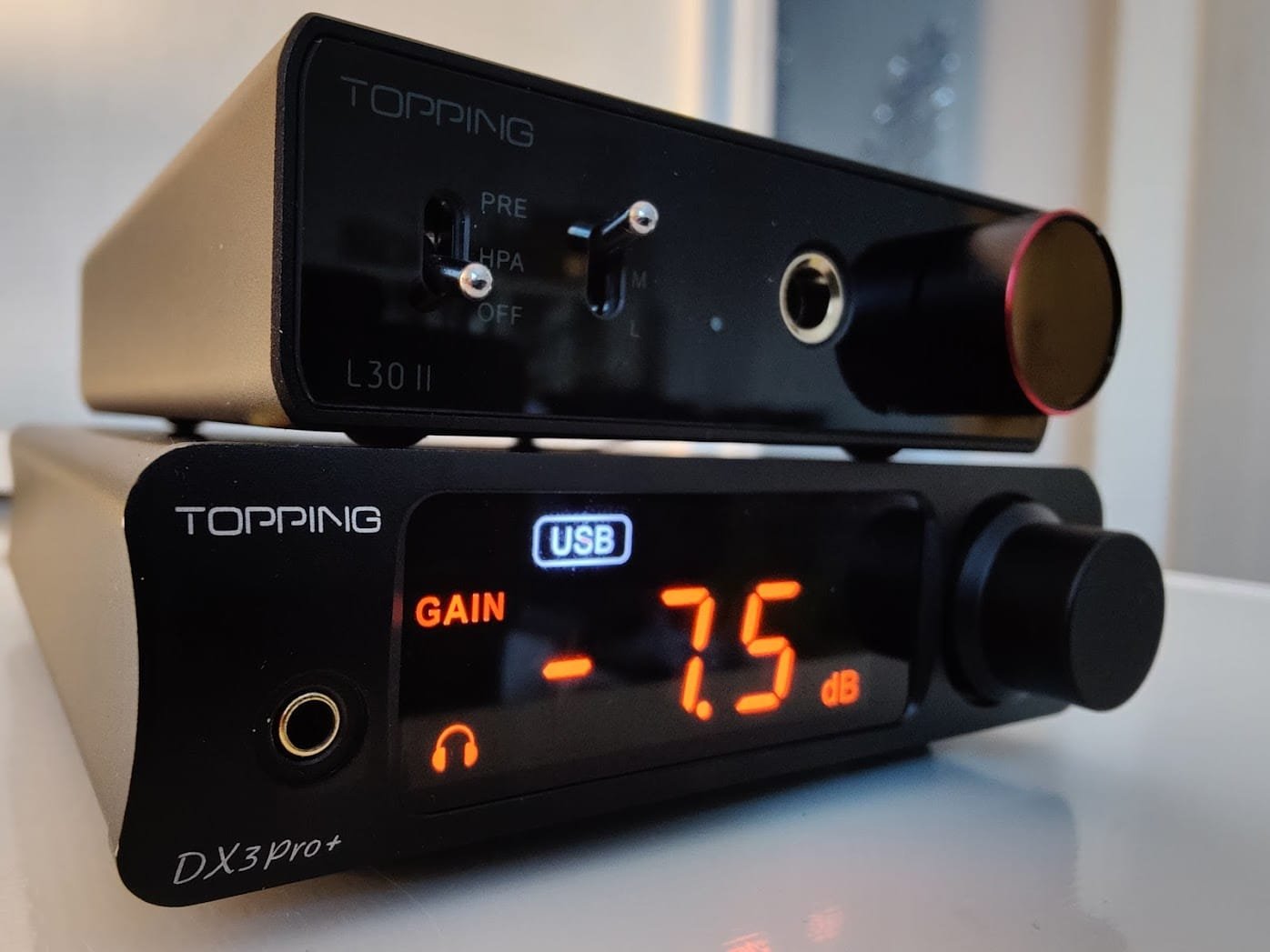
Right at the beginning of the comparison, it became clear that the two Topping amplifiers sounded very similar. For example, when listening to the Focal Clear, which requires little power, the DX3 Pro+ and L30 II were practically indistinguishable. Both amplifiers reproduce sound cleanly. The end result cannot be faulted, but neither device offers anything particularly memorable or special. I also couldn't distinguish the devices from each other with the 300-ohm impedance ZMF Verite Open. However, neither amplifier sounded particularly good with high-impedance dynamic headphones for one reason or another.
With SASH Tres planar headphones, there was a slight difference between the devices. The L30 II made the headphones sound more relaxed, making the music easier to listen to. The DX3 Pro+ sounded forced in the same way as with the ZMF Verite. However, we cannot speak of a night and day difference. The situation might change with, for example, Abyss AB-1266 headphones, but unfortunately, I don't own an adapter that would allow me to try them from the DX3 Pro+'s 3.5 mm headphone jack. However, in my opinion, it is clear that for headphones requiring a lot of power, the L30 II is the better choice as an amplifier of the two. This is actually the only significant difference between the devices.
Summary
The Topping DX3 Pro+ managed to both delight and frustrate. However, the device's problems are such that, depending on the use case, they may not necessarily be a hindrance (impractical adapter-requiring headphone jack and poor sound quality with high-impedance headphones), or they don't need to be dealt with very often (cumbersome menu structure and unclear settings).
The device's greatest strength is its versatility relative to its relatively low selling price. If someone needs a single device at the heart of their affordable hi-fi system, it's hard to imagine a better alternative. The DX3 Pro+, together with, for example, the Topping PA3s stereo amplifier, would form a very compact and versatile combination for both headphones and speakers for 350 euros. However, I have not heard the PA3s, so I cannot personally recommend it, even though its dimensions would make it a logical partner for the DX3 Pro+.

If someone doesn't need a remote control or Bluetooth connectivity, iFi's Zen DAC V2 is still, in my opinion, a better choice in terms of sound quality than the DX3 Pro+. However, the Zen DAC is not as powerful as a headphone amplifier as the DX3 Pro+, whose power is sufficient for almost all headphones. When looking for even more powerful amplification, the manufacturer's E30 II & L30 II combination could be considered, but the combined price of the two separate devices is 100 euros more, and RCA cables must also be purchased separately between them.
For those looking for an affordable all-in-one device, there are, of course, other options besides Topping's and iFi's products. However, most devices usually have shortcomings that they compensate for by excelling in a single area. For a beginner enthusiast, the DX3 Pro+ might actually be the best option of all. It's not particularly good at anything, but still good enough in every way.
Pros and cons:
+ Powerful headphone amplifier compared to other affordable all-in-one devices
+ As a D/A converter, as good as most separate devices in the same price range
+ Clean sound with all types of headphones
+ Remote control included
+ The device has a display
+ Bluetooth connectivity support
+ Excellent volume control in terms of channel balance and user feel
+ Excellent value for money considering its versatility
– The device only has a 3.5 mm headphone jack
– There are problems with quality control (wobbly circuit board)
– Mediocre sound quality with high-impedance headphones
– Confusing menus and settings, requiring constant browsing of the user manual for interpretation
– No balanced output connections, which is, on the other hand, quite understandable considering the price and the abundance of other features
 EN
EN  FI
FI
” In my case, accessing the “setup menu” was still impossible because I couldn't simultaneously reach the power outlet located behind the table at floor level and the device on the table. However, I still moved to adjust the device's settings near another power outlet.”
A lazier person would have unplugged the power cord from the back of the device. It's only 10 centimeters from the knob.
True 😀 However, it is generally safer to connect the device to the mains power last, especially in cases where the device does not have a separate power switch. If the connector makes smooth contact and the device is correctly designed, there is indeed only a small risk of something going wrong, but especially with borrowed devices, I try to avoid such ”laziness”.
Thanks for the review.
Is it possible to get a review and a similar comparison of the FIIO K7 BT DAC device, which is almost the same price?
This price range is particularly interesting in these.
Currently, there are no plans for a Fiio review, unless one happens to fall into our lap. A review of the Sound Blaster X5 is coming. It would be in almost the same price range. The X5 should be specifically designed for hi-fi use, even though it has features useful for gaming.
Possibly, there will also be an article about the Rod Rain D10, if anyone is interested in such a device. The D10 is a somewhat lesser-known device and only available from AliExpress/eBay. In the 200 euro price range, it is a very interesting case if you are interested in a DAC with XLR outputs.