Author: Roderick

Table of Contents:
Information:
- Release year: 2021 (original model in 2019)
- Price: 199 €
- Type: DAC and headphone amplifier
- DAC chip: Burr Brown
- MQA support
- Input connections: USB-B 3.0 (USB 2.0 compatible)
- Output connections: RCA and 4.4 mm pentaconn (balanced)
- Headphone connectors: 6.35 mm and 4.4 mm pentaconn (balanced)
- Sampling frequency PCM: 44.1–384 kHz
- Sampling frequency DSD: DSD64–DSD256
- Sampling frequency DXD: 352.8–768 kHz
- Output voltage RCA: 2.1 V (fixed) and 1–3.3 V (variable)
- Output voltage 4.4 mm pentaconn: 4.2 V (fixed) and 2–6.2 V (variable)
- Headphone amplifier stated output power (with 5 volt power supply): balanced 330 mW @ 32 ohm and 6.6 V @ 600 ohm // unbalanced 230 mW @ 32 ohm and 3.3 V @ 600 ohm
- Headphone amplifier output impedance: < 1 ohm
- Power consumption: < 1.5 W (USB)
- Dimensions: 160 x 117 x 30 mm
- Weight: 0.8 kg
- Features: TRUEBASS (analog bass EQ) and Power Match (2 gain settings)
- Included: Short RCA cables, short USB cable, 6.35 mm adapter and user manual
Review unit acquisition method: Loaned from a reseller
British iFi's Zen DAC is one of the most popular affordable combination devices containing a D/A converter and headphone amplifier. Its distinctive appearance has previously caught my attention, but I haven't had the chance to listen to the device. Now, however, the opportunity arose after we received from Joensuu Kuvalta ja Ääneltä on loan the latest V2 model of the device, which includes, among other things, a more powerful XMOS processor and more comprehensive MQA support compared to the original Zen DAC.
Features and device use
The Zen DAC V2 comes with RCA cables, a USB-B 3.0 cable, and an adapter that converts a 3.5 mm connector to a 6.35 mm connector. A separate power supply is not included with the device, so it must either be purchased separately or one must be content with the power provided by the USB connection. It is actually quite convenient that the device does not need to be plugged into a separate power outlet.
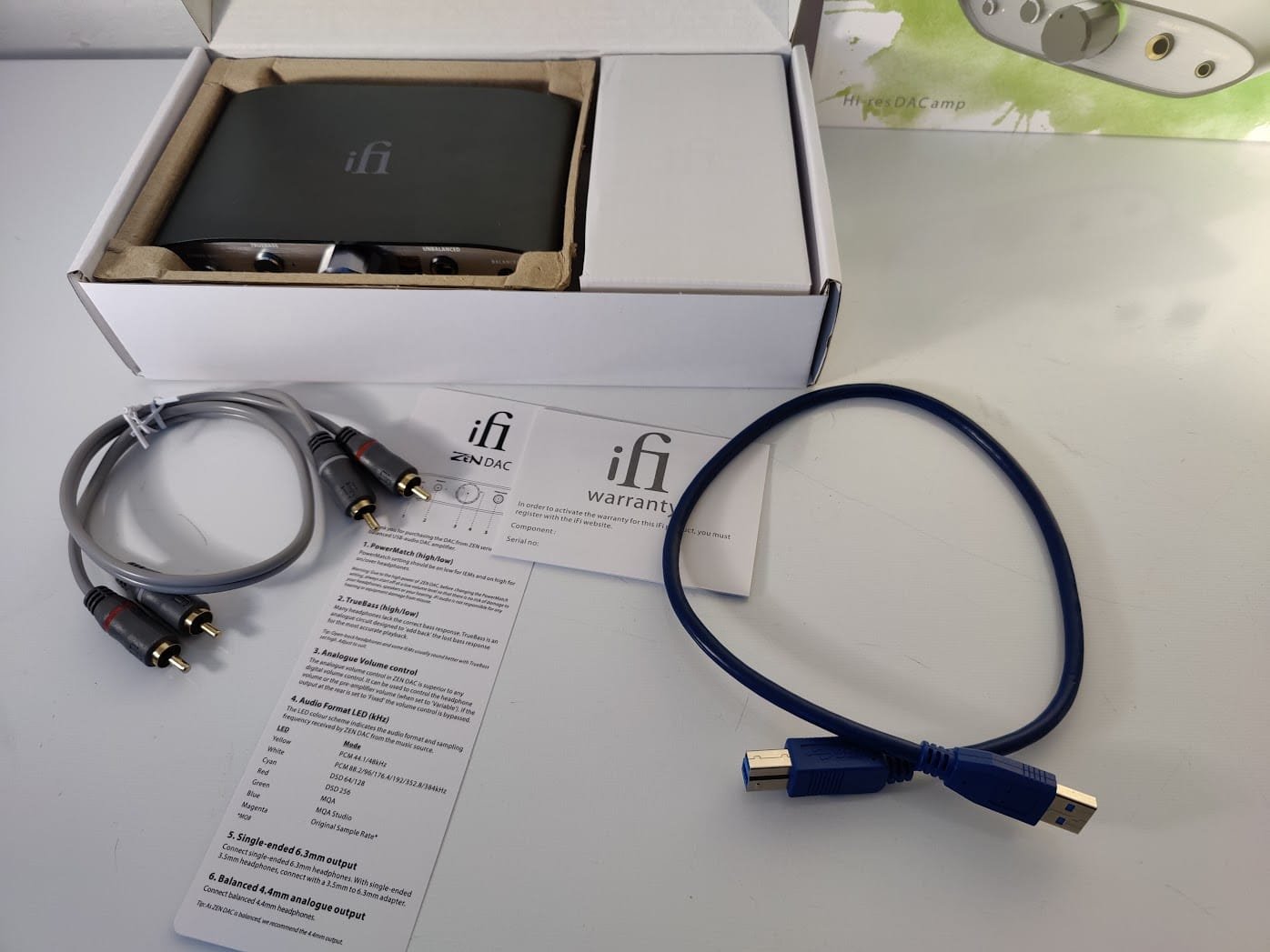
The Zen DAC features the distinctive personal design characteristic of the manufacturer's ZEN series. The entirely aluminum casing is truly high-quality for its price. It has no sharp corners whatsoever. The rounded edges are actually also practical, as the device is easy to place on a table slightly diagonally with one hand without the corners hitting the table.
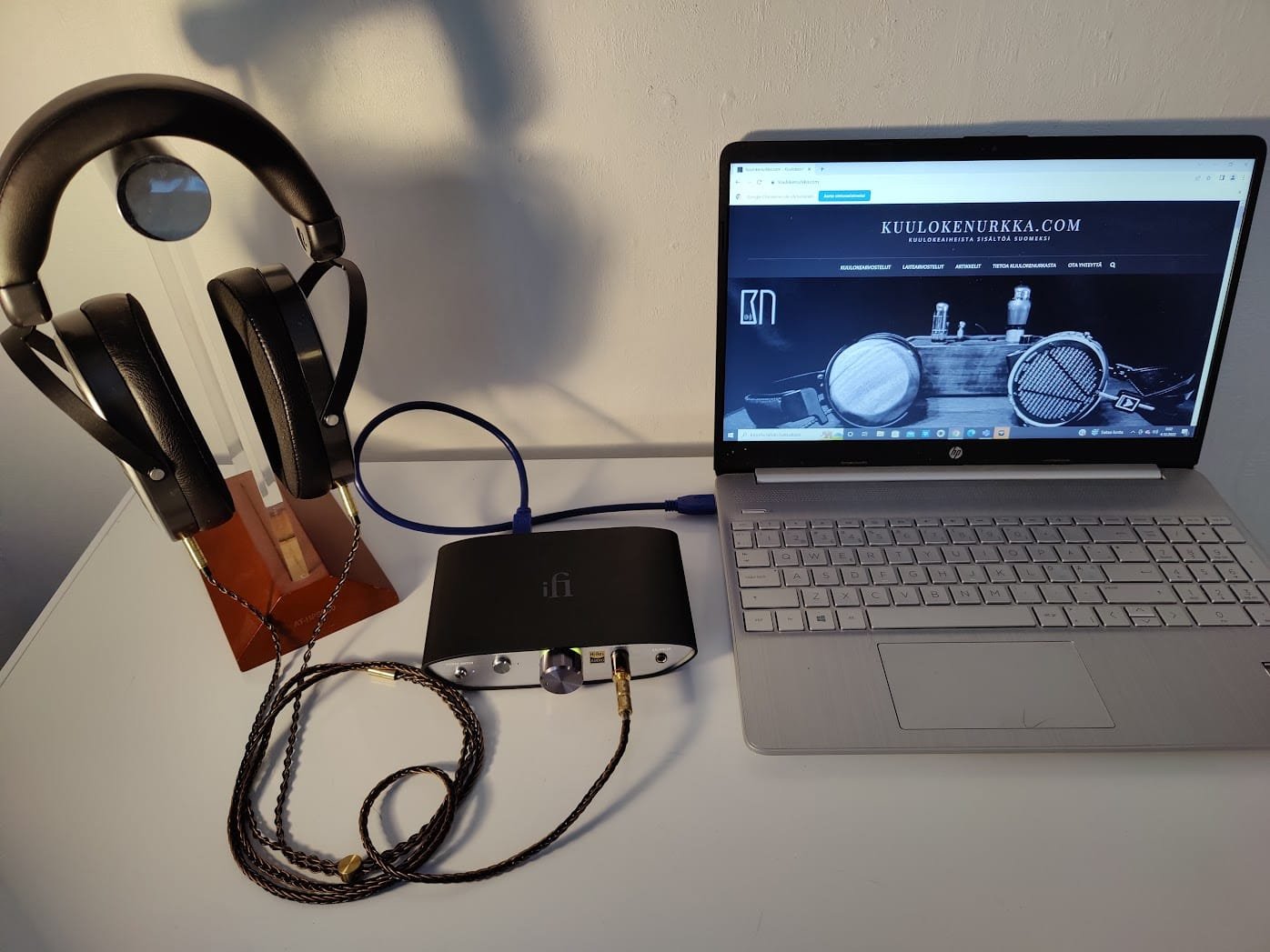
The RCA cables supplied with the device appear externally quite high-quality. The USB cable, on the other hand, could be a bit longer, because when using it, the Zen DAC must be placed right next to the playback device. On the other hand, a short cable does reduce cable clutter on the table, if listening occurs, for example, with a laptop.
In addition to the short cable, the unclear markings on the device's front panel caused some frustration during the test period. Light text printed in a small font is almost impossible to read from the silver front panel, especially in dimmer lighting. However, once the device's operation becomes familiar, this matter no longer has practical significance.
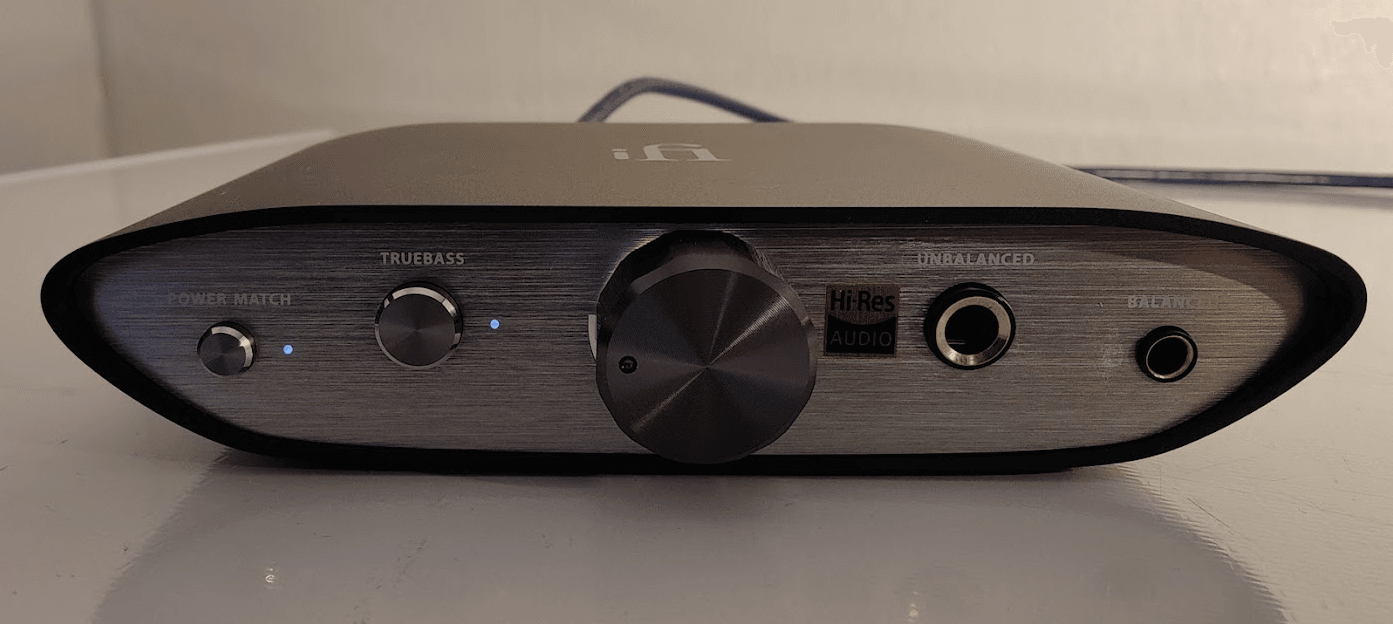
The device's front panel features two buttons, a volume control, and 6.35 mm and 4.4 mm headphone jacks (the latter is balanced). The button named Power Match acts as a gain switch, and the Truebass button can be used to activate bass boost. The activation of these features is indicated by small LEDs on the front edge. The Zen DAC's volume control rotates smoothly, but it has just the right amount of resistance. Behind the control, a colorful LED light is placed, which reflects onto the front panel – this too is pleasantly distinctive product design. The light illuminates in different colors depending on the file format or sampling rate the device is processing.
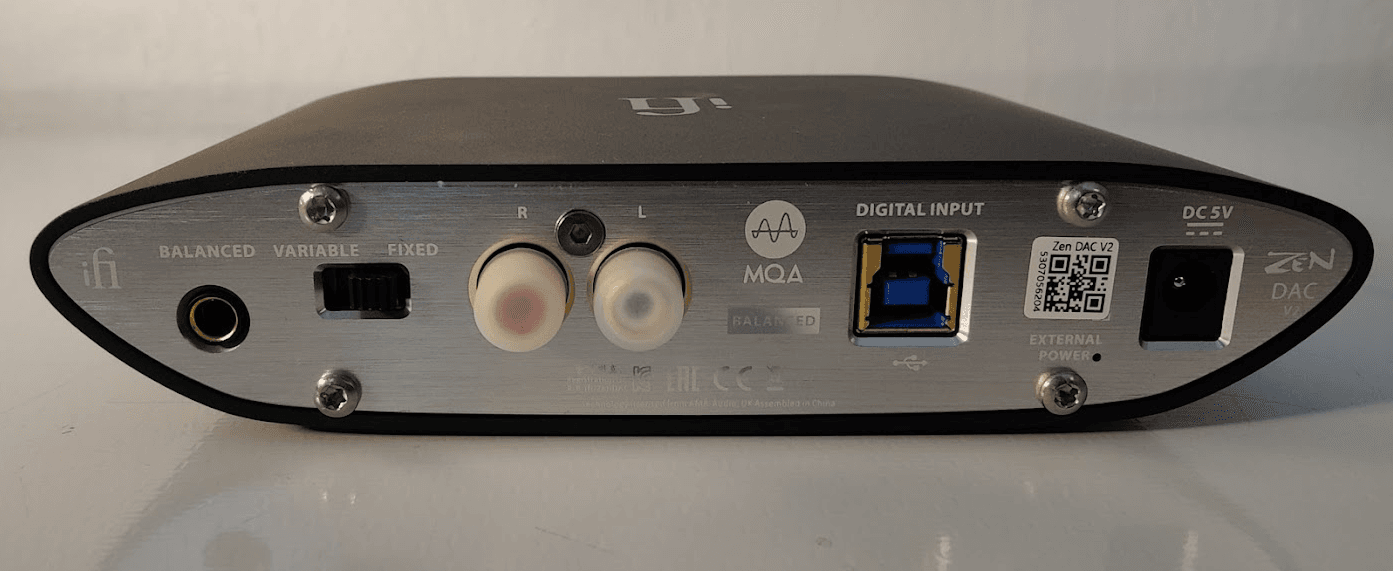
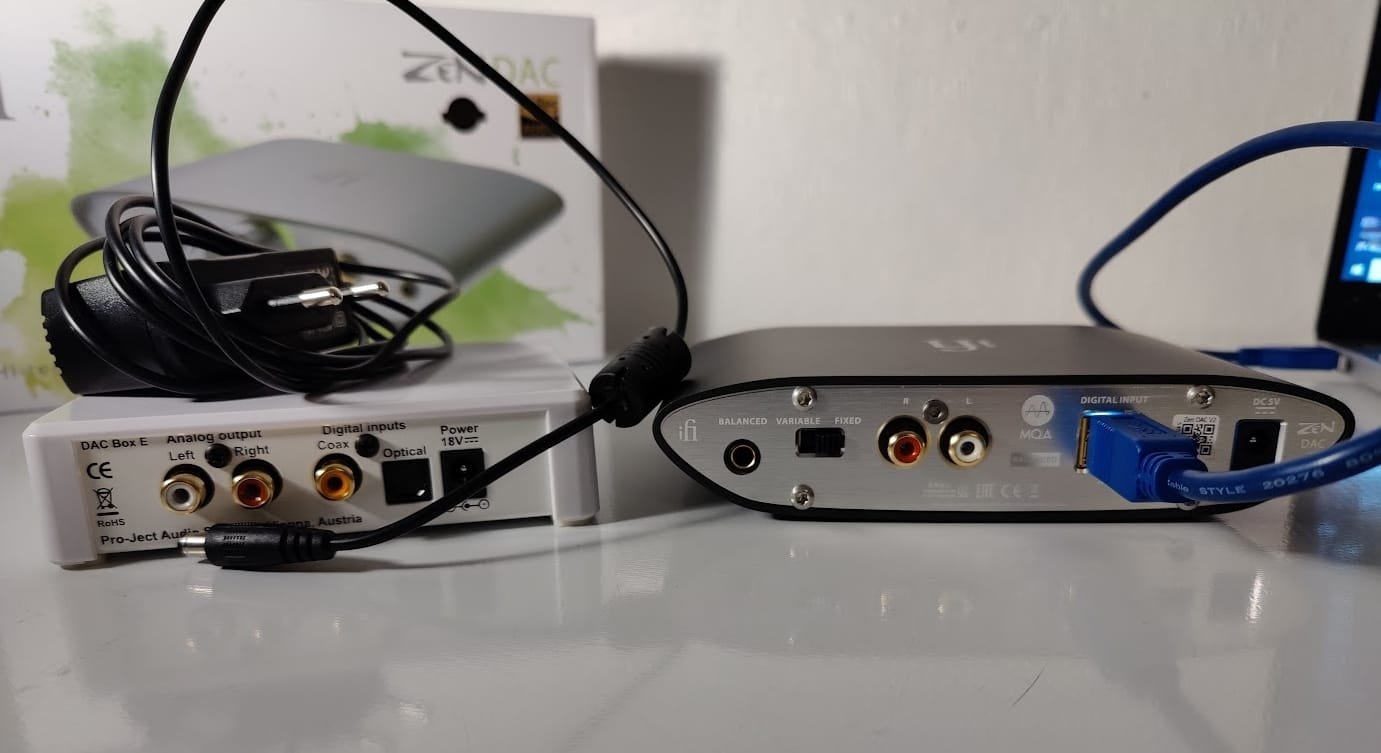
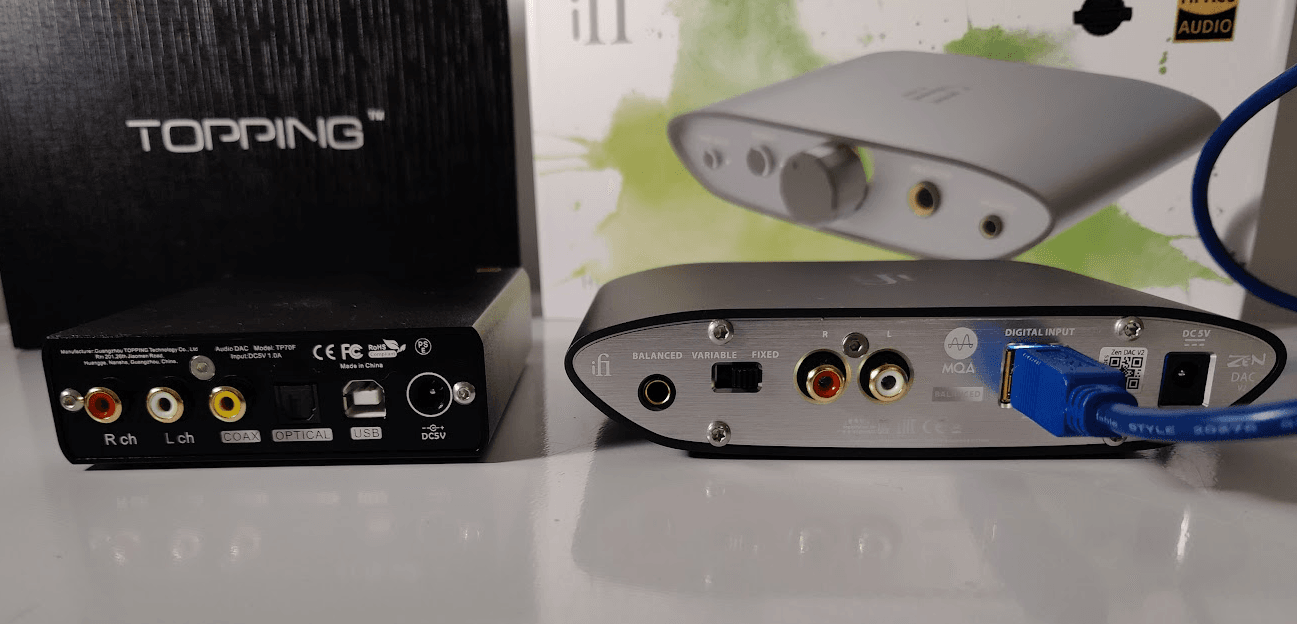
On the rear of the Zen DAC are traditional RCA outputs, a slightly more unusual 4.4 mm balanced output, and a USB input, through which the device can also draw its power. For use with mains power, there is a separate 5-volt power connection. Unfortunately, a separate power supply or cable is not included with the Zen DAC.
With a switch containing Variable and Fixed options, the volume control can be locked (Fixed) when the device is primarily used as a D/A converter. In Variable mode, the output voltage going to a power amplifier or active speakers can be adjusted between 1–3.3 volts. In balanced mode, the adjustment range is 2–6.2 V.
The device's 4.4 mm balanced output connector is quite interesting, as its compact size would certainly be very convenient and also save space. Unfortunately, however, amplifiers using this connector as an input connector are quite rare, apart from iFi's own selection, so in most cases, one has to resort to an adapter cable with a 4.4 mm connector at one end and two 3-pin XLR connectors at the other. The Zen DAC V2 does not come with any balanced cable, so I was unable to test the device's balanced output at all for that reason. If the 4.4 mm connection is not inferior in sound quality to a traditional XLR connection, I would hope for the smaller connector to become more common in both D/A converters and amplifiers.
All in all, the Zen DAC V2 is a high-quality feeling package. The unusual balanced connection may cause confusion, but I only see the lack of Bluetooth connectivity and a remote control as weaknesses, if one desires the most versatile features from a similar device.
Sound quality as a combination device
Zen DAC impressed me with its sound quality within the first five seconds of listening. The rather large soundstage and a slightly warm, yet impactful reproduction reminded me of significantly more expensive devices. Zen DAC is definitely the most natural-sounding affordable all-in-one device I have had the pleasure of listening to.
Although the outlines of the sounds are a bit blurry, and the background of the reproduction is not particularly black, the music spreads over a wide area, sounding grandly. This, at least for me, is more important than the device being suitable for more analytical error hunting in recordings. Zen DAC's wide soundstage and engaging macrodynamics make it an excellent companion for, for example, the Sennheiser HD6XX model (same as HD650). Most other affordable devices do not do justice to Sennheiser's HD600 series, as they further emphasize the headphones' small soundstage and mediocre dynamics.
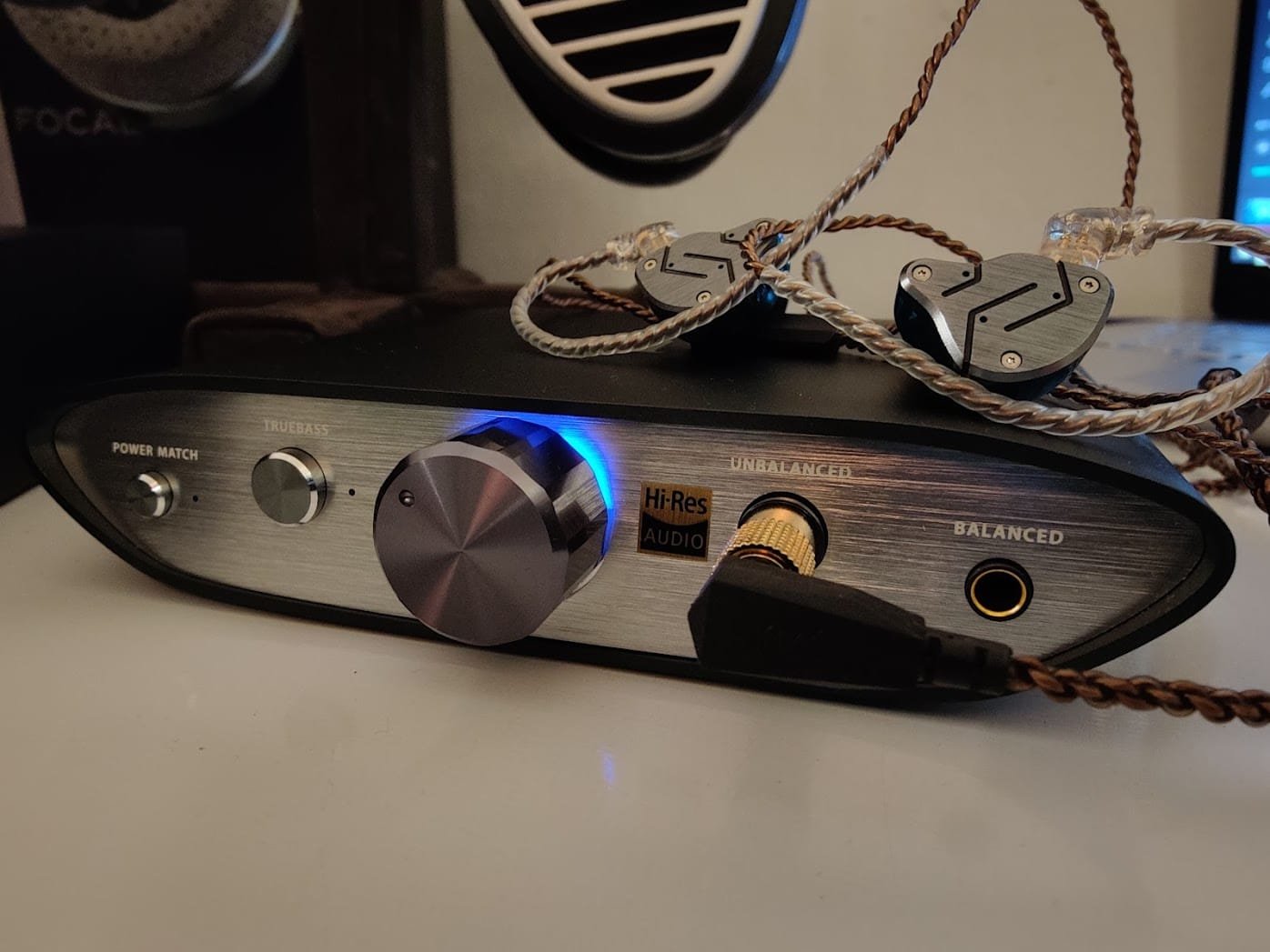
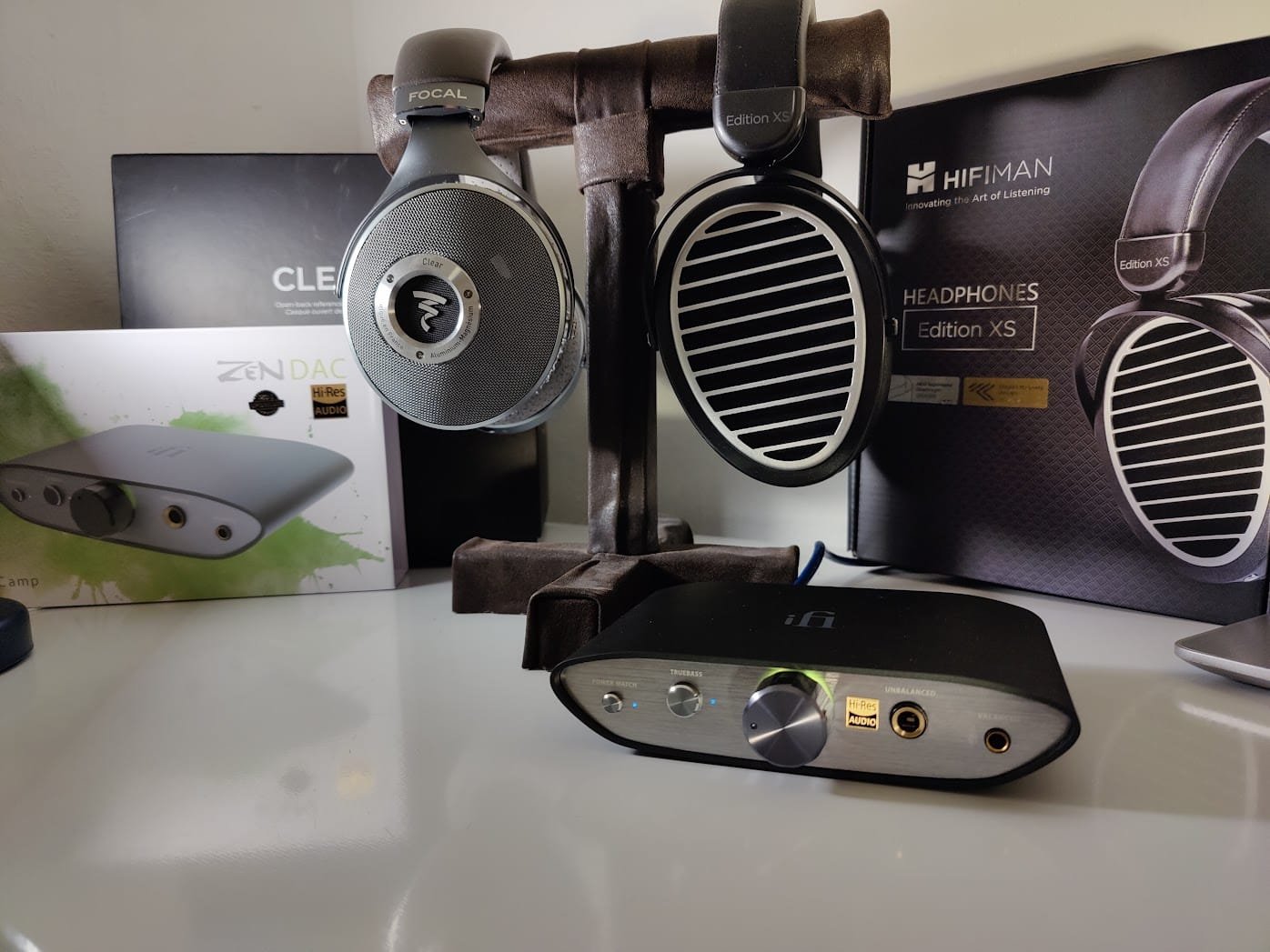
Zen DAC V2 thus works well with high-impedance Sennheiser headphones. The HD6XX plays loudly and without distortion even from the unbalanced 6.35 mm headphone jack. However, the device's weakness is the amplifier's inefficiency if even slightly more demanding planar headphones are used. For example, Hifiman Edition XS's sound distorts when listening at higher volumes. By using a balanced connector, higher volumes can be achieved without distortion, but even then, a limit is reached, although at that point, one can no longer speak of a safe listening volume.
Owners of planar or other insensitive headphones should be prepared that it might be necessary to add a balanced headphone cable to their shopping cart in addition to the Zen DAC. Sound distortion can also be reduced by using an external power supply, which unfortunately is not included with the device. When I simultaneously used an external power supply and a balanced headphone connector, the sound distortion threshold rose so high that I could no longer reach it with the Edition XS model.
Audio as a D/A converter
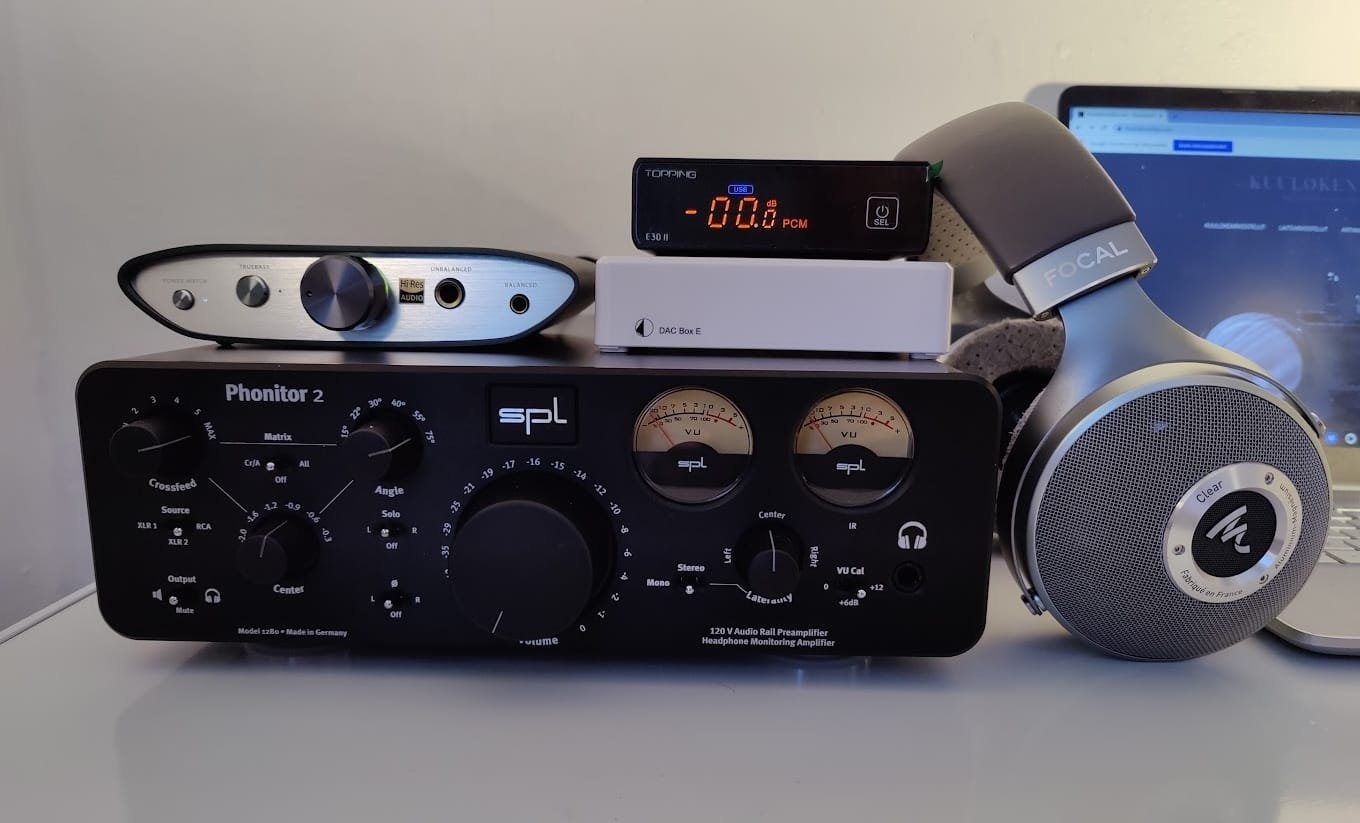
I tested the Zen DAC purely as a D/A converter with the SPL Phonitor 2 headphone amplifier and Focal Clear headphones. Using an expensive 1700 euro amplifier with a 200 euro DAC might sound strange, but I wanted to utilize test equipment I was already familiar with, which is uncolored in its characteristic sound and, above all, capable enough to highlight differences between other devices. The Zen DAC's volume control was in Fixed mode during testing, and RCA outputs were used.
The Zen DAC & Phonitor combination sounded pretty much as I expected. When using the Phonitor, the sounds had clearer outlines and a more precise location in the sound field compared to the ZEN DAC's amplifier section. The sound still played ”everywhere,” but now the relationships of the distances between sounds were clearer. In terms of tone, the reproduction was colder and drier than when listening with the Zen DAC's amplifier. The bass, in turn, became less abundant but was more precise and easier to follow. My observations don't really tell much about the ZEN DAC as a D/A converter, but rather that the SPL Phonitor 2 is a more refined amplifier than iFi's device. Therefore, more information is needed on how other D/A converters compare to the ZEN DAC when used in conjunction with the SPL Phonitor.
iFi Zen Dac V2 vs. Pro-Ject Dac Box E
Prices: 199 € vs. 90 €
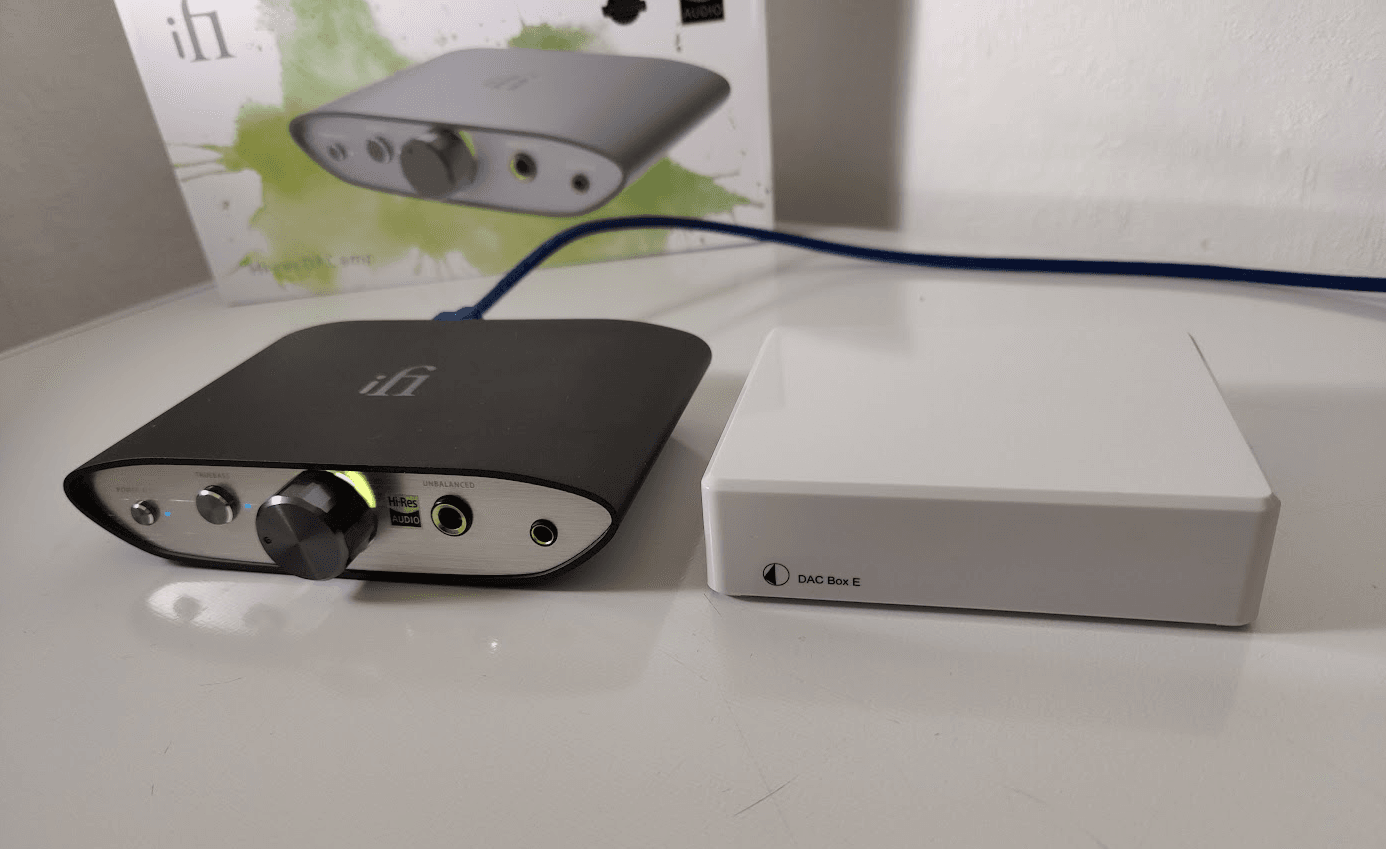
The first comparison device was the Pro-Ject Dac Box E, an ”entry-level” device priced at 90 euros that has been on the market for several years. Many may have acquired this device, for example, to improve TV sound quality. The DAC Box E is not intended for use with a computer, as the device does not have a USB connection. Since my laptop does not have an optical or coaxial connection, I routed the audio signal Soncoz SGD1through an SPDIF-USB converter. Although the DAC Box E is my own device, I have only listened to it once before.
Since we are talking about D/A converters, I had to remind myself not to expect very large differences between the devices. Preconceptions tend to easily become reality in comparative listening, even if no significant differences exist. Although I didn't have a precise preconception of the DAC Box E's sound, I naturally assumed that the Zen DAC, being twice as expensive and containing newer technology, would be superior in every aspect of its sound. However, I did not arrive at such a clear-cut conclusion.
When listening to the DAC Box E, I realized I was paying an exceptional amount of attention to fading sounds. For example, the last gasp of a stretched electric guitar note or the vocalist's final sigh before their lungs emptied came through clearly. Listening was quite interesting because of this, at least for a moment.
After listening for a longer time, it started to feel like the DAC Box E's dynamics are weak, causing quieter sounds to be emphasized more than usual. The device doesn't sound as dynamically exciting as iFi's Zen DAC. Also, the DAC Box E's bass reproduction feels so moderate that I thought it was cutting off some of the bass frequencies. However, when measuring the headphone frequency response with both devices, there was no difference between them. Despite everything, the DAC Box E performed surprisingly well for its 90 price, and it didn't make the 3000 euro SPL Phonitor & Focal Clear combination sound particularly bad.
I cannot truly recommend upgrading to the Zen DAC V2 for those who already own the DAC Box E and like its sound. The two devices sound so different that the Zen DAC could even be a disappointment for those accustomed to the Pro-Ject device. On the other hand, the differences between D/A converters are generally so small that a less dedicated listener might not pay much attention to them. However, if the current owner of the DAC Box E is not yet sure what kind of sound they prefer, and acquiring a better DAC doesn't seem like an impossible idea, recommending the Zen DAC V2 is easy. In this case, one must, of course, be transitioning to USB listening, as it is not possible to connect the iFi device to an old CD player or TV.
Although the Zen DAC V2 is twice as expensive, an additional investment of about one hundred euros gets you quite a lot more. In addition to better sound quality, the iFi model features, among other things, a headphone amplifier, more versatile connections, and MQA support. Even if these additional features are not necessarily needed, the Zen DAC might be a better purchase purely because it achieves a higher volume than a DAC Box E-based system. Pro-Ject's 0.7-volt output voltage is exceptionally low, whereas through the Zen DAC, nearly five times higher voltage can be output via RCA connectors. When balanced, the difference even doubles.
iFi Zen Dac V2 vs. Topping E30 II
Prices: 199 € vs. 149 €
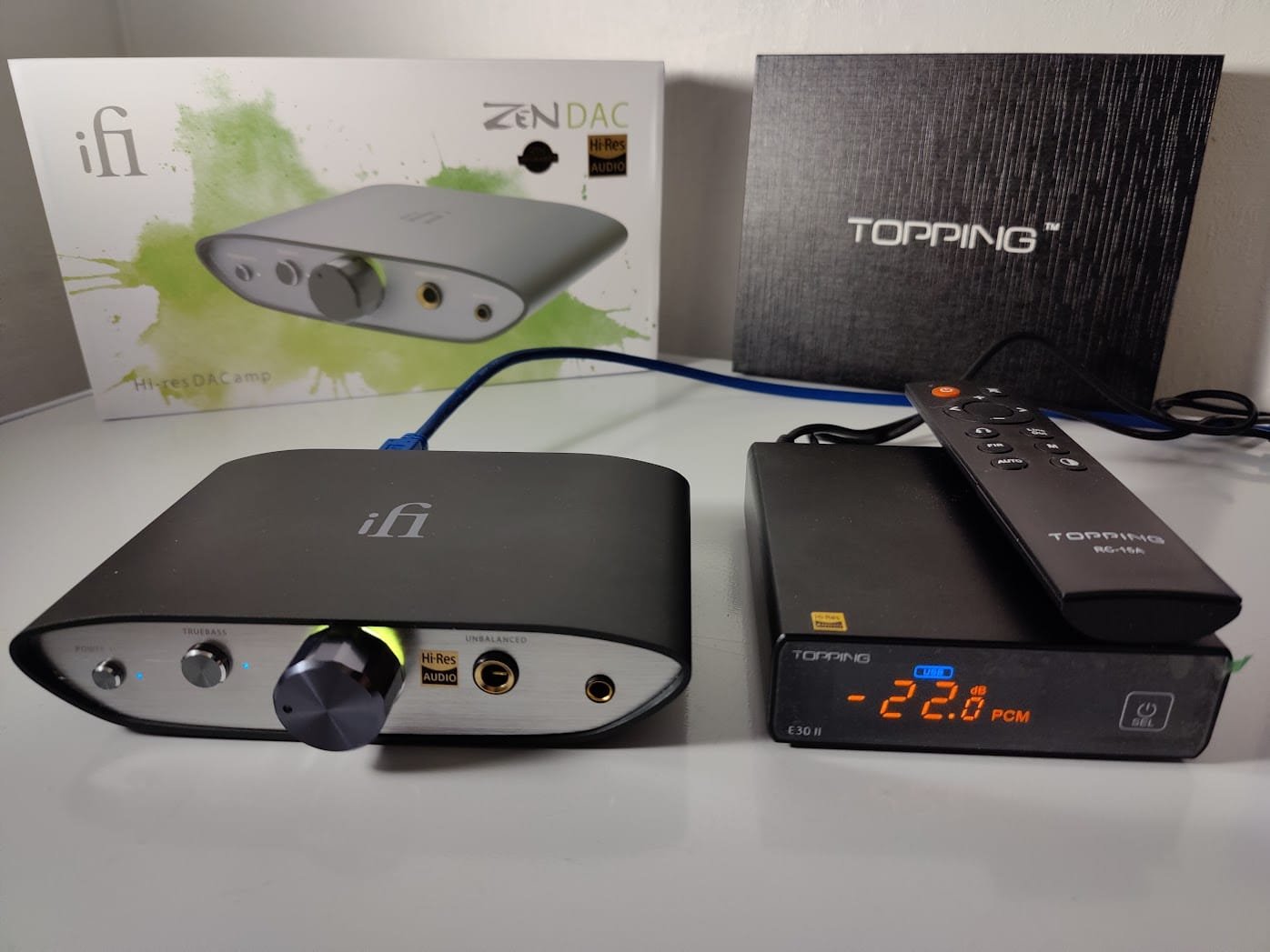
Topping E30 II and its predecessor E30 are certainly familiar devices to many. The Chinese manufacturer is especially known for its devices generally being extremely good based on measurement results. If Topping happens to be a new acquaintance in this context, you can start getting to know the manufacturer by taking a look at a review previously published in Kuulokenurkka of the E30 model. The article also includes a suitable comparison to the older iFi Zen DAC model. We received Topping's new E30 II model for testing from Hifitalo.
Before comparing sound quality, I will go through the most essential differences in the devices' equipment and features. The most obvious difference is that the Zen DAC V2 is a combo device, while the E30 II is a D/A converter without a headphone amplifier. The different intended use of the devices is also reflected in the price, as the E30 costs 50 euros less. The most direct competitor to the Zen DAC from Topping's product range would be the DX3 Pro+ combo device.
Other key differences between the devices are as follows:
- Topping comes with a remote control, which is almost mandatory to use, as the device itself only has a power button/audio input selector
- Topping has a display
- Topping has various sound filters offered by the AKM chip manufacturer, and iFi has the TrueBass feature. In my opinion, the differences between the filters are too small, whereas TrueBass is a genuinely fun feature
- In addition to a USB input, Topping has optical and coaxial connections, but no balanced output, unlike iFi
- Both devices can draw power directly from a USB connector, but Topping requires two ports unless the device is used, for example, connected to a 5-volt phone charger
- The iFi comes with RCA cables
- The iFi has MQA support (however, the lack of MQA support does not prevent the use of the Tidal streaming service with the Topping)
- Topping uses AKM's DAC chip and iFi uses Burr Brown's chip
Sound quality differences:
I must confess that I didn't particularly like the original Topping E30 model, as it sounded flat and forced. Regardless of the device combination, it made music sound duller than usual. I would probably prefer listening to Pro-Ject's DAC Box E over the E30 if I had to choose between the two. For this reason, I was positively surprised to find that the E30 II is a clear improvement over the previous model.
However, improvement has not occurred in all respects, as the soundstage is still narrow. In fact, all Topping DACs I've heard (E30, E30 II, DX3 Pro+, and D10) have had a small soundstage, so I'm starting to suspect that it's part of the manufacturer's intended sound signature. In addition to the small soundstage, the E30 II also doesn't layer sounds as well as I would hope. Sounds are placed next to each other very precisely, but are as if stuck on the same curved line. The Focal Clear headphones I use inherently have a small soundstage, but the placement of sounds in a confined space is extremely precise. With the E30 II, however, this characteristic suffers. When listening with the Zen DAC V2, the sounds do not have as clear outlines as with the E30 II, but the soundstage is much wider – sounds ”live” and are separated also in depth. The differences are very similar to when I compared the iFi model to the Pro-Ject device.
The Zen DAC once again makes music sound big, dynamic, and exciting. Mid-range frequencies stand out more than with the E30 II, where my attention is drawn to other aspects of the sound. Someone who likes the E30 II might, in my opinion, find the Zen DAC's sound muddy, because the Topping model has a very clean sound. The sound is emphatically tight, and short-duration individual sounds and their structures are very clear. Unfortunately, the E30 II, however, makes music sound mostly like a collection of individual sounds. I don't know what the unifying factor is that binds sounds into a cohesive musical whole, but in the Zen DAC V2, it is at a better level than in the E30 II. I therefore prefer the Zen DAC's way of reproducing music. Still, someone else might find the Topping E30 II sounds better, and a third person might think all DACs sound exactly the same.
If someone, like myself, didn't like the previous E30 model but would like to give Topping another chance, the E30 II could be a good purchase. Although the newer model sounds largely similar to its predecessor, it manages to make listening more interesting than before. Compared to devices like the Zen DAC, the E30 II doesn't sound particularly dynamic, but the anemic sound that plagued the original E30 is gone. The new model feels like a better overall package than its predecessor, even though I can't precisely distinguish everything that has changed between the models. Part of the improved listening experience could be explained by the fact that the E30 II sounds slightly brighter and airier, so its sound awakens the listener when the DAC's limited musicality threatens to make listening dull. Be that as it may, both the E30 II and Zen DAC V2 are excellent devices for their price. For my taste, however, the iFi model's effortless and grand reproduction ultimately suits me much better than Topping's more analytical and minimalistic presentation.
Summary
Although, knowing my preferences, I expected to like the Zen DAC V2, iFi still managed to exceed my expectations. The device does not appear to form a disturbing bottleneck as a D/A converter for the SPL Phonitor 2, which is quite an achievement considering the significant price difference between the two. Although the Zen DAC's headphone amplifier is quite decent, the device's DAC section is its true strength. The sound has naturalness, effortlessness, and dynamics that I have only been accustomed to hearing in significantly more expensive devices. If I ever have to give up my more expensive D/A converters for one reason or another, the Zen DAC V2 (or one of its successors) would be the first device I would acquire in their place.
Pros and cons:
+ Excellent dynamics and soundstage
+ Reproduction is truly effortless and natural-sounding
+ Build quality and distinctive appearance
+ TrueBass is a fun feature
+ Two headphone jacks
+ The headphone amplifier is quiet with in-ear monitors and works well with high-impedance headphones
+ The device does not have to be connected to mains power
+ Reasonable price
+/- Headphone amplifier is not entirely sufficient for power-hungry planar headphones, and its sound quality could be better otherwise. However, the amplifier increases the value of the device, because even without it, the Zen DAC is an excellent D/A converter in terms of price-quality ratio.
+/- Balanced output is a good thing, but the 4.4 mm connection is very rare, and the device does not come with the necessary cables.
+/- MQA support is a good thing in itself, but I would rather pay a little less for the device without it, especially since there is no evidence of the sound quality benefits of the MQA format.
– The darkness of the playback background and the ability to distinguish small details do not quite reach the top of its price class.
– The device only has a USB input.
– No remote control.
– No Bluetooth connection.
– No separate power switch.
– When connecting the device to mains power, accessories must be purchased separately.
 EN
EN  FI
FI