Author: Roderick
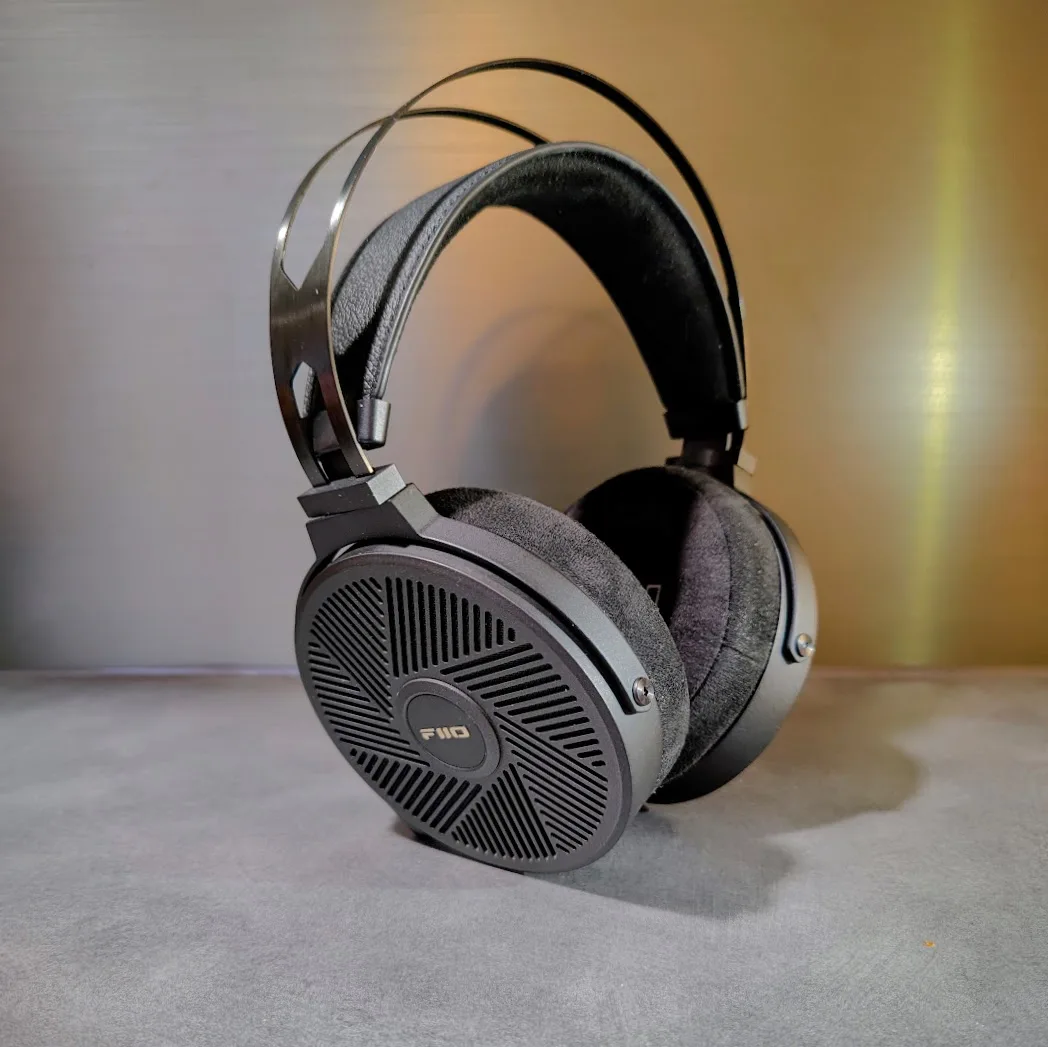
Table of Contents:
Information:
- Release year: 2023
- Country of Origin: China
- Price: 500 €
- Structure: open, over-ear
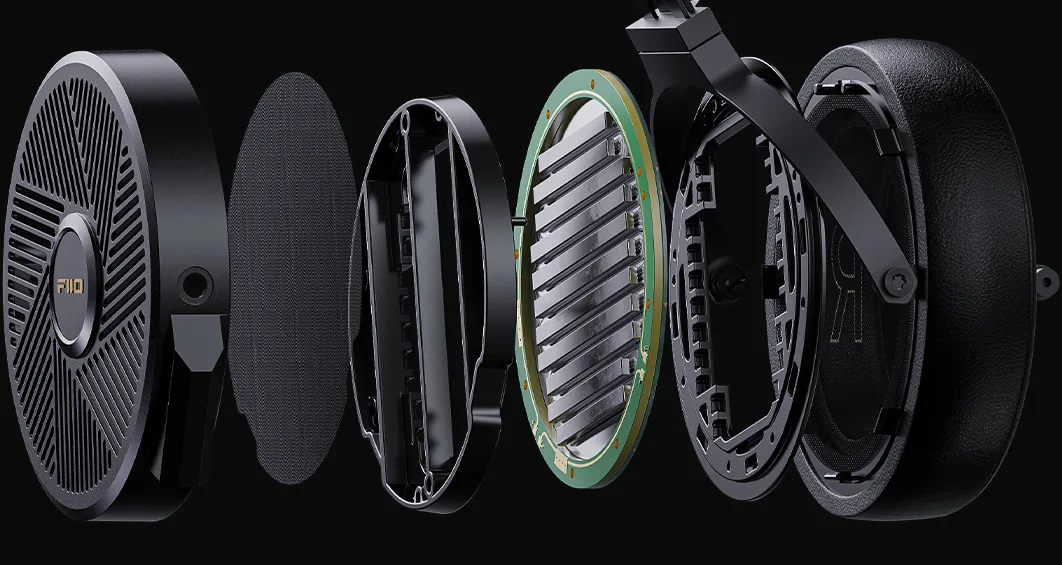
- 90 mm planar driver: PAR diaphragm (thickness 6 µm), conductors made of aluminum-silver alloy and double-sided N52 magnet structure with 1.5 Tesla magnetic force
- Impedance: 36 ohm
- Sensitivity: 96 dB/mW
- Weight: 456 g without cable
- Connector type: 2 x 3.5 mm
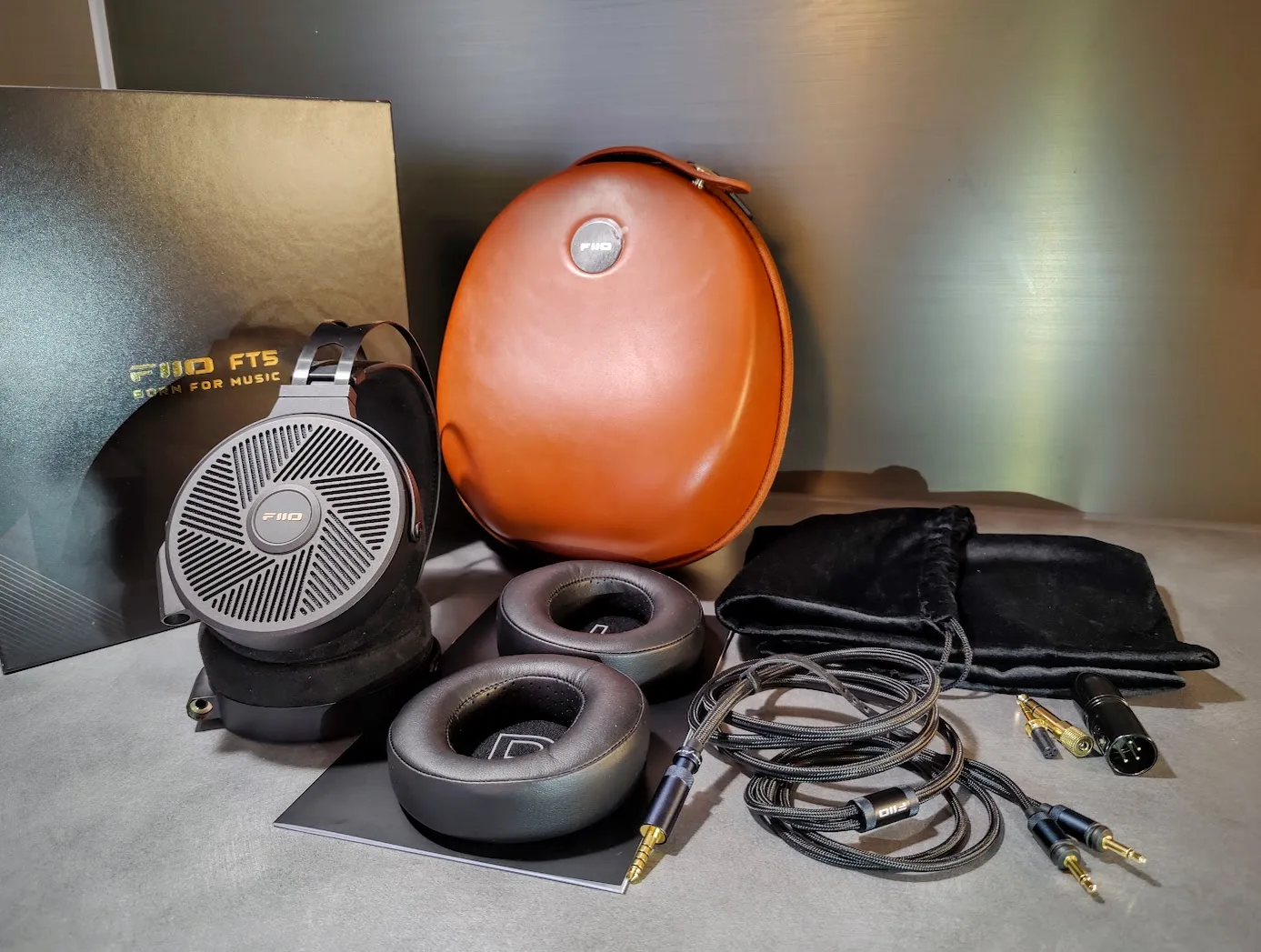
- Included: 1.5 meter long cable with interchangeable connector (3.5 mm and 4.4 mm), 6.35 mm adapter and 4-pin XLR adapter, hard-shell case, pouch and replacement earpads
Review sample: Provided by the manufacturer
FiiO, previously known mainly for its amplifiers and mobile players, expanded its product range into full-size headphones in 2023. The first model released, the 300-euro FT3, surprised me in April (link to my review) with both its high-quality build and balanced sound. Usually, headphone manufacturers' first releases are not as successful, but are partly flawed, if not sometimes even unusable. Making good headphones is not actually very easy, so FiiO's start was promising. Recently, the FT3 was followed by the 500-euro FT5 model (link to the manufacturer's product page), which is currently FiiO's most expensive headphone model and its first planar headphone. We received the FT5 for review directly from the manufacturer.
Product packaging
The FT5 is delivered in a three-layer package, as no less than two cardboard boxes have been added to protect the actual retail packaging. The inner cardboard box is interestingly supported by plastic corner protectors. This creates unnecessary waste, but at least the packaging is exceptionally sturdy. The FT3 was packaged in the same way, so FiiO seems to be investing an exceptional amount in ensuring its headphones arrive intact.
The FT5's accessories largely correspond to the more affordable FT3 model. The leather-like plastic carrying case has also remained unchanged. Those familiar with the FT3 may remember the special cable that came with the headphones, which can be converted with adapters to support four different connections. This interchangeable connector feature is also found in the FT5's cable, which, however, is slightly different in material – more on this later.
As usual, the product package also includes different earpads. As a new accessory, FiiO has also added a storage pouch. A more critical enthusiast might be disappointed that the accessories have not improved more compared to the cheaper FT3, but it doesn't bother me personally. The FT5's accessories are already significantly more extensive than what is usually seen in the 500-euro price range.
Build and comfort
The FT5's frame is made of a magnesium-aluminum alloy. Magnesium is, in my opinion, one of the best materials for building headphones, as when used correctly, it is durable and, above all, lightweight. Despite FiiO's weight optimization, its headphones are unfortunately relatively heavy. The FT5's weight of 456 grams (without cable) is not yet particularly high for planar headphones, but it is still about 100 grams more than, for example, Hifiman Sundara in comparison.
Planar headphones are generally heavier than headphones equipped with dynamic drivers, which is due to larger magnets. This also explains the FT5's high weight, as its magnetic structure appears exceptionally robust.
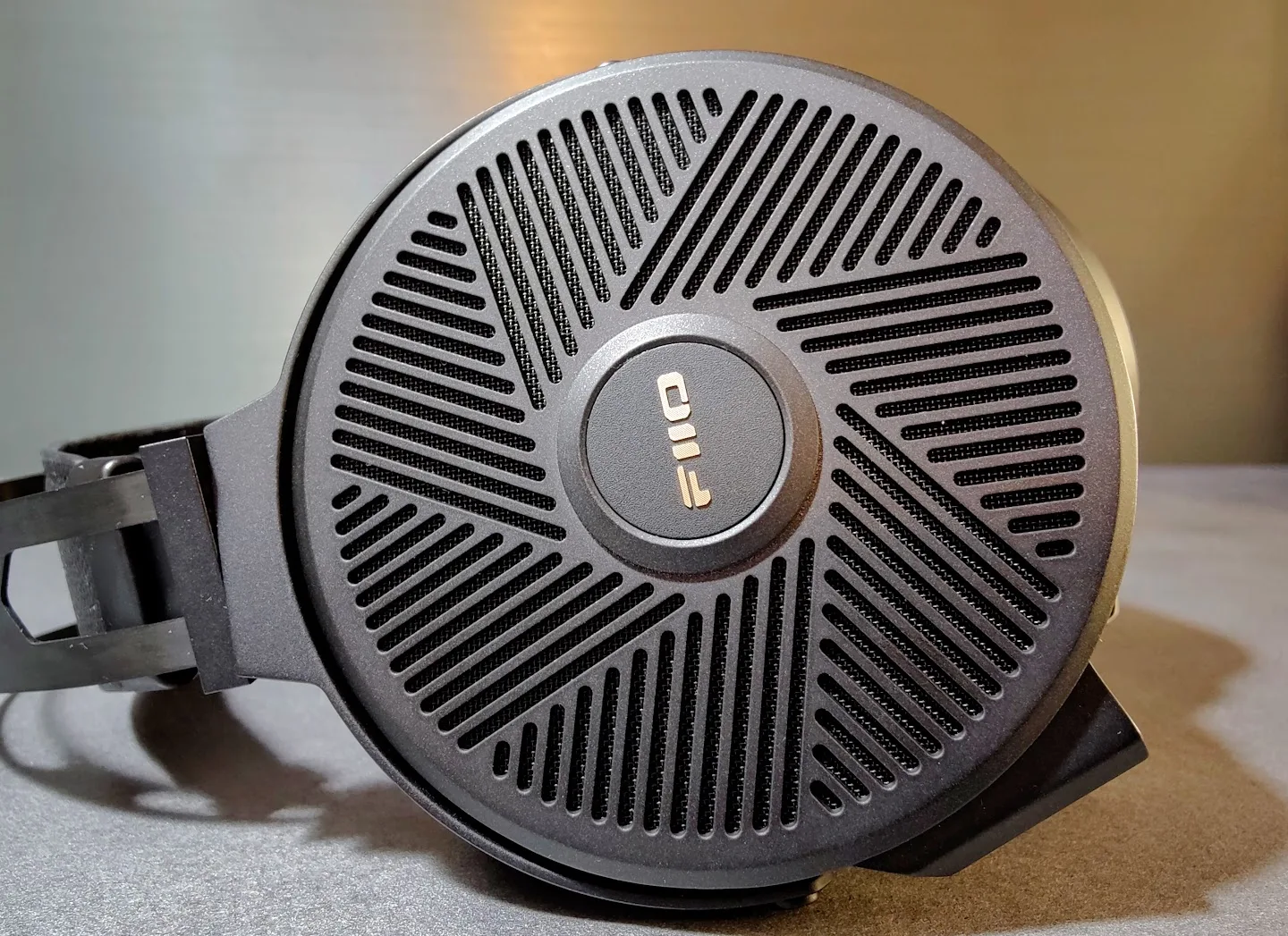
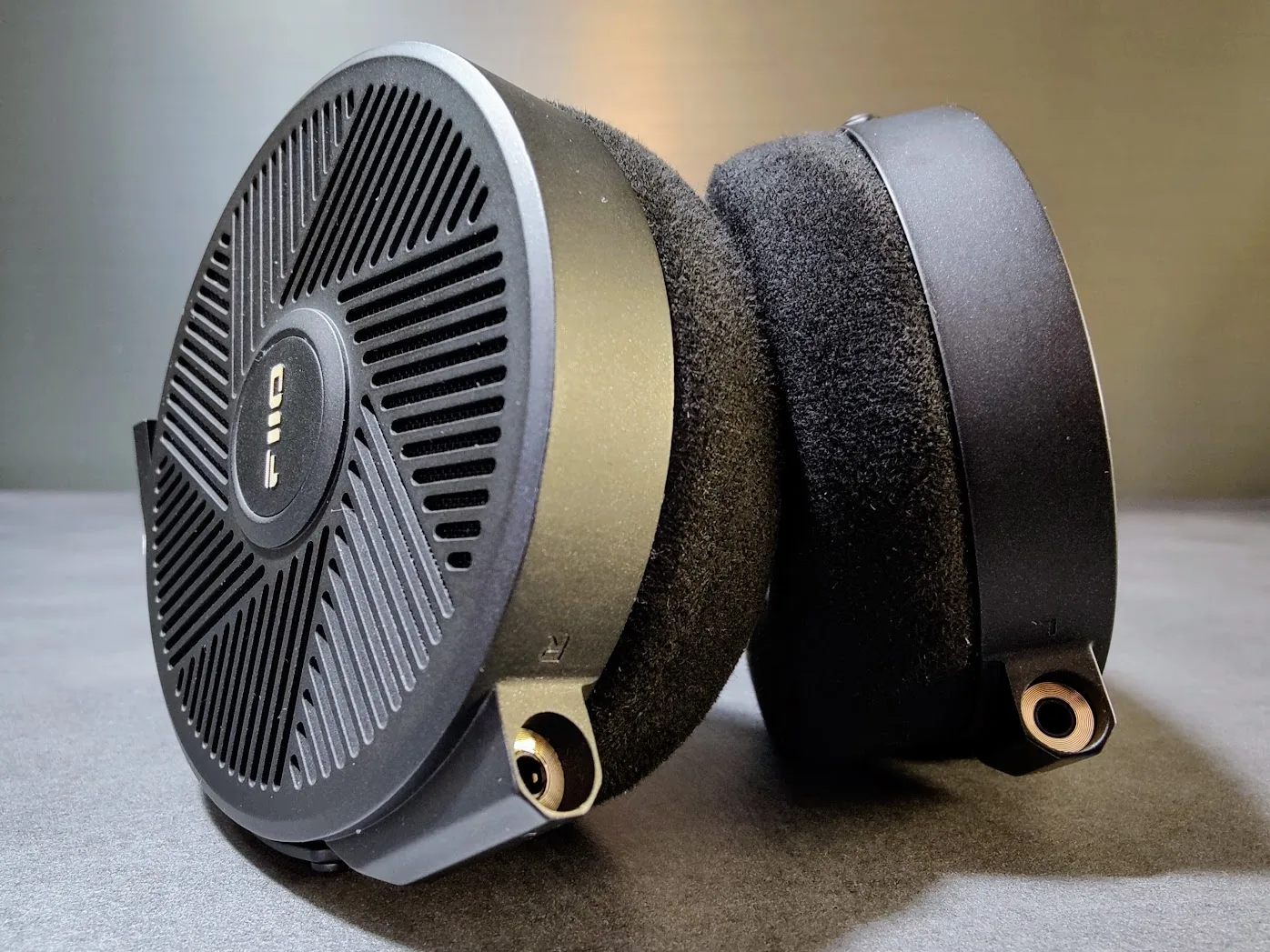
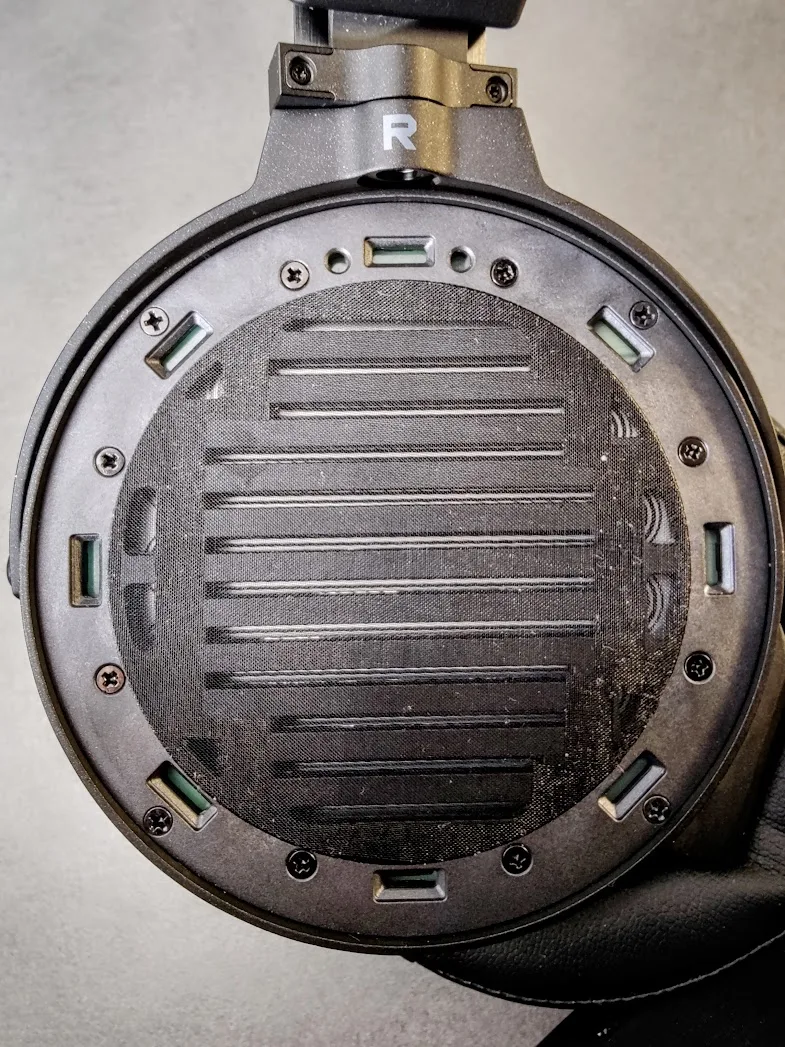
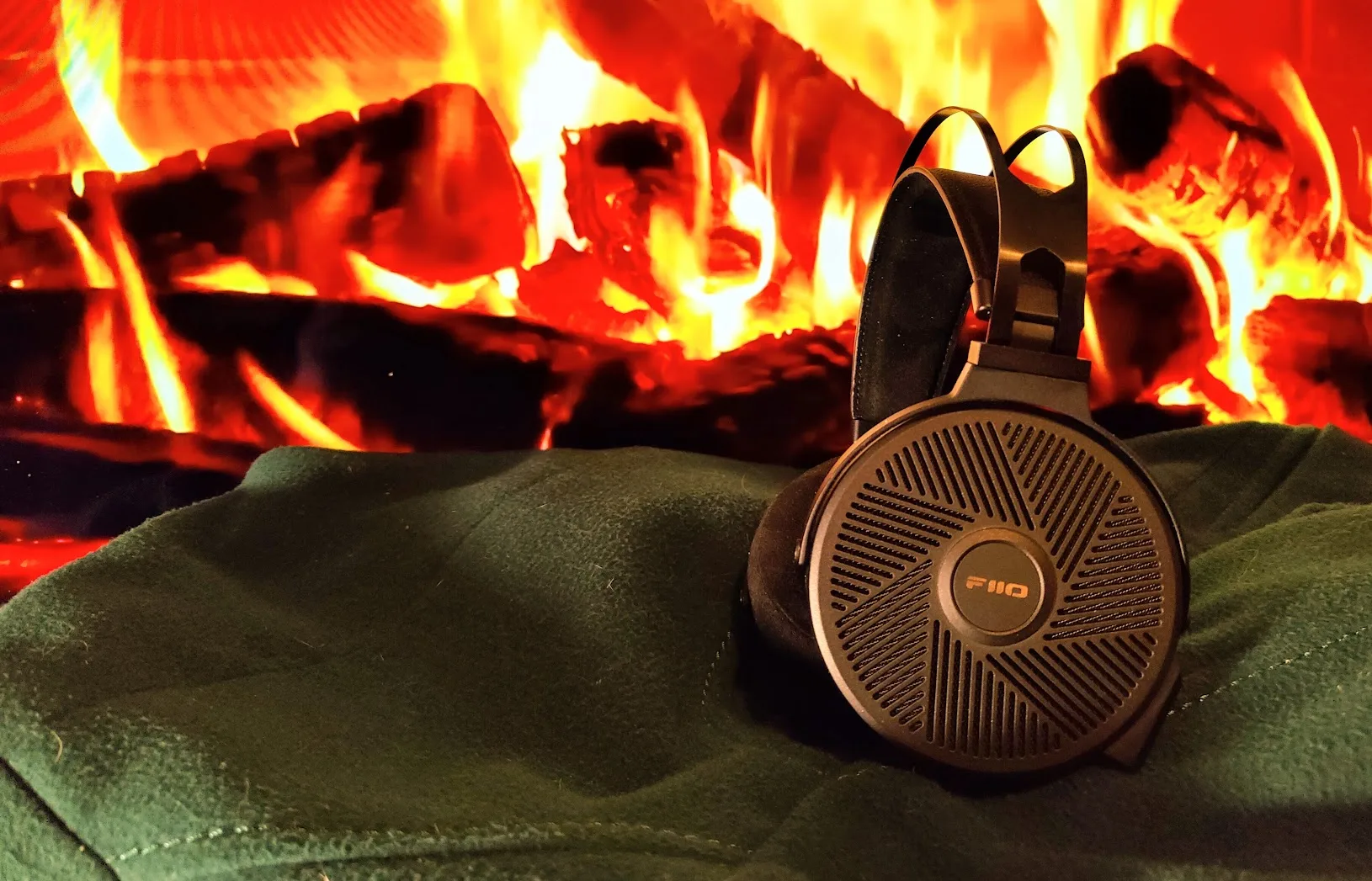
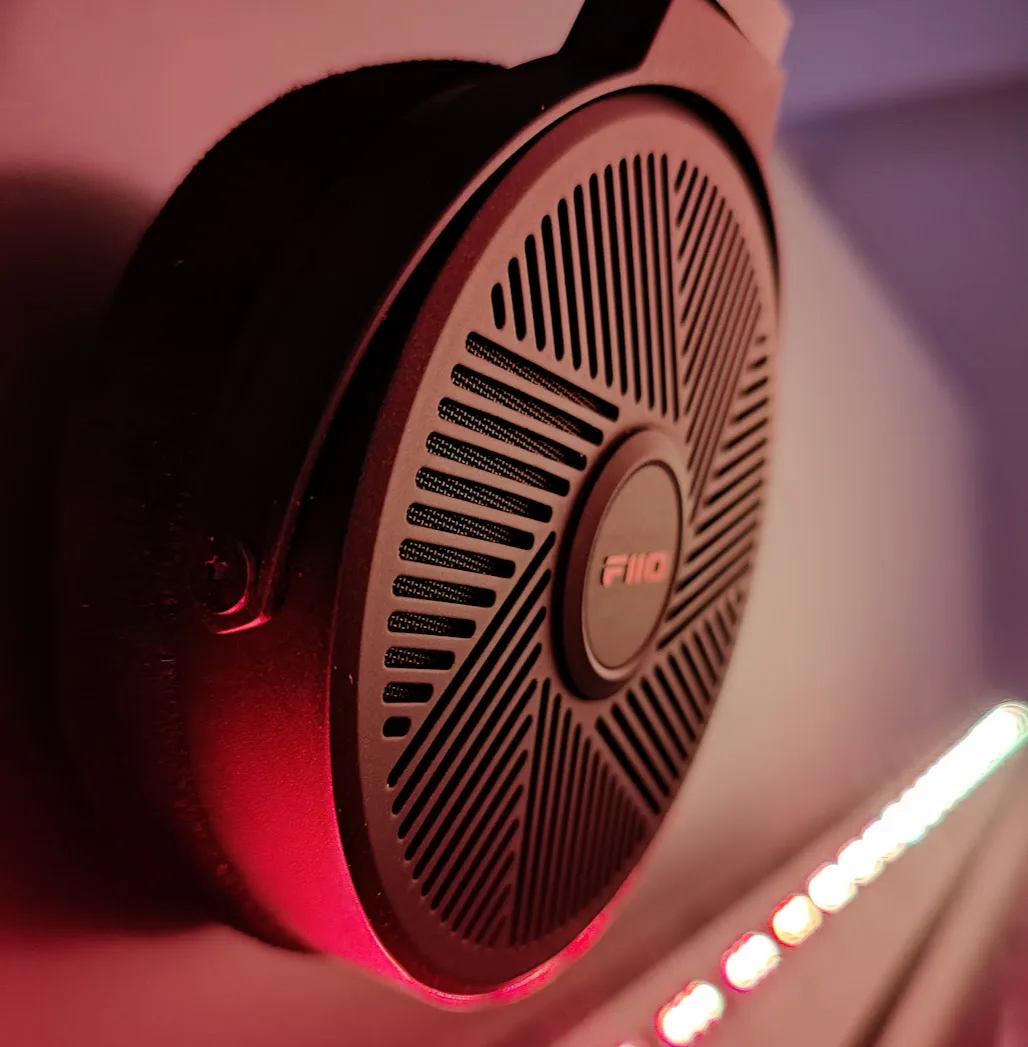
Apart from the weight, it's difficult to find anything to criticize about the headphones' construction. The finish is first-class throughout, the earcups have nice details, and even the protruding housings of the headphone connectors look great. The manufacturing of the earcups from a single piece of metal is also impressive.
The earcups move slightly sideways and in/out, so the headphones adapt well to the shape of the head. The design also features a spring mechanism, similar to the FT3 model, which allows the earcups to move smoothly and return to their default position when the headphones are not in use. The mechanism is similar to that found in Focal headphones, for example.
The FT5's dark coloring will surely appeal to most. Depending on the light, the headphones may appear almost black or quite gray. In my own photos, they are predominantly gray, as it is difficult to get natural pictures in artificial light, and there hasn't been much sunlight available this winter. The FT5 is handsome as it is, but its high-quality construction could, in my opinion, have been emphasized with a more ornate metallic finish, for example. A minor annoyance is that the upper arch of the headband is not covered with artificial leather, as in the FT3. This does not affect usability, but the FT3's headband looked exceptionally fine when covered.
Headband mechanism:
The headphones' headband automatically adjusts in height to fit the user's head. Although I previously criticized the FT5's weight, it must be said that the headband mechanism manages to remarkably well diminish the feeling of weight. Listening sessions of a couple of hours are easily managed. The clamping force of the headband is also optimal for my head, so the weight is evenly distributed to both the ears and the top of the head. If the FT5 were 100 grams lighter, one would barely even notice them.
Ear cushions:

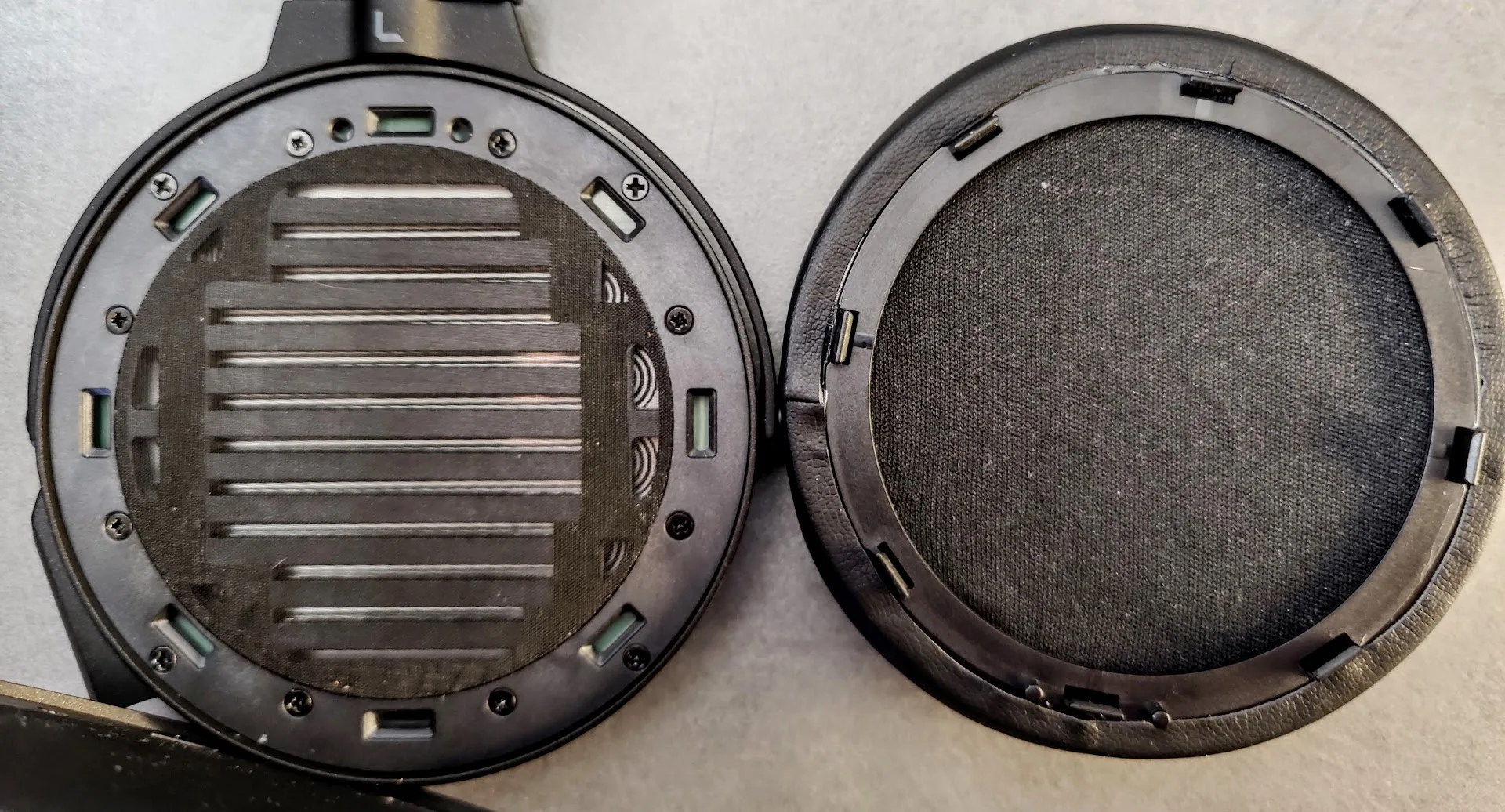
The headphones come with ear pads covered in both artificial leather and suede material. These are slightly different from those on the FT3, as the ear opening is now oval instead of round. This is, in my opinion, a successful change, but the pads are still not particularly spacious inside. For my ears, the pads fit quite comfortably, but for slightly larger ears, there might not be enough space. The manufacturer should definitely address this in their future headphone releases. Fortunately, there is sufficient depth in the pads, and they seal tightly around the ears even when wearing glasses.
Cable:
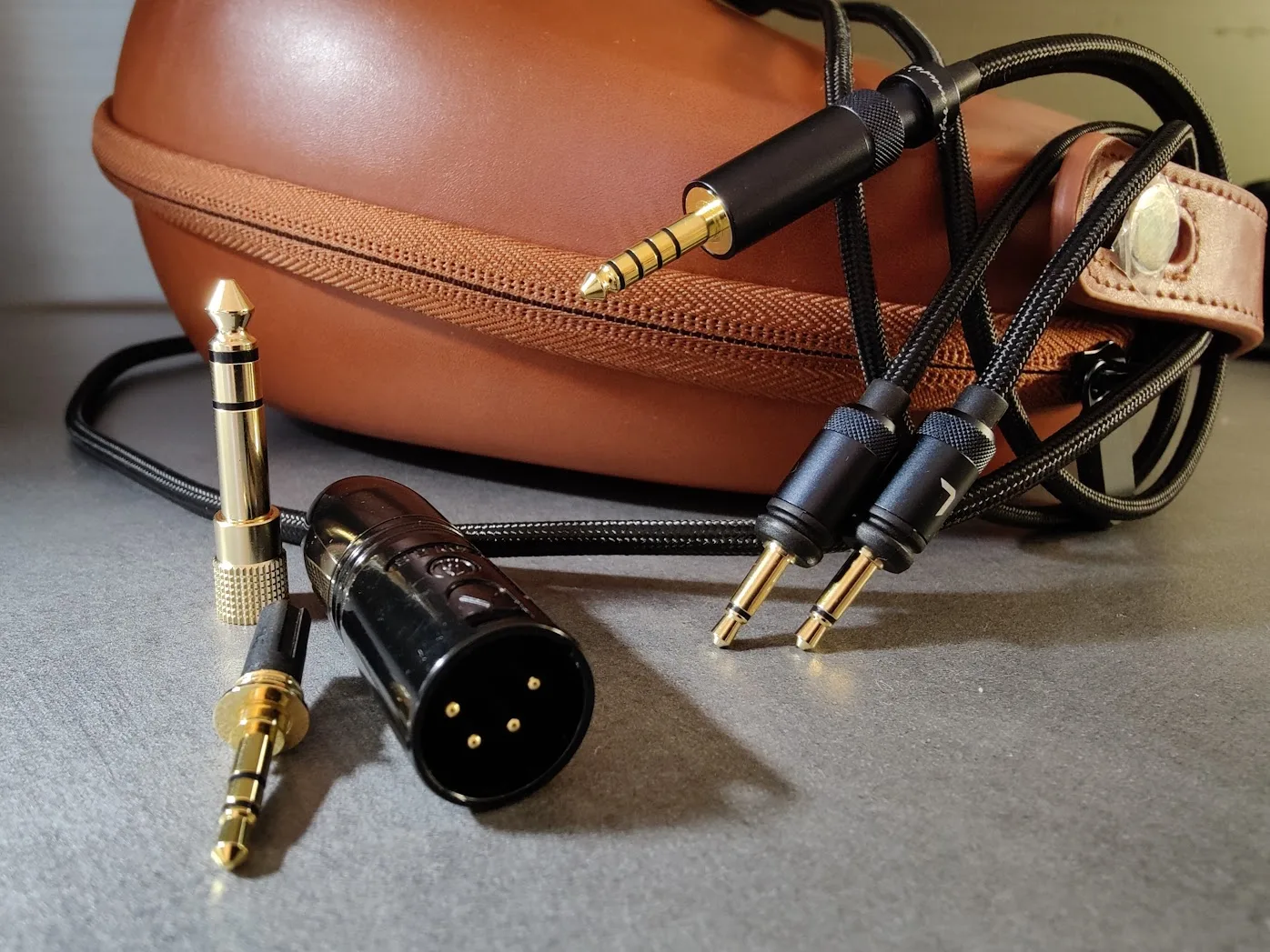
The fabric-covered cable included in the product package attaches to both earcups with a 3.5 millimeter connector. The cable is 1.5 meters long, which is half the length of the FT3 model. This is also a welcome change, as the FT3's 3-meter cable was too long for my needs, although certainly suitable when using an amplifier placed further away from the listener. This time, the manufacturer has not chosen an exotic OYAIDE HPC-23T cable for its headphones, but a silver-plated copper cable consisting of 392 strands, the brand of which remains unknown. More important to me, however, is the usability of the cable, in which respect FiiO has succeeded quite well, even if the fabric covering does not match the flexibility of rubber-coated braided cables. A plus must be given this time too for the fine metal housings of the connectors. I always appreciate individual connectors more than generic off-the-shelf items.
The best thing about the FT5 (and FT3) cable is its detachable connector and the included adapters. Unbalanced headphone cables most often have a 3.5 millimeter connection, to which a 6.35 millimeter adapter can be attached if necessary. A separate cable would be needed for a balanced connection. However, FiiO has solved the need for two cables by making the connector detachable, so the default 3.5 millimeter unbalanced connector can be easily swapped for a 4.4 millimeter balanced connector. With these, either a 6.35 millimeter adapter or a 4-pin XLR adapter can then be used if necessary, making a single cable suitable for four different use cases. This implementation is exceptional for over-ear headphones, but more familiar for in-ear headphones.
ÄSound quality
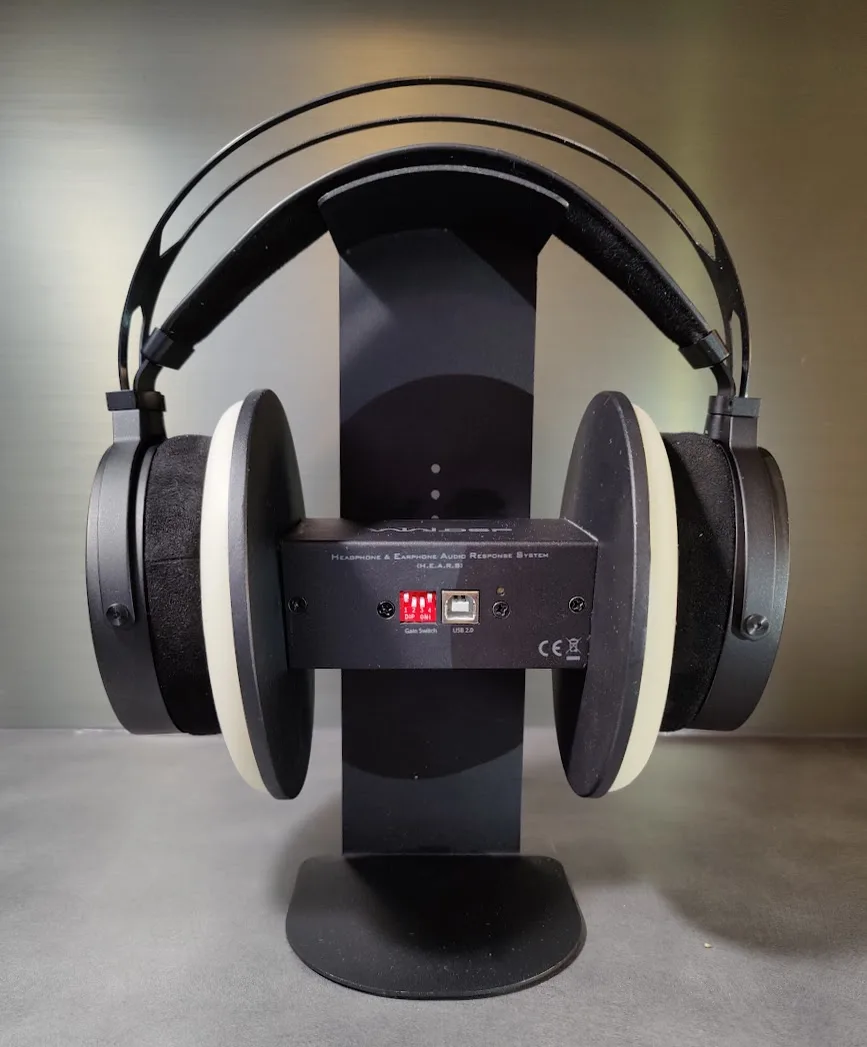
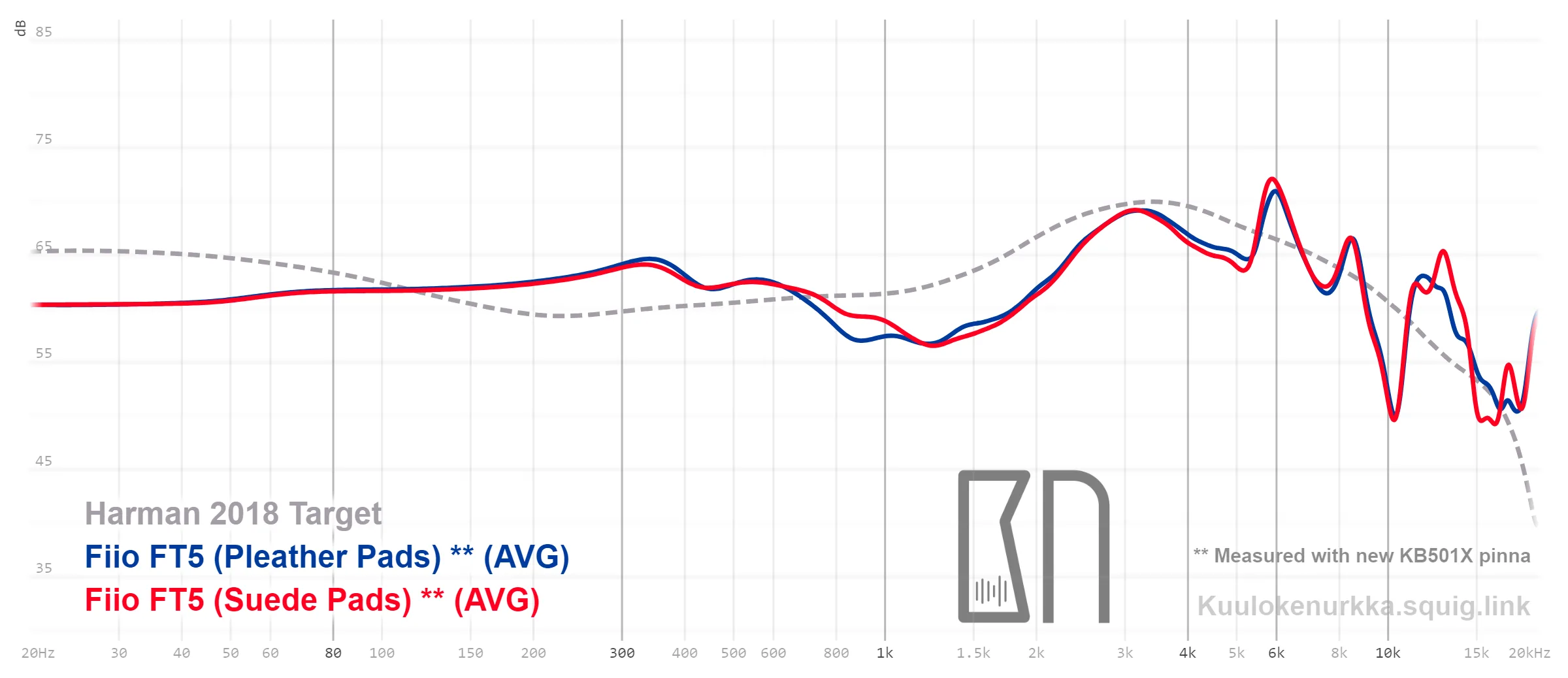
The frequency response measurements of the headphones were performed with IEC711-standard compliant equipment and new, more precise silicone ears (KB501X). The graphs use the Harman target curve (2018 version), based on scientific research, as a reference. This curve is a generalization of what kind of frequency response would sound good to most people and would correspond to listening to balanced-sounding speakers in a well-acoustically treated room. More information about the measurements and their accuracy can be found on the Headphone Measurements-page. The FT5's frequency response can also be compared with other measured headphones Squiglink-comparison tool.
FT5's frequency response with different earpads:
Bass:
The FT5 has a rather robust bass reproduction for planar headphones, although there isn't an excessive amount of bass, as for example in Modhouse Argon mk3. The unusually abundant lower midrange frequencies (300–600 Hz) draw some attention, so the bass frequencies do not actually stand out quite as strongly as one might infer from measurements. There is also less bass than would be desirable according to Harman's target curve, so I don't believe anyone would find the FT5's bass reproduction excessive. When listening to bass-heavy music at a low volume, I have occasionally equalized the sub-bass a couple of decibels stronger.
On the other hand, the headphones' sound can be perceived as robust and quite bass-heavy even as is, because the calm midrange frequencies between 1–2 kHz allow listening at a louder than usual volume. I have indeed noticed myself listening to the FT5 louder than most of my other headphones. According to the Fletcher-Munson curve (Wikipedia: Equal-loudness contour) the relative loudness of lower frequencies increases as the volume rises.
Regarding the quality of the FT5”s bass reproduction, my thoughts are twofold. Individual percussive sounds hit with respectable force, but with faster bass patterns, the reproduction feels slightly rounded. Of course, much worse has been heard in this price range. The FT5”s slightly lingering and "slow" bass reproduction might impress listeners who are accustomed to dynamic headphone models. Some find the low frequencies of planar headphones dry and unnaturally fast, in which case the FT5 would be a different beast in a positive sense.
Central votes:
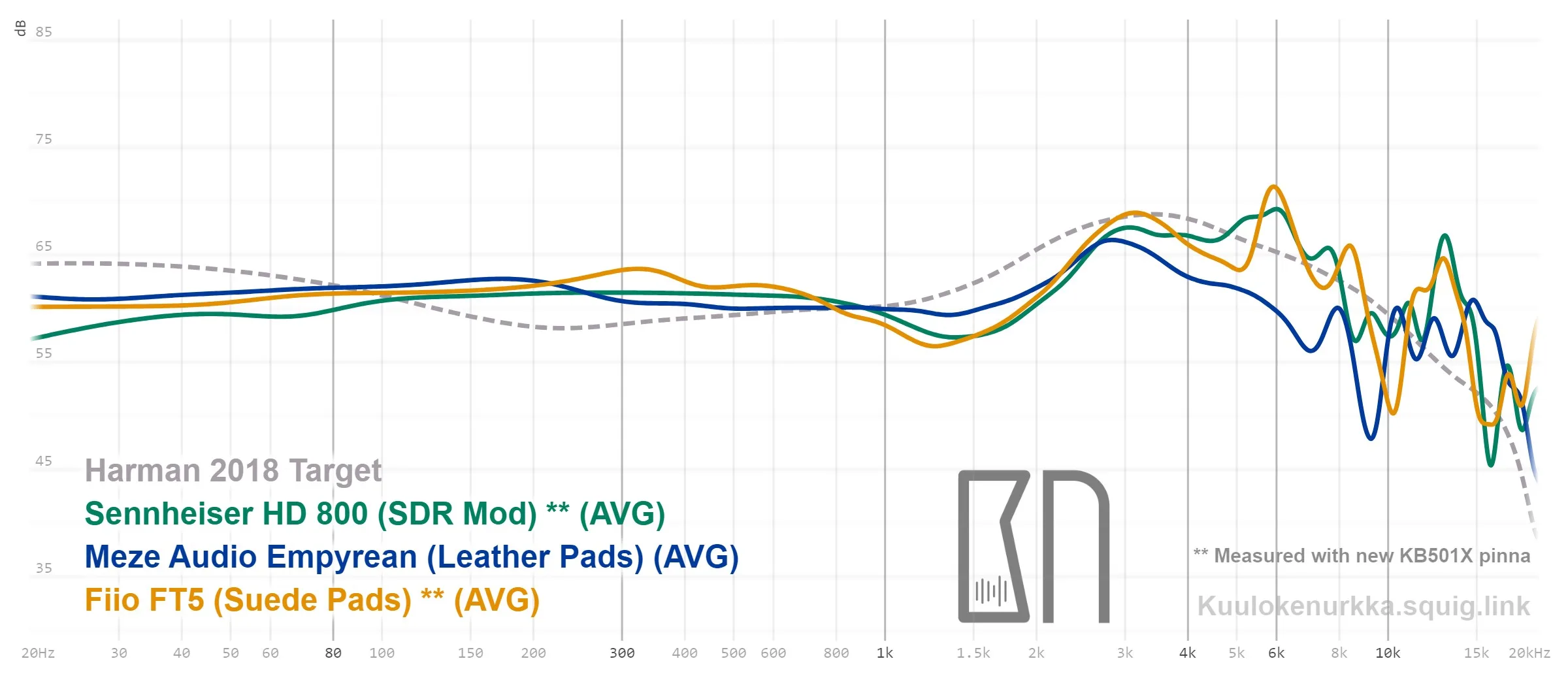
Mid-range is the headphones' greatest strength or weakness depending on the listener's preferences. If, for example, Sennheiser HD 600 feels perfectly balanced to you, the FT5 might not be for you. Due to the emphasis on lower mid-frequencies, the headphones sound robust, but the upper mid-frequencies might remain a bit too distant/subdued. The attenuation of the mid-range begins already at 600 Hz, and the energy level normalizes only around 3 kHz. Generally, I don't like headphones whose upper mid-frequencies are equally recessed.
However, the FT5”s peculiar frequency response ultimately sounds surprisingly ”neutral," and the overall package works better than expected. Abundant bass reproduction combined with rich lower mids creates a sense of weight in the sound. Music kicks nicely, making listening enjoyable. The slight boominess of the reproduction is a minor issue, but after a couple of minutes of listening, I no longer pay much attention to it.
Headphones like the FT5 are rarely found in the same price range, but their original presentation reminds me of a few more expensive headphone models. The FT5's frequency response could serve as a kind of model for Meze Audio Empyrean, but I don't find the mid-range of FiiO's headphones to be as bloated. In fact, the FT5's frequency response has almost as many similarities with Sennheiser HD 800. I haven't heard the Empyrean Elite model yet, but it's possible that the FT5 might resemble it as well.
Treble:
In terms of high frequencies, the FT5 is rather unremarkable, which is not a bad thing, however. The treble doesn't overdo it at any frequency, but there's just enough of it so that the headphones don't sound muffled, but are rather emphatically calm. The high frequencies also integrate seamlessly with the upper mid-frequencies, which I consider a very good achievement given how subtly this frequency range is reproduced. A narrow emphasis recorded in frequency response measurements at 6 kHz might cause some extra hiss and sibilance for some, but I personally haven't found this problematic. On the other hand, I know my hearing is quite insensitive in that frequency range, so I might be exceptionally lucky in this case. A narrow and reasonably moderate emphasis is unlikely to be a major problem even for more sensitive ears, but it's worth noting if a sharp reproduction between 5–6 kHz has caused problems before.
The resolution of the high frequencies in the FT5 is quite good, but the ultimate brilliance in the sound is missing. This is likely the price that had to be paid for the coherence of the reproduction. However, the sound of the headphones is precise enough for bells, chimes, and cymbals to be clearly distinguishable from each other and not blend together. Only the airiest phase of the sounds remains partially incomplete.
Soundstage:
The FT5 precisely positions sounds in the soundstage and can accurately reproduce the movements of sounds. The spatial impression has a slight speaker-like quality, as the soundstage is quite deep but not artificially wide. However, the reproduction is not particularly layered, even though there would be potential for it in terms of spaciousness. The three-dimensionality of the reproduction is most limited by the headphones' frequency response, as after equalization, the vocalist and instruments detach from their background much more clearly. Of course, excessive equalization might lead to losing the FT5's rich and robust characteristic sound.
However, if we talk about the situation without equalization, the headphones' moderately sized soundstage is clearly larger compared to, for example, Sennheiser's HD 600 series headphones. I haven't listened to Audeze headphones in a while, but from memory, I would claim the FT5's soundstage is at least as large as or larger than, for example, LCD-3. Hifiman Arya and Sennheiser HD 800-like striking grandeur in the sound, but there is comfortable space in every direction, including height. This was a positive surprise for me, as height-wise spatial separation is not necessarily present at all in 500-euro headphones. It is also impressive how large and grandiose the FT5 makes music sound. Works like Shostakovich's Waltz No. 2 feel like they fill the room, with the music extending far beyond the headphones.
Resolution and tonal transparency:
The resolution of headphones is a somewhat cryptic concept that may mean different things to different people. For me, a high-resolution headphone is one that can reproduce different sounds separately from each other while maintaining the natural timbre of instruments in every situation. I also actively expect ”I haven't heard this before” type moments. With high-resolution headphones, one should hear more things buried in the recording, which results in a richer listening experience.
Tonal transparency, on the other hand, is a more straightforward concept. In my opinion, a tonally transparent headphone reproduces sound in such a way that I don't feel there's anything extra between me and the music. A classic comparison for this situation would be a lightly transparent curtain and completely clear glass. A tonally transparent headphone should create the feeling that I am in the same place as the artist, and there is no artificial curtain between us.
How does the FT5 then fare with these completely subjective metrics?
In this area too, the performance is good, but not exceptionally excellent. The limiting factor again becomes the headphones' frequency response, and especially the recessed 1–2 kHz frequency range. This is known to have its own positive effects on the spaciousness of the soundstage, but in my experience, emphasizing the same frequency range can also increase the sense of presence and transparency. Equalization is indeed beneficial if the FT5 is desired to sound as accurate as possible. Even without it, however, I don't feel I'm losing significant information compared to other headphones. Ultimately, resolution and tonal transparency must be mentioned as the FT5's weakest areas. Based on my recollections, for example, SASH Tres (45 ohm) and Hifiman Edition XS are clearly ”more transparent” sounding.
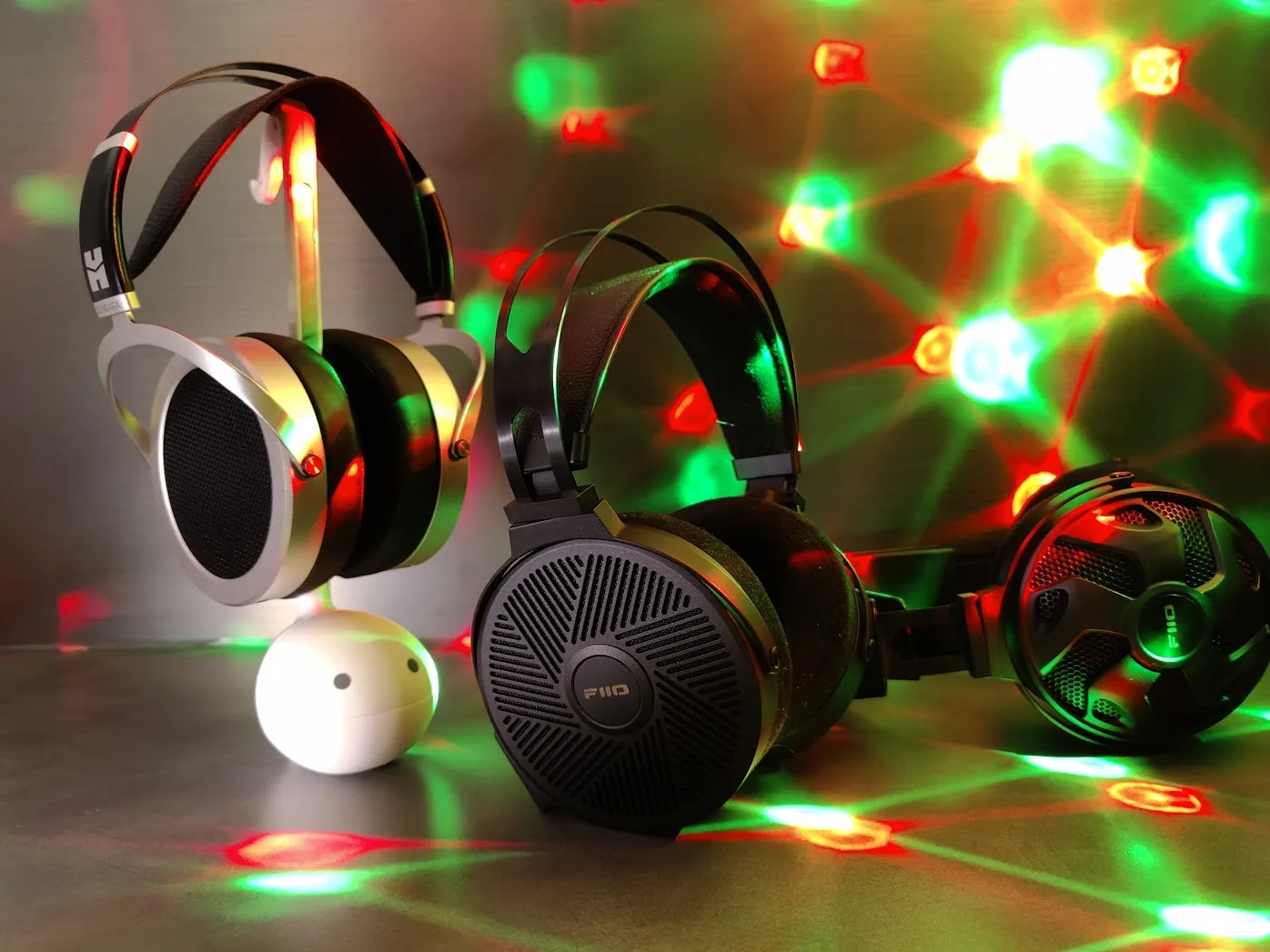
Dynamics:
Planar headphones generally do not sound particularly dynamic, but the FT5 is a positive surprise in this area. It is dynamically convincing not only within its own price range but also against significantly more expensive planar headphones. For example, I don't believe I have ever heard Audeze headphones that are as impressive in terms of macrodynamics as the FT5. However, it doesn't quite offer the same kind of punch as the Hifiman HE6 / HE6se V2:n kaltaista tykittelyä ei kuitenkaan sentään ole tarjolla.
I have listened to the FT5 at a slightly higher volume than most of my other headphones, which may partly influence my experience of good dynamics. Those who prefer quieter listening volumes might not find the headphones quite as dynamic, or at least not entirely similar to my experience.
The FT5's sound has its flaws, but thanks to its good dynamics, I enjoy listening to it considerably more than one might perhaps infer from my review. The headphones are easy and effortless to listen to, and nothing about them becomes irritating. Usually, anemic dynamics would be the first thing to annoy me.
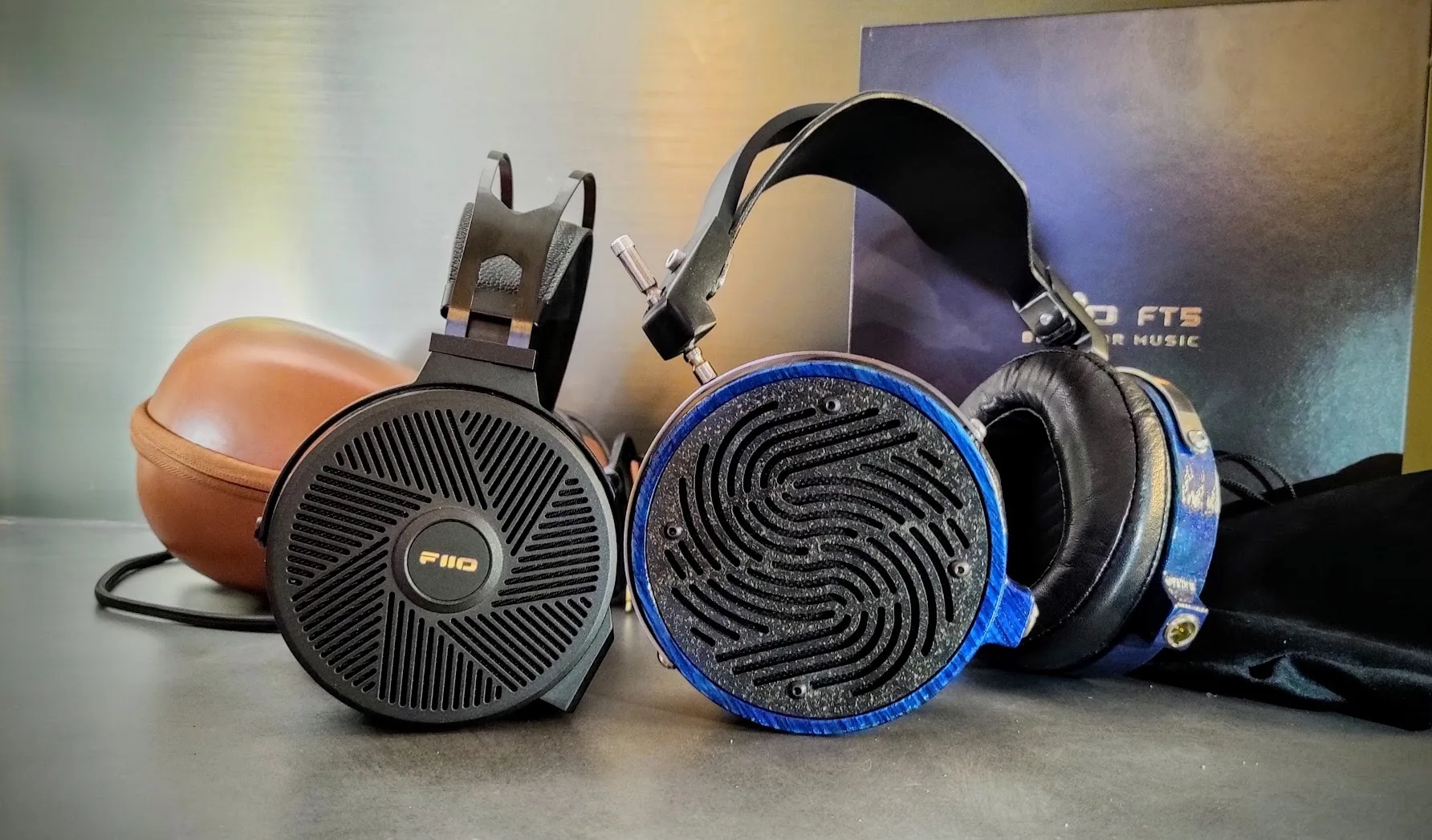
Strongstus
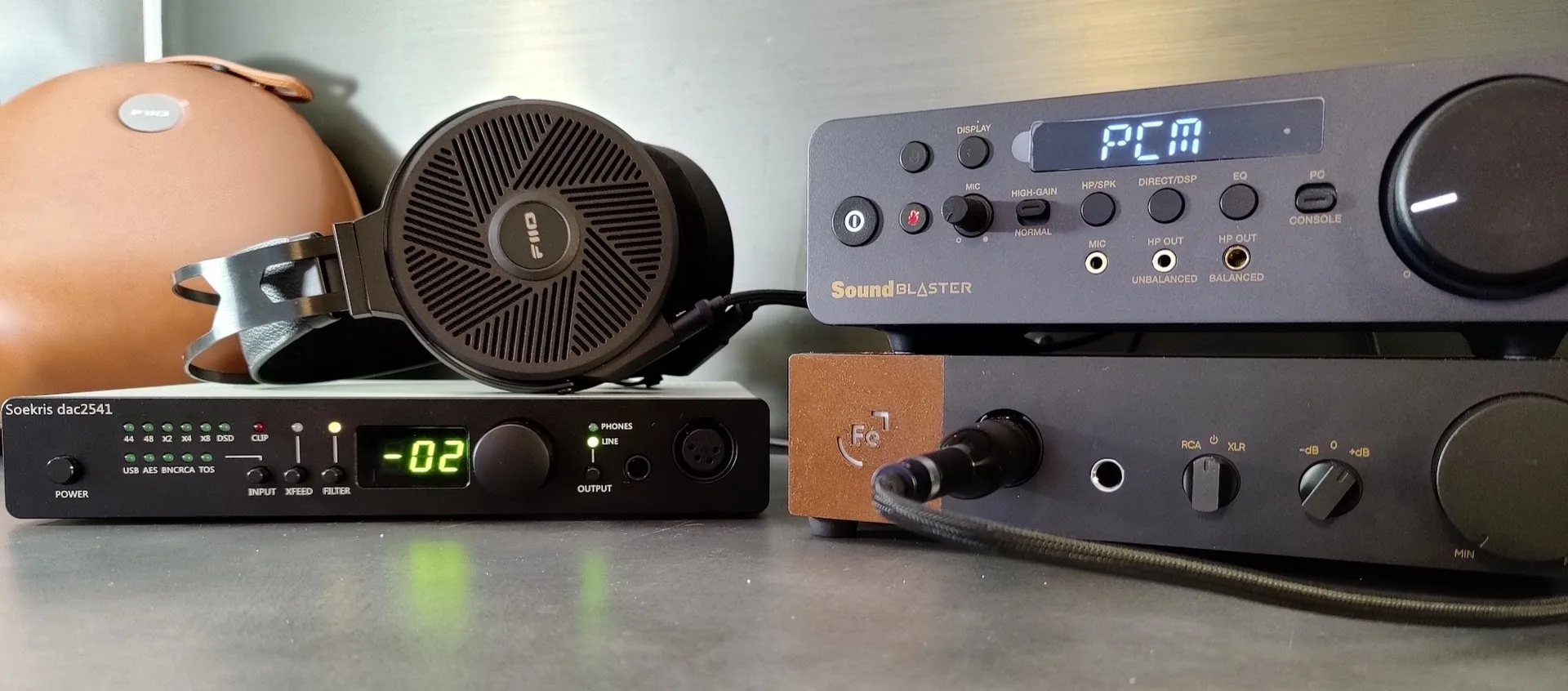
I have mainly listened to the headphones Creative Sound Blaster X5:llä (balanced) and with the Soekris DAC2541 & Ferrum Audio OOR combination (also balanced). The difference in sound quality between these devices is, in my opinion, quite small. Their price difference, however, is tenfold, so the result likely indicates that the FT5 achieves its maximum performance quite easily with transistor amplifiers. More expensive does not always mean better, of course, but with most other headphones, the OOR is a superior amplifier compared to the Creative device.
FiiO markets the FT5 as an easily driven planar headphone that pairs well with mobile devices. This is likely true if a fairly powerful mobile player is used. In my opinion, it's pointless to try listening to the headphones with low-power dongle devices, as the FT5's sensitivity is relatively low (96 dB/mW), even though the typical 36-ohm impedance might suggest an easy load.
It is actually good that the impedance is not lower than this, because not all amplifiers are designed for, for example, a 16-ohm load. Lower impedance is often assumed to make headphones easier to drive, but owners of Dan Clark Audio headphones, for example, will know that the situation can actually be the opposite. 36 ohms is a safe choice from FiiO, so that its headphones are versatile for listening with different devices.
Among the amplifiers I tested, my favorite has been the Original OPA-4A, updated with Psvane 6CA7 and Philips E80CC tubes. The FT5 would hardly sound good with a low-power OTL tube amplifier, but the powerful (4.5W @ 32 ohm) OPA-4A is likely designed specifically for planar headphones. Good tube amplifiers generally sound more effortless than transistor amplifiers and create a more convincing sense of space. Thus, the slightly sticky sound resulting from the FT5's recessed upper midrange disappears, and sounds detach more clearly from their background.
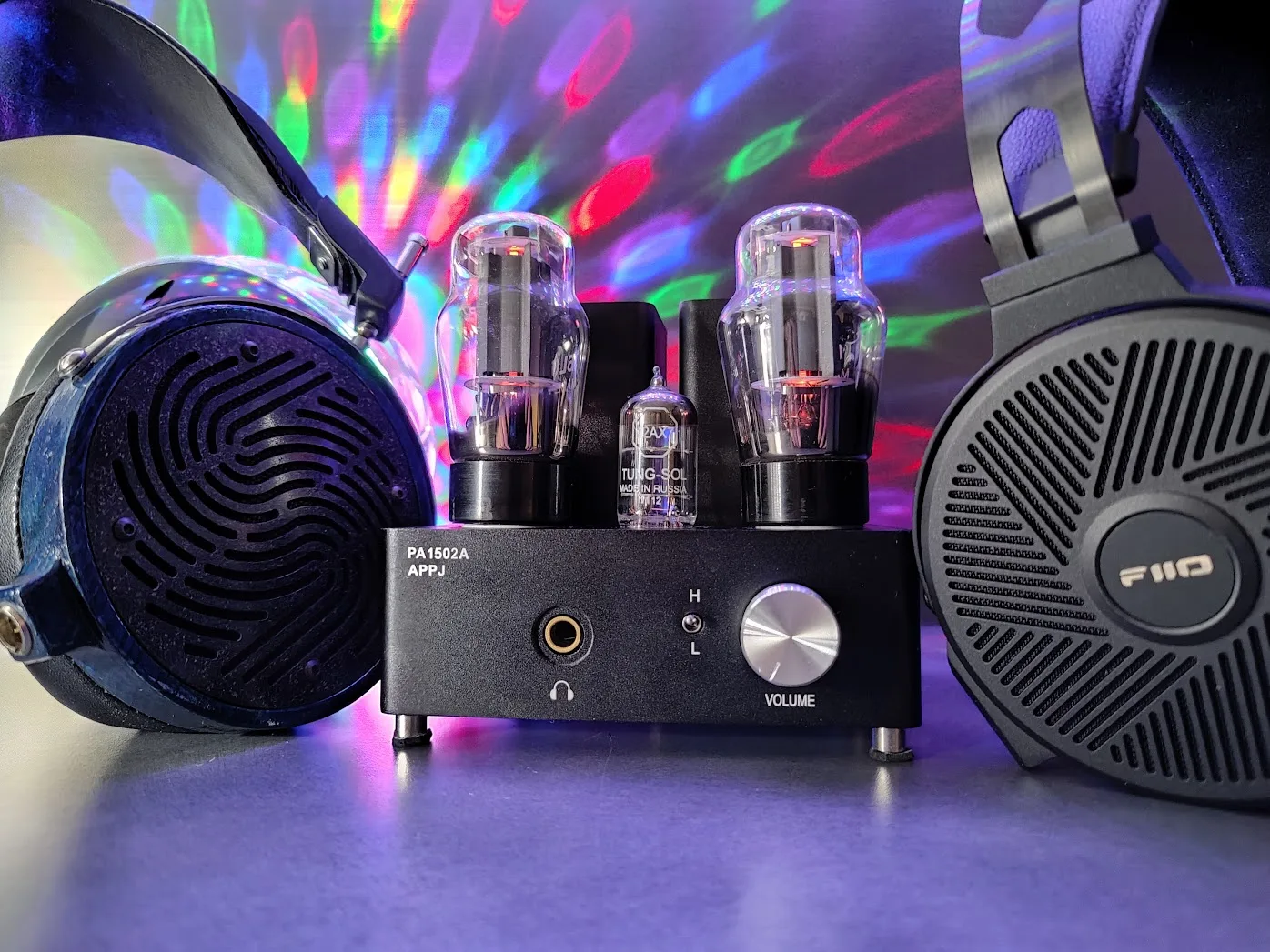
In addition to the OPA-4A, my favorite amplifier has been the APPJ PA1502, in which I have also changed the tubes. The PA1502 is an excellent amplifier, but in my opinion, it needs better tubes than the original ones to truly shine. The device costs about 200 euros, so you don't have to pay an arm and a leg for a good tube amplifier suitable for planar headphones. In addition to an improved sense of space, the amplifier makes the FT5 sound a bit more aggressive, which suits my preferences well.
Comparison to other headphones
FiiO FT5 vs. FiiO FT3
Prices: 500 € vs. 300 €
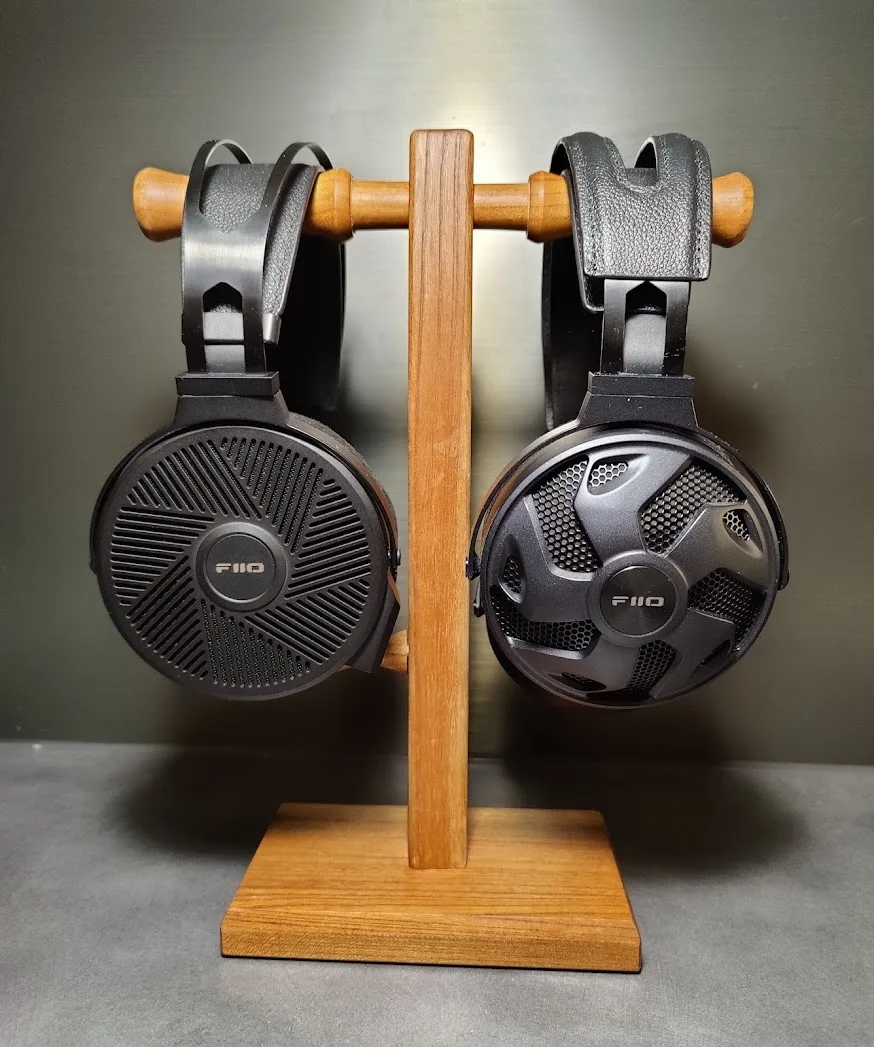
I quickly compared the FT5 with the manufacturer's FT3 model. More details about the FT3, which is implemented with a dynamic driver, can be read from our previously published review.
Frequency responses:
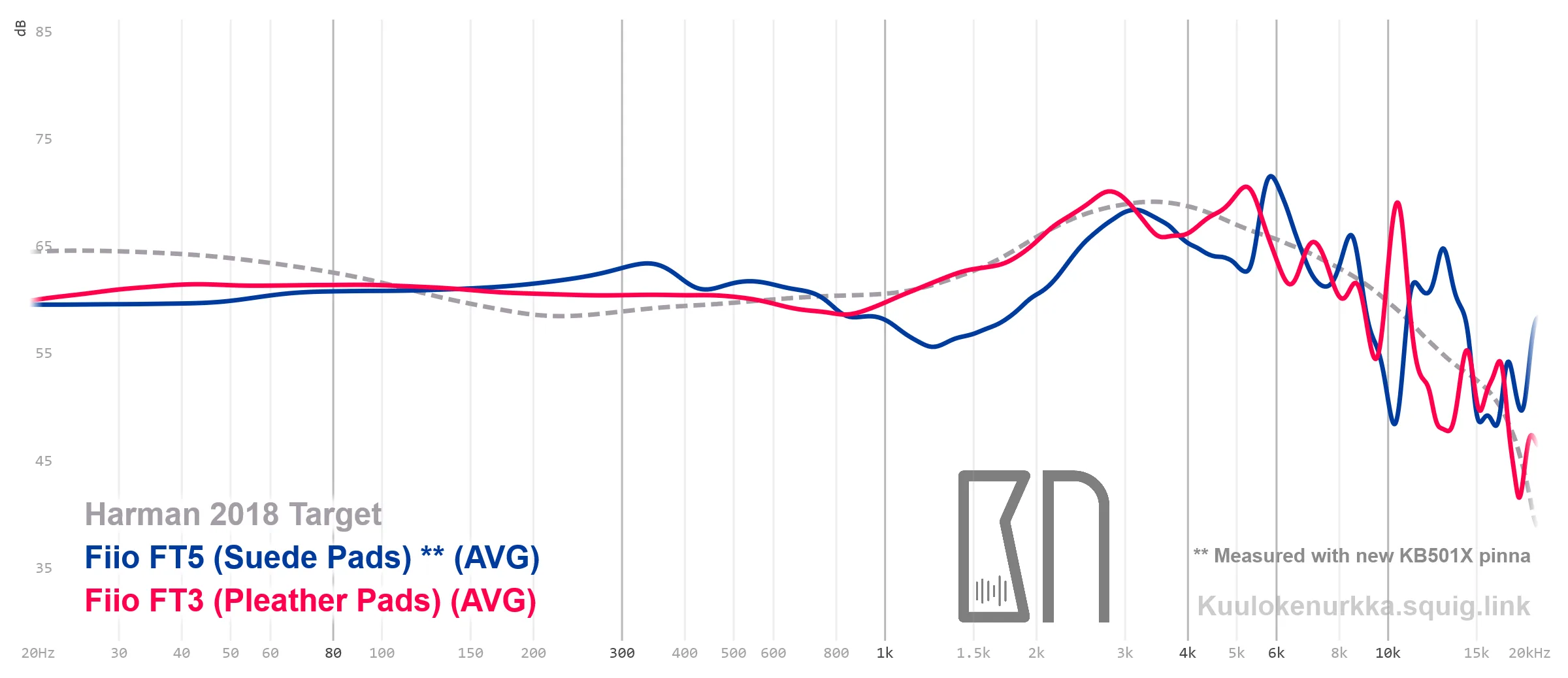
The FT3 is the more successful of the two in terms of frequency response, if the measure is how well the headphones conform to Harman's target curve. I quite like Harman-style sound, so headphones that sound calmer, like the FT5, don't always make a big impression on me. Despite a more "correct" frequency response, the FT3 is unable to challenge the FT5 in this case.
One of the best aspects of the FT3 is that it doesn't sound shriveled like many dynamic headphones, but rather possesses characteristics of larger planar headphones in its sound. It was surprising to notice how ”small” the FT3 sounds compared to the FT5. The difference is similar to comparing large and small speakers. When I switch from the FT5 to the FT3, it feels as if only the shells of the music remain, without depth and the driving kick that would make my feet tap. The FT5 is more dynamic, more resolving, and more natural-sounding. Although the FT3 is an excellent headphone for its price, the higher price of the FT5 is easily justifiable.
FiiO FT5 vs. Hifiman Sundara Silver
Prices: 500 € vs. 450 €
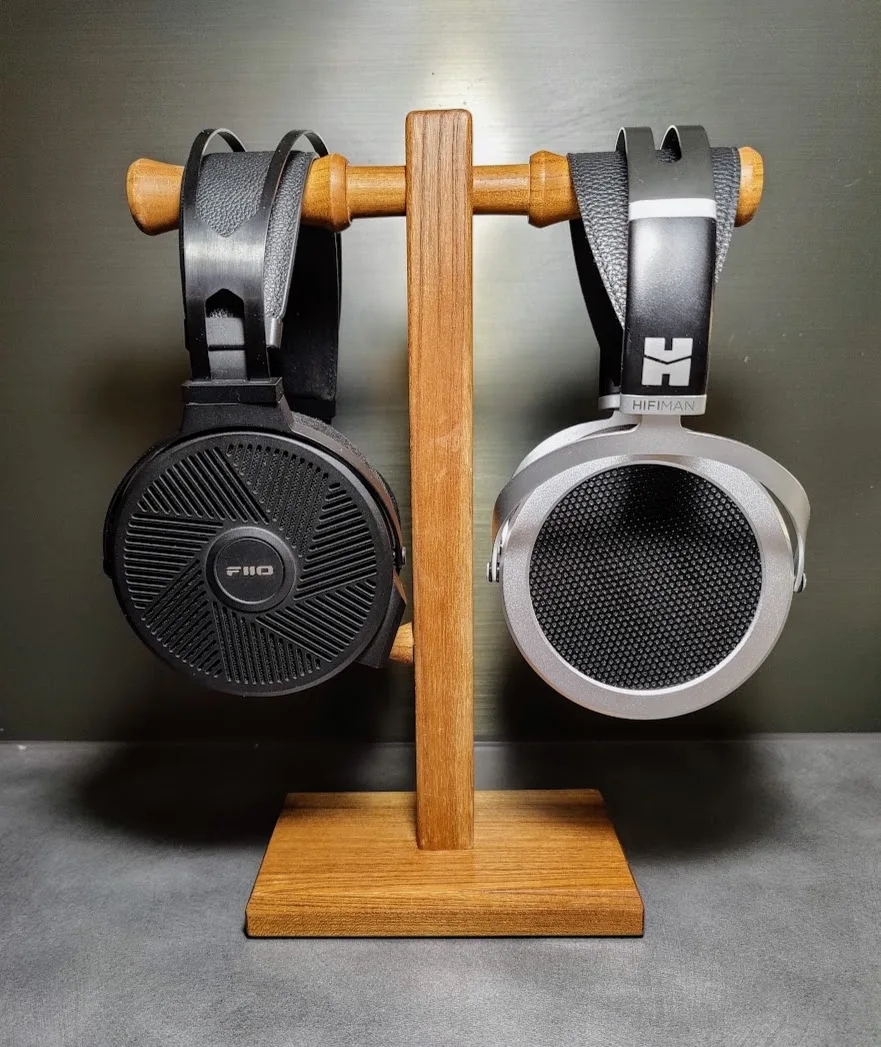
I had not heard the new Sundara Silver before writing this review. Initially, the headphones did not impress me, as they sounded thin, undynamic, and a tad too bright with the Shanling M6 Pro mobile player. Through the unbalanced output of the Creative Sound Blaster X5, the Sundara Silver already sounded quite good, but still lacked dynamics. With the Topping L30 II, the headphones sounded otherwise excellent, but the soundstage completely lacked a sense of depth. The vocalist sounded small, positioned roughly on my forehead, instead of the sound reproducing naturally from the front. The L30 II's soundstage has disappointed me with so many different headphones over the year that I have already started to consider modifying my previous, quite positive, review.
In our writing about Sundara Silver review on it was mentioned that it sounds excellent with the Nitsch x Schiit Audio Magni Piety headphone amplifier. I can confirm this myself as well. With the Magni Piety, Sundara's soundstage expands compared to the Topping amplifier, and the dynamics are also clearly better than with the low-power Sound Blaster X5 and Shanling M6 Pro. Of course, I also tested the FT5 with all the aforementioned devices, but its sound hardly changed when switching amplifiers.
Frequency responses:
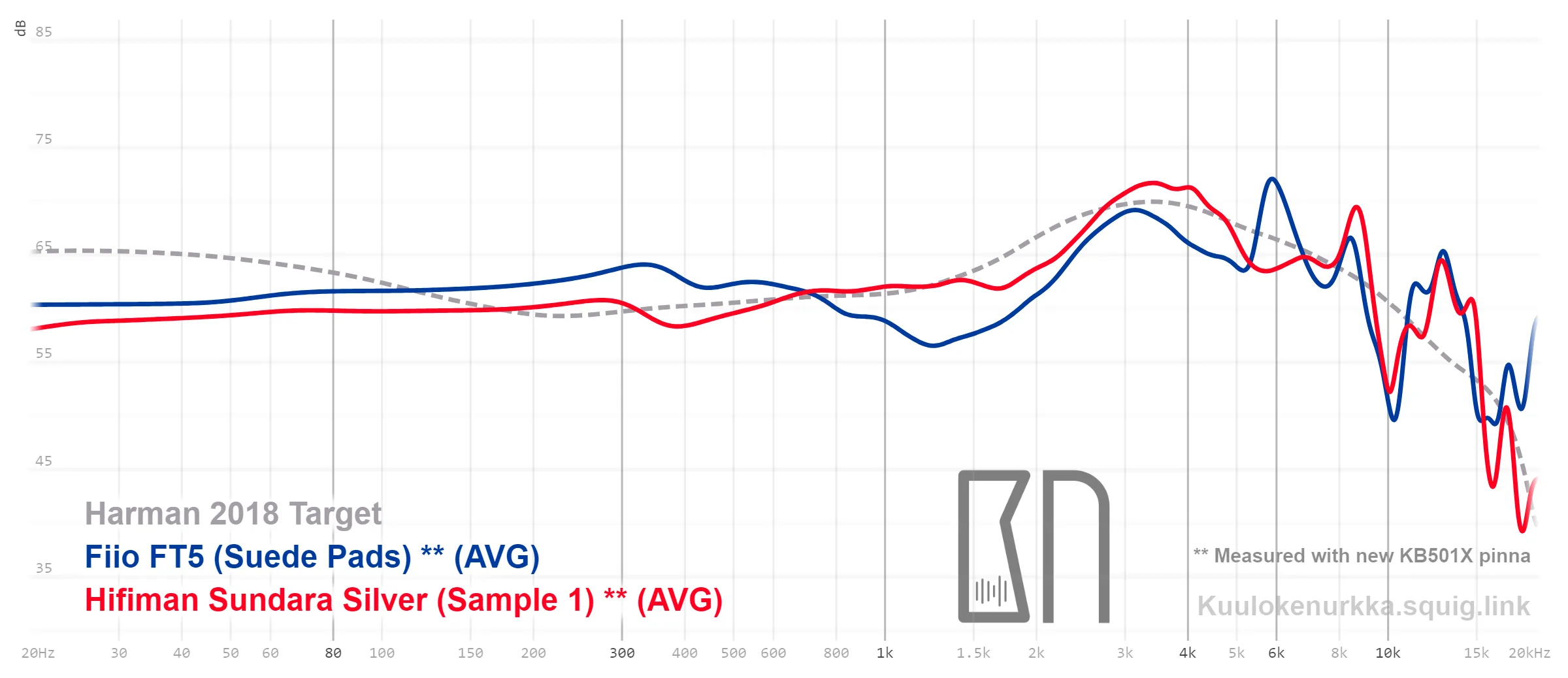
FiiO FT5 and Hifiman Sundara Silver differ greatly in sound quality. FiiO emphasizes lower mid-frequencies in its headphones, while Hifiman strongly brings out upper mid-frequencies and treble. As a result of these differences, the FT5 sounds fuller, but not as clear and ”transparent” as the Sundara Silver. The overall sound of the FT5 is clearly more colored, which means you never quite get free from the headphones; instead, the music feels like it's playing through a sound-shaping and veiling filter. Especially vocal performances sound significantly more realistic with the Sundara Silver.
When evaluating frequency response alone, Hifiman's headphones are clearly more convincing. However, if I also consider my subjective experiences, for example, regarding soundstage and dynamics, determining the superiority between the headphones is no longer as easy. The Sundara Silver's soundstage is quite decent and, according to my memory, better than in the black Sundara model. Still, the spatial impression of the FT5 pleases me more. The soundstage is not much wider, but the sound itself has a grandeur that is missing from the Sundara Silver. Individual sounds appear larger, as if I were listening to a large orchestra. In terms of dynamics, the FT5 is also the more exciting of the two. The Sundara Silver's presentation is undoubtedly more precise and correct, but not as engaging for me, especially if the amplifier pairing is not suitable for the headphones.
Overall, I would assess that the FT5”s 50 euro higher price is justified. Compared to the Sundara Silver, the headphones” build quality is higher, there are more accessories, and when equalized, it could sound almost as "normal." Conversely, it is not possible to equalize the good qualities of the FT5, such as a larger soundstage, into the Sundara Silver. Somewhat surprisingly, using the FT5 is also more comfortable for me, even though it weighs 100 grams more. The Sundara Silver clamps quite firmly, whereas FiiO's headphones almost disappear on my head. The FT5 is also a safer choice if a particularly good headphone amplifier is not available.
Summary
At this point, it's time for a summary. In my opinion, the FT5 is ultimately a peculiar case of headphones. Its grand sound and good dynamics distinguish it from most other planar headphones in the same price range, but otherwise, it doesn't particularly stand out based on any single feature. What is impressive, however, is that the FT5 doesn't have any major weaknesses either. Often, the best headphones are precisely those that are generally good performers. For example, I have recommended the Hifiman Sundara for years because it has no major flaws. On the same grounds, I can now also recommend FiiO's FT5. Its restrained and slightly soft presentation might even appeal to a wider audience than Sundara's more clinical and drier sound.
Although the FT5's sound is above all pleasant, it also possesses exceptional power and authority, especially when listening at slightly higher volumes. Its punchy presentation is, in my opinion, excellent for heavy and metal music, but the bass also has enough oomph for listening to EDM and rap. Pleasantly, even music recorded worse than usual sounds good with the FT5. Poorly recorded old Metallica and Iron Maiden tracks have indeed returned to my playlist.
The FT5 doesn't really have direct competitors, as planar headphones with similar tuning are usually significantly more expensive. A popular alternative among those who appreciate a slightly bass-heavy sound and a robust midrange has been the Audeze LCD-2 Classic, costing around 700 euros. I last heard it a couple of years ago, but according to my memory, FiiO's headphones are a step ahead of it in terms of both sound quality and comfort.
The FT5's sound, comfort, and build are thus in order, and the list of negative features is commendably short. In addition, the headphones come with an exceptional number of accessories and a cable unparalleled in its versatility. The FT5 is definitely worth trying for those who find the Harman-style midrange unnecessarily aggressive, and who believe that the physicality and dynamics of reproduction are more important than airiness and resolution.
Pros and cons:
+ Despite the peculiarity of the frequency response, a coherent and consistent sound
+ Fairly powerful bass reproduction and dynamics for planar headphones
+ Larger than average soundstage
+ Excellent quality construction
+ Good comfort
+ The most versatile cable on the market
+ Abundant accessories
+ Good price-quality ratio
+/- Consistently reliable performer in all music genres, but does not offer major wow-factors
+/- Sounds best when listened to at high volume, which can be either a good or bad thing depending on the user
– Earpads might be small for some
– Resolution and sound transparency do not reach the best in its price range
 EN
EN  FI
FI
Is it for sale or did you send it back to the factory?
On behalf of Roderick, I answer, No and No. 😀 Generally speaking, sometimes (very rarely) we get to keep some review units, especially if they come from abroad. Returning them to China, for example, would not be logistically or financially sensible for us or the manufacturer. On the other hand, when we spend a fair amount of work hours thoroughly testing the product, writing the review (we often make a separate English translation), and giving feedback to the manufacturer, the ”hourly wage” remains almost non-existent compared to the benefit companies receive. Of course, this is not done for money.
How do these compare to the new Sash Tres SE version? They seem like interesting headphones. 🙂
A review of the Tres SE is currently underway, so comprehensive experiences will be available for reading in the coming weeks. In a very generalized summary, I would describe the Tres SE as being more neutral and energetic in sound, while the FT5 is more robust and softer. Since I have only listened to both models for a few hours, I am also eagerly awaiting Roderick's more detailed analysis of SASH's new model. 🙂
I bought the FT5s based on this test and it didn't go wrong.
With a little EQ, an absolutely amazing and quite capable headphone.
Thanks for the test then. 🙂
My own EQ settings with which the sound doesn't really have any shortcomings to my ear:
350hz -2 Q0.6
1250hz +4 Q0.5
4000hz +2.9 Q0.79
6000hz-5 Q3.05