Hifiman-October 8/10
Author: Roderick
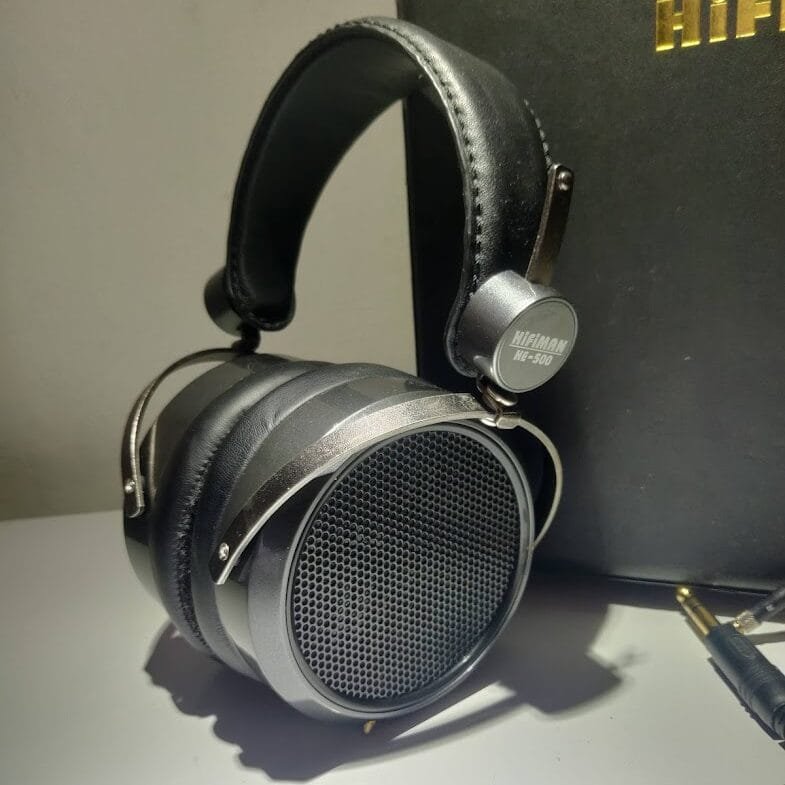
Table of Contents:
Information:
- Price: 899 USD (2012), nowadays used around 400 euros
- Sensitivity: 89 dB/mW
- Impedance: 35 ohms
- Weight: 502 g
- Connector type: 2 x SMC
- Cable: 3-meter silver cable with a 6.35 mm connector (previously, it apparently came with a Canare cable resembling the HE400 model)
Review sample: Self-purchased product
Released in 2011, the Hifiman HE500 is a classic of its kind, which I only got to hear for the first time years later. The HE500 (899 USD) was the middle headphone model of the Hifiman trio released around the same time, priced between the HE400 (399 USD) and the HE6 (1299 USD).
The headphones were apparently intended to be a lighter version of the HE6 flagship headphones, which require a really robust headphone amplifier – The HE500's original planned name was HE6p (p=portable). The pair of headphones I am reviewing has aftermarket Focus pads installed, so I have not tested the original pads at all.
Structure and comfort
The headphones are externally similar to the ones I reviewed earlier HE400-model. The build feels high-quality, but it is quite minimalistic for headphones that cost 900 dollars new. Like the HE400, the 60 grams heavier HE500 would, in my opinion, benefit from a thicker head cushion or a comfort strap-style solution that would distribute the weight more evenly on the head. You can comfortably wear the headphones for an hour or two, but after that, a break is needed.
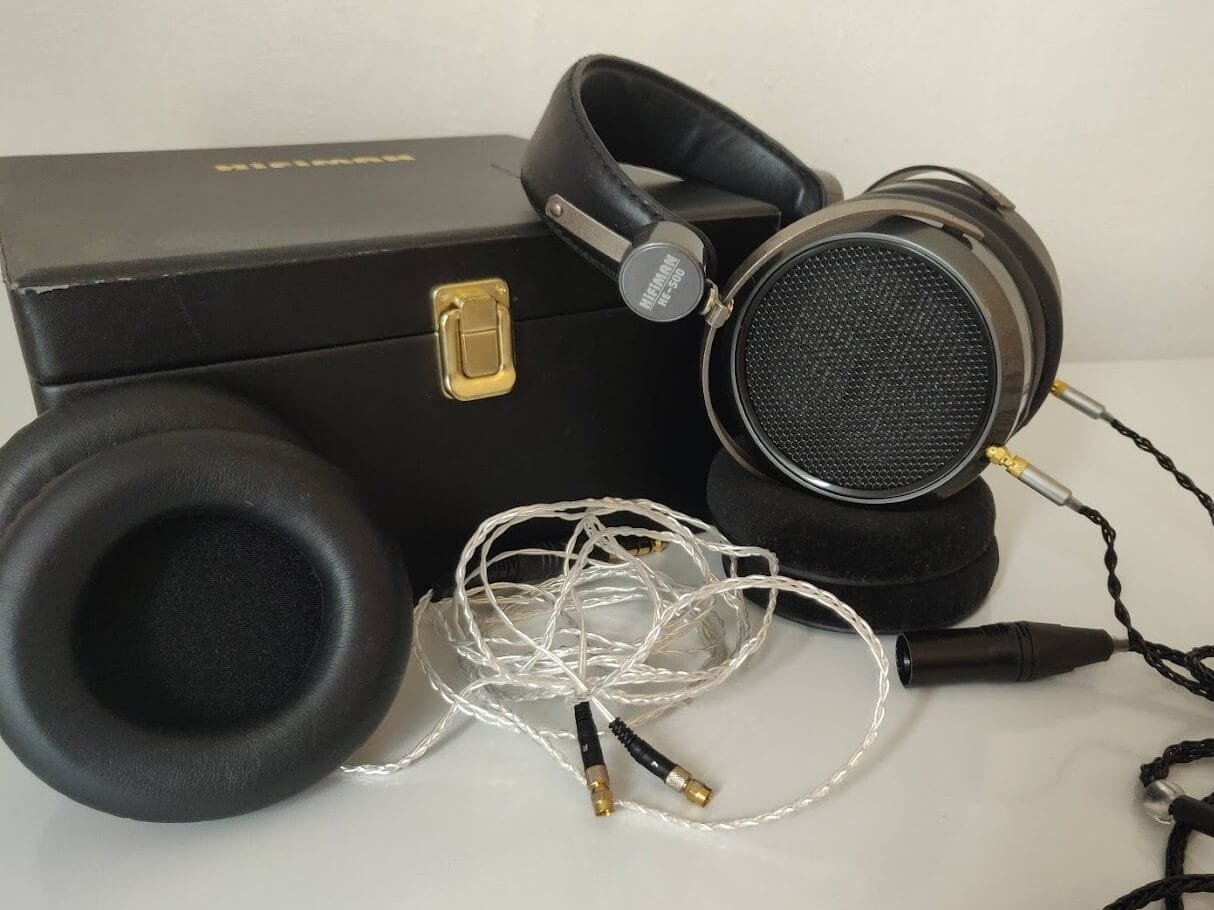
The headphones come with two sets of pads: artificial leather pads, similar to the HE400, and velour pads made of a more porous material, which resemble several pads used by AKG. However, I have not tried either of these pads, as my own headphones have pads known as Focuspads installed. These pads are slightly thicker at the back than at the front, so the headphone drivers are angled slightly towards the ears.
Focuspads are so-called hybrid pads, meaning they use several different materials: the outer edge is artificial leather, the part facing the face and the inner edge are rough velour, and the bottom part/base is fabric. If I have understood correctly, the pads are Focuspad A-model, which was originally used on HE400i– and HE560 models. After these, Hifiman has started using a newer Focuspad model, where the inner parts of the earpad are made of perforated synthetic leather. The manufacturer's earpad selection is almost as confusing as its headphone selection.
I already complained in the HE400 review about the earpad attachment mechanism, which is also used in the HE500 model. The earpads attach to the cups with a separate plastic ring, which is easy to remove, but when reattaching it, gaps easily form between the earpad and the cup, or the earpad spins freely on its rim. Due to the difficulty of attaching the earpads, I didn't want to test the headphones with the original earpads. Fortunately, the aftermarket purchase of Focuspads has been so common among enthusiasts that when acquiring used HE500s, the inclusion of Focuspads in the deal is very likely.
Since the headphone cable is similar to the HE400se model, I already briefly touched upon it in a previous review on. In summary, the cable is terrible – it transmits a huge amount of sound when it hits the listener's clothes. It also easily gets tangled and develops kinks. The cable would probably only get completely straight with an iron.
The SMC connectors used for attaching the cables are also terrible, as they easily loosen with use, and when twisting them on, the cable itself easily gets twisted. Due to the unusual connector solution, the selection of separately purchasable cables is currently limited. However, I managed to find an affordable balanced cable for the headphones, which I have used when reviewing them. When evaluating sound quality, the amplifier used was Liquid Platinum and its balanced output.
Sound quality
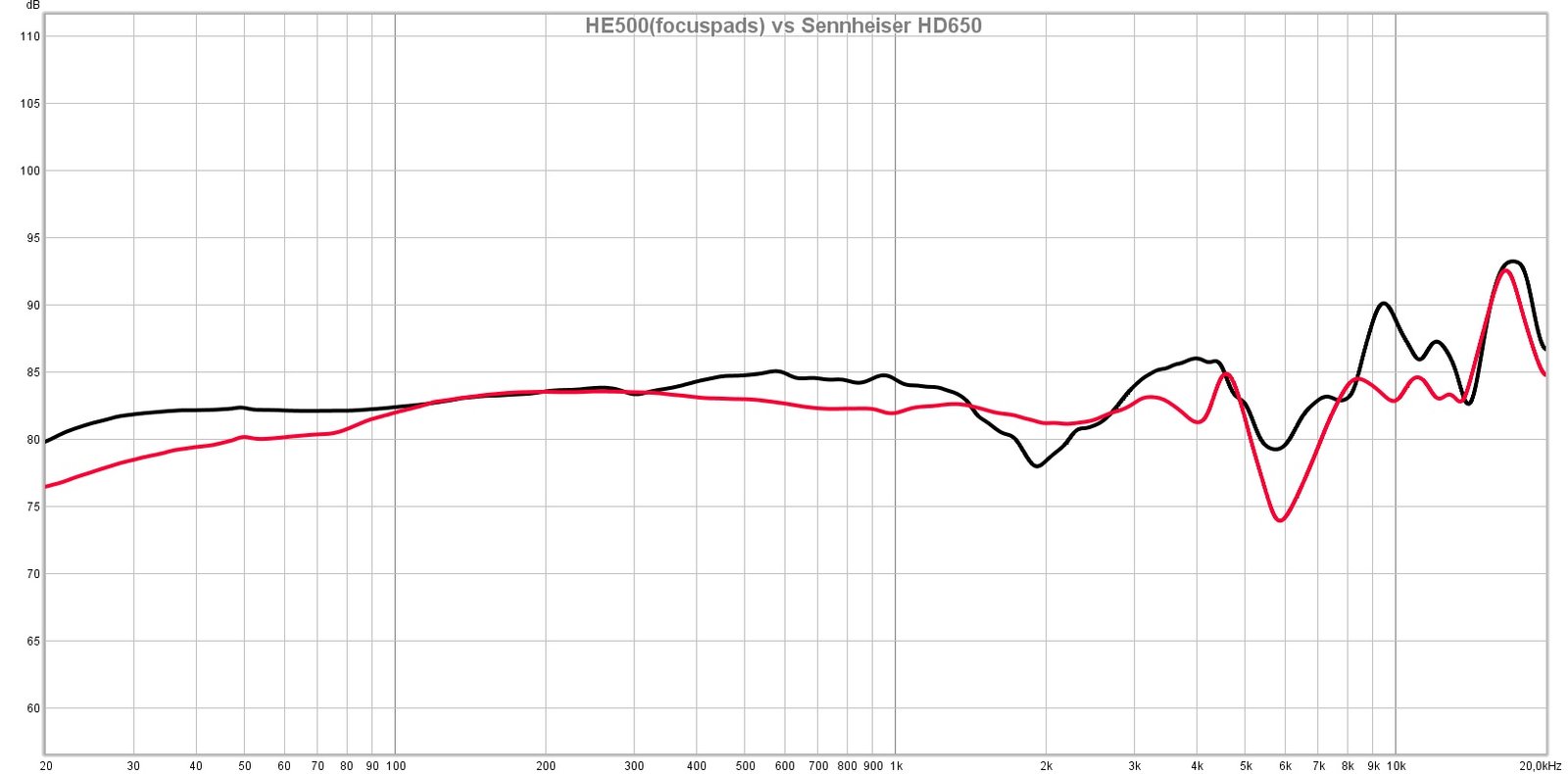
The tuning of the HE500 differs significantly from most Hifimans I have reviewed previously. The headphones most resemble the HE5XX-model, because both sound fuller in the midrange than Hifimans generally do. Partially because of this, the headphones' treble is also less emphasized.
In my opinion, the tuning of the HE500 is very successful because the sound has warmth, but not so much that the sound becomes distant or muffled. The headphones would certainly appeal to those who like Audeze LCD headphones, even if the Hifiman's sound isn't quite as dark. The midrange reproduction of the HE500 is one of the finest I've heard, and especially for 400 euros (the price of used headphones), it's hard to beat them. The Sennheiser HD650 also has a superb midrange, but the so-called ”Sennheiser Veil,” or a certain veiled quality to the sound, is a real phenomenon to my ears.
In the HE500, the amount of bass is also exceptional compared to other more affordable Hifimans – to achieve a similar amount of bass reproduction, one actually has to go all the way to the Arya in Hifiman's current lineup. However, it's worth noting with this observation that I haven't yet heard the new HE6se model, which might very well offer similar bass reproduction more affordably than the Arya. Of course, the HE6se still costs significantly more than the HE500.
The soundstage of these headphones is often characterized as speaker-like, which I completely agree with. However, in terms of three-dimensionality of reproduction, the headphones are not exceptional; in my opinion, even the HE5XX is better in that regard. At its best, however, the HE500's presentation is superb – in addition to the soundstage being wide, it is also large in height (note: I don't mean depth, but vertical direction). At times, the HE500 throws such massive walls of sound at the listener that I can't immediately think of another headphone model where I've encountered similar effects. Furthermore, the headphones seem to react to spatial cues in recordings more sensitively than most other headphones.
The HE500”s soundstage adapts excellently to the music being listened to. Sometimes the presentation is intimate, and I feel like I'm in the middle of the music as a listener, rather than observing it from afar. This kind of presentation works wonderfully, for example, with simpler vocal-focused music, where I want to create a ”connection" with the singer. With other types of recordings, the HE500 places the listener slightly further away from the music, which is often very pleasant, as who would want, for example, an entire symphony orchestra in their lap.
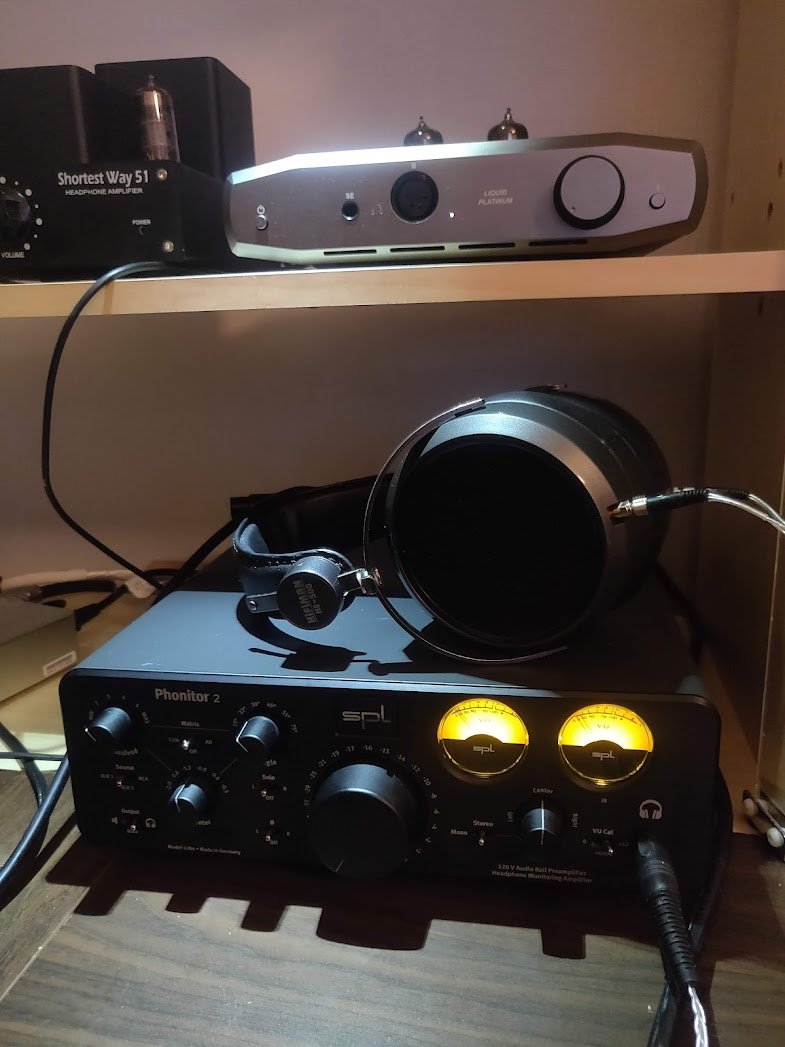
I mentioned at the beginning that the headphones were originally intended to be an easier-to-drive alternative to the HE6 model, which is one of the world's most demanding headphones. Although the HE500 is easier to drive, it should not be listened to with flimsy equipment due to its low sensitivity (89 dB / mW). For example, my Liquid Platinum amplifier provides a comfortable 6.6 W with a 33-ohm load. With the amplifier, the HE500 plays loudly but is listenable when the amplifier's volume is set to twelve o'clock.
HE500 vs. Sundara (2020)
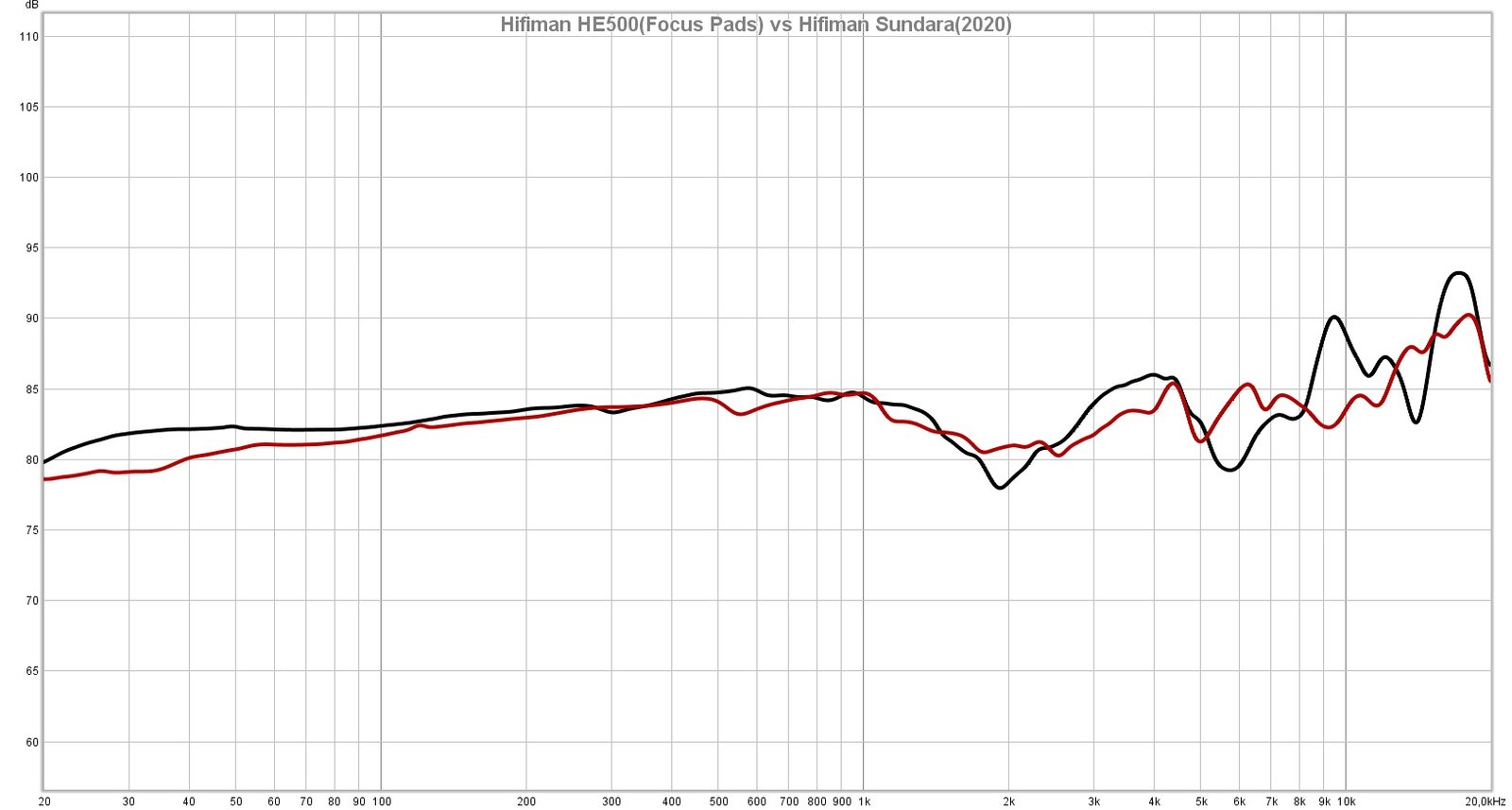
The Hifiman Sundara, costing about 350 euros new, is more resolving and technically more advanced sounding than the HE500. This is especially noticeable with more complex music, where the HE500 gets a bit ”congested” as different sounds blend more into a single wall of sound. With the Sundara, this does not happen. On the other hand, the HE500 brings more power to the sound, a firmer bass reproduction, and a wider, albeit more one-dimensional, soundstage.
Although the HE500 has a calmer and softer overall sound than the Sundara, for example, drum cymbals occasionally ”hiss” a bit too prominently. The difference in treble compared to the Sundara is smaller than one might infer from the frequency response, but I still prefer to use the soft-sounding Liquid Platinum tube hybrid with the HE500 rather than the SPL Phonitor. With the Sundara, the amplifier choice is less significant, as the headphones sound excellent from all sources that simply have enough power.
Overall, the HE500 and Sundara are quite different headphones that complement each other well. I planned to sell one of them, but at least for now, I'm not ready to part with either!
Summary
It's almost a small miracle that I only got to listen to the HE500 model for the first time years after their release. I considered buying the headphones around the time they were released, but I ultimately ended up acquiring the JVC HA-DX1000 headphones.
Although I knew the HE500 enjoyed great esteem among enthusiasts, it was still a big surprise to me how good they truly are. If the headphones' impractical design and somewhat lacking comfort are not an obstacle, the HE500 can be recommended to almost anyone. The wide soundstage, impactful and extended bass, and superb midrange reproduction easily make the listener forget that the headphones' technical performance no longer fully matches newer competitors at a similar price point.
Although about 400 euros might seem like a lot for ten-year-old headphones, I believe they are worth their price. However, the value is slightly diminished by the fact that the technically more advanced Sundara is roughly the same price new. For the price of the HE500, or by paying a little more, one can get many other good used headphones, such as the Audeze LCD2-C, Hifiman Ananda, or Focal Elear.
Pros and cons:
+ Warm, but not overly recessed midrange reproduction
+ Extended and impactful bass reaching the lowest frequencies, with a greater quantity than many other planars
+ Wide soundstage
+ The ”grandeur” of the sound is not limited solely to the size of the soundstage; the sound also has plenty of dynamics and power otherwise (corresponds to the situation of a large speaker vs. a small speaker)
+/– The price of used headphones is reasonable, but many other good headphones are also available at a fairly similar price.
– SMC connectors are impractical and the standard cable is terrible in terms of usability
– Comfort: the headphones are quite heavy, and the headband structure is not sufficient
– The original earpads are not great, and replacing them is not easy
– Does not reach the level of its modern competitors in terms of resolution and soundstage depth impression
 EN
EN  FI
FI