Author: Sword of Damocles
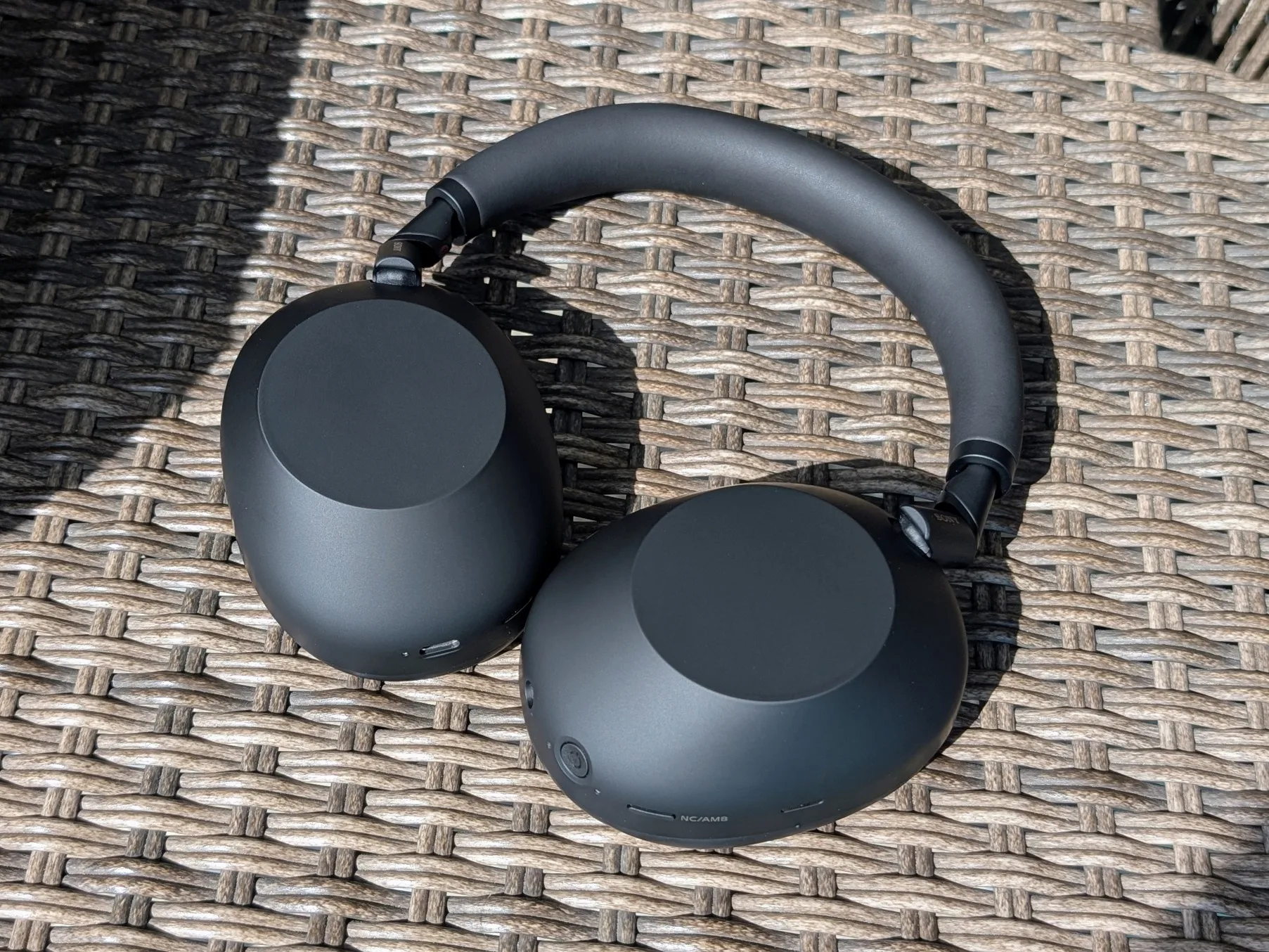
Table of Contents:
Information:
- Released: 2025
- Made in Malesia
- Colour options: Black, white and blue
- Price: 469 €
- Type: Closed, over-ear
- 30 mm dynamic drivers (carbon fiber composite diaphragms)
- Audio Connections: Bluetooth 5.3 and 3.5 mm
- Bluetooth Codecs: LDAC, LC3, AAC, and SBC
- Charging port: USB-C
- Battery size: 1050 mAh
- Battery Life (ANC ON/OFF): 30 h / 40 h
- Charging Time: 3.5 h (Supports fast charging: 3 minutes for 3 hours of playback)
- Adaptive Active Noise Cancellation: On / Off / Transparency mode
- Features: Multipoint, Google Fast Pair, voice assistant (Google Assistant / Siri / Alexa), spatial audio, in-ear detection sensor, and companion app with equalizer
- Weight: 254 g
- Accessories: Carrying case, short USB charging cable, and audio cable (3.5 mm)
Review unit: Loaned by the manufacturer
Sony, alongside Bose and Apple, is known as one of the giants of the active noise-cancelling headphone market. When any member of this trio releases a new product, the media attention is many times greater compared to many other manufacturers—and the marketing budget likely is, too. Furthermore, the generous supply of review units distributed to testers in advance ensures that plenty of information and firsthand impressions of the new product are available right on launch day.
The recent announcement of Sony's WH-1000XM6 model (manufacturer's product page) was a prime example of such a highlight in the headphone market. Countless websites buzzed with rumors beforehand, then grew certain of the features based on leaks, and finally went through the official specs thoroughly as if by way of recap. When the launch moment arrived and the NDA lifted, a massive wave of reviews popped up online—most of them glowing—proclaiming that the new Sony has arrived and is better than ever. Manufacturers of traditional wired headphones can only dream of that kind of visibility.
Since then, a few more critical words have already been uttered about the 470-euro WH-1000XM6, which is quite expected given Sony's sound quality history. I haven't been a fan of the manufacturer's mid-bass heavy and somewhat congested sound either, and up until now, the situation couldn't be fully fixed with the tools found in the app. However, as my title also suggests, one of the biggest renewals of the WH-1000XM6 is a clearly more versatile equalizer. In addition, Sony has patched many of the other weaknesses of the three-year-old WH-1000XM5 and further improved its noise-cancelling feature, which is why I have been exceptionally hopeful about the new model. Although numerous reviewers have already had time to share their opinions on the product, I finally get to throw my hat in the ring as well. Let this be one of the most comprehensive reviews of the WH-1000XM6.
Many thanks to Sony’s Finnish PR representative for loaning the review unit!
Packaging and accessories
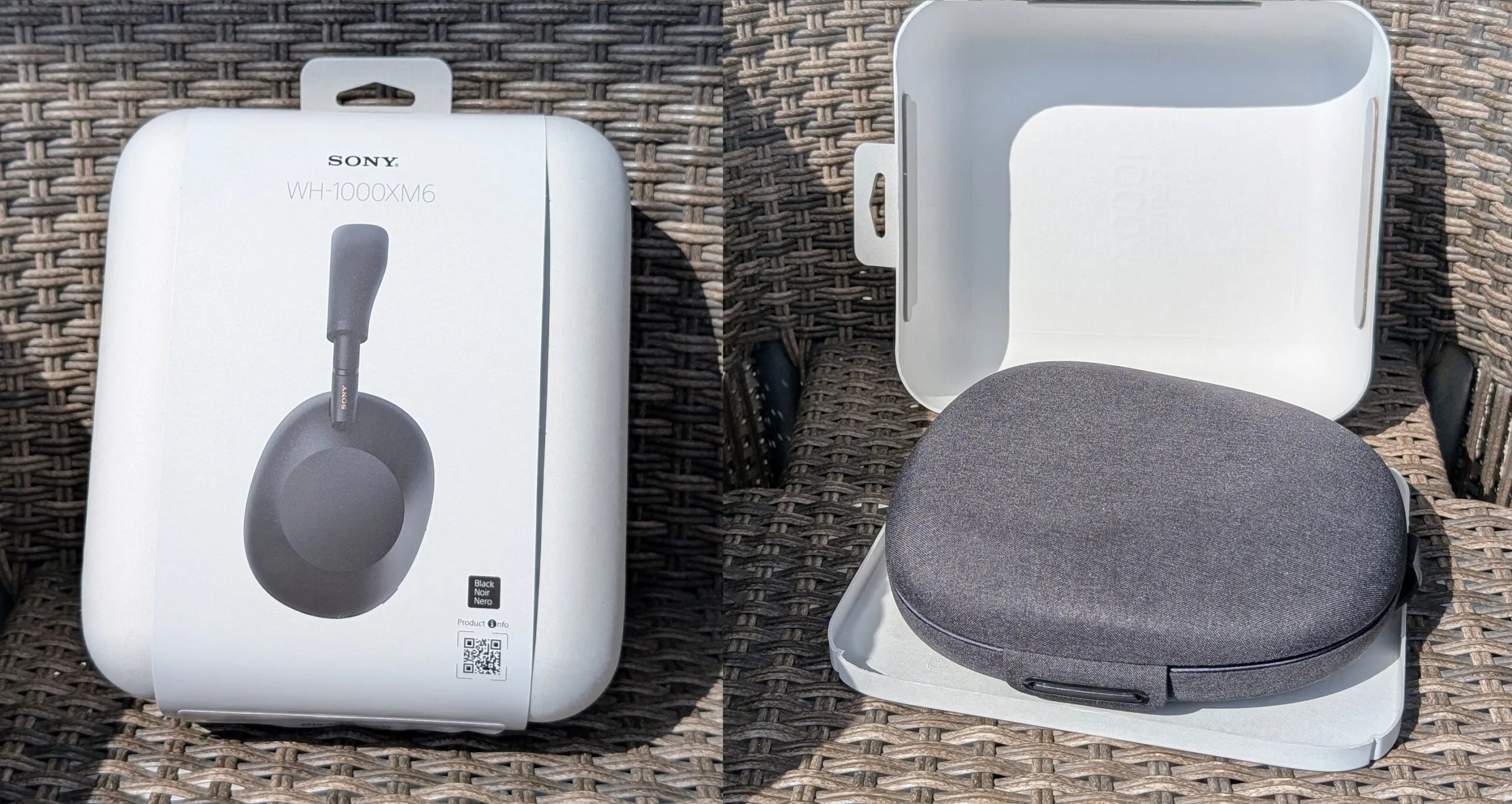
Like the WH-1000XM5, the WH-1000XM6 ships in an informative cardboard sleeve rather than a traditional product box. Then again, you rarely do anything with a fancy box after opening it anyway—the contents matter more. Unlike its predecessor, the XM6's design folds down compactly again, just like the XM4, meaning the carrying case has once again shrunk to a practically compact size. Sony has clearly listened to consumer feedback. Opening the case also no longer requires a zipper; instead, the halves stay together via a handy magnetic closure. The flap doesn't pop open even when shaking the case quite firmly, so Sony's design works brilliantly. This is definitely one of my favorite cases.


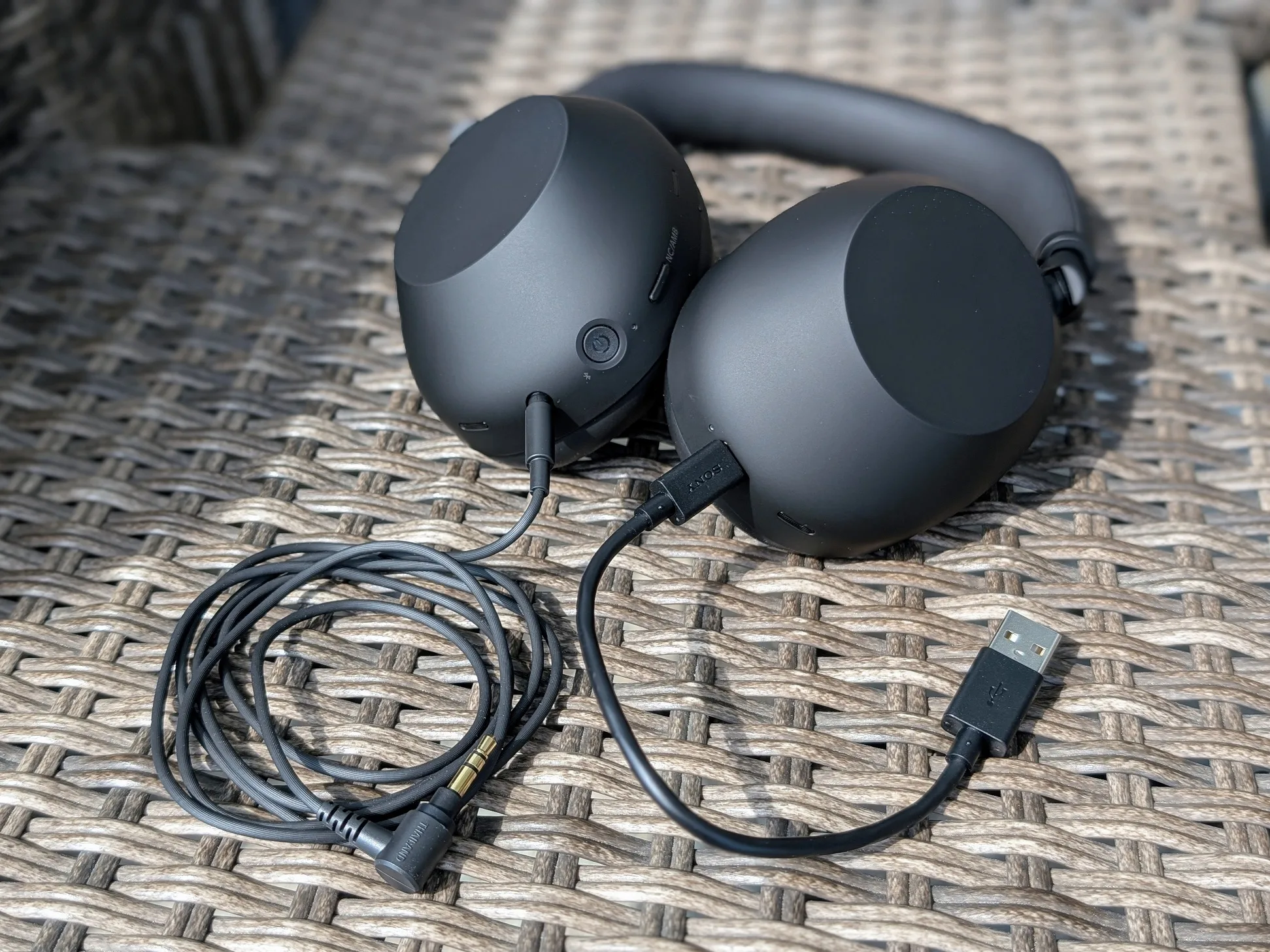
Other accessories include a short USB-C-to-USB-A charging cable and an audio cable equipped with 3.5 mm connectors. Apparently, a normal, usable length for a USB cable simply cannot be squeezed into a 470-euro price tag, so the owner is presumably expected to rely on a longer charging cable that came with their phone, for instance. In a way, I understand conserving natural resources, but a short stub ultimately goes to waste more than a longer cable that could be used for other purposes as well.
Build and comfort
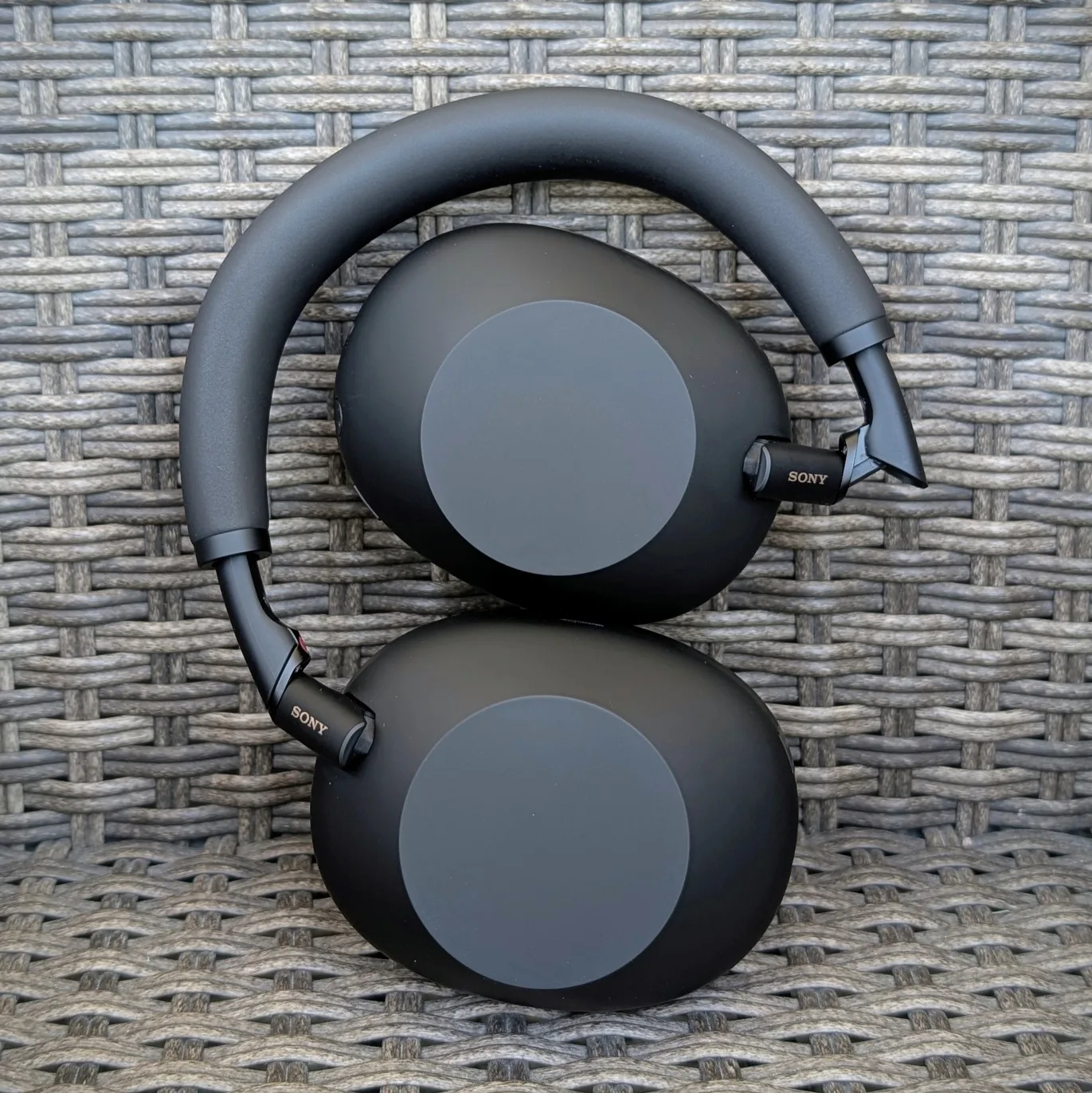
The foldable headband construction makes the WH-1000XM6 feel almost like the true WH-1000XM5 we never got three years ago. Sony has also made the XM6's headband slightly wider, and the structure now feels considerably sturdier, so when shaking the headphones, there is no sign of the XM5's wobbly looseness anymore. Furthermore, with the rough recycled plastic of the ear cups replaced by a smoother soft-touch quality, I find the WH-1000XM6 to feel genuinely high quality. On the other hand, the increased number of moving parts raises a few doubts, as the plastic headband of previous Sony models has been prone to cracking and even breaking. Fortunately, the XM6's hinges are partially metallic, but the surrounding parts are still made of brittle plastic. So let's keep our fingers crossed that the chosen materials withstand stress better this time around. Maintaining the headphones should at least be a bit easier than before.
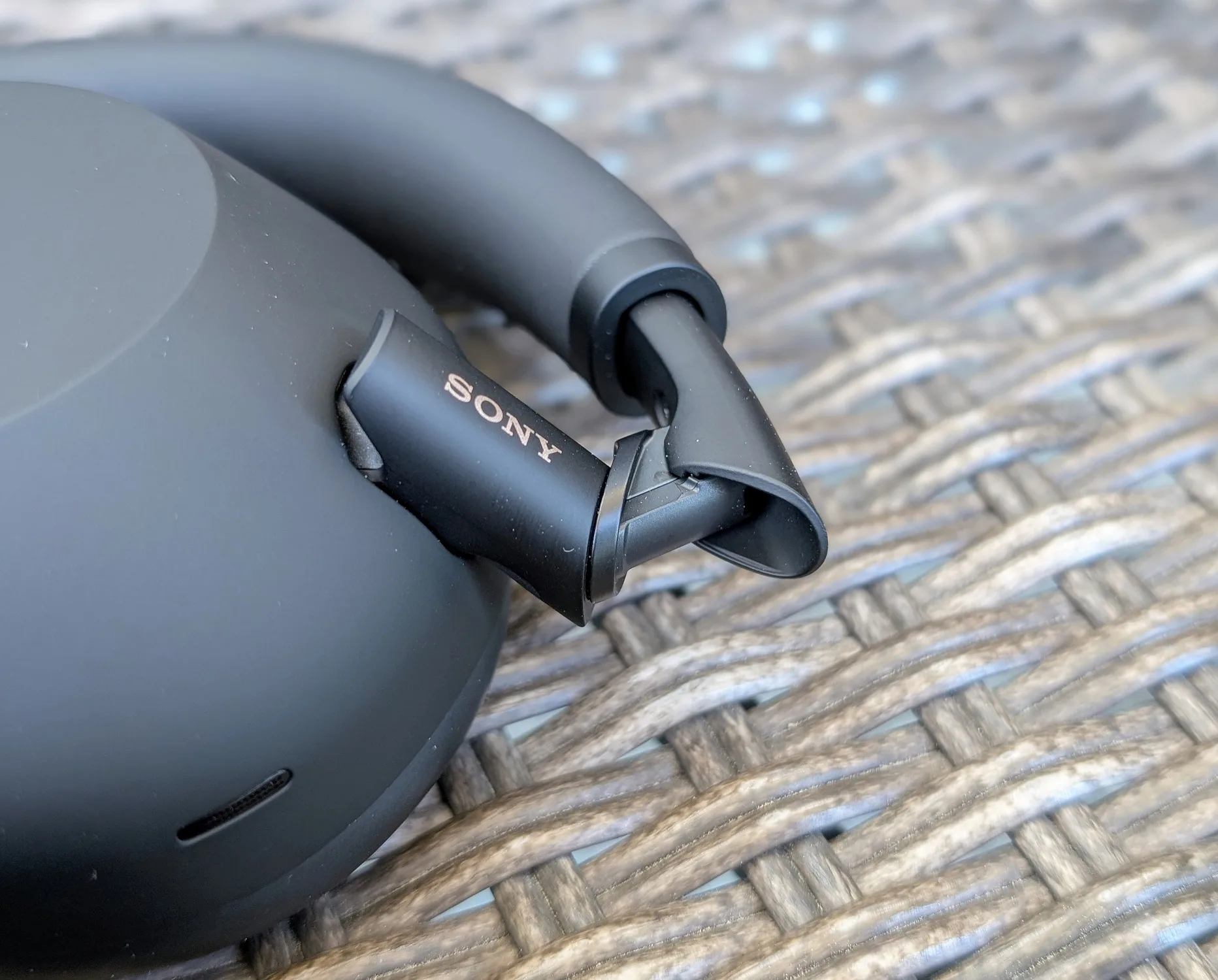
Visually, the new model continues its predecessor's understated line, looking pretty much like an ordinary plastic headphone. This will hardly bother most people, unless the specific goal in public places is to draw attention by wearing unusual headphones. For instance, the Dyson OnTrac would be the complete opposite of Sony's headphones. A luxury look, on the other hand, would be achieved with something like Bowers & Wilkins' PX series. Granted, the WH-1000XM6's ice cream boat-shaped ear cups are quite large and protrude from the sides of the head, so it's not the most low-profile option either. However, I would count the only real aesthetic flaw as the finger marks and oil smudges that stand out conspicuously on the matte black headphone version. In fact, I would buy one of the other color options myself so that my headphones wouldn't look dingy all the time.
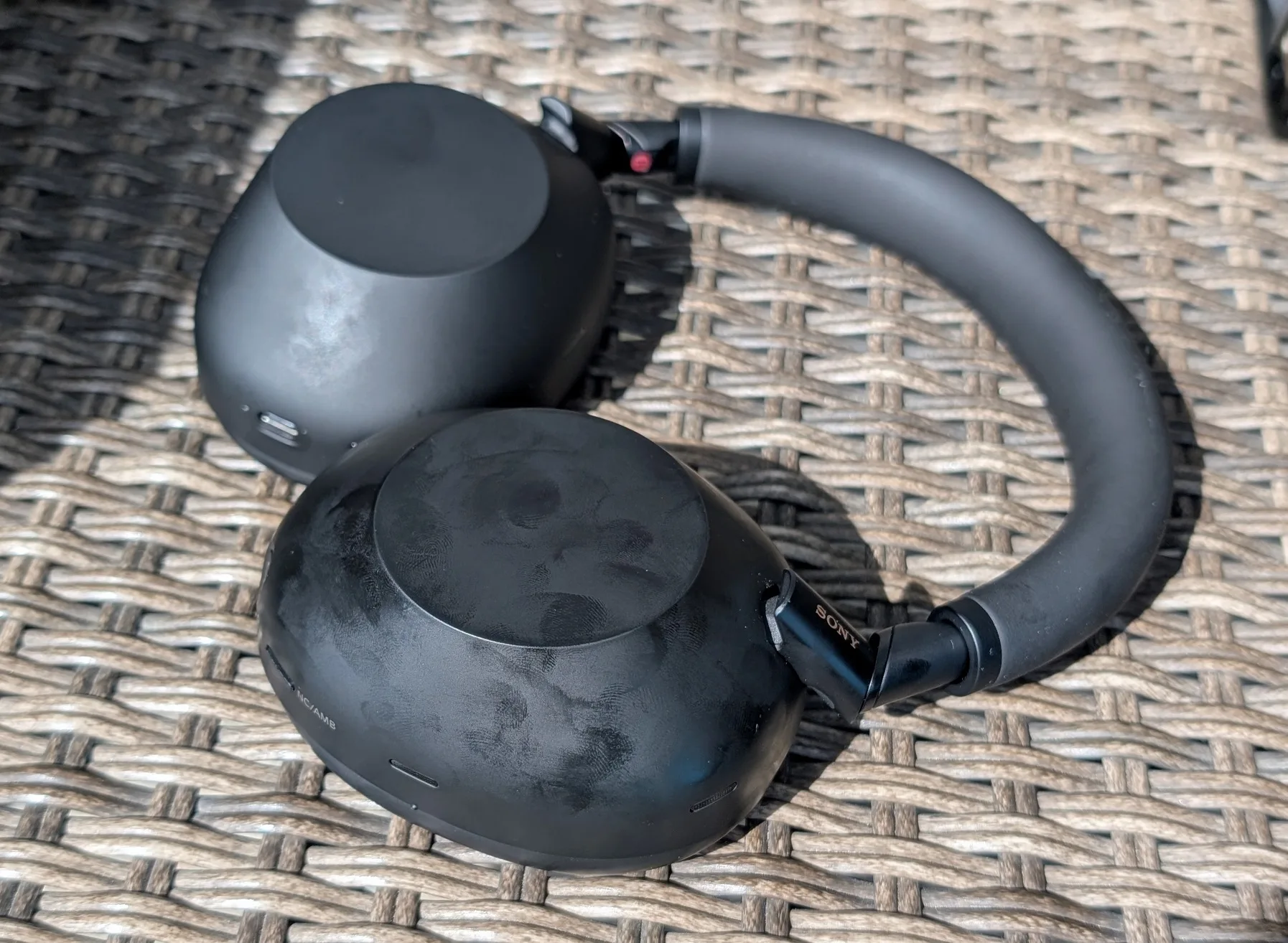
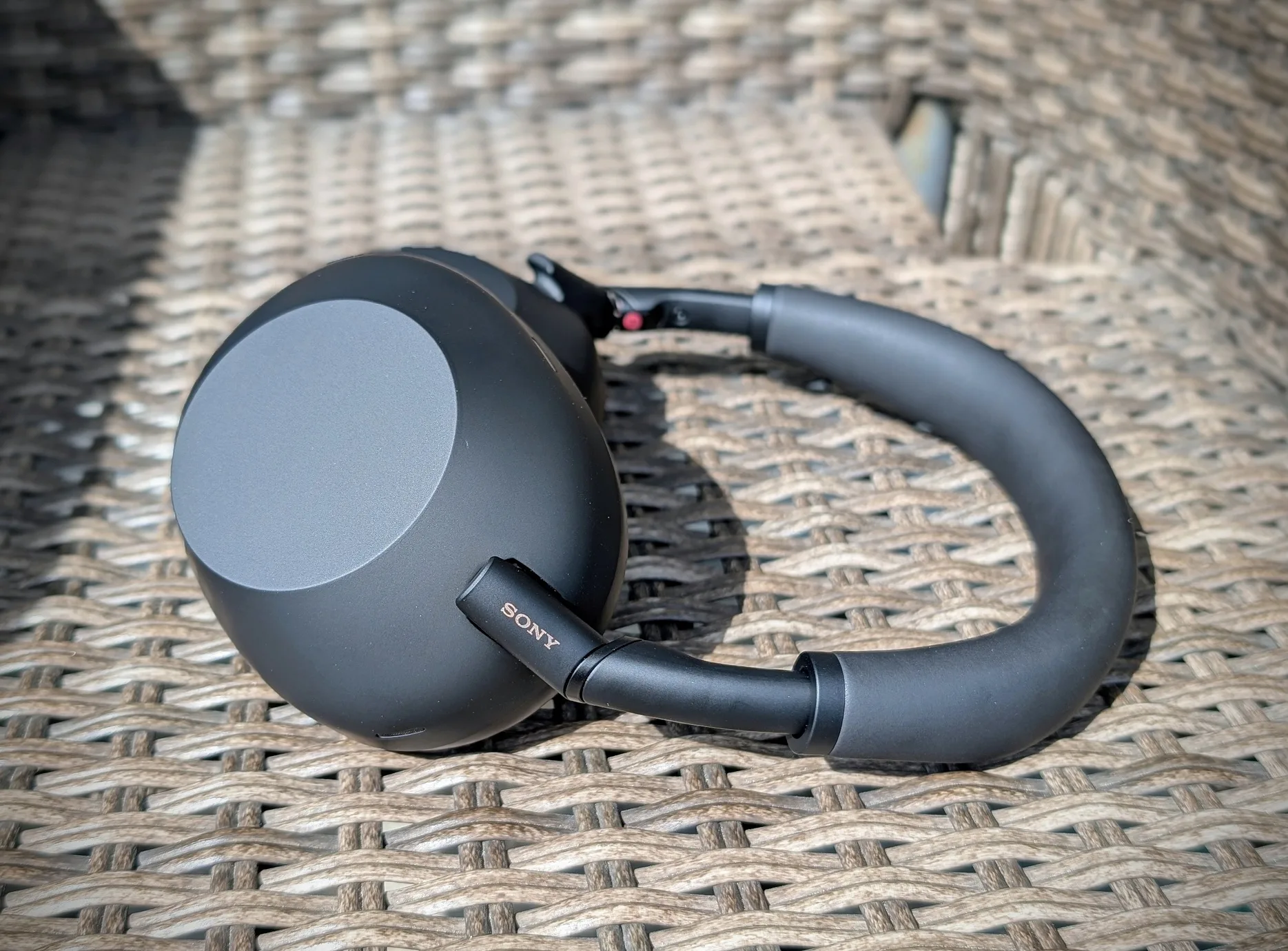
Despite minor structural changes, the weight has stayed right around 250 grams, so in that regard, hardly anyone will experience discomfort even during longer listening sessions. My ears also fit quite well inside the thin cushions, because there is extra empty space around the driver inside the ear cup structure. Even though my ears do brush against the base fabric, the feeling inside the cushions is, with minor reservations, quite spacious compared to the XM5 model. It is a pity, however, that the headphones make you sweat profusely at the same time, as heat cannot escape from inside the tight construction and the plastic surface material of the cushions. At temperatures of 25 degrees Celsius and above, I wouldn't want to use these headphones anymore, so you better hope there's air conditioning available in the summer.
Structural choices certainly have a positive impact on both passive and active noise isolation, too. Furthermore, the WH-1000XM6's headband clamps the head quite firmly, meaning Sony has once again chosen to emphasize a secure and tight fit over the absolute best possible comfort. You can barely shake these headphones off your head no matter what you do.
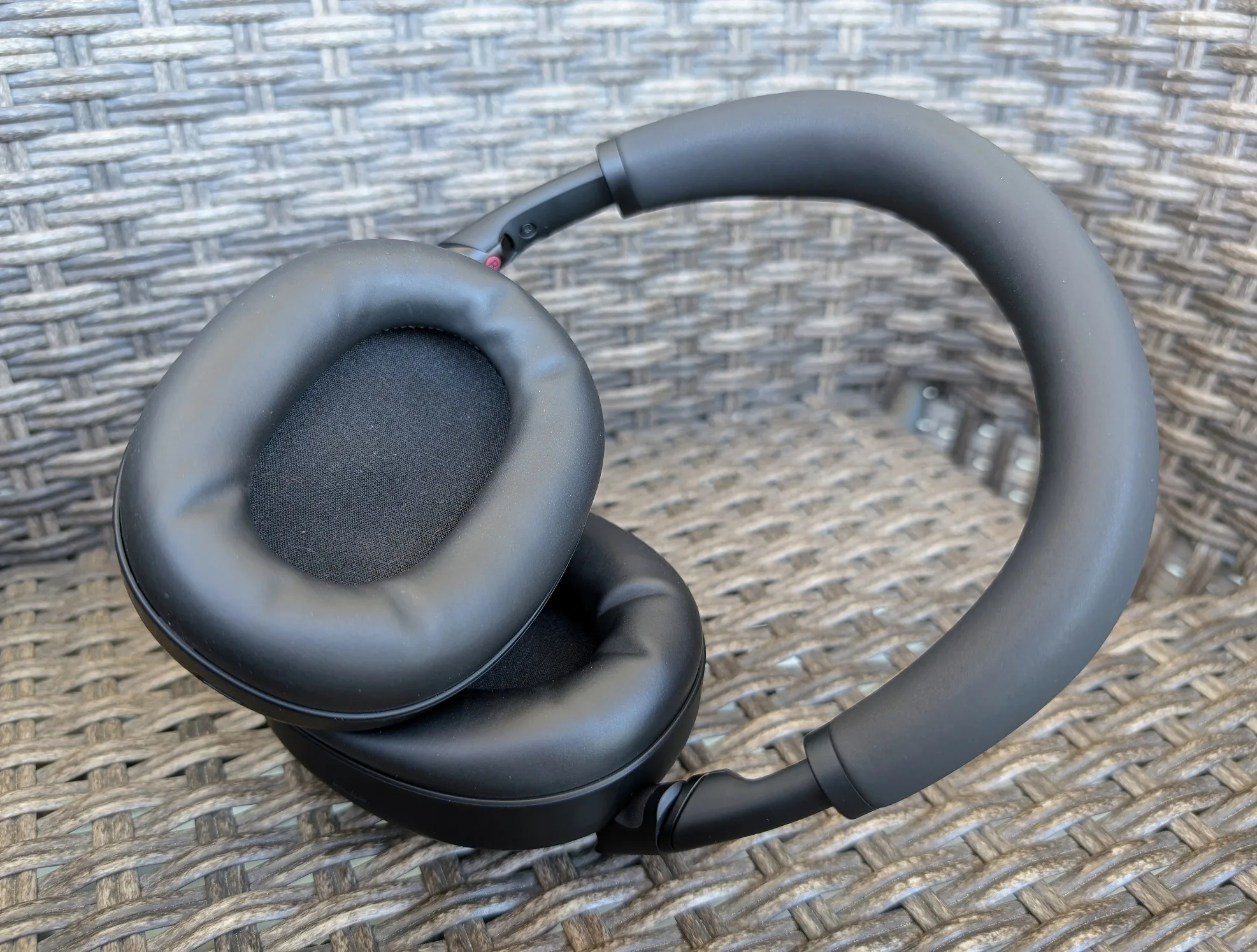
On the XM5 model, the ear cushions face toward the sky if you rest the headphones around your neck. On the XM6, the rotation direction has flipped back toward the chest, which is probably a better option in the rain, for instance. However, the new model's headband is shaped in such a way that when rested on the neck, the headphones literally choke me if I turn the ear cups horizontally. In their default position, the lower edges of the cups press firmly against each other, causing the cushions to wrinkle up at the same time. I'm not sure what effect this has on longevity, but I would rather store the headphones long-term in the exact position they are meant to be placed in their case. On the flip side, replacing the cushions would be an absolute breeze this time around, as they detach with a sharp pull using considerably less force than many other headphones.
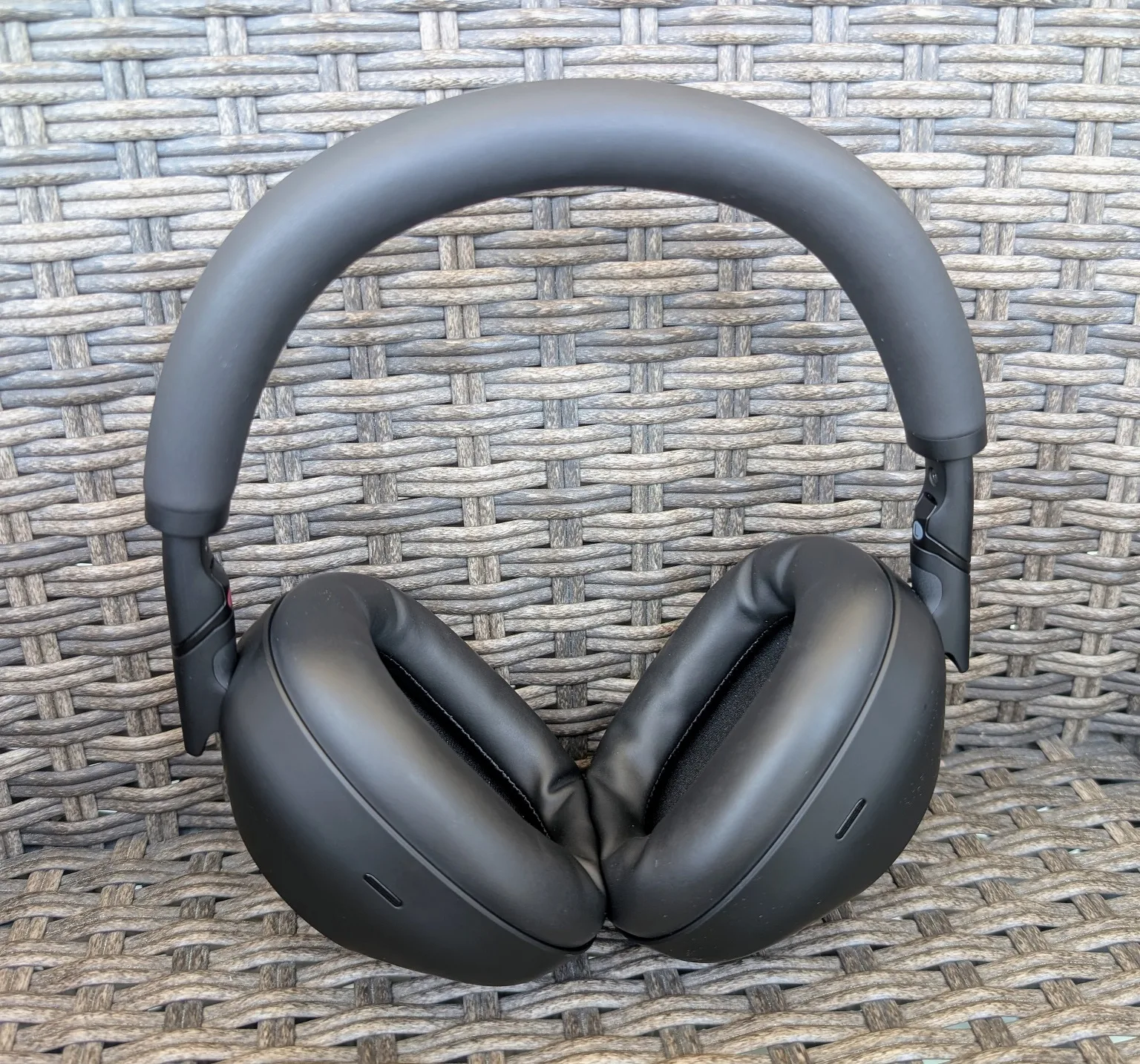
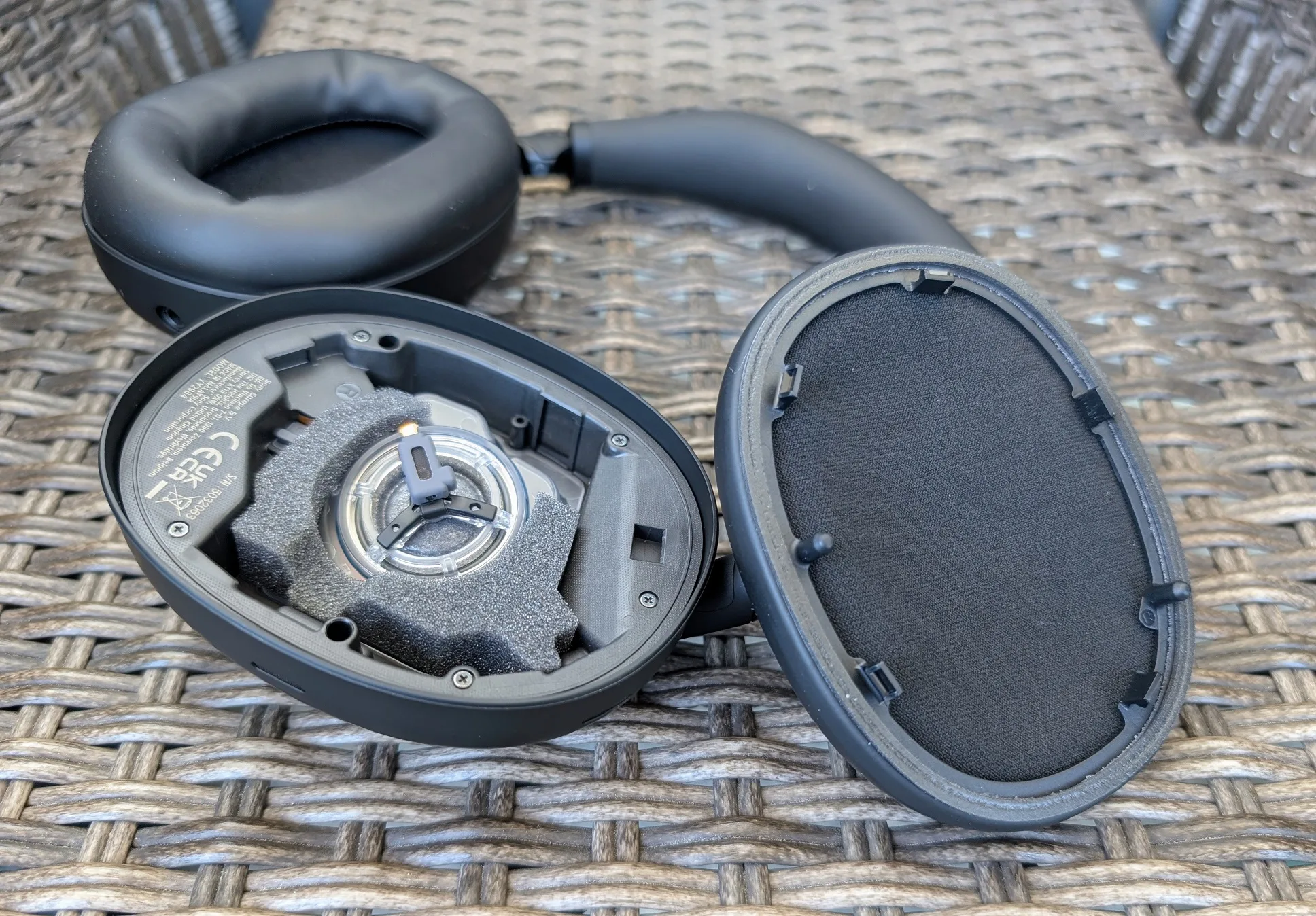
Despite its widening, the headband ultimately proves to be the XM6's biggest weakness from a comfort standpoint. I would love to know why a hard horizontal bar rests on top of my head instead of the headband having more than a couple of millimeters of foam and a shape that actually matches a human head. Headbands like this are widely known as the most uncomfortable ones out there, so Sony's design choice is, to put it politely, surprising. In my opinion, the manufacturer should look toward the WH-1000XM4 and the ULT Wearin the future, as headbands on those feel much smarter, whereas the XM6 strives to be anything other than comfortable.
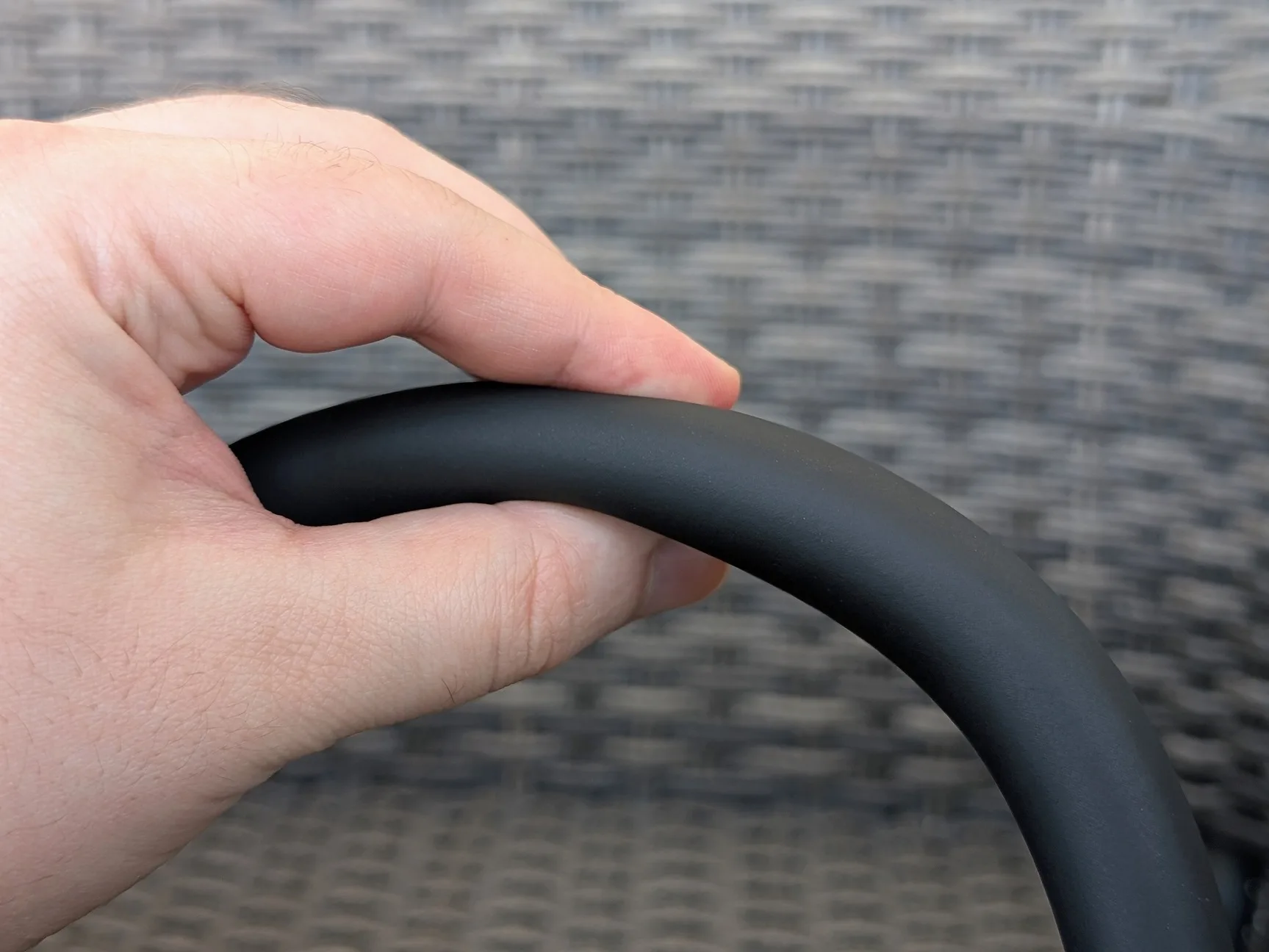
Due to the strong pressure forming on top of my head, the firm clamping force, and the rapid sweating, the XM6 becomes quite uncomfortable for me during longer use, although adjusting the headband as high as possible helps a bit. In that position, it merely brushes against my head while the headband's strong clamping force still keeps the ear cups tightly on my ears. This brings the comfort up to a tolerable level, as long as I occasionally take the headphones off my head. Among competitor products, for instance, the Bose QuietComfort Ultra feels noticeably more unnoticeable on my head, and I can't really think of another noise-canceling headphone with a headband as hard as Sony's new model. It is worth noting, though, that many others call the XM6 comfortable, so perhaps my own head is just some sort of exception.
Controls and functions
I like the new round power button, which is easy to find at the bottom of the ear cup. It doesn't really need to stand out from the other buttons, because there is only one of them: the switcher between noise cancellation and transparency mode (plus a couple of other functions). This button, however, is unnecessarily subtle in my opinion, as it sits almost flush with the edge of the ear cup. The microphone hole located nearby is also shaped the same way, so I sometimes end up rubbing against it, which doesn't sound particularly pleasant with ANC turned on.
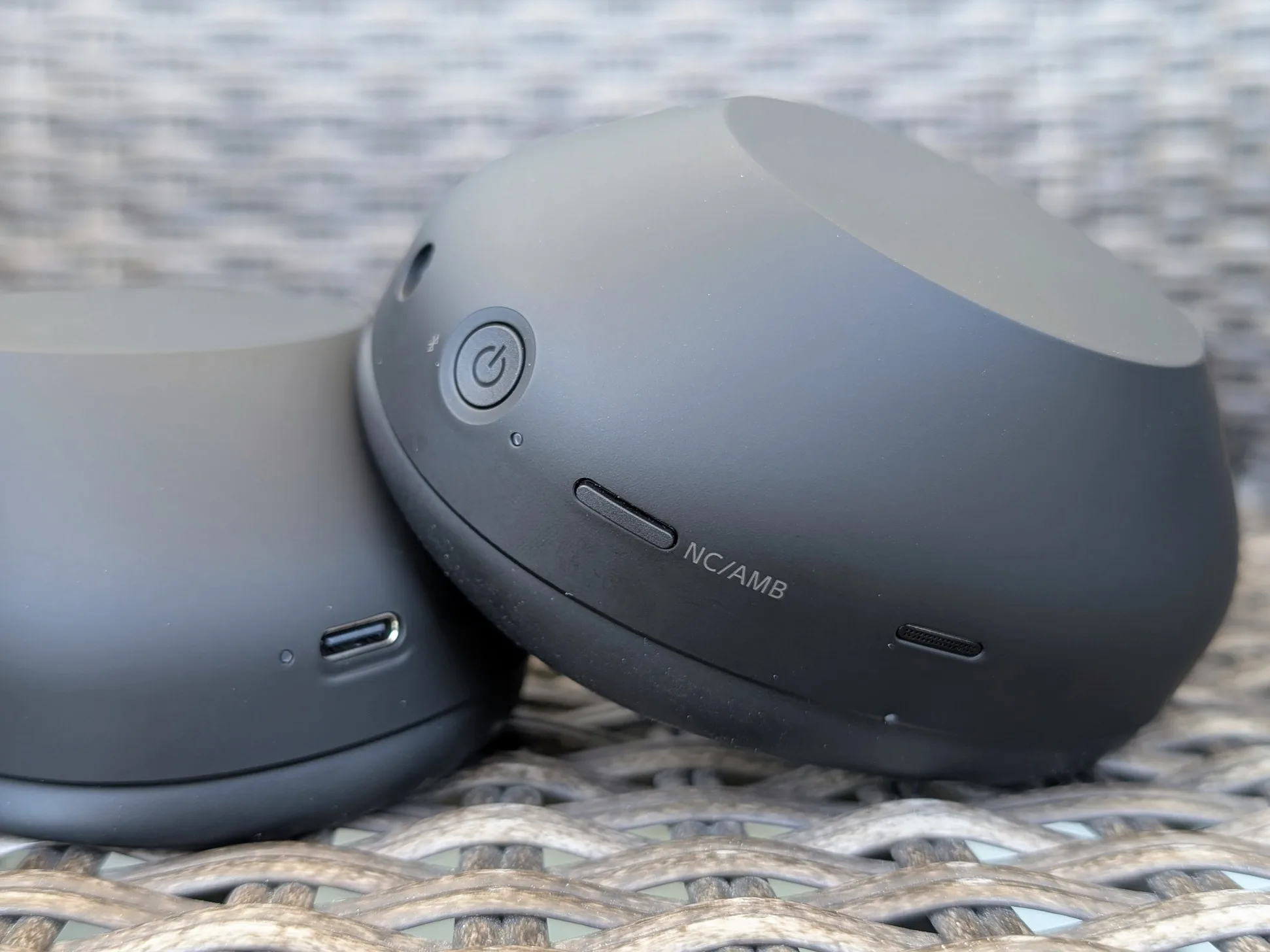
The touch controls mounted on the side of the right ear cup, as is customary, work better than in any other headphone model I know of. For example, changing the volume doesn't cause large jumps; instead, I can nudge the volume precisely up or down by individual steps (tested operating systems: Android, Windows 10, and macOS). With other headphones, you'd rather talk about jumps of 2 to 5 steps, so a big thumbs up to Sony for nearly perfect smoothness. However, when adjusting the ear cups better onto my ears, I sometimes accidentally trigger various functions because the touch area is so large. I can accept this, though, since the operation works well otherwise. Placing your palm over the cup surface temporarily activates transparency mode for a short conversation or listening to an announcement, for instance. On the other hand, the Speak-to-Chat feature handles the same thing without needing to, and your hand doesn't get tired either. That said, this isn't ideal for those who like to sing along out loud while listening with headphones.
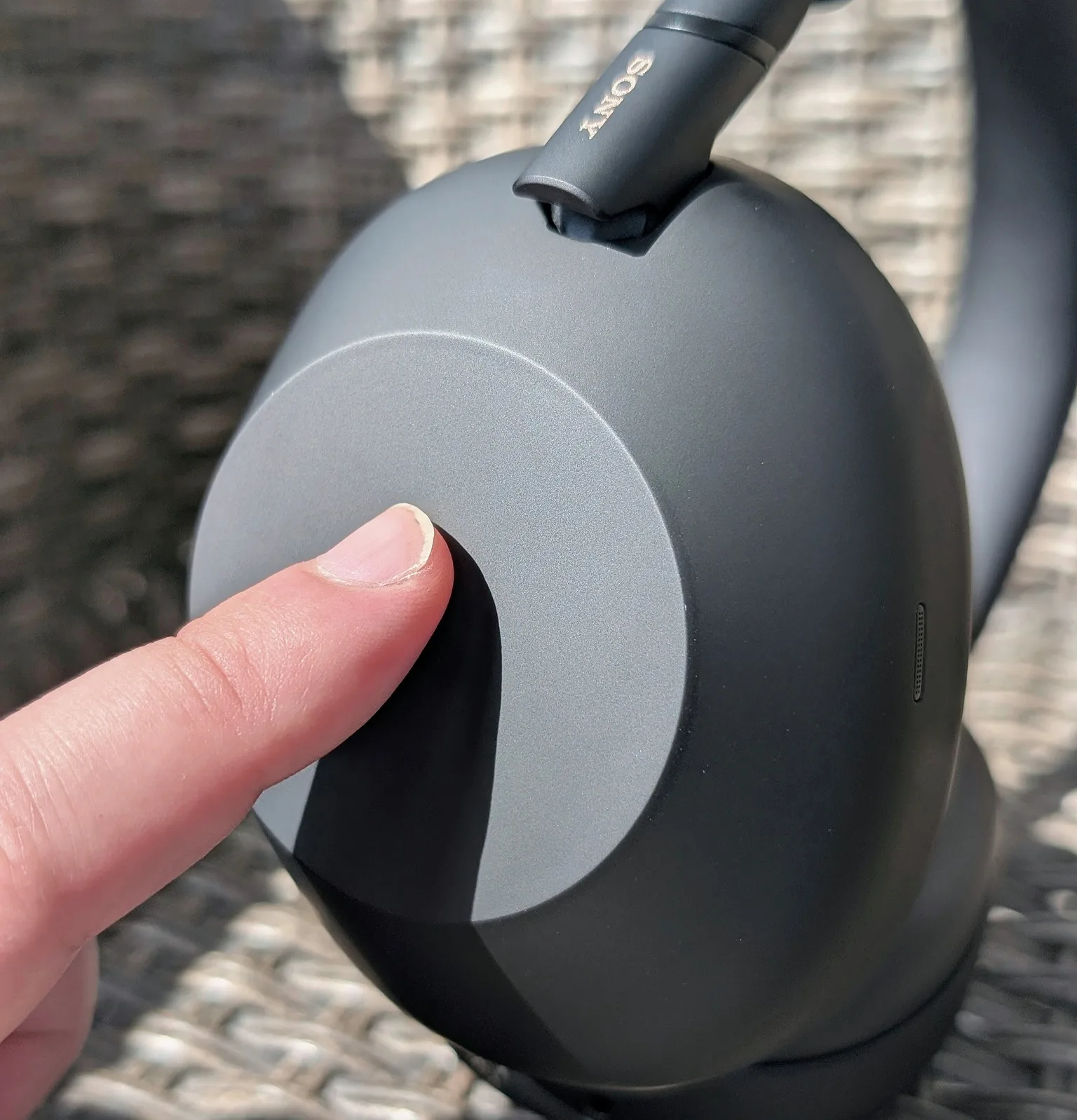
Sony's headphones still feature an in-ear sensor as well, so playback pauses and resumes automatically depending on the usage situation. The in-ear sensor also controls the noise cancellation, so when you take the headphones off, that turns off automatically too, thus avoiding unnecessary battery drain. All in all, Sony has polished the usability of the WH-1000XM6 to a top-tier level, if we exclude the mobile app, which I will talk about in more detail shortly.
Bluetooth technology and battery life
Bluetooth version 5.3 is currently the most common choice in noise-canceling headphones and Sony's choice as well. As expected, the WH-1000XM6 also supports the high-quality LDAC codec developed by Sony itself. Since LDAC has gradually become a sort of standard codec for Android devices, it gets utilized more often than the best aptX options (aptX Lossless and Adaptive). If the playback device does not support LDAC, the XM6 falls back on the conventional AAC and SBC codecs. For future needs, however, the headphones also include support for LE Audio and the LC3 codec, which are eventually intended to supersede the aging SBC.
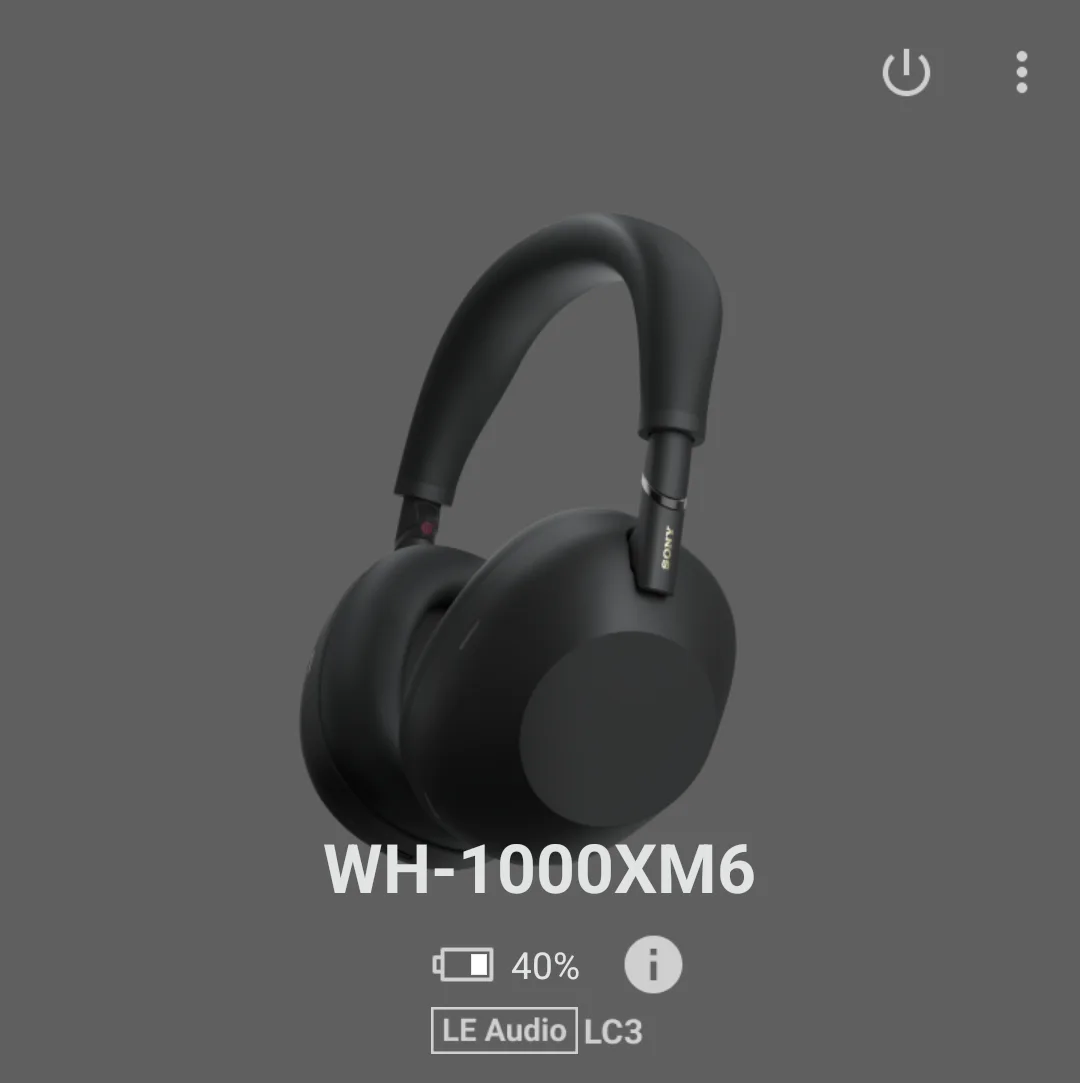
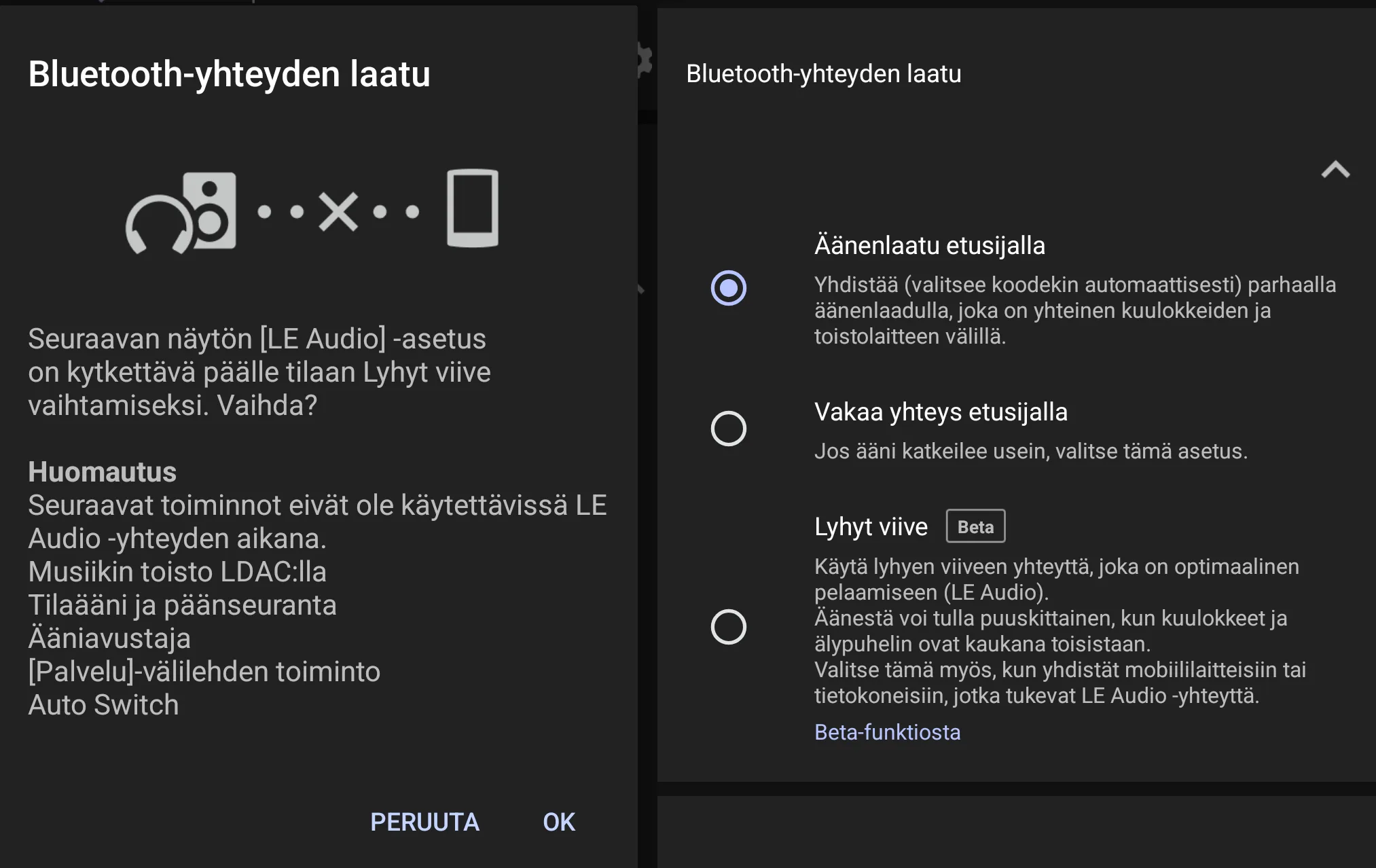
With my Google Pixel 9 phone, after a bit of puzzling, I managed to try out LE Audio and LC3, since they can be activated via Sony's app (Bluetooth connection quality → Short delay). This did require repairing the headphones, and the feature appears to be in beta. I couldn't notice a significant difference in latency, but it reportedly gets cut in half compared to LDAC. The sound, on the other hand, turned somewhat grainier in the upper frequencies with LC3, but this was my first encounter with the codec anyway, so I don't know how optimally it works in Sony's headphones. What I can tell you, however, is that Multipoint and Google Fast Pair work well, and the LDAC codec doesn't suffer from stuttering at a 660 kbps bitrate. On the Pixel 9, though, the highest 990 kbps bitrate remains a pipe dream, much like with many other headphones.
Since Sony is also known for its PlayStation game console, it is quite unfortunate that its headphones do not work wirelessly with the PlayStation 5, forcing the gamer to resort to a headphone cable. Usually, companies aim to support their own hardware ecosystem, so Sony certainly could have developed some kind of wireless USB transmitter, especially since the WH-1000XM6 is hinted to be suitable for gaming as well. However, the manufacturer has missed this opportunity, unlike AKG, for instance, whose N9 Hybrid noise-canceling headphones include a PS5-compatible transmitter. On the other hand, Sony's goal is likely to sell separate wireless gaming headsets to its console owners, which it develops in collaboration with Audeze.
Like previous Sony models, the XM6's battery lasts about 30 hours with noise cancellation on and 40 hours without it. This is plenty, but many competing products offer 50 to 100 percent longer battery life. Conversely, Bose's headphones only last about 24 hours, so Sony still beats one of its main competitors. The WH-1000XM6 can also be listened to while charging or used passively in an emergency without power, unlike the Bose QuietComfort Ultra.
Mobile app and additional features
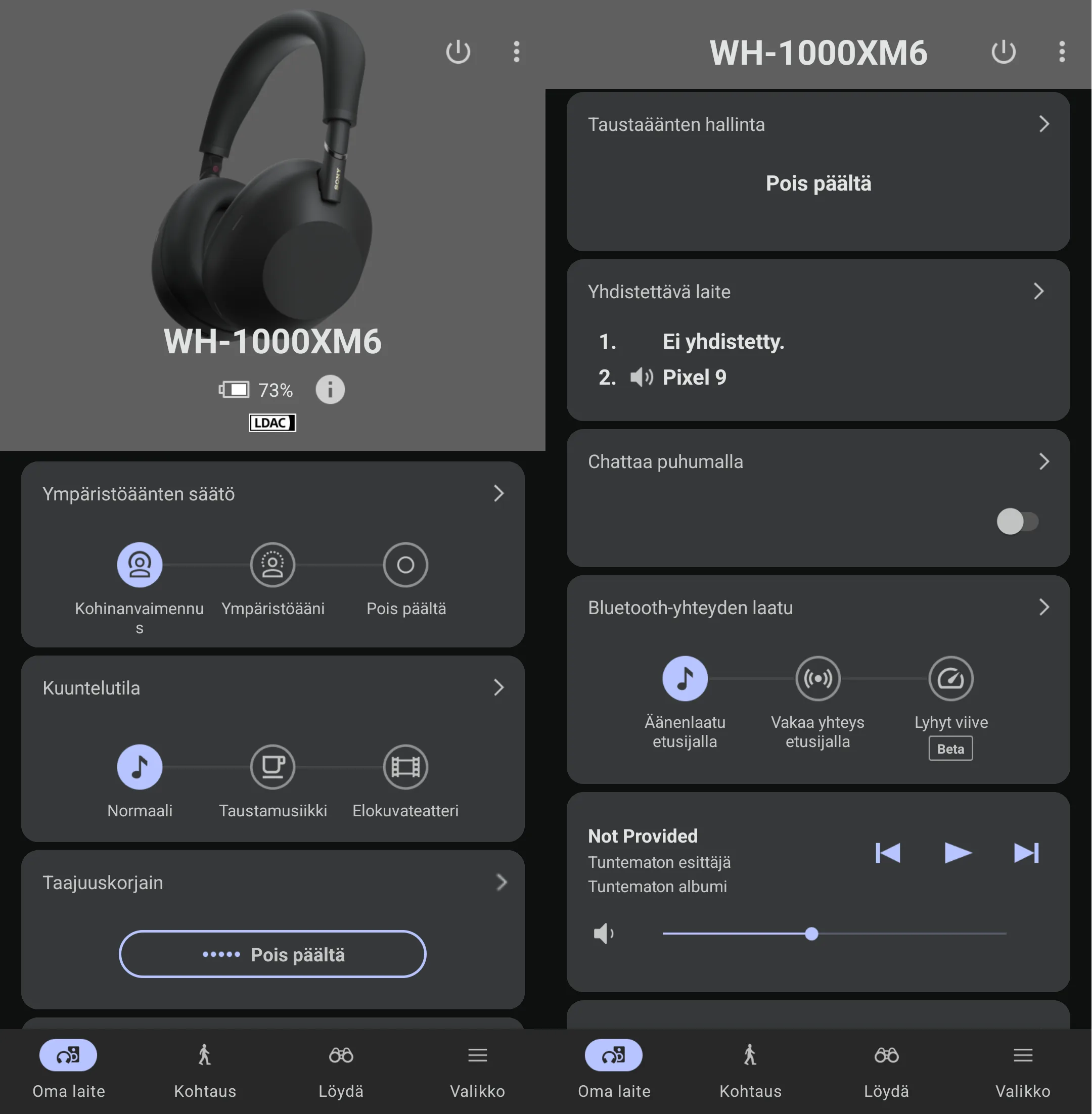
If any area of Sony's headphones could use a major overhaul, it would be the Sound Connect mobile app. First of all, all sorts of extra features require registering a user account, and at the beginning, the user has to accept an unusually large number of terms of service agreements and fight against other pop-up windows as well. To top it all off, the headphones lose connection to the app within a few minutes and reconnect extremely sluggishly. This makes fine-tuning the equalizer really frustrating, for instance, because often my changes don't go through, and I end up having to make them twice. I haven't encountered a similar problem with other Sony headphones or competitor products.


The app's user interface is also cluttered because too many new features have been added here and there over the years. Operating as a sort of prettier layer is the home screen offering the most common functions, from which you are nevertheless frequently forced to move deeper into the settings side. At that point, the same things are presented a second time, but expanded. Changing certain functions thus requires extra presses and navigating through menus. For example, sound profiles can be changed from the home screen, but you can't access the equalizer through it. In my opinion, Sony should start with a clean slate and redesign the app entirely. Maybe they shouldn't even offer different language versions unless the translations are done properly. Many of the Finnish expressions are completely mystic, so I wouldn't guess what any given function actually does.

New Equalizer:
I can praise the app for its versatility, as it offers a large number of various adjustments and extra features already familiar from Sony's other headphones. The most significant update has been experienced by the equalizer, which is now 10-band. Previously, only 5 adjustment channels and a separate Clear Bass setting were available, which has now been completely dropped. Thanks to the expanded adjustment possibilities, bass frequencies can in any case be influenced more versatilely than before. It is a pity, though, that Sony does not intend to enable the use of its better equalizer in the XM4 and XM5 models, even though there shouldn't be any technical limitations to it as far as I can see.
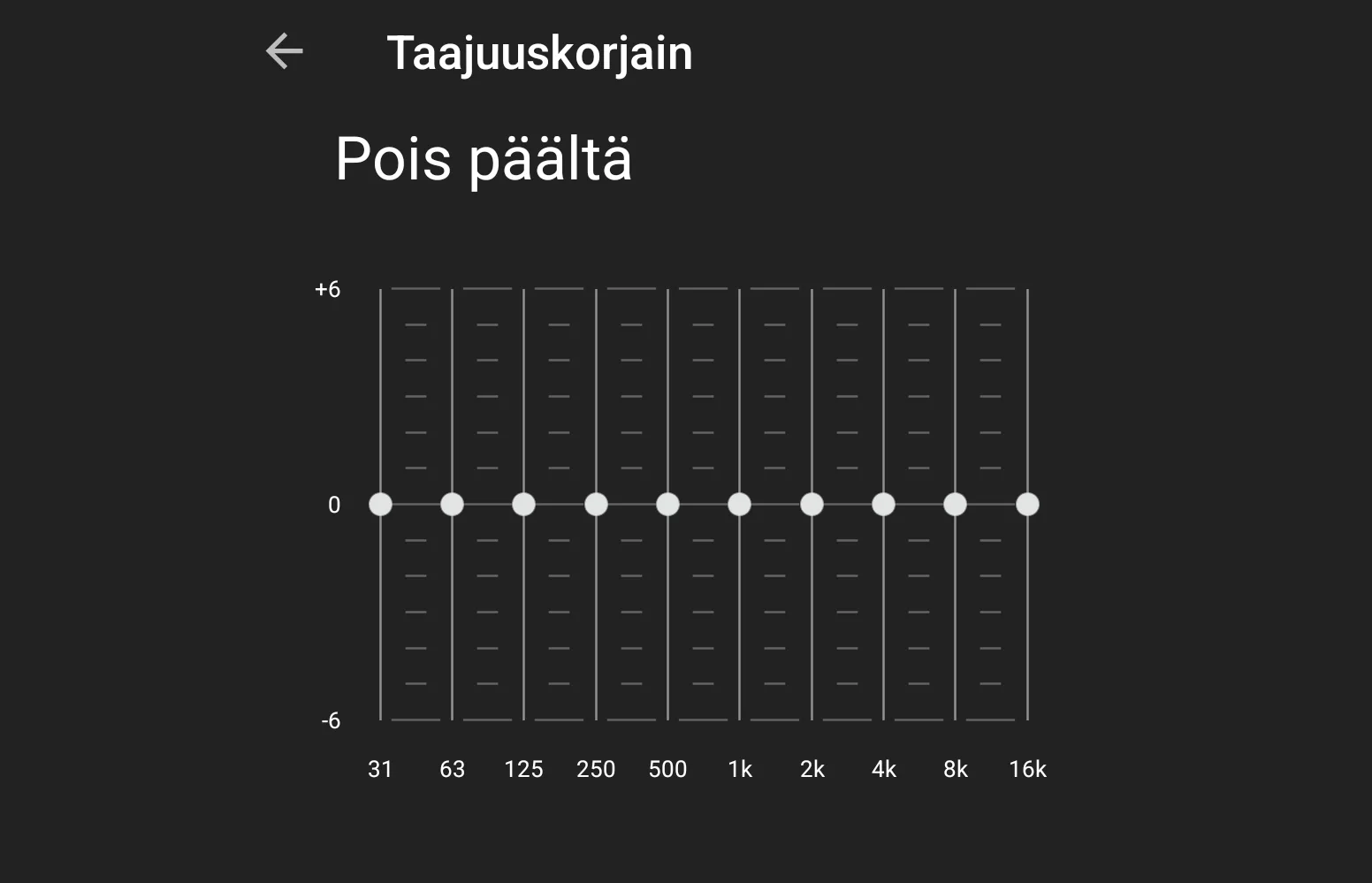
As usual, preset sound profiles have also been defined for the WH-1000XM6, one of which Sony intended for gaming, for instance, to make it easier to detect opponents' footsteps. The idea is good, but the DSP function is unfortunately located on the Bluetooth chip side, so the gaming profile or any other equalizations cannot be used with a headphone cable (the sound follows the default DSP profile). The Bluetooth connection latency, on the other hand, is always rather high, although the lower-latency LE Audio mode might also make the gaming profile somewhat useful.

Other profiles adjust selected frequency ranges in different directions without major innovations. Despite its new equalizer, the manufacturer has thus not seized the opportunity to create, for example, as neutral a sound profile as possible. Even though the XM6 is certainly meant to primarily appeal to the largest consumer groups, a different alternative sound profile could easily expand the target audience. Or is this unreasonable to expect from a company the size of Sony?
The app also includes a feature called "Find Your Equalizer," where the user can listen to a chosen song and select the most pleasing sound option from two tabs. This actually works quite smoothly on a general level, as based on my preferences, the headphones knew how to fine-tune the lower frequencies quite correctly. On the other hand, many other changes I desired would still have to be made manually, since the simplified process is unable to help with that. For basic users, this should still be helpful, as using the tool has been made easy.

360 Reality Audio:
Somewhat less easy, on the other hand, is setting up 360 Reality Audio. Unlike the Bose QuietComfort Ultra and Sonos Ace, for example, Sony's spatial audio is not universal—meaning it is independent of the audio content—but specifically requires the 360 Reality Audio format and a few preliminary settings within the app. For instance, I couldn't get Android head tracking to work at all, so the experience remained half-baked.
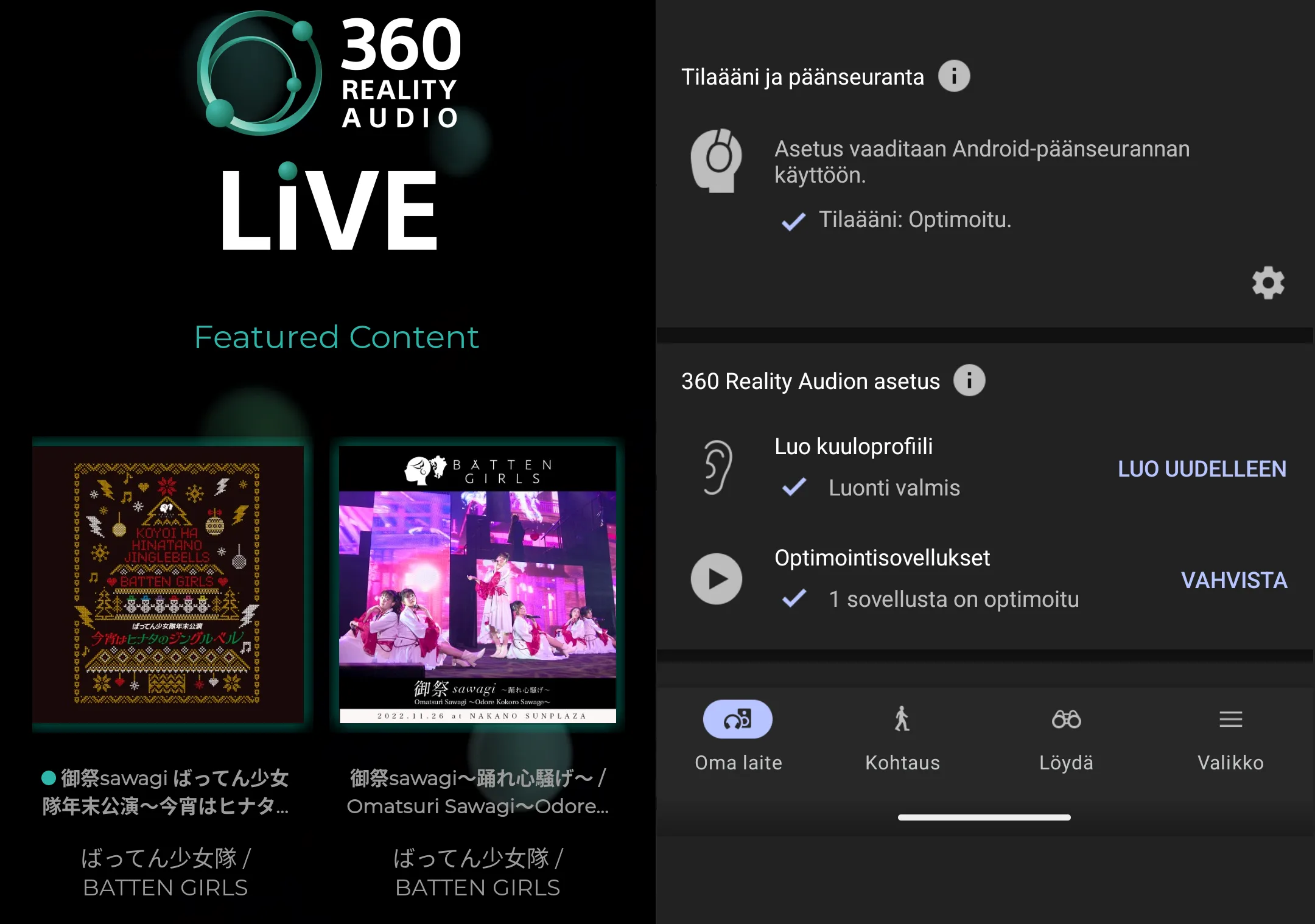
The 360 Reality Audio Live service (featuring Japanese music) felt the best optimized, as the end result resembled binaural recordings. This service and Sony's app actually communicate with each other, so I expected the test material to be proper. In contrast, the 360 Reality Audio content offered on the Amazon Music streaming service cannot be optimized separately for Sony's headphones, making it sound the same on products from other manufacturers as well. Thus, the end result with the WH-1000XM6 is not good at all; instead, the soundstage feels hollow and unnatural, and many vocalists' voices turn thin and sharp. Therefore, I wouldn't become an Amazon Music subscriber for the sake of this spatial audio format, but the Dolby Atmos content found on the service sounds better instead. Unfortunately, 360 Reality Audio leaves the impression of a bit of a "niche," because you can't properly access the format in the streaming services that the majority of people use.
Actually, the WH-1000XM6 also supports a more universal "spatial audio," because its app allows you to change the listening mode to a movie theater, which spreads the sound further away from inside your head. As another alternative to stereo sound, you can find "background music," which, true to its name, muffles the audio content so that it plays calmly as if in the background. There are a few different options for this as well. In my opinion, these spatial audio effects do not sound natural, but as extra features, they pass.

Active Noise Cancellation
Sony has improved the effectiveness of its active noise cancellation by increasing the number of microphones by four (from 8 to 12) and raising the noise-cancelling processor's power up to sevenfold compared to the WH-1000XM5 model. The WH-1000XM4, on the other hand, features four microphones. According to measurements, the combined attenuation power across the entire frequency band indeed appears to have increased by a couple of decibels in the new model, but in my view, the improvements related to the adaptability and responsiveness of the noise-cancelling feature are ultimately more significant.
The XM5 model reacts quite sluggishly to sudden noise sources, letting certain interfering sounds through. Apparently, the headphones have a delay of a few seconds before adapting to the ambient noise level, and sometimes it doesn't happen at all. Because of this, the active noise cancellation of the older WH-1000XM4 is still more effective in many everyday situations, which is supported by measurementsfrom sites like RTINGS. In the WH-1000XM6, however, the delay has been reduced to almost non-existent, meaning the noise cancellation works smarter, and all of the XM5's quirks are gone. Therefore, I dare call Sony's new model excellent, even though the XM4 still attenuates bass frequencies better. With the XM6, you achieve up to 7 decibels more effective mid-range attenuation, which is useful in office environments, for example. Overall, the headphones let you enter your own quiet bubble to escape all types of noise, and background hiss is virtually non-existent.
Having completed my traditional active noise cancellation tests (airplane and cafe noise, as well as human speech), I found the WH-1000XM6 to be the most effective noise-cancelling headphones I have tested so far. Partly this is due to the Bose QuietComfort Ultra 's better passive high-frequency attenuation, but at lower frequencies the Sony headphones are also slightly more effective. There is no significant practical difference between these two headphone models, but the best is always the best. Personally, I find Bose's noise cancellation to feel a bit gentler on my ears, but the Sony model doesn't cause any pressure or pain either, making it a pleasure to use.

Sony's active noise cancellation once again relies entirely on its adaptiveness, meaning the attenuation level cannot be adjusted manually through the app. On the other hand, the balance between transparency mode and noise cancellation can be adjusted, so it essentially serves the same purpose. With transparency mode turned all up, the simulation of the ambient soundscape sounds almost supernaturally clear. I could easily live with the headphones on (if they were more comfortable), as nothing would go unheard. My own voice sounds a bit thin to my ears, but otherwise, the transparency mode deserves praise.

The only weakness of the WH-1000XM6's active noise cancellation is wind noise interference, which cannot be reduced with any additional settings. The WH-1000XM4 handles wind significantly better, whereas from the XM5 model onwards Sony has no longer focused on the issue—I wonder why?
Microphone sound quality
Fortunately, wind interference remains just an annoyance for the headphone wearer, as the microphones are able to successfully block out wind and noise when recording speech, provided the conditions aren't completely absurd. I managed to keep my voice understandable and relatively clear amidst simulated noise and airflow, but there are also counterexamples where the background noise suppression blocks out speech as well. However, if the noise-cancelling headphones I've tested are ranked in order of best performance, really only the AKG N9 Hybrid gives Sony a run for its money, whereas at the other extreme, the Bose QuietComfort Ultra 's microphone cannot handle any more challenging conditions at all.
On a technical level, six of the WH-1000XM6's 12 microphones are utilized for recording speech, whereas in the WH-1000XM5 the same task is handled by four microphones. As another interesting new feature, the noise cancellation button on the XM6 can be used to mute the microphones during a remote meeting, for example. This is done by double-clicking the button.
Headphone sound quality
The WH-1000XM6 plays audio either via a Bluetooth connection or an analog headphone cable, but USB listening is still not supported, unlike in many competitors' products. On the other hand, the same shortcoming also plagues the Bose QuietComfort Ultra. With the headphone cable, audio can be fed into Sony's headphones in either active or passive mode. In the latter use case, battery power is not required, but digital corrections are disabled, rendering the sound quality extremely poor and distorted. When using the headphone cable, it is therefore most sensible to turn the WH-1000XM6's power on whenever possible. Confusingly, however, the sound profile chosen through Sony's app or manual EQ settings do not work in this state, as they have been limited in the circuit design to function strictly over a Bluetooth connection. In other words, in wired use the sound always defaults to the factory settings, whereas in wireless use it can be fine-tuned via the app.
Sony hints at having invested more than ever in the sound quality of its headphones by involving several mastering engineers—working behind top artists—in the development process alongside its own audio engineers. The WH-1000XM6 is declared to deliver studio-grade accuracy and precisely the kind of playback that artists intended and wanted. I find these claims bold, especially when made with full names and faces, because professionals have their reputations on the line and ultimately represent only a few artists and music genres. Furthermore, many other manufacturers use the same worn-out marketing slogans, so over the years they have lost their meaning entirely. Sound can be "as intended by the artists" and still be almost anything.
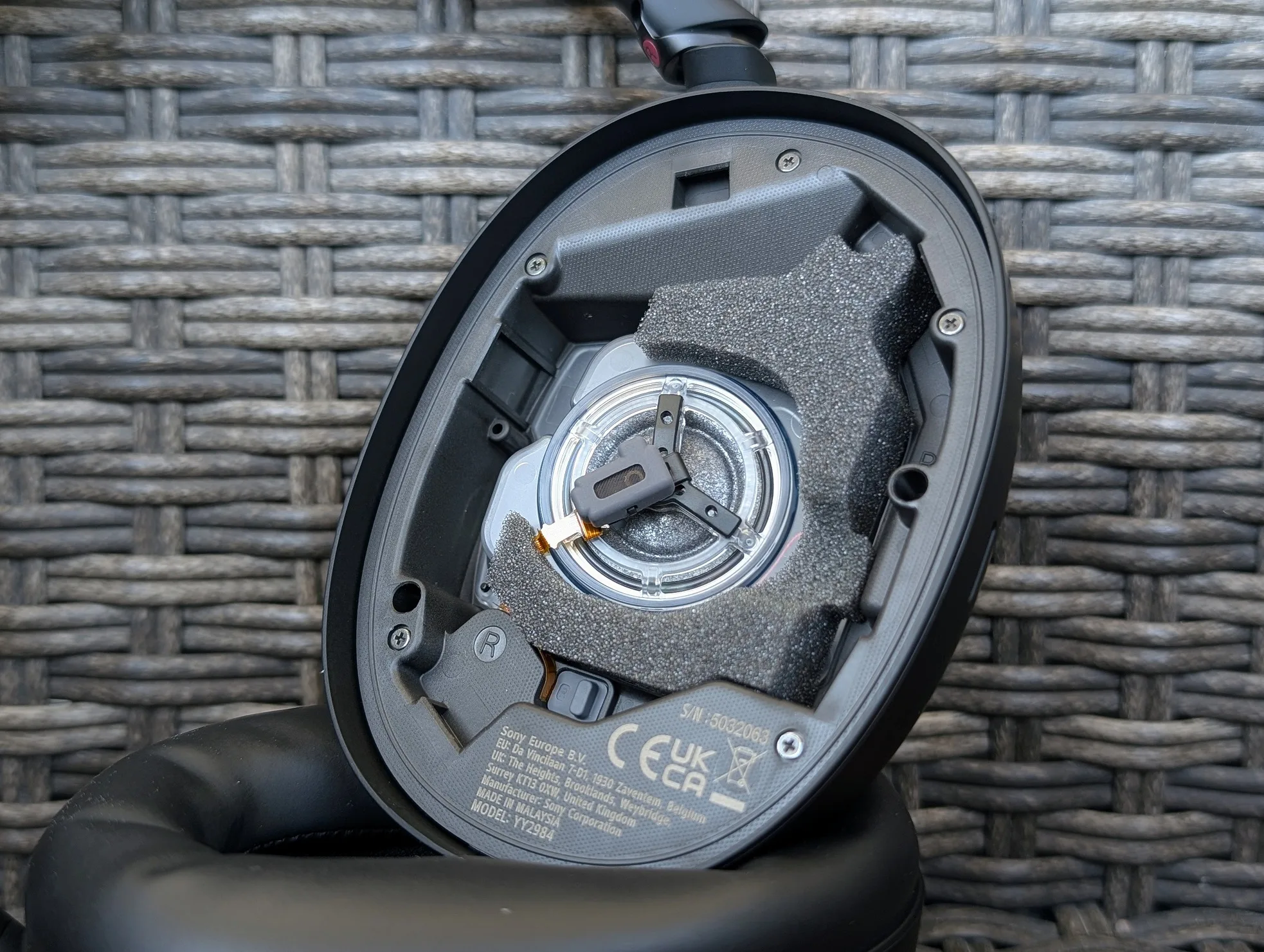
Sony is this time also courting audiophiles by mentioning that it has utilized gold in the headphones' internal wiring and high-end components on the circuit side. Producing the sound, meanwhile, are small 30-millimeter dynamic drivers—just like in the preceding XM5 model—featuring a carbon fiber composite diaphragm and a rubber surround. Active noise-cancelling headphones from other manufacturers typically feature 40-millimeter drivers, so Sony is making an exception here. At least in theory, a smaller diaphragm could offer a certain kind of benefit, but larger drivers might not fit inside the ear cup structure among the electronics anyway.
Measurements
Our frequency response measurements have been made with a clone IEC-60318-4 coupler and KB501X pinnae. The Harman target curve from 2018 is used as a reference point and generalization of the headphone response that would sound good to most people. For more information on the measurements and their accuracy, see Headphone Measurements. The frequency response of the WH-1000XM6 is also comparable with other measured headphones on Squiglinkkalun .
Frequency response in passive mode:
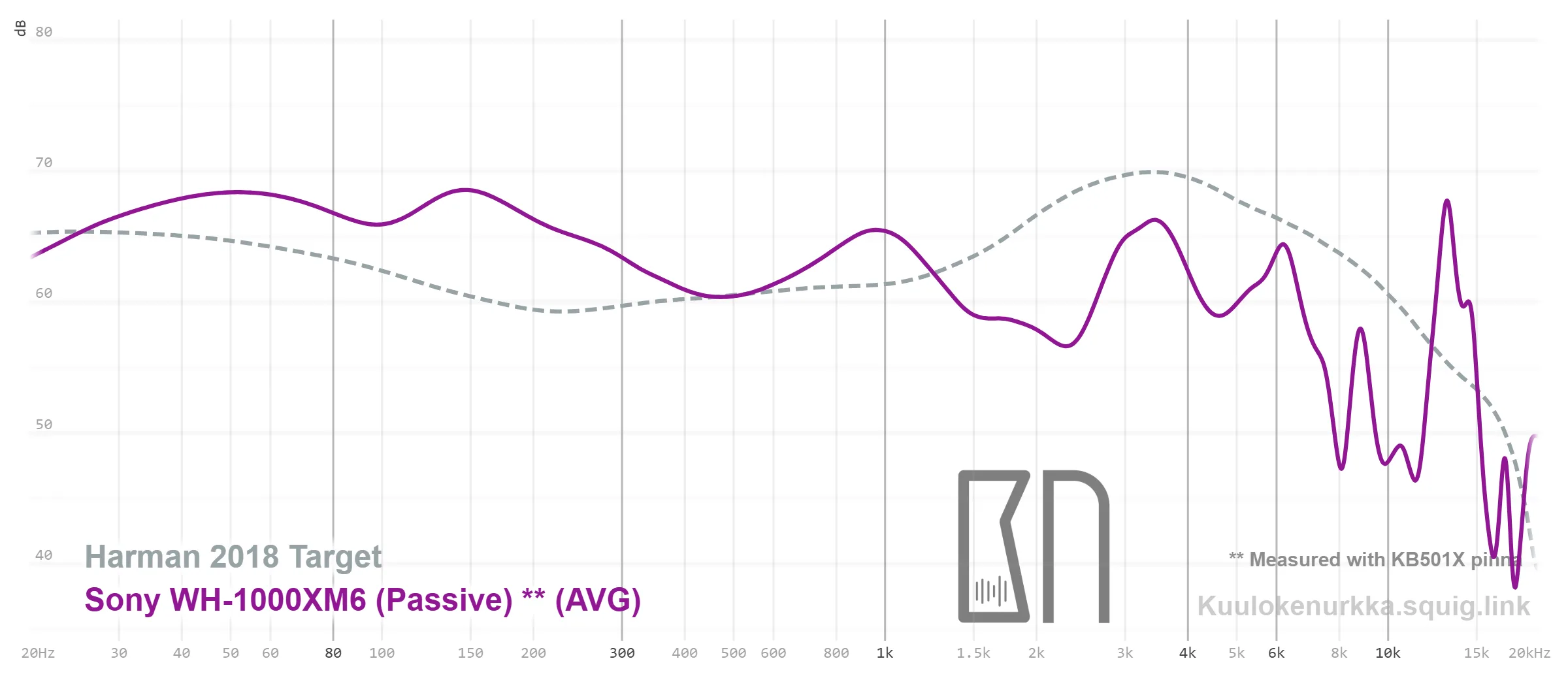
In passive mode, the weaknesses of the WH-1000XM6's acoustic design become apparent. Without digital signal processing (DSP), the sound is roller-coaster-like and unnatural, so there is not much more to be said about it. Sure, when the battery runs out, the headphone cable can be used to listen to an audiobook, for example, but this mode of use is not properly suited for listening to music unless the bar is set low. I therefore recommend turning the power on when using the cable, in which case the sound corresponds to the following measurements.
Frequency Response (ANC ON vs. OFF):
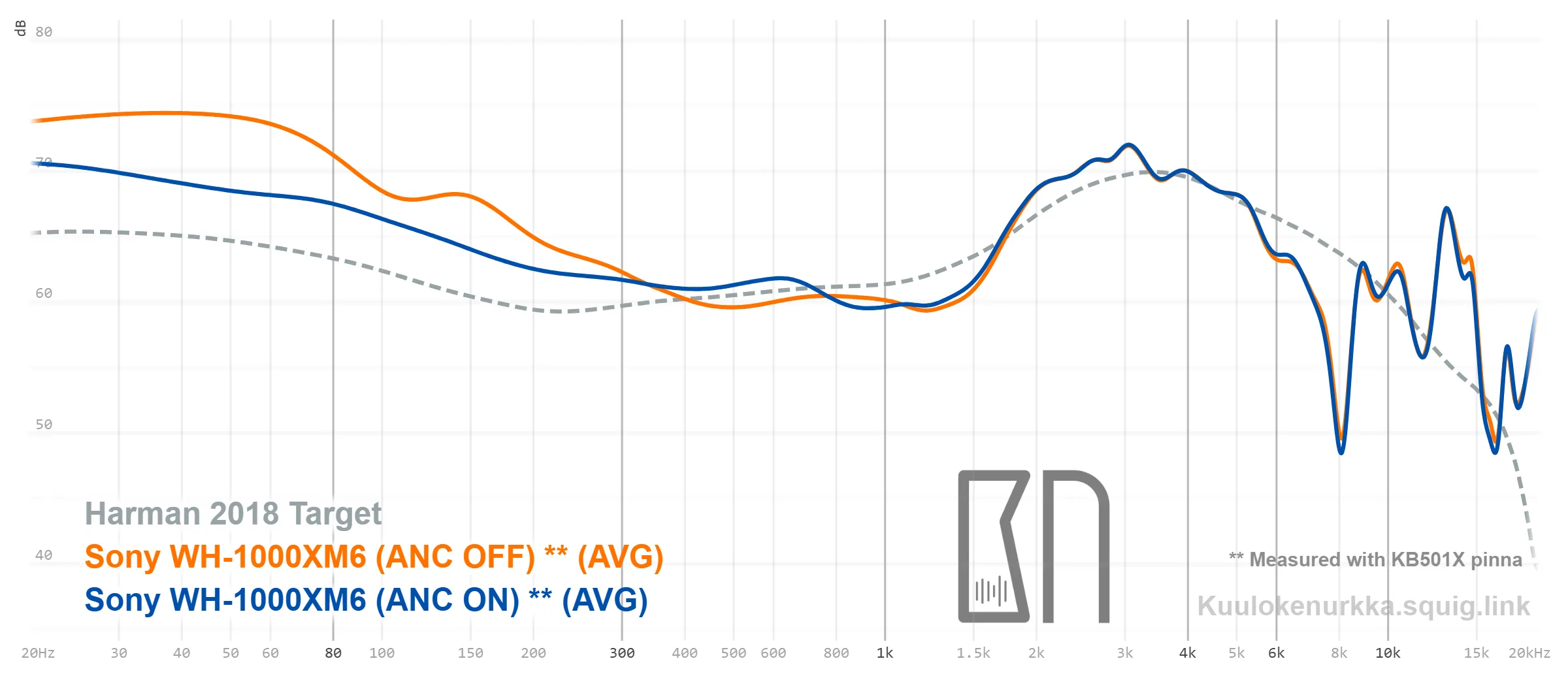
The promised studio accuracy or artist-intended reproduction wasn't achieved, but compared to previous XM-series models, the frequency response of the WH-1000XM6 already seems quite good. On the other hand, familiar problematic areas are the upper bass and lower midrange, which sound much heavier than desired. Although the bass is accentuated even more without active noise cancellation, a dip between 400 and 800 hertz can help the midrange reproduce more clearly than when the noise-cancelling feature is activated.
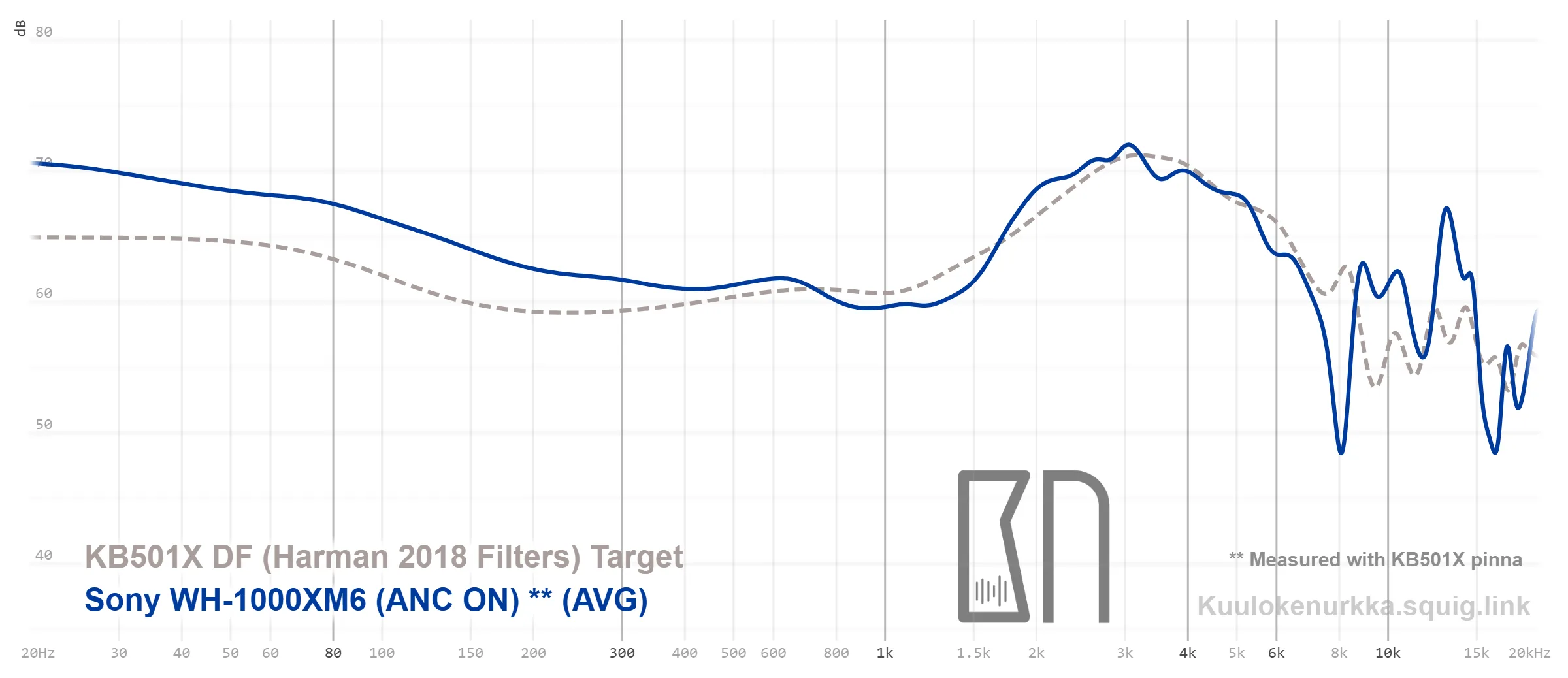
The high frequencies remain identical regardless of whether noise cancellation is on or off. I urge you to pay special attention to around 10 kilohertz, because at this point there should be a dip in the frequency response measured with my own equipment, but in the WH-1000XM6 the response is rather elevated compared to the Harman target curve. This trait becomes more apparent from the unrounded Harman curve tailored for my own measurement equipment, which shows more precisely what level the 10-kilohertz region should be at so that it wouldn't sound emphasized. The WH-1000XM6 has about 5 decibels of excess energy there.
Equalization:
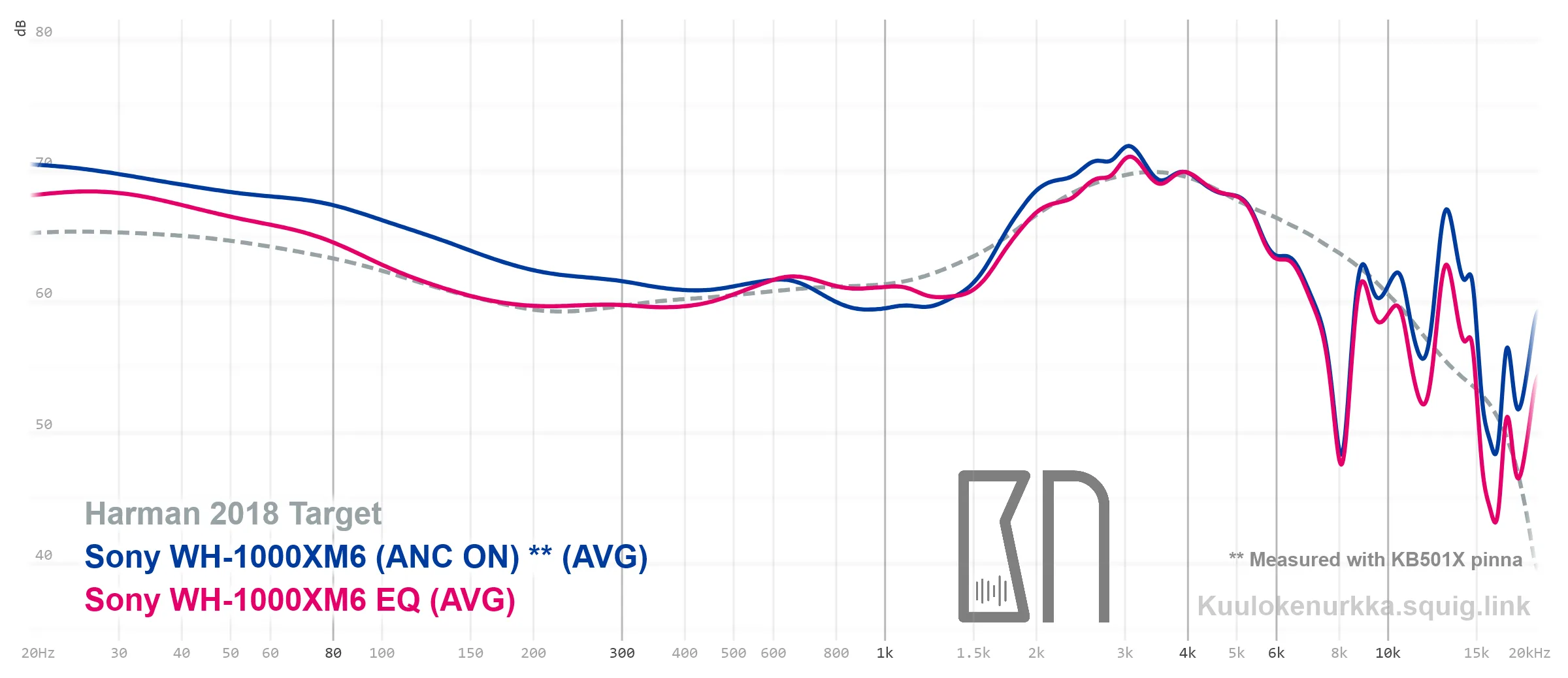
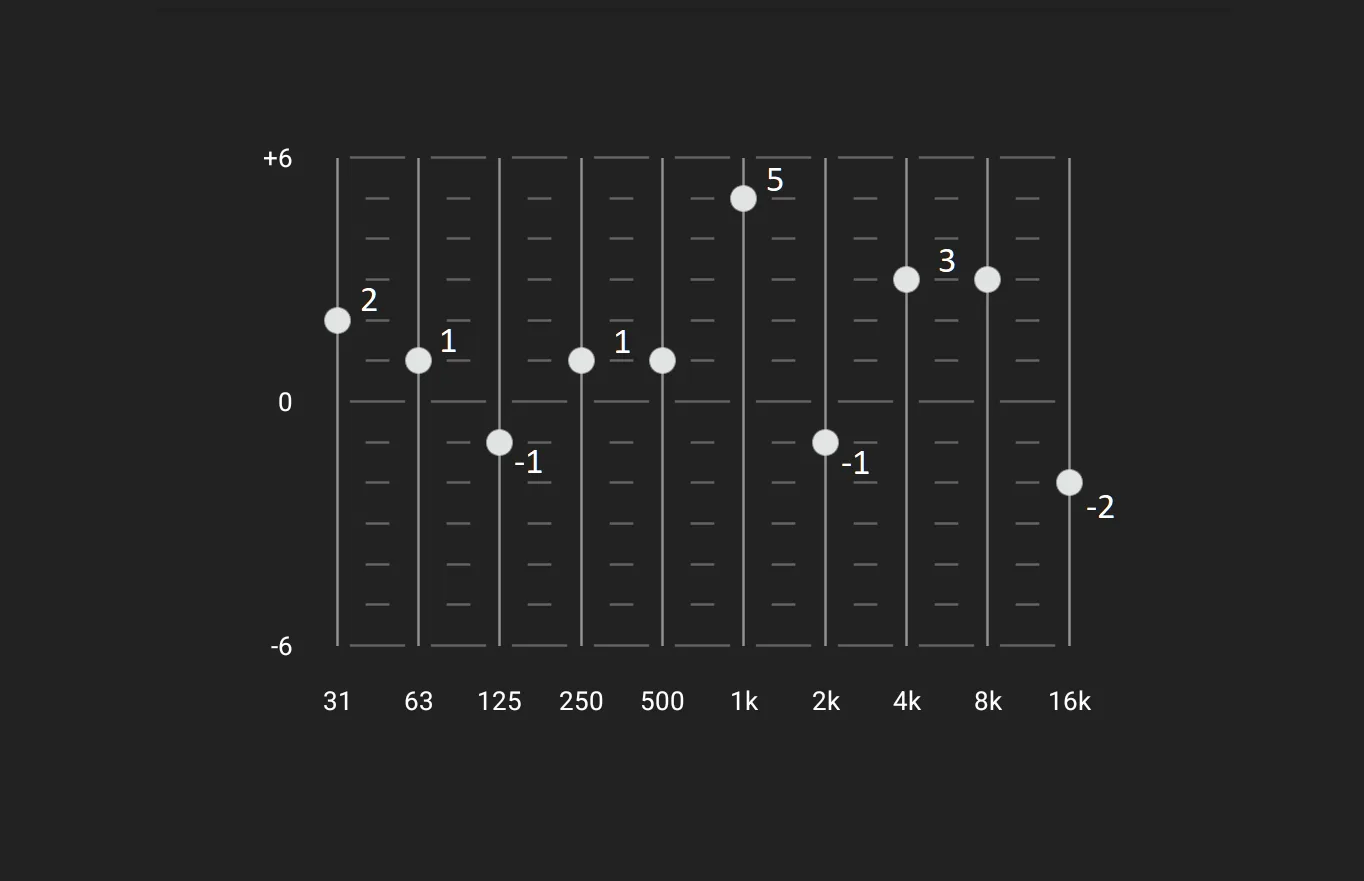
I won't describe the sound quality any further at this point, but if you want the WH-1000XM6 to be as balanced as possible, it requires quite heavy equalization, much like previous Sony models. The amount of bass in particular is worth reducing between 100 and 300 hertz, and the upper mid-range might also require a bit of taming. These changes can be easily made from the Sony app. For the first time in the history of the XM headphone series, excessive mid-bass is finally gotten rid of! Instead, the biggest challenge turns out to be the 10-kilohertz boost I mentioned, which cannot be fixed directly from the Sony app because the sliders are fixed at 8 and 16 kilohertz—an annoying blunder.
However, it is possible to reduce the treble around 10 kilohertz by boosting all other frequencies, which is why the equalization I designed might look a bit funny. When the final result is aligned with the Harman target curve, the adjustment is ultimately the correct one. Bass can also be easily added to my EQ by raising the lowest 31-hertz slider upward according to your own taste. In the Sony app, the Q-factor for every slider is 0.9, except for the 16-kilohertz slider, which follows a Q-factor of 0.4.
When comparing equalization to default settings, it is worth noting that custom sound profiles drop the volume by 3 decibels. My own EQ, which boosts several frequencies upward, does not change the overall volume much at all, but if the changes were smaller or downward, the default settings might suddenly sound better due to their louder volume. This difference in volume should be taken into account in a comparison situation.
Sound observations
Typical features of Sony's noise-canceling headphones include a hefty bass and soft midrange, which have almost become a universal trademark for mass-market products. Perhaps because of this, Sony hasn't wanted to drastically revamp its concept, even though it has the money and expertise to make more orthodox headphones—the manufacturer's studio headphones serve as an example of this. There is nothing wrong with enjoying a loosely growling bass, but I argue that many of us would also appreciate a more balanced and natural sound. Sony still doesn't provide this despite its promises, but its WH-1000XM6 is nonetheless already a step in the right direction. So let's start with the good news.
The upper midrange now plays at quite an appropriate energy level thanks to the proper ear-gain region (1.5–6 kHz), meaning instruments sound quite clear and present in this regard. I missed more airiness in the XM5's sound, which the XM6 also delightfully delivers between 12 and 15 kilohertz. The extra energy in the highest frequencies pleasantly lightens the presentation and in a way allows every sound to carry through better to the end, making the soundstage feel more spacious than before. The series of positive changes also continues in the bass frequencies, as the "mid-bass hump" of the XM4 and XM5 has been replaced in the XM6 by a more linear bass profile. Thus, the bass is reproduced with slightly more control, and it no longer has as negative an effect on the clarity or purity of other frequency ranges. I can indeed declare the WH-1000XM6 unquestionably better-sounding than its predecessor. On a general level, there is no major fault to find with the sound quality, and I could even consider listening to the headphones with their default settings when I just want to relax.
Then the bad news. The WH-1000XM6 is still an example of a headphone suffering from auditory masking , where the bass overpowers everything else, making the sound muddy and congested. The presentation certainly feels comfortably warm and relaxed, but I constantly feel like I can't quite make out the details properly. This stems directly from a multi-decibel bass boost that extends all the way to 600 hertz, reaching far into the midrange. Thus, like a misadjusted subwoofer, the headphones reproduce even frequencies as bass that are not supposed to be bass.
When the body of instruments and the beginning of a singer's voice are boosted, the rest of the sound begins to be masked beneath it. The low frequencies rumble as a uniform mass instead of allowing you to optimally make out drum hits or bass guitar notes, or even making the bass sound powerful. Vocal performances, in turn, take on a muddy and nasal tone, which may be further amplified by an aggressive-sounding bump around 2 to 3 kilohertz. In addition, the vast majority of the smaller details contained in the music practically go unheard, leaving the reproduction lacking in engagement and interest. Some derisively use the term "mud cannon" for Sony's headphones, which unfortunately holds some truth.
I don't understand who such tuning serves, because merely lowering the 150 to 300 hertz region would immediately make the presentation clearer and more detailed, after which the bass would also kick more inspiringly. On the other hand, the role of the upper bass boost might be to mitigate the treble accentuation occurring around 10 kilohertz. Due to this single characteristic, the XM6's upper frequencies are dry and coarse in tone, so in my opinion, they sound somewhat low-quality. Singers' sibilance also occasionally pushes to the forefront more than usual, while a deep dip at 8 kilohertz drains life away from the music.
Those accustomed to a balanced sound will likely notice the WH-1000XM6's presentation as immediately colored, but to everyone, the weaknesses I mentioned may not be completely obvious, especially if there is no prior experience with high-quality wired headphones. On the contrary, the XM6's peculiarities are even quite easily adopted, as long as the headphones are not expected to be hi-fi. Thus, I can understand if Sony's target audience is quite satisfied with the end result. I want to remind you that I represent a more critical listener myself, so my expectations for a headphone model costing 470 euros are higher. That is why I have welcomed the better-than-before equalizer with joy.
Correcting the lower frequencies is extremely effortless this time, but after it, the 10-kilohertz boost and the aggressiveness appearing around 2 kilohertz easily push too much to the forefront of the overall sound. The owner of the headphones has to roll up their sleeves so that the worst harshness is eliminated. Although the treble unfortunately cannot be made entirely smooth even through adjustment, the WH-1000XM6 sounds considerably clearer and more balanced with my settings than the starting point. It feels to me as though a thick curtain has been removed from in front of the music. Vocals and other instruments are easy to make out, and no significant deviations remain in the frequency ranges most sensitive to natural timbre that would disturb me. The end result produces both pleasantly inspiring listening moments and one valid question: have the mentioned music industry professionals actually participated in the development work or solely in the marketing?
Comparisons
Sony is, of course, not the only manufacturer of noise-canceling headphones, so the market situation requires a slightly broader examination. In this context, the WH-1000XM6 fares extremely well against all its competitors in most areas, and in fact, it doesn't sound half bad even with its default settings. While this says more about the mediocrity of many headphones, I believe Sony has closed the sound quality gap with its new model compared to competing products. In my own opinion, the WH-1000XM6 sounds more balanced than, for example, the Sonos Ace and Bowers & Wilkins' new PX7 S3 — though the latter will likely charm many with its bass- and treble-heavy sound. Frankly, I would also rather listen to the WH-1000XM6 than the Noble Audio Fokus Apollo, whose boosts in the upper frequencies are quite unpleasant, even though the headphones otherwise easily outperform the WH-1000XM6 in reproduction clarity.
Taking equalization into account, I would favor the XM6 even more clearly over all the headphone models mentioned above. Cambridge Audio Melomania P100, Bowers & Wilkins PX7 S2e and Sennheiser Momentum 4 , on the other hand, compare fairly evenly with Sony's headphones, so thanks to the good equalizer, the XM6 can be raised to the same conversation, which also gives its effective noise-canceling function more weight. Sony's headphones are no longer purchased solely for their more efficient noise cancellation and versatile features compared to competitors, but with a bit of effort, they can also be made to sound good. However, this requires know-how in using an equalizer, whereas adjusting many other headphones is easier. In my opinion, Sony should invest significantly more into the out-of-the-box tuning, especially since its headphones cost more than their older competitors.
Let's do few pair comparisons next.
Comparison: Sony WH-1000XM6 vs. Bose QuietComfort Ultra
Prices: 470 € vs. 500 € (often on discount for 350 €)
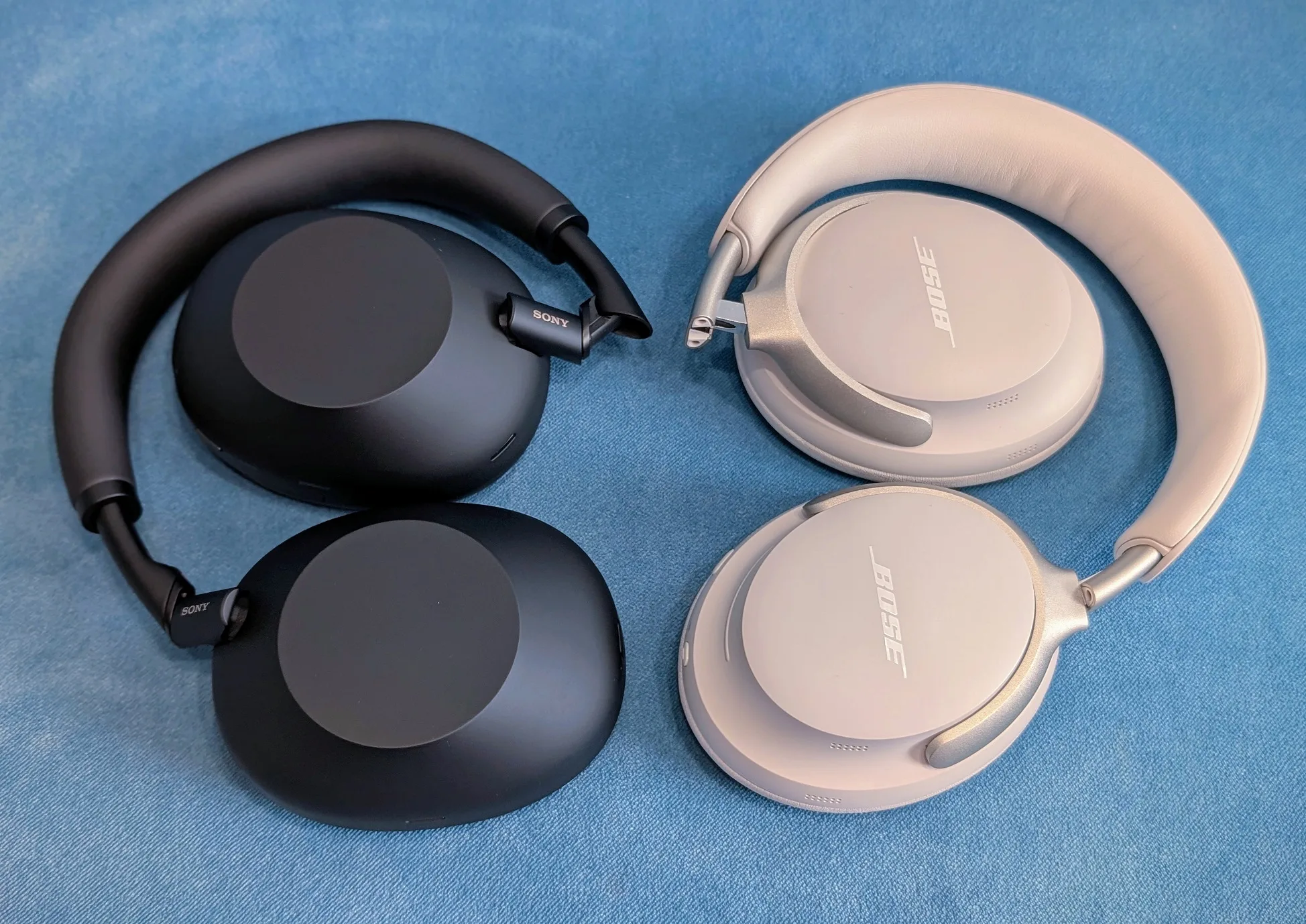
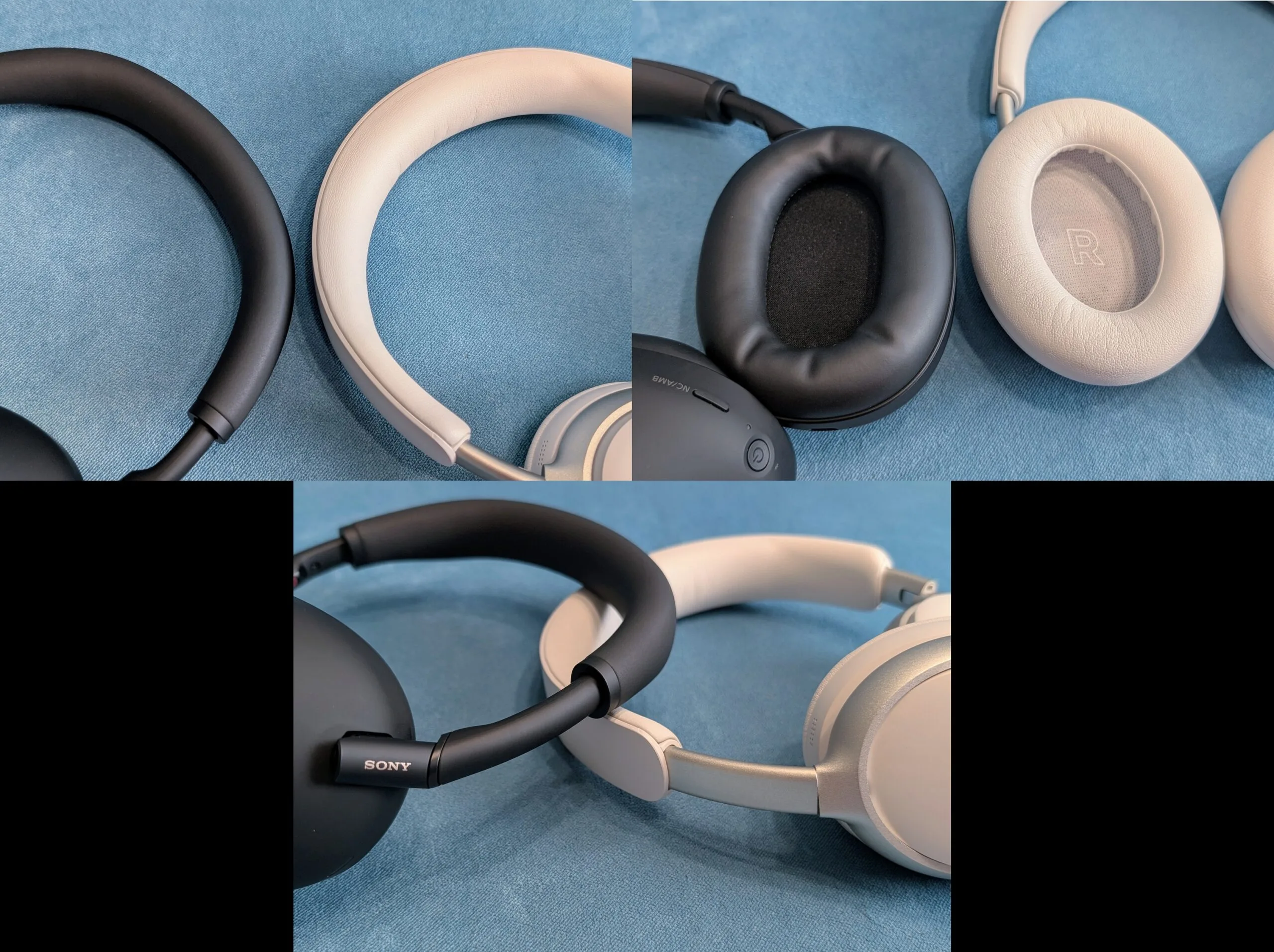
Key Advantages:
- WH-1000XM6:
– Longer battery life
– Features easier-to-use buttons and more precise touch controls
– Better passive sound isolation
– Slightly more efficient ANC
– ANC can be turned off (if needed)
– Slightly clearer transparency mode
– No background noise
– Microphone suppresses background noise noticeably better
– Listening via cable is possible with the power turned off
– More extra features and a more versatile equalizer
– Supports the LDAC codec, which is more common in the Android world
– Magnetic flap makes the case easier to use - QuietComfort Ultra:
– Better comfort (especially the headband)
– Causes less sweating
– Higher quality materials and a sleeker build
– ANC is less disturbed by wind
– Cleaner and more straightforward phone app interface
– Equalizer can be used when listening via cable
– More sensible and versatile spatial audio implementation
– Supports the lossless aptX Lossless codec
– Comes with a longer charging cable
– Lower market price
General usability, a better microphone, and the lack of background noise are Sony's clearest advantages over Bose's headphones, whereas the QuietComfort Ultra's greatest strength is significantly better comfort. In many areas, the duo performs so evenly that the differences have no major practical significance. In my view, both should cost roughly the same, meaning you currently have to pay extra for the WH-1000XM6 simply because it is a new product.
When it comes to sound quality, I have a favorite, even though the other at its best doesn't fall behind much.
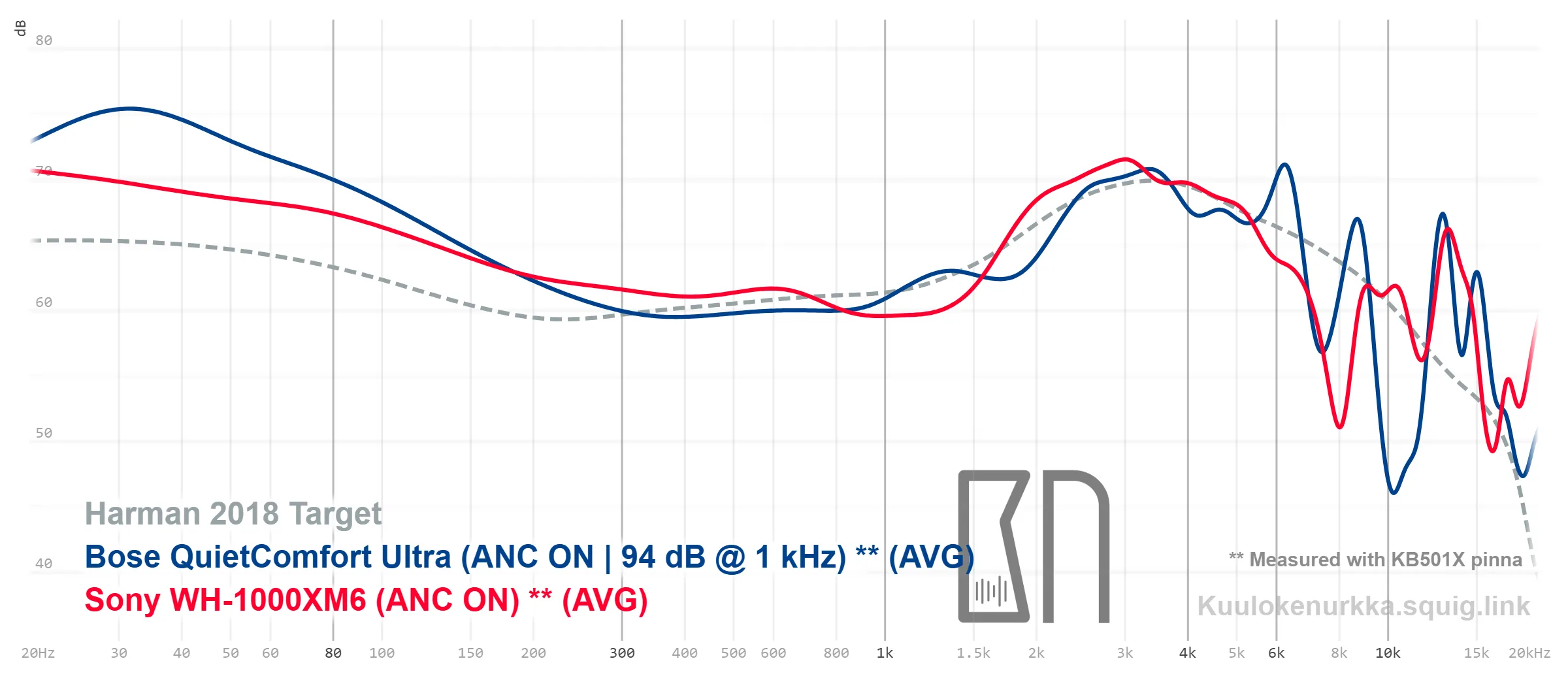
Frequency responses with default settings (ANC ON):
Frequency responses after EQ:
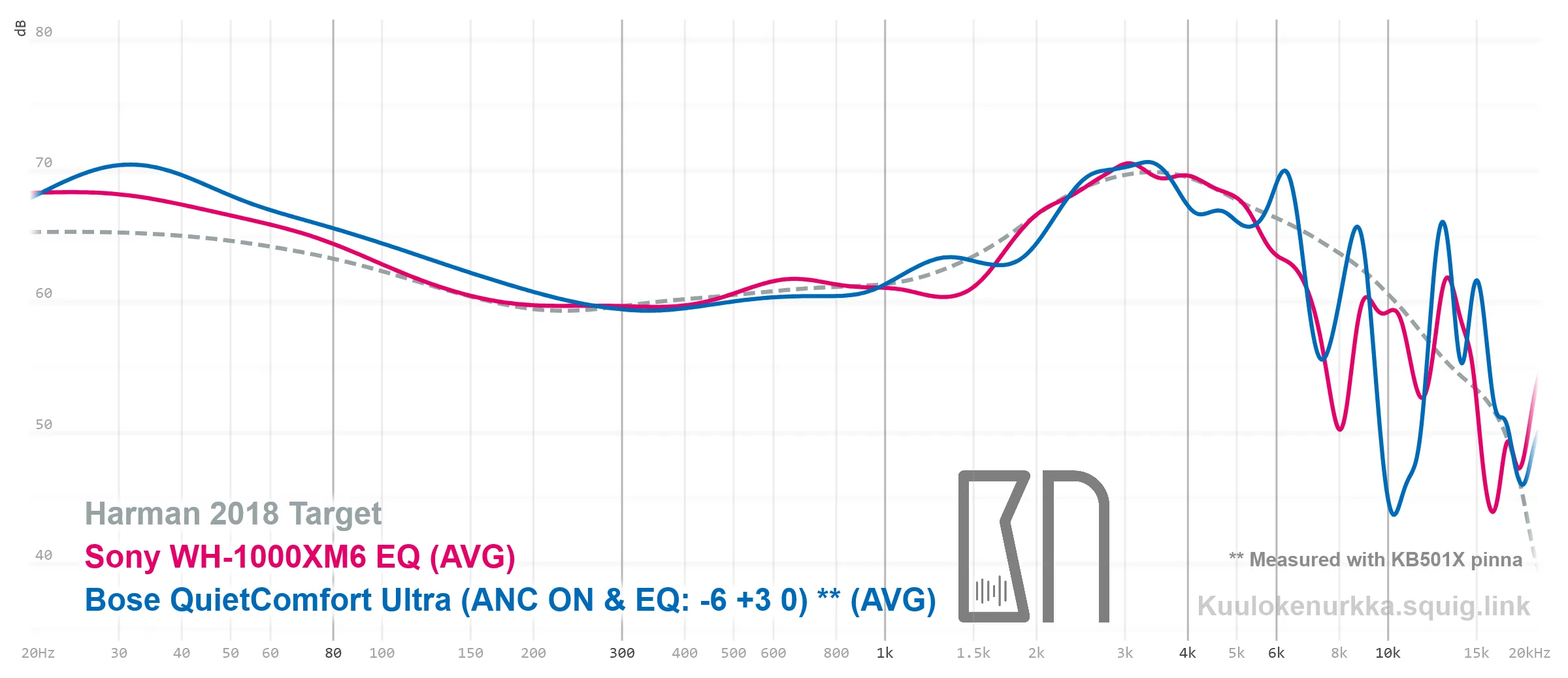
Because the WH-1000XM6 reproduces midrange frequencies more energetically and bass more moderately than the QuietComfort Ultra out of the box, you would expect the sound to be clearer. Yet the Bose model sounds cleaner and better of the two, because it is mainly plagued by loose, excessive bass thumping. Furthermore, on the Sony headphones, the bloated rumble covers up midrange details, making the presentation boringly unclear. If someone likes heavy bass, the QuietComfort Ultra would be the better choice in that regard as well. However, I wouldn't want to listen to either headphone model like this, because they get better when equalized.
After that, the differences become quite insignificant if I listen to the QuietComfort Ultra with the AAC codec and the WH-1000XM6 with LDAC. In this case, the Sony model's bass reproduces with better control and impact, while the Bose model's upper frequencies are fresher and the sound thus slightly more effortless. In general, however, both reproduce vocals and the vast majority of instruments quite naturally, so you don't pay a huge amount of attention to the differences. If, however, I use the QuietComfort Ultra with a Sennheiser BTD 700 USB transmitter and get to utilize the aptX Lossless codec, the WH-1000XM6 takes second place in sound quality.
The QuietComfort Ultra's soundstage is more credible because, thanks to the brighter treble, the tail end of sounds resonates more realistically in the surrounding space. The WH-1000XM6, on the other hand, sounds somewhat lifeless in its soundstage because a corresponding continuation is partly missing due to the 8 kHz dip. Some mention a slight deficit around 10 kHz as a prerequisite for a spacious spatial impression, of which the WH-1000XM6 is still the opposite example even when equalized. It may therefore be that this trait also makes the Sony headphones feel more closed-in and one-dimensional, whereas the Bose headphones' angled drivers may add depth and immersiveness to the soundstage that I perceive. Such observations are very subjective, however, so I recommend focusing primarily on the difference in the amount of treble. The WH-1000XM6 cannot be made as fresh and airy as the Bose headphones. Even though the QuietComfort Ultra looks more uneven based on measurements, I find its treble quite natural, especially compared to the Sony model.
Ultimately, I consider the QuietComfort Ultra better in terms of sound quality because I notice I get more emotionally excited by the music. For example, good vocalists sound better than on the WH-1000XM6, and "more happens" in the soundstage, so listening is more interesting in that respect too. Still, there isn't much to fault the Sony headphones for after equalization either, because the music sounds easily relatable on a general level, and I don't disapprove of the relaxed overall vibe. This is a defensive victory for Bose and only a small defeat for Sony. However, since the headphones could be equalized in many different ways, the end result could also be different depending on taste.
Comparison: Sony WH-1000XM6 vs. AKG N9 Hybrid
Prices: 470 € vs. 400 € (lowest at 280 €)
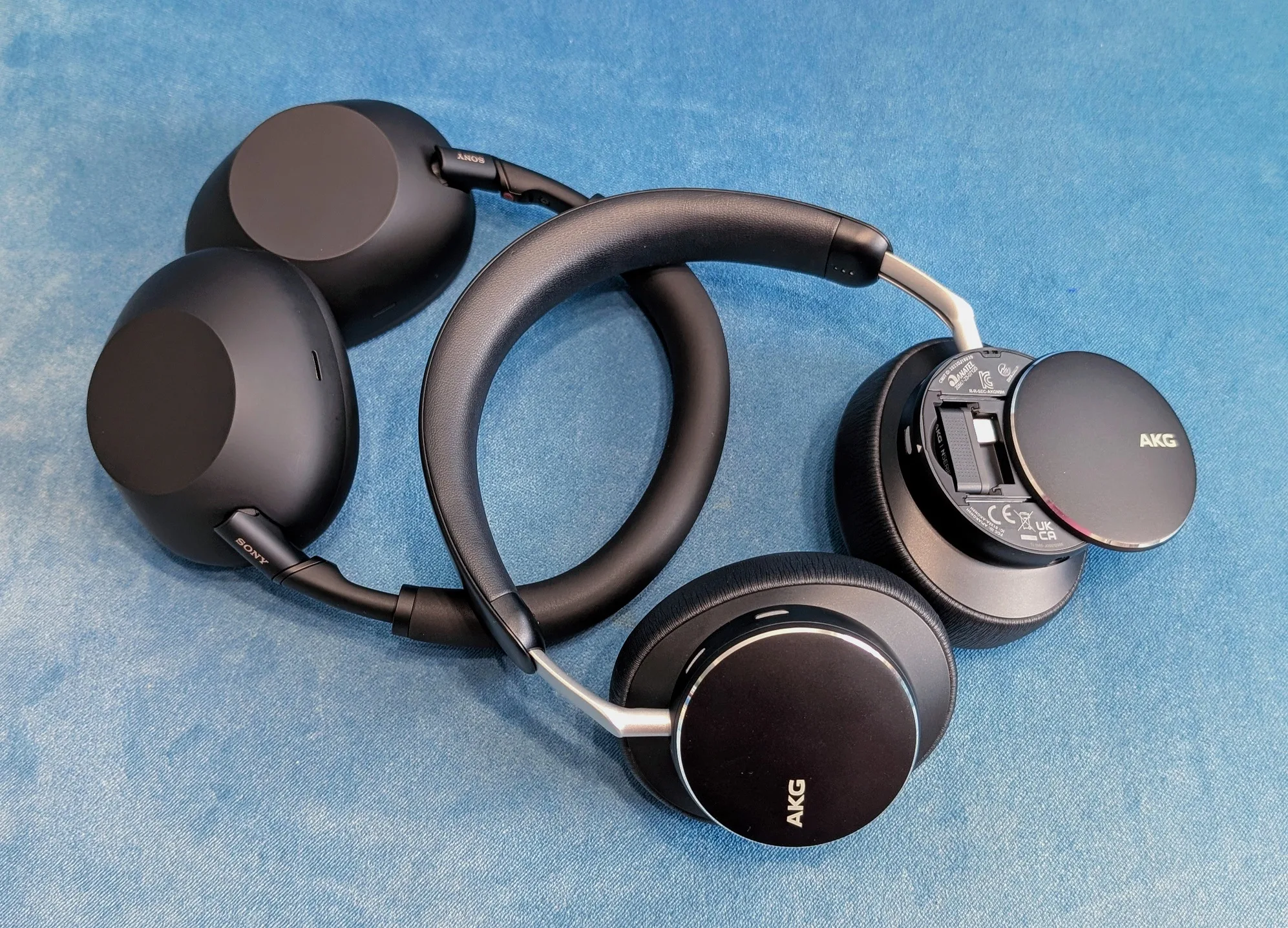
Key Advantages:
- WH-1000XM6:
– Weighs slightly less
– Better passive sound isolation
– Clearly more powerful ANC
– Slightly more natural transparency mode
– More precise volume control
– More additional features
– Fewer usability quirks
– Touch controls (if someone likes them)
– Smaller case - N9 Hybrid:
– Significantly longer battery life
– Better comfort
– Causes less sweating
– Higher-quality build materials
– Barely collects any fingerprints
– ANC is less disturbed by wind
– Cleaner and more straightforward phone app interface
– Equalizer can be used when listening via cable
– Comes with a wireless USB transmitter (lossless audio and lower latency for gaming)
– Comes with a longer charging cable
– Significantly more affordable market price
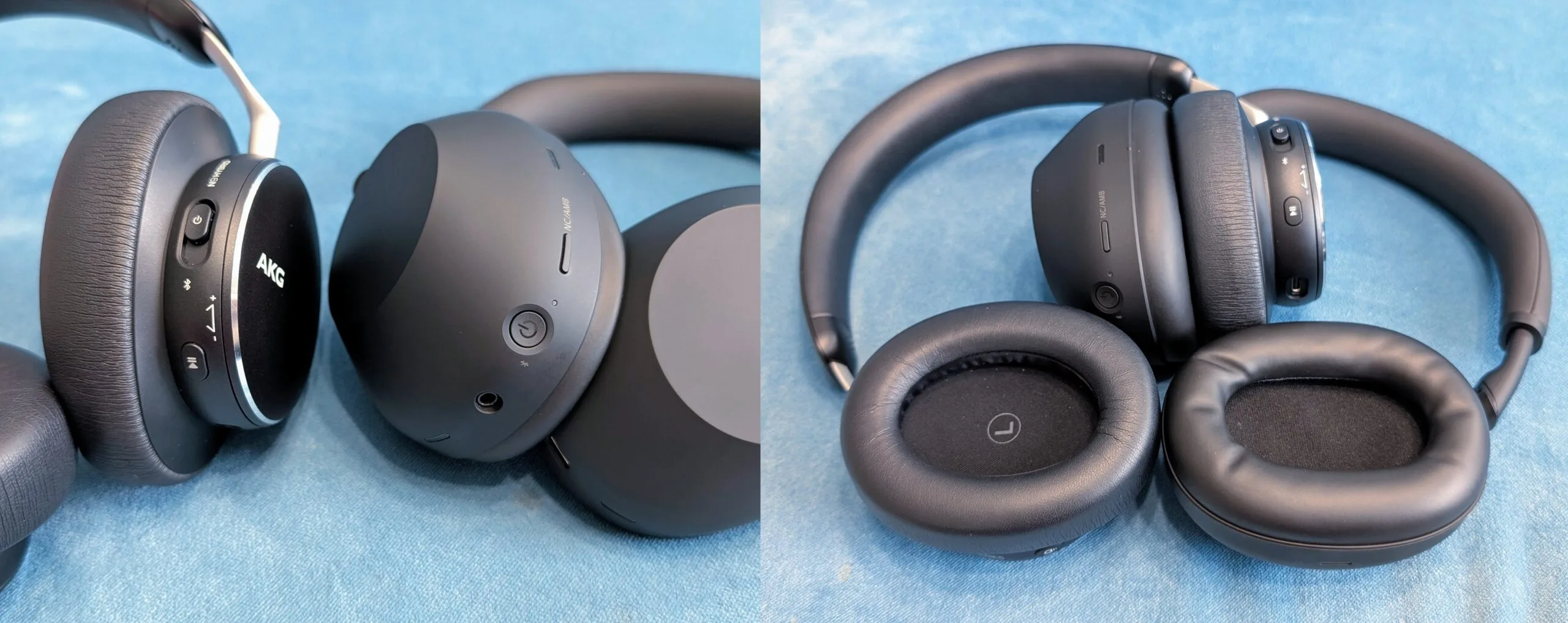
Compared to the AKG N9 Hybrid, the WH-1000XM6 stands out with its significantly more powerful active noise cancellation and more fine-tuned usability. The companion app also offers a wider array of features for those who value them. At the same time, however, Sony shows that it has essentially not innovated at all over the course of three years. The N9 Hybrid's battery life is considerably longer, and it comes with a wireless USB transmitter that enables lossless, low-latency playback. Somewhat paradoxically, AKG's headphones are actually a better companion for the PlayStation console than Sony's own product. The N9 Hybrid also feels more comfortable on the head, and its noise-canceling function is not disturbed by wind. Both headphones feature LDAC support, a good microphone implementation, and a 10-band equalizer. Without its powerful noise cancellation, the WH-1000XM6 would leave you wondering what you are actually paying for compared to the N9 Hybrid, which drops as low as 280 euros.
What about the sound quality?
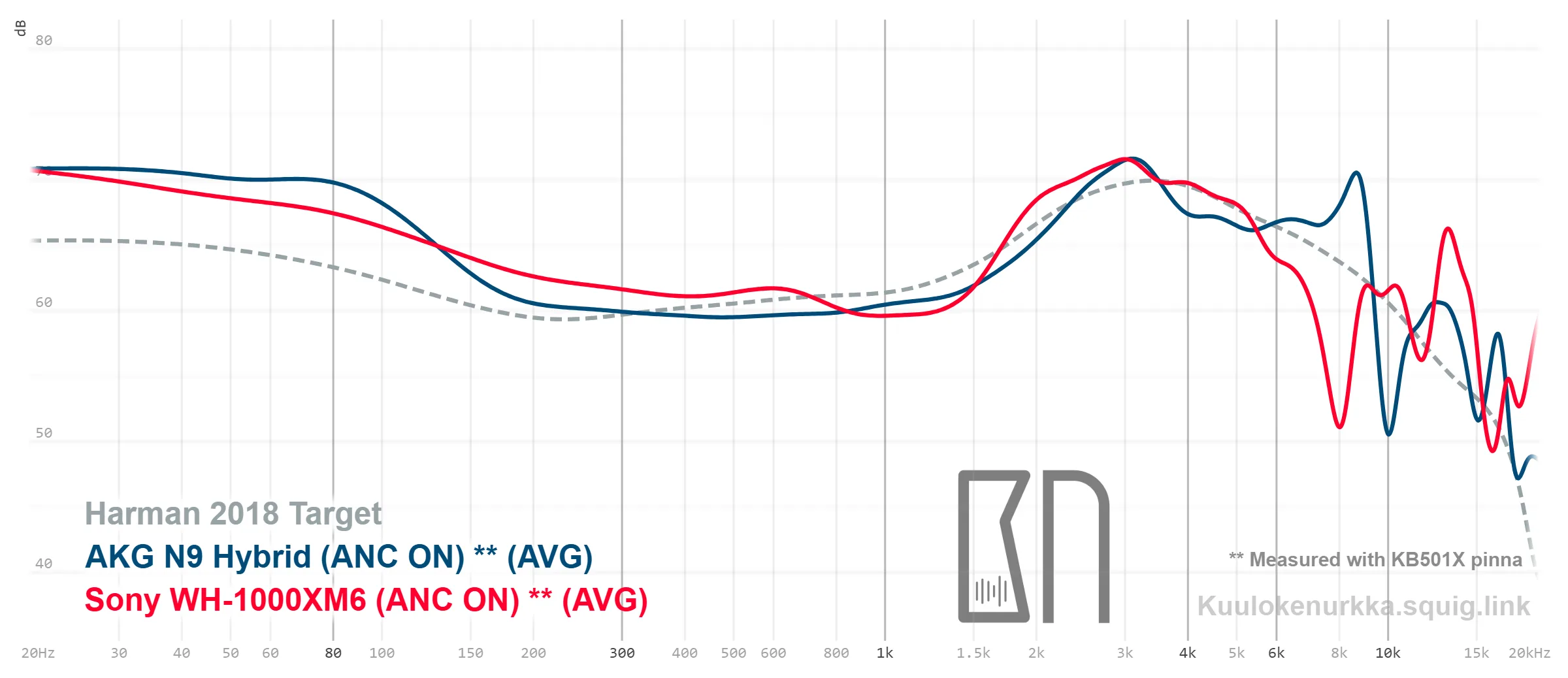
Frequency responses with default settings (ANC ON):
Frequency responses after EQ:
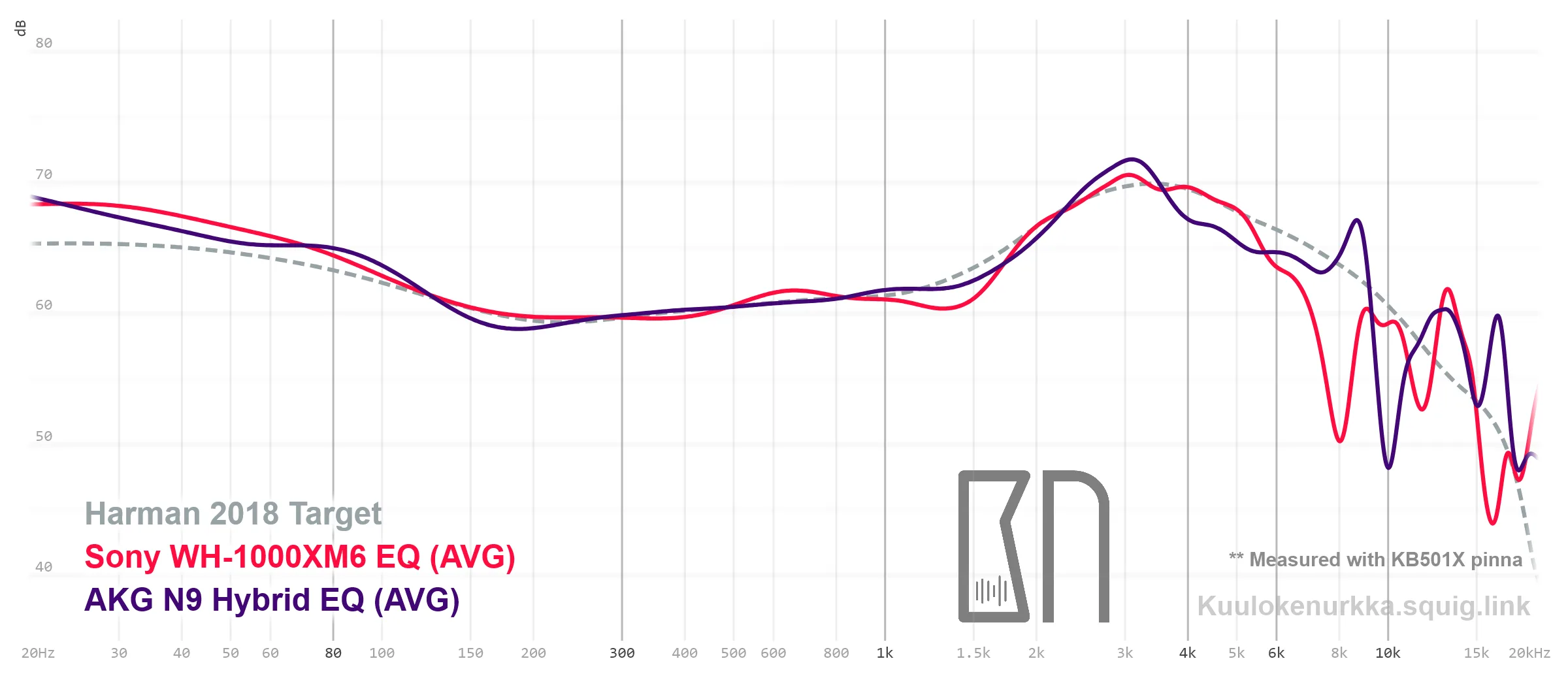
Out of the box, the N9 Hybrid manages to avoid the WH-1000XM6's biggest weaknesses, featuring a more powerful bass, clearer midrange, and more natural treble. That said, I have to admit that both the bass and treble are a bit too boosted for my personal taste, meaning AKG's headphones aren't stellar right out of the box either. On the other hand, they still feel that way next to Sony's muddy and bloated tuning. I would see the WH-1000XM6 as the better choice of the two mostly if someone prefers a more present midrange and its clarity doesn't matter to them. Perhaps someone might also favor Sony's more relaxed upper frequencies compared to the N9 Hybrid's punchy 8 kHz peak. In that case, though, the WH-1000XM6 sounds unnatural itself due to its 10 kHz boost. So equalization is beneficial on both sides.
After adjustments, Sony gets much closer to the N9 Hybrid, lagging behind in naturalness mostly in the upper frequencies. The WH-1000XM6's deep dip around 8 kHz seems to eat away a surprising amount of the music's engaging and lively feel, whereas the N9 Hybrid sounds exceptionally linear and high-quality when equalized. The music being listened to gets that final touch from the smoother treble that the Sony headphones lack. This is what the transition from good headphones to excellent headphones feels like. However, Sony is no longer far behind if it could get its upper frequencies to reproduce more smoothly. The current 10-band equalizer is still not enough to correct all the flaws.
Thus, the WH-1000XM6 is quite good in sound quality, but not quite on par with the best competitors like the AKG N9 Hybrid. Considering the whole package, Sony's headphones are better suited for noise cancellation and portability, while the N9 Hybrid would be a better headphone for music listening, low-latency gaming, and, with minor reservations, office use as well thanks to its more comprehensive speech controls. If only someone could combine all of this into one and the same product.
Summary
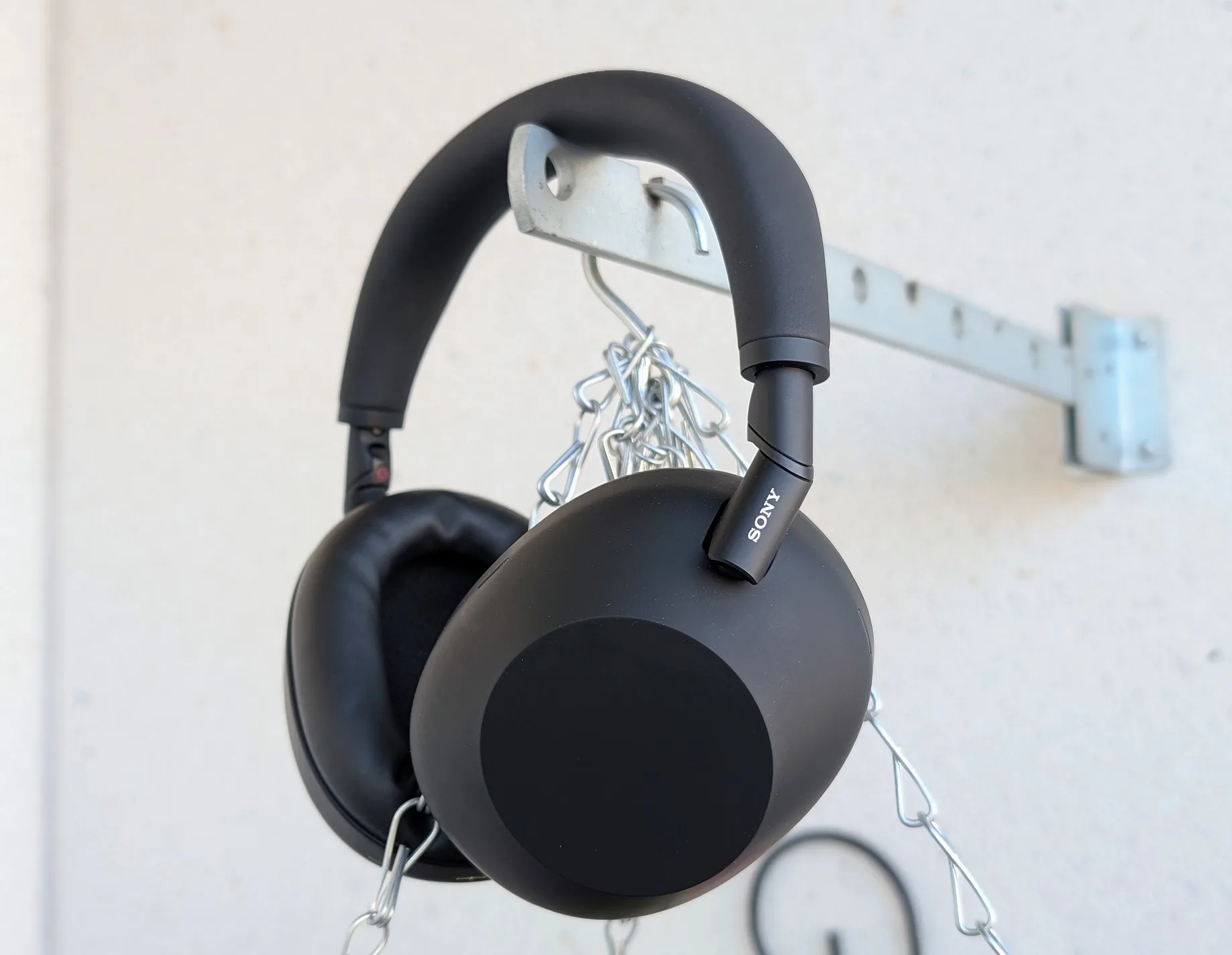
With minor refinements, the WH-1000XM6 is definitely Sony's best noise-canceling headphone yet, showing that the manufacturer has listened to feedback. However, this means the focus has been on fine-tuning the WH-1000XM5, leaving real innovations quite minimal, especially compared to competitors. For previous Sony headphone owners, the XM6 is not a must-buy until the price comes down. It is also worth noting that the older XM4 offers a similarly effective noise-canceling function at a significantly more attractive price than either of Sony's newer products.
In one area, however, the XM6 clearly outperforms its predecessor: sound quality, or rather the new 10-band equalizer, which helps the new model sound considerably more balanced than the XM4 or XM5. Despite all the criticism I've raised, the headphones have managed to win me over. Alongside the market's most effective noise cancellation, you can now enjoy quite good sound after proper adjustments—provided the owner can live with the rock-hard headband. Comfort is subjective, however, so if it feels fine and the other weaknesses I mentioned don't bother you, I am happy to give the WH-1000XM6 a mild recommendation.
When looking at the baseline sound quality, I still want to remind you that a company of Sony's size could do significantly better. It annoys me to see consumers misled, as the manufacturer tries to make people believe the XM6's sound is something it clearly isn't:
Hear music as it was meant to be. Co-created with world-renowned mastering engineers, these headphones deliver studio-level precision—preserving every nuance, every note, exactly as the artist intended.
If Sony wants to make the high-quality headphones it markets, shouldn't it do just that? Otherwise, the product's sound could simply be described as what it is: thick and soft. I don't believe that the music industry professionals used as marketing faces would want consumers to start considering muddy sound normal either. Even though most people perceive the WH-1000XM6's out-of-the-box sound quality as acceptable, why couldn't it be even better, building on Sony's expertise and long experience?
OK sound for 470 euros doesn't exactly spark cheers, and the new equalizer acting as a savior mostly matches competitors' products from past years rather than being parametric, like Nothing's recently released Headphone (1), for instance. It feels to me that I'm paying extra for the Sony product mostly because of the brand and the effective noise cancellation. Since competitors are catching up to Sony in this area and have already surpassed it in a few others, the manufacturer will, in my view, be forced to innovate significantly more with its next headphone model. Fortunately, any product turns out good when priced appropriately, so in that sense the WH-1000XM6 will improve as sales and discounts roll in. On the other hand, if the headphones are meant to be used for a long time and a Sony product is specifically on the shopping list, I would definitely recommend the XM6 over the more affordable XM5.
Pros and cons:
+ More natural and clearer default sound compared to XM5
+ Better equalizer (especially for bass frequencies)
+ Highly effective ANC and clear transparency mode
+ No background noise
+ Microphone's better than usual sound quality in a noisy environment
+ Sturdy build that folds up again
+ Clever magnetic flap on the case
+ Good usability when it comes to the buttons
+ Lots of additional features
+ Supports the LDAC codec and also works in LE Audio mode
+/- Comfort: lightweight and even fit, but clamps hard, causes sweating, and puts pressure on the top of the head
+/- Hinges are partly made of metal, but reports can already be found online of the surrounding plastic parts cracking
– Overly boosted lower frequencies make music sound congested and muddy
– Unnatural treble boost at 10 kHz
– Misleading sound quality marketing instead of Sony providing a sound profile in its app with a balanced sound
– Equalizer and other audio settings only work with Bluetooth
– The app's user interface is cluttered and the connection to the headphones drops constantly
– ANC is disturbed by wind
– No USB listening capability
– Short charging cable
– The black color option collects a massive amount of fingerprints and oil smudges
– High price (before discounts)
 EN
EN  FI
FI
It’s all a bit Finnish to me – even the EN page.
Yeah, sorry about that! My automatic AI translation couldn’t process the long articles, which happen to be mostly of ANC heapdhones, so some of them are still in Finnish – even after selecting English as language. I will translate the most read missing reviews manually at some point, but it will take time. You probably noticed that I have lots of content. 😅
It is actually a bit silly, as those articles were translated, but the word count was too high, so my server couldn’t save the translation to the database quickly enough before giving an error.
Edit: I translated this arcticle now, so it should be in English after changing language.
Thank you!