Author: Sword of Damocles
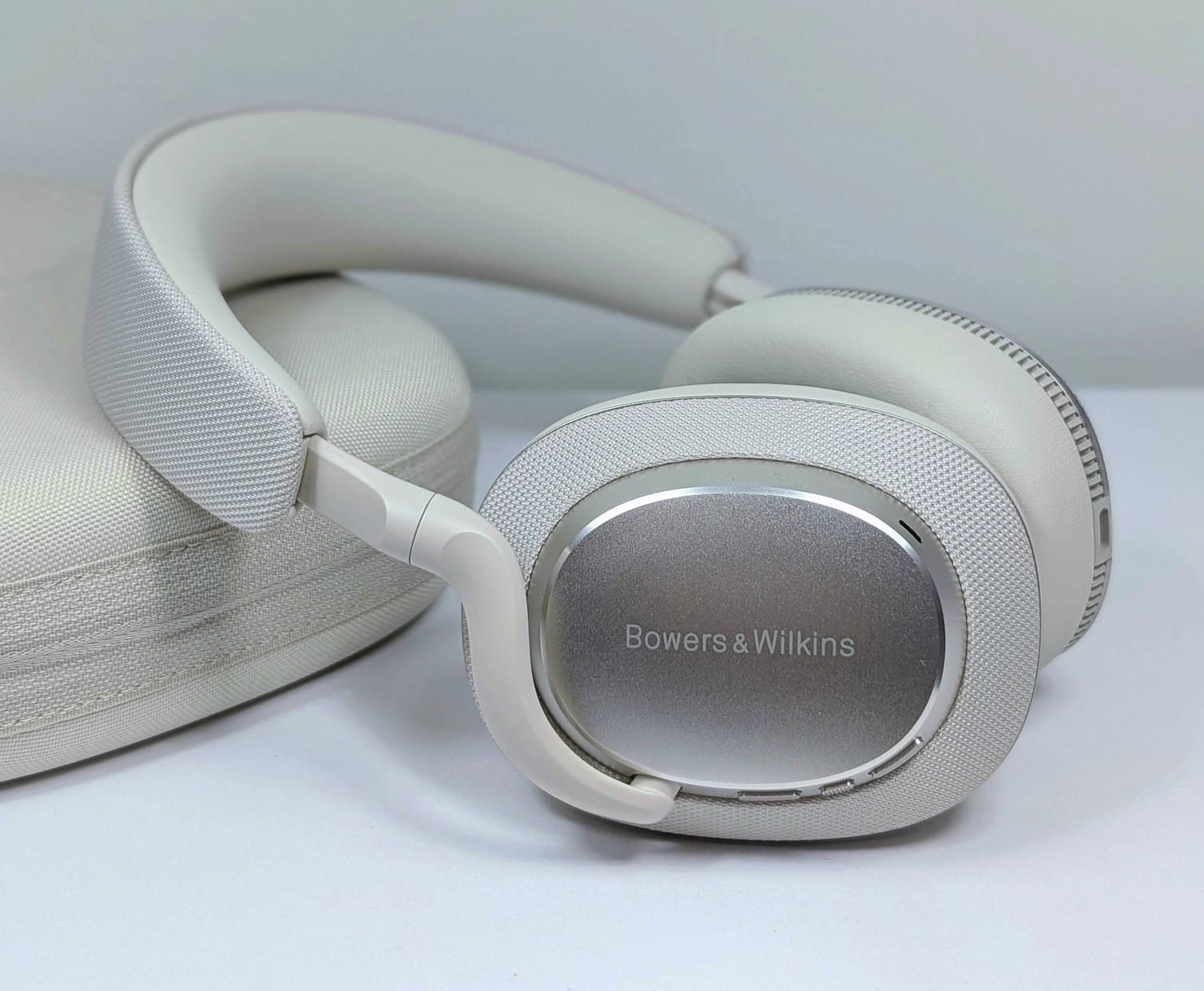
Table of Contents:
Information:
- Released: 2025
- Designed in Britain and manufactured in China
- Color options: Black, white and blue
- Price: 429 €
- Type: Closed, over-ear
- 40 mm dynamic drivers (biocellulose diaphragms)
- Audio connections: Bluetooth 5.3 and USB-C
- Bluetooth codecs: Snapdragon Sound (AptX Adaptive and AptX Lossless), AptX HD, AptX, AAC and SBC
- Charging port: USB-C
- Battery size: ?
- Battery life: 30 h (presumably longer without noise cancellation)
- Charging time: 2–3 h (Supports fast charging: 7 hours of use in 15 minutes)
- Active Noise Cancellation: ON / OFF / Transparency mode
- Features: Multipoint, Google Fast Pair, MFi (Made For iPhone), voice assistant (Google Assistant/Siri) and phone app with equalizer
- Weight: 300 g
- Accessories: Carrying case, USB-C cable (1.2m) and USB-C–3.5mm headphone cable (1.2m)
Review unit acquisition method: Received on loan from the importer
British Bowers & Wilkins has started updating its noise-cancelling headphone lineup by releasing the PX7 S3 headphones priced at 429 euros (manufacturer's product page), which, according to rumors, will soon be joined by a revamped PX8 series. The PX7 series is already familiar to me, as I wrote about it almost two years ago PX7 S2e: and liked it so much that I eventually bought the test headphones for myself. Compared to its predecessor, the PX7 S3 is said to offer improvements in almost every area: for example, the cup structure has been made slightly slimmer, and new types of drivers produce the sound. With the S2e model on the Headphone Corner's wall of fame, my expectations are naturally high, so I decided to test the new model right away. Is new always better, or could the older model, currently costing 250 euros, still be a viable option?
My thanks for lending the PX7 S3 test unit go to Simex:in direction!
Packaging and accessories
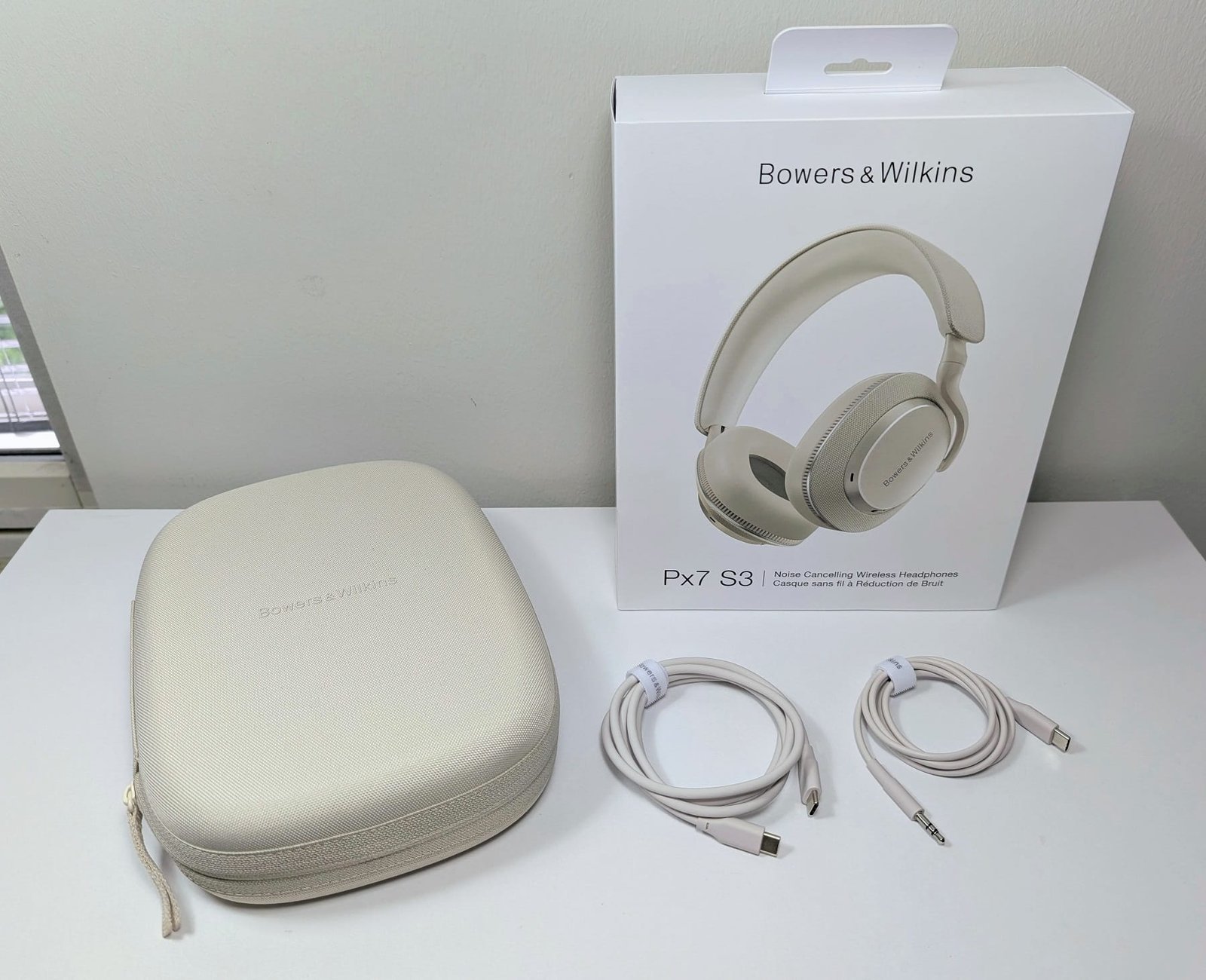
The PX7 S3 arrives in modern product packaging, or perhaps one should speak of bygone eras, as nowadays more and more manufacturers are replacing fine packaging with ecological and dreary cardboard boxes. In any case, Bowers & Wilkins' presentation exudes quality. Otherwise, there's nothing extraordinary in terms of accessories, as wireless headphones primarily need a carrying case and a couple of cables. The PX7 S3 comes with these, and their coloring matches the chosen headphone version.
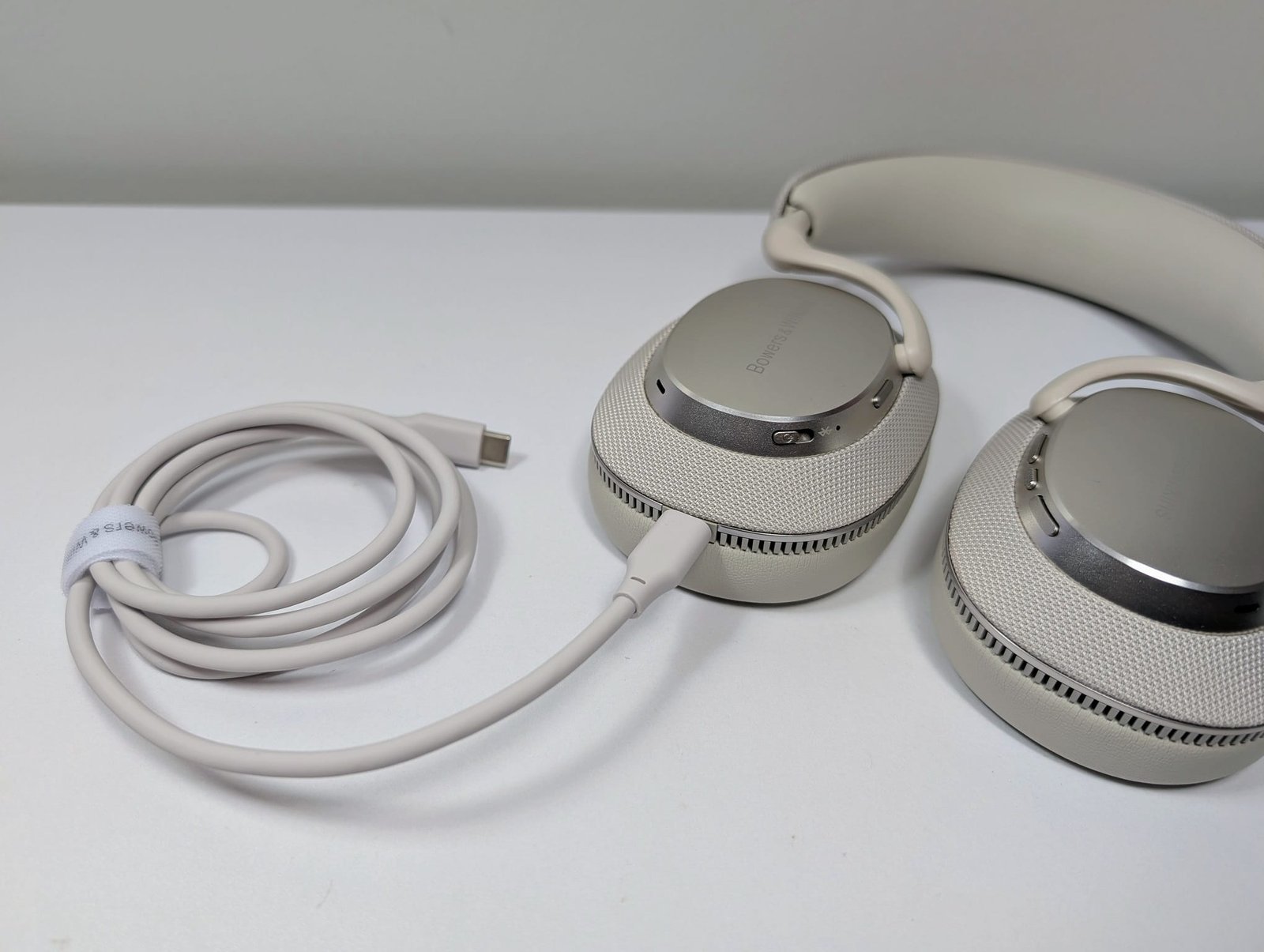
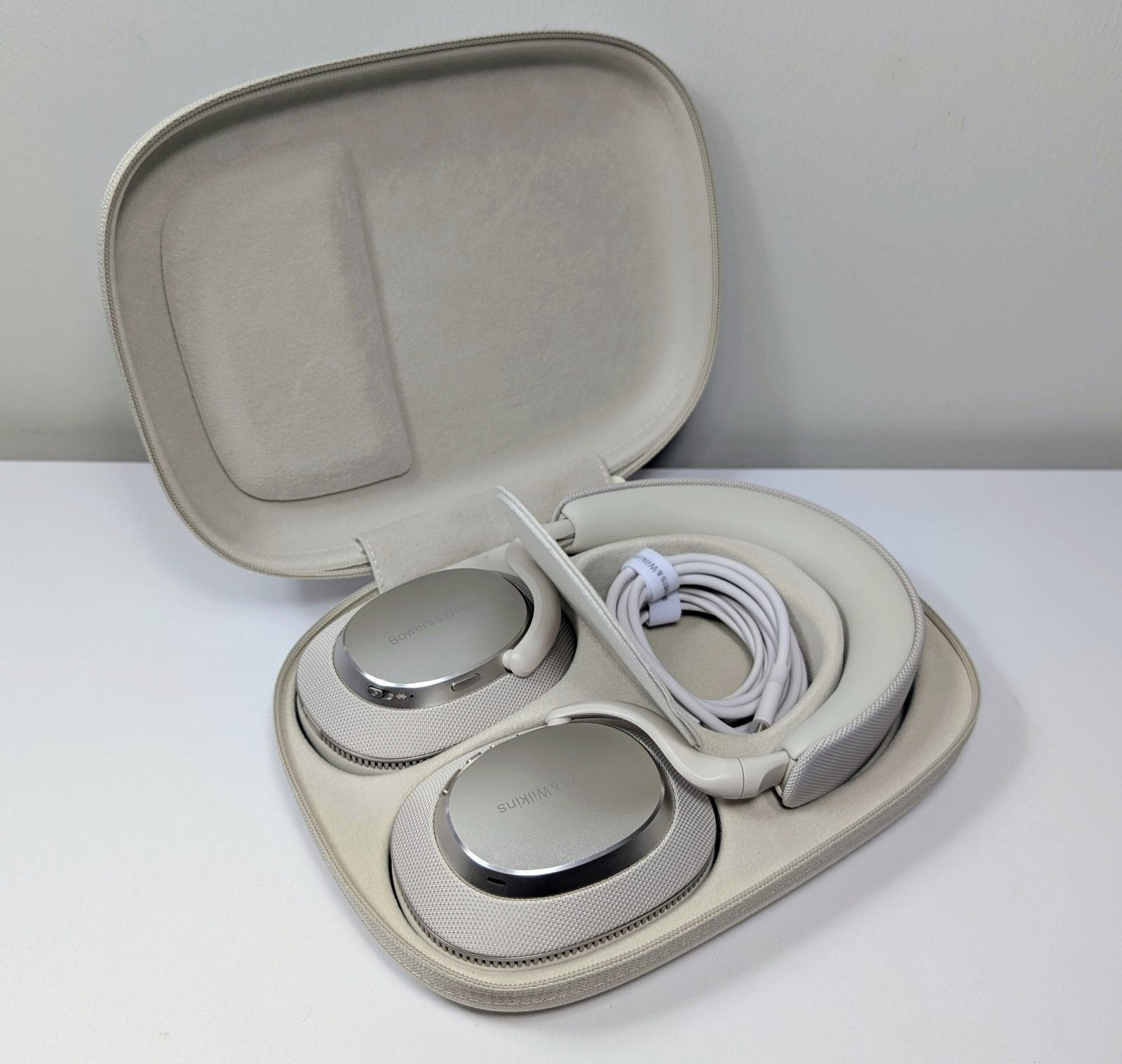
The dimensions of the case have shrunk slightly from the previous PX7 series, as the S3 model's earcups are flatter. Now the headphones take up space quite comparably to their smallest competitors, even though the structure doesn't fold down. On the other hand, the combined weight of the headphones and case still rises to 630 grams, which can be considered quite high from a portability perspective. The lightest noise-cancelling headphone I own, the Bose QuietComfort SE, weighs only 300 grams in its fabric pouch. The QuietComfort Ultra, in turn, weighs about 450 grams in its case, and Sony's new WH-1000XM6 about half a kilo. Thus, carrying Bowers & Wilkins headphones from one place to another is not quite as effortless.
Build and comfort
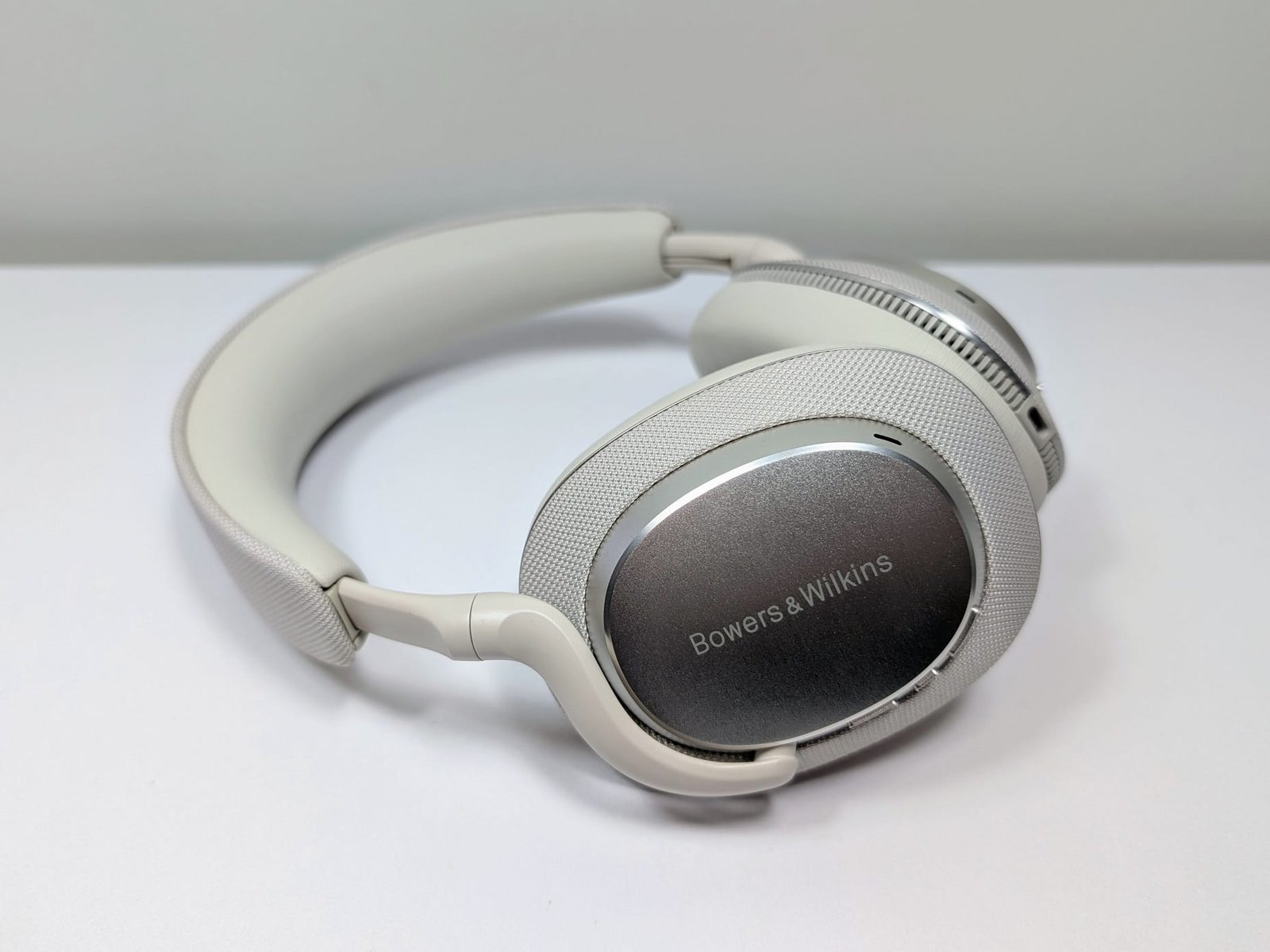
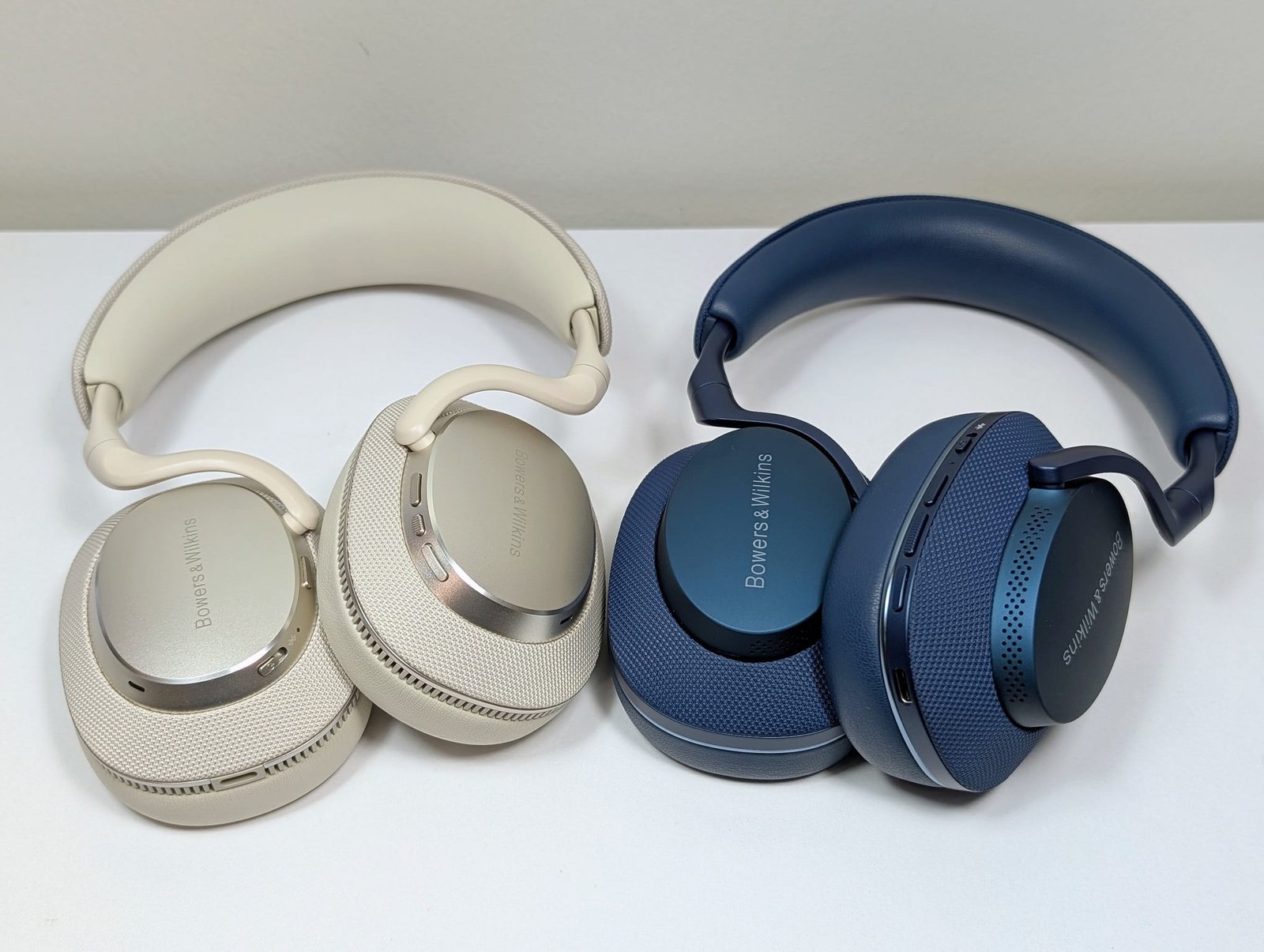
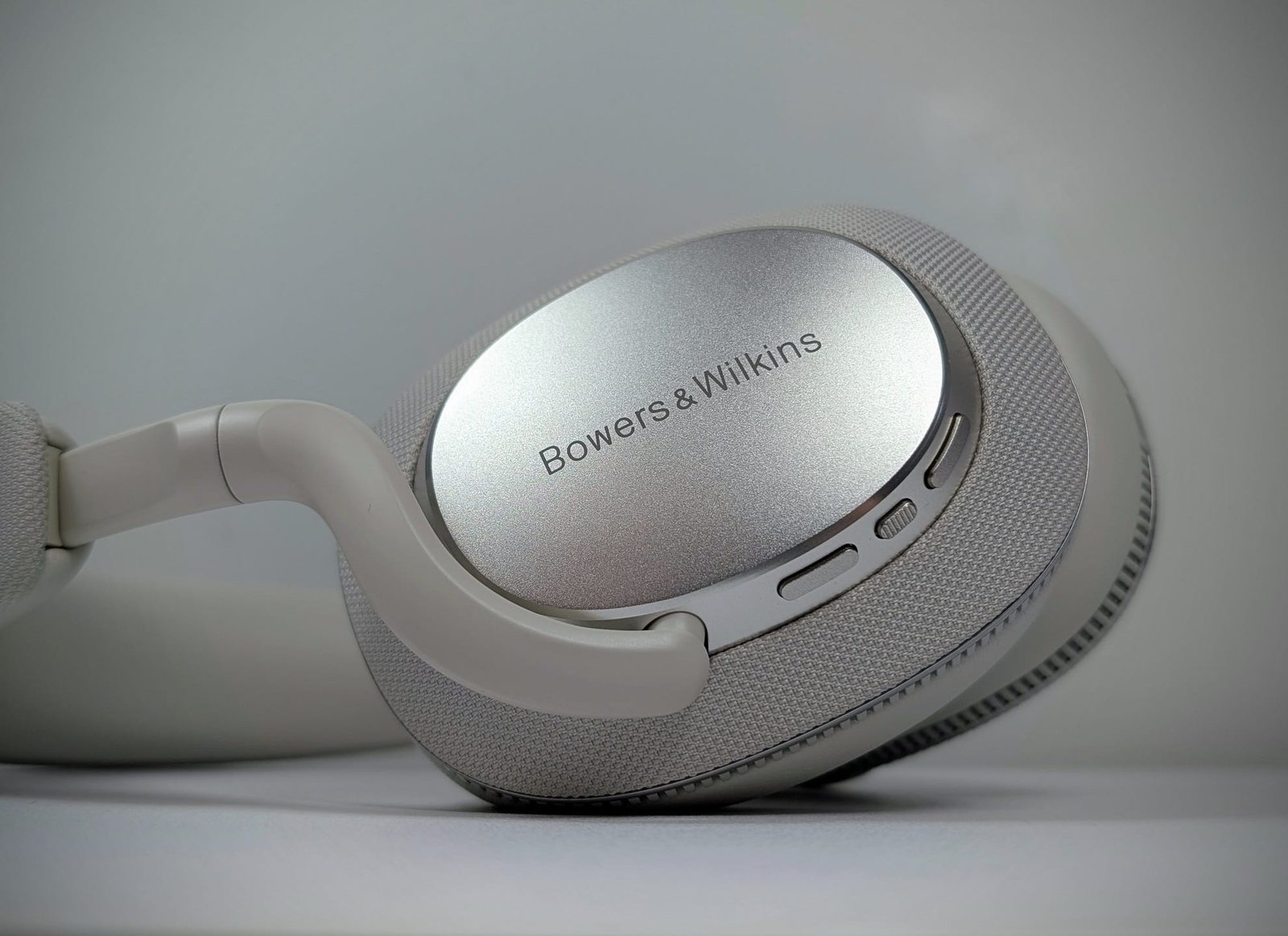
Bowers & Wilkins headphones always have a certain sense of luxury, and the PX7 S3 is no exception. Each of the color options sold forms a cohesive whole, with the metallic sides of the earcups and partial fabric upholstery, which also continues along the top edge of the headband, taking center stage. The headband, in turn, is still plastic, but the tubular parts are so thick that stories of breakage are unlikely to be known in the future. The ensemble is completed by artificial leather cushioning parts that are matched with the headphones' coloring. From the manufacturer's name written in large font on the side of the earcups, it should be clear to everyone what brand of headphones the user is wearing. The Canvas White version I tested looks so fresh that it might very well pique the interest of bystanders.
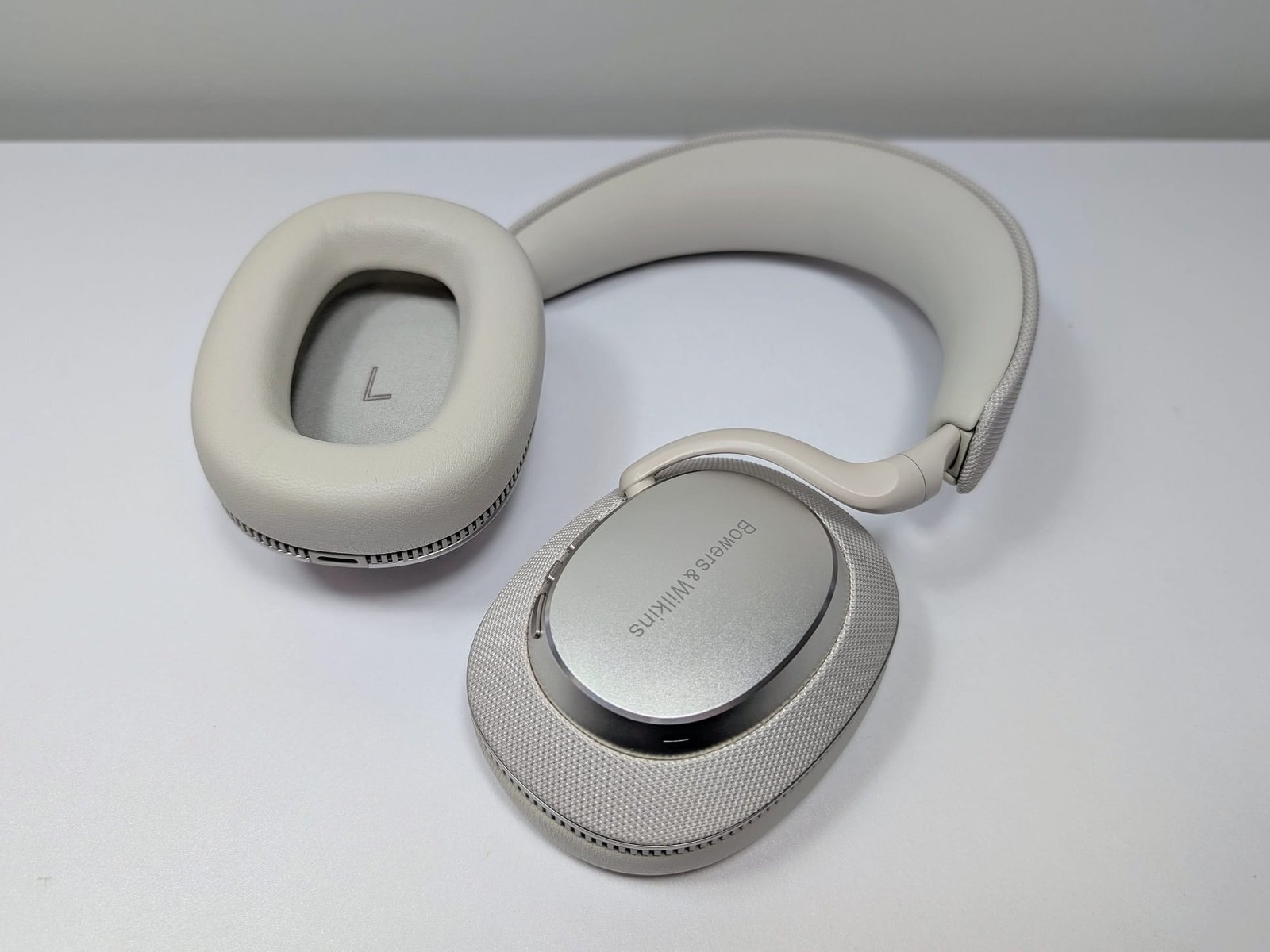
Compared to the preceding PX7 S2e model, the S3's earcups are about a centimeter flatter, resulting in a more slender appearance and a moderate 8 grams lighter weight (300g vs. 308g). At the same time, the headband parts have been rounded a bit more to make them look as streamlined as possible. The connecting cable running through the headband is also no longer visible externally, as the groove made in the headband is open only on one side. All these changes feel successful.
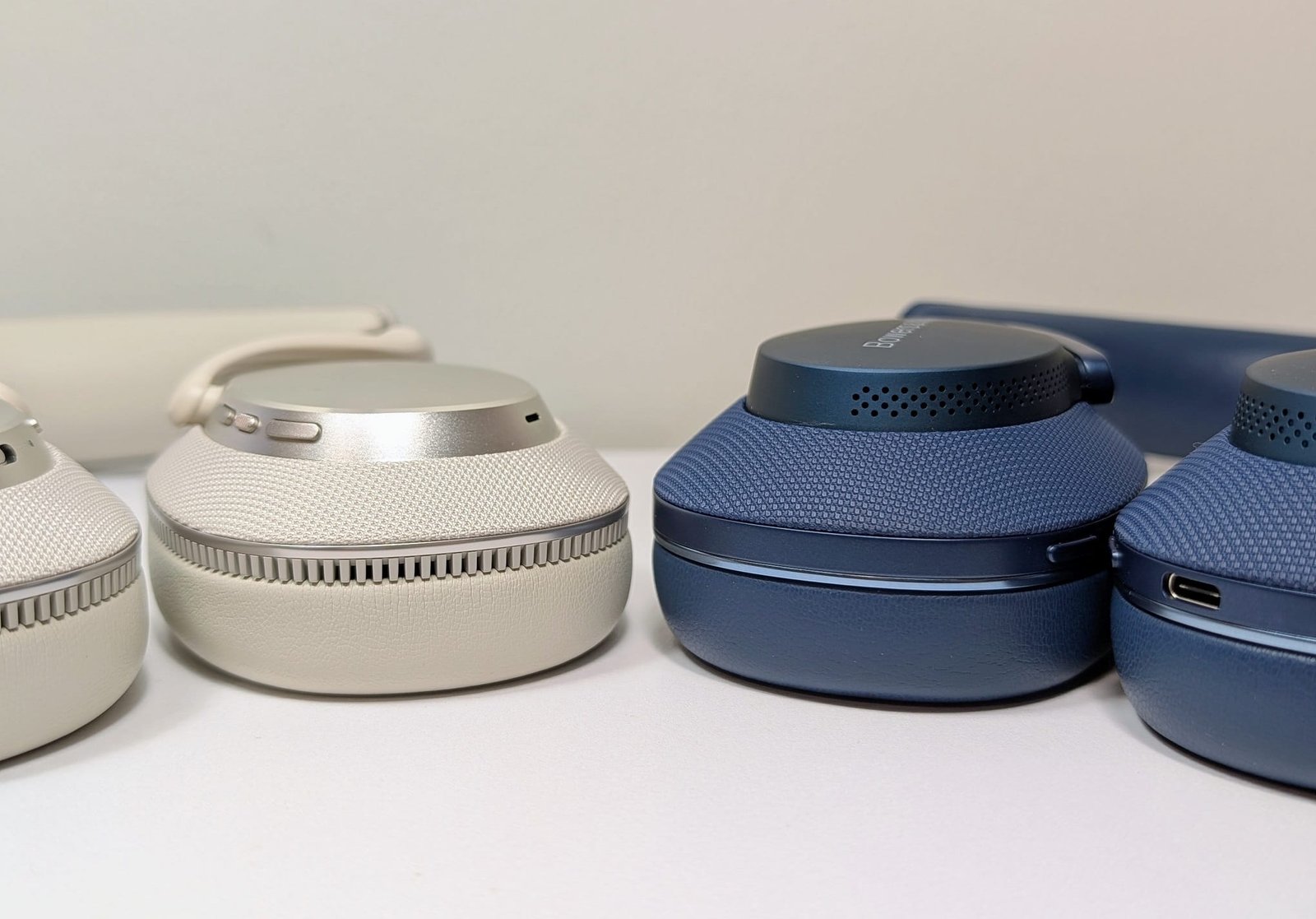
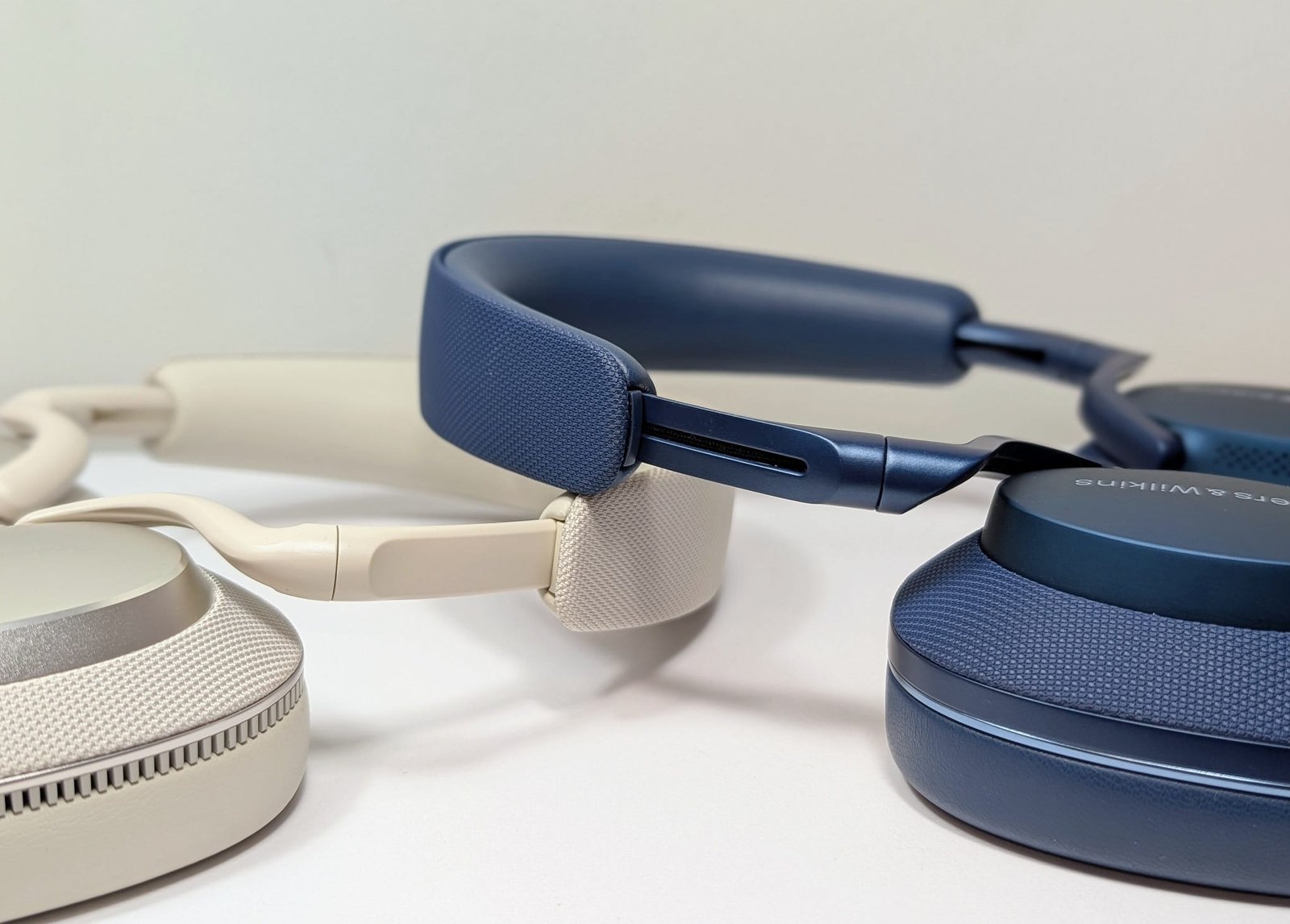
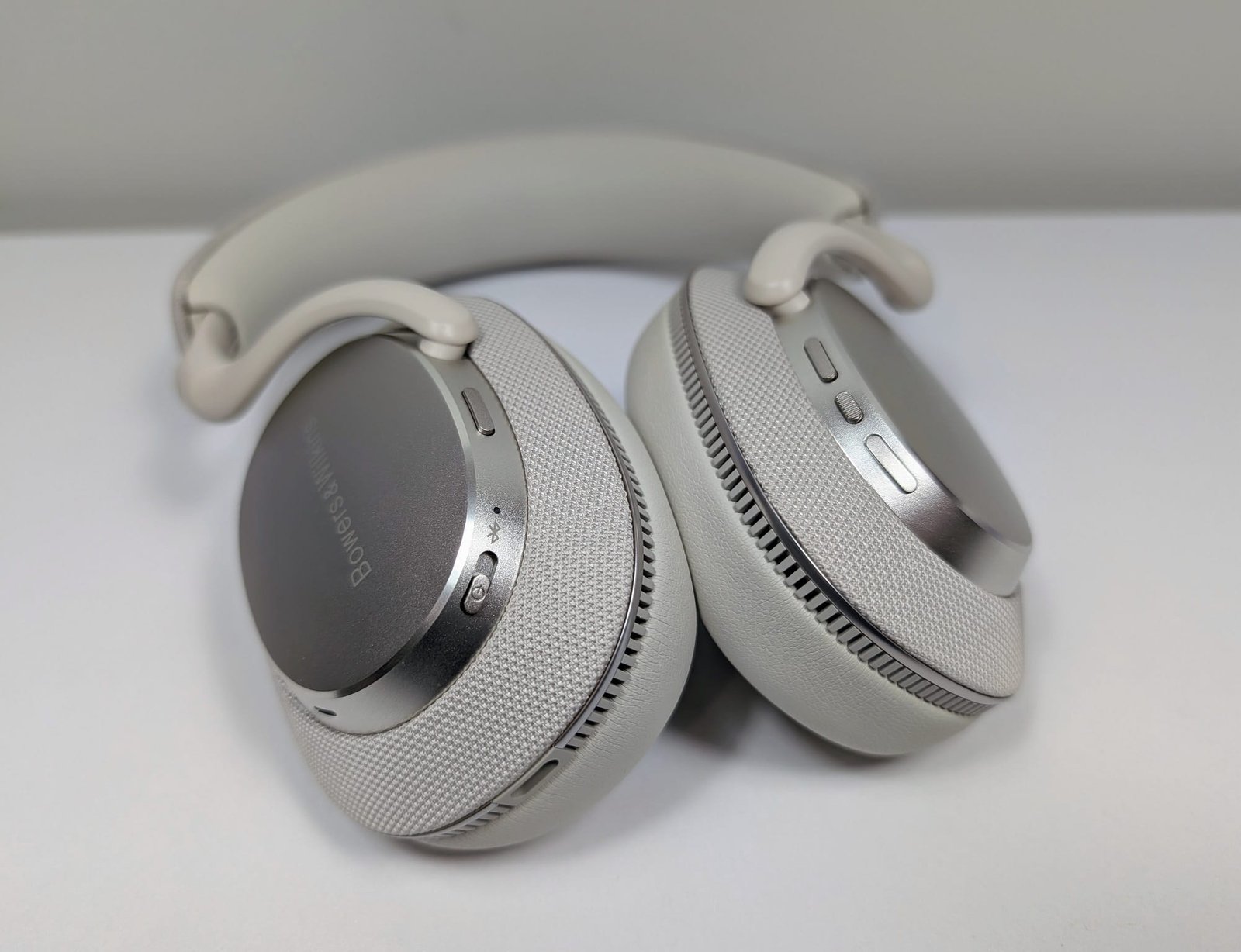
Due to the flatter size of the headphones, the microphones responsible for noise-cancelling functionality are now located inside the grooved strip in the central part of the earcups, which, unlike the S2e model, has prevented the placement of buttons in the same spot. Thus, in the PX7 S3, sufficient space for the buttons has only been left at the rear of the metallic sides, where they still barely fit. In my opinion, this appearance-centric rearrangement of things has slightly weakened the usability of the headphones. The small buttons have a firm press feel, but my fingers find them much slower than on the S2e. I also don't like that the edge of my finger inevitably rubs against the fabric upholstery of the earcup during use, causing rustling and crackling. In the white headphone version, prolonged use will likely also cause the light surface to get dirty.
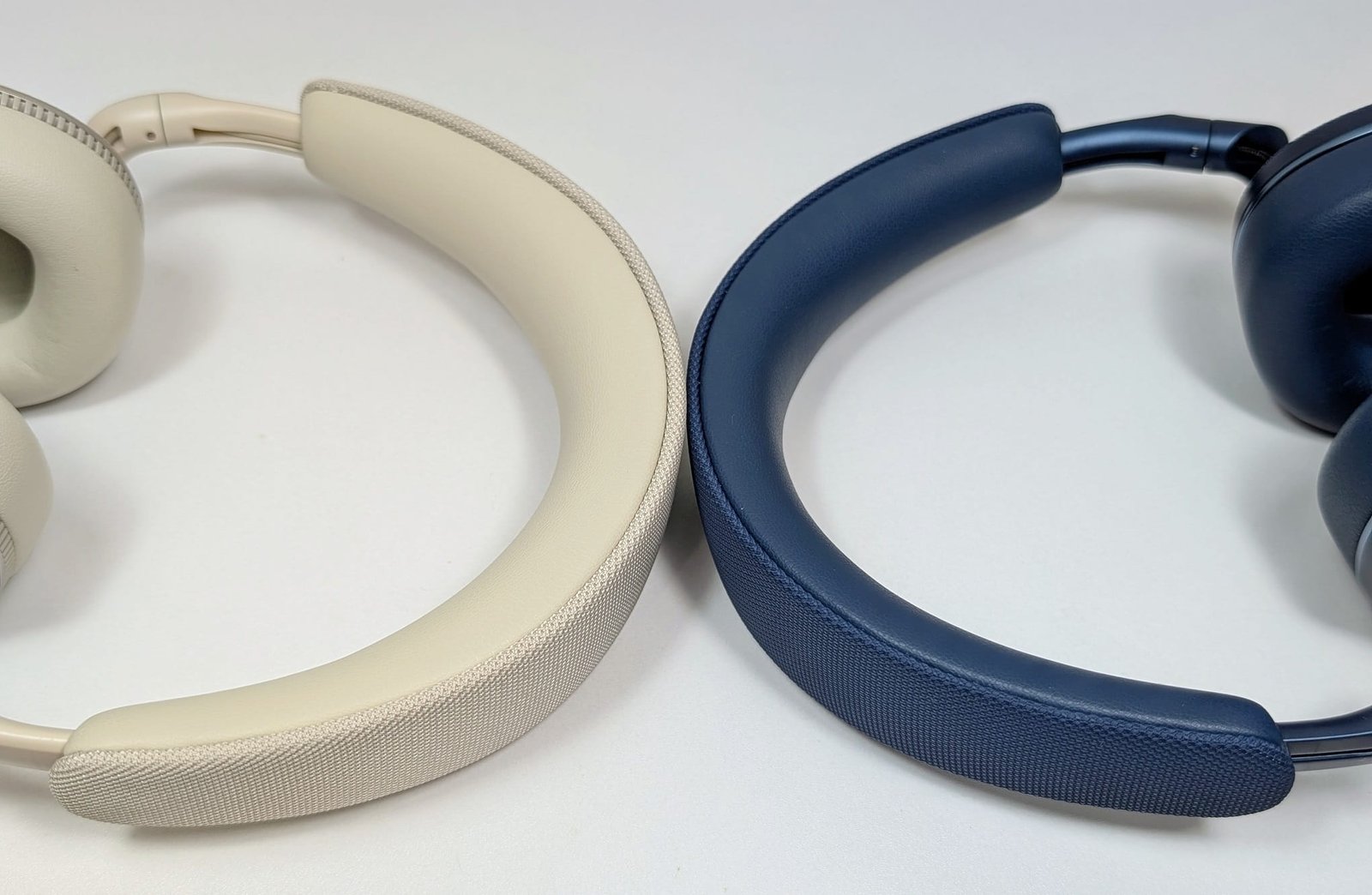
Bowers & Wilkins has also adjusted the comfort of its headphones by slightly widening the headband and adding a thicker cushion to it. However, with the shape of the arch remaining unchanged, the thicker cushion in the middle unfortunately presses more strongly against the top of my head than before, so I would not call the change successful for me personally. My wife also quickly noticed the reduced comfort when I let her try both headphones. The S2e model's thinner cushion distributes the weight of the headphones more evenly across the top of the head, so in my opinion, the manufacturer should have made a small notch in the middle of the S3's headband to prevent the formation of a so-called hotspot. One could take a cue from, for example, Sennheiser Momentum 4.
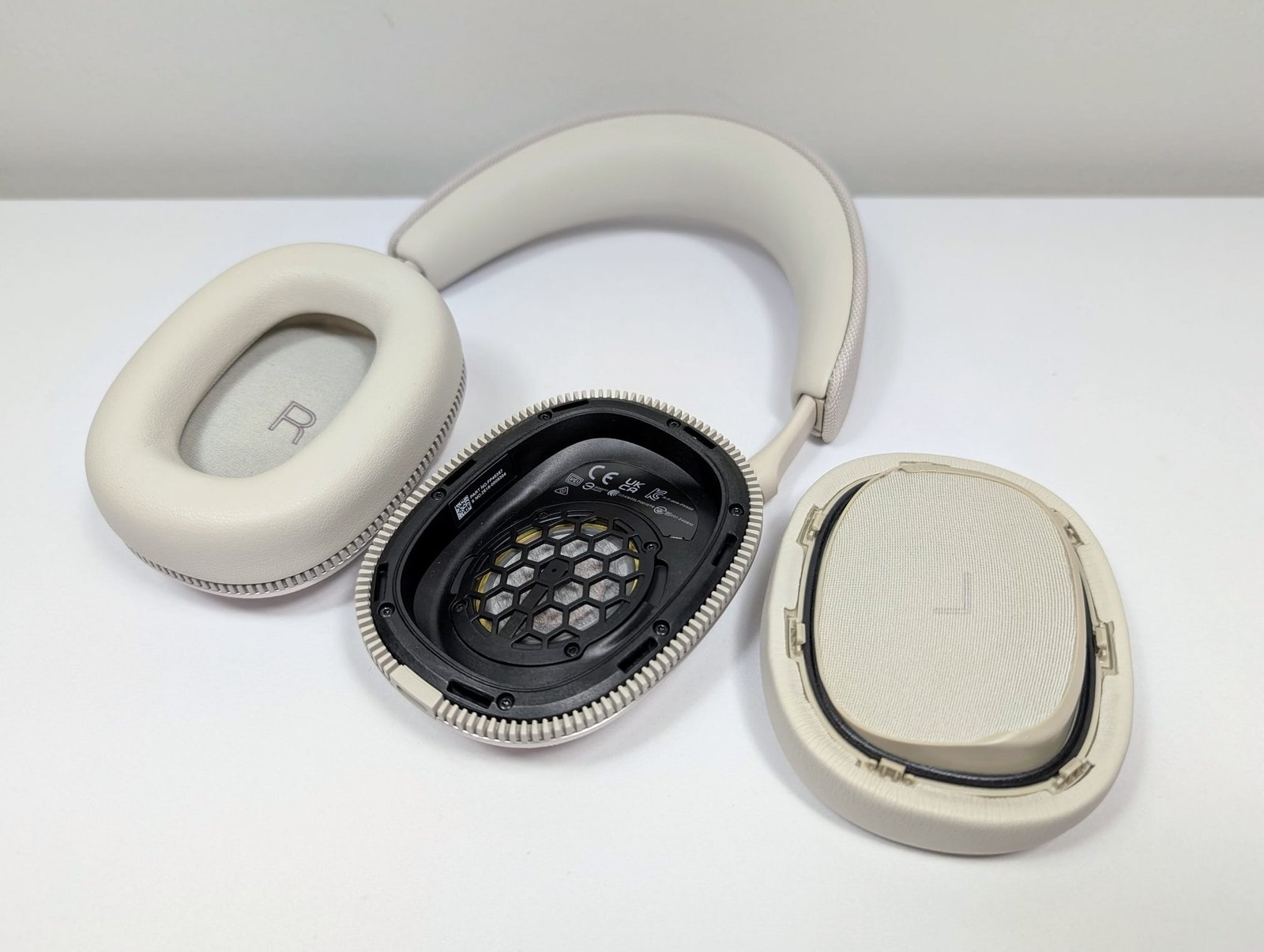
I consider the slightly more spacious-feeling ear cushions an improvement over the S2e model. The dimensions have largely remained the same (3.5 x 5.5 x 1.5–2.5 cm), but the opening is wider due to its more slanted shape, so with the S3, I no longer feel like I have to cram my earlobes into a small cavity. Thanks to the tilted elements, there has been enough space inside the rim before, but now the feeling at the opening is less claustrophobic. The clamping force of the headband may also have lightened slightly, but in any case, I don't notice any discomfort in that regard. The fit is also even and secure, as before. Without the pressure-inducing headband, I would consider the PX7 S3 a very comfortable headphone. Could the headband still soften and give way a bit with longer use?
Functions
The renewed buttons on the PX7 S3 also have good sides, as the power switch has been moved from the previously crowded right cup to the left cup, alongside the noise-cancelling button. Thanks to this, the distribution is more balanced, and the power switch, which feels similar, no longer gets confused with the volume control buttons, as tends to happen with the S2e.
The headphones still include an ear sensor that pauses or resumes playback depending on whether the PX7 S3 is on the head or, for example, around the neck while the user is having a conversation with someone. However, the ear sensor works a bit too quickly, as playback sometimes stutters when I move the cups on my ears. The sensitivity can be adjusted via the phone app, but even that doesn't completely eliminate occasional stuttering. I have ended up turning the feature off because it is possible.
The volume control of the PX7 S3 works a bit strangely with a Bluetooth connection on my Google Pixel 9 phone. Firstly, the headphones can play exceptionally loud thanks to their built-in separate amplifier, as a huge volume is already achieved at the beginning of the adjustment scale. With the phone's buttons, the volume jumps are disturbingly large for my needs, but I noticed that when using the headphones' own buttons, there are some kind of hidden levels that the Android system doesn't even show as a change in its volume indicator bar. This way, I can finally get the headphones to play quite flexibly at exactly the volume I desire.
On Windows computers and my Macbook, the adjustments work smoothly with a Bluetooth connection, so the volume increases linearly without suddenly jumping significantly up or down. However, peculiarities are not avoided, as in the Windows world, the headphone buttons and the computer's buttons (adjustment bar) communicate with each other, whereas on an Apple machine, these adjust the volume separately for some reason, never matching each other at any point. However, when switching to a USB cable, the situation also corrects itself in the Apple world.
However, the PX7 S3 is still not properly optimized for listening via a USB cable, as the headphones play far too loudly on a Windows machine already at setting 20/100, while on my Macbook, I can only use settings 1/16 and 2/16 – yes, 3/16 is already too loud! Thus, there isn't much room for volume adjustment unless the music players' own controls are also utilized. Fortunately, in the Android operating system, the optimization is at a better level, so the only annoying feature when connecting a USB cable to the phone is that the button for increasing the headphone volume does not work at all (only a beep is heard, as if the function were blocked).
Bluetooth technology and battery life
Like many of its competitors, the headphones support Bluetooth version 5.3. In terms of codecs, there is broad support for the entire AptX family, although only with a few mobile devices can the most advanced AptX Lossless and AptX Adaptive options, which are part of the Snapdragon Sound platform, be utilized. For example, with the Google Pixel 9, I have to settle for the older AptX HD codec, which is acceptable as long as the headphones are otherwise good. For now, however, I prefer the LDAC codec until better AptX codecs are more widely available and not just specifications on paper. Support for Bluetooth LE and the LC3 codec is apparently coming later as a firmware update to the PX7 S3, but will anyone even be able to utilize these yet?
However, I don't blame Bowers & Wilkins for the compatibility challenges; the situation is what it is. I found the Multipoint connection and Google Fast Pair feature to be functional in the PX7 S3, and there have been no disturbances in wireless connections. The new model seems to connect to two devices more automatically when powered on than the S2e, which often needs to be manually connected to a second device.
The battery life of the headphones is stated to be 30 hours, which by current standards is quite low compared to competitors – in fact, only Bose headphones run out of battery faster. Turning off the noise-cancelling function, however, will likely increase the PX7 S3's operating time somewhat, and it also always depends on the volume used. The manufacturer does not mention charging time, but I assume it to be 2–3 hours. Fast charging for 15 minutes, in turn, extends usage by 7 hours.
The PX7 S3 cannot be used passively without power, meaning that a battery or electronics failure automatically leads to service or discontinuation of use. This same weakness, of course, affects about half of other noise-cancelling headphones as well. The other half, however, works with just a headphone cable but sounds terrible by default without DSP correction, with a few exceptions.
Mobile app and additional features

Settings and additional features can be accessed with the rather limited Music | Bowers & Wilkins app, which probably still requires user account registration. I have benefited most from the more comprehensive equalizer and the ear sensor settings. The possibility of updating the firmware version will also likely be useful in the future. However, I have not felt the need to connect music streaming services to the app, change the noise-cancelling mode (handled by the headphone button), or disable the standby mode. I haven't been able to try spatial audio yet, as the manufacturer will only add it as a new feature to the app sometime in the future.
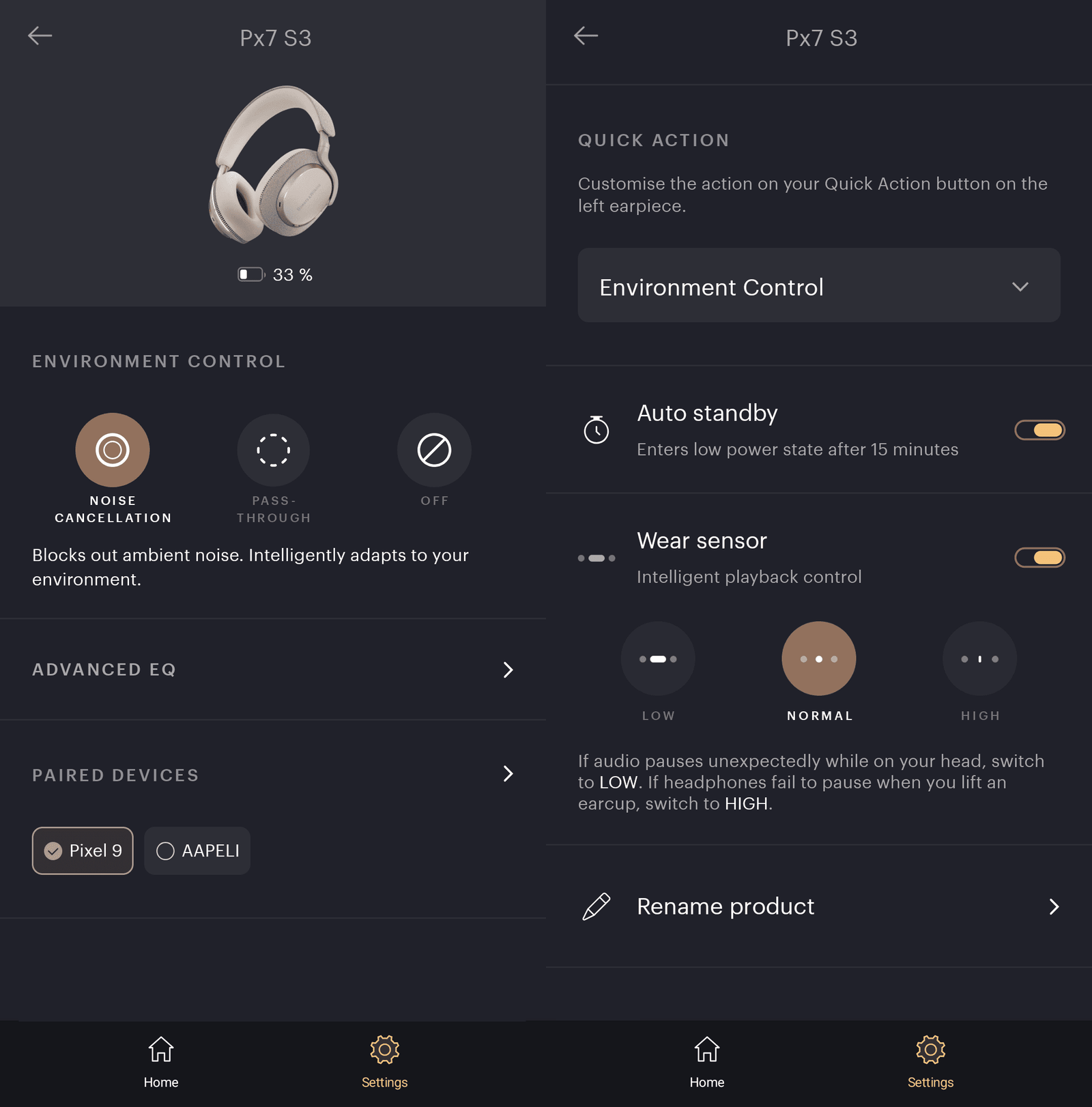
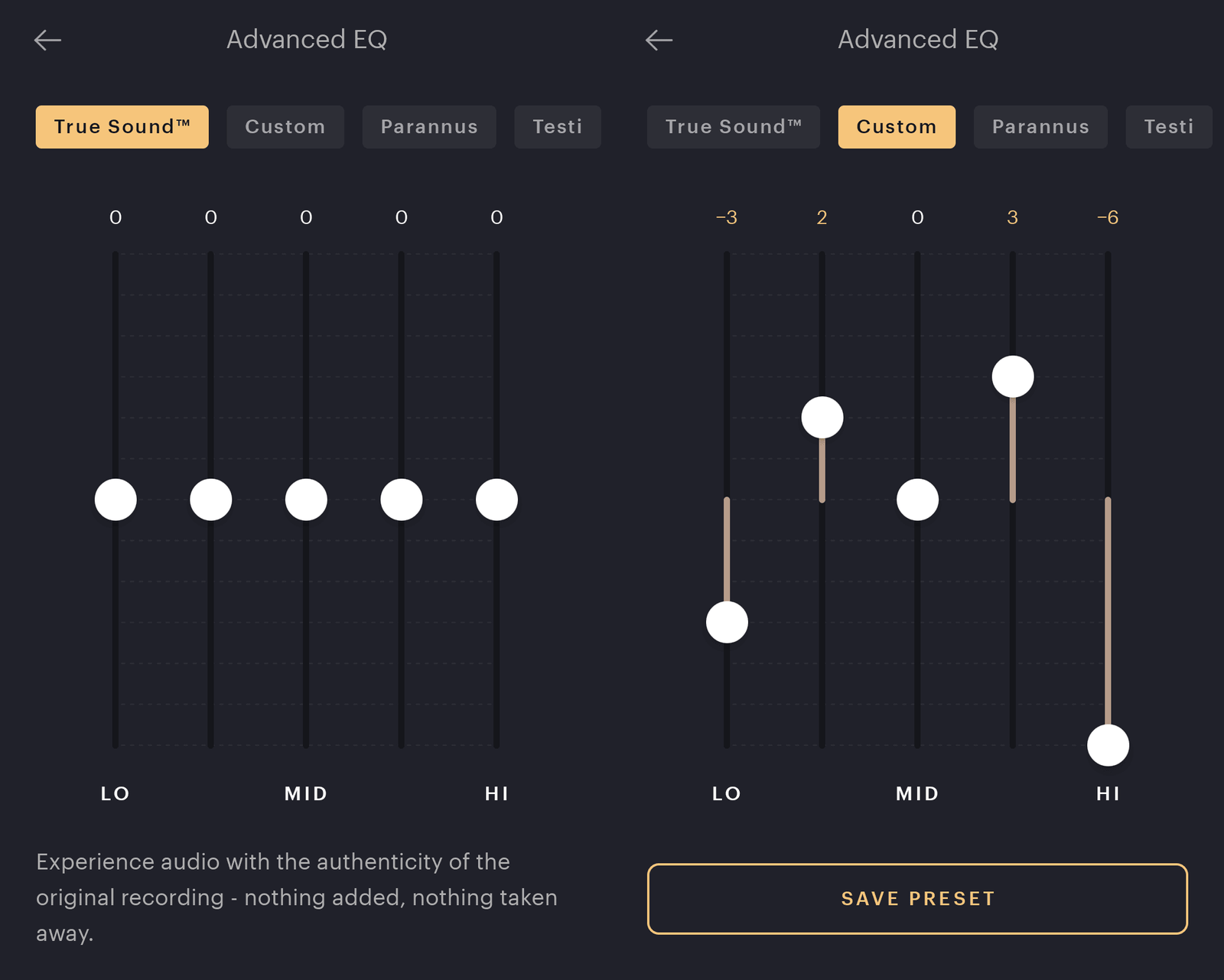
The equalizer now includes five adjustment areas (up to 6 decibels plus or minus) instead of the bass and treble controls of previous headphone models. There is also a setting called TrueSound, which seems to only reset the made adjustments like a reset button. Instead, at least a few new sound profiles can be saved from your own settings. The selected profile remains in use even on devices where the application is not installed. The PX7 S3 responds well to changes made with the equalizer, so its sound can be changed quite radically if necessary. For my own needs, however, there should be a few more adjustment channels to genuinely correct frequency response irregularities. Now, for example, the two lowest controls do not change the bass evenly, but the amount of mid-bass inevitably differs from sub-bass and lower mid-frequencies.
Weakened noise cancellation function
Note: I previously suspected there was something wrong with my test headphones due to the weak performance of the noise cancellation function, but after trying another pair of headphones and reading other reviews, I have come to the conclusion that my original observations were correct. Thus, the PX7 S3 does not properly attenuate noise compared to competitors' products.
The active noise cancellation function of the PX7 S3 corresponds in principle to the previous S2e model and most other current headphones, meaning the noise reduction performance adapts adaptively to the listening environment without being able to be adjusted manually. As a positive change, background noise is now slightly fainter (almost imperceptible). The transparency mode, on the other hand, produces a clearer result at the cost of amplifying and sharpening the soundscape more than in the S2e. Thus, for example, my own speech sounds more unnatural with the cups on my ears, but ambient sounds are certainly clearer.
Regarding noise cancellation itself, however, based on my own test headphones, the PX7 S3 is a downgrade compared to its predecessor. The attenuation performance of low frequencies has remained fairly unchanged, but mid-frequencies are heard more strongly through in the S3 model. Thus, for example, keyboard typing, the rattling of a desk fan motor, higher parts of human speech, or any kind of clinks and thuds are not attenuated much, whereas the S2e can quiet them down quite well.
I again tested the attenuation capability of simulated airplane and cafe noise, as well as human speech, through speakers. In addition to two Bowers & Wilkins models, the following noise-cancelling headphones were included in the comparison:
- Sony WH-1000XM6
- Bose QuietComfort Ultra
- Bose QuietComfort SE
- Focal Bathys MG
- Cambridge Audio Melomania P100
- AKG N9 Hybrid
- Valco VMK25
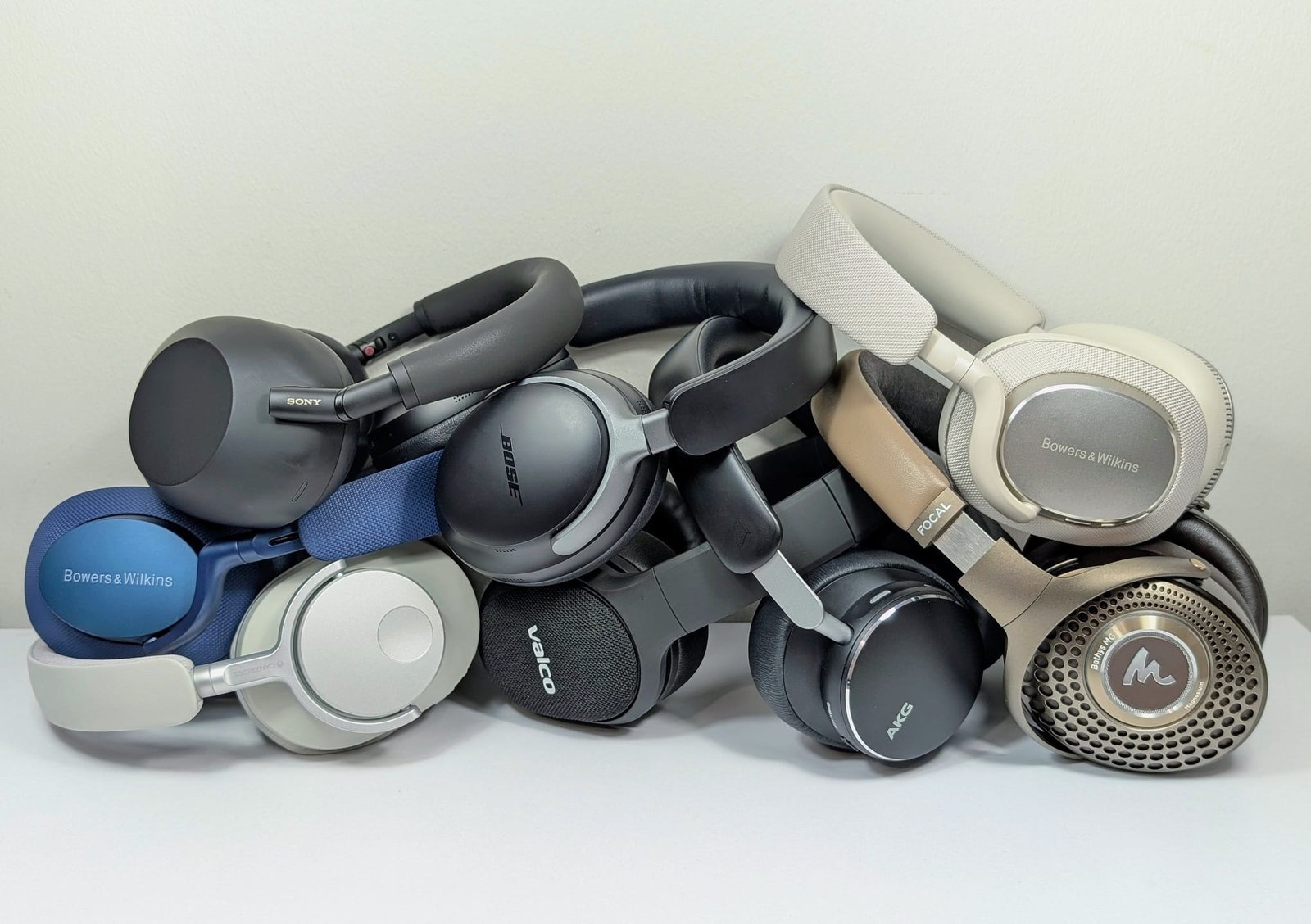
I will sprinkle more comparison information in my upcoming headphone reviews, but in this context, it suffices to state concisely that the PX7 S3 performed the weakest of the group in all tests. Sony's and Bose's best models stood out, but there was no need to guess whether the noise cancellation capability of the VMK25, N9 Hybrid, or PX7 S2e was better than the PX7 S3. I even often had to check if the S3's noise cancellation function was on at all. On the other hand, low frequencies were attenuated like the S2e model, so the mid-frequency attenuation capability simply appears to remain weak.
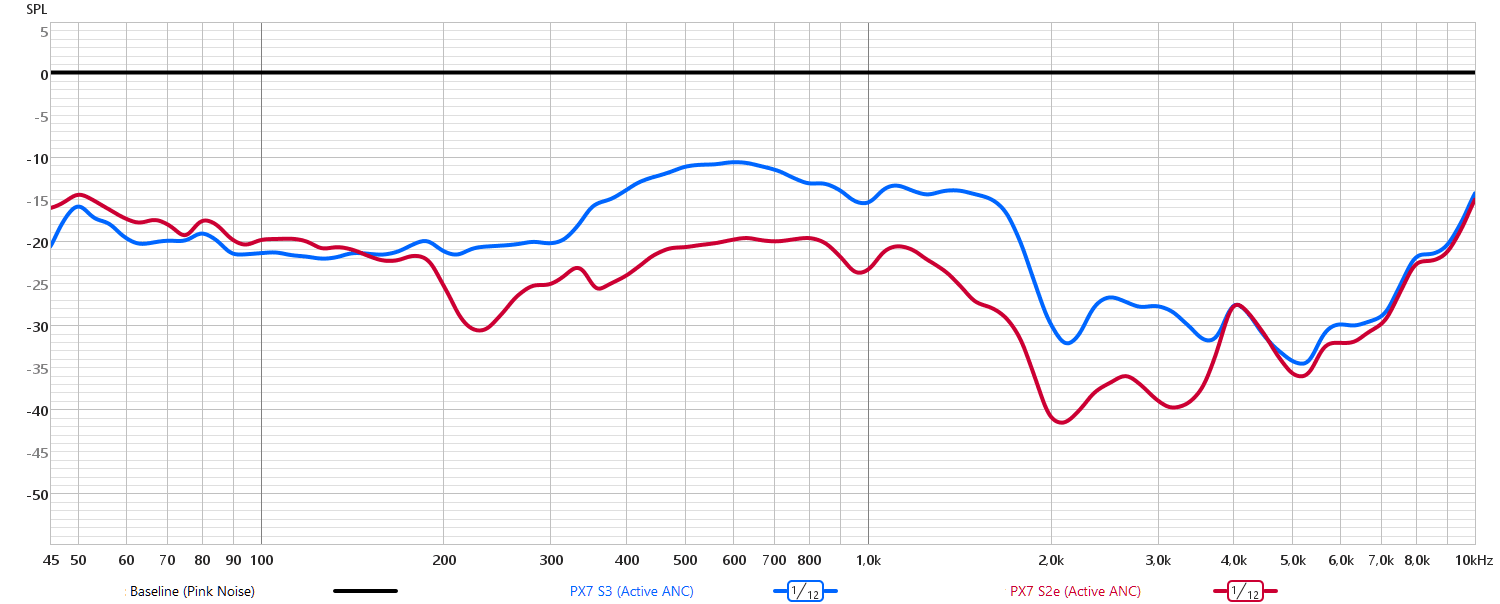
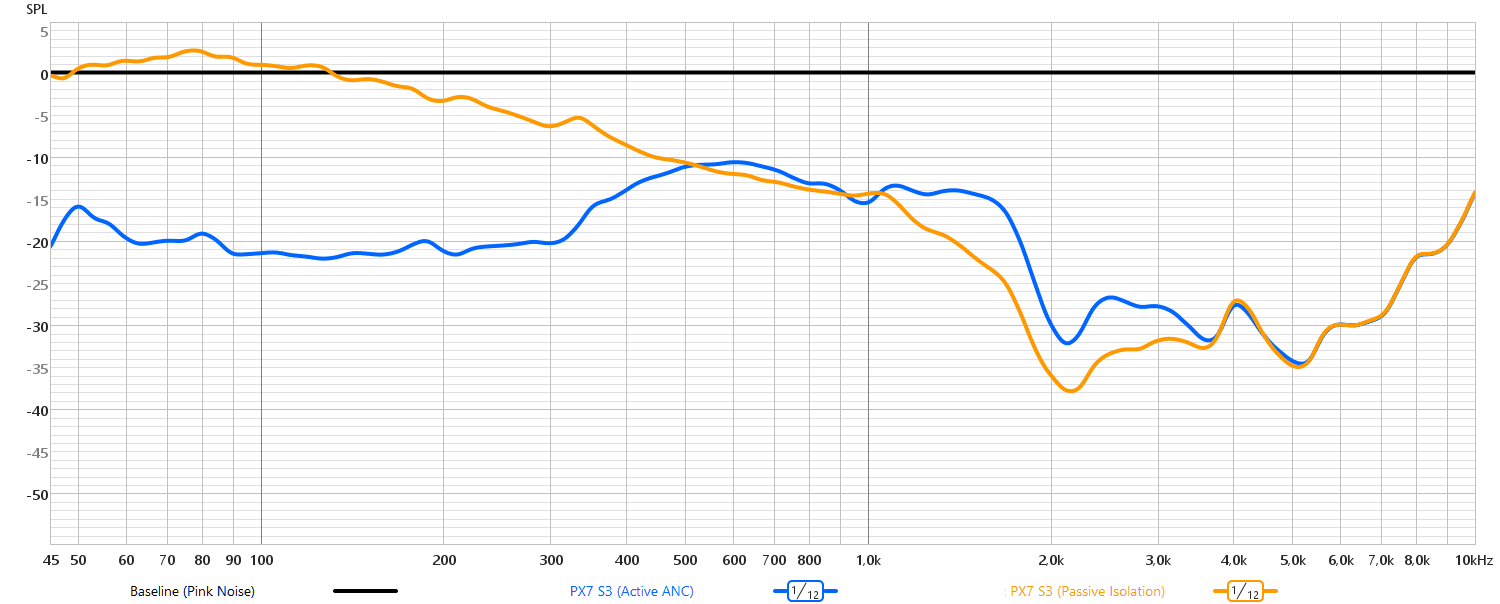
The matter eventually bothered me to such an extent that, exceptionally this time, I also performed measurements of the noise cancellation function's effectiveness using pink noise played from speakers. The results should by no means be taken as absolute truth regarding the decibel readings, but they show what I heard: the PX7 S3 attenuates low frequencies comparably, if not slightly better, than its predecessor, but the mid-frequency attenuation capability is clearly weaker. Between 1–3 kilohertz, the S3 model's noise cancellation function actually weakens the attenuation performance compared to when the function is off (passive attenuation only). Between 500–1000 hertz, active attenuation does not seem to do anything at all compared to passive attenuation. So something might be wrong, as the S2e behaves completely differently.
Noise cancellation measurements *:
Black line = pink noise in the initial situation without headphones (reference value)
Red line = PX7 S2e noise cancellation function on
Blue line = PX7 S3 noise cancellation function on
Yellow line = PX7 S3 noise cancellation function off (passive attenuation only)
* REW: Pink Periodic Noise (full range) ~85 dB | RTA 1/12 octave | 1/12 Smoothing | FFT Length 128k | Averages: 8
The graphs show how many decibels the pink noise is attenuated at each frequency compared to the initial situation when the headphones are placed on the ears of the measuring device in a specific operating mode. In the case of passive attenuation, it is common for the headphone structure to slightly amplify low frequencies due to resonances. The decibel readings should not be quoted anywhere due to my rather unscientific measurement environment, but the results nevertheless illustrate why I perceive the PX7 S3's noise cancellation performance to be weaker than the S2e model.
A weaker noise-cancelling function than before is ultimately quite a surprise, because I expected an improvement in this area compared to the S2e model. Also, the new model's noise-cancelling function cannot combat wind coming from the front, but it causes stronger rumbling and gurgling than the S2e. I haven't really encountered headphones in a while that are affected by wind as much. For example, even a 50-euro priced JBL Tune 770NC can eliminate the worst wind-induced disturbances, unlike the PX7 S3. I would not recommend these headphones for outdoor use if the noise-cancelling function is intended to be kept on.
Microphone sound quality
The microphones in the PX7 S3 produce very clear and natural sound in a quiet environment and quite acceptable sound even amidst noise and wind. Based on my tests, for example, Valco VMK25, Cambridge Audio Melomania P100, and Bose QuietComfort Ultra sound less clear in such challenging conditions. AKG's N9 Hybrid and Sony's WH-1000XM6, on the other hand, block background noise significantly better, and wind does not break the sound as easily. With the PX7 S3, I would, for safety, stay a bit away from crowds or the eye of the storm. I was unable to test possible improvements compared to the PX7 S2e model at this time, because the headphones' microphone mutes itself immediately for some reason when using audio recording applications.
Headphone sound quality
The PX7 S3 sounds almost the same with noise-cancelling on and off, as the frequency response changes slightly only at bass frequencies. The consistency is likely due, at least in part, to the modest effectiveness of the noise cancellation, which means it does not alter the acoustic behavior of the headphones.
Bowers & Wilkins headphones do not work passively without power this time either, but they can still be listened to, in addition to a Bluetooth connection, with two types of USB cables (attaches to either a USB-C connector or a 3.5 millimeter headphone jack). A USB connection also provides access to a higher quality (lossless) audio signal if your mobile device does not happen to support the AptX Lossless codec or if a separate USB dongle is not available for it (for example, Sennheiser BTD 700).
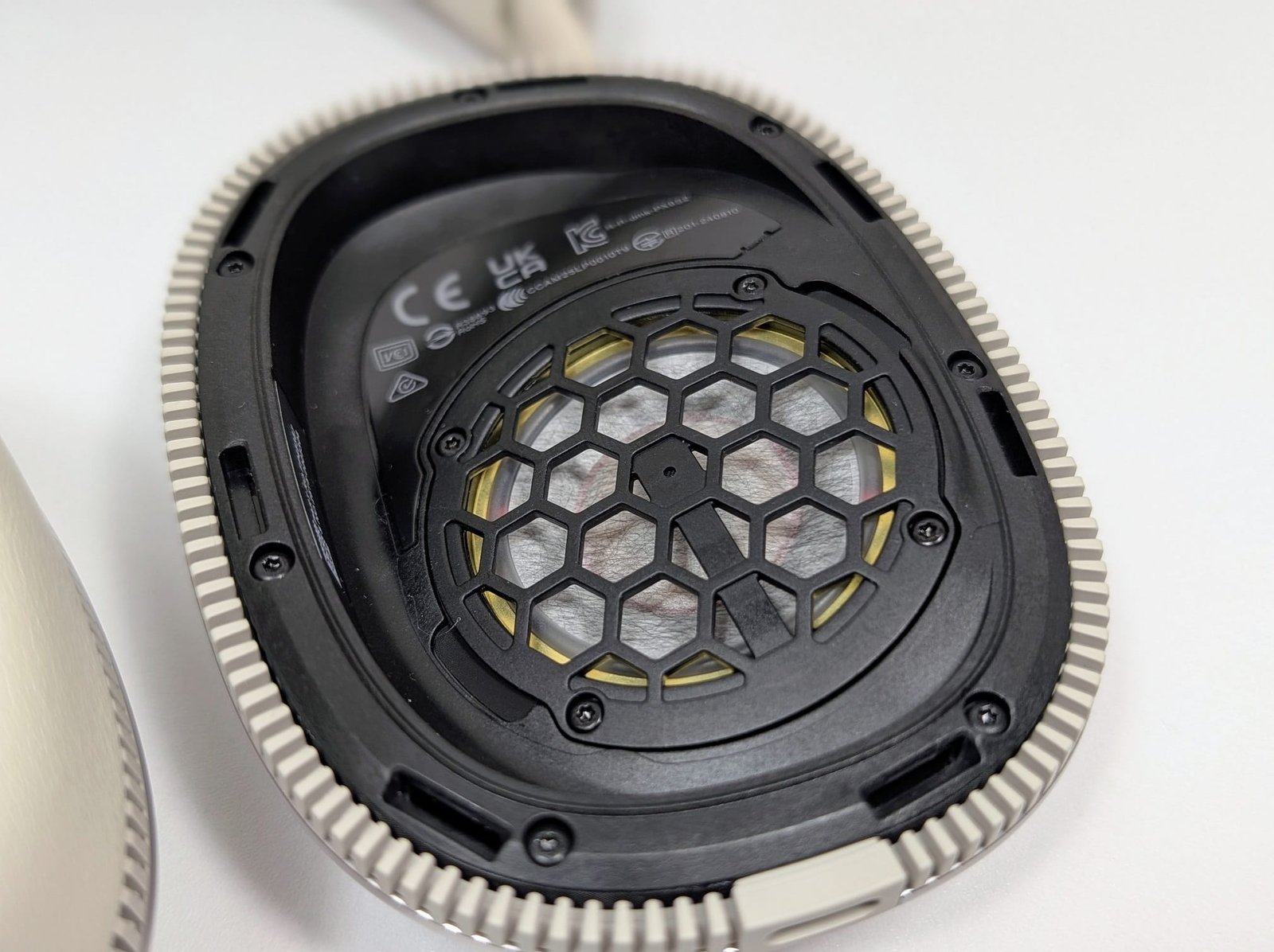
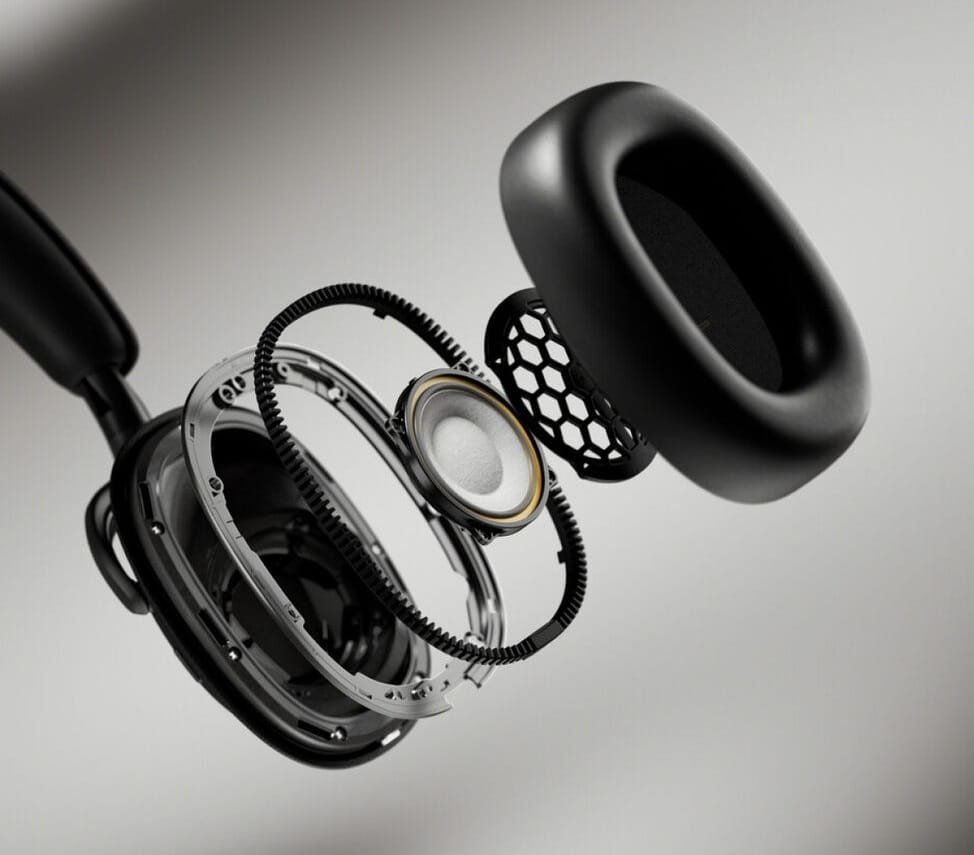
The headphones' 40-millimeter drivers have been redesigned in terms of voice coil, suspension, and magnet structure, while the diaphragm made of biocellulose has remained unchanged. The drivers have also been moved lower inside the cups compared to the S2e model. Now the drivers are also screwed into the cups directly from the corners of their square frame, so a possible replacement procedure would likely be easier than before.
Measurements
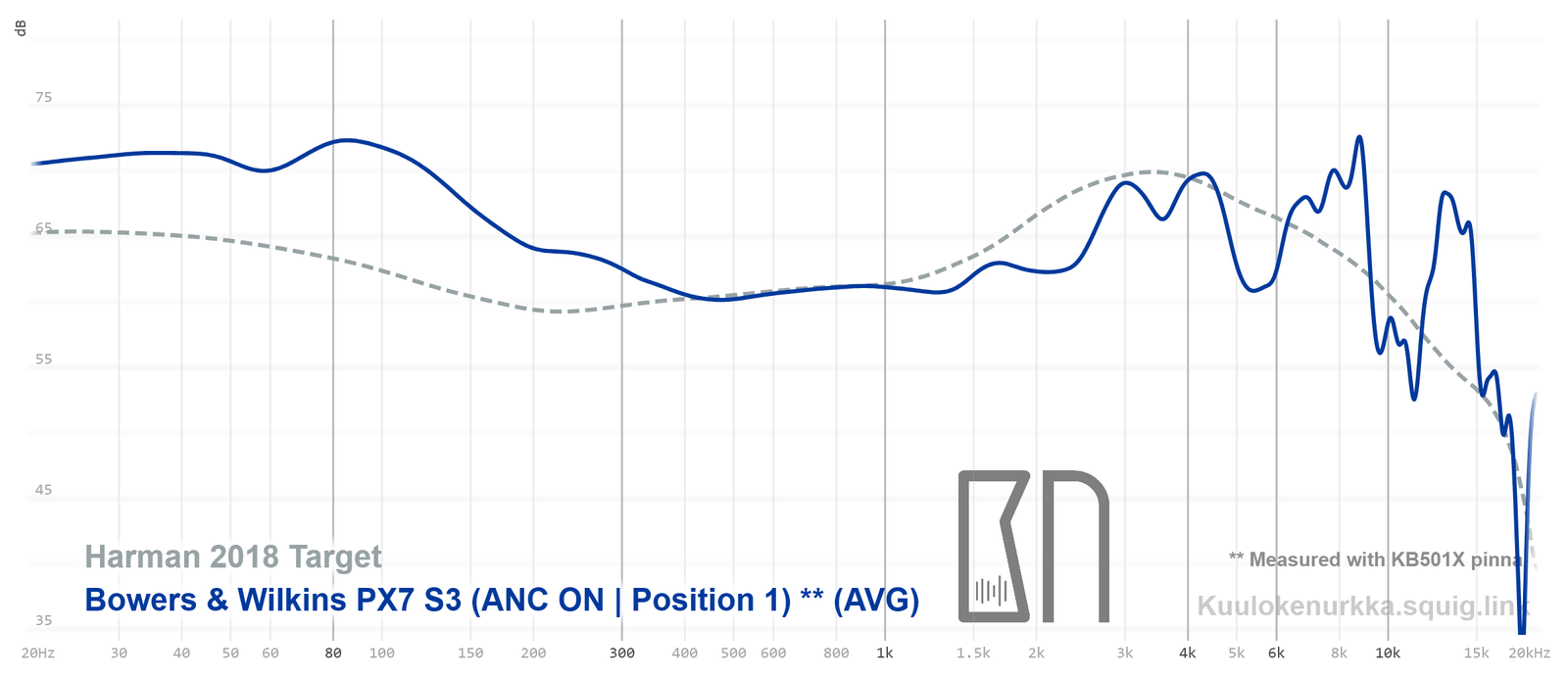
Our frequency response measurements have been made with a clone IEC-60318-4 coupler and KB501X pinnae. The Harman target curve from 2018 is used as a reference point and generalization of the headphone response that would sound good to most people. For more information on the measurements and their accuracy, see Headphone Measurements-page. The PX7 S3's frequency response can also be compared with other measured headphones Squiglink .
Frequency response (ANC ON) in my most natural wearing position:
Frequency response ANC ON vs OFF:
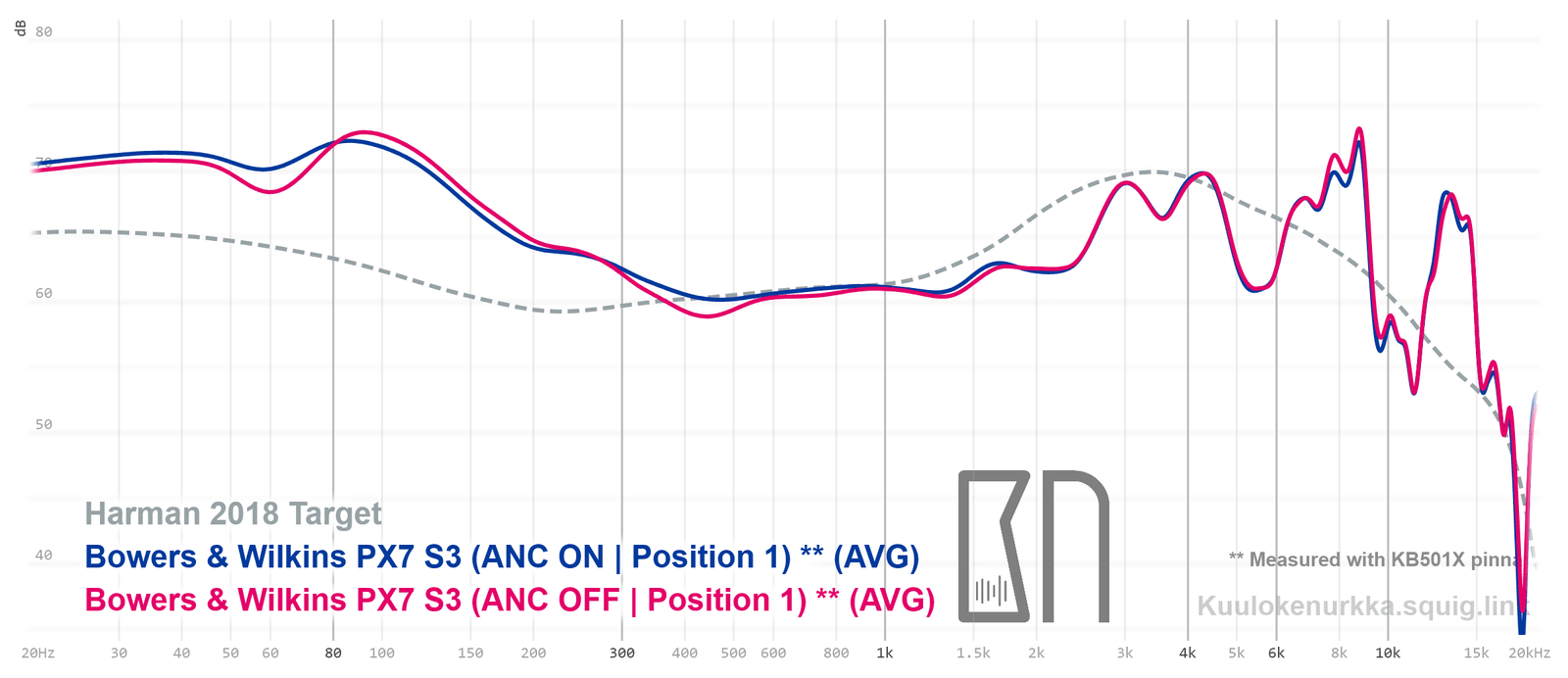
The PX7 S3's frequency response and thus its sound remain practically identical regardless of whether the noise-cancelling function is on. This is a pleasant change from many other headphones that sound very different between these two modes of operation.
Effect of wearing position on frequency response:
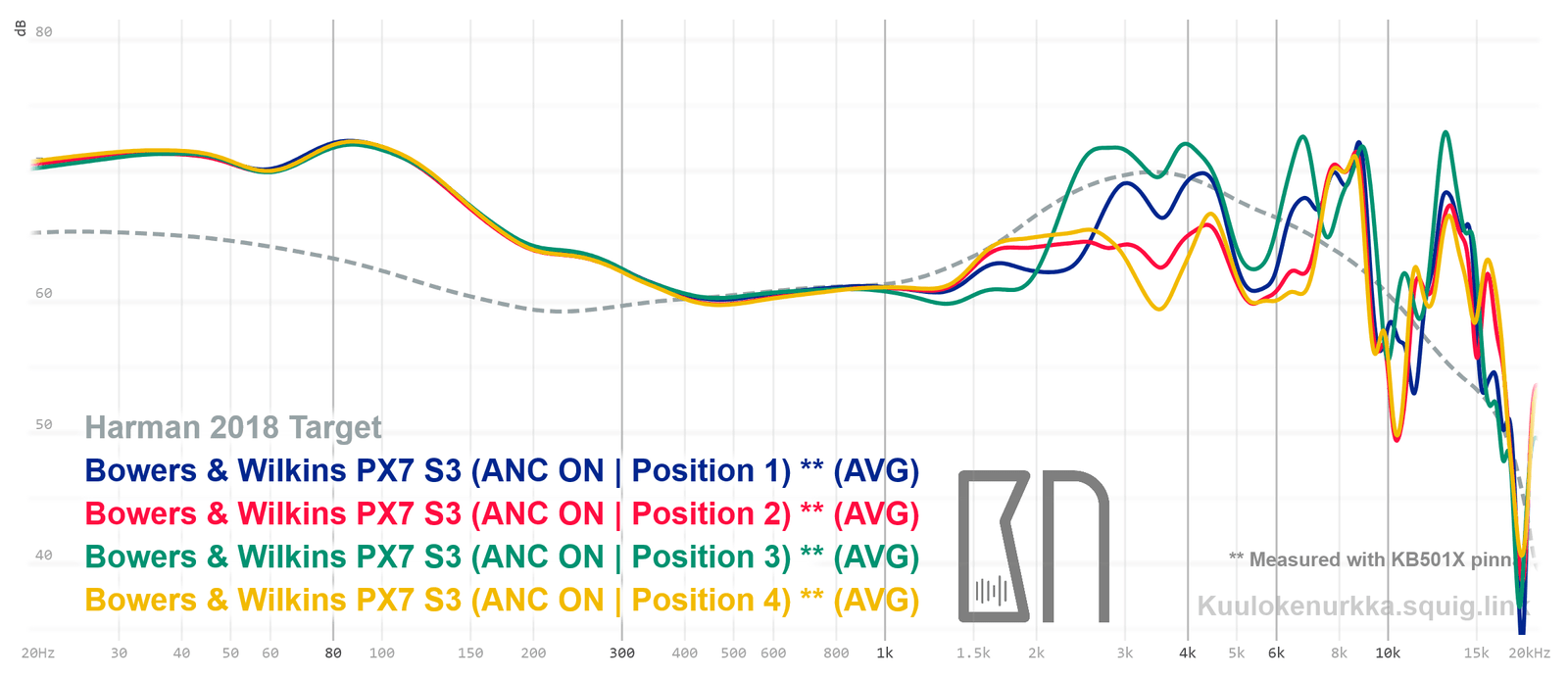
The sound of the PX7 S3 varies exceptionally much depending on how the headphones are positioned on the ears. Although position 1, shown by the blue line, most resembles what I heard, there is actually no consistency whatsoever between 2–7 kilohertz, but moving the cups a couple of millimeters to a different spot can swing the frequency response by several decibels in one direction or another. Especially in the most sensitive range of human hearing, between 2–4 kilohertz, changes of almost 10 decibels occur at most. The headphones can therefore probably sound almost anything in terms of their upper-mid frequencies depending on the user, which is not a good thing at all. Due to this characteristic, the channel balance also sometimes remains poor, because it is difficult for me to get both cups on my ears in such a way that they produce a similar sound. The difference is not, of course, as great as in my measurements.
My interpretation is that the large changes in frequency response are mainly due to the placement of the drivers in front of the ear and at the bottom edge of the cup. In the S2e model, the drivers are located more centrally in the cup, and the tighter ear pads prevent the user from moving the headphones as much in different directions. Thus, the sound automatically remains more consistent, and I have not noticed variations like those in the S3 model.
Equalization suggestion:
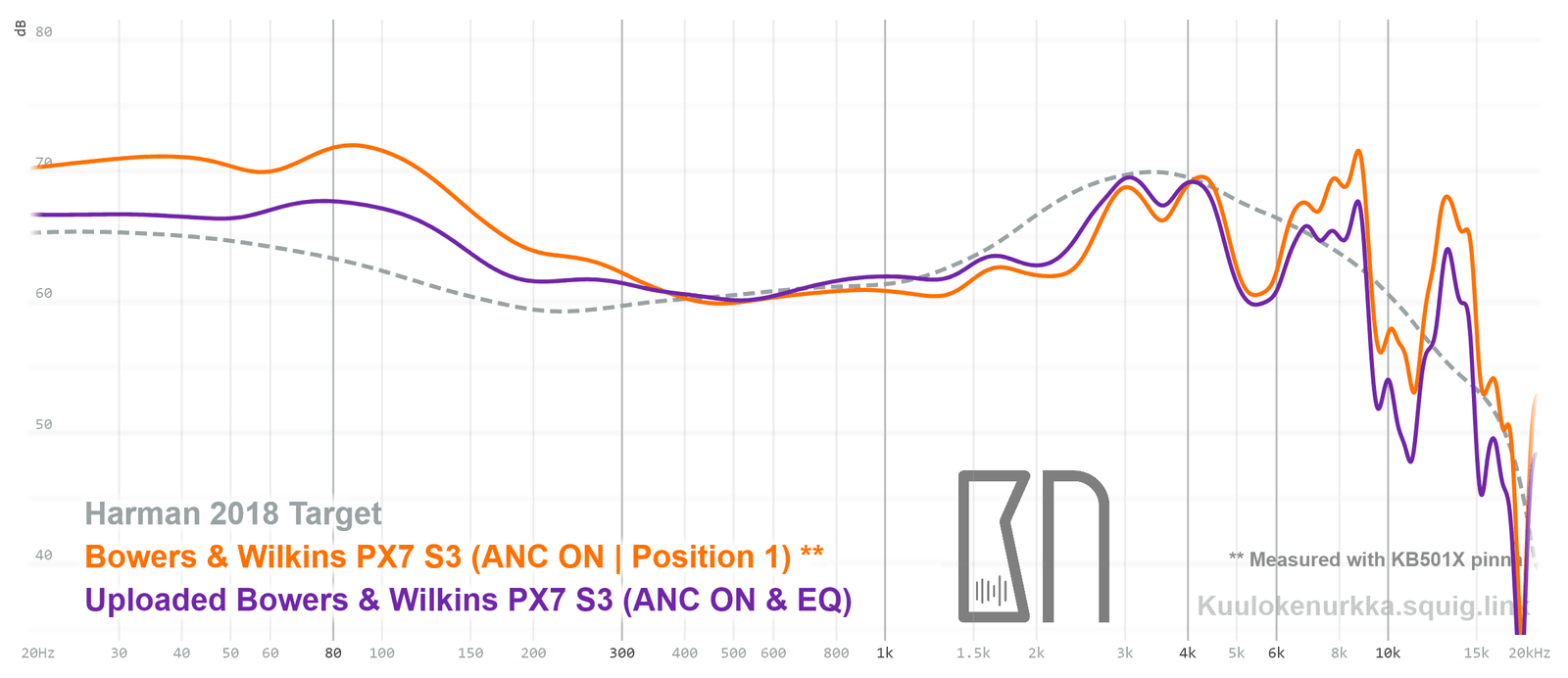
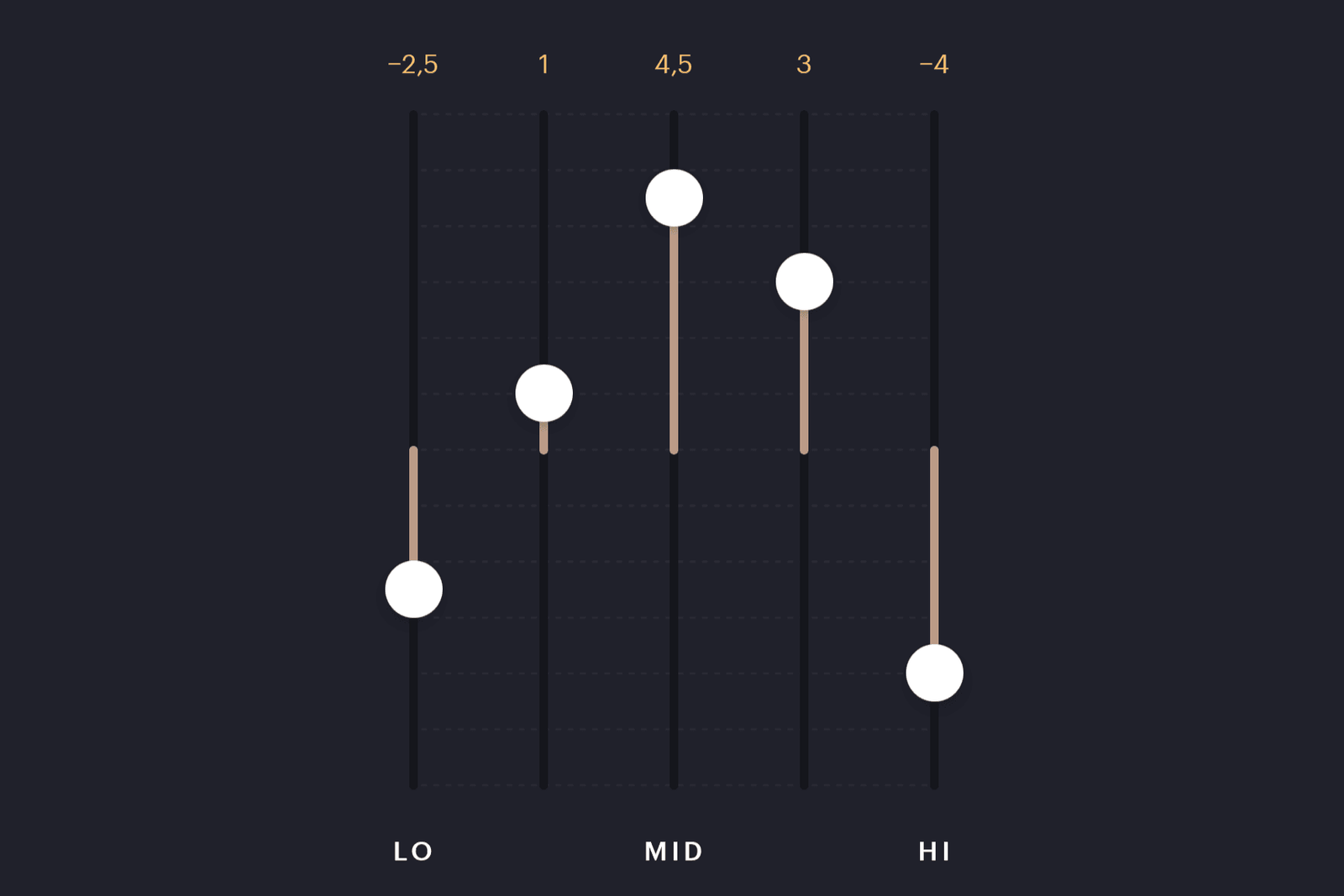
Those who understand frequency responses might immediately guess why I have had to adjust the PX7 S3's sound quite heavily. It falls regrettably far from balanced and natural reproduction. The manufacturer's 5-band equalizer is also not optimal, as it cannot adjust the headphones' worst problem areas, namely around 100–150 hertz and 7–9 kilohertz. For this reason, changes are achieved somewhat perversely by boosting the mid-frequencies, which then reduces the overall amount of low and high frequencies. In addition, the amount of highest treble MUST be reduced – trust me. With such tinkering, a fairly good end result is ultimately achieved, unless the default sound I describe next happens to be exactly what is desired from the headphones.
Sound observations
Bowers & Wilkins seems to have approached sound quality with the principle of ”the more bass and treble, the better.” The PX7 S3's mid-bass thumps loudly, and the brightness of the high frequencies almost tickles the eyes. Often people ask if headphones play loud enough – the answer for the PX7 S3 is YES. The sound is tuned so bass- and treble-heavy that the volume and loudness of the reproduction always push into your face. I had to wade through a few other reviews to see if people really like this extreme loudness effect – apparently, many absolutely love it. The PX7 S3 is not my cup of tea, but does my opinion ultimately matter if the larger market gets excited about these headphones?
Now that we are on the subject, let's not miss the opportunity. I like the manufacturer's previous PX7 S2e model because the same idea is implemented more maturely in it. The headphones do not try to impress by distorting music, but rather sound significantly more natural in terms of frequency balance. The S3, next to the S2e, literally sounds as if someone had pulled the bass and treble sliders of an equalizer to their maximum position – quite a change in direction. With a more balanced reproduction, the S2e separates musical details more clearly, and I also find its soundstage wider and deeper. When listening to the PX7 S3, attention is instead focused mainly on the loud bass and aggressive treble.
The S2e's upper bass frequencies are reproduced robustly in the same way, but as the amount of bass gently rises towards the lowest frequencies, attention focuses on the so-called real bass and the sound pressure it creates, rather than the booming thud between 100–200 hertz like in the S3. Additionally, the S2e's equalizer bass control smoothly reduces the amount of low frequencies, whereas the S3 inevitably leaves a hump in an already emphasized frequency range. With default settings, a robustly produced bass guitar and drum are reproduced in a muddy, muddled way.
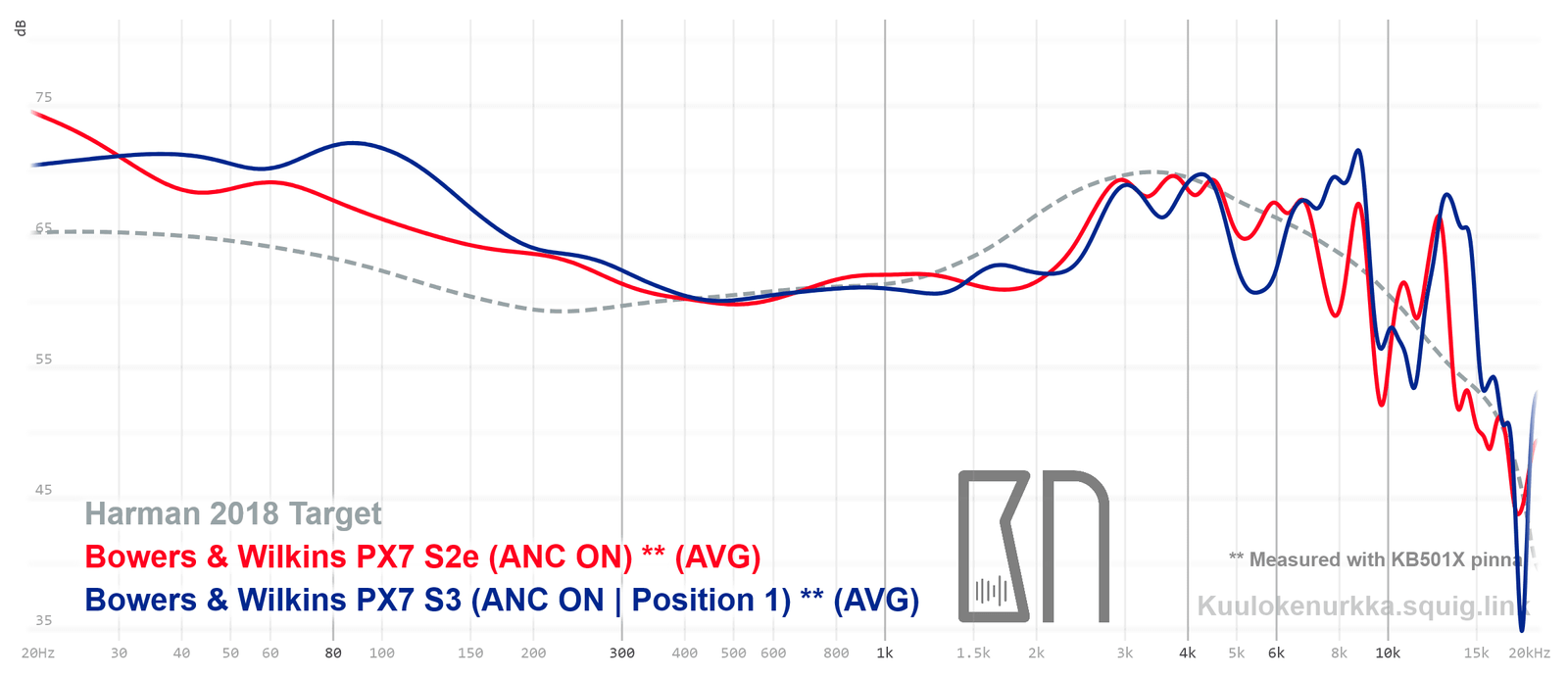
The PX7 S3's bass thus sounds thicker and less controlled than in the S2e. The low frequencies also spill more over the mid-frequencies, which materializes as the vocalist and many instruments having to, as it were, fight in a supporting role to get attention from beneath the booming bass. Depending on the chosen music, the result can even be nasally congested. When listening to electronic music, for example, this doesn't bother much; instead, the S3 model is at times more fun than its predecessor, especially when the bright high frequencies bring lively crispness to all kinds of effect sounds.
Furthermore, with suitable music, the bass of Bowers & Wilkins headphones sounds punchier and more dynamic than many of their competitors, so in a way, I understand why these headphones make a greater impression than, for example, Sonys and Boses known for their softer bass. If headphones are going to be tuned this way, perhaps it is even desirable not to leave things halfway, but to go all the way in the genre. The PX7 S3 should therefore meet the demand of its target audience, based on the positive reviews many tech-focused websites, for example, have given the headphones.
Despite the mid-frequencies being relegated to a supporting role and the emphasized bass, the headphones' sound generally feels quite clear and at first glance also detailed. This is due to the over-emphasized treble between 6–15 kilohertz. For laypeople, pushing bright sounds to the forefront certainly appears as detail, but it is mainly an unnatural distortion. In itself, it doesn't matter if it sounds good. The PX7 S3's presentation indeed feels fresher than the S2e model, especially at low volume. For me, at a more normal volume and with music containing both vocals and cymbals, the PX7 S3 often sounds bad precisely because of its sharpened treble. The S2e model does not have similar problems, as its high frequencies are reproduced quite evenly, as they normally should be.
One of the S3's biggest problems is sibilance. Although all kinds of pop music should sound catchy and fun with such bass- and treble-boosted headphones, female pop artists intentionally produced to be attention-grabbing sound irritating to my taste. At worst, every 's' sound hisses sharply and unnaturally. Sibilance occurs regardless of music genre, but the headphones perform at least as poorly in reproducing cymbals. They are often just piercing hissing and rustling, and smaller nuances are hard to discern. The result, in a way, distorts and merges because certain frequencies are emphasized far too much. To my hearing, over-brightness occurs most strongly around 7, 9–10, and 12.5 kilohertz. Sometimes the music sounds like a demo version recorded in a garage.
My wife described the matter well by saying that she had only heard cymbals of such poor quality when listening to Uniklubi in her friend's car when she was younger. The trick was that the music came from a USB stick, onto which the friend had saved the songs in the worst possible MP3 quality to save space. Having experienced this myself in the past, I fully attest to the PX7 S3's similarity. This kind of music should largely be forgotten with Bowers & Wilkins headphones, unless the harshness and aggressiveness of the high frequencies are found appealing. Heavier rock, then, is mostly muddy bass and cymbal hiss, with vocal performances suffering from congestion and sibilance. Of course, there are always bands whose music sounds quite good with the PX7 S3's tuning.
In my opinion, the headphones work best at a quiet volume or with bass music that does not contain real instruments or much vocals. In such cases, the presentation feels more powerful than many other headphones, which the manufacturer has probably primarily aimed for. On the other hand, the PX7 S3 can also be equalized, but it is much more laborious than with the S2e model. I would appreciate it if manufacturers would develop at least somewhat normal and balanced headphones, whose sound would be much easier to fine-tune to one's own taste than to start doing the work that belongs to an audio engineer from scratch.
With the equalizer setting I found effective, the PX7 S3 gets relatively close to the S2e, so I can already enjoy listening. Especially at lower volumes, the new model sounds a tad more energetic and lively than the equally equalized S2e, which requires a slightly louder volume to truly come alive. On the other hand, the bass of the S3 cannot be made as tight, nor the high frequencies as smooth and high-quality. The S2e actually sounds like a product from a higher price range in terms of treble, compared to the rough and splashy S3. The soundstage of the new model also still doesn't feel as spacious or realistic. So, it's not necessarily worth trying to make the PX7 S3 as balanced a headphone; it's meant to be completely different. In my opinion, the sound has simply been colored too much at the expense of natural reproduction, so to change my view to a more positive one, the manufacturer should have offered a better equalizer for its headphones.
Comparisons
My comparisons this time are concise because they are easy to group together. Bowers & Wilkins headphones are one of the best choices in their price range if the goal is to get as much bass and treble as possible, and generally a loud and dynamic-feeling reproduction. In this case, the PX7 S3 beats, for example, Bose QuietComfort Ultra and Sony's new WH-1000XM6headphones. Nor do those offering higher quality sound, such as Cambridge Audio Melomania P100 or the ones I recently reviewed, AKG N9 Hybrid create as great a contrast between low and high frequencies, so Bowers & Wilkins headphones might appeal more to the mass market. However, this requires that the naturalness of the reproduction is not important. In this case, the PX7 S3 could even be an alternative to Focal Bathys, because both rely on dynamic and powerful-feeling reproduction.
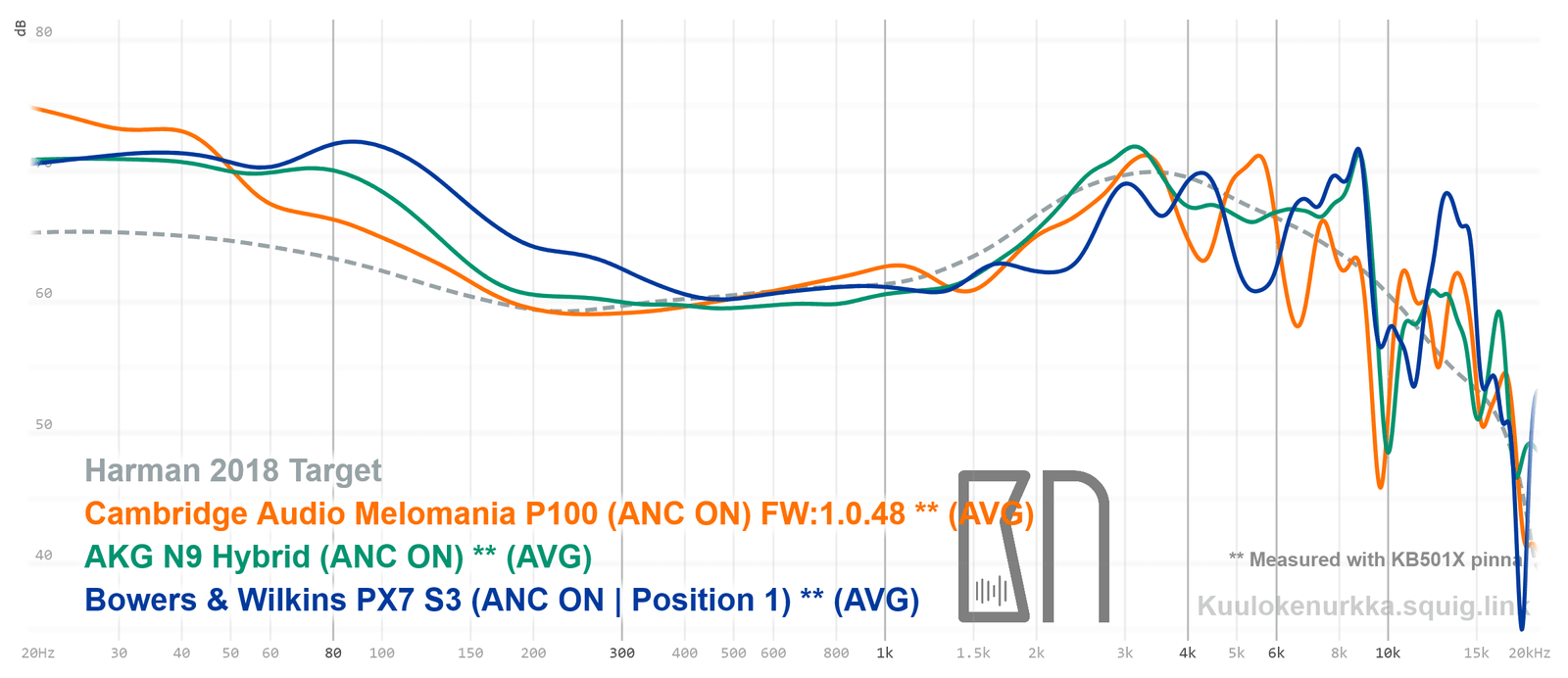
However, if music is desired to sound balanced and objectively high-quality, the PX7 S3 leaves much to be desired. Many might be surprised that the QuietComfort Ultra and WH-1000XM6 are better options for this purpose, especially since ”removing” extra bass from them has been made easy. AKG's N9 Hybrid, which broadly follows the Harman curve, or Audeze Maxwell's at the latest, demonstrate how distorted the PX7 S3 sounds. Of course, the manufacturer's own PX7 S2e did the same. Among other headphones, Sennheiser Momentum 4 Wireless is still a good option, and those desiring a more neutral sound should also never forget Valco VMK25.
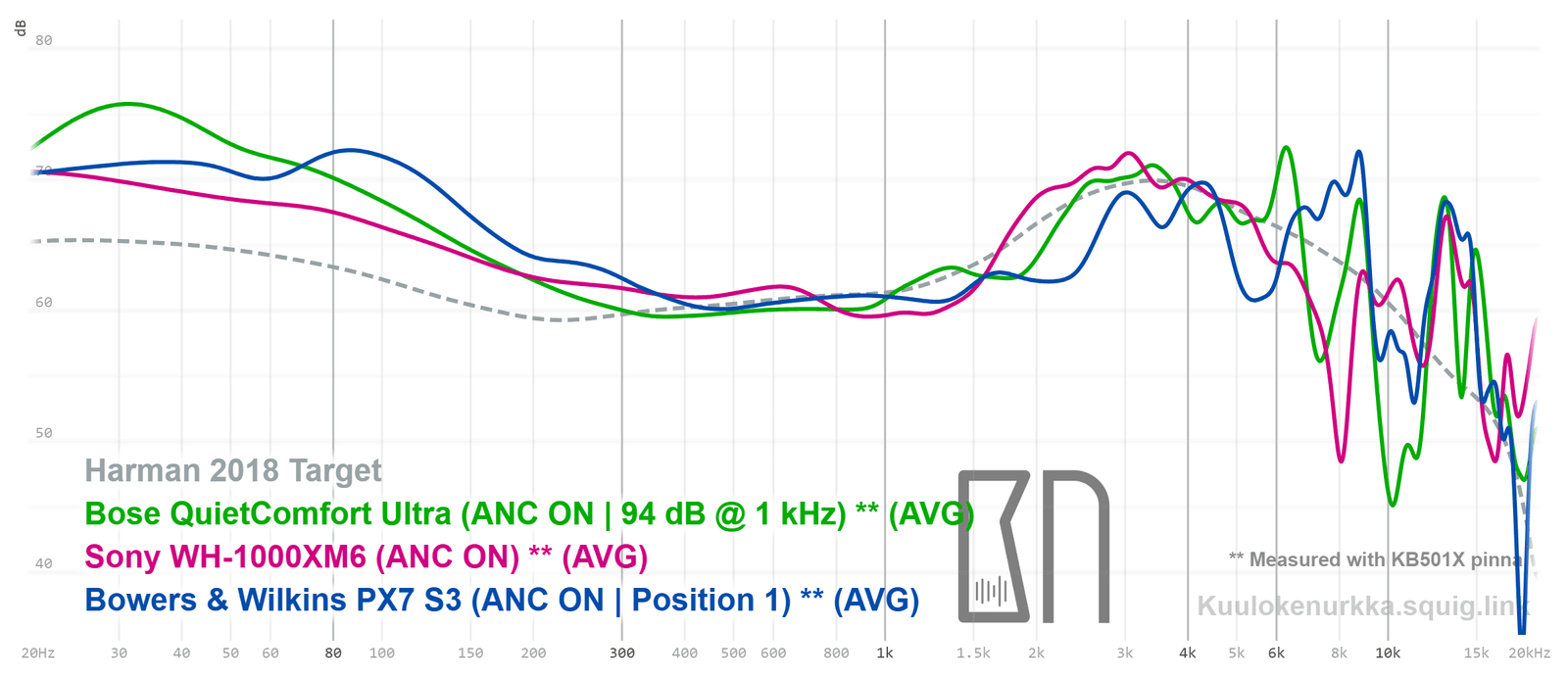
In other respects, the PX7 S3 has a higher quality build than its competitors and a more luxurious appearance. Comfort surpasses Sony's WH-1000XM6, but Bose's QuietComfort Ultra is in a league of its own. AKG's N9 Hybrid is also more comfortable, has better battery life, and is clearly more versatile in features. Bowers & Wilkins products are quite simple, for better or worse. Furthermore, the PX7 S3's noise-cancelling function is mediocre in effectiveness, so it doesn't score points against its competitors in that regard either. It would therefore be important for such headphones to sound excellent.
Summary
I wondered many times if I had been too harsh on the Bowers & Wilkins PX7 S3. However, I don't feel I have been, because on the shelves of hi-fi stores, it faces, in my view, higher than usual expectations from potential customers who are generally more aware of good sound quality. The manufacturer's PX7 S2e model feels like a better headphone to me, and it also costs less. So, new isn't always automatically better, although due to its distinctiveness, the S3 model will likely find its own fanbase who prefer more mid-bass and treble. I myself would feel I was settling for little when we are talking about headphones costing over 400 euros.
Nevertheless, thanks to its high-quality drivers and proper electronics, the PX7 S3's sound is clearer and more dynamic than other similarly tuned headphones. The main hindrance is therefore primarily the colored frequency response. Unfortunately, people less accustomed to headphone reproduction do Bowers & Wilkins a disservice by praising the current tuning, as we might not see truly high-quality headphones from the manufacturer anytime soon. It seems to have decided this time to focus on charming the mass market instead of faithful music reproduction, which is not inherently wrong, of course. As it stands, the headphones might even sell better than if they were tuned more "correctly." The PX7 S3 is also competitively priced compared to, for example, Sony and Bose headphones. If only the noise-cancelling function could also be made more effective…
Although the PX7 S3, when equalized, suits my preferences better, I am ultimately quite disappointed with it and cannot recommend buying it. The headphones feel like a surprisingly big step backward compared to the manufacturer's own PX7 S2e. Objectively evaluated, the sound quality has not improved, while the noise cancellation function has even weakened. Comfort and usability, on the other hand, remain in a plus-minus-zero situation due to their partial improvements and deteriorations. A separate issue is also the significant effect of the wearing position on the resulting sound, which leads me to argue that the acoustic design was a poor choice for this type of product. The new model seems to be mainly a cosmetic facelift. For the manufacturer, I still have good news: I will happily continue listening to its PX7 S2e model. Perhaps a new version of the more expensive PX8 will again be more to my taste? On the other hand, for many others, the PX7 S3 is already an almost perfect headphone, so please don't just take my word for it.
Pros and cons:
+ The sound has power and dynamics
+ A slimmer design than before
+ High quality impression, including the equipment
+ Microphone sound quality is quite good even in slight noise and wind
+/- Punchy bass and bright treble might impress some, but music with vocals and real instruments sounds distorted
+/- The headphones play exceptionally loud, but the volume adjustment range is small when using a USB cable
+/- Comfort has improved regarding the ear cushions, but the headband presses more on the top of the head
+/- Buttons are arranged more clearly, but they are located in a more awkward place
+/- Transparency mode has become clearer, but at the same time more unnatural
– Overly aggressive and muddy mid-bass
– Really overemphasized treble + sibilance
– The sound cannot be made particularly balanced even with equalization
– Sound varies significantly in different wearing positions
– Ineffective noise cancellation function that is disturbed by wind
– Shorter battery life than many competitors
– Too sensitive ear sensor
 EN
EN  FI
FI