Author: Sword of Damocles
Table of Contents:
Information:
- Release year: 2024
- Designed in Britain and manufactured in China
- Color options: Black, white
- Price: 279 €
- Type: Closed, over-ear
- Dynamic 40 millimeter drivers (3-layer composite: PEEK+PU+PEEK)
- Audio connections: Bluetooth 5.3 and USB-C
- Bluetooth codecs: AptX Lossless, AptX Adaptive, AptX, AAC and SBC
- Charging port: USB-C
- Battery size: 980 mAh
- Battery life: with noise cancellation on 60h and without noise cancellation up to 100h
- Charging time: < 2.5h (with 5 minutes of fast charging, 4h of usage time)
- Battery is user replaceable
- Noise cancellation function and transparency mode
- Features: Class A/B amplification, ear detection (wear detection), Google Fast Pair, Voice Assistant, Multipoint and phone app with equalizer
- Weight: 330 g
- Accessories: Carrying case, USB-C—USB-C cable, USB-C—3.5 mm cable
Review sample: Self-purchased product
Wireless noise-cancelling headphones are constantly gaining market share from traditional wired hi-fi headphones, which is also reflected in the readership numbers of reviews published in Kuulokenurkka. Since noise-cancelling headphones are read about many times more than wired headphones, they are also likely sold in large quantities. In light of this, it is not a big surprise that new headphone models are constantly emerging from both well-known and somewhat lesser-known manufacturers. British Cambridge Audio still belongs to the latter group as a headphone manufacturer, even though it has already released a few in-ear headphones among its various devices and speakers. This time, the Melomania P100 I am reviewing (link to the manufacturer's product page) is, however, its first over-ear noise-cancelling headphone.
The Melomania P100 costs 279 euros in the manufacturer's own online store, and based on a few years' sample, it seems very conventional. The black and white color options are also very familiar and safe. However, as a new player, Cambridge Audio aims to stand out from the crowd in a couple of areas. Firstly, it has implemented the internal amplification of its headphones using the Class A/B principle. This can be considered a logical investment target, especially from an amplifier manufacturer. Similar to wired headphones, high-quality built-in amplification can add its own flavor to the sound in wireless models, even if its effect on the final result is difficult to verify. In Cambridge Audio's case, this may have indirectly motivated them to make overall good headphones, because otherwise, it would also look bad as an amplifier manufacturer.
Secondly, the Melomania P100's battery should be user-replaceable, which is still very rare in noise-canceling headphones. Changing the battery requires opening the headphones, but Cambridge Audio provides instructions and suitable tools when purchasing a new battery. The solution does not reach the ease of Fairbuds XL -headphones' level, but it is still a clear selling point. This at least made me interested enough in the Melomania P100 to acquire it for review in Kuulokenurkka. Many things can always go wrong with noise-canceling headphones, so let's find out how Cambridge Audio has succeeded as a new manufacturer.
Product packaging and accessories
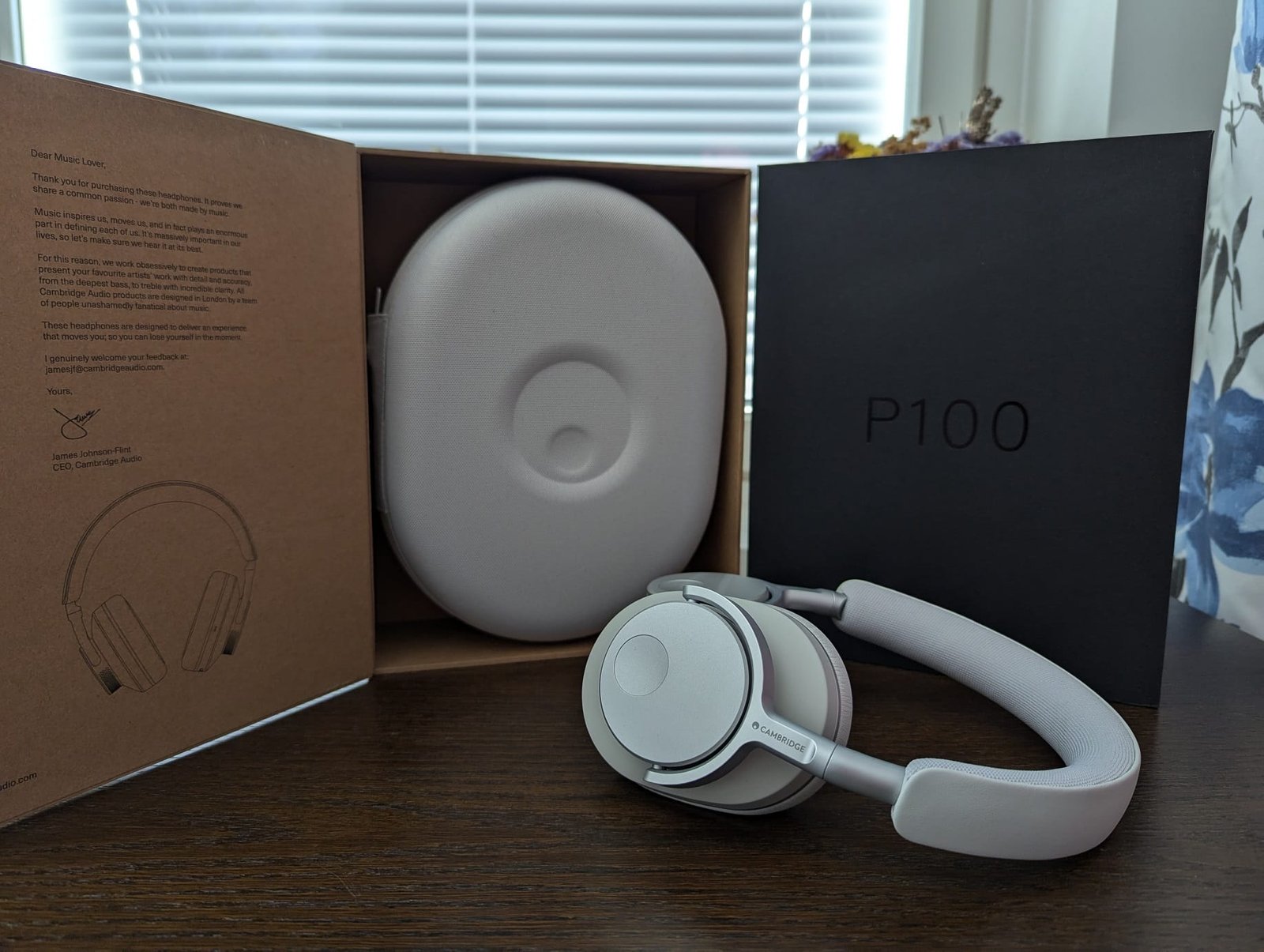
Regarding the packaging, the Melomania P100 follows a traditional line, as the headphones are delivered in a sturdy carrying case, which also contains the necessary cables. The color scheme of the accessories successfully matches the chosen headphone version, and the shoelace-like fabric sheath of the cables also makes them clearly higher quality compared to conventional rubber cables.
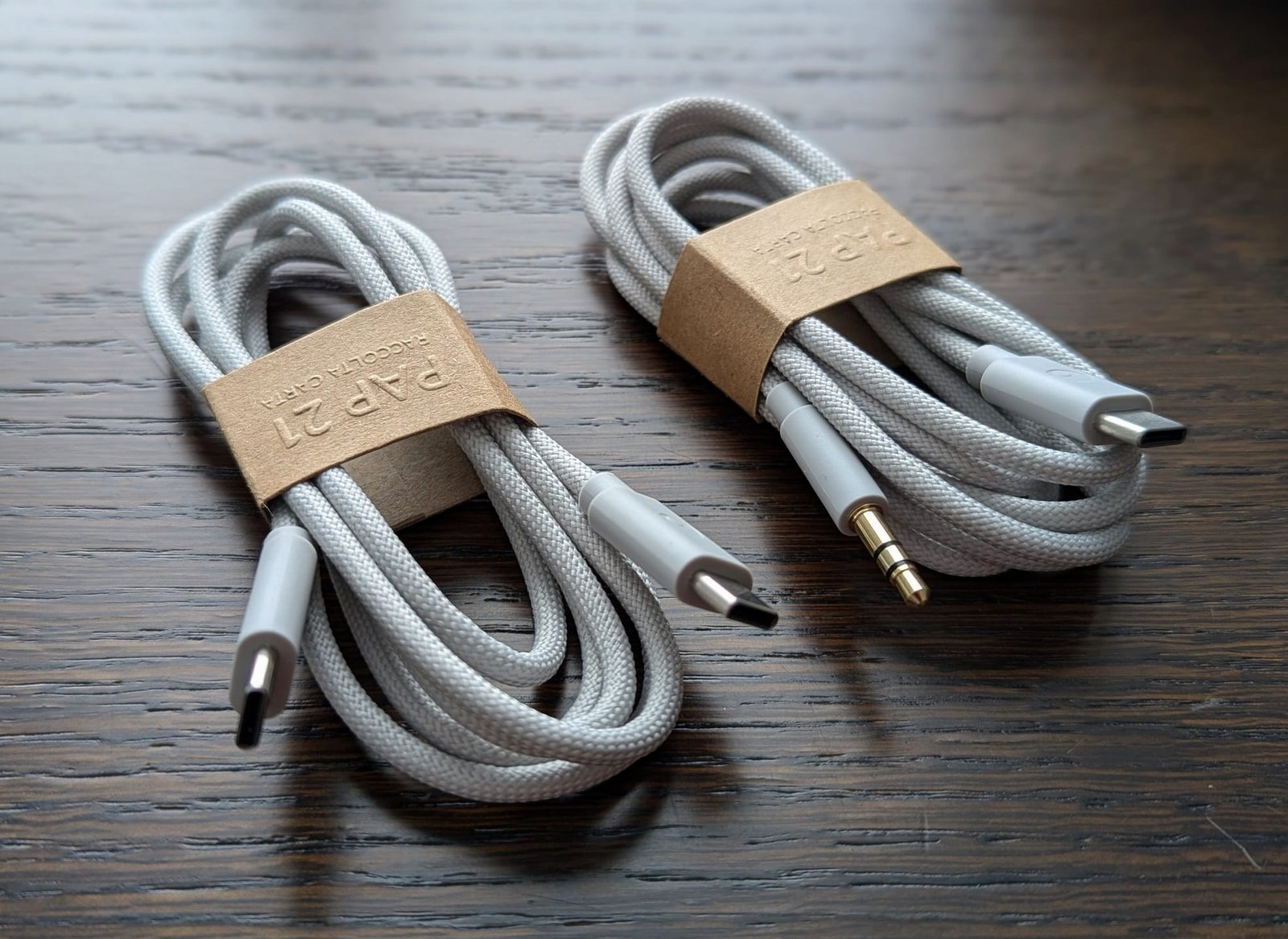
In addition to charging via the USB-C connector, the headphones can also be listened to through this connector, either with a USB connection or a 3.5-millimeter analog connection. For the latter use case, Cambridge Audio supplies a cable with a USB-C connector at the end that attaches to the headphones and a 3.5-millimeter connector at the end that attaches to the audio source. However, utilizing this requires turning on the headphones' power, so the Melomania P100 cannot be used passively without power in any situation.

There is nothing particularly noteworthy about the carrying case, except that it is slightly larger and thicker than, for example, Bowers & Wilkins' PX7 series case. Ample space is provided for cables in a separate compartment that closes with magnets.
Build and comfort
Structurally, Cambridge Audio's headphones are functional and their perceived quality largely matches their price range. The light-colored part of the oval-shaped earcups is made of plastic, and the silver parts, with the exception of the height adjustment extensions, are made of aluminum – about half of the materials are recycled. The overall design language resembles many other premium-style noise-canceling headphones already on the market, such as Bowers & Wilkins products. The Melomania P100 also feels slightly more premium than headphone models under 200 euros. The total weight is 330 grams, which is slightly more than the lightest options on the market. However, considering the material choices, this is completely acceptable.
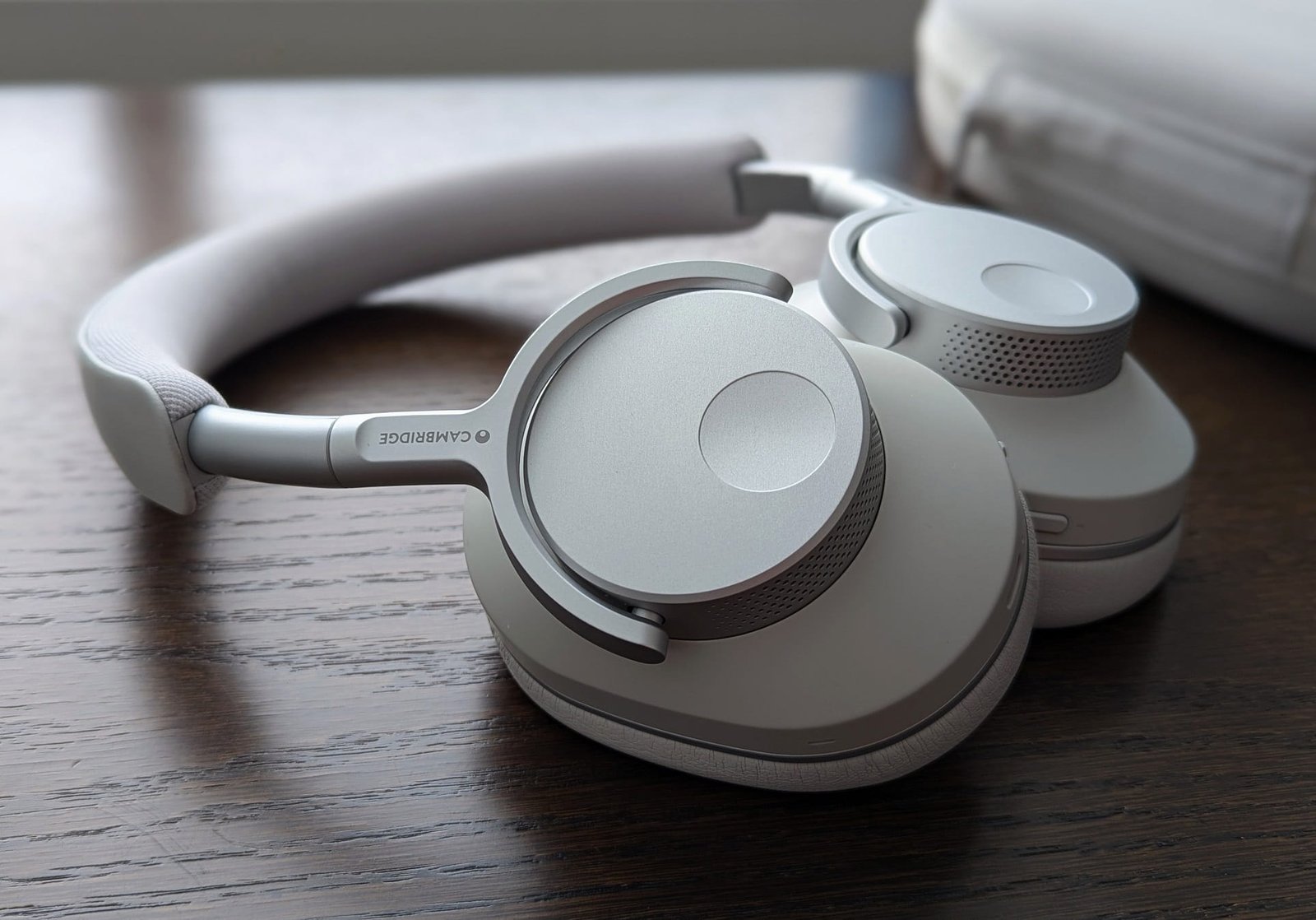
A somewhat polarizing feature in the headphones' design, in my opinion, is its wide headband, which causes part of the band to stick out far from the side of the head during use. Most other noise-canceling headphones sit flush with the head, and thus do not attract as much attention from bystanders. I wouldn't call the Melomania P100 particularly street-credible, but everyone can certainly judge this for themselves.

The wide but thin headband also makes the headphones' fit slightly wobbly, especially if the head is shaken during use. However, the fit in general is good for me from a comfort perspective. There isn't too much pressure on the ears, nor too much pressure on the top of the head, so prolonged use of the headphones is comfortable. The height adjustment range and the range of motion of the parts are also wide, with the earcups rotating horizontally in both directions.
Staying with the current design, improvements could mainly be found in the fabric-covered padding of the headband, which feels somewhat strange and cheap. Unlike usual, there is no foam under the fabric, but a hard-feeling rubber layer that flexes only slightly inwards. The head padding feels more like a head support. Fortunately, I can easily position the headphones on my head so that the headband only lightly touches the top of my head. For the white headphone version, I would recommend considering the potential for the fabric to get dirty and darken. For this reason, the black version might stay cleaner longer, although I would expect it to collect more fingerprints. I would not see the Melomania P100 as sports headphones of any kind.

Ear cushions and the top of the headband in the headphones are made of soft synthetic leather. For my own ears, there could be a bit more space inside the cushions, but I don't find them uncomfortable. The ear opening deepens towards its back edge, like many other noise-cancelling headphones, and a rather thick foam layer is glued over the driver, which prevents the ears from pressing against any hard material. The cushions come off by pulling them from their plastic hooks, so replacing worn cushions will be easy in due course.

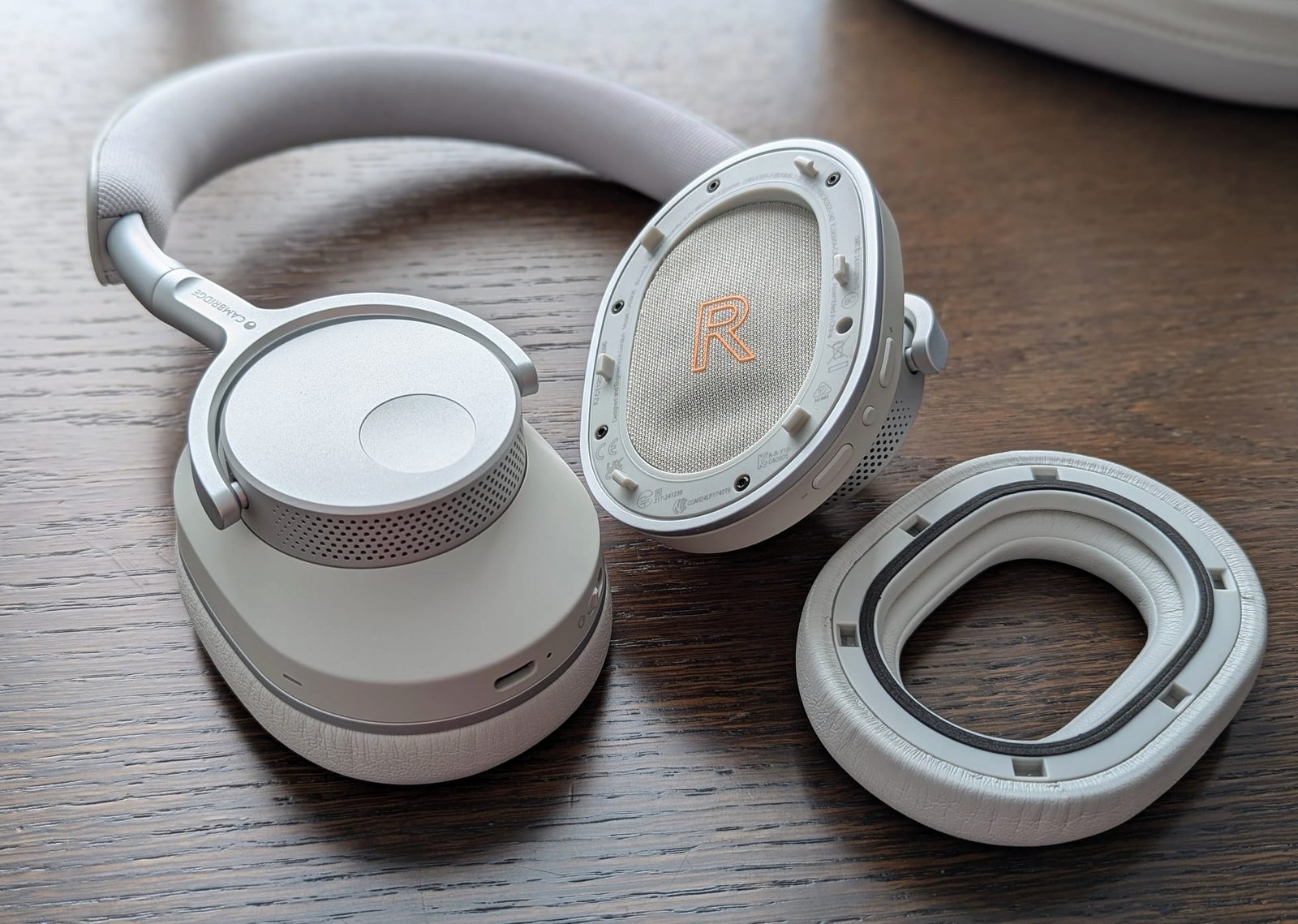
The Melomania P100 is controlled by physical buttons located on the back of the cups, which sit snugly in their recesses and offer a firm press feel. The buttons also distinguish themselves well by touch, as the power button is implemented as a slider switch and the play/pause button is clearly smaller and sharper to the touch than the volume buttons.
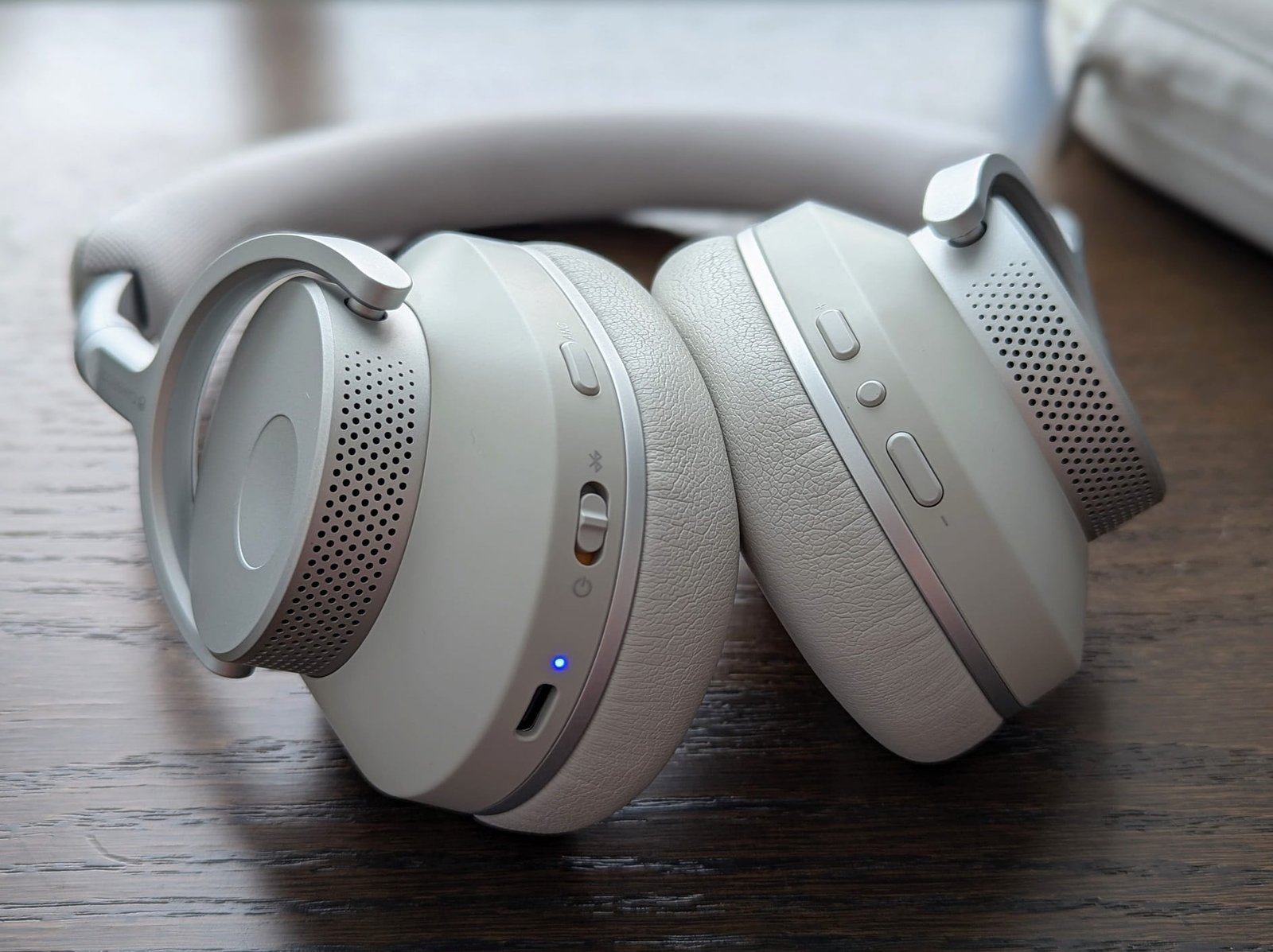
The Melomania P100 also includes an ”ear sensor” (located in the left cup), which automatically pauses playback when the headphones are removed. This feature initially worked exceptionally poorly and slowly, but after a couple of firmware updates, both pausing and resuming playback have performed comparably to competitors' products. The first Melomania P100 owners essentially received an unfinished product, but fortunately, Cambridge Audio seems committed to its continued development.
Bluetooth technology and battery life
The headphones' Bluetooth implementation adheres to the modern version number 5.3, and codec support leans towards AptX. In addition to AptX Adaptive and basic AptX, the higher-quality AptX Lossless option is supported, though currently, mainly owners of Sony, Asus, or Vivo branded Android smartphones can utilize it. For Apple users, the familiar AAC codec is available, and for older devices, SBC. The Melomania P100 supports Google's Fast Pair feature, so Bluetooth pairing is done in an instant. Multipoint support is also found in the headphones, so they can be connected to two devices simultaneously. Additionally, there is a separately activatable Gaming Mode, which may slightly reduce Bluetooth connection latency. I have not observed any connection problems or signal dropouts; everything seems to be in order in that regard as well. The headphones actually connect to my Google Pixel 6 phone faster than usual.
One of the Melomania P100's greatest strengths is its 60-hour battery life when used with noise cancellation active. Without noise cancellation, the battery would last up to 100 hours. Both figures easily reach the top end of the market and make, for example, Sony's and Bose's 20–30 hour battery life look very poor. Getting through the Melomania P100's test period with a single charge was quite a luxury. There is nothing exceptional about the charging speed either, and in the traditional way, several more hours of use can be gained with a few minutes of quick charging.
I already mentioned that the headphones' battery is replaceable. This would happen by purchasing a new battery from Cambridge Audio, which would apparently include new ear cushions in addition to instructions and tools. The possibility of extending the headphones' lifespan is an excellent thing, so Cambridge Audio must be given credit for that. On the other hand, I'm not entirely sure how easy it actually is to replace the battery, as by opening the headphones myself and removing all screws, I couldn't figure out a way to access the space between the driver and the cup where the battery is located. Some screws also required a special screwdriver with a star-shaped head. At this stage, I still get the impression that replacing the battery might not be any easier than in many other headphones, but unlike competitors, Cambridge Audio generally sells batteries as spare parts with instructions.
Phone app and equalizer
Cambridge Audio offers a phone application called Melomania for its headphones, which handles firmware version updates and settings changes, in addition to equalization. By registering the headphones, it is also possible to extend their warranty period by half a year. The application is generally minimalistic but functional, as it communicates quickly with the headphones and doesn't crash. Unlike many competitors, it also does not require any user account creation or login.
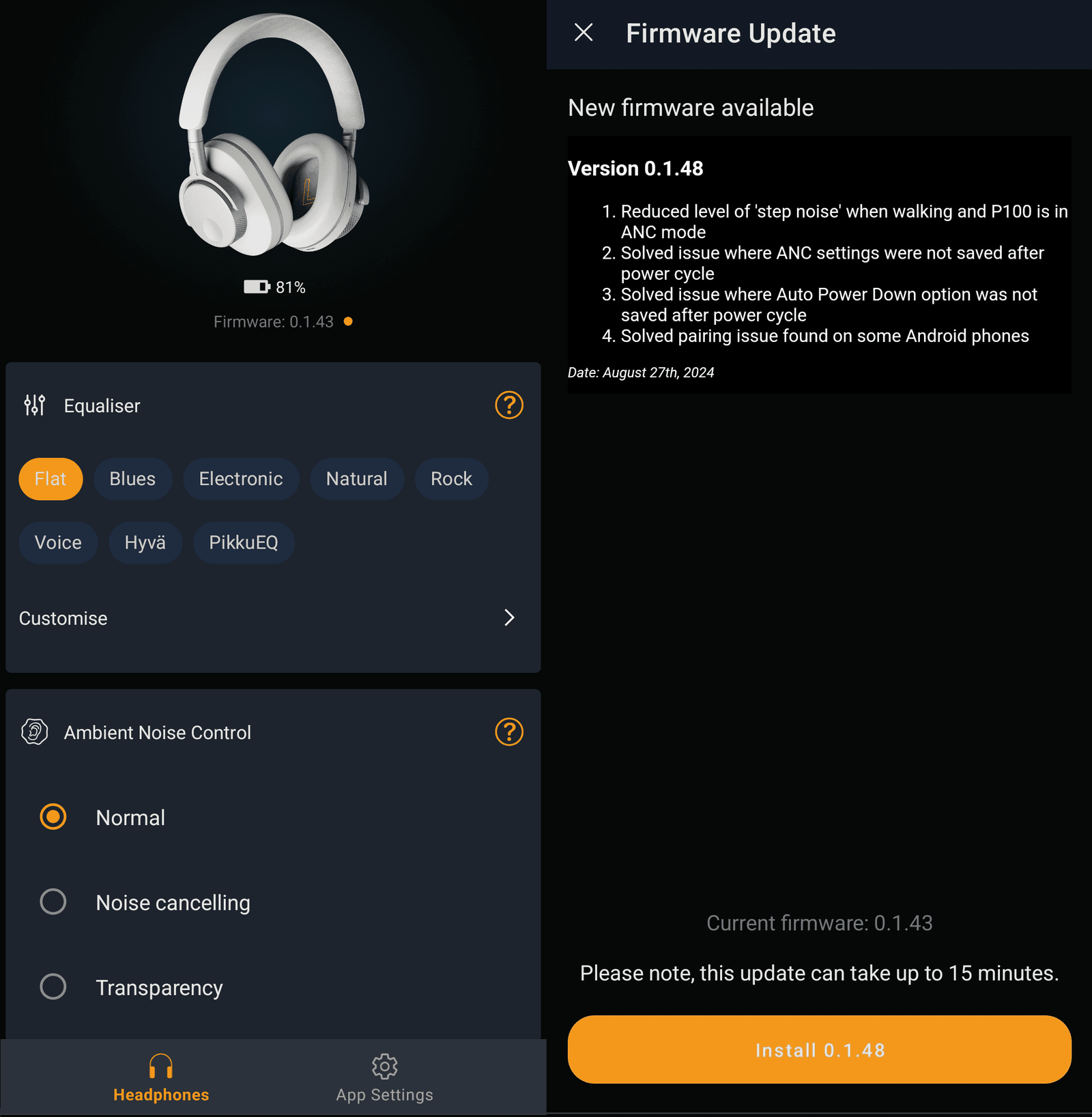
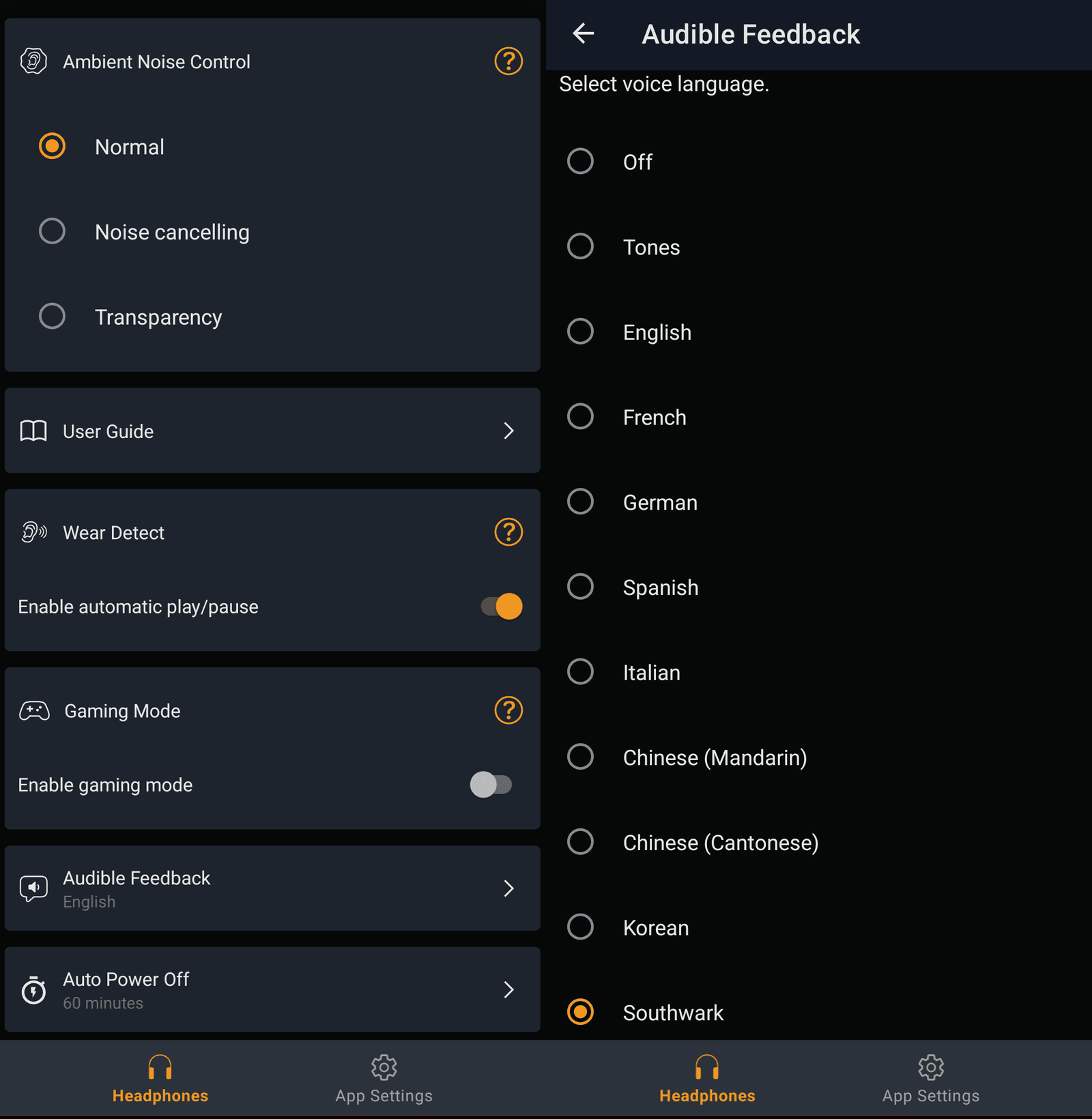
Among the basic settings, it's worth mentioning disabling the ear sensor, activating Gaming Mode, and defining the standby duration. The noise cancellation function and transparency mode are also adjustable. As the most amusing feature, I consider the Southwark (suth-erk) accent found on the notification sound language selection list. Cambridge Audio's headquarters coincidentally located in the same area in Central London, so this joke brings a bit of personality to the headphones, similar to Valco's deep male voice. If desired, spoken notifications can also be changed to gentle beeps or notification sounds can be turned off completely.
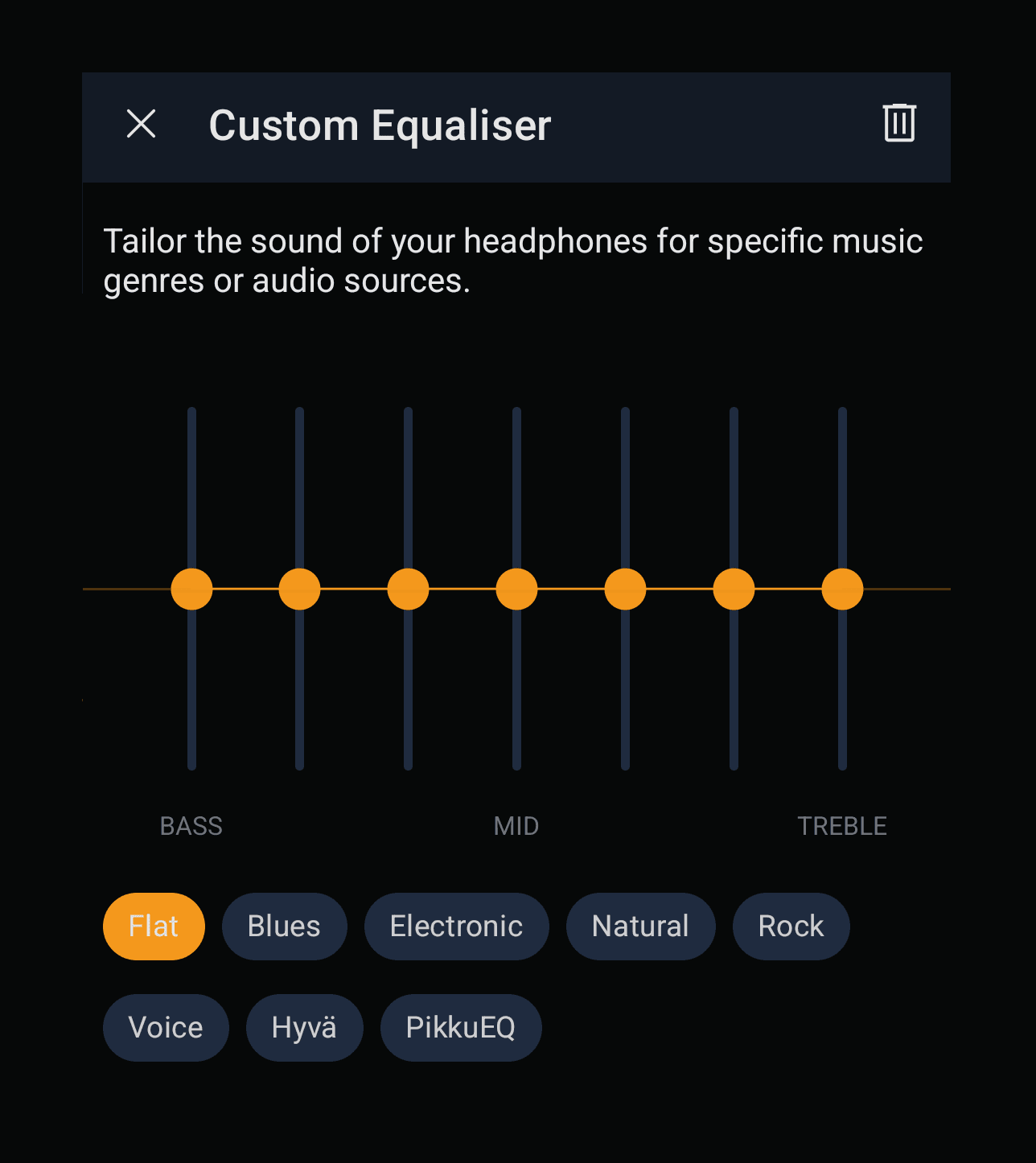
In addition to utilizing a few predefined sound profiles, the user can create and save up to five custom equalizations using sliders in the application. However, the adjustable frequency ranges are not specified in more detail, nor is the magnitude of the adjustments clear except by experimentation. On the other hand, each of the 7 sliders affects such a wide range that it would not be easy to name them clearly.
I measured the influence range of each slider in both minimum and maximum positions:
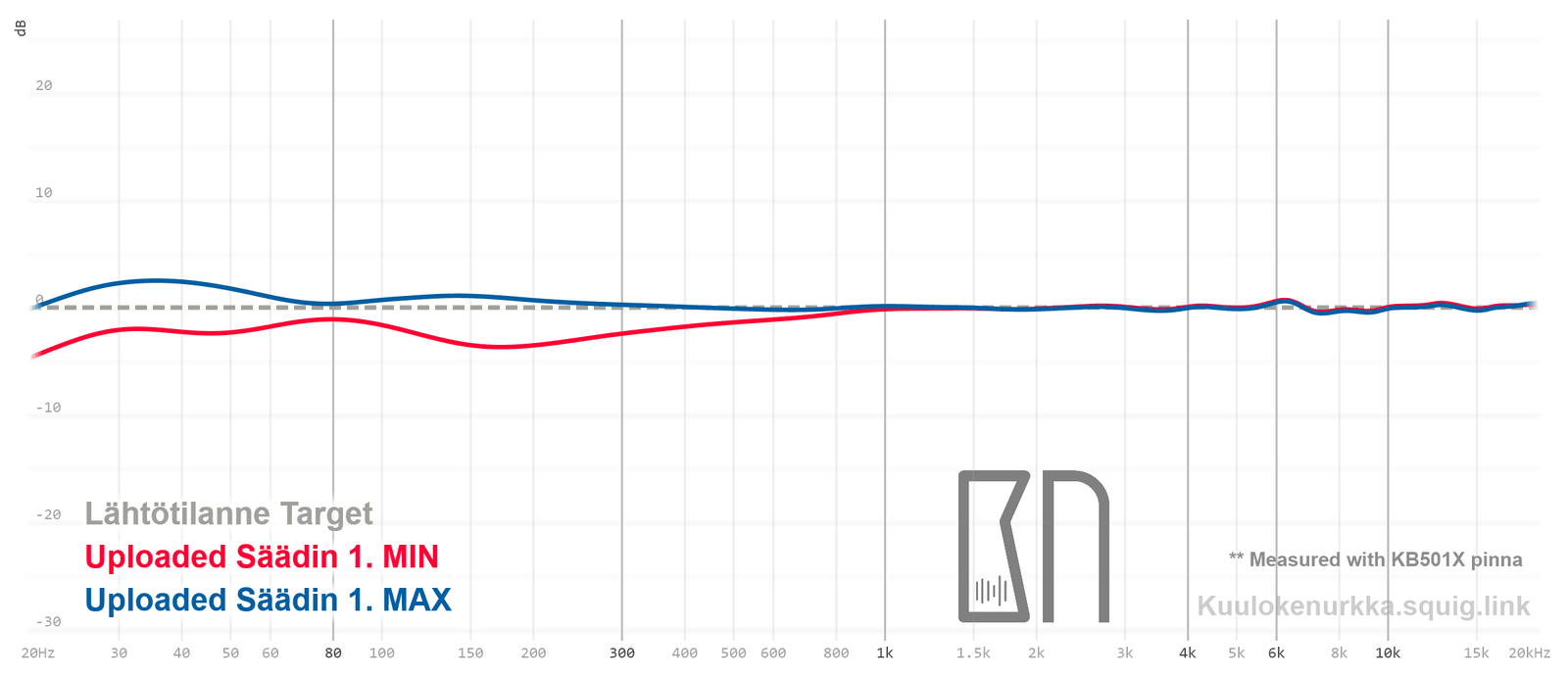
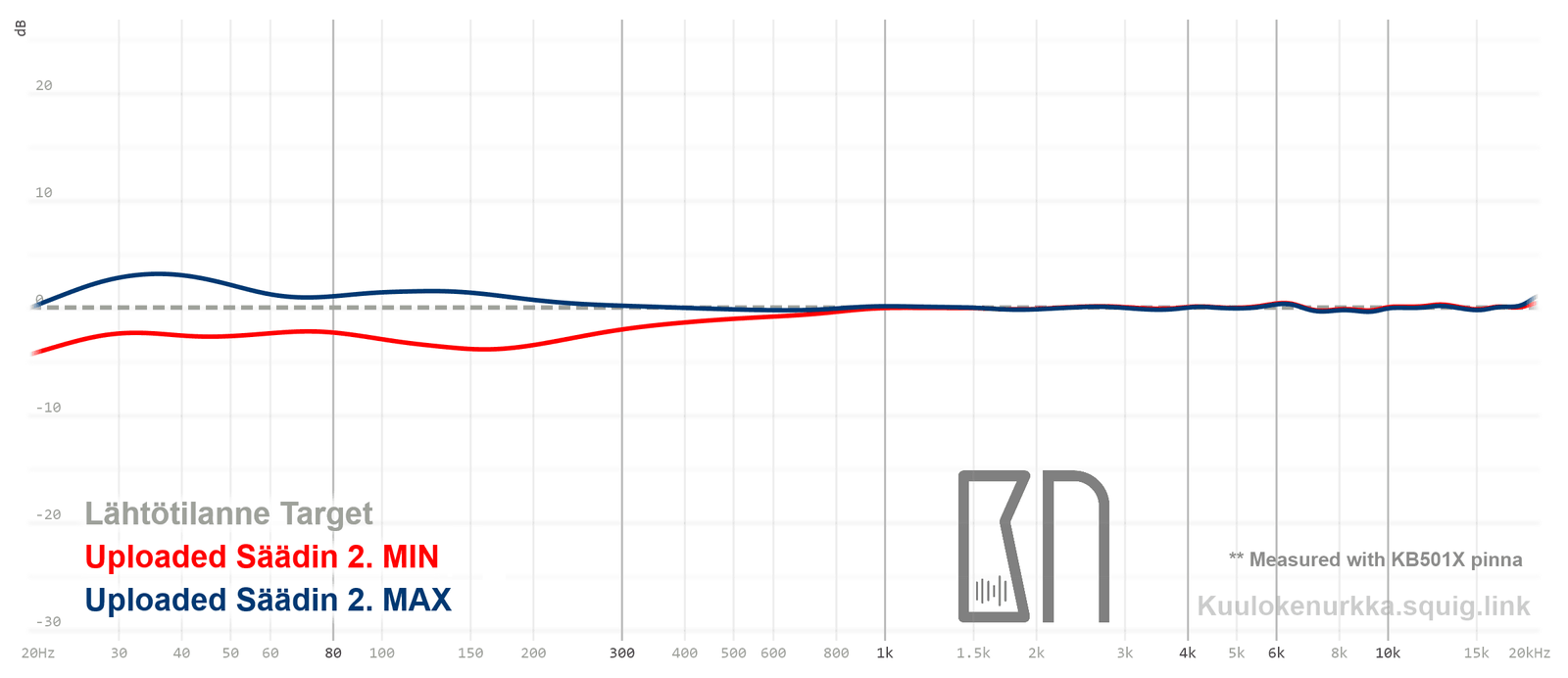
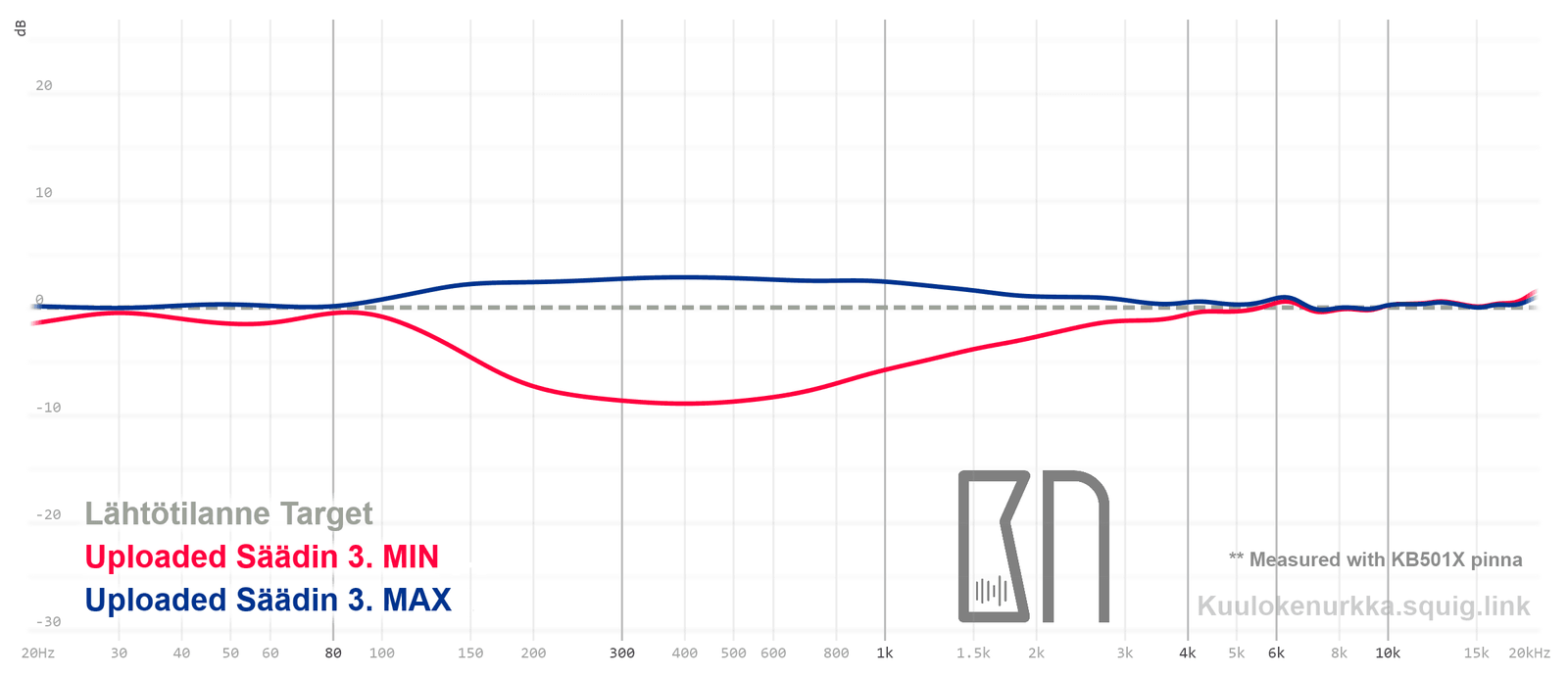
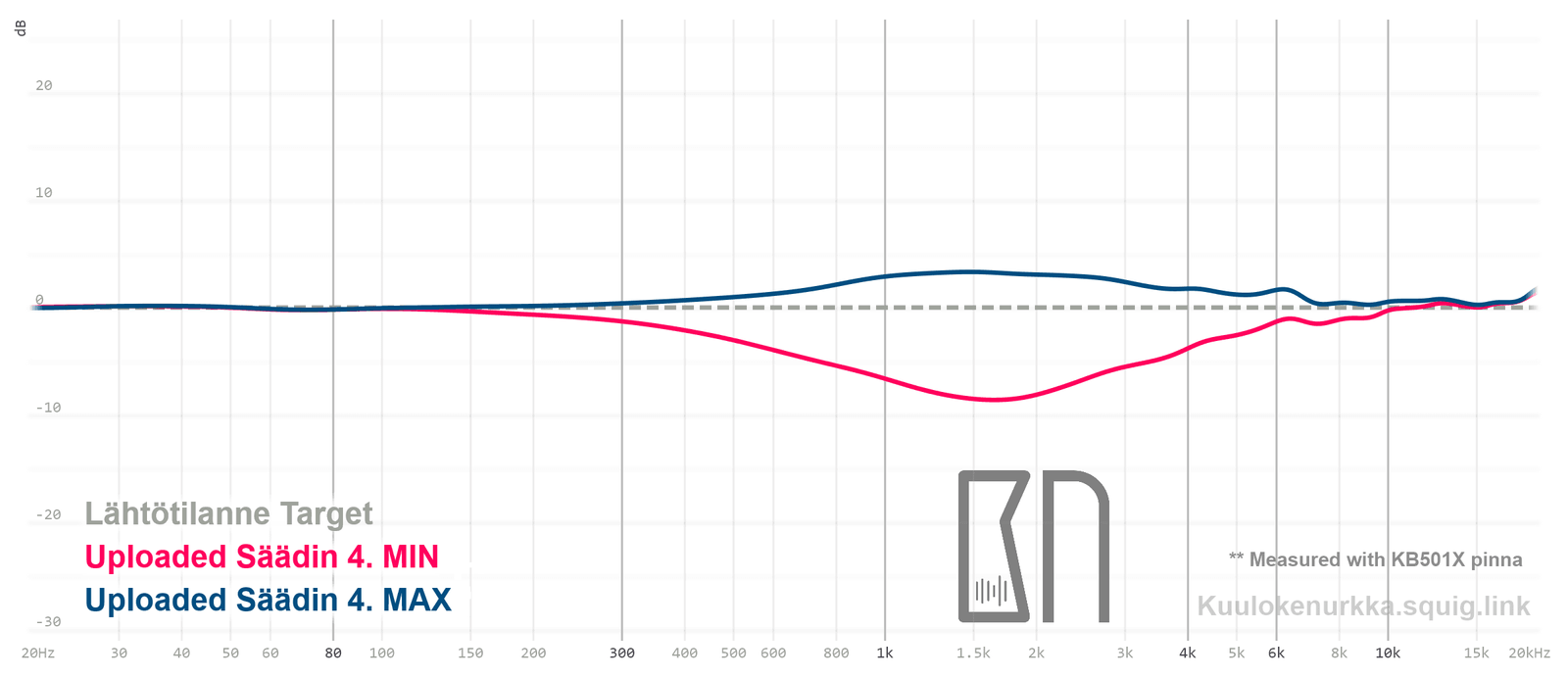
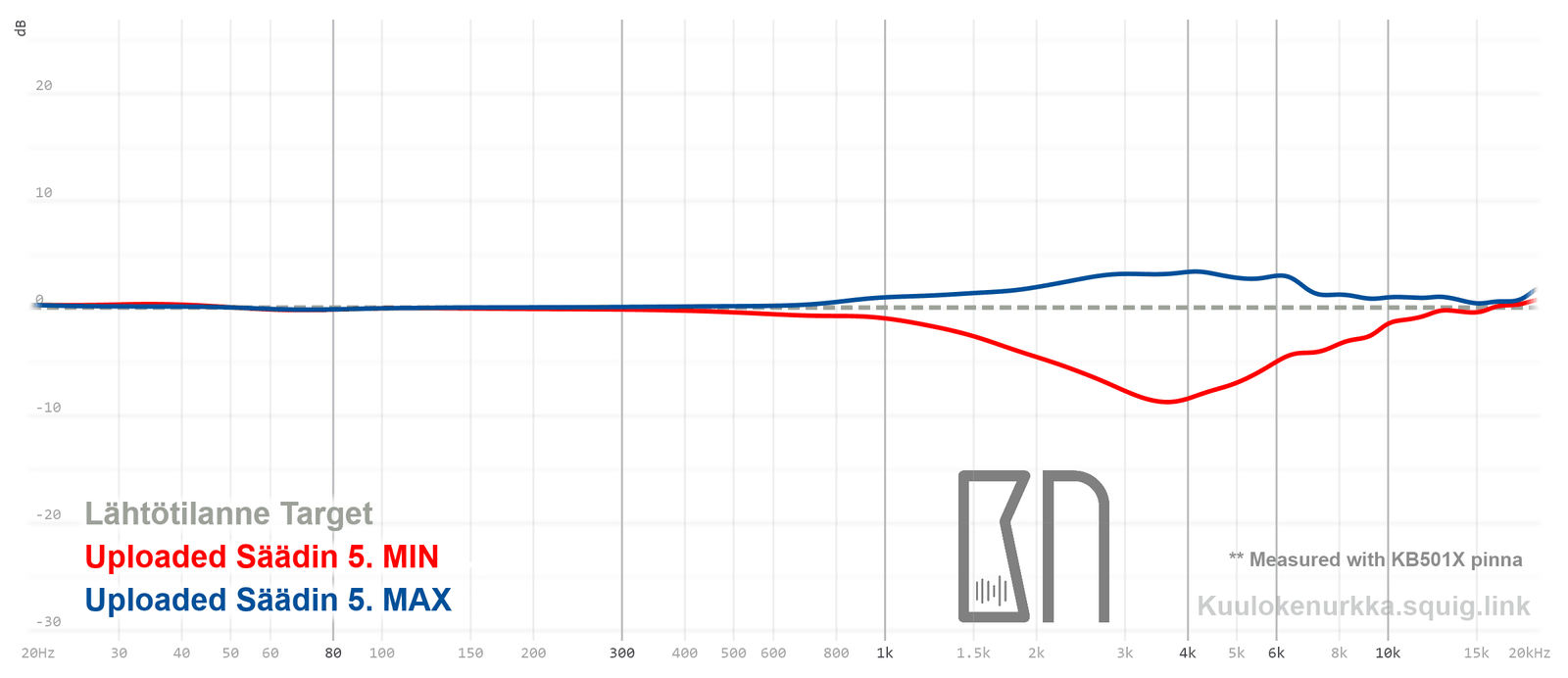
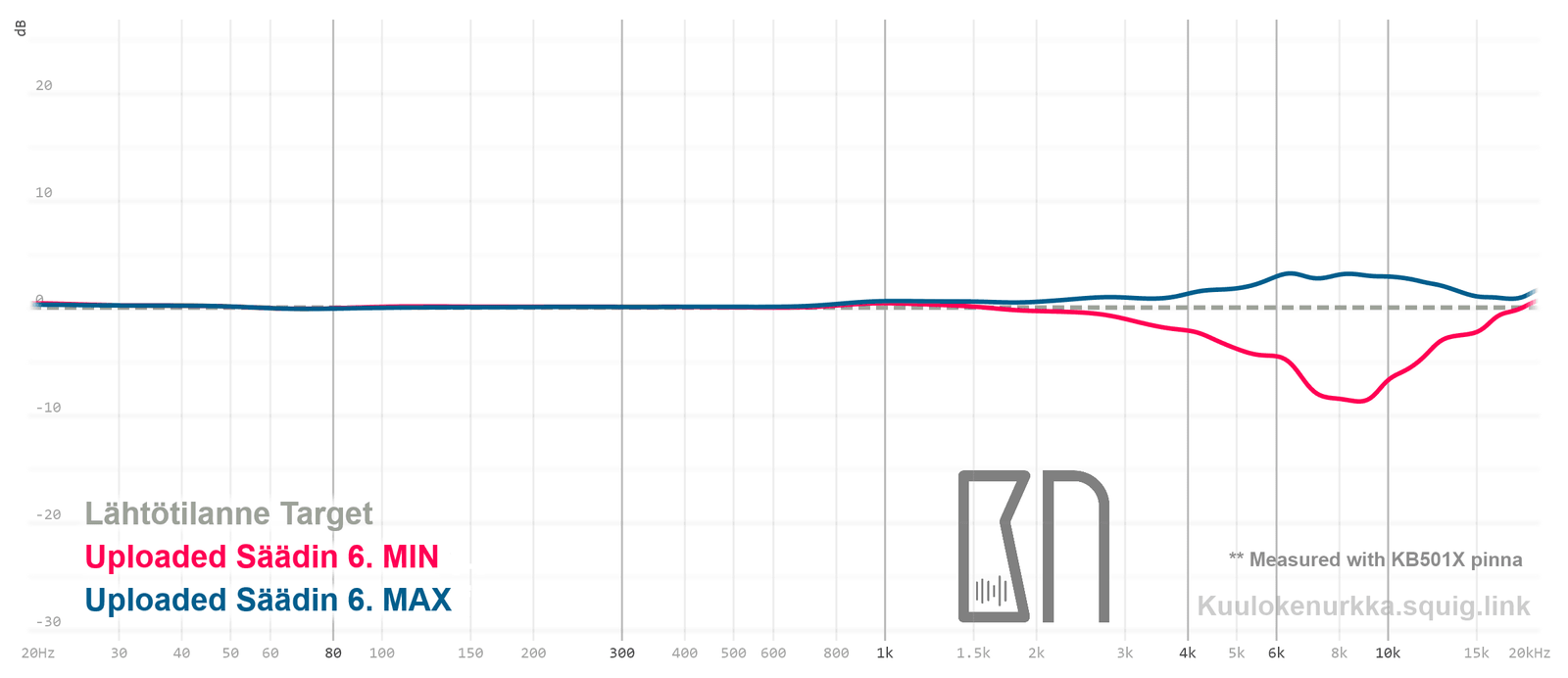
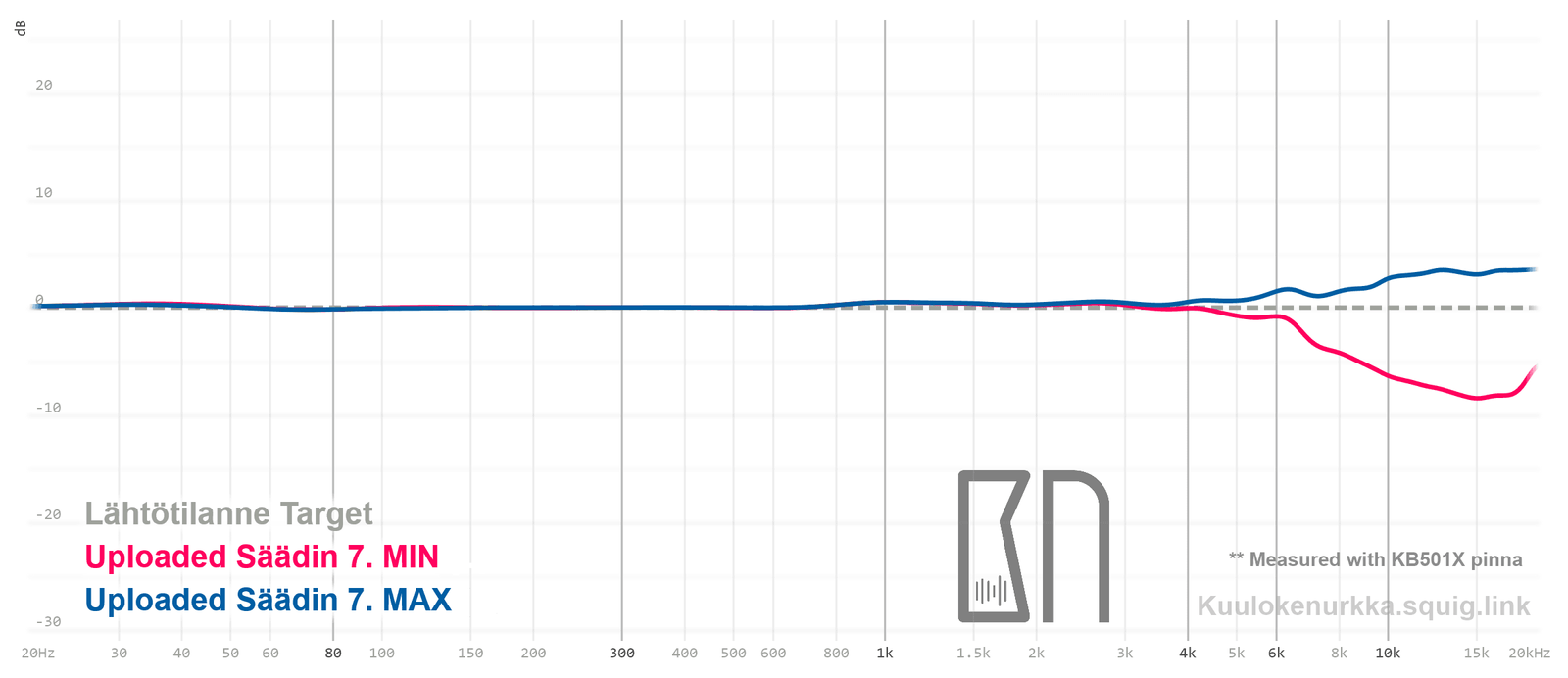
The upward adjustment range is very limited, but attenuating wide frequency ranges would be even too effective, with the exception of bass. In practice, however, it's best to skip larger adjustments, as most of them do not align with the Melomania P100's frequency response, but rather create unwanted boosts in the frequency response or make the sound unclear. For this reason, I consider Cambridge Audio's developed equalizer tool quite unnecessary. It's a relief that the Melomania P100 doesn't particularly need equalization.
Active Noise Cancellation (ANC)
The headphones feature a fairly traditional active noise cancellation function, the effectiveness of which can be selected from three options (low, medium, and high). Noise cancellation can also be completely switched off, which extends battery life. As a third option, there is a transparency mode that allows ambient sounds in, which is also adjustable in three steps. The low and high options are straightforward, while the Voice Focus mode amplifies the speech of people around while further attenuating ambient sounds. The transparency mode doesn't quite match the naturalness or clarity of sound, for example, Bowers & Wilkins PX7 S2e: or Bose QuietComfort SE: but it does beat Valco VMK25: which has a more digital nuance. I no longer own Sennheiser Momentum 4: but it might sound slightly more natural compared to Cambridge Audio headphones.
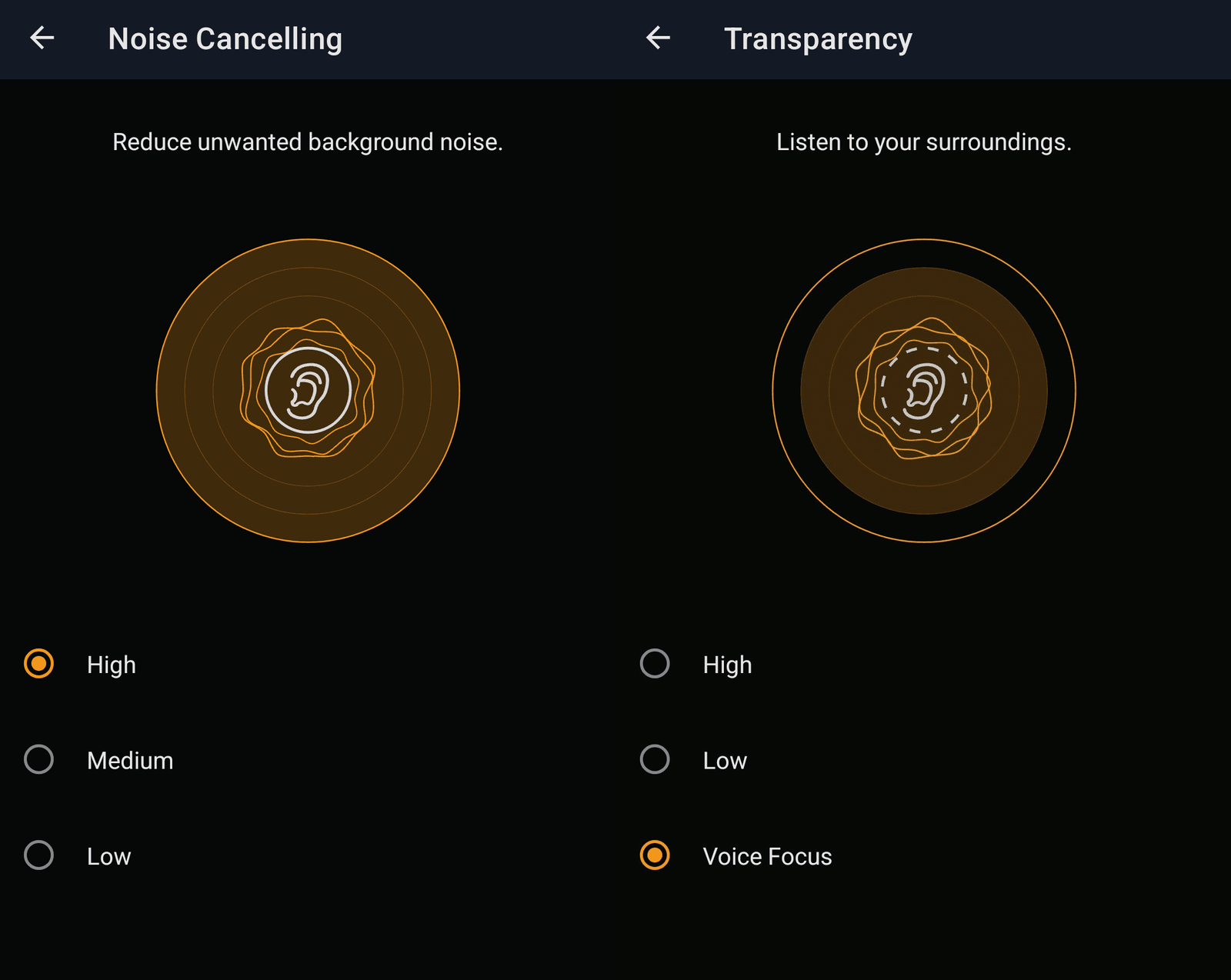
When the noise cancellation function is turned on, the Melomania P100's consistent background hiss indicates that it is not technically a top-tier product on the market. When listening to music, I don't find the hiss particularly distracting due to its consistency and pleasant tone, but it does stand out in quieter parts of songs. Regarding other functionalities, I had to rewrite this section once, as I was about to criticize the headphones' noise cancellation function for all sorts of interference sounds, but the latest firmware update alleviated the worst problems.
Firmware version 0.1.43:
The Melomania P100's noise cancellation function was very sensitive to headphone movement and pressure fluctuations inside the earcups. Moving the headphones on the ears, quickly shaking the head, or opening the mouth easily caused clicking and crackling. Tapping the earcups during use also led to a strong pop. Thumping also occurred from footsteps to such an extent that one didn't feel like walking even barefoot at home with the headphones on.
Firmware version 0.1.48:
Now, moving the headphones or other peripheral activities no longer cause particularly strong extraneous noises. Even when walking, there is no unusual thumping, which the firmware update indeed stated it would fix. On the other hand, tapping the headphones during use still produces a louder-than-usual click, but by itself, I wouldn't consider it a major drawback. As one pleasant improvement, the noise cancellation function seems to create less pressure sensation in the ears, although the Melomania P100 is still not among the gentlest, especially if it sits a bit loosely on the ears. It should therefore be placed on the head as snugly as possible. However, the noise reduction algorithm has already been optimized very quickly, so it remains to be seen if the situation will improve further with subsequent updates. As it is, I am already quite satisfied with the functionality.
The Melomania P100 can combat wind quite adequately, as placing one's head in front of, for example, a desk fan or an air conditioner does not cause the noise cancellation function to produce a particularly strong interference sound. Cambridge Audio indeed states that the Melomania P100 includes a wind reduction feature, which is continuously active.

In attenuating ambient noise, the Melomania P100 was surprisingly effective even with its earlier firmware version, as I found it to attenuate 80–85 decibel airplane and cafe noise produced by speakers, as well as human speech, more effectively than B&W's PX7 S2e and Valco's VMK25. The soundscape with Bose's QuietComfort SE was still slightly calmer, but the Melomania attenuates speech almost comparably. Based on my previous notes, I would say the Melomania P100 is close to the Sennheiser Momentum 4, while Sony's WH-1000Xmodels, like Bose headphones, would be somewhat more effective and reliable noise cancellers. Cambridge Audio's headphones actually cheat a bit, as they make noise less noticeable with their white hiss. I did not observe the low or medium modes weakening the attenuation performance at all, but the tone of the hiss changes slightly.
Overall, I am even cautiously impressed by the headphones' noise cancellation capability, although a small minus must be given for the hiss and a greater-than-usual feeling of pressure. Now that the worst technical glitches have been fixed, however, the product is generally usable.
Other observations related to use
Regarding other usability aspects, I only need to mention the volume adjustment, as it is smoother than usual. The adjustment steps are not as coarse (large jumps in volume) as, for example, Focal Bathys:s. I have noticed that I can easily find a suitable listening volume without the headphones playing too loudly or too quietly. This is likely very subjective and may also depend on the audio source, but the adjustment range nevertheless seems better optimized than usual in relation to the headphones' amplification power. I want to believe that Cambridge Audio, as an amplifier manufacturer, has aimed for this intentionally.
Microphone functionality and sound quality
This time, I have not tested the headphones' microphone in extreme conditions amidst noise, but when calling home from an office environment, my voice sounds very clear and natural to the recipient compared to many cheaper headphone models. Even the hum of a desk fan does not carry through in any annoying way, although I do hear a slight disturbance inside the headphones during the call. So, talking with Melomania P100 works just as well as with many other headphones, even if, based on test recordings I've heard on Youtube, the noise cancellation algorithm is not among the best on the market.
Headphone sound quality
Our frequency response measurements have been made with a clone IEC-60318-4 coupler and KB501X pinnae. The Harman target curve from 2018 is used as a reference point and generalization of the headphone response that would sound good to most people. For more information on the measurements and their accuracy, see Headphone Measurements-page. The frequency response of Melomania P100 is also comparable with other measured headphones Squiglink .
In addition to a Bluetooth connection, Melomania P100 can also be listened to via a USB cable, in which case the signal still passes through the built-in DAC and Class A/B amplifier. Thus, the headphones cannot be used passively with the power off, but considering the good battery life and the possibility of replacing the battery, I do not count it as a major drawback this time. On the positive side of the solution, the manufacturer's defined digital sound settings (DSP) are always available, so the frequency response is the same regardless of the signal transmission method. The noise cancellation function and equalization defined via the app also work in all situations.
In terms of sound quality, listening via a USB cable offers a small advantage, similar to many other noise-cancelling headphones, because the signal quality is slightly higher compared to a Bluetooth connection. I have primarily used the Melomania P100 with a Bluetooth connection when evaluating sound quality, but it is worth noting that its sound is a tad clearer and more controlled with the cable. Turning off the noise cancellation function, in turn, significantly boosts the bass, so the listening experience is not objectively as good as with ANC on.
I also want to mention that I listened to the Melomania P100 with firmware versions 0.1.43 and 0.1.48. This is important because with the factory version preceding them, the sound was, frankly, terrible. The bass was muddy, the mid-frequencies were subdued, and the treble was so harsh that it practically distorted. However, update 0.1.43 fixed these issues, so I would guess that Cambridge Audio's defined DSP profile was not activated at all originally, but might have been developed only after the first batch of headphones was manufactured. I regrettably forgot to measure the frequency response before the first update, but there wouldn't have been much to praise. With version 0.1.48, Cambridge Audio already earns a strong thumbs-up from me, especially since one of the easily hidden weaknesses of version 0.1.43 has been corrected. More on this, however, in connection with bass reproduction.
Frequency response ANC ON and ANC OFF:
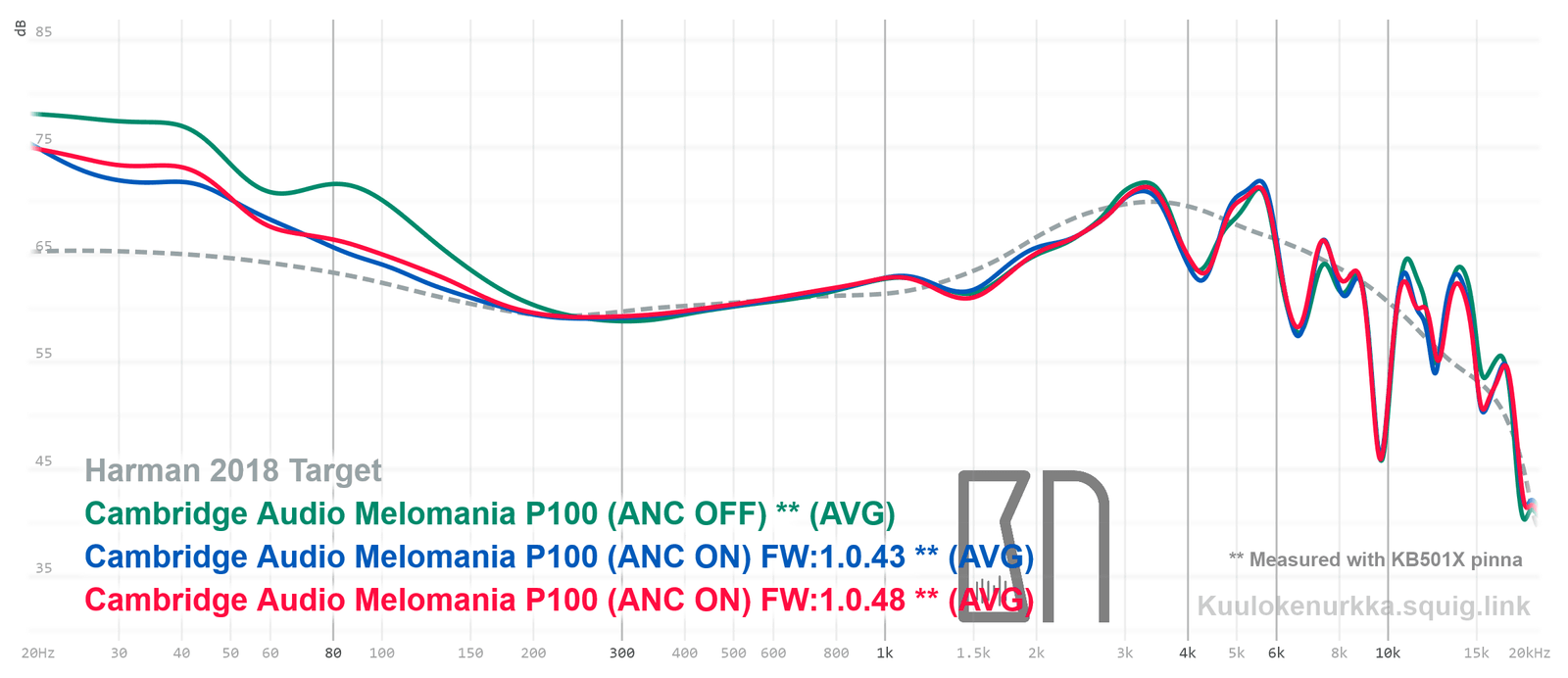
In noise-cancelling headphones, the most striking feature is usually emphasized bass reproduction, and the Melomania P100 is no exception. Especially when the noise cancellation function is off, there is so much bass that the reproduction cannot be expected to remain clear. Fortunately, activating the noise cancellation function drops the low frequencies to a more reasonable level, after which the headphones become surprisingly neutral and balanced for their primary use. There are no significant boosts or attenuations in the most important frequency areas; instead, the Melomania P100 has exceptionally natural mid-frequencies by noise-cancelling headphone standards and, broadly speaking, an appropriate amount of treble. There would certainly be some fine-tuning to be done, but the listening experience is good as it is. The frequency response, which sufficiently respects Harman's target curve, also reveals this.
Most competitor products have greater unevenness in the mid-frequencies, as according to current trends, the 1–3 kHz frequency range, in particular, often falls significantly into a dip. In such cases, strong bass reproduction easily covers the most important parts of the music, making both instruments and vocals sound weak. The more linearly tuned Melomania P100, on the other hand, manages to sound clear, even though it also strongly emphasizes the lowest bass and creates additional sound pressure in the music. However, we can give Cambridge Audio applause for the absence of muddying mid-bass emphasis. Why is the same so difficult for other manufacturers?
In summary, I would describe the Melomania P100 as a natural-sounding headphone with a pronounced, robust sub-bass and a little extra sharpness in the presence region between 5–6 kHz. Since other frequency response irregularities are harder to detect during listening, I seriously have to wonder if one can get better-sounding noise-cancelling headphones for under 300 euros. Competitor products could, of course, be equalized, but I'm already getting tired of mediocre default tunings. I really appreciate that the Melomania P100 sounds good and easily adoptable right out of the box. I didn't expect that, of all manufacturers, Cambridge Audio would grasp the plot so well.

Bass:
At this point, I want to mention an issue related to firmware version 0.1.43 that would have prevented me from recommending the headphones. Although the matter is not visible in the frequency response measurements I published, the Melomania P100”s sub-bass previously rose an incredible 15 decibels between 10–20 hertz. The human sense of hearing does not extend to 10 hertz, but our bodies can still perceive such low infrasound frequencies in other ways. In the case of the Melomania P100, a strong emphasis could have damaged hearing or otherwise affected health under certain conditions. For me, the headphones quite quickly caused fatigue and discomfort. There was often a low and burdensome ”hum" felt in the background of the reproduction. This was also not possible to equalize away via the manufacturer's app.
The culprit turned out to be the headphones' noise cancellation function, whose erroneous operation seemed to have produced an extra 10–20 hertz rumble into the sound. For the same reason, there was certainly more pressure in the ears than now, which further worsened my listening fatigue. However, in firmware version 0.1.48, the manufacturer fine-tuned its noise cancellation function regarding interference sounds, which simultaneously lowered the 10 hertz emphasis by about 7 decibels. The change clearly reduces the strain of the Melomania P100, so listening to the headphones is now more relaxed and probably also healthier. From a frequency response perspective, the fine-tuning of the noise cancellation function slightly changed the bass reproduction at other frequencies as well, but the experience regarding audible frequencies is still very similar to before. In other words, there is still a really abundant amount of sub-bass.
I could praise the headphones as very enjoyable for listening to bass music and all kinds of pop. At its best, the Melomania P100 thumps with such power that I literally get goosebumps. At the same time, it avoids sounding too loose or boomy, because its bass is correctly emphasized at the lowest frequencies, and not between 150–300 hertz. Among competitors, Sony likes to emphasize bass already at 300 hertz, which completely breaks the clarity of the mid-frequencies. Similarly, Bowers & Wilkins headphones and Sennheiser Momentum 4 start their bass emphasis more strongly from the upper bass, whereby the bass and mid-frequencies, as it were, compete for attention with each other.
If headphones must have a lot of bass, I would wish it to happen exactly like with the Melomania P100. Its bass successfully stays sufficiently separate from the mid-frequencies, and doesn't really announce its over-emphasis too much, unless the music listened to contains a lot of the lowest frequencies. Occasionally, there are certainly tracks that, with equally emphasized bass, inevitably sound overly heavy and unbalanced. For this reason, it would be nice if Cambridge Audio's equalizer allowed adjusting 20–60 hertz downwards without the area around 200 hertz simultaneously dipping too much.
Mid-frequencies:
I could applaud Cambridge Audio for deciding to implement headphones with natural and clear mid-frequencies. The ear-gain region correctly rises to its highest level at 3 kHz, which the human ear, so to speak, likes. A slight ”calming” between 1.5–2.5 kHz is actually just right without the sound becoming too soft – a moderate bump at 1 kHz might very well compensate for the situation. The reproduction is clear and pleasantly present. When implemented correctly, a more calmly reproduced 2 kHz region would certainly add a sense of spaciousness to the sound, but a more linear tuning like that of the Melomania P100 sounds the most natural when comparing headphones to loudspeakers.
I can't really find anything to complain about regarding the headphones' mid-frequencies; they are a perfect performance. Both vocalists and instruments sound like themselves without their energy pushing too much into your face or remaining too distant. Only the robust bass occasionally manages to draw too much attention to itself, making the presentation not quite as effortless and fresh as I would hope for in an optimal situation.
Treble:
The Melomania P100's treble has some unevenness, which is why it doesn't sound of the highest quality. However, the human brain can smooth out narrower dips quite well during listening, so they don't obviously stand out. I occasionally find only the slight emphasis at 5–6 kHz irritating, as it adds a touch of extra sharpness and hiss to the sound. However, this does not occur with nearly every song, nor does it cause sibilance. Otherwise, the treble is just right for my taste. It is clear and fresh, but not harsh or unnaturally sparkling. The high frequencies, in a way, do their job without standing out too much in the overall sound. This is, so to speak, a safe option, but I believe many would also prefer a slightly brighter treble, especially if their previous headphone experiences have focused on V-shaped tuned models.
Other observations:
Aside from somewhat exaggerated sub-bass and background noise, it is ultimately difficult to find much to criticize about the Melomania P100's sound quality. For its price, the headphones have a very accurate sound and a well-proportioned soundstage, where elements intended for the center, such as the vocalist, are reproduced in their correct place, and the movements of other sounds can be followed sufficiently separately from each other. However, given the closed-back design, one should not expect a particularly open and impressive soundscape; rather, the listening experience is focused on the sound heard up close. This is not a drawback, however, but has its own charm. For example, at 500 euros, the Melomania P100 would not feel very special, but at under 300 euros, it is excellent. When listening with a USB cable, the bass becomes tighter and the soundstage feels slightly more spacious – the sound, as it were, opens up better and is less compressed. This is definitely worth trying, even if a Bluetooth connection makes life easier.
I also tried to assess whether Cambridge Audio's Class A/B amplification could be heard in the Melomania P100's sound in some way, but it is practically impossible to evaluate. Based on the long battery life, the headphones' built-in amplifier certainly doesn't consume much power, so it's unlikely that full clarity on the implementation will be easily obtained.
Is it possible to improve the sound with the manufacturer's equalizer?
As I already mentioned, I don't find Cambridge Audio's equalizer to be very good or useful. Otherwise, the Melomania P100 doesn't really require equalization, but I wish the bass controls worked better. Currently, they lower the upper bass frequencies even more than the sub-bass, which is what I would like to adjust downwards. I have had to settle for very moderate adjustments so that the headphones' sound doesn't become too thin. However, even a small reduction in bass helps in situations where the mid-frequencies tend to get a bit lost in the rumble of the bass. I have also slightly boosted the uppermost treble, as I found that the added airiness compensates well for the robustness of the reproduction.
** Small update: After using the headphones more, I have found that increasing the treble is the best remedy for balancing the strong sub-bass. The sound becomes fresher overall when all three sliders affecting the high frequencies are moved upwards by approximately the same amount as I have done for a single slider in the following image.
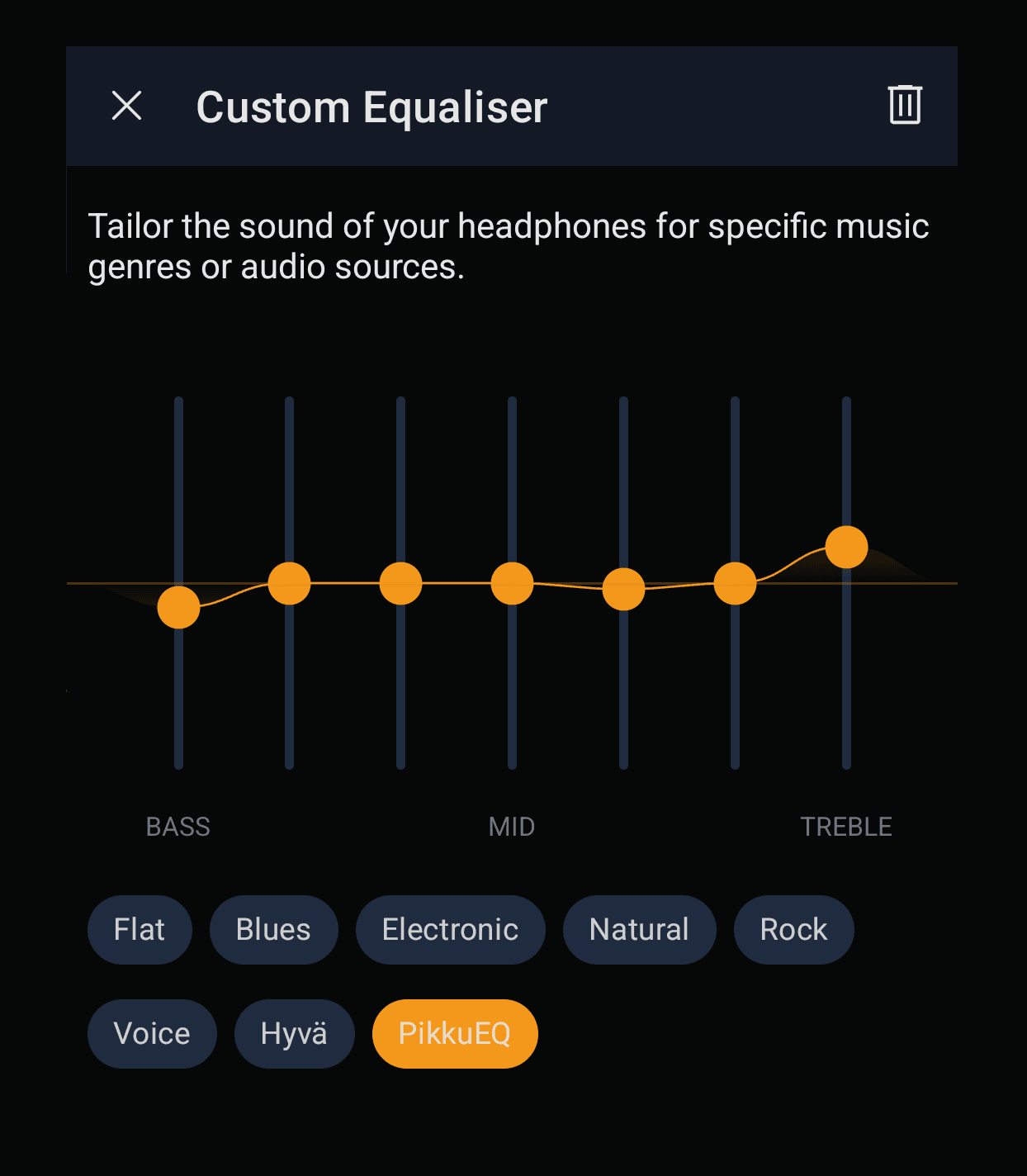
In my opinion, with these changes, the Melomania P100 sounds a tiny bit better, but ultimately not very different from how it already was. Greater changes would therefore have to be sought with another equalizer, although from a subjective standpoint, the sound could certainly be colored in different directions with Cambridge Audio's tool as well.
Comparisons to other headphones
Melomania P100 vs. Valco VMK25 (”2024”)
Prices: 279 € vs. 199 €

Among us Finnish internet users, few have likely avoided Valco's amusingly funny advertisements, so its VMK20 and VMK25 headphone models are probably relatively familiar. The newer VMK25 has been Kuulokenurkka's most read headphone since its review, and it has also often been used as a comparison for other noise-cancelling headphones. Its 200-euro price makes it actually difficult to overlook, as it is not significantly more expensive than the market's most affordable noise-cancelling headphones, yet somewhat cheaper than the offerings of many larger companies. Until now, I have been using Roderick's review unit from 2023, but this time I get to use my own headphones, which Valco kindly provided to me. I will start by mentioning a few small surprises.
Differences related to use:
The VMK25 currently sold has slightly different ear pads than it did last year. I'm not sure when the pads were changed, but they are plumper and softer than before, and thus more comfortable for me. They also seal my ears more tightly, so the noise cancellation capability feels slightly better. The frequency response, and consequently the sound, has also undergone a small change, but more on that in a moment. In my opinion, there's no need to make a big fuss about changes that happened quietly, but I don't want to hide the matter either. Wearing the current VMK25 is really comfortable, so it surpasses Cambridge Audio's Melomania P100 in terms of wearing comfort and fit stability for me. Valco's headphones also look sleeker and more streamlined on the head, and weigh about 40 grams less.
Structurally, I otherwise find the Melomania P100 to feel a bit more premium due to its metal parts, but the headphones also cost 80 euros more. Valco's matte ”soft touch” surface feels nice, but with use, it becomes a bit worn and oily-looking. For many tastes, a more casual appearance might, of course, suit them clearly better than the Melomania P100's attempt to look stylish.
In terms of features, the Melomania P100 is more versatile and has slightly better battery life, but I don't consider the equalizer found in the app, for example, a major advantage. The lack of extra adjustment options makes using Valco's headphones very straightforward, which certainly serves the manufacturer's target audience. The possibility of replacing the battery could theoretically be one of the Melomania P100's biggest advantages, but for us Finns, Valco's service practically achieves the same ease. The noise-cancelling function in the VMK25 does not cause interference sounds or as much pressure sensation as the Melomania P100, but Cambridge Audio's headphones suppress noise more effectively. Both headphones have some background hiss, which is fainter in the VMK25 but sharper in tone.
Sound quality differences starting from frequency responses:
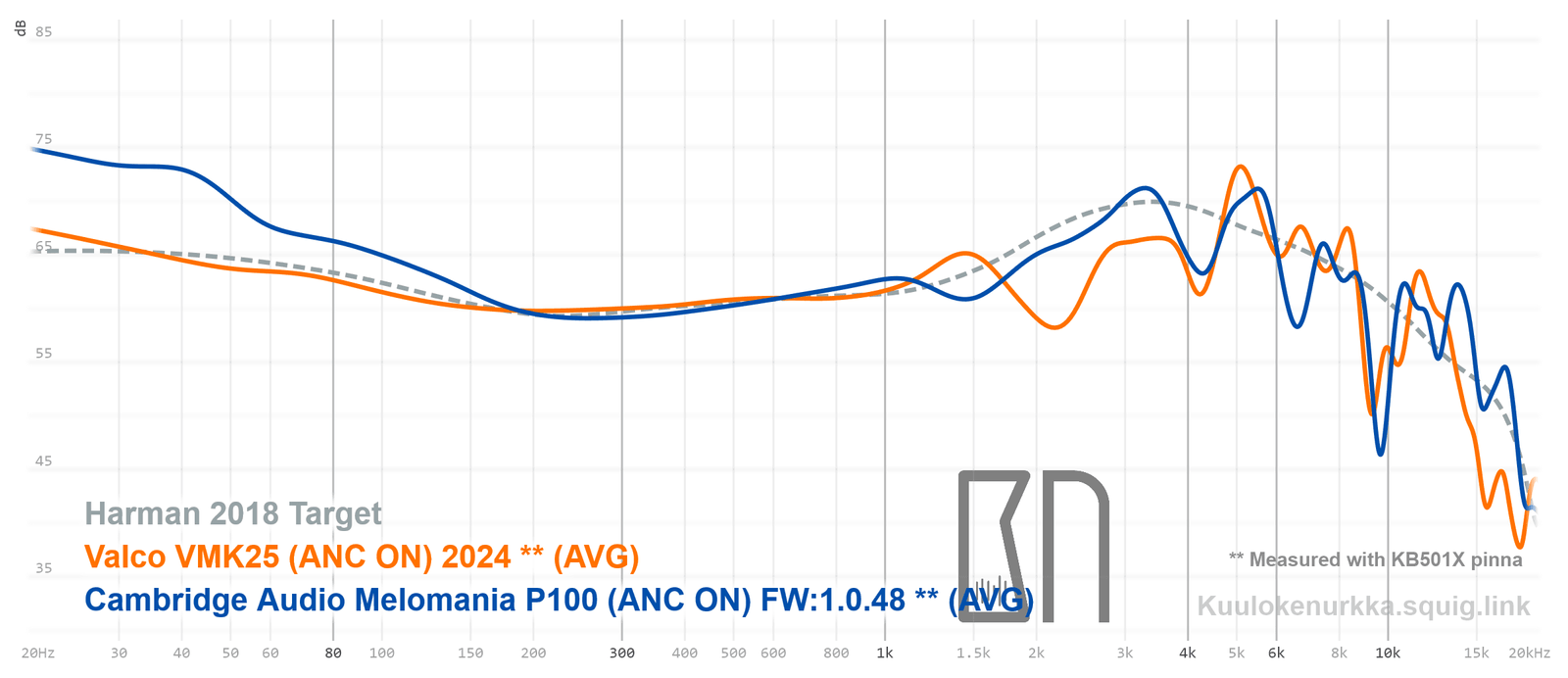
The duo differs most in terms of bass reproduction and upper midrange frequencies. The VMK25 has a very orthodox amount of bass, which is sufficient for most situations. However, if someone is accustomed to emphasized bass reproduction, Valco's headphones might sound a tad light next to a bass cannon like the Melomania P100. When aiming for balanced and clear reproduction, it is, however, an example of good headphones. The Melomania P100, on the other hand, rumbles and kicks more enjoyably when listening to bass music, but can sometimes sound too heavy if the listener doesn't want to focus on the bass.
The midrange frequencies of Valco's headphones are changed slightly with different ear pads. In the current version of the headphones sold, the area around 1.5 kHz is reproduced slightly more energetically than before, and the range between 3–5 kHz is, in turn, more subdued. This makes the reproduction slightly more uneven and especially female vocalists sound a bit veiled, which is why I prefer the Melomania P100 of the two, as it reproduces the midrange frequencies more energetically and cleanly. With it, the sound is more natural and present than with the VMK25. For example, small nuances in instruments and the vocalist's voice are more clearly brought out by the Melomania. The placement of sounds in space also feels more precise. On the other hand, the strong bass emphasis constantly takes its share of attention, so the presentation is less fresh compared to Valco's headphones. As a counterbalance to its thinner and softer sound, the VMK25 offers more relaxed listening moments and a soundstage that feels more spacious. I would ultimately be very happy to listen to both headphones.
With its lighter bass and calmer upper midrange frequencies, the VMK25 emphasizes the treble more of the two, and consequently sounds slightly brighter and more sparkling. This creates an impression of more neutral reproduction, even though Cambridge Audio's headphones have more energetic midrange frequencies. My experience is actually greatly influenced by the fact that when listening to the VMK25, I feel like I'm perceiving the sound from a bit further away, so that individual sounds don't automatically grab my attention in the same way as with the Melomania P100. The new ear pads seem to have slightly lowered the treble level of the VMK25, which I personally experience as an improvement in sound quality. The headphones no longer feel slightly bright to me, but just suitably more relaxed. However, there is some unevenness in the high frequencies of both headphones, so different people may experience them very differently depending on how the emphases align with their own hearing.
The colorations of neither headphone are particularly distracting in the long run, so superiority may vary depending on the music listened to. I like the freshness and spaciousness of the VMK25's sound, as well as its more reasonable amount of sub-bass. The Melomania P100, on the other hand, sounds more natural and believable in its midrange frequencies, so I find myself preferring it of the two. However, I also give the VMK25 a thumbs up, as is customary, because it also sounds better than most of its similarly priced competitors. In an optimal situation, I would combine the VMK25's bass reproduction and the Melomania P100's midrange frequencies.
Melomania P100 vs. Bowers & Wilkins PX7 S2e
Prices: 279 € vs. 429 € (current market price 300–350 €)

The PX7 S2e, which currently costs a minimum of 300 euros, is a tough competitor for the Melomania P100, because Bowers & Wilkins, with its longer experience, has managed to refine the technical side of its headphones. Its headphones also have a similar premium feel, so I assume the target audience for the duo is largely the same. It is even surprising how two British companies are entering the noise-cancelling headphone market with such a similar approach. That's why they are an interesting comparison pair.
Differences related to use:
Surprisingly, the more affordable Melomania P100 even features more metal, as the PX7 S2e's headband is made entirely of plastic, and only the sides of the cups are aluminum. However, this doesn't significantly show in the weight, as the Melomania P100 weighs only just over 20 grams more. Both designs surely have their fans, but on the head, the PX7 S2e looks better and more slender in my opinion. It also fits more securely, as the headband doesn't protrude as much to the side of the head. In terms of comfort, however, the situation is even. I prefer the PX7 S2e's headband, while the Melomania P100's ear pad opening is larger, so my ears don't touch the edges. Due to ear contact, I am more clearly aware of wearing the PX7 S2e headphones.
The duo largely matches each other in features, although the Melomania P100 offers slightly more adjustment options. Regarding applications, I prefer Cambridge Audio because it doesn't require unnecessary user account creation. I already noted that the Melomania P100's noise-cancelling function is slightly more effective than the PX7 S2e's, but also somewhat more susceptible to interference. The background noise in B&W's headphones is less, and the transparency mode also produces a more natural result. Likewise, I have achieved more sensible sound improvements with the equalizer, so Bowers & Wilkins, in my opinion, wins in terms of user experience smoothness. In this area, Cambridge Audio still has some room for improvement.
Sound quality differences starting from frequency responses:
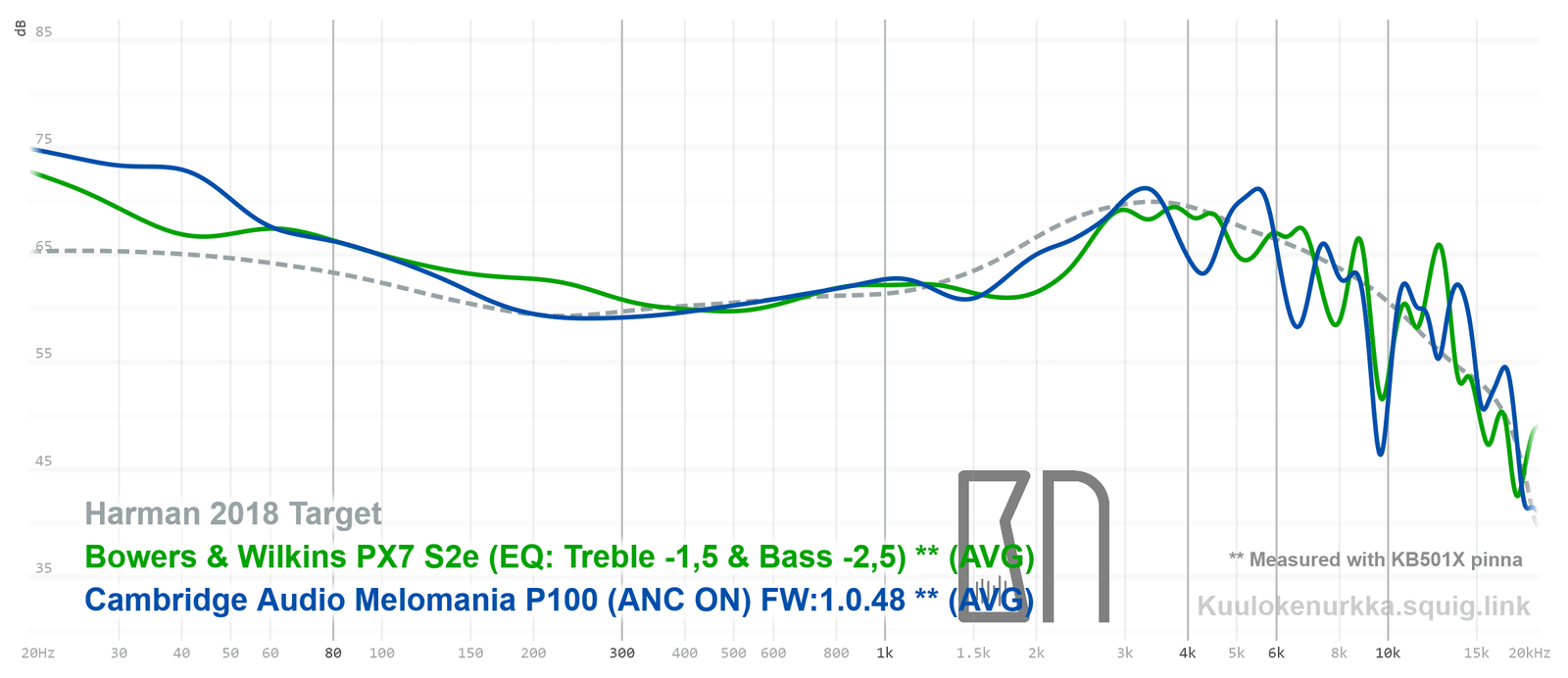
I usually use the PX7 S2e with an equalization made through the manufacturer's app, which lowers the bass level from 300 hertz downwards and thus makes the reproduction objectively more balanced. I didn't see a need to return to the default settings, as I don't consider it likely that many who appreciate good sound quality would experience an even fuller mid-bass as a clear strength against the Melomania P100. B&W's headphones are in any case still slightly more V-shaped, meaning their midrange frequencies are less prominent compared to the bass and treble. This is largely due to the robustly reproduced upper bass and the dip in the upper midrange frequencies at 2 kHz. The PX7 S2e's reproduction has both robust punch and spatial openness, but it is also softer and less present-sounding than the Melomania P100.
Many might find the PX7 S2e's upper bass somewhat boomy, but to my taste, it has a pleasantly warm tone and remains sufficiently tight, especially when the sub-bass doesn't start thumping as strongly as in the Melomania P100. I also like the headphones' relatively even treble, which doesn't have the kind of variation between 3.5–7 kHz that the Melomania P100 does. Thanks to this, the PX7 S2e's reproduction is slightly smoother and of higher quality. Otherwise, the duo does not significantly differ in brightness.
The Melomania P100 sounds slightly clearer and more engaging in its midrange frequencies, while the PX7 S2e's clearest advantage, in my opinion, is a more realistic spatial impression and wider sound separation. I personally experience the headphones' soundstage as deeper, as, for example, the vocalist comfortably positions themselves slightly in front of me in the overall sound. The Melomania P100, which reproduces sound intimately, on the other hand, sounds like a more conventional closed-back headphone. Solely because of this difference, I would classify the PX7 S2e as a slightly more expensive headphone, which it indeed is. However, the experience is probably not entirely similar for others, so generally speaking, I would call the Melomania P100's more linear midrange frequencies and clearer bass reproduction in style improvements over B&W's headphones. The strengths are thus quite evenly distributed between the two.
Although the PX7 S2e's coloration may divide opinions more, it ultimately attracts me more. Especially the soundstage, which I experience as more spacious and separated, the less exaggerated sub-bass, and the higher quality treble, subtly elevate the sound quality above the Melomania P100. On the other hand, without the EQ adjustments I made to the PX7 S2e, the Melomania P100 would be better of the two as is, so with minor additional adjustments, the situation could turn either way.
Summary
Cambridge Audio clearly released the Melomania P100 somewhat unfinished, so even a couple of weeks ago, I couldn't have recommended purchasing the headphones due to various bugs. Since then, however, the situation has already improved, so by the time the headphones reach sales in Finland, they are likely to be even more complete – fortunately so, as in the worst case, the manufacturer might have left further development undone. For this reason, buying a completely new product among the first is always a small risk.
Now that the worst teething problems have been resolved, I'm starting to warm up to the Melomania P100 to the extent that I could recommend purchasing it, at least for less mobile use. The headphones' noise-cancelling function is more effective than average, and the battery lasts a really long time. The fit on the head isn't quite perfect, but the comfort of use is still very good for me, at least. I also don't find any obvious weak points in the construction; instead, the impression of quality successfully matches the selling price.

However, the most important thing for me in headphones is sound quality, which happens to be the Melomania P100's greatest strength, even though the background hiss is a bit annoying. Cambridge Audio has tuned its headphones really well, which I didn't fully expect. Especially the lack of mid-bass emphasis and natural mid-frequencies impress me. I would wish for less emphasis on the sub-bass, but it generally stays well enough in its own territory in most situations. The treble doesn't sound irritating either. In my opinion, the Melomania P100 is one of the best noise-cancelling headphones under 300 euros I've heard in terms of sound quality. The possibility of replacing the battery could very well make it a long-lasting purchase for many. Still, there's no need to rush, as Cambridge Audio still has some minor refinements to make to its product. That's why I can't quite yet elevate it to the Headphone Corner's wall of fame – but it's close.
Pros and cons:
+ Natural mid-frequencies and surprisingly neutral tuning
+ No mid-bass emphasis, but powerful sub-bass
+ Quality-feeling construction
+ Good comfort
+ Competitively effective noise-cancelling function
+ Smooth volume control
+ Excellent battery life
+ Battery replacement option
+ Higher quality cables than usual
+ Reasonable selling price
+/- Looks quite stylish, but wide on the head
-/+ The headphones initially contained many bugs, but the manufacturer seems to be diligently fixing them
– Overly loud sub-bass sometimes rumbles too much
– There is slight unevenness in the treble
– The equalizer included in the app is not particularly useful
– Background noise
– Hard headband and a slightly wobbly fit
– The noise-cancelling function causes interference sounds more easily than usual and some pressure on the ears
 EN
EN  FI
FI
Hi,
Thanks for the thorough review! The headphones seem excellent in their sub-300€ price range!
For comparison, I would like to ask how much more open and precise the soundstage of the PX7 S2e is compared to the P100? Is the difference tiny, or actually noticeable? The resolution, by the way, is probably in the same class for both headphones.
Hi,
Thanks for the feedback! The headphones were undeniably a positive surprise for me.
The difference in soundstage openness and precision is by no means huge between the two, considering how subjective these characteristics are. I wouldn't necessarily favor the PX7 S2e solely for that reason, especially since the Melomania P100 is, in principle, the more natural of the two. With the PX7 S2e, I anyway experience the sound being positioned slightly in front of me, which doesn't happen as much with the Melomania P100. This is probably due to the PX7”s more calmly reproduced 1-3 kHz frequency range (and perhaps more tilted drivers?), which ”prevents” the vocalist and instrument energy from coming as close as with the Melomania P100. For the same reason, I perceive more spaciousness in the reproduction when it stays a bit further away. I wouldn't necessarily call the PX7 S2e more precise, but with it, I can observe things happening in the soundstage a bit more easily, because the part of the sound usually in the center, in turn, attracts a little less attention. I personally associate such a characteristic with more expensive headphones. However, different people may hear such a ”coloration" differently, which is why the Melomania P100 is slightly more honest to the recordings themselves.
I no longer want to evaluate resolution nowadays, as I have found it to largely arise from frequency response, lack of distortion, and e.g. the quality of the Bluetooth signal. The PX7 S2e sounds slightly cleaner, probably due to its smoother high frequencies. It does, of course, have more interesting biocellulose drivers, which I am more enthusiastic about than the basic drivers of many other noise-cancelling headphones. 😀 If someone dislikes emphasized mid-bass and is tired of the ”soundstage dip” in the mid-frequencies, the Melomania P100 is a better choice despite its thumping sub-bass. So, in terms of sound quality, these two are ultimately quite even. 🙂
Thanks for the answer! I appreciate your convincing reviews related to hifi!
I'll have to go listen to those PX7 S2e's in a store. In any case, they are a departure from previous B&W Bluetooth over-ear headphones, which have been almost unusable due to poor default tuning (muddy and veiled). In that sense, they are interesting!
Where could these be bought in Finland?
Unfortunately, they haven't arrived in Finland yet, but Cambridge Audio's own EU website ships for free, and the headphones would also have a 60-day return policy.
I just want to say thank you, for your thorough and deep review of the P100 which became my favorite among the few other cans I own. I’ve found your FR graphs on head-fi earlier and these were very helpeful fine tuning the DSP. I just didn’t register there yet, so I am cheering here.
The only griefs I have with this set, is the microphonic cable, because I am a tethered guy most of the time. Therefore it is a little bit of a PITA too, Bluetooth is always active and I have to be careful not to move too far back and forth when devices are connected wirelessly, avoiding these connectetd/disconnected prompts while listening. And, of course, in summer there is a ventilation problem underneath the faux-leather pads. Other than that, I truly enjoy listening through these cans, which are so well tuned right off the bat.
So which better for progressive rock music P100, Px7 or Momentum 4 in your opinion?
I find B&W and consumer grade Sennheiser cans such as the Momentums have far too much bass for my tastes , and the fact that they have to be thrown away when the battery degrades makes them a no no. I use the P100 when out walking in the countryside, and the ANC, while not perfect, is good enough that I can listen to foreign language podcasts without issues. All I hear of a passing car is a whoosh of the tyres. The ANC is as good as with the Bose QC25 that I own. I find them very comfortable, no complaints at all. There is somwtimes a squeaking from the joints, adjusting the position over the ear solves that. The P100 sound is on a par with my Sennheiser HD600, with a bit more bass when using the flat EQ. That for me is a mark of the sound quality. TheP100 has much better sound than the Bose QC25. Cans will never match good loudspeakers for sound quality, but these cans are excellent, decent build, user replaceable battery, and excellent sound.
An updated P100SE model was just released. Surely it will be tested at some point?
Let's see if someone would like to lend one for testing. Initially, the new model even seems like a slight degradation in sound quality, because the loudness mode and stronger bass are the last things the Melomania P100 needs in my opinion. Rather, excessive sub-bass should be gotten rid of, but perhaps the equalizer in the new model is smarter than before? The headband admittedly needed improvement, but based on the first reviews, the change in that regard is quite marginal. Thus, it does not yet arouse immediate testing enthusiasm, and I think I will first focus on a few other new products.