Author: Sword of Damocles
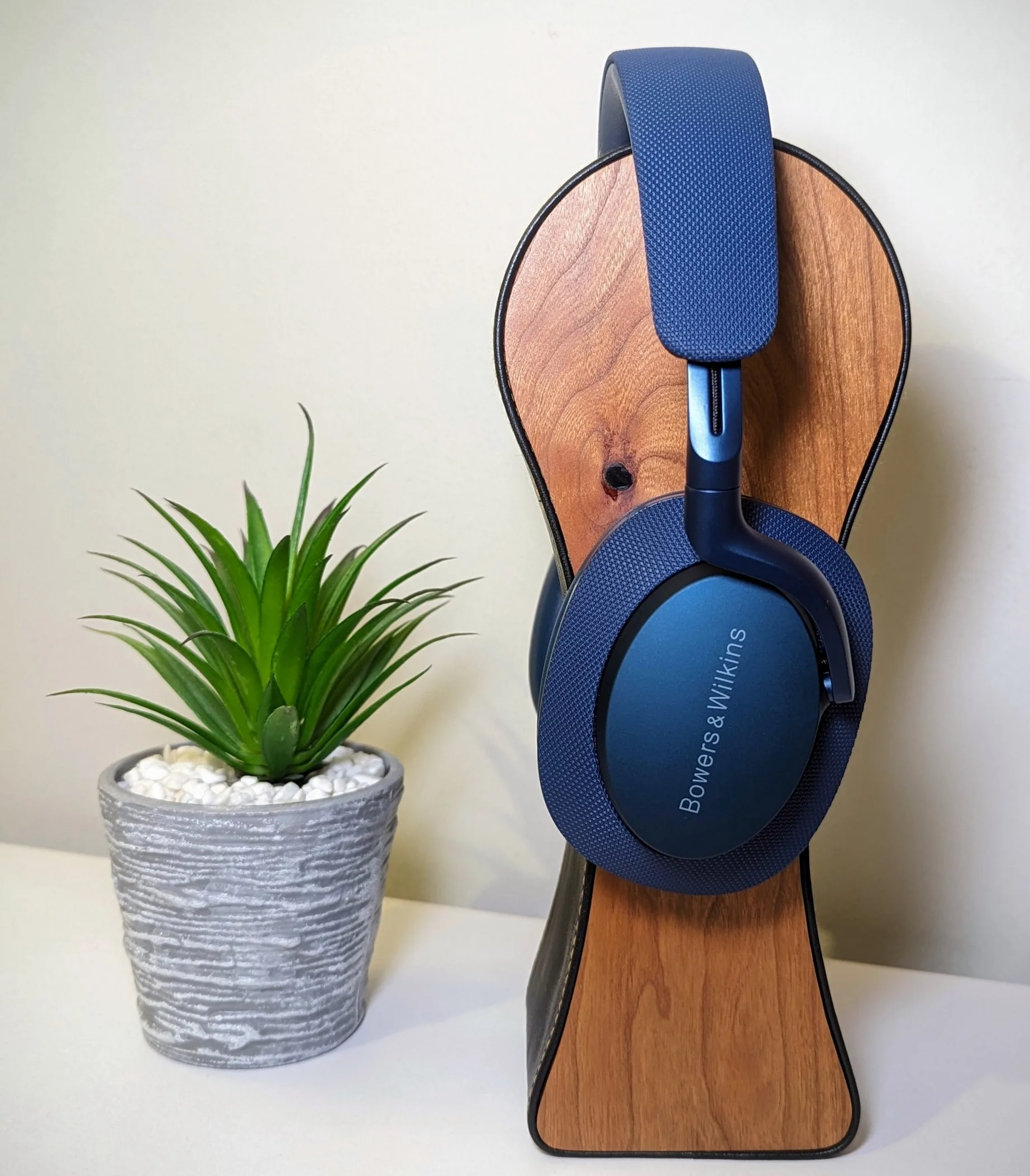
Table of Contents:
Information:
- Release year: 2023
- Designed in Britain and manufactured in China
- Color options: Black, gray, blue, green
- Price: 429 €
- Type: Closed, over-ear
- Dynamic 40 millimeter biocellulose drivers
- Audio connections: Bluetooth 5.2 and USB-C (can also be connected to a 3.5 mm jack with a suitable cable)
- Bluetooth codecs: AptX Adaptive, AptX HD, AptX, AAC and SBC
- Weight: 307 g
- Battery life: up to 30h (15 min fast charging provides 7h additional usage time)
- Charging port: USB-C
- Noise cancellation function: ON/OFF/transparency mode
- Features: Google fast pair, Voice Assistant, Multipoint, ear detection (wear detection) and phone app with equalizer
- Accessories: Hard carrying case, USB-C cable (length 1.2 m) and USB-C -> 3.5 mm cable (length 1.2 m)
Review unit acquisition: Loaned from the manufacturer
British Bowers & Wilkins has been known for over 50 years for its loudspeakers, but like some other speaker manufacturers, it also sells headphones. A few years ago, B&W still had wired hi-fi headphones in its selection, placed in different price categories. Since then, however, the P3, P5, P7, and P9 models seem to have disappeared from the market, making way for the PX series of wireless noise-cancelling headphones. I wouldn't see the manufacturer's focus on noise-cancelling headphones as a bad decision, as they are probably the best-selling type nowadays. There would also still be room in this market for good sound quality, which many people certainly still value more in headphones than all sorts of small extra features. B&W has always invested more than usual in the external structure and perceived quality of its products, which distinguishes its headphones from most competitors.
Based on the PX7 S2 and PX8, which I have tested quite quickly so far, the manufacturer aims to please large consumer groups who are assumed to like emphasized bass reproduction and bright high frequencies. As a fan of more balanced sound, I haven't been particularly thrilled by such monotonous bass thumping. On the other hand, B&W headphones could be equalized, so I haven't yet explored their potential more thoroughly. That's why I became interested in the model released in September 2023 PX7 S2e (evolved) headphone model (price 430 euros), which will replace the preceding S2 model.
We managed to arrange with B&W's Finnish representative to get the new model for testing on a quick schedule. After expressing my great thanks to B&W Group Finland, we can now move on to finding out what is good about the PX7 S2e, and where there might still be room for improvement from the perspective of a more critical headphone enthusiast.
E-version updates
Based on the manufacturer's information, the PX7 S2e is more of a minor version update than a comprehensive overhaul compared to the previous PX7 S2 model. The structure and appearance seem to have remained unchanged, while the audio side has seen changes in the form of a new DSP chip and tuning. The manufacturer states that they have incorporated lessons learned from the approximately 300 euro more expensive PX8 headphones into the e-version of the headphones.
Product package content
Upon receiving the Bowers & Wilkins product packaging, I immediately knew these were headphones of higher quality than usual. The cardboard box itself is thick and quite heavy, but the combined weight of the carrying case and headphones, 640 grams, also came as a surprise. The first impression is premium and matches the price level of the PX7 S2e.
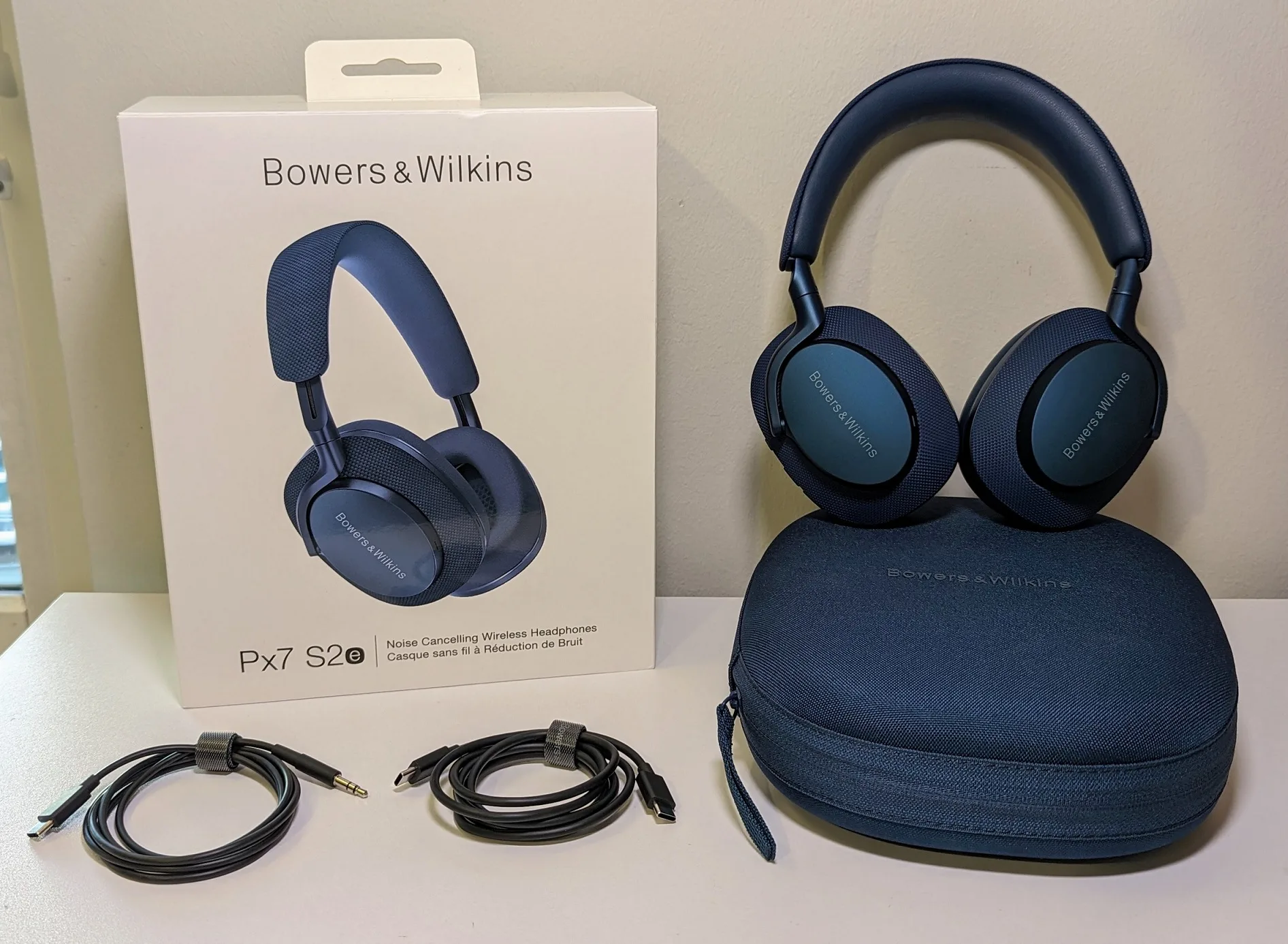
Excluding the instruction manual, the headphones and necessary cables are packed in a stylish and quite heavy carrying case. It is not among the smallest in size, but also not as large as, for example, Sony WH-1000XM5. The headphone cups rotate horizontally to fit into the case, and there is a separate lidded storage compartment for cables that closes with a magnet. I like that the coloring of the headphones and the case is uniform.
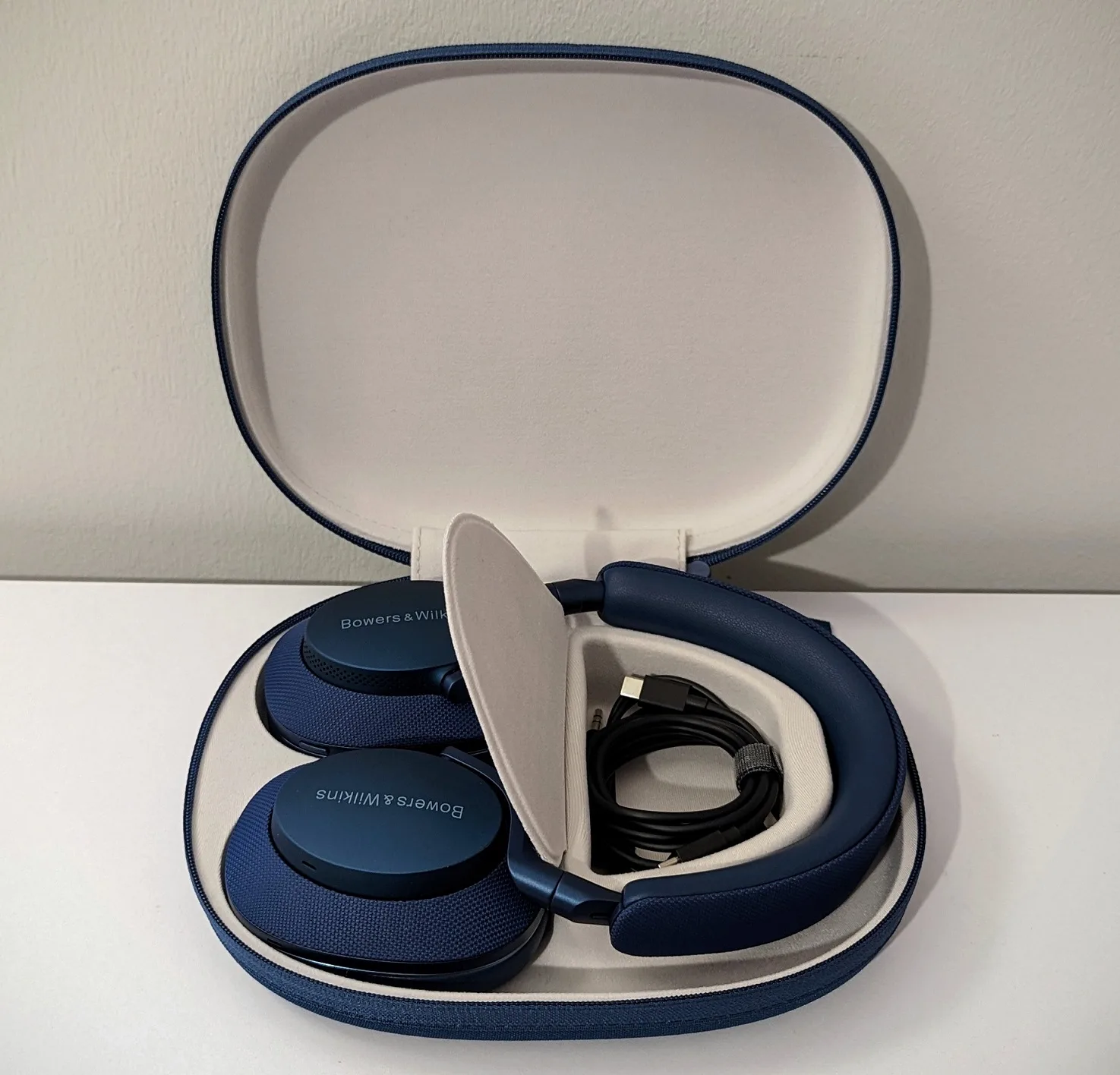
Accessories include a 1.2-meter long USB-C charging cable, which can also be used for listening to the headphones. In addition, B&W has included a slightly more unusual USB-C cable of the same length, which has a 3.5-millimeter headphone jack at one end. The cable does not allow for passive listening without power, but it adds flexibility to the use of the PX7 S2e in situations where a traditional headphone jack, but not a USB-C connector, is found on an audio source that does not support a Bluetooth connection.
Build and comfort
The PX7 S2e is externally pleasingly high-quality and also good-looking, unless the manufacturer's logo printed in cat-sized letters on the outer edge of the cups bothers you. The headphones would be more discreet in black and grey, whereas the green and the blue color option I have stand out positively from the crowd. It's nice to see that stylish materials can be used in noise-cancelling headphones without the product costing significantly more than the most popular plastic headphone models on the market, such as Sonys and Boses.
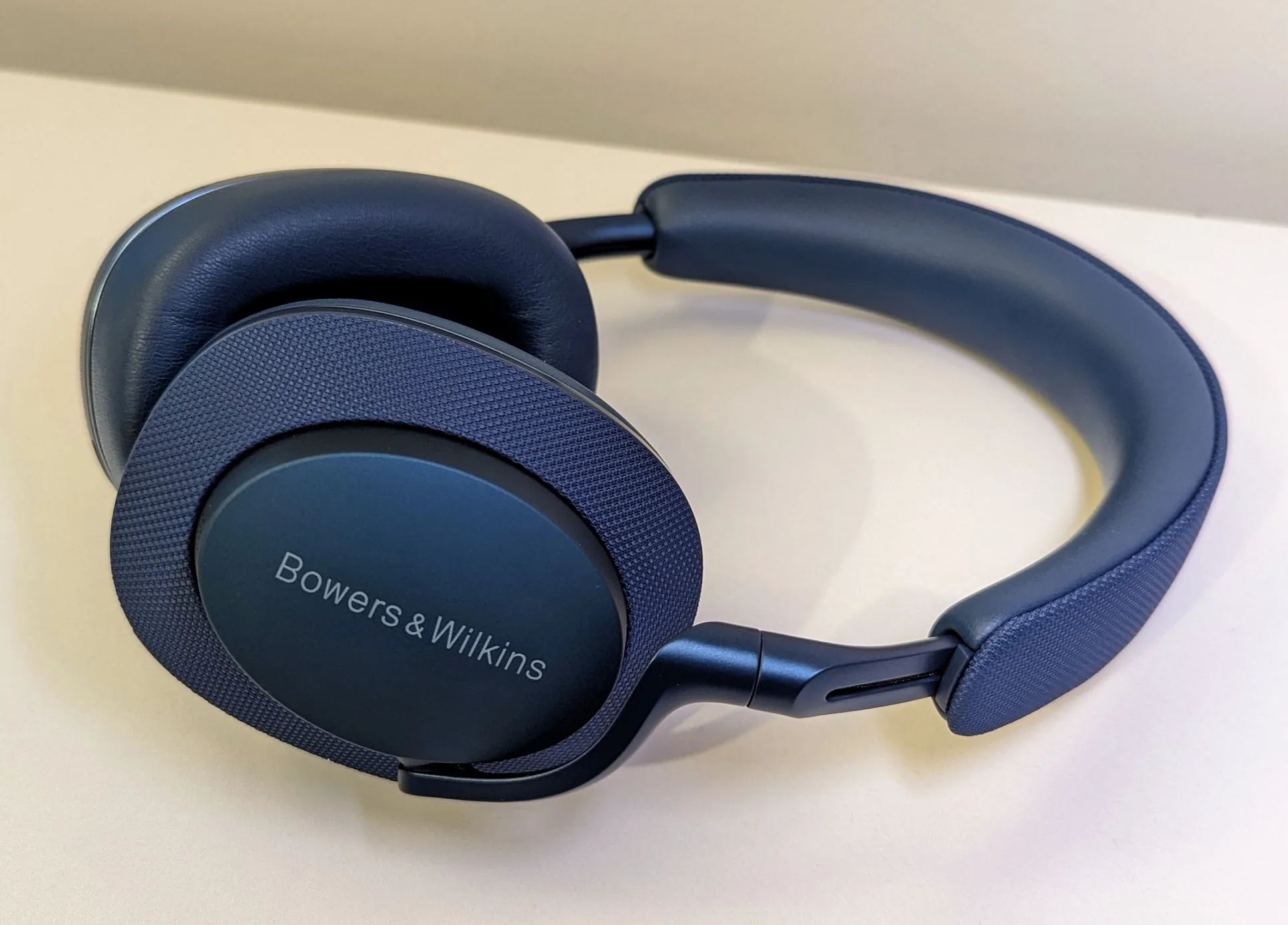
The PX7 S2e is sturdy and well-finished in every respect, without forgetting practicality. The moving parts have just the right amount of resistance, and the structure does not feel loose during handling. In my opinion, the overall impression of quality easily surpasses even more expensive products from competitors – for example, Focal Bathys' 's structure uses more metal, but it is looser in terms of part fitting and sharper at the edges.
In the PX7 S2e, the protruding part of the cups, bearing the manufacturer's name, is metal, while the rest of the cup structure and headband are made of such high-quality plastic that some might mistakenly think the headphones are entirely metallic. However, more metal is only available by purchasing the more expensive PX8 model. The manufacturer has improved the quality impression of the PX7 S2e by adding fabric upholstery to the outer edge of the cups and the top of the headband – the material appears wear-resistant due to its hardness. The padded parts, in turn, are covered with pleasant-feeling artificial leather. The coloring of the different parts and materials is admirably uniform. In the blue version of the previous S2 model, the decorative strips on the cups and the manufacturer's name were gold, whereas in the S2e, they have been changed to silver.
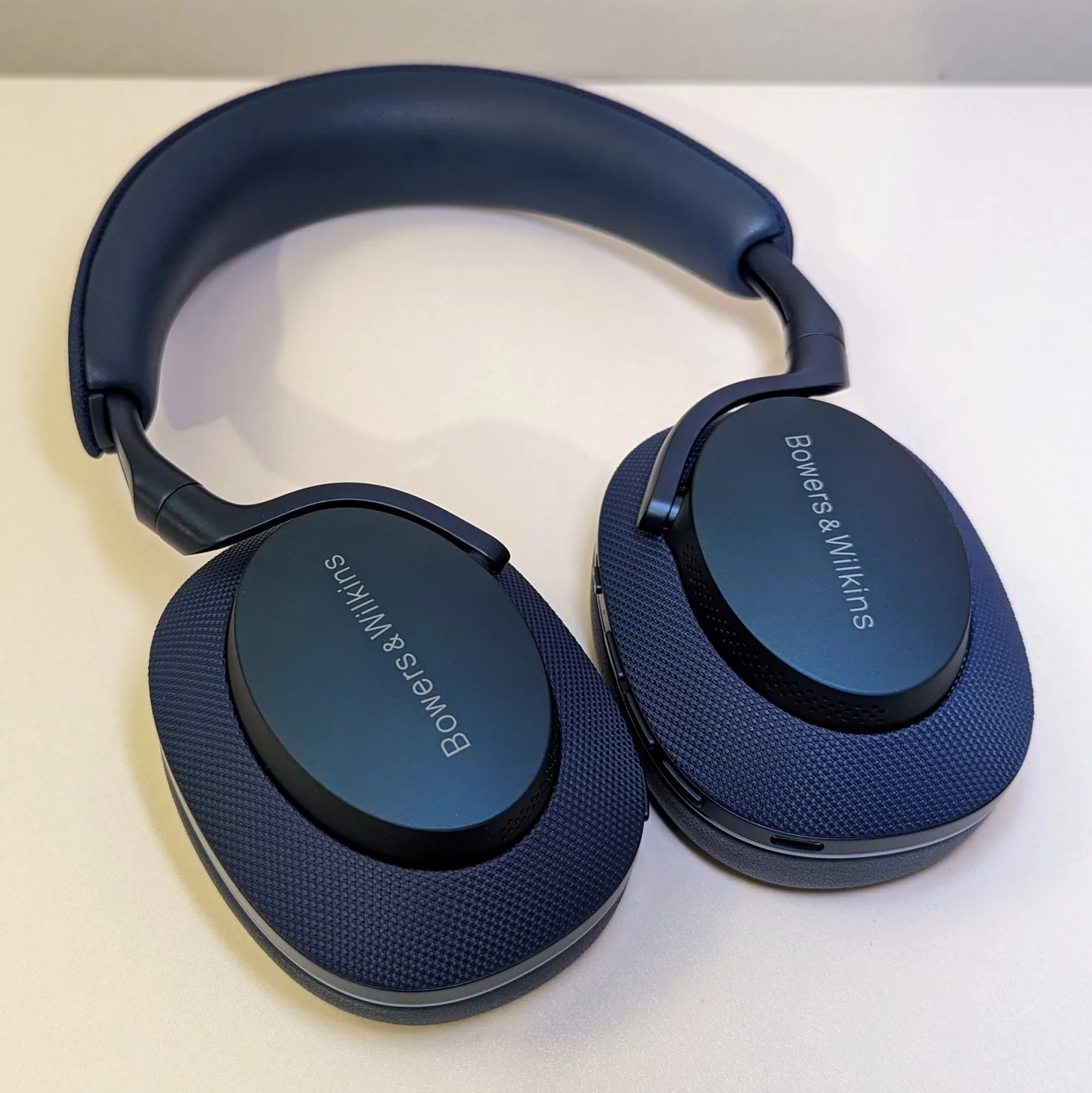
The headband's height adjustment works smoothly and steplessly. The cups, unlike many other headphones, rotate horizontally on both sides, so the PX7 S2e can be easily placed either around the neck or on a table, depending on the situation. Inside the ear pads, there are also sensors that, with a delay of just over a second, cut off audio playback when the headphones are removed from the head. This is still a relatively rare feature in noise-cancelling headphones.
The fit of the headphones on the head is good thanks to the even clamping force, and I have not experienced any pressure on the top of my head, even though the headband padding is typically quite thin. The PX7 S2e weighs 307 grams according to both the manufacturer's information and my own scale, which I have found to be still suitable considering the high-quality materials, compared to many other options weighing under 250 grams. Ultimately, regarding the structure and comfort, my only complaint is about the somewhat small ear pads, which, despite their soft memory foam, never feel particularly natural.
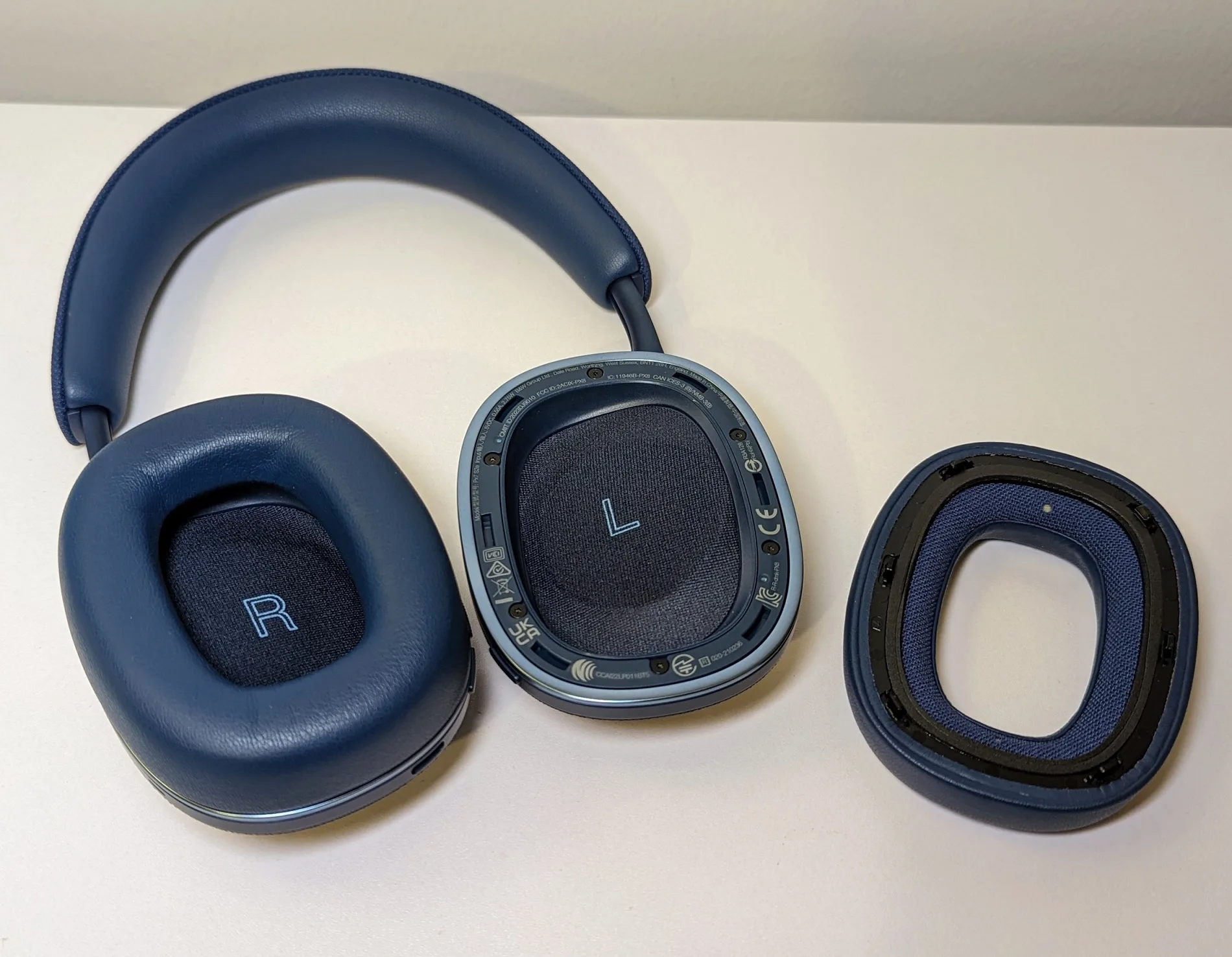
The idea behind the earcups is the same as, for example, in Bose's QuietComfort series headphones (QuietComfort SE model review): plenty of space is left at the back of the earcup thanks to the tilting of the drivers. The varying depth of the earcups, between 1 and 2.5 centimeters, is sufficient for my earlobes. However, the ear opening in Bowers & Wilkins headphones is crucially slightly smaller than in the Bose products I mentioned, so I always have to move the headphones quite vigorously on my head to comfortably fit my ears inside them. There is additional empty space under the edges of the earcups, so I believe the size of the ear opening could have been increased at the expense of the earcup edges' thickness. However, it might be that the current design is better for the functionality of the noise-cancelling feature. The edges of the earcups lightly touch my ears during use anyway, which is why I can never completely forget that I'm wearing the PX7 S2e. Apart from these earcup-related annoyances, the comfort of the headphones, after proper adjustment and a little getting used to, is still good, if not excellent. I can easily use the headphones for several hours.
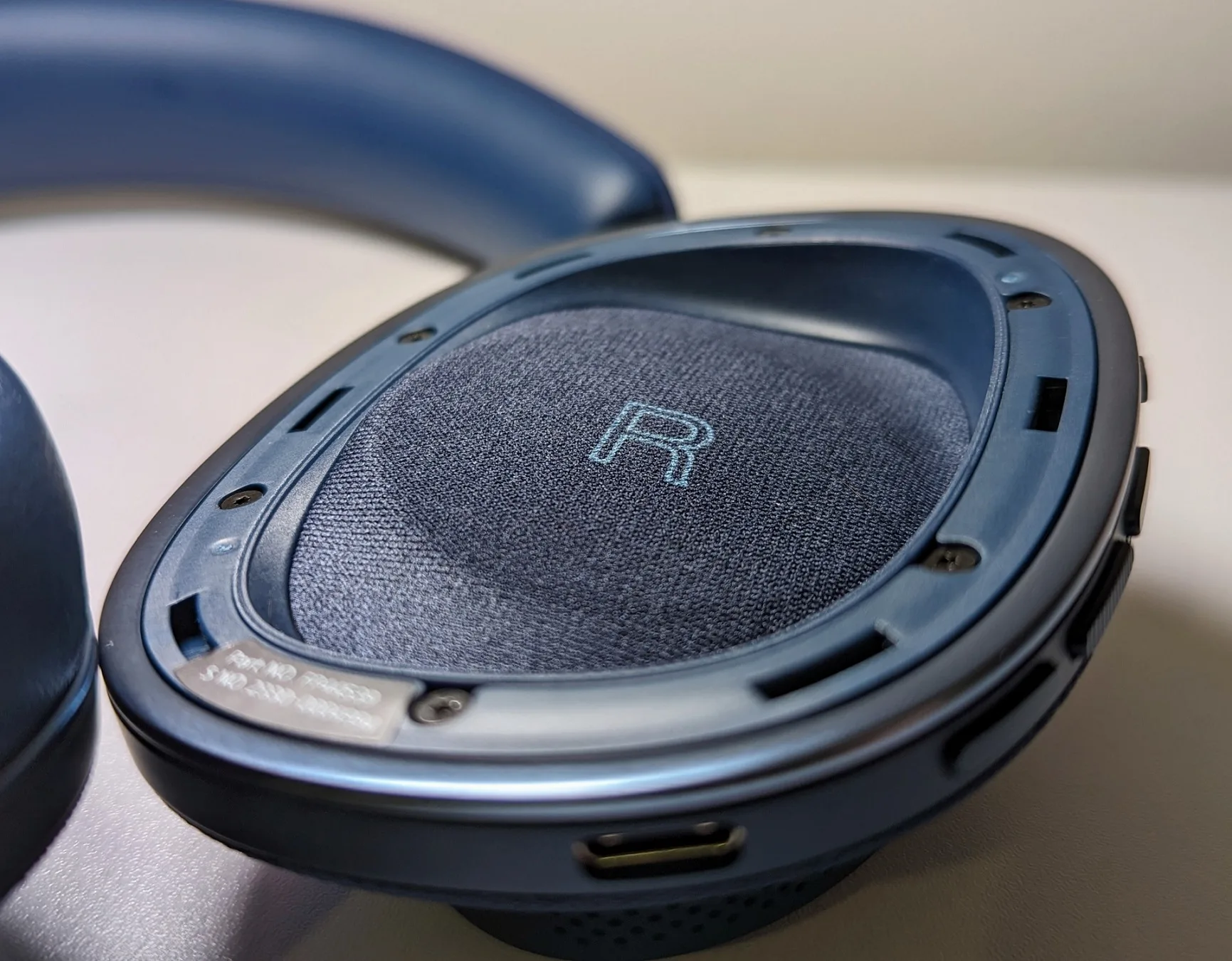
The ear pads can be removed for replacement thanks to the plastic hooks used for attachment. The manufacturer's own replacement pads are difficult to find, but based on forum discussions, a pair of pads would cost between 50 and 80 euros. Very similar-looking aftermarket pads, on the other hand, can be found in different colors and even made of genuine leather for under 20 euros. The headband cushion and the fabric-covered decorative part on top also appear to be replaceable if needed, which increases the lifespan of the headphones.
Observations related to use
The PX7 S2e is controlled by high-quality physical buttons, which I believe are still a more reliable and less frustrating alternative compared to vague touch controls. The left earcup houses a button that controls the noise-cancelling function, which can also optionally activate the voice assistant. The right earcup contains all the other buttons we are traditionally accustomed to in noise-cancelling headphones. The headphones can be both charged and listened to via the USB-C connector. I like that the PX7 S2e is turned on with a power switch, which is effortless to flick on, instead of a button that needs to be held down. The other buttons are flat and similarly shaped, but the rough surface of the middle one helps to distinguish which is which. My thumb also always automatically rests on this play/pause button when I grip the earcup. I have found the PX7 S2e to be easy to use, and it doesn't have annoyingly loud audio cues or any other perplexing features.
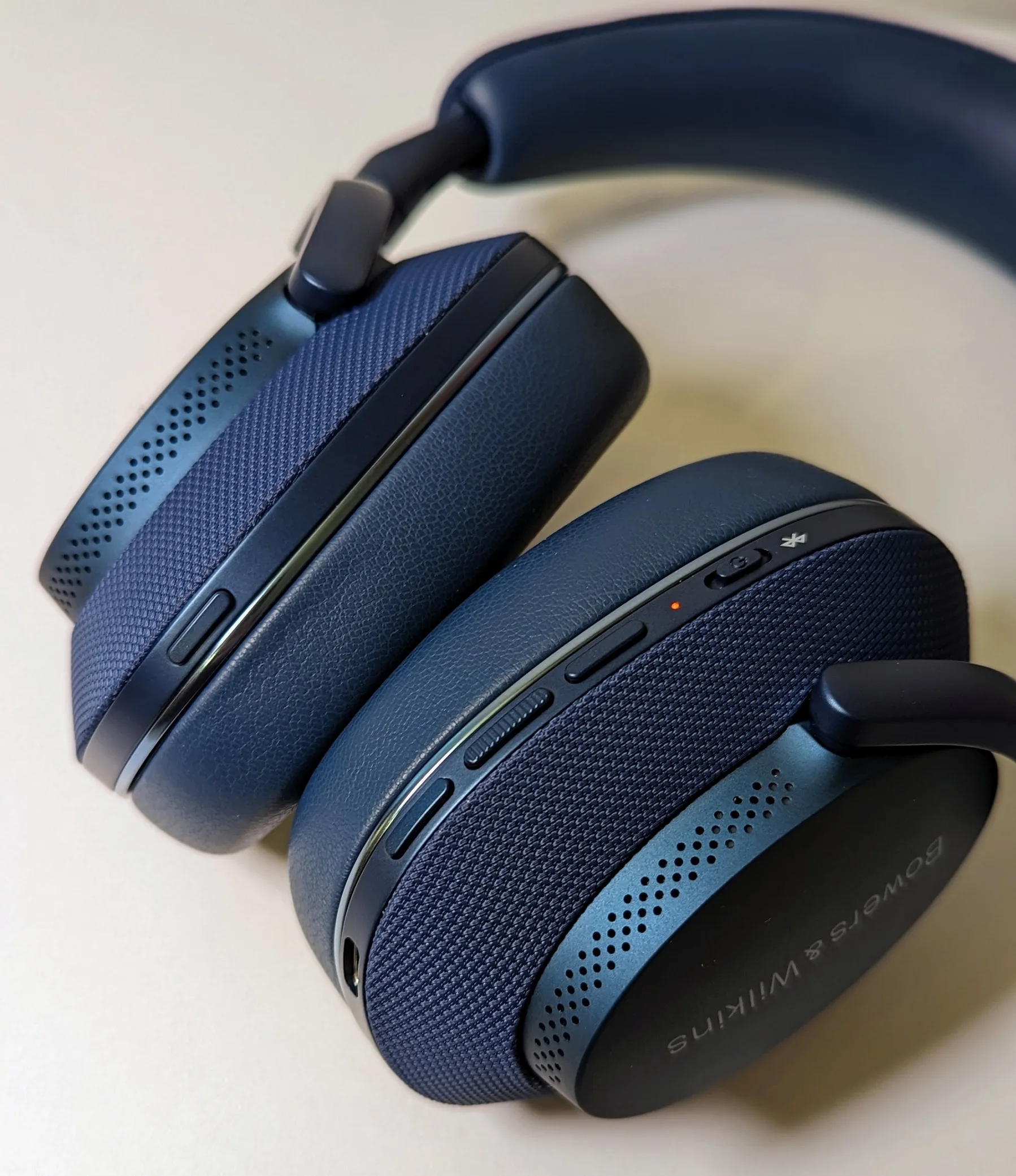
As a minor annoyance, however, I could mention the imprecise volume control that quite commonly plagues Bluetooth headphones. For example, when used with a phone, each adjustment step changes the volume quite a lot, so sometimes the optimal volume falls between two steps. In this case, the headphones practically have to be listened to at either a slightly too loud or too quiet volume, which makes me miss Audio-Technica ATH-HL7BT's comprehensive adjustment options. However, in the PX7 S2e, the situation with the volume jumping upwards is not as radical as in the Focal Bathys, so the matter doesn't ultimately bother me too much.
Another peculiarity I noticed is a faint chirping and buzzing sound in the background of the headphones when they are powered on but no Bluetooth connection is established with any device. Thus, when using a USB cable, this sound cannot be avoided, and I could see it bothering some people. However, the background noise disappears immediately after a Bluetooth connection is established, so fortunately, the headphones function flawlessly in their primary use case. Passive listening without power is unfortunately not possible, as there is no analog headphone jack available. When using a USB cable, power does not turn on automatically; the headphones must be turned on manually for them to start playing audio.
I'm not sure if the PX7 S2e, when used this way, draws its power from the battery or the USB cable, but damage to the internal electronics would mean the headphones can no longer be used. Thus, the PX7 S2e, like many other noise-cancelling headphones, is not a product that will last for decades, unlike most traditional wired headphones. This might bother some when buying headphones costing over 400 euros.
Sound quality doesn't actually degrade or age over the years, so for example, headphones bought in the 1990s Sennheiser HD 600are still fully usable and competitive compared to newer products. The same cannot necessarily be said for noise-cancelling headphones bought now in the 2030s, because at the very least their battery will have worn out and become unusable, thus turning the product into electronic waste. Since replacing the battery is not entirely straightforward, the possibility of passive use would significantly increase the lifespan of the headphones, even if, in truth, the sound quality without DSP correction is not usually good. However, I am not criticizing the PX7 S2e alone, but rather the environmental burden caused by the product category. Let's move on to more positive things from here.
Bluetooth
The headphones support Bluetooth version 5.2. In addition to the inferior SBC and AAC codecs, the higher-quality AptX Adaptive and AptX HD are supported. These do not fully match the audio signal quality of Sony's LDAC codec, but especially AptX Adaptive (24bit/96kHz) is already so good at its highest data transfer rates that it does not significantly degrade sound quality compared to wired use. Another advantage of the different AptX options is consistent performance, whereas LDAC only reaches its highest quality in rare use cases without occasional dropouts.
In addition to Multipoint pairing, the PX7 S2e supports Google's Fast Pair feature, so for example, an Android phone with an active Bluetooth connection automatically finds the headphones on first use and suggests pairing them. When working correctly, this feature significantly streamlines the initial setup of the headphones. For some strange reason, however, none of B&W's noise-cancelling headphones have connected to my Google Pixel 6 phone using Fast Pair; instead, I still have to connect them manually via the settings menu. Fast Pair does work with Samsung phones, so Google has managed to mess something up in its own products – but this happens. After pairing, the headphones have worked flawlessly, and the Bluetooth connection has been stable and maintained well even over longer distances.
Music | Bowers & Wilkins app
Bowers & Wilkins offers a phone application called Music for controlling its headphones, which includes a couple of useful settings and a simplified equalizer. The app also allows for updating the headphones' firmware version, which could be beneficial in the future. However, the app does not contain any actual additional features, so it is somewhat surprising that using it requires user account registration. Because of this, many may not bother to use the application at all.
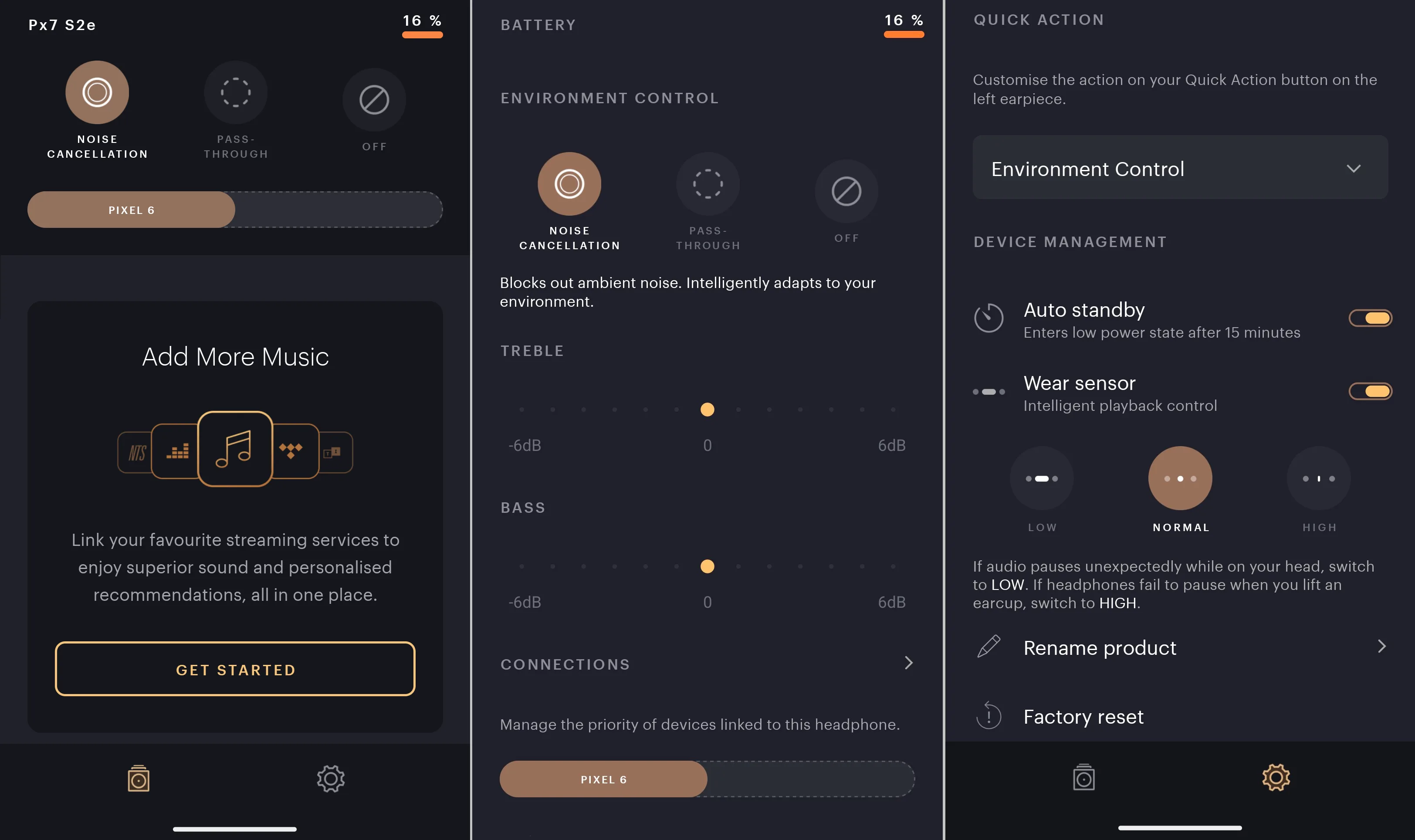
If that is done, however, the app can be used to change the priority of connected devices or disable the standby mode that activates after 15 minutes of inactivity. The sensitivity of the ”ear sensors” can also be changed if the headphones cut out or stop playback too easily during use. The most important feature for most, however, is likely the equalizer, which can be used to adjust the bass and treble levels by a maximum of 6 decibels up and down. It is almost impossible to design a more simplified equalizer than this, but in B&W's defense, it must be stated that with the limited adjustments, it is possible to significantly improve the balance of the PX7 S2e's default tuning – more on this in a moment.
Active Noise Cancellation
Bowers & Wilkins is not among the big names in noise-cancelling technology, so I wasn't sure what to expect from the PX7 S2e's noise reduction capabilities beforehand. Based on my testing, the noise is not suppressed as effectively as with my daily use Bose QuietComfort SE, which in turn falls somewhat short of Sony headphones, such as WH-1000XM5. However, the PX7 S2e manages to suppress airplane and cafe-type noise slightly better and more consistently than, for example, Edifier WH950NB, Valco VMK25, Heavys H1H and Focal Bathys. In my opinion, the strength of the PX7 S2e is that the remaining sound is soft and natural in tone. Also, in transparency mode, which allows ambient sounds through, the result when listening to human speech, for example, is more natural than with many other headphones that attenuate and amplify different frequency ranges unevenly.
I am actually quite satisfied with the PX7 S2e's noise-cancelling function, even though on a larger scale it must be called rather mediocre. The noise cancellation does not compete at all with the best noise-cancelling headphones on the market, but many would certainly be reasonably satisfied with B&W's level of noise cancellation in most common use cases. Beating the Focal Bathys is, in my opinion, a good performance for a product that primarily aims to compete in the noise-cancelling headphone market with sound quality.
The PX7 S2e's noise-cancelling function can be switched off either with the headphones' own button or via the phone app. However, there are no adjustments for the effectiveness or operating principle of the noise cancellation; instead, according to the manufacturer, it is adaptive in some way. A faint background hiss can be heard from the headphones, but I have not found it disturbing in any way due to its consistency. For example, the hiss of Valco VMK25, Bose QuietComfort SE, and Soundcore Space Q45's hiss is stronger.
Battery life
The headphones' 30-hour battery life is average by current standards, but it will certainly be sufficient for most. A quick 15-minute charge also provides an additional workday's worth of usage time, so the headphones don't need to be unused for very long if the battery accidentally runs out. However, if battery life is one of the most important criteria when purchasing headphones, for example, the 60-hour battery life of the Sennheiser Momentum 4 is difficult to beat.
Microphone sound quality
I have not been able to make calls with the headphones in a noisy environment, nor do I use borrowed products that could be damaged by getting wet in autumn rain or wind, but indoors, the sound produced by the microphones has seemed normal and perfectly suitable for speaking, according to others. However, it is advisable to check out more information on microphone sound quality from various review videos, for example.
Headphone sound quality
The headphone frequency response measurements were made using IEC711 standard equipment and new, more accurate silicone ears (KB501X). The graphs use the scientifically based Harman target curve (2018 version) as a reference, which is a generalisation of the frequency response that most people think would sound good. For more information on the measurements and their accuracy, see Headphone Measurementspage. The PX7 S2e's frequency response can also be compared with other measured headphones on the comparison tool .
The headphones cannot be listened to passively with the power off, so the audio signal always passes through the internal DSP circuit and DSP correction. The advantage of this is that the frequency response always remains the same, regardless of whether listening occurs via Bluetooth or a USB cable. Small variations only occur between having the noise-cancelling function on and turning it off. With the noise-cancelling function in the OFF position, there is a few decibels less bass between 20–80 hertz, while at higher frequencies, the differences compared to listening with noise cancellation on are practically so small that they could fall within the measurement error margin. With noise cancellation on, playback is slightly fuller, and with noise cancellation off, it is slightly thinner and brighter.
Next, I will evaluate the headphones' sound according to their most common use case, i.e., listening via Bluetooth with the noise-cancelling function on. I will also delve into equalization in a separate section.
Frequency response with noise-cancelling function switched on:
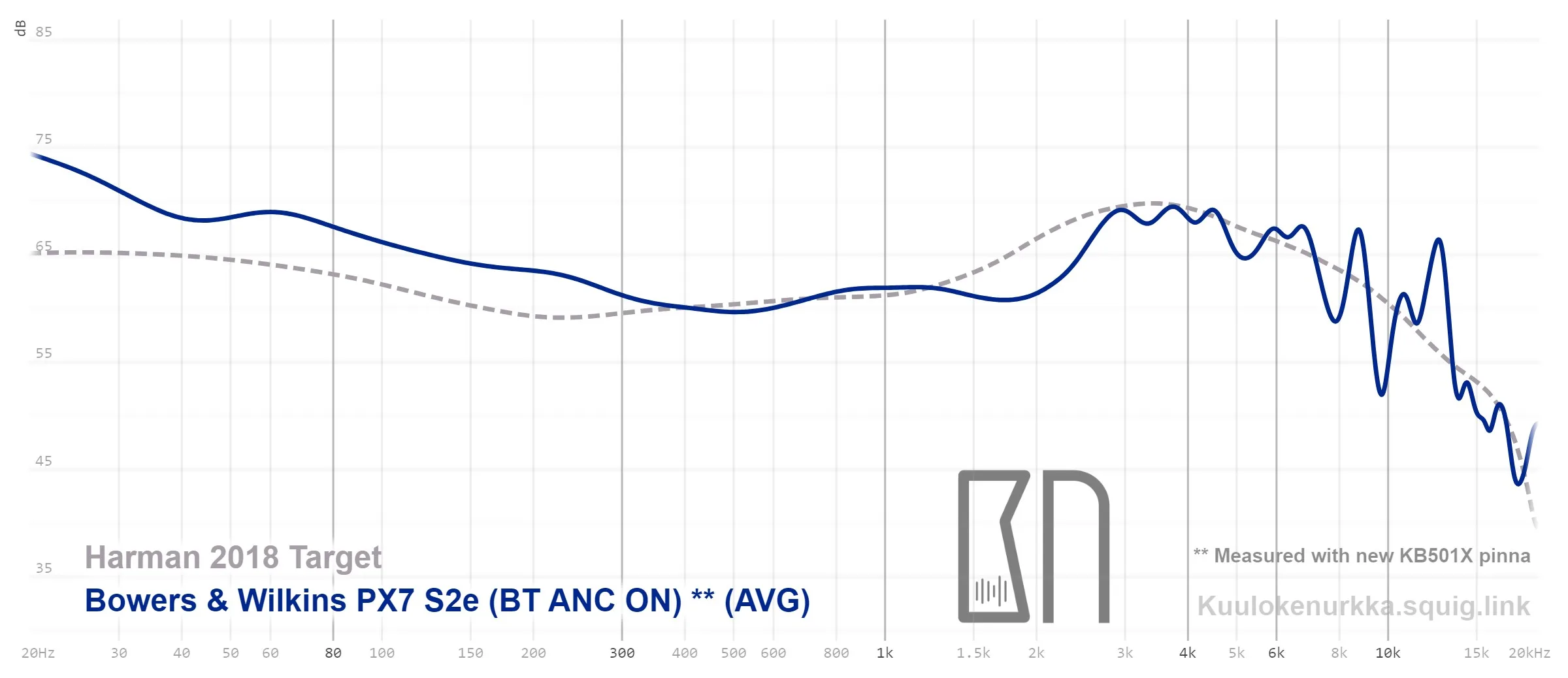
From the measured frequency response, it can probably be immediately deduced which frequency range B&W has wanted to emphasize most in their headphones. The low frequencies are reproduced throughout 4–9 decibels louder than the Harman target curve from 2018, which already sounds quite bass-heavy, would require. For this reason, the bass of the PX7 S2e is bloated, boomy, and thumpy in style, even in songs that are not meant to have much bass. Music almost always sounds as if a movie-effect-like rumble has been added to its background. Because the treble has also been slightly emphasized and sharpened at the same time, the presentation, which is in a certain way over-dynamic and constantly striving to make an impact, paradoxically begins to feel pre-chewed and thus somewhat dull.
All is not lost
Things are not so bad after all, as the PX7 S2e still sounds surprisingly controlled and clear given its enormous amount of bass. The distortion values of the 40mm biocellulose drivers are, in fact, almost zero throughout, based on my measurements, which is an excellent achievement. I am sure this is one of the main reasons why the bass sounds higher quality than usual, and it doesn't really get muddy or linger ridiculously loosely over other frequency ranges, like in Sony headphones.
Although there is quantitatively too much bass in B&W's headphones for my taste, the shape of the frequency response is orthodox in the sense that the lowest frequencies are reproduced more powerfully than the mid-bass, similar to Harman's target curve. For comparison, the bass reproduction of the previous PX7 S2 model is strongly emphasized between 100–200 hertz, so the result is muddier and less clear all the way up to the mid-frequencies.
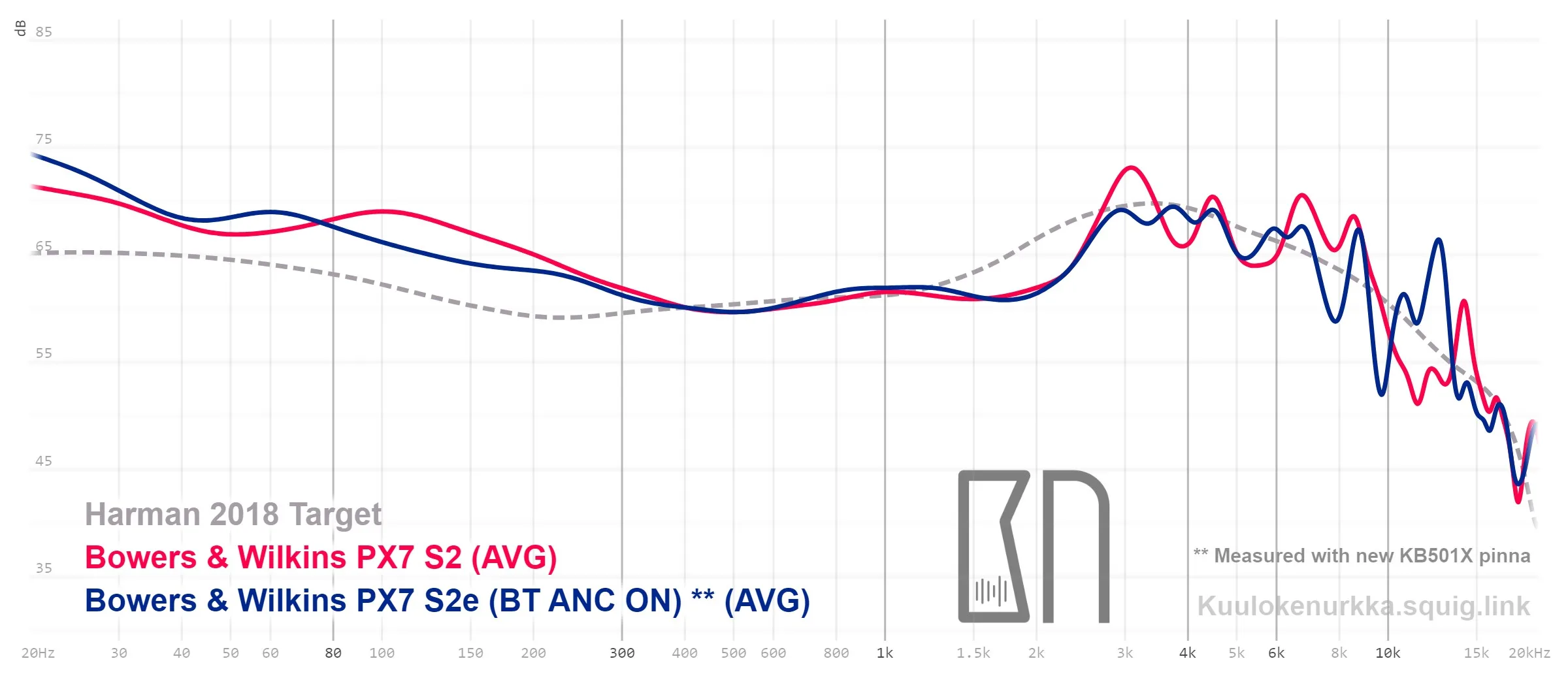
Furthermore, from the S2e model's frequency response, it can be seen that the headphones' mid-frequencies are quite orthodox in terms of energy level, and the high frequencies are relatively smooth, with the exception of a couple of individual peaks, especially compared to the preceding S2 model. The powerful bass balances the treble's slight over-brightness and aggressiveness sufficiently well, so no sounds noticeably grate on the ear, and there is no disturbing sibilance in vocal performances.
The relationship between mid-frequencies and treble could be compared in style, for example, to Hifiman's open-back headphones, although in the case of the PX7 S2e, it is difficult to get full certainty about the 1–3 kHz region because the frequency response changes quite a lot depending on the fit and position of the headphones on my measurement device. The average I presented should correspond quite well to reality, but in some positions (probably when the measurement device's ear touches the earpad), a clear emphasis in the upper mid-frequencies between 2–3 kHz occurs, similar to what I quickly measured in the PX7 S2. It will be interesting to see what other frequency response measurements of these headphones will be published in due course.
In any case, the PX7 S2e sounds pleasantly airy and spacious for closed-back headphones. The soundstage of the headphones also has depth and more sound separation than usual. I feel the sound coming slightly from the front instead of being reproduced entirely inside the head. This is by no means commonplace for noise-cancelling headphones in the same price range. B&W has strongly angled the headphone drivers so that they point towards the ears from the front-diagonal. This likely plays a part in the effective spatial impression. Slightly more moderately reproduced upper mid-frequencies between 1.5–3 kHz add more spaciousness to the presentation while simultaneously relaxing the sharpness of the reproduction. Unlike many other V-shaped noise-cancelling headphones, for example, vocal performances do not sound muffled and veiled; instead, the PX7 S2e brings the vocalist clearly and even prominently to the forefront of the overall sound.
Music sounds powerful and present with B&W's headphones, so it would certainly make a great impression on, for example, those who have previously used Sony products. However, I still recommend at least trying a little equalization, because in my opinion, that way the PX7 S2e becomes largely the best noise-cancelling headphone in its price range in terms of sound quality.
Equalization
I was a bit skeptical beforehand about the functionality of the equalizer found in B&W's app, because it can only adjust the level of bass and treble. However, these two adjustments are suitable given the headphones' default tuning and frequency response shape. The bass control's effective range is flat between 20–350 hertz, while the treble control appears to change the overall amount of high frequencies up or down.
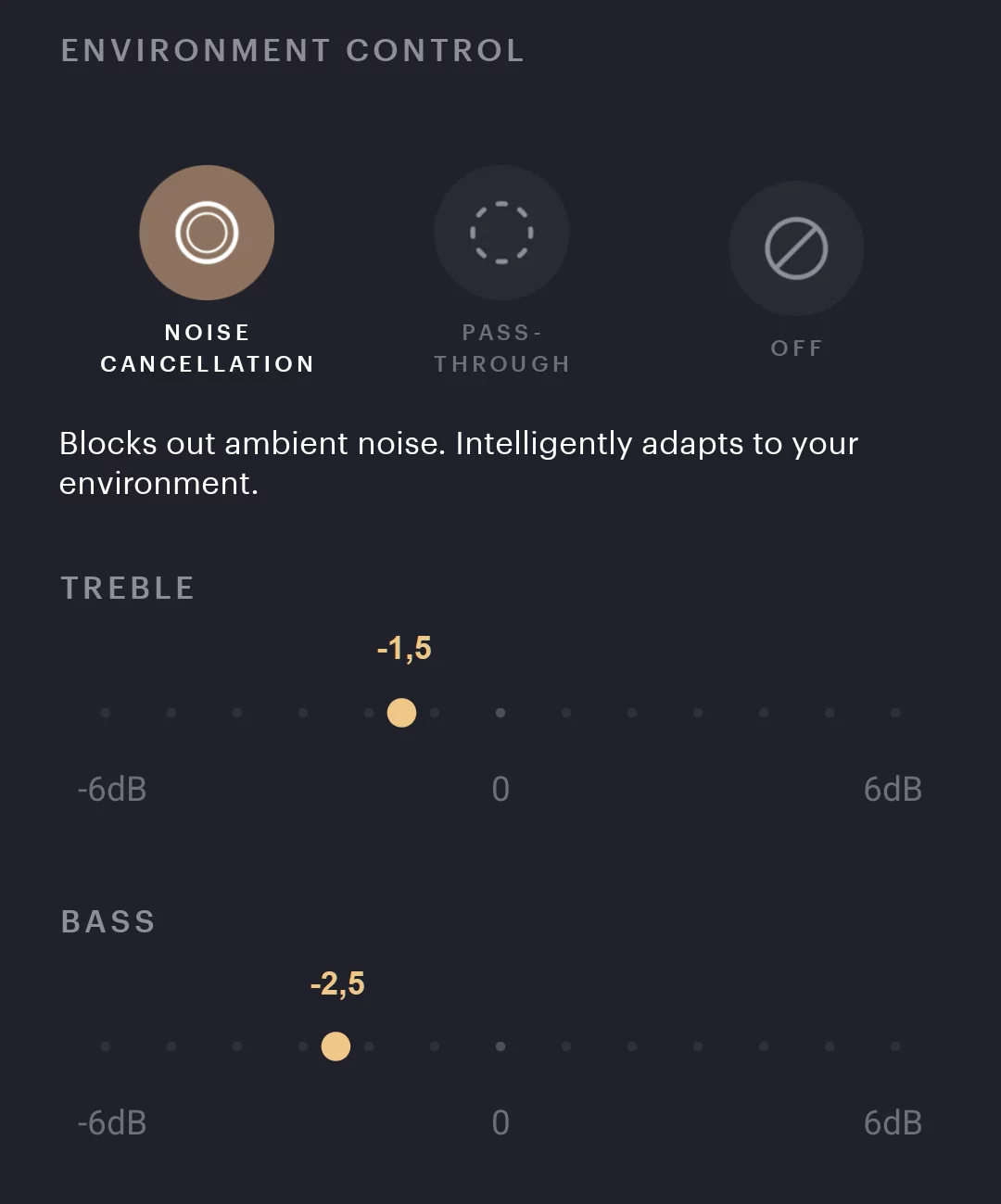
My recommendation is to reduce the amount of low frequencies on the PX7 S2e by about 2.5 decibels with the bass control, and the treble by 1–2 decibels depending on taste. I personally prefer to calm the treble by 1.5 decibels, because the sound is thus less aggressive, taking into account the lightening of the bass reproduction. After this, the frequency balance is just suitably more normal, and the extra thumping of the bass no longer draws too much attention to itself. In my opinion, the bass level can be left slightly higher than Harman's target curve, because the low frequencies are reproduced with high quality. When seeking a more neutral presentation for the bass, the high-frequency areas also tend to become too emphasized, making the sound somewhat thin and clinical for my taste. I tried reducing the bass by 4 decibels, but I couldn't get the treble to match it perfectly optimally. That's why I always found myself returning to the -2.5 (bass) & -1.5 (treble) combination. In this case, the frequency response looks like this:
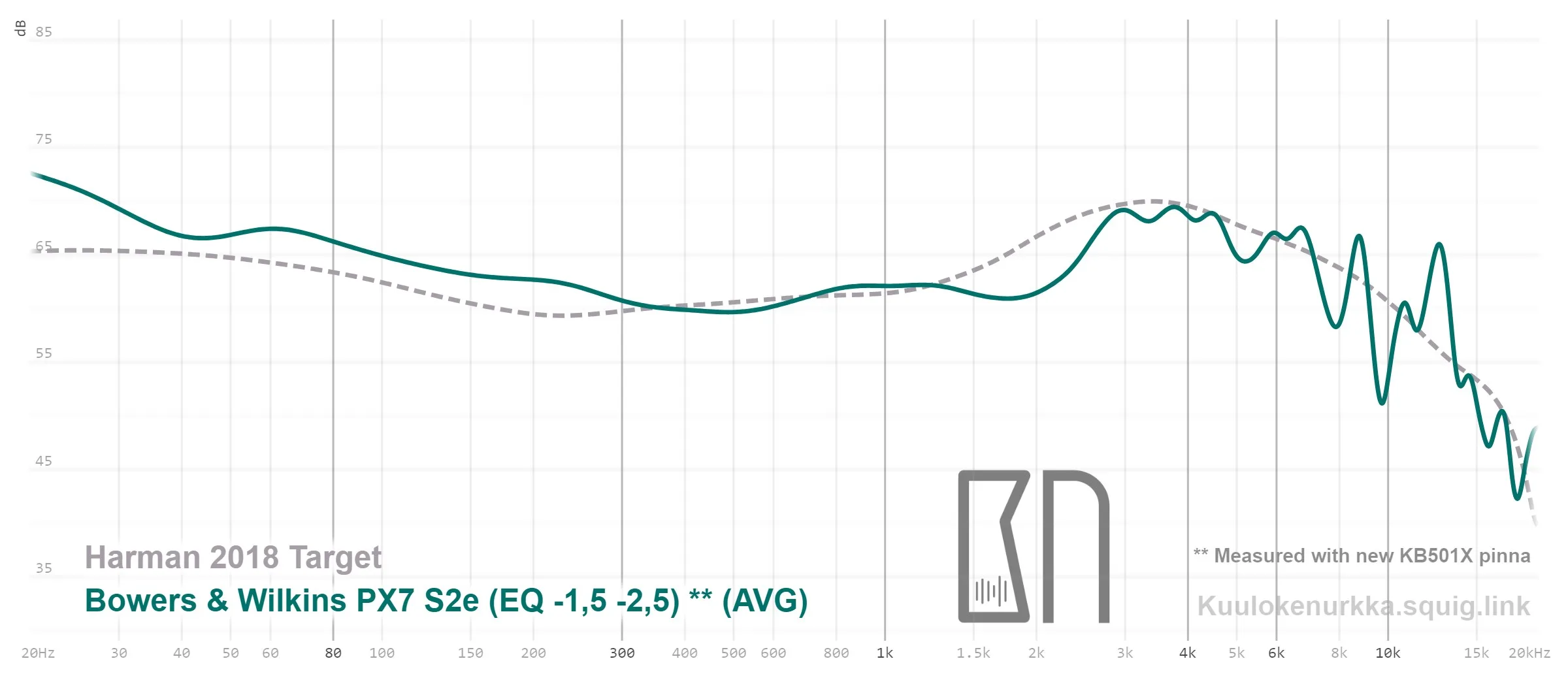
With my adjustments, the PX7 S2e is a truly impressive and genuinely both fun and natural-sounding wireless noise-cancelling headphone. The reproduction is balanced and precisely accurate regardless of the music listened to. The spatial impression is also even more spacious after reducing the amount of bass, and a functional emotional connection is created with the most important aspect of music, i.e., the mid-frequencies. Adapted to my hearing, the high frequencies also feel unusually smooth and unfatiguing without significantly lacking energy from any single frequency range. A certain kind of relaxation in the presentation is also brought by the relatively calm upper mid-frequencies, which in my opinion generally suit closed-back headphones well. The singer's voice lacks the final edginess, and the PX7 S2e might sound a bit soft and subdued with, for example, rock music, but even then, the listening experience is pleasant without clear weaknesses.
If Bowers & Wilkins had dared to make the headphones like this by default, they would, in my opinion, compete quite evenly against, for example, the Focal Bathys, which is about 350 euros more expensive. After the equalization, other noise-cancelling headphones under 500 euros that I tested still fall behind the PX7 S2e in terms of frequency response smoothness, sound separation, and soundstage depth impression. Based on my memory, the 800-euro Focal Bathys is slightly more capable, but due to its more colored lower mid-frequencies, it doesn't sound quite as natural as the PX7 S2e, whose mid-frequencies resemble good hi-fi headphones.
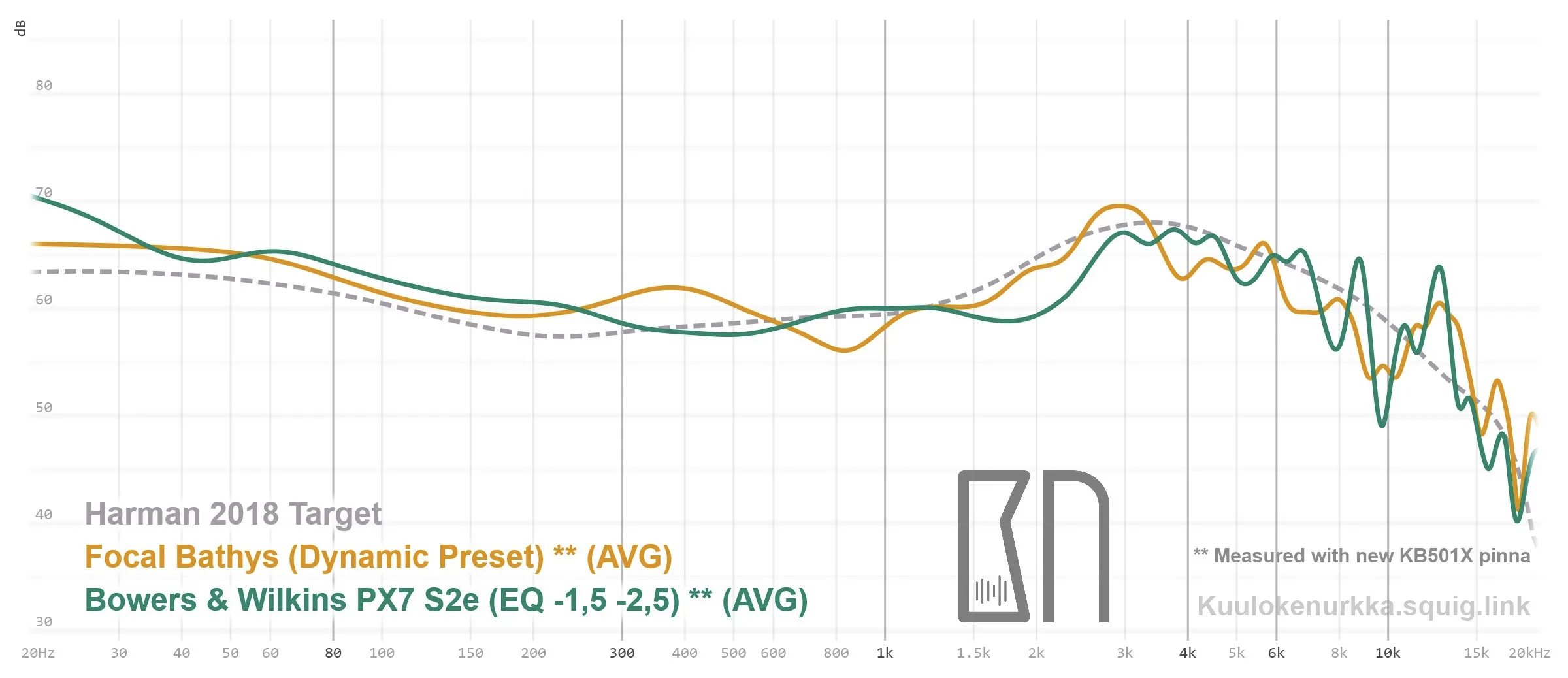
I haven't tested other more expensive noise-cancelling models sufficiently, but for example, Bowers & Wilkins' own PX8 is, in my opinion, so mid-bass heavy and congested in sound that I'm not sure if it can even be made to sound as good and balanced as the more affordable sister model with equalization. Perhaps I should find out more about this in the future?
Summary
Bowers & Wilkins' new PX7 S2e managed to surprise me, as until now I haven't found most 300–500 euro noise-cancelling headphones to be worth their price in terms of sound quality. After a little equalization, the PX7 S2e genuinely impresses me, and it also looks and feels like a high-quality product externally. However, due to the somewhat small ear pads, I unfortunately don't believe the headphones will suit everyone, so it would be advisable to try them before buying.
Primarily for those seeking the most effective noise-cancelling function, 200–300 euro Sonys and Boses are still more sensible purchases, whereas the PX7 S2e suits those who also want excellent sound quality from noise-cancelling headphones, which can be enjoyed if necessary in a slightly noisier environment outside the home. In my opinion, thanks to their significantly more affordable price, these headphones are an alternative to the 800 euro Focal Bathys, which is aimed at a similar target audience.
On the other hand, the outgoing PX7 S2 model is currently sold for 250–300 euros, so with equalization, it might still offer better value for money for some time, especially since the construction and noise-cancelling function should be the same in both models. However, thanks to its smarter DSP correction, the E-model sounds better by default and even after equalization, it's smoother and thus more natural. In my opinion, the PX7 S2e is generally a step in the right direction for B&W, as I haven't liked the manufacturer's other headphone models. However, one significant equation in noise-cancelling headphones remains unsolved: strikingly high-quality sound and super-effective noise-cancelling cannot be achieved in the same product.
Pros and cons:
+ Correct and natural frequency response, with the exception of overemphasized bass
+ Achievable with equalization: both fun and high-quality bass reproduction and hi-fi-style clarity
+ Deeper soundstage than usual with good sound separation
+ Exceptionally low distortion values, especially at bass frequencies
+ High-quality construction and premium feel
+ Good wearing comfort with minor reservations
+ Ease of use
+ Ear pads are replaceable
– Bass is reproduced too loudly by default compared to other frequencies
– Noise-cancelling effectiveness is only average
– Electronics hum when a Bluetooth connection is not established
– The ear opening of the pads is small
– The phone app is limited in features and requires user registration
 EN
EN  FI
FI
Thanks for the excellent test! A note that Focal Bathys is currently available, i.e., October 2023, for 699 euros. I'm having a tough time deciding between these and the B&W you tested.
I'm looking for new noise-cancelling headphones and came across this review. Do you still think these are a good buy at the current clearance price of 249€, or would your choice be another model (P100, QC Ultra) with a budget of approx. 300€?
Yes, I still think they are a very good option for 250 euros if the appearance is pleasing and there is no need for the most powerful noise-cancelling function. I would personally choose the PX7 S2e rather than the Melomania P100 or Sennheiser Momentum 4, which cost roughly the same. Almost, however, at the moment I would still recommend the discounted AKG N9 Hybrid, because it is more versatile and can be equalized to be even slightly better. If, on the other hand, there is a need for powerful noise cancellation and the budget reaches about 350 euros, the QC Ultra would be my choice.
I own PX7.. I use them daily or have already used them for 3 years. daily on the train.. The case is sturdy, no signs of use.. The headphones are practically flawless still..
About the Bass.. Yes, when listening on the couch there's too much of it, but not on the train..!!
It's always forgotten that these are made for use, not for audiophile listening on the couch. There are different devices for that!
B&W is the world's best in its class.. Yes, it knows what it's doing!!
A very big thank you for the headphone corner!!!
Thanks for the great article! I had bought the S2e online based on good foreign reviews without listening to them, a little before I found your article.
My first impression was the same as yours, bright and slightly fatiguing trebles and a bit too much bass. I was already considering returning the headphones when I found your story. I adjusted the sound according to your instructions. Now the sound is amazing and non-fatiguing even with noise cancellation. I listen with a USB cable. The sound is much clearer than with my (very) old Quietcomforts. The only thing that bothers me is that the S2e are nowhere near as comfortable on the head as the Bose. You can't have everything for this money.
Thanks for the feedback and it's great that you found my review! 🙂 This is exactly the kind of genuinely useful tips I aim to provide, unless the sound is already perfectly set with default settings, which rarely happens with these noise-cancelling headphones. Bose are undeniably comfortable headphones, so I completely understand a slight drop in comfort. Hopefully, the B&W will conform to your head with use. Enjoy your listening moments!
Hi,
Here are more of my observations after a couple of months of use.
I ordered lambskin ear pads from Infshop for 26€. They feel high quality and were easy to change. The headphones are now clearly more comfortable on the head.
I use a cable, because the volume control works with much smaller steps than wirelessly. Really strange. The sound is even a tiny bit better.
B&W's noise cancelling function and sound isolation together are worse than in my old Boses. Now, speech from those next to me can be heard a little when I listen quietly. With Bose, nothing was heard.
But Bose's noise cancelling worsened the sound quality and also hissed. With B&W, this does not happen.
In summary, decent headphones for 260€ (+26€).