Author: Sword of Damocles
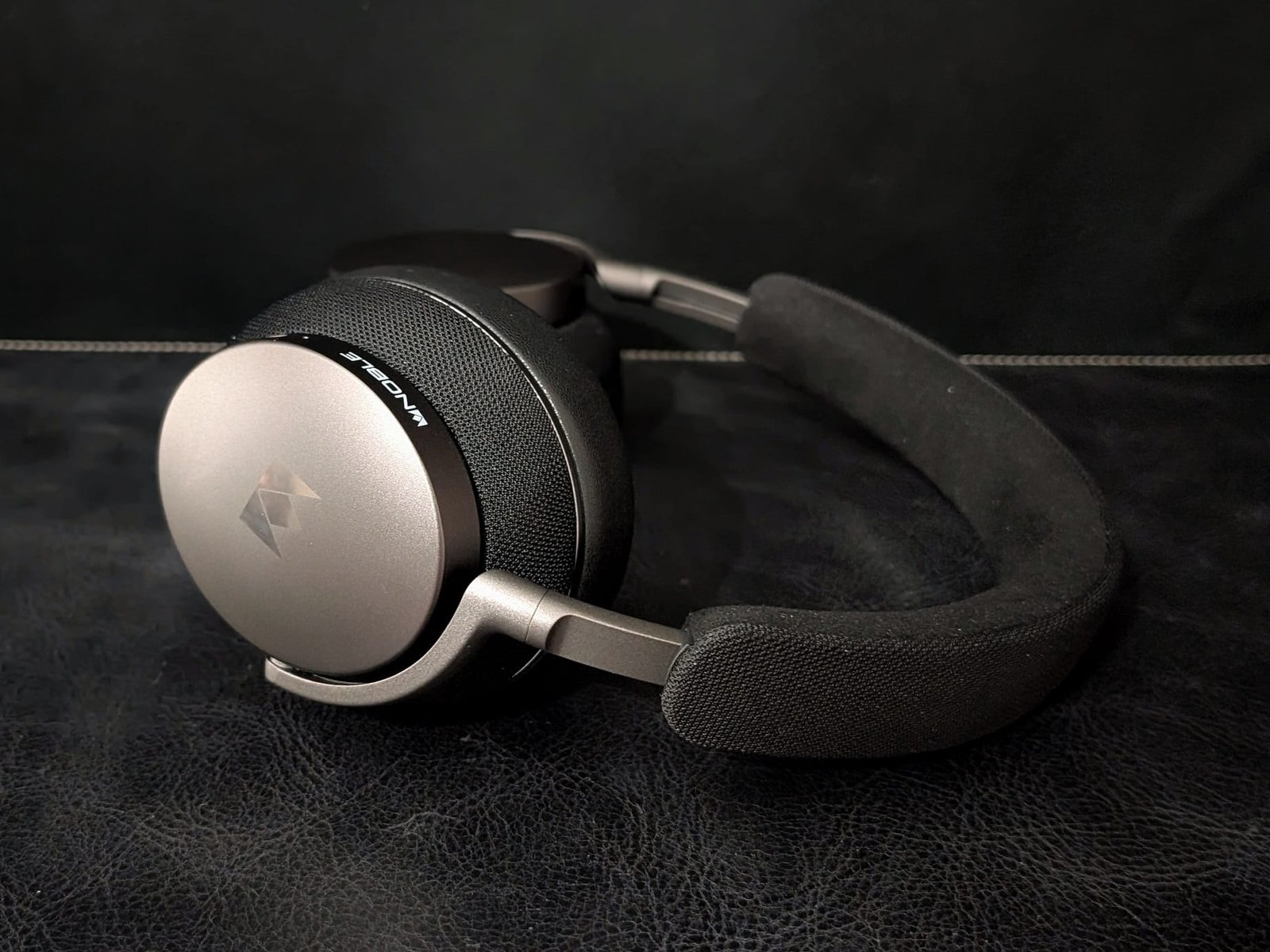
Table of Contents:
Information:
- Release year: 2024
- Country of Origin: China
- Price: In Finland 749 € (on sale for 649 € at the time of writing the review)
- Type: Closed, over-ear
- 2-way drivers: 40 mm dynamic driver + 14.5 mm planar driver
- Impedance (passive mode): 32 ohm
- Sound Input: Bluetooth 5.3, USB-C and 3,5 mm
- Bluetooth codecs: LDAC, AptX HD, AptX, AAC and SBC
- Charging port: USB-C
- Battery life: 60h with ANC on / 80h with ANC off
- Active Noise Cancellation: ON / OFF / Transparency mode
- Features: Boom microphone with mute button, Multipoint support and phone app with equalizer
- Weight: 327 g
- Accessories: Carrying case, USB-C cable, headphone cable (3.5 mm), airplane adapter, 6.35 mm adapter, 3.5 mm – 4.4 mm adapter and detachable boom microphone
Review unit acquisition method: Loaned from a reseller
Noble Audio is known worldwide for its good and quite expensive in-ear headphones, but until now there has not yet been a Finnish retailer for the products. Recently, however, the manufacturer launched a new venture, an over-ear noise-cancelling headphone model called Fokus Apollo, which many are familiar with Mareksound added to its selection. With this, I pleasantly surprisingly received the headphones for testing immediately.
Fokus Apollo (link to the manufacturer's product page) is priced at 750 euros (650 USD), placing it above traditional noise-cancelling headphones, competing with, among others, Focal Bathys, Bowers & Wilkins PX8, and DALI IO-8. All of these aim to offer a higher quality sound and structural quality, narrowing the gap between wireless and wired headphone models. Before this, I tested T+A Solitaire T: like, Fokus Apollo can be listened to not only via Bluetooth connection but also completely passively with a headphone cable.
Noble Audio's headphones stand out best from the crowd with their 2-way driver implementation, which includes a 40-millimeter dynamic driver and a 14.5-millimeter planar driver (likely originally designed for in-ear headphones). Of these, the former reproduces low frequencies quite as expected, and the latter high frequencies. Unlike in-ear headphones, hybrid implementations containing two different driver types have not yet become common in over-ear headphones, even though they are not exactly a new invention. However, a similar combination of a dynamic driver and a planar driver has not been seen before, nor was it expected, especially in noise-cancelling headphones. I see this as an excellent way to differentiate from competitors, who otherwise make products with very similar features. On the other hand, for 750 euros, the Fokus Apollo should also be a functional and polished package, so let's see how the new manufacturer has succeeded in its work.
Packaging and accessories
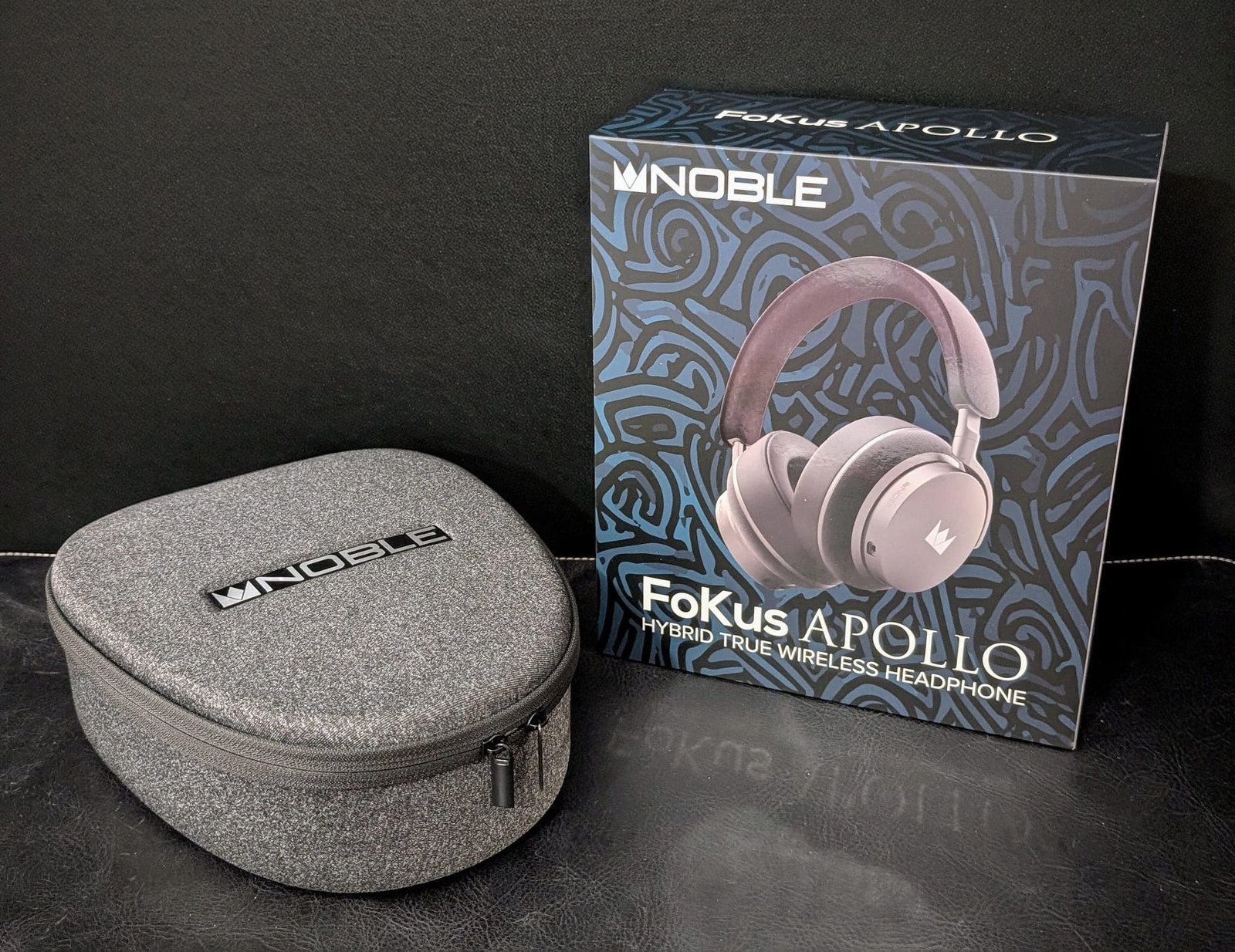
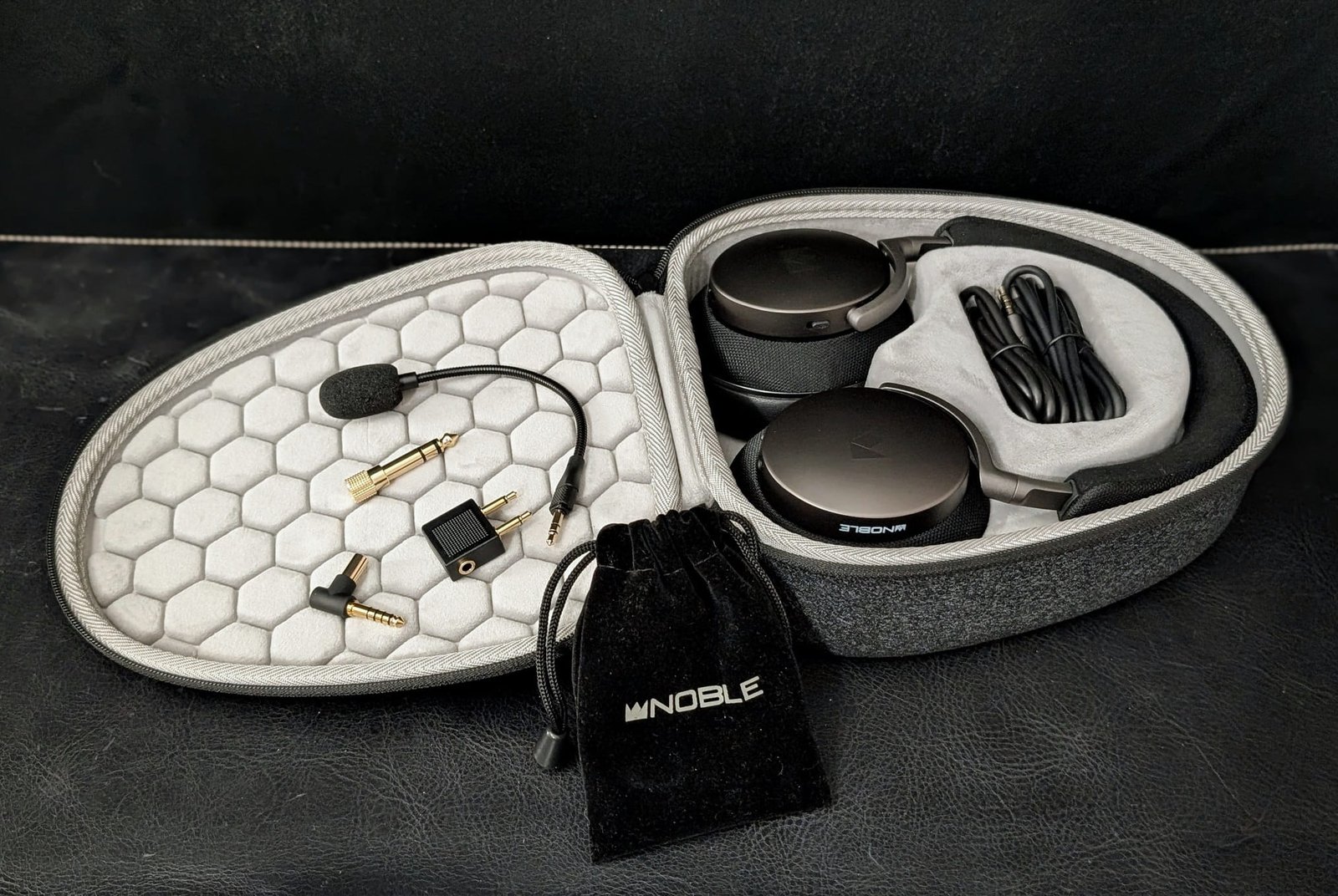
The market is gradually moving towards ecological packaging, i.e., brown cardboard boxes, so finer product packaging stands out even more from the crowd. Noble Audio is a good example of this. Although the Fokus Apollo's packaging essentially contains only a carrying case (everything fits inside it), the unboxing experience is interesting thanks to the ”doors” that open sideways. The carrying case itself feels exceptionally high quality in its materials, both externally and internally. At the same time, its large size, however, makes it more difficult to carry the headphones, as many competitors' products fit into a case that is even half as flat.
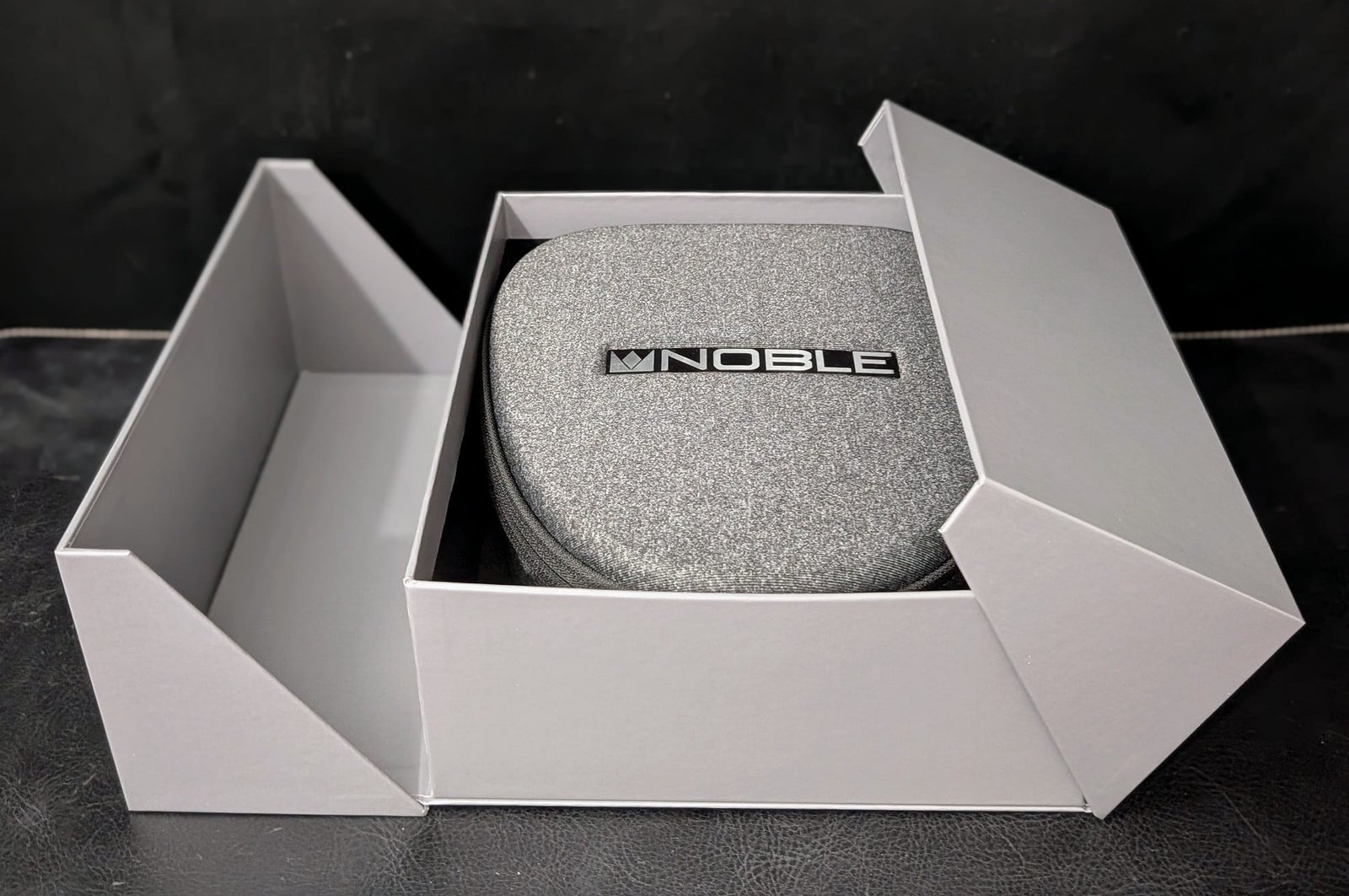
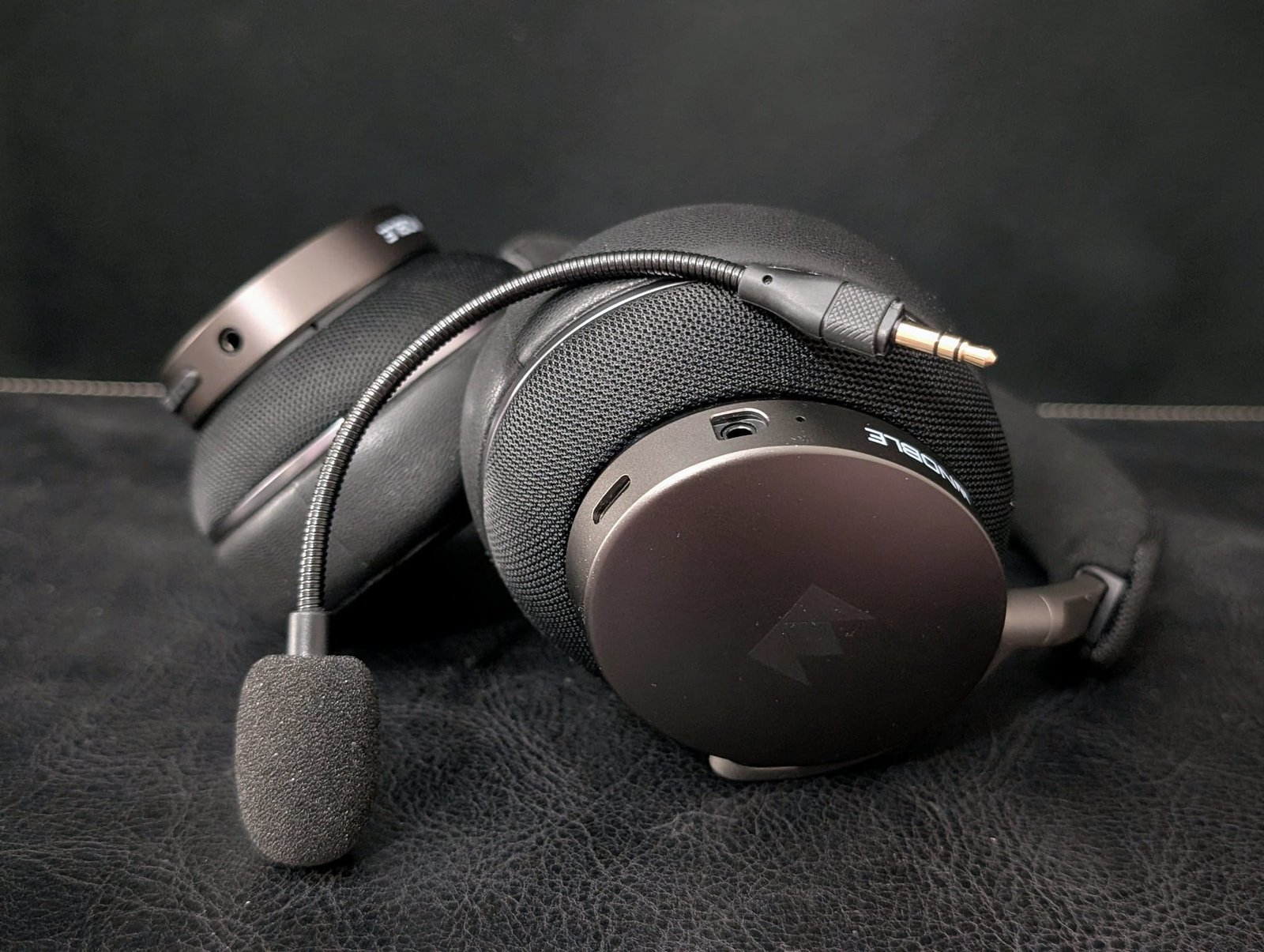
The Fokus Apollo comes with a USB-C charging cable, a 3.5-millimeter headphone cable, two cable adapters (6.35 mm and 4.4 mm), an airplane adapter, and a detachable boom microphone. The cables fit into a recess made in the case, while other accessories are packed in a small pouch. My attention is naturally drawn to the boom microphone, which is rare in Bluetooth headphones, but also to the 4.4-millimeter adapter, which I have never seen as standard equipment for headphones before.
Fokus Apollo's 3.5-millimeter connector is inherently TRRS type to enable a microphone signal, for example, when connected to a laptop's combo jack. However, with a 4.4-millimeter adapter, the audio signal does not magically become balanced, but the adapter is only intended to facilitate wired listening in a (rare) situation where the listening device only has a 4.4 mm connector – I can mainly think of a few USB dongles, such as Moondrop Dawn 4.4. The signal then becomes unbalanced, which, however, causes no practical harm.
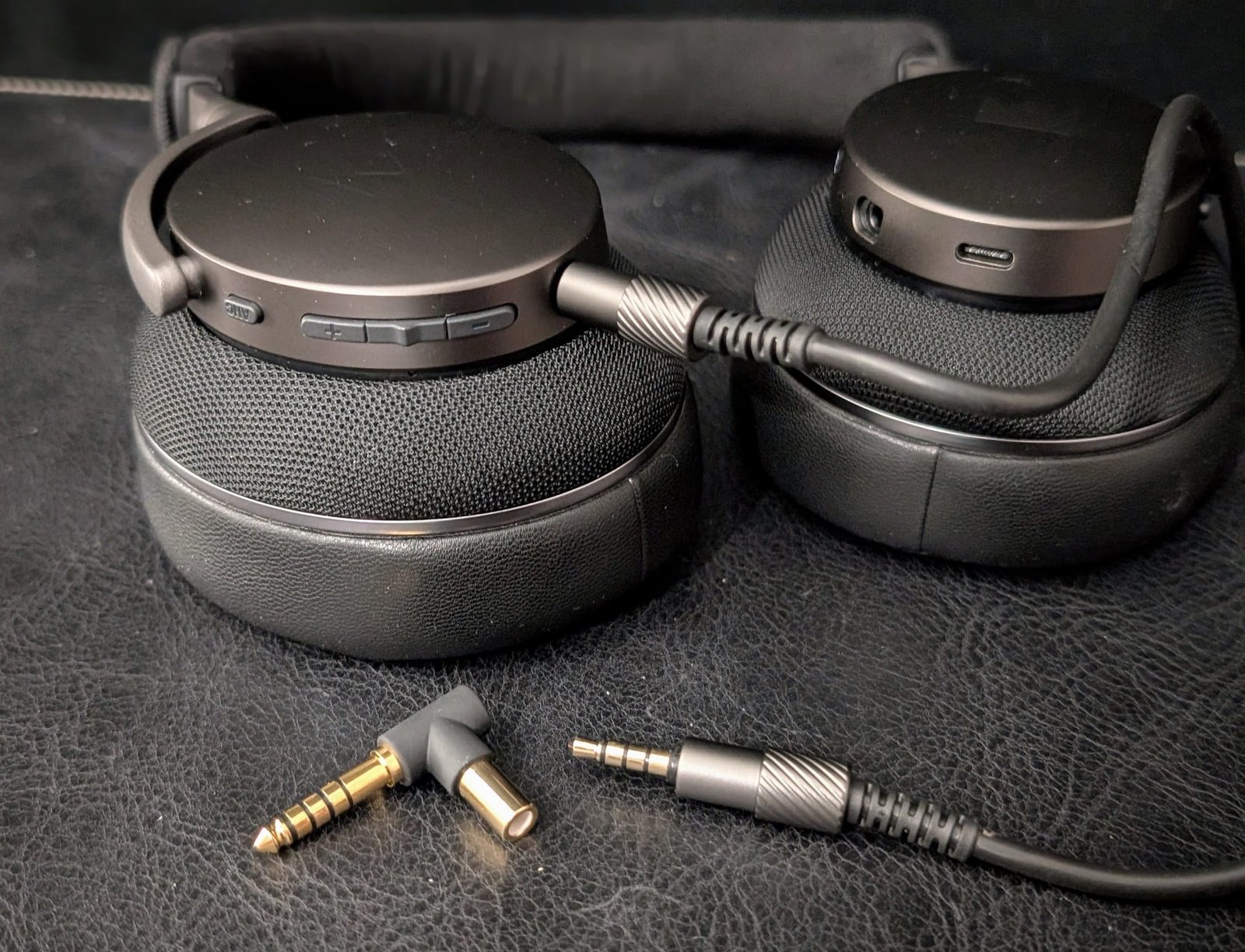
Regarding the equipment, my biggest complaints are directed at the cables, which are annoyingly stiff and will probably forever retain their winding shape. These mainly remind me of computer peripherals, except that, for example, a keyboard cable of the same thickness is often straighter and more flexible. If I were to use Fokus Apollo with a boom microphone connected to a computer, I would rather resort to, for example, a USB cable intended for charging a mobile phone.
Build and comfort
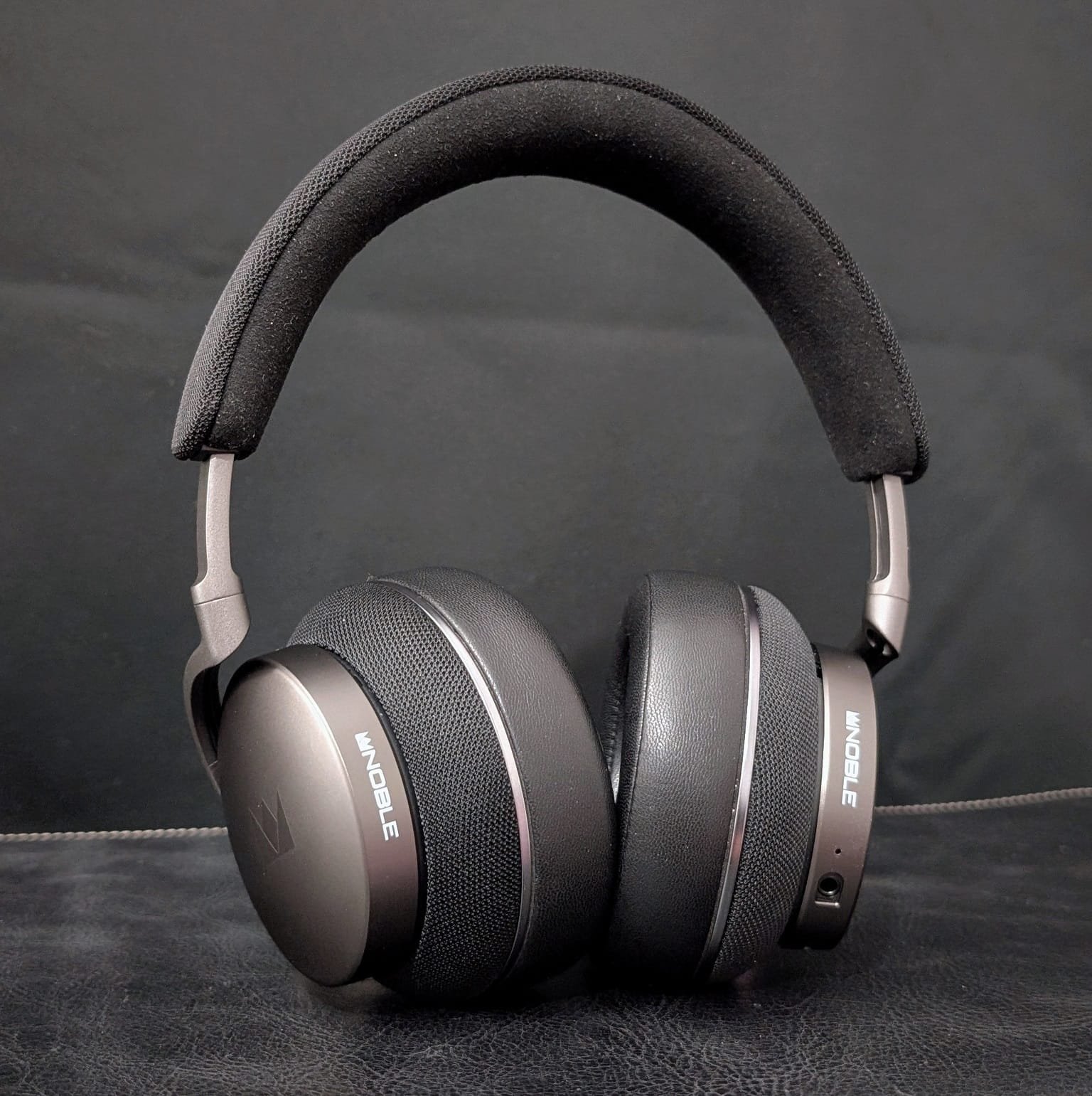
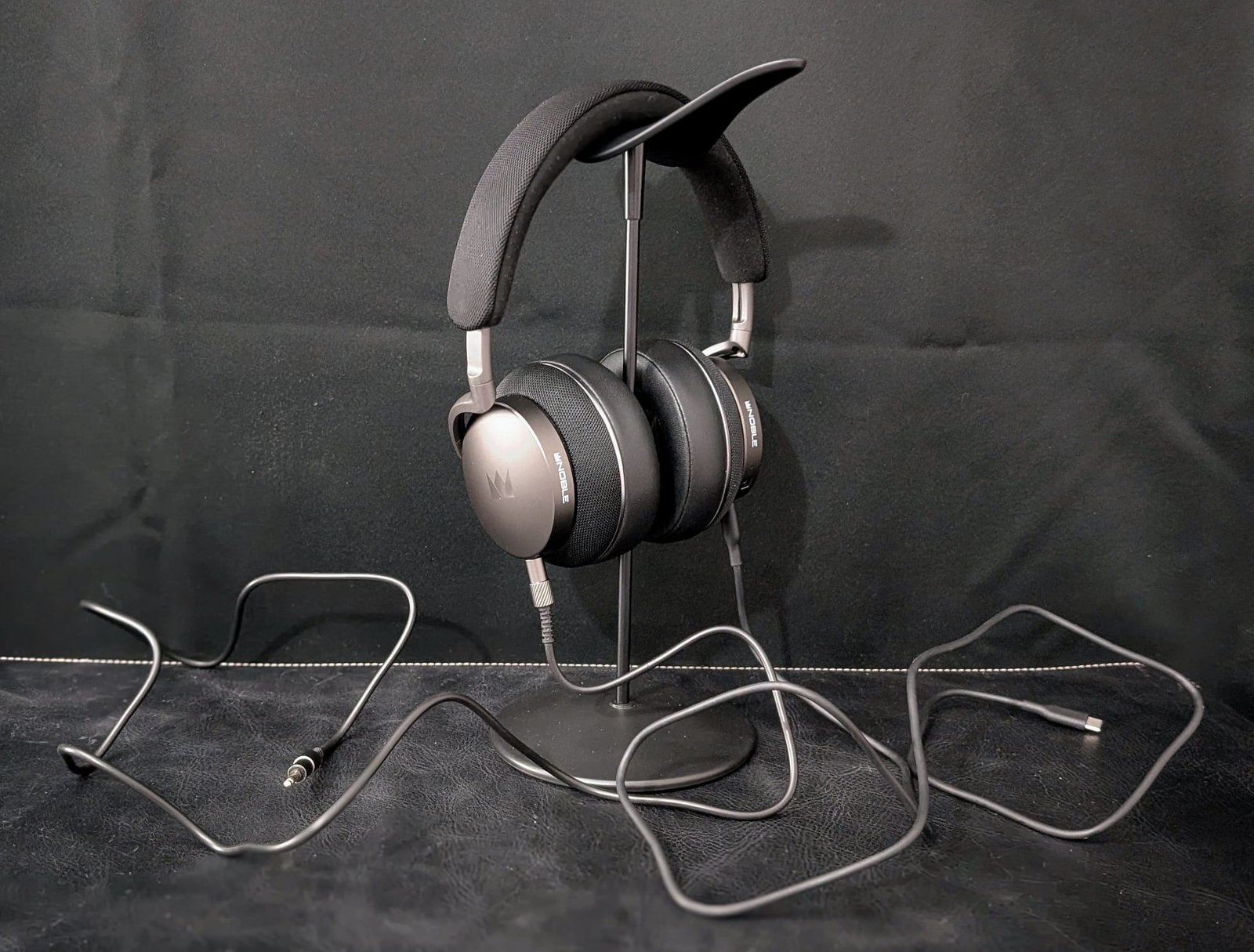
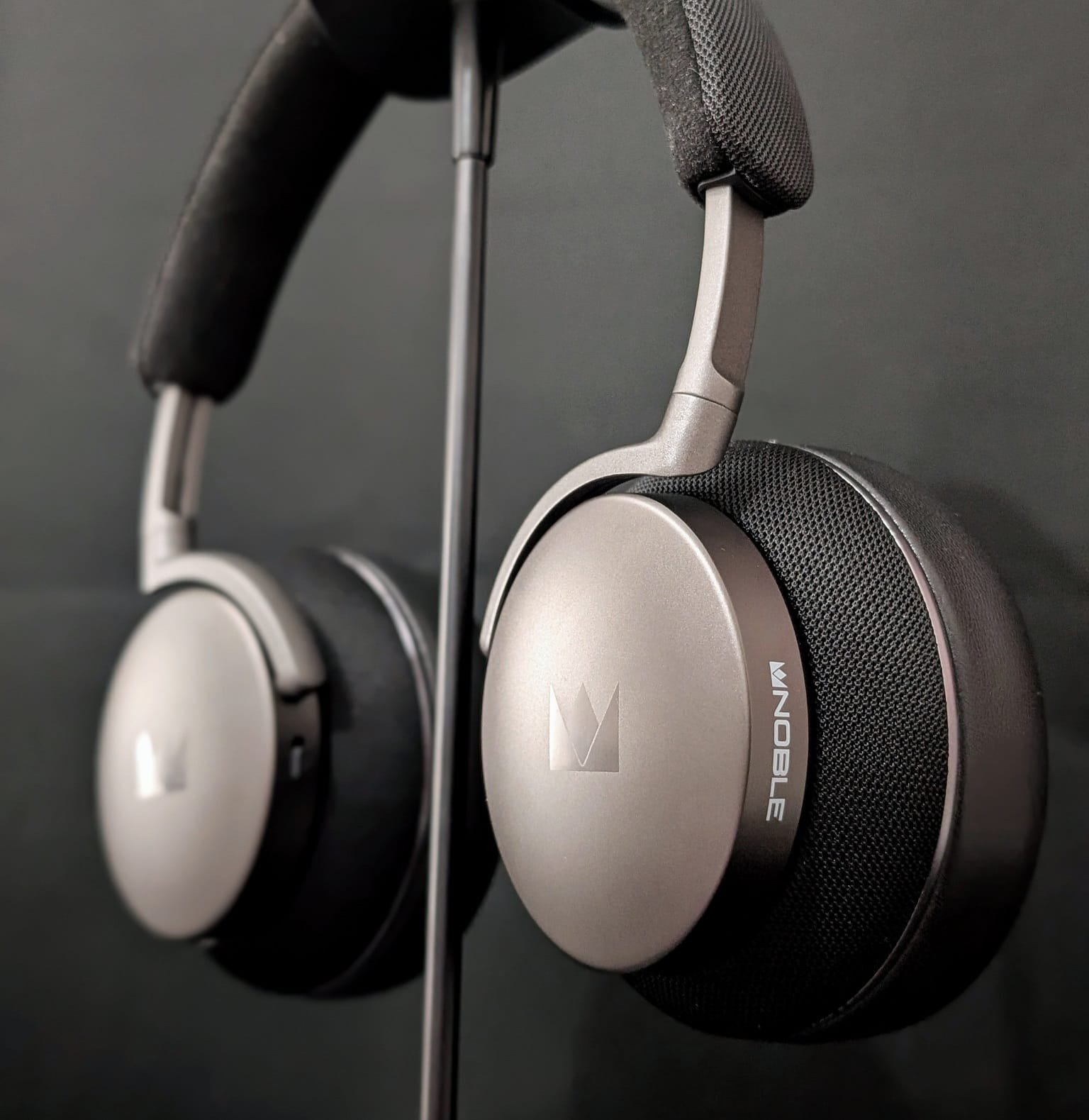
Structurally, the Fokus Apollo is practically an intermediate form of Bowers & Wilkins” PX7 and PX8 series headphones, implemented with larger and slightly rounder earcups. I don't believe in coincidence; Noble Audio has certainly taken inspiration from B&W headphones, as the headband and earcup design in Fokus Apollo are very identical. The partial fabric covering of the headband and earcups is ”copied" from the PX7, while the headband is entirely metal, like the more expensive PX8. Consequently, the Fokus Apollo's weight of 327 grams is also close to the PX8's 320 grams. If one needs to take inspiration from a manufacturer for premium-level headphones, Noble Audio has, in my opinion, made a good choice, and it has not forgotten to include its own ideas either.
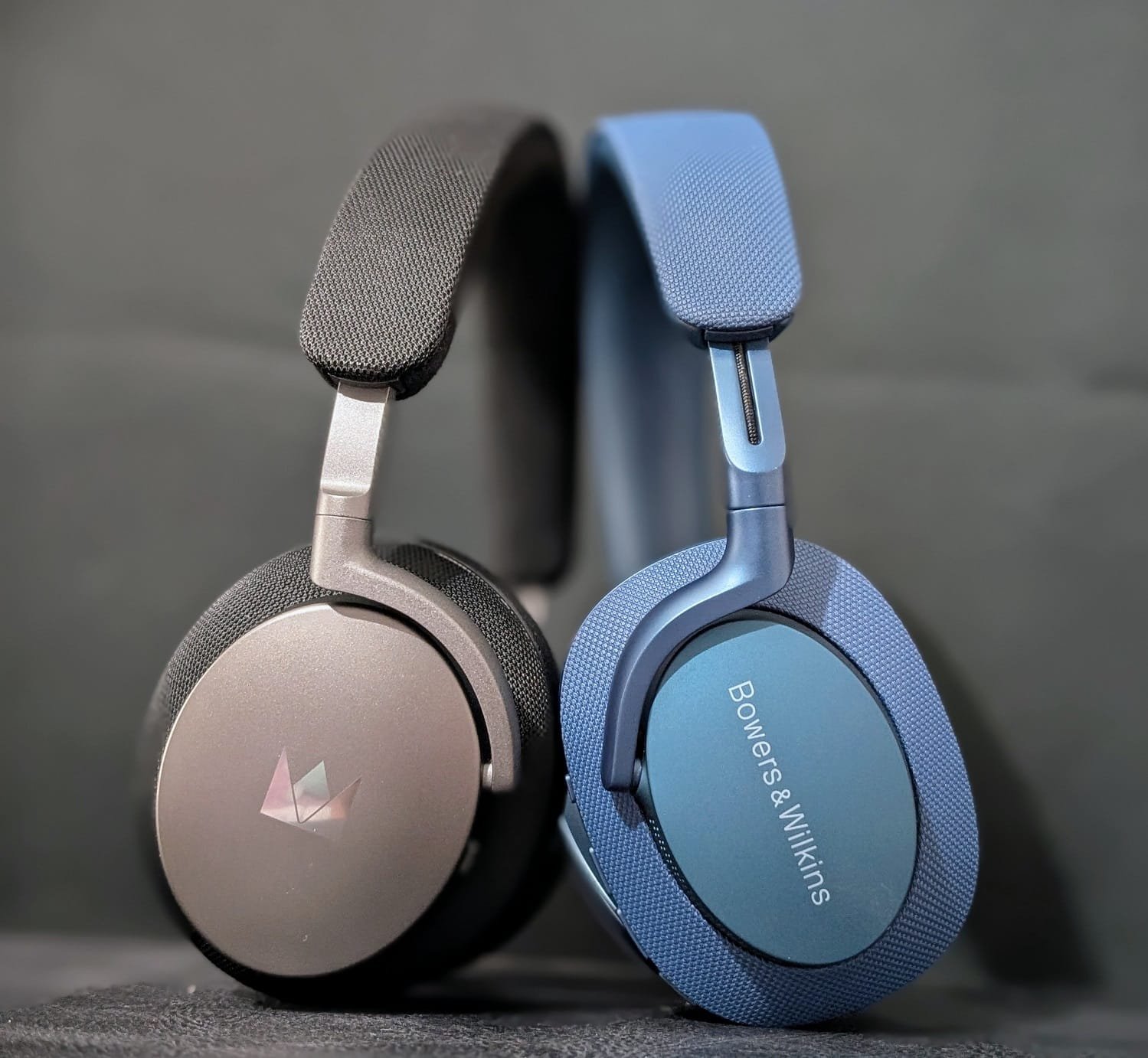
The inner surface of the headband in Fokus Apollo is covered with pleasant-feeling Alcantara, and the height of the headband adjusts in steps, whereas in the PX series, the adjustment mechanism is stepless. The buttons, on the other hand, are located on the metal part of the outer edge of the earcup, instead of being placed at the base of the ear cushion as in the PX series. Perhaps the biggest difference is that Fokus Apollo's ear cushions (faux leather & replaceable) are thicker and more spacious, making it one of the few noise-cancelling headphones where my ears fit well inside. Comfort is also supported by the headband's gentle clamping force and the earcups' wide range of motion. The narrow head cushion, however, could be a bit softer, as some have complained about an overly firm pressure sensation on the top of the head. Although this must be considered a potential weakness, with my head shape, the comfort is very good, and nothing about the headphones would prevent me from using them for extended periods.
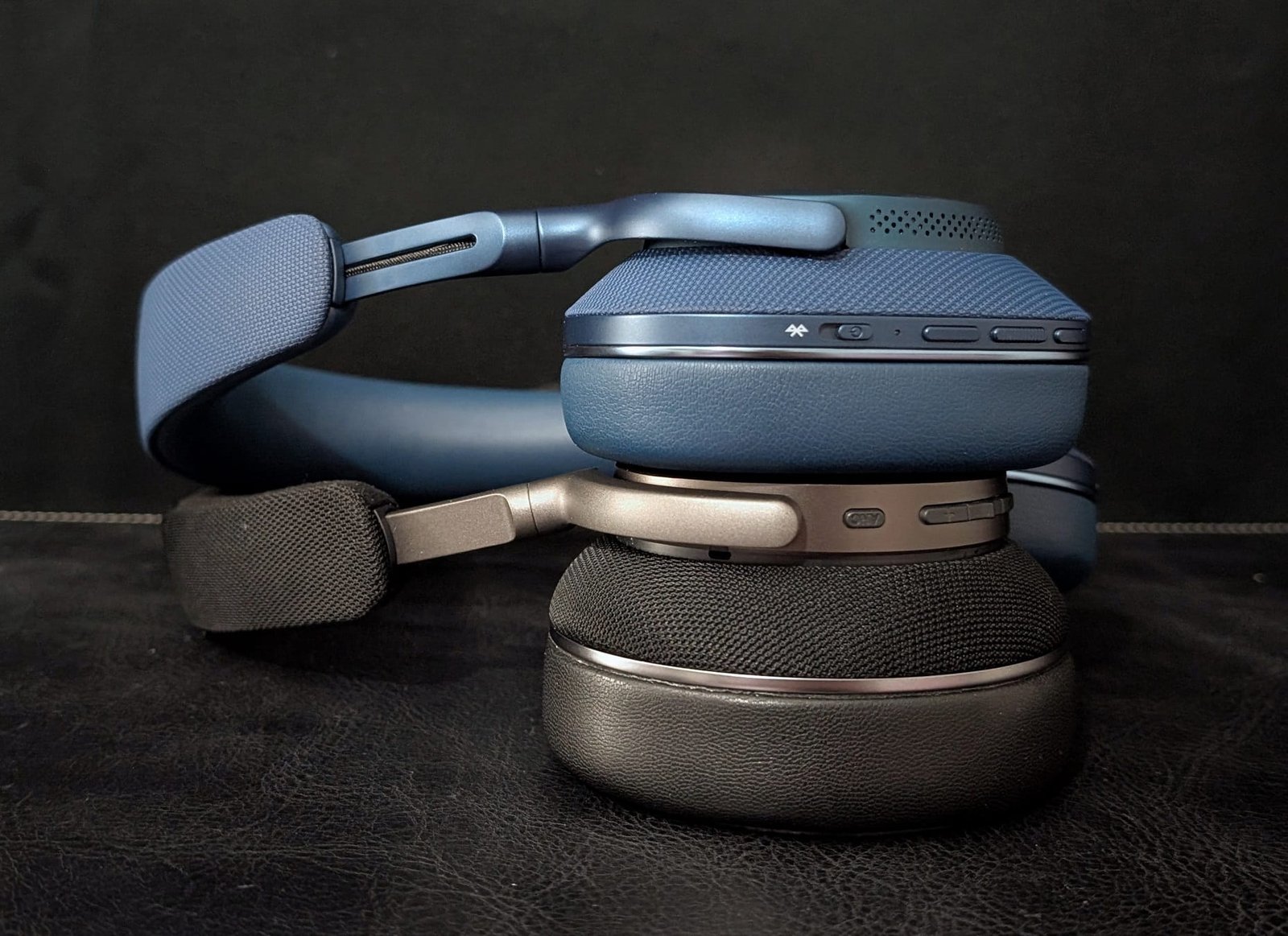
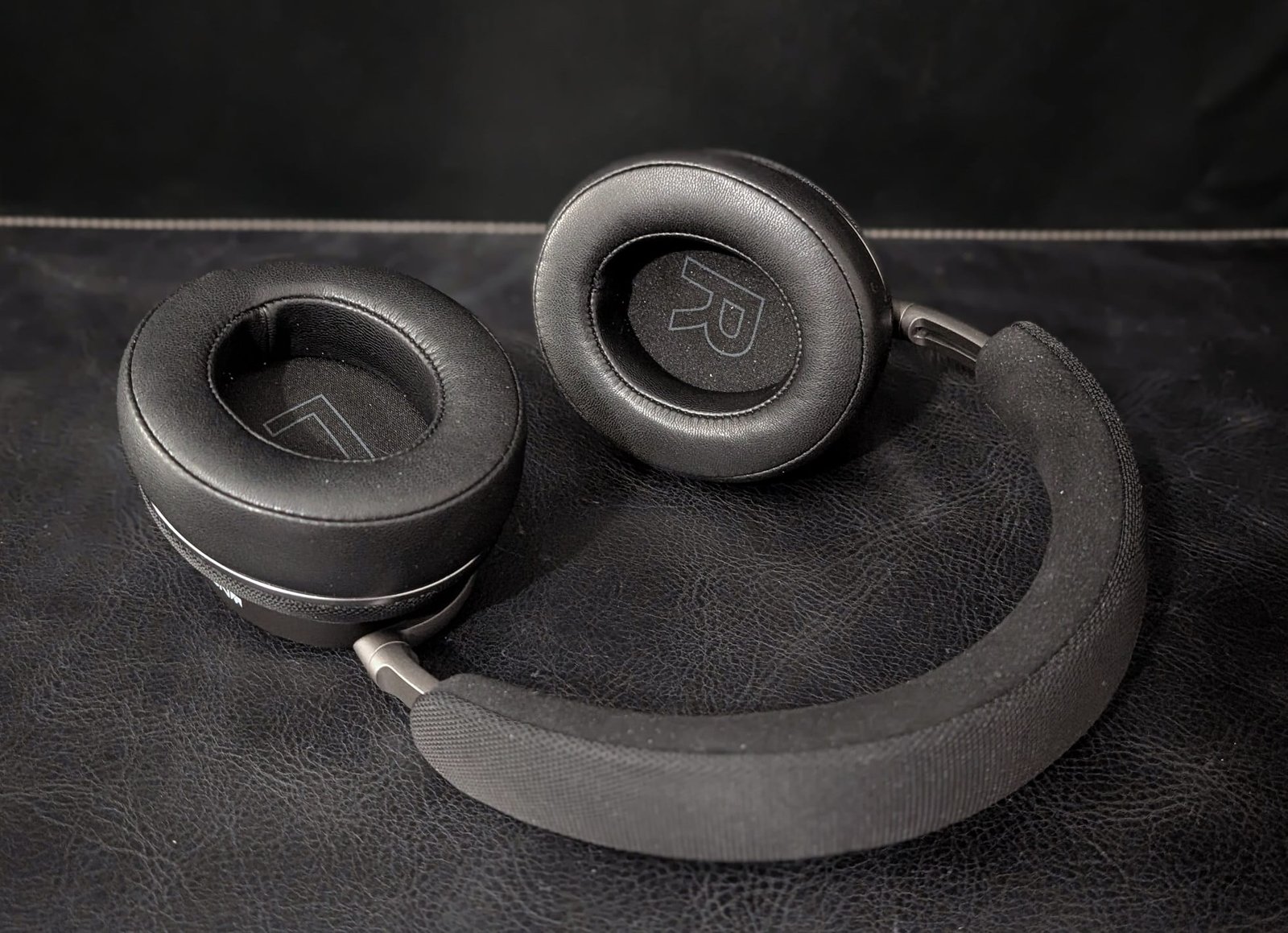
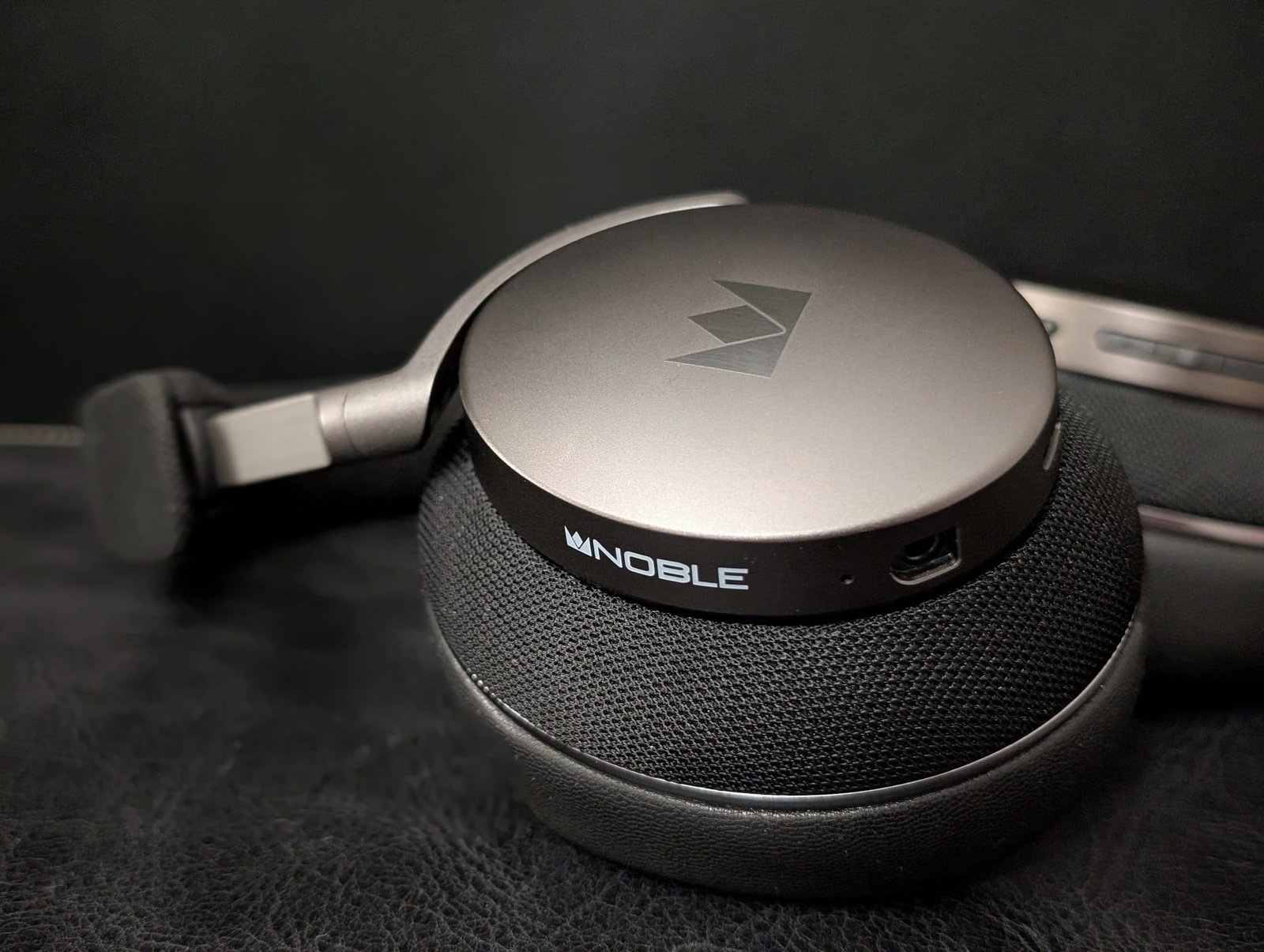
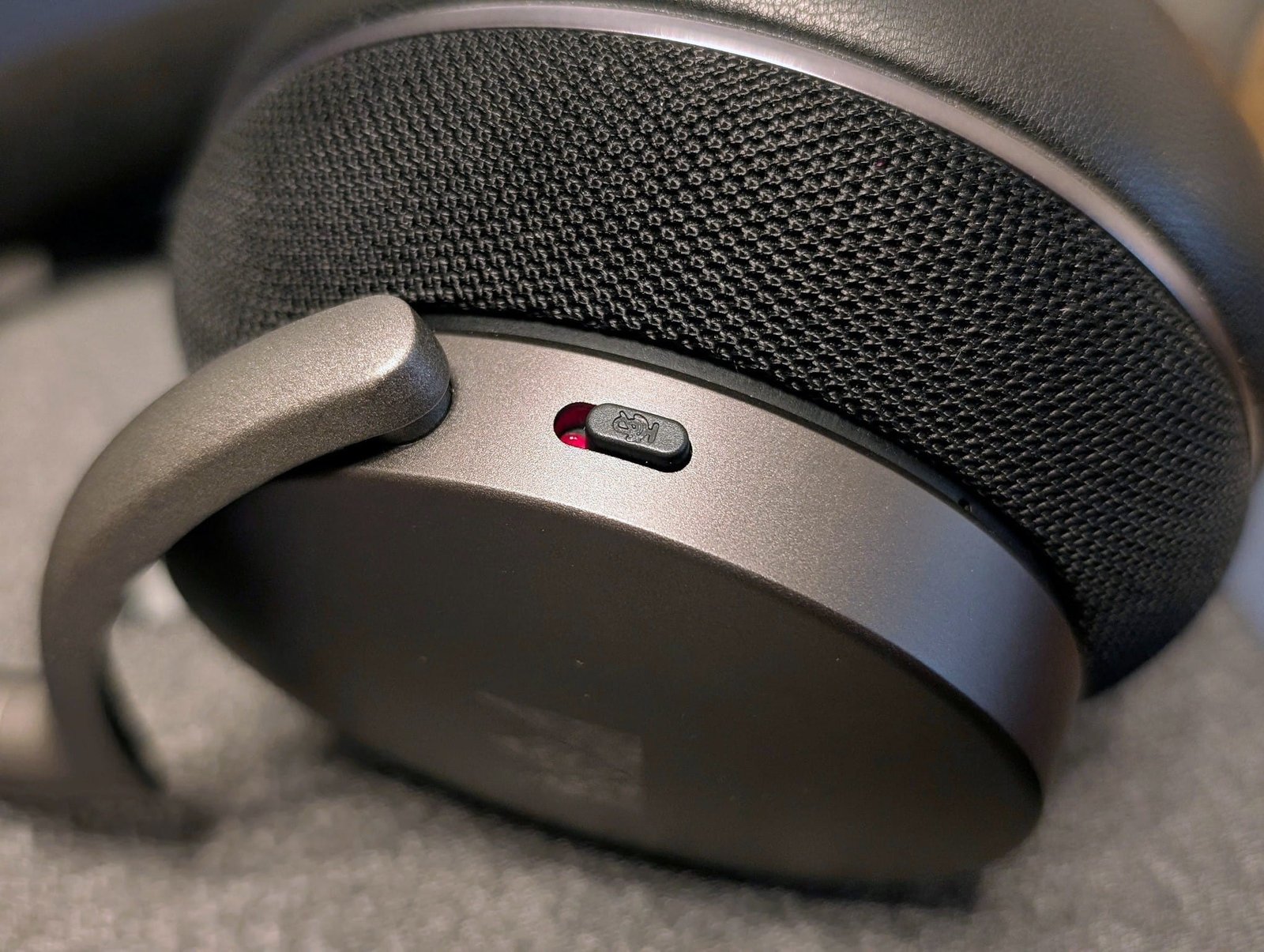
Fokus Apollo is controlled by small physical buttons located on the rear edge of the right earcup. The power button has a clear protrusion, from which fingers automatically move up and down to the volume control buttons. However, the noise-cancelling button located at the very top feels so similar that I sometimes press it accidentally. Behind the left earcup is a mute button for the included boom microphone, which also attaches to a forward-facing 3.5-millimeter connector on the left earcup. I find the absence of touch buttons a pleasant change compared to many noise-cancelling headphones I've recently tested, as everything works correctly on the first try.
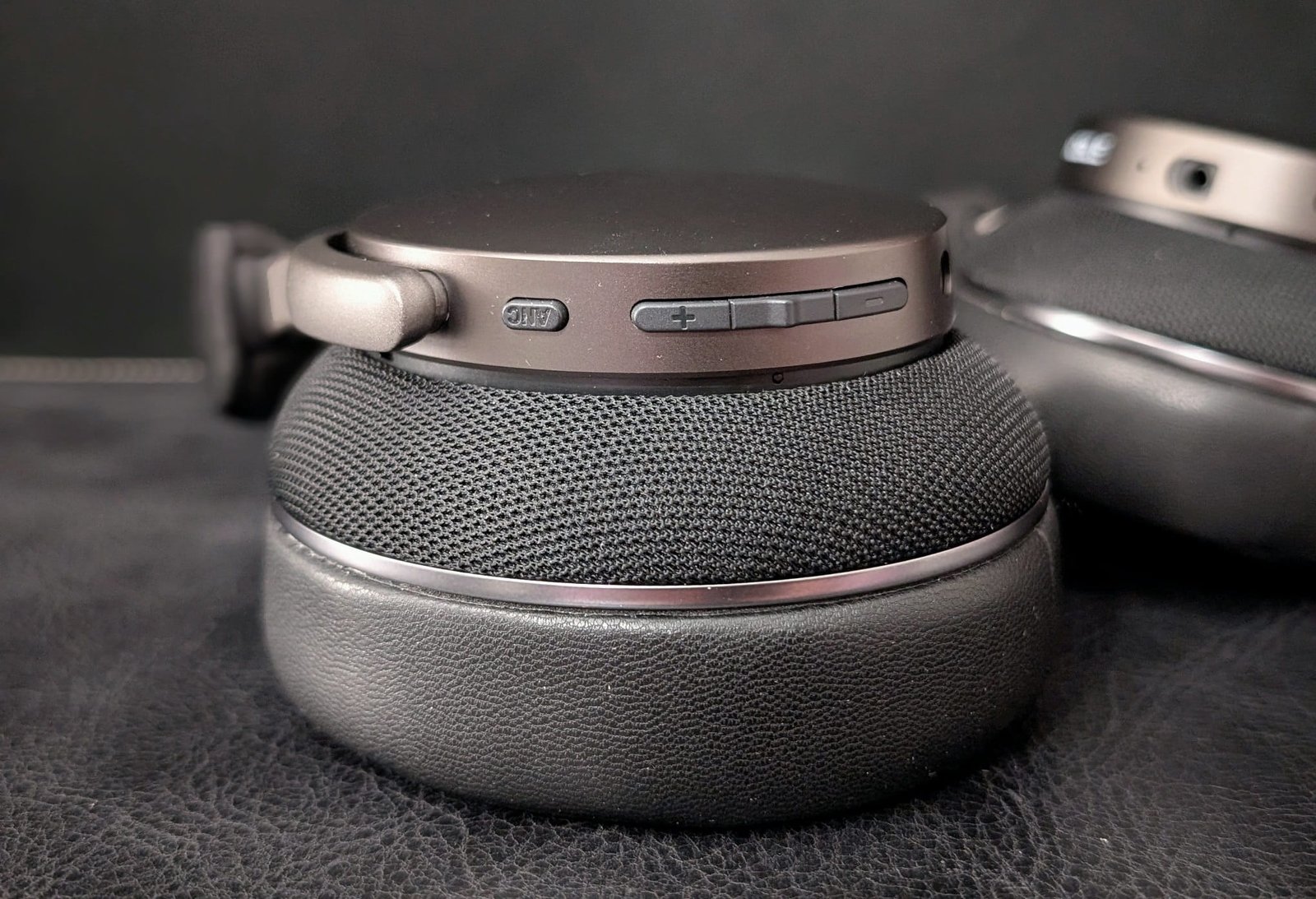
Fokus Apollo thus qualitatively meets my expectations in the 500–800 euro price range, and I do not detect any obvious weaknesses in its structure. The headphones are, of course, quite large for mobile use, and they do not have an ”ear detection” feature or a quickly activatable transparency mode. It is therefore probably wise to consider the intended use before a potential purchase decision. For example, when used at home, Fokus Apollo feels more comfortable than many other noise-cancelling headphones thanks to its large ear cushions. The boom microphone also suggests that Noble Audio has emphasized other aspects in its design than a mobile lifestyle.
Bluetooth technology and battery life
Fokus Apollo supports Bluetooth version 5.3 and, exceptionally, in addition to its basic codecs (AAC and SBC), both the LDAC codec and AptX codecs (HD and basic version) – it turns out that including both high-quality codecs in headphones simultaneously is indeed possible! This automatically makes Fokus Apollo one of the most versatile products on the market in terms of Bluetooth implementation. The LDAC codec also does not need to be activated separately via an app; it activates automatically. From the perspective of multipoint support, however, I am not entirely clear which codec the headphones utilize when connected to two devices simultaneously, as my phone claims the connection still works with LDAC, which I did not know was possible. The Bluetooth connection has worked stably with both my Google Pixel 9 phone and my PC, with commands also being reliably and quickly transmitted.
The battery life also brings a smile to my face, as 60 hours with noise cancellation on and 80 hours with it off practically match the market leaders, such as Sennheiser Momentum 4However, I am somewhat skeptical that these figures could be achieved with the LDAC codec, so it's possible that the measurements were made with AptX. It should also be noted that listening volume affects battery life by several hours one way or another. In any case, I didn't have to charge the Fokus Apollo separately even once during the approximately one-month test period, because I occasionally used it with a computer via a USB cable, at which point the battery charged almost unnoticed. Noble Audio does not state the charging time, but it certainly does not differ significantly from competitors' products, even assuming that fast charging is not supported.
Mobile app and additional features
The headphone owner can install the Noble FoKus app on their mobile device, which includes an equalizer, a few basic settings, and the option to update the firmware version. I appreciate the ability to turn off notification sounds once I've learned how the headphones work. However, no actual additional features are available; the Fokus Apollo is a simple product. This can be perceived as both a good and a bad thing, depending on expectations.
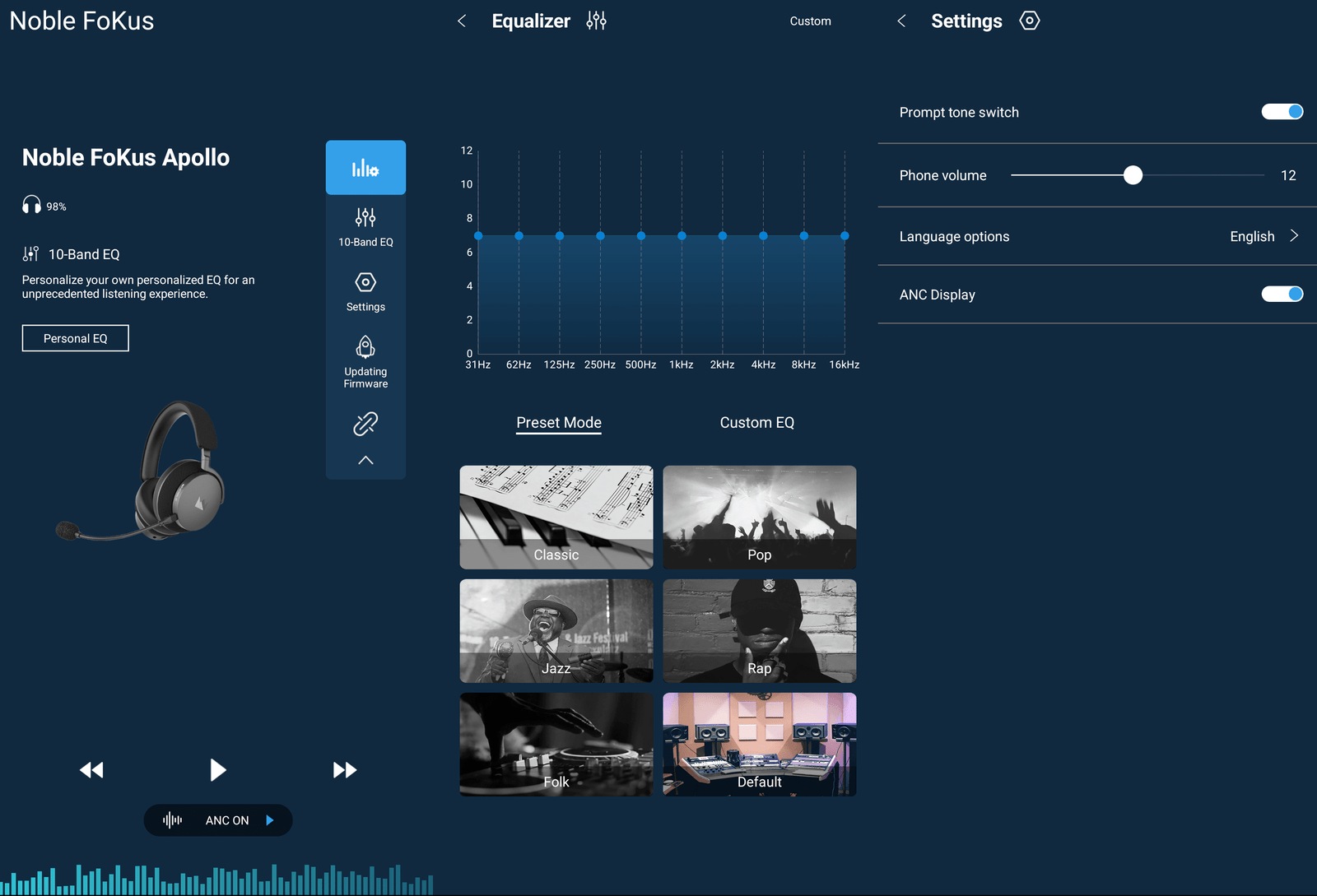
Noble Audio has pre-defined six different EQ profiles, and in addition, the sound can be adjusted using a 10-band equalizer. The decibel values indicated by the control are somewhat misleading, as the default level appears to be +7 decibels, from which it's possible to go up to +12 decibels and down to -12 decibels. However, no frequency actually rises significantly upwards; changes must be made mainly with downward adjustments. After this, multiple different profiles can be saved as usual, and the active one is simultaneously permanently stored in the headphones, thus working also on devices where the app is not installed.
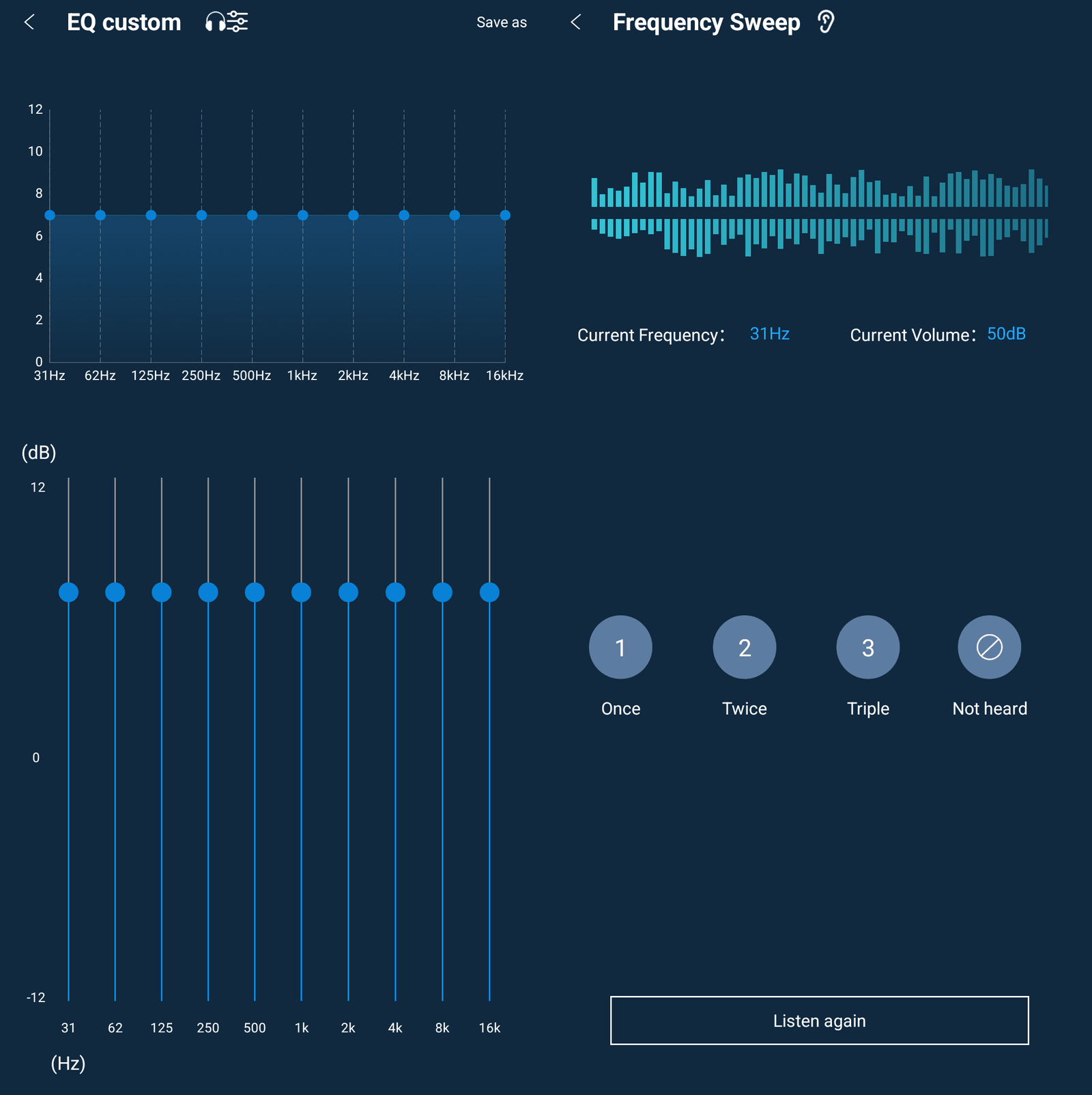
The app also offers a guided hearing test-type process, where test frequencies are listened to, and one selects how many times they are heard or if they are heard at all at a certain volume. The headphones' background noise interferes with hearing certain frequencies at low volume, while at 16 kHz, the test tone produced only crackling. At the end of the process, I was assigned a sound profile where the mid-frequencies became very muffled-sounding, while other frequencies remained unchanged. Therefore, I primarily recommend sticking to manual adjustments.
Active Noise Cancellation
Noble Audio's product information regarding the noise-cancelling function is limited, but it indicates that the headphones feature an ADI chip and three microphones in each cup. The effectiveness of the noise-cancelling function cannot be adjusted, but it can be turned off. As a third option, a transparency mode is available.
With the noise-cancelling function on, there is some background noise, which I would describe as more of a hiss. However, this is no longer noticeable when listening to audio content. Other disturbances, however, can cause slight irritation, as the noise-cancelling function produces louder crackles than usual if the headphones are poked or tapped during use. Additionally, when walking, footsteps cause thumps and wind creates some interference noise, so for now, I would recommend listening mainly indoors and while stationary. Similar problems were also present in Cambridge Audio Melomania P100until the manufacturer fixed them with firmware updates. I expect the same from Noble Audio, as its headphones cost more than double compared to the Melomania P100.
In terms of noise-cancelling effectiveness, the Fokus Apollo based on my own tests (listening to airplane and cafe noise, and speech at ~80 decibels), corresponds to Bowers & Wilkinsin PX7 S2e, from which it can be concluded that it is very similar to the PX8 model in its own price range. Compared to B&W headphones, the low frequencies are attenuated even slightly more effectively with the Fokus Apollo, so the end result might even be slightly more pleasant.
More broadly, however, we are still not talking about particularly high-performance noise cancellation, because, for example, Cambridge Audio's Melomania P100 and the slightly older Bose QuietComfort SE (the same headphones as QuietComfort 45) attenuate noise so much more effectively that the difference is easily noticeable. Sony's WH-1000XM series would also be a better choice than Fokus Apollo when emphasizing powerful noise cancellation. Thus, Noble Audio's headphones' noise-cancelling function does not impress, but it is not worse than most of its expensive competitors either. I cannot confirm this at the moment, but I would assume Focal Bathys' would come in second to Fokus Apollo, even if the difference is not necessarily large. In the 1400 euro priced T+A Solitaire T, in any case, based on my own experience, does not have as effective a noise-cancelling function as Noble Audio's headphones, which can be considered a kind of victory.
Transparency mode also works quite well in Fokus Apollo, although I do notice a missing piece in the mid-frequencies, which makes speech sound a bit bass-heavy and muffled. This is unlikely to bother many people significantly, as the worst noise and sound sharpening are avoided. The B&W PX7 S2e and Bose QuietComfort SE sounded more natural in the comparison, whereas the Melomania P100's transparency mode has its own unnatural qualities.
Microphone sound quality
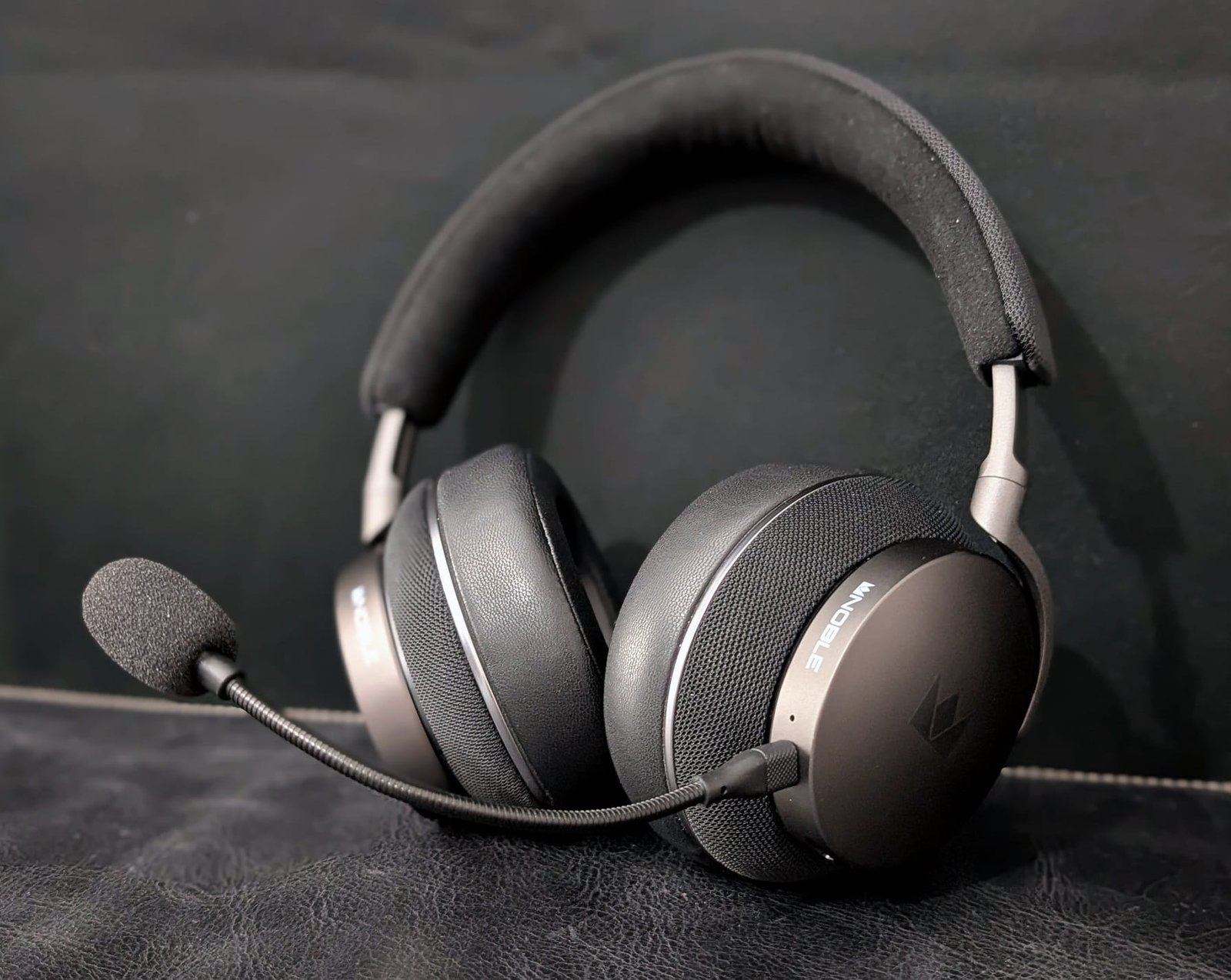
Fokus Apollo is a rather unique noise-cancelling headphone thanks to its detachable boom microphone. It would be well suited, for example, as a conference or gaming headset. For the latter use case, it's advisable to choose either a USB cable or a headphone cable to eliminate potential latency and prevent sound quality from suffering due to Bluetooth connection weaknesses. However, it's not always necessary to use the boom microphone, as the headphones also feature a traditional microphone installed inside the earcups. The mute button located behind the earcup affects both microphones.
I tested the headphones in Teams meetings and found the concept quite functional, with one peculiarity. For some reason, when the microphone is muted via the Teams application, Fokus Apollo beeps every 15 seconds as if to warn about the microphone being muted. This was really annoying, so using the headphones' own mute button was practically mandatory. There were no complaints about the microphone's sound quality, but I didn't get to try speaking in a noisier environment at this time. Some owners of the headphones have complained that the boom microphone doesn't attenuate background noise much compared to headphones specifically designed for speech use. Teams, however, seems to automatically suppress background noise, so Fokus Apollo's potential weaknesses only manifest in certain conditions.
Headphone sound quality
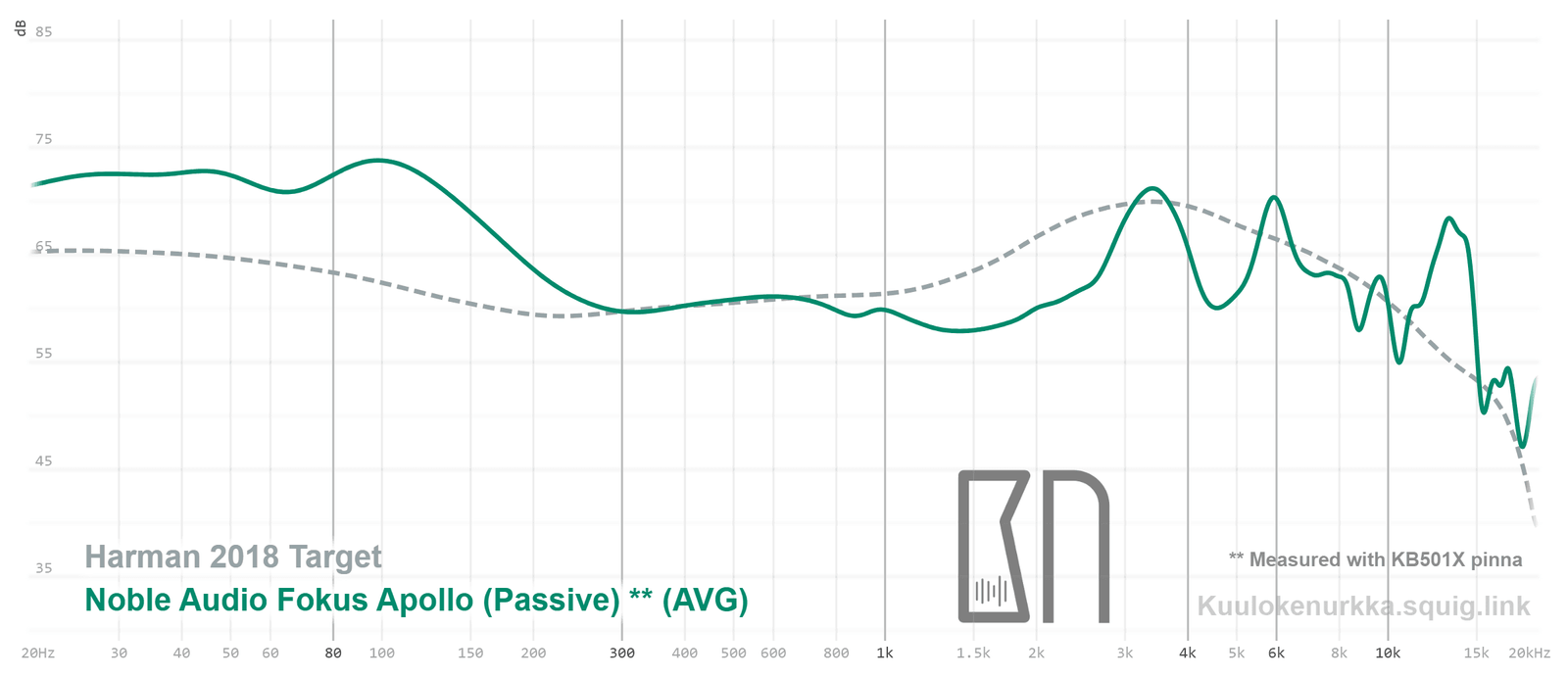
Our frequency response measurements have been made with a clone IEC-60318-4 coupler and KB501X pinnae. The Harman target curve from 2018 is used as a reference point and generalization of the headphone response that would sound good to most people. For more information on the measurements and their accuracy, see Headphone Measurements-page. The frequency response of the Fokus Apollo is also comparable with other measured headphones Squiglink .
In addition to a Bluetooth connection, the headphones can be used with a USB cable and a headphone cable. The first two require power to be on (so-called active mode), while listening with a headphone cable is also possible in passive mode with the power off. However, I do not recommend this, because in the absence of DSP correction, the sound is, in my opinion, off due to overemphasized bass and subdued upper-mid frequencies. This usage is mainly suitable for emergencies when the battery runs out, or for work meetings where balanced sound is not as critical.
Unfortunately, listening in active mode with noise cancellation off and in transparency mode also leaves something to be desired, as for some reason Noble Audio has not created an optimal DSP profile for them, allowing the bass to remain overly emphasized. This can only be remedied by activating the noise cancellation function, so despite its theoretical versatility, I believe Fokus Apollo should only be listened to in that manner – at least if sound quality commensurate with its price range is important or if one is not prepared to equalize the headphones. On the other hand, many ”hi-fi reviewers” have praised the sound quality specifically in passive mode and with noise cancellation off, so there are clearly many different preferences regarding the amount of bass.
Frequency response in passive mode:
Frequency response ANC ON and ANC OFF:
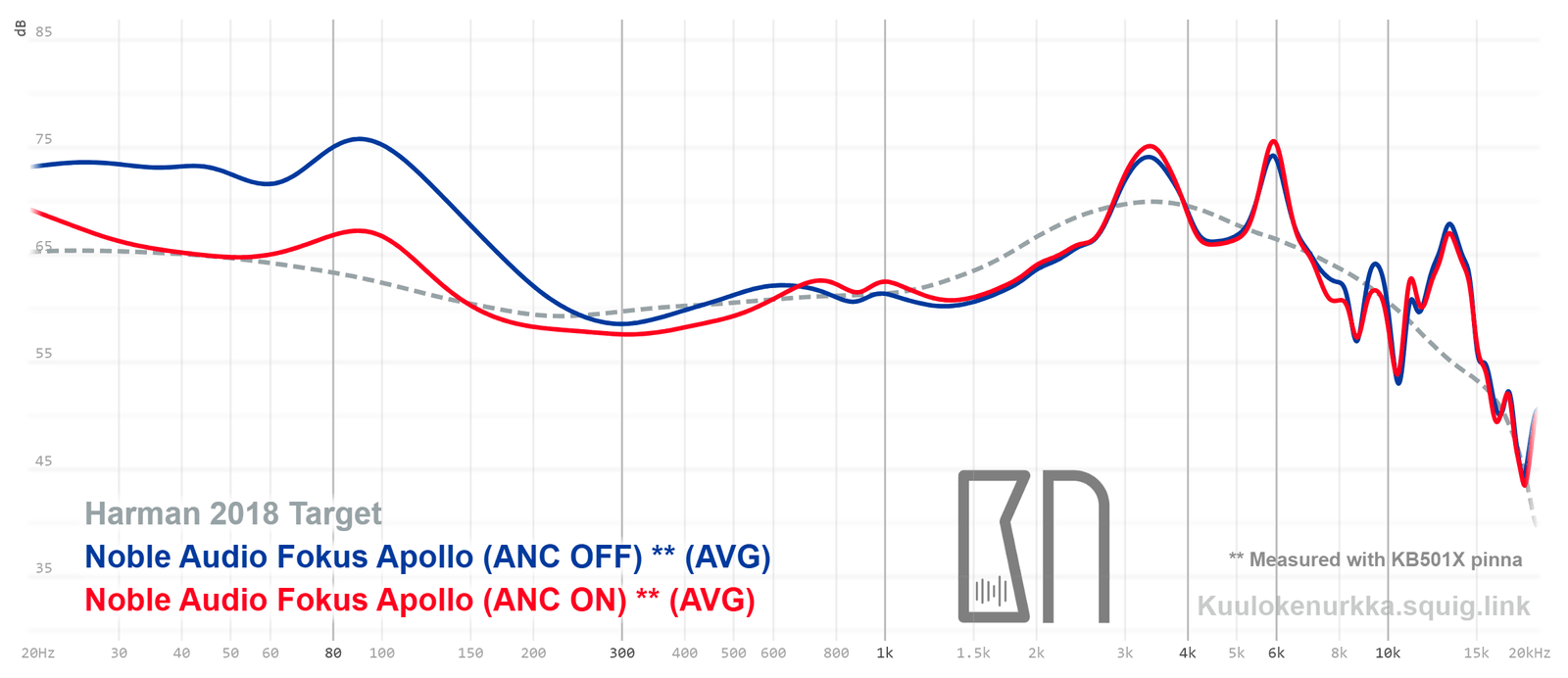
As noted, in passive mode, transparency mode, and with noise cancellation off, Fokus Apollo's sound is bass-heavy and rather bloated in style. The treble also reproduces with emphasized brightness, so the most important aspect of music for me, the mid-frequencies, often take a backseat, even though vocal performances sound surprisingly clear with the 3–4 kilohertz emphasis. Thus, I believe there's some kind of treat available for lovers of the traditional V-shaped sound signature.
Activating the noise cancellation function ultimately lightens the low frequencies to an objectively appropriate level, although a bump of a few decibels remains around 100 hertz. I would still guess that most people would find a small extra thump to be a fun feature, especially since the upper bass around 200 hertz is no longer emphasized as much in the overall sound as in many noise-cancelling headphone models designed for larger consumer groups (e.g., Sony). With noise cancellation on, Fokus Apollo's bass reproduction gets a thumbs up from me due to its punchiness and clarity.
Otherwise, my listening experience is unfortunately varied, because the tuning of the headphones simultaneously exhibits many characteristics that I personally find irritating, and which are masked by the emphasized bass when noise cancellation is off. The mid-frequencies, and especially vocals, sound quite thin and sharpened with noise cancellation on, which easily puts my ears into a kind of defensive mode unless I lower the volume more than usual. Firstly, the sound lacks some body between 200–500 hertz, so the thinness of the presentation exacerbates the honking and breathy nuance originating between 700–1000 hertz. Combined with a 3–4 kilohertz emphasis, this makes the sound even a bit rougher and more aggressive. Obvious colorations are also found in the high frequencies, as a narrow peak at 6 kilohertz and, to some extent, the sparklingly energetic reproduction of the 10–15 kilohertz frequency range add extra sibilance and harshness to the overall sound.
Sometimes individual emphases in headphones only appear in partially inaccurate measuring devices, but in the case of Fokus Apollo, I unfortunately detect all of them with my own ears when experimenting with frequency sweeps – at least in my test headphones. The emphases also align with the measurements at the same frequencies, as the headphones' frequency response does not change significantly in different wearing positions. One does get used to the colorations over time, but the timbre is unnatural to such an extent that it's somewhat difficult to connect with the music being listened to. Of course, the emphases are not always equally obvious or disturbing, and furthermore, when listening at a low volume, a certain kind of energy and detail also has its advantages. I wouldn't be surprised if many who praise Fokus Apollo as balanced listen to it at a relatively moderate volume.
However, it is clear that I am not particularly satisfied with the end result, considering Fokus Apollo's rather high price. I perceive the high-frequency emphases as flaws that Noble Audio should have smoothed out, instead of opting to make them more prominent with their DSP corrections compared to passive mode. Unfortunately, I can't quite grasp what the concrete benefits of the 2-way drivers are. Fortunately, the equalizer found in the app is relatively good at balancing the sound, so I will stop worrying about the initial situation here and move on to corrective measures.
Equalization
The manufacturer's predefined EQ profiles do not correct the biggest colorations, so balancing the sound should be done manually. I personally ended up with the settings shown in the image below in the Noble Audio app (with noise cancellation on). Since many frequency bands have been lowered, the headphones” volume needs to be increased by several ”steps' to reach a level comparable to the initial situation.
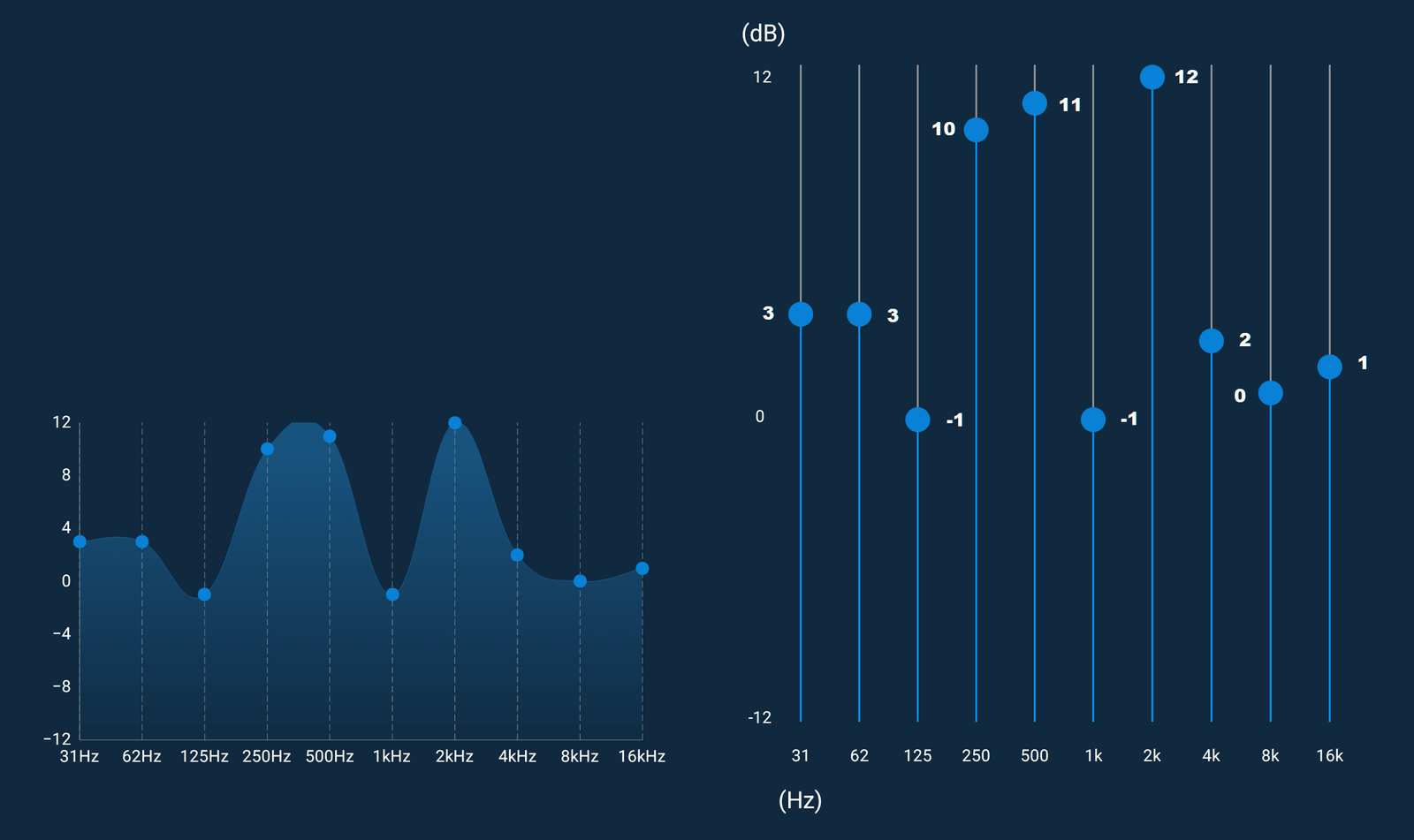
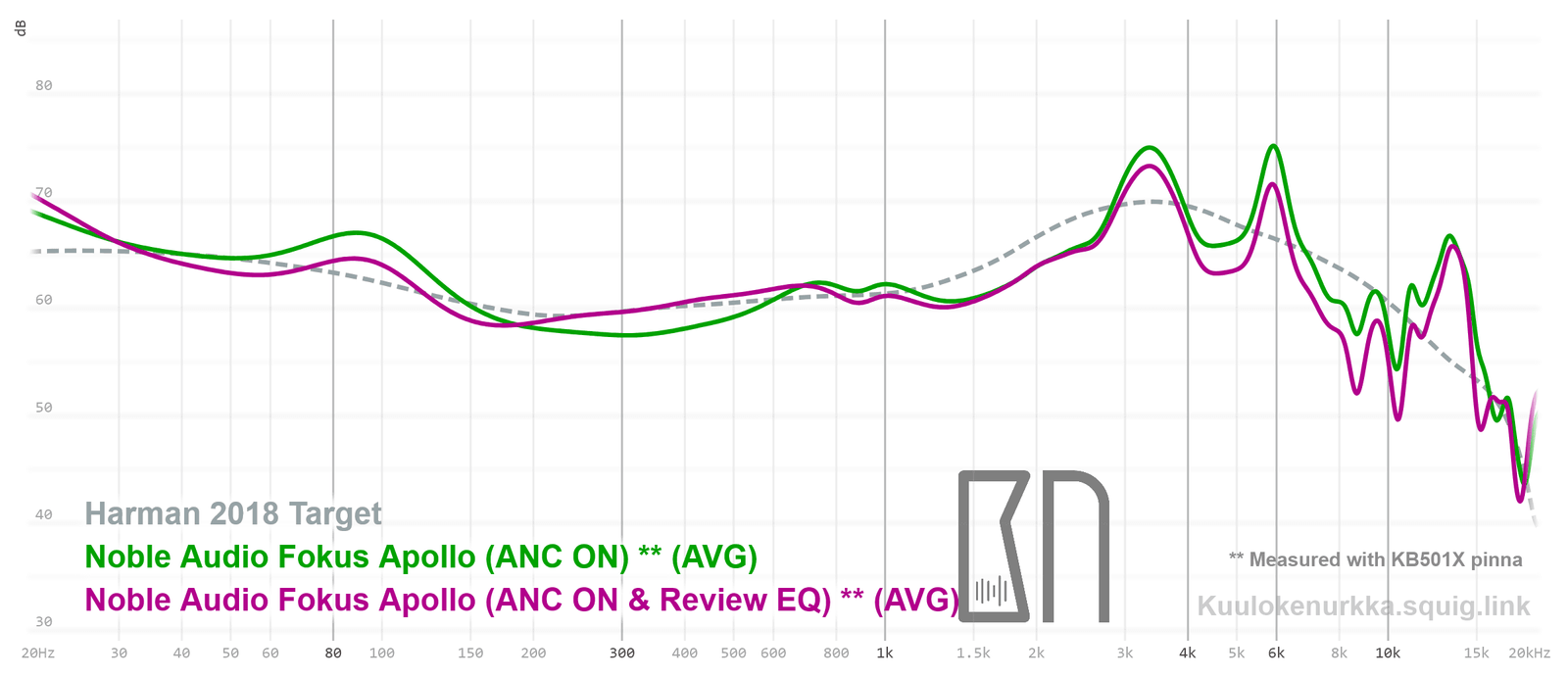
Straightening the lower midrange frequencies and lowering the biggest treble peaks help make the reproduction clearly more natural. Now the headphones also work at louder volumes, and my attention is no longer drawn to the thinness and aggressiveness of the sound. The spatial impression is also pleasantly spacious, thanks to the calmly reproduced 1–3 kilohertz frequency range and airy treble. The larger-than-usual ear pads also likely contribute to this.
Clarity, dynamics, and separation are plentiful, especially when listening with the LDAC codec, so I've gradually started to warm up to the Fokus Apollo. The bright and sharpened initial state might suit some, but based on the research behind Harman's target curve, I believe most would prefer my own equalization in the long run, which doesn't actually even change the headphones completely.
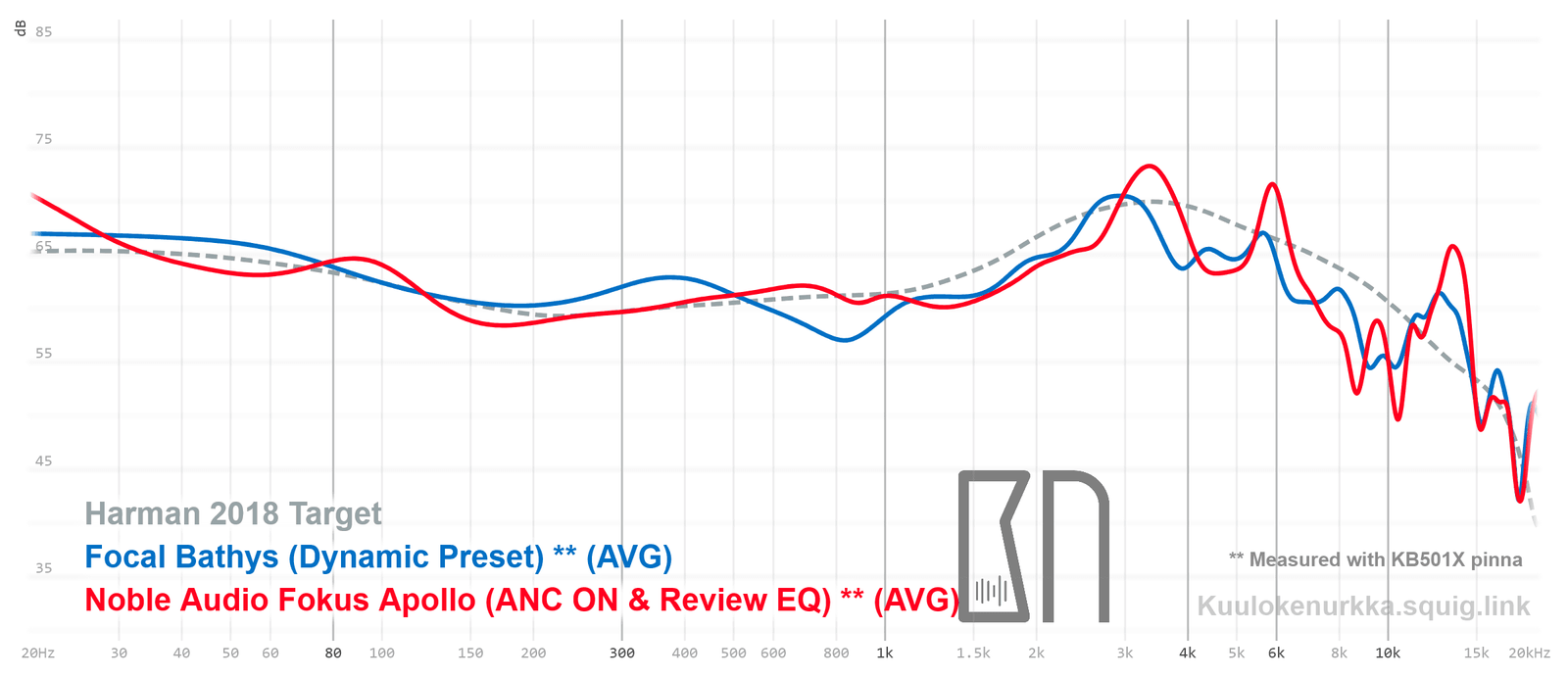
With better frequency balance, I can state that the Fokus Apollo's reproduction feels precise. It largely lacks the typical softness of Bluetooth headphones in both bass and treble. I don't know to what extent the planar driver affects the end result, but the clarity of the high frequencies and the accuracy of sound separation are in any case improvements compared to most of the more affordable noise-cancelling headphone models I've tested. For example, among competitors' products, Focal Bathys has been tuned to sound fuller and calmer, so its sound is not as fresh and transparent even in the more neutral Dynamic mode. The equalized Fokus Apollo is definitely among the better end of its product category for so-called hi-fi use. From the same price range, I would gladly leave the heavily bass-emphasizing Bowers & Wilkins PX8 in the store, but I have yet to hear the DALI IO-8.
Summary
The Fokus Apollo has been praised for its sound quality in almost every review I've seen, so I expected something other than a traditional V-shaped presentation or overly sharp sound with noise cancellation on. The headphones look and feel like an expensive product, but unfortunately, I cannot call the sound very natural or particularly high-quality without equalization. The effectiveness of the noise-cancelling function doesn't revolutionize the market situation either way.
Playing into all this, it might sound contradictory that with spacious ear pads, comprehensive codec support, excellent battery life, and successful equalization, I ultimately like the headphones to the extent that I might even consider acquiring them. However, I cannot decide if pushing the extra effort of equalization onto the headphone owner is acceptable in the Fokus Apollo's price range. I am, of course, a more critical listener than usual, which is perhaps indicated by the temporary depletion of headphones from retailers' stocks due to high demand.
Finally, I extend my thanks to Mareksound for lending the headphones. To Noble Audio, I, in turn, express the wish that they would consider fine-tuning and smoothing the tuning a bit more in conjunction with firmware updates. After this, I believe I could recommend the Fokus Apollo on par with, for example, the Focal Bathys. As always, I still urge everyone to try all kinds of headphones with an open mind and their own ears, if it's at all possible.
Pros and cons:
+ Proper bass reproduction with noise cancellation on
+ High-quality sound when equalized
+ 2-way drivers increase the headphones' appeal
+ High-quality and stylish construction
+ Long battery life
+ Exceptionally broad codec support
+ Versatile microphones
+ Comprehensive features
+/- Good wearing comfort and larger-than-usual ear pads, but the narrow headband might cause pressure on some people's heads
+/- The energy of the high frequencies is beneficial when listening at low volume, but the sound becomes somewhat harsh when listening louder
– The user must starkly choose between emphasized bass or treble
– The boosts in the frequency response would require fine-tuning
– The noise-cancelling function causes thumping when walking, at least for now
– Large size and thick casing can interfere with mobile use
– Stiff cables
– A rather high price considering the uneven factory tuning
 EN
EN  FI
FI