Author: Sword of Damocles
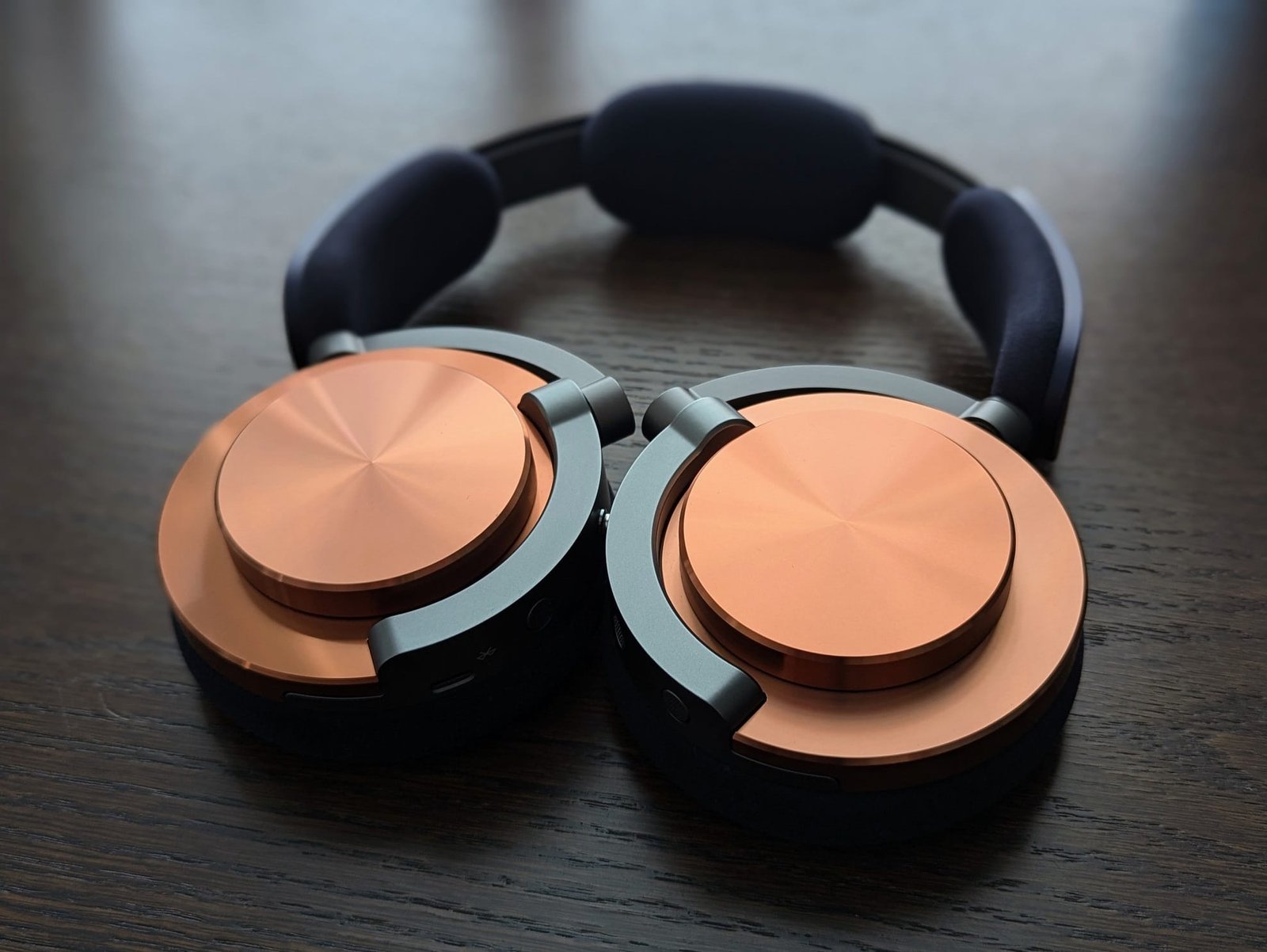
Table of Contents:
Information:
- Release year: 2024
- Country of Origin: China
- Color options: over 2000 different color combinations (metal sides of the cups and hard cushions are interchangeable)
- Price: 499 €
- Type: Closed, over-ear
- Dynamic 40 millimeter drivers
- Audio connections: Bluetooth 5.0 (release year 2016)
- Bluetooth codecs: LHDC, AAC and SBC
- Charging port: USB-C
- Battery life: 55h (with noise cancellation on)
- Charging time: 3h (fast charging: 2.5h of use in 10 minutes and 9h of use in 30 minutes)
- Noise cancellation function (8 microphones | 40 dB attenuation) and transparency mode
- Features: IP51 rating, ear detection (wear detection), joystick button and phone application with real-time sound exposure monitoring
- Weight: 451 g (according to my own scale 452 g)
- Accessories: Collapsible carrying case, USB-C charging cable (length 1.2 m)
Review unit: Loaned by the manufacturer
Dyson is particularly known for its wide range of suction and blowing electronics, such as vacuum cleaners, air purifiers, hair dryers, and fans. In 2022, it surprisingly released the very exceptional Zone headphones, which had an air purification system installed that blew fresh air onto the face through a visor. The fans with their motors placed in both cups simultaneously required an effective noise cancellation function so that the user would not hear a continuous hum. Although the headphones did not end up in widespread use due to their perplexing appearance and high price of 1000 euros (current price 650 €), they can still be considered an excellent demonstration of Dyson's technological expertise. I suspect that Zone was intended as a kind of concept product that served the Dyson brand on a broader level than just as headphones.

Now, however, the manufacturer has taken a step back from its wildest ideas and, so to speak, returned to earth. Its 500-euro priced OnTrac noise-cancelling headphones are already relatively normal and easily approachable. The appearance, with its extensive customization options, certainly differs significantly from most competitors' products, but not necessarily in a bad way. In other respects too, OnTrac incorporates a lot of out-of-the-box thinking, which I find to be a refreshing change. Since Zone already received cautious praise for its sound quality, I was eager to evaluate how Dyson has succeeded with OnTrac. I received the headphones for testing directly from the manufacturer through its Finnish PR representative. Thanks for the quick arrangement and cooperation!
Packaging and accessories
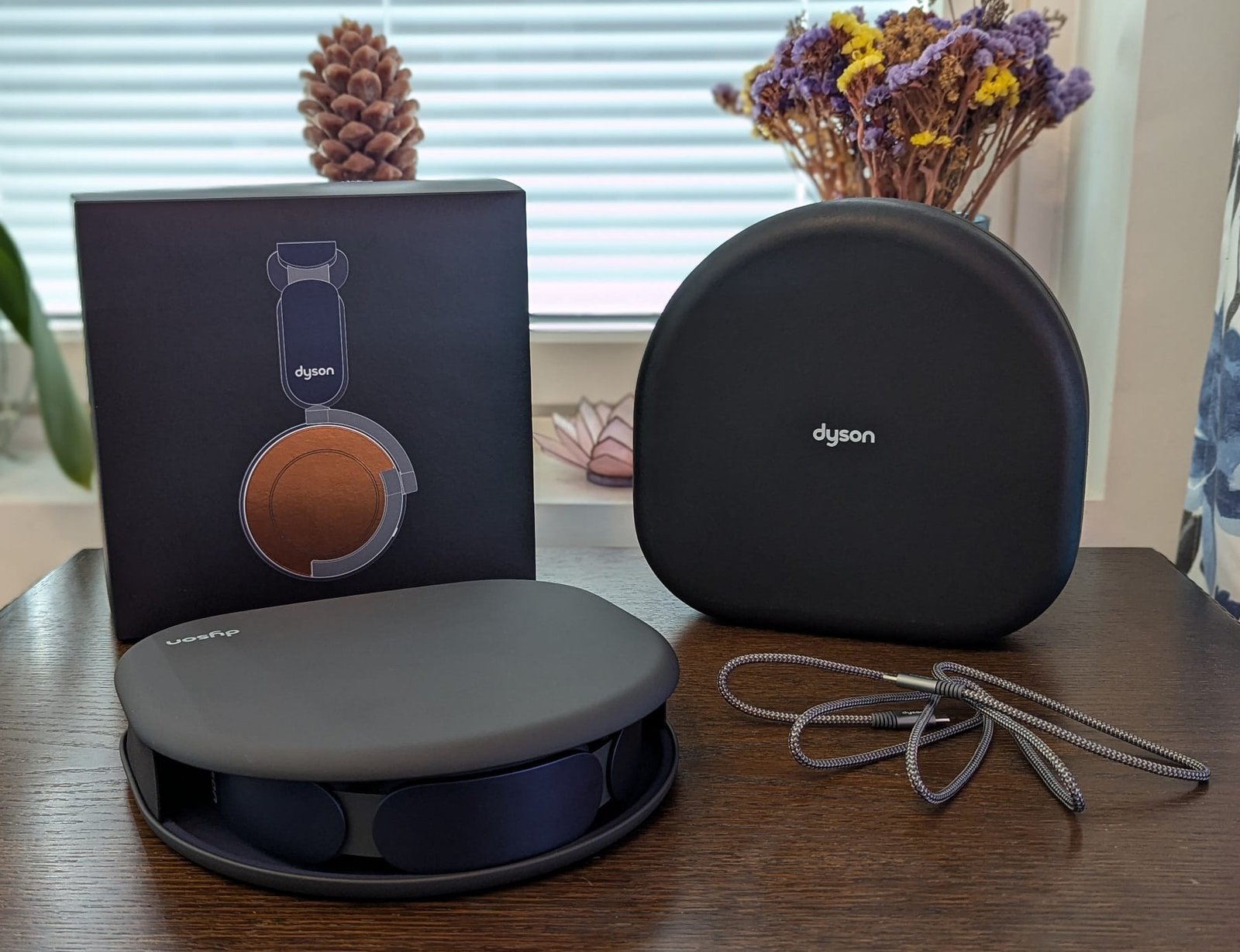
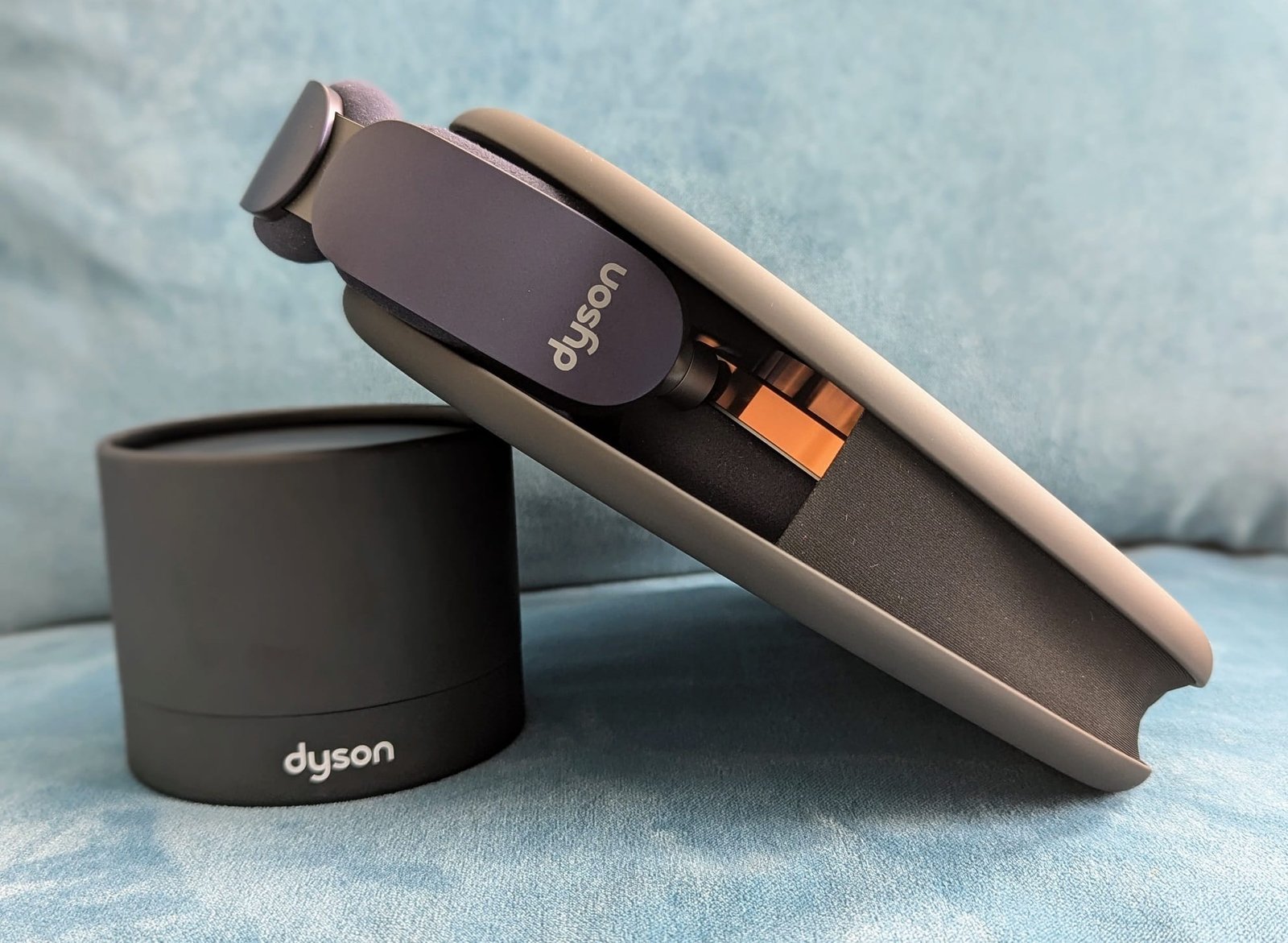
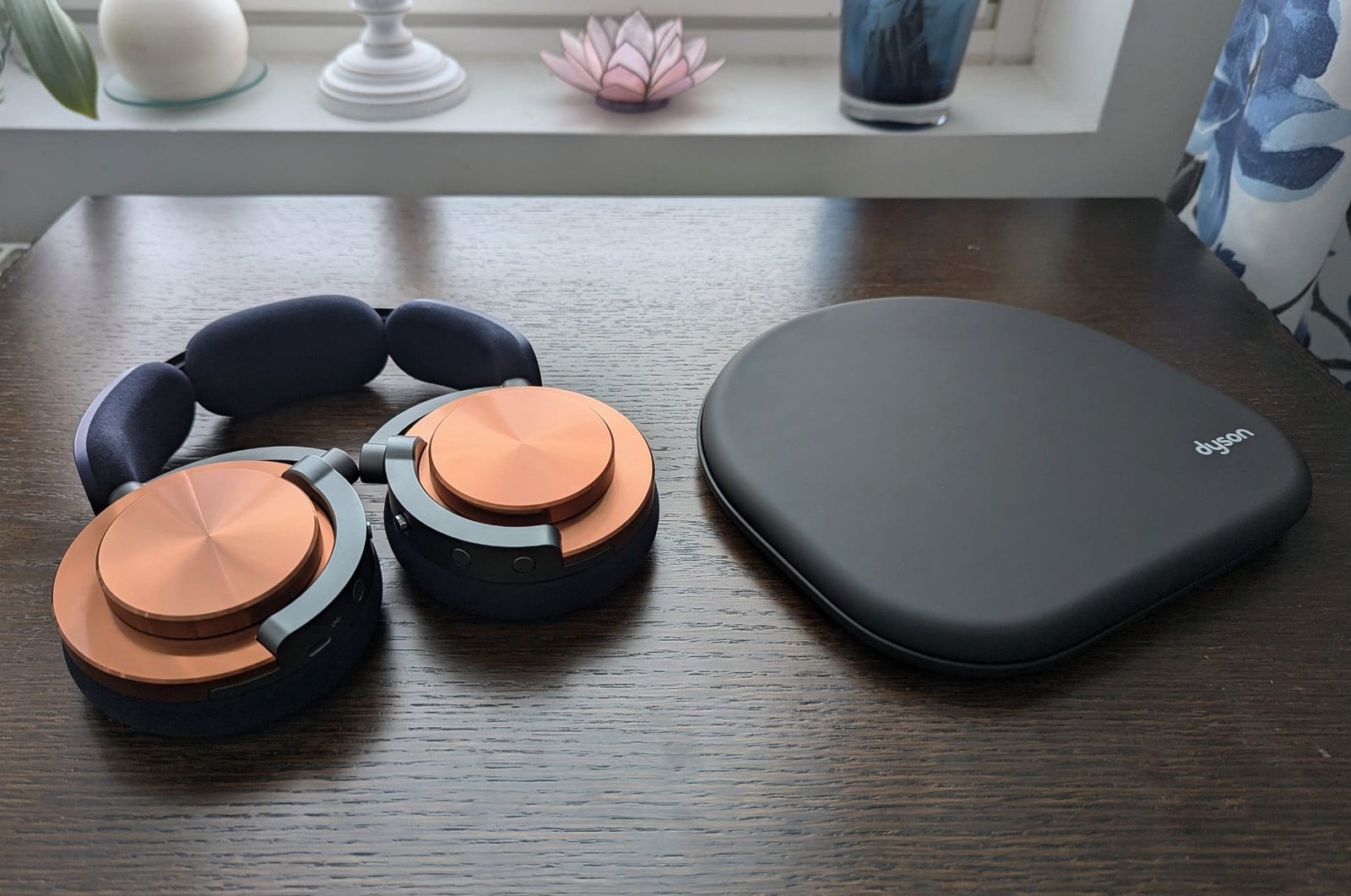
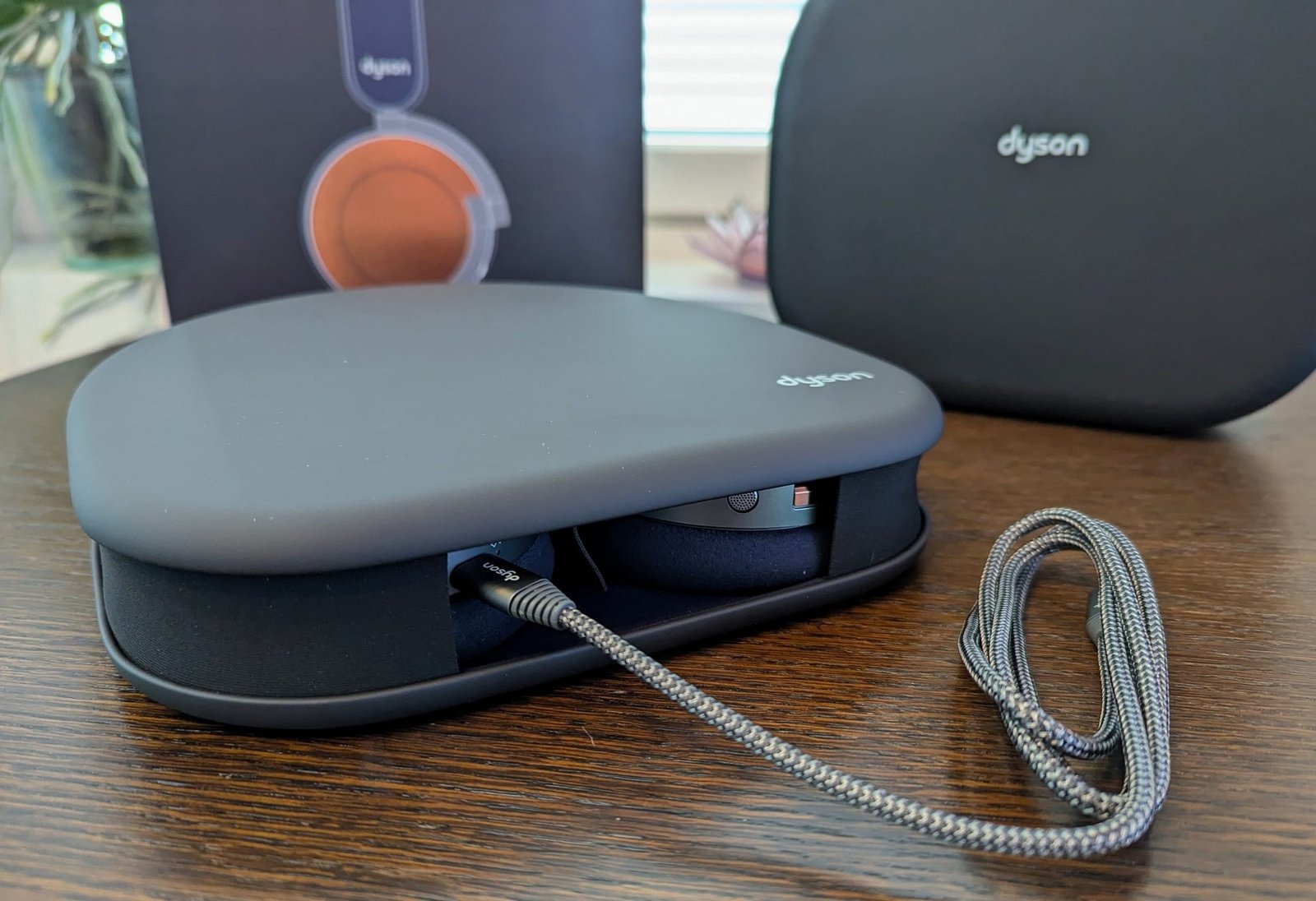
OnTrac is delivered in a black cardboard box, where the headphones are further protected by a separate hard cardboard shell before their actual carrying case, which is lighter in construction than usual. When the headphones are taken out of the case, it collapses and takes up little space, for example, in a bag or backpack. Otherwise, it is practically as flat as the OnTrac folded horizontally, making it convenient to carry the headphones. A small pocket for the charging cable is found on the inner edge of the case, and the headphones can be charged through the open bottom without taking them out. In addition to the case, the headphones come with user manuals and a fabric-covered USB-C charging cable, which is 1.2 meters long.
Structure and its customization possibilities
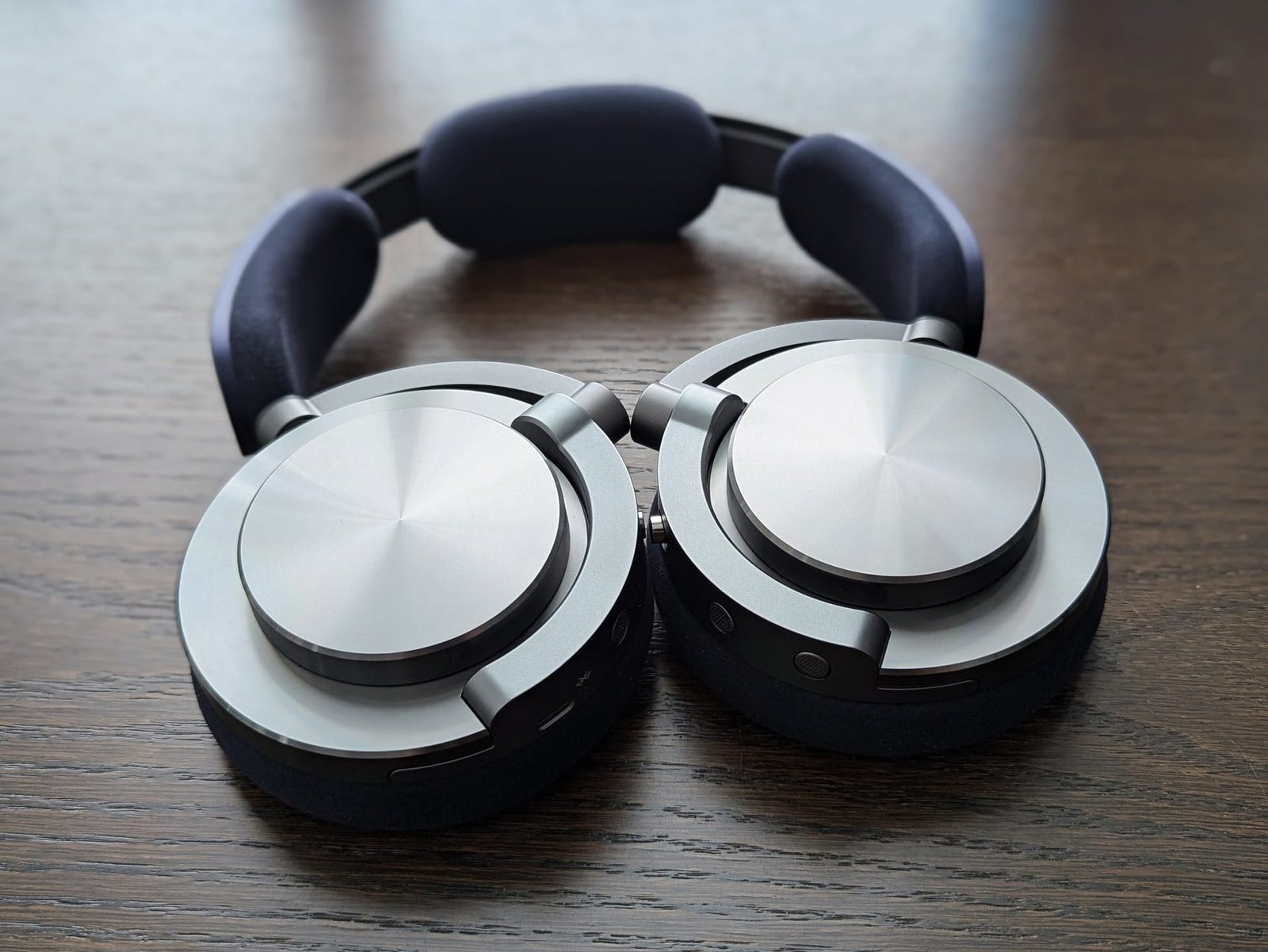
Dyson's headphones are a very peculiar sight, especially with their shiny copper-colored cups, which the manufacturer has CNC-machined from aluminum. Structurally, OnTrac also looks really robust, as it is clearly designed to be larger and more durable than one would assume necessary. In my opinion, the overall impression of quality in the 500-euro price range breaks all possible scales: I can't think of anything as sturdy and over-engineered. As a result, the weight accumulates to a hefty 450 grams, which could probably be considered a record for noise-canceling headphones, if Dyson's own Zone headphone model didn't weigh even more, a whopping 600 grams.
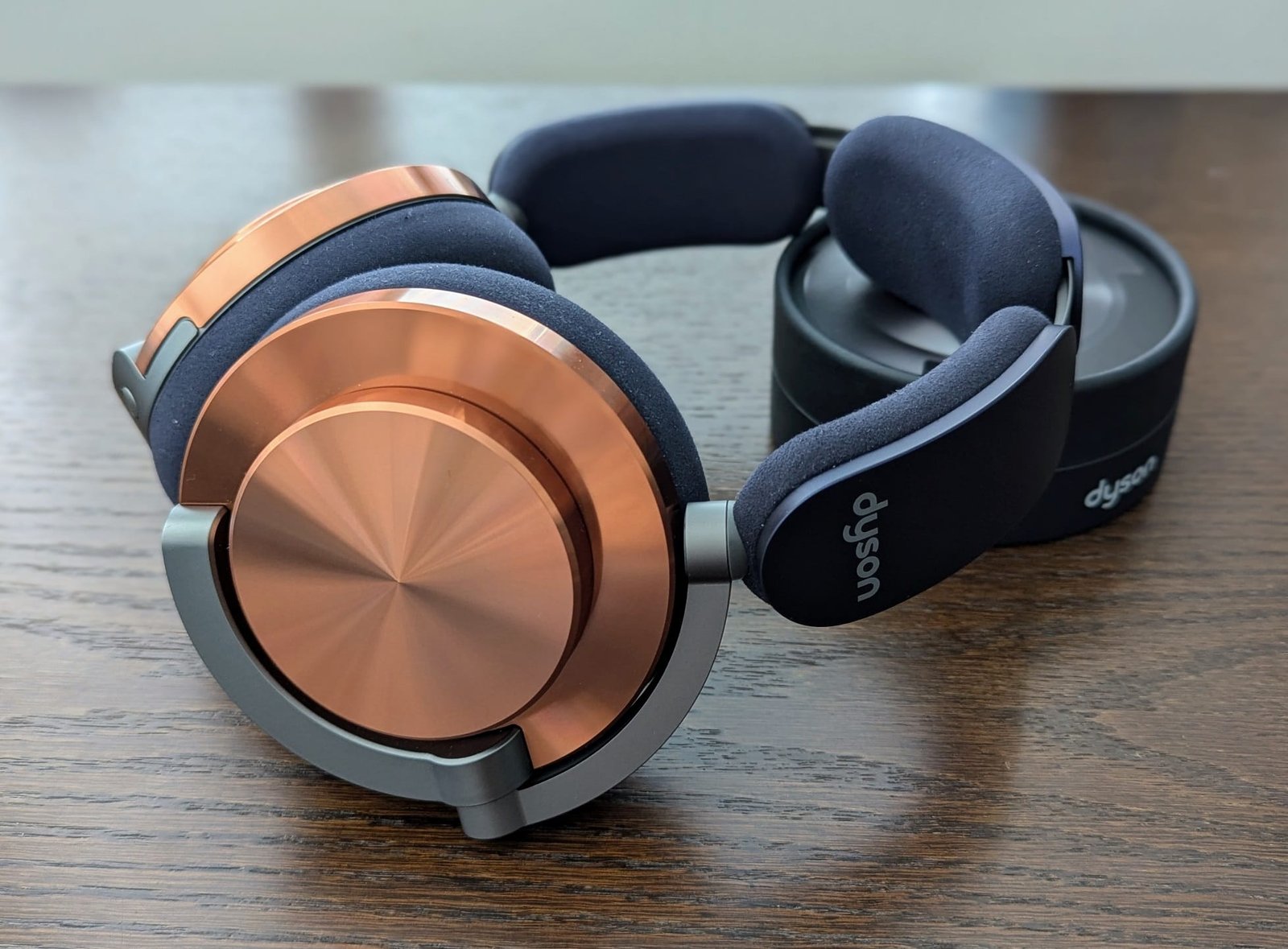
Fortunately, the manufacturer has not prioritized durability too much at the expense of usability; instead, OnTrac adjusts and sits comfortably and evenly on the head. The cups' range of motion is successful, and the height can be adjusted incrementally from the top of the headband. The rather large weight is also distributed evenly on the head because the cups are shaped surprisingly flat and conforming to the head, and the batteries are located inside the headband above the ears. The hard battery cases look like padding at a quick glance, but in reality, they are just covered with the same fabric as the padding located in the middle of the crown of the head.
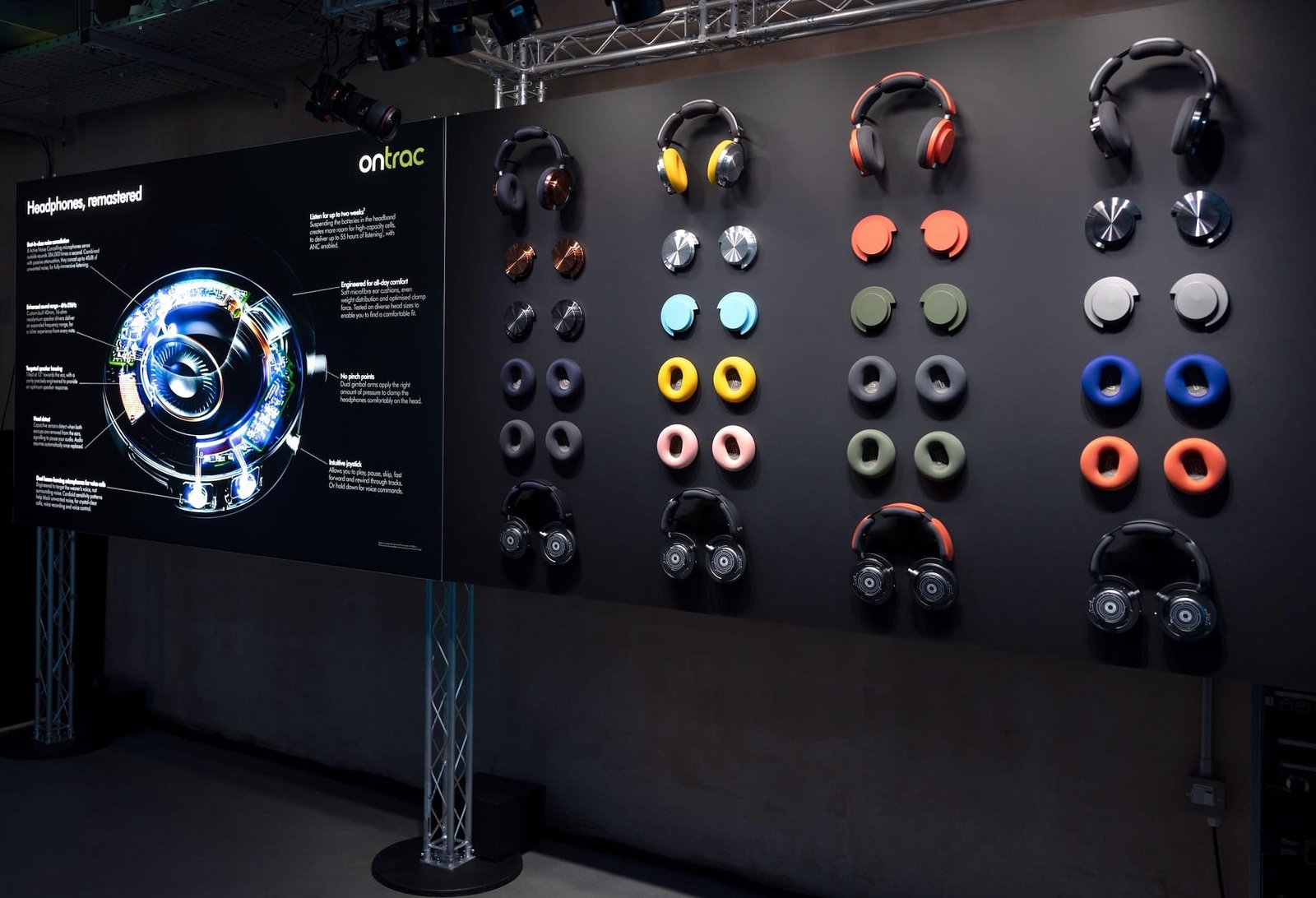
In my test headphones, the sides of the cups are copper-colored, while the headband and ear pads are dark blue. This combination would certainly attract attention when moving outdoors and would definitely suit those who want to stand out from the crowd. Nowadays, self-expression is more permissible and popular than before, for which Dyson also offers extensive customization options for OnTrac in the form of interchangeable parts. Firstly, four different versions of the headphones are sold, and additionally, the metal sides of the cups and the ear pads can be changed to different colors. When all the different color combinations are added up, the manufacturer states there are over 2000 different results. I would guess this number includes options where the left and right sides of the headphones are different colors.
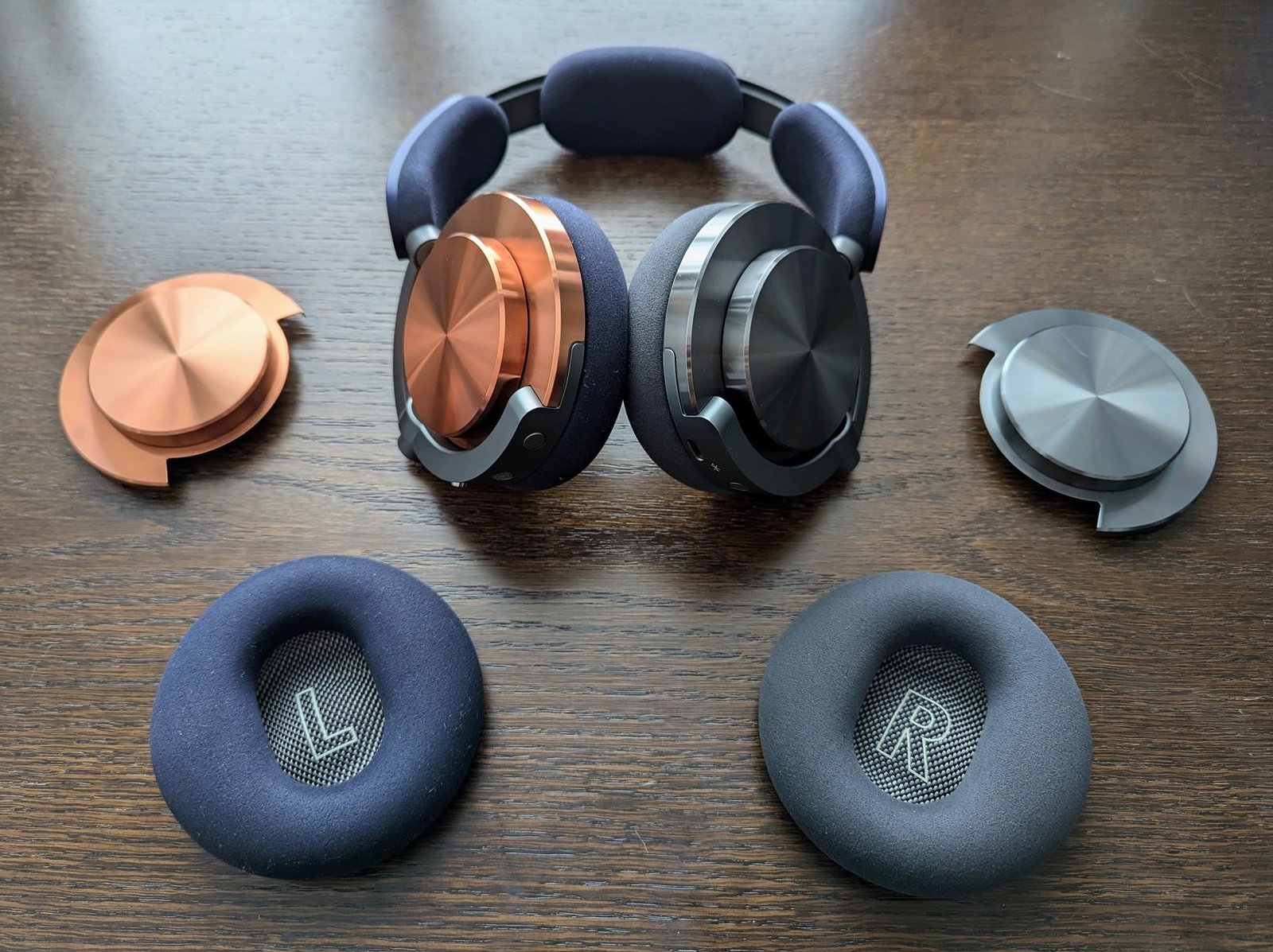
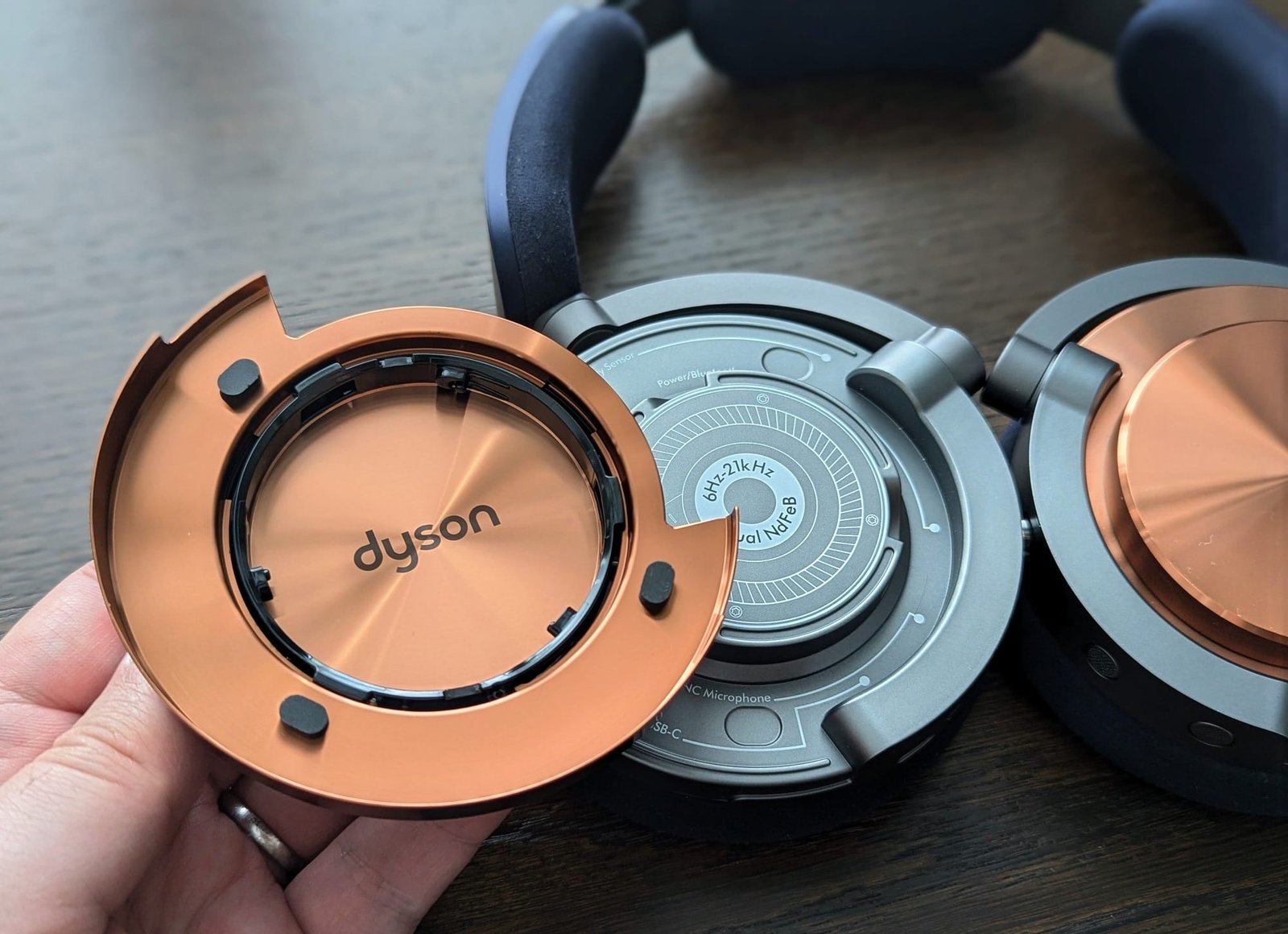
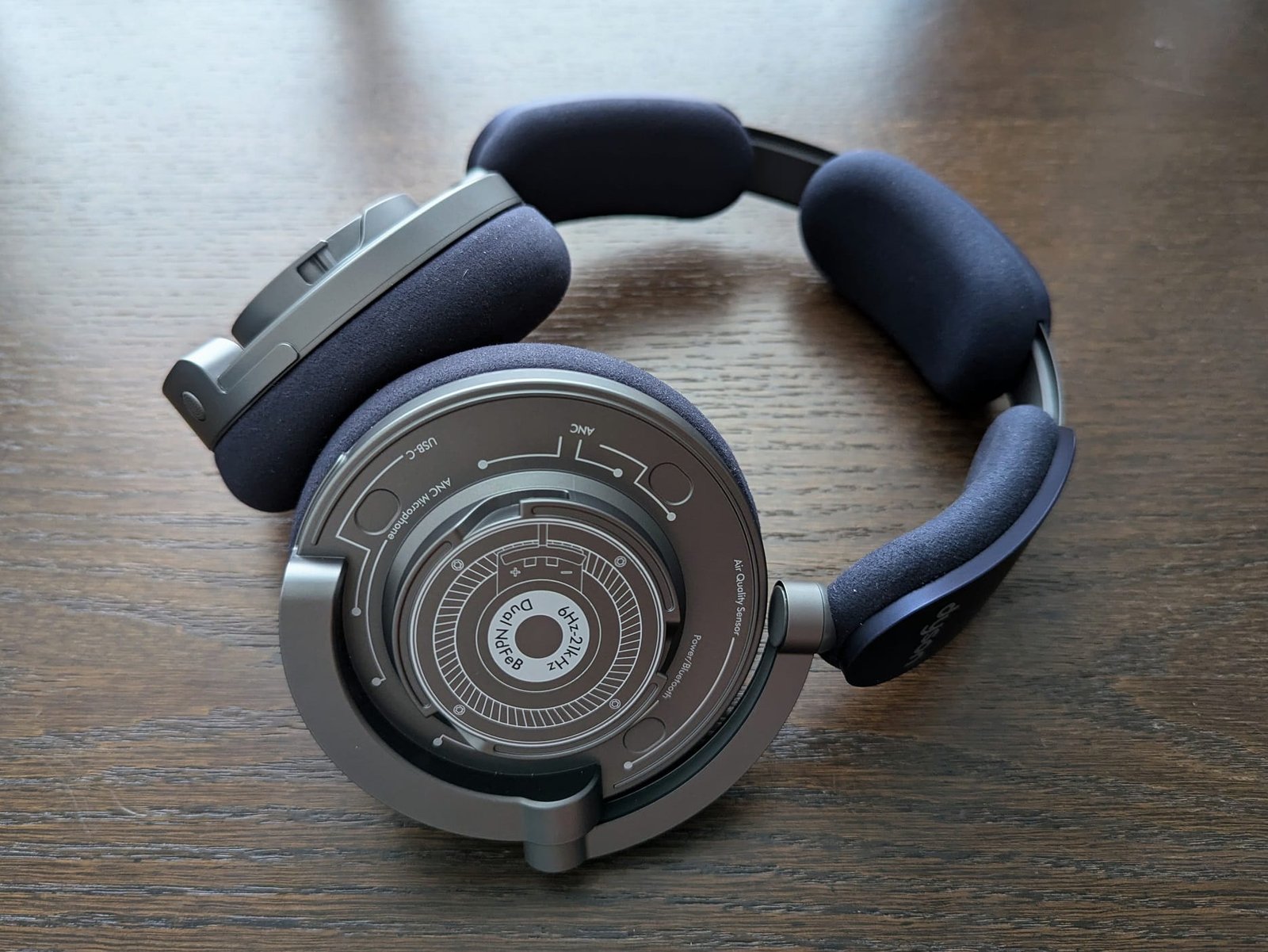
Changing parts has been made easy, as both the metal sides and the ear pads attach and detach with a twisting motion. I particularly like the mechanical design of the side panels. My review set included extra gray replacement parts, so I got to try modifying the appearance in practice. In gray, OnTrac looks more subdued, making the headphones suitable for those who don't want to attract too much attention. OnTrac actually looks funnily futuristic even with the sides exposed, as the different parts of the headphones are stylishly labeled on them. I like Dyson's different approach, but it remains to be seen whether consumers are willing to pay for accessories – a pair of side panels or ear pads costs 50 euros.
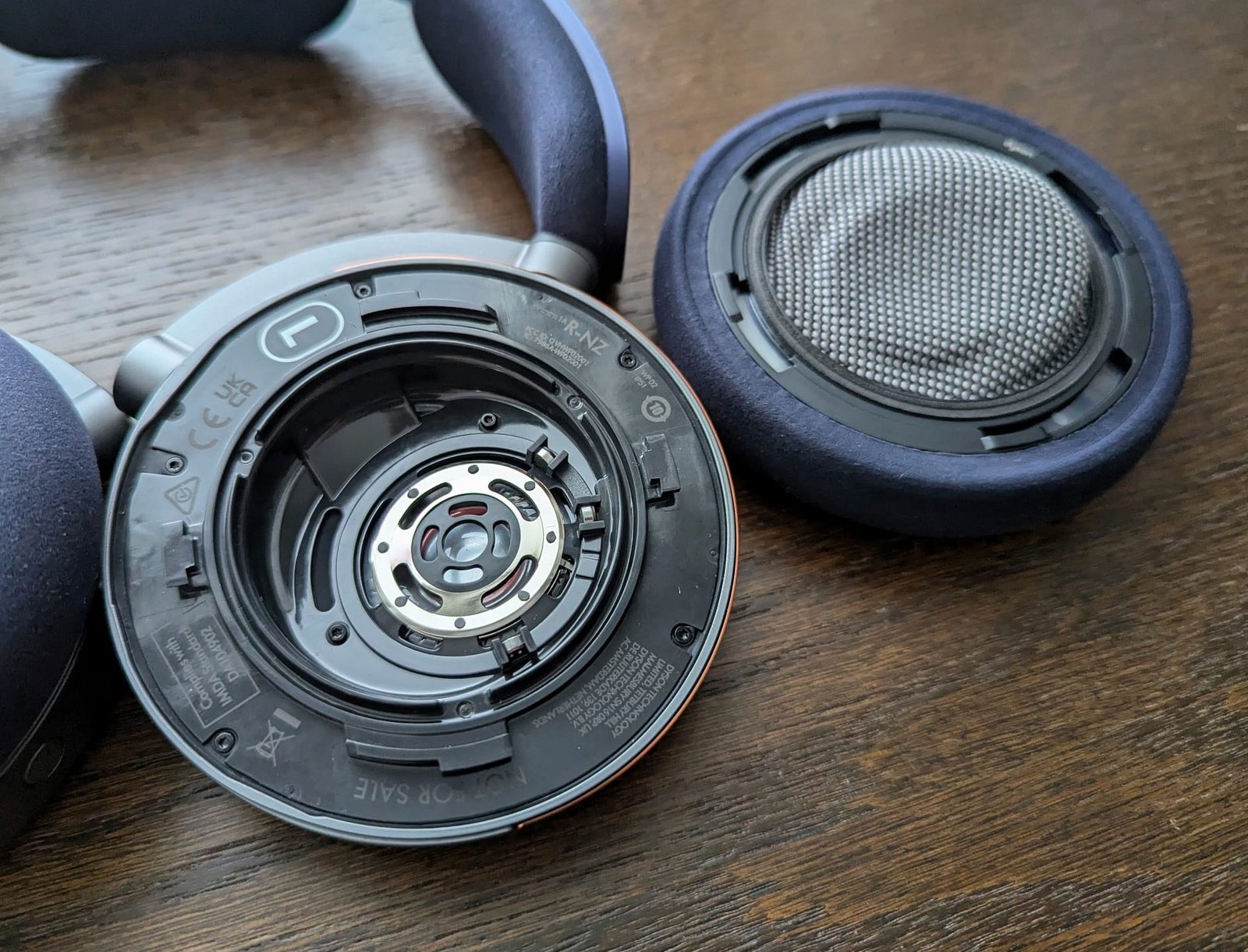
OnTrac is controlled by both physical buttons and by tapping the structure. The power and Bluetooth pairing button is located behind the left cup, along with the USB-C charging connector. The noise-canceling function, in turn, is controlled by tapping the side of the left cup. Everything else is conveniently handled by a joystick button located on the right cup, which can be tilted in four different directions and pressed inwards. I will mention more about my user experiences a little later.
Usability
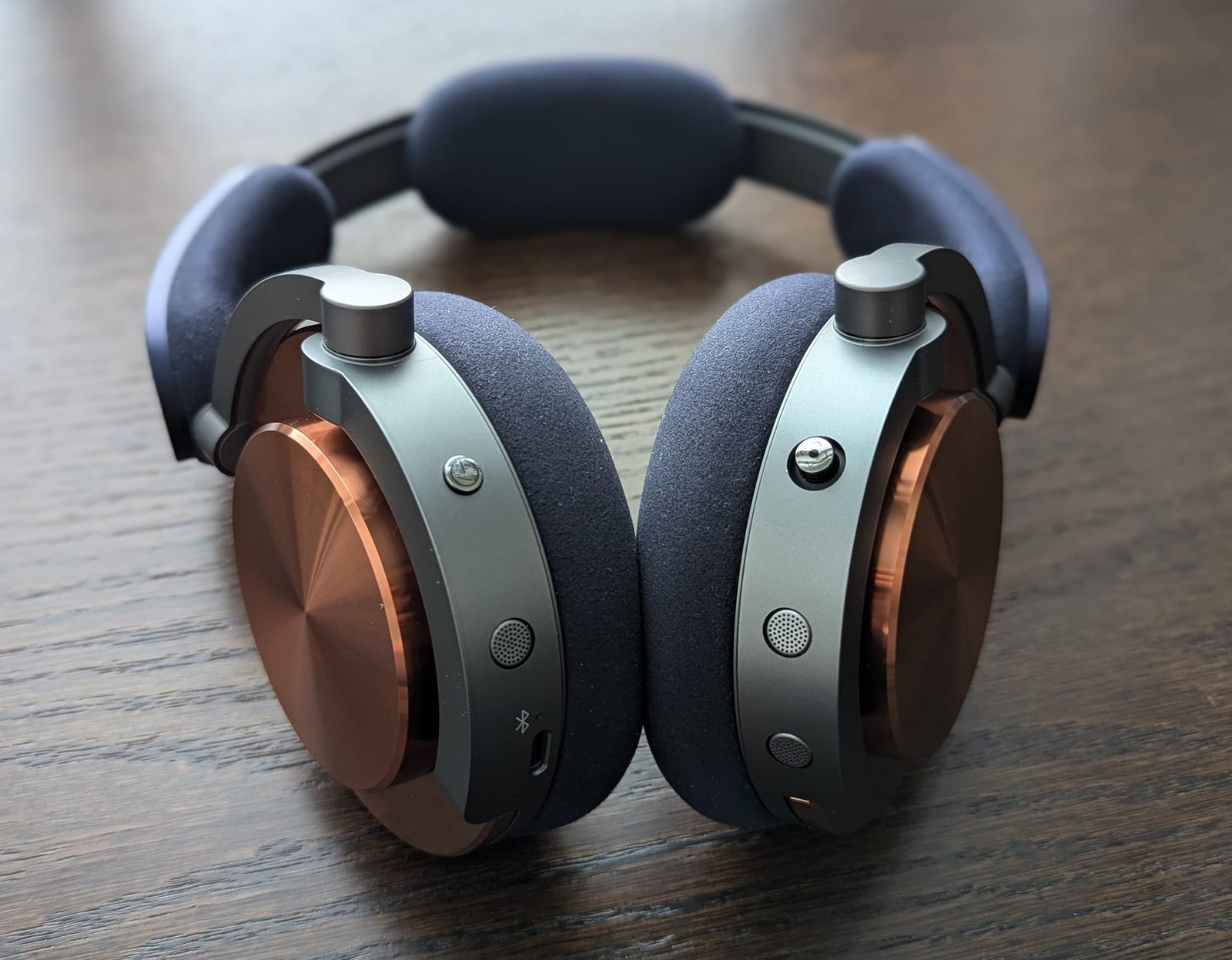
As stated, OnTrac weighs a hefty 450 grams. I myself am used to heavy hi-fi headphones, so this doesn't feel excessive. However, the weight might shock many others, especially if previous experiences are limited to plastic headphones weighing less than 250 grams. Nevertheless, I can at least try to convince others that OnTrac is surprisingly comfortable despite its high weight. Its headband clamping force is consistently gentle, and the pads perform their function excellently.
I initially doubted the sufficiency of the small head pad, but thanks to its thickness, it actually feels extremely comfortable. On the positive side, the headphones rest on a relatively small area on the crown of the head, so they don't cause much sweating. The same applies to the ear pads, which use a soft and smooth fabric as the surface material instead of sweaty artificial leather. However, due to the high weight of the structure, the moderate clamping force of the headband, and the slippery pad material, OnTrac would fall off the head quite easily when looking downwards and shaking the head at the same time. The headphones may not be a good choice for sports, unless neck training is considered such.
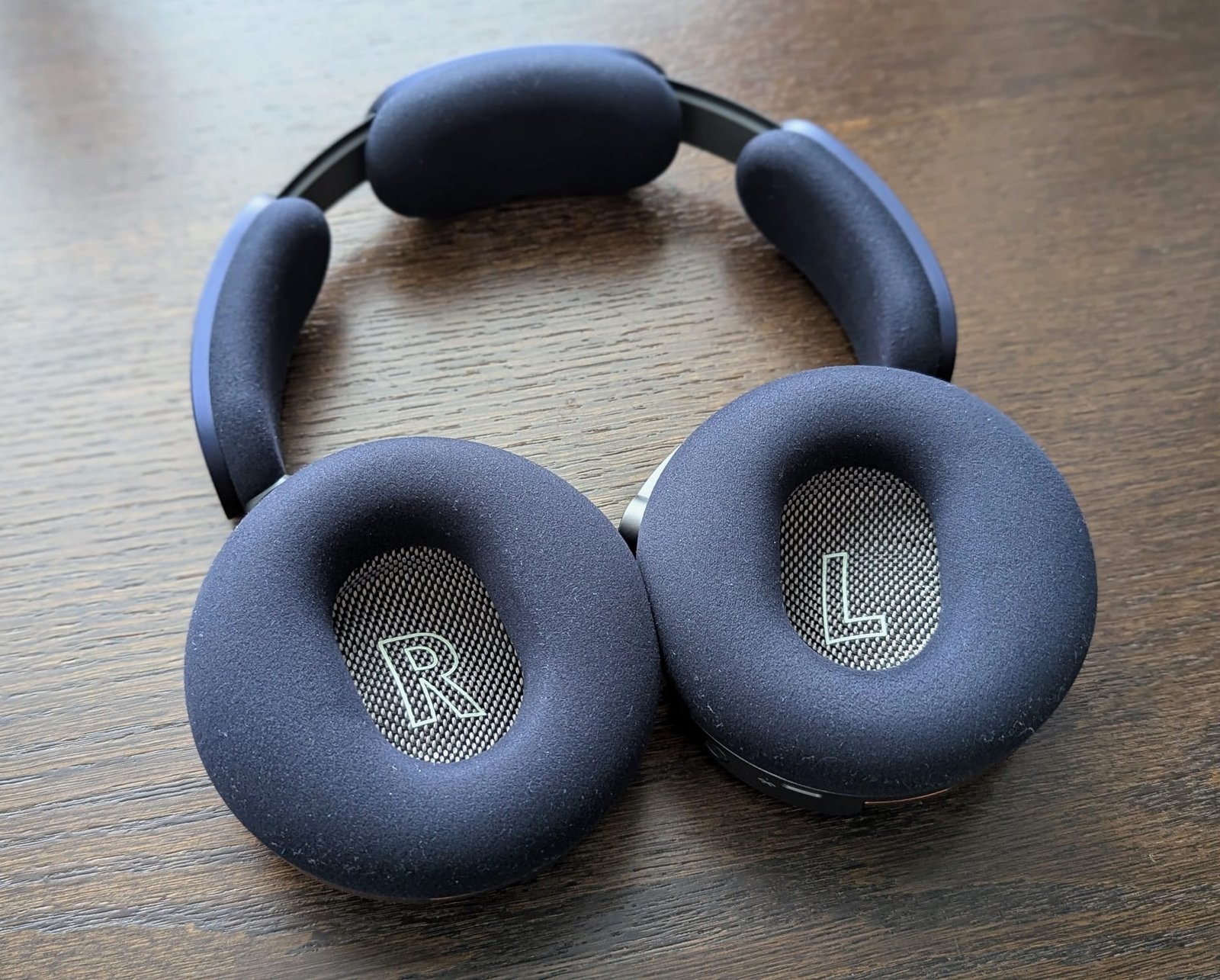
From a comfort perspective, what bothers me most about OnTrac is the minimally small (35mm x 50mm) ear opening of the pads, which causes the headphones to rest partially on my earlobes. However, since the most protruding part of my ear slips inside the pad and most of the headphone's clamping pressure settles around my ears, OnTrac does not start to feel uncomfortable even during longer use. The design has been successful in this regard, even though I don't fully understand why large pads can't have a sufficiently sized hole. Perhaps the thick side walls are intended to enhance passive noise cancellation and ensure the functionality of the active noise-canceling feature. OnTrac is at least well-suited for use with glasses.
Outdated Bluetooth technology & excellent battery life
According to Dyson, OnTrac's Bluetooth connection is implemented with version 5.0, which was released back in 2016. If this is true, the technology is hopelessly outdated and, in my opinion, should no longer be found in 500-euro headphones released in 2024. In my own use, the Bluetooth connection occasionally cuts out with several different devices, which, however, does not seem to be due to the connection's range, but something entirely different. Fortunately, the cutouts only last for a little over a second and occur approximately once every two hours.
What I find more regrettable, however, is that OnTrac does not support multipoint pairing or the most common high-quality Bluetooth codecs. I myself have had to listen to it with the AAC codec, with the even worse SBC as an alternative. Somewhat surprisingly, the headphones would, however, support the rare LHDC codec as a third option, which can be seen as a competitor to the AptX codec series and LDAC. Although LHDC appears to be of good quality on paper, it can only be used with mobile phones from a few Chinese manufacturers, which are not widely sold in Western countries. As a result, the user base for this codec is likely to remain very small.
The limited codec support and generally outdated Bluetooth implementation are a surprise for Dyson, as I would have expected it to want to ride the cutting edge of technology, considering how much it has invested in many other areas. On the other hand, if the primary target audience is owners of Apple products, the AAC codec is sufficient. Ultimately, the frequency response of headphones always affects the sound more than the Bluetooth codec in use, so the codec alone does not determine sound quality as bad, nor as good.
In terms of battery life, OnTrac performs significantly better, as its operating time with noise cancellation activated is an commendable 55 hours, which comes close to the market's top products. The battery capacity installed on both sides of the headband is likely substantial relative to power consumption. Dyson states the charging time as approximately 3 hours. If needed, a 10-minute quick charge would provide an additional 2.5 hours of use, while half an hour of charging would already suffice for a full workday or an intercontinental flight.
Mobile app and additional features
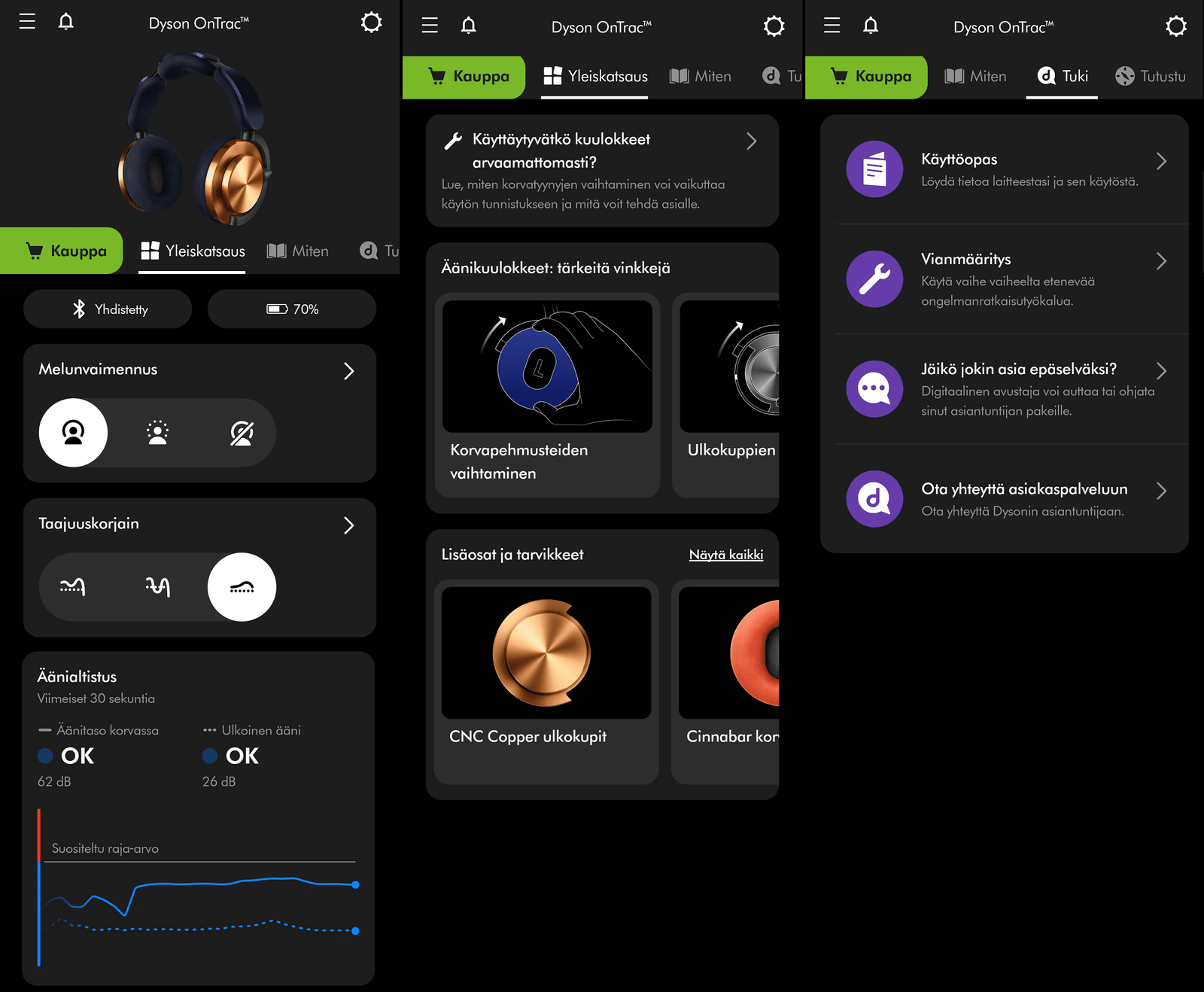
Through the Finnish-language MyDyson app, one can access the manufacturer's online store to buy accessories and vacuum cleaners adjust OnTrac's settings and monitor in real-time both the listening environment's and the headphones' generated sound exposure. The curve turns red if ambient noise is loud or the headphones are listened to at too high a volume. However, the app is most needed for updating the firmware version, turning off the noise cancellation function (cannot be done by tapping the headphones), and changing the sound profile. On the other hand, recalibrating or disabling wear detection can prove to be useful settings. Additionally, the volume can be limited to a maximum of 80 decibels, and the app also contains instructions and troubleshooting tips. Nevertheless, one of its most important tasks seems to be the presentation and sale of other Dyson products, as ample space is reserved for this in the user interface. It is also regrettable that using the app requires creating a user account.
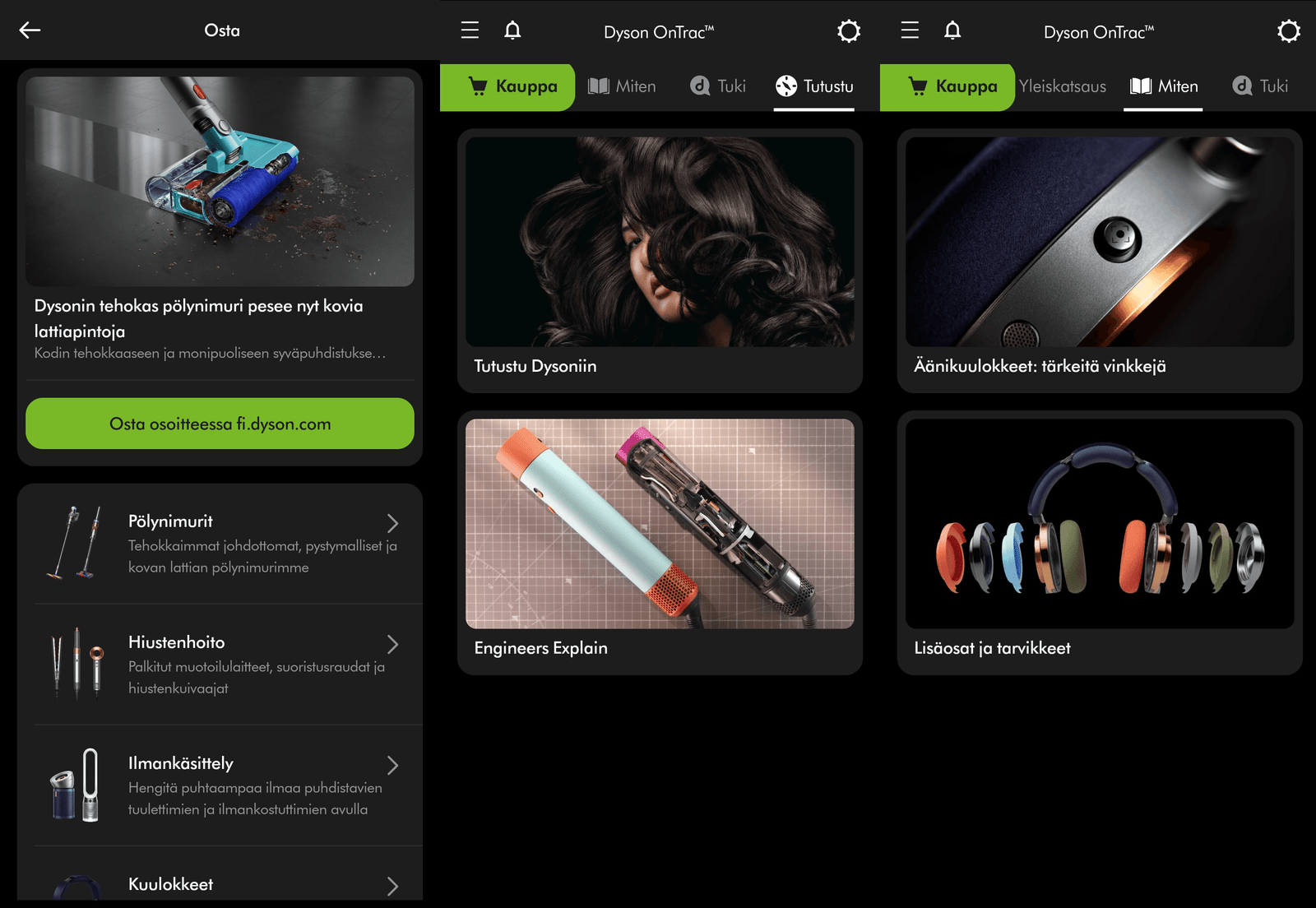
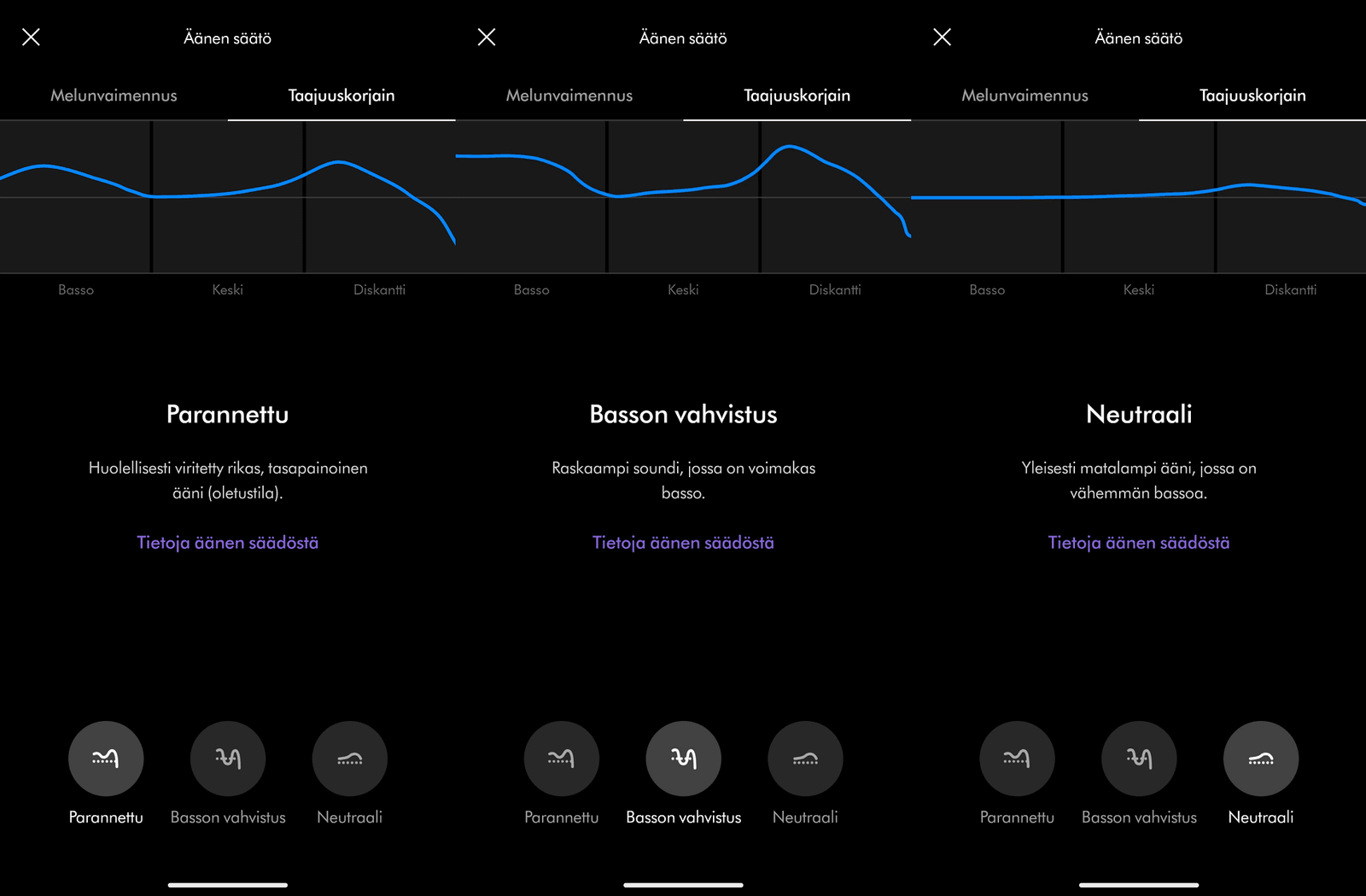
Of the three available sound profiles, Enhanced is selected by default, but it could be changed to Bass Boost or Neutral mode. No free-form equalization can currently be done through the app, but rumors suggest Dyson is considering adding a better equalizer to the app. I personally support this, as the preset sound profiles only change the amount of bass frequencies, even though the manufacturer's illustrative images suggest otherwise.
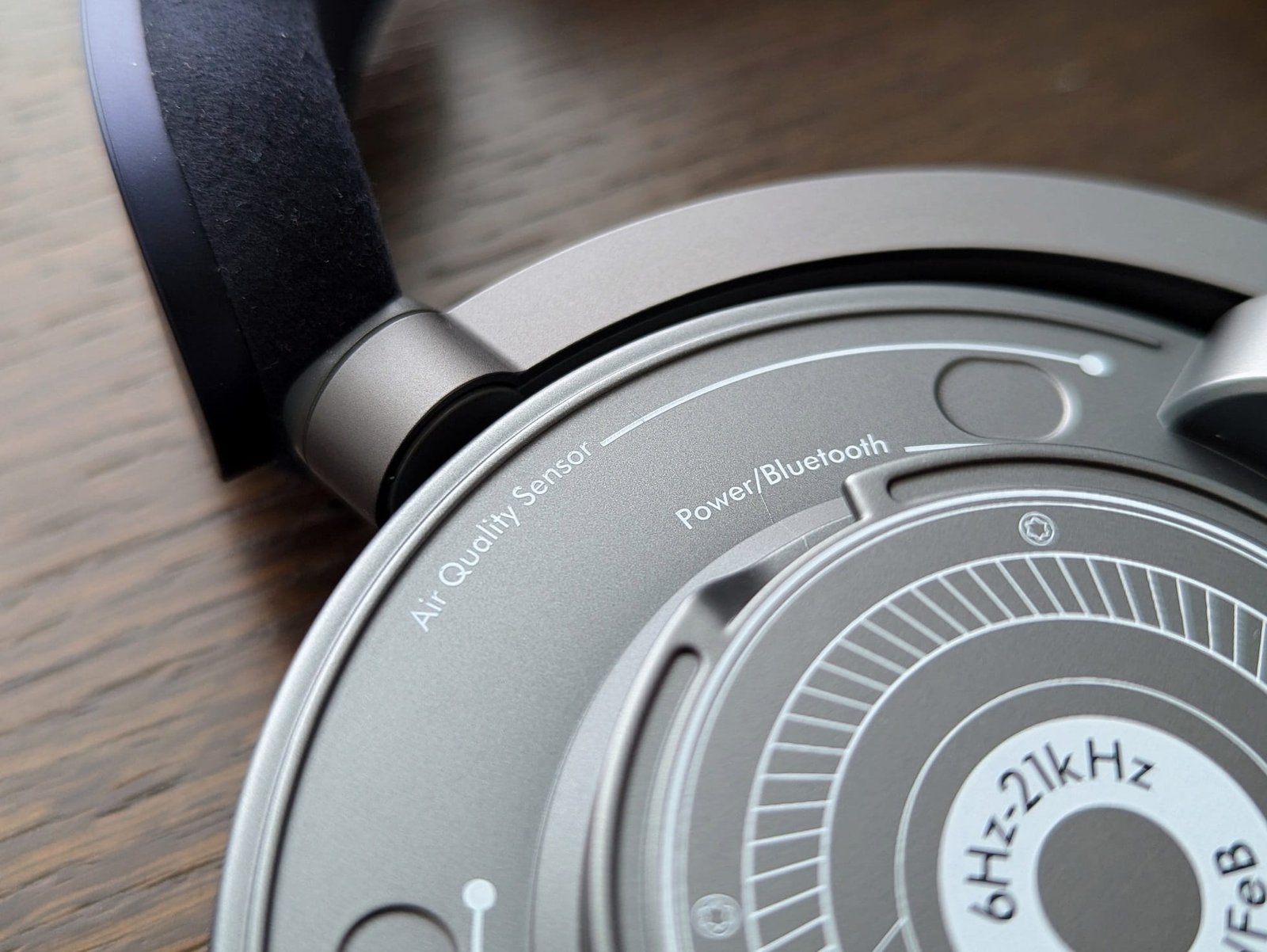
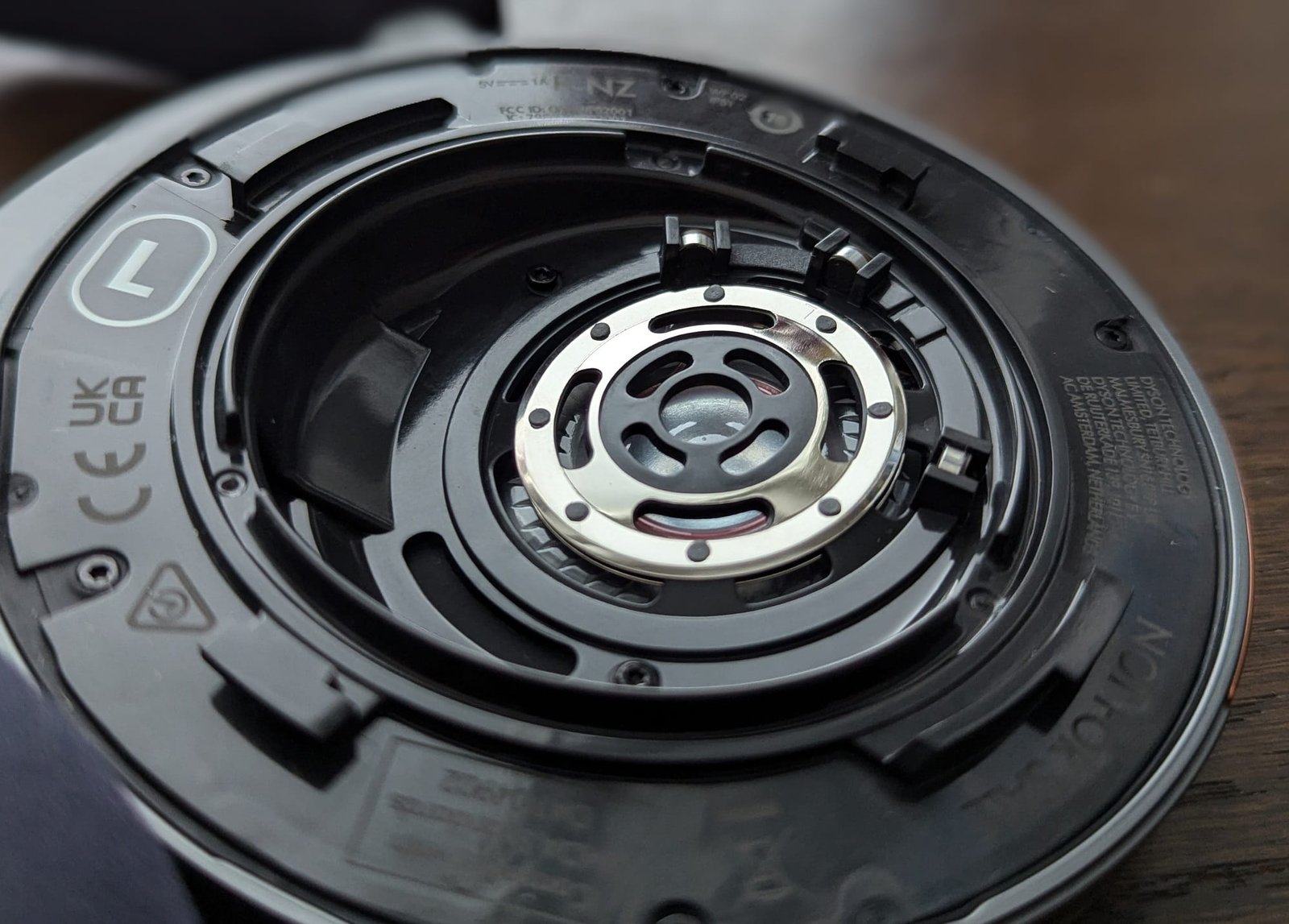
I'm going a bit detective-like here, but I noticed text under one of the headphone's metal sides that would suggest OnTrac also contains a sensor for measuring air quality. However, there is no monitoring option for this in the app yet, so either it will be added later, the text is incorrect, or Dyson is collecting air quality data from its users solely for itself. This feature could be genuinely useful in certain parts of the world, so it would be nice to see it in use.
Observations related to use
I like the joystick button located on OnTrac's right earcup, because all the functions I need are easily and intuitively found through a single button without me having to fumble for separate small buttons. In my opinion, this idea also beats all kinds of touch functions. In OnTrac's case, however, the joystick is not quite perfect for a couple of different reasons. Its surface is slippery, so I always have to precisely position my finger on the side of the button instead of being able to turn it from the top surface. A slightly rougher surface would make it faster to use. The reliability of the button is also not top-notch, which may, of course, also be related to the Bluetooth connection. When changing the volume, the button sometimes reacts on the first press, while often only on the second or third time. However, holding the button down a little longer seems to help.
The volume adjustment range on OnTrac is also quite coarse, meaning one step adjusted from the phone increases or decreases the volume a bit too much at once. However, limiting the maximum volume to 80 decibels through the app alleviates this, after which the listening volume could be adjusted more precisely.
I have also noticed some quirks in the headphones' wear detection, as it is both sensitive and insensitive at the same time. For example, a finger or pen inserted into the earcup is immediately recognized as an ear, whereas the silicone ears of my measuring device are not. Thus, measuring the frequency response initially only succeeded by pressing one earcup more firmly against the silicone ear, at which point the headphones finally agreed to play the frequency sweep. Ultimately, however, this was not necessary, as I realized that wear detection could be turned off via the app. With human ears, the sensor seems to work correctly, as occasional interruptions occur even when the feature has been turned off for me. When wear detection is kept on, the headphones automatically turn off after 30 minutes of inactivity. However, the duration of the standby time cannot be changed.

All kinds of notification sounds play a bit too loudly for my taste, because their volume follows the headphones' volume setting. OnTrac, for example, beeps loudly every time you put them on your head when wear detection is active. The app does not yet have a setting to mute notification sounds or turn them off, so I would hope for one soon.
Since OnTrac does not have a button to switch the noise-cancelling function to transparency mode or vice versa, the action is performed by tapping the left earcup twice. The exact tapping point is not of great importance, as the function is implemented with some kind of vibration sensor that reacts to the cup's movements. However, this means that the cup must be tapped surprisingly hard for anything to happen. My ears don't particularly like the loud thuds this causes, but the headphones do emit a fun ”whooomp” sound when entering noise-cancelling mode. If it gets annoying, adjustments can also be made with the MyDyson app instead of tapping the cup.
Effective noise cancellation function
Dyson has succeeded excellently in developing OnTrac's noise-cancelling function, as its effectiveness, based on my own tests, challenges the market's top products while also being gentle on the ears. Apart from a slight background hiss, I feel like I'm in my own quiet bubble. There is no pressure whatsoever on the ears; instead, the feeling is completely relaxed. Even wind does not cause significant interference sounds, only a slight rustle. Although many smaller manufacturers can force power into their noise-cancelling function, the pressure generation and absence of interference sounds ultimately distinguish the pros from the beginners, in my opinion.
Dyson states that it utilizes 8 microphones for noise reduction, which sense external sounds up to 384,000 times per second. Based on product images, the noise cancellation is produced from three small ”nozzles” in front of the ear, which I have not seen in other manufacturers' headphones either. The small-holed ear cushions probably further aid in attenuation, as there is a thick layer of foam around the ears. The headphones' fit is also tight even with glasses. For example, what I found to be an effective noise attenuator Bose QuietComfort SE is quite sensitive to glasses, so it only works optimally without glasses. Sony's WH-1000XM4, on the other hand, competes quite evenly with OnTrac in reliability. Sony's advantage is still the absence of background hiss. In OnTrac, the hiss doesn't really bother, but it is a small minus when listening to calmer music.
In my traditional noise-cancelling tests (airplane and cafe noise, and speech listened through speakers), OnTrac performs evenly with Bose QuietComfort SE headphones, which is an excellent performance. Especially low-frequency rumble and hiss are attenuated very well by Dyson's headphones. Higher-frequency sibilance, on the other hand, transforms into a slightly more pleasant tone with Bose headphones, but I wouldn't say the difference is very significant. Dyson's headphones also maintain their attenuation performance better when turning the head and opening the mouth.
When attenuating human speech, both QuietComfort SE and the recently reviewed Cambridge Audio Melomania P100 are interestingly slightly more effective than OnTrac. On the other hand, the attenuation performance of Melomania P100 varies the most when turning the head or, for example, moving the lower jaw, which is partly due to the headphones' less stable fit. OnTrac's noise-cancelling function is therefore generally slightly more effective than that of Melomania P100. The transparency mode in Dyson's headphones is likewise excellent and, above all, natural. Both ambient sounds and my own voice sound relatively normal without excessive sharpening or excessive attenuation of low frequencies. QuietComfort SE still attenuates some sound in its Aware mode, while Melomania P100 sounds quite muffled.
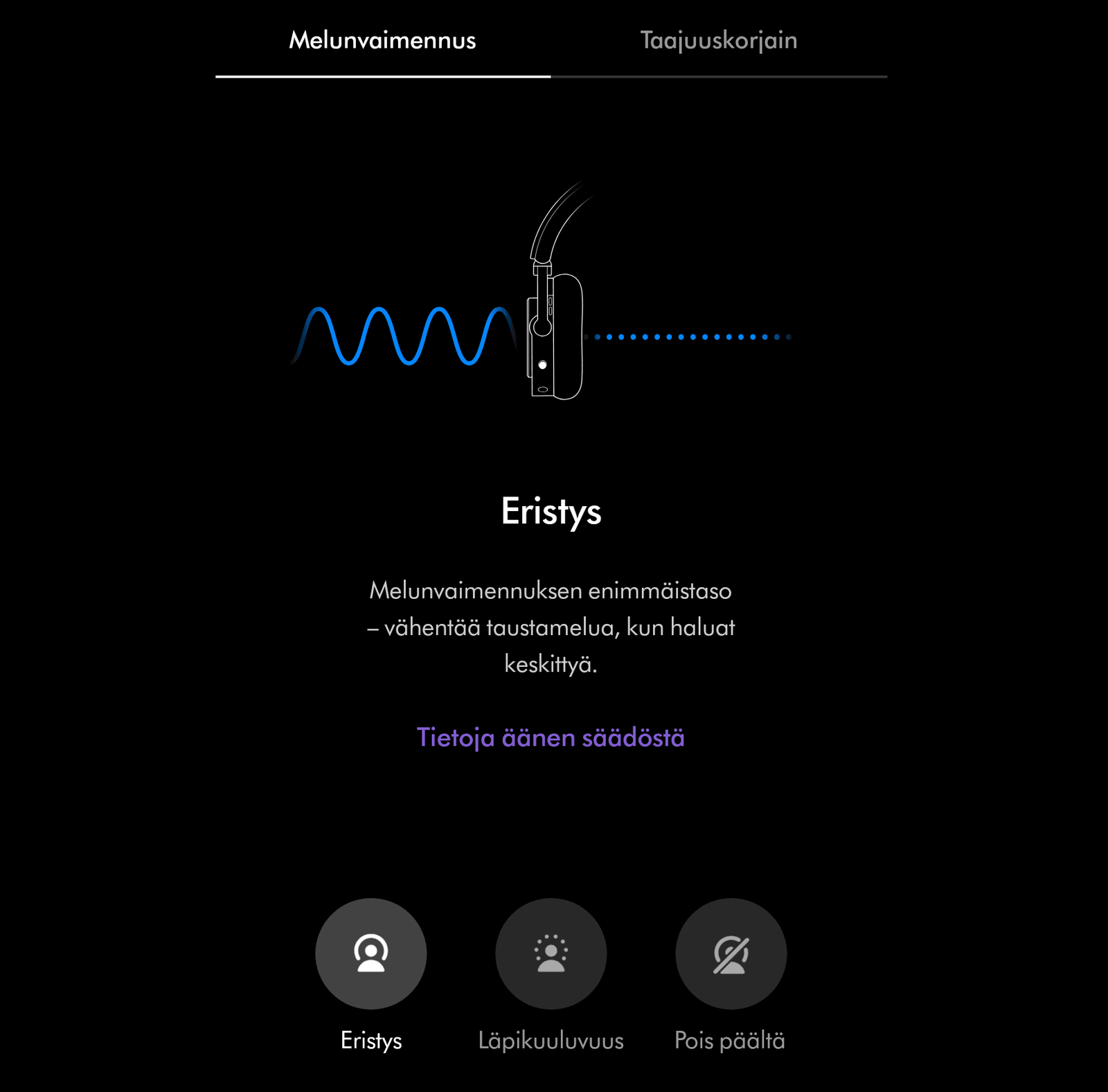
Through the app, OnTrac's noise-cancelling function could also be turned off. There are no other adjustment options for the noise-cancelling function or transparency mode, but from the perspective of straightforward use, this is actually a good thing. Everything works optimally at once, or at least that's the impression I get. An effective and well-functioning noise-cancelling function is indeed one of OnTrac's greatest strengths. Dyson has done a good job with it, considering it's a relatively new player in the noise-cancelling headphone market. However, money is decisive in technology development, so the resources of a large company have certainly been helpful.
Microphone sound quality
OnTrac's microphone seems to emphasize the naturalness of the sound more than necessarily its clarity. When recorded in a quiet environment, my voice sounds slightly warm in tone, without excessive sharpness. The recording volume is not particularly loud, so the other party might well have to raise the volume slightly during a call. The headphones automatically switch to transparency mode when the microphone is on, which I think is a good thing.
In the midst of noise, the sound has to be processed more, and some of the ambient noise leaks through. The result is no longer the clearest; in my opinion, my own voice should be louder. On the other hand, the worst interference sounds and crackles are avoided, so the microphone is ultimately quite decent in my view.
Headphone sound quality
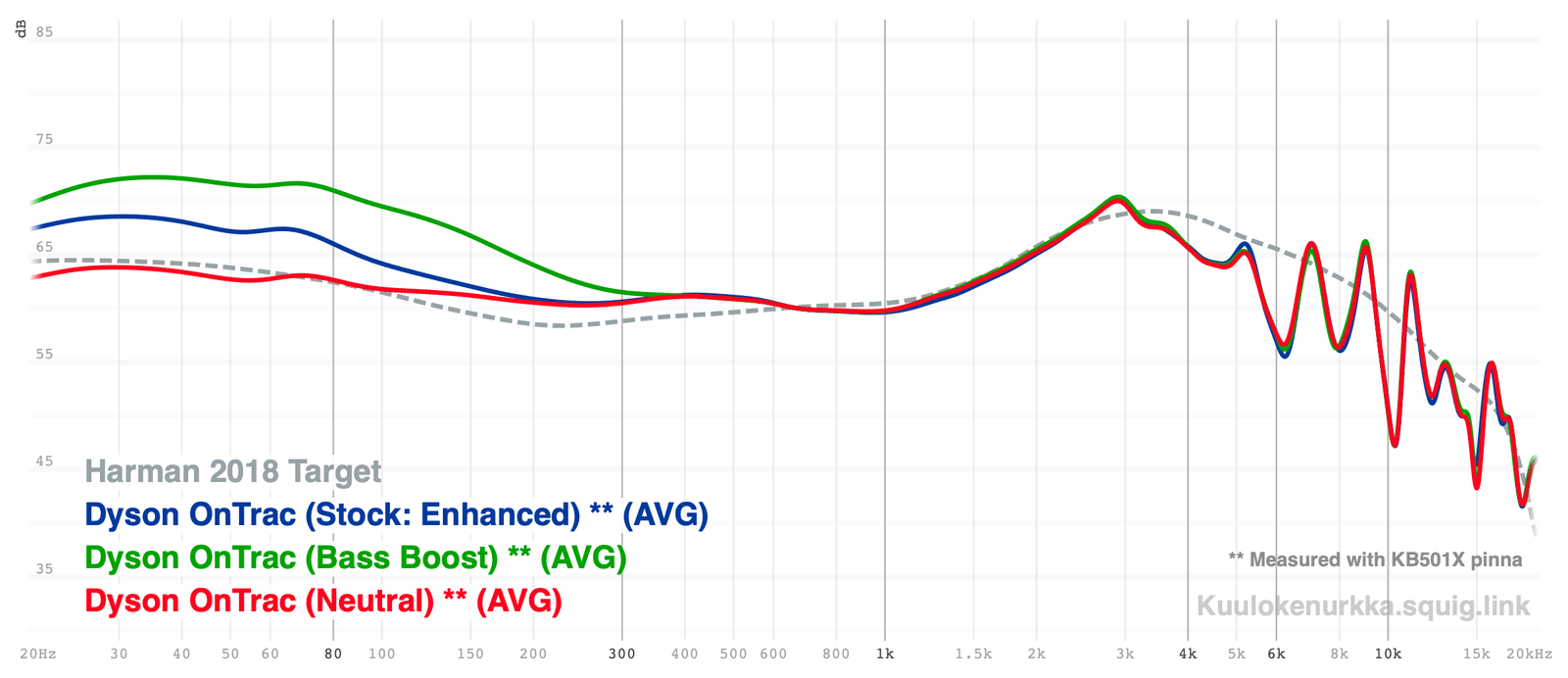
Our frequency response measurements have been made with a clone IEC-60318-4 coupler and KB501X pinnae. The Harman target curve from 2018 is used as a reference point and generalization of the headphone response that would sound good to most people. For more information on the measurements and their accuracy, see Headphone Measurements-page. OnTrac's frequency response is also comparable with other measured headphones Squiglink .
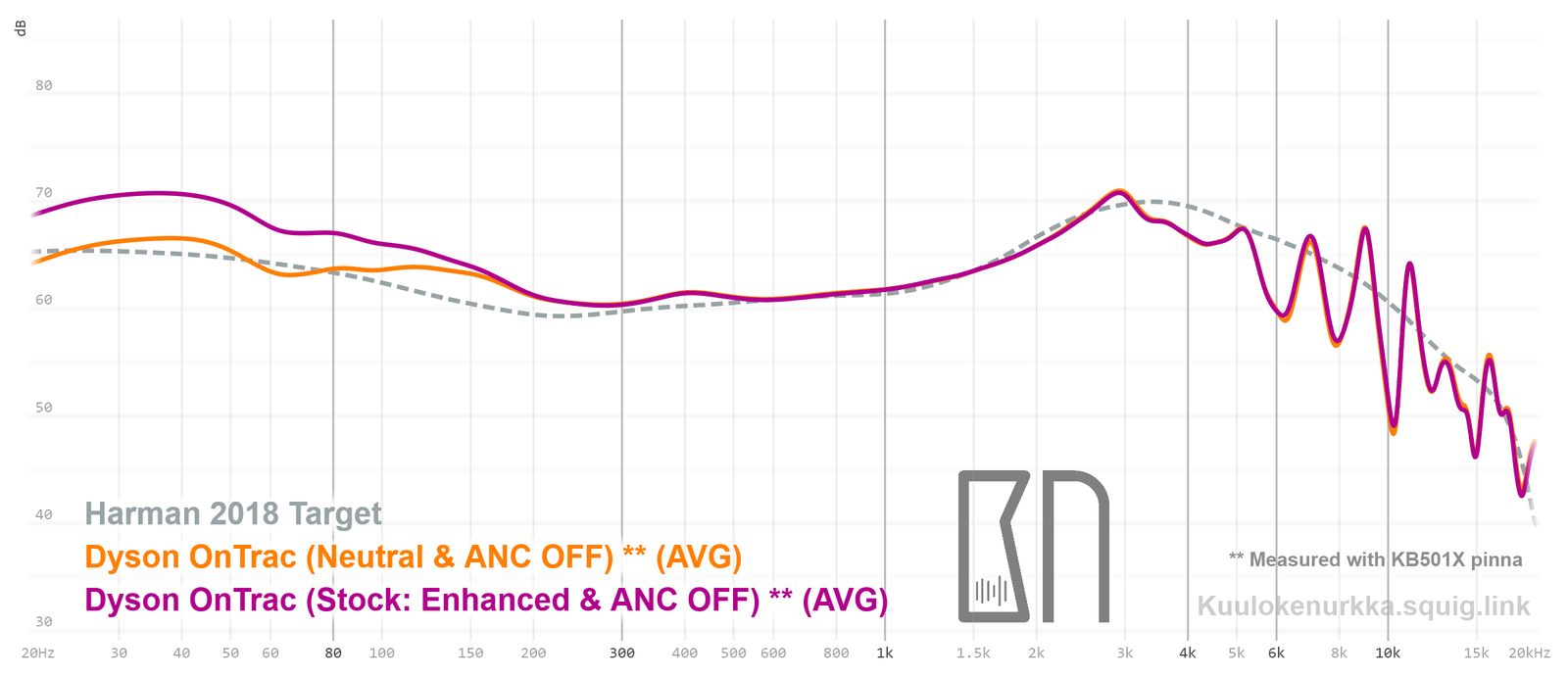
Listening to OnTrac is straightforward because it only works with a Bluetooth connection. However, the selected sound profile determines the amount of bass, and the frequency response also changes slightly depending on whether the noise-cancelling function is on or off. The changes are not huge, but they are decisive enough that turning off the noise-cancelling function leads to a better result regardless of the selected sound profile.
Dyson primarily markets the sound quality of its headphones with a frequency response ranging from 6–21000 Hertz, stating that most competitors' products fall between 20–20000 Hertz. Such a difference certainly appeals to less informed consumers and commercial reviewers, but in reality, it has no significance from a sound quality perspective in this millennium. Indeed, few noise-cancelling headphones have emphasized bass reproduction that doesn't extend well below 20 Hertz. Similarly, only a minimal portion of the population hears information above 20 kHz. In OnTrac's case, what is more relevant is the intensity at which the headphones reproduce different frequencies and the shape of the frequency response.
Frequency response with different sound settings:
Frequency response with noise cancellation turned off:
Dyson has succeeded excellently in tuning OnTrac by the standards of noise-cancelling headphones, but there is still room for improvement. As a positive surprise, the shape of the frequency response follows the well-established Harman target curve so precisely that I would see the manufacturer having aimed for it intentionally. The sound is indeed natural in style compared to most competitor products. Unfortunately, OnTrac does not ultimately sound quite as good as one might expect.
The default sound profile (Enhanced/Parannettu) emphasizes upper bass frequencies and lower midrange frequencies up to 600 hertz. Although the midrange frequencies are otherwise almost perfect, the extra warmth and a somewhat subdued reproduction of the 3–6 kHz frequency range make the reproduction somewhat muffled. The bass is soft and boomy in style, and there isn't enough clarity in instruments or the vocalist's voice for my taste. Someone less critical of listening might not notice this but might find the presentation a bit dull. That's also my opinion, even though Dyson has clearly aimed to offer a fun listening experience with its default profile. More punch could be added to the bass by switching to the Bass Boost profile, but that makes the reproduction muddy and heavy. This is because the bass is boosted far too much between 150–300 hertz, even though it should preferably be done from 100 hertz downwards.
The third sound profile, aiming for a neutral sound, works best in my opinion, but it may require some getting used to after a more bass-heavy sound. However, the lightened bass is reproduced more clearly than before, and it doesn't weaken the clarity of the midrange frequencies as much either. As a result, the reproduction is literally quite neutral and natural, which is rare in noise-cancelling headphones aimed at larger audiences. Most of the music listened to sounds largely as it should, but a slightly more critical listener might be left wondering why the result still feels somewhat soft and unclear.
I initially blamed the AAC codec for this, until I realized that the lower midrange frequencies are simply too elevated compared to the calm presence region. These characteristics alone are by no means particularly serious issues, but together they make the reproduction slightly monotonous, as if the dynamics were lacking. OnTrac is pleasant to listen to for long periods, for example while working, but it never truly impresses. I could describe the situation as all sounds lacking a bit of presence, making them difficult to discern. I might sound overly critical, but that's because Dyson has come very close to an excellent end result. My criticism should be interpreted as a kind of praise, because I believe the manufacturer can do even better. There is also evidence for this.
When the headphones' noise cancellation function is turned off, some of the lower midrange emphasis disappears, and the presence region brightens slightly. In other words, the headphones' weaknesses alleviate as if by themselves. As a small bonus, the sub-bass also strengthens when using the neutral sound profile compared to listening with noise cancellation on. After this, OnTrac sounds really clear and more energetic than before. I can discern the vocalist better and get more excited about listening. Now, the default sound profile, which emphasizes more bass, also works better because the upper bass remains clearer and doesn't bleed excessively into the midrange frequencies. Sometimes small changes in headphones can be surprisingly significant. If Dyson could adjust the DSP settings for the noise cancellation side in this direction, I would be very satisfied with the sound quality.
OnTrac reproduces treble in the same way regardless of the selected sound profile, which is not the most optimal. From the frequency response, it can be seen how it alternately saws up and down from 5 kilohertz onwards. This unevenness is also audible, with the high frequencies reproducing somewhat noisily and with poor quality. To my hearing, the area around 5.5 kHz is reproduced faintly, while individual peaks are located at 4.5 kHz, 6.5 kHz, 8.5 kHz, and 10.5 kHz. Of these peaks, especially the first and last are relatively large compared to their surrounding frequencies. Sound profiles with more bass cover some of the unevenness, while the otherwise more orthodox-sounding neutral profile reveals the harshness most clearly. S-sounds, for example, are reproduced with more sibilance than usual, and the reproduction also has a somewhat hissing and splashy tone.
The sawtooth nature of the treble is, in my opinion, due to OnTrac's structural problems, as I don't believe that dynamic drivers would naturally reproduce high frequencies so unevenly or that Dyson would have set the DSP profile this way. In any case, it would be very difficult to correct this with equalization, but fortunately, it doesn't spoil my listening pleasure. Since the individual peaks do not rise much higher than the midrange frequencies, one gets used to it surprisingly quickly, after which only the quality of the high frequencies leaves something to be desired. In this respect too, OnTrac sounds somewhat softened.
After all this, it might sound surprising that the end result is still on the positive side in my opinion. When the most important frequency ranges and basics are in order, individual, relatively small weaknesses can be forgiven. I genuinely enjoy listening to OnTrac, for example, while working. It doesn't draw too much attention to itself, but it also never startles by sounding wrong. The headphones are also a welcome change from all the bass-boosted or heavily scooped-midrange noise-cancelling headphone models. On the other hand, I wouldn't be surprised if consumers who crave strong bass and punchy treble aren't particularly impressed by OnTrac's presentation. It remains to be seen what the opinion of the wider audience will be over time.
Dyson OnTrac or Sonos Ace?
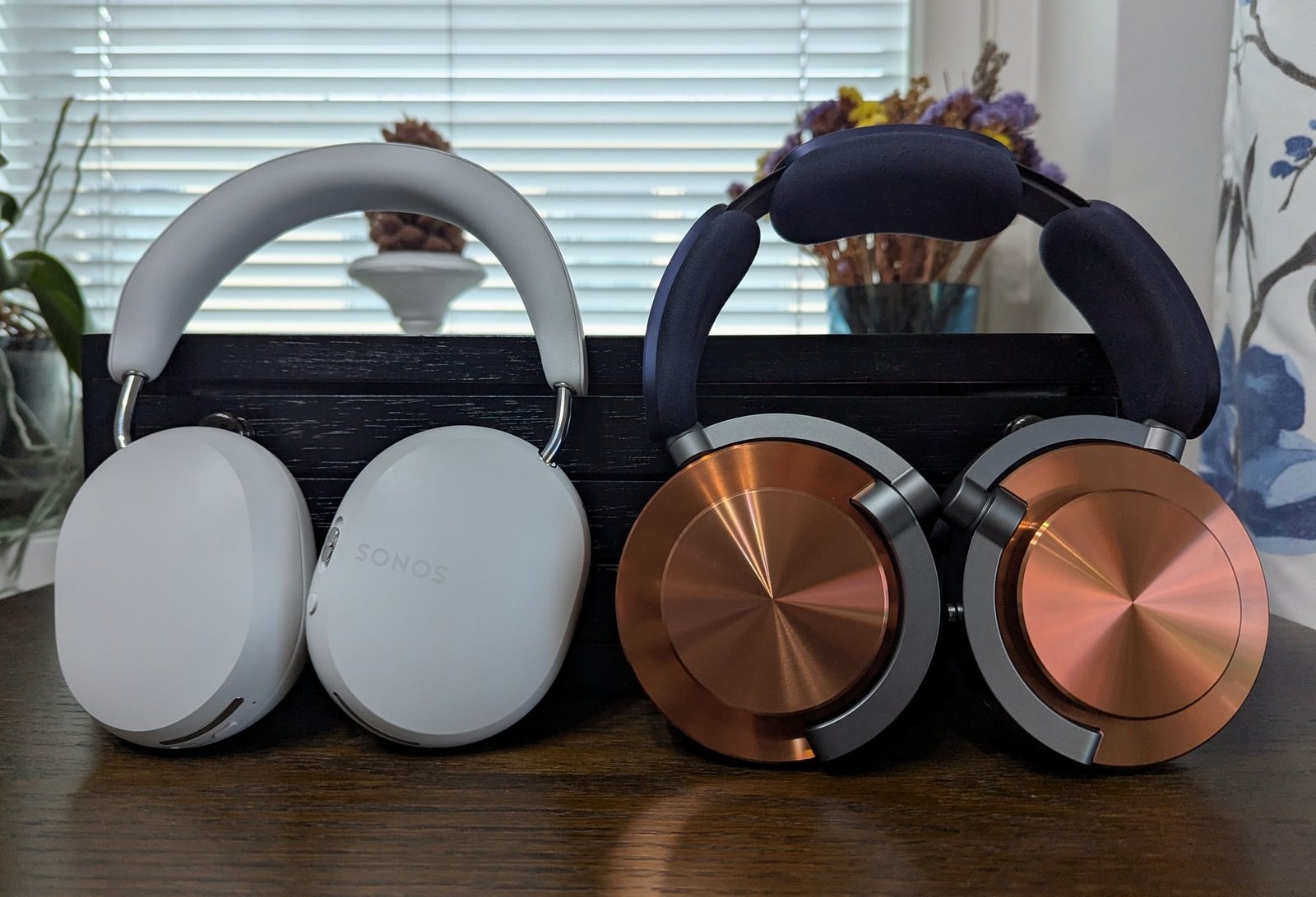
I have already written ad nauseam about Valco VMK25, Bose QuietComfort SE, and Bowers & Wilkins PX7 S2e, so to avoid repetition, I acquired as a comparison for OnTrac the also released in summer 2024 Sonos Ace -noise-cancelling headphones. Both cost the same, rounded to 500 euros (though Ace has already been on sale for 450 euros). The question is, which of these new headphones might be worth buying?
I do not own any other Sonos products, so unfortunately I cannot assess how well Ace would function as part of the manufacturer's other audio ecosystem. In this regard, however, the headphones were released in such a semi-finished state that no one else seems to know the full truth yet. In any case, I do not foresee writing about Ace again, so this comparison can serve as a kind of ”mini-review” of it, albeit a very comprehensive one.
Tietoja Sonos Ace:sta:
- Release year: 2024
- Suunniteltu Yhdysvalloissa ja valmistettu Kiinassa
- Color options: Black and white
- Hinta: 499 € (halvin markkinahinta 449 €)
- Type: Closed, over-ear
- Dynamic 40 millimeter drivers
- Ääniliitännät: Bluetooth 5.4, USB-C
- Bluetooth-koodekit: AptX Lossless, AptX HD, AptX, AAC ja SBC
- Charging port: USB-C
- Akunkesto: 30h (vastamelutoiminto päällä)
- Latausaika: 3h (pikalataaminen: 3 minuutissa 3h käyttöaikaa)
- Vastamelutoiminto (8 mikrofonia) ja läpikuuluvuustila
- Yhteensopiva Sonos-äänentoistojärjestelmän kanssa
- Ominaisuuksia: Google Fast Pair, Multipoint, Dolby-tilaääni, päänseuranta, korvatunnistus (wear detection), ja puhelinsovellus taajuuskorjaimella
- Paino: 312 g
- Varusteet: kuljetuskotelo, USB-C–USB-C-kaapeli (0,75 m) ja USB-C–3,5mm -kaapeli (1,2 m)
Review sample: Self-purchased product
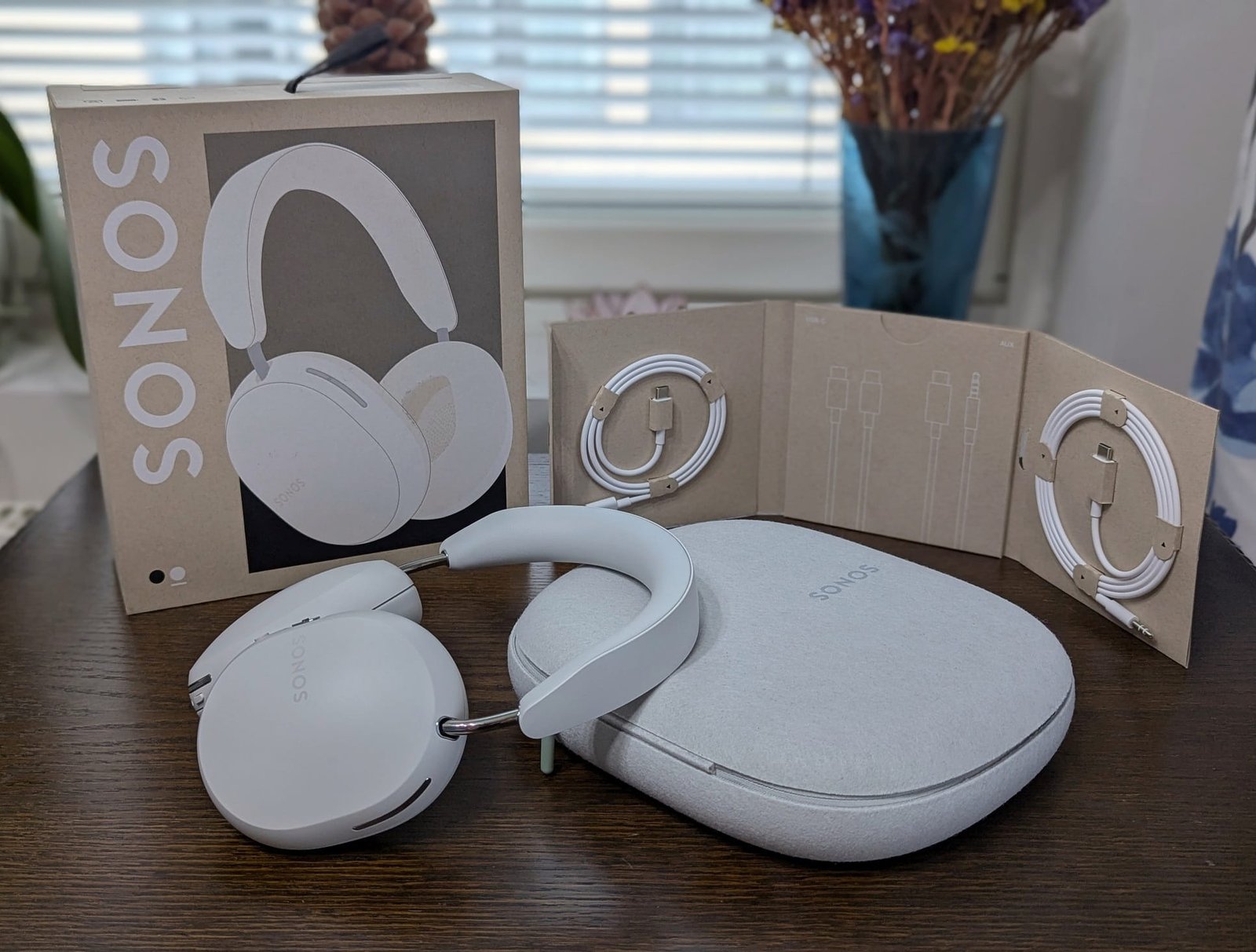

Sonos-tuoteperhe ja Ace
Sonos sells a variety of speakers and soundbars, from which a whole-home multi-room audio system can be built. The audio signal is transmitted to the speakers wirelessly and losslessly via Wifi, and the system can be conveniently controlled and customized with a phone application. Since the manufacturer's product range has not included headphones until now, it is logical that the Ace model fills this gap. Many, however, expected lossless data transfer technology, such as a Wifi connection, but ultimately had to settle for a Bluetooth connection. According to the manufacturer, battery life would be too weak with a Wifi connection, so there's nothing that can be done about that.
In any case, the Ace is designed so that, for example, TV audio can be captured from a Sonos soundbar to the headphones by pressing a button behind the cup (or via the app) and returned on the fly. This is slightly smoother than connecting traditional Bluetooth headphones directly to the TV. However, the Ace was released unfinished, so the feature was initially missing from the Android app. In addition, utilizing the feature requires at least for now a 1000-euro Sonos Arc soundbar, because the manufacturer has not yet released more affordable soundbars that would be compatible with Ace headphones. Linking headphones together is also not possible, meaning, for example, movie audio cannot be heard simultaneously by multiple people who own headphones. Sonos even misleadingly sells the Ace as a two-headphone package. I completely understand if Sonos fans have been somewhat disappointed with the headphones.
Disappointment has also clearly been caused by the manufacturer's recently botched app update, or rather, the replacement of the old app with a new and worse-performing one. Many are apparently frustrated with bugs and removed features, for which Sonos has even publicly apologized. Since I have not used the manufacturer's products before, I cannot comment on the app-related issues. With the Ace headphones, I do not observe any major peculiarities, so I would assume consumers' anger is directed at controlling the speaker-based audio system. However, the situation affects the headphones in such a way that the Ace does not seem to have sold well due to the bad publicity Sonos has received, and the manufacturer has reportedly had to reduce its production volume to about a tenth of what was planned. I myself would follow a possible price drop.
Now that I have the Sonos Ace in use, I want to compare it, detached from the manufacturer's other ecosystem, to Dyson's headphones. Let's see which one performs better in each area.
Differences in technology and features
The Sonos Ace beats Dyson's headphones with its modern Bluetooth 5.4 implementation, which includes support for Google's Fast Pair and Multipoint feature. The headphones also support AptX codecs. Although the manufacturer lists only the AptX Lossless option as supported, at least with my Google Pixel 6 phone, the Ace also works in AptX HD mode. This is a good thing, as AptX Lossless, like LHDC supported by OnTrac, is still a rare codec that can only be utilized with a small number of devices. I myself have not been able to try either of the better codecs; the Sonos Ace has worked with the slightly weaker AptX HD during the test period, while with the Dyson OnTrac, I have had to settle for the rather poor AAC.
In terms of battery life, the OnTrac is clearly better, as its 55 hours easily beats the Ace model's 30-hour battery life. There doesn't seem to be a major difference in charging speed between the two. Speaking of which, Sonos headphones can also be listened to via their USB-C connector with two included cables. In this case, the audio signal is lossless. The same is not possible with OnTrac, as its use is completely tied to a Bluetooth connection and a heavily compressed audio signal. In this respect, the Ace clearly outperforms the OnTrac.
Both headphones feature wear detection, or more familiarly, an ear sensor. Both pause playback correctly and quickly when the headphones are removed from the head. I prefer Sonos's implementation slightly more, as the Ace doesn't unnecessarily beep when put on, unlike the OnTrac. As a slightly more special feature, the Sonos Ace also supports head tracking, which is intended to further enhance Dolby spatial audio, which the headphones also support, for example, through the Apple Music streaming service. My used Tidal is also on the list of Dolby-supported services, but for some reason, listening to spatial audio through it was not successful, and the service complains about headphone incompatibility. Sonos hints that Tidal has failed to make the necessary configurations, but in my opinion, it should not then advertise compatibility in the headphones' product information. The Ace is thus an unfinished product in this regard as well.
Although I didn't get to try spatial audio at all, head tracking, on the other hand, is quite a fun feature, at least for a while. For example, when turning my head to the left, the sound emphasizes my right side. When listening to music, this is not of great benefit and sounds unnatural, but it could work when watching a movie on the couch, for example. Dyson's headphones do not support such peculiarities but are clearly more conventional.
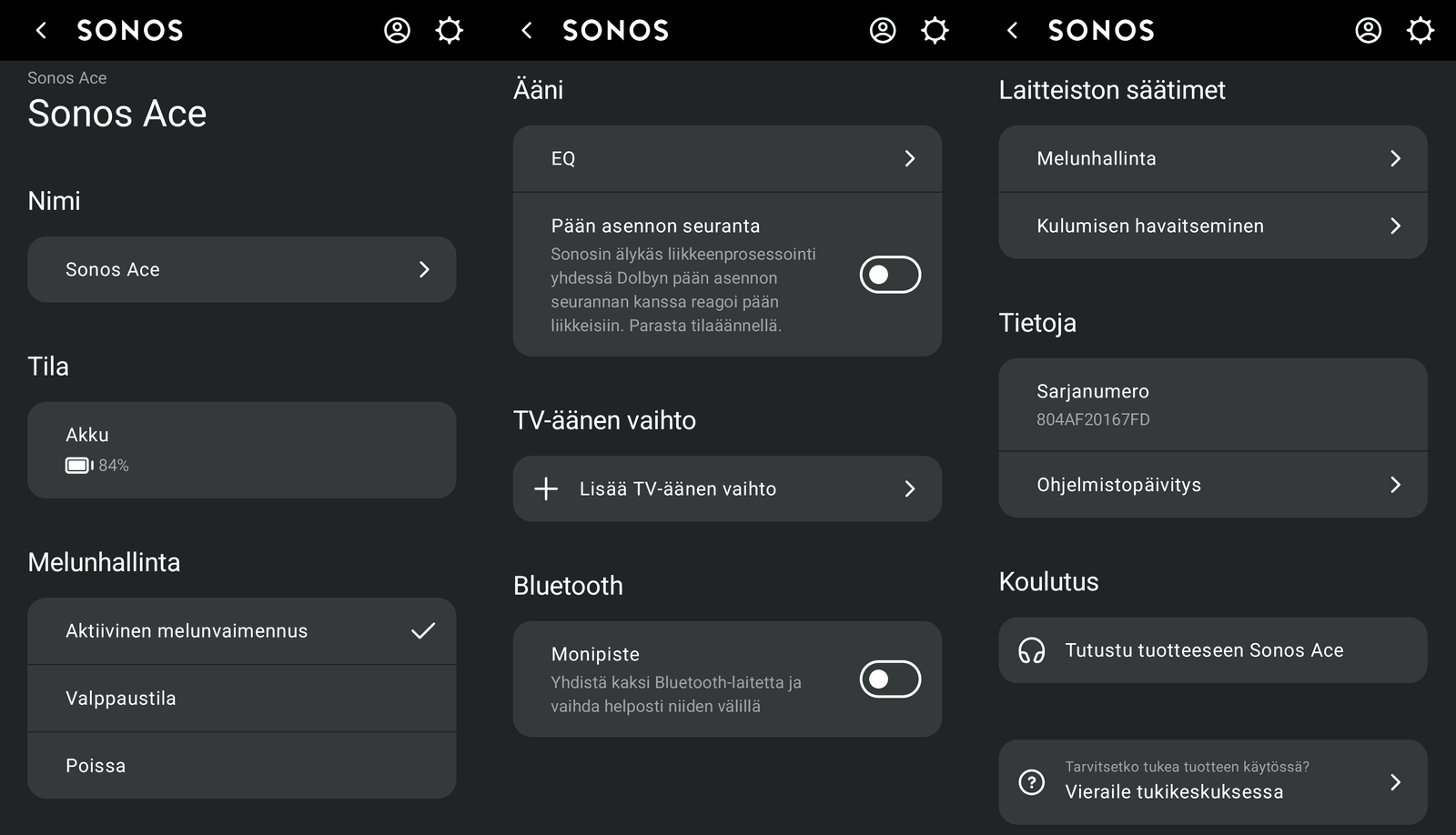
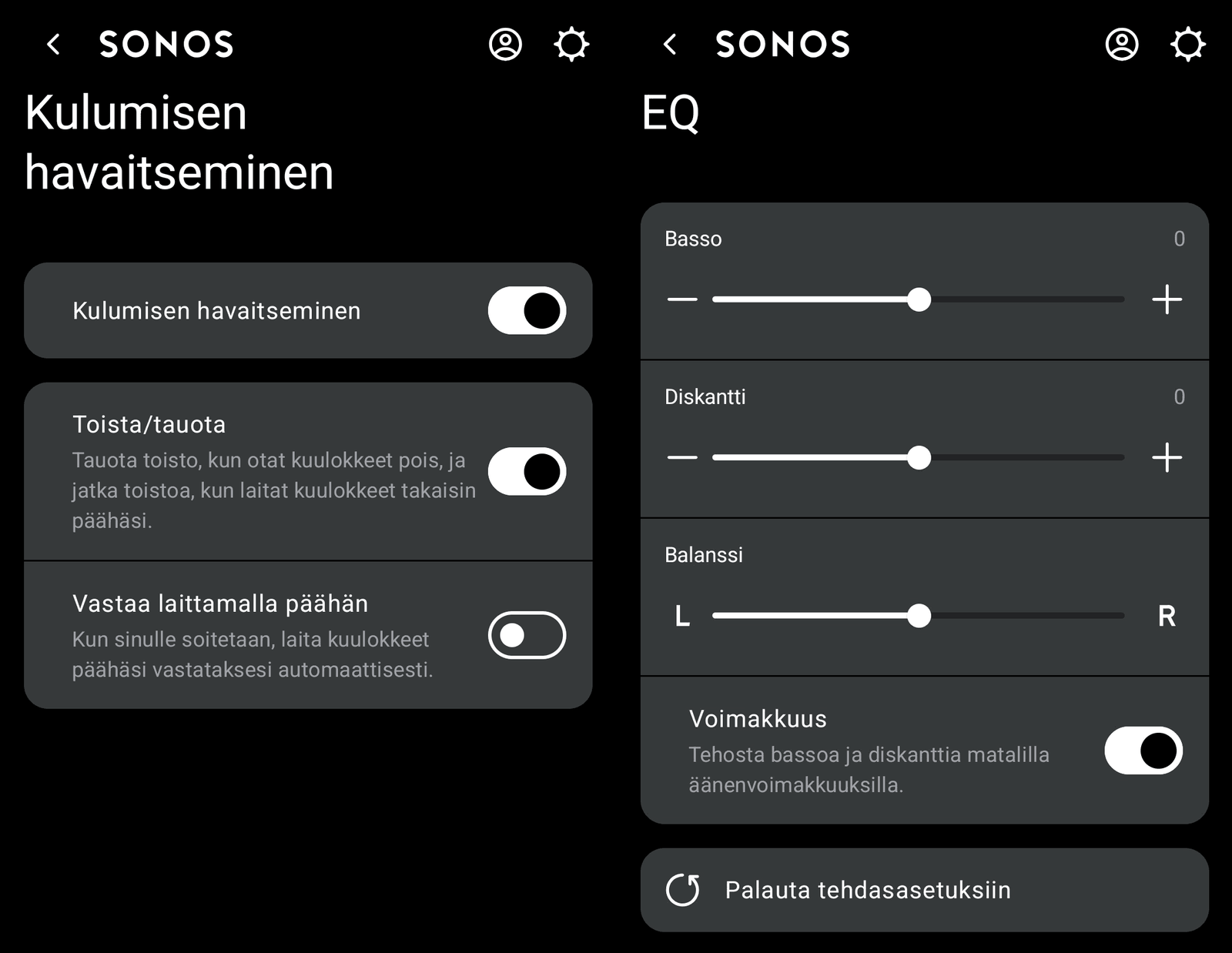
Both manufacturers” applications have been translated into Finnish, which can facilitate their use. However, the translation of the Sonos app is poor: ”wear detection” has been translated, for example, as ”kulumisen havaitseminen" (detection of wear). Like Dyson, Sonos asks users to create an account, but when using only the headphones (without the manufacturer's other audio system), it is not mandatory. Since Dyson's user interface is like a colorful advertisement, I prefer Sonos's minimalist approach. Its app does not offer sound exposure tracking or ready-made sound profiles like Dyson's, but a channel balance control and a basic equalizer for changing bass and treble levels would be available. As an additional feature, there is also a loudness mode, which amplifies both bass and treble more the quieter the volume at which the Ace is listened to. Sonos has decided to activate the loudness mode as a so-called factory setting, which should be taken into account when evaluating sound quality.
Differences in structure and comfort
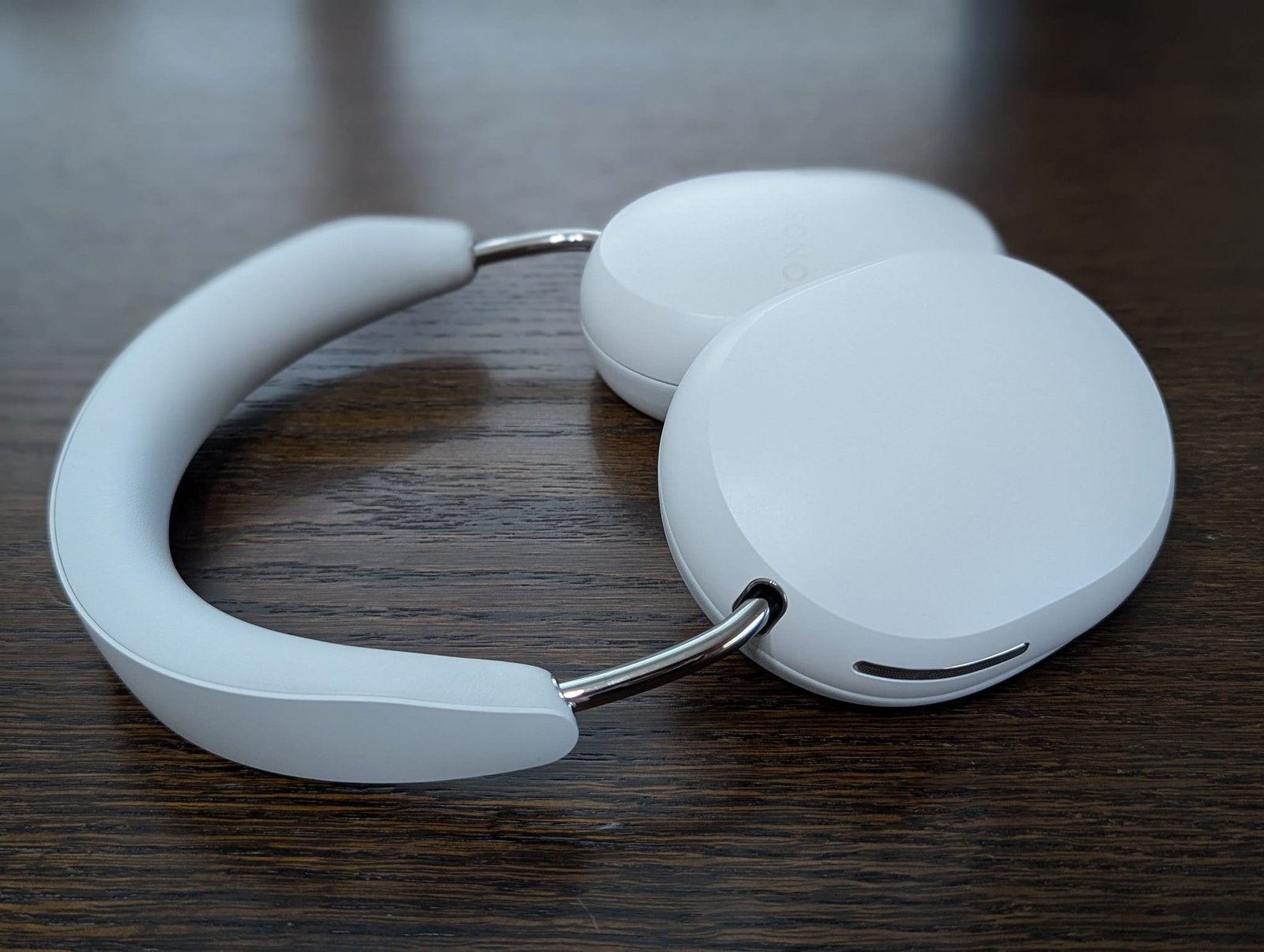
Compared to Dyson's headphones, the Sonos Ace looks clearly more conventional, yet minimally stylish. In my opinion, the appearance corresponds to what many want from more expensive noise-canceling headphones. The shape of the cups and the steel headband sliding in from their upper edge remind me of both Apple's Airpods Max and Sony's WH-1000XM5. These are by no means bad role models for attracting larger consumer masses. The Ace feels well-made and has a practical structure, but due to the plastic cups, its quality impression does not quite reach the level of the OnTrac. Everything feels familiar and safe, while Dyson's headphones are fascinatingly unique. The Ace suits those who prefer a more discreet style, while the OnTrac offers the opportunity to stand out from the crowd.
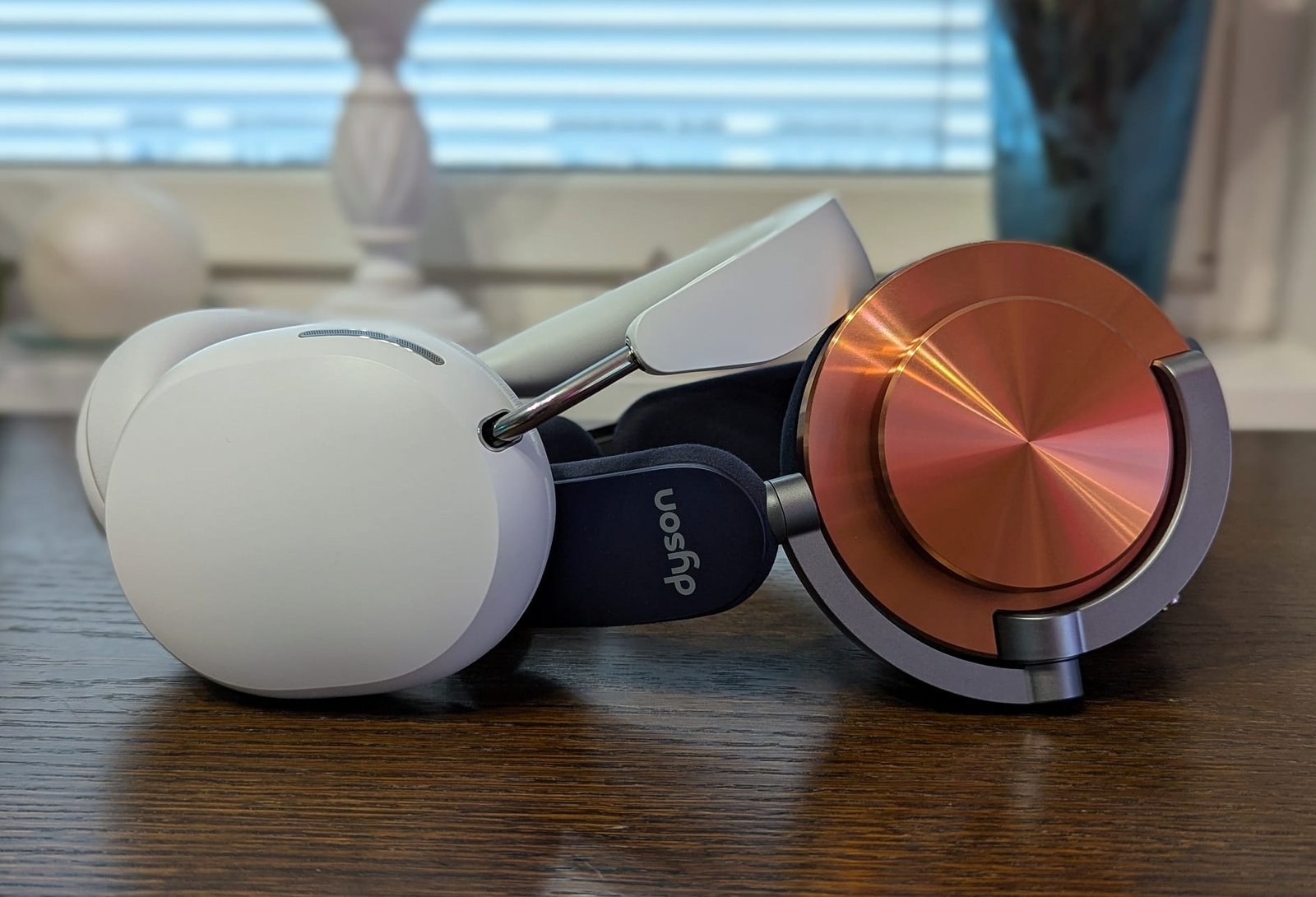
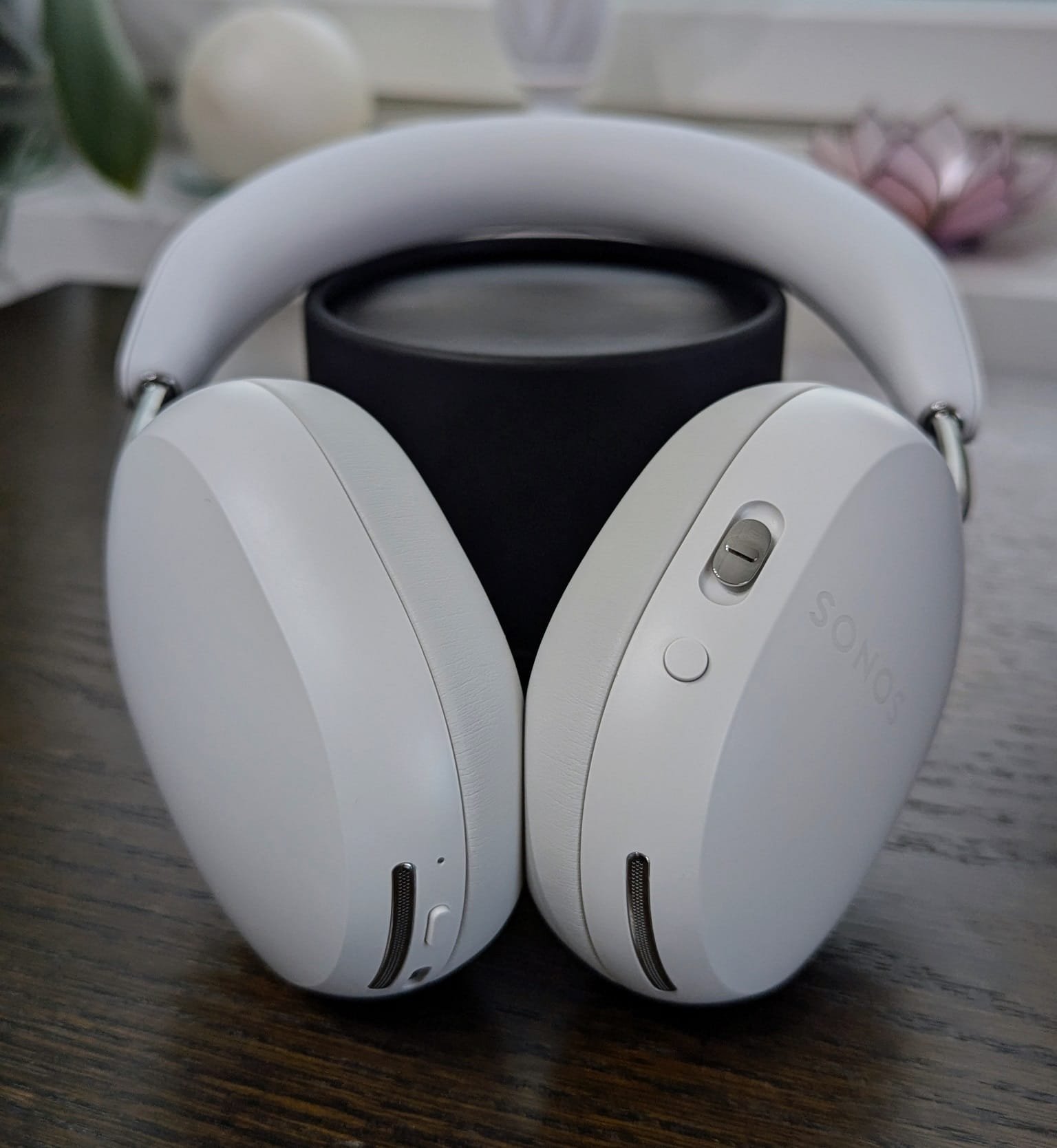
Like Dyson, Sonos has wanted to improve the usability of its headphones by abandoning individual separate buttons. The OnTrac has a rather stiff joystick, while the Ace features a large and easy-to-use slider for volume control. The advantage of the joystick is two extra directions of movement, which allow changing tracks. With the Ace, the same must be done by pressing the slider inwards either two or three times. I ultimately find myself preferring Sonos's control, as the feel or reliability of Dyson's joystick is not top-notch. With the Ace, the noise-canceling function can also be controlled with a normal button instead of having to poke the headphone cup. Using the button is not as exciting, but it works on the first try. I sometimes have to tap the OnTrac 4–6 times to do it firmly enough.
Ace toimii OnTrac:in tapaan hyvin kapeasankaisten silmälasien kanssa, koska pehmeät korvapehmusteet joustavat riittävästi, mutta eivät menetä sulkevuuttaan. Pehmusteosien pinta on Sonosin kuulokkeissa keinonahkaa, joka hiostaa pidemmässä käytössä melkoisesti Dyson-mallin kangasmateriaaliin verrattuna. Korvani osuvat myös hieman Ace:n pehmusteiden reunoihin, mikä on oikeastaan hieman häiritsevämpää kuin se, että OnTrac asettuu osittain korvanlehtieni päälle. Pienistä moitteistani huolimatta pystyn kuitenkin käyttämään molempia kuulokkeita tyytyväisenä useamman tunnin ajan. Laajemmin ajateltuna Sonos-mallin 140 grammaa kevyempi paino (312g vs. 452g) tehnee siitä useimmille hieman mukavamman massiiviseen OnTrac:iin verrattuna. Ace pysyy myös huomattavasti tukevammin päässä esimerkiksi riehumisen aikana. Se ei lopulta eroa merkittävästi markkinoiden muista vaihtoehdoista, kun taas OnTrac voi olla painonsa ja suuremman kokonsa vuoksi herkemmin hutihankinta.
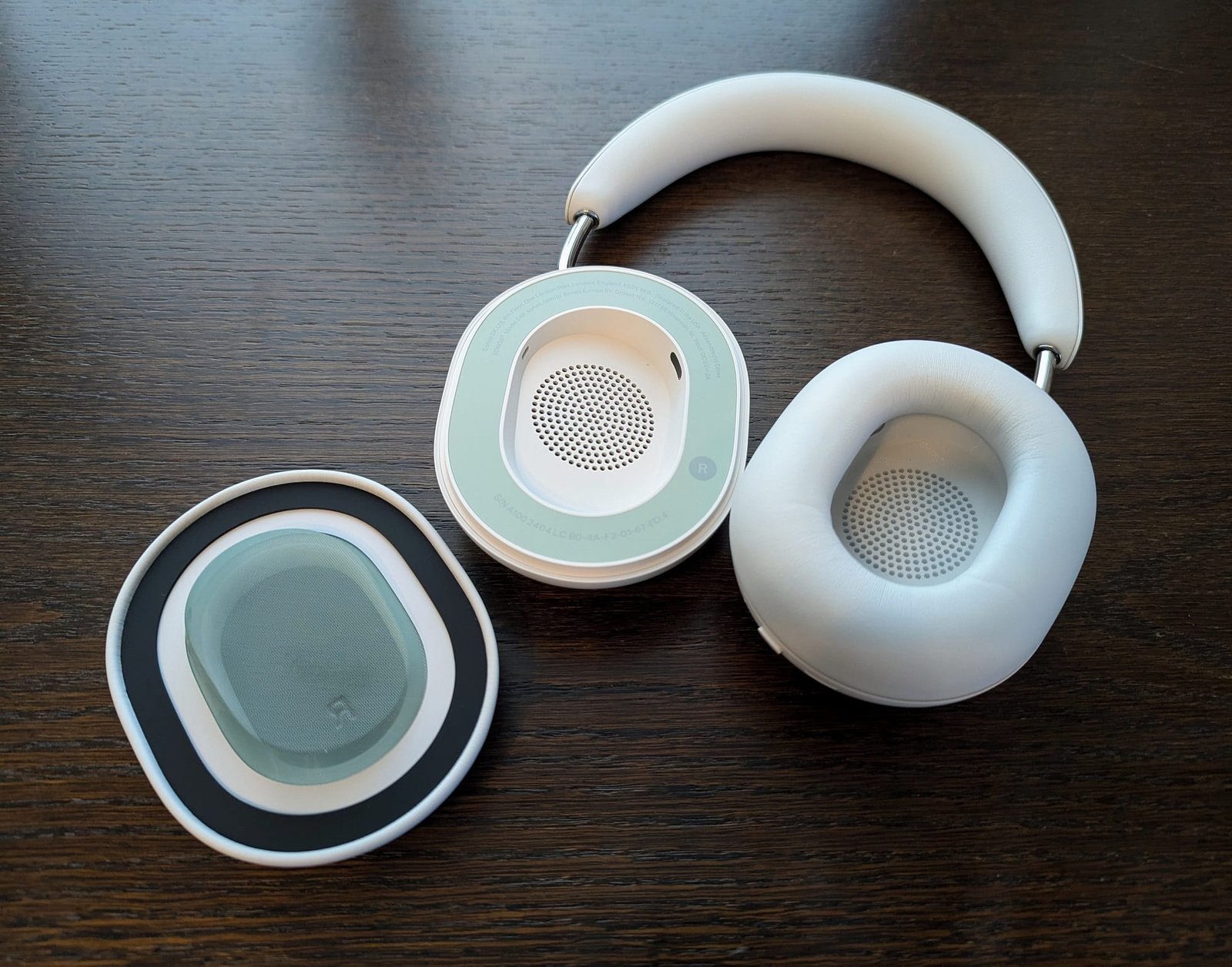
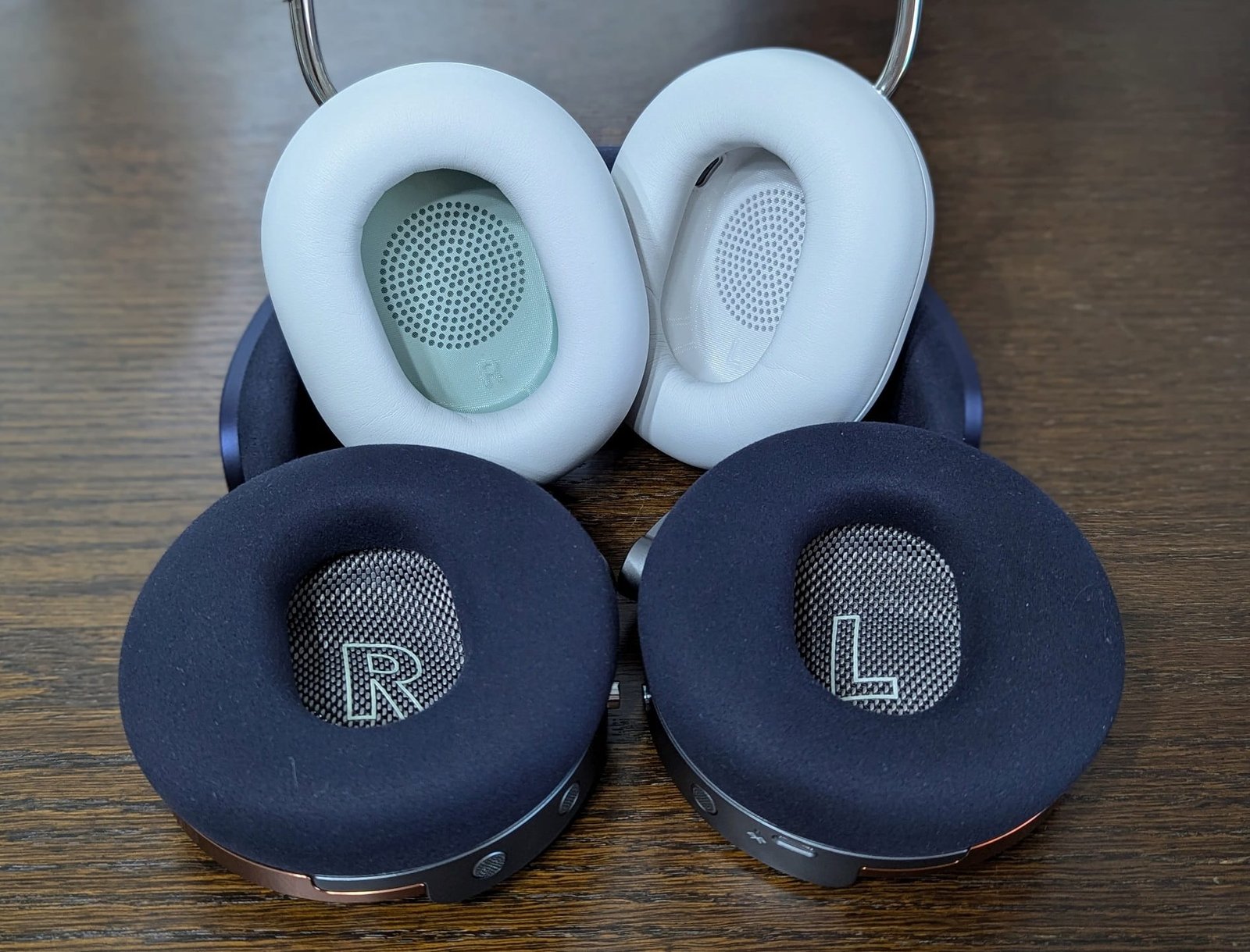
Sonosin kuulokkeiden korvapehmusteet on helppo irrottaa ja vaihtaa, koske ne kiinnittyvät Applen kuulokkeiden tapaan magneeteilla. Pienenä, mutta mukavana yksityiskohtana valmistaja on helpottanut oikean ja vasemman puolen erottamista toisistaan sävyttämällä oikeanpuolimmaisen pehmusteen sisäosan vihreällä. Kuljetuskotelon sisäreuna on saman sävyinen. Mustassa kuulokeversiossa toisen pehmusteen sisältä löytyy vihreän sijaan harmaata. OnTrac:issa on puolestaan suuret R- ja L-kirjaimet pehmusteiden pohjakankaassa.
Erot vastamelutoiminnossa ja mikrofonin äänenlaadussa
Totesin jo Dysonin kuulokkeiden vastamelutoiminnon tehokkaaksi, mutta jopa hieman yllättäen Sonos Ace pistää vieläkin paremmaksi etenkin matalataajuuksisen melun vaimentamisessa. Ace poistaa kaikenlaisen murinan, kohinan ja suhinan hämmästyttävän tehokkaasti pärjäten todennäköisesti Sonyn ja Bosen uusimmille tuotteille. Sonosin kuulokkeet tekevät kaiken lisäksi tämän ilman taustakohinaa, mitä esiintyy jonkin verran Dyson-mallissa. Ace:sta on kuitenkin mainittava, että ihmisen puhetta vaimentaessa se päästää erikoisesti terävimmän osan äänestä läpi selkeämmin kuin esimerkiksi Bosen QuietComfort SE ja Cambridge Audion Melomania P100. Tämä voi toisaalta johtua siitä, että kaikki muut taajuudet vaimenevat Sonosin kuulokkeilla tehokkaammin, jolloin kiinnitän tiettyihin taajuuksiin enemmän huomiota. OnTrac:in tapaan Ace vaimentaa melua varmatoimisesti päätä käännellessä, mutta suoraan eteenpäin suunnattujen mikrofonien vuoksi tuuli aiheuttaa voimakkaampaa häiriöääntä kuulokkeisiin osuessaan. Tältä osin OnTrac toimii hieman paremmin.
Läpikuuluvuustila Sonos Ace:ssa on selkeämpi ja tarkempi kuin missään muussa testaamassani vastamelukuulokkeessa, mutta ääntä selvästi terävöitetään. Tämän vuoksi oma ääneni ei kuulosta kaikkein luonnollisimmalta, vaan hieman ohuelta ja s-kirjaimien osalta suhahtelevalta. OnTrac toistaa puheeni luonnollisemmin, mutta ympäristöäänet hieman vaimeammin. Molemmat ovat joka tapauksessa mielestäni markkinoiden parhaimmasta päästä, kuten myös vastamelutoimintonsa osalta. Sony ja Bose (ja luultavasti myös Apple Airpods Max) kohtaavat tervetullutta kilpailua.
Mikrofonin äänenlaadussa Sonos Ace tuottaa itselleni pienen pettymyksen, koska ääneni kuulostaa melko ohuelta ja terävöitetyltä. Toisaalta siitä saattaisi saada puhelun aikana hieman paremmin selvää kuin Dysonin kuulokkeilla etenkin melun keskellä. Harmillisesti Ace:n taustahälyn prosessointi aiheuttaa kuitenkin enemmän häiriöitä kuin OnTrac. Näkisinkin Dysonin onnistuneen mikrofonin osalta hieman paremmin.
Differences in sound quality
Sonos Ace:n taajuusvaste (vastamelutoiminto päällä):
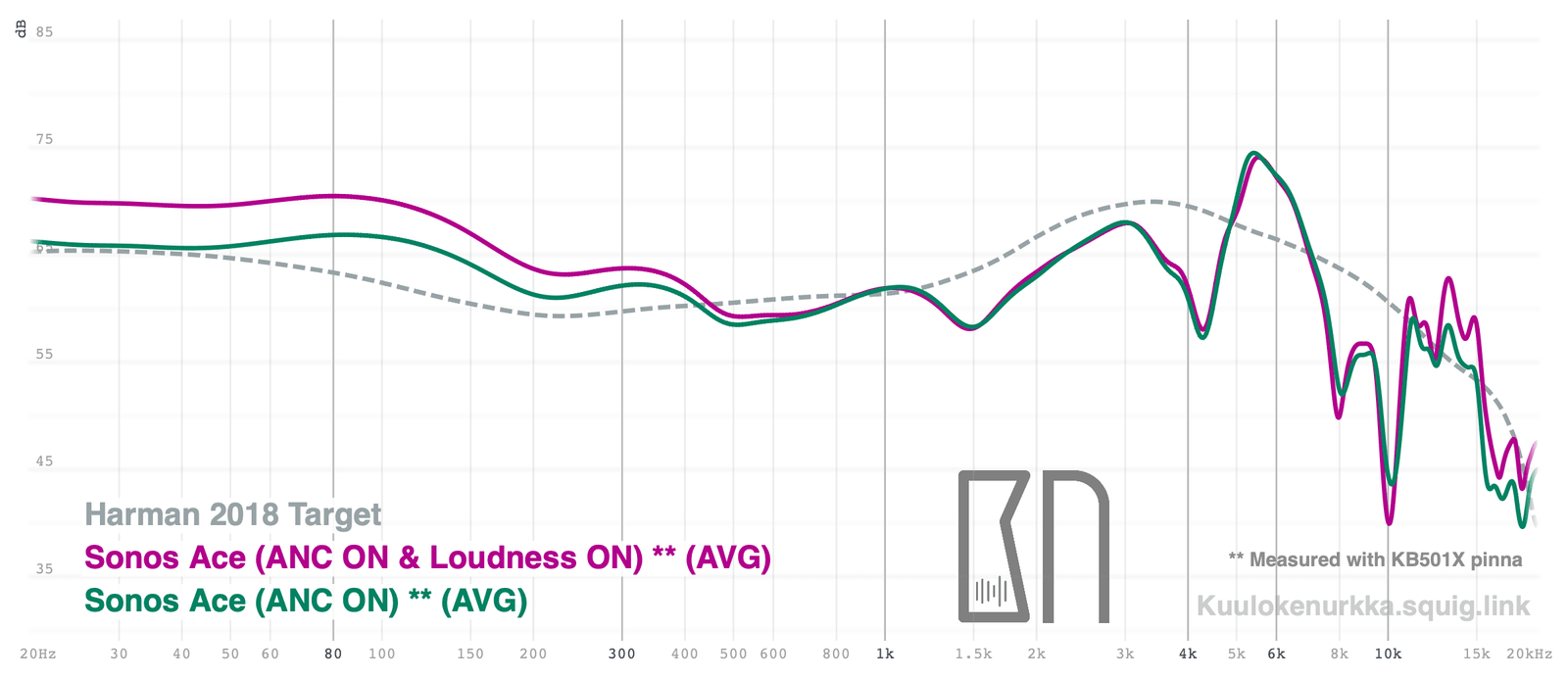
Sonosin kuulokkeissa on oletuksena loudness-asetus päällä, joten valtaosa kuulokkeet ostaneista tulee todennäköisesti kuuntelemaan niitä ensimmäisen kerran siten, ja valmistajakin sitä luultavasti haluaa. Kaikki eivät välttämättä myöskään asenna sovellusta tai hoksaa ottaa loudness-asetusta pois päältä, joten tämä voi hyvinkin jäädä pysyväksi käyttötavaksi. Tällöin minulla on ikävää kerrottavaa: ääni koostuu pelkästä mutaisesta mössöbassosta, joka peittää kaiken muun allensa. En maksaisi kumisevasta, epäselvästä ja verhoutuneesta kokemuksesta mitään, vaan pikemminkin minulle tulisi maksaa siitä, että suostuisin kuuntelemaan Sonosin kuulokkeita. Lopputuloksen täytyy olla jonkinlainen vitsi, koska mikään vakavasti otettava audiovalmistaja ei voisi julkaista mitään vastaavaa – paitsi että Sonosin tapauksessa niin on käynyt. Jottei 500 euroa mene täysin hukkaan, loudness-asetus kannattaa ottaa heti pois päältä. Tämän jälkeen ääni on jonkin verran kelvollisempaa, mutta todelliset ongelmat paljastuvat entistä selkeämmin.
Kuulokkeissa ylemmät bassotaajuudet korostuvat yhä liikaa, joten basso on tyyliltään turvonnutta ja melko epäselvää. Keskitaajuudet puolestaan ovat harmillisen epätasaiset samoin kuin diskanttikin. Tavallista rauhallisemmin toistuvissa keskitaajuuksissa ei sinällään ole suurempaa vikaa, mutta DSP-aikakaudella niiden olettaisi olevan selvästi nykyistä tasaisemmat, jos Sonos pyrkii erottautumaan edullisemmista kilpailijoistaan. Vieläkin ikävämmäksi koen kuitenkin toistoa dominoivan diskanttikorostuman 6 kHz:n ympäristössä. Tämä lisää välillä ääneen lähes murhaavaa pistävyyttä ja sibilanssia: esimerkiksi rumpujen lautaset kuulostavat ärsyttäviltä ja vokalisti usein ohuelta ja terävältä. Diskantti toistuu ylipäätään hämmentävän epäselvästi ja suhisevasti, ja toisto aaltoilee muutoinkin laidasta laitaan tiettyjen äänten jäädessä vaimeiksi ja toisten korostuen liikaa. Kokonaisuus ei kuulosta täysin kelvottomalta, mutta hyvin keskinkertaiselta. Äänenlaatu riittää toisin sanoen sekalaiseen peruskäyttöön, muttei tee minkäänlaista vaikutusta.
USB-kaapelilla kuuntelun totesin tiukentavan jonkin verran bassontoistoa ja avartavan tilavaikutelmaa. Vastaavia muutoksia olen havainnut monilla muillakin kuulokkeilla Bluetooth-yhteyden ja häviöttömän signaalin välillä. Näin käytettynä Sonos Ace on vähemmän huono, mutta hyväksi tai tasapainoisemmaksi se ei muutu.
Dyson OnTrac vs. Sonos Ace oletusasetuksillaan:
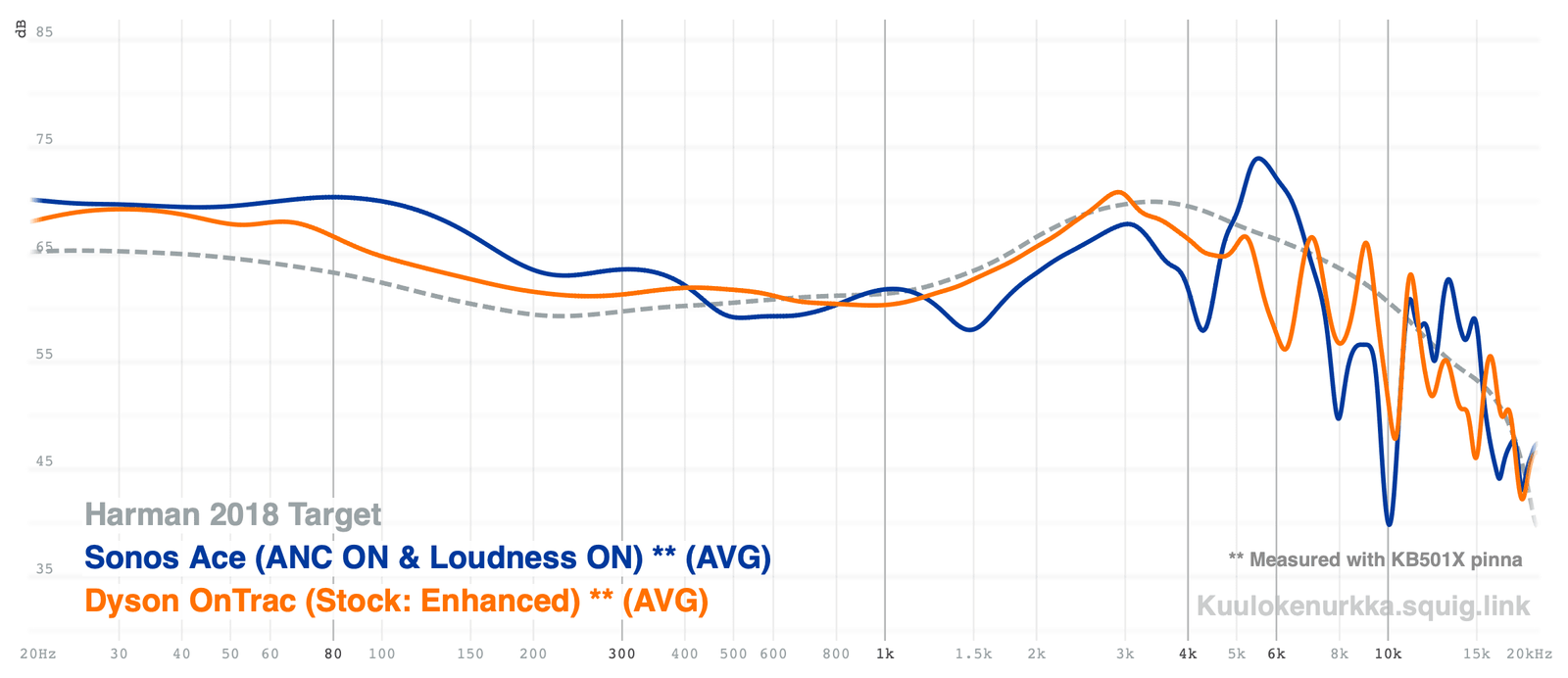
Dyson OnTrac:in oletusasetuksissa on omat ongelmansa bassontoiston ja alakeskitaajuuksien turvonneisuudessa sekä äänen lievässä epäselvyydessä, mutta toiston tasapainoisuudeltaan kuulokkeet ovat silti huomattavasti oikeaoppisemmat kuin Sonos Ace, joka toistaa loudness-asetus päällä lähinnä löysää bassoa. Tilanne ei parane valtavasti myöskään kyseinen asetus pois päältä ottaessa, joten OnTrac vie selvän voiton, vaikken senkään oletusääniprofiilia missään nimessä erinomaiseksi kutsuisi. Pidän tilannetta äänentoistoon erikoistuneen Sonosin kannalta nolona, sillä tuskinpa se odotti, että imurivalmistaja osaa tehdä paremmalta kuulostavat kuulokkeet.
Dyson OnTrac vs. Sonos Ace sovellustensa kautta hienosäädettynä:
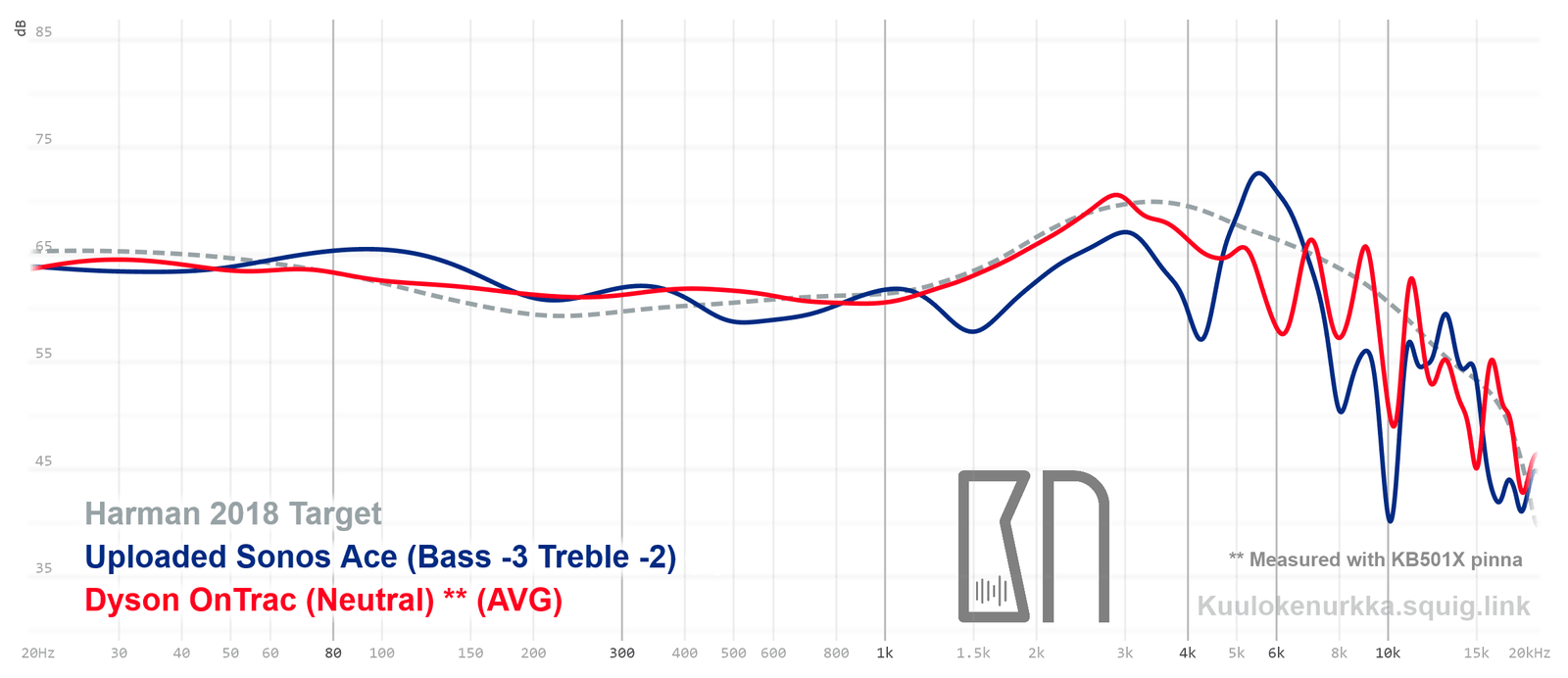
Koska valtaosa käyttää vastamelukuulokkeita nimenomaan melun vaimentamiseen, jätän pois laskuista sen, että OnTrac kuulostaisi vastamelutoiminto pois päältä otettuna kaikkein parhaimmalta. Pyrin sen sijaan tekemään molemmista kuulokkeista omien sovellustensa kautta mahdollisimman hyvät vastamelutoiminto päällä käytettäväksi. OnTrac:in kohdalla tämä tarkoitti neutraalin ääniprofiilin aktivoimista, kun taas Ace:n bassoa taajuuskorjasin kolme pykälää ja diskanttia kaksi pykälää alaspäin. Tämän jälkeen bassontoisto ei enää kumise yhtä häiritsevästi, eikä sibilanssikaan ole ihan yhtä riipivää. Toisaalta yläkeskitaajuudet vaimenevat samalla hieman lisää, joten niitä ei saada mitenkään yhtä luonnollisiksi kuin Dysonin kuulokkeissa. Kokonaisuutta arvioidessani OnTrac viekin edelleen voiton. Pintaa syvemmältä tarkastellessa Sonos Ace:lla on kuitenkin joitakin vahvuuksia.
OnTrac:in ääni jää tuhdisti toistuvien alakeskitaajuuksien (300–600 Hz) ja rauhallisen preesensalueen (4–6 kHz) vuoksi hieman pehmeäksi ja tasapaksuksi. Keskitaajuudet pääsevät kyllä hyvin oikeuksiinsa, mutta toiston selkeys ja dynaamisuus jää juuri sen verran vajaaksi, ettei lopputulos juurikaan innosta. Ylätaajuudetkin toistuvat toivomaani epätasaisemmin ja epäselvemmin.
Sonos Ace puolestaan korostaa edelleen 6 kHz:n ympäristöä, joten se tuo musiikin nyansseja terävämmin esiin ja tuntuu siten omalla tavallaan yksityiskohtaisemmalta. Se toistaa lisäksi ääntä avarammin kuin OnTrac, mikä on uskoakseni seurausta Sennheiser HD 800:n tapaisesta tuunauksesta, jossa yläkeskitaajuudet (1,5–3 kHz) jäävät aavistuksen vaimeiksi, ja 6 kHz:n ympäristö nostetaan etualalle kokonaisuudessa. Äänikuvan näkökulmasta tuunaus onkin suhteellisen onnistunut, vaikka keskitaajuudet jäävätkin melko verhoutuneiksi Dyson OnTrac:in rinnalla. Terävästä sibilanssista ei myöskään päästä millään eroon diskanttisäätimellä, koska se ei tasaa laisinkaan ylätaajuuksia, vaan pudottaa vain niiden tasoa. Omien säätöjeni jälkeen uskoisin kuitenkin monien pitävän lopputulosta hieman kelvollisempana, kunhan tavoitteena ei ole huippuhyvä äänenlaatu.
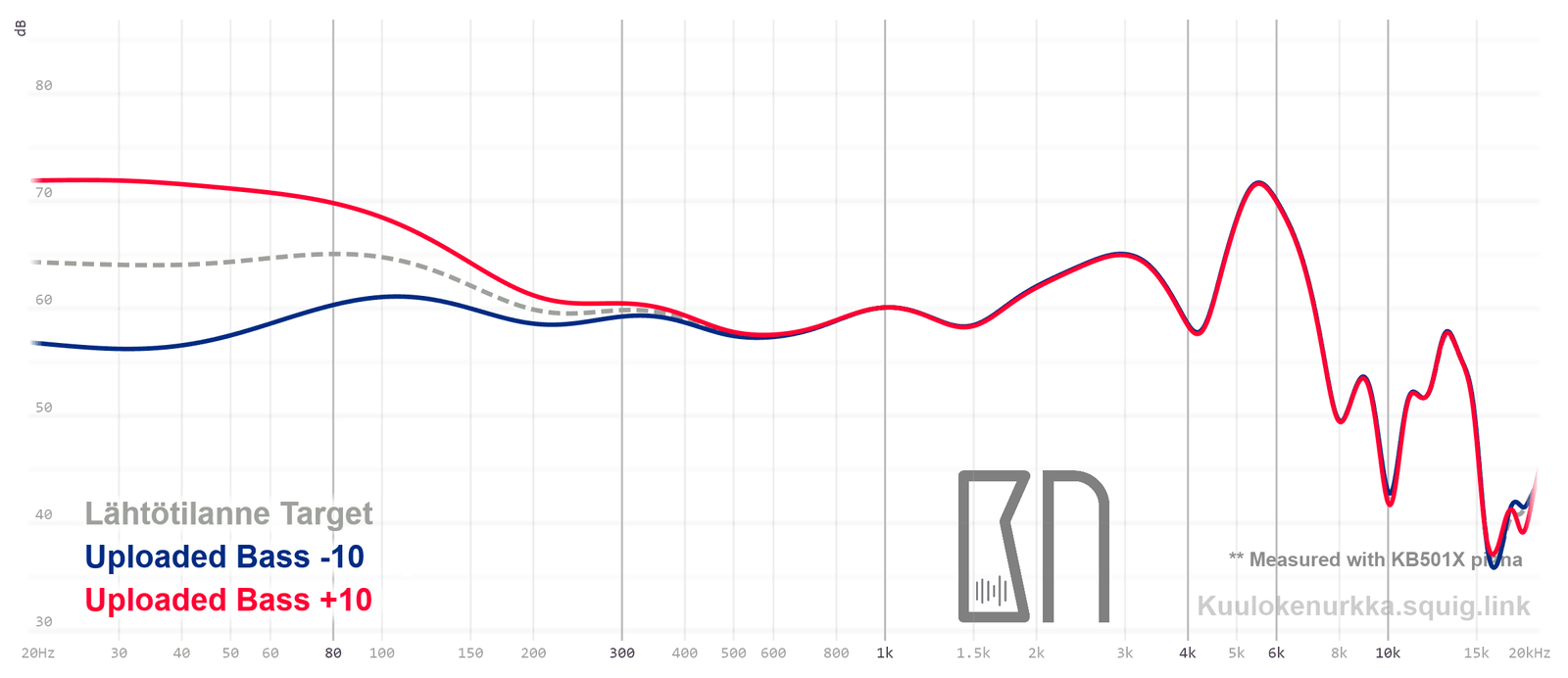
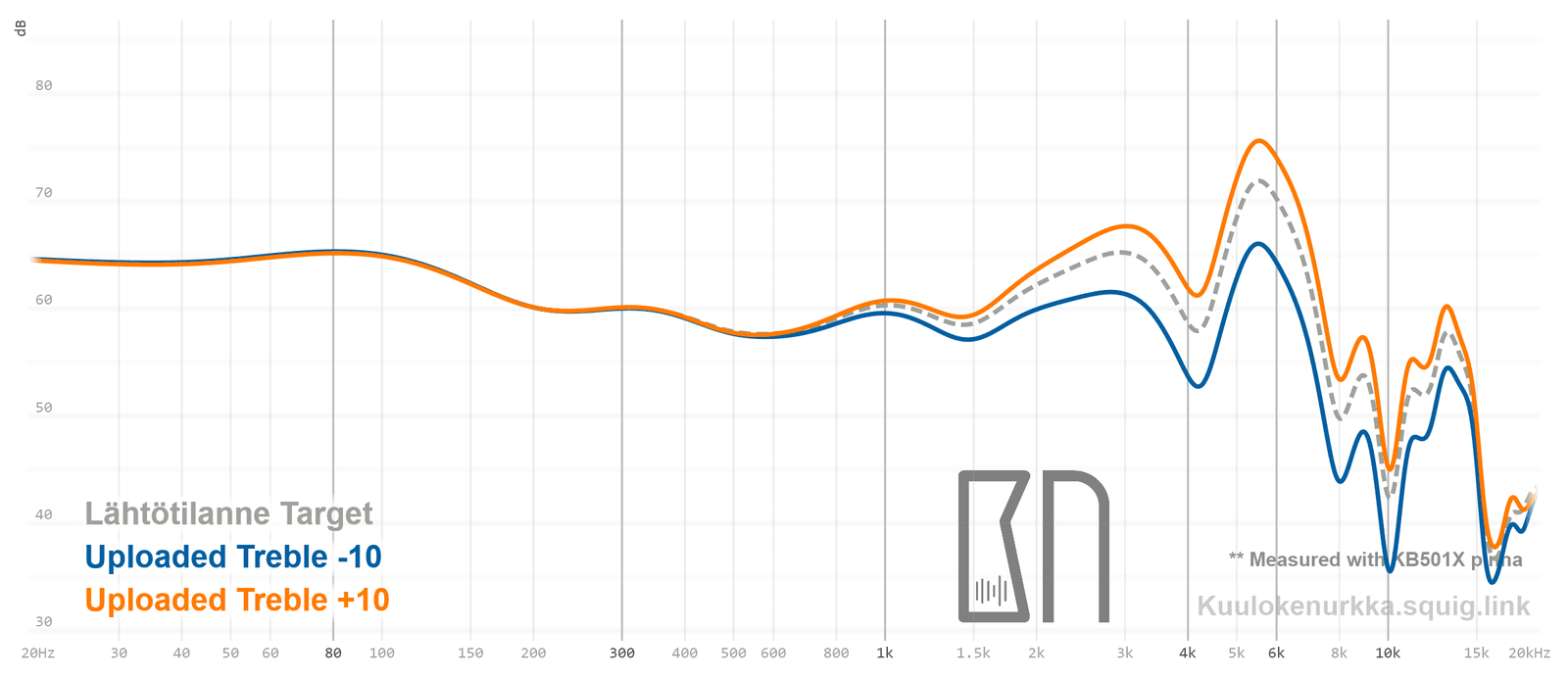
Kumpi on lopulta parempi?
Äänenlaadun osalta Dysonin kuulokkeet ansaitsevat lopulta voiton, mutta kannattaa huomioida, että niitä ei ole varsinaisesti suunnattu hauskaa ja innostavaa toistoa etsiville, vaan ne loistavat pikemminkin mahdollisimman neutraaliksi säädettynä. Ääneltään epätasainen Sonos Ace puolestaan voi olla ongelmistaan huolimatta joillekin jännittävämpää kuunneltavaa – tuhdilla keskibassolla ja sähäkällä diskantilla on tällainen vaikutus. Markkinointipuheet, speksit tai Bluetooth-koodekit eivät lopulta ratkaise äänenlaatua, koska Dyson on onnistunut työssään paremmin ”muinaisesta” Bluetooth-tekniikastaan huolimatta. Sonosilla puolestaan riittäisi reilusti parannettavaa, sillä nyt kuulokkeiden omistaja joutuu näkemään vaivaa saadakseen niistä millään tapaa siedettävän kuuloiset – jos äänenlaadulla on siis merkitystä samoin kuin itselleni.
Muilta osin Sonosin kuulokkeet ovat kaksikosta helpommin lähestyttävät ja selvästi kevyemmät. Ne ovat myös ominaisuuksiltaan monipuolisemmat ja omien kokemusteni perusteella vastamelutoiminnoltaan hieman tehokkaammat. Jos äänenlaadulla ei ole merkitystä, Ace:n voitaisiinkin todeta tarjoavan hieman enemmän vastinetta rahalle. Toisaalta Dysonin kuulokkeiden vastamelutoiminto on niin ikään erinomaisen tehokas ja akunkesto huomattavasti pidempi. OnTrac ei myöskään hiosta käytön aikana yhtä paljoa. Olen myös oppinut pitämään kuulokkeiden omintakeisesta ulkonäöstä ja tankkimaisesta rakenteesta. Ace on muovisempi, mutta toki vähemmän huomiota herättävä.
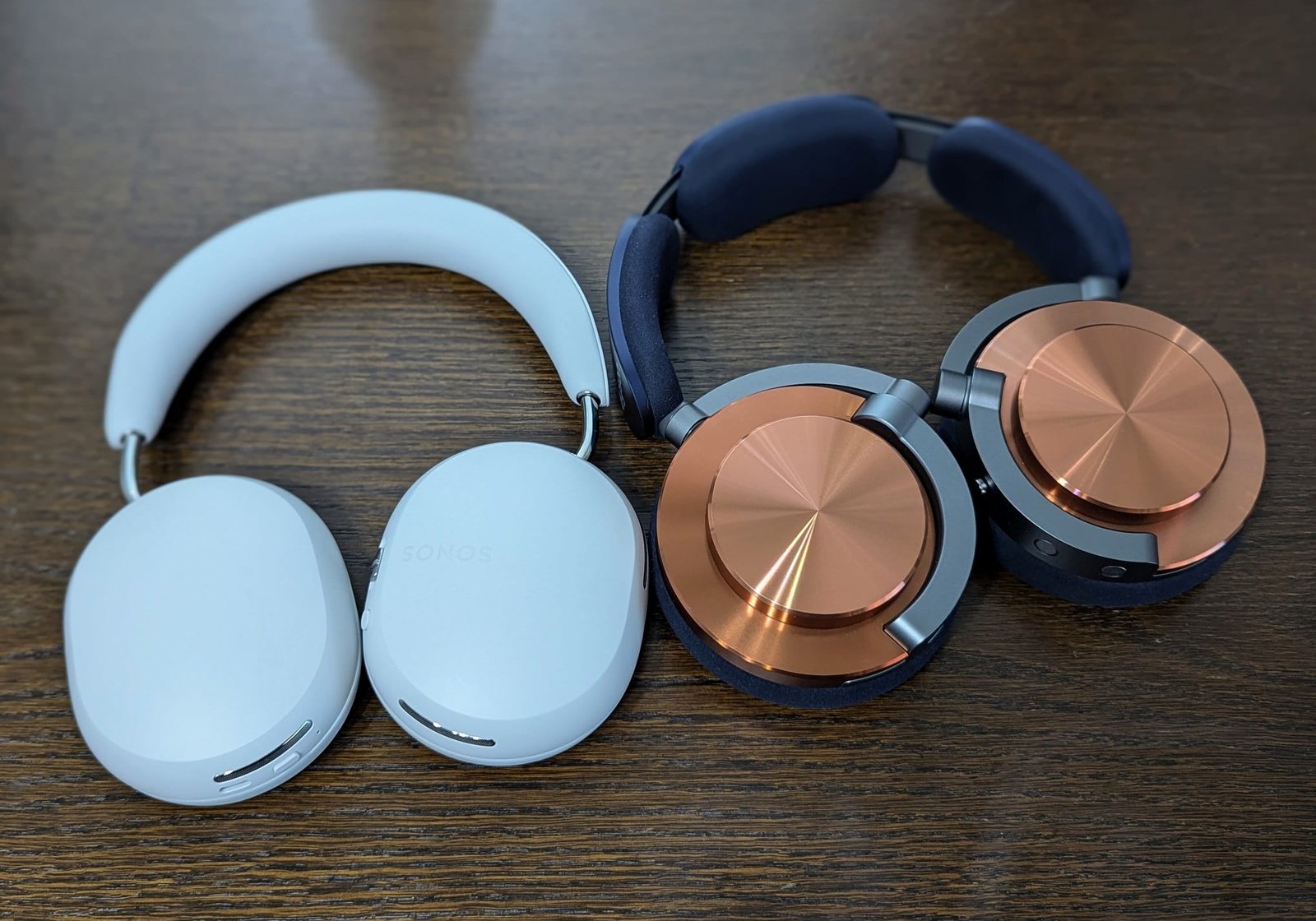
Molemmat kuulokkeet loistavat lopulta omilla vahvuusalueillaan, mutta vaatisivat korkeahkoon hintaansa nähden lisää hienosäätöä. Koska äänenlaatu ei yllä kriittisesti arvioituna kummassakaan huipputasolle, odottaisin käyttökokemuksen olevan tässä hintaluokassa vieläkin sulavampi. Sonosin kuulokkeita voisin suositella, jos ne kuulostaisivat reilusti paremmalta tai maksaisivat puolet vähemmän. Dysonin kuulokkeiden korkean hinnan ymmärrän paremmin äärimmäisen laadukkaan rakenteen ja oikeaoppisemman äänen myötä, mutta korkea paino, pienet oikut ja erikoinen ulkonäkö jakanevat jonkin verran mielipiteitä. Kumpaakaan kuulokemallia ei mielestäni tarvitsekaan kiirehtiä ostamaan ennen kuin selviää, miten valmistajat päivittävät ja jatkokehittävät niitä. Toisaalta tietynlaisiin tarpeisiin niistä löytyy jo nyt hyviä puolia.
Summary
Tämän sivupolun jälkeen pääsemme viimeisiin ajatuksiini Dysonin kuulokkeista. Kuten vertailuni paljasti, OnTrac pystyy päihittämään äänenlaadussa kokeneemman audiovalmistajan tuotteen, jos tavoitteena on monia muita vastamelukuulokkeita tasapainoisempi lopputulos. Jos taas joku toivoo kuulokkeiltaan vain paljon bassoa tai räväkämpää diskanttia, OnTrac ei mielestäni ole erityisen vaikuttava tapaus.
Parhaimmillaan kuulokkeet ovat mielestäni neutraalilla ääniprofiilillaan käytettynä, jolloin ne tarjoavat Valcon VMK25-mallin tapaan tavallista neutraalimman ja äänitteitä kunnioittavamman kuuntelukokemuksen. Vastamelutoiminnon pois päältä ottaminen parantaa lopputulosta entisestään, jolloin puhutaan jo hifi-tyylisestä toistosta. Näin käytettynä OnTrac kuulostaa mielestäni pienen totuttelun jälkeen mahtavalta, joten se olisi jopa hyvä referenssi monille muille kuulokevalmistajille.
Koska vastamelutoiminto päällä täytyy kuitenkin tyytyä tasapaksumpaan esitystapaan, eikä basson lisääminen muuta toistoa merkittävästi hauskemmaksi, näen kuulokkeet eräänlaisena väliinputoajana, jolle on hieman vaikeaa löytää selkeää kohderyhmää. Kokonaisuus jää plussalle, mutta lopputulos voisi olla pienillä muutoksilla parempikin. Toivoisinkin Dysonin hienosäätävän DSP-asetuksiaan firmware-päivityksellä tai lisäävän sovellukseen kunnollisen taajuuskorjaimen. Diskantti saisi ylipäätään olla jo oletuksena hieman tasaisempaa.
Muilta osin OnTrac tuntuu Dysonin ensimmäisen kuulokemallin tapaan yhä eräänlaiselta konseptituotteelta, jonka menestystä on vaikeaa ennakoida. Valmistaja on panostanut onnistuneesti vastamelutoiminnon tehokkuuteen, akunkestoon ja rakenteen laatuun, eikä kuulokkeiden käytettävyydessäkään ole korkeaa painoa ja pikkuvikoja lukuun ottamatta suurempaa huomautettavaa kilpailijoiden tuotteisiin nähden. Bluetooth-tekniikka on toki auttamatta vanhentunutta. Vaikka arvostankin OnTrac:in omalaatuisuutta ja olen alkanut pitää sen ulkonäöstä paljon, epäilen sen olevan useimmille liiankin erikoinen tapaus, jotta tulisimme näkemään kuulokkeita enemmän katukuvassa. Toisaalta jotkut kokevat varmasti joukosta erottautumisen positiivisena asiana. Kannattaa kuitenkin huomioida, että OnTrac:in ulkonäön kustomointi maksaa lisää.
Jos Dyson päätyy tekemään jatkossa hieman hillitympiä ja sirompia tuotteita, sillä olisi nähdäkseni kaikki mahdollisuudet tulla varteenotettavaksi tekijäksi vastamelukuulokemarkkinoilla. Kiinnostus on nyt todellakin herätetty ja valmistajan insinöörit vaikuttavat ymmärtävän tavallista paremmin, miltä hyvien kuulokkeiden tulisi kuulostaa. OnTrac ei ole vielä aivan nappisuoritus, mutta jos sen ulkonäkö, tehokas vastamelutoiminto ja tyyliltään neutraali ääni kiinnostavat, sen voi ostaa ihan hyvillä mielin. Annan Dysonille peukun.
Pros and cons:
+ Monia kilpailijoita neutraalimpi ja tasapainoisempi tuunaus
+ Neutraalilla ääniprofiililla ja vastamelutoiminto pois päältä otettuna hifi-tyylistä toistoa
+ Tehokas vastamelutoiminto
+ Natural-sounding transparency mode
+ Long battery life
+ Äärimmäisen laadukas ja kestävän oloinen rakenne
+ Omaperäinen ulkonäkö laajoine kustomointimahdollisuuksineen
+ Uniikki kotelo, joka myös toimii
+/- Kuulokkeet tuntuvat päässä todella mukavilta, mutta painavilta
+/- Joystick-painike on hyvä keksintö, mutta reagoi painalluksiin jokseenkin epävarmasti
– Oletusääniprofiilin turvonnut basso
– Diskantin epätasaisuus
– Esitystapa on väkisin hieman pehmeä ja tasapaksu vastamelutoiminto päällä
- Background hiss when using ANC
– Vanhentunut Bluetooth-tekniikka ja huono koodekkituki
– Toiston ajoittainen pätkiminen ja pienet käyttöä häiritsevät asiat
– Korvapehmusteiden aukko saisi olla suurempi
– Korkeahko hinta
 EN
EN  FI
FI