Author: Sword of Damocles
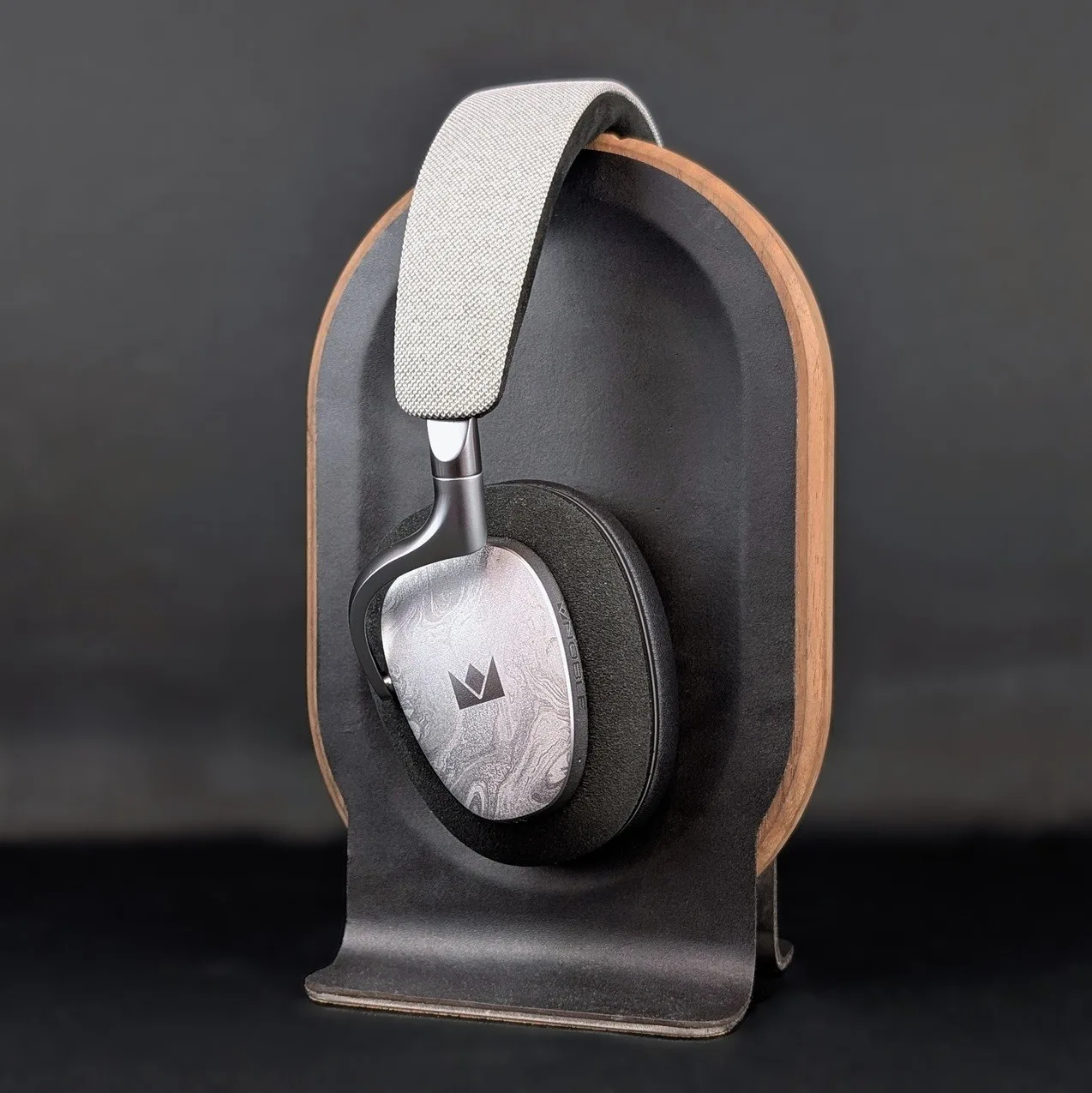
Table of Contents:
Information:
- Release year: 2026
- Country of origin: China (designed in the US/Thailand)
- Price: 899 USD / 949 EUR
- Available in Finland: Yes
- Type: Closed, over-ear
- 3-way Hybrid Drivers: Dynamic 32 mm + Planar 14,5 mm + Balanced Armature
- Audio connectivity: Bluetooth 6.0 and USB-C (supports analog use as well)
- Bluetooth codecs: aptX (Lossless, Adaptive, and Classic), LDAC, AAC, and SBC
- Charging port: USB-C
- Battery size: 600 mAh
- Battery life (ANC ON/OFF): 35 / 55 h
- Charging time: 1.5 h (Supports fast charging)
- Active Noise Cancellation: ON / OFF / Transparency mode
- Weight: 350 g
- Features: Multipoint, voice assistant, wear detection sensor, IP52 rating, replaceable battery, and mobile app with equalizer and spatial audio
- Accessories: Carrying case, two USB-C cables (long and short), USB-C to 3.5 mm cable, and airplane adapter
- Warranty: 24 months
Review sample: Received on loan from importer/reseller
Noble Audio has never aimed to be a mainstream brand for the masses. Under the leadership of John “Wizard” Moulton, the boutique manufacturer sets its sights firmly on the high end. The company is best known for its striking wired in-ear monitors, which can cost several thousand euros. On the other hand, their lineup also includes pricey wireless products, such as the FoKus Apollo and FoKus Prestige EncoreI previously reviewed. The latest addition to the range is the €950 Fokus Artemis, which takes its place as Noble Audio's flagship active noise-canceling over-ear headphone.
Among the most interesting features of the Artemis are its easily replaceable battery and a 3-way hybrid driver structure, which combines a dynamic driver, a planar magnetic driver, and a balanced armature driver commonly found in in-ear monitors. The slightly more affordable FoKus Apollo and Apollo Pro models lack the balanced armature driver, although their dynamic driver is somewhat larger than the one in the Artemis (40 mm vs. 32 mm). Multi-driver setups may well become more common in the future, as the recently released Nothing Headphone (1) Pro also features three different types of drivers.
The FoKus Artemis was provided as a review unit by Mareksound, the local importer and retailer for Noble Audio products in Finland. They also have these available for auditioning at their Helsinki store, making it well worth a visit if your interest is piqued.
Packaging and accessories
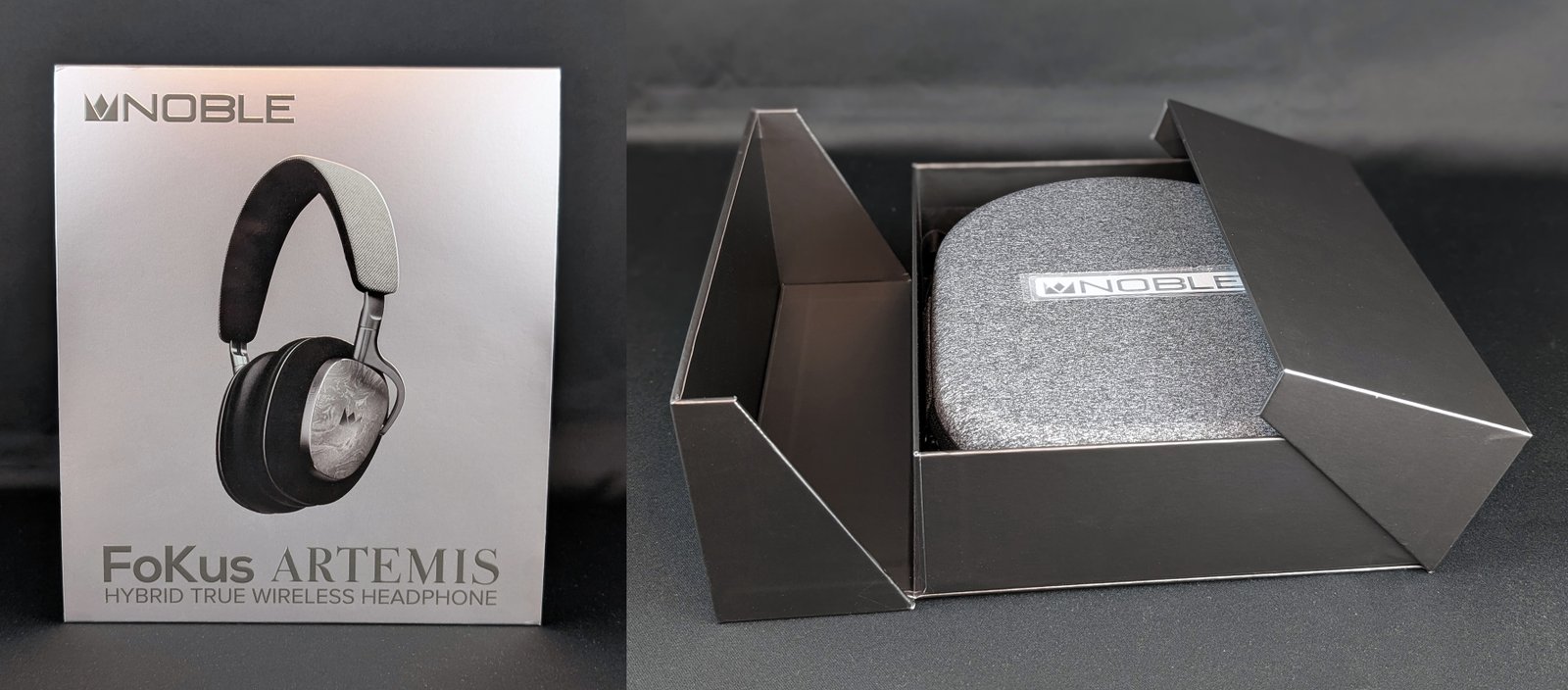
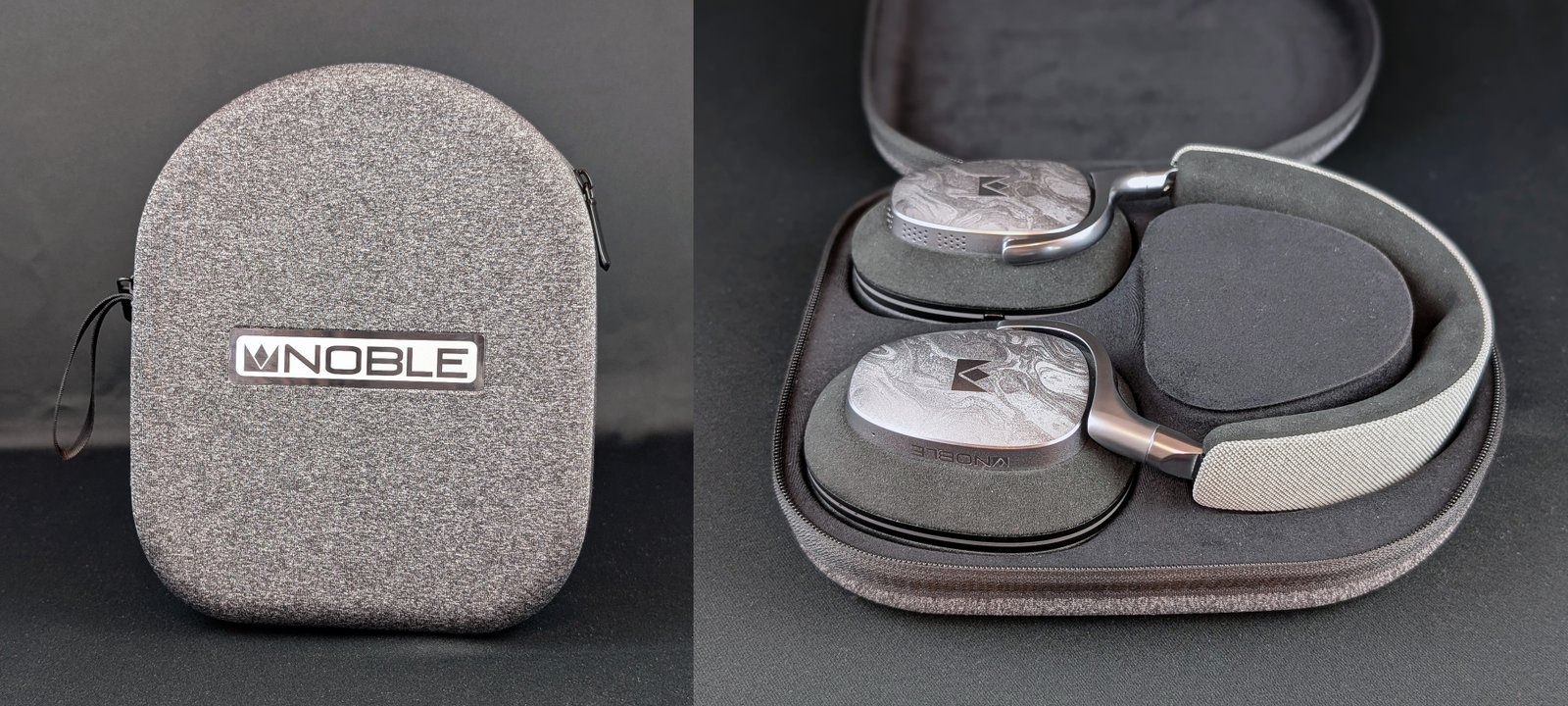
The Artemis feels like a high-end product from the moment you handle the packaging, as opening the box’s magnetically sealed “doors” leaves a lasting impression compared to more mundane product boxes. Inside, it reveals a relatively compact carrying case with a fabric finish that feels pleasantly smooth—almost cool to the touch. The interior layout, on the other hand, strongly evokes Bowers & Wilkins products. This premium touch extends to the three included cables, which, along with the flight adapter, fit neatly beneath the case's magnetic flap.
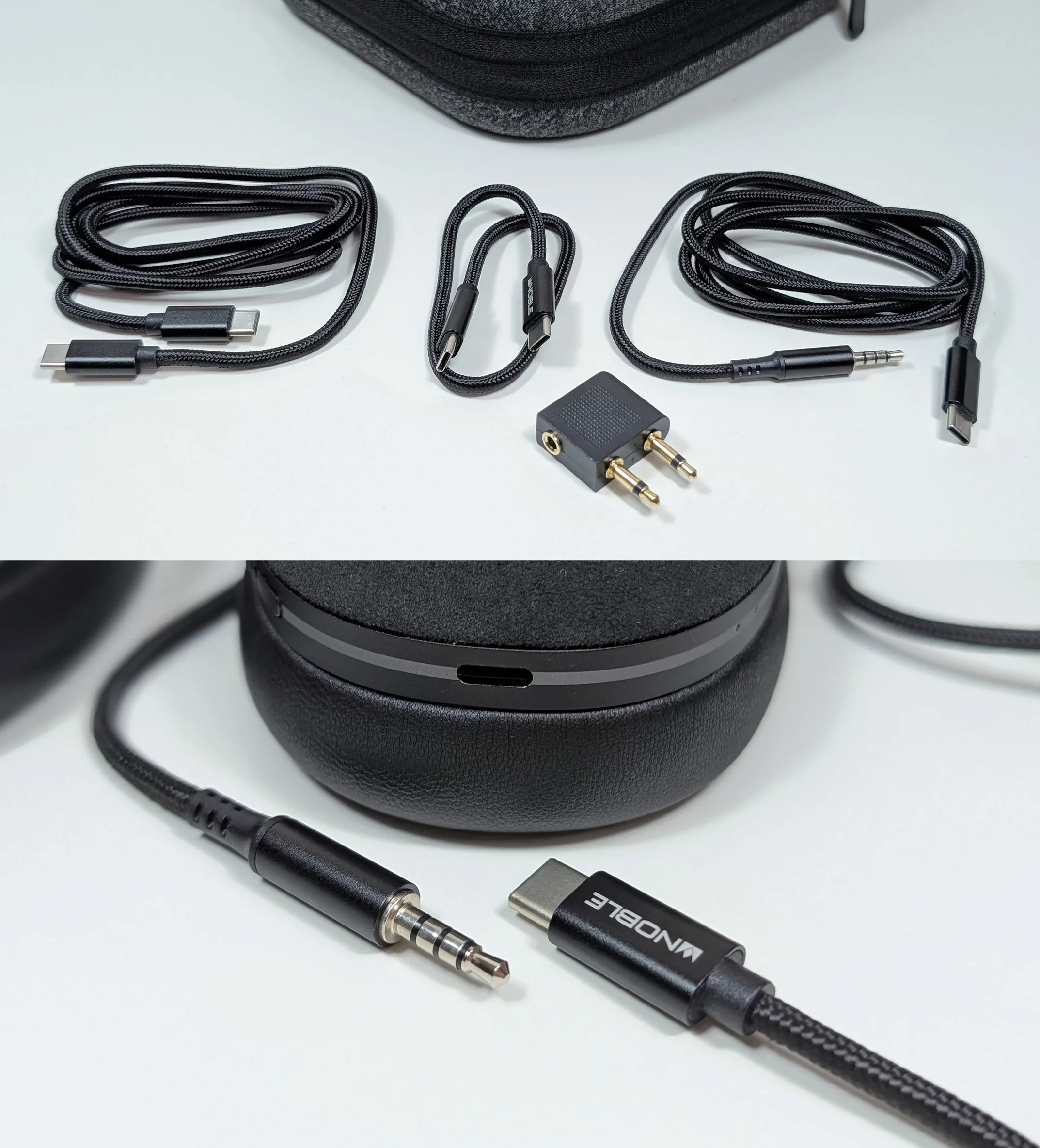
The buyer receives both a short and a longer USB-C cable, which can be used for charging and digital audio playback. Although the Artemis lacks a conventional analog headphone jack, passive listening is still possible via the third cable through the USB-C port. The manufacturer has evidently wired the USB connector to act as an analog signal path, since the headphones do not need to be powered on when the 3.5 mm end is plugged into an audio source. I haven't encountered such an ingenious solution before. Power can, of course, be switched on during passive listening as well, enabling active noise cancellation, sound EQ adjustments, and the physical control buttons. Potential buyers should note that, unlike with the FoKus Apollo, a separate boom microphone is not included with the Artemis.
Build and comfort
Much like its carrying case, the design of the Artemis shares a clear family resemblance to Bowers & Wilkins noise-canceling headphones, and the overall sense of quality is similarly top-tier. Personally, I prefer the aesthetic direction Noble Audio has chosen, even if B&W’s PX8 series is available in a wider range of colors. Frankly, you can't go wrong with either in terms of looks. The FoKus Apollo I previously reviewed is physically bulkier than the Artemis, making this new model look sleeker when out and about.
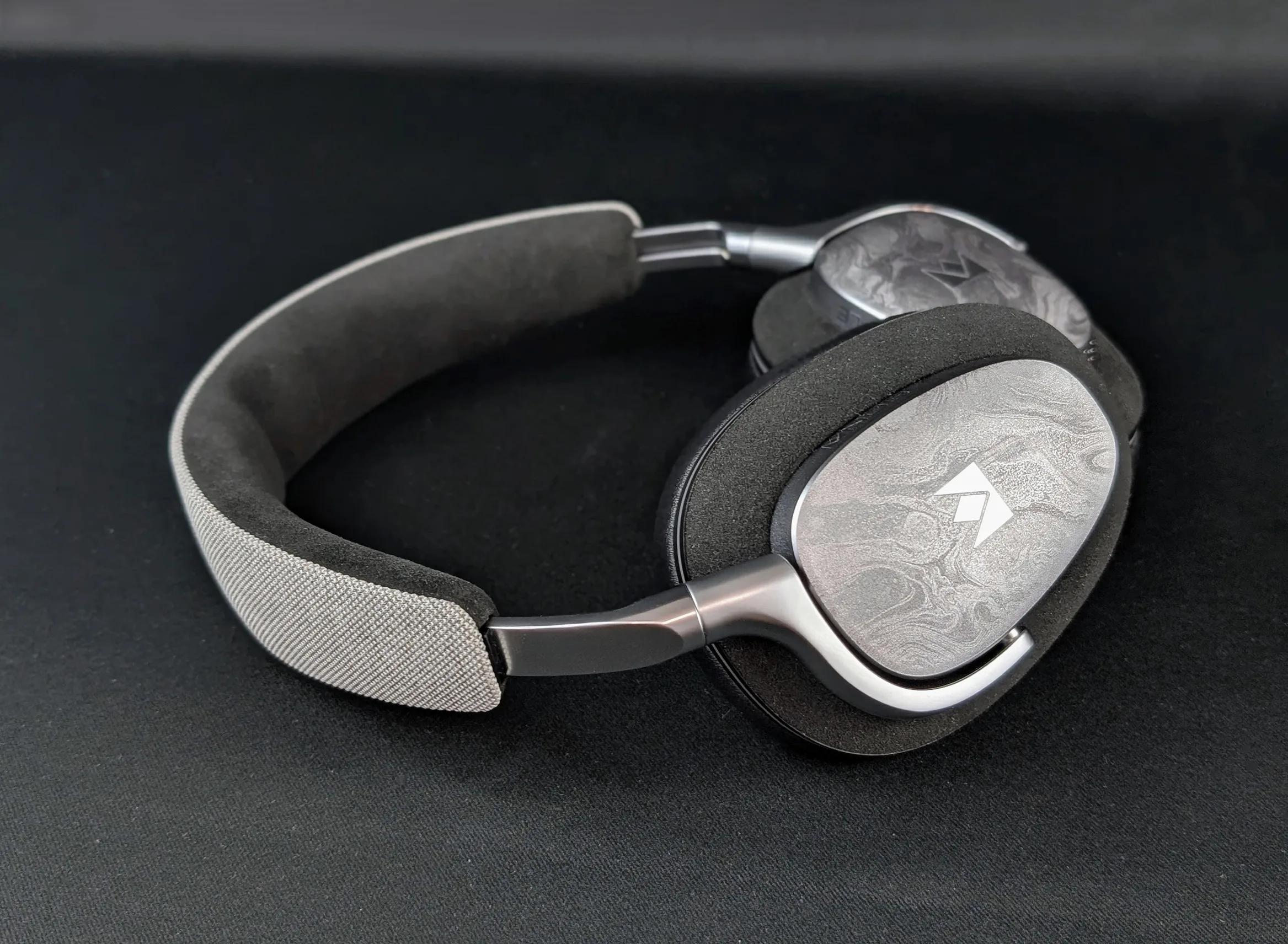
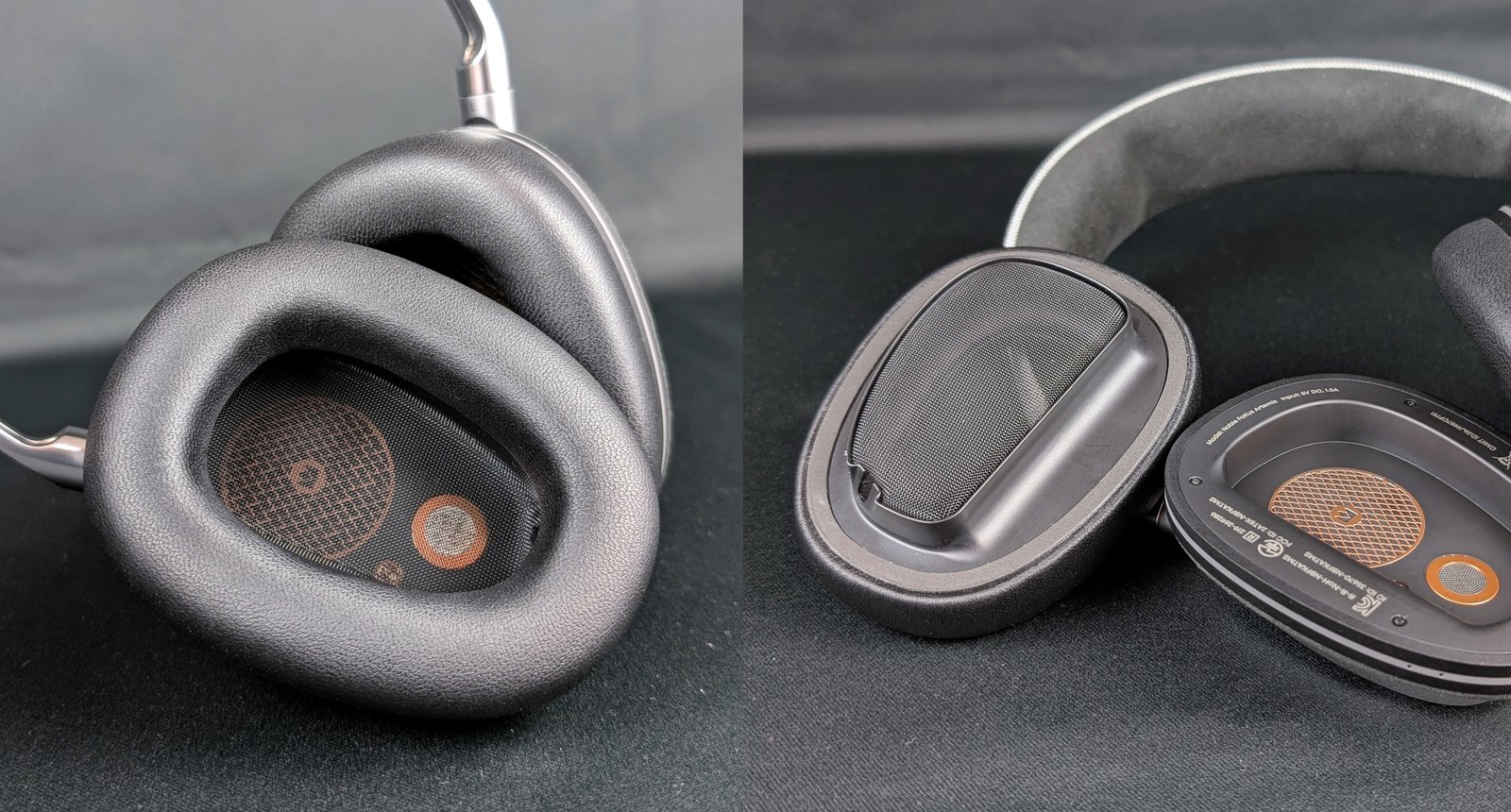
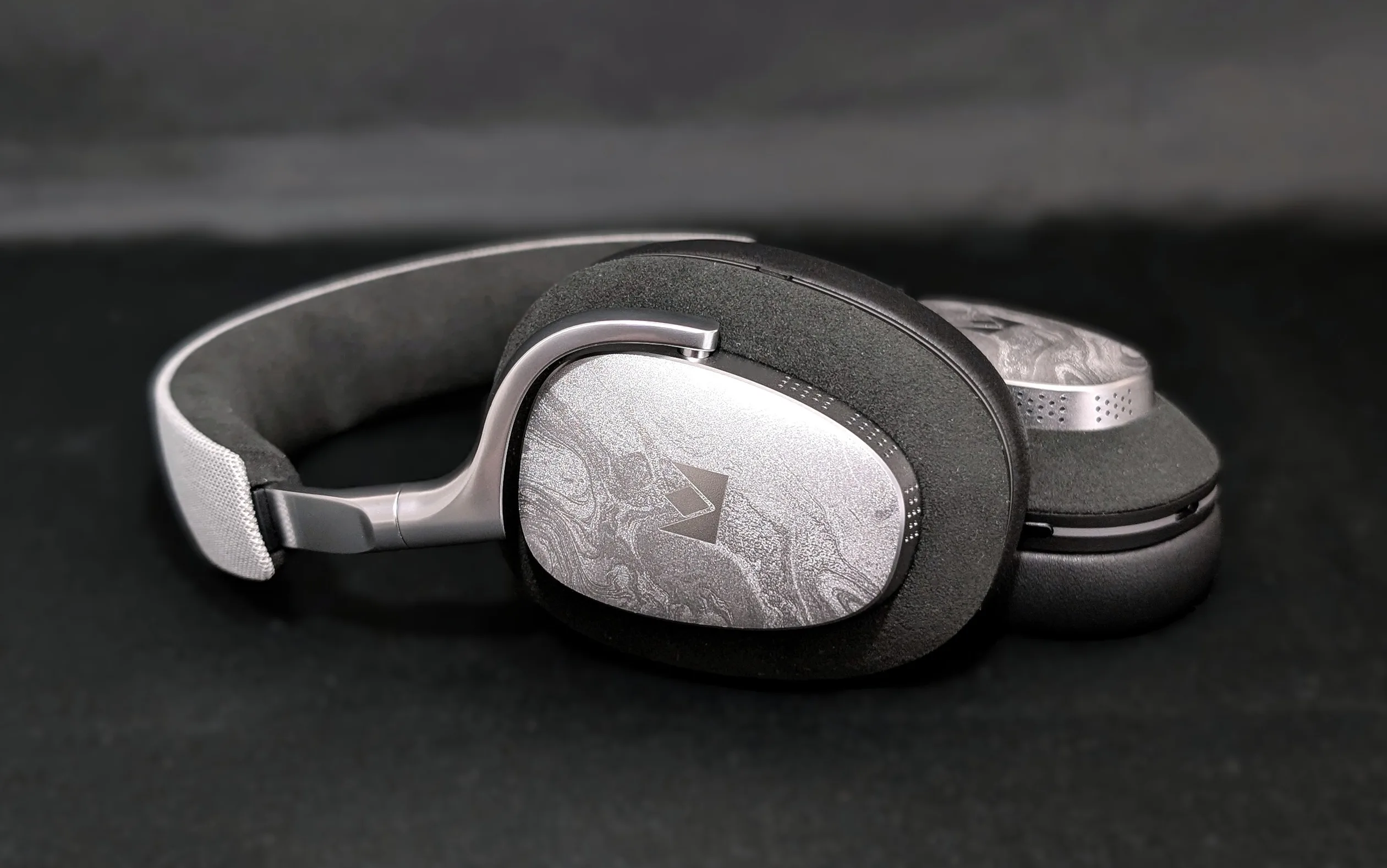
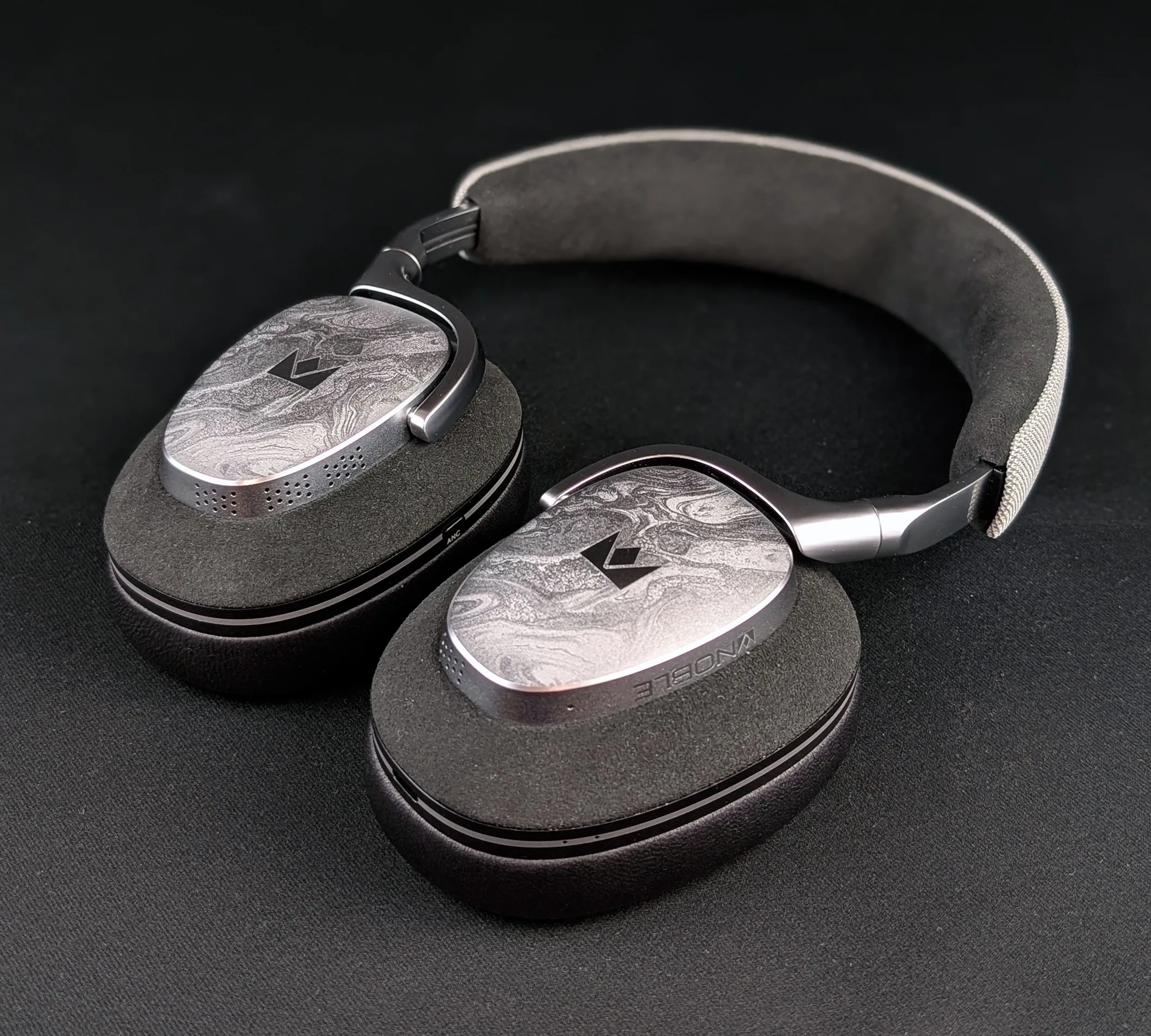
The aluminum frame, Damascus steel-patterned earcups, and soft Alcantara give the Artemis an unmistakable touch of luxury. The build and finish are flawless, and an IP52 rating offers a degree of protection against water and dust. From a usability standpoint, two highly welcome details are the magnetically attached earpads (made of what appears to be synthetic leather) and a user-replaceable battery, which significantly extends the lifespan of such a premium device.
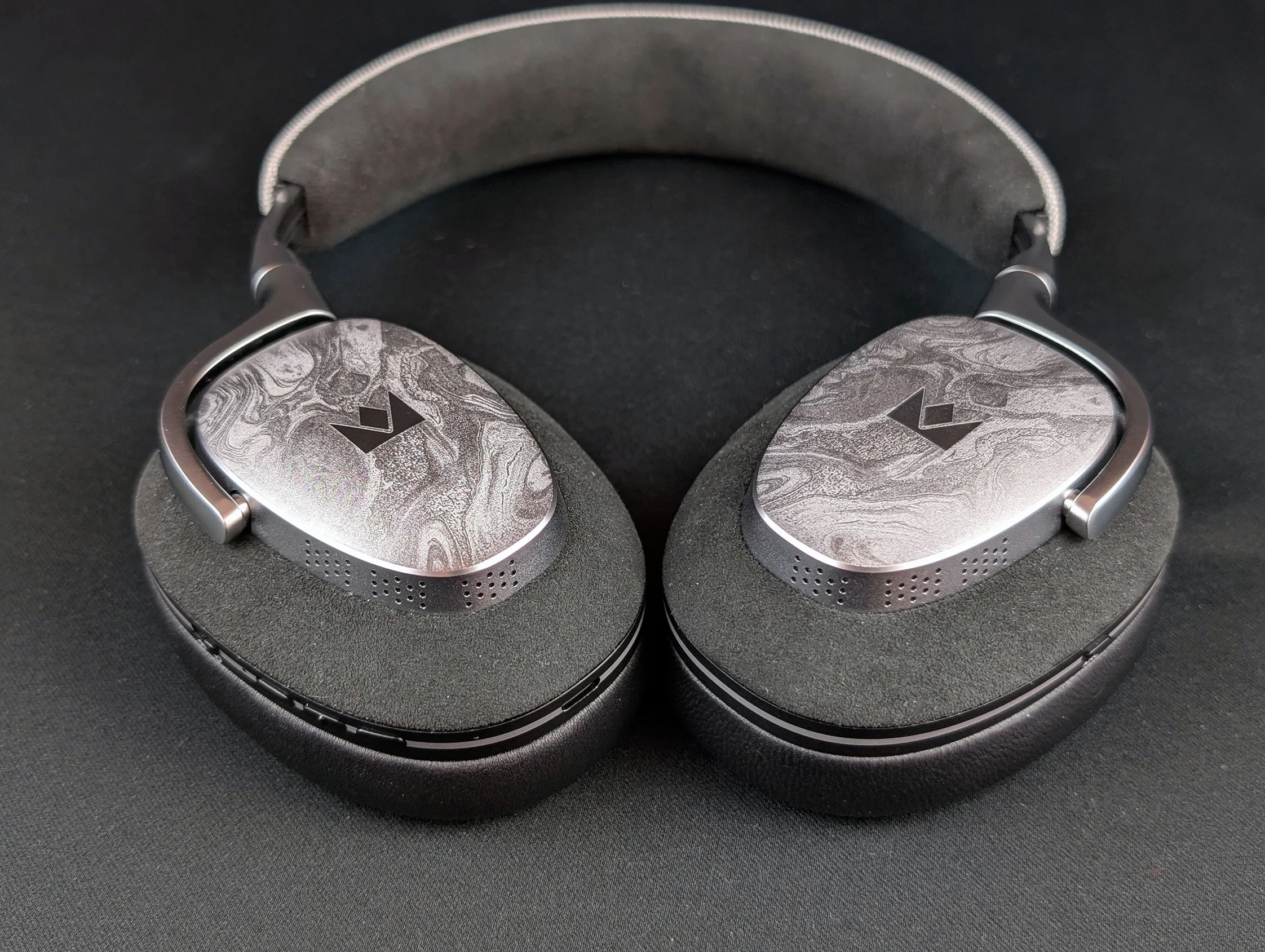
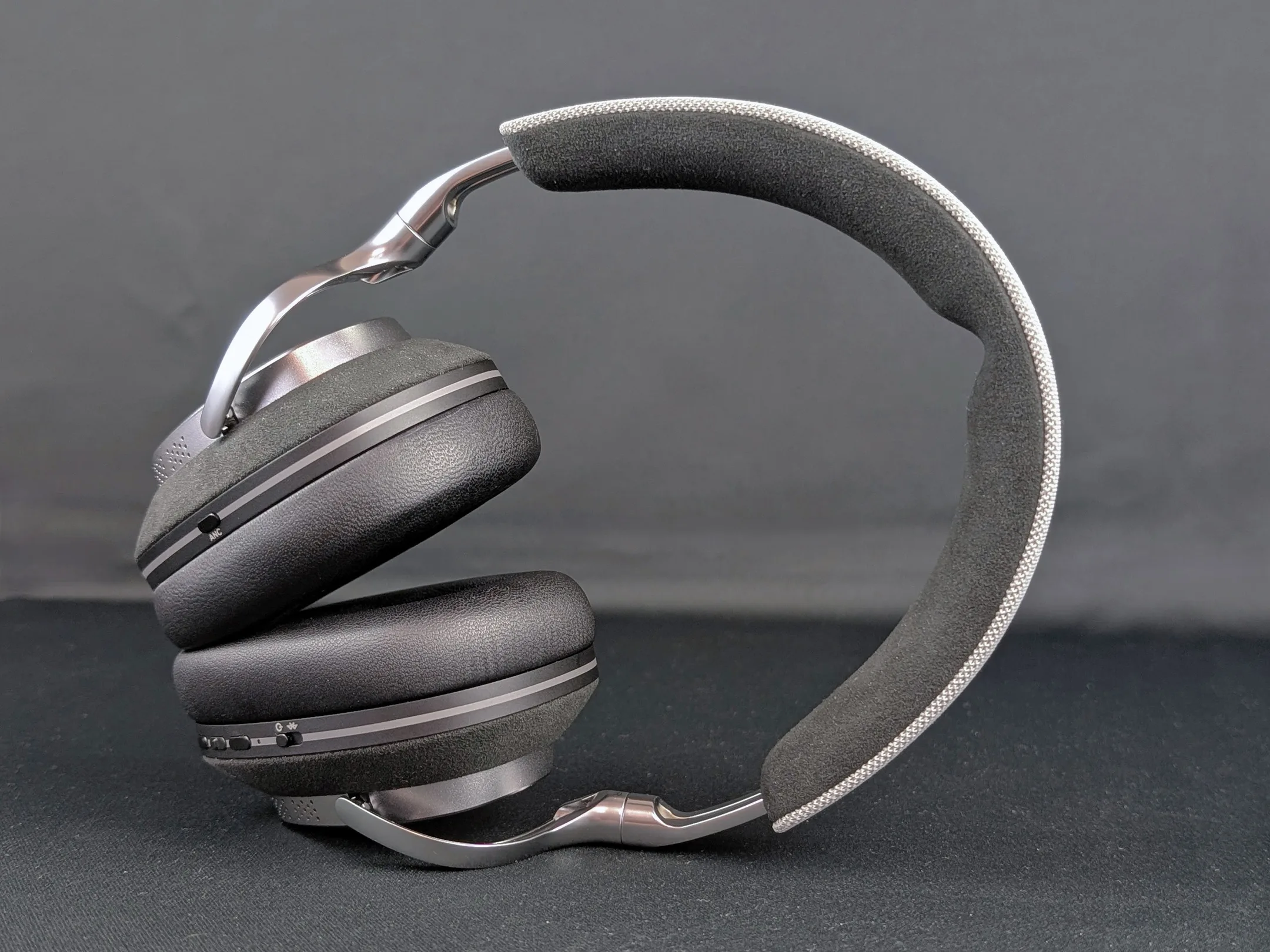
Unfortunately, in my case, the overall premium feel takes a hit due to how the headphones fit on my head. Despite a above-average weight of 350 grams, the Artemis itself is actually very comfortable and doesn't clamp or press too hard, making it easygoing for longer listening sessions. The flip side of this, however, is that out of the box, the headband structure feels a bit too loose for me. Due to the lack of clamping force, a small gap inevitably forms beneath my ears at the bottom of the pads.
Since both the sound performance (particularly the sub-bass) and the active noise cancellation rely heavily on a proper seal, a compromised fit degrades performance: some of the bass punch escapes, and the ANC struggles to work as intended. Using the Artemis as-is, I constantly had to readjust it on my ears, and I couldn't really walk around or open my mouth without breaking the seal. Out of necessity, I eventually took the risk of gently bending the headband to tighten the fit slightly (sorry, Mareksound!), as the steel part is quite thin and pliable. This adjustment completely solved the fit issue without leaving any visual trace. The slight increase in clamping force actually makes the headphones more comfortable and secure, as they no longer just hover on top of the head.
Controls and functions
The Artemis is controlled via exceptionally small buttons located on the back edge of the earcups. The power switch, for instance, is so tiny that I find it quite tricky to turn the headphones on while already wearing them. However, the control layout and functions align with industry standards, so getting used to them doesn't take long. I also understand that a sleek frame leaves little room for larger buttons, so this is a compromise you simply have to live with. Touch controls would likely frustrate me even more, so I'm glad Noble Audio refrained from going that route.
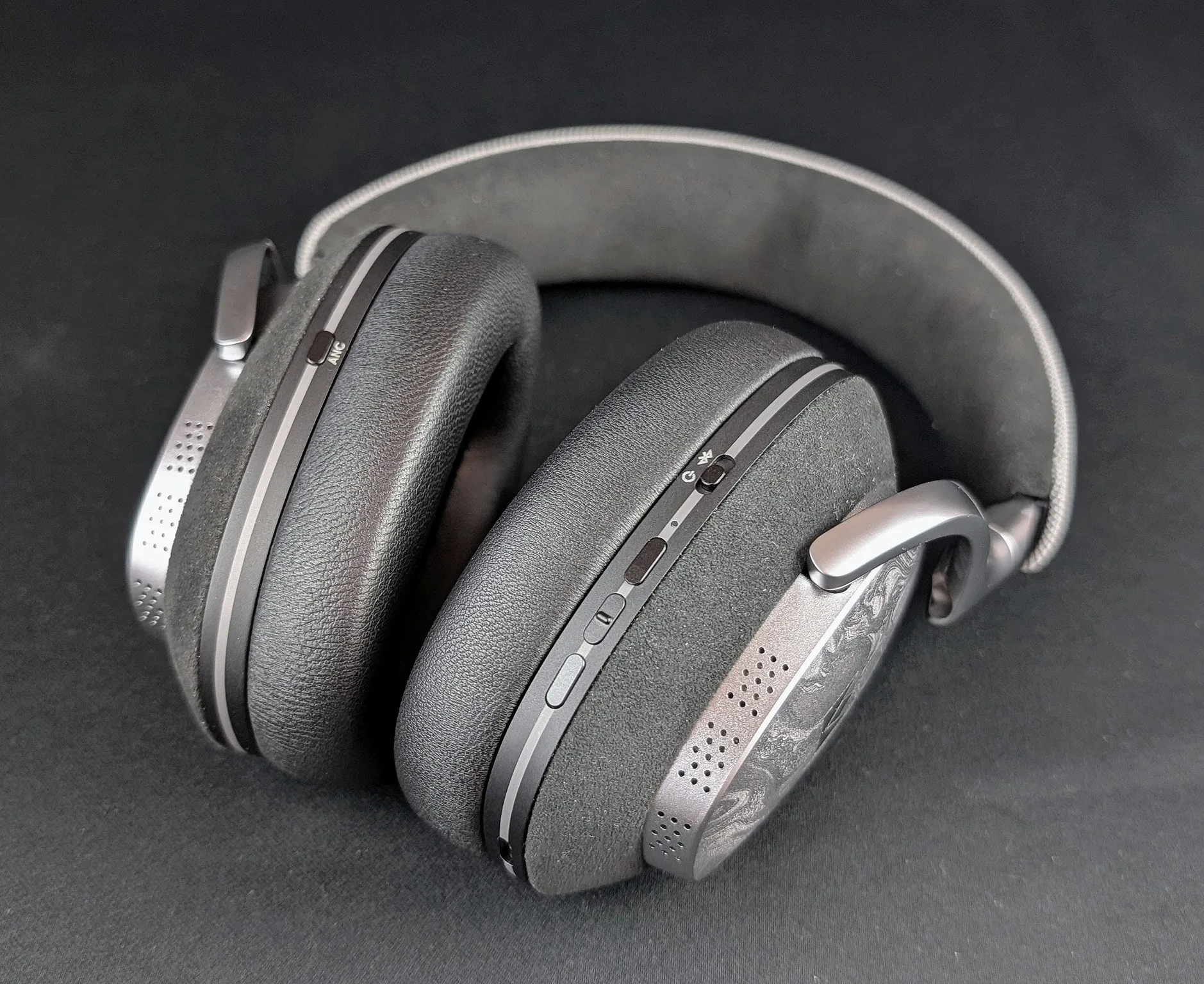
An infrared wear detection sensor is built into the right cup, which pauses both playback and active noise cancellation with roughly a one-second delay when the headphones are lifted off the ears. The sensor can be disabled via the companion app if desired, but in my experience, it has worked reliably.
Bluetooth technology and battery life
Like Noble Audio’s other products, the Artemis exceptionally supports both aptX (up to aptX Lossless) and LDAC codecs. The Bluetooth version is also the recent 6.0, though a minor omission is that the manufacturer hasn't included support for Bluetooth LE Audio. For headphones in this price tier, however, my primary expectation is top-tier sound quality, making support for high-resolution codecs the main priority. They also function without any dropouts, as expected.
The Multipoint connection works seamlessly as well, and there’s nothing out of the ordinary regarding wireless range. For instance, using a Sennheiser BTD 700 Bluetooth transmitter, aptX Lossless remained stable even 15 meters away from my computer. On my Pixel 9 Android phone, I’ve been using the LDAC codec, which hasn't stuttered once at home—even set to its maximum bitrate (990 kbps). Software updates for my phone have evidently made a difference, as a couple of years ago, maximum-quality LDAC was an impossible dream on any headphones due to constant dropouts.
Battery life is a solid average by modern standards, promising up to 35 hours with active noise cancellation enabled and 55 hours without it. While the manufacturer mentions fast charging support, detailed specifications are unfortunately lacking. Those who prefer listening via a phone and USB cable should note that there is no option to prevent the Artemis from drawing power and charging its battery from the phone during playback. For this reason, Noble Audio recommends using the analog cable for wired listening, which allows the headphones to operate passively without drawing battery power when necessary.
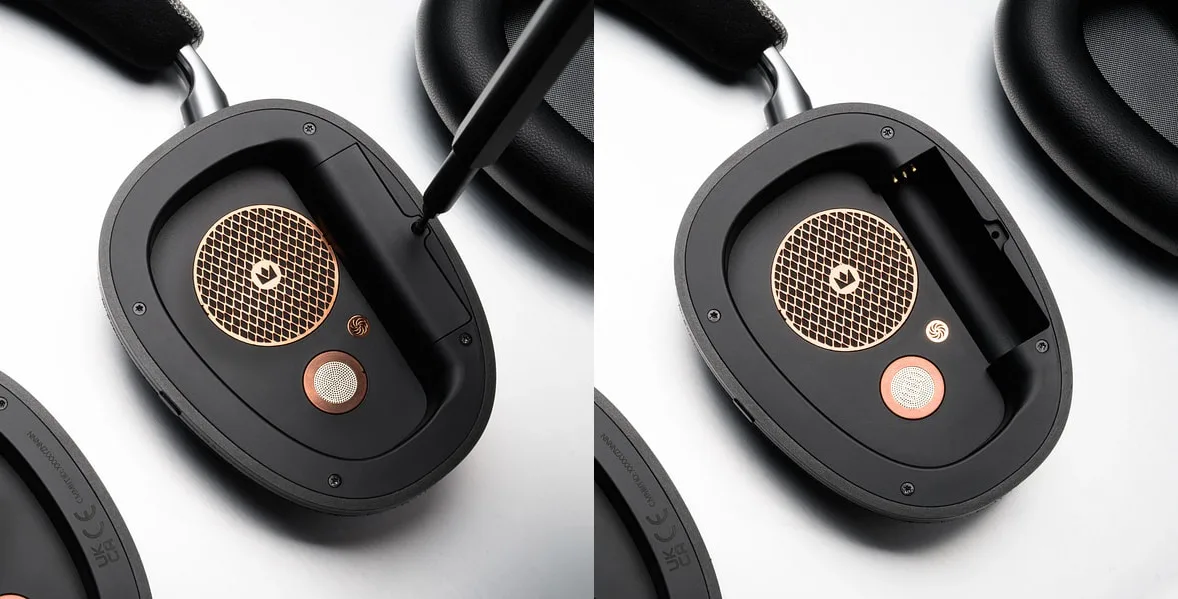
Should the battery eventually degrade after years of use, replacing it is remarkably easy. Noble Audio has housed the battery beneath a dedicated compartment inside the left earcup. Other manufacturers should definitely take notes!
Mobile application and additional features
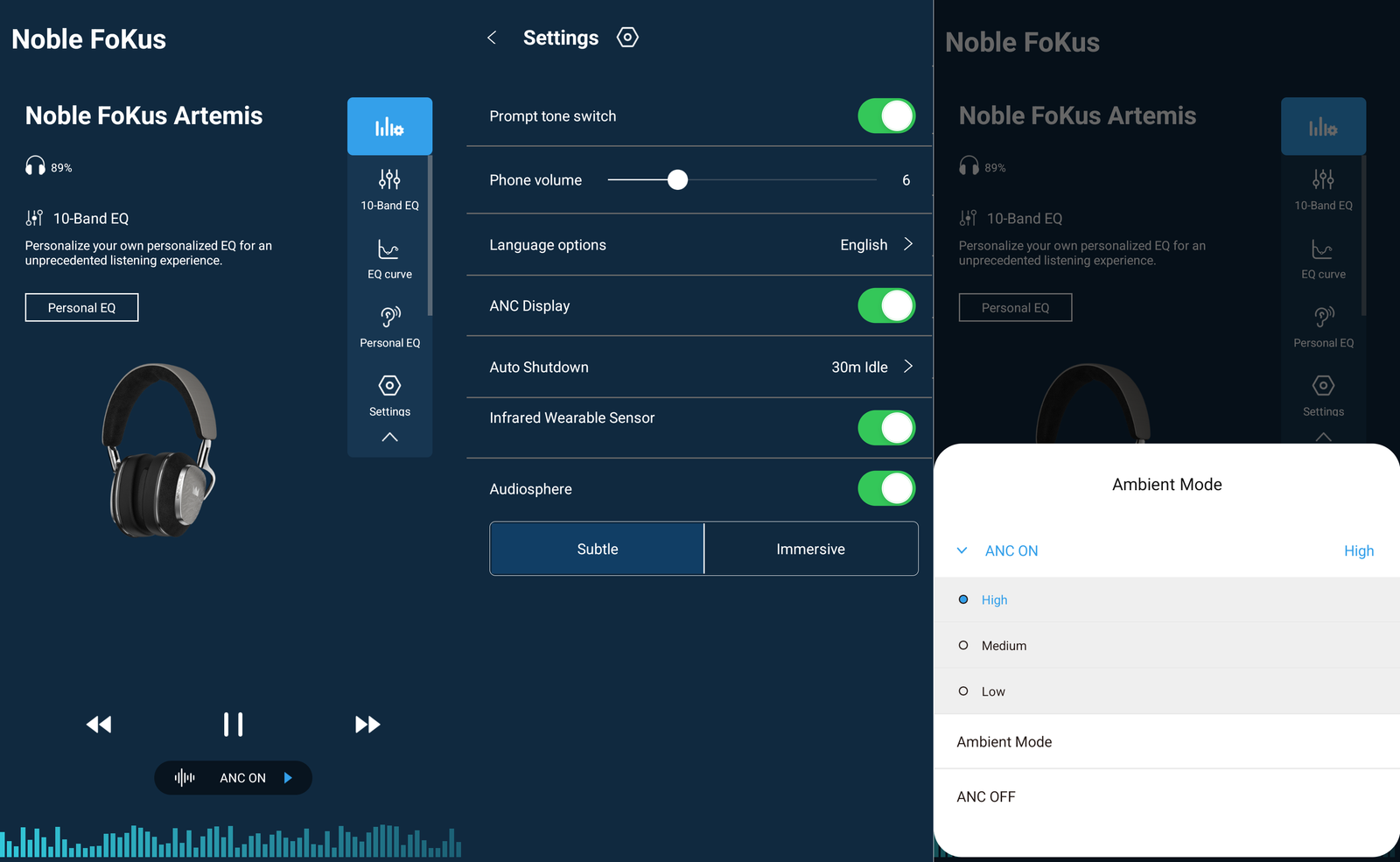
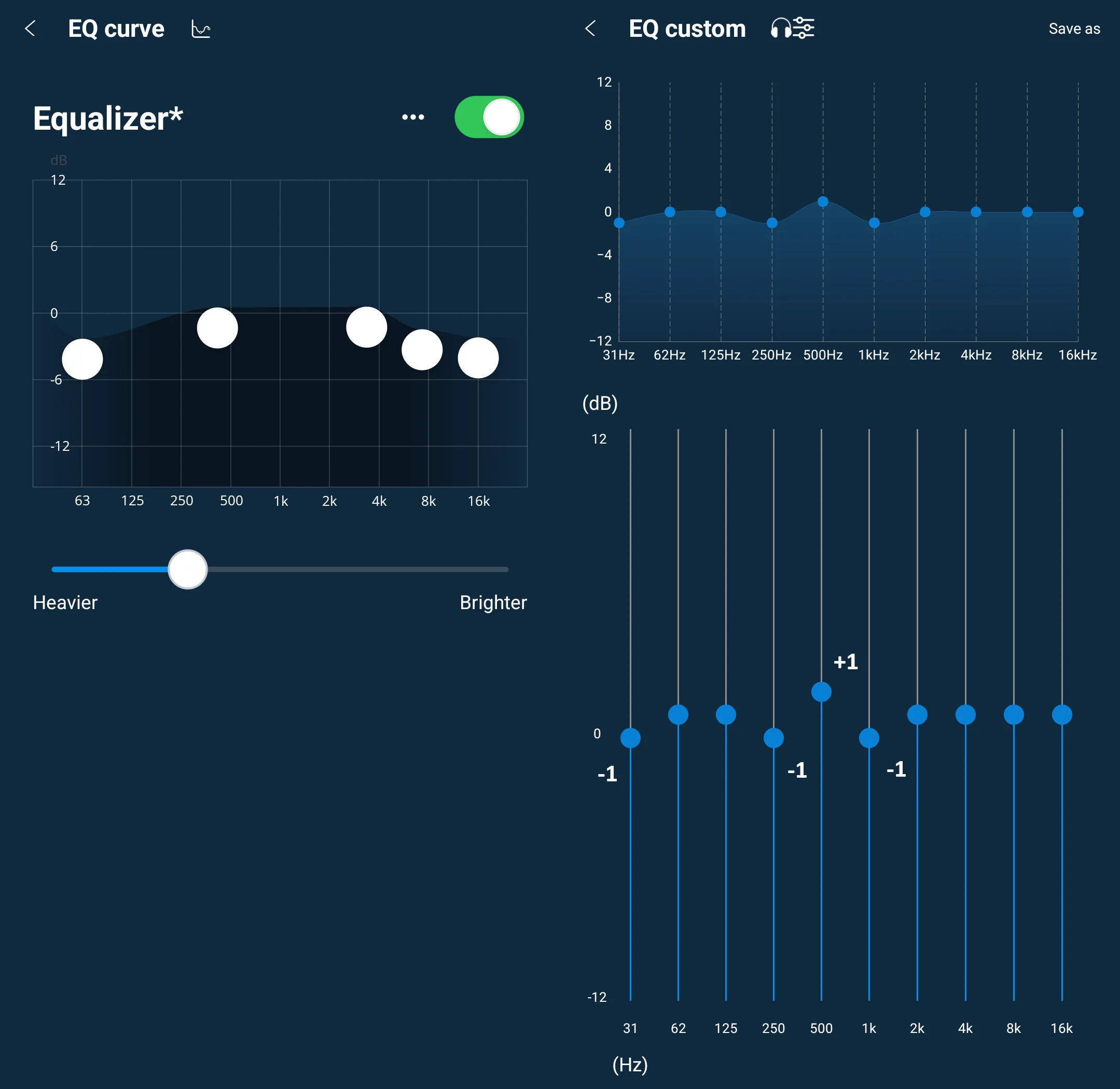
The Noble Audio mobile app covers basic settings and firmware updates, but most users will get the most value out of its versatile sound customization options. It features a selection of sound presets, a 10-band equalizer, a personalized Audiodo hearing test, and a frequency response "tilt tool" (EQ Curve) that doubles as a simplified equalizer. The same suite of tools is available across the manufacturer's other wireless headphones, though two spatial audio options (subtle and immersive) are new to me.
Noble Audio's spatial audio applies a surprisingly subtle touch compared to most competing implementations. I personally prefer this approach, as the Subtle mode introduces a modest sense of spaciousness without noticeably distorting the core frequency balance. I would take this over the more unnatural 360 Upmix processing found on models like the Sony 1000X The ColleXion.

The EQ Curve tool allows the frequency response to be tilted toward either the bass or treble. Alternatively, the view's five adjustable anchor points can be used like a traditional equalizer. For instance, if someone finds the sound signature too bright, broad-spectrum treble attenuation via this tool is often easier than dialing in adjustments on the second equalizer. On the other hand, the 10-band equalizer enables more granular adjustments, offering up to +12 dB of boost or cut per band. In future releases, I'd love to see Noble Audio implement a parametric EQ, as the current layout doesn't allow users to adjust center frequencies or Q factors.
Based on my measurements, the Q factors vary significantly across the different sliders:
- 31 Hz: Q 1.0
- 62 Hz: Q 1.0
- 125 Hz: Q 1.2
- 250 Hz: Q 1.2
- 500 Hz: Q 1.4
- 1 kHz: Q 1.8
- 2 kHz: Q 2.0
- 4 kHz: Q 2.8
- 8 kHz: Q ~5.0
- 16 kHz: Q ~3.2
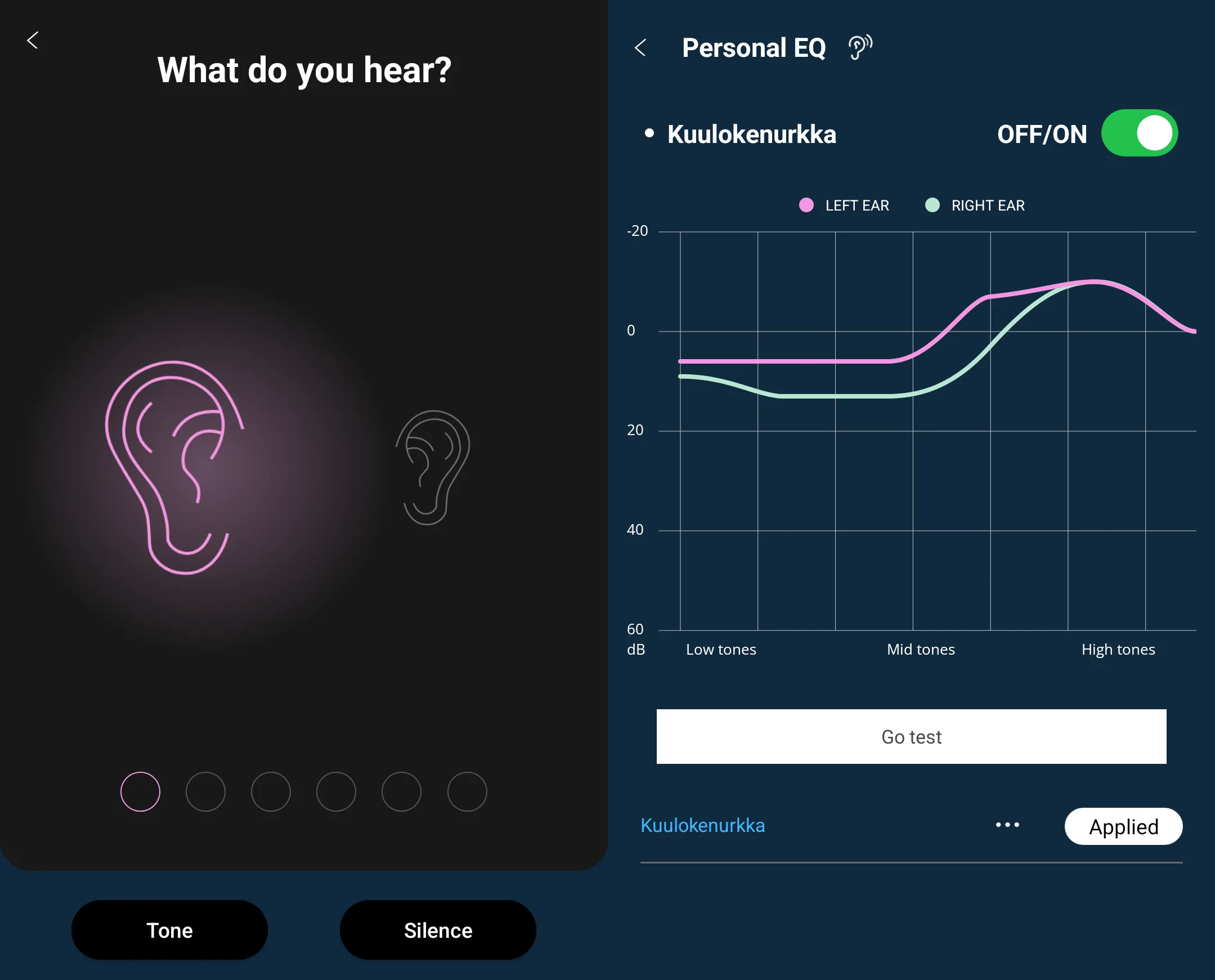
I also tested the hearing test feature, which aims to optimize and tailor the Artemis's sound to your individual hearing profile while correcting for interaural variations. While the results were underwhelming with the FoKus Prestige Encore earphones, the system works much better with the FoKus Artemis. The headphones almost seemed to read my mind, dialing back both the treble and bass to achieve a more balanced overall output. That said, the adjustments remain fairly broad, meaning manual EQ tuning is still worthwhile. It's useful, then, that all three customization tools can be active simultaneously.
Active Noise Cancellation
As a rule, boutique audio manufacturers can't match industry giants like Sony, Bose, and Apple when it comes to active noise cancellation, but they often attempt to justify this with the misleading claim that reduced ANC processing yields superior sound quality. In the age of sophisticated DSP capabilities, this is unfortunately nothing more than a marketing ploy designed to preemptively deflect criticism. I would much rather see manufacturers simply acknowledge that their ANC is effective enough—which, in everyday use, it usually is, especially when music is playing.
That said, FoKus Artemis delivers respectable noise isolation relative to mid-tier market standards, provided the earcups achieve a snug seal around your ears (which, in my case, required slightly reshaping the headband). I noticed virtually no difference between the three ANC strength levels available in the app, so it's easiest to leave it set to maximum. Even at full intensity, there is no noticeable background hiss, nor is it overly prone to wind noise interference.
I pitted the Artemis against several other noise-canceling headphones. In mixed environments (simulated cabin noise, coffee shops, and ambient chatter), the Artemis attenuated noise slightly better than the Finnish Valco VMK25.2 and Kaiku Wave. JBL Live 780NC , meanwhile, offers more powerful ANC than this trio. Naturally, the Bose QuietComfort Ultra and Sony 1000X The ColleXion remain in a league of their own if top-tier noise isolation is your primary concern. Still, you won't be disappointed by the Artemis as long as you view its ANC as a welcome secondary feature rather than the core selling point. From memory, it represents a clear step up over the active noise cancellation found on the FoKus Apollo.
I found the transparency mode a bit lacking: neither my own voice nor environmental sounds come through with much clarity or freshness. While it's an improvement over Valco's VMK25 series, models like the aforementioned JBL deliver a considerably clearer, more natural presentation of ambient surroundings. On the flip side, the Artemis avoids harsh artificial sharpening and unwanted hiss, ensuring its transparency mode won't get in the way when holding conversations or staying aware of traffic while outdoors.
Microphone sound quality
I used the Artemis in several Teams meetings, where its microphone handled voice clarity flawlessly, drawing zero complaints from other participants. I doubt voice quality will be an issue for regular phone calls either, even though I didn't get a chance to test the microphone in noisier environments this time around. During remote meetings, however, my main takeaway was that I would have preferred to hear my own voice a bit more clearly through the transparency mode. My own speaking voice sounds slightly muffled, which takes away a bit from how natural it feels to talk.
Headphone sound quality
Three different driver types
Noble Audio has extensive experience designing multi-driver in-ear monitors, and the company is now attempting to apply that expertise to the over-ear form factor. The FoKus Apollo already featured two drivers (a dynamic driver and a planar magnetic driver), making the addition of a third driver in the FoKus Artemis feel like a natural progression—whether or not the solution was acoustically strictly necessary. The headphones' dynamic driver is a 32 mm unit, which is more compact than average to make room inside the earcup for a 14.5 mm planar magnetic driver and a small balanced armature driver. Coaxing these three completely different driver technologies to work in harmony is no trivial feat.
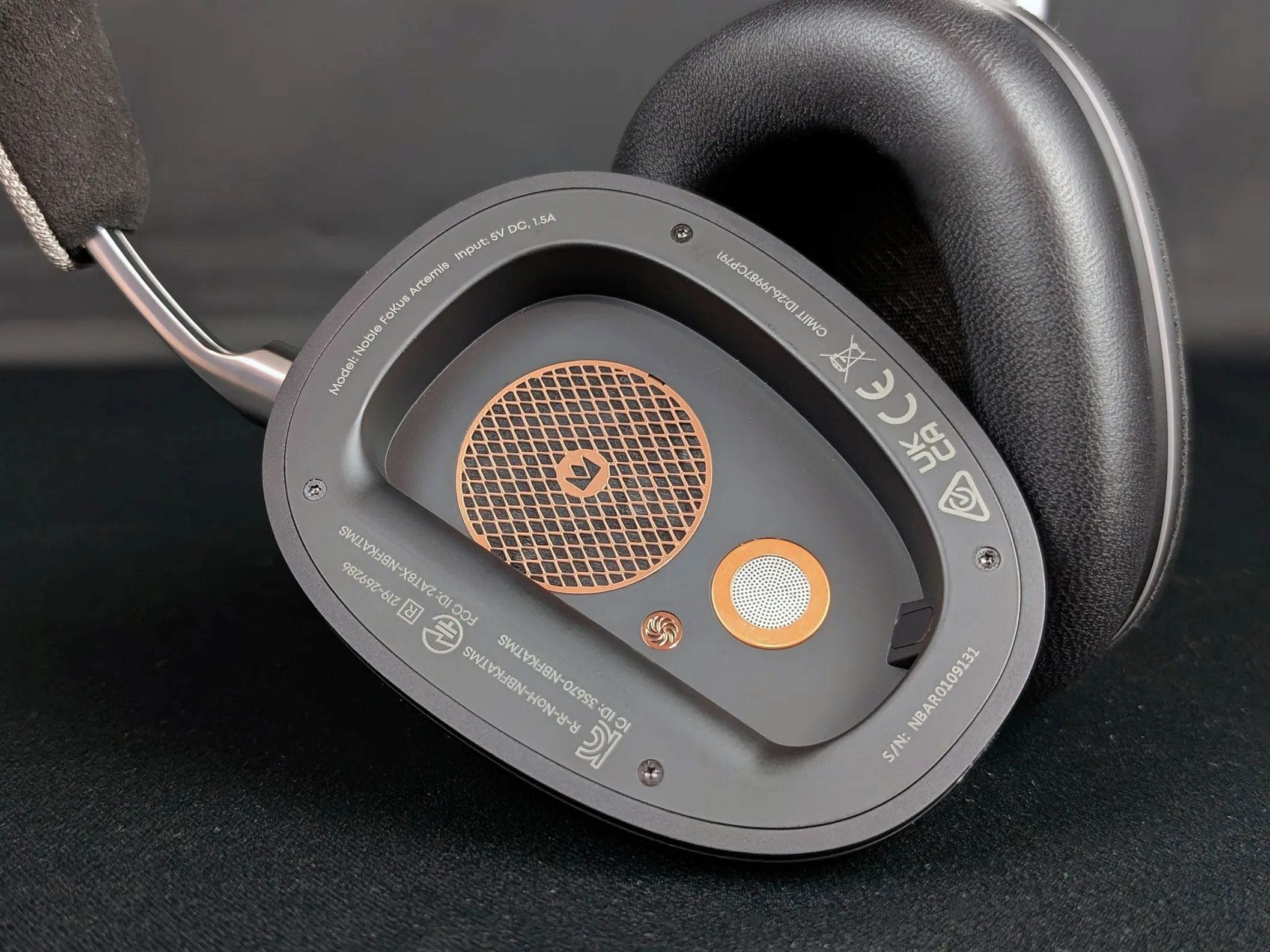
As a reviewer, I was naturally eager to determine which frequency range each driver reproduces. When I took turns taping off the sound ports of the smaller drivers (using a few layers of painter's tape and thick felt pads), the Artemis's sound signature surprisingly barely changed — the soundstage simply felt slightly more closed-in and less airy. However, no differences appeared in the measured frequency response, suggesting that the dynamic driver handles the entire frequency spectrum on its own. The smaller drivers seem to act as subtle background flavorings, as their contribution only becomes fully apparent after taping over the dynamic driver (which significantly drops the overall output volume).
I isolated the planar driver's primary range of influence to between 10 kHz and 14 kHz, whereas the balanced armature mainly handles frequencies from roughly 13 kHz upwards. Both operate at a lower output level than the dynamic driver, meaning high frequencies are produced across multiple drivers while the response delivered by the dynamic driver remains at the forefront. This subtle reinforcement isn't captured by a conventional frequency response measurement, but it would explain the difference in openness and airiness that I perceived. Still, my findings shouldn't be taken as absolute gospel; the exact implementation should ideally be confirmed with Noble Audio.
Measurements
The headphone frequency response measurements were performed with equipment compliant with the IEC711 standard and KB501X model silicone ears. The graphs use the Harman target curve (2018 version), optimized for this equipment, as a reference. This curve is a generalization, based on scientific research, of what kind of frequency response would sound good to most people and correspond to balanced loudspeakers in a well-acoustically treated room.
The Harman research was conducted with silicone ears that ”hear” sound slightly differently than the ear types sold today. For this reason, the target curve used by Kuulokenurkka is based on the diffuse field response according to the KB501X ears” own HRTF transfer function, to which, however, the core findings of the Harman research have been adapted using filters. In practice, the result still corresponds to the ideal frequency balance indicated by the Harman research, but as the equipment used by Kuulokenurkka would ”hear" it based on its characteristic acoustics. Thus, it is possible to make more precise observations of the headphones' frequency response between 2–20 kilohertz than when using the pure Harman 2018 curve as a reference.
More information about the measurement equipment can be found on the Headphone Measurements. The frequency response of Artemis is also comparable with other measured headphones on Squiglink .
The Artemis offers versatile connectivity options: Bluetooth, USB, and passive listening using the included special cable. When powered on, its frequency response remains identical regardless of the input method, though activating noise cancellation subtly alters the low frequencies, particularly around 300 Hz. Between the three ANC strength levels, however, there are no noticeable tonal shifts, nor does the headphone incorporate any dynamic loudness mode or adaptive algorithm that alters the sound based on listening volume or fit. Operating them is, therefore, completely straightforward.
Frequency response (ANC ON & OFF):
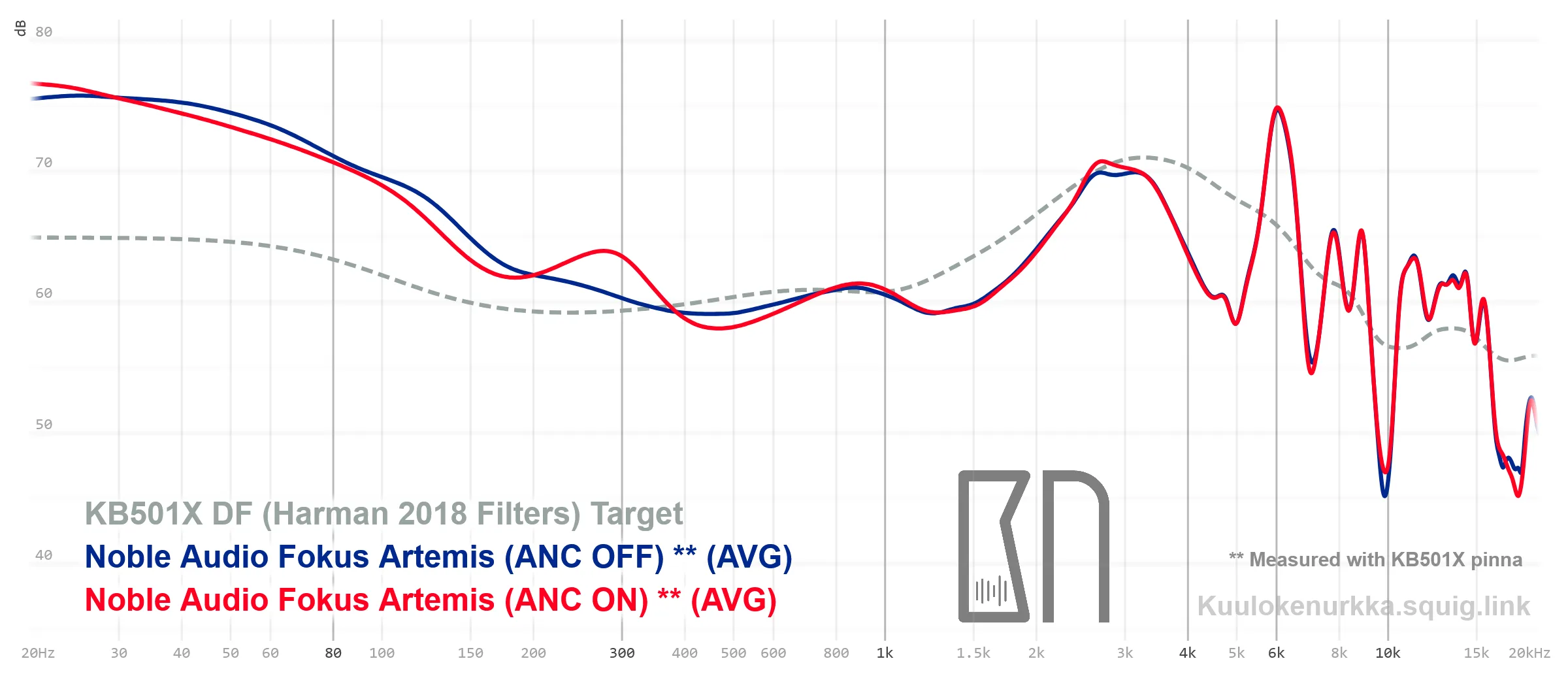
In terms of tuning, the Artemis is undeniably styled as a noise-canceling headphone: both bass (20–300 Hz) and treble (6–15 kHz) are boosted in pursuit of an engaging listening experience. This energetic, V-shaped presentation is well suited for noisy environments like trains or buses, as well as low-volume listening. Activating ANC creates a subtle bump around 300 Hz, but otherwise the sound signature remains virtually unchanged from the ANC OFF state.
Based on my measurements, the exact quantity of bass shouldn't be scrutinized too heavily this time around, as the loose fit means that seal will likely vary more than usual from person to person. There is certainly plenty of bass, though not necessarily as much as the graphs might suggest. The Artemis reproduces the midrange relatively smoothly and naturally, even if the curve appears slightly wavy on paper. The ear-gain region carries sufficient energy around 3 kHz, keeping instruments and vocals clearly defined. A slight dip between 1 and 2 kHz can be seen as adding a sense of spaciousness to the soundstage.
The biggest unevenness occurs higher up, particularly in the transition from upper midrange to treble (4–6 kHz). Alternating dips and peaks shuffle the deck a bit, occasionally making certain music elements feel slightly distant while driving other details forward with added emphasis. The boost at 6 kHz in particular can test your tolerance if present during actual listening. With my own ears, I perceived that peak closer to 7 kHz, and it didn't feel quite as pronounced in practice. The Artemis also boosts upper treble (8–15 kHz) above neutral levels, rendering the top end bright and airy.
Passive frequency response (cable):
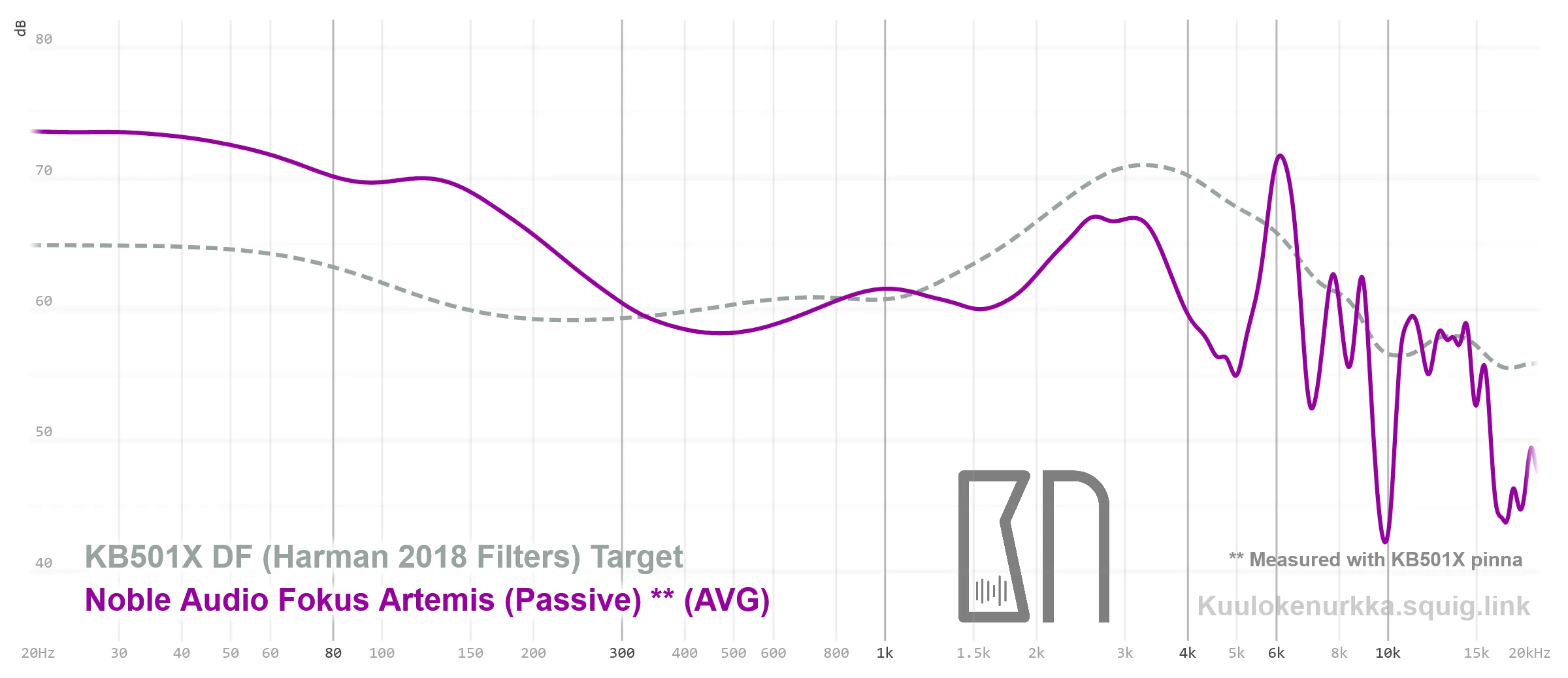
In passive use, the upper midrange and treble present a calmer profile, indicating that the manufacturer uses DSP to boost these regions for powered listening — the so-called active mode. However, the overall characteristics and unevenness of the frequency response remain nearly identical whether the Artemis is powered on or used passively via cable. This suggests that the DSP isn't performing fine-grained corrections, but rather applying a broad treble boost across the top end. Because most of the tuning relies on mechanical and acoustic design, the Artemis sounds surprisingly consistent across all listening modes, unlike many of its competitors.
Frequency response after minor EQ adjustment (ANC ON):
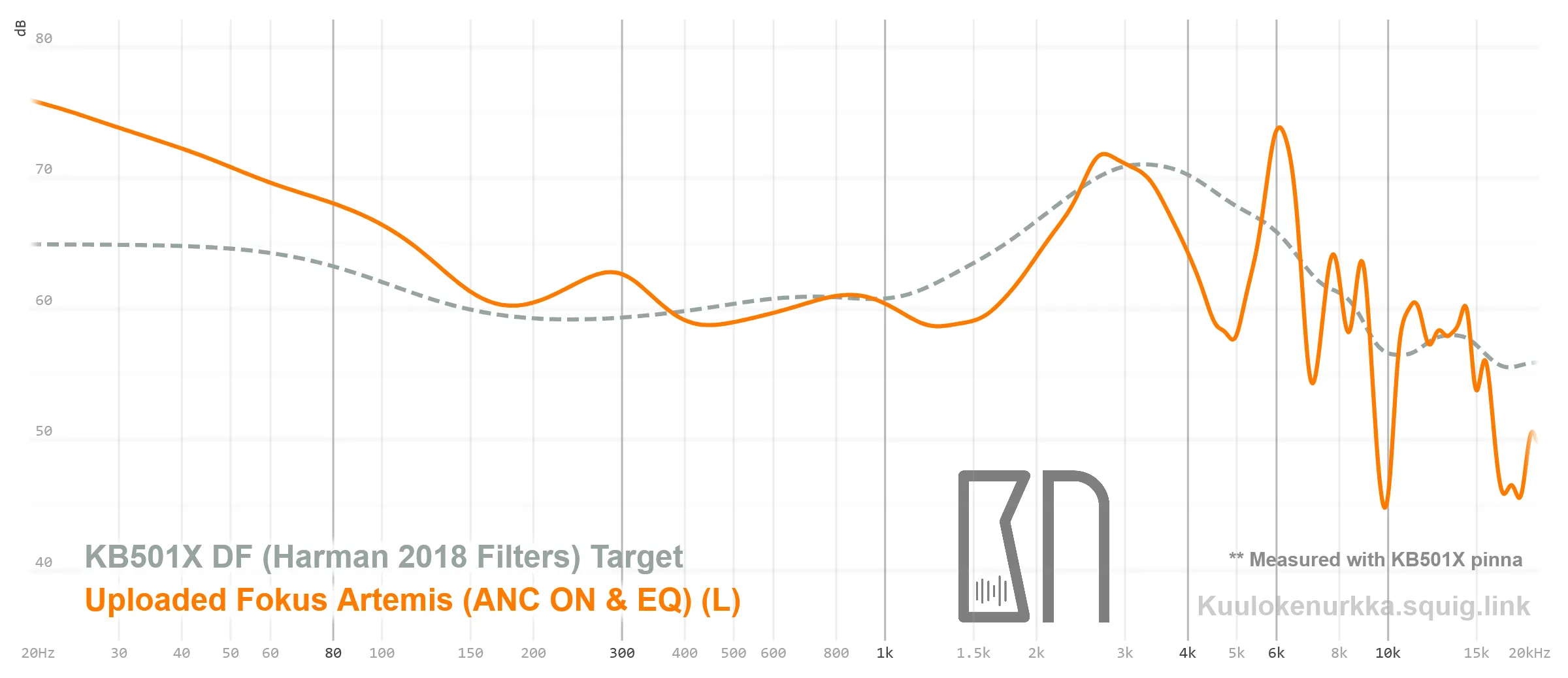
For home listening, I personally prefer a somewhat calmer high end, which often leads me to dial back the bass level on V-shaped headphones as well. With these two adjustments, the Artemis transforms into a more balanced performer, even if it loses a bit of the character Noble Audio originally intended. I achieved the result I was looking for by combining the app's EQ Curve tool with the 10-band equalizer.
Sound observations
Because these are wireless headphones, I listened to them primarily using the LDAC and aptX Lossless codecs. Under these conditions, I didn't notice any meaningful improvement when switching to a wired connection. By comparison, the Focal Bathys and Bathys MG benefit more from their USB-DAC mode, partly because their wireless connection is limited to aptX Adaptive at best. I also find that the T+A Solitaire T sounds a notch better as a wired headphone than over wireless.
I have mentioned Bowers & Wilkins headphones almost too many times, but in terms of sound quality, the Artemis can be said to resemble them as well: it delivers a bright, hard-hitting sound signature, but executed with greater maturity. Where B&W's PX7 S3 and PX8 S2 fall victim to a muddy upper bass and a spiky treble, the Artemis sounds more balanced and refined to my ears. Its punchy bass doesn't turn into mush, and its airy treble resolves without excessive sharpness or sibilance.
The Artemis's sound profile leans on a lively, detailed presentation balanced by a powerful, authoritative bass. Even with all that low-end impact, my attention is immediately drawn to the layered, effortless treble. It renders the sound extraordinarily intricate and "technical" for wireless headphones — truly impressive! Vocals and sharp transient attacks carry a touch of added bite that engages your senses and keeps you hooked on the music. I don't see this slight aggressiveness as a negative, though during longer sessions, the treble-forward presentation can become somewhat tiring. Thankfully, that can easily be mitigated using the app's equalizers.
The Artemis also impresses me with its spacious and precise soundstage. There is a sense of depth and transparency typical of high-end headphones, which I attribute to the combination of the airy top end and a couple of subtle dips in the frequency response curve. These characteristics push the midrange slightly further back without actually compromising vocal or instrumental clarity. On the contrary, tracking individual sounds and their placement across the soundstage feels delightfully effortless. It makes me wonder if the planar magnetic and balanced armature drivers really are working their magic in the background.
Somewhat surprisingly, the boosted, heavy bass doesn't bother me. In fact, it almost feels necessary to keep the energetic treble from becoming overwhelming. The Artemis manages to ride the fine line where the low end stays clear without booming loosely or creating a hollow, cupped-in atmosphere. Because overall tonal balance always matters more than any single frequency band, interpreting the real-world performance of a unique design like this strictly from measurement graphs can be tricky — especially since the frequency response inside one's own ear canals never perfectly mirrors measurements. Had I only seen the measurement graphs without hearing the Artemis for myself, I never would have guessed I'd enjoy it this much.
Naturally, as a V-shaped headphone, the Artemis doesn't offer the most neutral or strictly realistic sound profile; it is tuned to be engaging and accessible to a broader audience. However, Noble Audio succeeds in appealing equally to mainstream users accustomed to typical ANC tuning and to audiophiles who demand detail and resolution. For comparison, among other premium ANC headphones I've tested, the Focal Bathys MG leans toward a warmer, more laid-back sound, while the T+A Solitaire T places even greater emphasis on midrange clarity and neutrality. Consumers certainly have a great variety of flavors to choose from.
Personally, I've thoroughly enjoyed my time with the Artemis — both on its default stock settings and with my own custom EQ tweaks. That's actually quite rare for me, as finding the "perfect" EQ profile usually turns into a bit of a obsession. There's something captivating about the offered presentation, as colorations don't sound unnatural, but rather add texture, contrast, and engagement to the music. Throughout the review period, I listened to a wide spectrum of pop, rock, heavy metal, and everything in between. I also threw in electronic tracks, acoustic recordings, and raw, unpolished cuts from the last century. As long as I didn't blast the volume to ear-splitting levels, I never felt the urge to hit the skip button. In the end, the only thing that prompted me to take a break was the bright treble slowly wearing on my ears over time — and I can really only blame myself for that if I choose not to use the equalizer.
Summary
The FoKus Artemis is a stylish, technically advanced wireless headphone that delivers an impressively engaging sound. Its high-build quality, user-replaceable battery, and intriguing 3-way-driver setup set it apart from cheaper alternatives on the market. Paired with exceptionally broad Bluetooth codec support, its €950 price tag feels fully justified. It has all the right ingredients for a flagship product. While the recently reviewed Sony 1000X The ColleXion also feels well built, it lacks the unique, memorable character that defines Noble Audio's offering.
On the other hand, due to its loose fit, Artemis won't be a universal match out of the box — I had to reshape the headband tension myself to achieve optimal performance. That said, I found no other major drawbacks. Its noise cancellation efficiency holds its own against other ultra-premium ANC headphones it directly competes with. Noble Audio also offers more extensive equalization options than usual, even if a parametric EQ ought to be standard at this price point.
A natural point of comparison for the Artemis is Bowers & Wilkins. Sonically, both share a similar vibrant, bass-heavy philosophy, but when it comes to overall tonal balance, Noble Audio takes a clear lead in my book. Aesthetic preferences are always subjective, but I personally prefer the Artemis over B&W's PX8 series or Focal's Bathys lineup. Furthermore, since the Artemis costs less than the Focal Bathys MG, it rightfully earns its spot on the Headphone Corner's wall of fame among the select few elite premium ANC headphones.
I am also awarding these headphones special commendations for sound quality and build quality. Comfort takes a slight hit from the loose headband, leaving Noble Audio with room for improvement there. Overall, though, the Artemis leaves me with a surprisingly strong urge to buy a pair for myself.
Pros and cons:
+ Engaging, powerful, and detailed sound
+ Spacious soundstage
+ Extensive codec support (both aptX Lossless and LDAC)
+ User-replaceable battery and earpads
+ Premium, stylish build
+ Great wear comfort, provided the clamp force is firm enough
+ No background noise
+/- Versatile equalization options, though a parametric EQ is missing
+/- ANC performance is sufficient for everyday use, but falls well short of class leaders
– Treble-forward tuning can become fatiguing over extended sessions without EQ
– Loose fit out of the box may require reshaping the headband for adequate clamp force
– Battery charging cannot be disabled when connected to a phone via USB
– Underwhelming transparency mode
– Small, fiddly buttons
 EN
EN  FI
FI