Author: Sword of Damocles
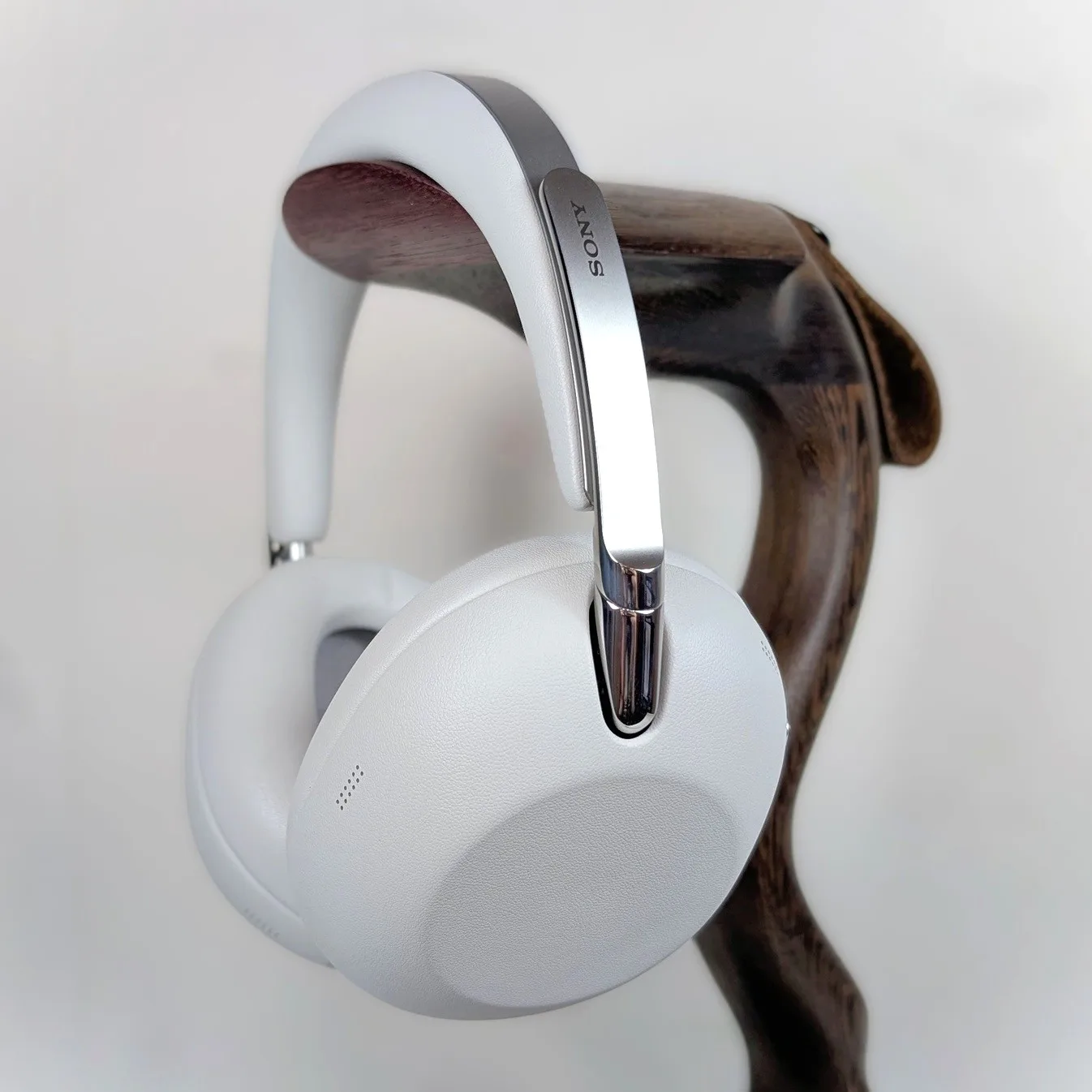
Table of Contents:
Information:
- Release year: 2026
- Country of manufacture: Vietnam
- Color options: Black and white
- Price: 649 €
- Available in Finland: Yes
- Type: Closed, over-ear
- 30 mm dynamic drivers (carbon fiber composite diaphragms)
- Audio connections: Bluetooth 6.0 and 3.5 mm
- Bluetooth codecs: LDAC, LC3 (Bluetooth LE), AAC and SBC
- Charging port: USB-C
- Battery life (ANC ON/OFF): 24 h / 32 h
- Charging time: 3.5 h (Supports fast charging: 1.5 hours of usage time in 5 minutes)
- Active Noise Cancellation: ON / OFF / Transparency mode
- Weight: 320 g
- Features: Multipoint, Google Fast Pair, voice assistant (Google Assistant/Siri/Alexa), 360 Upmix spatial audio, Gaming Audio Profile (GMAP), ear detection sensor and phone app with equalizer
- Accessories: Carrying case and headphone cable (1.2m)
- Warranty: 24 months
Review unit: Loaned by the manufacturer
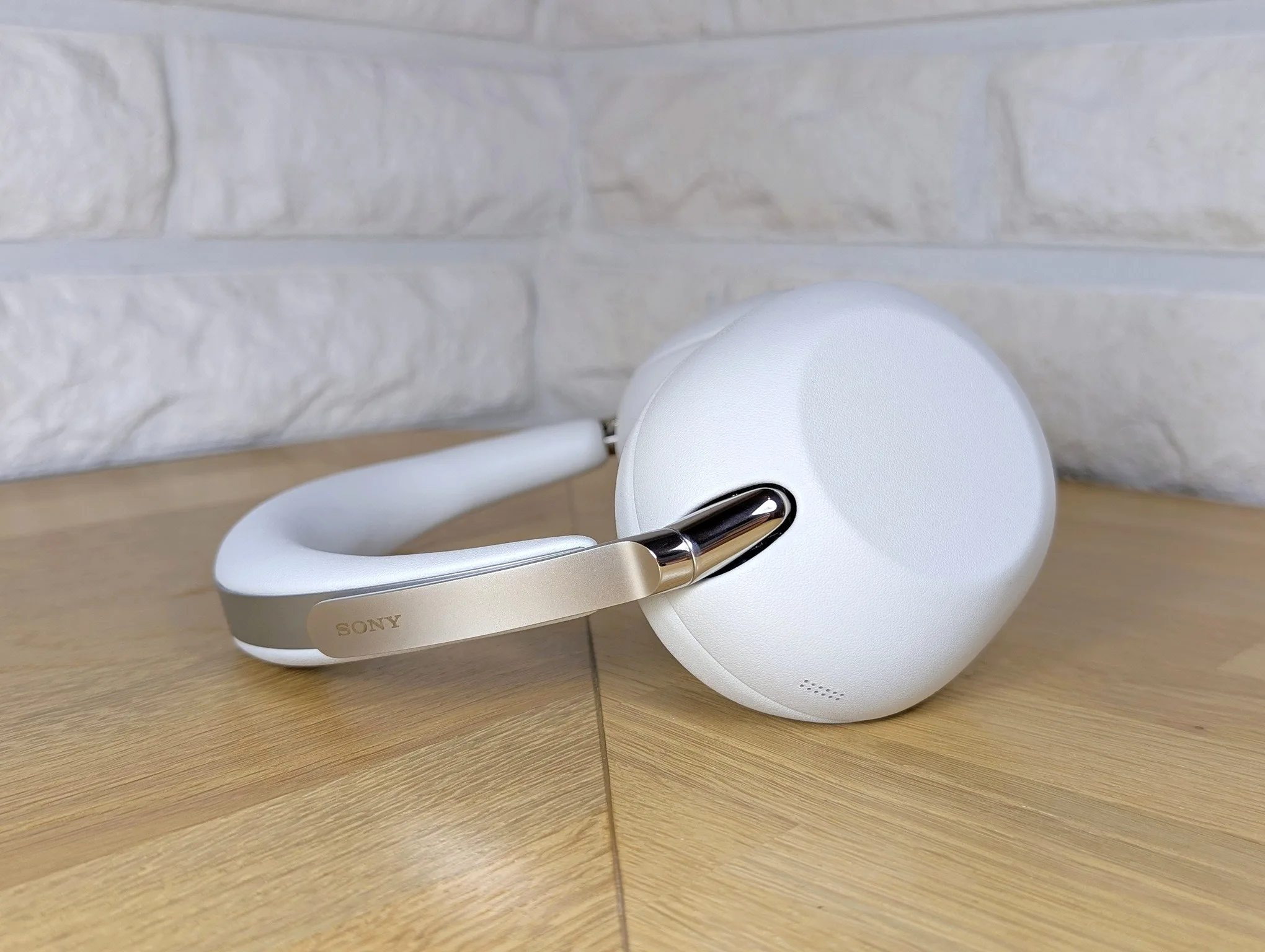
After Kuulokenurkka successfully relocated to a new address in the summer, we finally have the review in for Sony's new noise-canceling headphones 1000X The ColleXion — or more traditionally, the WH-1000XX, whichever rolls off the tongue better. This release marks the 10th anniversary of the WH-1000X series, serving as Sony's venture into higher-end premium territory. The goal here isn't everyday practicality, but a feeling of luxury.
The ColleXion is built on the foundation of the WH-1000XM6released in 2025, but it has undergone significant revamping to achieve a more premium feel, featuring an all-metal headband and ear cups fully wrapped in synthetic leather. With these upgrades, the price tag sits at 650 euros—roughly 200 euros above the XM6's current price, yet still 100 euros below the premium-first Bowers & Wilkins PX8 S2. The ColleXion isn't meant to replace older Sony models, however, but rather to expand the lineup into a higher price bracket.
As usual, I received the review unit on loan directly from Sony, who delightfully continues to invest in PR here in the Nordic region. Thanks again for the cooperation!
Packaging and accessories
Some reviewers have received a black box featuring a twist-lock mechanism that showcases WH-1000X series headphone models from over the years. My review unit, however, arrived in Sony's standard white recycled cardboard packaging, which is apparently because the more elaborate boxes are only distributed to reviewers outside of Europe. So, while I missed out on that festive first impression, the cardboard box better reflects what regular consumers will actually get when buying the headphones in stores.
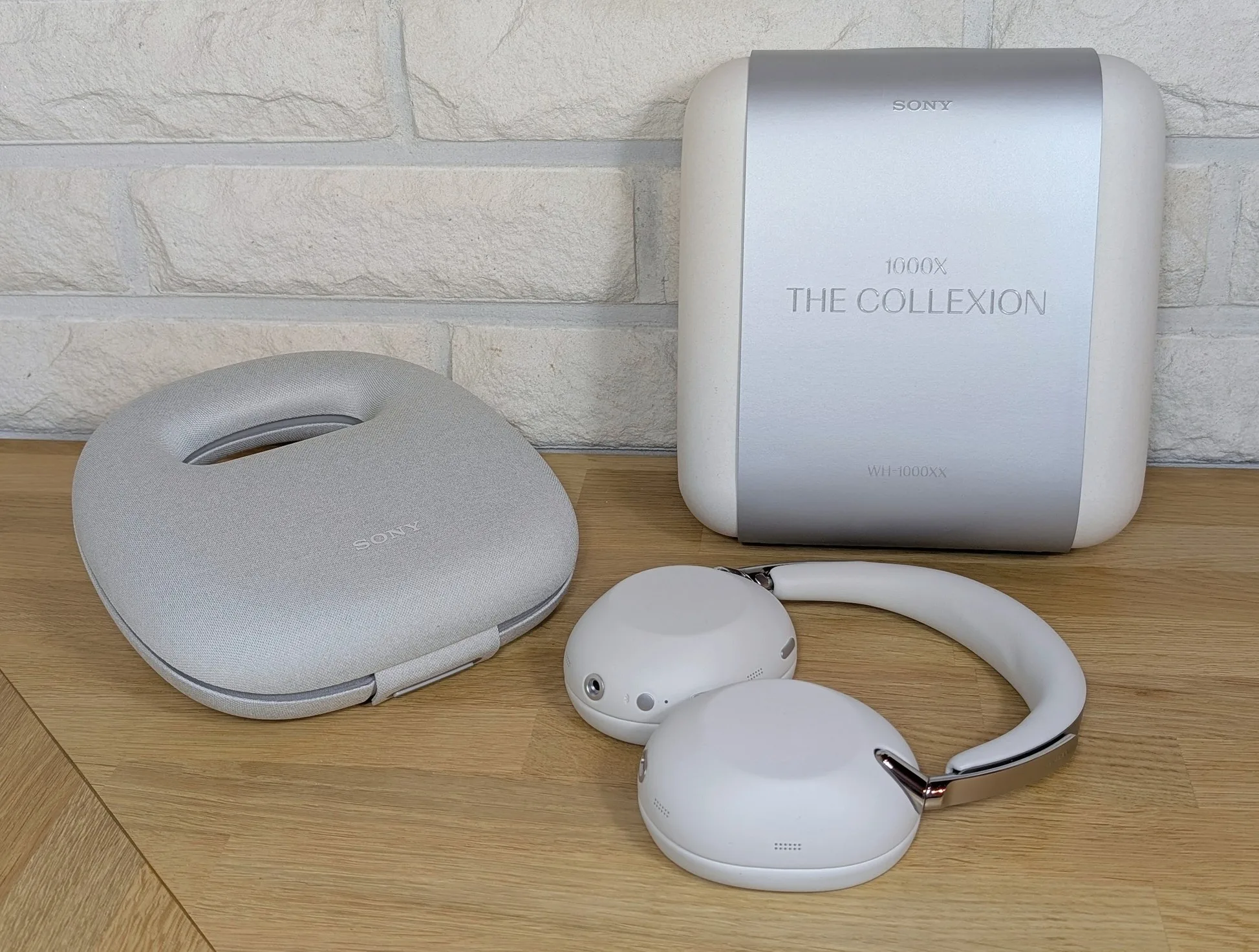
With the updated structural design, The ColleXion no longer folds down on hinges like the WH-1000XM6, so the carrying case has grown wider once again—though not quite to the scale of the similarly designed WH-1000XM5. Its thickness is actually less than that of the XM6 case, thanks to the new headphones having slightly slimmer ear cups. My review unit comes in white, so the fabric upholstery of the case matches this color scheme and may consequently be fairly prone to dirt compared to the black version.
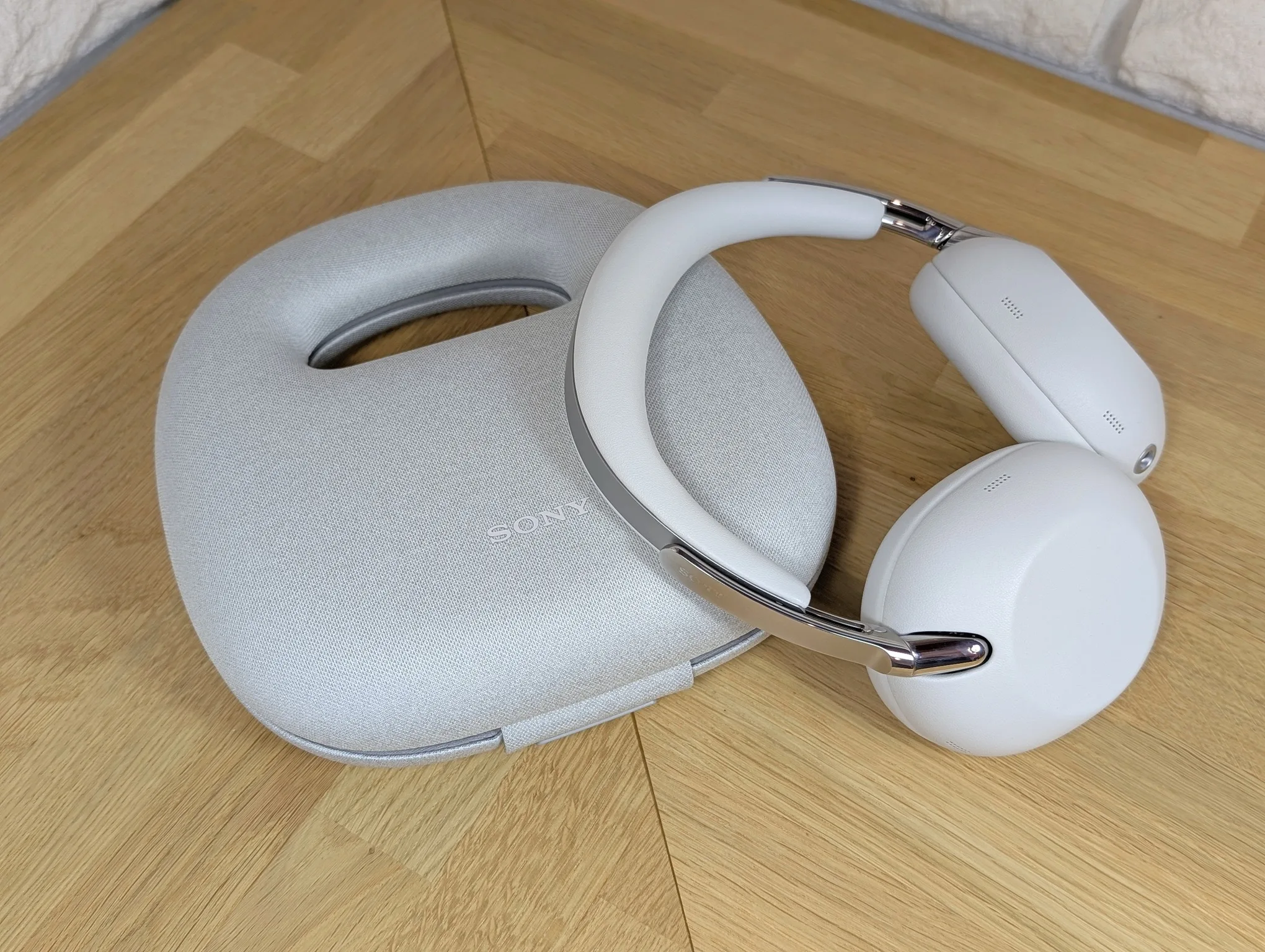
Most of the discussion surrounding the new case has centered around the carrying handle punched into the top edge, which primarily makes handling the headphones easier. I doubt we'll see anyone walking down the street carrying their headphones like a handbag or a kettlebell, as that trend failed to gain traction with the AirPods Max as well. On a more familiar note, the halves of Sony's case are held together by a magnetic flap rather than a zipper, making daily use significantly smoother. I can easily pack the headphones into their case and pull them out using just one hand.

The rest of the included accessories prove to be minimal, consisting only of a thin AUX cable for wired listening. Sony no longer includes a USB charging cable at all, though this doesn't bother me personally, as the previous short stub of a cable mostly just wasted resources. The vast majority of buyers paying 650 euros for a pair of headphones surely own a phone whose USB cable can handle all their charging needs. The absence of a USB cable might also be partially explained by the fact that Sony's headphones still can't be used for audio playback over USB. Let's delve deeper into that weakness a bit later, however.
The most significant changes compared to the WH-1000XM6:
- The carrying case with a handle is slightly flatter and wider in dimensions
- A USB charging cable is not supplied
Build and comfort
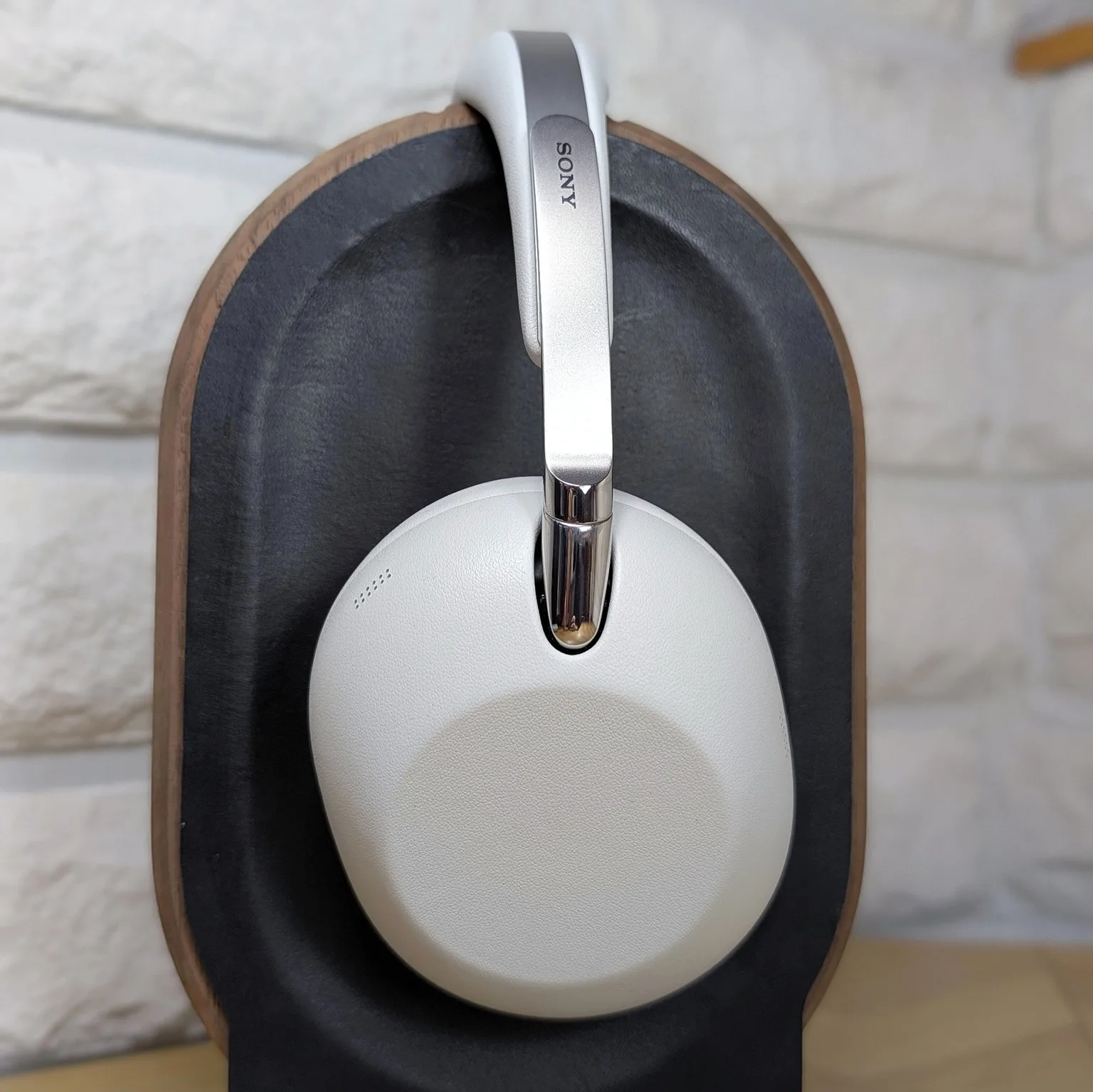
In my opinion, Sony has executed the structural design of The ColleXion exceptionally well. The headphones feature sleeker ear cups than before, while the aluminum headband—finished with varying degrees of sheen—elevates the perceived quality to a new level. The aesthetic will certainly appeal to style-conscious users. I also see durability being in order now, as cracking plastic components and flimsy hinges have been eliminated. The hands-on feel, at the very least, inspires confidence with its sturdiness.
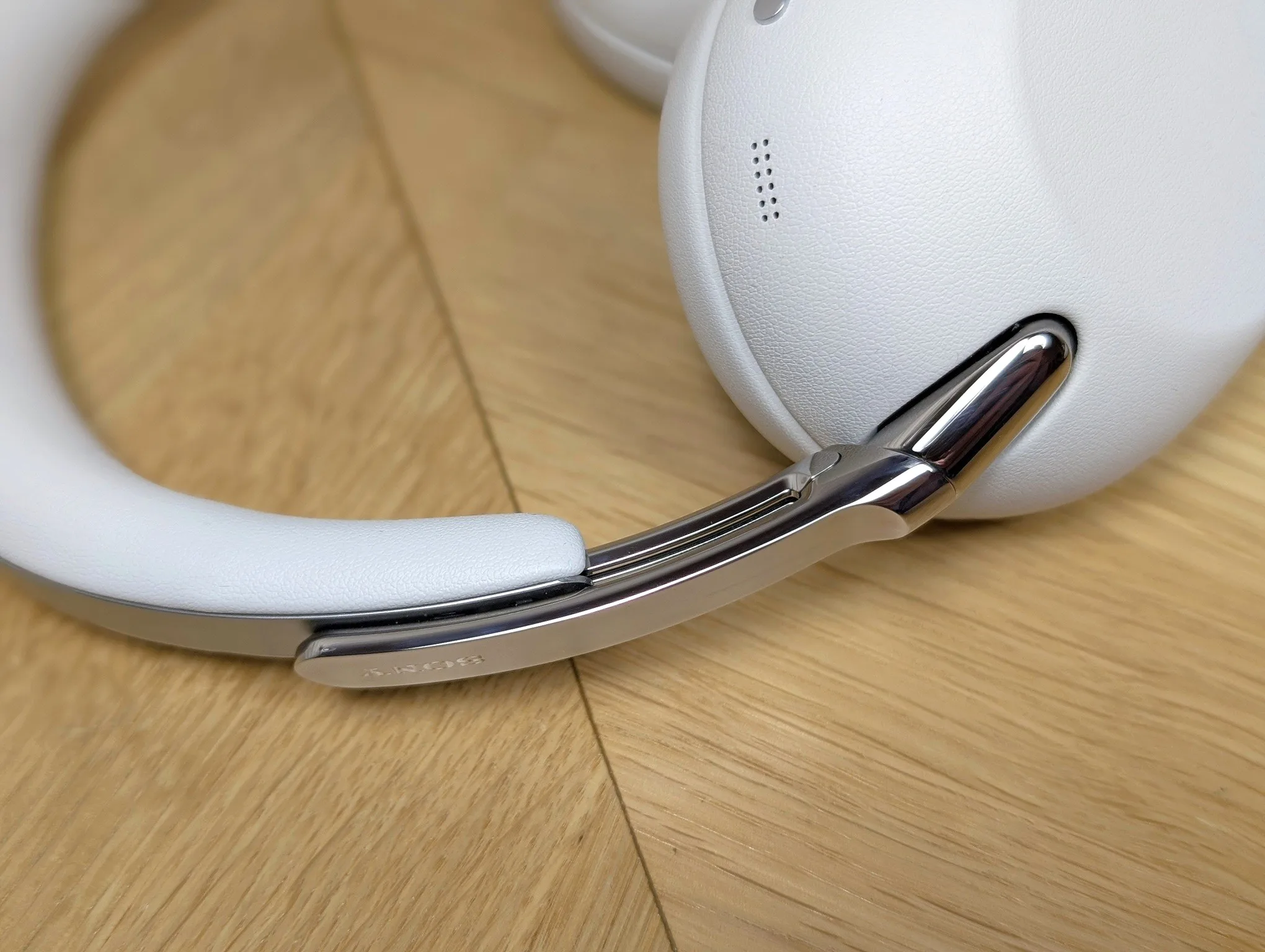
On the other hand, the manufacturer has wrapped the outer edge of the plastic cups in soft synthetic leather, whose long-term durability raises some doubt. Granted, this material looks and feels pleasant when new, but it typically starts cracking in a few years and cannot be replaced or repaired. The white version will presumably also get dirty fairly easily. Sony itself claims to have developed the material over a couple of years to maximize durability, so time will tell. Premium used to signify longevity, but nowadays brand perception and sleek aesthetics are often built at its expense.
Because the cushions are covered in the same synthetic leather, the exterior surfaces of the headphones are seamless, with no exposed hard plastic. The shift compared to the more affordable WH-1000XM series is substantial, which was undoubtedly Sony's goal. They may have drawn design inspiration from the Sonos Ace, while the leather materials remind me of Bowers & Wilkins headphones—both solid role models.

Even though The ColleXion weighs a quarter more than the WH-1000XM6 (320 vs. 254 g), it feels delightfully more comfortable on my head. Improvements have occurred across several key areas. First, there is more room for the ears inside the pads now that Sony has recessed the drivers deeper into the cups (opening size 65 x 38 x 18–30 mm). Second, the headband clamp is lighter than before, and the headband padding is sufficiently thick without looking bulky. When placed on the head, the cushion flattens and widens under pressure. Aside from the heat inherent to the design, I no longer feel any discomfort; for long-term wearing comfort, The ColleXion comes surprisingly close to Bose's excellent QuietComfort line.

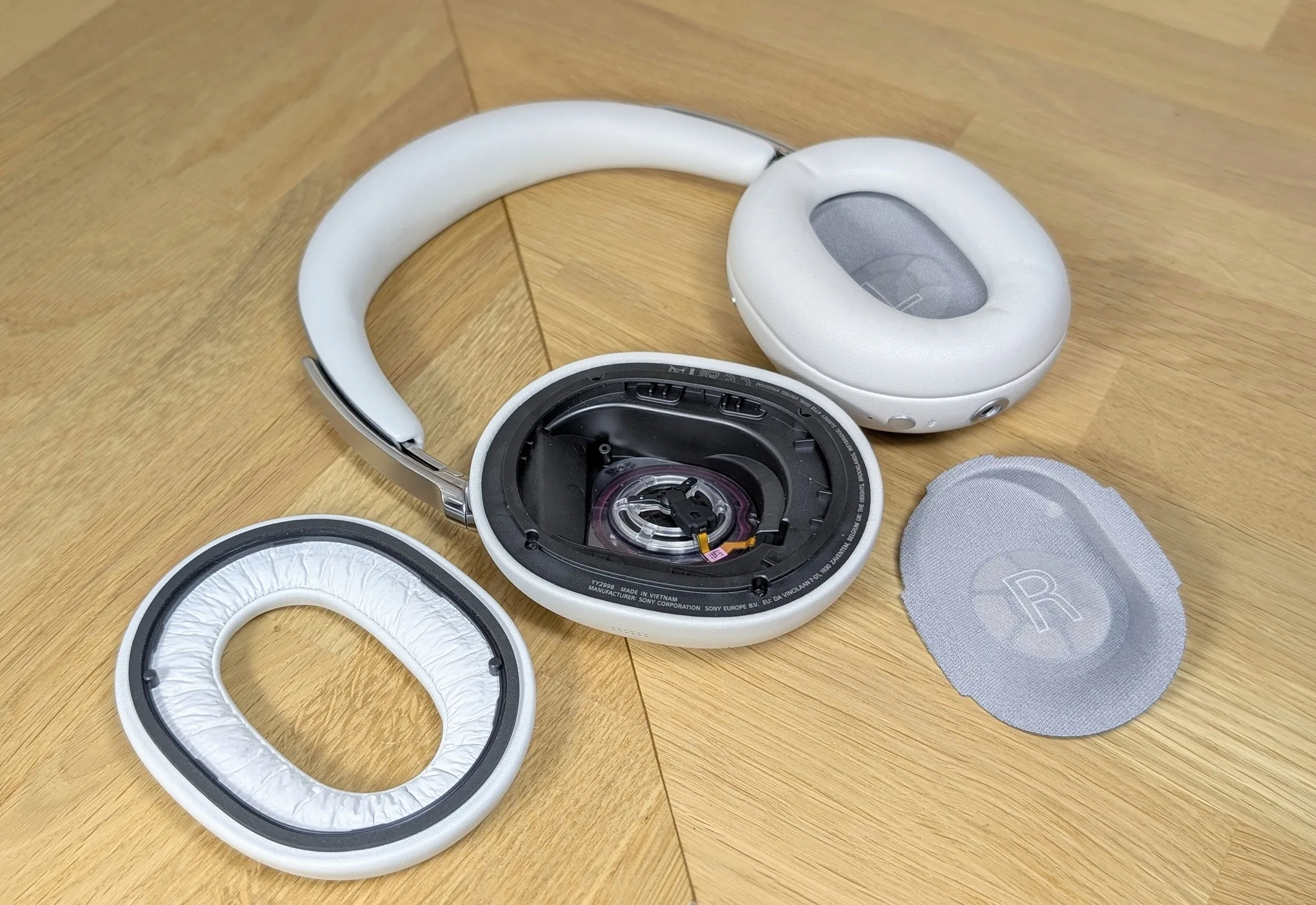
In summary, I think The ColleXion looks sleek and premium, and it is a pleasure to wear. Time will tell how the synthetic leather ages, however, as only the ear pads are easily replaceable.
The most significant changes compared to the WH-1000XM6:
- Headband made of metal and cup surface artificial leather
- The structure does not fold, but the cups can still be turned flat
- Cups slightly slimmer, but still more space inside for ears
- Headband better padded
- Clamps lighter
Controls and functions
The synthetic leather surface of the cups hasn't stopped Sony from once again embedding touch controls into the right housing. They function just as well as on the WH-1000XM6, with an identical feature set. I have no major complaints here, especially since touch implementations from other manufacturers tend to feel clunkier and less reliable. For instance, accidental triggers are noticeably more frequent for me with Sennheiser's Momentum-series and HDB 630. Usability on The ColleXion is surprisingly enhanced by the slimmer ear cups, as the inner part of my palm is far less likely to brush against the touch panel while gripping the cup edges to adjust the headphones on my head.
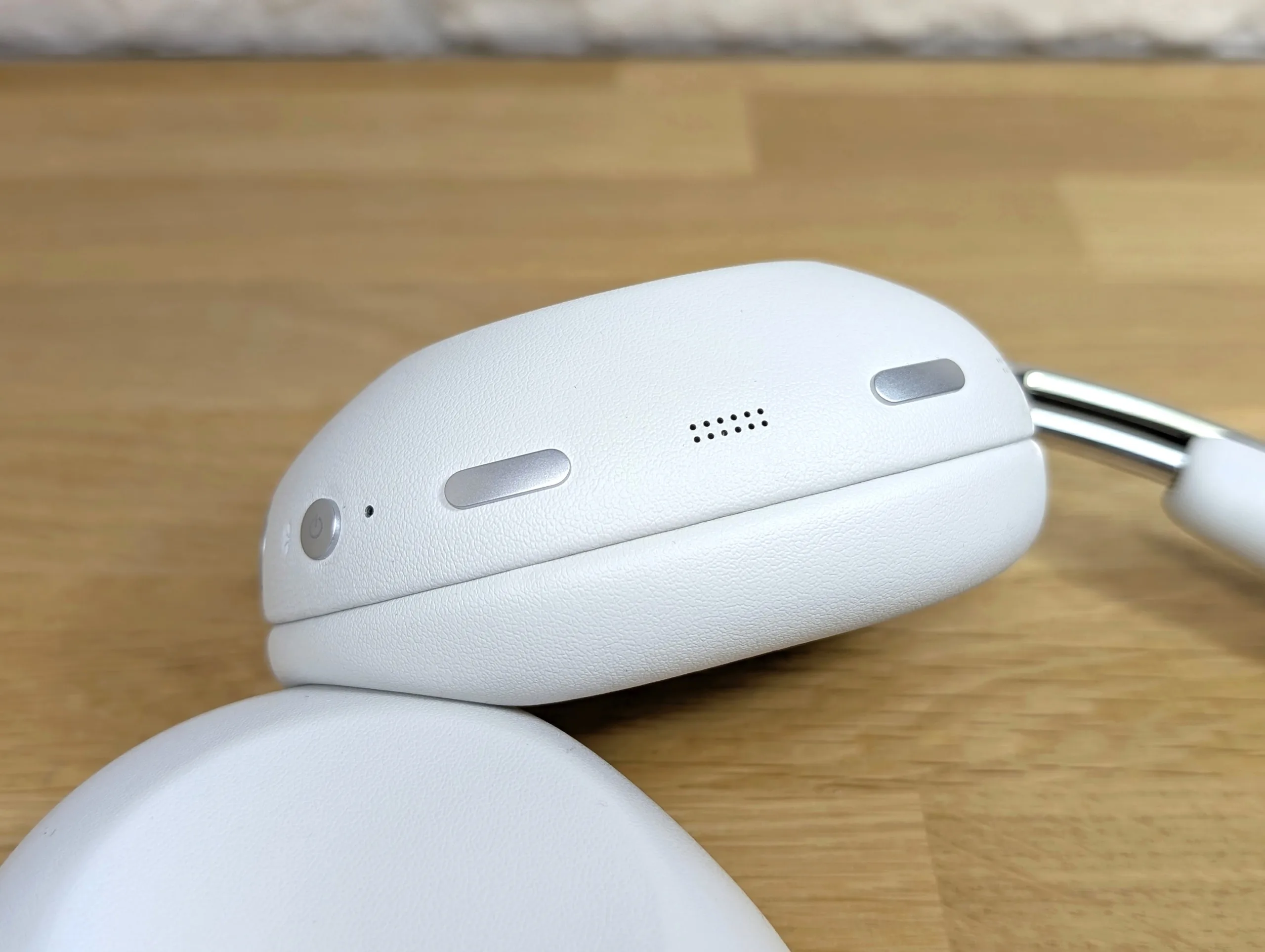
Sony markets the 360 Upmix spatial audio options as a standout new feature, making sure users can access them as easily as possible. Consequently, the power and noise-cancellation buttons have been joined by a physical spatial audio toggle. Put bluntly, you can now ruin the sound quality with a single button press, though I suppose some might find the feature useful when watching movies or playing games.
Overall, The ColleXion's metallic buttons feel high quality, but their tactile feedback is strangely mushy and dull. If the commands didn't register reliably despite this, I wouldn't even believe I had successfully pressed them. In this regard, the premium feel falls just a bit short.
The most significant changes compared to the WH-1000XM6:
- Buttons made of different material
- New spatial audio button
Bluetooth technology and battery life
Bluetooth 6.0 is making its debut and has also found its way into Sony's latest headphones. In addition to Sony's high-resolution LDAC codec, The ColleXion supports Bluetooth LE (Low Energy) and its integrated LC3 codec. Recently, a firmware update added support for the GMAP gaming profile (a new operating mode within Bluetooth LE), which, when functional, drops Bluetooth latency to between 20 and 40 milliseconds—virtually unnoticeable in practice. Unfortunately, native GMAP compatibility is currently found in very few devices, and there don't seem to be any proven standalone Bluetooth transmitters on the market yet either.
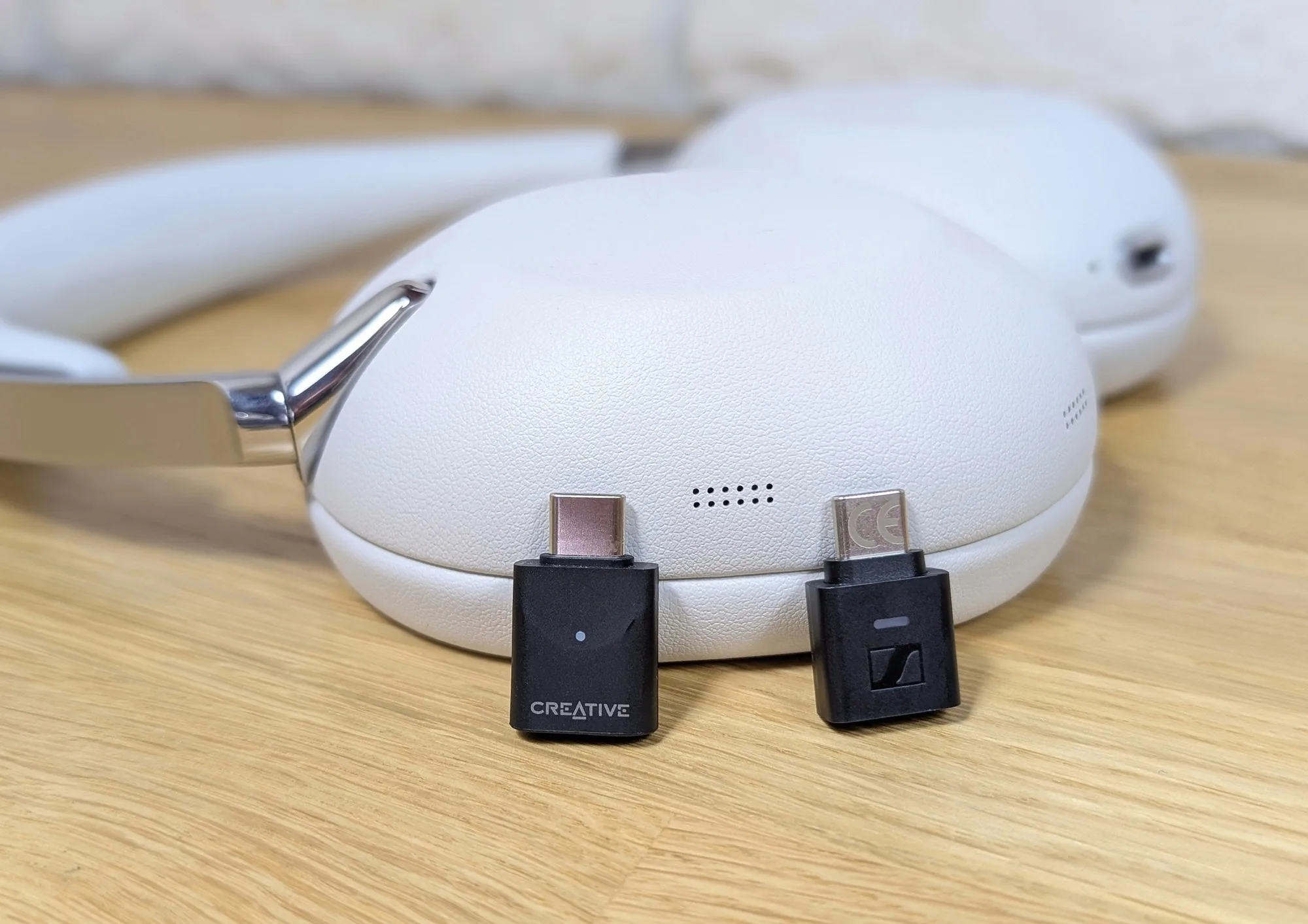
For instance, my Sennheiser BTD 700 transmitter does support Bluetooth LE, but not the GMAP profile, nor does it work with Sony's headphones outside of Bluetooth Classic mode (which restricts you to basic codecs). Similarly, the Creative BT-W6 I recently acquired fails to function with The ColleXion in Bluetooth LE mode (producing no audio), even though the transmitter is marketed as nearly the only GMAP-compatible device in the world. I would infer these compatibility issues stem from the fact that Sony's headphones lack a Qualcomm chipset, for which most such transmitters are primarily designed. Consequently, GMAP feels more like a feature for the future than today.
Using my Google Pixel 9, however, I confirmed that Bluetooth LE mode and the LC3 codec work as intended on the headphones, provided they are enabled via Sony's mobile app. As usual, the headphones also support the AAC and SBC codecs, along with Google Fast Pair. Multipoint functionality is likewise rock-solid, and I have no complaints regarding wireless connection stability or range. Sony simply doesn't miss in these areas.
Battery life on The ColleXion, however, has taken a slight hit compared to older WH-1000XM series models. Runtime with active noise cancellation enabled is now rated at 24 hours instead of 30, which feels like an odd step backward for a higher-tier product. Until now, Sony outpaced the Bose QuietComfort series and the Apple AirPods Max, but it now joins them near the back of the pack. Then again, if needing to charge slightly more often isn't a dealbreaker, The ColleXion's runtime is still plenty for a few days of use. This time, Sony notes that a 5-minute quick charge yields 1.5 hours of playback. Based on my experience, a high-power charger tops the headphones off completely in 1 to 2 hours, and delightfuly, they can be used normally while charging—even if the charging cable can be a bit awkward.
Sony likely had to reduce battery capacity to meet its other design goals. With flatter ear cups and more breathing room for ears inside, larger batteries may simply not have been feasible. On the bright side, the two batteries mounted inside plastic housings along the edges of the right cup should be relatively easy to replace, as they are secured with screws and detachable connectors. Sony doesn't explicitly advertise user-serviceable batteries, but in my view, the procedure isn't much more complex than on the new Sennheiser Momentum 5—assuming replacement batteries eventually become available.

The most significant changes compared to the WH-1000XM6:
- Bluetooth version updated from 5.3 to 6.0
- Usage time shortened with noise cancellation on from 30 hours to 24 hours
Mobile application and additional features

Since Sony's mobile app and its additional features are already largely familiar from the WH-1000XM6, I won't dive into them deeply this time around. Regardless, the versatile feature set continues to serve as a major selling point for the manufacturer. Virtually anyone can tailor The ColleXion to fit their daily routine, provided they are willing to tolerate the rather cluttered user interface at least once. The half-baked Finnish translation and intermittent connection drops between the app and the headphones also hinder usability to some extent, though the latter might just be an Android power-saving measure that can be disabled.
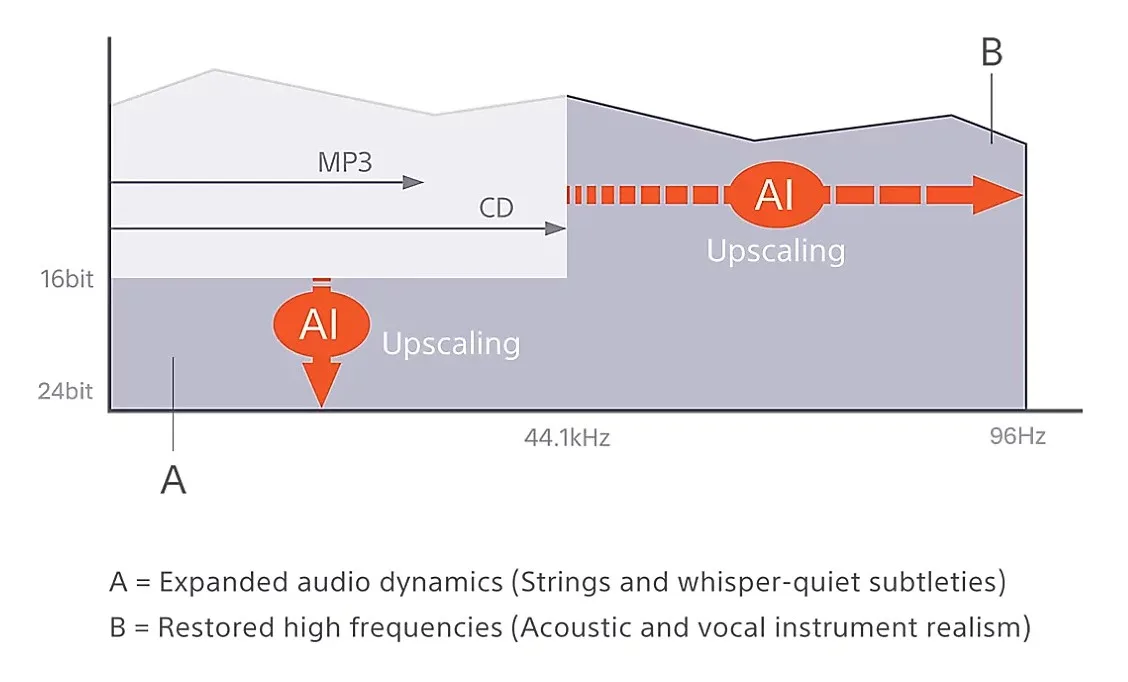
Sony has added two new features to The ColleXion. 1) The DSEE Ultimate sound enhancement technology replaces DSEE Extreme, featuring even more advanced AI processing. 2) The aforementioned 360 Upmix spatial audio profiles—Music, Cinema, and Game—are also new additions. Besides being accessible via the button on the headphones, they are listed in the app alongside further details.

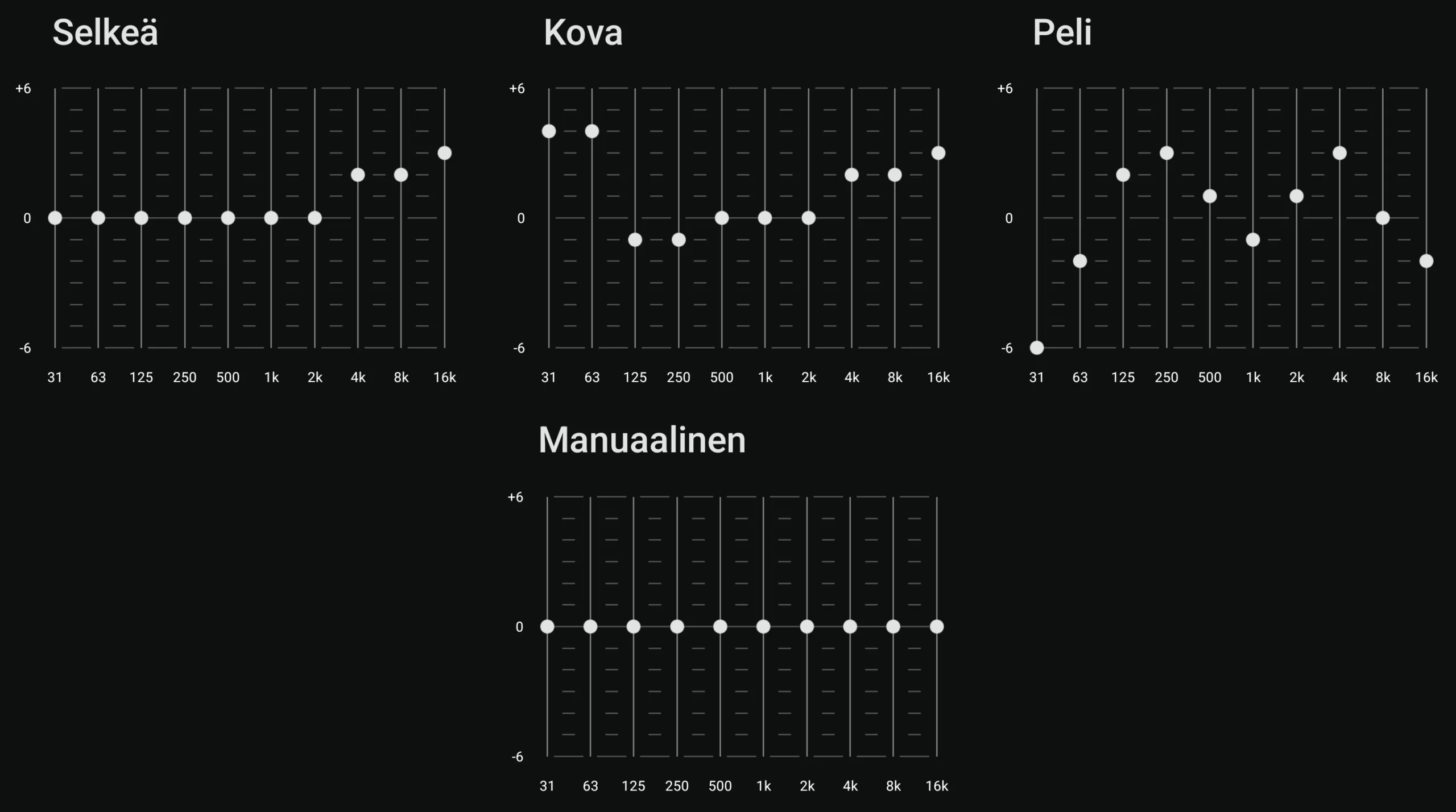
From the perspective of fine-tuning the sound quality, the 10-band equalizer will likely interest most people the most, as the built-in sound presets are what they are. Personally, I might have hoped for Sony to switch to a parametric equalizer, but as with the XM6, the adjustable frequencies remain fixed and locked, allowing only their amplitude to be adjusted up or down by 6 decibels. The Q-factor is still 0.9 for all bands except the 16 kHz slider, which operates at a Q-factor of 0.4. The scope of adjustments is therefore safely broad, but localized changes to narrower frequency bands are not possible.
New features compared to WH-1000XM6:
- DSEE Ultimate (formerly DSEE Extreme)
- 360 Upmix spatial audio: Music, Cinema and Game
Active Noise Cancellation
Due to changes in the cup design and a lighter fit, test results show that The ColleXion's noise reduction performance has dropped slightly compared to the WH-1000XM6, though it makes little practical difference. Noise is still attenuated exceptionally well, allowing me to escape into my own pleasantly quiet bubble even amidst louder noise—unlike many cheaper noise-canceling headphones. Background hiss is also practically non-existent, although the silence does reveal a faint electronic buzzing in the background. Once audio starts playing, however, even that disappears, placing The ColleXion's noise cancellation firmly among the best on the market. My first-generation Bose QuietComfort Ultra performs quite similarly, albeit with more background hiss.

The ColleXion's transparency mode also delivers a good, clear experience. At the maximum setting, rustles, mechanical ventilation humming, and vocal sibilance are sharpened a bit too aggressively, but at a more moderate setting, the result feels fairly natural. At that level, for instance, I've gotten used to hearing my own voice during meetings with transparency mode engaged. As an interesting touch, transparency mode can still be activated temporarily in the familiar way by holding your palm over the touch pad on the cup.
Through the app, the headphones can also be set to ANC OFF mode, where they block environmental noise purely passively without transparency enabled. This could come in handy when moving outdoors in windy conditions, as I find Sony's noise cancellation doesn't suppress wind-induced crackling as effectively as it could.
The most significant changes compared to the WH-1000XM6:
- Noise cancellation performance slightly decreased
Microphone sound quality
The ColleXion's microphone configuration mirrors that of the XM6, meaning the new model similarly delivers clear voice quality with effective background noise cancellation. Wind and other ambient noises are suppressed quite successfully, making the headphones well-suited for calls. During the testing period, I used them several times in Teams meetings, where other participants noted my voice sounded natural. For some reason, muting the microphone by double-pressing the noise-cancellation button didn't work, even though, according to the product specs, it should be possible just like on the XM6. Perhaps the feature functions better in other applications.
The addition of the GMAP profile would bring a clear improvement to two-way Bluetooth audio quality, allowing the headphones to simultaneously receive high-quality game audio and transmit crystal-clear voice via the microphone. GMAP no longer suffers from the familiar "landline effect" (hands-free profile), which occurs over standard Bluetooth because the headphones have to compromise playback quality to reserve bandwidth for the microphone signal. Although GMAP is aimed at gaming, it would also improve the audio quality of remote meetings. Now we just wait for the day we can actually utilize this feature in the future.
Headphone sound quality
Unlike previous WH-1000X series noise-canceling headphones, The ColleXion no longer works without battery power when listening via cable. This may limit usability somewhat, especially considering the modest battery life, but on the other hand, no one would choose to listen to these headphones without digital signal processing (DSP) active to enhance the sound quality. However, a familiar weakness still plagues the headphones: sound profiles, the equalizer, and 360 Upmix spatial audio do not function over a wired connection, even though you would expect them to when the power is turned on. As a result, audio settings aimed particularly at gaming are largely wasted, given that—due to audio-visual latency—few people play games over Bluetooth until GMAP becomes more widespread.
Listening via USB is also not possible on Sony's headphones, which is becoming an unforgivable omission in a premium-tier product. Competitors like Sennheiser, Bowers & Wilkins, Bose, and Apple have understood this, whereas Sony emphasizes its proprietary LDAC codec so heavily that there has been no room for a lossless wired listening option. Granted, the manufacturer attempts to compensate for this with its DSEE Ultimate feature, which uses AI to upscale compressed music and audio signals. With DSEE Ultimate activated, I do notice a slight tonal difference in the treble, though I can't say whether it's an actual improvement or merely a change.
The dynamic drivers are 30 mm, making them the smallest on the noise-canceling headphone market (excluding earbuds). Sony claims to have updated the drivers' acoustic structure compared to the XM6, while the diaphragm material remains a rigid carbon fiber composite paired with a flexible surround.
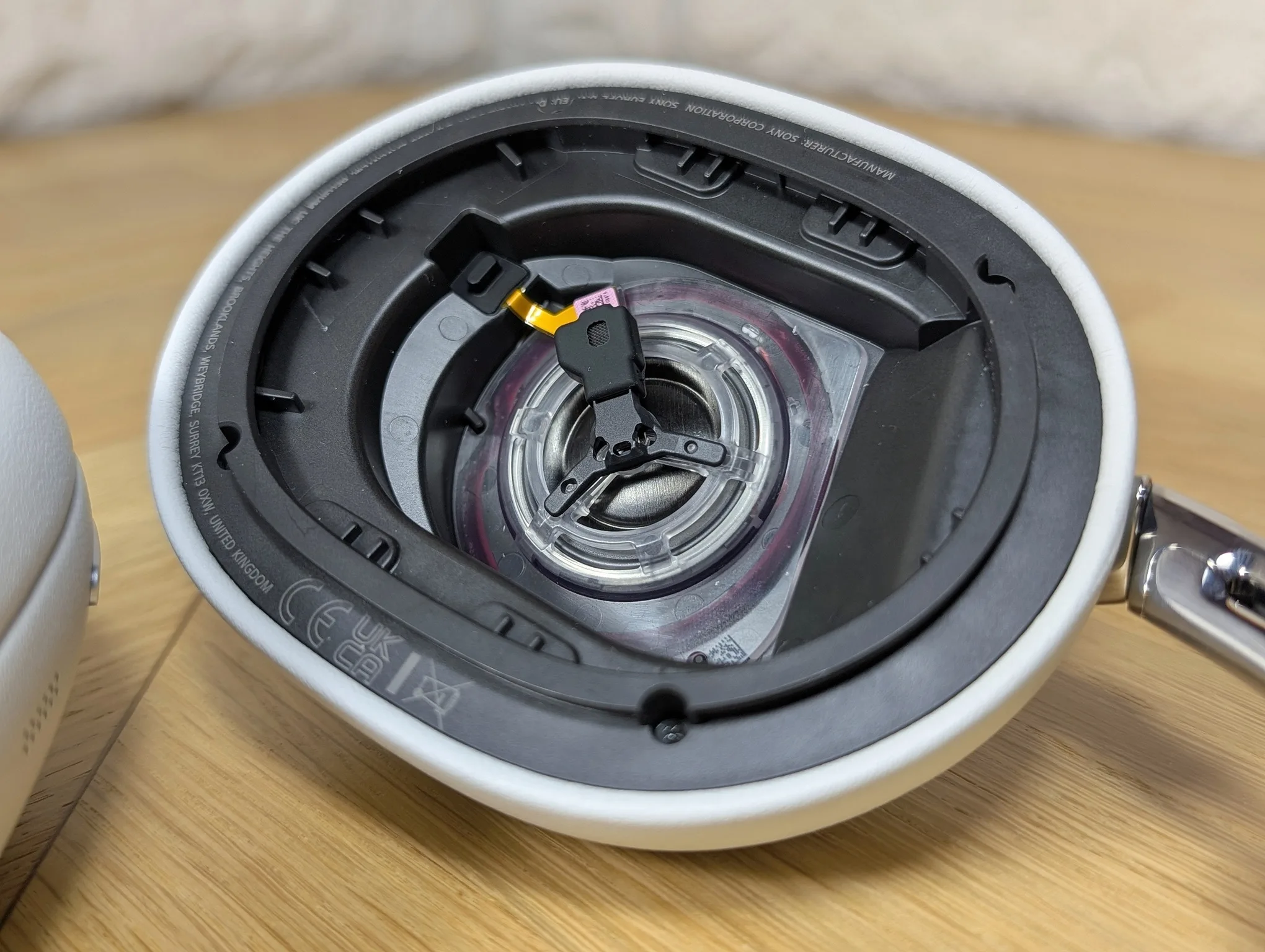
Compared to the XM5 and XM6 models, the plastic driver frame has shrunk significantly, and the drivers are now recessed deeper into the ear cups, positioned further away from the ears. The final touch comes from the new noise-canceling and D/A conversion processors, though their biggest benefits lie in rendering the 360 Upmix spatial audio. Once again, Sony involved the same award-winning sound engineers in the tuning process—the ones who didn't quite hit the mark with the XM6. Perhaps second time's the charm, though.
The most significant changes compared to the WH-1000XM6:
- Does not work passively anymore with power off
- The drivers are located further from the ear and produce a different frequency response
Measurements
The headphone frequency response measurements were performed with equipment compliant with the IEC711 standard and KB501X model silicone ears. The graphs use the Harman target curve (2018 version), optimized for this equipment, as a reference. This curve is a generalization, based on scientific research, of what kind of frequency response would sound good to most people and correspond to balanced loudspeakers in a well-acoustically treated room.
The Harman research was conducted with silicone ears that ”hear” sound slightly differently than the ear types sold today. For this reason, the target curve used by Kuulokenurkka is based on the diffuse field response according to the KB501X ears” own HRTF transfer function, to which, however, the core findings of the Harman research have been adapted using filters. In practice, the result still corresponds to the ideal frequency balance indicated by the Harman research, but as the equipment used by Kuulokenurkka would ”hear" it based on its characteristic acoustics. Thus, it is possible to make more precise observations of the headphones' frequency response between 2–20 kilohertz than when using the pure Harman 2018 curve as a reference.
More information about the measurement equipment can be found on the Headphone Measurements. The ColleXion's frequency response is also comparable with other measured headphones on Squiglink .
From a headphone reviewer's perspective, Sony's wear detection sensor poses a challenge: to conserve power, active noise cancellation only engages on human ears. Consequently, measuring the frequency response in ANC mode requires placing a small piece of aluminum foil inside the left ear cup. This tricks the sensor into keeping noise cancellation active even while mounted on a measurement rig.
Mostly, measurements are found online where noise cancellation has been off, even though the measurer has assumed it to be on. I myself have confirmed this when performing measurements by monitoring the noise cancellation function via a Multipoint connection from the mobile application. By default, when placing the headphones on the measuring device's silicone ears, the application states that the noise cancellation function is off, while on my own ears, noise cancellation activates normally. With a piece of foil, however, I can transfer the headphones from my head to the device so that the noise cancellation function does not turn off in between.
Frequency Response (ANC ON vs. OFF):
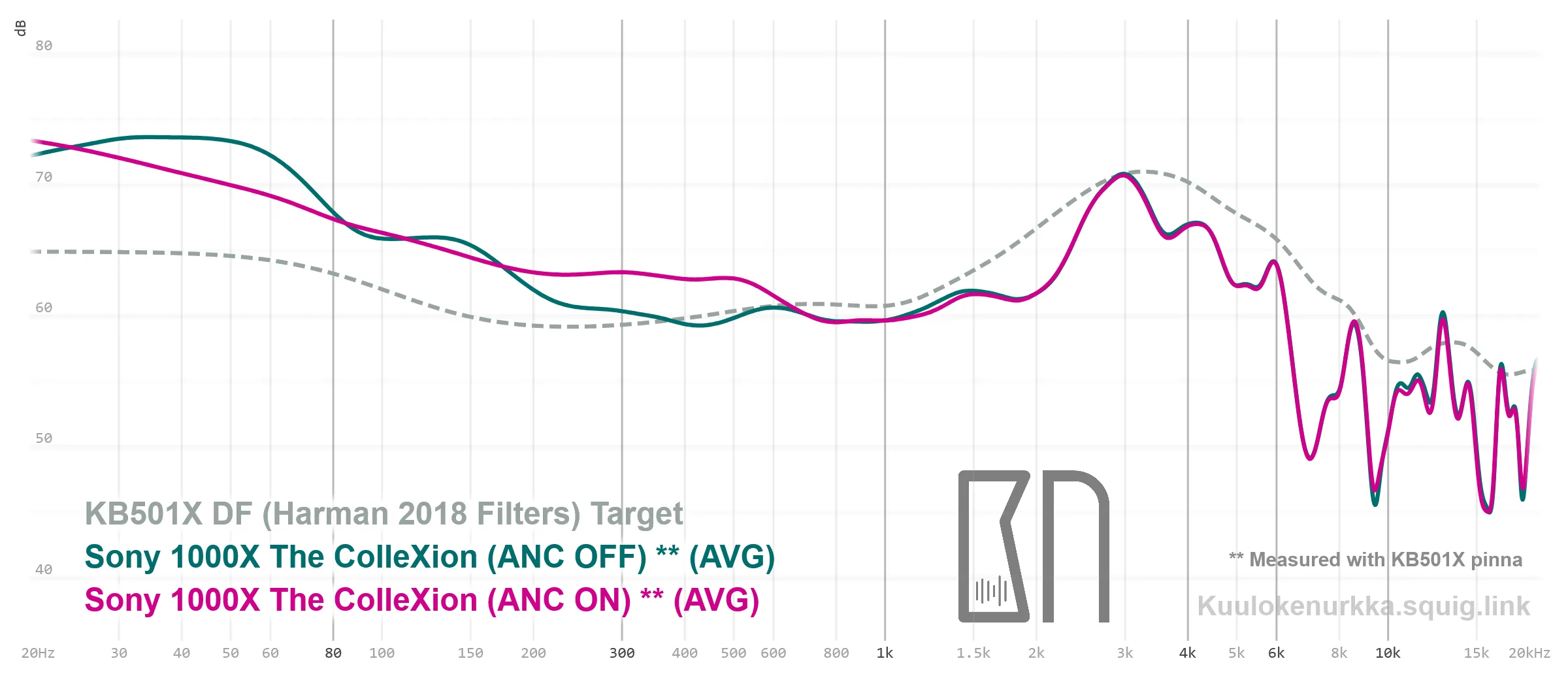
As expected, the low frequencies of The ColleXion sound slightly different depending on whether active noise cancellation is turned on (transparency mode matches ANC ON behavior). Most people will likely use the headphones with ANC engaged, where the sub-bass reproduces more linearly—though still loud if a target like the Harman curve is used as a benchmark. By default, the bass response should easily satisfy those looking for plenty of rumble, and this style of tuning certainly holds its ground in noisy surroundings. That said, Sony's bass boost isn't the most aggressive on the market; in the ANC category, it's actually fairly standard, for better or worse.
Lower midrange frequencies, on the other hand, are pushed up all the way to 500 Hz when ANC is active—just like on the WH-1000XM6—which stands as The ColleXion's biggest single weakness objectively speaking. A boost in this region almost always makes the sound thick, soft, and consequently muffled. Beyond that, the tuning doesn't stray too far from modern guidelines, following the Harman curve like a relaxed, energy-tamed variation. Overall, the sound profile can be described as warm, calm, and even slightly dark. Sony likely aimed for a laid-back, non-fatiguing listening experience that sets itself apart from the more affordable XM6. Turning ANC off cleans up the lower midrange of The ColleXion, making this mode better suited for critical listening despite the increased bass quantity.
1000X The ColleXion vs. WH-1000XM6:
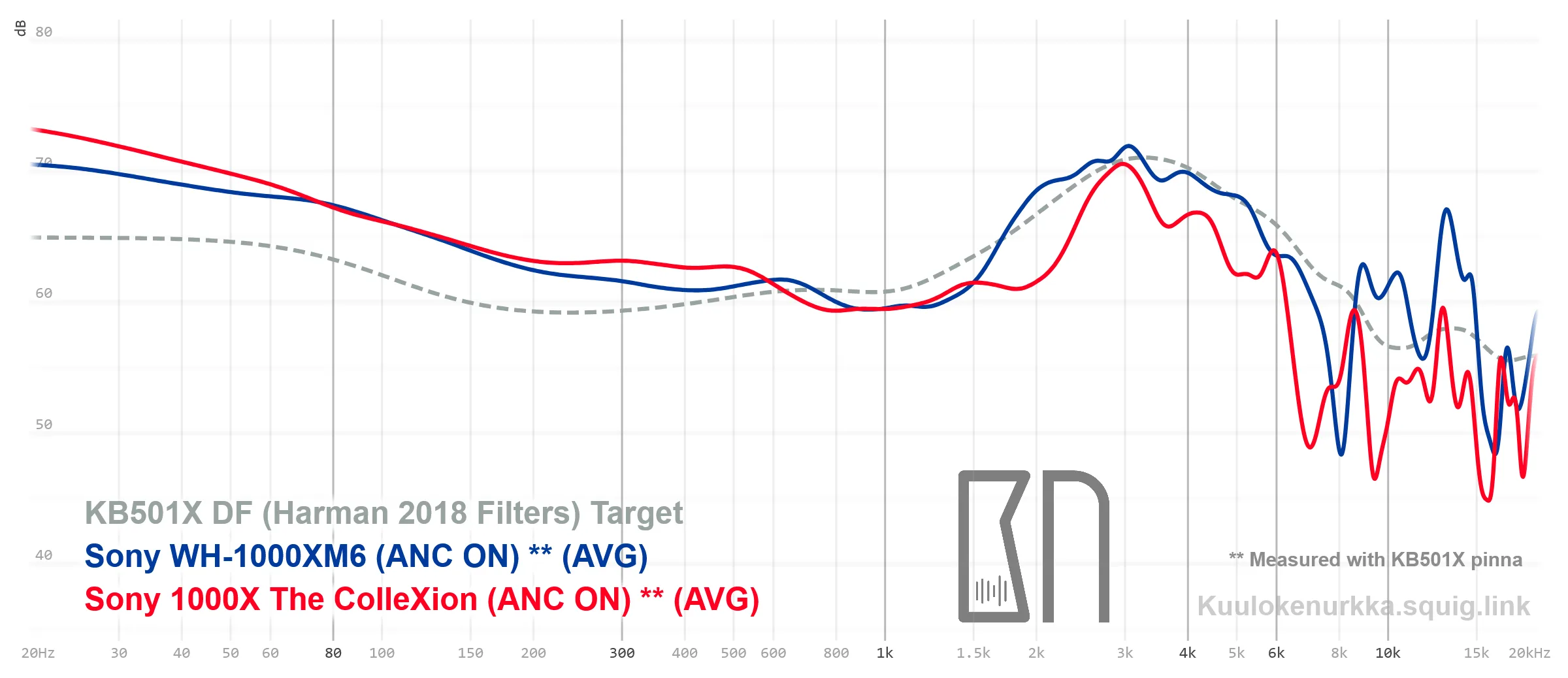
The ColleXion and WH-1000XM6 are tuned surprisingly differently, even if they share the same approach when it comes to the bass. The new model sounds thicker and more laid-back, as its high frequencies are reproduced more gently across the board. On the XM6, the overall balance is compromised most by low-end bleed into the midrange and an emphasis around 10 kHz. While The ColleXion falls victim to that same low-end bleed, its worst treble irregularities have been ironed out, resulting in a smoother sound. On the other hand, the acoustic design creates a deeper dip around 7 kHz than before, leaving room for further refinement if you're chasing peak high-frequency naturalness.
Looking at the factory settings, the shift in character between the two is distinct enough that neither can be called objectively superior. If the treble boost and slight graininess of the XM6 bother you, the energy-tamed ColleXion might come across as more natural. However, if clarity is what you're after, the XM6 takes the lead by reproducing the 2–6 kHz region more accurately. Both headphones benefit immensely from equalization, though the process is considerably easier on The ColleXion.
Clearer sound by equalizing:
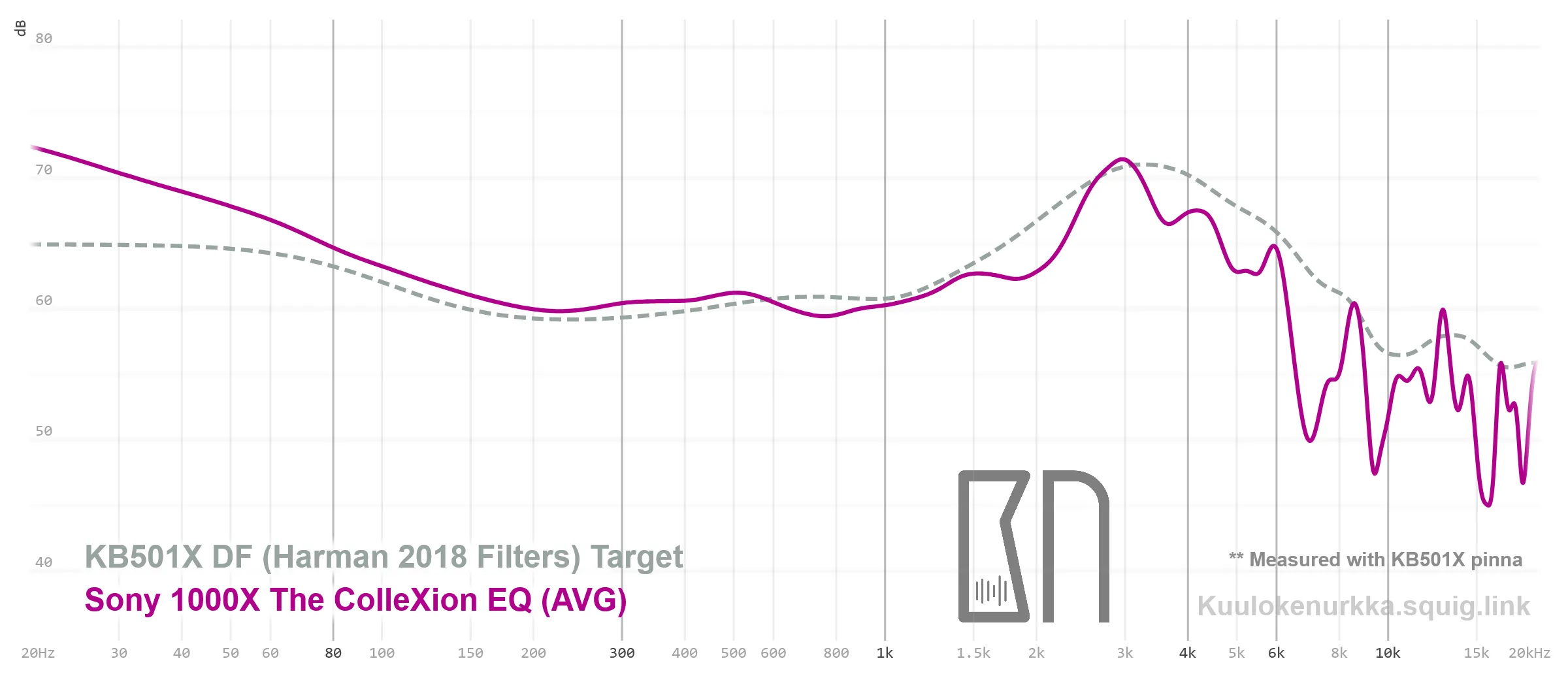
Let's take an immediate look at the settings that get The ColleXion sounding clearer and more balanced with noise canceling turned on, all without sacrificing its entertaining bass response:
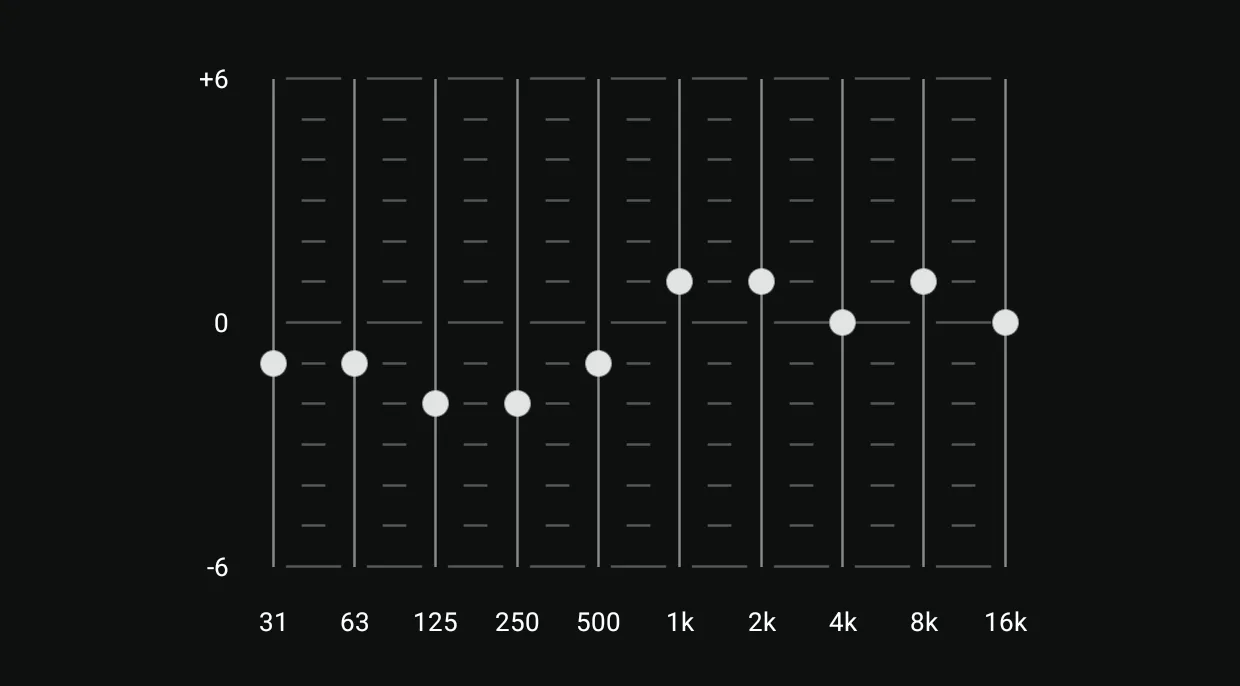
Fine-tuning these headphones is straightforward enough even by ear, as anyone accustomed to a more neutral sound will instantly notice the low end being pushed over the high frequencies. Improving the balance between these regions is the logical goal—and thankfully easier than on the XM6, as The ColleXion's frequency response lacks the same harsh local peaks.
My settings serve as a solid, dependable baseline from which you can further tweak the sound to match your personal taste. Dial the bass up or down using the bottom three sliders as needed, and adjust the treble with the top two. The midrange should be pretty much dialed in, but you can relax the presentation by dipping the 1 kHz band or add a bit of bite by boosting 4 kHz.
Sound observations
With Sony's default factory settings, The ColleXion offers a bass-heavy, darker sound. Its warm and relaxed tone has its own charm, though at the expense of overall clarity. As with other models in the WH-1000XM series, the upper bass is boosted so crowd-pleasingly that there isn't much to say about precision or detail retrieval. The thick bass works passably well at low listening volumes, but crank it up even a bit, and things quickly turn bloated and muddy. Some might call Sony's soft baseline tuning safe and familiar, but no major leap forward has taken place.
This type of presentation doesn't particularly bother me during casual background listening, especially since the high frequencies come through smoother than on the WH-1000XM6, which I couldn't get to sound entirely natural even with EQ. Over time, however, The ColleXion feels quite dull and fatigueingly muffled. Music sounds veiled, as if playing behind a thick blanket, and the soundstage feels cramped and closed in. To my taste, the mid and upper frequencies need more energy so they don't get completely steamrolled by the constant bass thud. In practice, though, the easiest fix is simply dialing back the bass level.
Year after year, I wonder why Sony won't tune the low end to sound cleaner. Does the target audience really want such thick, loose sound instead of tight, punchy bass? After all, The ColleXion is a €650 product, which you'd expect to sound more balanced out of the box. That would make fine-tuning with EQ much easier too.
Fortunately, The ColleXion responds very well to equalization. By dropping the bass quantity and giving a tasteful boost to the higher frequencies, the sound becomes significantly fresher and more detailed. Vocals and instruments finally come into their own, sounding natural, while the soundstage opens up considerably without the need for artificial spatial audio processing. I did try the headphones with Sony's 360 Upmix, but it only made music sound terribly hollow and harsh. So I wouldn't call the new spatial audio feature a real selling point—or at least I'd reserve it strictly for watching movies.

As a whole, despite my criticisms, the headphones deserve a bit of praise, because when EQ'd (and especially over the LDAC codec), I haven't heard sound this good in Sony's WH-1000XM lineup before. Nor does The ColleXion leave much room for complaints when compared to products from other brands. In an ideal scenario, the treble could certainly be smoother—or adjustable to be so—as the 7 kHz dip and a slight elevation around 12 kHz make themselves known from time to time. Luckily, I don't find these flaws nearly as distracting as the treble on the WH-1000XM6, so Sony's 10-band equalizer saves the day more effectively this time around. Given the muddy starting point, the improvement in listening pleasure achieved through EQ is nothing short of impressive.
In short, from the perspective of a more critical headphone enthusiast, The ColleXion is a rather average product out of the box that doesn't deliver much in terms of sound quality. With a little effort, however, it's possible to wring a very enjoyable sound out of it, making equalization practically mandatory. Provided you're willing to dive into the settings, The ColleXion's sound quality no longer pales in comparison to competing products—or even to the recommendations on Kuulokenurkka's Wall of Fame. Therefore, the buying decision comes down to other areas, where the €650 price tag might ultimately be easier to justify.
Among other pricey noise-canceling headphones, I still slightly prefer Focal's Bathysmodels thanks to their better factory tuning. On the other hand, Bowers & Wilkins' heavily colored PX8 series and Bang & Olufsen's outrageously expensive H100 don't sound nearly as good to my ears as the Sonys. I managed to hunt down one suitable point of comparison for this review to show that The ColleXion is actually not half bad.
Comparison: The Collexion vs. Bowers & Wilkins PX8 S2
Prices: 650 € vs. 750 €
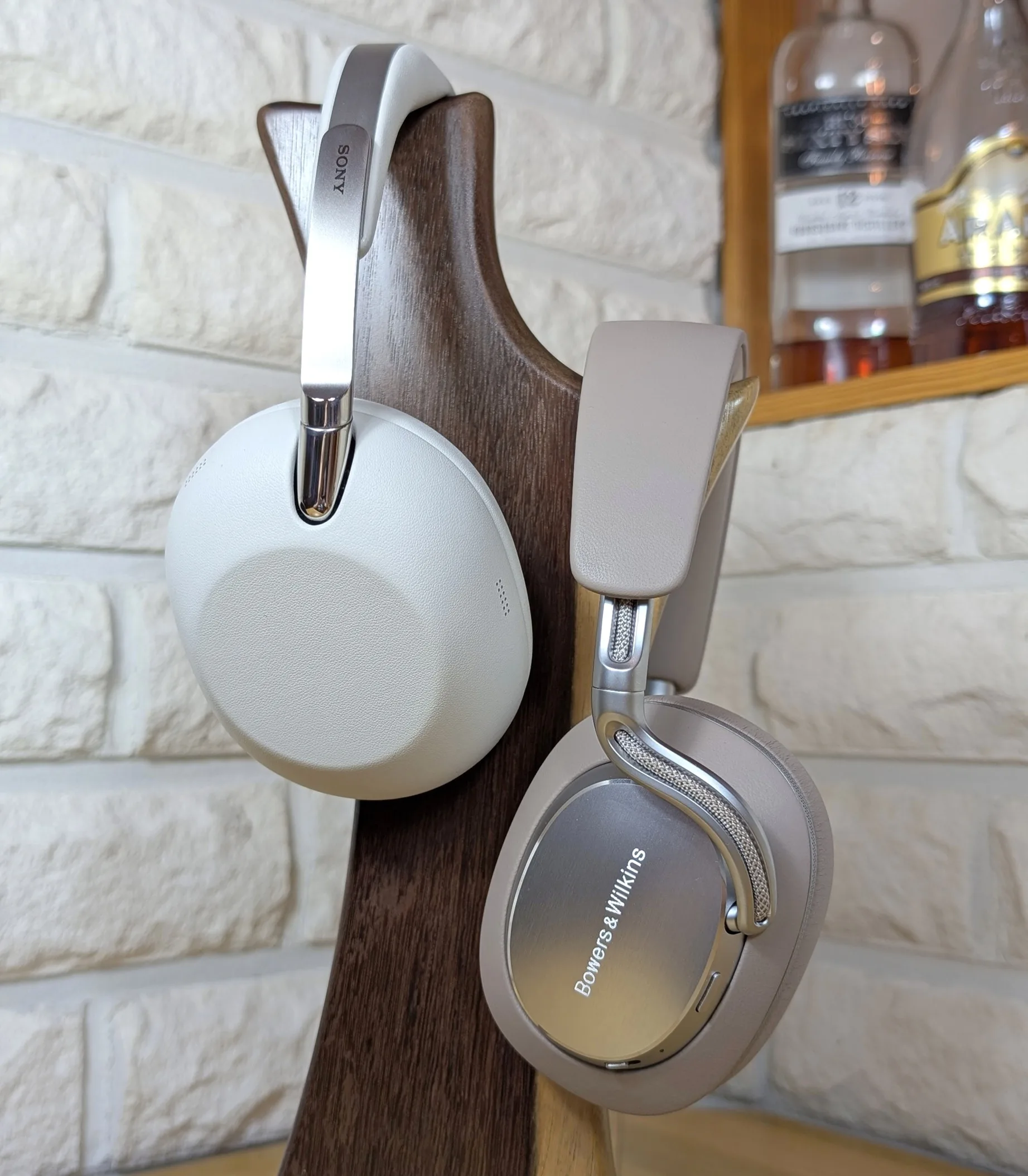
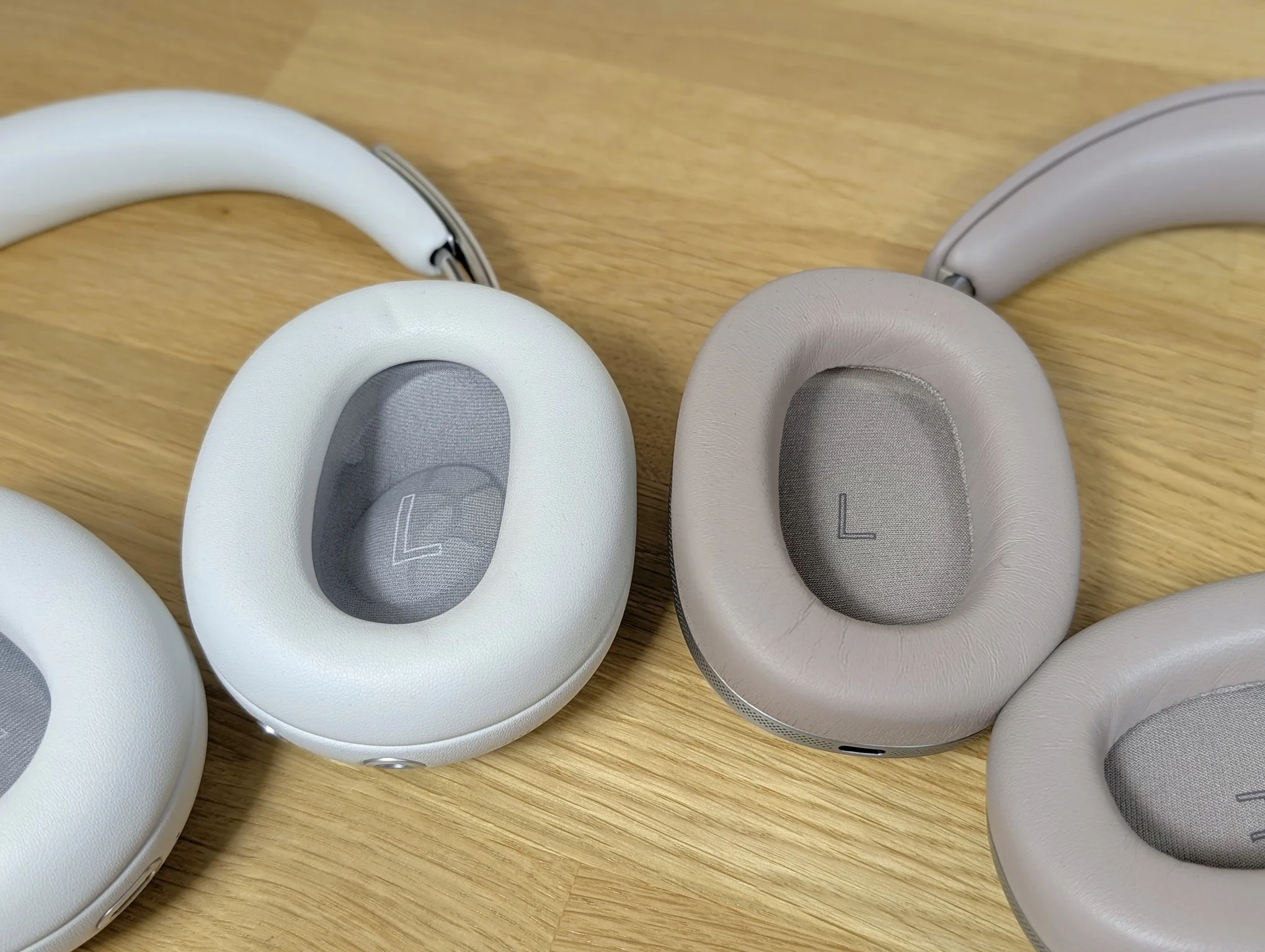
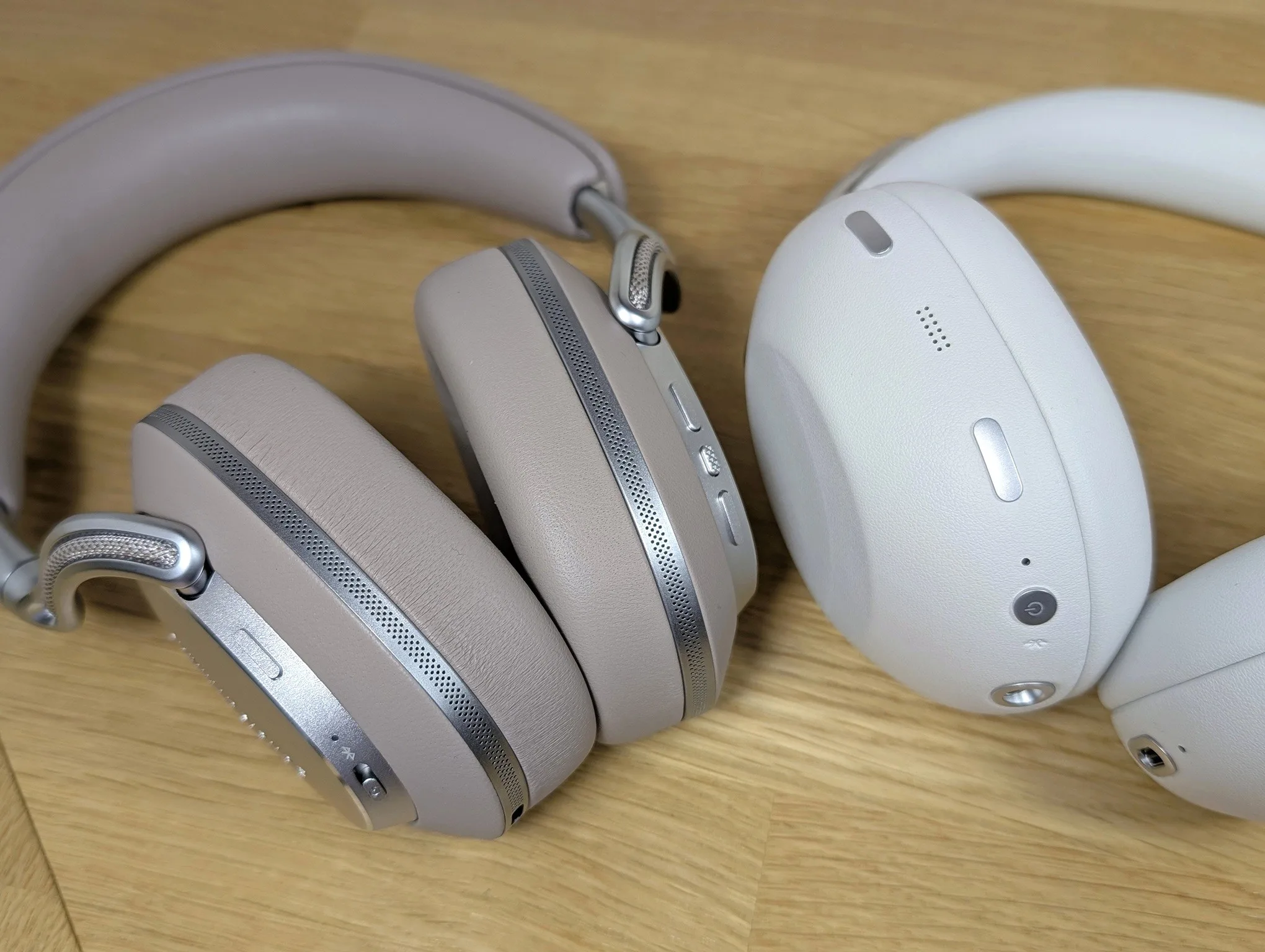
Bowers & Wilkins has established itself as a maker of premium-leaning noise-canceling headphones, so Sony can be seen encroaching on the same turf with The ColleXion. Therefore, I chose the €750 PX8 S2 as a point of comparison, as its headband is made of metal, just like Sony's. On the other surfaces, B&W had the sense to use genuine Nappa leather instead of The ColleXion's flimsier synthetic leather, making the PX8 S2 feel even more upmarket. Still, noise-canceling headphones are always about much more than just materials, so let's compare this pair in terms of key features and sound quality.
Both headphones weigh the same and perform equally well ergonomically, despite having slightly different headband designs. I can quickly dial in the fit without feeling any discomfort on my head or ears. That said, the PX8 S2 clamps harder from every angle, making The ColleXion feel a bit gentler over longer sessions without being any more prone to slipping off. Since Sony's case is also more practical and its noise cancellation clearly more effective than the PX8 S2's, The ColleXion makes for the better travel headphone. It's an added bonus that Sony's microphone isolates background noise more effectively during calls.
Sony also gets the upper hand in app features, even though its user interface is messier. Among other things, its equalizer allows for adjustments across ten different frequencies, whereas B&W's EQ is limited to just 5 channels. Some users would certainly appreciate The ColleXion's spatial audio options as well, which are similarly more versatile compared to the PX8 S2. While I criticized the 360 Upmix spatial audio for sounding unnatural, Bowers & Wilkins' own spatial audio manages to sound many times worse, serving better as a torture device. However, B&W beats its new rival in battery life by about 6 hours with noise cancellation turned on. The PX8 S2's 30-hour runtime matches Sony's WH-1000XM6, while battery life on The ColleXion has dropped to 24 hours.
On the Bluetooth codec front, the two manufacturers rely on different technologies, not least because the LDAC codec was developed by Sony itself. The PX8 S2, on the other hand, supports the AptX codec family all the way up to the lossless AptX Lossless option. When chasing maximum wireless sound quality, Bowers & Wilkins takes the win—at least in theory—as long as the source device supports AptX Lossless as well. Both headphones support the increasingly common Bluetooth LE and LC3 codec, and naturally, support for AAC and SBC is included for older devices and the Apple ecosystem.
In addition to wireless connectivity, the PX8 S2 can be listened to losslessly via a USB cable, which still isn't possible with the Sony headphones. Neither pair works passively; power must be turned on even when using the analog headphone cable. The upside to this is that the audio signal always passes through the DSP chip, keeping the manufacturer's designated sound tuning active. Unlike The ColleXion, the PX8 S2 also allows for EQ adjustments during wired use.
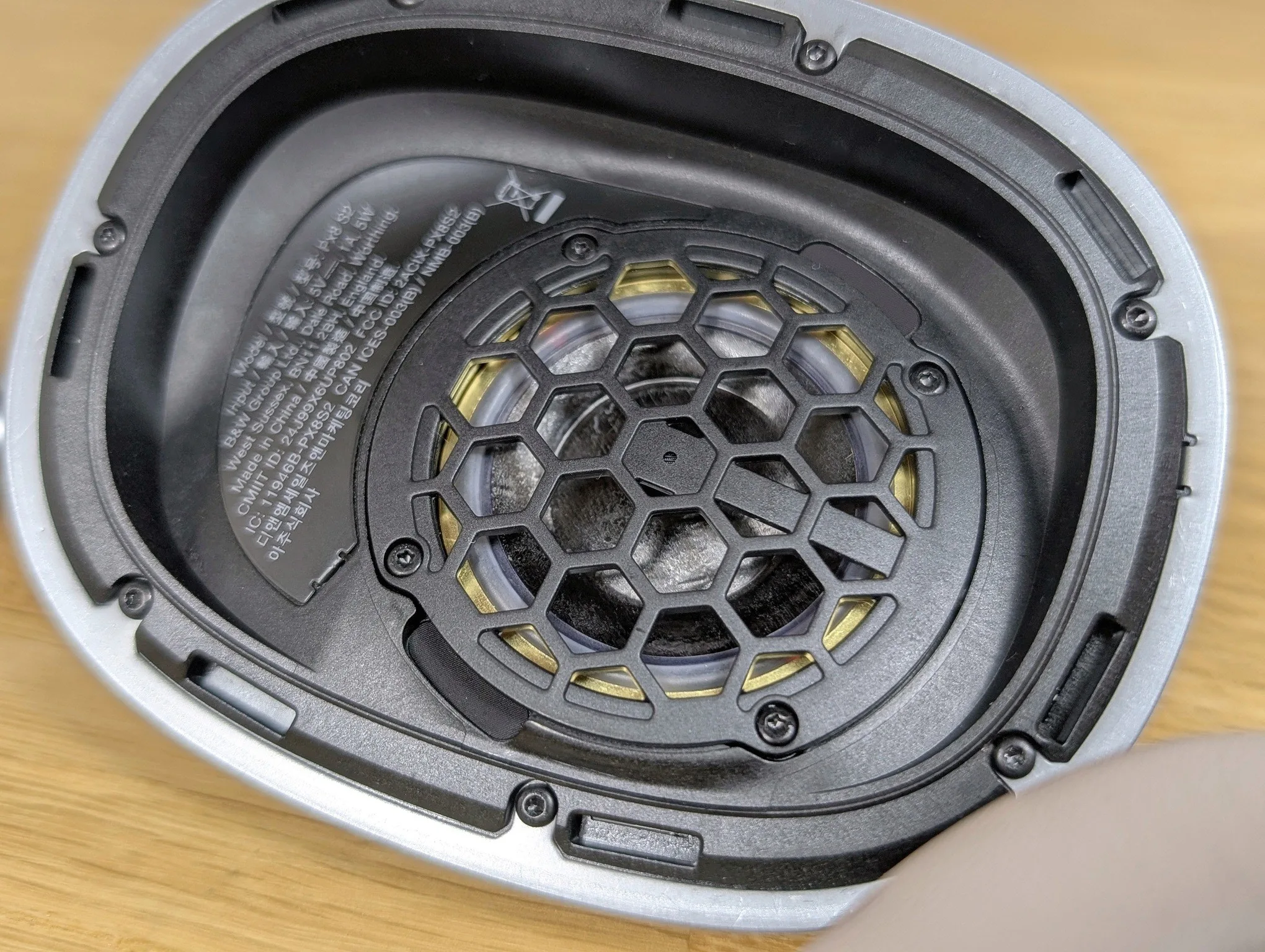
Interestingly, both manufacturers rely on carbon fiber drivers. The PX8 S2's drivers are slightly larger (40 vs 30 mm), but what plays a more critical role in sound quality is how each manufacturer has chosen to tune their headphones' sound profile. The adjustment capabilities offered by modern DSP chips are nearly limitless, so good or poor sound quality ultimately comes down to the manufacturer's expertise and the choices they make. Sony has the advantage of greater resources behind it, whereas Bowers & Wilkins has the opportunity to position itself closer to the audiophile market.
Frequency responses:
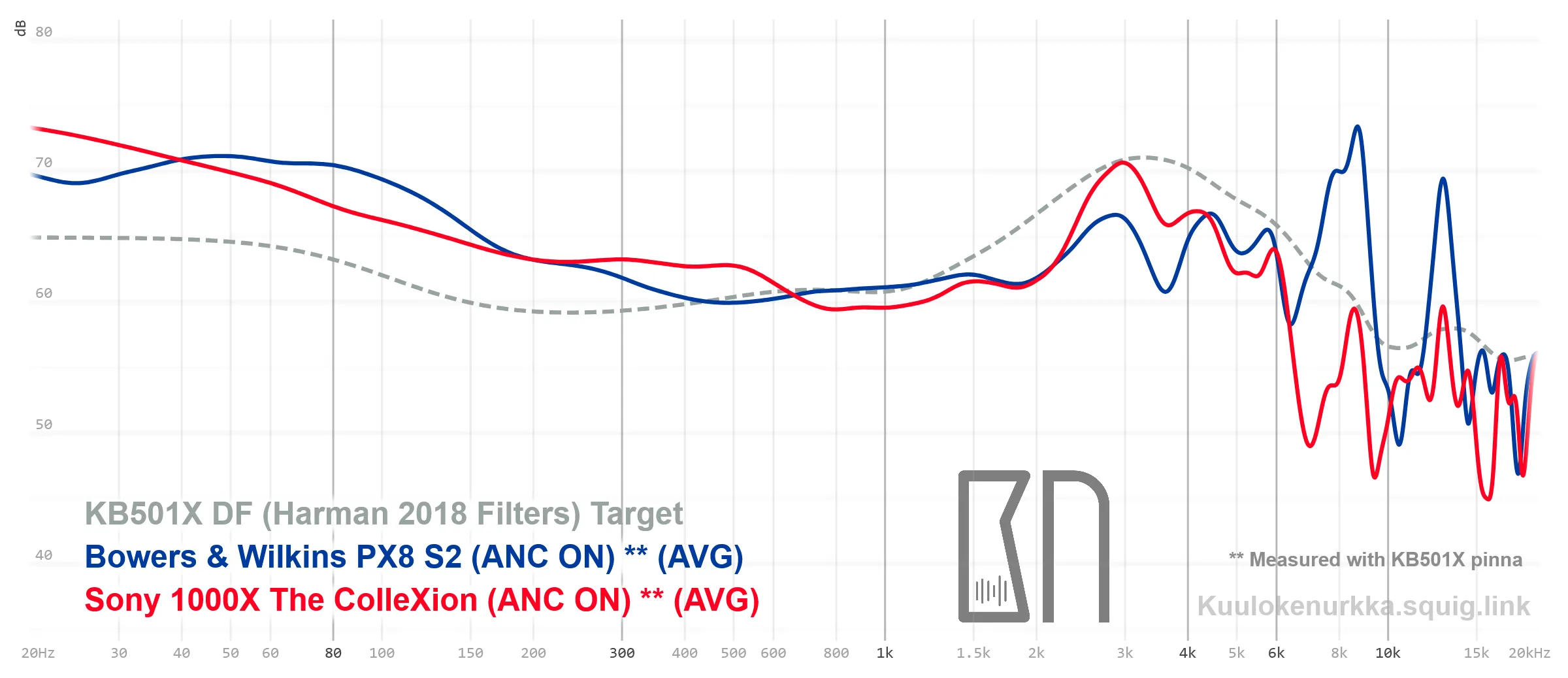
The PX8 S2 barely differs in sound from the more affordable PX7 S3; Bowers & Wilkins has tuned both to be aggressive and V-shaped. The bass thumps hard in the foreground while harsh treble peaks draw attention to themselves. The sharp and metallic sound reminds me of Beyerdynamic's cold-leaning studio headphones, which exhibit similar steep treble spikes. In Bowers & Wilkins' new models, these peaks are among the most brutal on the market, so the target audience is likely an older demographic whose high-frequency hearing isn't what it used to be.
When I listen to the PX8 S2, it consistently emphasizes vocal sibilance and makes cymbals sound unnaturally splashy. The bass is also visibly bloated, though it hits with a bit more separation than on the Sonys. Some advantages over The ColleXion would be the PX8 S2's airier presentation and a certain sense of spaciousness. If someone enjoys a dynamic character and extremely bright treble, listening to the PX8 S2 might actually be significantly more engaging compared to The ColleXion. In a way, the Bowers & Wilkins headphones fake higher detail retrieval simply because the high frequencies are so unnaturally exaggerated.
In Sony's headphones, my attention goes straight to the overly thick low end, especially with the treble being reproduced more laid-back than average. The difference in brightness between this pair from 6 kHz onward is massive, in places even exceeding 15 dB. Thanks to its more relaxed and smoother sound, I could listen to The ColleXion for longer sessions. The headphones also try to sound somewhat natural, unlike the PX8 S2, which forces you to forget what music is actually supposed to sound like. On the other hand, neither model offers particularly clear midrange presentation out of the box, so which coloration suits your preferences better ultimately comes down to personal taste. If you prefer the unapologetic V-shaped sound of the PX8 S2, I feel the PX7 S3 would achieve the exact same thing. However, neither of these Bowers & Wilkins headphones delivers the warm character of The ColleXion, so consumers at least have clear alternatives to choose from.
Personally, I can't stand the PX8 S2—or at least I don't see the value in it—because placing drivers inside closed cups without fine-tuning the frequency response usually yields this exact outcome: boomy upper bass and wild structural peaks in the treble. Sony's WH-1000XM6 also follows this trend to a degree, whereas with The ColleXion, the manufacturer actually seems to care a bit more about the end result. Thanks to that, the tables turn in Sony's favor once you start equalizing the headphones.
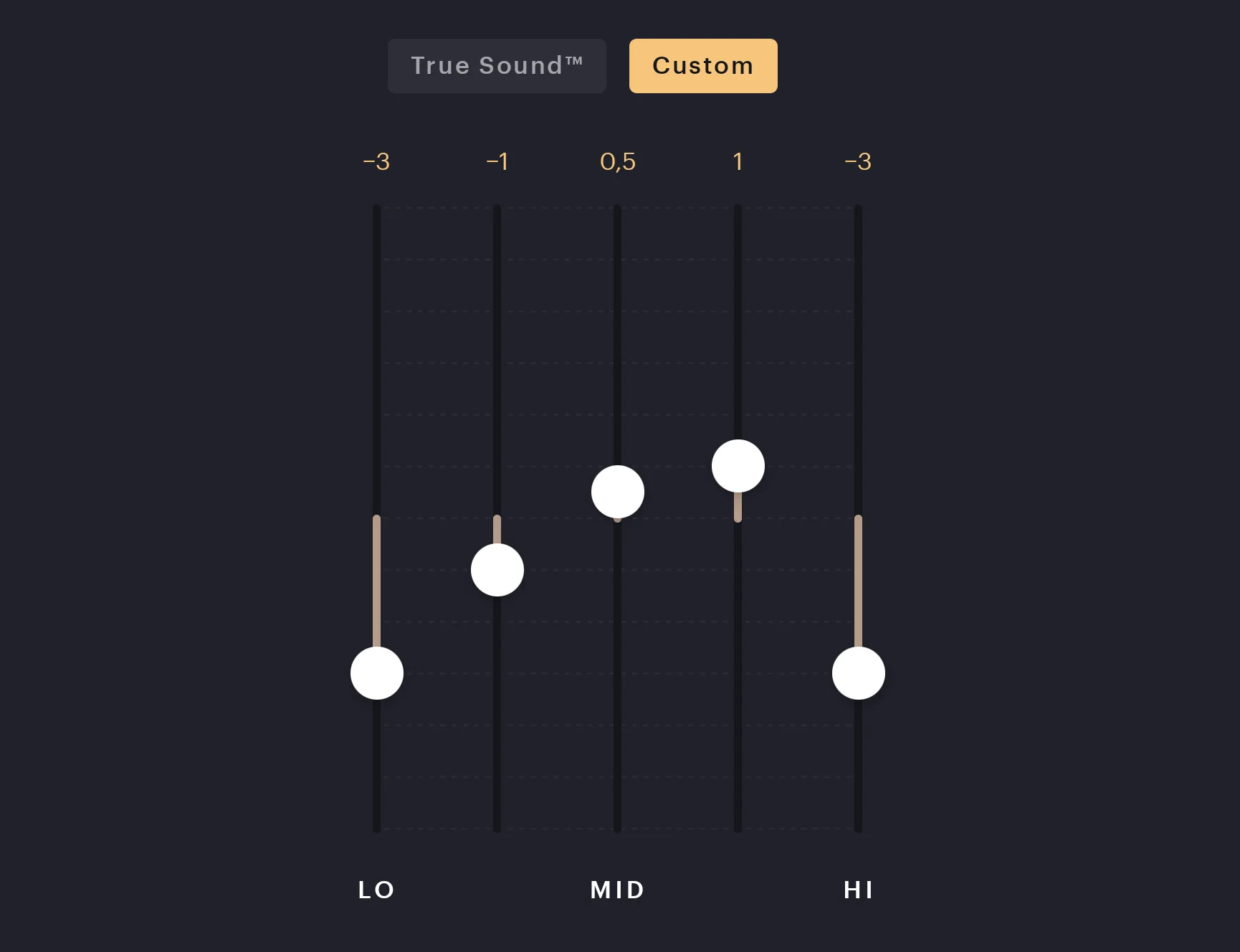
The treble peaks on the PX8 S2 cannot be corrected with the tool provided by Bowers & Wilkins, nor can I get the sound to be as balanced and refined as on The ColleXion, whose more linear tuning pairs quite well with Sony's built-in equalizer. With the settings shown in the image below, the PX8 S2 does sound slightly more natural than out of the box, but in practice, I still wouldn't want to listen to it over the EQ'd Sonys. Ultimately, the main advantages of the Bowers & Wilkins headphones come down to genuine leather materials, USB audio support, and a slightly longer battery life. Otherwise, I feel Sony has executed the premium category better, and their headphones are more affordable to boot.
Summary
Ultimately, the Sony 1000X The ColleXion anniversary edition proved to be quite a straightforward product. The manufacturer clearly wanted to create a more premium noise-canceling headphone that retains the versatile features and core technology familiar from the WH-1000X series. The elevated design, metallic headband, and improved comfort are indisputably the high points of this new model—Sony genuinely avoided the XM6's shortcomings regarding material choices and fit. The headphones look, feel, and (once EQ'd) sound good.
However, mixed in with the improvements are a few regrettable drawbacks and missed opportunities. Battery life is a notch shorter than before (though not to a critical degree), and audio still cannot be played directly over a USB cable. The new 360 Upmix spatial audio doesn't add much value either, sounding unnatural with music. Furthermore, time will tell how the synthetic leather on the ear cups holds up; no manufacturer has yet developed a synthetic material that doesn't eventually crack over the years—which would be a real shame for a luxury product in this price bracket. When it comes to long-term material durability, headphones from brands like Bowers & Wilkins feel like a somewhat safer bet, even if the original PX8 had its own issues with the headband leather adhesive peeling. Paradoxically, the most durable headphones are likely to be found outside the premium tier altogether.
So, is The ColleXion worth its €650 price tag? In daily use, its flaws have bothered me less than I expected. At the same time, effective active noise cancellation and comprehensive features keep the headphones ahead of many competitors. Most of us will do fine with more everyday noise-canceling headphones in the €200–€400 range, such as Sony's own WH-1000XM6, but The ColleXion is aimed at those who are willing to pay extra for luxury and a touch of exclusivity. Since Sony's flagship is a well-rounded package despite a few setbacks, I would ultimately find it quite easy to recommend among premium-priced wireless headphones. The manufacturer still has work to do, but each time, they give me less reason to criticize.
On behalf of Kuulokenurkka, I give Sony's headphones special recognition for their build quality and comfort. However, The ColleXion doesn't quite make it to our Wall of Fame as it stands, because the out-of-the-box sound quality would need to be better at this price point. Alternatively, Sony should offer a preset EQ profile in their app for a more balanced listening experience. I think that's something we can reasonably expect at 650 euros, especially given that the manufacturer involves music industry professionals in product development. Moving forward, I still hope to see improvements in this area. Furthermore, considering the resources of a company Sony's size, I would be delighted to see lower-priced models in the 1000X series feature a build as durable and comfortable as The ColleXion in the future—minus the expensive embellishments, of course
Pros and cons:
+ More natural sound compared to WH-1000XM6 (with minor reservations)
+ Good sound quality when equalized
+ Finally, Sony's headphones feel high quality and durable
+ Clearly better comfort than XM6
+ Effective noise cancelling function and clear transparency mode
+ No background noise
+ Microphone's better than usual sound quality in a noisy environment
+ Versatile software and additional features
+ Practical case
+/- No charging cable included
+/- The cups' faux leather surface feels nice, but it may wear out or crumble
+/- The GMAP game profile is an important game changer, even though hardly any devices supporting it can currently be found on the market
– Overly strong low frequencies make the music sound muddy and unclear
– Unnaturalness of 360 Upmix spatial audio
– No USB listening capability
– Equalizer and other audio settings only work with Bluetooth
– App's messy user interfaceand poor Finnish translation
– Unimpressive battery life compared to many competitors
– Unresponsive buttons
 EN
EN  FI
FI
Jännä EQ B&W:ssä, omiin korviini juuri ylimmät keskitaajuudet (-1,5) olivat aivan liian kovalla, diskantit eivät varsinaisesti omiin kolmekymppisen korviin tuntuneet erityisen terväviltä (-1).
Korvia on erilaisia ja itse käytän noita PX8 S2:sia enemmän/mieluummin kuin johdollisia ZMF:iä ja Hifimanejani. Täytyy joskus kokeilla Sonyjä, vaikka aiemmista en olekkaan tykännyt ollenkaan.
Tietyssä käyttöasennossa (eli myös anatomiasta riippuen) uusimmat B&W-mallit voi korostaa yläkeskitaajuuksia, joten ymmärrän tällaiset erot hyvin. Oma kuuloni toimii pääpiirteittäin melko vastaavasti kuin mittauslaitteistoni, minkä vuoksi kyseiset taajuudet vaati pienen voimistuksen ja diskantti puolestaan reilummin miinusta. Makuasioitahan nämä myös on, ja hiljaisemmalla äänenvoimakkuudella diskantti korostuu joka tapauksessa vähemmän ja saakin kuulua hieman koholla.
Bowers & Wilkinsin taajuuskorjaimessa liukusäätimet saisi sijaita fiksummissa paikoissa. Laitoin keskelle plussaa myös sen vuoksi, että diskantin vähentäminen vähensi myös yläkeskitaajuuksien kuuluvuutta. Plussat ja miinukset tavallaan taistelee toisiaan vastaan, eikä taajuuskorjaus toteudu ihan sellaisena kuin pelkkiä säätimiä katsomalla voisi olettaa. Mittauslaitteella aloitin korjailun, jotta pääsin oikeaan suuntaan ja ymmärsin, mitä taajuutta mikäkin säädin säätää. Harmillisesti en kylläkään näytä kirjanneen tätä infoa itselleni ylös, kun oli muuttohommat kesken ja kuulokkeet meni jo palautukseen.