Author: Sword of Damocles
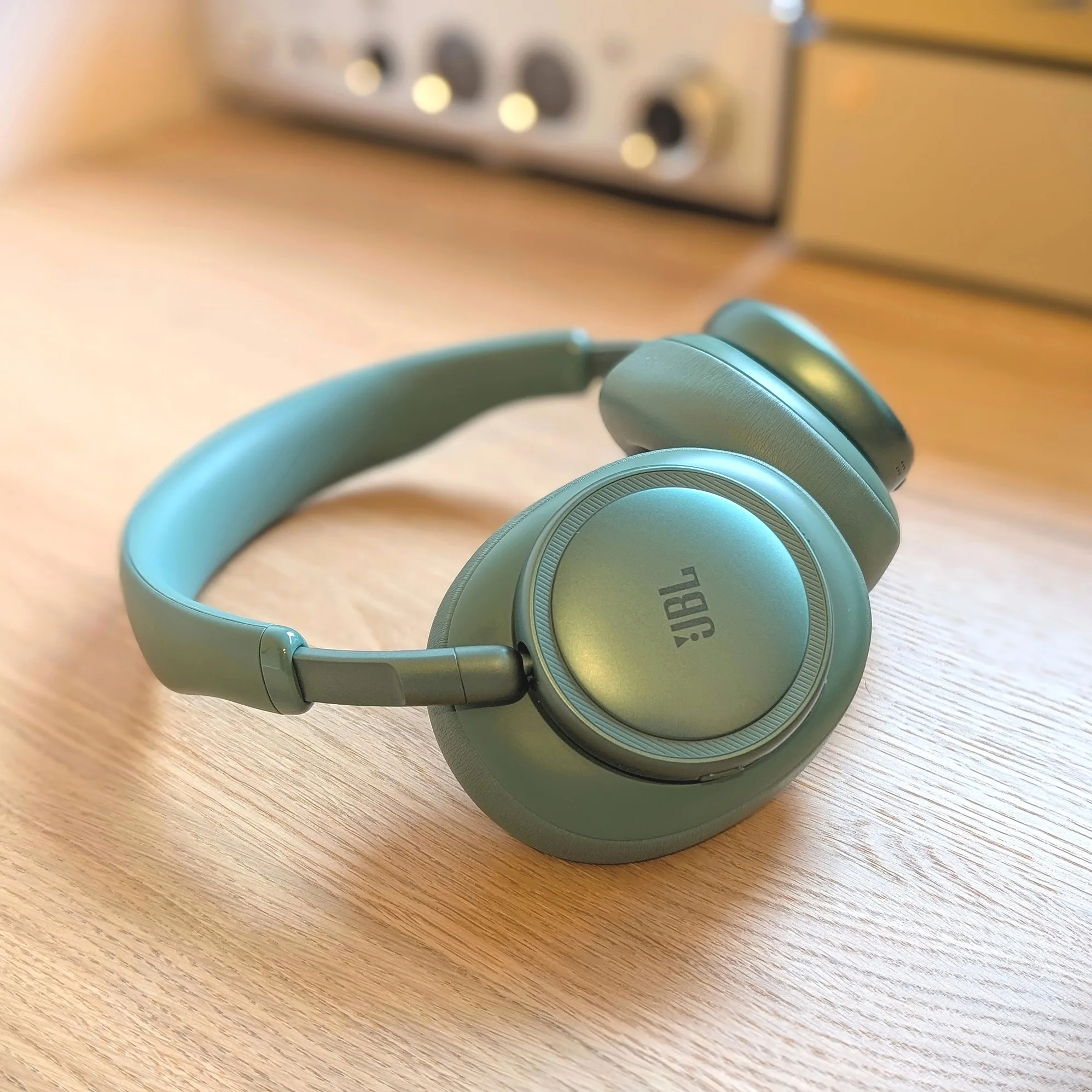
Table of Contents:
Information:
- Release year: 2026
- Country of Origin: China
- Color options: Black, white, sand, green, blue, orange and purple
- Price: 200 € (for now at its cheapest 129 €)
- Available in Finland: Yes
- Type: Closed, over-ear
- 40 mm dynamic elements
- Audio connections: Bluetooth 6.0 and USB-C (only analog audio signal)
- Bluetooth codecs: LDAC, LC3 (Bluetooth LE Audio), AAC and SBC
- Charging port: USB-C
- Battery size: 870 mAh
- Battery life (ANC ON/OFF): 50 / 80 h
- Talk time (ANC ON/OFF): 28 / 33 h
- Charging time: 2 h (Supports fast charging: 5 minutes for 4 hours of usage time)
- Active Noise Cancellation: ON / OFF / Transparency mode
- Weight: 260 g
- Features: Multipoint, Google Fast Pair, voice assistant (Google Assistant/Siri/Alexa), ear sensor and versatile phone app with equalizer
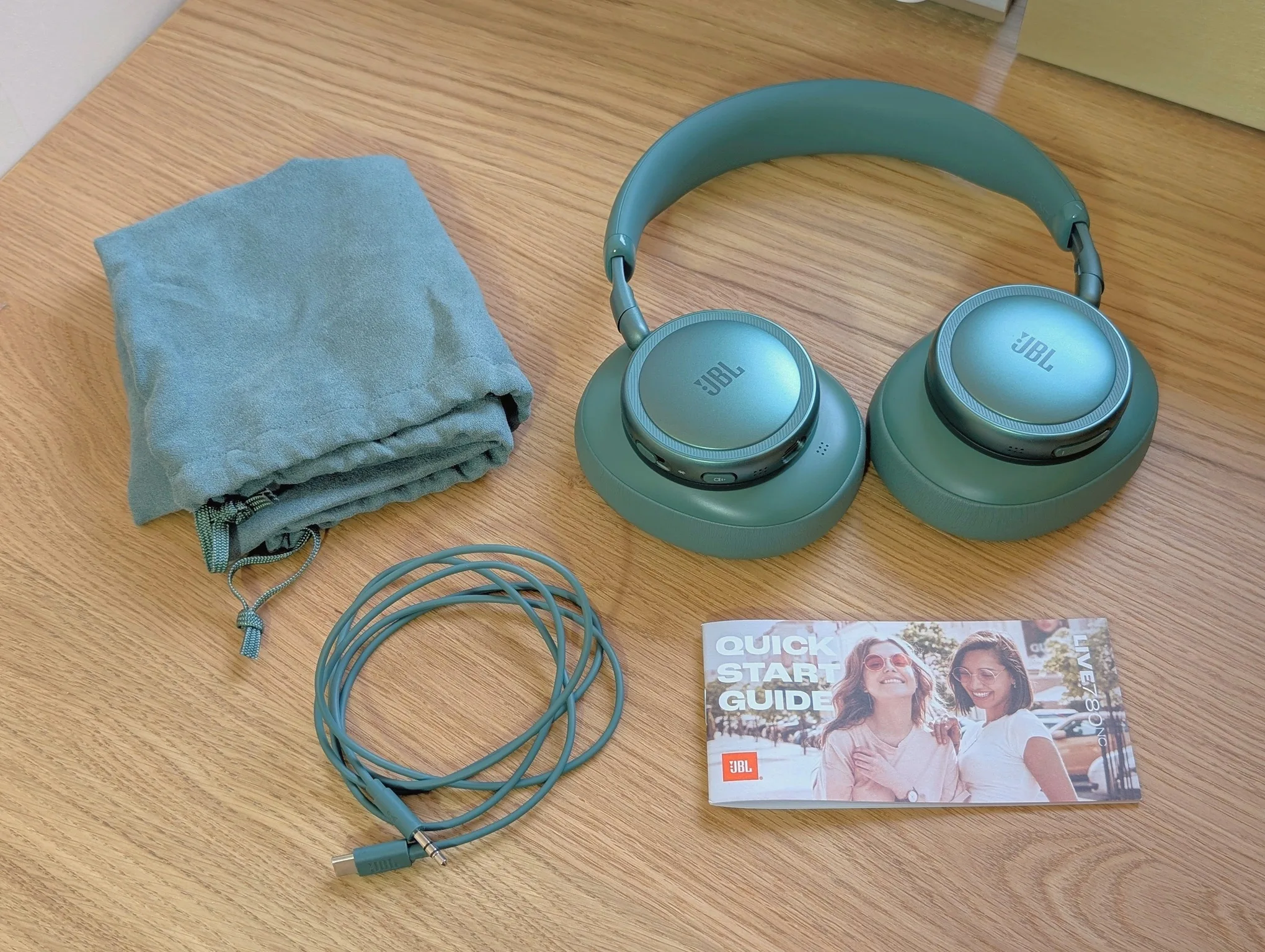
- Accessories: Fabric pouch and USB-C–3.5 mm headphone cable (1.2m)
- Warranty: 24 months
Review sample: Self-purchased product
JBL, owned by Harman International (and ultimately Samsung), is a staple on the audio shelves of general retail stores. If a department store carries headphones at all, chances are you'll find JBL front and center. Yet there's no reason to scoff at the brand: backed by genuine audio expertise, JBL's offerings are often far better purchases than their mass-market reputation might suggest. I proved this to myself when reviewing the roughly 50-euro Tune 770NC, and aside from a flimsy build, I couldn't find much to complain about with the pricier Tour One M3(currently around €250) either.
I haven't tested JBL's mid-tier Live lineup until now, so I'm diving in with the Live 780NCreleased in 2026. The MSRP for this model sits at 200 euros, but less than six months post-launch, it is routinely found on sale for around 180 euros, with street prices dipping as low as 130 euros. JBL offers an impressive selection of seven different colorways, and for on-ear enthusiasts, there is also the smaller Live 680NC sibling.
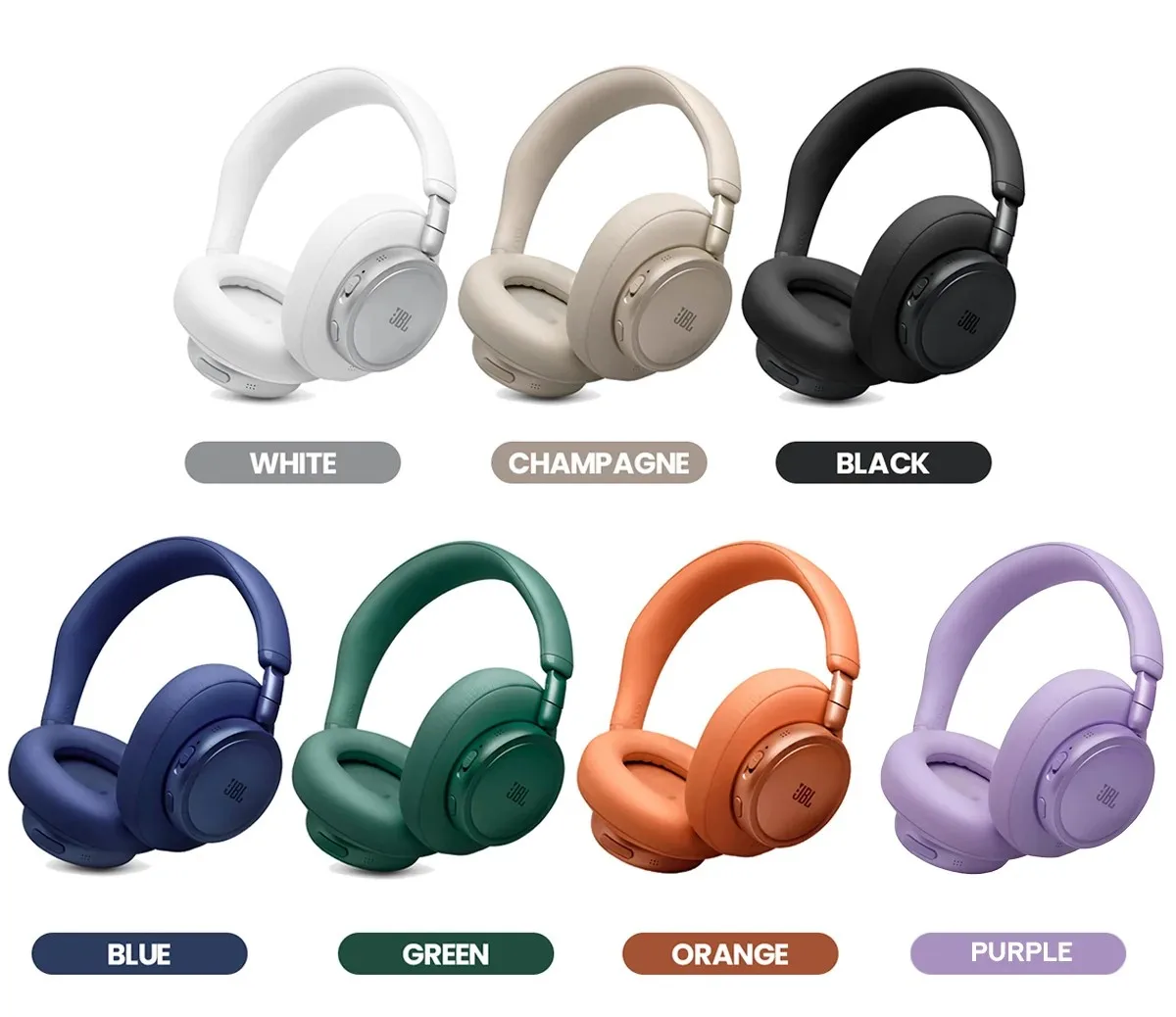
Unlike the preceding Live 770NC, the new model bears a noticeable visual resemblance to the AKG N9 Hybrid, which is designed under the same parent company. However, the AKG feels like a business-oriented product in its feature set, whereas the Live 780NC makes a more youthful impression with its variety of colorways. This reflects how Harman International aims to position its brands to avoid competing too directly with one another. According to rumors, Samsung is also working on its own over-ear headphones, so it remains to be seen how those will differentiate themselves from AKG and JBL's offerings.
Packaging and accessories
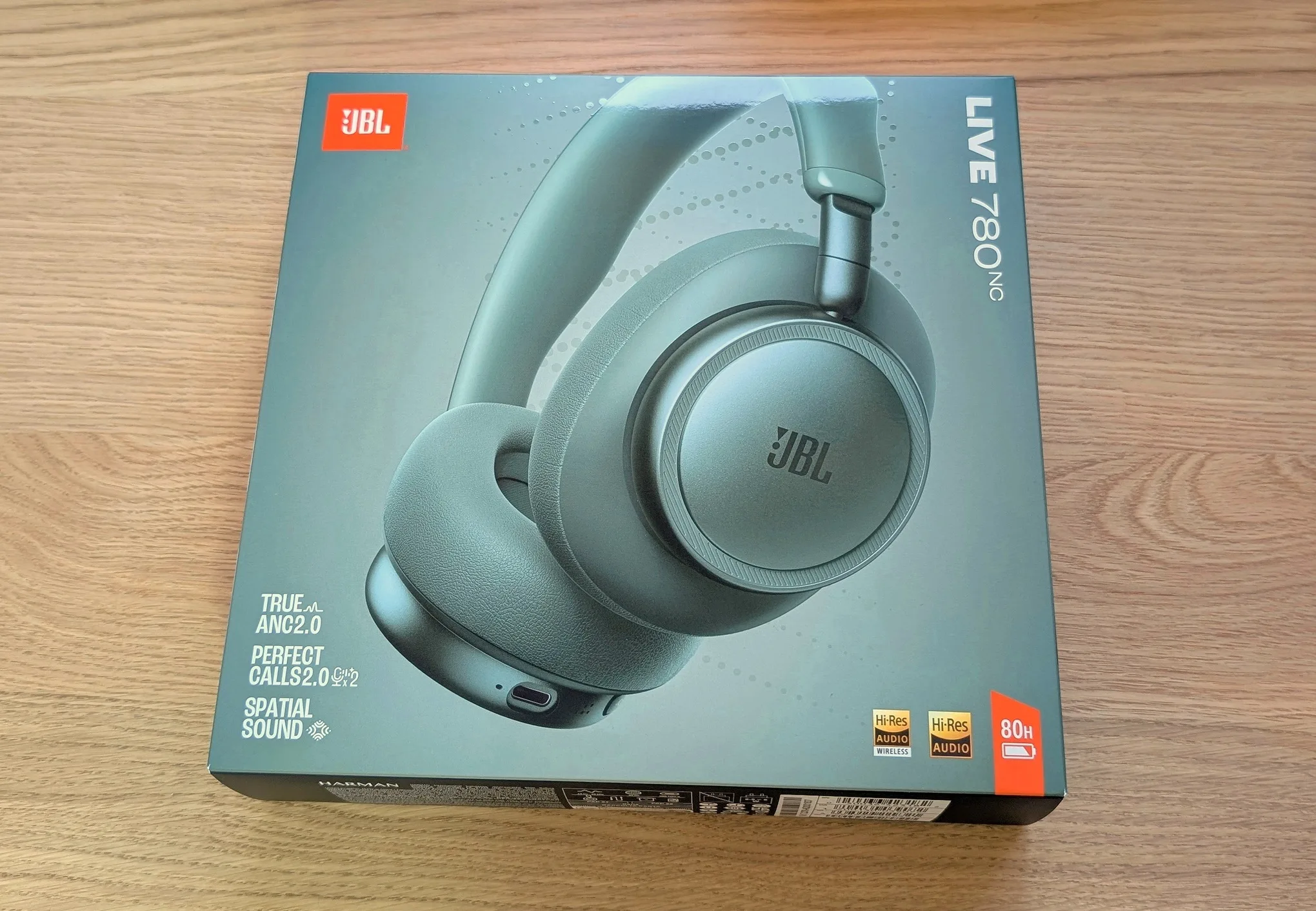
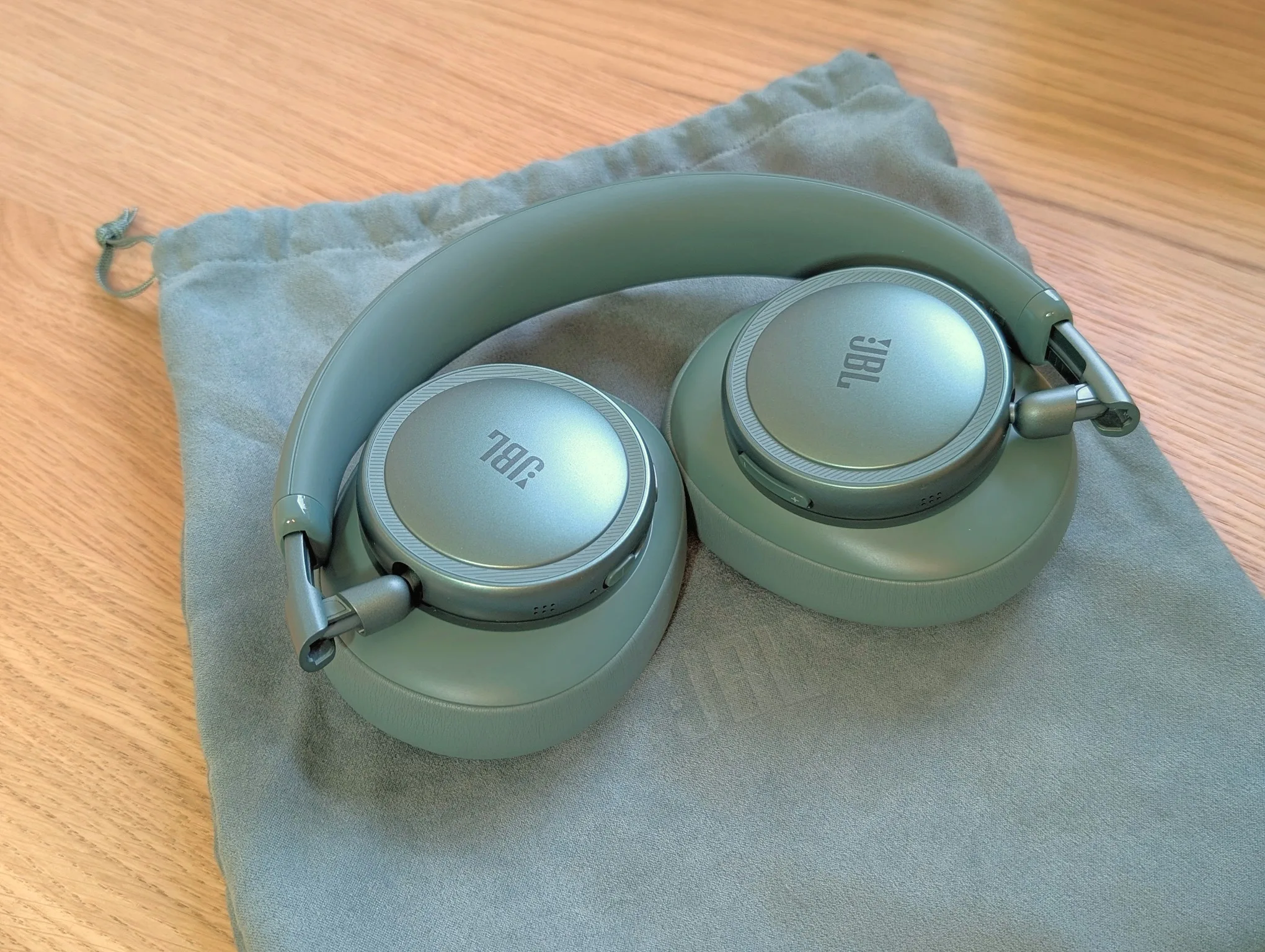
Black or white headphones would have felt a bit plain, so I opted for the more interesting green colorway offered by JBL. This choice brings a welcome splash of color right across the board—from the retail box design and all included accessories to the overall look of the companion app. Still, the unboxing experience is by no means luxurious, as the packaging remains minimal and as eco-friendly as possible.
In addition to the headphones slipped into their fabric pouch, buyers get a relatively rare cable that plugs into the earcup via USB and into the audio source with a 3.5 mm jack. This allows listening from an analog audio source, provided the power is switched on. Following the Sony 1000X The ColleXion , the Live 780NC is already my second pair of noise-canceling headphones in a row that doesn't ship with a charging cable. This seems to be a new trend we will just have to get used to.

A more surprising omission is the lack of a hard carrying case, which is usually standard fare for 200-euro products. Because of this, the Live 780NC doesn't quite feel tailored for its MSRP, but rather trimmed down with sales and lower street prices in mind. You could also call it aggressive cost optimization. A fabric pouch certainly does the job around the 130-euro mark, but even then, competitors like the Sony ULT Wear and Edifier WH950NBinclude a proper case.
Build and comfort
The Live 780NC follows fairly conventional noise-canceling headphone design. The build reveals no major innovations, but no significant flaws either. Similar to the AKG N9 Hybrid , the OEM manufacturer behind this JBL model may be Cosonic, as both closely resemble the Soundcore models it produces, such as the Space Q45.
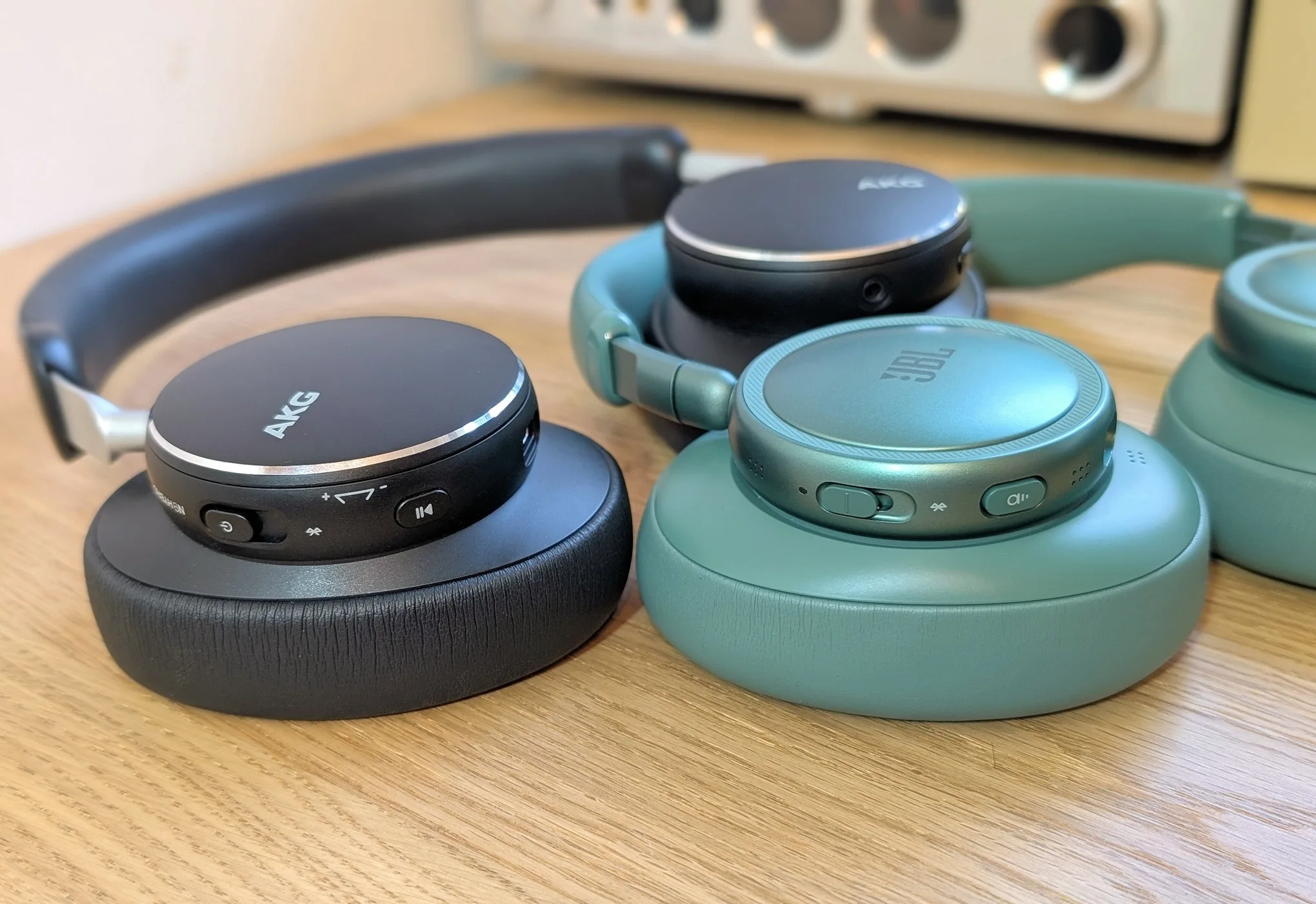
Overall, the Live 780NC looks slightly better than it feels in hand. Despite the metal headband and decent plastic materials, the stepped height adjustment feels somewhat loose, and there is very little resistance when swiveling the earcups. A touch of mechanical play can certainly be forgiven at this price point, but it is precisely these finer details where higher-end models typically set themselves apart. On the other hand, the Live 780NC doesn't feel cheap, even though it weighs just 260 grams. Nor would I be concerned about long-term durability, as the headband hinges—often considered a potential weak point—are made of metal. In fact, the overall build quality surpasses even JBL's more expensive Tour One M3, which feels distinctly more plastic and toy-like by comparison.
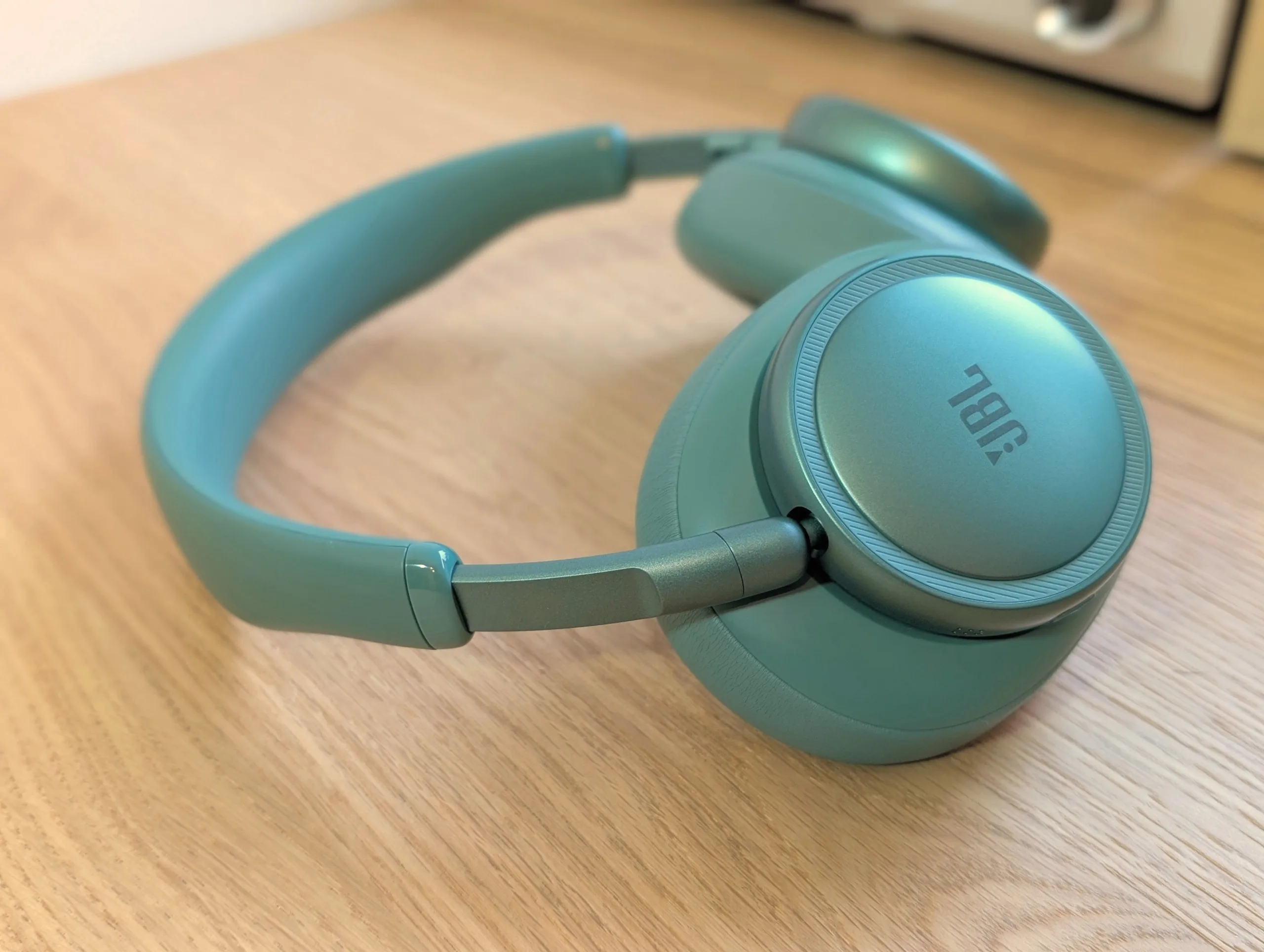
On my head, the Live 780NC clamps evenly, though fairly tightly from the sides. Thanks to this, the headphones stay securely in place even during more active movement, and their weight doesn't rest heavily on the thin headband. Although the headband padding at the crown is sparse, the implementation works well for me. The most comfortable part of the headphones is the memory foam earpads (inner cup dimensions: 58 x 38 x 20–25 mm). As usual, their surface is made of synthetic leather prone to wear over time, so the ability to replace the pads earns a clear bonus point. Hopefully, replacement earpads will eventually become available in all colorways. The rubberized headband padding, on the other hand, likely won't need replacing as quickly, assuming it is even possible.
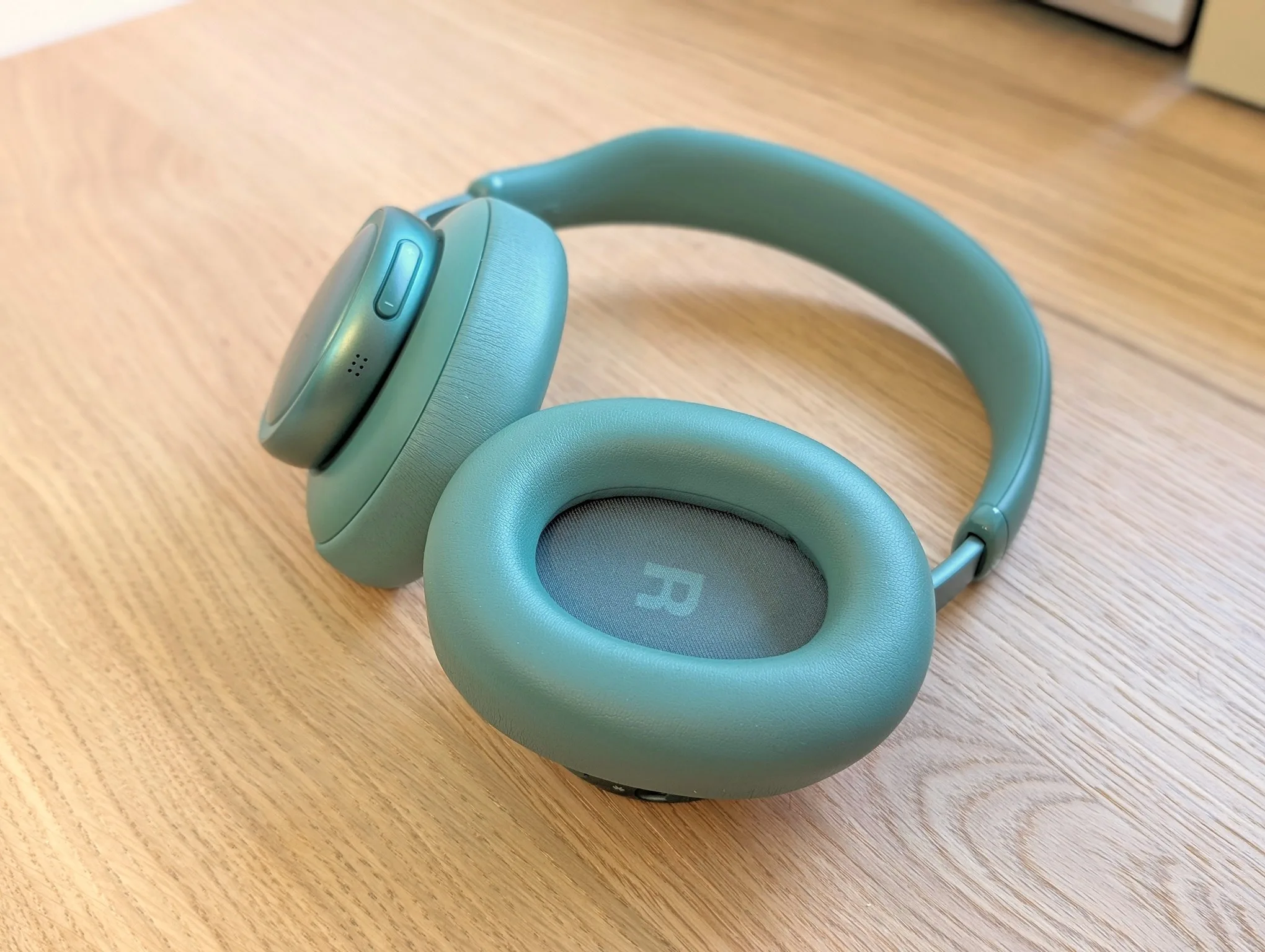
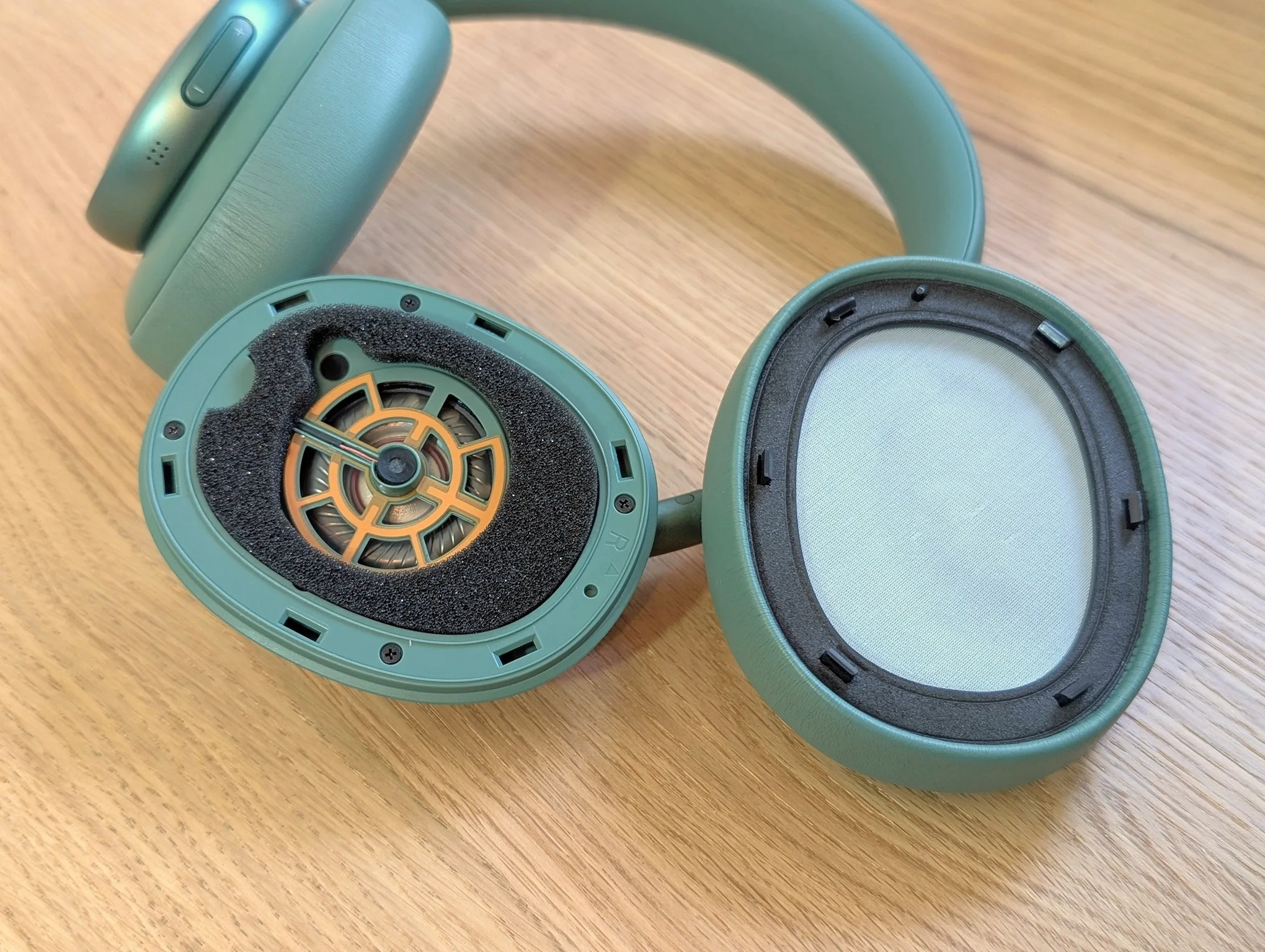
Considering its sleek and compact footprint, the Live 780NC delivers a solid level of wearing comfort. In this category of headphones, aesthetics are often prioritized over ergonomics, but JBL has managed to steer clear of the worst pitfalls, such as an overly stiff headband or cramped earpads.
Controls and functions
The Live 780NC is controlled using both physical buttons and touch gestures. I really like the buttons placed along the rear edge of the earcups; despite their smooth finish, they are sufficiently large and well-positioned. The sliding power switch/Bluetooth pairing button also earns a thumbs-up compared to the power buttons on many other headphones, which require holding them down for several seconds. Who has time for that?
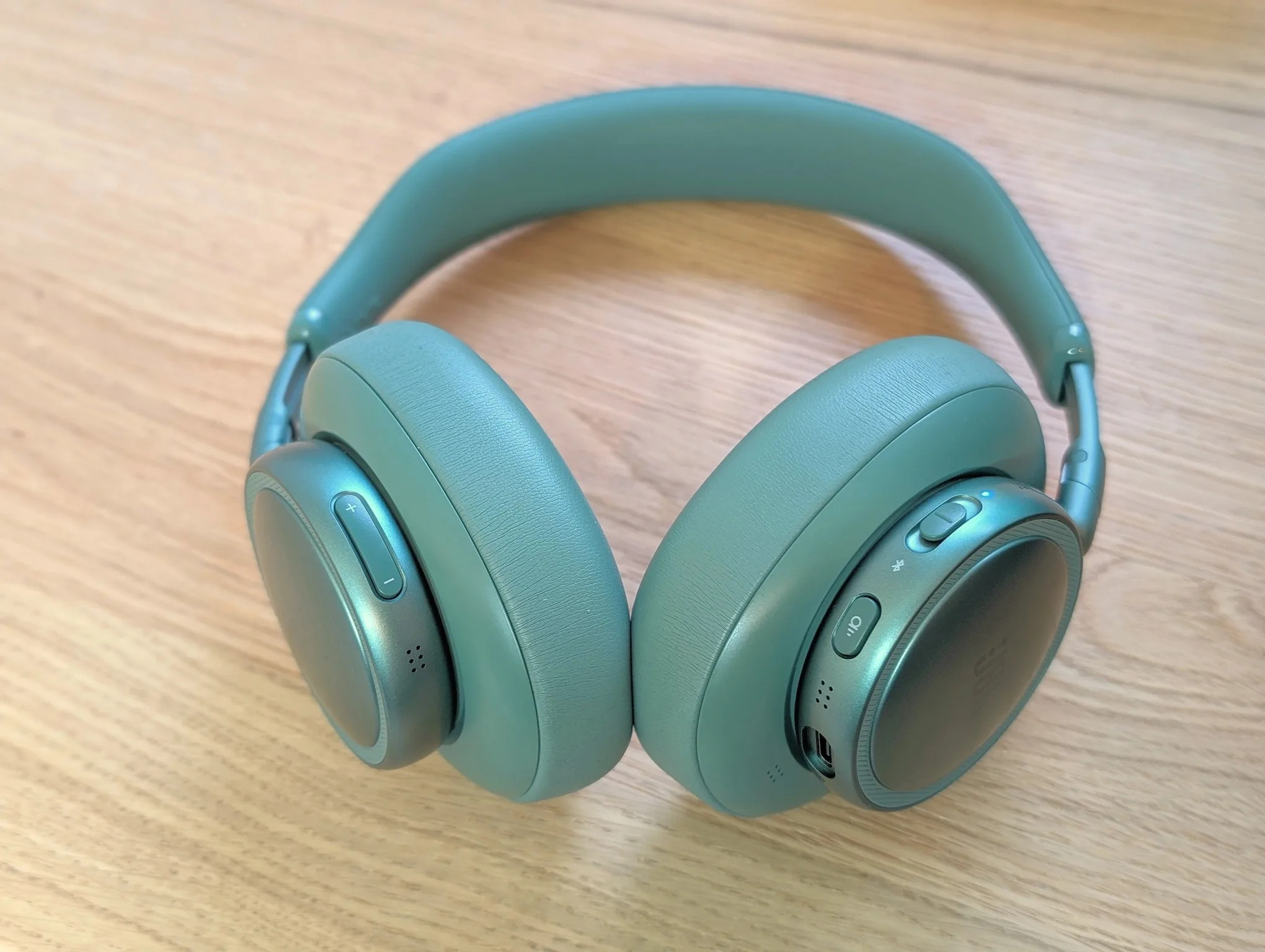
Media controls and call management are handled by touching the right earcup. However, gesture responsiveness can be somewhat hit-or-miss due to the small touch-sensitive area. I've found that the most reliable method is covering the earcup with your entire palm to ensure every input registers. On the flip side, the conservative touch sensitivity has its advantages, as accidental triggers rarely happen when gripping the edges of the earcups.
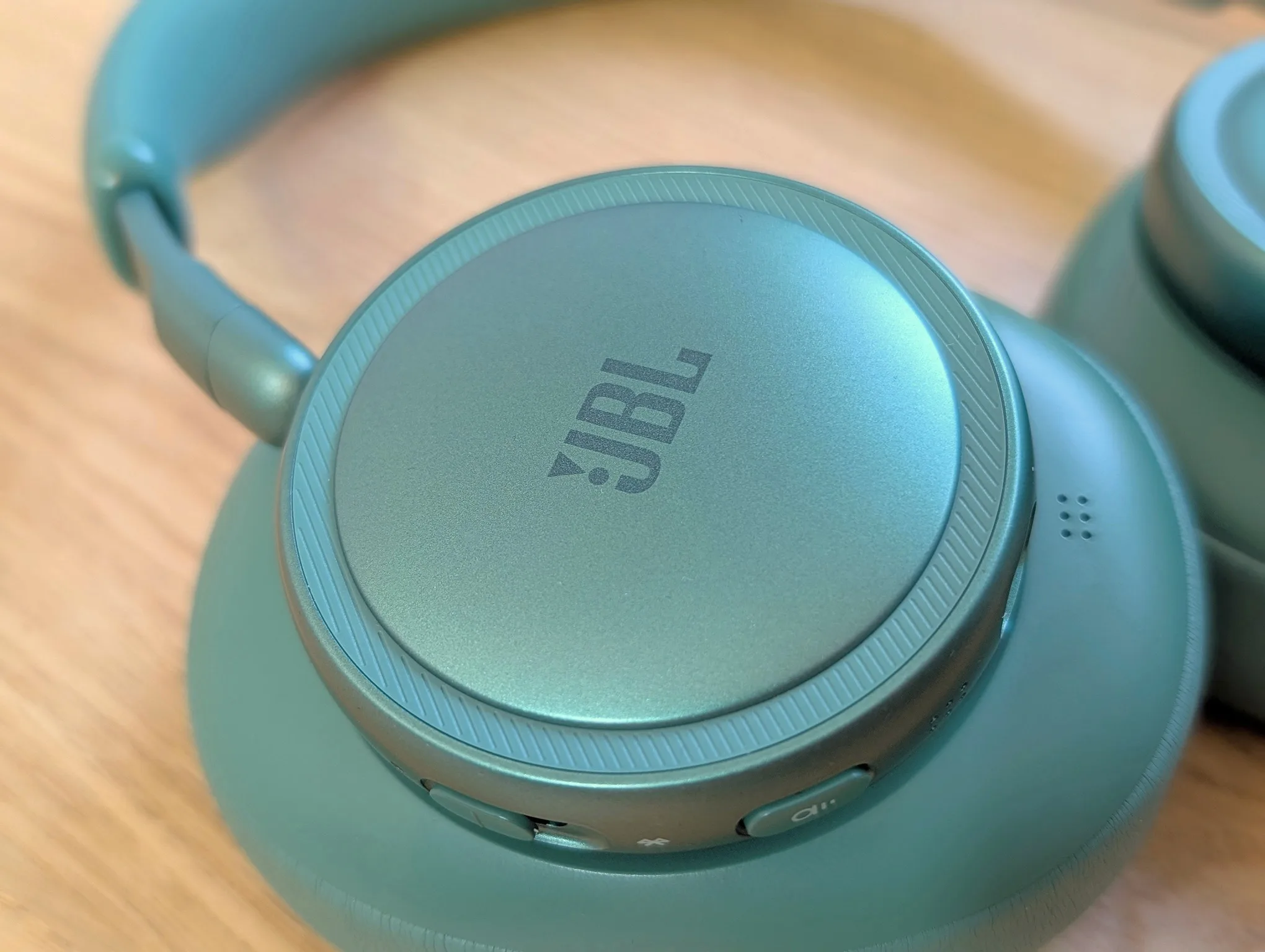
The Live 780NC also features a wear sensor that reliably pauses playback whenever the headphones are removed. I experienced sensor-related playback stuttering only a couple of times during the testing period, and even then, the issue was easily resolved by slightly adjusting the position of the headphones on my ears.
Bluetooth technology and battery life
Just a couple of years ago, the 100–200 euro price range frequently featured outdated Bluetooth tech with only basic codec support, but the Live 780NC proves times have changed. Bluetooth 5.3, high-quality LDAC codec support, and Bluetooth LE Audio integration (LC3 codec & Auracast) rival even the most expensive flagship models on the market.
Multipoint connectivity and Google Fast Pair also function flawlessly, and I haven't experienced any dropouts. On the contrary: the Live 780NC is the first headphone so far that maintains a stable connection with my Google Pixel 9 phone at the maximum LDAC bitrate (990 kbps), provided I stay within a radius of about 8 meters. Most other headphones stutter every couple of seconds under the same conditions, forcing a lower transmission quality. With adaptive LDAC bitrates, the JBL model's wireless range proved exceptionally broad, suggesting an above-average Bluetooth receiver or particularly strong synergy with my Pixel.
Similarly, the battery life of the Live 780NC is impressive. JBL promises up to 50 hours of playback with ANC turned on and a staggering 80 hours with it off. Talk time is rated at 28 hours with ANC and 33 hours without. Based on my testing period, these figures are easy to believe, even if codec choice and listening volume alter real-world results by a few hours either way. The headphones house an 870 mAh battery that charges fully in two hours, while a quick five-minute charge yields four hours of additional playback time.
When out of power, the headphones cannot reproduce sound at all, as they lack an analog jack supporting passive operation. Since there is no mention of battery serviceability, the product's lifespan will inevitably be shorter compared to traditional wired headphones.
Mobile application and additional features
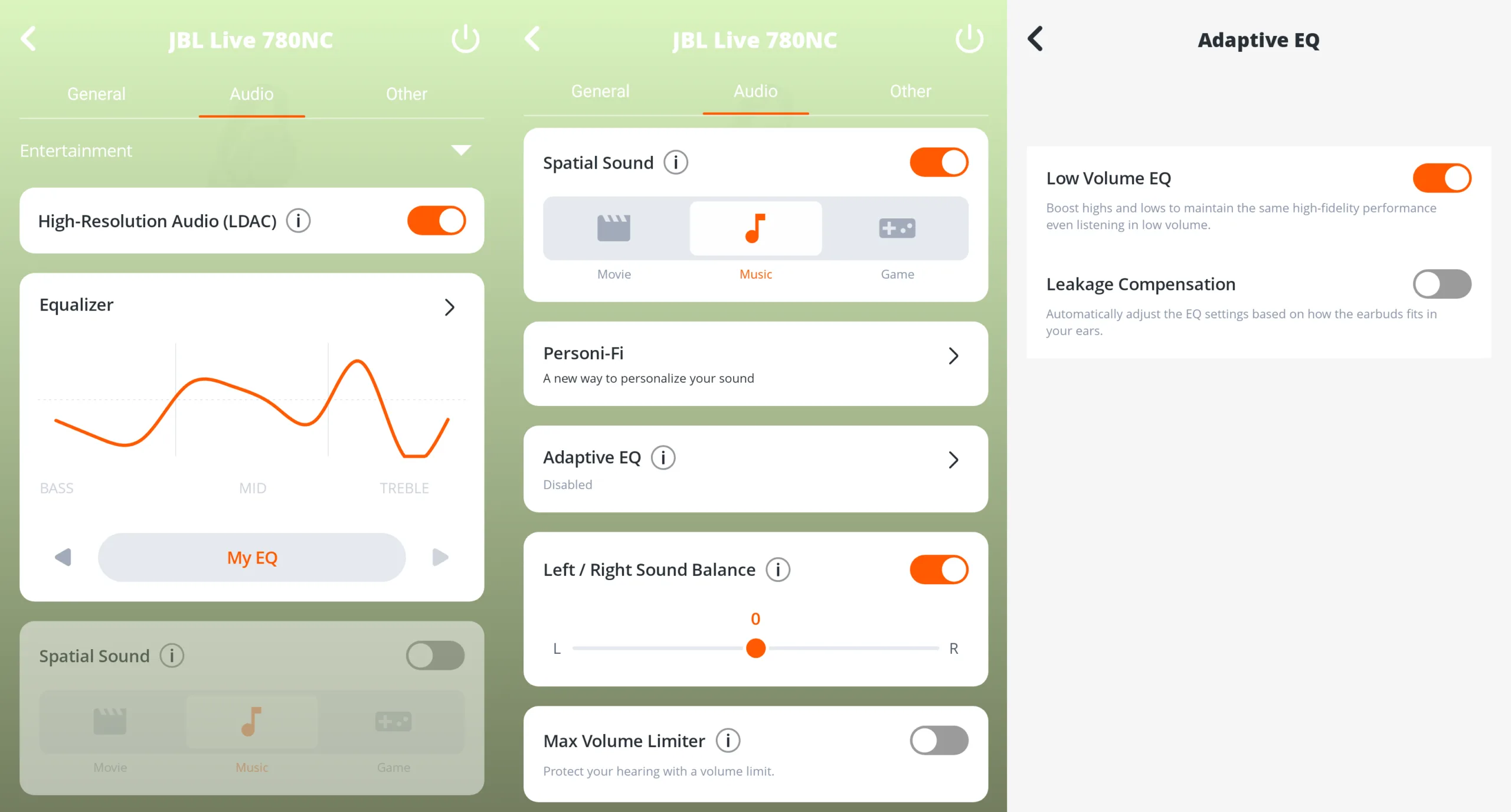
An affordable price point has never limited JBL on the software side; their mobile apps have consistently offered a broader range of customization than usual. That same approach carries over to the Live 780NC. Beyond standard features—such as adjusting ANC and transparency modes, wear detection, button remapping, and auto-power off—you get extensive control over both the audio profile and the microphone settings. In my opinion, the app's interface is clean and intuitive as well.
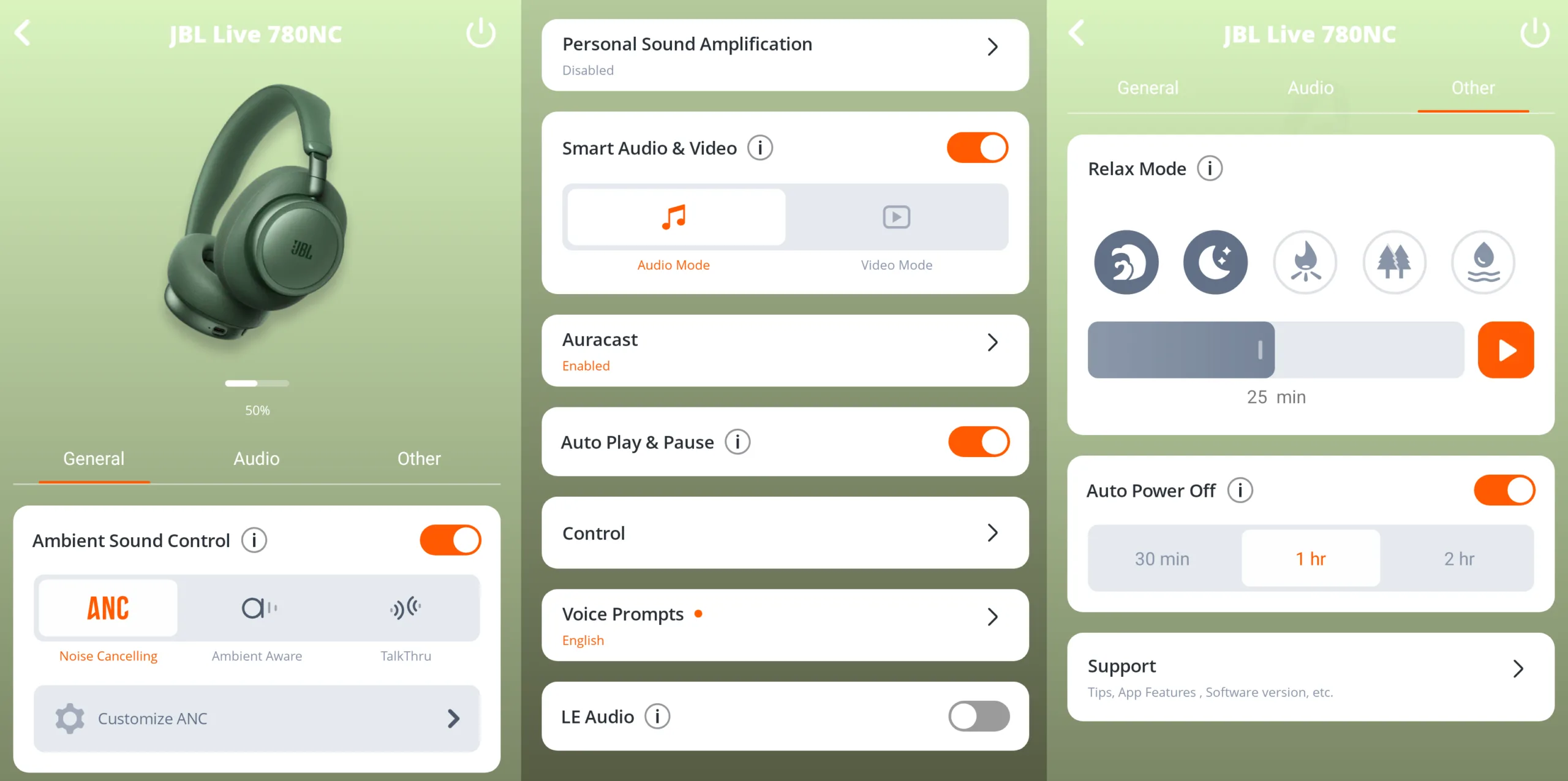
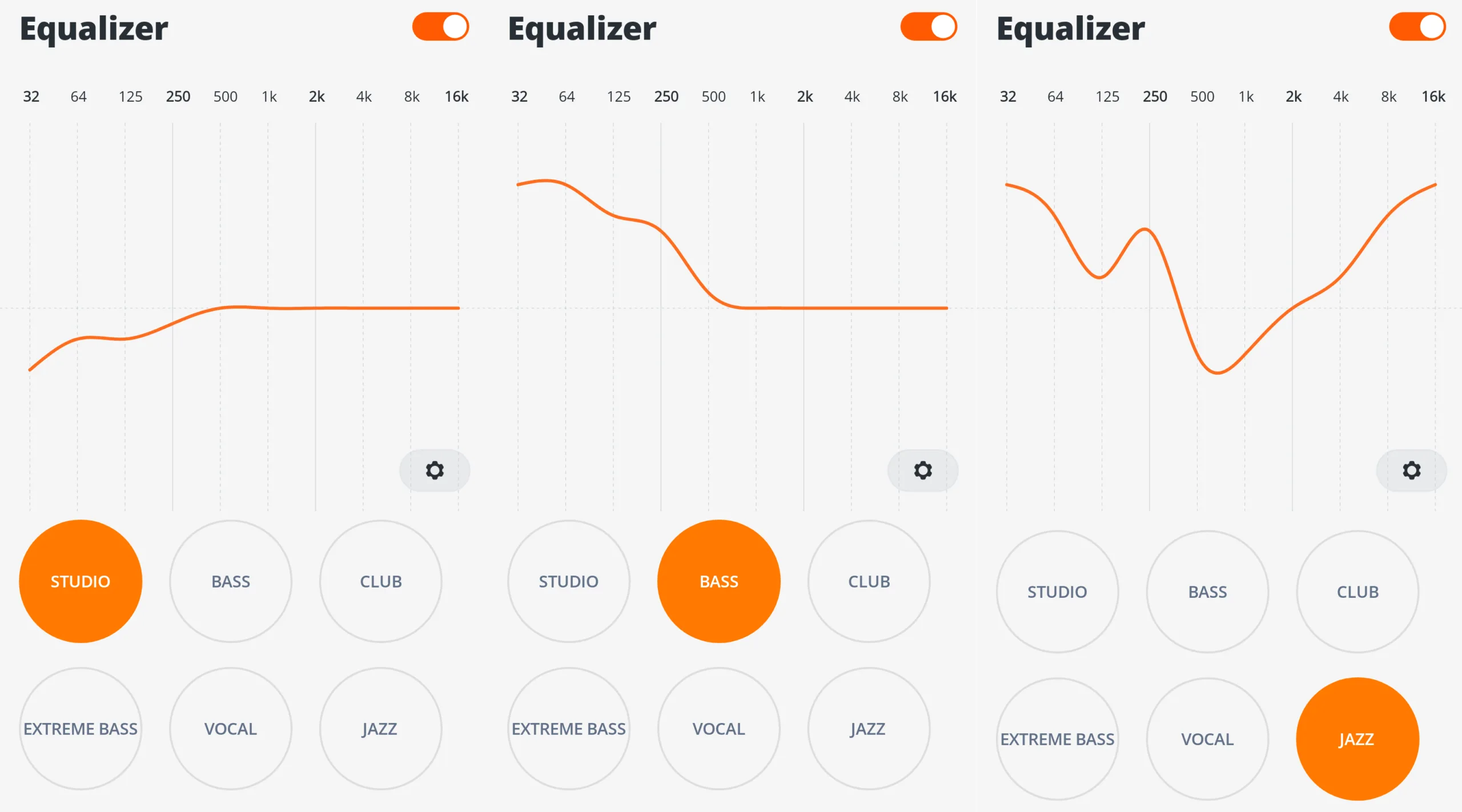
When the headphones are used without the LDAC codec, three spatial audio options become available—though these make the sound exceptionally unnatural—along with a loudness mode that boosts bass and treble at lower volume levels. Sound can also be personalized via the guided Personi-Fi hearing test if you find such a step-by-step process useful. Naturally, the app also includes preset sound profiles and JBL's familiar 10-band equalizer. Unlike the spatial audio features, these remain fully functional when using the LDAC codec.
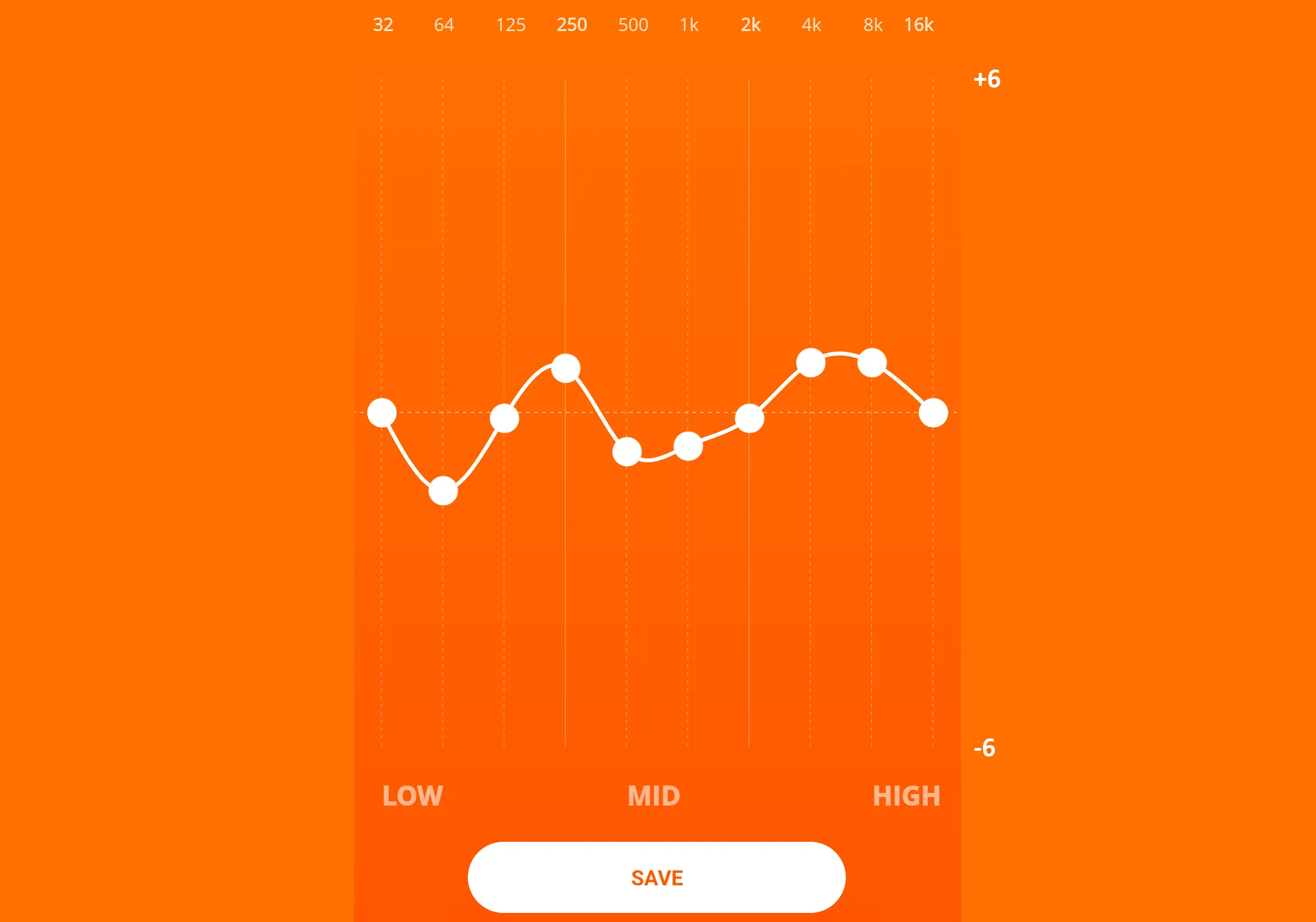
I found the equalizer to be exceptionally useful. There are plenty of frequency bands and sufficient adjustment range, even though it isn't a parametric EQ. Every slider operates with a fixed Q factor of 0.9, and they strictly follow the chosen decibel values even if the visual curve displayed on the screen rounds out to look slightly different after saving. For instance, you can set fractional decibels between +1 dB and +2 dB simply by positioning the control node halfway between two whole numbers.
Active Noise Cancellation
The Live 780NC's active noise cancellation works much like on the AKG N9 Hybrid : it can either be set to an adaptive mode or manually adjusted on a scale from 1 to 7. The headphones also perform an automatic compensation routine upon placement, adjusting ANC according to current seal and fit. On the AKG model, this feature made me want to toggle it off in the app due to its slow operation and irritating prompt chimes, but on the Live 780NC, the function operates completely silently without disrupting the user experience. Speaking of the AKG model's quirks, JBL's headphones thankfully refrain from shouting "connected" every single time you put them on.
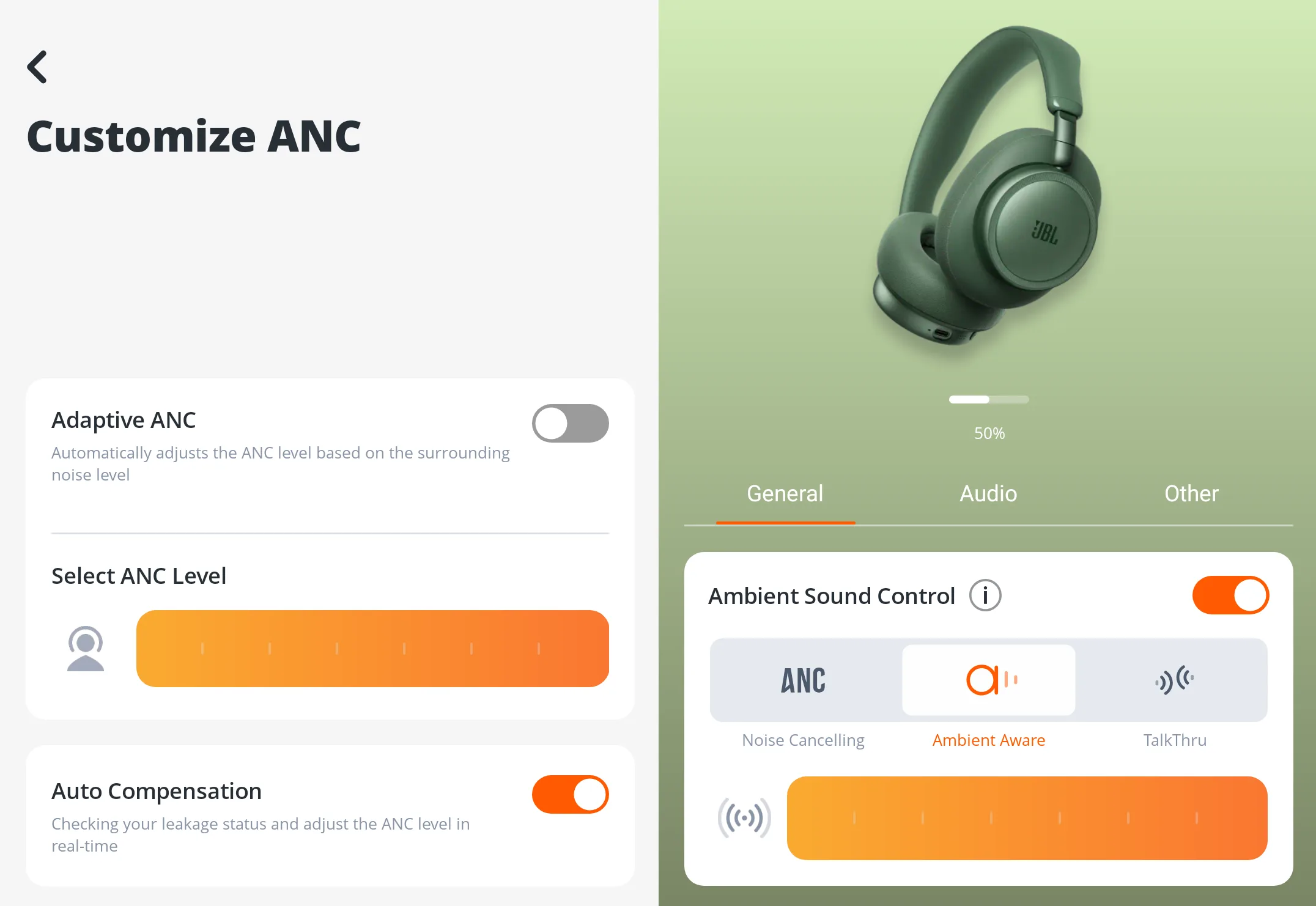
With active noise cancellation set to maximum, the Live 780NC exhibits a very faint noise floor in quiet environments, but this can be eliminated by selecting adaptive mode. In that mode, the noise reduction stays at its minimum setting until ambient noise calls for more power. Ultimately, though, I didn't notice any massive differences between the various intensity settings.
In terms of attenuation performance, the headphones represent a solid mid-tier standard. They fall noticeably behind top-tier flagships from Sony (e.g. WH-1000XM6) and Bose (e.g. QuietComfort Ultra, but slightly edge out models like the Valco VMK25.2and Kaiku Wave. Meanwhile, the step up from JBL's more budget-friendly Tune 770NCis quite substantial. In fact, the Live 780NC performs almost identically to the pricier AKG N9 Hybrid. The AKG seems to dampen noise a fraction more at times, but its ANC doesn't operate with the same consistency as the newer JBL—making the Live 780NC the better overall package in my view.
Reflecting on my previous testing (in airplane cabin and café noise environments), the Live 780NC beats most of its cheaper competitors and performs creditably even alongside many pricier headphone models. For example, Bowers & Wilkins' noise cancellation is roughly on par or even weaker. JBL's algorithm also filters out wind noise effectively, making outdoor use smooth with ANC enabled, save for a few minor caveats. Overall, I am pleased with the noise cancellation performance and find little to complain about.
The transparency mode and the dedicated TalkThru mode also do their job well. The experience isn't fully transparent in the way the best competitors manage, but it remains pleasantly clear and natural. I personally prefer this kind of implementation, where ambient sounds aren't artificially sharpened, avoiding any extra background hiss as a result.
Microphone sound quality
JBL advertises its "Perfect Calls 2.0" feature and AI-driven noise reduction algorithm for these headphones. Indeed, ambient noise and wind rumble are filtered out effectively during calls, but in extreme environments, the algorithm starts cutting into the speaker's own voice. This is hard to avoid without moving to a quieter spot. The manufacturer could, of course, tone down the noise gate via a software update, though that feels like wishful thinking on my part.
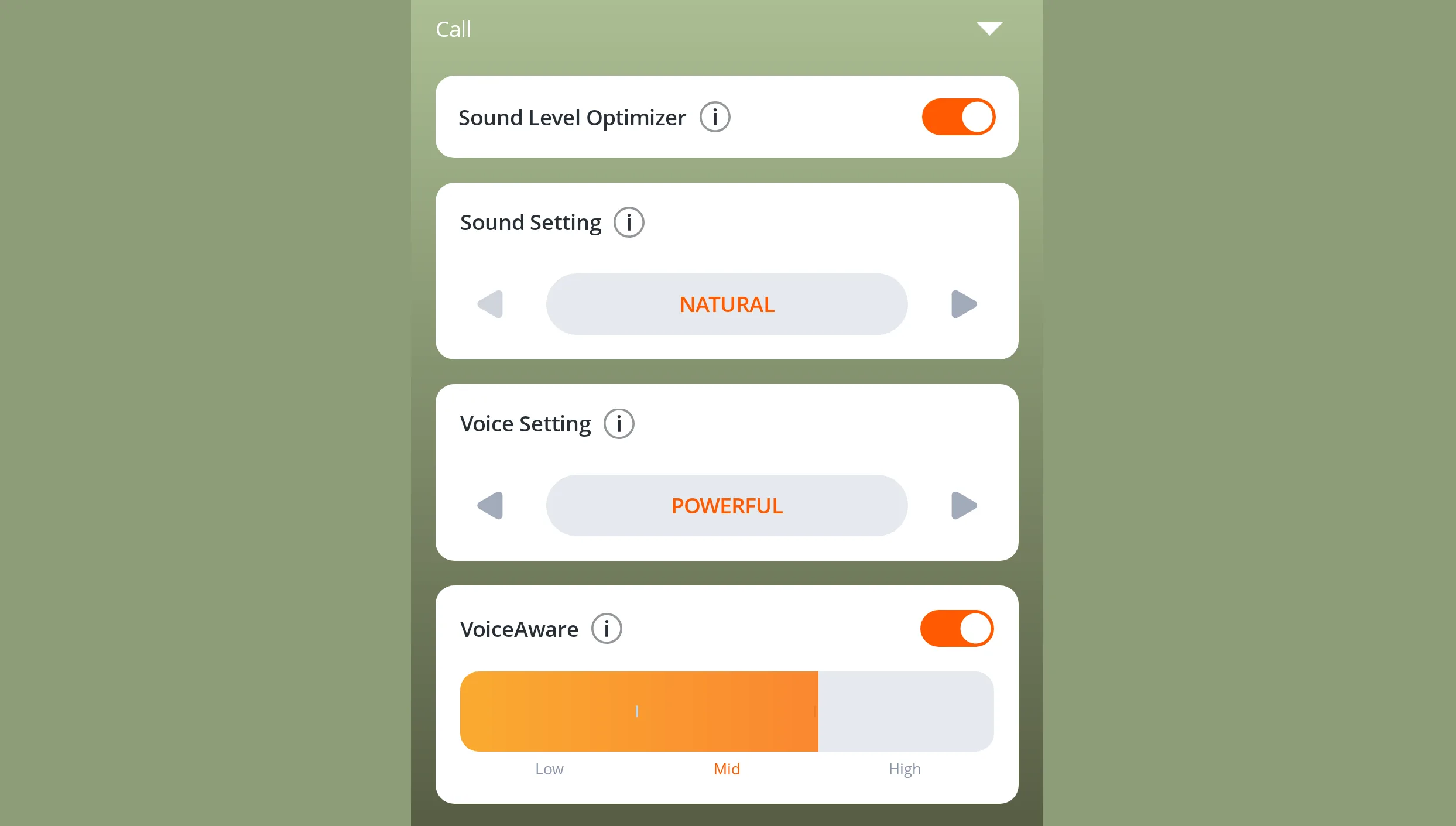
In standard or mildly noisy surroundings, there is nothing to complain about regarding voice clarity. Call audio can also be customized in the app more extensively than usual if you want to add brightness or depth to your own voice. Interestingly, the incoming caller's voice can be adjusted using similar controls.
Since speaking with closed-back headphones can feel somewhat unnatural, JBL's Voice Aware feature allows you to adjust how much of your own voice is fed back into your ears during calls. While many other headphones automatically engage a transparency mode during calls, having granular control tailored specifically for this purpose is always a welcome addition.
Headphone sound quality
In addition to a Bluetooth connection, audio can be played from a 3.5 mm (or, via adapter, 6.35 mm) analog source using the included USB-C cable, provided the headphones are powered on. Surprisingly, the built-in DAC cannot accept digital USB audio, meaning JBL likely cut costs by omitting the necessary chip. While this omission would be disappointing on a pricier model, it carries little weight in this price segment. Fortunately, custom EQ settings applied via the app remain active during wired playback, unlike on Sony’s latest offerings.
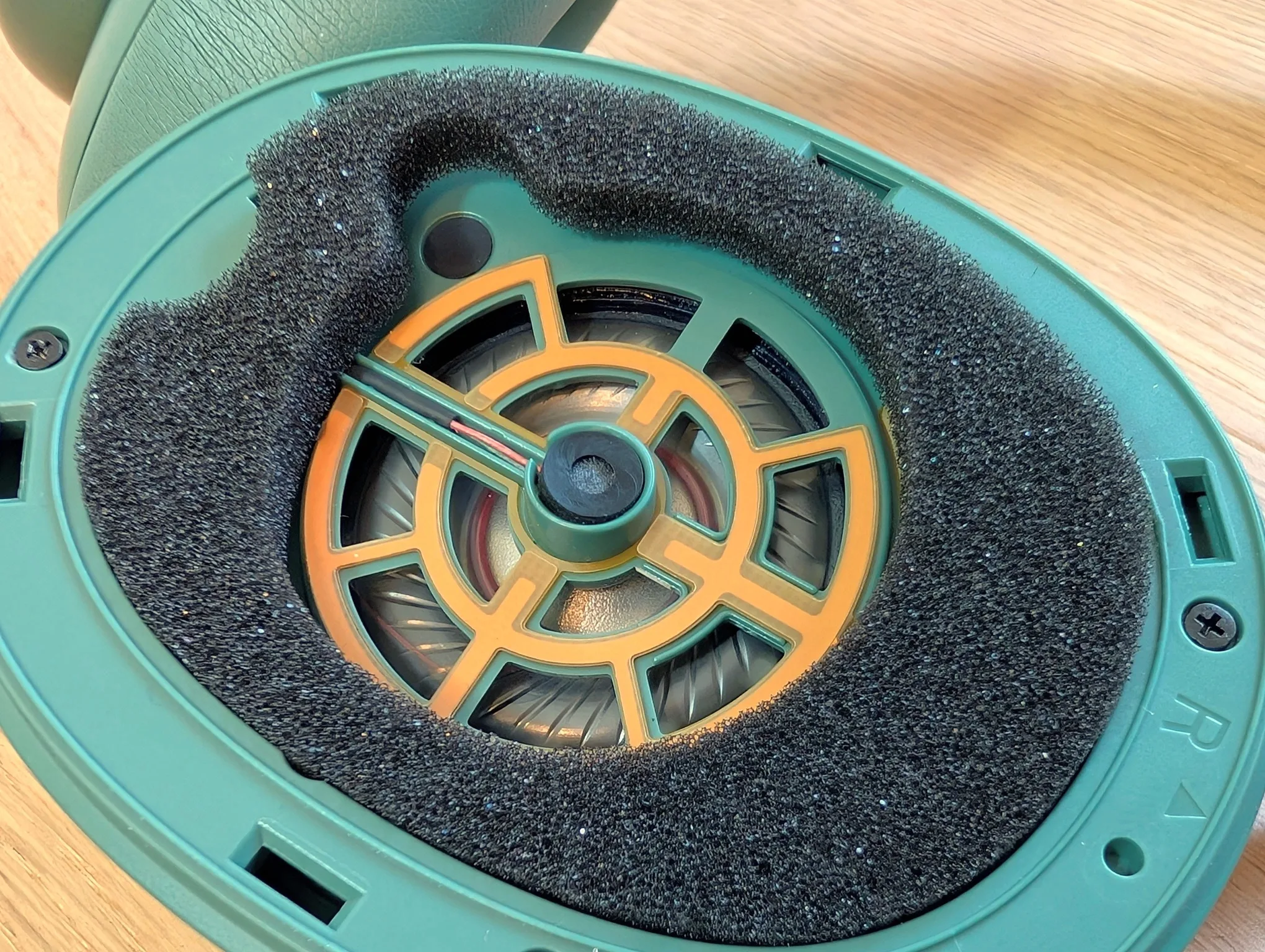
At the core of the Live 780NC are fairly conventional 40 mm dynamic drivers. While Harman International typically tunes its products around the Harman target curve, its more youth-oriented JBL models have been known to break the mold. Consequently, it was intriguing to see which direction the Live 780NC would lean.
Measurements
The headphone frequency response measurements were performed with equipment compliant with the IEC711 standard and KB501X model silicone ears. The graphs use the Harman target curve (2018 version), optimized for this equipment, as a reference. This curve is a generalization, based on scientific research, of what kind of frequency response would sound good to most people and correspond to balanced loudspeakers in a well-acoustically treated room.
The Harman research was conducted with silicone ears that ”hear” sound slightly differently than the ear types sold today. For this reason, the target curve used by Kuulokenurkka is based on the diffuse field response according to the KB501X ears” own HRTF transfer function, to which, however, the core findings of the Harman research have been adapted using filters. In practice, the result still corresponds to the ideal frequency balance indicated by the Harman research, but as the equipment used by Kuulokenurkka would ”hear" it based on its characteristic acoustics. Thus, it is possible to make more precise observations of the headphones' frequency response between 2–20 kilohertz than when using the pure Harman 2018 curve as a reference.
More information about the measurement equipment can be found on the Headphone Measurements. The Live 780NC's frequency response is also comparable with other measured headphones on Squiglink .
Frequency response (ANC ON & OFF):
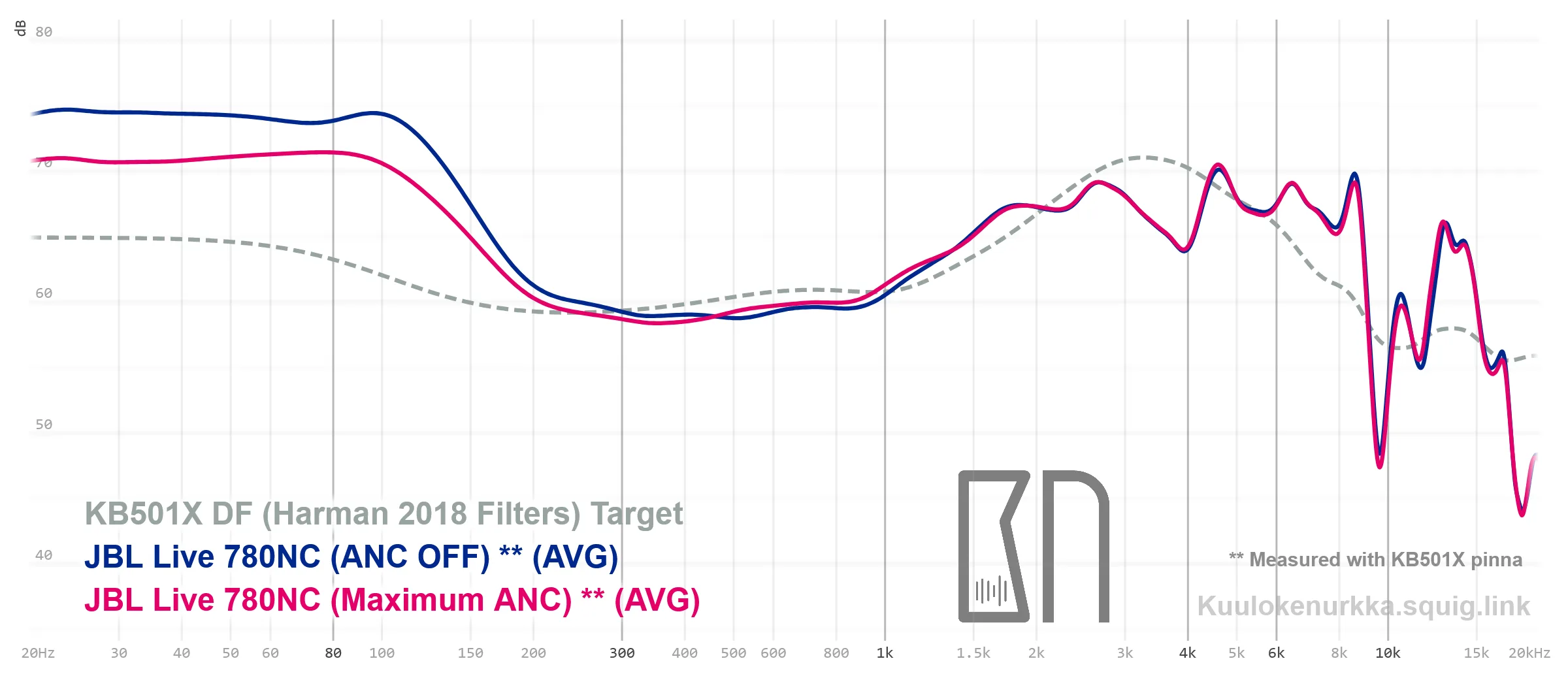
The measurements reveal that, like many other headphones, the Live 780NC outputs more bass with active noise cancellation turned off. During testing, I also noticed that lowering the ANC intensity level in the app slightly increases the bass response—as does using adaptive ANC in a quiet environment. From a sound quality perspective, the most balanced result is achieved by keeping noise cancellation set to maximum.
Out of the box, the Live 780NC is tuned to sound heavily bass-boosted alongside an accentuated brightness from 6 kHz onward. A slight aggressiveness in the upper-midrange between 1 and 2 kHz likely serves to compensate for the heavy low end, whereas around 4 kHz the energy dips below the surrounding frequencies, sapping some of the music's liveliness. The headphones are clearly targeted at the mainstream consumer on the assumption that powerful party bass and energetic highs are perceived as more exciting than a neutral sound signature. That said, on the Tune 770NCI previously tested, the bass and treble were not boosted as aggressively, so my expectations for a more mature and balanced tuning from the Live series were not quite met.
Credit must be given to JBL, however, for not extending the bass boost above 200 Hz. This avoids the worst of the midrange bloat, for which many Sony headphones serve as a cautionary example. Based on the measurements, the treble response on the Live 780NC is also reasonably smooth. For comparison, Bowers & Wilkins' latest PX7and PX8exhibit harsh, sharp treble peaks that are difficult to digest.
Fundamentally, the Live 780NC is best viewed as a bright thumper that entertains with a certain loud character. At the same time, its baseline frequency response allows for a significantly more balanced result once you tap into the manufacturer's equalizer.
Equalizing the response to be straighter:
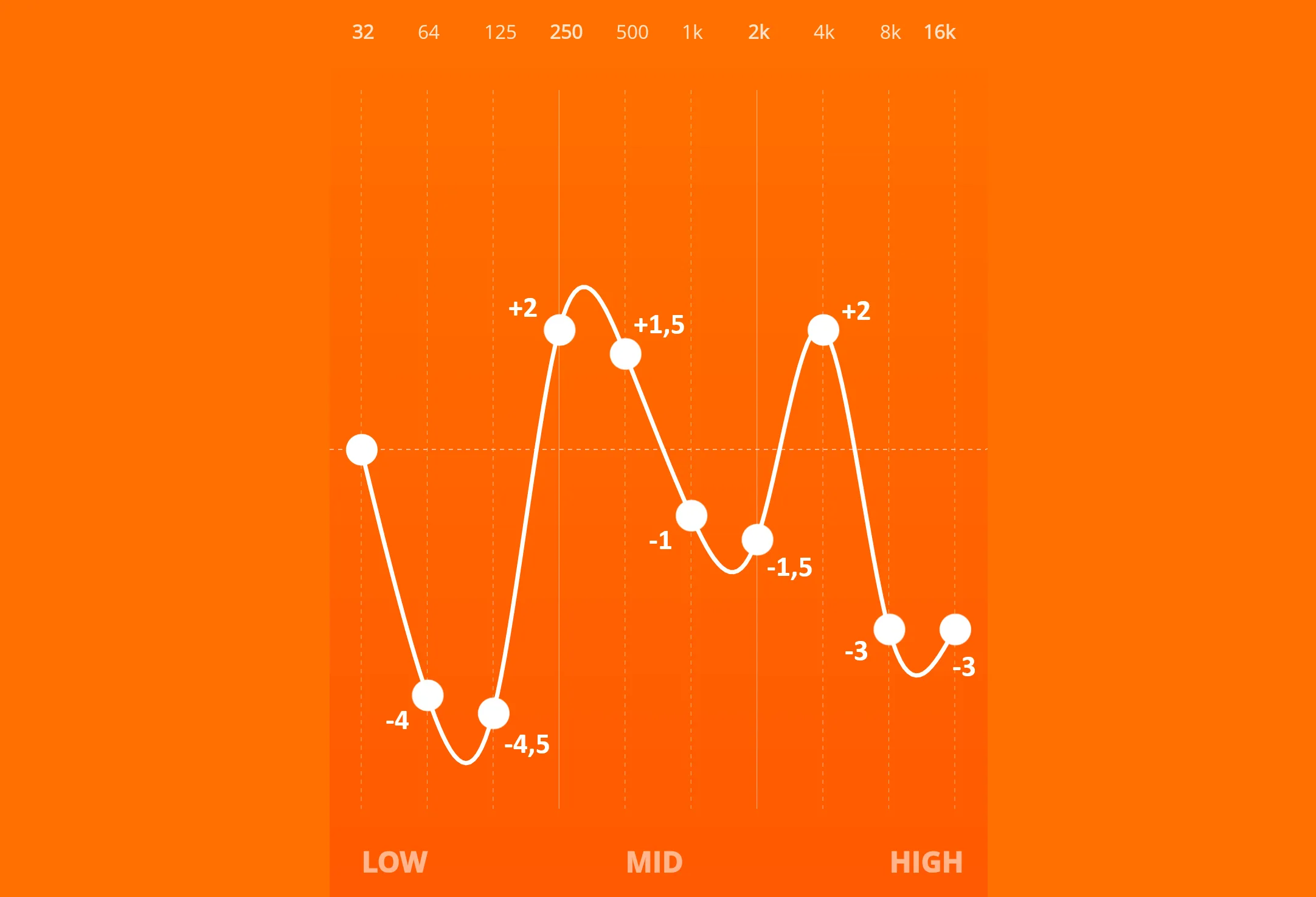
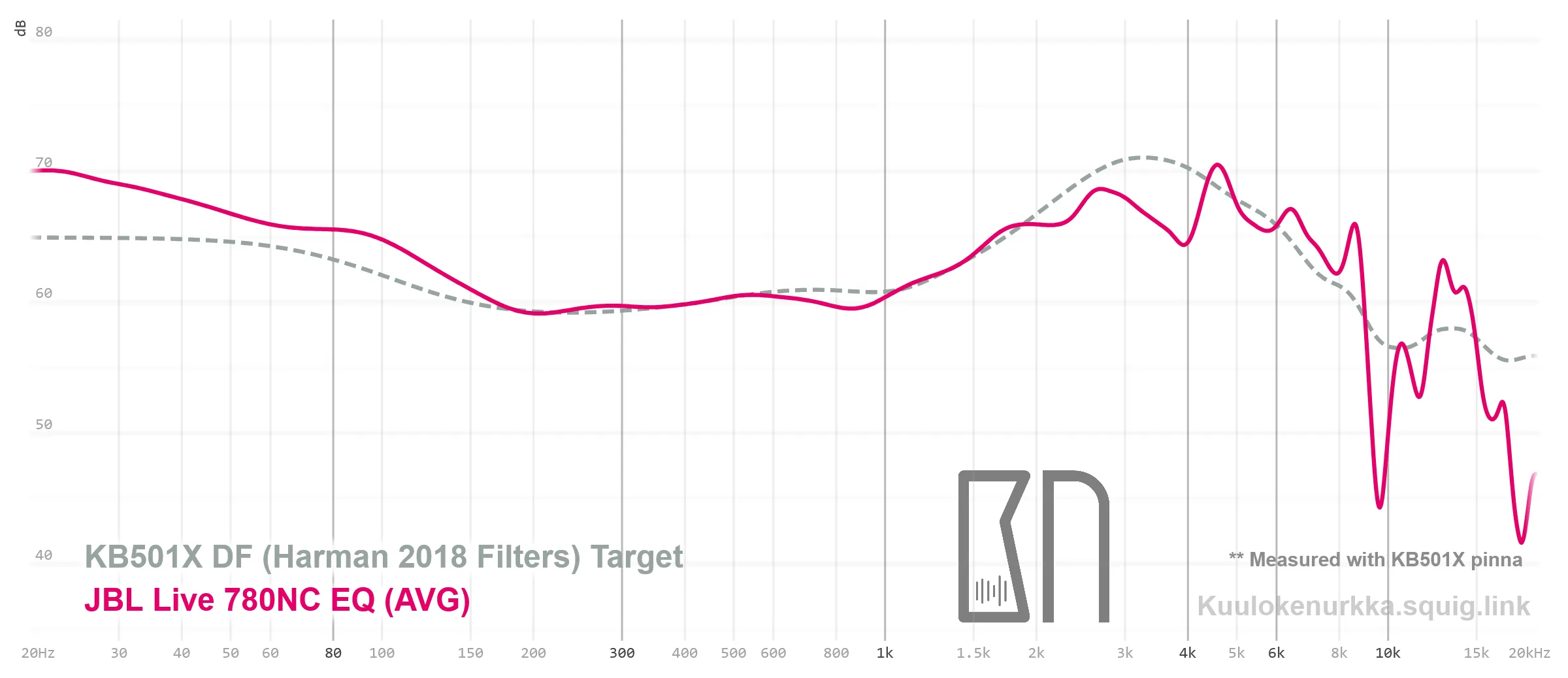
I balanced the sound of the Live 780NC by dialing back the bass and treble. At the same time, I smoothed out the midrange by adding a bit of warmth and rounding off the harshness. I wasn't aiming for a completely neutral presentation, though; I kept a subtle loudness character so it holds up well in noisier environments.
The following settings work best with active noise cancellation set to maximum. If you find the treble too bright or too dark with these settings, I recommend starting your fine-tuning at the 8 kHz band. As for the bass, it's easy to adjust using the lowest three bands—I'd suggest tweaking the 125 Hz slider first.
Sound observations
To my ears, the Live 780NC sounds punchy in the bass and noticeably bright, just as the measurements suggested. Your attention is first drawn to the over-the-top thumping and then to a piercing energy that leaves the body of the sound feeling thin. This kind of hard, aggressive presentation isn't the most pleasant to my personal taste, though at its best, it certainly carries a degree of excitement. All kinds of pop music sound fine just as they do on other modern playback devices, and I can hardly be genuinely disappointed—especially considering the 130-euro sale price.
Exaggerated bass requires a matching amount of brightness to balance it out, and JBL has succeeded in that regard. Lower-midrange muddiness is also largely avoided, preserving midrange clarity—even if it sits somewhat hidden behind the more accentuated frequency ranges. As far as V-shaped tunings go, the end result is actually quite solid, and the Live 780NC will surely appeal as-is to its target audience. However, if you are aiming for a more natural sound that adapts better to various genres, equalization is well worth doing.
After my EQ adjustments, the Live 780NC sounds very balanced and pleasant—to the point where no single flaw really stands out. Only a slight attention-grabbing quality in the treble remains noticeable, though I could easily achieve a calmer presentation if I were willing to sacrifice a bit of liveliness. This upper-frequency emphasis is partly due to a dip around 3–4 kHz, but I wouldn't criticize that too harshly either. A slightly relaxed presence region is generally far less intrusive than overly aggressive forwardness. Equalized, the Live 780NC punches well above its discounted price tag, so purely from a sound quality perspective, I wouldn't automatically jump to more expensive options.
In short, the JBL model is a safe bet for anyone comfortable using an equalizer, as well as for those who pick their headphones based on bass output alone. For the latter crowd, however, the Sony ULT Wear remains the most extreme choice, as its sound consists almost entirely of bass. JBL hasn't pushed things quite that far, keeping the Live 780NC firmly within the tradition of conventional V-shaped headphones.
Comparison: Live 780NC vs. Valco VMK25.2
Prices: 200 vs. 200 € (JBL at its cheapest 130 €)
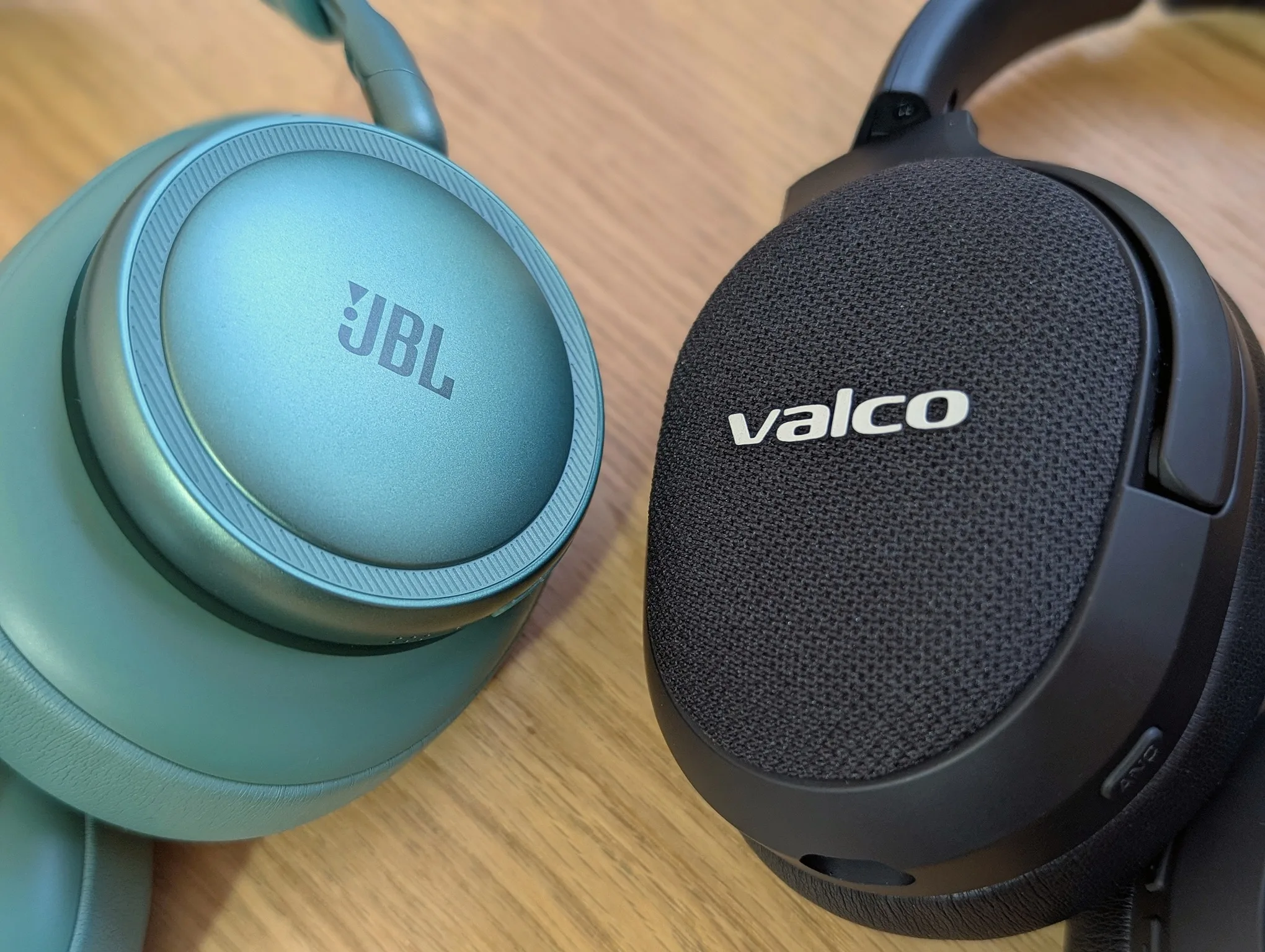
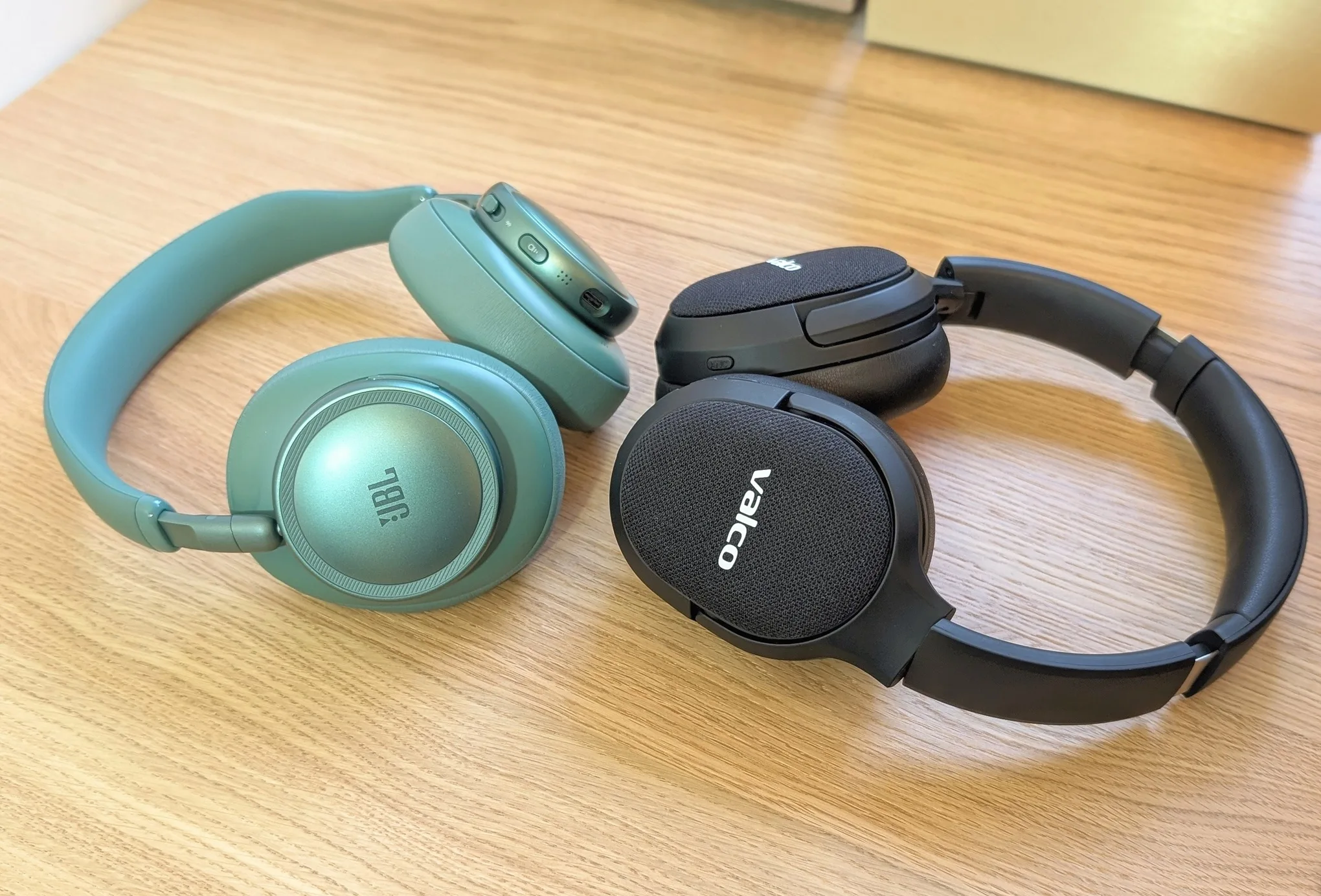
Finns will certainly be interested in how new budget-friendly noise-canceling headphones stack up against Valco's products, so let's examine how the Live 780NC compares to the similarly priced VMK25.2. Valco's headphones are rarely found at discounts as steep as the JBL model, but alongside signature Finnish humor, their retail package includes a proper charging cable and a solid hard carrying case. The fewer color options of the VMK25.2 don't automatically make it boring either, as the headphones can be customized by swapping out the magnetic ear cup covers. Sure, those cost extra, but at the same time, more of your money stays in Finland rather than flowing to a global mega-corporation.
When it comes to looks, anyone can pick their favorite between the two. The sleeker JBL model aims for a more modern, fashionable look, whereas Valco's utilitarian practical design might appeal to a different kind of user. Material-wise, the Live 780NC feels a touch more premium, partly because the soft-touch coating on the VMK25.2's plastic parts tends to wear down into a scuffed appearance. When gauging structural sturdiness by feel, however, points go to Valco, as its product features slightly tighter, more solid tolerances. On the flip side, the Live 780NC weighs just over 20 grams less. Its ear pads feel marginally more spacious at the bottom, while the VMK25.2 offers a slightly softer headband cushion. In terms of overall wearing comfort, I don't notice a significant difference between the two—I'm happy to wear either pair.
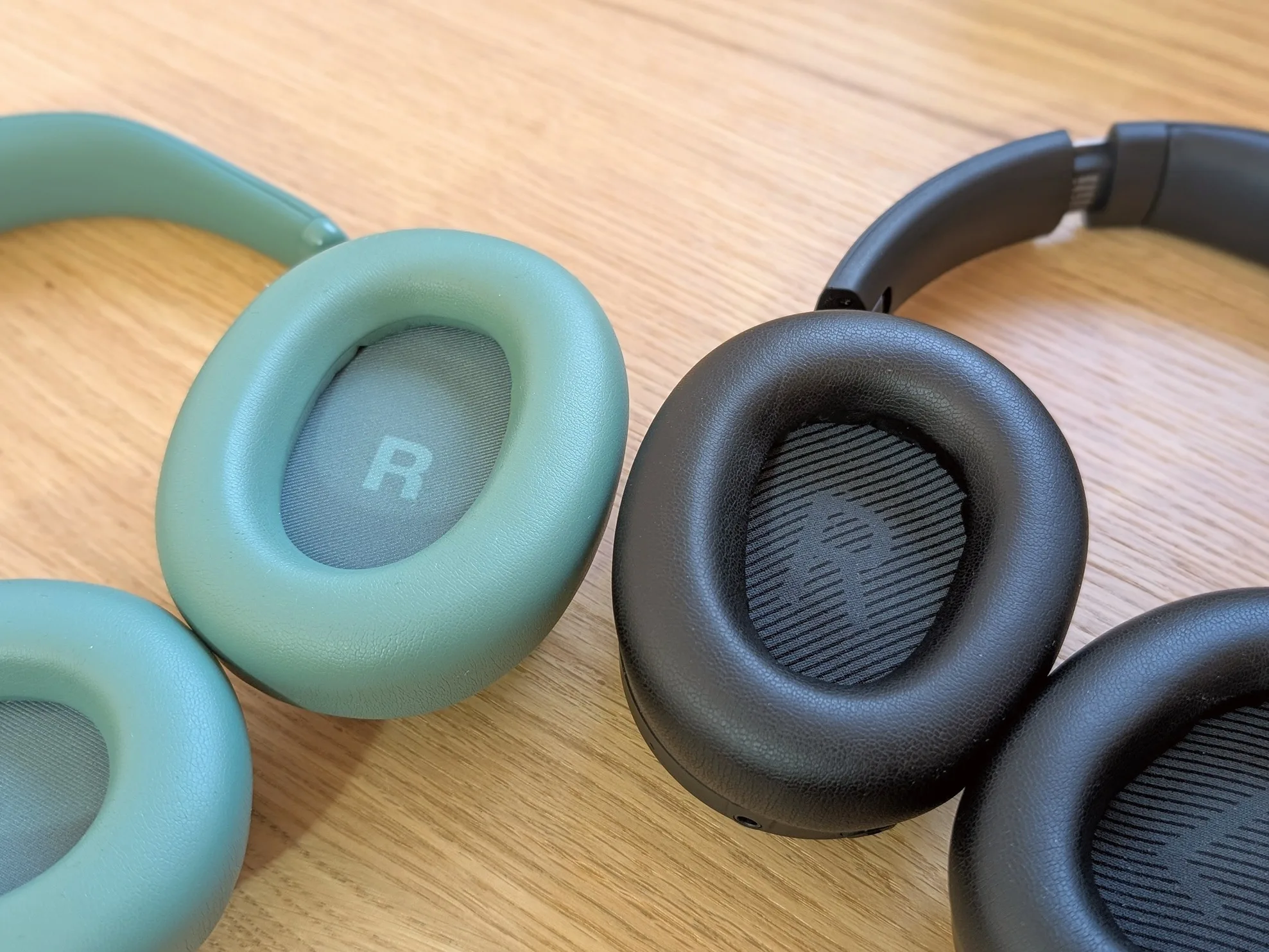
A larger contrast emerges in the feature set—or, in Valco’s case, the lack thereof. While the VMK25.2 isn't missing anything strictly essential, JBL lays down a long list of additional features, ranging from genuinely useful to gimmicky. Features like spatial audio and adjustable ANC intensity levels may prove redundant for many, whereas wear detection, a customizable EQ, and call enhancement settings deliver the most tangible improvements to daily usability. Valco does not yet offer a dedicated companion app (though one is planned for a future release), unless one counts their basic firmware updater tool. From an ergonomics standpoint, the Live 780NC's touch controls can be frustrating, but thankfully it also includes standard physical buttons, which I slightly prefer over Valco’s smaller controls. In particular, the JBL model's toggle switch easily beats Valco's power button that requires a long press.
Under the hood, both models are admirably modern. The VMK25.2 supports the lossless aptX Lossless codec, while the Live 780NC operates exceptionally reliably on the high-bitrate LDAC codec. Furthermore, both feature support for the Bluetooth LE Audio standard. Battery life is equally impressive across the board; achieving around 50 hours with active noise cancellation enabled will easily cover extended use. Taking a closer look at the figures reveals that the VMK25.2 lasts a few hours longer—and up to two workdays longer with ANC turned off. This gives a slight edge to Valco.
In terms of noise cancellation efficiency, I found little practical difference between the two. Under close listening, however, any residual background noise retained a slightly softer tone on the Live 780NC. Valco's headphones exhibit a higher noise floor, and their transparency mode isn't quite as clear. If effective background noise suppression during calls is a priority, JBL also performs better. That said, the VMK25.2 might prove more practical in certain scenarios, as its noise gate is less aggressive and less prone to cutting off the speaker's voice.
Finally, both headphones require power to be turned on to output audio, even when using an analog wired connection. USB audio playback is not supported on either model.
Frequency responses:
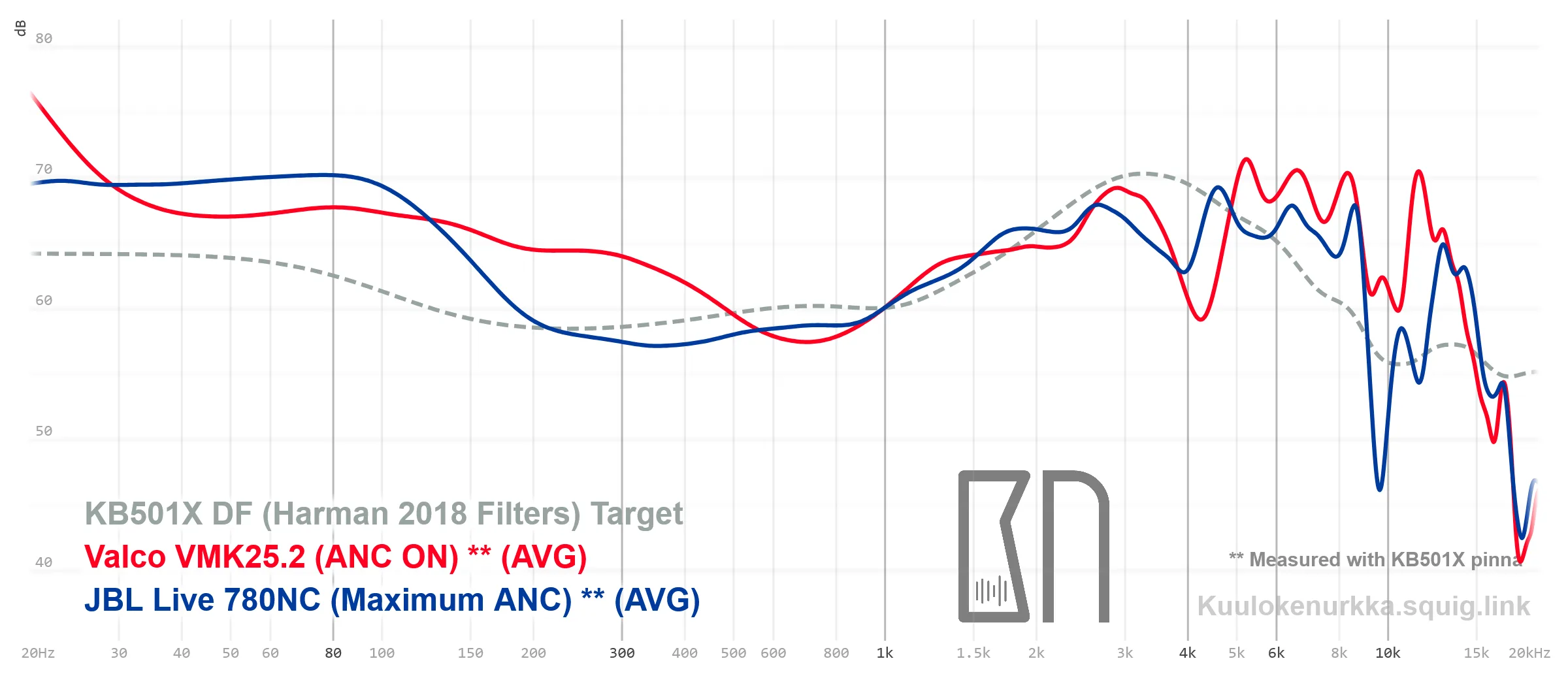
Both headphones have clear flaws out of the box when listened to with a critical ear. The Live 780NC features too much bass and treble, though not quite to the extent of the VMK25.2. Valco's headphones sound distinctly bright, with the bass bleeding heavily up to 300–400 Hz right into the midrange. I find the sound somewhat muddy, recessed, and yet harsh. The overall presentation would work better if the sibilance didn't accentuate harsh s sounds quite so badly. In my view, JBL's approach to a similar sound signature is safer. That said, it isn't necessarily what Valco has found to work best knowing its own customer base; Jasse Kesti is unlikely to tune headphones at random, so they presumably hit the mark well for their target audience.
Valco's product seems intended primarily for noisy environments with ANC enabled, where objective sound quality loses part of its significance. Having low frequencies and energetic treble cut through background noise can be more important than whether the end result sounds natural. JBL, on the other hand, tries to strike a balance between mega bass and midrange clarity.
Somewhat surprisingly, the VMK25.2 sounds better of the two with ANC turned off. On the Live 780NC, switching ANC off only boosts the bass further, moving in the wrong direction. Consequently, I find Valco's two vastly different sound profiles more versatile. The JBL, meanwhile, yields high-quality audio only after EQ fine-tuning. Once adjusted, however, it ultimately edges out the Valco in sound quality when listening with ANC on with a balanced presentation in mind.
JBL's companion app naturally allows shaping the sound in many other directions, and nothing prevents fine-tuning the VMK25.2 using a third-party equalizer either—unless one chose Valco's headphones precisely for their plug-and-play simplicity. That said, comparing ANC headphones quickly gets tricky once factory defaults are abandoned, as everyone EQ's sound differently. At that point, you're no longer measuring differences between the products themselves.
As a headphone enthusiast, I would pick the VMK25.2 as an easy option for home listening without ANC. For combining quality audio with active noise cancellation, the Live 780NC provides a better foundation—at least until Valco launches its own app with customizable settings.
Summary
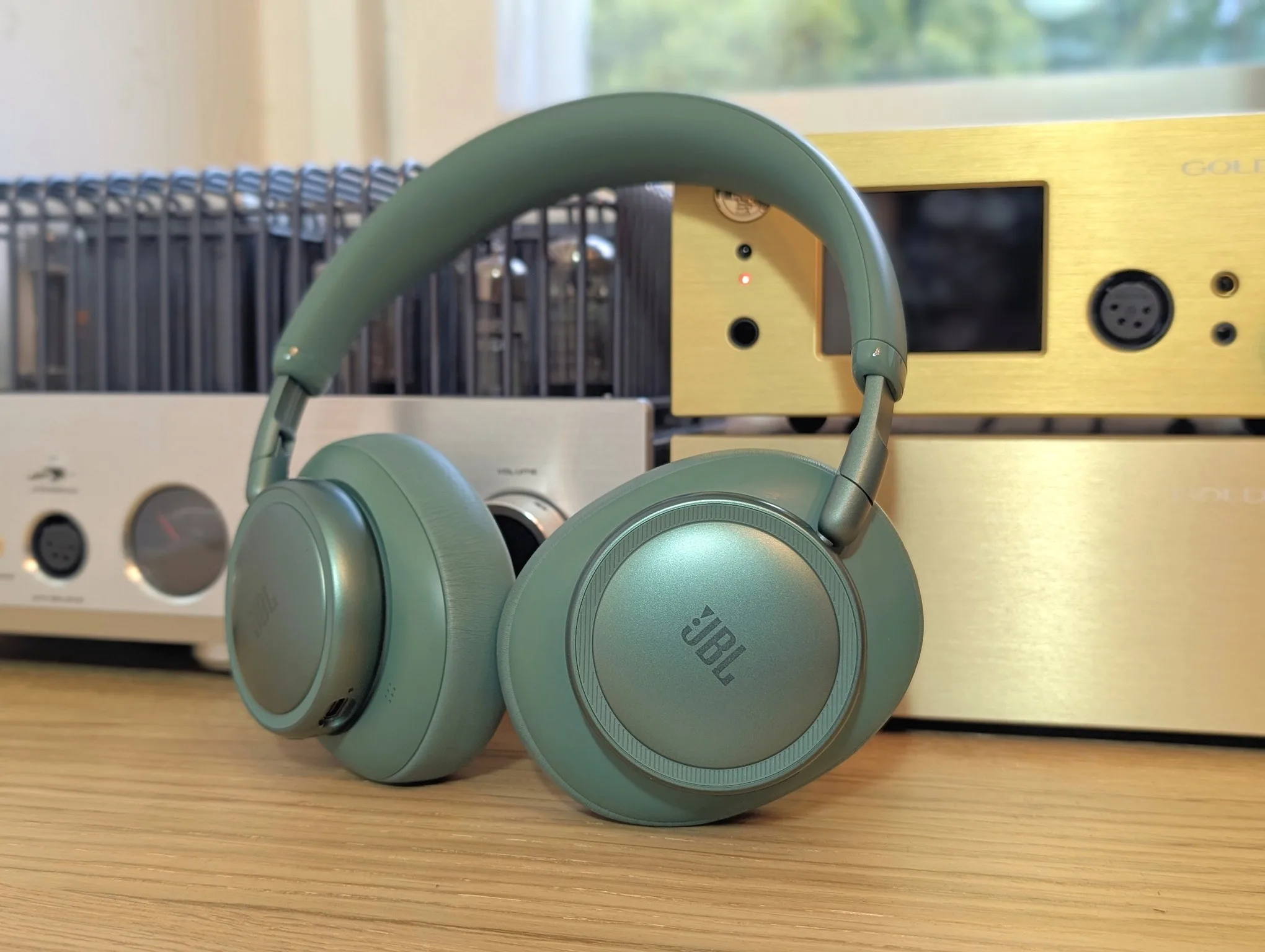
If the JBL Live 780NC can be bought for 130 euros, it gets a strong recommendation in its price class. While the headphones don't exactly revolutionize any single area, they don't have any major weaknesses either. On the contrary, a few years ago you couldn't get features this versatile—at least not executed with this level of quality—at this price point. The manufacturer has also invested in the build quality and noise cancellation algorithms.
Depending on the user, JBL's bass- and treble-heavy factory tuning can be either a strength or a weakness. Personally, I don't care for party bass or harshness, but a more balanced sound can fortunately be achieved using the app's equalizer. With its help, the audio quality climbs to a level fully competitive with noise-canceling headphones a tier higher. The LDAC codec—which performs exceptionally well in terms of range and signal stability—is another nice bonus.
The only clear drawback is the sparse set of accessories, as a carrying case would have made this a truly complete package. On the other hand, the headphones travel easily enough in their fabric pouch, so there's nothing stopping them from serving as a benchmark for other sub-150-euro products going forward—and as a serious contender even from 200 euros up. However, the retail price at the time of purchase largely dictates how enthusiastic I ultimately am about the product.
The Live 780NC earns a spot on Kuulokenurkka's Wall of Fame primarily as a strong all-rounder and, at its best, a great deal. If the market price stays close to 200 euros, however, there are many other solid options available—the best of which can be found on that same Wall of Fame. We'll continue checking out new noise-canceling headphones in the future to see where the market moves next.
Pros and cons:
+ Sound can be equalized to high quality
+ Modern Bluetooth implementation with LDAC codec support
+ Wide Bluetooth range
+ Versatile application
+ Long battery life
+ Headband with its joints made of metal
+ Good comfort
+ Fairly effective noise cancellation and clear transparency mode
+ Sold in many colors
+ Market price regularly lower than recommended price
– Factory tuning too bass and treble heavy
– Unnatural spatial audio
– No USB listening capability
– Small activation area for touch functions
– Package does not include a carrying case or charging cable
 EN
EN  FI
FI