Author: Sword of Damocles
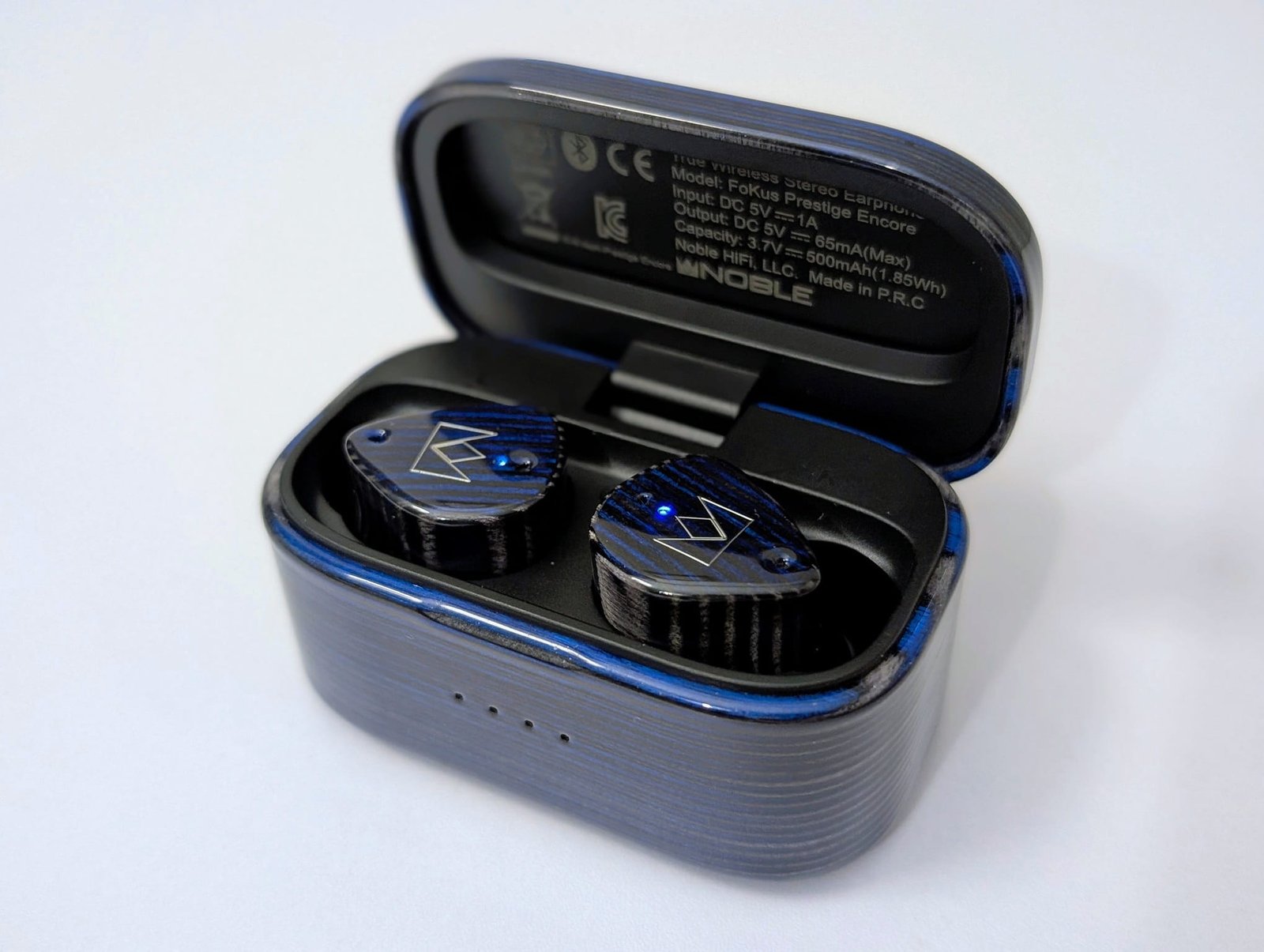
Table of Contents:
Information:
- Released: 2025
- Country of Origin: China
- Price: 799 €
- Structure: Wireless in-ear
- Drivers: 1× 8 mm dynamic, 2× Balanced Armature and 1× 6 mm planar
- Bluetooth 5.4
- Bluetooth codecs: AptX Lossless, AptX Adaptive, AptX, LDAC, AAC and SBC
- Battery size: 65 mAh (earbuds) / 500 mAh (case)
- Battery life (ANC ON/OFF): 7 / 10 h
- Total usage time with case: 35 h
- Charging time (earbuds/case): 1.5 / 2 h (case also supports wireless charging)
- Noise cancellation function: ON/OFF/Transparency mode
- Features: Multipoint, Audiodo ear calibration and two different equalizers
- Weight: headphones 8.5 g/pc and with case 75 g
- Accessories: Fabric pouch, short USB charging cable and 5 pairs of different sized and styled ear tips
Review unit acquisition method: Received on loan from importer/reseller
Among wireless noise-cancelling earbuds, in addition to so-called mass-market brands (e.g., Sony, Bose, and JBL) and the standard selection of hi-fi stores (e.g., Bowers & Wilkins and Denon), there are also more expensive premium options for those who fully embrace this product category. Although popular Apple Airpods Pro 2 and 3, for example, might already be at the upper end of many people's pain threshold at around 250 euros, some enthusiasts are always willing to invest more in their purchases. Domestic importers and resellers have also woken up to this.
Helsinki-based Mareksound sells Chinese Noble Audio wireless earbuds from 350 euros upwards, and they could also be tested in their store. Since the manufacturer's headphone range is relatively unfamiliar to me, having tested about a year ago Focus Apollo -over-ear-noise-cancelling headphones aside, I decided out of curiosity to borrow for testing the new Fokus Prestige Encore -noise-cancelling earbuds. Thanks again to Mareksound for the arrangements!
If you readers haven't yet glanced at the price of the headphones above, don't fall off your chair: the Fokus Prestige Encore costs a whopping 800 euros, which practically makes it the most expensive representative of its product category in the world – at least when talking about serious headphone models. Louis Vuitton's 1450-euro Horizon Light Up and Bang & Olufsen's 1200-euro Beo Grace fall into a kind of accessory category for brand loyalists. Noble's true competitors, such as Bowers & Wilkins Pi8 and Devialet Gemini II, are priced between 350–500 euros, so the Fokus Prestige Encore jumps into a completely empty market niche where it should be able to justify its extra price. Now that expectations have been set relatively high, let's proceed to the review itself.
Packaging and accessories
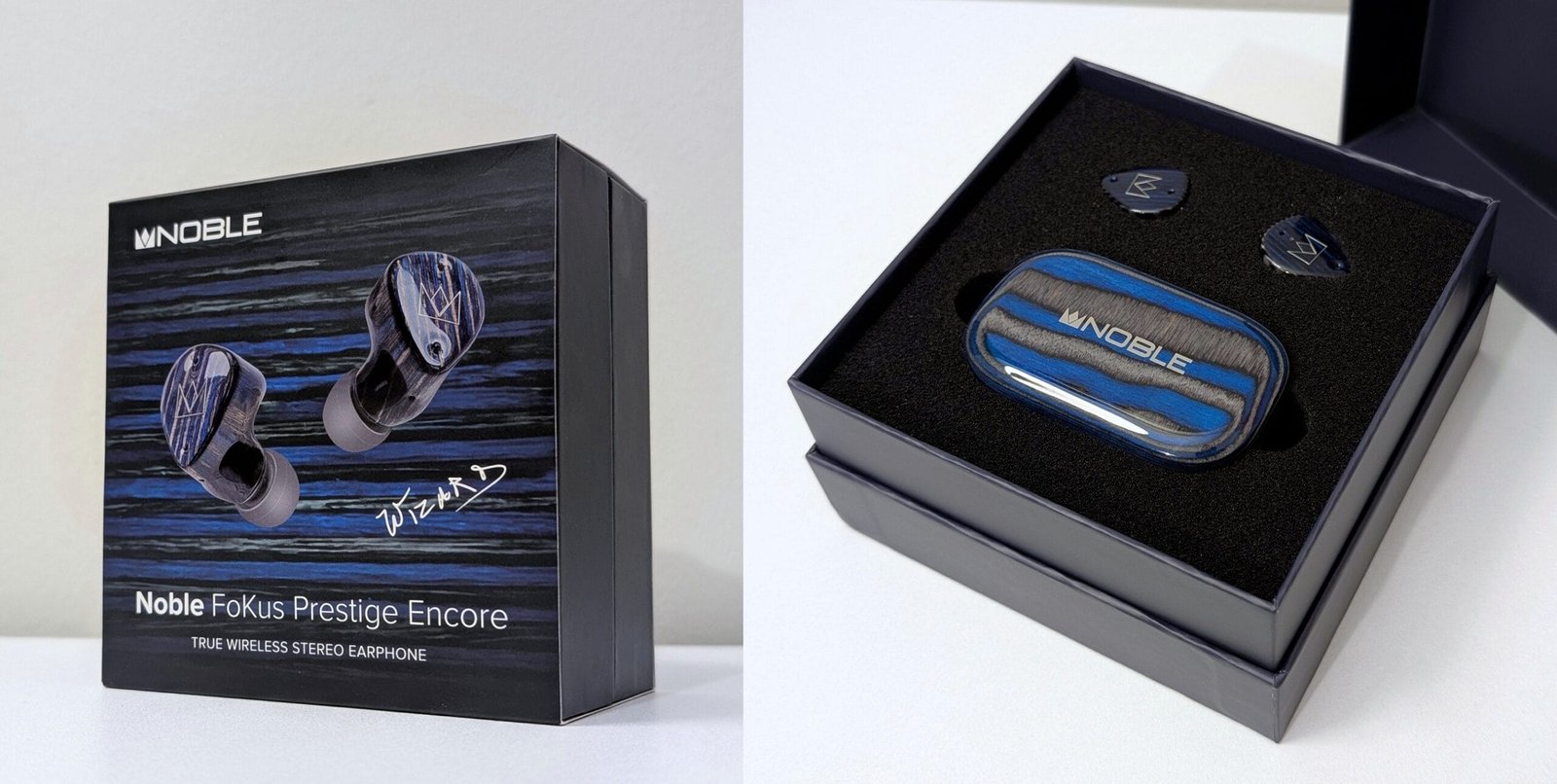
I don't inherently expect special circus tricks from small products like earbuds in terms of packaging, as it would be difficult to make an 800-euro product stand out from, for example, a 300-euro product. However, the Fokus Prestige Encore's cardboard packaging is neat, and both the headphones and the charging case are well-represented inside.
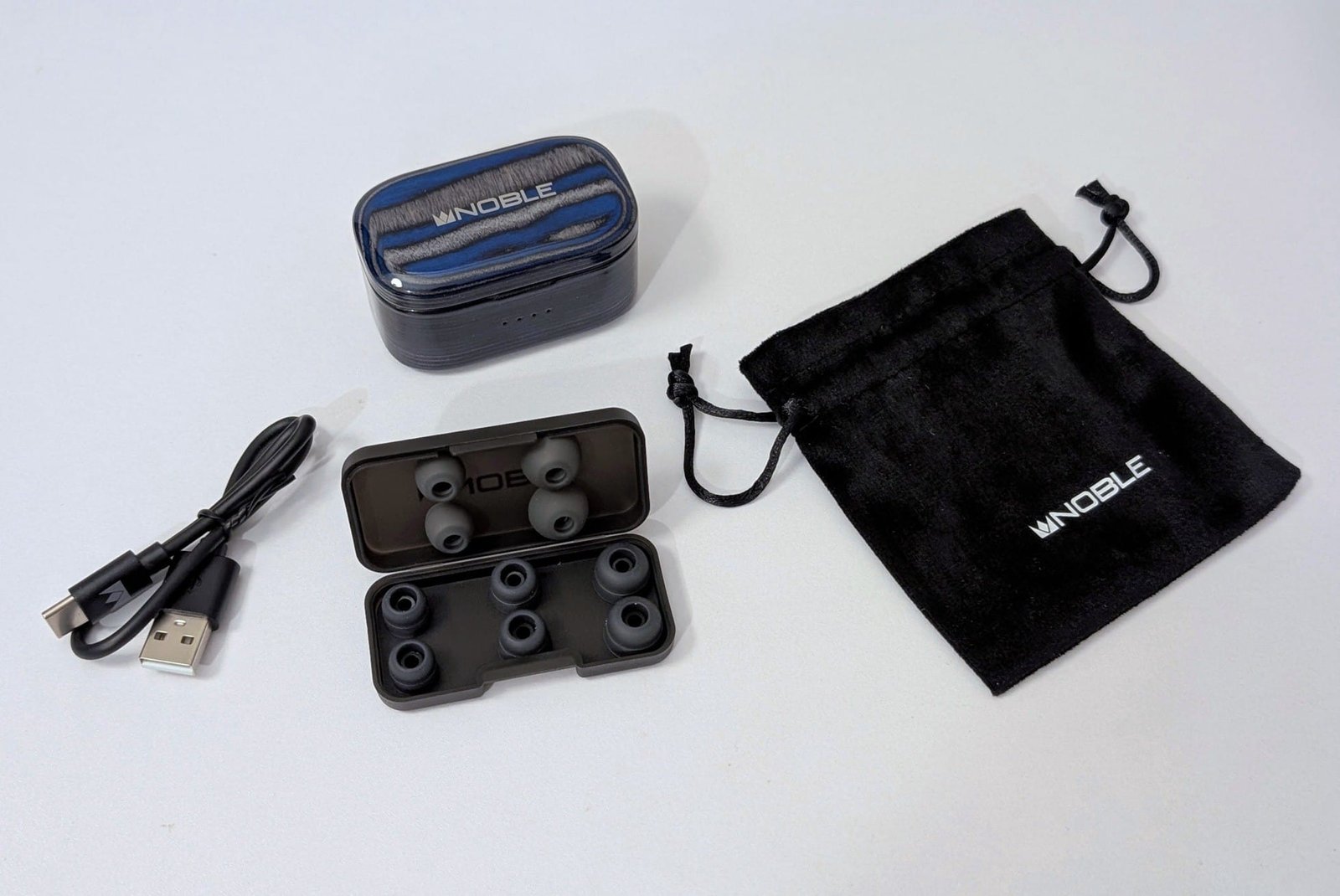
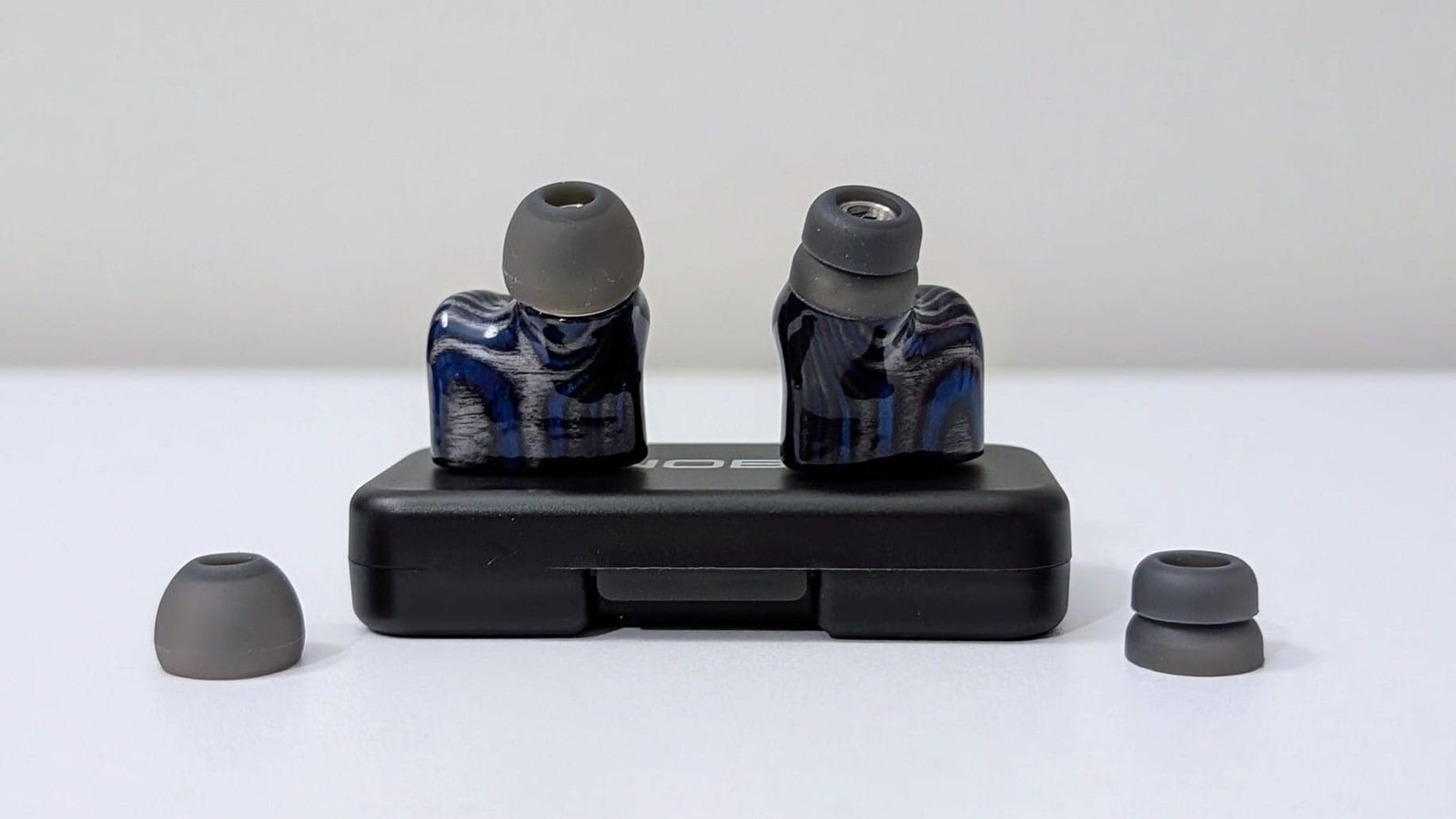
Deep within the packaging, there is a small Noble-branded pouch containing a short USB charging cable and a small plastic case where different sized ear tips are placed. This is definitely a nice addition, as often the tips arrive in a plastic bag. Half of the tips feature an interesting double-flange structure, which is likely aimed at maximizing noise reduction. The fabric pouch, in turn, can be used as a protective cover for the charging case when carrying it.
Structure and feel
The Fokus Prestige Encore is a unique product in terms of its manufacturing materials, as the body of the earbuds and the charging case is made of CNC-machined stabilized wood, which has been given a glossy lacquer layer. The appearance is likely somewhat individual, but the color theme is in any case blue-gray, with these two colors appearing alternately as stripes. Interestingly, ZMF Bokeh Open the colored SpectraPly veneer of the headphones looks quite similar, so I could very well imagine an American manufacturer also making exactly this kind of earbuds.
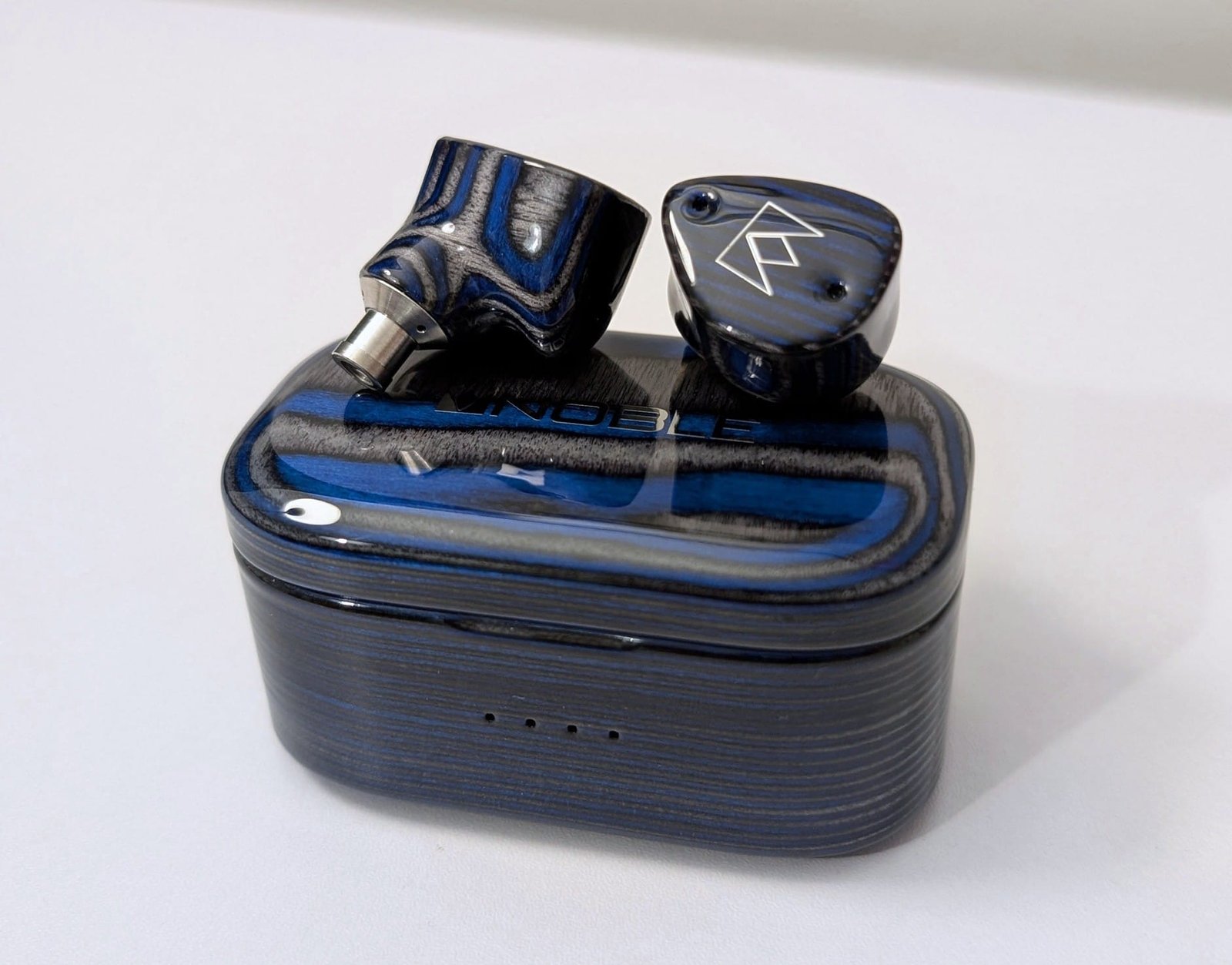
In addition to the fine appearance, the necessary holes and fittings in the Fokus Prestige Encore have perfectly aligned with the wooden parts, so in this respect too, the 800-euro price gets its value. When even the opening of the metal nozzles is shaped according to Noble's crown logo, the whole looks cohesive and exudes a premium feel. This is certainly how the situation is intended to be maintained, meaning that using the headphones may not be as carefree compared to cheaper earbuds. Especially the wooden charging case should not be kept without its protective pouch in the same pocket with other items, so that it doesn't get scratched. Normally, this would hardly matter much, but with appearance being one of the important features of the Fokus Prestige Encore, its elegance must be somewhat protected.
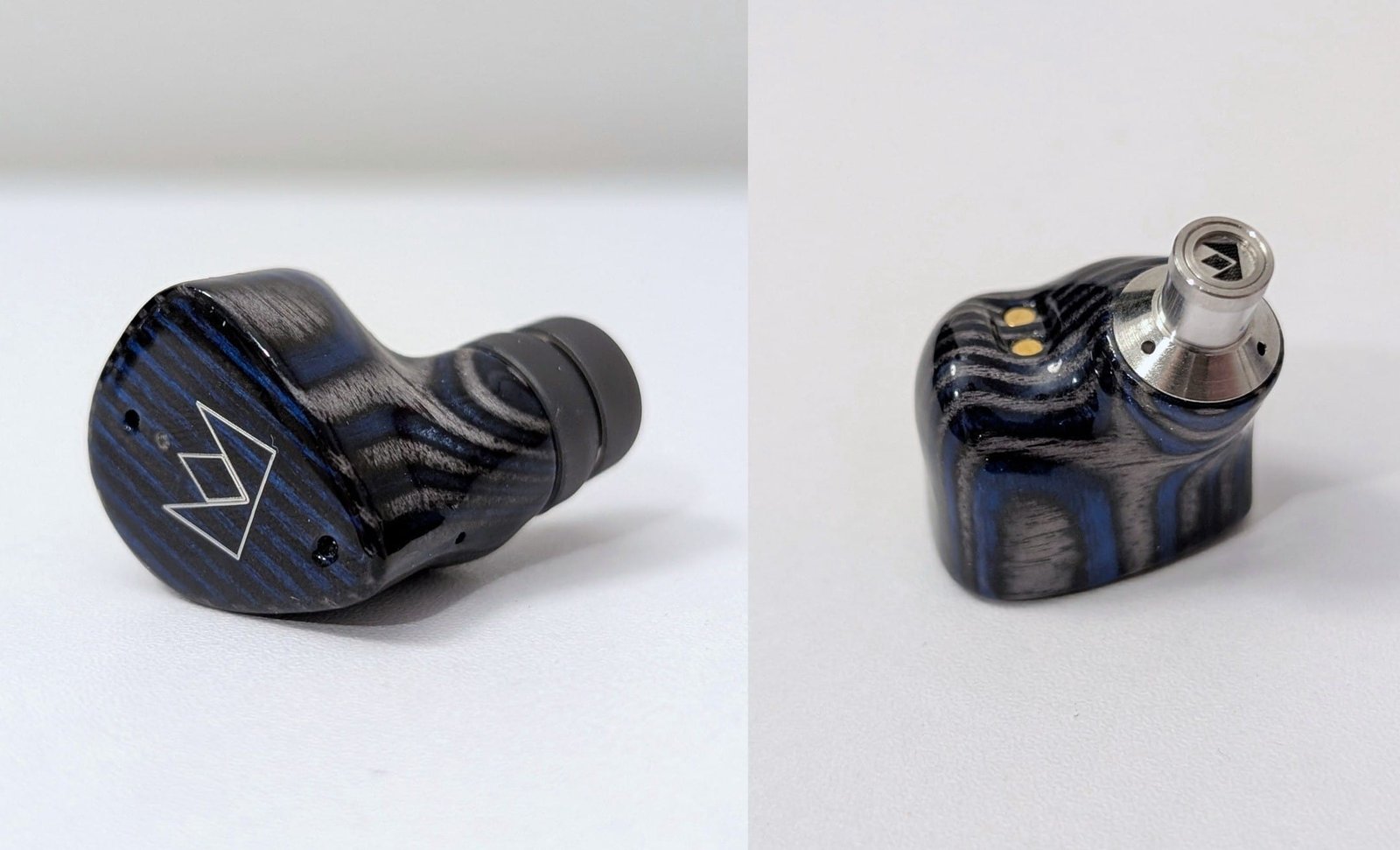
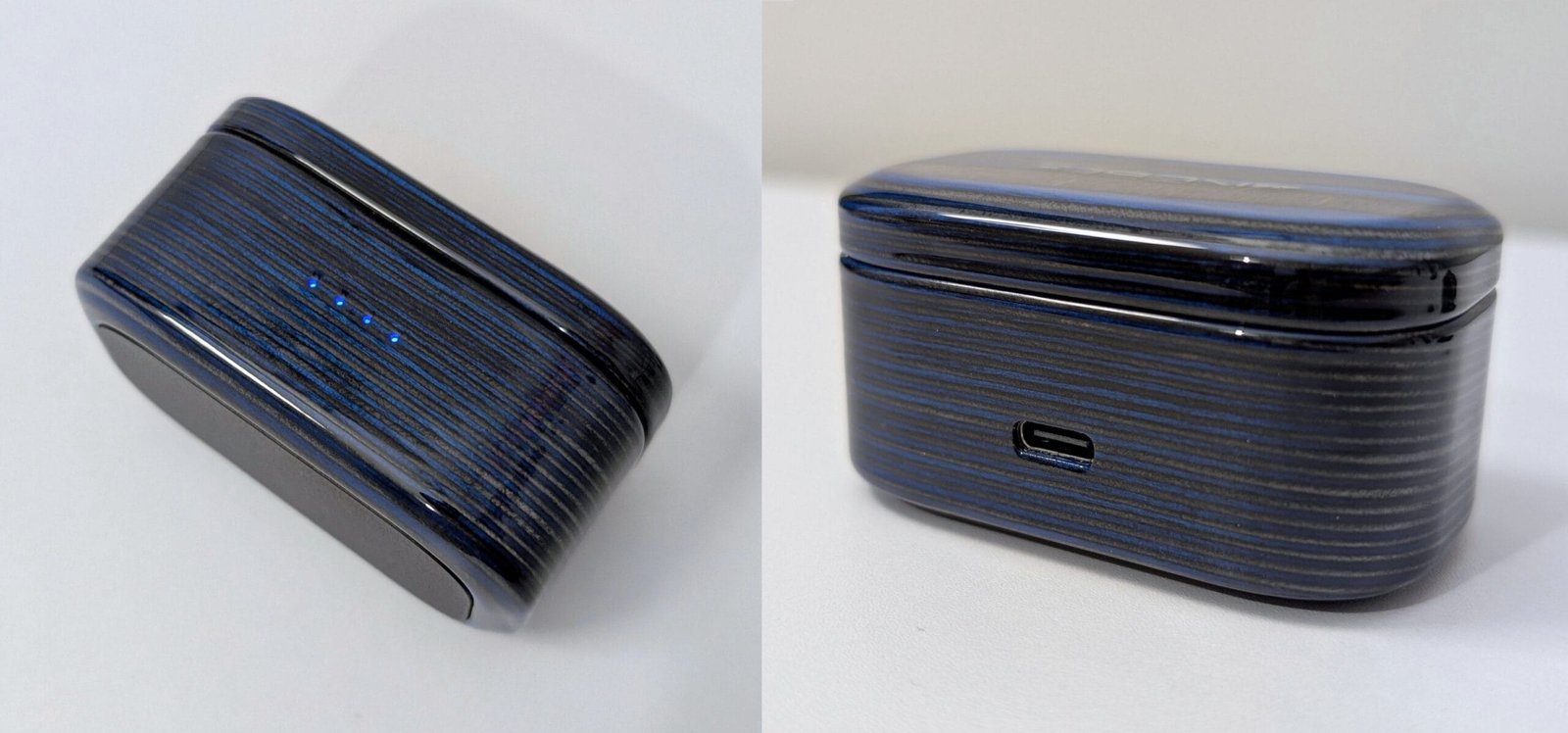
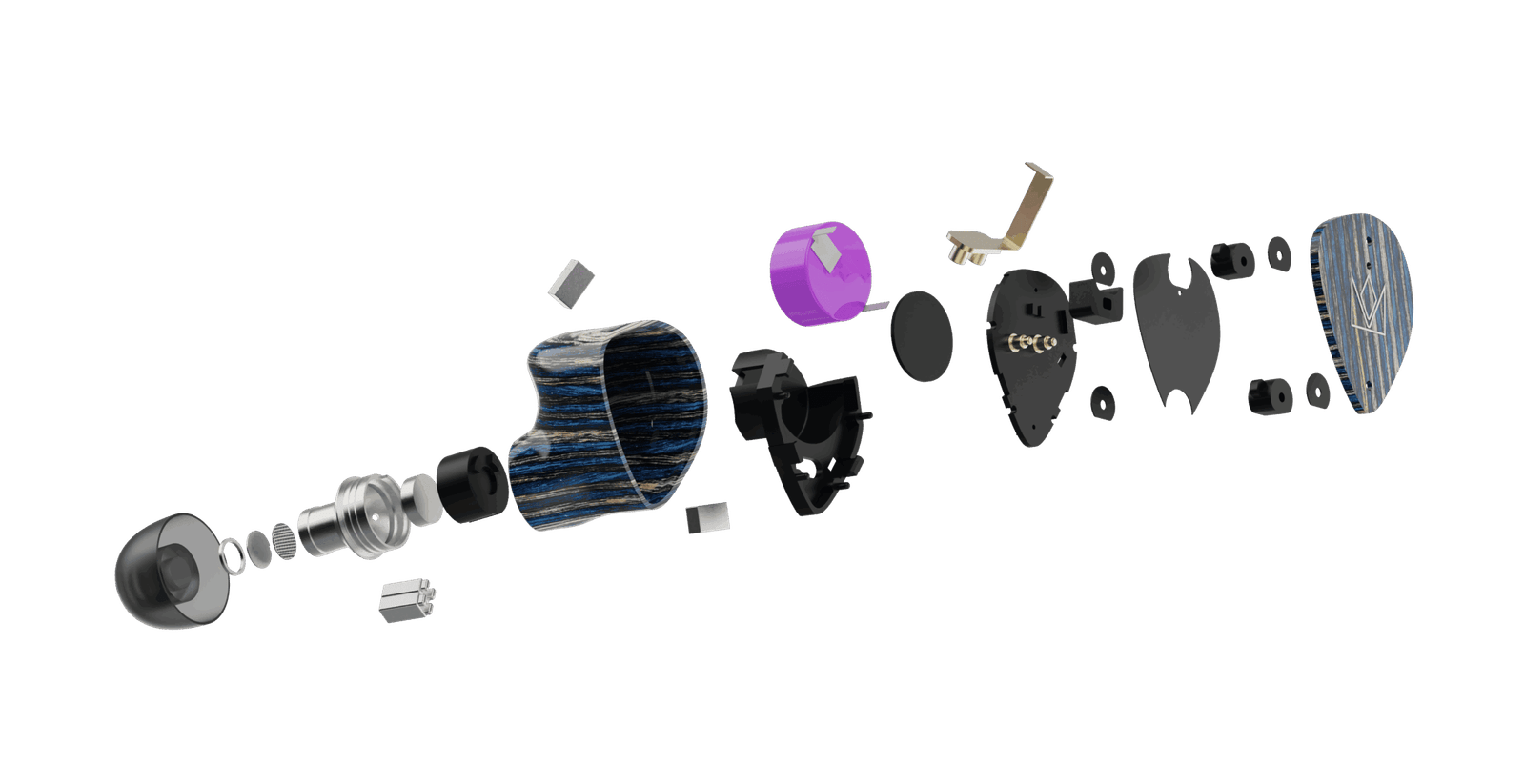
Many might wonder about the large size of Noble's earbuds compared to competitors' products, but there's an understandable explanation for it: each earbud contains no less than four drivers. Wired earbuds of a similar size might, of course, have even more drivers, but wireless headphones usually settle for one or two, allowing the structure to be, for example, stick-like. A recent example of this is the one I tested: Valco NL25. A downside of the Fokus Prestige Encore's bulkiness is that the charging case also had to be made so large that it no longer fits properly in a trouser pocket. Otherwise, however, I like the case, so its use did not pose any challenges during the test period.
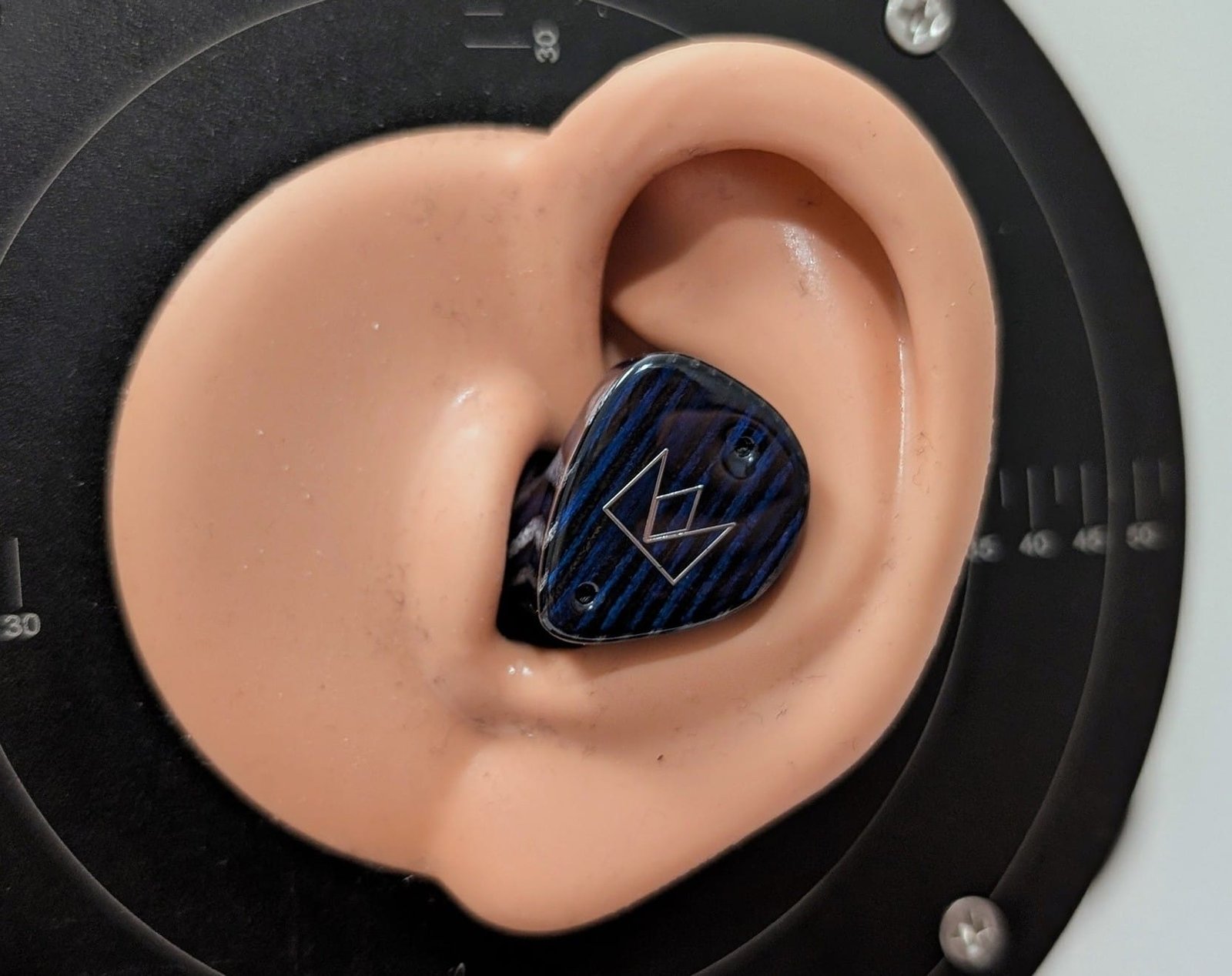
Thanks to the successful design, the earbuds slide easily into my ear canals without causing any discomfort even during prolonged use. The fit happened to be perfectly secure for me with the default tips already attached, so I had an easy time with setup. On the other hand, I can get the headphones to sit a bit deeper in my ear canals with the double-flange tips, which results in a smoother treble reproduction and slightly better ambient noise attenuation. I eventually switched to these tips permanently.
From a usability perspective, Noble has fortunately not added touch functions to the outer side of the headphones that would activate with a single tap. Instead, for some functions, a finger must be held against the side of the headphones for several seconds, while other commands are registered by tapping the buttons, which also usually isn't done accidentally. All functions are also customizable through the manufacturer's app for different needs.
My only real complaint is the slight uncertainty and delay in command registration, which means I can never be completely sure if I succeeded with multi-tap sequences. The manufacturer could still try to improve this to make the use as smooth as possible. On the other hand, the harder the buttons are tapped, the more reliably the commands register. Thus, the owner of the headphones will surely become accustomed to controlling them over time.
Technical aspects
Noble Audio is the only company I know that can add simultaneous AptX and LDAC codec support to its headphones. This is possible because Qualcomm's latest chipsets, which developed the AptX codecs, also support competing codecs, provided that some kind of licensing agreement is made for their use. Thanks to Noble's investments, the Fokus Prestige Encore supports all the best codecs from an audio quality perspective, including lossless AptX Lossless. Of course, AAC and SBC are also naturally found on the codec list. The Bluetooth version, in turn, is modern 5.4, and Multipoint works flawlessly, as do wireless connections in general, regardless of the codec. It is difficult to improve on this further, except in the form of Bluetooth LE support and the LC3 codec, which are currently missing.
The headphones' battery life also deserves praise, as with noise cancellation on, they reach 7 hours according to the manufacturer, and 10 hours without noise cancellation. This should be sufficient for a workday or a longer flight, as placing the earbuds in the charging case for 10 minutes extends their usage time by 2 hours. The total usage time, including the case, is stated as 35 hours. If someone owns a wireless charger, the case could also be charged with one in addition to a USB cable.
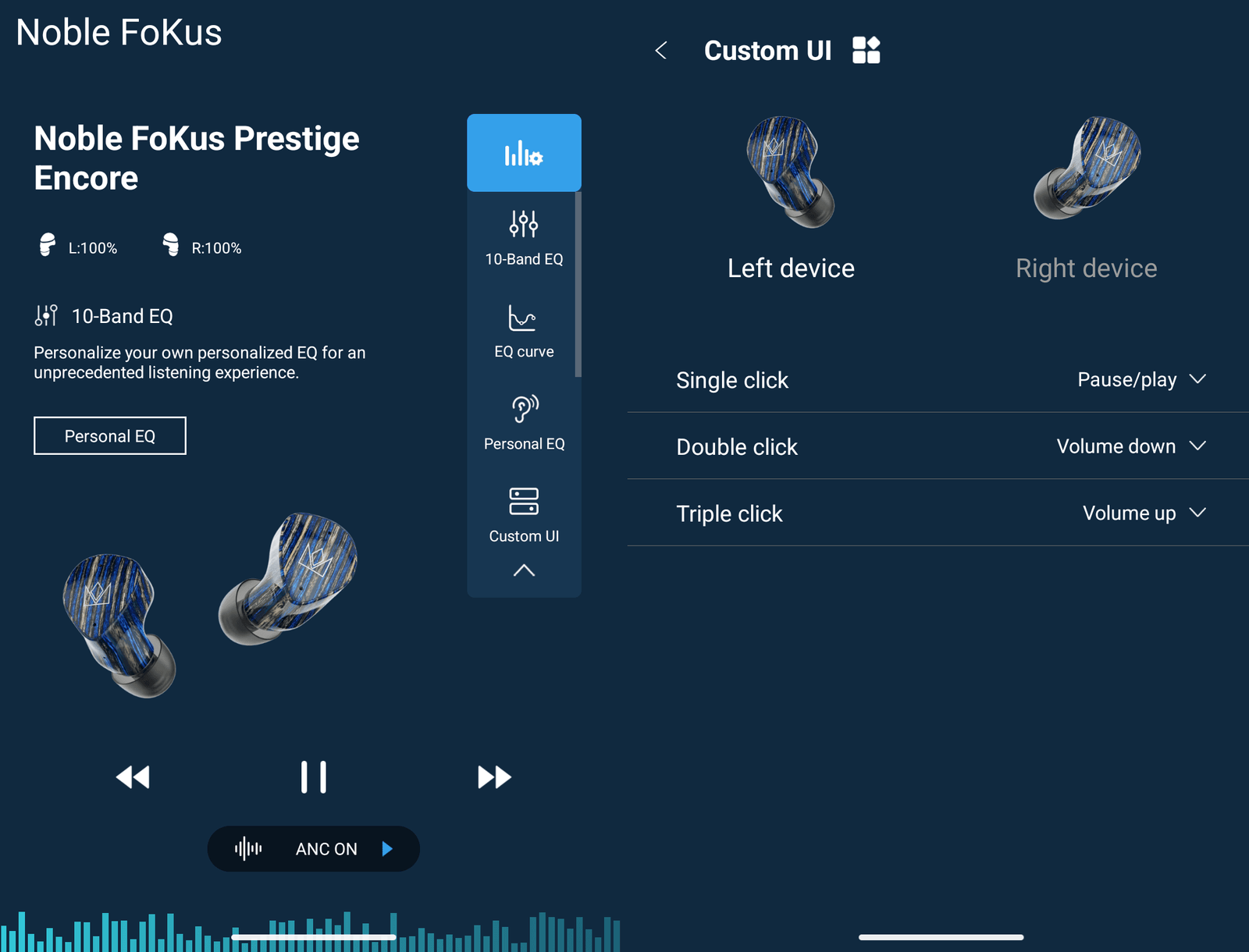
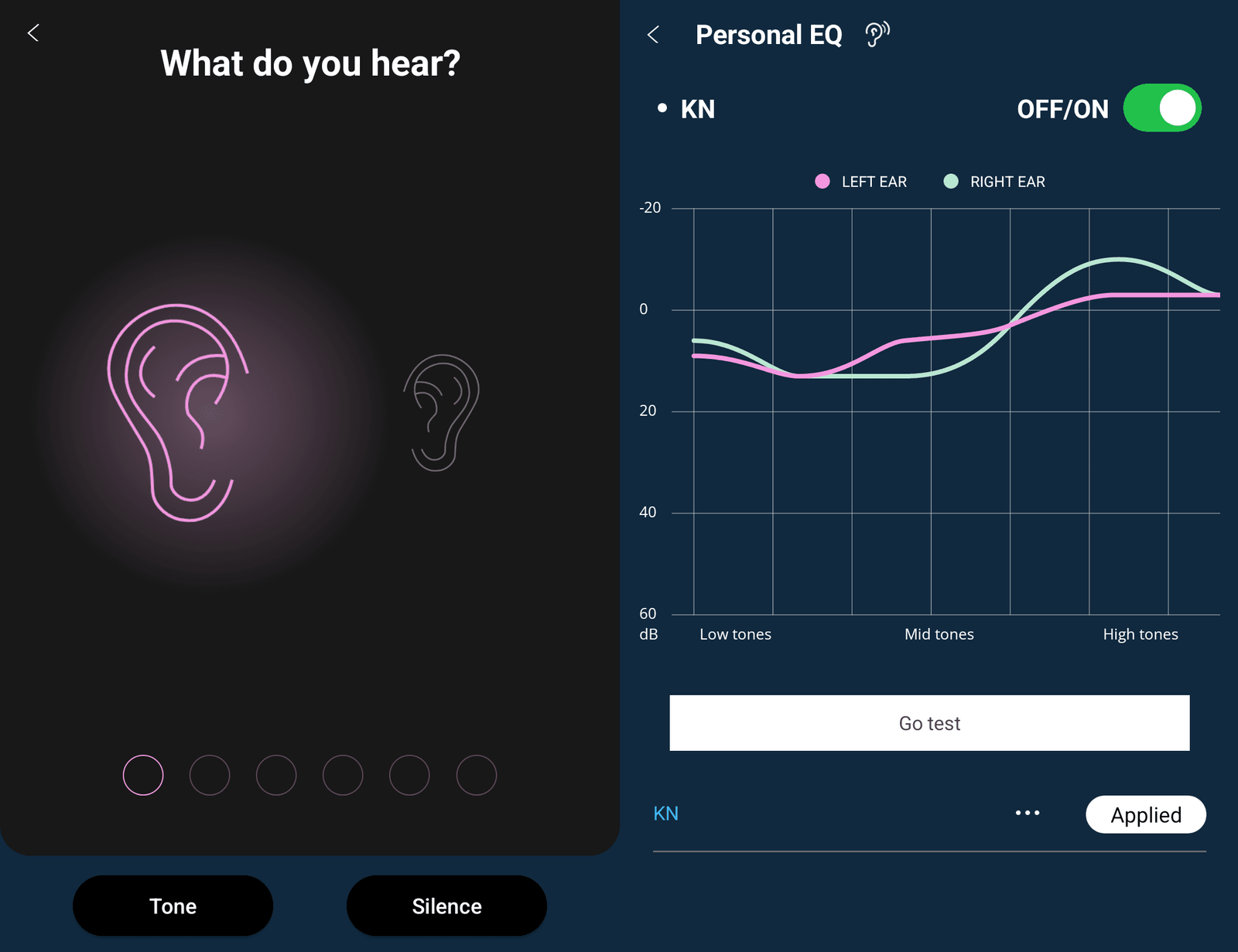
The manufacturer's mobile application allows for a few general settings and firmware updates, but its main task is to adjust the sound with versatile tools. Available are ready-made sound profiles, a 10-band equalizer, an Audiodo-branded hearing test, and a frequency response ”tilt tool” (EQ Curve), which also serves as a simpler equalizer.
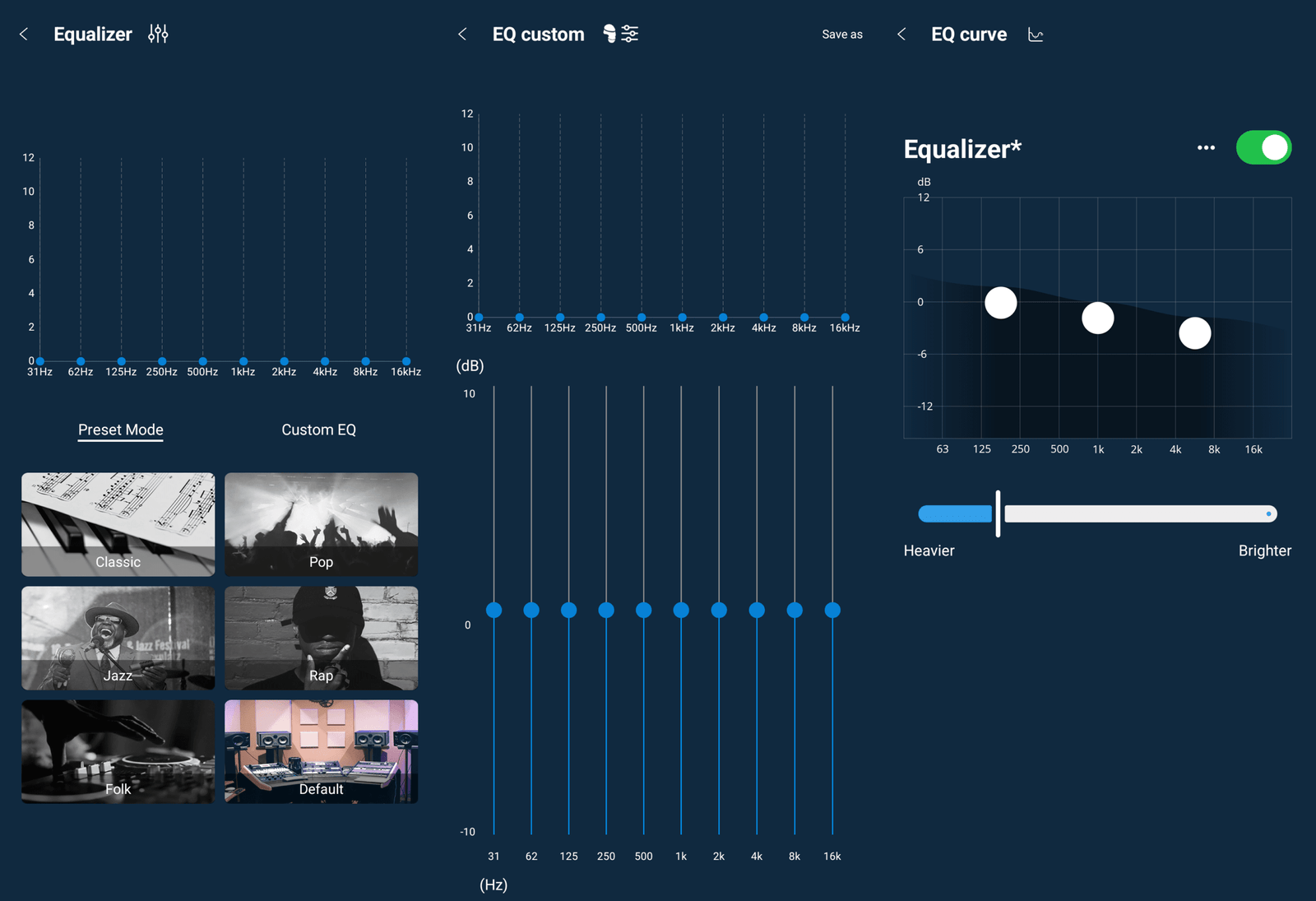
With the EQ Curve tool, the frequency response can be tilted towards either bass or treble at three pivot points. Even if the tilt function is not used, the pivot points can also be utilized for more traditional equalization. For example, if someone finds the sound too bright, broadly lowering the treble level with this tool can be easier than with another, more complex equalizer. What makes the situation even more interesting is that these two equalizers can be used simultaneously.
The manufacturer's 10-band equalizer allows for more precise adjustment of different frequencies by up to 10 decibels up or down, if needed. The selected profile is, as expected, saved to the headphones, making it available even on devices where the manufacturer's app is not installed. The pre-defined sound profiles, on the other hand, I found quite useless based on my own needs, even though they clearly alter the sound in different directions. I also didn't achieve the best result with the hearing test, because for some reason, my ears' hearing perception was determined to be so different that the center of the stereo image became distorted. However, everyone should try this themselves, as performing the hearing test only takes a few minutes.
Active Noise Cancellation
The Fokus Prestige Encore actively dampens noise, but it can be difficult to notice when the noise cancellation function is on, because the difference compared to mere passive attenuation remains quite small. At least for me, it happened many times during the test period that I thought noise cancellation was on, even though it wasn't. Partially, this was due to the fact that I didn't realize the headphones always start in a state where noise cancellation is off. The manufacturer probably assumes most users use their headphones this way.
When listening to simulated airplane noise and city hustle, I found the Fokus Prestige Encore's noise cancellation function to be roughly as effective Valco NL25with it, regardless of which type of ear tips I used. Since the Valco model, in turn, corresponds to the Moondrop Space Travel 2, which costs less than 30 euros, I do not believe, with my limited sample of earbuds, that these come anywhere near the market leaders. Furthermore, there is a constant faint electronic chirping from Noble's headphones, and the noise cancellation is not well suited for windy conditions due to interference, which, knowing the similar challenges of competitors, I did not expect anyway. Since the transparency mode is also quite faint, differing only slightly from the OFF mode, the Fokus Prestige Encore would not be my first recommendation for those looking for the best possible noise-cancelling headphones. On the other hand, I suspect that those interested in earbuds costing over 500 euros are not primarily seeking this, but rather are interested in potential sound quality improvements compared to more affordable products.
Microphone sound quality
I found that the headphones' microphones produced very clear sound in a quiet environment, and they also do not have overly strong background noise filtering that would inadvertently cut off the speaker's own voice in a noisier environment. I even admit to being slightly surprised at how natural my voice remained in recordings made amidst noise. At the same time, I naturally still heard other sounds, such as all kinds of traffic noise or keyboard typing mixed with my speech, but they remained somewhat in the background without drawing too much attention to themselves. Only a breeze posed greater challenges for the Fokus Prestige Encore's microphone, but such headphones where this wouldn't happen are likely rare. Thus, the microphone's sound quality gets a thumbs up from me.
Headphone sound quality
The Fokus Prestige Encore differs from more affordable wireless earbuds in the total number of drivers. To my knowledge, no other manufacturer's products have four drivers, and to be precise, Noble's own Fokus Rex5 has one more, even though it costs less than the Fokus Prestige Encore. The manufacturer's most expensive model is based on a 3-way hybrid implementation, where an 8-millimeter dynamic driver produces bass, two BA (Balanced Armature) drivers handle mid-frequencies, and a 6-millimeter planar driver produces treble. Noble focuses its marketing on the advantages of these three driver types without describing its sound quality goals very precisely. However, the bass should be deep and ”rich,” the midrange clear and realistic, and the treble airy, accurate, and detailed. Based on this, we will investigate the situation with both measurements and listening observations.
Even though I present the measurement results first in my articles, in reality, I always listen to the headphones I'm testing for some time before measuring them. Usually, this already forms my final opinion, and the measurements don't significantly change it anymore, except from a reporting perspective. I hadn't seen the frequency response of the Fokus Prestige Encore before I got the headphones in my hands and ears, which was even a bit unusual given the diligent measurement community for in-ear headphones.
Measurements
The headphones' frequency response has been measured with equipment compliant with the IEC711 standard (inner ear + microphone). In the case of in-ear headphones, Harman's scientific research remained partly incomplete, so the 2019 in-ear target curve has not achieved as established a position as the 2018 over-ear target curve due to its rather aggressive high frequencies. Despite this, I use it as a reference in the graphs, because otherwise, I would have to choose another target curve based on entirely subjective premises. So, let's keep the reference as objective as possible, but remember that in-ear headphones are not necessarily desirable to sound quite as bass-heavy and energetic as the Harman 2019 curve suggests.
When measured with my own equipment, the results for in-ear headphones are no longer completely accurate after 7 kilohertz; instead, a resonance naturally forms around 8–9 kilohertz, flanked by dips on both sides of the frequency response. So, the headphones do not actually reproduce sound in this way, but the steepness of these features can still indicate whether there are more or fewer high frequencies compared to other headphone models.
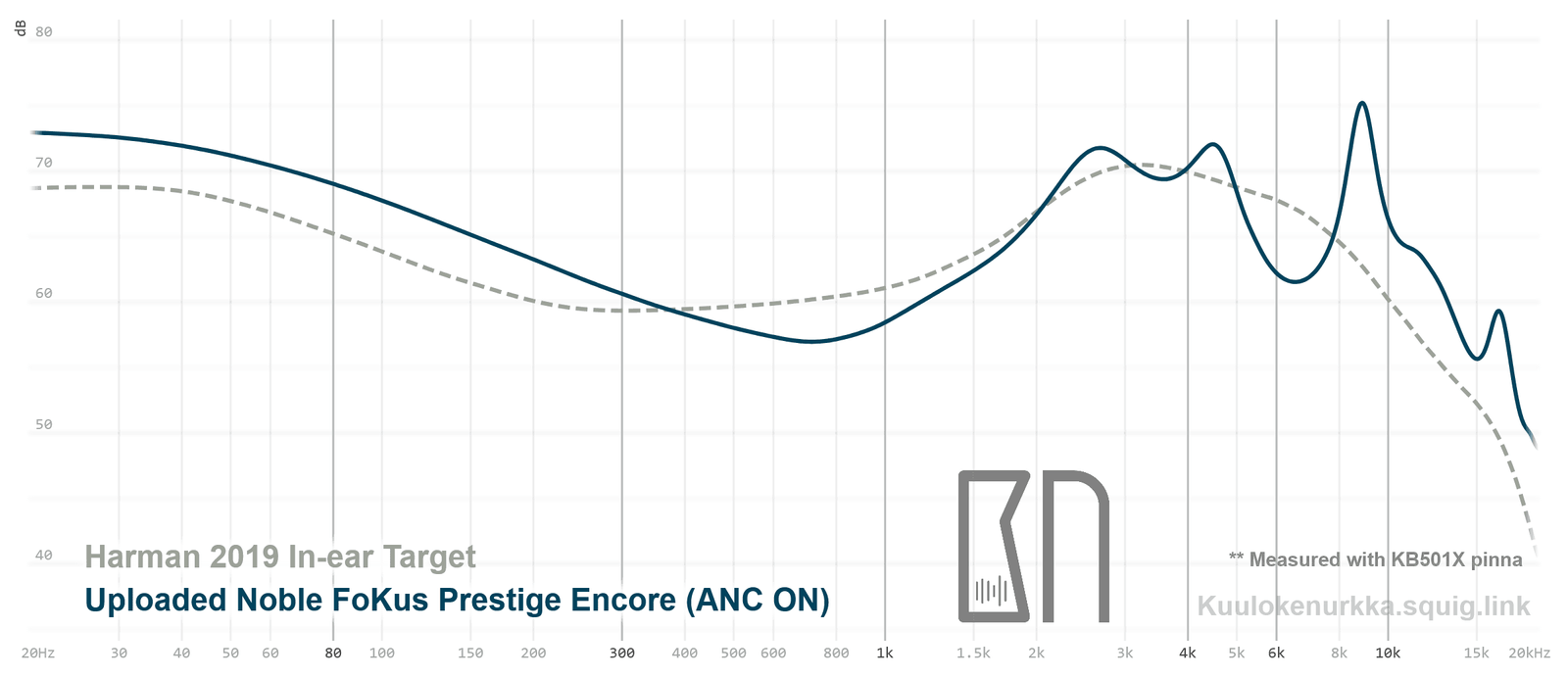
The frequency response of the Fokus Prestige Encore is identical with noise cancellation on and off, so there's no need to pay attention to this when listening to the headphones or examining the measurement results.
Frequency response with default ear tips:
Frequency response with alternative ear tips (double-flange design):
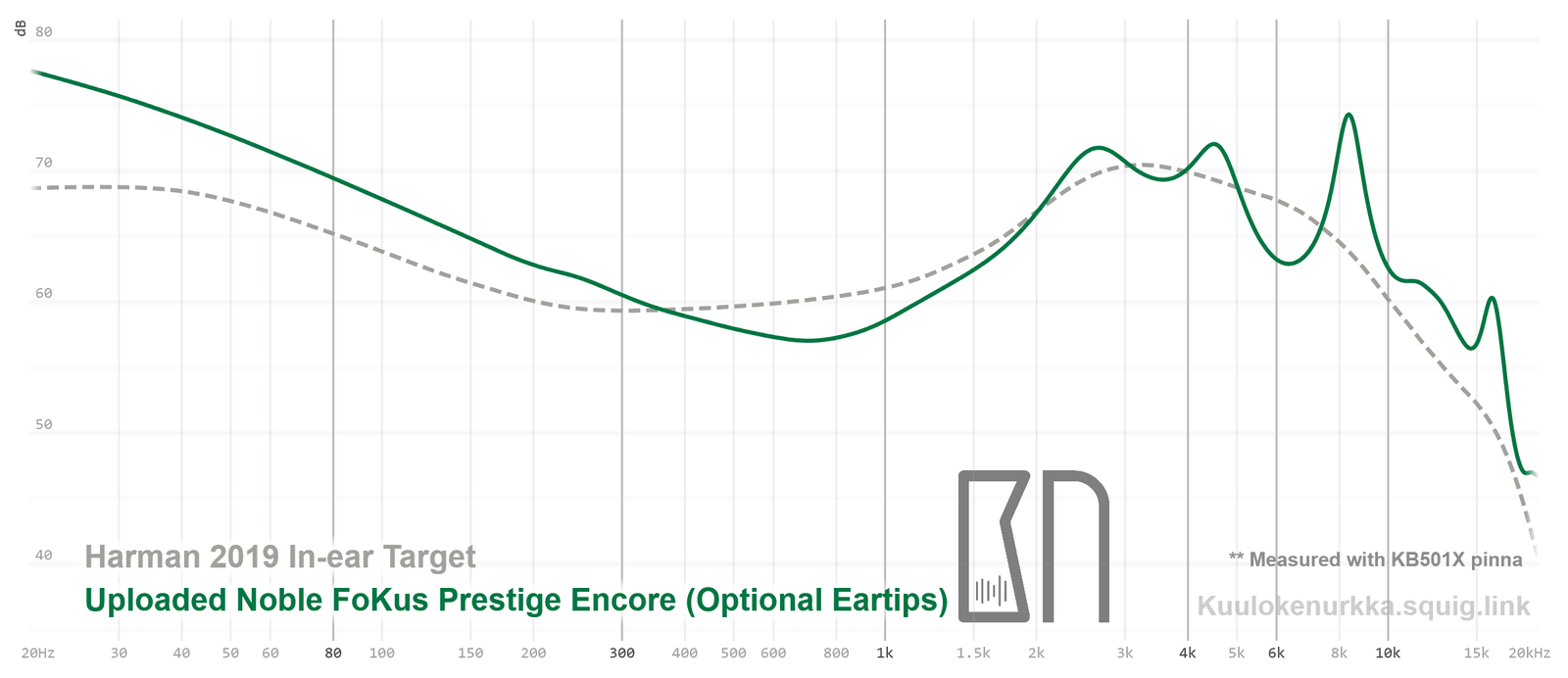
Now we are examining a prime example of V-shaped and attention-seeking tuning, where bass and treble are strongly emphasized. Since Harman's published curve for in-ear headphones already represents the same genre, the Fokus Prestige Encore should be considered a truly bass-heavy and bright in-ear headphone. This may be beneficial for those who use headphones in noisy environments or at low volumes. Objectively evaluated, however, the midrange between 500–1500 hertz remains quite recessed, and the extremes of the frequency response may, in most people's opinion, be overemphasized when aiming for a balanced listening experience. In such cases, I recommend exploring the manufacturer's comprehensive EQ tools.
Achieving a more balanced sound with equalization:
If a more balanced sound is desired from the Fokus Prestige Encore, it can be achieved most simply with the EQ Curve tool using the following adjustments. Reducing the bass, slightly boosting the midrange, and significantly attenuating the treble will bring the frequency response close to Harman's in-ear curve. After this, the reproduction is still V-shaped in a way, but to such a moderate extent that it doesn't overtly color the music being listened to.
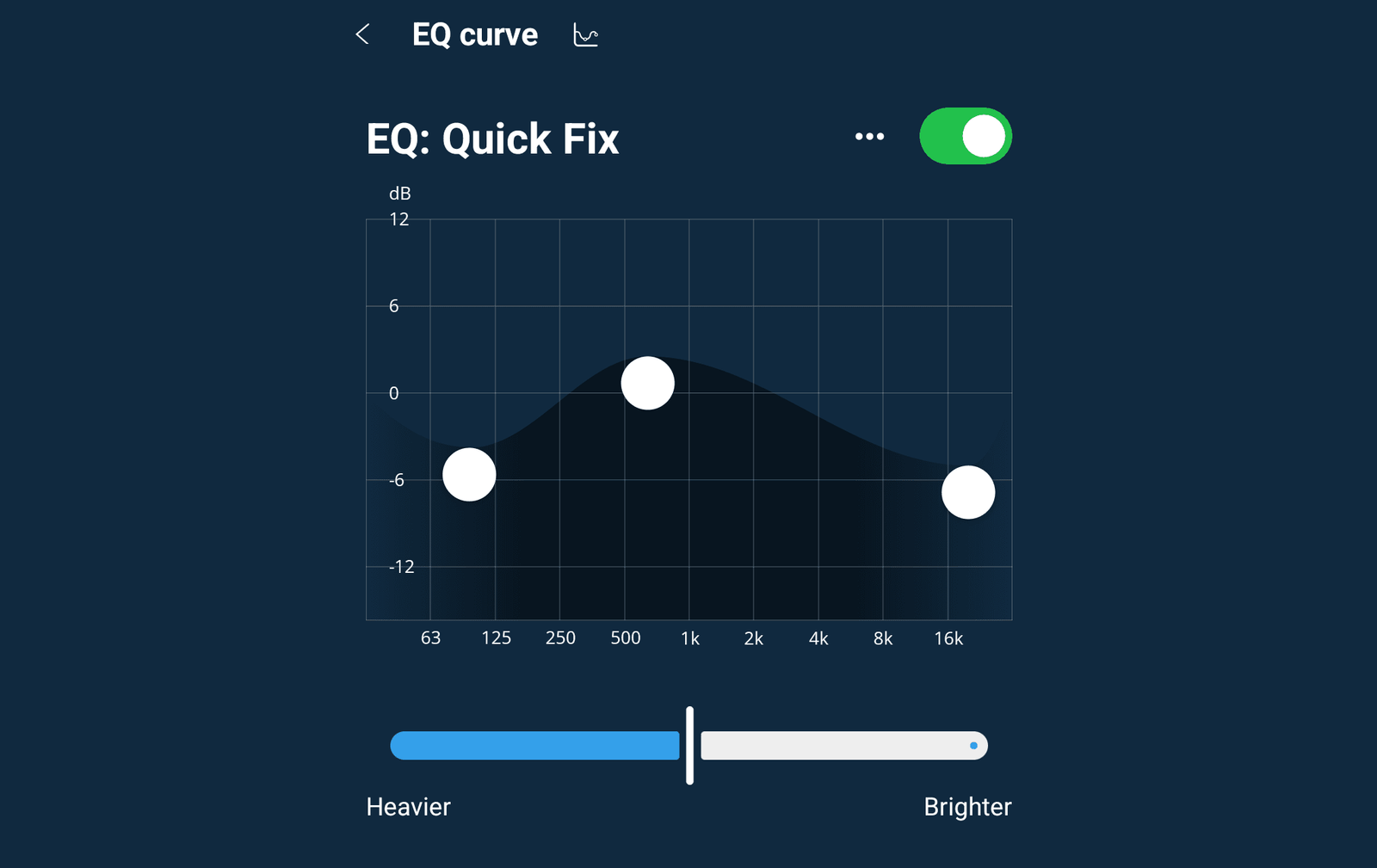
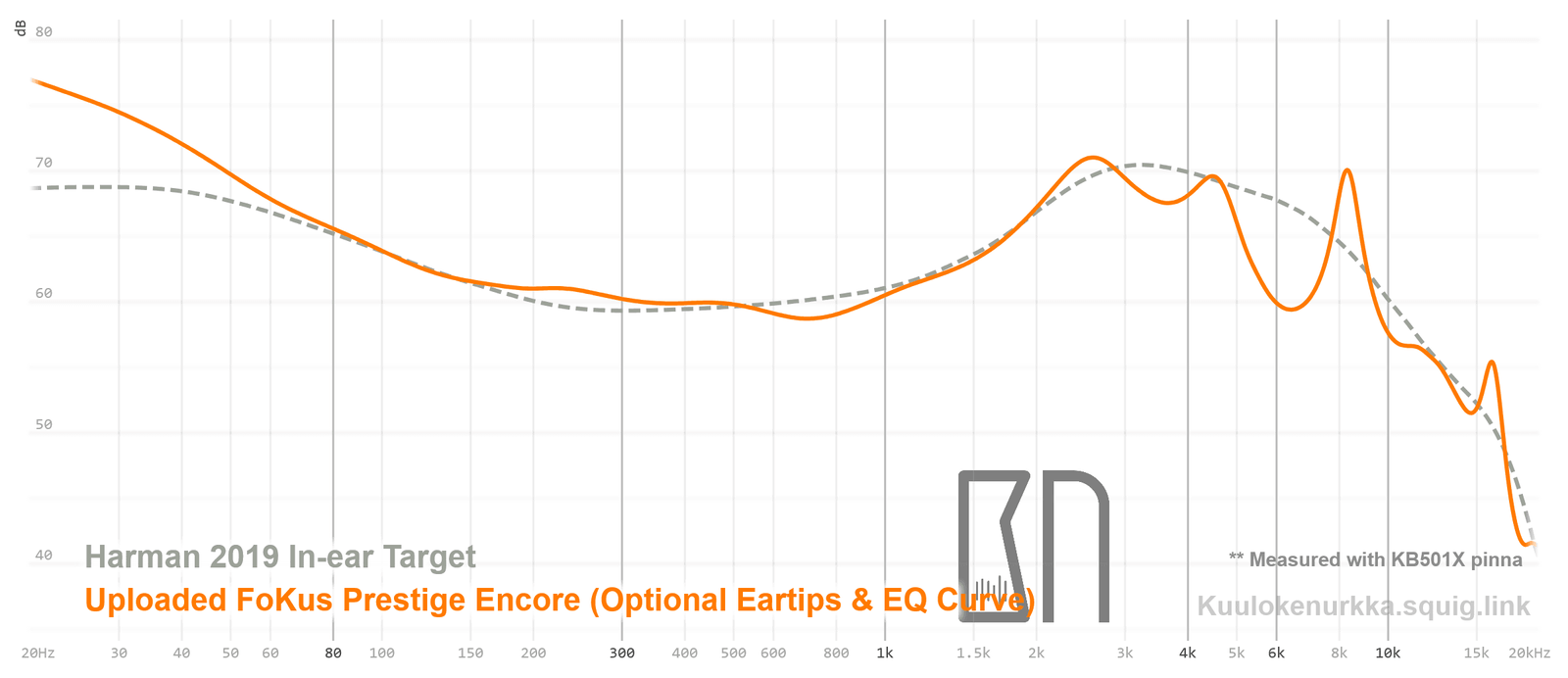
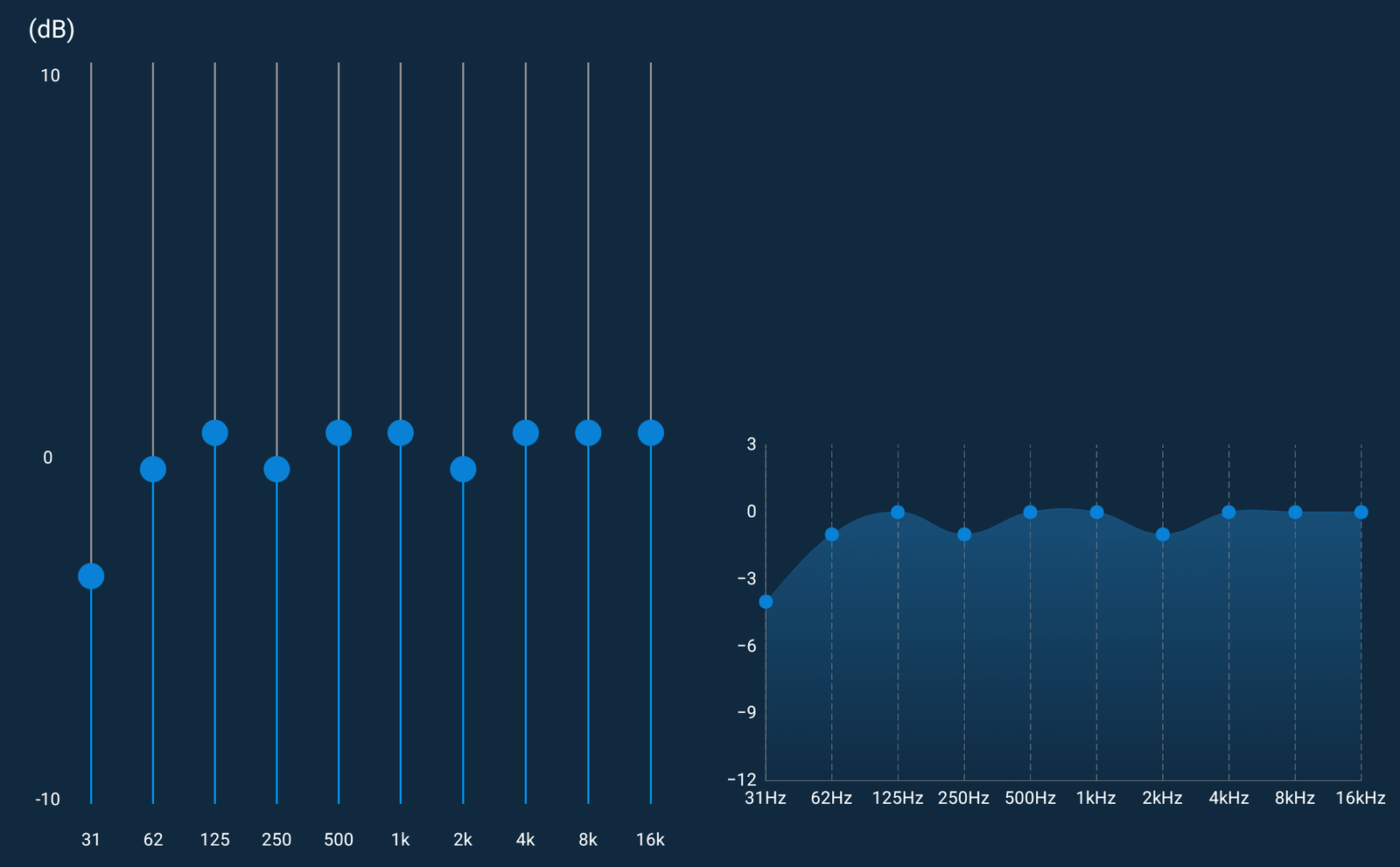
Achieving a good result with this tool is extremely easy, whereas with a more precise 10-band equalizer, the highest treble adjusts somewhat inadequately, with the largest emphasis remaining between 8k and 16k. For this reason, the simpler tool surprisingly won this time. However, if I were to nitpick further, I would make the following additional adjustments, as both equalizers can be used simultaneously.
Sound observations
When I first listened to the Fokus Prestige Encore, its wildly tuned bass and treble left me astonished. The sound according to the default settings is intentionally exaggerated, resembling a kind of demo mode designed to captivate a customer quickly, for example, in a trade show environment or a hi-fi store. Noble's approach is thus contrary to the direction in which in-ear headphones have been moving in recent years – we are seeing more and more headphones aiming for a balanced and natural sound. The Fokus Prestige Encore, on the other hand, delivers hefty bass rumble and aggressively sharpened treble. On the other hand, the high amount of low and high frequencies somewhat balances each other out, sometimes even shifting my attention more towards the veiled and stylistically thin midrange.
Such a strong loudness effect is not entirely unfounded, as when keeping the volume low, the headphones still sound robust and brightly clear. I actually don't find the result bad at all in such a use case. As awareness of the risk of hearing damage caused by excessively loud volume has risen in recent years, Noble's tuning philosophy ensures that its headphones do not need to be listened to particularly loudly for the desire for powerful bass and clear sound to be realized. Such tuning can also be suitable for noisier environments, especially since the Fokus Prestige Encore's noise-cancelling function is not among the best on the market. As a third advantage, I would see the headphones' hybrid driver implementation, as a similar tuning implemented with, for example, a single dynamic driver would easily become muddy, whereas with four drivers, clarity and separation remain quite decent.
Generally, Noble's headphones seem to be aimed at larger consumer groups who are likely accustomed to a similar presentation from other manufacturers' products. Such headphones are generally best suited for those who do not listen to music with too critical an approach, but rather crave excitement and energy. The size of this demographic may be larger than I can even imagine. However, I personally lean towards a slightly more natural sound, so the Fokus Prestige Encore with its default settings is not quite my cup of tea. I don't like how the bloated bass easily overpowers instruments, and how harsh the treble becomes as soon as the volume is even slightly increased. Therefore, the headphones' equalization possibilities quickly became familiar and simultaneously proved their competence.
With the combination of two equalizers, I was able to create a kind of inverted V-curve, which made the sound significantly smoother. After this, the headphones became really good in my opinion! This is how the multi-driver implementation shows its best sides in sound clarity and separation. The bass, which I initially found muddy, also kicks really hard and tight after the changes, and I no longer detect any disturbances in the airy treble either. My goal was not specifically to emulate Harman's in-ear curve, but on the other hand, I also didn't want to change the headphones to be completely different from Noble's design solutions. With my own changes, the target audience for Fokus Prestige Encore would remain pretty much the same, and most importantly, I like the sound myself. Equalized, the reproduction is clear, exciting, and detailed, so many others would likely be impressed by this kind of presentation.
I perceive the Fokus Prestige Encore primarily as a headphone with potential for development, as it could be adjusted to almost anything. I notice some have, for example, added the maximum amount of bass and treble with both equalizers, even though I myself already dislike the default settings. Correspondingly, nothing would prevent adjusting the bass and treble to be even more neutral compared to my own suggestions. It's not worth arguing too much about matters of taste, but such different extremes concretely demonstrate how versatilely the sound of the Fokus Prestige Encore could be shaped. An advantage of in-ear headphones is also often the flatness of the frequency response, which further facilitates achieving a good result compared to similar over-ear headphones.
Summary
The Fokus Prestige Encore is therefore a headphone whose factory-set sound a critic like myself is forced to be slightly disappointed with. However, the trick with such colored-sounding headphones lies in the fact that if the presentation happens to hit the mark, it will likely do so strongly. Especially if someone likes powerful bass and bright high frequencies, Noble's headphones will probably outperform almost all their more moderately tuned competitors.
If, on the other hand, one desires something else, thanks to the two equalizers, the sound can be adapted to very different preferences – including my own. In this case, the multi-driver implementation of the headphones is beneficial, and with a successful Bluetooth implementation, wirelessness does not become an obstacle to sound quality. On the contrary, such a product is much easier to grab from its case and put into the ears than to start wrapping the cables of similarly priced wired in-ear monitors around the earlobes and then finding a suitable amplifier. I understand the appeal of the product category.
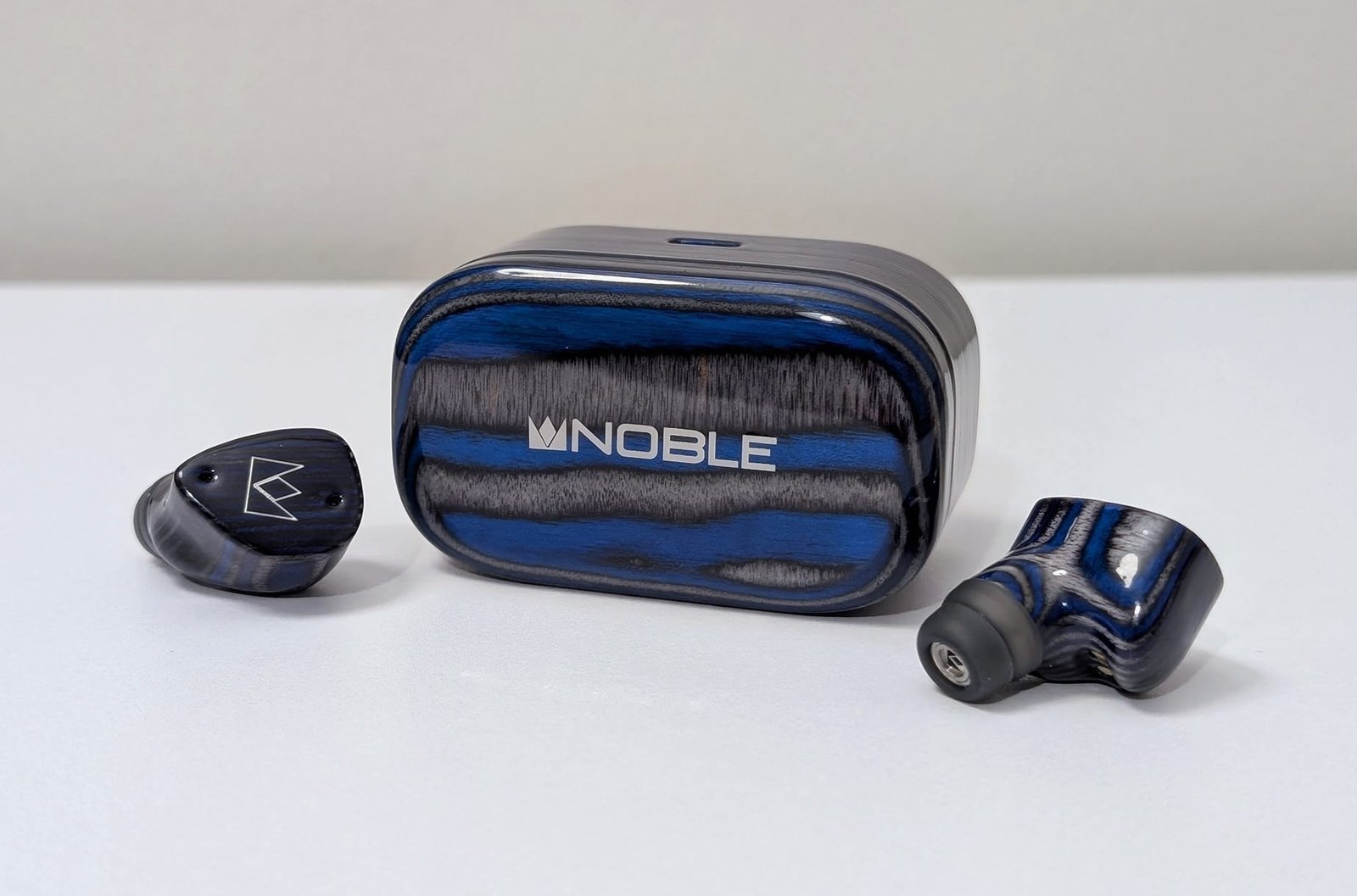
The ”carved” wooden Fokus Prestige Encore is, in my opinion, aimed at those who are willing to pay extra for an original appearance, a high-quality impression, and for the product to evoke emotions in general. On the other hand, a potential buyer is also expected to appreciate multi-driver audio reproduction. Noble has, all in all, succeeded in creating in a certain way exclusive and even slightly over-the-top in-ear monitors without them feeling tasteless, provided that blue is among one's favorite colors. However, particularly effective noise cancellation is not available, as tool-like noise suppressors are offered by completely different manufacturers, such as Apple, Sony, and Bose. They can also be had for half the price.
My biggest surprise regarding the purpose of the Fokus Prestige Encore ultimately relates to noise cancellation. Since it doesn't actually compete against other consumer favorites on this metric, why is the sound quality nevertheless tuned to appeal to the same target audience? I myself would have expected a slightly more neutral factory tuning for 800 euros, or at least a separate sound setting leaning in that direction, which would allow me to recommend the headphones to knowledgeable hi-fi enthusiasts. Instead, as they are, I would recommend the headphones in terms of sound quality rather to those who might normally seek effective noise cancellation, which Noble's headphones do not, however, offer.
Although there are contradictions associated with the end result, interpreting my own feelings, I find myself liking the Fokus Prestige Encore after my equalizations, and we're not just talking about politeness here. Perhaps in products like these, adaptability is ultimately the most important thing, because you can never please everyone at once. If the sound quality is highly likely to be adaptable to one's own taste and obvious flaws are absent, then isn't it a good product? This is at least how the Fokus Prestige Encore feels, provided one can afford it.
Pros and cons:
+ Benefits of multi-driver implementation compared to more affordable competitors
+ Versatile equalization possibilities
+ Excellent sound quality achievable precisely through equalization
+ Support for both AptX and LDAC codecs
+ Fine and original appearance
+ Good fit
+ Long battery life
+ Clear-sounding microphone
+ Supports wireless charging
– Strong V-shaped factory tuning may divide opinions
– Slightly clunky ”tap functions”
– Mediocre noise cancellation function
– High price
 EN
EN  FI
FI
Good afternoon, is a review of SoundPEATS H3 planned?
Hi! These latest earbud reviews have come quite unexpectedly and unplanned, so I don't currently have anything locked in regarding testing other earbuds either. There would be many interesting products in this category as well.
Hello, can you upload your measurements to Squiglink?
Hello, yes I might. So far, I haven’t measured many IEMs, so I have skipped uploading them to Squiglink. However, I could probably add the measurements to my current headphone database similarly as some others have done. Please check again tomorrow and there should be data available.
Yes, now I found them. Thanks a lot, perfect review like always.
Thank you very much for displaying frequency measurement
I tried to tweak based on hearing but couldn’t be happier until I found yours, and i just realized we can combine both eq as the 10 band frequency didn’t sit on the right width either
Best regards,
You are welcome! I was lucky to be able to measure and review them a way earlier than many others. Happy listening!