Author: Sword of Damocles
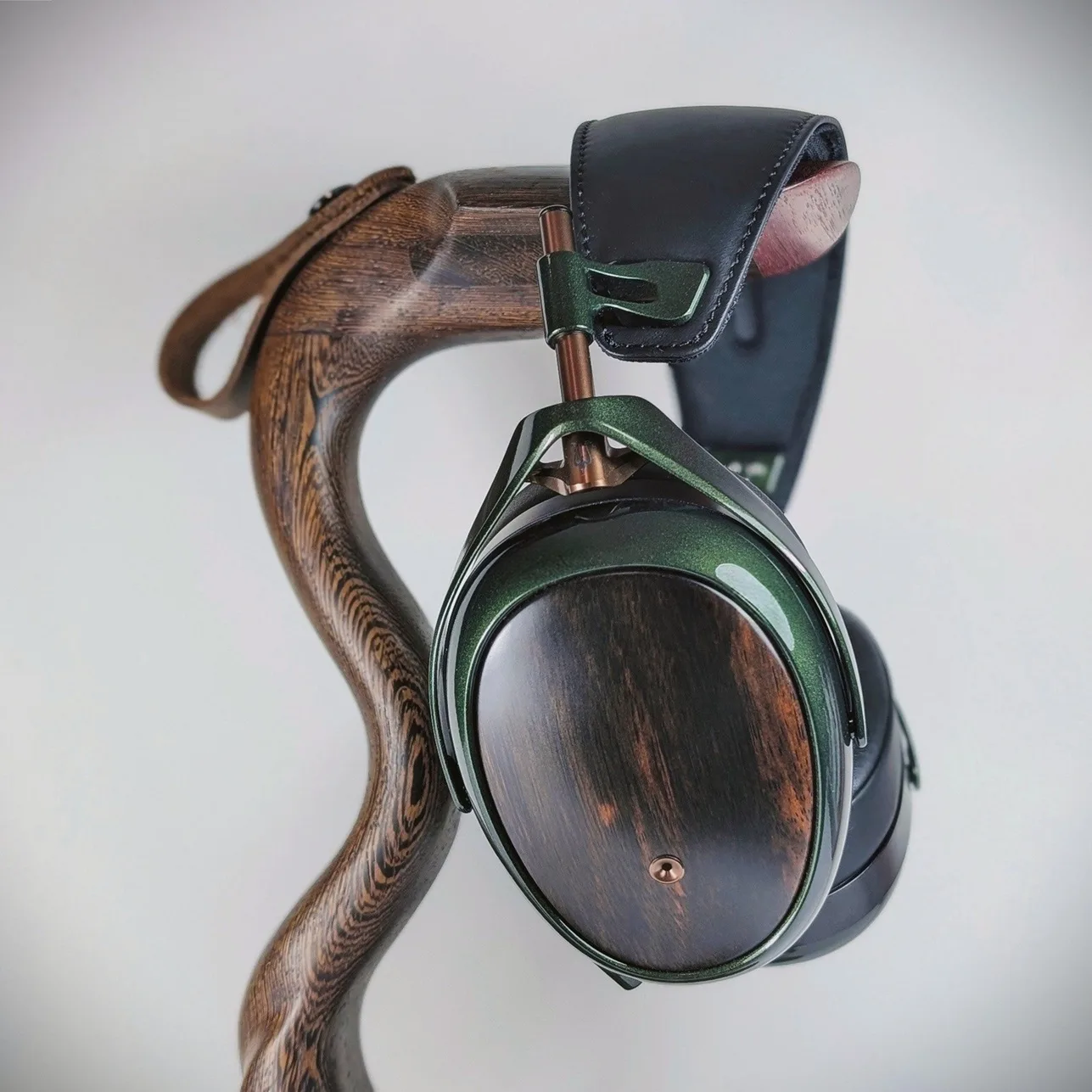
Table of Contents:
Information:
- Release year: 2026
- Country of manufacture: Romania
- Price: 799 €
- Available in Finland: Yes
- Type: Closed, over-ear
- 50 mm dynamic drivers with a W-shaped diaphragm (beryllium-coated polymer surround and cellulose-carbon fiber composite dome)
- Impedance: 40 Ohm
- Sensitivity: 111 dB/mW
- Weight: 332 g
- Connection type: 2x 3,5 mm
- 2 cables: Length 1.8 m | Connectors 4.4 mm and 3.5 mm (+ 6.35 mm adapter)
- Accessories: Carrying case and cable pouch
- Warranty: 2 years
Review sample: Self-purchased product
The life of a headphone reviewer nowadays is a constant chase after manufacturers, as new products pop up on the market before even half of the previous ones have been tested. If and when traditional passive headphones are also assumed to be a long-lasting purchase for most, how can there be enough buyers for all headphone models? Manufacturers can certainly help this by designing attractive and reasonably priced products that encourage enthusiasts to try new things. In my case too, headphones should stand out in some way from already sold alternatives for me to pick them up for review.
This threshold was crossed this time by Meze Audio's brand new STRADA, even though a few other headphones from the manufacturer would still be awaiting testing. What makes the closed-back STRADA (meaning 'road' in Romanian and Italian) interesting are the parts borrowed from different Meze headphone models: for 800 euros, the consumer gets the drivers of the similarly priced 109 Pro's drivers installed in the high-quality chassis of the 2000-euro LIRIC headphones. The earcups are also made of fine Makassar ebony, so on paper, the package feels like a better deal than its price suggests.
Since these headphones have, in typical Meze Audio fashion, been both praised and criticized so far, I decided to throw my own spoon into the soup without intermediaries. So far, I've liked about every other headphone model from the manufacturer, so, expressed in a Savonian way, STRADA might be a perfectly good game, but it might also not be. One hears by listening and learns by reading.
Packaging and accessories
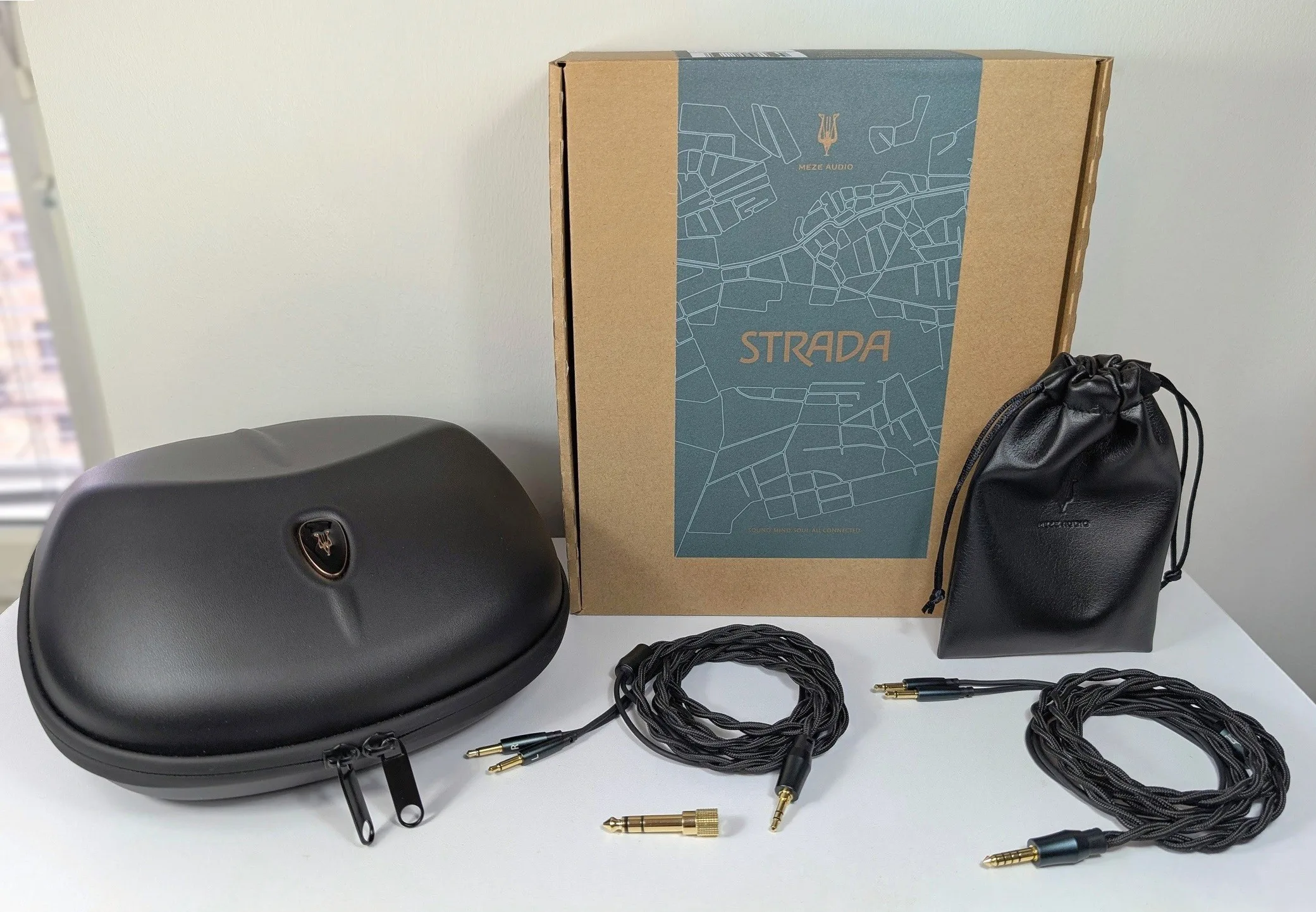
Even though STRADA's minimalist cardboard box may not necessarily raise great expectations, the headphones' equipment is high quality. The buyer receives a large carrying case lined with faux leather and velvet, as well as two valuable-feeling cables packed in a separate pouch. One of the cables is unbalanced (3.5/6.35 mm) and the other is balanced (4.4 mm) – both a suitable length of 1.8 meters. LIRIC- and POET-headphones, the attachment to the earcups is done with two 3.5 mm connectors, so additional cables can also be found relatively easily if someone needs them.
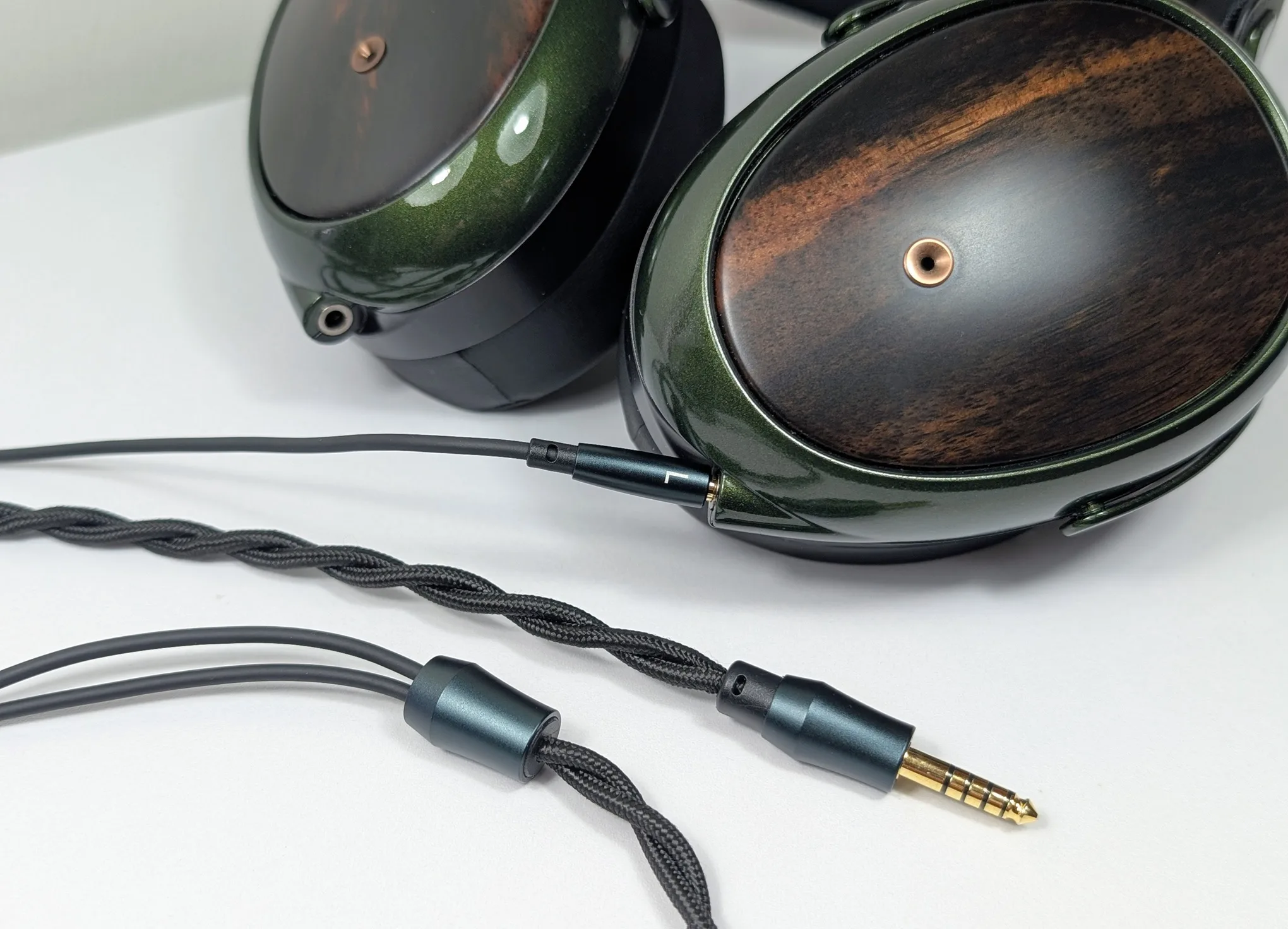
More expensive Meze models naturally come with even finer cables, but STRADA's braided cables' smooth fabric sleeving and metal connector housings also make an impression. For example, the standard cables of ZMF headphone models costing several thousands are not this fine. In STRADA, the fabric sleeving is cleverly absent from the parts branching to the cups, whereby the rubber sheath quite effectively stops the rustling and rattling caused by rubbing against clothes. Microphonics have not been as bothersome as in most other closed-back headphone models. The only cosmetic flaw is that the casing has come off one of the connectors attaching to the cup on the unbalanced cable, due to the glue failing. These things happen sometimes.
Build and comfort
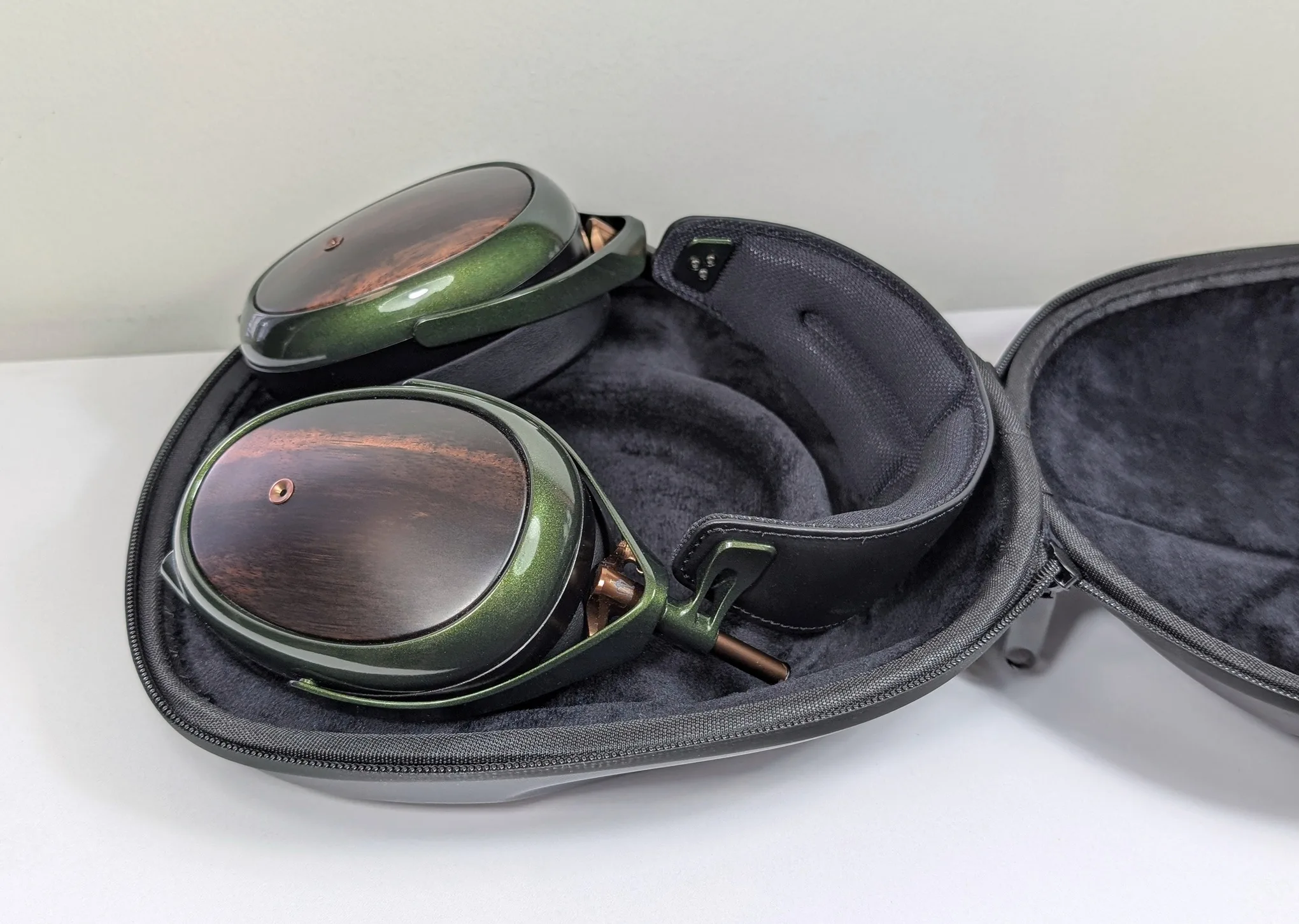
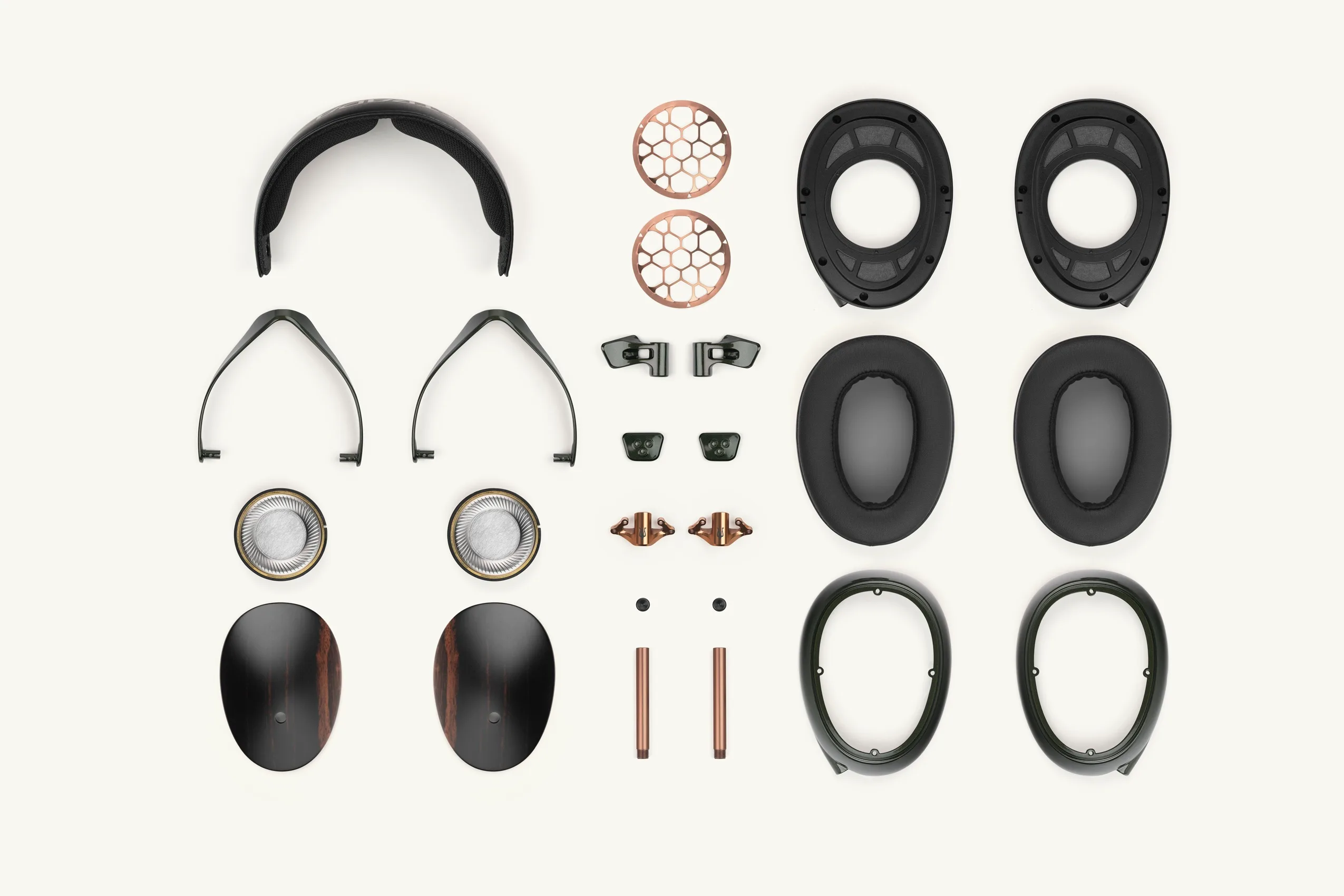
STRADA is built on a frame inherited from the manufacturer's LIRIC series, previously only seen in the 2000 euro price range, so the headphones' quality impression and mechanical design already outperform many competitors from the outset. Also noteworthy is STRADA's lightness, as it weighs only 332 grams for a rather large headphone, which is only 25 grams more than the clearly more slender Focal Azurys. This also makes it 100 grams lighter compared to the LIRIC equipped with planar drivers. Nevertheless, the construction feels excellently sturdy, and corners have not been cut in any other way either.
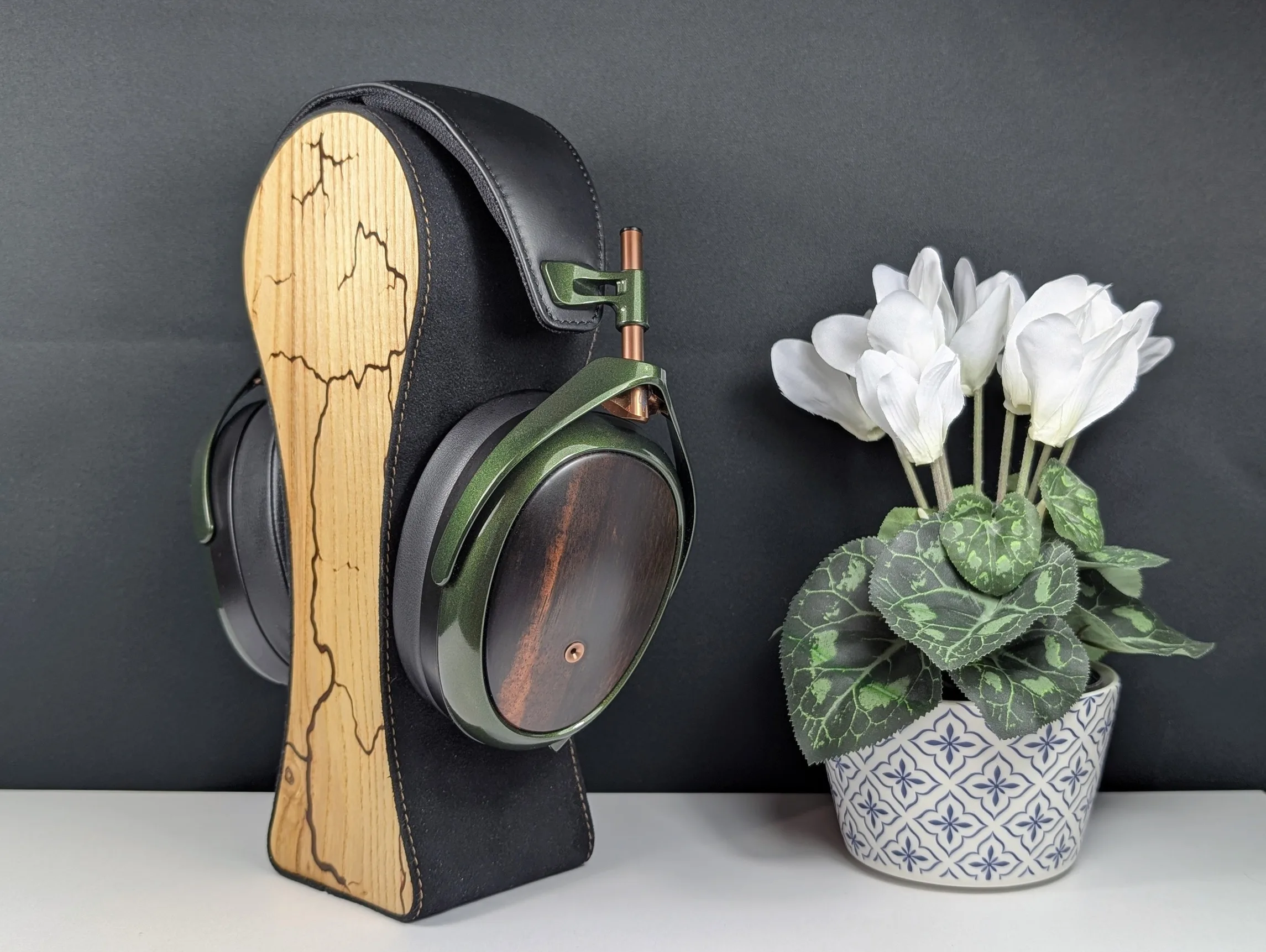
Externally, STRADA may divide opinions, as its magnesium parts are hand-painted in metallic green. Four layers of paint make the surface slippery and soft, so I admit I mistakenly thought the metal parts were plastic, especially since the thin headband gives a little when squeezed. The sides of the cups, on the other hand, are made of magnificent Makassar ebony, which looks unique in each headphone unit. My test headphones happened to have mainly dark wood, but I have also seen very light and striped units.
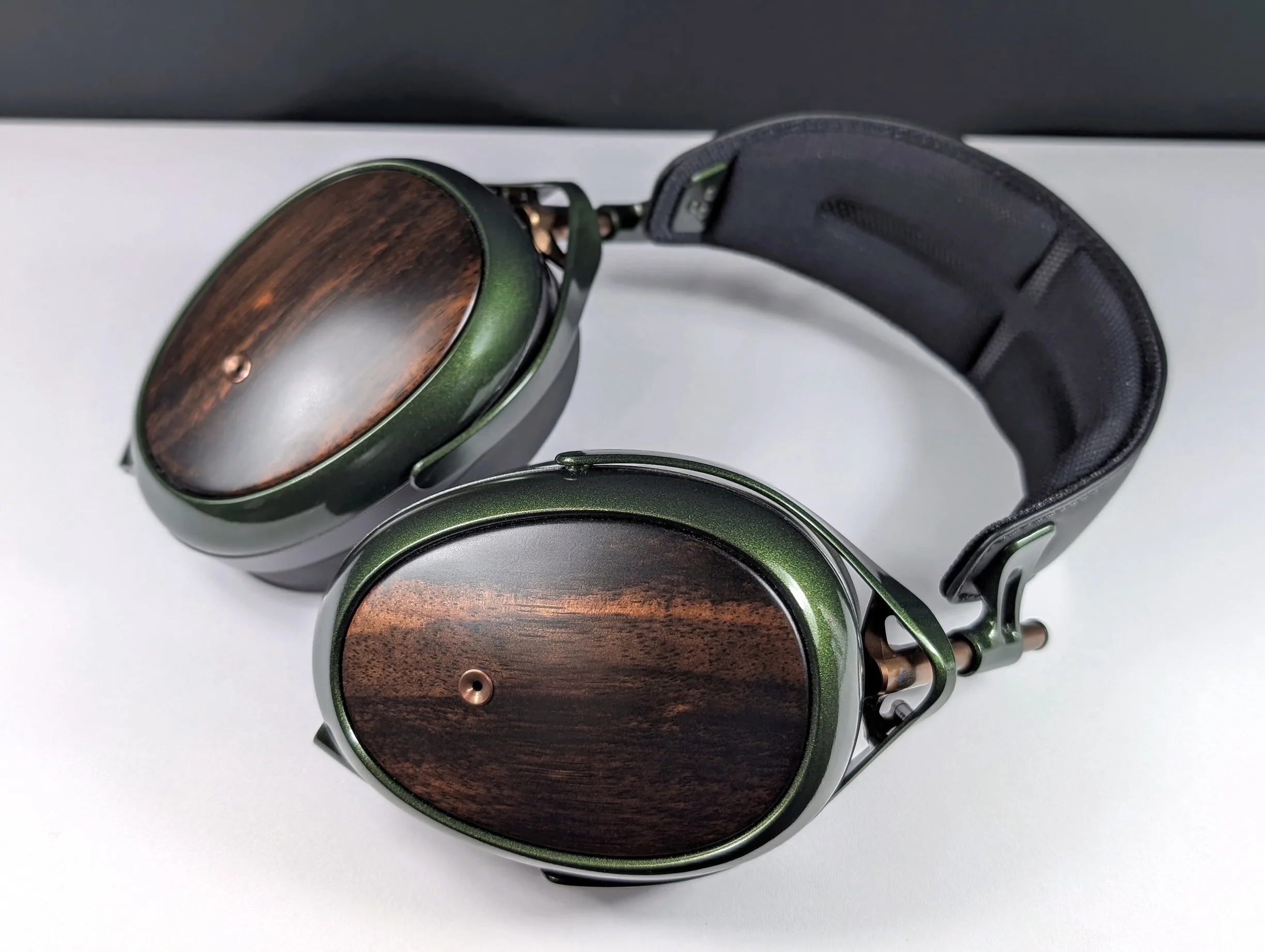
Although combining wood with metallic green may initially feel like a visual contradiction, in person the color theme works clearly better than in photographs. I believe the green parts are meant to imitate patinated copper and thus match other copper-colored details. Even if someone doesn't like the end result, at least it boldly stands out from the crowd. I myself already find myself a small STRADA fan, because especially in slightly dimmer lighting, it exudes a certain elegance of bygone eras.
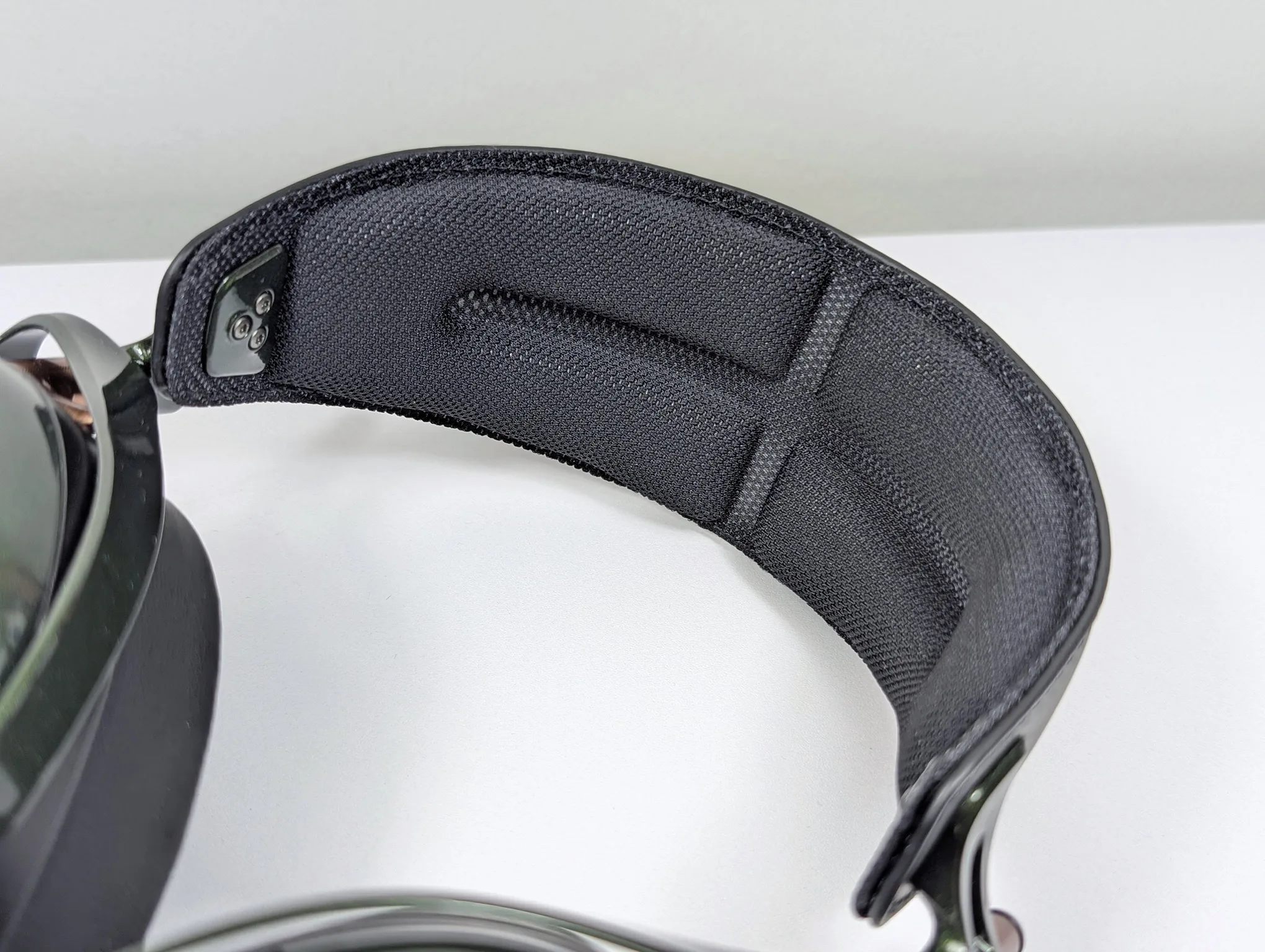
During use, STRADA proves to be a very comfortable headphone, influenced in part by its light weight, suitably sized ear pads, and excellently shaped and padded headband. The headband also doesn't squeeze too much. Usually, headphones of this size might feature a separate comfort strap, but Meze Audio has managed to design a streamlined headband whose existence I almost completely forget. The height of the headphones adjusts steplessly by sliding the headband upwards along the copper-colored rods.
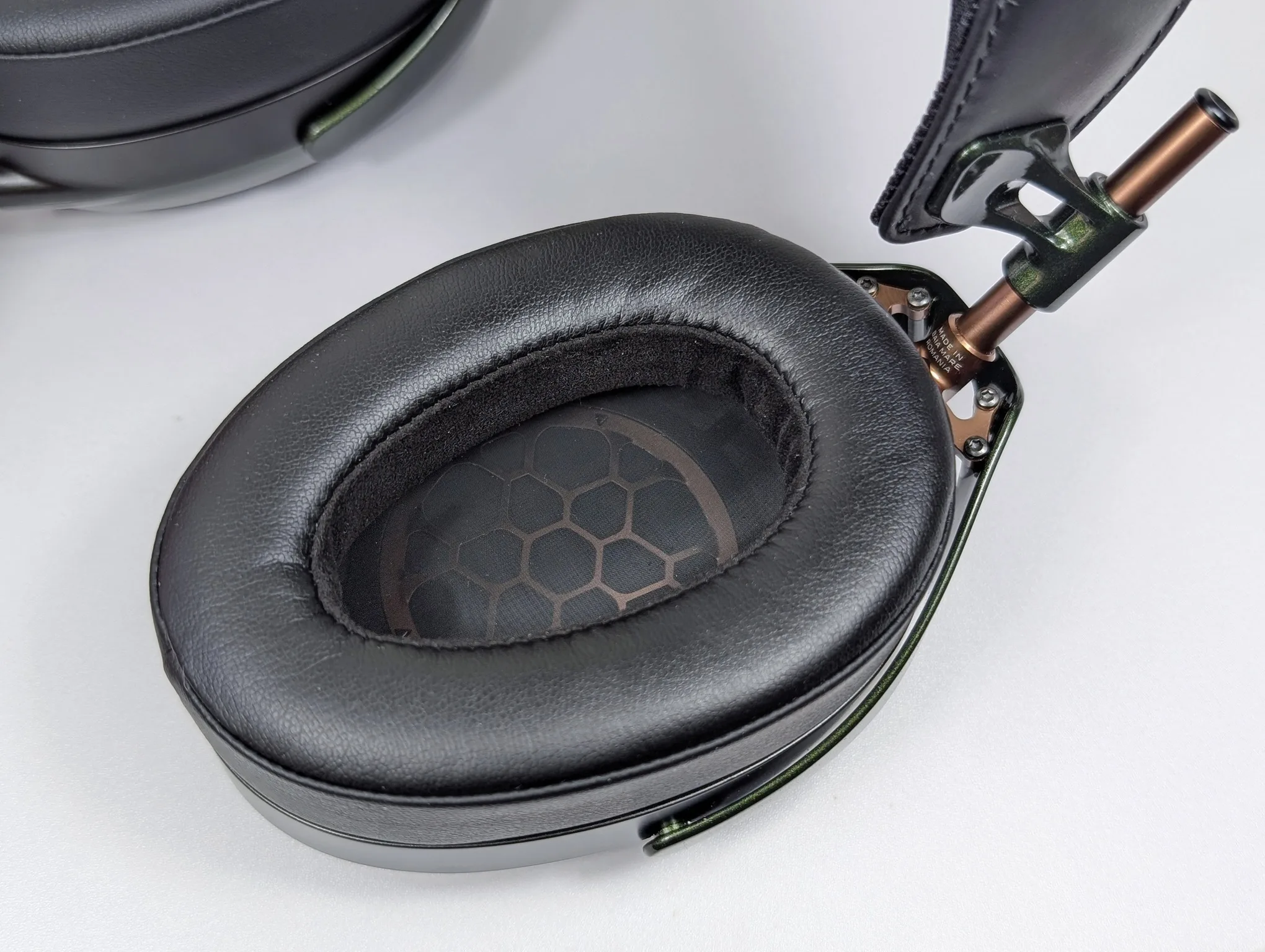
The usability of the headphones is also enhanced by magnetically attached ear pads, which are easy to remove if necessary. The manufacturer has not yet listed replacement pads for sale, so it remains to be seen if they will cost a whopping 145 euros, like those for the LIRIC series. For STRADA, Meze Audio still relies on faux leather, so replacing the pads may become relevant at some point. As usual, the structure would otherwise be fully disassemblable and repairable.
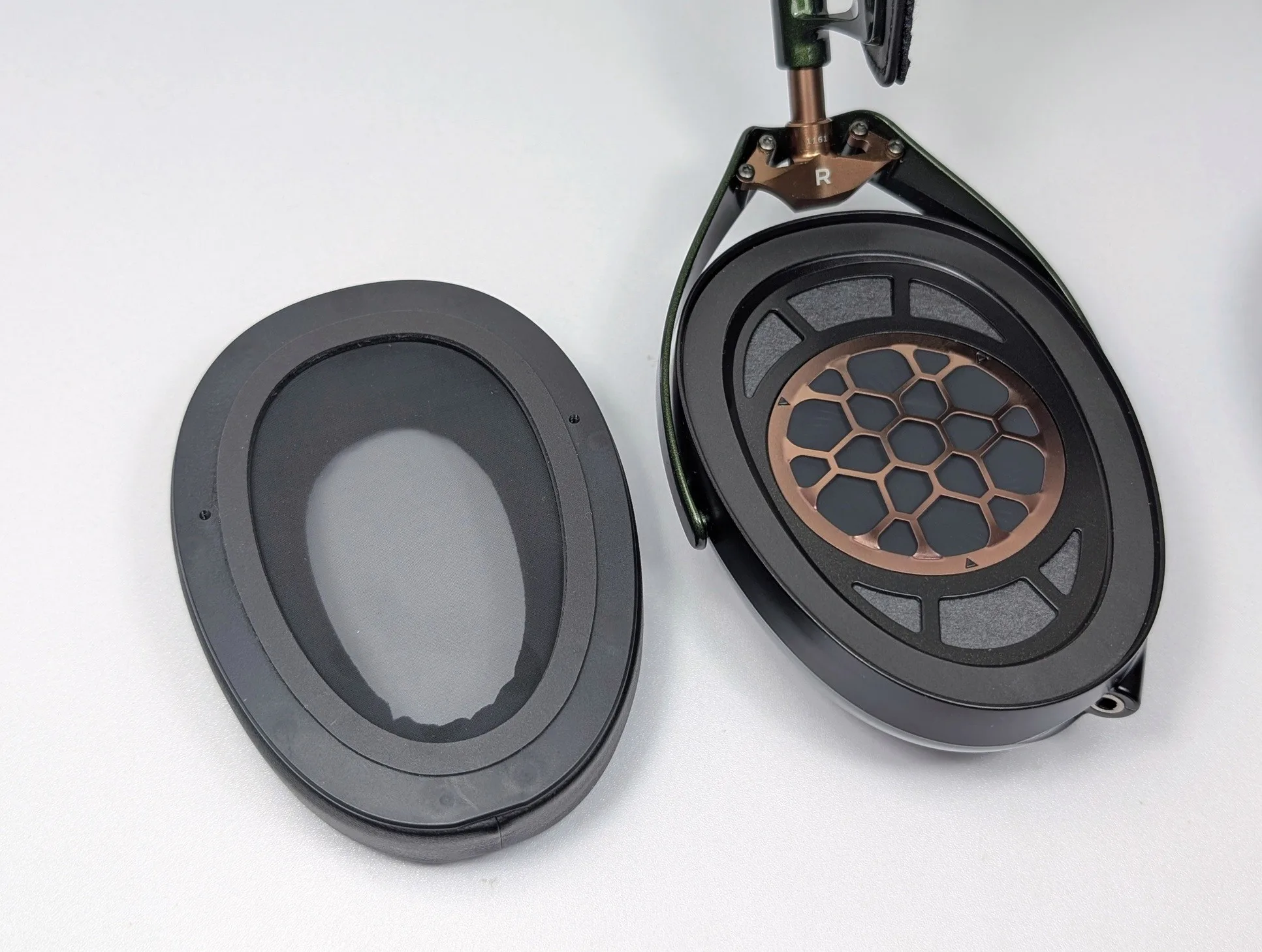
As wonderful and refined a product as the STRADA is, not everything is absolutely perfect. When rotating the cups, I hear a slight creaking and rattling in my own headphones, which I also noticed in the POET, which is based on a similar structure. Interestingly, with the STRADA, these side noises have clearly started to decrease with use, so movement seems to be the cure.
My biggest single criticism ultimately concerns the tightness of the headphones' fit, which primarily affects bass reproduction. The suspension of the STRADA's cups turns the lower edge of the earpad so strongly inwards that an air gap easily forms above the ears. In the POET model, Meze Audio had intentionally weakened the spring force, but apparently in its closed headphone models, it still adheres to this user-fighting design solution. I myself have to position the cups slightly higher on my ears than I would like, but I can still declare that I have won the battle. Hopefully, others can too.
When fitting tightly, the STRADA isolates ambient noise well (including speech), so Meze Audio has clearly invested in this. Despite the bass ports, the structure feels genuinely closed, not semi-open like many other manufacturers. Correspondingly, the listened music and other audio content largely remain unheard by people nearby, even if the volume is increased a bit more vigorously.
Sound quality
Familiar drivers
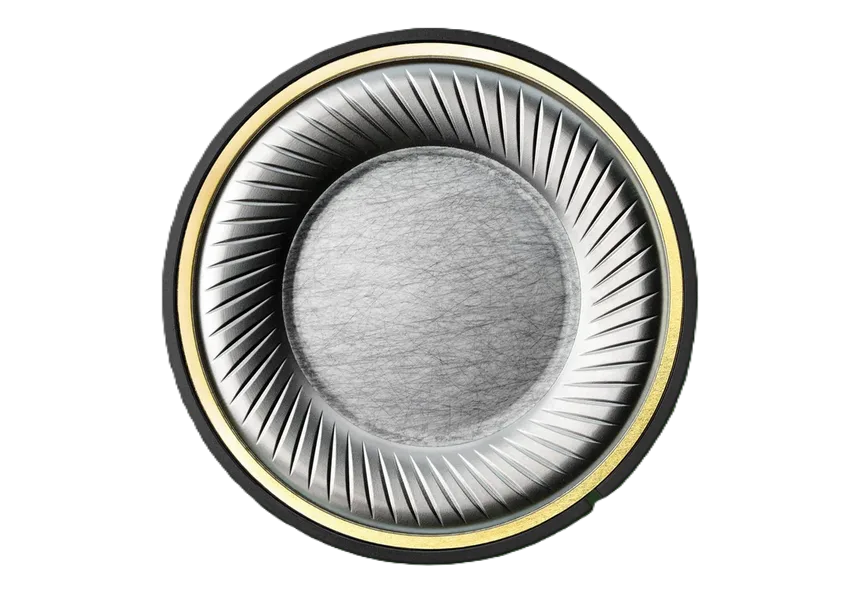
Meze Audio uses the same dynamic drivers (50 mm diameter) in the STRADA as in the 109 Pro headphones, but they have been fine-tuned to operate optimally within a closed cup structure. The diaphragms in these drivers are W-shaped and use two different materials: the rim is beryllium-coated polymer and the center is a cellulose-carbon fiber composite. Whereas the 109 Pro's drivers are completely exposed on the front, the STRADA has a bit of front damping added. Bass ports have been made on the outer edge of the cups, which certainly also equalize the pressure behind the driver somewhat.
Meze Audio itself describes the STRADA's sound as natural and dynamic, aiming for good separation without the typical cramped feeling of traditional closed headphones. The headphones are tuned to provide a warm and intimate listening experience that combines technical precision and ”emotional musicality” in an easily approachable form. If all this holds true, that is.
Impedance measurements and amping requirements
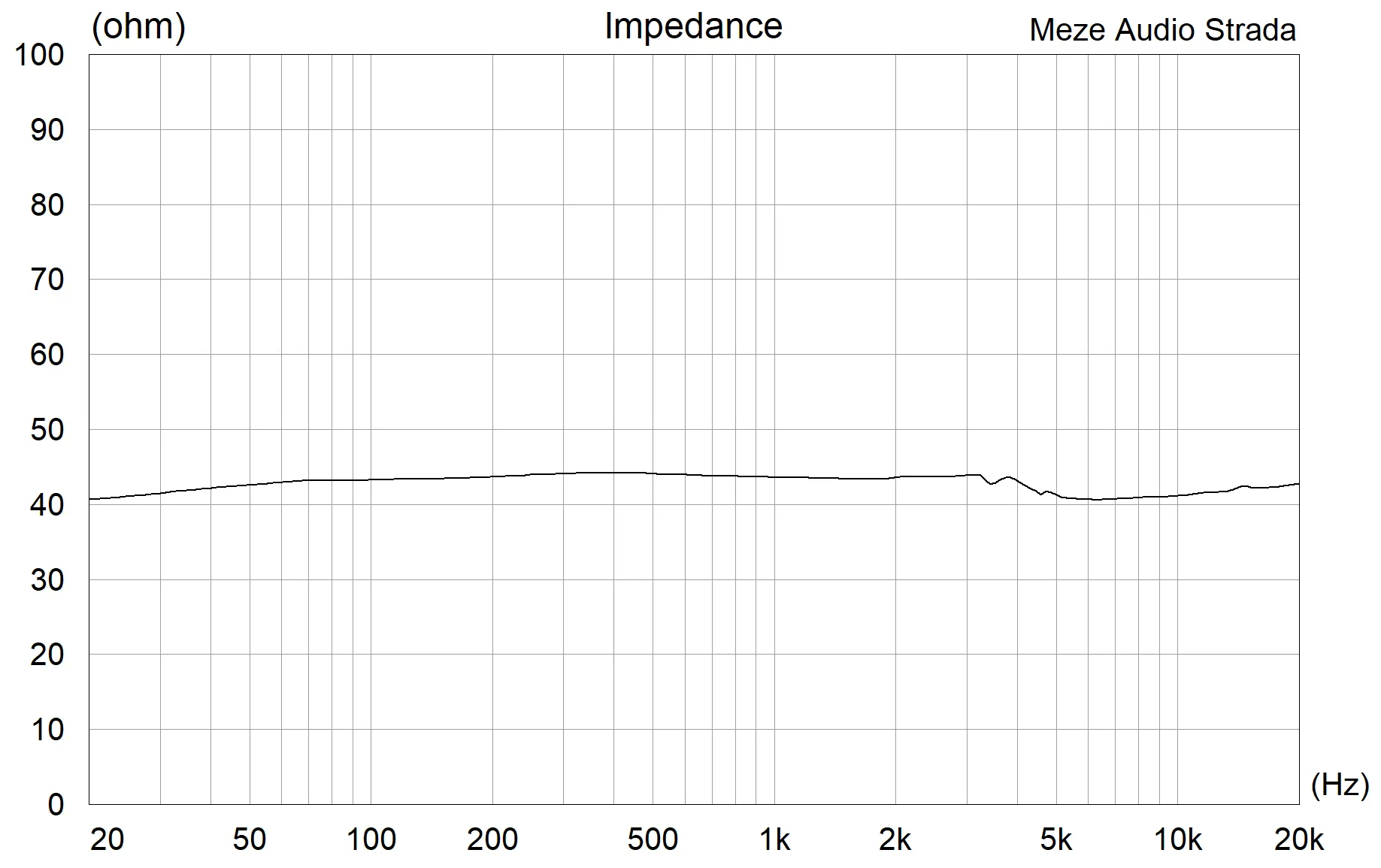
The nominal impedance of the STRADA is stated as 40 ohms, similar to the 109 Pro model, which is exceeded by a few ohms according to my own measurements. However, the impedance curve is practical in its linearity, as there is little need to pay attention to the amplifier's output impedance. At most, the high frequencies would calm down slightly, which would not be detrimental in the case of the STRADA.
When it comes to peripherals, however, it may be worth noting the STRADA's high sensitivity (111 dB/mW), as the headphones require a ”silent amplifier,” by which I mean background noise that remains below the hearing threshold. Older devices, especially those implemented with tubes, should therefore be forgotten from the outset, and the focus should be on modern transistor amplifiers. Thanks to their high sensitivity, the headphones play loudly even with small mobile amplifiers.
Headphone Measurements
Our frequency response measurements have been made with a clone IEC-60318-4 coupler and KB501X pinnae. The Harman target curve from 2018 is used as a reference point and generalization of the headphone response that would sound good to most people. For more information on the measurements and their accuracy, see Headphone Measurements-page. The STRADA's frequency response can also be compared with other measured headphones Squiglink .
Frequency response:
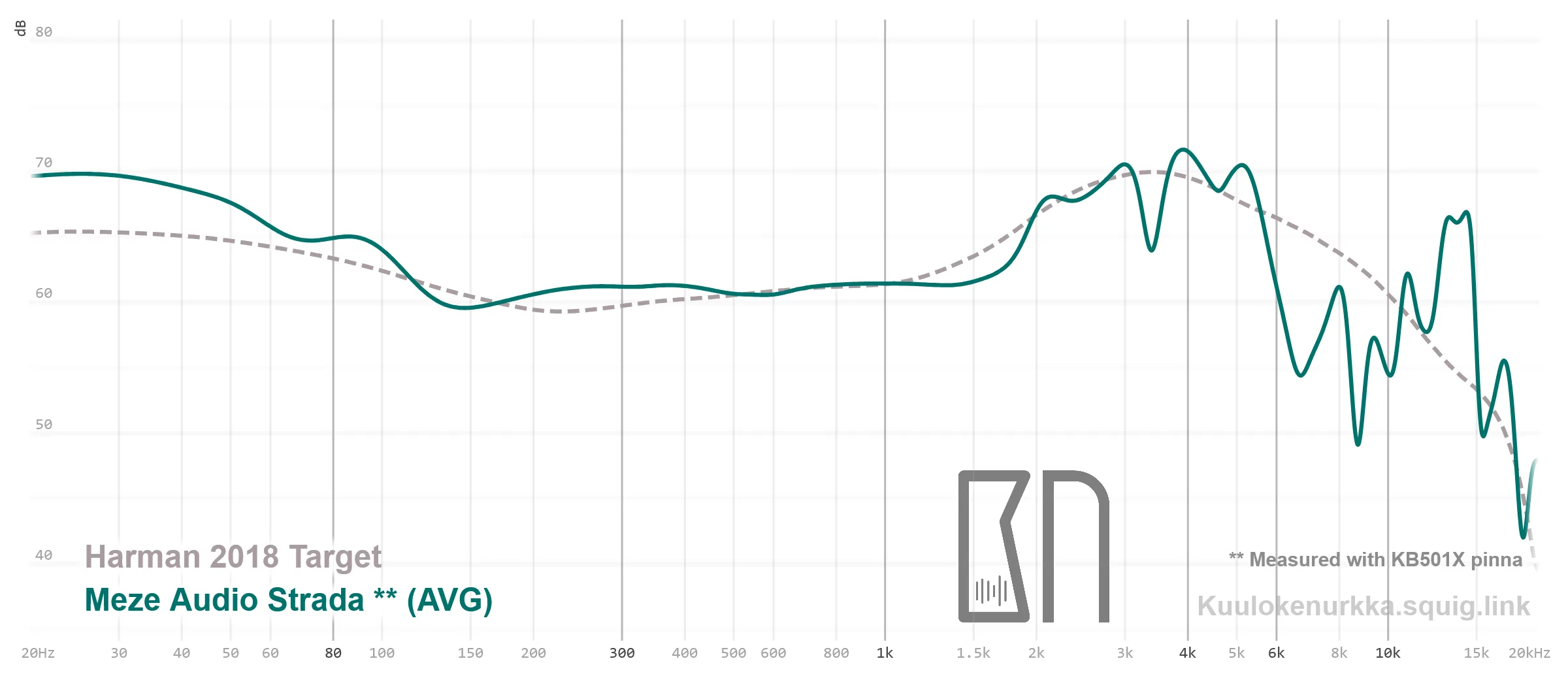
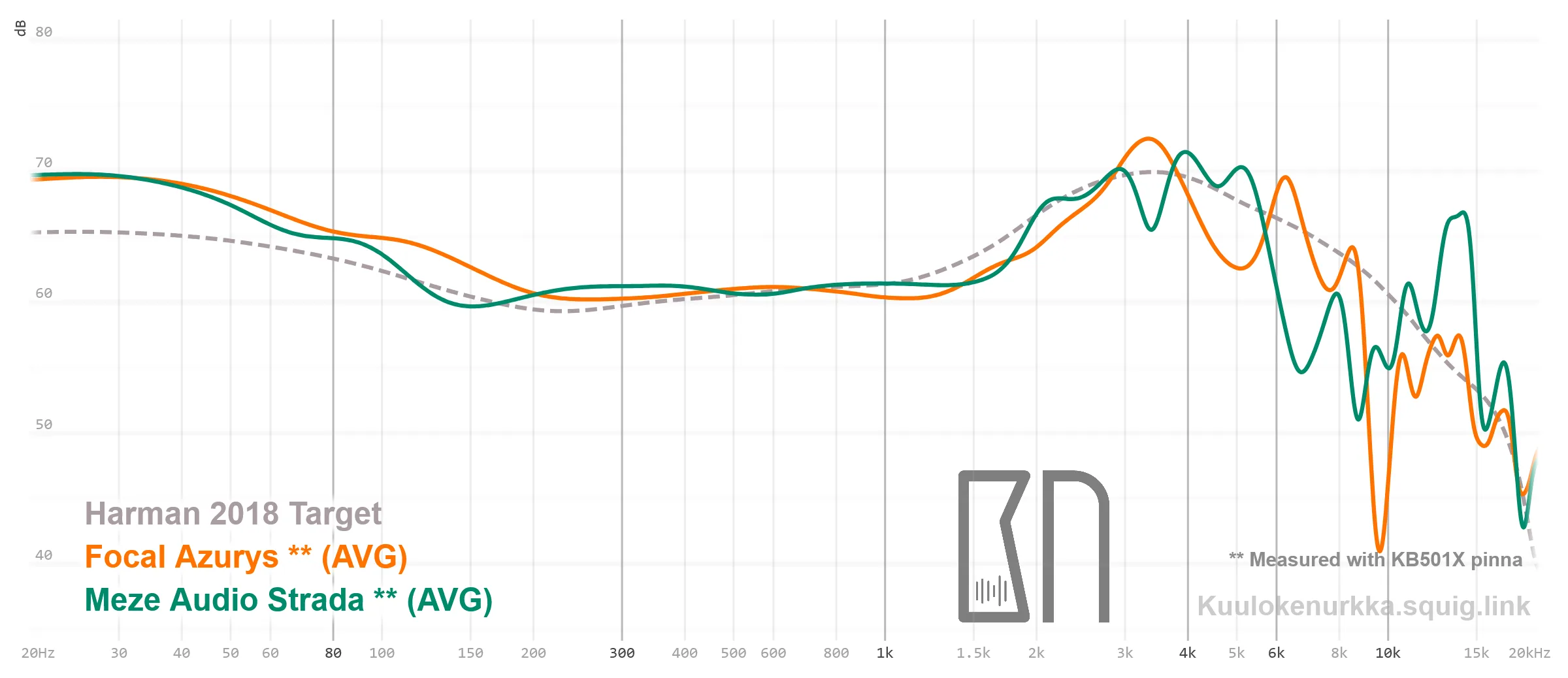
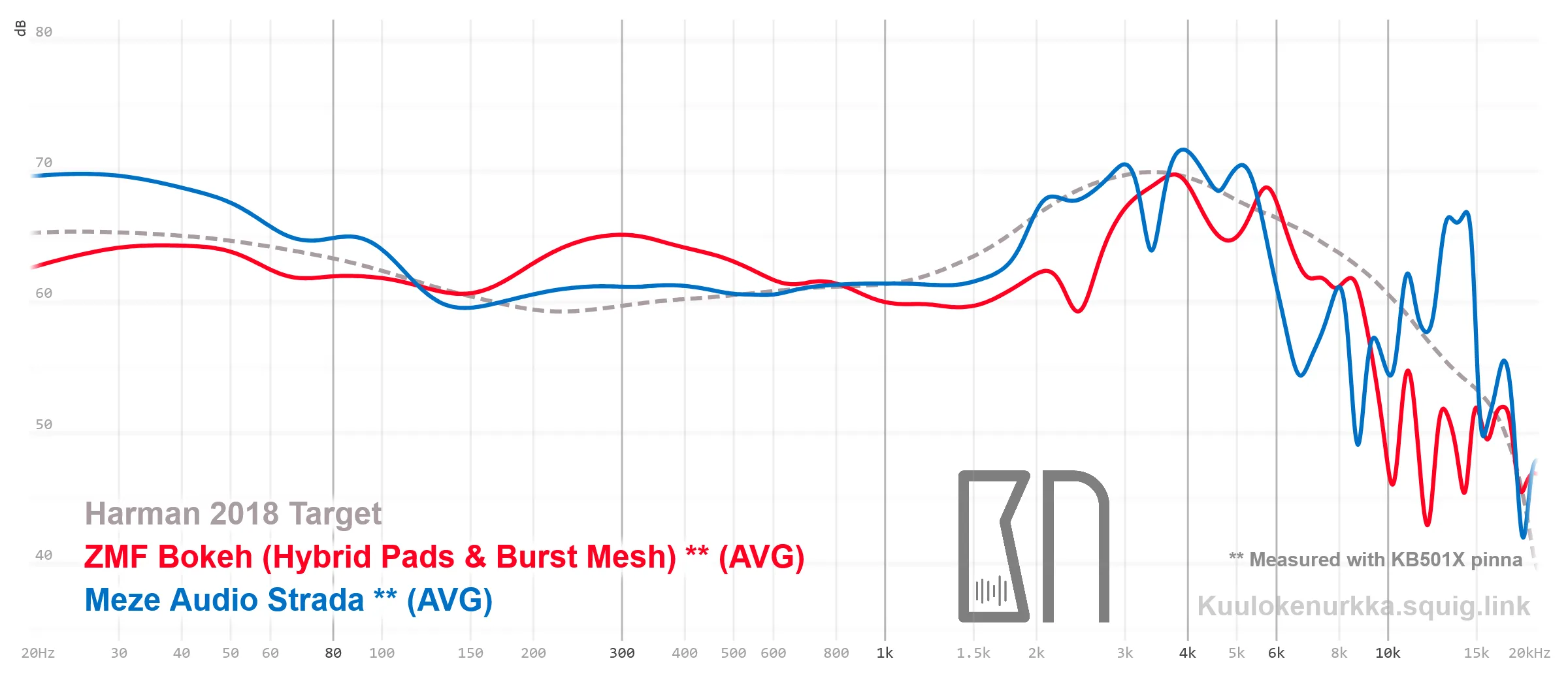
Meze Audio has tuned the STRADA largely in accordance with current teachings, which promises clear and easily digestible reproduction. However, liveliness and power have been sought in the sound by somewhat emphasizing the sub-bass, presence region, and highest treble. When fitting tightly, the STRADA reproduces sub-bass louder than the Harman curve, so music with strong bass truly kicks hard. On the other hand, the headphones should not be expected to be a traditional ”bass cannon” by closed-model standards, as the 150 Hz region has been tamed more successfully than many competitors.
The midrange is pretty much in line up to 3000 Hz, and the presence region (4–6 kHz) is reproduced with amplified presence. In between, the closed structure causes a small dip around 3.5 kHz (I hear this myself with a frequency sweep), but when listening to music, this should hardly make its presence known. The energy peaks located at 4 and 5.5 kHz, however, can be noticeable features depending on what kind of music one listens to. Typically, such emphases bring certain energetic nuances of, for example, female vocalists, electric guitars, and cymbals even more to the forefront of the overall sound.
In the high frequencies, on the other hand, Meze Audio's typical unevenness can be observed, as this time the 6–9 kHz range is slightly subdued, while the upper half above 10 kHz is reproduced loudly, especially between 13–15 kHz. The positive aspects of this solution can be seen as the airiness of the reproduction and the compensation for possible age-related hearing loss. If, however, the music listened to contains a lot of these so-called air frequencies, emphasizing them further can add a shimmering and coarse tone to the sound.
The frequency response of closed-back headphones often varies significantly depending on how they are placed on a measurement device or human ears. However, STRADA behaves exceptionally consistently, and the channel balance of my test headphones is also excellent. Therefore, I trust my measurements more than usual this time, and additionally, the headphones always sound almost the same to me regardless of how I place them on my ears. Of course, the bass level decreases if I don't get the upper edge of the earpads to seal tightly enough.
Sound observations
Headphone listening took place this time JDS Labs Element IV and Cayin iHA-6 -amplifiers, with Topping Centaurus serving as the DAC for the latter.
I experience STRADA's sound profile, which emphasizes three frequency areas, primarily as lively and sense-activating: in a presentation reminiscent of the letter W, the following come to the forefront: 1) physical sub-bass, 2) enhanced presence in the upper midrange/presence region, and 3) sparkling airiness in the treble. The sound reproduced by the headphones does not deviate enormously from what I consider a natural result, but the emphasis on clarity and energy tilts the timbre towards the higher frequencies. The sound of many other closed-back headphones has more warmth, whereas STRADA sounds quite light, fast, and bright. Its strengths are precise separation and an open-feeling soundstage, but some would certainly desire more fullness in the body of the reproduction, which strong sub-bass alone does not provide.
Personally, I am most bothered by a couple of treble peaks, without which STRADA would sound more balanced. On the other hand, its lively sound often still sounds impressive. Music details also don't need to be sought out by increasing the volume; instead, they effortlessly pop out with the treble emphasis. When cheaper and fuller-sounding closed-back headphones need to stand out somehow, this is probably an expected stylistic direction in the end.
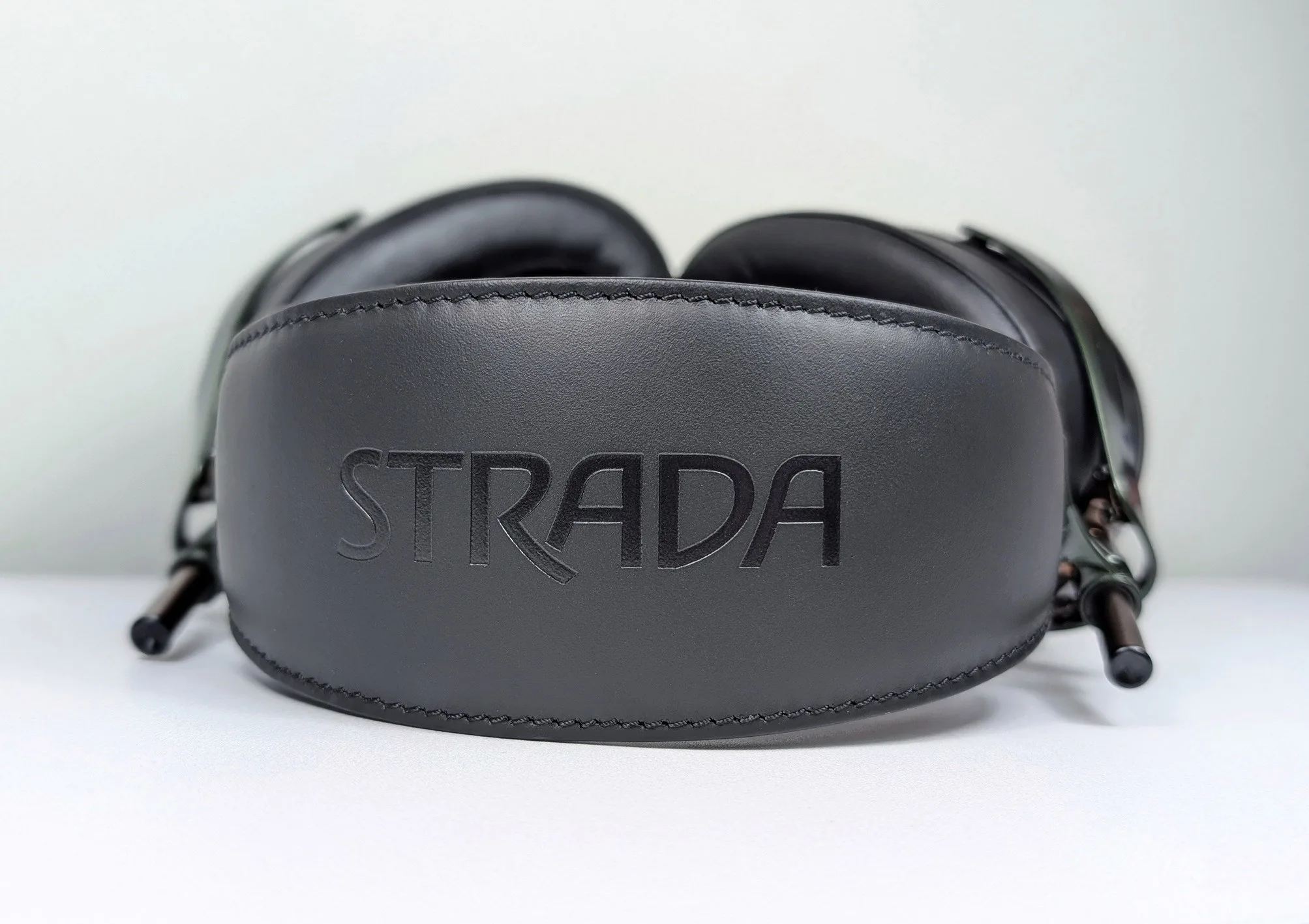
Bass: STRADA's bass can be alternately wonderfully powerful or, by the standards of closed-back headphone models, even a bit light. If the source material contains strong bass, the headphones bring it out excellently. At its best, robust sub-bass adds a strong kick and deep rumble to the reproduction, making listening enjoyable. For example, the kick drum often pounds deliciously, and electronic music and movie soundtracks generally sound ”physical” and good. On the positive side, STRADA's bass also does not bleed into the midrange but stays nicely in its own territory. This is a pleasant change from closed-back headphones that bloat the bass to be heavy and, as it were, slow. STRADA's controlled bass and its precision would easily fit into higher price categories.
On the other hand, the body of the lower frequencies can remain slightly weak if the emphasis of the listened music is in the vicinity of 100–200 hertz instead of the sub-bass. In this case, STRADA's higher frequencies draw proportionally more attention to themselves and cause the bass to take a back seat. Despite its powerful sub-bass, STRADA does not reinforce light-sounding recordings in the same way as some open-back headphone models whose bass is more emphasized in the upper frequencies. My experience is ultimately surprisingly varied, so I cannot be entirely satisfied with the implementation as a whole, even though at the same time I am tempted to highlight the modern bass tuning as one of the headphones' best aspects. Partially, the result is certainly disturbed by noticeable treble peaks, so the most straightforward improvements would be achieved by fine-tuning them.
Midrange: The midrange itself, considering the closed-back design, is successfully linear and naturally energetic, but the unevenness of the treble sometimes disrupts the integrity of the presentation. Because the 4 kilohertz emphasis, in particular, strongly draws attention, the lower midrange sometimes feels thin in body. The reproduction lacks a bit of fullness and warmth. For example, female vocalists are a bit of a double-edged sword, as I find myself enjoying the present delivery, but sometimes the result is overly aggressive and tense. Electric guitars also sometimes distort too much.
STRADA is not too heavy to listen to for me in any way, but the sharpened and rough tone is not always pleasing. The 4 kilohertz peak, which I experience as the biggest disturbance, is probably a kind of structural flaw, as it is preceded by a dip that is also perceived as a flaw. However, a closed-cup design easily causes precisely these kinds of peculiarities. In STRADA's defense, Meze Audio has, on the other hand, managed to build a fairly functional whole from the lively sound. Thanks to sharp transients, the sound feels detailed, as all kinds of nuances and energy bursts related to the musical event pop out excellently and distinctly within the whole. With this meticulousness, I might even mistake STRADA for planar headphones.
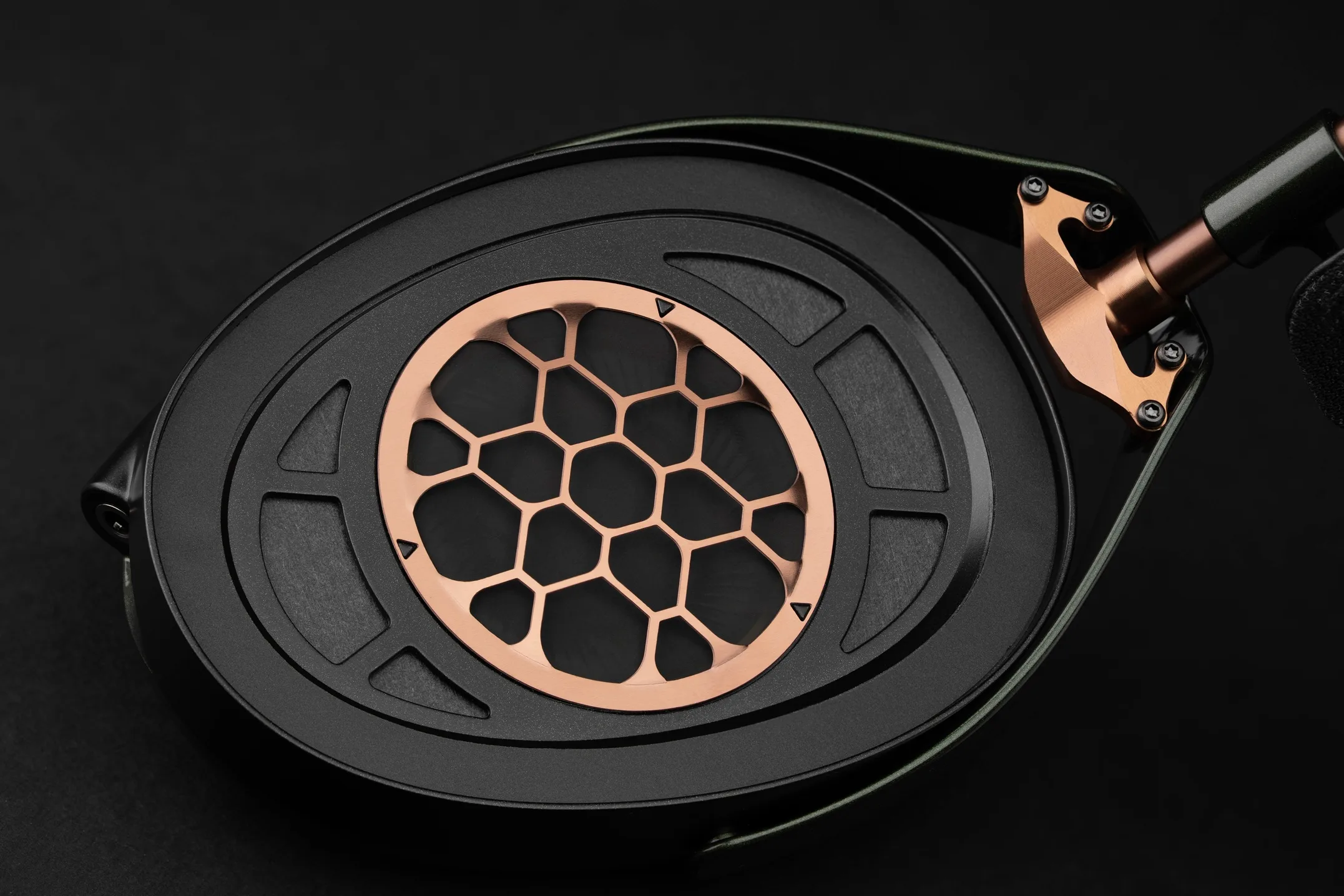
Treble: In addition to the energetic presence region, STRADA's higher frequencies are also reproduced quite prominently due to the typical air frequency sparkle for Meze Audio (strongest at 13–15 kHz). Depending on preferences, the treble can sound either deliciously lively and fresh or somewhat rough and, in the long run, fatiguing. For example, drum cymbals are quite sparkling and penetrating in tone even at low volume. However, I do not detect excessive harshness or sibilance alongside the added rustle and hiss, so the colorations of the highest frequencies are ultimately mostly quite harmless and primarily a stylistic element that tilts the frequency balance. I would start equalization from the 4 kilohertz emphasis.
When listening to the headphones with different devices, I noticed the biggest difference precisely in the attention-seeking nature of the treble, so it would be possible to slightly relax and smooth out the presentation. For example, the Cayin iHA-6 proved to be a functional combination with the Topping Centaurus DAC via its unbalanced headphone jack with a 10-ohm output impedance. In this case, the treble activated my senses less than, for example, with the neutral JDS Labs Element IV. I would therefore recommend some slightly softer and warmer-sounding peripheral equipment for STRADA. This could even, in my opinion, determine whether someone likes the headphones or if the unevenness of the frequency response is perceived as too sharp.
Audio description: Although the soundstage is experienced in numerous different ways, some might be interested in my own observations of STRADA. Firstly, I perceive the headphones' sound as pleasantly open and airy. The powerful sub-bass also does not create extra pressure inside the cups and thus a cup-like closed feeling. However, with the present presence region, the sound comes, as it were, directly at you, so I don't ultimately experience the reproduction as particularly spacious. STRADA's strength is rather precise and spacious-feeling separation, as well as the sense of openness I mentioned. Each instrument has enough empty space around it, and due to the upper-frequency emphasis, the clarity of musical details is also otherwise ensured. By the standards of closed-back headphones, the result is, in my opinion, more functional than usual. At the very least, the presentation should captivate, as it is neither dull nor boring.
A couple of thoughts on other headphone options on the market
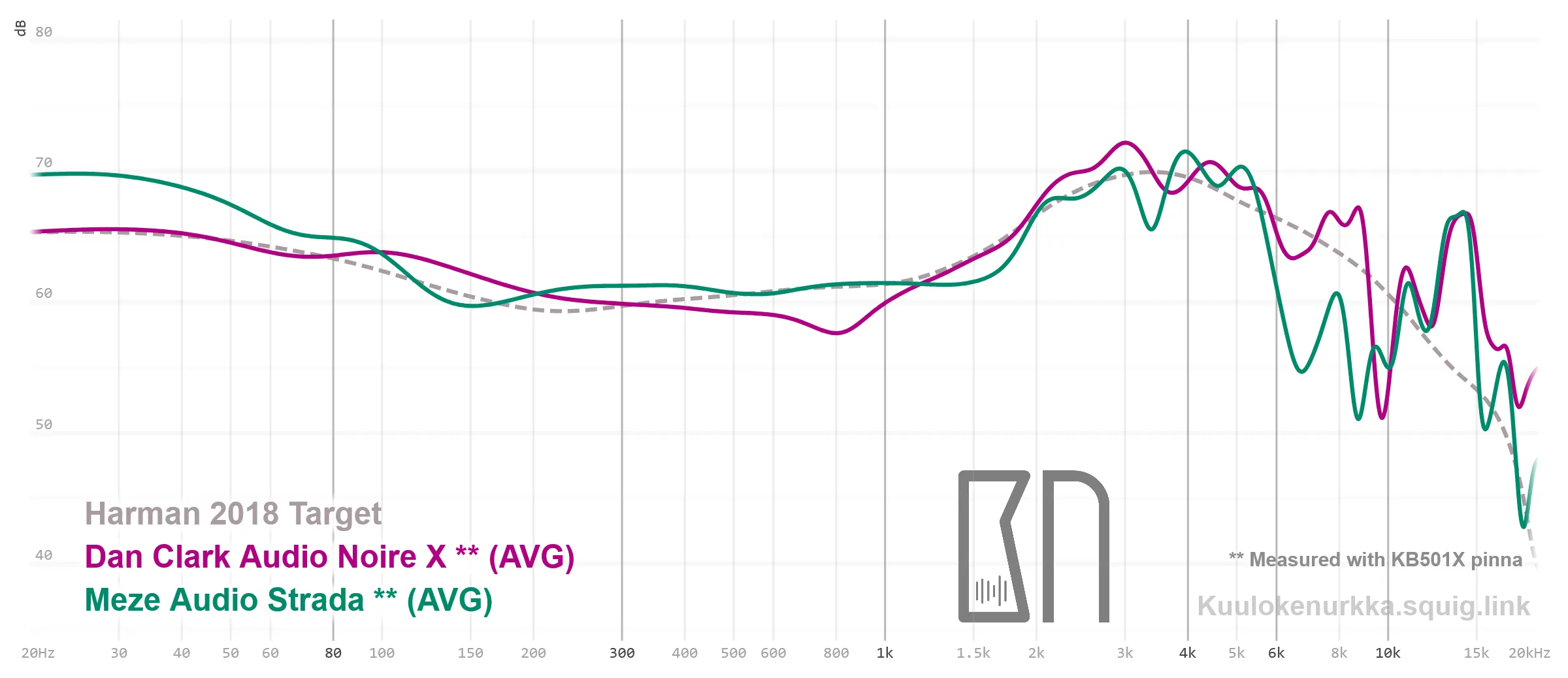
I haven't specifically started collecting passive closed-back headphones as long-term comparisons, but based on my previous experiences, a slightly more affordable alternative to STRADA would be Focal Azurys, whereas by paying more, one could get Dan Clark Audio Noire Xor perhaps ZMF Bokeh:in. In my opinion, all of these would have their own charm. Bokeh would offer the warmest and most relaxed reproduction, while Azurys would likewise be robust in its low frequencies and, by my standards, the least fatiguing in its treble among these options. The advantage of Noire X, on the other hand, would be the accuracy and liveliness of its reproduction, similar to STRADA, so stylistically the duo actually resembles each other the most. Both have punchiness and a certain meticulousness due to bright high frequencies.
Based on my recollections, Noire X sounds even brighter than STRADA, but its treble is smoother without equally clear local emphases. STRADA may not feel as refined or balanced, but it is certainly the cheaper of the two. When emphasizing tuning with fewer risks, I would recommend Focal Azurys over these two headphone models. The Focal model's bass also kicks a bit more robustly, whereas STRADA only comes alive if the music contains more sub-bass. STRADA, on the other hand, might be a ”funnier” choice for those who crave extra energy in the high frequencies.
Summary
STRADA, which strongly divided opinions, would have been an easy headphone to leave untested altogether due to its controversial nature, but fortunately, I did otherwise. In my opinion, it falls into the better end of Meze Audio's headphone selection, and I actually like it the most among the closed-back models I've heard so far. The headphones' lively high frequencies and powerful sub-bass manage to entertain, even if the reproduction, in truth, is somewhat aggressive in style. I wouldn't recommend STRADA to everyone, especially those looking for the most balanced headphones possible, but at its best, it sounds really good. This time, the flaws are functionally part of the product's charm, if the observations match my own. Closed-back headphones are fundamentally never perfect.
For a large headphone, STRADA is also light and comfortable, and I've even started to find the green coloring, which many were startled by, a suitable combination with the fine wooden cups. I don't know about you, but to me, STRADA feels quite personal and appealing in its price range. Its good sound isolation should also not be underestimated: the structure is genuinely closed. High-quality equipment and repairability are also a plus. Meze Audio has thus, in my view, succeeded, although I also understand the criticism STRADA has faced. With it, it can be a small thing whether the headphones are liked or not. Perhaps the manufacturer aims to evoke strong emotions, as boring products often tend to be forgotten by consumers.
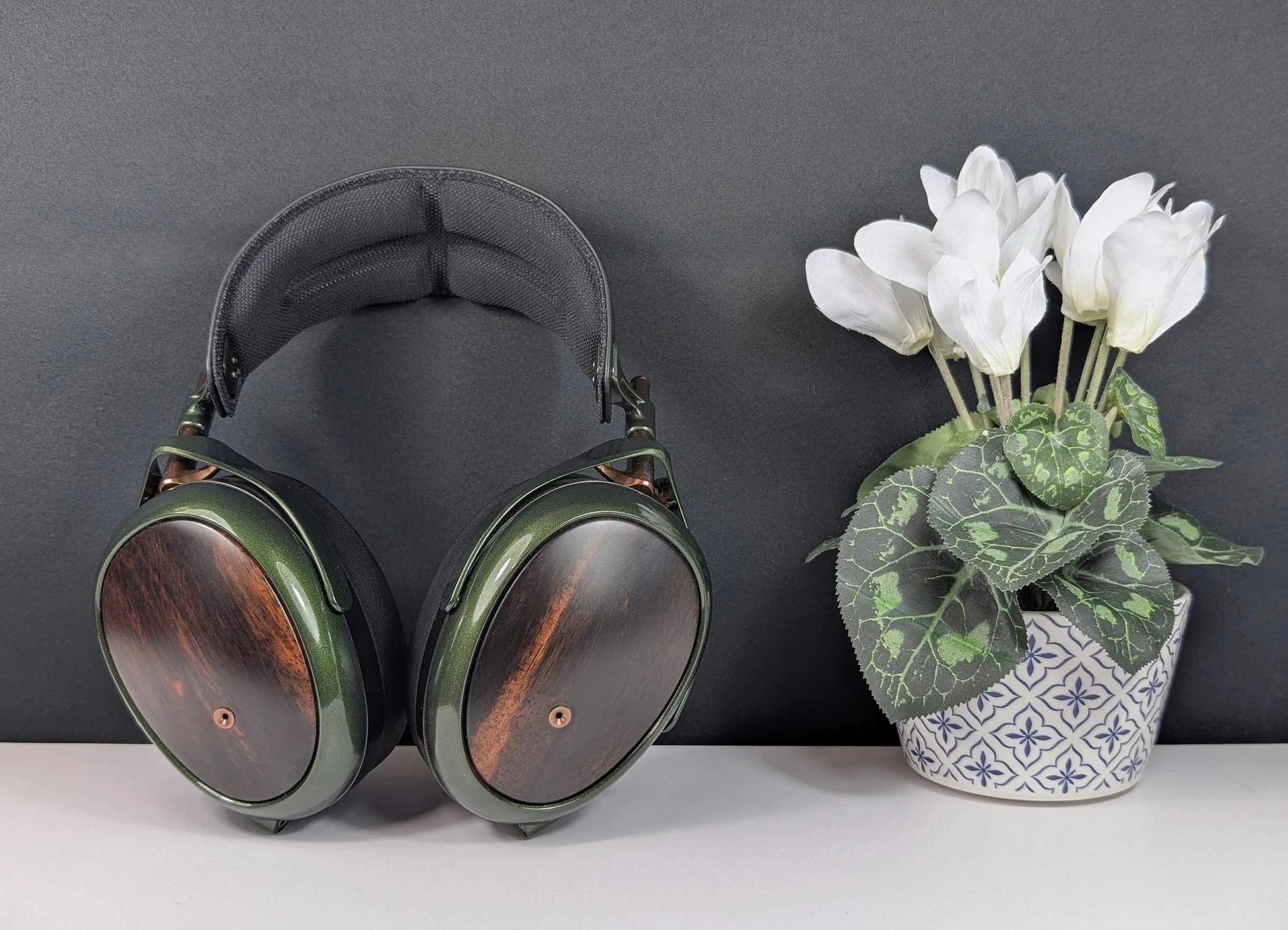
Despite minor structural quirks and the cups' quirky spring mechanism, I must give this aspect a special mention alongside comfort. In the sub-1000 euro price range, such a significant investment in mechanical functionality and design is rarely seen.
Pros and cons:
+ Lively and detailed sound
+ Powerful and well-executed sub-bass
+ Lightweight, high-quality, and well-designed structure, even with minor flaws
+ Comfort
+ Good sound isolation in both directions
+ Comprehensive features
+ Repairability
+ Easy to drive
+/- Green color theme
+/- Magnetic ear pads are easy to change, but the consumer is tied to Meze Audio's expensive spare parts
– Treble peaks reduce the pleasantness of the reproduction
– The lower midrange sometimes lacks warmth and fullness
– Minor structural creaks
– The strong spring mechanism of the cups hinders the tightness of the fit and bass reproduction
 EN
EN  FI
FI