Author: Sword of Damocles (some images from the manufacturer's image bank)
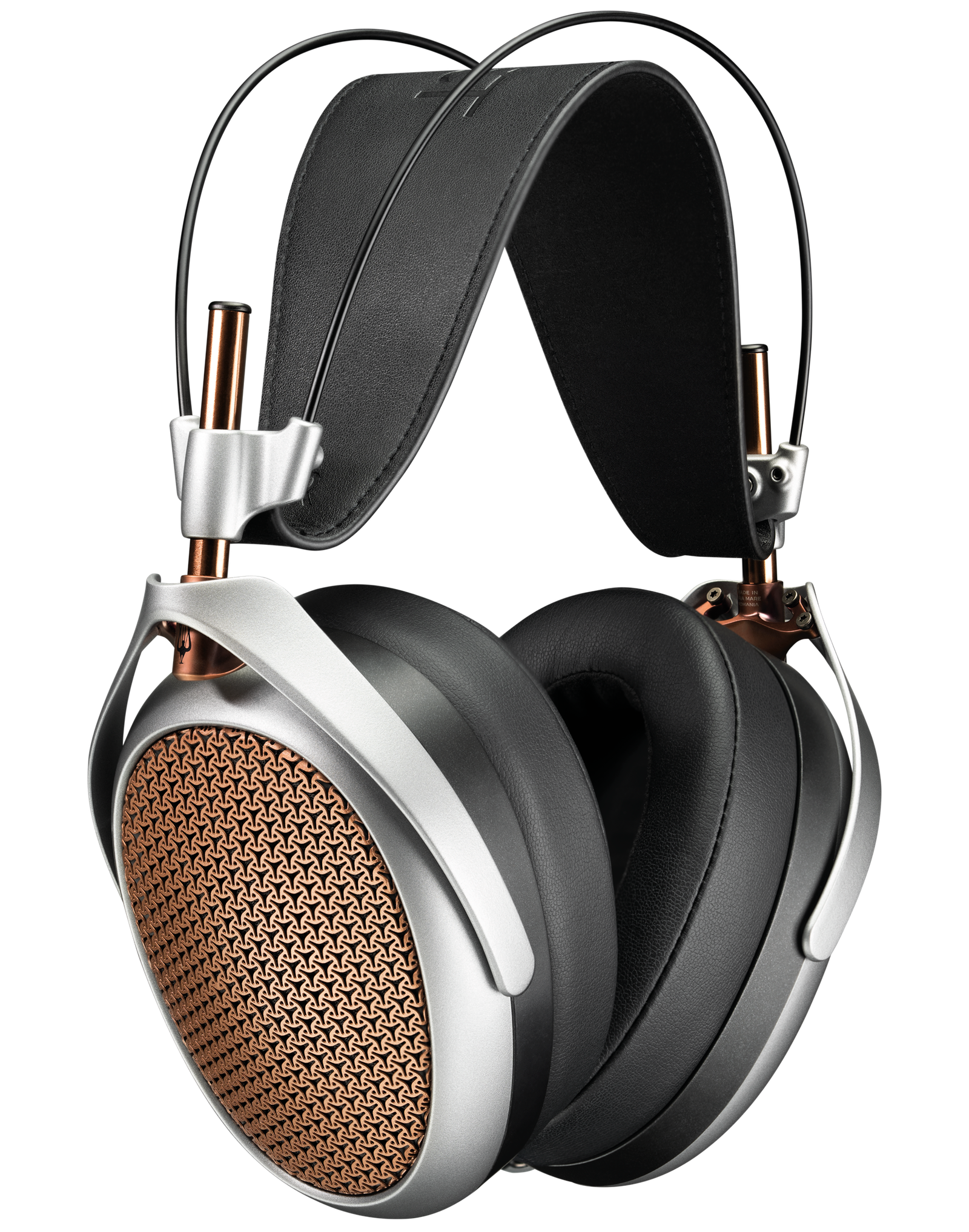
Table of Contents:
Information:
- Released: 2025
- Country of manufacture: Romania
- Price: 2000 €
- Available in Finland: Yes
- Type: open, over-ear
- 92 x 63 mm planar drivers (Rinaro Isodynamic Hybrid Array MZ6) + AMTS technology (licensed from Dan Clark Audio)
- Impedance: 55 Ohm
- Sensitivity: 101 dB/mW
- Weight: 405 g
- Connection type: 2x 3,5 mm
- Cable: Length 2 m / connector 6.35 mm
- Accessories: Case and cable pouch
- Warranty: 2 years
Review unit acquisition method: Received on loan from the importer
In the headphone corner, we haven't reviewed Meze Audio headphones for a couple of years, but this time the situation is made easier by the manufacturer's POET headphone model With it. For 2000 euros, the buyer gets an open-back planar headphone in the LIRIC series size class. In addition, the Romanian manufacturer has incorporated influences from Dan Clark Audio (DCA) headphones into the POET, with the headband constructed in the same way from two thin metal rods. An even clearer example of the collaboration between these two manufacturers is the AMTS technology licensed from DCA for driver front damping, a QWRM-like solution that Meze Audio had already utilized earlier in its closed LIRIC 2 headphone model.
Despite its appeal, the POET has, however, received relatively little attention, which can be partly explained by the headphones' pricing. Most manufacturers' most interesting flagship models now cost at least 4000 euros, while competition has intensified most in the sub-1000 euro price range. Therefore, a 2000 euro headphone like this can easily feel a bit like a middle-ground product. It should be able to justify being really good, but at the same time interest headphone enthusiasts enough so that they don't immediately jump to the true High-end models with their buying pants on. So, let's examine the POET from this perspective. What is a 2000 euro headphone like today?
The POET arrived for testing on loan from our domestic importer Simex, so let's give them all thumbs up and thanks!
Packaging and accessories
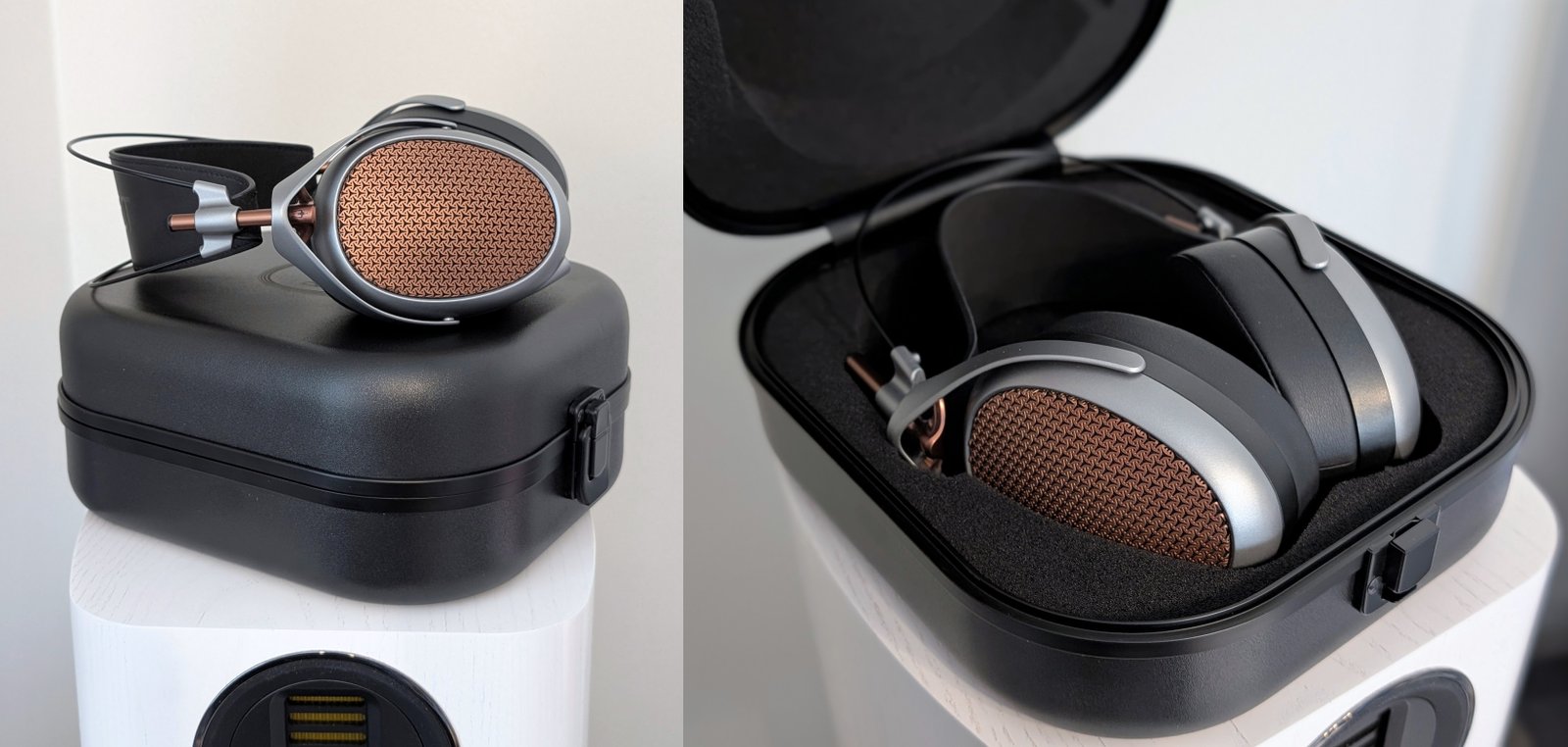
Meze Audio once wanted to make a maximum impression by delivering Empyrean-headphones in a large aluminum case, which, however, later underwent a shrinking cure when it was replaced by a slightly more compact case Empyrean 2. The more affordable POET, on the other hand, is delivered in a black box that resembles a large lunchbox. I myself would see this more as a home storage solution than a transport case, although it would also be suitable for longer journeys.
In addition, the headphone buyer receives a premium copper cable (Furukawa PCUHD Copper) packed in a black faux leather pouch, which I consider very nice, but too long for my own ”desktop use”. For many others, however, the 2.5-meter length is likely quite optimal, as it extends further than a one-and-a-half-meter cable, but is not quite as clumsy as a three-meter jump rope. Purchased separately, such a hand-braided 8-strand cable made in Romania would cost 250 or 350 euros depending on the length, which may sound steep, but is quite in line with other offerings on the market. Although cables generally do not have a significant impact on sound quality (it certainly sparks debate), Meze Audio ensures that the POET feels comprehensively special. And this cable also happens to be excellently flexible and ”well-behaved”.
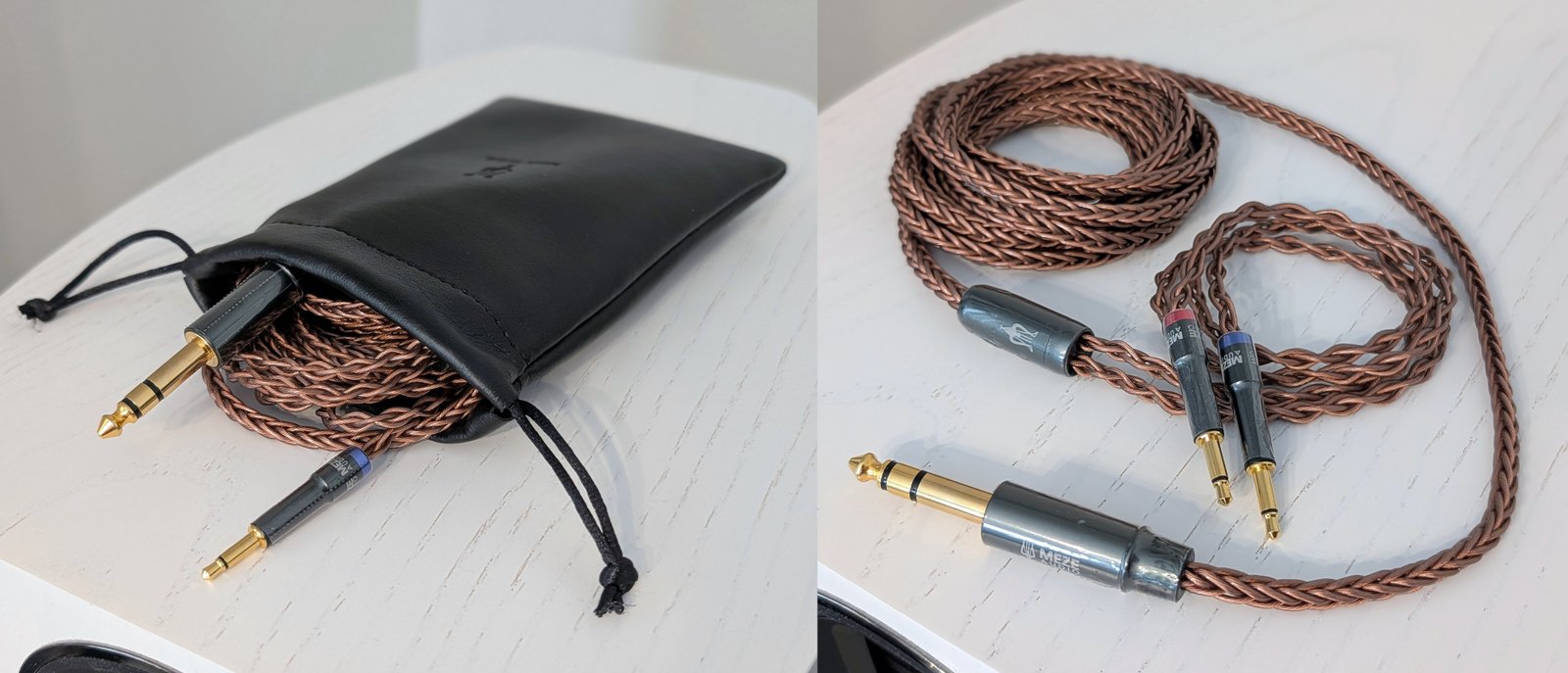
As a minor annoyance, the manufacturer does not allow choosing the connector during the purchase phase for the POET, but the cable has a fixed 6.35 millimeter plug. The cable, in turn, snaps into the headphone cups with 3.5 millimeter connectors. Fortunately, there is a selection of replacement cables, as the same variants fit, for example, Hifiman and FiiO headphones. Based on my experiments, 3.5 millimeter connectors with a wide body also fit into the POET's cups.
Build and comfort
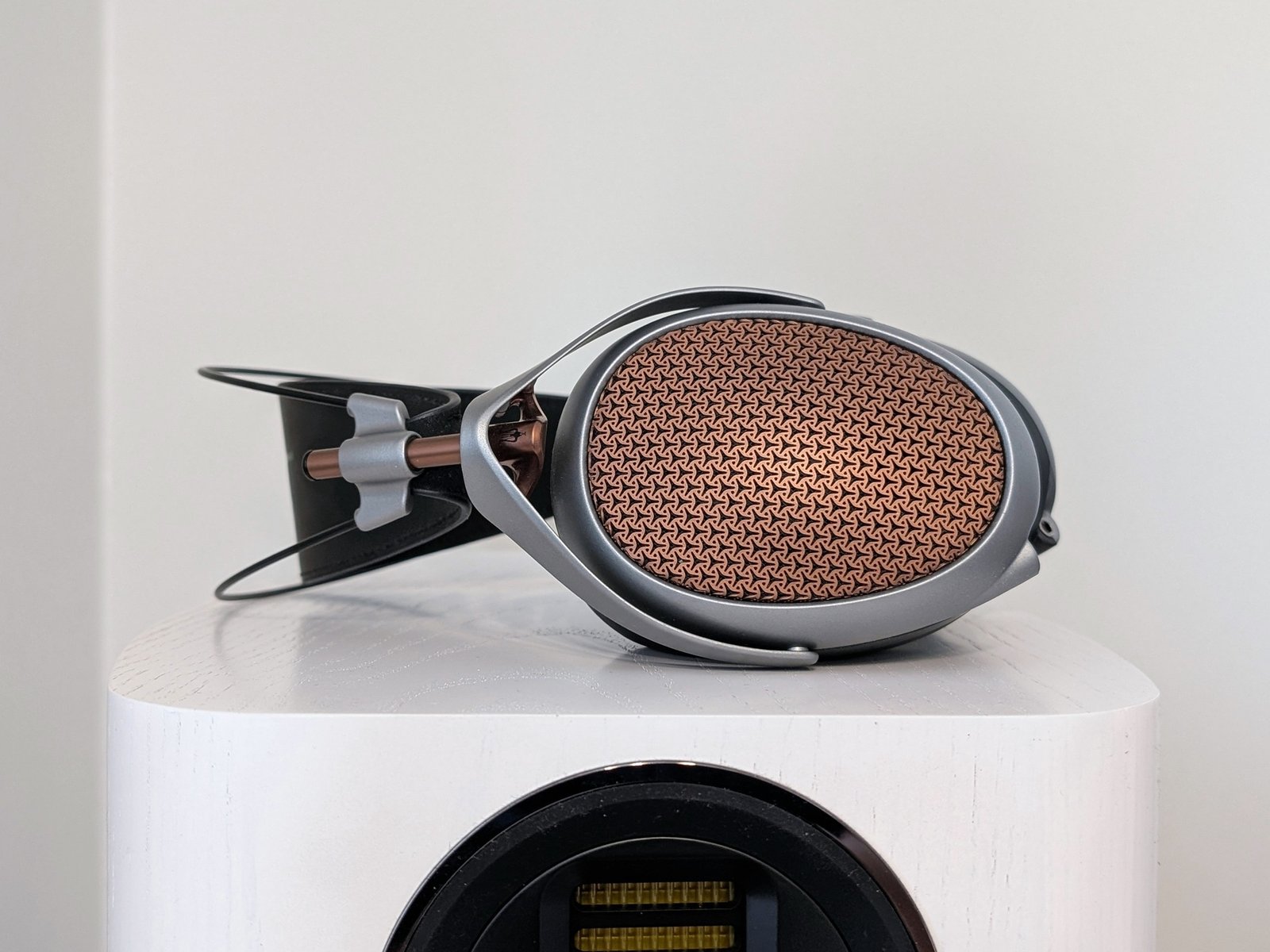
Meze Audio manufactures fine and exceptionally high-quality headphones, which in my opinion could be purchased just for their external appearance. This, of course, is also reflected in the high price level of the headphones, but unlike most other manufacturers, Meze Audio can provide clear reasons why its Empyrean 2 costs 3000 euros and the POET 2000 euros. Sound quality alone rarely produces immense joy of ownership if the build quality is on the level of ”Hifiman of yesteryear”.
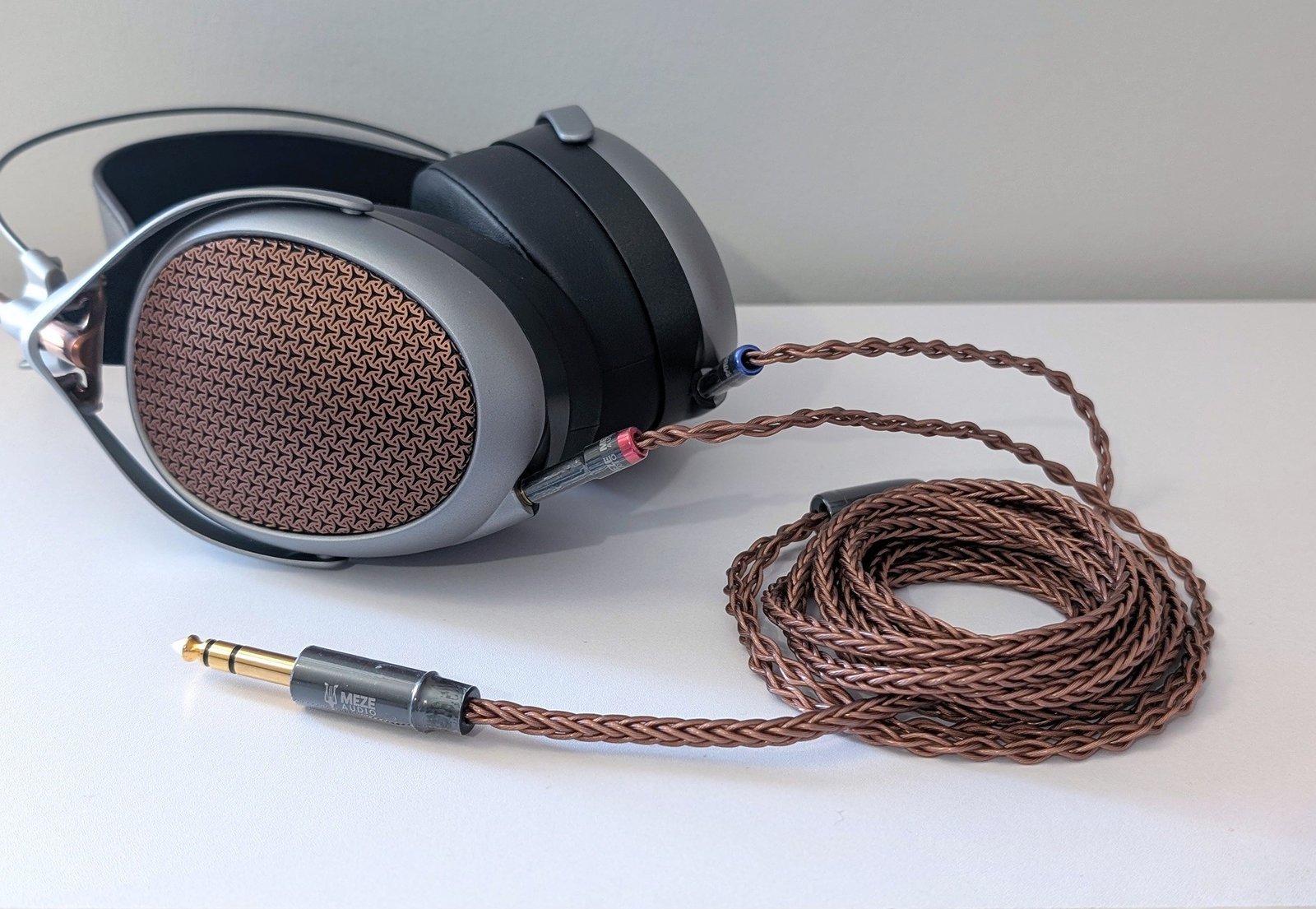
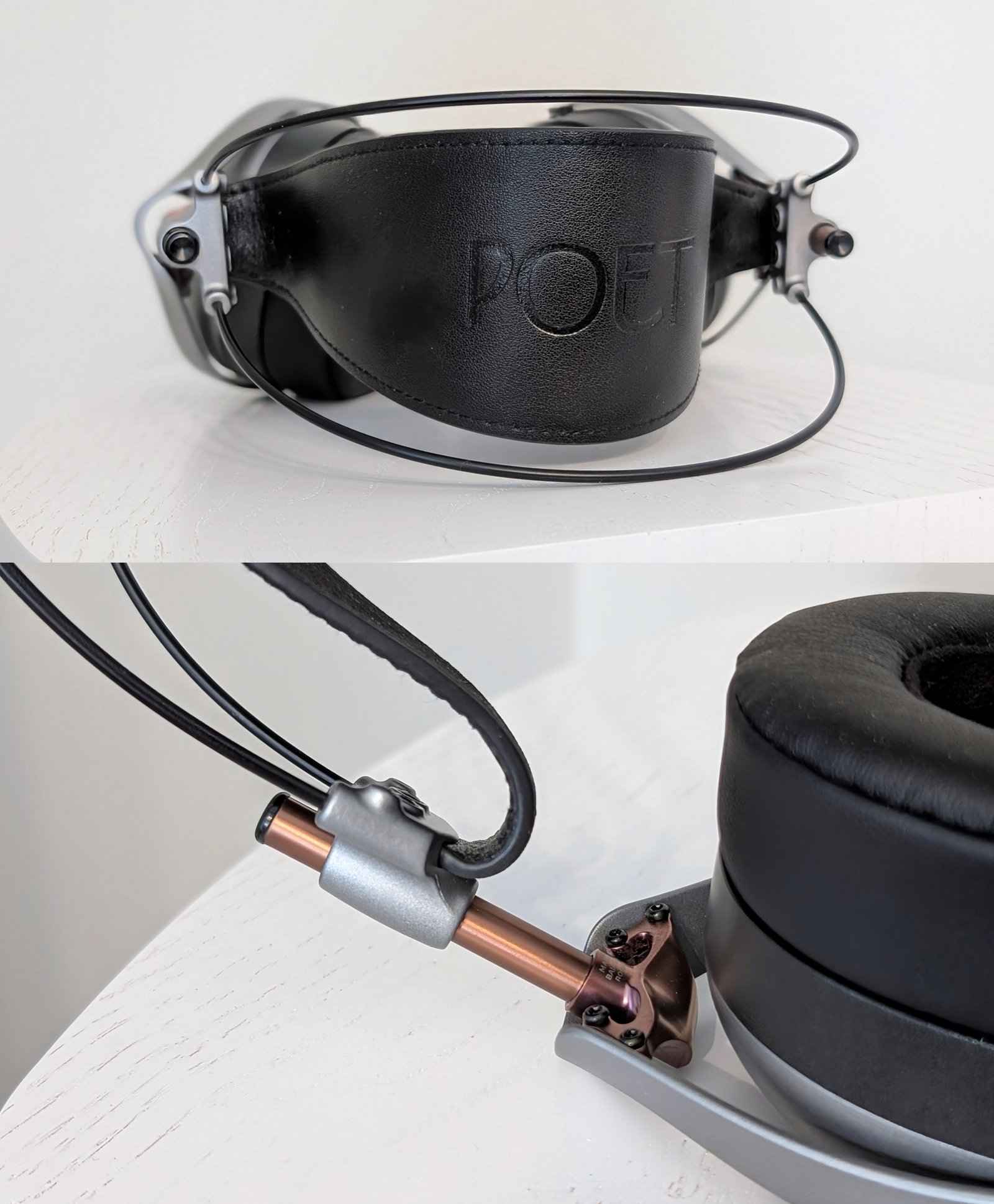
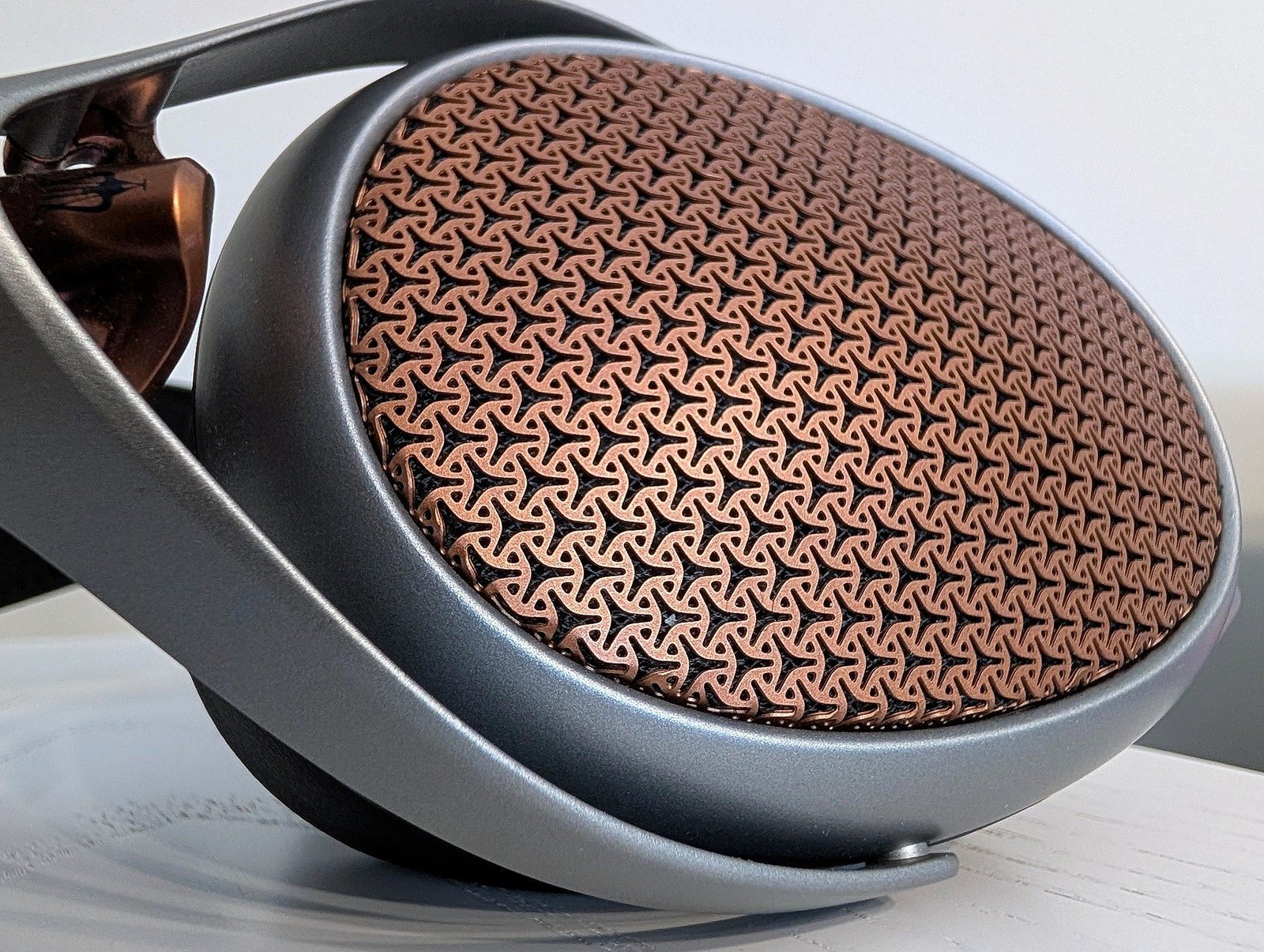
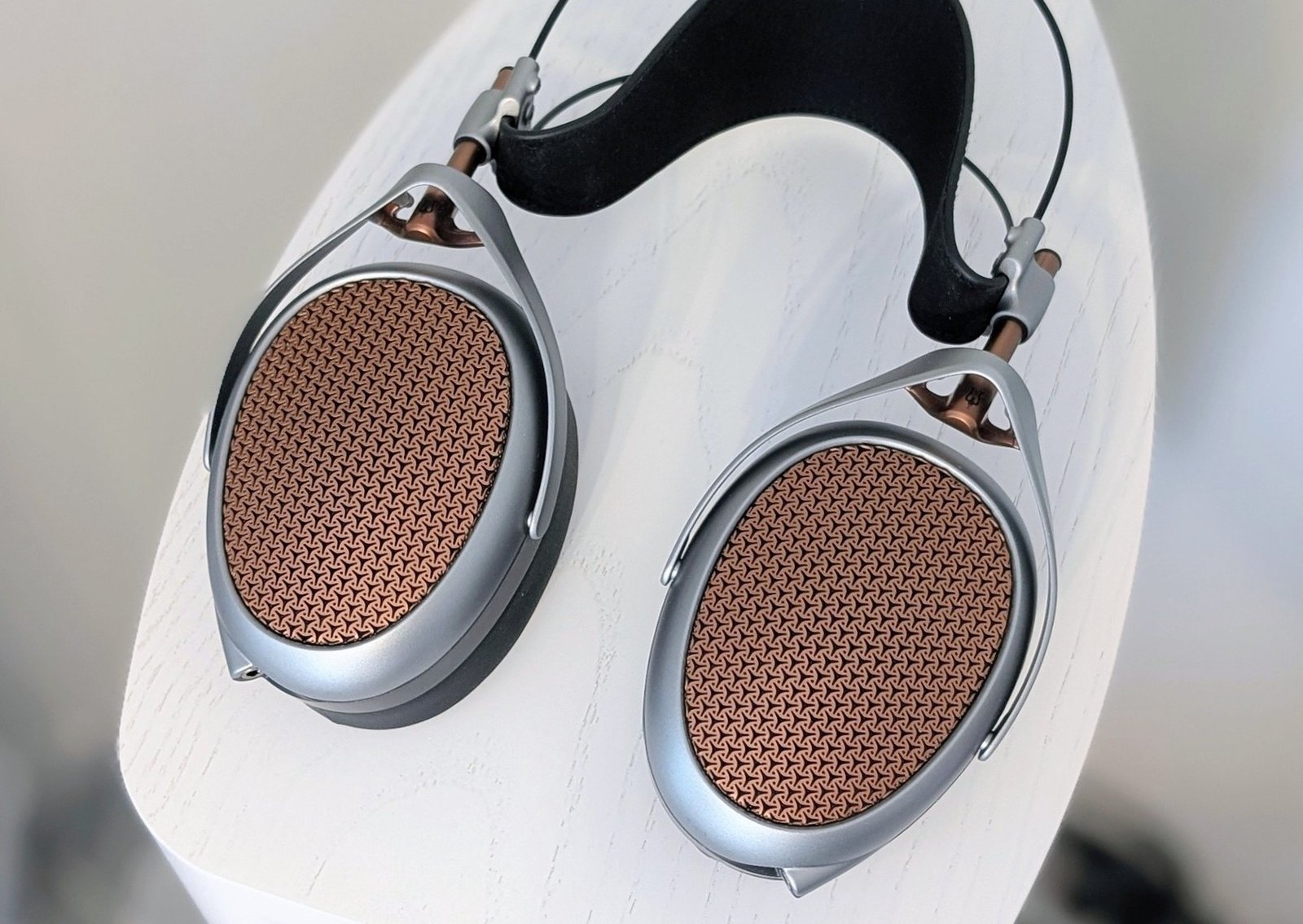
Since the POET is based on the LIRIC series frame, it is more compact than the Empyrean series and about 50 grams lighter. The precisely machined structure of the headphones combines gray magnesium and black plastic, brightened by copper-colored Meze grilles and tubes for height adjustment. The headband, in turn, consists of two titanium rods (they ring when tapped), which remind me of Dan Clark Audio headphones (e.g. Noire X). The overall look does not appear perfectly cohesive to my eyes, but there are no actual flaws either. The POET is definitely presentable to others, and the Empyrean series must still look even better.
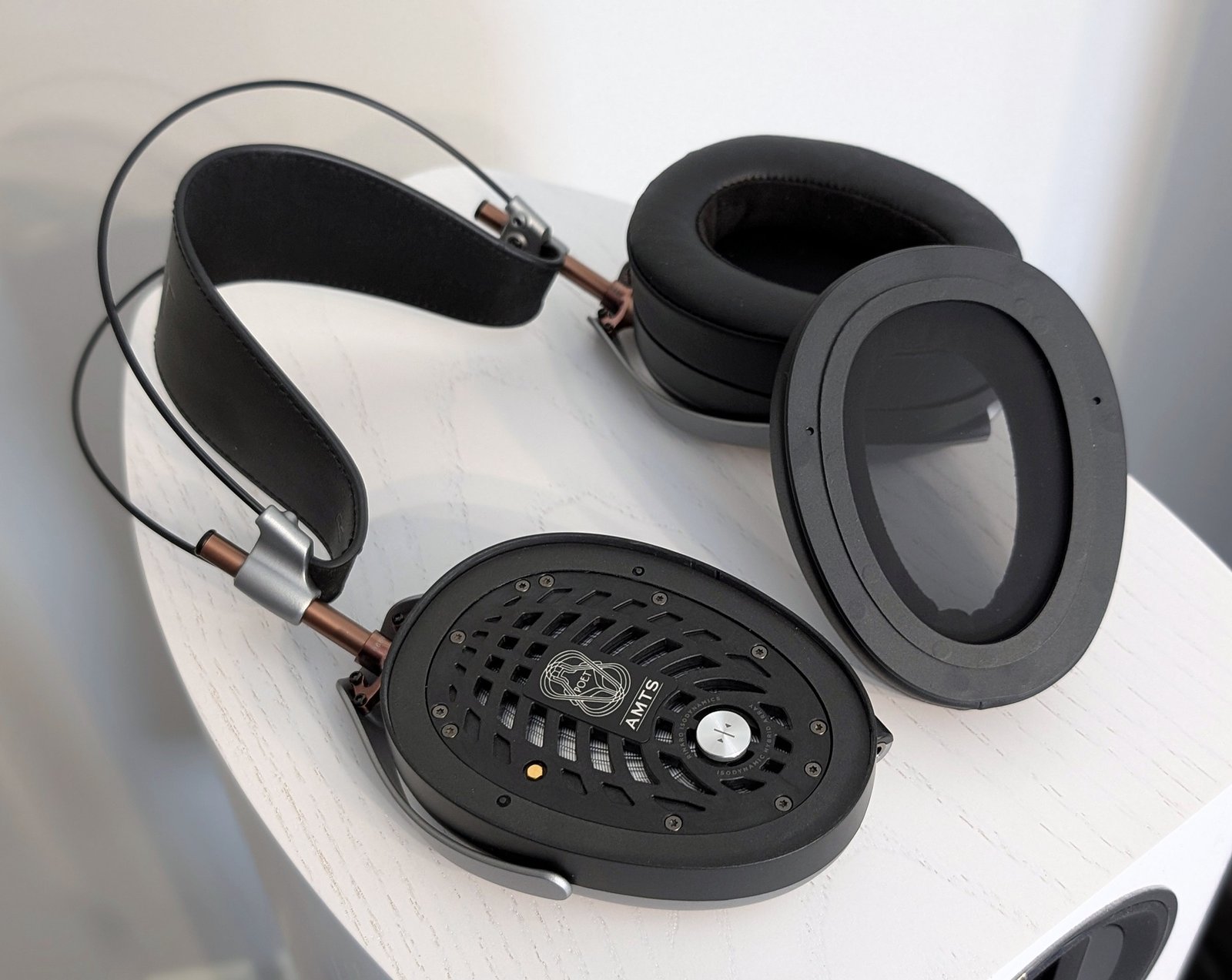
Based on the exploded views and exposed screws, the POET would be easily repairable part by part, which Meze Audio deserves credit for. The ear pads also detach extremely effortlessly, as they are held in place by magnets on the cups, similar to the Empyrean series. On the other hand, if the pads need to be replaced, it quickly becomes expensive. New ear pads cost 145 euros, and a suede headband costs as much as 165 euros. The margins are certainly in order.
When handling the headphones, I am only slightly bothered by a small clicking sound, which is caused by the loose attachment of the cups and the headband. Someone might also call the structure a bit loose, because the cups can rotate 360 degrees. For example, it is not advisable to hold the POET by dangling it from one cup; neat handling always requires two hands. However, I would not consider this a major drawback, especially after how comfortable I have found the headphones to be during use.
In its weight class, the POET is very close to the most comfortable headphones I have ever tried. Firstly, it does not protrude as far from the head as the Empyreans. The pre-pressed leather headband, in turn, conforms to my head so seamlessly that I don't really feel the headphones on my scalp at all. The deep and high ear pads are also optimal in both size and feel. My ears do not touch anything, nor would I need more space if it meant that the edges of the pads would extend closer to my jawbone.
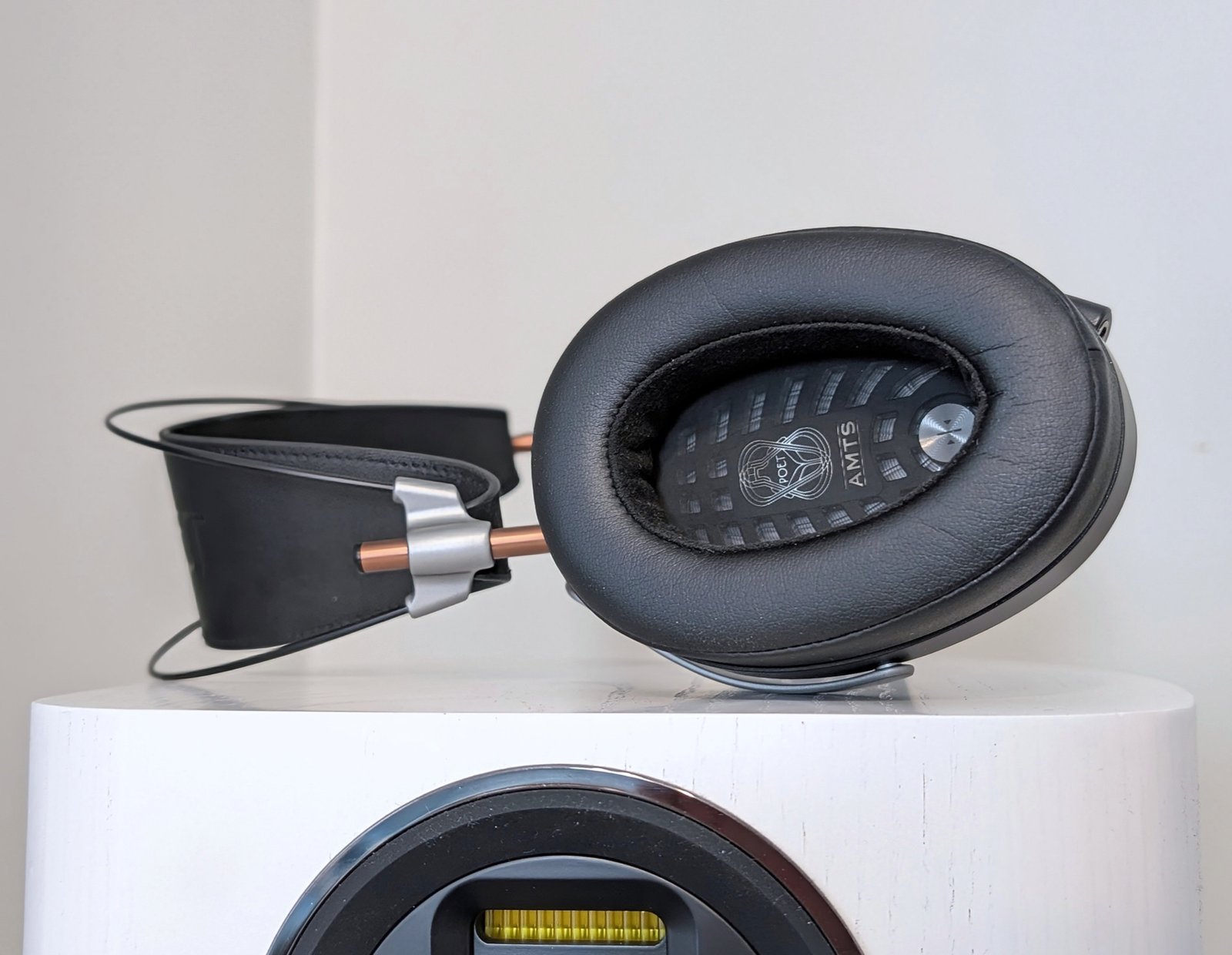
Something about the consistency of the fit is that I can open my mouth completely without the headphones moving at all on my ears. Shaking my head also causes no problems, as the fit remains surprisingly secure given its gentleness. The user experience is therefore completely undisturbed for me, regardless of how long my listening session stretches. In this regard, the more compact POET, in my opinion, surpasses the Empyrean series.
Sound quality
Isodynamic elements
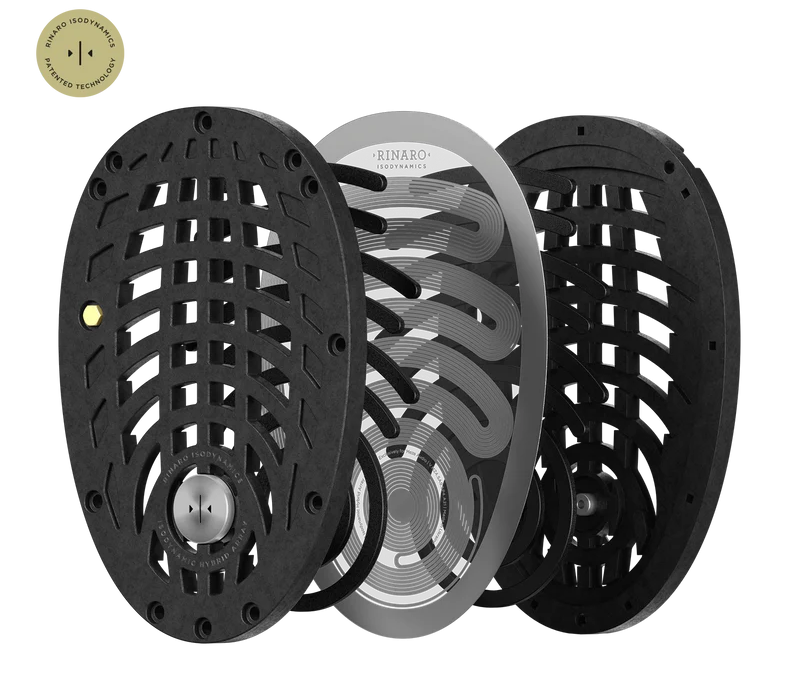
Meze Audio's planar headphones are known for their drivers designed by Ukrainian Rinaro, in which the conductors are uniquely arranged on the diaphragm. The lower edge of the driver, which sits closer to the ear, is spiral-shaped, while in the upper part, the conductors form larger loops. The magnet structure also conforms to this shape, making it quite exceptional.
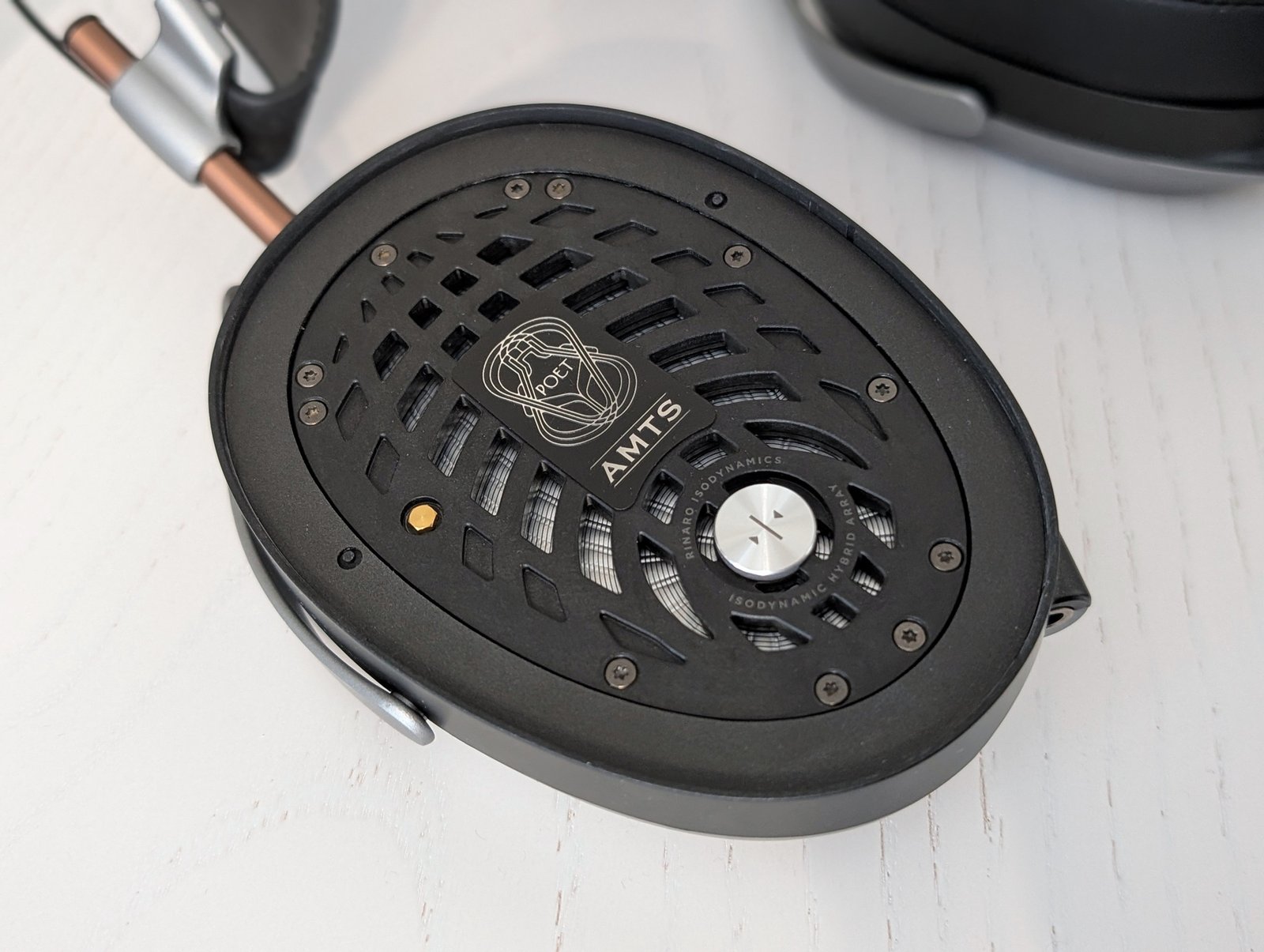
The drivers of the POET headphone model are slightly smaller compared to the Empyrean series, but as an innovation, a Dan Clark Audio licensed AMTS structure (Acoustic Meta Material Tuning System) has been added to the center of the magnet structure. With this, Meze Audio has strategically closed some of the openings in the magnet structure, preventing the worst treble peaks from occurring and making the sound feel smoother. On the other hand, this does not seem to work quite as expected for everyone, and user experiences vary more than average, similar to Dan Clark Audio headphones.
Impedance measurements and amping requirements
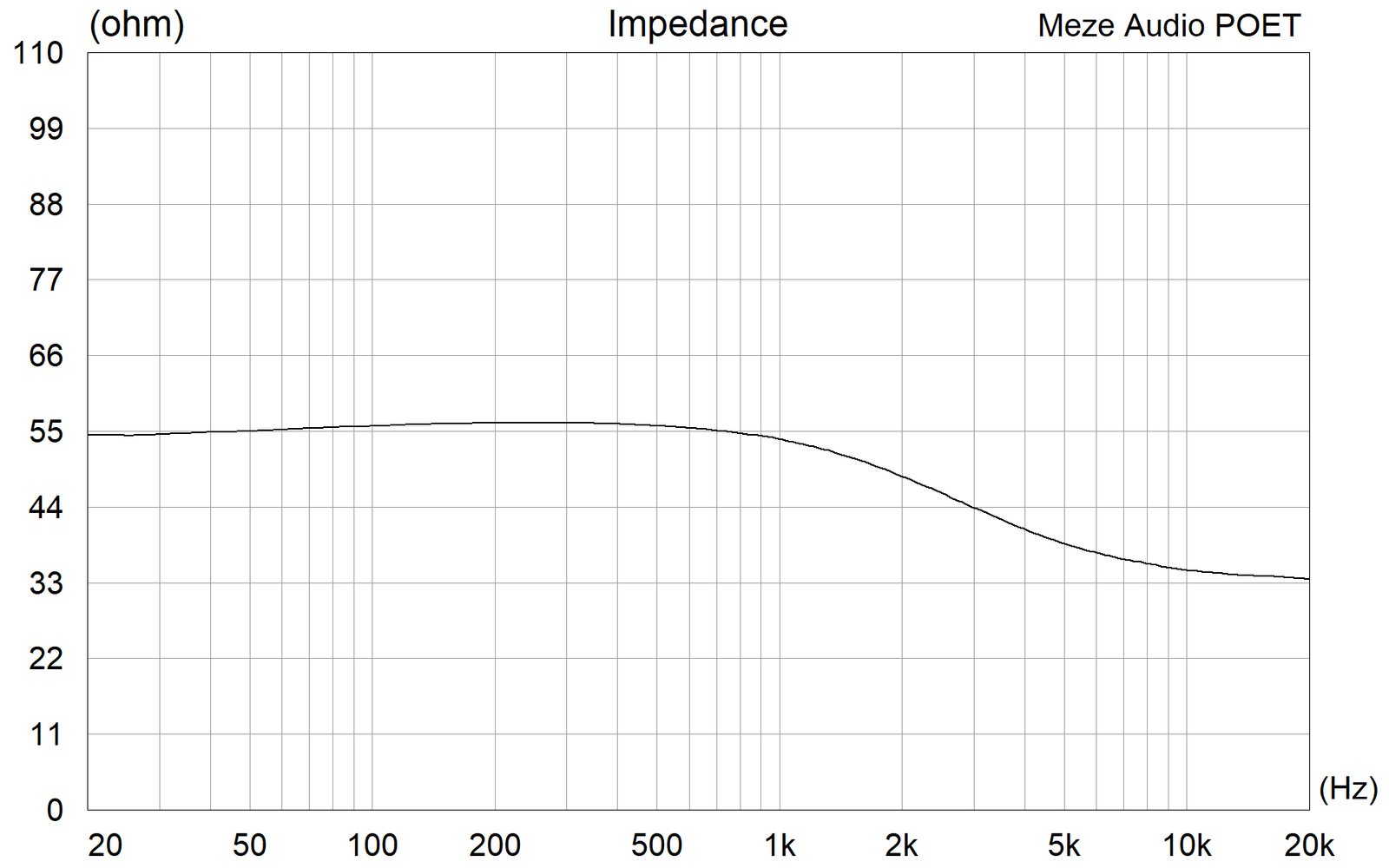
The POET does not behave quite in the same way as 95 percent of other planar drivers on the market have shown, because the impedance curve is uneven due to some kind of electronic filter used for tuning. Meze Audio's stated nominal impedance, 55 ohms, is realized only between 20–1000 hertz, while above that, it drops down to 33 ohms.
From a usage perspective, this means that a high output impedance of the amplifier can change the headphones' frequency response, because in such a case, the elevated impedance range is amplified relatively more than other frequencies. In the case of the POET, this would be perceived as a dampening of the high frequencies when the amplifier's output impedance is 10 ohms or more. For example, the 100-ohm output impedance of some tube amplifiers calms the high frequencies by 2–3 decibels.
So, if the POET's treble seems to be missing, it's worth ensuring that your amplifier's output impedance isn't causing it. When the device specifications state <1 ohm (the majority of modern transistor amplifiers), no changes occur. In the hands of an enthusiast, such a special characteristic could, of course, even be beneficial for fine-tuning the sound.
Otherwise, in terms of amplification power, the POET belongs to the easy-to-drive headphones, as its high sensitivity (101 dB/mW) would allow listening with mobile amplifiers as well as other low-power devices. For comparison, Hifiman headphones are slightly more challenging to drive, regardless of price range.
Headphone Measurements
Our frequency response measurements have been made with a clone IEC-60318-4 coupler and KB501X pinnae. The Harman target curve from 2018 is used as a reference point and generalization of the headphone response that would sound good to most people. For more information on the measurements and their accuracy, see Headphone Measurements-page. The POET's frequency response is also comparable with other measured headphones Squiglink .
Frequency response:
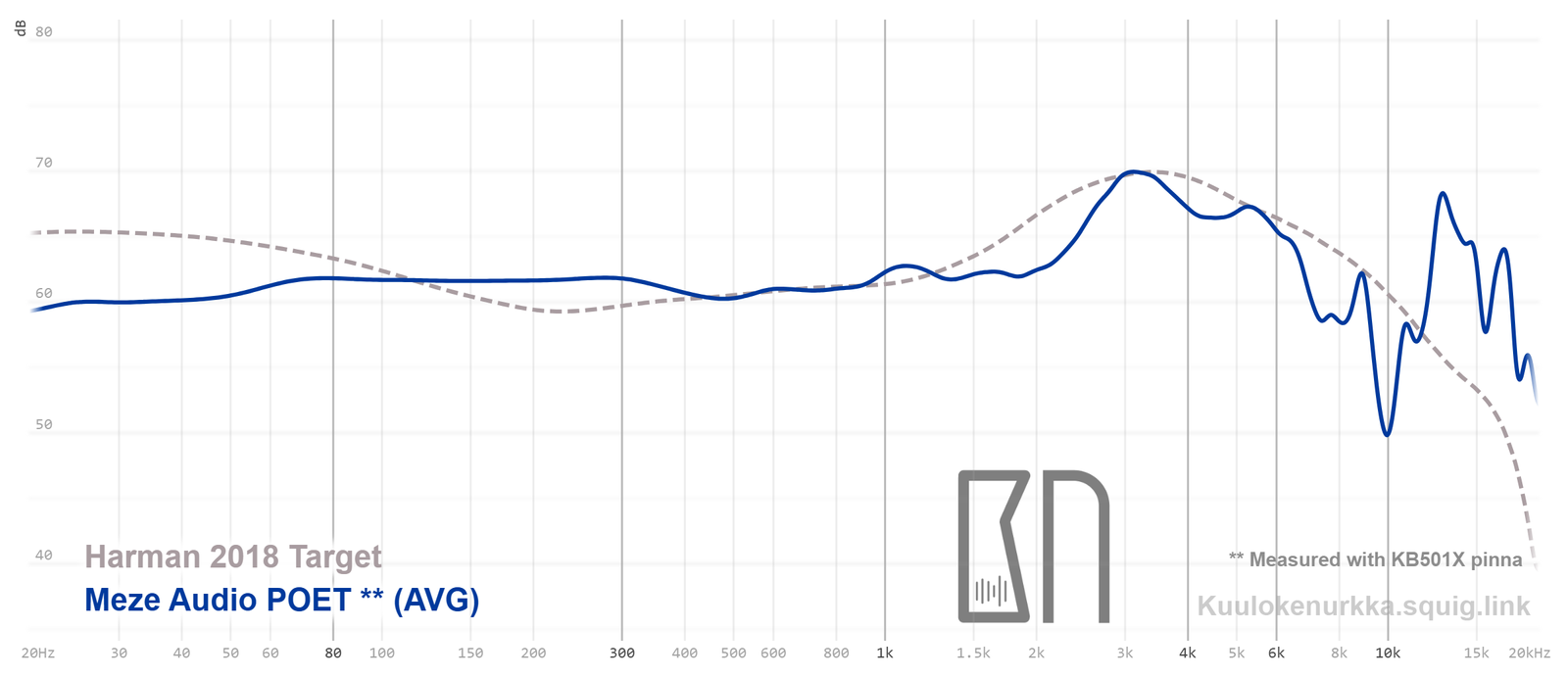
Meze Audio does not tune its headphones to be particularly neutral or as universally applicable as possible; instead, it has so far aimed to stand out from the crowd with its own ”house sound,” which includes robust low frequencies and airy treble. POET also follows this style choice, but it takes the soundscape a notch further in a safer direction, resembling Empyrean 1 more than 2.
Low frequencies reproduce quite linearly, typical for open-back planar headphones, with only a small touch of Meze-style emphasis (100–400 Hz). Approximately half of the robust sound of the original Empyrean and ELITE has thus been carved away, especially as the energy charge in the so-called ear-gain region (from 1 kHz onwards) rises to a quite neutral level in the POET. However, it never rises above the Harman curve at any point. For comparison, most Chinese planars Hifiman Edition XVwith the exception of, are still more energetic in sound than POET. However, from these cousins, POET borrows a soundstage-widening ”calming” at 2 kilohertz.
The most polarizing feature in POET appears at frequencies that many dreaming of expensive headphones presumably already hear somewhat diminished. The uppermost treble has been significantly emphasized from around 12 kilohertz onwards. On the other hand, the fit of the headphones and the positioning of the AMTS structure relative to the ear affect the final amount of the highest frequencies, which likely explains the sharp variation in the reviews the headphones have received.
A small change in position also causes changes of 10 decibels between 12–20 kilohertz during measurement. The frequency response I published reflects an average, but in a certain position, the treble can be a few decibels higher or it can even settle quite close to the Harman curve. In other frequency areas, the variation remains smaller, however, because POET's structure is open and its acoustic impedance is relatively small – at least compared to closed-back headphones.
POET vs. other Meze models:
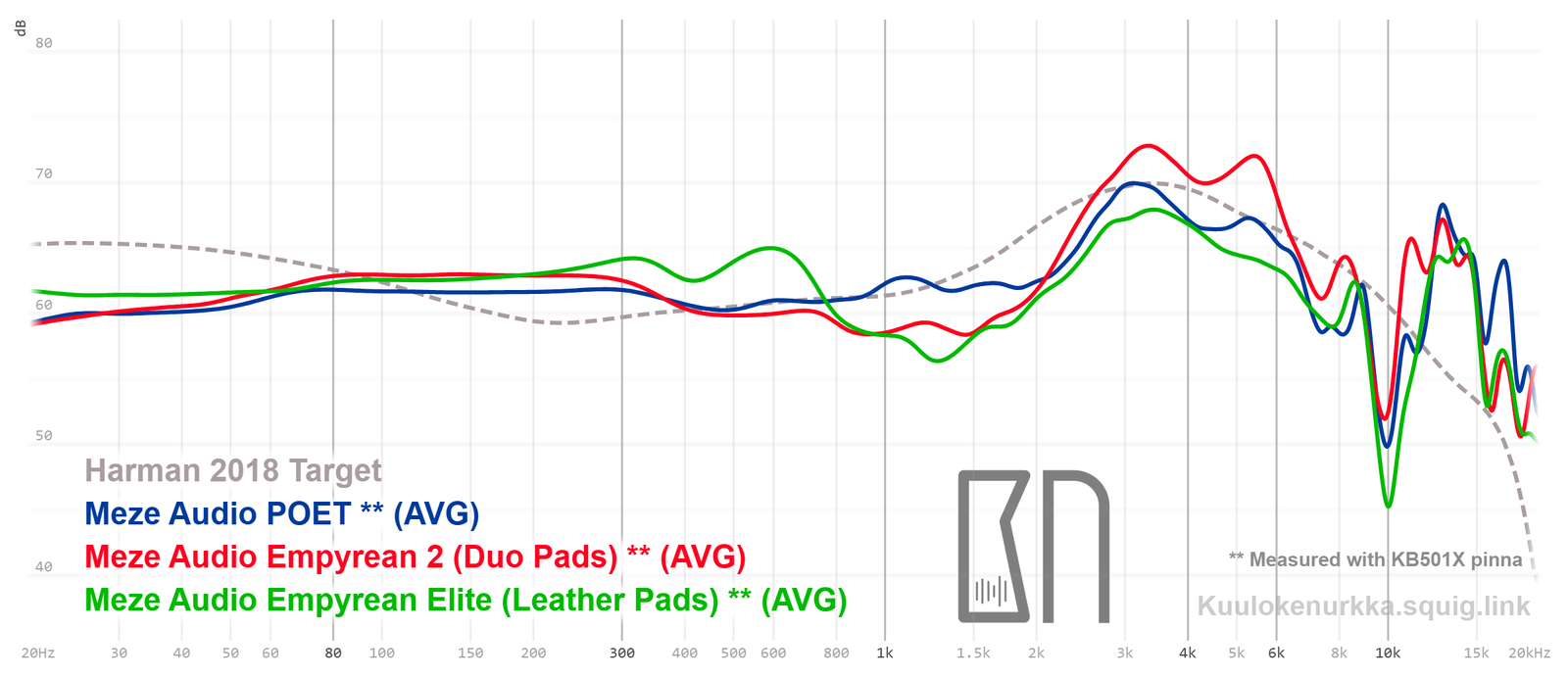
POET is, by a fairly clear margin, the most normal of the open-back planar headphones currently sold by Meze Audio, as its energy level falls between Empyrean 2 and Empyrean ELITE. Especially the midrange, POET reproduces most linearly without significant boosts or dips. In Empyrean models, these are found in both the low frequencies and around 1 kilohertz. With its default earpads, Empyrean 2 sounds somewhat V-shaped, while ELITE reproduces sound robustly and calmly. However, an emphasis on the highest frequencies is visible in all three of the manufacturer's headphones, which adds its own spice to the sound.
Sound observations
Evaluating POET was somewhat hindered by its sensitivity to head placement. At the beginning of listening, the result could be almost anything between a dark and warm sound and an overly sparkly sound, depending on the amount of treble realized. However, once I got my ears into the right position within the earpads, I found myself liking what I heard, even though many other critical reviewers like myself have been quite reluctant towards the headphones.
POET feels like the original Empyrean's soulmate, because its sound similarly combines full low frequencies, calm treble (4–10 kHz), and an added sparkle (>10 kHz). However, the balance is now more successful to my taste, as the low and high frequencies have approached each other, so the result no longer sounds too thick and soft to me.
Meze Audio has thus managed to retain a certain kind of relaxedness and ”musicality” (the opposite of a studio-type monitoring tool), but at the same time, I could already characterize the sound as moderately neutral. When listening, I certainly don't get the impression that the music ever sounds disturbingly colored or unnatural. Rather, with its relaxed overall approach and sturdy framework, POET is a pleasant change from many modern planars that emphasize clarity and precision in their sound. It would not be wrong to call Meze Audio's headphones a bit old-fashioned in a good way. Common features can be found, for example, towards the original Audeze LCD series. Among newer newcomers, Hifiman Edition XV is of the same genre, although its uppermost treble reproduces somewhat more calmly.
The certain robustness of POET's sound primarily arises from the relationship between the lower and upper midrange frequencies, as, unlike the Empyrean headphone series, bass alone it doesn't really stand out. In any case, the instruments have the weightiness I expected without the sound feeling bloated. For example, drums hit more robustly and the bass guitar reproduces more solidly than with many other planar headphones. On the other hand, the sub-bass remains quite subdued, so the POET cannot properly create a sense of pressure for electronic bass music, games, or movies. A pity, but quite expected given the open design.
Mid-range The POET reproduces naturally and smoothly, although with a slightly incorrect head placement, it is also possible to detect aggressiveness and excessive sibilance. Usually, however, the sharpness of instruments or vocal performances does not push into my face, but the softened sound is easy to listen to. The soundstage also feels quite open due to the ”calming” of the upper mid-range and airy treble, although I experience the reproduction as intimate rather than grand.
Compared to many Hifimans, I like that the POET's frequency response doesn't dip as much at 1.5 kilohertz. I find vocal performances, for example, on the Edition XV, a tad unclear, whereas the POET reproduces them slightly more energetically and present, but otherwise with a similar honeyed tone. Both headphones emphasize the lower part of the human voice, while the clarity of articulation remains somewhat rounded. A special feature of the POET in reproducing vocal performances is the airy treble, which adds freshness to its relaxed style. As an example, Melissa Bonny's solo album Cherry Red Apocalypse, released during the test period, was pleasant to listen to with Meze Audio headphones.
Attention-seeking highest treble is ultimately a feature in the POET that is either admired or disapproved of, depending on how much of it the AMTS-technology-tamed drivers deliver to each listener, and whether one's hearing extends beyond 12 kilohertz. Some have criticized the POET for being annoyingly bright, but I wouldn't actually call the headphones' sound bright. It's possible, of course, that for my anatomy, the 6–9 kilohertz range reproduces more evenly than for many other people. For example, I find older Hifimans quite clearly brighter, as their sound exhibits more sharpness and local variation.
In the POET, the sparkle emphasized above 12 kilohertz alone is not enough to make the sound very bright; rather, the more accurate adjectives would be airy and sparkling. Of Meze Audio headphones 109 Pro:n, 105 Silva and LIRIC 2's treble sounds unnaturally restless to me, whereas the POET feels clearly more suitable and smoother.
As long as I don't go wild with the volume, the POET's high frequencies don't bother me almost at all, even during longer listening sessions. Rather, the sparkle enlivens the sound and prevents the headphones from being too reserved and ”sleepy,” which they might otherwise be. For example, the airiness of cymbals and various effect sounds pop out distinctly from the otherwise relaxed sound. Many other headphones don't draw attention to these specific details in the same way, so the POET is sure to impress. Occasionally, the amplified ”hiss” does sound a bit artificial, at least to my 35-year-old ears, but it doesn't really bother me. The situation would probably also ease with age, at which point, returning to the POET, I might even wish for such an emphasis.
When listing potential weaknesses, I wouldn't call the POET a particularly dynamic or exciting headphone due to its relaxed sound. Its reproduction is also not very clear or separated compared to more energetic competitors (e.g., almost all Hifimans, Fiio FT7, XK-Audio Fluxion, Modhouse Tungsten) either very clear or separated. For this reason, I understand if 2000 euros for such headphones feels a bit too much to ask, just like 3000 euros for the original Empyrean. However, Meze Audio headphones excel in one surprising area.
It has been exceptionally pleasant to listen to the POET while focusing on something else, such as reading or writing. The energy level settles on a truly optimal middle ground, where I am constantly aware of what I'm hearing, but not overly activated by it to lose my concentration on other things. I'm not sure if any other headphone has succeeded in the same while sounding equally good. Yes, the POET also offers enough stimulation for more active listening, but I wouldn't rate it as highly in such use cases; instead, I would prefer a slightly greater energy charge and sharper sound separation. The POET is best suited for relaxed enjoyment.
Amplifier choice matters little
During the test period, I listened to the POET with a few different amplifiers, finding the choice of device less significant compared to how I positioned the headphones on my ears. However, in the same usage position, the Topping Centaurus & Gold Note HP-10 -combination produced a slightly more robust and relaxed sound than when switching to the Cayin iHA-6 amplifier or choosing my recently acquired JDS Labs Element IV. However, the neutral Element IV suited the POET:s excellently, which leads me to believe the headphones are not very picky about equipment choices. On the other hand, I also wouldn't recommend listening to such an expensive product directly from a laptop's headphone jack, even though it worked with my Macbook Air (M1). Let's at least put some kind of 100 euro dongle in between.
As an additional experiment Cayin HA-3A-tube amplifier also worked excellently, binding the different frequency ranges into an even more cohesive whole. The headphones don't need much amplification power, as my chosen volume settings mimicked many dynamic headphone models I've found to be sensitive.
Comparison: POET vs. Hifiman Edition XV
Prices: 2000 € vs. 409 €
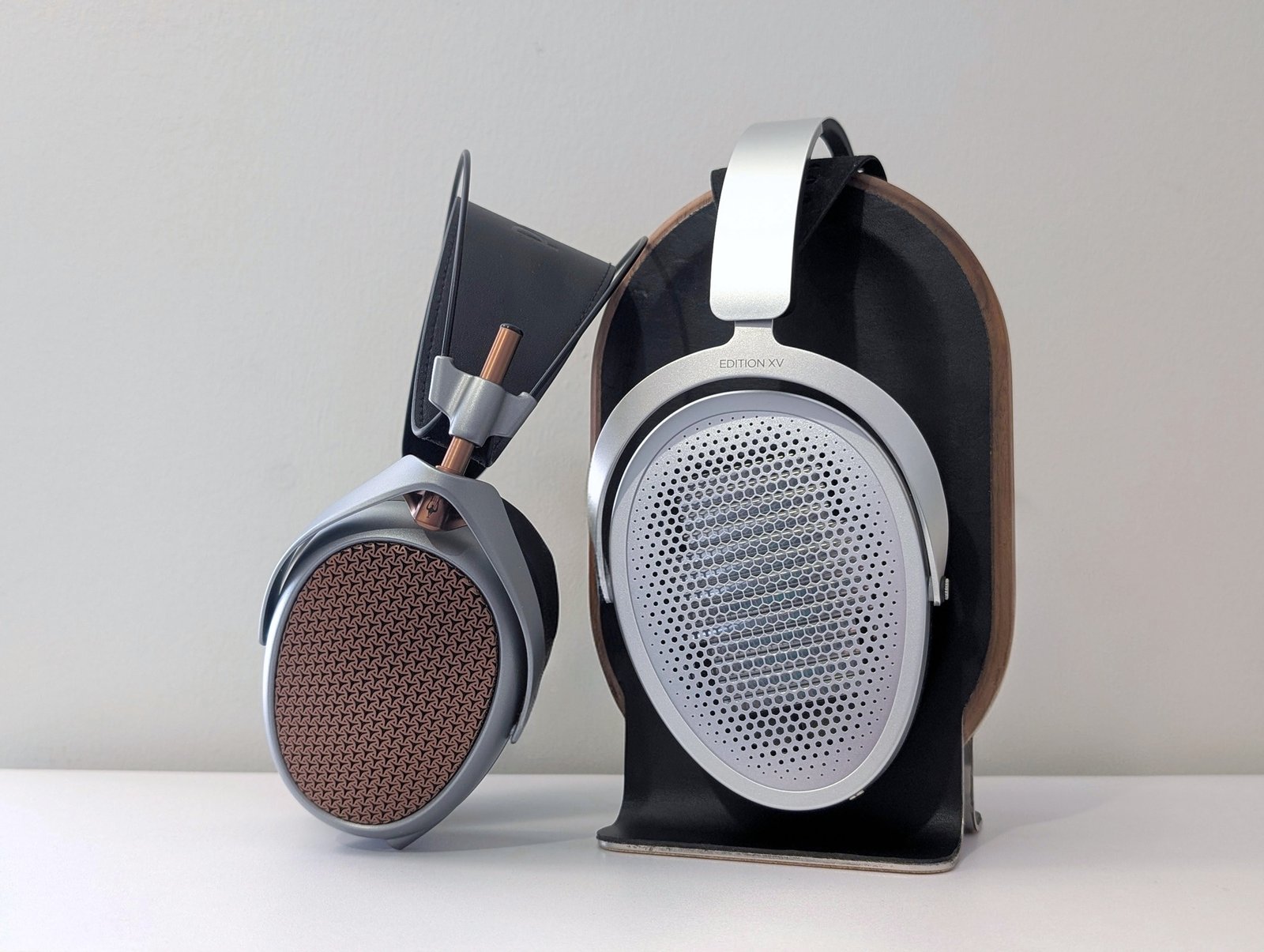
I already mentioned in passing the POET and Edition XV's similarity and also slight differences, so let's recap the situation. Although Hifiman has succeeded in raising the perceived quality of its latest headphones in the sub-1000 euro price range, the build quality of Meze Audio's products still makes a greater impression. I also find the POET of the two slightly more comfortable and practical because it weighs less, clamps more gently on my head, and allows the cups to be rotated horizontally. The accessories are also more comprehensive than the Edition XV, so by paying five times the amount, you get, as expected, better headphones in these respects.
However, if someone desires a fairly similar sound quality with a slightly safer treble, the Hifiman model would serve as an excellent alternative to the POET. In some respects, the Edition XV even sounds better, so the price difference doesn't tell nearly the whole story about the two.
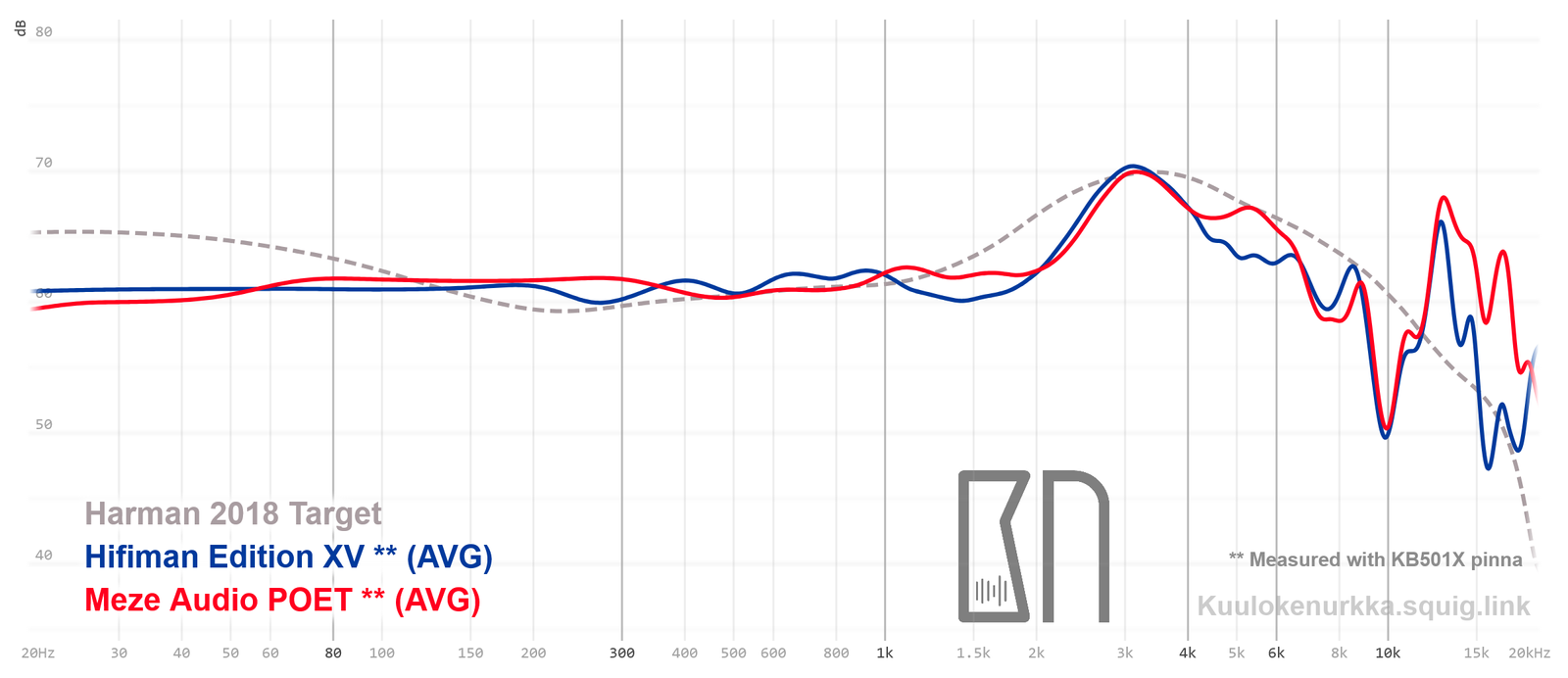
The Edition XV sounds even fuller and smoother than the POET, as its otherwise similar frequency response remains calmer around 1.5 and 5 kilohertz. As a result, I perceive the POET's presentation as slightly more present and neutral, so, for example, vocal performances are reproduced somewhat sharper. The Edition XV's greater ”energy deficit” in the upper frequencies shifts my attention quite automatically to the lower frequencies, so measurements do not reveal how much more physical the Hifiman headphones actually sound. The Edition XV kicks tighter and bigger, and the sound pressure at the lowest frequencies also remains stronger. Compared to this, the POET's bass feels quite tame despite its robustness.
Despite its tamer treble, the Edition XV is ultimately also the more detailed of the two. When listening to it, I pay attention in a completely different way to the separation of sounds and the movement within the soundstage. The POET, on the other hand, does not activate my senses as much, so it would be easier to listen to while concentrating on something that requires thought. On the other hand, both headphones are relaxed in their own way, because the Edition XV lacks the sparkle added to the POET's highest treble. The treble of Meze Audio's headphones is reproduced more vividly, but at the same time, its style is somewhat restless compared to Hifiman's headphones.
Part of the Edition XV's more precise resolution is explained by a larger soundstage, where music has more room to breathe. I experience more depth and layering in the reproduction. The sound also opens up wider laterally, whereas the POET always sounds quite intimate. Perhaps this is due to the headphones' more closed structure and smaller earpad size. In any case, the soundstage of the Edition XV, serving as a comparison, makes a greater impression on me.
Overall, the Edition XV thus feels like a slightly more functional and versatile package to my taste. On the other hand, in terms of overall sound, the duo is still very close to each other compared to if a brighter and more energetic planar headphone were brought into the comparison. Thus, both headphones largely serve the same target audience, who will hopefully find them their own.
The POET justifies its higher price with its higher quality build and gentler fit, but in terms of sound quality, I ultimately prefer the Edition XV because listening to it is more interesting. Someone else might very well end up with the slightly more neutral and lively POET, as the Hifiman model is already quite dark in sound.
Comparison: POET vs. XK-Audio Fluxion
Prices: 2000 € vs. 500–1000 € (depends on place of purchase)
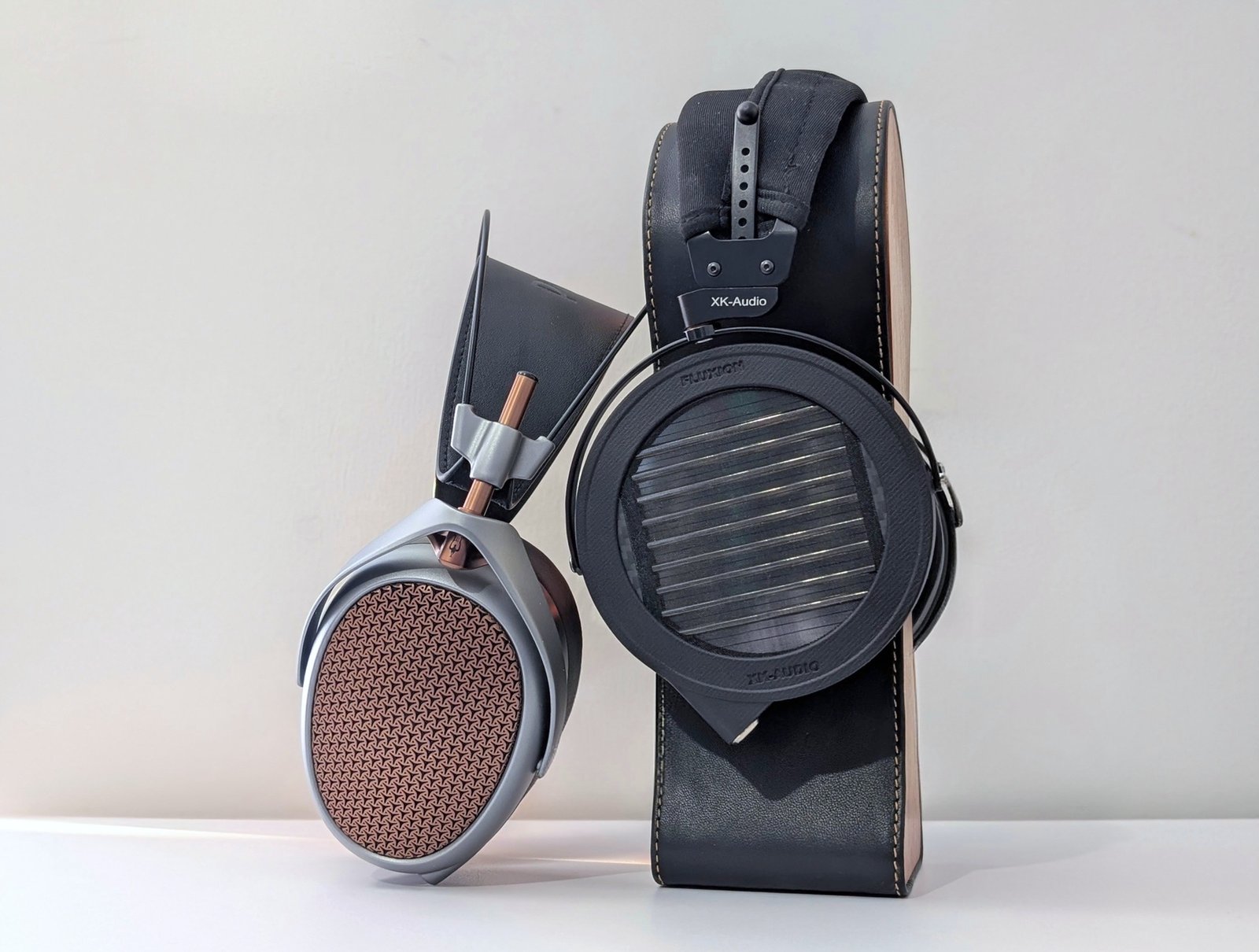
Chinese XK-Audio Fluxion let it serve in this review as a fresher and more neutral-sounding planar headphone comparison. Despite its sub-1000 euro price, this headphone could, due to its sound quality, cost more than the POET, but perhaps the structure assembled from bulk parts and 3D-printed cups wouldn't quite lend itself to that in the end. The Fluxion has no chance against Meze Audio's product design or precise manufacturing method, nor does its comfort reach the same excellent level. In this context too, the POET thus justifies its higher price with its high-quality impression.
In its tuning, the Fluxion takes quite a leap in a different stylistic direction, although it could also be seen as a kind of target state from which Meze Audio has intentionally wanted to deviate by shifting some of the energy from the upper frequencies to the lower frequencies.
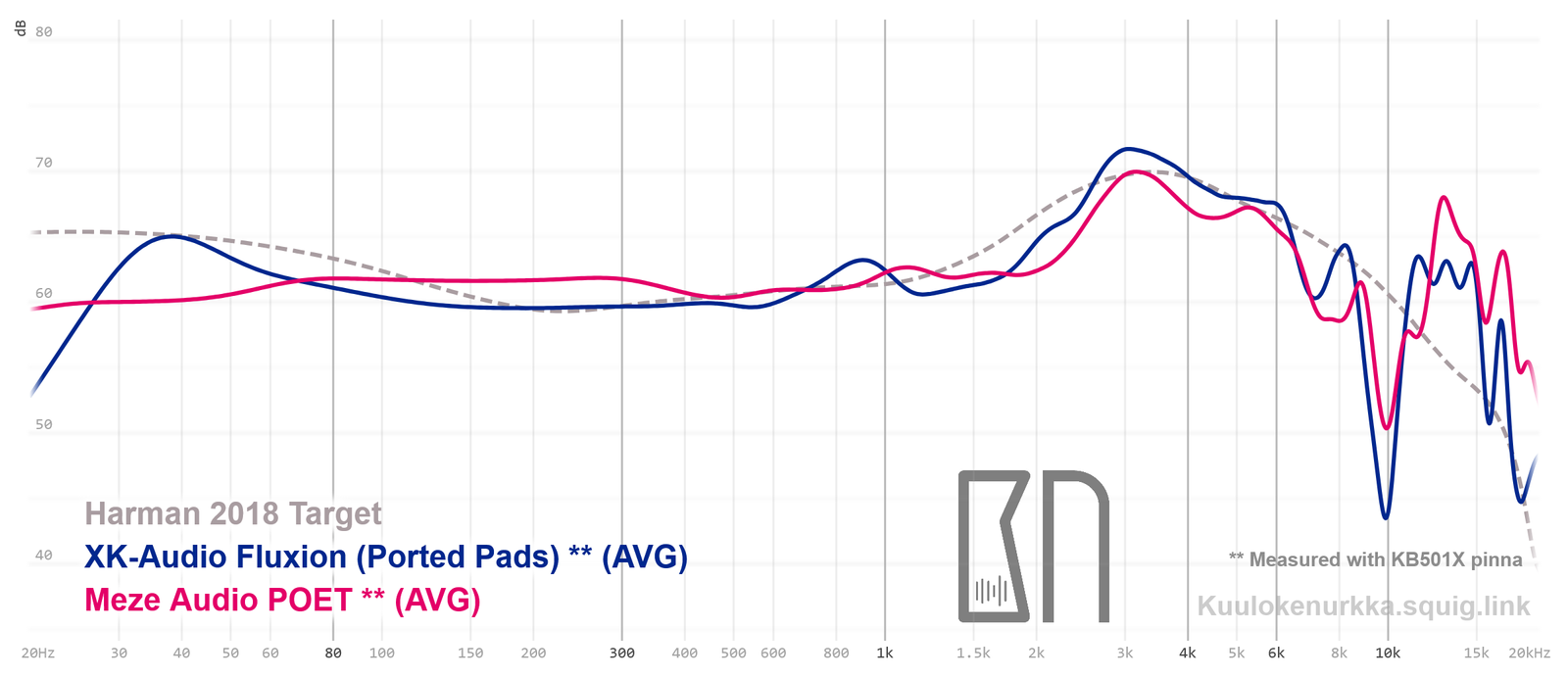
When placing the Fluxion on the head, it quickly becomes clear what is missed with a more relaxed and tamer headphone like the POET. Although I myself still describe Meze Audio's headphones' presentation as quite neutral, the Fluxion is ultimately, in all its clarity and precision, the more truthful view of neutrality of the two. A more energetic and stylistically leaner midrange offers more detail and spatial separation. I get more excited listening to the Fluxion and feel I get closer to the core of the music's informational content. The playback practically rolls forward faster. When listening to the POET, the pace, in turn, slows down, and I find myself entering a kind of resting state. The focus is no longer on playback accuracy or realism, but on a relaxed listening experience. This isn't a bad thing either.
Objectively evaluated, the Fluxion nevertheless feels like a better headphone because it reproduces the sub-bass more physically and the upper frequencies more faithfully to the recordings. The airiness of the highest treble is also more even and easier to predict, as, unlike the POET, it hardly depends on the headphones' wearing position.
If one expects similar performance from Meze Audio's headphones, they are easily declared quite mediocre. Therefore, I believe that shouldn't be done, as the manufacturer has not aimed for perfect sound. Some might find headphones like the Fluxion to sound too neutral and mechanical, in which case the POET's more robust style in the lower frequencies and the softness of the treble might feel more pleasant and relatable. So, let both headphones shine in their own areas of strength, as they are likely aimed at different people or designed to complement each other.
The Fluxion, as such a brighter planar headphone, is somewhat an unfair comparison, as it reproduces the highest frequencies more evenly than, for example, many Hifimans. If there were stronger local emphases in the reproduction, the POET's smoothness would come into its own better.
Summary
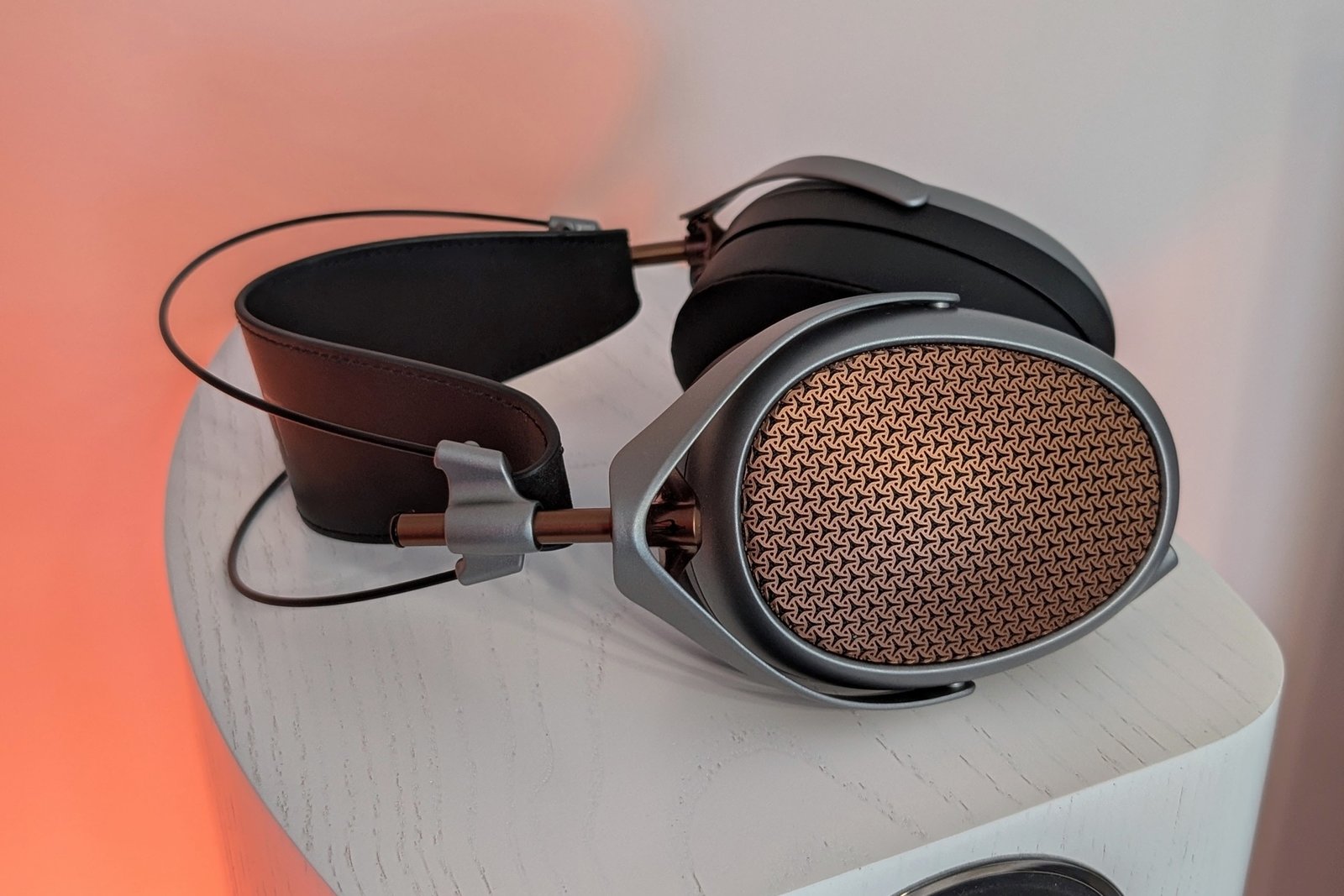
The Meze Audio POET should be considered a fine and comfortable premium headphone, aimed at relaxed listening moments. On the other hand, the sparkling treble clearly divides opinions, although I myself stated that I liked it more than in many of the manufacturer's other headphone models. Overall, the POET feels like a smaller, more affordable, and more neutral-sounding version of the original Empyrean headphone. At least on paper, there's an idea here.
More broadly speaking, this is not the most revolutionary product in terms of novelty value, nor necessarily my top recommendation in the 2000 euro price range, but the POET nevertheless serves, in my opinion, as a successful stopping point between more affordable headphone models and true flagship headphones. If someone wants clearer and more separated planar reproduction, they can get it with a 500 euro budget. Instead, many, in my view, are looking for the POET's characteristics in more expensive top models, such as the Empyrean itself, so the headphones should definitely be auditioned. It may be that there is no longer a need to acquire more expensive headphones than this.
The market is currently suffering from a kind of planar headphone glut. Many are released, and it's not easy to stand out so brilliantly that the latest models don't always capture consumers' attention. Viewed the other way, there is, on the other hand, plenty of selection for fans of such headphones. While many manufacturers strive for the most detailed reproduction possible, Meze Audio offers a more relaxed alternative. As a company, the Romanian manufacturer also feels considerably more interesting than, say, Hifiman, which releases so many new headphones that no emotional connection to individual models is formed anymore. I will remember the POET even after this review. Most other manufacturers have a lot of catching up to do in designing such high-quality headphones.
Pros and cons:
+ Robust and smooth sound is perfectly suited for relaxed listening moments
+ A more neutral take on the original Empyrean
+ Long-term comfort
+ Fine and high-quality construction
+ Repairability
+ Doesn't require a powerful amplifier
+ Premium cable
– The sparkle of the highest treble can annoy some
– Placement on the ears changes treble reproduction more than usual
– The sound is not very detailed
– A slight clicking sound can be heard from the structure when handled
– Cable connector not selectable at the purchase stage
– Expensive accessories
What is this?
In the future, I will grant special mentions to headphones in four areas if they perform better than usual. The absence of a star does not mean that, for example, the sound quality would automatically be bad or the build weak, but rather I fundamentally expect every product to be good and functional. When my expectations are met, special mentions are not yet given. If, on the other hand, a product makes a great impression in some area compared to its competitors, I want to indicate it with a star rating.
With this reward method, it is perfectly fine if a product receives a star for excellent sound quality, but is not, in my opinion, a particularly attractive purchase if it costs, for example, 5000 euros. Similarly, another product might be affordable and designed more cleverly than usual, making it a good purchase, even if I wouldn't give a special mention for sound quality. Therefore, you shouldn't expect stars or be upset by their absence, as I will award them thoughtfully.
 EN
EN  FI
FI