Author: Sword of Damocles
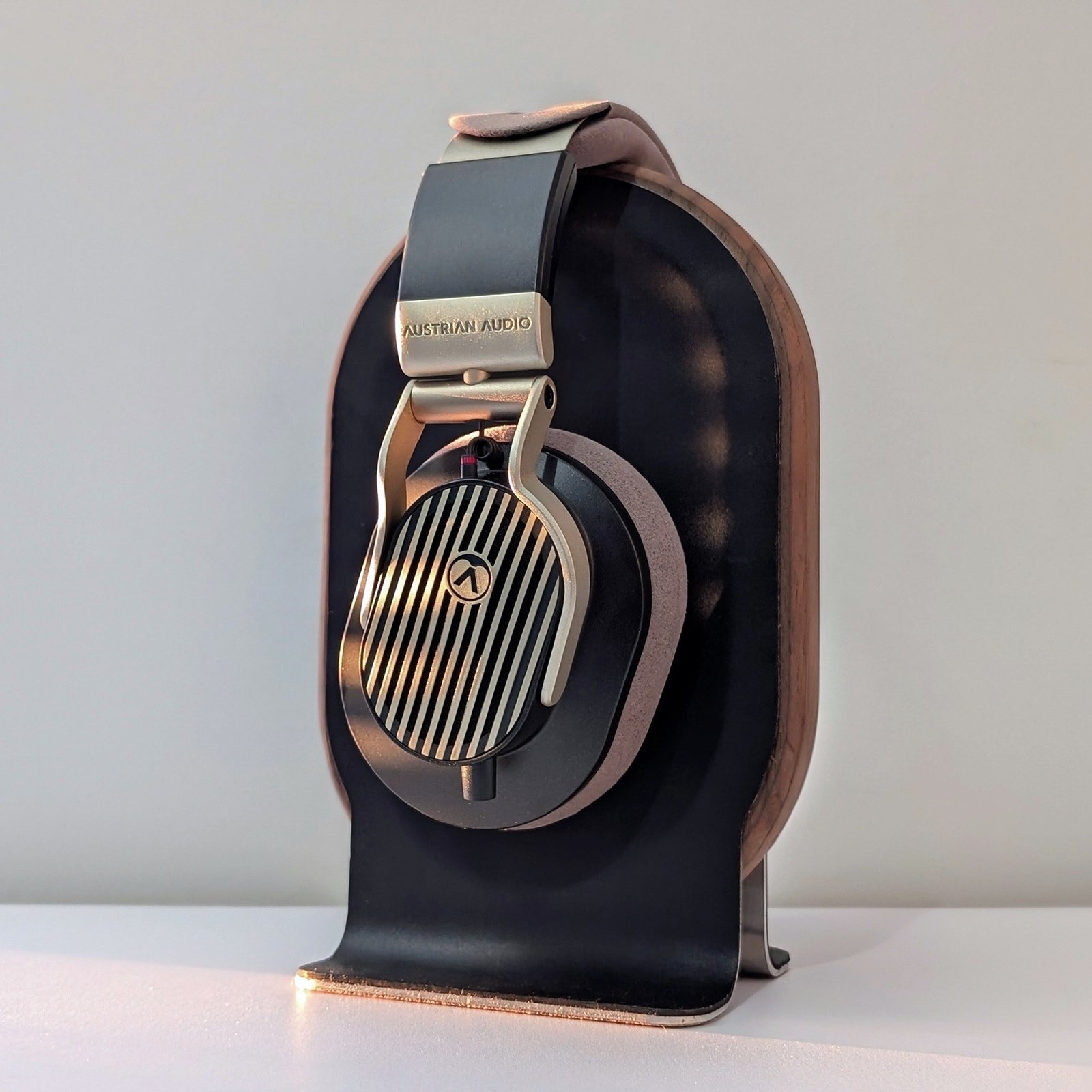
Table of Contents:
Information:
- Release year: 2026
- Country of manufacture: Austria (design) and Hungary (assembly)
- Price: 999 €
- Available in Finland: Yes
- Type: open, over-ear
- 44 mm dynamic drivers with DLC (diamond-like-carbon) coating on the diaphragms
- Impedance: 25 Ohm
- Sensitivity: 94 dB/mW
- Weight: 320 g
- Connector type: Lockable 2.5 mm
- Cable: Length 3 m / connector 3.5 mm (+ 6.35 mm adapter)
- Accessories: Fabric pouch
- Warranty: 2 years
Review unit acquisition method: Loaned by the importer and purchased for myself
Austrian Audio, born from the ruins of AKG, had a somewhat rocky start as a headphone manufacturer, mainly remembered for its undulatingly tuned Hi-X55 headphone model. Since then, however, improvements have been made with each headphone release. The most expensive model in the collection (2500 €), The Composer, was and still is a genuinely top-tier product that I missed after writing my review a bit. The headphone model can also be found on my Wall of Fame, even though I can't listen to it there.
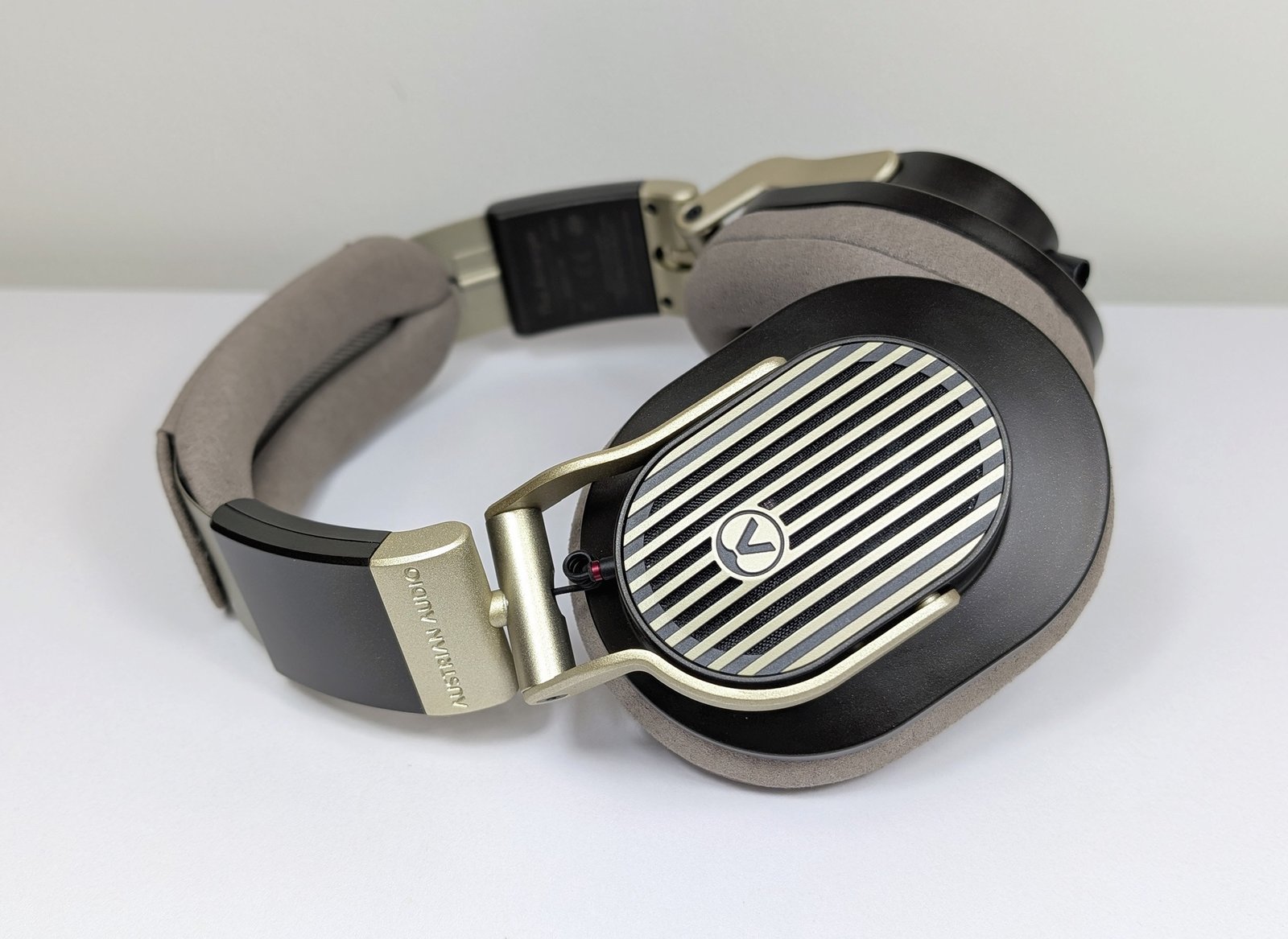
Now, to kick off 2026, the manufacturer released a new open-back headphone model, named The Arranger and priced at 999 euros. The frame for the headphones is borrowed from the manufacturer's more affordable Hi-X50/60 series products, albeit aesthetically enhanced and equipped with new earpads. The color theme, combining champagne tones and black, refreshingly stands out from the crowd. The headphones are also manufactured in Europe, or more precisely in Hungary, offering an alternative for those wary of China.
The price range of 1000 euros is competitive, as nowadays many headphones cost rather less than this. For example, the recently released HEDDphone D1, which will serve as a comparison in this article, has already garnered praise as a 700-euro German headphone for its neutral and studio-like sound. Since Austrian Audio also seeks attention among professionals and hi-fi enthusiasts looking for reference sound, could this even be a kind of duel?
The Arranger was provided for testing by domestic AK-Hifisystems. In my opinion, they can pat themselves on the back a little for offering consumers the opportunity to get more information about their newly imported product on such a quick schedule. Thank you on behalf of all of us! In this context, it should already be mentioned that I eventually bought the headphones for myself. The reasons for this will be revealed when I talk about the sound quality.
Packaging and accessories
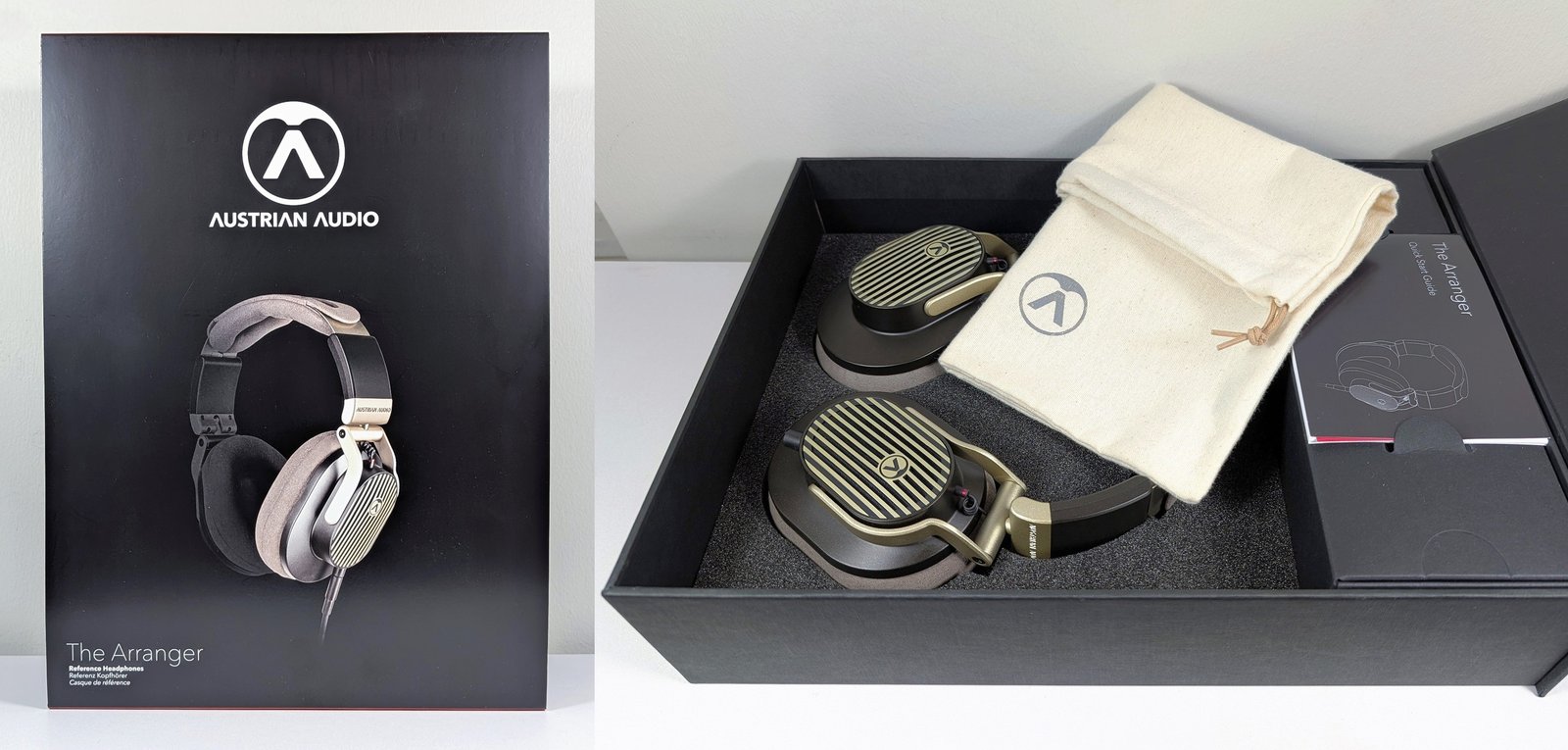
The equipment of headphones can always surprise in both directions, because sometimes inexpensive products come with a huge amount of everything, while at other times more expensive models represent themselves without accessories. The Arranger is delivered in a large box, which, however, contains only a light fabric pouch in addition to the user manual and cable. Perhaps I expected a little more, but this is what we have. A compatible carrying case (HXHC) could be purchased separately from the manufacturer for 29 euros.
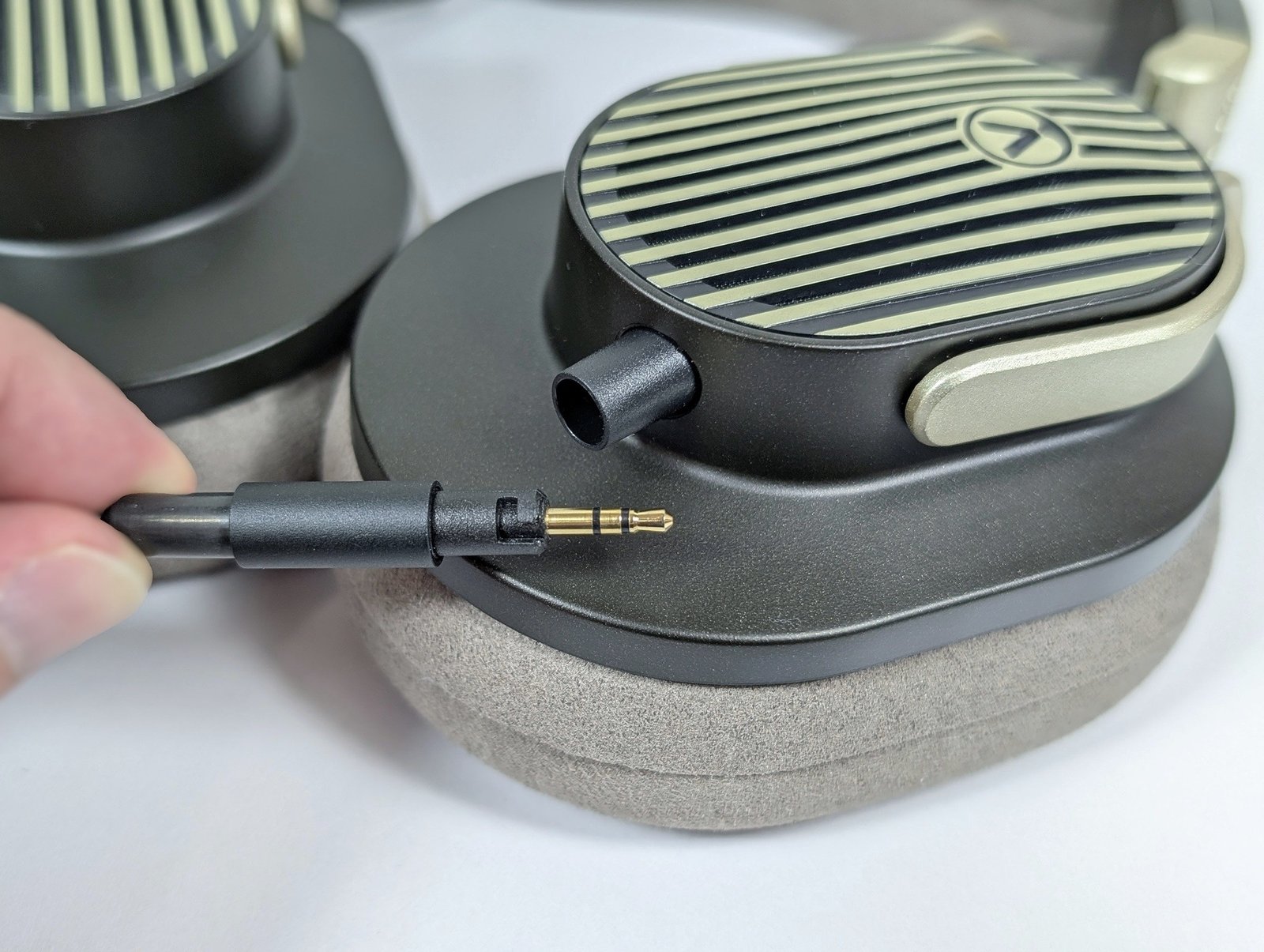
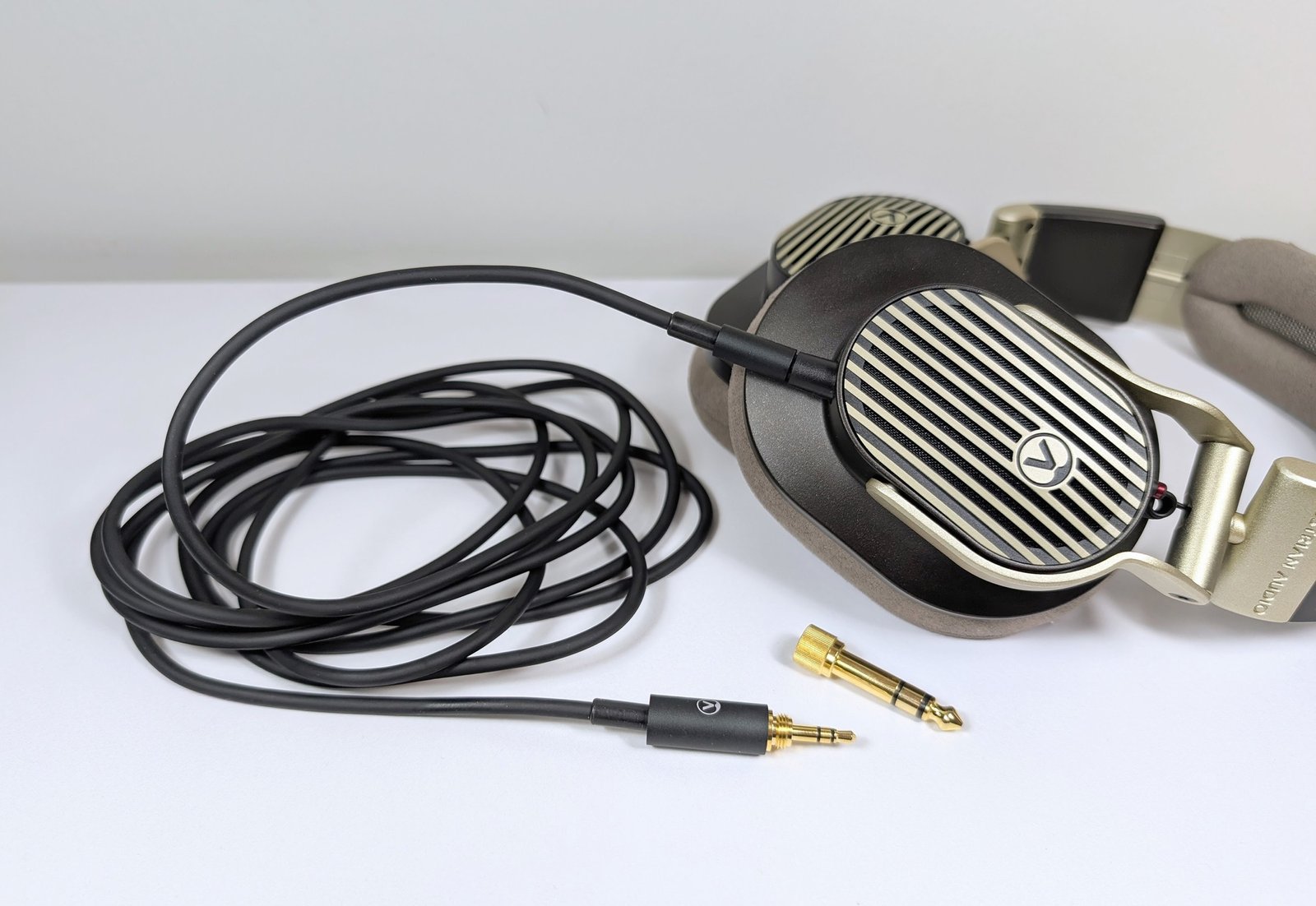
The cable attachment to the headphones is handled by a screw-locking 2.5-millimeter connector, which differs slightly in structure from Sennheiser's HD 500 series and Audio-Technica's ATH-M50X, to which each other's cables usually fit. Austrian Audio thus does not want to belong to the same group, but at the same time, it complicates consumers' lives. The rubber-coated cable included with the Arranger is also a full 3 meters long, so in my opinion, it is slightly better suited for a studio environment than for home listening. However, apart from the length, I have little to complain about regarding usability.
Sound can be output from the most common 3.5 and 6.35 mm audio outputs, but balanced cables would also be available for purchase separately at a very reasonable price. Austrian Audio's recommended price for a two-meter cable with a 4.4-millimeter connector (TACP2m) is 49 euros, and for a three-meter XLR cable (TACX3m) is 69 euros. For comparison, Sennheiser's equivalent accessories cost about 40 percent more.
Build and comfort
Because the Arranger borrows its angular design from the manufacturer's professional Hi-X50/60 series headphones, the overall look appears quite tool-like. At the same time, the champagne-colored details and light grey ear pads lighten the appearance to suit a wider audience. No other headphones of exactly this color can be found on the market. I personally like it.
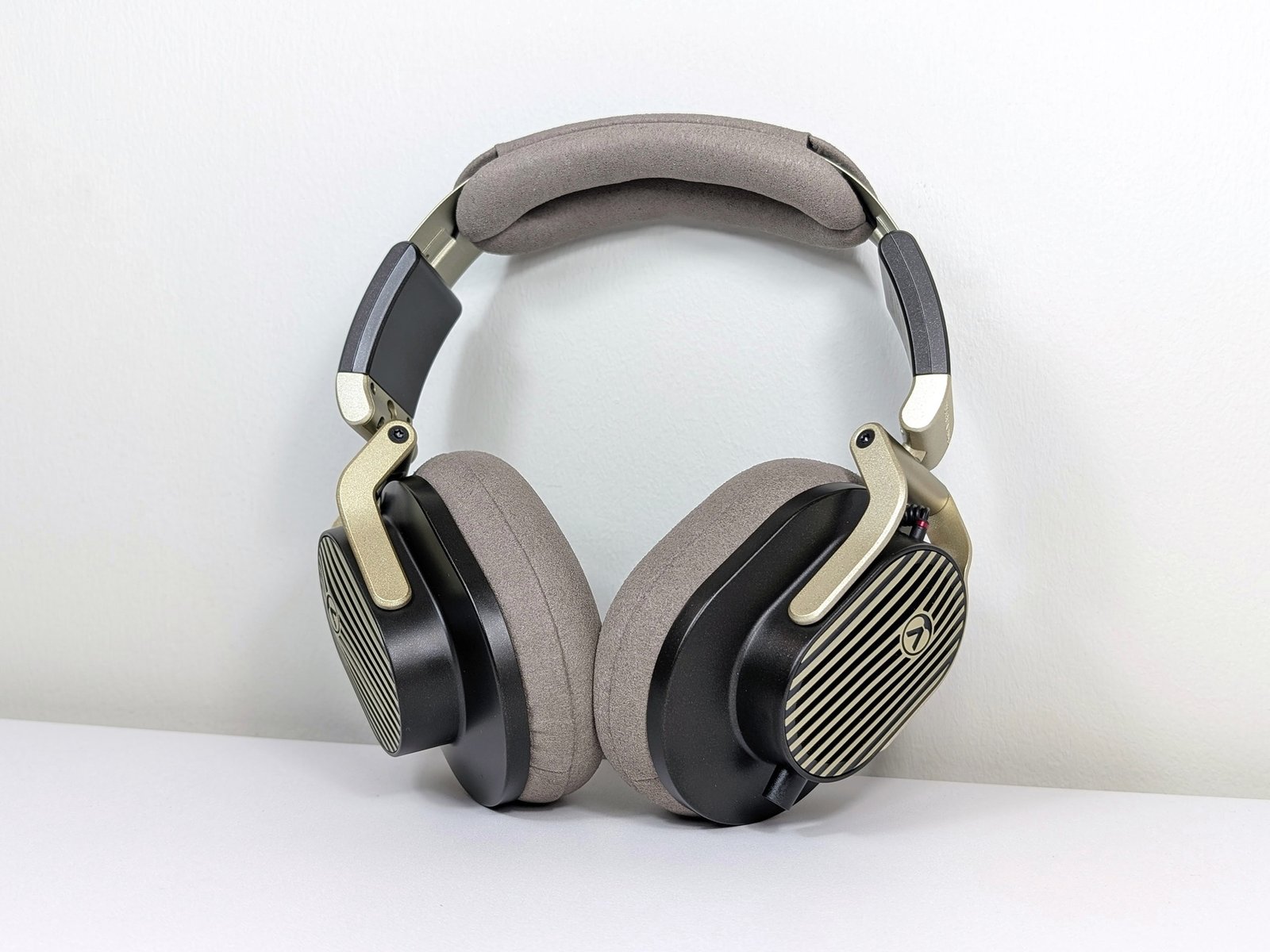
Functionally, the structure works very well in terms of its range of motion and joints. The click-by-click height adjustment also firmly holds its chosen position. Despite the sturdy feel and metal headband, I still have some doubts about the durability of the headphones. The black strip that presses the parts together is still made of plastic, and it has been observed to crack in the manufacturer's more affordable headphone models after only short use. On the other hand, Austrian Audio advertises its headphones as fully serviceable and repairable, and in addition, repair instructions and 3D printing models for spare parts made by others can be found online.
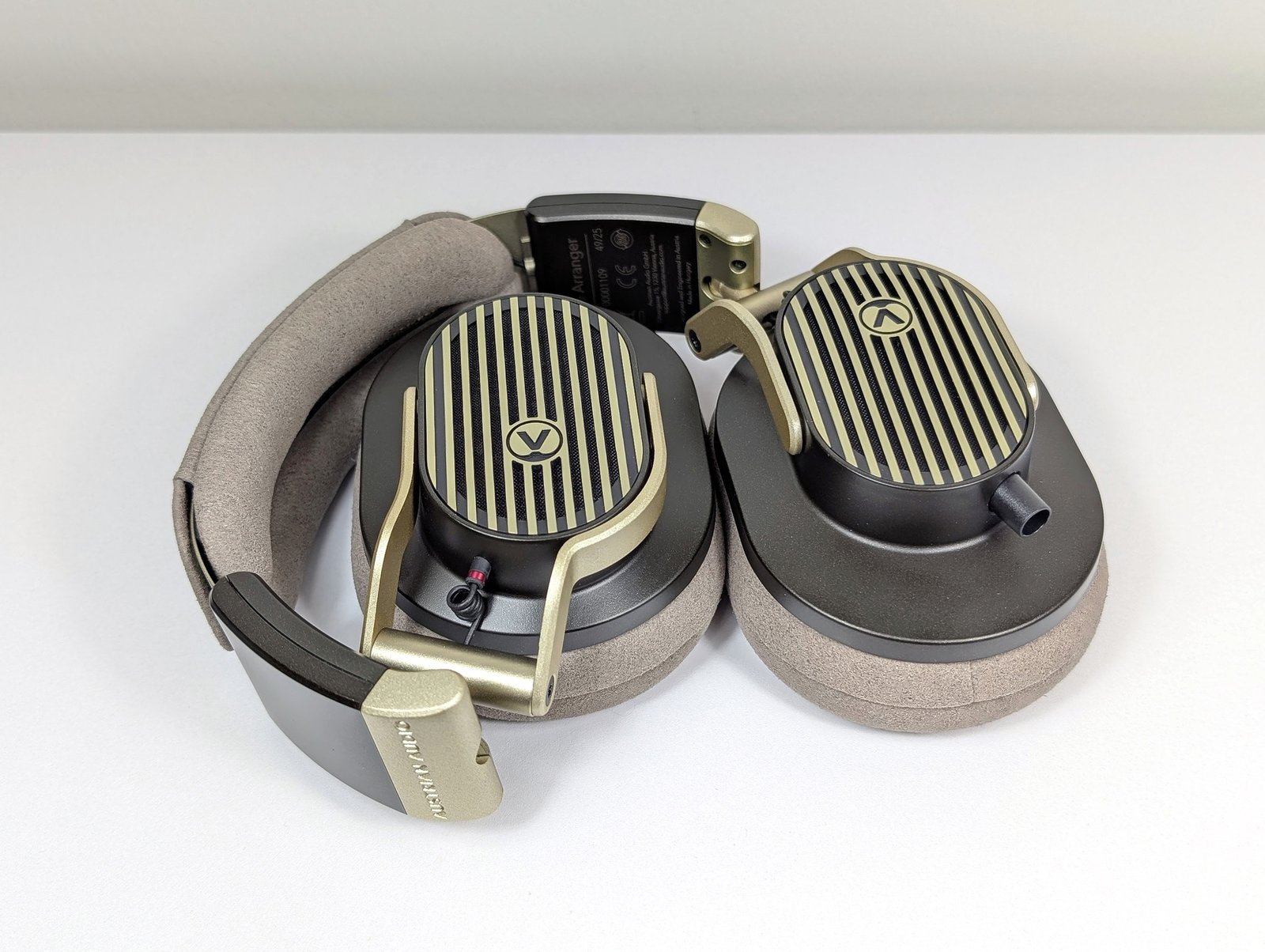
On the other hand, I understand the plastic nature of the cup structure to keep the overall weight of the headphones in check. Considering the thickness of the parts and material choices, I even consider 320 grams to be light. On the other hand, I wouldn't mind if the cups were a bit thicker at the edges, as gripping them when putting the headphones on doesn't feel the most natural.
The structure is open behind the drivers, but the frame has been opened towards the ear so thoughtfully that the external soundscape is surprisingly attenuated during use. Sound also does not leak out of the headphones too badly, especially compared to planar drivers. On the other hand, by placing hands over the Arranger's cups, it quickly becomes clear how easily the drivers are disturbed by closing their rear. Thus, the benefits of the open structure can be assumed to be fully realized.
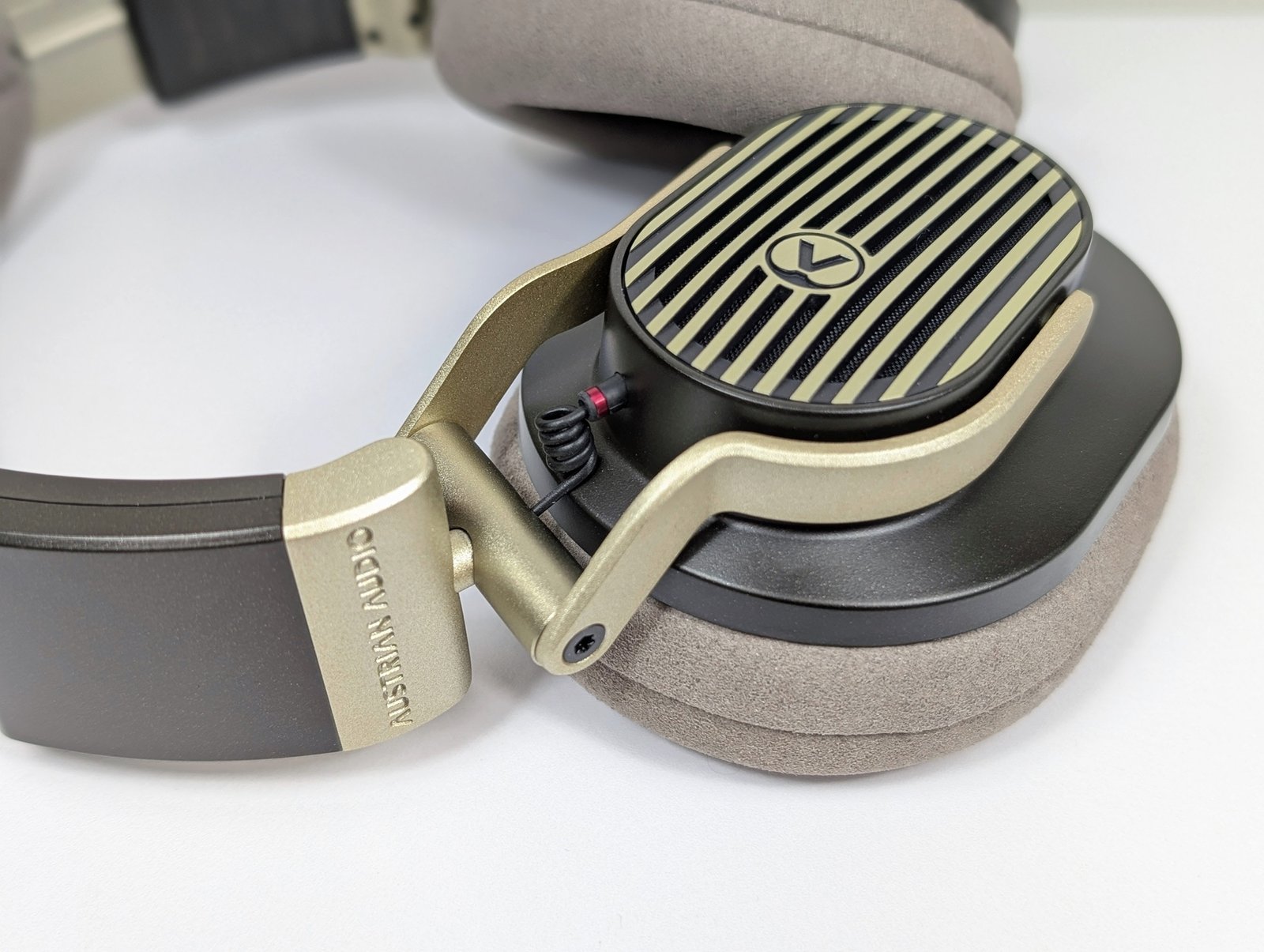
In terms of comfort, the Arranger differs somewhat from the usual, because when placed on the head cold, its thin-edged ear pads feel uncomfortably hard. However, after a moment of warming up, the fit becomes noticeably softer and more even for me. Many others have also reported the headphones behaving this way, although I don't personally notice a huge difference in sound quality after warming up. Perhaps the bass and treble even out a bit?
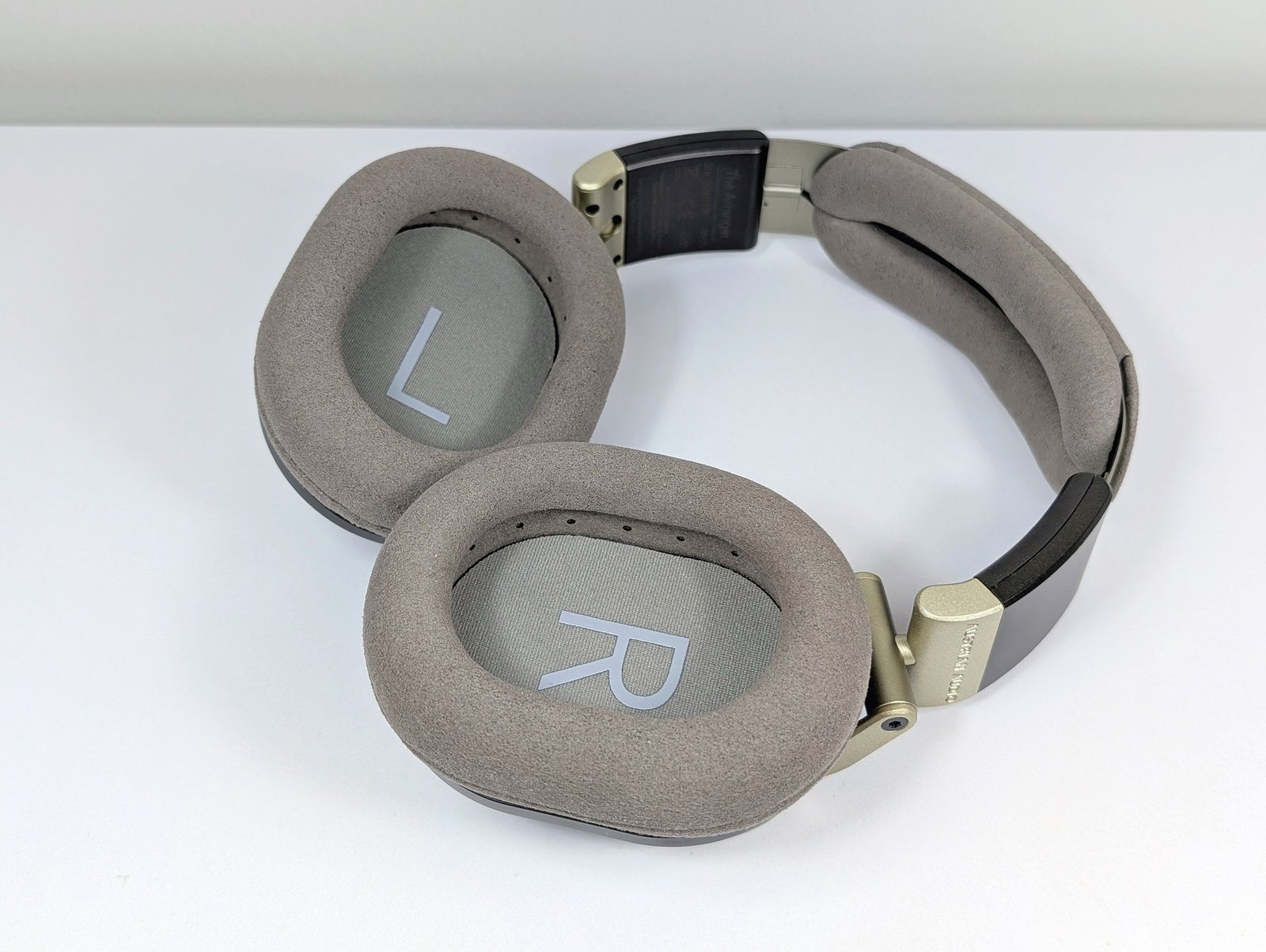
On the head, the Arranger feels somewhat similar to Sennheiser's HD 600 series due to its fairly firm clamping force, though not as conforming to the head. Austrian Audio's suede pads are also clearly of higher quality and likely more durable. No one's ears are likely to touch the edges of the pads, as the internal space is practically the most spacious on the market (80 x 60 x 27 mm). The headband pad is also ingeniously designed, as it stays attached with magnets. The ventilated center part prevents sweating, and the notch made for the crown of the head prevents extra pressure. The pads can also be changed quite easily, which is equally beneficial for professionals and ordinary consumers. In this context, it remains unclear whether the light gray pads will darken with prolonged use.
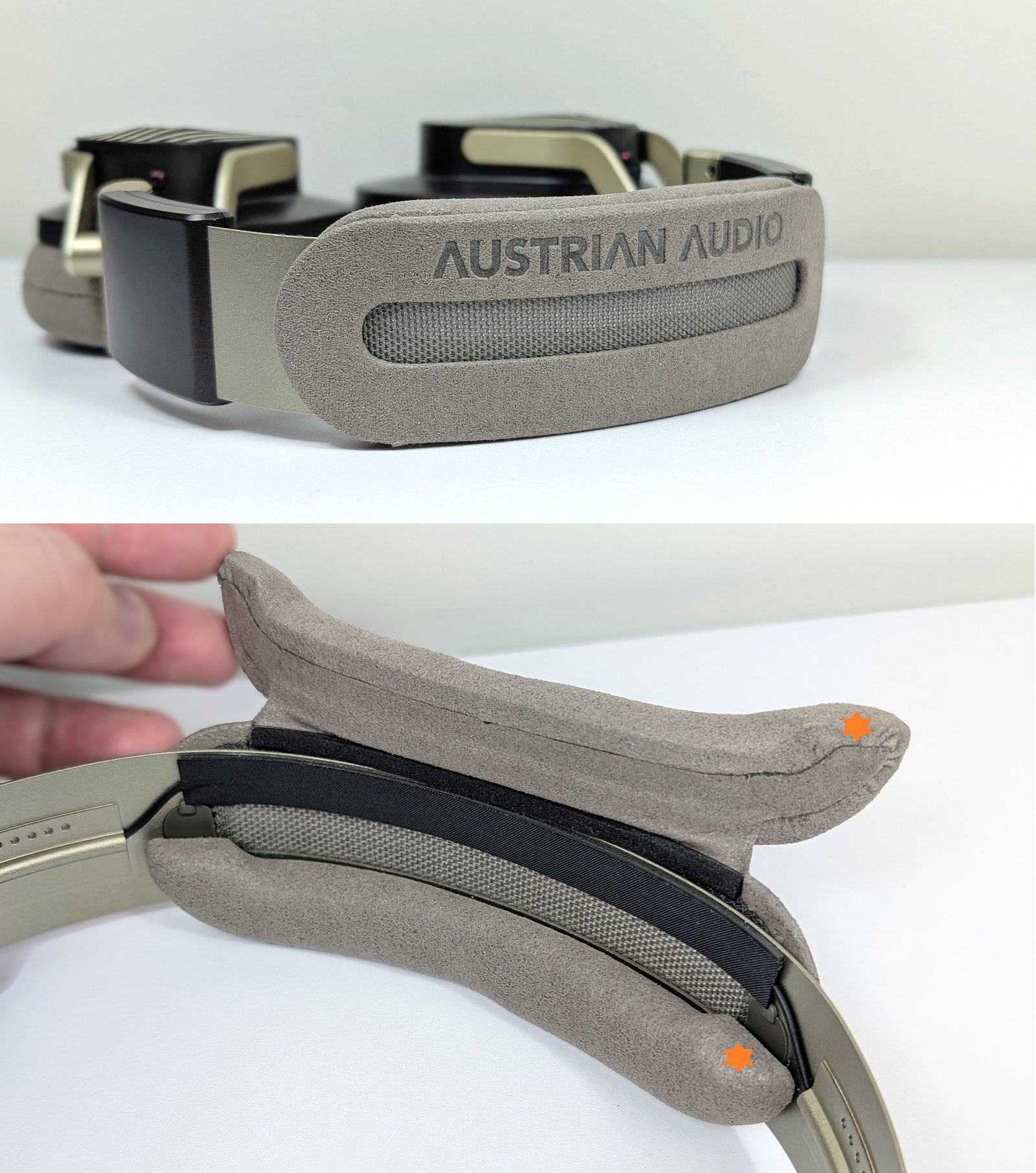
So I find the Arranger to be a comfortable headphone, as long as it warms up a bit at first. Despite minor durability-related question marks, I also find the construction quite sensible. Nothing about the headphones has particularly bothered me, and there's no need to think about them much during use. This emphasizes a certain straightforwardness. For the same money, you can get products that feel a bit more premium (e.g. Meze Audio 109 Pro), but the Arranger also manages, in my opinion, to feel interesting enough that there is no conflict between its construction and price.

Sound quality
According to Austrian Audio, the Arranger uses very similar dynamic drivers to its flagship Composer headphones, but the diaphragm diameter is slightly smaller (44 vs 49 mm). In both of these, the diaphragm material is DLC (diamond-like carbon), which is driven by ring magnets. Unfortunately, the manufacturer has not released a more detailed image of the Arranger's drivers, nor can they be seen from under the foam layer used for front damping.
Impedance measurements and amping requirements
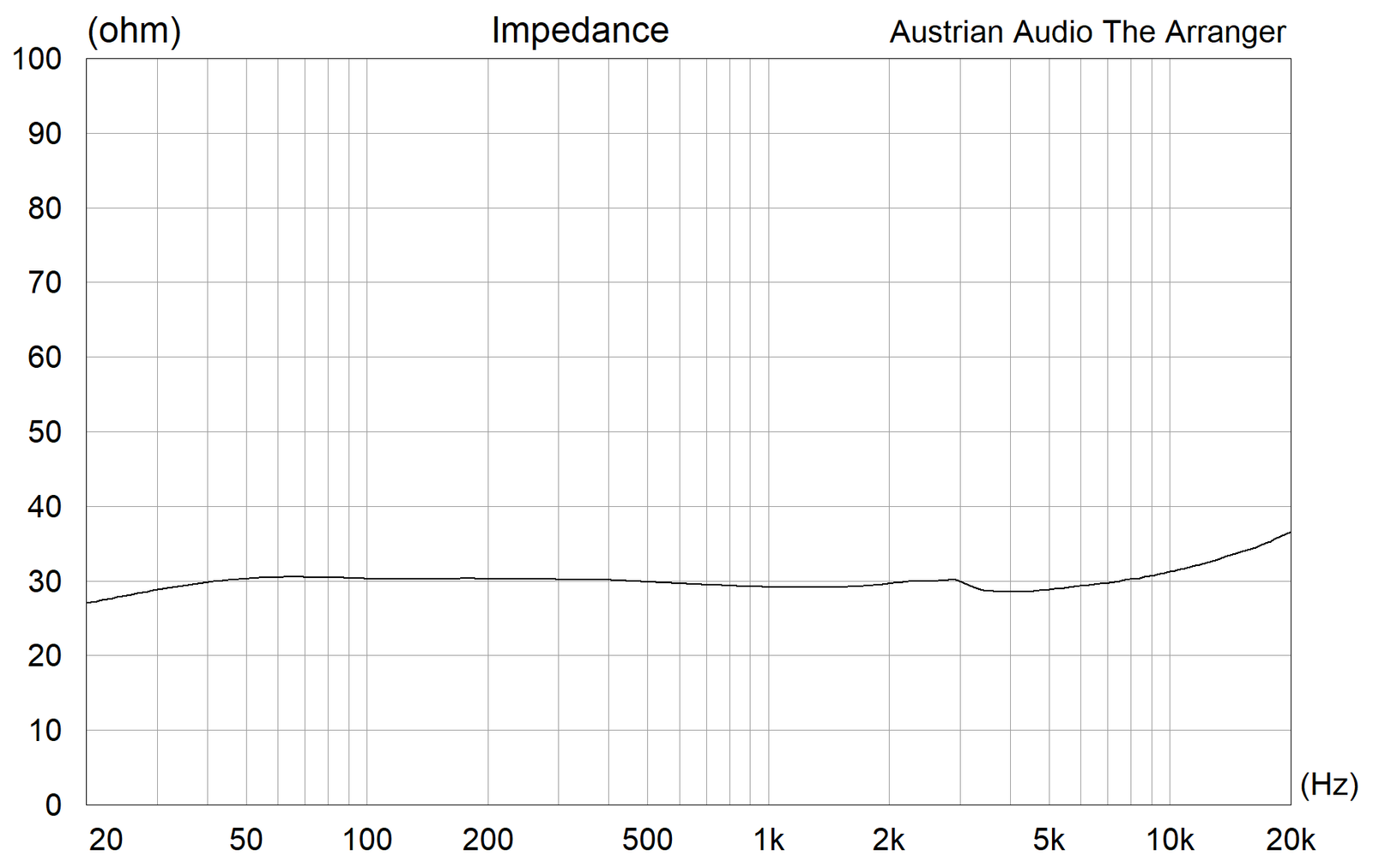
Austrian Audio states the nominal impedance of its headphones as 25 ohms, but I measured a reading of about 30 ohms. Such a small difference doesn't really matter; I would pay more attention to the flatness of the impedance curve, which is not at all common for dynamic drivers. Thanks to this, the Arranger is ”safe” to listen to even with an amplifier that has a higher output impedance, because the frequency response always remains as designed. For example, the equipment in many studios is likely still quite old, but in this case, it would not be a significant disadvantage.
The manufacturer states the sensitivity of the headphones as 94 dB/mW, which at first glance sounds even somewhat low. However, I like this, as I have found many dynamic headphones more sensitive than this to be prone to noise, especially if their impedance is low like the Arranger's. A slightly lower sensitivity therefore makes the headphones even more versatile without them still needing a powerful amplifier. For example Qudelix 5K or the Macbook Air's (M1) headphone jack would already be sufficient for my needs.
Headphone Measurements
Our frequency response measurements have been made with a clone IEC-60318-4 coupler and KB501X pinnae. The Harman target curve from 2018 is used as a reference point and generalization of the headphone response that would sound good to most people. For more information on the measurements and their accuracy, see Headphone Measurements-page. The Arranger's frequency response can also be compared with other measured headphones Squiglink .
Frequency response:
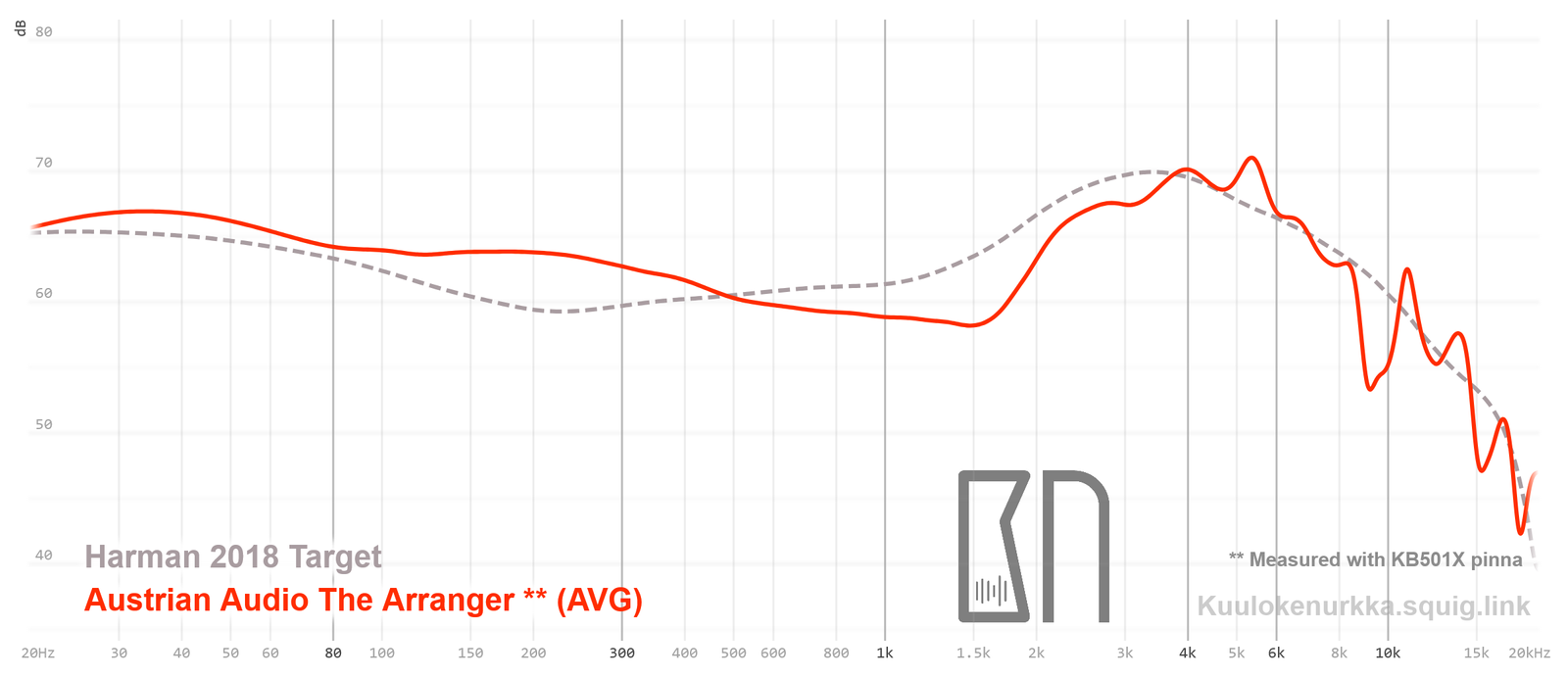
The Arranger has surprisingly powerful bass for an open-back headphone model, as based on my own measurements, the upper bass frequencies are reproduced elevated up to 400 hertz, and even the sub-bass rises slightly above the Harman curve. This amount of bass would more often be encountered in closed-back headphone models, so Austrian Audio has not arrived at this situation by accident, but entirely intentionally. The Arranger's low frequencies are reproduced robustly and richly.
The midrange, in turn, resembles in style Sennheiser HD 800:aa, because in both, the initial part of the ear-gain region (1–5 kHz) is reproduced calmly, and the energy level only begins to rise with a slight delay compared to the Harman curve. In this respect, a certain wearing position might make the Arranger slightly more energetic already at 2 kilohertz. In any case, it is a slightly V-shaped headphone, with the midrange remaining somewhat more distant in presence compared to the bass and treble.
With such a tuning, it is worth noting that the relative proportion of treble is greater than the upper midrange, meaning that the high frequencies, which measure almost Harman-style with my equipment, are actually heard slightly louder. However, no significant local boosts or dips are observable, meaning my measurement device ”hears” the high frequencies very evenly, and nothing exceptional occurs even after 10 kilohertz. Someone might perhaps notice a small bump at 5.5 kilohertz, but this feature seems to be so common that it can be partly explained by the characteristics of the equipment, rather than the headphones themselves.
The Arranger vs. The Composer:
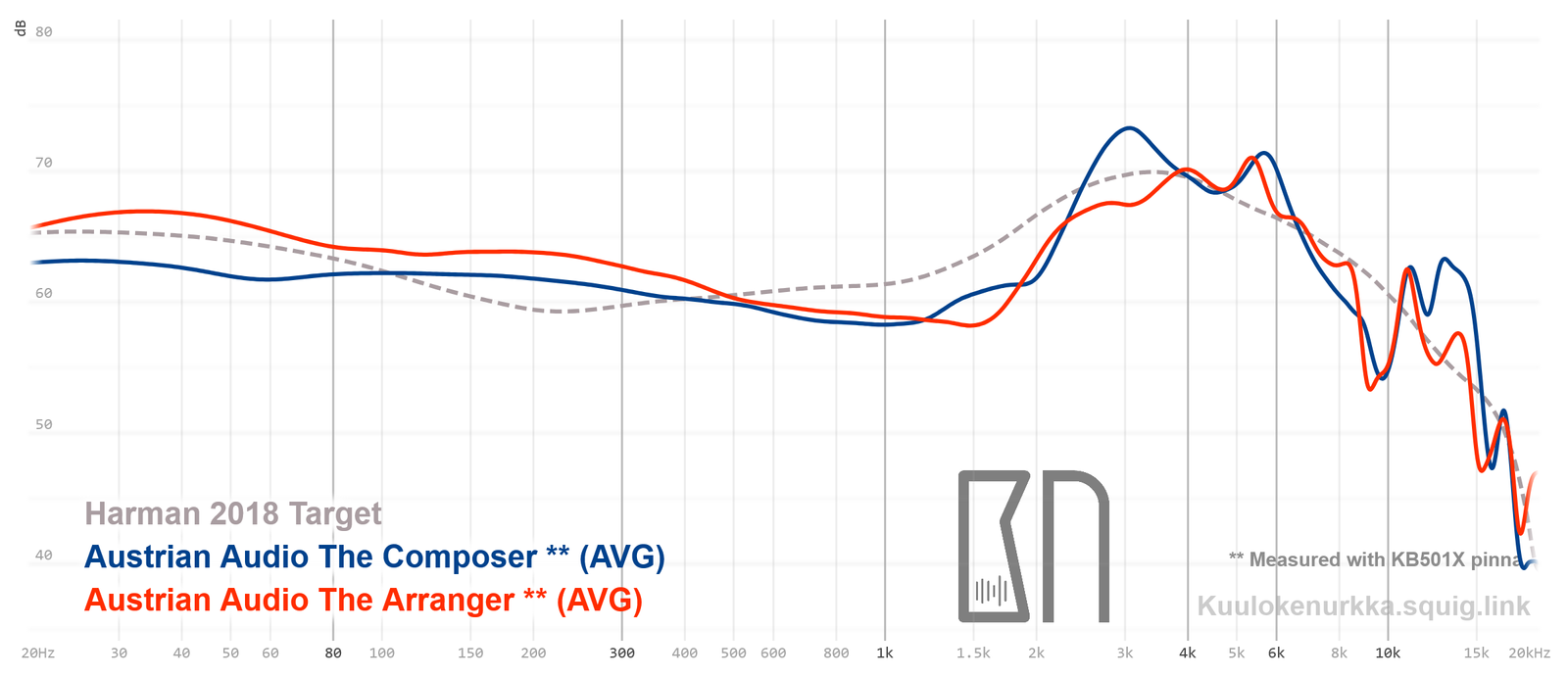
In The Arranger's frequency response, it's easy to see much in common with The Composer, but also crucial differences that change the listening experience. The biggest difference is in the lower end: The Arranger's low frequencies are reproduced more broadly and robustly compared to The Composer's more linear bass tuning. Since the peak of the ear-gain region (3 kHz) in the Arranger is also several decibels lower than in the Composer, the presentation is fuller, more relaxed, and, as it were, ”more popular.” The Composer, on the other hand, is the brighter of the two and emphasizes clarity more in its sound. In my opinion, the differences feel logical considering the price range and potential target audience of both headphones.
Sound observations
This time, I evaluated the headphones exclusively with the JDS Labs Element 4 amplifier and its integrated D/A converter. The device is practically completely colorless, so it can provide an indication of how the Arranger would sound when connected to other neutral listening chains.
In my opinion, The Arranger exceptionally effectively combines two different worlds. From the very first moments, it offers easily digestible and entertaining reproduction, thanks to its V-shaped sound profile. The deliberately recessed midrange brings the robust bass and clear treble to the forefront. Thus, it is a very consumer-friendly headphone that adapts music into a ”more fun” version of itself, as it were. In doing so, however, the Arranger does not forget the more critical audience either; it makes me focus on the precise separation of sounds and its soundstage, which feels wide and layered. The most surprising thing about these headphones is precisely how invitingly they manage to combine all these features. The presentation is easy to like, whether casually jamming or spotting the subtle nuances in recordings.
Low frequencies in the Arranger are warm in tone and, considering the dynamic drivers housed in open cups, exceptionally extended – a familiar trait from Composer headphones. The bass feels large and is capable of providing deep rumble without the upper bass emphasis visible in measurements becoming disturbingly overpowering for the midrange. During the test period, this only really happened when listening to live recordings that already had an overly thick bass relative to the audibility of vocal performances. Generally, however, the Arranger's bass stays well in its own layer and maintains its traceability despite its fullness.
I am increasingly listening to heavy music, to which the Arranger brings fun punch and power somewhat similarly to ZMF Atticus. On the other hand, my experience is still more balanced than my measurements, because the open design likely dissipates some of the pressure, and the fit on my head may not be quite as tight as on the measurement device. Therefore, I recommend trying the Arranger with an open mind, even if the measurements don't necessarily flatter it. After listening to the headphones before measuring them, I wouldn't have guessed the bass to be as ”emphasized,” as many closed-back models create even more sound pressure.
Midrange is the Arranger's calmest and at the same time most colored area. It reproduces its upper parts somewhat softened and remains somewhat distant in its presentation. Despite this, I would not call the sound veiled, because, for example, the vocalist is naturally positioned slightly further back in the soundstage while still maintaining good clarity. What is missing, then, is only the feeling of direct energy and Sennheiser HD 600 -series-style presence. This could easily be EQ'd into the Arranger by adding a few decibels of energy at 1500 hertz with a Q-value of 1. If the upper bass is further lightened at around 220 hertz with the same Q-value, the headphones become excellently neutral.
I also tried equalization myself, but ultimately didn't see a particular need for it. This time, I found myself preferring the Arranger's spacious midrange reproduction, to which a little warmth has been added. Nor did I find the instruments too softened; instead, detail and relaxation met in a pleasant way. Perhaps Austrian Audio has aimed for a spacious reproduction that is easy to listen to.
Balanced treble I have experienced as one of Arranger's strengths. With the midrange remaining slightly in the background, the treble actually comes out more than it normally would. Its style is fresh and sometimes even a little analytical, but it never succumbs to sibilance or excessive attention-seeking with its sharpness. Cymbals and other high sounds play loosely, but smoothly.
Generally speaking, people perceive treble very differently, so I can only speak for myself when stating that Arranger is of higher quality than most of its competitors in this frequency range. During the test period, I did not perceive anything disturbing in the headphones” upper frequencies; instead, they managed to pique my interest with their refined detail. There were also no similar sharp ”peaks' in the highest frequencies as in many planar headphones I have tried before or Meze Audio 109 Pro:s, which I would see as one of Arranger's competitors. Arranger feels like a more finely tuned product thanks to this.
The biggest surprise for me was ultimately Arranger's magnificent soundstage, where the center point is extremely easy to follow as if into depth, while sounds mixed to the left and right extend impressively far beyond my head. The positions of sounds also stand out astonishingly accurately, for example, during sweeps from side to side, and different instruments layer spaciously apart from each other. Perhaps due to the large earpads, the reproduction also feels grand in height. I had to check a few times that I hadn't accidentally turned on some kind of spatial audio from my sound sources – I hadn't.
The end result always depends on the audio recording listened to, but if everything is in order in that regard, my brain really likes the Arranger. I did not expect such an impressive soundstage, whose breadth at its best has something similar to Sennheiser HD 800:s, and which in its accuracy competes quite evenly with highly resolving planar headphones. At the same time, we are also talking about an entertaining bass-driven and effortless headphone for an enjoyer, where, if desired, the observation of details could also be completely omitted.
In this context, I would, of course, remind that the soundstage in headphone listening is largely an illusion created by the brain, which varies between people. For me, the Arranger makes an impression, while others might experience the same characteristics in headphones that sound ordinary to me. It would also be completely normal not to notice anything special in any headphone model, so my praise for Arranger's soundstage is ultimately very personal. For some reason, it also sounds almost addictively good, which has made me question my perceptions a bit. Based on measurement data, the result should be more colored, but I would still want to listen to these headphones for hours on end precisely because of how credibly and relatable they present the sound.
Comparison: The Arranger vs. HEDDphone D1
Prices: 1000 vs. 700 €
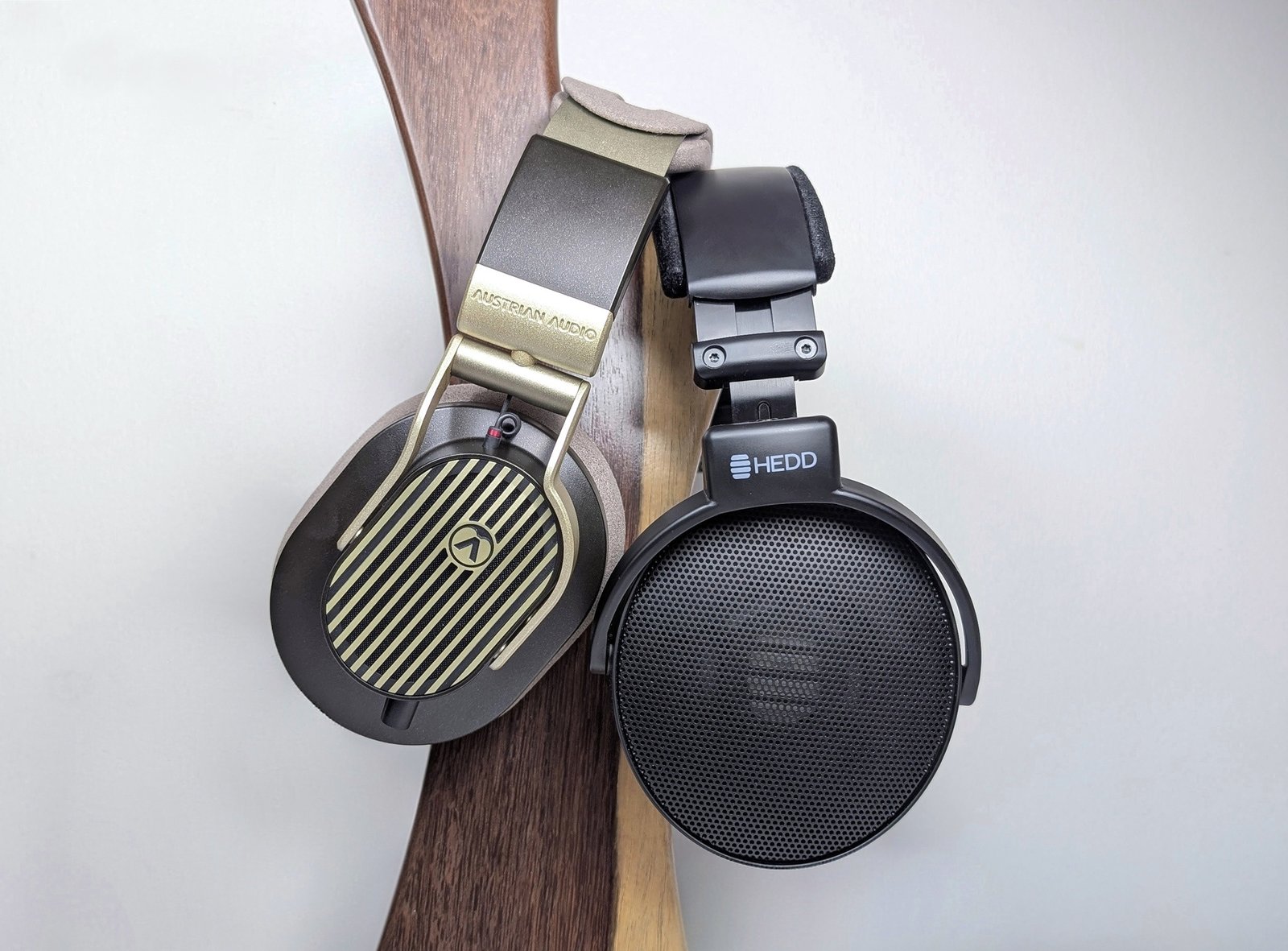
Let's start the pair comparisons with the HEDDphone D1 (price 700 €) that made it into the article, which I would describe as a modernized Sennheiser HD 600 in terms of both build and sound. The most interesting feature of the D1 are the drivers made from a completely new type of thin-ply carbon fiber, which HEDD Audio designed together with Swedish Composite Sound.
The HEDDphone D1 feels slightly more durable in its mechanical design than the Arranger, as its mechanisms resemble the equally robust Sennheiser HD 600 series. The D1, however, weighs a bit more than the Arranger, even though a larger part of its structure is plastic. This does not affect comfort, but the most significant difference is the headband padding. The Arranger feels quite unnoticeable on my head, whereas the HEDDphone D1's padding is, for some reason, really hard. The large notch on the top of the head effectively prevents the worst pressure sensation, but for longer use, I would still wish the padding would compress at least a little. Additionally, the D1's ear pads are a bit tight for me, even though I find the soft foam material slightly more comfortable than the Arranger's. Overall, in terms of comfort, I prefer the HEDDphone D1 during the first half hour, while after that, I pay less attention to the Arranger.
HEDD Audio deserves praise for the fact that the cable attachment to the headphones is handled with standard and proven 3.5-millimeter connectors, and not with a locking special connector like the Arranger's. Using the D1 is easier, and its 2-meter cable also feels more practical than the Arranger's 3-meter counterpart. Furthermore, regarding accessories, it's worth mentioning that the buyer of the HEDDphone D1 receives a handy carrying case.
Since the impedance of both headphones is very similar at 30–40 ohms, the only difference in amplification is the HEDDphone D1's higher sensitivity (100 vs. 94 dB/mW). Thus, it plays slightly louder with the same amplification power. Critically evaluated, however, Arranger's lower sensitivity could be an advantage with older devices, as their potential background noise should remain less noticeable than with the D1.
Frequency responses:
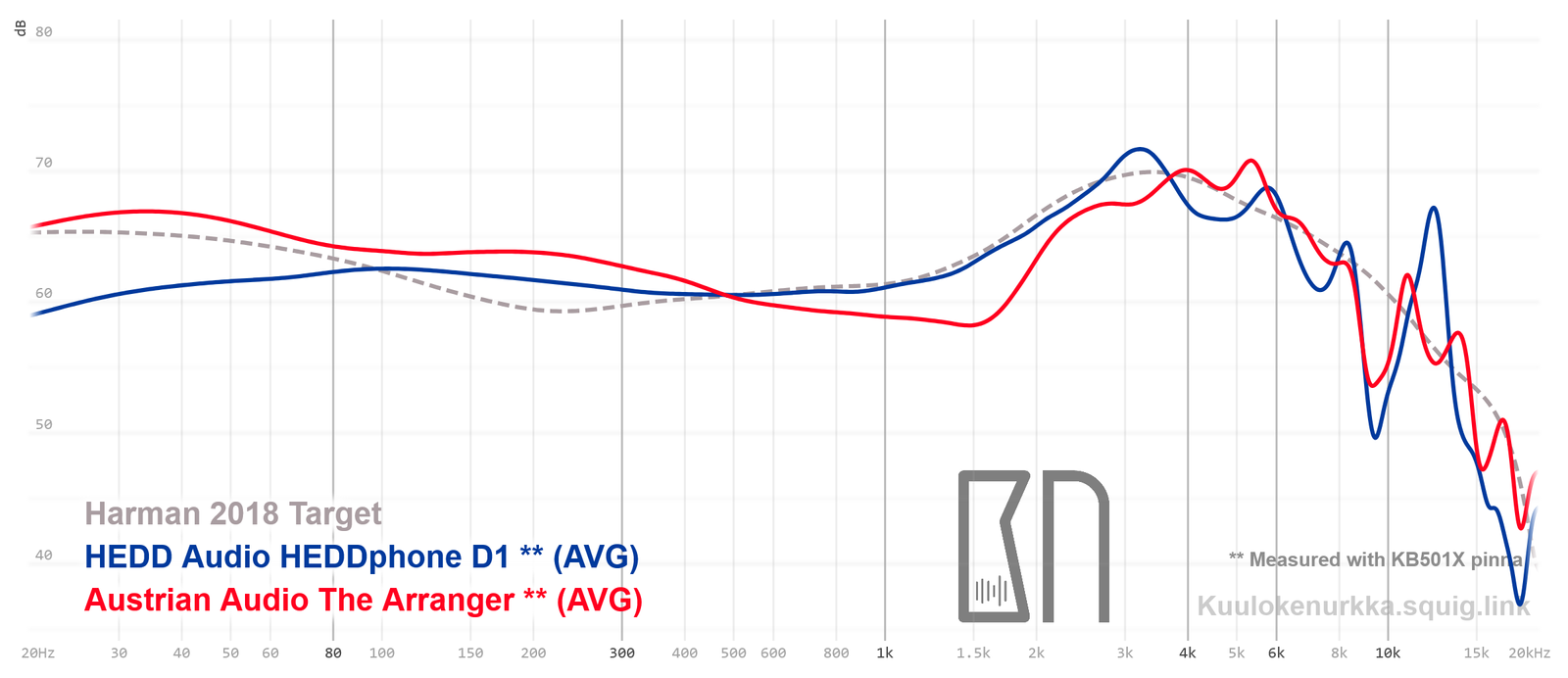
The Arranger and HEDDphone D1 represent two different approaches to sound reproduction, even though professional use is mentioned in the marketing material for both. The D1 is significantly more neutral and linear in its sound, offering a very truthful listening experience, where the upper midrange, in particular, is reproduced more present than with the Arranger. On the other hand, while the D1”s sound largely seems to reproduce inside my head, the Arranger offers a wider soundstage and a more spacious-feeling separation. Such a ”less headphone-like" spatial impression is, in my opinion, an advantage for those looking for new and interesting dimensions in music instead of traditional monitoring. Could this be of some benefit in a studio environment?
In terms of timbre, the HEDDphone D1 is in any case almost unbeatable in its correctness, and it maintains its clarity throughout the frequency range. The Arranger sacrifices some of the naturalness of reproduction to offer more entertainment in the bass frequencies. The HEDDphone D1 is by no means tame in its bass for an open-back headphone model, especially compared to the Sennheiser HD 600 series, but it offers no competition in entertainment value to the robustly kicking Arranger. It is truly amazing how Austrian Audio has achieved such a powerful and extended bass structure without further closing the design. I find the treble in the D1 slightly livelier, but sometimes also a tad sharp compared to the Arranger's effortless presentation.
Ultimately, the choice between the two, in my opinion, boils down to whether the listener values the truthfulness of reproduction or greater experiences. The colorations of a headphone like the Arranger become most apparent precisely alongside a neutral reference like the D1, but the robust bass and wider soundstage likely make it a more preferred choice for the majority of people. By my own standards, both are excellent headphones that I could include in my collection simultaneously.
Comparison: The Arranger vs. Focal Hadenys
Prices: 1000 € vs. 700 €
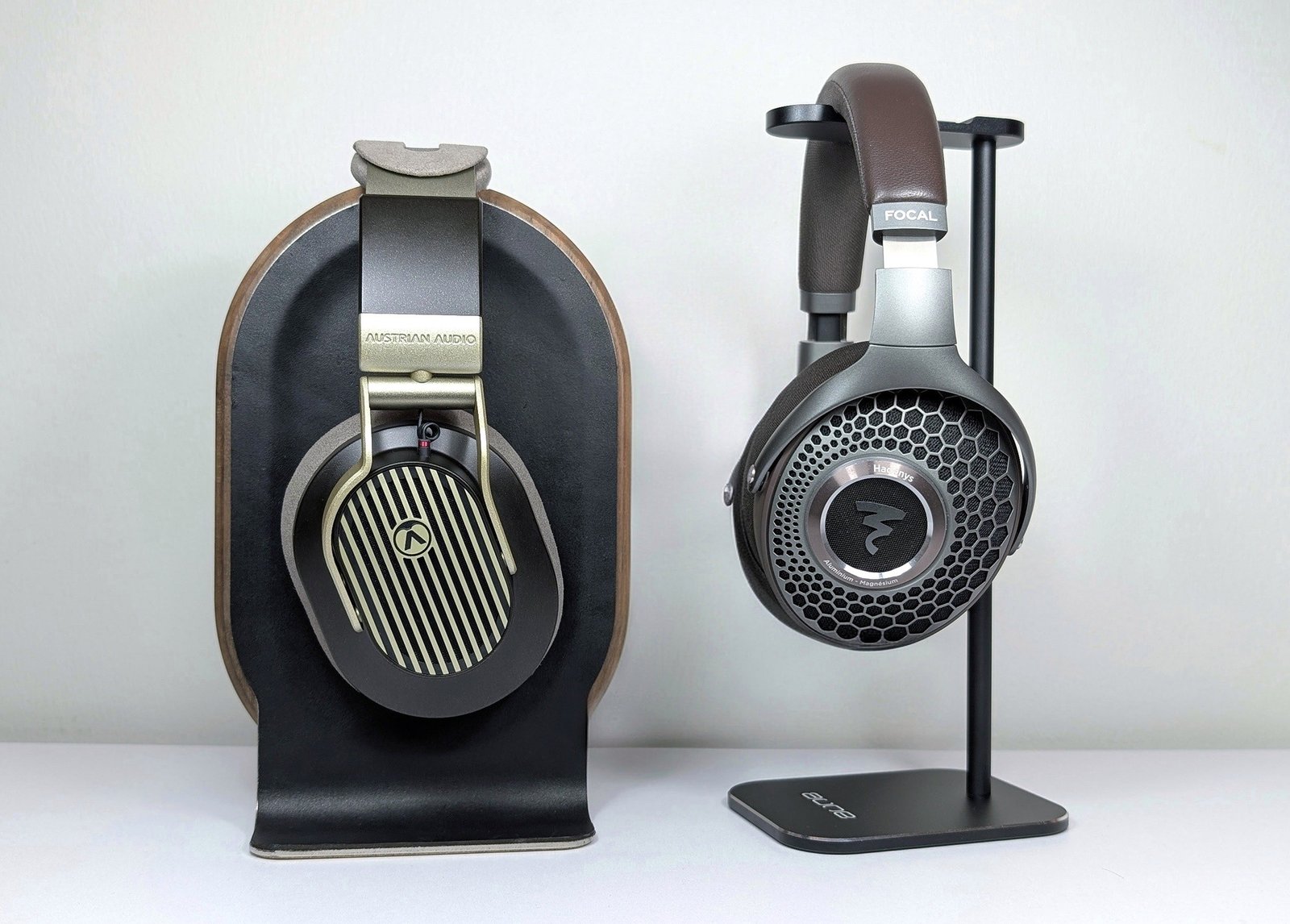
As a second reference, like the HEDDphone D1, the 700 euro costing Focal Hadenys, which I have found easy to recommend as a good all-around headphone. If it can still be bought on sale for around 500 euros, Austrian Audio's headphones already feel quite clearly like a more expensive purchase. The Arranger buyer also does not get a carrying case like with the Hadenys.
In terms of design, the Hadenys is simpler, with fewer moving parts and the headband being entirely magnesium without plastic additions like the Arranger. For home use, the Focal model might be slightly more practical. The cable also attaches with a standard 3.5 mm connector, so sound can be output with any AUX cable, unlike the Arranger. On the other hand, Austrian Audio's headphones could be listened to balanced, which is not possible with the Hadenys.
Both headphones weigh approximately the same, but they feel quite different on the head. The Arranger, due to its adjustments, would fit a larger head, and ears fit more spaciously inside its pads. The Hadenys, on the other hand, clamps the head more gently, and its pad parts feel softer. I myself am more satisfied with both than average, but depending on preferences and user anatomy, one or the other may also feel distinctly more comfortable.
If the headphones are intended to be listened to with a low-power mobile device, the Hadenys would be better suited for the purpose due to its higher sensitivity (105 vs 94 dB/mW). The impedance in both headphones is around 30 ohms, so there are no known differences in that regard.
Frequency responses:
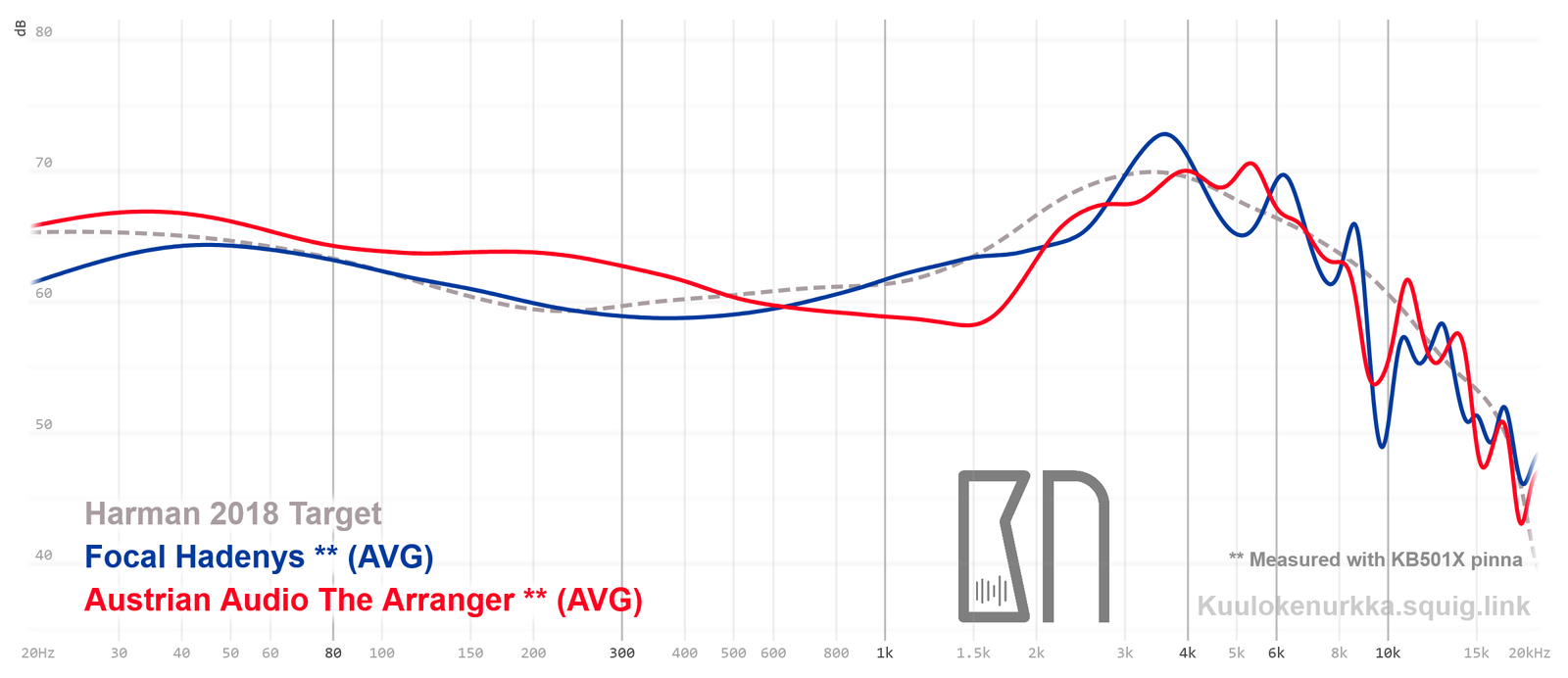
Since the Hadenys is like the HEDDphone D1 with a more robust sub-bass and slightly coarser high frequencies, it also differs considerably from Austrian Audio's headphones. The Arranger does not reproduce the upper midrange as present as the Hadenys, but it creates a clearly larger and more layered spatial impression. Focal's headphones undeniably reproduce sound more balanced and correctly, while the Arranger calms the upper-mid frequencies to more strongly highlight things and details happening around the vocalist in the soundstage.
Regarding low frequencies, the Hadenys is cleaner in sound, as it keeps the bass and midrange more clearly separate from each other, emphasizing the sub-bass according to the Harman curve. The Arranger's bass rises already in the lower-mid frequencies, making the presentation more robust. The Hadenys' slightly thin lower-mid frequencies further emphasize the Arranger's fuller approach. On the other hand, regarding the treble, the Arranger sounds slightly fresher and clearer, with the Hadenys remaining quite dark in its highest frequencies. Points for smoothness also go towards Austrian Audio, as a few irregularities visible in the frequency response make the Focal model sound a tad rough.
Ultimately, the Arranger feels like the more interesting headphone of the two to me, although the Hadenys still defends its place as a more versatile choice. Focal's headphones perform more consistently, especially in situations where energy is desired in the upper midrange. In such cases, the Arranger's colorations may occasionally disturb the listening experience. Generally speaking, however, with Austrian Audio's headphones, significant compromises do not need to be made; instead, they succeed in offering a stronger bass and a more impressive soundstage than the Hadenys in the same package. Having experienced this, Focal's headphones no longer interest me as much as before.
Comparison: The Arranger vs. ZMF Bokeh Open
Price: 1000 € vs. 1100–1200 €
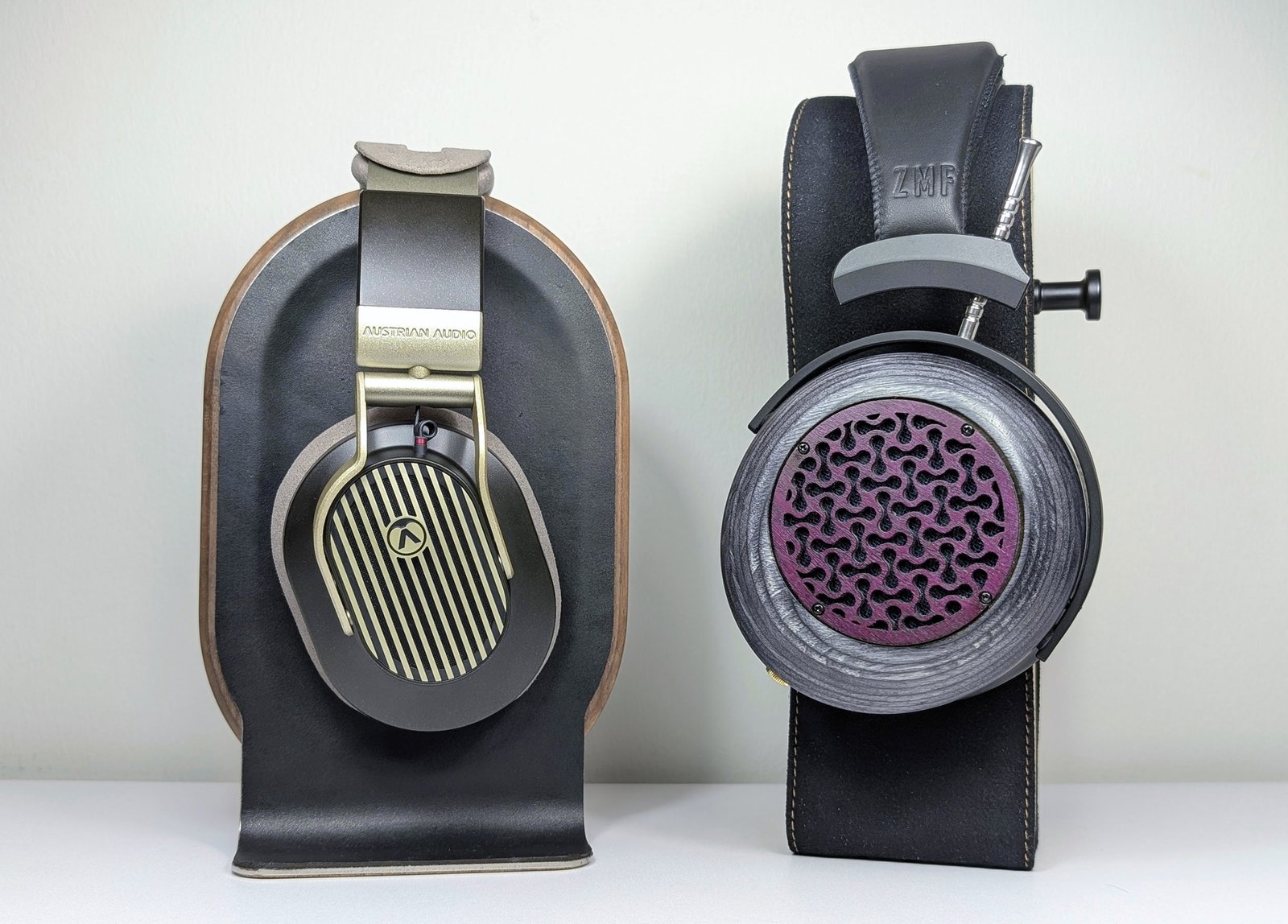
The third comparison is from my headphone shelf, ZMF Bokeh Open, which costs at its cheapest about 100 euros more than the Arranger. Of course, various customizations, such as cups made from more exotic wood or additional padding, could still add a few hundred more, so the price level of the ZMF model is fluid. The same can be said about its sound quality, as everyone can modify it to their own preferences if they wish. I myself have changed the partially open front damping meshes to a fully closed version, which smooths out the headphones' treble.
With its larger size, wooden parts, and thicker metal headband, the Bokeh Open weighs about 200 grams more, but those who appreciate wood craftsmanship also get an interesting decorative item. The Arranger, on the other hand, is a more conventional and slightly more practical headphone. In the long run, its use is less noticeable than the Bokeh Open due to its lightness, although I don't find the latter uncomfortable in any way.
The ZMF model comes with a case and a higher quality cable, so Austrian Audio falls short in terms of accessories. What I disapprove of most is its locking connector body compared to how easy it is to swap out another cable with two 3.5mm connectors for the Bokeh.
Neither headphone requires a ”miraculous” amplifier, although their different impedances shine in slightly different situations. The Arranger is not as sensitive on paper as the Bokeh Open (94 vs. 103 dB/mw), but its lower impedance makes it play louder, for example, with mobile devices optimized for a 16–32 ohm load. The ZMF model's 80 ohm impedance, on the other hand, would be better suited for tube amplifiers than the Arranger, but generally with transistor amplifiers, the potentiometer needs to be turned up a bit more.
Frequency responses:
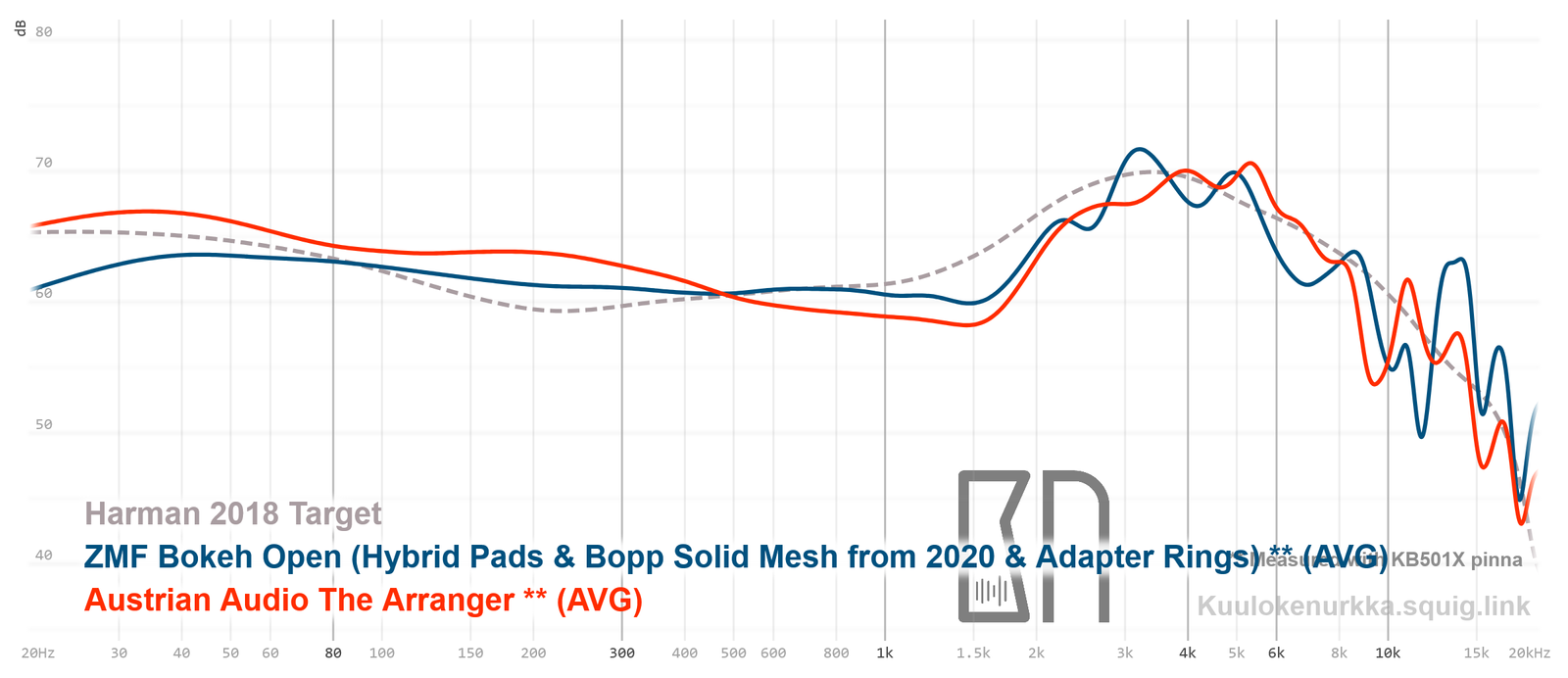
Compared to previous comparison situations, the Bokeh Open differs slightly less from the Arranger – at least with my own settings. The ZMF model doesn't bring the midrange quite as forward as the HEDDphone D1 or Focal Hadenys, and the bass, like the Arranger, sounds fuller than these two. Thus, the Bokeh Open could appeal to those interested in the Arranger if the listening experience were desired to be just a notch more neutral. On the other hand, by default, the ZMF model's treble is more uneven and even quite splashy, and these characteristics do not completely disappear even with my own fine-tuning.
I thus find the Arranger's high frequencies smoother and more relaxed, while the Bokeh Open adds liveliness and sparkle to the reproduction at the expense of naturalness. Depending on the material listened to, I alternately observe good qualities in both. The midrange, on the other hand, is reproduced quite optimally to my taste in the ZMF headphones when I want it to be easily relatable and present, but without excessive analyticalness.
The Arranger places the vocalist and most instruments a little further back in the soundstage, thus enhancing the sense of space. This makes the soundstage feel larger and more layered, as individual sounds move more freely in space and draw more attention with their placement. The Bokeh Open may technically be more precise, but I would still call its soundstage rather ordinary compared to the Arranger. In the bass department, both have their strengths: the Bokeh's bass feels tighter and more explosive, while the Arranger relies on a fuller and slightly softer presentation, which most would probably find more entertaining.
Ultimately, the superiority between the two largely depends on how the Bokeh Open's sound is adjusted with different customization options, and whether one is willing to pay more for it. In the default state, the Arranger is, in my opinion, a more successful overall package, but with my own settings, the ZMF model can sound slightly more balanced if neutral sound is used as the benchmark. If, on the other hand, absolute midrange neutrality is desired to be exchanged for a more robust bass and a larger-feeling soundstage, the Arranger is an excellent remedy for that.
Summary
I ultimately perceive the Arranger as a headphone that many would easily like. Usually, such an entertaining bass tuning does not simultaneously sound as separated and large in its soundstage. These features also do not typically occur together, especially in an open-back headphone. I cannot help but be excited about the result, and even the slightly recessed midrange does not bother me in this overall package. The Arranger feels like a successful continuation to the Composer, being both easier to approach in terms of sound and price – like a fun headphone with a professional touch. Moving upwards from the thousand-euro price range, which acts as a kind of watershed, consumer buying enthusiasm quickly begins to decline, but many, in my view, can still manage this.
Structurally, Austrian Audio's headphones leave small question marks regarding their durability due to a few critical plastic parts, but my concerns may prove to be entirely unfounded. The manufacturer also promises that the Arranger is fully repairable, and with replaceable pads, it can be kept clean for years to come. Thanks to the spacious ear pads and light weight, I also consider the wearing comfort to be very good, as long as the headphones warm up a bit at the beginning.
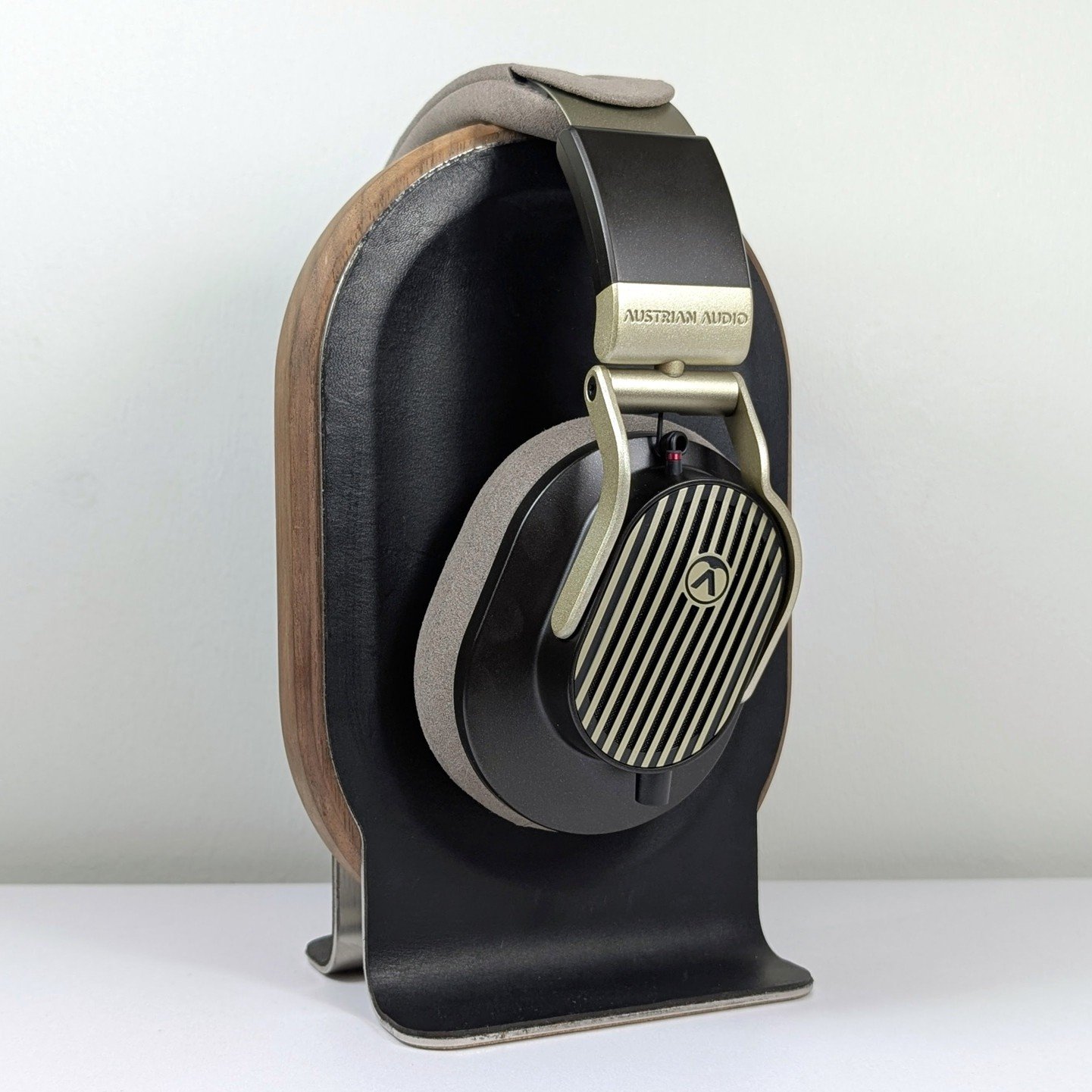
Since I couldn't find a music genre during the test period where the Arranger wouldn't sound at least interesting, the headphones ultimately became part of my collection. For a moment, I thought I had become a strict headphone critic, but such an objectively less perfect product managed to win me over. Therefore, I recommend others to try out what the Arranger sounds like when the opportunity arises. Naturally, it also makes it to the Headphone Corner's wall of fame and receives special mentions for both its addictive sound quality and its wearing comfort thanks to the large ear pads and light weight.
Pros and cons:
+ Successfully combines ”commercial” tuning with studio-like detail
+ Wide-feeling and precise soundstage (if the perception is the same as mine)
+ Really punchy bass for an open-back headphone model
+ Distinctive appearance
+ Lightweight
+ Spacious ear pads
+ Repairability of the structure
+ Doesn't require a powerful amplifier, but isn't too sensitive either
+ Moderately priced accessories
+/- The internal wiring of the headphones is balanced, but the unusual connector choice complicates cable shopping
– Not suitable for those who dislike strong bass or a slightly recessed midrange
– The durability of the headband's plastic parts raises slight doubts
– The ear pads feel quite hard before they warm up
– Sparse accessories
 EN
EN  FI
FI
With the D1 150 Ohm impedance adapter and Xbass+ on from the Zen Can 3 amplifier, it's truly such honey that a tear comes to the eye.
I recommend trying it if you get the chance.