Author: Sword of Damocles
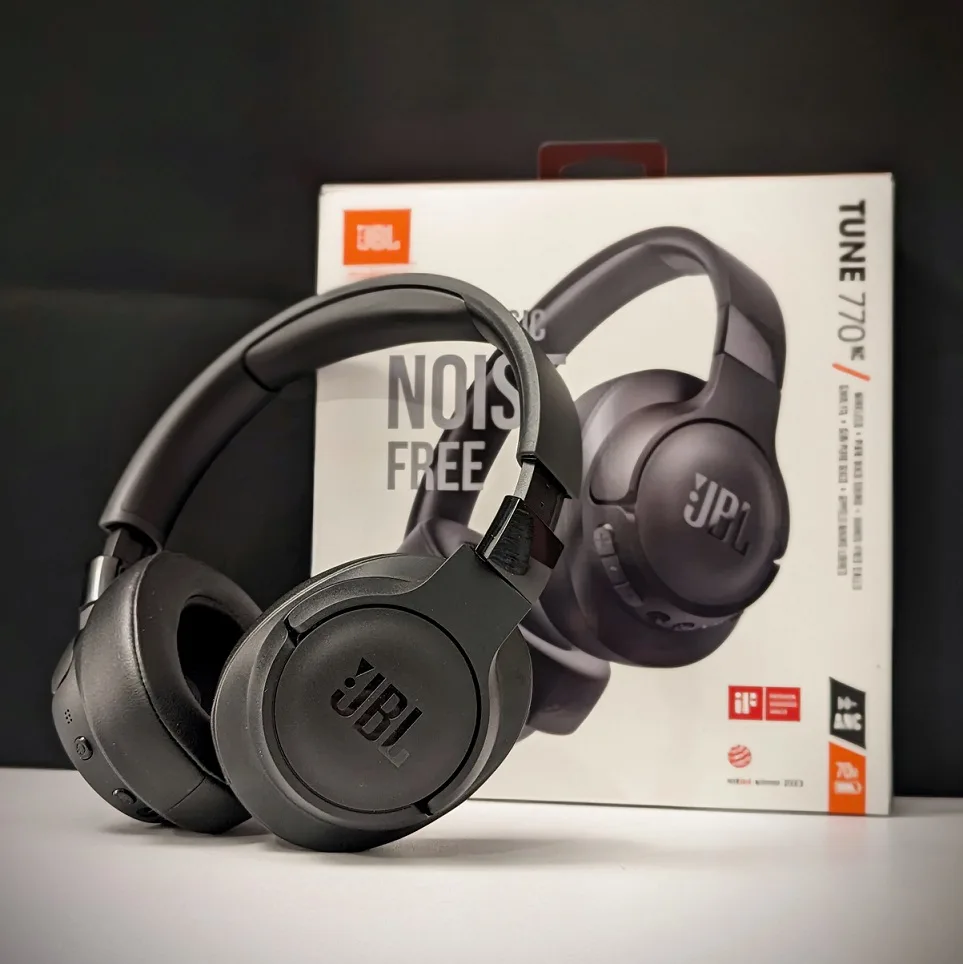
Table of Contents:
Information:
- Release year: 2023
- Country of Origin: China
- Colour options: Black, purple, blue, white
- Price: 129 € (actual market price 70–80 €)
- Type: Closed, over-ear
- Dynamic 40 millimeter drivers
- Audio connections: Bluetooth 5.3 and 2.5 mm
- Bluetooth codecs: AAC and SBC
- Impedance: 32 ohm
- Sensitivity: 100 dB/mW
- Battery life: noise cancelling on 44h and noise cancelling off 70h
- Charging port: USB-C
- Charging time: 2 h (5 min fast charging provides 3h additional usage time)
- Noise cancelling function/ambient aware mode/TalkThru
- Features: Google fast pair, Voice Assistant, Multipoint and phone app with equalizer
- Weight: 232 g
- Accessories: USB charging cable (length 25 cm) and headphone cable (2.5 mm — 3.5 mm)
Review unit acquisition method: Self-”purchased” product
Background on JBL
JBL, named after its founder, James Bullough Lansing (link to the company's online store) may be a familiar brand and speaker manufacturer to many. I personally know the company best for its Bluetooth headphones and speakers, which are seen very often when moving around in public places. I would estimate that in my hometown of Joensuu, almost every second person I encounter with headphones on has JBLs, and likewise, most people blasting annoying rap music in the city have the manufacturer's Bluetooth speaker. JBL has clearly invested in youth, as its products are popular among this target group.
The main reasons for the popularity of the manufacturer's products are likely their excellent availability and affordable price level. For example, the manufacturer's cheapest over-ear headphones, priced at 30–50 euros, are widely sold in all kinds of stores, so they could mockingly be called ”supermarket headphones.” Even if a sales package with the text "Pure bass sound" never makes its way into your shopping cart with groceries, JBL headphones can also sometimes be obtained completely free, for example, with a phone subscription. This is exactly how I acquired my own Tune 770NC noise-cancelling headphones, about which I am writing this time. Since I have noticed myself having a somewhat reluctant attitude towards the manufacturer's products, I feel it is my duty to finally find out more about them.
The 770NC, released in late 2023, was given a recommended price of 130 euros, but the actual market price, like previous models, immediately dropped to between 70-80 euros. During the last Black Friday, the headphones cost as little as 50 euros, and Telia also distributed them for free with their phone subscriptions. If someone is looking for affordable noise-cancelling headphones, the Tune 770NC would indeed be an inexpensive and easily obtainable option. The manufacturer also sells a very similar Tune 760NC model for 10 euros less. It appears to lack transparency mode, and the battery life is also slightly weaker compared to the Tune 770NC. JBL's product range also includes very similar Live series headphones with a more refined appearance.
It's good to know about JBL that it has been owned for several decades by Harman International (originally Harman/Kardon), the same company behind the Harman target curve related to headphone frequency response measurements. What makes the ownership structure even more interesting is that Harman International is now owned by Samsung. The same entity includes several other companies, such as AKG and Mark Levinson.
The company's operating model includes Harman International taking care of tuning headphones using the Harman target curve as a basis. However, because different brands are targeted at different groups of people and for specific uses, there are some differences between the headphones. For example, JBL is a kind of youth brand, so its headphones have more bass than usual. Young people are assumed to like emphasized bass, and on the other hand, this kind of tuning is also beneficial in noisy environments, such as when moving on the street. As an interesting observation, Harman thus does not strictly adhere to its own research and the frequency response it considers optimal, but deviates from them deliberately.
Product packaging
The Tune 770NC is delivered in a clear-looking and even quite attractive product package. The buyer can clearly see what they are buying. As an enticement, the package also mentions that the headphones received a Red Dot Design Award, which may seem surprising, as every solution in a JBL product exudes affordability. However, the company behind Red Dot earns money from its competition, so it benefits from distributing the award to as many products as possible, as long as manufacturers remember to register for the competition. Participation is paid, and mentioning the victory with its logo is only allowed by paying an additional sum of several thousand euros to the competition organizer – you surely understand the pattern. Nevertheless, the Red Dot award is for some reason highly valued, so it is useful in product marketing. That is why JBL has also likely acquired the award to give consumers additional assurance that its Tune 770NC is a good purchase.
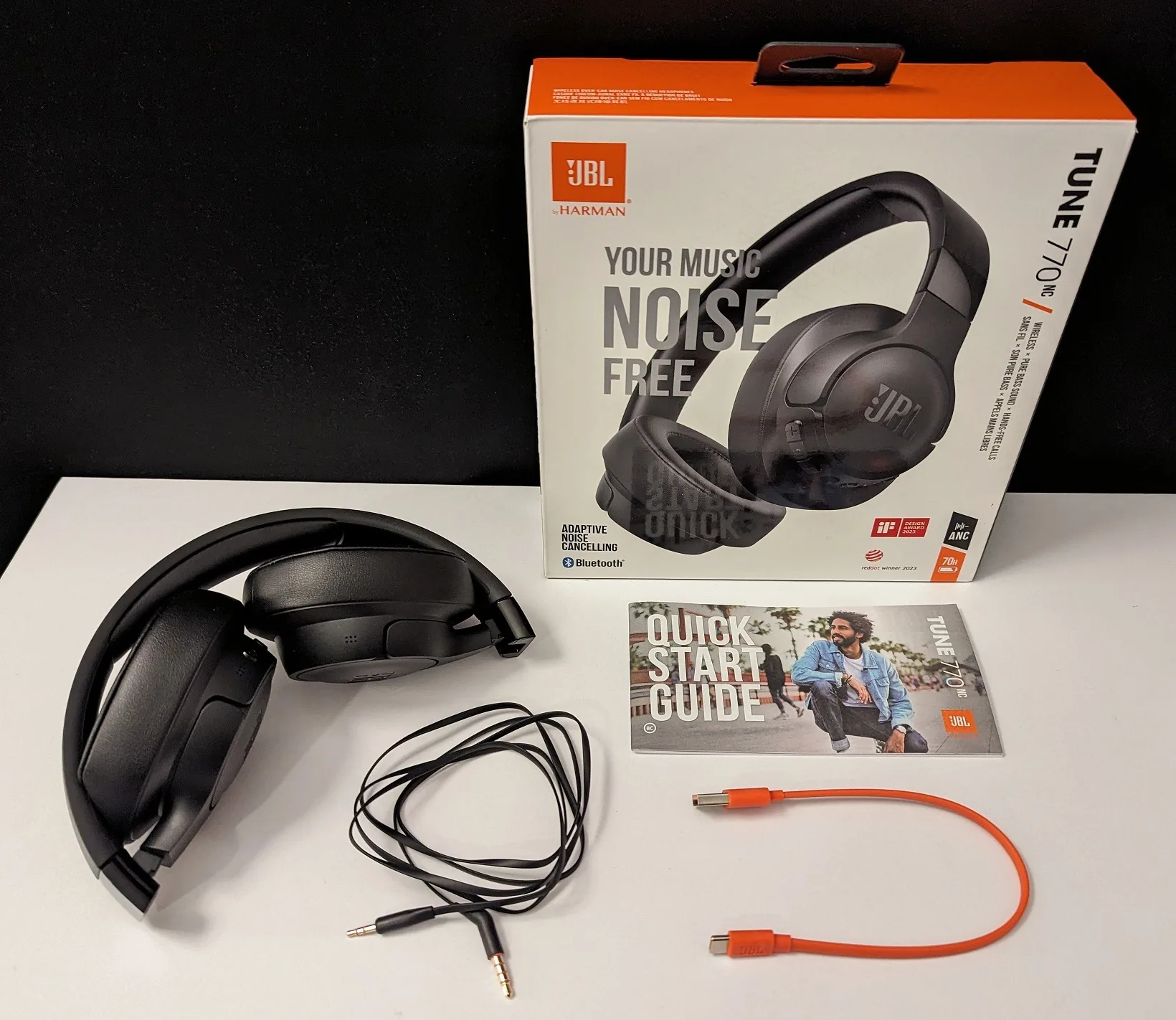
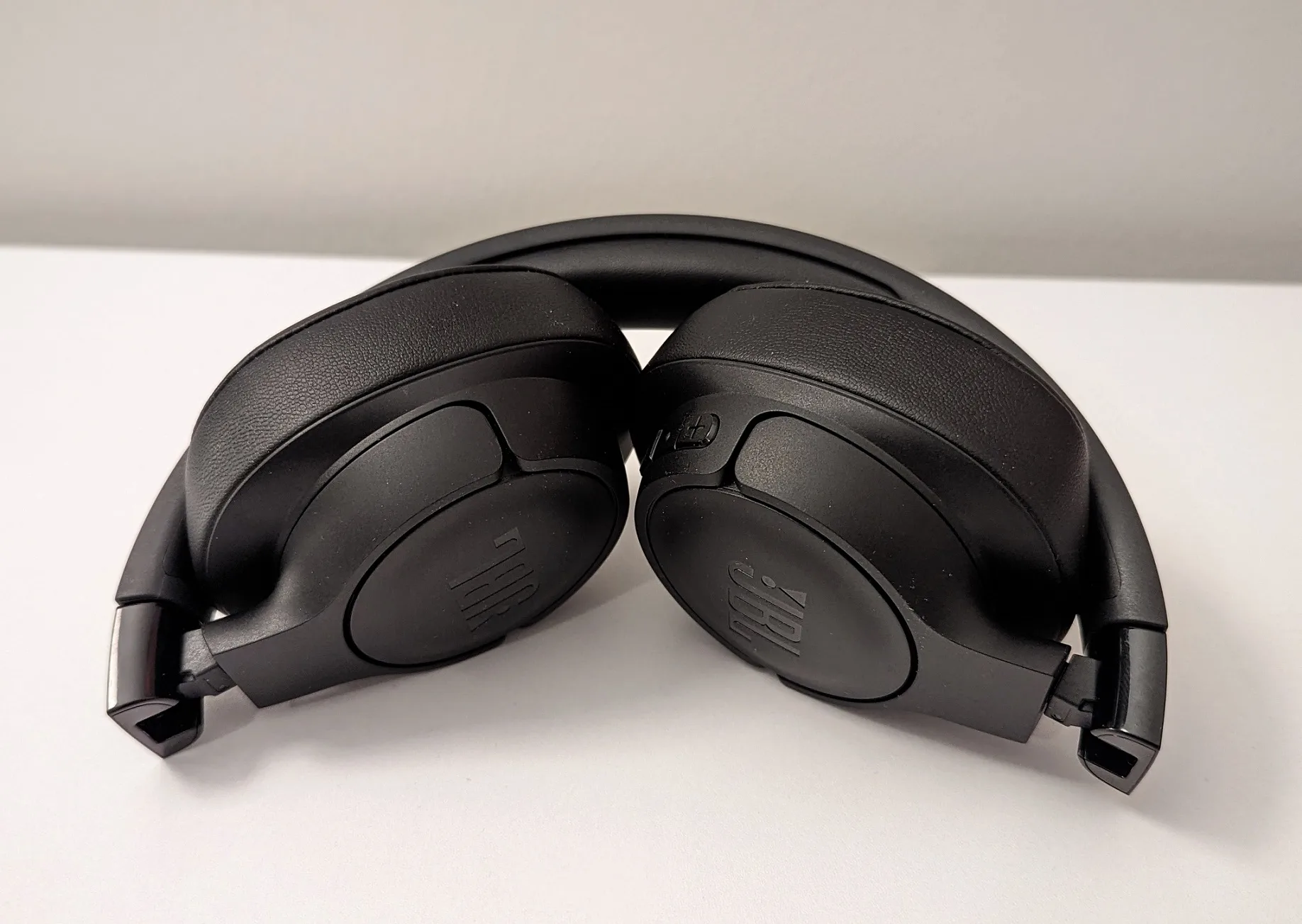
Since JBL headphones are sold in large quantities, the amount of packaging material is reasonably small, and everything is made of cardboard. In addition to the user manual, the equipment includes an orange USB charging cable (length about 25 cm) and a black headphone cable. The Tune 770NC has a 2.5-millimeter headphone jack, so acquiring a suitable cable separately would be somewhat difficult. Considering the affordable price, the equipment is sufficient. The headphones fold down into such a small space, making them easy to carry even without a case.
Build and comfort
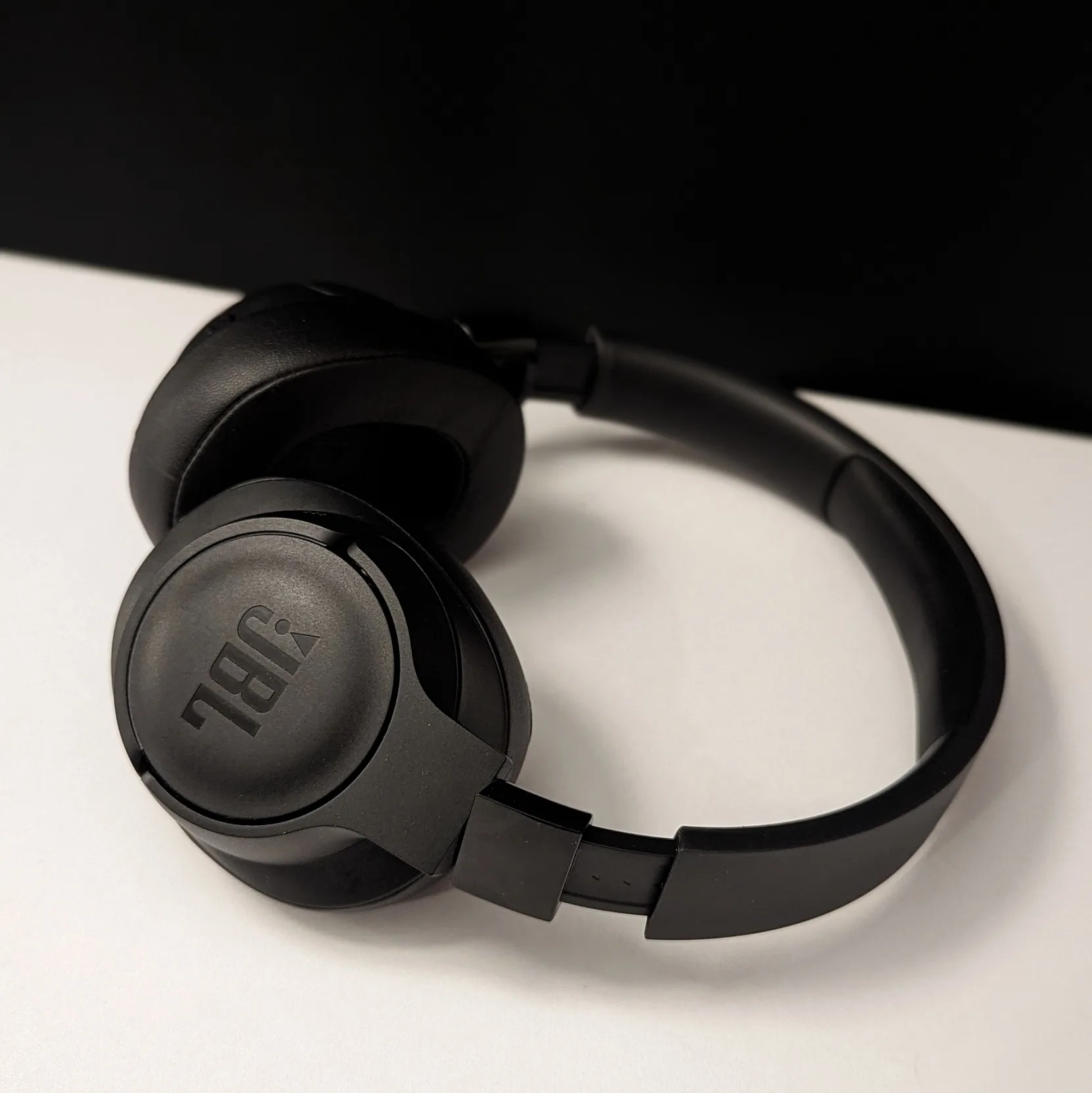
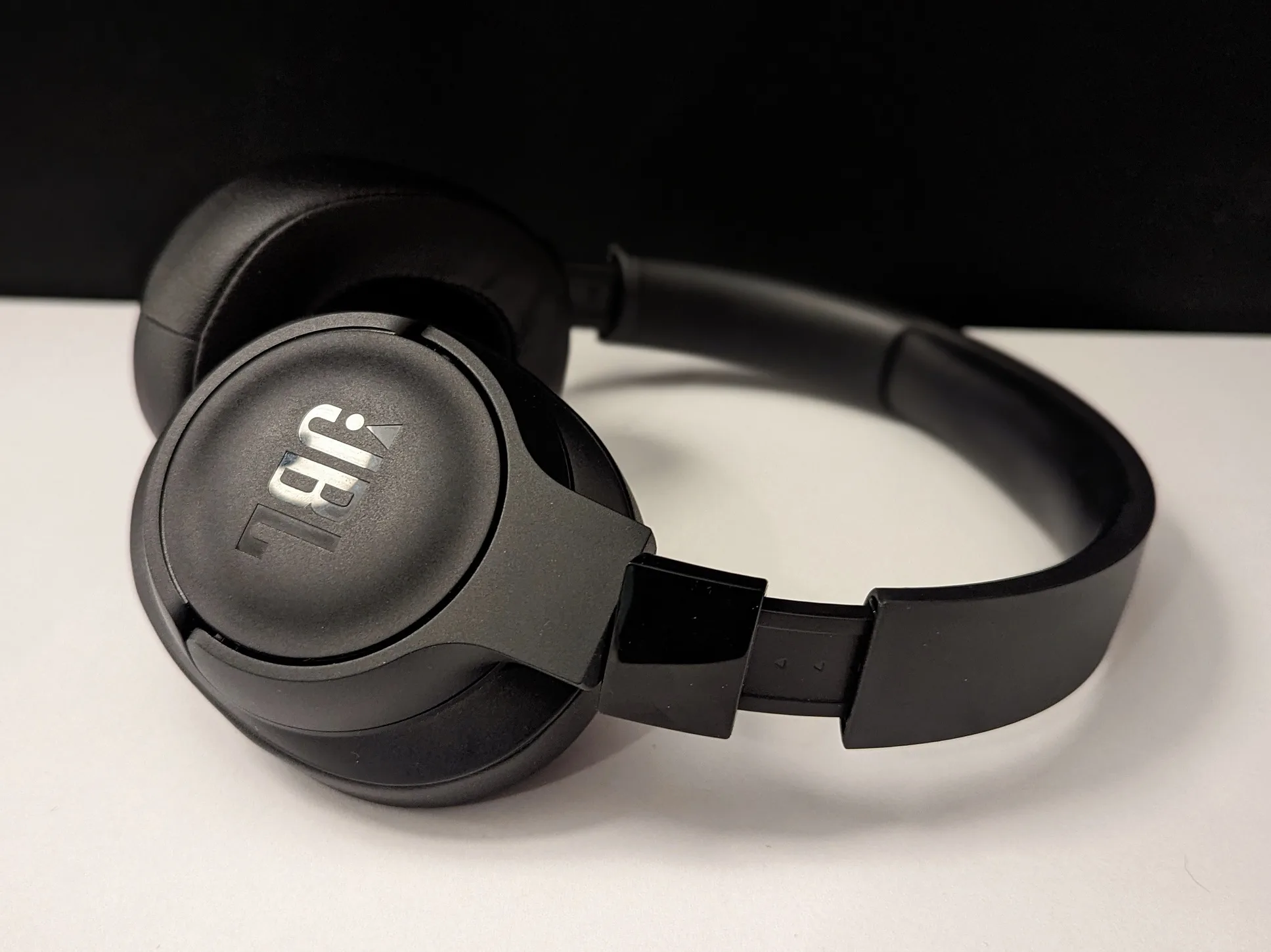
Like other JBL products, the Tune 770NC is a generic-looking plastic headphone with nothing particularly interesting about it. However, this also has its advantages, as the headphones do not attract much attention when moving on the street or, for example, sitting on a bus, unless a more colorful option is purchased instead of the black model. The Tune 770NC feels extremely cheap in hand, but the parts are made of such thick plastic that long-term durability is unlikely to be an issue. JBL has generally manufactured similar headphones for so long that any potential weak points have surely been refined over the years. I would say the perceived quality is even slightly better compared to the Edifier W820NB and Soundcore Life Q30 in the same price range (both models compared previously in Kuulokenurkka).
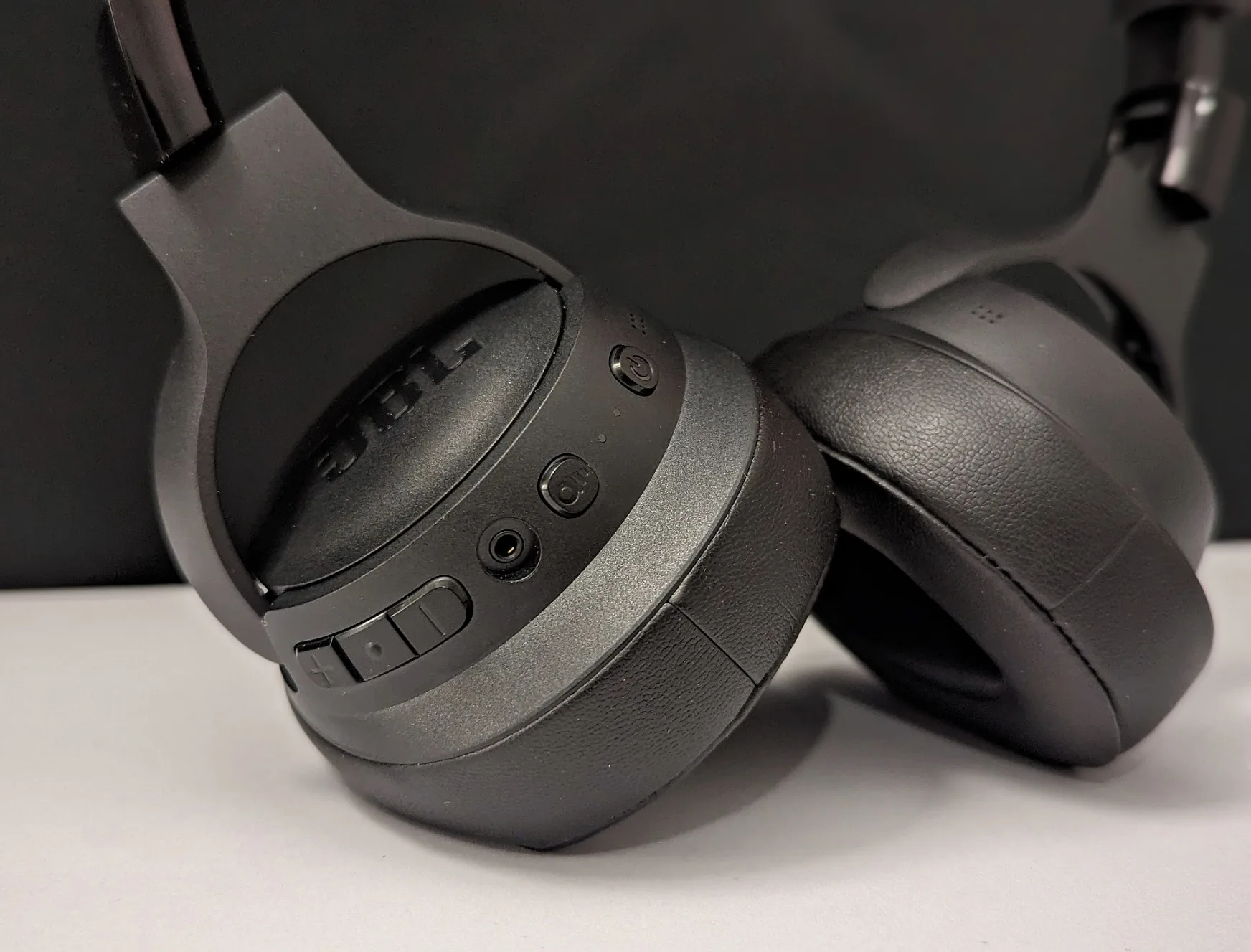
The usability of the Tune 770NC is also good, as the adjustment possibilities are extensive, and the buttons located at the bottom of the earcups are large and easy to use. The earcups rotate horizontally so that the cushions rest against the chest. In addition, the earcups can also be folded inwards against the headband, so the Tune 770NC takes up little space, for example, in a bag. Since the artificial leather ear cushions are also thick and pleasant to the touch, the overall package seems promising for the price.
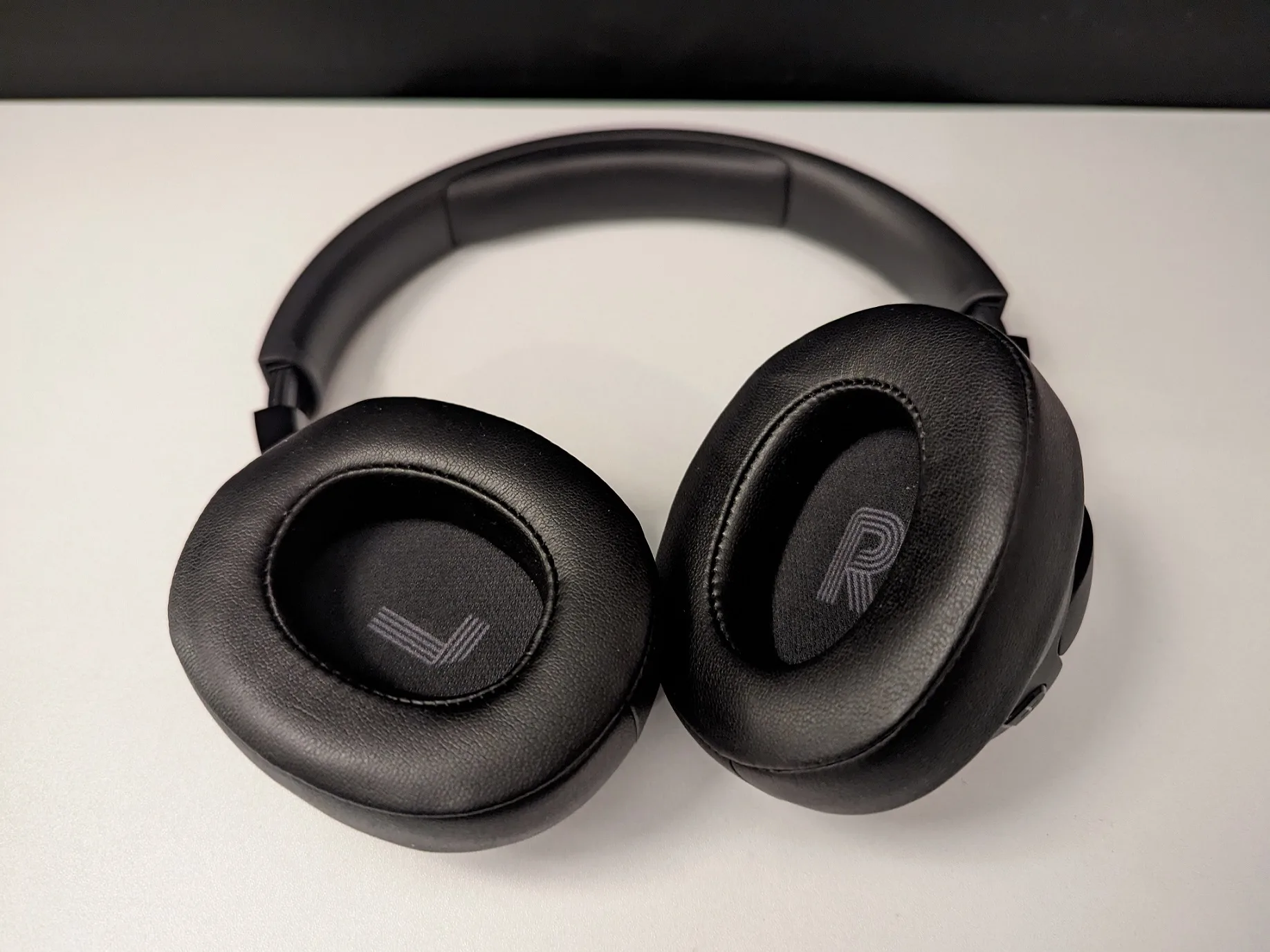
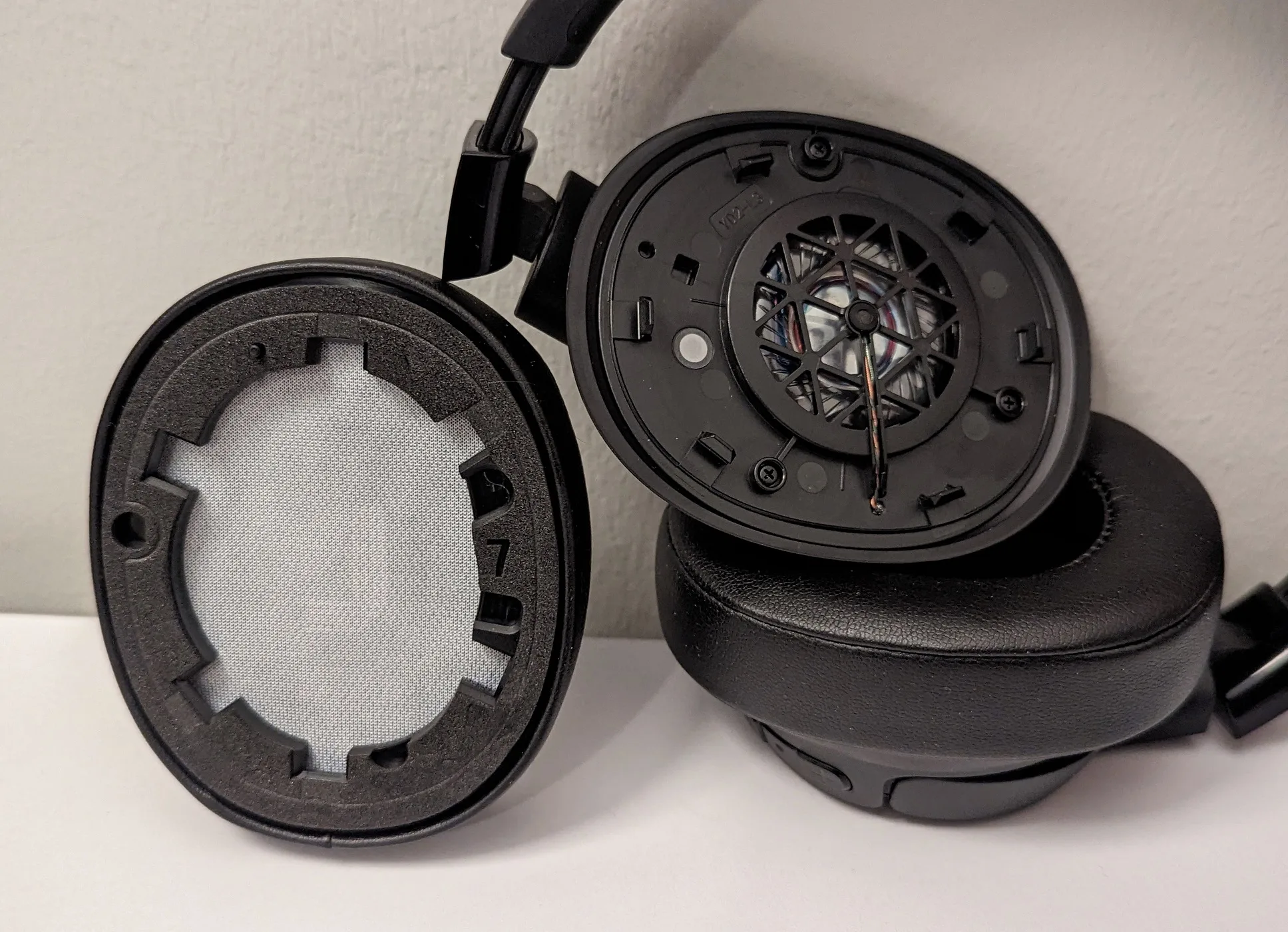
However, placing the headphones on the head reveals that they are not primarily designed for adults. The width and clamping force of the headband are likely optimized for youth, as on my head, the Tune 770NC clamps annoyingly tightly. My ears also don't fit properly inside the earcups unless I first fold my earlobe and then slide the earcup around it. My ears become sore within 15 minutes this way, so on-ear use is actually more tolerable. Due to the strong clamping of the headband, the headband itself barely touches the top of my head, as long as the height is adjusted correctly. The overall comfort for an adult like myself is poor, but I have noticed the situation has slightly improved as the plastic headband has stretched with use. The headphones fit my wife better, so the Tune 770NC might be more usable for many others than for myself. On the positive side, the headphones weigh only 230 grams.
Bluetooth technology and battery life
The Tune 770NC supports Bluetooth version 5.3, but the manufacturer has chosen to keep the available Bluetooth codecs a secret in the product specifications. A quick Google search, however, confirms my assumption that only AAC and SBC are supported, which are the two lowest-quality Bluetooth codecs. This is not a major concern, however, considering the price range of the Tune 770NC. Including electronics that support the AptX codec in headphones would hardly cost a fortune, but affordable models are sought to be differentiated from more expensive alternatives with such design solutions.
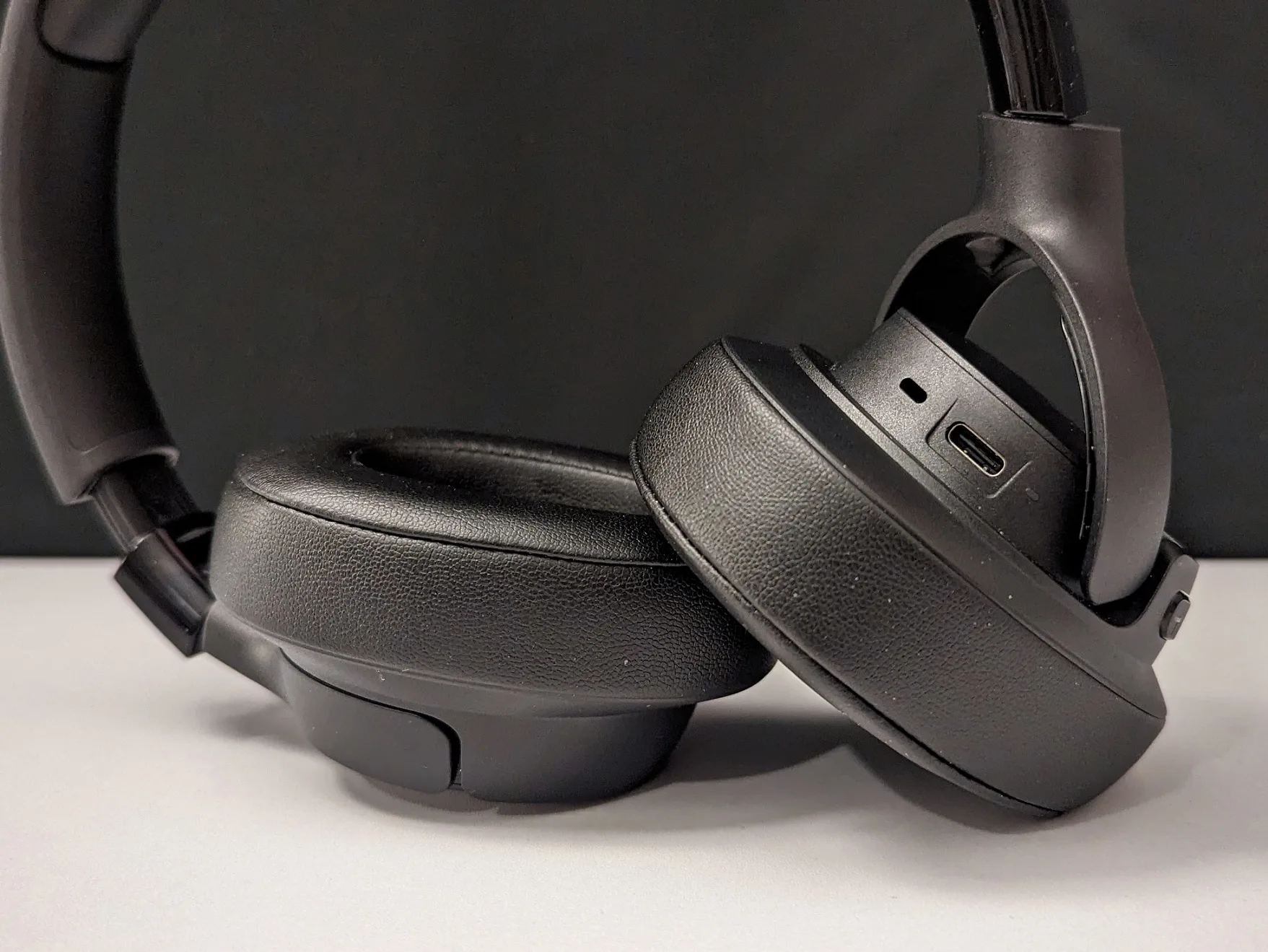
The battery life of JBL headphones with noise cancellation on is an excellent 44 hours. Turning noise cancellation off extends it to an impressive 70 hours, and if the battery happens to run out, a 5-minute quick charge provides an additional 3 hours of listening time. I am pleased to see a USB-C charging connector, which, however, is placed somewhat unusually at the top edge of the cup.
Phone application, features and equalizer
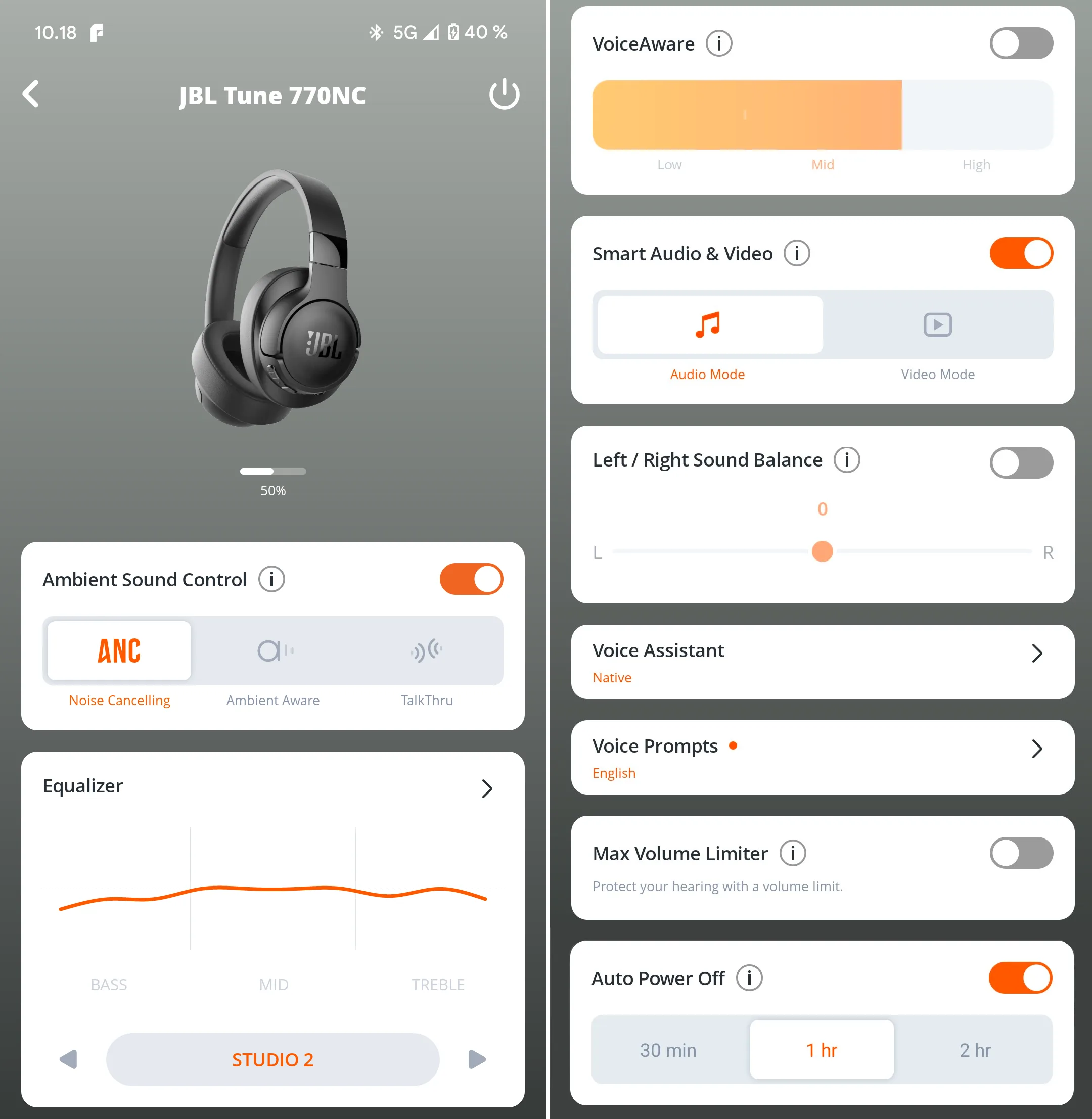
Despite the affordable price, the headphones include many modern features, such as Google Fast Pair and multipoint support. Thus, setting up the Tune 770NC on Android devices is smooth, and it can be connected to two different audio sources simultaneously. JBL has also created a well-functioning phone application and equalizer for its headphones. From the app, one can adjust, among other things, the transparency of one's own voice during calls, as well as the balance of the right and left channels. There is also a separate low-latency mode for watching videos and the option to set a maximum volume limit of 85 decibels, which is still quite a high figure for children, for example.
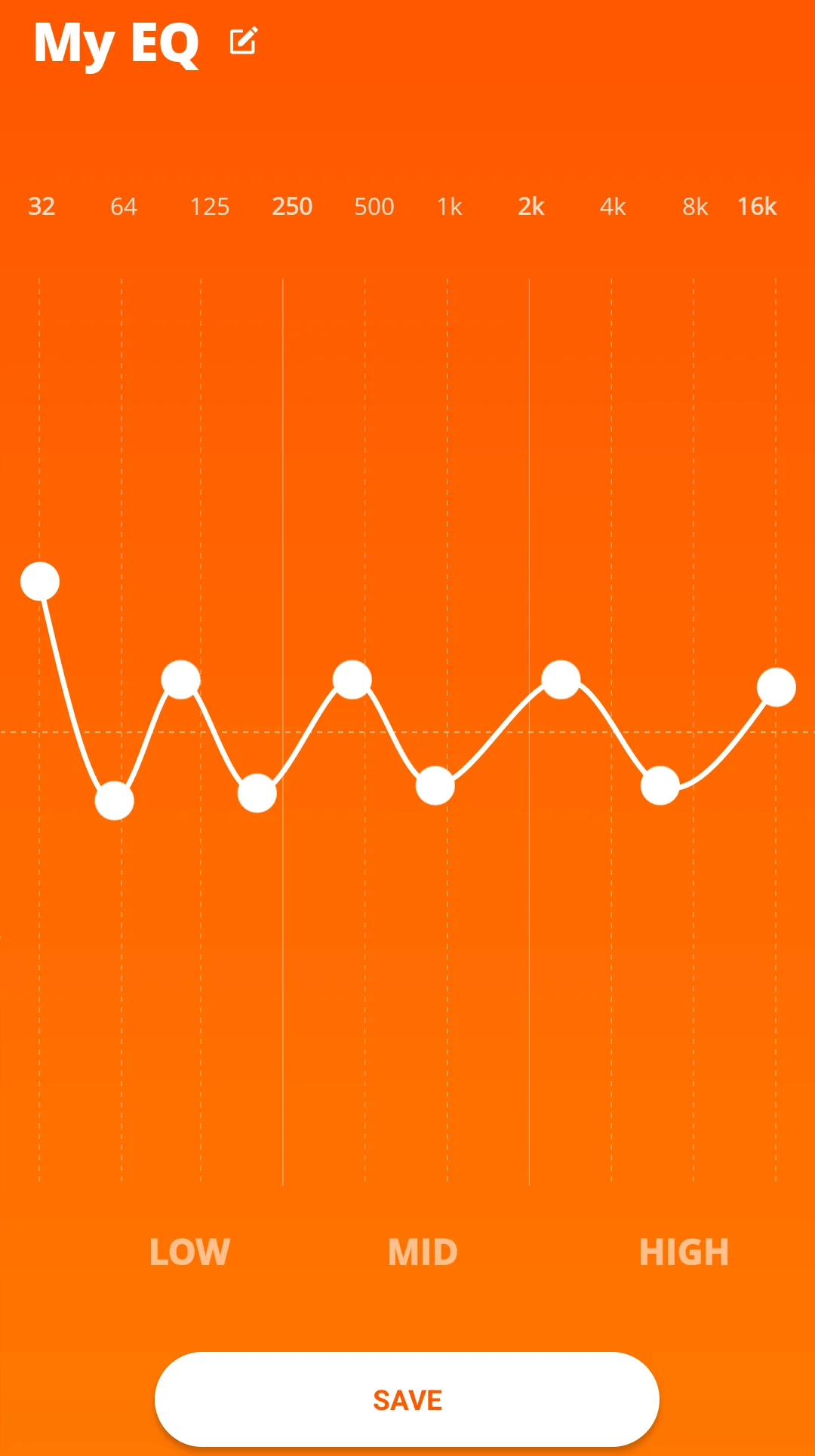
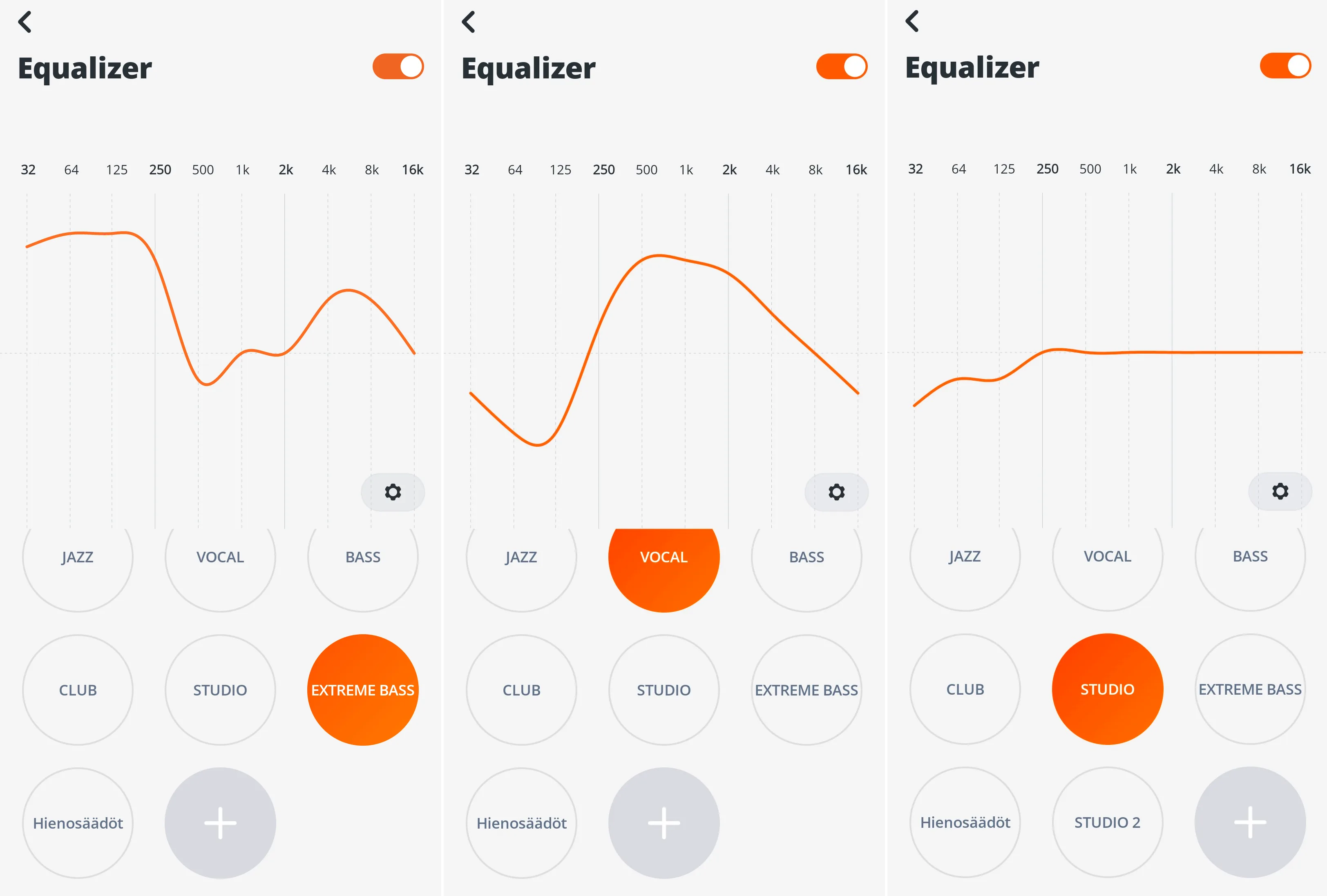
JBL's equalizer allows for sound adjustment of up to 6 decibels up or down. The adjustable frequency ranges can also be freely selected in the graphical adjustment window, but in reality, making sharp changes to closely spaced frequencies is almost impossible because the end result is rounded to be broader than set during the saving phase. However, this is not a problem, as JBL has already tuned its headphones well. The equalizer is perfectly sufficient, for example, for changing the amount of bass or treble. Most would also surely find making adjustments and saving profiles easy. Through the app, a few manufacturer-preset sound profiles, such as Vocal and Extreme Bass, would also be selectable. Of these, the Studio setting is quite functional as is, but the others are more or less over-the-top. Unfortunately, the selected setting does not seem to activate automatically when the headphones are turned on, but I always have to go into the app to reactivate the equalizer.
Active Noise Cancellation (ANC)
Because the Tune 770NC presses tightly against the ears, its passive noise cancellation is top-notch. On the other hand, the headphones might sit at least partially on the earlobes, which is not at all optimal for the functionality of the active noise cancellation feature. Even a small gap between the cushion and the earlobe causes the noise cancellation to malfunction. When working correctly, however, it serves its purpose in the sub-100 euro price range, as in my tests, both airplane and cafe-type noise was attenuated slightly more effectively than with the Soundcore Life Q30. Valco's VMK25 on the other hand, attenuates noise more than the Tune 770NC. In JBL headphones, the attenuation focuses on low frequencies, while higher frequencies are attenuated only slightly. JBL headphones also have clearly audible background hiss, although its tone is less sharp than in the Life Q30 and VMK25. The Tune 770NC's noise cancellation feature is not better than its price or even close to Sony and Bose headphones, but in fairness, I didn't expect it to be. I am quite satisfied with its performance in everyday use.
The headphones also feature a traditional transparency mode (named Ambient Aware) and a TalkThru mode, where your own voice sounds relatively normal with the headphones on. However, TalkThru must be activated separately from the app, so I'm not sure in what situations it would be useful. When using it, audio playback is also almost muted, so the setting is probably only intended for chatting with people with headphones on, in which case it would be more polite to take the headphones off completely. For making calls, a fairly similar Voice Aware mode can be activated separately from the JBL app, which lets your own voice pass through to the headphones. This setting is user-adjustable, unlike the noise cancellation function, transparency mode, or TalkThru. The headphones' noise cancellation function/other modes can also be completely turned off, but this too can only be done via the app.
Sound quality
The frequency response measurements of the headphones were performed with IEC711-standard compliant equipment and new, more precise silicone ears (KB501X). The graphs use the Harman target curve (2018 version), based on scientific research, as a reference. This curve is a generalization of what kind of frequency response would sound good to most people and would correspond to listening to balanced-sounding speakers in a well-acoustically treated room. More information about the measurements and their accuracy can be found on the Headphone Measurementspage. The frequency response of the Tune 770NC can also be compared with other measured headphones on Squiglink .
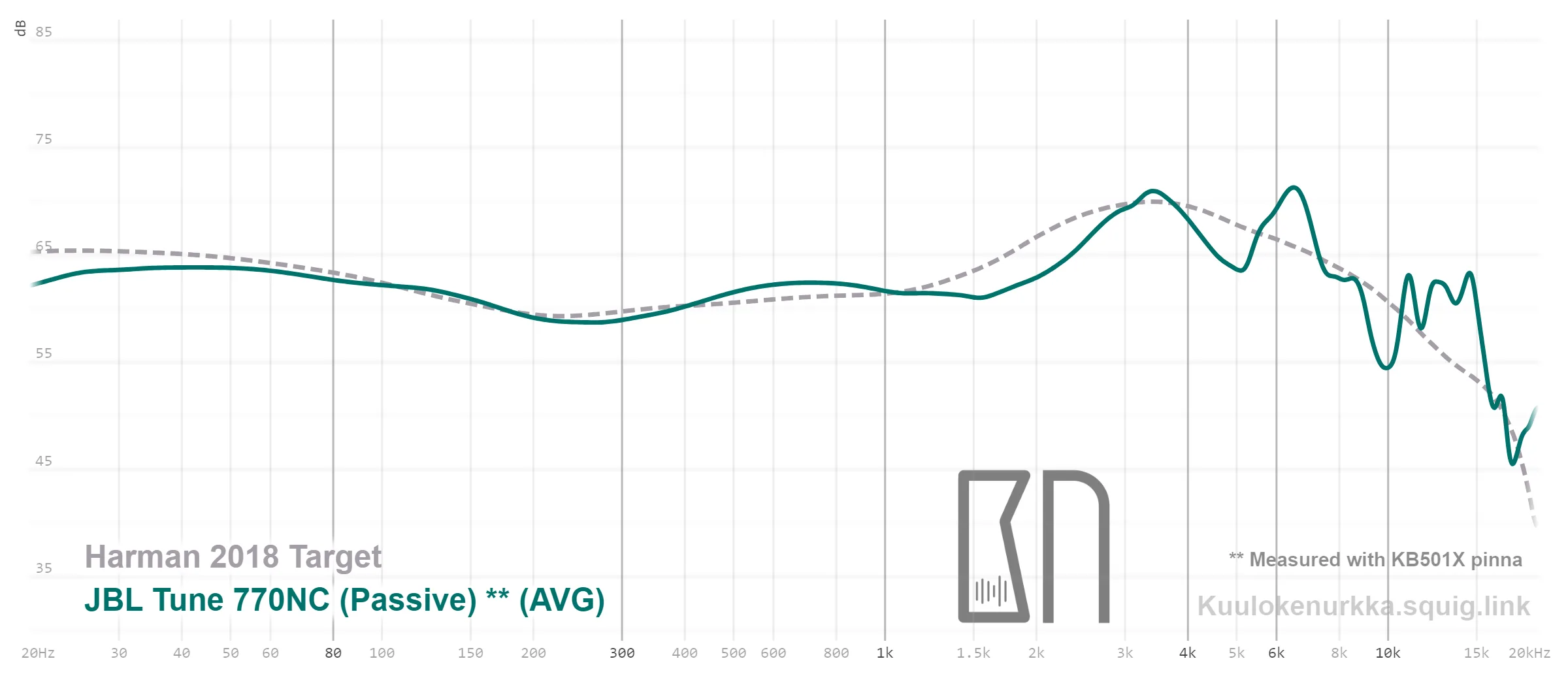
The Tune 770NC can be listened to both via Bluetooth connection and passively with a headphone cable. JBL has mechanically tuned the sound quality, as the headphones sound excellent and balanced when wired with the power off. This is quite rare in noise-cancelling headphones under 100 euros, whose sound is usually largely based on strong DSP correction (digital equalization) to compensate for non-existent acoustics. JBL therefore deserves a big thumbs up from me. Since low-quality Bluetooth codecs are also not a burden during wired listening, I would argue that the sound quality is best this way.
By switching to a Bluetooth connection, however, in addition to the noise cancellation function, JBL's digital fine-tuning is enabled, with which the manufacturer has clearly aimed to make its headphones sound more fun and energetic by boosting both bass and high frequencies. On the other hand, at the same time, the extra emphasis at 6 kHz has been eliminated, so the high frequencies are slightly smoother than in passive listening with a cable. Harman International clearly knows how to tune headphones according to its goals. My task is to evaluate what the Tune 770NC ultimately sounds like. In this regard, I will focus on the Bluetooth connection with noise cancellation enabled, as most users will likely use their headphones that way.
Frequency response with cable, power off:
Frequency response with Bluetooth, noise cancellation on:
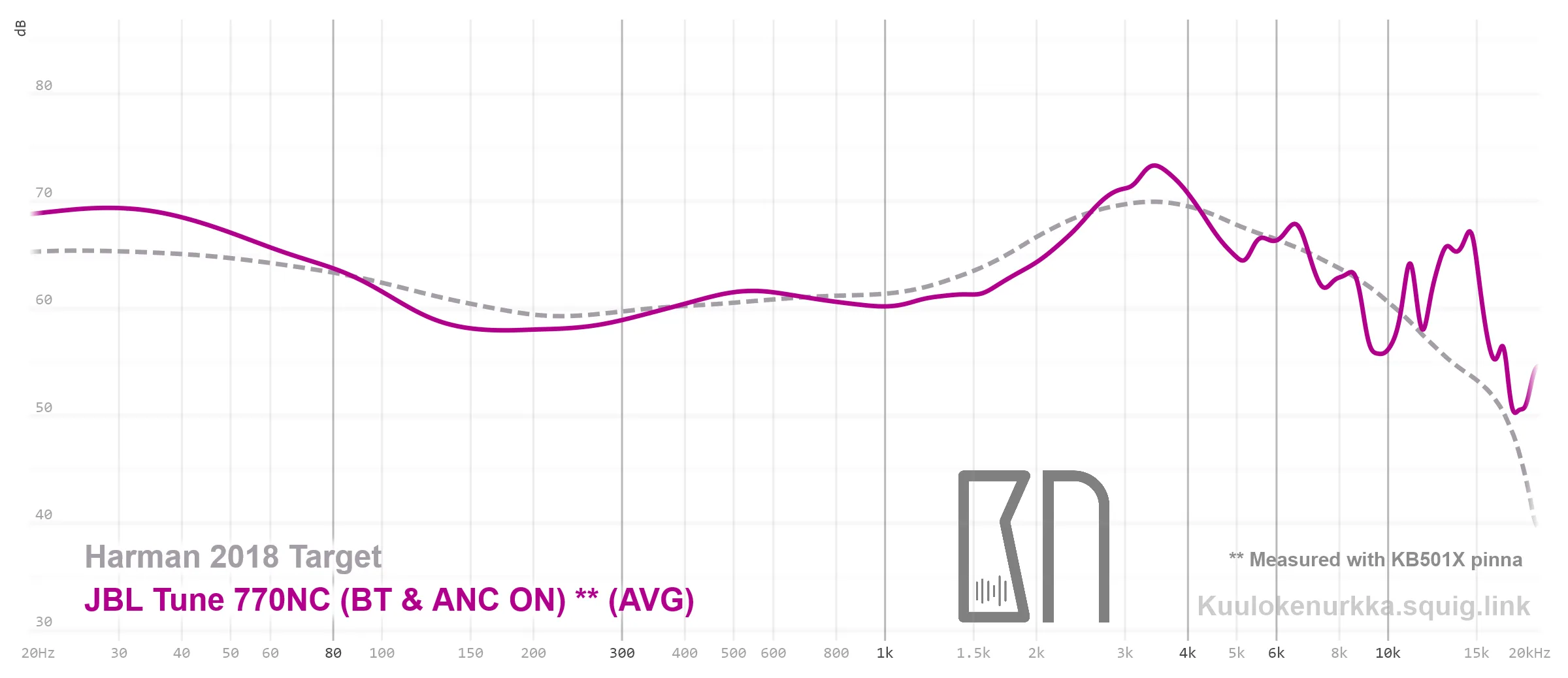
The influence of Harman's target curve is clearly visible in the JBL Tune 770NC's frequency response. The headphones closely follow this target, and there are no major errors in the tuning. Considering how difficult it is to measure headphones due to small ear cushions, the frequency response also provides a good overall picture of the Tune 770NC's sound.
The bass reproduction is powerfully growling, the mid-frequencies are energetic and clear, and the treble is surprisingly balanced. All kinds of music sound good, though not particularly mind-blowing when considered more critically, because the sound plays in a single mass inside the head and the overall tone is a bit aggressive for my taste. However, slight sharpness and an inadequate soundstage are not major drawbacks in the sub-100 euro price range, as similarly priced noise-cancelling headphones usually have significantly bigger problems. The Tune 770NC, as a whole, ranks among the best affordable headphones I've heard, and most people wouldn't necessarily need to equalize it at all. Its biggest and even rare strengths are the bass staying separate from the mid-frequencies and the sufficient energy level of the upper mid-frequencies. JBL has aimed for a rather V-shaped and lively fun presentation, which is likely to appeal to younger audiences.
Bass:
When genuinely powerful bass reproduction is desired in headphones, the low frequencies should be adjusted exactly as they are in the Tune 770NC. The bass of JBL headphones is quite emphasized, but the thump and growl originate from frequencies below 100 hertz, and not, for example, between 100–300 hertz like in Sony's noise-cancelling headphones. A strong emphasis on higher bass frequencies (Sony) makes the bass thick, loose, and boomy, whereas emphasizing sub-bass (JBL) brings power and depth to the sound. In the Tune 770NC, the area around 150 hertz actually sounds slightly quieter than usual, which successfully keeps the sub-bass in its own territory. Thanks to this, the low and mid-frequencies do not mix at all, and the presentation is admirably clear. It is actually entertaining to think that many teenagers listen to higher quality bass with their JBL headphones than we adults do with Sony headphones.
In JBL's case, the only regrettable thing is that its headphones are not capable of reproducing a large amount of sub-bass particularly cleanly; instead, the bass often thumps quite bloated and slow. Often, the bass boost also sounds unrealistic in songs that shouldn't have that much bass. The low frequencies of the Tune 770NC do cause me some listening fatigue, so I have equalized them to be a bit more moderate. On the other hand, all kinds of bass-heavy and pop music sound fun and powerful as they are, making your feet tap. Considering JBL's target audience, the bass is possibly the Tune 770NC's best feature and biggest selling point. When listening with a cable, the bass reproduction is the most balanced for a more critical taste.
Mid-frequencies:
The mid-frequencies of the Tune 770NC are remarkably successful for a sub-100 euro price range. The headphones, however, emphasize clarity and energy in reproduction, so the presentation is a touch thin rather than having warmth and emotion in the sound. This is not a problem, however, as both vocal performances and all mid-frequency-focused instruments are reproduced easily digestible despite their slightly thin style. The bass, in turn, adds power to the reproduction. The overall sound must be called exemplarily orthodox when the goal is a reproduction similar to Harman's target curve.
However, if I want to give some personal criticism, a slightly more moderate energy level in the ear-gain region (3–4 kHz) would be sufficient for my hearing sensitivity. The Tune 770NC sounds quite aggressive and harsh to me in places, even though energetic music genuinely sounds punchy and thus exciting. This is likely a deliberate stylistic choice and, in general, a characteristic that divides opinions somewhat within Harman's target curve. Not everyone necessarily wants headphones to push sound into the listener's awareness with such energy. This front-forward tuning also reduces the already narrow soundstage of JBL headphones, similar to Sennheiser HD 600series, so it's worth trying to equalize the 2–4 kHz frequency range down by a couple of decibels in the Tune 770NC, at least experimentally. This makes the sound more natural and reduces the sharpness of singers' voices in particular.
Treble:
The treble, on the other hand, is relatively suitable as is. The high frequencies are reproduced balanced and usually do not draw much attention to the overall sound. I like the airy reproduction of frequencies above 10 kHz, as they nicely lighten the sound and balance the robust sub-bass. The audibility of the frequency band extends excellently to the extremes of human hearing, which is not common at all, as many Sony headphones, for example, cut the treble almost to zero at 15 kHz.
I have only equalized the treble of the Tune 770NC above 10 kHz when making other changes, so that the increased airiness does not cause unnecessary hiss and sibilance in the sound. Without equalization, these characteristics are often overshadowed by the prominent upper mid-frequencies. The headphones' presentation is slightly sharpened, but not excessively so, especially when listening at moderate volume. Mild sibilance is not at all among the worst, nor does lower-quality music crackle more than usual in the ears. The aggressiveness I experience in the presentation largely originates from the 3–4 kHz range, rather than the treble.
Other observations:
The most regrettable characteristic of JBL headphones is their narrow soundstage, which can, however, be made to feel somewhat more spacious with a little equalization. Also, when listened to with a headphone cable, the Tune 770NC is clearly more spacious due to its different frequency response. With a Bluetooth connection and the manufacturer's DSP correction, music largely plays inside the head due to the forward-pushing upper mid-frequencies, which can be quite a suffocating experience, especially at louder volumes. However, headphones with small closed cups are prone to this. One does get used to it over time, but when compared to better headphones, the non-existent spatial separation of the reproduction causes a slight disappointment. Despite its orthodox tuning, the Tune 770NC sounds like an inexpensive product when used with a Bluetooth connection. Thus, no enormous overperformance or detail is to be expected, but JBL has priced its headphones correctly, and they perform excellently in their price range. Those aiming for the highest possible quality reproduction should try listening with a cable, as in my opinion, the Tune 770NC would then be quite comparable to, for example, AKG's K361 and K371, which are also developed by Harman International.
My moderate equalization:
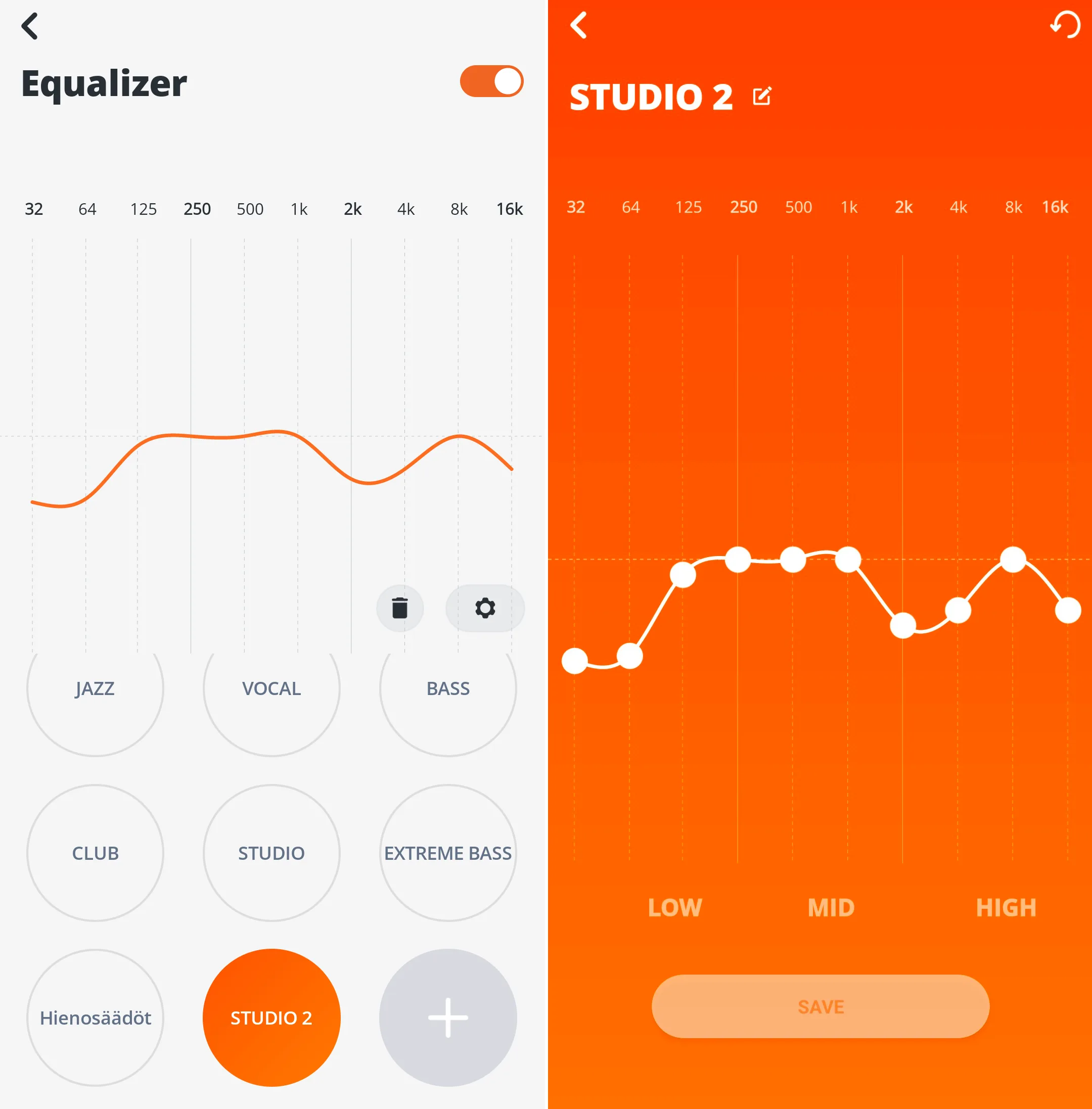
Sound quality can also be fine-tuned by equalization. In this case, I suggest trying the following moderate changes, which clarify bass reproduction and calm and widen the mid-frequencies. Equalization is easiest when taking JBL's predefined Studio setting as a base and then further lowering the energy level of the upper mid-frequencies according to one's own taste. I myself have moderately reduced the audibility at 2 kHz, 4 kHz, and 16 kHz. Additionally, I have reduced the bass only with the two lowest controls, as the headphones do not have a mid-bass boost between 125–300 Hz like many of their competitors. After these changes, the Tune 770NC sounds more balanced to my taste, essentially a bit more like it does with a headphone cable without its DSP correction. It may well be that JBL's default tuning appeals a bit more to younger listeners, so I would see equalization for the Tune 770NC as quite optional rather than a compelling necessity.
Quick comparisons
I will quickly compare the Tune 770NC to the similarly priced Soundcore Life Q30 and the 200-euro Valco VMK25. Since using JBL headphones is quite uncomfortable for me due to the small ear pads, I declare both competitors more comfortable at this stage. In terms of build, the VMK25 is sturdier and of higher quality, but the Soundcore Life Q30 feels more toy-like and creakier in hand than the Tune 770NC. In terms of features, JBL is the most modern of the three, even though it doesn't support the AptX codec like the VMK25. However, like the Q30, a phone app and an equalizer have been made for the headphones. Adjusting the sound of the VMK25, on the other hand, would only be possible with a third-party application. The noise-cancelling function in the VMK25 is clearly the best, while the Tune 770NC and Q30 remain quite mediocre. Battery life is also best in Valco headphones (50h with ANC on). The Tune 770NC's battery, in turn, lasts a few hours longer (44h vs 40h) than the Soundcore Life Q30. In the following sections, I will focus on comparing sound quality.
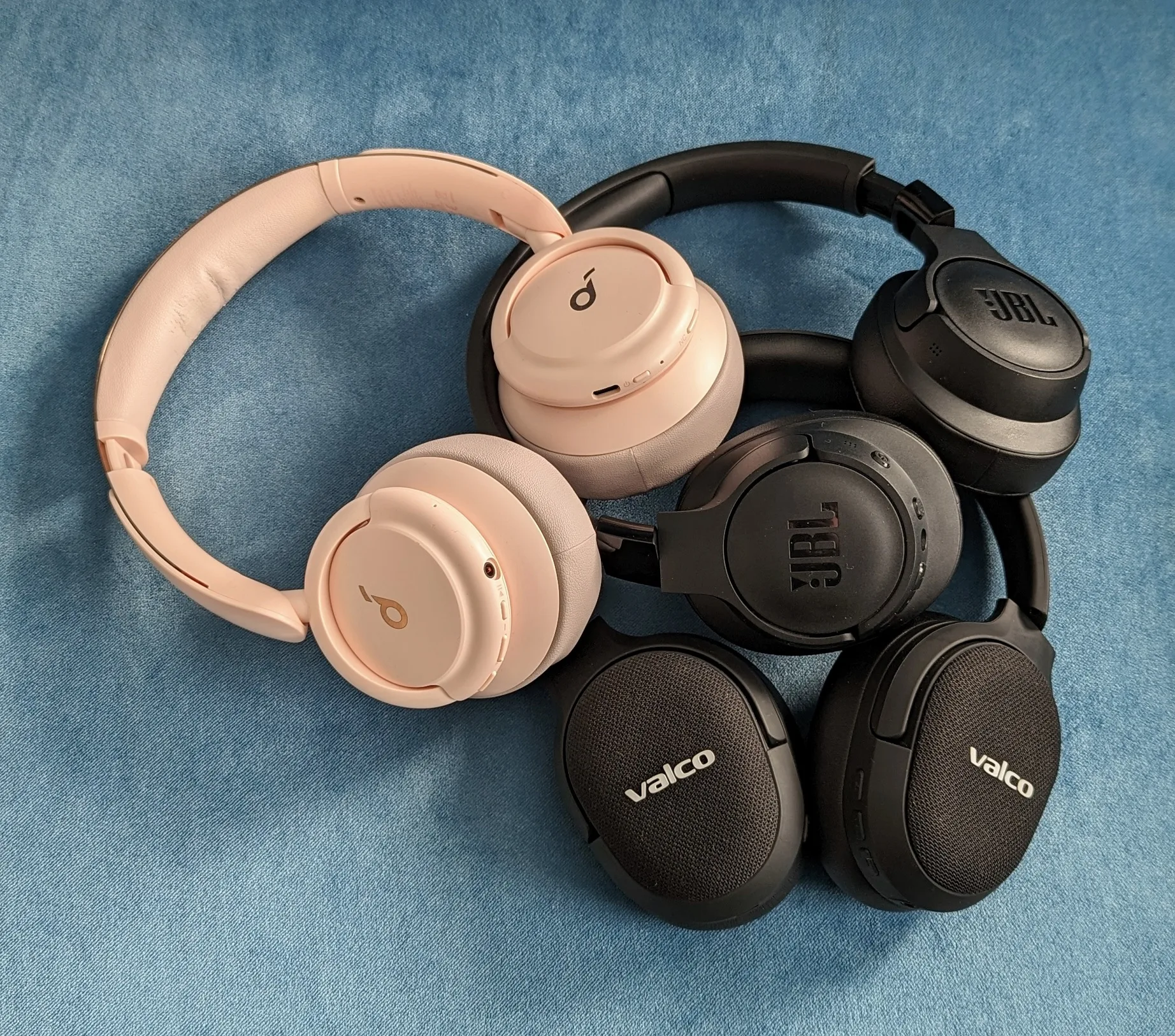
JBL Tune 770NC vs. Soundcore Life Q30
The Soundcore Life Q30 is not known for its good sound quality; as it is, it's an almost abysmal headphone drowned in bass. However, with equalization, it can be made quite good for its 60-euro price. Comparing an equalized headphone model to the already good-sounding Tune 770NC doesn't seem the most sensible, of course, but it is still justified in the sub-100-euro price range, as affordable products always inherently involve compromises in some areas. In the case of the Q30, however, only better comfort is a clear advantage compared to JBL's headphones.
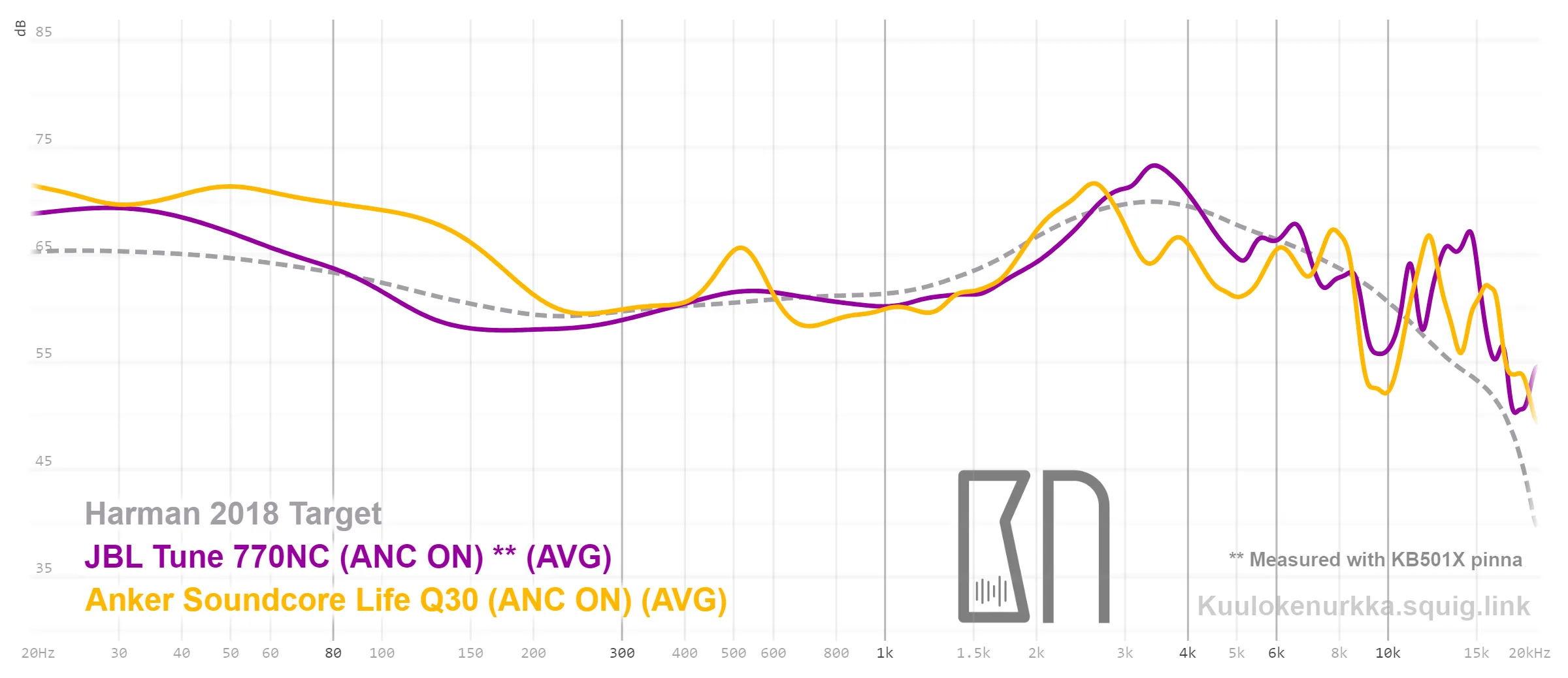
Since I have once replaced the Q30's ear pads with slightly different ones, I can no longer compare it to JBL's headphones without equalization. However, the frequency response I measured earlier likely indicates that the reproduction is very bass-heavy. The boomy and all-encompassing bass did not change even by replacing the pads; it requires equalization. After various corrections, a few irregularities still remain in the sound, such as a peculiar 500 Hz emphasis, but to my ears, the overall result works well and is a clear improvement over the initial state.
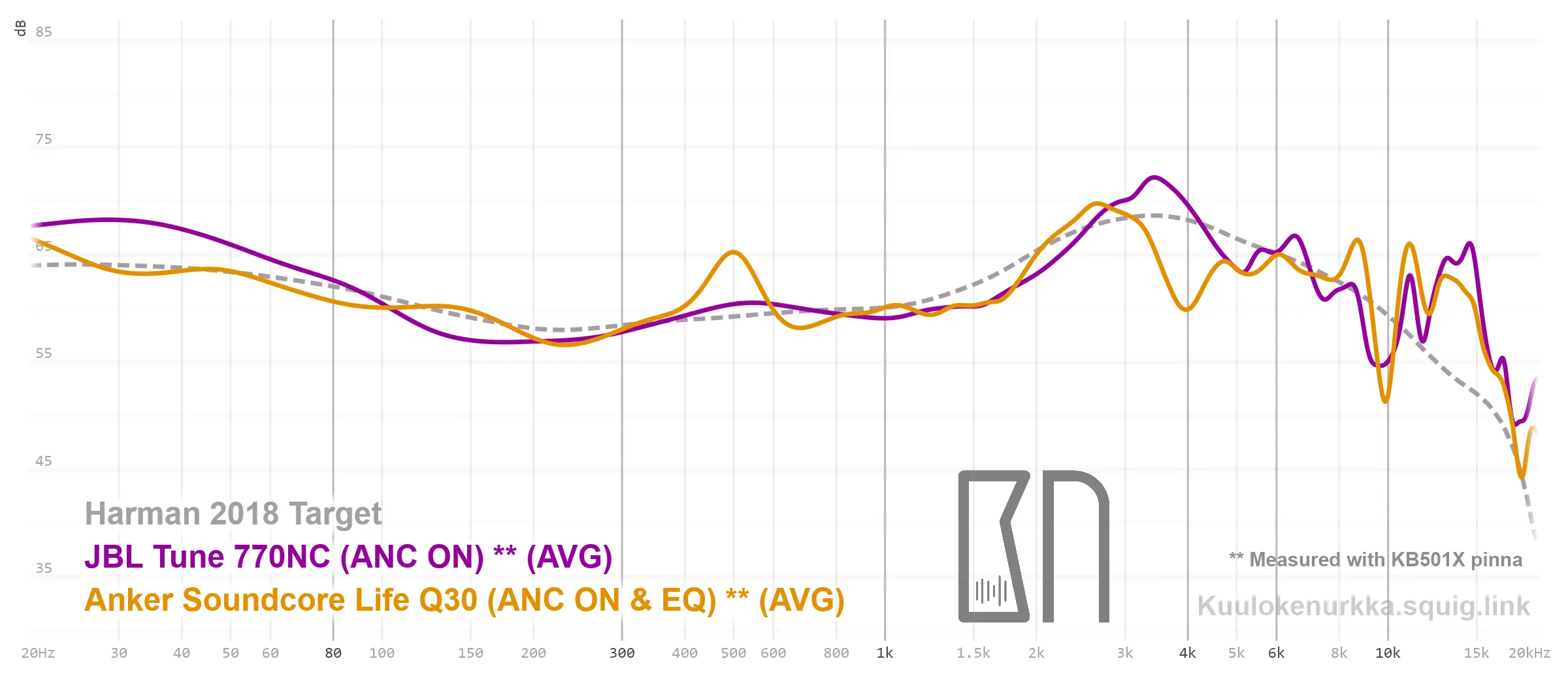
The strengths of the Life Q30 compared to JBL's headphones are in its more spacious soundstage, which is likely due to the larger ear pads. The relaxed reproduction around 4 kHz also makes the sound pleasantly calm compared to the Tune 770NC's more aggressive upper-mid frequencies. However, with a small equalization, the JBL model could be made quite similar, making the pair surprisingly comparable to each other. Both headphones are pleasant to listen to, and neither is vastly superior to the other in any aspect. The most important observation I would make is that a good result is achieved with JBL's headphones with significantly less effort. Due to a slightly more effective noise cancellation function and better availability, I would nowadays recommend buying the Tune 770NC rather than the Soundcore Q30. JBL, of course, has other similarly priced options in its selection, which are likely close in tuning to the headphone model I tested.
JBL Tune 770NC vs. Valco VMK25
The Valco VMK25 is a very different style of noise-cancelling headphone than the Tune 770NC, as its bass is nowhere near as powerful; instead, the headphones' tuning emphasizes freshness and detail in reproduction, similar to hi-fi headphones. The VMK25's soundstage is more spacious compared to JBL's headphones, and the treble is brighter between 5–8 kHz – the Tune 770NC, on the other hand, is airier and more sparkling in its highest treble.
Listening to both headphones consecutively, I cannot help but notice that the VMK25's mid-frequencies sound somewhat veiled and soft compared to the JBL model. This is largely because Valco's headphones reproduce the upper-mid frequencies between 2–4 kHz in a subdued manner. The presentation is more open and relaxed, but the Tune 770NC sounds more linear and normal. Its treble is also slightly more natural in style, as the VMK25's high frequencies have some extra harshness and sparkle due to a few emphases. I would call the VMK25 somewhat unnatural-sounding, but its most significant advantage compared to the Tune 770NC is clearer sound separation. The headphones more successfully delineate reproduction into different parts, making it easier to follow individual instruments and sounds amidst each other. JBL's headphones cannot quite achieve the same.
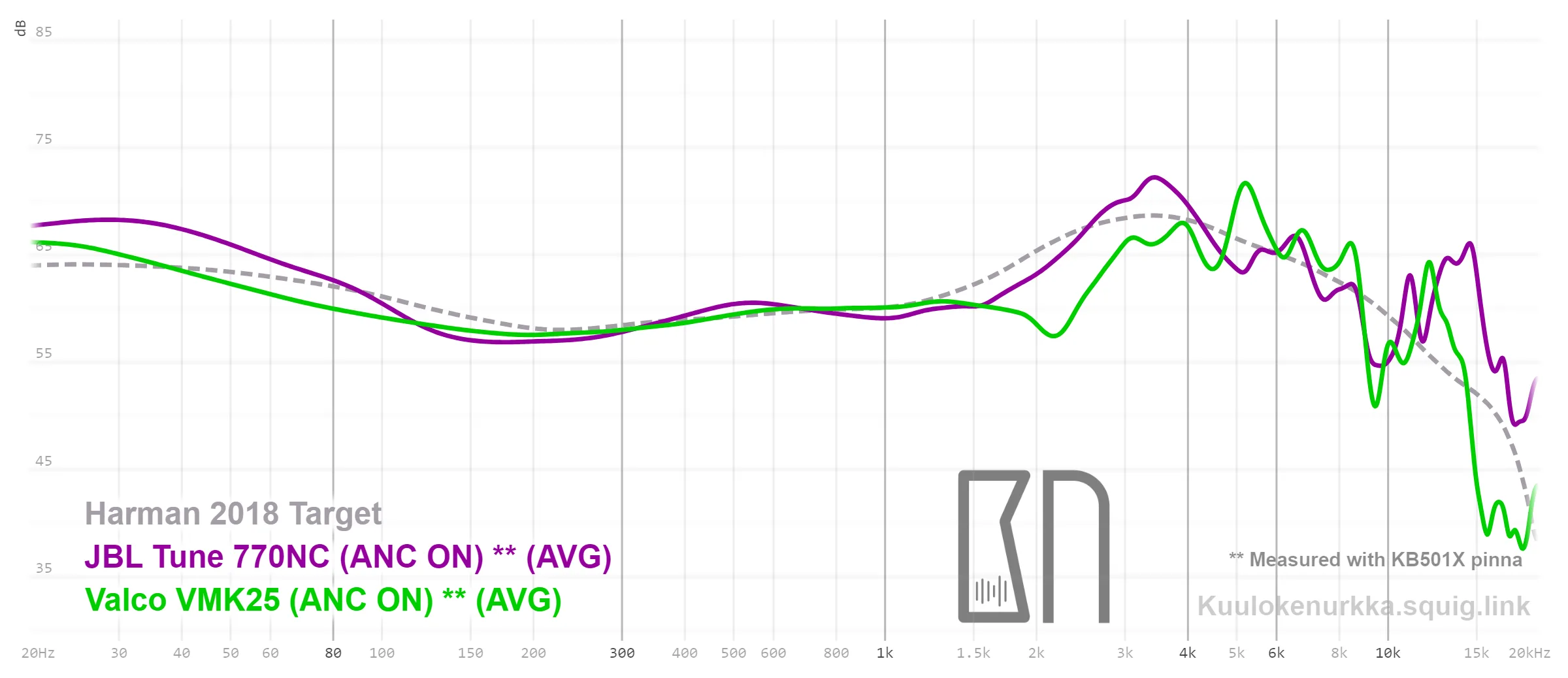
The target audience for the duo is so different that I wouldn't really see the headphones as direct alternatives to each other. JBL is more fun for so-called basic pop listening, but it doesn't really bring out small nuances from the music or make one appreciate the work of artists and studio personnel in the way the VMK25 does. On the other hand, with a small equalization, the Tune 770NC also adapts well to more critical listening, but the reviewer's main task is to find out how each manufacturer has succeeded in their work. As such, both headphones, in my opinion, have their place in the market. If a VMK25 owner desires stronger bass reproduction for a change, the affordable Tune 770NC could even be a good purchase as a second noise-cancelling headphone model. The VMK25 and Tune 770NC are, in fact, representative examples of two different stylistic directions. After hearing both, many would surely be able to say which type of sound they prefer more or whether the reproduction following Harman's target curve aligns with their own preferences.
Summary
In my opinion, JBL deserves credit for making it possible to get good headphones from a local supermarket, whose sound quality is scientifically proven to suit most tastes. As a product, the Tune 770NC is extremely boring and ordinary, but it is also affordable. More expensive alternatives offer, among other things, higher quality construction, better comfort, and a more effective noise cancellation function, but from a sound quality perspective, for example, Sony's WH-1000XM4 or WH-1000XM5 are not significantly better than JBL's budget model, even with equalization and the small corrections I suggested. This is again an indication that the retail price tells relatively little about the sound quality of noise-cancelling headphones, because in skilled hands, products can be adapted with DSP correction to almost anything without significant additional costs. Although the resolution or soundstage of reproduction often does not reach top levels in noise-cancelling headphones, at least the frequency response could be easily adjusted to perfection. JBL and Harman International seem to master this better than most other manufacturers.
If the comfort of the Tune 770NC were slightly better for me, I might use it quite regularly when I need a reminder of what reproduction according to Harman's target curve sounds like. As it is, however, the headphones primarily remain a joy for younger user groups or those with smaller ears than mine, which in itself is not wrong. Those aiming for slightly better comfort should probably look towards JBL's Live series, which appears to be somewhat larger. Perhaps I will test those someday too, as my first experience with the manufacturer's products was very positive.
Pros and cons:
+ Harman-style punchy tuning
+ Powerful and correctly tuned bass reproduction
+ Clear mid-frequencies and balanced treble
+ Sounds excellent even wired
+ OK construction in terms of specifications and durability
+ Functional mobile app and equalizer
+ Good battery life
+ Affordable price and excellent availability
+/- Dull appearance
+/- The effectiveness of the noise-cancelling function does its job, but still leaves something to be desired
– There is a bit too much sub-bass for it to stay clean
– Upper midrange frequencies can sound aggressive
– Narrow soundstage
– Rather poor comfort
– Slight background noise
 EN
EN  FI
FI
Voisitko verrata sitä Audio-Technica ATH-HL7BT:hen?
Hei, unohdin näköjään vastata tähän. Kahden kuulokemallin tarkempi vertaileminen ei valitettavasti olisi nyt mahdollista, kun Audio-Technicat ovat olleet jonkin aikaa tutun käytössä. Puhutaan kuitenkin suljetusta ja avoimesta kuulokkeesta, joten molemmilla on omat vahvuutensa. ATH-HL7BT kuulostaa avoimemmalta ja siten tilavaikutelmaltaan luonnollisemmalta. JBL Tune 770NC:ssä sen sijaan on voimakkaampi bassontoisto ja se on myös oletuksena tuunattu lähemmäs Harmanin tavoitekäyrää ja osuu siten paremmin valtaväestön makuun. Audio-Technicat on ilman taajuuskorjaamista melko kevyen ja rauhallisen kuuloiset, joten melko erilaiset. Avoimista kuulokkeista ei myöskään löydy vastamelutoimintoa. Käyttömukavuus on kuitenkin ATH-HL7BT:n ehdoton vahvuus, koska niitä ei huomaa päässä laisinkaan, kun taas Tune 770NC sopii hyvin vain pienikorvaisille.
Kiitos arvostelusta, tästä oli mulle paljon apua! Tämän perusteella nappasin itselleni alennuksesta Live 770NC:t, ja esimerkkisäätösi antoivat hyvän lähtökohdan omille säädöille. Vertailin Jlabs Jbuds Luxeihin joita en saanut kuulostamaan omiin korviini yhtä hyviltä.
Enpä olisi uskonut, että yhdestä kuulokemallista voi tehdä näin kattavaa analyysiä, mutta kiitos tästä! Tutustun minäkin live-mallistoon.
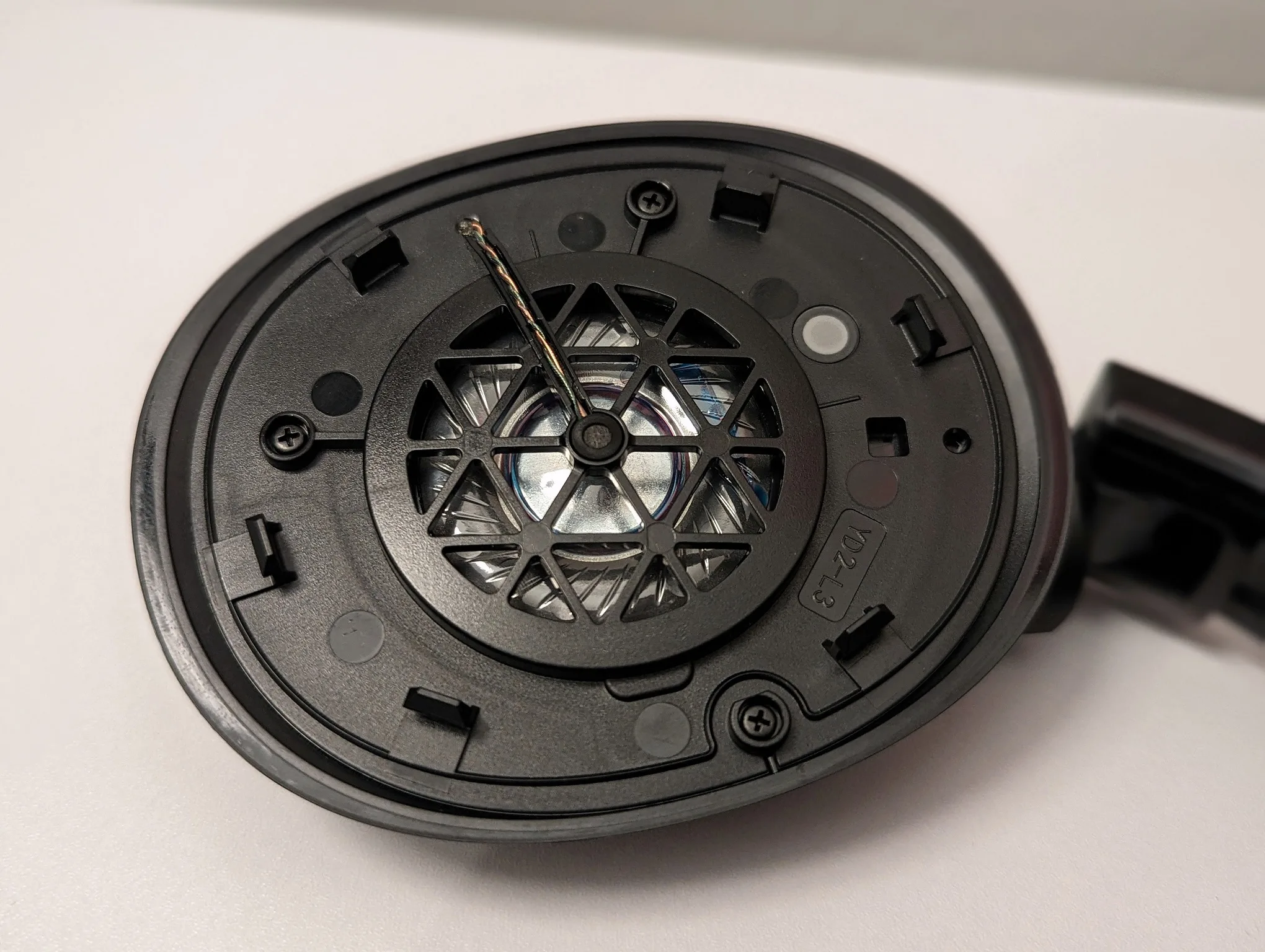
Ilmeisesti jopa JBL Tune 710Bt käyttää samaa driveria kuin Tune 770NC, ainakin ulkoisesti näyttävät identtisiltä jopa tuon refleksiaukon osalta kun äsken avasin ja tarkistin asian omistani. Omasta mielestäni JBL 710BT on yksi parhaimmista halpis kuulokkkeista mitä olen koskaan kuunnellut ja sitä on saanut tarjouksessa todella edullisesti. Itse kuuntelen aina johdon kanssa ja minulle on erittäin tärkeää miltä kuulokkeet kuulostavat passiivisesti. Ostin hetki sitten JBL:n Tour ONE M2 kuulokeet joissa passiivitoisto huomattavasti heikompi kuin Tune 710BT:ssä. Niissä yläkeskiäänialue huonomoi ja ehkä midbassot ja se ylempi bassoalue kumiseva. M2 driver täysin erilainen ja sitä pitäisi sähköisesti korjata tuohon Harmanin tavoitevasteen suuntaan, jotta sitä jaksaisi kuunnella pidempään.