Author: Sword of Damocles
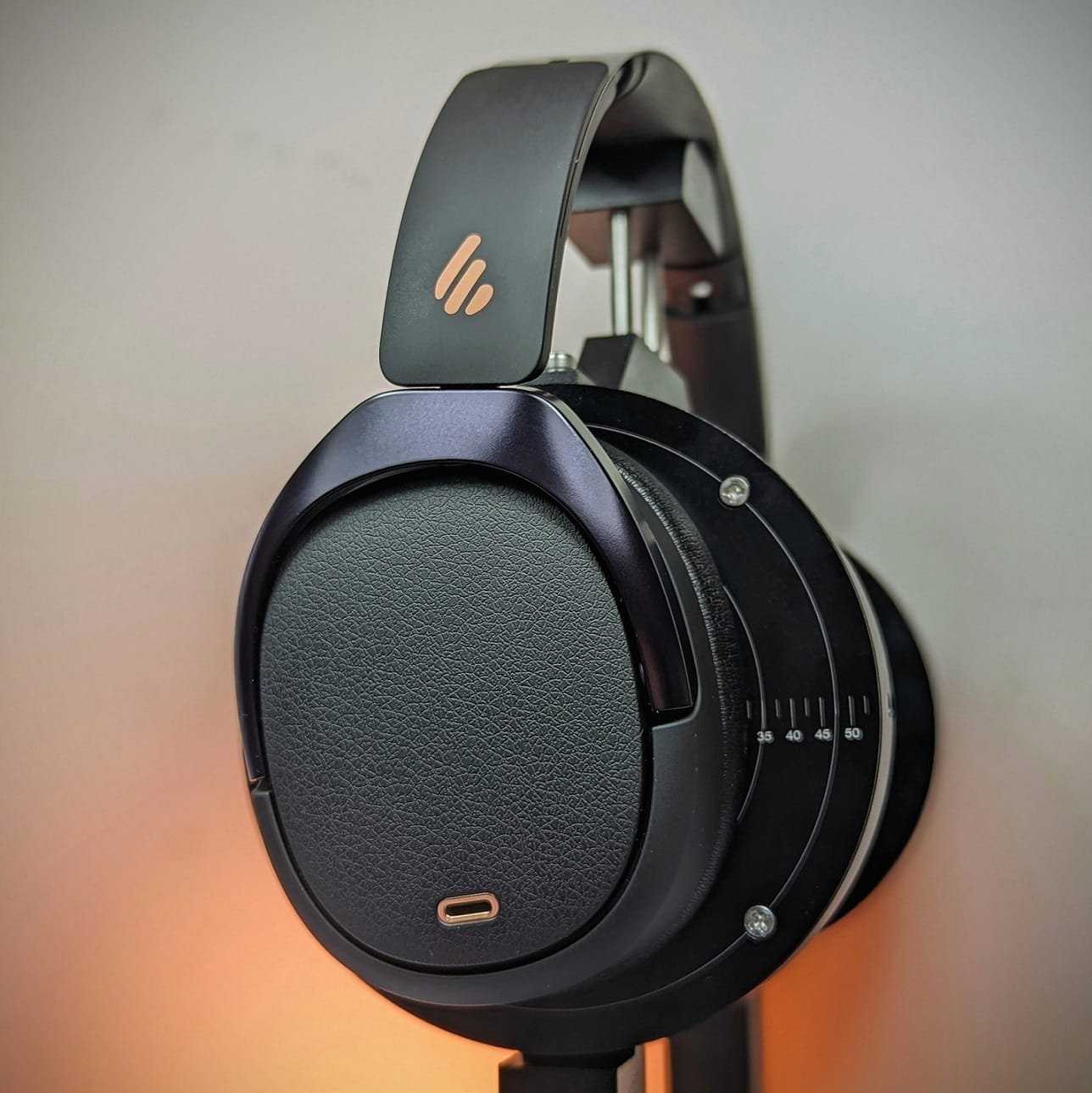
Table of Contents:
Information:
- Release year: 2022
- Country of Origin: China
- Price: 180 € (sales attempted to be limited to certain countries only)
- Color options: Black and white
- Type: Closed, over-ear
- Dynamic 40 mm driver (composite-titanium diaphragm)
- Audio connections: Bluetooth 5.3 and headphone jack (3.5 mm)
- Bluetooth codecs: LDAC, AAC and SBC
- Weight: 296 g
- Battery life: 34 hours (noise cancellation on) and 55 hours (noise cancellation off)
- Charging time: 1.5 hours (supports fast charging: 7 hours of use in 10 minutes)
- Charging port: USB-C
- Adjustable noise cancellation function: High, Low, Wind Reduction, Off and transparency mode (6 different strengths)
- Features: Multipoint and Google Fast Pair support, volume limiter (Safe volume) and three different sound modes: music, movies and games
- Includes phone application and equalizer
- Accessories: fabric-covered case, USB charging cable, 3.5 mm headphone cable and airplane adapter
Review sample: Self-purchased product
In the headphone corner, more and more Bluetooth noise-cancelling headphones have been tested, so we have also closely followed new product releases. One such is the Chinese Edifier's WH950NB, costing around 180 euros (link to the manufacturer's product page), whose sales have so far been limited to certain countries only, such as China, Japan, the United States, Britain, and Germany. This caused a bit of extra effort to order the headphones immediately upon their release, because the manufacturer's affordable W820NB-model previously made a great impression on me both with its sound and the effectiveness of its noise cancellation.
Since the new model currently costs a bit extra when ordered to Finland, I cannot yet strongly recommend it. However, I am proactively writing a review of it with an eye on possible improvements in availability during 2023. Let's see then, what kind of product this really is.
Product packaging
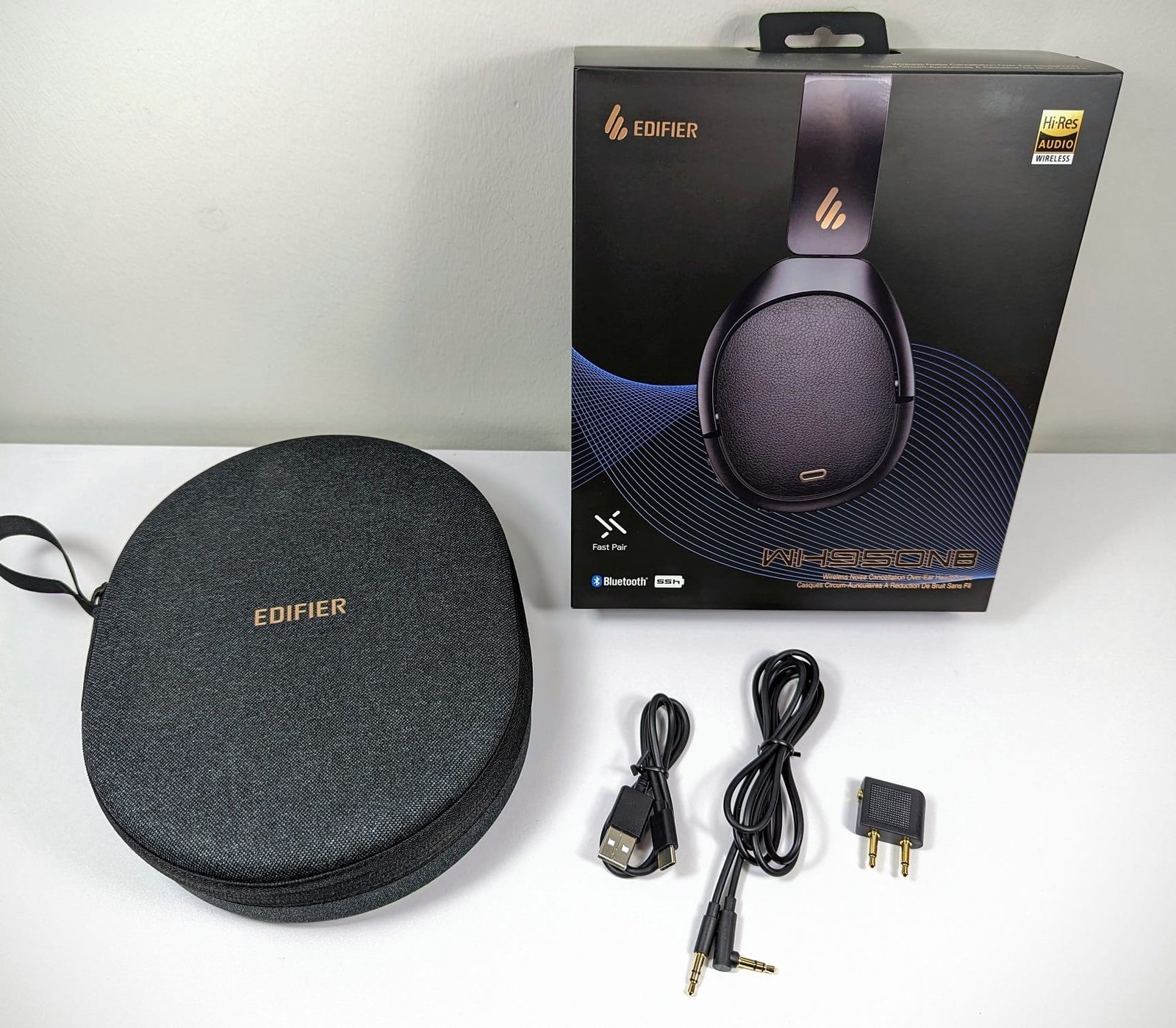
To my knowledge, the WH950NB model is Edifier's most expensive noise-cancelling headphone, a brand known for its affordable products. In any case, efforts have been made through marketing and presentation to create a luxury-style product. The slightly more stylish black cardboard box features embossed detailing, and the fabric-covered carrying case feels high-quality. Additionally, the copper-toned details on the case and headphones create a cohesive look. Otherwise, the WH950NB comes with standard accessories: a USB charging cable, a rubber-coated headphone cable, and an airplane adapter.
Structure and comfort
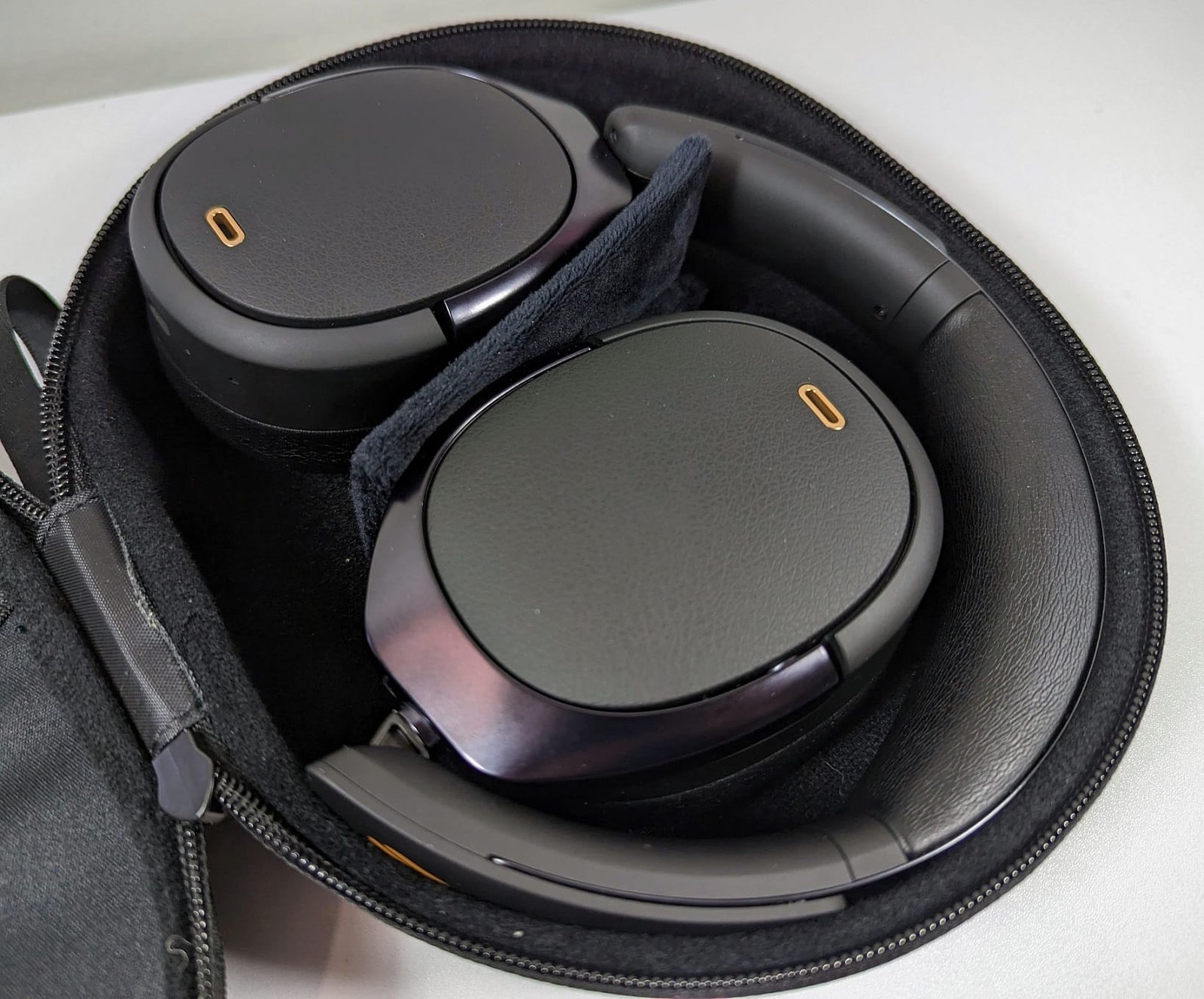
The WH950NB resembles the manufacturer's affordable W820NB model in terms of earcup structure and ear pads, while the metal headband with its height adjustment mechanisms is almost a direct copy from Soundcore headphones, such as Life Q30:s. However, these solutions are not a drawback, as the WH950NB is made from significantly higher quality materials. The plastic feels pleasant and doesn't creak at all when twisting the structure. The earcups, in turn, attach to the headband with robust metal parts, and the hinges that allow them to fold are also durable-feeling and very smooth-moving.

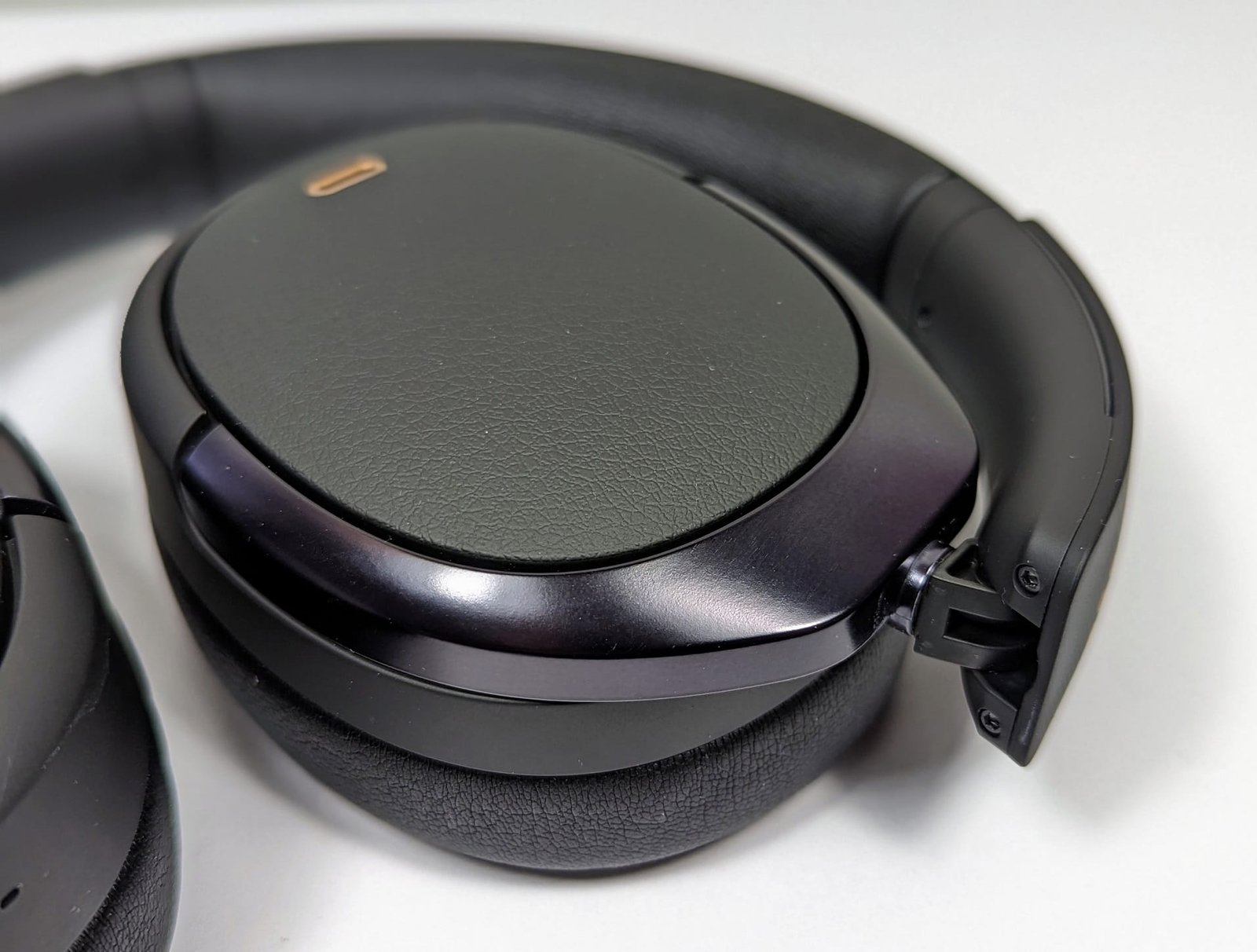
In my opinion, the WH950NB feels higher quality than 100-euro headphones and slightly less expensive than, for example, many 300-euro headphones. This can be considered a good performance in the 200-euro price range, especially when I feel that the 150-euro priced Soundcore Space Q45:s falls short in terms of quality impression. Valco's new VMK25 is pretty much in the same league, being sturdier than the Edifier model when handled.
In my opinion, the WH950NB is a very stylish-looking headphone with its copper-colored details and large metal parts. The sides of the earcups look as if they are covered in black leather, but the material is actually smooth plastic with a leather-like surface texture. You encounter similar finishes, for example, in car interiors, so the WH950NB would be almost perfectly suited as a collaboration headphone for a car brand.
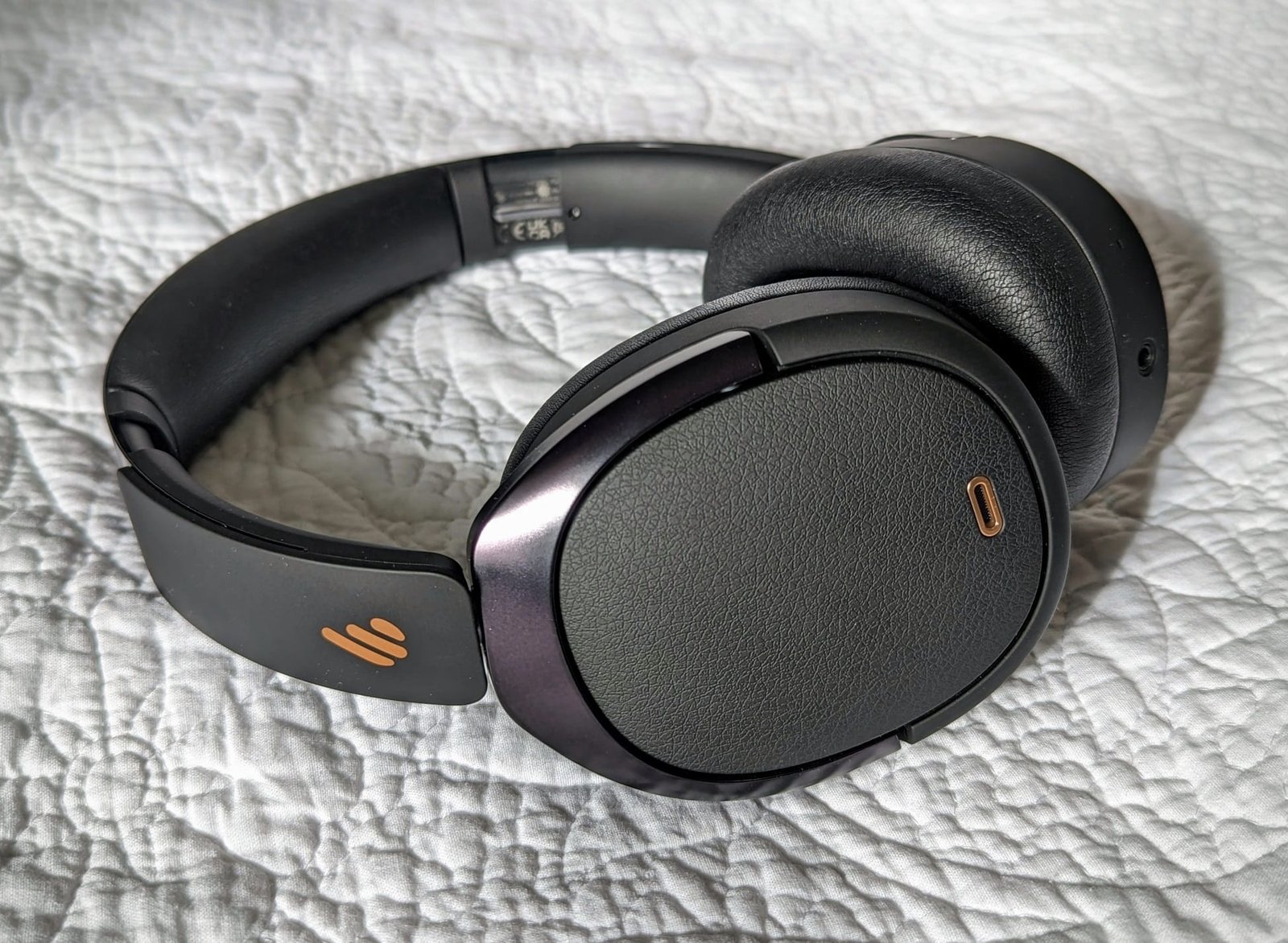
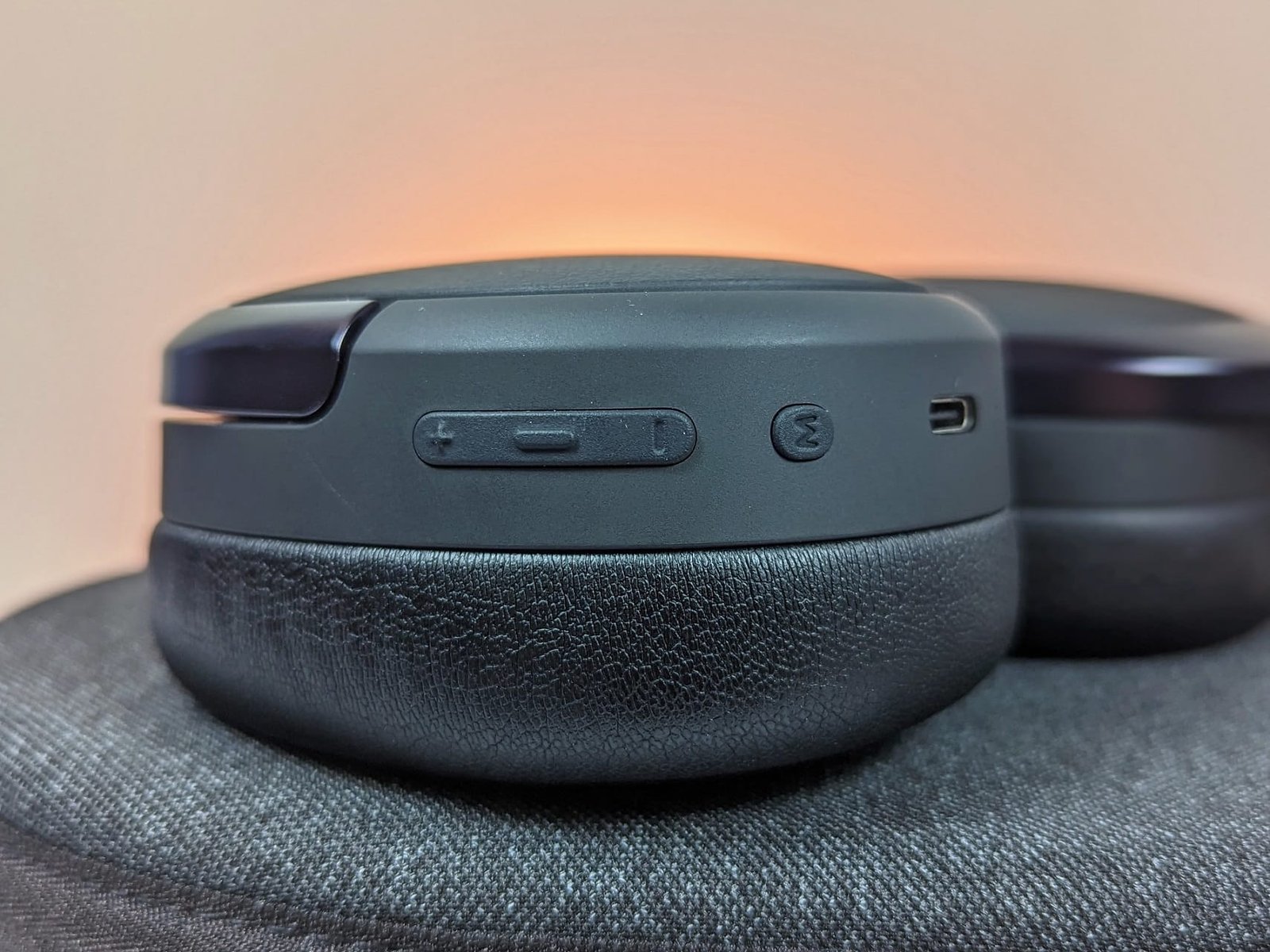
The cheapest-feeling part of the WH950NB are the rubber-coated buttons located behind the right earcup, which are borrowed quite directly from the W820NB model. However, there are only four buttons, and they work well, so I don't have any major complaints about them. The bottom of the right earcup features a USB-C charging connector, and the left earcup has a 3.5 mm headphone jack.
Both the ear pads and the headband padding are thick and soft. The artificial leather used by Edifier looks quite cheap but feels pleasant. The ear pads can be easily removed and replaced. The wearing comfort of these headphones is, for me, excellent compared to, for example, the Soundcore Space Q45 model or both Valco headphones, even though the WH950NB, weighing around 300 grams, is not the lightest noise-cancelling headphone. Of the competitors I recently tested, only Bose QuietComfort SE is slightly more comfortable due to its lighter weight.
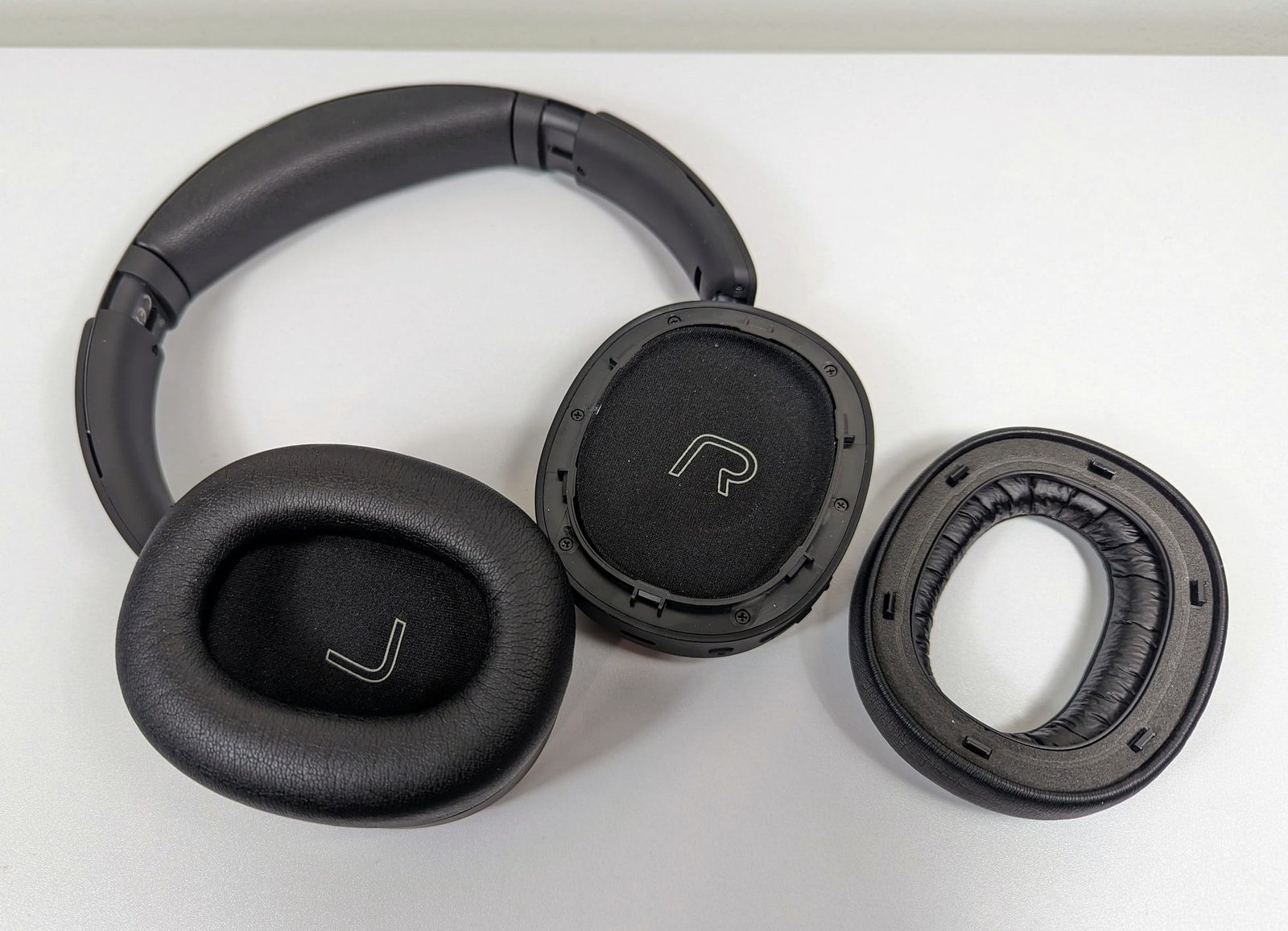
The WH950NB's ear pads are deep enough for me (front of the ear about 2 cm and back 2.5 cm), and no pressure is felt on the top of the head. The clamping force of the headband is also suitably even, not too tight or loose. In terms of comfort, the only minor drawback I would count is that the ear pads, like the W820NB model, seal around the ears like suction cups, which can feel a bit peculiar.
Features and Bluetooth technology
The headphones are pleasantly modern for their price, as they support Bluetooth version 5.3 and the highly regarded LDAC codec. I have found the LDAC connection to be quite stable, as it cuts out less and more imperceptibly than with many cheaper headphones. The range of the Bluetooth connection also seems excellent, and there are no oddities in connecting to devices. Once again, I would hope for support for AptX in addition to the LDAC codec, as its absence forces many devices to settle for the inferior SBC codec.
The WH950NB is, somewhat surprisingly for a relatively affordable product, Google Fast Pair compatible. When the headphones are put into pairing mode, a notification about the possibility of connecting automatically appears on a nearby Android device (Bluetooth must be on). This significantly speeds up setup, as normally the user has to go to the device's Bluetooth settings to find the headphones to connect from a list. Google Fast Pair has been available for a longer time, for example, in Sony's WH-1000X series headphones, but now it has also started to be implemented in many more affordable products.
Edifier praises the sound quality of its headphones' microphones, but owning several different noise-cancelling headphones, I haven't had much time to test or compare it to anything. Based on the video reviews I've watched, the sound produced by the microphones is quite acceptable and doesn't lose out to competitors' products. So, everything is in order in that regard.
Phone application

A phone application called Edifier Connect has been developed for the headphones, through which a few settings and the equalizer can be accessed. For example, the application offers the possibility to choose between different noise-cancelling functions, and a safe decibel limit defined by Edifier can be set for the volume, whatever that may be. The functions of the physical buttons can also be changed, and the volume of sound prompts can be lowered. From the second tab of the application, the sound mode can be selected as either Classic or Dynamic, and a manually customizable Customized mode is also available (I will elaborate on this in connection with equalization). The third tab lists more different sound modes, as Edifier has customized separate settings for music, games, and movies.
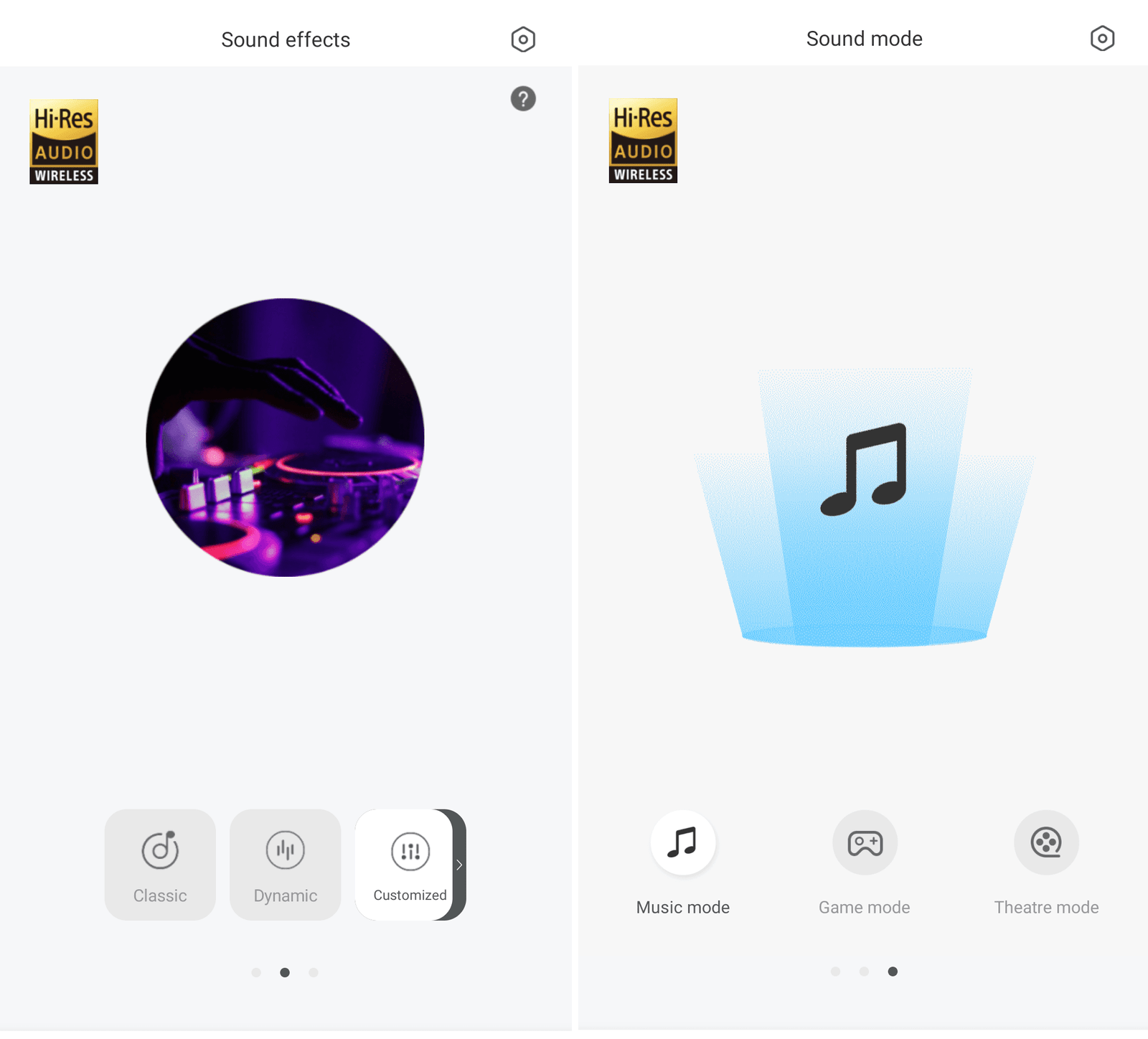
The game mode should apparently lower the latency of the Bluetooth connection, but in my opinion, Bluetooth headphones should not be used for gaming at all, as the latency is never particularly low. The movie setting, named Theater mode, is peculiar because it activates some kind of spatial effect that causes a strong echo. I have only used the headphones in music mode because it does not add any additional effects to the sound.
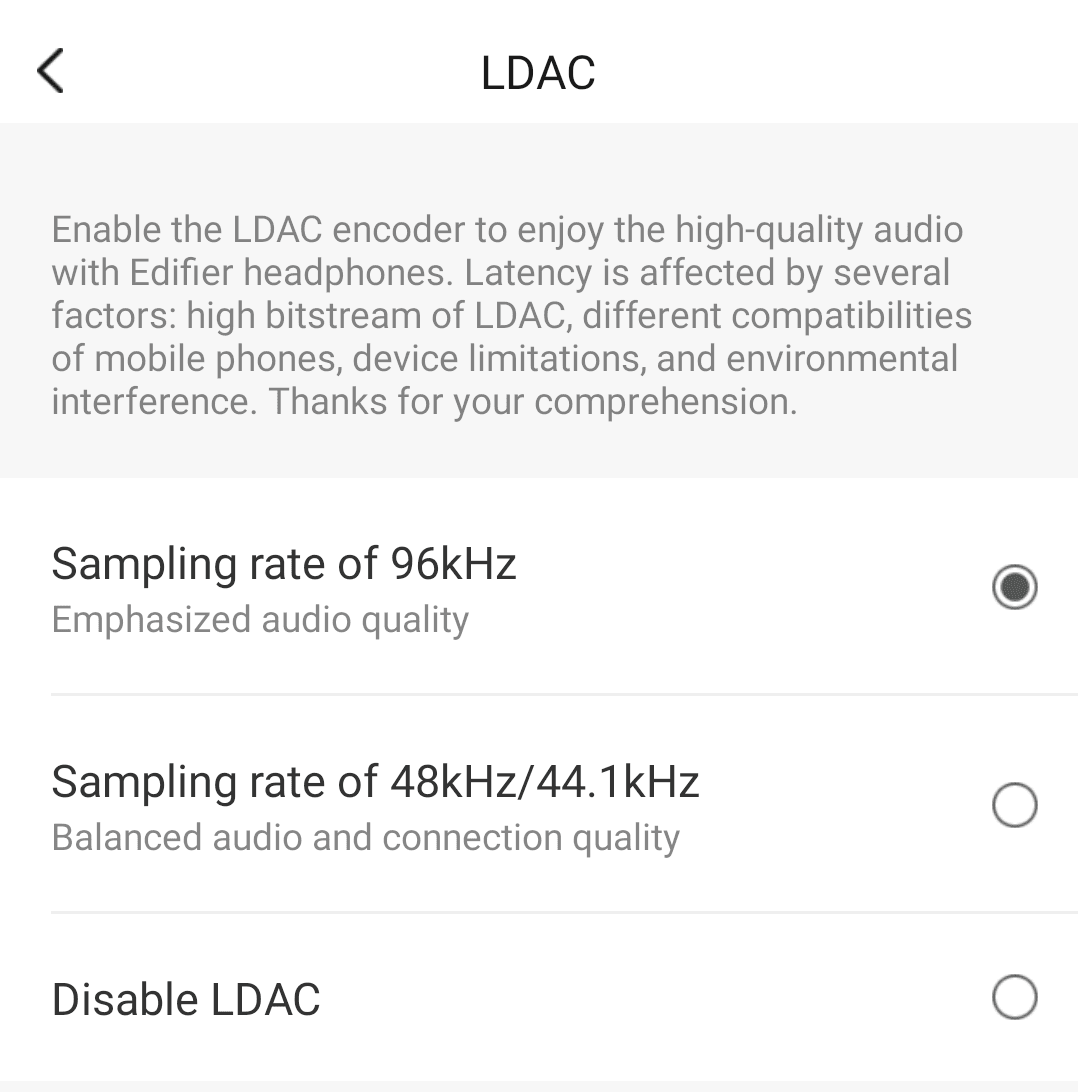
Those aiming for the best possible sound quality should remember to activate the LDAC codec separately from the application, as it is not selected by default.
Battery life
The WH950NB's battery is promised to last about 34 hours with noise cancellation on and 55 hours without noise cancellation. These figures are commendable, so the headphones perform well against their competitors in terms of battery life. If the battery runs low, a 10-minute quick charge provides an additional 7 hours of listening time. However, Edifier does not specify whether this applies to listening with noise cancellation on or off – if one had to guess, the latter is probably more likely, as manufacturers usually lean towards their own advantage in marketing materials when given the opportunity.
In any case, the battery does not need to be charged often, at least when the headphones are new. Battery life will likely deteriorate over time in all battery-powered products, which is unavoidable. On the positive side, the WH950NB can be listened to without power using a headphone cable, although it is not recommended in terms of sound quality.
Active Noise Cancellation (ANC)
Edifier's affordable W820NB model was surprisingly effective in its noise-cancelling function in my tests, so I naturally expected a lot from the more expensive W950NB as well. Unfortunately, it is not significantly better, which is not a disaster, however. On the positive side, the headphones have practically no background hiss, and I also don't feel pressure in my ears when using the noise-cancelling function.
The WH950NB's noise-cancelling function can be set to a more powerful High mode or its effectiveness can be lowered in Low mode. The headphones also have a separate Wind Reduction mode to reduce wind-induced rustling, if needed. I found the transparency mode, which lets ambient sounds into the headphones, to sound somewhat unnatural, even though its volume is adjustable in six steps. For example, Bose's transparency mode and, somewhat surprisingly, also Focal Bathys' the corresponding setting sounds more natural. However, in my opinion, the WH950NB is an improvement over the Soundcore Space Q45 and Valco VMK25. Edifier's headphones can also be used with noise cancellation and transparency mode turned off.
The effectiveness of noise cancellation, even with the more powerful High setting, does not reach the level of the Soundcore Space Q45, which is surprising, as I thought the W820NB was even better. However, I unfortunately no longer own the more affordable Edifier model, so I have to rely on my notes. I usually compare noise-cancelling headphones by listening to sounds imitating airplane travel, miscellaneous cafe noise, and human speech from, for example, a TV show or YouTube video, played through speakers at about 85 decibels.
The Edifier WH950NB attenuates all kinds of sound somewhat less than the Soundcore Space Q45, being quite on par with the Valco VMK25. The significantly more expensive Focal Bathys is also very similar in noise cancellation effectiveness, if not even surprisingly identical. I wouldn't be surprised if Bathys' noise cancellation technology was based on a very similar noise reduction algorithm to what Edifier utilizes.
Overall, the WH950NB performs quite well, even though it lets through more high-frequency noise and human speech compared to the best noise-cancelling headphones, such as the Bose QuietComfort SE model I had as a reference at the same time. The biggest advantage of the Edifier model is the absence of background hiss, making it pleasant to use. Bose headphones and Valco VMK25 have some hiss, and Soundcore Space Q45 has a remarkably loud hiss. The more expensive Sony WH-1000XM4 is as quiet as the WH950NB, so Edifier has invested in the quietness of the headphones' internal electronics.
Sound quality
Headphone frequency response measurements have been performed with equipment compliant with the IEC711 standard. The graphs use the Harman target curve (2018 version), based on scientific research, as a reference, which is a generalization of what kind of frequency response sound would sound good to most people. More information about my measurements and their accuracy can be found Headphone Measurementson the page. The WH950NB's frequency response can also be compared with other headphones I have measured comparison tool .
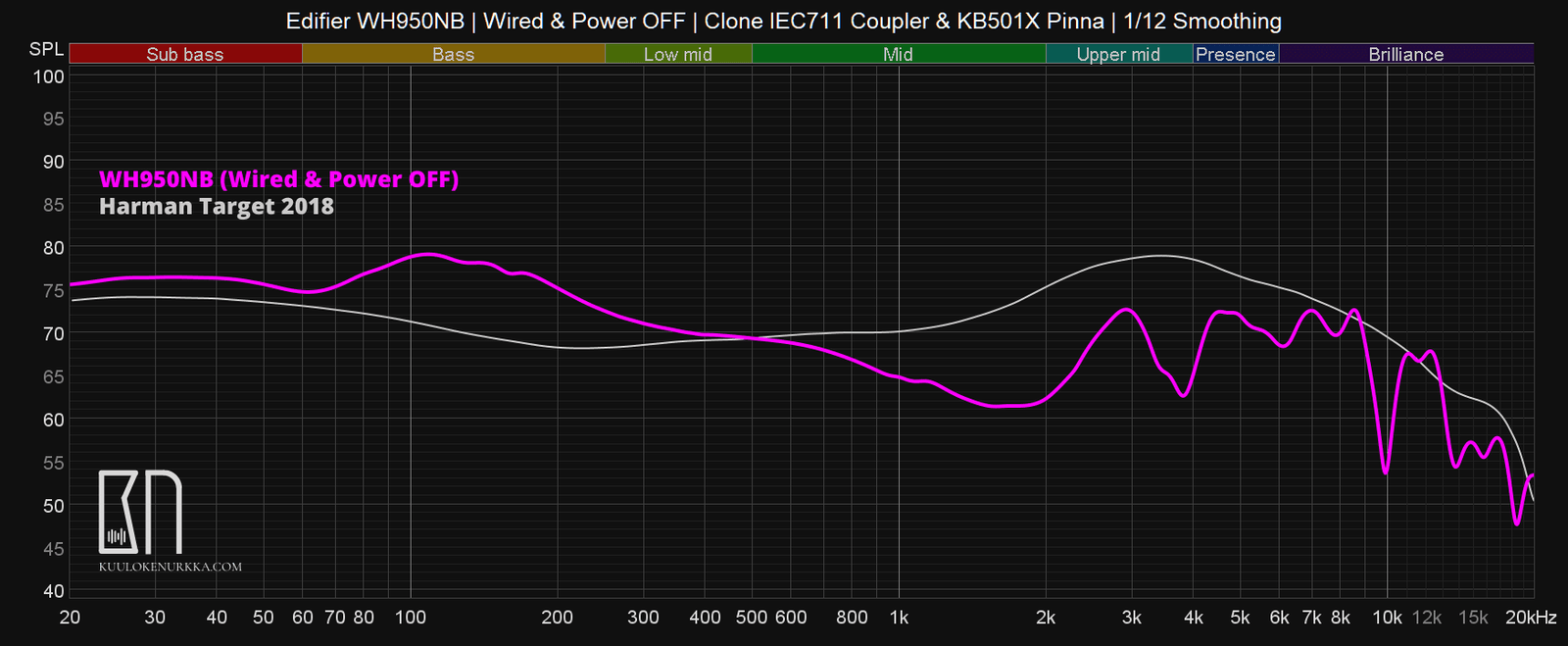
The headphones feature the Classic and Dynamic sound modes I mentioned, of which Edifier has chosen the Classic option as default. Dynamic mode boosts both bass and treble, but the frequency response is otherwise identical. Turning off the noise cancellation further increases the bass in both sound modes, so the most balanced result is achieved with noise cancellation on. The WH950NB can also be listened to with a headphone cable without power, in which case the sound is, however, very poor, with the mid-frequencies almost entirely absent. Edifier has not tried to make the headphone driver sound good by optimizing the cup structure; instead, the final sound quality is largely based on DSP correction using internal electronics.
Frequency response when listening with a cable and power off:
Frequency response in different sound modes with noise cancellation enabled:
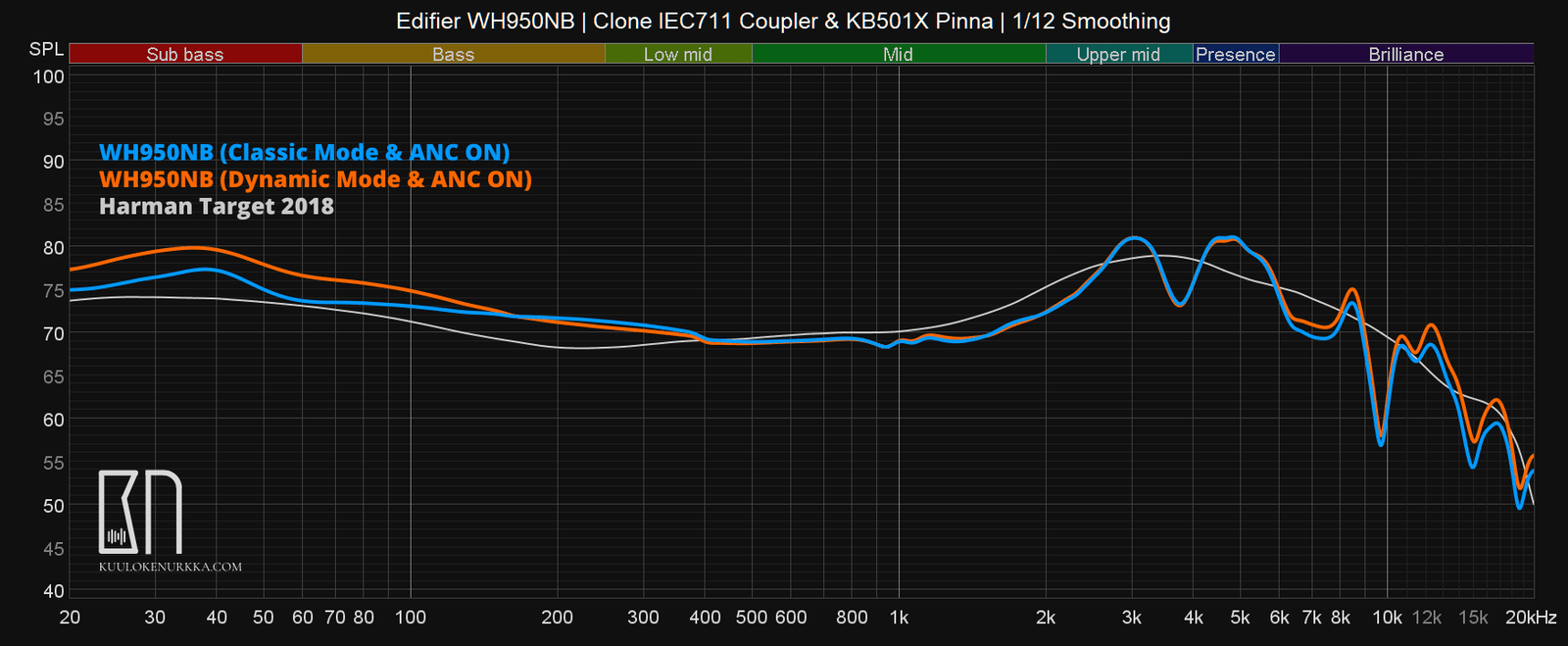
The WH950NB's sound in Classic mode is clear and energetic, which is due to a strong emphasis in the 4–6 kHz frequency range, i.e., the so-called presence region. The slight thinness of the mid-frequencies and somewhat subdued high frequencies make the reproduction even more focused on this single frequency range. Vocal performances, in particular, are reproduced in an aggressive and artificial style, and the reproduction otherwise feels sharpened and somewhat hissy. The penetrating presence of the sound is sure to captivate, but the WH950NB is quite fatiguing to listen to in the long run.
On the other hand, there's nothing fundamentally wrong with the headphones otherwise, as the bass, for example, is not overemphasized, and there's no jarring unevenness in the upper treble frequencies. After reducing the volume, I find the result more balanced than, for example, in Sony headphones that offer a monotonous bass rumble (e.g. WH-1000XM5) or Bose's overly bright QuietComfort SE model. The similarly priced Valco VMK25 sounds more neutral and, despite its slight brightness, less fatiguing than the Edifier, but the WH950NB's fuller bass might appeal to many.
Edifier's headphones also allow activating Dynamic sound mode, which boosts bass reproduction and slightly boosts high frequencies. In theory, the sound should become more V-shaped and unbalanced, but I instead find that boosting the extremes of the frequency band balances out the emphasis in the presence region. In Dynamic mode, the WH950NB's sound at a similar volume is more fun, spacious, and detailed. In Classic mode, the high frequencies are so heavily overshadowed by the presence region that it's difficult to discern many details and sound locations. Dynamic mode remedies these issues, making the sound literally more dynamic and transparent-feeling.
At higher volumes, the excessive bass rumble still becomes too much for me, and the aggressiveness of the presence region hasn't disappeared either. Despite the improvements in Dynamic mode, the WH950NB is a rather mediocre headphone in terms of detail, reproduction accuracy, and soundstage, though not worse than most of its competitors. Since the biggest differences in affordable headphones are based on frequency response, it's good that Edifier offers a versatile equalizer for the WH950NB.
Equalization
Edifier's equalizer differs slightly from those I've used before, as its parametric adjustments are precisely customizable, but for some reason, each control still has strict frequency limits:
- Control 1: 20–200 Hz
- Control 2: 201–3000 Hz
- Control 3: 3001–5000 Hz
- Control 4: 5001–10,000 Hz
Each control can be moved after selecting the frequency by a maximum of 3 decibels upwards or 9 decibels downwards. A Q-value (0.5–2.0) can also be selected for the adjustments, which affects how narrow or wide a frequency range each change impacts. With a small Q-value, the adjustment extends further around the selected frequency, whereas with a high value, a steeper change can be made to a narrow frequency range. The WH950NB's sound is thus quite versatilely modifiable, but it requires some understanding of how each frequency affects the overall sound. In my opinion, it would be sensible for headphone manufacturers to publish frequency response measurements of their headphones, which would make adjustments easier to perform.
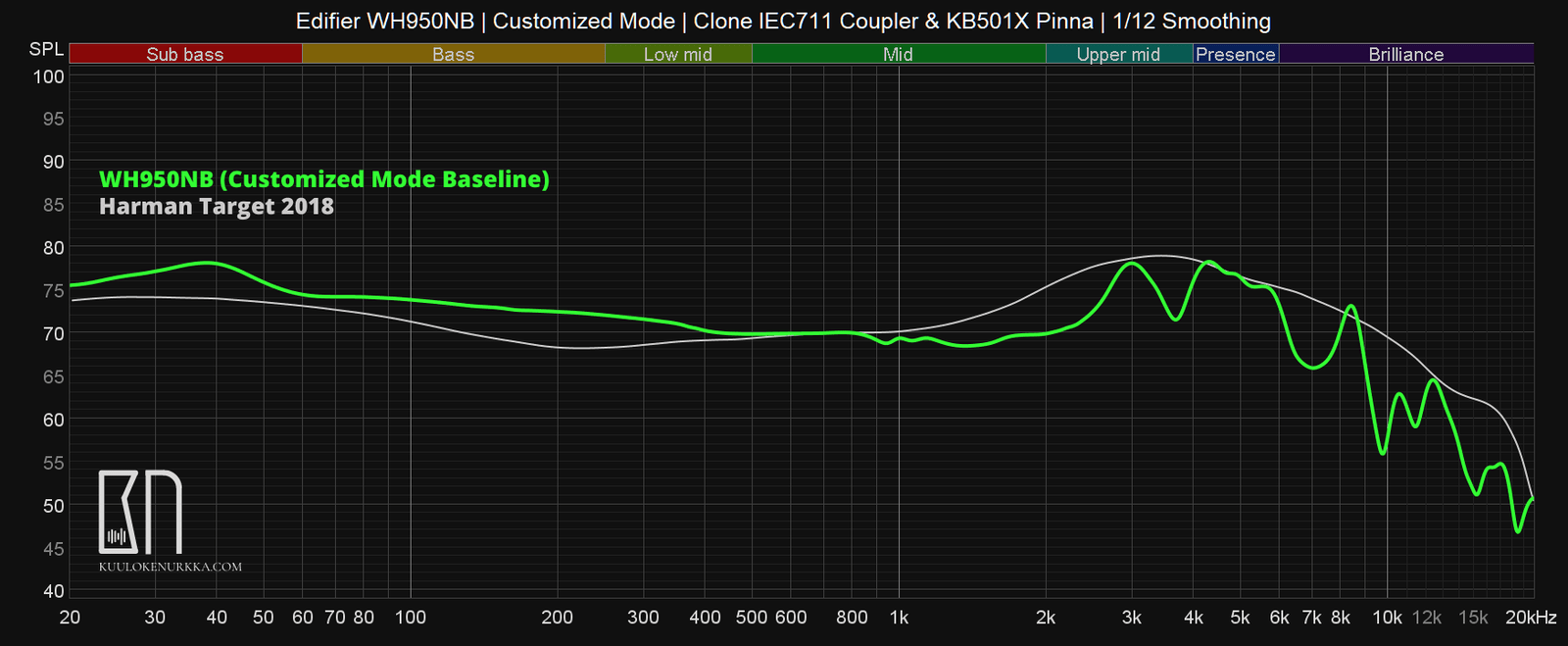
The WH950NB is an interesting headphone in that its frequency response is more balanced and less aggressive compared to the Classic and Dynamic sound modes, simply by activating the equalizer without making any adjustments. Edifier's own sound modes are separate variations of the underlying initial DSP correction. This makes equalization slightly more challenging, as it's not possible to model it after the frequency response of the Classic or Dynamic modes.
I first measured the frequency response as a reference with the Customized sound mode (equalizer) activated:
The sound improves further with, for example, the following adjustments:
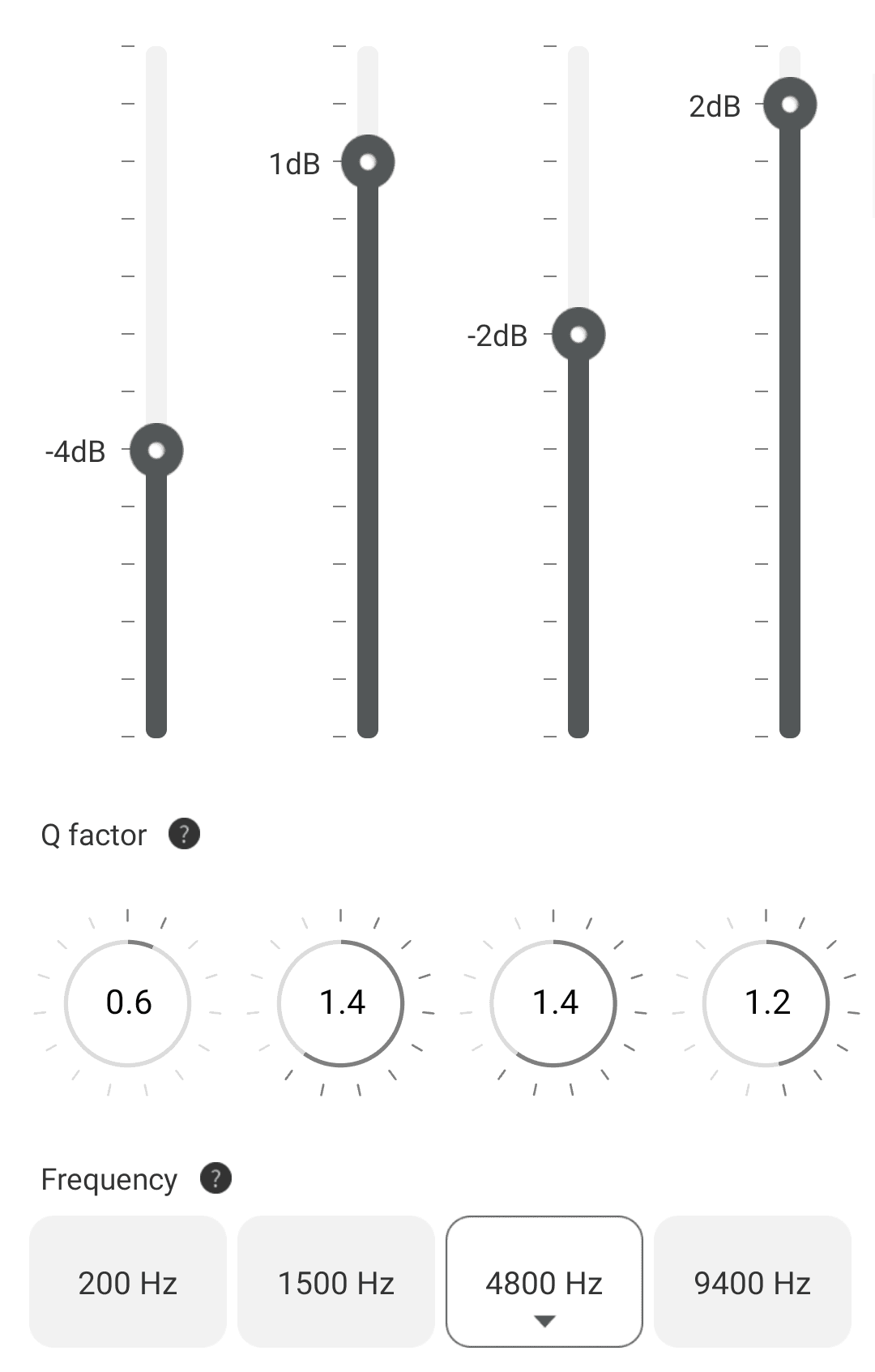
...whereupon the frequency response looks like this:
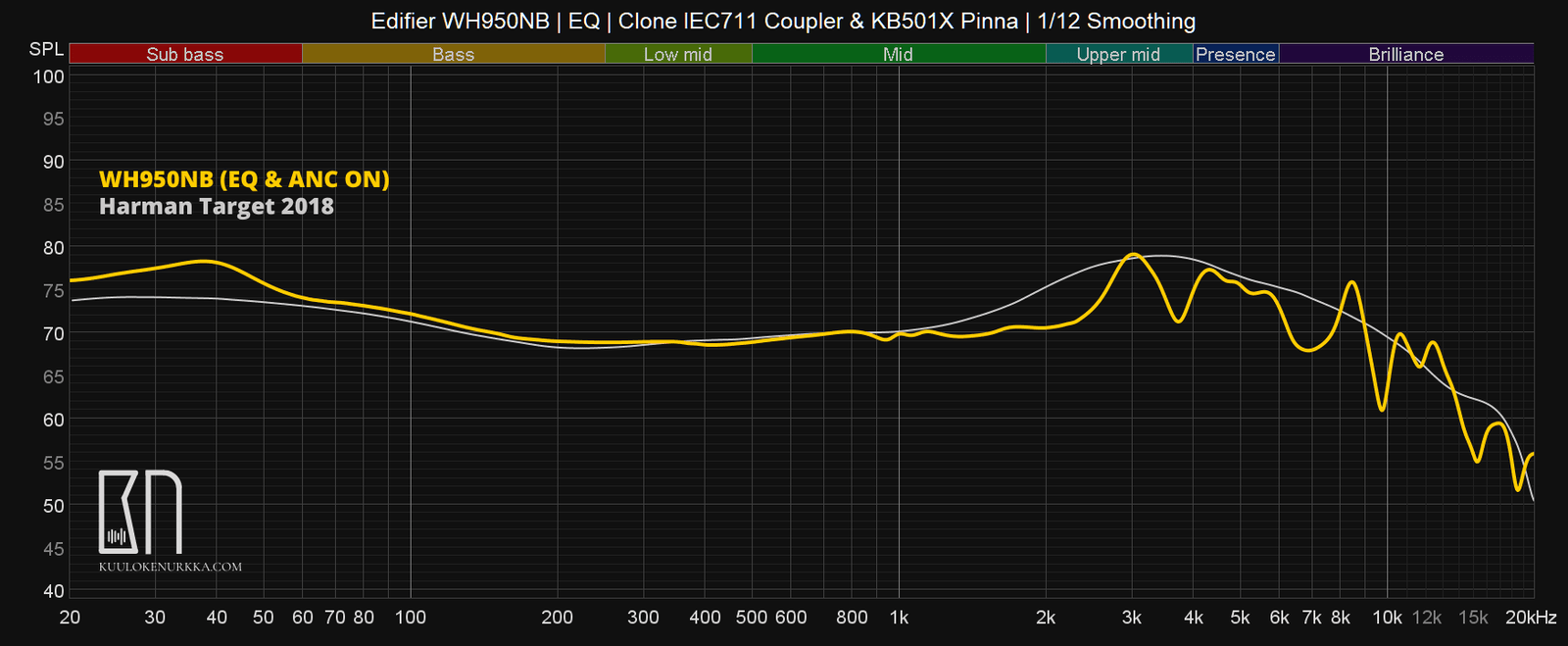
A drawback of equalization is the reduction in volume adjustment range, as for example, when listening to classical music recorded quietly, the volume might remain too low. However, when listening to more normal music, the volume can still be set sufficiently loud.
The equalized WH950NB is, to date, the most balanced and largely the best noise-cancelling headphone I've heard released for under 200 euros. There is nothing distracting or jarring in the sound; instead, listening is engaging and appealing. The reproduction is also dynamic with a suitable frequency response. I was able to ”trick” the headphones into producing a rather spacious and pleasant soundstage by making the upper-mid frequencies around 2 kHz less present than Harman's target curve would require. The center of the soundstage remains quite vague, but considering the closed design, the sound has a nice sense of forward depth. The drivers are correctly angled towards the ear, which certainly contributes to the formation of a functional soundstage.
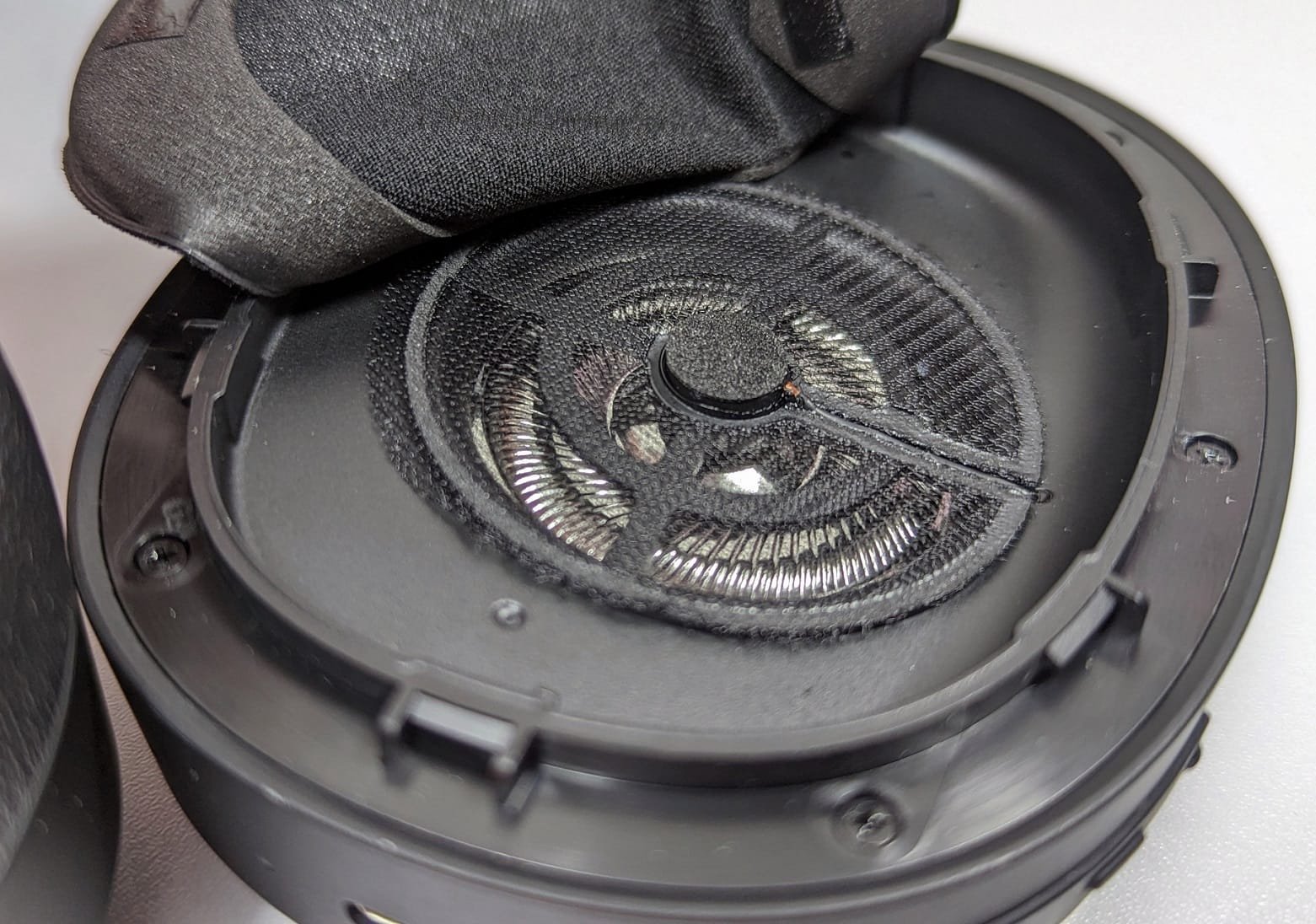
Additionally, it was possible to get punchy and tight bass reproduction without compromising the clarity of the mid-frequencies. The WH950NB does not seem to be inherently particularly resolving, but it feels surprisingly fresh and detailed when reproducing sounds with moderately sharp edges. I can quite easily forget that I am listening to Bluetooth headphones, especially when the LDAC codec causes hardly any audio dropouts.
Chances of success in the 200 euro price range
In my opinion, despite its default frequency balance issues, the WH950NB is among the better options in its price range, especially among so-called consumer-friendly headphone models (where the aim is to impress the buyer with powerful bass and bright high frequencies at the expense of natural sound). Most competitors go too far in emphasizing bass and treble (or both), whereas the WH950NB's sound is tuned quite evenly, making it easy to equalize.
Among competing products, for example, the 150-euro Soundcore Space Q45 sounds significantly more irritating and uneven by default. The headphones also have stronger emphasis in narrow frequency ranges, making it impossible to equalize the sound as evenly as with the WH950NB. In other respects, the Space Q45's noise-cancelling function is somewhat more effective, but it has noticeably stronger background hiss. Since the features of both headphones are similar and the WH950NB's comfort is better, I ultimately consider it the slightly better headphone of the two. On the other hand, the Space Q45 model has been sold for as low as 110 euros, so the price is clearly in its favor.
The Valco VMK25 is more suitable in sound for those seeking a more neutral and detailed hi-fi reproduction, but some find the bass too subdued. The headphones also cannot be equalized, nor are there any other additional features. The Edifier model, however, offers more versatile sound adjustments. The noise-cancelling function of the VMK25 and WH950NB, on the other hand, does not significantly differ in effectiveness in either direction, nor can the build quality or comfort be said to be significantly better in one over the other. I wouldn't be able to name a clear winner between the two, but thanks to better availability and warranty, Valco's headphones are at least for now a more sensible purchase for most.
Bose sells its QuietComfort SE model, which has effective noise cancellation and excellent comfort, for as low as about 200 euros. In my opinion, it offers better value for money than the WH950NB for those primarily seeking effective noise cancellation and easy-to-use everyday headphones. However, the Edifier model sounds slightly better by default and is more modern in its features. Both headphones can be made to sound good with equalization, but the QuietComfort SE sounds softer and less dynamic with the SBC codec than the WH950NB with LDAC. The Edifier model would therefore be a better purchase in terms of sound quality. Its equalizer is also more versatile.
Summary
In my opinion, Edifier has succeeded in making the WH950NB a competitive product, but it is difficult to buy due to limited purchasing options. For example, Amazon Germany and Aliexpress refuse to ship the headphones to a Finnish address. Ordering by paying extra VAT is possible, for example, from Amazon UK and Japan, but then the price rises to around 230 euros. This is a shame, as I have already seen the headphones on sale for about 150 euros, which makes them an even more attractive purchase. If someone is interested in the WH950NB, it is worth looking for it in the Amazon selections of different European countries. Sometimes a seller may agree to ship to Finland, and the headphones may even come from Amazon's own warehouse, in which case Amazon handles shipping and support in problem situations.
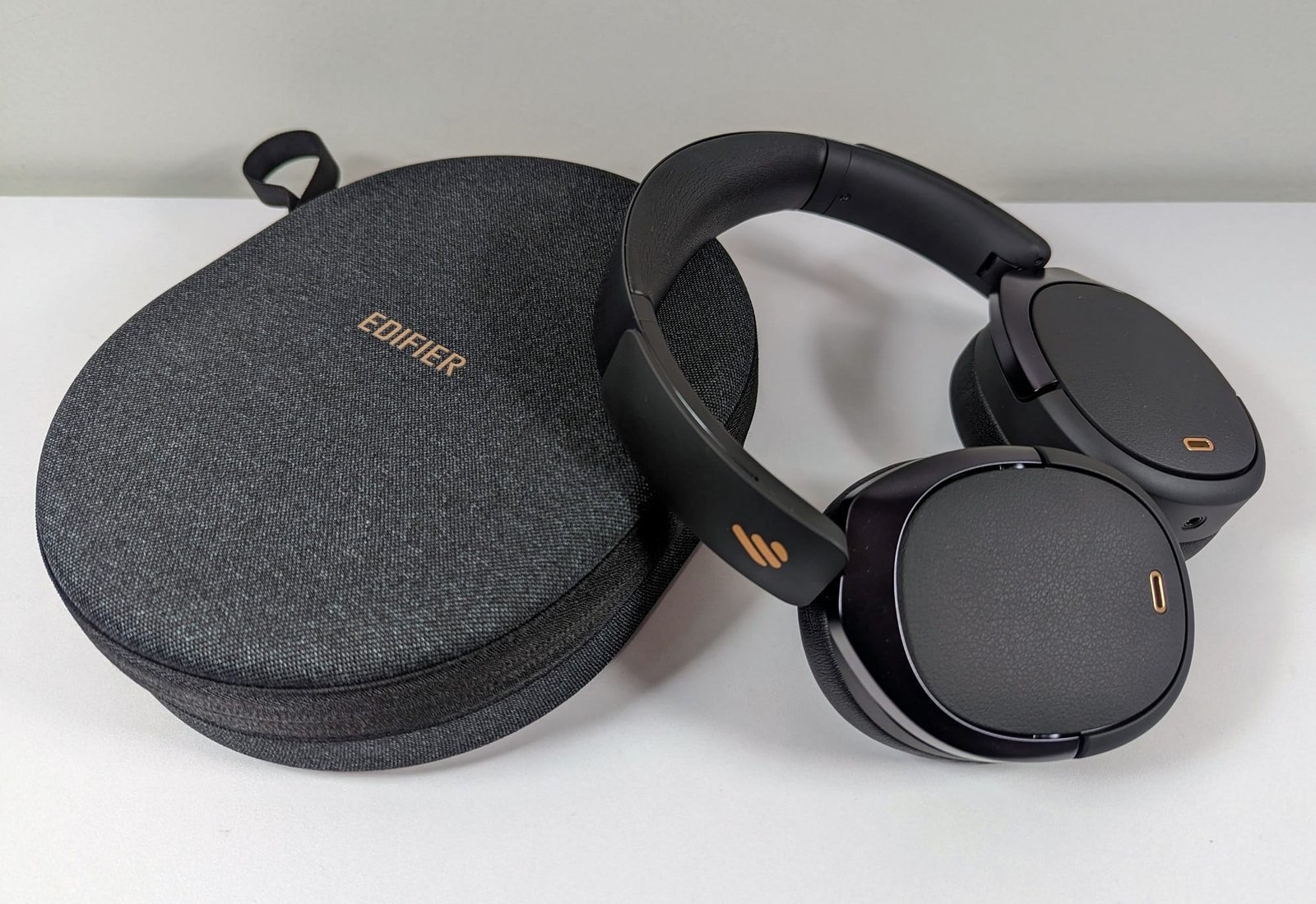
The sound of the WH950NB model is overly aggressive by default, but this can be resolved with the equalizer provided by the manufacturer. The headphones have modern features, and their noise-cancelling function is good for the price. There is also nothing to fault in the design or material choices of the construction – I actually find the headphones' appearance stylish. A white color option would also be available if someone doesn't like black headphones. All this considered, the WH950NB is a refreshingly successful product that increases competition in the sub-200 euro price range. On the other hand, consumers currently have several more easily available options in the 150–300 euro price bracket, so the WH950NB might largely remain an forgotten product at this rate.
Pros and cons:
+ More balanced frequency response than many competing products
+ It is possible to make the sound excellent with equalization
+ LDAC codec support
+ Good comfort
+ Stylish appearance
+ Noise-cancelling function is effective for the price
+ Practically no background hiss
+ Modern features, such as Google Fast Pair support and a versatile equalizer
+ Good carrying case
+ Competitive price
– Strong emphasis in the presence region makes the sound unpleasantly aggressive and artificial
– Sound quality when listening with a cable is exceptionally poor
– Equalizing clearly reduces the volume adjustment range
– No support for AptX codec
– Suction cup-like ear pads may feel a bit strange
– Headphone availability is poor
 EN
EN  FI
FI
Hi,
Although Valco's headphones do not have an equalizer, there is one in the Spotify app, for example, so a little compensation can fortunately be obtained that way.
Do you have any plans to review Edifier Stax Spirit S3 and S5?
Currently, no, as they aren’t that common or popular here in Finland. The S3 especially is getting a bit old already, but the S5 might be somewhat interesting for me, if it gets cheaper at some point.
There’s one used for sale in Tori.fi right now under 400€
Yeah, and I believe I actually already reviewed the same unit a while ago. 🙂