Author: Sword of Damocles
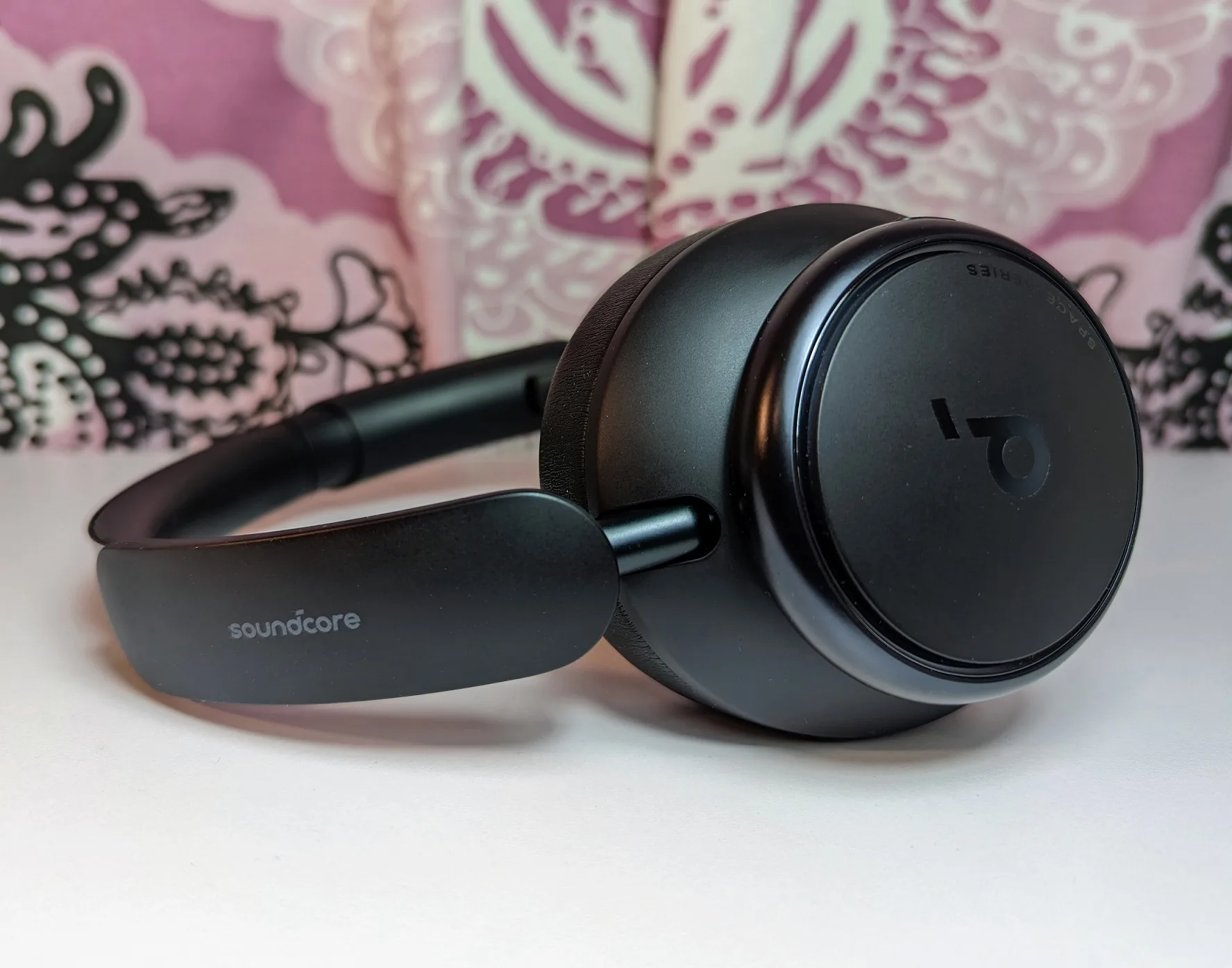
Table of Contents:
Information:
- Release year: 2022
- Price: 150 €
- Color options: Black, white and blue
- Type: Closed, over-ear
- Dynamic 40 mm driver (made of silk and ceramic materials)
- Audio connections: Bluetooth 5.3 and headphone jack (3.5 mm)
- Bluetooth codecs: LDAC, AAC and SBC
- Weight: 295 g
- Battery size: 750 mAh
- Battery life: 50 hours (ANC on) and 65 hours (ANC off)
- Charging time: 2 hours (supports fast charging: 5 minutes for 4 hours of use)
- Charging port: USB-C
- Adaptive and adjustable noise cancellation function: On/Off/transparency mode
- Includes a phone app with a comprehensive equalizer
- Accessories: hard-shell protective case, USB charging cable and 3.5 mm headphone cable
Review sample: Self-purchased product
Chinese Anker manufactures affordable noise-cancelling headphones under the Soundcore brand, of which we have already reviewed the Life Q30 model (link to review), which is often sold at a discount for about 60 euros. This time I am reviewing the new model released at the end of 2022, the Space Q45 model, which at its 150 euro price is currently the manufacturer's most expensive headphone model. Despite this, these are relatively affordable noise-cancelling headphones compared to many more popular models, especially since the Q45 has already been sold at a discounted price of 120 euros. The headphones can be ordered, for example, from the manufacturer's own EU store.
Product package content
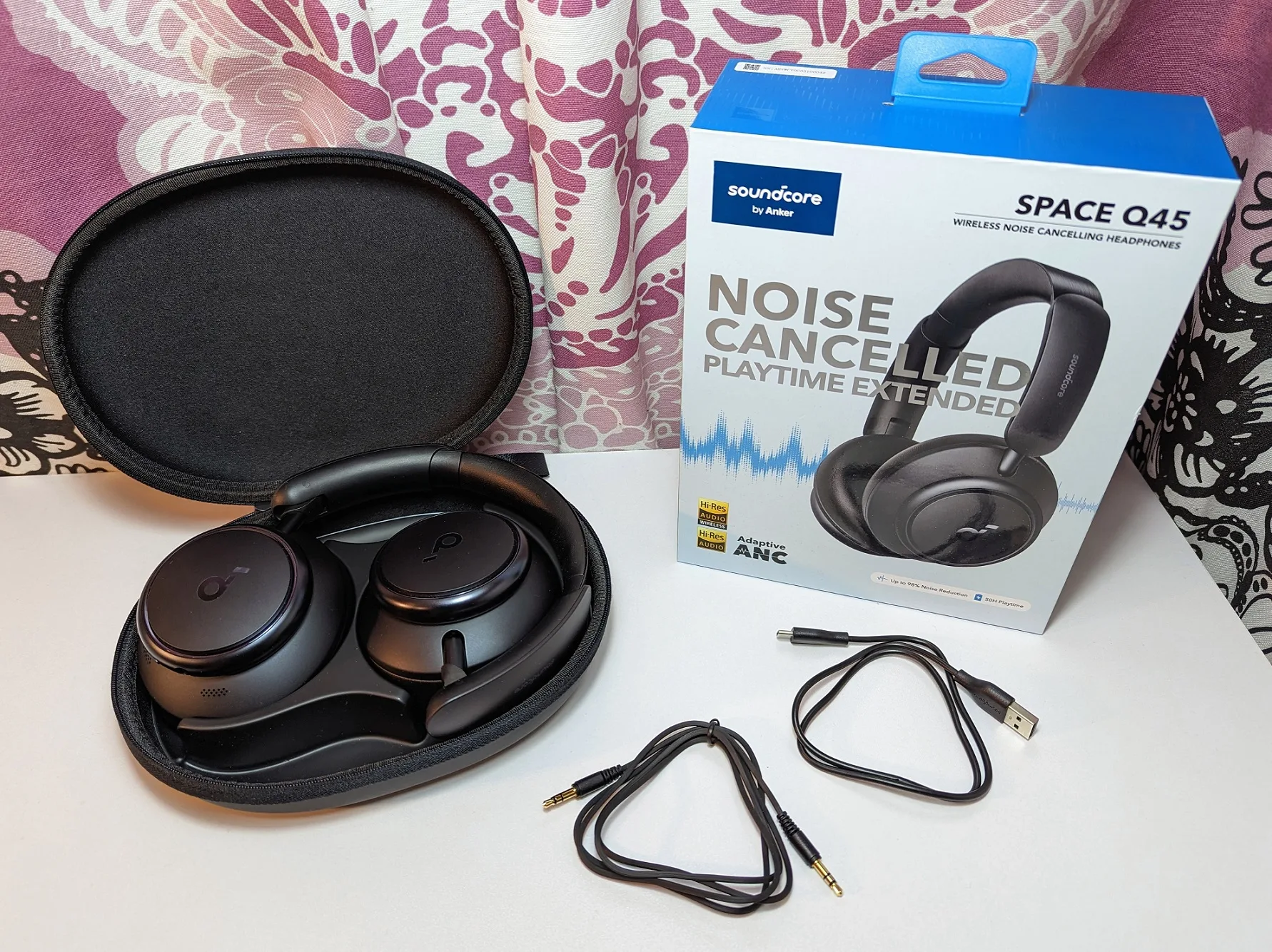
The Space Q45 is delivered in a cardboard box that is clearly designed to be placed on a store shelf. The headphones are packed in the included hard-shell carrying case, which is a practical size – for example, the case for Sony's XM4 headphones is quite similar. A short USB-C to USB-A cable is provided for charging the battery, and since the headphones can be listened to with a cable, a 3.5 mm AUX cable is also included. Both cables are thin and flimsy, and will never stay straight.
Inside the carrying case there is a plastic ”tray” which makes it easier to correctly place the headphones inside. I myself have removed the tray because the headphones fit better in the case without it. The Q45 folds up in a similar way to, for example, Sony's WH-1000XM3 or -XM4, so there is hardly any wasted space in the case.
Structure
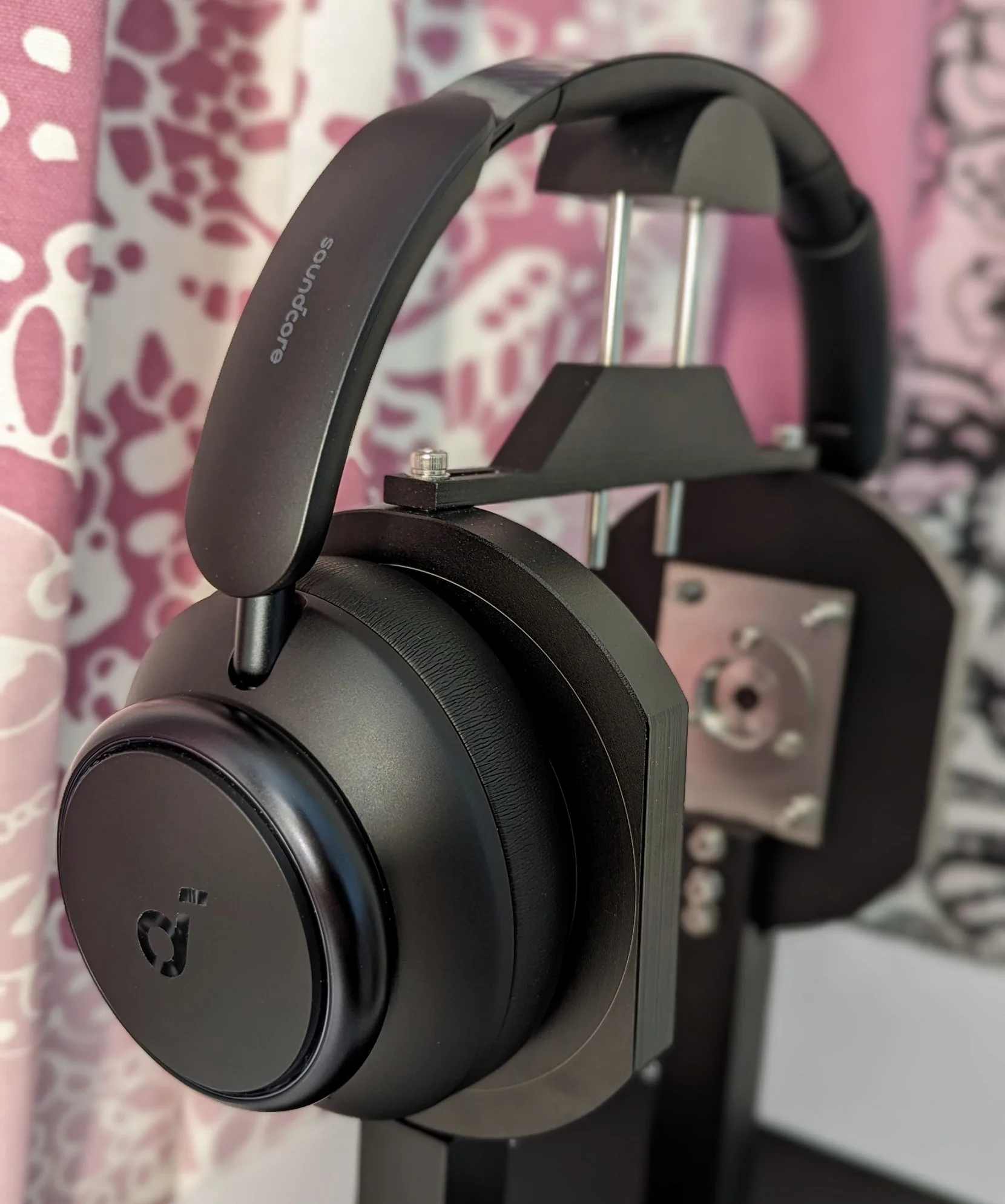
The Space Q45 is a significant improvement in build quality compared to the half-price Q30 model, even though plastic is still the main material. Now the plastic is both sturdier and more pleasant to the touch, so in my opinion, the impression of quality corresponds to the 150 euro price point for noise-cancelling headphones. Although a creaking sound can still be heard when twisting the headphones more forcefully, it does not occur in normal use. Moving parts, such as the aluminum hinge components that allow folding, seem strong. However, the Q45 weighs 295 grams, so it is not among the lightest noise-cancelling headphones.
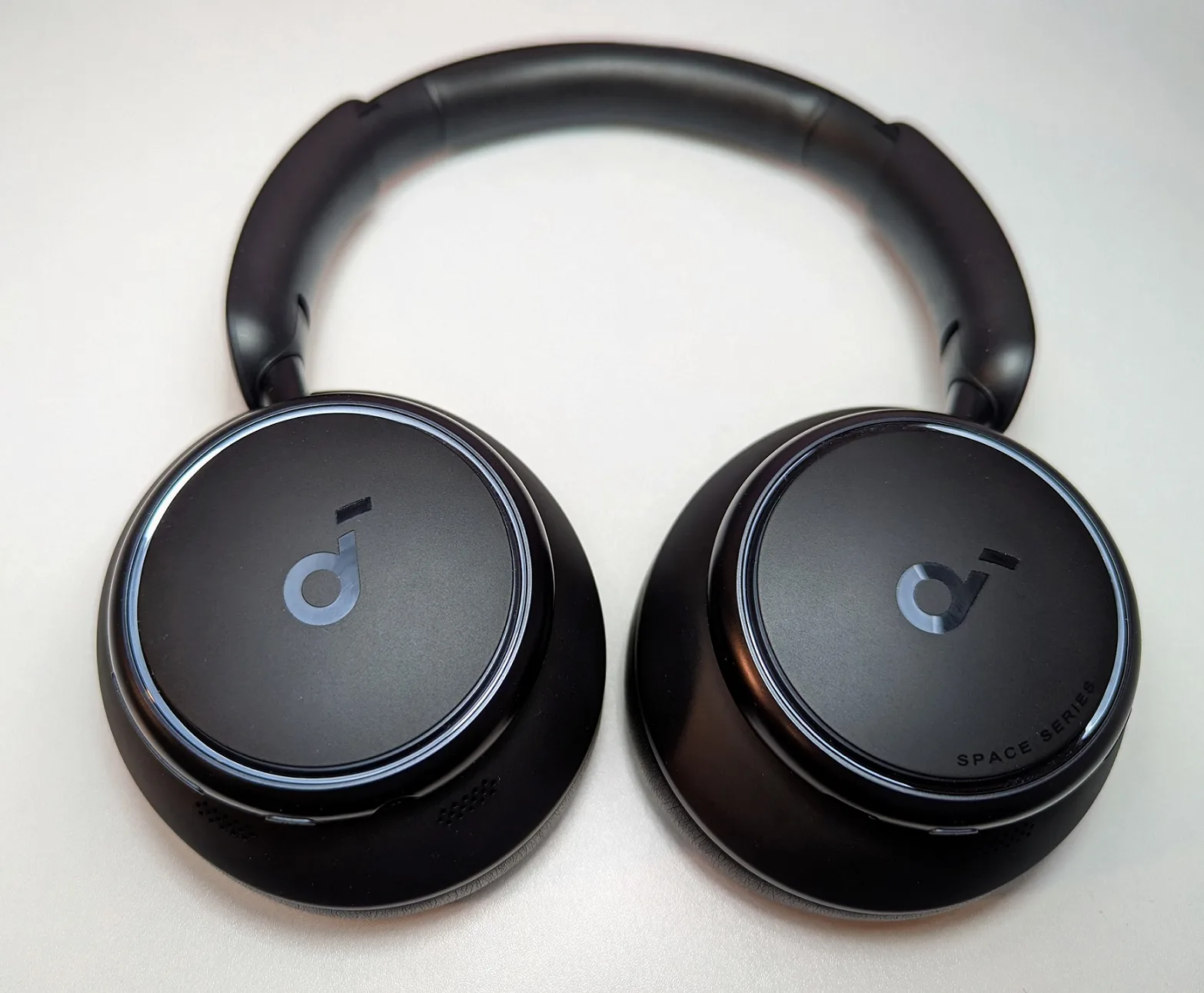
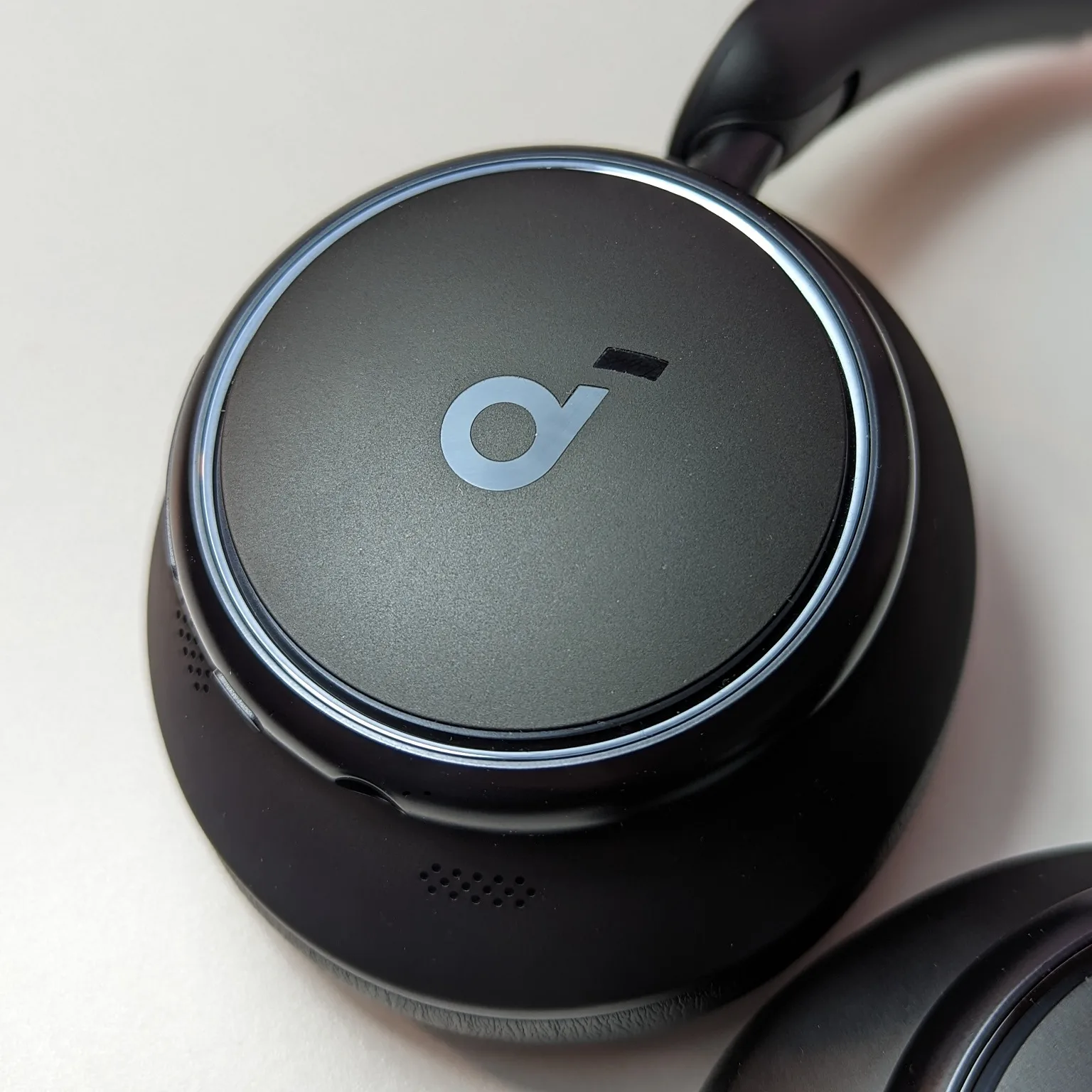
My own headphones are black, but a dark blue and white color option would also be available. The color of the carrying case always matches the color of the headphones. The Q45's paint finish has been successfully made so that no visible fingerprints are left on it. In my opinion, the matte headphones are quite nice, especially with the narrow glossy rim and the manufacturer's logo decorating the cups as a pleasant detail.
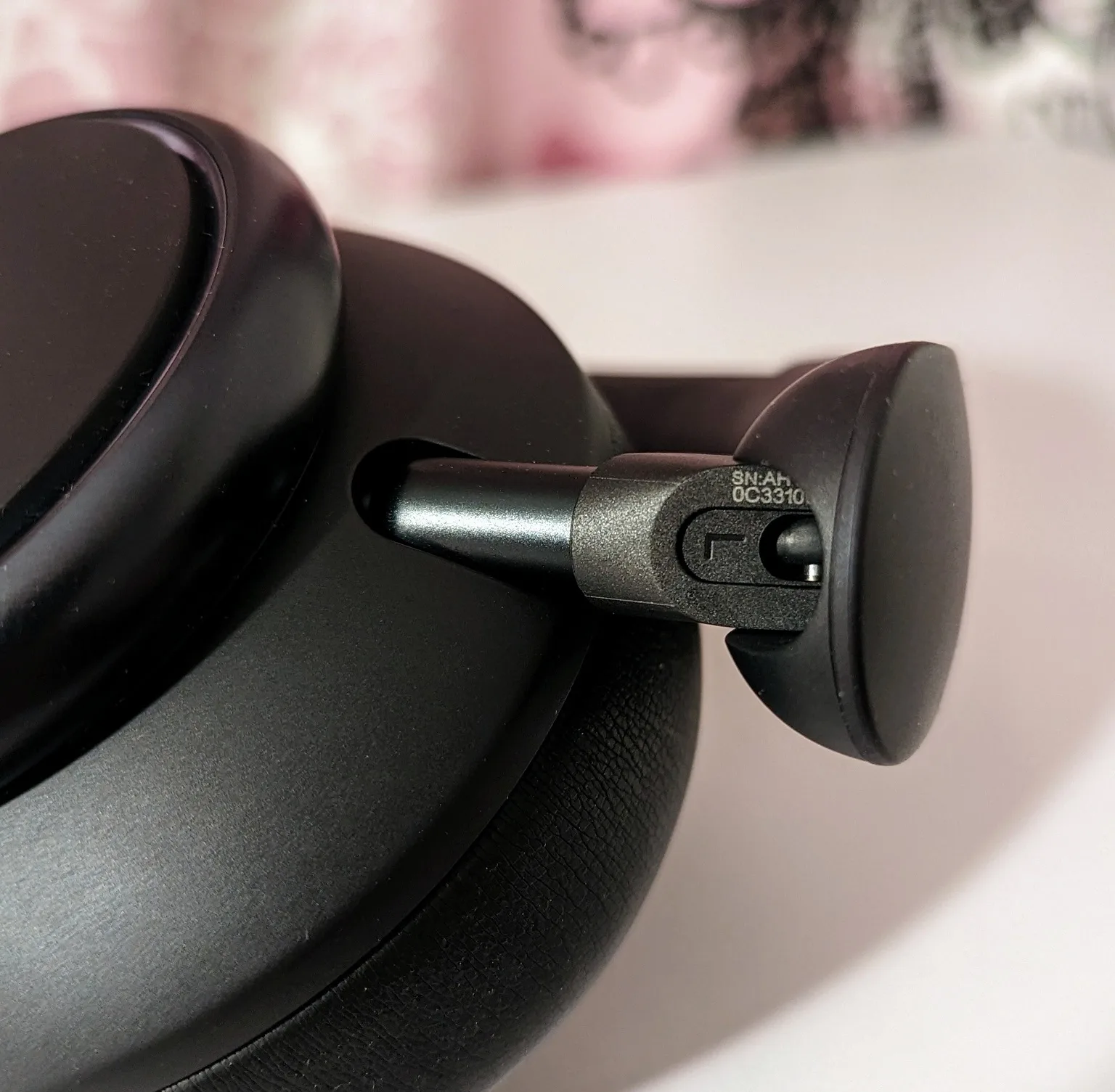
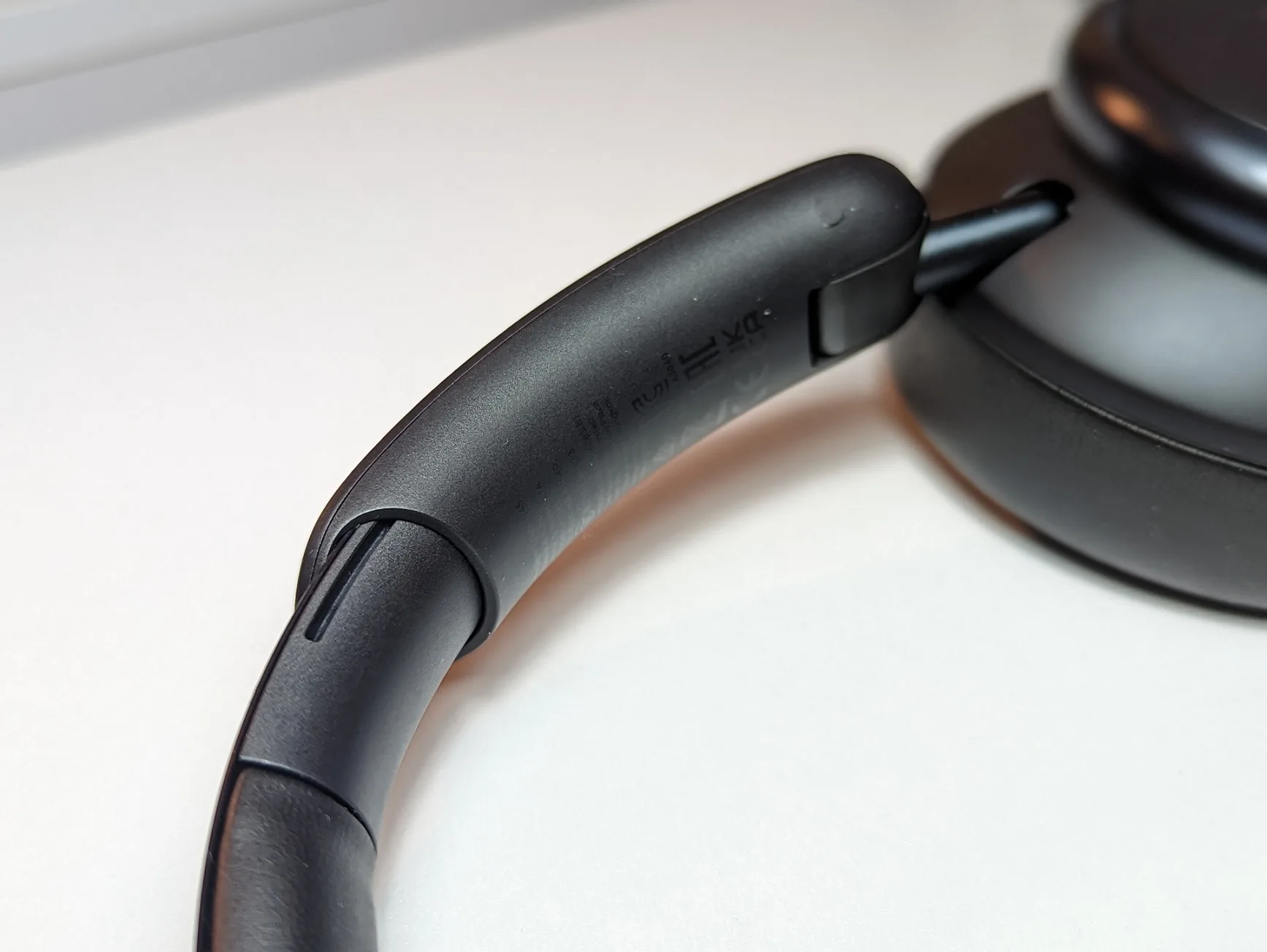
The arch of the headband is made of metal, like other Soundcore models. As a cosmetic update, the extension piece created by height adjustment remains hidden between the plastic parts, so the headband looks neat even when extended. The earcups rotate horizontally so that when the headphones are placed around the neck, the ear cushions rest against the listener's chest. In this position, the cups are suitably slightly angled compared to the headband, which further helps in wearing the Q45 around the neck.
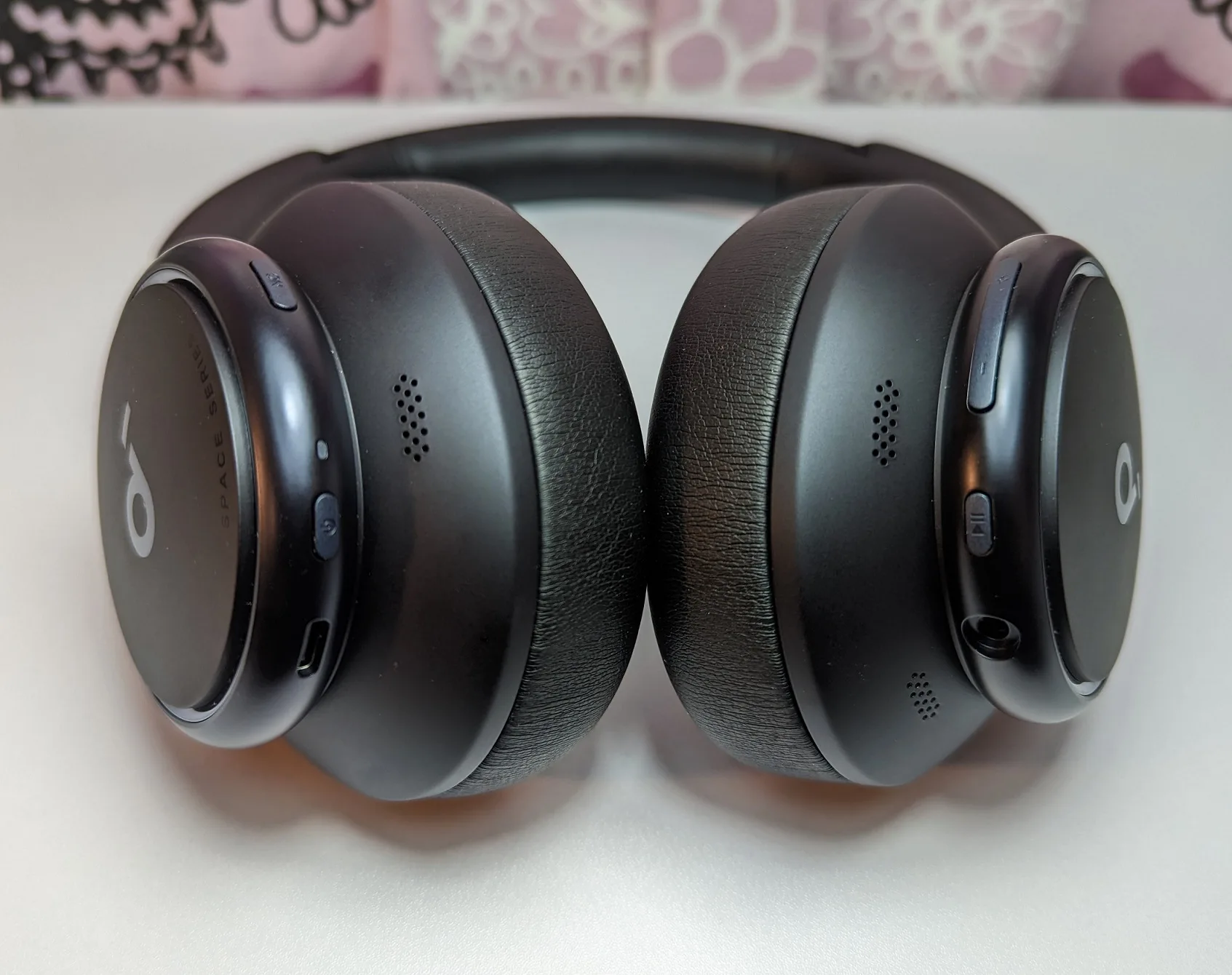
All buttons on the headphones are physical, meaning there are no touch controls on the sides of the cups, which are common in more expensive headphones. Especially the Play/Pause button at the bottom of the right cup is often needed, as the Q45 does not have a sensor that would stop audio playback when the headphones are removed. Other buttons are also located at the bottom of the cups along with the connectors.
The left cup features a USB-C charging port, a power button, and a button controlling the noise-cancelling function. The right cup, in turn, has the Play/Pause button I mentioned, plus a 3.5 mm headphone jack and volume controls. The low-profile buttons feel better than average, even though they only stand out from the edge of the cup by feeling their rough edges with fingertips. On the positive side, the buttons do not wobble from side to side, so their press feel is firm and clear.
So far, I have only had good things to say about the Q45's build quality for its 150 euro price, but there are also some regrettable aspects regarding comfort.
Usability
I liked the thick headband padding of the more affordable Q30 model, which has unfortunately been replaced with an almost non-existent thin padding in the Q45 model – there is no obvious reason for this change. With my head shape, the metal arch of the headband presses against the top of my head through the padding, so comfort remains mediocre, whereas it was at a good level with the Q30 model. Additionally, the clamping force of the Q45 is quite strong, and the ear cushions are made of firm foam, so the headphones feel rather hard on the head.
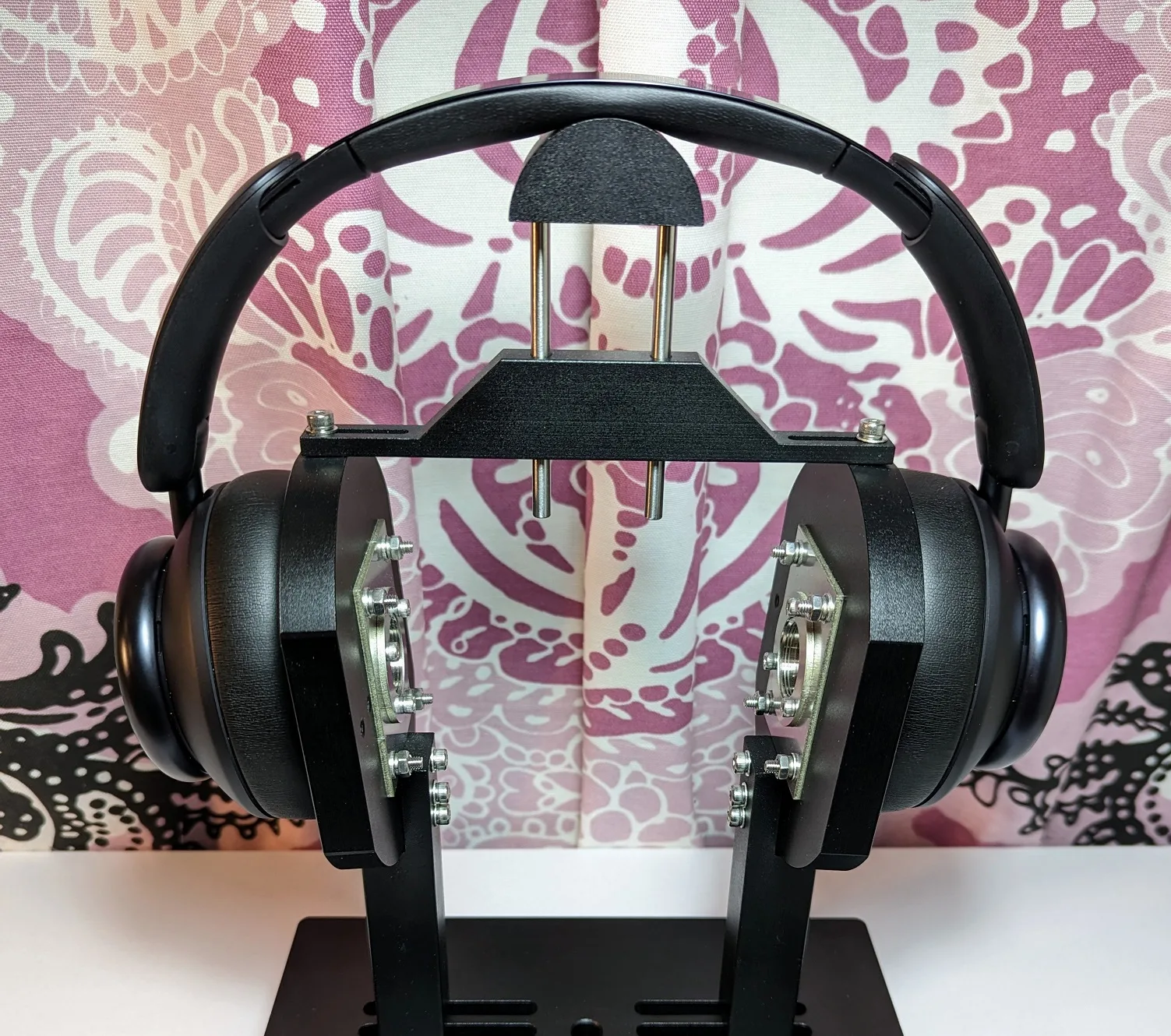
The vertical tilting movement of the Q45's earcups includes stiff springs that press the bottom edge of the cups more tightly against the head (for the same reason, the cups are slightly angled when turned horizontally). This is likely intended to ensure a tight fit so that passive sound isolation and the noise-cancelling function work as effectively as possible. Indeed, the headphones sit unusually securely on the head, and they also very effectively dampen ambient sounds, even when the power is off.
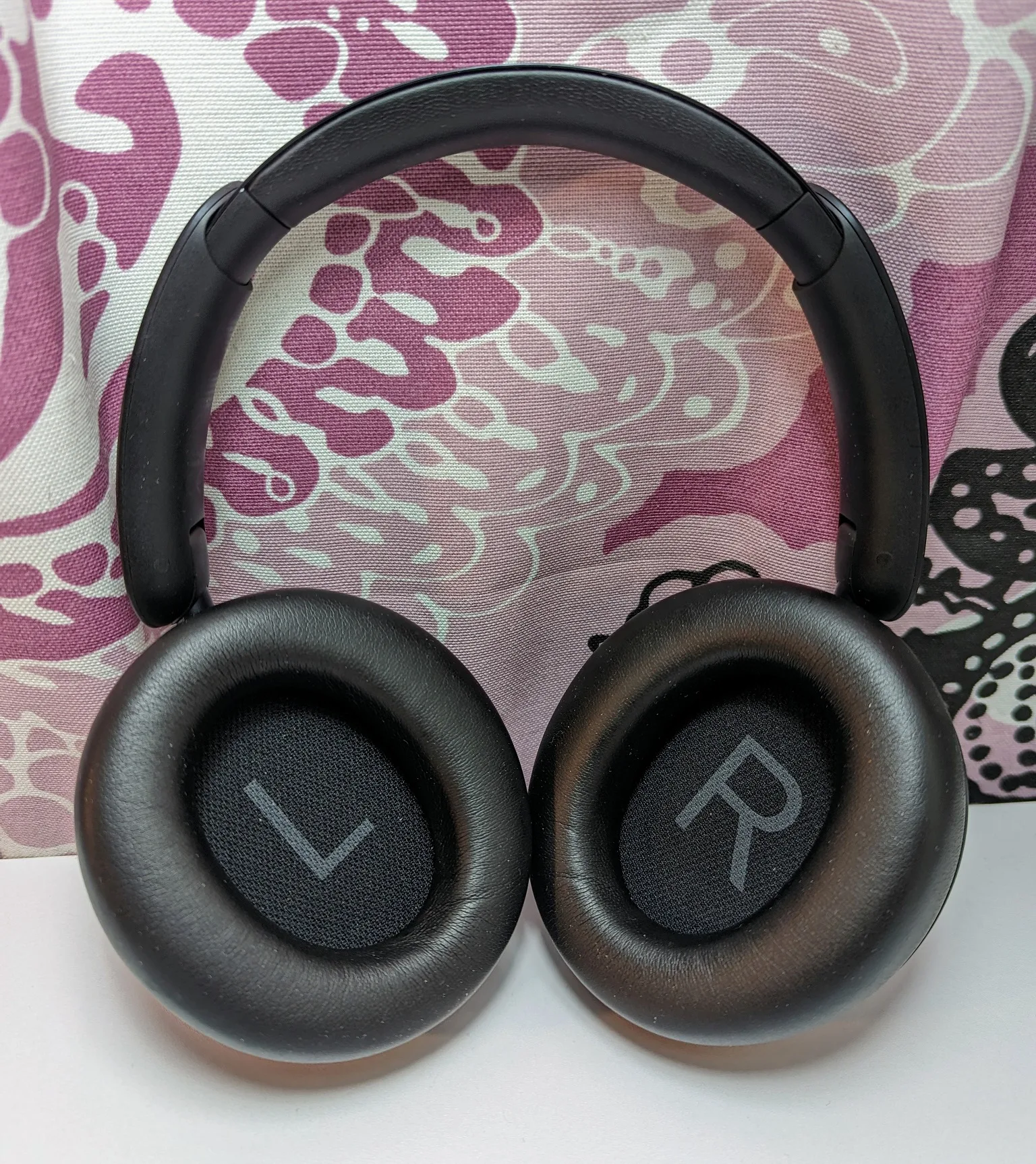
The ear cushions are made of firm memory foam that quickly returns to its shape after being pressed. The dense material has a positive effect on sound isolation, but unfortunately, the ear cushions feel quite hard against the head. The surface material is generic synthetic leather, so in summer heat, be prepared for the Q45 to cause considerable sweating due to its tight fit.
In terms of shape, the Q45's cushions are good, as my slightly larger ears fit inside them easily. The ear opening is 65 mm high and 45 mm wide, with a depth of approximately 23 mm. For comparison, the Q30 model has a couple of millimeters less depth, and the Valco VMK20 has about a centimeter less. The Q45, with its deep cushions, is therefore excellent for those who do not like the bottom fabric of the cushion pressing against their earlobes in an on-ear style.
The Q45 ultimately does not rank among the most comfortable noise-cancelling headphones, but it is not among the worst either. The strong clamping force of the headband is actually the headphones' salvation, as it prevents too much weight from being distributed onto the top of the head via the thin padding. Comfort and fit always vary from user to user, but I personally have managed well enough with the headphones.
Bluetooth connection
The headphones support Bluetooth version 5.3. In terms of codecs, LDAC, SBC, and AAC are supported, meaning AptX with all its versions is missing from the list. This means that when connected to a modern Android phone, high-quality LDAC is used, whereas, for example, when listening on a Windows computer, one has to settle for lower-quality codecs (unless a Bluetooth module with LDAC support has been separately installed on the computer). Windows would support the AptX codec, so it's a shame that there is no support for it in the headphones. I would understand this for models under 100 euros, but at 150 euros, I would expect better. On the other hand, the 500-euro Sony WH-1000XM5 is equally modest in terms of codec support.
By default, the Q45 only works with SBC and AAC codecs, as the LDAC option must be downloaded and installed separately via the Soundcore phone application. Activating the codec results in the loss of support for simultaneous pairing with two devices. However, to my understanding, this applies to all other headphones that support the LDAC codec, such as various Sony models (Sony itself developed the codec).
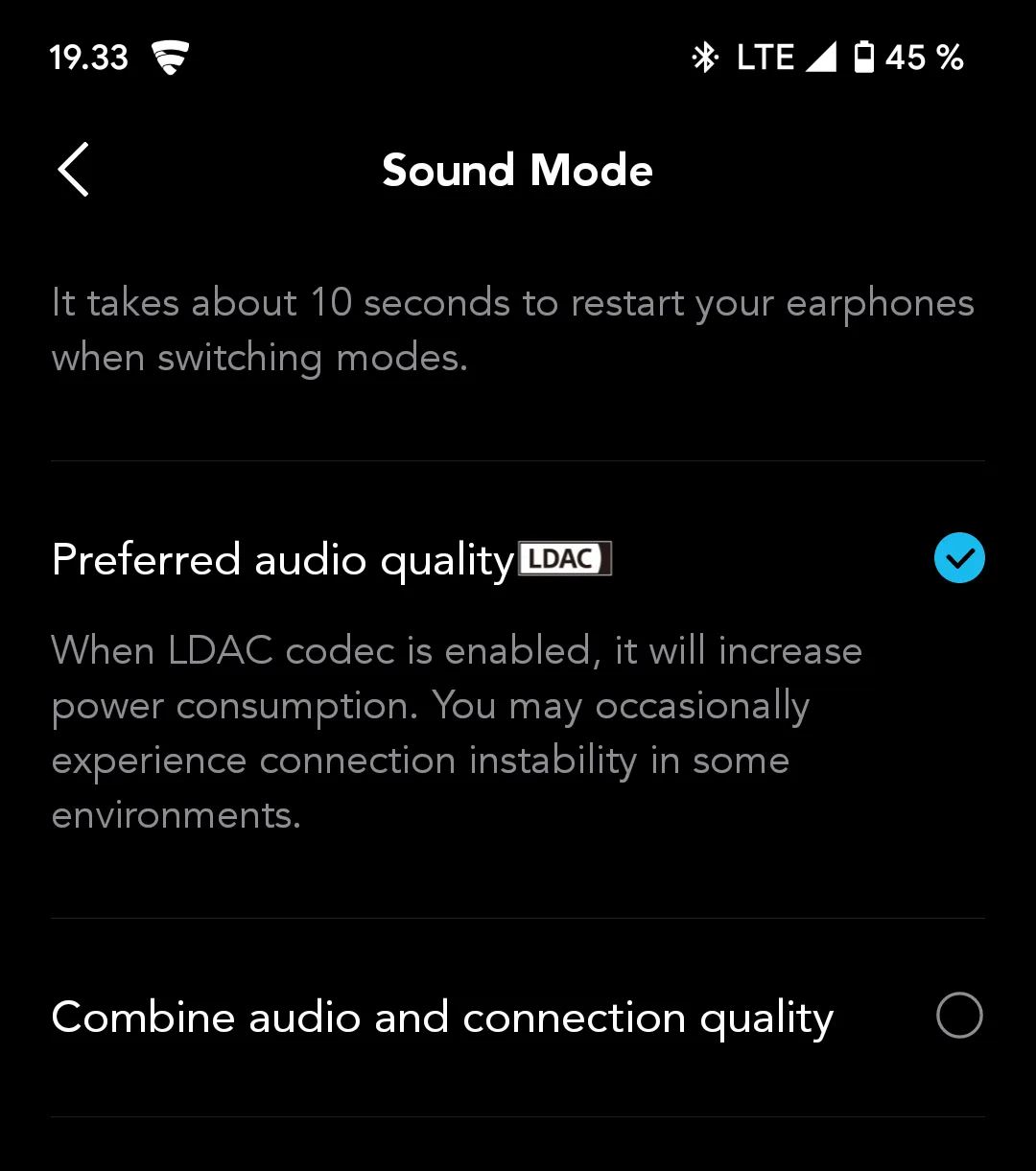
Regarding Bluetooth connection stability and range, the headphones have worked well with my Google Pixel 6 phone. The LDAC codec does not cause more stuttering than usual, but when using it, one should be prepared for occasional short interruptions, which may be related to, for example, other phone usage and strain. The manufacturer itself warns about this when enabling the LDAC codec. It has not bothered me personally.
Battery life
The Q45's battery life is excellent, as the battery is promised to last 65 hours with noise cancellation off and 50 hours with noise cancellation on. These figures, of course, only apply to listening with low-quality codecs, so with LDAC in use, the battery life will be somewhat shorter. Generally, high volume also consumes more battery than promised. Despite everything, I have only needed to charge the headphones every other week, or every two to three weeks with more occasional use. Speaking of charging, the battery fully charges in about two hours. The Q45 also supports fast charging, so a 5-minute charge provides an additional 4 hours of usage time. The headphones compete with the best noise-cancelling models on the market in all battery life and charging-related metrics.
Mobile app and additional features
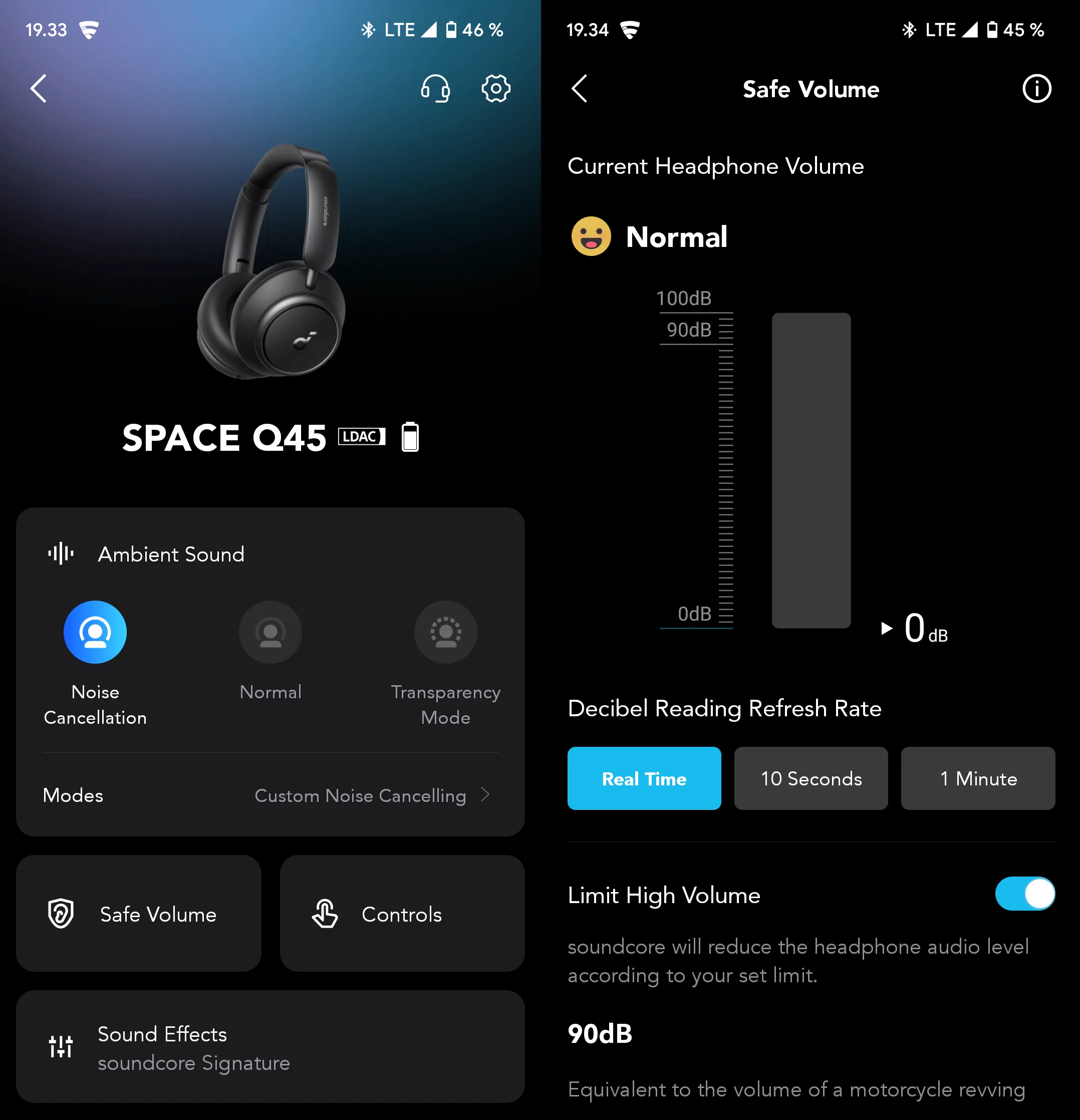
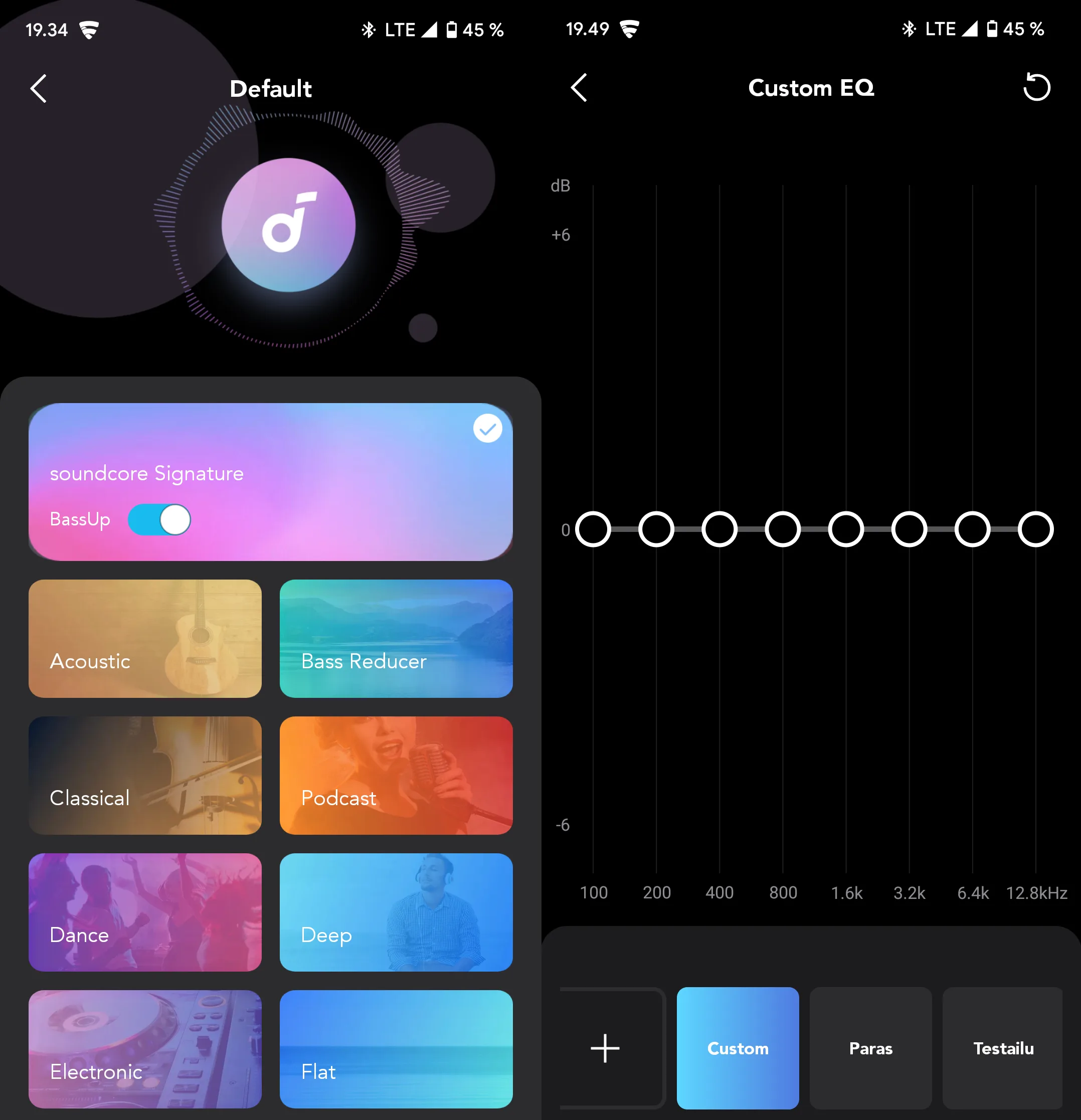
Anker offers a phone application called Soundcore for its headphones, through which, in addition to a few basic settings, the noise-cancelling function and sound quality can be adjusted. Especially the comprehensive equalizer has made the manufacturer's headphones recommendable in past years, as by default, the sound quality has been quite poor. Usually, similar equalizers only have a few controls, but in Soundcore's case, there are as many as 8. In addition, there are as many as 20 different ready-made sound profiles available. Besides the adjustments, the only additional feature of the application is monitoring listening volume and the possibility to limit the maximum volume.
Active Noise Cancellation (ANC)
One of the most important features of the headphones is its active noise-cancelling function, which the manufacturer advertises as suppressing up to 98 percent of ambient sounds. This is certainly true in an already quiet environment, but my previous tests (read noise-cancelling comparison) have already revealed that the situation is not quite as rosy amidst noise. Overall, I would call the Q45 model's noise-cancelling function good. Combined with excellent passive noise reduction, it suppresses low frequencies well. Higher frequencies remain more audible, but they too are clearly attenuated better compared to the more affordable Q30 model or, for example, the Sennheiser Momentum 3 Wireless model.
The Q45's noise-cancelling function can be set to either an adaptive mode, which automatically adjusts according to ambient noise, or it can be manually adjusted on a scale of 1–5. In my opinion, the highest setting causes disturbingly strong background hiss, so I have almost always used setting 4, whose calmer hiss is tolerable. The hiss can be largely eliminated with lower settings, but then the effectiveness of the noise cancellation also decreases.
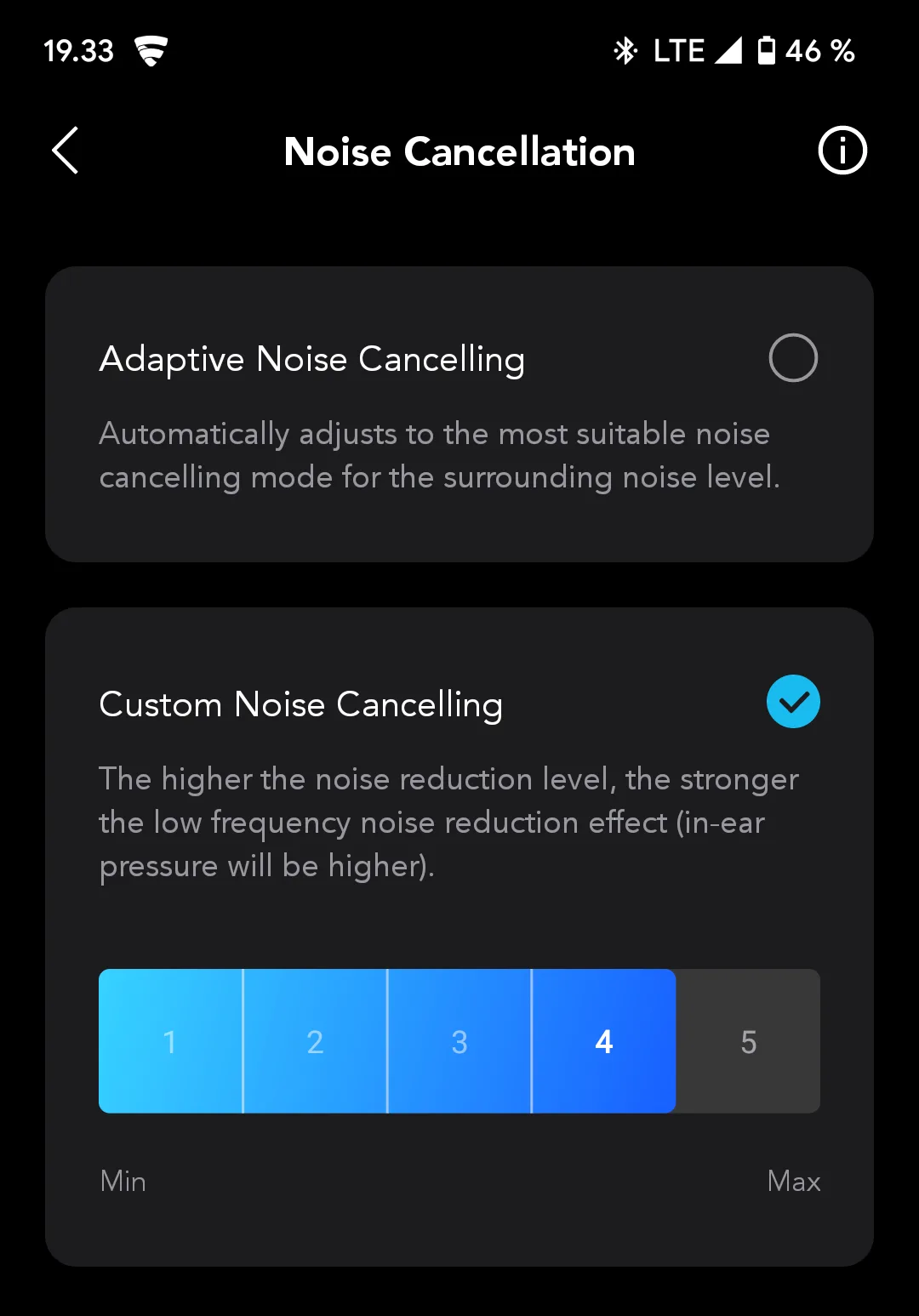
The headphones' noise cancellation can be disabled if necessary, and there is also a traditional transparency mode, for which I personally never find a sensible use. The phone application has a separate setting that reduces disturbances caused by wind hitting the headphones. However, I unfortunately haven't had time to test this, as I don't use headphones outdoors in winter.
The Q45's noise cancellation doesn't quite match the Sony XM4 and XM5 headphones I've heard, but I'd estimate it's pretty much on par with, for example, the Sennheiser Momentum 4 – the older Momentum 3 attenuated noise significantly less than the Q45. Valco's VMK20 also doesn't have as effective noise cancellation. It would be interesting to know how the new VMK25 performs. In my opinion, the Q45 is reaching a level where it's pleasantly quiet in a noisy environment when worn. Audible background hiss is an unfortunate issue, but regarding noise attenuation, I am very satisfied with the headphones. The Q45's noise cancellation does not cause any feeling of pressure or throbbing in my ears.
Microphone sound quality
I have used the headphones in a few Teams meetings, during one of which I was on a train. No one seemed to be surprised by the microphone's unclear sound quality, so I would assume it is quite adequate for its purpose. However, I did not test the microphone further in this context, especially since many video reviews already contain audio samples of the Q45's microphone.
Headphone sound quality
The Soundcore Space Q45 sounds different depending on whether its noise cancellation is on or off. The sound in transparency mode is similar to when noise cancellation is active, with the exception of small differences between 500–700 hertz. It is also possible to listen to the headphones with a 3.5 mm headphone cable. If there is power left in the battery, the Q45 automatically activates its electronics and DSP corrections, so the sound would appear to be similar via cable as with a Bluetooth connection. I haven't remembered to listen to the headphones with a cable when the battery is empty, but I would assume that then the frequency response without DSP correction is quite uneven and unusable (if the headphones work at all with an empty battery). In any case, the battery life is so good that there will likely be only rare need for wired listening.
I will begin discussing sound quality from the headphones' primary use case, which is listening via Bluetooth with noise cancellation on.
Headphone frequency response (ANC ON):
It is possible to compare the frequency response with other headphones using the new comparison tool tool
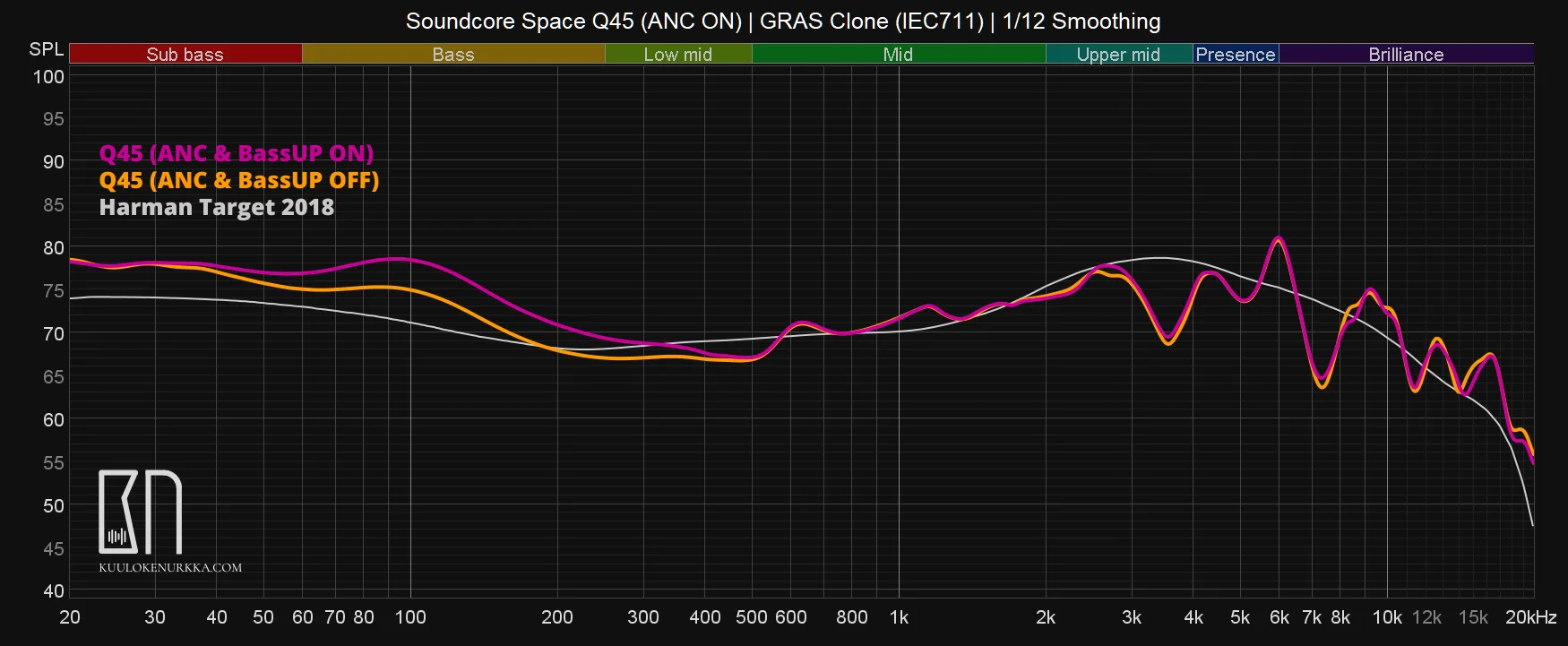
The manufacturer describes the Q45”s bass as thumping and the treble as bright. This is entirely true, as the rumble and boom of the upper bass frequencies drown out everything else except the piercing and sharp-sounding treble. By default, the headphones sound as if there's a thick mattress in front of the music. The bass resonance is so jarring that it completely clogs up the sound. Fortunately, this unlistenable result is due to the manufacturer's separate BassUP additional setting, which is on by default (the reddish line in the frequency response graph above). When it is turned off via the phone app, the situation improves significantly (the orange line in the graph).
Without the BassUP setting, the Q45's bass reproduction is actually at a quite suitable level, making it one of the headphones' minor concerns. As for other frequency ranges, the headphones' sound is clear, perhaps too clear. Thinly reproduced lower midrange frequencies, an aggressive frequency range between 600–2000 Hz, and extremely sharp treble create an irritating sound. Especially the narrow 6 kHz emphasis makes listening to the headphones fatiguing, even if my ears aren't bleeding. Vocal performances are generally thin and shouty, and there is also sibilance in the sound. The presentation is unnaturally piercing and harsh, but for those who like or are accustomed to V-shaped reproduction, the Q45 is still not among the worst by noise-cancelling headphone standards. Thanks to this, equalization is not overly complicated either.
Equalization with the phone app
I generally don't like equalizing headphones because it's not a permanent solution, but rather an additional function tied to a single device, such as a computer. However, with noise-cancelling headphones, I think differently because adjustments made with the phone app are permanently saved to the headphones, making equalization available regardless of the listening device. Therefore, I do not consider equalization a limiting factor for use. This also applies to Soundcore Space Q45 headphones.
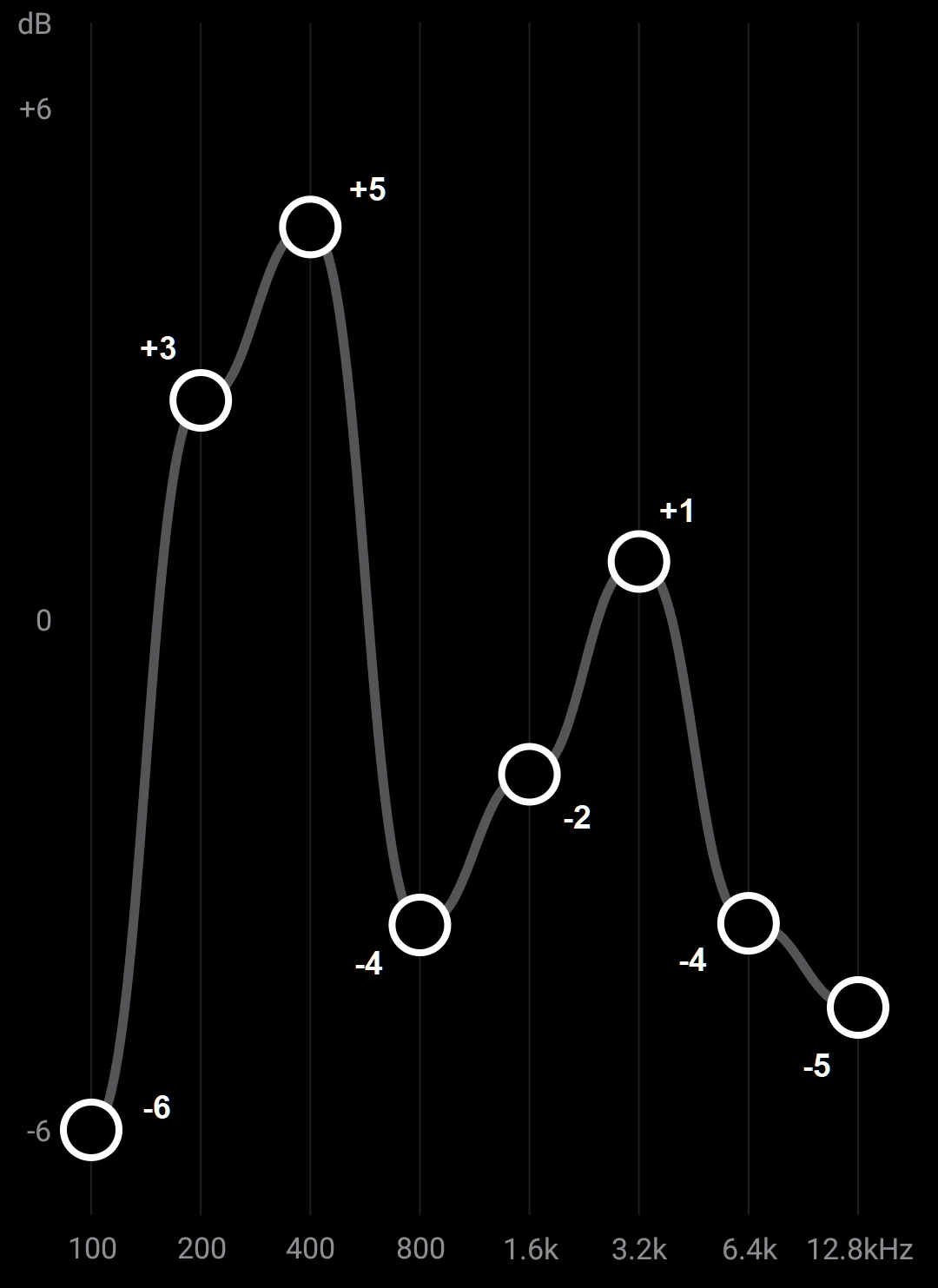
For these, my goal in equalization was a clear and balanced sound, meaning I aimed to correct the manufacturer's errors without completely transforming the headphones. The Q45's midrange frequencies required fine-tuning to be more natural, and the treble also needed to be significantly calmed down. I also lowered the bass level to match Harman's target curve from 2018. The equalizer found in the phone app handled this well, although at least one more control for the treble would be beneficial.
Frequency response according to settings (ANC ON):
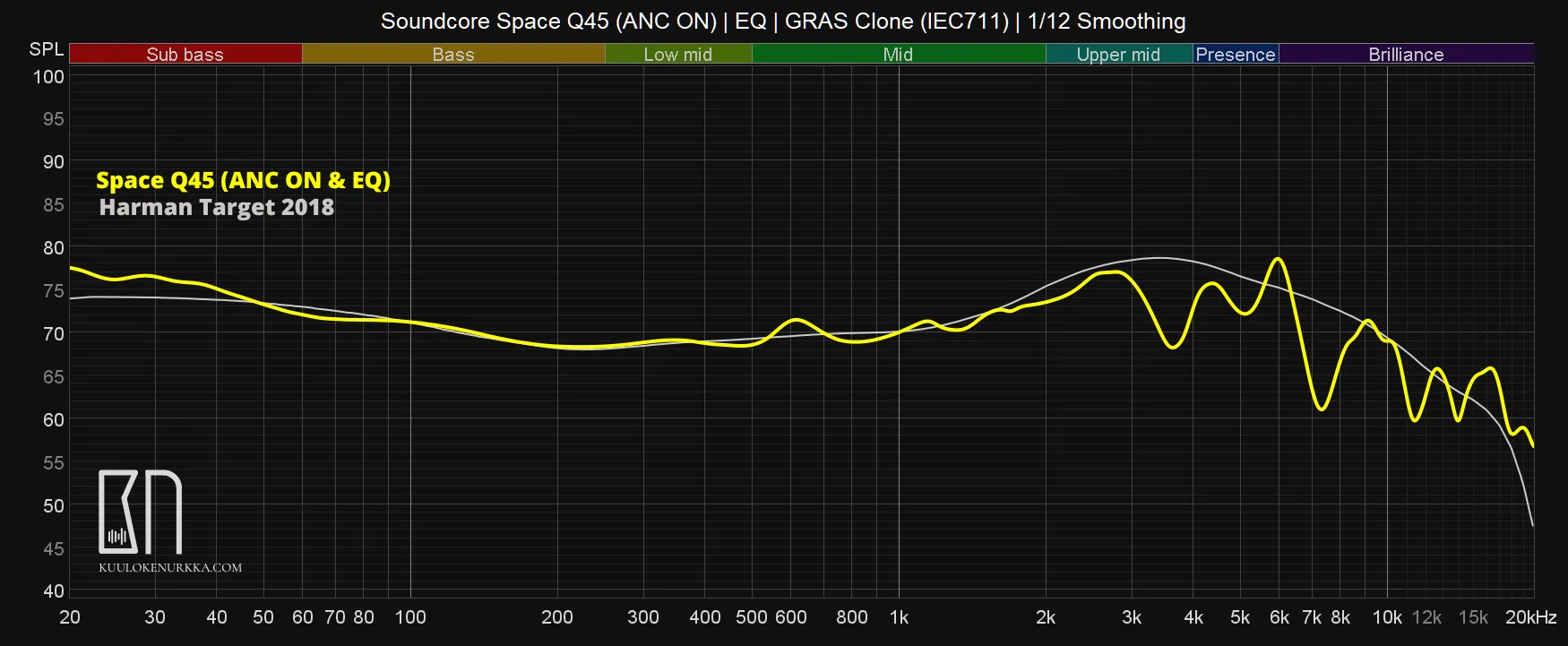
With my equalization, the Q45 sounds really good. The bass reproduction is powerful and clear. The mid-frequencies, on the other hand, are very even, with the exception of the sometimes calm upper-mids, and the sound is no longer too sharp or aggressive in the upper frequencies either. The headphones are actually pleasantly fresh and airy for noise-cancelling headphones, because the highest treble reproduces without attenuation up to 20 kHz. For some reason, in many other headphones, the treble level drops sharply, making the reproduction sound muffled and closed.
The Q45 doesn't sound particularly large or open in terms of soundstage either, but its somewhat small soundstage doesn't feel too claustrophobic. Since the channel balance of the headphones is excellent, the placement of sounds in the sound field is accurate for the price. Only the separation of sounds doesn't impress me much compared to, for example, the Sennheiser Momentum 3, but Sony's more expensive headphones are not, in my opinion, much better than the Q45, especially when they inevitably retain a mid-bass emphasis that obscures detail even after equalization. The Valco VMK20 sounds different compared to the Q45 (fuller due to calmer upper-mids and more sparkling due to brighter treble), so the superiority of the duo largely depends on preferences. Neither model can be unequivocally said to be better or worse in sound quality.
The equalized Q45 is, in my opinion, a strong contender against all common noise-cancelling headphones in the 100–300 euro price range. I would also dare to bring the manufacturer's more affordable Q30 model into the same discussion, to which the Q45 is somewhat better in the clarity of individual sounds and the tightness of reproduction. The Q30 sounds softer, but it has a quite unbeatable price-quality ratio in terms of sound quality after equalization. If making your own adjustments doesn't seem like an impossible idea, I can highly recommend Soundcore headphones.
If equalization doesn doesn't appeal, the Q45 model actually still has an ace up its sleeve. The headphones sound, in fact, in many places even better than my own equalization when the noise-cancelling function is turned off.
Sound with noise-cancelling function turned off
Frequency response (ANC OFF):
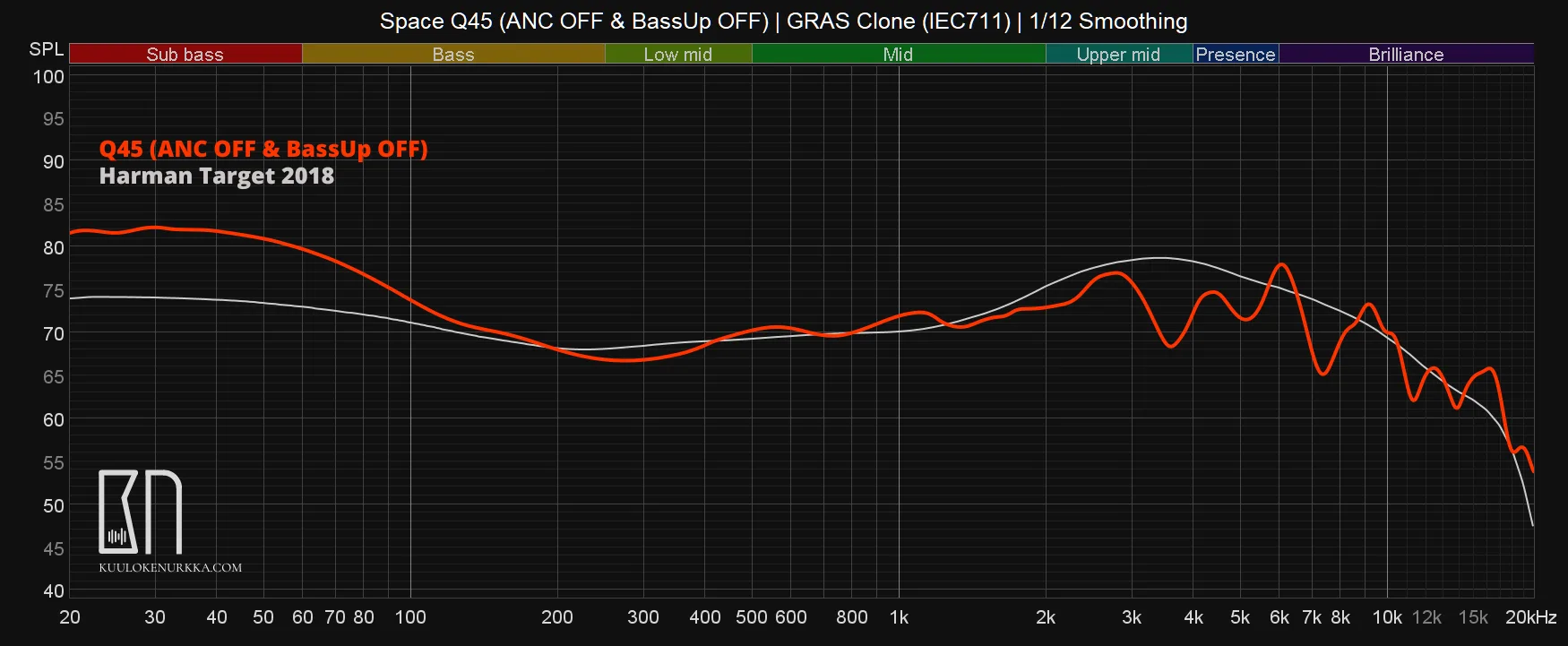
Noise-cancelling headphones often have poorer tuning when the noise-cancelling function is turned off, because manufacturers adjust the sound to their liking with noise-cancelling on. However, the Space Q45 is an exception in this regard, as it surprisingly sounds downright excellent, provided the silly BassUp setting is disabled.
Especially the treble is clearly smoother and more natural than what can be achieved by equalizing the headphones with the noise-cancelling function on. The treble is also more distinct when the drivers do not have to produce noise cancellation at the same time. The mid-frequencies are very similar to my own equalization, with the difference that they evoke more emotion. The reproduction is clear, natural, and fun, making it easy to immerse oneself in listening. As the cherry on top, the soundstage also feels more spacious.
My frequency response measurements reveal that turning off the noise-cancelling function causes a very strong sub-bass boost. However, it is mainly located below 100 hertz, so the bass hardly leaks over other frequency ranges at all. If the music being listened to has little sub-bass, everything sounds completely normal. For example, when listening to more energetic electronic bass music, the intensity, however, becomes wild, as the Q45”s bass is truly physical and fun. It also remains surprisingly tight, so the headphones might be, when listened to this way, one of the best ”bass headphones" under 200 euros.
The Q45 without noise cancellation is so excellent that I don't understand why the manufacturer has DSP-corrected both the fun (though for some tastes, overly powerful) bass reproduction and the balanced upper frequencies in noise-cancelling mode. Either the functionality of the noise-cancelling feature has for some reason required a different frequency response, or the manufacturer has imagined consumers wanting muddier bass reproduction and sharper treble. Since the Q45's construction isolates noise quite well, I would see that it would be possible to use the headphones even without the noise-cancelling function. I am sure many would enjoy the sound quality that way. The battery life of the headphones is also longer then, and there is no background hiss at all.
Summary
The Soundcore Space Q45 is, as a whole, good, though by no means a mind-blowing 150-euro noise-cancelling headphone. Its greatest strengths in its price range (and compared to more affordable headphone models) are a durable-feeling and quite stylish construction, an effective noise-cancelling function, and excellent battery life. Comfort and sound quality with default settings remain at a more mediocre level: the former does not prevent use, and the latter can be corrected with the phone app's equalizer or by listening to the headphones without the noise-cancelling function, in which case the sound quality is excellent.
I would be somewhat disappointed with the headphones if they cost, for example, 250 euros, but at 150 euros, it's difficult to come up with a clearly better overall package. With a noise-cancelling headphone budget of that amount, the Q45 should definitely be added to the consideration list. In my opinion, the headphones serve as a good benchmark for, for example, the Valco VMK25 model coming soon to market.
For the next Soundcore model, I would hope the manufacturer reduces the amount of background hiss caused by the noise-cancelling function. Better DSP correction with noise cancellation on would also be desirable, because even though the Q45, with the BassUp setting turned off, doesn't sound completely unusable, I don't believe consumers who appreciate good sound quality will be enthusiastic about listening to the headphones. The Q45 is, from a sound quality perspective, acceptable mainly because it is reasonably priced and includes a comprehensive equalizer.
Many other manufacturers ask significantly more for their noise-cancelling headphones, even if the sound quality is no better than the Q45 model. This is one of the main reasons why I have a positive impression of Soundcore headphones. I feel I get good value for my money, as long as I invest a little of my own time in equalizing the headphones. After that, I can say that with the Q45, I got a little more than what I paid for.
Pros and cons:
+ Excellent sound quality when noise-cancelling function is switched off
+ With noise cancelling on, it's possible to get good sound with the manufacturer's equalizer
+ Effective noise-cancelling function for the price
+ Good passive sound isolation
+ Stylishly understated and neat appearance
+ Build seems durable
+ Large ear cushions
+ Long battery life and fast charging
+ Supports LDAC codec and the latest Bluetooth version
+ Comes with a good carrying case
+ Reasonable selling price
– The default BassUp setting spoils the sound
– The sound is otherwise mediocre by default due to excessive brightness and sharpness (noise-cancelling function on)
– No support for AptX codecs, which would be beneficial in computer use
– Noise-cancelling function causes audible background noise
– User comfort is mediocre due to hard cushions
– Although the structure seems durable, the plastic parts creak somewhat when twisted.
 EN
EN  FI
FI
Windows 11 brought AAC support to Bluetooth.
Hi Which/what other BT headphone is of this sound quality, when the EQ tunings are set correctly?
Is it too heavy on the head. However, it seems to have weight.
Which one has better sound quality, Q30 or Q45, when the settings are correct in both?
Hi. If you manage to get the Edifier WH950NB for 100-120 euros, I would recommend it from the same price range. Otherwise, JBL's affordable noise-cancelling headphones are in principle even slightly better than the Soundcore Space Q45, especially if the treble and perhaps also the bass are adjusted to be a bit more moderate. Otherwise, we're already moving into 200-300 euro headphones, of which the discounted AKG N9 Hybrid is among the best.
In my opinion, the Space Q45, when adjusted, is slightly better than the Q30, because the mid-frequencies can be made smoother and the LDAC codec clarifies the sound a bit. However, the listening experience is not vastly different except for the treble. If small emphases bother you, the Q30 might even be the safer choice of the two. The biggest problem with the Space Q45, however, is precisely the uneven frequency response with default settings.