Authors: Roderick & Sword of Damocles
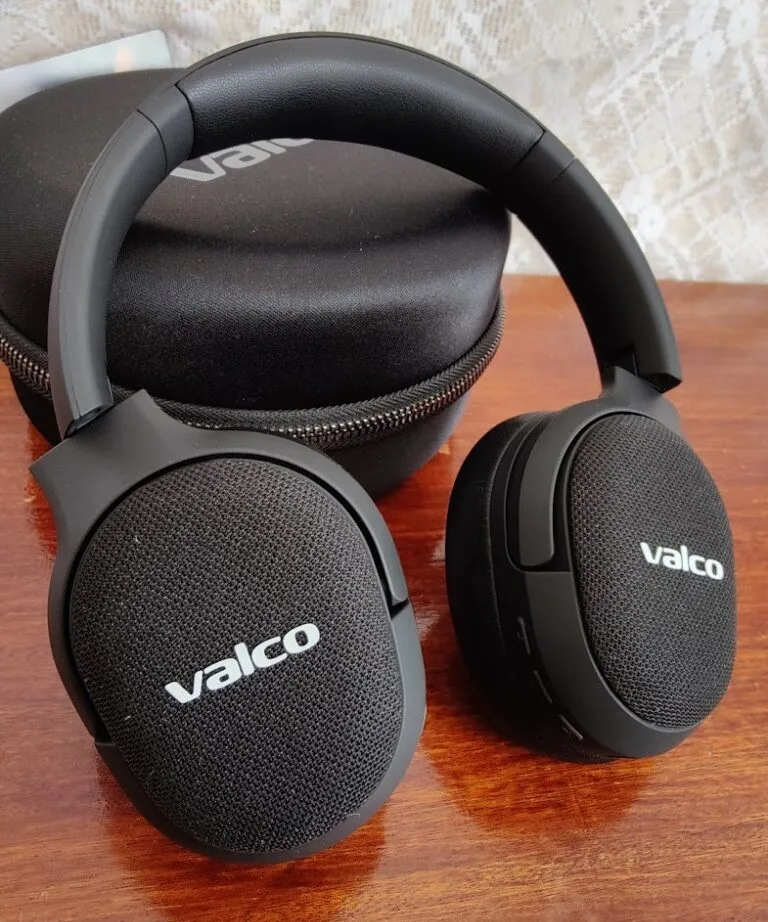
Table of Contents:
Information:
- Release year: 2022
- Country of manufacture: Finland/China
- Price: 199 € (pre-order price 189 €)
- Color options: Black
- Type: Closed, over-ear
- Dynamic 45 mm composite driver
- Audio connections: Bluetooth 5.1 and headphone jack (3.5 mm)
- Bluetooth codecs: AptX HD, AAC and SBC
- Weight: 287 g
- Battery size: 1050 mAh
- Battery life: up to 50 hours with noise cancellation on
- Charging time: 2–3 hours
- Charging port: USB-C
- Active noise cancellation function: On/Off/transparency mode
- Accessories: Carrying case, USB charging cable, 3.5 mm headphone cable and airplane adapter
- Warranty: 12 months (spare parts available at cost price after the warranty period and Valco also offers reasonably priced repair service)
Review sample: Provided by the manufacturer
Finnish Valco's popular VMK20 model has received a successor that is about 30 euros more expensive. The new VMK25 (link to the manufacturer's product page) is, like its predecessor, a Bluetooth noise-cancelling headphone that can also be listened to wired. About a year ago, I really liked the VMK20, as evident from my written review may have indicated. However, according to the manufacturer, the VMK25 should be even better in many ways compared to it. Valco donated its new headphones to us for testing, so we can find out for ourselves what it's all about – Thank you Valco!
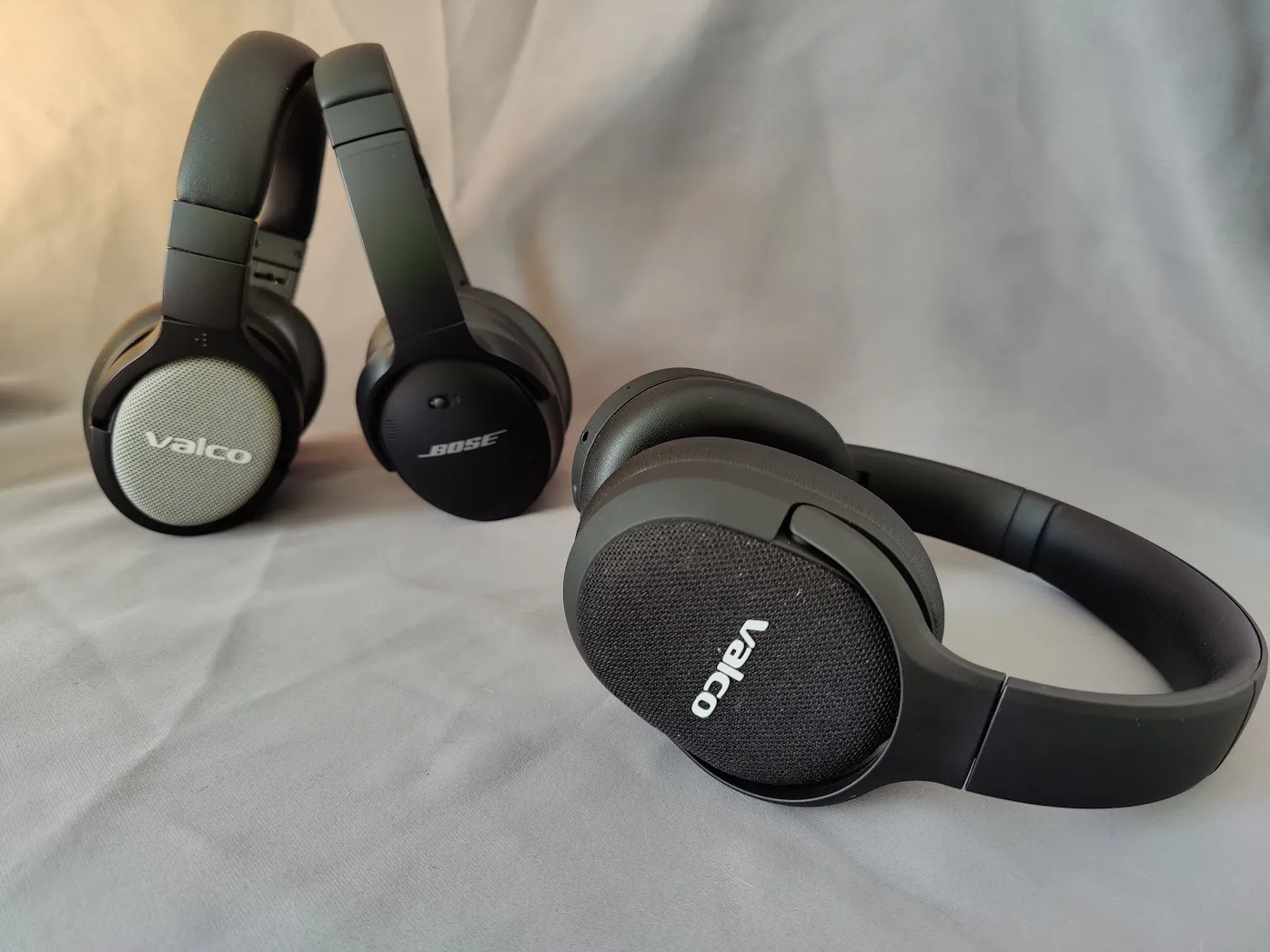
In this review, I compare the VMK25 and VMK20. I also find out if Valco can challenge slightly more expensive Bose QuietComfort SE -headphones.
Addition 10.1.2026: The production of VMK25 has been discontinued and VMK25.2 has been released as its successor. These two headphone models should not be confused with each other, as the new model sounds quite different. You can jump directly to the VMK25.2 review here.
Product packaging
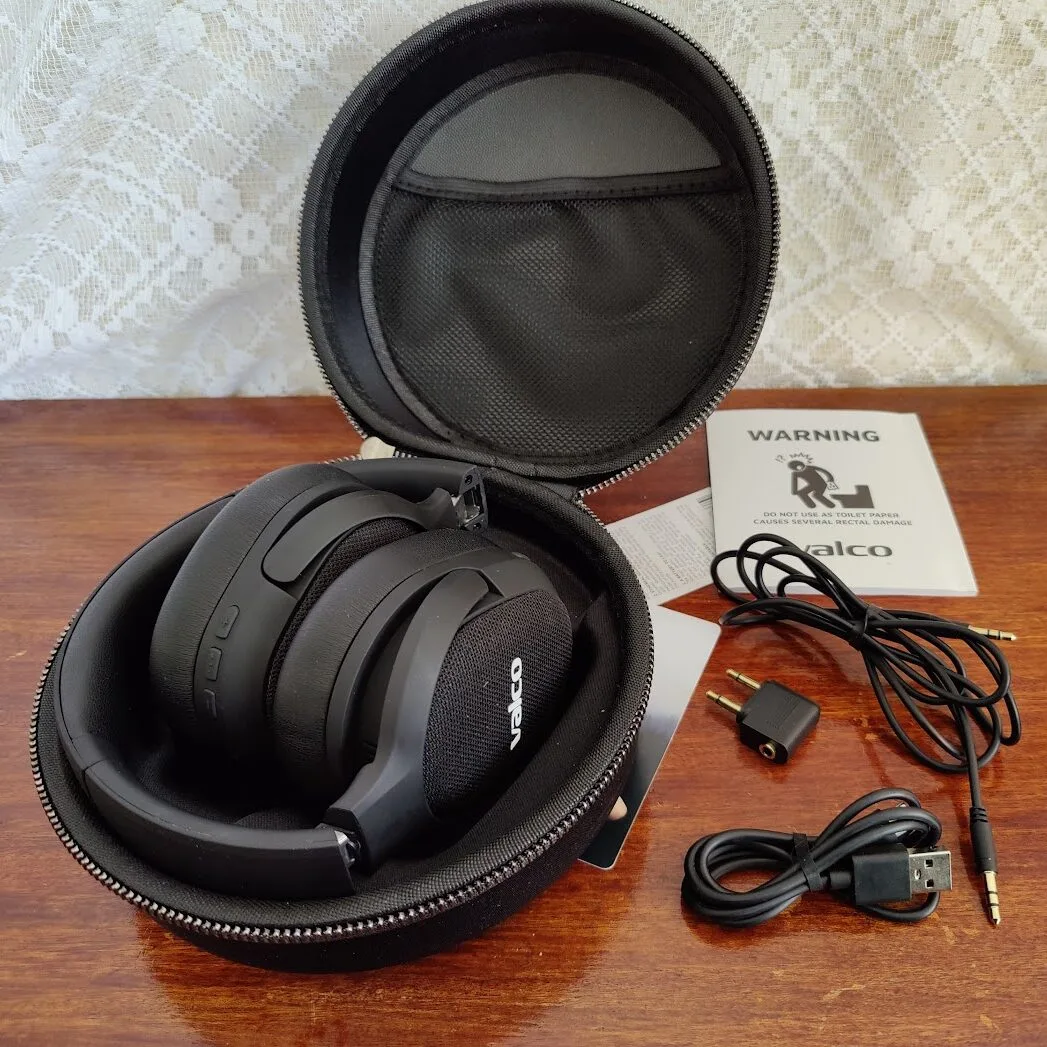
The VMK25 is similar in equipment level to its predecessor, as it comes with an AUX headphone cable (3.5 mm connector at both ends), a USB charging cable, an airplane adapter, and a hard carrying case. Due to its newly designed structure, the headphones are placed in their case as a kind of lump, so the case is remarkably thick compared to headphone models whose cups are folded horizontally to be as flat as possible. For example, Sennheiser Momentum 3 Wireless headphones have a thick case similar to Valco's, albeit made of soft fabric.
Build and comfort
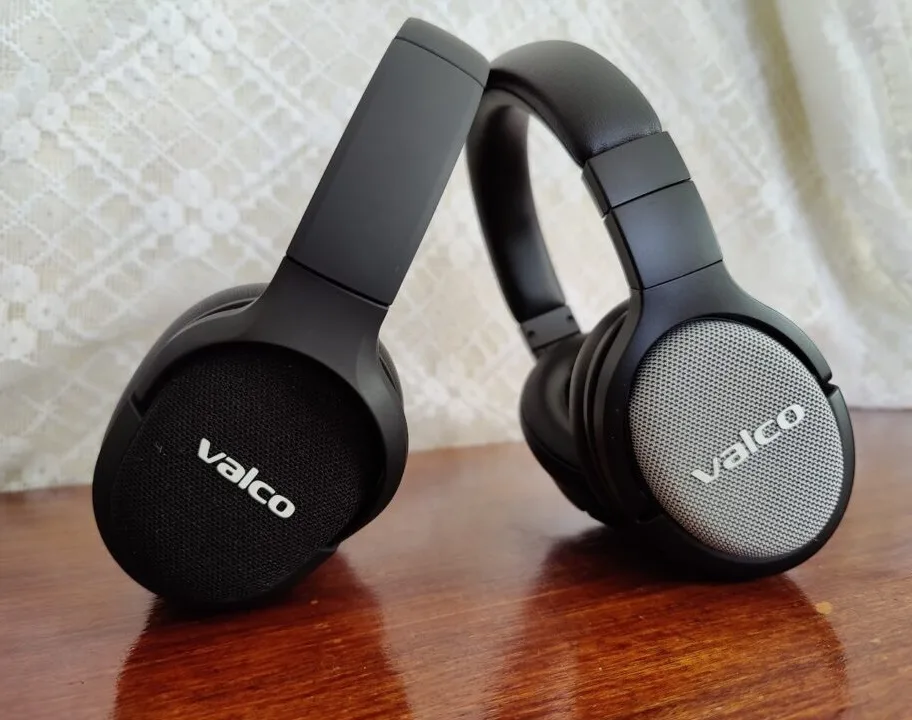
In terms of construction, the VMK25 is clearly sturdier than the VMK20. There is some resistance in the headband's range of motion, which creates a really high-quality impression. The VMK20, on the other hand, feels quite cheap and plasticky because the floppy earcups rattle against the headband. In the VMK25, the matte finish of the plastic also improves the impression of quality. On the other hand, I am somewhat skeptical about the change, because matte plastic often looks dirty over time and also scratches easily. Time will tell if Valco has found sufficiently high-quality plastic for its headphones. Even with short use, easily visible fingerprints have been left on the headphones.
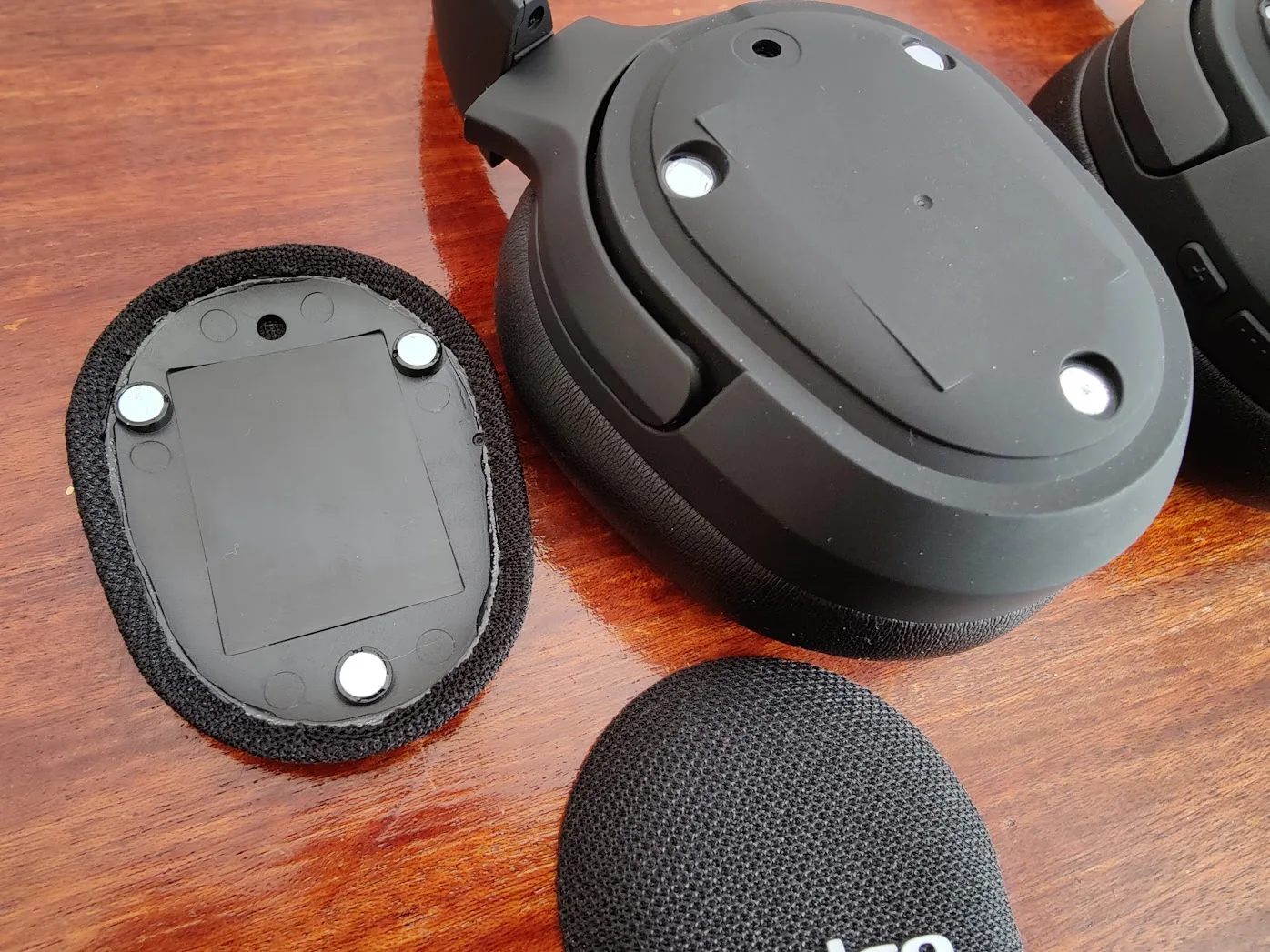
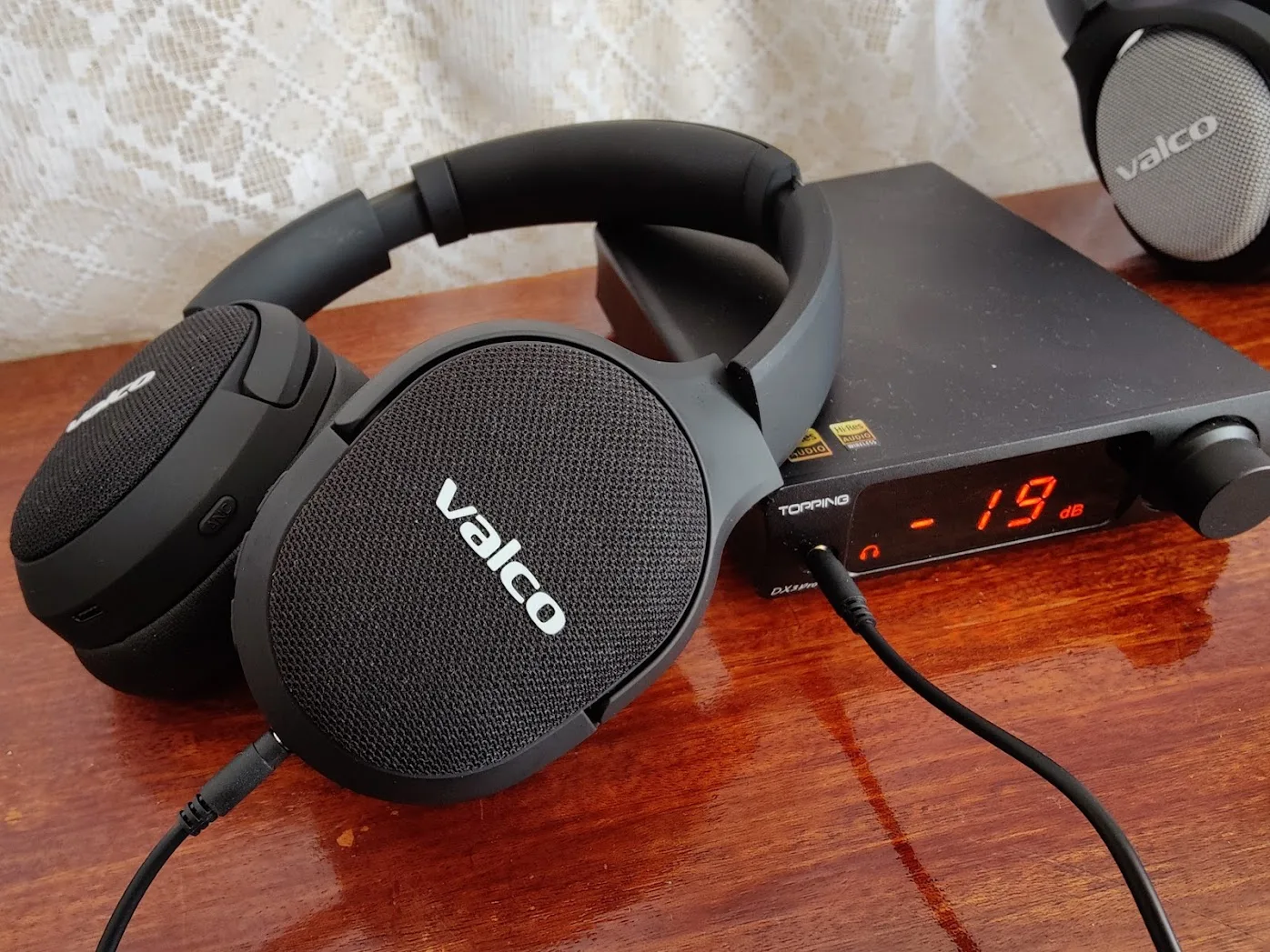
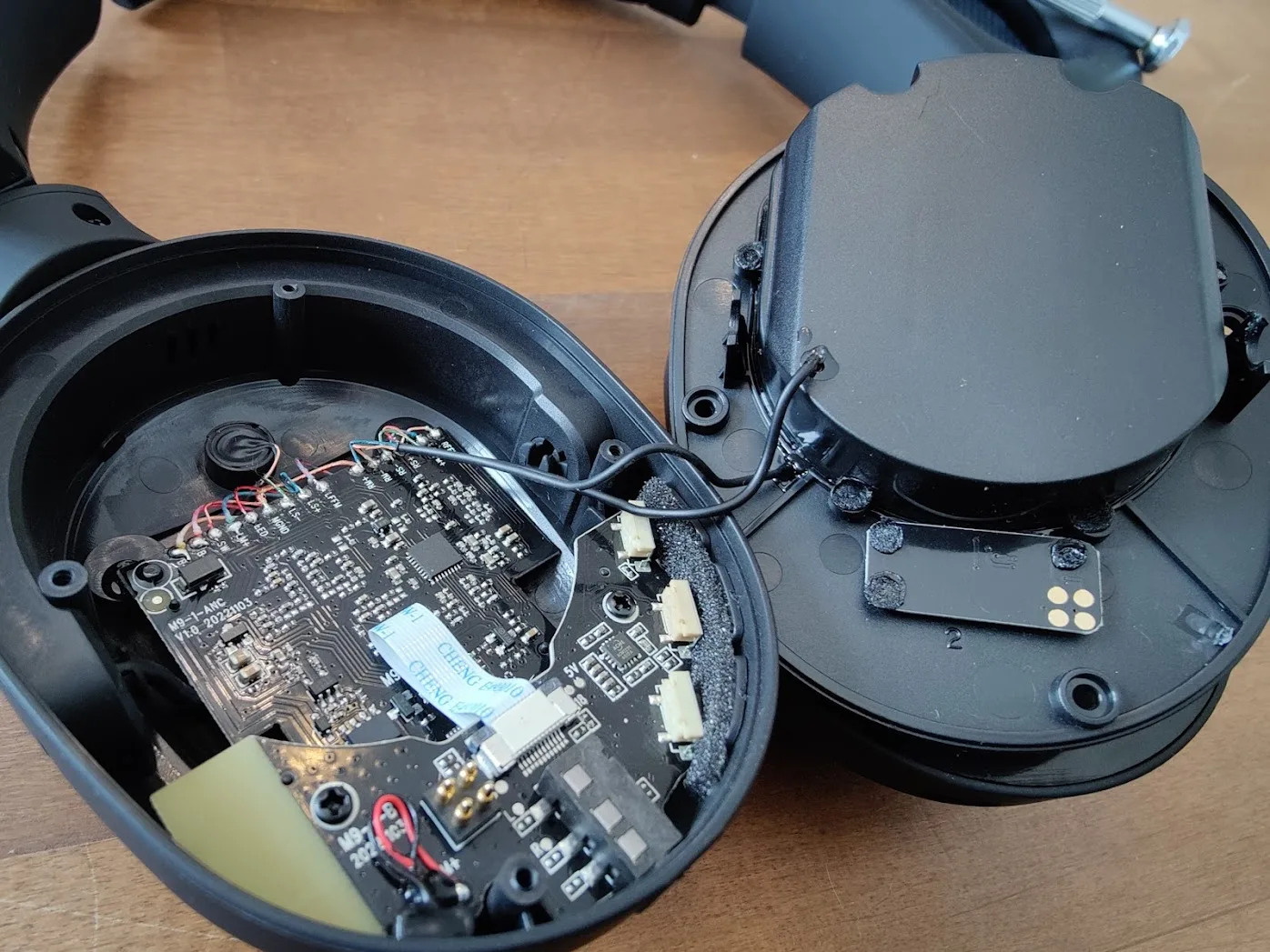
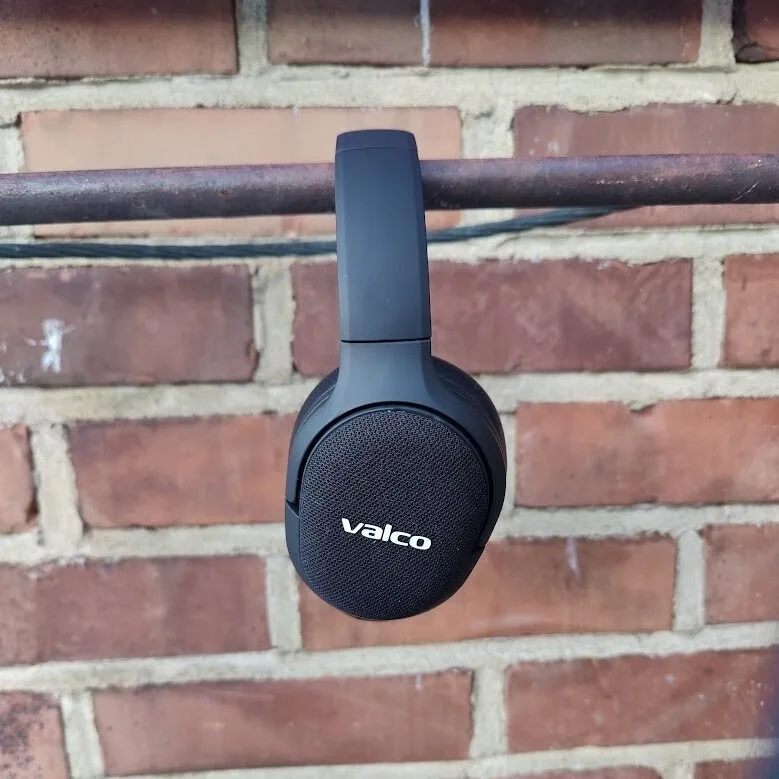
Like its predecessor, the VMK25's earcups are adorned with fabric-covered shells designed by Finnish Ratamo Design. This time, the fabric is easily removable for washing, as magnets have been cleverly used for its attachment. The manufacturer hints in its marketing materials that the appearance of the headphones can be customized with different shells, but at least for now, none are available. It would be great if, in the future, customers could choose a different, smoother material instead of fabric, to which dust and other dirt would not stick as easily. The shells should not be permanently removed, as their purpose is to protect the microphone located at the top edge of the earcups.
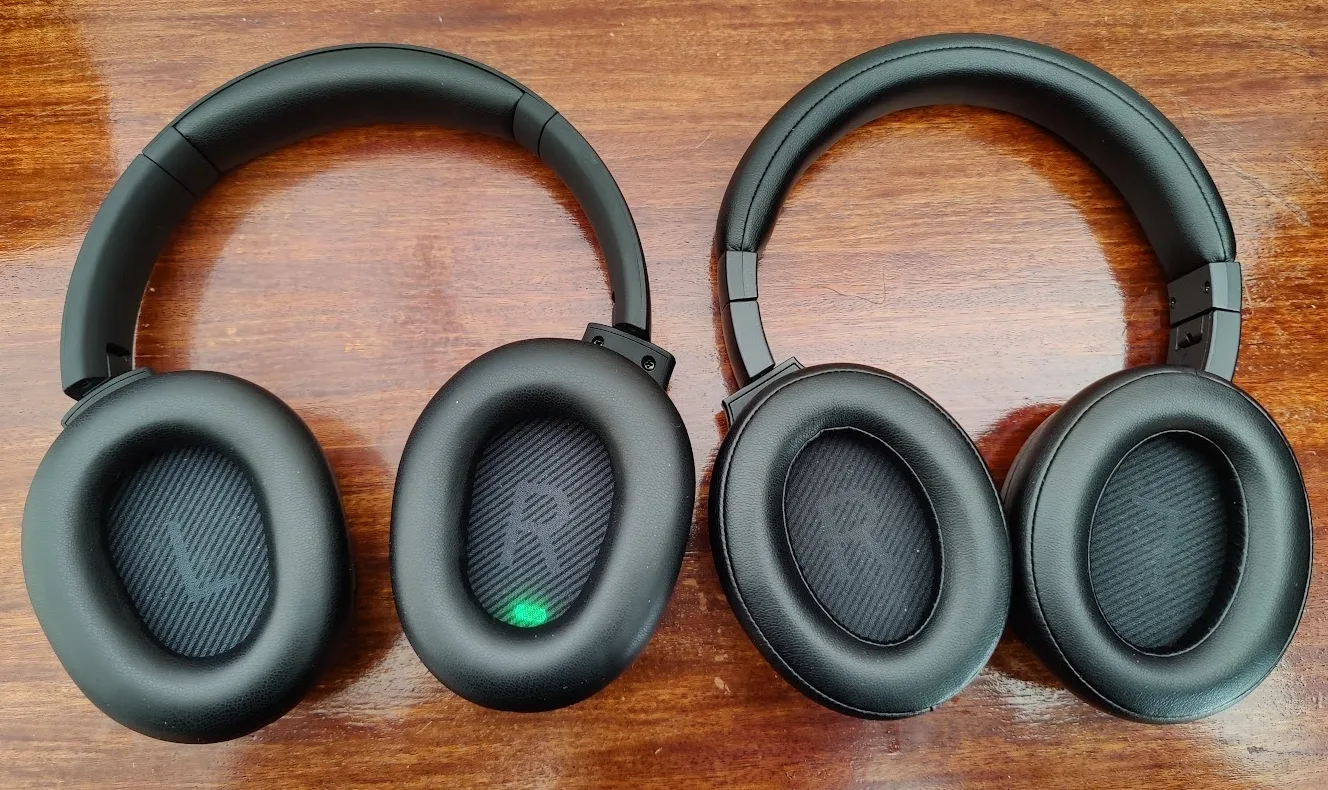
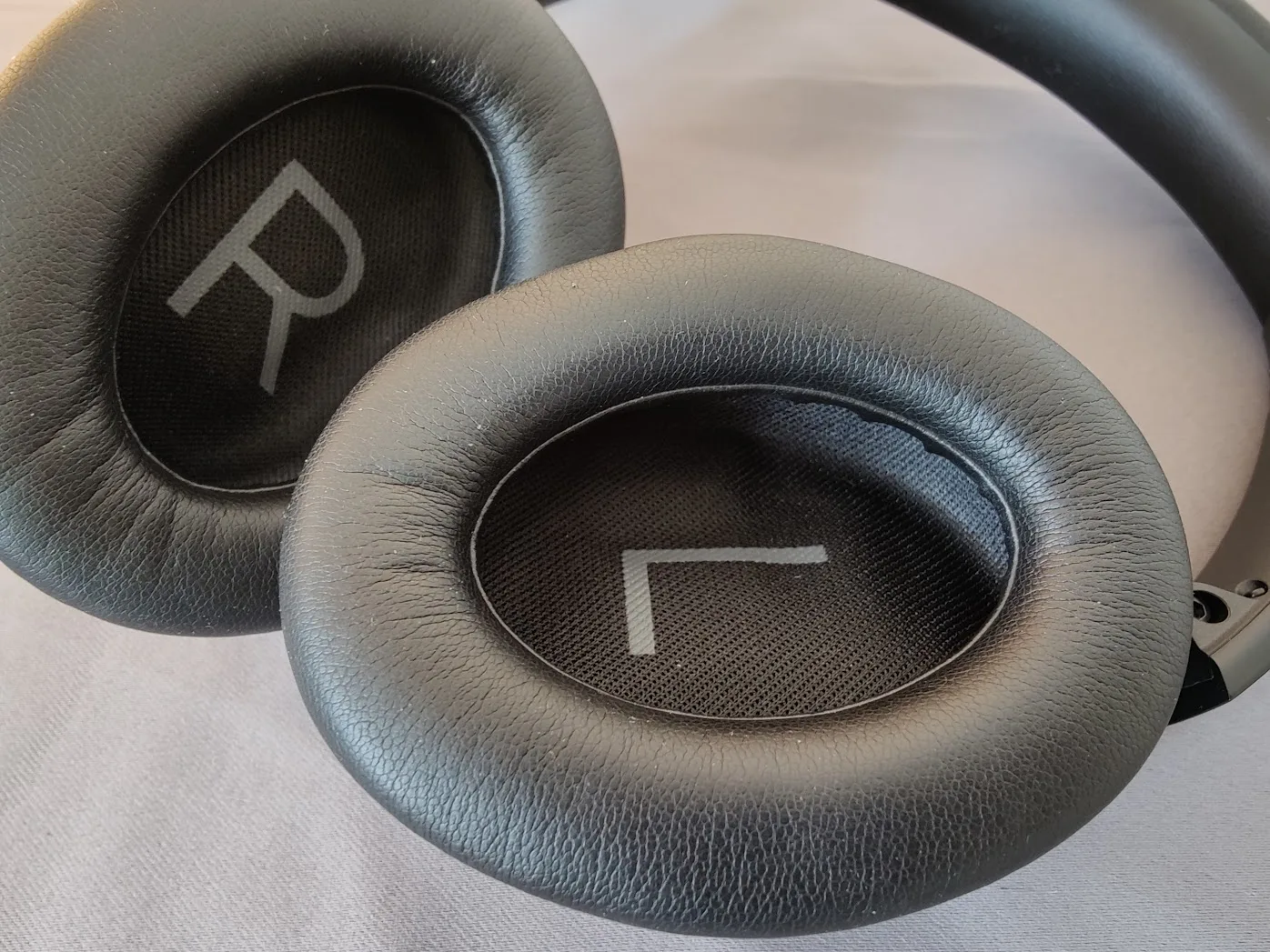
The new ear pads are the most important structural innovation of the headphones, as they affect not only comfort but also sound quality and noise cancellation functionality. In terms of material, the pads are made of the same synthetic leather as before. This time, the inner surface of the pads is also made of synthetic leather, unlike the VMK20, whose paper-like material does not seem very durable. The VMK25's pads are still removed by twisting. At the time of writing this article, replacement pads are not yet sold separately for the new model, but I would assume they will become available once the general availability of the headphones improves.
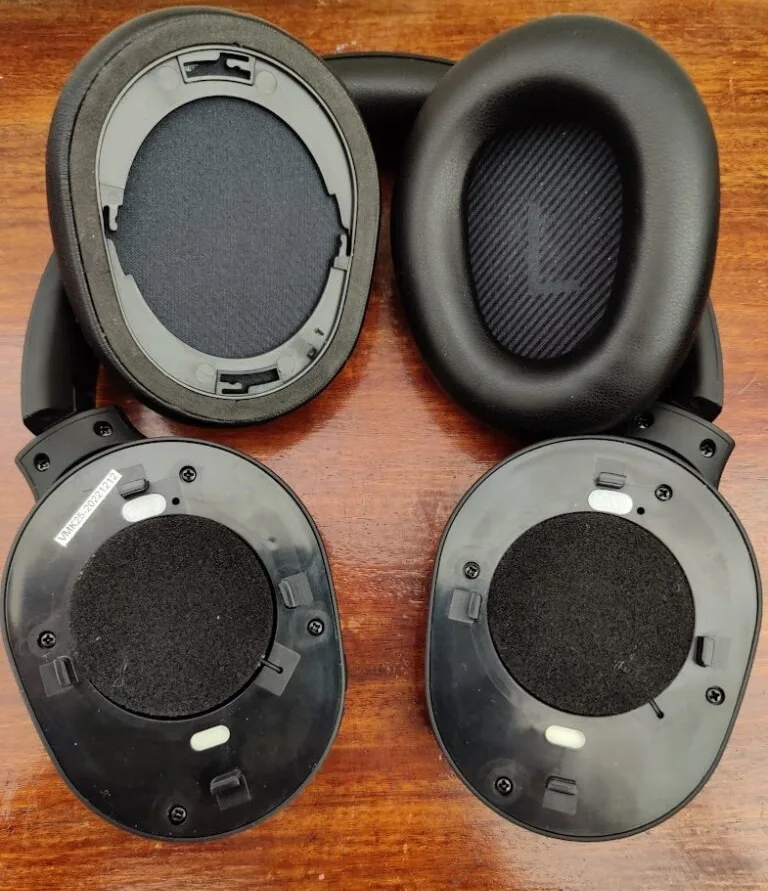
The most essential improvement in the pads for comfort is their different shape and slightly increased size. The pads are no longer completely oval like the VMK20, but slightly wider at the top edge. The design thus mimics the shape of the ear. For me, the VMK20's pads were sufficiently sized, but the VMK25 should be better suited for those with larger ears. I myself also consider the increased inner dimensions of the new pads to be a good thing.
Despite its many structural improvements, the VMK25 has not been perfected. The earcups still turn horizontally upside down when the headphones are lowered from the ears to the neck. The electronics would be better protected from moisture and dirt if the ear pads rested against the user's chest. On the other hand, with its current design, placing the VMK25 on a table is easy.
Nowhere has there really been a step backward compared to the previous model, although a few innovations might divide opinions. The VMK25 is more substantial in construction than the VMK20. The new model might feel a bit bulky to those who prefer the most slender headphones possible. However, the VMK25 is fortunately only about 30 grams heavier than its predecessor, which is even a bit surprising given the sturdier and higher-quality construction.
As a result of the sturdiness, the headphones also press on the head more strongly than before. When I put the VMK25 on my head for the first time, it pressed too much. I then carefully stretched the headband a couple of times, which almost corrected the problem. However, I hope that the headphones will become even more flexible with use.
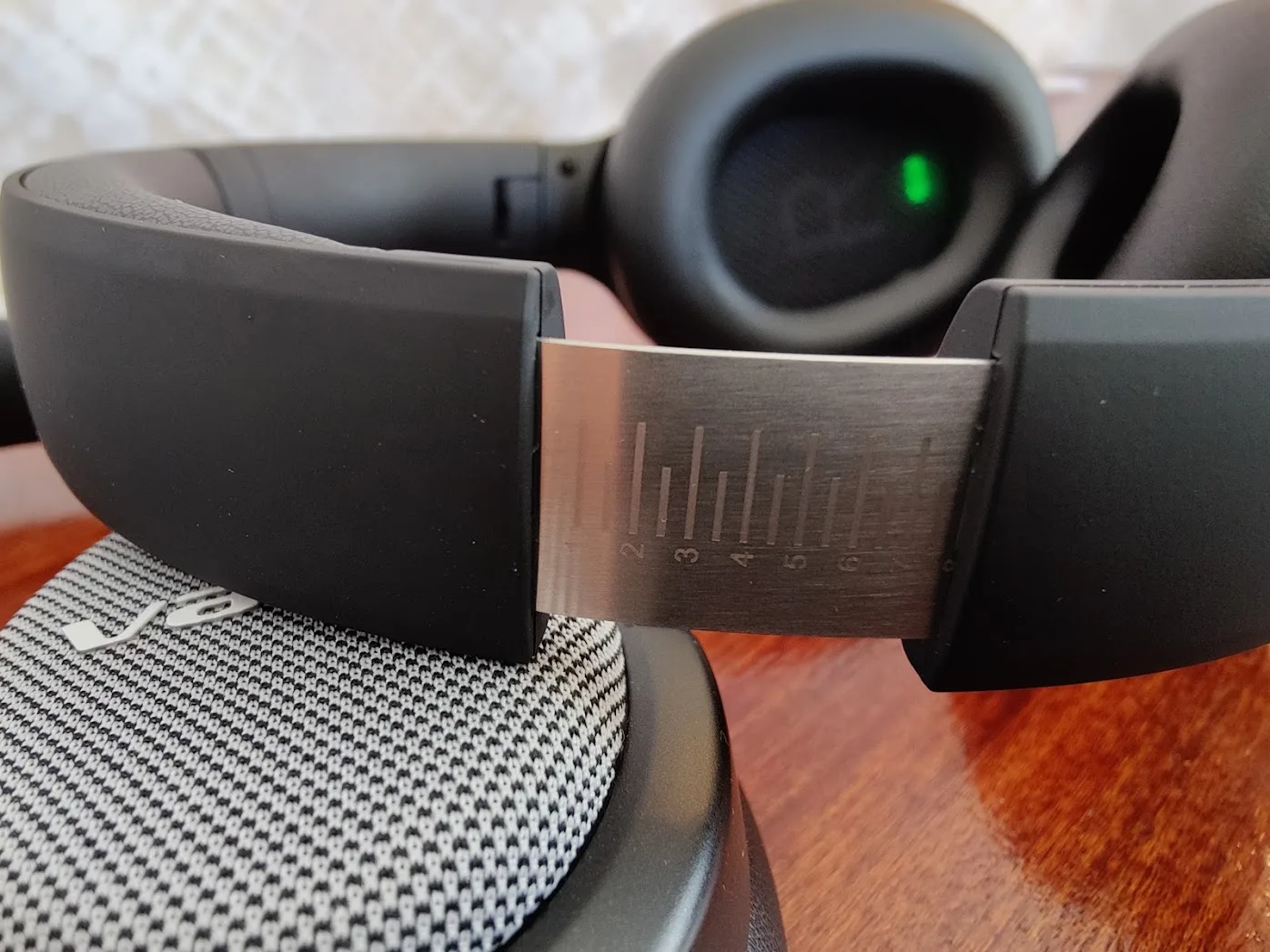
I actually also find the VMK25's headband more uncomfortable than before, even though it has slightly more padding than the VMK20. Due to the increased clamping force and the headband fitting my head less well, I cannot say that the VMK25 is more comfortable than its predecessor, despite its better ear pads. Overall, the user comfort remains quite mediocre for me. If I were to prioritize user comfort the most in a headphone purchase, I would rather buy, for example, Sony's WH-1000XM4. However, Sony is not a viable option for me, because above all I value good sound quality, which the manufacturer has not yet been able to offer in its noise-cancelling headphones.
Bluetooth–technology
The VMK25's Bluetooth connection is based on Bluetooth version 5.1, and the supported codecs are AptX HD, SBC, and AAC. The absence of the highly regarded LDAC codec might bother some, but I personally don't miss it, as I haven't really delved into the sound quality differences between it and AptX HD. In my opinion, many other factors still affect sound quality more than the Bluetooth codec used.
During my test period, the headphones' Bluetooth connection worked flawlessly with my Android phone and Windows 10 computer. When watching YouTube videos on the computer, there is a slight delay, which, however, does not bother me significantly. When used with a phone, at least Netflix works without noticeable delay. I did not try gaming with the headphones, but there is probably enough delay that the VMK25 is not the right choice for more serious gaming. However, this is likely a common problem with all other Bluetooth headphones as well.
I also tested Multipoint support by connecting the headphones simultaneously to a laptop and a phone. It worked great, as long as I remembered to stop audio playback before switching to another device. If two audio sources are attempted to be played simultaneously, the result is stuttering and an unpleasant crackling sound.
Battery life
Valco promises a maximum battery life of 50 hours for the VMK25 with noise cancellation enabled, which is an excellent figure compared to competitors. This is due to both the larger-than-usual 1050 mAh battery and the low-power Bluetooth codecs. In most headphones supporting the LDAC codec, the operating time with noise cancellation on remains closer to 30 hours. The VMK25's charging time is promised to be 2-3 hours, and the headphones have a modern USB-C charging connector, as should be the case nowadays.
Active Noise Cancellation (ANC)
The VMK25's active noise cancellation is a clear improvement over the VMK20 model, both in effectiveness and the amount of background hiss. The previous model hisses quite a bit, whereas the VMK25's hiss is already quite imperceptible, although it is more present than, for example, in Bose's QuietComfort SE model. When listening to music, the hiss is difficult to notice.
The headphones attenuate low-frequency noise particularly well. When listening to sound imitating airplane travel at about 85 decibels from speakers, the reference Bose headphones and the 150-euro priced Soundcore Space Q45 attenuated noise better, but the VMK25 was still an improvement over, for example, the approximately 200-euro Edifier WH950NB model and the 800-euro priced Focal Bathys nähden.
When listening to more varied cafe noise containing more high frequencies, Valco's headphones performed slightly worse than the Soundcore Space Q45 and Edifier WH950NB, still narrowly beating the Focal Bathys. When attenuating human speech from TV, Valco performed largely similarly to other tests, ranking fairly evenly with Edifier after the Soundcore model. The performance is therefore good, especially if the VMK25 is not compared to more effective noise-cancelling headphones from Bose and Sony (e.g. WH-1000XM5). The Soundcore Space Q45 is surprisingly good for a 150 euro headphone, but in its case, you have to consider the significantly stronger background hiss compared to the Valco model.
This time, Valco has also added a transparency mode to its headphones, which lets in ambient sounds and is already found in most competitors' products. When evaluating the naturalness of the sound, the result in transparency mode is not particularly good, but rather artificial. However, this is probably not a major drawback, as those who need transparency mode will surely find it useful.
The VMK25's noise cancellation function can be turned off if necessary, for example, to save battery. In the VMK20 model, the noise cancellation function must be remembered to be turned off separately when switching off the headphones, whereas the VMK25 turns off its power completely at once. This is a good improvement!
Microphonesound quality
My testing of the microphone's functionality remained quite superficial. I spoke on the headphones for one half-hour call, during which I moved both indoors and outdoors. With noise cancellation on, there was a slight echo in the call, but without noise cancellation or in transparency mode, the same did not occur. The other party on the call said that the wind was a bit distracting, but the sound remained quite clear. I find transparency mode really handy when making calls because my own voice is heard at a normal volume.
The headphones' sound quality
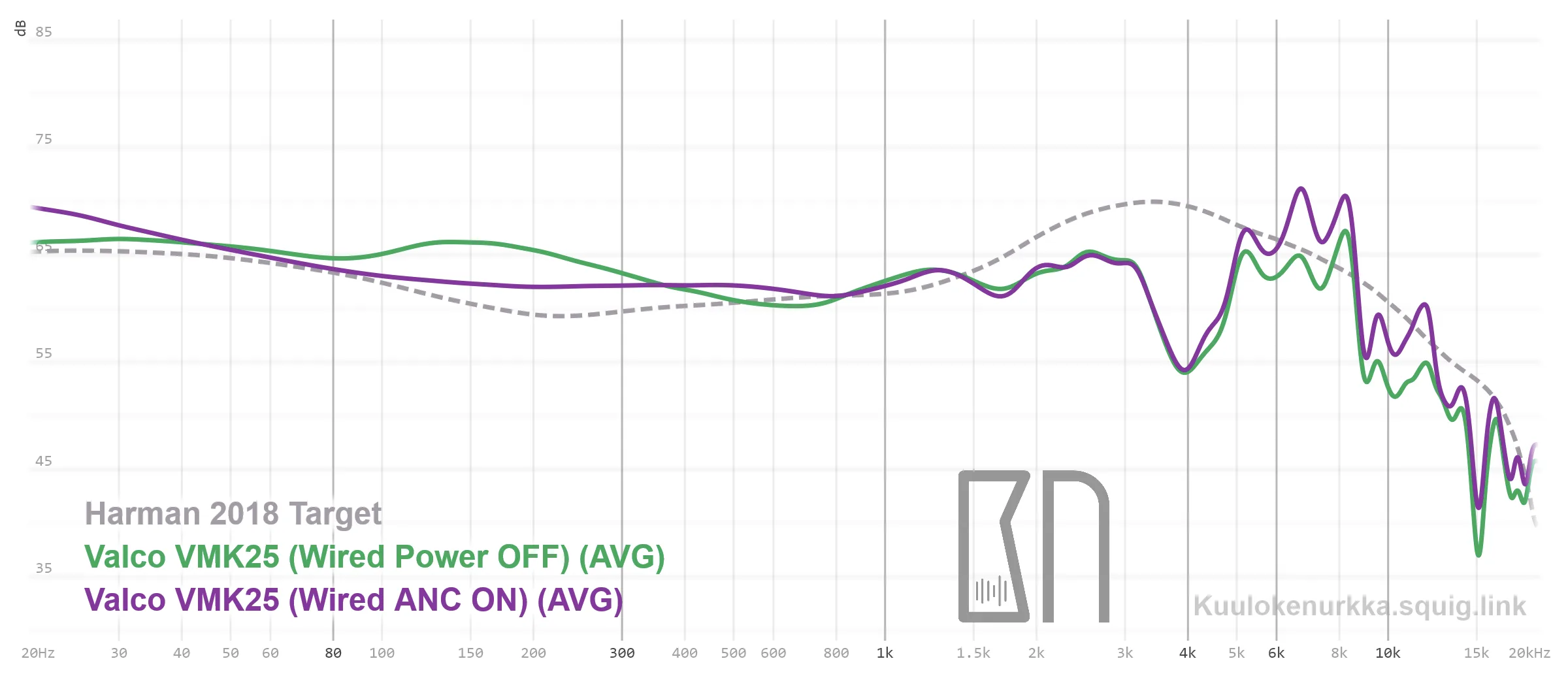
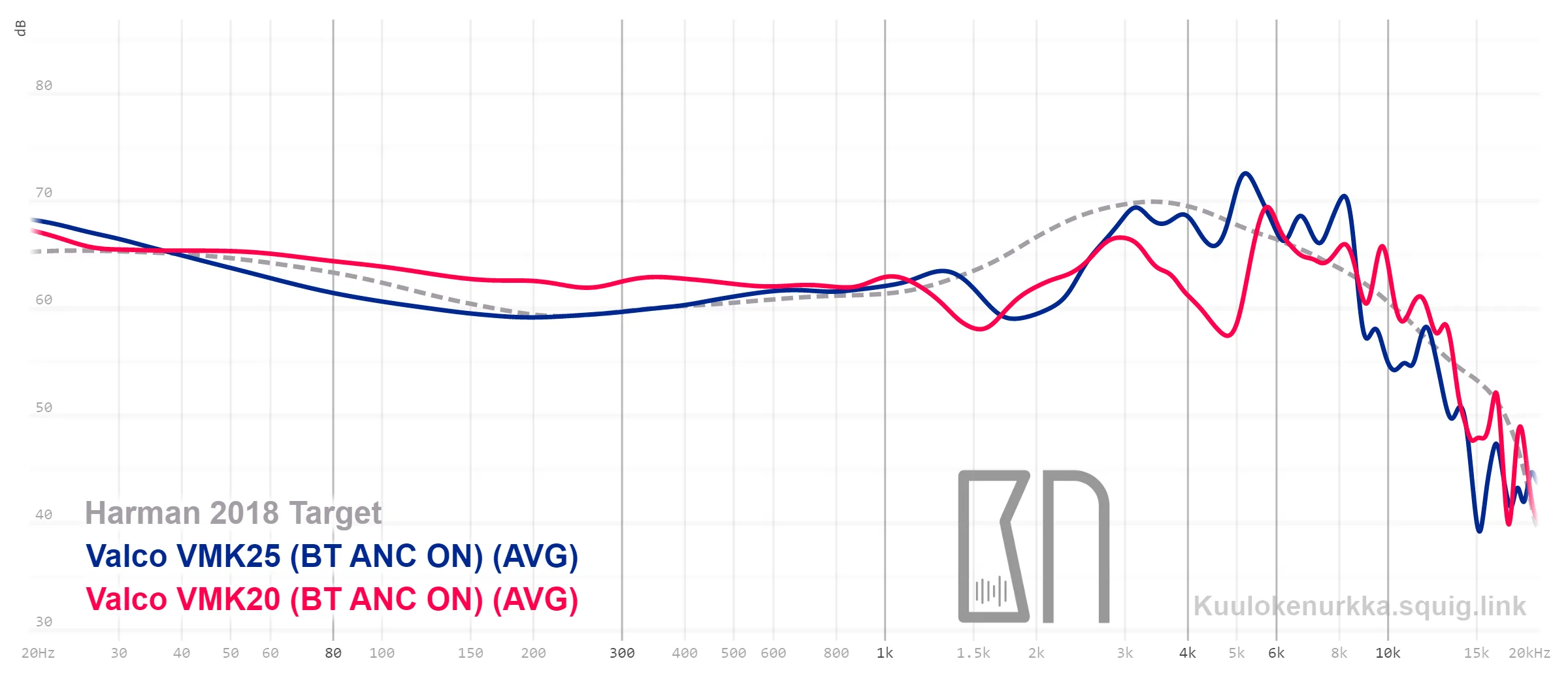
The headphone frequency response measurements have been performed with equipment compliant with the IEC711 standard. The graphs use the Harman target curve (2018 version), based on scientific research, as a reference. This curve is a generalization of what kind of frequency response sound would sound good to most people. More information about the measurements in this review and their accuracy can be found Headphone Measurements-page. The VMK25's frequency response can also be compared with other measured headphones comparison tool .
Headphone frequency response with Bluetooth connection (ANC ON):
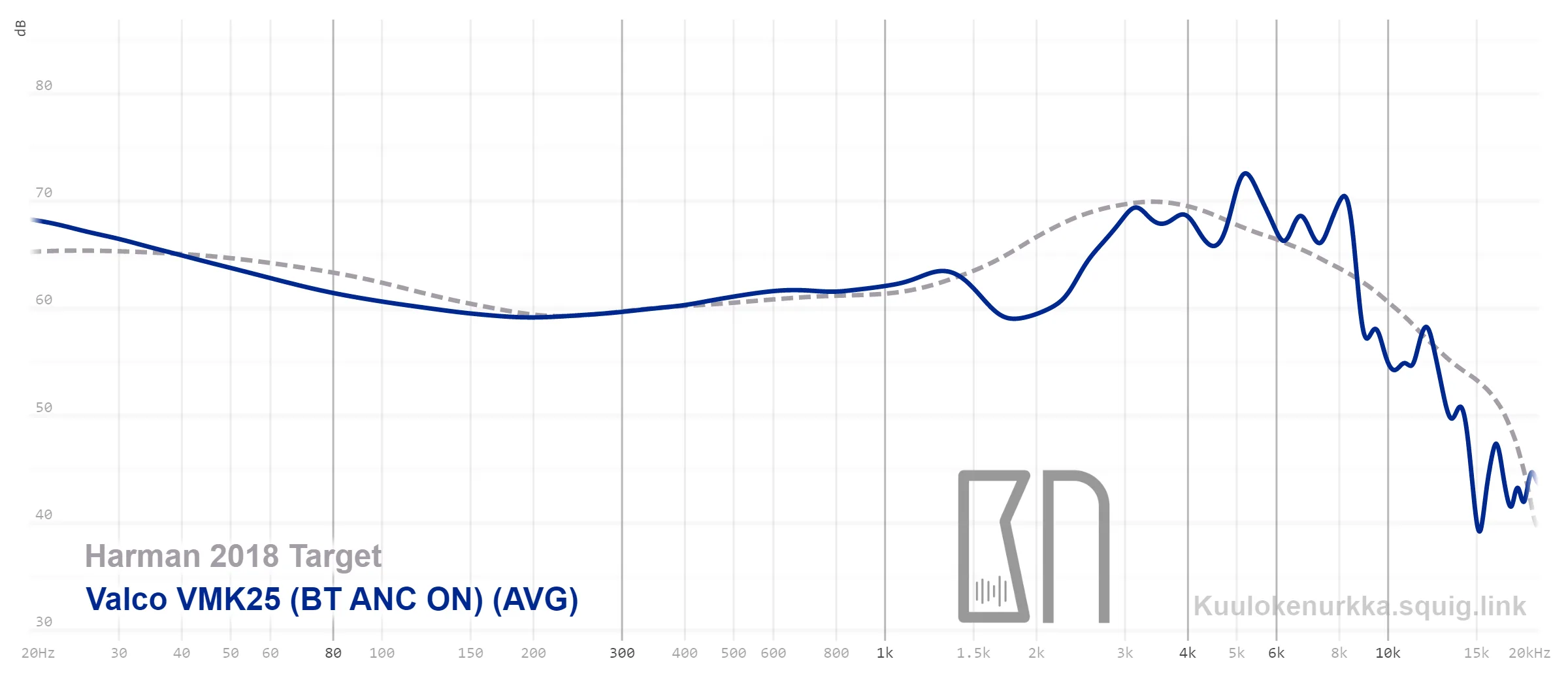
My listening evaluation is based on the sound quality according to the frequency response shown above, with the noise cancellation function enabled..
In summary, the VMK25 sounds more neutral and fresher compared to the richer and more relaxed VMK20 model. Sound quality improvements have occurred in almost every area, so let's go through it one piece at a time.
Bass:
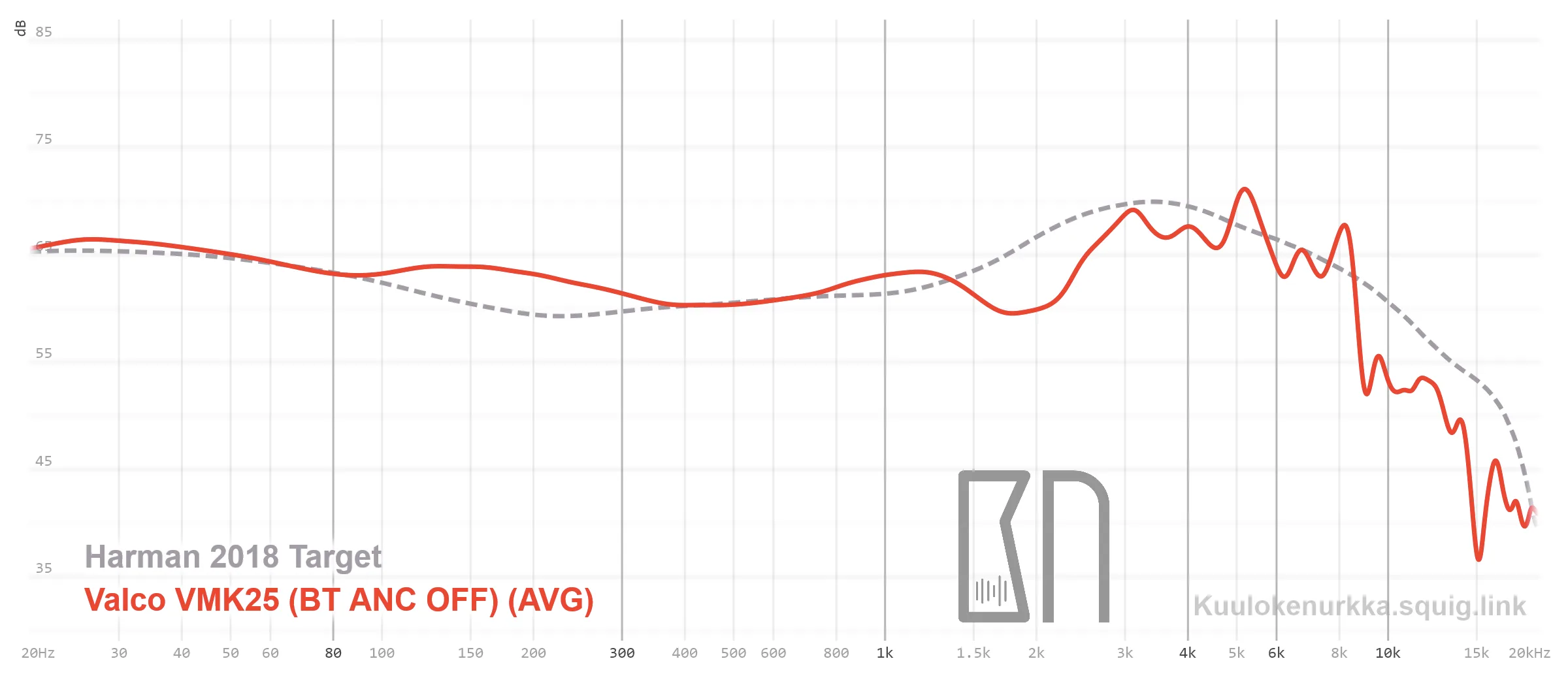
The VMK25's bass follows Harman's target curve quite well. The headphones do not offer a rich and overpowering bass, but on the other hand, for headphones with scarce bass (for example, Sennheiser HD600 or Hifiman Sundara) For those accustomed, the rumble of the lowest frequencies might feel a bit too abundant. However, I believe the average listener will be truly satisfied with the amount of bass. I personally find Harman-style bass somewhat emphasized, so if poorly implemented, the bass can easily become boomy, causing the notes to muddle together.
To my delight, however, I can say that the VMK25's bass reproduction is implemented with very high quality. Compared to the VMK20 model, the lower frequencies are more distinct and better layered. Although there is slightly less bass than before, the VMK25 hits powerfully, bringing a credible sense of physicality to the sound. The bass is controlled and less boomy than in headphones of the same price range generally. Strongly reproduced lowest bass frequencies make rap music sound pleasant, whereas for fast-paced EDM music, I would wish for a slightly more impactful mid-bass.
It would be possible to make the bass fuller and more impactful by turning off the noise-cancelling function. However, for my own musical taste, a more restrained mid-bass suits best, because with energetic rock and metal music, faster bass patterns are reproduced clearly and the double bass drum rumbles precisely, and the bass does not detract from the clarity of the lower mid-frequencies.
Mid-range:
The biggest difference between the VMK25 and the older VMK20 is found in the mid-frequencies. Due to better bass balance, the lower mid-frequencies sound clearer on the VMK25 than before. The VMK20 has a rather natural sound, but its upper mid-frequencies are attenuated to such an extent that the reproduction lacks the final edge, freshness, and distinctiveness. The VMK25 has a more realistic tonal balance and sounds less veiled.
However, if the VMK20”s relaxed presentation feels perfect as is, the VMK25 might sound overly aggressive. I myself found the VMK25 a bit fatiguing to listen to at first, but I got used to the new presentation quite quickly. The slightly attenuated 2 kHz region should theoretically make listening effortless, but for some reason, the result is not as expected this time. Overall, however, the VMK25”s mid-frequencies are successful, and it should also please "audiophiles" who appreciate neutral reproduction.
Treble:
Among the few sound quality weaknesses of the VMK20, in my opinion, was the treble that sounded detached from other frequencies. Overly sparkling high frequencies, in my opinion, are ill-suited for headphones that are balanced and almost soft-sounding in other frequencies. Unfortunately, the VMK25 suffers to some extent from the same problem. Most often, the brightness and detachment of the treble do not bother much, but especially when listening to metal, the reproduction easily becomes overly sibilant. Those sensitive to higher frequencies should therefore approach the purchase of these headphones with a small reservation. However, it is not a serious problem, as for example almost all Beyer Dynamics and Grados, as well as most in-ear headphones designed for hi-fi use, have more emphasized treble than the VMK25.
I have nothing bad to say about the quality of the treble. High ”air frequencies” are reproduced relatively well, and sound separation is excellent. Notes do not decay too quickly but linger as long as necessary to create a realistic sound.
Soundstage:
In terms of soundstage, the VMK25 is pretty much on par with its predecessor. The headphones are a relatively affordable closed-back model, and they sound like it. The reproduction feels slightly larger compared to the VMK20, but the difference is marginal. I hope Valco will also try tilting the drivers towards the ear in the future. Many headphone manufacturers build their headphones so that the sound-producing driver is slightly angled relative to the ear, so that the sound arrives at a more natural angle. Even then, a significant soundstage improvement is not always achieved, but sometimes the center of the soundstage shifts clearly forward, making the presentation more natural and speaker-like. However, the VMK25 does not ultimately differ greatly from its competitors, so there is no need to worry about the soundstage when making a purchase decision.
Dynamics:
Among the strengths of the VMK20 were its dynamic and engaging reproduction. For me, the macro-dynamics of headphones (the ability to credibly reproduce changes in tempo and volume, as well as percussive sounds // in other words, the opposite of dull and restrained reproduction) is of paramount importance as a single feature, so a weakness in that area can, at worst, ruin otherwise excellent headphones. Fortunately, the VMK25 continues on the path paved by its predecessor, being explosive and powerful in its reproduction. As the tempo accelerates, listening draws you in.
Sound Separation:
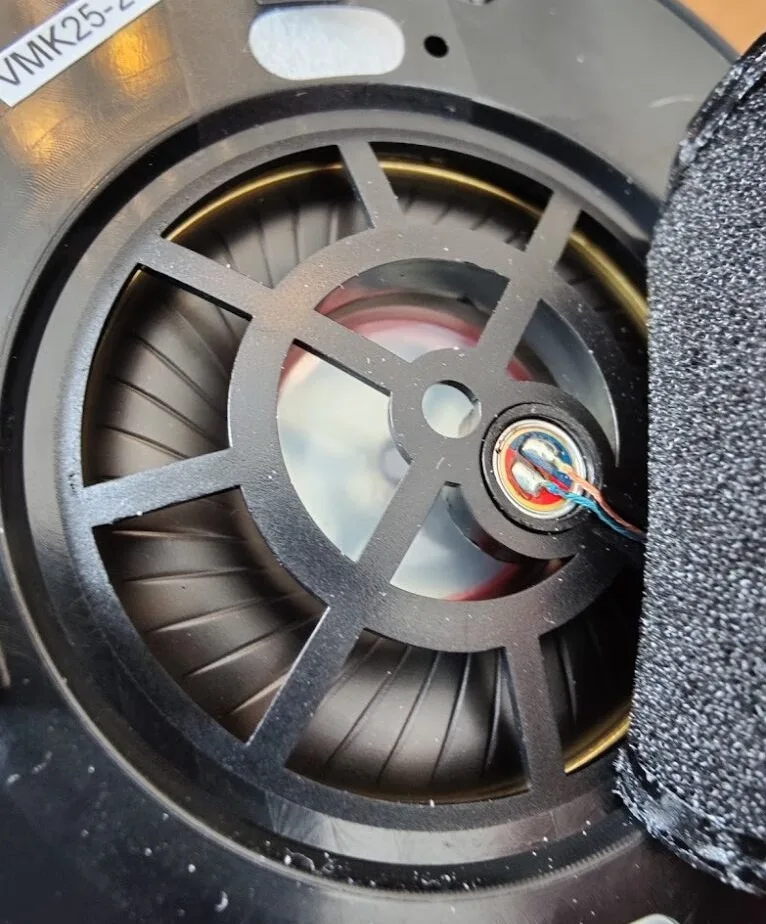
Although the VMK20 was already a capable headphone in terms of separation, the VMK25 takes a clear leap forward in sound transparency. The clearer reproduction of the new model is mainly enabled by an objectively better frequency response. Partially, the improvement is also a result of the new headphone driver, which appears to be more capable than before. With the VMK25, it is quite easy, in a way, to "see" into the recording, making it possible to pick out individual components of the music for listening.
With VMK20 and most other headphones under 200 euros, you don't get absolutely everything out of the music, because quieter sounds pop out less clearly from their background. The VMK25 is one of the best closed-back headphones I've heard in its price range for detail separation. It also performs excellently against wired headphones intended for more critical music listening or for those working with audio technology. Those seeking the most accurate and detailed sound should, of course, still primarily consider headphones with an open-back design, such as Hifiman HE400se.
Valco VMK25 vs. Bose QuietComfort SE
Prices: 200 € vs. 350 € (Bose model also sold for as low as 200 euros)
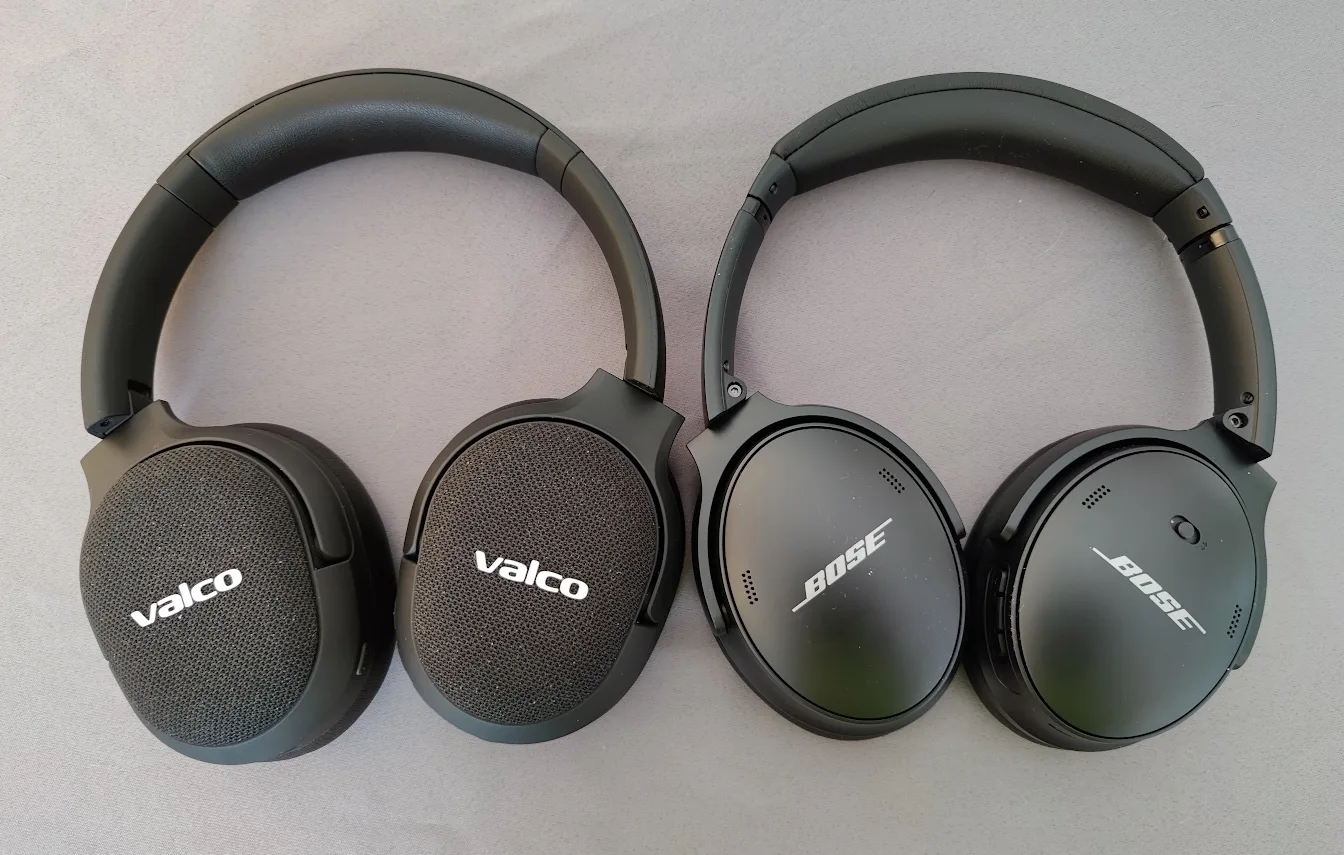
I also quickly compared Valco's new headphones to the Bose QuietComfort SE model (QC SE), which is sold for as low as the same price as the VMK25.
Differences in user experience
The VMK25 feels more robust in construction than the flimsy QC SE. However, there's nothing inherently wrong with the Bose model's construction, even if it doesn't quite match my image of 350-euro headphones. The Valco model's sturdier construction unfortunately results in higher weight and poorer wearing comfort. The QC SE is about 50 grams lighter, and its strongly angled drivers create a large space inside the ear pads, easily accommodating even larger ears. This particular Bose model is indeed one of the most comfortable headphones I have ever tried.
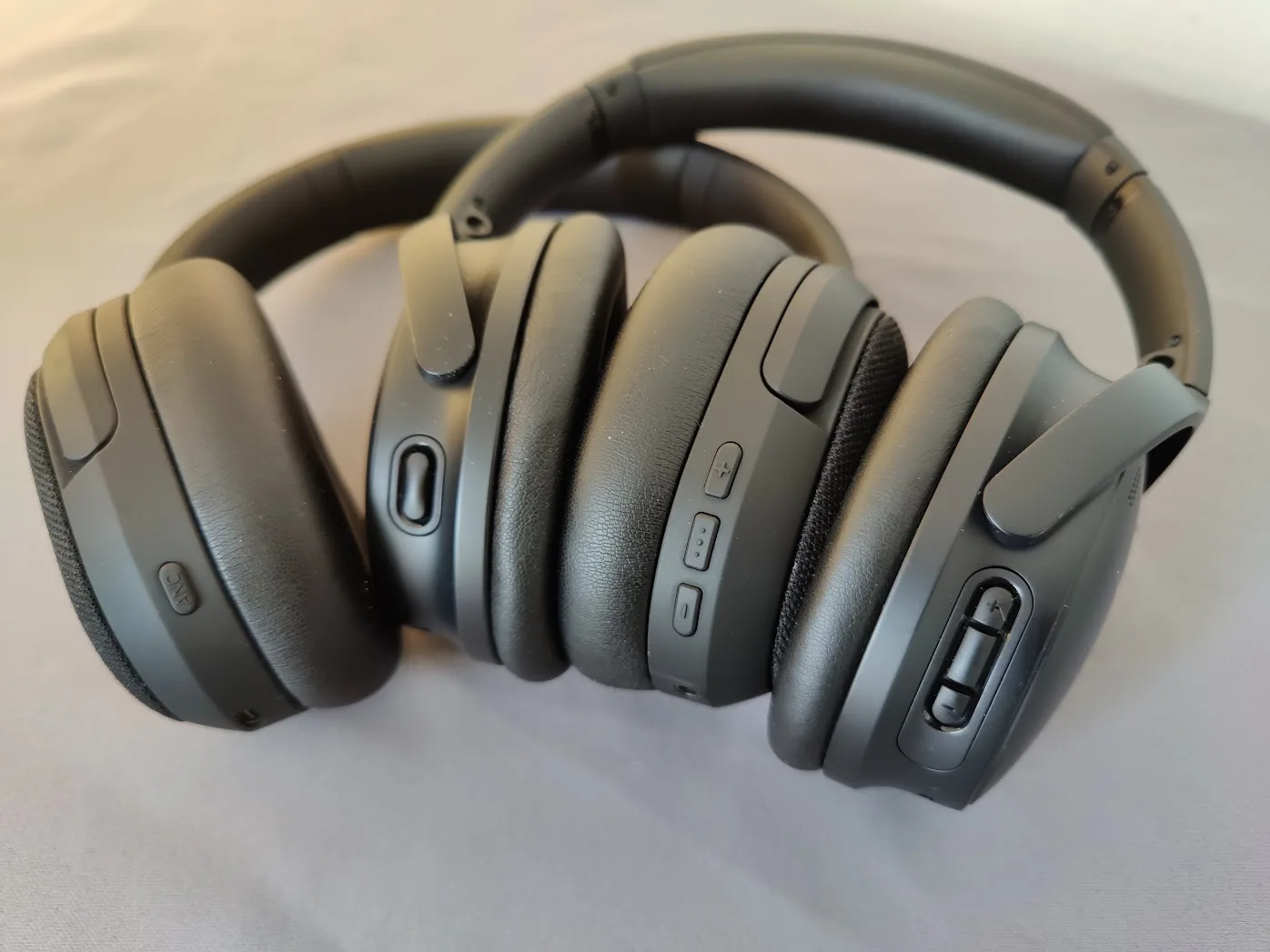
Both headphones are controlled by physical buttons, which are placed on the back of the cups in the same way. The right cup has three buttons, and the left has one button to change the noise-cancelling mode. The QC SE also has a separate power button implemented with a slider. Ultimately, there isn't a big difference in controlling the headphones or using the buttons.
There is no noticeable difference in Bluetooth connectivity between the headphones either. Both connected to my Android phone effortlessly, and there were no problems with connection stability. I cannot describe possible differences in microphone performance in more detail. Both headphones do their job, but on the other hand, I didn't get to try speaking with them in a very noisy environment.
The VMK25 and QuietComfort SE are largely comparable in features and usability. However, the Bose model's significantly more effective noise-cancelling function and better wearing comfort tip the scales in favor of the American manufacturer. Bose also offers a phone application for its headphones, which includes an equalizer. The VMK25's sound can only be modified with a separately installed application, which does not save settings permanently to the headphones.
Differences in sound quality
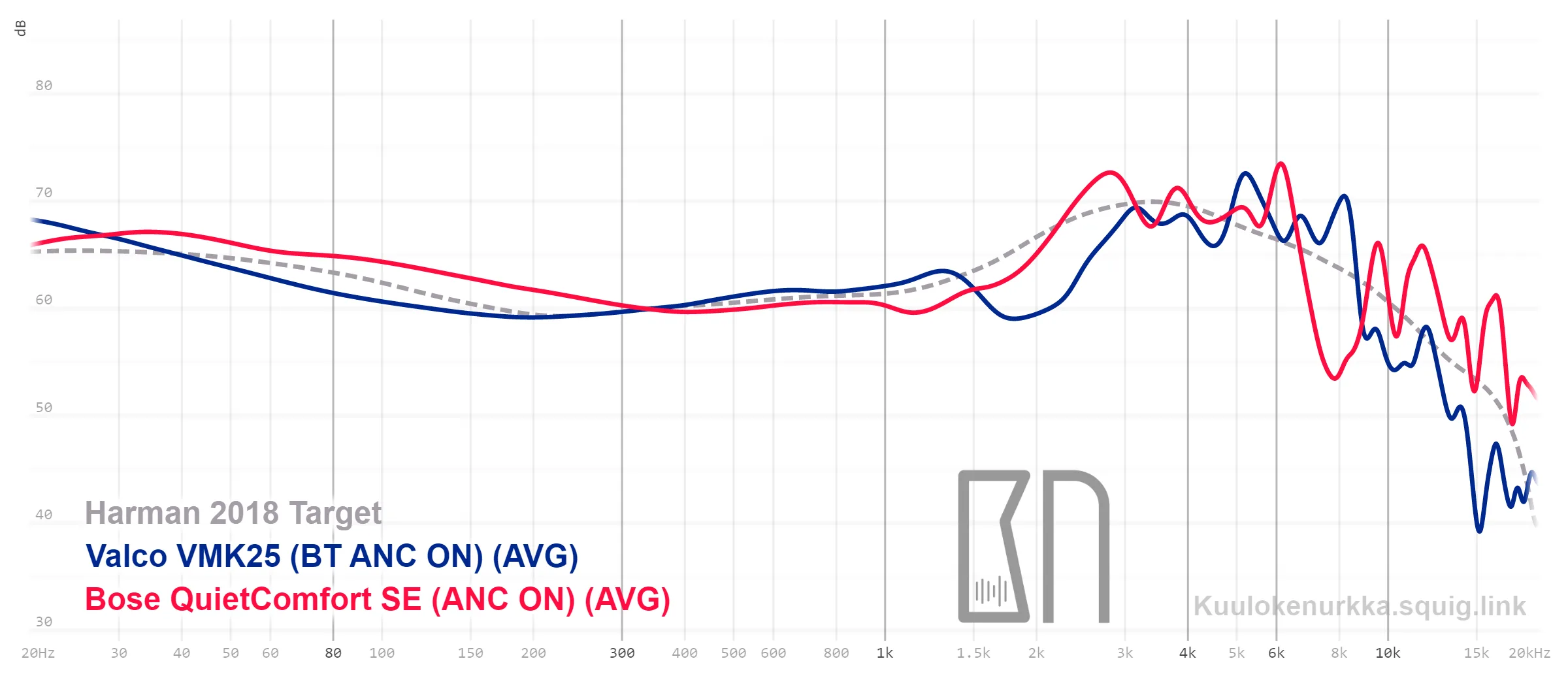
Bose headphones have a rather bright sound, so everything sounds artificially sharpened. On the positive side, the QC SE sounds more open than the VMK25, but the result is peculiar because the closed design is still clearly evident in the bass reproduction. Valco, on the other hand, has succeeded in making the structure of its headphones such that the low frequencies do not make it ”live” too much, but the reproduction generally remains clean and articulate. Bose's hissing and sibilant sound quickly becomes irritating, but over time one gets used to it to some extent. However, if one does not want to get used to an overemphasized treble, the frequency response can be corrected with the Bose Music app.
My intention was to compare the headphones without equalization. However, the VMK25's frequency response is so much more correct that a proper comparison would not have been possible. I ended up installing the Bose Music app and entered the settings used in the QuietComfort SE review, which I also found to sound good:
- Bass: -2
- Mid-frequencies: +3
- High frequencies: -3
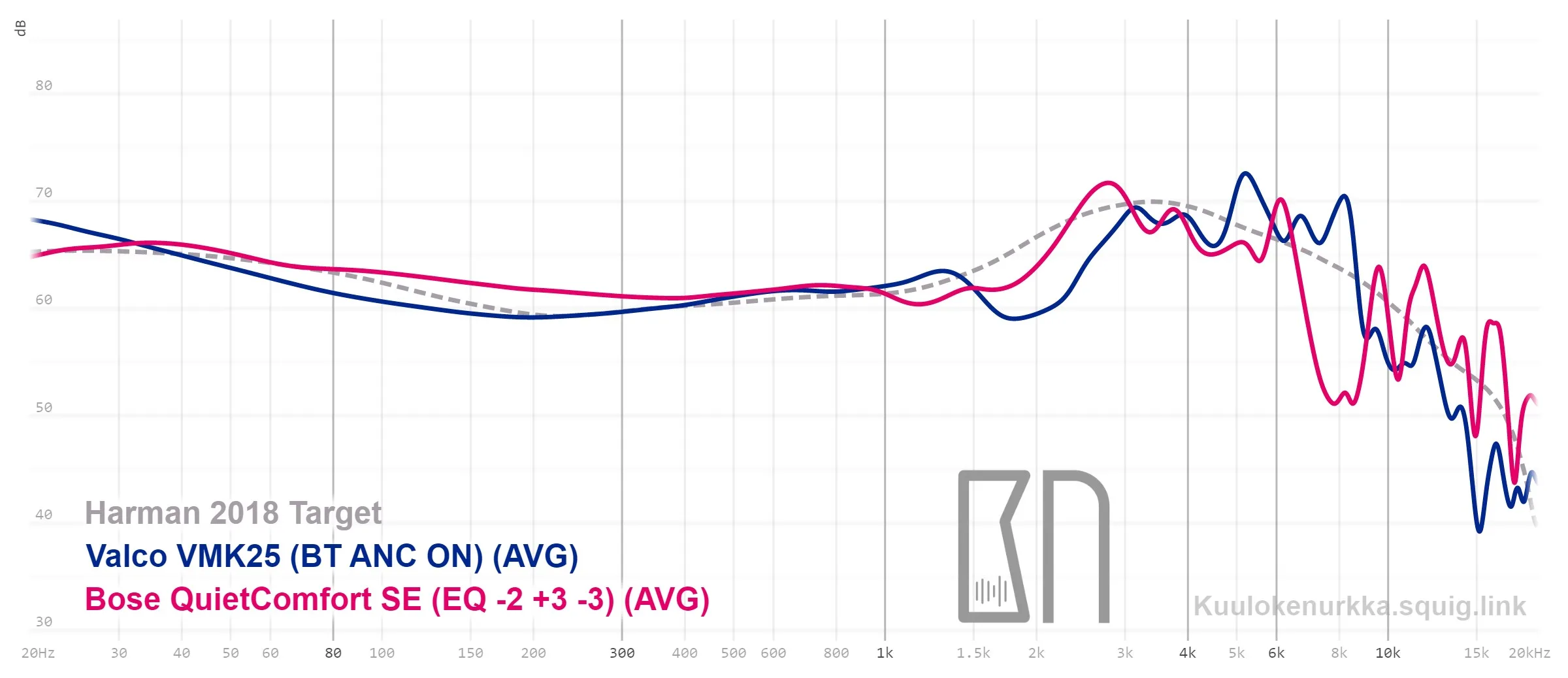
When equalized, the QuietComfort SE's frequency response is at least as pleasant or even slightly better than Valco's headphones. However, this was not enough to close the gap, and in my opinion, the VMK25 still sounds better.
The VMK25 is, above all, more articulate than the QC SE. With the latter, for example, choir harmonies become muddled, and counting the number of singers is not as easy as with Valco. In my opinion, the VMK25 sounds better overall. Only in soundstage-related characteristics does the Bose model gain a slight advantage, as the vocalist stands out better from the background and thus acquires a more realistic shape and size in the space. In plain terms, with Bose, it's easier to imagine the singer in front of you, whereas with the VMK25, the vocalist doesn't sound as authentic. I would almost dare to say that Bose's angled drivers enable a more convincing soundstage. Part of this could also be explained by the ”missing piece” in the VMK25's mid-frequencies between 1.5–3 kHz.
If I had to choose…
For my own use, I would more often choose Valco's VMK25 from the two, because I value sound quality more than other features of the headphones. I don't need powerful noise cancellation and I usually wear headphones for at most an hour at a time. If, however, I were to use headphones for, say, 8 hours a day, I would be willing to sacrifice some sound quality and would prefer to wear the more comfortable QuietComfort SE. Without equalization, Bose headphones are not particularly pleasant to listen to, but when adjusted, they eventually come close to the VMK25's sound quality.
Summary
Valco has succeeded in making the VMK25 a better headphone than its predecessor in almost every aspect. It is quite astonishing that the new model costs only 30 euros more than the VMK20. The most significant improvements are a more effective and less noisy active noise cancellation function, as well as further improved sound quality. Many also believe that comfort has certainly progressed.
When it was released, the VMK20 was somewhat old-fashioned in its functionality and features. The VMK25 adds a transparency mode to the feature list, but this feature is already undeniably three years late. Nowadays, most noise-cancelling headphones have a mobile application that allows for adjusting the noise cancellation function, power settings, and other things in addition to sound modification. With the VMK25, in addition to an app, I missed ear sensors that would pause audio playback when the headphones are removed from the head. The VMK25 actually feels more old-fashioned than the VMK20 did at its release. However, if someone values ease of use and good sound quality most in headphones, Valco's VMK25 is a fairly foolproof choice in its product category.
Commercial cooperation
Explore Valco's selection and support Kuulokenurkka at the same time
What does this mean?
If you are planning to acquire Valco headphones and decide to place your order by proceeding to the manufacturer's website via the link above, Kuulokenurkka will receive a small commission from this. You are thus simultaneously supporting the construction of both Valco's death star and our headphone empire. Which one will be completed first?
Pros and cons:
+ Uncolored mid-range
+ High-quality bass reproduction
+ Sound accuracy and resolution
+ Sounds decent even wired
+ Noise cancellation is more effective and works better than in the VMK20 model
+ Ease of use
+ Sturdy construction
+ Excellent battery life
+ Valco offers repair service for headphones
+ The price has only increased slightly compared to the VMK20 model
+/- The ear pads are larger than in the VMK20, while the headband is not as comfortable. For most, the VMK25 is certainly very comfortable, but for me, the VMK20 fits better
– Treble is emphasized a bit too much
– The size and accuracy of the soundstage are at most average
– The headphones are limited in features and old-fashioned
– Fingerprints easily stick to the matte plastic surface
– No LDAC support
 EN
EN  FI
FI
They're quite okay! I bought these sight unseen on pre-order, without prior experience with Valco products. A bit about my background: I am not an audiophile.
I have previously tried my friend's similar Apple noise-cancelling headphones. In those, the noise-cancelling function and sound quality were, in my opinion, excellent. So I am comparing the use of these to those. The Valcos do not have as good playback sound or noise cancellation; you notice it when trying these devices alternately. But I decided to keep these anyway, because
a) are more affordable
b) fit my head better, are more comfortable and significantly lighter
c) can be used without mercy in different situations
d) the battery seems to last really really well
Based on a month of use, these are excellent when commuting by train (noise cancellation silences coughers quite well and sometimes annoying, crackling loud speakers in the train car). They also work quite well in the office, especially when keeping noise cancellation on and listening to music or YouTube while working. The hustle and bustle of an open-plan office drops to such an extent that you can actually get something done.
They stay on well during walks, even if you jog a little sometimes, and block about half of the traffic noise, which is already half less than normal traffic noise. They also work well for PC gaming and Teams meetings, but the Playstation 4 (damn it!) only accepts them when connected directly to a DualShock controller with a cable, but then again, I haven't been able to connect any of my audio devices to the Playstation via BT. Maybe I'm completely inept, or the device is really picky.
These are hardly enough for an audiophile's home jams, but for a basic user who needs headphones they dare to use in different situations, they are a really good option. In my opinion, the price/quality is therefore spot on. With more money, you can certainly get better ones, but then will it happen that you still need more affordable earflaps in their price range so that you can use them in different situations.
PS4 Bluetooth does not support most audio devices. My son and I learned the same phenomenon the hard way. Apparently, the underlying A2DP audio protocol(?) is too ”slow” for gaming as it has ~100-200 ms lag, and Sony doesn't want to explain that to its users. For the same reason, gaming headsets are rarely BT-based and instead have their own dongle at 2.4 GHz.
That's a layman's understanding. Those who know better, please correct me if I got it very wrong. 😅
After Bose QC, the biggest minus is calls made in noisy environments. Previously, it was possible to make Teams or similar calls outdoors while walking past cars, in a cafe environment, and even on a bus, one could answer an important call, trusting that the call could be made. Now the other party can no longer hear anything unless they are in a significantly less noisy environment. The difference is wild. Perhaps the microphone quality/directionality is poorer.