Author: Sword of Damocles
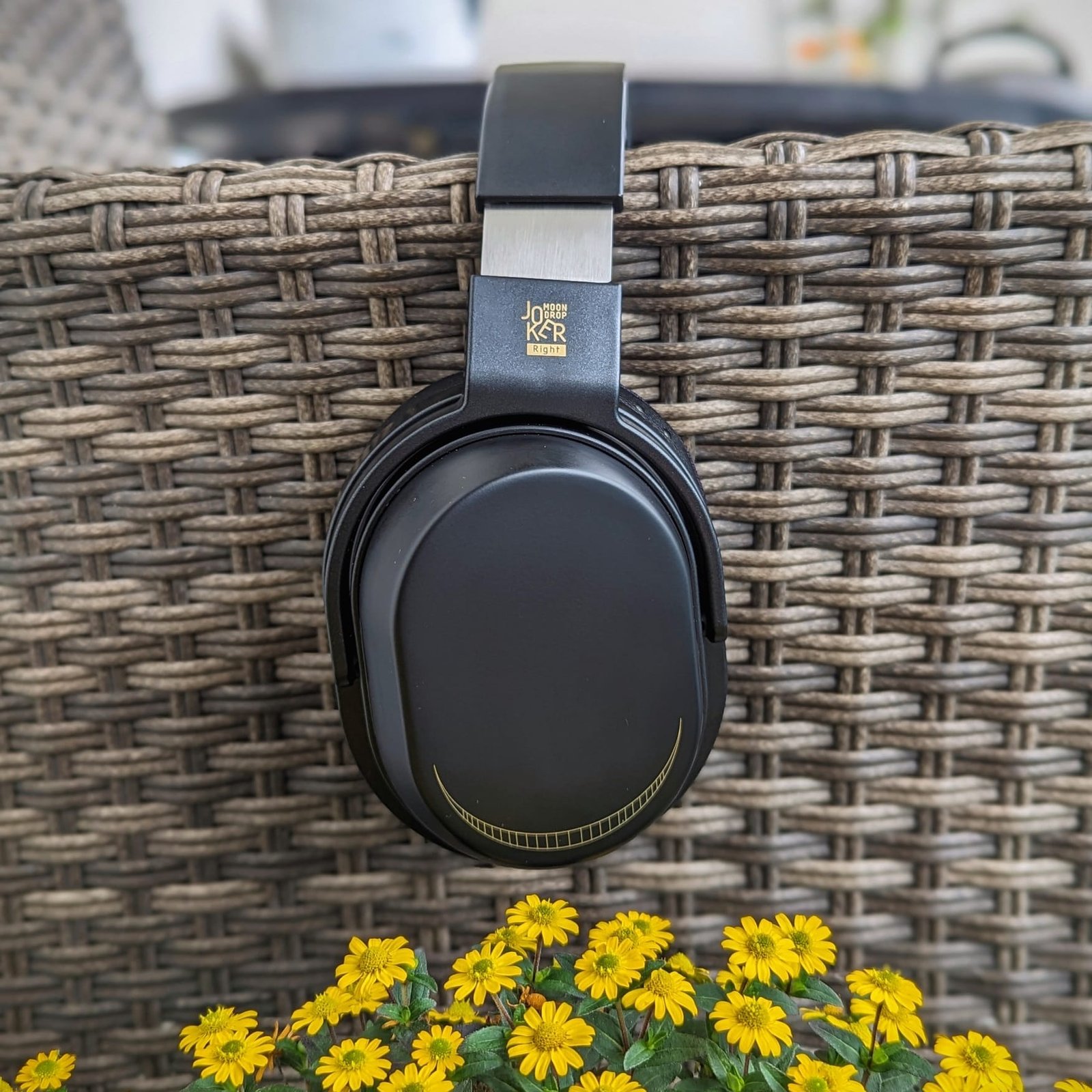
Table of Contents:
Information:
- Release year: 2023
- Country of Origin: China
- Price: 80 USD (approx. 75 euros)
- Type: Closed, over-ear
- Driver type: Dynamic 50 mm
- Impedance: 68 ohm
- Sensitivity: 106 dB/Vrms
- Weight: 290 g
- Connector type: 2 x 3.5 mm
- Cable: 1.2 meter cable with a 3.5 millimeter connector
- Accessories: 6.35 millimeter adapter and manual
Review sample: Self-purchased product
Moondrop, which now manufactures over-ear models alongside in-ear headphones, recently released closed-back headphones named Joker (link to the manufacturer's product page), which, based on marketing material, are aimed at monitoring use. The most surprising and interesting aspect of the headphones is their aggressive $80 pricing, as many other recently released Chinese (more well-known) headphone models have generally cost $100–200. Since headphones costing under 100 euros are generally not particularly good, I decided to buy the Joker to try it out, hoping it would bring a change to the situation. I ended up paying only 65 euros for the headphones when ordering from Shenzhenaudiol, because they went on a Back to School sale a week after their release. The question is, can you get good headphones for such a low price?
Product packaging
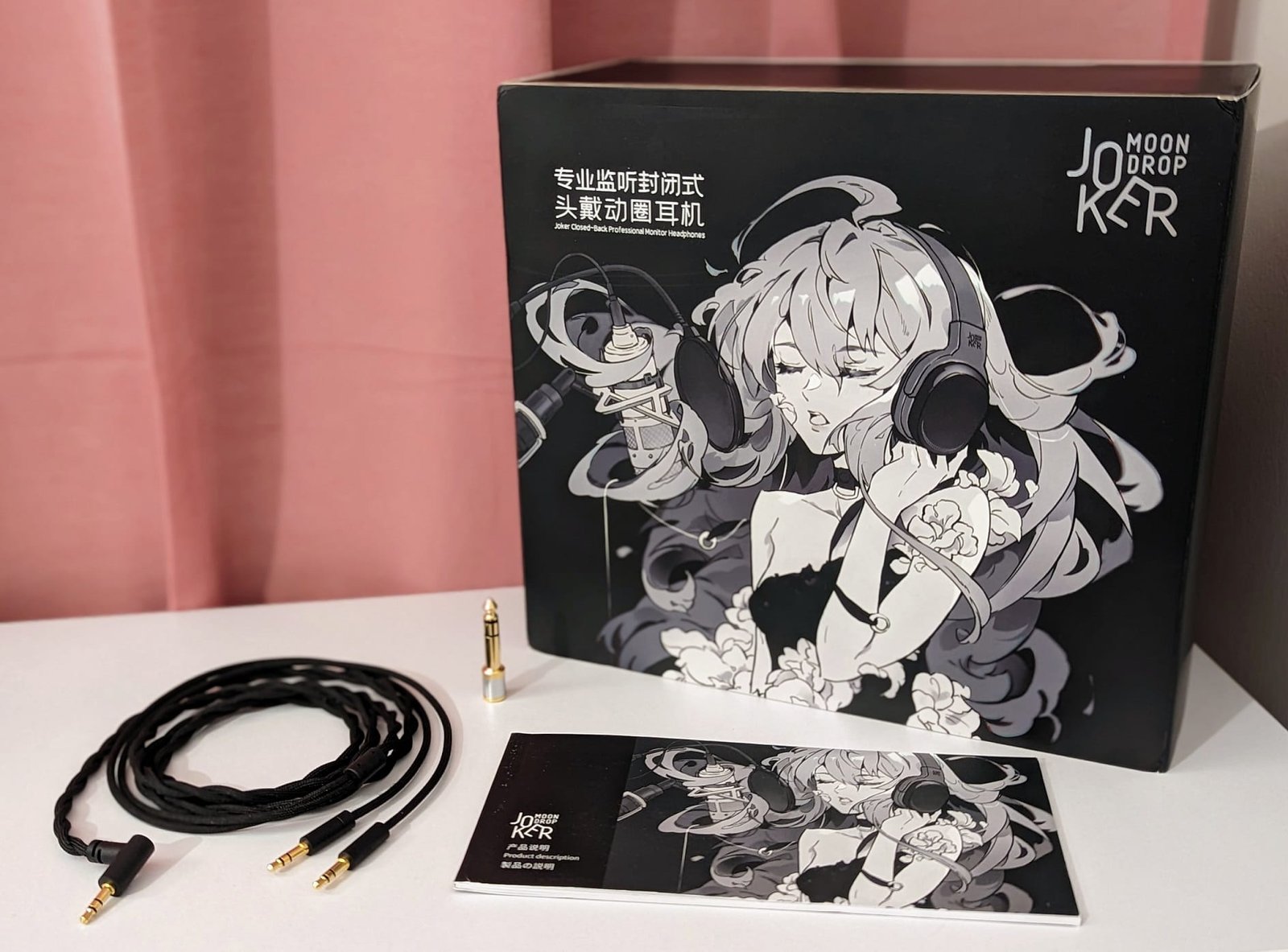
Most Moondrop products have their own anime character, and the Joker is no exception in this regard. Its black product packaging is adorned with a rather stylish female character printed in white, so the first impression is intriguing given the affordable price. The cardboard box is also very sturdy, as its front is made of thicker cardboard. For comparison, Hifiman's 1500 euro headphone models are not delivered in such a fine box or with equally precise product information. Moondrop has, among other things, printed the measured frequency response of its headphones on the back of the package – other manufacturers should also gradually move in the same direction regarding transparency.
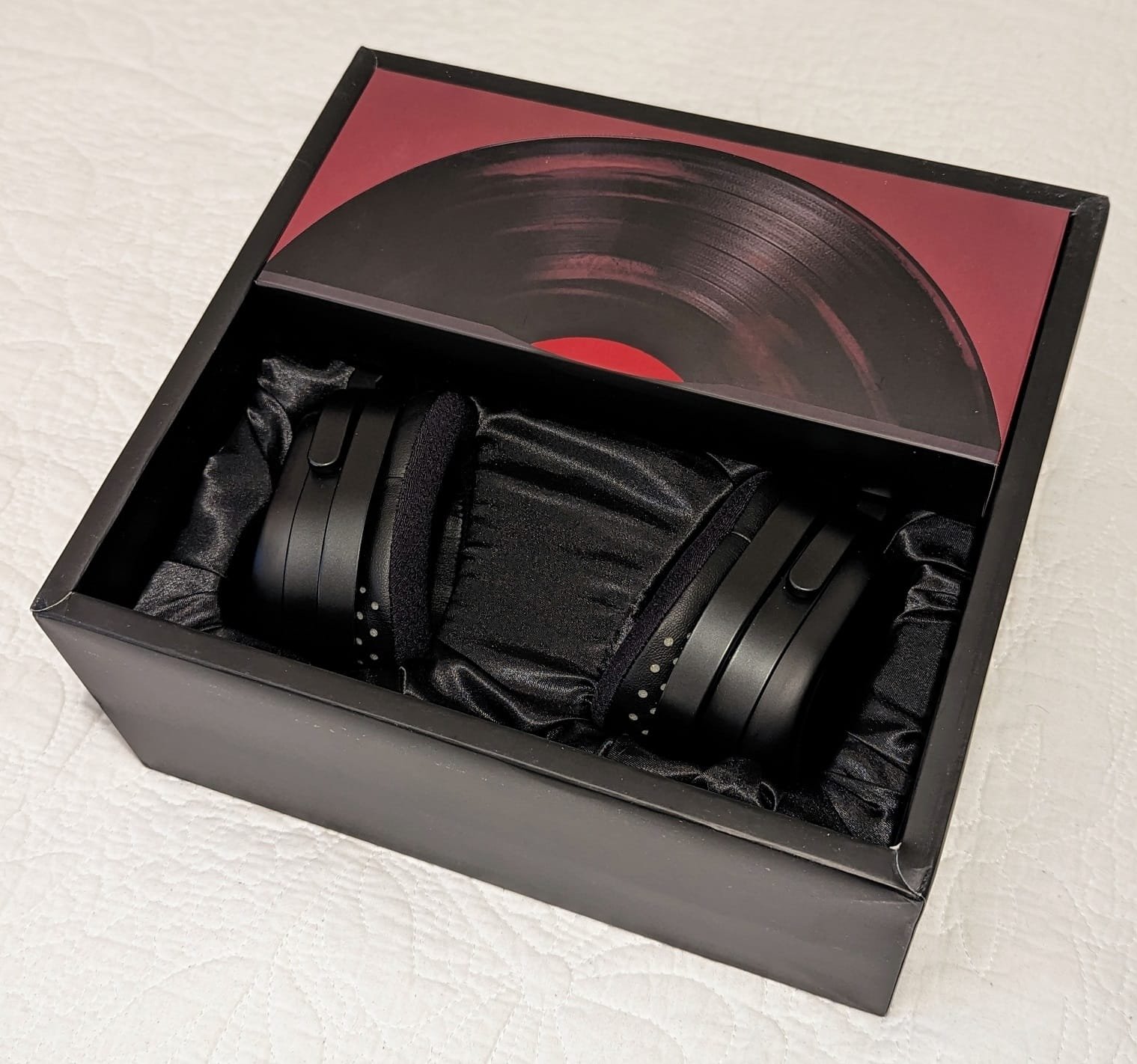
The positive feeling continues even after removing the cardboard covers, as the presentation is really neat. The Joker comes with an excellent, albeit rather short (1.2 m) cable, for which a traditional 6.35 millimeter adapter is offered as an accessory. Based on the marketing material, the package should have also included some kind of sandpaper for modifying the headphones' appearance, but the idea has apparently been abandoned without remembering to inform the marketing team – however, the loss is not significant.
Structure
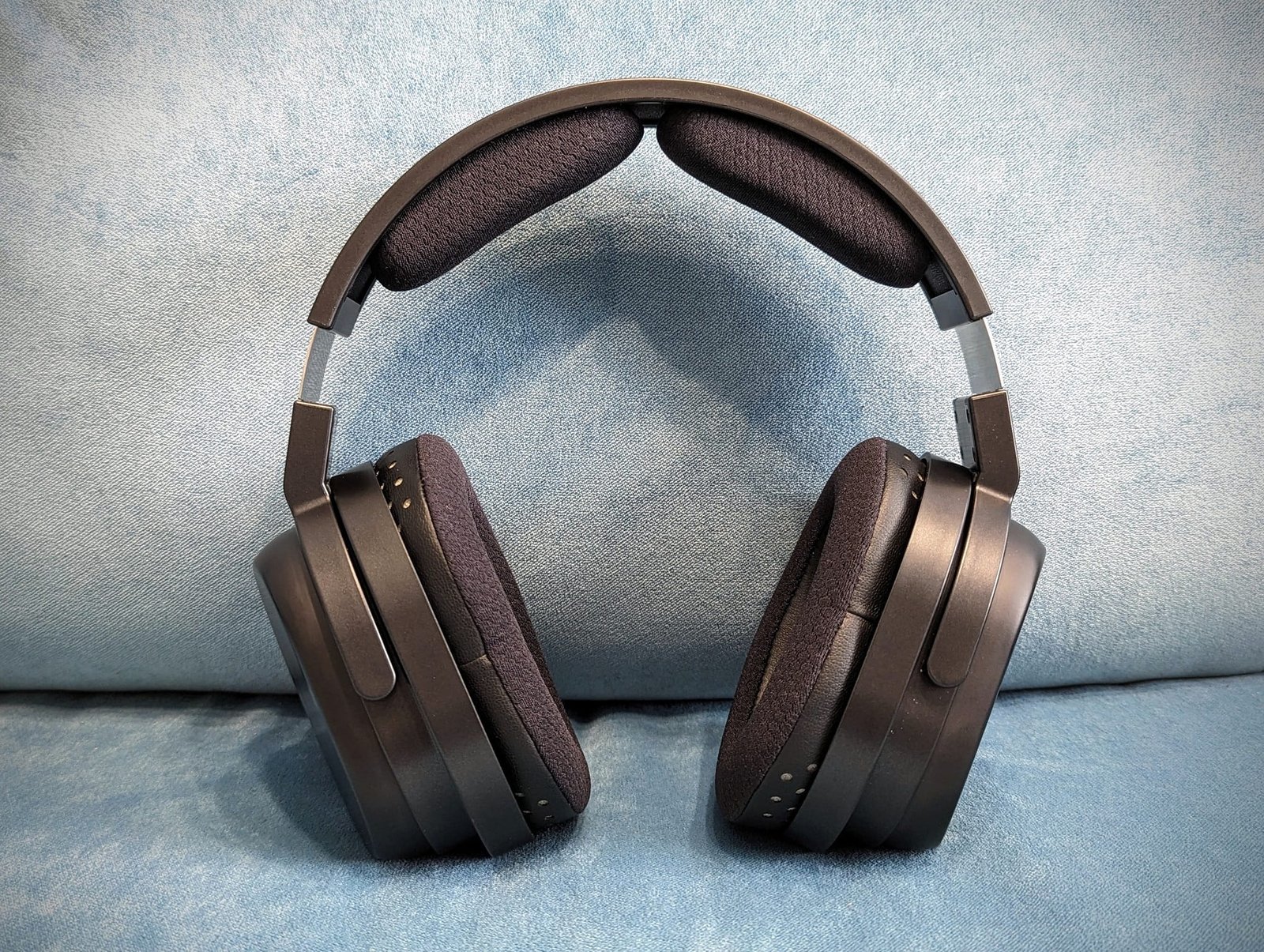
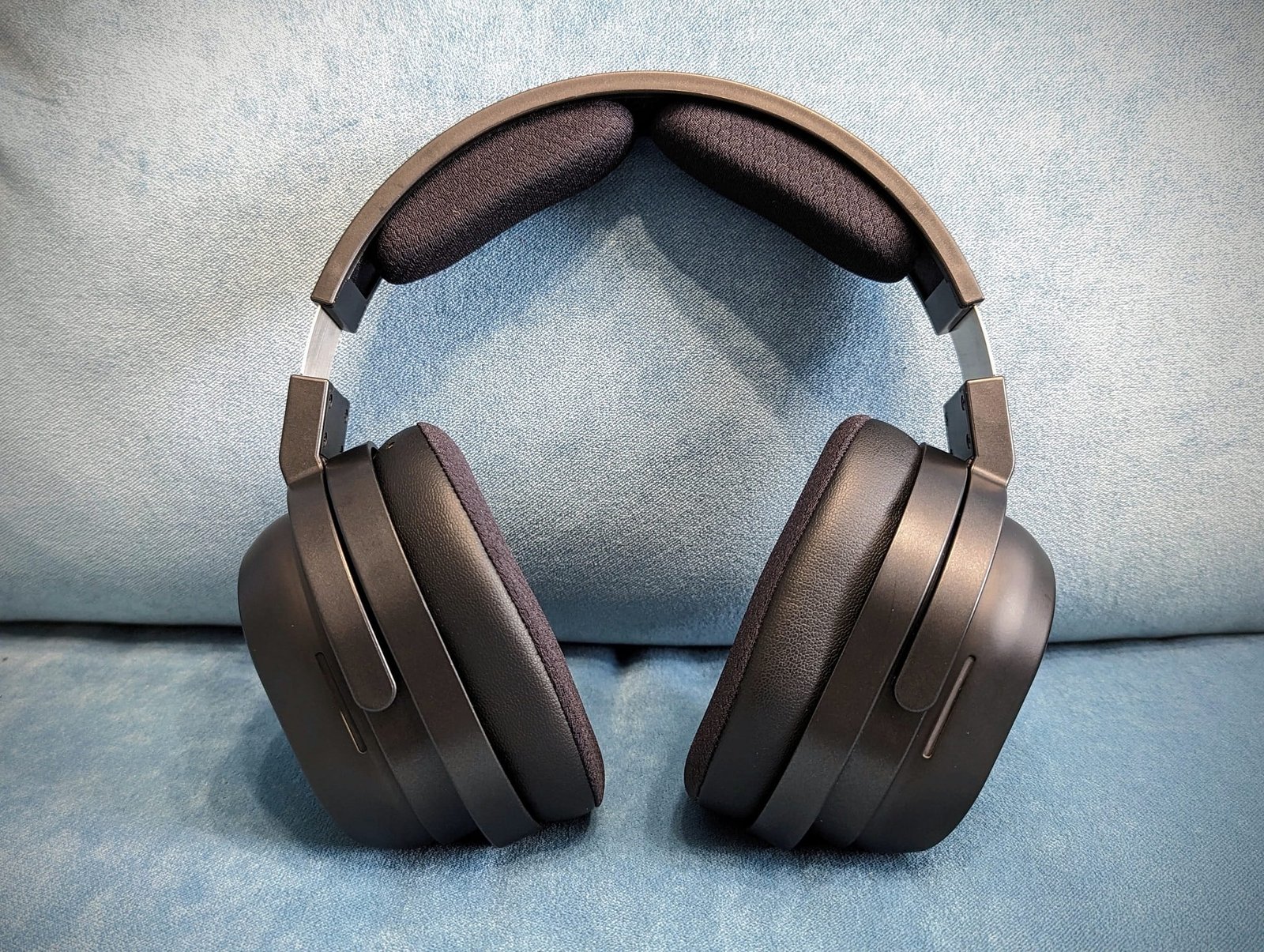
The Joker's structure appears to be identical to Moondrop's previously released open-back Void model, apart from the closed cups (product page) with. For the approximately 200 euro Void, the cheap-feeling plastic and loose overall feel are undeniably poor choices, but in the sub-100 euro Joker, the structural solutions do not cause me significant annoyance. The manufacturer has clearly taken inspiration for the headband and head strap from From Sennheiser's HD 600 series, because the adjustments work the same way and the design language is quite similar. The similarities end there, however, as the chosen materials in the Joker are clearly inferior, and for example, the earcups rattle unpleasantly against the headband when shaking the headphones, even though thin rubber pieces have been added in between – ”clonk clonk clonk”.
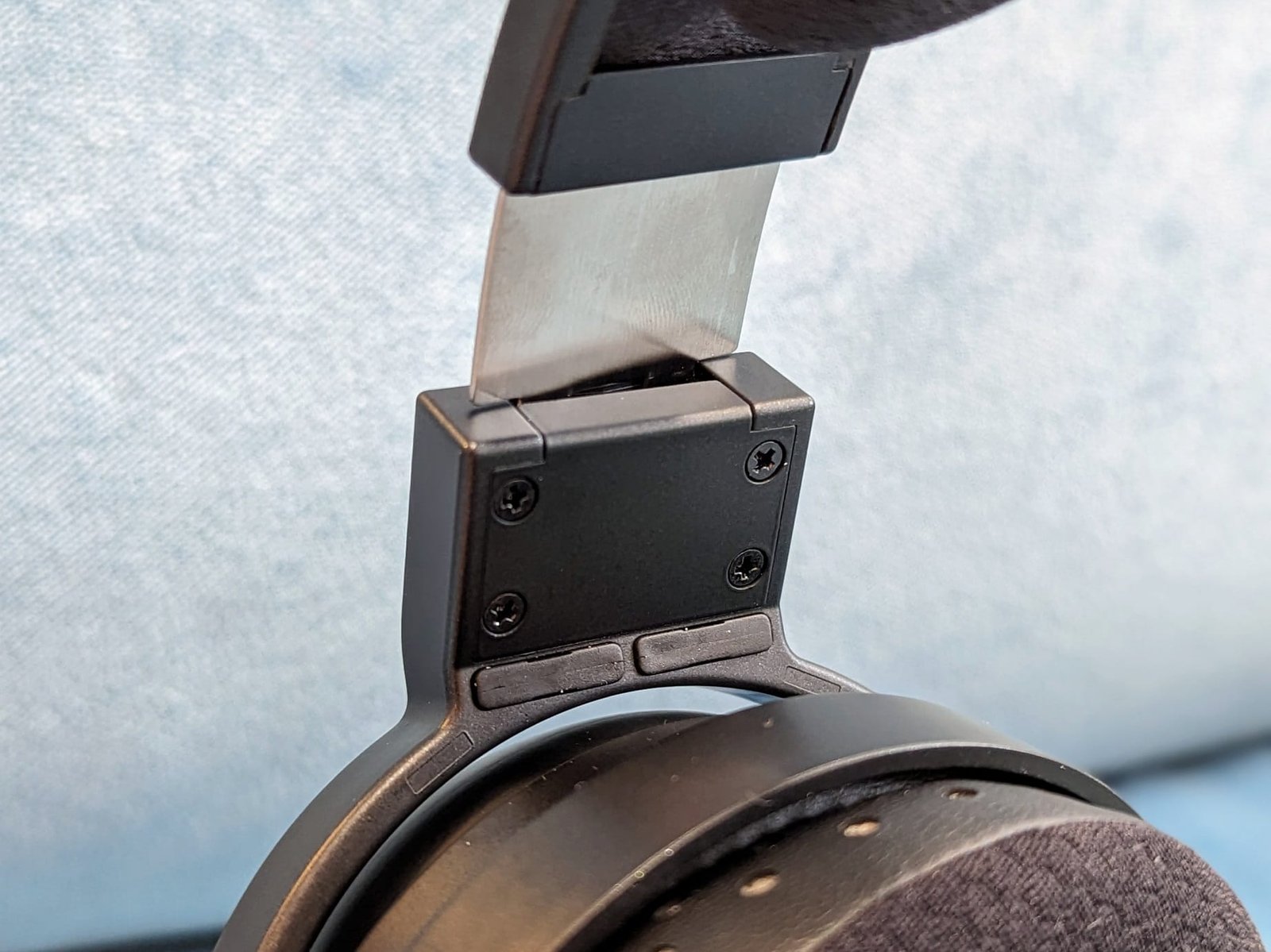
However, at 290 grams, the Joker is pleasantly light for a closed-back headphone, and the most critical points in the structure feel sufficiently durable. The height adjustment also works smoothly. There is actually a comically large amount of adjustment range, as in their maximum position, the headphones almost touch my shoulders. The most exceptional feature of the Joker, however, are the brass earcups. I don't know many closed-back headphones with metal earcups, let alone ones sold for 75 euros. The Joker's earcups also don't sound completely hollow when tapped, so they have clearly been damped and acoustically treated, as the manufacturer states they have done. Some kind of model for stopping standing sound waves has apparently been taken from Sony's legendary MDR-R10 headphones, which is certainly not a bad starting point.
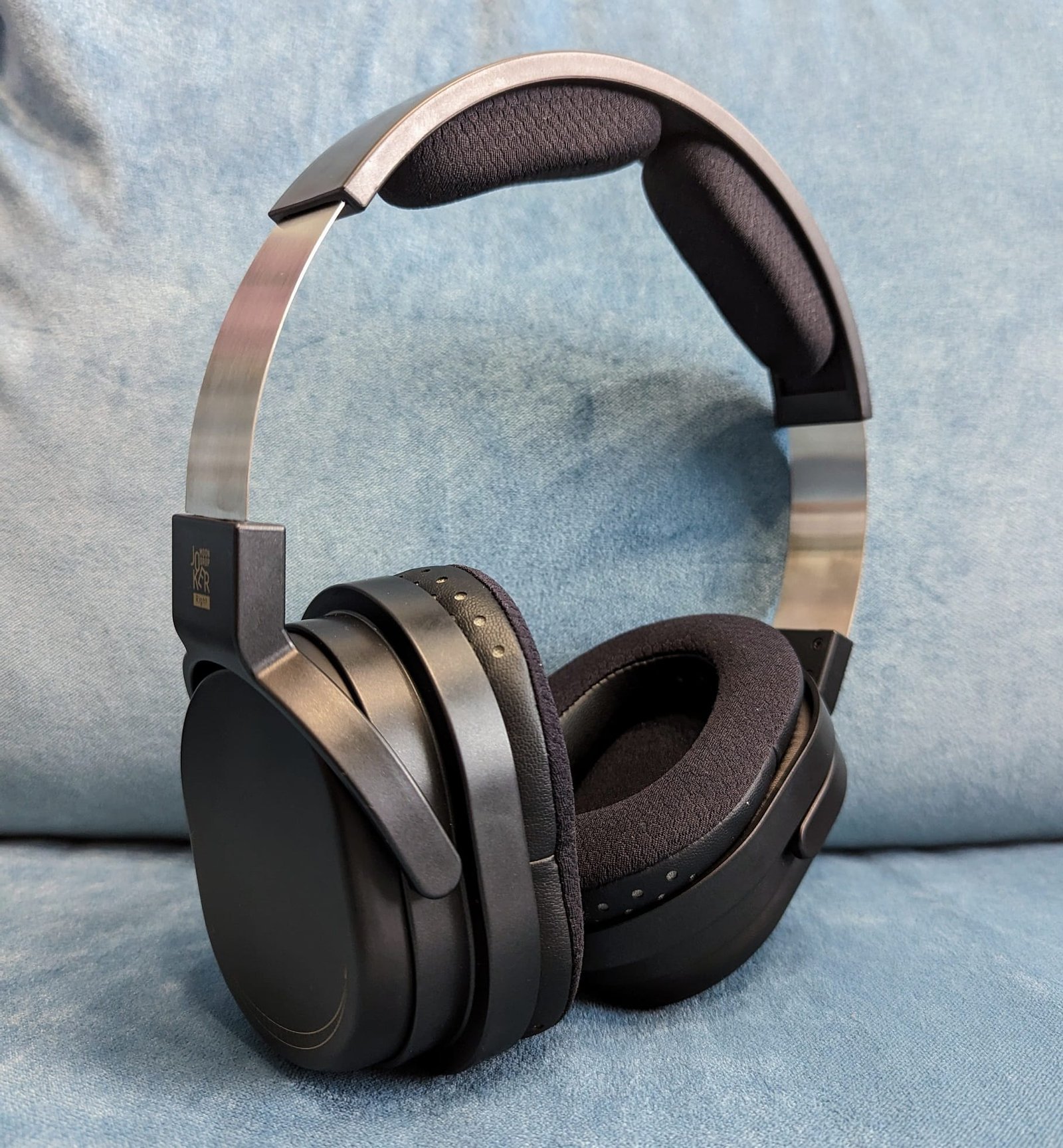
Moondrop mentions that the black paint finish of the earcups will intentionally wear off over time, revealing the brass underneath as if patinated. The owner could even customize the headphones by rubbing off the paint as desired. The idea is interesting, but it smells a bit like an attempt to cover up poor paint quality. The manufacturer was apparently supposed to provide sandpaper for treating the paint finish, but it was not visible in the product packaging or its contents list. The joker theme of the headphones is recalled by a grinning mouth-like painting on the bottom edge of the earcups.
Included cable:
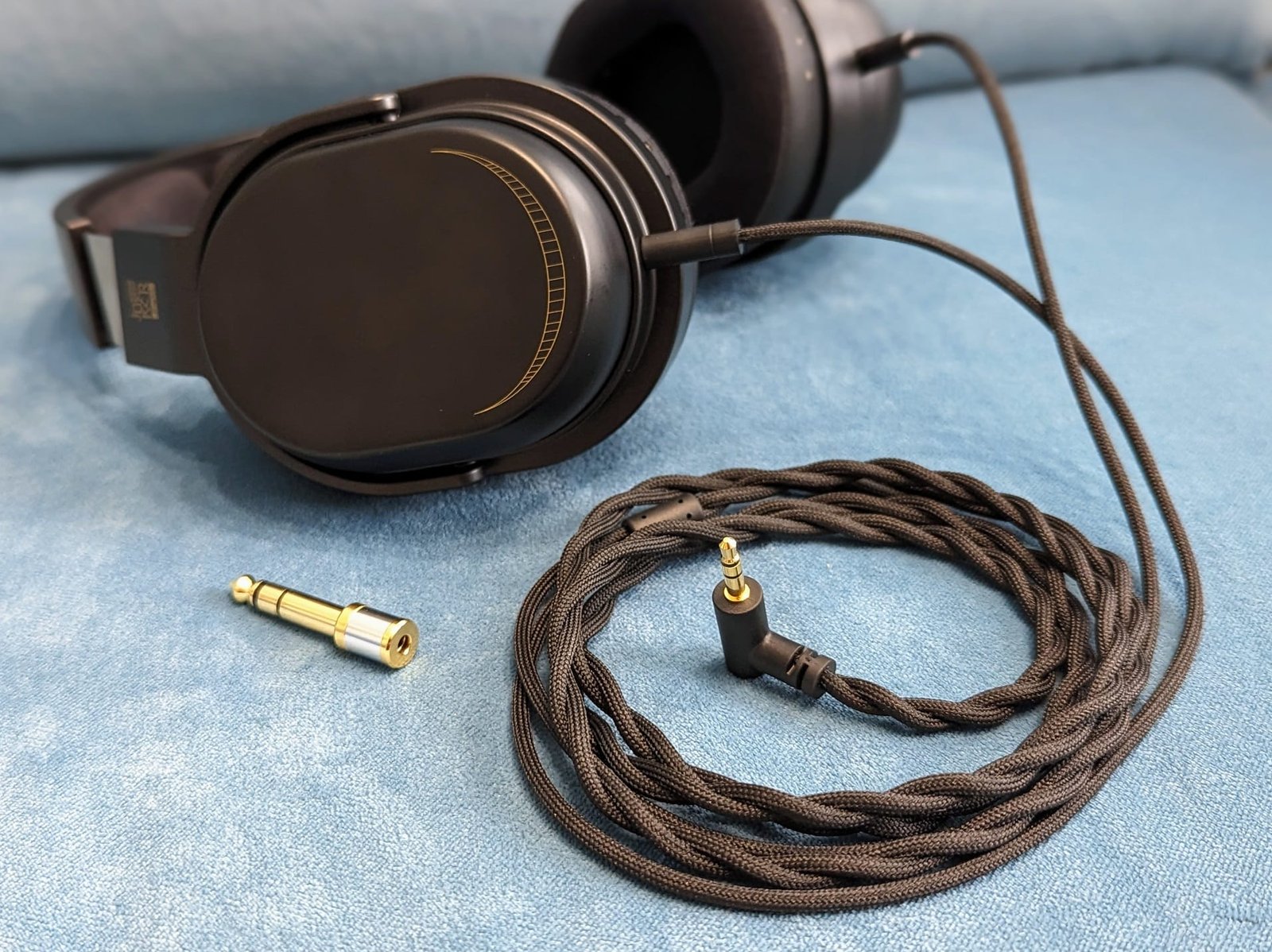
The product package includes an excellent cable in terms of usability, which I was already familiar with from the manufacturer's Venusplanar headphones. The 1.2-meter long cable is light and flexible, and it also looks good. The only regrettable aspect of the fabric covering, in the case of closed-back headphones, is a slight microphonics, which means that rustling caused by rubbing against clothes or the edge of a table travels along the cable structure into the headphones. However, this is not a particularly big problem when stationary, so I prefer a flexible cable over a thick rubber hose that would not be microphonic. Thanks to standard 3.5-millimeter connectors, the same replacement cables fit the Joker as, for example, Hifiman or Focal headphones.
Usability
The Joker is good in terms of comfort, but the fit can vary greatly between users. The structure, mimicked from Sennheiser's HD 600 series, is not stiff enough and horseshoe-shaped, so the ear pads easily lift off below the ears, especially at the lowest height adjustment settings. For those with larger heads, this may not cause problems, but those with smaller heads may have to bend the headband at the metal extension parts or at least adjust the height a couple of notches higher than would otherwise be necessary. In my case, a height adjustment setting of 8/17 ensures a normal fit and seal of the pads. Even then, the clamping force on the ears is so light that the headphones could fall off by shaking one's head.
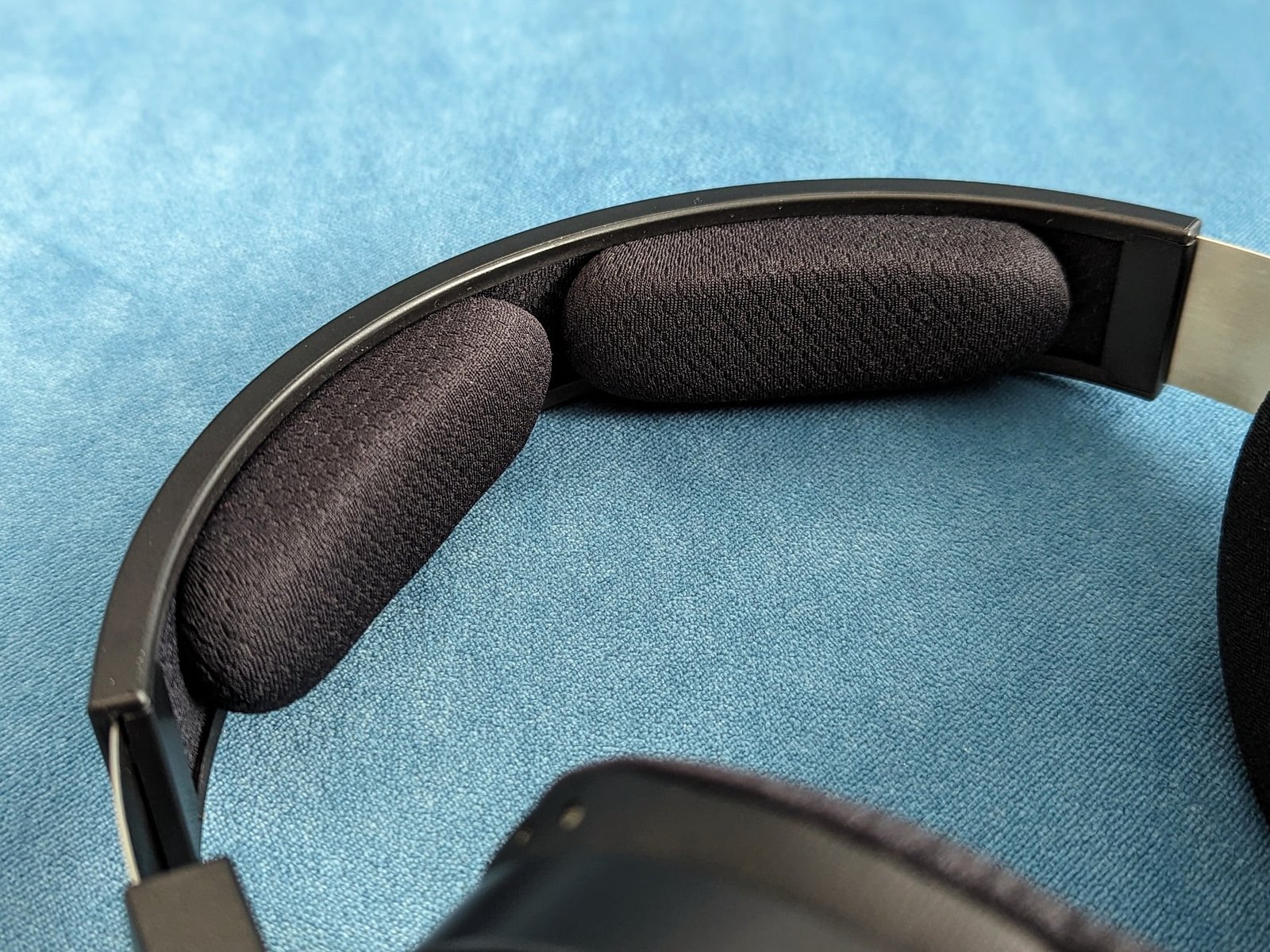
Speaking of padding, the headband is very well padded and feels pleasant against the top of the head. The padded part also appears to be replaceable if necessary, similar to Sennheiser headphones. Interestingly, the ear pad attachment mechanism also resembles the HD 600 series headphones, so the pads are replaceable, provided Moondrop eventually brings them to market.
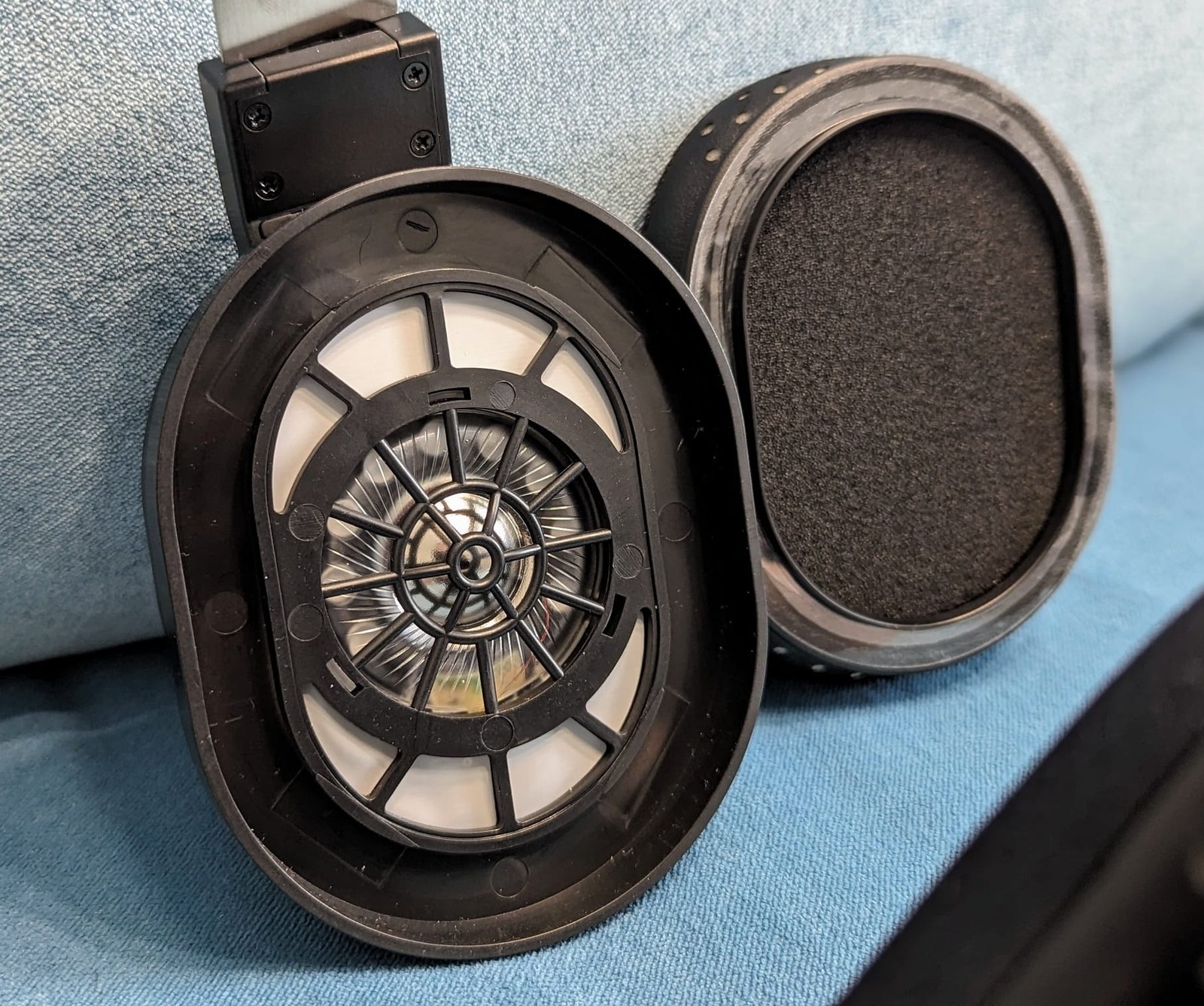
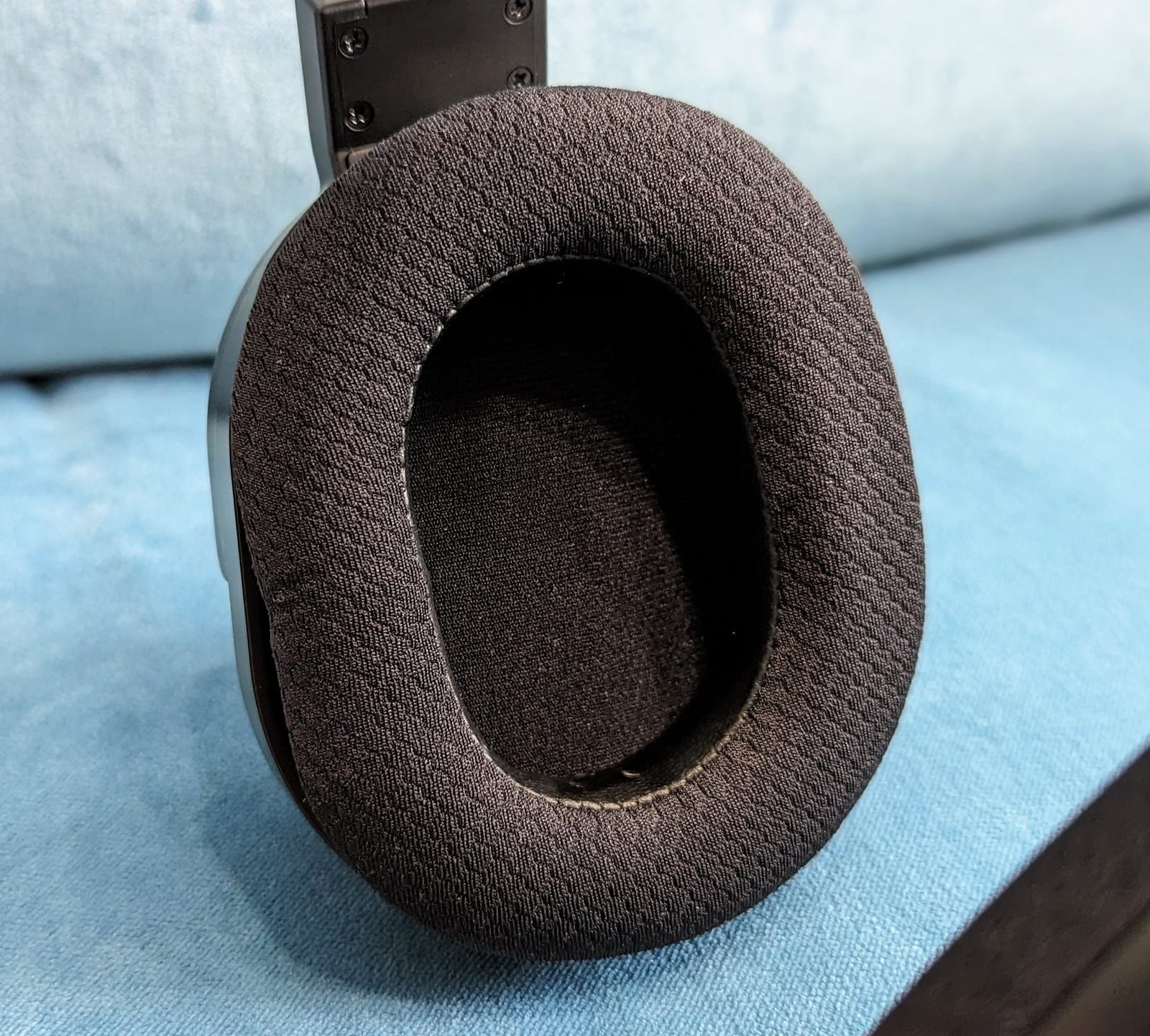
The Joker's ear pads could be called basically comfortable. The ear opening is large, but it could have a bit more depth, as my ears touch the bottom fabric, which starts to feel a bit uncomfortable after a couple of hours of use. The sides of the pads are artificial leather, while the parts that come into contact with the skin and the headband cover are a coarse fabric that rustles loudly when rubbed with a finger. Unfortunately, some rustling is also heard during use when moving the head, especially with glasses and a beard. Some holes have been made in the artificial leather of the pads, which prevent the headphones from sweating too much during longer use. However, due to the holes, the sound isolation remains rather mediocre, considering the closed-cup design.
Sound quality
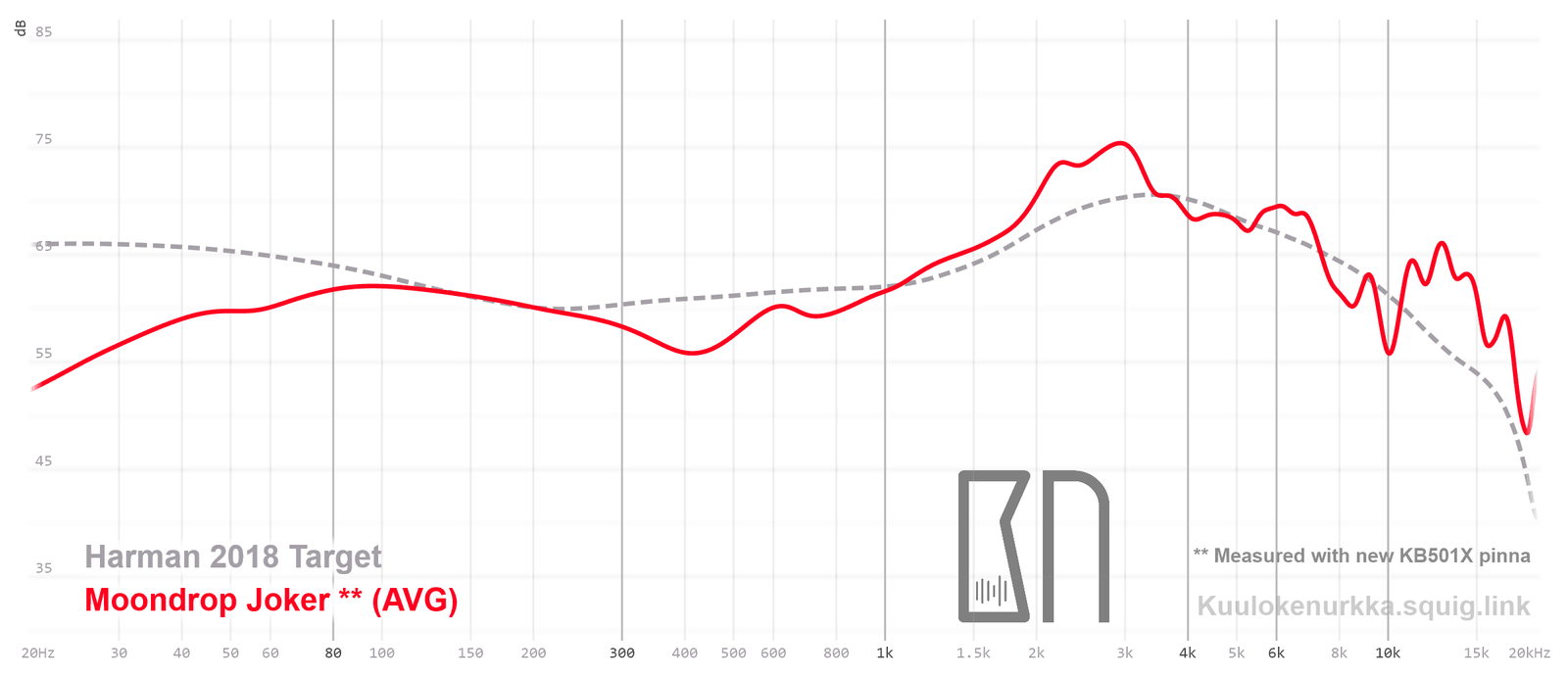
The headphone frequency response measurements were made using IEC711 standard equipment and new, more accurate silicone ears (KB501X). The graphs use the scientifically based Harman target curve (2018 version) as a reference, which is a generalisation of the frequency response that most people think would sound good. For more information on the measurements and their accuracy, see Headphone Measurements-page. The Joker's frequency response is also comparable with other measured headphones comparison tool .
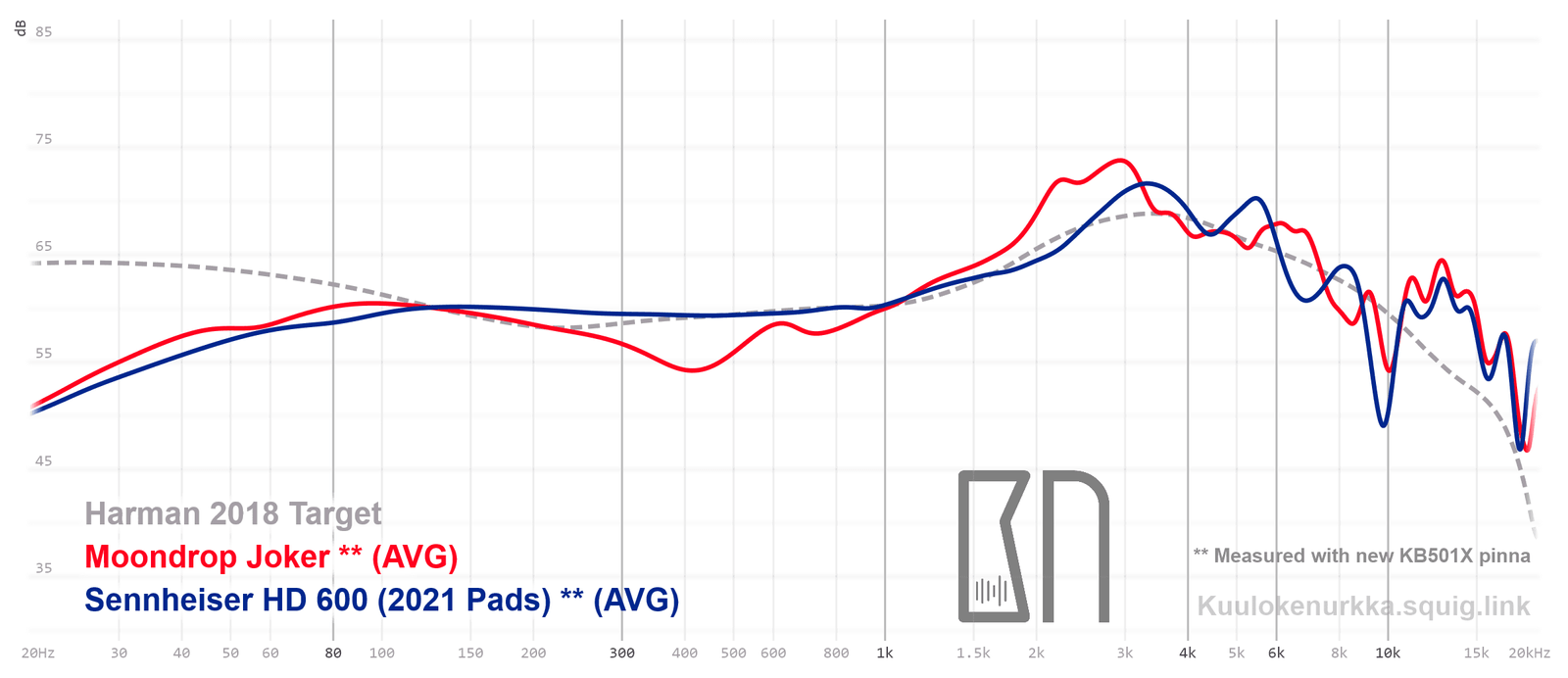
Frequency response compared to Harman's target curve:
Frequency response compared to Diffuse field response:
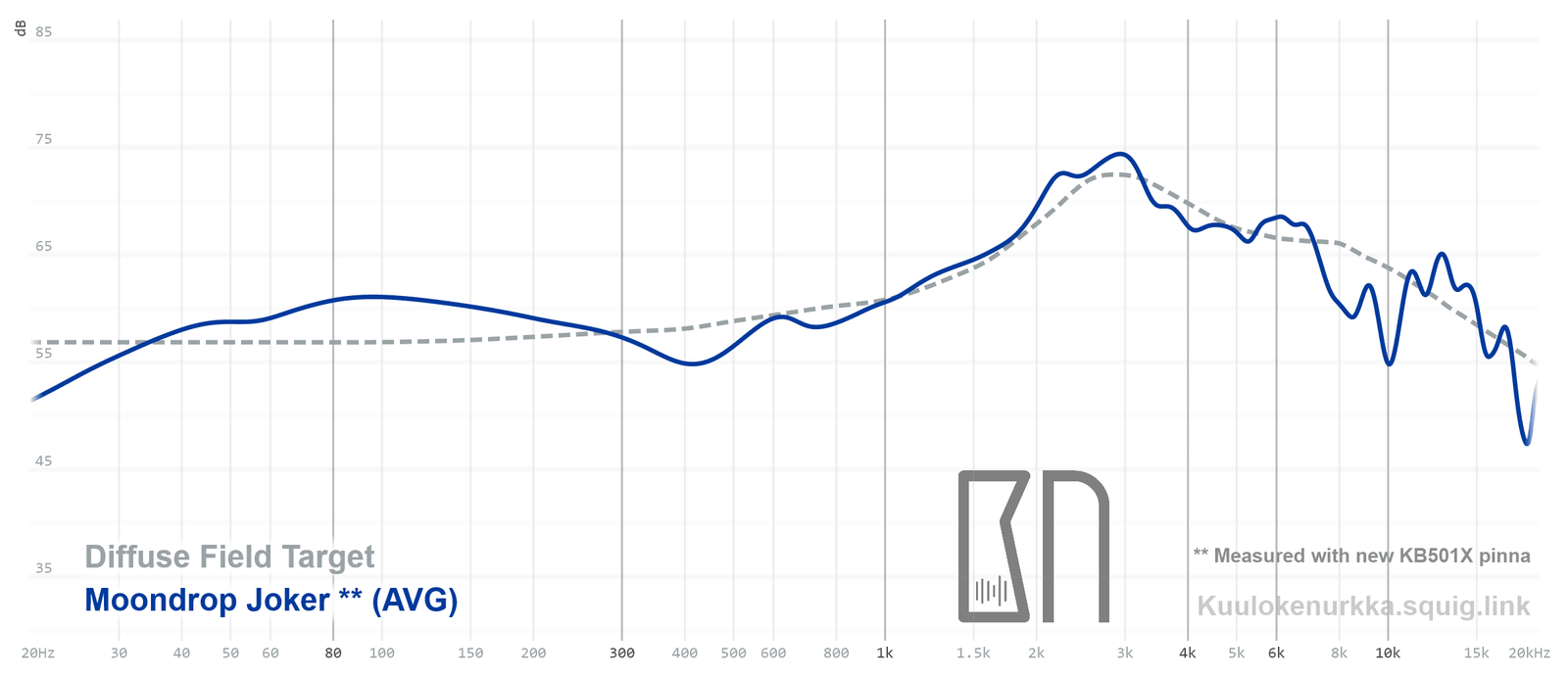
The Moondrop Joker is truly exceptional in its sound for a closed-back headphone. In my opinion, it can be seen either as aimed at a specific audience, mainly fans of the diffuse field response, or as a somewhat unsuccessful product for more general use (those who prefer Harman's target response). Firstly, the headphones reproduce hardly any sub-bass, even though closed-back headphones are generally known for rather overemphasized bass reproduction. The Joker also sounds aggressive in the upper midrange, specifically around 2–3 kHz, making it impossible to listen to at very high volumes, especially with a brighter-sounding amplifier.
As a primary characteristic that comes to mind, the lightness of the lower frequencies and a dip around 400 Hz automatically direct attention towards the upper frequency ranges when listening, which makes perceiving smaller details in music effortless. Vocal performances are reproduced very energetically in the foreground, and most instruments sound slightly sharpened. The presentation is extremely clear, yet quite thin and aggressive. Exaggerating, one could say the headphones resemble a harsh-sounding and blaring mobile phone speaker. However, at a suitable volume and when listening to slightly darker-produced music, one gets used to the Joker's sound, after which it doesn't sound terribly unnatural to me.
I cannot say if this kind of presentation is suitable for sound monitoring, but if someone wants to effortlessly hear details reproduced in the upper midrange and treble, these headphones are good for that. The Joker's treble is actually quite even, considering its closed-back design. I also find the soundstage accurate for the price and surprisingly spacious. Music reproduces around me like a somewhat large bubble, where some sounds are amusingly heard above and below my head. I am sure that those who are fond of Grado headphones, in particular, might like the Joker's presentation, as they also have a similar sound-enlivening emphasis in the upper midrange. However, this kind of presentation is not suitable for all types of music, so the Joker benefits from equalization, which I will delve into in a moment.
Bass:
The headphones' bass reproduction is clean but subdued, as if it's not meant to draw much attention to the overall sound. The bass is audible and occasionally has a slight kick and growl, but because sub-bass is almost entirely absent, all kinds of bass music sounds light and rather unremarkable. The bass either leaks out through the earpad holes, or Moondrop has wanted to take inspiration from Sennheiser's HD 600 series in this regard, thinking that neutral headphones should have little to no sub-bass.
Be that as it may, the Joker has an astonishingly similar amount of bass as the HD 600 model, which can be considered an unusual solution given the tuning possibilities offered by closed cups. A more robust bass would balance the very present upper frequencies, so equalization leads to a more sensible outcome. As such, the Joker's lower frequencies leave one rather cold, although, on the positive side, they do remain completely separate from other frequency ranges.
Mid-frequencies:
The midrange is, in a way, both a good and a bad aspect of the headphones, and surprisingly dependent on the chosen amplifier and the music being listened to. The clarity and presence of the sound are suitable, for example, for calmer acoustic music, although I myself would prefer a slightly fuller presentation. The vocalist always vividly jumps out, almost "on your skin," so good singers give me goosebumps, unless the result happens to sound too blaring. Rock music also sounds fantastically good at times, because electric guitars have a fun bite and the sound generally has the energy that the music style demands. The amount of upper bass frequencies is also sufficient for this kind of music, and despite the bright treble, I do not experience significant sibilance or unnaturalness in the reproduction of drum cymbals.
Furthermore, details of different instruments are easy to analyze because the presentation is fresh and airy due to the light lower midrange and controlled bass. On the downside, however, the sound is often quite thin, so the missing piece in the lower midrange is a clear weakness from the perspective of listening pleasure. I would also see this typical dip in closed-back headphones more as a side effect of the design than as an intended tuning choice.
The lean lower midrange and aggressive upper midrange are probably a particularly fatiguing combination for those whose hearing is already more sensitive than usual between 2–3 kHz, or who use a clinically neutral amplifier. At its worst, the Joker can sound really bright, thin, and aggressive. Brighter-produced music is sometimes irritating for me to listen to, and fast-paced music occasionally turns into restless clamor. With a slightly softer-sounding amplifier, such as Cayin iHA-6: I really enjoy the energy of the sound – probably more than I should. At its best, the timbre is surprisingly natural, but often the frequency balance also leaves something to be desired. The Joker is somewhat difficult to recommend as a general-purpose headphone as is, but for certain preferences, it is certainly interesting to listen to.
Treble:
Regarding the headphones' treble, despite its brightness, I mostly have only good things to say, as it reproduces quite evenly without sharp peaks or clear dips. Usually, a closed design causes all sorts of peculiarities in the frequency response at high frequencies, but Moondrop has succeeded in eliminating the worst side effects, at least as adapted to my hearing. The Joker's sound is bright and airy, but the energetic upper midrange frequencies draw so much attention that the treble, which comes in second to them, doesn't become harsh to my ear or cause exaggerated sibilance. With the iHA-6 amplifier I mentioned, I can listen to the Joker most of the time relaxed, without my ears being in any kind of defensive state. However, it's worth noting that I myself am quite immune to the 6 kHz emphasis often seen in frequency response measurements, which is found, for example, in many ZMF headphones and the Sennheiser HD 800, and to some extent also in the Moondrop Joker.
Audio description:
In open-back headphones, the soundstage often extends outwards from the ears, more diffused, as if into infinity, whereas a closed design usually creates a more confined spatial impression, as if music were playing in a room of a certain size and bouncing slightly off the walls. This is also the case with the Moondrop Joker, but I find it sounds clearly like a larger room than usual. Some investments in the cup structure are, in my opinion, audible, because the spatial impression feels surprisingly open and spacious, despite the upper midrange frequencies pushing some of the sound very close. On the other hand, the lower midrange frequencies heard further away simultaneously create a kind of emptiness and transparency in the soundstage.
The sound settles around my head like a bubble, and some sounds are sometimes amusingly positioned above and below my head. The presentation is otherwise focused, as attention is drawn to the locations and movements of sounds as if by themselves. Detail separation is also clear for the price, and the sound doesn't feel softened in the same way as in closed-back headphones (e.g.,. Drop Panda and Dan Clark Audio's Aeon series), in front of whose drivers a thick layer of damping material has been placed. In this regard, I could imagine listening to a more expensive headphone model, so the soundstage and its clarity are one of the Joker's best aspects. The headphones draw you in, as long as the exceptional frequency response and the presentation it creates suit the music being listened to.
Equalization
Although I can find good aspects in the headphones' sound myself, many would probably find the Joker somewhat irritating to listen to and its bass reproduction unfortunate by modern standards. For this reason, equalization is quite justified, especially when dealing with inexpensive headphones that have the potential to be genuinely good. This is also a good moment to mention the equalization tool found on my frequency response database, i.e., my Squiglink page, which allows for the automated creation of equalization settings for specific headphones relative to a certain target response. In this way, I myself was able to create settings for the Joker, which I have used after minor fine-tuning Qudelix 5K -device. For equalization on a computer, one could use, for example, the popular Equalizer APO software.

When using the equalization tool, a good end result depends on the accuracy of the frequency response measurements, as well as one's own preferences and the characteristics of one's hearing, so changes based on listening observations are usually still needed. However, the tool shows changes in the frequency response in real-time, so it can also be used to freely test various manual adjustments alongside the AutoEQ function. Especially the treble should be adjusted based on one's own hearing, because the frequency response created by a measuring device is not particularly accurate for the very highest frequencies.
Joker's frequency response with my corrections:
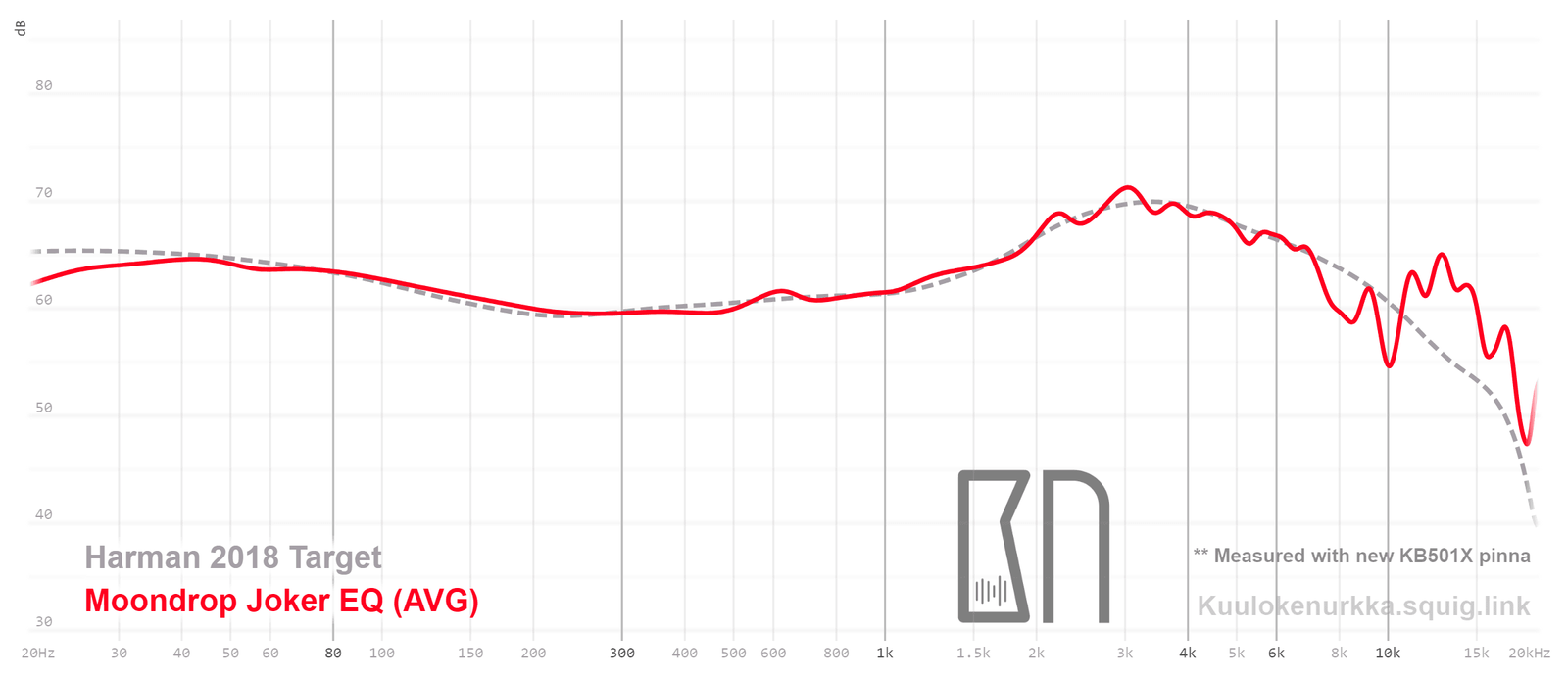
After equalization, the headphones are truly balanced in sound and are versatile for all kinds of music without ever causing irritation. Most of the features related to the effective spatial impression are still present, so in my opinion, the headphones would be quite competitive against more expensive closed-back headphones. I actually wouldn't be able to say directly what price range of headphones I'm listening to, because almost nothing in the sound any longer indicates a retail price under 100 euros.
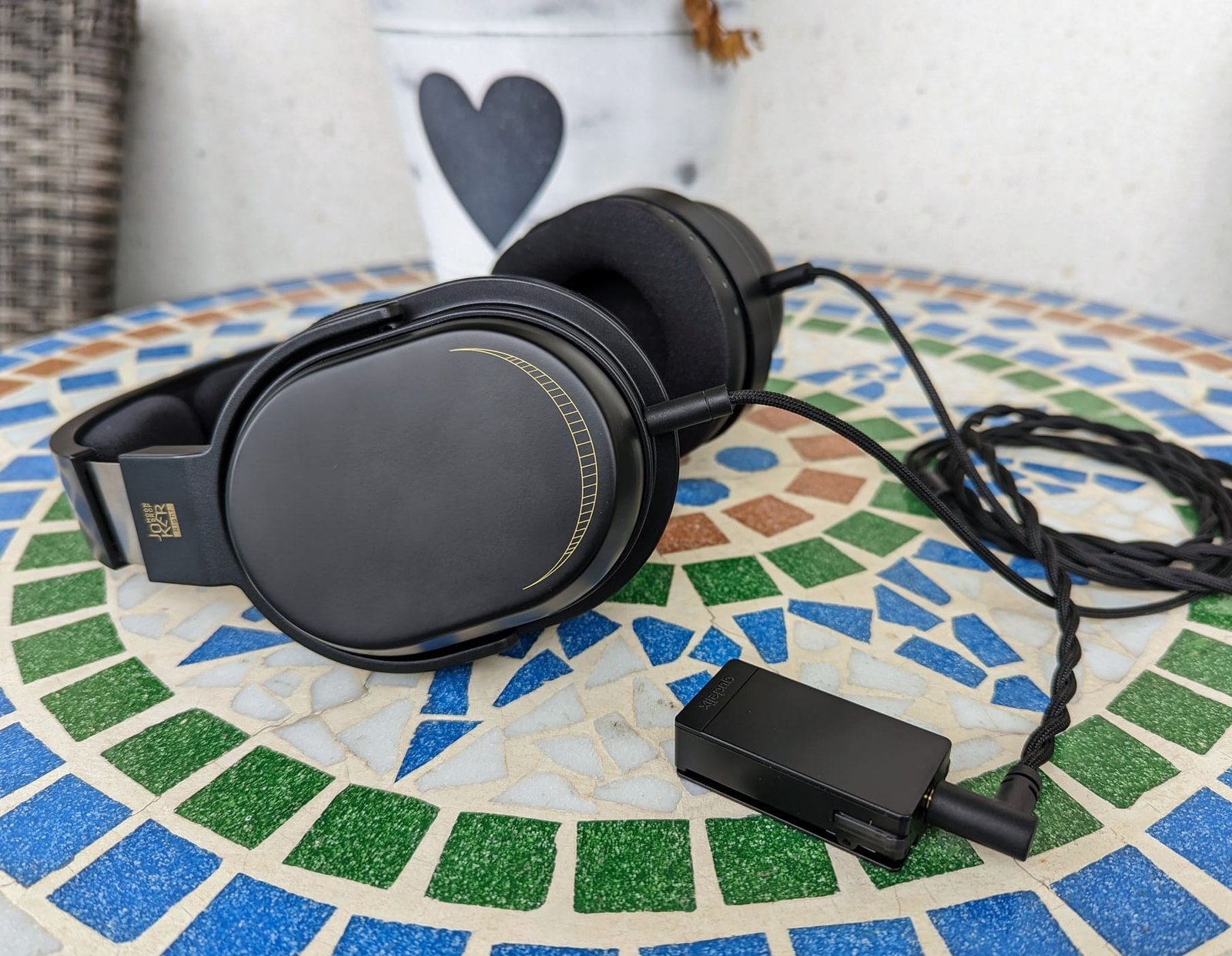
Equalizing the Joker is, in my opinion, worthwhile, and it forms an excellent 200-euro listening setup with, for example, the Qudelix 5K, especially since the included 1.2-meter cable also suits the purpose well. If needed, the upper midrange frequencies could be left more elevated, if someone prefers the clarity of sound that the headphones offer by default. Equalization, in general, opens up limitless possibilities for sound adjustment, so I cannot give unambiguous instructions on what should or should not be done to the headphones. Adjusting the Joker to sound better is relatively easy, as its frequency response is not, after all, impossibly uneven by default.
Confirmation
The headphones are easy to amplify and achieve high volume with, as their sensitivity is high at 106 dB/mW. Affordable dongle-style devices (For example, iFi GO Link) and also the headphone jacks of sound sources such as mobile phones and computers are sufficient. However, with these, the Joker may not sound particularly pleasant due to its aggressive tuning. Instead, I recommend an amplifier that does not sound bright or too neutral. Without equalization, the headphones need warmth and a little softness in the sound to make listening to them pleasant. For example, compared to Qudelix 5K and Topping DX1: compared to, the Cayin iHA-6 changes the Joker's character surprisingly much, so the headphones might genuinely benefit from better equipment. On the other hand, equalization can be performed with Qudelix, after which the result is really good.
The Joker may well be designed for slightly older studio equipment, which many describe as sounding more analog than usual. This would also be supported by the headphones' 68 ohm impedance, thanks to which the frequency response does not change significantly, even if the output impedance of the amplifier in use was, for example, 100 ohms – after trying it, the iHA-6's 120 ohm connector added about 1.5 decibels of bass between 20–200 hertz, while there were no changes to other frequencies. Thanks to a slightly higher than usual impedance, the headphones also produce less background noise if they are listened to with lower-quality equipment that is most powerful in terms of amplification, for example, between 16–32 ohms. In my opinion, Moondrop's choices fit the Joker's intended use very well, whether they were intentional or pure coincidence.
Moondrop Joker vs. BeyerDynamic DT 770 Pro Limited Edition (32 ohm)
Prices: 75 € vs. 150 €
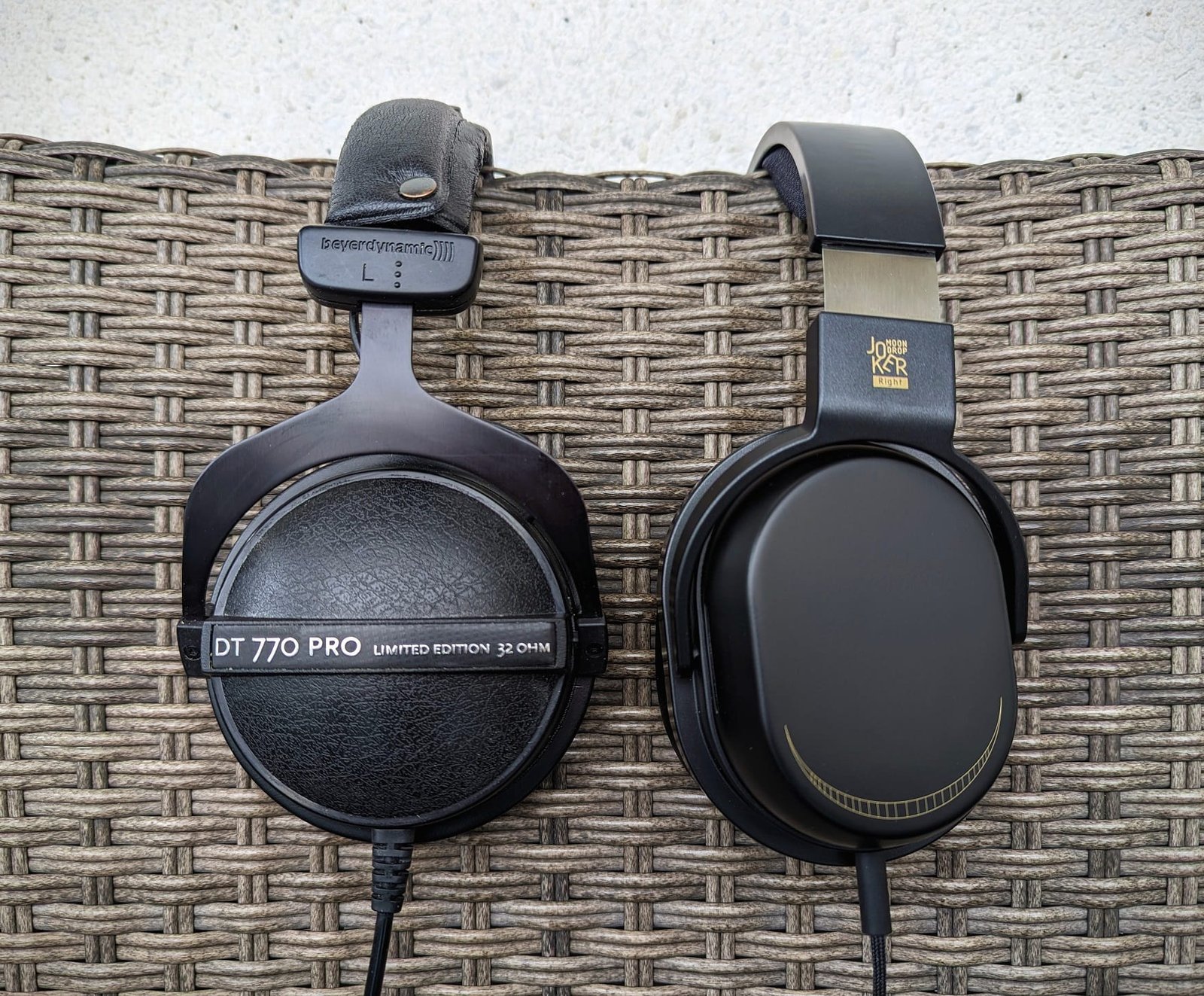
I pondered for a while about a suitable comparison in the Joker's price range, but there are actually few such options, as most people would probably buy, for example, JBL Bluetooth headphones or a gaming headset for under 100 euros. There are also a huge number of in-ear headphones on the market, which are likely more popular than a traditional closed-back headphone like the Joker. However, when the price range is increased to 100–200 euros, more options begin to appear. For example, Audio-Technica's ATH-M50X, BeyerDynamic's DT 770 Pro, and AKG's K361/K371 are a kind of perennial consumer favorites that many Chinese headphone models have not managed to displace. Nor did the Australian Rode NTH100 model seem to change this.
Since I have a 10-year-old German BeyerDynamic DT 770 Pro in a 32-ohm special edition, I decided to choose it for a more detailed comparison to find out how the newer and more affordable Joker compares to it. The comparison is also apt in that the DT 770 Pro has been a very popular studio headphone, which Moondrop has also tried to brand its product as.
Structural differences:
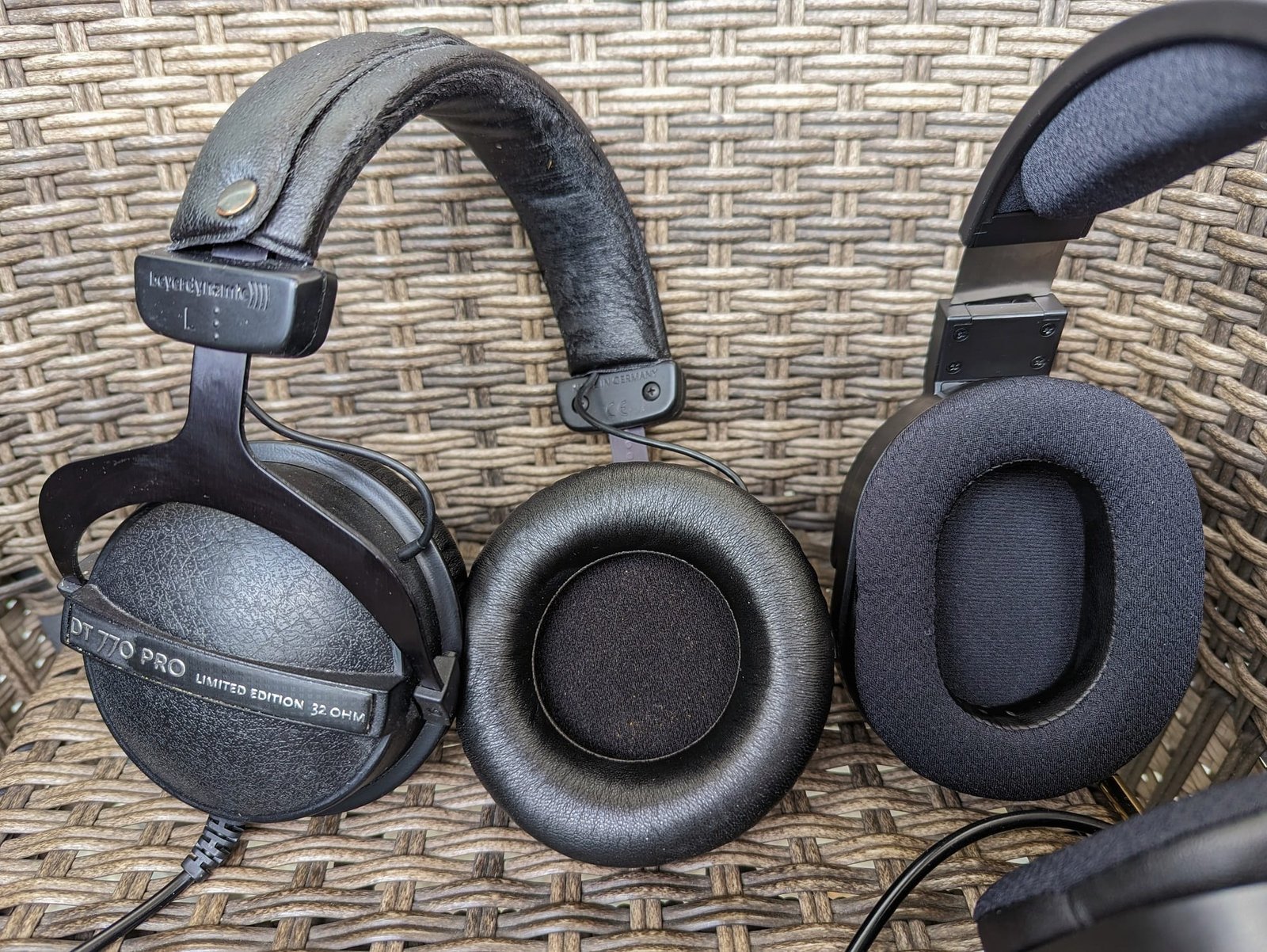
The price difference between the two and, in a way, also the country of manufacture, is clearly visible in the headphones' structure. The DT 770 Pro has an old-fashioned design, but it is built to withstand rough handling. The Joker, on the other hand, feels cheap and somewhat toy-like next to it. It does, however, unlike BeyerDynamic's headphones, have a detachable cable and metal cups, which naturally add a little extra weight (290 g vs. 270 g). The Joker is slightly more comfortable for me because my ears have never properly fit inside the DT 770 Pro's round ear pads without the edge of the pad pressing uncomfortably against them. The ear pad parts of both headphones can be replaced with new ones if necessary. The more expensive DT 770 Pro ultimately offers no other advantages compared to the Joker, apart from its better sound isolation and possible longer-term durability.
Sound quality differences:
The headphones are very different from each other, as the Joker is somewhat like an imperfect Sennheiser HD 600 with light bass and a somewhat thin sound, while the DT 770 Pro offers significantly more bass with a more V-shaped tuning. The artificial leather pads of my DT 770 Pro further amplify the bass compared to the 80-ohm and 250-ohm headphone versions with fabric pads. The treble, typical for BeyerDynamics, is somewhat uneven and piercing due to a few sharp peaks that stand out more strongly than the mid-frequencies. The Joker sounds flatter in its frequency response and also more natural. In my opinion, the DT 770 Pro has always sounded somewhat cold, even though it has a lot of bass. In my headphones, the mid-frequencies also sound somewhat hollow between the boomy bass and sharp treble.
Frequency responses:
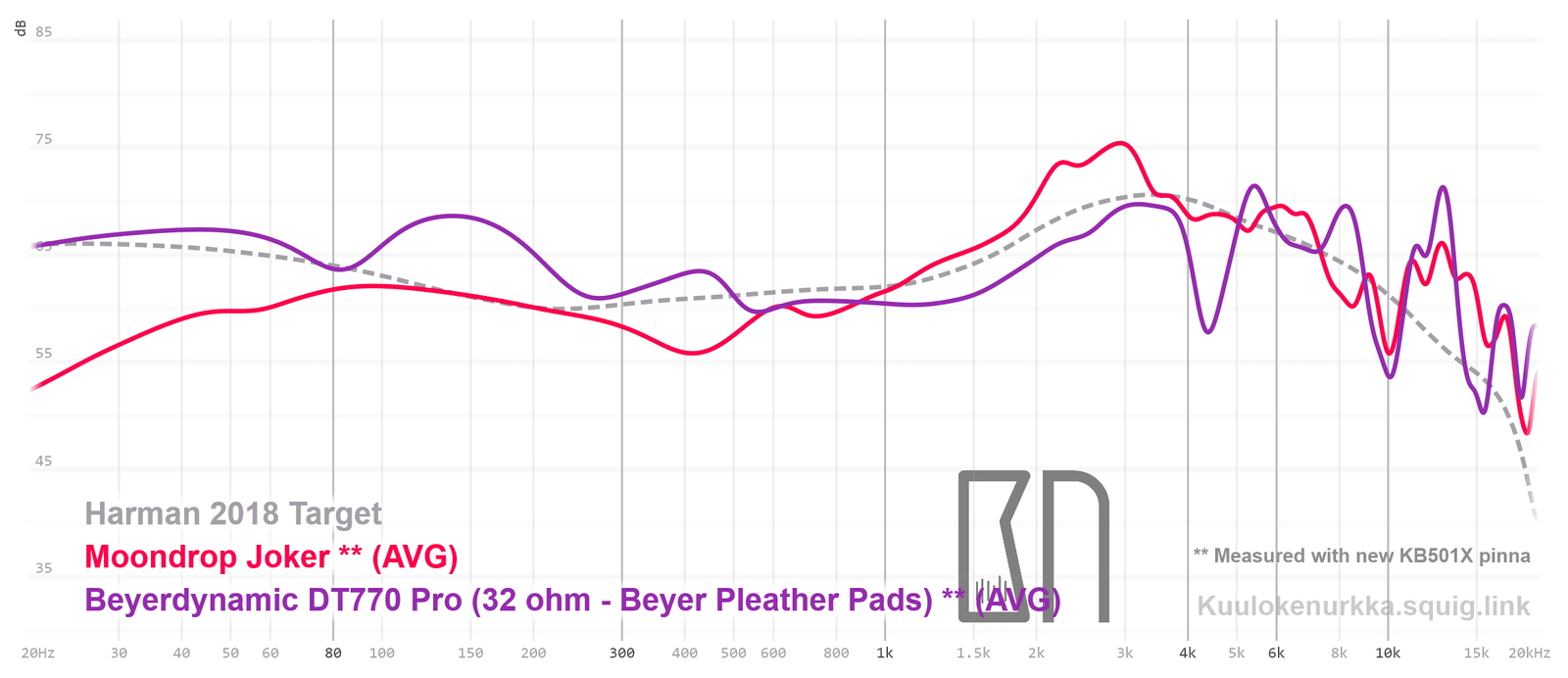
Both headphones reproduce sound in a way that makes me focus on listening to the vocalist and details leaning towards the high frequencies. The DT 770 Pro, however, manages to destroy some of the sound's clarity with its overly emphasized mid-bass. I don't recall noticing similar with fabric pads, so this characteristic is likely a result of the artificial leather pads. Although the headphones are more fun thanks to their stronger bass, and still very clear in sound and separation for the price, the Joker makes the information on recordings easier to observe, while sounding more natural in timbre.
DT 770 Pro's mid-frequencies are slightly recessed and veiled, which interferes with immersion in listening. The presentation, on the other hand, is clearly more relaxed because the upper mid-frequencies are not aggressive like the Joker's. The Joker is brighter and more vibrant in its treble, but less sharp. When listening to the DT 770 Pro, my hearing is always in a slightly guarded state, whereas I can listen to the Joker more relaxed. For someone else, the situation could very well be the opposite, as the emphasis on the headphones' upper frequencies falls into different frequency ranges.
Both headphones exhibit their own kind of artificial detail, which is a result of certain frequencies being emphasized in the overall sound. Perhaps the most important observation, however, is that the Joker does not sound significantly less clear in its overall sound than the DT 770 Pro; in fact, most of the mid-frequencies are reproduced even more transparently. The Joker's soundstage is also, in my opinion, more realistic, as it has more depth and a 3D-like quality that spreads around the head.
Most of the differences between the headphones are likely due to different frequency responses, but that doesn't change the situation in any direction. The Moondrop Joker is, in my opinion, a truly competitive product against a slightly more expensive headphone like the DT 770 Pro. Every headphone model in the 100–200 euro range I mentioned earlier has its own strengths and peculiarities, so a perfect product has not yet been released. Without equalization, AKG's K371 is probably still the most easily recommendable option for general-purpose headphones, as it is tuned based on Harman's target curve. However, the sound of the K371 varies more than usual depending on the user and fit, so the final result is difficult to predict beforehand. Therefore, there is still room in the market for new headphone models, such as the Moondrop Joker. The Joker's appeal is further enhanced by its affordable price compared to other alternatives designed for similar use.
Summary
From a testing perspective, the Moondrop Joker has been an interesting and refreshingly different headphone release, especially since it hasn't been spoiled by its price: many other manufacturers might have priced similar headphones 100 euros higher according to current trends, without clear justification. The Joker is, above all, a change from most other closed-back headphone models that offer emphasized bass. On the other hand, weak bass reproduction is also one of its biggest weaknesses, alongside aggressive upper mid-frequencies. The build also feels really cheap, even though it gets the job done.
However, what the headphones tell me is that I easily managed to write this much about them. Normally, I would hardly bother with the same for an affordable product, but the Joker's energetic and different sound happened to resonate with me more than it probably should, objectively speaking. I have also seen quite negative reviews of the headphones, which I understand well considering people's different musical tastes and preferences. The Joker could easily be condemned based on its frequency response, but I personally approach it more moderately. In my opinion, the headphones are somewhat of a love-hate type. If a clear and quite analytical presentation with a more spacious soundstage than usual feels like your thing, I can recommend trying the headphones due to their affordable price. You can also make them excellent with equalization, after which the affordable price would no longer be guessed based on the sound quality.

Pros and cons:
+ Clear and detailed sound is well suited for music analysis
+ High frequencies are reproduced quite evenly despite their brightness
+ Accurate, spacious, and fun soundstage for the price and closed-back design
+ Good comfort with reservations
+ Comes with an excellent cable
+ Earpads are replaceable
+ Low price
– Weak bass reproduction
– The sound is too thin and aggressive for general use and pleasant listening
– Cheap and plasticky feel to the build
– Fit and earpad seal may vary per user
– Does not insulate sound very well
 EN
EN  FI
FI