Author: Sword of Damocles
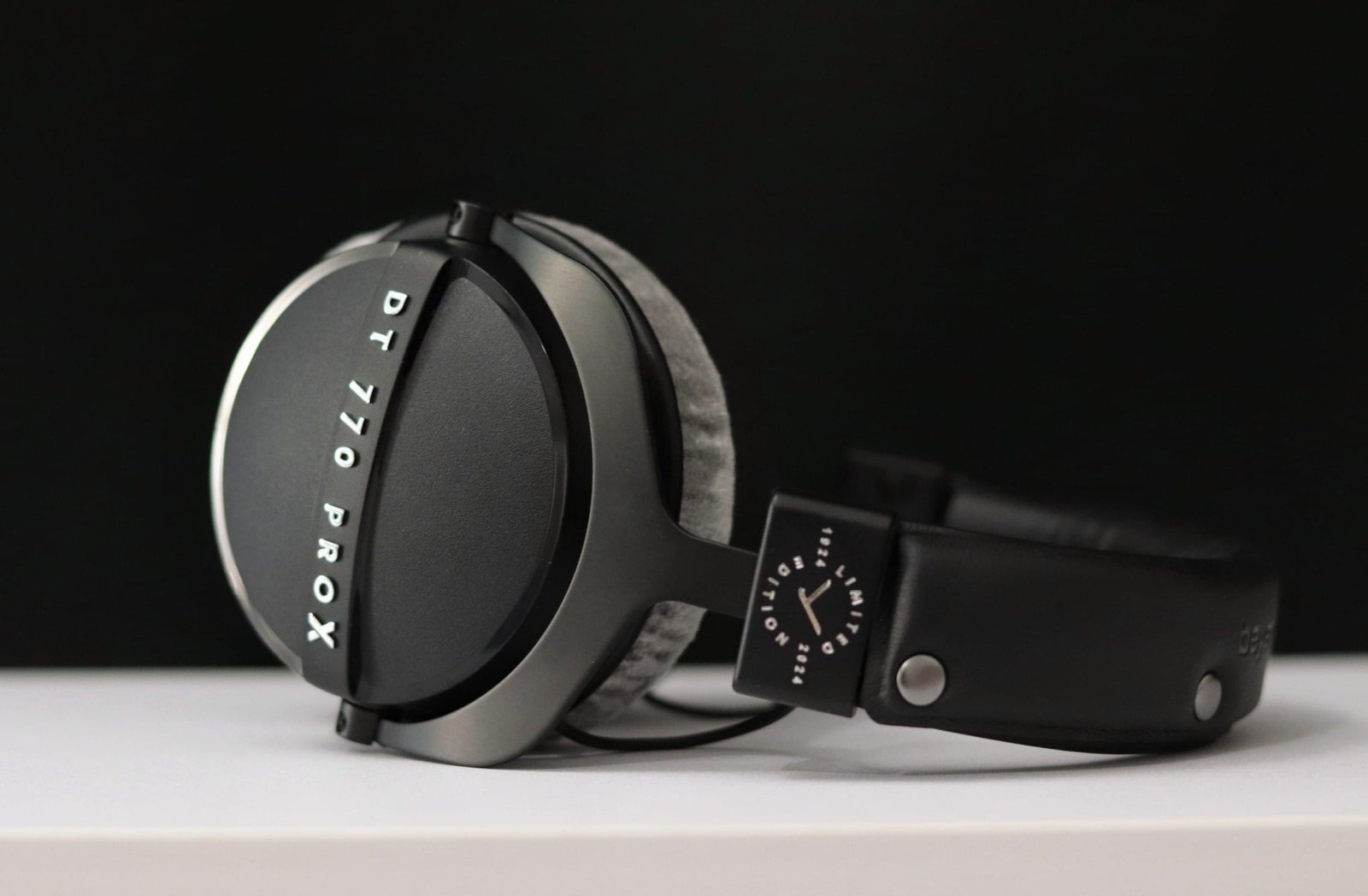
Table of Contents:
Information:
- Release year: 2024
- Country of manufacture: Germany
- Price: 199 EUR
- Type: Closed, over-ear
- Dynamic drivers: Stellar.45 (diameter 45 mm)
- Impedance: 48 Ohm
- Sensitivity: 98 dB/mW
- Weight: 305 g (without cable)
- Connector type: 3-pin mini-XLR
- Cable: Length 3 m / connector 3.5 mm (includes screw-on 6.35 mm adapter)
- Accessories: Soft storage pouch
- Warranty: 2 years
Review sample: Self-purchased product
Germany is home to many audio companies whose roots extend far back into the 20th century, or in Beyerdynamic's case, even to the first quarter of the century. The manufacturer, which started its operations in 1924, is celebrating a respectable 100 years this year, which is why it has released a special edition of its DT 770 Pro studio headphones (winner of Kuulokenurkka's comparison of affordable closed-back headphones), which were also originally released 39 years ago.
The 200-euro priced DT 770 Pro X Limited Edition anniversary model has been fitted with the Stellar.45 drivers familiar from the more expensive DT 700 Pro X and DT 900 Pro X (previous review) in addition to which the cable can finally be detached from the ear cup – this has only been awaited in the model series for a few decades. The external structure otherwise still corresponds to the DT 770 Pro, which has a reputation for durability, but in addition to the decorations made in honor of 100 years, some details have also been taken from the finer DT 1770 Pro. The DT 770 Pro X is thus an interesting combination of Beyerdynamic's different headphone models. How could I not have acquired such an interesting product for testing?
Packaging and accessories
It's difficult to find anything noteworthy about the product packaging of the headphones, as it mainly protects the product without hindering its use. The package includes a cable and a plastic-feeling storage pouch, but no other accessories come with the anniversary model. A small booklet, however, offers a concise timeline of the manufacturer's history, which is quite fitting for 100 years of operation. Generally speaking, the anniversary year is more visible in the headphones themselves.
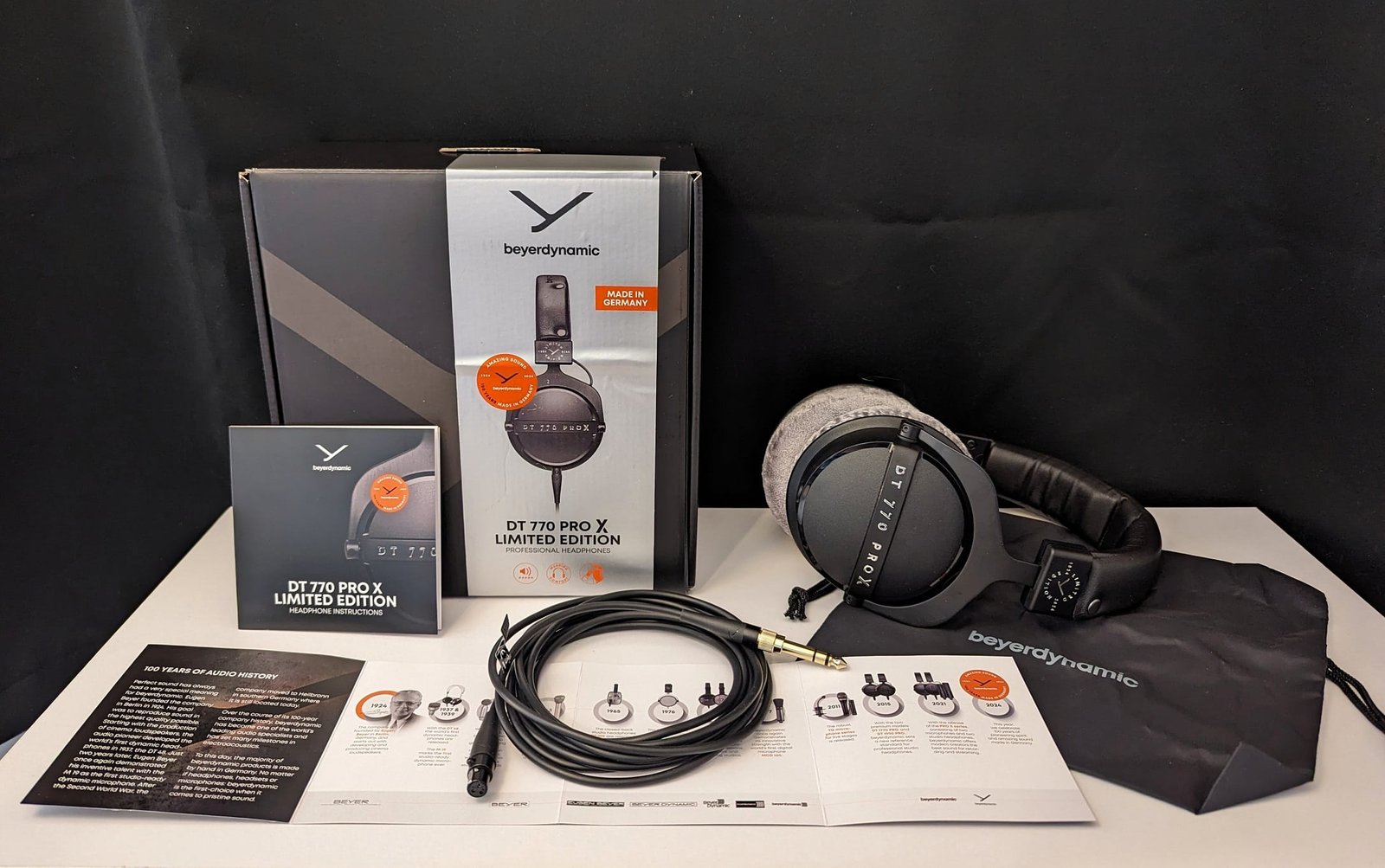
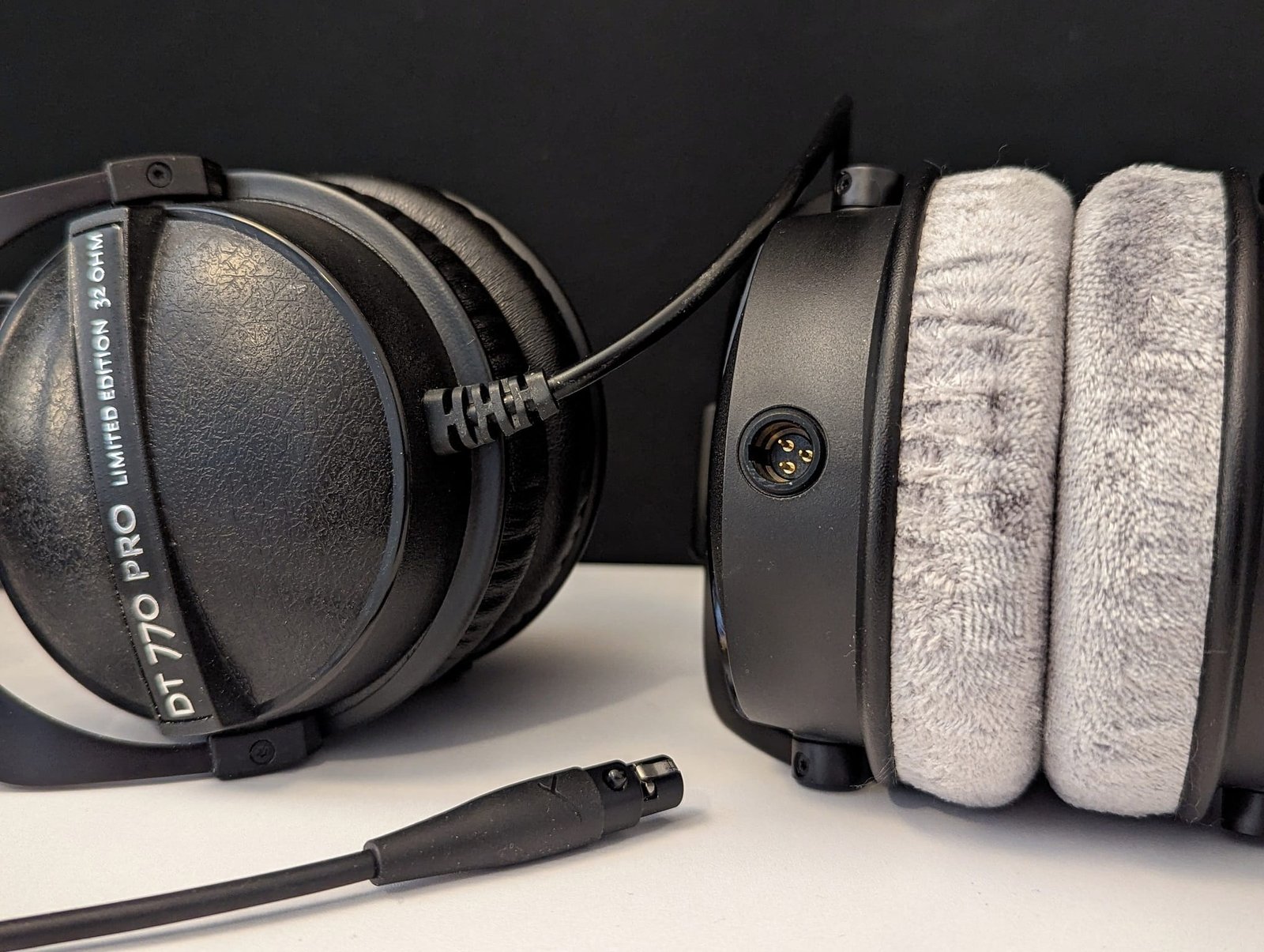
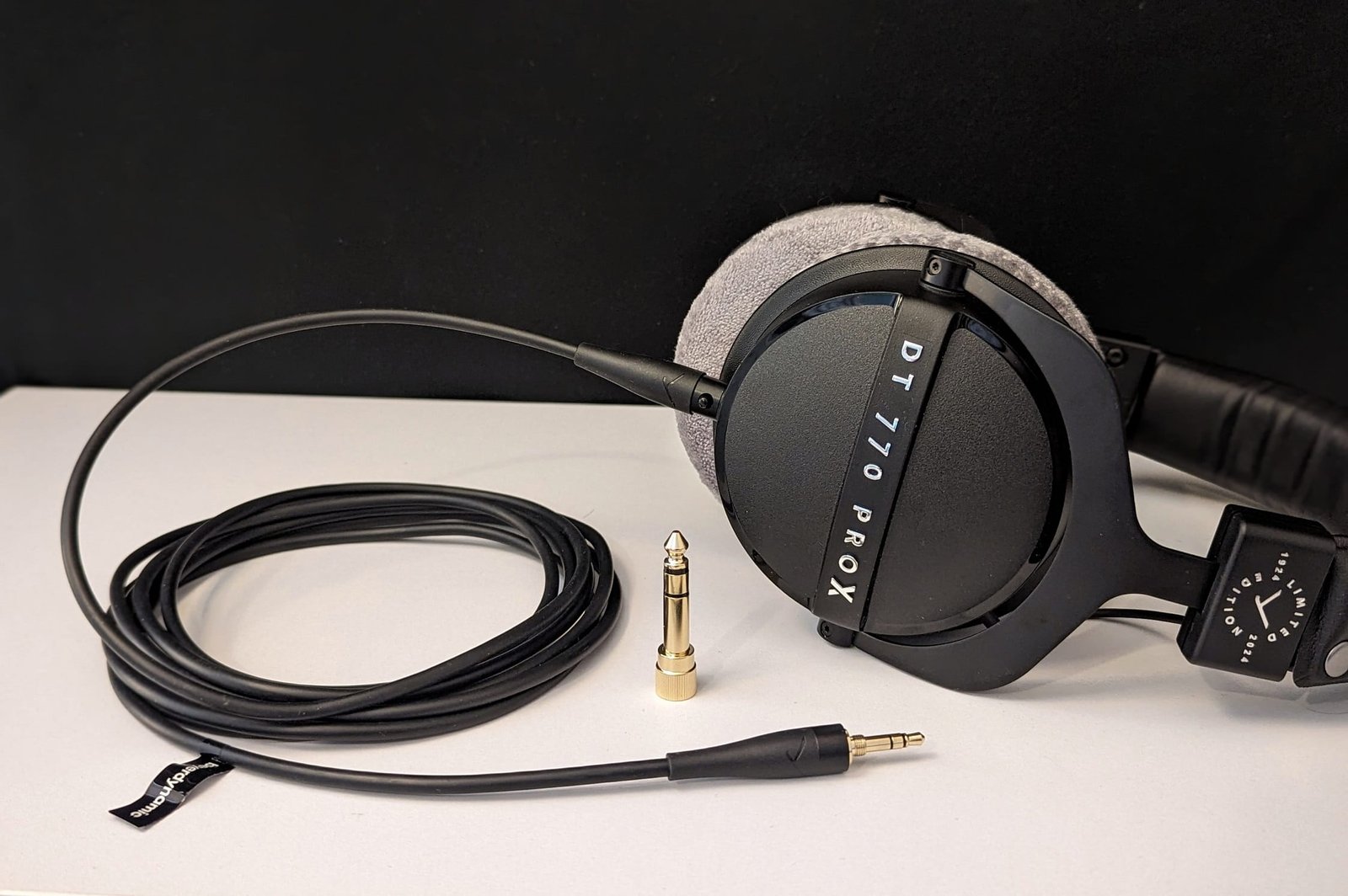
The included storage pouch is not of particularly high quality, but the headphones' proven durable construction would likely survive transport intact within it. The rubber-coated cable, on the other hand, is probably intended for studio use, as it is a full 3 meters long. This feels inevitably clumsy in a home environment, and the cable is also somewhat microphonic and difficult to fold, but thanks to the possibility of detachment, it could be replaced with a different one. Beyerdynamic has added a 3-pin mini-XLR connector to the left ear cup, which unfortunately does not support a balanced signal. On the other hand, from the perspective of moderate amplification needs, it wouldn't be particularly beneficial anyway. The cable supplied by the manufacturer has a traditional 3.5-millimeter connector and a 6.35-millimeter adapter is provided for it.
Build and comfort
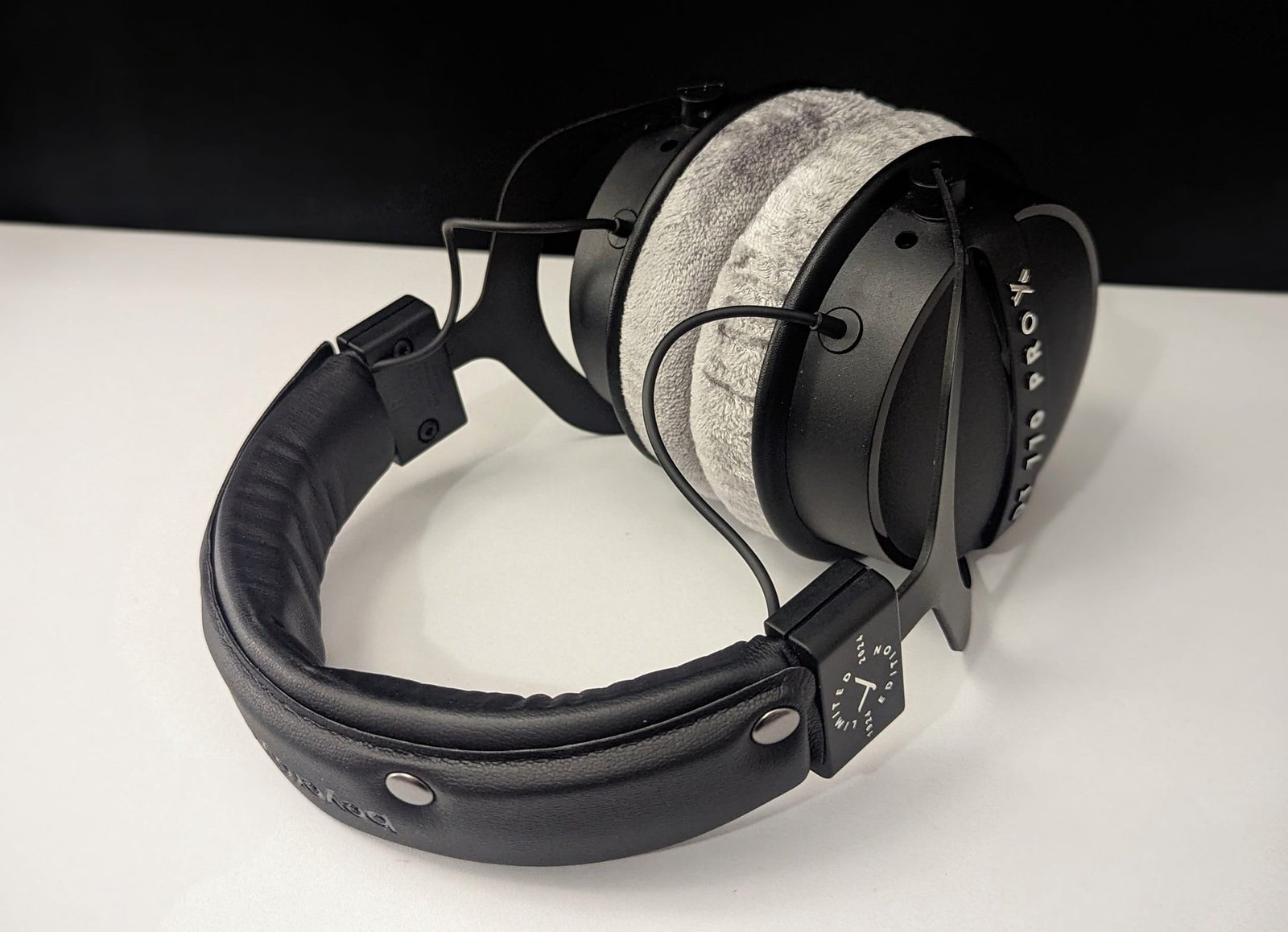
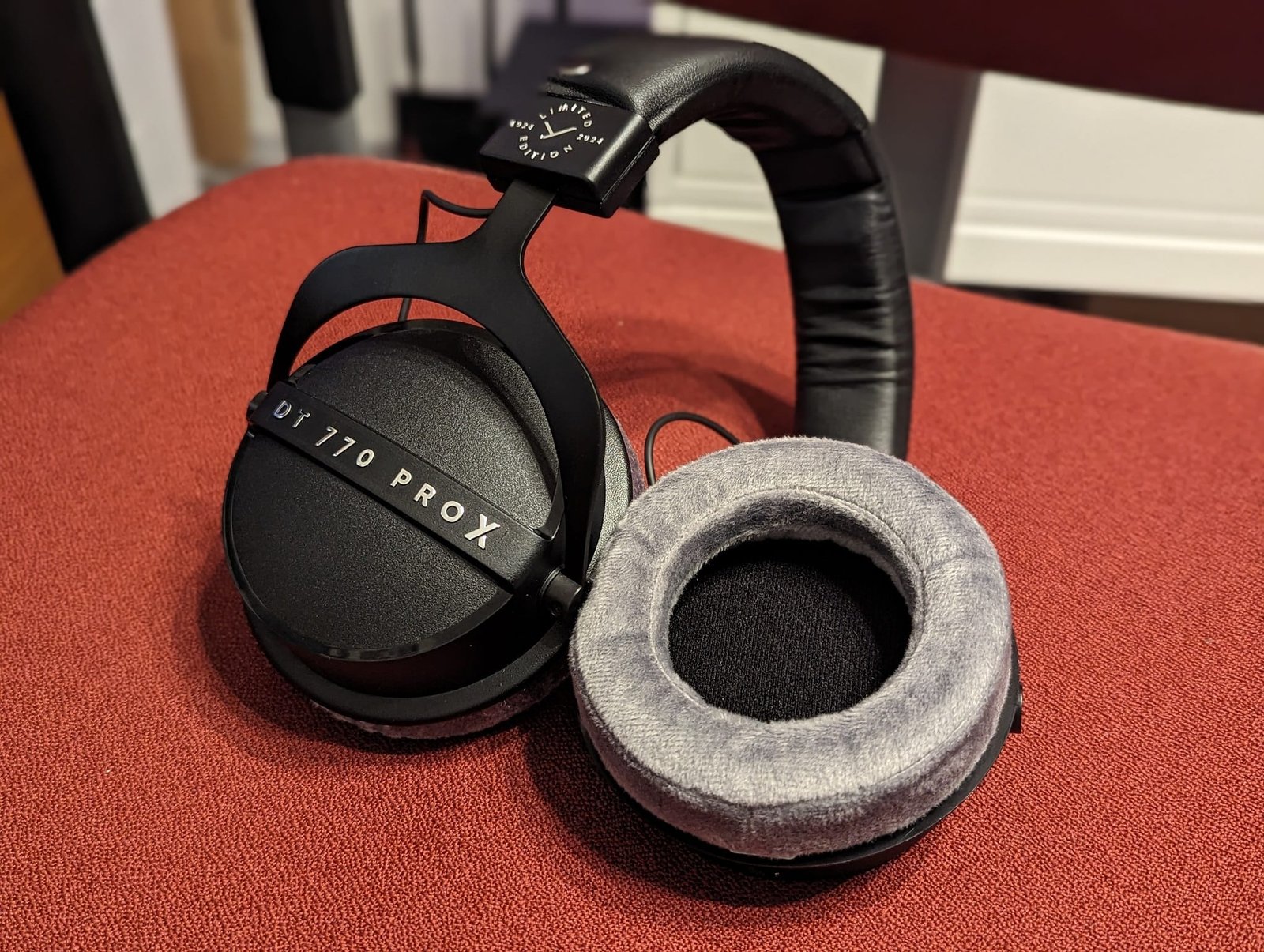
From the outside, the DT 770 Pro X Limited Edition differs from the old DT 770 Pro only in appearance, as the sturdy and durable basic structure has been kept intact. The slightly higher-quality plastic material and the glossy stripe around the cups make the overall look more modern in my opinion. I also like the DT 1770 Pro-style parts around the attachment points of the cups and headband. Likewise, the model designation of the headphones is more stylish than the ”nameplates” glued to older DT 770 Pro models. The anniversary year and Limited Edition status of the DT 770 Pro X are indicated by silver letters on the side of the headband.
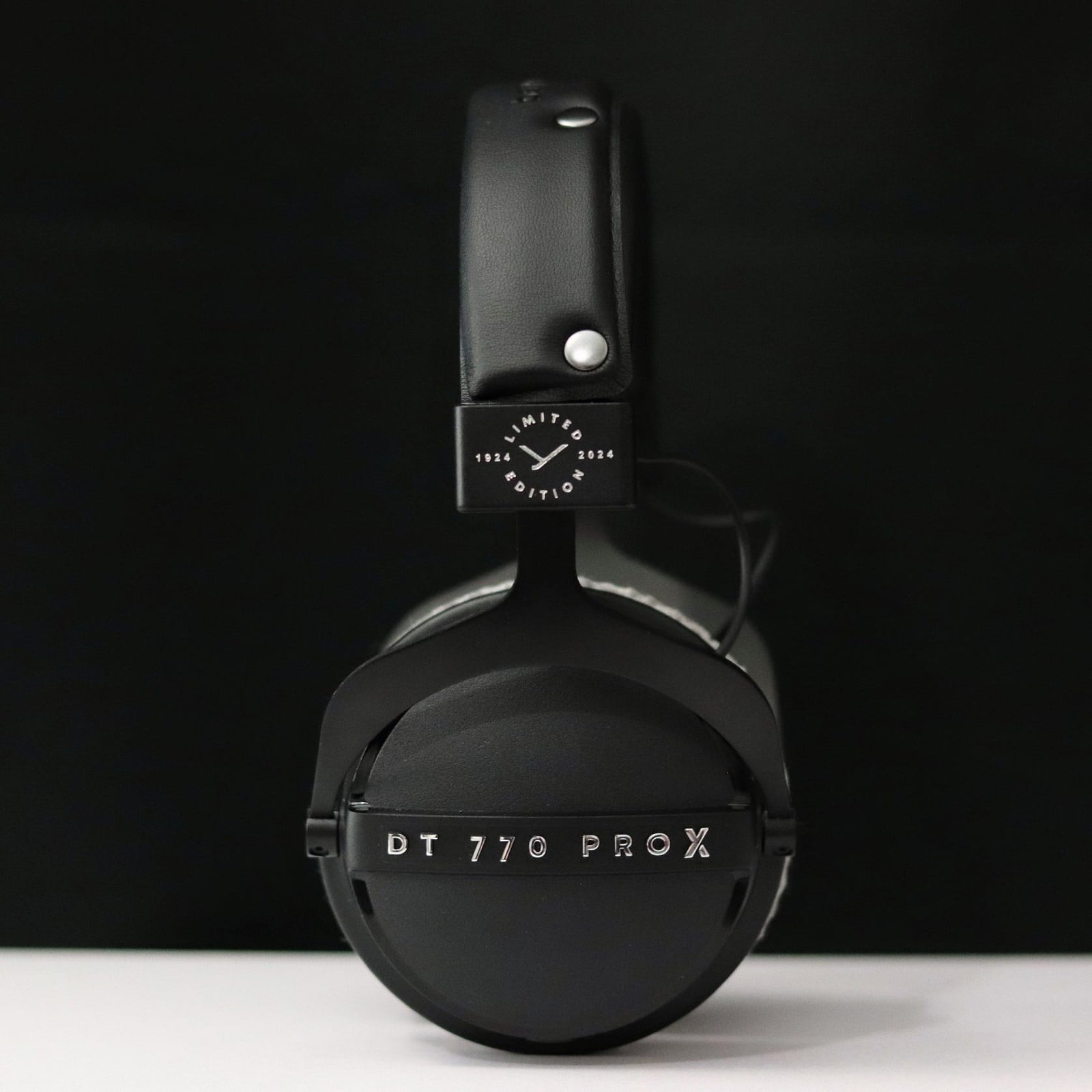
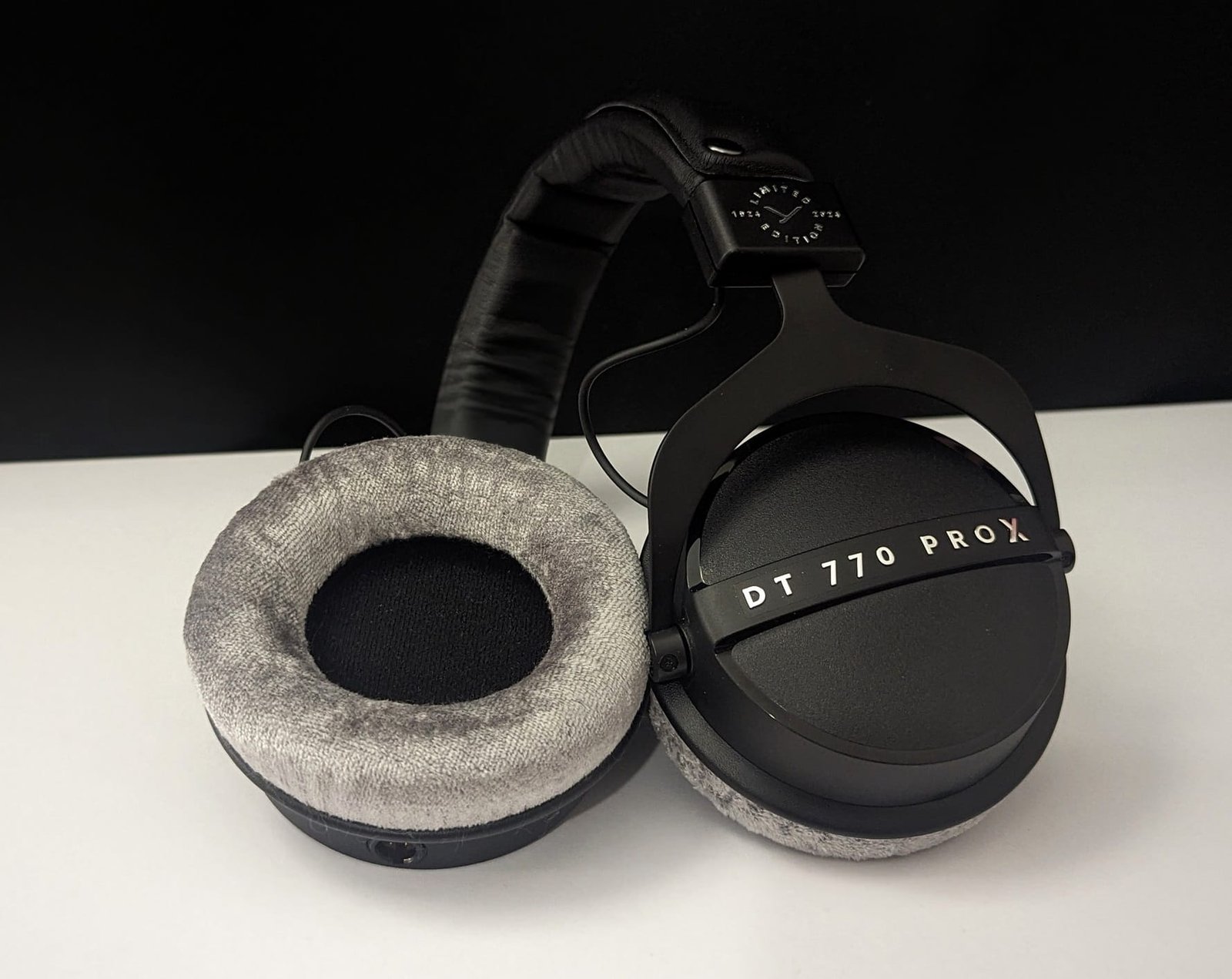
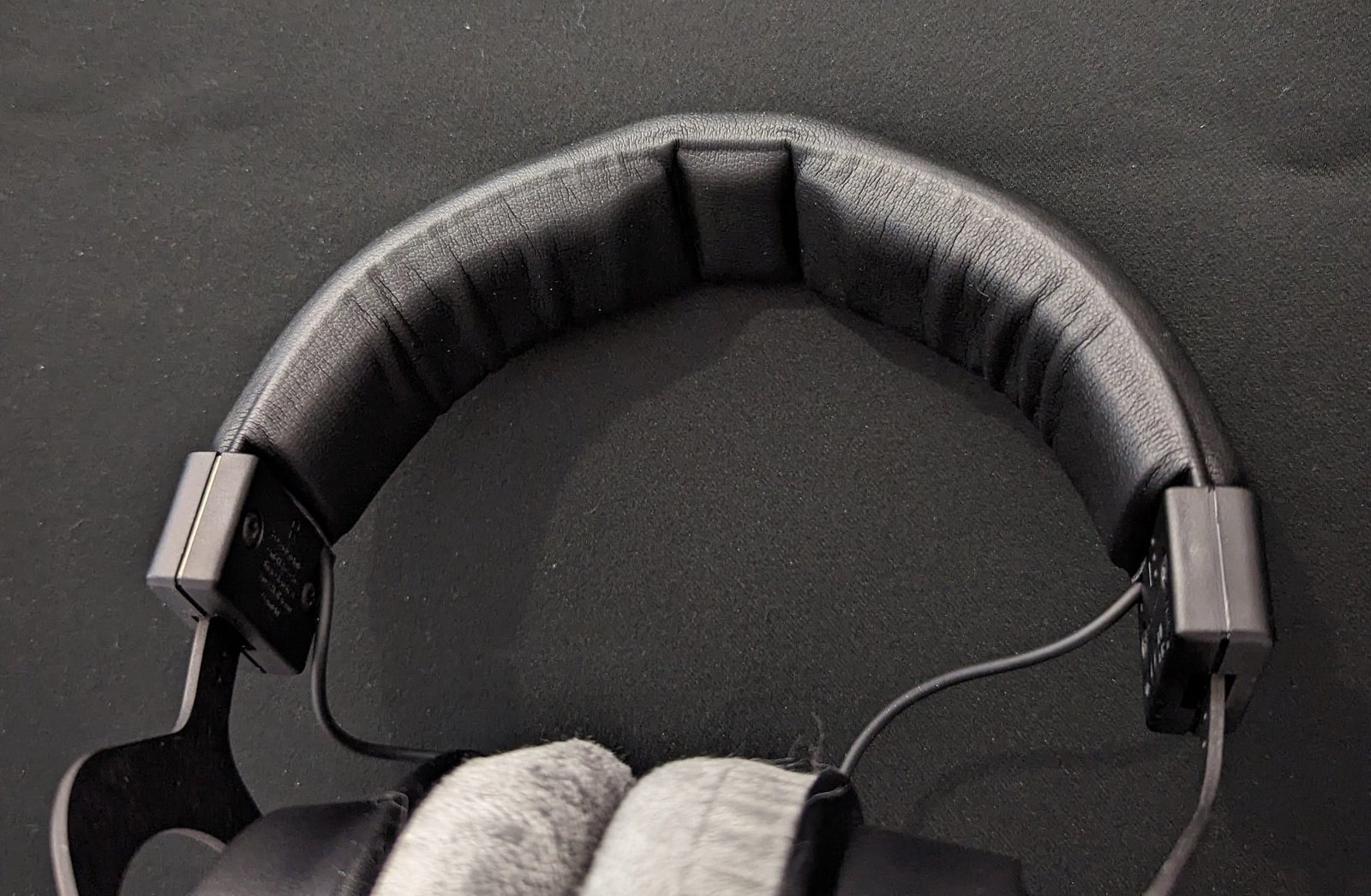
The familiar gray velour ear pads from the model series make a return. A small but functional change has been made to the snap-fastened headband pad: a notch added to the center effectively prevents pressure from building up on the top of the head. The DT 770 Pro series has never felt as comfortable as it does now. The headphones' weight of approximately 300 grams also feels quite tolerable, and the user would no longer have to tolerate an excessively long cable, as it could be replaced with a shorter one. As usual, the closed-back design also provides good isolation from ambient noise, which is beneficial, for example, in studio work.
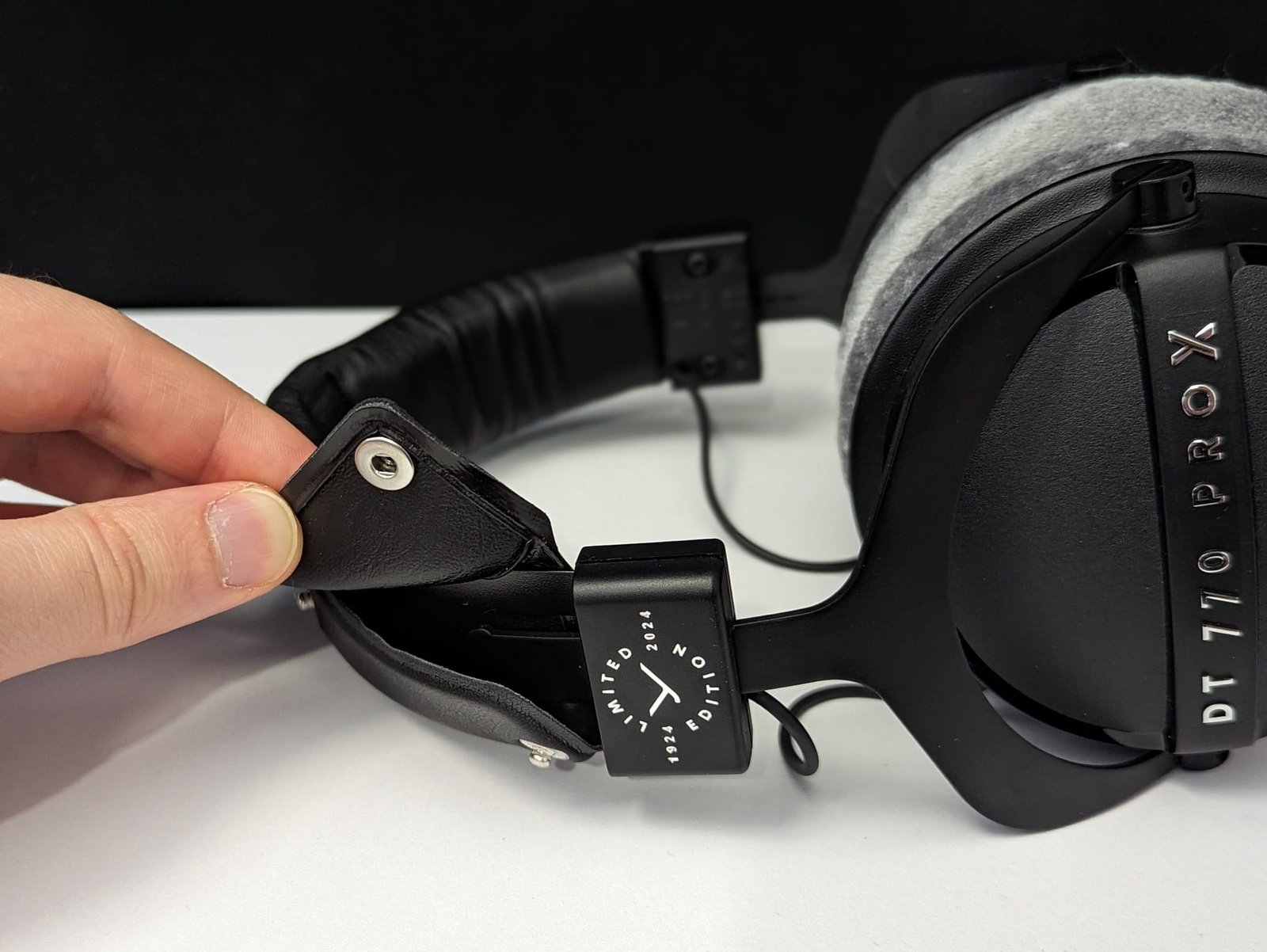
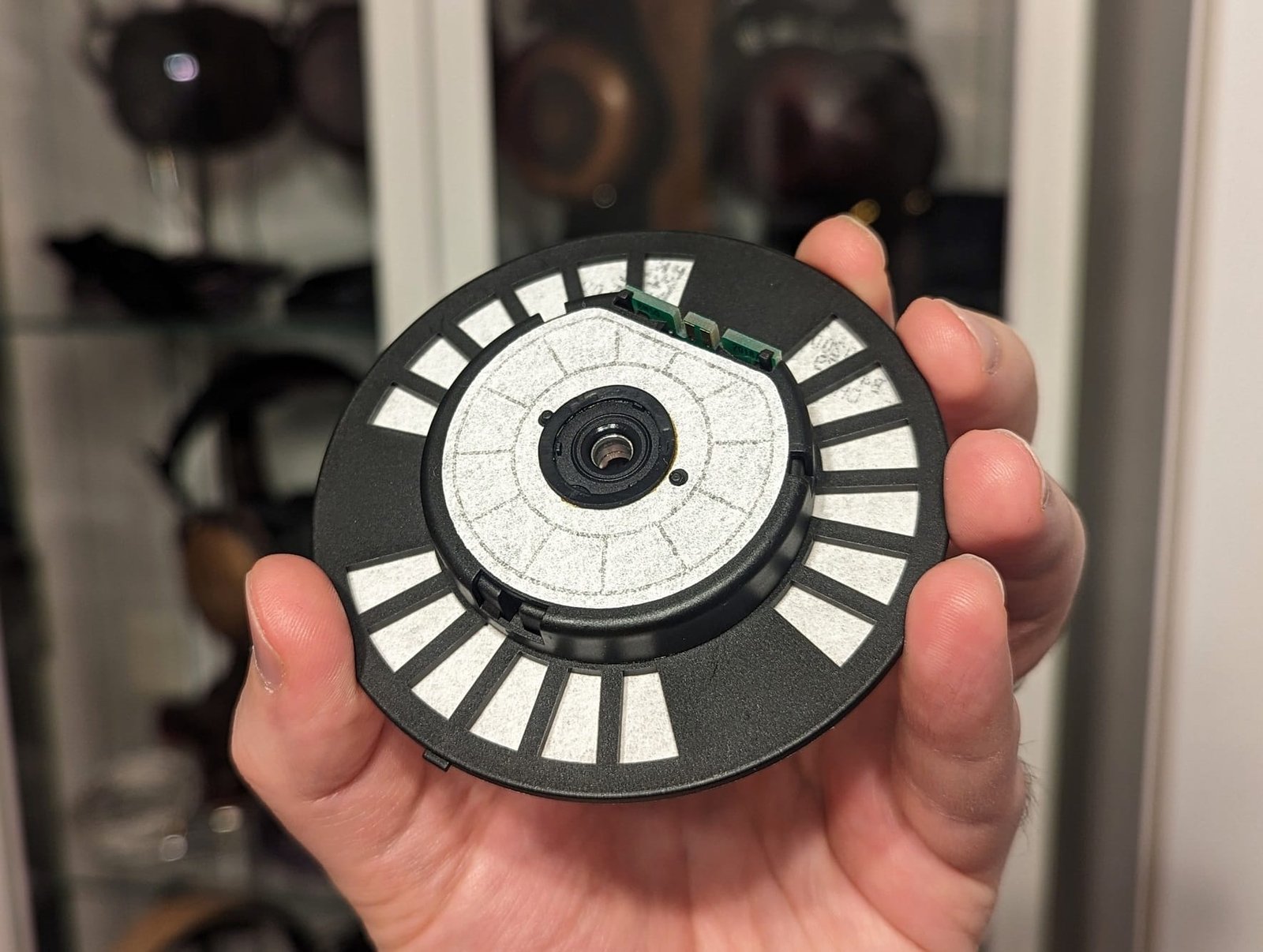
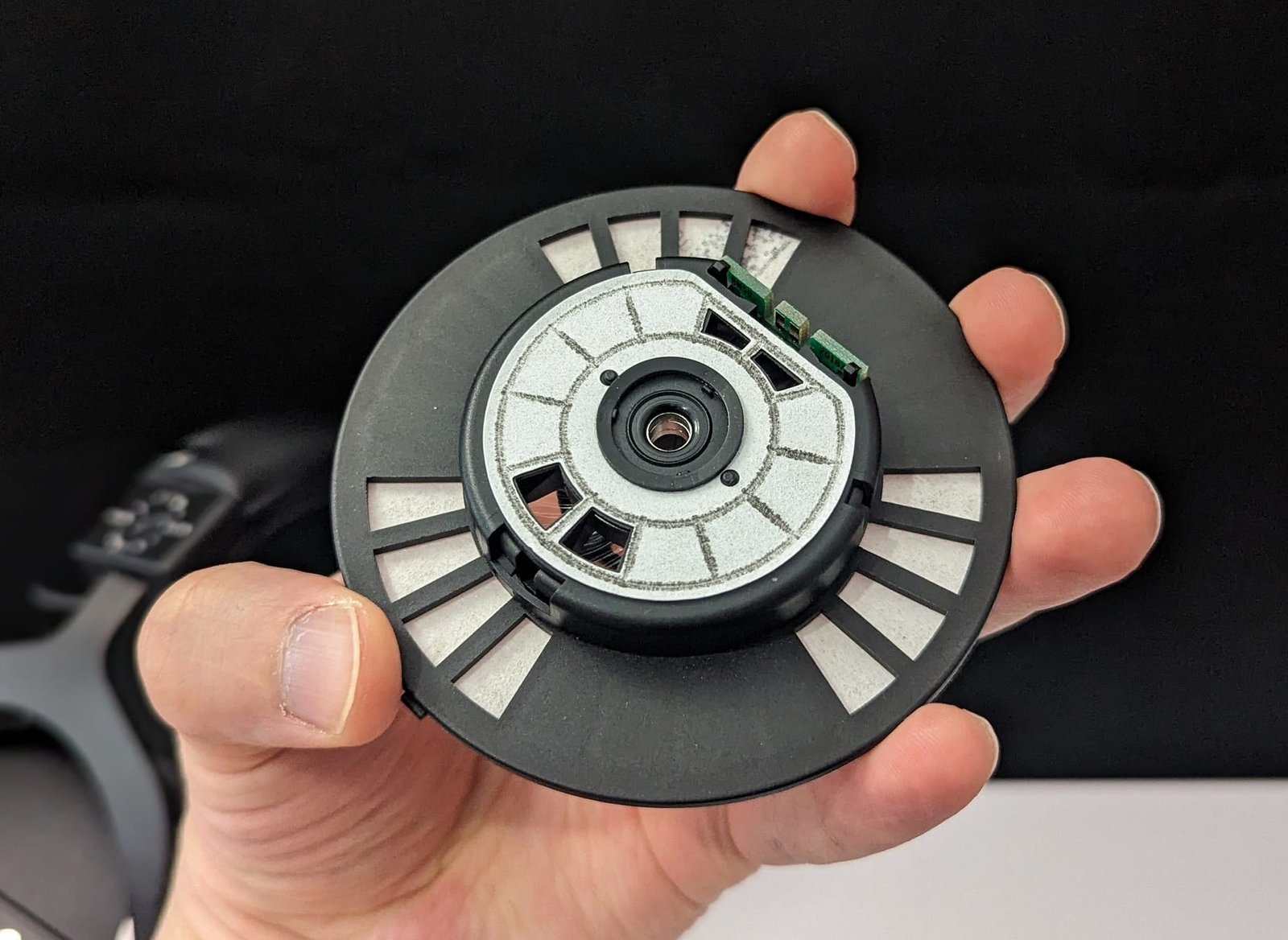
The headphones also deserve my praise for their ease of maintenance, as the pad parts are easily replaceable and other spare parts are available from the manufacturer's selection at reasonable prices. As an interesting innovation, the drivers could also be swapped in an instant, as they attach to their wiring with contact pins mounted on a piece of circuit board, instead of the owner having to use a soldering iron. A similar solution is also used in the DT 700 Pro X model, of which the DT 770 Pro X Limited Edition is practically a perfect copy in terms of its internal cup structure. This opens up interesting modification possibilities, so I will return to this in more detail a little later.
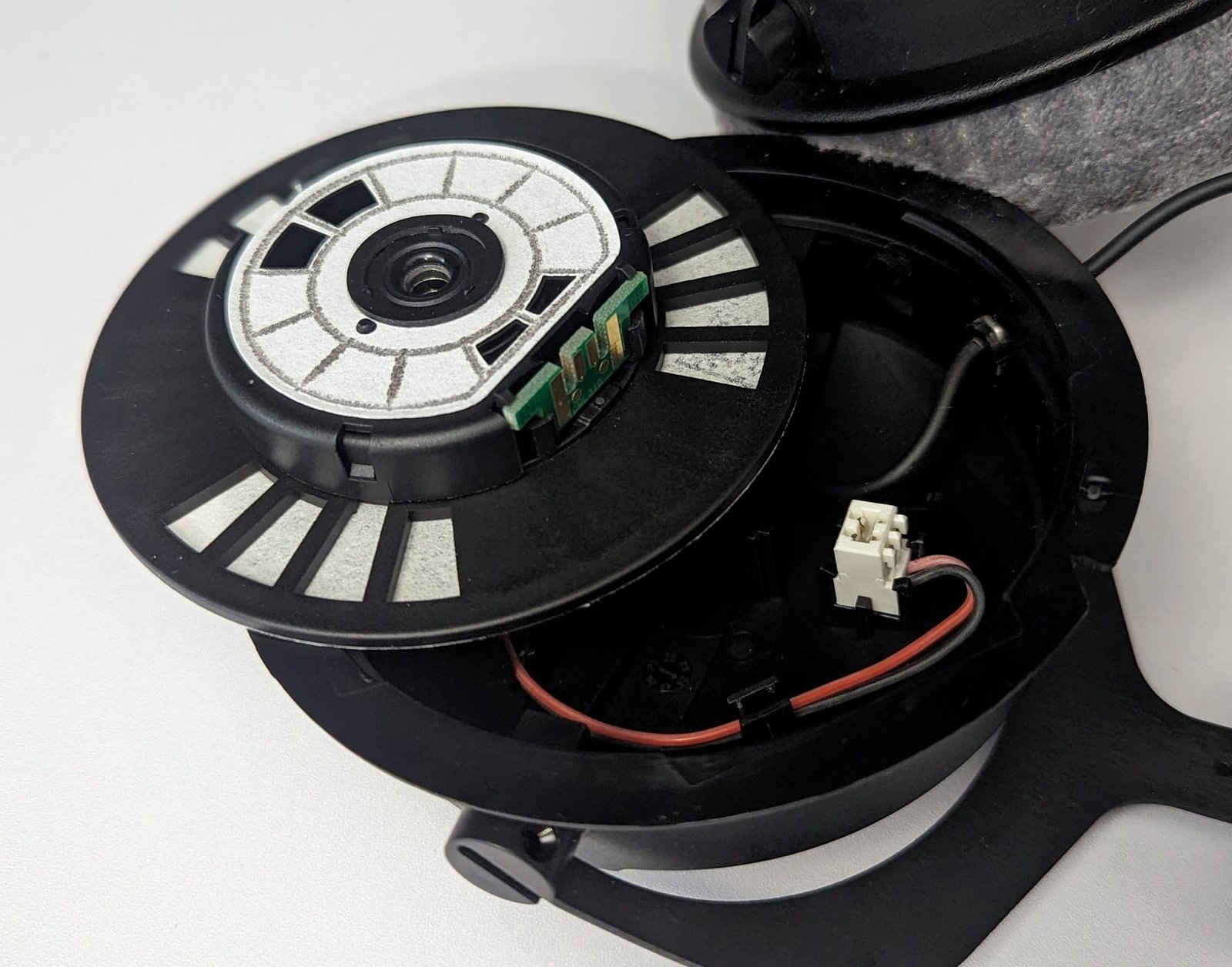
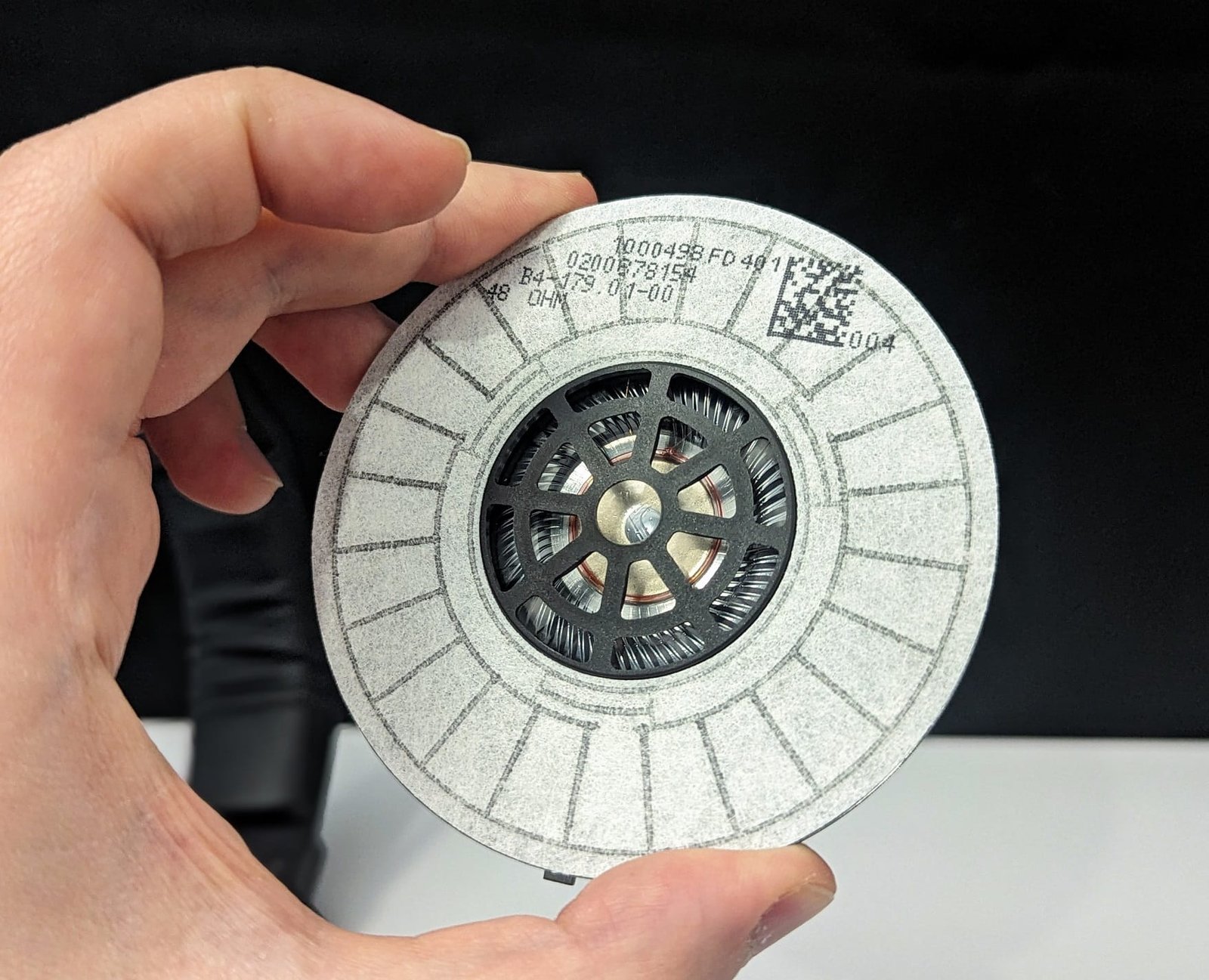
The DT 770 Pro X contains the manufacturer's dynamic Stellar.45 drivers, whose frame and airflow have undergone minor changes compared to the corresponding drivers in the DT 700 Pro X. The primary reason for this may be the differences in ear pads between the two model series, as the cup structure itself is similar. However, we will find out more about this later in the article.
Sound quality
Our frequency response measurements have been made with a clone IEC-60318-4 coupler and KB501X pinnae. The Harman target curve from 2018 is used as a reference point and generalization of the headphone response that would sound good to most people. For more information on the measurements and their accuracy, see Headphone Measurements-page. The frequency response of the DT 770 Pro X is also comparable with other measured headphones Squiglink .
Frequency response:

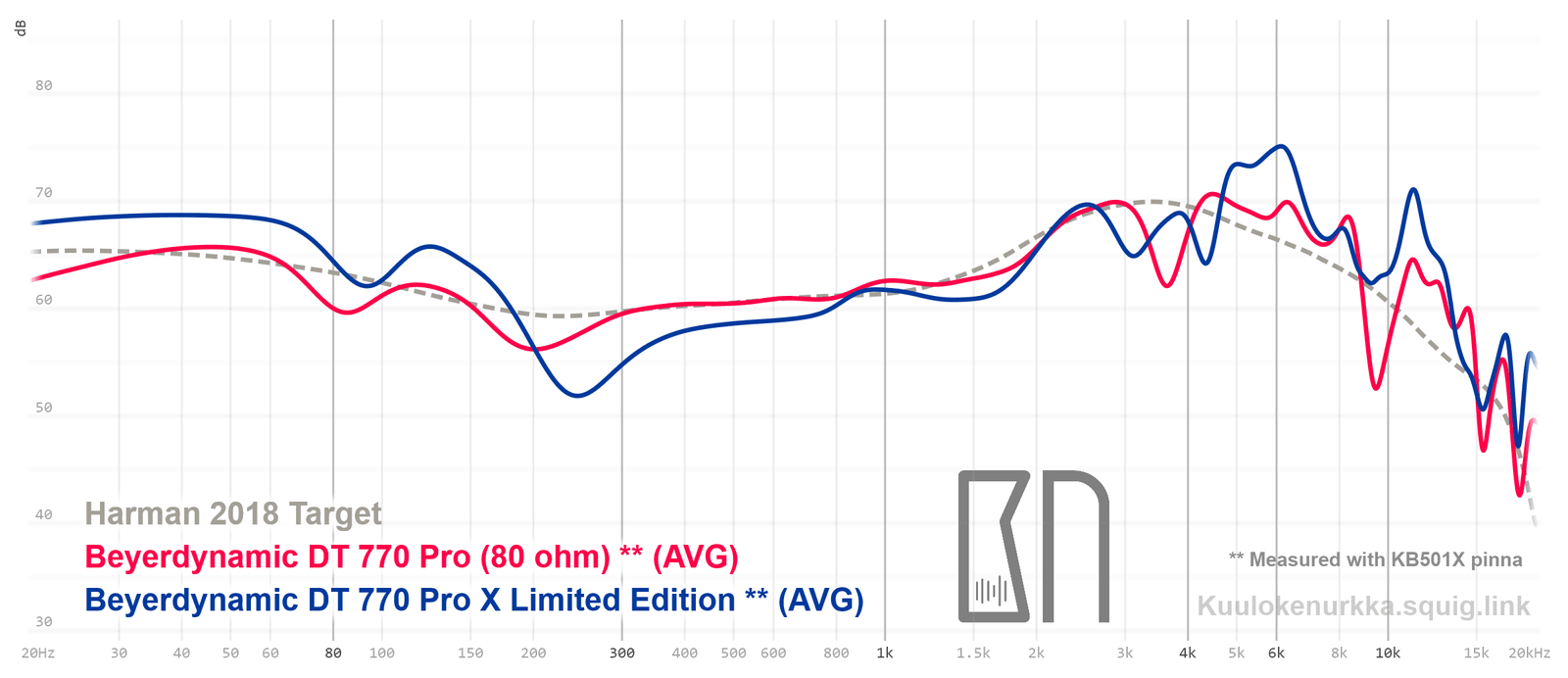
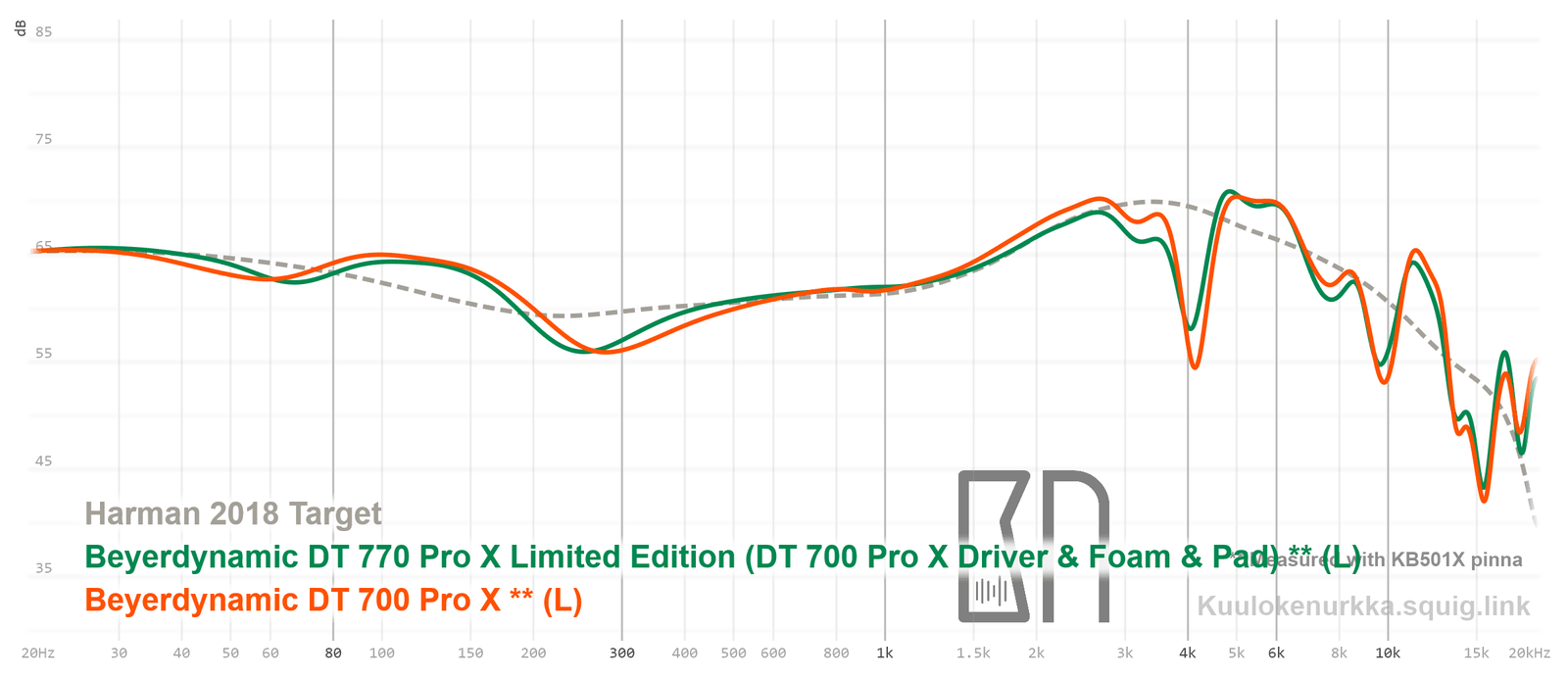
The DT 770 Pro X sounds wildly colored, even by Beyerdynamic's standards. If the DT 770 Pro was already V-shaped and quite bright in sound, the anniversary model turns the knobs at the extremes of the frequency spectrum even higher. Both bass and treble have been significantly boosted, and the mid-frequencies also sound more subdued than before, as if further emphasizing the distortion of the frequency response. Affordable closed-back headphones have become better in recent years, thanks to AKG's K361and K371, so Beyerdynamic's DT 770 Pro X feels like it belongs to a different era. On the other hand, if someone likes a strong V-shaped reproduction, some characteristics of the headphones can also be pleasing.
Firstly, one should not be too misled by the huge treble boosts visible in the frequency response, because even though they exist, the headphones do not automatically sound fatally harsh. This is because the appropriate volume is adjusted precisely based on the treble level, so in reality, the most disturbing aspect is the mid-frequencies that remain too distant and weak. At moderate volume, however, I find the DT 770 Pro X to be relatively tolerable due to its loudness-style sound. Although instruments and vocal performances are reproduced as powerless and downright lacking in detail, thanks to their smooth sound, the headphones are forgiving of low-quality recordings. A large amount of bass also effectively compensates for the emphasized treble, and the overall timbre does not have the same metallic quality as in the regular DT 770 Pro.
However, when the volume is increased, the overall sound quickly breaks down, as the treble becomes far too sharp and attention-grabbing, and the upper bass frequencies start to rumble thickly and resonantly. On the other hand, a powerfully kicking bass would certainly be to many people's liking. As a positive aspect, an airy and open-feeling soundstage could still be seen. After a little getting used to, the colored presentation is not entirely classless, but I would by no means recommend the DT 770 Pro X to those who dislike overly emphasized treble or appreciate natural mid-frequencies, unless its sound is fine-tuned to be more balanced. Both the DT 770 Pro (80 ohm) and DT 700 Pro X sound clearly more orthodox by default, so it's difficult for me to see how the anniversary model would be better suited for studio work either.
Bass:
Powerful bass reproduction can be seen as one of the DT 770 Pro X's stronger areas, as the reproduction has a tremendous amount of punch – sometimes even too much. The robustness of the reproduction can easily bring a smile to one's face at its best, but most often the resonant rumble of the mid-bass between 100–150 Hz starts to bother me. The emphasized bass also constantly draws attention, even if the music being listened to isn't particularly bass-heavy. Fortunately, a deep dip at 250 Hz prevents the low frequencies from bleeding too much into the mid-frequencies. This, combined with the low distortion values of the Stellar.45 drivers, makes the bass sound quite clean for its high quantity. For example, movie soundtracks with plenty of sub-bass can sound truly dynamic and immersive.
However, this kind of fun-oriented presentation is not necessarily well-suited for studio work, because the bass clearly draws more attention in the overall sound compared to the mid-frequencies and thus to the more important aspects of the music. Interestingly, the subdued sound around 250 Hz also makes the low frequencies sound quite hollow and dead, because this frequency range usually affects how full and warm we perceive the reproduction.
Mid-frequencies:
The subdued lower mid-frequencies also prevent instruments and vocalists from sounding like themselves, because despite the kicking bass, the reproduction lacks foundation. The presentation remains weak, hollow, and lifeless, as if all its edginess and detail had been polished away. Yet, at the same time, I find the sound sufficiently clear thanks to the bright treble, so the overall impression is quite peculiar. When listening, I somehow completely skip the overly smoothed lower mid-frequencies, focusing only on the bass and high frequencies. I don't know if this is intentional, but it would still be possible to get used to the presentation, if one didn't occasionally listen to more balanced tuned headphones. After that, the DT 770 Pro X sounds truly colored. The mid-frequencies simply remain too distant to be pleasant for me or in any way faithful to the recordings.
When listening to the headphones, sometimes truly confusing things happen, as at one moment the treble might be very prominent and the bass pounding loudly, while a moment later a mid-frequency-focused part of the song might be reproduced so faintly that it's difficult to hear. However, it's not advisable to increase the volume, because it's to be expected that in a moment the high frequencies will hit hard again. Often, the DT 770 Pro X feels like I'm listening to an uneven live mix where the vocalist's microphone has been left too quiet compared to the bass and drum cymbals.
Treble:
Nowadays, it's rare to encounter as emphasized treble in headphones as in the DT 770 Pro X, but it still doesn't inherently sound as annoying as the frequency response measurements would suggest. Since the 8–15 kHz frequency range is reproduced most strongly of all frequency ranges, it automatically regulates how high a volume one feels like listening to the headphones at. At louder volumes, the sharpness and sibilance are downright murderous, but when staying below my tolerance threshold, the high frequencies never actually grate on the ear or make vocal performances too piercing. Even then, I naturally focus more on the high frequencies than on other aspects of the reproduction. Perhaps this is considered useful in a studio environment when searching for errors in recordings?
I don't know if it's due to the new drivers or characteristics related to the distorted frequency response, but despite its emphasis, the treble of the DT 770 Pro X sounds less metallic than, for example, in the 80-ohm version of the DT 770 Pro. The high frequencies are indeed emphasized far too much (for example, drum cymbals are very prominent), but their tone is more pleasant than before. It may be that the rumble of the bass covers some of the sharpness, as it is the second most attention-grabbing feature in the headphones after the treble.
Other observations:
Listening to music solely through the DT 770 Pro X would ultimately give a very distorted picture of what different recordings actually sound like. If we disregard this, however, I would count the anniversary model's advantages over the regular DT 770 Pro as a more fun bass reproduction and a more airy and open soundstage. These features, on the other hand, compete with each other, because the mid-bass rumble reveals that it is a closed-back headphone model. Apart from the very uneven frequency response, I don't find any other weaknesses in the sound of the DT 770 Pro X for its 200 euro price. Dynamics or resolution, on the other hand, are difficult to assess, because the frequency balance does not match what I am used to in good headphones.
Kitchen paper and bass port mod
Since Beyerdynamic's anniversary model brings to mind past decades, inspired by nostalgia, I decided to try some DIY mods that many have traditionally utilized with the manufacturer's headphones.
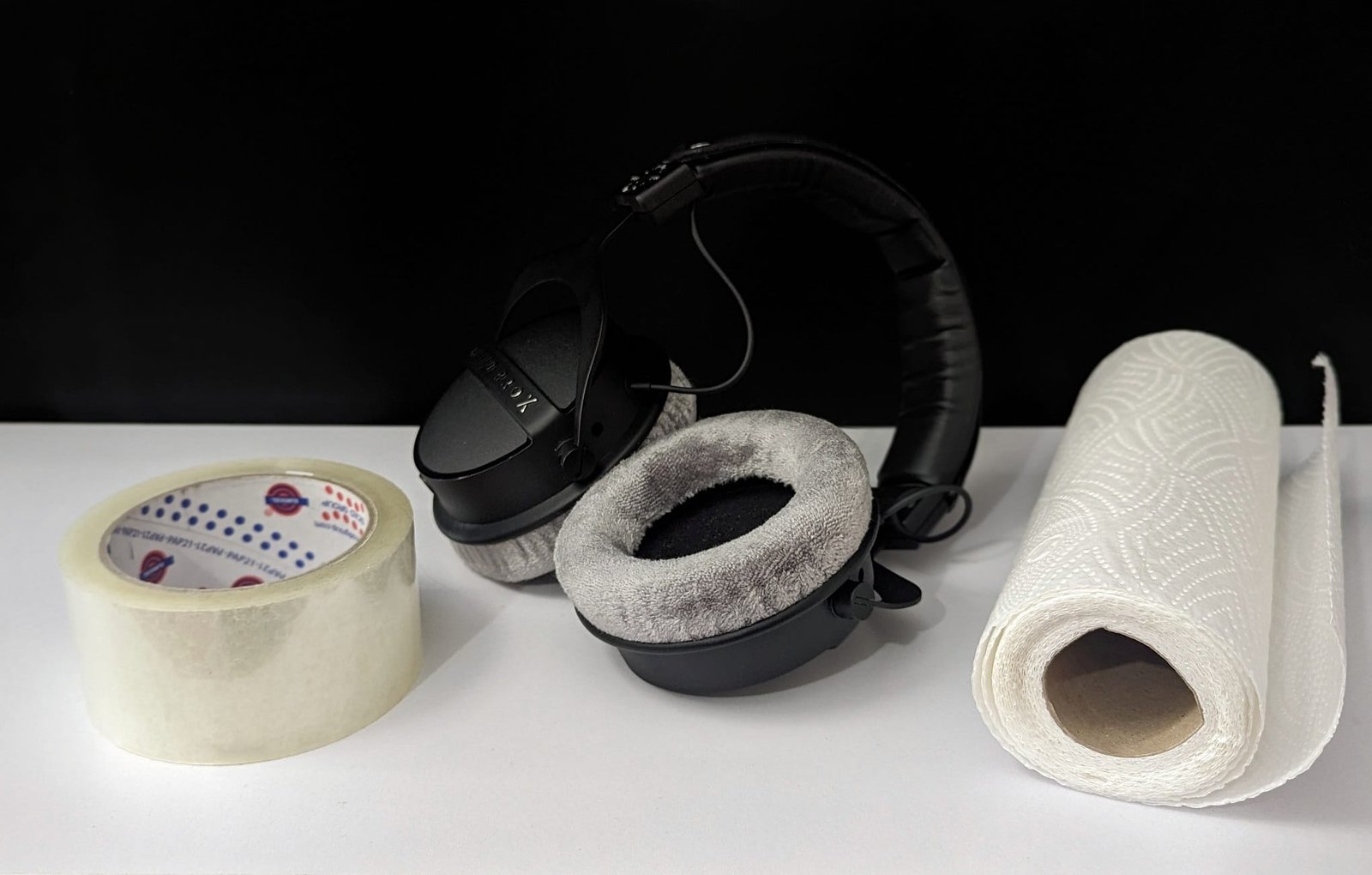
First, I added a layer of paper towel to the front of the driver, i.e., to the base of the earpad. I expected this to somewhat reduce the amount of treble, but I wouldn't have believed it would almost completely correct the excessive brightness of the DT 770 Pro X. The change is truly dramatic given its simplicity, as after that, it's possible to increase the volume and the mid-frequencies come out much more naturally in the overall sound. On the other hand, the lower mid-frequencies still reproduce too lightly and the mid-bass rumbles a bit too much.
These two weaknesses can be alleviated by partially taping off the bass ports located at the rear edge of the cups. I placed the tape pieces so that about 25 percent of the holes remained uncovered. This shifts the dip formed in the frequency response from 250 Hz towards the bass, while simultaneously raising the level of the lower mid-frequencies. The excessive mid-bass emphasis is also almost completely eliminated, which clarifies the sound. Critically evaluated, the dip remaining in the low frequencies is still too large, but it is already possible to get used to it.
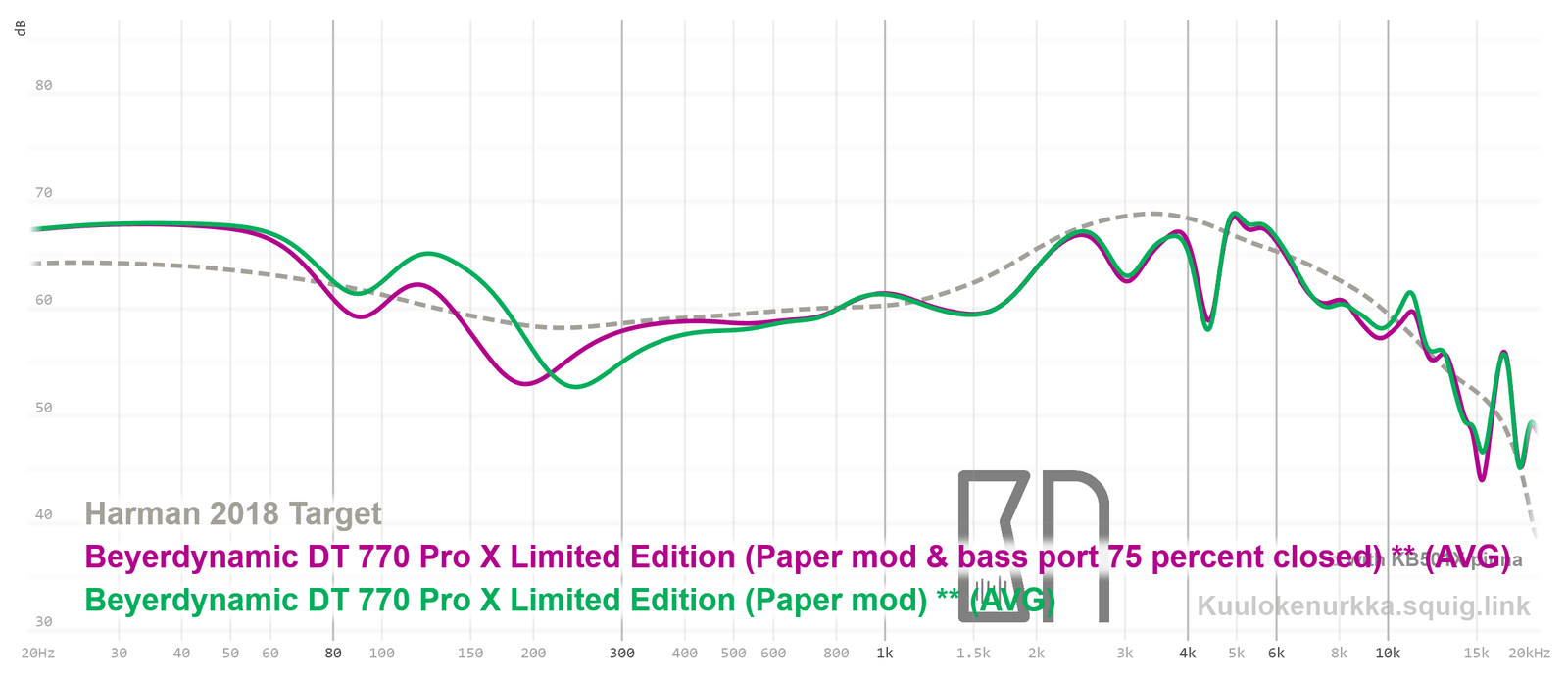
With these modifications, which take less than 10 minutes and are achievable by anyone, it's possible to get a balanced headphone from the DT 770 Pro X that still sounds refreshingly open, considering its closed-back design, and delivers powerful bass thanks to its strong sub-bass. The treble, on the other hand, still has a bit of added sparkle and clarity, which aids in perceiving details. Despite their clarity, the mid-frequencies could be somewhat smoother and fuller, but a few dips are ultimately less bothersome than having similar boosts in the reproduction. After the changes, the DT 770 Pro X even sounds quite atypical for a DT 770 series headphone, as there is no coldness or metallic harshness in the sound; instead, the tone is even inviting. The reproduction is also clean and precise, which could very well be due to the low-distortion Stellar.45 drivers. For comparison, the drivers of the regular DT 770 Pro are already showing their age.
Equalization
In addition to mechanical modifications, the headphones could, of course, also be equalized, which would eliminate individual dips in the frequency response. In this case, there would not even be a need for mods, as their effects can be handled entirely software-based.
Suitable settings for equalization can be determined, for example, based on my own measurements using Squiglink's AutoEQ tool. I have made small fine-tunings by ear, but Harman's target curve serves as a very good starting point. Anyone who has purchased the headphones can try the settings I have listed below, for example, with Equalizer APO software. I found them to be effective Qudelix 5K:lla. The listening experience after equalization does not differ vastly from the mods I made, but objectively evaluated, the reproduction is still slightly more neutral and linear. The DT 770 Pro X, in any case, has the potential to be a really good headphone, provided its frequency response is made balanced.
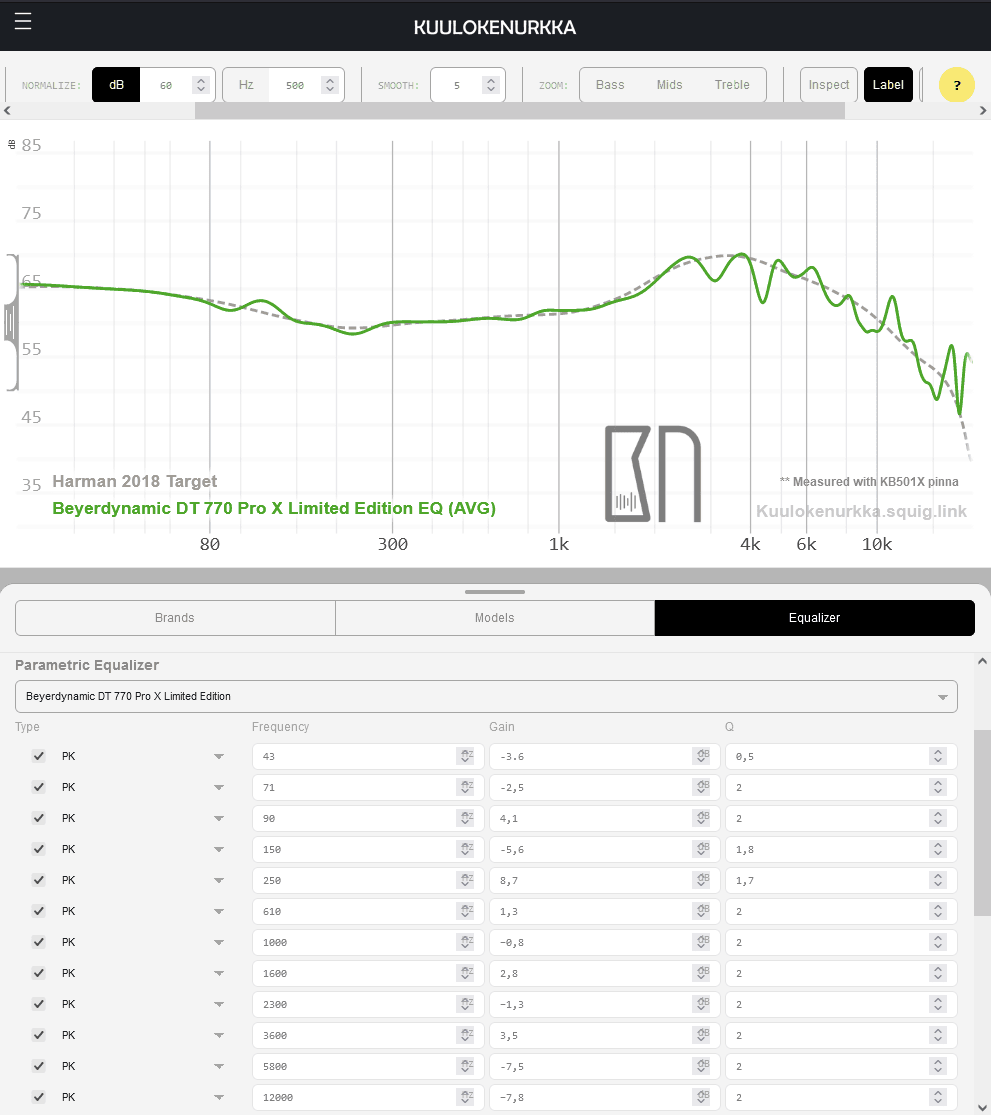
For more expensive headphones, I generally do not see equalization as a solution for correcting manufacturers' mistakes, but with more affordable products like the DT 770 Pro X, the effort can be seen to pay off better, especially if the same price range is not already saturated with better headphone models.
DT 770 Pro X Limited Edition vs. DT 700 Pro X
Prices: 200 € vs. 230–250 €
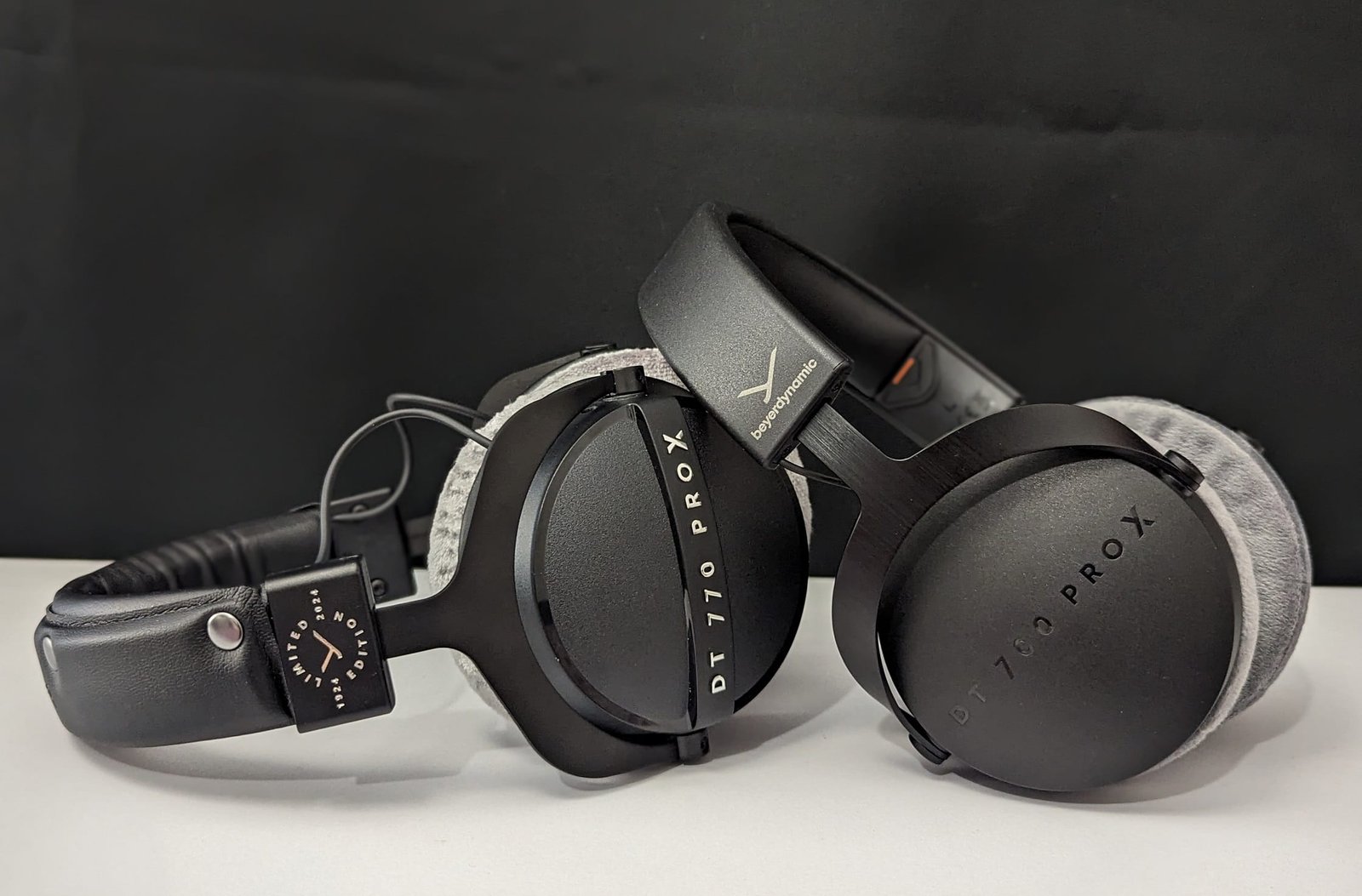
I ended up acquiring the Beyerdynamic DT 700 Pro X headphones for a more detailed comparison, which are sold at their cheapest for about 30 euros more than the DT 770 Pro X anniversary model. The headphones are confusingly named almost identically, so following this section may require precision. Fortunately, the headphones at least look different, so they wouldn't get mixed up in use. The DT 770 Pro X Limited Edition is based on the older DT 770 Pro, while the DT 700 Pro X looks slightly more modern and less attention-grabbing, similar to the semi-open DT 900 Pro X, which is based on a similar structure. The overall impression of quality, in my opinion, reaches a slightly higher level than in the anniversary model, but on the other hand, I like how the silver texts pop out on the DT 770 Pro X. The DT 700 Pro X, in comparison, looks quite modest, for better or worse.
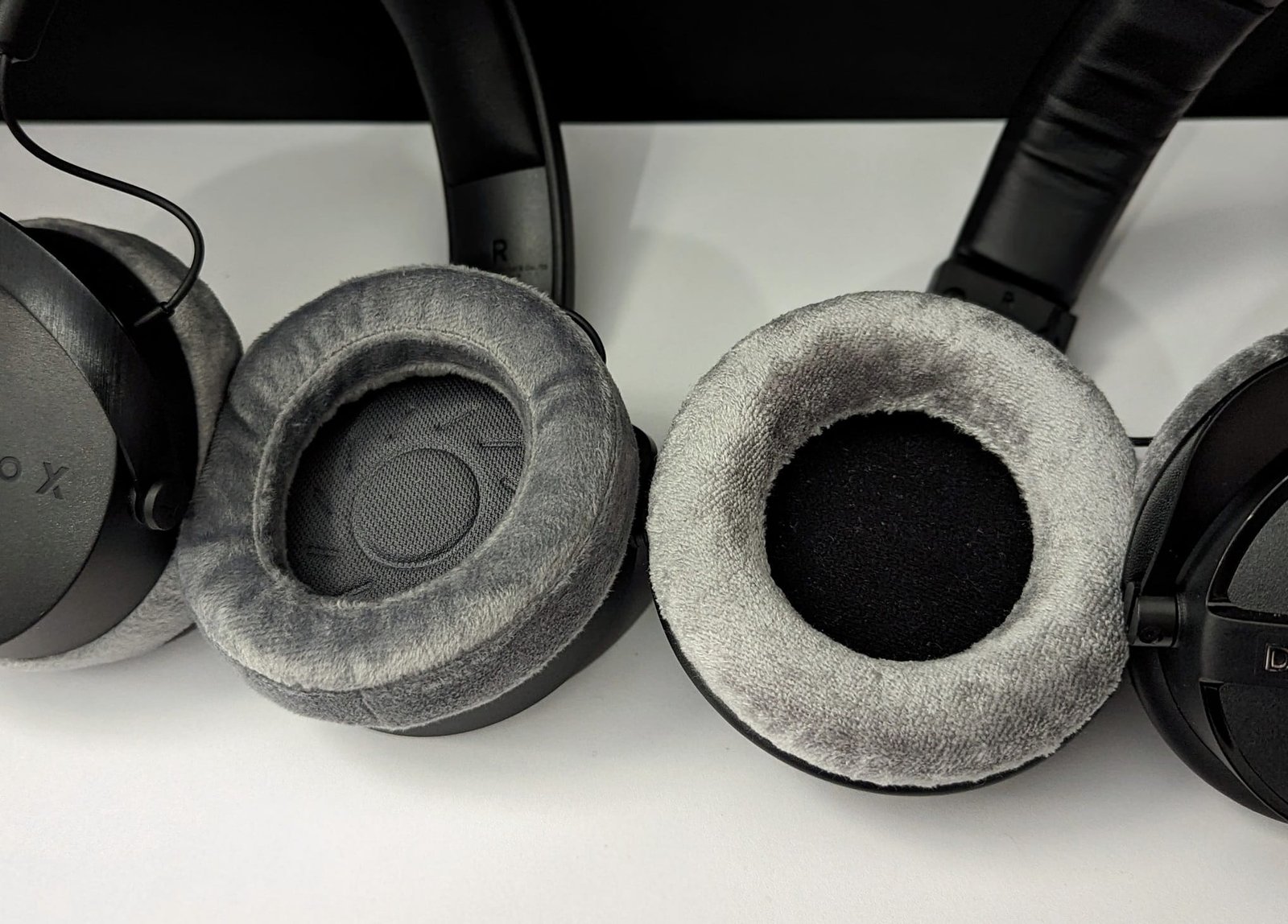
In terms of functions or adjustments, the duo does not differ much from each other, except that the DT 700 Pro X's earpads attach around the rim of the cup with a snap-on plastic ring instead of stretching. The new type of earpads feel softer in material and thus slightly more comfortable, but the ear opening is slightly smaller than in the DT 770 Pro X's earpads. Although using both headphones is comfortable, I find myself preferring the anniversary model because it clamps lighter on my head and weighs about 50 grams less. The DT 700 Pro X, with its firm clamp and tight fit, resembles Sennheiser HD 600-series. For the general population, the clamp is certainly not too much, but for some, the headphones might feel a bit bothersome in the long run. On the positive side, however, a firmer clamp would seem to improve passive sound isolation.
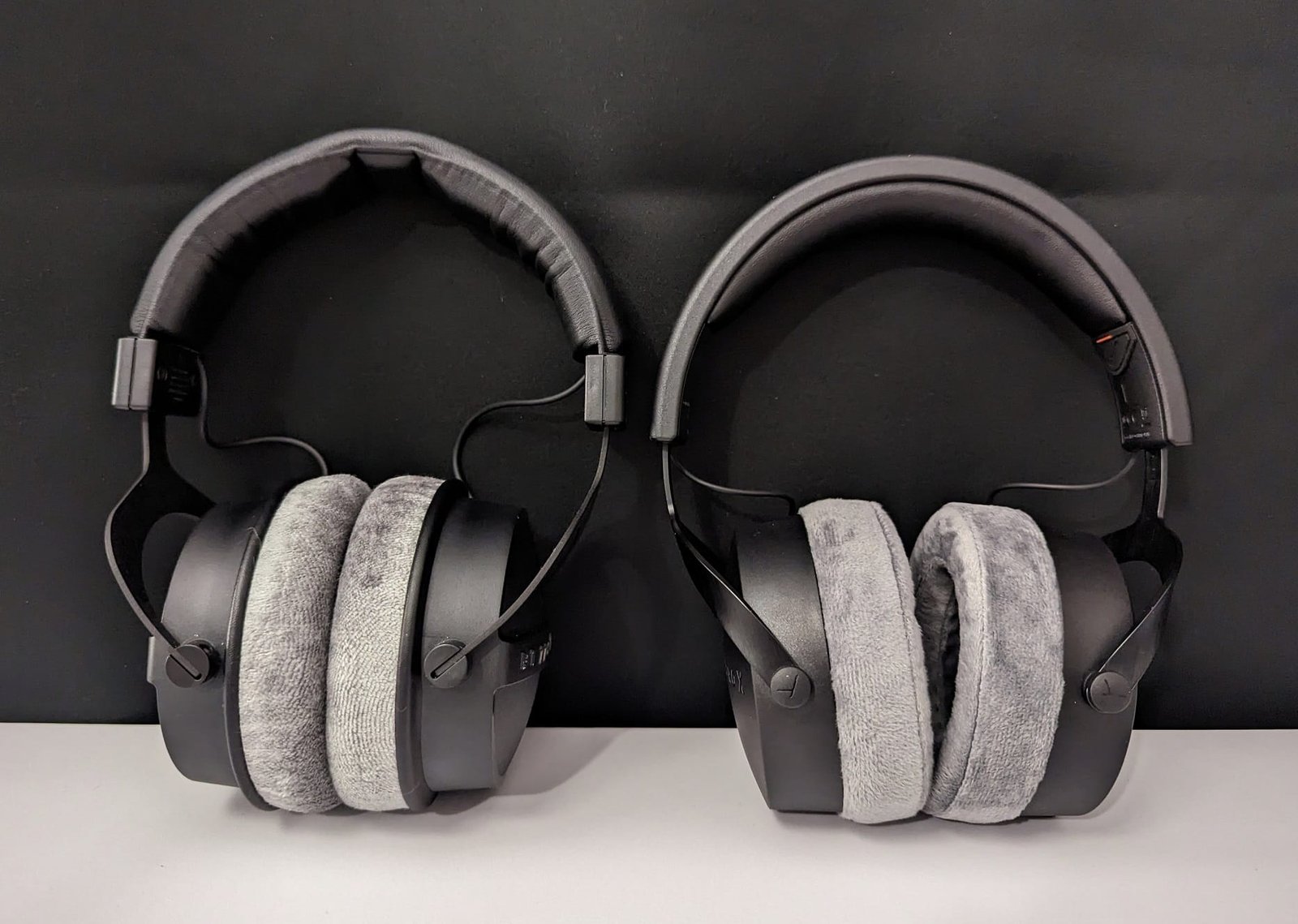
Regarding accessories, it's worth noting that with the more expensive DT 700 Pro X, the buyer gets a higher-quality storage pouch and two cables (lengths 1.8 m and 3 m). The DT 770 Pro X anniversary model only comes with the longer of these cables. In both headphones, the cable and its long connector point straight downwards from the bottom of the cup, so they hit my shoulder somewhat annoyingly, especially when turning my head to the left. This could have been avoided by installing the connector to point slightly forward and diagonally.
Sound quality differences
I was most looking forward to the sound quality comparison, as both headphones use the same Stellar.45 drivers with minor differences. In terms of internal cup structure and parts, the DT 770 Pro X is practically a copy of the DT 700 Pro X, but different ear pads change the end result. In addition, the DT 700 Pro X has a clearly thicker layer of damping material installed in front of the driver, which most affects the amount of high frequencies.
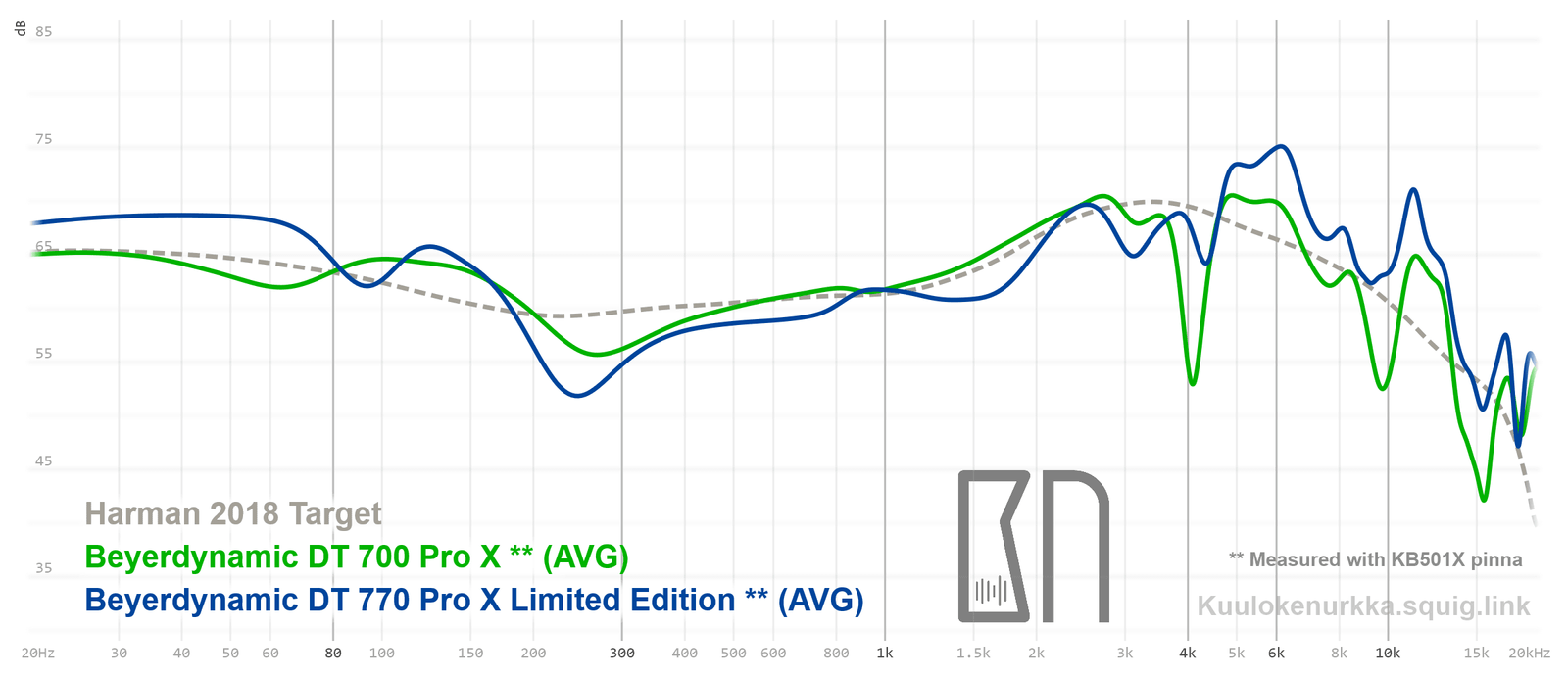
The DT 700 Pro X may very well be Beyerdynamic's best-tuned closed-back headphone in history. Its natural mid-frequencies and only slightly V-shaped reproduction clearly differ from the brighter DT 770 Pro models. The balance of the reproduction is only broken by an occasionally overly emphasized mid-bass and a missing piece between the upper mid-frequencies and treble – this would seem to be some kind of phase cancellation caused by the structure, but fortunately, it only slightly relaxes the sound. The full-feeling and balanced presentation is, in any case, a huge improvement over the DT 770 Pro X's dull mid-frequencies and other frequency response irregularities.
Where the DT 770 Pro X's bass and treble overpower the mid-frequencies, the DT 700 Pro X has only a little added punch in the low frequencies and just the right amount of sparkle in the treble without it being particularly emphasized overall. Listened to consecutively, the anniversary model sounds thin, hollow, bright, and strongly boomy, whereas the DT 700 Pro X is pleasantly natural and warm. On the other hand, its soundstage remains quite intimate, while the DT 770 Pro X sounds more open and airy. Its presentation also feels a bit more lively, which is not solely explained by differences in frequency responses.
The thick front damping of the DT 700 Pro X's drivers is clearly audible to me, as despite its balance, the sound remains peculiarly soft and blended. The reproduction is clear in a way, but I still have to constantly make a slight effort to discern smaller details and the outlines of sounds. The mid-bass radiating warmth around it doesn't help the situation, but the dynamically limited and somewhat uniform presentation is, however, typical for other heavily front-damped headphones, such as Rode NTH100:lle, Drop Panda and Dan Clark Audio's Aeon series. The same observations also apply to Beyerdynamic's open-back DT 900 Pro X model.
The listening experience is peculiar because there's nothing inherently wrong with the sound, but it sounds a bit like music is playing through a blanket. However, this doesn't bother in casual listening, nor would it necessarily be a problem in general sound monitoring. Many have recommended the DT 700 Pro X and DT 900 Pro X for speech monitoring, for example, which is easy to agree with, as the human voice is reproduced very honestly in style. In my opinion, the DT 700 Pro X is still a very good overall choice and a significantly better general-purpose headphone than the DT 770 Pro X Limited Edition.
Interestingly, the more freely breathing drivers of the anniversary model do have their advantages, provided that the headphones' frequency response is adjusted to be more balanced than the default. For example, after the modifications I suggested, it sounds more transparent and detailed than the DT 700 Pro X. The spatial separation of sounds is also more precise, and the soundstage feels more expansive. Although the mid-frequencies still sound thinner and less pleasant, the more lively dynamics make the listening experience more impactful. With a little effort, I believe the DT 770 Pro X has the potential to be even better than the DT 700 Pro X. I personally find myself preferring the fresher and more detailed reproduction of the modified anniversary model, especially since wearing the headphones is also slightly more comfortable.
Beyer-Frankenstein
This brings me to my final realization: thanks to the similar design, the parts of the DT 700 Pro X model fit directly into the DT 770 Pro X, allowing the anniversary model to be turned into quite a Frankenstein's monster by swapping out the drivers and ear pads. This also opens up the possibility to experiment with how the headphones would sound if Beyerdynamic had opted to use DT 700 Pro X parts directly in them, instead of modifying the drivers and taking the ear pads from the DT 770 Pro.
Sound with DT 700 Pro X ear pads
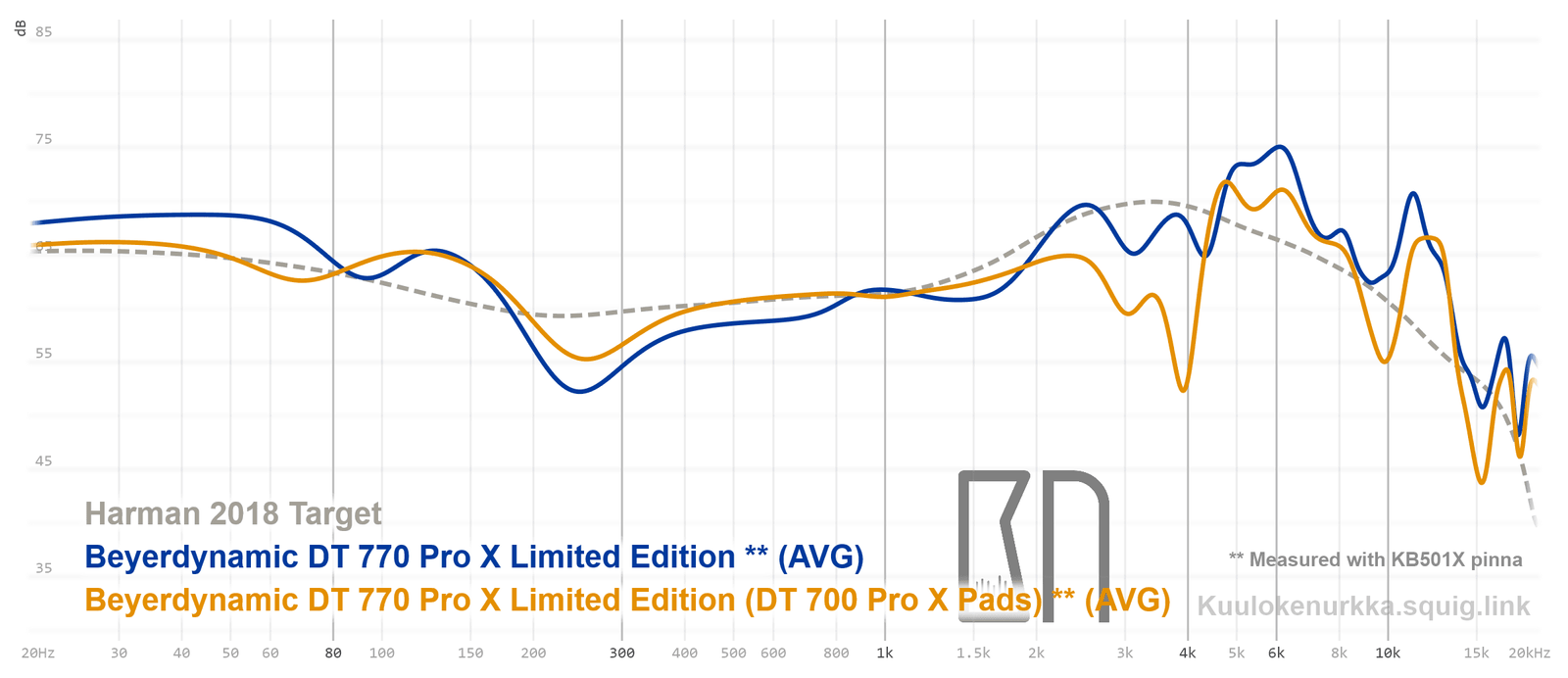
When the earpads of another Beyerdynamic model are swapped into the DT 770 Pro X, the sound changes significantly. The headphones become calmer and fuller-sounding. The bass is no longer too boomy, nor is the treble too bright, so the mid-frequencies are more prominent. Unfortunately, the upper mid-frequencies between 2–4 kHz remain subdued, making vocalists sound rather dull and veiled. On the other hand, the dip created in the frequency response brings an intriguing sense of spaciousness to the reproduction, somewhat similar to ZMF's Verite headphones. Thus, the DT 770 Pro X would be well-suited for relaxed listening, which completely deviates from its initial V-shaped sound. If someone still finds the treble too bright, its level could be further reduced by 3–6 decibels by installing the thicker foam discs from the DT 700 Pro X model in front of the drivers. Overall, I consider changing the earpads an improvement in sound quality, even though it introduces new kinds of weaknesses.
How does the DT 770 Pro X sound with DT 700 Pro X drivers or when completely ”cloned”?
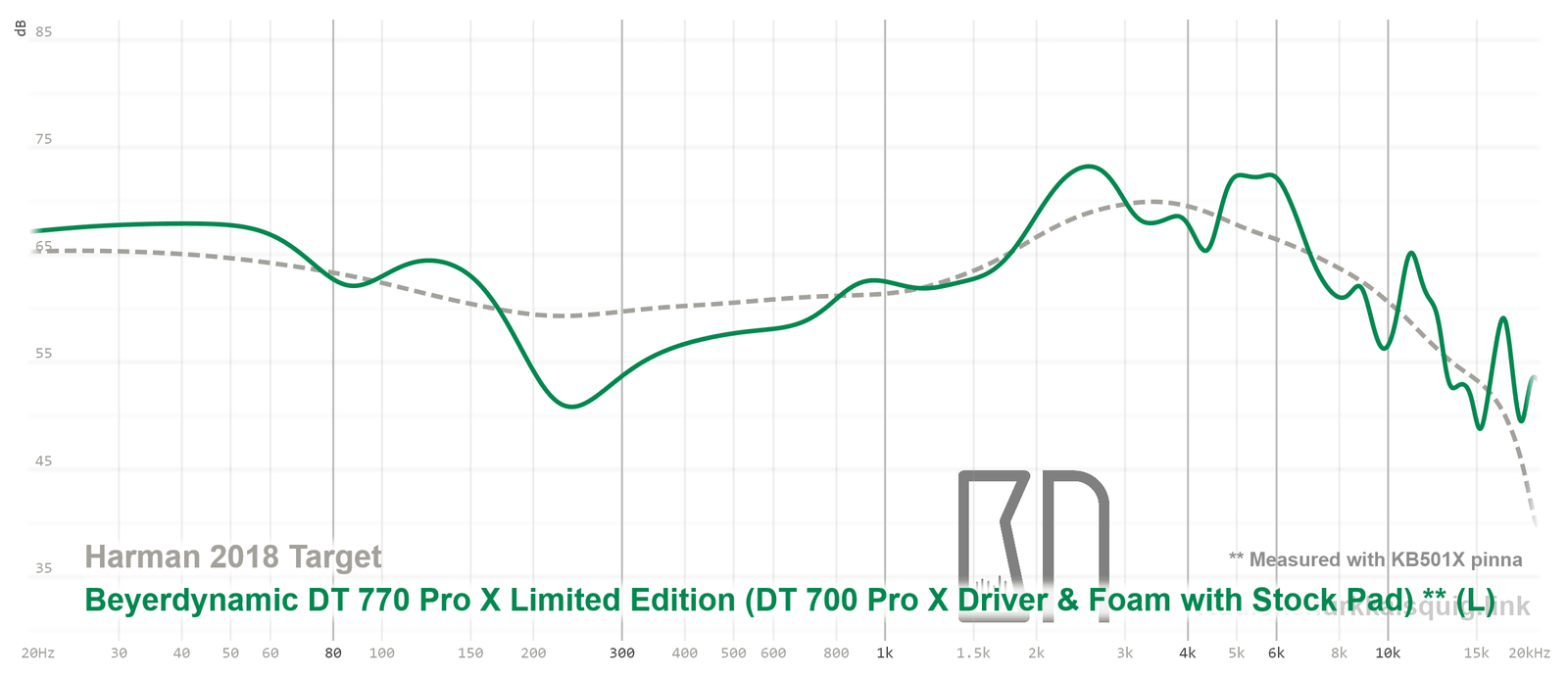
Next, I swapped the DT 700 Pro X drivers into the headphones, which snap into place without issues. This way, I found out what the anniversary model could have been like if the manufacturer had not modified the Stellar.45 drivers at all, but had still used the current DT 770 Pro-style earpads in the headphones.
As expected, the sound quality would not have been commendable, as the lower mid-frequencies would have been even more subdued, and an unpleasant emphasis would have formed at 2.5 kHz. The amount of treble, however, would have been more moderate, but there would still have been excess energy between 5–6 kHz. The poor compatibility between the DT 700 Pro X drivers and the DT 770 Pro earpads may ultimately have been the reason for Beyerdynamic's decision to modify the airflow of the drivers to better suit the DT 770 Pro X model.
Finally, I made a complete clone of the DT 700 Pro X from the anniversary model by taking not only its drivers and damping foams but also its earpads. With identical parts, the frequency response between the two models is also nearly identical, which indicates that there are hardly any differences in the cup structures, even though the headphones look different from the outside. Beyerdynamic could have made the sound of the DT 770 Pro X balanced if it had wanted to, as it already had the necessary parts for it. In that case, however, it would have had two identical headphones in its product range, so perhaps they were intentionally made different. The V-shaped tuning of the anniversary model ultimately creates stronger associations with the original DT 770 Pro, which seems to have been the primary goal.
What kind of amplifier is being installed?
From an amplification perspective, the DT 770 Pro X is not among the lightest, as its sensitivity is below 100 dB/mW, and the impedance is not between 16–32 ohms, but a slightly higher 48 ohms. Nevertheless, for example, laptop headphone jacks reproduce the headphones effortlessly, and there is not necessarily a need for a separate amplifier, unlike with the older 80 and 250 ohm DT 770 Pro models.
However, a certain challenge with the DT 770 Pro X may be the harshness and roughness of the treble, which sometimes occurs with low-power audio sources. For example, with a Macbook Air, the headphones sound more irritating than usual, whereas with a Qudelix 5K, the reproduction becomes less piercing. My more expensive desktop devices further balance the situation, but only up to a certain point. The headphones are designed to be bright, so they remain so regardless of the equipment. Since the balanced headphone jacks of my more expensive amplifiers would not have been usable with either Beyerdynamic model I tested, I primarily listened to the headphones while writing this article using an SMSL DL200 all-in-one device, which does not significantly color the sound in one direction or another.
Summary
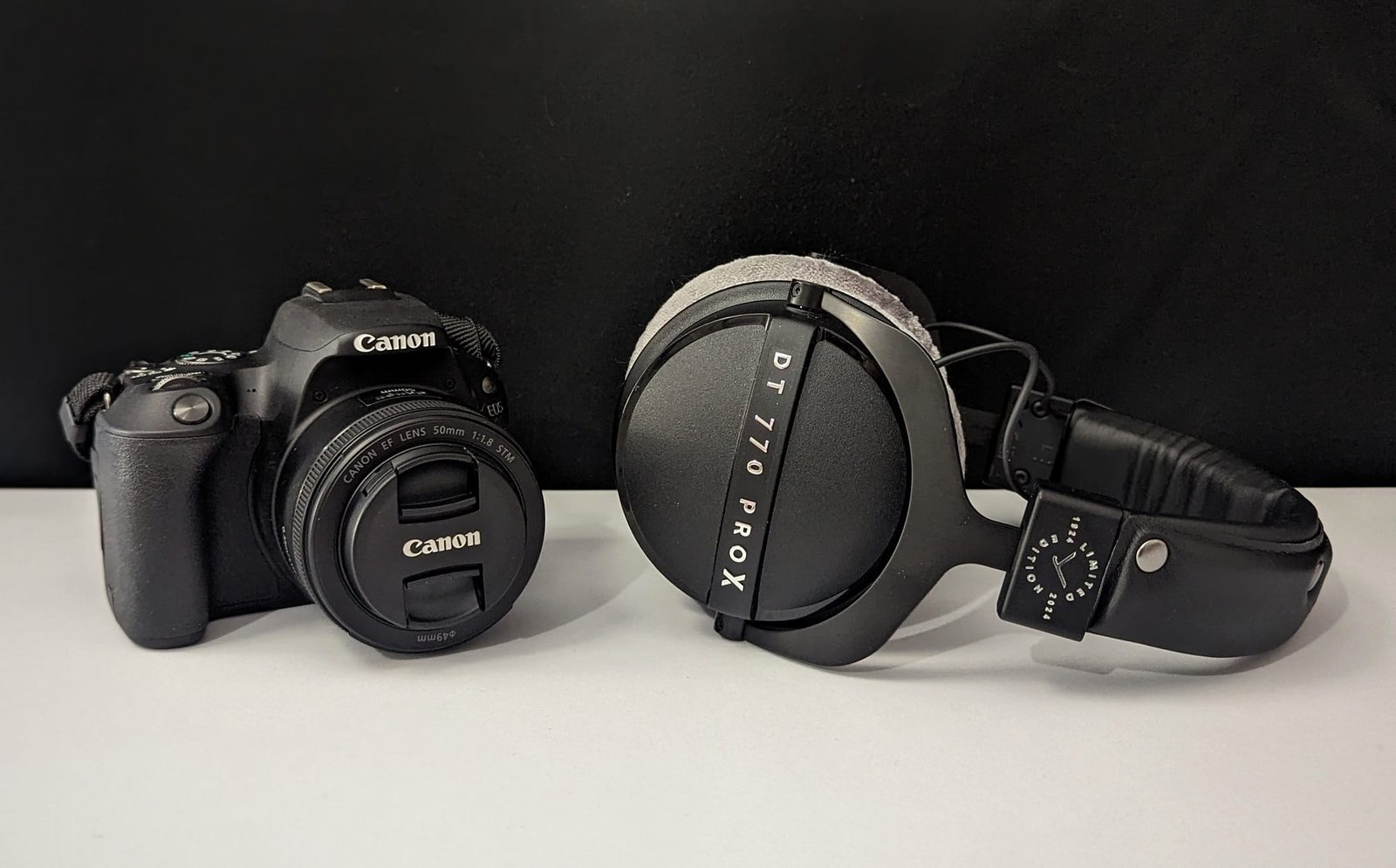
Unfortunately, the DT 770 Pro X is far too V-shaped in sound for me to call it a good headphone as is. The new drivers seem more capable than before, but the tuning has taken a step backward compared to, for example, the 80-ohm version of the DT 770 Pro. The slightly more expensive DT 700 Pro X also sounds clearly more balanced without sacrificing the mid-frequencies to the bass and treble. Since the anniversary model costs 200 euros, I believe Beyerdynamic should have been expected to deliver something better. The DT 770 Pro X is like a blast from decades past, when closed-back headphones still had their own weaknesses.
I cannot think of another headphone manufacturer that has celebrated its 100th birthday, so the DT 770 Pro X feels like a lost opportunity for Beyerdynamic to show what it has learned during this time. On the other hand, the manufacturer can be seen as remaining faithful to its own tuning style, which will likely please its fanbase who enjoy V-shaped reproduction. The decisions made seem intentional, as taking the drivers and earpads directly from the DT 700 Pro X would have resulted in a clearly more balanced outcome, although it would not have offered consumers anything new.
What ultimately makes the anniversary model interesting is its versatile modding potential, as the headphones react strongly to all kinds of changes. The sound quality could be adjusted in many different directions, including to be truly balanced. The same could alternatively be achieved by equalization. All of this requires extra effort, but after that, I could recommend the headphones even over the more expensive DT 700 Pro X. The comfort and durability of the anniversary model are, as usual, spot on – for example, AKG's K371 feels almost like a toy next to Beyerdynamic's products. As one significant innovation, the DT 770 Pro X also offers a detachable cable, which many have been waiting for eagerly. Since the DT 770 Pro series now feels more modern and user-friendly than before, I hope the manufacturer will eventually add the option to detach the cable to its other affordable headphone models as well.
Pros and cons:
+ Fairly spacious soundstage
+ Suitable for bass lovers
+ Sounds less metallic than other DT 770 Pro models
+ Includes better Stellar.45 drivers
+ Low distortion values support equalization
+ Enormous modding potential
+ Aesthetic enhancements are functional
+ Easy load for the amplifier
+ Excellent comfort
+ Cable finally detachable
+ The structure is sturdy and easy to maintain
-/+ The headphone connector does not support a balanced audio signal, but then again, there is no need for it either
– Very distorted frequency balance
– Mid-frequencies remain disturbingly subdued and lifeless
– Unusually overemphasized treble by current standards
– Mid-bass is too boomy
– Long cable is inconvenient for home use
– Cable/connector hits the shoulder when turning the head
 EN
EN  FI
FI
Hair-splitting comment: my 770 Pro definitely doesn't have the model designation on the cup with any sticker, but rather made of hard plastic.
Perhaps the manufacturer has changed the way the nameplate is attached in the basic model in recent years? I haven't seen newer headphones with my own eyes, and the change isn't visible yet in Beyerdynamic's product images either; instead, a similar glued-on name strip is still in the middle of the cup. Perhaps the term ”sticker” is a bit misleading, as I meant the black strip-like part where the initials are indeed raised plastic. If the "sticker" stays well attached, one might not even notice it as such. However, the adhesive on my 32-ohm DT 770 Pro has started to peel at the edges over the years. Thank you anyway for the good observation. I will investigate the matter further so that no misleading information remains in the article.
Mine are 250 ohm and they aren't exactly new either, but less than 10 years old. In your picture, it certainly looks more ”sticker-like” than on mine, and perhaps the text is less raised. But it doesn't really matter for listening 🙂
I have a pair and tried your modifications. I was not that bad but overall I did not like the modified sound. I prefer to keep cymbals, snares, tambourines and jingly guitars forward and have the airy sound now after having them for a few weeks. But I have added a oidio mongrel spc occ coper cable to them and this did make the whole thing clearer with more a solid and detailed top end in the first place. I’d love to see a frequency graph of a pair with an aftermarket spc occ copper cable.
Overall though your review is an accurate description of these headphones, but you can grow to really like them. On some tracks though I still have to turn them down or avoid some tracks completely.
Hello,
I don’t suppose you could put two standard Beyerdynamic DT 770 PRO x LE foam pads in each side and do a frequency test?
Hello,
I can do it when I get my headphones back. I have been borrowing them after my review, so they are not with me right now.
Hello,
I have ordered some new pads from Polar see link.
https://polar.uk.com/beyerdynamic-dt990-series-individual-foam-infill-910236
They are only £4.60 a pair, I paid £4.75 for a double pack of regina blitz to mod my headphones….!
https://www.sainsburys.co.uk/gol-ui/product/regina-blitz-kitchen-towel-x2
Please email me when you have the graph.
Thanks very much.
Breck.