Author: Sword of Damocles
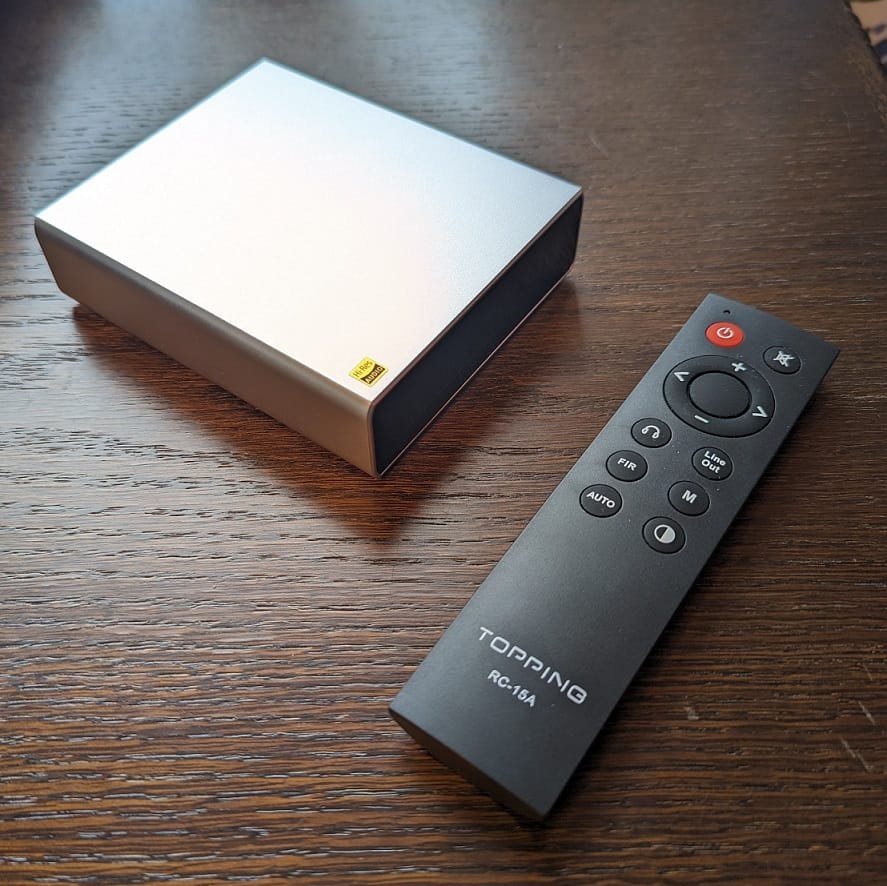
Table of Contents:
Information:
- Release Year: 2020
- Price: 149 €
- Type: Delta-sigma
- DAC chip: AKM (Asahi Kasei Microdevices) AK4493
- USB implementation: XMOS XU208 + Thesycon drivers
- Sampling rate (USB) PCM: 44.1–768 kHz (16–32 bit)
- Sampling rate (USB) DSD: DSD64–512 (native) / DSD64–256 (DOP)
- Sampling rate (Optical and COAX) PCM: 44.1–192 kHz (16–24 bit)
- Output voltage: 2 Vrms
- Noise: < 2 uVrms
- Crosstalk: -130 dB
- THD + N: < 0.0003 %
- SNR: > 121 dB
- Dynamic Range: 119 dB
- Channel balance: < 0.3 dB
- External dimensions (L x W x H): 12.5 x 10 x 3.2 cm
- Weight: 265 g
- Included: USB data cable, USB-DC power cable and remote control
- Warranty: 1 year?
Review sample: Self-purchased product
Starting point
Topping (”icing”) is, alongside S.M.S.L, one of the best-known Chinese device manufacturers who compete with each other with the measurement results of their devices. For example, by following the Audio Science Review (ASR) forum, it quickly becomes clear that both manufacturers enjoy great popularity among people who approach their audio hobby through measurement results. Topping's headphone amplifiers and D/A converters (I will use the word DAC from now on) often make it to the list of recommended devices regardless of price range – including the one I am reviewing E30-named DAC is such a device.
Topping usually releases its devices in pairs following the same design, including both a headphone amplifier and a DAC. The E30-DAC (price approx. 150 €) belongs to the manufacturer's more affordable model series, whose amplifier is called L30 (also priced approx. 150 €). I previously owned this amplifier along with the E30, but it lacked ESD protection (apparently) to maximize measurement results. Because of this, the amplifier could, when touched, break both itself and the connected headphones – unfortunately, this happened to several owners of the device, so I decided to get rid of my amplifier immediately. The manufacturer did fix the problem in new production batches quite quickly, but the resulting damage to its reputation is likely obvious.
Chinese manufacturers seem to release new, almost identical, devices on an assembly line, so in some of them, the design simply goes wrong. The E30 is also not perfect in its design, as at least in the first production batches, the device's polarity was inverted. This peculiar design flaw/indifference could only be corrected with a firmware update for the USB connection, so in my device, other digital connections still invert the polarity incorrectly. The effect of this on the sound is a bit of a question mark for me, but my trust in the manufacturer plummeted significantly based on the E30/L30 duo. Despite this negative starting point, my review of the E30 will, however, be quite positive from now on.
External introduction of the device
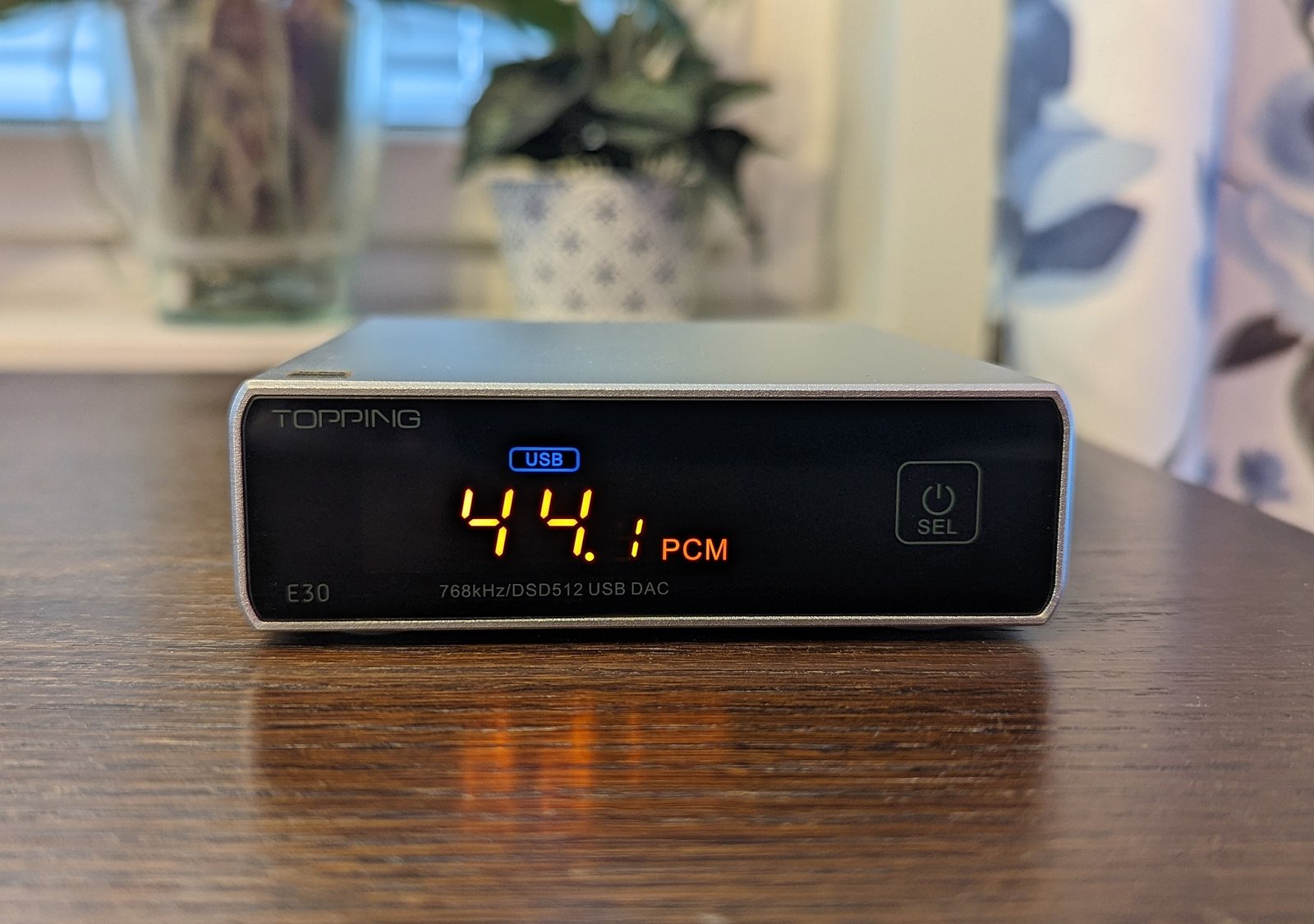
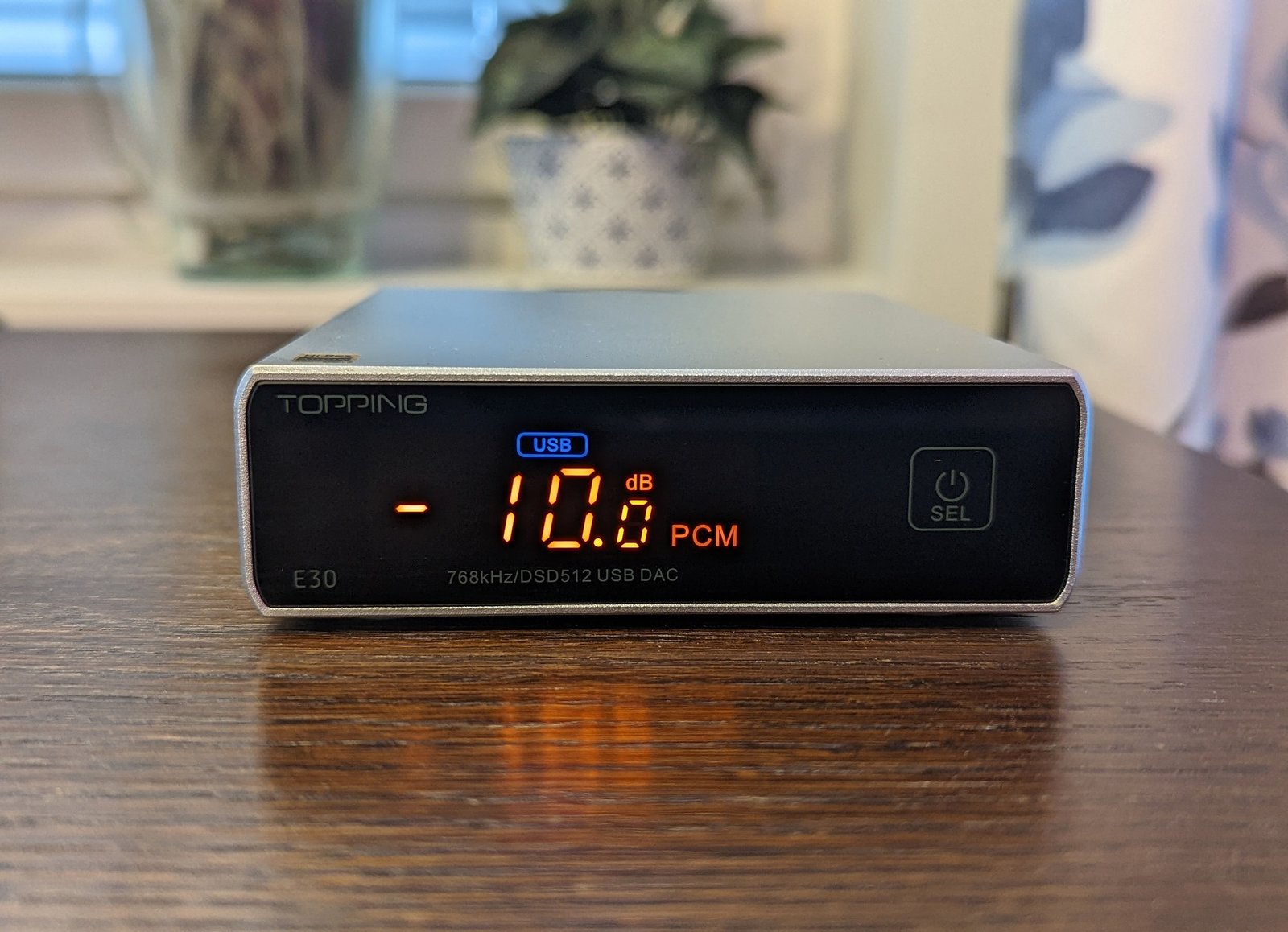
The E30 is externally a sturdy and neat device, as its aluminum outer shell is made from a single piece, with no visible seams or screws. The device is also small in size, so it takes up little desk space. My device is silver in color, but the E30 can also be purchased in black, red, or blue. The front edge of the device is glass, and behind it is a small display showing orange text, and a power LED. The front edge also has a touch-sensitive button. The background of the glass is black, which makes fingerprints on the glass quite clearly visible. However, there is no real need to touch the device during use, as it also comes with a remote control.
All connections are located on the rear edge of the device. The E30 receives digital audio via three different connections: USB, coaxial SPDIF, and optical SPDIF. Analog audio is transmitted via RCA connectors – balanced audio cannot be output from the device, which is not a major surprise considering the device's low price.
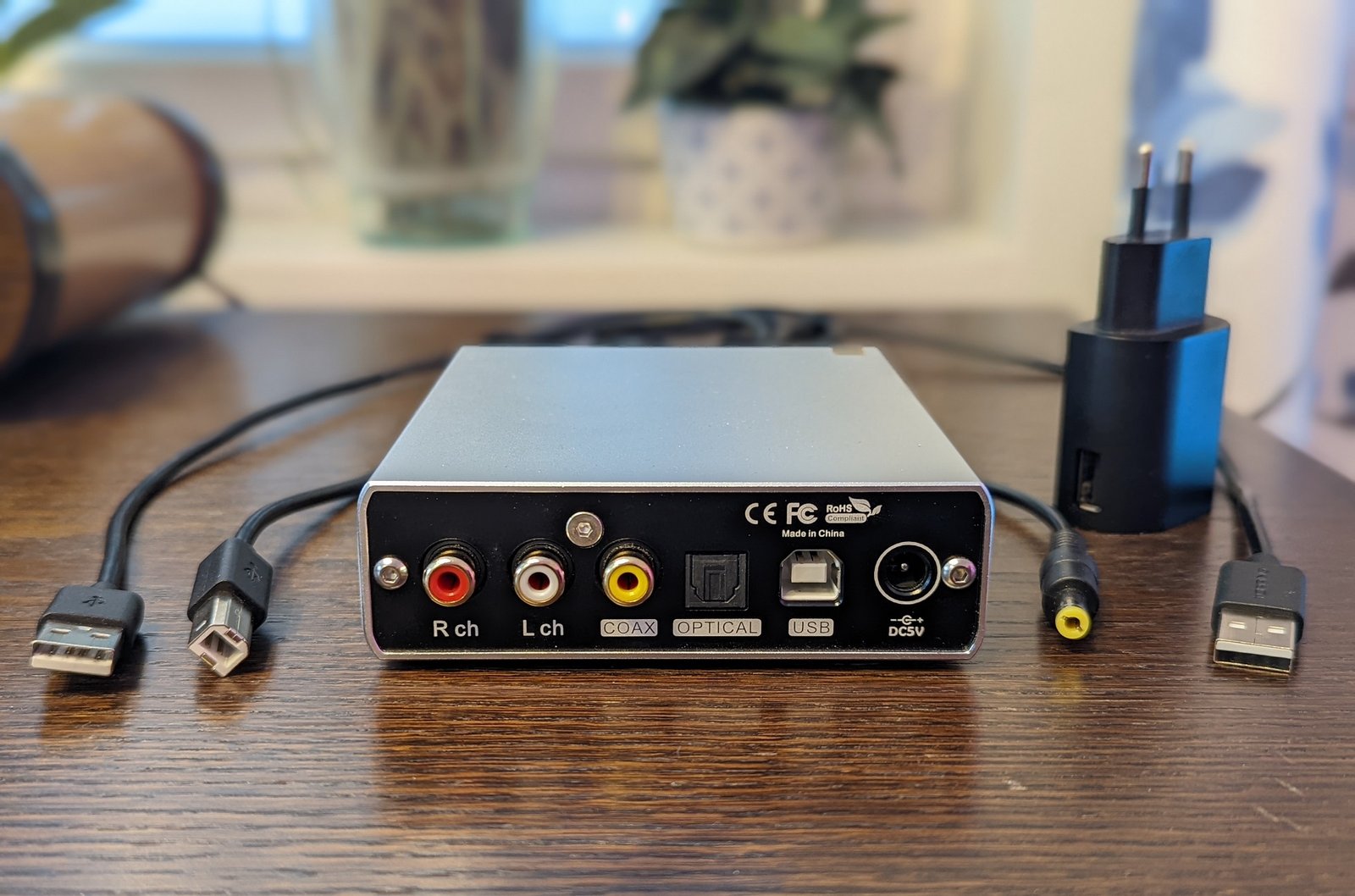
The device comes with two USB cables, one for audio transmission and the other for power supply. The power cable can be connected, for example, to a standard 5-volt phone charger or directly to a computer's USB port. Although I have not noticed any difference in sound quality or interference noises between these in my own use, using a separate charger at least reduces the possibility of interference. Some computers annoyingly let interference noises, such as the whining of power supply coils, pass through USB ports.
The power cable connector for the L30 amplifier, designed to pair with the E30, is exactly the same size as on the E30, but the L30 is powered by a more robust 15-volt power supply. When owning both devices, it is important to be careful not to accidentally connect the L30's power cable, for example, plugged into a wall socket under the table, to the E30 – this would likely destroy the DAC.
Features and device use
The use of the E30 is simple, but it has some useful features for its affordable price. Firstly, the device can be set to turn on and off automatically according to the audio signal it receives – for example, a computer or TV being turned on will also turn on the E30. This feature has worked flawlessly and is really convenient, for example, in living room use, when you don't want to bother turning the DAC on or off separately. I haven't encountered a similar feature in many even more expensive devices, so the E30 deserves a big plus for this.
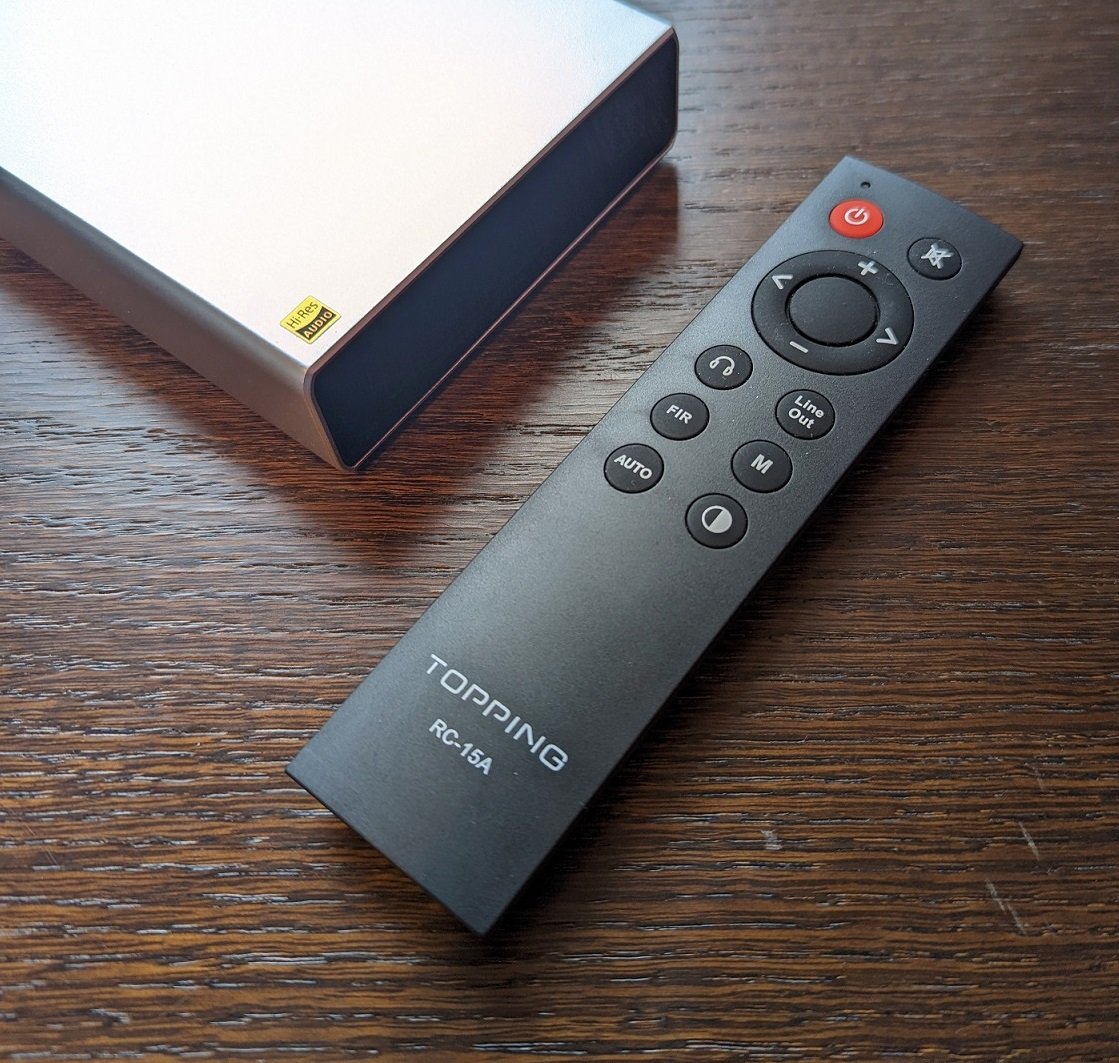
When there is a need to change the device settings, this can be done with the included plastic remote control – the remote control feels cheap, but its inclusion at a price of 150 euros is an excellent thing. Most settings are generally only accessible via the remote control, as the power button on the front edge of the device can primarily only change the audio input connector in addition to switching power. The remote control, on the other hand, also features a mute function, display brightness adjustment, automatic power on/off setting, and several different ”sound-altering” filters. The remote control can also adjust the DAC's volume if the E30 is set to pre-amplifier mode.
The device has two different modes, one of which allows volume adjustment and the other is a more traditional DAC mode where the volume is always at maximum. Volume adjustment is particularly useful when using active speakers. When connecting to a headphone amplifier, I have always used the E30 in DAC mode because I have handled volume adjustment through the amplifier. The operating mode of the device can be changed by pressing the power button on the front edge for a few seconds before powering it on. This setting is not found on the remote control at all; it is the only setting that requires the device's own button.
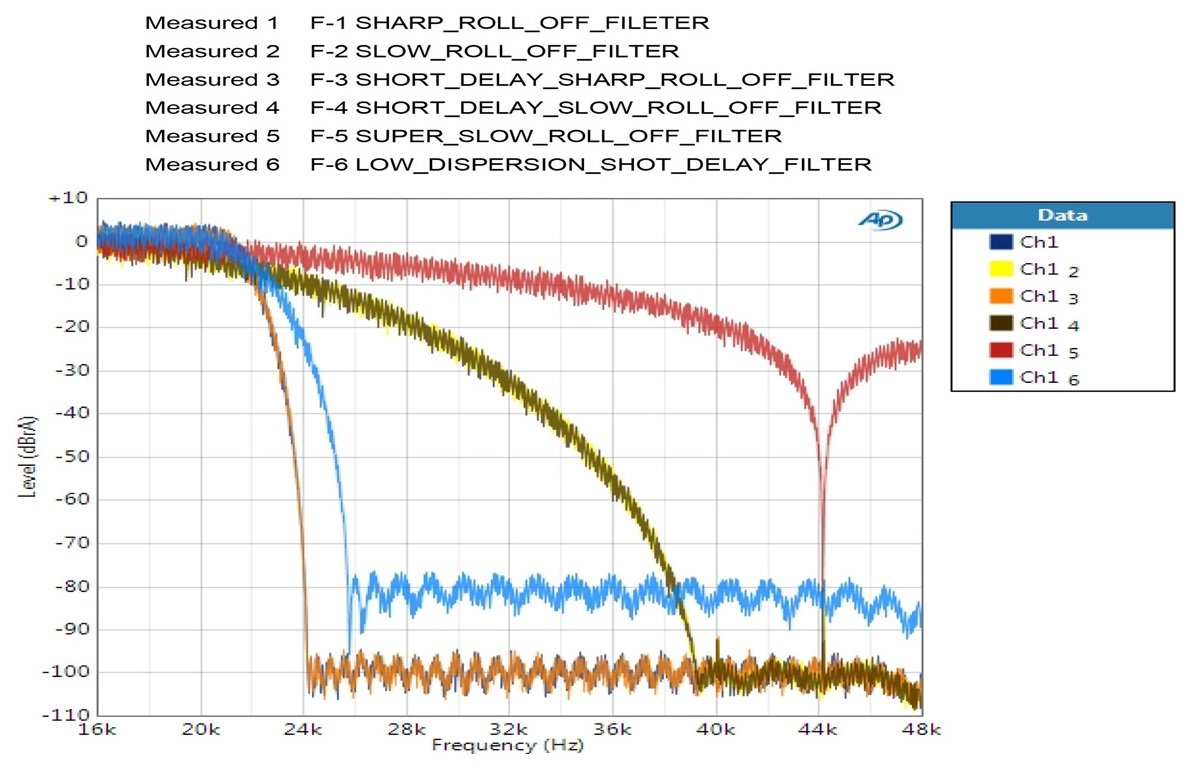
The E30 is implemented with AKM's AK4493 DAC chip, so the device features various filters defined by the chip manufacturer, which alter the reproduction of frequencies around 20 kHz. Some of the 6 filters immediately cut off all frequencies above the specified threshold, while in others, this cut-off occurs more slowly or in a slightly different manner.
Filters are not a very familiar topic for me, but I can say that I don't perceive any sound quality difference between them that I could consistently describe. I consider filters to be a somewhat unnecessary additional feature that chip manufacturers, such as AKM and ESS, use to differentiate themselves. Usually, the manufacturer's default filter has been the safest choice, and it would be strange if the device were configured to operate by default in a non-optimal way.
The E30 widely supports various sampling rates and naturally DSD as well. I don't personally listen to DSD files, so I cannot comment on how stably they are reproduced or if there are any issues related to the support. With PCM material, the device operates in DAC mode without any interference sounds when the sampling rate suddenly changes. In preamplifier mode, a faint pop was heard in similar situations with the first firmware versions, but this issue was resolved for me with firmware updates. All in all, the device has been completely stable and problem-free in its operation for me.
Sound quality
General observations on the effect of DACs on sound quality:
Evaluating the sound quality of a DAC is, in my opinion, difficult because the listener must be very familiar with all other variables, such as the listened track and the headphones and amplifier used for listening. With insufficient knowledge, it's easy to imagine the DAC's impact on the overall system to be greater than it actually is.
My perspective on the topic is that headphones clearly affect reproduction the most (I would say at least 80%), with the amplifier's effect being slightly greater than that of the DAC. However, these devices are interesting in the sense that an amplifier or DAC with an unsuitable sound for the overall system can ruin the listening experience or at least annoy enough that one cannot fully enjoy the music or headphones.
At the beginning of my hobby, I looked for differences between DACs in terms of detail and small, hard-to-perceive things. At some point, I realized that no DAC is so bad that it would fail to reproduce details or make them so faint that they couldn't still be heard. When I abandoned this analytical approach, I started to find stylistic differences in devices when listening more casually. DACs are, in my opinion, generally dark-sounding, neutral, or bright/analytical – yet only a few devices fall stylistically into either extreme. A neutral DAC is always the best option, especially for a beginner enthusiast, until their own preferences are clear and they want to start modifying the overall system with a DAC in addition to headphones and an amplifier.
In addition to the stylistic differences I mentioned, I also observe differences in DACs in the presentation of the soundstage, which is inherently linked to the ability to layer sounds in a realistic way. Even if the sound through different devices sounds essentially identical, some DACs create a more natural and lifelike reproduction. However, this also requires that the amplifier and headphones are capable of the same.
Equipment used for sound quality evaluation:
I evaluated the Topping E30 DAC by listening to it with both a rather expensive and an affordable headphone-amplifier combination: the more expensive setup included the ZMF Verite Closed headphones, which I know well (link to review) and the Burson Audio Soloist 3X Performance amplifier. For a more sensible pairing for the Topping E30 in terms of price, I used BeyerDynamic DT770 Pro (32 ohm) headphones and an Objective2 amplifier.
Because the effect of a DAC is very difficult to isolate from the reproduction, it is almost necessary to compare it simultaneously with another DAC. For this, I used a similarly priced DAC with the E30, namely the IFI Zen DAC(I have version 1 of the device; the newer v2 costs about 180 euros).
Both DACs were connected to my computer simultaneously, and both received power via the computer's USB ports. Both also used identical Windows sound settings and RCA cables. Between the DACs and the headphone amplifier was an RCA selector/splitter, which allowed switching the audio input device on the fly by turning a lever. I listened to music from the Tidal streaming service (the IFI Zen DAC supports MQA, but it was turned off) because it allowed me to quickly switch the DAC to which I wanted the software to feed audio. When I wanted to switch from one DAC to another while listening, I just had to click on the other DAC in Tidal and simultaneously turn the lever on the RCA selector.
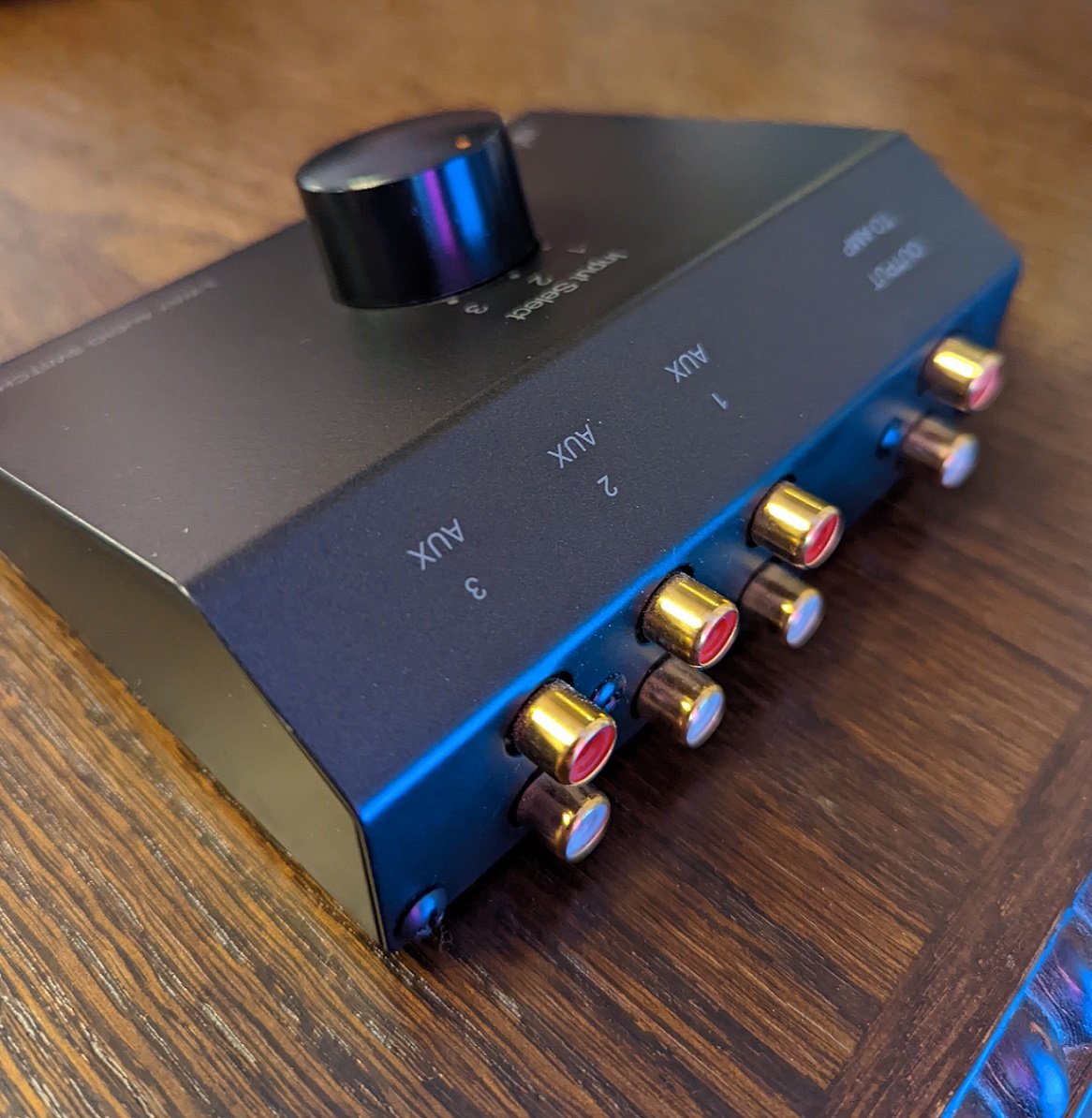
The volume of both DACs was set to 100 percent, and although I knew that the output voltage of both devices was the same 2 Vrms, I still confirmed with my MiniDSP EARS device that the volumes were completely identical. The difference between the devices was only 0.1 dB, so I could be sure that they were, so to speak, on the same level when listening, and I did not favor one due to higher volume.
Where does the Topping E30 stand in the world of DACs?
In my opinion, the Topping E30 is neutral in sound, yet its treble and mid-range are quite clearly calmer than, for example, the 100-euro Khadas Tone Board implemented with an ESS Sabre chip. This calmness makes the E30 sound slightly warm, but it is not because the device significantly emphasizes bass frequencies in any way. Overall, the E30 does not otherwise emphasize its existence; instead, it sounds refined and pleasantly calm. The device pairs well with various headphones and amplifiers.
In addition to the calmness of the reproduction, my greatest attention to the device is drawn to its soundstage presentation, which is quite ”flat” and wall-like (really neutral?). Because of this, the E30 sounds somewhat analytical – music is always listened to as sound, and the reproduction is not particularly realistic in a way that allows one to immerse themselves in the whole. Although I observed this characteristic with both listening setups I used for evaluation, it is not particularly disturbing or problematic considering the E30's affordable price. Such flatness of the soundstage and a certain analytical quality of the reproduction can also be appealing to many listeners.
Regarding the size of the soundstage, I have noticed that when listening to the E30 with the ZMF Verite Closed & Burson Soloist combination, I get the feeling that the sound doesn't open up properly, but rather is slightly compressed. I notice this even more clearly with my Wharfedale Evo 4.2 speakers, as with them the sound feels small and is confined only between the speakers. Even the affordable DT770 Pro headphones and O2 amplifier bring out the same characteristic, but with them, it bothers me less. Among the DACs costing 100–200 euros that I have heard, the E30's soundstage size is, however, very normal, apart from its slight compression.
Although the E30 doesn't make my feet tap with its soundstage realism or the fun of its reproduction, it is a good DAC in its price range. For example, the Khadas Tone Board was, in my opinion, at times too bright and aggressive, so the E30's calmer presentation suited me much better for longer listening sessions. The E30 has its own style, but it doesn't really do anything wrong for its price.
Topping E30 vs. IFI Zen DAC
Prices: 149 € vs. 179 € (newer v2 model)
Since many of my observations about the E30 have already been based on a pair comparison with the IFI Zen DAC, I will next explain how these devices differ in sound. The comparison is also interesting for me in the sense that the Zen DAC has previously been used by my wife, and I myself have not really listened to it much before, especially not as a standalone DAC.
Differences in features:
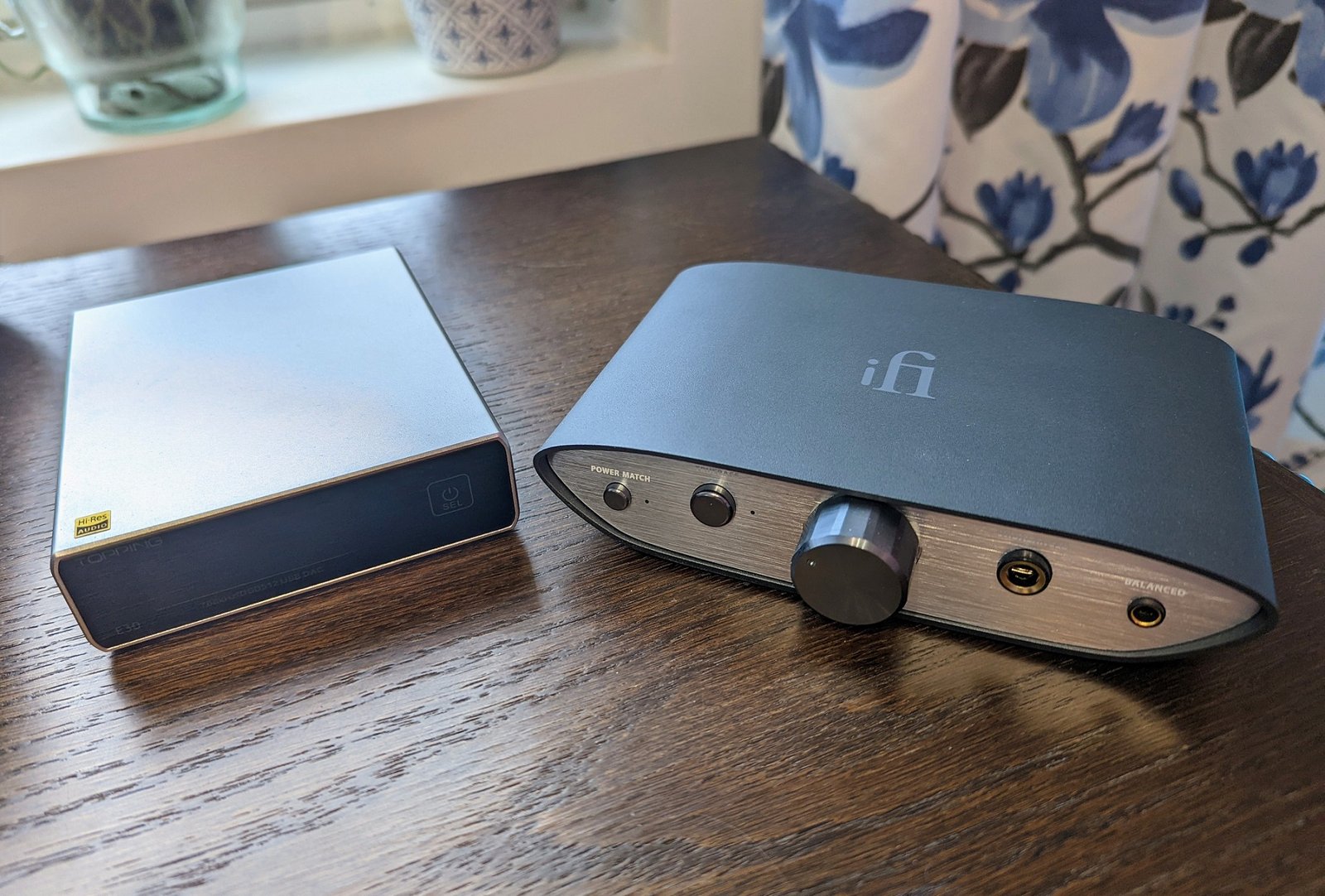
The E30 and Zen DAC are aimed at slightly different use cases, although both can, for example, adjust the volume of connected active speakers. With the E30, this is considerably easier in the living room, as it comes with a remote control, and the device itself has a display. The Zen DAC, on the other hand, includes a low-power but perfectly adequate headphone amplifier for basic use, as well as a balanced design. An interesting additional feature in the headphone amplifier section is also an analog bass boost, which can be activated with a separate button located on the front edge of the device. Both devices are small in physical size and have a sturdy metal outer casing. However, the Zen DAC feels significantly more premium of the two, as it weighs a full half a kilogram more than the E30.
Unlike many other better-known manufacturers, IFI uses Burr Brown DAC chips in its devices – one such chip is also found in the Zen DAC. In my experience, the chosen DAC chip does not directly determine how a particular device sounds, but many manufacturers tend to implement the rest of the device's structure in such a way that, for example, ESS chips are quite generally considered bright-sounding, and AKM chips slightly calmer and less detail-emphasizing. However, such preconceptions can also be a kind of self-fulfilling prophecy for both device manufacturers and listeners.
Sonic differences:
The E30 and Zen DAC differ surprisingly much in sound when compared consecutively, but the difference is quickly forgotten if one immerses themselves in listening to one device for a longer period without switching to the other. This immersion in listening is actually the most significant difference between the two, as the Zen DAC constantly threatened to draw me in so much that I forgot I was reviewing the Topping device. Conversely, with the E30, I constantly wanted to switch back to the Zen DAC. However, if I managed not to do so, I might not have realized what I was missing with the E30 after 15 minutes.
The sound of both devices is generally calm and easy to listen to, but the Zen DAC implements the same style in a more fun and less neutral-sounding way. The biggest immediate difference when switching from the E30 to the Zen DAC is that the music comes alive and sounds more natural. For example, when listening to a live recording with eyes closed, one feels like listening to a real band – with the E30, the same just sounds like sound, though by no means a bad one.
The difference in the realism of the reproduction, in my opinion, largely stems from the Zen DAC's soundstage being more layered and not as wall-like as in the E30. With the Zen DAC, the sound is able to open up as if a curtain were being removed from in front of it. For example, the vocalist is better separated from other instruments, also coming slightly forward in the overall presentation compared to the E30's slightly more distant vocal performances. The Zen DAC makes me immerse myself in listening significantly better. The same situation is repeated with both of my listening setups, even though the cheaper DT770 headphones don't sound very natural themselves.
Part of the difference I experienced is also due to my own preferences, as the Zen DAC's reproduction is quite clearly warmer, and it emphasizes the bass so that it sounds heavier than when listening with the E30 – we cannot speak of any insane bass boost, but it brings fun and drive to the reproduction. In addition, the Zen DAC also sounds slightly airier and fresher in its upper treble frequencies, meaning in a way less congested than the E30. The difference in bass is still quite clearly noticeable, but the difference related to treble would likely go unnoticed unless comparing the devices side by side.
The Zen DAC's sound surprisingly resembles my own Schiit Bifrost 2, so I'm not greatly surprised that I'm more enthusiastic about its reproduction than the E30's more neutral and somewhat lifeless presentation. The Zen DAC truly surprised me positively, and I could very well use it as a DAC for even my more expensive headphones. With the Topping E30, I don't really have much to complain about, but there's something disturbing in its presentation that prevents me from getting as excited about listening as I usually would.
Concluding remarks:
Although the differences between different DACs may generally sound quite large based on what I've written, in my opinion, they are insignificantly small in many cases, especially if the devices are built with a similar budget and from the same components. In more expensive devices, different implementations begin to appear, so the sound may have been stylistically moved further away from neutral, even though neutrality is likely a kind of starting point in every delta-sigma DAC chip.
In summary, the Zen DAC sounds somewhat like a photograph with added color saturation compared to the E30. When speaking of sound, the overall presentation becomes more lively and powerful. The E30 is flatter, so I could call it more neutral – yet I find it difficult to come up with anything in its sound that would be a plus compared to the Zen DAC. This may be because I want to listen to music as lively and authentic-sounding as possible, while someone else might enjoy the E30's less attention-grabbing presentation more. Both devices would be well-suited to balance a bright-sounding amplifier or brightly tuned headphones.
Summary
The Topping E30 is an affordable and good basic DAC in terms of sound quality, which includes several useful and user-friendly features, such as remote-controlled volume adjustment and automatic power on/off with the audio signal. These features are, in my opinion, the device's greatest strength, as the choice of a DAC in the 100–200 euro price range should largely be based on the available features. The E30 works well and is also excellently suited for use in a living room or with active speakers. The device also measures well, for example, in Audio Science Review's tests, so it is easy to recommend to people who value measurement results.
However, if there is no need for the device's additional features, a very similar sound quality can likely be achieved, for example, with the manufacturer's own D10S model, which is 40 euros cheaper. Similarly, for about 200 euros, several DACs with a balanced architecture would be available. Devices combining a DAC and a headphone amplifier, such as the IFI Zen DAC I used in the comparison, also offer strong competition to the Topping E30, as they contain everything the average consumer needs for headphone listening in one and the same enclosure.
I noticed sound quality differences between the E30 and the Zen DAC, but the differences are small enough that I would still buy the one of the two that better meets my needs in terms of features. As a standalone DAC, the Topping E30 is more versatile, but with the Zen DAC, you also get a headphone amplifier for a small extra cost. The Zen DAC also appeals to me more due to its warm sound and more realistic soundstage, but this is largely my subjective preference. The Topping E30 produces a very similar sound when listened to less critically.
In my opinion, the Topping E30 is a very successful and convenient DAC in its price range, and it is aesthetically pleasing to my eye. The device is very easy to recommend for its features for mixed use, including both headphone and speaker listening. In terms of sound quality, the device is suitable in its price range for those who want a DAC with a slightly calmer style, especially in the treble, compared to, for example, many devices implemented with an ESS Sabre chip.
Pros and cons
+ Reproduction is neutral in style, so the device is versatile for various device pairings
+ Calm treble
+ Allows volume adjustment
+ Can be set to turn on and off automatically based on the received audio signal
+ 3 different audio input connectors
+ Remote control included
+ Sturdy and high-quality metal construction
+ Small physical size
+ Great orange display!
+ Affordable price
+ Good measurement results
– The sound is so neutral that it is already somewhat lifeless and flat
– The soundstage remains somewhat congested and wall-like in style
– The reproduction is not as realistic and natural in style as in devices made from more subjective starting points, such as the IFI Zen DAC
– In older production batches, digital inputs with inverted polarity due to a design flaw
– The selectable audio filters are largely useless and only cause confusion
 EN
EN  FI
FI
Hi.
Did you try the E30 with what kind of power supply? At least in Amazon customer reviews, it is commented that with Topping E30 and E50, a quality power supply is a must-have, raising the sound quality to a different level. Which is a shame in itself, raising the price of a cheap DAC.
Hi!
I have powered the E30 directly from the PC's USB connector and with various brands of phone chargers. I don't notice any clear difference between these two options. Unfortunately, I also don't own any suitable higher-quality power supply with which I could test potential benefits.
In my Burson Audio Soloist 3XP amplifier, a higher-quality power supply costing 300 euros improves the sound by about 5-10% according to my estimate (even though there is no such meter), so it would be interesting to try something like that as a hobby with the E30 as well. However, buying a more expensive power supply for such an affordable product does not seem particularly sensible for most. 🙂 Nevertheless, I will add a good 5V power supply to my shopping list for potential products, with which such devices could be tested in the future.
I have owned both, and I personally noticed a clear difference between PC vs charger. Mainly the darkness of the background, although I didn't do a long evaluation, but I remember the effect of the change. I largely agree with the points mentioned in your review. The E30 was accurate but too bright for my taste, the E50 was clearly better of the two, also neutral and even more accurate but handles high frequencies better. I noticed a small difference in the filters, some of the later filters slightly tamed that brightness a bit, but I remember that when I scrolled through them back and forth, I couldn't get a clear difference, mainly an internal one.