Author: Sword of Damocles
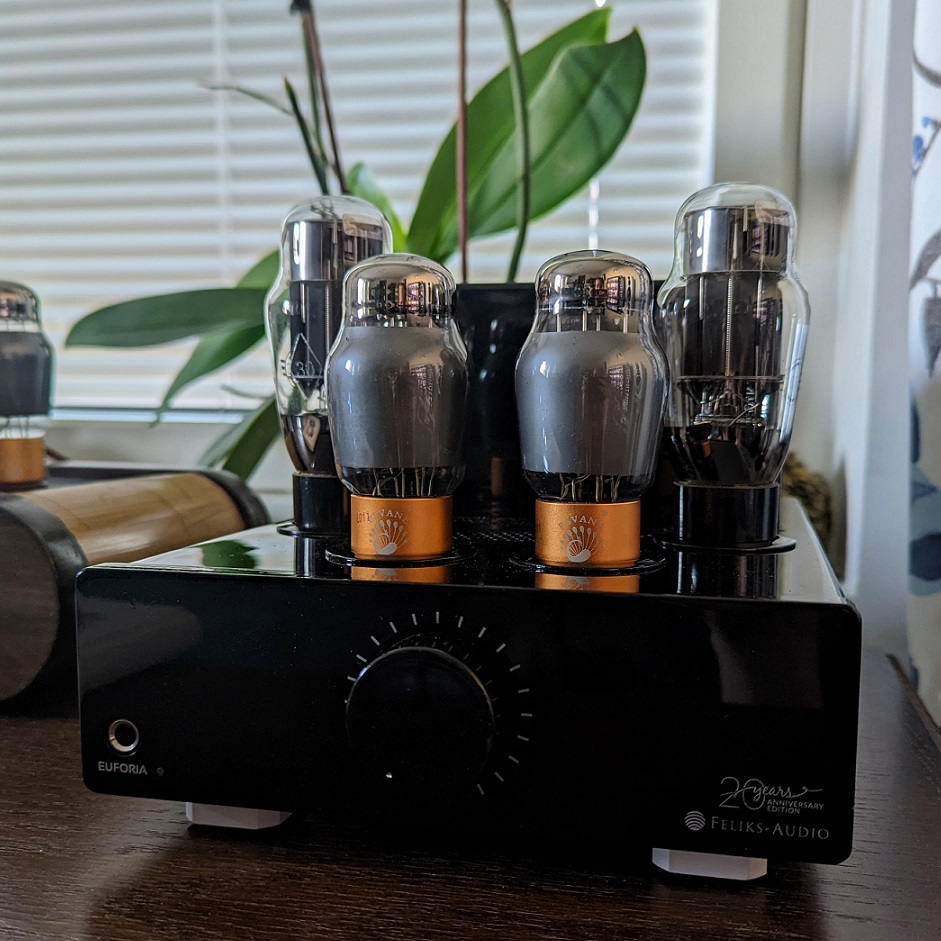
Table of Contents:
Information:
- Price: 3099 €
- Country of manufacture: Poland
- Type: OTL tube amplifier (no output transformer)
- Headphone connector: 6.35 mm
- Power tubes: 2 x 6N13S (NOS)
- Driver tubes: 2 x PsVane CV-181 Mk2 Gold (6SN7)
- Maximum output power: 280 mW
- Gain: 20 dB
- Output impedance: Not specified (presumably quite high)
- Optimal headphone impedance: 32–600 ohm
- THD: 0.4% (300 ohm, 20 mW)
- External dimensions with tubes (L x W x H): 31.3 x 20.3 x 19.3 cm
- Weight: 7 kg
- Warranty: 3 years
Review unit acquisition method: Loaned from a reseller/importer
More unfamiliar topic area
Tube amplifiers have not yet been a very familiar topic for me, even though I own a Ukrainian Tor Audio Roger amplifier, which includes a toroidal output transformer. All my high-impedance headphones have generally sounded more interesting and natural with the Roger than with most transistor amplifiers. However, the Roger's characteristic sound is quite robust and warm, which makes some headphones sound too relaxed for more critical listening. For this reason, I have wanted to try a really good and balanced tube amplifier for some time now.
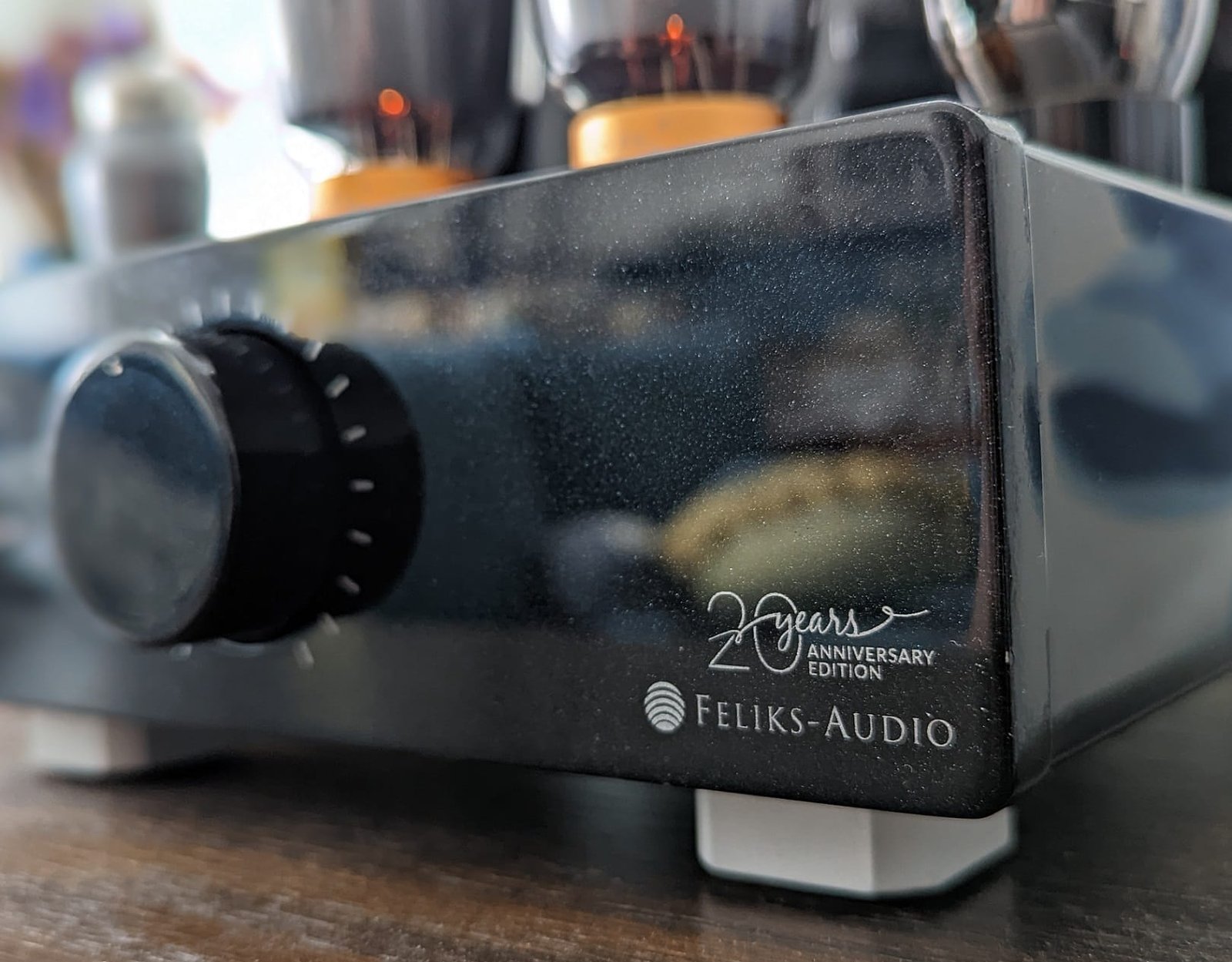
An opportunity arose when I borrowed the Polish Feliks Audio Euforia 20th Anniversary amplifier from Hifitalo (link to the manufacturer's product page). The device's more affordable basic version currently costs about 2200 euros, while the improved anniversary version I am reviewing is priced at a hefty 3100 euros.
Feliks Audio, which has built a reputation with its high-quality tube amplifiers, also has the more affordable Elise and Echo 2 models, as well as the top-of-the-line Envy model, in its selection in addition to the Euforia models. The company is run by a father and his three sons, so Feliks Audio can be called a family business, similar to the American Grado, for example. All amplifiers are made in Poland ”in-house,” which at least increases my appreciation for the products.
Euforia is an OTL tube amplifier, meaning it does not contain an output transformer like, for example, the Tor Audio Roger. As I am still relatively unfamiliar with the subject, I will not delve deeper into the operating principles or characteristics of different amplifier types this time. Many consider OTL tube amplifiers to be the best amplifier option in terms of sound quality for dynamic headphones with high impedance. However, these devices usually have a relatively low output power, making them less suitable for planar headphones. Euforia's stated maximum output power of 280 mW may somewhat limit the device's usability, but for most headphones, it is still perfectly sufficient.
Since I currently own several ZMF and Sennheiser 300-ohm headphones, I likely belong to Euforia's core target audience. I have at least been able to bring out the best aspects of the amplifier during the nearly three-month test period. A tube amplifier is always acquired based on subjective preferences, not, for example, with the best possible measurement results in mind. For this reason, my sound quality observations in this review will also be highly subjective.
External introduction of the amplifier
The amplifier and its tubes are delivered very well and securely packaged, so I see no need to discuss the packaging in more detail. In addition to the amplifier and tubes, the product package includes a power cable, a user manual, and a thank-you card from the manufacturer.
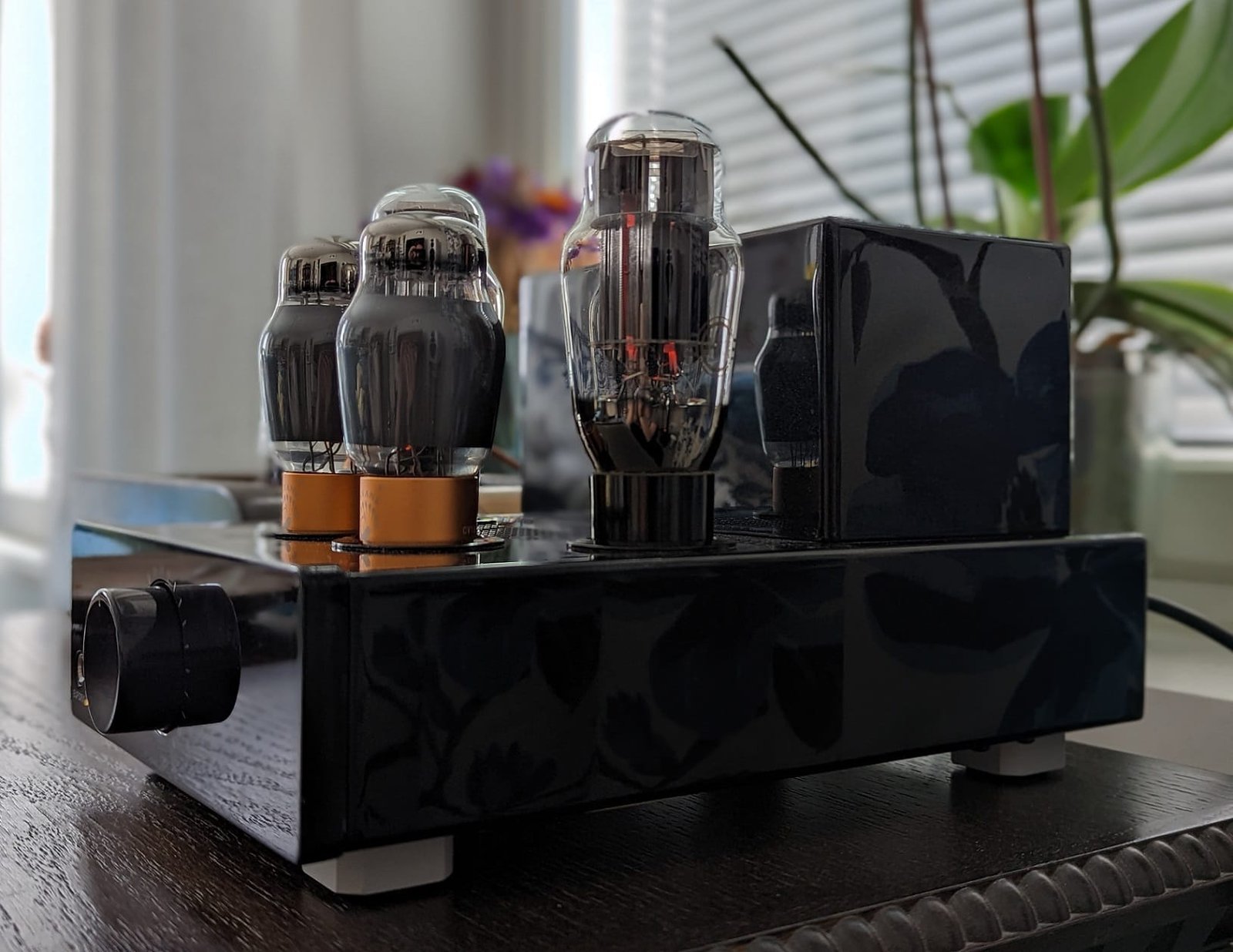
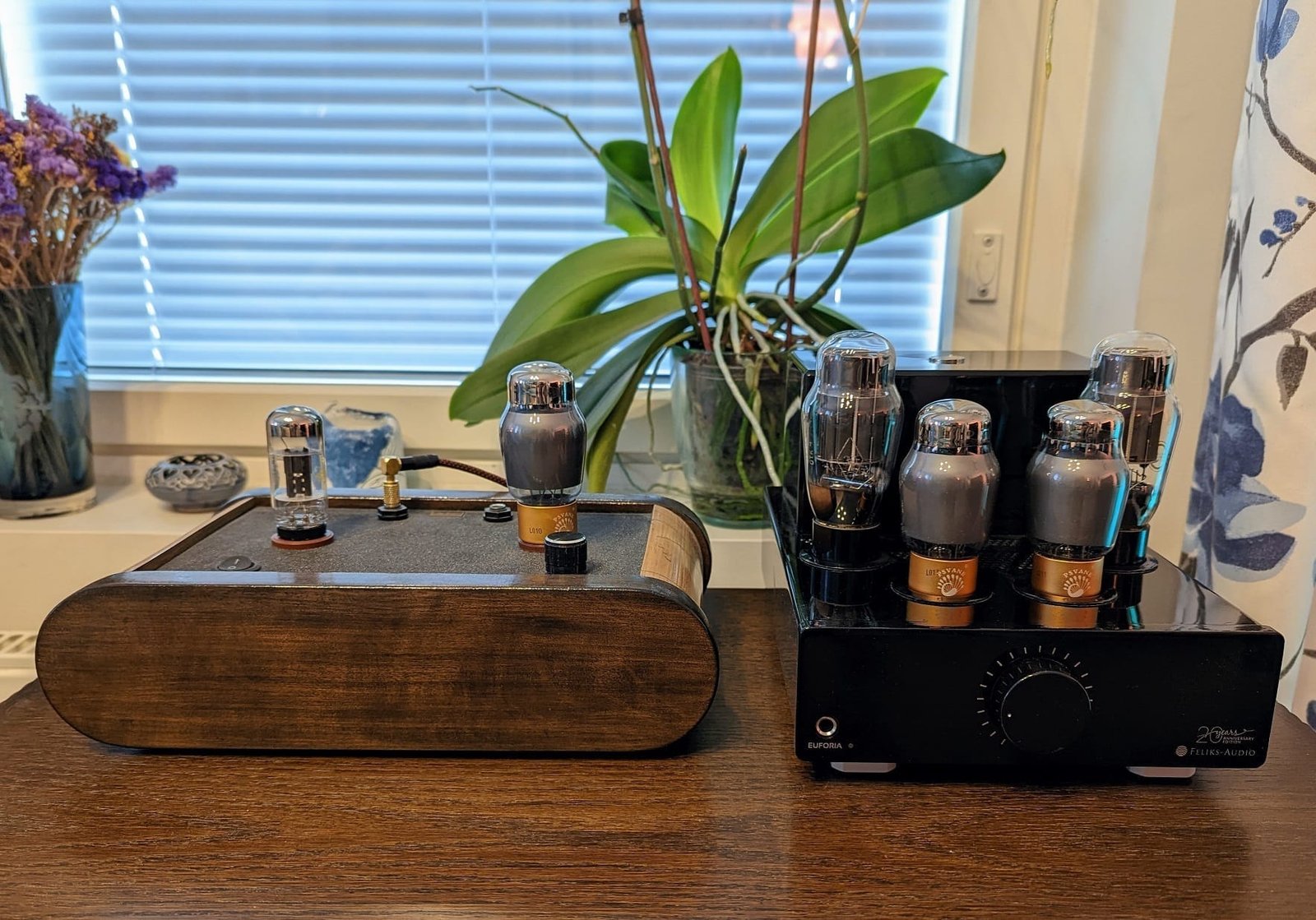
Although Euforia is a medium-sized tube amplifier, it is still a robust presence. The device weighs about 7 kilograms. Aesthetically, the biggest difference compared to the basic model, which is 900 euros cheaper, is the different paint finish: the metal casing of the celebration version is painted glossy with car paint, while the basic model, with its matte finish, looks more ordinary.
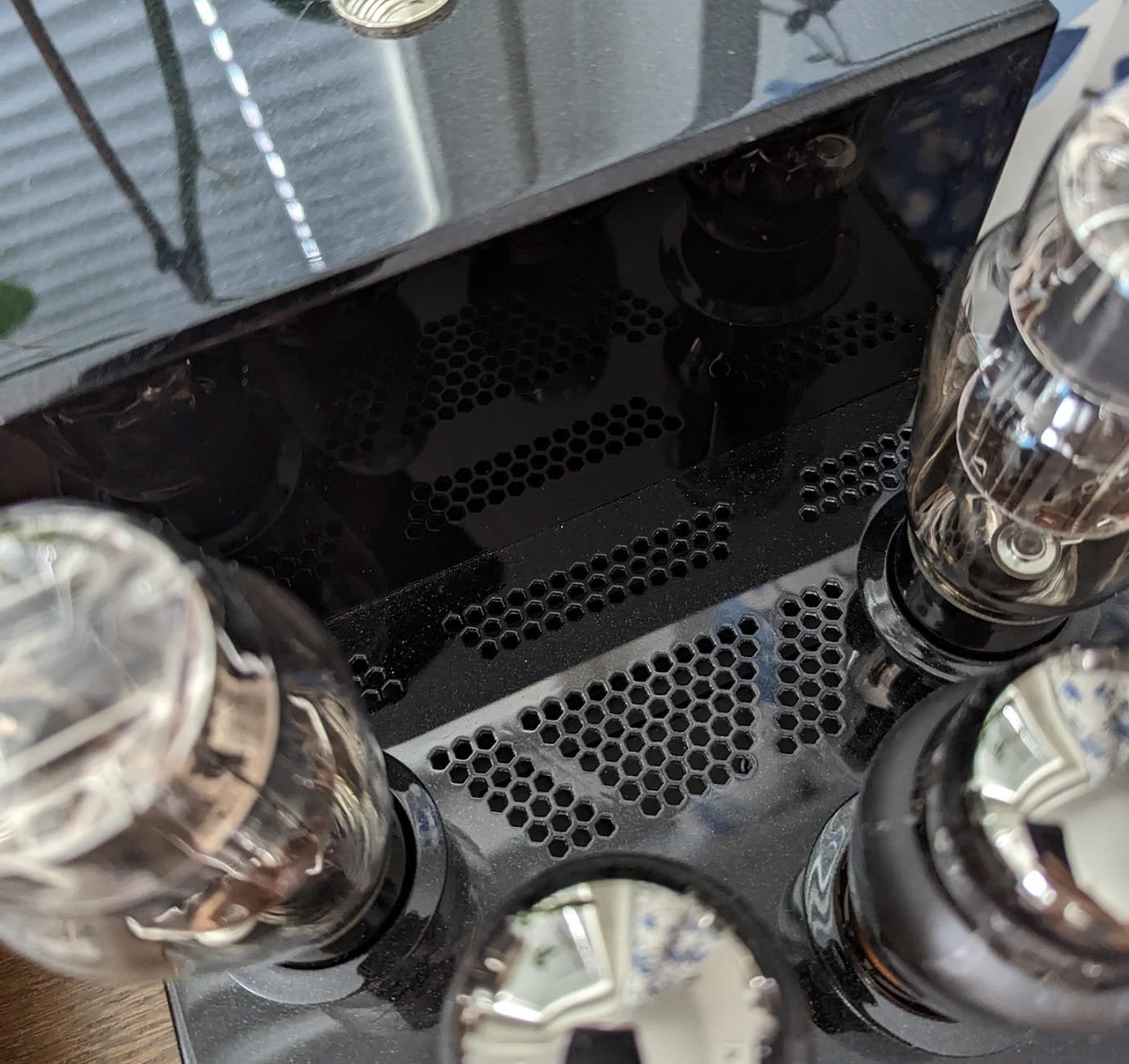
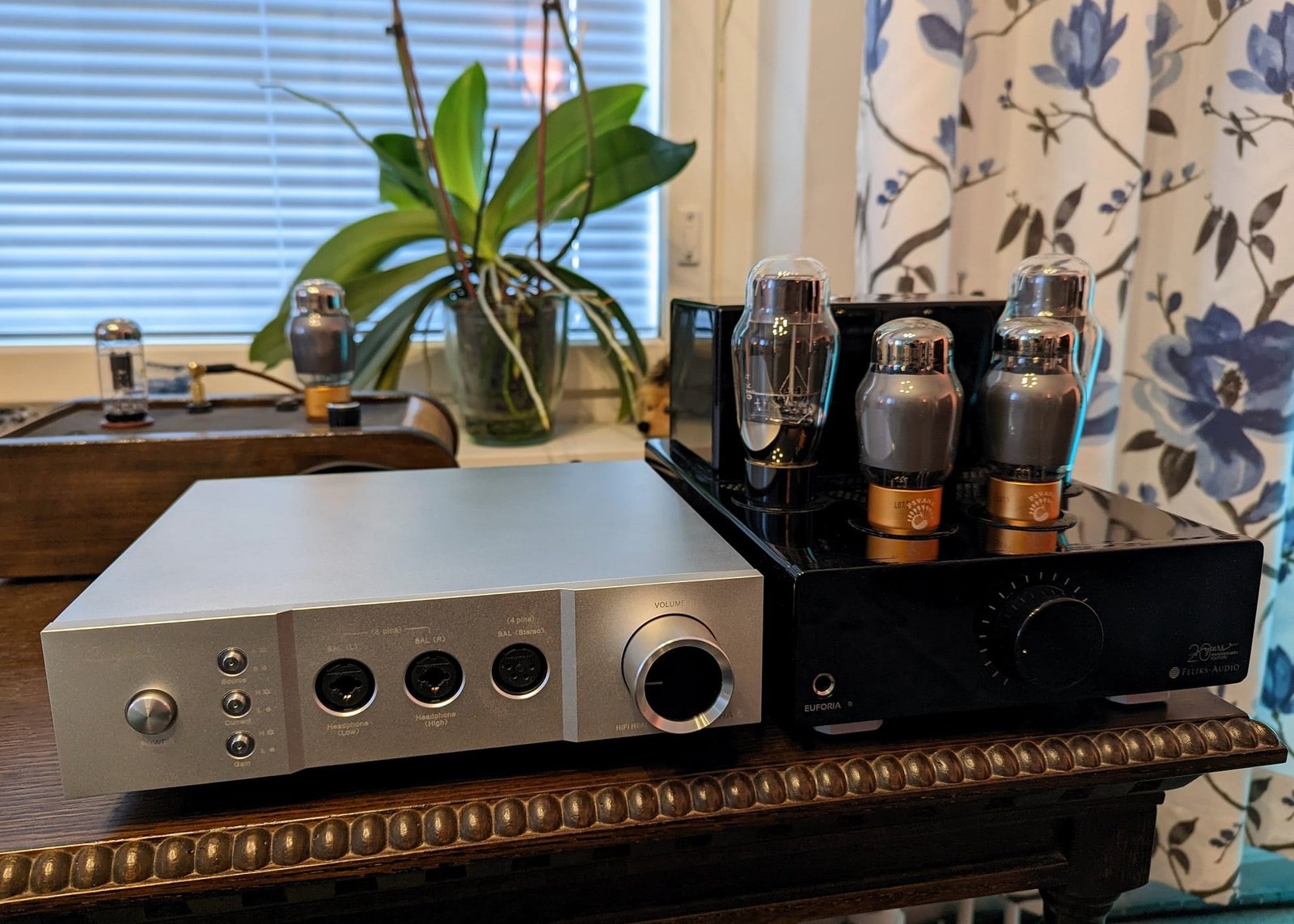
Otherwise, I would describe the amplifier as stylish and neat-looking, as it has nothing superfluous. When looking at the device, attention is drawn to the four large tubes located at the front edge. At the rear edge, there is a large metal box that conceals the power supply. Underneath the amplifier are exceptionally large feet that hold the device firmly on the surface of a table or equipment stand.
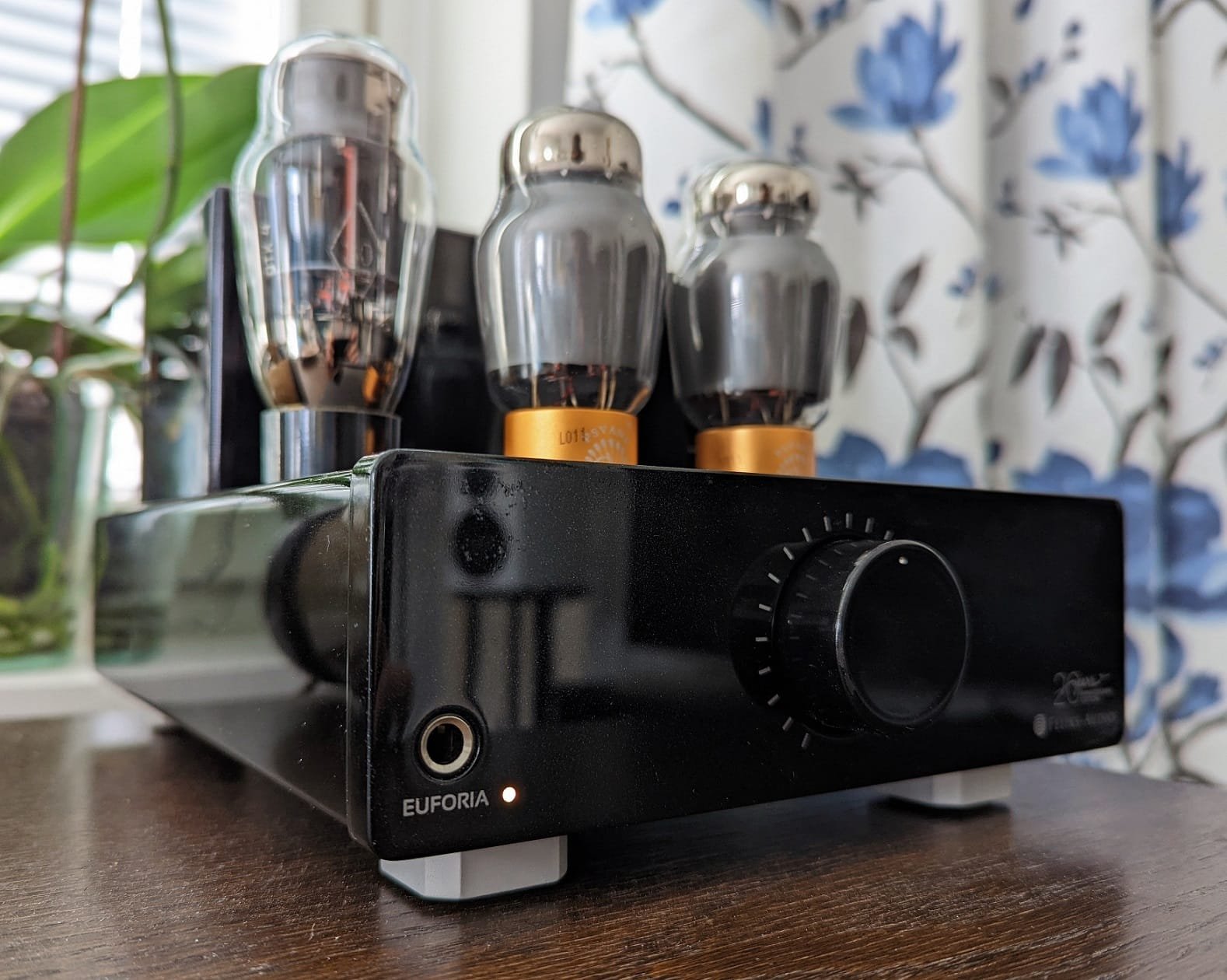
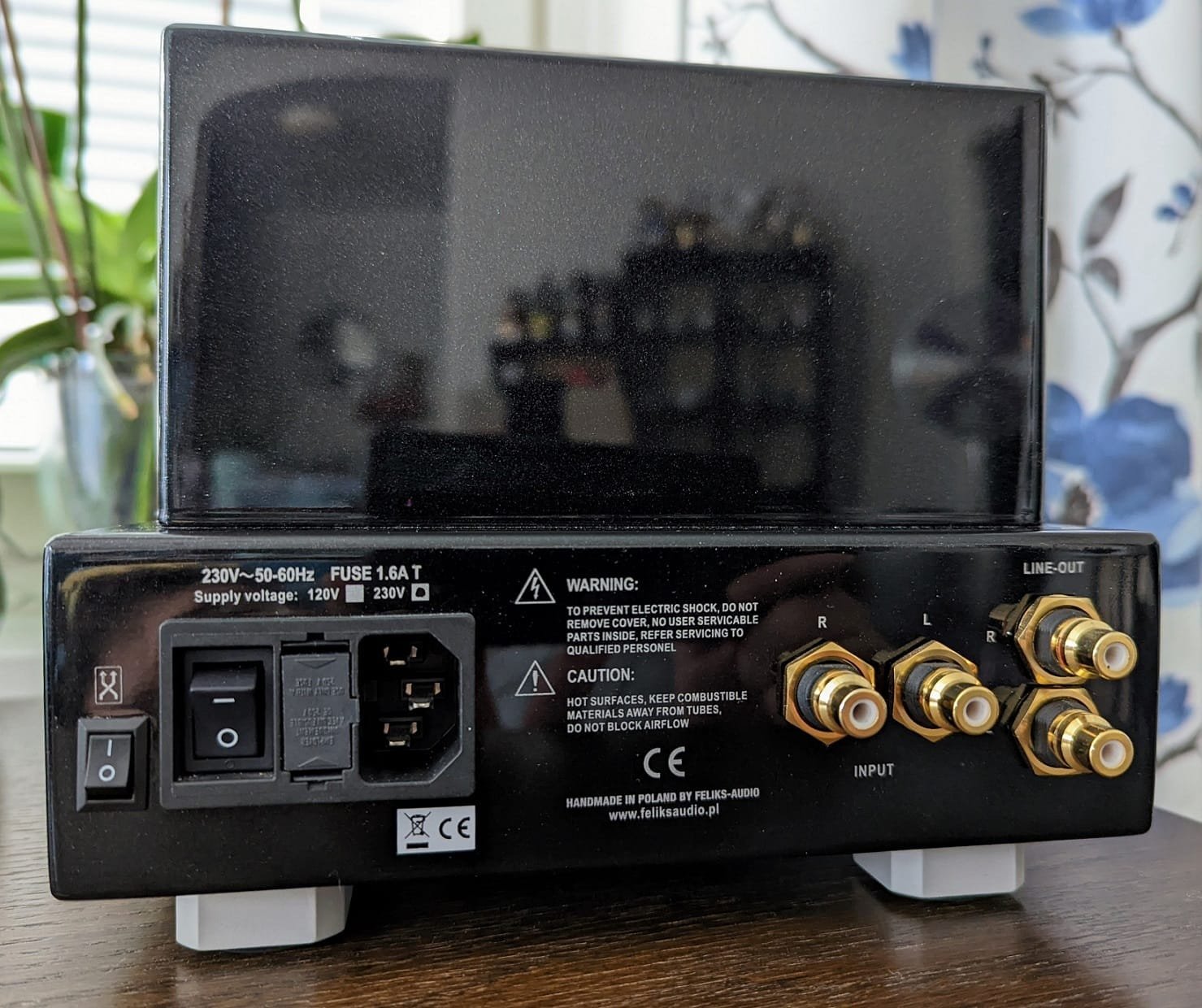
The front edge of the device features a 6.35 mm headphone jack, a yellowish power LED, and a volume control with an excellent feel. On the rear, in addition to the power connector and switch, there are RCA inputs and another set of RCA connectors for preamplifier use. Euforia also has a surprising additional feature: a built-in crossfeed function, which has its own small switch.
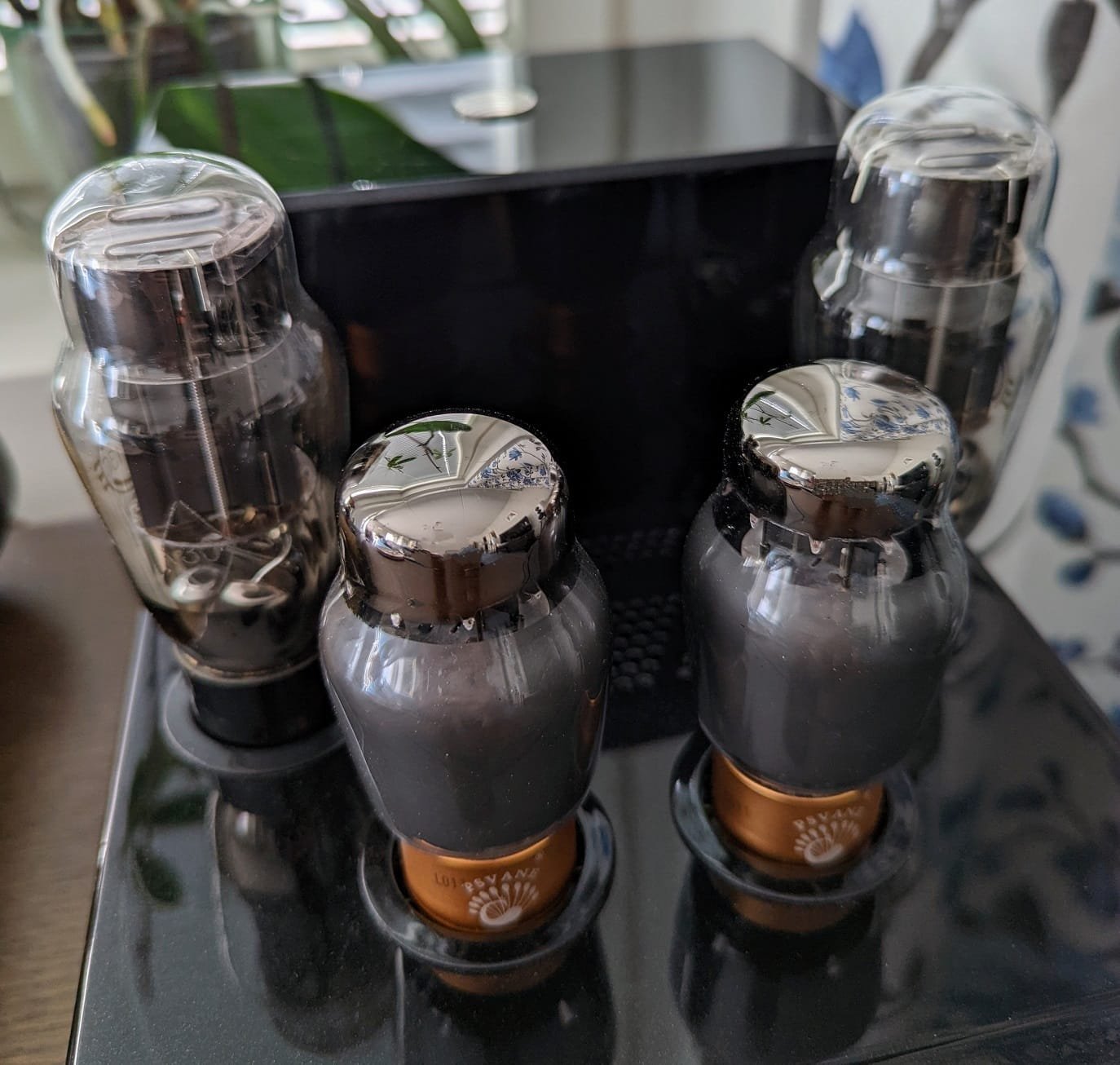
Feliks Audio has chosen two 6N13S tubes (NOS) as the output tubes for Euforia, while preamplification is handled by two PsVane CV-181 Mk2 Gold tubes (6SN7). I have previous experience with the latter, as I use the same PsVane tube, costing over 100 euros, in my Tor Audio Roger. The tubes included with Euforia are, to my understanding, of very high quality, but a true enthusiast can also replace them with even more expensive and specialized tubes if desired. Feliks Audio helpfully lists suitable tube types for the device in the user manual.
Notes on usage
The manufacturer recommends 30–50 hours of use for Euforia after purchase to achieve optimal sound quality. I am not intimately familiar with the operation of tubes, but there might even be some sense in this recommendation, as we are not talking about several hundred hours this time. In any case, the amplifier I have on loan has been tested by others before, so the recommendation has likely been met long ago.
According to the manufacturer's second recommendation, the tubes should be allowed to warm up for 15 minutes after starting the device before listening, so that they reach their optimal operating temperature. This is sensible, as otherwise, the sound is slightly unbalanced at first. Many might consider such a need for waiting ridiculous and old-fashioned, as it is not necessary when using transistor amplifiers. I partially agree, but in my opinion, the initial warm-up of the tubes somewhat resembles heating a sauna – waiting is an important part of the experience.
Thoughts on sound quality
Headphones used for sound quality evaluation:
- ZMF Collection: Atrium, Verite Closed, Verite Open, Auteur and Eikon
- Sennheiser Collection: HD800, HD600 and HD580
- Focal Clear
- Hifiman HE1000 V2
- Meze Empyrean
Listening Chain:
Tidal/FLAC files on external hard drive -> IFI Zen Stream -> Soncoz SGD1 -> Feliks Audio Euforia 20th Anniversary
I listened to the Cayin IHA-6 transistor amplifier alongside the Euforia, as its relatively uncolored sound provides a good basis for comparison with the changes brought about by a tube amplifier.
Smoothness and Realism:
Tube amplifiers add space and layers to the reproduction. I always find myself paying attention to details that generally receive less attention with transistor amplifiers. This makes tube amplifiers sound a bit more interesting, even if the end result is not necessarily objectively truthful. I personally prefer the more organic and relaxed presentation style created by tubes, which fully draws you in when listening with suitable headphones.
All these characteristics are also found in the Euforia. The sound it produces is, above all, extremely smooth and effortless. Listening to music is pleasantly relaxing because I can trust exceptionally well that nothing will jar my ears or jump out at me. Because my ears can be completely relaxed, I also find myself delving into the available information more closely than usual.
Fortunately, the Euforia's relaxation has not been achieved at the expense of detail, as the reproduction is also very transparent and layered. The soundstage is quite intimate due to the forward-presenting mid-frequencies, but at the same time, the sense of depth around the vocalist is in a class of its own compared to all other amplifiers I have heard. Individual instruments and sounds are reproduced extremely clearly in their own layers, and there is a vast amount of empty space between them. The result is so realistic and lively that one would not believe the sound originates from headphones. The music literally feels as if it exists before my eyes. Furthermore, the device has practically no noise or hiss; instead, the background of the reproduction is pitch black. Thanks to this, even the smallest details and movements of sounds pop out like stars in the night sky.
A large part of the realistic impression probably arises from Euforia's sound profile, which brings the mid-frequencies to the forefront. My reference, the Cayin IHA-6, for example, reproduces vocal performances as more spacious and less attention-grabbing, whereas Euforia brings them closer to the listener. The strong emotional charge created in the mid-frequencies, combined with the layered reproduction, makes Euforia a fantastically good-sounding amplifier, especially with ZMF headphones. The Hifiman HE1000 V2, which I recently reviewed, is an extremely realistic-sounding headphone as it is, so I was very pleased to notice that Euforia makes many 300-ohm headphones very similar in realism.
Still not particularly colored for a tube amplifier:
Despite its style of slightly emphasizing the mid-frequencies overall, Euforia is not, in my opinion, particularly colored for a tube amplifier. For example, it doesn't make the sound thick and warm in the same way as my Tor Audio Roger. In a certain way, Euforia doesn't immediately sound like a tube amplifier compared to the Roger, which can be both a good and a bad thing. Some want to access the benefits of tubes without coloring the sound too much, while others might expect greater changes in some direction from a 3000-euro amplifier. I feel that Feliks Audio's chosen path is the right one, because I expect an expensive amplifier to sound refined and sophisticated, not just as ”tubey” as possible.
Bass:
The higher, less driver-controlling, output impedance of an OTL device makes the bass of 300-ohm headphones fuller and more natural compared to low-output impedance solid-state amplifiers. However, Euforia's output impedance does not seem to be very high, based on the fact that the amount of bass does not actually increase compared to, for example, the Cayin IHA-6. Tor Audio Roger, on the other hand, makes the bass honey-thick and warm. With Euforia, the bass, in short, sounds normal and natural in a good way. The reproduction is full, but still clear and controlled.
I am sure that by changing tubes, it would be possible to get a richer sound out of Euforia, if someone desires such. The amplifier's somewhat neutral ”default sound” is a positive thing in that the end result can also be influenced by changing the D/A converter. What I experimented with the amplifier for a while Schiit Audio Bifrost 2 adds more warmth to the sound, while the slight brightness of the Soncoz SGD1 suitably balances Euforia's relaxedness for my taste.
Treble:
Euforia's treble reproduction is, in my opinion, the most colored aspect of the amplifier, as the high frequencies sound distinctly different compared to other amplifiers I've heard – the tone is in a certain way warm and romantic. The treble is easy to listen to in terms of the very highest frequencies, but at the same time, for example, the rattling of cymbals mixed into the background of a song stands out more clearly from the whole than usual. The high frequencies attract a surprising amount of attention without being sharp or fatiguing. However, if the headphones used emphasize the same frequency areas, the result becomes too treble-heavy for my taste. This happens, for example, with the Hifiman HE1000 V2 and Sennheiser HD580. I was also surprisingly not satisfied with the ZMF Verite Open model with the amplifier, as its frequency balance was not optimal in my opinion.
With all other headphones I've tried, I like that Euforia constantly brings out details from the treble frequencies that I had not noticed before. In the end, only its slight unnaturalness bothers me in the treble. The highest frequencies lack some airiness compared to, for example, the Cayin IHA-6, so certain sounds with Euforia sound a bit blunt and unbalanced. This doesn't bother me greatly, but it's something to be prepared for when considering buying Euforia. On the other hand, the relaxedness of the highest treble suits, for example, the Meze Empyrean well, in whose sound I usually detect an annoying extra sparkle – with Euforia, there is no trace of it.
Crossfeed function
I also tried Euforia's crossfeed function for a while, which is intended to make the reproduction more speaker-like. This is achieved by mixing part of the sound heard on the left side to the right side and vice versa. On the positive side, the feature works well in Euforia in that I feel the soundstage turns from the sides more towards the center in front of my eyes. Unfortunately, at the same time, the treble loses a large part of its energy and the bass significantly strengthens. The sound becomes quite congested and muddy, even though listening is effortless in terms of the soundstage.
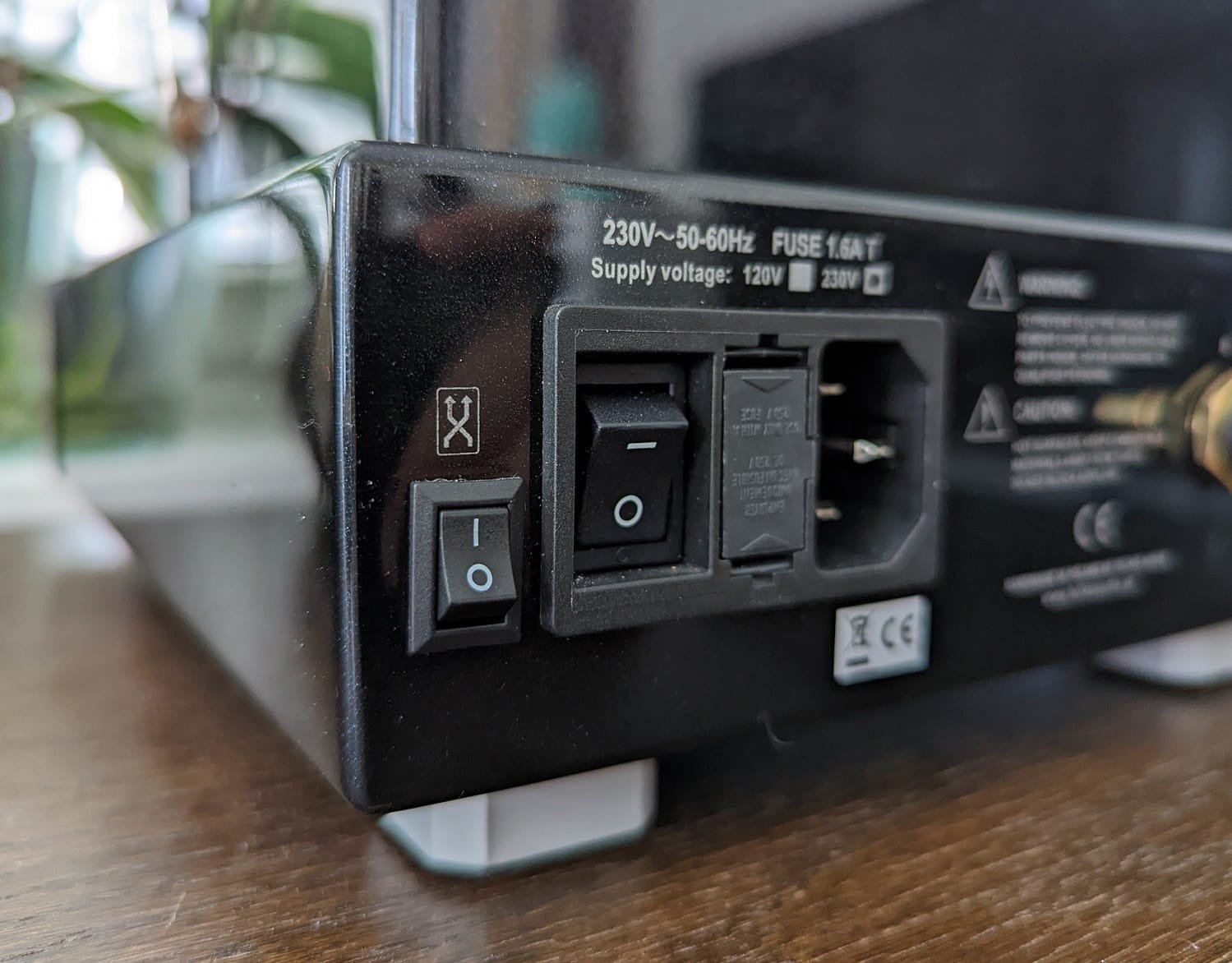
Crossfeed didn't make any of my headphones sound significantly better, so I couldn't think of situations where I would have wanted to use it. Perhaps it's a kind of emergency solution for those who are generally bothered by headphone listening and the strong separation between the left and right channels. There are certainly much better crossfeed implementations on the market, so the feature should not be completely dismissed based on Euforia. It may also be that my own hearing simply doesn't work with the amplifier's setting.
Individual headphone tests
Euforia makes many of my 300-ohm headphones sound better than they are, and it also seems to have enough power for many planar headphones. The promised maximum output power of 280 mW is more than enough for, for example, the Modhouse Argon, and it also sounds good. However, for planar headphones that are generally difficult to drive, it is usually better to get some kind of tube hybrid or a tube device with an output transformer. Next, I will briefly describe how I experienced different headphones sounding with Euforia.
ZMF Verite Closed:
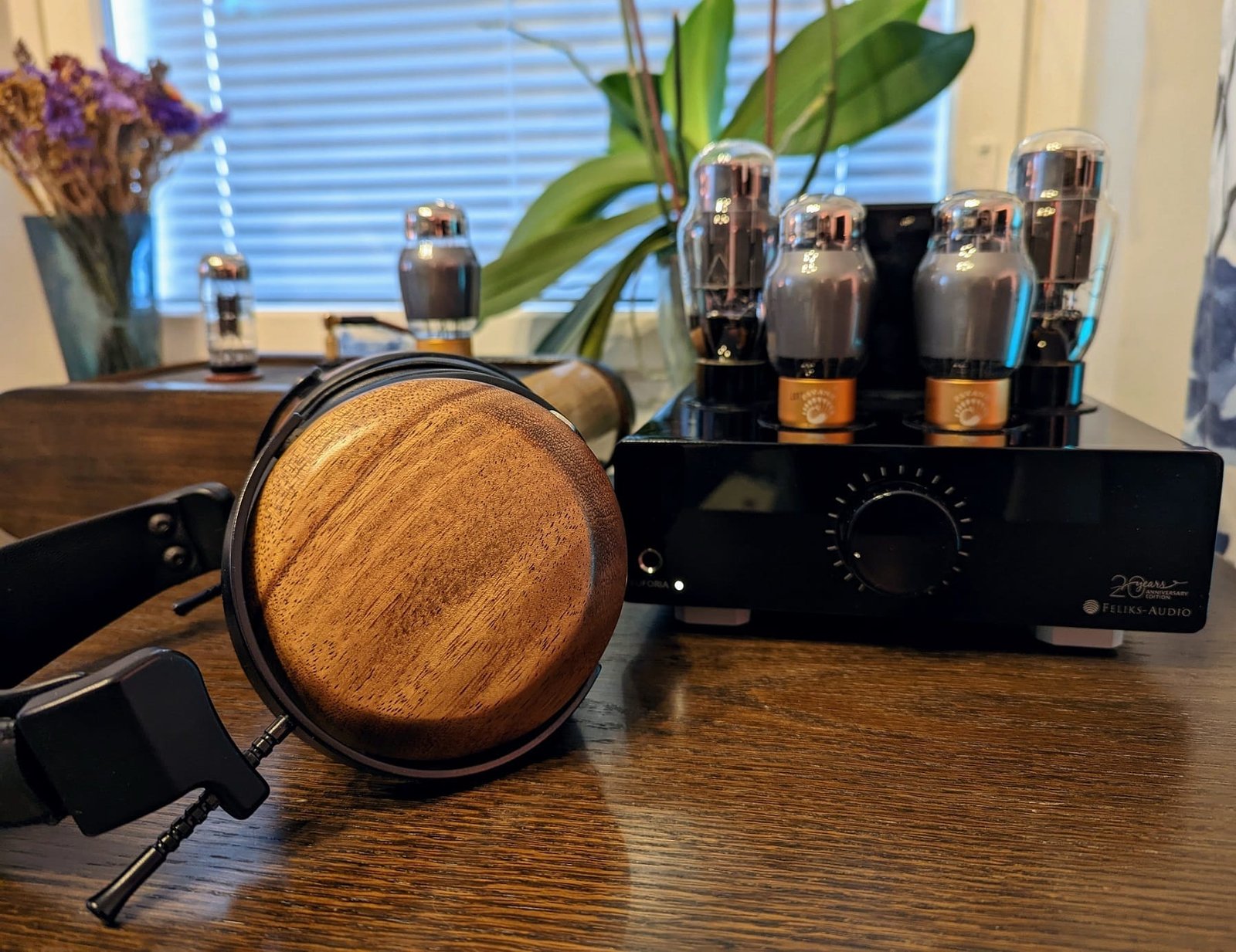
ZMF Verite Closed was the first headphone I tried with Euforia. My eyes widened with excitement because the headphones had not sounded this good before. Although the Verite Closed is one of the best closed-back headphones I've heard, its mid-frequencies remain somewhat distant and smoothed out for my taste, and the treble is also sometimes heavy to listen to, especially with solid-state amplifiers. However, Euforia makes the Verite a more perfect version of itself – I wouldn't want to listen to them with any other amplifier anymore.
Euforia adds just the right amount of life and emotion to the Verite's mid-frequencies, and the treble becomes truly smooth. The bass also remains excellently controlled, and it doesn't resonate in the soft wooden cups as much as usual. At the same time, the realistic separation of instruments and the layering of the soundstage are an addictive experience. I have never before experienced different sounds passing through each other so perfectly without mixing at all, even in complex music. I could very well see the Euforia & Verite Closed combination as many people's last acquisition, because the result in its seamlessness is better than the sum of its parts. The Verite is still not a neutral-sounding headphone, but in a certain way, it sounds better than reality. If I had to get Euforia for one pair of ZMF headphones, my choice would be the Verite Closed.
ZMF Verite Open:
The open Verite model does not, in my opinion, sound particularly good with Euforia; its sound remains peculiarly thin and bright. In addition, the bass reproduction is subdued and the soundstage is narrow compared to the Tor Audio Roger. The situation did not improve even when using the Schiit Audio Bifrost 2 DAC, so I ultimately did not bother trying different ear pads. I think that the Verite Open, made from hard African Blackwood, requires a warmer-sounding amplifier, as it sounds excellent with the Tor Audio Roger.
ZMF Atrium:
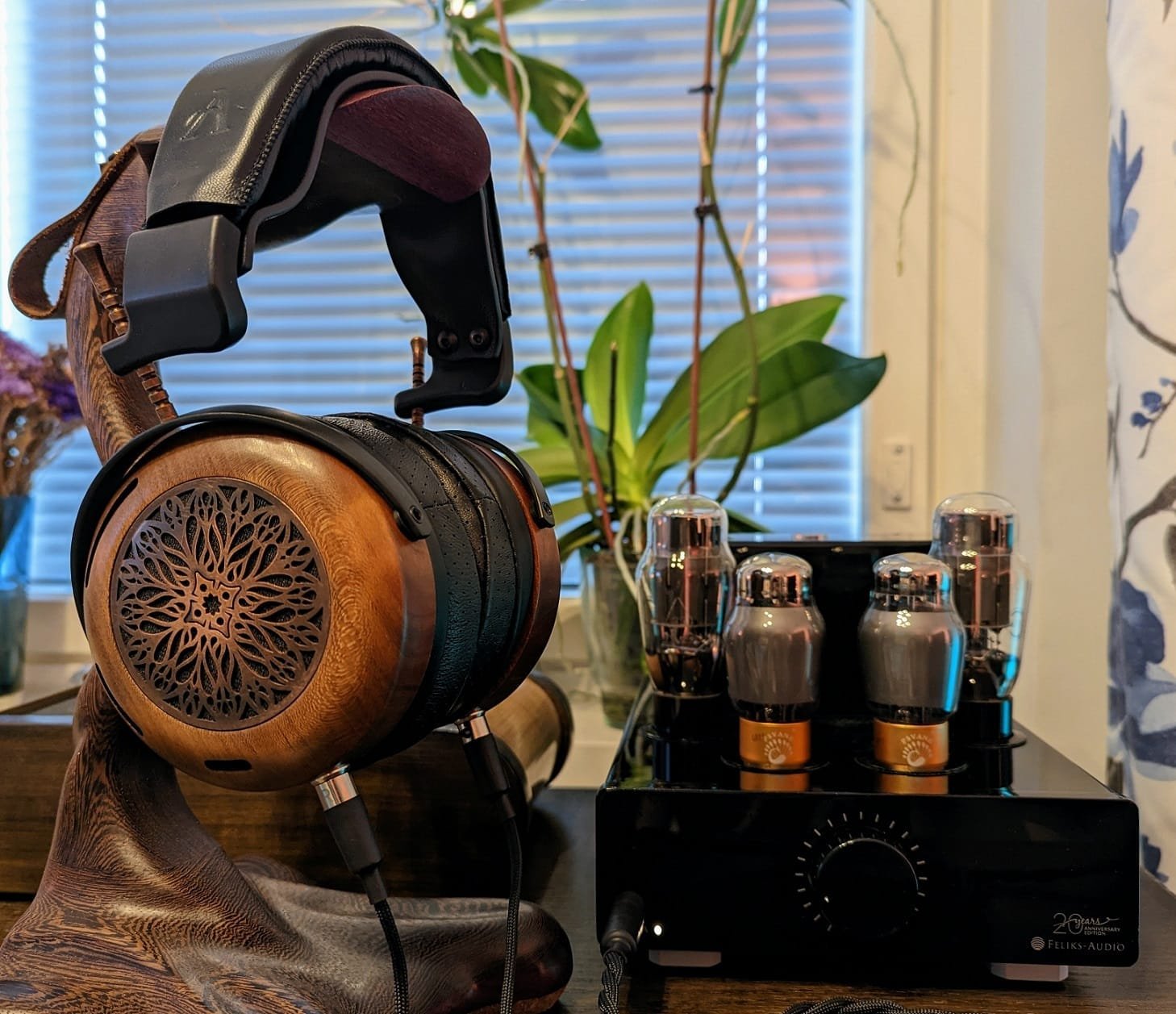
ZMF's new Atrium model is another headphone for which Euforia is an excellent match. The headphones already have a wonderfully palpable soundstage, whose realism comes into its own with Euforia. I also like that the headphones' somewhat dark treble attracts more attention than with my solid-state amplifiers. I wouldn't change anything in the combination, because the result is so seamless that I can't tell which part of the sound is due to the headphones or the amplifier. The Atrium sounds good with any amplifier, but Euforia further enhances its best qualities.
ZMF Eikon:
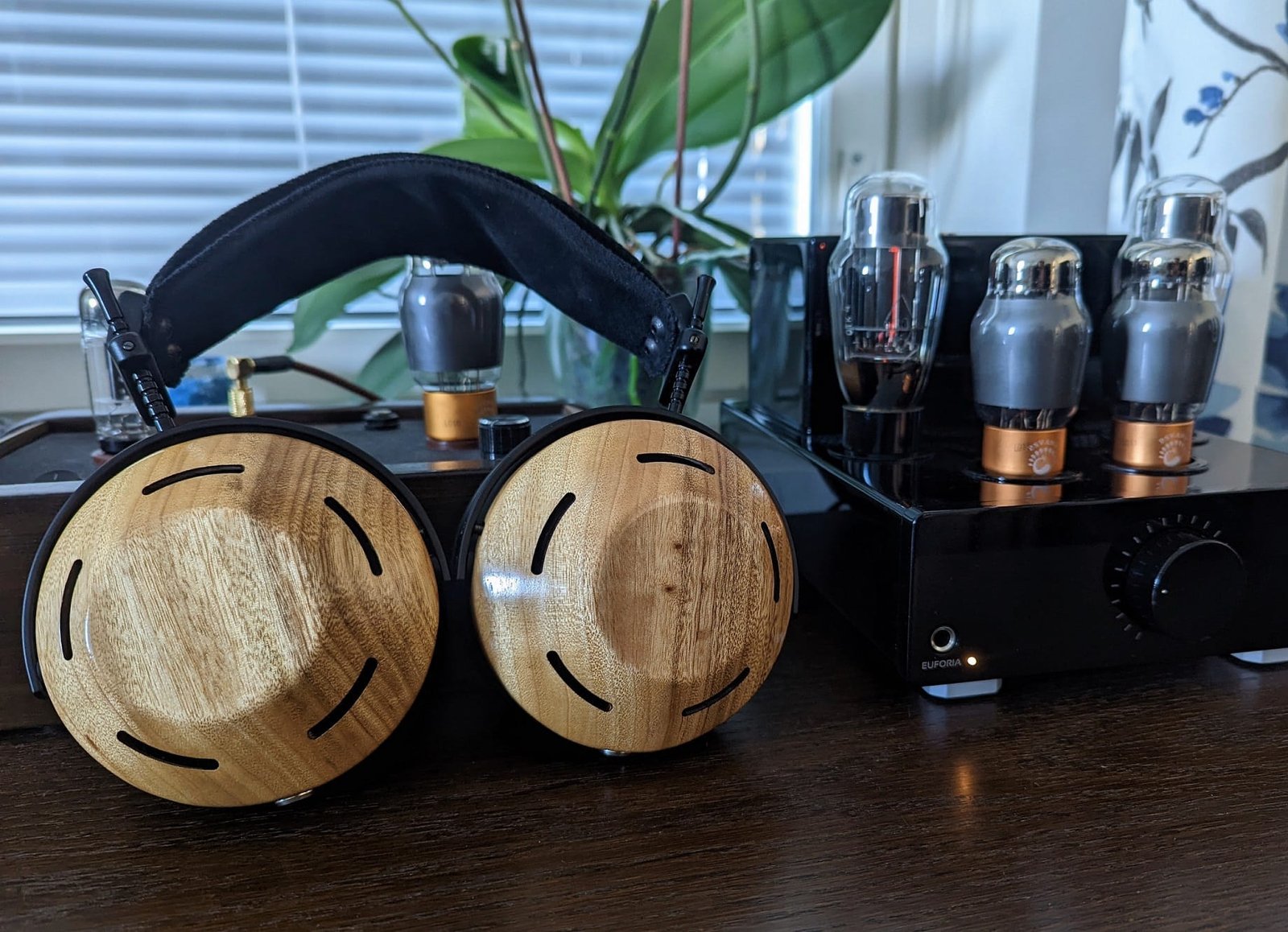
ZMF's closed-back Eikon model, discontinued in 2022, is also made for Euforia – or vice versa. The amplifier seamlessly supports the headphones' quite neutral tuning and natural timbre. A new kind of depth is formed in the soundstage, and the more prominent treble complements Eikon's irregularities in just the right places. The result is authentic, inspiring, and smooth all at once. Vocal performances, in particular, give me goosebumps, so I actually listened to the Eikon & Euforia combination the most during the amplifier's loan period.
ZMF Auteur:
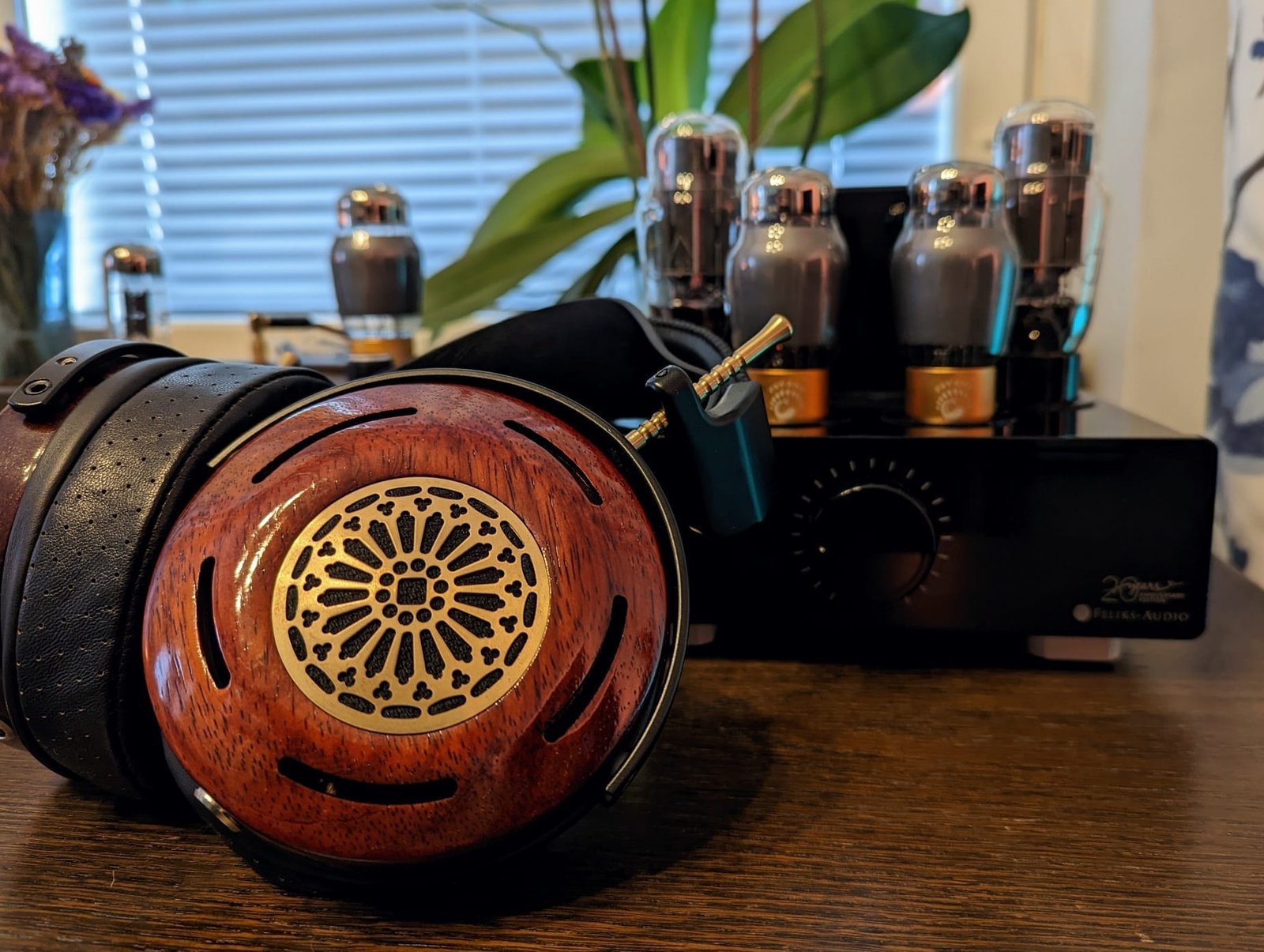
The ZMF Auteur, implemented with a similar biocellulose driver as the Eikon, also sounds good. The Auteur's soundstage is not usually particularly memorable, but with Euforia, the result is livelier and more interesting. The amplifier makes the headphones' natural mid-frequencies even better, and the treble, which pops out more than usual, doesn't bother either. For comparison, the Tor Audio Roger makes the Auteur sound really warm, whereas with Euforia, the headphones' neutral character largely remains unchanged. The overall result is pleasant, even if the Auteur doesn't change as much with the amplifier as, for example, the Verite Closed or Eikon.
Focal Clear:
The Focal Clear (original model) was one of the biggest surprises among the headphones I tested with Euforia, because the result is fantastically good. The headphones' own impedance is so low that the amplifier's somewhat high output impedance boosts and warms the low frequencies more than in other dynamic headphones I tested. This changes the Clear's rather neutral hi-fi sound to be just suitably fuller and more musical. The sound has more body, and the slight metallic quality of the headphones' timbre is conspicuously absent. Also, the slightly aggressive mid-frequencies typical of Focal headphones interestingly move further away, so the soundstage feels more spacious than usual. I would characterize the headphones, when listened to with Euforia, as more ZMF-like, with sound separation being more precise compared to, for example, the Auteur model.
Sennheiser HD800 (SDR-modded):
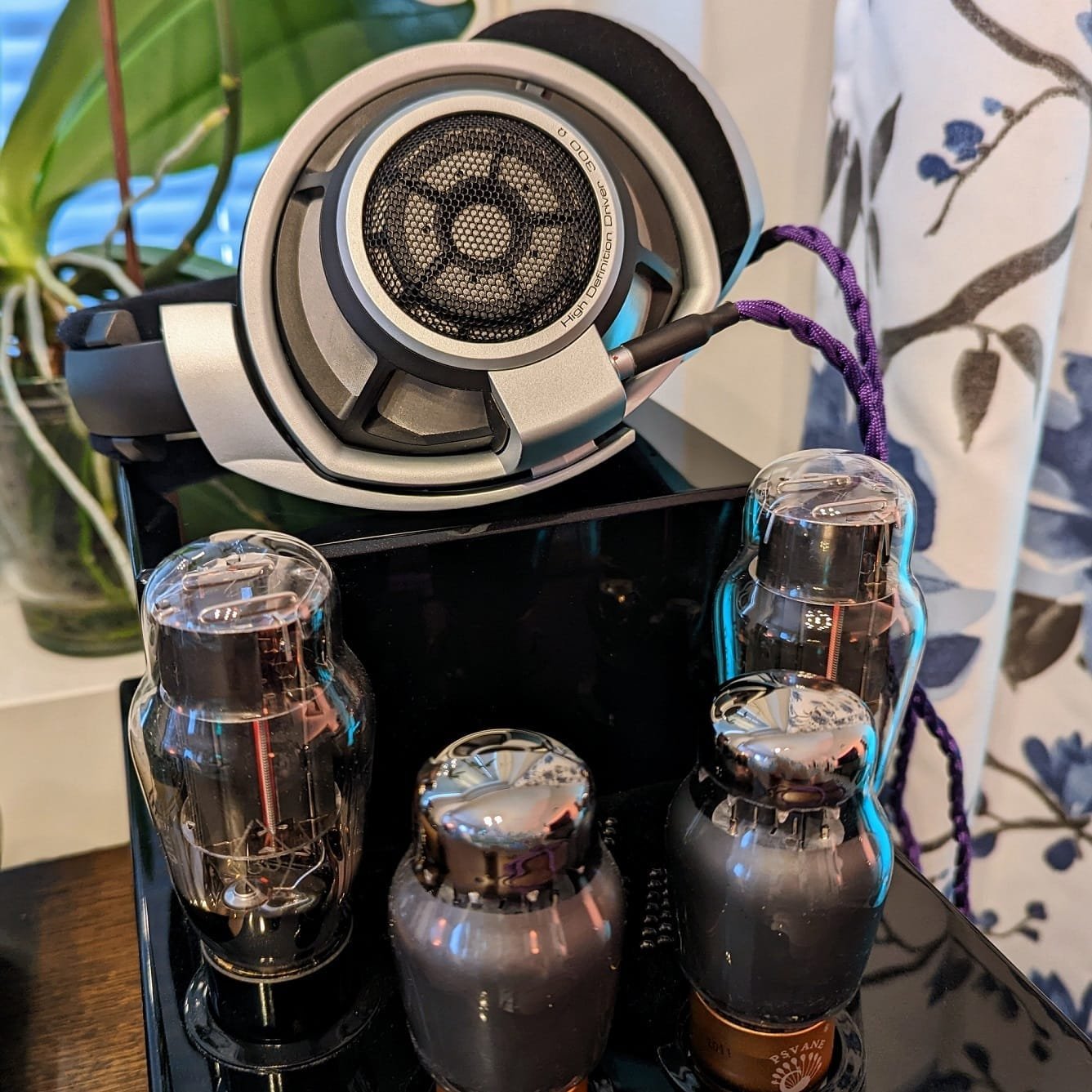
Euforia is a good match for the SDR-modded Sennheiser HD800. It would actually be interesting to hear the headphones unmodded with the amplifier, because the very bright treble reacts even better to equipment changes. When listened to with Euforia, the SDR version is in any case realistic and quite relaxed-sounding. Especially the authenticity and emotional charge of the mid-frequencies improve compared to the Cayin IHA-6, because Euforia brings the vocalist suitably closer. There is also just the right amount of bass, uncharacteristically for these headphones, and the treble doesn't bother with its brightness either. Because the HD800's treble is of high quality and the amplifier makes it easy to listen to, I pay more attention to its detail than usual.
If I hadn't had many other headphones on my test list, I would probably have forgotten myself listening to the HD800 & Euforia combination for much longer. A tube amplifier that warms the sound more might still be a more interesting option for the HD800, whereas Euforia supports the headphones' strengths without coloring the overall sound too much.
Sennheiser HD580 and HD600:
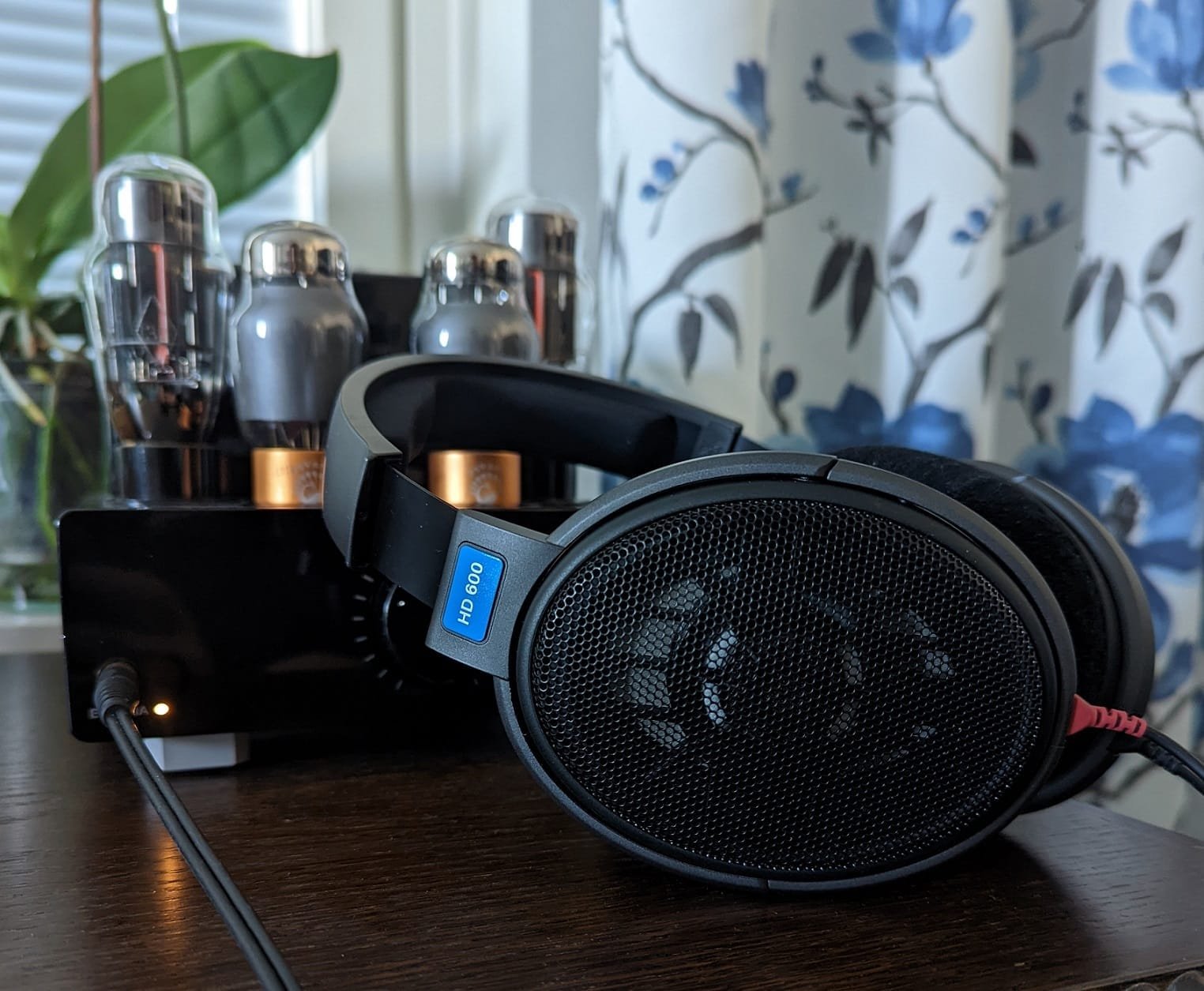
When testing Sennheiser's more affordable models, my experiences were somewhat mixed. Of the two, the brighter and more open-sounding HD580 is quite aggressive-sounding with Euforia, because the amplifier draws even more attention to the upper frequencies. I prefer the HD580, for example, when listened to from the 10-ohm connector of the Cayin IHA-6. In my opinion, the headphones would benefit from a warmer tube amplifier, even though the mid-frequencies are good with Euforia.
The HD600 model, with its more moderate treble, on the other hand, sounds basically good. The result is neutral, credible, and more spacious than usual. Compared to the Cayin IHA-6, the soundstage becomes slightly more interesting with Euforia, and the small boost to the treble is, in my opinion, mainly a positive thing, even though the upper frequencies are more natural in style with other amplifiers. Ultimately, however, I would prefer to listen to the HD600 with the Tor Audio Roger, because it excellently boosts the headphones” subdued low frequencies. Euforia is not, in my opinion, ”tubey" enough for the HD600 series. Also, the headphones' scalability seems to run out, so a similar result could probably be achieved with a more affordable device.
Planars: Hifiman HE1000 V2 and Meze Empyrean
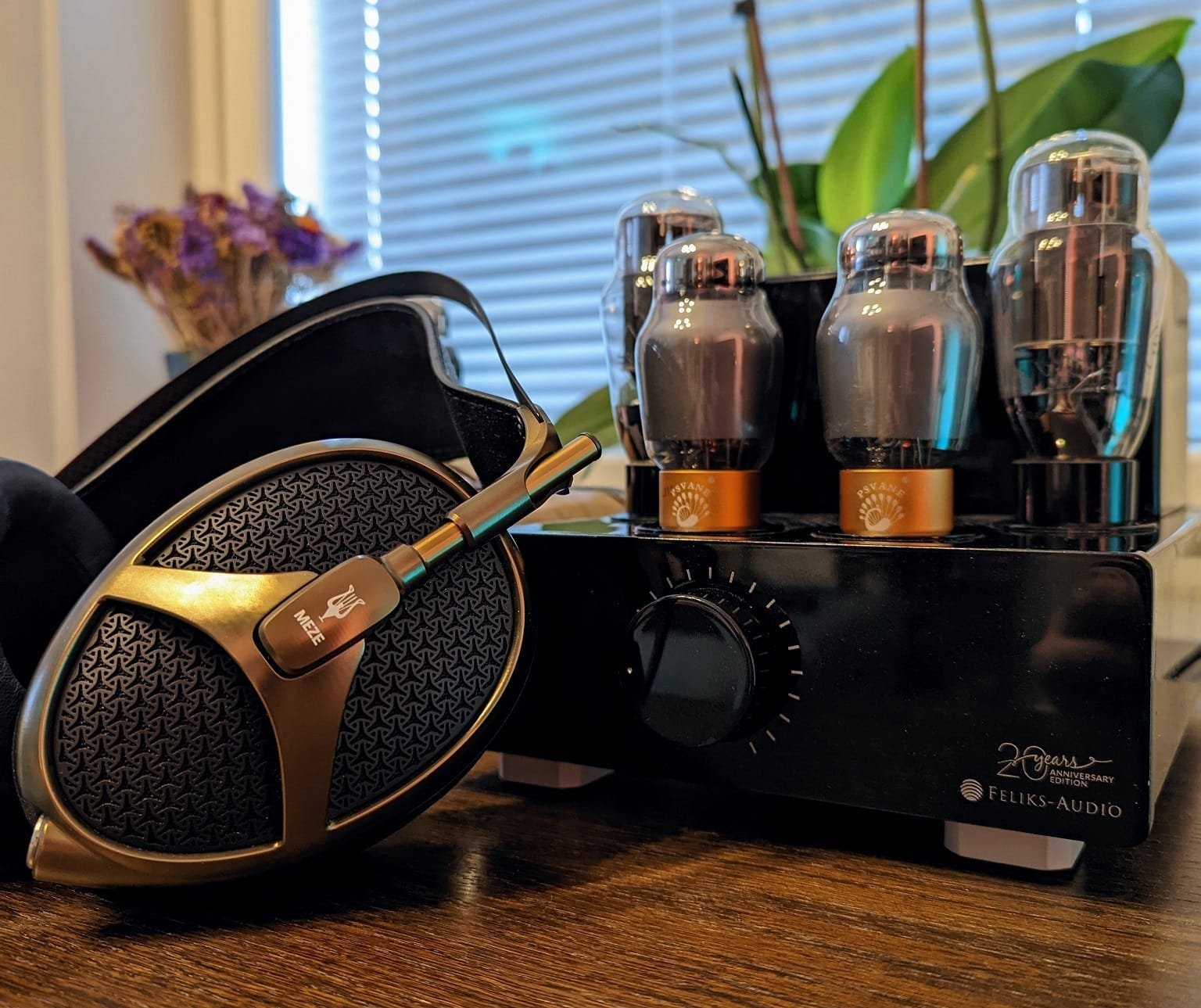
I didn't want to listen to the Hifiman HE1000 V2 with Euforia for long, because my attention was drawn too much to the treble. In my opinion, the headphones don't suit the amplifier properly, or it runs out of power.
Another planar headphone I tried, the Meze Empyrean, sounds better instead. If someone is bothered by the extra sparkle in the Empyrean's upper treble, the Euforia largely gets rid of this characteristic. At the same time, vocal performances and the soundstage are more authentic than, for example, with the Cayin IHA-6, although on the other hand, the result with the Euforia is even too calm compared to the more dynamic presentation of a solid-state amplifier. However, the Empyrean's strength is ultimately its ease of listening and lack of fatigue, so the Euforia can be seen as supporting these qualities excellently.
Summary
In my opinion, the Feliks Audio Euforia 20th Anniversary is a fantastic-sounding tube amplifier with suitable headphones. I don't have much experience with other devices in a similar price range, but frankly, it's hard for me to imagine anything better, especially for ZMF headphones – even better devices probably exist, but one would have to find them first. I know the Euforia is both well-made and excellent in sound, so despite its high price, it evokes a surprisingly strong desire for ownership. I part with the amplifier with a heavy heart, but perhaps I will meet it again in due course if I still own several high-impedance headphones.
In my opinion, the Euforia has its own target audience, to which I happen to belong. Although the amplifier offers pleasantly smooth and emotionally engaging reproduction, complemented by a realistic soundstage, as an OTL-type device, it may not be suitable for all headphones or all people. For example, the Euforia's sound is not the most 'tubey,' but rather quite normal and mature, with the exception of the treble. Many other tube devices might sound more interesting and fun, even if they cost only a fraction of the Euforia's price. Similarly, owners of planar headphones and those seeking a more edgy sound than the Euforia will probably prefer solid-state amplifiers. However, these observations do not make the Euforia any worse in its own areas of strength.
Is the Euforia ultimately worth its price of over 3000 euros? In my view, the amplifier is a kind of luxury product for the true enthusiast who has long since stopped evaluating the price-to-performance ratio of headphones and devices. When the listening hobby has become a way of life, even small things can make the overall experience more pleasant. By buying the Euforia, one knows they are getting quality, even though quite similar tube amplifiers can probably be found from lesser-known manufacturers much more affordably. Since the normal version of the Euforia costs ”only” 2200 euros, the buyer of the 20th Anniversary special edition is in any case willing to pay for the last percentages of performance. 3000 euros feels wild, but oh boy, how good it sounds too.
Pros and cons:
+ Reproduction is extremely smooth and non-fatiguing to the ears
+ Magical mid-frequencies: vocals, in particular, sound realistic and emotionally engaging
+ Soundstage is very layered and precisely structured
+ Does not color the reproduction too much in terms of bass and mid-frequencies
+ Makes most high-impedance headphones, such as ZMF models, sound better than solid-state amplifiers
+ Elegant size for a tube amplifier
+ Beautiful glossy painted chassis
+ High-quality feeling volume control
+ No background noise
+/- The crossfeed function is an interesting additional feature, but it is not particularly useful for my taste
+/- The treble is easy on the ears and stands out clearly. However, the upper frequencies sound somewhat colored and unnatural compared to other amplifiers
– Low output power may not be sufficient for all planar headphones
– Considering the high price, it would be nice to see an XLR connector in the device in addition to the 6.35 mm headphone jack, even if it were implemented unbalanced
– The tubes get very hot (this is, however, expected)
– The price is very high for most headphone enthusiasts
 EN
EN  FI
FI