Author: Roderick
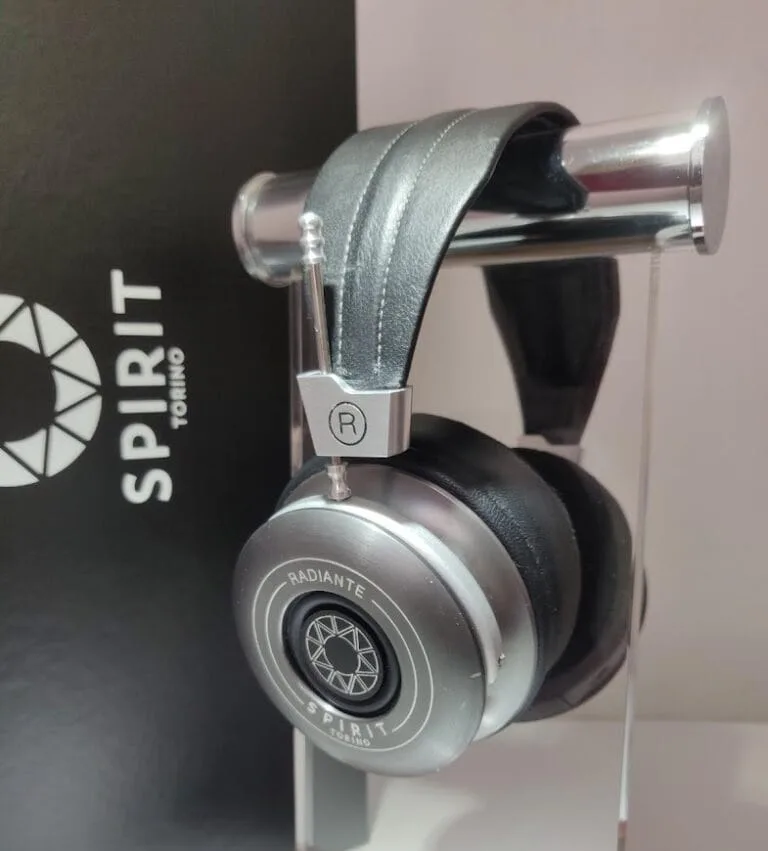
Table of Contents:
Information:
- Year of publication: 2019
- Country of manufacture: Italy
- Price: 2100–2400 € (depends on the paint finish and headband trim). The price of the Titanium model I reviewed is 2250 € (+235 € for a balanced upgrade cable manufactured by Portento Audio)
- Type: Closed, over-ear
- Dynamic driver: 46 mm (information unconfirmed) + passive driver
- Impedance: 32 ohm
- Sensitivity: Not stated. The headphones do not require a powerful amplifier, so I would assume a sensitivity of about 100 dB/mW
- Weight: 370 grams without cable
- Connector type: 2 x 3.5 mm
- Cable: 1.3 m–2.2 m (connector type and cable length selectable when ordering headphones)
- Accessories: none
- Warranty: 24 months
Review sample: Self-purchased product
Spirit Torino
Do you know which are the most expensive headphones currently manufactured that are not special editions, individual collector's items, or diamond-encrusted rarities? You might be able to name the 62,000 euro Sennheiser HE1 headphone system, which includes headphones, an amplifier, and a D/A converter. You might also remember that Hifiman has the Shangri-La system, which costs 50,000 euros, and of which the headphones account for about 18,000 euros. Perhaps you have also heard of the Warwick Acoustics Aperio, which can be acquired with a listening device for 32,000 euros.
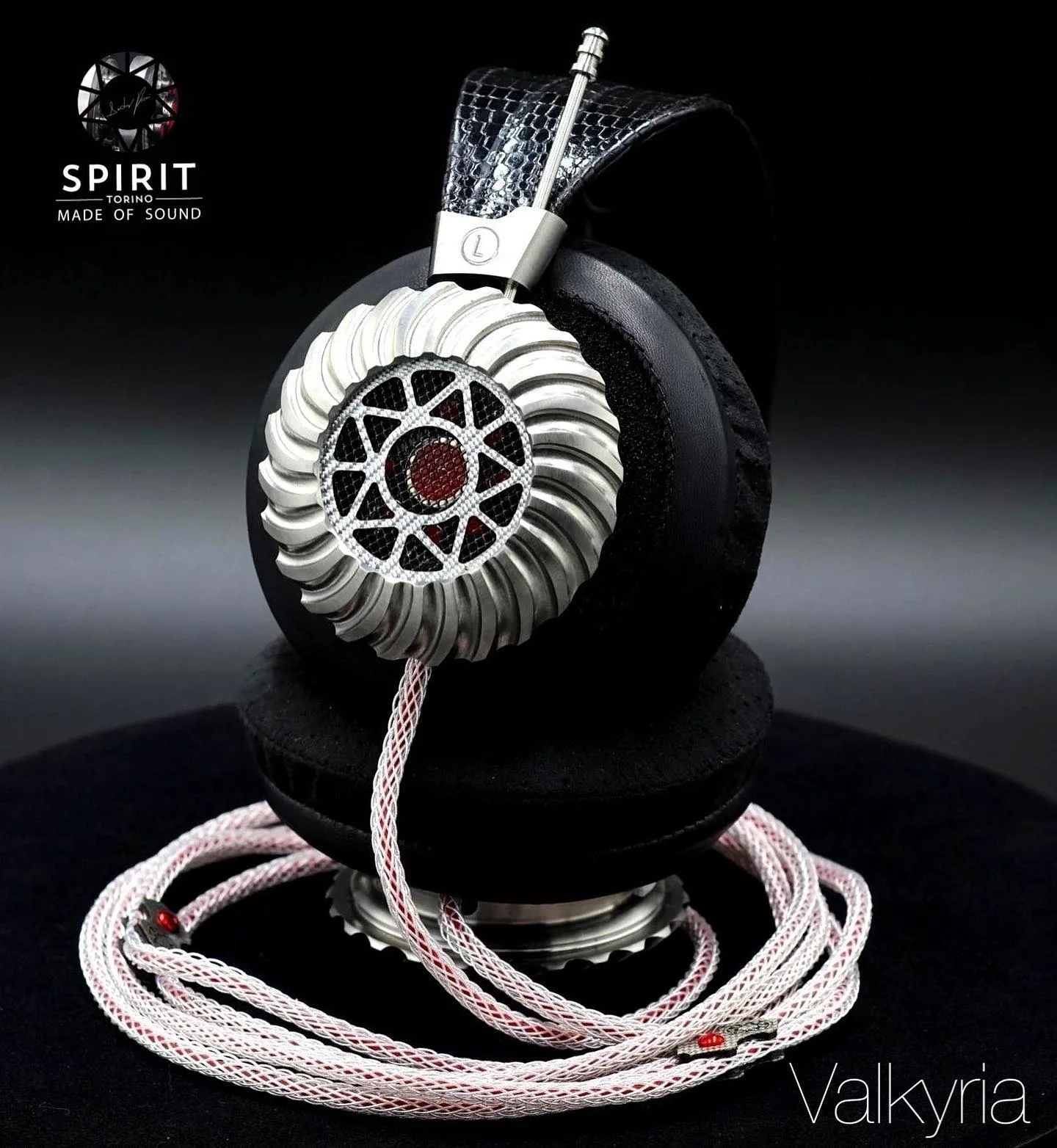
However, you might not be able to guess the model that ranks fourth on the list of most expensive headphones. It is the 12,000 euro Spirit Torino Valkyria, which, unlike other expensive headphones, is a very conventional (although there is nothing conventional about the headphones) headphone implemented with a dynamic driver. How did a relatively unknown small manufacturer end up making such a headphone, and what kind of company is Spirit Torino really?
Like many other small manufacturers, Spirit Torino's founder Andrea Ricci started his business by modifying headphones made by other manufacturers. According to Spirit Torino's website, such experiments began in 2007. The Spirit brand itself had existed since 1995. Under it, equipment racks for hi-fi devices were manufactured and concerts were recorded – a record label named Spirit was also founded. So Andrea did not start manufacturing headphones completely without an audio background.
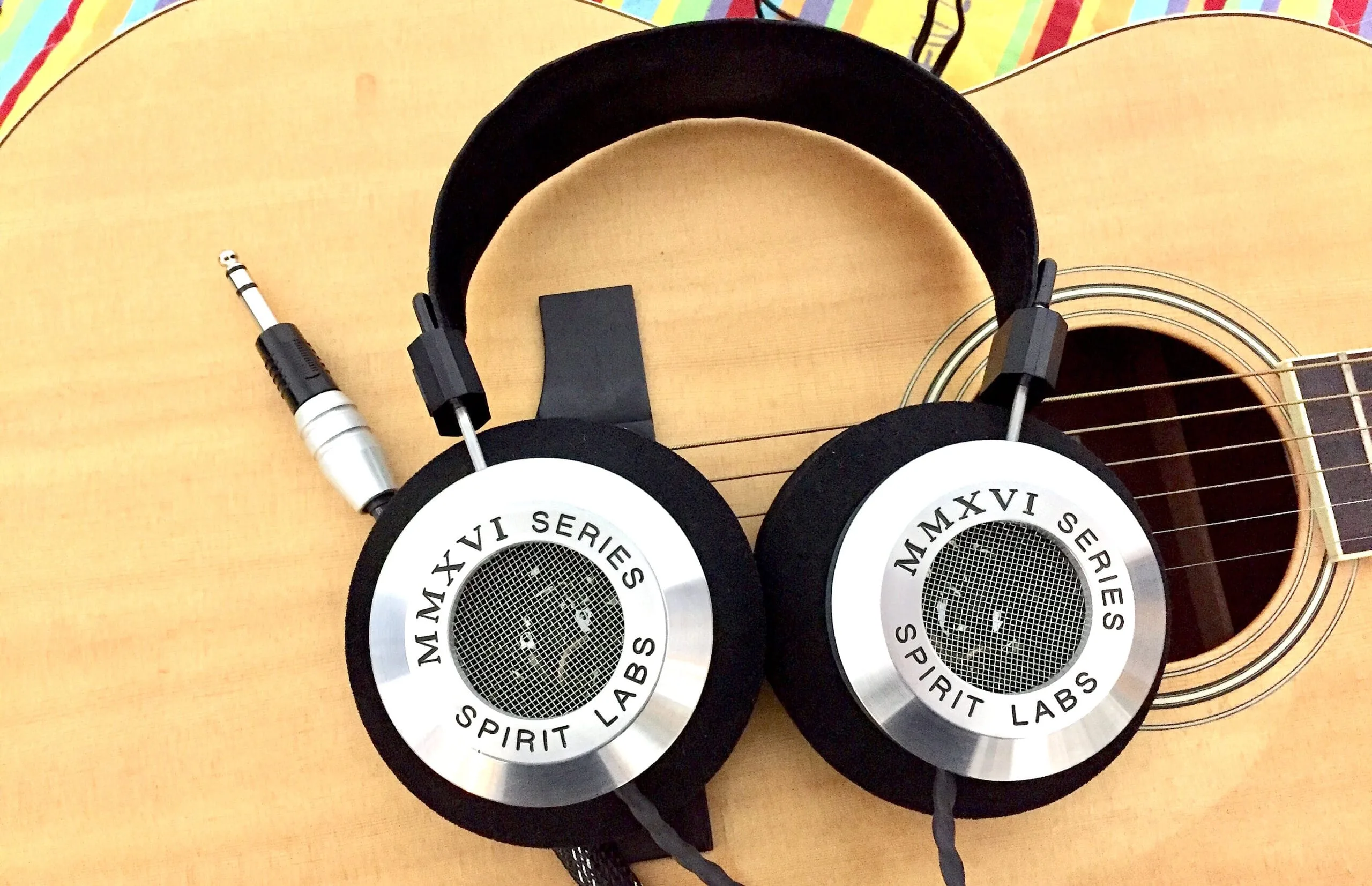
I remember following the creations of Spirit Torino (then Spirit Labs) on Facebook about 10 years ago. At that time, I was also enthusiastic about modifying headphones, so Spirit Labs' openly shared tips and instructions gave new ideas for modifying the sound of headphones. In 2016, Spirit Labs released its first own headphones, which had a rather peculiar name, MMXVI. The headphones featured a Grado SR80e driver, so it was essentially a Grado modification taken to the extreme. The Grado-style design is still clearly visible in Spirit Torino's newer headphones.
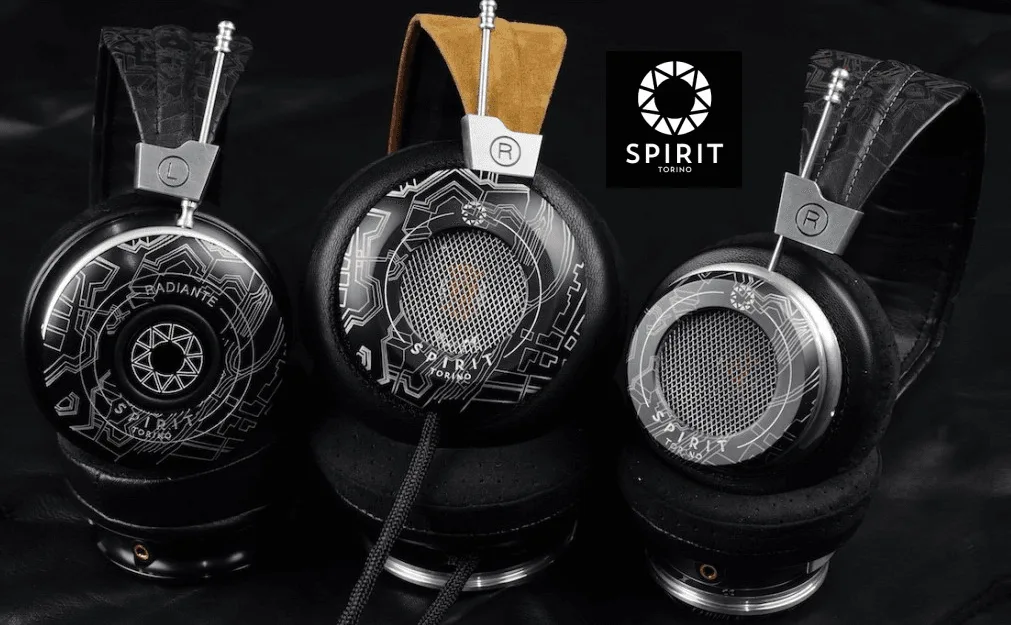
All of the manufacturer's headphones are, in my opinion, really fine and personal. The headphones are made entirely by hand in Italy, and the manufacturing processes are not entirely simple. The manufacturer's Youtube channel there are many videos that accurately describe the manufacturing of the headphones and their technical features. Less surprisingly, Spirit Torino headphones are quite expensive, but after watching the videos, I better understand what the price consists of. Perhaps it could be said that Spirit Torino is a bit like an Italian ZMF.
The manufacturer's headphones are no longer just fancy and expensive Grado copies, because the Twin Pulse models released in 2017 feature a very unique driver solution. Twin Pulse Isobaric System consists of two drivers enclosed one on top of the other. Both drivers are active full-range drivers, and the arrangement is intended to enhance airflow movement. According to the manufacturer, this improves the driver's acceleration and the dynamics experienced when listening to the headphones.
The Radiante model I tested, which costs over 2000 euros new, does not feature this technology, so I cannot say how well it works in practice – at least Spirit Torino does something genuinely different. The manufacturer generally does not settle for conventional solutions anyway, as the headphone pads have adjustable cavities, the magnetic structures of the drivers are special, and some models have a ”lens” in front of the driver that can be adjusted to modify the sound. I think it's great that among headphone manufacturers, there are independent thinkers like Spirit Torino.
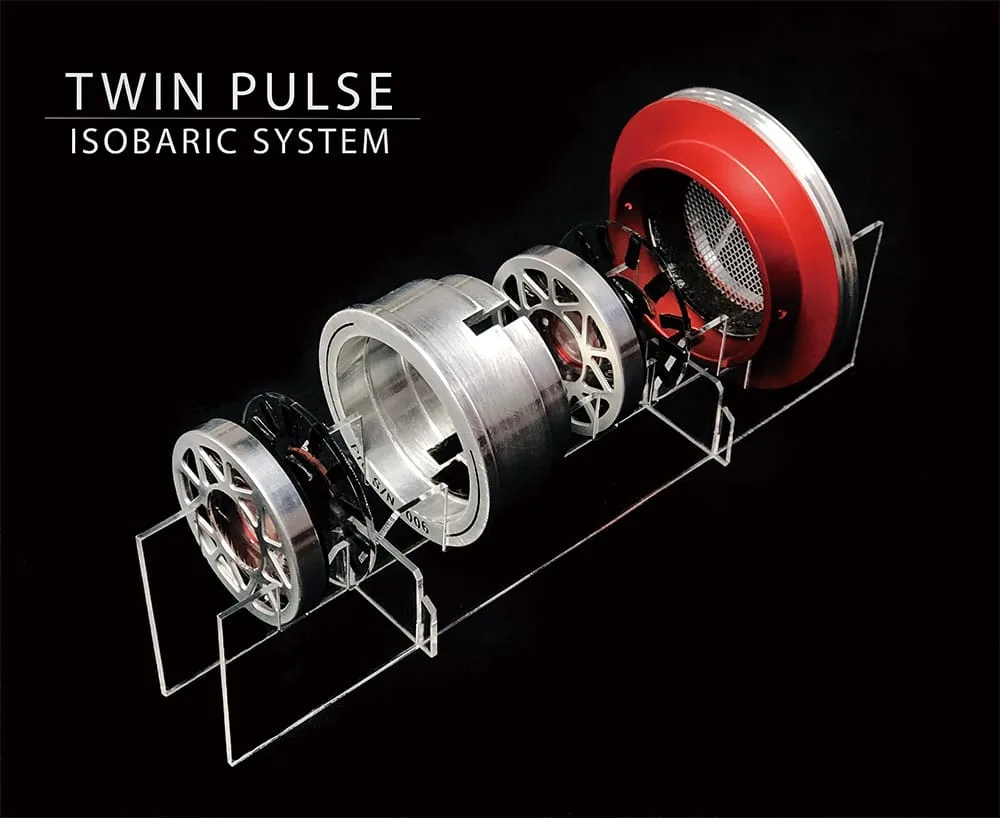
Spirit Torino Radiante: structure and comfort
The cardboard product packaging of the Radiante model is quite nice, but its material does not at all match the high price of the headphones. Only a wooden ornament indicates that this is not the most ordinary product. The headphones also do not come with a carrying case, replacement pads, or an extra cable.
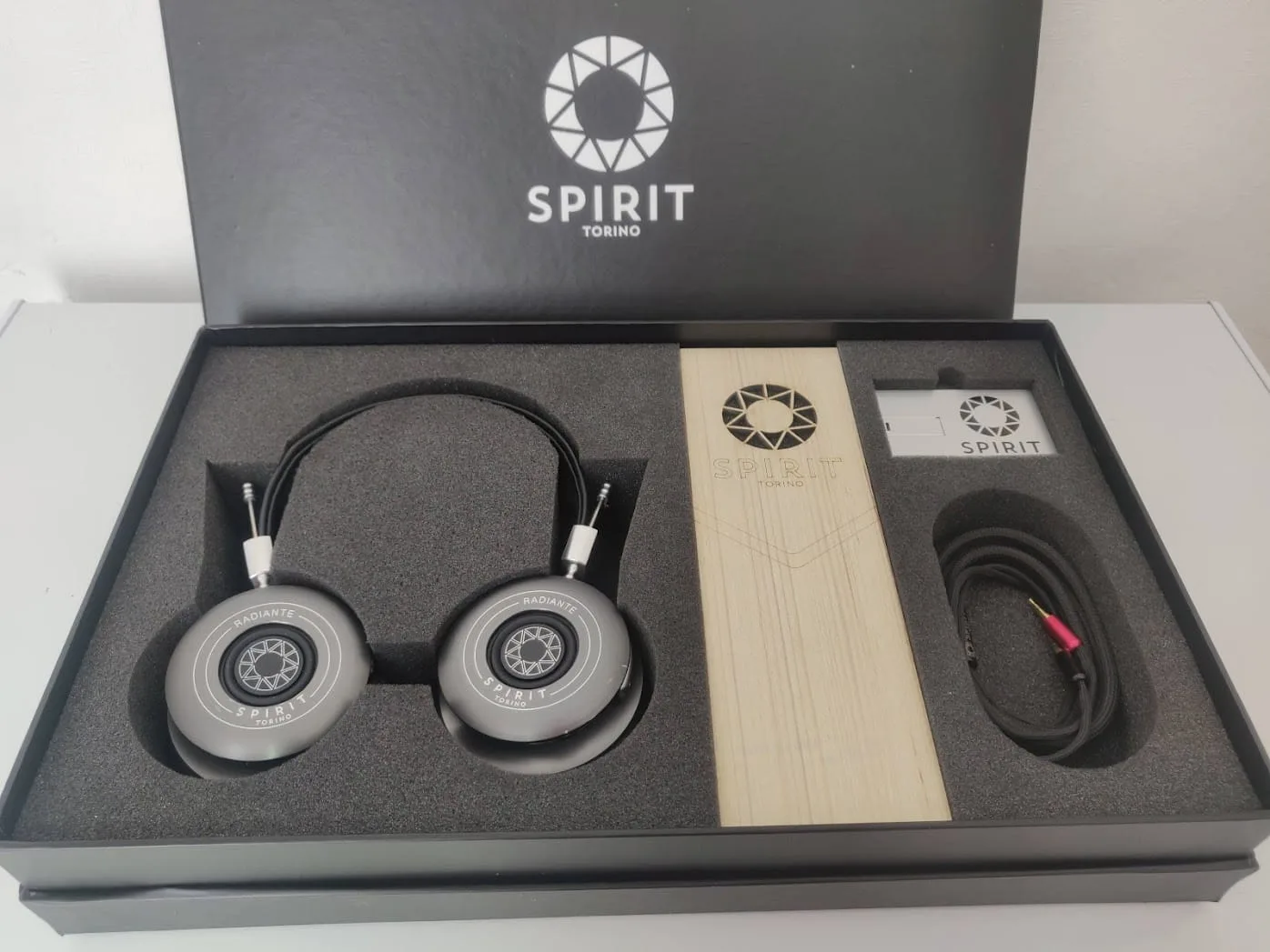
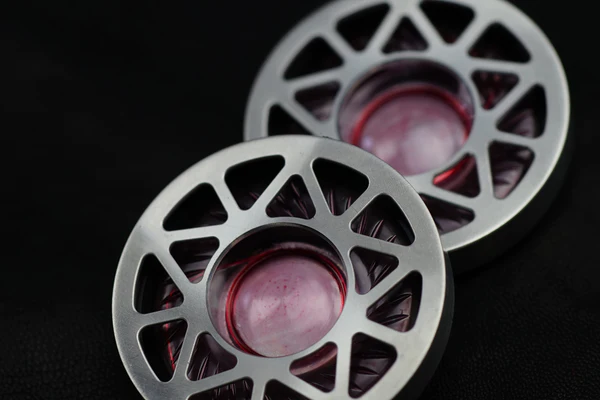
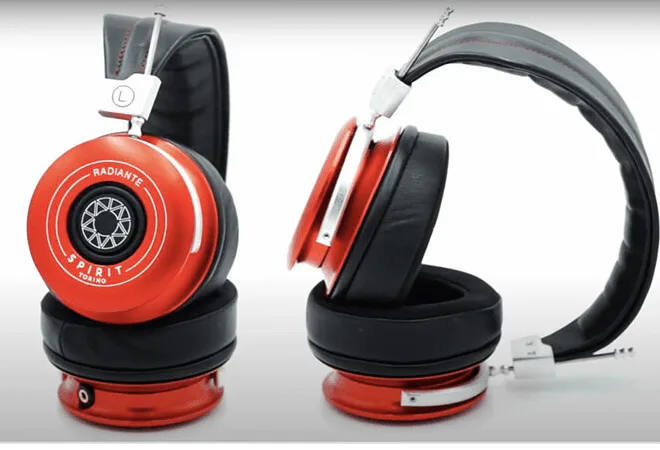
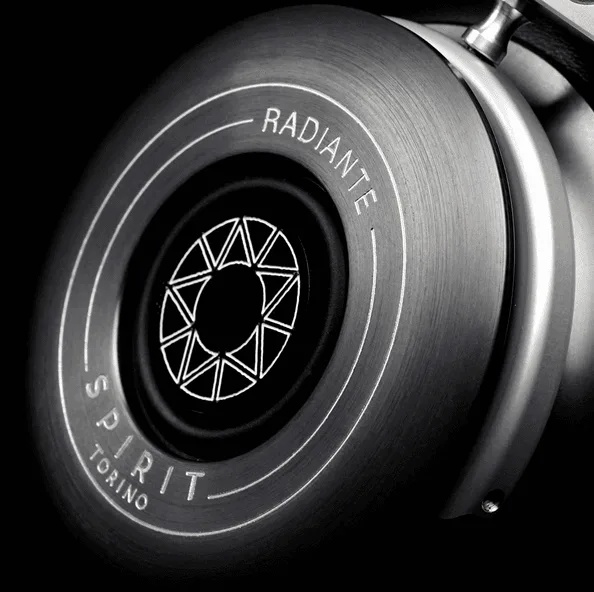
Like other Spirit Torino headphones, the Radiante is built entirely of metal. The headphones are very robust and feel heavier to me, both on the head and in the hands, than the 370 grams stated by the manufacturer. A special feature of the Radiante is a rather neat passive radiator found on the outer edge of the cups. I am a bit concerned about its durability, so it would have been nice to see some kind of mesh as protection, for example.
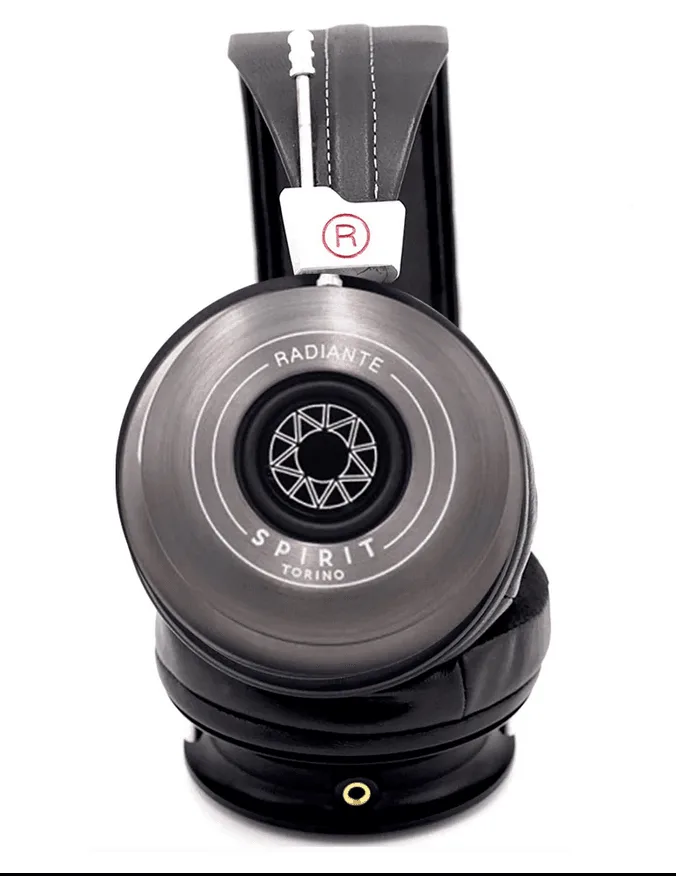
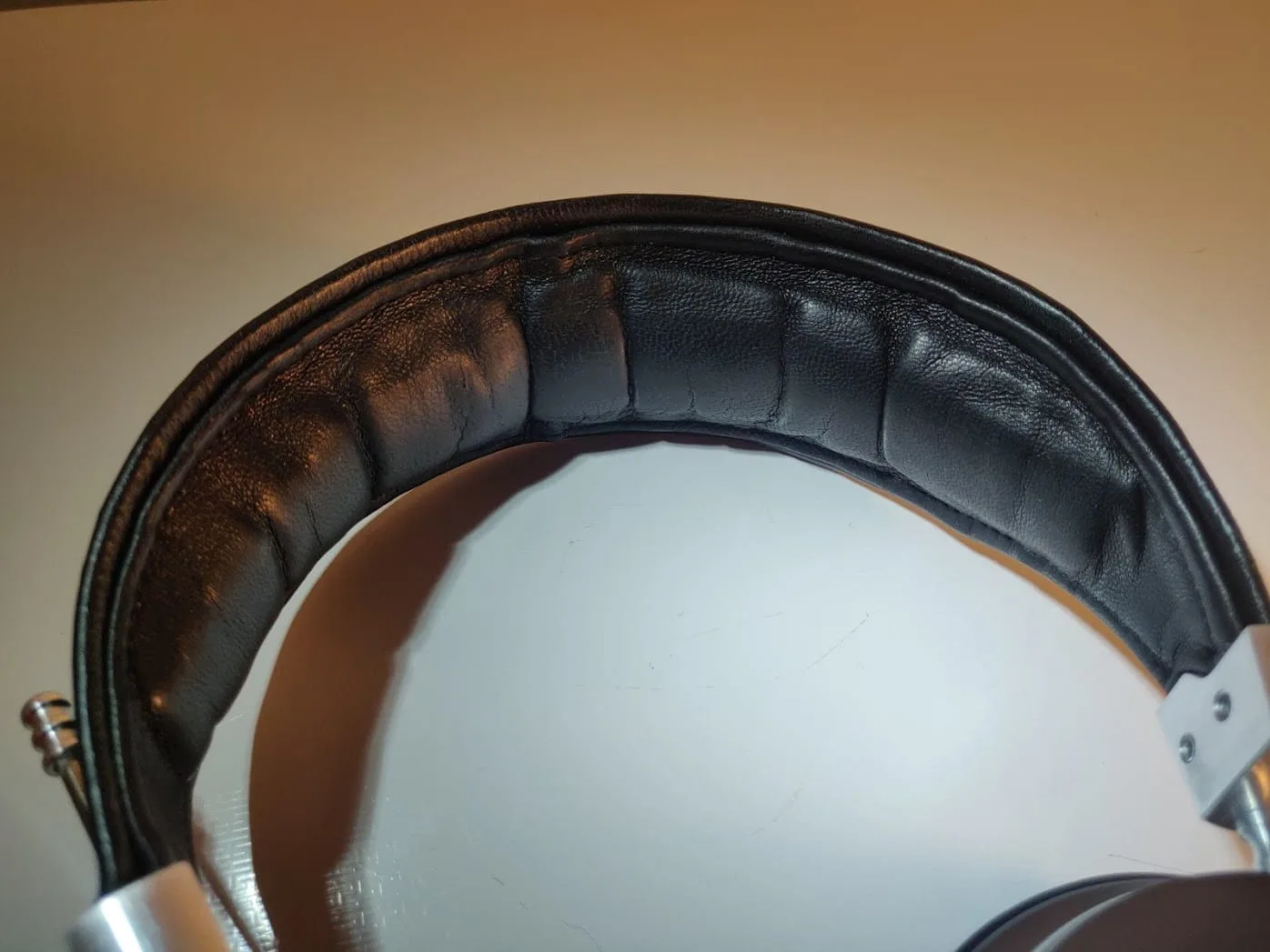
The structure and general usability of the headphones are likely familiar to anyone who has handled Grado headphones. The height is adjusted with a freely moving rod mechanism, which, unlike Grados, also has a screw that allows the rod to be locked in place. This is a very welcome feature, as the cups tend to clatter against each other when rotating freely. However, when locked, the height cannot be adjusted while the headphones are on the head. There would be no problem or need to lock the rods if the rotational movement of the cups had more resistance by default. In this respect, the headband structure still needs refinement.
Pads and sound adjustment:
Although the headphones are not very large, the ear pads have been made quite spacious. The pads also feel very high-quality and comfortable. This is not surprising in itself, as they are manufactured in cooperation with Dekoni Audio with. The edges of the pads are leather and the part against the head is Alcantara. The only downside is that the pads rotate easily, so they always have to be rotated back into place after each use.
In addition to exceptionally high quality, what makes the pads special is the VPS system used in them (Ventilation Pad System). This means a hole in the side wall of the pads, which can also be closed either partially or completely with the included plugs and filters. In some of the manufacturer's headphone models, there are several holes.
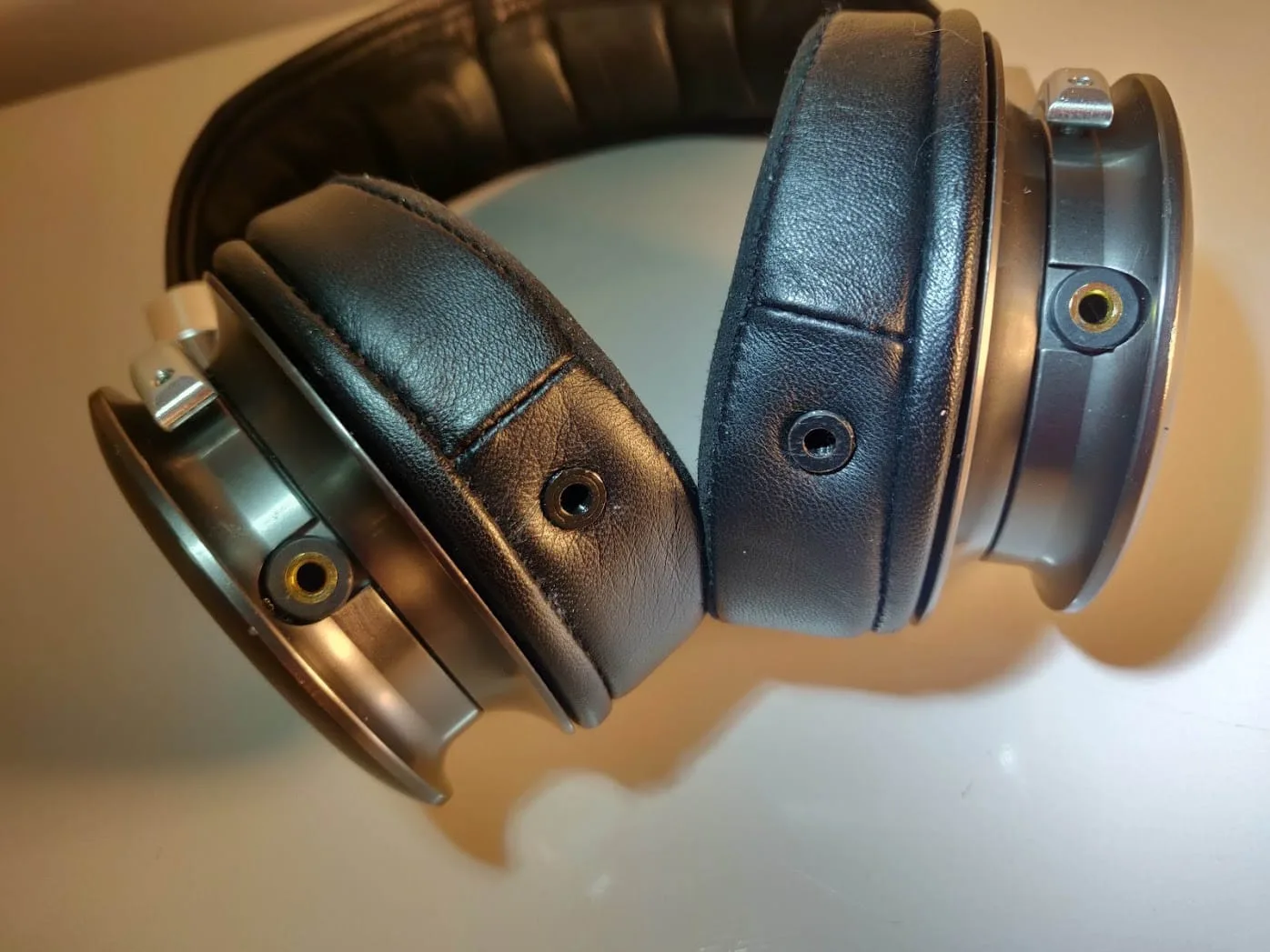
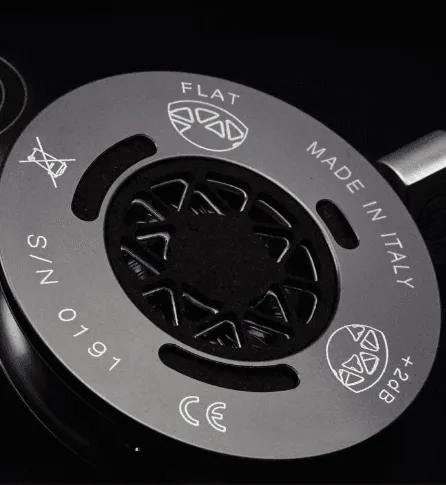
The VPS pads are not the only way for the user to modify the sound of the headphones, as there is a shaped piece of felt in front of the driver, the position of which affects the sound. Unfortunately, in addition to the plugs intended for blocking the holes in the pads, these felts were also missing from the headphones I bought used. According to the manufacturer, however, the sound of the headphones is most neutral without the felts, so no major damage occurred.
Cable:
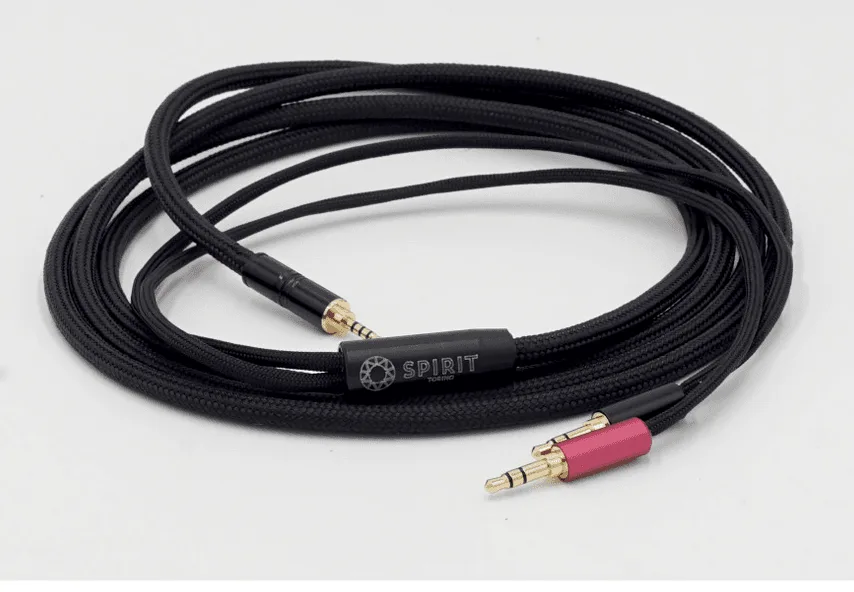
The Radiante cable attaches with two 3.5 mm connectors and its length is 1.3 or 2.2 meters depending on the selected connector type. Available connectors are 3.5 mm, 4.4 mm, and 2.5 mm, as well as 4-pin-XLR. The cables are manufactured for Spirit Torino by the Italian cable manufacturer Portento Audio, so one would expect them to be first-class, being made by a professional. Unfortunately, at least mine is quite stiff, slightly microphonic, and too mundane-looking for otherwise exceptionally striking headphones. Although the Radiante is a well-built and exceptionally customizable headphone, its cable and overall usability could still be improved slightly.
Sound quality
Equipment used:
- DAP: Shanling M6 Pro / Astell & Kern SR15
- DAC: Schiit Audio Yggdrasill A1
- Headphone amplifier: SPL Phonitor 2
- Headphone cables: Standard cable and the manufacturer's own 235 euro 4.4 mm connector upgrade cable
Radiante frequency response:
Bass:
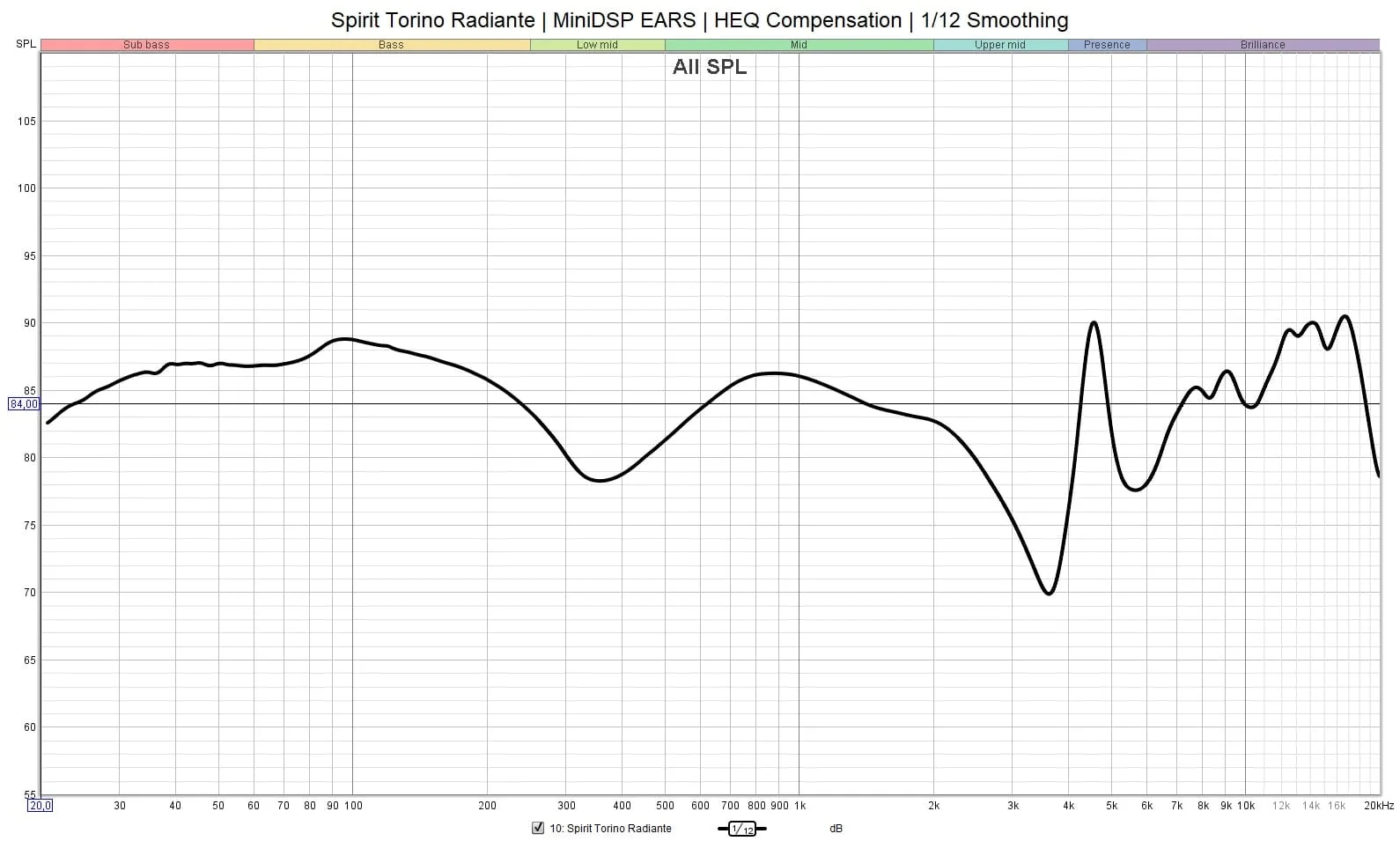
The bass reproduction of the headphones is very emphasized. The bass intensity is further increased by the lower midrange, which reproduces almost 10 decibels quieter than usual. The solution is at least successful in the sense that the bass does not bleed into the mid-frequencies.
Radiante's bass hits really hard and feels physical. I don't remember listening to headphones in a long time that would inspire me to feel the sheer thump of the bass in the same way. Despite the large amount of bass, the accuracy of the low frequencies remains excellent regardless of the material being reproduced. In my measurements, there is a slight deficiency at the very lowest bass frequencies, but it has little significance when listening. Radiante deserves special mention for its bass reproduction maintaining its impact even at very low volumes – perhaps the headphones' passive element is not just a decoration after all. Radiante is an amazing experience in terms of bass.
Mid-range:
Readers who understand frequency responses can probably already guess that there isn't much to praise in Radiante's mid-range. The severely dipped lower midrange makes the reproduction rootless and thin. Ultimately, however, this bothers surprisingly little, because when listening to the headphones, the main attention tends to be drawn to the excellent bass reproduction. In addition, the calm 2–4 kHz reproduction pleasantly softens the sound (in my measurements, this frequency range also contains errors, but a small dip is also noticeable in reality).
In my opinion, a frequency response like Radiante's could be considered quite acceptable in affordable headphones that primarily aim for fun and personalized reproduction. However, in headphones this expensive, the tuning is quite questionable. I could live with the deficient lower midrange if I only used the headphones occasionally and solely for listening to bass-heavy music. Generally, however, I cannot tolerate the strong emphasis around 5 kHz, which adds a lot of sibilance to the singer's voice. On some recordings, the problem is not very serious, but sometimes it makes the headphones almost unlistenable. The hiss is so ridiculously strong that the vocalist sometimes sounds more like a snake than a human.
Treble:
Radiante's treble reproduction depends heavily on the music being listened to. Sometimes the treble sounds quite balanced, airy, and resolving. Sometimes, however, the treble is harsh. This is not fully evident from my frequency response measurements, but in my opinion, Radiante is slightly bright in sound. Because of this, brighter recordings sound unpleasant, which is a shame, as I have no complaints about the quality of the headphones' upper frequencies.
Soundstage, Dynamics and Resolution:
Radiante sounds exceptionally open for a closed-back headphone. In my opinion, the headphones should be considered semi-open, similar to, for example, Fostex's ”closed” headphones. Radiante or Fostex offer little isolation from external sounds, and they strongly leak sound outwards.
The soundstage in Radiante is reasonably sized, but not particularly large. Sounds are precisely placed in the sound field, but the peculiar shape of the soundstage causes problems. It often feels to me as if there is an empty area at the edges of the soundstage, where no sound seems to reflect. Thus, the headphones' sound plays either in front or directly to the side, because the area located diagonally forward remains too empty.
The macro dynamics of the headphones, on the other hand, are very impressive – the sound has power and explosiveness. This is welcome, as a truly recessed lower midrange would likely make the sound lifeless and delicate if the situation were not compensated by good dynamics and a relatively relaxed 2–4 kHz reproduction. In my opinion, Radiante sounds better overall than its peculiar frequency response would suggest.
The transparency of reproduction and the resolution of individual sounds are quite good. There is a slight veil in the sound, but the high-quality (though occasionally overemphasized) treble nicely balances the overall presentation. Radiante's performance is surprisingly good in all respects, considering that the headphones are actually a very expensive ”basshead model,” which in terms of its frequency response, mostly compares to affordable Bluetooth headphones.
Need for an amplifier
Radiante, as a 32-ohm headphone, plays well from almost any audio source. I primarily listened to the headphones with Astell & Kern SR15 and Shanling M6 Pro mobile players. Both players were powerful enough even from unbalanced outputs. Spirit Torino does not state a sensitivity rating for the headphones, but I would assume it to be at least 100 dB/mW.
Because the headphones have low impedance, they should not be paired with amplifiers that have high output impedance. These include many tube amplifiers (especially OTL-based devices) and many older amplifiers designed for speakers that have a low-quality headphone output on their front panel. Using low-impedance dynamic headphones with a high output impedance amplifier usually leads to overemphasized bass reproduction. In some cases, the result may, of course, sound pleasant. However, as a general rule, the amplifier's output impedance should be at most 1/8 of the headphones' impedance to avoid changes in the frequency response.
Comparison to other headphone models
Spirit Torino Radiante vs. Fostex TH900
Prices: 2100 € vs. 1500 €
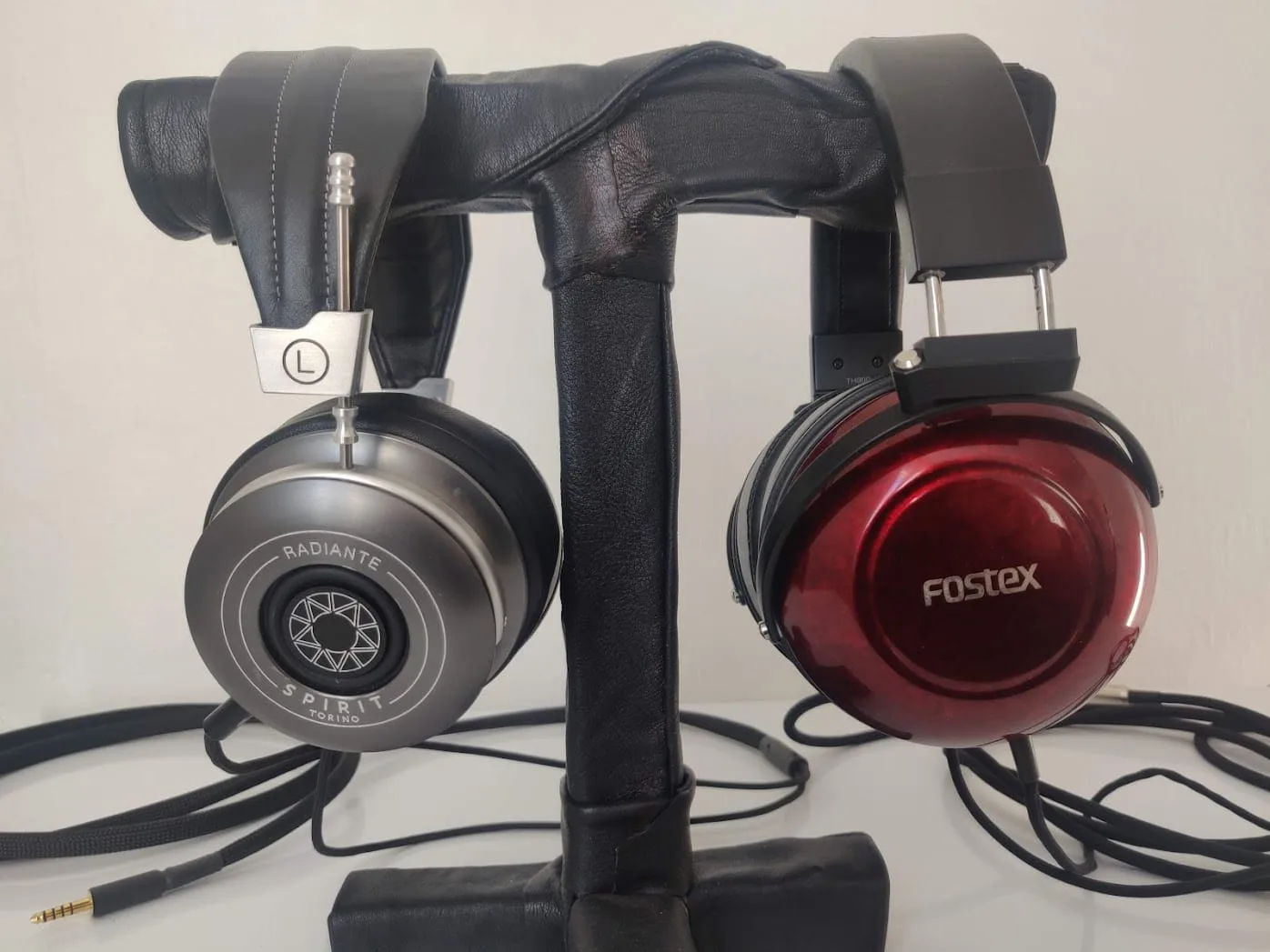
Fostex's TH900 model can be considered a kind of standard for powerful but high-quality bass. A more detailed review of the headphones can be found here.
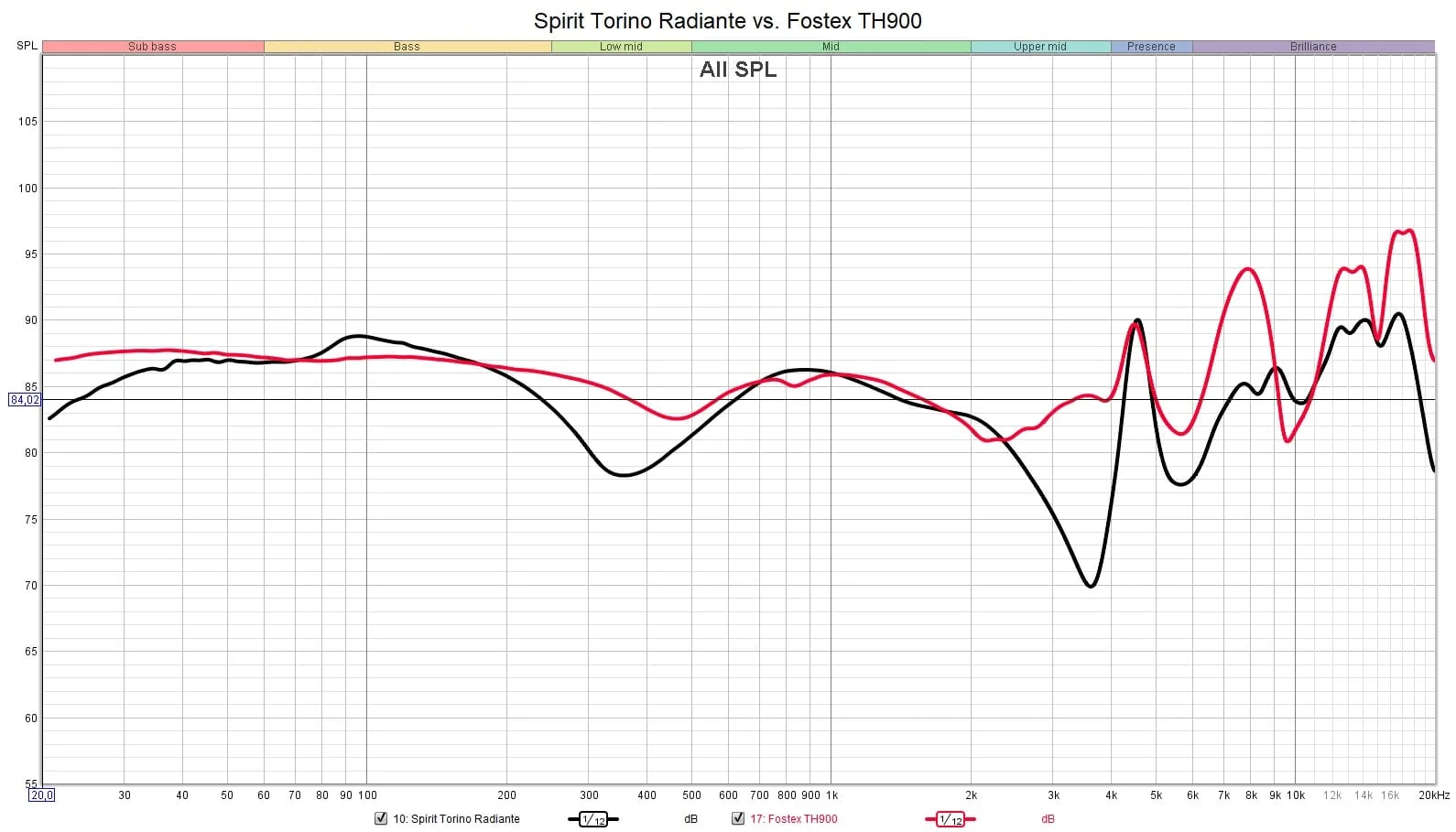
Frequency responses: Radiante (black) and TH900 (red)
Bass:
Radiante's bass is more powerful than the TH900's. This is also visible when comparing frequency responses, considering how much more deficient Radiante's lower midrange reproduction is. What makes the situation peculiar is that when listening to the headphones louder, the perceived bass intensity increases significantly with the Fostex, but not at all with the Radiante. When listening at moderate volume, Radiante's bass is punchier and feels more physical, but the headphones cannot offer the same kind of extreme rumble as the TH900 when listened to loudly. In terms of bass quality (speed, control retention, lack of muddiness), both headphones are excellent, although I lean slightly towards the Radiante. However, the differences in quality remain quite small.
Mid-range:
Although there is much in common in the midrange of Radiante and TH900, the headphones ultimately differ quite a lot. The TH900 is clearly clearer in its upper midrange, while Radiante's reproduction has a hint of softness, which unfortunately makes the overall sound a bit blurrier. Both headphones exhibit aggressive sibilance. Midrange reproduction is not a strength of either headphone model, so each listener's preferences strongly influence which one can be called better.
Treble:
Regarding the treble, both headphones are problematic. The Fostex model is too bright and sharp in its overall sound, and Radiante also sometimes manages to sound just as terrible. The harsh treble significantly affects the headphones' tonal balance and the volume at which listening is even possible. If both models had a more balanced treble, it would be possible to listen to them louder while enjoying even more immense bass rumble.
Soundstage, dynamics, and resolution:
The TH900 has a larger soundstage, while Radiante's soundstage is oddly shaped, as I described earlier. However, the depth of the center image is slightly better in Radiante. But since there remains empty space to the front right and front left in the headphones, I would describe the soundstage as being shaped like an inverted V, instead of a more natural-sounding semicircle.
In terms of dynamics, Radiante makes a greater impression than the TH900. This is saying a lot, as the TH900 is quite excellent in its macrodynamics. Radiante still sounds punchier.
Radiante's resolution is also a notch better, which is impressive given that its upper midrange is more subdued than the TH900's. Despite Radiante's warmer sound, the music holds together better, meaning less information is lost, especially during the most hectic parts of tracks.
Concluding remarks:
Radiante is a good option for bass lovers who desire a slightly softer reproduction than the TH900. Depending on preferences, however, the softness I mentioned might make the headphones sound a bit veiled compared to the clear Fostex model. Radiante's resolution is a notch better, while its peculiar soundstage lowers its score compared to the TH900.
If my listening were exclusively at low volume, I would choose Radiante. However, at a more normal volume, the choice becomes more difficult. At high volume, neither can be listened to due to the flawed treble. In this regard, the TH900 is even worse than Radiante.
The ultimate superiority between the two largely depends on what aspects of sound reproduction are prioritized. If other factors also influence the choice, the TH900's comfort is better. Since there is also a price difference of about 600 euros between the headphones, the TH900 offers better value for money.
Spirit Torino Radiante vs. Focal Stellia
Prices: 2100 € vs. 3000 €
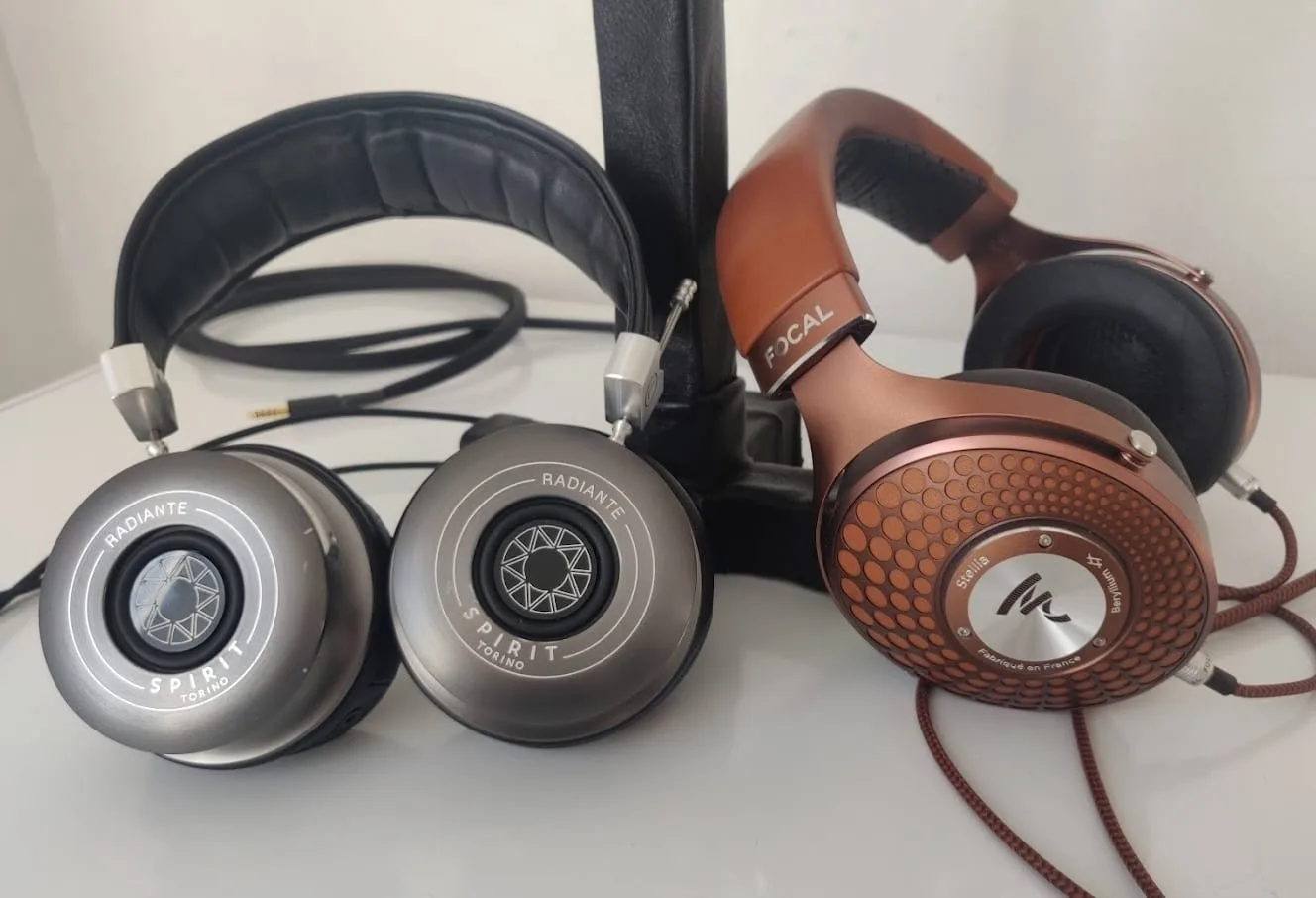
Focal Stellia is one of the best closed-back headphones I've heard, even though I'm not entirely satisfied with its frequency response. A more comprehensive review of the Stellia can be found here.
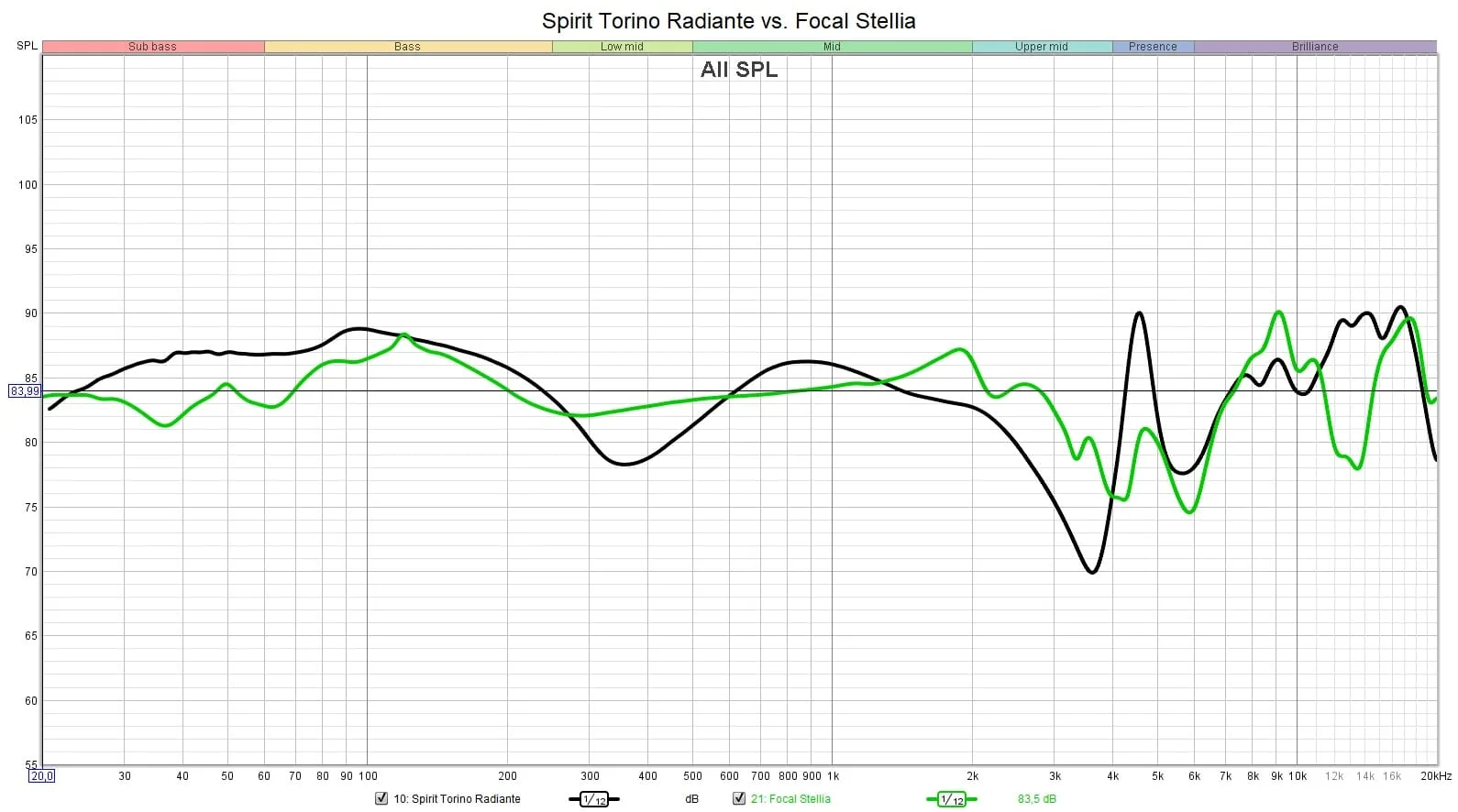
Frequency responses: Radiante (black) and Stellia (green):
Bass:
While the Stellia's bass reproduction has abundance and power, the Radiante's bass intensity is in a completely different league. Despite its slight emphasis, the Stellia's bass remains quite conventional in style, and it certainly won't deter those accustomed to headphones with less bass.
It's difficult to assess the bass quality between the two, as generally, less bass automatically sounds higher quality. Considering this, the Radiante's more powerful presentation is more convincing. Its bass doesn't sound muddier, slower, or boomier, even though the bass intensity feels almost like being shot by a cannon compared to the Stellia's polite tap.
Mid-range:
One of the Stellia's biggest weaknesses is the excessive aggressiveness and slight thinness of its mid-range, but the headphones still sound quite powerful compared to the Radiante. Although the Radiante's dynamics compensate for the lack of lower mid-frequencies, the mid-range intensity is still bland next to the Stellia. The reproduction is also not very rhythmic compared to Focal's flowing style. When considering the Radiante's tendency for strong sibilance, I believe the two cannot be properly compared. All music requiring proper mid-range reproduction sounds much better on the Stellia, despite its own weaknesses, than on the Radiante.
Treble:
This brings us to the treble, where the Stellia, as expected, comes out on top. Although the Radiante's treble is excellent in quality (sometimes even better than the Stellia's), there are serious problems with the tonal balance. The headphones sometimes sound too sharp, and the harshness of the 5 kHz emphasis is not limited to sibilance alone. The Stellia does not have such problems.
Soundstage, dynamics and separation:
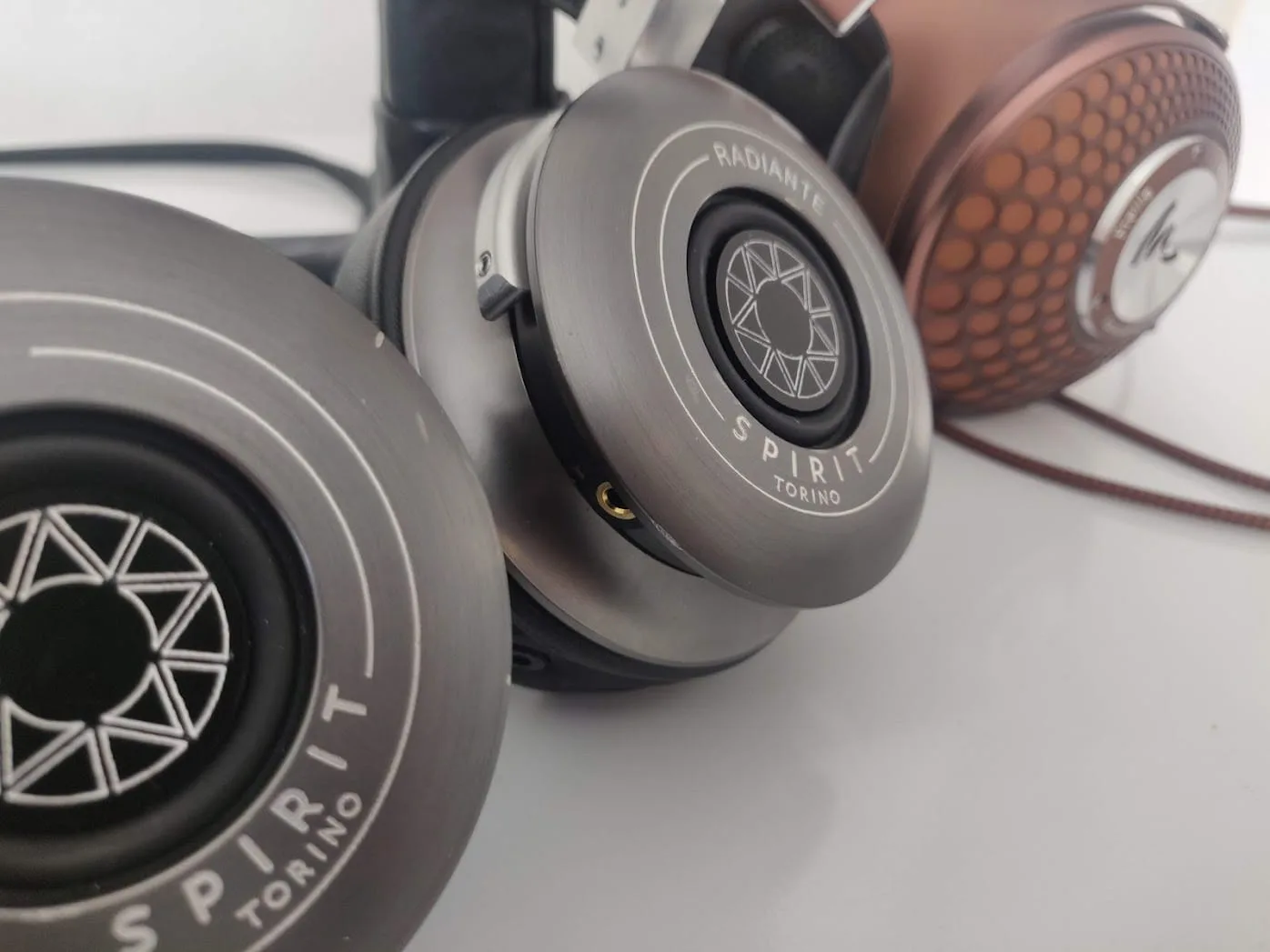
The Achilles' heel of Focal headphones has always been a narrow soundstage. For this reason, even the Radiante, with its normal-sized soundstage, is clearly more impressive. It also sounds more open than the Stellia, which is a remarkable achievement considering how well the Stellia has managed to dampen all internal cup resonances. However, the Stellia is more precise in sound source placement than the Radiante, which struggles with its oddly shaped soundstage. If the Radiante's drivers had been angled more towards the ears, I think it might be able to challenge the Stellia better in this area as well.
The dynamics of both headphones are almost the best I've heard. The Stellia is better at reproducing subtle attenuations and small changes in sound. The Radiante's strength, on the other hand, lies in powerfully reproducing larger variations.
Regarding resolution and tonal transparency, it's almost impossible to compare the two. Except for the treble, the Stellia sounds cleaner, more detailed, and more transparent. This is largely due to the Stellia's frequency response, which seems designed to emphasize these characteristics. The Radiante's frequency response, on the other hand, is designed to emphasize... well, not much else besides bass. However, I believe that even with full EQ, the Radiante wouldn't quite reach the Stellia's level. This is at least hinted at by the fact that the Stellia is significantly better at picking up small cues from sounds, which can be used to deduce whether they are, for example, breaths, thumps, or brushes. The Radiante, on the other hand, dulls things, making them sound more alike. I don't believe such a difference could be corrected by merely changing the frequency response.
Concluding remarks:
In my opinion, the Stellia is quite clearly the better headphone of the two. There is, of course, a price difference between the headphones, but at this point, it feels almost justified. If the only criterion is extremely powerful and high-quality bass reproduction, the Radiante might be a better choice. However, in such a situation, I believe relatively few people would turn their attention to expensive headphones.
Summary
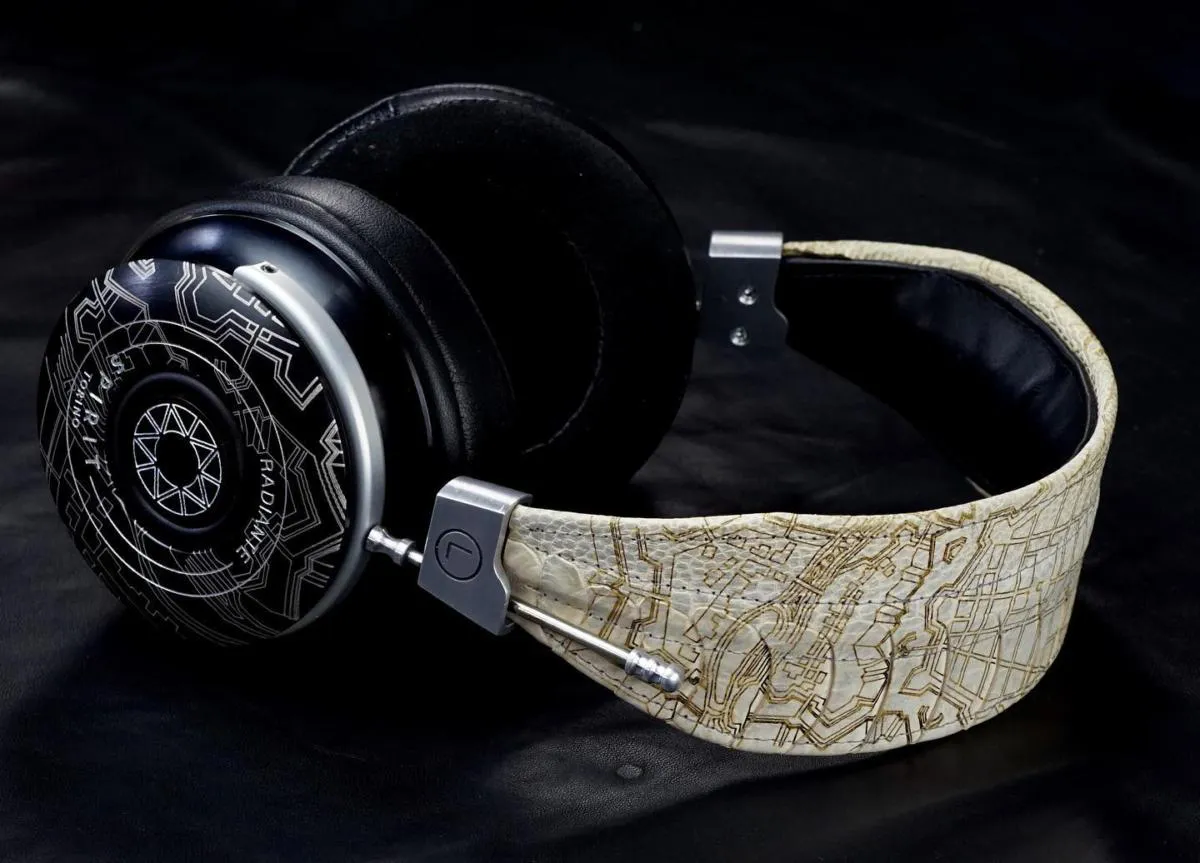
The Spirit Torino Radiante managed to surprise me. I expected the headphones to have a lot of bass, but I didn't realize how high-quality the bass reproduction ultimately was. I also wasn't prepared for the Radiante's resolution and overall technical performance to be more or less at the level its price demands. Instead, I assumed the headphones would primarily be a decorative item, sounding like hundred-euro headphone models. The decorative aspect, however, was true, as the appearance and build quality are, in my opinion, excellent – personalized and high-quality craftsmanship must be appreciated.
Unfortunately, the Radiante also has too many flaws for its high price. Due to its peculiar frequency response, the headphones are only properly suitable for music where bass plays a dominant role. Strong sibilance occasionally makes the Radiante almost unlistenable. It might be possible to make the sound less bright with pads and a felt filter, but based on the manufacturer's information, I tested the headphones in their most neutral form.
In addition to sound quality issues, there is room for improvement in the headphones' comfort. The Radiante sits too loosely on my head, the height adjustment mechanism doesn't work completely smoothly, and the headband doesn't manage to dissipate the headphones' weight well enough.
If you are looking for headphones with powerful and high-quality bass, I could still recommend the Radiante with the aforementioned reservations. If the high price is at most a deterrent for the buyer, the Radiante might even be the world's highest quality ”basshead headphone.” However, those who prefer a more normal sound should look at completely different headphone models.
Pros and cons:
+ High-quality bass reproduction (perhaps the world's best ”Audiophile Basshead” headphones)
+ The sound is detailed despite the abundant bass
+ Functional macrodynamics
+ High-quality construction, appearance, and finish
+ The sound can be modified with VPS pads and the felt on top of the driver
+ Sounds good from any audio source
+/- The headphones are expensive, but considering the amount of craftsmanship, the price is almost justifiable
– Vague frequency response
– Strong sibilance in the midrange
– Disproportionate soundstage
– The headphones feel heavier than their actual weight due to the loose clamping force of the headband
– Poor cable for the price
– No accessories at all
– The packaging does not match the product's price
– A 2-year warranty is standard, but insufficient for such an expensive product
 EN
EN  FI
FI