Author: Sword of Damocles
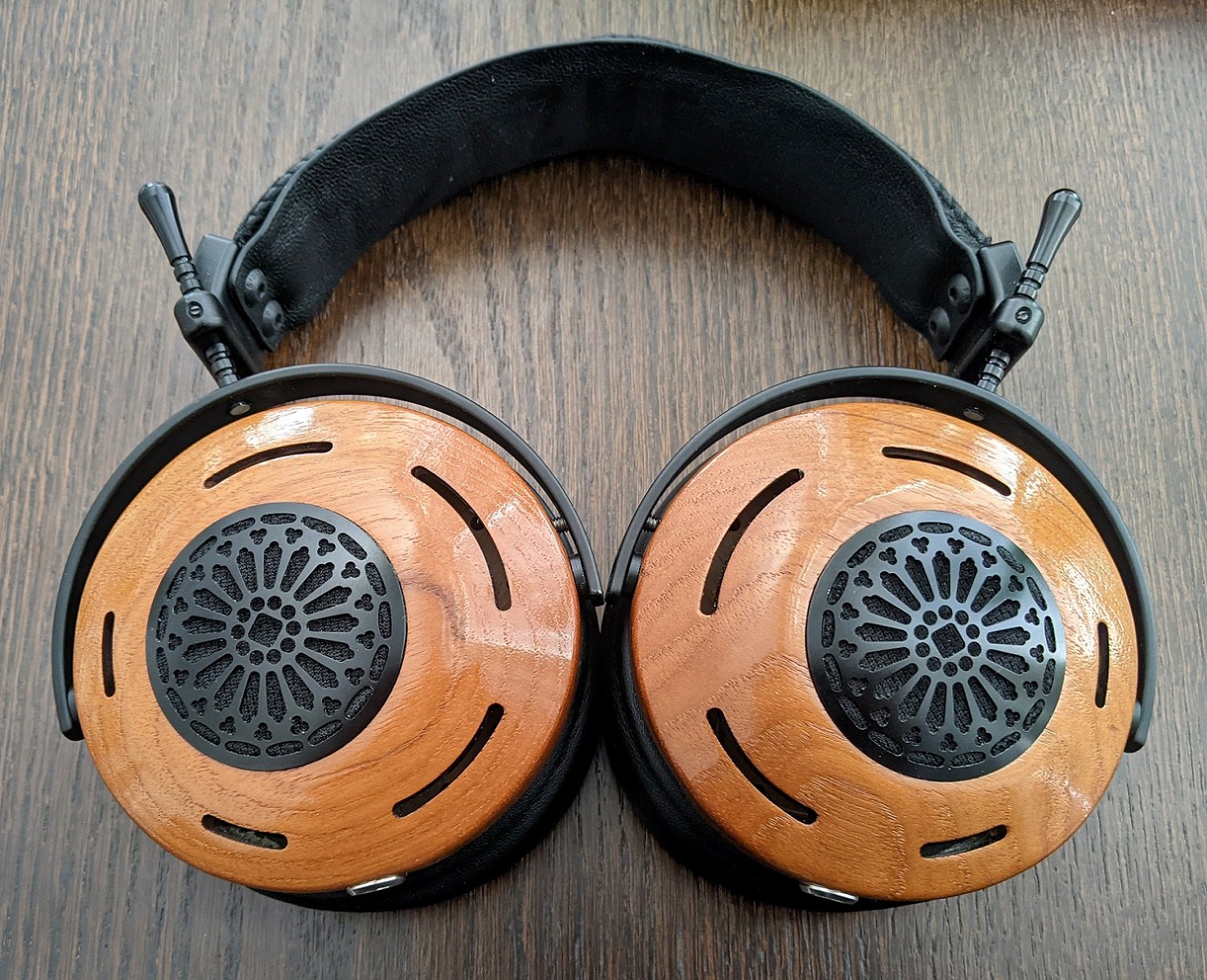
Table of Contents:
Information:
- Release year: 2017
- Country of origin: USA
- Price: starting from ~1800 euros depending on wood type
- Dynamic biocellulose driver
- Impedance: 300 ohm
- Sensitivity: 97 dB/mW
- Weight: 470 g (+-20 g) without cable (my own pair 505 g)
- Included: Seahorse case, 2 pairs of pads (second pair freely selectable) and a cable with a connector of your choice
- Warranty: lifetime driver warranty for the first owner
Review sample: Self-purchased product
Having previously reviewed Atticusand Verite Closed -models, I wanted to hear ZMF's open-back headphone models as well, so I bought both Auteur and Aeolus headphones used. I'll write about the Auteur first, as I've owned it a bit longer.
ZMF utilizes three different dynamic drivers in its headphones: TPE (Atticus/Aeolus), Bio-cellulose (Eikon/Auteur), and PEN+beryllium (Verite Open/Closed). The Auteur and the closed Eikon feature a driver with biocellulose diaphragms, which is also found in many Fostex headphones. However, Fostex's drivers known as Biodyna have low impedance, unlike the drivers used by ZMF, which have an impedance of 300 ohms.
Auteur is currently, with its 1800 euro price tag, the manufacturer's second most expensive model after the Verite models. The headphones were released in 2017 and represent ZMF's vision of neutral and linear reproduction. Many consider the Auteur a kind of ultimate Sennheiser HD600 series headphone, so for this review, I borrowed an HD6XX model, which is acoustically equivalent to the HD650 headphones. Otherwise, in this review, I primarily compare the Auteur to ZMF's own product line.
Structure and comfort
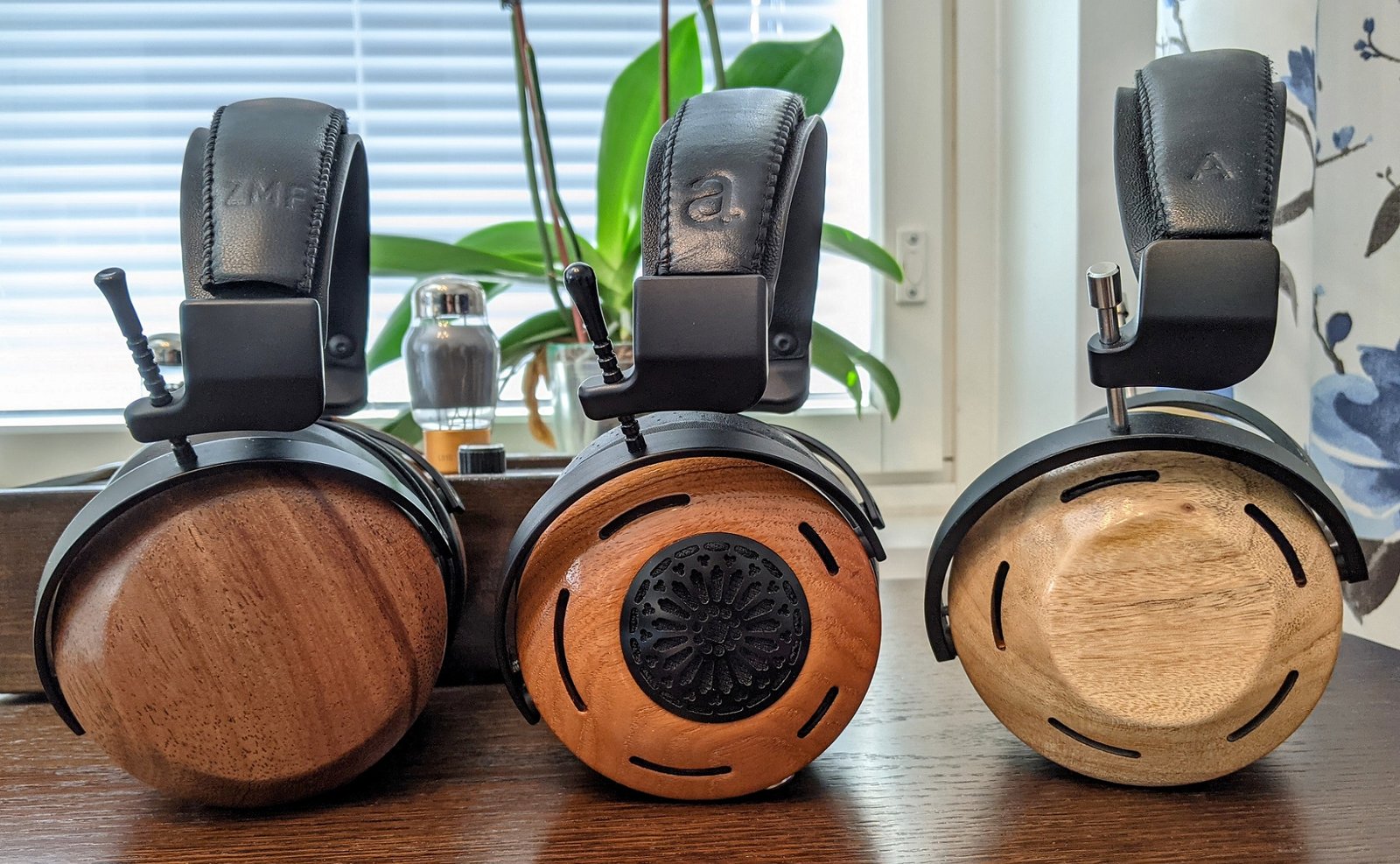
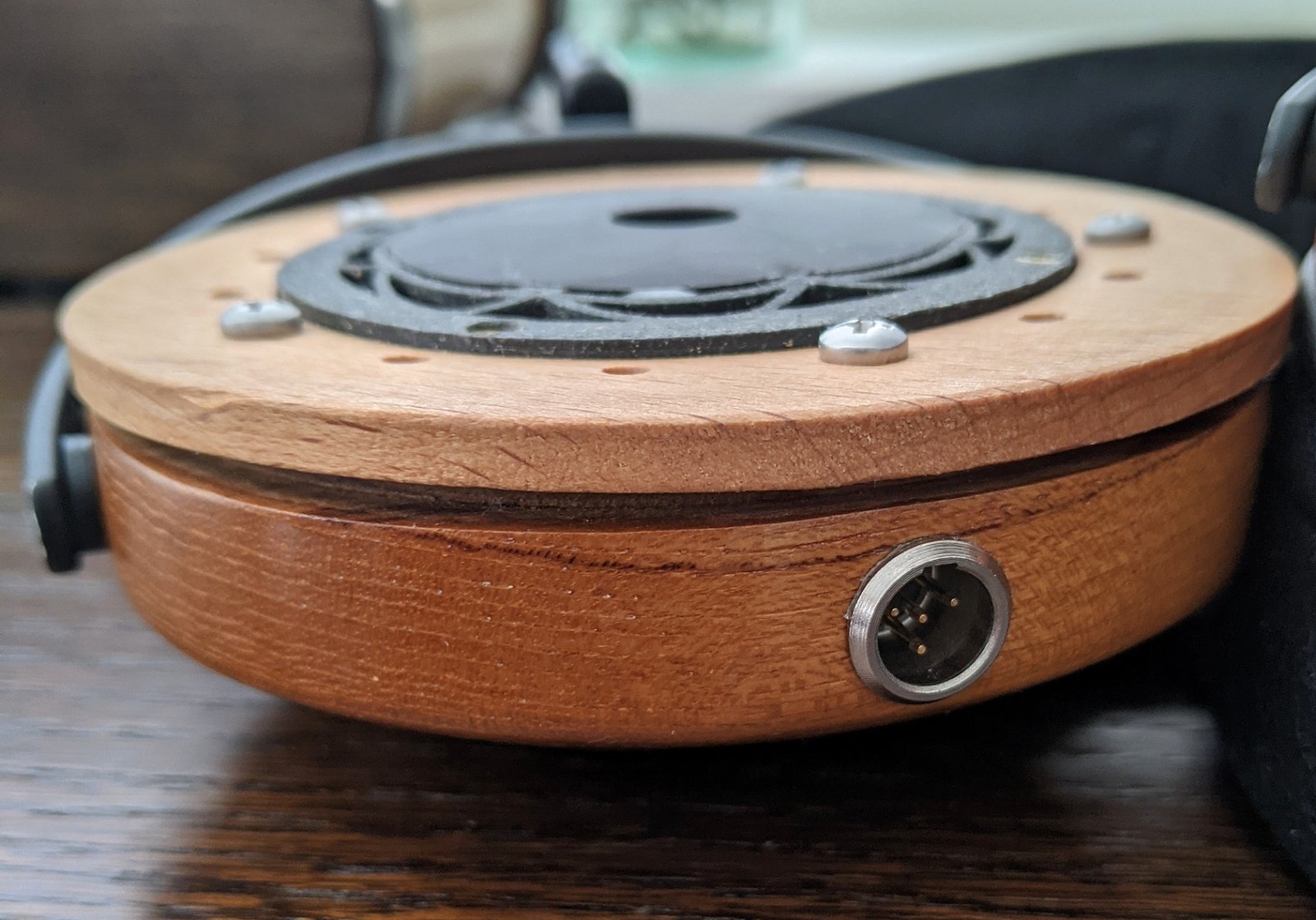
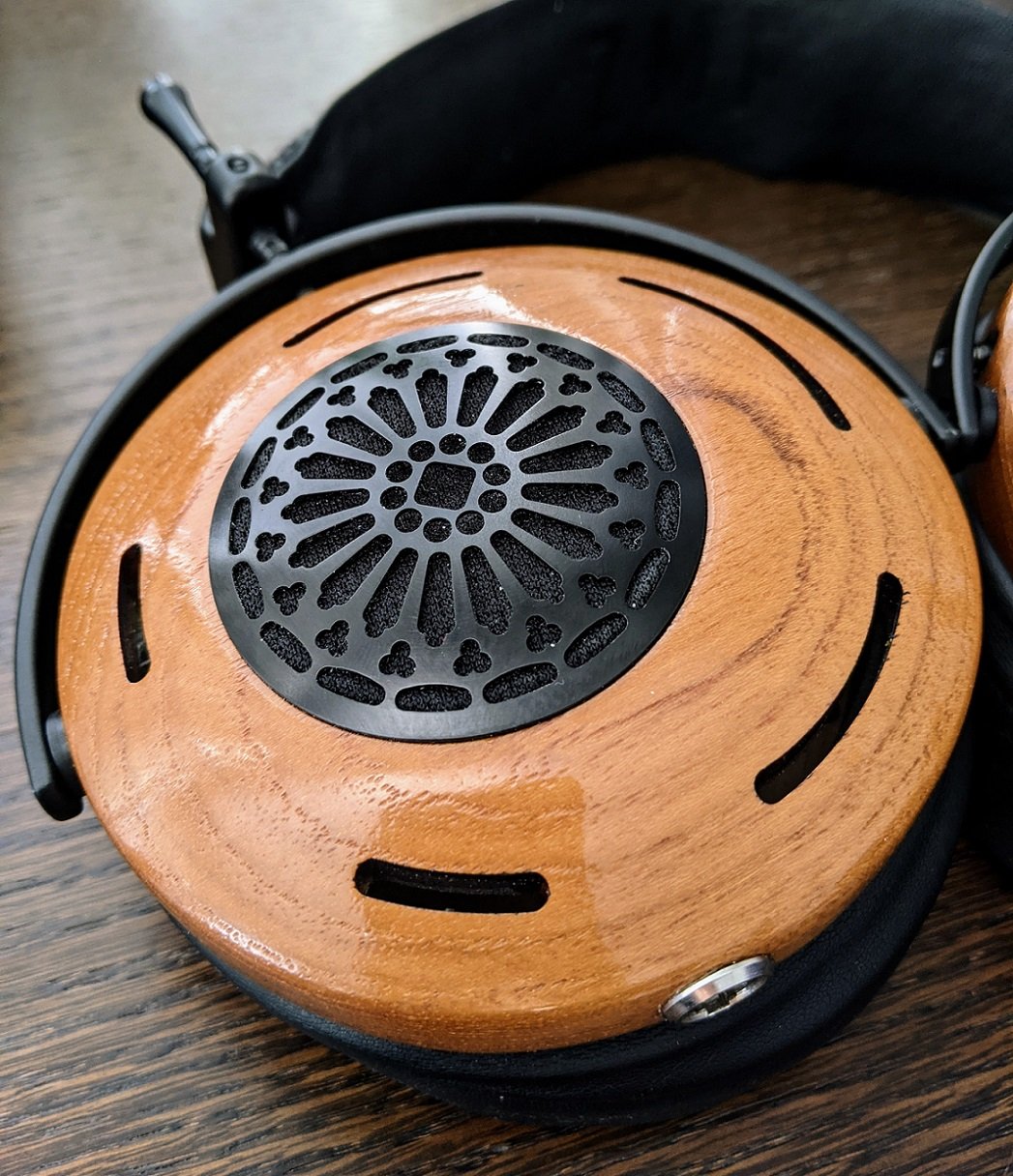
Despite its open-back design, the Auteur is rather a semi-open headphone model, as only a small part of the wooden cup is open. In the center of the cups, there is a round opening covered with fabric and a metal grille, and additionally, the cups have line-shaped slots of various sizes. These slots are completely open, and one can see inside the cups through them. Thanks to its semi-open design, the Auteur isolates ambient sounds slightly and also doesn't leak sound outwards as much as fully open headphones. However, even slightly louder listening would still disturb people nearby.
The headphones I bought used, manufactured in 2018, are made of teak, which in color suits autumn and Halloween well. According to Zach Mehrbach, who designed the Auteur, the headphones' appearance is influenced by French windows, Gothic architecture, and heirloom banjos – in my opinion, these sources of inspiration are even more clearly visible in headphone units whose metal grilles and rods are in colors other than black.
When ordering directly from ZMF, it is possible to choose the color of the headphones' metal parts from several different options. However, it is worth noting that the total weight of the headphones may increase with parts made of heavier metal. In my opinion, the Auteur's appearance is fine and interesting even in a slightly more subdued form.
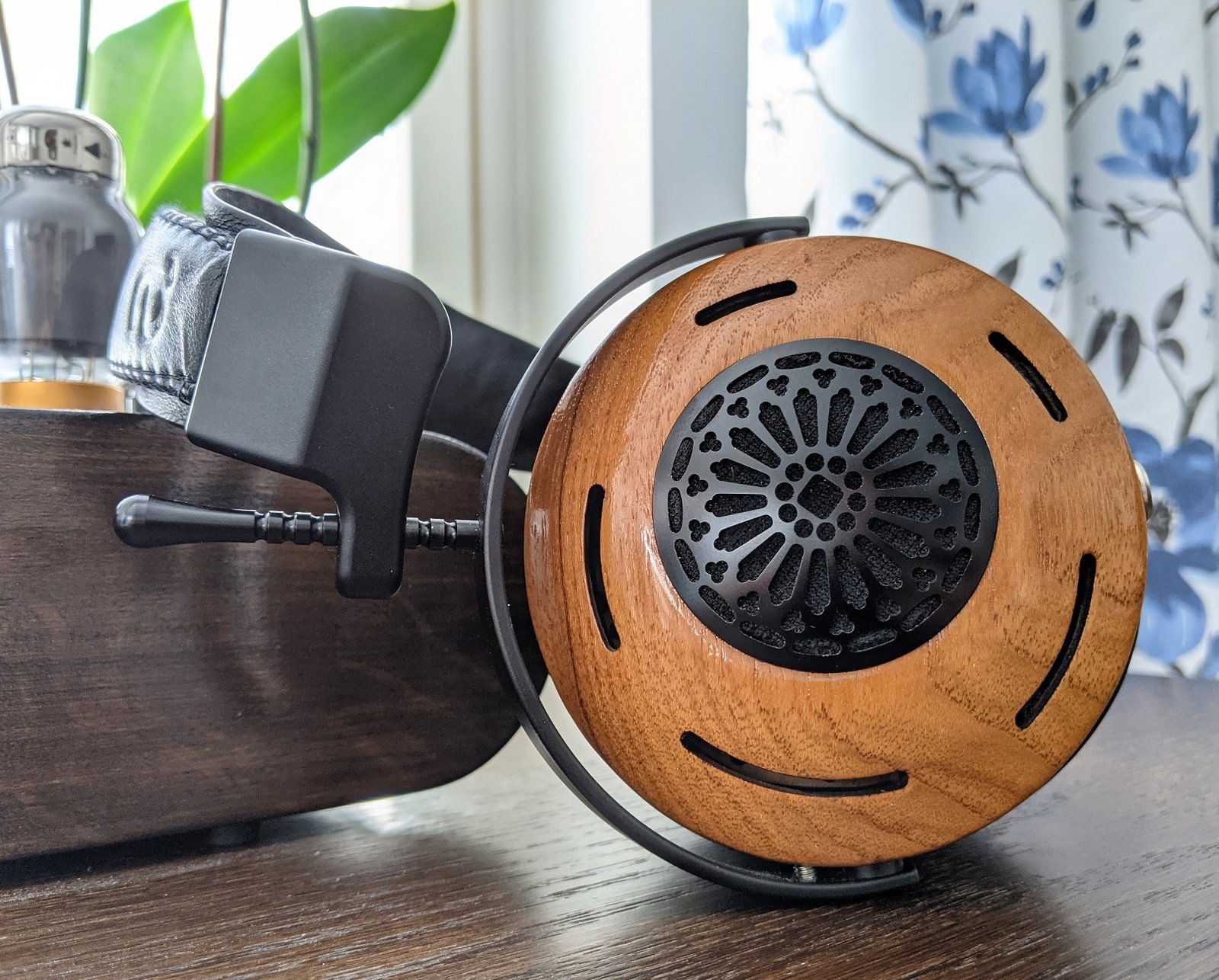
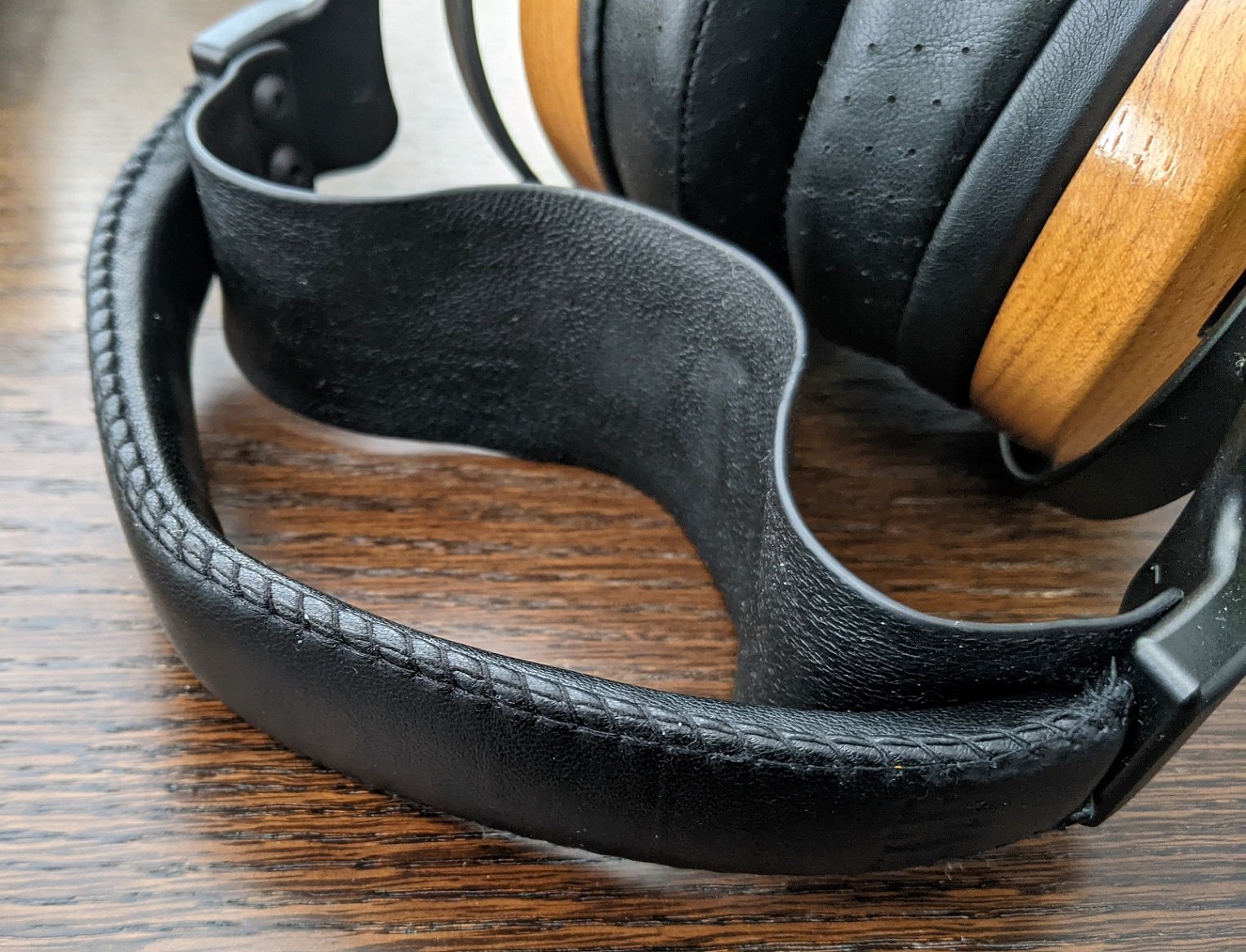
Since its release, the Auteur has used ZMF's newer headband structure, where height adjustment is done with locking rods. All external metal parts of my own headphones are aluminum, and the outer shell of the steel headband and the pad against the top of the head are made of lambskin. Like other ZMF models, the Auteur's leather parts can also be swapped during the ordering process for a more padded, but slightly less premium-looking fabric material.
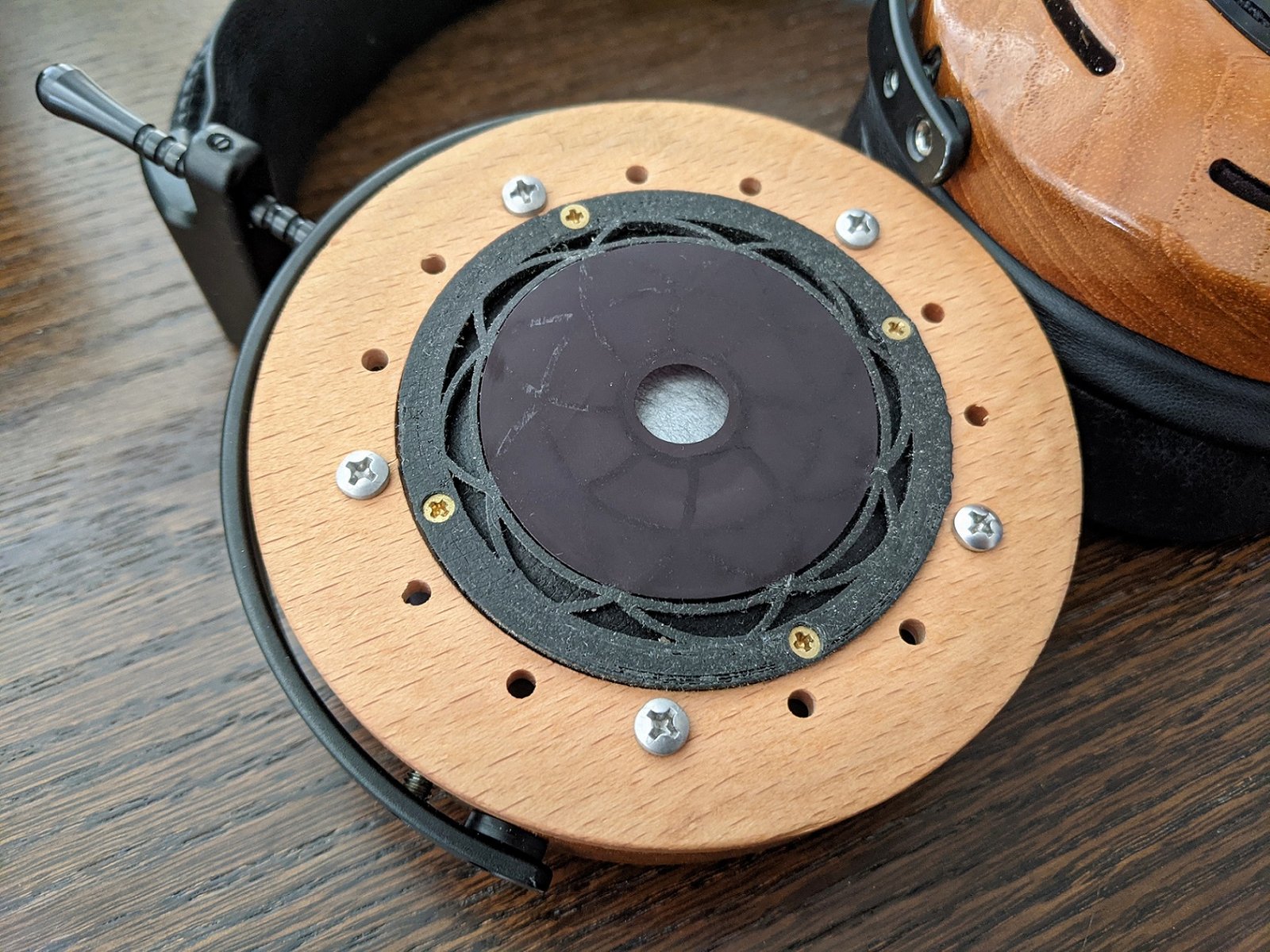
As an interesting detail, the manufacturer uses a kind of metallic pop filter in its open-back headphones, which limits the amount of high frequencies. The filter is attached between the driver and the ear by gluing it to a 3D-printed structure. This structure has been fine-tuned in recent years, so the filter may look slightly different in newer headphones.
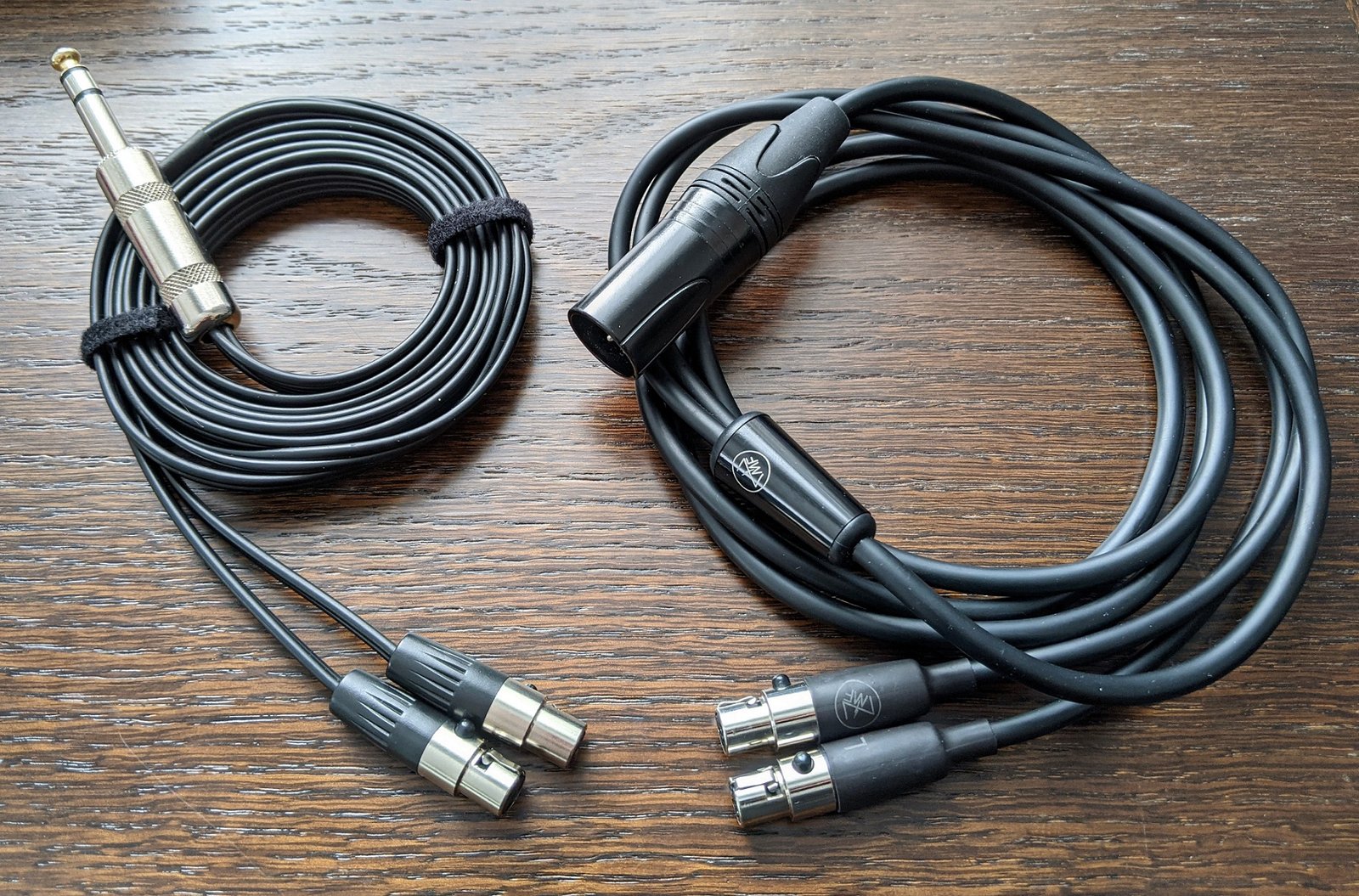
The Auteur previously came with ZMF's flat basic cable, but nowadays the buyer receives a higher-quality looking fabric-covered cable. The original owner of my headphones had chosen a 6.35 mm connector for the basic cable – he had also separately purchased a ZMF-branded balanced OFC upgrade cable, which the manufacturer sells for about 100 euros. The cables are delivered in a red fabric pouch, which also contains suitable hex keys for tightening the headphone bolts (or if the user wants to disassemble the headphones for maintenance).
My teak headphones weigh 505 grams (the type of wood affects the total weight), so the open-back design has not achieved a lighter weight compared to the manufacturer's similarly weighted closed-back models. This is largely due to the metal grille adding weight compared to wood.
Despite their rather high weight, the headphones are comfortable and unobtrusive when properly adjusted – the problem with my own headphones has rather been that the headband does not have enough clamping force. The steel headband of my headphones feels quite loose when bent, so previous owners have probably bent it diligently. However, I managed to get the clamping force right by bending the earcups inwards from the edges of the headband. When buying new headphones, the clamping force and headband are likely to be tighter, so no broader conclusions should be drawn from my own situation.
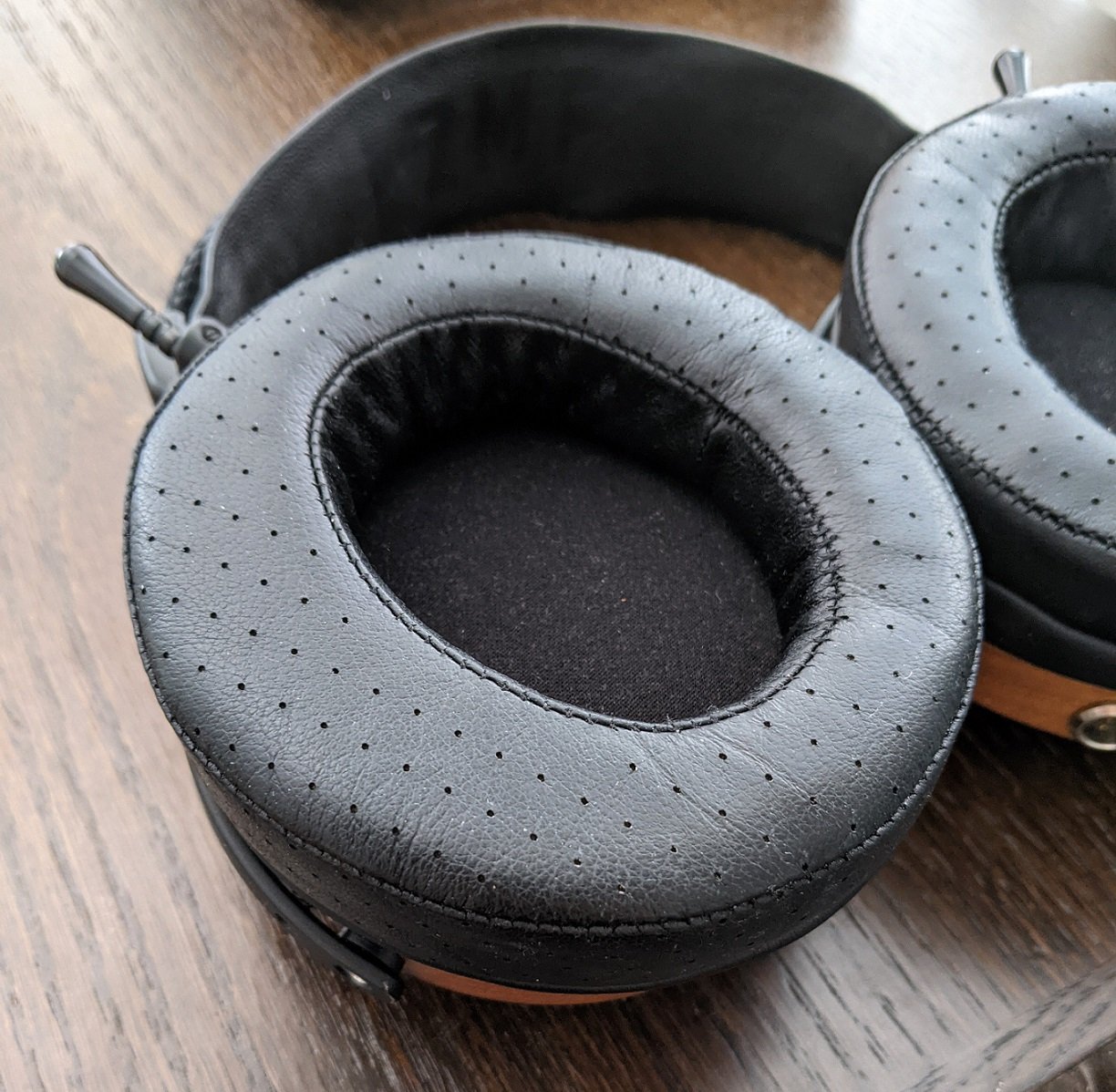
ZMF's open-back headphone models use perforated earpads, and replacing them with more traditional solid pads would, among other things, mess up the bass reproduction. The Auteur comes with two sets of pads: Auteur Perforated Lambskin pads and a second set of user-selectable pads. To my understanding, the manufacturer has always recommended the Eikon Perforated Lambskin model as the second set of pads, which I also received with the headphones. Both pads are really thick, soft, and comfortable. I will discuss their sound quality differences separately later. When evaluating the sound quality of the headphones, I have used the Auteur pads.
The auteur sounds like they look
Evaluating the Auteur's sound quality is very straightforward in the sense that it sounds truly ”right” and balanced. The tuning of the headphones is a kind of warm and pleasant version of a neutral sound – the presentation is very much in line with the headphones' appearance. Listening doesn't often evoke "wow" moments, but on the other hand, nothing ever sounds bad or wrong.
The headphones direct the listener's attention mostly to the mid-frequencies, although no frequency range can truly be said to be emphasized more than others. Around the mid-frequencies, both the low frequencies and the treble extend well to the extremes of their frequency ranges, but neither begins to dominate the reproduction in any situation. Listening to these headphones is truly relaxed, and they are very versatile – I can't think of a music genre that would sound bad. In this respect, the Auteur is a good example of headphones that, once owned, eliminate the real need to own other headphones.
Although the tuning is neutral, the headphones still have two characteristic features typical of the manufacturer: 1) the timbre of the reproduction, especially in the mid-frequencies, is truly natural, so instruments sound authentic and believable 2) the wooden earcups add a pleasant touch of reverberation (reverb) to the reproduction.
Resolution and dynamics:
Subjectively evaluated, the Auteur is technically good for its price, but doesn't truly excel in any single area. Especially the placement of sounds in the soundstage is precise, and it doesn't fall far behind even better headphones. However, the Auteur is somewhat slow in terms of transients, which means details are reproduced a bit softly, and their resolution isn't top-notch considering the 1800 euro price – the headphones, in a way, don't want to let go of their relaxed nature. Nevertheless, I don't consider this problematic for the overall experience, as listening is pleasant.
For comparison, the more expensive Verite Closed sounds faster and manages to keep the edges of individual sounds sharper and clearer. Compared to the cheaper Atticus and Aeolus models, however, the Auteur is better in all respects, although in some parts, comparison is difficult due to significantly different frequency responses.
The Auteur's dynamics are rather gentle, so the more grandiose parts of music lack a bit of vigor and power. The Atticus and Aeolus are quite similar in this regard, but they compensate for the situation with their more energetic tuning. The Auteur doesn't particularly impress with its dynamics, although I would say it's an improvement over its cheaper siblings. This would likely become even clearer if I could make a comparison with frequency responses that are closer to each other.
Audio description:
Despite its partially closed structure, the Auteur sounds pleasantly spacious. The soundstage size is larger than average, especially in width. In this regard, the style is actually somewhat tube-like, as there isn't as much height or forward depth in the sound. I don't usually pay much attention to the soundstage during listening, which I think is a good thing. Compared to closed ZMF models, the Auteur's soundstage is more traditional in style, as the 3D-type reverberation caused by the wooden cups is reduced due to the headphones' more open structure.
Bass:
The Auteur's bass reproduction is linear, so the mid-bass is not emphasized as much as in many other ZMF models. The upper bass frequencies do not audibly bleed into the mid-frequencies in the Auteur. Similarly, the audibility of the lowest bass frequencies has been well preserved, considering that these are open-back dynamic headphones. Thus, electronic music also sounds quite good, albeit a bit leisurely due to the headphones' somewhat slow speed.
The Auteur neither downplays nor overemphasizes the amount of low frequencies. If a song has a lot of bass, the Auteur brings it out well. Often, however, the bass reproduction merely complements the sound without drawing too much attention to itself. Interestingly, despite the somewhat soft macro-dynamics, drum hits have a pleasant tightness and power. The detail of the low frequencies is at a good level, but for those who enjoy a greater amount of bass, the headphones might be a slight disappointment without equalization.
Mid-frequencies:
The headphones' mid-frequencies are clear, clean, and have a natural timbre – the graininess of the cheaper Atticus and Aeolus models is gone. Based on the frequency response measurements I've seen (e.g.,. Crinacle's measurements, found at the bottom of the page) the mid-frequency tuning largely follows the Harman target curve, but in my opinion, it sounds slightly warmer in its lower parts than what could be inferred from the measurements. When listening, the headphones draw the most attention precisely to the mid-frequencies, which feels natural and not forced or aggressive. If the Auteur doesn't exactly make your feet tap with its bass reproduction, listening to these headphones often gives you goosebumps thanks to the emotionally evocative mid-frequencies.
When listening to the Auteur, instruments and vocals have a lot of energy. Vocal performances come to the forefront more energetically than with Verite headphones, but the presentation is still more relaxed in terms of detail. In this sense, the Auteur is slightly easier to listen to for longer periods. Thanks to its pleasant and balanced tuning, the Auteur's mid-frequencies are excellent overall and the most balanced of the ZMF headphones I've heard.
Treble:
The Auteur has more treble than other ZMF models, which in turn makes it sound somewhat neutral. The treble is quite soft in style, but due to an emphasis between 5–6 kHz, there is some extra sparkle that adds liveliness to the reproduction. While this doesn't severely break the naturalness of the sound, the emphasis sometimes interferes with distinguishing details in surrounding frequencies.
In terms of detail separation, the Verite Closed performs better, even though details are quieter due to its darker tuning. Although I would describe the Auteur's treble as very balanced in quantity, there is sometimes enough energy that poorly recorded music can be a bit heavy to listen to. The second set of earpads included with the headphones helps with this if needed, though they also reduce the soundstage width.
Auteur- vs. Eikon-pads
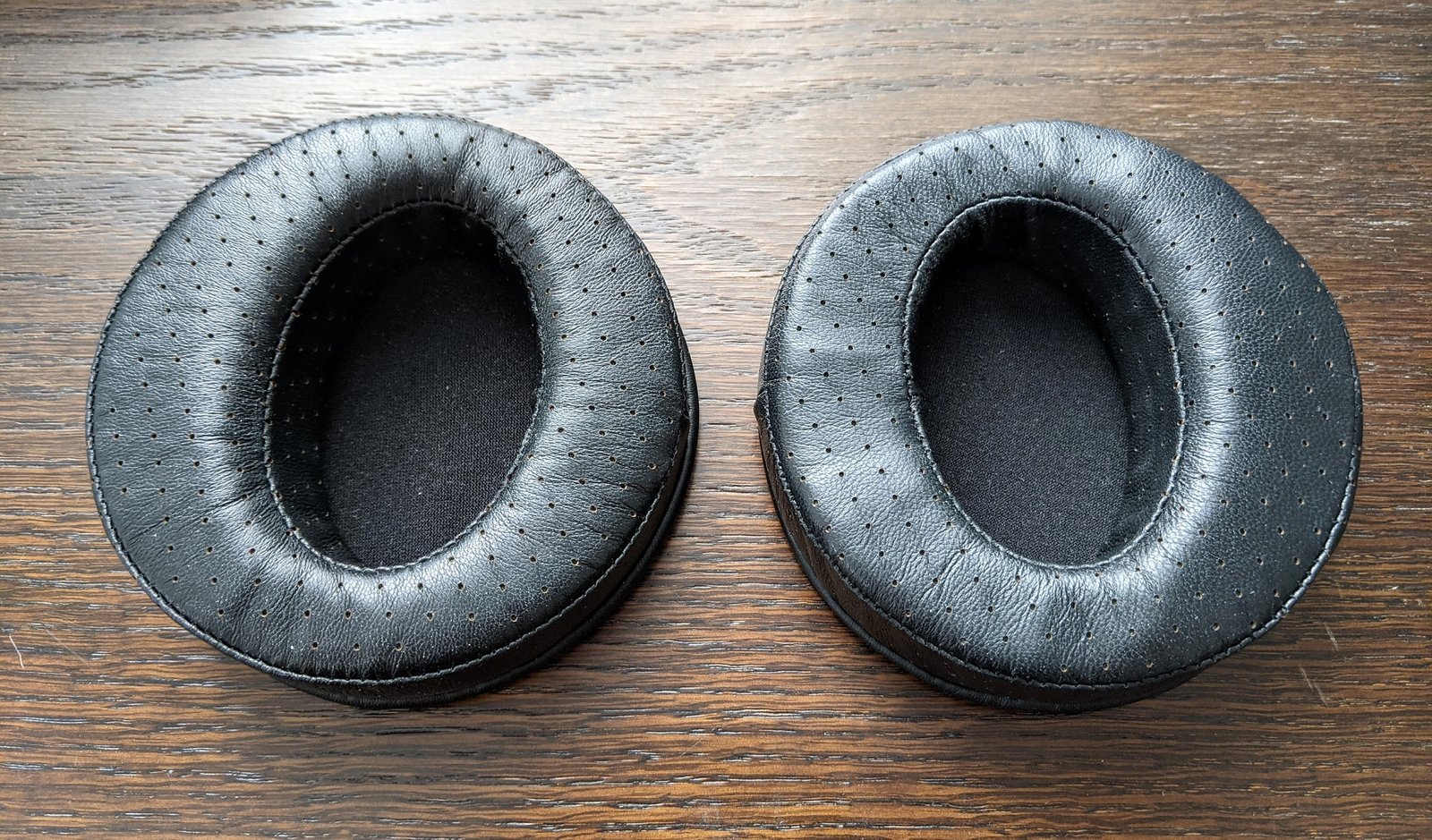
The Eikon Perforated Lambskin model, recommended as the second set of earpads for the headphones, looks externally very similar to the standard Auteur Perforated Lambskin pads. However, the Eikon pads have a slightly smaller diameter and ear opening, and the thickest part of the pad that sits behind the ear is slightly thicker than on the Auteur pads. According to ZMF itself, the Eikon pads make the Auteur sound darker and more reminiscent of other ZMF models – a description I find to be very accurate.
Changing the pads audibly reduces the amount of treble in the 6–10 kHz frequency range. Eikon pads also bring the mid-frequencies more to the forefront and slightly increase the amount of bass, but this might be an indirect effect of lower frequencies becoming more prominent as the treble quantity decreases. These changes can be desirable, even though, for example, the Auteur's treble is not particularly fatiguing by default.
The downside of the Eikon pads (or a positive for some) is a clear reduction in the headphones' soundstage. With these pads, music comes more aggressively towards the listener, and the headphones sound less open. Since, in my opinion, there isn't much to correct in the sound with the Auteur pads, I don't find the Eikon pads to offer clear benefits compared to other pads. However, a slightly darker tuning and a more intimate soundstage might be what some others desire, so it's great that the headphones' sound can be adjusted as easily as by changing pads. ZMF also sells other pads suitable for the Auteur model.
Device selections
Like other ZMF headphones, the Auteur does not require a powerful headphone amplifier, even though its impedance is 300 ohms. The headphones are very adaptable in terms of what kind of amplifier they are listened with. The balanced tuning allows the headphones' sound to be colored in desired ways in different directions without the overall presentation becoming too unbalanced.
It's possible to make the Auteur more enjoyable with a tube amplifier. In this case, the headphones change to such an extent that it feels like they're throwing their suit jacket into the corner and going out to party. It's especially easy to further emphasize the low frequencies, as their quantity still remains reasonable. Coloring the mid-frequencies to be even livelier or making small changes to the amount of treble are also not detrimental. I would even say that to achieve a better and more fun ”ZMF experience,” a tube amplifier is a highly recommended option.
With a traditional solid-state amplifier, the Auteur sounds neutral and controlled. While such an amplifier might be a good choice for most, I believe that due to their somewhat soft dynamics, a more energetic and dynamic amplifier is better suited for these headphones. A D/A converter that slightly emphasizes the impact of low frequencies is also not harmful – for example, Schiit Audio's Bifrost 2 pairs well with these headphones. I have mostly used Rebel Audio's RebelAmp and Garage1217's Project Polaris as amplifiers with the Bifrost 2.
Similarity with the Sennheiser HD600 series
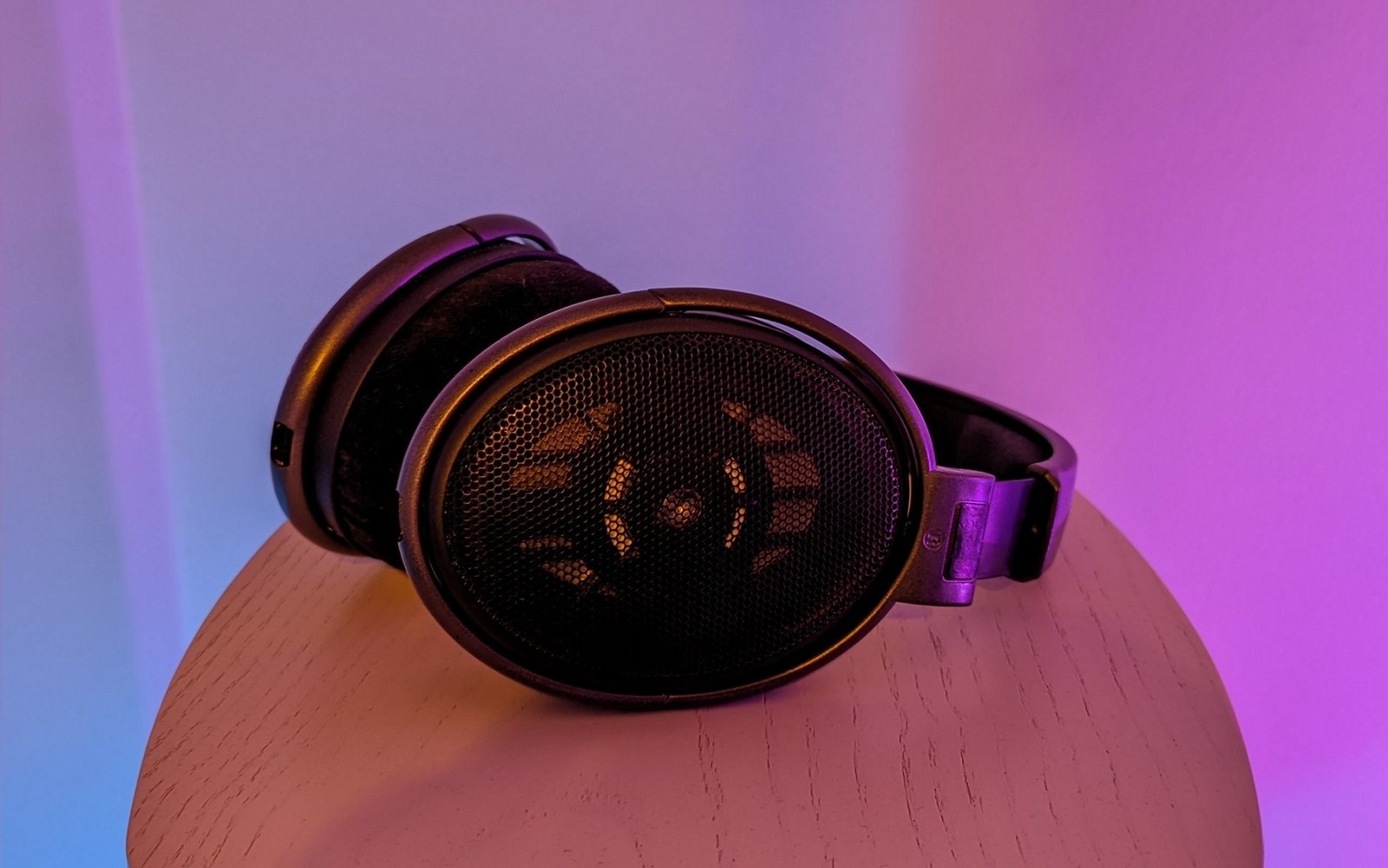
When listening to the ZMF Auteur and Sennheiser HD6XX consecutively, it's easy to notice a lot of stylistic similarities, especially in the reproduction of mid-frequencies – both headphones draw the listener's attention most to these. Both also have a slightly added warmth in their lower mid-frequencies, making the reproduction very natural to my taste.
However, the similarities between the headphones largely end here, as they sound different, especially in terms of soundstage and clarity of reproduction. The HD6XX is warmer due to its slight mid-bass emphasis. The headphones also have a really small and intimate soundstage, which makes the vocalist, in particular, sound closer to the listener than with the Auteur. Yet, something makes the HD6XX's sound seem muddy, even though the reproduction is very natural and pleasant. This muddiness might not be clearly realized before listening to the Auteur. With it, the reproduction significantly clarifies and opens up – it literally feels as if a thick curtain is removed from between the headphones and the listener's ears.
The Auteur brings much-needed airiness and balance to the reproduction, both in terms of bass and treble. The bass complements the reproduction better with stronger and tighter impacts, whereas in the HD6XX, the bass sounds somehow small and thick at the same time. Due to the different soundstages, it's easy to see that some might still choose the HD6XX's warmer and more intimate presentation. However, the Auteur's clarity and airiness make an immediate impression on me, as the details of the music sound more separate from each other, and sounds have more space to be placed elsewhere than inside the listener's head.
The HD6XX sounds really good on its own, so I would say that if their sound has pleased you so far, it might not be worth trying better headphones, such as the Auteur. On the other hand, if someone wants fairly similar natural headphones with a larger soundstage and slightly better technical performance (the biggest improvement comes from the soundstage), the Auteur can be seen as an excellent option, especially when bought used. Otherwise, the price difference between the headphones becomes so massive that I myself hesitate to speak of the headphones as alternatives to each other. For the price of a new Auteur, depending on the model, you can get 5–7 units of Sennheiser's HD600 series, making it difficult to see the upgrade as entirely worthwhile purely from a financial perspective.
The Auteur is not 1500 euros better, no matter how one justifies it. Nevertheless, for a Sennheiser HD600 series owner/fan who invests more in the headphone hobby and considers more than just direct financial added benefit, the ZMF Auteur could very well be the ultimate headphone purchase. For those aiming for headphone reproduction as close as possible to the HD600 series, better alternatives are surprisingly few, if they even exist.
Comparison to ZMF Aeolus and Atticus models
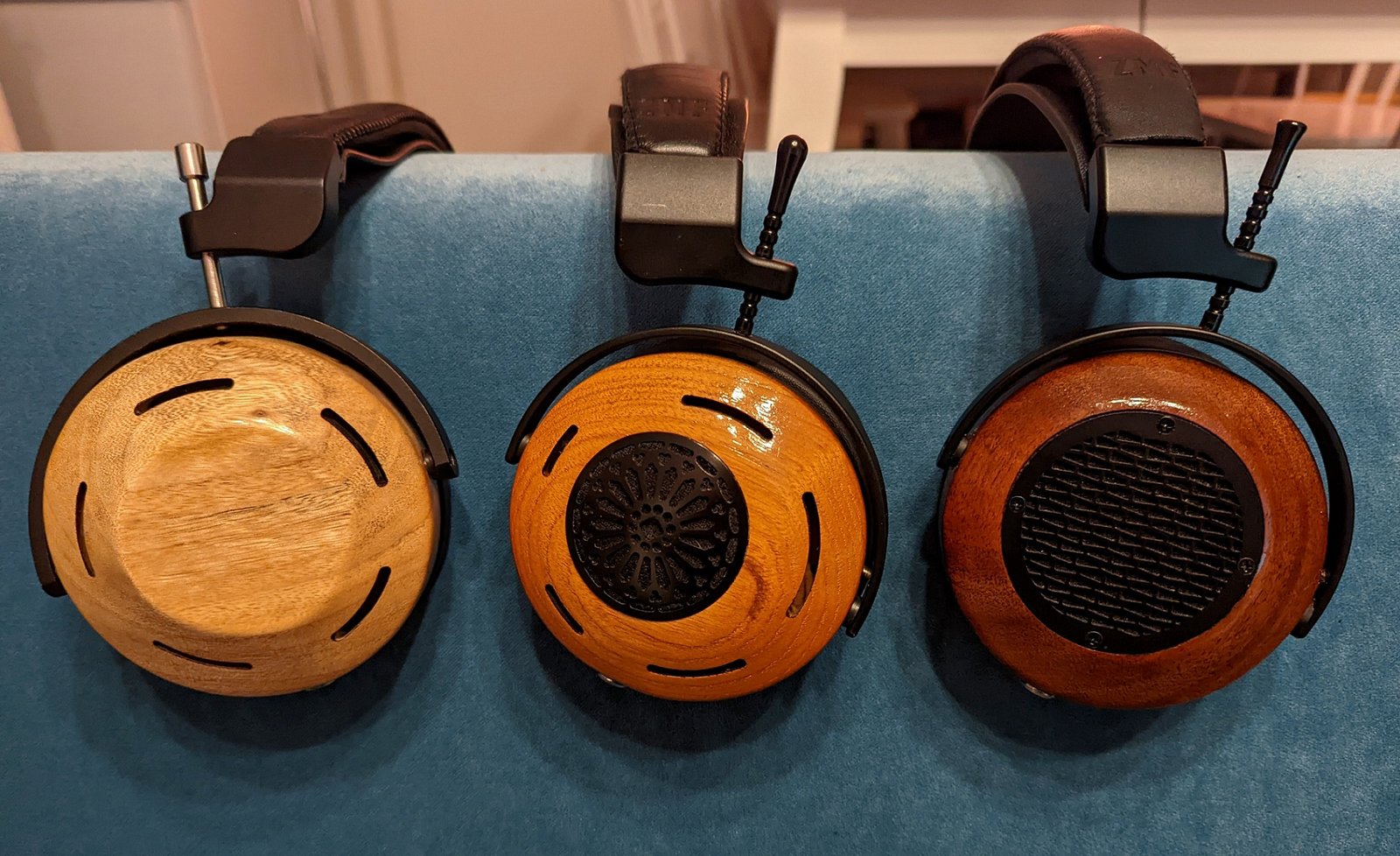
The Aeolus, like the Auteur, is an open ZMF model. The Aeolus uses exactly the same driver as the Atticus model I reviewed earlier, so these two headphones have a lot in common technically – especially the detail retrieval and sound placement in the soundstage are at a rather mediocre level, and the Aeolus or Atticus should not be acquired expecting top-notch technical performance anyway.
Compared to the better-performing Auteur, the approximately 500 euro cheaper duo compensates for the situation with different, significantly more fun tunings. While the Auteur is neutral and balanced, the Atticus sounds robust, fun, and, thanks to the soundstage created by the closed wooden cups, interesting.
The Aeolus, in turn, is a kind of more linear and balanced version of the Atticus – the biggest difference is that the Aeolus pushes the vocalist more forcefully towards the listener, transforming the music into a living room concert. When listening to suitable music, I cannot listen to the Aeolus without my hairs constantly standing on end. The Auteur and Aeolus are tuned quite similarly in terms of bass. However, the Auteur's impacts are tighter, whereas the Aeolus sounds more robust in its tonal body, like the Atticus.
The Auteur sounds the airiest of the headphones and has the largest soundstage. The Atticus comes in second in terms of soundstage, and as a closed model, it also has a pleasant and natural reverberation resonating from the wooden cups. The Aeolus is an open headphone model, but its soundstage is small. The listener is, in a way, constantly inside the music, but surprisingly, this works excellently with the headphones most of the time. There is something truly natural about the tuning of the headphones and the infinitesimally small soundstage, so I currently believe that the Aeolus is, overall, the most natural of all the ZMF headphones I have heard.
Each differently tuned ZMF model has its own strengths, so their absolute ranking in terms of superiority varies according to each listener's preferences. Common to the three models compared in this section is the natural timbre of the reproduction, especially the mid-frequencies, which makes all music containing acoustic instruments sound excellent. The Auteur is such a balanced package that it is the easiest and safest to recommend for different music genres and for people who have not previously heard ZMF headphones. The Atticus is well suited for listeners who enjoy robust bass reproduction – especially rock and heavy metal music sounds fun, which also applies to the Aeolus model. The Aeolus's magic trick is bringing the mid-frequencies to the forefront in such a way that the sound is truly natural and convincing.
Comparison to ZMF Verite Closed –model
Comparing the Auteur to the more expensive Verite Closed model is a bit silly, but somewhat useful, as many considering purchasing ZMF headphones might wonder what additional benefit the Verite brings for an extra 1000 euros. I have not yet heard the open Verite model, but based on the closed Verite model, which is tuned very similarly and equipped with the same driver, I can state that the Auteur and Verite are so different in style that it's easy to see some people preferring the Auteur.
The Verite is technically superior to the Auteur: dynamics, transient reproduction speed, detail retrieval, and soundstage accuracy are all on a different level in a positive sense, even though the Auteur balances the situation with its more accurate frequency response. The Verite is, above all, a more fun headphone, constantly delivering the "wow" experiences I crave. At the same time, however, the Verite sounds more intense compared to the Auteur and requires more concentration from the listener. Also, the different frequency ranges are not as well balanced as in the Auteur.
For this reason, for those who appreciate a more relaxed and balanced reproduction, the Auteur can be a more pleasant option. If the headphones cannot be directly compared, an Auteur buyer can be very satisfied with the technical performance of the headphones. Although the Verite is in many ways, if not quite 1000 euros better, then at least 500 euros better, the more original tuning of the headphones may disappoint some – the Auteur, on the other hand, is a safe choice for most.
Summary
When I first heard the ZMF Auteur, I found it a bit boring and unremarkable. However, after listening to the headphones more, I have come to find them just right. Although the Auteur is easy and allows for relaxed listening, for example, to background music, when focusing on more critical listening, it reproduces everything admirably correctly. In my opinion, the headphones demonstrate that a neutral and in a way boring tuning can also be implemented musically and enjoyably. It is very difficult for me to find any fault with what the headphones offer the listener. If I had to choose, I would only add a little bass to the sound to bring some much-needed fun.
The Auteur is suitable for relaxed and balanced listening, which was clearly sought after when designing the headphones. Due to their style, the headphones are at their best when listening to slightly calmer music, but still keep the reproduction together even with technically more challenging listening material. Sharpening the reproduction in the Auteur would likely only mess up the overall sound. More aggressive sound can be found in many of the headphones' competitors, so the Auteur offers them a more relaxed and in a way more natural alternative in its price range. The Auteur is actually an exceptionally orthodox-sounding more expensive headphone, making it an excellent option for those seeking a neutral and balanced sound.
The only major question mark for the headphones is their high price of 1800 euros. Based on appearance and material choices, the price is easily justifiable – in terms of sound quality, I think the price is 300–400 euros too high, because buyers of more expensive headphones usually hope to get even better detail and a kind of wow-experience, which are partly missing from the Auteur. Below 1500 euros, the headphones would be an even better alternative to, for example, Sennheiser, Focal, and Audeze headphones.
At the full price of 1800 euros, the Auteur's positioning in its price range is also difficult in the sense that with a small additional investment, one can acquire used headphones that originally cost 3000–4000 euros, which I believe, based on my own experiences, would be a clear improvement over the Auteur in many technical aspects. However, I can defend the Auteur in a similar way, as buying it used for 1000–1200 euros is an excellent headphone purchase.
For those considering ZMF headphones, the Auteur is technically clearly better than the Atticus and Aeolus, which cost 1200–1400 euros new. The Auteur's tuning is also more balanced and, objectively evaluated, better. The headphones are better suited than cheaper ZMF models as versatile primary headphones, and not just to complement other headphone collections.
PS after this review, I bought even finer Auteur headphones, which have been among my favorite headphones for a long time.
Pros and cons:
+ Balanced and neutral tuning, suitable for various music genres
+ The sound has just the right amount of warmth and musicality, so the reproduction is not emotionless
+ Natural and clear mid-frequencies
+ Offers more detailed reproduction and a more airy soundstage compared to more affordable ZMF models
+ Comfort is at a good level despite the weight of over 500 grams
+ High-quality and sturdy construction
+ Unique and fine appearance
– The sound is somewhat soft in both detail and dynamics
– There could be slightly more bass quantitatively
– The slight sparkle in the treble might be fatiguing or unnatural for some
– The steel part of the headband is loose in my pair, so it's difficult to get the clamping force optimal
– High price
 EN
EN  FI
FI