Author: Roderick

Table of Contents:
Information:
- Release Year: 2020
- Price: 169 €
- Type: Closed, over-ear
- Bluetooth: 5.0 APTX HD, SBC and AAC
- BT chipset: Qualcomm QCC3034
- Dynamic driver: 40 mm
- Impedance: 35 ohm
- Sensitivity: ?
- Weight: approx. 250 grams
- Battery: 1050 mAh
- Charging time: 2–3h
- Operating time: According to the manufacturer, 45 hours
- Talk time (hands-free): According to the manufacturer, 40 hours on a single charge
- Noise cancellation: Active noise cancellation (ANC) achieved with 4 microphones, Analog Devices Inc. (ADI) chipset
- Amplifier: Class AB
- Hands-free microphones: CVC8
- USB-C charging port
- Accessories: Hard-shell protective case, charging cable, headphone cable with a 3.5 mm connector, and an airplane adapter
Review sample: Provided by the manufacturer
Valco VMK20
Valco VMK20 is a domestic Bluetooth noise-cancelling headphone. Many have surely come across Valco's humor-infused marketing on social media. Although the advertisements are, to say the least, spirited, the headphones themselves are no joke. The VMK20 has indeed gathered mainly positive reviews also from outside Finland's borders.
However, Valco's Finnishness has been questioned, which is quite understandable, as its headphones are based on a Chinese OEM (Original Equipment Manufacturer) headphone model, which has been customized according to Valco's needs. The VMK20 differs from the Chinese original model at least with its different Bluetooth and noise-cancellation technology. A more detailed comparison between the Valco model and similar-looking Chinese headphones has been carried out by the audio-room.net website (link to the article), the message of which, spelled out in plain terms, is that it's not possible to buy similar headphones 100 euros cheaper from Aliexpress.
It would certainly be great to see what Valco headphones would be like if they were designed and manufactured entirely in Finland. Perhaps such a model will be seen someday if the manufacturer releases a more expensive headphone model. However, I do not consider the manufacturing of headphones in China problematic, as it is likely impossible to compete with other more well-known headphone manufacturers with Finnish production costs, especially since most of them do not manufacture their products in Western countries. For example, Bowers & Wilkins manufactures its headphones in China, Sony's headphones are made in Malaysia, Bose has a factory in Mexico, and Apple in China.
I received the VMK20 headphones, which are under review, a couple of months ago from Valco, and I do not intend to return them, even if they asked me to. In return for my review, Valco did not promise me money, beer, or even a lieutenant's position on a Valco-designed Death Star. The VMK20 is not actually a new acquaintance for me, as I already bought the headphones once a year ago with my own money, and wrote my thoughts about them on the hifiharrastajat.org forum. In my opinion, the headphones were and still are among the best in their price range – I will try to justify this opinion as well as possible in this review. I will focus mainly on discussing the sound quality characteristics of the headphones, rather than the technical aspects, such as the functionality of noise cancellation or microphones.
Unboxing
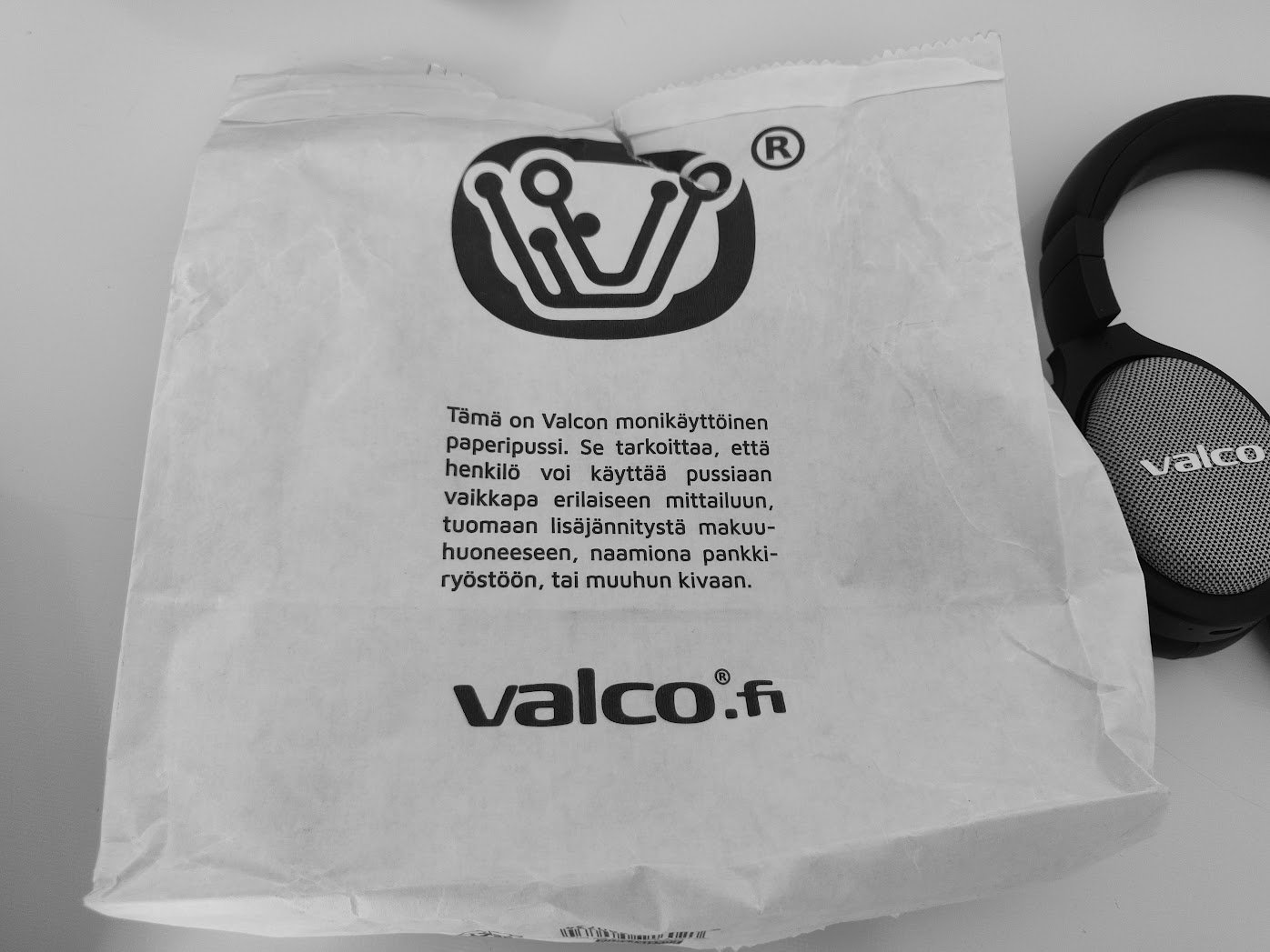
The accessories supplied with the headphones are standard: a hard-shell protective case, a charging cable, a headphone cable with a 3.5 mm connector, and an airplane adapter. The zippered case is a convenient size and sturdy enough to protect the headphones.
My only complaint about the accessories is the USB-C charging cable, which I think could be a bit longer. An approximately 80-centimeter long cable doesn't reach the table well if the headphones are charged from a floor-level power outlet. A separate power adapter is not supplied with the headphones. The manufacturer recommends using a standard 5V/1.5–2A USB charging source. I have mainly charged the headphones via my computer's USB port, as most 5V chargers found in my household are too powerful. According to Valco's manual, using turbo chargers may cause so-called ”kyrvähtäminen”.
A memorable part of the VMK20 unboxing experience was the strong smell of the headphones. The headphones smell of some chemical from the factory, which slightly resembles the smell of a swamp. I noticed the same smell in both of my headphones, but fortunately, it disappears on its own in a few days, so there's no need to worry about it further.

Structure and comfort
The headphones are mainly made of plastic, which feels high-quality, being ”soft” rather than hard and brittle like cheap plastic. The structure feels quite sturdy, but there is room for improvement in a few areas. The headphone cups wobble freely in their yokes, causing them to clatter when plastic parts hit each other. The flaw is not significant, but it emphasizes the plastic construction of the headphones and diminishes the impression of quality. I solved the problem by attaching a small piece of anti-slip material to the upper edge of the cups.

The only metal part of the headphones is found in the headband adjustment mechanism. Headbands are usually the most critical part of headphones in terms of durability, so most headphones made of plastic have a similar metal reinforcement piece.
The VMK20's stepped headband adjustment mechanism is firm, and there's enough adjustment range even for larger heads. Unfortunately, the adjustment mechanism is a bit too stiff, making it somewhat difficult to adjust the headphones while they are on your head. If I recall correctly, the mechanism in the first VMK20 headphones I owned was slightly looser and easier to use. In this price range, variation between production batches would not be surprising.

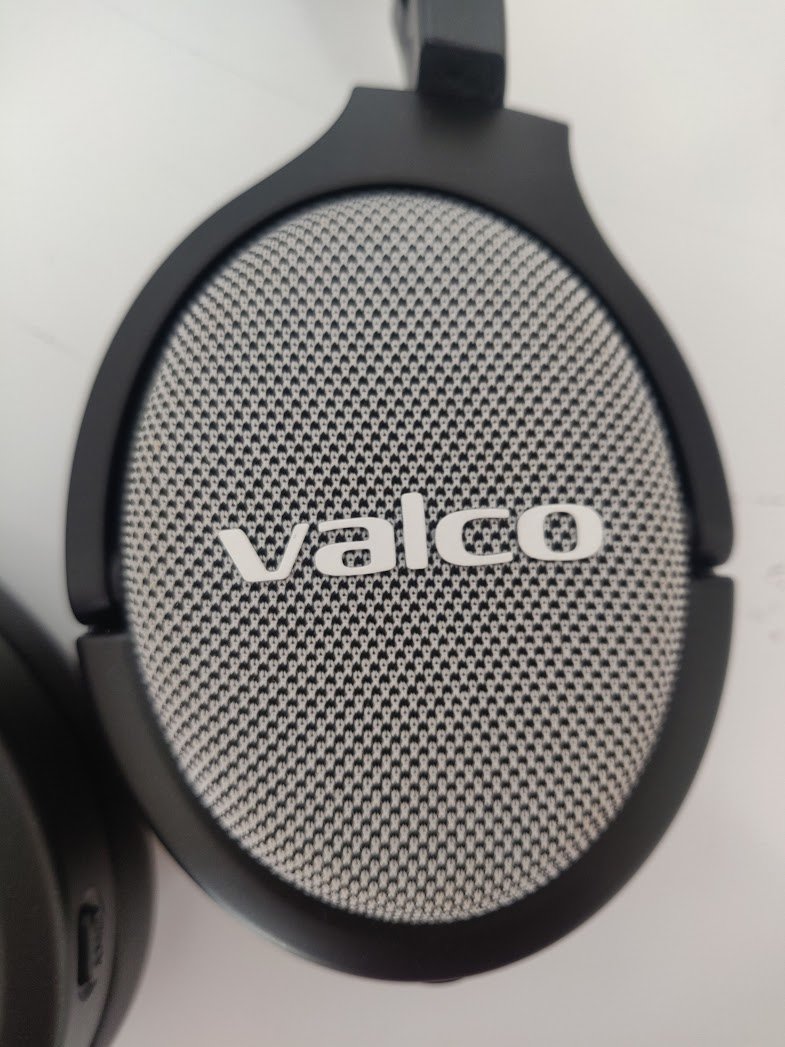
The headphone cups are covered with fabric, which, according to the manufacturer, acts as a wind shield. I cannot comment on the effectiveness of this invention, but at least it makes the headphones' appearance more distinctive. The fabric is also certainly more durable for outdoor use than the wood veneer used in the previous model. It would be convenient if the fabric were removable for washing, should it get dirty for some reason. However, in winter conditions, the headphones have remained clean.
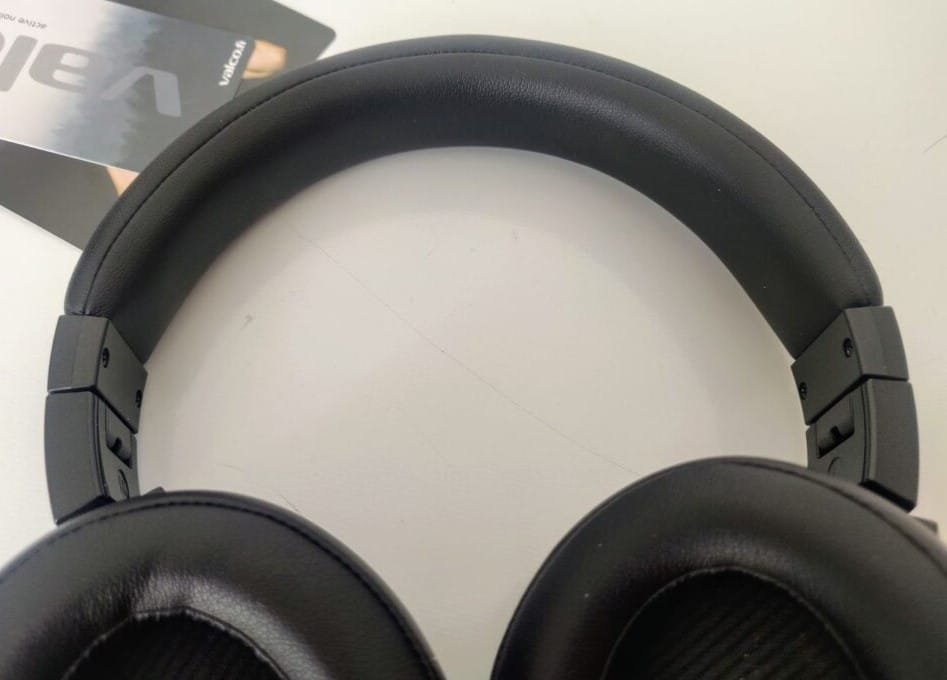
The headphone headband is covered with artificial leather. The padding could be a bit thicker, but at least for me, the headphones do not cause any feeling of pressure on the top of the head.
Like the headband, the ear pads are also made of artificial leather. For my own ears, there is enough space in the pads, and the headphones do not unpleasantly squeeze even when used with glasses. However, for those with large ears, the ear opening of the pads, which is just under 6 cm high and slightly less than 4 cm wide, might be too small. Nevertheless, Valco's pads are not exceptionally small; similar sized pads are also used in most other noise-cancelling headphones.

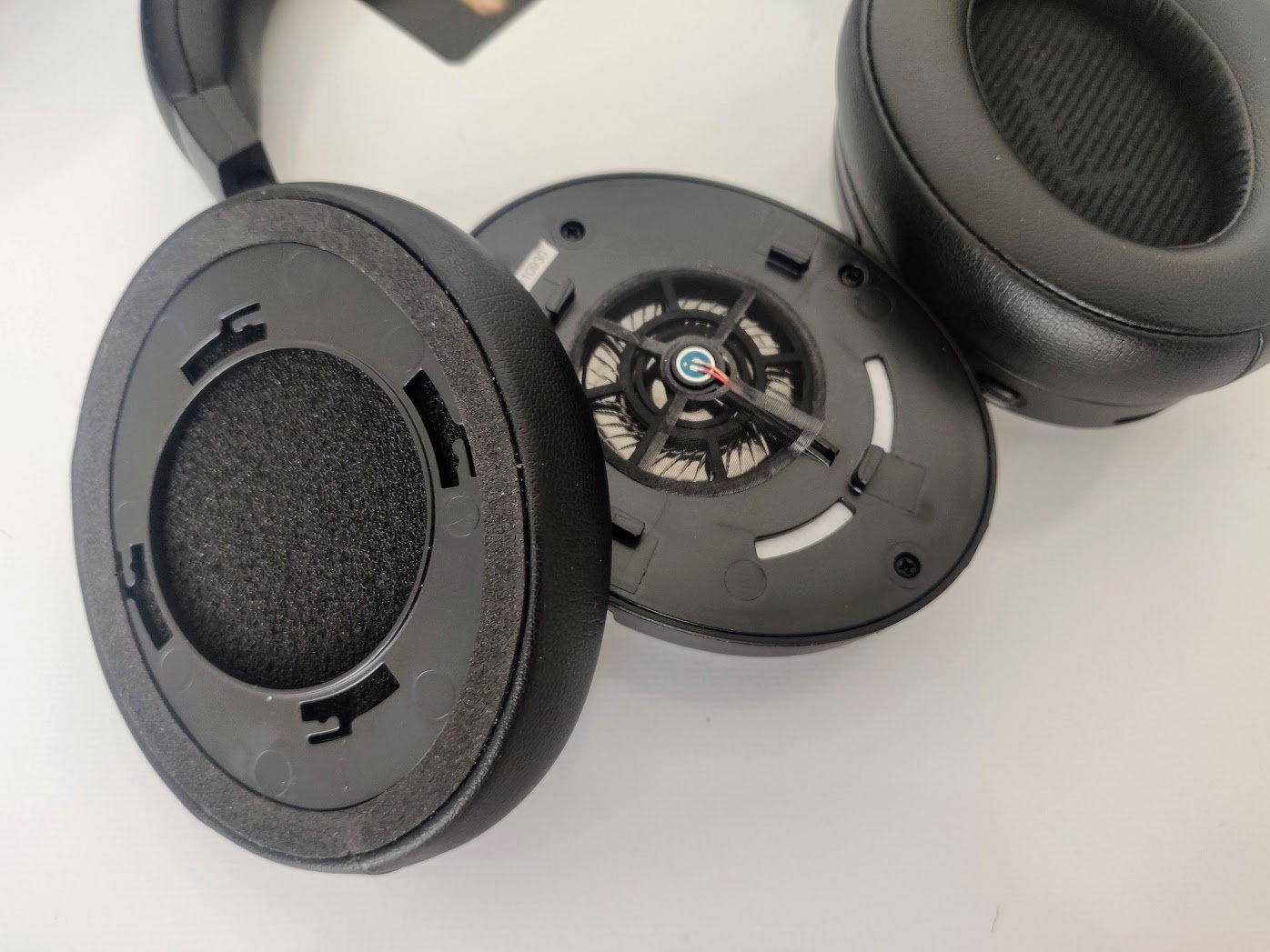
The pads inevitably wear out with use, at which point they need to be replaced. Therefore, it is good that VMK20's replacement pads cost only 14.90 €. Replacing the pads is also simple, as they detach by twisting counter-clockwise and attach by twisting clockwise.
If the headphone owner needs to replace something other than the pads, Valco offers a repair service for that purpose. After the warranty expires, repairing the headphones costs 39.90 € + one-way shipping costs. The manufacturer promises to repair everything for the stated price, and the price also includes battery replacement, if necessary. Such excellent service is not often available from other manufacturers, even if their headphones cost several hundred euros.
The headphone cups rotate 180 degrees, so it is possible to lower the VMK20 from the ears to the neck. In my opinion, however, the headphones then sit upside down, as the pads remain facing upwards. The electronics would be better protected from moisture and dirt if the pads rested against the user's chest. The current position also does not work in situations where the headphones are lowered to the neck without turning off the music during a conversation with another person: the sound from the headphones is directed straight towards the face, so the user has to shout over the music, or they cannot hear what is being said to them.
All in all, the Valco VMK20 is reasonably good in terms of materials and user comfort, though not excellent. The biggest weakness in terms of comfort are the somewhat small ear pads. It would also be nice if finer materials had been used in the headphones instead of plastic. However, a similar plastic construction is commonly used in more expensive headphones as well. Since, for example, Sony's or Bose's 300-euro noise-cancelling headphones are not any finer or feel of higher quality, I cannot fault the 169-euro VMK20 for its plastic construction.
Quality problems
The year 2021 was difficult for Valco. A subcontractor had supplied faulty chipsets for the headphones, which caused the Bluetooth to go dark on many headphones. When the fault finally became clear, thousands of headphones had already been replaced under warranty, and customer service was severely congested. In addition, Covid-19 added its own complications in the form of logistical difficulties.
The Bluetooth fault has since been corrected, and according to the manufacturer, the VMK20's operational reliability should now be at a normal level. I wanted to bring this up because many may have read comments from frustrated customers, for example, on social media. However, broader conclusions about the current durability of the headphones can no longer be drawn from earlier comments. When acquiring used Valco headphones, it is still good to note that the 2021 model range had a lot of problems.
You can read the manufacturer's more detailed explanation of the situation here.
Bluetooth
I mainly used the headphones with my OnePlus 6 phone, and I also tested them with a Windows 10 laptop. Bluetooth connected to both devices effortlessly, both on the first use and subsequently. Occasionally, my phone did not find the headphones, but the issue was resolved by restarting the Bluetooth connection.
The Bluetooth range is excellent, even though I don't have much basis for comparison on the subject. However, in my opinion, Bluetooth works better than in Hifiman Deva Pro and Bowers & Wilkins P7 headphones, being at least on par with Sony WH-1000XM3 headphones. The phone playing music can be left in any room in a 100 square meter apartment, and the connection does not start to cut out. Bluetooth also works through exterior walls to the balcony.
Noise cancellation
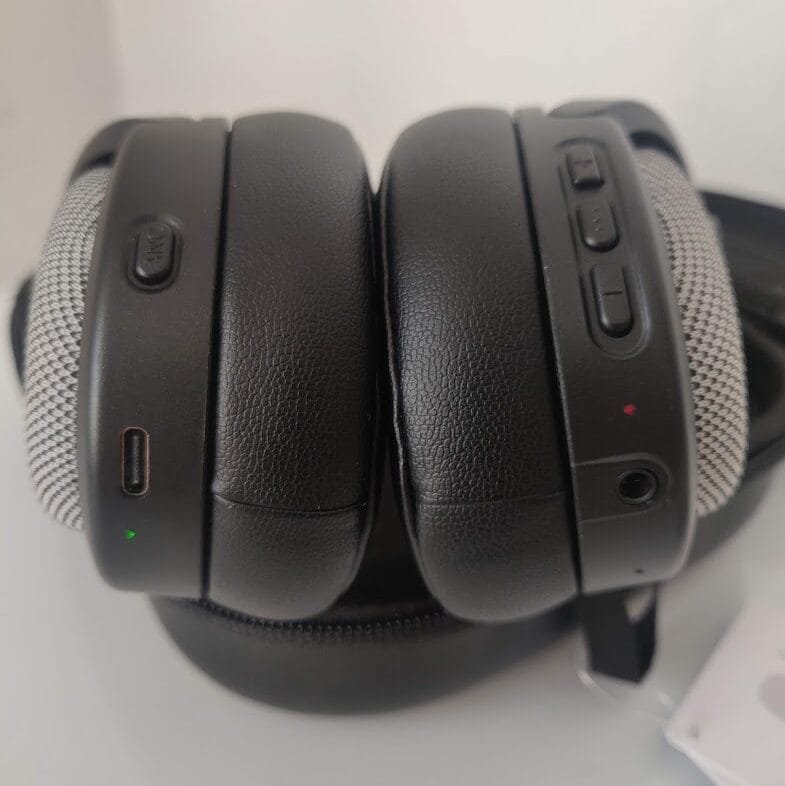
The VMK20's noise cancellation did not quite convince me. The noise-cancelling function works as it should, but in my opinion, the attenuation could be more effective. The headphones also hiss quite strongly. I did not get to test the headphones, for example, on an airplane, so I cannot comment on how they perform in such conditions. I also have not heard enough noise-cancelling headphones in the same price range to say with full certainty how good or bad Valco's noise-cancelling function is.
The more expensive Sony WH-1000XM3 suppresses background noise more effectively, and it also has features that are missing from the VMK20. Valco's noise-cancelling function is simple, as it is either on or off. Many users would certainly appreciate customizable noise cancellation or the ability to adjust its intensity with a touch switch.
For me, however, these features are of little importance, which is why I actually like Valco's straightforwardness. Those longing for effective or customizable noise cancellation should, however, consider other options, which will most likely cost more than the VMK20. The Valco model earns a plus for the fact that noise cancellation also works when listening to headphones via cable.
Battery
Valco promises up to 45 hours of battery life for the headphones. Although I haven't timed it, the promised battery life may very well be accurate. The headphones need to be charged very rarely, which is a good thing, because charging is unfortunately not very fast. It takes 2–3 hours.
Since my phone unreliably indicates the remaining battery life of the headphones, I would find it desirable for the headphones to occasionally notify me themselves when 5–10 percent of battery is left. Now, the notification comes far too late, about 5 minutes before the headphones turn off. Alternatively, it would be convenient if the battery charge could be checked, for example, by tapping the power button, as in Sony's WH-1000XM3 model.
Microphone
I only briefly tested the headphones' microphone. During the call, the sound was clear according to the other party. In my own use, the microphone is not important, as I don't engage in remote meetings, and I feel a bit strange talking on the phone in a public place without having the phone to my ear.

Soundquality
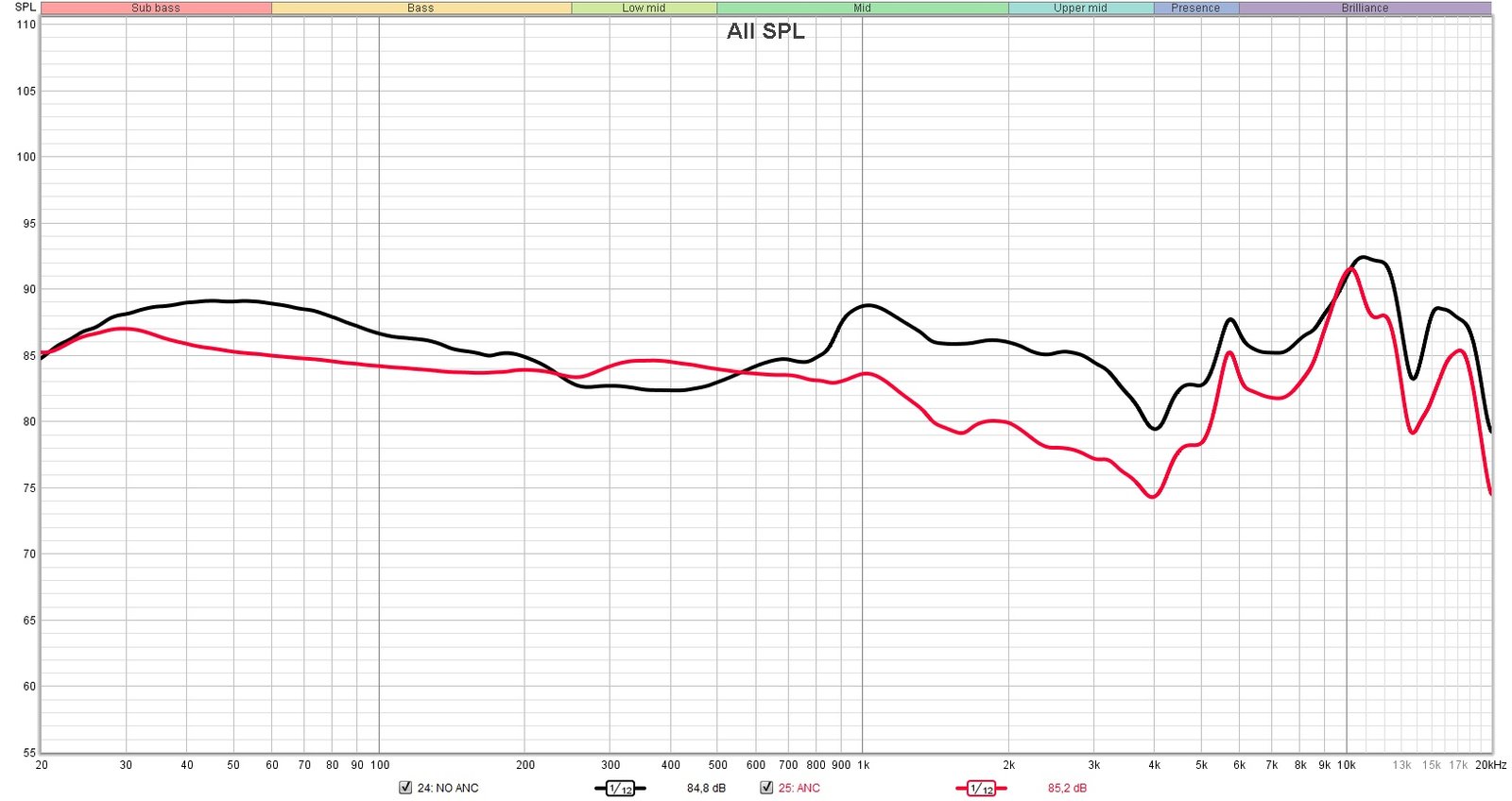
Measurements made with EARS are generally only indicative, and measurement results for Bluetooth headphones are even less reliable. The purpose of the measurements is merely to illustrate the biggest differences between various headphones, and the frequency response should not be used as an absolute description of the headphones' sound quality.
The sound quality of the VMK20 is different depending on whether it is listened to wirelessly, with ANC enabled, or via cable. The most balanced sound is achieved with a Bluetooth connection and the noise cancellation function enabled. If the noise cancellation function is not on, the headphones sound slightly clearer and more distinct, although the mid-range is somewhat hollow.
The frequency response without noise cancellation sometimes sounded even more pleasant to me, so I switched the setting according to my mood and the music I was listening to. The noise cancellation function also causes a slight echo, which is sometimes a bit distracting. However, it's not a dramatic issue, so I don't believe it will bother less picky listeners than myself. My subjective listening evaluations are in any case based on the VMK20's sound with the noise cancellation function enabled.
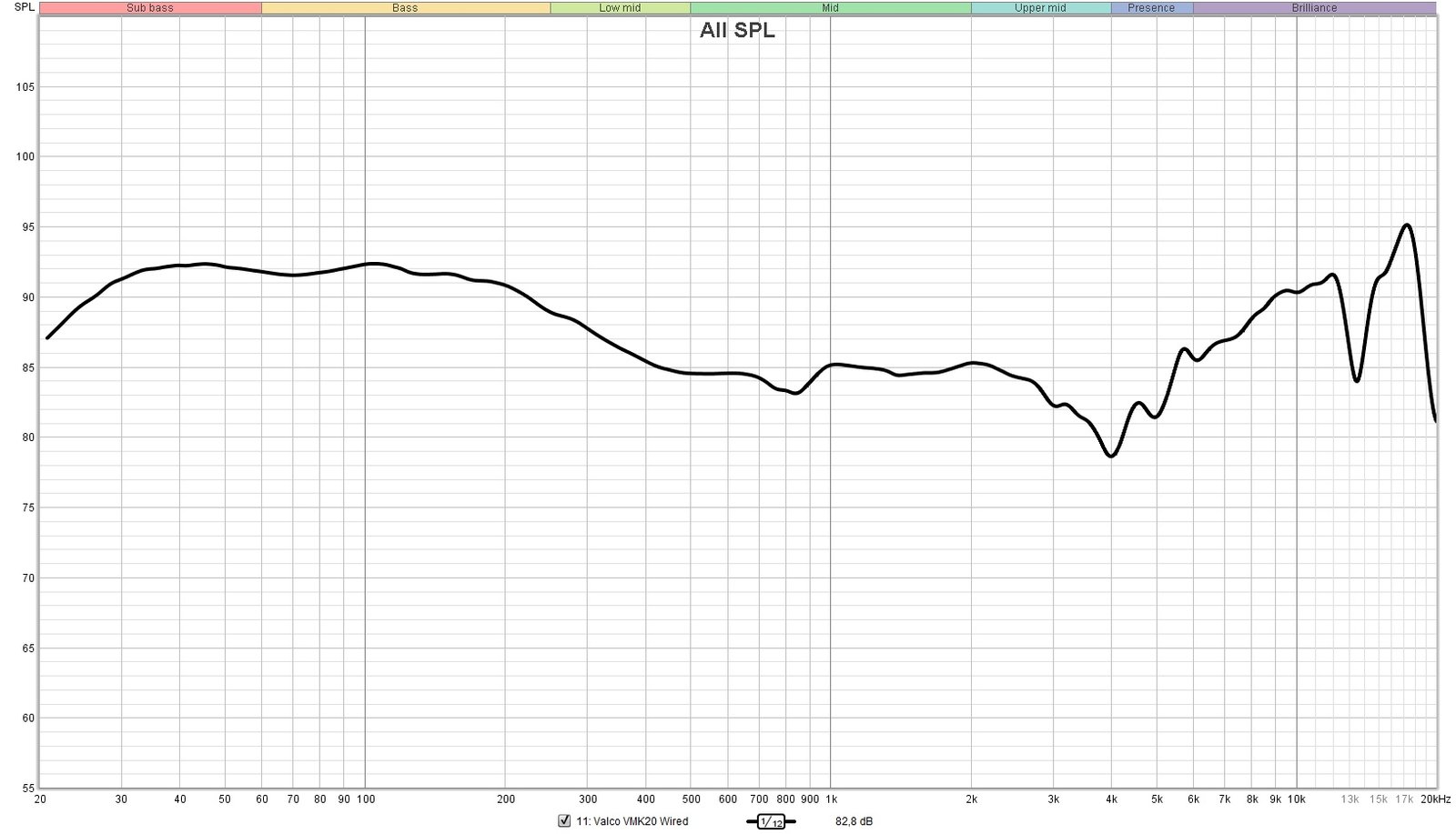
If the headphones are listened to via cable without a Bluetooth connection, their bass reproduction is badly overemphasized. The overpowering bass rolls over other frequencies, dominating the reproduction so that everything becomes a boomy mush. Apart from the wild bass, wired reproduction is actually quite balanced, albeit regrettably lacking in detail and flat.
Why do the headphones then sound better with a Bluetooth connection? The ”secret” lies in the digital sound equalization (DSP) utilized in them, which activates when the headphones” internal electronics are active in wireless use. Jasse ”Jazmanaut" Kesti from Kesthouse audio studio has been responsible for creating the sound profile, whose CV related to audio technology is longer than a famine year. Kesti truly understands good sound quality, and it shows in Valco's VMK20.
However, there is only one equalized sound profile, so the user cannot choose their preferred one from several different options. By leaving noise cancellation off, the sound quality of the headphones changes quite a lot, so in that sense, the headphones have two different sound settings. Although many might desire a phone application that allows sound customization for the headphones, I personally appreciate Valco's simple approach. I have tested a few headphones, such as AKG N90Q and Audeze Mobius, which offer adjustability in various directions. Before long, however, I have come to the conclusion that the versatility of adjustment options can be as much a burden as an opportunity. Adjusting easily becomes an endless loop, making it difficult to be completely satisfied with anything.
Bass:
The bass reproduction of the VMK20 is very balanced, though slightly emphasized for the overall sound. For open-back hi-fi headphones with little bass, such as the Sennheiser HD600, or Hifiman Sundara after getting used to them, the VMK20's bass reproduction might initially feel overly powerful. On the other hand, for those who have only listened to Skullcandy headphones, for example, the bass reproduction might seem too light. The truth lies somewhere between these two examples. In the VMK20, the amount of bass is close to my own preferences. There is slightly more bass than there should be in headphones I consider completely neutral, but the amount is still sufficiently close in my opinion.
The bass is tight, and although a slight emphasis on the upper bass is noticeable, it is not as pronounced as in many other headphones implemented with dynamic drivers. Thanks to the restrained mid-bass emphasis and reproduction extending to the lowest frequencies, the VMK20's bass tuning resembles that of slightly better planar headphones. This is probably not entirely coincidental, as the inspiration for the headphones' tuning came from a 3000 euro Meze Empyrean. However, the VMK20 unfortunately cannot achieve the bass speed of planar headphones or the best dynamic headphones, so different chords tend to blend too easily into one mass. Considering its very affordable price, Valco's performance is nevertheless quite good, if not excellent.
The pleasantness of the bass reproduction is also enhanced by the fact that the bass does not boom as strongly as is usually the case with closed headphones in the same price range. Boomy bass has ruined many good headphones, such as the otherwise excellent AKG K371 headphones. Boominess cannot be controlled solely by digital means, so the structure of the headphones must also be in order.
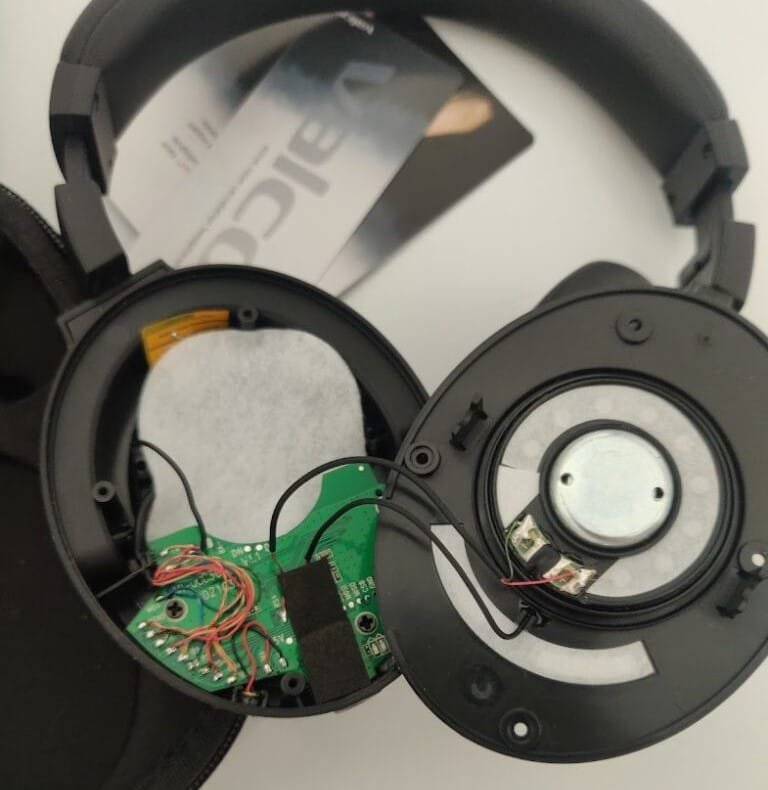
I peeked inside the VMK20 to notice that its acoustics have been improved by installing reflection-damping felt inside the cups. In addition, there appears to be a piece of paper around the driver, which seems to have been installed afterwards. Such small changes can have a significant impact on the sound quality of headphones, but adding ”extra” parts always increases the amount of work and complicates the manufacturing process. More affordable headphones are unfortunately often as simple in structure as possible, even though it would have been possible to improve sound quality with easy modifications. It's great that Valco has not left sound quality solely to digital signal processing!
Central votes:
I have no complaints about the balance of the VMK20”s mid-range; ”balanced" is, in my opinion, the best word to describe the mid-frequencies, regardless of the price of the headphones they are compared to. The sound is neither warm or rich-sounding nor light in a positive sense. The only drawback in the headphones' sound is a slightly unnatural hardness, which, however, usually does not become disturbing in any way.
I would like to speculate whether this could be due to the headphones' metal-coated driver, or if it might be a byproduct of digital equalization. However, I probably wouldn't be able to identify the material of the drivers or the side effects produced by equalization more likely in a blind test, so it's probably not worth taking the speculation any further.
Treble:
The upper frequencies in Valco's headphones are not quite as successful as other areas. The treble has a slight emphasis, which overly amplifies the ”tsih tsih” effect of drum cymbals and other similar sounds. Some listeners might find this more disturbing, while others will hardly care.
For the highest treble frequencies, I would like more energy to alleviate the headphones' slightly muffled reproduction. The VMK20 is by no means dark or muddy-sounding, but in my opinion, closed headphones generally benefit from a lightly emphasized treble because it creates an illusion of openness. This is still partly a matter of my own preference, rather than a flaw in the headphones.
Even if there is some room for improvement in the treble, the VMK20's presentation is clearly better than, for example, the Beyerdynamic DT770 Pro or Audio Technica ATH-MSR7b, which are wired headphones roughly in the same price range as the Valco model. Both headphone models are, in my opinion, far too emphasized in their upper frequencies.
Soundstage:
The soundstage of the VMK20 is regrettably narrow. One cannot expect a very large soundstage from headphones of this price and size (large headphones often have a wider soundstage), but I am still a little disappointed. Sounds are structured mainly along the right-left axis, and no significant depth is created in the soundstage. The sounds also do not have very precise starting points or outlines. Sometimes music seems to play everywhere even when the sound should come from a specific location.
However, the headphones' performance is not exceptional among affordable Bluetooth headphones, as all of Valco's competitors also suffer from the same problems. Since the electronics required by the headphones take up their own space, there is only limited room inside the headphone cups to modify the sound quality. Many manufacturers compensate for this situation with various digital solutions.
The Audeze Mobius and Apple Airpods Max feature head-tracking-based spatial audio, while the Beyerdynamic Amiron Home and AKG N90Q calibrate their sound after ”measuring” the listener's ear shape. However, the headphones I mentioned cost 400–1500 euros, so they are by no means direct competitors to the VMK20. If Valco ever releases more expensive headphones, it would be nice to see some kind of spatial audio feature or simple crossfeed in them.
Nevertheless, the soundstage is not a very significant matter for many listeners, so one should not dwell too much on its shortcomings. In addition, it is good to remember that the experience of a soundstage is a very subjective matter, and it varies greatly depending on the situation. I just reviewed my old notes, according to which I thought the VMK20's soundstage was quite good a year ago. The headphones' soundstage has hardly changed at all, but my own perception of a wide soundstage is different from a year ago.
I mainly listened to Focal Utopia headphones at the time, which are known for their somewhat small soundstage. Nowadays, I mostly listen to Abyss AB-1266 Phi headphones, whose strengths include a large, speaker-like soundstage. Since my current ”daily driver headphones” are different from before, this inevitably reflects in my experience with the headphones I review, even though I try to avoid listening to other headphones when writing reviews.
Resolution:
The VMK20's resolution does not deviate in one direction or another from what good headphones in its price range generally sound like. I compared the headphones to the acclaimed AKG K371 model, and it didn't feel like it could bring out any more smaller details from the music. This is a good achievement for Valco's headphones, considering that the K371 is a wired headphone model designed for professional use. Audio Technica's ATH-MSR7b, on the other hand, sounds more detailed, which is largely due to its brighter sound, rather than VMK20's superior technical capability.
Dynamics:
In terms of dynamics, the headphones are among the best in their price range. The sound is very punchy, and the quieter passages of music are reproduced well between the more grandiose sections. The VMK20 cannot reproduce the very smallest dynamic nuances as clearly as high-end headphones, but in my opinion, neither can any other headphone in Valco's price range.
The VMK20's dynamic capability is sufficient across the entire frequency range, and thus it is not limited, for example, to the punchiness of bass reproduction. Only wind instruments, in my opinion, are reproduced a bit sluggishly, so the power of the playing is not conveyed to the listener as credibly as I would hope.
Beanie test
Since one has to wear a beanie for most of the year in Finland, I also tested the headphones while listening with a beanie over my ears. I assumed that the reproduction would become muffled through the beanie, but I was surprised at how good the headphones still sounded. The biggest change occurred in the headphones' soundstage, which became really strange. Depth reproduction disappeared, and music was reproduced prominently in the vertical direction. So, this sounded a bit like the music was playing above my head rather than in front of it.
Comparison to other headphones

I already mentioned the AKG K371 and Audio Technica ATH-MSR7b headphones a few times, with which the Valco VMK20, in my opinion, competes in the same league. This is an excellent performance, as wired headphones are generally considered to be superior in sound quality to Bluetooth headphones.
I also compared the VMK20 to Kef M500 and Nad Viso HP50 headphones. The Kef M500 has a larger and more grandiose reproduction, but it doesn't compete with the VMK20 in bass reproduction. The VMK20 cannot compete with the NAD Viso HP50's very natural-sounding reproduction, but it is more approachable, as NAD's slightly dark sound is certainly not to everyone's taste. All the comparables I mentioned are wired headphones, so the VMK20 should primarily be compared to other Bluetooth headphones.
For this purpose, I went around stores listening to various Bluetooth models, testing, among others, the Sony WH-1000XM4, Sennheiser Momentum 3, and Jabra Elite 85h. The Sennheiser model pleased me the most, as it sounded technically very capable. However, the Momentum 3's frequency response focused too much on the lowest and highest frequencies, leaving the mid-range thin. Ultimately, Sony's WH-1000XM3 model ended up in a more detailed comparison, which, at its current discounted price of 199 euros, is likely the VMK20's primary competitor.
Valco VMK20 vs. Sony WH-1000XM3
Prices: 169 € vs 199 € (price of new headphones 380 € in 2018)

Structure and comfort
Sony has a long tradition of manufacturing comfortable headphones, and the WH-1000XM3 does not disappoint in that regard. Its ear pads are softer and slightly more spacious vertically than those of the Valco model. The difference is not huge, but it is easily noticeable in use. The VMK20's comfort is at a good level, while Sony's headphones fit my head almost perfectly.
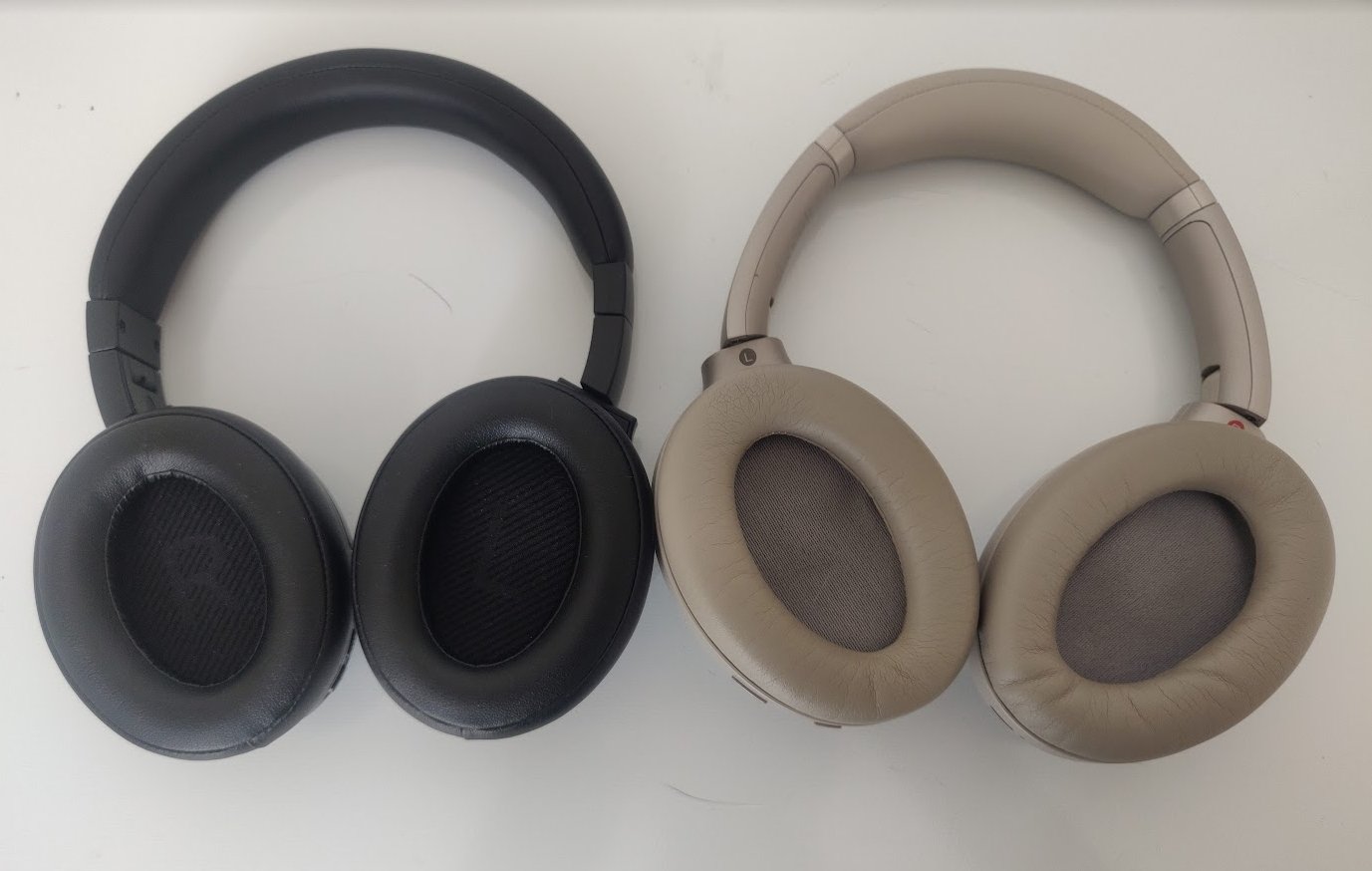
Valco's plastic construction did not come as a surprise to me, but I expected better performance from Sony instead, as the WH-1000XM3 model originally cost almost 400 euros new. Just a few years ago, Sony manufactured its headphones from a lightweight magnesium-aluminum alloy, but in the WH-1000XM3, all parts are plastic. In terms of construction, only the fine design hints at the headphones' high original price. Next to Sony, Valco looks simple and cheap. Fundamentally, however, both are ordinary basic headphones, and there is no such difference in their construction that one could be called better.
Technology
Sony has more technical refinements than Valco. Most of Sony's functions are controlled by touching the headphone cups without physical buttons. The headphones can also be easily set to transparency mode by touching the cup. This is a very convenient feature in situations where there is a need to hear ambient sounds or talk to someone else. Sony also has the Headphones Connect app, which allows you to customize the headphones for your own use, for example, by adjusting noise cancellation features and the headphones' frequency response. The WH-1000XM3 is also compatible with Sony's 360 Spatial Sound Personalizer spatial audio app. Valco's VMK20 undoubtedly feels old-fashioned compared to the Sony model.
Also, the noise cancellation function in Valco is not as effective as in Sony. Somewhat surprisingly, however, the VMK20's Bluetooth connection is more stable, and its range is greater than that of the WH-1000XM3. I did not compare the battery life of the headphones in more detail, but based on the manufacturers' stated information, Valco's battery lasts 45 hours and Sony's battery only 30 hours.
SoundSound quality comparison
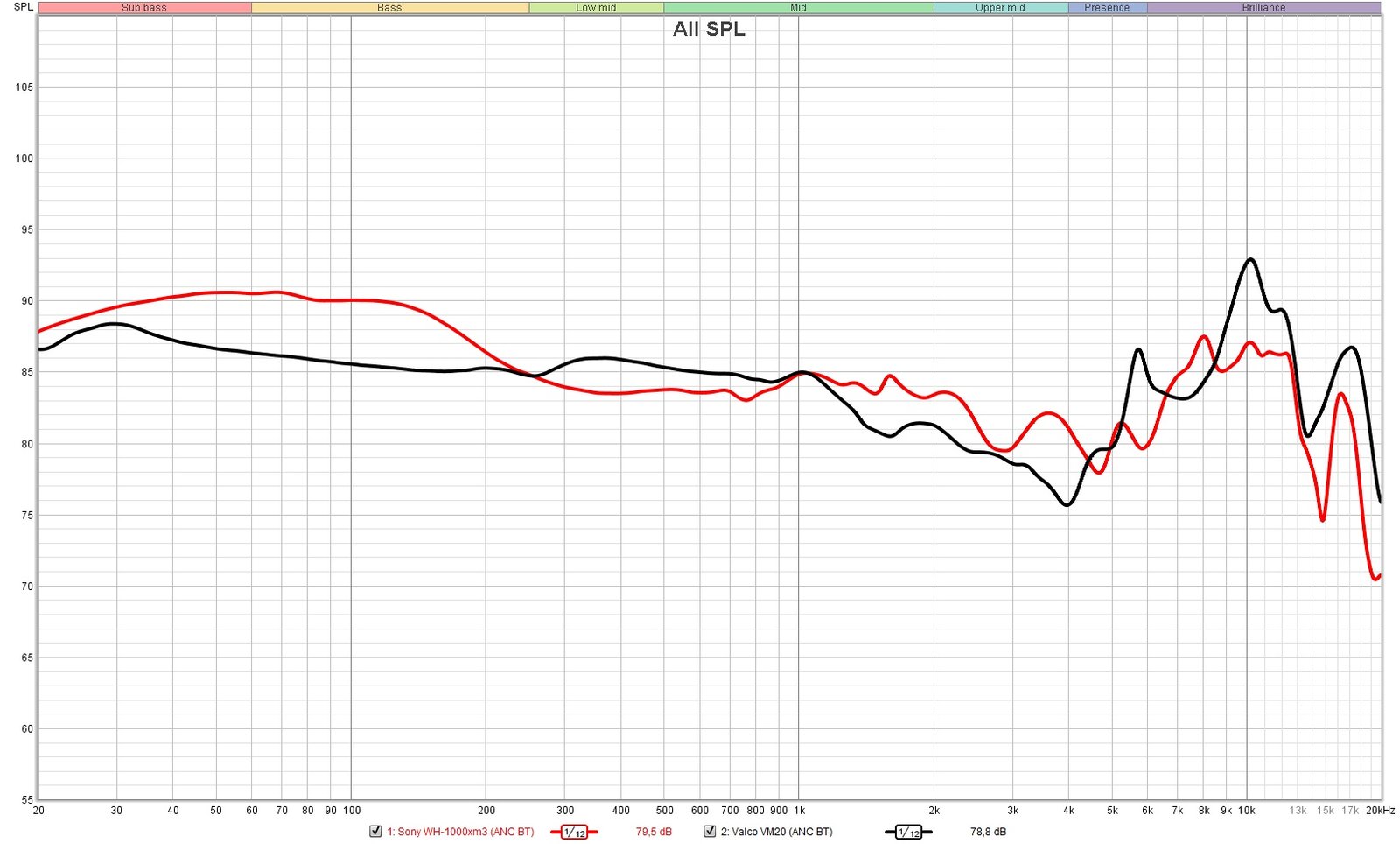
As my frequency response measurements show, Sony's bass is remarkably emphasized compared to Valco. Strong bass is not a problem in itself, if it is only of sufficient quality. However, Sony's bass reproduction is really poor in quality and it resonates strongly. Despite its large quantity, the bass does not even sound very punchy, but rather like a slowly surging mudslide that buries all musicality. Thus, Sony offers no competition to Valco's high-quality bass reproduction.
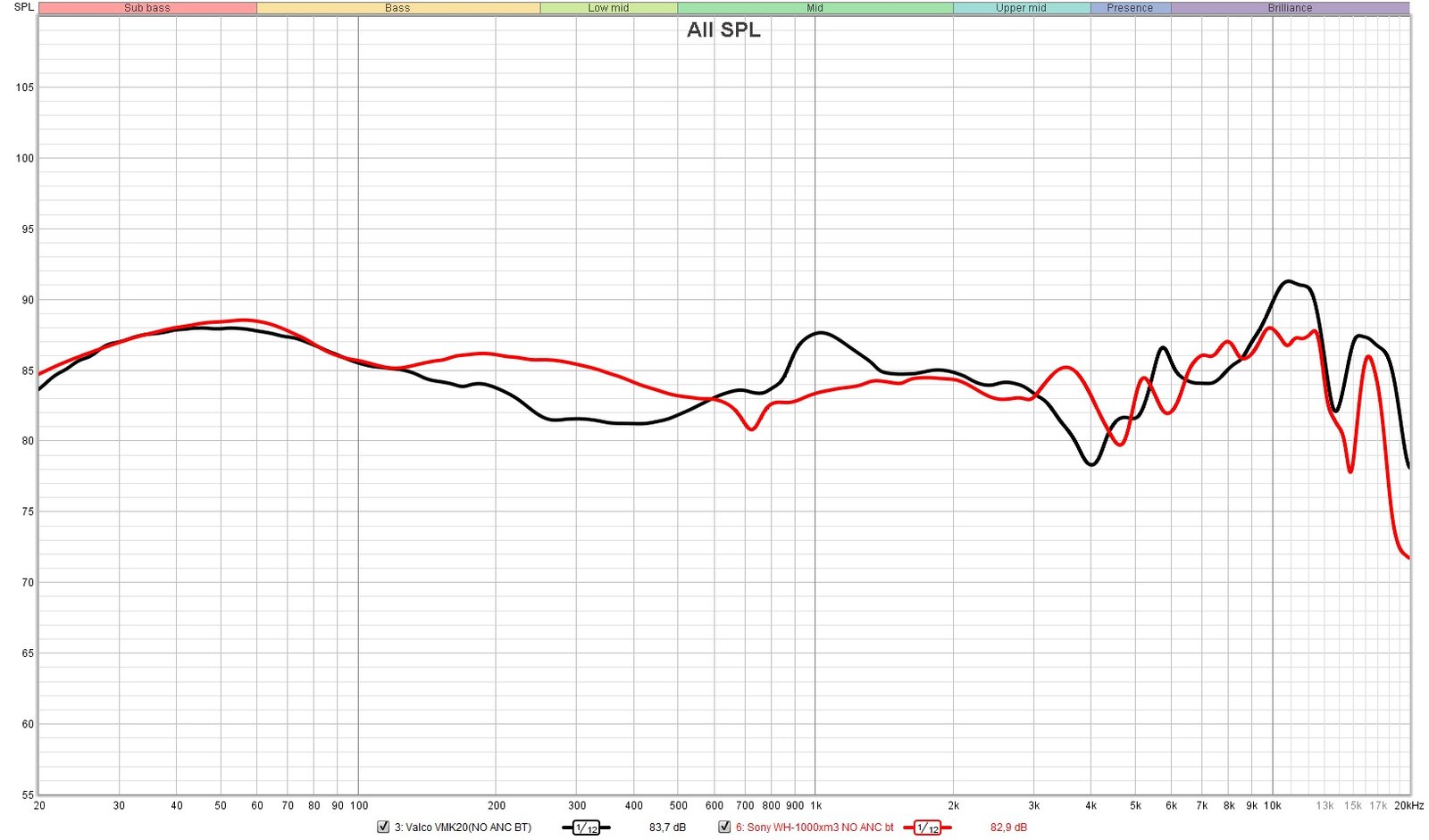
When noise cancellation is turned off on Sony, the amount of bass balances out. Unfortunately, this is of no benefit, as the bass emphasis extends towards the lower mid-frequencies, making the sound at least as muddy as with noise cancellation on. Valco's reproduction without noise cancellation, on the other hand, becomes clearer, even though the sound is more unbalanced according to measurements.
In Sony, the muddiness of the sound is emphasized by too subdued treble. The mid-range balance is excellent in itself, whether noise cancellation is in use or not, but due to excessive and poor-quality bass, a balanced mid-range is of no benefit. The sound is always hazy and flat. Valco sounds dynamic and inspiring, able to distinguish small details in music that are inevitably lost with Sony. In my opinion, the Sony WH-1000XM3 is not worth its current price of 200 euros in terms of sound, and compared to its original price of 380 euros, the sound quality is downright miserable.

Summary
Valco's VMK20 headphones impress above all with their sound quality – I have not yet heard better noise-cancelling headphones. However, for those who desire versatile features, these headphones are not the best option. Even a couple of years ago, the simplicity of the headphones would not have been a problem in my opinion, but nowadays many even more affordable models are more advanced in features than the VMK20. In addition, previously more expensive headphones, such as the Sony WH-1000XM3 and Jabra Elite 85H, offer better value for money than Valco at their current reduced prices, if versatile technical features are more important than sound quality.
However, the simplicity of the VMK20 also has its good sides. Not everyone likes having to customize headphones with separate applications. Valco's headphones are indeed excellent basic headphones for a user who primarily wants ease of use and good sound quality. The VMK20 can actually positively surprise those accustomed to ”ordinary” Bluetooth headphones with its sound quality. The headphones are also suitable in sound for a seasoned audiophile like myself, because their frequency response is balanced, and their sound quality is good enough for less critical listening. I have not been able to say the same about any other Bluetooth noise-cancelling headphones before.
I hope that Valco continues to develop its products. In the next version, it would be nice to see a more original design, and enough additional technical gadgets so that the headphones can better keep up in the intensifying competition. If the already excellent sound quality of the headphones could also be improved by another notch, we would be talking about such a high-class product that owning affordable wired headphones would already be difficult to justify.
Commercial cooperation
Explore Valco's selection and support Kuulokenurkka at the same time
What does this mean?
If you are planning to acquire Valco headphones and decide to place your order by proceeding to the manufacturer's website via the link above, Kuulokenurkka will receive a small commission from this. You are thus simultaneously supporting the construction of both Valco's death star and our headphone empire. Which one will be completed first?
Pros and cons:
+ The most balanced-sounding Bluetooth noise-cancelling headphones I have heard
+ Dynamics and resolution are as good as in wired headphones of the same price
+ Battery life
+ Bluetooth connection range
+ Headphone repair service
+ Reasonable price
+/- An app for modifying headphone features would be a nice addition, but simple ”plug and play” usability has its own advantages
+/- The headphones are based on a Chinese OEM model, but considering the price, this is understandable
+/- The headphones' construction and comfort are quite good, but both could be slightly improved. Especially the opening of the ear pads might be too small for some users.
+/- The headphones' soundstage is narrow, but the same problem exists in almost all other Bluetooth noise-cancelling headphones in this price range
– Sound quality when listening wired
– The headphones feel old-fashioned because they lack technical features that are now found in even cheaper headphones (e.g., ambient sound mode, touch buttons on the cups, a sensor that pauses music playback when headphones are removed from the head)
– Noise cancellation could be more effective

 EN
EN  FI
FI
Great review and walkthrough of the headphones! I use Sennheiser Momentum 3 myself. It would be nice to know how they compare to Valco when using the ”high end sound tuning” in the Sennheiser app, which slightly balances the bass and mids. Of course, these can also be changed separately with EQ, but not exactly the same as with the aforementioned setting. I've read somewhere that these are otherwise quite similar in sound.
These will certainly also go for testing at some point.
Thanks! The Momentum 3, when briefly tested, indeed sounded quite interesting, and their construction is also really nice. If schedules permit, I would gladly review the Sennheisers as well.