Author: Sword of Damocles
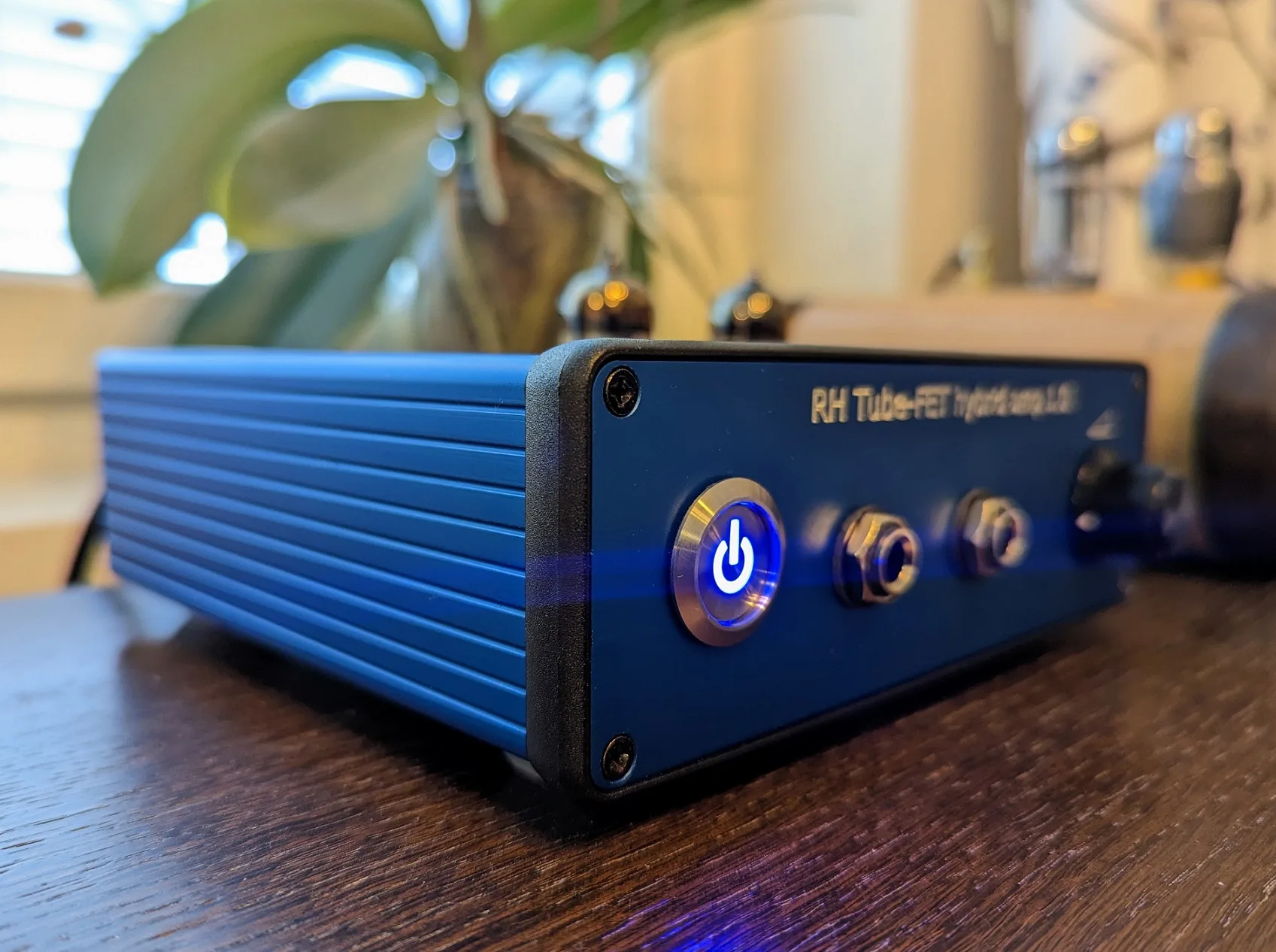
Table of Contents:
In the headphone corner, more headphone amplifiers and D/A converters have been tested recently, the handling of which, despite the differences in devices, is often not particularly interesting compared to headphones. Occasionally, however, individual devices manage to stand out from the crowd in one way or another. Such a device is the blue RH Tube-FET hybrid amp 1.0, designed and manufactured in Finland by Risto Hölttä (hence the RH abbreviation in the name).
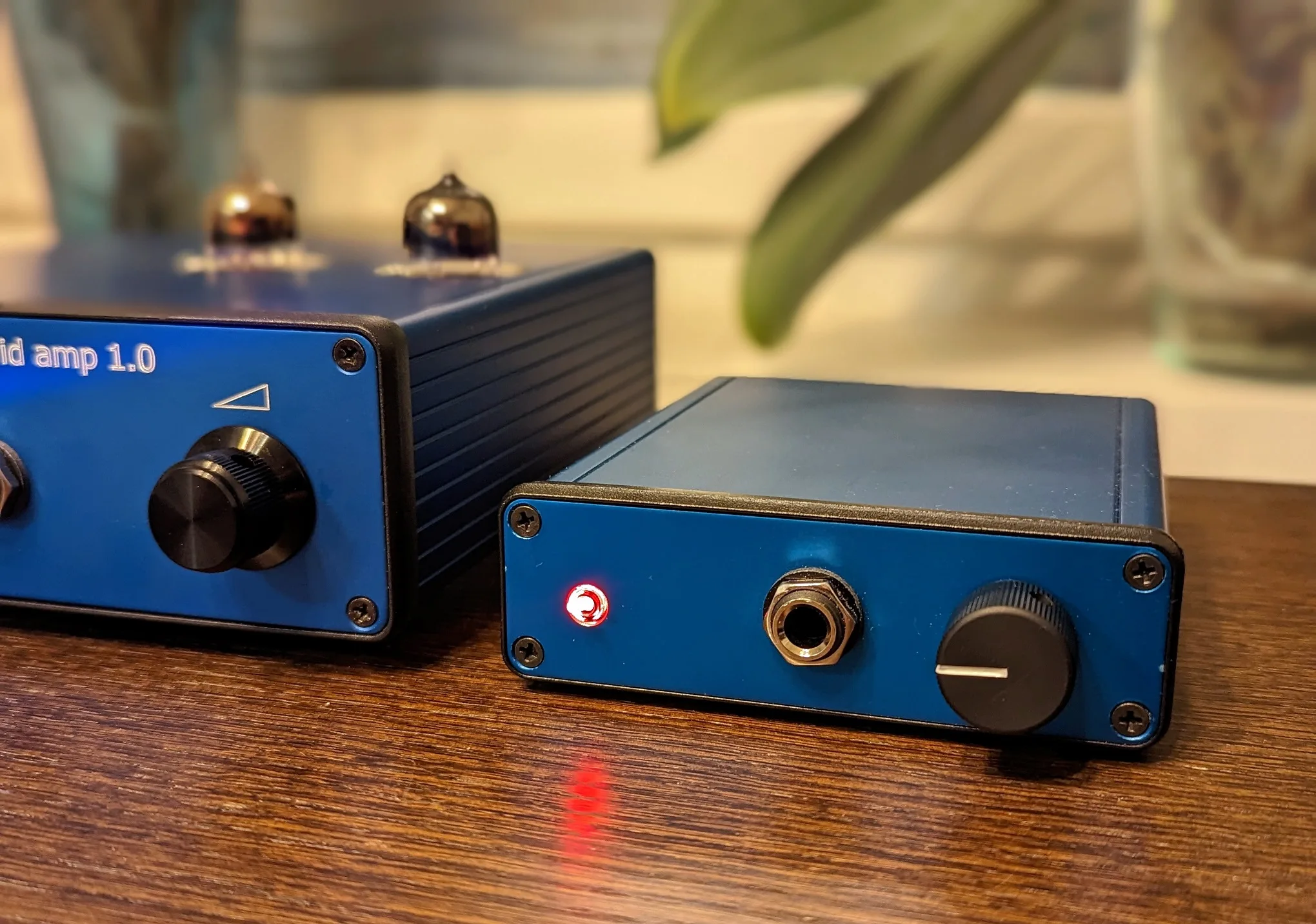
Pictures of the amplifier have been seen before Hifiharrastajat Forum, and its prototype was available for listening at the 2022 Hifi Fair. I had the great honor of trying out the first fully finished version of the device, so I will share some of my experiences with it. Due to the amplifier's rather long name, I will refer to it as the RH hybrid in this article. Risto also has a prototype ready for a smaller headphone amplifier implemented with an operational amplifier, which I also tried.
Design principle
According to Risto, the RH hybrid is a kind of mix of old and the latest new circuit technology. The device's topology is inspired by Konka's OTL tube amplifier, but it has been modernized in many ways. The power supply side is implemented with modern switch-mode power supplies, not in the manner of traditional tube amplifiers. The circuit board, in turn, is 4-layered with a continuous ground plane, which is a clear electrical improvement compared to more conventional 2-layer boards. The amplifier is also quite suitable for low-impedance headphones, as the output buffer is a Class A FET stage.
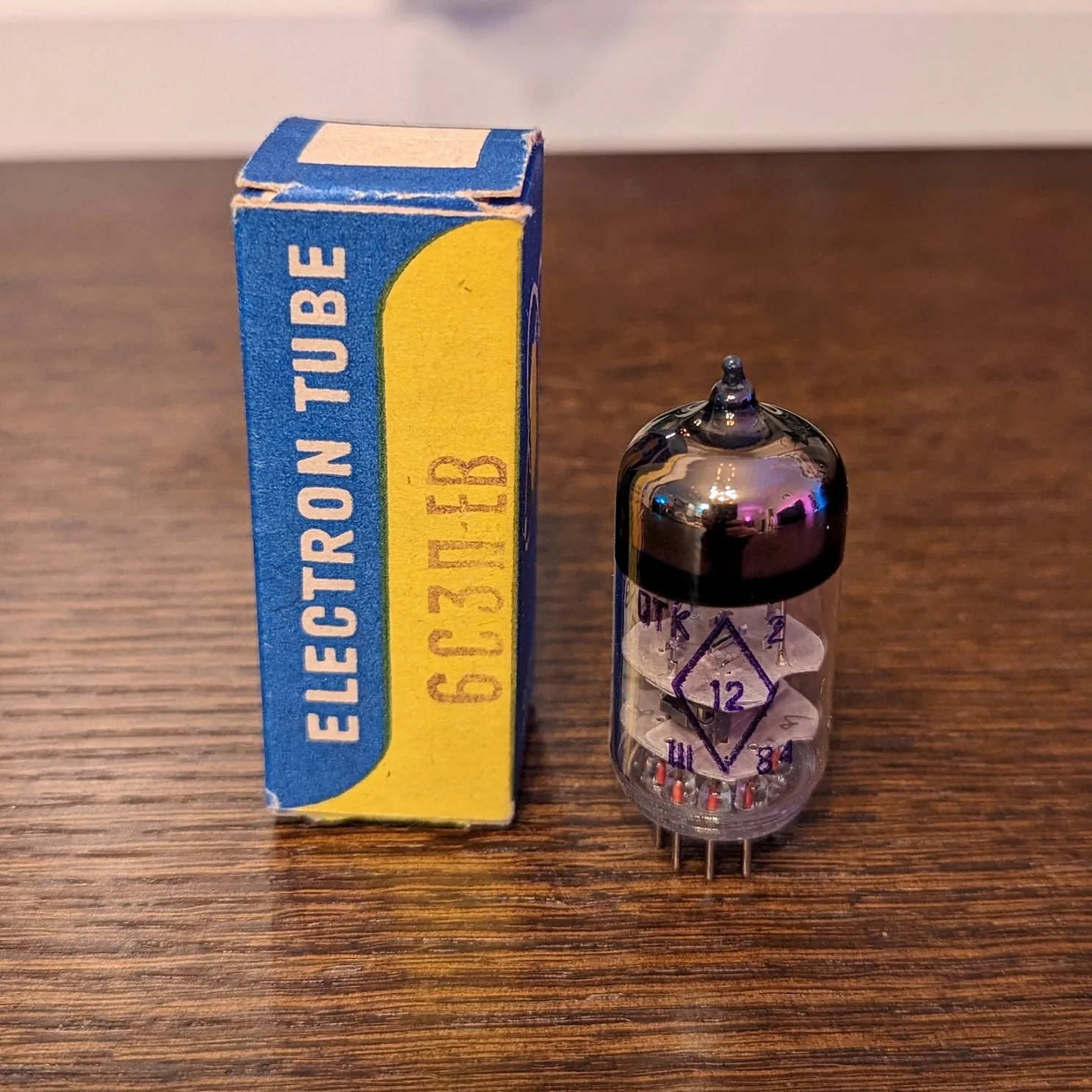
With these choices, the aim has been to make the amplifier sound clean and neutral. However, it is a hybrid device because tubes are used for voltage amplification. For example, unlike many inexpensive Chinese hybrid amplifiers, the tubes in the RH hybrid are not just buffers or ”decorations,” but are used for amplification with a full 200-volt anode voltage, i.e., in their optimal operating range. In some Chinese devices, the anode voltage may remain between 24-40 volts. The tubes in the RH Hybrid produce a typical, audible distortion profile for tube amplifiers, but with modern design, the amount of distortion is less than in most other tube devices. The RH hybrid is thus, true to its name, an intermediate form between tube sound and clean amplification. The output impedance of the device is around 10 ohms.
External introduction of the device
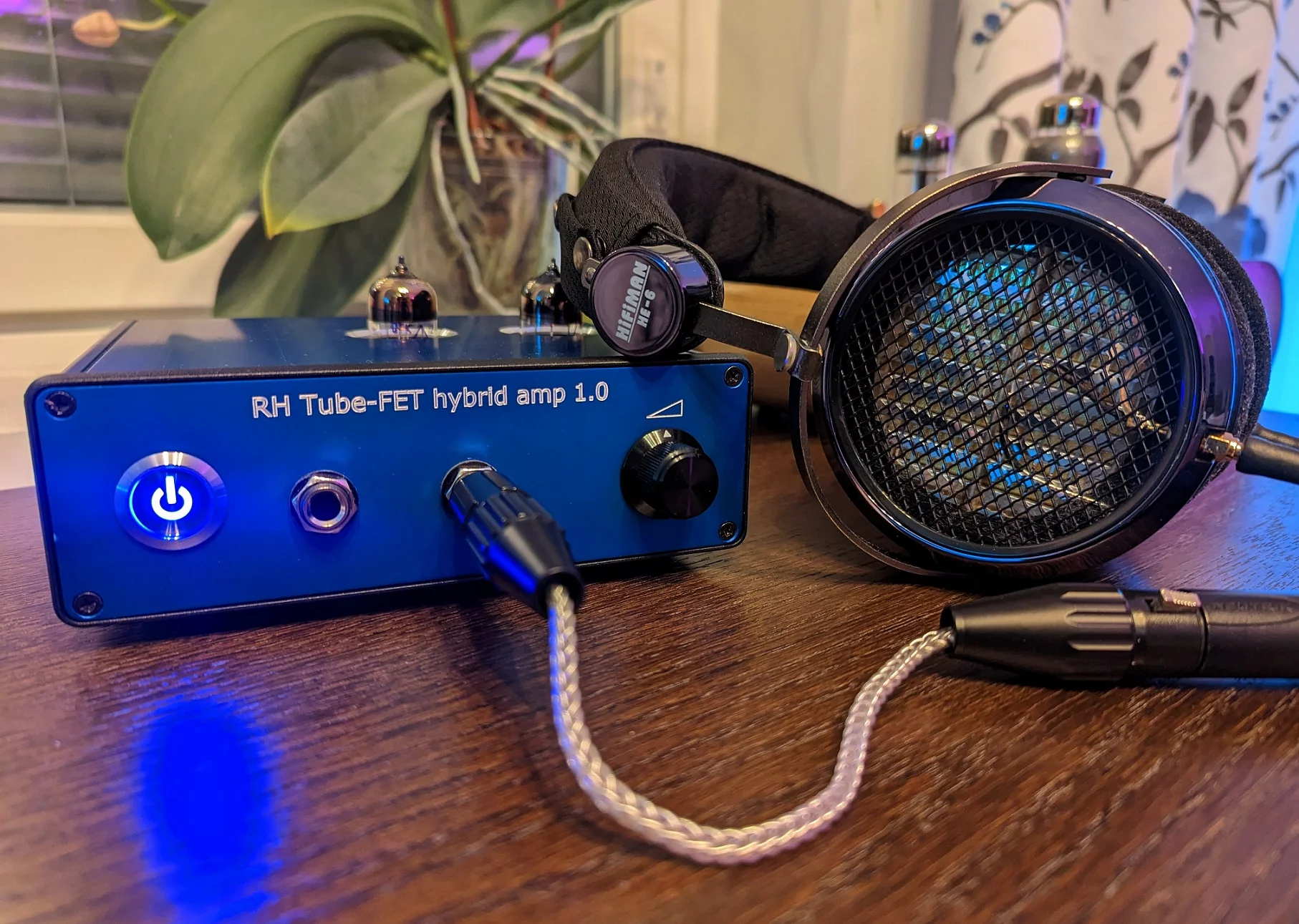
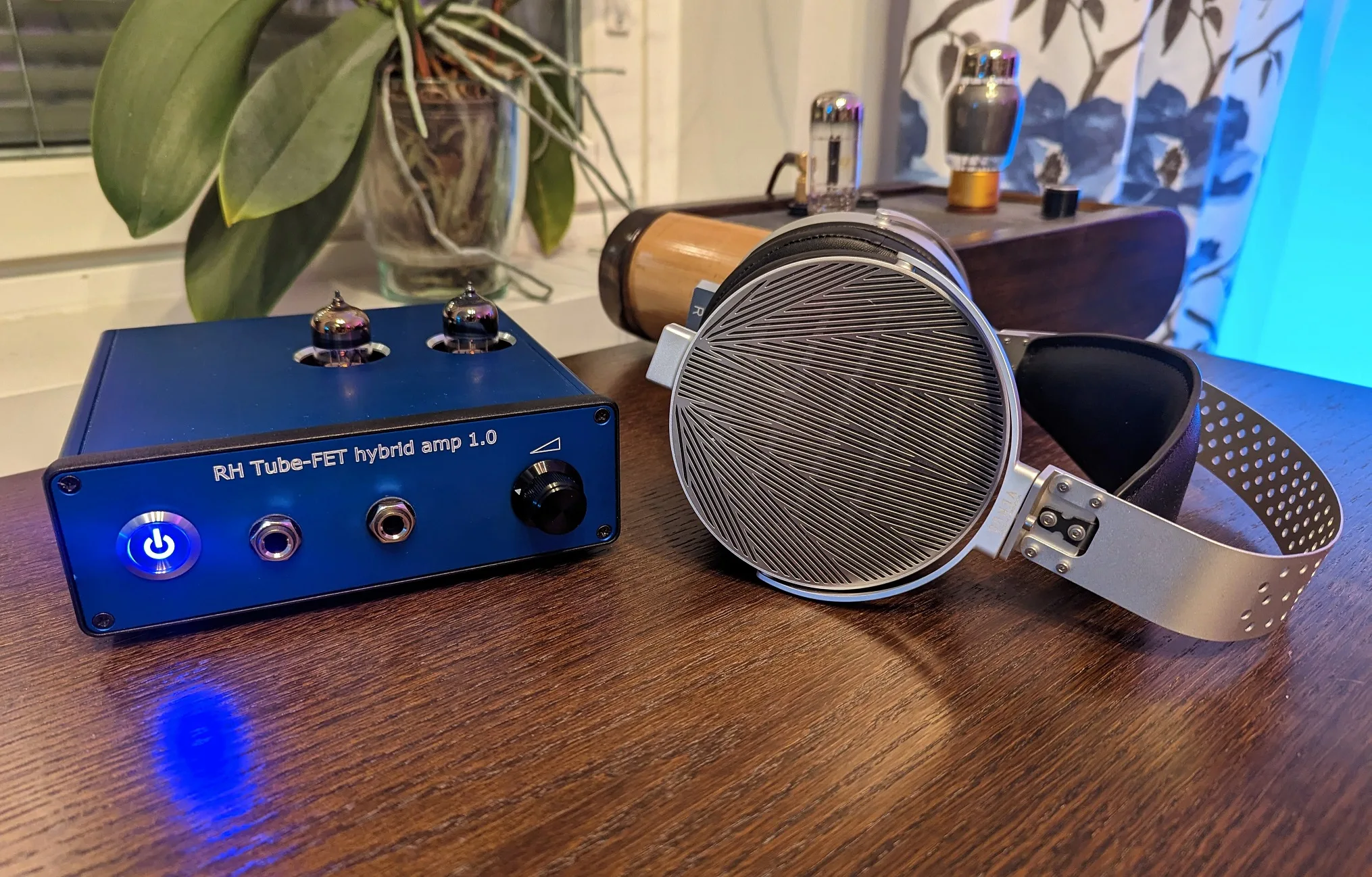
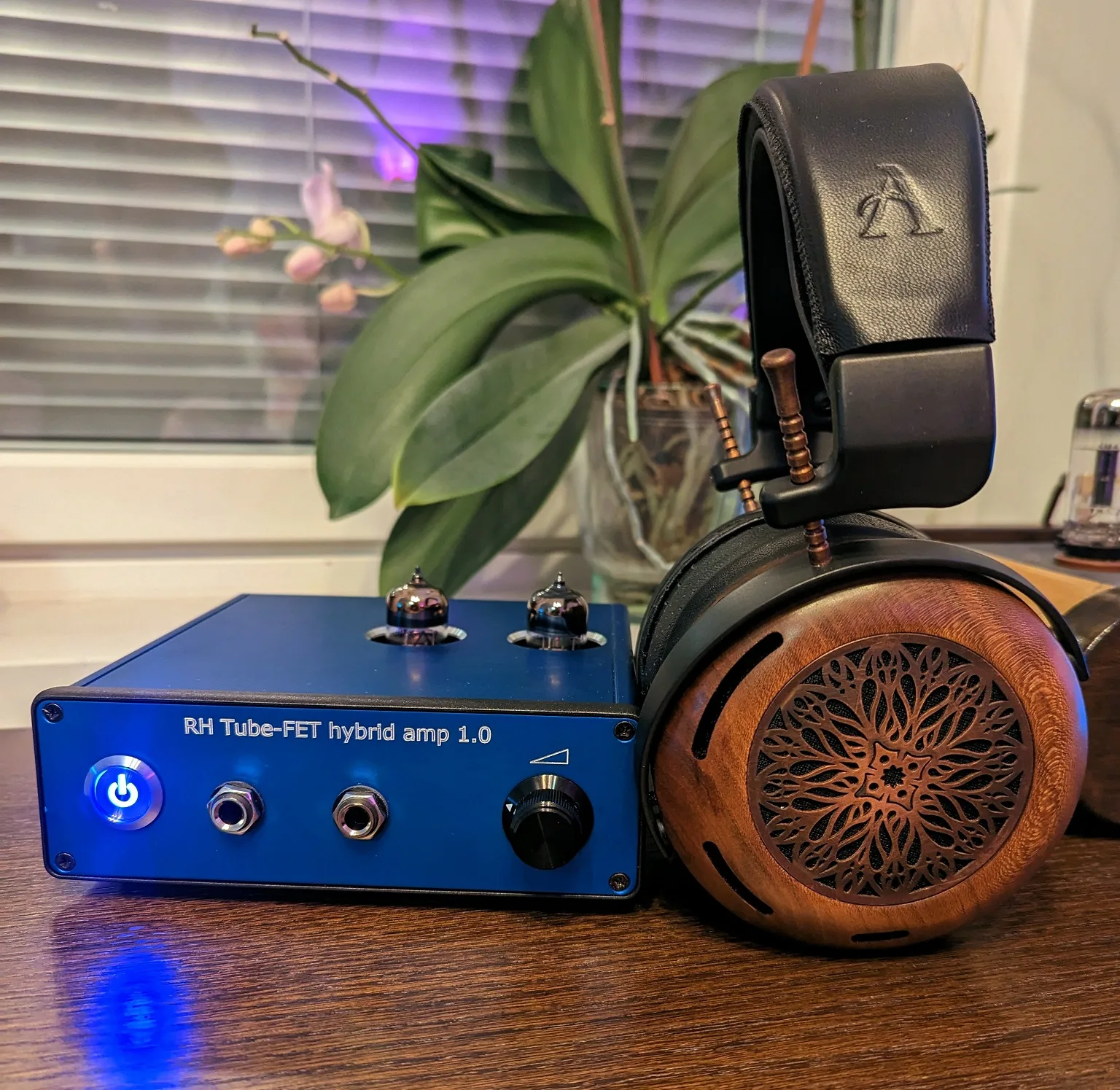
The RH hybrid is externally simple and quite minimalist. The appearance exudes a DIY spirit, but the overall impression is, in my opinion, serious-looking – one expects a device that looks like this to sound good. I like the blue coloring that stands out from the crowd. The aluminum casing is sturdy and high-quality in every respect.
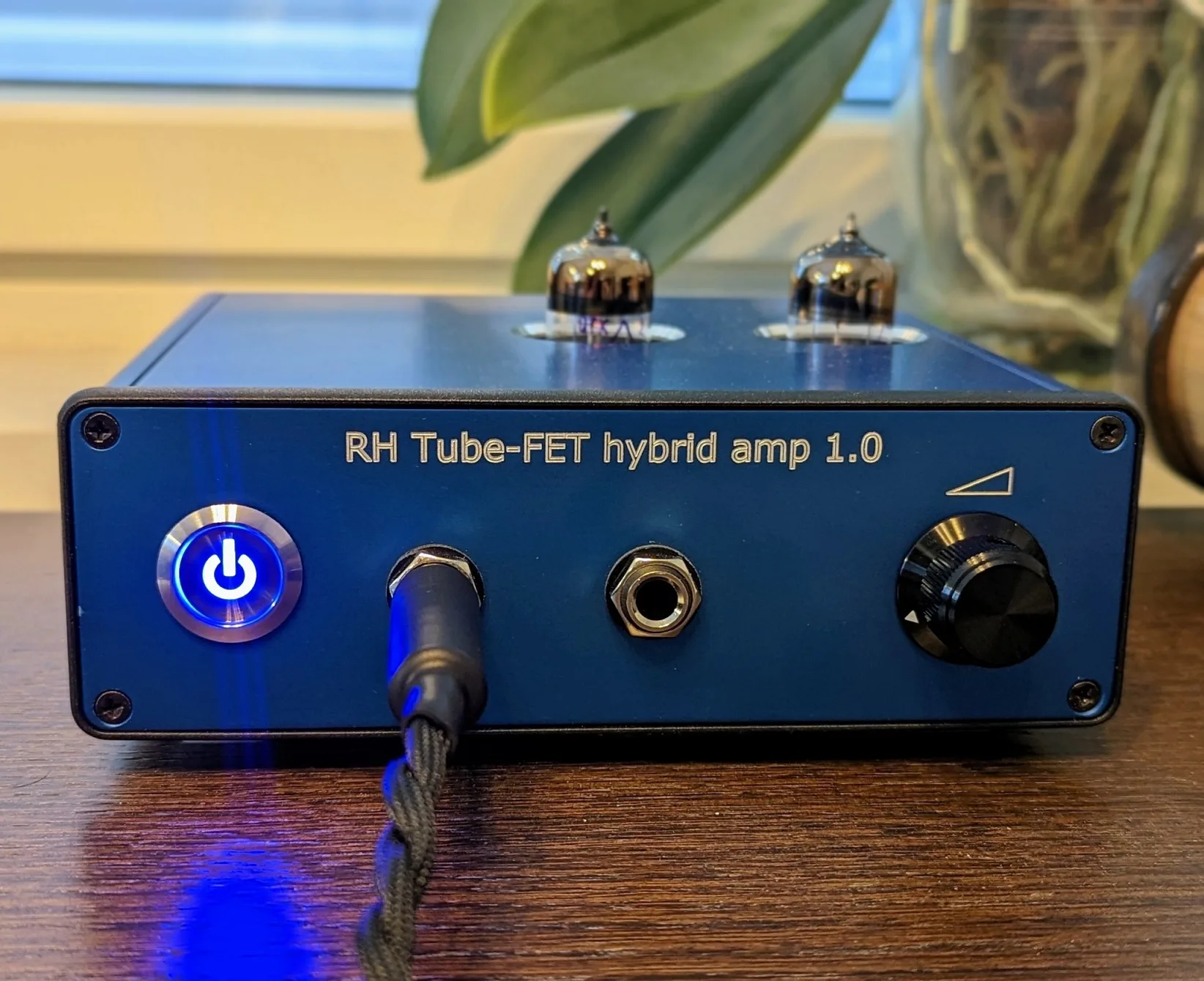
In addition to a large metal power button and volume control, the front edge of the amplifier has two 6.35 mm headphone jacks. I found the blue power LED to be very bright in a dim room, so a slightly more moderate indication of the device being on might suffice. The feel of the volume control is good and smooth. The control also has a clear marking indicating its position. The channel balance in the control is good right from the beginning of the adjustment range.
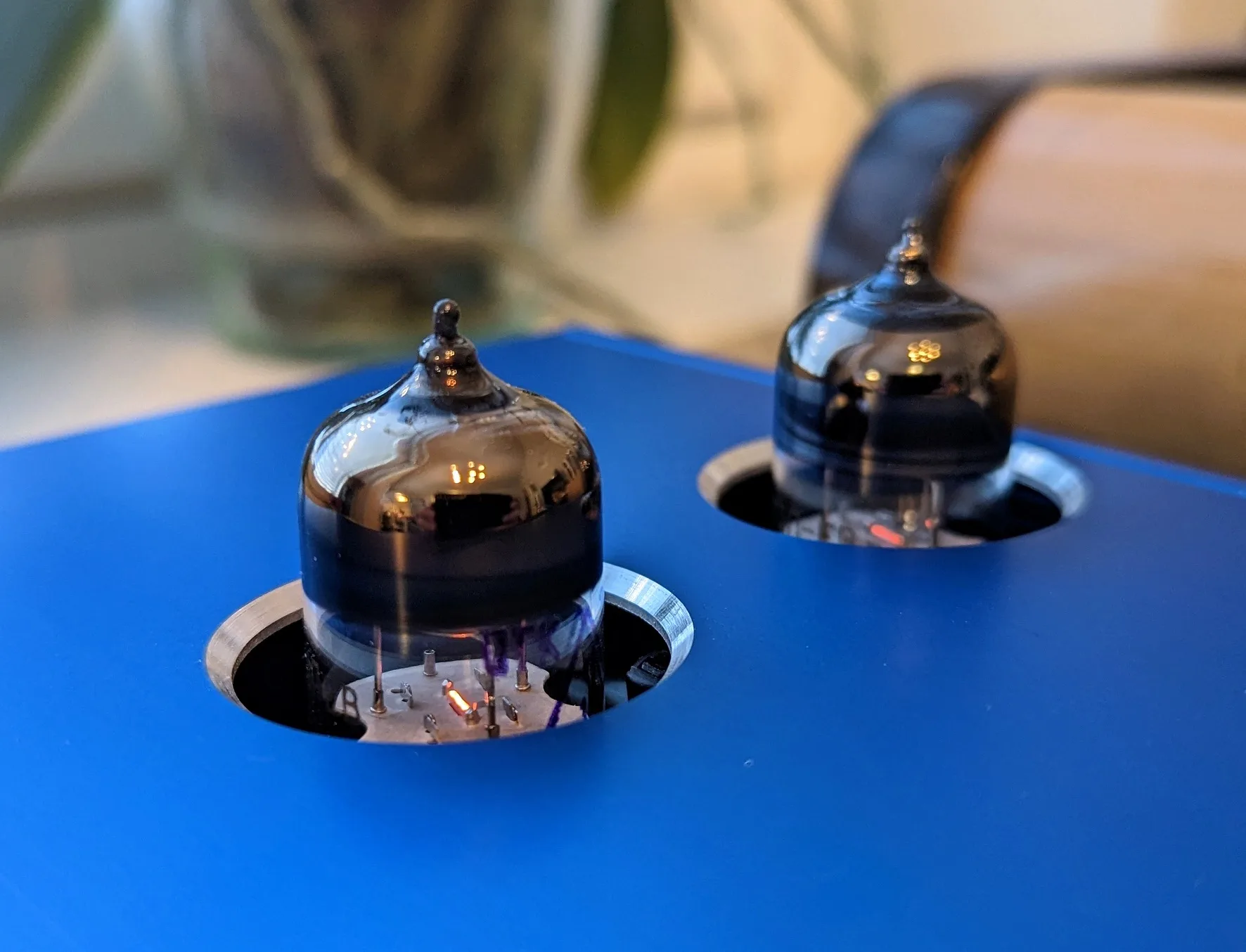
The tubes are pressed into their sockets through holes in the top cover. On the positive side, the tubes remain sufficiently exposed, making them easy to remove. In some devices, the tubes sink so deep that they are difficult to grasp.
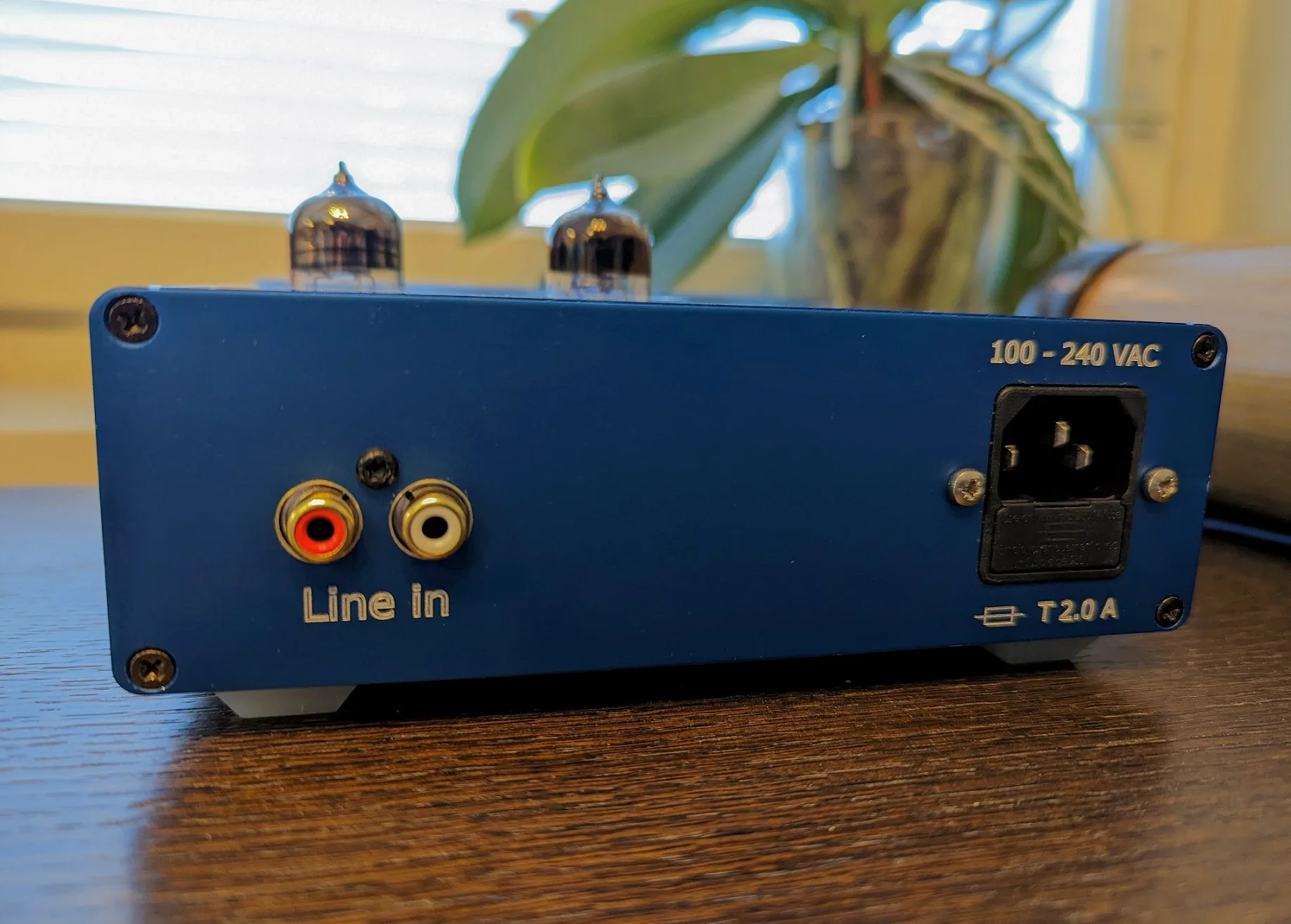
At the back of the device, you'll find traditional RCA input connectors and a full-size power connector – nothing out of the ordinary, then.
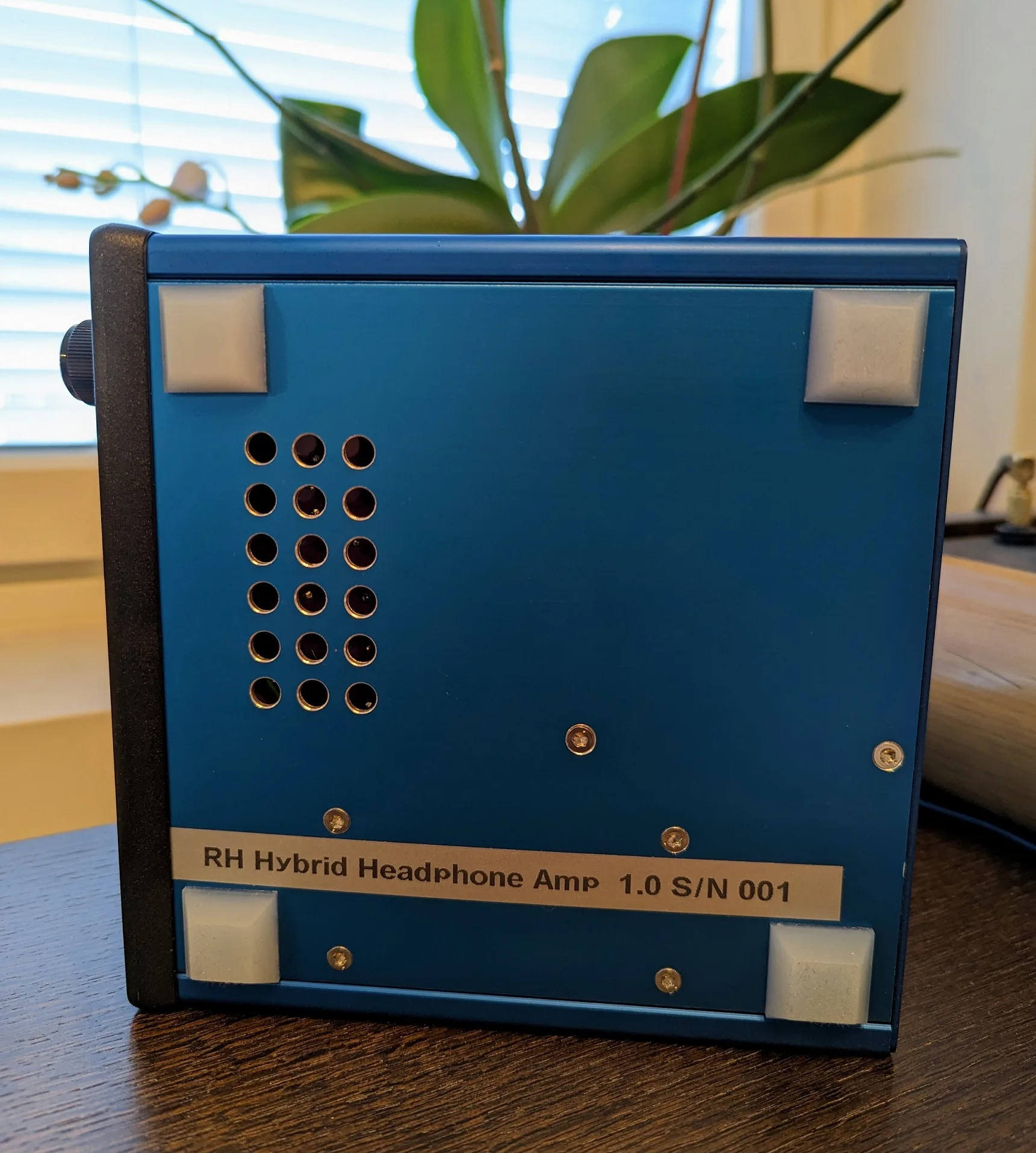
Holes have been made in the bottom for cooling. The feet located at the corners are larger than usual, so the device sits firmly on the table. Slightly higher feet probably also help with cooling, even though the device didn't get hot at all during my use. This is a good thing, as some tube devices tend to run very hot.
Notes on usage
Using the RH hybrid is straightforward, as after switching on the power and waiting for a moment, the device is ready for listening. No special background noises are audibly transmitted from the tubes during listening, but connecting headphones and touching the device's chassis makes the tubes hum for a moment. At this point, a rather strong buzzing and chirping sound is heard from the headphones, which fortunately stops after about 10 seconds. This characteristic therefore does not negatively affect the device's use. Risto also mentioned that he would find out if anything could be done about it. According to my own experience, tube-operated devices are sensitive to other surrounding electronics and power grid disturbances, so the situation regarding background noises might change with the device's placement. In this respect, the RH hybrid does not differ from other tube amplifiers.
There is hardly any background noise during use with regular headphones. However, the amplifier was not suitable for the sensitive in-ear headphones I tested due to the rather strong noise. I am not surprised by this at all, and in my opinion, a device like the RH hybrid should not be acquired for in-ear headphones anyway.
In terms of output power, the device reproduced both 300-ohm dynamic headphones and low-impedance planar headphones well. The former test headphones included various ZMF and Sennheiser models, while for planar headphones, I mainly used the 18-ohm Moondrop Venus. The RH hybrid was also able to drive Hifiman's original HE6 model, which is known as one of the most difficult headphones to drive. The sound of the HE6 was indeed softer than usual, but still pleasant and perfectly listenable compared to many other amplifiers.
Experiences with sound quality
Devices included in testing:
- Schiit Audio Bifrost 2 - D/A converter
- Soncoz SGD1 - D/A converter
- Cayin IHA-6 - transistor amplifier
- Monolith Liquid Platinum - hybrid amplifier
- Tor Audio Roger - tube amplifier
- Objective 2 - amplifier
- RH HP Amp 1.0 (Risto's op-amp based amplifier)
Headphones tested:
- ZMF collection: Atrium, Auteur, Verite Closed, Eikon
- Sennheiser collection: HD600 and HD800 (SDR)
- Fostex TR-X00 Purpleheart
- Moondrop Venus
- Hifiman HE6
- Modhouse Audio Argon mk3
- Beyerdynamic DT770 Pro (32 ohm)
I will begin the sound quality discussion by stating that Risto's goal of a neutral sound has, in my opinion, been achieved. The RH hybrid does not significantly color the reproduction towards any frequency range, but it brings just the right amount of the best aspects of tube sound to the overall experience. These are also easily audible when compared to conventional solid-state amplifiers.
I noticed the amplifier adding its own flavor to the sound, regardless of the headphones I was listening with. This kind of consistency is, in my opinion, an excellent thing, as I know exactly how the sound changes when I use the amplifier. Thanks to the generally neutral-ish presentation, I also didn't have to worry that the amplifier's more significant colorations wouldn't suit a particular headphone model. I found the RH hybrid to be versatile for various headphones, so I have no particular desire to elevate any specific headphone & amplifier synergy above others – the music always sounded good, and I wanted to listen more.
What are the best aspects of the RH hybrid compared to solid-state amplifiers?
The RH hybrid expands and widens the soundstage of all the headphones I tested, which seems to be common specifically for tube amplifiers. Compared to solid-state amplifiers, such as the Cayin IHA-6 and Risto's own op-amp-based device prototype, the sound is more layered and interestingly more lively. The vocalist and different instruments clearly separate from each other, so I perceive individual instruments as being more distinctly located in their own space than usual. On the other hand, as a negative aspect, I feel that the absolute precision of the soundstage simultaneously weakens, because the sounds seem to play larger than usual, making their starting point more indistinct. However, this is easily forgotten because the reproduction is so powerfully immersive. The spacious and layered sound is pleasant to listen to.
In my experience, tube amplifiers often bloat the low frequencies, which can be both a good and a bad thing. This characteristic is also noticeable in the RH hybrid, but in a suitably moderate way. Regardless of the headphone type, the bass is pleasantly stronger than average without being loose or boomy. The power, tightness, and clarity of the bass reproduction can, in my opinion, be counted as one of the RH hybrid's strengths. These features make the reproduction sound fun and dynamic. The low frequencies also blend naturally with other frequency ranges, so when listening, I don't perceive the bass as truly emphasized, unlike, for example, with the Tor Audio Roger tube amplifier. Furthermore, the RH hybrid's output impedance is at a reasonable level, based on the fact that low-impedance dynamic headphones do not become too bass-heavy in their sound.
I also detect a certain relaxation and smoothness in the RH hybrid's sound. The sound is not truly soft or muddy, but the slight rounding of the sharpest sounds in the high frequencies makes listening pleasantly effortless in the long run. The treble still maintains its energy level, lively enough for my taste, as I don't feel the amplifier makes the reproduction darker than usual. This, together with ”sensible” bass reproduction, keeps the overall sound neutral. Compared to the more aggressive and attacking-sounding Monolith Liquid Platinum hybrid amplifier, the RH hybrid sounds distinctly calmer and more spacious.
The spaciously reproduced mid-frequencies prevent the sound from being too warm and intimate, which is encountered with many tube amplifiers. For example, the Tor Audio Roger sounds considerably fuller and more colored. Honeyed mid-frequencies and robust bass are, in their own way, pleasant to listen to with suitable headphones, but sometimes a bit too much flavor syrup is poured into the music. The RH hybrid hardly colors the mid-frequencies, so in more general use, it would sound suitably more normal.
I would say that, depending on preferences, some might expect a tube-containing amplifier to offer a fuller reproduction, which the RH hybrid does not provide, at least with the tubes I tested. However, one device cannot be everything at once. When examining the extremes, the world of tube devices offers plenty of more colored devices, while solid-state devices, at their best, provide an even slightly more neutral, precise, and sharper reproduction for listeners who prefer sound detail. As such, the RH hybrid is, in my opinion, an excellent intermediate form between tube and solid-state devices. Fans of neither camp would likely find much to complain about in the sound, and might even be excited by the mix of different characteristics.
Summary
It is probably clear at this point that I liked the sound of the RH hybrid. The device adds just the right amount of liveliness and soundstage interest characteristic of tubes to a neutral sound, making solid-state devices sound duller and more ordinary alongside it. Generally speaking, the RH hybrid's slightly colored presentation is better suited for a music listener than an analyzer. I observed the characteristics I considered positive with all the headphones I tested, and I can't really find any actual weaknesses in the sound quality, apart from a slight imprecision in the soundstage. In my opinion, the RH hybrid is a successful device as a hybrid implementation. It should also be evaluated as such, because all other different amplifier types also have their own strengths depending on preferences.
In terms of its other features, the RH hybrid is simple and stripped-down, so it doesn't compete against commercial devices with special solutions. Risto's amplifier is indeed difficult to comprehensively compare to products on the market, especially since it is not, at least for now, going to be available in larger quantities. Commercial success would depend on pricing, and since manufacturing individual amplifiers is quite slow, the price naturally increases with the labor hours used. However, a domestic and good-sounding headphone amplifier is something whose story I would like to see continue. Risto's other amplifier also sounded good, so it will be interesting to see what the future brings.
 EN
EN  FI
FI