Author: Sword of Damocles
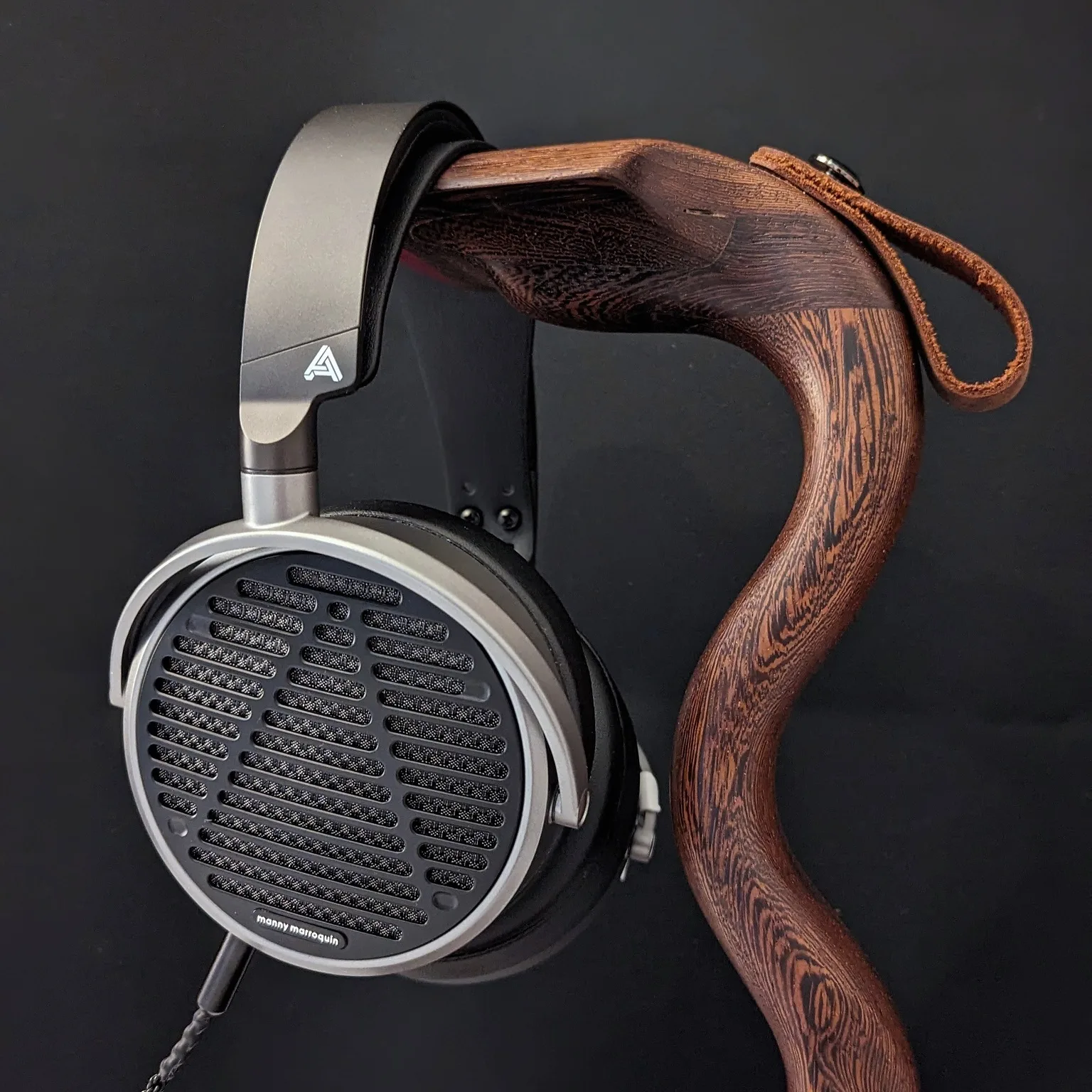
Table of Contents:
Information:
- Release year: 2023
- Country of origin: USA
- Price: 499 € (tax-free price 400 USD)
- Type: open, over-ear
- 90 mm planar drivers (Ultra-Thin Uniforce diaphragm, Fluxor Magnetic Array (N50) and Fazor waveguides)
- Impedance: 18 Ohm
- Sensitivity: 98 dB/mW
- Weight: 475 g (without cable)
- Connector type: 3.5 mm (drivers connected by an interconnect cable, so the headphone cable can be attached to either the left or right cup)
- Cable: length 2.5 m / connector 6.35 mm (attaches to headphones with a single 3.5 mm connector)
- Accessories: Soft protective pouch
Review sample: Self-purchased product
Audeze, now owned by Sony, is one of the most well-known planar headphone manufacturers alongside Hifiman. While Hifiman's product range includes many affordable (100–300 €) hi-fi headphone models, Audeze's cheapest headphones, with the exception of a few gaming headphone models, have hovered around 1000 euros. The LCD-1, which briefly appeared on the market, was already somewhat of an attempt towards more affordable price ranges at its 400 euro price, but ultimately did not achieve greater success. Now, however, Audeze is trying again to create an ”affordable” headphone with the MM-100 model (link to the manufacturer's product page). It is priced at 500 euros in Finland, a truly competitive price range.
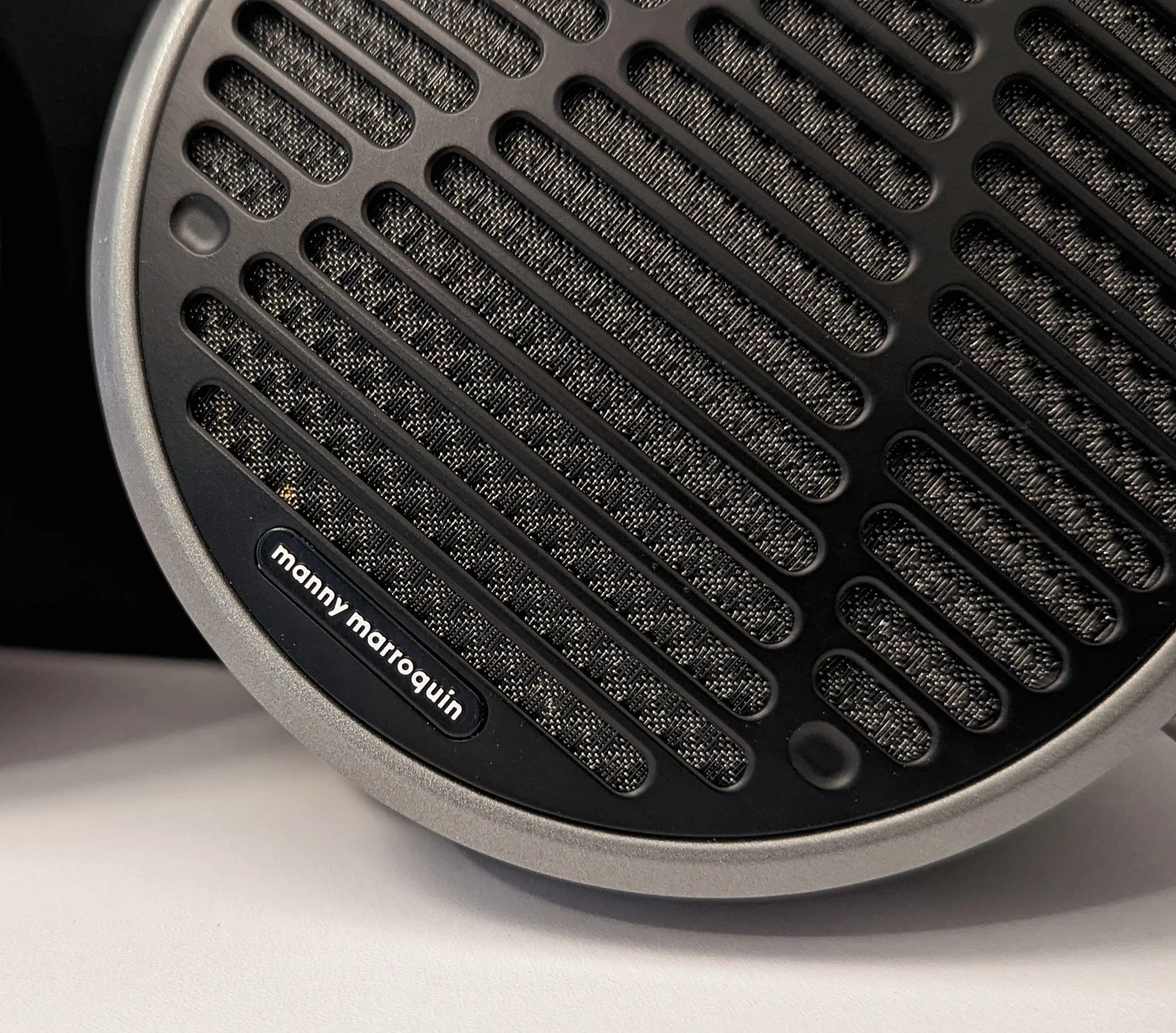
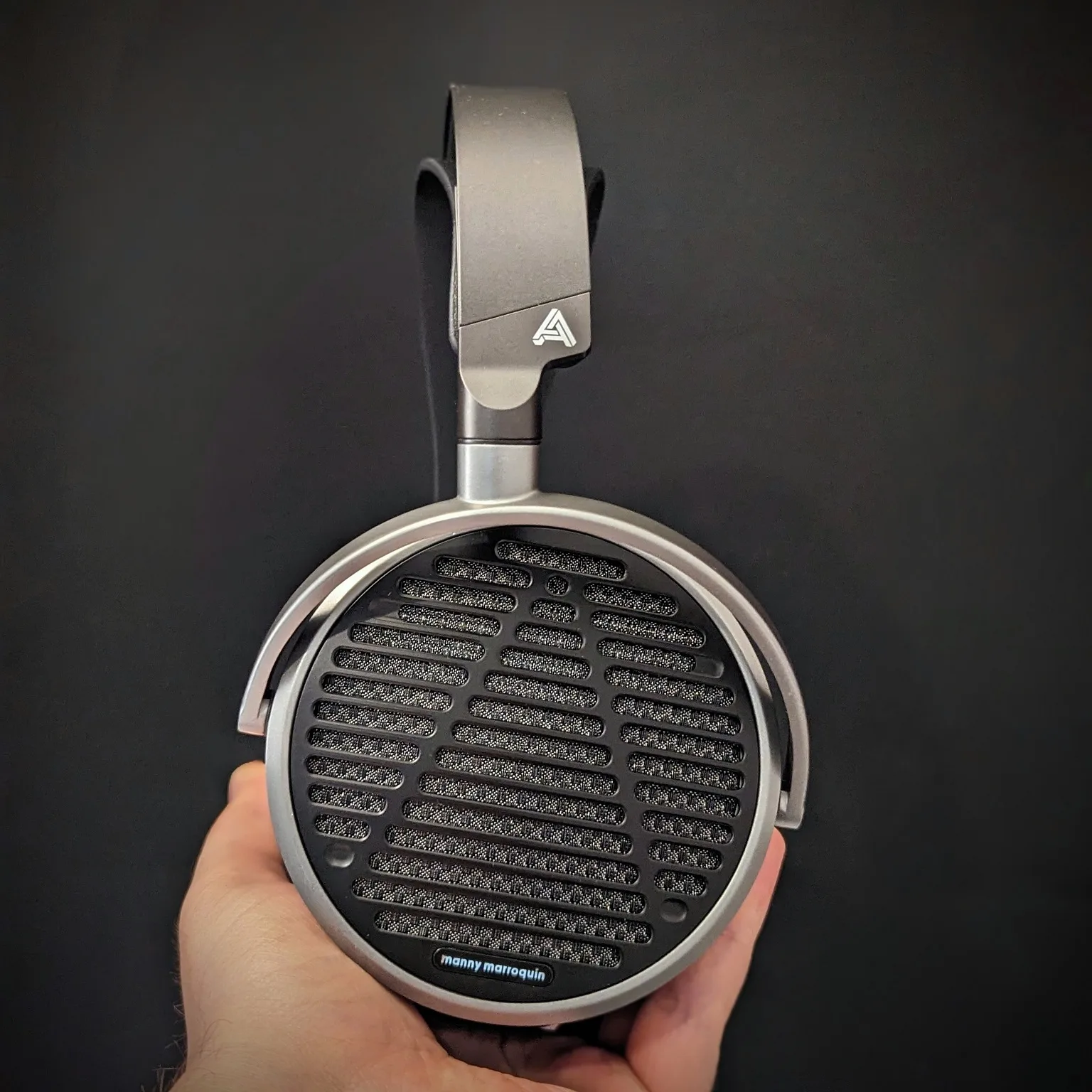
Like the 2000-euro MM-500 model, the MM-100 is aimed at studio use, representing a clear departure from the tuning characteristic of the traditional LCD series. Both products also utilize the name of music producer Manny Marroquin (winner of 11 Grammy awards), as he has participated to some extent in the development of the headphones. In the case of the MM-500, this is prominently featured in marketing and product images, whereas the MM-100 only includes Manny's name without him appearing in any product images. I would suspect that the collaboration for the more affordable model has been less extensive. Despite this, the MM-100 aims to offer similar studio-friendly sound at a significantly lower price point. The structure of the headphones is borrowed from the wireless Maxwell gaming headphones (price 400 €) with the difference that the cups are open and no electronics have been added inside them.

The release of the headphones did not go particularly smoothly, as material availability issues forced the postponement of production, and the announced sales launch date, which was a couple of months in advance, had to be moved several times. Audeze's communication seemed rather vague, and the first finished headphones were, in addition, accidentally wired incorrectly, so the sound quality was off. Due to these problems, the arrival of the MM-100 model in Finnish retailers' warehouses had to be awaited for almost half a year after its release, which is why it has received very little attention here, considering how well-known a company Audeze is. Let's, however, quickly find out about the headphones now.
Packaging and accessories
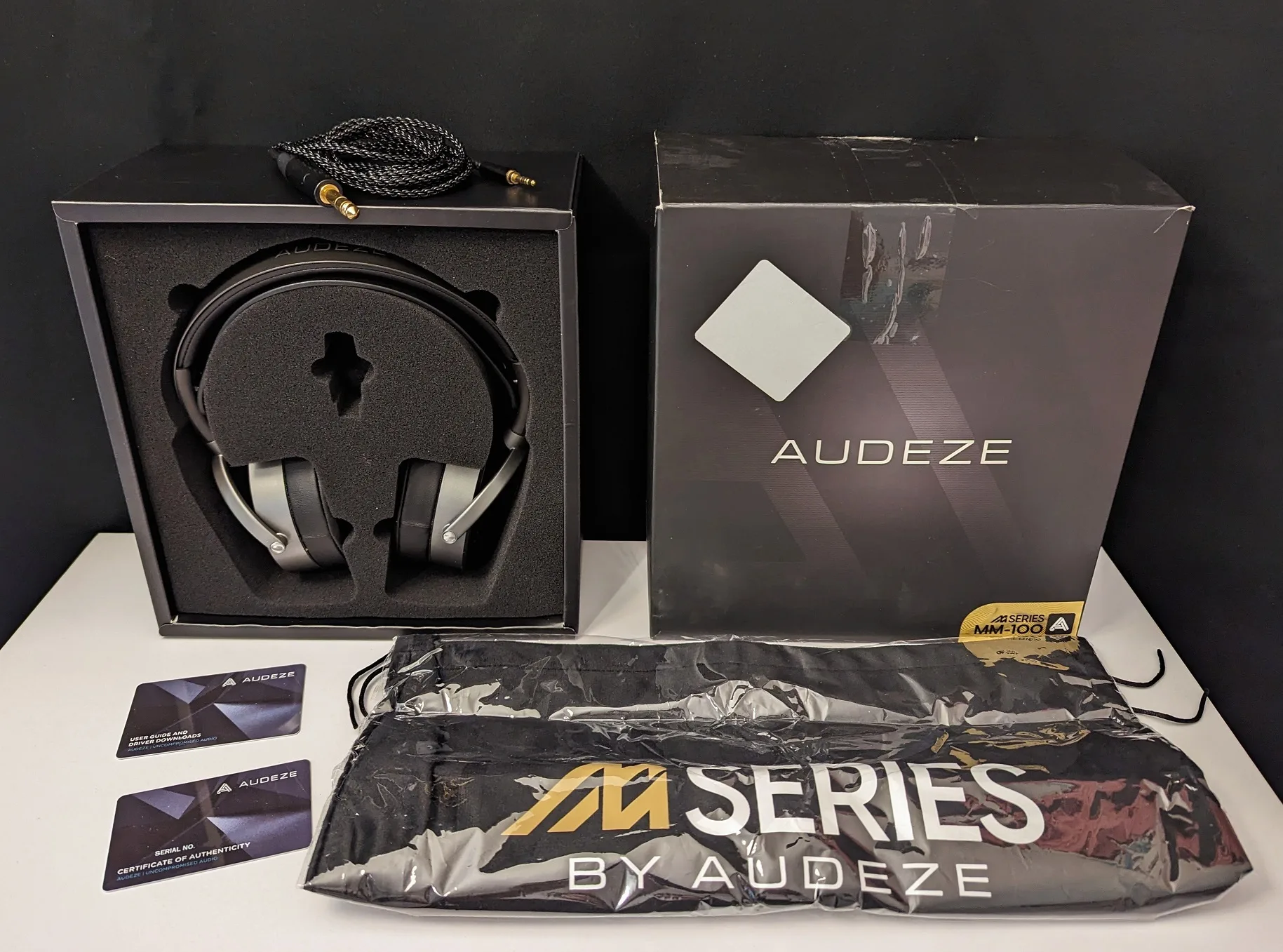
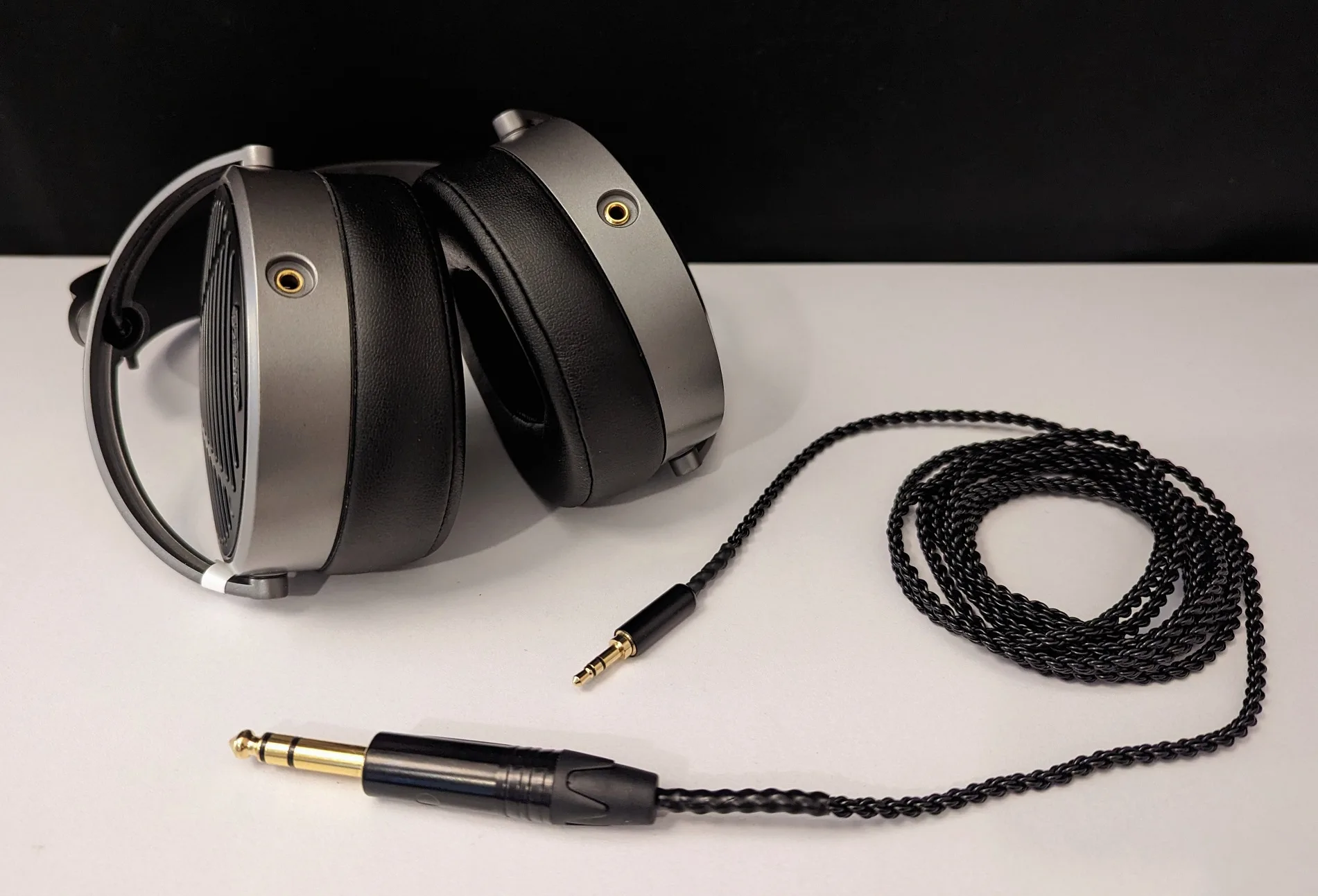
The headphones are delivered in a black cardboard box and, in addition to the 2.5-meter cable, only a large protective pouch is included – the equipment is very sparse. Audeze has somewhat unusually added a direct 6.35 mm connector to its cable instead of having a 3.5 mm connector and a 6.35 mm adapter. I would assume the larger connector is more common in a studio environment, meaning the user doesn't have to rely on adapters. The advantage of a more robust connector is, of course, also better durability.
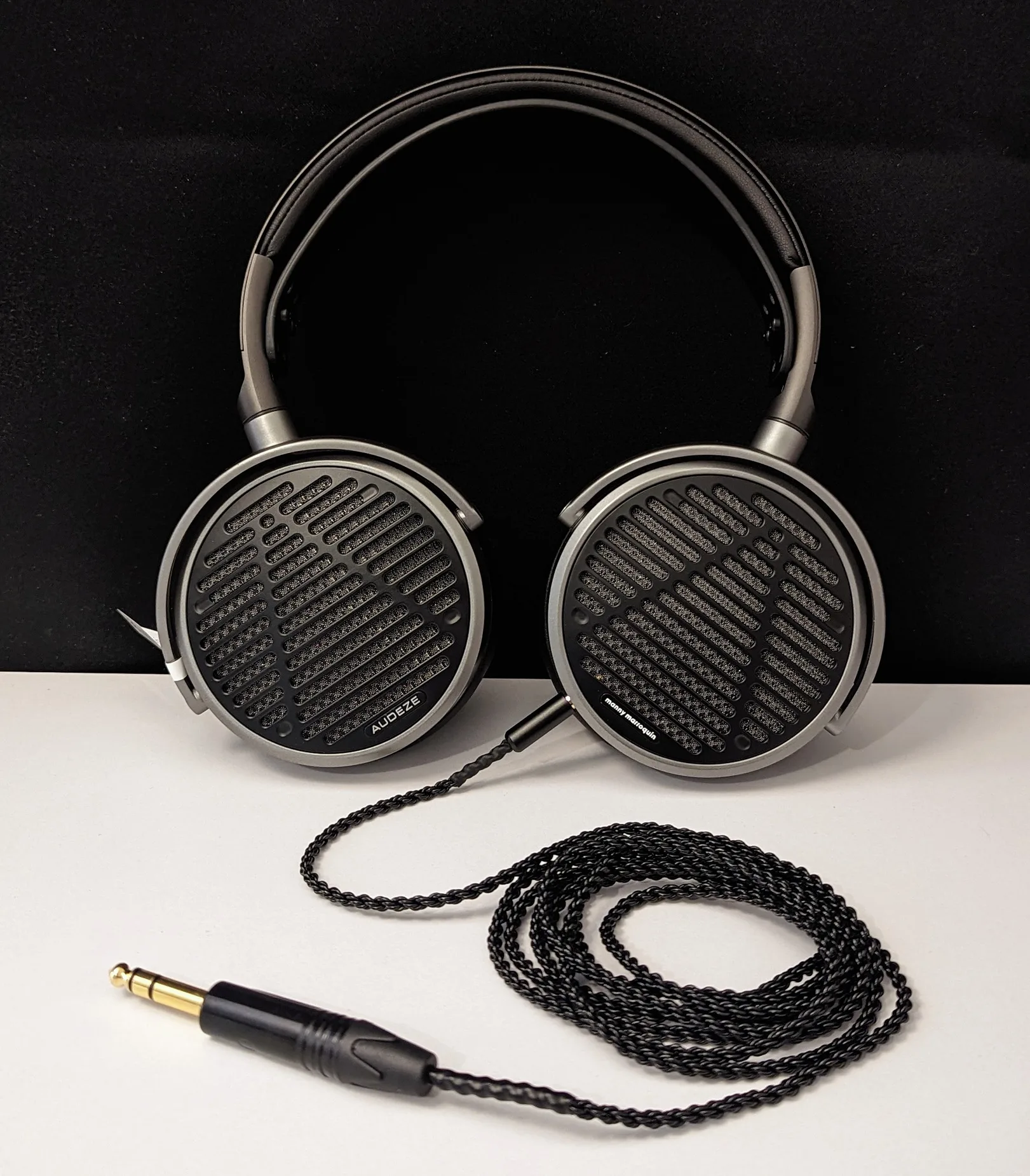
The thin braided cable feels regrettably generic due to its hard plastic insulation, especially considering the otherwise high-quality impression of the headphones. Cables with similar materials are often included with 20-euro Chinese in-ear headphones, so Audeze could certainly have invested a bit more in this aspect. Fortunately, the cable is relatively unnoticeable during use because it is lightweight and does not cause rubbing noise when it touches clothing.
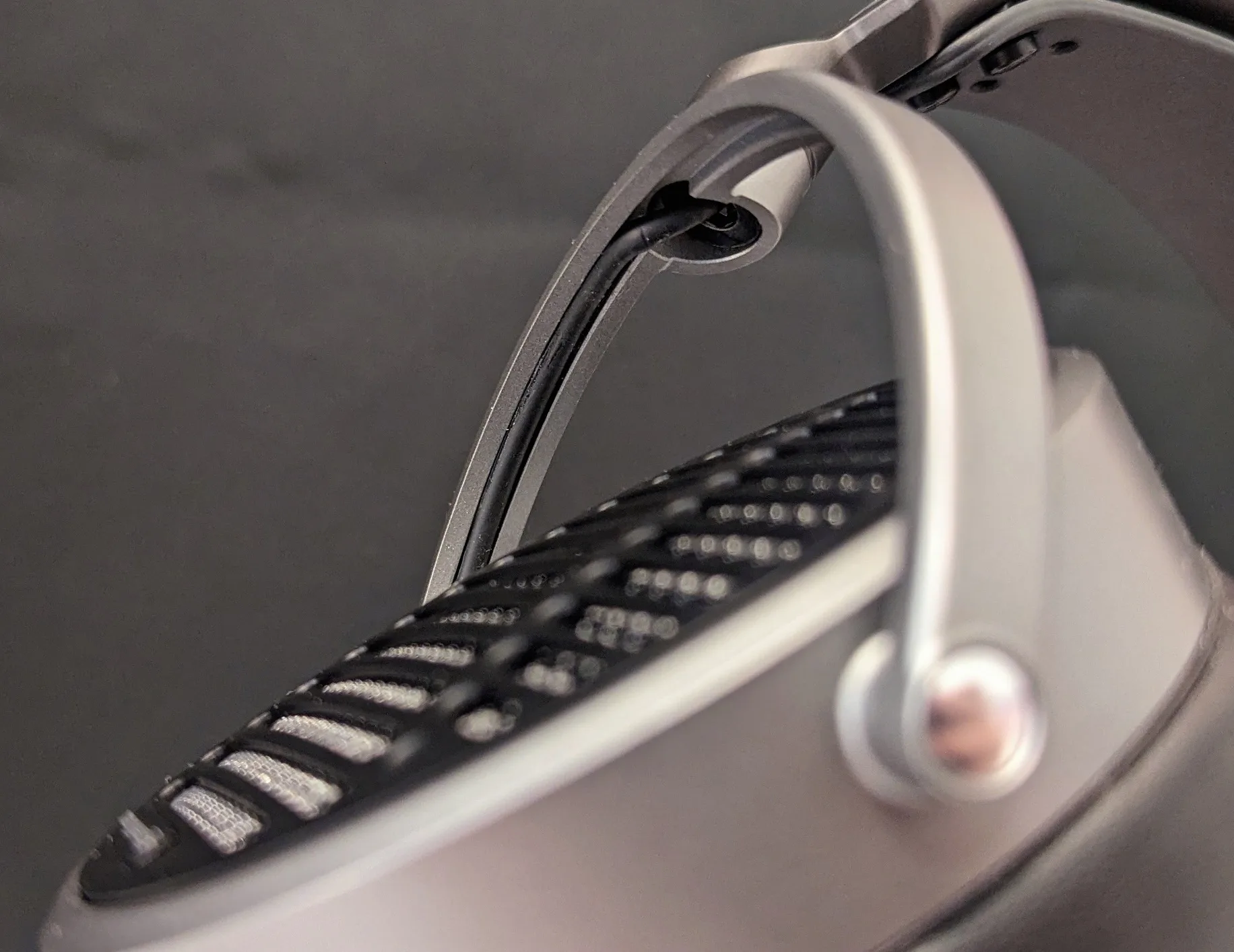
The cable can be attached to either the left or right cup thanks to a single 3.5 mm connector, as an interconnect cable runs through the headphone headband to the other side. Alternatively, a cable with two 3.5 mm connectors would also fit the headphones, but it would need to be wired specifically for the MM-100. Thus, cables designed for Hifiman and Focal headphones, for example, do not work correctly with the Audeze model. Since a balanced cable is not included in the product package, acquiring one would be more difficult than usual.
Build and comfort
One of the MM-100's greatest strengths is its stylish and high-quality construction, which, in terms of material choices, would be suitable for a significantly higher price range. As a side effect, however, the headphones are, in typical Audeze fashion, heavier than their competitors. The MM-100 is not among the largest in size, but the thick metal parts (magnesium and aluminum) and planar drivers with their magnets accumulate a total of 475 grams, which is, for example, about 100 grams more Hifiman Sundara compared to or over 200 grams more compared to the Sennheiser HD 600 series. On the other hand, Audeze's older LCD series headphones (excluding LCD-5) weigh 100–200 grams more than the MM-100, so in that respect, the change is very welcome.
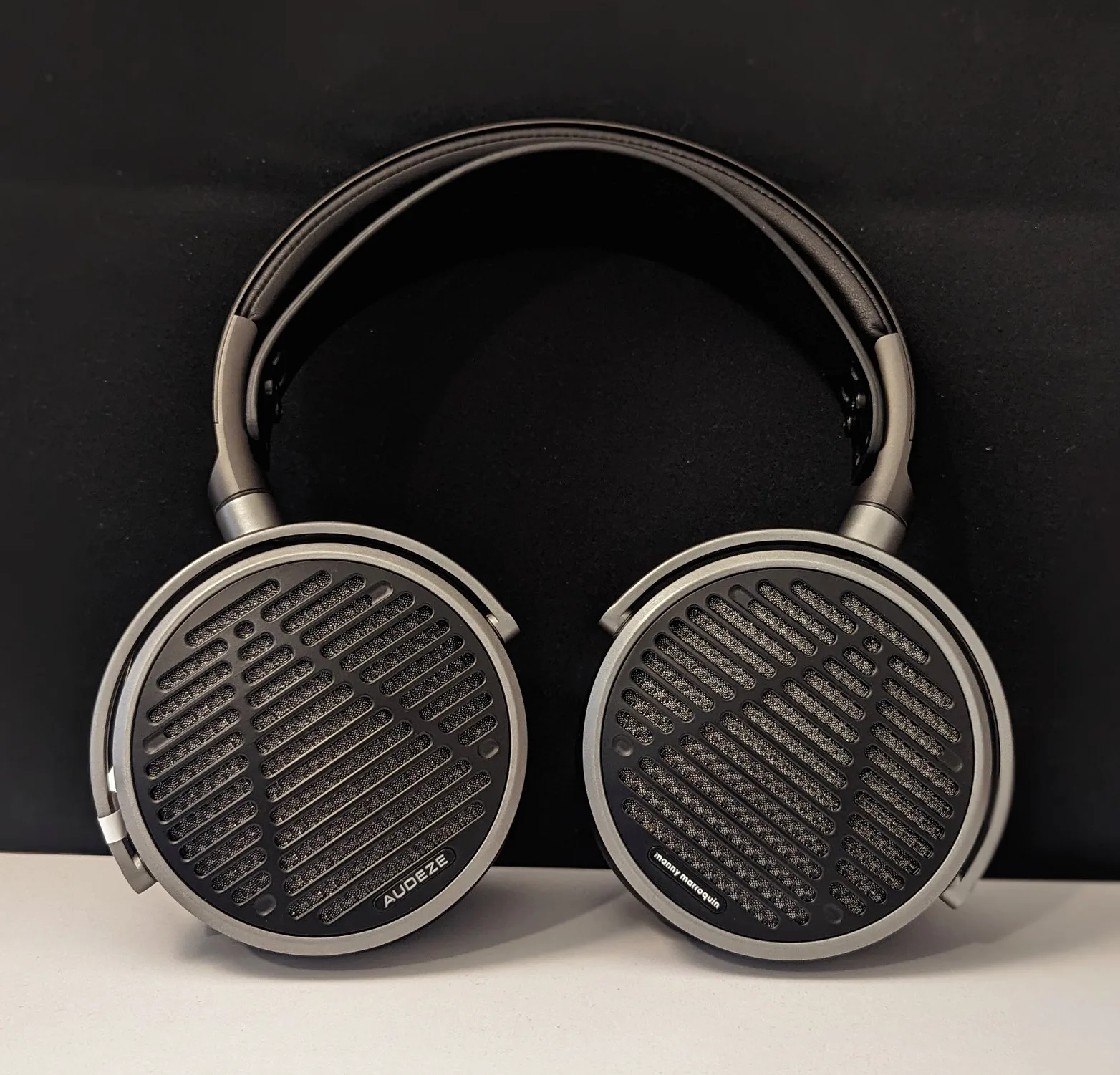
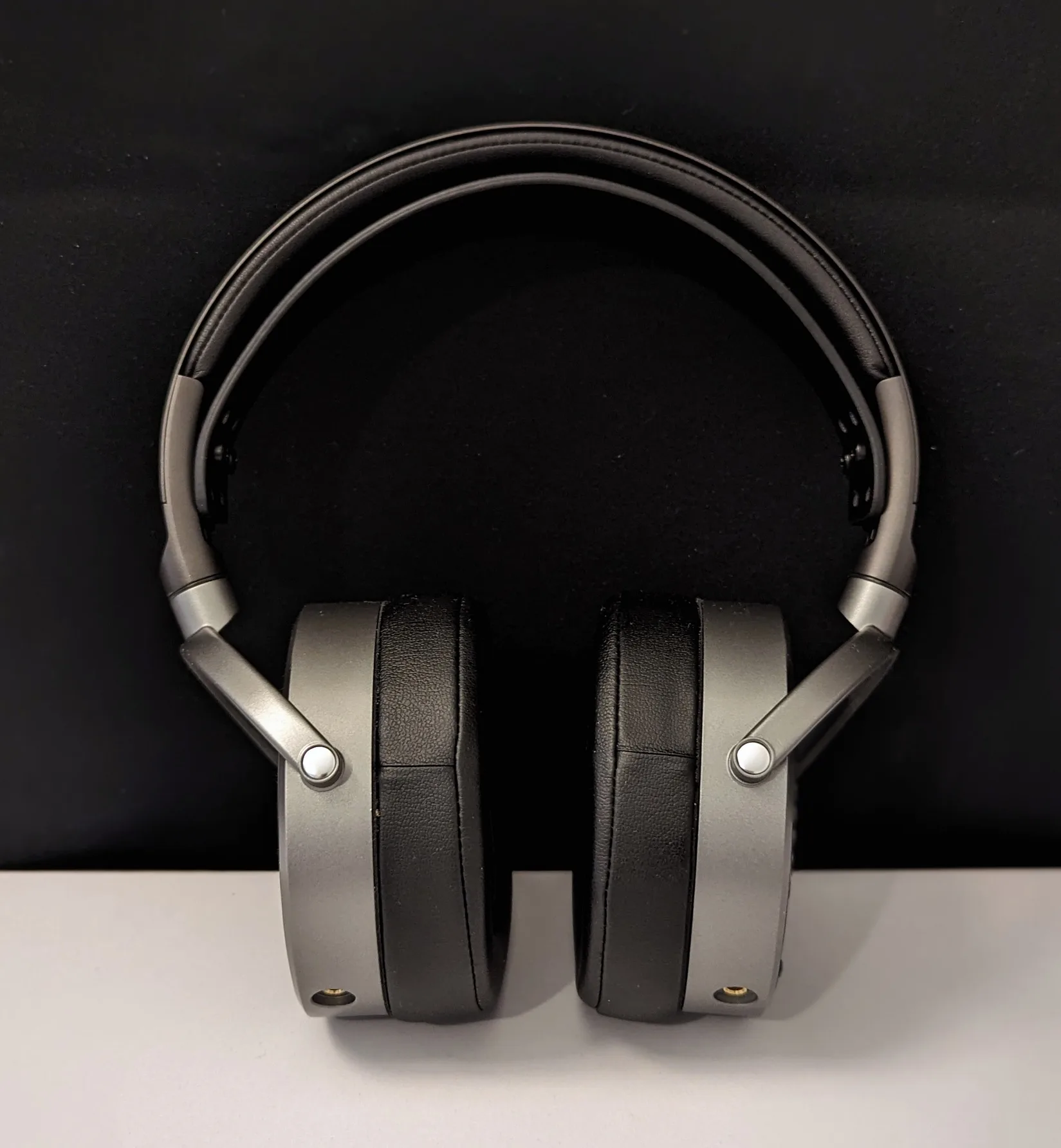
Cost savings are most evident in the headphone's padding parts, or rather, their attachment. The Maxwell has removable ear pads, but for some reason, the MM-100's pads are glued tightly in place. Since the chosen plastic faux leather material is exceptionally sweaty, many might want to use fabric pads, for example, during summer – however, this is not possible. For me, the standard pads could also be thicker, as my earlobes partially press against the Fazor structure installed in front of the drivers. As a result, my ears start to ache after just 15 minutes of listening, which is further exacerbated by the pressure sensation on the side of my head caused by the strong clamping force of the headband. The fit is tight but not particularly secure, as the headphones could be shaken off quite easily. Although the MM-100 may suit many better than myself, the specially implemented height adjustment can still cause problems.
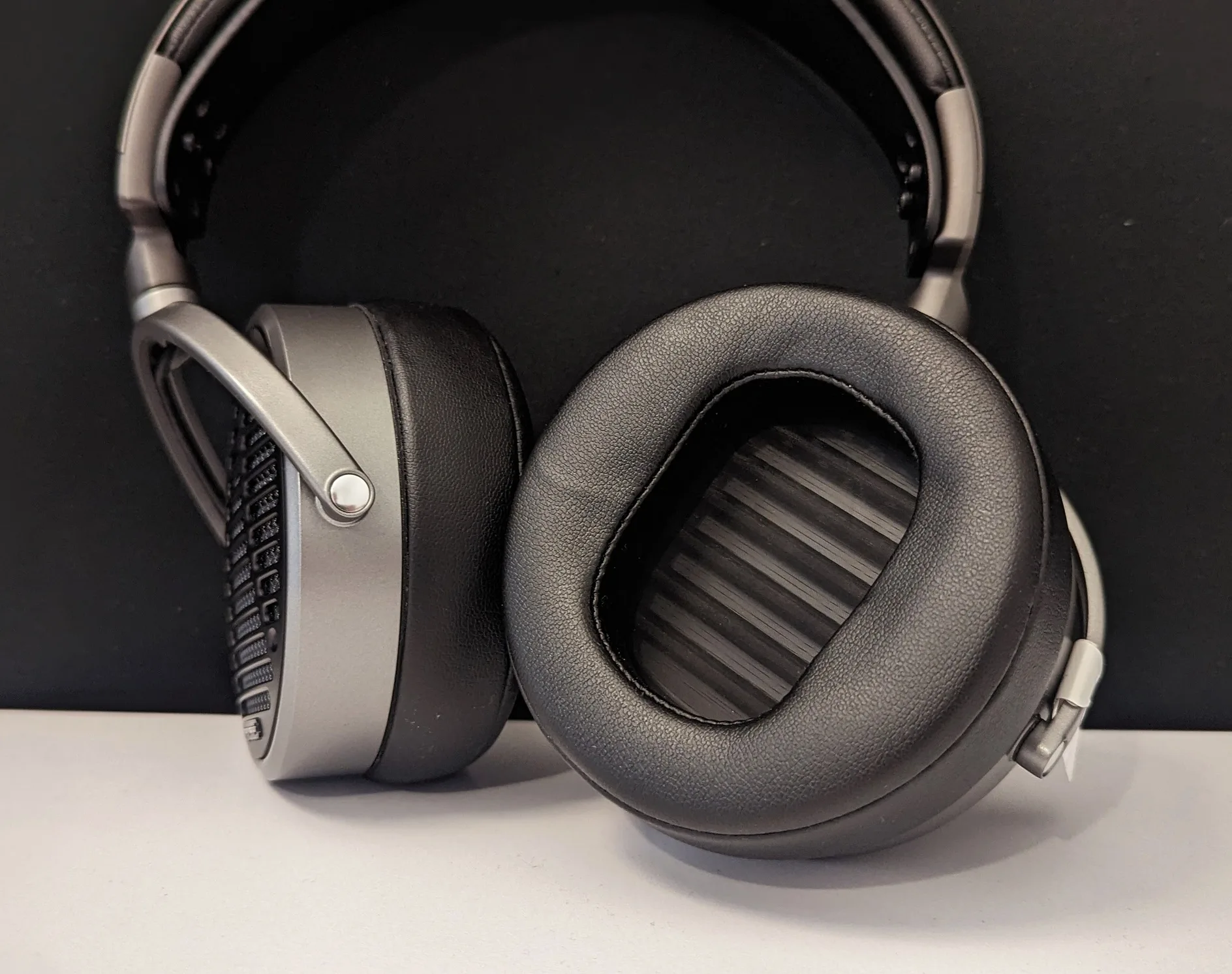
The MM-100 does not have traditional height adjustment at all; instead, a few holes have been made along the edges of the faux leather strap that serves as the headband padding, allowing it to be moved to different positions. To adjust the height, the strap is detached and re-attached around the screws on the inner edge of the headband. The adjustment possibilities are very limited, as only three settings are available. These are certainly sufficient for most, but in my case, the suitable height would fall between the adjustment holes. However, I can circumvent the problem by setting the strap assymmetrically to a different position on one side. The solution looks clumsy but serves its purpose. With use, the head pad seems to stretch, so in a few weeks, I would surely be able to return to a symmetrical attachment. When in a good mood, I would say that Audeze's designed height adjustment is acceptable despite its simplicity. My critical side, however, wants to state that the solution is almost incomprehensible for 500-euro headphones. Other manufacturers have achieved a clearly better solution in this price range, so Audeze should also be expected to do the same.

Despite everything, the MM-100 remains competitive in its price range in terms of its build quality impression and sturdiness. I would assume durability, in particular, is one of its strengths. On the other hand, for consumers prioritizing comfort, there are many lighter alternatives on the market that also have more easily replaceable ear pads and better adjustment options. It is therefore worth considering what is most important to oneself, as the MM-100 involves greater compromises than usual.
Sound quality
Our frequency response measurements have been made with a clone IEC-60318-4 coupler and KB501X pinnae. The Harman target curve from 2018 is used as a reference point and generalization of the headphone response that would sound good to most people. For more information on the measurements and their accuracy, see Headphone Measurements-page. The MM-100's frequency response can also be compared with other measured headphones Squiglink .
Frequency response:
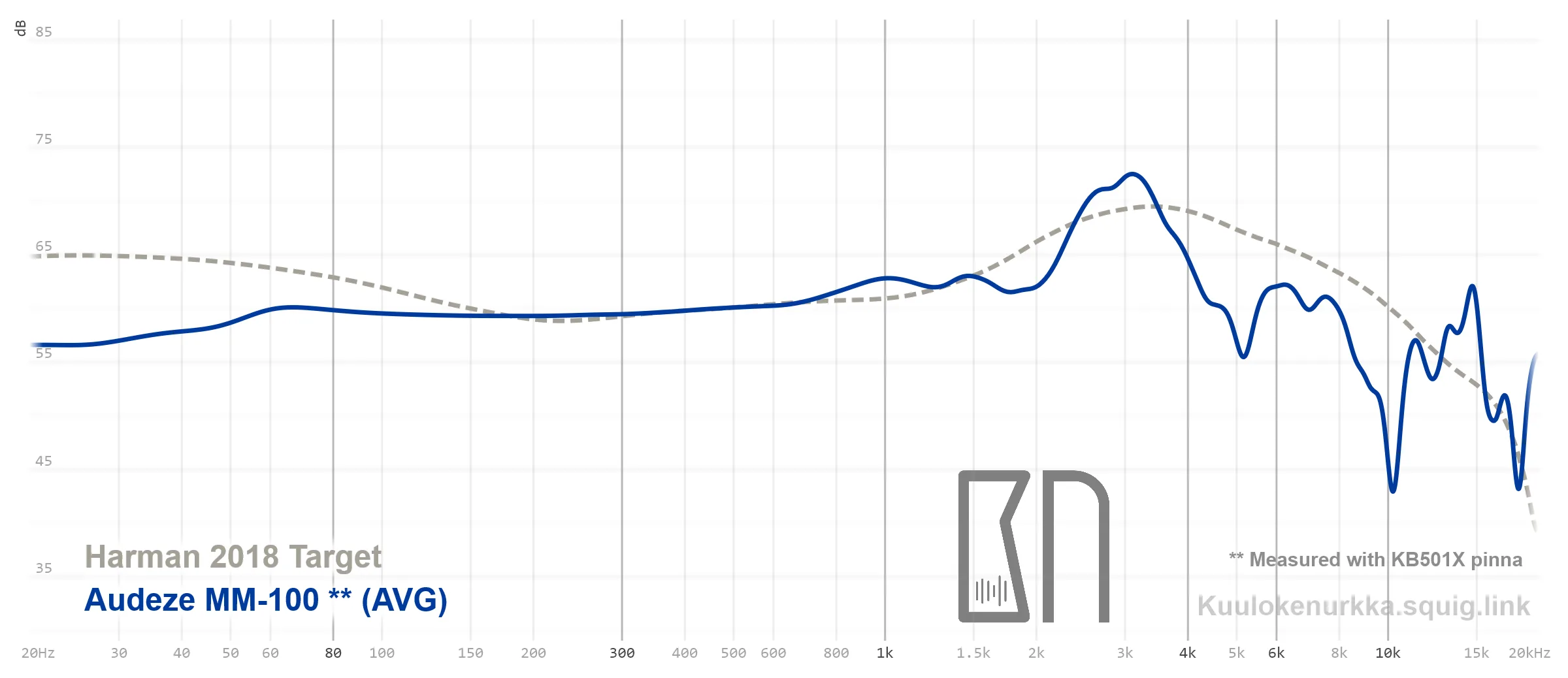
Audeze has strongly emphasized the 3 kHz region and to some extent also the vicinity of 1 kHz in the tuning of the MM-100. Since the low frequencies are linear and the treble is softer than expected, the result sounds very mid-frequency-heavy. The MM-100's strength could be seen in the edginess of instrument details and the clarity of vocal performances. Making these aspects easily perceptible can be beneficial in studio work, as the MM-500 model is also tuned in a similar way. Likewise, the Neumann NDH 30, also designed for studio use, shares similar characteristics with the Audeze models. However, I cannot evaluate potential studio benefits, but instead focus on listening to finished music. For that, the MM-100 is unfortunately not very well suited.
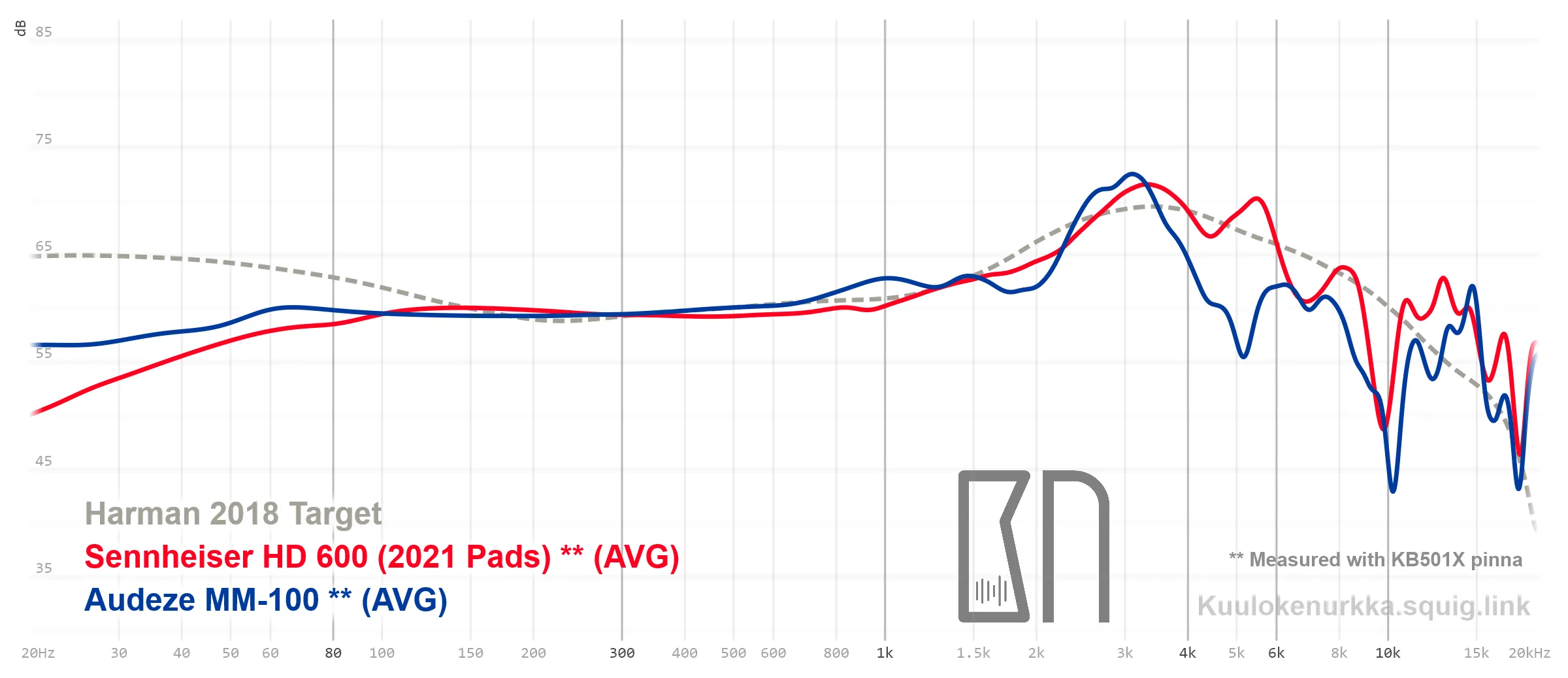
Emphases at 1 kHz and 3 kHz often make the reproduction thin and shouty – more so for some and less for others, depending on their hearing. In a vocalist's voice and speech, the sharpest parts are emphasized, such as sibilance and all kinds of breaths. In instruments, the most energetic part is also amplified, while the body remains light. On the other hand, the sound is not too sharp either, because the subdued treble removes much of the joy and effortlessness from it. I would describe the presentation as aggressive and dull. However, apart from the treble, it does not succumb to worse unnaturalness, because the shape of the frequency response is mostly orthodox, and it does not deviate greatly from, for example, the Sennheiser HD 600 series. As a result, music suitable for the MM-100's frequency response sounds quite good at its best. However, that remains a meager consolation, as for most of the time, the listening experience is quite mediocre.
My negative experiences are further reinforced by the MM-100's exceptionally tight and narrow-feeling, almost claustrophobic, soundstage. In this respect, the headphones resemble the well-known for its small size Sennheiser HD 600, but are even more distressing due to their more aggressive upper-midrange frequencies. The sound plays entirely inside my head, so that the stereo image practically consists of three points: sounds located in the center and directly to the side. There is also no layering whatsoever, but the whole feels one-dimensional and dynamically compressed. This materializes in such a way that sounds intended to be faintly in the background are reproduced at the same level and with the same volume as everything else. In theory, this could be useful for sound monitoring, but at the same time, much also goes unheard due to the deficient treble. Although the general precision of reproduction and a reasonably linear sub-bass can be seen as improvements compared to many dynamic headphone models, the MM-100's 500 euro price feels too expensive. However, if the headphones are suitable for studio work, so be it.
Bass:
The MM-100's bass reproduction is typically linear and precisely clear for planar headphones. The quantity and quality of the bass largely match the Hifiman Sundara, but due to its more emphasized upper-midrange frequencies, the Audeze model sounds lighter. Its sub-bass also remains quite powerless, being an improvement mainly compared to the Sennheiser HD 600 series. There's nothing wrong with aiming for a neutral presentation, but I would prefer to experience some kind of punch and physicality in the reproduction. As it is, the MM-100's bass largely remains in a supporting role and offers nothing memorable. However, thanks to low distortion values, the situation could be improved by equalization.
Mid-frequencies:
In truth, the midrange frequencies in the MM-100 are not as unnatural as I assumed, but excessive aggressiveness and shoutiness are present most of the time. On the other hand, for someone else's hearing, Audeze's tuned upper-midrange frequencies might be more suitable, in which case this frequency range does not push as strongly to the foreground. For me, the reproduction is artificially sharpened and quite aggressive, which leads me to lower the volume. In this case, the bass and treble become even fainter, but the energy of the midrange and the intimately reproduced vocalist do become somewhat pleasant features. Music optimally produced for the headphones also still sounds good even when listened to a bit louder, so the end result varies exceptionally much due to the ”dangerous” tuning. Part of the problem is also unbalanced upper frequencies, which generally allow the MM-100 to draw too much attention around 3 kHz. More affordable headphones, such as Sennheiser HD 600, Hifiman Sundara Silver and Aune Audio AR5000, are more successful in terms of frequency balance. For example, FiiO FT5compared to and Quad ERA-1, the MM-100 would instead be more neutral.
Treble:
Since the treble of the MM-100, MM-500, and LCD-5 is quite similar in style, it must be a conscious choice from Audeze. However, I personally don't understand how subdued upper frequencies can be beneficial in studio use? The opposite style seems to be a strong emphasis on treble, similar to Beyerdynamic.
In the case of the MM-100, the energy level of the reproduction drops sharply at 4 kHz, but the sound is still more hissing than dark and calm. A deep dip between 4–6 kHz, i.e., in the so-called presence region, makes the midrange frequencies dry and joyless despite their aggressiveness – someone might describe the sound more positively as smooth and sleek. Every sound starts abruptly, but does not continue naturally to the end. The sound doesn't really start to play in space, but is only pushed more and more into the listener's face. This likely contributes to the narrowness of the soundstage.
The missing part of the treble also causes, for example, drum cymbals to lack much body and ”snap,” but rather sound like hissing maracas. Because the lower part of the treble is tonally powerless and flimsy, frequencies above 10 kHz tend to become too prominent. The MM-100, with its dark treble, could have offered a variation to bright-sounding headphones like Hifiman, but the emphasized hiss and sibilance prevent it.
Other observations:
The MM-100 sounds regrettably compressed because the dynamics are mediocre, and there is hardly any layering in the reproduction. However, this is a feature that could genuinely be useful in studio work when the goal is to detect potential small errors that would otherwise get lost in the background of the reproduction. With Audeze headphones, all sounds play at the same level and very close, as if forming a unified wall. The sounds have a precise beginning, and the separation is not bad despite the small soundstage, but the listening experience is still distressing. The vocalist generally comes too close for my taste, and the reproduction does not open up in any direction around them. However, the end result depends somewhat on the music listened to, because if it is not too shouty, the soundstage immediately feels a bit more spacious. A suitable playlist should probably be compiled for the MM-100 to highlight its strengths. However, there are already many headphones on the market with which similar music would also sound good. The MM-100 is, so to speak, just okay, but doesn't impress in any area.
Little need for confirmation
Audeze planar headphones have usually been easy from an amplification perspective, for example, compared to Hifiman, and the MM-100 is no exception in this regard. Its impedance is a very low 18 ohms, and its sensitivity reaches 98 dB/mW, which can be considered quite high. The headphones are even too easy a load for modern and powerful transistor amplifiers, as the lowest possible gain level is needed to leave enough headroom for volume adjustment. Mobile devices would probably also reproduce the headphones quite acceptably, but the sound might be even more aggressive.
Unfortunately, I was unable to test the MM-100 with many amplifiers because I was tied to the standard cable's 6.35 millimeter connector, and due to Audeze's silly wiring, I couldn't use balanced cables designed for other headphone models. In any case, no device corrected the headphones' aggressiveness, deficient treble, or narrow soundstage, so it might be better to focus efforts on equalization rather than device choices. For most of the time, I had the headphones connected to an SMSL DL200, which, at its price of around 200 euros, would seem like a proportionate choice for the MM-100.
Concise comparisons
Audeze MM-100 vs. Sennheiser HD 600
Audeze headphones have better bass reproduction, while the HD 600 sounds clearly more balanced and natural. However, someone who desires more sharpness in the midrange and dislikes treble might enjoy the MM-100's presentation. Both headphones have a small and quite similar soundstage in style.
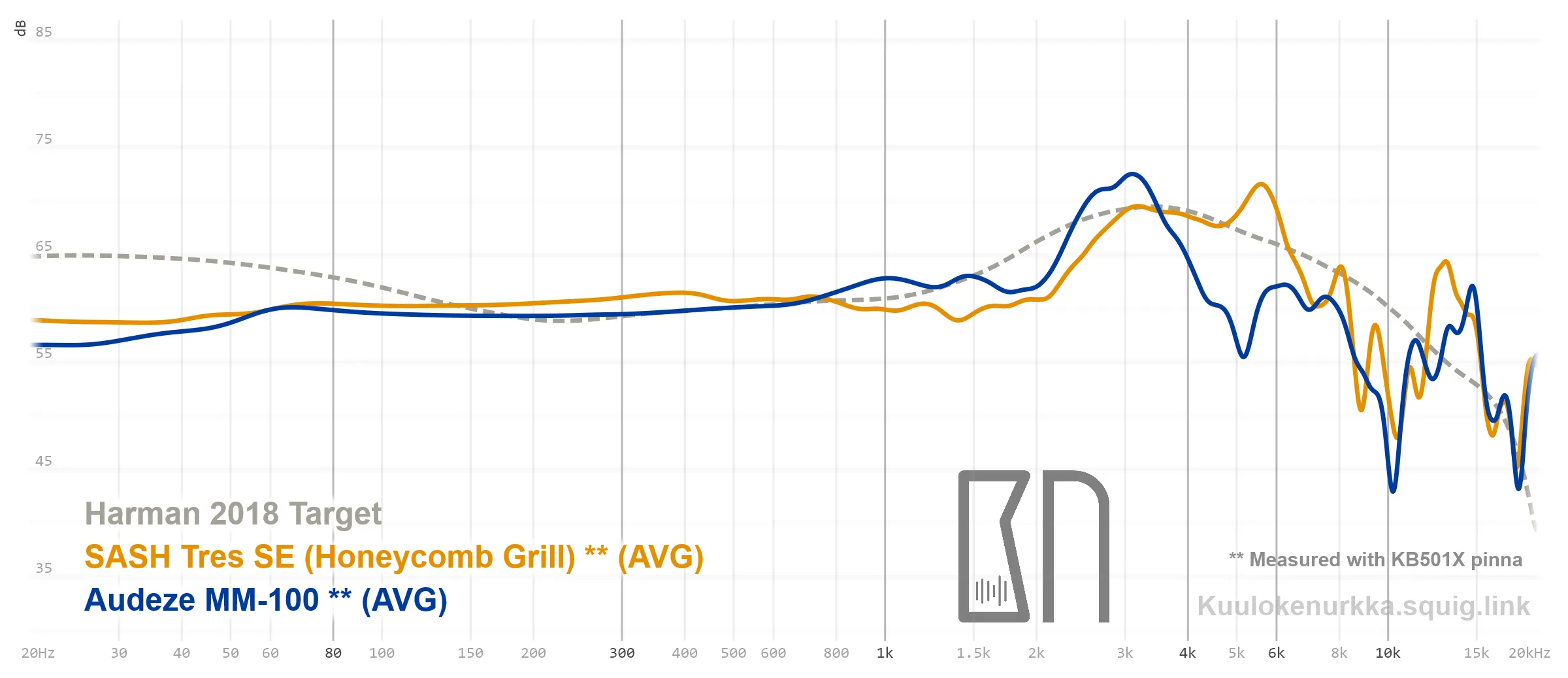
Audeze MM-100 vs. SASH Tres SE
SASH Tres SE is better in every way, unless there is a need for the MM-100's intimate and energetic mid-range reproduction. The TRES SE's bass is firmer, the soundstage is clearly more spacious and layered, and the treble is fresher and more detailed.
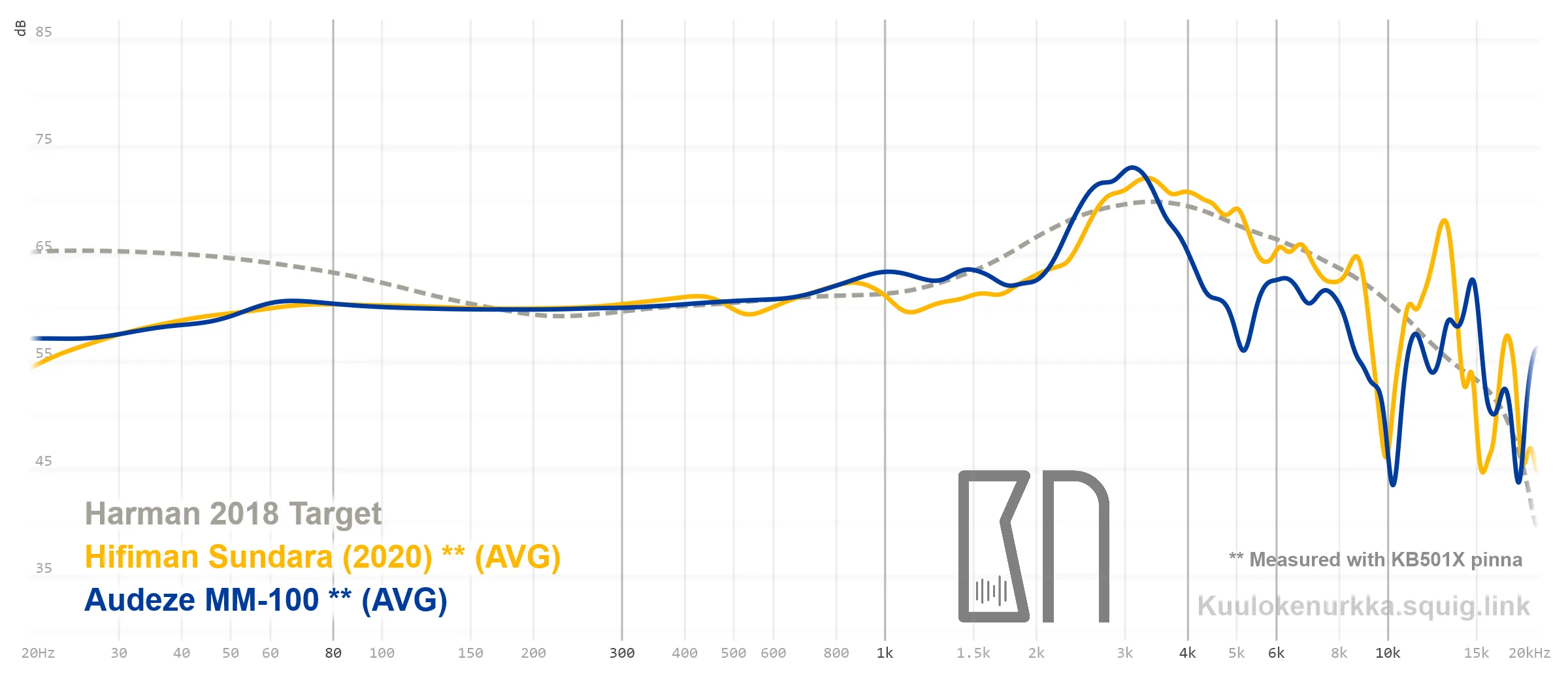
Audeze MM-100 vs. Hifiman Sundara
The headphones' low frequencies are quite similar. The Sundara sounds more spacious, brighter, and softer. The MM-100, on the other hand, brings sharpness to the mid-range, but too much. The Sundara's brightness might be a bit too much for some, but it is still clearly more balanced and correct compared to the MM-100's congested and unnaturally hissing treble.
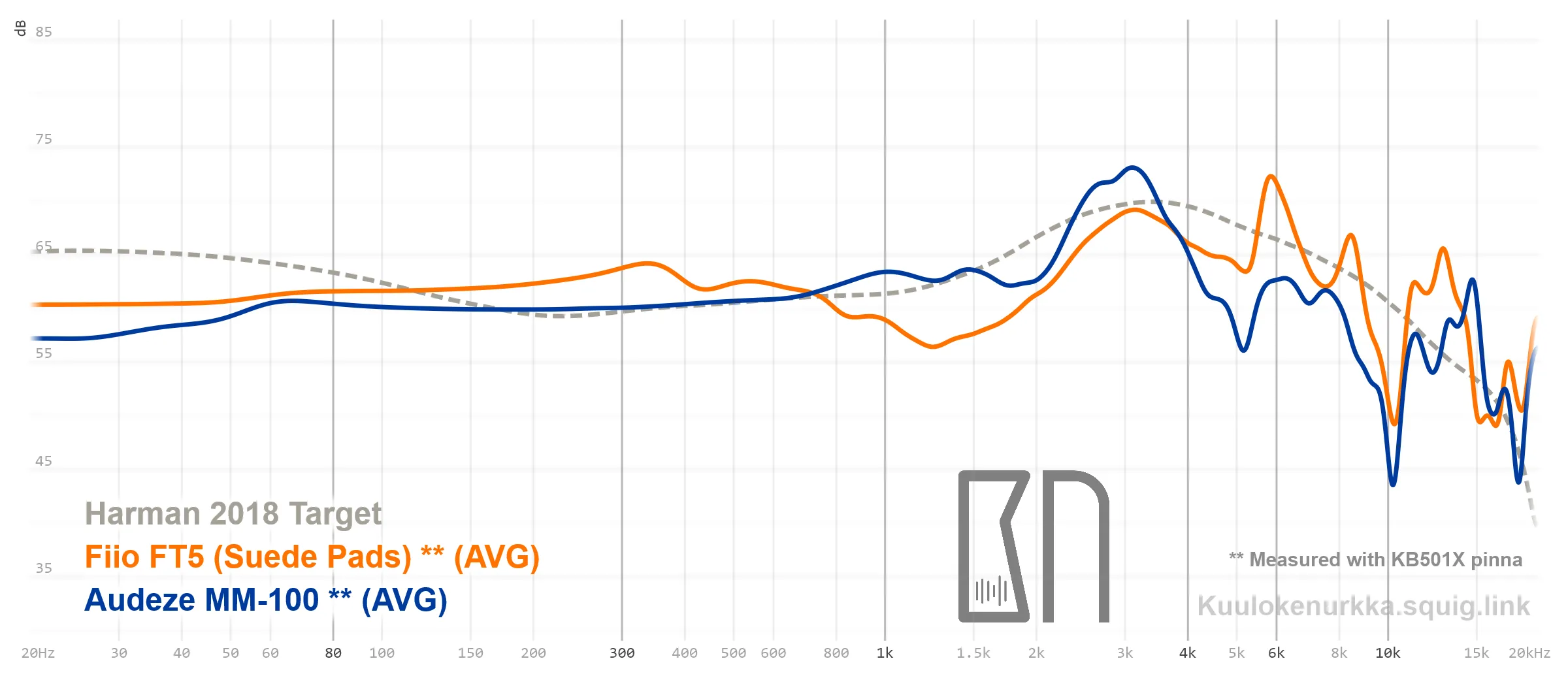
Audeze MM-100 vs. FiiO FT5
With its robust and colored sound, the FT5 is completely different from the MM-100. In this case, Audeze's headphones would be more neutral and suitable for sound monitoring. However, having briefly listened to the FT5, I believe many would find it the more enjoyable of the two. Someone who values the most balanced reproduction would hardly buy either.
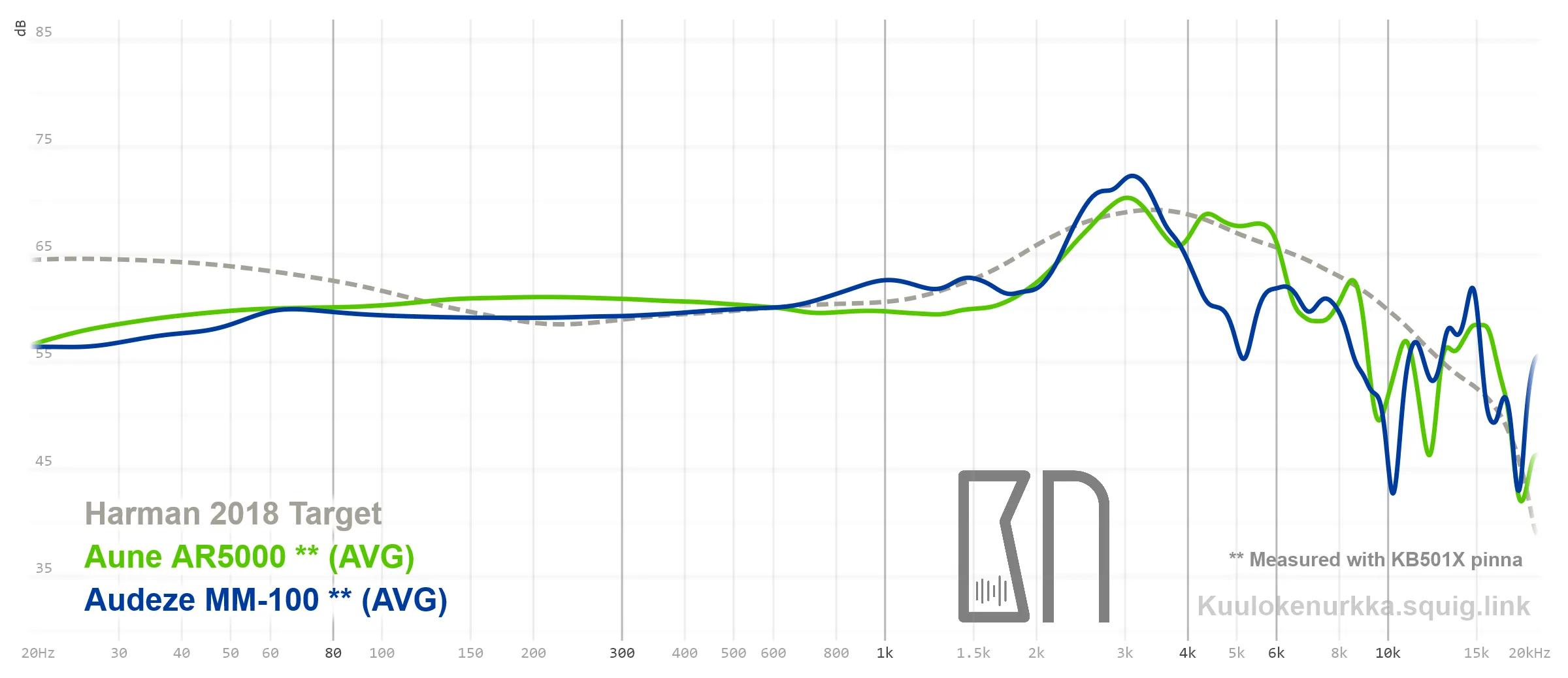
Audeze MM-100 vs. Aune Audio AR5000
Next to the MM-100, the AR5000 sounds more like it's twice as expensive rather than 200 euros cheaper. It's truly astonishing how it manages to correct all the MM-100's weaknesses without significant compromises. It must also be noted that the AR5000 is Aune's first over-ear headphone model, whereas Audeze has been manufacturing planar headphones for about 15 years. While the MM-100 isn't exactly bad, it's precisely the AR5000 that makes it feel mediocre.
Summary
I ended up testing quite unremarkable and forgettable headphones for the first time in a long while, which, apart from their quality build, don't really have other strengths compared to competitors” products. At its best, the MM-100 certainly sounds quite good with its clear mid-range, and it never really sounds particularly bad either. I certainly don't hate the headphones, but ”just good enough" is not sufficient in the 500 euro price range, in my opinion. The sound is thin and shouty most of the time, accompanied by a narrow soundstage and flat dynamics. There's hardly anything noteworthy about the bass reproduction, and the treble remains subdued while still being hissy. However, if Audeze's chosen tuning is perfectly suited for studio use, I cannot say that the MM-100 couldn't also be an excellent purchase for some. It's also worth remembering that my article is just one person's opinion, so for a certain taste, these headphones might have their place elsewhere than in the studio.
I haven't heard the more expensive MM-500 model, but it seems to be a more balanced version of a similar tuning. Compared to it, the MM-100 could certainly be seen as successful based on its 75 percent lower price, but the praise the headphones receive is largely concentrated on the American continent, where ”made in USA” guarantees a positive reception. I personally would wish the MM-100”s price was closer to 350 euros, in which case it could be a viable option, especially when equalized. By default, the headphones” sound feels as if Audeze had managed to adjust it "somewhere in the ballpark," but hadn't bothered to refine the weaknesses further. This is a shame, as I would like to see good affordable planar headphones from Audeze at some point. Currently, the best option seems to be the Maxwell, whose sound has been made balanced with the help of DSP correction.
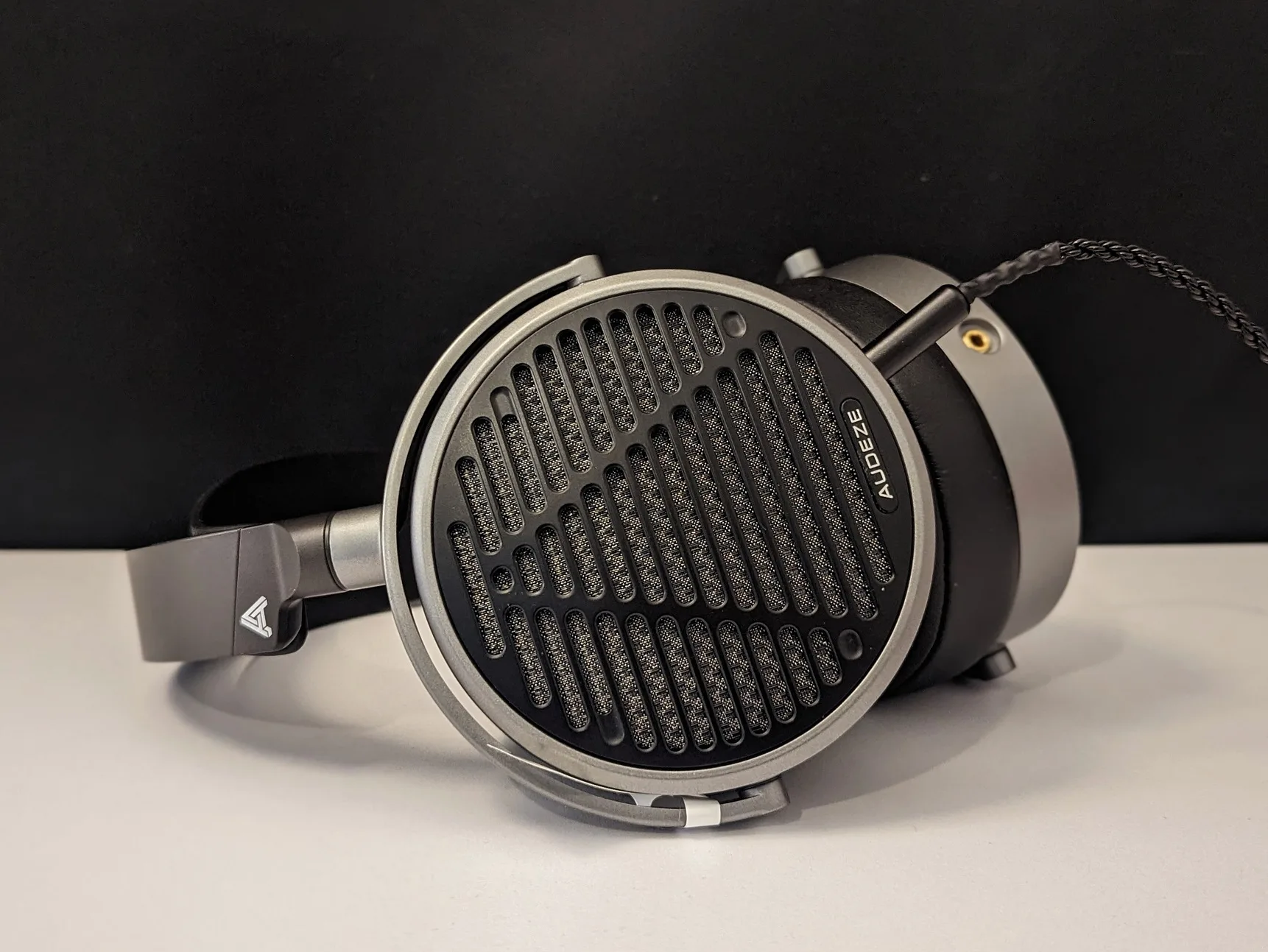
Pros and cons:
+ Clearly brings out the details of the vocalist and instruments focused on the mid-range
+ Despite its problems, a relatively neutral tuning
+ Music produced to suit headphones sounds good
+ Low distortion values support equalization
+ Stylish appearance
+ Very sturdy and high-quality construction
+ Cable attachment side selectable
+ Very easy load for the amplifier
– Unnecessarily thin and aggressive mid-frequencies
– Muted and flimsy treble, which however has an unnatural hissing tone
– Sounds dynamically compressed
– Very cramped and narrow soundstage
– Height adjustment possibilities are exceptionally limited
– Poor wearing comfort: sweaty ear pads, strong clamping force, rather high weight, and fazor structure hitting the ears
– Ear pads are attached with glue, even though in the Maxwell model they are removable
– The included cable feels cheap
– Due to the exceptional wiring, standard 3.5 millimeter connector cables cannot be used with these headphones
– Limited accessories
– The price feels too high
 EN
EN  FI
FI