”A new way of hearing”
Author: Roderick
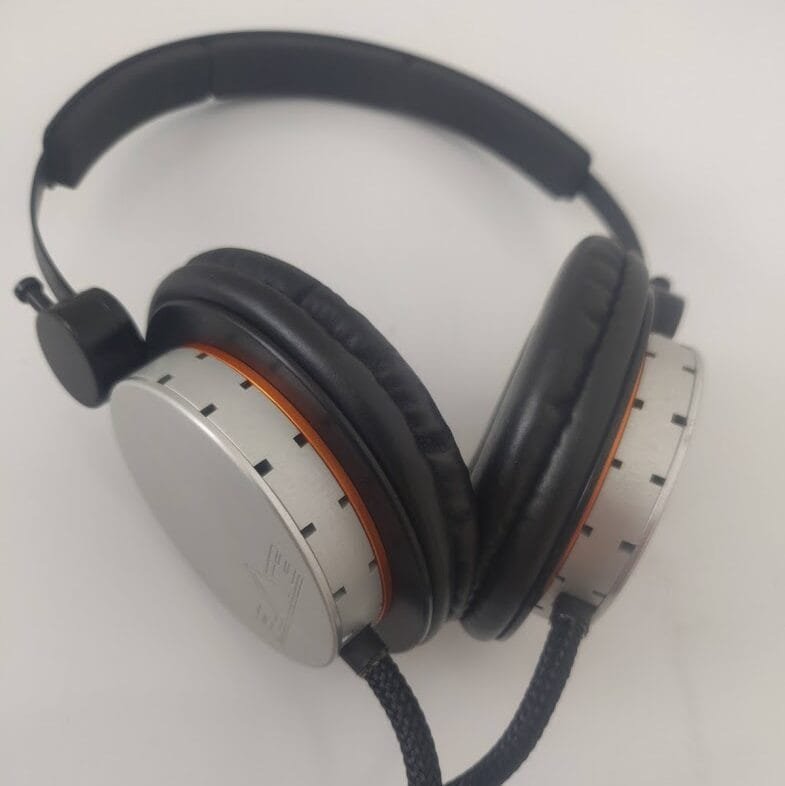
Information:
- Price: 777 USD or about 700 euros (production discontinued)
- Dynamic driver: 40 mm
- Impedance: 32 ohm
- Sensitivity: unknown
- Cable: Fixed cable with 3.5 mm connector
Review sample: Self-purchased product
Every now and then, really bad headphones end up in my hands for testing. Most of these are affordable, so they are easy to dismiss. However, the situation is different if hundreds or even thousands of euros are asked for bad headphones – In my opinion, examples of such headphones include Bowers & Wilkins P9, Beyerdynamic T5p gen1, and Sennheiser HD700. This trio, as well as other more expensive but, in my opinion, rather bad headphones, are mostly still perfectly usable, even if their sound quality or other features do not match the selling price.
In 2014, the English Flare Audio however, managed to produce headphones about which it is very difficult to find anything positive to say. According to the manufacturer, Reference R1 is the world's first ”fully open” headphone, whose amazing sense of openness has been achieved with patented Vortex™ and Space™ technologies. Currently, the production of Reference R1 headphones has already been discontinued, and they remained, at least for now, the manufacturer's only full-size headphones. Since then, Flare Audio has specialized in in-ear headphones and special earplugs that are supposed to improve all the sound we hear.
Structure and comfort

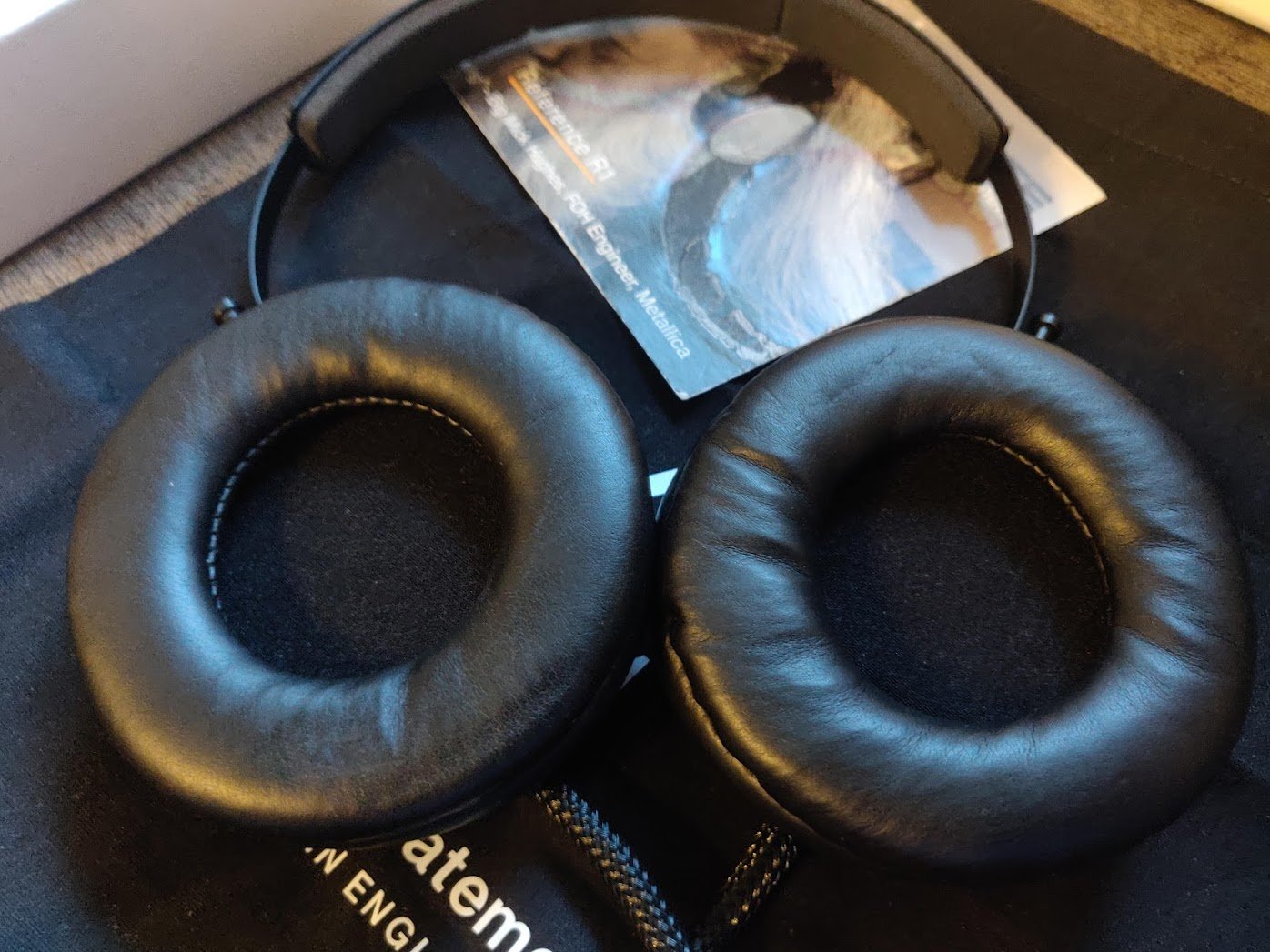
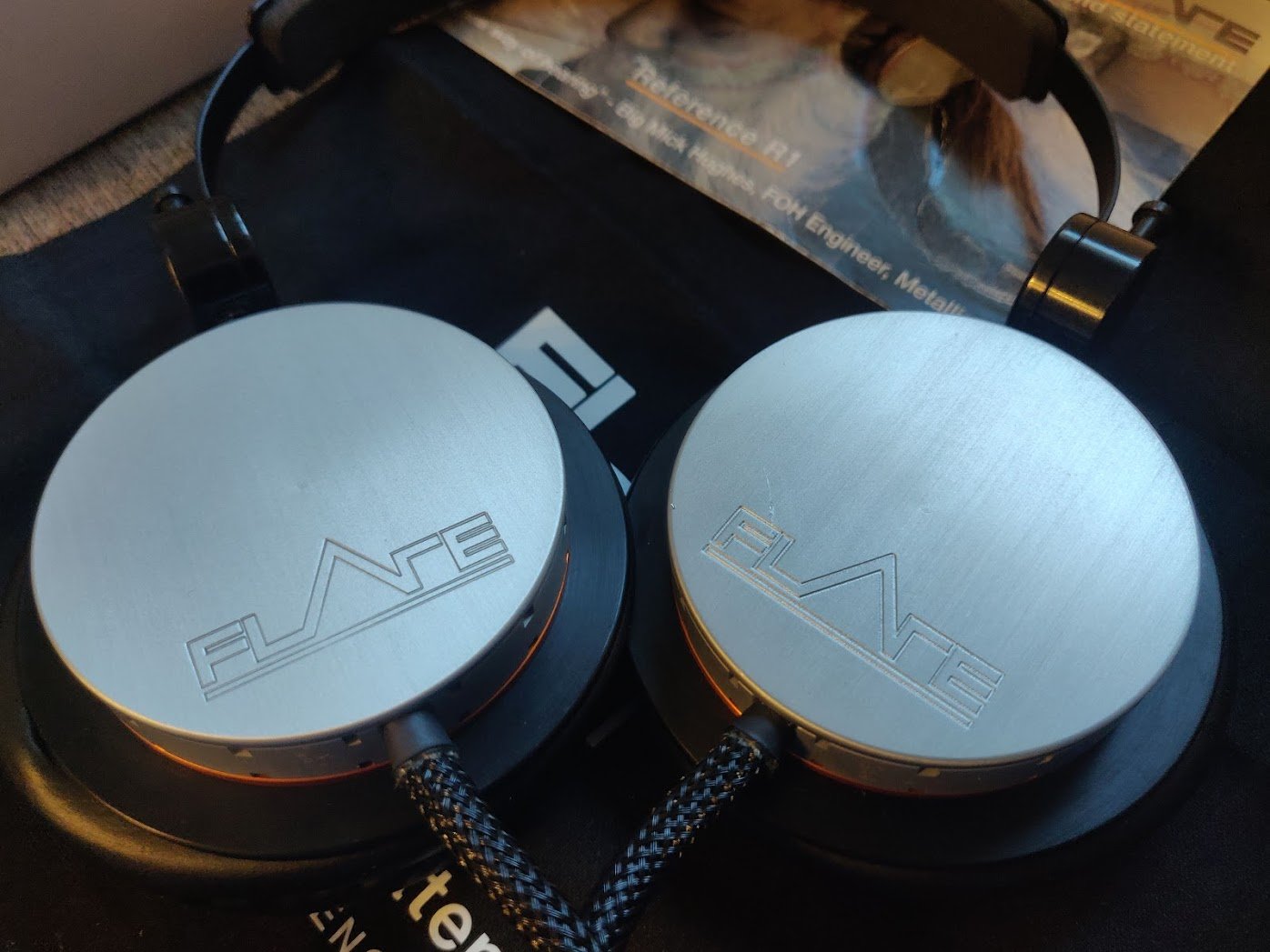
The headphones are delivered in a minimalist cardboard box filled with some kind of styrofoam. The only accessories are a fabric pouch and an advertising leaflet, in which Big Mick Hughes declares the headphones to be ”A new way of hearing”. The cheap appearance of the packaging and the non-existent accessories for the price make even the Hifimans, which I often criticize, seem like luxury products.
I think the following conversation might have taken place at Flare Audio's headquarters:
A: ”We would need a music industry professional to promote the headphones”
B: ”The downside with professionals is that they have acute hearing. None of them will agree to that job after listening to the Reference R1 headphones”
A: ”So we need a professional who can no longer hear anything – not some Vivaldi fiddler or studio rat, but someone who has really exposed their ears.”
B: ”I actually just read an article about Mick Hughes, who has worked as Metallica's live engineer for 35 years...”
Not really... Big Mick is certainly good at his job, unlike the person responsible for the design and implementation of the Reference R1 at Flare Audio. Let's examine what I think is seriously wrong with the headphones.
In appearance, the Reference R1 resembles an uglier version of Grado headphones. Also common with Grados is the stiff and impractical cable, which is not detachable. The headphones weigh about 350 grams, which is slightly more than the metal Grado SR325. The Reference R1 is likely the world's heaviest on-ear type headphone.
Like cursed objects in general, the Reference R1 is also indestructible. The headphones are made entirely of metal, and there are no connection points from which the headphones could be opened. I would have liked to open the cups to examine how the headphones are constructed. However, opening the headphones would require an angle grinder or a plasma cutter, or alternatively, they would have to be thrown into the depths of Mount Doom.
The headband of the headphones is really stiff and the clamping force on the ears is very strong. Especially with glasses, wearing the headphones can be quite a painful experience. For comparison, the first version of the headphones was reportedly so loose in its clamping that they wouldn't stay on anyone's head – in this regard, they have moved from one problem to another.
The discomfort is emphasized by the fact that the headphones” vinyl ear pads are hard, thin, and very much on-ear sized. Although the headphones” center of gravity rests on the ears, discomfort is also noticeable on the top of the head because the headband is "padded" with hard, almost Styrofoam-like, foam that is not coated at all.
The Reference R1s are the most uncomfortable headphones I have ever used, and for other users, the experience might be even more terrible. On my own ears, the headphones sat evenly, but not all users are certainly as lucky. Since the headphone cups do not tilt at all, on different head shapes the pads might sit unevenly on the ears, concentrating the pressure created by the stiff headband on a small area – I don't even want to imagine how that would feel.
Sound quality
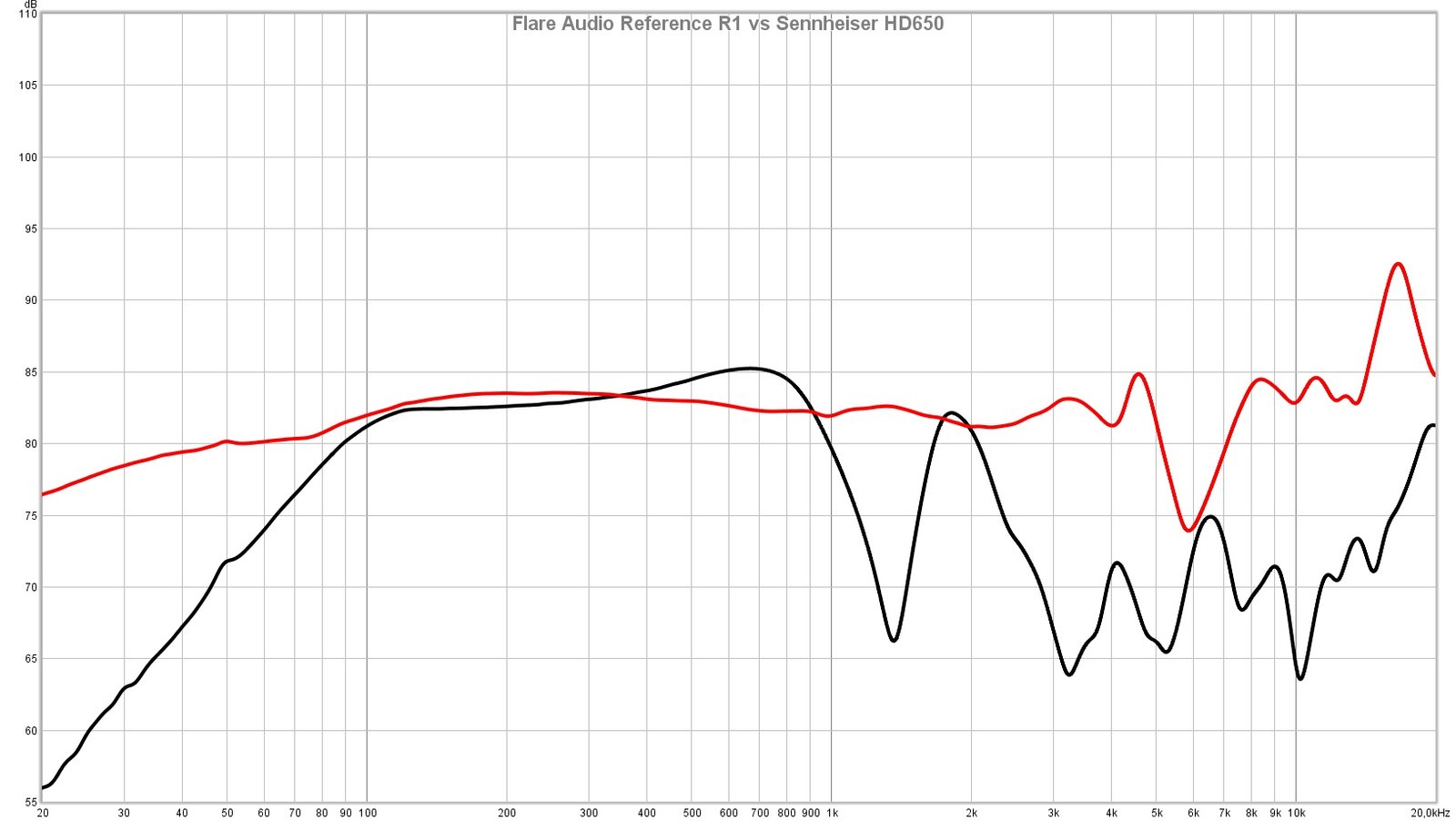
When a reader who understands frequency responses sees the graph above, the first thought is likely that the 700-euro Reference R1 headphones have been measured incorrectly. Unfortunately, this is not the case; the frequency response matches the more professionally conducted measurements by Tyll Hertsens.
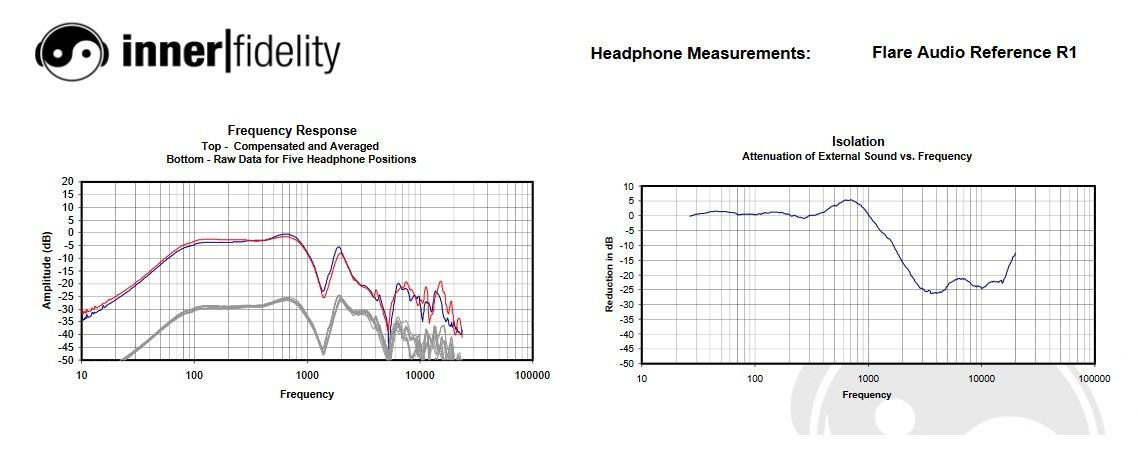
The headphones reproduce almost no lowest frequencies, as bass reproduction stops dead at 100 hertz. The Sennheiser HD650 is known for its bass not reaching the lowest frequencies properly, but compared to the R1, it performs significantly better. More concerning than the weak bass in Flare Audio headphones is that they also reproduce almost no high frequencies. The sound of the headphones is truly dark, veiled, and stuffy, while also being thin, because the bass only extends to the upper parts of the lower frequencies.
Since the only audible frequency range is the mid-range, let's examine it a bit more closely through the headphones' peculiar structure. The Reference R1s are clearly closed in design, but they have a few holes. However, the manufacturer claims the headphones are the world's only truly open headphones. After removing the front plate protecting the driver, the following channel structure is revealed:

The channels on the outer surface of the headphones have a circle resembling a vortex. I assume this is the advertised Vortex™ technology. Its effect on the headphones' sound is anything but ingenious: the sound begins to echo and even swirl in the channels, making the timbre truly chaotic and muddled. All musical nuances are buried under the reverberation – if one imagines someone shouting into a fan at the end of a metal pipe, one gets quite close to the reproduction of the Reference R1.
The sound of the headphones is distorted, echoing, and due to the lack of higher frequencies, also completely unnatural. The headphones are only capable of producing an enormous amount of metallic, echoing, but muffled mid-range reproduction. It is mere wishful thinking to be able to distinguish any finer details from the reproduction. I believe that a fire alarm tuned to play music would sound somewhat similar.
The reproduction of the Reference R1 is powerful in itself, but the uniformly thick ”pressure” cannot really be called dynamics. In fact, the situation is the opposite of dynamic, but most often undynamic headphones sound dull. The Reference R1 is not dull or sluggish, but it is otherwise almost unlistenable.
I would have liked to delve into the Space™ technology found in the headphones, but as I mentioned, it is impossible to open the headphone cups further. Space™ most likely contains only more sound-degrading channels, but it is certainly possible that the people at Flare Audio have come up with an even more ingenious way to destroy the sound quality of their headphones.
Summary
For headphones costing almost 700 euros, the Flare Audio Reference R1 is an utterly incomprehensible creation – it's difficult to find another headphone with such a poor price-to-quality ratio. I can't even compare these headphones to anything because I don't own anything that sounds anywhere near as bad.
More specifically, I can't really think of any sound-producing device with such a poor price-quality ratio. Reference R1 sounds worse than good 10-euro headphones. Additionally, the R1s are also the most uncomfortable headphones I have ever owned. I've started to suspect that the person responsible for the headphones' ergonomics knew better than those responsible for the sound what the headphones sound like, and he did everything he could to make the Reference R1 so uncomfortable that no one would be able to listen to them.
Pros and cons:
+ Reviews of these headphones reveal which reviewers are purchasable or only do their work in hopes of free products. If a review of the Reference R1 is neutral/positive, I recommend being skeptical of all other reviews on that site.
+/- The headphones are entirely metal with no weak connection points, so they are virtually indestructible – though I'm not sure if that's a good or bad thing.
– Do not reproduce bass
– Do not reproduce treble
– Mid-range consists mainly of metallic and harsh echo
– Even though the mid-range sounds harsh at times, the overall sound is still very veiled
– The sound has power, but no dynamics, because everything is truly flat
– Do not distinguish smaller details, at all
– Narrow soundstage
– The clamping force is so strong that ears become sore quite quickly
– Uncomfortable ear pads
– Uncomfortable headband ”cushion”
– The headphone cups do not tilt at all
– The cable is not detachable
– Packaging and accessories do not match the headphones' high price
– Price
 EN
EN  FI
FI