Author: Sword of Damocles
We published in April 2024 review about Finnish, or more precisely, Kuopio-based Kaiku Tone Bluetooth headphones. At that time, despite their wooden headband and Finnish craftsmanship, the headphones did not receive much praise from me, as their sound quality left quite a lot to be desired, and there were also some question marks regarding everything else, as Kaiku Acoustics still a new player in the market.
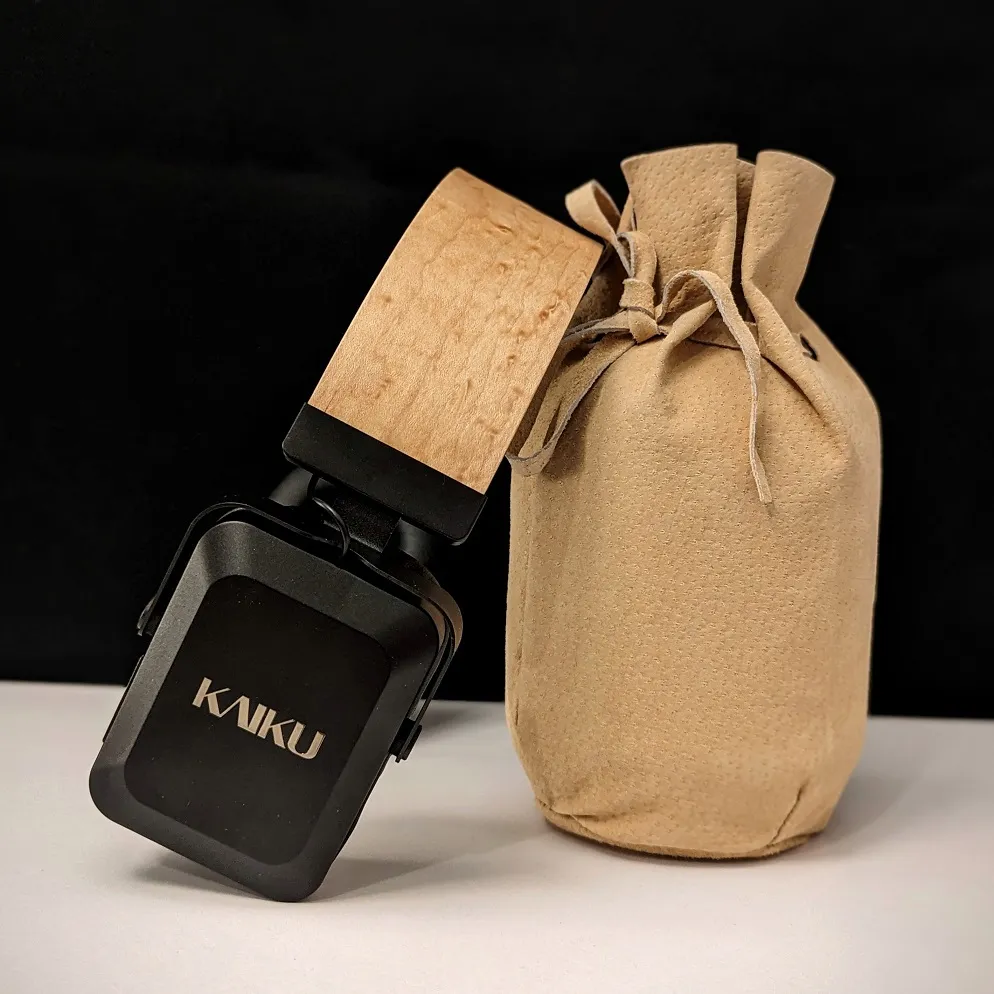
A lot has happened during the summer, however, as the current (completed in August) headphone version differs acoustically from the original model like night and day. Kaiku Acoustics has further fine-tuned the acoustics of the cups, and the drivers were also changed to new types in between. Now, the DSP chip previously found in the headphones is also utilized for optimizing the frequency response instead of just ready-made sound profiles. Kaiku Tone no longer contains several different profiles; instead, its default sound has been aimed to be as correct as possible directly.
To achieve this goal, the manufacturer approached me, asking for support in DSP correction and fine-tuning the sound quality of the headphones. I gladly accepted the challenge, especially as it offered an opportunity to learn new things about both tuning headphones and manufacturing them. Thus, as a result of cooperation between Kuopio and Joensuu, the renewed Kaiku Tone was born, which actually doesn't have a name yet. However, the manufacturer will likely provide more information on their website at some point.
Although I don't earn anything from headphone sales or am otherwise commercially involved in Kaiku Acoustics' operations, I still feel somewhat disqualified from describing or evaluating the sound quality of the current headphone version. I will leave that to others. For example, Kuulokehemmo has published a video review. The new Kaiku Tone will also soon be available for trial listening at Helsinki's Hifi Fair 14.-15.9.2024.
In this context, I want to publish a new frequency response, which is based on measurements made with my own equipment measurements:
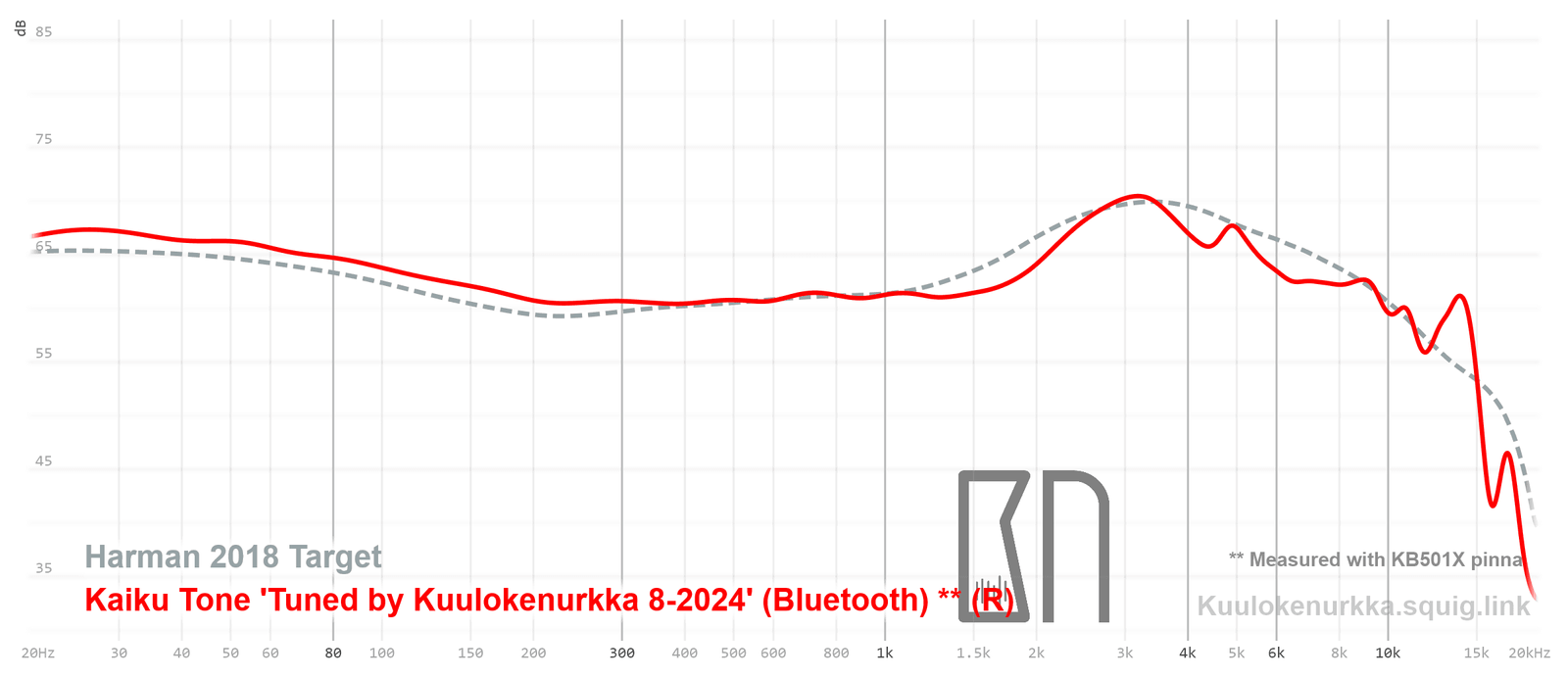
I used Harman's target curve as the basis for adjusting the frequency response, but I aimed to avoid major corrections in the high frequencies because their perception varies most among people. Headphones should not be adjusted solely to suit the ”hearing sense” of a measuring device, as for many people, narrower corrections can at worst cause unpleasant-sounding treble peaks.
The intensity of the low frequencies intentionally slightly exceeds Harman's target curve because, due to the on-ear fit of the headphones, some bass easily leaks out if even a small air gap forms between the cushion and the ear. In such cases, the level of low frequencies decreases steadily from about 300 hertz downwards. Now, the bass should be reasonably robust even with a slightly looser fit. I decided to make the mid-frequencies clear and natural, but rather slightly relaxed than aggressive. Hopefully, these principles help to understand what has been aimed for with the new Kaiku Tone. My role was to give the sound, as it were, the final touch, as the starting situation regarding structural tuning was already better than the headphone version I reviewed earlier in the year.
Finally, I want to mention that there is always slight variation between individual headphone units, so I cannot be sure how closely each Kaiku Tone pair will align with the frequency response I have published. Kaiku Acoustics itself is responsible for quality control. In any case, the objective sound quality should now be sufficiently accurate that time will tell what develops from the headphones.
 EN
EN  FI
FI