Author: Roderick
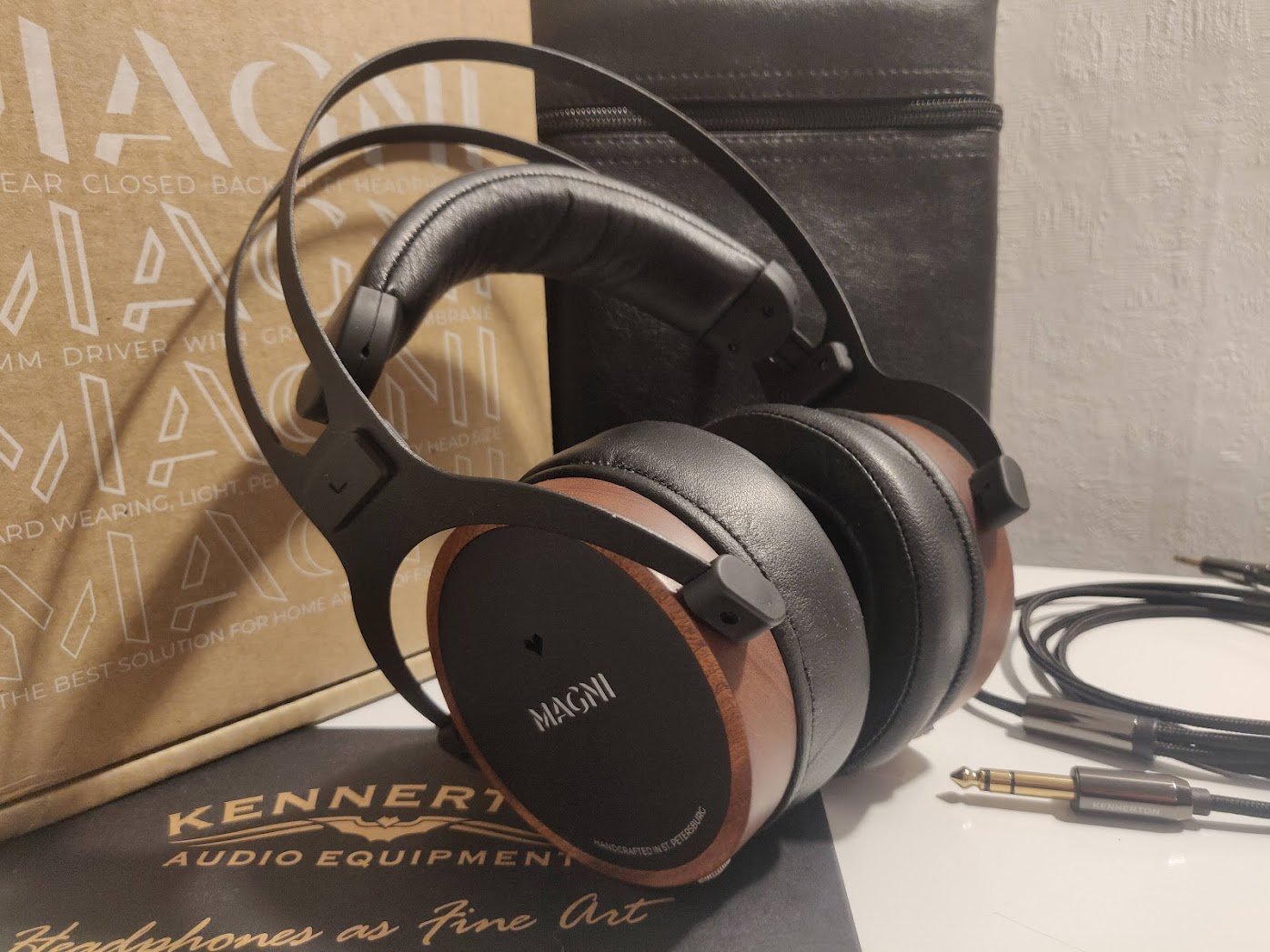
Table of Contents:
Information:
- Publication year 2020
- Price: 690 € (+VAT), delivered to Finland with taxes and postage approximately 950 €
- Design: Closed
- Dynamic driver: 50 mm with graphene coating
- Impedance: 33 ohm
- Sensitivity: 114 dB/mW
- Weight: 440 g
- Connector type: 2 x 3.5mm
- Cable: 2-meter cable with 6.35 mm connector
Equipment used in the review:
- DAP: Astell & Kern SR15
- DAC: Schiit Yggdrasil A1
- Headphone amplifier: SPL Phonitor 2
Review sample: Self-purchased product
Released in 2019 Kennerton Magni has already undergone two version updates. The latest V3 model I'm reviewing is, in my opinion, quite an uninspiring case, so my review is exceptionally short this time. However, I recently wrote about two more interesting Kennerton models, so the manufacturer has already received plenty of visibility in Kuulokenurkka.
Links to previous reviews:
Kennerton Rögnir Dynamic
Kennerton Gjallarhorn GH40
Product packaging
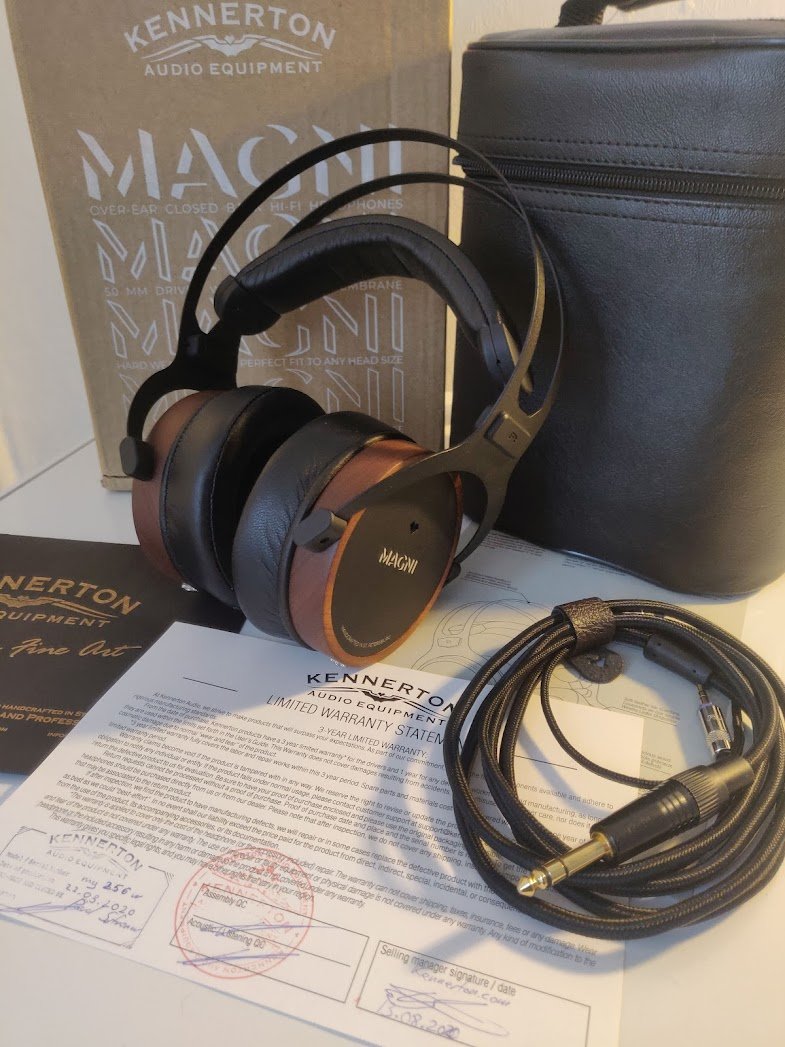
The headphones are delivered in similar packaging to other Kennerton models – the overall package is impressive. Once again, the practical carrying case deserves special mention, into which the Magni can be quickly slipped for protection after listening.
Structure and comfort
The Magni's cable looks nice, but is unfortunately stiff. It also picks up sound when it rubs against the listener's clothes. This problem is more pronounced than with the Rögnir Dynamic and GH40 headphones, because the Magni's connectors are directed straight downwards. If the connectors were angled forward like on the GH40 and Rögnir, the cable would not rub against the listener's shoulders as easily.
The usability is further diminished by the headphones' really noisy headband. Touching the headband or the cups makes the yoke structure resonate loudly. So, a lot of all kinds of sound comes from the Magni, even if the headphones haven't been connected to an amplifier yet.
The headphones' yoke structure is similar to that of the Rögnir and almost all other Kennerton headphones. However, I have made a new observation that the Kennerton logo and texts on the headband are not painted or printed on the faux leather, but the patterns are made by cutting away the surface of the faux leather – this is an incredibly foolish solution!
Although my Magni is just over a year old, the pattern on the headband has already started to tear slightly. The surface will presumably flake off more, and in a couple of years, it will have to be scraped off completely. Spare parts are at least easily available, for example, from Sharkoon Skiller SGH3 -headphones, which have exactly the same structure. I have already mentioned in my previous Kennerton reviews that I despise the manufacturer's practice of using generic yokes from cheap gaming headphones in expensive premium headphones, which are claimed to be handmade in St. Petersburg.
Apart from the yoke and cable, there is nothing to complain about in the headphones' construction. The Magni's wooden cups are not particularly fancy, but they serve their purpose. The minimalist style reminds me of Ollo Audio headphones, as in those too, the outer edge of the cups is enclosed with a metal plate. The Magni's ear pads feel high-quality and comfortable, and no mechanism has been used for their attachment that would make it difficult to acquire replacement pads.
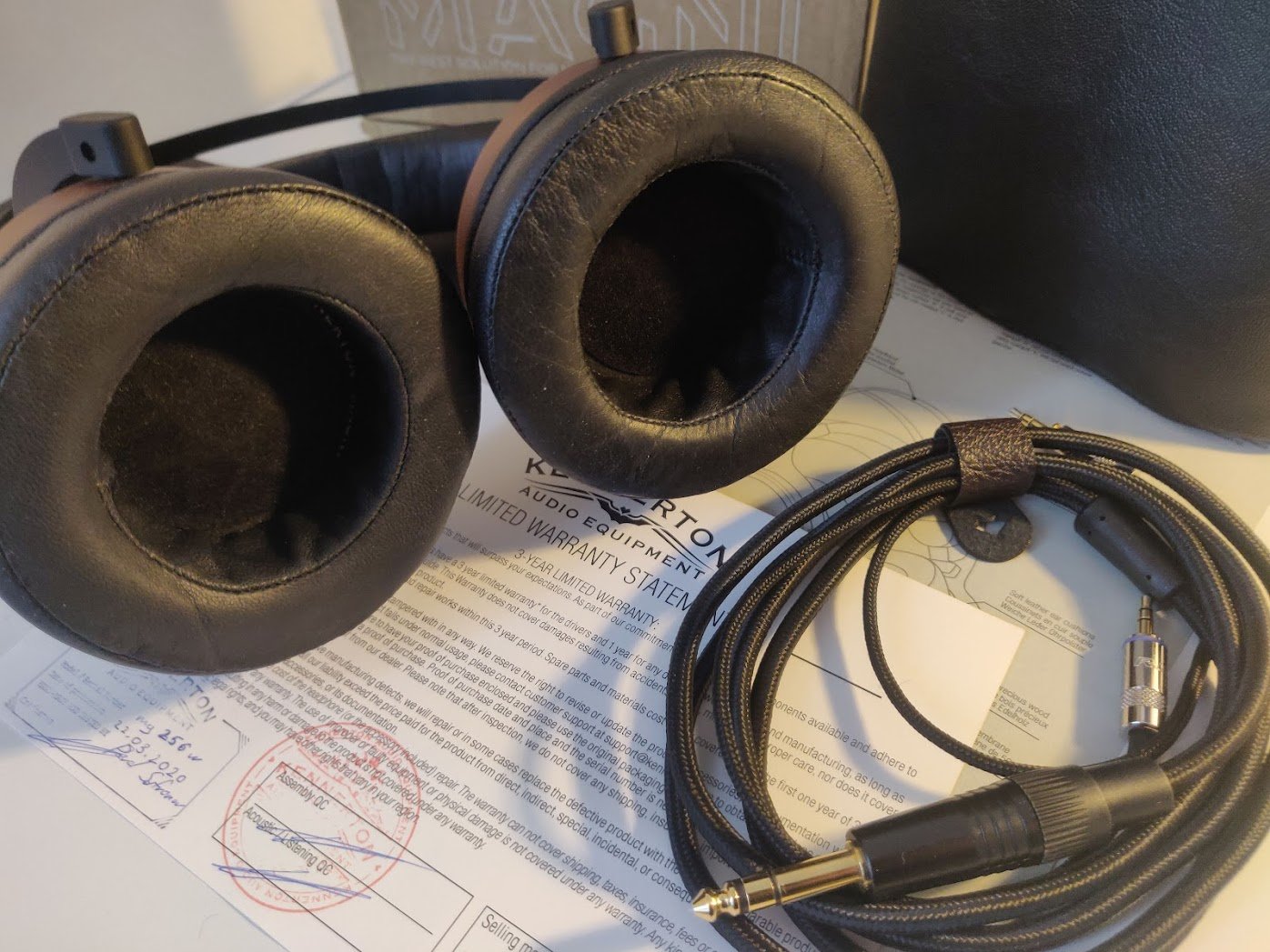
The headphones' wearing comfort is more or less in order. The self-adjusting headband mechanism is a bit loose, but the situation is slightly alleviated by a stronger clamping force than the Rögnir Dynamic model. I suspect that the Magni's previous owner has bent the yoke to achieve a better fit. However, I still miss a mechanism in the yoke that would allow the cups to turn sideways according to the shape of the face.
The Magni's cups swing more freely in their yokes than in the Rögnir Dynamic. I don't know if this is due to the different shape of the cups, or if the attachment point embedded in the wood has worn out with use. The loosely swinging cups do not cause any actual usage-related problems, but they create a somewhat cheap overall impression in headphones costing nearly 1000 euros.

Soundquality
Bass:
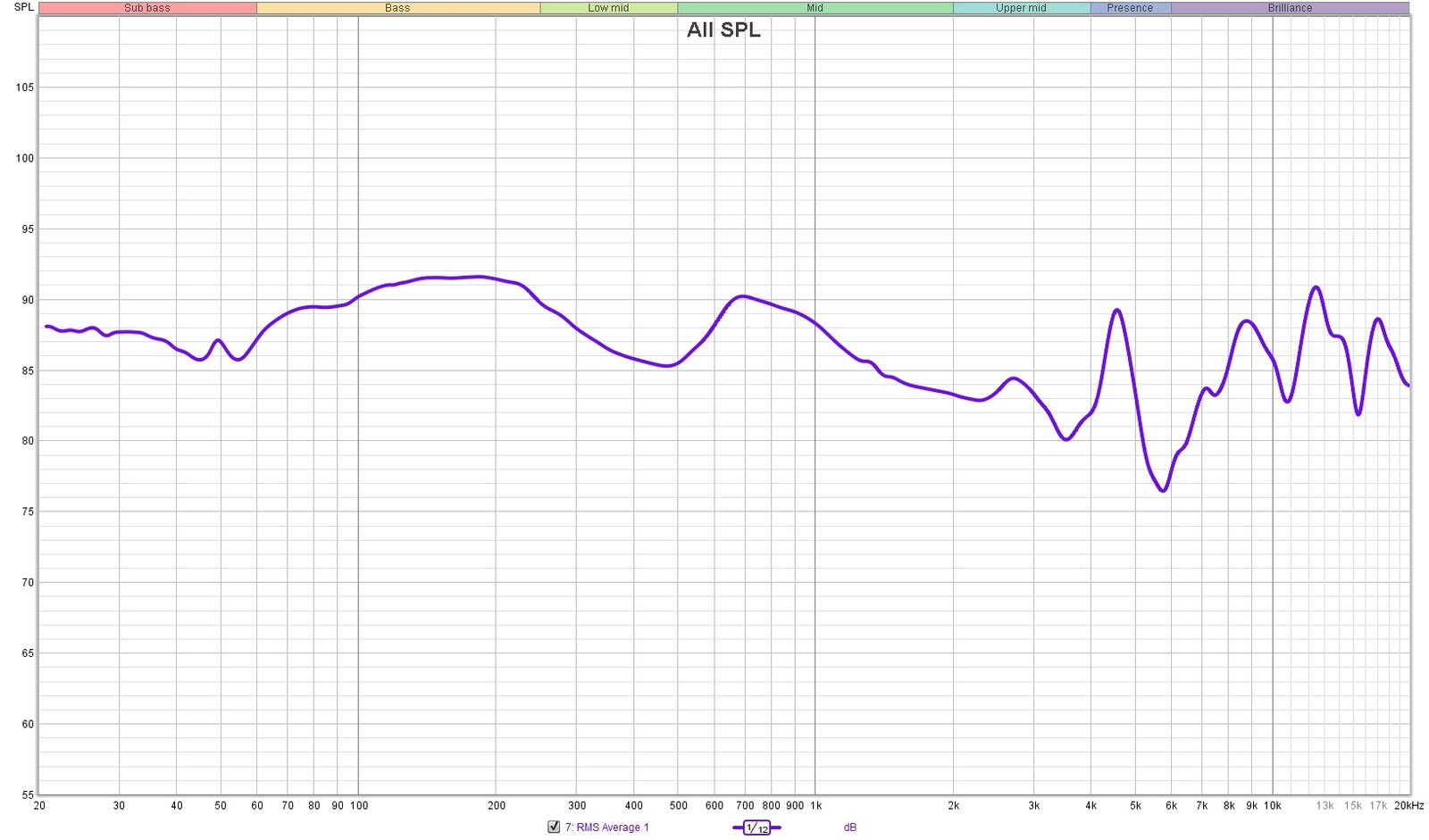
The Magni's mid-bass is really emphasized, and the bass reproduction in general is monotonous. The headphones are unable to differentiate any layers in the bass, and the bass echoes very strongly, lingering with a boomy sound. The reproduction resembles low-quality Bluetooth headphones, so I have never heard more abysmal bass reproduction in such expensive headphones.
Central votes:
Vocal performances are reproduced exceptionally unclearly by the headphones. The timbre of the mid-frequencies is peculiar, as for example, a saxophone might be difficult to distinguish from a synthesizer. The reproduction is very veiled, although at times certain sounds grate on the ear very badly. This is likely due to a rather large emphasis, which is highest in the 700 Hz region. Despite a rather grand sound, the Magni's sound does not feel particularly powerful. The overall impression strongly reminds me of the Audioquest Nighthawk, which, however, manages to sound quite excellent in places.
Treble:
The headphones' treble sounds grainy and lacking in air frequencies, despite my measurements indicating that there should be plenty of treble above 10 kHz. The sound is congested, and the 5 kHz emphasis does not manage to enliven the end result at all.
Soundstage, separation, and dynamics:
The Magni's soundstage is moderate in width, but there is far too little depth. Because the soundstage is unbalanced, the headphones are only able to place sound sources mostly to the left and right.
Magni's resolution is terrible considering the high price of the headphones. Listening is truly exhausting because my ears constantly strain to hear details in the music that I know are present in the recordings. These details simply refuse to emerge from the music, no matter what I do. In my opinion, technically more convincing playback can be achieved with better headphones costing just a few tens of euros.
Listening to Magni feels like I accidentally forgot earplugs in my ears. The sound is plagued by the same peculiar, irritating, and echo-like veil as the technically very similar Rögnir Dynamic model. The macro dynamics in the headphones are reasonably good, but I couldn't be bothered to analyze them further because listening to Magni is, frankly, a repulsive task.
Since the Magni V3 is classless in terms of sound quality, I will not compare it to other headphones. While writing my review, I did, of course, compare it to a few other models to ensure I hadn't lost my hearing. It is characteristic of Magni's poor sound quality that the Brainwavz HM5, costing less than 100 euros, sounds significantly better to me. The HM5's sound is cleaner and more resolving, and the headphones' soundstage is better structured.
Summary
The Kennerton Magni V3 suffers from the same problems as the more expensive Rögnir Dynamic. Since I didn't like the Rögnir Dynamic, I already suspected beforehand that I wouldn't like the Magni either. However, the headphones managed to fall short of my already low expectations. Similar, if not even better, sound quality is already available in headphones ten times cheaper.
Pros and cons:
+ Sturdy construction and quality materials
+ The carrying case is practical
+ Easy to drive with any amplifier
+ Thanks to the simple attachment mechanism of the ear pads, suitable pads are available almost endlessly
+/- Reasonable comfort
– Poor resolution
– Disproportionate soundstage
– Veiled sound
– The headband made in China and used in cheap gaming headphones does not belong in headphones costing nearly 1000 euros, especially when the product is marketed as handcrafted in St. Petersburg
– The long cable with a 6.35 mm connector does not offer versatility regarding the audio source
– Terrible price-to-performance ratio
 EN
EN  FI
FI