Author: Roderick

Table of Contents:
Information:
- Year of publication: 2019
- Price: 599 €
- Structure: Open, on-ear
- Dynamic element: 40 mm with titanium coating
- Impedance: 32 ohm
- Sensitivity: ?
- Weight: 270 g
- Connector type: 2 x 3.5 mm
- Cable: Detachable cable with 3.5 mm connector
- Accessories: Pouch for carrying headphones
- Warranty: 2 years
Review sample: Self-purchased product
Erzetich is a Slovenian headphone manufacturer founded in 2012, whose product range currently includes 3 headphone models and 5 different headphone amplifiers. Erzetich's products are not exactly on the cheap side, as for example, the most expensive headphone amplifier named Deimos costs 4500 euros, and the flagship of the headphone lineup, the Phobos planar headphone, costs 2000 euros. The one I am reviewing Thaliaheadphone model costs a slightly more moderate 600 euros.
For me, Erzetich's products are not previously familiar, but I have wanted to test the manufacturer's headphones for a long time. Based on what I've read, the company's founder Blaž Erzetič is passionate about his handcrafted products, and his visions, at least in terms of product appearance, are clearly distinct from the mainstream. Such starting points often lead to great headphones, as demonstrated by ZMF, Dan Clark Audio (formerly MrSpeakers), and Ollo Audio, for example.
Structure and comfort
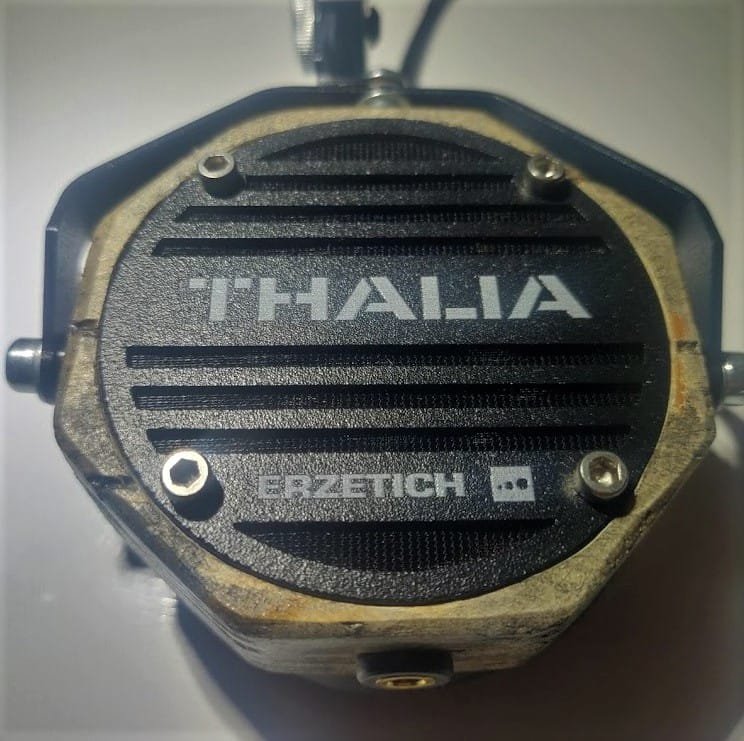
All Erzetich headphones feature distinctive octagonal cups. My Thalia model is of the Salvage type, which indicates that it is made from recycled/repurposed spruce. There are also other versions of the headphones with different wood types and finishes.
The Salvage version has an almost unfinished surface – splinters don't come off the wood, though it's not far from it. The appearance of the headphones is so rugged that, without knowing it's intentional, I would think they slipped into the sales package unfinished.
The wooden cups even have a few small cracks, which puzzled me to the extent that I opened the headphones to examine them more closely. From the inside of the cups, it was visible that the cracks had been glued. They were not formed afterwards, but the headphones were assembled during the construction phase from wood pieces that were in poor condition. For my taste, the rugged style has been taken too far, but I suppose someone might like it.

Thalia's headband is made entirely of metal. The parts are attached to each other with various bolts and nuts, which need to be constantly re-tightened. The height adjustment is of a locking type, meaning the adjustment screw of the fastening mechanism must first be loosened to change the position. Such a mechanism was common in 70s and 80s headphones, but it is apparently still used occasionally. The solution is quite nice in the already distinctive Thalia.
The clamping force of the headband is a bit loose, but it can be easily increased by bending the metal part by hand – however, when doing this, one must be careful not to bend the headphones at the height adjustment mechanism. Even after adjusting the clamping force, the headphones unfortunately do not sit tightly enough on the head to be properly suitable for more active use.
Earpads:
Erzetich does not want to use animal-derived materials in its products, so Thalia's ear pads are made of artificial leather. The material choice is perfectly fine, but in my opinion, the cheap-looking and feeling pads do not suit the headphones' appearance at all. Pads that look similar are used in several headphones costing 5 euros.
The pads are hard and do not conform to the shape of the ear. They are also small and slightly slippery, so they do not provide adequate support for the already wobbly headphones. Using pads sold on Alibaba for 5 cents apiece in handmade headphones costing 600 euros does not amuse me at all as an owner of Thalia. Fortunately, the pads attach to the headphones without a more complex mechanism, so they can be easily replaced with higher quality ones.
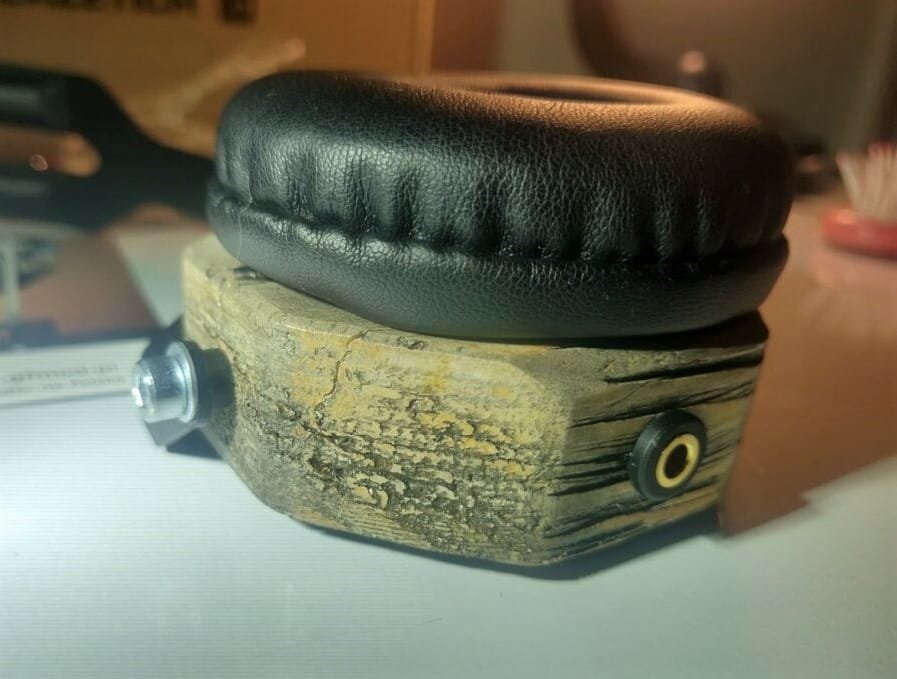
The headband padding is attached with glue. The solution is functional in itself, but the padding is far too thin. The headphones start to feel uncomfortable after only a short period of use. A stronger clamping force on the ears would have helped with this, because even though Thalia is light in weight, its weight rests almost entirely on the top of the head.

Cable:
Recently Grado Hemp after reviewing headphones, Thalia's detachable cable feels exceptionally enjoyable. However, the cable itself is not very good, as it is really thin, resembling cables used in in-ear headphones. Despite its thinness, the cable is also slightly stiff, and it tends to rustle against clothes.
The splitter for the parts branching into the cups is located exceptionally low on the cable, which would not be a problem if the cups did not rotate freely 360 degrees. As a result, the cable has an exceptionally large amount of space to get tangled. Since Blaž Erzetič has stated that he considers the importance of the cable in headphones to be great, it is somewhat ironic that he has designed such a poor cable in terms of usability for his headphones.
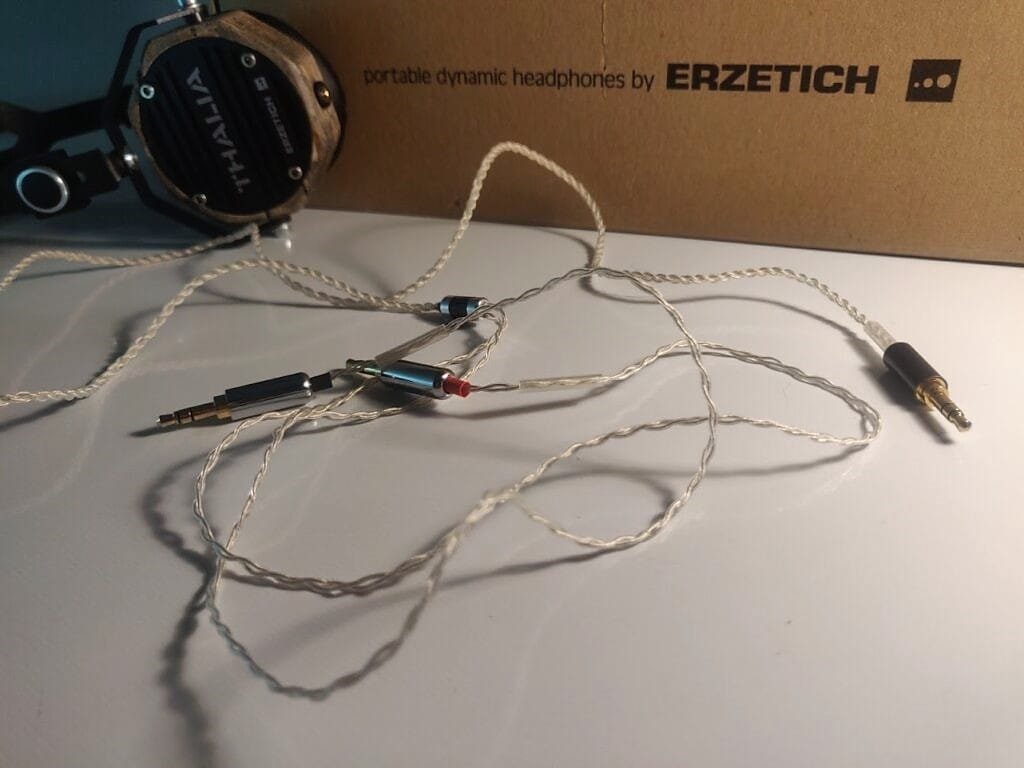
The Thalia model is a contradictory entity in terms of its structure and comfort. There is plenty of personality in the headphones' essence, but several flaws detract from the overall impression they create. User comfort also remains clearly below average, although with better ear pads it could be quite good.
Soundquality

Bass:
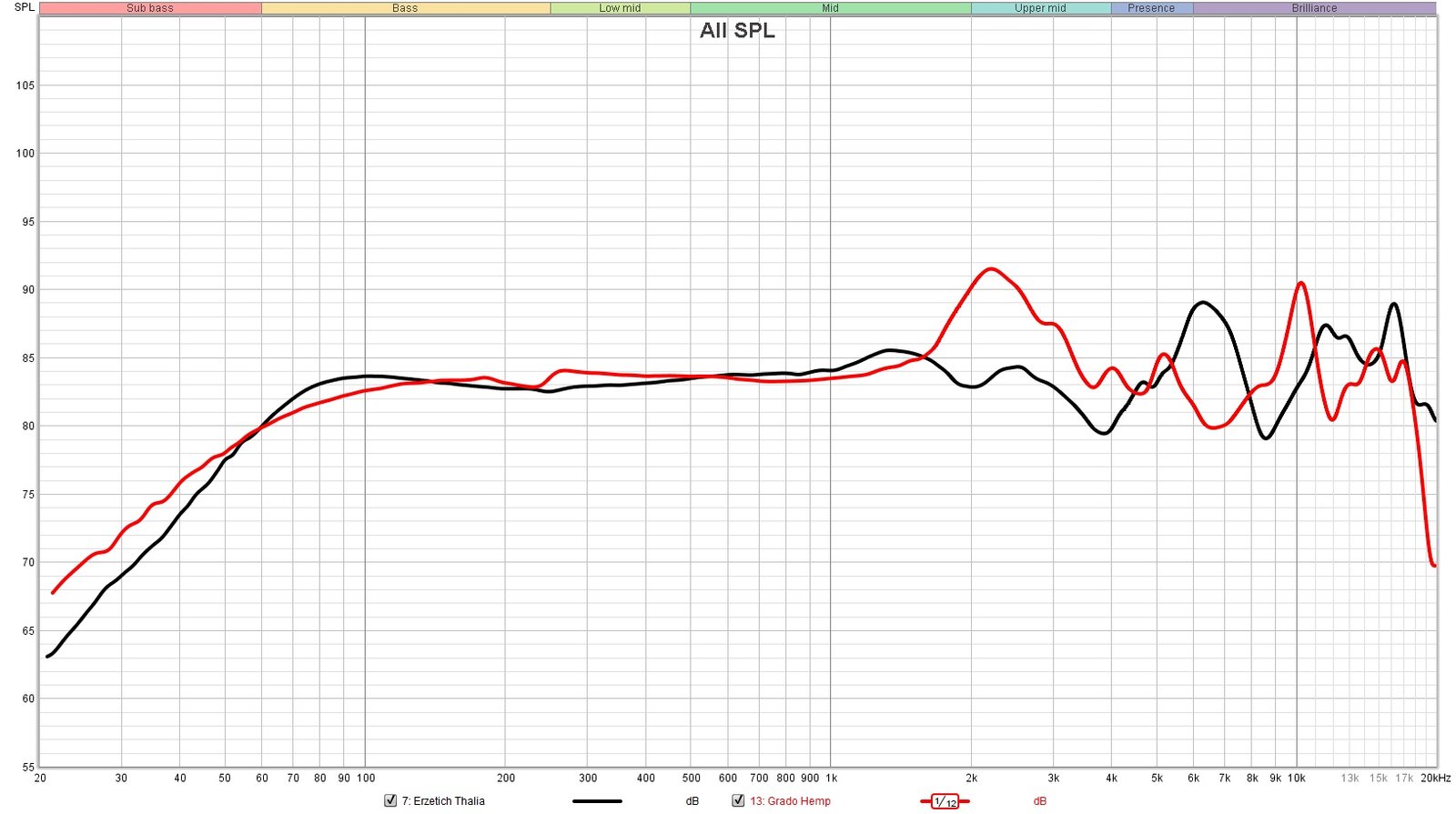
The huge collapse visible in Thalia's frequency response at lower frequencies is real. The headphones' mid-bass is punchy, but it sounds hollow because the sound lacks foundation due to weak sub-bass. Unfortunately, the bass reproduction cannot be improved by pressing the headphones more tightly against the head or the measurement device. I also tried a few common bass modifications, but they had no effect whatsoever. Functional bass reproduction from Thalia would likely only be achieved by completely redesigning its structure or by replacing the driver with a different one.
The problem is not limited to the quantity of sub-bass, but there are also obvious shortcomings in its quality. When listening to bass-heavy music, extraneous noises are heard from the headphones, which indicates that the drivers simply do not function correctly at low bass frequencies. For this reason, the situation cannot be improved with an equalizer.
I cannot think of another modern headphone with equally weak bass, and among older models, the AKG K500 released in 1996 comes to mind first. Even the Tripowin H1 I recently tested is more convincing in terms of bass than Thalia.
Mid-range:
The headphones' mid-range, on the other hand, is reasonably successful. A slightly upward-sloping frequency response makes the sound clear, but somewhat thin and cold-feeling. The tuning has clearly aimed for a Sennheiser HD600-style mid-frequency reproduction, but Thalia does not achieve an equally natural-sounding result – though I have heard worse attempts. One downside of Thalia is that sibilance in vocal performances is slightly emphasized, which is quite distracting on some recordings.
Treble:
Thalia's treble is balanced, with the exception of a 6.5 kHz emphasis. There is just the right amount of air in the highest frequencies as well. Cymbals sound clear and do not hiss, unlike, for example, in many Hifiman headphones. The 6.5 kHz emphasis visible in my frequency response measurements is such that its effect is more sibilance-inducing than broadly coloring the higher frequencies.
Soundstage, dynamics, and other technicalities:
If one positive feature of the headphones had to be highlighted above others, it would definitely be the wide soundstage. I really didn't expect such a large soundstage in every direction from small on-ear headphones like the Thalia. Unfortunately, the soundstage is also quite vaguely structured, meaning sounds do not have a clearly defined location. I wouldn't bring this up for a more affordable headphone model, but based on its 600 euro price, one would expect better performance from the Thalia.
The headphones are also weak in macrodynamics for their price. Since the experience of macrodynamics is often closely related to bass reproduction, and the Thalia is deficient in that regard, I aim to evaluate macrodynamics with music where the lowest frequencies do not play a central role. Tchaikovsky's Violin Concerto, for example, is excellently suited for this purpose.
Unfortunately, the Thalia also sounds flat with such music. The headphones' large soundstage is well-suited for classical music, but the reproduction is bland and powerless in terms of dynamics. The same Tchaikovsky's Violin Concerto mercilessly reveals weak microdynamics as well. There is a veil in the Thalia's sound, where the smallest sounds get lost – the music remains distant and feels unreal. However, the headphones are not terrible; their technical performance is simply not at the level one would expect from 600 euro headphones.
Erzetich Thalia vs. Grado Hemp
Structure and comfort
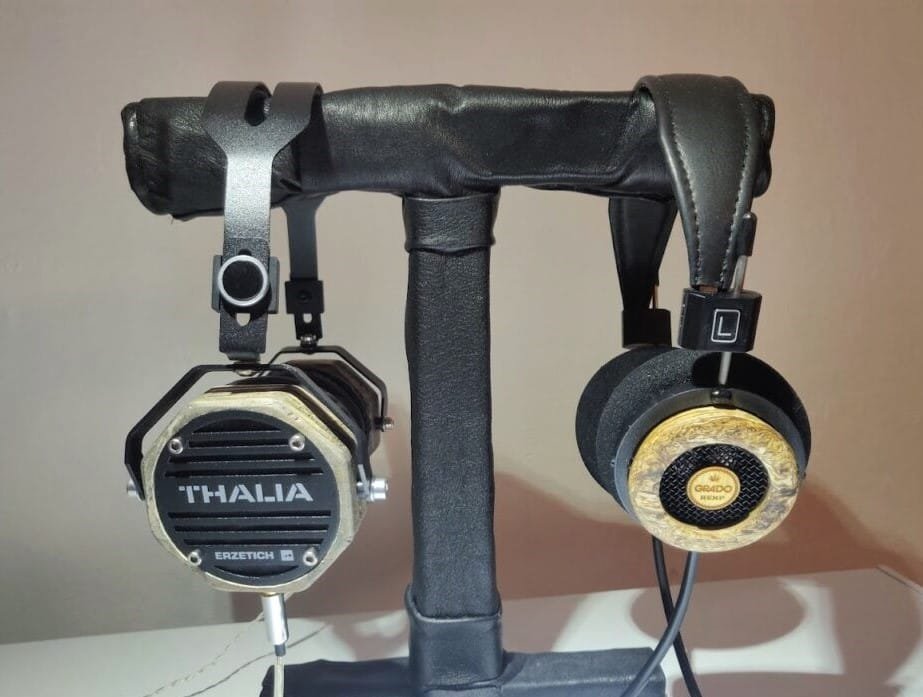
In my opinion, the cups of the Grado Hemp, made from hemp fiber, are fine, whereas the cups of the Erzetich Thalia fall somewhere between distinctive and terrible in appearance. The Hemp's minimalist headband structure is more functional, although I would wish for metal headbands like the Thalia's on Grado headphones – however, Erzetich's implementation is unfortunately poor. Thalia earns a plus compared to Hemp for its detachable cable.
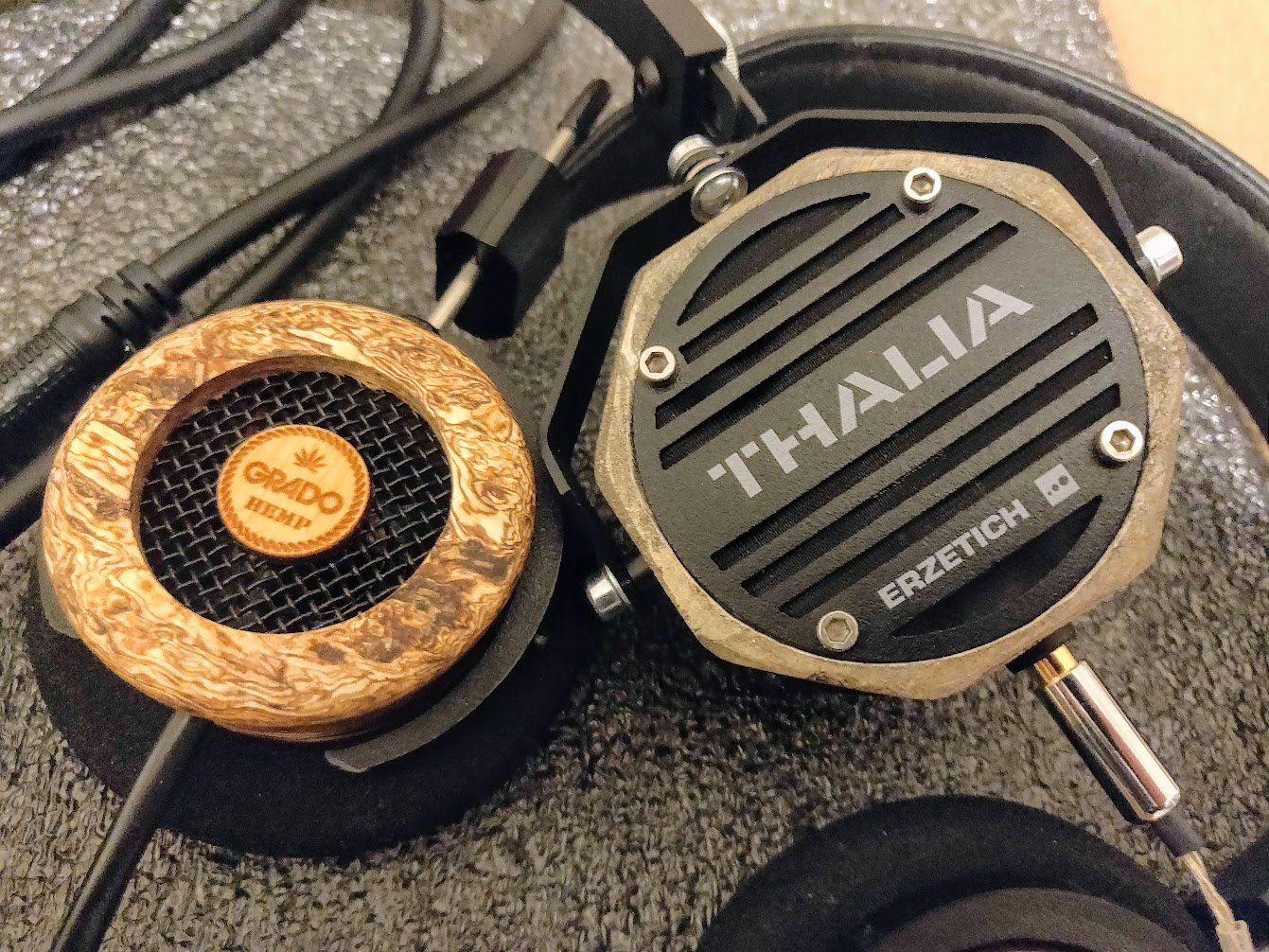
On-ear headphones can be very comfortable at their best, but unfortunately, neither Thalia nor Hemp are. Grado's foam pads are frustratingly thin, while Thalia's pads are thicker, but they sit uncomfortably on the ears due to their too-small size.
Hemp distributes its weight quite well and doesn't press on the top of my head. Thalia's weak clamping force, on the other hand, barely supports the headphones against the ears at all, so the too-thinly padded headband is not enough to ensure comfort. Hemp is uncomfortable, but Thalia is even more uncomfortable.
In terms of usability, both headphones are equally poor. Hemp's heavy cable makes the headphones unstable on the head. Thalia's wobbliness, on the other hand, is due to a loose clamping force and cups that rotate too easily – when I bend down, the cups start to turn, causing the headphones to almost fall off my ears.
Both headphones are weak in construction and terrible in usability. Both Thalia and Hemp are, in my opinion, good examples of how headphones should not be built.
Differences in sound
Bass:
The bass reproduction of both headphones appears quite similar in my frequency response measurements, but in reality, there is a greater audible difference between the models. Hemp's bass deficiency is largely due to the headphones' open structure, both from behind the cup and largely between the ears and pads. The thin foam pads simply do not seal tightly enough against the ears. Thalia's bass deficiency, in my opinion, is more explained by the poor quality of the driver used in the headphones.
Although Hemp's bass reproduction drops sharply towards lower frequencies, it does not experience the same sudden drop as Thalia. With Hemp, the lowest frequencies are still somewhat audible, whereas with Thalia, the bass completely loses its foundation. Another significant difference is that Grado's driver does not start to distort low frequencies as much as the driver used by Erzetich. It is pointless to even try to evaluate the more technical differences in bass reproduction between the models, as Thalia's bass reproduction is so exceptionally poor.
Central votes:
Thalia's otherwise successful but rather unremarkable mid-range pales in comparison to Hemp. Hemp's mid-range reproduction is energetic and slightly aggressive, but above all, extremely captivating. In comparison, Thalia's weak and thin reproduction does not inspire listening to music, and the more pronounced sibilance further worsens the situation.
Treble:
Thalia's treble reproduction is, in my opinion, more balanced and pleasant to listen to. Hemp has some issues with the integration of upper mids and lower treble. Because of this, the upper frequencies are reproduced somewhat inconsistently. Additionally, there could be more airiness in the very highest frequencies.
Soundstage, dynamics, and other technicalities:
Hemp cannot challenge Thalia's wide soundstage. Unfortunately, neither headphone performs up to its price in sound placement.
In terms of dynamics, the headphones differ significantly. Although Hemp is not among the best in its price range for macrodynamics, it still easily surpasses Thalia, which is regrettably bland to listen to.
In other ”technical” features, there is no significant difference between the headphones. In my opinion, the word ”average” best describes the performance of both. Neither model, for example, sounds particularly resolving. On the other hand, it's difficult to find any major flaws in the reproduction of either.
Sonic final remarks:
The different aspects of the headphones form a very different whole. The Grado Hemp sounds much better than the sum of its parts: the headphones are energetic, inspiring, and truly entertaining. In my opinion, the Erzetich Thalia, on the other hand, is lackluster and boring.
Summary
The Erzetich Thalia performs really poorly considering its rather high price of 600 euros. The headphones are uncomfortable and impractical, and I didn't feel like listening to them any more than was ”necessary” for this review. If the bass reproduction of the headphones were even at an acceptable level in terms of quantity and quality, the Thalia would be significantly better than it is now. The mid-range and treble are balanced, but that's not enough to compensate for the shortcomings of the lowest frequencies, especially since the headphones don't possess any other overall improving features besides their wide soundstage.
The problems with the lowest frequencies and the oddities related to usability are so obvious that, in my opinion, the headphones should never have been released. The price of the Thalia is also quite outrageous considering the quality, so I absolutely cannot recommend anyone to acquire them.
Pros and cons:
+ Wide soundstage
+ Balanced treble
+/- Mid-range is balanced, but slightly thin
+/- Distinctive appearance and finish, which will certainly divide opinions
– Dismal bass reproduction
– Weak resolution for the price
– Poor macrodynamics
– Poor comfort and usability
– Low-quality cable
– Exceptionally poor and cheap-feeling ear pads
– Poor price–quality ratio
 EN
EN  FI
FI