Author: Sword of Damocles
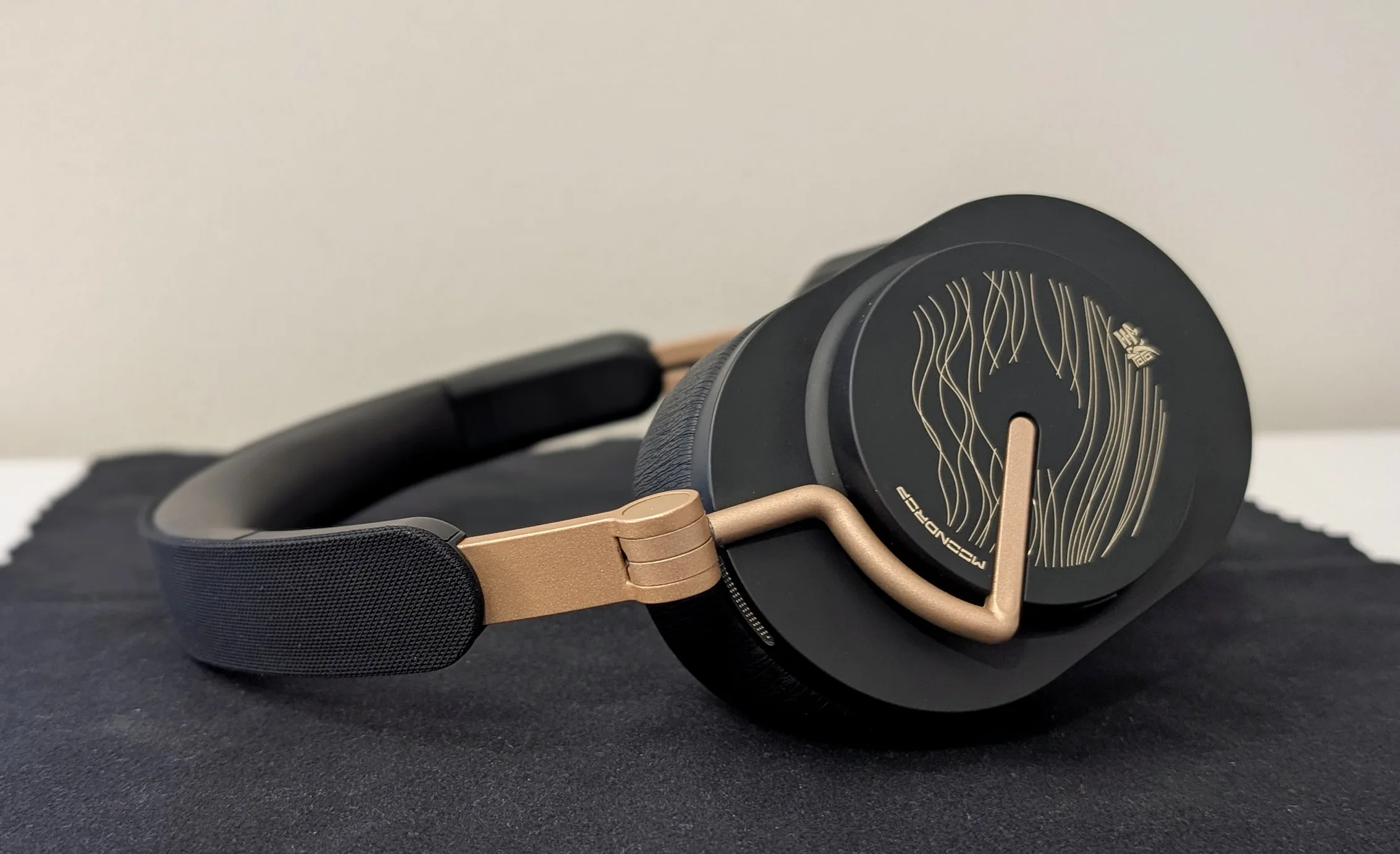
Table of Contents:
Information:
- Release year: 2024
- Country of Origin: China
- Colour options: Black and white
- Price: 80 USD
- Type: Closed, over-ear
- 40 mm dynamic drivers (Titanium-coated diaphragm, CCAW voice coil and N52 magnets)
- Audio connections: Bluetooth 5.4
- Bluetooth codecs: LDAC, AAC and SBC
- Charging port: USB-C
- Battery life: 48h (AAC codec & noise cancellation off)
- Charging time: 1.5 h (supports fast charging: 5 minutes for 4 hours of use)
- Active Noise Cancellation: ON / OFF / Transparency mode
- Features: Multipoint support and a phone app to change the sound profile
- Weight: 240 g
- Accessories: USB cable and faux leather pouch
Review sample: Self-purchased product
Chinese Moondrop has already managed to release several over-ear headphones in addition to its extensive in-ear headphone selection. However, none of these seem to have made a significant breakthrough, even though I consider, for example, Venus a pretty good pair of headphones. This time, the manufacturer is testing its ”market stickiness” for the first time in the realm of noise-cancelling headphones with its $80 Edge model, which can be seen as a competitor to, for example, JBL's affordable products. The 50–100 euro price range seems popular based on the fact that my review of the JBL Tune 770NCwas the second most read on Kuulokenurkka in 2024.
I have had in my hands the ”x Singer” collaboration version of Moondrop's new headphones, whose external decoration apparently pays homage to the Chinese Singer singing competition. Since then, Moondrop has also released a similarly priced Edge model for the international market without the Singer mention. The international Edge looks slightly more minimalistic, and based on product information, its driver diaphragms would be coated with beryllium, whereas the x Singer version would feature titanium. A significant difference is unlikely to arise from this, especially since other product specifications are largely identical. Nevertheless, it is, of course, possible that the tuning of the two models is slightly different due to a different target audience.
Packaging and accessories
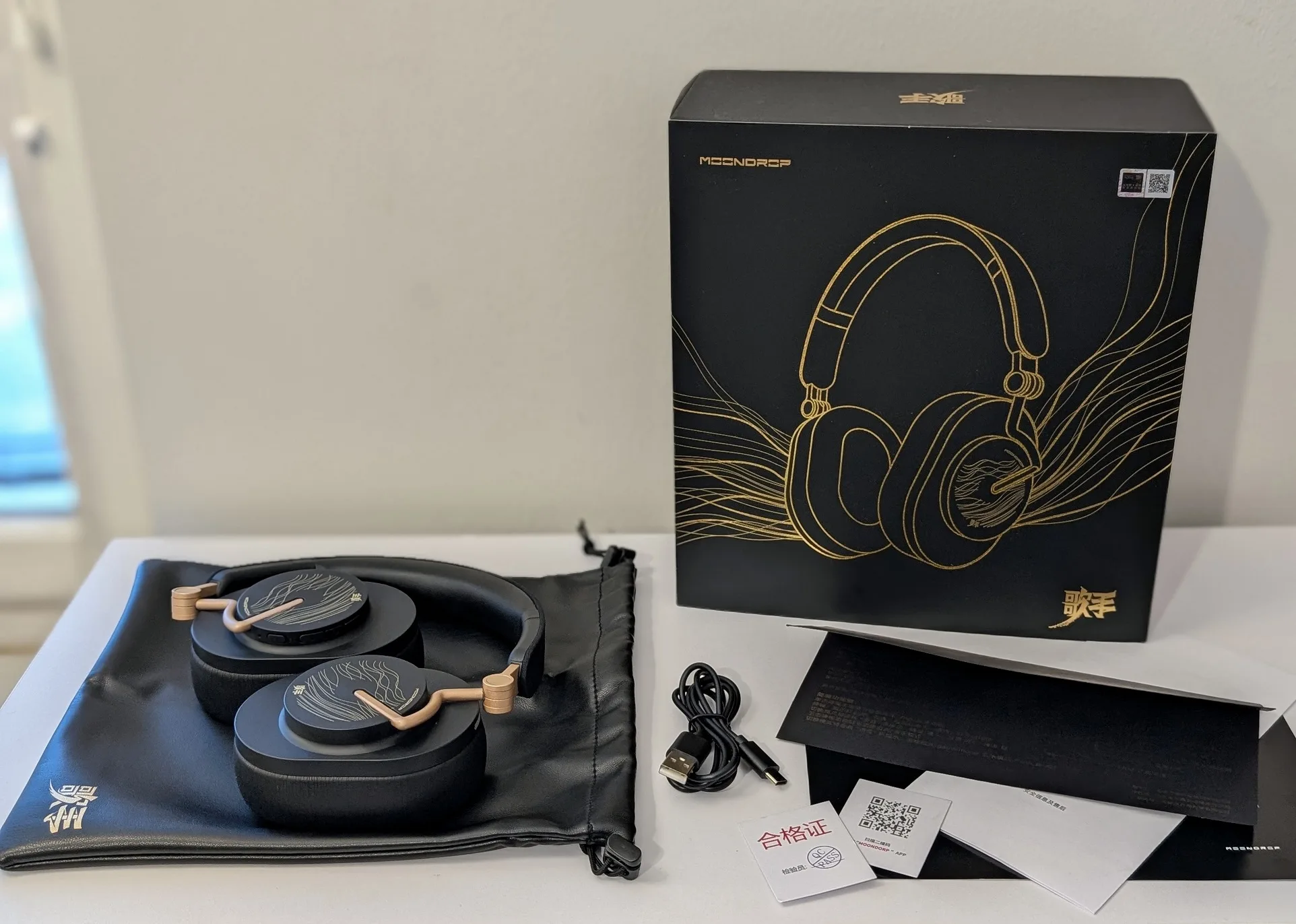
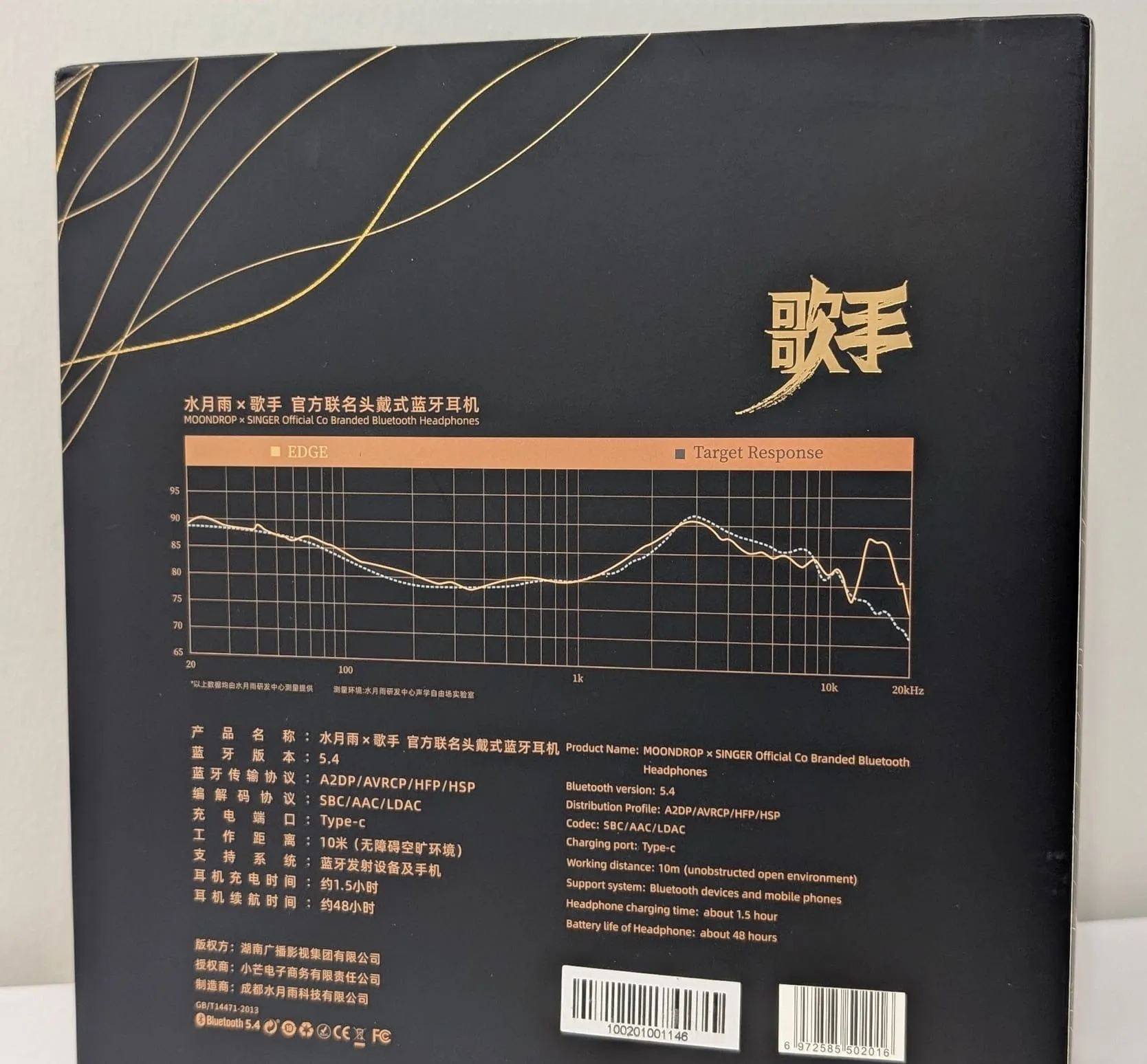
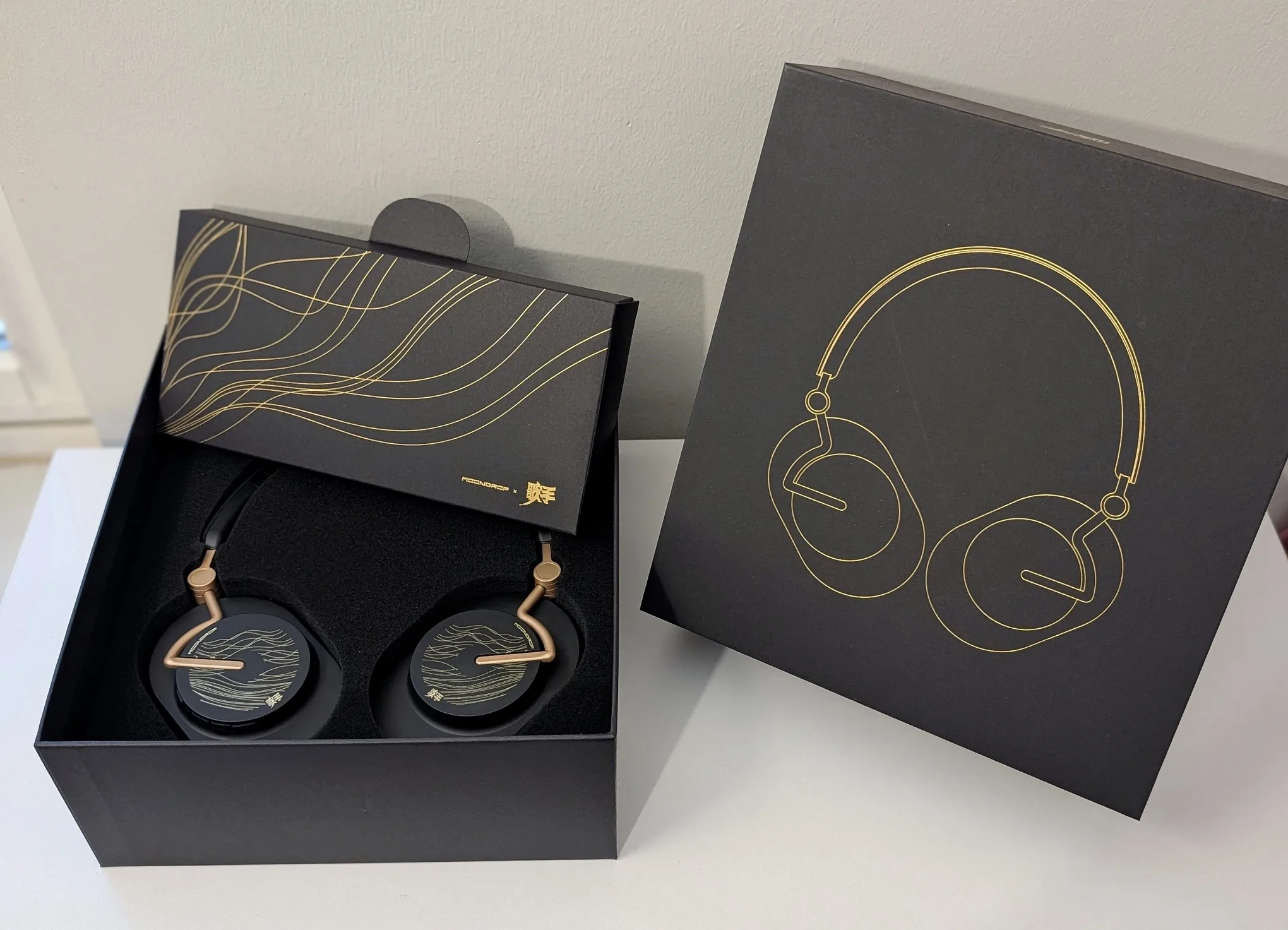
In my opinion, Moondrop designs nice product packaging, even though sometimes they are quite a bit of anime overload. The Edge makes an exception to this, arriving in a stylish black box (the color may depend on the chosen headphone version), which is decorated with golden details. On the back, a useful piece of information is an image of the headphones' frequency response – I appreciate the manufacturer's transparency.
The accessories are limited to a USB cable and a quite nice faux leather pouch. Like the Soundcore Life Q30, in this price range, it would be nice to also see a carrying case, but in terms of specs, the Edge is fortunately a step better headphone.
Build and comfort
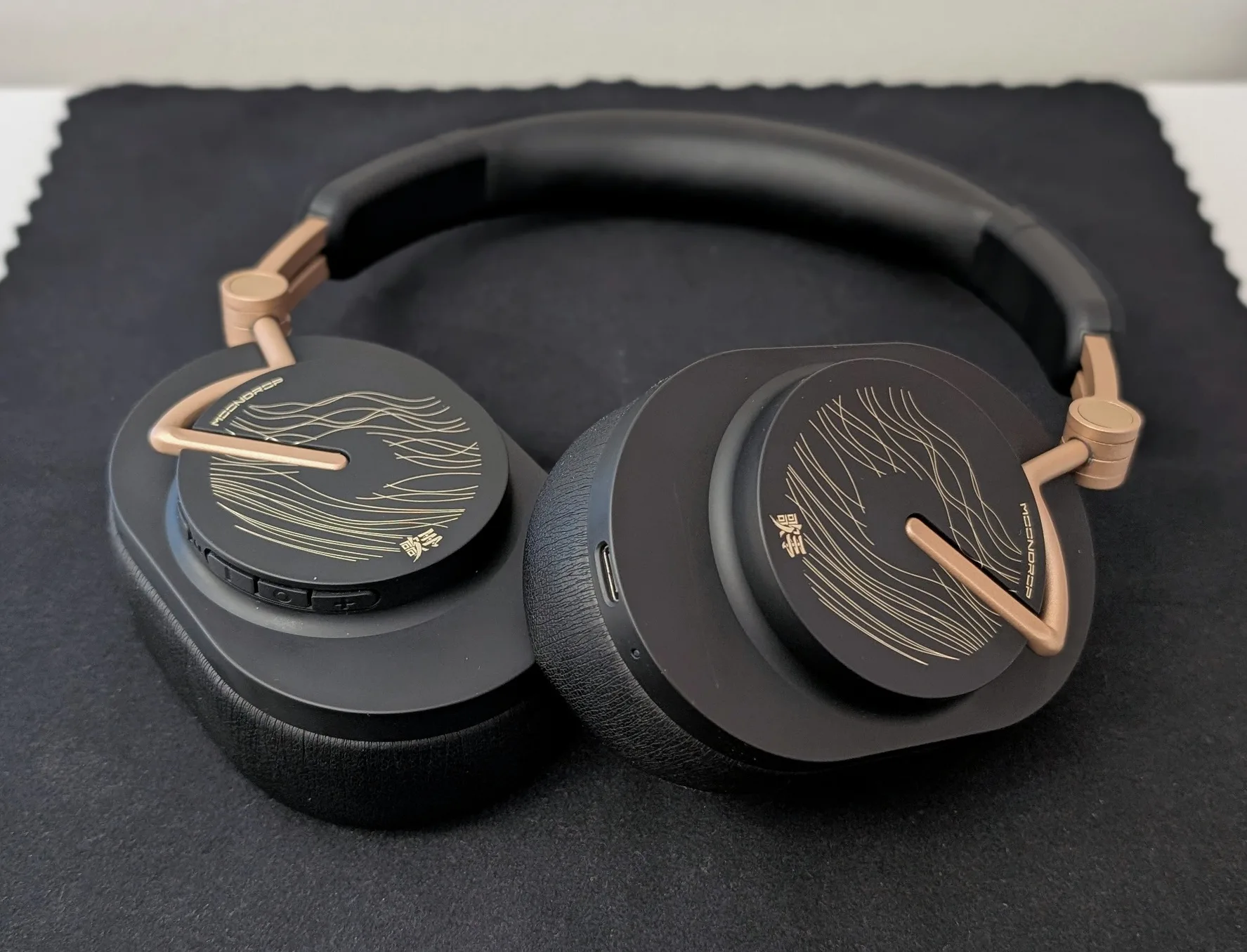
I became interested in Edge due to its unique appearance. The headphones' gold-colored headband with its hinge parts is made entirely of aluminum, so the structure should withstand use well. The cups turn both horizontally (pads against the chest) and inwards, so the structure can be folded small for portability. For some reason, gray oily gunk, likely used for lubricating the parts, oozes from between the hinges of my own headphones.
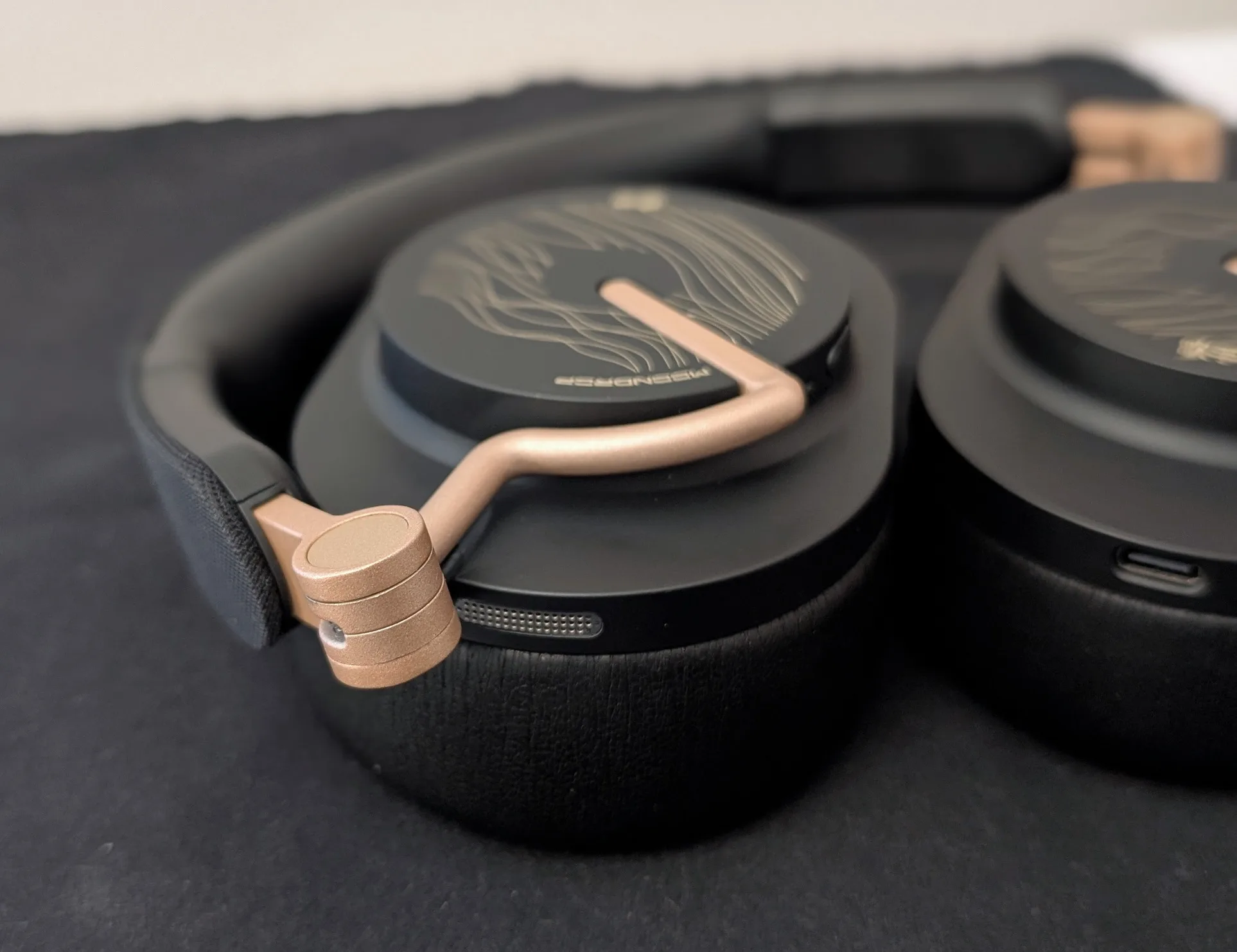
The cups and the outer parts of the headband are made of matte black plastic, which feels quite cheap and quickly gets oily from fingerprints. The fabric covering added to the top of the headband, however, creates an impression of a slightly more premium product. Ultimately, handling the headphones reveals that despite their interesting appearance, we are talking about a very affordable product. Especially the movement paths of the cups and the height adjustment feel mechanically somewhat vague, but this was not a major surprise to me considering the price of under 80 euros. Therefore, I don't perceive anything more concerning in the structure, especially since it allows for a good fit and weighs only 240 grams.
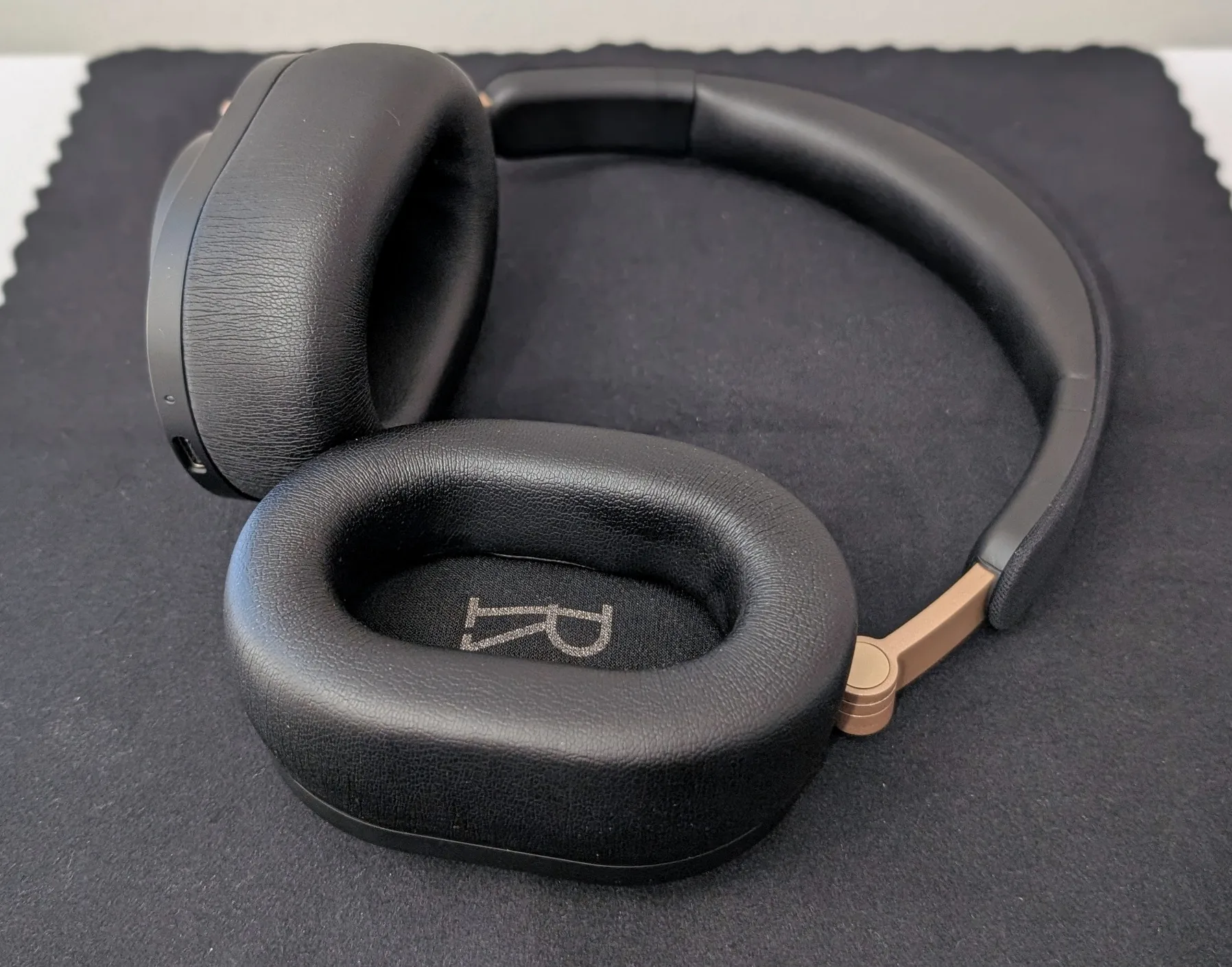
The headphones' artificial leather ear pads are thicker than usual, so the top of my head can be at ease during use, and my ears won't be squashed flat. The clamping force of the headphones is also suitable for my taste. Ultimately, only the headband's design could be less steep for my head, as the pads fit very snugly below my ears, while above my ears, the fit remains light enough to slightly weaken the bass reproduction. This can be a problem especially for those wearing thicker glasses, although it shouldn't significantly affect comfort. I have sat on a train with the Edge on my head for a few hours quite contentedly.
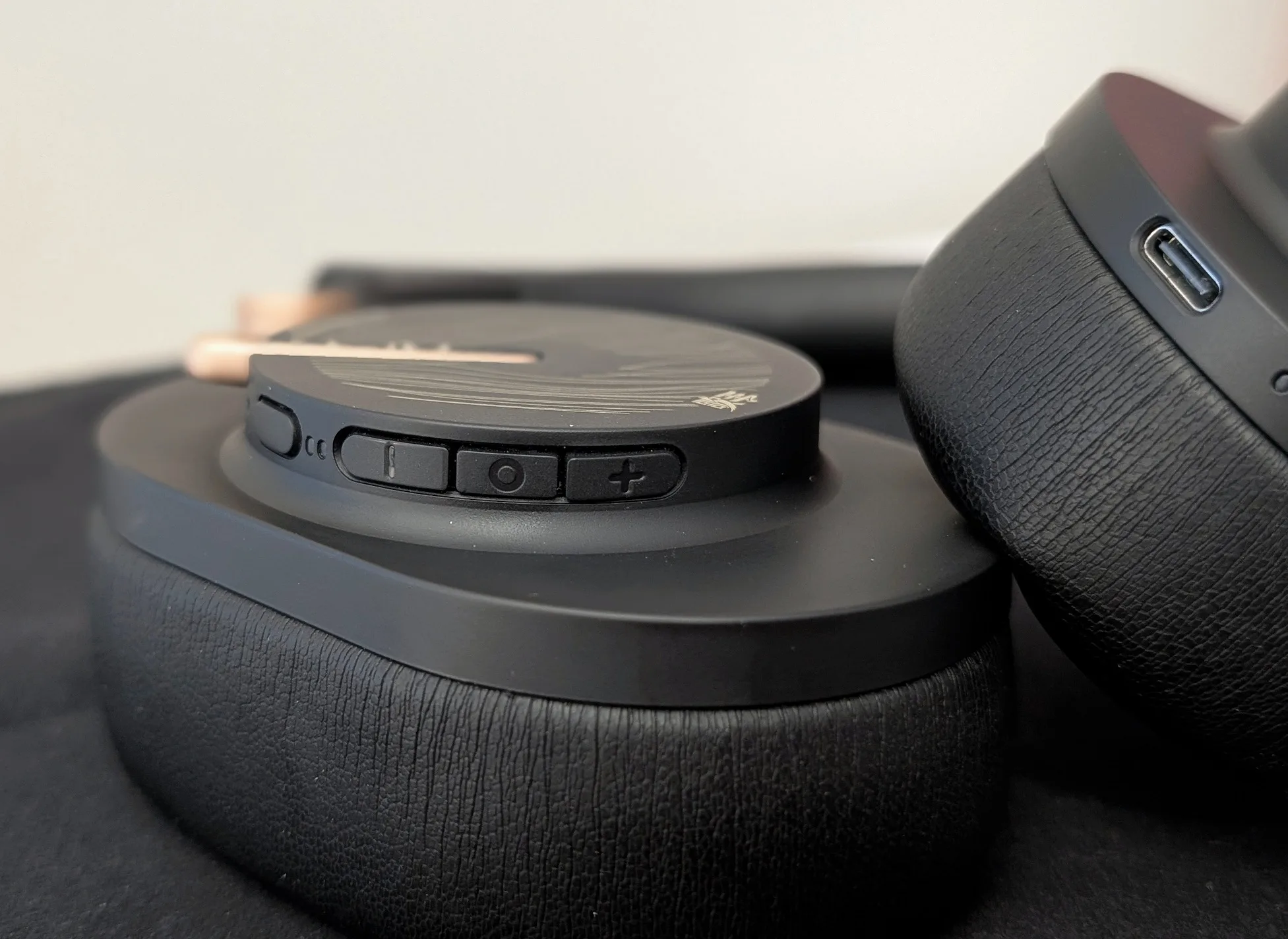
The headphones are controlled by buttons located behind the right cup, which my fingers find easily. The power button sits slightly deeper in the housing compared to the volume control buttons. For controlling the noise cancellation function, there is a separate button, as is customary. Typically for Moondrop headphones, audio notifications are handled by a small girl who, for example, says ”HEI!” in a cute voice when switching to transparency mode and ”Shiiiiii….” when turning on noise cancellation. In addition to this, the Edge differs from other noise-cancelling headphones on the market in its inverted volume control, as the lower button increases the volume and the upper one decreases it.
Bluetooth technology and battery life
The headphones support the Multipoint feature and the latest Bluetooth version 5.4. In addition, the Edge fully supports the high-quality LDAC codec without interruptions or interference (must be activated via the app itself), which is still a rare treat in the sub-100 euro price range. Only a few more expensive headphones, with the exception of Sony models, offer such a stable LDAC connection. Moondrop has thus invested modern technology in its headphones. Owners of mobile devices that do not support the LDAC codec and Apple users, of course, still have to settle for AAC and SBC codecs.
The Edge's Bluetooth connection has not been entirely perfect in terms of functionality, as my Windows PC disconnects almost immediately, and I cannot use the headphones at all. Fortunately, Bluetooth has worked normally on two phones and an Apple computer, so it is likely some kind of isolated compatibility issue.
Moondrop states the Edge's battery life as 48 hours, but this figure is misleading, as it is only achieved with noise cancellation turned off and using the AAC codec. In more common use cases, the battery life is shorter. I haven't timed it, but I would estimate 25–30 hours based on the Stetson-Harrison method, which is also quite sufficient. If needed, a 5-minute quick charge already provides several more hours of use time.
Phone application
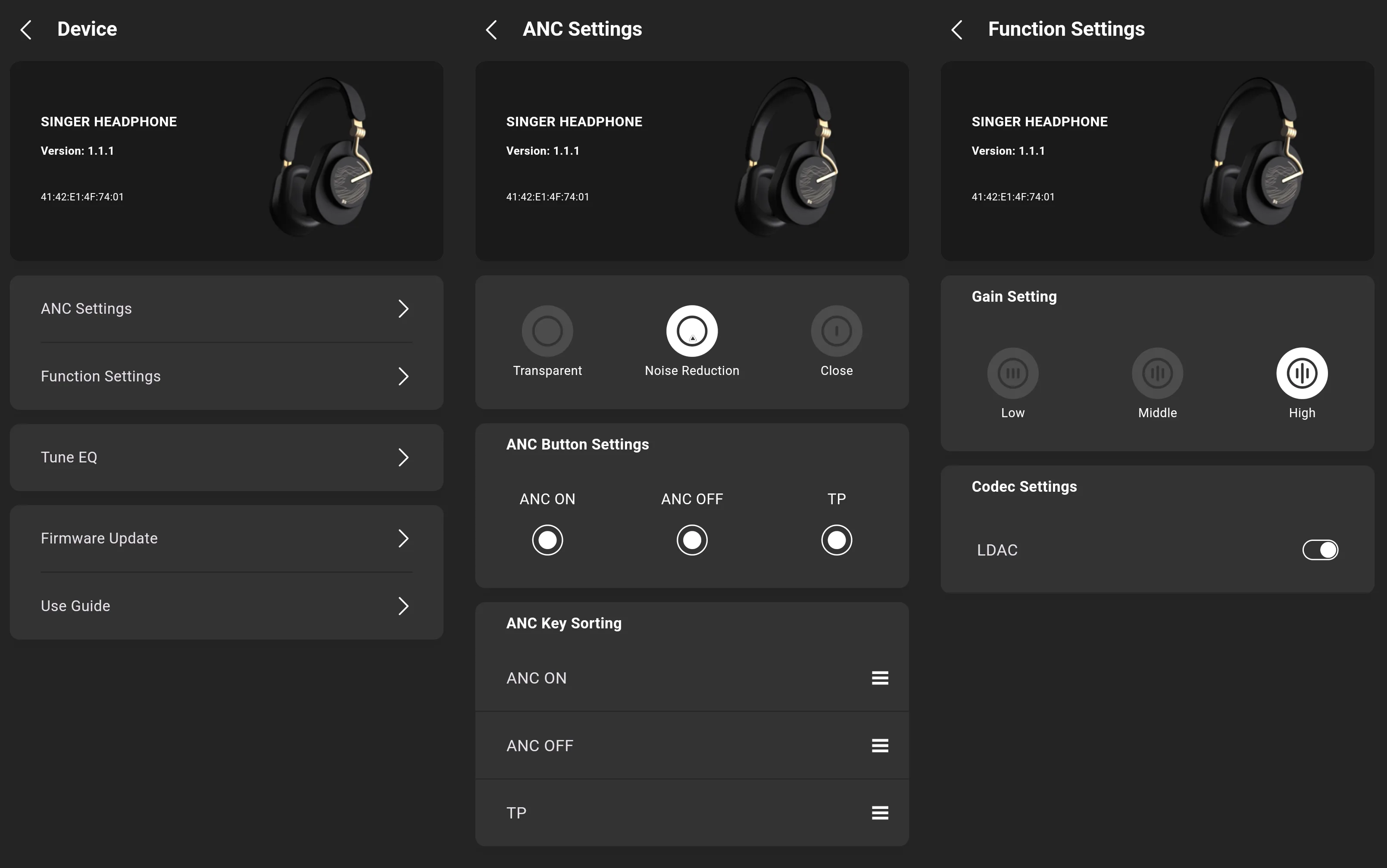
Moondrop has finally gotten its Link app approved for the Android store, so it no longer needs to be downloaded and installed from the manufacturer's website. I recommend using the app at least temporarily, as it is needed to activate the LDAC codec. Firmware updates for the headphones would also be installed via the app, if any are released. The headphones' gain level could also be reduced when more adjustment range for volume is desired. Otherwise, there are mainly a few alternative sound profiles available, as a free-form equalizer is missing, and the noise cancellation function is not adjustable.
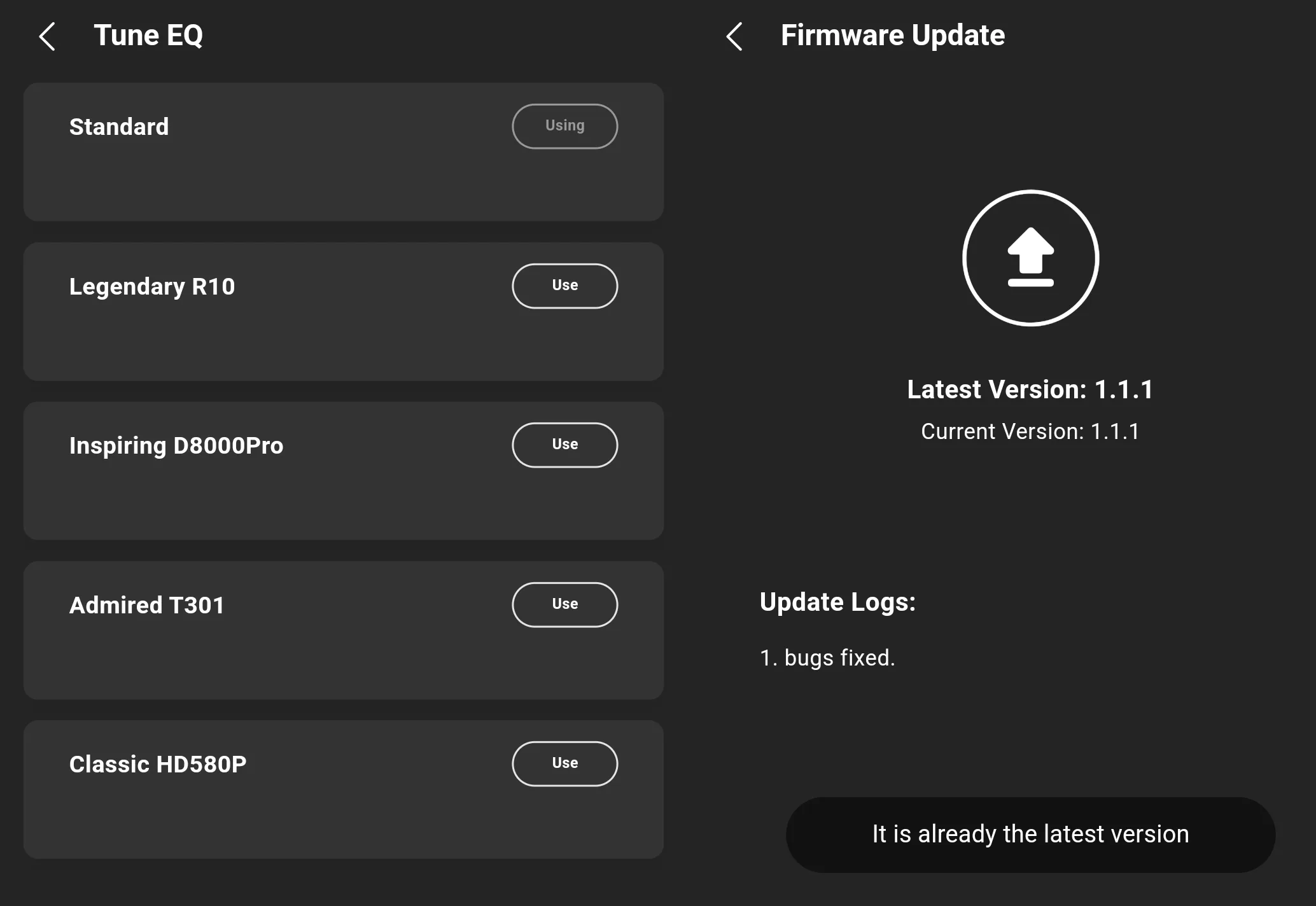
The different sound profiles are supposed to make the Edge sound like other well-known headphone models, but the implementation seems to have gone wrong. Firstly, the chosen headphone models are peculiar, though perhaps popular in China? Furthermore, each profile degrades the Edge's sound quality, as none of them closely resemble their intended model. However, let's explore these a bit later. While I appreciate trying new things, a standard equalizer would have brought me more joy.
Active Noise Cancellation
Moondrop has designed a few in-ear headphones with noise cancellation to date, but the Edge is its first over-ear model featuring noise cancellation. In addition to suppressing ambient noise, the headphones can be set to transparency mode or, alternatively, both can be turned off. The effectiveness of noise cancellation or transparency, however, is not adjustable by the user.
Edge dampens low-frequency noise sufficiently for sitting on a train, for example, but at the same time, it becomes like a detective's tool, allowing you to hear the conversations and stories of people around you more clearly amidst the noise. The attenuation power for mid-frequencies thus remains weak. Based on my quick tests, noise-cancelling is more effective on both JBL Tune 770NCand Soundcore Life Q30. I notice this already when sitting on the couch, with the TV and dishwasher audible in the open-plan kitchen at the same time. Moondrop Edge is the only one that lets the gurgling of water through and doesn't attenuate speech as much as the two comparisons. At the same time, an electrical interference sound can be heard from the Edge, as if there were some kind of small motor inside the headphones. This, of course, gets lost in the music being listened to, in which case the headphones' slightly weaker noise-cancelling function would no longer stand out from my comparisons.
Other observations include that the transparency mode sounds quite unnatural, and touching the earcups causes a strong crackling sound. Wind and airflow hitting the headphones also cause interference sounds, so Moondrop's headphones are among the weakest on the market in terms of active features, as I actually expected. However, these functions can be turned off if they start to bother you.
Microphone sound quality
Every headphone manufacturer always praises their microphone implementation, but positive surprises in terms of sound quality often fail to materialize. In my opinion, the Edge sounds very ordinary, for better or worse. Furthermore, for example, JBL's headphones have a clearly better noise reduction algorithm.
Headphone sound quality
Our frequency response measurements have been made with a clone IEC-60318-4 coupler and KB501X pinnae. The Harman target curve from 2018 is used as a reference point and generalization of the headphone response that would sound good to most people. For more information on the measurements and their accuracy, see Headphone Measurements. The Edge's frequency response is also comparable with other measured headphones on Squiglink .
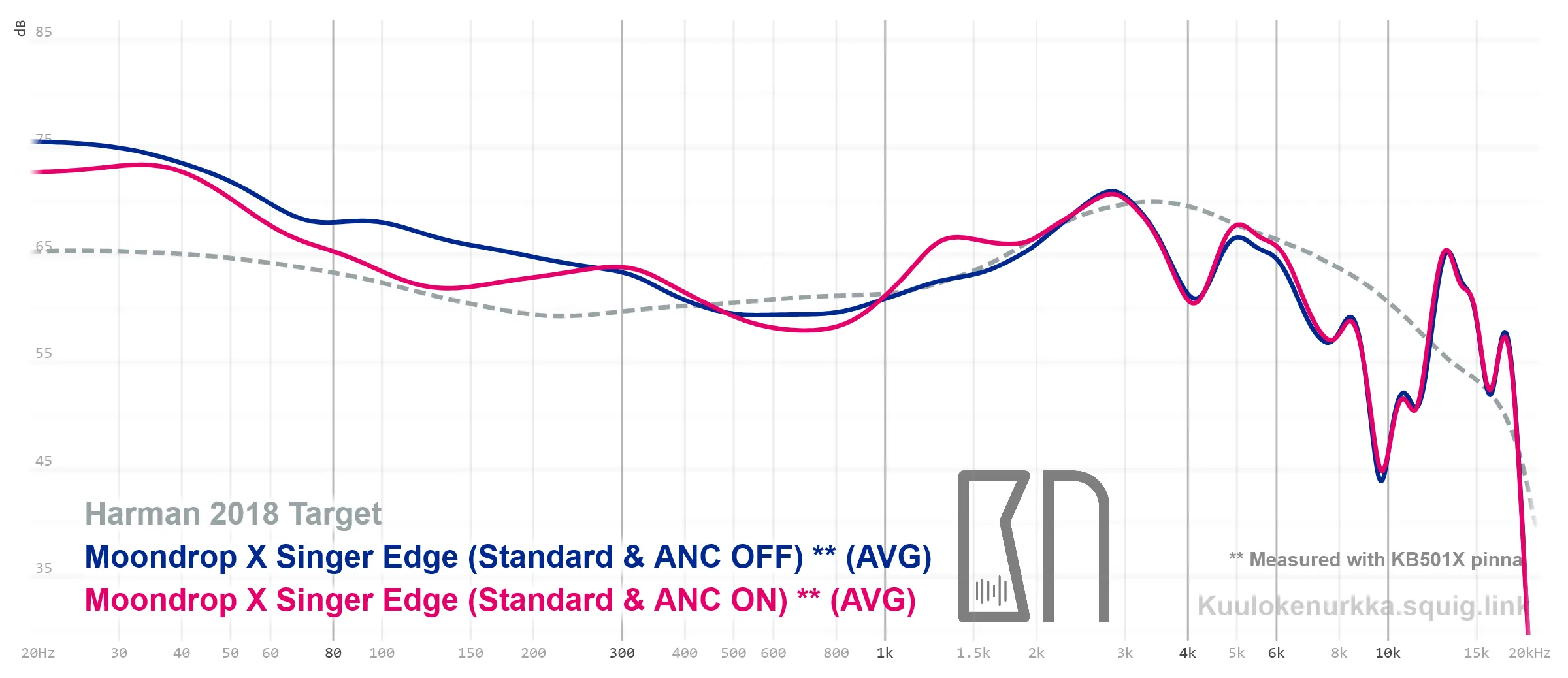
Using the headphones is straightforward, as they can only be played via Bluetooth. The frequency response for the low and mid frequencies is slightly different depending on whether the noise-cancelling function is on or off, but both modes of use have their own sound quality advantages. Moondrop states that they have tuned the Edge to emulate their VDSF target response, developed with the B&K 5128 measuring device, which closely resembles Harman's target response.
Frequency response:
Sound with noise-cancelling function off:
The Moondrop X Singer Edge can be seen as a balanced-tuned headphone when used with the noise-cancelling function off, although its bass reproduction is overemphasized up to 400 hertz. The 100–400 hertz range reminds me of Sony's noise-cancelling headphones, whose low frequencies sound muddy and bloated. Interestingly, however, the Edge does not sound like this to my ears, even though its bass reproduction is robust. The headphones sit somewhat loosely above my ears, as I mentioned, so the extra bass can leak out of the headphones, pushing the actual frequency response closer to Harman's target curve. In other words, for me, the bass is just right and kicks nicely. If I press the earcups more tightly against my ears, the sound becomes bloated and the bass starts to boom. Thus, the Edge's bass reproduction may sound very different to different people.
The Edge reproduces mid and high frequencies very balancedly, if not neutrally. Vocals and instruments sound natural and are reproduced clearly thanks to the proper ear-gain region (2–3 kHz). Robust lower mid-frequencies simultaneously add a pleasant weight to the sound, which I believe many would appreciate. The treble in the headphones is slightly calmer than what I perceive as completely neutral, but thanks to this, listening is easy and effortless in all situations. On the other hand, from 12 kilohertz upwards, the treble has been intentionally slightly boosted to keep the sound fresh and airy. In my opinion, this works well in the Edge, and for example, drum cymbals do not become hissing or unnatural. There is no sibilance in the sound either, so I think Moondrop's headphones sound really good, and I wouldn't see a great need for equalizing them. The accuracy of sound separation, dynamics, and the credibility of the soundstage would also be sufficient to compete against many significantly more expensive noise-cancelling headphones, provided the LDAC codec is used.
Sound with noise-cancelling function on:
Turning on the noise-cancelling function reduces the amount of bass between 50–200 hertz, so I no longer detect bloat in the sound, even if I press the earcups tightly against my ears. This change would be very positive for the clarity of presentation for those whose heads the Edge reproduces bass too boomy with the noise-cancelling function off. At the same time, the headphones still retain their warm lower mid-frequencies, so for example, the kick drum and bass guitar are reproduced with pleasant weight.
Other changes resulting from activating the noise-cancelling function, however, may divide opinions. A dip occurs in the mid-frequencies between 600–800 hertz, while the range between 1000–1500 hertz begins to be emphasized. On the positive side, these characteristics compensate for each other, so the unevenness hardly makes itself known, and it might even go unnoticed. Without my frequency response measurements, I would have claimed the headphones' tuning to be smoother even with the noise-cancelling function on.
When listened to more closely, however, the music sounds less natural and linear than with the noise-cancelling function off. For example, the vocalist's voice simultaneously has a slight hollowness and an extra aggressiveness. On the other hand, this edginess makes the music sound fun, lively, and energetic. Ultimately, after a little getting used to, nothing sounds too unnatural, and I am equally satisfied with the Edge even with the noise-cancelling function on. The treble in the headphones still reproduces safely in style, albeit brightening slightly in the presence region. I would describe the overall presentation with the noise-cancelling function on as clearer and edgier, whereas with the noise-cancelling function off, the Edge sounds slightly warmer and more neutral in its mid-frequencies. Only a few noise-cancelling headphones are tuned as well by default, so Moondrop is among the manufacturers who master the secrets of high-quality headphone reproduction.
LDAC vs. AAC:
Finally, I also want to mention that the Edge sounds better, clearer, and more resolving with the LDAC codec than, for example, with AAC. LDAC also keeps the bass reproduction tighter and can smooth out some of the mid-frequency unevenness. With lower-quality codecs, I find myself focusing more on small weaknesses (with noise cancellation on) or I experience the bass as somewhat loose when I have turned off the noise cancellation. Considering the difference in audio signal quality, I am not entirely surprised by this, but I would still argue that the chosen codec has more significance than usual for the Edge. With AAC and SBC, my experience is more mediocre, whereas LDAC cleans up the sound so much that I might even suspect the frequency response is different. However, I cannot confirm this, as none of my computers support measuring frequency response with the LDAC codec.
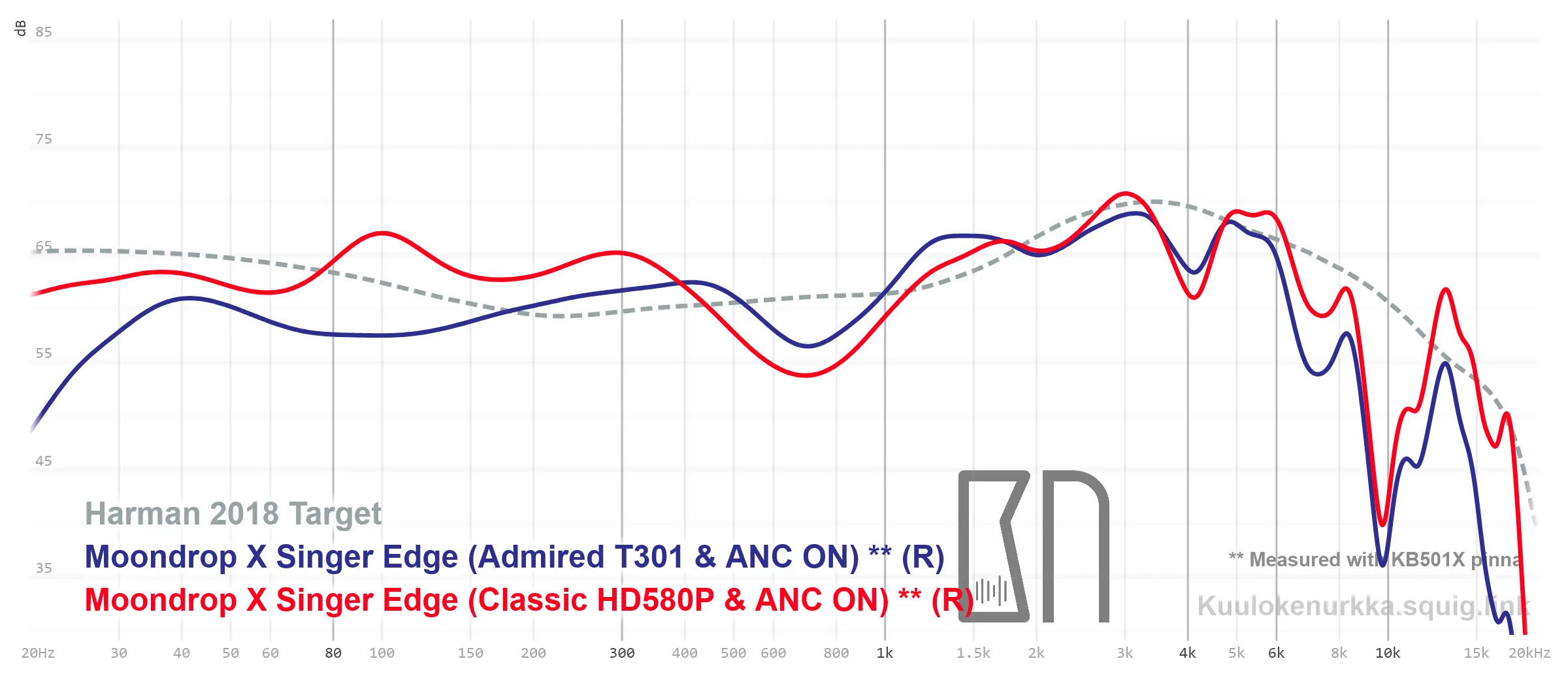
Alternative sound profiles:
I initially thought about skipping the alternative sound profiles entirely, but they are so peculiar compared to the headphones' default tuning that I couldn't resist briefly introducing them. The profile named Legendary R10 likely refers to Sony's aged MDR-R10 headphone model. I haven't heard it, but I don't believe it sounds like a cheap and sharpened phone speaker that doesn't reproduce any bass at all. Inspiring D8000Pro, on the other hand, refers to Final Audio's expensive D8000 Pro planar headphones, although one wouldn't guess that from Moondrop's created sound profile. Where are the bass and ear-gain region? The sound with these two profiles is almost unlistenable.
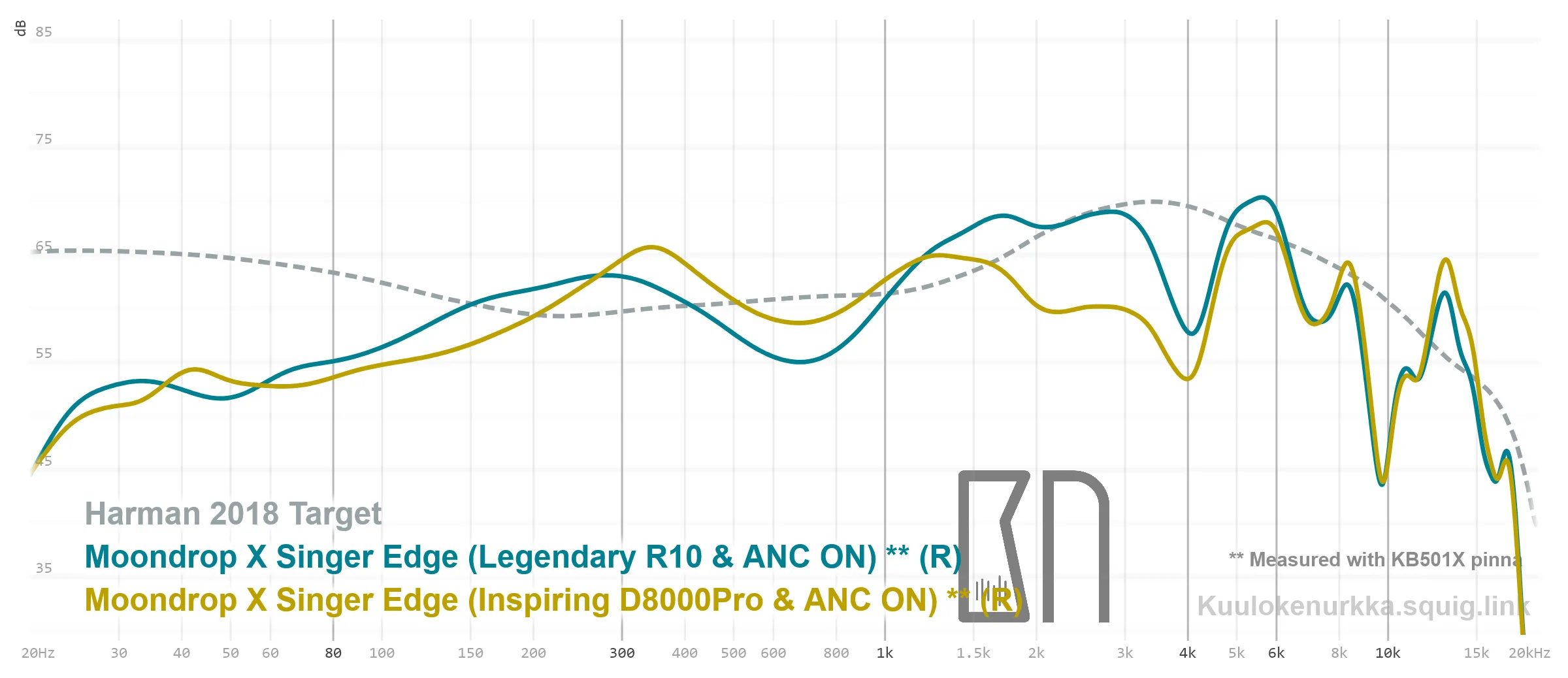
Admired T301 (Tago Studio T3-01) and Classic HD580P (Sennheiser HD 580) are at least a step in the right direction, even though the former directs too much attention to the mid-frequencies while reproducing bass and treble too faintly. The setting honoring the Sennheiser HD 580 is ultimately the most usable, but it also lacks a large portion of the mid-frequencies, and additionally, the upper bass rumbles and booms quite disturbingly. When noise cancellation is turned off, each setting becomes slightly more reasonable, but I still wouldn't want to use them. Perhaps someone else would, though?
Comparison: Moondrop x Singer Edge vs. JBL Tune 770NC
Prices: approx. 78 € vs. 49 € (often on sale at this price)
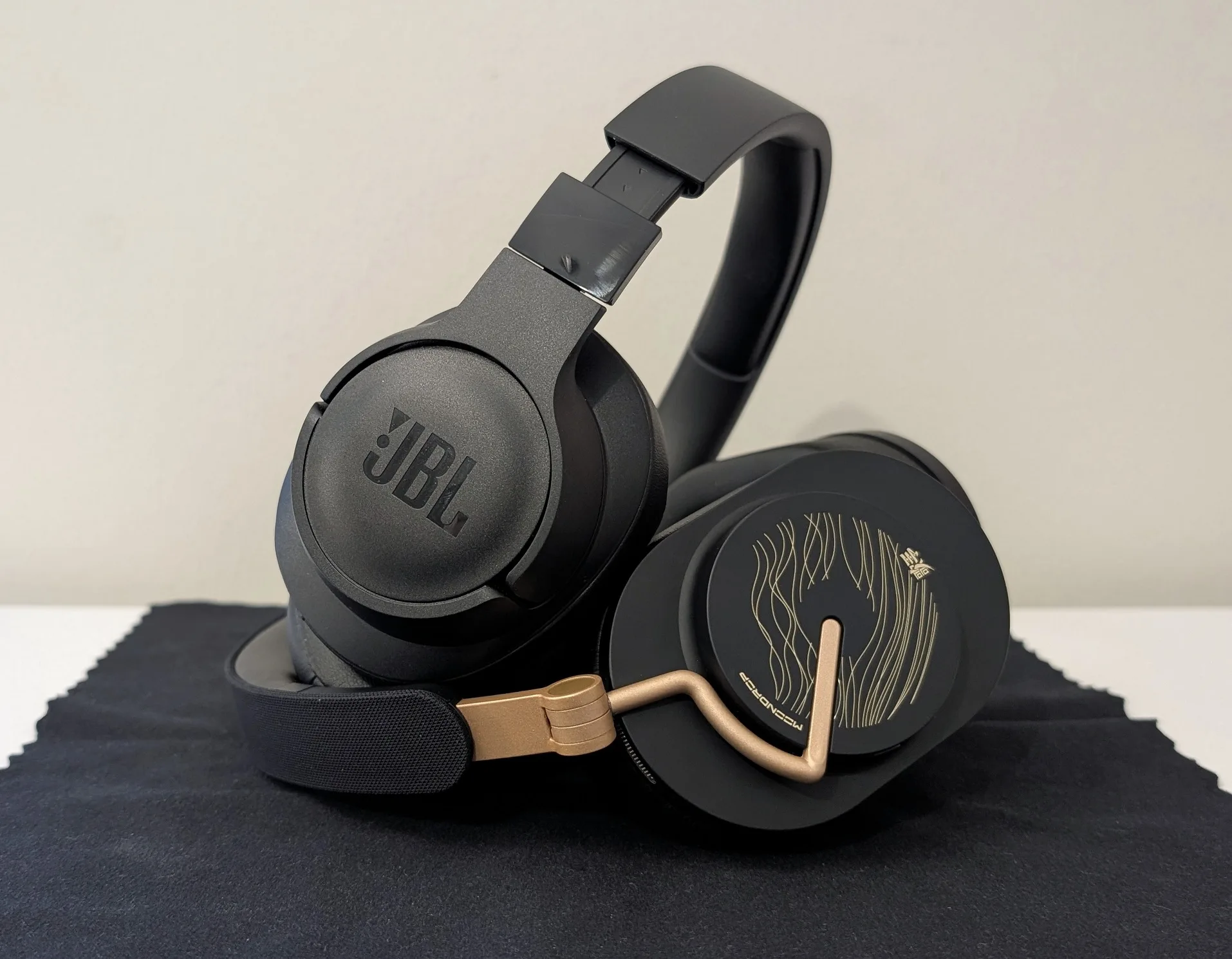
One of Moondrop's toughest competitors in the sub-100 euro price range is likely JBL, which has several noise-cancelling headphones in its selection. For example, the Tune 770NC model, which I consider good, is often sold for 49 euros, and its availability is clearly better than the Edge. Let's do a small comparison.
Moondrop and JBL are interesting manufacturers because both tune their headphones based on their own target frequency response. In JBL's case, this means Harman's target curve, as the sound is adjusted by the parent company Harman International. Moondrop, on the other hand, has developed its own VDSF response. Only a few headphone manufacturers directly state what kind of frequency response and sound they aim for with their products, so JBL and Moondrop are, in my opinion, quite refreshing cases.
Structurally, the Edge and Tune 770NC are plastic and feel cheap, but are still of sufficient quality. The Moondrop model's more spacious ear pads, gentler clamping force, and thicker padded headband make it clearly more comfortable for me, but the smaller Tune 770NC might be better suited for younger users. The Tune 770NC would also attract less attention in public places, unless a more colorful option is acquired instead of the black version I have. Both headphones fold into a small space, so I'm not sure if the JBL model's slenderness offers significant practical benefit when carrying them around. Some, however, might benefit from the fact that the Tune 770NC can be listened to passively with a headphone cable, unlike the Edge.
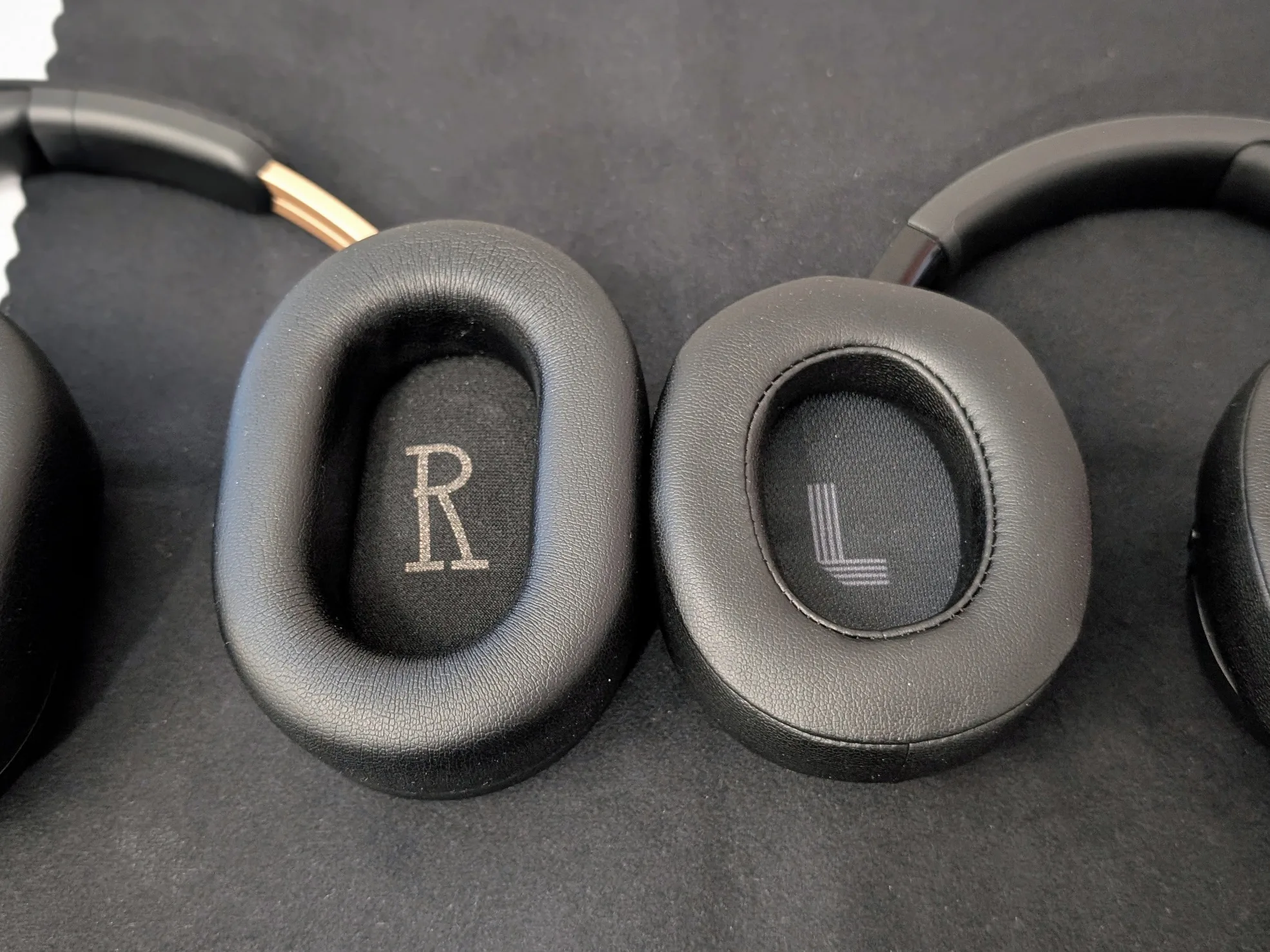
In addition to better comfort, one of the Moondrop model's clearest advantages is support for the LDAC codec, as the JBL Tune 770NC only supports AAC and SBC codecs. On the other hand, thanks to this, the battery lasts a little longer in the JBL model, and the codec probably doesn't have much significance for the target audience designed by the manufacturer.
Whereas Moondrop has aimed to maximize sound quality when using a Bluetooth connection, JBL has invested more in its headphones' phone application and features. Unlike the Edge, the Tune 770NC supports Google Fast Pair, which allows for quick setup. The headphones can also be adjusted more versatilely through their app than the Edge, and a good equalizer is also available. As the icing on the cake, the Tune 770NC's noise cancellation is also more effective than Moondrop's headphones, and the microphone also suppresses background noise better. I wouldn't be surprised if the JBL model feels like a more attractive purchase of the two, especially since it costs about 30 euros less. However, does the sound quality of the more comfortable Moondrop Edge reach a clearly higher level?
Frequency responses (noise cancelling function on):
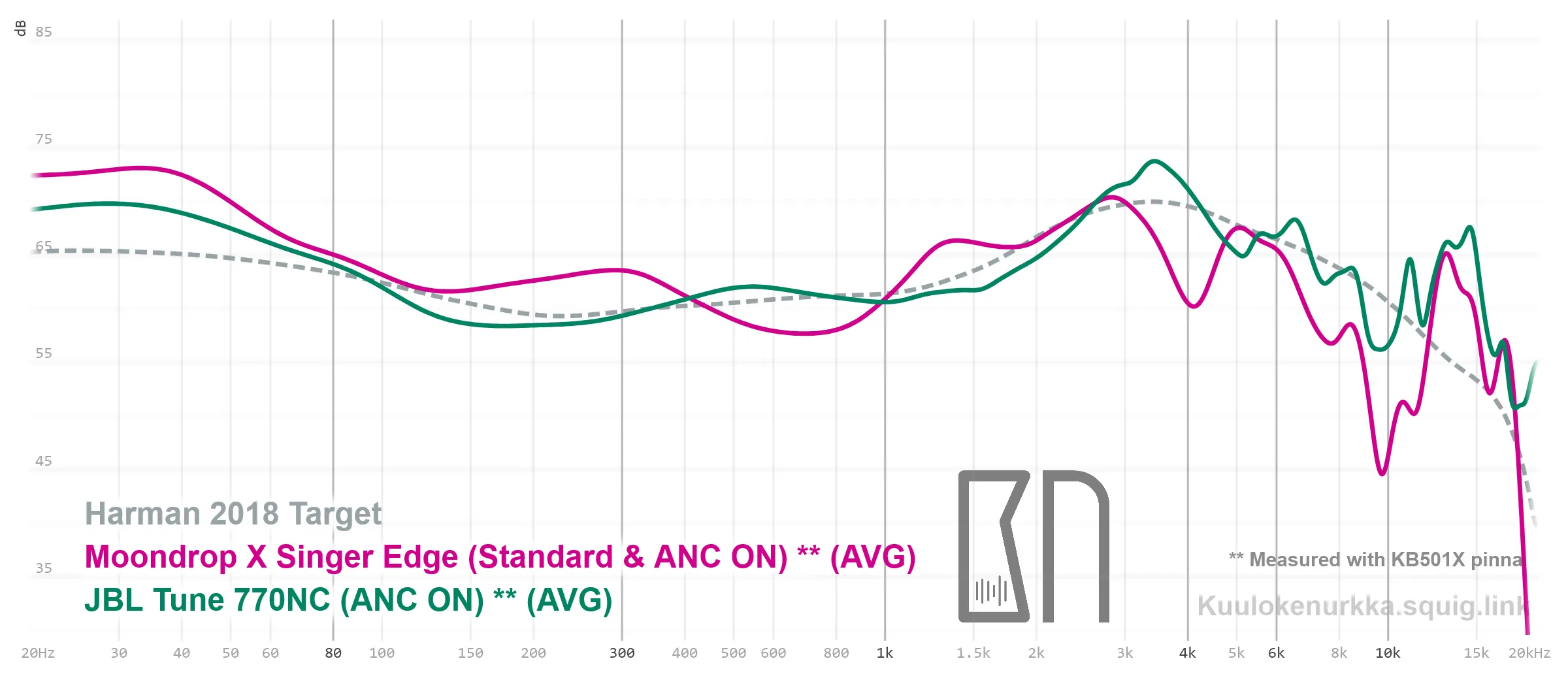
Edge and Tune 770NC are both sound-quality-wise functional packages. The mid-frequencies of JBL's headphones have been tuned thinner and the high-frequencies brighter, so the sound is more energetic and clarity-focused compared to the Edge, although already quite punchy and V-shaped for my taste, considering the strong bass reproduction. I am slightly bothered by the distant vocal performances and slight aggressiveness in such Harman implementations, but the energy of the Tune 770NC is certainly inspiring and it presumably suits the youth, who are JBL's target audience.
The sound of Moondrop's headphones, on the other hand, is calmer in terms of treble and feels heavier in terms of instrument body. With the noise cancelling function on, the headphones also bring the vocalist pleasantly present in the overall sound due to their emphasis placed between 1–1.5 kilohertz. I find JBL's headphones more pleasant when I slightly calm down their forward-pushing 3–4 kilohertz range. In Moondrop's headphones, the high frequencies, in turn, could use a little boost if they were desired to be as fresh as in the Tune 770NC. However, there is nothing major to complain about in either, and one quickly gets used to the sound as it is.
As one difference, I could still mention the Edge's more spacious-feeling soundstage compared to how cramped the Tune 770NC sounds. Solely because of this difference, I believe the Edge can compete more evenly with headphone models more expensive than itself, whereas the limits of the Tune 770NC are reached faster, even though it has been tuned better than most 100–200 euro models. Perhaps with the help of its LDAC codec, the Edge also manages to separate sounds more distinctly and layered than the JBL model, whose sound remains softer despite its energy. In more critical listening, the victory in terms of sound quality therefore goes to Moondrop's headphones, which I also prefer to wear. For general use, the advantages offered by JBL in other areas still seem quite unbeatable, considering that the Tune 770NC costs less. My final recommendation would therefore depend on what kind of person and for what kind of use the headphones end up.
Summary
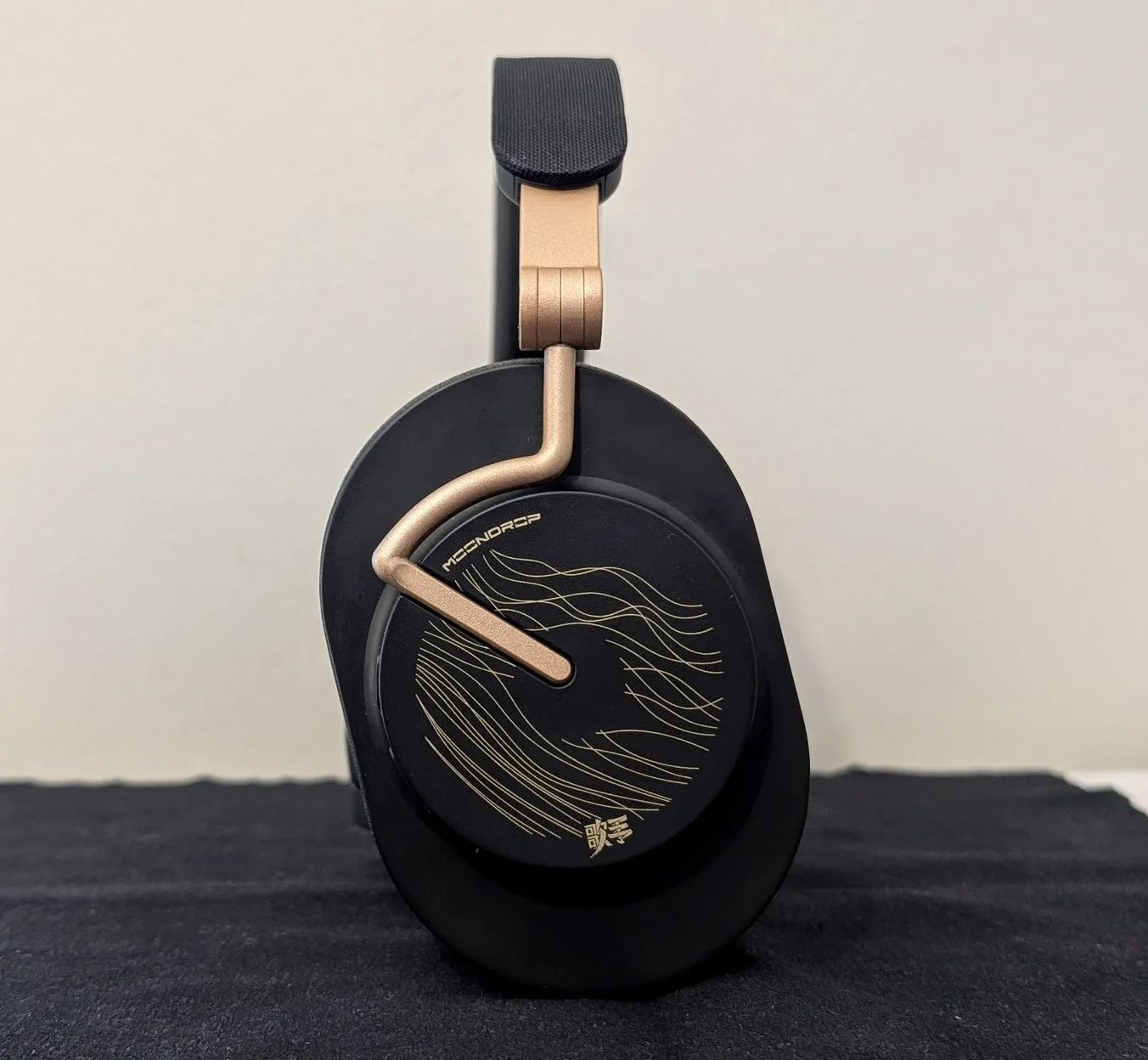
Despite its affordable price, the Moondrop X Singer Edge proved to be a very good-sounding noise-cancelling headphone that also stands out from the crowd in terms of appearance. For a price of less than 80 euros, I have no major complaints, even though a strict price target and minimization of manufacturing costs are evident in many areas.
In terms of comfort, the Edge surpasses, for example, JBL's small noise-cancelling headphones. The default tuning, in turn, is clearly more successful than in affordable Soundcore models, so I would choose Moondrop's headphones instead of, for example, the equally affordable Life Q30. If, on the other hand, Edifier WH950NBis available for 90–110 euros, it would already be a clearly better headphone than the Edge in terms of its construction and noise-cancelling function, with a minimal price difference. Unlike the Edge, however, the WH950NB, in my opinion, requires a small equalization, so the Moondrop model still has its own advantages.
Ultimately, I somewhat regret why Moondrop didn't directly release, for example, a 100-euro headphone model with a somewhat higher quality construction and more advanced noise-cancelling function, in which case slightly more expensive competitors would no longer have posed as great a threat to it. For some, 20 euros is certainly a considerable sum of money, but in that case, 50-euro JBLs are equally more justified purchases than the Moondrop Edge. In fact, it would be easiest for me to recommend Moondrop's headphones when they can be obtained during sales for about 65 euros or less. Otherwise, they fall into a rather challenging price bracket. Finally, I want to remind you that I have discussed the x Singer version of the headphones, so the Edge intended for international markets may differ in some respects.
Pros and cons:
+ Tuning and sound quality are spot on
+ Good comfort
+ Unique appearance
+ Moving parts of the structure are metal
+ Newest Bluetooth version
+ Reliably supports LDAC codec
+ Affordable price
– Frequency response is slightly more uneven with noise cancellation on
– Amount of bass may vary due to sub-optimal fit
– Alternative sound profiles are unusually poor
– Bluetooth connection did not work with one computer
– Weak noise cancellation function
– Background noise and buzzing
– Does not work passively/with cable
– No carrying case
 EN
EN  FI
FI