Author: Sword of Damocles
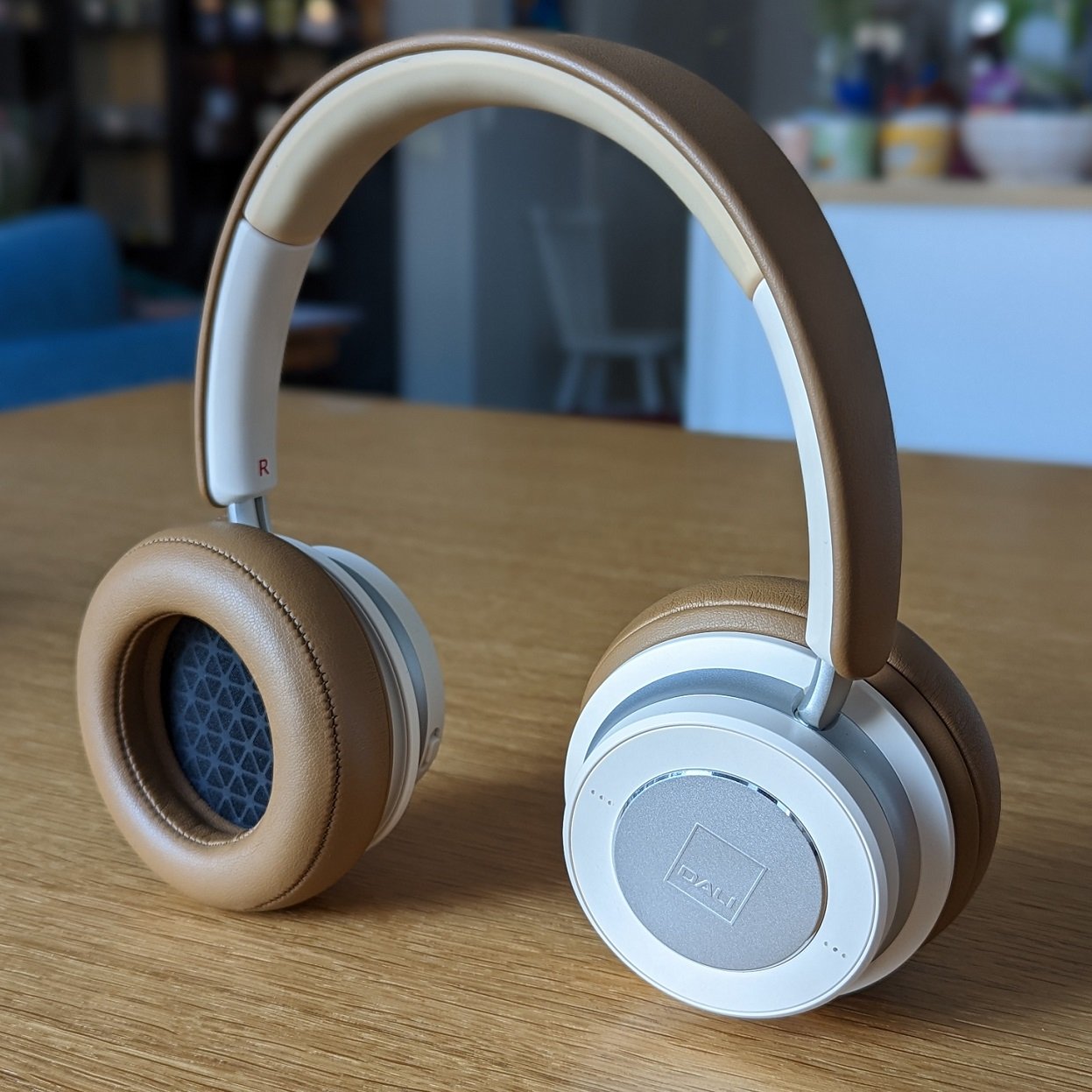
Table of Contents:
Information:
- Year of publication: 2019
- Price: 399 €
- Color: Caramel white
- Type: Closed, over-ear
- Dynamic driver (50 mm) with paper cone
- Impedance: 25 ohm
- Connections: Bluetooth 5.0, USB-C and 3.5 mm connector
- Bluetooth codecs: AptX, AptX HD, AAC and SBC
- Weight: 325 grams
- Battery: 1100 mAh
- Battery life: 25–30 hours
- Charging time: 2.5 hours
- Active noise cancellation: On/Off/Transparency
- USB-C charging port
- IP53 rating
- Accessories: fabric protective case, USB-C cable, 3.5 mm headphone cable and airplane adapter
The headphones were borrowed for review from Joensuu Kuvalta ja Ääneltä.
Danish DALI (link to manufacturer's pages) has gained more recognition as a loudspeaker manufacturer, but its product range also includes two Bluetooth headphone models released in 2019: IO-4 and IO-6. The IO-6 (price 400 €) I received for testing offers active noise cancellation for an additional 100 euros, which is missing from the more affordable IO-4 model (price 300 €). In terms of other features, the duo largely corresponds to each other, right down to the interesting driver with a paper cone.
DALI states that it has transferred its decades of experience in manufacturing loudspeakers to the sound quality of headphones, so the IO-6's higher price compared to many of its competitors immediately sets high expectations for it. Let's find out without further ado how the manufacturer has succeeded in a highly competitive and new product category for itself.
Product packaging
The headphones are delivered in a sturdy cardboard box, the neat appearance of which immediately creates a valuable impression. When the lid of the box is opened, a fabric protective case is found inside, in which the headphones are packed. The case has reinforced outer sides, making it sturdy enough to carry the headphones with you. The IO-6's earcups rotate horizontally, so the case is quite flat, and thus fits conveniently into, for example, a backpack.
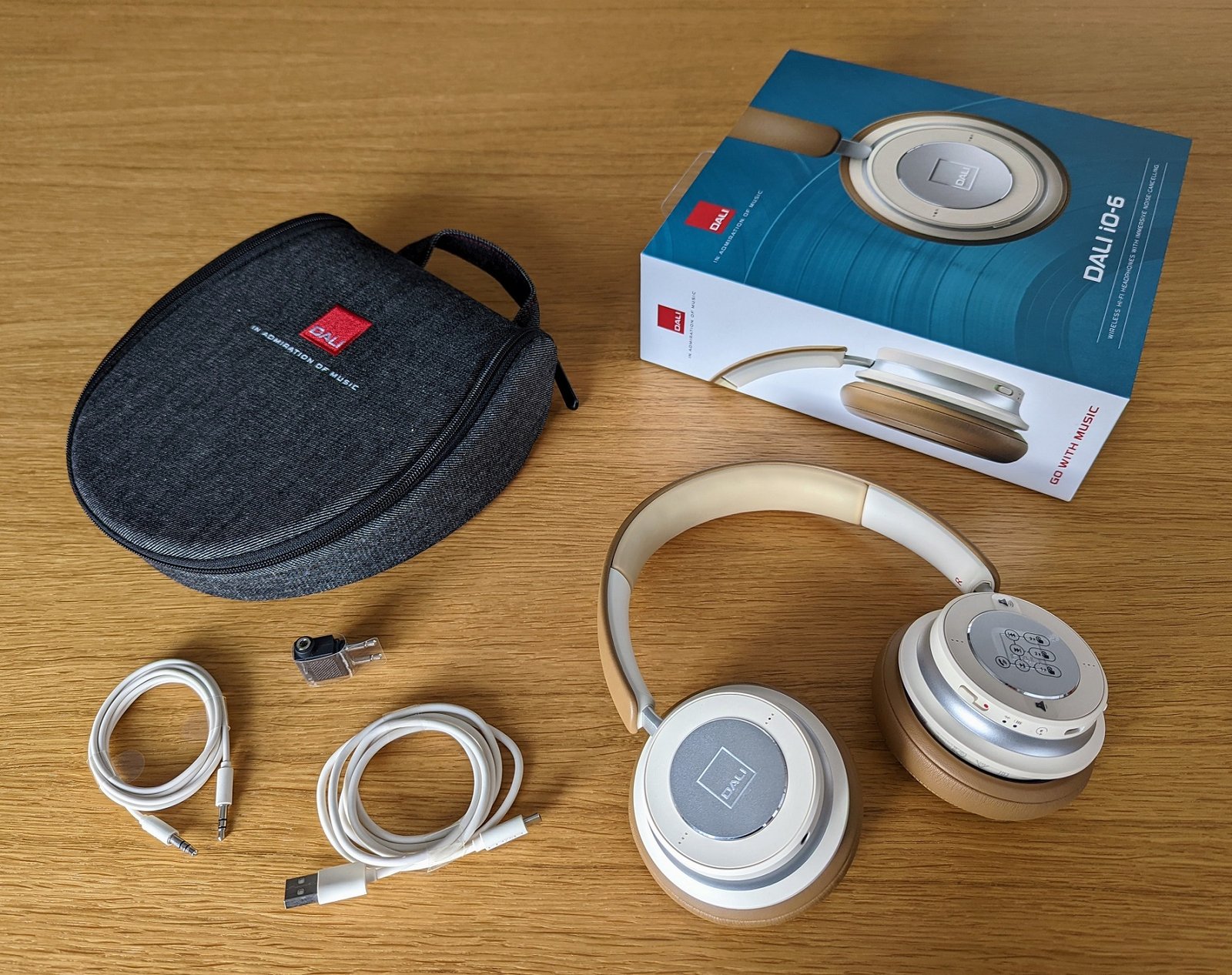
In addition to the headphones, the product package includes a USB-C cable (for charging or listening), a 3.5 mm headphone cable (AUX type), and an airplane adapter. The most important operating instructions are printed directly on the inside of the cardboard box, so the headphones can be quickly put into use without a separate manual. The IO-6 is otherwise so straightforward in its functions that there is no need for additional instructions.
Structure and comfort
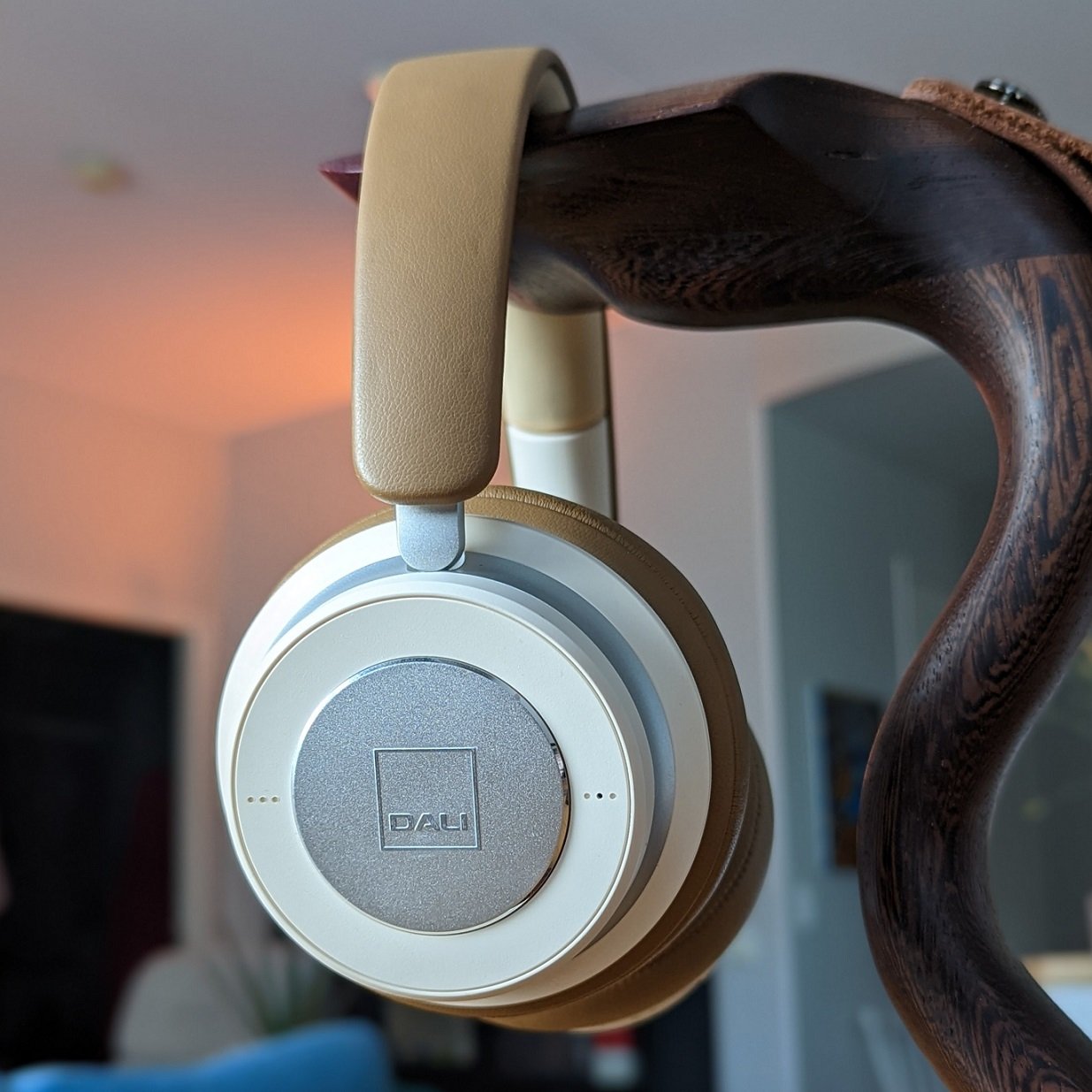
The IO-6 looks stylish and modern. Its appearance shares much with Bang & Olufsen headphones, which is certainly no coincidence, as both are Danish companies. The IO-6 is not among the smallest in size, so it cannot be called very discreet, for example, when moving outdoors. On the other hand, the headphones have an IP53 rating, so they can withstand dust as well as rain, as long as water doesn't come horizontally from the sky.
The color scheme of the headphones I tested is ”Caramel white,” which combines white with light brown artificial leather. This color option would not be my first choice, but for example, a female colleague of mine described it as beautiful. The IO-6 can also be purchased in black, army green, or completely white.
The structure of the headphones is sturdy and feels high-quality. There are no unpleasant side noises when turning the cups or stretching the headband, and the movements of the parts are smooth. The headphones feel pleasant in hand because their structure, mainly made of plastic, is smooth and soft on the surface. The upper part of the headband is covered with the same high-quality artificial leather as the ear pads. The part of the headband that rests against the head is made of a silicone-like material, which should withstand use well. It is also easy to clean if necessary.
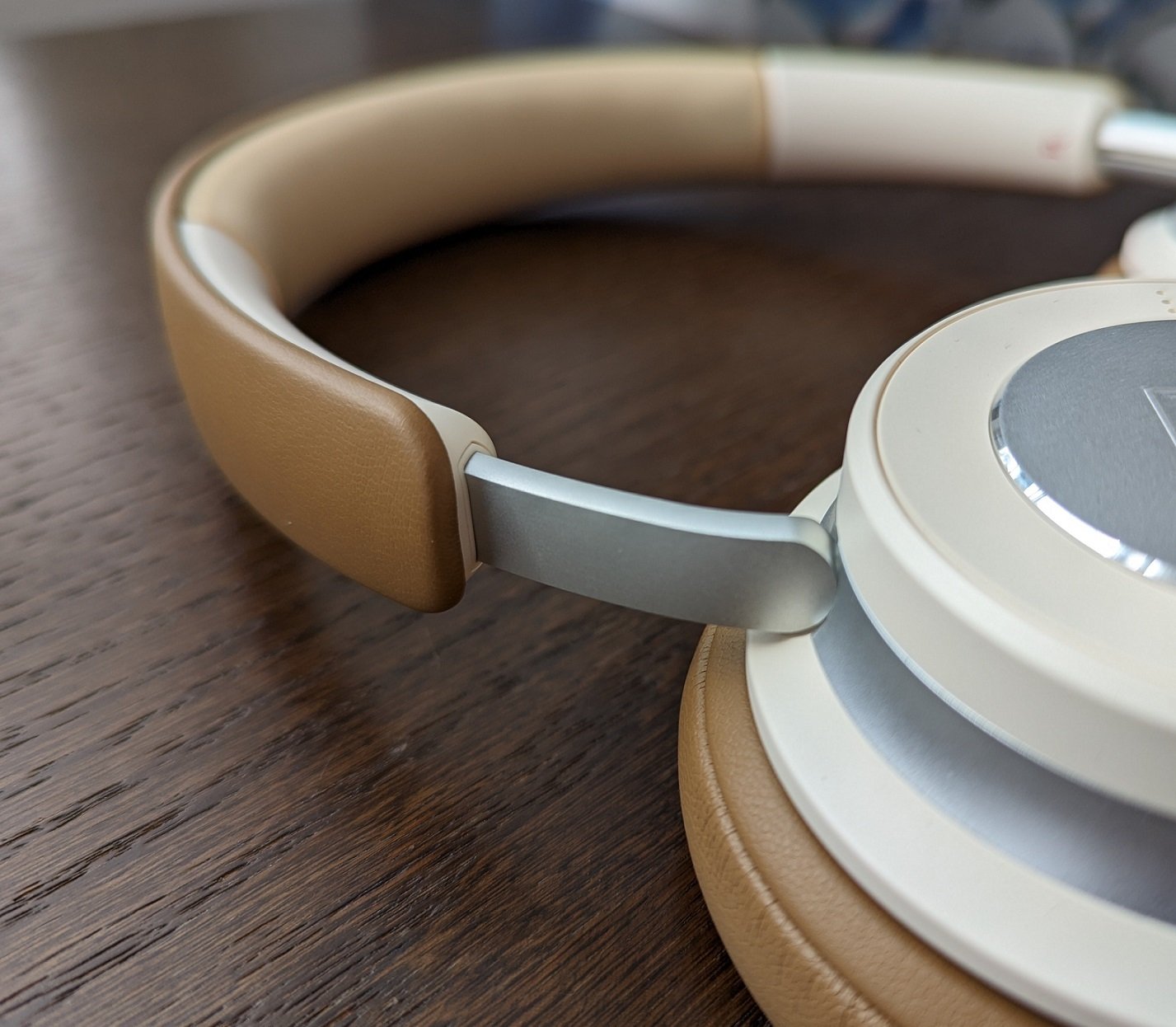
The height of the headphones is adjusted using aluminum bars that slide smoothly into the headband. The cups rotate 90 degrees in both directions from the attachment point of these bars, so the IO-6 can be neatly placed around the neck when taken off the head. The vertical movement of the cups is implemented interestingly so that the driver and the attached ear pad rotate inside the cup structure. This has required extra design, but the implementation works well. The ear pads can be removed by twisting, so they can be replaced if necessary. DALI sells new pads for 40 euros.
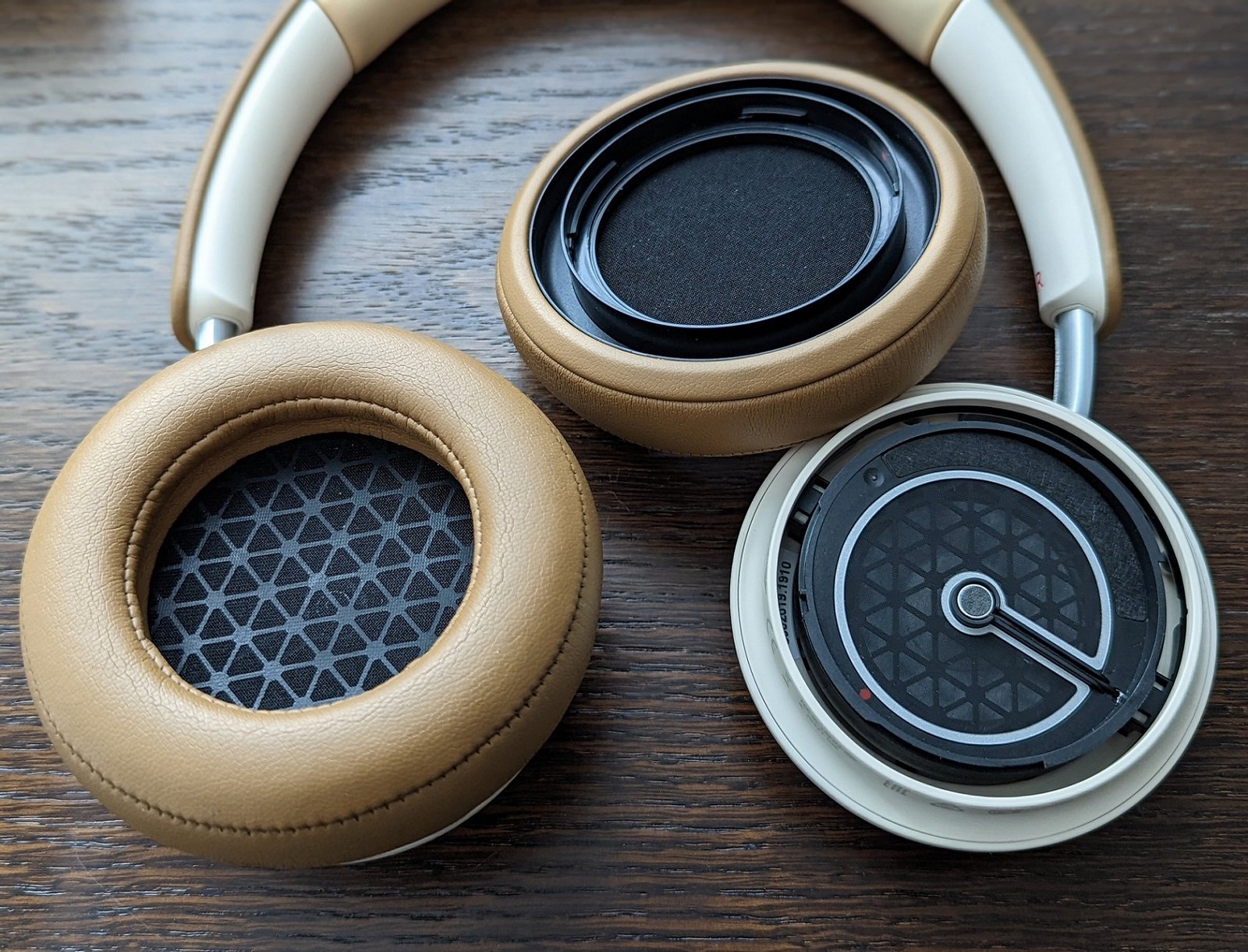
The round pads are made of memory foam and soft artificial leather, which feels comfortable against the skin. This is a good thing, as the headphones sit slightly on my earlobes. This bothers me a little at the beginning of listening, but after just 5 minutes, it feels like I was born with the headphones on. Even if the ear opening of the pads could be a centimeter or two higher, the wearing comfort of the headphones is excellent even during longer use.
The IO-6 sits firmly on my head, with just the right amount of clamping force. The headphones' 325-gram weight rests mainly on the ears, so no uncomfortable pressure builds up on the top of the head. Sufficient clamping force also ensures that the headphones do not fall off easily when tilting the head.
Buttons and connectors:
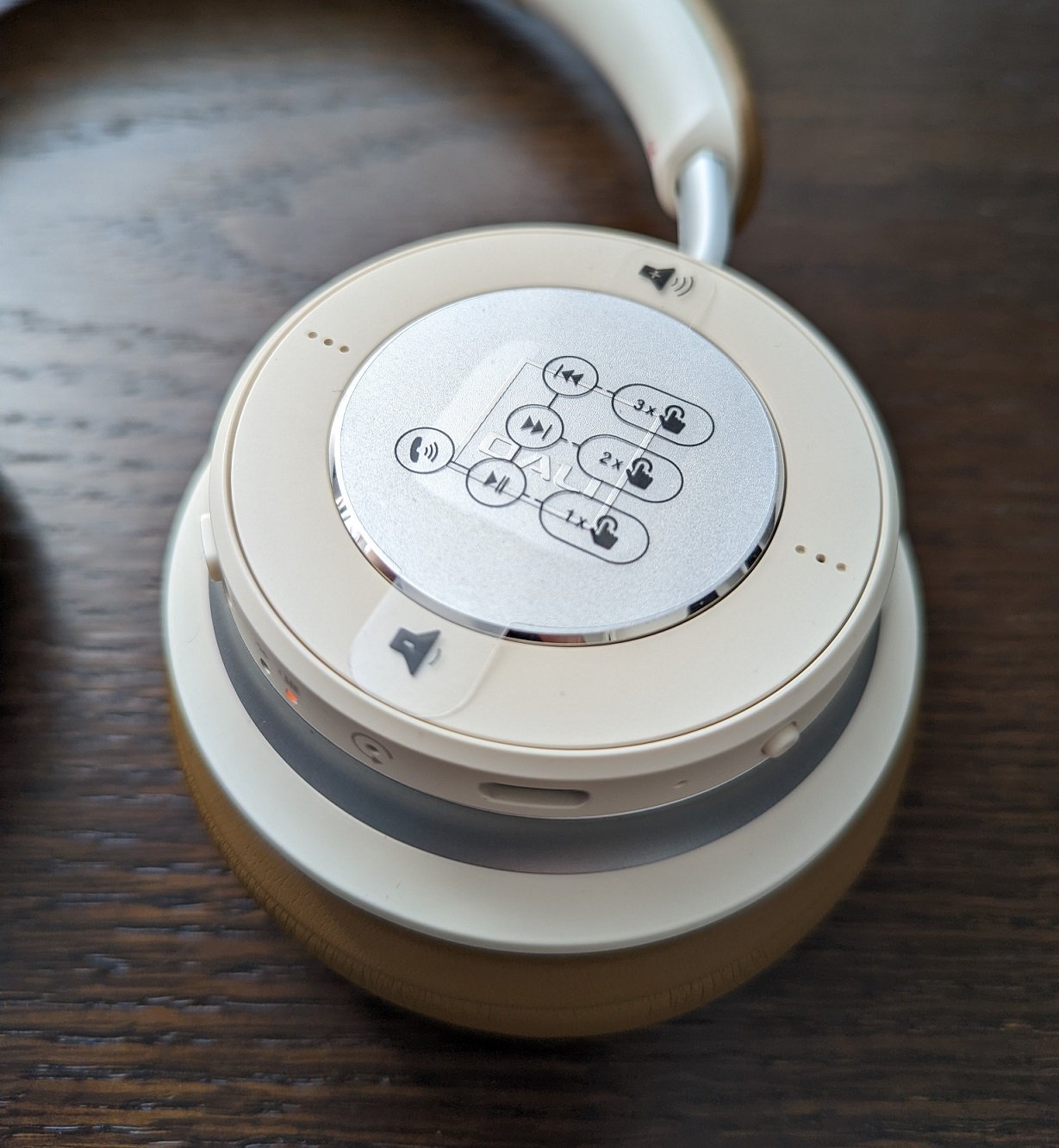
Using the IO-6 is extremely easy and smooth. All functions, except for the 3.5 mm headphone jack, are located on the right cup. In addition to the USB-C charging port, the bottom edge of the cup features a sliding power button, which can also be used to enter Bluetooth pairing mode. The noise-canceling function is controlled by a separate, smaller button, which is positioned in front of the ear during use. The headphones confirm performed actions with a convincing male voice. The same voice also indicates the battery level.
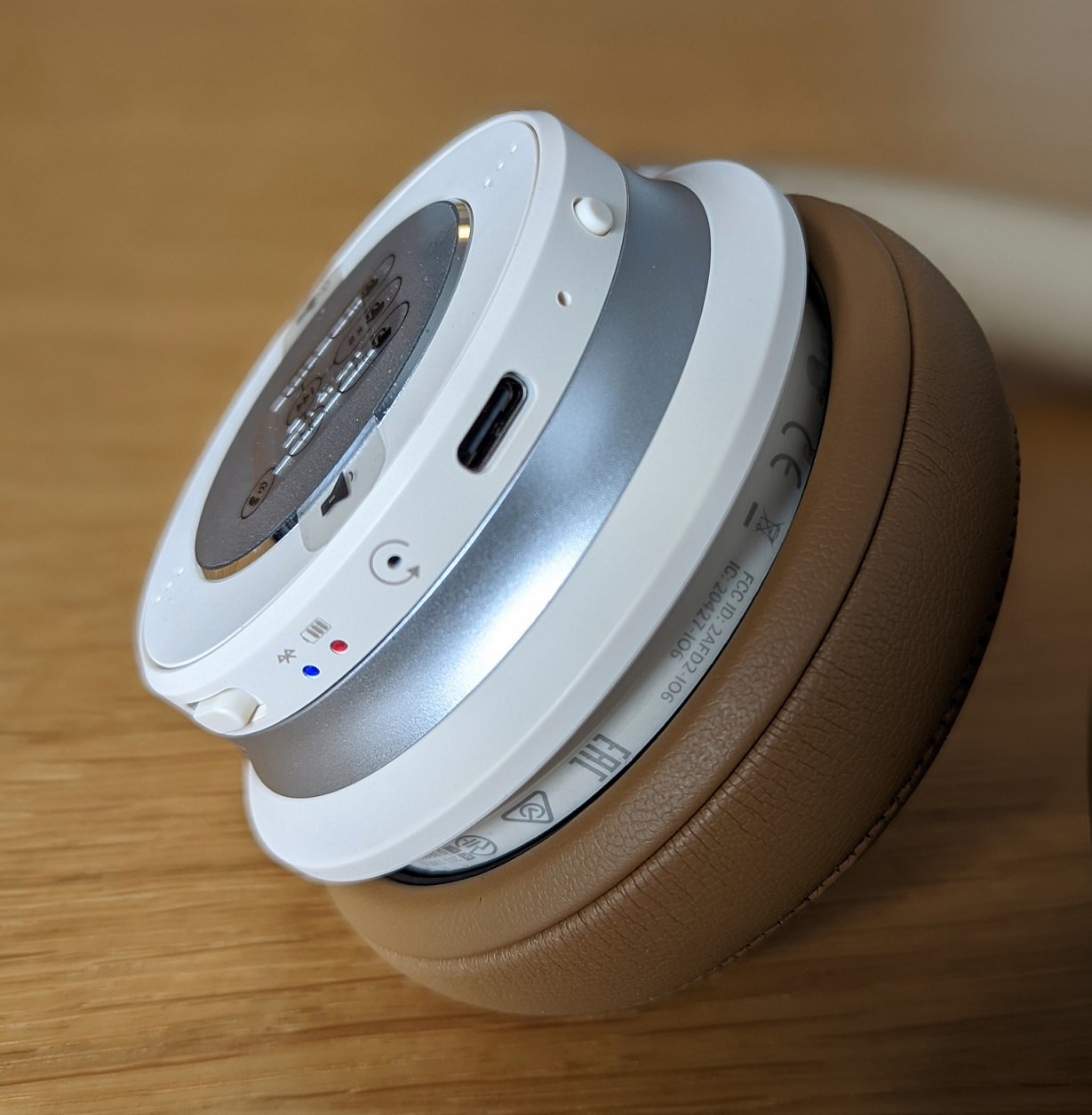
Volume adjustment, answering calls, and controlling the music player are handled by pressing the outer edge of the cup. I like that all functions are implemented with physical buttons instead of unreliable touch switches. The IO-6's buttons are reliable, but commands unfortunately reach my phone with a slight delay. However, this does not significantly interfere with use.
Bluetooth connection
The headphones feature Bluetooth 5.0 implemented with a Qualcomm chip, so the supported codecs include the now standard SBC, AAC, and AptX, as well as the slightly higher-quality AptX HD. In my opinion, the sound quality offered by AptX HD, in particular, is perfectly sufficient, even though Sony's LDAC theoretically offers the best sound quality. In practice, however, it depends on how stably LDAC's highest sampling rates work between devices. In my experience, AptX HD works without interruptions.
During my approximately two-week test period, the IO-6's Bluetooth connection worked completely stably, and the headphones connected reliably to both my Google Pixel 6 phone and my Windows computer. There were also no problems with the range of the Bluetooth connection in my own use. The connection only started to cut out slightly in my 64-square-meter apartment when I put my music-playing phone in a desk drawer and went to the corner of the balcony on the other side of the apartment, behind a stone outer wall. In normal use situations, it's difficult to see the range becoming a problem.
Active Noise Cancellation
The IO-6 has a noise-cancelling function with three settings: off, on, and transparency mode (lets ambient sounds through via microphones). The noise-cancelling function can be used not only with Bluetooth listening but also when listening via a USB cable and a 3.5 mm headphone cable. Noise cancelling is always off by default after powering on, so it must be switched on separately (it's worth remembering to do this, as it has a positive effect on sound quality). There is no phone application for the headphones, so the intensity of the noise cancelling or other settings cannot be adjusted.
DALI mentions that the IO-6's noise-cancelling function primarily attenuates low frequencies. In my opinion, this is an accurate description, as activating the function attenuates other frequencies only slightly compared to passive attenuation – the closed design itself, however, attenu attenuates noise quite effectively. For example, the noise cancelling of the Anker Q30, which costs less than 70 euros at its cheapest, is more effective, so the IO-6 does not perform particularly well. The noise-cancelling function is probably just an additional feature, not the headphones' main selling point. In any case, the feature is useful as it reduces low-frequency background noise in a noisy listening environment.
Background noise
The most annoying feature and the biggest single problem of the IO-6 is a fairly strong background hiss, which is only heard from the left side. The hiss does not seem to be related to the noise-cancelling function, as it is present whenever the headphones are powered on. The problem likely arises from the headphones” ”noisy" electronics, which are clearly installed inside the left earcup. Despite the noise-cancelling function, it is unfortunately never completely silent with the headphones on. The hiss is also audible when listening to calmer music. This is not the end of the world, but it is very regrettable in a 400-euro product.
Battery life
In terms of battery life, the IO-6 performs well, as the manufacturer's promised 25–30 hours is also realized in practical listening situations. The headphones indicate the battery level every time they are turned on, so running out of power doesn't easily come as a surprise. The IO-6 also has a clear power button and light, so the headphones are rarely left on when I'm not listening to them.
The battery charges fully in about 2.5 hours, so you can get back to listening quite quickly if needed. The headphones have a USB-C connector, so charging can be done, for example, with a phone charger.
Microphone
The sound quality of the microphones included in the IO-6 was good during calls. The other party heard my voice clearly and loudly enough, at least in a quiet environment where I tested the matter. I was told that I sounded very similar to speaking directly into the phone's microphone. The other party's voice also reproduced normally and pleasantly.
Sound quality
DALI has not created a phone application or an equalizer for the headphones, so fine-tuning the sound quality is largely not possible. The IO-6 is primarily designed as a Bluetooth headphone, so most of my listening has occurred via a Bluetooth connection using the AptX HD codec. However, it would also be possible to listen to the headphones via a USB cable (requires powering on the headphones) or a 3.5 mm headphone cable (can be listened to without power).
If the noise-cancelling function is activated on the headphones, the frequency response is practically identical in both wireless and wired listening. In my experience, it is always advisable to keep the noise-cancelling function on, as DALI has put all its efforts into its sound quality through DSP correction. With the noise-cancelling function turned off or when using transparency mode, the balance of bass reproduction and mid-frequencies is worse.
The worst sound from the IO-6 is obtained via the 3.5 mm connector with the headphones completely powered off. In this case, the bass reproduction is very weak, and the mid-frequencies are overly emphasized in the overall sound. From a sound quality perspective, I recommend keeping the power and noise-cancelling function on, despite the background hiss, even when listening with a headphone cable.
I have confirmed my previous observations by measuring the headphones' frequency response with a MiniDSP EARS device using all different modes of use. More detailed information about the device and its use can be found in a previously published article. Next, I will evaluate the sound quality with the noise-cancelling function turned on, as the IO-6 sounds best that way.
Frequency response with noise-cancelling function activated (green) and off (magenta):
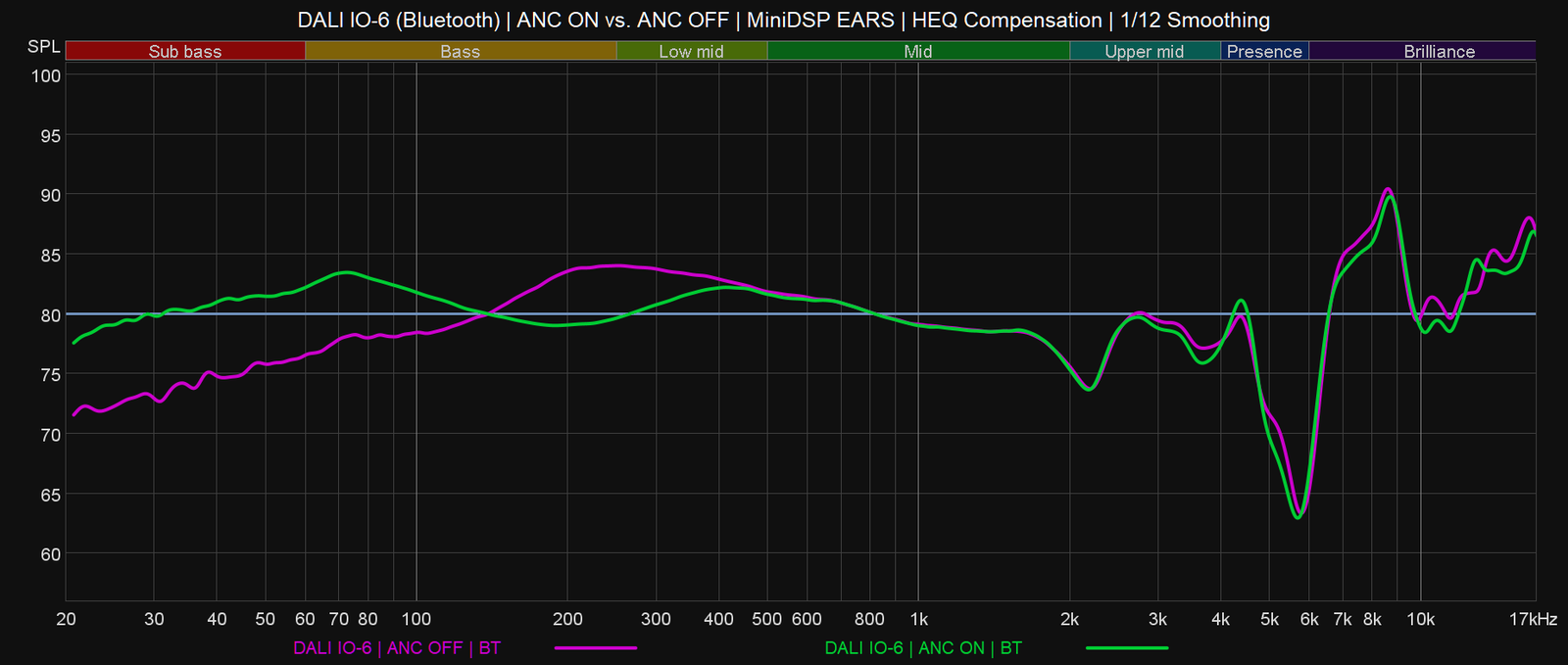
The IO-6 positively surprised me with its balanced sound. DALI, as a speaker manufacturer, has succeeded in a product category where many headphone manufacturers fail: instead of an overemphasized bass response, the headphones have an orthodox neutral tuning. The IO-6 is interesting in that its frequency response keeps the bass, mid-frequencies, and treble truly separate from each other. Thanks to this, the reproduction is always clear, and when listening to the headphones, it is possible to focus on the desired aspect. Only the treble is quantitatively slightly too much for my taste, which, however, mainly bothers only when listening to lower-quality music.
The IO-6's sound resembles good wired headphones more than traditional Bluetooth headphones. The sound lacks the familiar softness and uniform dynamics found in cheaper headphones, so the result is pleasantly fresh and lively, whether listening wirelessly or via cable. At the same time, there is also a certain smoothness in the reproduction, which I believe is at least partly due to the drivers equipped with paper cones. Ultimately, only a rather closed-sounding soundstage reveals the IO-6 to be a representative of its product category.
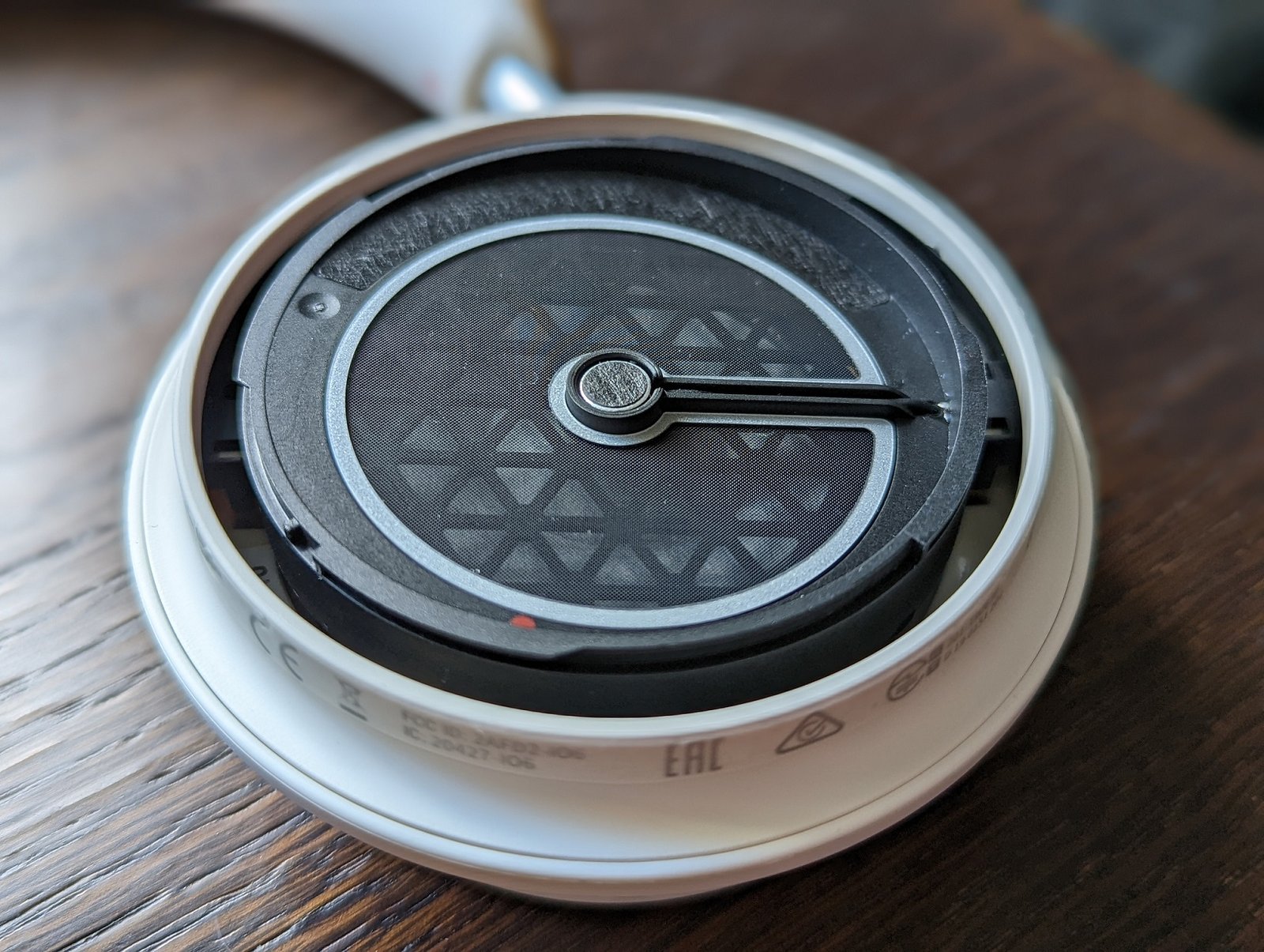
Bass:
In my opinion, the IO-6 is an excellent example of how bass reproduction should be implemented in this type of headphone. There isn't quantitatively too much bass in the upper bass frequencies, so the reproduction remains clean-sounding. Impact sounds are tight because no disturbing boominess forms around them. A slight dip around 200 Hz, in turn, ensures that the bass doesn't bleed into the mid-frequencies. The IO-6 thus has both quite powerful bass reproduction and clear mid-frequencies.
The power in the bass reproduction comes from an emphasis that is mainly below 100 Hz. The headphones do not have the same overemphasized bass reproduction as many more popular noise-cancelling headphones, but some accustomed to a neutral sound might still find the bass a couple of decibels too much. In my opinion, the result is enjoyable, especially since the headphone driver is capable of reproducing the chosen amount of low frequencies without complaint. Despite its slight emphasis, the bass remains controlled without becoming a monotonous thumping.
In the IO-6, the amount of bass depends very strongly on the ear pads fitting snugly around the listener's ears. If the headphones are poorly positioned on the head or the ear pads are lifted even slightly from the ears, the bass reproduction almost completely disappears. This should be taken into account especially when wearing thick-framed glasses. Fortunately, my thin-framed glasses work well with the headphones.
Mid-frequencies:
The best aspect of the IO-6 is its accurate and clear-sounding mid-frequencies. The reproduction has both a pleasantly robust body and a sufficient amount of energy in the upper mid-frequencies. Music sounds dynamic and detailed, yet at the same time, it's easy to listen to. A certain relaxed quality in the presentation seems to arise from the fact that the presence region between 5–6 kHz is quieter than the surrounding frequencies.
This also makes vocal performances interesting. The vocalist is positioned quite prominently in the overall soundstage, separate from other instruments, but at the same time, a fascinating distance remains to the listener. Vocals sound energetic without being overly aggressive. Although the result is slightly different from the usual, I like it. Good singers come into their own with these headphones, and one can listen to them from a slightly further distance. If there is sibilance in the singer's voice, the IO-6 does not smooth it out but reproduces it even slightly emphasized due to the brightness of the upper treble.
Despite this, the mid-frequency reproduction is very convincing overall. The presentation style entices one to listen to the headphones more, even if I had even better headphones available – this, in my opinion, is a sign of a stellar performance. When combined with bass reproduction that suitably paces the overall sound, I immediately started to like the IO-6 more than, for example, Sennheiser's HD600 series headphones, which also have excellent mid-frequencies. DALI can be proud of its performance.
Treble:
My only major criticism concerns the IO-6's high frequencies, which have a few noticeable shortcomings. The IO-6's treble is energetic and detailed, but quantitatively, it's a few decibels too much for my taste. The treble always draws quite a lot of attention to itself, and the sibilant sounds of 's' letters are reproduced slightly emphasized. The presentation style is not relaxed; instead, it easily reveals lower-quality recordings. Because of this, listening to roughly produced rock music, for example, can sometimes be fatiguing. On the other hand, the treble's presentation style is excellent for better-produced music, so there are two sides to the coin.
Another thing that bothers me about the treble is its occasional unnaturalness. This mainly emphasizes drum cymbals, whose shimmer sounds either overemphasized or strangely rustling, depending on the track. For some reason, the sound reminds me of sand. This doesn't seem to be directly due to an excessive amount of treble, but also to a dip between 5–6 kHz, which breaks the treble's balance. Equalizing 5.5 kHz, for example, to be 5 decibels louder immediately makes the cymbals sound more normal. This also brings other reproduction slightly closer in the soundstage.
Despite everything, it would be possible to get used to the treble as it is, even without equalization, as music containing more electronic elements does not sound unnatural in the same way. I initially considered the treble a bigger problem, but it actually has good sides too. The upper treble is quite resolving, and the sounds are sharp in a good way at their edges. There is also sufficient airiness in the reproduction at frequencies above 10 kHz. These characteristics help the IO-6 stand out favorably when compared to more affordable headphones. However, those sensitive to treble brightness should definitely try to audition the IO-6 before potentially purchasing it.
Soundstage, resolution, and dynamics:
The IO-6 is a compact closed-back headphone, so it does not inherently offer a spacious and open-sounding soundstage. The sound, for example, compared to the Sennheiser HD600 model known for its small soundstage, is considerably more closed-sounding, but there isn't a big difference in soundstage size between the models. In a certain way, the IO-6's sound even plays less "in-head," because the headphones separate the different elements of music more distinctly from each other within the given space.
Especially sounds heard in the center, such as vocals, remain suitably a little further back in the overall soundstage due to the dip in the presence region. There is also enough empty space between sounds, so the reproduction is never too cramped. The background of the reproduction is also pleasantly dark, so quiet parts of music genuinely feel quiet, despite the continuous background hiss audible from the left side. The hiss is indeed very unfortunate, as without it, the headphones would have the potential to be even better.
The IO-6 has good dynamics for its price, as the headphones can react convincingly enough to changes in sound pressure between quiet and loud passages of music. The headphones' successful frequency response and performance are thus well-balanced: the reproduction is lively, not just accurate-sounding. For comparison, for example, Anker Q30 headphones can be equalized to sound quite similar, but the sound still remains rather flat in terms of dynamics. The IO-6 draws me in much more powerfully when listening.
Bluetooth connection vs. cable
The AptX HD Bluetooth codec supported by the headphones seems to be good enough, as in my experience, most of the IO-6's potential is realized when listening wirelessly. The sound does not change significantly, for example, when listening via a USB-C cable, as the headphones still utilize their own electronics, just as in wireless listening. An exception, however, is the 3.5 mm headphone cable if it is connected to equipment that itself affects the audio signal. In this case, the DSP correction included in the noise-cancelling function is interestingly still available, but the headphone volume is adjusted via an external amplifier.
For example, the Schiit Audio Bifrost 2 & Burson Audio Soloist 3X Performance combination, which I have found excellent with most full-size headphones, makes the IO-6's treble more pleasant and the soundstage feel slightly more spacious. The reproduction is also more controlled overall, so the IO-6 seems to scale somewhat better with more expensive equipment when listening via cable. On the positive side, the sound is still almost equally excellent when listening wirelessly, especially when compared to affordable standalone devices.
DALI IO-6 vs. Sennheiser Momentum 3 Wireless
Prices: 400 € vs. 300 € (original price 400 €)
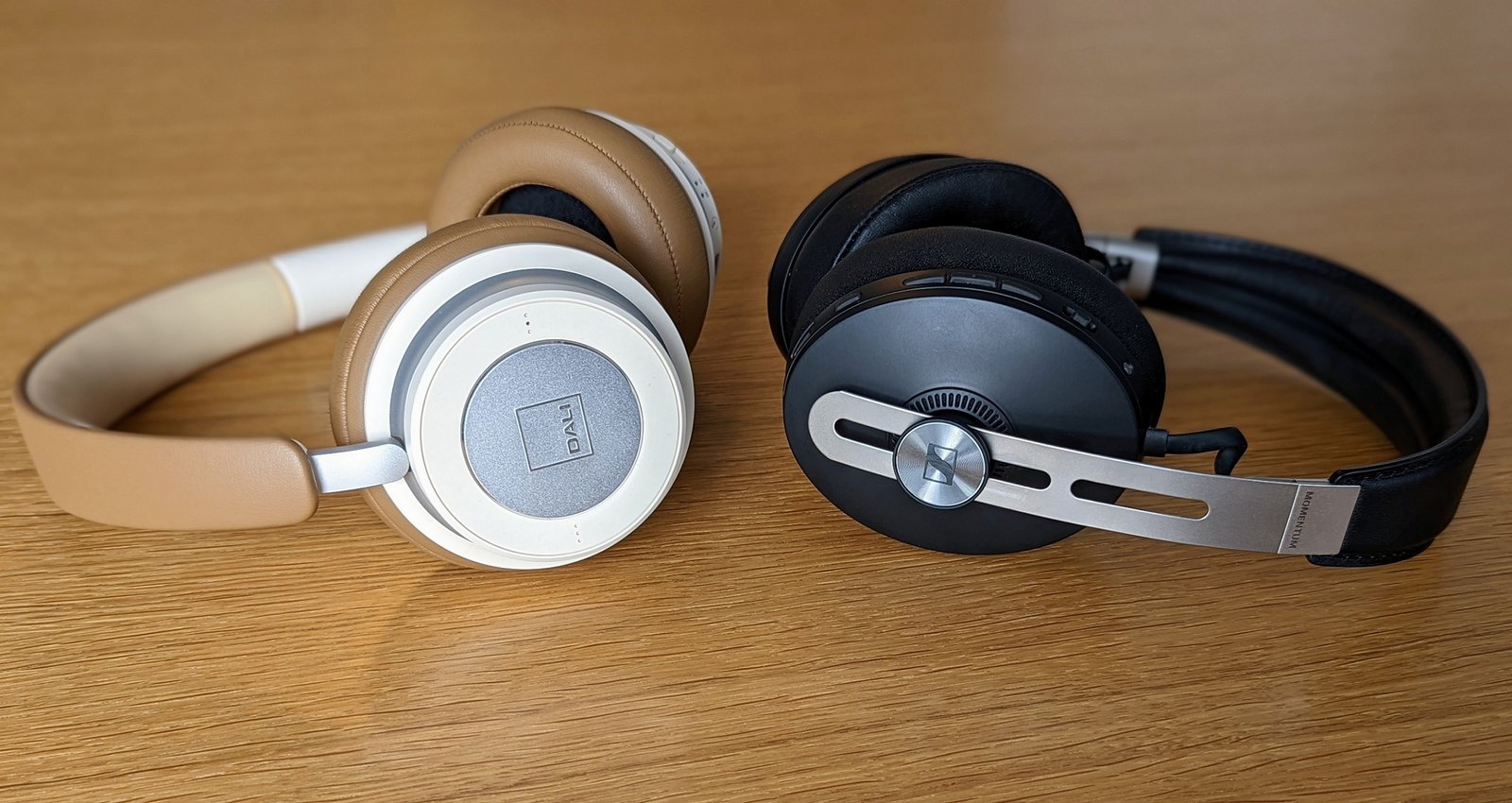
Finally, I will compare the IO-6 to Sennheiser's Momentum 3 Wireless noise-cancelling headphones, which I have also had the chance to test for about two weeks. According to many, the Momentum 3 ranks among the top in its product category for sound quality, so I reasoned it would be a useful comparison. The release date and original price of the headphones are also similar to the IO-6.
Structural differences
Both models feel externally high-quality and sturdy. DALI's plastic material is, in my opinion, slightly better, whereas the Momentum 3's headband, made of metal and genuine leather, appeals to me more. The wearing comfort of both headphones is good, and their weight is almost identical. The Sennheiser model has the advantage of a slightly higher ear cup opening, so my ears fit entirely inside the cushions, unlike with the IO-6. However, the Momentum 3's cushions are not as soft and comfortable as DALI's.
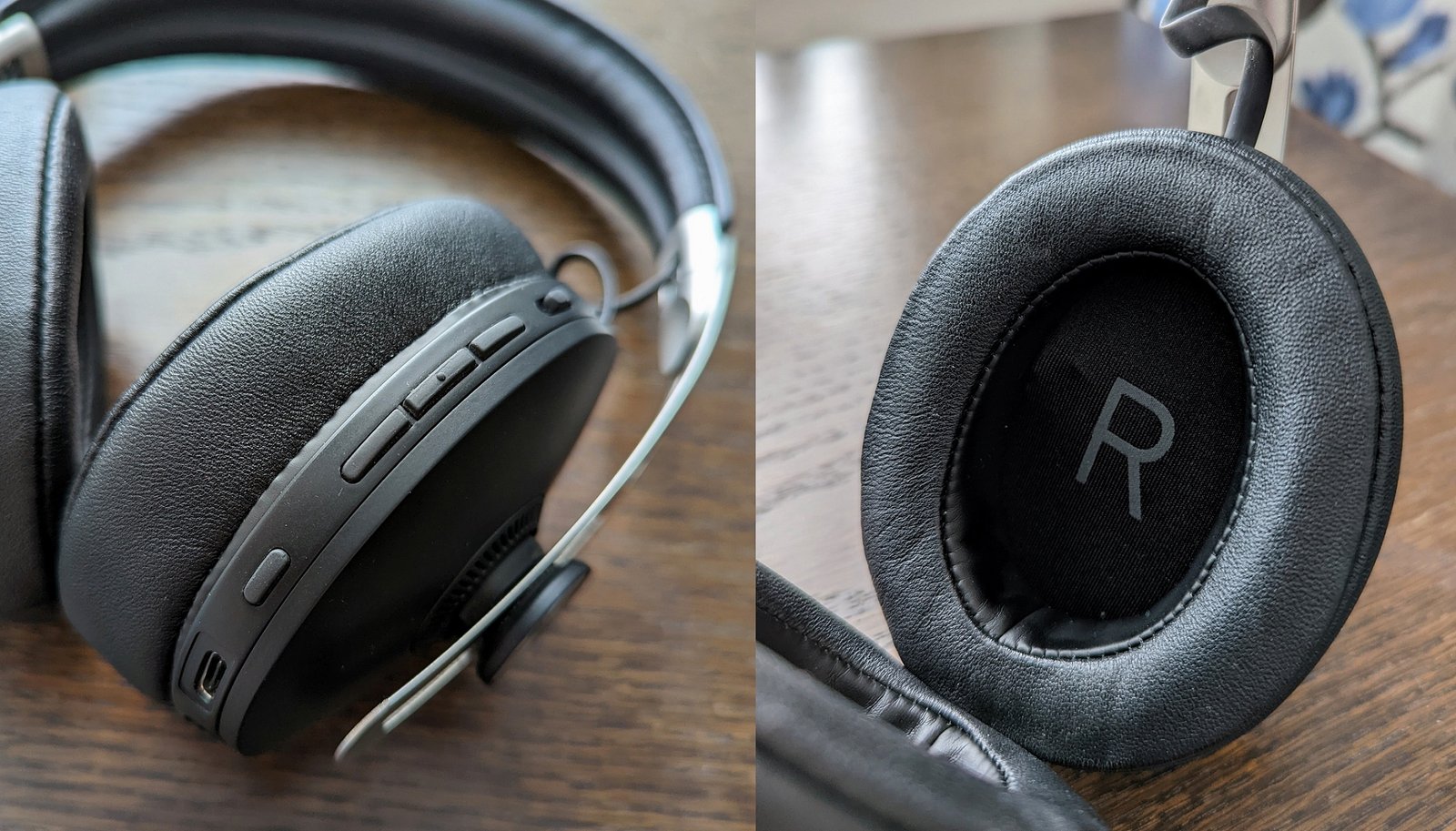
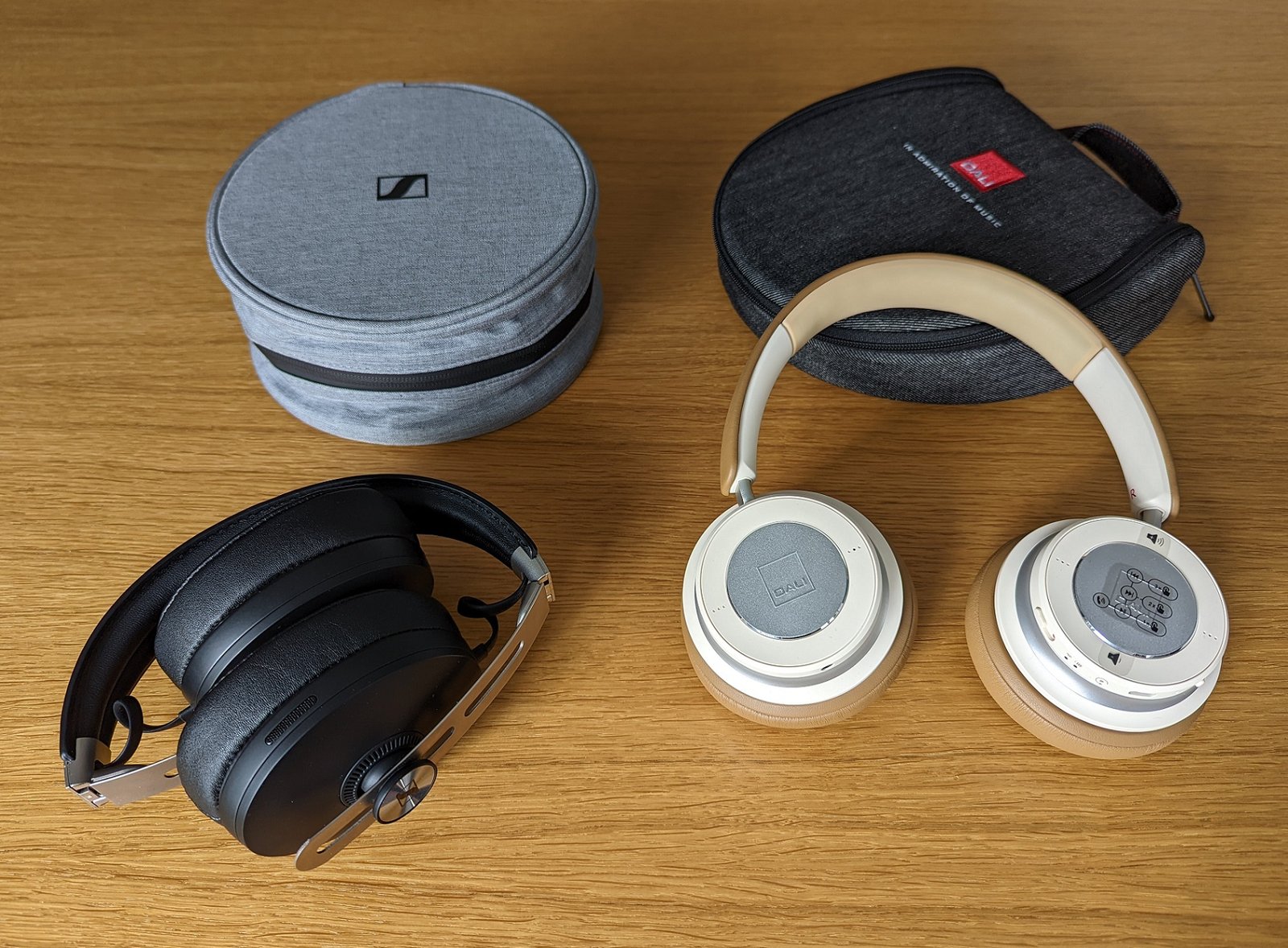
The IO-6's cups swivel flat, while the Momentum 3 folds compactly. Both solutions have their advantages, as Sennheiser's carrying case has a smaller footprint, and the IO-6's case is flatter. I personally prefer the latter, as a flat case fits better into narrow bags and backpacks.
Features and usage considerations
The Momentum 3 is a more versatile headphone in terms of features. It has an app with, for example, an equalizer and various settings for noise cancellation intensity. Another app, in turn, finds the headphones if they get lost, for example, at home. The headphones also turn off automatically when folded and turn back on when placed on the head. The IO-6 does not have such sophisticated features, but it does have everything necessary. On the positive side, the sound quality is also pre-tuned correctly, unlike with the Momentum 3 – more on this shortly.
The Momentum 3's noise-cancelling function is clearly more effective, although it apparently doesn't compete with Sony's and Bose's latest models either. In any case, the IO-6's noise cancellation does not reduce noise nearly as much. The Momentum 3's background hiss is also almost non-existent compared to DALI's headphones, so listening in a noisy environment is quieter, and in a quiet space, you don't have to listen to hiss in the background of the music.
The microphone sound quality during calls, however, is better on the IO-6. Additionally, the other party's voice sounds quite metallic and hollow for some reason with the Momentum 3. The IO-6 also has the advantage of approximately 10 hours longer battery life and more clearly identifiable physical buttons. Using the Momentum 3 is easy, but its smaller buttons require more fumbling before finding the right one. Physical buttons are still a better option than unreliable touch controls.
I did not observe any difference in Bluetooth connection range between the models. Regarding codecs, the IO-6 supports AptX HD, while the Momentum 3 only uses the lower-quality AptX codec at its best. This probably doesn't have a significant real-world impact, but the Momentum 3 seems to benefit more from being listened to via cable rather than a Bluetooth connection. The IO-6 sounds very similar both wirelessly and wired, which is an advantage compared to the Momentum 3.
Sound quality comparison
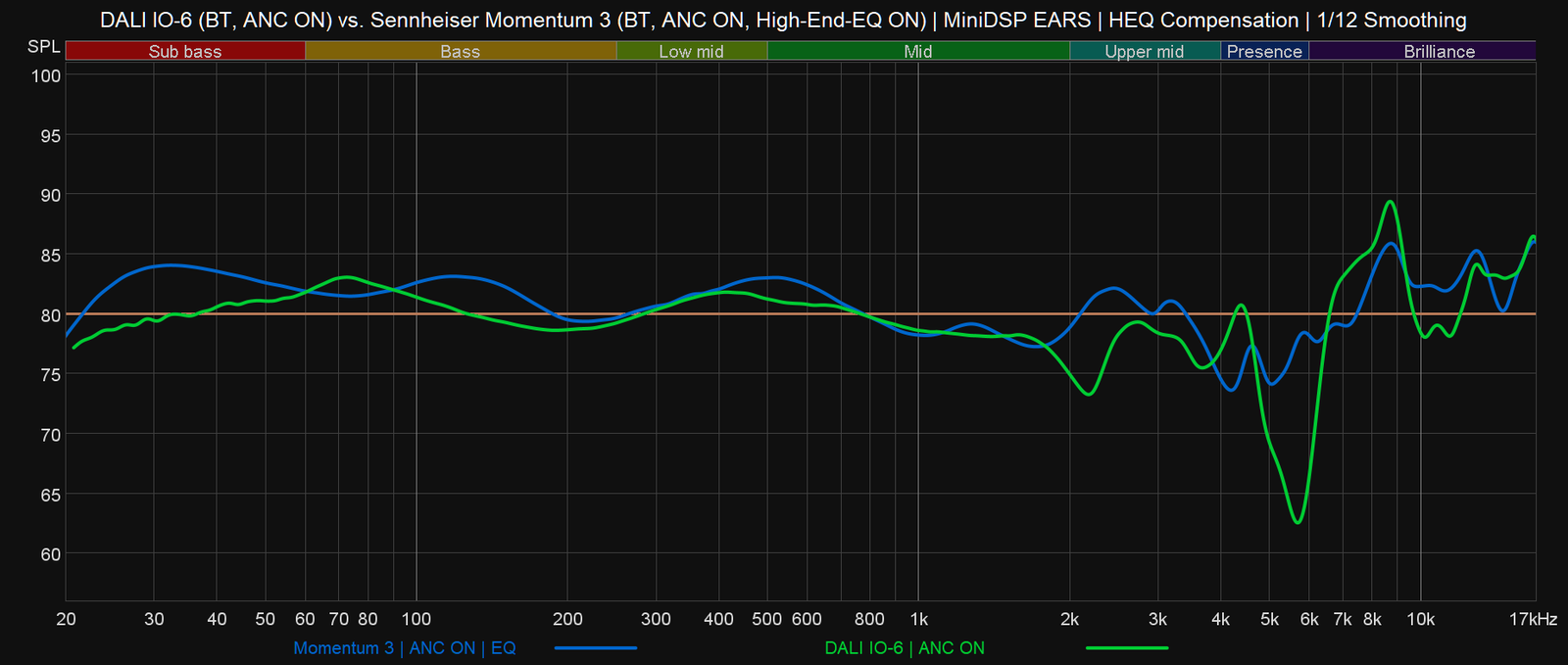
I have only listened to the Momentum 3 model with equalization, as the headphones' sound is by default far too bass-heavy and muffled. Fortunately, Sennheiser's phone app has a ready-made High End Sound setting, which largely transforms the headphones into what I would equalize them to myself. Unfortunately, it is not possible to reduce the amount of bass any further, but after the change, the amount is at least tolerable.
Frequency responses with noise cancellation on: IO-6 (green) and Momentum 3 (blue):
Bass:
Sennheiser has clearly wanted to ensure that no one can say the Momentum 3 has too little bass: there's a choice of outrageously much or much. This is essentially the headphones' biggest single problem, as the excessive amount of upper bass frequencies makes the bass sound soft and boomy, especially in wireless listening. Interestingly, the bass reproduction becomes more controlled when listening via cable, after which it is no longer very bothersome.
Considering wireless use, the bass of the IO-6, thanks to a more sensible tuning, sounds significantly tighter and dynamically more impactful. Comparing the two showed me that there is no benefit to be gained from the extra bass typical of the Momentum 3.
Mid-frequencies:
Both headphones have good mid-frequencies from a frequency response perspective. However, this is an area that Sennheiser could implement better in the Momentum 3. The mid-frequencies of the headphones are quite subdued and lifeless compared to the clearer and more interesting reproduction of the IO-6. The IO-6 engages the listener better, while the Momentum 3 is more relaxed to listen to. This makes it better suited for listening to lower quality music among the two. Most often, however, the listening experience is somewhat dull compared to the IO-6.
Treble:
The Momentum 3 is also more relaxed due to its less emphasized treble. The treble is also more balanced and natural-sounding than in the brighter IO-6. The treble of the Momentum 3 would normally match my preferences well, but somewhat surprisingly, I still prefer the sharper and fresher presentation of the IO-6 more. Qualitatively, the treble of the Momentum 3, when listened to via Bluetooth, is slightly unclear and less detailed than in the IO-6. However, the differences narrow when listening via cable, at which point the good qualities of the Momentum 3's treble become more apparent.
Other differences:
Despite the differences in frequency responses, I find the headphones to be quite similar in overall sound and, for example, soundstage size. It took me some time to realize why the IO-6 still immediately sounds better than the Momentum 3, which is a very good-sounding Bluetooth headphone on its own.
My explanation for this is that the IO-6's reproduction is more lively and transparent. When listening to music, one can perceive the effect of space on the sound, and there is also more empty space between sounds. The quietest sounds can be very quiet and still audible. The Momentum 3 has a flatter sound because there is less variation in volume between individual sounds. At the same time, it feels as if the sound is coming through a curtain, which further smooths out the overall experience. The Momentum 3, in a way, lacks any special characteristic that would make one enthusiastic about listening to it compared to the IO-6's more realistic presentation style.
Final remarks
Based on sound quality, when looking for the best possible closed-back Bluetooth headphones, my choice would undoubtedly lean towards the IO-6 among the two. However, the product category is much more than that, so it's easy for me to see many preferring the Momentum 3's more comprehensive features and more effective noise-cancelling function. It also doesn't have the background hiss like the IO-6, and its current price is about 100 euros lower. Although both headphones are designed for the same purpose, they are, in a way, aimed at different people. The superiority of one model depends on one's own needs and how much one is willing to pay for the headphones.
Summary
The product category of Bluetooth noise-cancelling headphones is interesting because headphone models have primarily competed in the effectiveness of their noise-cancelling function and additional features – sound quality often becomes almost a secondary consideration. DALI, however, seems to have clearly prioritized sound quality in the design of the IO-6 model. In my opinion, these headphones have received too little attention given how good and balanced they sound. They are also of high quality in construction, and they are easy and straightforward to use.

The positioning of the IO-6 in the headphone market is admittedly somewhat challenging, as it falls between its cheaper, but more effective in noise-cancelling, competitors and good wired headphones under 500 euros. Qualitatively, the IO-6 is closer to good headphones, especially among closed-back models, so it is very easy to recommend its purchase. However, if the effectiveness of the noise-cancelling function and other features are emphasized in the selection of similar headphones, DALI cannot compete with, for example, Sony, Bose, and Sennheiser.
I see the IO-6 primarily as a modern closed-back headphone that can be listened to wirelessly. The noise-cancelling function is a useful additional feature, but its effectiveness leaves a bit to be desired. The only major downside, however, is the strongly audible background hiss from the left side, which disturbs listening to calmer music. Without the hiss, I think the IO-6 would be so good that I would get a pair for myself for travel and office use.
I don't know, however, if all headphones have background hiss or if my pair is from a specific problematic production batch. If you become interested in acquiring these headphones, you should first try listening to them – the hiss might be disturbing or not. If there is no need for noise-cancelling, the more affordable IO-4 model might also be an interesting alternative. It is said to sound very similar, and it should not have any hiss at all.
Pros and cons:
+ There is a proper balance between frequency ranges
+ Controlled bass reproduction
+ Excellent and clear mid-frequencies
+ Despite its small size, the soundstage has pleasant separation and layering
+ The sound is lively and fresh in style, like good headphones
+ Sound quality with a Bluetooth connection is almost as good as when listening via cable
+ Using the headphones is easy: physical buttons work well
+ The noise cancelling function and its DSP correction are also available in wired listening
+ Good battery life
+ High-quality physical construction
+ Good comfort
+ IP53 rating (only a few headphones have official dust and water resistance)
– Hissing and in places overly emphasized treble
– A dip located in the presence region is unnecessarily large, so the nuance it adds to the reproduction may divide opinions
– The soundstage is quite closed-sounding despite its clarity
– Strong background noise can be heard from the left side
– There is a small delay in commands performed via the buttons
– The noise cancelling function does not fare well in effectiveness against most competitors
– No phone application has been made for the headphones, with which they could be, for example, equalized
– The ear pads should be slightly taller
– The price of the headphones is quite high if more is expected from them than excellent sound quality
 EN
EN  FI
FI